Review

A Review on the Applications of Various Zeolites and Molecular Sieve Catalysts for Different Gas Phase Reactions: Present Trends in Research and Future Directions


by
Preetha Chandrasekharan Meenu
*,
Bhagatram Meena
and
Panagiotis G. Smirniotis
*
Department of Chemical and Environmental Engineering, University of Cincinnati, Cincinnati, OH 45221-0012, USA
*
Authors to whom correspondence should be addressed.
Processes 2026, 14(1), 132; https://doi.org/10.3390/pr14010132 (registering DOI)
Submission received: 14 November 2025 / Revised: 17 December 2025 / Accepted: 25 December 2025 / Published: 30 December 2025
(This article belongs to the Special Issue Novel Applications of Zeolites in Adsorption Processes)

Abstract

Zeolites and molecular sieves have demonstrated remarkable potential in adsorption, ion exchange, and separation processes since their industrial revolution in the 1950s. Zeolites and molecular sieves are materials of choice in separation applications because of their well-defined microporous architecture, remarkable shape-selectiveness, and tunable characteristics. The adsorption process can be evaluated using an isotherm to determine the feasibility of gas mixture separation for practical applications. We will also discuss the basic structure of zeolites and molecular sieves based on different metals, along with their distinctive properties in detail. The purpose of this review is to contextualize the importance of zeolites and molecular sieves in adsorption and separation applications. The review has been divided into groups based on how zeolites as well as molecular sieves are established in the adsorption and separation processes. The fundamental adsorption characteristics, structures, and various separation methods that make zeolites appealing for different uses are covered. By incorporating knowledge of adsorption mechanisms, isotherms, and material changes, this review discusses the most recent developments. To augment zeolite-based materials for certain pollutant removal applications, it offers a strategic framework for future study. In this review, we will comprehensively discuss a range of separation and adsorption applications, including wastewater purification, CO2 capture from flue gases, and hydrogen storage. Furthermore, the review will explore emerging prospects of zeolites and molecular sieves in innovative fields such as energy storage, oil refining, and environmental remediation. Emphasis will be placed on understanding how their tunable pore structures, surface chemistry, and metal incorporation can enhance performance and broaden their applicability in sustainable and clean energy systems.

1. Introduction

Adsorption is a vital physicochemical process that plays a vital role in numerous industrial and environmental applications. This technique is a surface energy phenomenon and is considered of high importance because of the rewards, including precursor availability, low sorbent cost, and superficial sorbent regeneration process [1,2]. In modern technology, adsorption has evolved into a mature and highly versatile separation technique, extensively applied in areas such as catalysis, environmental remediation, gas storage and separation, water purification, pharmaceutical formulation, agriculture, and medical diagnostics [2]. Among them, separation has gained a lot of attention, as it is highly important for society, as it accounts for 10–15% of global energy use [3]. It involves the accumulation of atoms, ions, or molecules from a fluid phase onto a solid surface, leading to the formation of an adsorbed layer. This process is reversible in many cases and governed by factors such as surface area, pore structure, chemical functionality of the adsorbent, and the nature of the adsorbate. Among the broad spectrum of adsorbents, zeolites and molecular sieves have emerged as materials of particular interest due to their unique physicochemical characteristics, such as crystalline microporous structure, high surface area and pore volume, ion exchange capacity, thermal and chemical stability, surface acidity and basicity, hydrophilic and hydrophobic nature, uniform and adjustable pore size, and tailorable composition and framework [4,5]. These materials exhibit crystalline microporous frameworks, typically formed from SiO4 and AlO4 tetrahedra, linked through shared oxygen atoms. Their ordered structure forms uniform channels and cages, whose dimensions and surface properties can be finely tuned through compositional and synthetic modifications. This structural tunability enables size- and shape-selective adsorption, making them ideal candidates for applications requiring molecular discrimination at the angstrom level [6].
Zeolites are aluminosilicate minerals classified under tectosilicates, with a general empirical formula, M y z + [ S i 1 x A l x O 2 ] x , where M represents an exchangeable cation (e.g., Na+, K+, Ca2+), z—cation valency, and x—Si/Al ratio, typically ranging between 0 and 0.5, following Lowenstein’s rule (Figure 1) [7,8]. The integration of heteroatoms such as B, Ga, Fe, or P allows for further functional diversity. These cations balance the negative charge generated by AlO4 units and are often located within the pores and channels of the framework, where they can participate in ion exchange or catalytic interactions. The high surface area, cation exchange capacity, thermal stability, and acidic/basic sites collectively endow zeolites with multifaceted functionality. The historical significance of zeolites started in 1756 when Axel Fredrik Cronstedt, a Swedish mineralogist coined the term “zeolite” (from Greek zein, “to boil” and lithos, “stone”), upon observing the evolution of steam from a mineral when heated. This early observation foreshadowed their role in thermal and catalytic applications, where their stability under diverse temperature and pressure regimes proves indispensable [9,10].
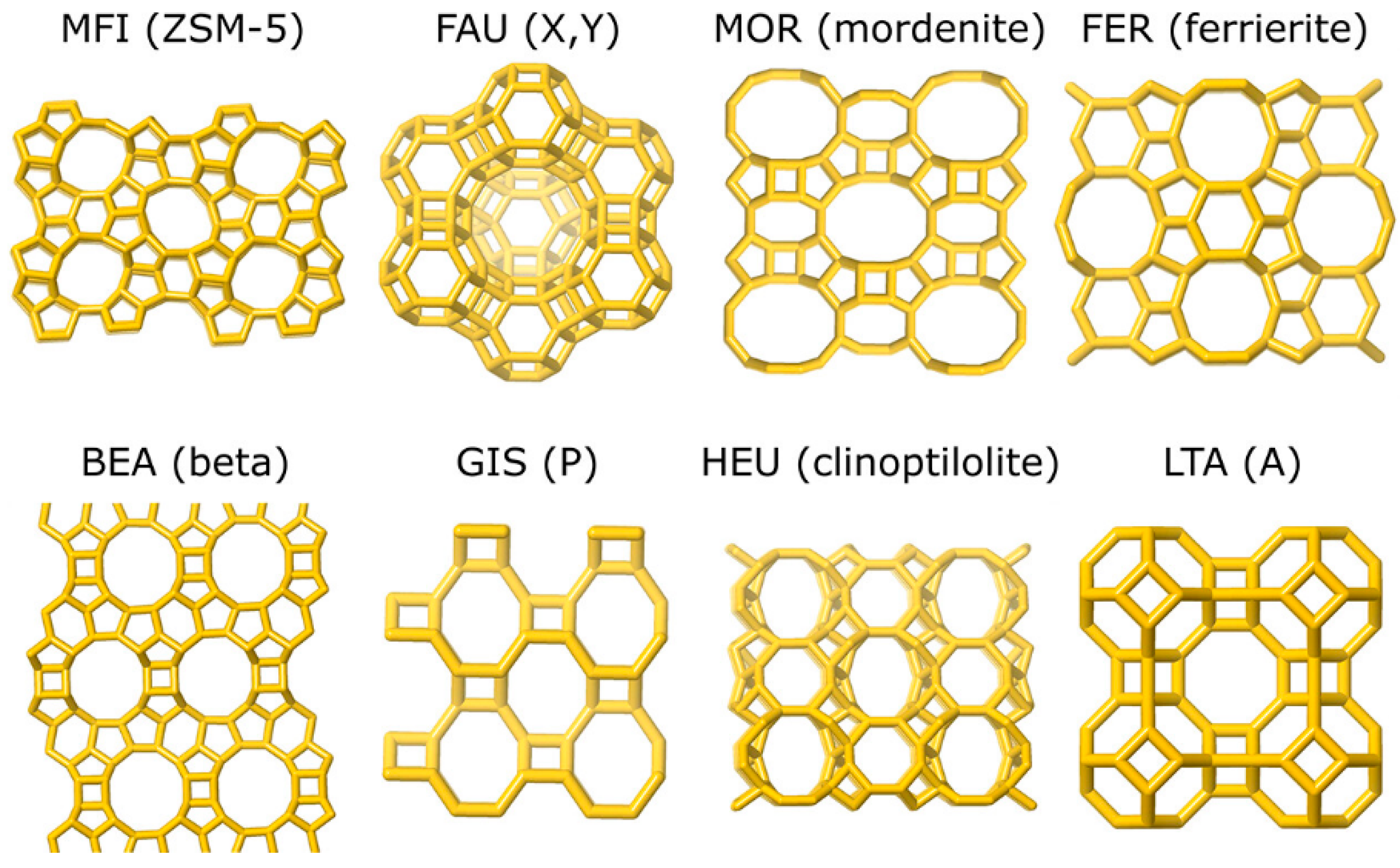
The industrial importance of zeolites became particularly pronounced with the commercialization of synthetic analogues, notably zeolite A, X, Y, ZSM-5, beta, and mordenite, which are now widely used in hydrocarbon processing, cracking, isomerization, adsorptive separation, and environmental protection technologies [10,11,12]. Some of the industrially important zeolites are shown in Figure 2. These frameworks are characterized by pore apertures ranging from 3 Å to 8 Å, allowing for high selectivity in gas separation (e.g., CO2/CH4, CO2/N2), purification of hydrogen, dehydration processes, and selective adsorption of volatile organic compounds (VOCs) [13,14].
Recent advancements have witnessed a paradigm shift in zeolite science, propelled by innovations in synthesis strategies, nano-structuring, and surface functionalization. The development of hierarchical zeolites, which integrate mesoporosity into microporous frameworks, has addressed limitations related to mass transport and accessibility of active sites. Additionally, post-synthetic modifications such as ion exchange, surface grafting, or the incorporation of functional organic groups have enabled the tailoring of adsorption affinity and selectivity toward specific target molecules [16,17].
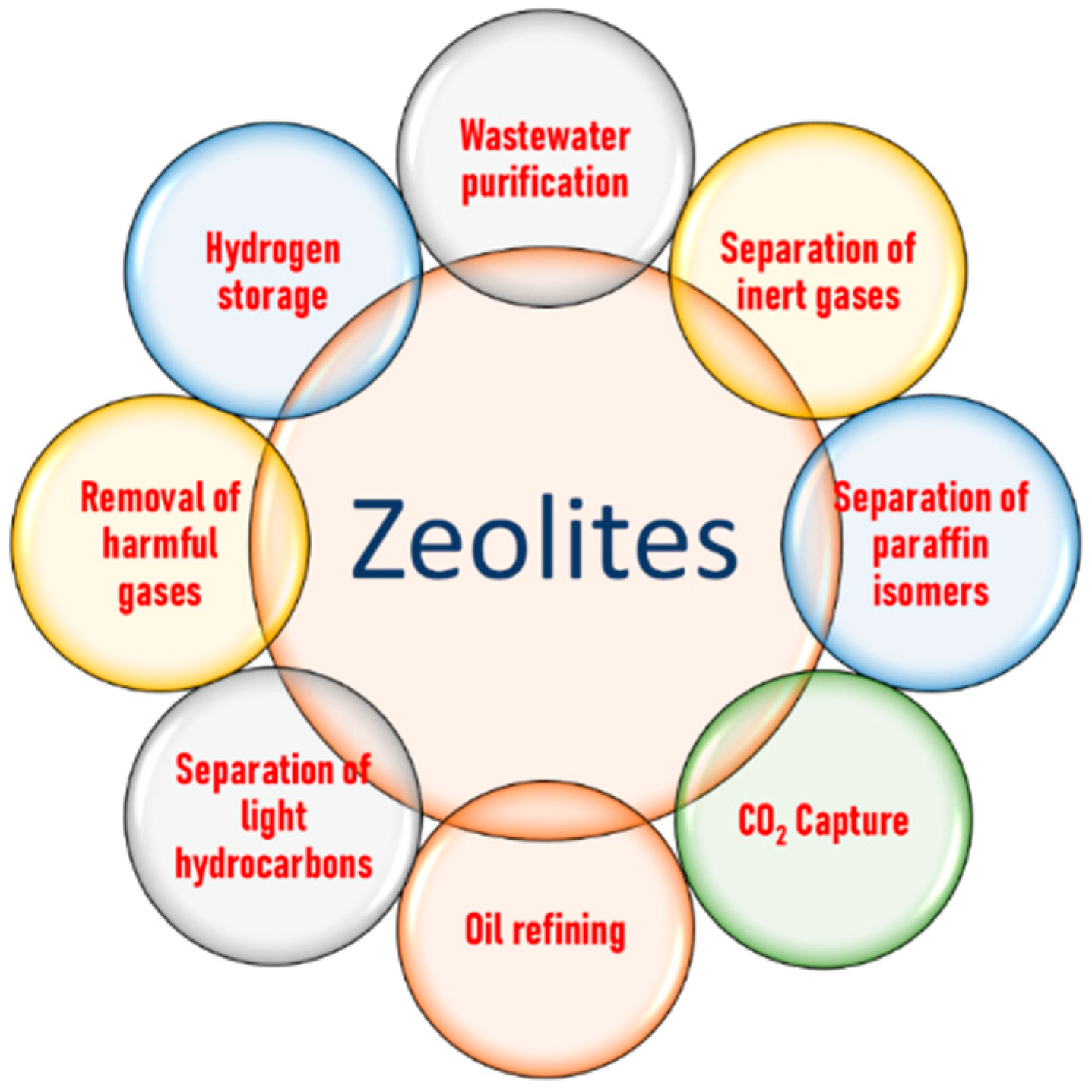
Beyond conventional applications, zeolites are now being explored for emerging challenges, including carbon capture and sequestration [18] (CCS), air quality control [11], drug delivery systems [19,20], radioactive waste remediation [21,22], bio separations [23,24], etc., as in Figure 3.
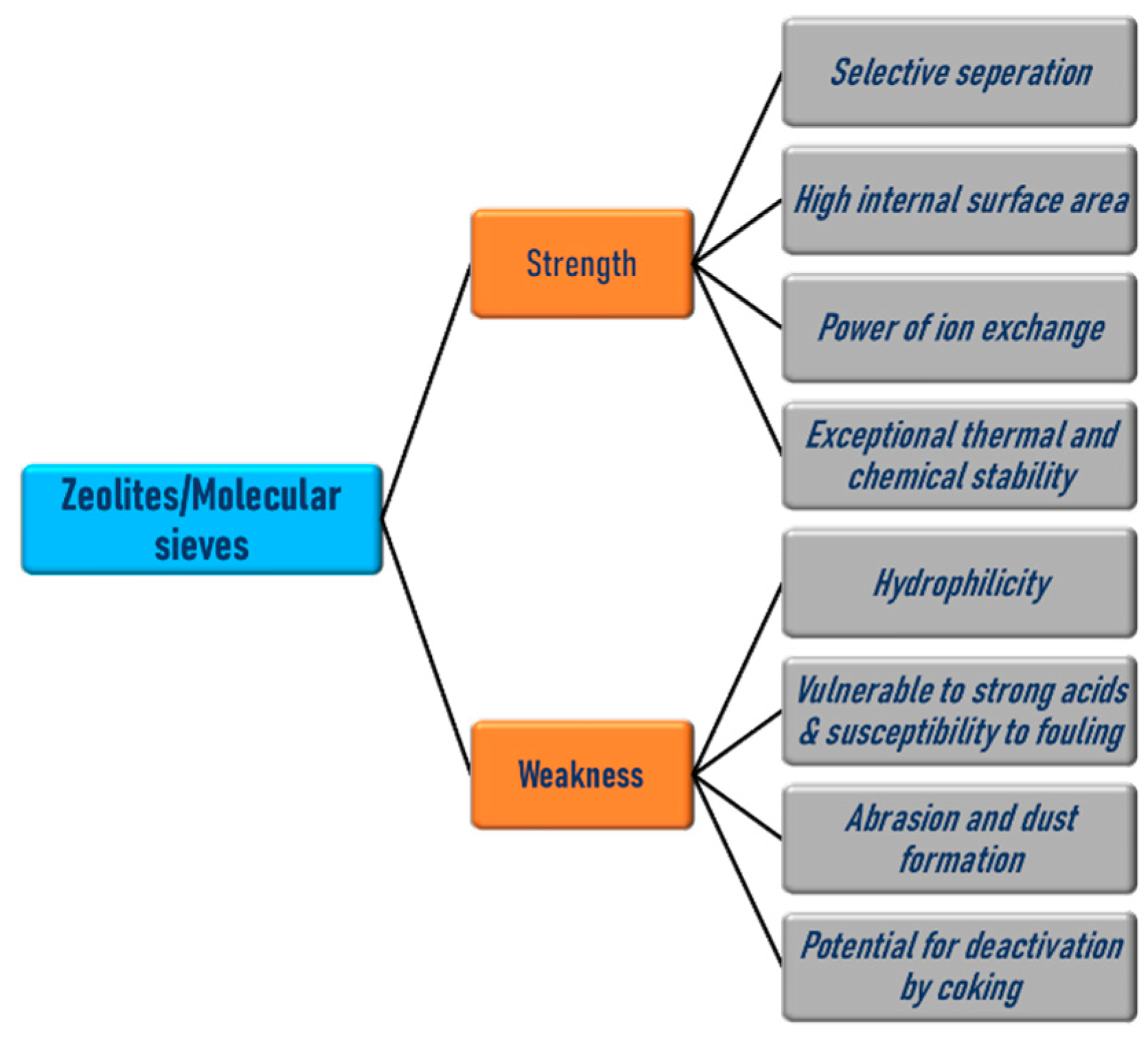
Some of the recent zeolites synthesized for CO2 capture low silica X zeolite [25], Li-SSZ-13 [26]. Zeolite-A/chitosan nanocarrier [27] and Quercetin-loaded magnetic zeolite nano-composite [28] are some of the latest zeolites explored for drug delivery. These novel applications demand precise control over pore architecture, surface chemistry, and adsorption energetics, thereby stimulating continued research into molecular simulation, machine learning-guided design, and structure–property correlation analysis. The interplay between structural topology, chemical composition, and adsorption behavior underscores the need for a deeper understanding of zeolitic materials and their synthetic analogues. Some of the advantages and weaknesses of zeolites are presented schematically in Figure 4. Another important criterion that makes zeolite stand on its own is its adsorption isotherm. The adsorption isotherms of zeolites can be altered by varying pore size, framework, and composition. Different isotherms provide diverse adsorption behaviors [29,30,31]. For example, zeolite AQSOA has an S-shaped isotherm, which results in hydrophobic behavior at the low-pressure region. This distinctive quality makes it viable to be used for water adsorption at low-temperature ranges [32].
There has been limited coverage on the types of zeolites and various reaction conditions adopted not only for CO2 adsorption but also removal of harmful gases, separation of isomers, hydrogen storage, and the removal of other harmful gases. Mechanistic aspects and the role of co-adsorbates for the application of zeolites in various adsorption processes in a real industrial stream has to be explored and included in reviews. Most of the review focuses on the adsorption process of any one of the gases. There is a lack of comparative reviews on different pollutants, which include CO2, CH4, VOCs, SO2, and pharmaceuticals, where zeolites play a major role in unified conditions.
This review aims to provide a comprehensive overview of the recent advances in zeolites and molecular sieves as adsorbents, with a focus on their structural attributes, synthetic methodologies, and performance in diverse adsorption-driven processes. Special emphasis is placed on correlating material characteristics with functional performance as well as highlighting the opportunities and challenges in adapting these materials to meet future separation and purification demands. We will be discussing future aspects in environmental redemption, energy storage systems, and separation processes. By offering an in-depth evaluation of state-of-the-art developments and application frontiers, this review serves as an orientation point for scientists aiming to develop next-generation adsorbents tailored for sustainable, high-efficiency processes.

2. Zeolites and Molecular Sieves for Adsorption

2.1. Capture and Separation of Carbon Dioxide

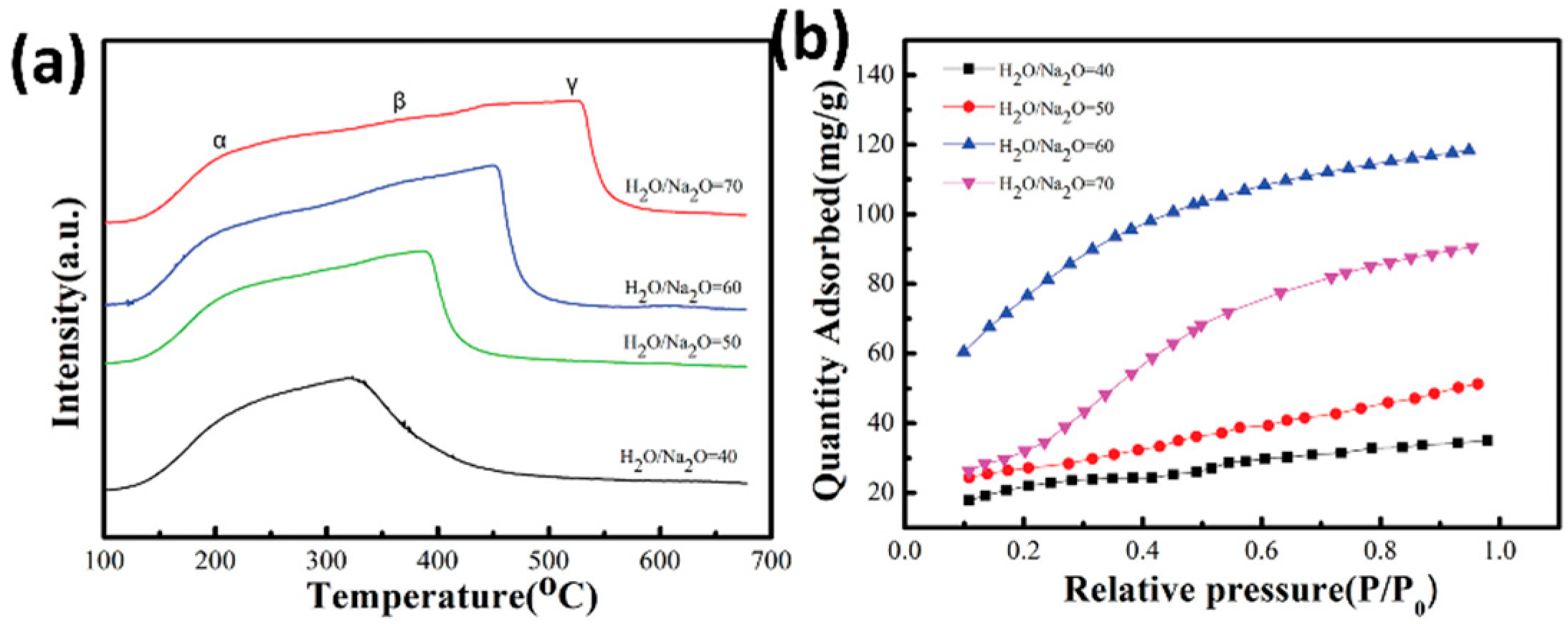
Adsorption of CO2 is a capable approach to mitigate anthropogenic CO2 productions. It involves taking CO2 emitted from large sources and afterward employing it as an industrial feedstock or storing it underground. The selective adsorption of CO2 on different adsorbents’ surface is generally optimized by their superior adsorption strength, kinetics, and/or availability toward CO2 compared to other gaseous components (e.g., N2, CH4, and O2) [33,34]. The efficiency and selectivity of CO2 adsorption basically depend upon the CO2 adsorbents, together with high CO2 capacity and CO2 selectivity, better kinetics for CO2 adsorption/desorption, reusability nature, non-toxicity, and cost effectiveness [35,36]. In this scenario, developing a porous material meeting all these criteria is mandatory. Different synthesis strategies and the effect of synthesis conditions were adopted by researchers to enhance CO2 adsorption. For example, 13X zeolites were synthesized by hydrothermal methods and the effect of synthesis condition were studied towards the activity towards CO2 adsorption [37]; 13X zeolites were synthesized hydrothermally employing Na2SiO3·9H2O and NaAlO2 as the starting material. CO2 adsorption performance and the structure property were studied with the effects of n(H2O/Na2O). As observed from CO2 TPD (Figure 5a), with the increase in n(H2O/Na2O), the temperature of medium-strong adsorbed CO2 and strong adsorbed CO2 peaks shift to higher temperatures, which indicates that the interface between CO2 and 13X is steadily boosted. With the increase in n(H2O/Na2O), CO2 adsorption capacity enhanced (118.3 mg/g), which was in good agreement with CO2-TPD activity, Figure 5b.

2.1.1. Mechanism of Zeolites for CO2 Separation

Preferential adsorption is the bottle neck mechanism for the separation of CO2 from gas mixtures. Weak chemical reactions, Van der Waals interactions, and electrostatic interactions are the three primary gas–zeolite interactions. The ionic frameworks of the zeolite possess a surface electric field that determines gas–zeolite interaction. The electrostatic interactions act on gas molecules with higher polarizability and multipole moments [38,39]. In the case of weak chemical interaction between zeolites and the gases, there will be the π-complexation among gas molecules and specific transition metal cations within zeolites. The parameters of zeolites that involve the adsorption of CO2 include the Si/Al ratio, basicity, polarizing power and pore size, distribution, and size and amount of exchangeable cations [40,41]. In zeolites, cations play a major role in the adsorption process. The presence of these cations form strong electrostatic interactions with oxygen atoms, resulting in CO2–cation complexes that enhance CO2 adsorption. CO2 capture by zeolites is either physisorption or chemisorption. Physisorption occurs by weak Vanderwal’s interactions, and dipole–dipole interactions and dispersion forces are the primary forces involved. In case of physisorption, there is a release of heat and reduction in enthalpy once CO2 molecules are attracted to the zeolite surface. There will be disorder in CO2 molecules on the surface of zeolite. With a decrease in pressure or increase in temperature, there will be desorption of CO2. In chemisorption, there will be the direct bond formation between zeolite, resulting in its electronic structure [42]. There will be electron transfer or configuration with a drastic enthalpy and heat release.
Various theories can be adopted for the adsorption of CO2 on zeolites.
(i) 
Steric Effect
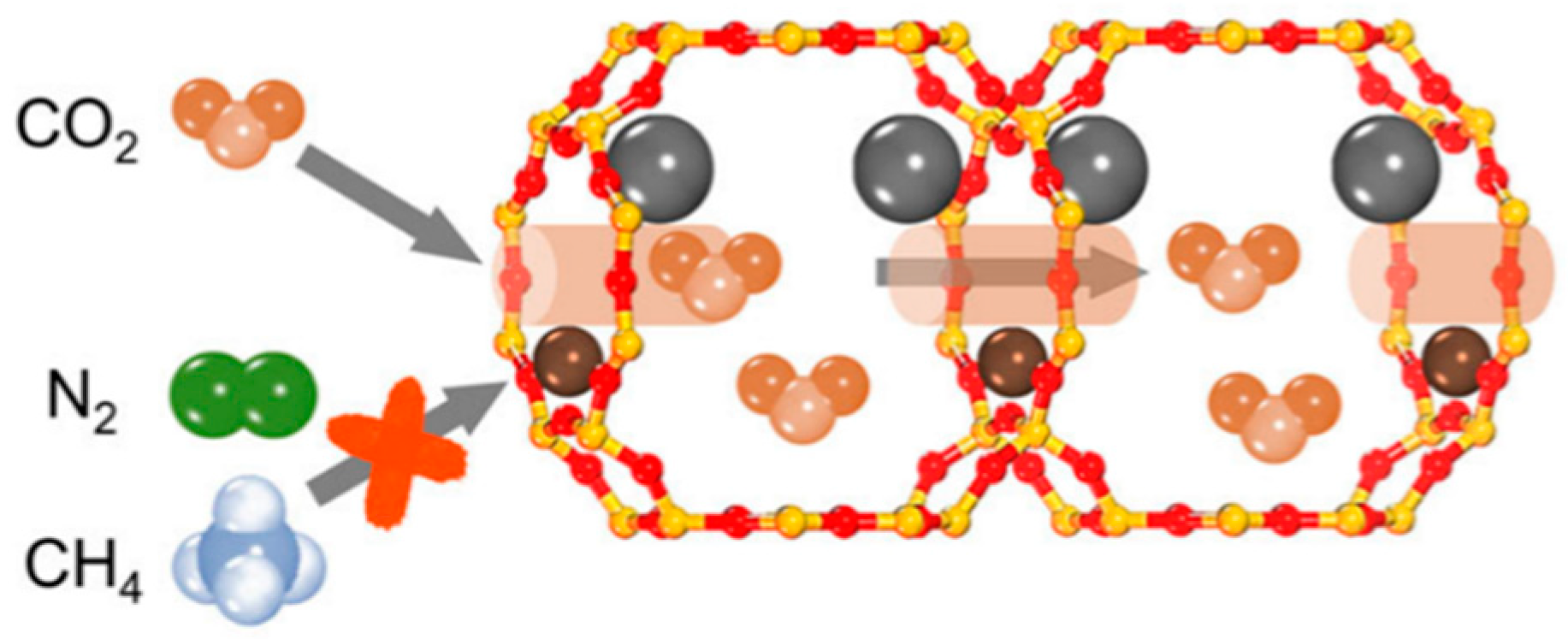
A steric effect is a size exclusion mechanism, as shown in Figure 6, which can be implemented in porous material with pore diameter larger than CO2 but smaller than other gaseous mixtures, including N2 and CH4. This mechanism is implemented on zeolites with common name molecular sieves. To implement a steric effect in zeolites, frameworks are synthesized by tunning aperture size. One such zeolite is amine-modified β-zeolite, adopted for the separation of CO2 from methane and nitrogen on monoethanol, where steric effects played a drastic role [43]. Functionalization with amine improved the selectivity along with the steric effect, and the chemical adsorbate–adsorbent interaction played a major role. On amine functionalization to zeolites, there was a decrease in pore diameter. As pore diameter reduced, there was a comparatively lower effect on CO2 compared with N2 and CH4, which increased CO2 separation.
(ii) 
Kinetic Effect
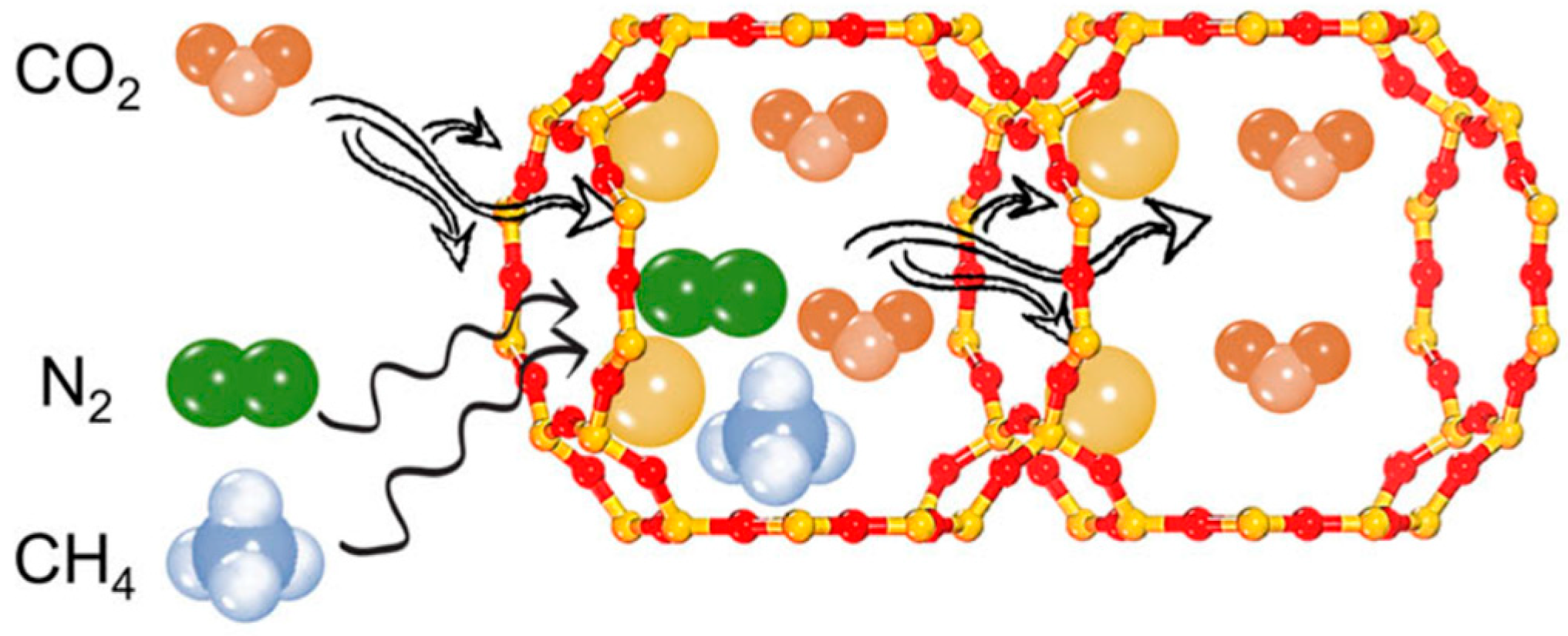
CO2 separation via kinetic-based mechanisms leverages the differential diffusion rates of gas molecules within the microporous structure of zeolites (Figure 7). This approach capitalizes on the fact that CO2 exhibits a faster diffusion rate compared to other gases, such as N2 or CH4, when traversing zeolitic frameworks. The kinetic selectivity becomes particularly significant in small-pore zeolites, where the pore apertures are analogous to the kinetic diameters of the gas molecules. Under these conditions, molecular sieving effects dominate, enabling preferential uptake of CO2 based on size and diffusion-driven exclusion of larger or slower-moving species. The effect on the kinetic behavior of Li-, Na-, K-, Mg-, Ca-, and Sr-exchanged KFI zeolites for CO2 separation from CH4 was studied by Remy et al. [44]. K-exchanged KFI zeolites exhibited highest selectivity towards CO2, as CH4 was unabsorbed due to kinetic limitations.
(iii) 
Gating Effect
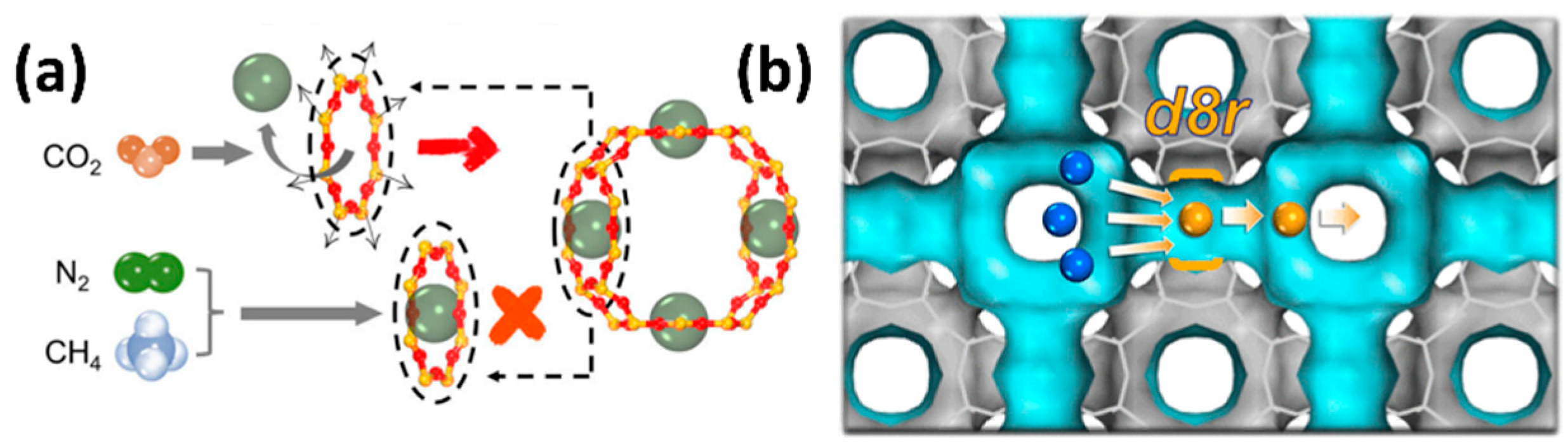
The gating effect in zeolite-based CO2 separation refers to a dynamic adsorption mechanism wherein the flexible framework temporarily restricts or permits access to the pore channels, thereby permitting careful adsorption of CO2 over other gases (Figure 8a). This phenomenon is typically associated with either the trapdoor effect, where strong host–guest interactions displace extra-framework cations to allow for CO2 entry, or the gate-opening (breathing) effect, involving reversible structural relaxation of the zeolite framework. Due to its stronger interaction with the zeolite matrix, CO2 is capable of overcoming these energy barriers, granting it preferential access to adsorption sites that remain inaccessible to less-interacting molecules like CH4 and N2 [36,39]. Liu et al. introduced a molecular self-gating on a zeolite structure [45]. The authors concluded through theoretical studies that the adsorbates at low concentration will spontaneously form a gate by themselves, which inhibits the movement of other molecules and promotes selective adsorption and separation of molecules (Figure 8b).

2.1.2. CO2 and H2 Separation from Water–Gas Shift (WGS) Reaction

The WGS reaction, a crucial process in syngas upgrading, plays a vital role in hydrogen (H2) production and pre-combustion CO2 capture, particularly in integrated gasification-combined cycle power plants (IGCC). The primary challenge in WGS is achieving complete CO conversion, which relies heavily on the efficient and timely removal of the reaction products, CO2 and H2 [46,47]. Enhanced WGS processes have demonstrated significant potential for clean hydrogen production and effective carbon capture. These advancements are essential to enable a low-carbon hydrogen economy. Notably, operating at high temperature and pressure, the WGS reaction results in the generation of high-purity, pressurized CO2, substantially reducing the energy demands for downstream CO2 compression in CCS systems. However, a major limitation is the lack of efficient high-temperature and high-pressure separation technologies that can offer both selectivity and durability under harsh reaction conditions. In this context, zeolite-based membranes have arose as capable candidates for achieving high H2 recovery and near-complete CO conversion while simultaneously producing a high-pressure CO2 stream suitable for CCS [48,49]. Due to their crystalline structure, zeolite membranes exhibit excellent hydrothermal stability and inherent resistance to sulfur-containing compounds, making them well-suited for WGS applications. While natural zeolites are typically not suitable for WGS, tailored modifications enable the design of membranes with desired physicochemical properties. Recent advancements have demonstrated the potential of zeolite membranes to improve WGS performance. For example, Kim et al. developed a modified MFI-type zeolite membrane capable of efficiently separating reaction products, thereby enhancing the CO conversion rate. Membranes were synthesized by hydrothermal method and the activity was compared with the structural modification of the membrane using methyl diethoxysilane by onstream method at 450 °C. An unmodified membrane was more selective towards CO2, as better adsorbed CO2 hinders the entry of non-adsorbing H2, while a modified membrane exhibited better H2 adsorption, as there were less defects after modifications. Their membrane exhibited an H2 permeance of approximately 10−7 mol/s m2 Pa, achieving CO conversions ≥ 99% under industrially relevant conditions [50]. In another notable study, Wang et al. fabricated a bilayer MFI zeolite membrane composed of a thick silica substrate with a thin ZSM-5 layer, supported by microporous α-alumina and yttria-stabilized zirconia. Pore size tuning was achieved via catalytic cracking deposition. This membrane demonstrated excellent selectivity towards H2 and remained stable under a gas stream containing up to 400 ppm H2S. The H2 permeance was around 1.2 × 10⁻⁷ mol/m2 s Pa at 500 °C, with sustained performance over 24 days [51]. Carbon molecular sieve membranes (CMSMs) were also explored in WGS shift reaction for H2 generation and CO2 capture in an Integrated Gas Combined Cycle up to 250 °C and pressures up to 25 bar, using a model coal gasifier syngas [52]. The membrane exhibited a stable performance up to 750 h of syn gas exposure. Iyer et al. explored hyperselective carbon molecular sieve hollow fiber membranes synthesized by stirred interfacial polymerization for H2/CO2 selectivity, which was an exceptional 7000 under mixture permeation at 150 °C, while at 400 °C, the selectivity was over 1400 [53]. Ultra micropores in the membrane were responsible for effectively separating the closely sized H2 and CO2 molecules. Theoretical studies show that the extraordinary H2/CO2 selectivity will hypothetically allow for one-step enrichment of H2 from shifted syngas.
Furthermore, recent research has explored the use of crystalline metal–organic framework (MOF) membranes for enhanced separation of H2 and purification of the product stream, particularly for low-temperature WGS applications. These hybrid materials offer tunable porosity, high surface area, and functional versatility, further expanding the scope of membrane-based separation technologies for hydrogen production and CO2 capture. The membrane showed a hydrogen permeance of 9.2 × 10⁻⁷ mol/m2 s Pa and a corresponding H2/CO ideal selectivity of 6.13 at room temperature [54]. Hydrogen-selective zeolite membranes were explored by Zhang et al. by modifying zeolitic pores with methyldiethoxysilane deposition (MFI zeolite). The membrane exhibited a 42.6 H2/CO2 separation factor with 2.82 × 10⁻⁷ mol/m2 s Pa H2 permeance at 500 °C. At 300 °C, 95.4% CO conversion was achieved. The modified membranes exhibited excellent CO tolerance and was a potential candidate for separation of H2 [55].

2.1.3. CH4/CO/CO2 Separation

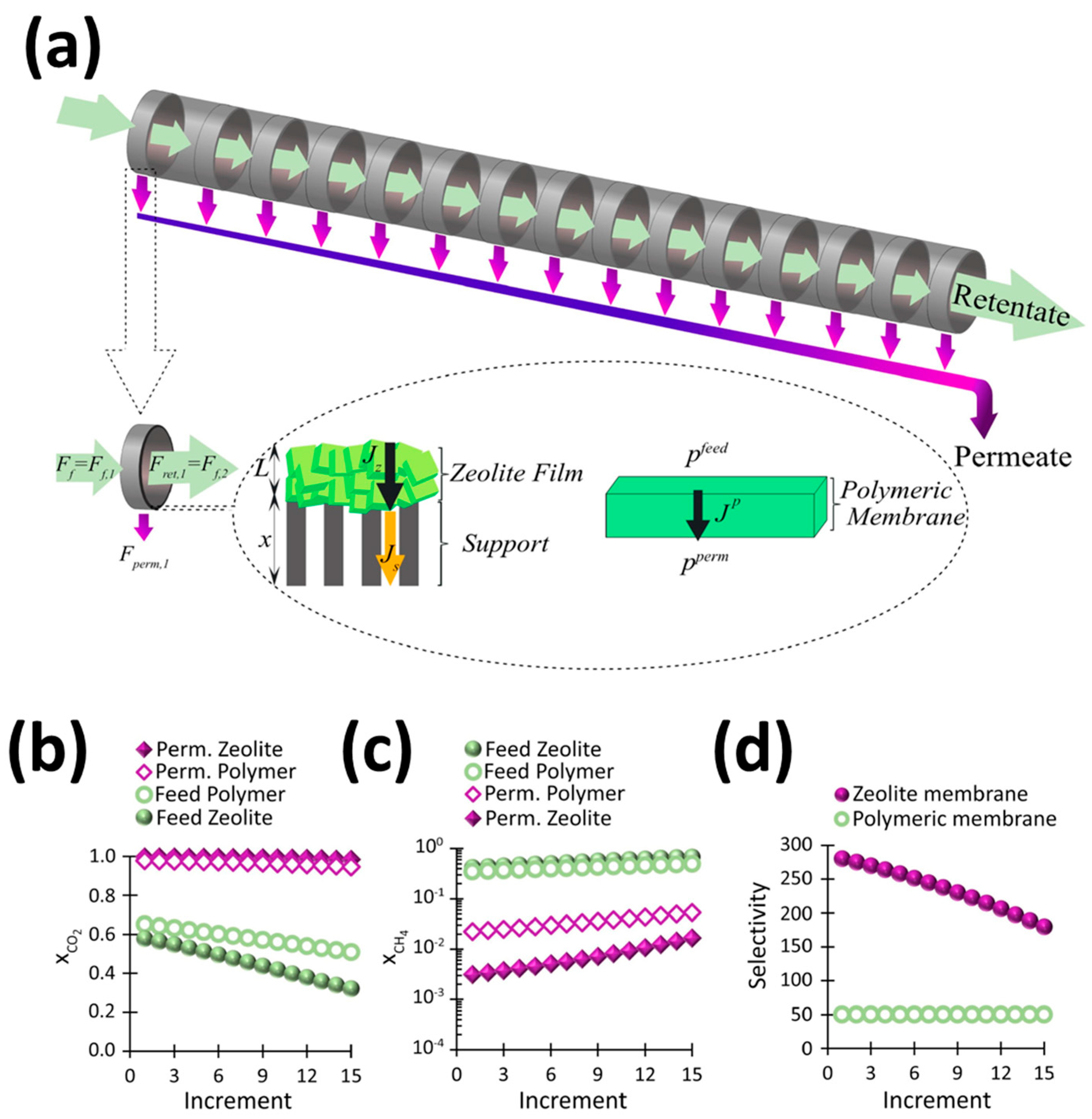
Zeolites are promising membrane materials for separating methane (CH4), carbon monoxide (CO), and carbon dioxide (CO2) because of their ceramic stability and well-defined pores, which can provide both high permeability and selectivity. These membranes separate gases primarily through preferential adsorption. Among the gases, CO2 is adsorbed more strongly than CH4 due to its higher polarizability and faster diffusion through the zeolite structure. CO typically shows similar or lower adsorption compared to CH4, as shown in Figure 9 [56]. The membranes adopted were tubular in geometry with 15 increments of constant membrane. The efficacy of zeolite membrane was shown at different pressures of 5 bar, 10 bar, and 20 bar. The zeolitic membrane was more compact and had higher selectivity. To gain a better insight on how CH4 and CO2 adsorb and diffuse within MFI-type zeolites, Zhang et al. used computational methods, including molecular dynamics simulations to support experimental work. The authors explored the effect of temperature and pressure on the self-diffusion coefficient [57]. Specifically, Grand Canonical Monte Carlo (GCMC) simulations were used to calculate adsorption isotherms and isosteric heats for pure gases and binary mixtures at various temperatures. Their results revealed competitive adsorption between CO2 and CH4, where CO2 adsorption remained similar to that in pure gas conditions, while CH4 adsorption showed minor changes. Importantly, CO2 separation by MFI zeolites was dominant. The study also found that lowering the temperature or increasing the pressure can enhance the selectivity for CO2 adsorption on CH4.
Another group explored the CO2, H2, and CH4 adsorption kinetics on zeolite 13X with octahedral structural by volumetric method [30]. A micropore diffusion approach was applied to explore the kinetic adsorption. The adsorption isotherm of CO2, H2, and CH4 on zeolite 13X increased with an increase in pressure while a decrease in the quantity of gas adsorbed with temperature. According to the kinetic adsorption curve, the diffusivity of CO2 is higher than CH4 and H2 in zeolite 13X. The enhanced diffusivity of zeolite 13X for CO2 can be attributed to the adsorbent pores and higher surface concentration, causing the molecules to slide across the surface. This slippage results in surface diffusion at the maximum adsorption load and highest pressure, and this surface diffusion enhances the overall intracrystalline diffusivity as pressure increases. Researchers increased the number of gases (CO2, CO, CH4, N2, and H2) and explored multicomponent separation [58]. The authors investigated the adsorption capacity of zeolite-5A@MOF-74 with core shell structure for the purification of H2 from steam methane reforming stream. It was observed that zeolite exhibited a 20–30% enhancement in the uptake of CO2, CO, CH4, and N2 because of its high surface area and pore volume. The composite at 20 bar and room temperature exhibited equilibrium capacities of 13.8, 8.0, 7.7, and 6.7 mmol/g for CO2, CO, CH4, and H2 respectively, surpassing the capacities of the original adsorbents.
In another concept, CO2 absorption using MCM-41 has been considered as an effective strategy. Li et al. reported functionalization of MCM-41 by grafting, impregnation, and two-step methods combining grafting and impregnation to improve the CO2 absorption capacity [59]. They reported that combining the strategies enhanced the CO2 absorption more than single amine alone. The enhancement in the absorption capacity was attributed to the synergetic effect of APTES and TETA, where the formation of an intertwined network enhanced the CO2 diffusion capacity to MCM-41. This strategy enhances cyclic stability for the zeolite for continuous CO2 absorption. There have been various studies with functionalization to improve the CO2 absorption capacity.
Carbon-based molecular sieves have gained great attention towards the separation of CH4/CO/CO2 in terms of permeability and perm selectivity. Zhang and koros [60] reported the permeability selectivity of CO2/CH4 of carbon molecular sieves prepared from polyimide precursors. The authors detected CO2 permeability of 26 Barrers and a selectivity greater than 3600 for CO2/CH4 pure-gas at 900 °C, yet another group synthesized carbon molecular sieves from polyimide, P84, for CO2/CH4 separation [61]. Calcination temperature form 550–800 °C in a vacuum atmosphere was adopted during the synthesis. The highest permeability was exhibited by a molecular sieve obtained at 800 °C. The permeability was about 500 Barrers and 89 selectivity. The permeability of CH4 was less in a binary gas system compared to an individual system.

2.1.4. CO2/CO Separation

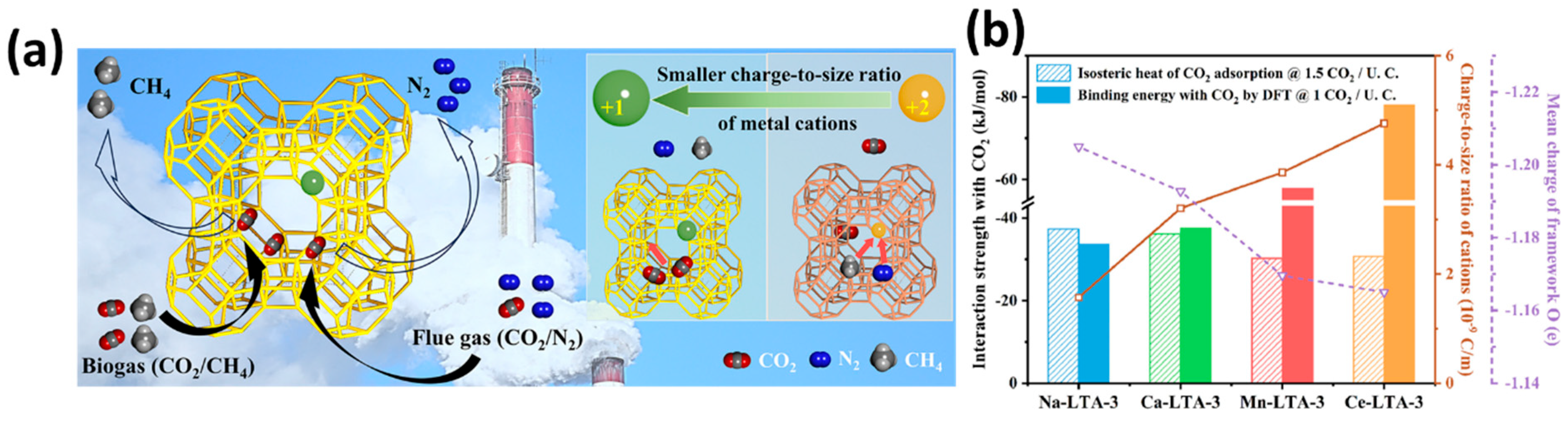
Zeolite exhibited its exceptional ability to separate CO2 and CO, as it has substantial differences on CO2 and CO adsorption amounts. Cui et al. explored the adsorption and separation of CO2 and CO on NaX and CaA zeolites both experimentally and theoretically [62]. NaX zeolite exhibited low adsorption heat but high separation on CO2/CO. In the case of CaA, zeolites exhibited excellence under different ratios of CO2/CO mixture. It was concluded that NaX zeolites have higher separation coefficients, whereas better separation stability was exhibited by CaA zeolites. High adsorption capacity and selectivity was obtained with better volume and huge alterations in the adsorption complex of CO2 and CO with Na+. In a study conducted by Cui et al., the separation of CO2 and CO in blast furnace gas using zeolites was investigated through both experimental and theoretical approaches [63]. The authors examined the influence of varying CO2/CO mixing ratios on the separation performance of LiX zeolites exchanged with different cations. Theoretical simulations revealed that LiX zeolites demonstrated high selectivity and efficiency for CO2 capture. This performance was attributed to the distinct potential energy distribution of adsorption sites within the LiX structure, which effectively suppressed competitive CO adsorption, thereby facilitating the release of high-purity CO2. Additionally, a study by Tao et al. established Na+-, Ca2+-, Mn2+-, and Ce3+-exchanged LTA zeolites as selective CO2 adsorbents for carbon capture from flue gas with CO2 (15)v/N2 (85)v and biogas CO2 (50)v/CH4 (50)v, as revealed in Figure 10 [64]. Na-LTA-3 was concluded to be the most promising candidate, with more adsorption sites and smallest charge-to-size ratio, exhibiting the maximum CO2 uptake selectivity and regeneration capacity and separation factors. The adsorption of CO2 at modest pressures on Na-LTA-3 was mainly governed by the gas–framework interaction. Theoretical studies confirmed that metal with larger charge-to-size ratio had better interaction with CO2 due to electrostatic interactions, resulting in Ce3+-exchanged zeolite having better adsorption capacity with the highest binding energy. In Table 1, we have tabulated recent studies on CO2 separation from the mixture of gases based on zeolites.
Hence, it has been established that zeolites are still the trending catalyst for adsorption on the industrial level with its modifications in its structure by synthesis methods, cation exchange, natural precursor, etc. New zeolites are studied for emerging adsorptive separations with modifications such as the separation of hydrogen isotopes, removal of pollutants, and separation of bio-alcohols. The research now focuses on process improvement and recyclability of the catalysts for use in the long run. Researchers are also concentrating towards coupled approaches with a single zeolite, where there will be adsorption along with reaction.

2.2. Separation of Inert Gases

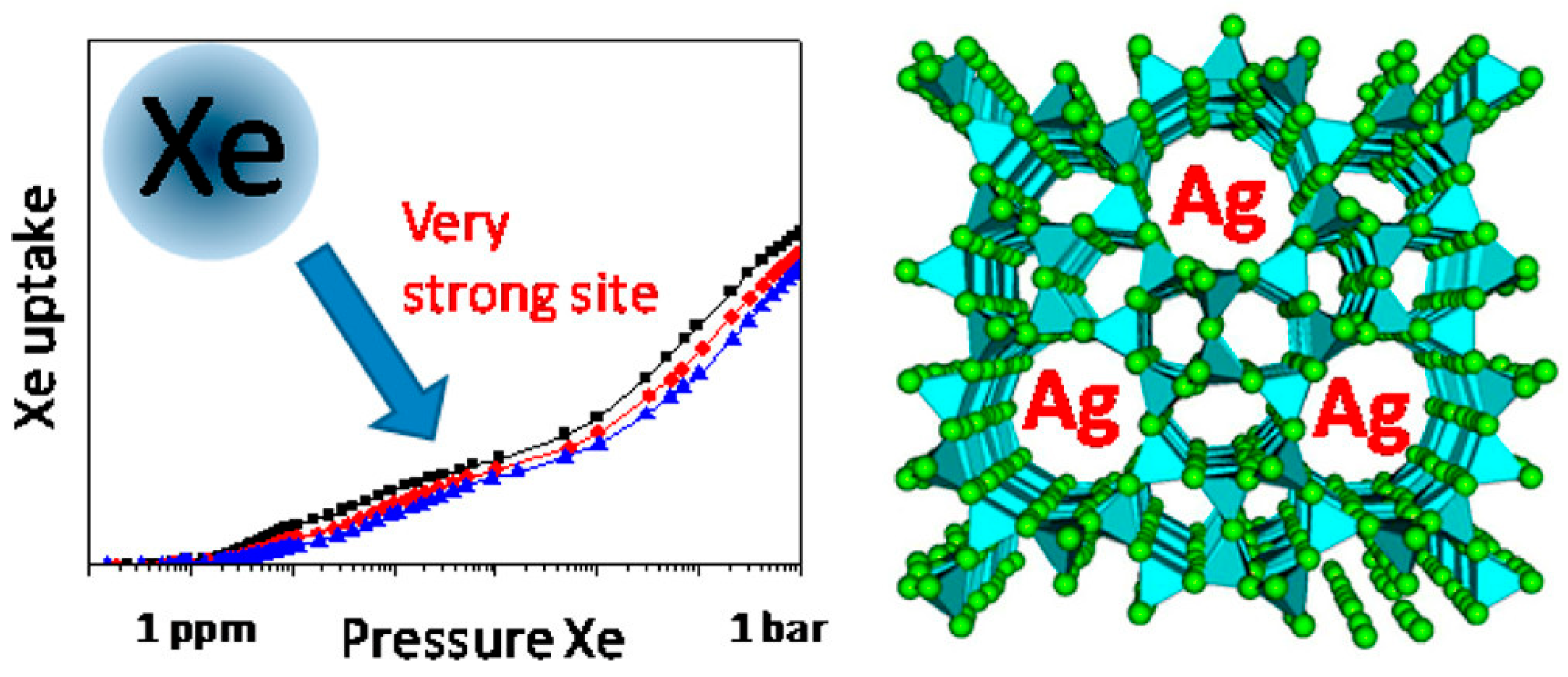
Molten salt reactors (MSRs), categorized as Generation IV nuclear fission systems, produce volatile fission products such as xenon (Xe) and krypton (Kr). These gaseous isotopes can be efficiently separated from the reactor off-gas stream using techniques such as cryogenic distillation or solid sorption. Among solid sorbents, silver-exchanged zeolites have demonstrated high efficiency for the selective adsorption of xenon, particularly at trace concentrations and low partial pressures when compared with Kr [74]. Various studies proved that the presence of Ag+ into the pores of zeolite enhance the interaction with Xe. A study by Daniel et al. highlighted that the incorporation of silver nanoparticles into the zeolite framework significantly enhances Xe adsorption by increasing the number of active adsorption sites [75]. Isothermal adsorption modeling was employed to estimate both the number and strength of these adsorption sites. Xenon adsorption behavior was evaluated for both fully and partially silver-exchanged zeolites. The most energetically favorable adsorption sites exhibited isosteric heats of adsorption from −35–50 kJ/mol, with fully silver-exchanged samples showing the highest concentration of these strong sites. A linear 2:1 correlation between silver content and the number of strong adsorption sites was observed, particularly in pentasil-type zeolites. These materials demonstrated the highest density of strong sites, reaching up to 5.7 × 10⁻⁴ mol g−1 for fully exchanged samples. Furthermore, 129Xe NMR spectroscopy enabled quantitative evaluation of the strong adsorption sites over a Xe concentration range of 10–1000 ppm. As summarized in Table 2, adsorption performance at ultra-low pressures was found to be largely independent of the porous textural properties of the zeolite. Instead, the silver content along with properties of zeolites emerged as the principal descriptor for xenon uptake performance (Figure 11).
In a subsequent study, Delière et al. in 2014 investigated xenon adsorption on silver-loaded zeolites through both theoretical modeling and experimental analysis [74]. The research focused on two configurations: Ag-exchanged zeolites (Ag(I)@ZSM-5) and silver nanoparticles supported on zeolite surfaces (AgNPs-ZSM-5). GCMC simulations were employed to model the adsorption behavior, and a simplified mathematical expression was developed to describe Xe uptake on both material types. According to the GCMC simulations, Xe adsorption on Ag(I)@ZSM-5 was characterized as a single-step process with negligible uptake observed below 10−4 kPa. However, this result was not consistent with experimental data, which exhibited a two-step adsorption process best described by a dual-site Langmuir model. Experimentally, the first adsorption step occurred in the pressure range of 10−4 to 10−1 kPa, followed by a second uptake phase at higher pressures. In contrast, xenon adsorption on AgNPs-ZSM-5 showed better agreement between simulation and experiment. Both approaches indicated the occurrence of adsorption at very low pressures, starting around 10−5 kPa. GCMC simulations revealed that the low-pressure adsorption predominantly occurred at the silver nanoparticles, while high-pressure adsorption was associated with the zeolite framework itself. These findings highlight the critical role of silver nanoparticle dispersion in enabling efficient Xe capture at trace concentrations, particularly under ultra-low-pressure conditions relevant to off-gas treatment in advanced nuclear systems.
SAPO-34 is silicoaluminophosphate, a small pore zeolite that was also explored for selectively separate Kr and Xe mixture at industrial appropriate compositions [76]. SAPO-34 membranes were able to separate Kr/Xe mixtures with Kr permeances as high as 1.2 × 10⁻⁷ mol/m2 s Pa and 35 selectivity. At the same time, Kr/Xe mixtures with molar composition in nuclear reprocessing technologies was separated with selectivity of 45. In Table 3, we have elucidated recent studies on the inert gas separation.

2.3. Separation of Paraffin Isomers

The isomerization of paraffin always produces a combination of alkanes, as it is thermodynamically limited. Among them, linear alkanes are reintroduced into the reactor for isomerization. To increase the octane yield, there should be a process that can separate different isomers from the paraffin. Zeolites act as molecular sieves and separate paraffin isomers [80]. The separation ability of these zeolites depends on micropore characters when the pore diameter is close to the kinetic diameter of the mixture of paraffin to be separated. One of the best examples is zeolite 5A, which has the ability to separate smaller, linear alkanes (like n-paraffins) while blocking larger, branched alkanes. The rate of diffusion depends on the size and shape of the molecules known as the kinetic separation mechanism. Morphologically modified core shell-based zeolite was explored for the selective separation of the branched paraffin isomer [80]. The core–shell composite material allowed for more selective separation of mono- and di-branched isomers due to higher pore volume. The core–shell structure was extensively utilized for the adsorptive separation of C5–C6 isomers to maximize the octane number of the gasoline blend. Zeolite imidazole frameworks (ZIF-8, ZIF-76, and IM-22) were also explored for separation of C6 paraffins. ZIF-8 exhibited a high selectivity towards linear alkanes with high adsorption capacity. The authors compared the activity to the industrially relevant zeolite 5A, and the activity declined in the following order: 5A > ZIF-8 > IM-22 > ZIF-76. ZIF-76 has a broad pre-aperture that allows for the diffusion of all isomers, and it preferentially adsorbs branched alkanes over linear ones. On the other hand, ZIF-8 acts as a molecular sieve, where linear alkanes can diffuse easily. The effective pore size of ZIF-8 in the paraffin separation was comparable to the kinetic diameter of mono-branched alkanes. IM-22 easily adsorbs linear and mono-branched alkanes, but not di-branched isomers. The scientists concluded that ZIF-8 and IM-22 might be interesting alternatives for zeolite 5A on an industrial scale. Researchers tried to comparatively study the performance of zeolites with MOF (MIL-96) for separation of the aliphatic C5-diolefins, mono-olefins, and paraffins in liquid phase with a focus on C5-diolefin isomers isoprene and trans- and cis-piperylene from a steam cracker [81]. The authors compared the activity of MIL-96 with two zeolites. MIL-96 demonstrated a better uptake of trans-piperylene from a mixture including all three C5-diolefin isomers, with higher separation factors and capacity than the reference zeolite 5A, owing to more efficient packing of the trans isomer in the pores.

2.4. Oil Refining

The effectual consumption of heavy oil has been a critical area in addressing the global energy crisis and ensuring sustainable energy resources for future generations. The conversion of crude oil and heavy oil fractions into value-added petrochemical products represents a major challenge and opportunity in modern refining industries. Crude oil, particularly its heavy residues, consists of highly complex mixtures of multi-ring aromatic compounds, long-chain hydrocarbons, and heteroatom-containing species such as sulfur, nitrogen, and oxygen compounds. These characteristics make its processing and upgrading both technically demanding and economically intensive. Zeolites, as a class of crystalline aluminosilicate catalysts, have emerged as highly promising materials for efficient heavy oil upgrading and refining processes. Their exceptional porous crystalline structures, large surface area, and optimizable acidity make them highly effective for breaking down heavy hydrocarbons into more valuable lighter products like gasoline, diesel, and lubricants. Zeolites play a crucial role in oil refining processes such as Fluid Catalytic Cracking (FCC), hydrocracking, and dewaxing. One of their key advantages lies in their molecular sieving properties, allowing for selective adsorption, drying, and separation of components based on molecular size, which is essential in processing complex crude oil and petrochemical streams. Therefore, zeolite-based catalysts play a pivotal role in enhancing the efficiency, selectivity, and sustainability of modern petrochemical and refining operations [82]. Among the various types of zeolites, delaminated zeolites have shown great promise, particularly ITQ-2, which consists of separated zeolitic layers with fully accessible active sites. This open structure eliminates intracrystalline diffusion limitations and offers a large external surface area (~700 m2/g) with minimal microporosity, enhancing catalytic efficiency [83]. Other notable examples include Y-type zeolites, characterized by their large super-cage structure, which can accommodate bulky hydrocarbon molecules. This feature improves the cracking efficiency of heavy feedstocks. Meanwhile, ZSM-5 demonstrates outstanding shape-selective catalysis due to its peculiar ten-membered ring pore system, which promotes the synthesis of light hydrocarbons and valuable aromatics [84].
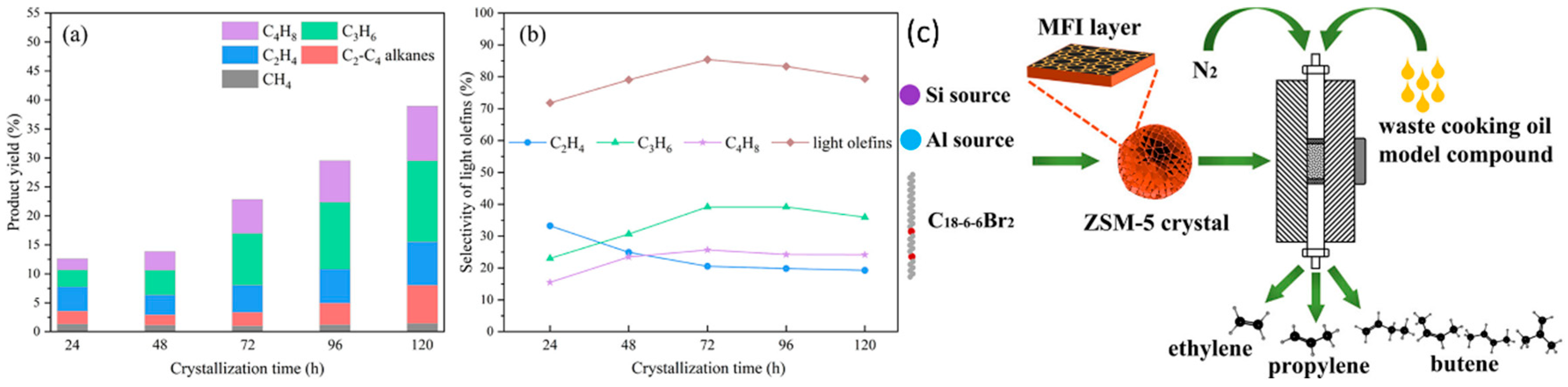
In another study, Jingjing Lee et al. investigated the catalytic aquathermolysis cracking of heavy oil into light hydrocarbons using a water-based system containing zeolite, aluminum acetate [Al(CH3COO)3], and aluminum sulfate [Al2(SO4)3] under both CO2 and N2 atmospheres (Figure 12). As illustrated in Figure 12a, the catalyst components dissolve in water at elevated temperatures, leading to the in situ formation of AlxOy(AlOH) species. These aluminum-rich intermediates generate acidic sites that promote catalytic cracking through C–C and C–M (heteroatom) bond cleavage as well as dehydrogenation and isomerization reactions. The FTIR spectra presented in Figure 12b demonstrates distinct chemical transformations after catalytic treatment. The post-cracking spectra show an increase in the intensity of aliphatic C–H stretching bands, accompanied by a decrease in the C=C aromatic and sulfoxide absorption bands. This indicates enhanced hydrogenation, desulfurization, and reduction of aromatic content within the treated oil and asphaltene fractions. Furthermore, Figure 12c depicts the compositional changes in the oil fractions indicating a considerable rise in saturate components and a significant reduction in aromatics, resins, and asphaltenes, particularly under the CO2 atmosphere. These observations highlight the synergistic effect of CO2, which facilitates deeper structural degradation and molecular rearrangement, thereby improving the upgrading efficiency. Among the catalysts tested, the sulfate-based system [Al2(SO4)3] exhibited superior activity in reducing heavy fractions and enhancing overall conversion, emphasizing its potential for efficient CO2-assisted heavy oil upgrading [82,85]. Two-dimensional nanosheets of zeolites have been explored for catalytic cracking of a waste cooking oil to light olefins. Di quaternary ammonium-type surfactant was used as the precursor for the synthesis of nanosheets, which result in better acidic sites [86]. The catalytic activity yielded C2H4, C3H6, and other light olefins. The selectivity and yield of ethylene was highest at 500 °C. At low temperatures, C2H4 oligomerized to C4H8 and C3H6. The exceptional surface area and hierarchical pore structure of nanosheets resulted in excellent catalytic activity for 45 h.

2.5. Separation of Light Hydrocarbons

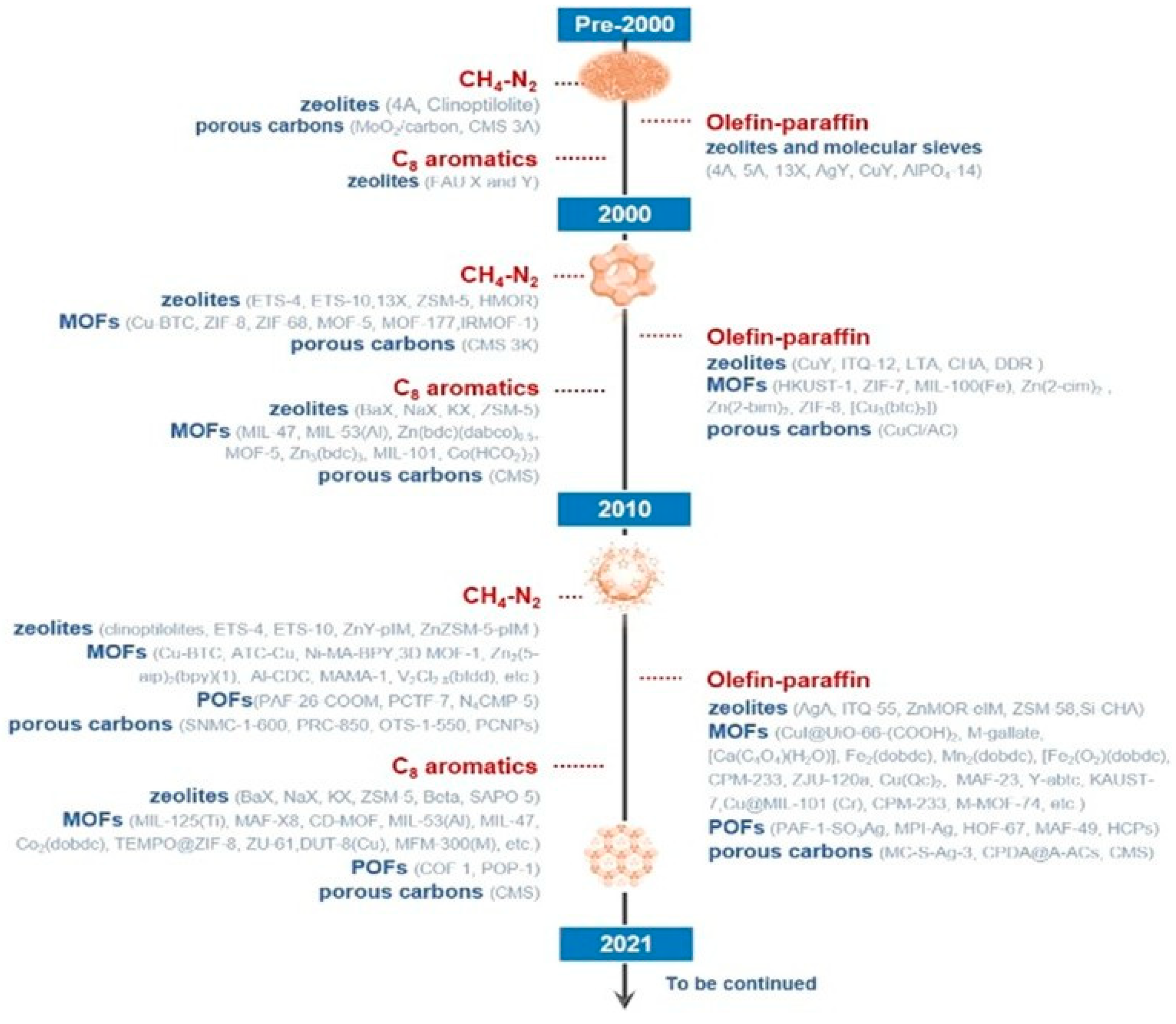
Separation of light hydrocarbons, especially C1–C3, is a crucial raw material in the petrochemical industry, but separation of these hydrocarbons poses a great obstacle due to their similar molecular structure and properties [87], as shown in Table 4. As traditional low-temperature cryogenic distillation (separates based on boiling point difference) and absorption strategies lack the high efficiency and consume high energy to overcome this, a selective adsorption by employing porous material (zeolites, MOFs, molecular sieves) as adsorbents can boost efficiency, boost selectivity, and lower the energy consumption, suggesting the broad application possibilities in the field of light hydrocarbon separation [88]. The most promising technique in this separation is an adsorptive separation technique, where light hydrocarbons are separated using porous solid materials. Research on porous materials for hydrocarbon separation and purification has shown phenomenal growth, as seen in the time frame chart (Figure 13) [89].
In the field of adsorbent-based separation of light hydrocarbons can be efficiently separated by tuning the pore structure, hybrid composite formation with a higher surface area. Molecular sieves possess the advantages of a higher surface area, cost-friendliness, and high stability under severe conditions. However, molecular sieves face challenges with pore size distribution, specific surface area, and surface functionalization due to their unique design. In recent reviews, Sun et al. and Chuah et al. reported the basic properties of light hydrocarbons, which are very crucial for efficient separation, as shown in Table 4 [87,90].
The separation mechanism for light hydrocarbons depends on the adsorbent properties: whether it can absorb or diffuse into it. The separation of these hydrocarbons can be classified into three categories: (i) the molecular sieve effect, which is mainly determined by the shape, molecular size, and pore structure of the adsorbent; (ii) the kinetic effect, which influences the separation by the rate of diffusion of the adsorbate to the adsorbent; and (iii) the thermodynamic equilibrium effect, which is about the particular interaction between a distinct gas molecule, and the adsorbent’s better separation and selectivity can be achieved with this process.
Inspired form these observations, in a recent study, Xiao et al. reported the synthesis of scalable carbon molecular sieve (CMS) granules from resin for the separation of C2H4/C3H6 by the molecular sieve effect. In this study, the CMS-1050 sample showed a narrow pore size and distribution width at the sub-angstrom level (4.1 Å), which is close to C2H4 kinetic diameter, yielding a phenomenal size-sieving performance. CMS-1050 material showed a remarkable uptake of ration 5.6 in C2H4/C3H6 with a C2H4 diffusion rate of 1.4 × 10⁻³ s−1, outperforming state-of-the-art CMS materials [91].
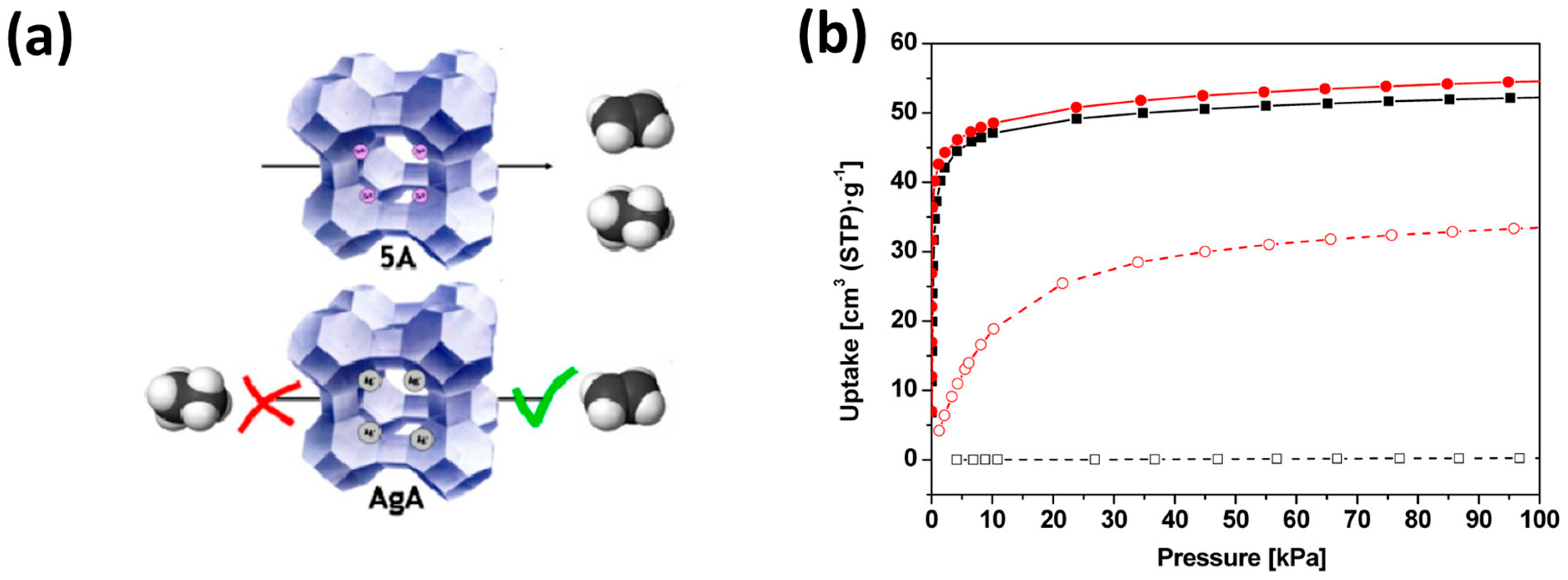
Adsorptive separation uses fixed-bed adsorbers operated in a cyclic or unsteady-state manner [92]. Because of the existence of local electric fields and extremely polarized microenvironments resulting from the controlled distribution of cations in the pore, zeolites are thought to be good because they preferentially adsorb molecules with large dipole moments and quadrapoles [93]. The mechanism of separation of C2H4/C2H6 are categorized into two groups; Ag+ and Cu+ coordinated zeolites can selectively bind olefins with π-complexation. However, C2H6 is excluded by molecular sieving in zeolites with sufficient pore diameter. Aguado et al. separated absolute ethylene with ethane using silver-exchanged zeolite (Figure 14). The exceptional behavior of silver-exchanged zeolites for ethylene separation from ethane/ethylene combination was due to the superior adsorption of the olefin over the paraffin and ethane’s steric size exclusion [94]. The molecular sieving mechanism was attributed to the pore size of the adsorbent, and the free diameter of silver-exchanged zeolite was larger than ethylene and smaller than ethane. This allowed for the penetration of ethylene, whereas ethane was excluded.
Liu et al. reported C2 and C3 separation by a faujasite zeolite (Na-X, Si/Al = 1.23) [95]. The authors used a technique that combines traditional temperature/pressure-swing adsorption with tandem reactors. Here, temperature-swing desorption was used to trap and recover C2H2 from the primary reactor (0.73 mmol g−1), while pressure-swing desorption was used to obtain high-purity C2H4 (>99.50%, 1.80 mmol g−1) and C2H6 (>99.99%, 1.41 mmol/g) from the subsequent reactor. Excellent separation of C3 hydrocarbons was made possible by this simple separation technique.

2.6. Removal of Harmful Gases

The paint, pharmaceutical, petroleum, and chemical industries release massive exhaust emissions into the atmosphere even at low concentrations that contain VOCs, H2S, and NOX, posing a menace to the environment and human health. The transition toward a sustainable and cleaner environment necessitates the effective mitigation of NOx, SOx, and VOCs, which are major pollutants generated from industrial and combustion processes. These compounds are key contributors to air quality degradation, exerting detrimental effects on human health and the environment. Elevated atmospheric levels of NOx, SOx, and VOCs are closely associated with global warming, climate change, and acid rain formation, while chronic exposure can lead to respiratory disorders, bronchospasm, pulmonary edema, and a notable rise in premature mortality, as shown in Table 5 [96].
The Organization for Economic Co-operation and Development (OECD), using its ENV-Linkages computable general equilibrium (CGE) model, projects that global deaths attributable to air pollution may increase from approximately 3 million in 2010 to nearly 9 million by 2060 if emission levels remain unchecked [97]. Major anthropogenic sources of NOx and SOx emissions include power plants, industrial boilers, gas turbines, and automobiles, which together account for a substantial share of global emissions. To solve these urgent environmental concerns, there is an increasing demand for the development of efficient, ecological, and economically viable gas capture and conversion technology [98]. Zeolites have the capability of trapping these harmful gases, H2S, NOx and other volatile VOCs, by adsorption and catalysis. High surface area, well-defined pore sizes, and tunable properties make it effective for the separation of gases. Moreover, zeolites have the capability to convert harmful gases to less harmful ones through catalysis. Thus, zeolite-based systems hold great potential for advancing clean energy technologies and promoting environmental sustainability through effective pollutant removal. One such example is the removal of chlorinated volatile organic compounds by Cu-modified zeolites [99]. The researchers explored the effect of chemical surface characteristics on adsorption. Modification of zeolite with Cu enhanced the acidic character due to the extra Bronsted acid sites formed after modification. This Bronsted acid played major role in adsorption of VOCs by forming hydrogen bonds. On modification of zeolites with Cu, enhanced specific surface area, pore volume with generated Lewis acid sites along with stronger bronsted acidic sites. In this scenario, chlorobenzene migrated towards zeolite framework with dual acid sites forming adsorption complexes.
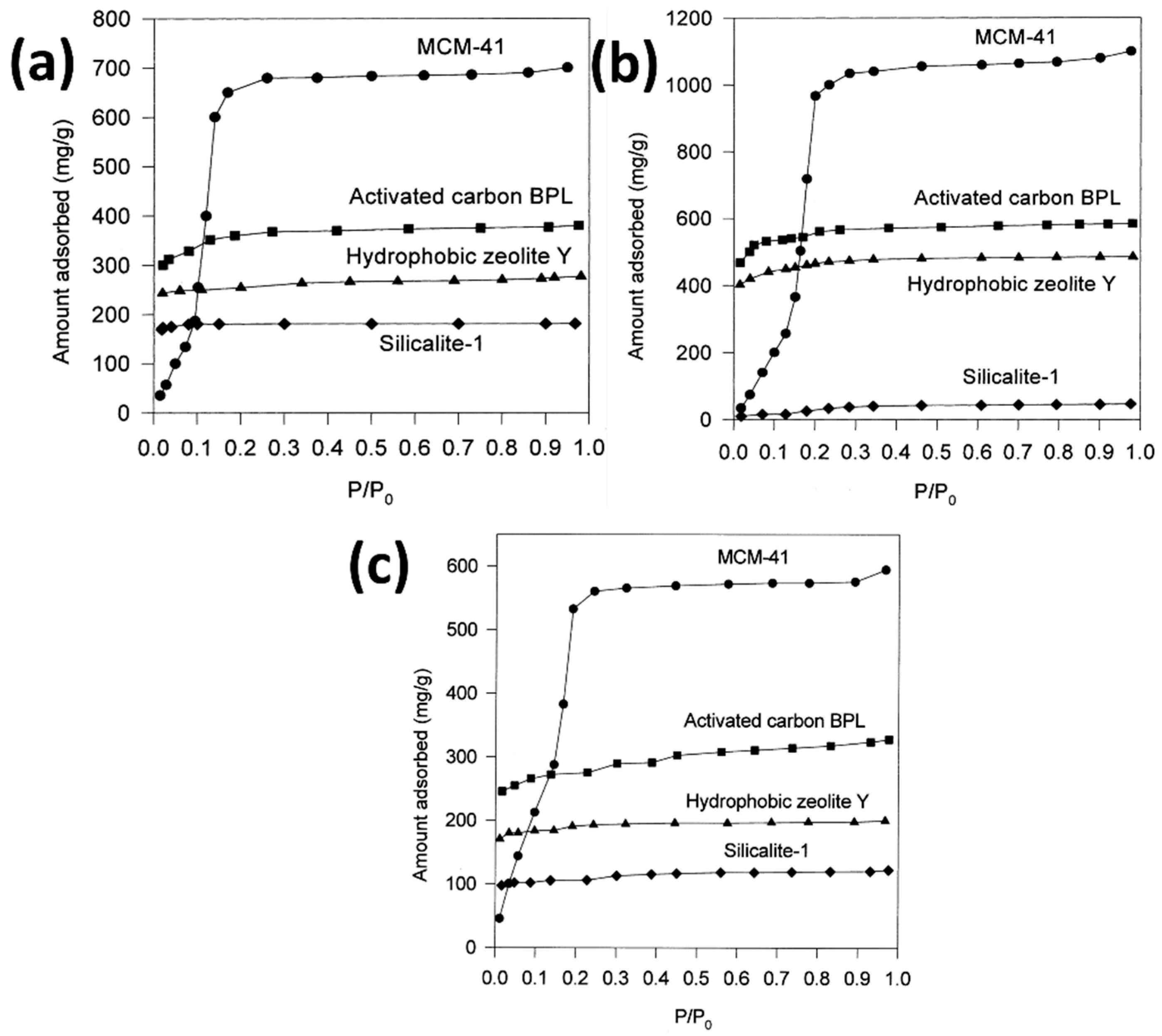
Molecular sieves find widespread use in air purifiers for the removal of harmful gases and VOCs. MCM-41, a newly discovered molecular sieve, was adopted for the adsorption for VOCs [100]. MCM-41 adopted type 4 adsorption isotherm for VOCs such as benzene, CCl4, and n-hexane. A modification in pre-MCM-41 shifted the isotherm to type 1 without any damage of the accessible pore volumes. MCM-41 was found to be efficient for benzene, CCl4, and n-hexane as shown in Figure 15 at high concentrations where low-temperature waste heat is available for regeneration.

2.6.1. Nitrogen Oxide Capture

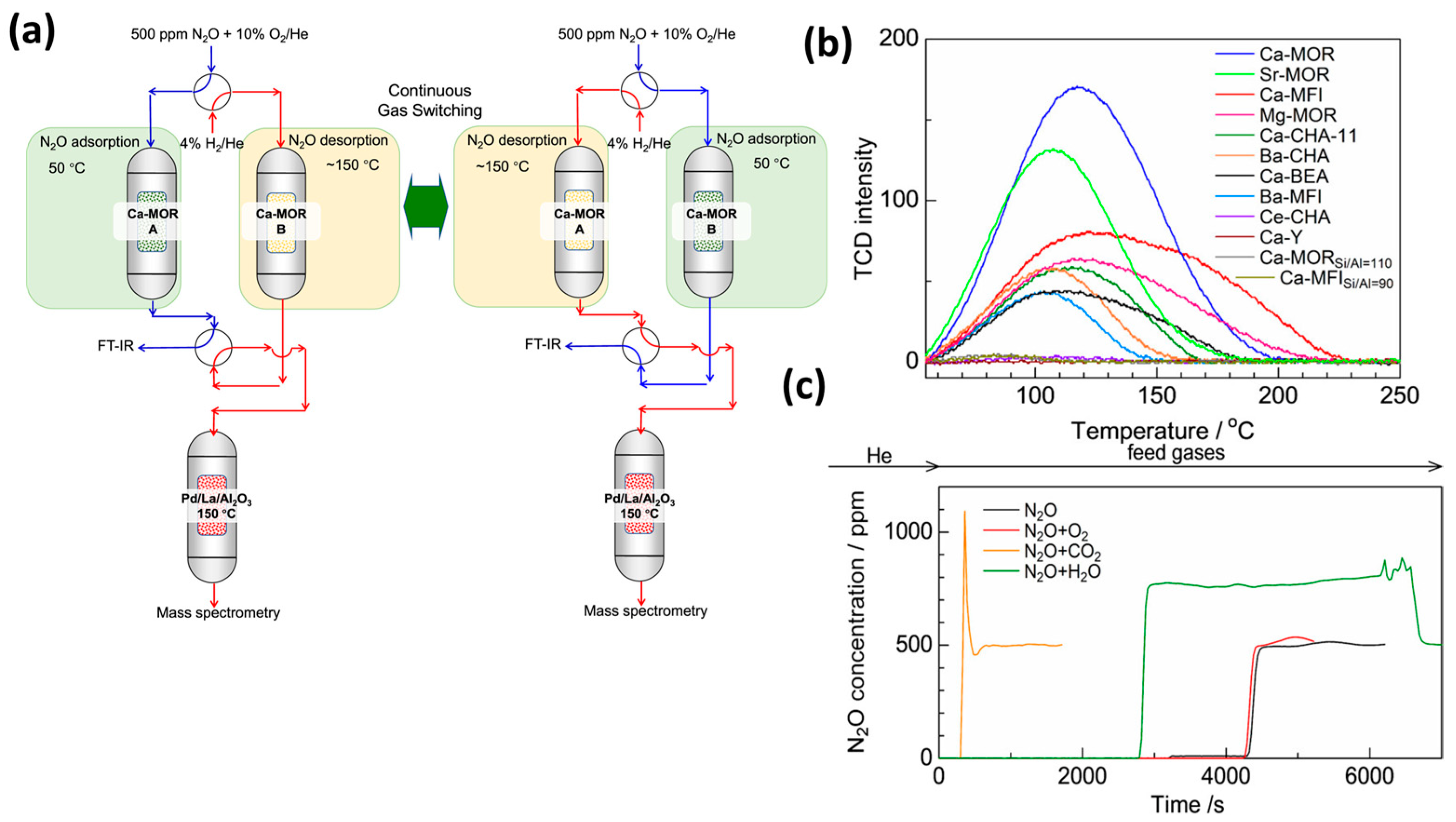
Massive industrial flue gas emissions of nitrogen oxides (NOx) from various industrial and vehicular activities is the primary source of air pollution causes serious harm to the atmospheric environment and human health [101,102,103]. A variety of methods have been adopted for the adsorption and reduction of NOx to non-harmful gases, which include the electron beam technique, liquid absorption method, selective noncatalytic reduction (SNCR) adsorption method, and decomposition and catalytic oxidation method. The most promising technique for removing NOx from moist flue gases is adsorption. The crucial element for success in real-world applications is zeolites with the proper silica-to-alumina (Si/Al) ratio. Liu et al. investigated the impact of the Si/Al ratio, temperature, humidity, and gas composition on adsorptive NOx filtration by HZSM-5 zeolites [104]. Low-silica HZSM-5 had the highest performance (326.6 μmol/g and 39.2 μmol/g at dry and 90%RH) compared to those with greater Si/Al ratios at lower temperatures (288 K). Researchers have proven that regulating Al distribution in zeolite frameworks can affect the catalytic activity towards adsorption and reduction of NOx by adjusting the interaction between the reactant and acidic sites. Zhang et al. controlled the Al in CHA zeolites using organic templates by crystallization pathways. There was 47.7% Al paired and 52.3% Al isolated when N,N,N-trimethyl-1-adamantanammonium (TMAda+) was employed. On the contrary, N,N-dimethylcyclohexylammonium (DMCHA+) resulted in 83.6% Al paired and 16.4% Al isolated in the CHA-D zeolite. The presence of more Al paired in CHA-D zeolites exhibited superior activity towards the NH3-selective catalytic reduction (NH3-SCR) reaction [105]. A two-step N2O capture and reduction to N2 was adopted by using Ca-zeolite as adsorbent and Pd/La/Al2O3 as reductant, as shown in Figure 16a [106]. This was effective for a temperature between 5 and 150 °C. N2O -TPD (Figure 16b) of Ca-zeolite exhibited the best N2O adsorption capability when compared with other metal-exchanged zeolite. A mixture of feed gases—O2, CO2, and H2O along with N2O—was used to study the separation ability of Ca-zeolite. O2 had no effect, 3% H2O decreased the adsorption, and 5% CO2 limited the N2O adsorption. As CO2 and H2O have an effect on N2O adsorption, they should be removed to ensure high efficacy of Ca-zeolite for N2O separation (Figure 16c).
Even though zeolites possess high catalytic activity and hydrothermal stability towards NH3-SCR, these materials are comparatively less active at low temperatures, releasing about 80% of the NOx through the exhaust. To overcome this issue, zeolite-built passive NOx adsorbents (PNA) with large pore sizes are preferred as catalysts [107,108]. PNA catalysts are metal oxides (e.g., Al2O3, TiO2, etc.) or zeolite-based nanosized noble metals (Pt, Pd, Ag). Among them, zeolite-based PNA has shown enhanced NOx adsorption capacity along with better hydrothermal stability and resistance to poisons, which make it suitable to control NOx emission in high duty vehicles [109]. In Table 6, we have discussed recent studies of zeolites on NOx removal.

2.6.2. Desulfurization

Sulfur is found as various forms in petroleum and natural gas fuels. This includes sulfides, disulfides, aromatic and aliphatic disulfides, thiophenes, etc. These sulfur compounds can become problematic, resulting in the formation of Sox, while the fuel is refined or burnt. This can cause safety risks to workers as well as corrode the equipment. High sulfur content results in emissions of SOx and H2S, resulting in acid rain and air pollution [116,117]. The removal of H2S from industrial gas mixtures is a critical step in ensuring both environmental protection and operational efficiency in the oil and gas industry. H2S is a highly toxic and corrosive gas that poses severe risks to humans, pays to acid rain formation, and causes catalyst poisoning and equipment corrosion in refining and petrochemical processes. Therefore, the development of efficient and sustainable desulfurization technologies remains a major research focus. Among the strategies employed for sulfur removal, Adsorptive Desulfurization (ADS) has arose as an effective approach, particularly under mild operating conditions and for fuels with relatively low sulfur concentrations. The ADS process typically involves passing sulfur-laden fuel through a packed-bed reactor containing an adsorbent material, which selectively removes sulfur-containing compounds from the fuel stream [118]. The efficiency and cost-effectiveness of the ADS process are sturdily influenced by the choice of adsorbent material. ADS is classified into numerous approaches, including π-complexation, polar adsorption, selective adsorption, integrated adsorption, and reactive adsorption. Zeolites have garnered considerable attention as promising candidates in H2S removal owing to their exceptional physicochemical properties, including high surface area, tunable acidity, adjustable pore size distribution, and high thermal stability. These features facilitate the selective adsorption and catalytic oxidation of H2S even under challenging industrial conditions. These characteristics make zeolites highly effective for selectively capturing and removing sulfur species from hydrocarbon matrices, thereby enhancing the overall performance and adaptability of the ADS process. Furthermore, their ion-exchange capability allows for modification with active metal species, thereby enhancing H2S capture through chemisorption or redox interactions. A varied range of zeolitic materials, such as NaX-, AgY-, AgX-, and Cu-exchanged zeolites, have been extensively studied for gas-phase desulfurization. The two most widespread methods for extracting sulfur from zeolites are selective adsorption and π-complexation. The most explored zeolites are Faujasite zeolites such as NaX and NaY with different Si ratios. Their high porosity, ion-exchange capability, tunable structures, and surface area lead to the high flexibility of zeolites, making it best for ADS. Impregnation of different metals, such as Cu, Ni, and Fe, to zeolites was found to be an effective method to enhance the sulfur adsorption. These metals provide the zeolite structure with unique features, such as increasing the active surface area and facilitating interaction with sulfur compounds. One such example was Ni nickel-incorporated zeolites, which were used as adsorbents for the removal of dimethyl sulfide (DMS) from liquid hydrocarbon streams using a fix bed reactor [119]. The level of sulfur adsorption was 10 μgg−1 with a capacity of 69.9 mg of sulfur per adsorbent. The introduction of charge compensating Ni2+ cations increased the adsorption capacity of the ion-exchanged NiY, as the weak Lewis acid centers contributed to the S-M bond between the adsorbent and sulfur atoms in DMS. Table 7 summarizes recent studies on zeolite-based desulfurization systems, highlighting their structural characteristics, operating conditions, and H2S removal efficiencies.

2.6.3. VOC Removal

Industrialization and modernization have accelerated air quality issues worldwide. Among various major contributors, VOCs have garnered much attention due to their hazardous effects on the environment and human health. VOCs are nothing but lower-boiling-point organic molecules [129,130]. The majority of VOCs react with NOx present in the environment under the exposure of sunlight and form aerosol and ozone, which cause the photochemical smog and lead to environmental pollution and pose serious human health concerns [131,132]. To overcome this, the traditional strategy is classified into source control and end-of-pipe elimination. Source control is widely recognized, but the limitations of current production technologies and the widespread nature of VOC emission sources have led to reliance on more established and cost-effective end-of-pipe elimination techniques. The end-of-pipe elimination technique is classified into two categories; one is recovery, and the other is destruction. The absorption technology is a part of end-of-pipe elimination techniques. The selective adsorption of VOCs on adsorbents is a key technique to improve the air quality. It is considered as an economically viable, environmentally friendly, and universal method to reduce the VOC concentration in the environment. The synthesis of molecular sieves with a similar pore size to gas molecules, ultramicropores (<7 Å), is a high demand for efficiently and selectively adsorbing VOC molecules through capillary action. Mostly, a molecular sieve has sharp pore distribution in the micropore (<2 nm), which is crucial for efficient VOC removal, but most of the molecular sieves are hydrophilic in nature, and the pore could be blocked by the moisture, H2O, present in the atmosphere. In this, a carbon molecular sieve (CMS) could be crucial, with a narrow pore size and sharp pore distribution between 0.1 to 1.0 nm for efficient VOC removal. CMS could be crucial, as it will not be impacted by the water present in the atmosphere, as it is hydrophilic in nature.
Inspired from the above advantages, in a recent study, Zhao et al. reported the synthesis of a CMS-A-5 molecular sieve and observed the separation of VOCs in the presence of N2/O2. It showed great absorption capacity. This material shows long-term stability, which shows promise for practical applications [133].
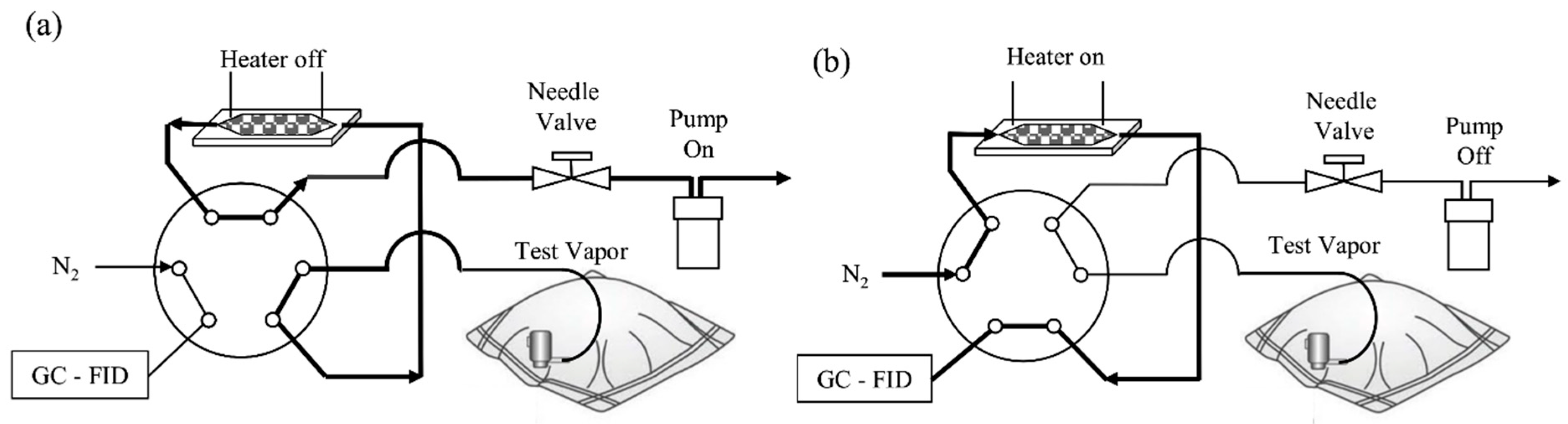
In another study, Lu et al. reported the synthesis of a carbon molecular sieve membrane (CMSM) for the enhanced VOC absorption capacity, as per set up in Figure 17 [134]. In this study, an array of µ-pillars measuring 100 µm in diameter and 250 µm in height was fabricated inside a microfluidic channel to enhance the attaching surface for the CMSM. Low volatile compounds such as gaseous BTX and mesitylene appeared to be adsorbed strongly on CMSM, showing a memory effect. The higher uptake of the VOCs to CMSM was attributed to their higher surface area.

2.7. Hydrogen Storage

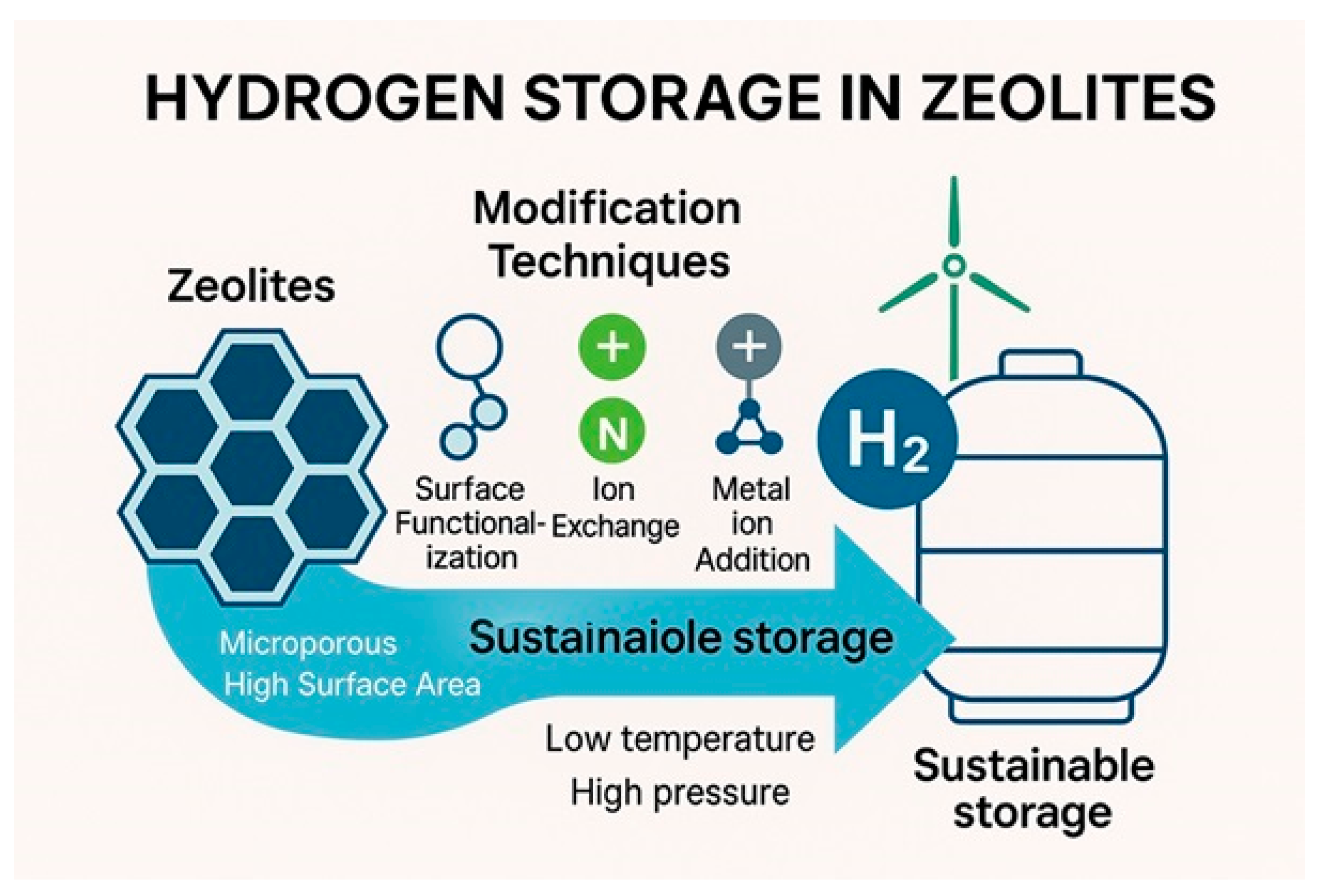
Hydrogen is considered to be a future fuel from the past 30 years and its potential to be used in car engines and aircraft turbines make it more attractive for sustainable and future energy requirements [135,136]. The prerequisite for hydrogen is to use it in a safe environment with easy handling and transportation techniques. The most common methods adopted are high-pressure tanks for gaseous hydrogen, cryogenic vessels for liquid hydrogen, and metal-hydride storage systems [137,138]. However, these storage methods have low hydrogen uptake and ungovernable hydrogen desorption rate. The search for a new method has attracted researchers towards physisorption, as adsorption is reversible, and thus, the adsorbent can be recycled. Zeolites are widely regarded as capable materials for hydrogen storage because of their well-defined cage and channel architectures, high thermal stability, unique physicochemical properties, and substantial ion-exchange capacities [139]. Hydrogen adsorption within zeolites primarily occurs via physisorption, where hydrogen interacts with the internal surfaces of the microporous framework (Figure 18). These interactions are predominantly governed by weak van der Waals forces, resulting in relatively low interaction energies and heats of adsorption. To enhance the adsorption capacity and efficiency of zeolites, various modification strategies have been employed. Surface functionalization with amine groups introduces additional electrostatic interactions, while ion exchange with selected cations can tailor the pore environment, improve surface charge distribution, and optimize framework accessibility [140,141]. Initial investigations into zeolite-based hydrogen storage primarily focused on structures containing sodalite cages, highlighting the importance of pore geometry and framework composition in adsorption performance. Langmi et al. explored Ca-exchanged X zeolites and reported a high gravimetric storage capacity of 2.19 wt% at cryogenic temperatures and 15 bar [142]. The authors explored a pore-blocking phenomenon preventing hydrogen uptake with addition to the large size of alkali metal cations. The addition of large alkali metal cations distresses the available void volume, thus preventing the pore space for hydrogen adsorption. Later, low silica type X zeolites (LSX, Si/Al = 1), completely replaced by alkali-metal cations (Li+, Na+, and K+), were examined for their hydrogen storage capabilities [143]. The cationic ionic radius predicts that the interaction energy between H2 and cations are in the order Li+ > Na+ > K+. However oxygen anions on the zeolite structure were modest adsorption sites. Li-LSX had an H2 capacity of 1.5 wt% at 77 K and 1 atm and 0.6 wt% at 298 K and 10 MPa, which was among the greatest of any known sorbent.

2.8. Wastewater Purification

The sustainability of human life is very much dependent on the availability of clean water for our daily use. The provision of clean water can be considered as an urge to achieve zero hunger, good health and well-being, decent work, and economical growth. The desire towards industrialization and the growing population has declined the quality and quantity of water from all sources. More than 700 million of the world population are deprived from access to water sources due to the contaminations from industrial effluents, organic and inorganic contaminants, nuclear waste, and household wastes. Most of the waste that has been discarded to the water bodies are non-biodegradable, which include dyes, pharmaceuticals, and heavy metals. These contaminants cause high risk even at a very low rate, resulting in health hazards like lung cancer, kidney and bladder disease, reproductive organ damage, and immune system disorder.
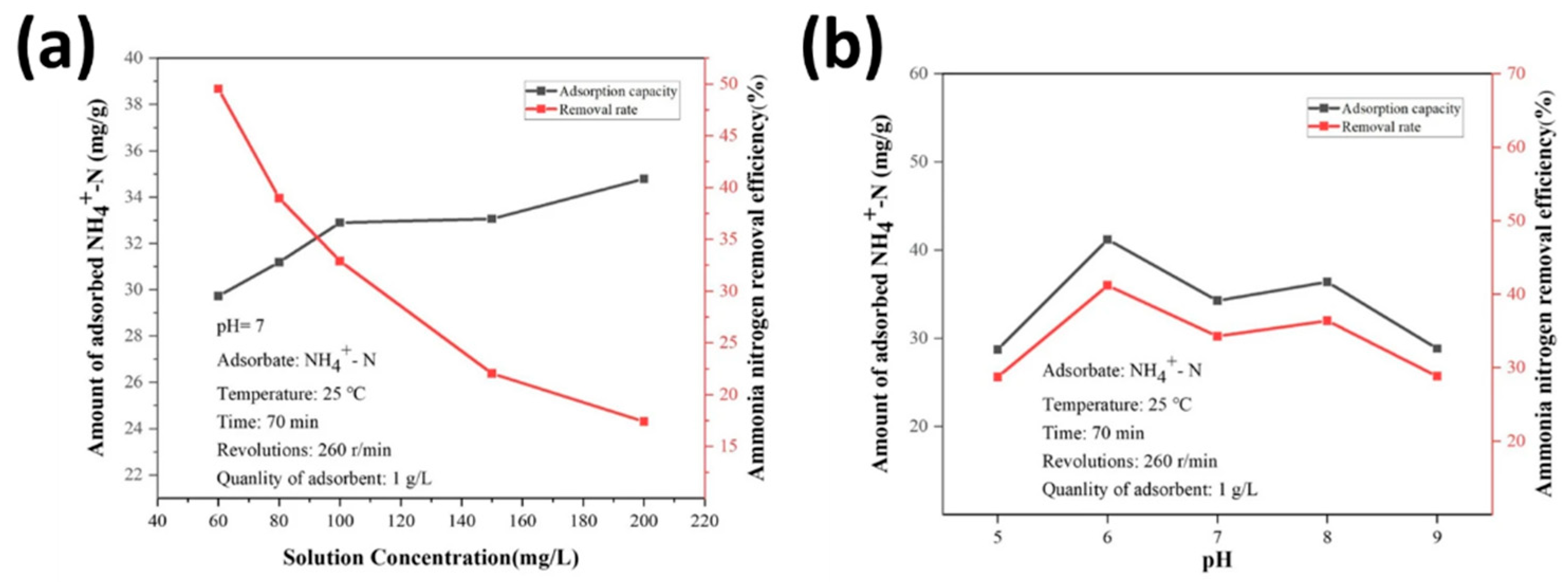
To tackle this issue, various techniques have been implemented for the purification of waste water. This includes distillation, sedimentation, photocatalysis, phytoremediation, electrolysis, adsorption, and other advanced oxidation processes. The adsorption technique stands out among the others because of its cost-effectiveness, accessibility, consumption of natural solid supports, high efficacy, and simple equipment requirements for removing pollutants, even at low concentrations. Enormous efforts have been put forward for the development of a wide range of sorption materials to eliminate contaminants from wastewater at the pilot scale as well as industrial level. Zeolites have caught the interest of researchers and are effectively utilized as adsorbents for wastewater purification. Natural zeolites were found to be effective through ion exchange interaction. The modifications in such zeolites include chemically modifying them with various metals, including Mn, Fe, Na, Ag, and TiO2, to trap the contaminants. Another strategy for the modification of natural zeolites are using agricultural and industrial wastes as sources for the structural elements, e.g., fly and biomass ashes containing silicon and aluminum ash and slag. One such zeolite was modified molecular sieves, which were modified from coal fly ash for the removal of ammonia-nitrogen from wastewater [144]. Researchers adopted alkali fusion followed by hydrothermal method for the synthesis of zeolites from fly ash. Adsorption capacity was adopted using the nanoscale reagent spectrophotometric method. Different parameters were adopted to study the adsorption capacity of the catalyst. In the case of the initial concentration of ammonia nitrogen solution, the adsorption capacity exhibited a gradual increase due to the presence of adsorbates available for ion exchange, but the adsorption capacity of zeolite for ammonia nitrogen gradually weakens as the concentration of the ammonia nitrogen solution continues to increase. The efficacy for the removal of ammonia nitrogen is highest between pH 6 and 8, and the adsorption capacity of ammonia nitrogen is higher within the pH range of 6 to 8, with a gradual change. The removal efficiency reaches 41.2%, with an adsorption capacity of 41.2 mg/g (Figure 19). Outside of this range, both the removal efficiency and adsorption capacity of ammonia nitrogen are lower. Ammonia nitrogen solution mainly exists in the form of NH4+. Due to the smaller ionic radius of H+ compared to NH4+ in ammonia nitrogen, H+ is more likely to enter the internal pores of the zeolite. As the internal pores of the zeolite are occupied by H+, its adsorption capacity for NH4+ is reduced, resulting in poor adsorption performance for ammonia nitrogen solution. The authors also conducted regeneration cycles to assess the reusability of the adsorbents. The catalyst exhibited a slight decrease in adsorption after the fifth cycle due to some adsorbates entering the crystal pores hindering the activity. The adsorption followed a pseudo-second-order model, indicating that the adsorption of ammonia nitrogen on zeolite is primarily controlled by chemisorption rather than physisorption.

2.9. Conclusions and Future Aspects in Separation Process Using Zeolite

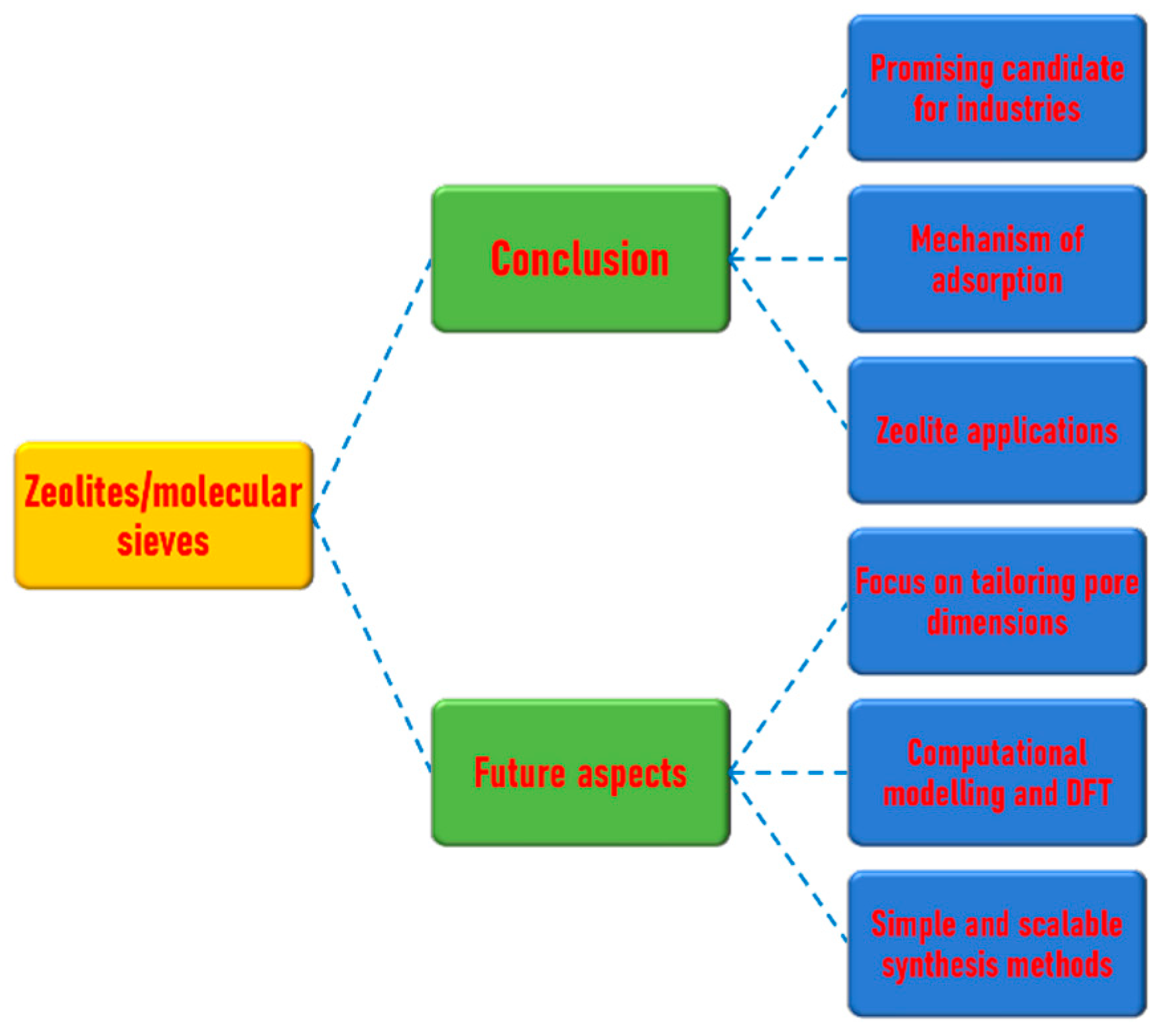
Given the increasing demand for fossil fuels, escalating manufacturing costs, and heightened environmental issues, the utilization of affordable and readily available zeolites offers significant advantages for industrial purposes. Zeolites are a class of promising adsorbent materials in the field of adsorption and separation with extensive applications in gas separation and hydrogen storage due to their well-defined crystalline framework, high thermal stability, and tunable surface properties. This review has offered an in-depth analysis of the most recent breakthroughs in zeolite-based adsorbents, highlighting new architectures and their improved adsorption capacities in a variety of applications. The significance of zeolites as adsorbents in various fields have been scrutinized, and the most relevant applications have been reviewed. Among the zeolites, those with small-pore zeolites, such as LTA, 5A, 13X, and Clinoptilolite, have demonstrated remarkable potential for the separation of CO2 and NOx/SOx and for use in oil refining and energy storage applications. Their narrow pore apertures and high selectivity make them particularly suitable for biogas upgrading, as they effectively minimize CH4 slip during CO2 removal. In contrast, large-pore zeolites, despite exhibiting higher CO2 adsorption capacities, are less efficient for kinetic separations due to insufficient molecular discrimination between CO2 and other gas species. Amine-based zeolites have shown great potential with functionalization. However, we have discussed various strategies for improved gas separation, oil refining, and energy storage applications, but we have some serious challenges to overcome with zeolites, such as the large-scale synthesis of zeolites: in cation-exchanged zeolite, cation migration at elevated temperatures and tunability issues without affecting framework stability, and in amine-based zeolites, amine leaching under long-term exposer, pore block due to high amine loading, and long-term stability challenge. Hybrid zeolites show great potential in separation with a dual adsorption mechanism due to MOF-zeolite and improved stability compared to bare zeolite but face challenges with different thermal expansion and MOF instability under harsh conditions like under moisture and acidic conditions. The major issue researchers have been facing is that it is very difficult to replicate lab scale to industry scale, pallet formation without losing the porosity of the material, and stability issue under real gas streams. This highlights that an efficient adsorbent is not solely defined by high adsorption capacity but also by its selectivity and mass transfer efficiency under realistic process conditions. The summary and future aspect is now schematically represented in Figure 20.
Although zeolites were widely studied in gas purification, refining, and separation technologies, several challenges persist. Future research should focus on tailoring pore dimensions, zeolite functionalization based on amines, and physical absorption using selexol and rectisol; various types of membranes must be utilized such as ceramic membranes, mixed-matrix membranes, and polymeric membranes; and framework chemistry must closely match the kinetic diameters of target molecules, thereby enhancing adsorption performance. A new strategy should be developed to improve the stability of amine-based zeolites for real-life experiments, as they show higher potential for CO2 absorption for a shorter period. We should discover new pathways to fabricate an efficient membrane for specific gases. Electrochemical gas separation should also be explored. Enzyme-assisted absorption of zeolites could be a potential way to improve the separation of toxic gases from flue gases by carbonic anhydrase. Research should focus on the synthesis of zeolite high adsorption and selectivity by tailoring their active sites under humidity and the influence of mixture of gases. Moreover, the discovery of novel zeolite frameworks through computational screening and high-throughput synthesis is essential to advance separation science. DFT theoretical analysis and experimental approaches should be considered to better understand the mechanism for gas separations from mixtures. Simplified and scalable synthesis routes with high reproducibility and reduced cost are equally critical for industrial deployment. Ultimately, the adsorption and catalytic performance of zeolites depend strongly on the nature and distribution of their active sites and functional groups. Bridging molecular-level structural control with macroscopic performance optimization will enable multifunctional zeolites with superior efficiency. Integrating computational modeling, such as DFT and molecular simulations, with rational synthesis strategies will accelerate the design of zeolites tailored for specific applications, including gas separation, refining, pollutant degradation, and energy storage systems. Molecular simulation needs to be performed for pore-guest interaction reactions for better separation of gases in a real gas stream. Machine learning-driven material design could reduce the workload of experimental researchers by helping them in designing an efficient zeolite for oil refinery, gas separation, and energy storage applications. Digital twins of zeolites should be performed for higher efficiency.

Author Contributions

Conceptualization, methodology, resources, data curation, writing—original draft preparation: P.C.M.; writing—review and editing: P.C.M., B.M.; supervision: P.G.S. All authors have read and agreed to the published version of the manuscript.

Funding

This research study received no external funding.

Data Availability Statement

The original contributions presented in this study are included in the article.

Acknowledgments

During the preparation of this manuscript, the authors used Scifinder for the purposes of finding relevant literature and Grammarly for English revision.

Conflicts of Interest

The authors declare no conflicts of interest.

Abbreviations

The following abbreviations are used in this manuscript:
VOCsVolatile Organic Compounds
CCSCarbon Capture and Sequestration
CCUSCarbon Capture, Utilization, and Storage
WGSWater Gas Shift Reaction
IGCCIntegrated Gasification Combined Cycle
MOFMetal Organic Framework
GCMCCarbon Capture, Utilization, and Storage
IASTIdeal Adsorption Solution Theory
ISFIdeal Separation Factor
ASFActual Adsorption Factor
MSRsMolten Salt Reactors
OECDOrganization for Economic Co-operation and Development
CGEComputable General Equilibrium
SNCRSelective Noncatalytic Reduction
DMCHA+N,N-dimethylcyclohexylammonium
SCRSelective Catalytic Reduction
PNAPassive NOx Adsorbents
ADSAdsorptive Desulfurization
DFTDensity Functional Theory

References

  1. Dąbrowski, A. Adsorption—From Theory to Practice. Adv. Colloid Interface Sci. 2001, 93, 135–224. [Google Scholar] [CrossRef]
  2. Karimi, S.; Tavakkoli Yaraki, M.; Karri, R.R. A Comprehensive Review of the Adsorption Mechanisms and Factors Influencing the Adsorption Process from the Perspective of Bioethanol Dehydration. Renew. Sustain. Energy Rev. 2019, 107, 535–553. [Google Scholar] [CrossRef]
  3. Sholl, D.S.; Lively, R.P. Seven Chemical Separations to Change the World. Nature 2016, 532, 435–437. [Google Scholar] [CrossRef] [PubMed]
  4. Kordala, N.; Wyszkowski, M. Zeolite Properties, Methods of Synthesis, and Selected Applications. Molecules 2024, 29, 1069. [Google Scholar] [CrossRef]
  5. Rhodes, C.J. Properties and Applications of Zeolites. Sci. Prog. 2010, 93, 223–284. [Google Scholar] [CrossRef]
  6. Roth, W.J.; Gil, B.; Tarach, K.A.; Góra-Marek, K. Top-down Engineering of Zeolite Porosity. Chem. Soc. Rev. 2025, 54, 7484–7560. [Google Scholar] [CrossRef] [PubMed]
  7. Derbe, T.; Temesgen, S.; Bitew, M. A Short Review on Synthesis, Characterization, and Applications of Zeolites. Adv. Mater. Sci. Eng. 2021, 2021, 6637898. [Google Scholar] [CrossRef]
  8. Bahmanzadegan, F.; Ghaemi, A. A Comprehensive Review on Novel Zeolite-Based Adsorbents for Environmental Pollutant. J. Hazard. Mater. Adv. 2025, 17, 100617. [Google Scholar] [CrossRef]
  9. Millini, R.; Garbarino, G. Zeolites: Historical Evolution and Current Relevance. In Zeolites: From Fundamentals to Emerging Applications; Serrano, D.P., Čejka, J., Eds.; Royal Society of Chemistry: London, UK, 2025; pp. 1–33. ISBN 978-1-83767-545-6. [Google Scholar] [CrossRef]
  10. Alotaibi, A.M. An Overview of Zeolites: From Historical Background to Diverse Applications. Molecules 2025, 30, 4036. [Google Scholar] [CrossRef] [PubMed]
  11. Lang, Q.; Lu, P.; Yang, X.; Valtchev, V. Zeolites for the Environment. Green Carbon 2024, 2, 12–32. [Google Scholar] [CrossRef]
  12. Zhang, W.; Zhang, T.; Lv, Y.; Jing, T.; Gao, X.; Gu, Z.; Li, S.; Ao, H.; Fang, D. Recent Progress on the Synthesis and Applications of Zeolites from Industrial Solid Wastes. Catalysts 2024, 14, 734. [Google Scholar] [CrossRef]
  13. Li, B.; Wen, H.-M.; Zhou, W.; Chen, B. Porous Metal–Organic Frameworks for Gas Storage and Separation: What, How, and Why? J. Phys. Chem. Lett. 2014, 5, 3468–3479. [Google Scholar] [CrossRef]
  14. Tanaka, S.; Fuku, K.; Ikenaga, N.; Sharaf, M.; Nakagawa, K. Recent Progress and Challenges in the Field of Metal–Organic Framework-Based Membranes for Gas Separation. Compounds 2024, 4, 141–171. [Google Scholar] [CrossRef]
  15. Pérez-Botella, E.; Valencia, S.; Rey, F. Zeolites in Adsorption Processes: State of the Art and Future Prospects. Chem. Rev. 2022, 122, 17647–17695. [Google Scholar] [CrossRef]
  16. Chen, C.-Y.; Zones, S.I. Post-Synthetic Treatment and Modification of Zeolites. In Zeolites and Catalysis; Wiley: Hoboken, NJ, USA, 2010; pp. 155–170. ISBN 9783527630295. [Google Scholar] [CrossRef]
  17. Lee, K.M.; Kim, N.S.; Numan, M.; Kim, J.-C.; Cho, H.S.; Cho, K.; Jo, C. Postsynthetic Modification of Zeolite Internal Surface for Sustainable Capture of Volatile Organic Compounds under Humid Conditions. ACS Appl. Mater. Interfaces 2021, 13, 53925–53934. [Google Scholar] [CrossRef]
  18. Boer, D.G.; Langerak, J.; Pescarmona, P.P. Zeolites as Selective Adsorbents for CO2 Separation. ACS Appl. Energy Mater. 2023, 6, 2634–2656. [Google Scholar] [CrossRef]
  19. Pandya, T.; Patel, S.; Kulkarni, M.; Singh, Y.R.; Khodakiya, A.; Bhattacharya, S.; Prajapati, B.G. Zeolite-Based Nanoparticles Drug Delivery Systems in Modern Pharmaceutical Research and Environmental Remediation. Heliyon 2024, 10, e36417. [Google Scholar] [CrossRef]
  20. Servatan, M.; Zarrintaj, P.; Mahmodi, G.; Kim, S.-J.; Ganjali, M.R.; Saeb, M.R.; Mozafari, M. Zeolites in Drug Delivery: Progress, Challenges and Opportunities. Drug Discov. Today 2020, 25, 642–656. [Google Scholar] [CrossRef]
  21. Jiménez-Reyes, M.; Almazán-Sánchez, P.T.; Solache-Ríos, M. Radioactive Waste Treatments by Using Zeolites. A Short Review. J. Environ. Radioact. 2021, 233, 106610. [Google Scholar] [CrossRef] [PubMed]
  22. Ambrosino, F.; Gargiulo, N.; Della Peruta, G.; Gravino, C.; Gagliardo, G.; Pisciotta, F.; Esposito, S.; La Verde, G.; Caputo, D.; Pugliese, M. Study and Characterization of Zeolites for the Removal of Artificial Radionuclides in Wastewater Samples from Nuclear Power Plants. J. Hazard. Mater. Adv. 2024, 16, 100458. [Google Scholar] [CrossRef]
  23. Vasconcelos, A.A.; Len, T.; de Oliveira, A.D.; Costa, A.A.; Souza, A.R.; Costa, C.E.; Luque, R.; Rocha Filho, G.N.; Noronha, R.C.; Nascimento, L.A. Zeolites: A Theoretical and Practical Approach with Uses in (Bio)Chemical Processes. Appl. Sci. 2023, 13, 1897. [Google Scholar] [CrossRef]
  24. Warjurkar, T.; Gore, P.M.; Kandasubramanian, B. Zeolite-Coated Membranes for Efficient Separation of Oil-Water Mixture. Clean. Water 2025, 4, 100132. [Google Scholar] [CrossRef]
  25. Liu, C.; Rao, F.; Guo, Y.; Lu, Z.; Deng, W.; Li, G.; Zhang, H.; Qi, T.; Hu, G. CO2 Capture Using Low Silica X Zeolite Synthesized from Low-Grade Coal Gangue via a Two-Step Activation Method. J. Environ. Chem. Eng. 2024, 12, 112074. [Google Scholar] [CrossRef]
  26. Wang, W.; Li, W.; Wang, Z.; Liu, B.; Wang, B.; Duan, J.; Zhou, R. Directly Synthesized High-Silica CHA Zeolite for Efficient CO2/N2 Separation. J. Environ. Chem. Eng. 2024, 12, 113036. [Google Scholar] [CrossRef]
  27. Eldeeb, A.M.; Serag, E.; Elmowafy, M.; El-Khouly, M.E. PH-Responsive Zeolite-A/Chitosan Nanocarrier for Enhanced Ibuprofen Drug Delivery in Gastrointestinal Systems. Int. J. Biol. Macromol. 2025, 289, 138879. [Google Scholar] [CrossRef]
  28. Babaei, M.; Khosravi, S.; Ranjbar, A.; Mohammadi, M. Quercetin Loaded-Magnetic Zeolite Nano-Composite Material and Evaluate Its Anti-Cancer Effect. Naunyn. Schmiedeberg’s Arch. Pharmacol. 2025, 398, 13745–13754. [Google Scholar] [CrossRef]
  29. Bathen, D.; Schmidt-Traub, H.; Simon, M. Gas Adsorption Isotherm for Dealuminated Zeolites. Ind. Eng. Chem. Res. 1997, 36, 3993–3994. [Google Scholar] [CrossRef]
  30. Jedli, H.; Bouzgarrou, S.M.; Hassani, R.; Sabi, E.; Slimi, K. Adsorption of CO2, CH4 and H2 onto Zeolite 13 X: Kinetic and Equilibrium Studies. Heliyon 2024, 10, e40672. [Google Scholar] [CrossRef] [PubMed]
  31. Zheng, X.; Jiang, N.; Zheng, H.; Wu, Y.; Heijman, S.G.J. Predicting Adsorption Isotherms of Organic Micropollutants by High-Silica Zeolite Mixtures. Sep. Purif. Technol. 2022, 282, 120009. [Google Scholar] [CrossRef]
  32. Feng, C.; E, J.; Han, W.; Deng, Y.; Zhang, B.; Zhao, X.; Han, D. Key Technology and Application Analysis of Zeolite Adsorption for Energy Storage and Heat-Mass Transfer Process: A Review. Renew. Sustain. Energy Rev. 2021, 144, 110954. [Google Scholar] [CrossRef]
  33. Fu, D.; Davis, M.E. Carbon Dioxide Capture with Zeotype Materials. Chem. Soc. Rev. 2022, 51, 9340–9370. [Google Scholar] [CrossRef]
  34. Hong, W.Y. A Techno-Economic Review on Carbon Capture, Utilisation and Storage Systems for Achieving a Net-Zero CO2 Emissions Future. Carbon Capture Sci. Technol. 2022, 3, 100044. [Google Scholar] [CrossRef]
  35. Das, A.; Peu, S.D.; Hossain, M.S.; Nahid, M.M.A.; Bin Karim, F.R.; Chowdhury, H.; Porag, M.H.; Argha, D.B.P.; Saha, S.; Islam, A.R.M.T.; et al. Advancements in Adsorption Based Carbon Dioxide Capture Technologies- A Comprehensive Review. Heliyon 2023, 9, e22341. [Google Scholar] [CrossRef]
  36. Tao, Z.; Tian, Y.; Wu, W.; Liu, Z.; Fu, W.; Kung, C.-W.; Shang, J. Development of Zeolite Adsorbents for CO2 Separation in Achieving Carbon Neutrality. npj Mater. Sustain. 2024, 2, 20. [Google Scholar] [CrossRef]
  37. Liu, J.; Sun, X.; Li, N.; Tan, T.; Zhang, F.; Sun, M.; Liu, Q. Effect of Synthesis Conditions on the Properties of 13X Zeolites for CO2 Adsorption. Environ. Pollut. Bioavailab. 2024, 36, 2387683. [Google Scholar] [CrossRef]
  38. Yang, P.T. Sorbents for Applications. In Adsorbents: Fundamentals and Applications; Wiley: Hoboken, NJ, USA, 2003; pp. 280–381. ISBN 9780471444091. [Google Scholar] [CrossRef]
  39. Li, J.-R.; Kuppler, R.J.; Zhou, H.-C. Selective Gas Adsorption and Separation in Metal–Organic Frameworks. Chem. Soc. Rev. 2009, 38, 1477–1504. [Google Scholar] [CrossRef] [PubMed]
  40. Bonenfant, D.; Kharoune, M.; Niquette, P.; Mimeault, M.; Hausler, R. Advances in Principal Factors Influencing Carbon Dioxide Adsorption on Zeolites. Sci. Technol. Adv. Mater. 2008, 9, 13007. [Google Scholar] [CrossRef]
  41. Thang, H.V.; Grajciar, L.; Nachtigall, P.; Bludský, O.; Areán, C.O.; Frýdová, E.; Bulánek, R. Adsorption of CO2 in FAU Zeolites: Effect of Zeolite Composition. Catal. Today 2014, 227, 50–56. [Google Scholar] [CrossRef]
  42. Whaieb, A.H.; Jasim, F.T.; Abdulrahman, A.A.; Khuder, I.M.; Gheni, S.A.; Fattah, I.M.R.; Karakullukcu, N.T. Tailoring Zeolites for Enhanced Post-Combustion CO2 Capture: A Critical Review. Curr. Res. Green Sustain. Chem. 2025, 10, 100451. [Google Scholar] [CrossRef]
  43. Xu, X.; Zhao, X.; Sun, L.; Liu, X. Adsorption Separation of Carbon Dioxide, Methane and Nitrogen on Monoethanol Amine Modified β-Zeolite. J. Nat. Gas Chem. 2009, 18, 167–172. [Google Scholar] [CrossRef]
  44. Remy, T.; Peter, S.A.; Van Tendeloo, L.; Van der Perre, S.; Lorgouilloux, Y.; Kirschhock, C.E.A.; Baron, G.V.; Denayer, J.F.M. Adsorption and Separation of CO2 on KFI Zeolites: Effect of Cation Type and Si/Al Ratio on Equilibrium and Kinetic Properties. Langmuir 2013, 29, 4998–5012. [Google Scholar] [CrossRef]
  45. Liu, Z.; Lou, C.; Yuan, J.; Tang, X.; Fan, Y.; Qi, J.; Zhang, R.; Peng, P.; Liu, G.; Xu, S.; et al. Molecular Self-Gating Inside a Zeolite Catalyst. J. Am. Chem. Soc. 2025, 147, 6126–6136. [Google Scholar] [CrossRef]
  46. Baraj, E.; Ciahotný, K.; Hlinčík, T. The Water Gas Shift Reaction: Catalysts and Reaction Mechanism. Fuel 2021, 288, 119817. [Google Scholar] [CrossRef]
  47. Baraj, E.; Ciahotný, K.; Hlinčík, T. Advanced Catalysts for the Water Gas Shift Reaction. Crystals 2022, 12, 509. [Google Scholar] [CrossRef]
  48. Basile, A.; Criscuoli, A.; Santella, F.; Drioli, E. Membrane Reactor for Water Gas Shift Reaction. Gas Sep. Purif. 1996, 10, 243–254. [Google Scholar] [CrossRef]
  49. Brunetti, A.; Caravella, A.; Barbieri, G.; Drioli, E. Simulation Study of Water Gas Shift Reaction in a Membrane Reactor. J. Memb. Sci. 2007, 306, 329–340. [Google Scholar] [CrossRef]
  50. Kim, S.-J.; Yang, S.; Reddy, G.K.; Smirniotis, P.; Dong, J. Zeolite Membrane Reactor for High-Temperature Water-Gas Shift Reaction: Effects of Membrane Properties and Operating Conditions. Energy Fuels 2013, 27, 4471–4480. [Google Scholar] [CrossRef]
  51. Wang, H.; Dong, X.; Lin, Y.S. Highly Stable Bilayer MFI Zeolite Membranes for High Temperature Hydrogen Separation. J. Memb. Sci. 2014, 450, 425–432. [Google Scholar] [CrossRef]
  52. Cao, M.; Zhao, L.; Xu, D.; Ciora, R.; Liu, P.K.T.; Manousiouthakis, V.I.; Tsotsis, T.T. A Carbon Molecular Sieve Membrane-Based Reactive Separation Process for Pre-Combustion CO2 Capture. J. Memb. Sci. 2020, 605, 118028. [Google Scholar] [CrossRef]
  53. Iyer, G.M.; Ku, C.-E.; Zhang, C. Hyperselective Carbon Membranes for Precise High-Temperature H2 and CO2 Separation. Sci. Adv. 2025, 11, eadt7512. [Google Scholar] [CrossRef] [PubMed]
  54. Yin, H.; Shang, J.; Choi, J.; Yip, A.C.K. Generation and Extraction of Hydrogen from Low-Temperature Water-Gas-Shift Reaction by a ZIF-8-Based Membrane Reactor. Microporous Mesoporous Mater. 2019, 280, 347–356. [Google Scholar] [CrossRef]
  55. Zhang, Y.; Wu, Z.; Hong, Z.; Gu, X.; Xu, N. Hydrogen-Selective Zeolite Membrane Reactor for Low Temperature Water Gas Shift Reaction. Chem. Eng. J. 2012, 197, 314–321. [Google Scholar] [CrossRef]
  56. Sinaei Nobandegani, M.; Yu, L.; Hedlund, J. Zeolite Membrane Process for Industrial CO2/CH4 Separation. Chem. Eng. J. 2022, 446, 137223. [Google Scholar] [CrossRef]
  57. Zhang, M.; Qian, W.; Ma, H.; Ying, W.; Zhang, H.; Yuan, P. A Theoretical Study on the Separation of CO2/CH4 through MFI Zeolite. Comput. Theor. Chem. 2023, 1228, 114272. [Google Scholar] [CrossRef]
  58. Al-Naddaf, Q.; Rownaghi, A.A.; Rezaei, F. Multicomponent Adsorptive Separation of CO2, CO, CH4, N2, and H2 over Core-Shell Zeolite-5A@MOF-74 Composite Adsorbents. Chem. Eng. J. 2020, 384, 123251. [Google Scholar] [CrossRef]
  59. Xu, Z.; Yang, X.; Liu, S.; Wang, B.; Peng, Y.; Zhang, Y.; Li, Z. Development of Enhanced CO2 Adsorbents on Functionalized MCM-41 with Hybrid Amines. New J. Chem. 2025, 49, 7384–7392. [Google Scholar] [CrossRef]
  60. Zhang, C.; Koros, W.J. Ultraselective Carbon Molecular Sieve Membranes with Tailored Synergistic Sorption Selective Properties. Adv. Mater. 2017, 29, 1701631. [Google Scholar] [CrossRef] [PubMed]
  61. Tin, P.S.; Chung, T.-S.; Liu, Y.; Wang, R. Separation of CO2/CH4 through Carbon Molecular Sieve Membranes Derived from P84 Polyimide. Carbon N. Y. 2004, 42, 3123–3131. [Google Scholar] [CrossRef]
  62. Cui, Y.; Xing, Y.; Tian, J.; Su, W.; Sun, F.-Z.; Liu, Y. Insights into the Adsorption Performance and Separation Mechanisms for CO2 and CO on NaX and CaA Zeolites by Experiments and Simulation. Fuel 2023, 337, 127179. [Google Scholar] [CrossRef]
  63. Cui, Y.; Su, W.; Xing, Y.; Hao, L.; Sun, Y.; Cai, Y. Experimental and Simulation Evaluation of CO2/CO Separation under Different Component Ratios in Blast Furnace Gas on Zeolites. Chem. Eng. J. 2023, 472, 144579. [Google Scholar] [CrossRef]
  64. Tao, Z.; Tian, Y.; Hanif, A.; Chan, V.; Gu, Q.; Shang, J. Metal Cation-Exchanged LTA Zeolites for CO2/N2 and CO2/CH4 Separation: The Roles of Gas-Framework and Gas-Cation Interactions. Carbon Capture Sci. Technol. 2023, 8, 100126. [Google Scholar] [CrossRef]
  65. Liu, Q.; Pham, T.; Porosoff, M.D.; Lobo, R.F. ZK-5: A CO2-Selective Zeolite with High Working Capacity at Ambient Temperature and Pressure. ChemSusChem 2012, 5, 2237–2242. [Google Scholar] [CrossRef]
  66. Shang, J.; Li, G.; Singh, R.; Gu, Q.; Nairn, K.M.; Bastow, T.J.; Medhekar, N.; Doherty, C.M.; Hill, A.J.; Liu, J.Z.; et al. Discriminative Separation of Gases by a “Molecular Trapdoor” Mechanism in Chabazite Zeolites. J. Am. Chem. Soc. 2012, 134, 19246–19253. [Google Scholar] [CrossRef]
  67. Palomino, M.; Corma, A.; Rey, F.; Valencia, S. New Insights on CO2−Methane Separation Using LTA Zeolites with Different Si/Al Ratios and a First Comparison with MOFs. Langmuir 2010, 26, 1910–1917. [Google Scholar] [CrossRef]
  68. Lozinska, M.M.; Mangano, E.; Greenaway, A.G.; Fletcher, R.; Thompson, S.P.; Murray, C.A.; Brandani, S.; Wright, P.A. Cation Control of Molecular Sieving by Flexible Li-Containing Zeolite Rho. J. Phys. Chem. C 2016, 120, 19652–19662. [Google Scholar] [CrossRef]
  69. Georgieva, V.M.; Bruce, E.L.; Verbraeken, M.C.; Scott, A.R.; Casteel, W.J.J.; Brandani, S.; Wright, P.A. Triggered Gate Opening and Breathing Effects during Selective CO2 Adsorption by Merlinoite Zeolite. J. Am. Chem. Soc. 2019, 141, 12744–12759. [Google Scholar] [CrossRef]
  70. Aydani, A.; Brunetti, A.; Maghsoudi, H.; Barbieri, G. CO2 Separation from Binary Mixtures of CH4, N2, and H2 by Using SSZ-13 Zeolite Membrane. Sep. Purif. Technol. 2021, 256, 117796. [Google Scholar] [CrossRef]
  71. Mei, W.; Du, Y.; Wu, T.; Gao, F.; Wang, B.; Duan, J.; Zhou, J.; Zhou, R. High-Flux CHA Zeolite Membranes for H2 Separations. J. Memb. Sci. 2018, 565, 358–369. [Google Scholar] [CrossRef]
  72. Shafie, A.H.; An, W.; Hosseinzadeh Hejazi, S.A.; Sawada, J.A.; Kuznicki, S.M. Natural Zeolite-Based Cement Composite Membranes for H2/CO2 Separation. Sep. Purif. Technol. 2012, 88, 24–28. [Google Scholar] [CrossRef]
  73. LIU, Z.; TENG, Y.; ZHANG, K.; CAO, Y.; PAN, W. CO2 Adsorption Properties and Thermal Stability of Different Amine-Impregnated MCM-41 Materials. J. Fuel Chem. Technol. 2013, 41, 469–475. [Google Scholar] [CrossRef]
  74. Deliere, L.; Topin, S.; Coasne, B.; Fontaine, J.-P.; De Vito, S.; Den Auwer, C.; Solari, P.L.; Daniel, C.; Schuurman, Y.; Farrusseng, D. Role of Silver Nanoparticles in Enhanced Xenon Adsorption Using Silver-Loaded Zeolites. J. Phys. Chem. C 2014, 118, 25032–25040. [Google Scholar] [CrossRef]
  75. Daniel, C.; Elbaraoui, A.; Aguado, S.; Springuel-Huet, M.-A.; Nossov, A.; Fontaine, J.-P.; Topin, S.; Taffary, T.; Deliere, L.; Schuurman, Y.; et al. Xenon Capture on Silver-Loaded Zeolites: Characterization of Very Strong Adsorption Sites. J. Phys. Chem. C 2013, 117, 15122–15129. [Google Scholar] [CrossRef]
  76. Feng, X.; Zong, Z.; Elsaidi, S.K.; Jasinski, J.B.; Krishna, R.; Thallapally, P.K.; Carreon, M.A. Kr/Xe Separation over a Chabazite Zeolite Membrane. J. Am. Chem. Soc. 2016, 138, 9791–9794. [Google Scholar] [CrossRef]
  77. Ren, Y.; Liu, X.; Dai, G.; Zhang, L.; Chen, H.; Yang, P.; Li, Y.; Yu, X.; Chen, Y.; Shi, X.; et al. Smooth Pore Surface in Zeolites for Krypton Capture under Humid Conditions. Green Chem. Eng. 2025, 6, 431–438. [Google Scholar] [CrossRef]
  78. Liu, S.; Lian, X.; Yue, B.; Xu, S.; Wu, G.; Chai, Y.; Zhang, Y.; Li, L. Control of Zeolite Local Polarity toward Efficient Xenon/Krypton Separation. J. Am. Chem. Soc. 2024, 146, 8335–8342. [Google Scholar] [CrossRef] [PubMed]
  79. Liu, B.; Wu, X.; Liu, Q.; Gong, Y.; Qi, S.; Dong, S.; Mao, Z.; Xiong, S.; Hu, S. Suitable Pore Confinement with Multiple Interactions in a Low-Cost Zeolitic Imidazolate Framework for Efficient Xe Capture and Separation. Sep. Purif. Technol. 2025, 354, 128868. [Google Scholar] [CrossRef]
  80. Pirngruber, G.D.; Laroche, C.; Maricar-Pichon, M.; Rouleau, L.; Bouizi, Y.; Valtchev, V. Core–Shell Zeolite Composite with Enhanced Selectivity for the Separation of Branched Paraffin Isomers. Microporous Mesoporous Mater. 2013, 169, 212–217. [Google Scholar] [CrossRef]
  81. Maes, M.; Alaerts, L.; Vermoortele, F.; Ameloot, R.; Couck, S.; Finsy, V.; Denayer, J.F.M.; De Vos, D.E. Separation of C5-Hydrocarbons on Microporous Materials: Complementary Performance of MOFs and Zeolites. J. Am. Chem. Soc. 2010, 132, 2284–2292. [Google Scholar] [CrossRef]
  82. Wei, L.; Wang, H.; Dong, Q.; Li, Y.; Xiang, H. A Review on the Research Progress of Zeolite Catalysts for Heavy Oil Cracking. Catalysts 2025, 15, 401. [Google Scholar] [CrossRef]
  83. Primo, A.; Garcia, H. Zeolites as Catalysts in Oil Refining. Chem. Soc. Rev. 2014, 43, 7548–7561. [Google Scholar] [CrossRef]
  84. Leyva, C.; Rana, M.S.; Trejo, F.; Ancheyta, J. On the Use of Acid-Base-Supported Catalysts for Hydroprocessing of Heavy Petroleum. Ind. Eng. Chem. Res. 2007, 46, 7448–7466. [Google Scholar] [CrossRef]
  85. Abdelsalam, Y.I.I.; Galiakhmetova, L.K.; Sharifullin, A.V.; Tajik, A.; Mukhamatdinova, R.E.; Davletshin, R.R.; Vakhin, A. V Comparative Study of the Catalytic Effects of Al(CH3COO)3 and Al2(SO4)3 on Heavy Oil Aquathermolysis in CO2 and N2 Atmospheres. Appl. Catal. A Gen. 2025, 699, 120247. [Google Scholar] [CrossRef]
  86. Luo, W.; Liu, H.; Yuan, H.; Liu, H. Synthesis of Two-Dimensional Zeolite Nanosheets Applied to the Catalytic Cracking of a Waste Cooking Oil Model Compound to Produce Light Olefins. ACS Omega 2024, 9, 17054–17065. [Google Scholar] [CrossRef] [PubMed]
  87. Zhou, Y.; Li, P.; Wang, Y.; Zhao, Q.; Sun, H. Progress in the Separation and Purification of Carbon Hydrocarbon Compounds Using MOFs and Molecular Sieves. Separations 2023, 10, 543. [Google Scholar] [CrossRef]
  88. Yang, L.; Qian, S.; Wang, X.; Cui, X.; Chen, B.; Xing, H. Energy-Efficient Separation Alternatives: Metal–Organic Frameworks and Membranes for Hydrocarbon Separation. Chem. Soc. Rev. 2020, 49, 5359–5406. [Google Scholar] [CrossRef]
  89. Wu, Y.; Weckhuysen, B.M. Separation and Purification of Hydrocarbons with Porous Materials. Angew. Chemie 2021, 133, 19078–19097. [Google Scholar] [CrossRef]
  90. Chuah, C.Y.; Bae, T.-H. Recent Advances in Mixed-Matrix Membranes for Light Hydrocarbon (C1–C3) Separation. Membranes 2022, 12, 201. [Google Scholar] [CrossRef] [PubMed]
  91. Zheng, Y.; Miao, G.; Yang, C.; Huang, J.; Li, X.; Du, S.; Xiao, J. Fast Size-Sieving Separation of C2H4/C2H6 by Pore Engineering of Scalable Carbon Molecular Sieve Granules. Chem. Eng. Sci. 2026, 320, 122640. [Google Scholar] [CrossRef]
  92. Saboor, F.H.; Hajizadeh, O. Separation of Light Hydrocarbons: A Minireview. Adv. J. Chem. Sect. A 2020, 3, 777–788. [Google Scholar] [CrossRef]
  93. Chai, Y.; Han, X.; Li, W.; Liu, S.; Yao, S.; Wang, C.; Shi, W.; da-Silva, I.; Manuel, P.; Cheng, Y.; et al. Control of Zeolite Pore Interior for Chemoselective Alkyne/Olefin Separations. Science 2020, 368, 1002–1006. [Google Scholar] [CrossRef]
  94. Aguado, S.; Bergeret, G.; Daniel, C.; Farrusseng, D. Absolute Molecular Sieve Separation of Ethylene/Ethane Mixtures with Silver Zeolite A. J. Am. Chem. Soc. 2012, 134, 14635–14637. [Google Scholar] [CrossRef]
  95. Liu, S.; Chen, Y.; Yue, B.; Nie, Y.; Chai, Y.; Wu, G.; Li, J.; Han, X.; Day, S.J.; Thompson, S.P.; et al. Cascade Adsorptive Separation of Light Hydrocarbons by Commercial Zeolites. J. Energy Chem. 2022, 72, 299–305. [Google Scholar] [CrossRef]
  96. David, E.; Niculescu, V.-C. Volatile Organic Compounds (VOCs) as Environmental Pollutants: Occurrence and Mitigation Using Nanomaterials. Int. J. Environ. Res. Public Health 2021, 18, 13147. [Google Scholar] [CrossRef]
  97. Outdoor Air Pollution Will Cause up to 9 Million Premature Deaths a Year by 2060, Says the OECD|World Economic Forum. Available online: https://www.weforum.org/stories/2016/08/air-pollution-deaths-oecd/ (accessed on 10 November 2025).
  98. Taha, S.S.; Idoudi, S.; Alhamdan, N.; Ibrahim, R.H.; Surkatti, R.; Amhamed, A.; Alrebei, O.F. Comprehensive Review of Health Impacts of the Exposure to Nitrogen Oxides (NOx), Carbon Dioxide (CO2), and Particulate Matter (PM). J. Hazard. Mater. Adv. 2025, 19, 100771. [Google Scholar] [CrossRef]
  99. Valdés, H.; Riquelme, A.L.; Solar, V.A.; Azzolina-Jury, F.; Thibault-Starzyk, F. Removal of Chlorinated Volatile Organic Compounds onto Natural and Cu-Modified Zeolite: The Role of Chemical Surface Characteristics in the Adsorption Mechanism. Sep. Purif. Technol. 2021, 258, 118080. [Google Scholar] [CrossRef]
  100. Zhao, X.S.; Ma, Q.; Lu, G.Q. VOC Removal:  Comparison of MCM-41 with Hydrophobic Zeolites and Activated Carbon. Energy Fuels 1998, 12, 1051–1054. [Google Scholar] [CrossRef]
  101. Raja, S.; Alphin, M.S. Low Temperature Selective Catalytic Reduction of NOx by NH3 over Cu Modified V2O5/TiO2–Carbon Nanotube Catalyst. React. Kinet. Mech. Catal. 2020, 129, 787–804. [Google Scholar] [CrossRef]
  102. Raja, S.; Alphin, M.S.; Sivachandiran, L. Promotional Effects of Modified TiO2- and Carbon-Supported V2O5- and MnOx-Based Catalysts for the Selective Catalytic Reduction of NOx: A Review. Catal. Sci. Technol. 2020, 10, 7795–7813. [Google Scholar] [CrossRef]
  103. Kumar, M.S.; Srinivasan, S.A.; Alphin, M.S.; Mustafa, B.; Selvaraj, S.K. Progresses in the NOX Elimination Using Zeolite Under Low-Temperature Ammonia-Based Selective Catalytic Reduction—A Review. Adv. Mater. Sci. Eng. 2024, 2024, 1827332. [Google Scholar] [CrossRef]
  104. Liu, Y.; Tao, H.; Yang, X.; Wu, X.; Li, J.; Zhang, C.; Yang, R.T.; Li, Z. Adsorptive Purification of NOx by HZSM-5 Zeolites: Effects of Si/Al Ratio, Temperature, Humidity, and Gas Composition. Microporous Mesoporous Mater. 2023, 348, 112331. [Google Scholar] [CrossRef]
  105. Zhang, J.; Shan, Y.; Zhang, L.; Du, J.; He, H.; Han, S.; Lei, C.; Wang, S.; Fan, W.; Feng, Z.; et al. Importance of Controllable Al Sites in CHA Framework by Crystallization Pathways for NH3-SCR Reaction. Appl. Catal. B Environ. 2020, 277, 119193. [Google Scholar] [CrossRef]
  106. Jing, Y.; He, C.; Wan, L.; Tong, J.; Zhang, J.; Mine, S.; Zhang, N.; Kageyama, Y.; Inomata, H.; Shimizu, K.; et al. Continuous N2O Capture and Reduction to N2 Using Ca-Zeolite Adsorbent and Pd/La/Al2O3 Reduction Catalyst. ACS EST Eng. 2025, 5, 447–455. [Google Scholar] [CrossRef]
  107. Khivantsev, K.; Jaegers, N.R.; Kovarik, L.; Hanson, J.C.; Tao, F.F.; Tang, Y.; Zhang, X.; Koleva, I.Z.; Aleksandrov, H.A.; Vayssilov, G.N.; et al. Achieving Atomic Dispersion of Highly Loaded Transition Metals in Small-Pore Zeolite SSZ-13: High-Capacity and High-Efficiency Low-Temperature CO and Passive NOx Adsorbers. Angew. Chemie Int. Ed. 2018, 57, 16672–16677. [Google Scholar] [CrossRef]
  108. Lee, J.; Kim, J.; Kim, Y.; Hwang, S.; Lee, H.; Kim, C.H.; Kim, D.H. Improving NOx Storage and CO Oxidation Abilities of Pd/SSZ-13 by Increasing Its Hydrophobicity. Appl. Catal. B Environ. 2020, 277, 119190. [Google Scholar] [CrossRef]
  109. Mahnaz, F.; Dharmalingam, B.C.; Mangalindan, J.R.; Vito, J.; Varghese, J.J.; Shetty, M. Metal Cation Exchange with Zeolitic Acid Sites Modulates Hydrocarbon Pool Propagation during CO2 Hydrogenation. Chem Catal. 2025, 5, 101183. [Google Scholar] [CrossRef]
  110. Liu, Y.; Wu, X.; Yang, X.; Tao, H.; Li, J.; Zhang, C.; Yang, R.T.; Li, Z. Enhancement of NOx Adsorption Performance on Zeolite via a Facile Modification Strategy. J. Hazard. Mater. 2023, 443, 130225. [Google Scholar] [CrossRef] [PubMed]
  111. Lisi, L.; Pirone, R.; Russo, G.; Santamaria, N.; Stanzione, V. Nitrates and Nitrous Oxide Formation during the Interaction of Nitrogen Oxides with Cu-ZSM-5 at Low Temperature. Appl. Catal. A Gen. 2012, 413–414, 117–131. [Google Scholar] [CrossRef]
  112. Perdana, I.; Creaser, D.; Öhrman, O.; Hedlund, J. NOx Adsorption over a Wide Temperature Range on Na-ZSM-5 Films. J. Catal. 2005, 234, 219–229. [Google Scholar] [CrossRef]
  113. Landi, G.; Lisi, L.; Pirone, R.; Russo, G.; Tortorelli, M. Effect of Water on NO Adsorption over Cu-ZSM-5 Based Catalysts. Catal. Today 2012, 191, 138–141. [Google Scholar] [CrossRef]
  114. Wang, Z.; Sklyarov, A.V.; Keulks, G.W. TPD Study of the Interaction of Oxygen and NO with Reduced Cu/ZSM-5. Catal. Today 1997, 33, 291–302. [Google Scholar] [CrossRef]
  115. Tao, H.; Liu, Y. Dynamic Adsorption/Desorption of NOx on MFI Zeolites: Effects of Relative Humidity and Si/Al Ratio. Nanomaterials 2023, 13, 156. [Google Scholar] [CrossRef]
  116. Mansouri, M.; Shayanmehr, M.; Ghaemi, A. Exploring the Adsorption Desulfurization Efficiency Using RSM and ANN Methodologies. Sci. Rep. 2025, 15, 20869. [Google Scholar] [CrossRef] [PubMed]
  117. Garba, Z.N.; Zango, Z.U.; Adamu, H.; Haruna, A.; Menkiti, N.D.; Danmallam, U.N.; Ali, A.F.; Zango, M.U.; Ratanatamskul, C. A Review on Zeolites for Adsorptive Desulfurization of Crude Oil and Natural Gas: Kinetics, Isotherms, and Thermodynamics Studies. Prog. Eng. Sci. 2025, 2, 100063. [Google Scholar] [CrossRef]
  118. Lee, K.X.; Valla, J.A. Adsorptive Desulfurization of Liquid Hydrocarbons Using Zeolite-Based Sorbents: A Comprehensive Review. React. Chem. Eng. 2019, 4, 1357–1386. [Google Scholar] [CrossRef]
  119. Yu, X.-L.; Lu, Y.-N.; Huang, H.; Yi, D.-Z.; Shi, L.; Meng, X. Adsorption Desulphurisation of Dimethyl Sulphide Using Nickel-Based Y Zeolites Pretreated by Hydrogen Reduction. Chem. Pap. 2016, 70, 294–304. [Google Scholar] [CrossRef]
  120. Yaşyerli, S.; Ar, İ.; Doğu, G.; Doğu, T. Removal of Hydrogen Sulfide by Clinoptilolite in a Fixed Bed Adsorber. Chem. Eng. Process. Process Intensif. 2002, 41, 785–792. [Google Scholar] [CrossRef]
  121. Hoguet, J.-C.; Karagiannakis, G.P.; Valla, J.A.; Agrafiotis, C.C.; Konstandopoulos, A.G. Gas and Liquid Phase Fuels Desulphurization for Hydrogen Production via Reforming Processes. Int. J. Hydrogen Energy 2009, 34, 4953–4962. [Google Scholar] [CrossRef]
  122. Tomadakis, M.M.; Heck, H.H.; Jubran, M.E.; Al-Harthi, K. Pressure-Swing Adsorption Separation of H2S from CO2 with Molecular Sieves 4A, 5A, and 13X. Sep. Sci. Technol. 2011, 46, 428–433. [Google Scholar] [CrossRef]
  123. Ratnasamy, C.; Wagner, J.P.; Spivey, S.; Weston, E. Removal of Sulfur Compounds from Natural Gas for Fuel Cell Applications Using a Sequential Bed System. Catal. Today 2012, 198, 233–238. [Google Scholar] [CrossRef]
  124. Micoli, L.; Bagnasco, G.; Turco, M. H2S Removal from Biogas for Fuelling MCFCs: New Adsorbing Materials. Int. J. Hydrogen Energy 2014, 39, 1783–1787. [Google Scholar] [CrossRef]
  125. Yokogawa, Y.; Sakanishi, M.; Morikawa, N.; Nakamura, A.; Kishida, I.; Varma, H.K. VSC Adsorptive Properties in Ion Exchanged Zeolite Materials in Gaseous and Aqueous Medium. Procedia Eng. 2012, 36, 168–172. [Google Scholar] [CrossRef]
  126. Gasper-Galvin, L.D.; Atimtay, A.T.; Gupta, R.P. Zeolite-Supported Metal Oxide Sorbents for Hot-Gas Desulfurization. Ind. Eng. Chem. Res. 1998, 37, 4157–4166. [Google Scholar] [CrossRef]
  127. Rezaei, S.; Tavana, A.; Sawada, J.A.; Wu, L.; Junaid, A.S.M.; Kuznicki, S.M. Novel Copper-Exchanged Titanosilicate Adsorbent for Low Temperature H2S Removal. Ind. Eng. Chem. Res. 2012, 51, 12430–12434. [Google Scholar] [CrossRef]
  128. Lee, H.; Chi, C.W. Zeolite Catalyst for Dilute Acid Gas Treatment via Claus Reaction. U.S. Patent 3,953,587, 27 April 1976. [Google Scholar]
  129. Zhang, J.; Xiao, J.; Chen, X.; Liang, X.; Fan, L.; Ye, D. Allowance and Allocation of Industrial Volatile Organic Compounds Emission in China for Year 2020 and 2030. J. Environ. Sci. 2018, 69, 155–165. [Google Scholar] [CrossRef]
  130. Cetin, E.; Odabasi, M.; Seyfioglu, R. Ambient Volatile Organic Compound (VOC) Concentrations around a Petrochemical Complex and a Petroleum Refinery. Sci. Total Environ. 2003, 312, 103–112. [Google Scholar] [CrossRef]
  131. Baltrėnas, P.; Baltrėnaitė, E.; Šerevičienė, V.; Pereira, P. Atmospheric BTEX Concentrations in the Vicinity of the Crude Oil Refinery of the Baltic Region. Environ. Monit. Assess. 2011, 182, 115–127. [Google Scholar] [CrossRef]
  132. Pöschl, U.; Shiraiwa, M. Multiphase Chemistry at the Atmosphere–Biosphere Interface Influencing Climate and Public Health in the Anthropocene. Chem. Rev. 2015, 115, 4440–4475. [Google Scholar] [CrossRef] [PubMed]
  133. Wei, Y.; Zhao, T.; Wang, J.; Chen, Y.; Wang, Q.; Liu, X.; Zhao, Y. Ultramicroporous Carbon Molecular Sieve for Air Purification by Selective Adsorption Low-Concentration CO2 and VOC Molecules. Ind. Eng. Chem. Res. 2023, 62, 7635–7641. [Google Scholar] [CrossRef]
  134. Kuo, H.-Y.; Cheng, W.-R.; Wu, T.-H.; Sheen, H.-J.; Wang, C.-C.; Lu, C.-J. A MEMS Μ-Preconcentrator Employing a Carbon Molecular Sieve Membrane for Highly Volatile Organic Compound Sampling. Chemosensors 2021, 9, 104. [Google Scholar] [CrossRef]
  135. Hossain Bhuiyan, M.M.; Siddique, Z. Hydrogen as an Alternative Fuel: A Comprehensive Review of Challenges and Opportunities in Production, Storage, and Transportation. Int. J. Hydrogen Energy 2025, 102, 1026–1044. [Google Scholar] [CrossRef]
  136. Le, T.T.; Sharma, P.; Bora, B.J.; Tran, V.D.; Truong, T.H.; Le, H.C.; Nguyen, P.Q.P. Fueling the Future: A Comprehensive Review of Hydrogen Energy Systems and Their Challenges. Int. J. Hydrogen Energy 2024, 54, 791–816. [Google Scholar] [CrossRef]
  137. Usman, M.R. Hydrogen Storage Methods: Review and Current Status. Renew. Sustain. Energy Rev. 2022, 167, 112743. [Google Scholar] [CrossRef]
  138. Mekonnin, A.S.; Wacławiak, K.; Humayun, M.; Zhang, S.; Ullah, H. Hydrogen Storage Technology, and Its Challenges: A Review. Catalysts 2025, 15, 260. [Google Scholar] [CrossRef]
  139. Martin-Calvo, A.; Gutiérrez-Sevillano, J.J.; Matito-Martos, I.; Vlugt, T.J.H.; Calero, S. Identifying Zeolite Topologies for Storage and Release of Hydrogen. J. Phys. Chem. C 2018, 122, 12485–12493. [Google Scholar] [CrossRef]
  140. Taşğın, B.; Ryšavý, J.; Sangeetha, T.; Yan, W.M. Hydrogen Storage in Zeolites: A Mini Review of Structural and Chemical Influences on Adsorption Performance. Green Energy Fuel Res. 2025, 2, 48–63. [Google Scholar] [CrossRef]
  141. Turnes Palomino, G.; Llop Carayol, M.R.; Otero Areán, C. Hydrogen Adsorption on Magnesium-Exchanged Zeolites. J. Mater. Chem. 2006, 16, 2884–2885. [Google Scholar] [CrossRef]
  142. Langmi, H.W.; Book, D.; Walton, A.; Johnson, S.R.; Al-Mamouri, M.M.; Speight, J.D.; Edwards, P.P.; Harris, I.R.; Anderson, P.A. Hydrogen Storage in Ion-Exchanged Zeolites. J. Alloys Compd. 2005, 404–406, 637–642. [Google Scholar] [CrossRef]
  143. Li, Y.; Yang, R.T. Hydrogen Storage in Low Silica Type X Zeolites. J. Phys. Chem. B 2006, 110, 17175–17181. [Google Scholar] [CrossRef] [PubMed]
  144. Jiang, Q.; He, J.; Wang, Y.; Chen, B.; Tian, K.; Yang, K.; Wei, H.; Xu, X. Efficient Removal of Ammonia–Nitrogen in Wastewater by Zeolite Molecular Sieves Prepared from Coal Fly Ash. Sci. Rep. 2024, 14, 21064. [Google Scholar] [CrossRef]
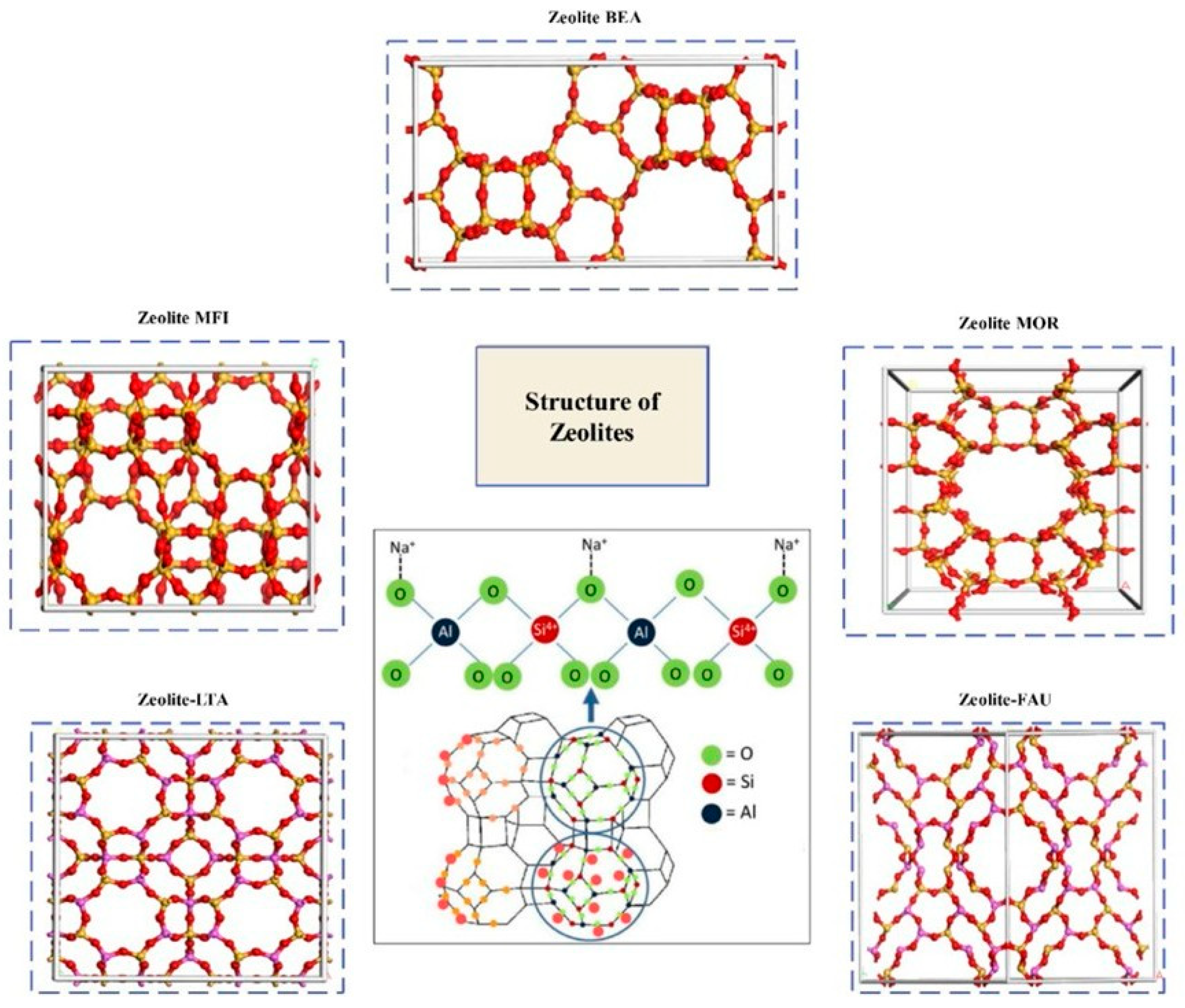
Figure 1. Ball and stick model of zeolite structure [8]. Copyright 2025, Elsevier.
Processes 14 00132 g001
Figure 2. The front view of industrially important zeolites with official names by the International Zeolite Association [15]. Copyright 2022, ACS.
Processes 14 00132 g002
Figure 3. Schematic representation depicting applications of zeolites.
Processes 14 00132 g003
Figure 4. Schematic representation showing the strength and weakness of zeolites and molecular sieves.
Processes 14 00132 g004
Figure 5. (a) CO2-TPD profiles and (b) CO2 adsorption curves of 13X samples with varied n(H2O/Na2O) [37]. Copyright Taylor and Francis 2024.
Processes 14 00132 g005
Figure 6. Steric effect on CO2 separation [36]. Copyright Nature, 2024.
Processes 14 00132 g006
Figure 7. Kinetic effect on CO2 separation [36]. Copyright Nature, 2024.
Processes 14 00132 g007
Figure 8. (a) Gating effect on CO2 separation [36]. Copyright Nature, 2024. (b) Molecular self-gating on zeolites [45] Copyright 2025, ACS.
Processes 14 00132 g008
Figure 9. (a) The tubular membrane for separation of CO2 and CH4, (b) CO2 mole fractions, and (c) CH4 mole fractions at the feed and permeate sides of each increment and (d) the selectivity comparison of zeolite with polymeric membrane at each increment [56]. Copyright 2022, Elsevier.
Processes 14 00132 g009
Figure 10. (a) A scheme representing the selective adsorption of CO2. (b) The relationship between the metal cations’ characteristics, zeolite framework oxygens, and CO2 adsorption strength [64]. Copyright 2023, Elsevier.
Processes 14 00132 g010
Figure 11. Xe uptake by pentasil-type zeolites [75]. Copyright 2013, ACS.
Processes 14 00132 g011
Figure 12. (a) The yield and (b) selectivity of products. (c) Scheme representing the generation of olefins from waste cooking oil [86]. Copyright ACS, 2024.
Processes 14 00132 g012
Figure 13. The timeframe summarizing developments in adsorptive hydrocarbon separation and purification with different porous materials over the past three decades [89]. Copyright 2021, Wiley.
Processes 14 00132 g013
Figure 14. (a,b) Adsorption isotherms of ethylene (closed symbols) and ethane (open symbols) measured by volumetric method on (black squares) and AgX (red circles) at 303 K [94]. Copyright 2012, ACS.
Processes 14 00132 g014
Figure 15. Comparison of adsorption isotherms of (a) benzene, (b) CCl4, and (c) n-hexane of MCM-41 with other adsorbents [100]. Copyright 1998, ACS.
Processes 14 00132 g015
Figure 16. (a) Schematic representation of N2O capture and reduction. (b) N2O-TPD profile of metal-exchanged zeolites. (c) Separation efficacy of Ca-zeolite over H2O, CO2, and O2 [106]. Copyright 2025, ACS.
Processes 14 00132 g016
Figure 17. Organic vapor sampling and injection experiment setup: (a) loading of sample; (b) injection of sample [134]. Copyright mdpi, 2021.
Processes 14 00132 g017
Figure 18. Schematic representation depicting hydrogen storage in zeolites [140]. Copyright 2025, Scilight.
Processes 14 00132 g018
Figure 19. The effect of (a) solution concentraion and (b) pH for the removal of ammonia nitrogen from wastewater [144]. Copyright Nature, 2024.
Processes 14 00132 g019
Figure 20. Schematic representation of conclusion and future aspects.
Processes 14 00132 g020
Table 1. Zeolite adsorbents for CO2 separation from mixture of gases at room temperature.
Sl No.ZeolitePressure (kPa)MixtureCapacity (mmol/g)SelectivityReferences
1Na-LTA-3101.3CO2/N2 (15/85)3.71730/ASF *[64]
2Li-ZK-5100CO2/N2 (10/90)3.34128/ISF *[65]
3K-ZK-5100CO2/N2 (10/90)2.66104/ISF[65]
4r1KCHA100CO2/N2 (15/85)1.74496/ISF[66]
5r1KCHA100CO2/CH4 (50/50)1.95>100/ISF[66]
6Na-LTA-1100CO2/CH4 (50/50)3.94.9/ISF[67]
7Li-RHO100CO2/CH4 (40/60)4.5>200/ISF[68]
8K-MER-3.8100CO2/CH4 (50/50)3.468/ISF[69]
9SSZ-13100CO2/H2 (50/50)3.925/ISF[70]
10SSZ-13200CO2/H2 (50/50)3.211/ISF[71]
11C–S–H100CO2/H2 (50/50)1.225/ISF[72]
13Zeolite-5A@MOF-74700CO2/CO/CH4/H2
(25:25:25:25)
13.8300/IAST *[58]
14NaX Zeolite100CO2/CO/He (20:20:60)1.1314.5/ISF[63]
15 MCM-41-40-TEPA-CO2/N2 (10/90)2.7-[73]
16M-1AP-60TETA-CO2/N2 (10/90)6.52-[59]
* Values have been taken from figures. Ideal Adsorption Solution Theory (IAST), Ideal Separation Factor (ISF), Actual Adsorption Factor (ASF).
Table 2. Silver loading, estimated number of adsorption sites, and equilibrium constants for the strong and weak sites at 303 K [75]. Copyright 2013, ACS.
CatalystAg loading (mol g−1)N2 (mol g−1)K2 (kPa−1)N1 (mol g−1)K1 (kPa−1)
NaAg-PZ2-256.21 × 10−42.8 × 10−46431.8 × 10−30.3
Ag-PZ2-259.45 × 10−45.7 × 10−49251.6 × 10−30.8
NaAg-PZ2-402.20× 10−41.6 × 10−41031.9 × 10−30.06
Ag-PZ2-403.74 × 10−42.6 × 10−41811.8 × 10−30.06
NaAg-PB1.78 × 10−41.2 × 10−4191.7 × 10−30.02
Ag-PB5.65 × 10−43.3 × 10−41131.4 × 10−30.04
AgX31.5 × 10−44.8 × 10−4262.2 ×10−30.05
Table 3. Zeolite adsorbents for inert gas separation at room temperature.
Sl No.ZeoliteGas Mixture *Adsorption Capacity (mmol/g) *Pressure (bar) *Selectivity *References
1ZMS-11Kr/N2 (50:50)0.51 (Kr)1.04.5/IAST[77]
2SSZ-13Kr/N2 (50:50)0.50 (Kr)1.03.9/IAST[77]
35AKr/N2 (50:50)0.60 (Kr)1.00.7/IAST[77]
44AKr/N2 (50:50)0.18 (Kr)1.00.7/IAST[77]
513XKr/N2 (50:50)0.42 (Kr)1.00.9/IAST[77]
6Na-CHA-11.5Ke/Xe (20:80)1.98 (Xe)1.06/IAST[78]
7Na-MFI-13.1Ke/Xe (20:80)2.0 (Xe)0.24.7/IAST[78]
8Na-FAU-1.2Ke/Xe (20:80)2.4 (Xe)0.24.9/IAST[78]
9Na-BEA-13.4Ke/Xe (20:80)2.1 (Xe)0.27.2/IAST[78]
10ZIF-4Ke/Xe (20:80)1.64 (Xe)0.216.2/IAST[79]
* Values have been taken from figures.
Table 4. Basic properties of light hydrocarbons.
Sl No.Light HydrocarbonsKinetic Diameter (Å)Polarizability
×1025 cm−3
Boiling Point (K)Dipole Moment (×1018/ESU cm)
1C2H44.1642.5169.40
2C2H64.4444.3184.60
3CH4-25.9111.60
4C3H84.3–5.1162.9231.00.084
5C3H64.6862.9225.50.366
Table 5. Uses and harmful effects of various gases.
Uses of GasesHarmful Impact of Gases
CO2 is the main component in fire extinguishersCO2 is the main source for global warming resulting in acid rain, temperature rise
Nitrogen is used for the synthesis of ammonia and food packaging.Nitrogen can cause severe frostbite and asphyxiation due to oxygen displacement. Oxidized form of nitrogen -N2O and NO2 pose significant health risks, causing respiratory issues
Argon is used in light bulbsArgon acts as a simple asphyxiant by causing dizziness, unconsciousness, and death in low-oxygen situations
Xenon is used in nuclear reactorsXenon inhalation in excessive concentrations results in dizziness, nausea, loss of consciousness. Oxygen–xenon compounds are toxic. They are also explosive, breaking down to elemental xenon and diatomic oxygen with much stronger chemical bonds than the xenon compounds.
Methane is the main component of natural gas used for heating, cooking, and electricity generation, powering homes, CNG, and industries.CH4 is a powerful greenhouse gas and is a key ingredient in forming harmful air pollutant, tropospheric ozone.
CO is used industrially as a fuel and a reducing agent for metal extraction.CO binds to red blood cells in hemoglobin, resulting in reduced oxygen levels in human body.
Table 6. NOx removal using zeolites.
Sl No.ZeoliteSurface Area (m2/g) *Catalyst Weight in the Pack Fixed-bed (g) *Reaction ConditionNOx Adsorption Capacity
(mmol/g) *
References
1.H-ZSM-533362.5200 ppm NO + 4.5% CO2/N2 + 14% O2
298 K
0.232[110]
2.Cu-ZSM-53501800 ppm NO/He
at 298 K
0.25[111]
3.Na-ZSM-5415-600 ppm NO2/Ar
at 303 K
0.42[112]
4.Cu-ZSM-5250-800 ppm NO + 1% O2 + 2% H2O/He
at 323 K
0.09[113]
5.Cu-ZSM-53603Wet gas stream (RH = 0.32%):
500 ppm NO + 500 ppm NO2 + 10% O2 /N2
at 473 K
0.084[104]
6.Na-ZSM-5-0.51000 ppm NO
at 273 K
0.01[114]
7.HZSM-5
(35)
336.52.25200 ppm NOx, 14% O2, 4.5% CO2, Bal N20.28[115]
8.HZSM-5
(110)
372.42.25200 ppm NOx, 14% O2, 4.5% CO2, Bal N20.19[115]
9.HZSM-5
(360)
385.12.25200 ppm NOx, 14% O2, 4.5% CO2, Bal N20.08[115]
10.Silicate-1413.82.25200 ppm NOx, 14% O2, 4.5% CO2, Bal N20.005[115]
* Values have been taken from figures.
Table 7. Desulfurization approaches by different zeolites and their modifications.
Sl No.ZeolitesSelectivity *Modification TypeReference
1.Clinoptilolite0.03g S/g-[120]
2.H-Y59% S reduction-[121]
3.Ce-Na-Y-239% S reductionIon exchange[121]
4.13X85%-[122]
5.Ca-X and Na-X10 wt.%SIon exchange[123]
6.5A66.6%-[124]
7.LTA (Zeolite A)20%Ion exchange[125]
8.Mn-SP-1150.47% wtWet
impregnation
[126]
9.Cu-ETS-247 mg H2S/g of adsorbentIon exchange[127]
10.Na-Mordenite97%Ion exchange[128]
* Values have been taken from figures.
Disclaimer/Publisher’s Note: The statements, opinions and data contained in all publications are solely those of the individual author(s) and contributor(s) and not of MDPI and/or the editor(s). MDPI and/or the editor(s) disclaim responsibility for any injury to people or property resulting from any ideas, methods, instructions or products referred to in the content.