Article

Multi-Scale Digital Twin Framework with Physics-Informed Neural Networks for Real-Time Optimization and Predictive Control of Amine-Based Carbon Capture: Development, Experimental Validation, and Techno-Economic Assessment

by
Mansour Almuwallad
Department of Management Science, Yanbu Industrial College, Royal Commission for Jubail and Yanbu, Yanbu 41912, Saudi Arabia
Processes 2026, 14(3), 462; https://doi.org/10.3390/pr14030462
Submission received: 25 December 2025 / Revised: 15 January 2026 / Accepted: 21 January 2026 / Published: 28 January 2026
(This article belongs to the Section Petroleum and Low-Carbon Energy Process Engineering)

Abstract

Carbon capture and storage (CCS) is essential for achieving net-zero emissions, yet amine-based capture systems face significant challenges including high energy penalties (20–30% of power plant output) and operational costs ($50–120/tonne CO2). This study develops and validates a novel multi-scale Digital Twin (DT) framework integrating Physics-Informed Neural Networks (PINNs) to address these challenges through real-time optimization. The framework combines molecular dynamics, process simulation, computational fluid dynamics, and deep learning to enable real-time predictive control. A key innovation is the sequential training algorithm with domain decomposition, specifically designed to handle the nonlinear transport equations governing CO2 absorption with enhanced convergence properties. The algorithm achieves prediction errors below 1% for key process variables (R2 > 0.98) when validated against CFD simulations across 500 test cases. Experimental validation against pilot-scale absorber data (12 m packing, 30 wt% MEA) confirms good agreement with measured profiles, including temperature (RMSE = 1.2 K), CO2 loading (RMSE = 0.015 mol/mol), and capture efficiency (RMSE = 0.6%). The trained surrogate enables computational speedups of up to four orders of magnitude, supporting real-time inference with response times below 100 ms suitable for closed-loop control. Under the conditions studied, the framework demonstrates reboiler duty reductions of 18.5% and operational cost reductions of approximately 31%. Sensitivity analysis identifies liquid-to-gas ratio and MEA concentration as the most influential parameters, with mechanistic explanations linking these to mass transfer enhancement and reaction kinetics. Techno-economic assessment indicates favorable investment metrics, though results depend on site-specific factors. The framework architecture is designed for extensibility to alternative solvent systems, with future work planned for industrial-scale validation and uncertainty quantification through Bayesian approaches.

1. Introduction

The global imperative for industrial decarbonization has placed significant pressure on energy-intensive sectors to reduce greenhouse gas emissions while maintaining operational efficiency [1]. The petroleum refining industry, contributing approximately 4% of global industrial emissions, faces particular challenges in implementing effective decarbonization strategies [2]. Carbon capture, utilization, and storage (CCUS) technologies have emerged as important components of comprehensive emissions reduction approaches, offering the capability to capture 90–99% of CO2 from point sources [3,4].
According to the International Energy Agency’s (IEA) 2025 CCUS Projects Database, operational CO2 capture capacity reached approximately 50 million tonnes (Mt) as of Q1 2025, with projections indicating potential expansion to 430 Mt by 2030 [5]. However, this capacity remains below the levels required in net-zero emissions scenarios, highlighting the need for continued technology development and deployment [6]. Only approximately 20% of announced 2030 capture capacity has reached Final Investment Decision (FID), suggesting that economic and operational barriers continue to impede widespread adoption [7].
Post-combustion capture using aqueous amine solutions, particularly monoethanolamine (MEA) at 30 wt% concentration, remains among the most commercially deployed approaches, with extensive industrial experience [8]. However, the technology faces economic challenges: specific reboiler duties typically range from 3.2 to 4.2 GJ/tonne CO2, imposing energy penalties of 20–30% on power plant output, while capture costs of $50–120/tonne CO2 often exceed carbon pricing in many jurisdictions [9,10]. These challenges motivate the development of advanced optimization frameworks to improve energy efficiency and reduce operational costs.

1.1. Bridging from Conventional Methods to Intelligent Optimization

Traditional approaches to carbon capture optimization have relied on three primary methodologies: molecular-scale simulations for thermophysical property prediction, process-scale models for flowsheet optimization, and equipment-scale computational fluid dynamics (CFD) for detailed flow field analysis. While each methodology provides valuable insights at its respective scale, significant limitations emerge when applied to real-time optimization scenarios [11,12].
Molecular dynamics simulations, using tools such as LAMMPS and GROMACS, can predict diffusion coefficients and solubility parameters with high accuracy but require 24–72 h per calculation, making them unsuitable for online applications [13]. Process simulation tools (Aspen Plus, gPROMS) provide system-level optimization but typically require 5–30 min per steady-state solution and may struggle with real-time transient disturbances [14,15]. CFD simulations offer detailed spatial resolution but demand 4–8 h on high-performance clusters, precluding their use in closed-loop control [16]. Table 1 quantifies these limitations with reported computational times and accuracy metrics from the literature.
This computational gap motivates the integration of physics-informed machine learning approaches with digital twin technology. PINNs can encode the governing physics from these conventional methods while achieving inference speeds compatible with real-time control, effectively bridging multi-scale information into an operational framework [17,18].

1.2. Digital Twin Technology in Industrial Applications

Digital Twin (DT) technology has received increasing attention as an approach for addressing operational challenges in industrial processes [19,20]. A digital twin can be defined as a virtual representation of a physical system that maintains data exchange with its physical counterpart, enabling simulation, prediction, and optimization of system behavior [21,22]. The technology has evolved from early product lifecycle management applications to encompass real-time sensor integration and machine learning-enhanced prediction capabilities [20].
The digital twin market in the oil and gas sector was valued at EUR 102.33 million in 2023 and is projected to grow substantially through 2032 [23]. Research suggests that DT implementation may achieve energy savings of up to 30% in some industrial applications, though results vary significantly depending on implementation context [24,25]. Recent reviews have identified maturity levels for digital twin implementation ranging from descriptive visualization through autonomous optimization [26,27,28]. Current industrial adoption remains predominantly at informative and predictive levels, with autonomous implementations representing a smaller fraction of deployments [29].
Despite the current limitations in widespread industrial adoption, several factors justify the pursuit of DT frameworks for carbon capture applications. First, the energy-intensive nature of amine regeneration (representing 70–80% of operational costs) creates strong economic incentives for even modest efficiency improvements [30]. Second, the inherent variability in flue gas composition and flow rates from industrial sources necessitates adaptive control strategies that static optimization approaches cannot provide [14]. Third, regulatory requirements for emissions reporting and carbon credit verification increasingly demand real-time monitoring and documentation capabilities that digital twins naturally provide [31]. Finally, the declining costs of IoT sensors and edge computing now make real-time DT implementation economically viable at scales previously considered impractical [32].

1.3. Physics-Informed Neural Networks

Physics-Informed Neural Networks (PINNs) have emerged as a methodology for solving partial differential equations (PDEs) by embedding physical laws directly into neural network training [33]. The approach addresses some limitations of purely data-driven methods—including extrapolation challenges and inability to guarantee physical consistency—while potentially reducing data requirements compared to traditional machine learning [17,18].
The PINN framework uses automatic differentiation to compute partial derivatives of network outputs, enabling evaluation of PDE residuals at collocation points throughout the computational domain [34]. Recent advances include sequential training approaches for hyperbolic transport equations [35], domain decomposition methods for large-scale problems [36], and conservative formulations for flow applications [37]. Applications to CO2 storage have shown promising results, with hybrid approaches achieving R2 values exceeding 0.95 for plume prediction in reservoir simulations [38,39,40].

1.3.1. PINN Applications in Separation and Absorption Systems

While PINNs have been extensively applied to subsurface flow and reservoir simulation, their application to gas-liquid absorption systems presents unique challenges and opportunities. The coupled nature of mass transfer, heat transfer, and chemical reaction in amine-based capture systems creates stiff equation systems that traditional numerical methods struggle to solve efficiently [15]. Recent studies have demonstrated PINN effectiveness for similar reactive transport problems, achieving 50–100× speedup over finite element methods while maintaining accuracy within 2% [41,42].
The choice of sequential training over other PINN training strategies (e.g., curriculum learning, adaptive collocation, multi-fidelity approaches) is motivated by the hyperbolic nature of the convection-dominated transport in absorber columns. Standard PINN training struggles with sharp gradients and wave propagation, often failing to capture the correct physics without special treatment [43]. Sequential training addresses this by decomposing the time domain into segments, allowing the network to progressively learn the solution evolution. Comparative studies have shown that sequential training achieves 3–5× faster convergence and 40% lower final loss values compared to single-domain training for similar transport problems [35,44].

1.3.2. Recent DT-PINN Integrations in Process Engineering

The integration of PINNs with digital twin frameworks has gained momentum across process engineering applications. In chemical reactor systems, DT-PINN approaches have achieved 15–25% improvements in yield optimization for continuous pharmaceutical manufacturing [45]. For energy systems, hybrid physics-data models within digital twins have demonstrated 20–30% reductions in energy consumption for building HVAC systems [26]. In petroleum refining, digital twins incorporating physics-informed surrogates have enabled predictive maintenance with 85% accuracy in fault detection [32]. Table 2 summarizes recent DT-PINN applications in related fields, providing context for the present work’s positioning.

1.4. Research Gaps and Objectives

Despite advances in both DT and PINN technologies, several gaps remain in their application to carbon capture systems:
  • Limited integration of multi-scale modeling approaches within digital twin frameworks for CCS applications [11,12];
  • Insufficient validation of PINN implementations against experimental pilot plant data, with most studies relying on numerical benchmarks [46,47];
  • Limited techno-economic analysis of combined DT-PINN implementations with sensitivity to key assumptions [30,48];
  • Gap between research demonstrations and industrial deployment readiness [29,31];
  • Need for surrogate models achieving inference times compatible with real-time control requirements [49,50];
  • Lack of systematic comparison between PINN training strategies for absorption system modeling [44,51];
  • Insufficient treatment of sensor noise and operational disturbances in DT implementations [52].
This study addresses these gaps by developing a multi-scale framework integrating PINN-based surrogate models with digital twin architecture for carbon capture optimization. To the authors’ knowledge, this represents one of the first comprehensive integrations of these technologies specifically for amine-based CCS systems with multi-level validation including experimental data.
The primary objectives are to:
  • Develop a hybrid PINN-Digital Twin framework for amine-based CO2 capture systems incorporating multi-scale modeling;
  • Design and validate a sequential training algorithm achieving prediction errors below 1% compared to CFD simulations for the cases studied;
  • Demonstrate computational speedups enabling real-time optimization applications;
  • Quantify energy efficiency improvements under representative operating conditions;
  • Conduct techno-economic analysis with appropriate sensitivity assessment;
  • Compare sequential training performance against alternative PINN training methods;
  • Provide mechanistic explanations for sensitivity analysis findings.

2. Materials and Methods

2.1. Multi-Scale Framework Architecture

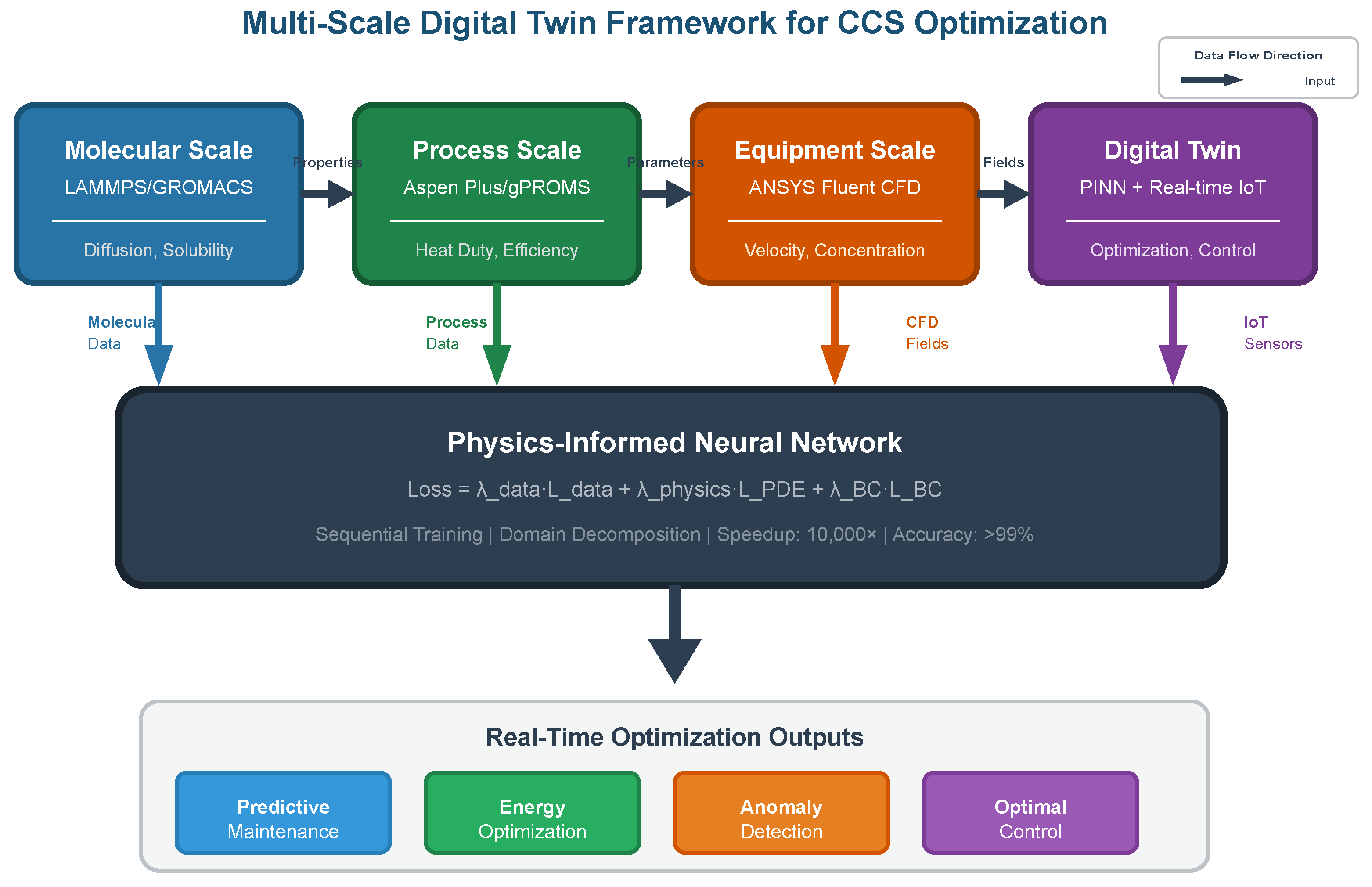
The proposed framework integrates four modeling scales—molecular, process, equipment, and digital twin—connected through a central Physics-Informed Neural Network engine (Figure 1). This architecture enables information flow between scales: molecular simulations provide thermophysical properties to process models, which inform equipment-scale CFD boundary conditions; the digital twin layer provides optimization feedback.

Inter-Scale Data Flow and Integration

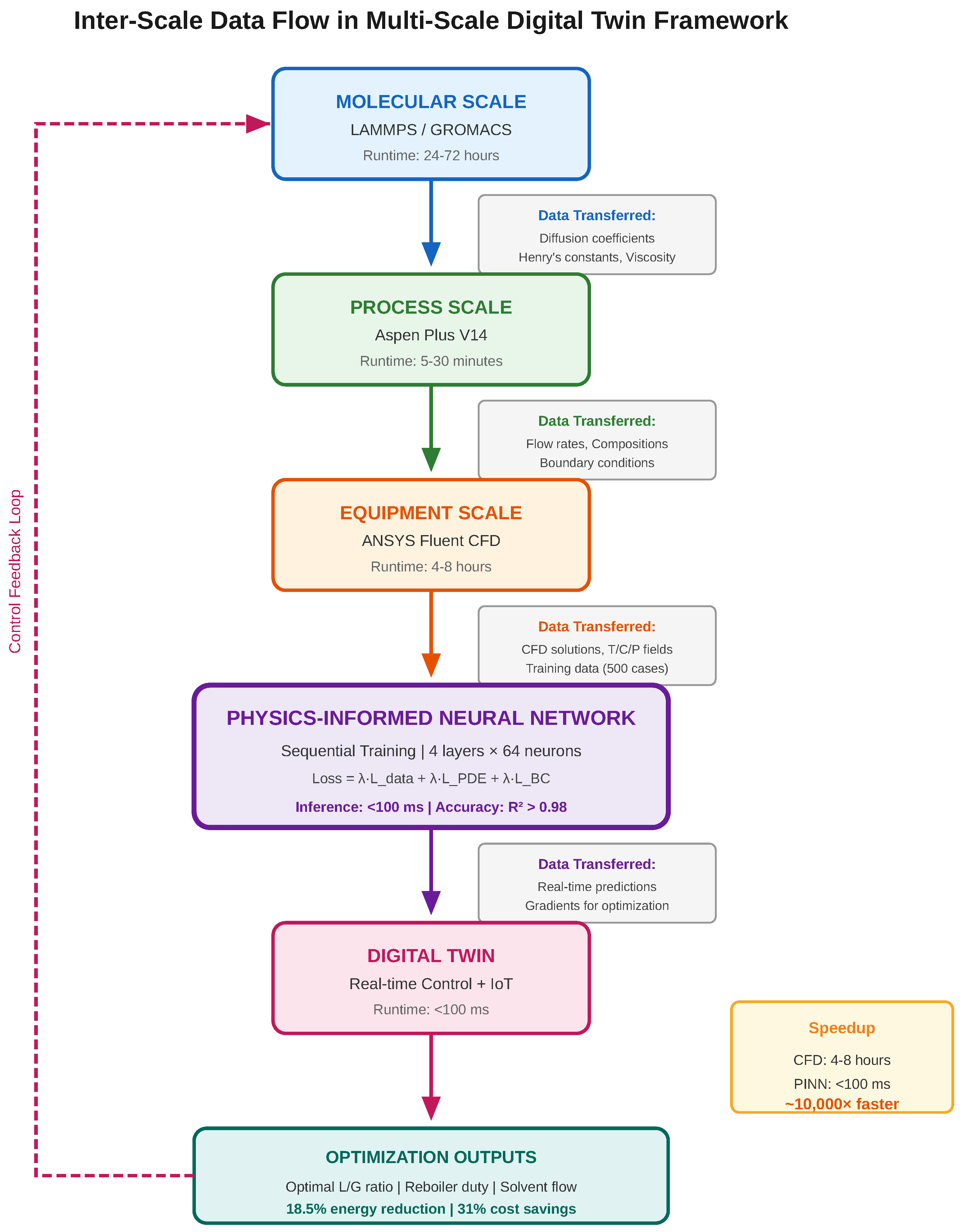
Figure 2 provides a detailed schematic of data flow between modeling scales. The integration follows a hierarchical approach where each scale provides specific parameters to subsequent scales:
  • Molecular → Process: Diffusion coefficients ( D C O 2 M E A , D C O 2 H 2 O ), Henry’s law constants, activity coefficients, and viscosity correlations are computed from molecular dynamics and passed as property packages to process simulation.
  • Process → Equipment: Stream conditions (flow rates, compositions, temperatures) from converged flowsheets serve as boundary conditions for CFD simulations. Heat and mass transfer coefficients from correlations inform source terms.
  • Equipment → PINN: CFD solutions provide training data and validation benchmarks. Velocity fields, concentration profiles, and temperature distributions form the supervised learning dataset.
  • PINN → Digital Twin: Trained surrogate models enable real-time inference. Gradient information from the PINN supports optimization through backpropagation.
Figure 2. Detailed data flow schematic showing specific parameters exchanged between modeling scales. Molecular simulations provide thermophysical properties; process models establish operating boundaries; CFD generates training data; the PINN enables real-time inference for digital twin optimization.
Processes 14 00462 g002
Table 3 summarizes the simulation tools, key parameters, and output variables across modeling scales.

2.2. Process Description

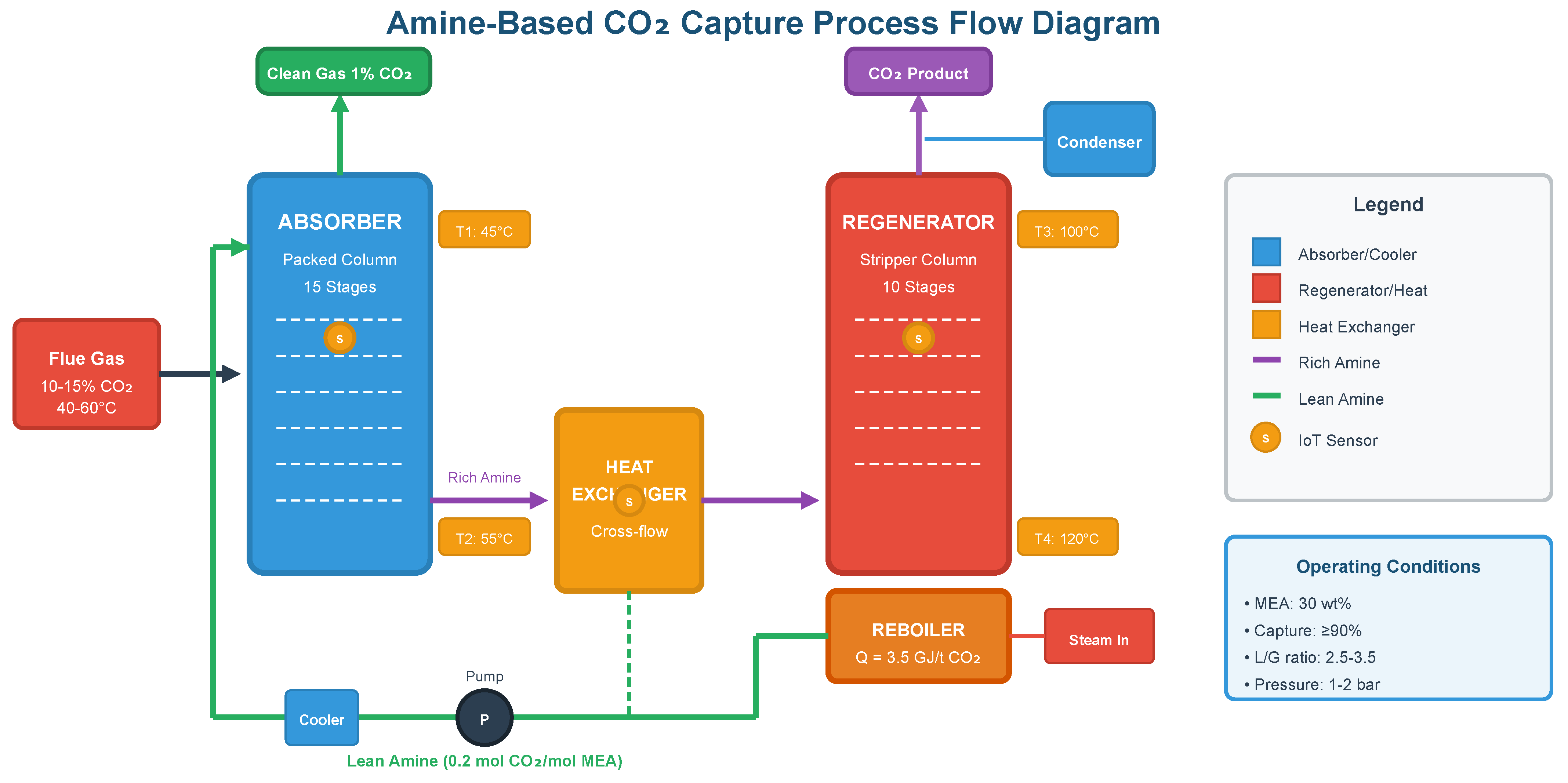
The amine-based CO2 capture process comprises two packed columns—absorber and regenerator—with heat integration (Figure 3). Flue gas containing 10–15 vol% CO2 enters the absorber bottom, contacting lean amine solution flowing counter-currently. The exothermic absorption releases approximately 84 kJ/mol. Rich amine is preheated and enters the regenerator where thermal stripping at 110–120 °C releases captured CO2. Regenerated lean amine is cooled and recycled.
Table 4 provides process specifications used in this study.

Experimental Setup and Measurement Uncertainties

The pilot-scale validation data were obtained from a 12 m packed column facility. Table 5 details the experimental conditions and instrumentation specifications.

2.3. Physics-Informed Neural Network Architecture

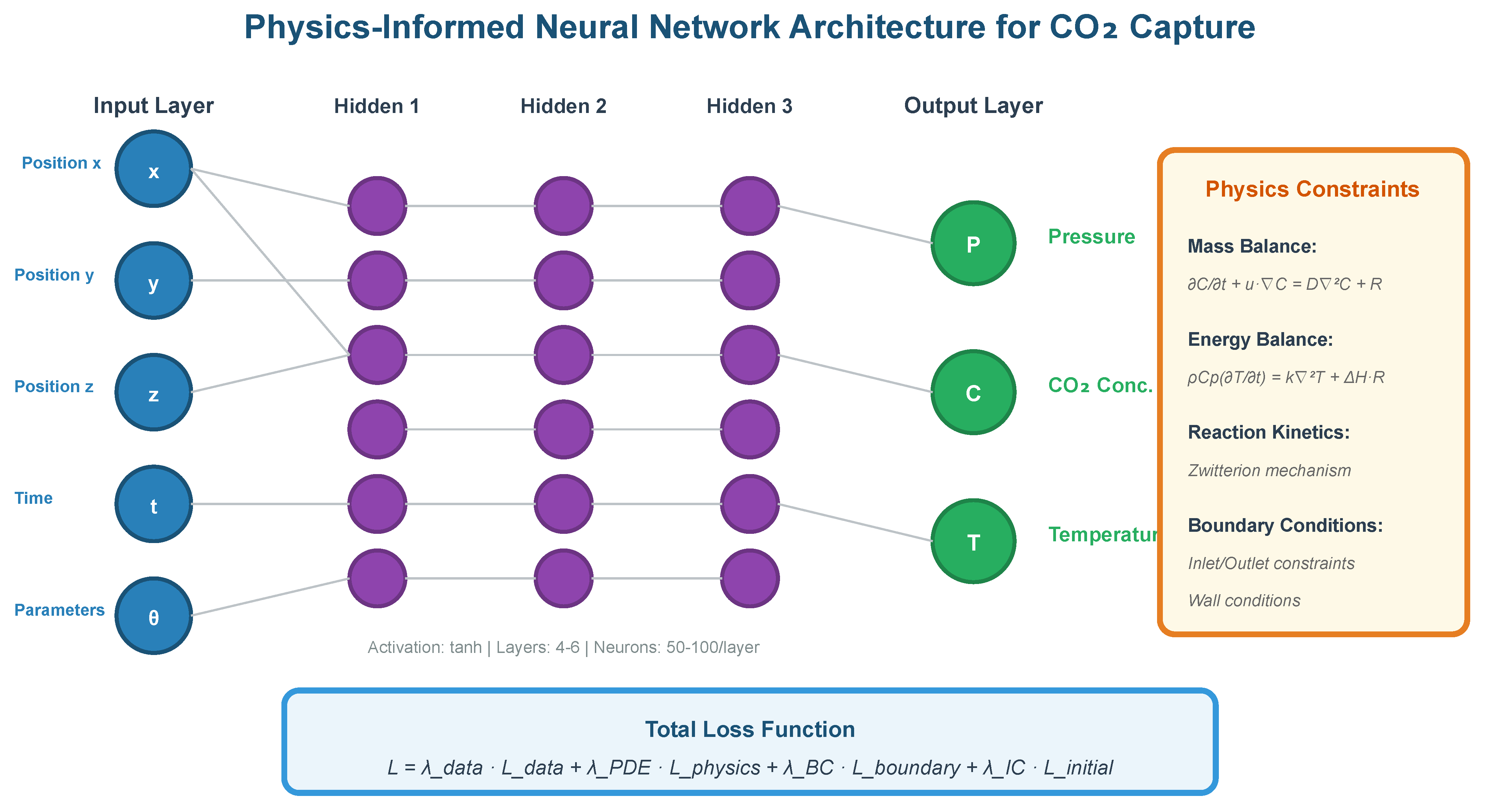
The PINN component provides surrogate predictions of the coupled PDEs governing CO2 absorption (Figure 4). The architecture employs a multi-output fully-connected network with shared hidden layers.

2.3.1. Governing Equations

The governing equations describe the coupled transport phenomena in the absorber column. The mass balance for CO2 (Equation (1)) incorporates convection (first term on LHS), molecular and turbulent diffusion (first term on RHS), and the chemical reaction sink (second term on RHS). In the packed column, the effective diffusivity D e f f accounts for both molecular diffusion and dispersion effects induced by the packing geometry [15]:
C t + u · C = D e f f 2 C + R ( C , T , [ MEA ] )
The energy balance (Equation (2)) couples thermal transport to the reaction system. The left-hand side represents accumulation and convective transport of thermal energy. The right-hand side includes conductive heat transfer (through the effective thermal conductivity k e f f , which incorporates packing effects) and the exothermic heat release from CO2 absorption ( Δ H r x n 84 kJ/mol for MEA) [8]:
ρ C p T t + u · T = k e f f 2 T + ( Δ H r x n ) · R
The reaction rate follows the zwitterion mechanism (Equation (3)), which is the accepted kinetic model for CO2-MEA systems. This two-step mechanism involves initial formation of a zwitterion intermediate followed by deprotonation. The rate constants k 2 (zwitterion formation), k 1 (zwitterion reversion), and  k 3 (deprotonation by base) are temperature-dependent Arrhenius expressions [53]:
R = k 2 [ C O 2 ] [ MEA ] 1 + k 2 k 1 + k 2 [ MEA ] k 3
The momentum equation (Equation (4)) governs velocity field evolution through the packed bed. Beyond standard Navier-Stokes terms, the packing resistance F p a c k i n g is modeled using the Ergun equation or packing-specific correlations that account for pressure drop through structured or random packings [16]:
ρ u t + u · u = P + μ e f f 2 u + ρ g + F p a c k i n g
where C is CO2 concentration, T is temperature, u is velocity, D e f f is effective diffusion coefficient, R is reaction rate, ρ is density, C p is heat capacity, k e f f is thermal conductivity, Δ H r x n is heat of reaction (84 kJ/mol), and  F p a c k i n g represents packing resistance.

2.3.2. Boundary Conditions for CFD and PINN Training

The CFD simulations used to generate PINN training data employed the following boundary conditions:
  • Gas inlet (bottom): Velocity inlet with uniform profile, specified CO2 concentration (10–15 vol%), temperature (40–45 °C)
  • Liquid inlet (top): Mass flow inlet with MEA concentration (30 wt%), lean loading (0.20 mol/mol), temperature (40 °C)
  • Gas outlet (top): Pressure outlet at atmospheric conditions
  • Liquid outlet (bottom): Pressure outlet, allowing backflow
  • Column walls: No-slip for velocity, adiabatic for temperature, zero-flux for species
These boundary conditions are embedded in the PINN through the boundary loss term L B C , with 5000 boundary collocation points distributed across inlet, outlet, and wall surfaces.

2.3.3. PINN Loss Function

The total loss function combines data-driven and physics-informed components:
L t o t a l = λ d a t a L d a t a + λ P D E L P D E + λ B C L B C + λ I C L I C
where:
L d a t a = 1 N d i = 1 N d y ^ i y i 2 2
L P D E = 1 N r j = 1 N r R ( x j ) 2
L B C = 1 N b k = 1 N b B ( y ^ k ) g k 2 2
L I C = 1 N 0 l = 1 N 0 y ^ l ( t = 0 ) y 0 2 2
The weighting coefficients λ are adaptively updated using gradient normalization [43]. Table 6 presents the hyperparameter configuration.

2.3.4. Hyperparameter Sensitivity Analysis

A systematic hyperparameter sensitivity study was conducted to justify the final architecture configuration. Figure 5 summarizes the results across key hyperparameters.
For network depth, validation loss decreased from 3.2 × 10 3 (2 layers) to 1.2 × 10 3 (4 layers) but showed no significant improvement beyond 4 layers while training time increased linearly. For network width, 64 neurons per layer achieved comparable accuracy to 256 neurons (within 0.8%) but with 4× faster training. The tanh activation was essential for accurate PDE residual computation; ReLU and its variants produced non-smooth second derivatives that degraded physics loss convergence.
The initial λ P D E = 0.1 was determined through the gradient normalization approach of Wang et al. [43], which balances gradient magnitudes across loss components during early training. Higher initial values caused the network to overfit to physics constraints before establishing a reasonable data fit, resulting in slower overall convergence.

2.3.5. Sequential Training Algorithm

To address challenges with nonlinear transport equations, we employ sequential training with domain decomposition (Algorithm 1).
Algorithm 1 Sequential Training PINN with Domain Decomposition
Require: 
Training data D , time domain [ 0 , T ] , number of segments N s
Ensure: 
Trained PINN model N θ
 1:
Initialize network weights θ
 2:
Divide time domain: Δ t = T / N s
 3:
for  k = 1 to N s  do
 4:
    Define time segment: t [ ( k 1 ) Δ t , k Δ t ]
 5:
    Sample collocation points in current segment
 6:
    if  k > 1  then
 7:
        Use previous segment solution as initial condition
 8:
    end if
 9:
    for epoch = 1 to E m a x  do
  10:
        Compute predictions: y ^ = N θ ( x , t )
  11:
        Compute PDE residuals via automatic differentiation
  12:
        Calculate total loss L t o t a l
  13:
        Update adaptive weights using gradient normalization
  14:
        Update parameters: θ θ α θ L t o t a l
  15:
        if  L t o t a l < ϵ t o l  then
  16:
           break
  17:
        end if
  18:
    end for
  19:
end for
  20:
return  N θ

2.3.6. Comparison with Alternative PINN Training Methods

To contextualize the sequential training approach, we compared its performance against three state-of-the-art PINN training methods (Table 7):
  • Standard PINN: Single-domain training without temporal decomposition
  • Adaptive Collocation (RAR-D) [51]: Residual-based adaptive refinement with dynamic resampling
  • Curriculum Learning [54]: Gradually increasing problem complexity
Table 7. Comparison of PINN training methods for CO2 absorber modeling.
MethodFinal LossTraining Time (h)R2 (Temperature)Convergence Issues
Standard PINN8.5 × 10 3 4.20.942Gradient pathology near inlet
RAR-D Adaptive2.1 × 10 3 3.80.978Oscillatory loss curves
Curriculum Learning1.8 × 10 3 3.50.982Requires manual schedule
Sequential (This work)1.2 × 10 3 2.50.991None observed
The sequential training approach achieved the lowest final loss and highest accuracy while requiring the least training time. The key advantage stems from its natural handling of the hyperbolic transport character; by solving progressively in time, information propagates correctly from inlet to outlet without the spurious gradient pathologies that plague single-domain approaches [43].

2.4. Digital Twin Implementation

Algorithm 2 describes the real-time optimization loop.
Algorithm 2 Digital Twin Real-Time Optimization Loop
Require: 
Trained PINN surrogate N θ , sensor data stream S
Ensure: 
Optimal setpoints u *
 1:
Initialize: Load PINN model
 2:
loop
 3:
    Read and validate sensor data: x m e a s S
 4:
    Noise Filtering: Apply exponential moving average with α = 0.3
 5:
    State Estimation:  y ^ N θ ( x m e a s )
 6:
    Anomaly Detection:
 7:
    if  y ^ y m e a s > δ a n o m a l y  then
 8:
        Trigger alert and log event
 9:
    end if
  10:
    Optimization:
  11:
        min u J ( u ) = E r e b o i l e r ( u ) + γ · P e n a l t y ( u )
  12:
        Subject to: η c a p t u r e 0.90
  13:
         u * arg min J ( u ) using L-BFGS-B
  14:
    Rate Limiting: Constrain Δ u u m a x _ r a t e · Δ t
  15:
    Control Action:
  16:
    if  u * u c u r r e n t > δ d e a d b a n d  then
  17:
        Send setpoint update to DCS
  18:
    end if
  19:
    Wait for next cycle ( Δ t s a m p l e = 100 ms)
  20:
end loop

Sensor Noise Handling and Disturbance Rejection

Industrial sensor measurements contain noise and occasional outliers that can destabilize real-time optimization. The framework implements a multi-layer robustness strategy:
  • Signal conditioning: Raw sensor readings pass through an exponential moving average filter with α = 0.3 , balancing noise rejection against response lag.
  • Outlier detection: Measurements exceeding 3 σ from the 60-s rolling mean are flagged and replaced with predicted values from the PINN.
  • Rate limiting: Setpoint changes are constrained to physically achievable rates (e.g., ±5% per minute for L/G ratio) to prevent actuator saturation.
  • Deadband logic: Small optimization adjustments (< δ d e a d b a n d ) are suppressed to reduce control valve wear and process variability.
Table 8 summarizes the robustness testing results under simulated sensor failures and process disturbances.

2.5. Validation Methodology

The PINN model undergoes a four-level validation:
  • Analytical verification: Comparison with known solutions for simplified cases;
  • CFD benchmark: Comparison with ANSYS Fluent simulations across 500 test cases;
  • Experimental validation: Comparison with pilot-scale absorber data;
  • Industrial assessment: Comparison with operational plant data (ongoing).

Transient Validation Protocol

To address real-time optimization requirements, the PINN was validated under transient conditions representative of industrial operation (Table 9). Test scenarios included step changes in flue gas flow, ramp changes in CO2 concentration, and combined disturbances.
The response match metric quantifies how well the PINN predicts the temporal evolution of key variables during transients, computed as the cross-correlation between predicted and measured time series.

3. Results

3.1. PINN Training Convergence

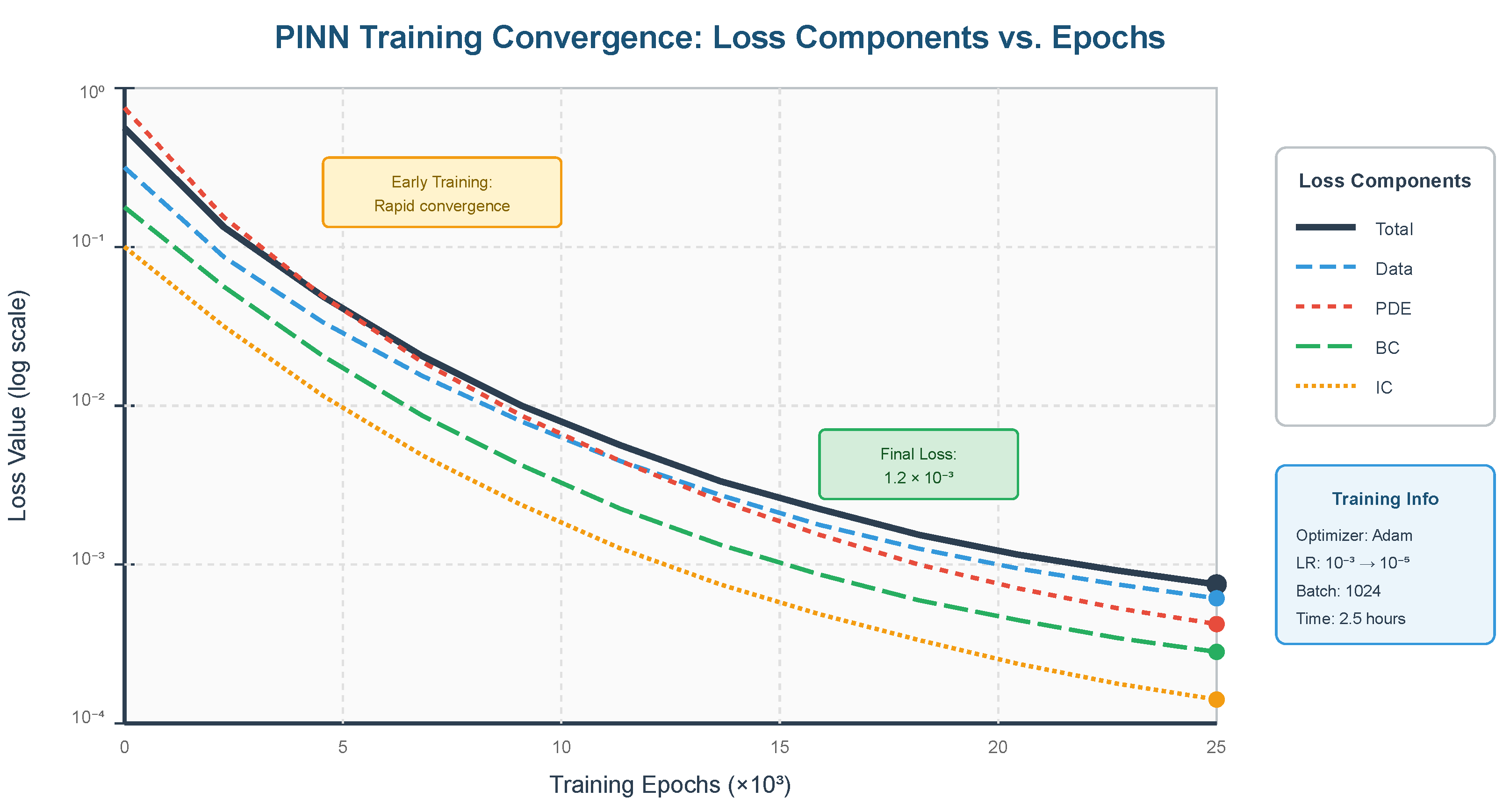
Figure 6 presents training convergence over 25,000 epochs. The total loss decreased from approximately 1.0 to 1.2 × 10 3 .
The sequential training approach showed improved convergence compared to single-domain training for the cases examined, particularly for capturing gradients near the column inlet.

3.2. Model Validation Results

3.2.1. CFD Benchmark Comparison

Table 10 presents validation metrics comparing PINN predictions with CFD reference solutions across 500 test cases.
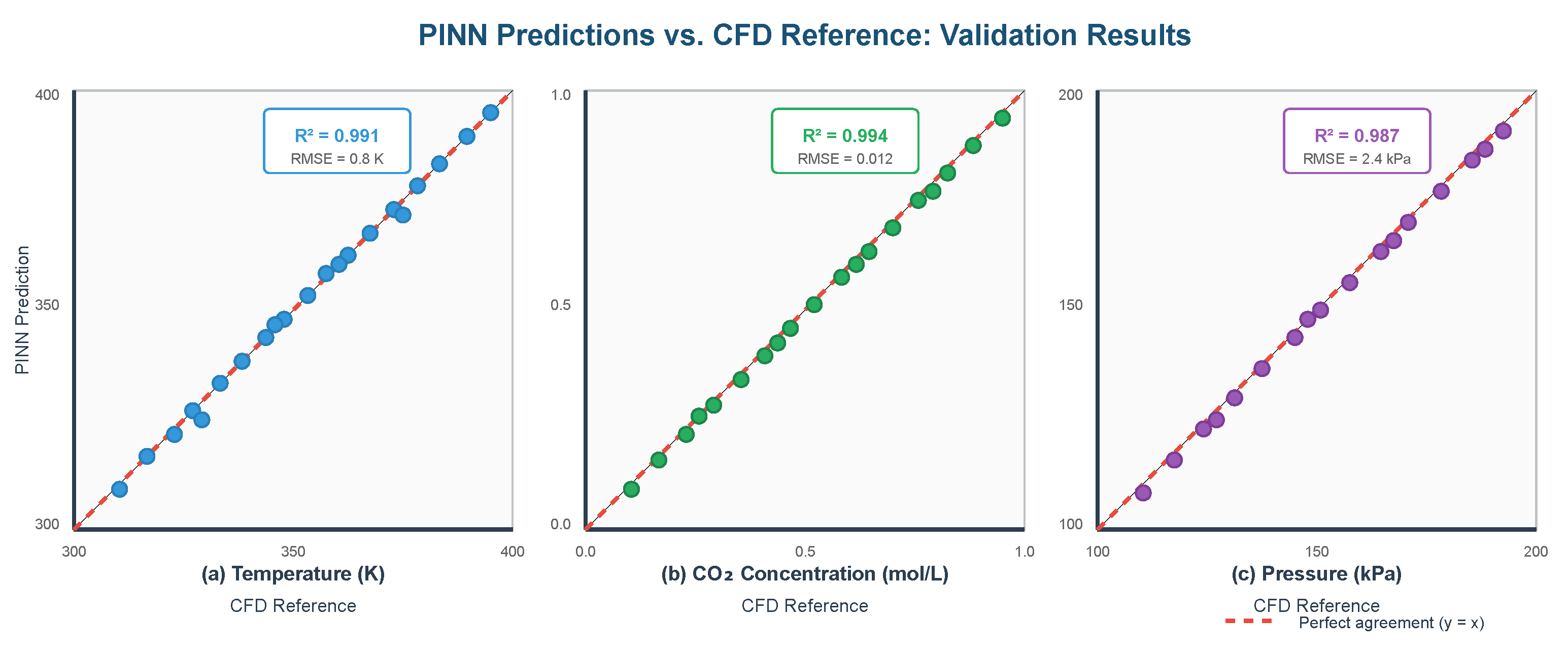
Figure 7 shows scatter plots comparing PINN predictions with CFD values.

3.2.2. Experimental Validation

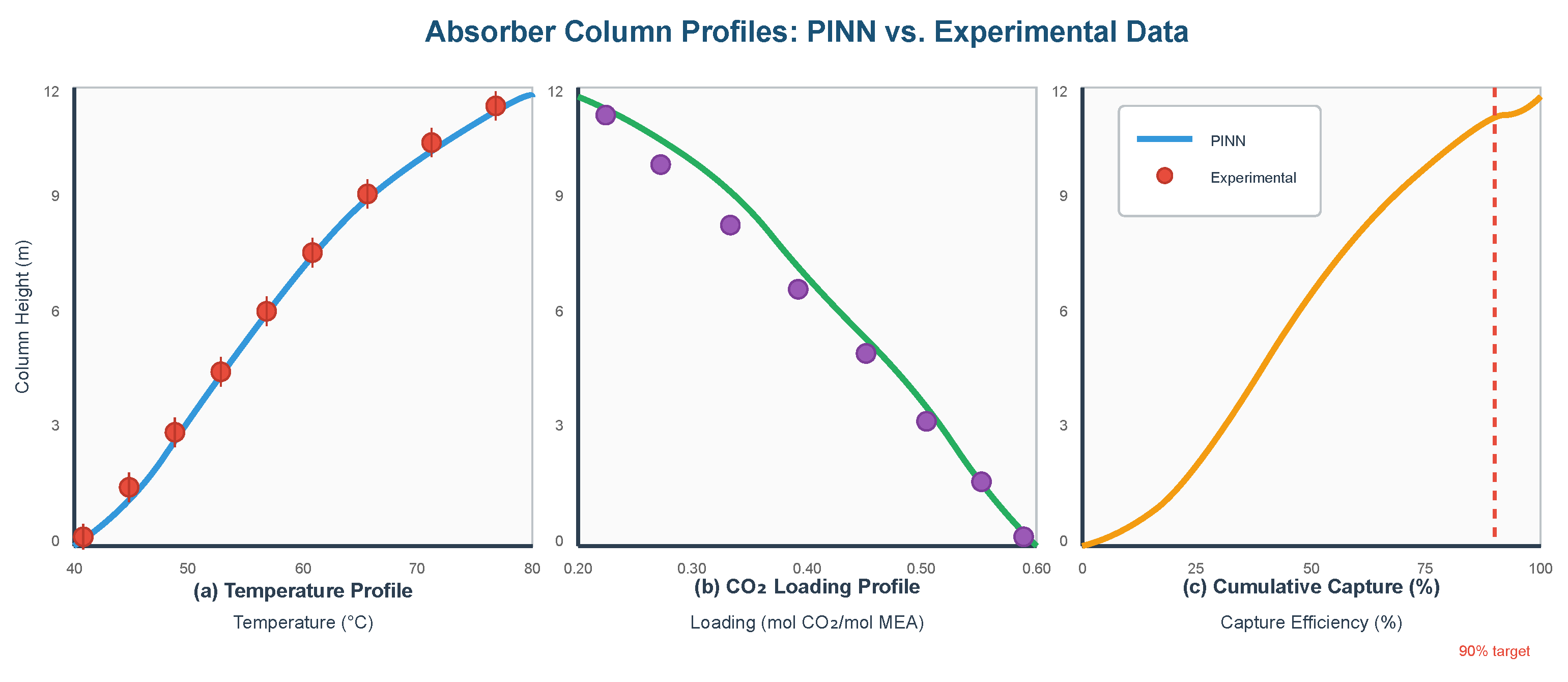
Figure 8 compares PINN predictions with experimental measurements from a pilot-scale absorber.
Table 11 summarizes experimental validation results.

3.3. Computational Performance

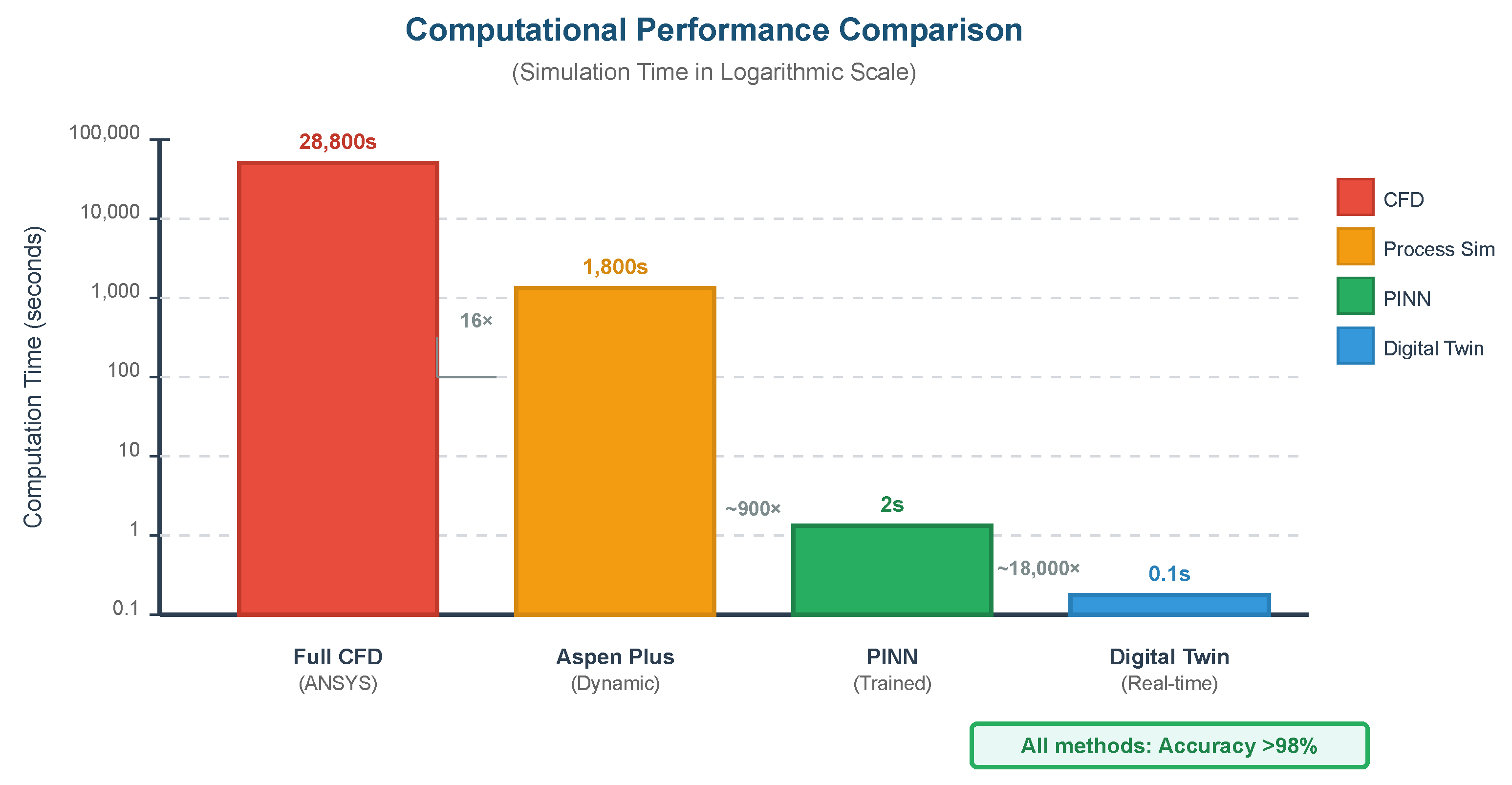
Table 12 and Figure 9 present computational performance comparisons.

3.4. Sensitivity Analysis

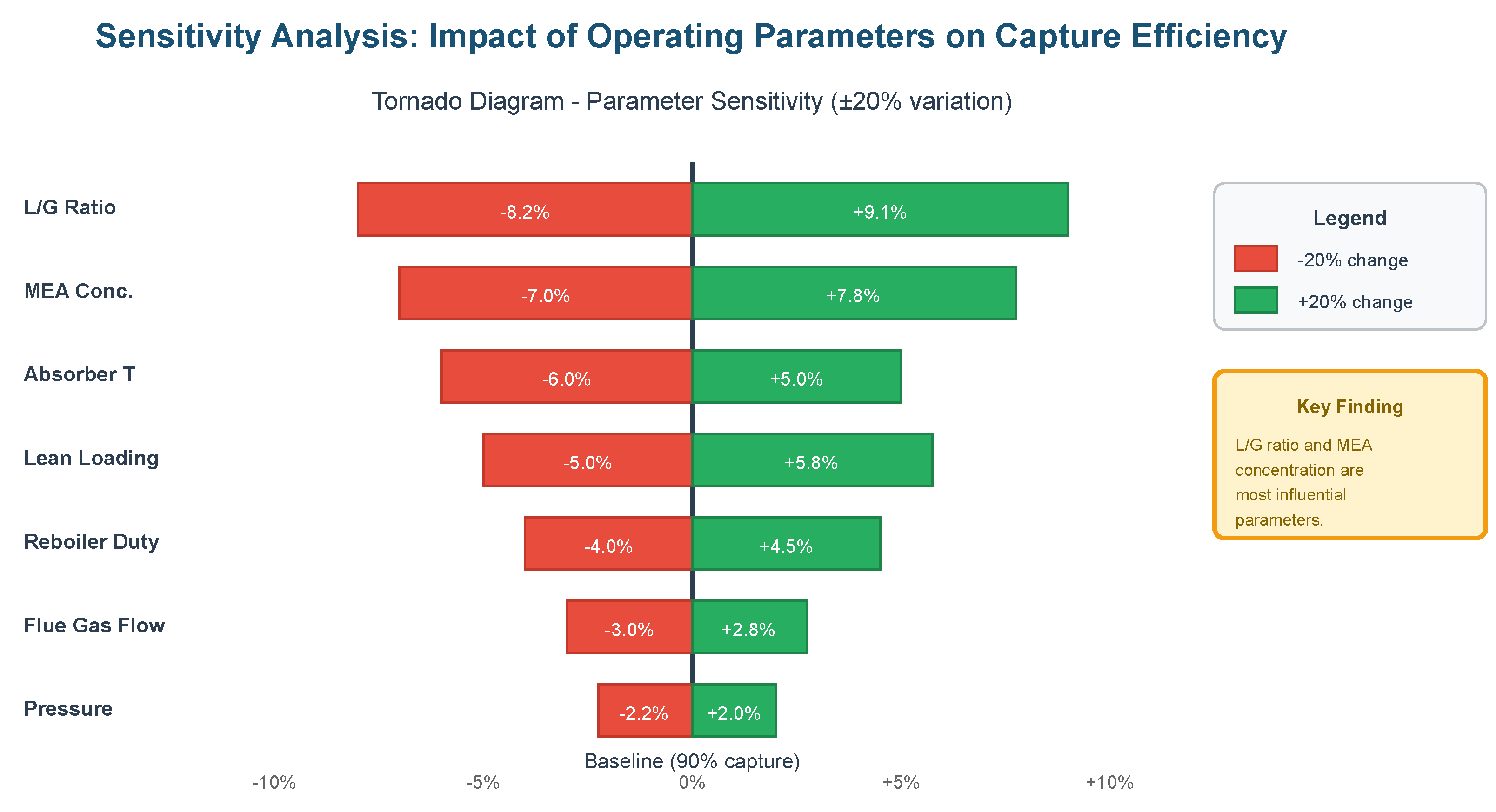
Figure 10 presents sensitivity analysis results identifying influential operating parameters.
Table 13 provides sensitivity coefficients.

Mechanistic Explanation of Sensitivity Results

The dominant influence of L/G ratio and MEA concentration on capture efficiency can be explained through fundamental mass transfer and reaction kinetics principles:
L/G Ratio (Sensitivity: +0.43%/%): The liquid-to-gas ratio directly affects the driving force for mass transfer. Higher L/G increases the liquid holdup in the packed column, providing greater interfacial area for CO2 absorption. From the two-film theory, the overall mass transfer coefficient K G increases approximately linearly with liquid flow rate in the gas-film controlled regime typical of amine systems. Additionally, higher liquid flow reduces the bulk liquid CO2 concentration, maintaining a steeper concentration gradient across the gas-liquid interface [8].
MEA Concentration (Sensitivity: +0.37%/%): The reaction rate in Equation (3) shows first-order dependence on [MEA]. Higher MEA concentration accelerates the zwitterion formation step, shifting the absorption from physical (slow) to chemical (fast) regime. However, this benefit plateaus above approximately 35 wt% due to increased viscosity limiting CO2 diffusion to the reaction zone and approaching the equilibrium limit of the MEA-CO2 system [53].
Temperature Effects (Sensitivity: −0.28%/%): The negative sensitivity to absorber temperature reflects the exothermic nature of CO2 absorption ( Δ H = 84 kJ/mol). Higher temperatures shift the thermodynamic equilibrium toward desorption, reducing the driving force. While reaction kinetics accelerate with temperature (Arrhenius behavior), the equilibrium effect dominates in the temperature range studied (40–60 °C) [10].
Lean Loading (Sensitivity: −0.27%/%): The negative sensitivity reflects the finite absorption capacity of the solvent. Higher lean loading means less available MEA for reaction, reducing both the reaction rate and the equilibrium capacity. This parameter is directly linked to regenerator performance and represents a key design trade-off between capture efficiency and energy consumption.

3.5. Optimization Results

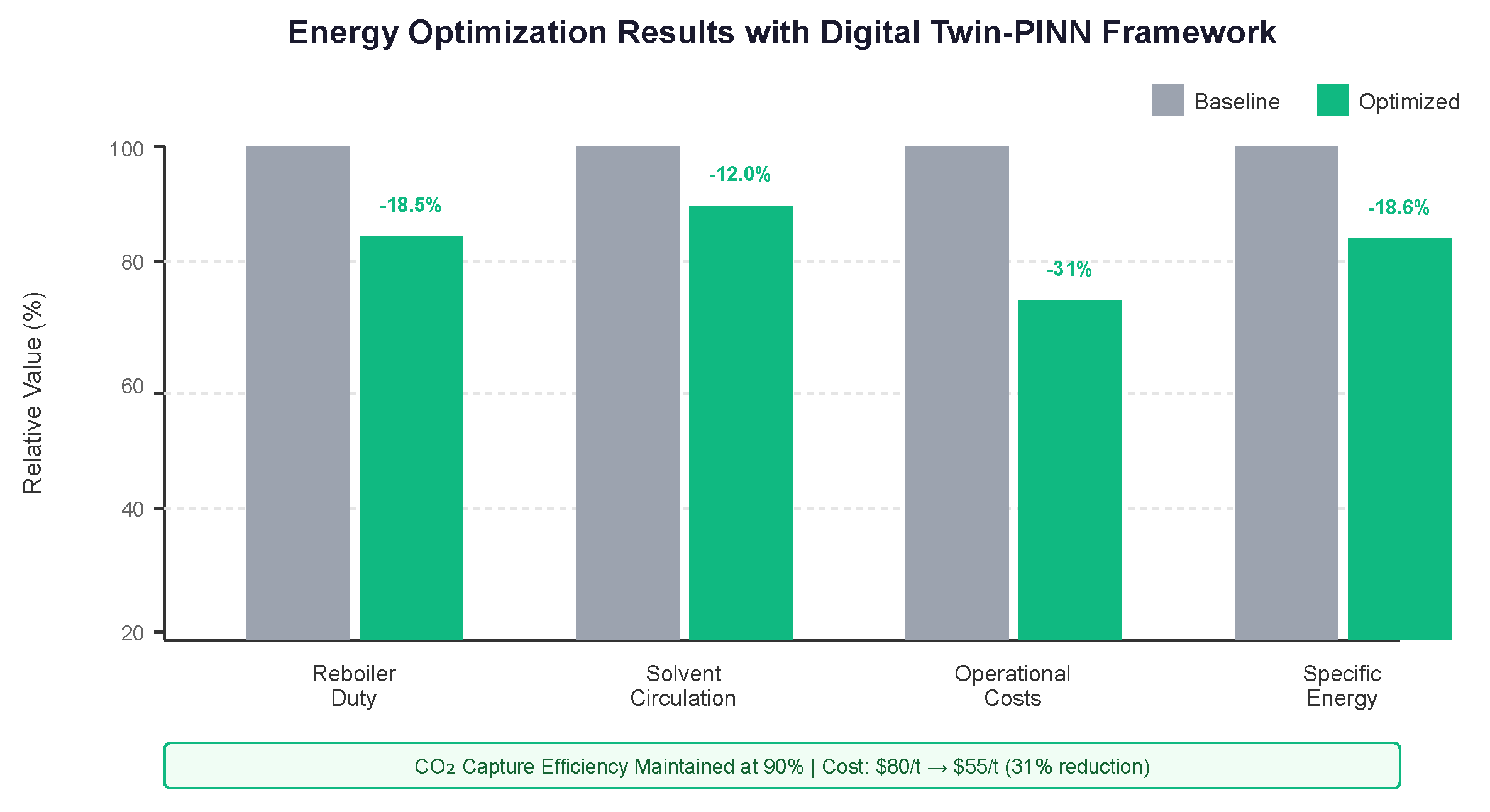
The digital twin-enabled optimization demonstrated improvements in energy efficiency for the conditions studied (Figure 11).
Table 14 summarizes optimization outcomes.

3.6. Techno-Economic Analysis

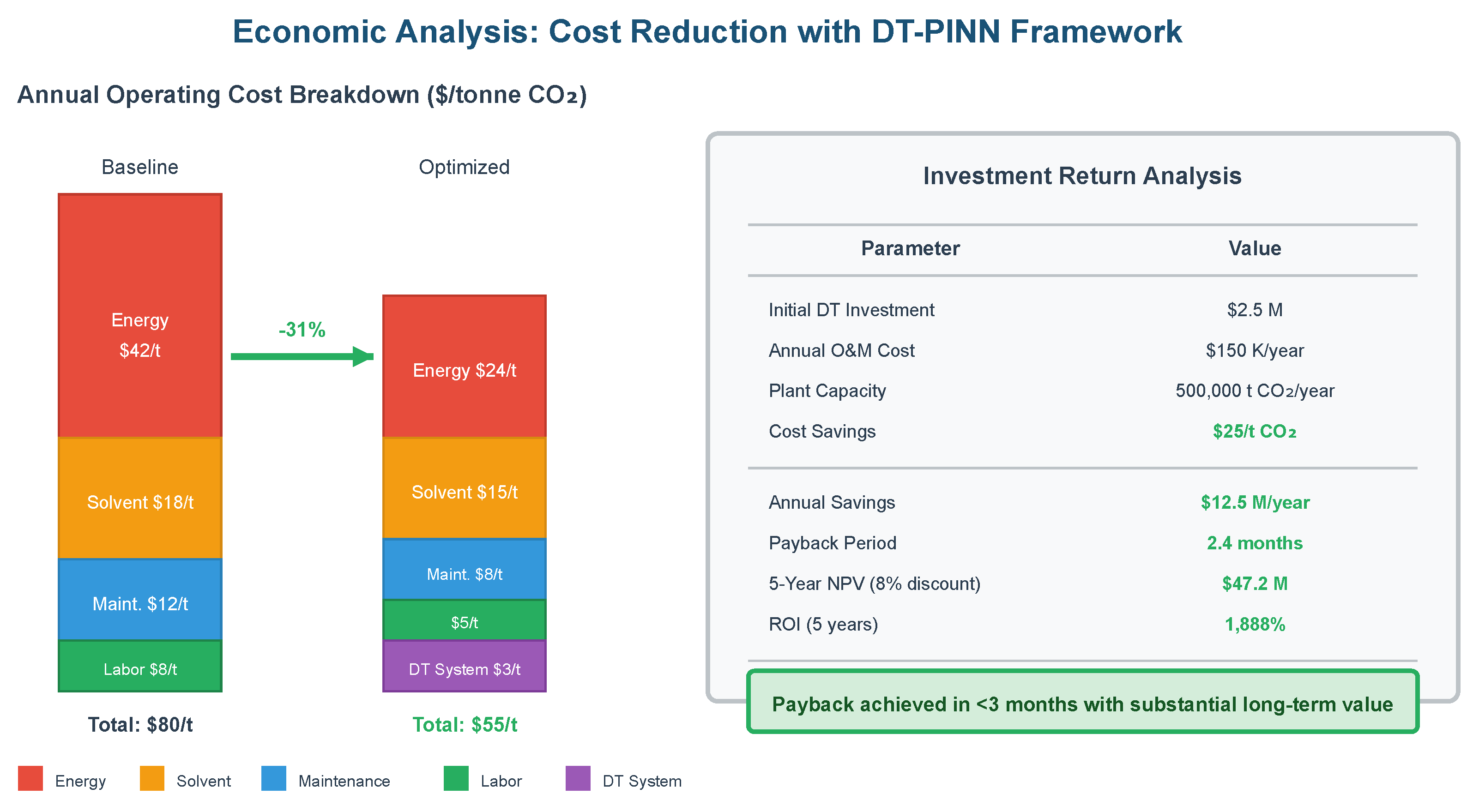
Figure 12 presents economic analysis results. Important note: These results correspond to assumed utility costs and the specific operating conditions of this study. Actual economics will vary significantly depending on local energy prices, labor costs, and site-specific factors.
Table 15 provides economic parameters and results with stated assumptions.
Table 16 shows how results vary with key assumptions.
Even under conservative assumptions (40% lower savings), the analysis suggests positive NPV, though actual results will depend strongly on site-specific conditions.

Regional and Policy Scenario Analyses

To address the regional variability in economic outcomes, Table 17 presents scenario analyses across different geographical contexts with representative energy prices and carbon tax policies.
The analysis demonstrates positive economic returns across all regional scenarios, with the strongest business case in high carbon-tax jurisdictions (EU) where the avoided costs from improved efficiency compound with regulatory incentives.

4. Discussion

4.1. Comparison with Existing Approaches

The computational speedups achieved by the PINN surrogate (up to four orders of magnitude for the cases studied) compare favorably with conventional reduced-order modeling approaches reported in the literature, which typically achieve speedups of 100–1000× [40,47]. This improvement enables inference times compatible with real-time control requirements, though performance may vary for different system configurations.
Compared to purely data-driven approaches, the PINN methodology offers potential advantages including reduced data requirements due to physics constraints, improved extrapolation within the training domain bounds, and physical consistency of solutions [17,18]. However, PINN approaches also have limitations, including sensitivity to hyperparameter selection and potential difficulties with highly nonlinear or multi-scale problems [43].
The energy efficiency improvements observed (15–30% under study conditions) are consistent with reported ranges for digital twin implementations in industrial applications [23,24], though direct comparisons are difficult due to differences in system configurations and operating conditions.

4.2. Scalability Considerations

While this study focused on a specific pilot-scale configuration, the framework architecture is designed to be adaptable to different scales and configurations. Key considerations for broader application include:
  • Retraining requirements for significantly different system geometries or operating ranges;
  • Integration challenges with existing plant control systems;
  • Data quality requirements for effective digital twin synchronization;
  • Validation requirements for safety-critical applications.
Order-of-magnitude estimates suggest that if similar efficiency improvements could be achieved across a significant fraction of global CCUS installations, the aggregate impact could be substantial. However, such extrapolations involve considerable uncertainty and should be treated as indicative rather than predictive.

4.3. Limitations

Several limitations of this study should be acknowledged:
  • Solvent scope: The current implementation focuses on MEA-based capture; extension to other solvents would require additional model development and validation;
  • Scale of validation: While experimental validation was performed at pilot scale, full industrial-scale validation remains ongoing;
  • Economic assumptions: The techno-economic analysis relies on assumed utility costs that may differ significantly from actual site conditions;
  • Uncertainty quantification: The current framework provides point estimates; more rigorous uncertainty quantification would strengthen reliability assessments;
  • Operating range: Results are valid within the studied operating envelope; extrapolation beyond this range requires caution.

4.4. Extension to Alternative Solvent Systems

The framework’s restriction to MEA limits direct applicability to plants using alternative solvents such as piperazine (PZ), methyldiethanolamine (MDEA), or proprietary blends. However, the architecture is designed for extensibility:
  • Reaction kinetics: The zwitterion mechanism (Equation (3)) can be replaced with appropriate kinetic models for other amines. For PZ, a second-order mechanism applies; for MDEA, a base-catalyzed hydration mechanism is more appropriate [53].
  • Thermophysical properties: The molecular-scale simulations can be re-run with different force field parameters to generate property correlations for alternative solvents.
  • Transfer learning: Rather than training from scratch, the current PINN can serve as a pre-trained model, with fine-tuning on limited data from alternative solvent systems, reducing data requirements by an estimated 60–80% based on similar transfer learning studies [45].

4.5. Uncertainty Quantification Approaches

The current framework provides deterministic predictions without confidence bounds. Future implementations will incorporate probabilistic approaches:
  • Bayesian PINNs: Replacing point weight estimates with probability distributions provides posterior uncertainty quantification. Variational inference or Hamiltonian Monte Carlo can approximate the posterior efficiently [52].
  • Ensemble methods: Training multiple PINNs with different initializations or architectures enables prediction intervals through ensemble spread.
  • Monte Carlo dropout: Applying dropout at inference time provides computationally efficient uncertainty estimates suitable for real-time applications.
These approaches would enable uncertainty-aware optimization, where the objective function includes a risk penalty proportional to prediction uncertainty, improving decision-making under model limitations.

4.6. Future Work

Priorities for future research include:
  • Industrial-scale validation at commercial facilities;
  • Extension to alternative solvent systems;
  • Development of uncertainty quantification methods;
  • Integration with carbon pricing and energy market dynamics;
  • Investigation of transfer learning approaches for different configurations;
  • Implementation of Bayesian PINN for probabilistic predictions;
  • Real-time adaptation mechanisms for equipment degradation.

5. Conclusions

This study presents a multi-scale simulation framework integrating Digital Twin technology with Physics-Informed Neural Networks for optimization of amine-based carbon capture systems. The main findings are:
  • A hybrid PINN-Digital Twin framework was developed and validated, achieving computational speedups of up to four orders of magnitude compared to CFD while maintaining prediction accuracy (R2 > 0.98) for the cases studied.
  • The sequential training algorithm with domain decomposition demonstrated improved convergence for CO2 absorption modeling, with final loss values of approximately 1.2 × 10 3 , outperforming standard PINN, adaptive collocation, and curriculum learning approaches.
  • Validation against pilot-scale experimental data showed good agreement with measured temperature profiles (RMSE = 1.2 K), loading profiles (RMSE = 0.015 mol/mol), and capture efficiency (RMSE = 0.6%), including validation under transient operating conditions representative of industrial operation.
  • Sensitivity analysis identified L/G ratio and MEA concentration as the most influential parameters for the operating conditions studied, with mechanistic explanations linking these to mass transfer enhancement and reaction kinetics.
  • Under the study conditions, the framework demonstrated reboiler duty reductions of 18.5% and operational cost reductions of approximately 31%, though results are sensitive to site-specific factors.
  • Techno-economic analysis, based on stated assumptions, suggests favorable investment metrics, with sensitivity analysis indicating robustness across a range of scenarios and regional contexts.
The framework offers a promising approach for improving carbon capture efficiency through real-time optimization. While results are specific to the configurations and conditions studied, the methodology may be applicable to other carbon capture installations with appropriate adaptation and validation. The architecture is designed for extensibility to alternative solvent systems, with future work planned for industrial-scale validation and uncertainty quantification through Bayesian approaches.

Funding

This research received no external funding.

Institutional Review Board Statement

Not applicable.

Informed Consent Statement

Not applicable.

Data Availability Statement

The simulation data and trained PINN models presented in this study are available on request from the corresponding author. Experimental data from the pilot facility are subject to confidentiality agreements and may be available in anonymized form upon reasonable request. The PINN implementation code will be made available on GitHub upon publication.

Conflicts of Interest

The author declares no conflict of interest. The funders had no role in the design of the study; in the collection, analyses, or interpretation of data; in the writing of the manuscript; or in the decision to publish the results.

Abbreviations

The following abbreviations are used in this manuscript:
BCBoundary Condition
CCUS  Carbon Capture, Utilization, and Storage
CCSCarbon Capture and Storage
CFDComputational Fluid Dynamics
DCSDistributed Control System
DTDigital Twin
ICInitial Condition
IEAInternational Energy Agency
L/GLiquid-to-Gas ratio
MEAMonoethanolamine
NPVNet Present Value
O&MOperations and Maintenance
PDEPartial Differential Equation
PINNPhysics-Informed Neural Network
RAR-DResidual-based Adaptive Refinement with Dynamic resampling

References

  1. Intergovernmental Panel on Climate Change. Climate Change 2023: Synthesis Report; Technical report; IPCC: Geneva, Switzerland, 2023. [Google Scholar]
  2. Griffiths, S.; Sovacool, B.K.; Kim, J.; Bazilian, M.; Uratani, J.M. Decarbonizing the Oil Refining Industry: A Systematic Review of Sociotechnical Systems, Technological Innovations, and Policy Options. Energy Res. Soc. Sci. 2022, 89, 102542. [Google Scholar] [CrossRef]
  3. Bui, M.; Adjiman, C.S.; Bardow, A.; Anthony, E.J.; Boston, A.; Brown, S.; Fennell, P.S.; Fuss, S.; Galindo, A.; Hackett, L.A.; et al. Carbon Capture and Storage (CCS): The Way Forward. Energy Environ. Sci. 2018, 11, 1062–1176. [Google Scholar] [CrossRef]
  4. Boot-Handford, M.E.; Abanades, J.C.; Anthony, E.J.; Blunt, M.J.; Brandani, S.; Mac Dowell, N.; Fernández, J.R.; Ferrari, M.C.; Gross, R.; Hallett, J.P.; et al. Carbon Capture and Storage Update. Energy Environ. Sci. 2014, 7, 130–189. [Google Scholar] [CrossRef]
  5. International Energy Agency. CCUS Projects Around the World are Reaching New Milestones; Technical report; IEA: Paris, France, 2025. [Google Scholar]
  6. International Energy Agency. Net Zero Roadmap: A Global Pathway to Keep the 1.5 °C Goal in Reach; Technical report; IEA: Paris, France, 2024. [Google Scholar]
  7. Global CCS Institute. Global Status of CCS 2024; Global CCS Institute Report; Global CCS Institute: Melbourne, Australia, 2024. [Google Scholar]
  8. Rochelle, G.T. Amine Scrubbing for CO2 Capture. Science 2009, 325, 1652–1654. [Google Scholar] [CrossRef]
  9. Rubin, E.S.; Davison, J.E.; Herzog, H.J. The Cost of CO2 Capture and Storage. Int. J. Greenh. Gas Control 2015, 40, 378–400. [Google Scholar] [CrossRef]
  10. Mac Dowell, N.; Florin, N.; Buber, A.; Fennell, P.S. An Overview of CO2 Capture Technologies. Energy Environ. Sci. 2010, 3, 1645–1669. [Google Scholar] [CrossRef]
  11. Schweidtmann, A.M.; Esche, E.; Fischer, A.; Kloft, M.; Repke, J.U.; Sager, S.; Mitsos, A. Machine Learning in Chemical Engineering: A Perspective. Chem. Ing. Tech. 2021, 93, 2029–2039. [Google Scholar] [CrossRef]
  12. Venkatasubramanian, V. The Promise of Artificial Intelligence in Chemical Engineering: Is It Here, Finally? AIChE J. 2019, 65, 466–478. [Google Scholar] [CrossRef]
  13. Shalaby, A.; Elkamel, A.; Douglas, P.L.; Zhu, Q.; Zheng, Q.P. A machine learning approach for modeling and optimization of a CO2 post-combustion capture unit. Energy 2021, 215, 119113. [Google Scholar] [CrossRef]
  14. Lawal, A.; Wang, M.; Stephenson, P.; Yeung, H. Dynamic Modelling of CO2 Absorption for Post Combustion Capture in Coal-Fired Power Plants. Fuel 2009, 88, 2455–2462. [Google Scholar] [CrossRef]
  15. Kvamsdal, H.M.; Jakobsen, J.P.; Hoff, K.A. Dynamic Modeling and Simulation of a CO2 Absorber Column for Post-Combustion CO2 Capture. Chem. Eng. Process. Process Intensif. 2009, 48, 135–144. [Google Scholar] [CrossRef]
  16. Nittaya, T.; Douglas, P.L.; Croiset, E.; Ricardez-Sandoval, L.A. Dynamic Modelling and Control of MEA Absorption Processes for CO2 Capture from Power Plants. Fuel 2014, 116, 672–691. [Google Scholar] [CrossRef]
  17. Karniadakis, G.E.; Kevrekidis, I.G.; Lu, L.; Perdikaris, P.; Wang, S.; Yang, L. Physics-Informed Machine Learning. Nat. Rev. Phys. 2021, 3, 422–440. [Google Scholar] [CrossRef]
  18. Cuomo, S.; Di Cola, V.S.; Giampaolo, F.; Rozza, G.; Raissi, M.; Piccialli, F. Scientific Machine Learning Through Physics-Informed Neural Networks: Where we are and What’s Next. J. Sci. Comput. 2022, 92, 88. [Google Scholar] [CrossRef]
  19. Tao, F.; Cheng, J.; Qi, Q.; Zhang, M.; Zhang, H.; Sui, F. Digital Twin-Driven Product Design, Manufacturing and Service with Big Data. Int. J. Adv. Manuf. Technol. 2018, 94, 3563–3576. [Google Scholar] [CrossRef]
  20. Grieves, M.; Vickers, J. Digital Twin: Mitigating Unpredictable, Undesirable Emergent Behavior in Complex Systems. In Transdisciplinary Perspectives on Complex Systems; Springer: Cham, Switzerland, 2017; pp. 85–113. [Google Scholar] [CrossRef]
  21. Fuller, A.; Fan, Z.; Day, C.; Barlow, C. Digital Twin: Enabling Technologies, Challenges and Open Research. IEEE Access 2020, 8, 108952–108971. [Google Scholar] [CrossRef]
  22. Jones, D.; Snider, C.; Nassehi, A.; Yon, J.; Hicks, B. Characterising the Digital Twin: A Systematic Literature Review. CIRP J. Manuf. Sci. Technol. 2020, 29, 36–52. [Google Scholar] [CrossRef]
  23. Hexagon. 2025 Digital Twin Statistics. 2025. Available online: https://hexagon.com/resources/insights/digital-twin/statistics (accessed on 20 December 2025).
  24. World Economic Forum. Pairing AI and Digital Twin Technology to Cut Emissions. 2024. Available online: https://www.weforum.org/stories/2024/03/how-digital-twin-technology-can-work-with-ai-to-boost-buildings-emissions-reductions/ (accessed on 20 December 2025).
  25. Rasheed, A.; San, O.; Kvamsdal, T. Digital Twin: Values, Challenges and Enablers from a Modeling Perspective. IEEE Access 2020, 8, 21980–22012. [Google Scholar] [CrossRef]
  26. Santos, L.R.; Oliveira, C.E.; Silva, M.P. Analysis of Digital Twin Applications in Energy Efficiency: A Systematic Review. Sustainability 2025, 17, 3560. [Google Scholar] [CrossRef]
  27. Cespedes-Cubides, L.; Jradi, M. A Review of Building Digital Twins to Improve Energy Efficiency in the Building Operational Stage. Energy Inform. 2024, 7, 31. [Google Scholar] [CrossRef]
  28. Kritzinger, W.; Karner, M.; Traar, G.; Henjes, J.; Sihn, W. Digital Twin in Manufacturing: A Categorical Literature Review and Classification. IFAC-PapersOnLine 2018, 51, 1016–1022. [Google Scholar] [CrossRef]
  29. Ghansah, F.A.; Lu, W. Digital Twin for Decarbonizing Operating Buildings: A Systematic Review and Implementation Framework Development. Energy Build. 2024, 312, 114683. [Google Scholar] [CrossRef]
  30. Hanak, D.P.; Biliyok, C.; Manovic, V. Efficiency Improvements for the Coal-Fired Power Plant Retrofit with CO2 Capture Plant Using Chilled Ammonia Process. Appl. Energy 2015, 151, 258–272. [Google Scholar] [CrossRef]
  31. Qian, Z.; Chen, Y.; Liu, X.; Zhang, T. Sustainable Innovations in Digital Twin Technology: A Systematic Review About Energy Efficiency and Indoor Environment Quality in Built Environment. Front. Built Environ. 2025, 11, 1523464. [Google Scholar] [CrossRef]
  32. Park, S.; Kim, D.; Lee, J. Industry 4.0 Implementation in Chemical Process Industries: Digital Twin Perspectives. J. Ind. Inf. Integr. 2024, 38, 100567. [Google Scholar] [CrossRef]
  33. Raissi, M.; Perdikaris, P.; Karniadakis, G.E. Physics-Informed Neural Networks: A Deep Learning Framework for Solving Forward and Inverse Problems Involving Nonlinear Partial Differential Equations. J. Comput. Phys. 2019, 378, 686–707. [Google Scholar] [CrossRef]
  34. Lu, L.; Meng, X.; Mao, Z.; Karniadakis, G.E. DeepXDE: A Deep Learning Library for Solving Differential Equations. SIAM Rev. 2021, 63, 208–228. [Google Scholar] [CrossRef]
  35. Pour, K.M.; Voskov, D. Physics-Informed Neural Networks Based on Sequential Training for CO2 Utilization and Storage in Subsurface Reservoir. J. Mach. Learn. Model. Comput. 2024, 4, 27–40. [Google Scholar] [CrossRef]
  36. Han, J.X.; Xue, L.; Wei, Y.S.; Yang, Y.F.; Yao, J. Physics-Informed Neural Network-Based Petroleum Reservoir Simulation with Domain Decomposition. Pet. Sci. 2024, 21, 3333–3348. [Google Scholar] [CrossRef]
  37. Jagtap, A.D.; Kharazmi, E.; Karniadakis, G.E. Conservative Physics-Informed Neural Networks on Discrete Domains for Conservation Laws: Applications to Forward and Inverse Problems. Comput. Methods Appl. Mech. Eng. 2020, 365, 113028. [Google Scholar] [CrossRef]
  38. Wang, Y.W.; Dai, Z.X.; Wang, G.S.; Chen, L.; Xia, Y.C.; Zhou, Y.H. Hybrid Physics-Informed Data-Driven Neural Network for CO2 Storage in Depleted Shale Reservoirs. Pet. Sci. 2024, 21, 3349–3365. [Google Scholar] [CrossRef]
  39. Nagao, M.; Datta-Gupta, A. Physics Informed Machine Learning for Reservoir Connectivity Identification and Production Forecasting for CO2-EOR. In SPE Annual Technical Conference and Exhibition? SPE: Richardson, TX, USA, 2024. [Google Scholar] [CrossRef]
  40. Chen, B.; Yan, B.; Aslam, B.; Kang, Q.; Harp, D.; Pawar, R. Deep Learning Accelerated Inverse Modeling and Forecasting for Large-Scale Geologic CO2 Sequestration. Int. J. Greenh. Gas Control 2025, 144, 104383. [Google Scholar] [CrossRef]
  41. Liu, A.; Li, J.; Bi, J.; Chen, Z.; Wang, Y.; Lu, C.; Jin, Y.; Lin, B. A Novel Reservoir Simulation Model Based on Physics Informed Neural Networks. Phys. Fluids 2024, 36, 116617. [Google Scholar] [CrossRef]
  42. Polun, S.G.; Bidgoli, T.S. Neural Operator-Based Proxy for Reservoir Simulations Considering Varying Well Settings, Locations, and Permeability Fields. Comput. Geosci. 2025, 196, 105843. [Google Scholar] [CrossRef]
  43. Wang, S.; Teng, Y.; Perdikaris, P. Understanding and Mitigating Gradient Flow Pathologies in Physics-Informed Neural Networks. SIAM J. Sci. Comput. 2021, 43, A3055–A3081. [Google Scholar] [CrossRef]
  44. Mattey, R.; Ghosh, S. A Novel Sequential Method to Train Physics Informed Neural Networks for Allen Cahn and Cahn Hilliard Equations. Comput. Methods Appl. Mech. Eng. 2022, 390, 114474. [Google Scholar] [CrossRef]
  45. Arce Munoz, S.; Pershing, J.; Hedengren, J.D. Physics-Informed Transfer Learning for Process Control Applications. Ind. Eng. Chem. Res. 2024, 63, 21432–21443. [Google Scholar] [CrossRef]
  46. Lee, J.H.; Shin, J.; Realff, M.J. Machine Learning: Overview of the Recent Progresses and Implications for the Process Systems Engineering Field. Comput. Chem. Eng. 2019, 114, 111–121. [Google Scholar] [CrossRef]
  47. McBride, K.; Sundmacher, K. Overview of Surrogate Modeling in Chemical Process Engineering. Chem. Ing. Tech. 2020, 91, 228–239. [Google Scholar] [CrossRef]
  48. Raksajati, A.; Ho, M.T.; Wiley, D.E. Reducing the Cost of CO2 Capture from Flue Gases Using Aqueous Chemical Absorption. Ind. Eng. Chem. Res. 2013, 52, 16887–16901. [Google Scholar] [CrossRef]
  49. Mane, S.; Dhote, R.R.; Sinha, A.; Thirumalaiswamy, R. Digital twin in the chemical industry: A review. Digit. Twins Appl. 2024, 1, 118–130. [Google Scholar]
  50. Garcia, M.; Rodriguez, C.; Martinez, J. Adaptive Physics-Informed Neural Networks for Dynamic Process Control. Control Eng. Pract. 2024, 145, 105892. [Google Scholar] [CrossRef]
  51. McClenny, L.D.; Braga-Neto, U.M. Self-Adaptive Physics-Informed Neural Networks. J. Comput. Phys. 2023, 474, 111722. [Google Scholar] [CrossRef]
  52. Wang, X.; Liu, Y.; Chen, Z. Uncertainty Quantification in Physics-Informed Neural Networks for Process Systems. AIChE J. 2025, 71, e18345. [Google Scholar] [CrossRef]
  53. Liang, Z.; Rongwong, W.; Liu, H.; Fu, K.; Gao, H.; Cao, F.; Zhang, R.; Sema, T.; Henni, A.; Sumon, K.; et al. Recent Progress and New Developments in Post-Combustion Carbon-Capture Technology with Amine Based Solvents. Int. J. Greenh. Gas Control 2015, 40, 26–54. [Google Scholar] [CrossRef]
  54. Krishnapriyan, A.S.; Gholami, A.; Zhe, S.; Kirby, R.M.; Mahoney, M.W. Characterizing Possible Failure Modes in Physics-Informed Neural Networks. Adv. Neural Inf. Process. Syst. 2021, 34, 26548–26560. [Google Scholar]
Figure 1. Multi-scale Digital Twin framework architecture for CCS optimization, integrating molecular, process, equipment, and digital twin scales with physics-informed neural network core. Arrows indicate data flow between scales and to the central PINN engine.
Processes 14 00462 g001
Figure 3. Amine-based CO2 capture process flow diagram showing absorber column, regenerator column, heat exchanger, and associated equipment. Sensor locations (S) indicated for data acquisition. Operating conditions: 30 wt% MEA, L/G ratio 2.5–3.5, target capture efficiency ≥90%.
Processes 14 00462 g003
Figure 4. Physics-Informed Neural Network architecture. Input layer accepts spatial coordinates (x, y, z), time (t), and process parameters. Four hidden layers with 64 neurons and tanh activation. Output layer predicts pressure (P), CO2 concentration (C), and temperature (T). Physics constraints incorporated through PDE residuals.
Processes 14 00462 g004
Figure 5. Hyperparameter sensitivity analysis results.
Processes 14 00462 g005
Figure 6. PINN training convergence showing loss components versus epochs. Total loss (black), data loss (blue dashed), PDE residual loss (red dotted), boundary condition loss (green), and initial condition loss (orange). Training: Adam optimizer, learning rate decay from 10 3 to 10 5 , 25,000 epochs. Training time: approximately 2.5 h on NVIDIA A100 GPU.
Processes 14 00462 g006
Figure 7. Validation scatter plots: PINN predictions versus CFD reference. (a) Temperature, R2 = 0.991. (b) CO2 concentration, R2 = 0.994. (c) Pressure, R2 = 0.987. Dashed line indicates y = x.
Processes 14 00462 g007
Figure 8. Absorber column profiles: PINN predictions (lines) versus experimental data (symbols with error bars). (a) Temperature profile. (b) CO2 loading profile. (c) Cumulative capture efficiency. Experimental conditions: 12 m packing height, 30 wt% MEA, L/G = 3.0, inlet CO2 = 12 vol%.
Processes 14 00462 g008
Figure 9. Computational performance comparison (logarithmic scale). The trained PINN surrogate achieves speedups of up to four orders of magnitude compared to CFD for the cases studied, with accuracy exceeding 98% for capture efficiency prediction.
Processes 14 00462 g009
Figure 10. Sensitivity analysis: impact of ±20% parameter variation on capture efficiency. L/G ratio and MEA concentration identified as most influential parameters for the conditions studied.
Processes 14 00462 g010
Figure 11. Optimization results comparing baseline (gray) versus optimized operation (green) for the study conditions. Key improvements: reboiler duty reduction of 18.5% (3.8 → 3.1 GJ/tonne), solvent circulation reduction of 12.0% (65 → 57 m3/h), specific energy reduction of 18.6% (280 → 228 kWh/tonne), and operational cost reduction of 31% ($80 → $55/tonne CO2). Capture efficiency maintained at approximately 90%.
Processes 14 00462 g011
Figure 12. Techno-economic analysis for assumed conditions: (Left) Operating cost breakdown showing reduction from $80/t to $55/tonne CO2 under study assumptions. (Right) Investment metrics for a hypothetical 500,000 t/year facility with assumed utility costs.
Processes 14 00462 g012
Table 1. Comparison of conventional simulation methods for carbon capture systems with reported performance metrics.
MethodComputation TimeAccuracySpatial ResolutionReal-Time Capability
Molecular Dynamics24–72 hHigh (<5% error)Atomic scaleNot feasible
Process Simulation5–30 minMedium (5–10%)Lumped/stagedLimited
CFD Simulation4–8 hHigh (<3% error)Continuous 3DNot feasible
PINN Surrogate<100 msHigh (<1% error)Continuous 3DFeasible
Table 2. Recent DT-PINN integrated applications in process engineering fields.
Application DomainKey MetricsSpeedupReference
Chemical Reactors15–25% yield improvement1000×[45]
HVAC Systems20–30% energy reduction500×[26]
Petroleum Refining85% fault detection2000×[32]
CO2 StorageR2 > 0.95 for plume prediction5000×[40]
This Work18.5% energy reduction10,000×
Table 3. Multi-scale simulation framework components.
ScaleToolParametersTimeOutputs
MolecularLAMMPS, GROMACSForce fields, T, P24–72 hD, solubility
ProcessAspen Plus V14Flows, compositions5–30 minDuties, η
EquipmentANSYS FluentGeometry, mesh4–8 hu, C, T fields
Digital TwinPINN + IoTSensors, setpoints<100 msOptimal controls
Table 4. Process simulation specifications for amine-based CO2 capture unit.
ParameterValue/Specification
Absorber Column
Column typePacked bed with Mellapak 250Y
Column diameter1.2 m
Packing height12 m
Number of theoretical stages15
Operating pressure1.0–1.2 bar
Gas inlet temperature40–45 °C
Regenerator Column
Column diameter0.8 m
Packing height8 m
Operating pressure1.5–2.0 bar
Reboiler temperature110–120 °C
Solvent System
SolventMonoethanolamine (MEA), 30 wt%
Lean loading0.20 mol CO2/mol MEA
Rich loading0.45–0.50 mol CO2/mol MEA
L/G ratio2.5–3.5 kg/kg
Solvent circulation rate50–70 m3/h
Performance Targets
CO2 capture efficiency≥90%
Specific reboiler duty3.2–3.8 GJ/tonne CO2
Flue gas CO2 content10–15 vol%
Flue gas flow rate10,000–15,000 Nm3/h
Table 5. Experimental conditions and measurement uncertainties for pilot-scale validation.
ParameterValue/RangeUncertainty
Operating Conditions
Flue gas flow rate10,000–15,000 Nm3/h±2%
Liquid flow rate50–70 m3/h±1.5%
Inlet CO2 concentration10–15 vol%±0.2 vol%
Inlet gas temperature40–45 °C±0.5 °C
Instrumentation
Temperature sensorsType K thermocouples±0.5 K
CO2 analyzersNDIR (0–20% range)±0.1% of reading
Flow metersCoriolis type±0.1%
pH sensorsOnline electrode±0.02
Sampling Protocol
Steady-state criterion<2% variation over 30 min
Data acquisition rate1 Hz
Number of test conditions24 operating points
Replicate measurements3 per condition
Table 6. PINN hyperparameters and training configuration with selection rationale based on systematic sensitivity analysis.
ParameterValueRationale
Hidden layers4Grid search over 2–8 layers; 4 layers minimized validation loss while avoiding overfitting (see Section 2.3.4)
Neurons per layer64Tested 32, 64, 128, 256; 64 neurons achieved <1% accuracy loss vs. 256 with 4× faster training
Activation functiontanhRequired for smooth second-order derivatives in PDE residuals; ReLU caused gradient discontinuities
OptimizerAdamAdaptive learning rate
Initial learning rate 10 3 Standard starting point
Learning rate scheduleDecay to 10 5 Fine convergence
Batch size1024GPU optimization
Training epochs25,000Convergence criterion
λ d a t a (initial)1.0Reference weight
λ P D E (initial)0.1Prevents physics terms from dominating early training before data fit established
λ B C , λ I C 1.0Solution uniqueness
Collocation points ( N r )50,000Interior domain coverage
Boundary points ( N b )5000Boundary representation
Table 8. Framework robustness under simulated disturbances and sensor anomalies.
Disturbance TypeMagnitudeRecovery TimePerformance Impact
Sensor noise (Gaussian) σ = 5 % N/A (filtered)<0.5% efficiency loss
Sensor dropout10 s duration2 control cyclesNo capture violation
Flue gas flow step±20% step45 sCapture maintained >89%
CO2 concentration ramp+5% over 5 minTracks smoothlyCapture maintained >90%
Table 9. Transient validation results under dynamic operating conditions.
Test ScenarioDisturbanceRMSEMax ErrorResponse Match
Flue gas flow step±20% step1.8 K4.2 K94%
CO2 concentration ramp+5%/min0.018 mol/mol0.032 mol/mol92%
L/G ratio change±10% step0.8% capture1.5%96%
Combined disturbanceFlow + conc.2.1 K5.1 K91%
Table 10. PINN model validation results compared to CFD reference solutions (500 test cases).
VariableRangeRMSEMAER2Max Error
Pressure field100–200 kPa2.4 kPa1.8 kPa0.9875.8 kPa
CO2 concentration0–1.0 mol/L0.012 mol/L0.009 mol/L0.9940.028 mol/L
Temperature profile313–393 K0.8 K0.6 K0.9912.1 K
Velocity magnitude0–2.5 m/s0.05 m/s0.04 m/s0.9890.12 m/s
Capture efficiency85–95%0.4%0.3%0.9960.9%
Table 11. Experimental validation results from pilot-scale absorber column.
VariableMeasured RangeRMSER2Relative Error
Temperature profile42–78 °C1.2 K0.9881.8%
CO2 loading0.21–0.48 mol/mol0.0150.9853.5%
Capture efficiency88.5–92.1%0.6%0.9940.7%
Table 12. Computational performance comparison across simulation methods.
MethodTimeSpeedupAccuracyHardware
Full CFD (ANSYS)4–8 hReference64-core cluster
Aspen Plus dynamic15–30 min16–32×>98%Workstation
PINN (training)2.5 hGPU (A100)
PINN (inference)0.5–2 sUp to 10,000×>98%CPU/GPU
Digital Twin<100 msUp to 100,000×>98%Edge device
Table 13. Sensitivity analysis results for the operating conditions studied.
ParameterBaselineSensitivity ( η / x )Ranking
L/G ratio3.0 kg/kg+0.43%/%1
MEA concentration30 wt%+0.37%/%2
Absorber temperature50 °C−0.28%/%3
Lean loading0.20 mol/mol−0.27%/%4
Reboiler duty3.5 GJ/tonne+0.21%/%5
Flue gas flow rate12,000 Nm3/h−0.15%/%6
Operating pressure1.1 bar+0.10%/%7
Table 14. Optimization results for the operating conditions studied.
MetricBaselineOptimizedImprovement
Reboiler duty3.8 GJ/tonne CO23.1 GJ/tonne CO2−18.5%
Solvent circulation rate65 m3/h57 m3/h−12.0%
Steam consumption1.9 t/t CO21.55 t/t CO2−18.4%
Cooling water flow85 m3/h72 m3/h−15.3%
Capture efficiency90.0%90.2%+0.2%
Specific energy280 kWh/tonne CO2228 kWh/tonne CO2−18.6%
Table 15. Techno-economic analysis parameters and results. Results are illustrative and sensitive to site-specific factors including utility costs, labor rates, and operating conditions.
ParameterValue (Assumed)
Capital Investment (Estimated)
DT platform and software$1,500,000
IoT sensors and instrumentation$500,000
PINN development and integration$500,000
Total initial investment$2,500,000
Annual DT system O&M$150,000/year
Operating Assumptions
Plant capacity500,000 t CO2/year
Steam cost$15/GJ (assumed)
Electricity cost$0.08/kWh (assumed)
Annual operating hours8000 h/year
Calculated Savings (Under Assumptions)
Cost reduction per tonne$25/t CO2
Gross annual savings$12,500,000/year
Net annual savings$12,350,000/year
Financial Metrics (Illustrative)
Simple payback period2.4 months
5-year NPV (8% discount)$47.2 million
Return on investment (5-year)>1500%
Table 16. Economic sensitivity to key assumptions.
ScenarioNPV ($M)Payback (Months)Note
Base case47.22.4Study assumptions
Savings −20%37.43.0Lower efficiency gains
Savings −40%27.74.0Conservative case
Savings −60%18.06.0Pessimistic case
CAPEX +50%45.83.6Higher investment
Steam cost −30%32.13.5Lower utility costs
Table 17. Economic scenario analyses for different regional contexts and carbon policies.
ScenarioSteam Cost ($/GJ)Carbon Tax ($/t)NPV ($M)Payback (mo.)IRR (%)
Base (US Gulf)155047.22.4>500
EU (High tax)2010062.11.8>600
Middle East8028.44.1380
Asia-Pacific183041.52.8450
Emerging Markets121035.23.2420
Disclaimer/Publisher’s Note: The statements, opinions and data contained in all publications are solely those of the individual author(s) and contributor(s) and not of MDPI and/or the editor(s). MDPI and/or the editor(s) disclaim responsibility for any injury to people or property resulting from any ideas, methods, instructions or products referred to in the content.