1. Introduction
Due to their high efficiency and reliability, Induction Motors (IM) have been widely used in industrial applications [
1,
2,
3,
4]. This dependence highlights the crucial need for systems with precise control over torque and speed across their full operating ranges, prepared to address any potential contingency [
5,
6]. As the technological landscape advances, the growing demand for highly reliable systems has driven the development of accurate models that facilitate the testing of control systems [
7,
8,
9]; this approach ensures a reliable operation, enabling the monitoring of working conditions and the implementation of advanced techniques for the rapid detection of faults in electric machines.
Accurate modeling of IM behavior contributes to the practical design of machine controllers, enabling the characterization and detection of faults within the system [
10,
11,
12]. Most anomalies in IM directly affect the flux in the air gap [
13,
14], posing a considerable challenge to precisely measuring this parameter at the physical level; for this reason, alternative estimation methods must be employed. According to previous research [
15], critical failures in industrial induction motors are primarily attributable to three fault types. It is observed that rotor failures constitute only 8% of the total, followed by stator failures at 22%, and finally, bearing failures, which are the most predominant, accounting for 42% of the total identified faults. Several modeling and implementation techniques for fault characterization and diagnosis have been reported in the literature. Some studies specify that these techniques are first validated through simulation [
16], which is a useful approach to avoid potential damage when conducting hazardous experimental tests.
A digital model of an IM is presented in [
17], where a DQ model was developed in the stator reference frame using the Matlab/Simulink platform. This model accounts for the complex interactions among variables in the IM. Additionally, a data-acquisition system compatible with LabVIEW has been implemented to measure voltage and current signals. The solution estimates the magnetic flux across the machine using measured voltage and current, providing the necessary data for precise analysis and the design of control systems.
The work in [
18] explores the mathematical equations underlying the DQ model of an IM. This information presents the methodology for simulating the model in Matlab/Simulink. In [
19], a faulty model of a three-phase IM is introduced. This model is used across various design paradigms, including electronic IM drives, fault-tolerant systems, and early fault-detection algorithms. However, despite numerous modeling studies in the literature, there remains a significant need for accurate models of three-phase IMs that reflect operating conditions under fault conditions.
These models are essential for developing robust controllers and fault-tolerant drive systems, an area of increasing research interest, particularly in critical applications such as electric vehicles, aerospace systems, automated industrial environments, and renewable energy systems [
20,
21]. In these contexts, operational reliability is not just desirable but an indispensable requirement to ensure safety, efficiency, and continuous system availability.
From the previous works, it is evident that prevalent modeling approaches for induction machine fault analysis are predominantly confined to offline simulation environments, such as MATLAB/Simulink. While these PC-based tools are invaluable for initial design and theoretical analysis, they possess inherent limitations that hinder their direct applicability to the development of real-world, embedded diagnostic systems. Specifically, software-based simulations typically lack deterministic execution and the high-speed processing capabilities required to accurately emulate the fast, transient dynamics of electromechanical faults in real-time.
Furthermore, many existing models focus on core machine emulation without integrating detailed, real-time fault injection capabilities, or they may not be architected to provide the precise timing and low-latency response needed for closed-loop controller validation. Therefore, a clear research gap persists: the transition from high-fidelity but non-real-time offline models to a deterministic, real-time digital platform capable of serving as a high-speed testbed for diagnostic and fault-tolerant control systems. This work presents the design and implementation of a real-time digital twin for a three-phase IM on a Field-Programmable Gate Array (FPGA) platform. The core contribution is the integration of a bearing fault model into this deterministic, hardware-based emulation framework. This approach enables the precise, cycle-accurate simulation of the machine’s electromechanical behavior under both healthy and faulty conditions, generating the necessary electrical signature data with strict real-time adherence. The proposed emulator serves as a versatile platform for validating fault-detection algorithms and designing resilient control systems prior to experimental prototyping. By functioning as a digital twin, it effectively bridges the gap between offline theoretical models and physical prototype validation, thereby significantly reducing development risk. Furthermore, these tools are invaluable for training engineers in fault-condition analysis without risking real physical equipment, thereby accelerating the development of expertise in machine diagnostics and prognostics.
2. Background
2.1. DQ Model of a Three-Phase Induction Machine
The direct-quadrature (DQ) axis model is based on the theory of space phasors [
22,
23], a mathematical representation that enables the analysis of polyphase systems, such as three-phase electric machines, using complex variables that combine magnitude and phase angle. When applied to dynamic machine modeling, this theory provides an effective means of describing electromagnetic behavior in terms of rotating variables, thereby greatly simplifying both analysis and controller design. The DQ model transforms the time-varying sinusoidal magnitudes typical of three-phase systems into constant (or quasi-constant) quantities by projecting them onto a rotating reference frame synchronized with the machine’s magnetic field [
24]. This is accomplished using the Park transformation [
25], which converts the three-phase (a-b-c) variables into the stationary reference frame (
-
), and subsequently into the rotating d-q frame, where the components align with the direct and quadrature flux axes. The direct axis (D) represents the component aligned with the main air-gap flux and is responsible for controlling magnetic flux, while the quadrature axis (Q), electrically shifted by 90° from the D-axis, is associated with the generation of electromagnetic torque [
26]. This separation enables independent control of flux and torque, a fundamental feature for achieving superior dynamic performance—similar to that of a DC motor—while retaining the inherent advantages of AC machines, such as greater robustness, lower cost, and reduced maintenance. This decoupling principle forms the basis of vector control, also known as field-oriented control, which has revolutionized the electric drive industry by enabling fast, efficient, and precise control, even under transient or variable load conditions [
27]. The DQ model is particularly relevant in advanced closed-loop control systems, where accurate regulation of torque and speed is crucial, including electric powertrains, industrial automation, electric aircraft, robotics, and renewable energy systems. In these contexts, maintaining stable, efficient, and responsive dynamic control in the presence of external disturbances is essential.
2.2. Mathematical Modeling of the Induction Machine
Within the scope of this work, the dynamic model of the three-phase IM, defined by Equations (
1)–(
12), is derived from the fundamental laws of electromagnetism. These equations couple the machine’s electrical and mechanical behavior, enabling high-fidelity simulation of phenomena such as startup, transient behavior, fault response, and steady-state operation.
Mechanical System
where
and
represent the resistance of the stator and rotor, respectively. The variables
,
, and
are the mutual inductance, self-inductance of the stator, and rotor inductance, respectively. These variables describe the system’s dynamic relationships between currents and magnetic fluxes. The variables
,
,
,
denote the magnetic stator and rotor frame components of the magnetizing flux, respectively. The parameters
J and
B represent the moment of inertia and viscous friction, respectively. Similarly, the variables
,
, and
refer to the electromagnetic torque, the torque associated with the applied load, and the torque related to dry friction, which manifests in bearing failure, respectively, and where the impulses occur at the characteristic impact frequency defined by (
13) and (
14), representing the periodic mechanical interactions induced by the defect. In the healthy operating condition, the fault-related variable remains null, indicating the absence of impulsive behavior. Conversely, when the fault is injected, this variable takes the form of an impulse train at the corresponding characteristic frequency, modeling the repetitive impacts generated by the localized defect. Finally, the variables
and
represent the mechanical and reference rotating at angular speeds, respectively.
2.3. Bearing Faults Overview
Bearing failure in an IM represents one of the most common and critical problems affecting the reliability and performance of the electromechanical system [
28]. Bearings are essential mechanical components that enable the smooth, controlled rotation of the rotor shaft, minimize friction, and support radial and axial loads. However, when defects occur—whether due to natural wear, poor installation, contamination, insufficient lubrication, or even electrical issues indirectly affecting mechanical integrity—these defects generate abnormal mechanical vibrations transmitted along the rotor shaft [
29]. These vibrations not only alter the machine’s mechanical dynamic behavior but also manifest in the electrical signal, particularly in the stator current, due to the close interdependence between mechanical and electromagnetic variables. In an IM, the rotor’s mechanical angular velocity is regulated within a closed control loop, which affects the air-gap magnetic flux and, consequently, the induced current and voltage. When bearing faults occur, rotational irregularities introduce mechanical oscillations in angular velocity, which translate into periodic disturbances of the magnetic flux and appear in the electrical current as spurious harmonics around the system’s fundamental frequency [
30]. These harmonics are additional frequencies not part of the ideal signal and indicate the presence of faults or abnormal conditions. The fundamental mechanical frequency
, corresponding to vibrations induced by the bearing defect, is directly related to the bearing’s geometric and dynamic characteristics. Specifically, factors such as the ball radius
, the pitch circle radius
, the total number of balls
, the bearing shaft rotational frequency
, and the contact angle between ball and race
determine the characteristic vibration frequencies that may appear in the electrical spectrum. The assumption of a zero contact angle is a common and justified simplification in preliminary studies or when detailed geometric information from the manufacturer is unavailable, as it allows the fundamental bearing fault frequencies to be obtained with sufficient accuracy. These frequencies are mathematically described by Equations (
13) and (
14), which enable the calculation of impact frequencies on the rolling elements as well as on the inner and outer races of the bearing.
Moreover, the presence of these mechanical vibrations generates sidebands around the electrical fundamental frequency (the supply frequency), modulated by the fault harmonics denoted as and scaled by an integer coefficient k representing the harmonic order of the associated component. This phenomenon results in additional spectral components, known as sidebands of the fundamental frequency, which act as specific signatures of bearing faults.
3. Methodology
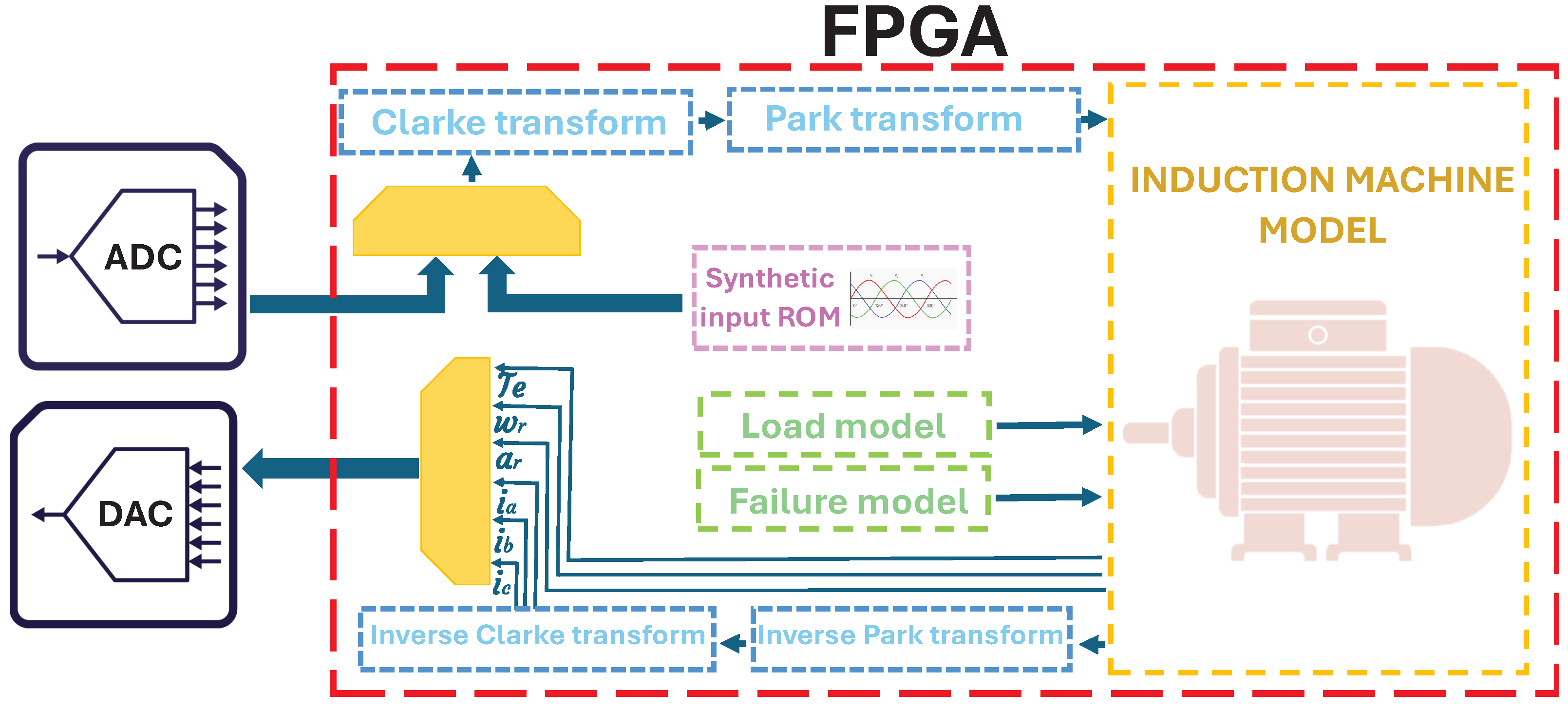
The proposed system is structured to describe the complete signal flow, from data acquisition through signal processing to diagnostic output generation. The architecture highlights the interactions among the functional blocks, emphasizing how the acquired signals are conditioned, processed, and transformed to yield the relevant system responses.
Figure 1 presents the block diagram of the proposed system, illustrating the acquisition, processing, and resulting signals throughout the signal flow. The simulations were carried out in Matlab/Simulink (R2021b) and Active/Aldec (student edition) using a commercial WEG IM (model 00118ET3EM143TW) as the reference system. This machine constitutes the basis for the design and validation of the proposed approach. The electrical and mechanical parameters of the IM were obtained through laboratory estimation procedures, while the parameters associated with an outer race bearing fault were experimentally identified and are detailed in [
31].
To fully assess the dynamic behavior of a three-phase IM, it is necessary to accurately define the electrical, mechanical, and magnetic parameters that govern its operation. These parameters are crucial for developing mathematical models that allow predicting the machine’s response under different operating conditions, including fault scenarios such as bearing defects. To ensure the model accurately represented the behavior of a real system, the parameters used in this work were obtained through experimental testing. In the first stage, the technical data and specifications provided by the motor manufacturer (WEG) served as the basis for the model’s initial development. Subsequently, using the Matlab/Simulink simulation environment, the model was refined, and variables not directly available in the manufacturer’s documentation were calculated.
This procedure enabled validation and adjustment of system parameters, ensuring consistency with real operating conditions. The simulations showed stable, efficient motor behavior, confirming the model’s suitability for analyzing and studying the system under both normal and faulty operating conditions. The specific parameters used to model the IM and the bearing fault are presented below, along with an explanation of their significance and impact on system dynamics:
Number of poles (p): Set to 4. This value defines the configuration of the machine’s rotating magnetic field and directly affects the synchronous operating speed.
Electrical frequency (): Calculated as in radians per second. This frequency represents the angular velocity of the rotating magnetic field, where f is the grid frequency (60 Hz), and p is the number of poles.
Stator and rotor resistances ( and ): With values of and . These resistances model the Joule losses in the stator and rotor windings, directly impacting the machine’s efficiency.
Stator, rotor, and magnetizing inductances (, , ):
- −
H: Represent the self-inductances of the stator and rotor windings, respectively.
- −
H: The magnetizing inductance, which models the magnetic coupling between the stator and rotor through the air-gap.
Rated electromagnetic torque (): Set to 4 N·m. This value represents the machine’s torque-generating capacity under normal operating conditions.
Grid frequency (f): Set to 60 Hz, which is the standard in many electrical power systems.
Damping factor (B): With a value of 0.02 N·s/m. This parameter represents the mechanical resistance to the rotor’s rotation, modeling losses due to friction and other mechanical dissipations.
Supply voltage (): Fixed at 230 V, a typical value for medium-power induction machine supply systems.
The injection and analysis of bearing faults within the digital twin are achieved through a targeted mathematical model of an outer race defect. The fault mechanism is characterized by the ball pass frequency outer race, a periodic impact frequency calculated from the bearing’s specific geometry and rotational speed. This mechanical disturbance modulates the stator current, creating detectable spectral signatures used for diagnostic validation. The model’s physical and operational parameters, which govern the simulated fault’s behavior, were established using a combination of manufacturer specifications and simulation-based extraction to ensure representativeness. The following section details the complete set of technical parameters that define this fault model and its implementation logic within the real-time emulation framework.
Ball radius of the bearing (): Set to 4 mm. This value is fundamental for calculating the characteristic fault frequencies associated with ball impacts.
Pitch circle radius (): With a value of mm. This radius corresponds to the pitch circle of the balls within the bearing and is key to determining the fault frequencies.
Characteristic frequency of the outer race fault (): Set to Hz. This frequency corresponds to the rate at which the balls pass over the defect located on the outer race, generating periodic impacts detectable in the vibration or current spectrum.
Number of rolling elements (): Set to 9. This number is fundamental for calculating the fault frequencies using the classical bearing defect formulas.
Contact angle (): Set to 0 radians. This angle describes the inclination of the contact plane between the balls and the race; an angle of 0 indicates pure horizontal plane contact.
The simulation and digital description are focused on analyzing key parameters such as the angular speed (), which represents the rate of change in the rotor’s angular position over time, electromagnetic torque (), system acceleration (), and phase current ().
The system is evaluated over a 1 s period to facilitate a comparative analysis of the results. A sampling frequency of 7.68 kHz is employed, with an integration step of 130.2 μs. The Forward-Euler integration method was selected as the initial exploratory approach for this digital implementation. Its primary advantage lies in its straightforward algorithmic structure, which translates directly and efficiently into digital logic, minimizing computational overhead and simplifying verification during early development. While methods like Runge–Kutta offer higher accuracy, they require significantly more operations per step and intermediate state storage, increasing FPGA resource utilization and design complexity. For this initial proof-of-concept, the Forward-Euler method provided a sufficient and effective means to validate the model’s real-time performance.
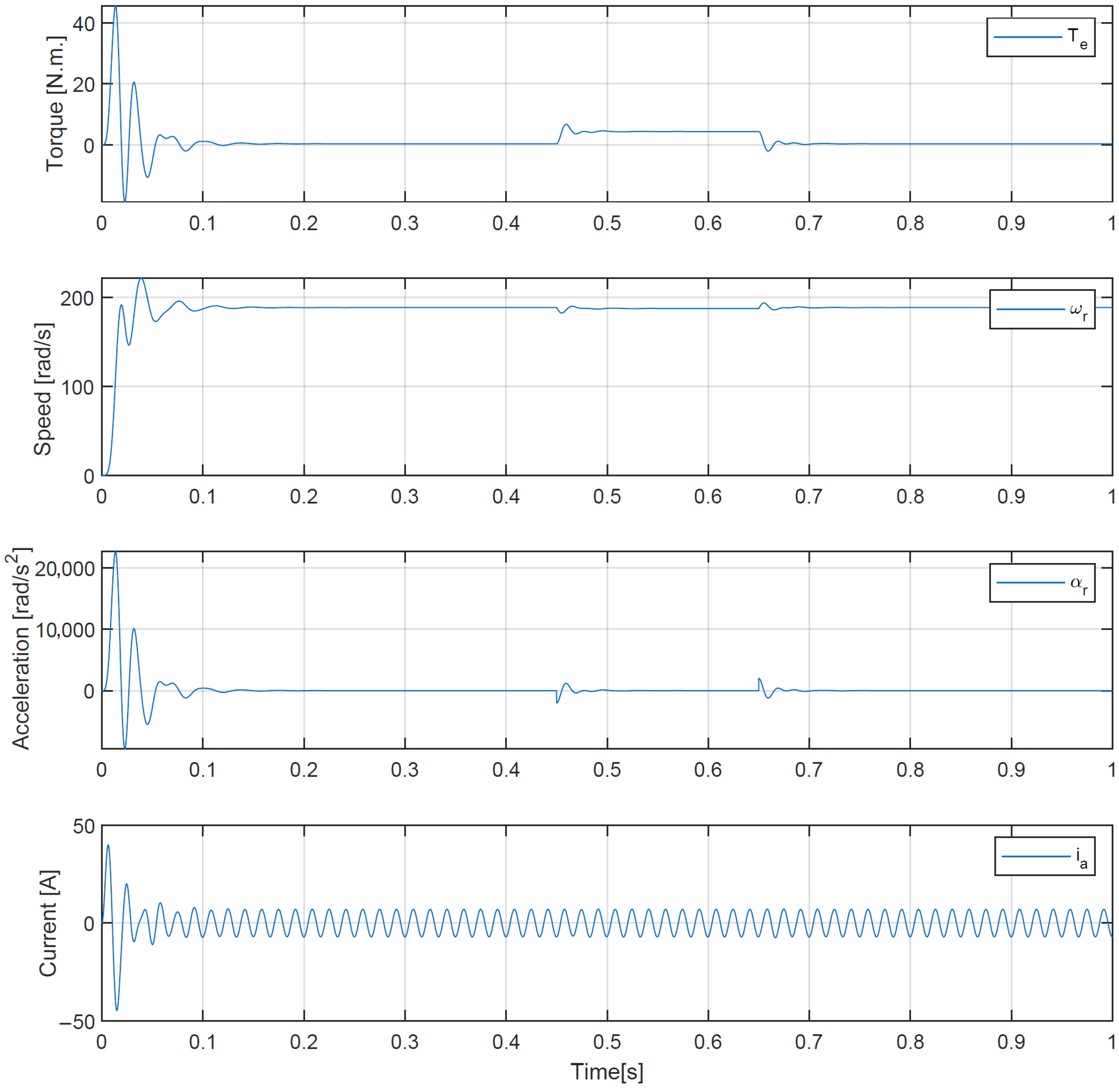
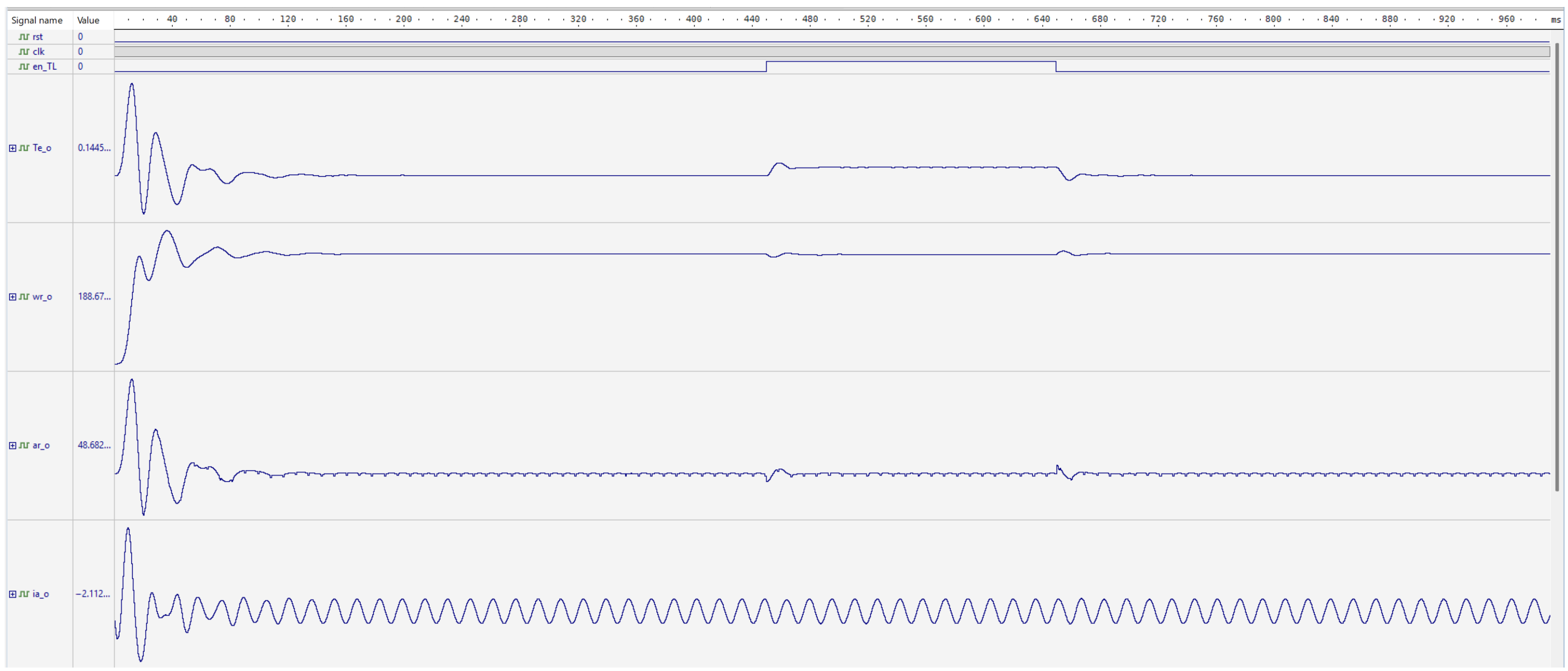
The analysis follows a structured sequence, including acceleration to nominal speed upon system activation, application of a load torque between 450 ms and 650 ms, and finally removal of the load torque to assess the system’s transient recovery.
Figure 2 shows the results obtained from simulations conducted in Matlab/Simulink, where the response of the IM model under normal operating conditions (without bearing faults) is observed.
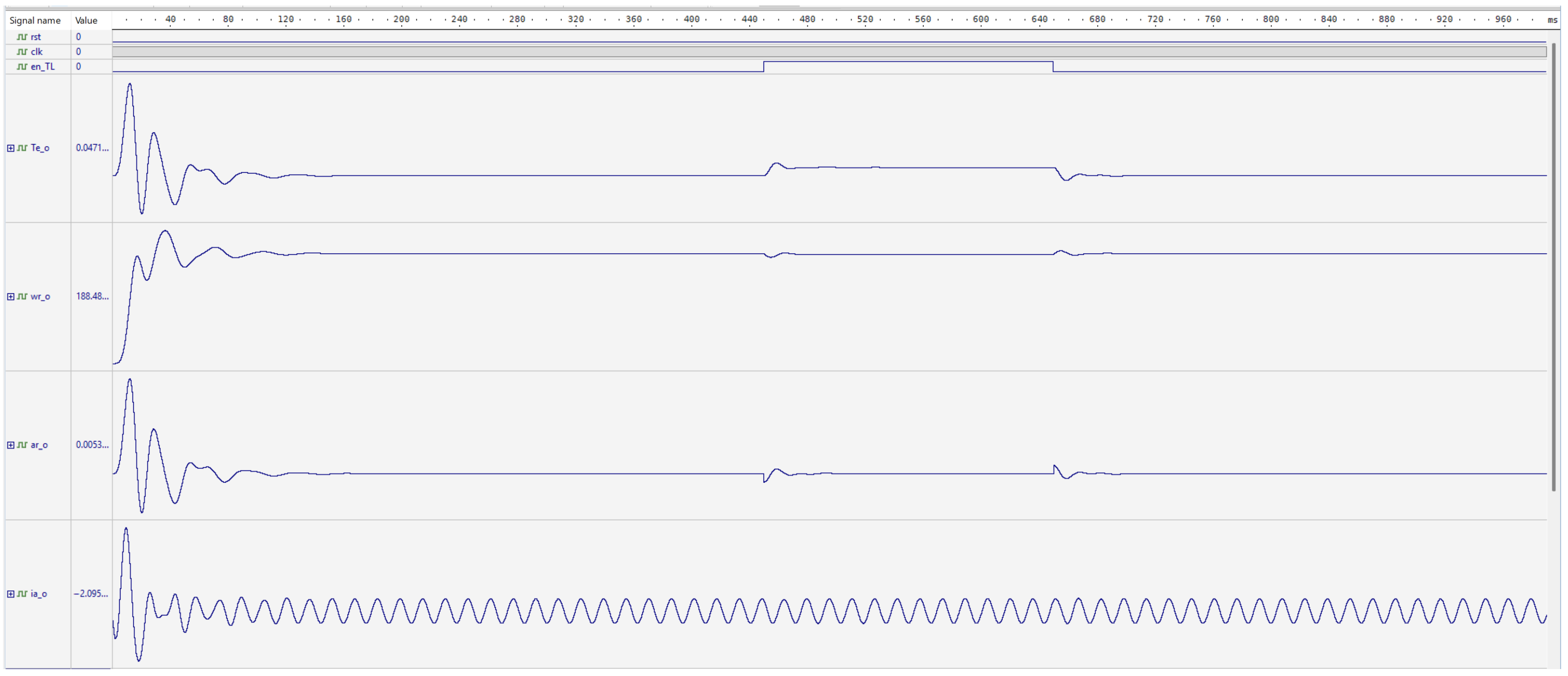
Once the functionality has been verified through simulations, the system is described in Verilog-HDL. The simulation results from Active/Aldec are shown in
Figure 3 and
Figure 4, which present the response of the IM model under normal operating conditions and with a bearing fault, respectively.
Under fault conditions, small-amplitude oscillations are observed in the machine’s fundamental mechanical variables, including angular acceleration, electromagnetic torque, and rotor angular velocity. These oscillations are a direct consequence of the mechanical disturbance introduced by the defect in the outer race of the bearing, which acts as a source of periodic vibrations that couple into the electromechanical system of the IM. The presence of these vibrations modulates the rotor speed, manifesting as small fluctuations around its nominal value, which, in turn, affects torque generation in the machine due to the intrinsic dependence of torque on slip and on the induced rotor currents.
This behavior directly impacts the system’s electrical quantities, particularly the phase current. System analysis reveals that the mechanical fluctuations induced by the fault are reflected in the stator current spectrum, where harmonic components appear around the fundamental grid frequency. This phenomenon occurs because the rotor’s angular velocity () is a key parameter in calculating the rotor’s magnetic fluxes, specifically the flux components in the direct axis () and quadrature axis (). Since the IM model in the DQ reference frame incorporates a feedback loop in which the rotor’s mechanical speed modulates the differential equations governing the fluxes and currents, any mechanical perturbation, such as that induced by the defective bearing vibration, inevitably propagates into the electrical variables.
The controlled injection of a fault in the outer race of the bearing in this evaluated system aims to systematically and reproducibly analyze how mechanical disturbances impact the machine’s electromagnetic behavior. This approach establishes a direct causal relationship between the mechanical defect and the observed electrical manifestations, which is of great importance for the development of advanced condition-monitoring and early-fault-detection strategies in electric drive systems.
4. Results
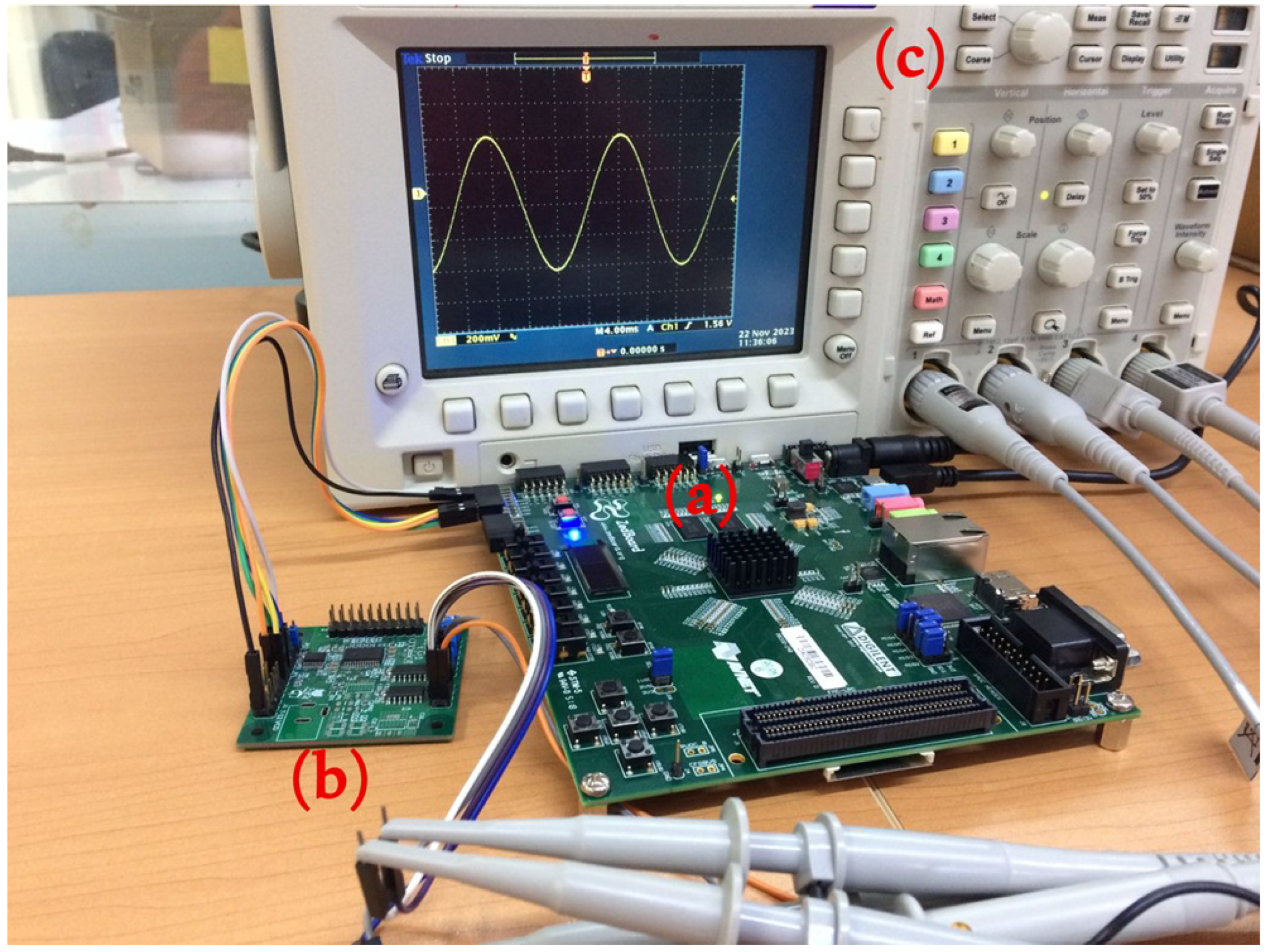
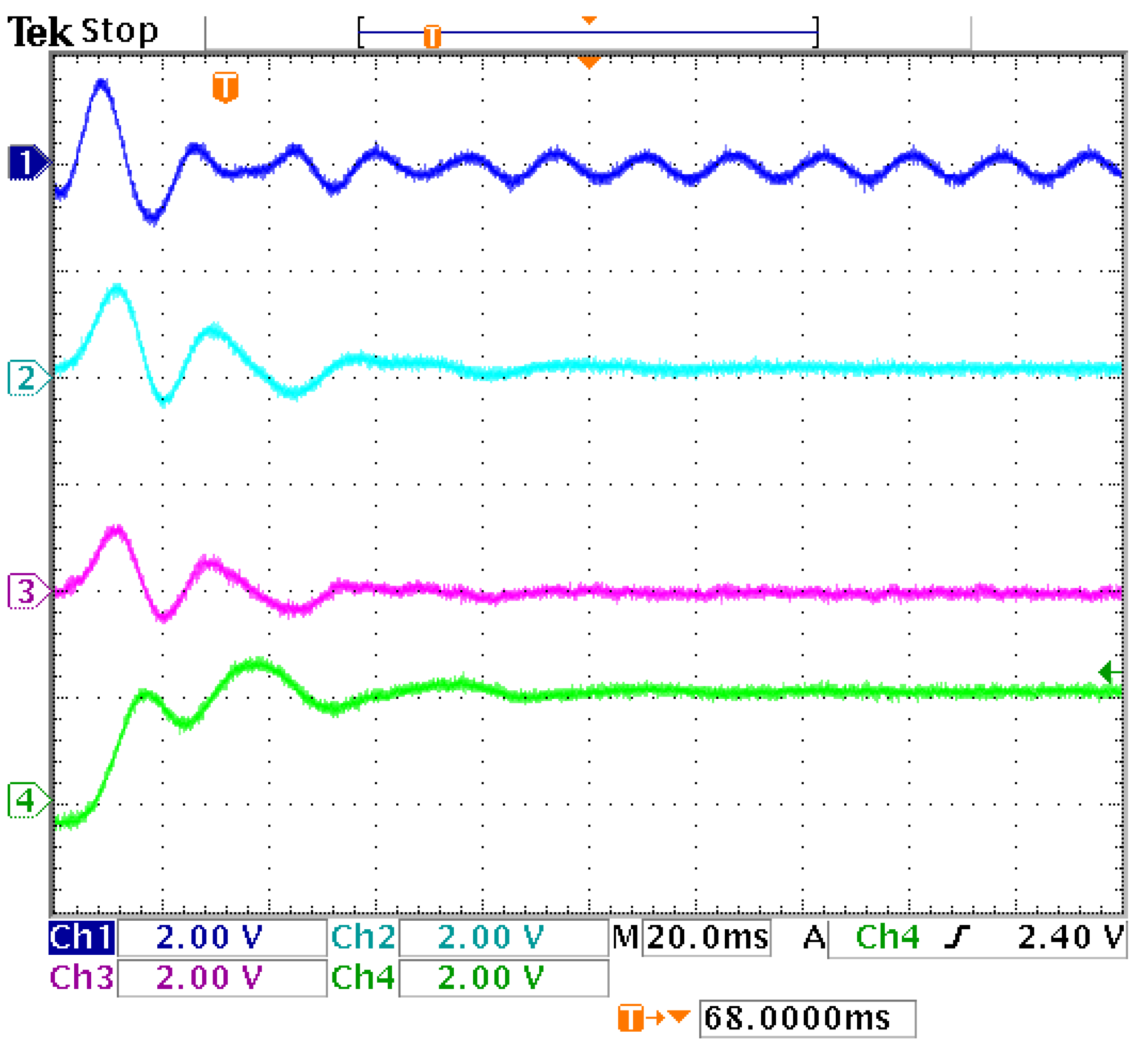
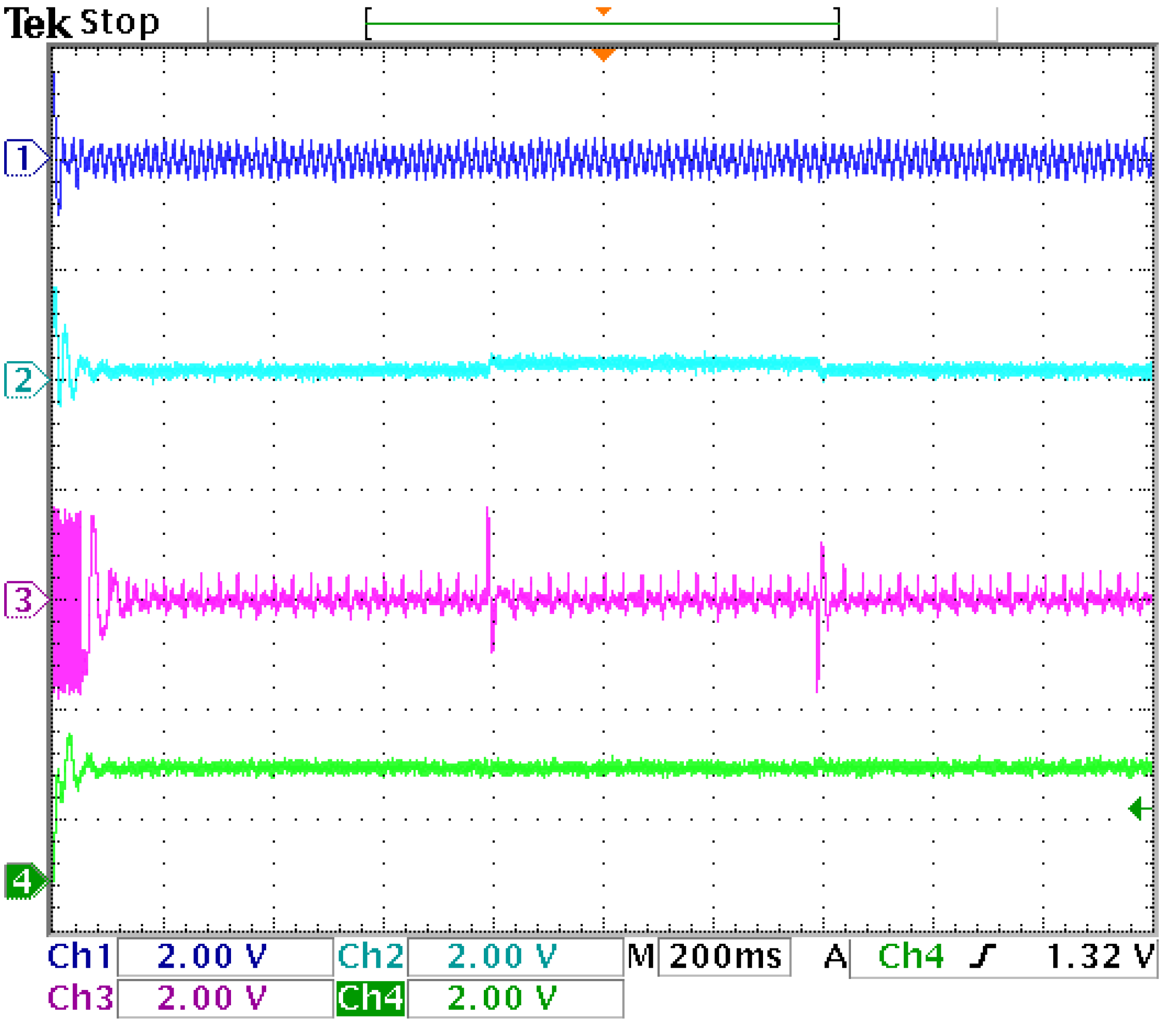
The proposed model was successfully implemented and validated on a digital hardware platform based on the Digilent Zedboard FPGA evaluation board. The experimental setup includes an analog-to-digital converter that enables real-time oscilloscope visualization of system signals, as illustrated in
Figure 5. The FPGA-based implementation demands a range of digital resources, including Look-Up Tables (LUTs), Flip-Flops (FFs), Digital Signal Processors (DSPs), Input/Output (IO) pins, and Global Clock Buffers (BUFGs).
A detailed summary of the resource utilization for the selected FPGA device is presented in
Table 1. The table shows that most basic logic resources, such as LUTs and FFs, are lightly used, with utilization rates of 4.12% and 1.89%, respectively. Similarly, the IO and BUFG exhibit low usage of 4.5% and 6.25%, respectively. In contrast, the DSP blocks are the most heavily utilized resource, reaching 50.91% of the available capacity. This indicates that the design is computationally intensive and relies significantly on arithmetic operations. The total power consumption is moderate at 205 mW, suggesting the design is efficient and leaves ample headroom for scaling or adding functionality.
Figure 6 and
Figure 7 show the results obtained from the implementation in the FPGA-based digital platform, where the same behavior from the simulation stage in the starting and normal conditions, and the introduction to the fault condition, as well as the nominal load torque is observed in the dynamic response of the machine digital model generated, respectively. In this case, a 2 s validation is generated. At steady state, the machine raises the nominal angular speed to approximately 188 rad/s, as expected. Then, a load torque is applied at 0.8 s to 1.6 s, generating an acceleration perturbation in the system.
When a load is applied to the system, the rotor’s angular acceleration decreases, a physically expected response due to the increased torque required to maintain the system’s motion under load. This decrease in acceleration directly translates into a reduction in the rotor’s angular velocity, demonstrating an intrinsic, proportional relationship between acceleration (the derivative of velocity) and velocity. This is consistent with the fundamental laws of rotational dynamics, in which applying a load imposes additional mechanical resistance that must be compensated for the electromagnetic torque generated by the machine.
Conversely, when the load is removed, the system experiences a sudden increase in both acceleration and angular velocity. This behavior is characteristic of an electric machine operating under closed-loop conditions: upon load removal, the system’s inertia and lack of resistance allow the rotor to accelerate rapidly until it stabilizes at a new equilibrium condition, determined by the balance between the available electromagnetic torque and the system’s mechanical and inductive losses. This transition from the loaded to the unloaded state induces transient variations in velocity and acceleration, which are gradually damped until a new steady state is reached.
These dynamic changes inevitably affect the stator phase current, which exhibits a small offset during moments of load application or removal, reflecting increased energy consumption in response to load variations. This current increase is the natural mechanism by which the machine adjusts its behavior to meet additional torque demand or release stored energy when the load is removed.
When a fault condition is introduced, specifically a defect in the bearing’s outer race, this anomaly manifests in the acceleration signal. The fault generates periodic mechanical oscillations in the system, recorded as fluctuations in the rotor’s acceleration. These oscillations, coupled with the system dynamics, also affect the rotor’s angular velocity and consequently alter the machine’s magnetizing flux behavior. The magnetizing flux, responsible for establishing the electromagnetic coupling between the stator and rotor, depends on the relative speed between the stator’s rotating field and the rotor itself. Therefore, any mechanical perturbation induced by a fault directly affects the stator phase currents, generating periodic disturbance signals that are detectable in the current domain.
This analysis is crucial, as it demonstrates how the interaction between the system’s mechanics (bearing faults) and the machine’s electromechanics (fluxes, currents, torque) enables the identification of abnormal conditions through the monitoring of electrical signals. This establishes that by developing the IM model within a digital environment, its performance and behavior under fault conditions can be emulated [
32]. Furthermore, using the phase current as a diagnostic variable provides an advantage since it is easily measurable in industrial systems and thus readily comparable with the emulator, enabling a reliable diagnostic method and opening the possibility to implement early fault detection algorithms based on spectral analysis or time-frequency transforms, thereby allowing proactive fault identification before they lead to catastrophic system failures.
To assess the precision of the implemented system, the resulting signal was analyzed. Specifically, the output current was selected as the representative variable, and the Mean Absolute Error (MAE) was computed to quantify the deviation between the simulated and implemented signals. The analysis was performed over a 1 s window corresponding to the first second after device startup under healthy operating conditions. This FPGA-based implementation benefits from deterministic, cycle-accurate execution, which is essential for achieving high-fidelity emulation and reliable quantitative comparison. In this transient period, the simulated current signal in MATLAB exhibited a mean absolute value of , while the implementation introduced a mean absolute error of , representing approximately of the reference signal. When the system reaches stable operating conditions, the MAE decreases significantly to , corresponding to approxim ately of the signal’s mean absolute value. This exceptionally low error in steady state underscores how the parallel architecture of the FPGA preserves model integrity while satisfying real-time constraints. The results demonstrate that the implementation closely aligns with the simulation model, with deviations well within an acceptable margin for demanding applications such as real-time diagnostics and hardware-in-the-loop validation, thereby confirming the efficacy of the chosen FPGA platform for high-precision digital twin emulation.
To validate the injection of faults, we conducted a spectral analysis using the Fast Fourier Transform (FFT) on the phase current signal. This method allows for the identification of dominant frequencies within a signal, which is crucial for understanding underlying periodic phenomena or system responses [
33]. Furthermore, by shifting the analysis from the time domain to the frequency domain, the FFT facilitates the isolation and detailed examination of individual frequency components that collectively form a complex signal, thereby broadening the scope of analyzable signal characteristics [
34].
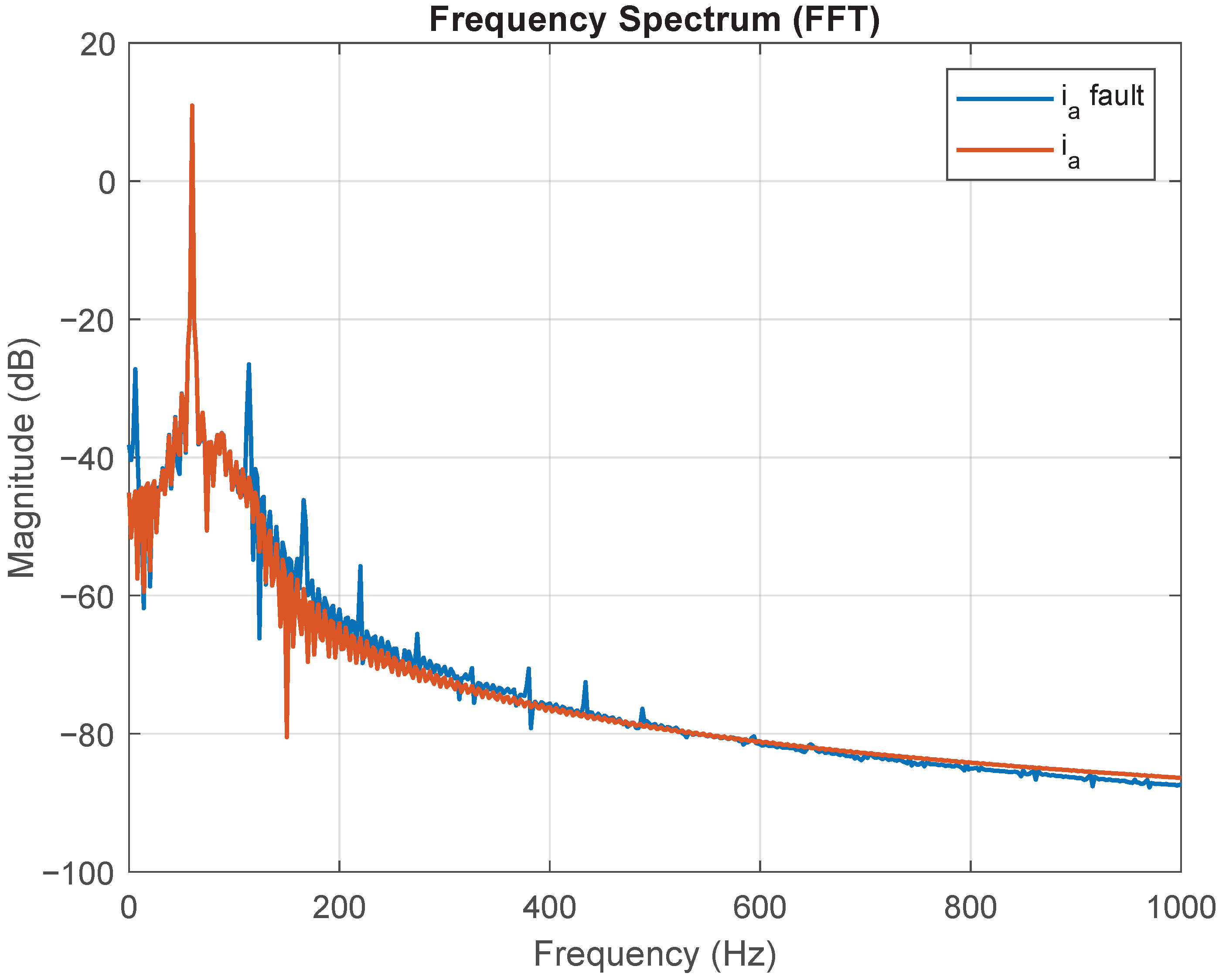
The spectral analysis results, obtained via the Fast Fourier Transform (FFT), are presented in
Figure 8. This visualization is key for contrasting the frequency-domain signatures of the induction machine under healthy and faulty conditions. The plot clearly shows two distinct traces: the orange curve corresponds to the stator current signal from the machine in a healthy state, while the blue curve represents the current signal with an injected bearing fault.
The spectrum of the healthy signal (orange) displays a characteristic clean peak at the fundamental supply frequency, with its amplitude decaying smoothly into the noise floor. This is the expected signature of a stable, periodic current under normal operation.
In direct contrast, the spectrum of the faulty signal (blue) reveals significant and diagnostic alterations. The most critical evidence is the appearance of sidebands—additional frequency components that flank the fundamental peak. These sidebands are a direct spectral manifestation of the periodic mechanical disturbance caused by the bearing defect. Their presence indicates that the fault modulates the current signal, redistributing energy from the fundamental frequency to these specific adjacent frequencies.
5. Discussion
This work successfully demonstrates the implementation and application of a real-time digital model of an IM for fault injection analysis. The core contribution lies in establishing a functional, FPGA-based digital twin that accurately emulates the machine’s dynamic behavior and permits the controlled introduction of a bearing outer-race fault. The ability to replicate fault signatures in electrical signals within a deterministic, hardware-in-the-loop environment is of significant importance. It provides a safe, flexible, and cost-effective platform for developing and validating diagnostic algorithms, testing fault-tolerant control strategies, and training condition monitoring systems without risking physical hardware. The strong correlation between simulation results and the digital implementation validates the model’s fidelity for its intended exploratory purpose.
The choice of the Forward-Euler integration method, while a simplification, was a deliberate and strategic decision for this first phase of research. Its primary advantage was its simple implementation, which enabled rapid prototyping and verification of the core model’s real-time feasibility on the FPGA platform. To ensure numerical stability and convergence within this explicit method, the simulation step size was carefully selected at 130.2 μs, balancing the model’s dynamic response with the constraints of the hardware platform. The goal of this initial phase was to establish a functional foundation and successfully assess the system’s real-time behavior under the defined operating conditions. We acknowledge that for higher-fidelity emulation, particularly of faster electromagnetic transients or more complex fault dynamics, higher-order numerical methods present an important avenue for future work. Consequently, the model in its current form presents inherent limitations that define the scope of this exploratory study and outline clear pathways for future refinement.
The most significant limitations stem from the model’s simplified nature. The electrical model does not account for non-idealities such as magnetic saturation or core losses. The drive system is idealized, ignoring critical real-world effects like Pulse-Width Modulation (PWM) harmonics, control delays, and the non-linear behavior of the three-phase Voltage Source Inverter (VSI), including dead-time effects. These factors are known to significantly influence the manifestation of current harmonics and fault signatures. Furthermore, the fault model is currently restricted to the outer race, while ball bearing defects are equally prevalent and produce distinct characteristic frequencies. These acknowledged simplifications were necessary to isolate and understand the primary fault-current interaction mechanism in a controlled digital environment.
Therefore, this implementation should be viewed as a crucial first step that confirms the approach’s viability and establishes the essential digital infrastructure and methodology. The inherent disadvantages of the model’s simplifications such as the use of a first-order integration method and the exclusion of drive system non-linearities and magnetic saturation—must be acknowledged. These choices deliberately trade off high-frequency dynamic accuracy for implementation stability and real-time determinism. Consequently, the current model’s primary application scope is well defined: it serves as an effective platform for initial proof-of-concept studies, educational demonstrations of fault signatures, and the validation of core diagnostic logic that relies on lower-frequency fault components, such as bearing defect harmonics. Its validity for these purposes is justified by its ability to replicate the fundamental electromechanical coupling and produce the characteristic fault-induced sidebands in the current spectrum, as demonstrated in the results. Future research will build directly upon this foundational baseline by integrating a more sophisticated numerical solver, incorporating the aforementioned non-linearities and drive system effects, and expanding the fault library. This evolution will systematically address current limitations and transform the digital twin from an exploratory tool into a high-fidelity platform capable of simulating complex, real-world fault scenarios with greater accuracy, enabling precision control and enabling prognostic system design.
6. Conclusions
This work presents a comprehensive advancement in the real-time emulation and fault diagnosis of induction machines by developing a digital implementation of an IM model. The detailed analysis and successful implementation led to the following key conclusions:
A High-Fidelity, Real-Time Digital Twin for Fault Diagnosis: This research successfully designed and implemented a digital twin of a three-phase induction machine capable of operating in real-time on an FPGA platform. The core innovation lies in integrating a detailed bearing-fault model, specifically for race defects. The model transcends simple simulation by accurately replicating the complex electromechanical coupling of a physical machine. It captures the dynamic transition from healthy operation through transient load changes and into faulty states, thereby generating the precise electrical signatures (specifically, current harmonics and sidebands) used for condition monitoring. This capability provides an indispensable, risk-free virtual environment for prototyping and validating diagnostic algorithms, effectively bridging the gap between theoretical offline models and physical experimental setups.
Rigorous Cross-Platform Validation and Model Fidelity: A cornerstone of this work is the validation methodology employed. The system’s performance was meticulously compared across three distinct tiers: conventional software simulation (Matlab/Simulink), specialized hardware simulation environments (Active/Aldec), and final execution on the target FPGA hardware. The observed strong agreement across these platforms is not merely a qualitative success; it is substantiated quantitatively by performance metrics, such as a mean MAE of 0.20% of the signal’s magnitude during steady-state operation. This multi-layered verification attests to the robustness, accuracy, and reliability of the underlying mathematical model, establishing it as a trustworthy foundation for advanced research in predictive control, fault-tolerant system design, and the development of prognostic strategies.
Strategic FPGA Deployment Enabling Efficiency and Future Scalability: The deployment of the digital twin on an FPGA platform is identified as a key strategic advantage, offering a critical balance between computational performance and implementation flexibility. The FPGA’s parallel architecture guarantees deterministic, real-time execution, enabling accurate emulation of fast electromechanical transients—a feat challenging with software-based solutions. An in-depth analysis of the hardware resource consumption reveals a highly efficient and scalable implementation:
- −
Low Logic Overhead: The minimal utilization of LUT 4.12% and FF 1.89% demonstrates an optimized design for control and sequencing logic.
- −
High Arithmetic Intensity: The significant use of Digital Signal Processing blocks 50.91% correctly reflects the computationally intensive nature of solving the machine’s differential equations in real-time.
- −
Power and Space Efficiency: With total power consumption measured at 205 mW and low usage of I/O 4.5% and BUFG 6.25% resources, the design profile is exceptionally lean.
This specific resource footprint—high DSP usage coupled with low logic overhead—is a pivotal finding. It confirms that the computational burden is focused on essential arithmetic operations, leaving ample space on the device. This available headroom is not merely an unused surplus; it represents a direct pathway for scalability, enabling the future on-chip integration of auxiliary diagnostic modules, lightweight AI co-processors for intelligent fault classification, or enhanced monitoring functionalities, all without necessitating a migration to a larger, more power-hungry device.
Practical Applicability for Industrial Embedded Systems and Training: The combination of real-time execution, deterministic response, and demonstrated hardware efficiency directly translates to high practical applicability. The portability of the FPGA-based system facilitates its potential integration into embedded industrial controllers for in-field, online monitoring and protection. Furthermore, this digital twin serves as a powerful tool for engineer and technician training, allowing for the safe exploration of fault conditions, system responses, and diagnostic techniques without the risks and costs associated with operating and damaging physical machinery.
Explicit Limitations and a Clear Roadmap for Future Research: This work is intentionally positioned as a foundational, proof-of-concept study. Its scope is clearly defined by deliberate design choices, such as the use of the Forward-Euler integration method for simplicity and the initial focus on a single fault type. These choices establish a functional baseline but also outline explicit limitations, including the omission of drive system non-linearities and other complex fault modes. Consequently, this work provides a direct and actionable roadmap for future research. Immediate next steps include:
- −
Model Enhancement: Integrating higher-order numerical solvers for improved accuracy, and incorporating missing non-linearities like saturation and detailed inverter models.
- −
Fault Library Expansion: Extending the fault model to include inner race defects, ball defects, and combined/multiple-fault scenarios to better mimic real-world degradation.
- −
System Intelligence: Leveraging the available FPGA resources to implement on-board, real-time signal processing and machine learning algorithms for autonomous fault detection and classification, moving towards a fully intelligent prognostic system.
Therefore, this research establishes a versatile, efficient, and validated FPGA-based digital twin for induction machines. It provides a significant contribution to the field by offering a practical platform that advances academic research while simultaneously delivering a tangible pathway for improving industrial safety, operational efficiency, and diagnostic capability through advanced, real-time condition monitoring.




 ,
,