Machine Learning-Based Prediction of Optimum Design Parameters for Axially Symmetric Cylindrical Reinforced Concrete Walls

Abstract
1. Introduction
2. Materials and Methods
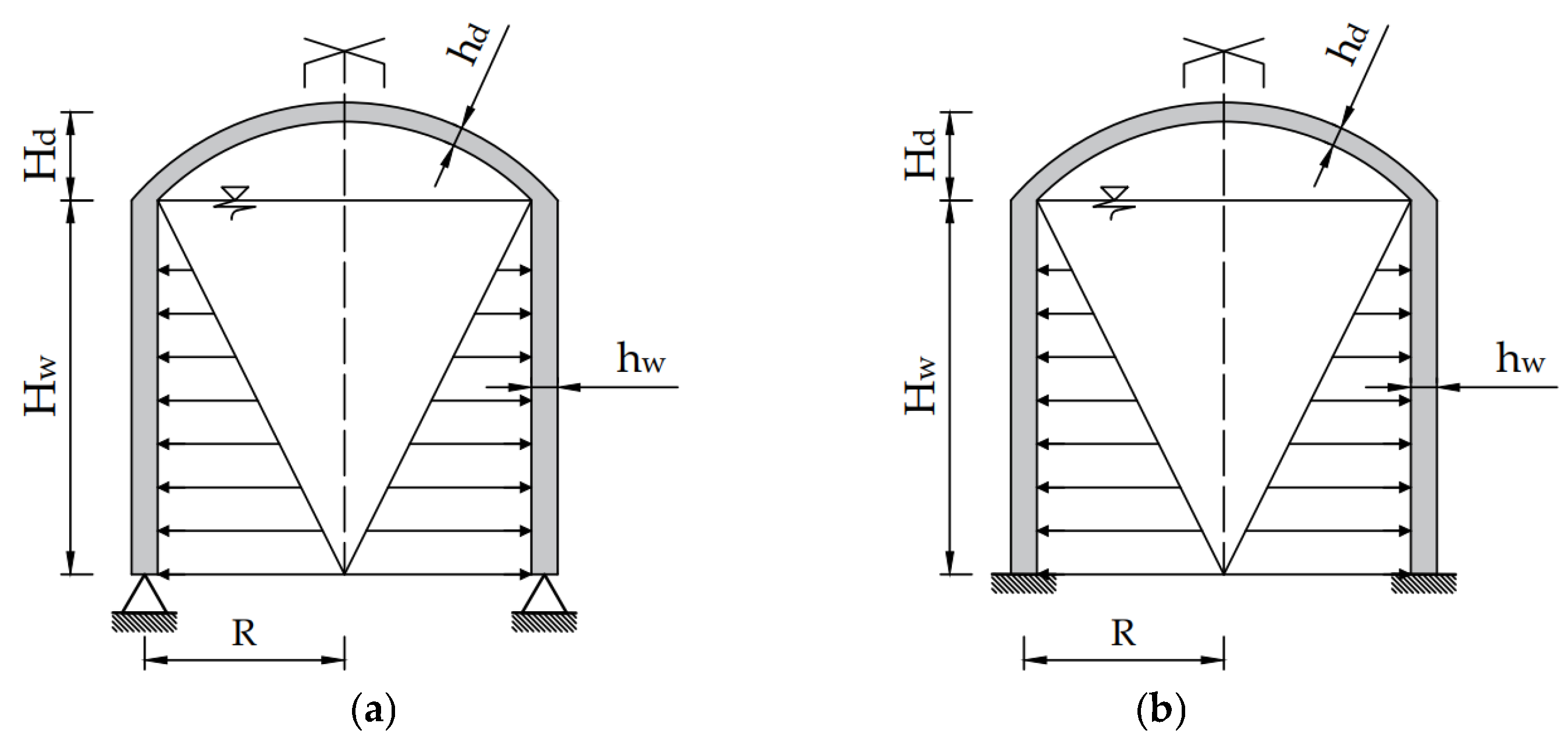
2.1. Optimization-Based Dataset Generation
2.2. Description of the Optimization Dataset
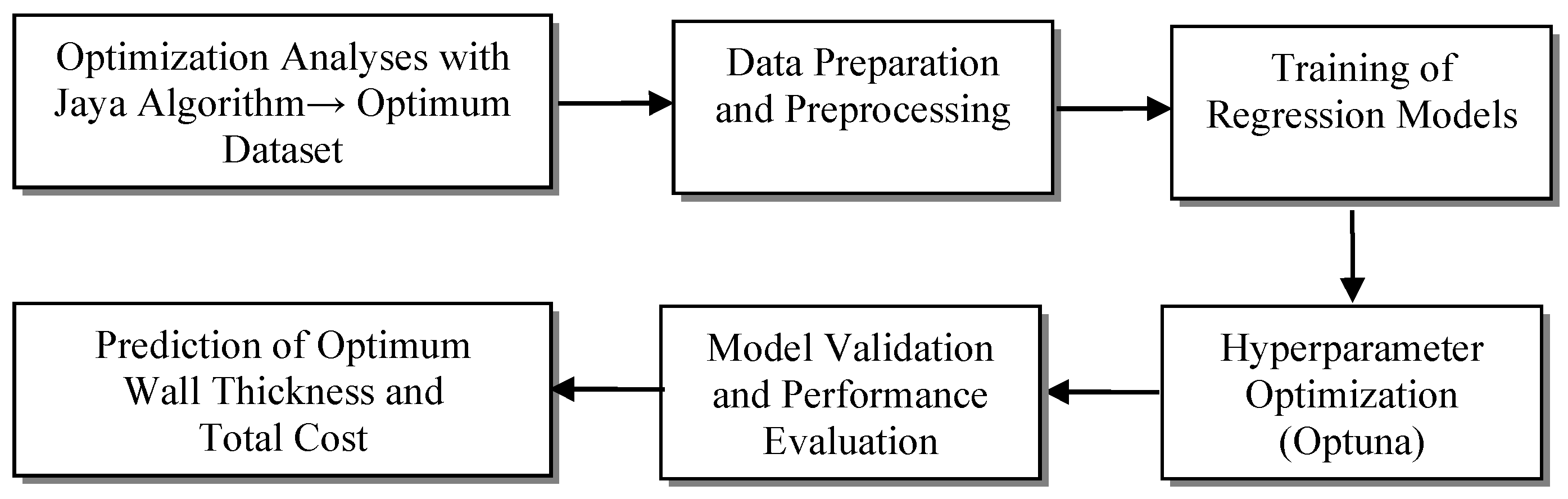
2.3. Machine Learning Methodology
2.3.1. Machine Learning Process
Regression Models
Linear Regression-Based Models
Tree-Based Regression Models
Ensemble and Boosting Models
Distance-Based and Neural Network Models
2.3.2. Hyperparameter Optimization Using Optuna
2.3.3. Model Training and Validation
3. Results and Discussion
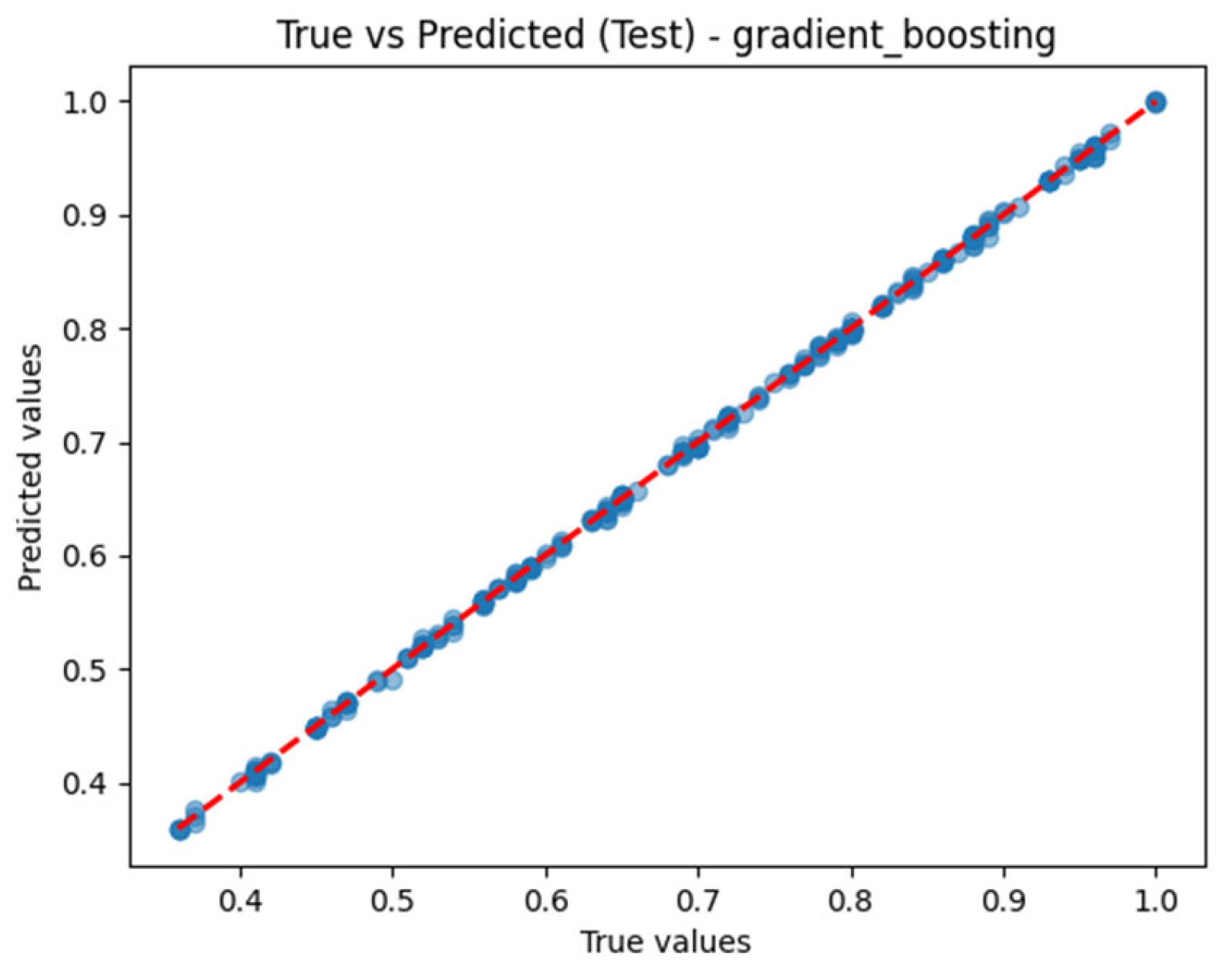
3.1. Prediction Performance for Optimum Wall Thickness
3.1.1. Pinned Support
3.1.2. Fixed Support
3.2. Prediction Performance for Total Cost
3.2.1. Pinned Support
3.2.2. Fixed Support
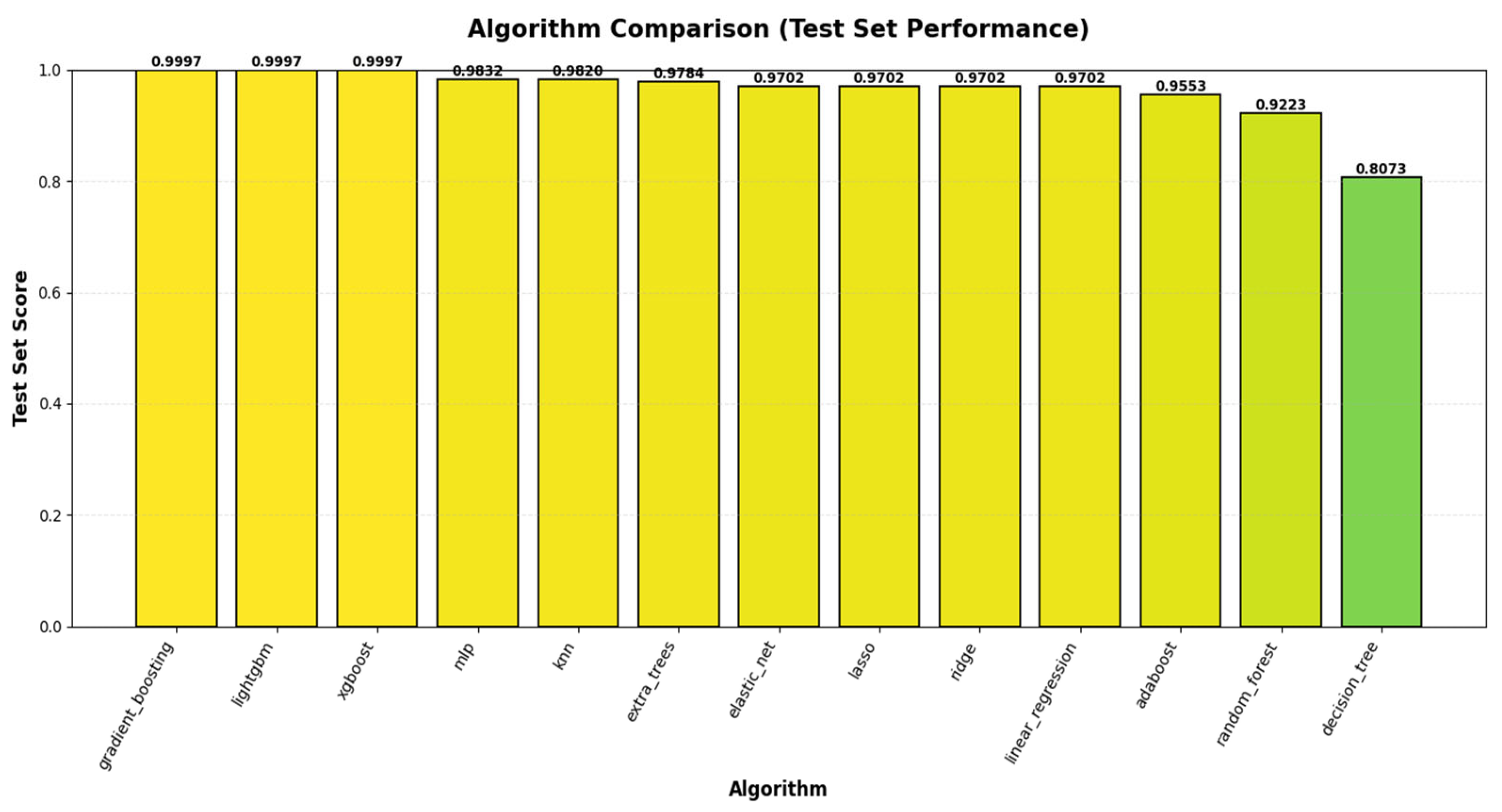
3.3. Comparative Evaluation of Machine Learning Models
4. Discussion and Conclusions
Funding
Data Availability Statement
Conflicts of Interest
References
- Melchers, R.E.; Rozvany, G.I.J. Optimum design of reinforced concrete tanks. J. Eng. Mech. Div. 1970, 96, 1093. [Google Scholar] [CrossRef]
- Adidam, S.R.; Subramanyam, A.V.J. Optimum design of reinforced concrete water tanks. J. Struct. Div. 1982, 108, 1219–1231. [Google Scholar] [CrossRef]
- Saxena, M.S.; Sharma, P.; Mohan, C. Cost optimization of Intze tanks on shafts using nonlinear programming. Eng. Optim. 1987, 10, 279–288. [Google Scholar] [CrossRef]
- Thevendran, V.; Thambiratnam, D.P. Minimum weight design of conical concrete water tanks. Comput. Struct. 1988, 29, 699–704. [Google Scholar] [CrossRef]
- Tan, G.H.; Thevendran, V.; Das Gupta, N.C.; Thambiratnam, D.P. Design of reinforced concrete cylindrical water tanks for minimum material cost. Comput. Struct. 1993, 48, 803–810. [Google Scholar] [CrossRef]
- Barakat, S.A.; Altoubat, S. Application of evolutionary global optimization techniques in the design of RC water tanks. Eng. Struct. 2009, 31, 332–344. [Google Scholar] [CrossRef]
- Ansary, A.M.; Damatty, A.A.; Nassef, O. A coupled finite element genetic algorithm for optimum design of stiffened liquid-filled steel conical tanks. Thin-Walled Struct. 2011, 49, 482–493. [Google Scholar] [CrossRef]
- El Ansary, A.M.; Nassef, A.O.; El Damatty, A.A. Optimum Design of Stiffened Liquid-Filled Steel Conical Tanks. In Proceedings of the Annual General Conference of the Canadian Society for Civil Engineering, CSCE, Montreal, QC, Canada, 29 May–1 June 2013. [Google Scholar]
- Bekdas, G. Optimum design of axially symmetric cylindrical reinforced concrete walls. Struct. Eng. Mech. Int. J. 2014, 51, 361–375. [Google Scholar] [CrossRef]
- Bekdas, G. Harmony search algorithm approach for optimum design of post-tensioned axially symmetric cylindrical reinforced concrete walls. J. Optim. Theory Appl. 2015, 164, 342–358. [Google Scholar] [CrossRef]
- Bekdas, G. New improved metaheuristic approaches for optimum design of posttensioned axially symmetric cylindrical reinforced concrete walls. Struct. Des. Tall Spec. Build. 2018, 27, e1461. [Google Scholar] [CrossRef]
- Bekdas, G. Optimum design of post-tensioned axially symmetric cylindrical walls using novel hybrid metaheuristic methods. Struct. Des. Tall Spec. Build. 2019, 28, e1550. [Google Scholar] [CrossRef]
- Bekdas, G.; Nigdeli, S.M. Optimum Reduction of Flexural Effect of Axially Symmetric Cylindrical Walls with Post-tensioning Forces. KSCE J. Civ. Eng. KSCE 2018, 22, 2425–2432. [Google Scholar] [CrossRef]
- Latif, I.; Banerjee, A.; Surana, M. Explainable Machine Learning Aided Optimization of Masonry Infilled Reinforced Concrete Frames. Structures 2022, 44, 1751–1766. [Google Scholar] [CrossRef]
- Ukwaththa, U.J.; Liyanarachchi, T.S.D.; Kulasooriya, W.K.V.J.B.; Ranasinghe, R.S.S. Use of Interpretable Machine Learning Methods to Predict the Fundamental Period of Masonry Infilled Reinforced Concrete Frame Structures. In Proceedings of the 2024 Moratuwa Engineering Research Conference (MERCon), Moratuwa, Sri Lanka, 8–10 August 2024. [Google Scholar] [CrossRef]
- Chepurnenko, A.; Al-Zgul, S.; Tyurina, V. Machine Learning for Predicting Required Cross-Sectional Dimensions of Circular Concrete-Filled Steel Tubular Columns. Buildings 2025, 15, 1438. [Google Scholar] [CrossRef]
- Nguyen, T.-H.; Nguyen, D.-D. Improved Data-Driven Models for Estimating Shear Capacity of Squat Rectangular Reinforced Concrete Walls. Asian J. Civ. Eng. 2024, 25, 2729–2742. [Google Scholar] [CrossRef]
- Nguyen, N.-M. Predicting Mechanical Properties of Concrete Structures Using Metaheuristic-Optimization-Based Machine Learning Models. Appl. Soft Comput. 2025, 172, 112893. [Google Scholar] [CrossRef]
- Mehraban, M.H.; Alnaser, A.A.; Sepasgozar, S.M.E. Building Information Modeling and AI Algorithms for Optimizing Energy Performance in Hot Climates: A Comparative Study of Riyadh and Dubai. Buildings 2024, 14, 2748. [Google Scholar] [CrossRef]
- Tsetse, A.; Jones, Y. Predictive Modeling of Energy Requirements in the Design of Buildings: A Comparative Analysis of Machine Learning Algorithms. In Proceedings of the IEEE 3rd International Conference on Computing and Machine Intelligence (ICMI), Michigan, MN, USA, 13–14 April 2024. [Google Scholar] [CrossRef]
- Abdeyazdan, H.; Safaeianpour, A.; Amini, M.A. Explainable Machine Learning for Passive Design: Early-Stage Building Energy Reduction in Hot-Arid Climates. Sustain. Energy Technol. Assess. 2025, 83, 104589. [Google Scholar] [CrossRef]
- Arbi, S.J.; Hassan, W.; Khalid, U.; Ijaz, N.; Maqsood, Z.; Haider, A. Optimized machine learning-based enhanced modeling of pile bearing capacity in layered soils using random and grid search techniques. Earth Sci. Inform. 2025, 18, 332. [Google Scholar] [CrossRef]
- Dehghan, F.; Amores, C.P.; Khanmohammadi, L.; Labib, R. Evaluating Machine Learning Models for Sustainable Building Design: Energy, Emissions, and Comfort Metrics. Build. Environ. 2025, 285, 113582. [Google Scholar] [CrossRef]
- Aldawish, A.; Kulasegaram, S. Predictive Modeling for Self-Compacting Concrete: Evaluating Machine Learning Approaches in Real-World Construction Scenarios. In Proceedings of the 4th FIB International Conference on Concrete Sustainability (ICCS2024), Guimarães, Portugal, 10–12 September 2024; Lecture Notes in Civil Engineering. Springer: Cham, Switzerland, 2025; Volume 573. [Google Scholar] [CrossRef]
- Lazaridis, P.C.; Kavvadias, I.E.; Demertzis, K.; Vasiliadis, L.K. Structural Damage Prediction of a Reinforced Concrete Frame Under Single and Multiple Seismic Events Using Machine Learning Algorithms. Appl. Sci. 2022, 12, 3845. [Google Scholar] [CrossRef]
- Kondratieva, T.; Vysokovskiy, D.; Rusakova, E.; Poliakova, K. Modeling the Strength of the Walls of I-Shaped Reinforced Concrete Beams. In Proceedings of the II International Scientific Conference “Recent Advances in Architecture and Construction”, Kazan, Russia, 14–15 May 2024; Lecture Notes in Civil Engineering. Springer: Cham, Switzerland, 2025. [Google Scholar] [CrossRef]
- Khan, M.S.; Peng, T.; Akhlaq, H.; Adeel Khan, M. Comparative Analysis of Automated Machine Learning for Hyperparameter Optimization and Explainable Artificial Intelligence Models. IEEE Access 2025, 13, 84966–84991. [Google Scholar] [CrossRef]
- Jegadeeswari, K.; Rathipriya, R. An Environmental Sustainable Approach to Machine Learning, Training and Development. Sak. Univ. J. Comput. Inf. Sci. 2025, 8, 457–469. [Google Scholar] [CrossRef]
- Cosut, M.; Bekdas, G.; Nigdeli, S.M.; Isikdag, U. Predicting Design Suitability of Box-Shaped Sustainable Timber Structural Members Using Machine Learning and Hyperparameter Optimization. Neural Comput. Appl. 2025, 37, 24123–24148. [Google Scholar] [CrossRef]
- Mohanty, A.; Raghavendra, G.S.; Rajini, J.; Sachuthananthan, B.; Banu, E.A.; Subhi, B. Artificial Intelligence (AI) and Machine Learning (ML) Technology-Driven Structural Systems. In Technological Advancements in Data Processing for Next Generation Intelligent Systems; IGI Global Scientific Publishing: Hershey, PA, USA, 2024; pp. 225–254. [Google Scholar] [CrossRef]
- Singh, J.; Singh, P.; Ravi, V.; Kumar, S.; Al Mazroa, A.; Diwakar, M.; Gupta, I. Enhancing Large-Diameter Tunnel Construction Safety with Robust Optimization and Machine Learning Integrated into BIM. Open Civ. Eng. J. 2024, 18, e18741495343680. [Google Scholar] [CrossRef]
- Iram, S.; Farid, H.M.A.; Akande, A.A.; Shakeel, H.M. Intelligent Modelling Techniques for Enhanced Thermal Comfort and Energy Optimisation in Residential Buildings. Energies 2025, 18, 3878. [Google Scholar] [CrossRef]
- Abbood, I.S.; Rahman, N.A.; Abu Bakar, B.H. Enhanced Data-Driven Shear Strength Predictive Modeling Framework for RCDBs Using Explainable Boosting-Based Ensemble Learning Algorithms Coupled with Bayesian Optimization. Results Eng. 2025, 27, 106556. [Google Scholar] [CrossRef]
- Grandi, F.; Zanatto, D.; Capaccioli, A.; Napoletano, L.; Cavallaro, S.; Peruzzini, M. A Methodology to Guide Companies in Using Explainable AI-Driven Interfaces in Manufacturing Contexts. Procedia Comput. Sci. 2024, 232, 3112–3120. [Google Scholar] [CrossRef]
- Zhang, T.; He, X. Enhancing Explainability in Medical AI: Developing Human-Centered Participatory Design Cards. In Proceedings of the 26th International Conference on Human-Computer Interaction, Washington, DC, USA, 29 June–4 July 2024; Lecture Notes in Computer Science. Springer: Cham, Switzerland, 2024. [Google Scholar] [CrossRef]
- Asal, B.; Demir, M.O. Enhancing Software Defect Prediction through Explainable AI: Integrating SHAP and LIME in a Voting Classifier Framework. In Proceedings of the 8th International Artificial Intelligence and Data Processing Symposium IDAP, Malatya, Turkey, 21–22 September 2024. [Google Scholar] [CrossRef]
- Belghachi, M. A Review on Explainable Artificial Intelligence Methods, Applications, and Challenges. Indones. J. Electr. Eng. Inform. 2023, 11, 1007–1024. [Google Scholar] [CrossRef]
- Sadeghi, Z.; Alizadehsani, R.; Cifci, M.A.; Kausar, S.; Rehman, R.; Mahanta, P.; Bora, P.K.; Almasri, A.; Alkhawaldeh, R.S.; Hussain, S.; et al. A review of Explainable Artificial Intelligence in healthcare. Comput. Electr. Eng. 2024, 118, 109370. [Google Scholar] [CrossRef]
- Zito, F.; Talbi, E.-G.; Cavallaro, C.; Cutello, V.; Pavone, M. Metaheuristics in Automated Machine Learning: Strategies for Optimization. Intell. Syst. Appl. 2025, 26, 200532. [Google Scholar] [CrossRef]
- Singh, J.; Sandhu, J.K.; Kumar, Y. Metaheuristic-Based Hyperparameter Optimization for Multi-Disease Detection and Diagnosis in Machine Learning. Serv. Oriented Comput. Appl. 2024, 18, 163–182. [Google Scholar] [CrossRef]
- Ravikumar, R.N.; Aarthi, S.; Kurbanova, S.; Sathya, K. Hybrid Metaheuristic Optimization for Neural Networks in Biomedical Imaging. In Metaheuristic Algorithms and Optimizing Neural Networks for Biomedical Image Processing; IGI Global Scientific Publishing: Hershey, PA, USA, 2025. [Google Scholar] [CrossRef]
- Razmjouei, P.; Moharamkhani, E.; Hasanvand, M.; Daneshfar, M.; Shokouhifar, M. Metaheuristic-Driven Two-Stage Ensemble Deep Learning for Lung/Colon Cancer Classification. Comput. Mater. Contin. 2024, 80, 3855–3880. [Google Scholar] [CrossRef]
- Aarthi, S.; Ravikumar, R.N.; Kalandarova, M.; Ramasamy, J. Overcoming Barriers in Metaheuristic Neural Network Optimization for Biomedical Imaging. In Metaheuristic Algorithms and Optimizing Neural Networks for Biomedical Image Processing; IGI Global Scientific Publishing: Hershey, PA, USA, 2025. [Google Scholar] [CrossRef]
- Yücel, M.; Bekdaş, G.; Nigdeli, S.M. Prediction of Minimum CO2 Emission for Rectangular Shape Reinforced Concrete (RC) Beam. In Proceedings of the 7th International Conference on Harmony Search, Soft Computing and Applications, Seoul, Republic of Korea, 23–24 February 2022; Lecture Notes on Data Engineering and Communications Technologies. Springer: Cham, Switzerland, 2022. [Google Scholar] [CrossRef]
- Bekdaş, G.; Cakiroglu, C.; Kim, S.; Geem, Z.W. Optimal Dimensions of Post-Tensioned Concrete Cylindrical Walls Using Harmony Search and Ensemble Learning with SHAP. Sustainability 2023, 15, 7890. [Google Scholar] [CrossRef]
- Alkhawaldeh, S.M.A. Enhancing Flat Slab Design: Machine Learning and Metaheuristic Approaches to Predict Punching Shear Strength. Asian J. Civ. Eng. 2024, 25, 2459–2469. [Google Scholar] [CrossRef]
- Kayabekir, A.E. Effects of constant parameters on optimum design of axially symmetric cylindrical reinforced concrete walls. Struct. Des. Tall Spec. Build. 2021, 30, e1838. [Google Scholar] [CrossRef]
- The MathWorks. MATLAB, R2022b; The MathWorks: Natick, MA, USA, 2022.
- Python (3.10) [Computer Software]. Available online: http://python.org (accessed on 15 November 2025).
- Rao, R. Jaya: A simple and new optimization algorithm for solving constrained and unconstrained optimization problems. Int. J. Ind. Eng. Comput. 2016, 7, 19–34. [Google Scholar] [CrossRef]
- Laake, P.; Fagerland, M.W. Statistical inference. In Research in Medical and Biological Sciences; Academic Press: Cambridge, MA, USA, 2015; pp. 379–430. [Google Scholar] [CrossRef]
- Ranjbarzadeh, R.; Dorosti, S.; Ghoushchi, S.J.; Caputo, A.; Tirkolaee, E.B.; Ali, S.S.; Bendechache, M. Breast tumor localization and segmentation using machine learning techniques: Overview of datasets, findings, and methods. Comput. Biol. Med. 2023, 152, 106443. [Google Scholar] [CrossRef]
- Smalheiser, N.R. Correlation and Other Concepts You Should Know. In Data Literacy; Elsevier: Amsterdam, The Netherlands, 2017; pp. 169–185. [Google Scholar] [CrossRef]
- Tibshirani, R. Regression Shrinkage and Selection via the Lasso. J. R. Stat. Soc. Ser. Methodol. 1996, 58, 267–288. [Google Scholar] [CrossRef]
- McNeish, D.M. Using lasso for predictor selection and to assuage overfitting: A method long overlooked in behavioral sciences. Multivar. Behav. Res. 2015, 50, 471–484. [Google Scholar] [CrossRef]
- Hoerl, A.E.; Kennard, R.W. Ridge Regression: Biased Estimation for Nonorthogonal Problems. Technometrics 1970, 12, 55–67. [Google Scholar] [CrossRef]
- Zou, H.; Hastie, T. Regularization and variable selection via the elastic net. J. R. Stat. Soc. Ser. B Stat. Methodol. 2005, 67, 301–320. [Google Scholar] [CrossRef]
- Sharma, H.; Kumar, S. A survey on decision tree algorithms of classification in data mining. Int. J. Sci. Res. IJSR 2016, 5, 2094–2097. [Google Scholar]
- Mienye, I.D.; Jere, N. A survey of decision trees: Concepts, algorithms, and applications. IEEE Access 2024, 12, 86716–86727. [Google Scholar] [CrossRef]
- Breiman, L. Random forests. Mach. Learn. 2001, 45, 5–32. [Google Scholar] [CrossRef]
- Geurts, P.; Ernst, D.; Wehenkel, L. Extremely randomized trees. Mach. Learn. 2006, 63, 3–42. [Google Scholar] [CrossRef]
- Kim, C.; Park, T. Predicting determinants of lifelong learning intention using gradient boosting machine (GBM) with grid search. Sustainability 2022, 14, 5256. [Google Scholar] [CrossRef]
- Bentéjac, C.; Csörgő, A.; Martínez-Muñoz, G. A comparative analysis of gradient boosting algorithms. Artif. Intell. Rev. 2021, 54, 1937–1967. [Google Scholar] [CrossRef]
- Chen, T.; Guestrin, C. Xgboost: A scalable tree boosting system. In Proceedings of the 22nd ACM Sigkdd International Conference on Knowledge Discovery and Data Mining, San Francisco, CA, USA, 13–17 August 2016; pp. 785–794. [Google Scholar] [CrossRef]
- Ding, Y.; Zhu, H.; Chen, R.; Li, R. An efficient AdaBoost algorithm with the multiple thresholds classification. Appl. Sci. 2022, 12, 5872. [Google Scholar] [CrossRef]
- Schapire, R.E. Explaining AdaBoost. In Empirical Inference; Schölkopf, B., Luo, Z., Vovk, V., Eds.; Springer: Berlin, Heidelberg, 2013. [Google Scholar] [CrossRef]
- Prasath, V.B.; Alfeilat, H.A.A.; Hassanat, A.; Lasassmeh, O.; Tarawneh, A.S.; Alhasanat, M.B.; Salman, H.S.E. Distance and similarity measures effect on the performance of K-nearest neighbor classifier—A review. arXiv 2017, arXiv:1708.04321. [Google Scholar] [CrossRef]
- Mailagaha Kumbure, M.; Luukka, P. A generalized fuzzy k-nearest neighbor regression model based on Minkowski distance. Granul. Comput. 2022, 7, 657–671. [Google Scholar] [CrossRef]
- Camacho Olmedo, M.T.; Paegelow, M.; Mas, J.F.; Escobar, F. Geomatic Approaches for Modeling Land Change Scenarios. An Introduction. In Geomatic Approaches for Modeling Land Change Scenarios; Lecture Notes in Geoinformation and Cartography; Olmedo, C.M., Paegelow, M., Mas, J.F., Escobar, F., Eds.; Springer: Cham, Switzerland, 2018. [Google Scholar] [CrossRef]
- Akiba, T.; Sano, S.; Yanase, T.; Ohta, T.; Koyama, M. Optuna: A next-generation hyperparameter optimization framework. In Proceedings of the 25th ACM SIGKDD International Conference on Knowledge Discovery & Data Mining, Anchorage, AK, USA, 4–8 August 2019; pp. 2623–2631. [Google Scholar] [CrossRef]


| Type | Parameter | Description |
|---|---|---|
| Input | H | Wall height |
| Input | Hd | Dome height |
| Input | hd | Dome thickness |
| Input | γ | Unit weight |
| Input | Support condition | Fixed/pinned |
| Output | Hw | Optimum wall thickness |
| Output | C | Total cost |
| Model | Parameter Type and Range |
|---|---|
| Random Forest | n_estimators (data type: int; range: 10–200) max_depth (data type: int; range: 2–32; log = True) min_samples_split (data type: float; range: 0.1–1.0) |
| Gradient Boosting | n_estimators (data type: int; range: 10–200); learning_rate (data type: float; range: 1× 10⁻³−–1; log); max_depth (data type: int; range: 1–7). |
| Decision Tree | max_depth (data type: int; range: 1–32); min_samples_split (data type: float; range: 0.1–1.0); min_samples_leaf (data type: float; range: 0.1–0.5). |
| KNN | n_neighbors (data type: int; range: 1–20); weights (categorical; uniform/distance); p (data type: int; range: 1–2) |
| Linear Regression | No tunable hyperparameters (defaults only) |
| Ridge | alpha (data type: float; range: 1× 10⁻⁵–1× 10⁵; log) |
| Lasso | alpha (data type: float; range: 1× 10⁻⁵–1× 10⁵; log) |
| Elastic Net | alpha (data type: float; range: 1× 10⁻⁵–1× 10⁵; log); l1_ratio (data type: float; range: 0–1). |
| MLP | hidden_layer_sizes (categorical; (50,), (100,), (50, 50), (100, 50)); activation (categorical; tanh/relu); alpha (data type: float; range: 1× 10⁻⁵–1× 10⁻¹; log); learning_rate (categorical; constant/adaptive). |
| AdaBoost | n_estimators (data type: int; range: 10–200); learning_rate (data type: float; range: 1× 10⁻³–1; log). |
| Extra Trees | n_estimators (data type: int; range: 10–200); max_depth (data type: int; range: 2–32; log); min_samples_split (data type: float; range: 0.1–1.0). |
| XGBoost | n_estimators (data type: int; range: 10–200); max_depth (data type: int; range: 1–10); learning_rate (data type: float; range: 1× 10⁻³–1; log); subsample (data type: float; range: 0.5–1.0); colsample_bytree (data type: float; range: 0.5–1.0). |
| LightGBM | n_estimators (data type: int; range: 10–200); max_depth (data type: int; range: 1–10); learning_rate (data type: float; range: 1× 10⁻³–1; log); subsample (data type: float; range: 0.5–1.0); colsample_bytree (data type: float; range: 0.5–1.0). |
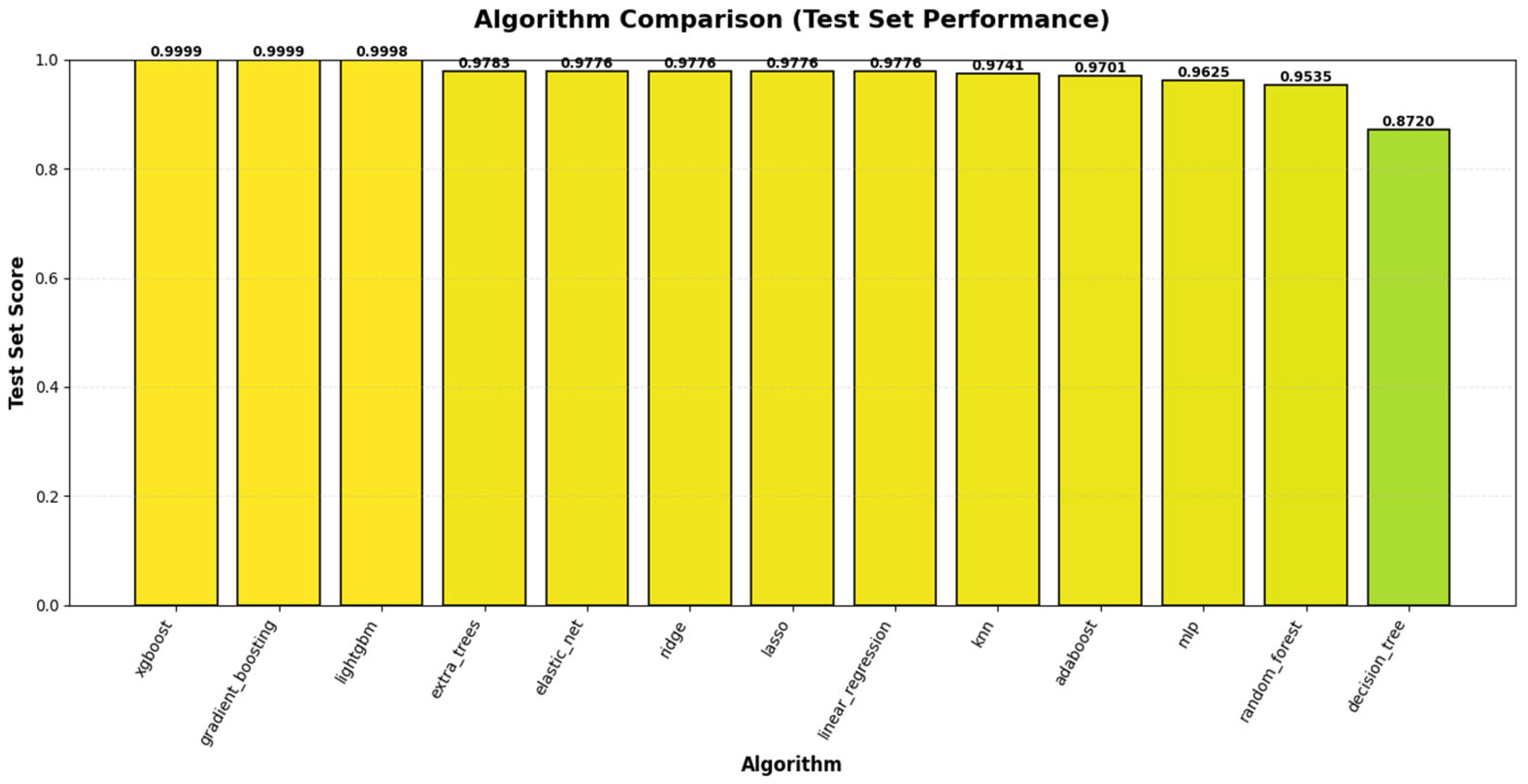
| Model | R2 | MSE | MAE | MAPE (%) |
|---|---|---|---|---|
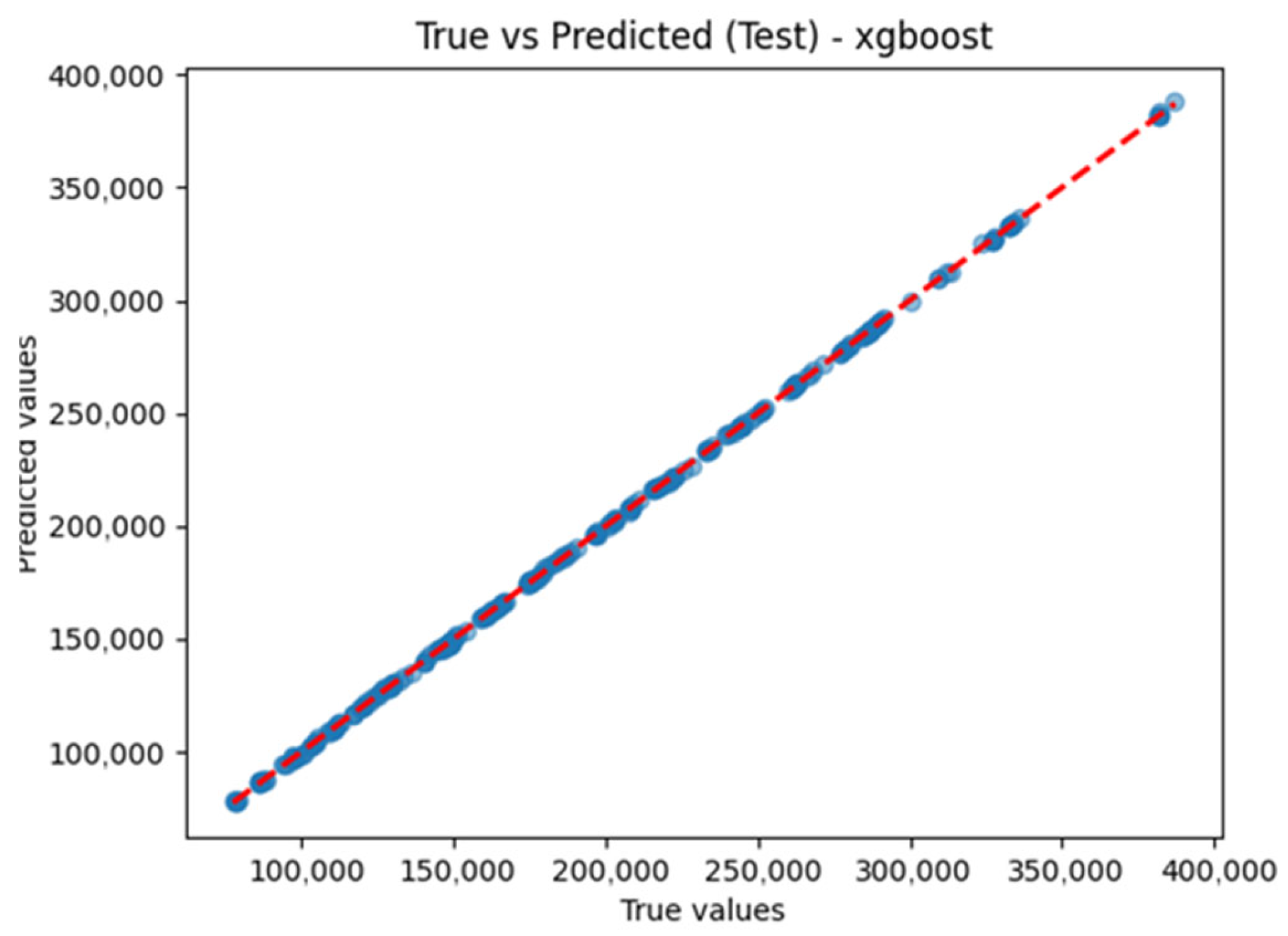
| XGBoost | 0.999935 | 3.55 × 10⁵ | 470.01 | 0.28 |
| Gradient Boosting | 0.999934 | 3.60 × 10⁵ | 465.01 | 0.27 |
| LightGBM | 0.999831 | 9.19 × 10⁵ | 734.20 | 0.40 |
| Extra Trees | 0.978303 | 1.18 × 10⁸ | 7717.98 | 3.88 |
| Elastic Net | 0.977599 | 1.22 × 10⁸ | 9004.50 | 5.63 |
| Ridge | 0.977599 | 1.22 × 10⁸ | 9004.50 | 5.63 |
| Lasso | 0.977599 | 1.22 × 10⁸ | 9004.50 | 5.63 |
| Linear Regression | 0.977599 | 1.22 × 10⁸ | 9004.50 | 5.63 |
| kNN | 0.974086 | 1.41 × 10⁸ | 9239.07 | 5.10 |
| AdaBoost | 0.970123 | 1.62 × 10⁸ | 10,500.01 | 6.41 |
| MLP | 0.962503 | 2.04 × 10⁸ | 11,352.99 | 6.95 |
| Random Forest | 0.953452 | 2.53 × 10⁸ | 11,828.33 | 6.27 |
| Decision Tree | 0.871965 | 6.96 × 10⁸ | 20,810.76 | 11.17 |
| Model | R2 | MSE | MAE | MAPE (%) |
|---|---|---|---|---|
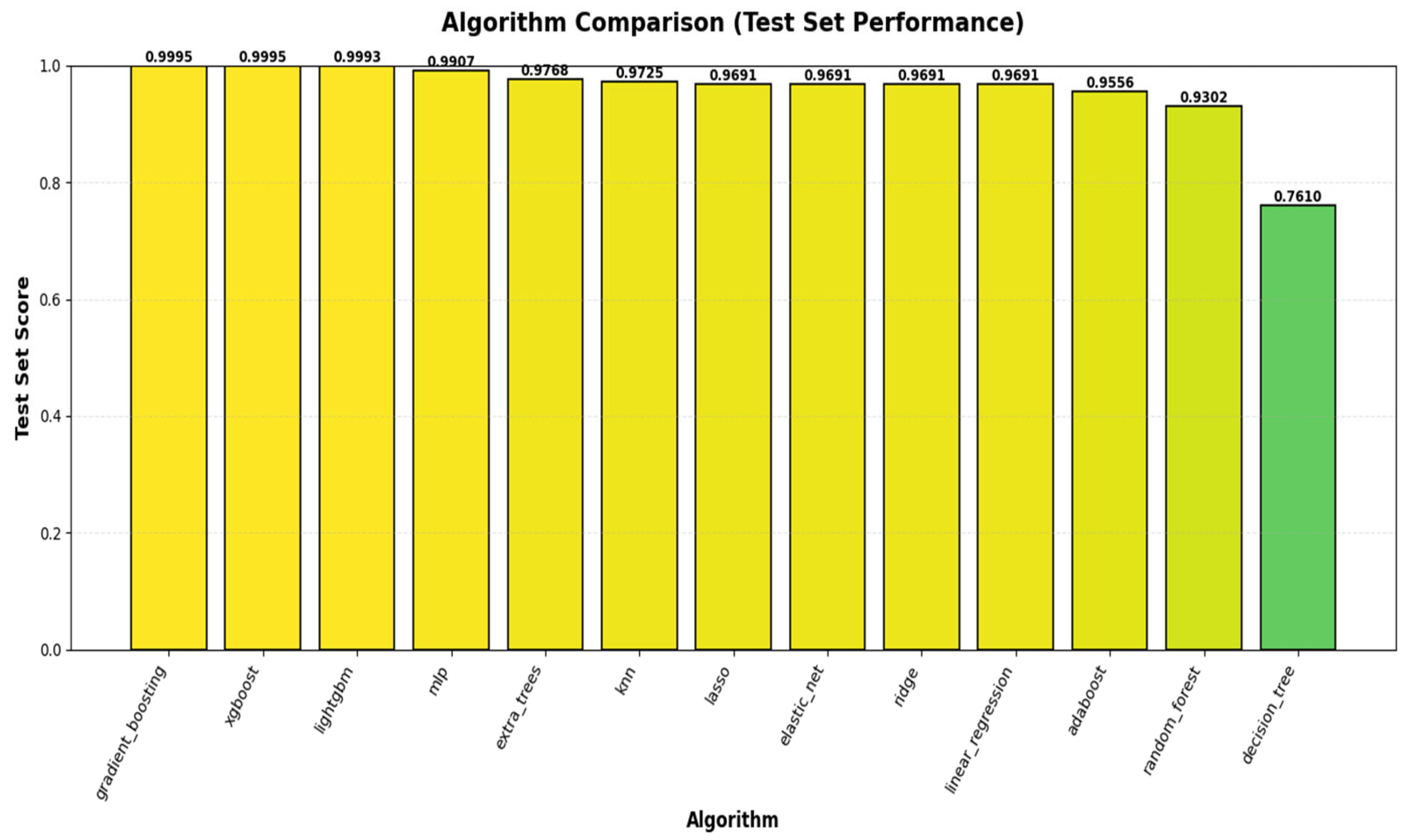
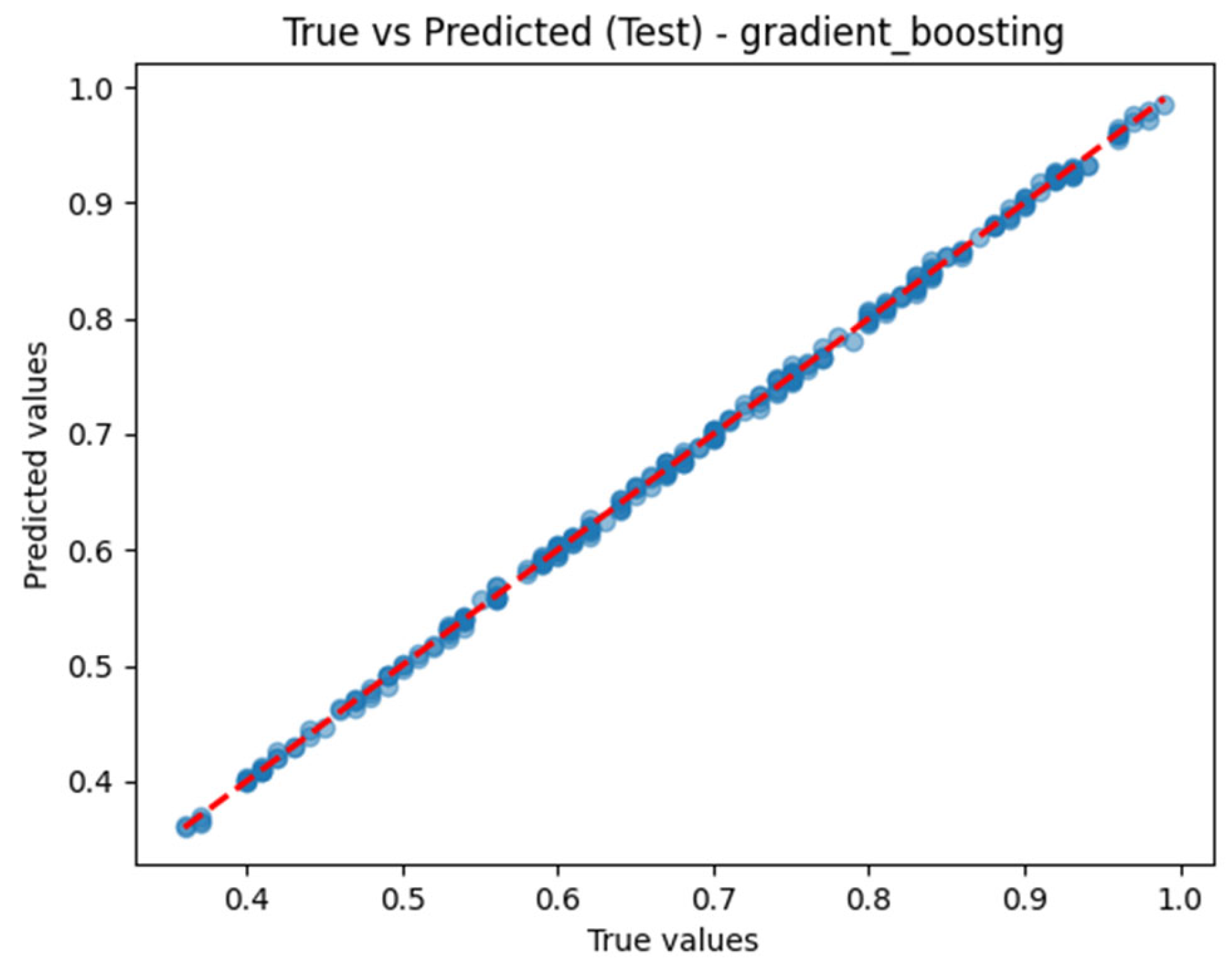
| Gradient Boosting | 0.999485 | 0.000014 | 0.00291 | 0.43 |
| XGBoost | 0.999452 | 0.000014 | 0.00308 | 0.47 |
| LightGBM | 0.999283 | 0.000019 | 0.00349 | 0.53 |
| MLP | 0.990715 | 0.000245 | 0.01232 | 1.78 |
| Extra Trees | 0.976815 | 0.000612 | 0.01993 | 3.01 |
| kNN | 0.972513 | 0.000726 | 0.02094 | 3.04 |
| Lasso | 0.96913 | 0.000815 | 0.02228 | 3.29 |
| Elastic Net | 0.969129 | 0.000816 | 0.02228 | 3.29 |
| Ridge | 0.969126 | 0.000816 | 0.02228 | 3.30 |
| Linear Regression | 0.969126 | 0.000816 | 0.02228 | 3.30 |
| AdaBoost | 0.955607 | 0.001173 | 0.02903 | 4.66 |
| Random Forest | 0.930195 | 0.001844 | 0.03540 | 5.36 |
| Decision Tree | 0.761044 | 0.006312 | 0.06679 | 10.28 |
| Model | R2 | MSE | MAE | MAPE (%) |
|---|---|---|---|---|
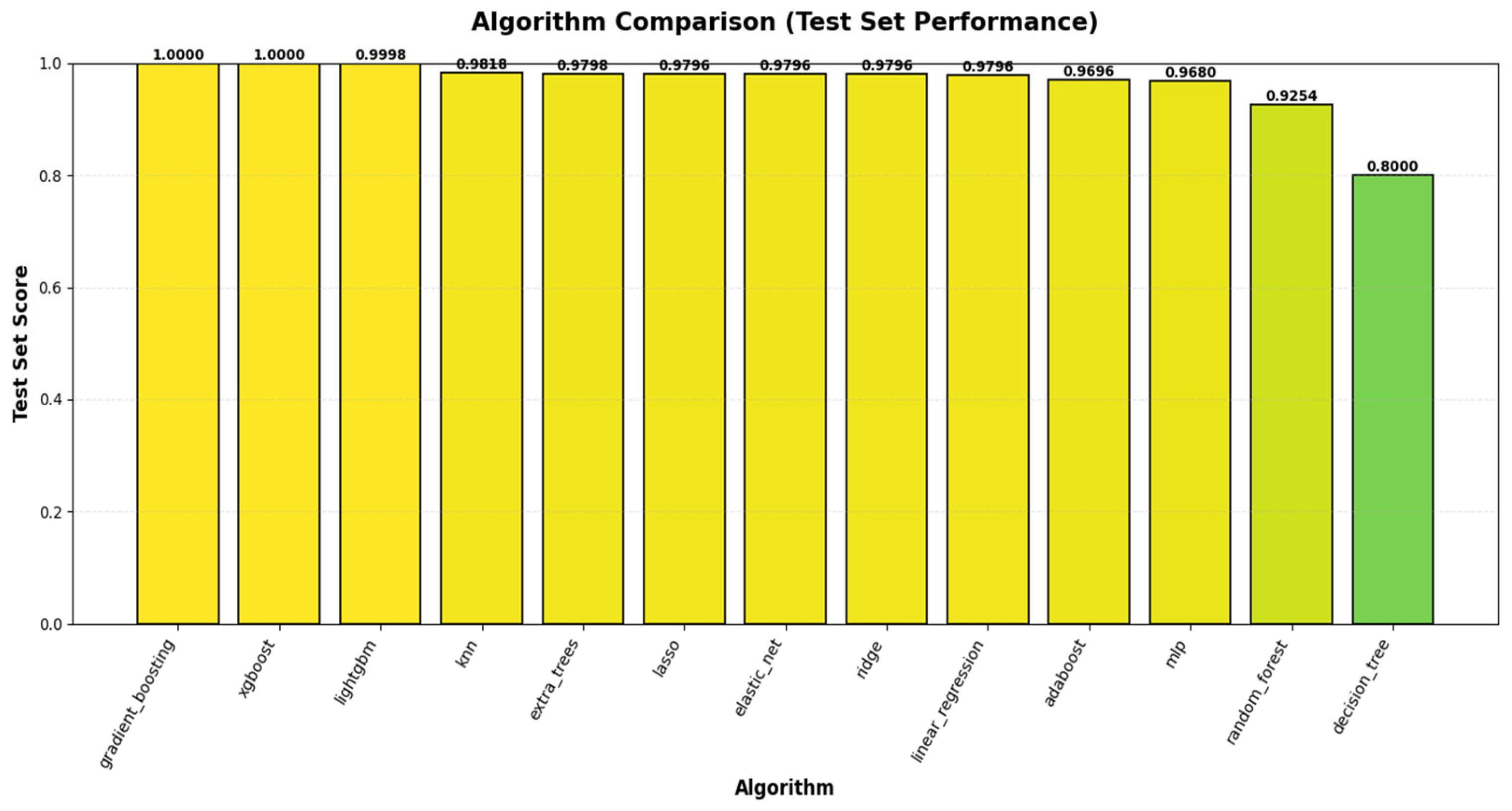
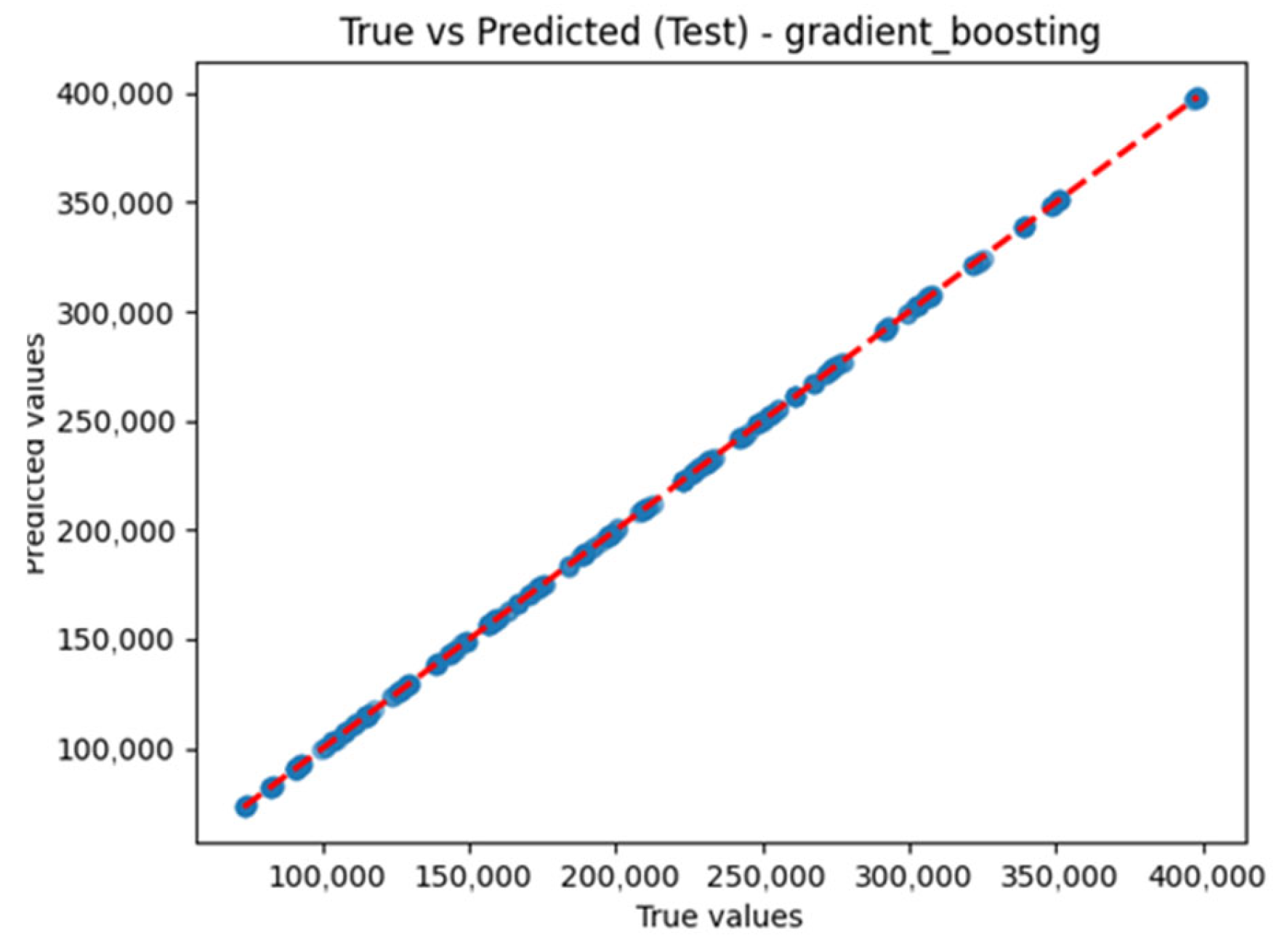
| Gradient Boosting | 0.999993 | 4.91 × 10⁴ | 129.84 | 0.07 |
| XGBoost | 0.999985 | 9.60 × 10⁴ | 238.19 | 0.13 |
| LightGBM | 0.999772 | 1.49 × 10⁶ | 635.27 | 0.31 |
| kNN | 0.981752 | 1.20 × 10⁸ | 7934.09 | 4.37 |
| Extra Trees | 0.979838 | 1.32 × 10⁸ | 8615.06 | 4.39 |
| Lasso | 0.979633 | 1.33 × 10⁸ | 9069.15 | 5.84 |
| Elastic Net | 0.979622 | 1.34 × 10⁸ | 9062.79 | 5.85 |
| Ridge | 0.979618 | 1.34 × 10⁸ | 9062.92 | 5.85 |
| Linear Regression | 0.97961 | 1.34 × 10⁸ | 9063.35 | 5.85 |
| AdaBoost | 0.969632 | 1.99 × 10⁸ | 11,776.70 | 7.25 |
| MLP | 0.968032 | 2.10 × 10⁸ | 11,712.76 | 7.33 |
| Random Forest | 0.925405 | 4.89 × 10⁸ | 17,876.38 | 9.58 |
| Decision Tree | 0.800002 | 1.31 × 10⁹ | 29,803.84 | 16.99 |
| Model | R2 | MSE | MAE | MAPE (%) |
|---|---|---|---|---|
| Gradient Boosting | 0.999737 | 0.000008 | 0.00189 | 0.29 |
| LightGBM | 0.999696 | 0.000009 | 0.00237 | 0.36 |
| XGBoost | 0.999694 | 0.000009 | 0.00243 | 0.37 |
| MLP | 0.983188 | 0.000480 | 0.01761 | 2.65 |
| kNN | 0.982030 | 0.000513 | 0.01691 | 2.51 |
| Extra Trees | 0.978409 | 0.000617 | 0.01921 | 2.87 |
| Elastic Net | 0.970199 | 0.000851 | 0.02275 | 3.36 |
| Lasso | 0.970197 | 0.000851 | 0.02276 | 3.36 |
| Ridge | 0.970175 | 0.000852 | 0.02277 | 3.37 |
| Linear Regression | 0.970173 | 0.000852 | 0.02278 | 3.37 |
| AdaBoost | 0.955318 | 0.001276 | 0.02999 | 4.79 |
| Random Forest | 0.922300 | 0.002219 | 0.03906 | 5.87 |
| Decision Tree | 0.807304 | 0.005504 | 0.06099 | 9.21 |
Disclaimer/Publisher’s Note: The statements, opinions and data contained in all publications are solely those of the individual author(s) and contributor(s) and not of MDPI and/or the editor(s). MDPI and/or the editor(s) disclaim responsibility for any injury to people or property resulting from any ideas, methods, instructions or products referred to in the content. |
© 2026 by the author. Licensee MDPI, Basel, Switzerland. This article is an open access article distributed under the terms and conditions of the Creative Commons Attribution (CC BY) license.
Share and Cite
Kayabekir, A.E. Machine Learning-Based Prediction of Optimum Design Parameters for Axially Symmetric Cylindrical Reinforced Concrete Walls. Processes 2026, 14, 455. https://doi.org/10.3390/pr14030455
Kayabekir AE. Machine Learning-Based Prediction of Optimum Design Parameters for Axially Symmetric Cylindrical Reinforced Concrete Walls. Processes. 2026; 14(3):455. https://doi.org/10.3390/pr14030455
Chicago/Turabian StyleKayabekir, Aylin Ece. 2026. "Machine Learning-Based Prediction of Optimum Design Parameters for Axially Symmetric Cylindrical Reinforced Concrete Walls" Processes 14, no. 3: 455. https://doi.org/10.3390/pr14030455
APA StyleKayabekir, A. E. (2026). Machine Learning-Based Prediction of Optimum Design Parameters for Axially Symmetric Cylindrical Reinforced Concrete Walls. Processes, 14(3), 455. https://doi.org/10.3390/pr14030455