Review

Recent Advances in the Development of Noble Metal-Free Cathode Catalysts for Microbial Fuel Cell Technologies


1
Laboratoire des Procédés, Matériaux et Environnement (LPME), Faculté des Sciences et Techniques de Fès, Université Sidi Mohammed Ben Abdellah, Fez B.P. 2202, Morocco
2
Laboratory of Spectroscopy, Molecular Modelling, Materials, Nanomaterials, Water and Environment, Environmental Materials Team, ENSAM, Mohammed V University in Rabat, Avenue des Forces Armées Royales, Rabat B.P. 6207, Morocco
3
Laboratoire des Procédés, Matériaux et Environnement (LPME), Faculté Polydisciplinaire (FP-Taza), Université Sidi Mohammed Ben Abdellah, Taza B.P. 1223, Morocco
*
Authors to whom correspondence should be addressed.
Processes 2026, 14(3), 440; https://doi.org/10.3390/pr14030440
Submission received: 5 January 2026 / Revised: 23 January 2026 / Accepted: 25 January 2026 / Published: 27 January 2026
(This article belongs to the Special Issue High-Effective Energy Conversion for Sustainable Environment)

Abstract

The accelerating growth of the global population and the depletion of conventional energy resources have intensified the dual challenges of water scarcity and sustainable energy production. Microbial fuel cells (MFCs) have emerged as a promising bioelectrochemical technology capable of simultaneously treating wastewater and generating renewable electricity. Their performance is strongly dependent on electrode materials, particularly cathodes, which govern the kinetics of the oxygen reduction reaction (ORR) and overall energy conversion efficiency. Therefore, in order to improve the electro-kinetics of ORR, it is necessary to use catalysts with specific catalytic properties. An ideal catalyst for ORR must combine fast kinetics, high conductivity, high durability, and cost-effectiveness. Although platinum-based electrodes remain the most efficient ORR catalysts, their scarcity and prohibitive cost are hindering their commercialization. Therefore, research has focused on viable alternatives, such as metal oxides, perovskites, heterojunction composites, and emerging carbon-based materials, paving the way toward highly effective energy conversion and industrial-scale implementation of MFCs.

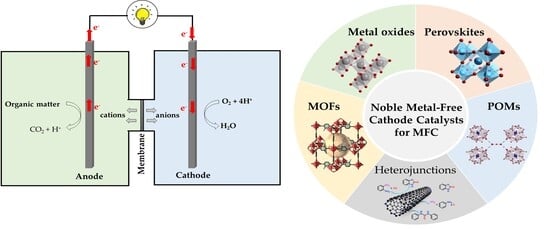
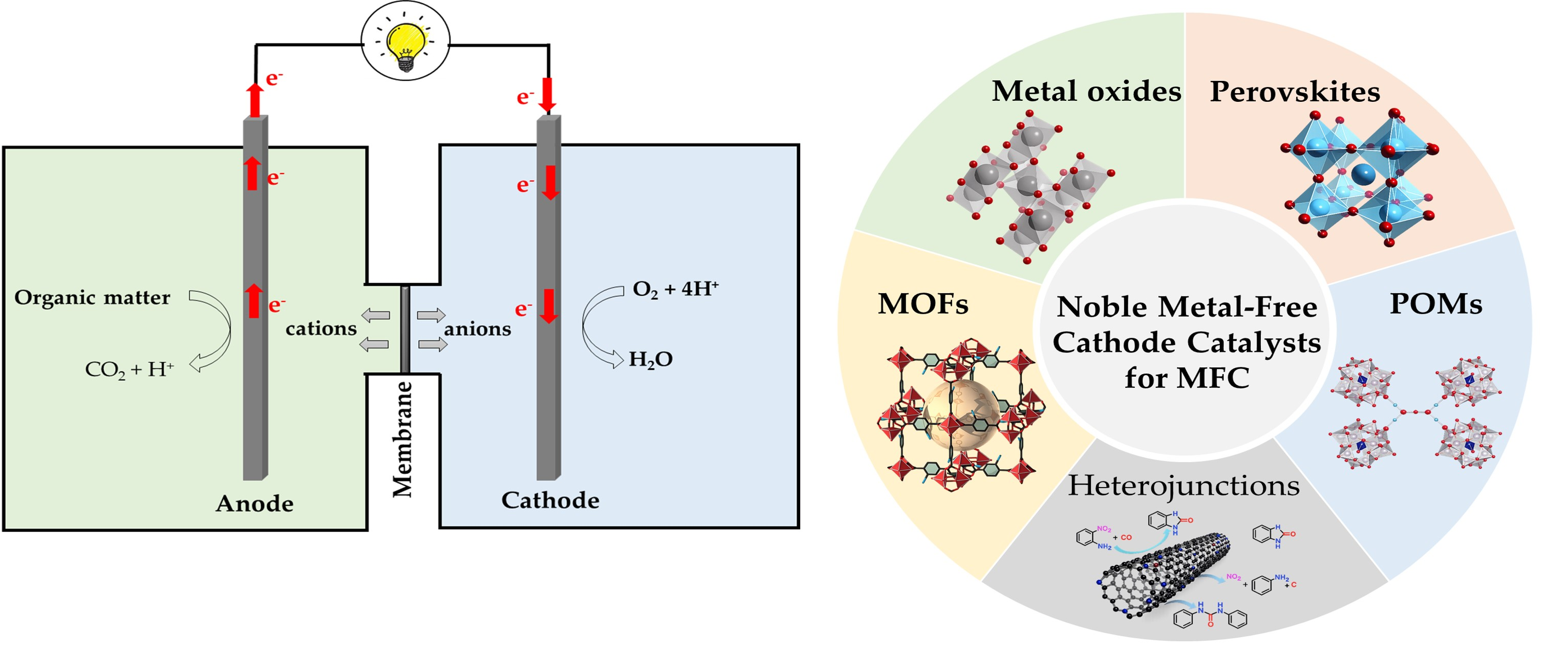
Graphical Abstract

1. Introduction

The exponential growth of the global population, expected to reach approximately 9.7 billion by 2050 and 10.9 billion in 2100, up from an estimated 8.2 billion in 2025 [1], exerts significant pressure on natural resources and accelerates their depletion. In this context, modern society faces two major challenges that determine its future: (i) the energy crisis and (ii) environmental pollution. To address these current challenges, a rapid transition to clean and sustainable energy sources is essential. Moreover, optimized water management in energy systems and the development of advanced wastewater treatment techniques will be essential to achieve balance and resilience between energy and the environment [2]. These intertwined challenges highlight the necessity of innovative technologies capable of simultaneously addressing water purification and renewable energy generation.
Microbial fuel cells (MFCs) have emerged as one of the most promising bioelectrochemical systems to meet these dual demands. By harnessing the metabolic activity of electroactive microorganisms, MFCs convert the chemical energy stored in organic substrates directly into electrical energy, while simultaneously degrading pollutants in wastewater. This dual functionality, energy recovery and wastewater treatment, positions MFCs as a strategic technology for sustainable resource management [3,4,5,6]. Structurally, MFCs consist of an anode and a cathode connected through an external circuit and separated by a specific membrane. In the anode chamber, microorganisms oxidize organic matter, releasing electrons (e) and protons (H+). Electrons flow through the circuit to the cathode, while protons migrate across the separator, enabling the oxygen reduction reaction (ORR) at the cathode to form water (H2O). When such electron acceptors are absent in an MFC, the microorganisms transport the electrons to the anode surface, enabling electricity to be generated [7,8,9,10].
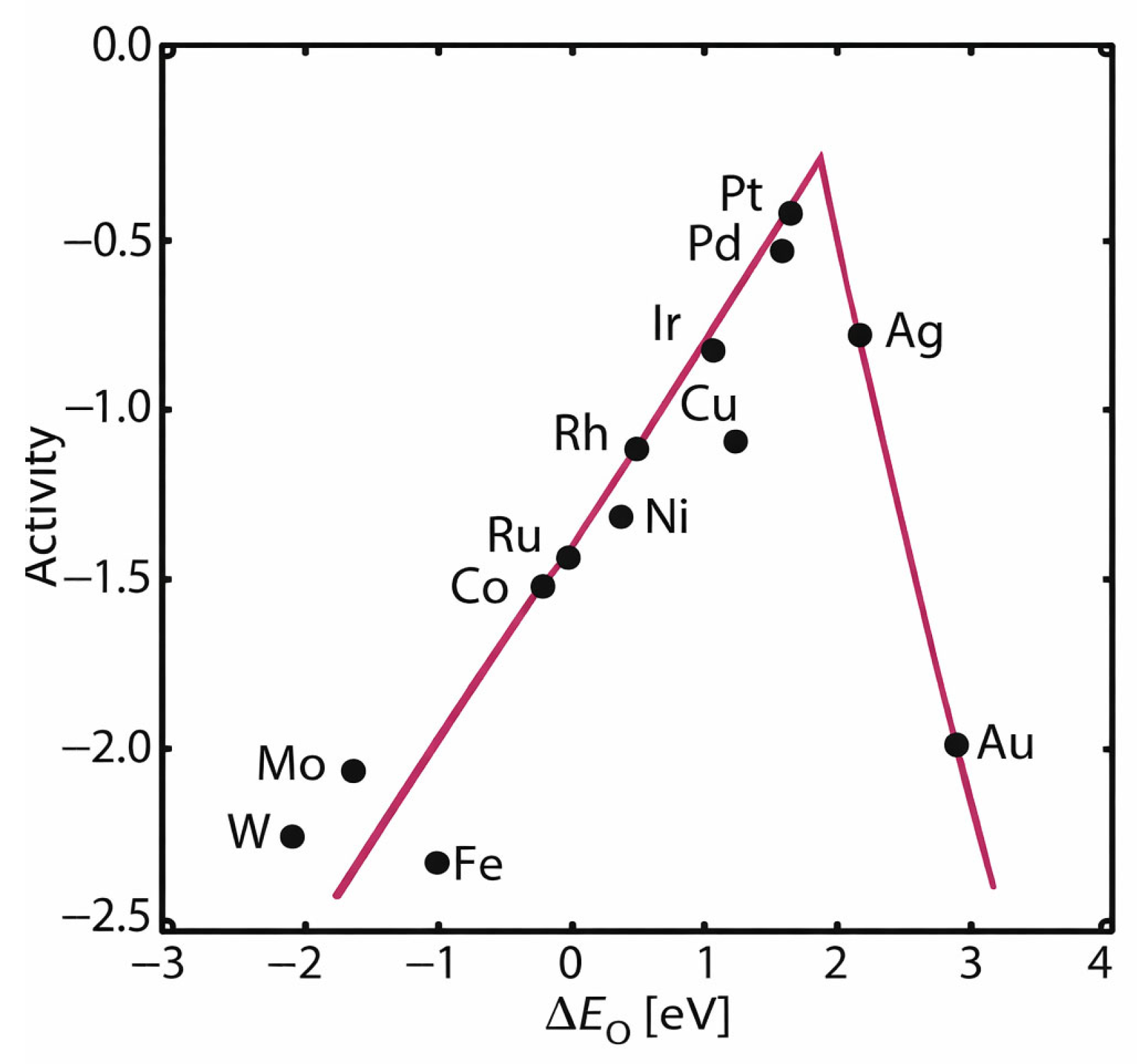
Despite their promising potential, MFCs face significant challenges in terms of efficiency, scalability, and economic viability [4,11]. Among these, the cathode remains the most limiting component due to sluggish ORR kinetics, which require high activation energy (498 kJ/mol) to break the O=O bond [12]. Moreover, the ORR in MFCs is severely hindered by their neutral pH and low operating temperature. Unlike conventional fuel cells, these mild conditions restrict proton availability, forcing the reaction toward slower, less efficient pathways, such as the two-electron reduction to peroxide [13]. To overcome these constraints, it is necessary to use ORR catalysts with specific catalytic properties that reduce the activation energy of oxygen reactivity while decreasing the binding energy of the O=O bond, and remarkably improve the electro-kinetics of ORR. Noble metals, particularly Pt, Rh, and Pd, are the most active systems reported so far for the ORR process [8,14,15]. The exceptional catalytic performance of these Pt-group metals fundamentally arises from their optimal binding energy with key oxygen-containing intermediates, such as *OOH, *OH, and *O [16]. This characteristic behavior is illustrated by a volcano plot (Figure 1), which correlates ORR activity with the calculated free energy (ΔE) of adsorbed intermediates on various metal surfaces. The peak of the volcano represents the ideal binding strength; intermediates should adsorb neither too weakly, which would hinder activation, nor too strongly, which would impede product desorption. Pt’s position near the top of the volcano plot confirms its superior activity for ORR [17]. Nevertheless, their prohibitive cost, scarcity, and susceptibility to long-term degradation under operational conditions present critical barriers to the scalable deployment in MFCs [18]. Consequently, recent research has focused on developing alternative cathode materials that combine affordability, durability, and high catalytic activity for ORR [19,20], such as carbon graphite [21], metal oxides [22], metals [23], and perovskites [24], which have all been explored as potential substitutes, offering tunable electronic structures, oxygen vacancy engineering, and synergistic interfacial effects that enhance ORR kinetics. Furthermore, hybrid systems integrating photocatalysis with MFCs have been proposed to improve pollutant degradation and energy recovery, leveraging both solar energy and microbial metabolism [25]. These innovations underscore the importance of material science in advancing MFC technology, particularly in the design of cathodes that can overcome kinetic barriers and deliver high-effective energy conversion.
This review is structured to provide an overview of recent advances in noble metal-free cathode catalysts development for ORR in MFCs, with comprehensive comparison across the full spectrum of emerging catalyst classes. Section 1 introduces the different MFC configurations, establishing the technological context for electrode design. Section 2 focuses specifically on cathode catalysts, highlighting recent advances in metal oxides, perovskite, and heterojunction composites. Section 3 explores the mechanistic pathways of the ORR within MFCs, emphasizing the fundamental electrochemical processes that govern system performance. Finally, the concluding section outlines future perspectives and research directions, with particular attention to material innovation and scalability.

2. MFC Configurations

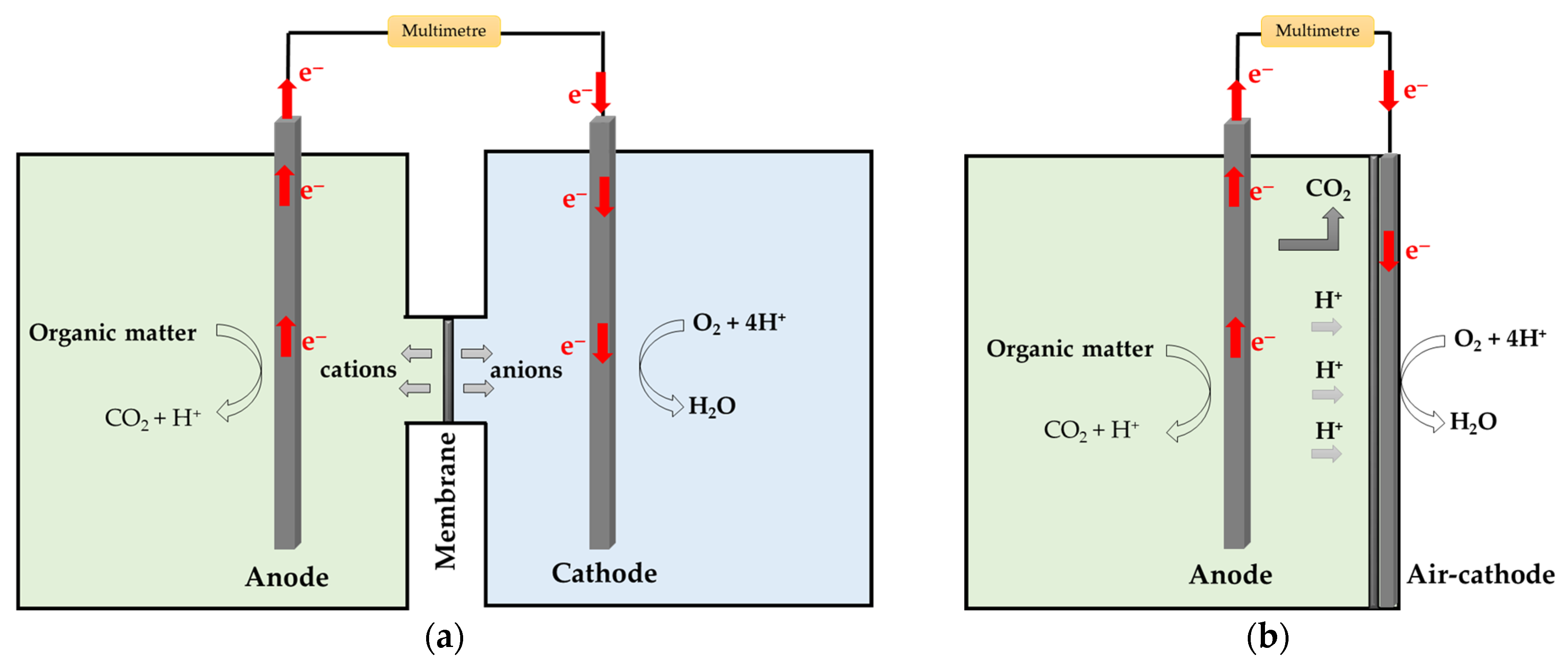
Several MFC designs have been implemented so far, and all require two different phases or at least two different physically separated compartments to be connected: one for the anode, and the other for the cathode [8]. In dual-chamber MFCs (DCMFCs), the anode and cathode compartments are physically separated by a specific membrane, most commonly a proton exchange membrane (PEM), which facilitates proton transfer while preventing mixing of the electrolytes. In some designs, a simple salt bridge is employed as an alternative separator [26]. The most widely adopted laboratory-scale DCMFC is the H-type device, consisting of two reactors connected by a tube containing a separator (Figure 2a) [27]. This architecture maintains strict anaerobic conditions in the anodic compartment, minimizing oxygen diffusion that could inhibit exoelectrogenic bacteria. Oxygen typically serves as the oxidizing agent at the cathode due to its availability in air, high oxidation potential, and formation of water as a benign byproduct. To enhance oxygen transport to the cathode surface, air can be bubbled into the electrolyte of an aqueous cathode compartment [28,29]. However, the low solubility of oxygen in water (approximately 1 mM at room temperature under 1 atm of pure oxygen and only 0.28 mM at equilibrium with air) severely limits mass transfer and constitutes a major performance bottleneck in aqueous-cathode systems. This constraint often results in higher internal resistance, lower power densities, and reduced overall efficiency, confining DCMFCs largely to fundamental research applications despite their advantages in controlled environments.
To overcome these oxygen-related limitations, air cathodes that expose one side directly to the atmosphere have been developed, enabling passive oxygen diffusion without the need for active aeration. Due to their simpler, more economical design, reduced internal resistance, and improved practical implementation characteristics, including lower construction costs and easier scalability, many researchers have recently transitioned to single-chamber MFCs (SCMFCs) [30,31,32,33,34]. In SCMFCs (Figure 2b), the anode and cathode are housed within a single compartment, with the cathode typically configured as an air-cathode exposed to ambient air. This configuration eliminates the need for a separate catholyte and often omits or minimizes the use of a PEM, further decreasing costs and complexity while enhancing proton diffusion and oxygen reduction kinetics at the cathode surface. Consequently, SCMFC systems frequently achieve higher power outputs compared to traditional DCMFC setups as demonstrated by a study of Kim et al. [35], who evaluated both configurations under similar conditions; their results revealed a maximum power density (MPD) of 40 mW m−2 and 488 mW m−2 for DCMFC and SCMFC, respectively. This makes SCMFC more suitable for potential real-world applications such as integrated wastewater treatment with energy recovery. Other factors can affect the MFC’s performance in power generation and wastewater treatment such as operating conditions, substrate type, microorganisms, membrane type, and electrode materials [27,36,37]. It is essential to note that the materials used at both the anode and cathode determine the rate of reaction at the electrodes, which is the key step in the operating mode of an MFC [4,11]. The rate of electron transfer in MFCs is proportional to the number of viable electroactive microorganisms attached to the anode surface. Meanwhile, a larger surface area can accommodate more microbial adhesion and thus facilitate greater total current output. Moreover, performance is determined not merely by the total geometric area, but by the catalytically active surface area, the specific regions where microorganisms establish effective electrochemical contact, and the physicochemical heterogeneity of the electrode interface, which can significantly affect biofilm formation, electron transfer kinetics, and overall system efficiency. The catalytic performance of the materials used at the cathode is the most limiting factor at this electrode [12]; ongoing research continues to optimize cathode catalysts to address challenges related to ORR kinetics and long-term stability, paving the way for more efficient and commercially viable MFC technologies.

3. Cathode Materials

ORR efficiency in the cathodic MFC compartment is typically associated with four key parameters: (i) the concentration of the electron acceptor, (ii) the availability of protons from the anode, (iii) the performance of the catalyst, and (iv) the electrode composition. Carbon- and graphite-based materials are most commonly used as cathodes. However, the ORR kinetics at these conventional electrodes are sluggish, necessitating the integration of electrocatalysts to enhance their performance. Noble metals, particularly Pt, are widely used as cathode catalysts in MFCs. Nevertheless, their practical application is hindered by critical drawbacks, including high cost, limited availability, and catalyst poisoning. Therefore, extensive research efforts have been directed toward the development of noble metal-free catalysts, aiming to provide cost-effective, durable, and efficient alternatives for practical MFC applications [38].

3.1. Metal Oxides

Metal oxides have emerged as promising cathode catalysts in MFCs due to their intrinsic redox activity, structural stability, and cost-effectiveness compared to noble metals such as Pt. Transition metal oxides, including manganese dioxide (MnO2) [39], cobalt oxide (Co3O4) [40], and iron oxides (Fe2O3 [41], Fe3O4 [42]), exhibit multiple oxidation states that facilitate electron transfer during the ORR. Xia et al. [43] revealed that the MPD produced by a cobalt oxide cathode (1540 mW m−2) was 13% higher than that from Pt/C cathodes (1360 mW m−2), due to the presence of Co2+ and Co3+ species on the catalyst’s surface. TiO2 has been proven to be an effective ORR catalyst for improving the MFC’s performance. Jaswal et al. [44] explored the influence of a TiO2 nanoparticle-modified cathode catalyst in DCMFC. The results indicated a power output of 162.5 mW m−2, accompanied by significant wastewater treatment efficiency evaluated in terms of chemical oxygen demand (COD) removal efficiency, which was 72.3%. Such activity was attributed to the presence of interfacial oxygen vacancy active sites on the modified cathode surface where electrons are trapped in oxygen vacancies and subsequently localize to the neighboring Ti sites, resulting in the formation of Ti3+ species at low-coordinated surface positions. This makes the nanoparticle more oxygen-deficient, resulting in the adsorption of more oxygen from the catholyte. A higher redox potential of O2 then favors its reaction with electrons transferred from the anode, leading to a higher cathode reduction potential and higher power generation efficiency. Bhowmick et al. [45] investigated bismuth-doped TiO2 (Bi-TiO2) as a photocathode component in a DCMFC. The obtained MPD was 224 mW m−2, significantly higher than that achieved using a Pt cathode catalyst (194 mW m−2). The performance of the Bi-TiO2 photocatalyst was attributed to its reduced band gap (2.80 eV), enabling efficient visible-light absorption, coupled with Bi3+–O3− orbital hybridization in Bi2O3, which facilitates the spatial separation of photogenerated electron–hole pairs, thereby significantly suppressing their recombination and enhancing the ORR activity. Furthermore, the COD removal efficiency was 89% owing to the enhanced ORR performance, which facilitated the rapid scavenging of electrons and protons from the anode chamber and thereby contributed to maintaining a stable microenvironment at the anode. Wang et al. [46] explored the use of 2 wt% Cu/TiO2 as photocathode catalysts for DCMFC, which yielded a remarkable MPD of 312 mW m−2 and achieved 99% degradation efficiency of the methyl orange pollutant. These outstanding performances were correlated with its high specific surface area (70.42 m2 g−1), superior charge separation efficiency, and enhanced electrochemical activity. Chen et al. [47] investigated MnO2@Co3O4, which provided an MPD of 475 mW m−2, 2.24 times higher than that of Co3O4 (212 mW m−2) and 2.63 times higher than that of the MnO2 (180 mW m−2). Such activity is attributed to the rod-like structure of MnO2, which can effectively improve the ion flow efficiency and reduce the transfer resistance, coupled with the point-like structure of Co3O4, which can increase the specific surface area of the complex, providing more active sites. Other metal oxides such as NiCo2O4 nanoplatelets [48], V2O5 [49], SnO2 [50], CuO [51], Mn-doped ZnO [52], NiMn2O4 [53], ZrP2O7 [54], and Ni2V2O7 [55] highlight that the transition metal oxides are a cost-effective and feasible active substitute for conventional costly Pt-based cathode catalysts. Nevertheless, their conductivity is low because of the nature of the oxides; it is therefore necessary to improve the conductivity and reduce the resistance of the materials.

3.2. Perovskites

Other researchers have developed efficient perovskite (ABO3) cathode catalysts, owing to their tunable electronic structure, enhanced catalytic behavior toward the ORR, and relatively low cost compared to noble metals. Their activity is primarily governed by several intrinsic properties: (i) the presence of mixed valence states at the B-site transition metal cations (e.g., Mn, Co, Fe, Ni), which facilitate electron transfer and redox cycling; (ii) an adjustable oxygen vacancy concentration, enhancing ionic conductivity and promoting oxygen adsorption and dissociation; and (iii) high structural stability under aqueous and electrochemical conditions. Furthermore, the ability to tailor the A-site cation (e.g., La, Sr, Ca) allows for fine control of electronic conductivity and ORR kinetics, making perovskites versatile candidates for cathodic applications. In a study by Dai et al. [56], a CaFe0–7Zn0–3O3 perovskite was used as an electrocatalyst with a carbon cloth cathode in an SCMFC, achieving a remarkable efficiency, with an MPD of 892.10 mW m−3 (normalized to the reactor volume) with excellent stability over 160 h of operation. This performance is attributed to the excellent ORR kinetics, which are due to the synergy between Zn and Fe that enhances the formation of oxygen vacancies, which increase oxygen unavailability rates and conductivity, as well as the formation of a mixed valence state of Fe2+/Fe3+, which helps to stabilize the catalytic activity of perovskite. Nourbakhsh et al. [57] tested LaCoO3, LaMnO3, and LaCo0.5Mn0.5O3 perovskite nanoparticles as cathode catalysts on carbon cloth in a DCMFC. LaMnO3 provided an MPD greater than 13.9 mW m−2. The electrochemical performance of perovskites can be classified in the following order: LaCoO3 < LaCo0.5Mn0.5O3 < LaMnO3. Dong and his group studied the La0.4Ca0.6Co0.9Fe0.1O3/carbon (LCCF/C) cathode in an SCMFC; a power density of 405 mW m−2 was obtained [58]. The perovskite is a type of structure that provides oxygen vacancies, facilitating oxygen mobility and reducing biofilm coverage. As a result, the LCCF/C catalyst behaved in a cycling experiment with much higher performance: after 15 cycles, it had the lowest rate of decay of the open-circuit voltage (2%) and MPD (15%) relative to those of C (22%, 69%) and Pt/C (4%, 17%) cathodes, respectively. In a neutral operating medium, lanthanum-based perovskites displayed a lower internal resistance, which is favorable for the ORR process, as the required activation energy decreases [58]. The participation of transition metal cations and their valence largely affect the ORR and electrocatalytic activity of perovskite-type oxides. In a study by Bai et al. [59], the perovskite LaxSr1-xCoO3 was introduced as the cathode compound in an anaerobic fluidized bed MFC. A comparative study between La0.7Sr0.3CoO3, La0.3Sr0.5CoO3, and La0.8Sr0.2CoO3 was carried out, which showed that La0.7Sr0.3CoO3 attained the best lanthanum and strontium concentrations in perovskite, as it exhibited the most effective electrocatalytic activity, with a power output of 104.59 mW m−2 and an open-circuit voltage of 594.0 mV. Representative perovskite cathode catalyst formulations tested for MFCs are recapitulated in Table 1.
The group of Touach et al. evaluated the photoelectrocatalytic performance of carbon cloth coated with ferroelectric perovskite materials for the construction of cathodes for SCMFCs. In the absence and the presence of a UV–visible light condition, BaTiO3 [61], LiTaO3 [62], LiNbO3 [63], Li1-xTa1-xWxO3 [64], Li0.95Ta0.76Nb0.19Mg0.15O3 [65], (Li0.95Cu0.15)Ta0.76Nb0.19O3 [66], LiTa0.5Nb0.5O3/gC3N4 [67], and Li0.95Ta0.57Nb0.38Mg0.15O3 [68] were tested. The photoelectrocatalytic activity results obtained for these cathodes are summarized in Table 2, highlighting the photocatalytic activity of perovskite materials for ORR. This performance was attributed to the spontaneous polarization characteristic of ferroelectric materials, often linked to the displacement of transition cations relative to oxygen anions, promoting charge transport to catalytic interfaces. Ferroelectric/electrode interfaces typically create charged defects that modify redox activity and enhance electrochemical reactivity [61]. Thus, the presence of positively charged surfaces in perovskites promotes the ORR. Other perovskites such as NiTiO3 [69] and BiFeO3 [70] are also investigated as cathode photocatalysts for MFCs.

3.3. Metal–Organic Frameworks (MOFs) and Polyoxometalates (POMs)

In recent years, MOFs and their derivatives have emerged as a major research focus owing to their exceptional structural and functional properties. MOFs are crystalline materials with two- or three-dimensional framework architectures constructed from metal ions or clusters bridged by organic ligands. They possess remarkable features, including extremely high surface areas, tunable porosity, diverse ligand chemistry, versatile functionalization, and outstanding chemical and thermal stability, which have fueled their rapid development and widespread interest [72]. In a recent study carried out by Lan et al. [73], a hybrid material, Cu-MOF@Fe-MOF, produced a maximum power density of 231.2 mW m−2 and demonstrated high stability and durability, maintaining a potential of 238 mV for 150 h, highlighting the performance of MOF as a catalyst for the ORR. Additionally, Noori et al. [74] also investigated MOFs with NH2-UiO-66(Zr/Ni) as a cathode catalyst to enhance the ORR in MFCs. NH2-UiO-66(Zr/Ni) significantly improved electricity production. The MFC equipped with this bimetallic MOF catalyst achieved a significant improvement in power generation, reaching a power density of 800 mW m−2. This efficiency was notably higher than that achieved with other tested electrocatalysts, including a standard 10% Pt-C catalyst. The substantial increase in MPD confirms the efficacy of NH2-UiO-66(Zr/Ni) in improving the energy recovery process. Due to their unsaturated metal ion active sites, MOFs exhibit intrinsic electrocatalytic activity, highlighting their potential as ORR catalysts [75].
POM complexes represent a rich and important class of inorganic molecular compounds with unique electronic versatility due to their dual electronic and acid–base properties, allowing them to be both electrocatalysts and electron reservoirs [76,77]. The compositional flexibility and the presence of large numbers of redox active sites make these molecular metal oxide clusters excellent candidates for ORR catalysts. Kegging-type heteropolyacids have been reported as effective ORR catalysts [78]. H3PW12O40 and H3PMo12O40 exhibited notable performance in terms of both bioelectricity production and wastewater treatment, achieving maximum power densities of 497 and 514 mW m−2, along with COD removal efficiencies of 84.66% and 73.6%, respectively. Rezaei et al. [79] investigated the electrocatalytic performance of a cesium phosphomolybdate (Cs3PMo12O40) on graphite in a DCMFC system. The results showed an MPD of 64.73 mW m−2 and a COD removal efficiency of 86.4%. Furthermore, lacunary POM salts, including Cs5PMo11FeO39 and Cs5PMo11CoO39, were also studied. Cs5PMo11CoO39 catalysts demonstrated an MPD of 418.15 mW m−2 and a COD removal efficiency of up to 97% after 96 h of MFC operation under UV–Vis irradiation [80]. These studies confirm that Keggin-type POMs can be promising ORR catalysts for MFCs. Table 3 displays the performance of different MOFs and POMs used as cathode compounds in SCMFCs.

3.4. Heterojunction Composites

Non-precious metals such as Fe, Mn, and Cu and heteroatom-doped carbon-based materials were examined to replace noble metals used as catalysts for the ORR in MFCs. Li et al. [23] investigated transition metal composites (N@C, CuN@C, MnN@C, and CoN@C) as ORR electrocatalysts to enhance power generation in an SCMFC. The CoN@C cathode was able to achieve an MPD of 1202.3 mW m−2, which is 1.09 times higher compared to that of commercial Pt/C (1104 mW m−2), demonstrating that this material is an efficient cathode electrocatalyst for replacing valuable Pt/C in MFC applications. Kodali et al. [85] compared the performance of Fe-, Co-, Ni-, and Mn-aminoantipyrine (AAPyr) ORR catalysts with that of an activated carbon (AC) cathode. The findings revealed that the electrocatalytic activity of the materials can be classified in the following order: Fe-AAPyr > Co-AAPyr > Ni-AAPyr > Mn-AAPyr > AC. Cathode catalysts based on multiwall CNTs impregnated with nitrogen, Co, and Fe were tested by Turk et al. [86], and the results obtained showed excellent electrocatalytic activity, with maximum power densities of 5.1 W m−3 and 6 W m−3 for Co-N-CNT and Fe-N-CNT, respectively. This performance was associated with the formation of active nitrogen–metal centers. Wang et al. [87] developed metal-free cathode catalysts based on nitrogen-modified carbon (CN) powder pyrolyzed at different temperatures, which showed a distinct cost–effectiveness ratio. An MPD of 371 mW m−2 was achieved for the MFC operating with CN-800 with a COD removal of 77.2%. The MFC demonstrated excellent stability over 580 h of operation and efficiency. A reduced graphene oxide–copper sulfide–zinc sulfide hybrid nanocomposite (rGO-CuS-ZnS) was investigated by the team of Mahalingam et al. [88] for its effectiveness as a cathode catalyst in an SCMFC. This cathode showed an MPD of 1692 mW/m2. Bhowmick et al. [89] tested a cathode constructed from TiO2/activated carbon irradiated with UV-A light, which exhibited an MPD of 494 mW m−2 and a COD removal efficiency of 95%. Karthick and Haribabu [90] reported a polypyrrole/molybdenum oxide (Ppy/MoO2) composite on carbon cloth as a cathode for SCMFC that yielded a power density of 0.63 W m−2. Ali et al. [91] tested a graphite felt modified with iron sulfide wrapped in reduced graphene oxide (FeS@rGO) as a cathode electrocatalyst in a DCMFC. The MFC showed an MPD of 154 mW m−2 as well as a COD and Cr(VI) removal efficiency of 72% and 100%, respectively. This electrochemical performance was explained by the high conductivity, low internal resistance, and improved reaction kinetics of FeS@rGo nanocomposites. Papiya et al. [92] employed Co/Al2O3-rGO as the cathode electrocatalyst in an SCMFC. Co nanoparticles with varying percentages were incorporated into a mixture of alumina and graphene oxide. Four different weight percentages of Co were investigated, with the material containing 80 wt% Co found to have the highest power density of 548.19 mW m−2 and COD removal efficiency of 91.48%. In addition, PANI@Fe/NC was evaluated by Dhillon and Kundu [93] as a novel and cost-effective cathode catalyst for MFCs. They demonstrated that this catalyst reached a high MPD of 637.53 mW m−2, which was 36.25% greater than that of a conventional 10 wt% Pt/C catalyst (467.92 mW m−2) under identical operating conditions. A Cu-N/C@Cu-2 catalyst derived from ZIF-8 exhibited an MPD of 581 ± 13 mW m−2, outperforming commercial Pt/C catalysts (499 ± 13 mW m−2) owing to the improved conductivity and more active sites of Cu-Nx as demonstrated by Lai et al. [94]. Zhang et al. [95] investigated a new Fe-N-C catalyst based on pomelo peel derived-carbon (PPC), demonstrating an MPD of 184 mW m−2 and effective wastewater treatment, achieving 86.6% and 99.0% in COD and Congo Red removal, respectively. This performance was attributed to graphitized structures, pyridine-N and graphitic-N, which enhanced the conductivity of PPC, as well as the presence of Fe3C nanocrystals, Fe-Nx active sites, and the rod-like CNTs. Liu et al. [96] showed that the use of a biochar and conductive carbon black (CCB) composite has very promising applications as an efficient and cost-effective cathode catalyst material. By promoting the growth of electrogenic and degrading bacteria, the optimized biochar/CCB catalyst enhanced the MPD to 269.5 mW m−3, which was 2.47 times higher than that of carbon cloth (109.1 mW m−3). The performance of cobalt oxide nanoparticles supported on nitrogen-doped carbon nanotubes (Co/N-CNT) was also evaluated [97]. This nanocomposite exhibited high electrocatalytic activity, with an MPD of 1260 mW m−2, 16.6% higher compared to Pt/Carbon (1080 mW m−2) due to the formation of high-efficiency Co-N active sites that facilitated the ORR kinetics. Furthermore, magnesium cobaltite (MgCo2O4) coated on nitrogen-doped carbon (NC-700) was investigated as a cathode catalyst [98]. The MFC using MgCo2O4/NC-700 as the electrocatalyst for the cathode showed a remarkable power output of 873.81 mW m−2 accompanied by the highest COD removal efficiency of 82.92%. This performance was significantly superior to that of other catalysts; it was 59.56% higher than that of an MFC using Pt/C (547.65 mW m−2) and 216.05% higher than that of one using a Co/NC-700 catalyst (276.48 mW m−2). Some MFC cathode electrocatalysts using heterojunction composites are summarized in Table 4.

4. ORR Mechanistic Pathways in MFC

In an MFC system, the efficiency of the cathodic process is decisive for the overall performance of the system. At the anode, microorganisms oxidize carbon-based organic matter, converting biochemical energy into a flux of electrons. These electrons must then be transferred to the cathode, where the ORR takes place. The ORR is responsible for accepting the electrons and reducing oxygen to water, thereby closing the electrochemical cycle and sustaining continuous current generation. Because the ORR is intrinsically sluggish and often represents the rate-limiting step, its kinetics must be carefully controlled. Mechanistic investigations are essential to identify the reaction pathways, intermediate species, and rate-determining steps that influence electron transfer efficiency [13,100].
Typically, the ORR process occurs through two pathways: either a direct four-electron reduction or an indirect 2 + 2 electron reduction pathway. In an acidic environment, the mechanism involves the formation of two water molecules (Equation (1)), whereas in an alkaline medium, it implies the production of four OH ions (Equation (2)). Achieving a direct four-electron reduction is crucial for maintaining high energy output [24,101].
Acidic electrolyte 4e pathway:
O2 + 4H+ + 4e → 2H2O E0 = +1.229 VSHE
Alkaline electrolyte 4e pathway:
O2 + 2H2O + 4e→ 4OH E0 = +0.401 VSHE
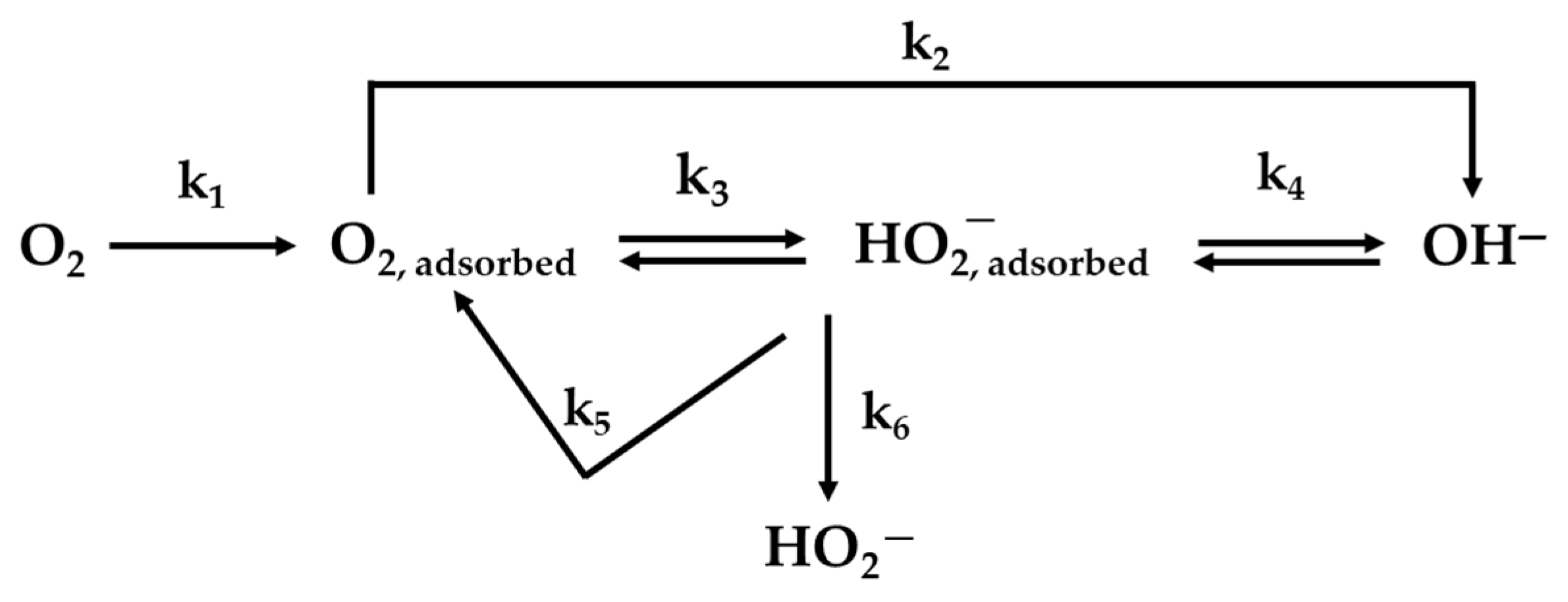
Reaction 2 can be further divided into single-electron reaction steps. However, the specific reaction pathway depends on the electrolyte pH and the catalyst used. There are two main mechanistic routes for the ORR. The first one consists of a dissociative pathway implying the breakage of the O–O bond as O2 adsorbs onto two metal active sites, preventing the formation of a peroxide intermediate. The energy required to break the O–O bond in oxygen molecules is high [102], making the dissociative pathway less likely for most catalysts [103,104]. The second route is an associative pathway; in this mechanism, the O2 molecule adsorbs onto a single metal site, forming a peroxide intermediate (Equation (3)), which makes breaking the O–O bond easier [102,105]. In alkaline media, hydrogen peroxide exists as HO2 [106].
O2 + H2O + 2e → HO2 + OH E0 = −0.065 VSHE
The HO2 intermediate can then undergo electrochemical reactions on the catalyst surface (Equation (4)) or desorb from the catalyst. Additionally, the HO2 can also interact with the electrolyte or at the surface of the catalyst (Equation (5)). In both cases, only two electrons are transferred, leading to lower energy efficiency compared to the four-electron pathway.
HO2 + H2O + 2e → 3 OH E0 = +0.867 VSHE
2HO2 → 2OH + O2 E0 = −0.07 VSHE
More electrons can be transferred if the O2 formed by HO2 chemical disproportionation (Equation (5)) undergoes further reduction via Equation (3). A rotating ring disk electrode (RRDE) is used in an analytical electrochemical technique that can measure the number of electrons transferred by detecting the amount of hydroperoxide at the ring electrode [107]. This method allows the determination of whether two or four electrons have been transferred. However, the RRDE cannot distinguish whether four electrons have been transferred through the dissociative or associative pathways (i.e., with or without the formation of HO2 intermediates). An overview of the possible reaction paths examined to date is provided in Figure 3.
Although acidic media provide a higher thermodynamic potential (E0 = +1.229 VSHE) and faster intrinsic ORR kinetics than alkaline media, alkaline conditions are often favored in MFCs due to enhanced catalyst stability and microbial compatibility. Nevertheless, controlling the kinetics of the ORR through mechanistic investigations is crucial. A detailed understanding of the reaction mechanism allows researchers to identify limiting steps, optimize catalyst design, and minimize energy losses. These insights are essential for improving the durability, efficiency, and economic viability of MFC technology.

5. Conclusions and Outlooks

As a new high-effective energy conversion system, the electrical efficiency of an MFC is fundamentally governed by the reaction kinetics at both the anode and the cathode. Therefore, employing high-performance catalysts to accelerate the ORR at the cathode represents a pivotal strategy for enhancing the overall electrical output and efficiency of MFCs. This review provides an updated overview of recent advances in ORR noble metal-free catalysts and their development for MFCs, including transition metal oxides, perovskites, metal–organic frameworks, polyoxometalates, and heterojunction structures. Although significant progress has been made in electricity production from wastewater biomass conversion using these ORR catalysts, several issues remain unresolved. Metal oxides have a wide range of sources, low prices, and good stability and catalytic performance, but their conductivity is slightly insufficient. Additionally, perovskite catalysts have tunable properties and low cost, but their main limitations are a lack of long-term stability and scalability. The MOF has a large specific surface area and porosity, which exposes metal catalytic sites to a greater extent, but makes it prone to aggregation, leading to a decrease in catalytic performance. POMs offer cost-effectiveness, multifunctionality, and tunability of redox properties, but susceptibility to degradation or leaching in aqueous environments restricts their long-term durability and practical use. These limitations highlight the need for further research and innovation, paving the way for future opportunities to optimize and implement MFCs toward eventual commercialization. Future research could target quantitatively comparable performance and rigorous benchmarking, especially long-term stability, to enable practical scaling. Particular focus should be placed on developing hybrid catalysts for MFCs to improve ORR kinetics at the cathode, reduce overpotentials, enhance electron transfer, and lower costs compared to conventional Pt-based catalysts.
Furthermore, several aspects must be improved in order to see the implementation of MFCs in industrial environments, i.e., the use of efficient and inexpensive cathodic materials as well as the improvement of the configuration and the expansion of a high-efficiency cell. The crucial key here is to achieve high-effective energy conversion for sustainable use by developing large-volume MFC-based devices or a stack of MFCs, or even deploy systems allowing their insertion into existing installations.

Author Contributions

Conceptualization, F.L., and J.T.; writing—original draft preparation, F.L.; writing—review and editing, N.T., A.B., and J.T. All authors have read and agreed to the published version of the manuscript.

Funding

This research received no external funding.

Data Availability Statement

No new data were created or analyzed in this study.

Conflicts of Interest

The authors declare no conflicts of interest.

Abbreviations

The following abbreviations are used in this manuscript:
MFCMicrobial fuel cells
DCMFCsDual-chamber MFCs
SCMFCsSingle-chamber MFCs
ORROxygen reduction reaction
CODChemical oxygen demand
CODrChemical oxygen demand reduction
PEMProton exchange membrane
CNTCarbon nanotube
MOFsMetal–organic frameworks
POMsPolyoxometalates
CNNitrogen-modified carbon
ACActivated carbon
AAPyrAminoantipyrine
MPDMaximum power density
OCVOpen circuit voltage
RRDEA rotating ring disk electrode

References

  1. United Nations. World Urbanization Prospects: The 2019 Revision; United Nations: Manhattan, NY, USA, 2019. [Google Scholar]
  2. Durkin, A.; Vinestock, T.; Guo, M. Towards Planetary Boundary Sustainability of Food Processing Wastewater, by Resource Recovery & Emission Reduction: A Process System Engineering Perspective. Carbon Capture Sci. Technol. 2024, 13, 100319. [Google Scholar] [CrossRef]
  3. Santoro, C.; Arbizzani, C.; Erable, B.; Ieropoulos, I. Microbial Fuel Cells: From Fundamentals to Applications. A Review. J. Power Sources 2017, 356, 225–244. [Google Scholar] [CrossRef]
  4. Slate, A.J.; Whitehead, K.A.; Brownson, D.A.C.; Banks, C.E. Microbial Fuel Cells: An Overview of Current Technology. Renew. Sustain. Energy Rev. 2019, 101, 60–81. [Google Scholar] [CrossRef]
  5. Rahimnejad, M.; Adhami, A.; Darvari, S.; Zirepour, A.; Oh, S.E. Microbial Fuel Cell as New Technology for Bioelectricity Generation: A Review. Alex. Eng. J. 2015, 54, 745–756. [Google Scholar] [CrossRef]
  6. Choudhary, M.; Verma, P.; Ray, S. A Comprehensive Review on Bio-Electrochemical Systems for Wastewater Treatment: Process, Electricity Generation and Future Aspect. Environ. Dev. Sustain. 2024, 26, 1–30. [Google Scholar] [CrossRef]
  7. Boas, J.V.; Oliveira, V.B.; Simões, M.; Pinto, A.M.F.R. Review on Microbial Fuel Cells Applications, Developments and Costs. J. Environ. Manag. 2022, 307, 114525. [Google Scholar] [CrossRef] [PubMed]
  8. Logan, B.E.; Hamelers, B.; Rozendal, R.; Schröder, U.; Keller, J.; Freguia, S.; Aelterman, P.; Verstraete, W.; Rabaey, K. Microbial Fuel Cells: Methodology and Technology. Environ. Sci. Technol. 2006, 40, 5181–5192. [Google Scholar] [CrossRef]
  9. Liu, H.; Cheng, S.; Huang, L.; Logan, B.E. Scale-up of Membrane-Free Single-Chamber Microbial Fuel Cells. J. Power Sources 2008, 179, 274–279. [Google Scholar] [CrossRef]
  10. Li, M.; Zhou, M.; Tian, X.; Tan, C.; Mcdaniel, C.T.; Hassett, D.J.; Gu, T. Microbial Fuel Cell (MFC) Power Performance Improvement through Enhanced Microbial Electrogenicity. Biotechnol. Adv. 2018, 36, 1316–1327. [Google Scholar] [CrossRef]
  11. Sah, N.; Jain, U.; Chauhan, N. From Waste to Watts-Harnessing the Power of Wastewater to Generate Bioelectricity. J. Water Process Eng. 2024, 64, 105570. [Google Scholar] [CrossRef]
  12. Nourbakhsh, F.; Pazouki, M.; Mohsennia, M. Impact of Modified Electrodes on Boosting Power Density of Microbial Fuel Cell for Effective Domestic Wastewater Treatment: A Case Study of Tehran. Ranliao Huaxue Xuebao J. Fuel Chem. Technol. 2017, 45, 871–879. [Google Scholar] [CrossRef]
  13. Erable, B.; Féron, D.; Bergel, A. Microbial Catalysis of the Oxygen Reduction Reaction for Microbial Fuel Cells: A Review. ChemSusChem 2012, 5, 975–987. [Google Scholar] [CrossRef]
  14. Erikson, H.; Sarapuu, A.; Tammeveski, K. Oxygen Reduction Reaction on Silver Catalysts in Alkaline Media: A Minireview. ChemElectroChem 2019, 6, 73–86. [Google Scholar] [CrossRef]
  15. Chen, T.W.; Kalimuthu, P.; Anushya, G.; Chen, S.M.; Ramachandran, R.; Mariyappan, V.; Muthumala, D.C. High-Efficiency of Bi-Functional-Based Perovskite Nanocomposite for Oxygen Evolution and Oxygen Reduction Reaction: An Overview. Materials 2021, 14, 2976. [Google Scholar] [CrossRef]
  16. Deng, C.; Wang, D.-W. Functional Electrocatalysts Derived from Prussian Blue and Its Analogues for Metal-Air Batteries: Progress and Prospect. Batter. Supercaps 2019, 2, 290–310. [Google Scholar] [CrossRef]
  17. Ge, X.; Sumboja, A.; Wuu, D.; An, T.; Li, B.; Goh, F.W.T.; Hor, T.S.A.; Zong, Y.; Liu, Z. Oxygen Reduction in Alkaline Media: From Mechanisms to Recent Advances of Catalysts. ACS Catal. 2015, 5, 4643–4667. [Google Scholar] [CrossRef]
  18. Seh, Z.W.; Kibsgaard, J.; Dickens, C.F.; Chorkendorff, I.; Nørskov, J.K.; Jaramillo, T.F. Combining Theory and Experiment in Electrocatalysis: Insights into Materials Design. Science 2017, 355, eaad499. [Google Scholar] [CrossRef] [PubMed]
  19. Chaturvedi, A.; Kundu, P.P. Recent Advances and Perspectives in Platinum-Free Cathode Catalysts in Microbial Fuel Cells. J. Environ. Chem. Eng. 2021, 9, 105662. [Google Scholar] [CrossRef]
  20. Mustakeem, N. Mustakeem Electrode Materials for Microbial Fuel Cells: Nanomaterial Approach. Mater. Renew. Sustain. Energy 2015, 4, 22. [Google Scholar] [CrossRef]
  21. Yuan, H.; He, Z. Graphene-Modified Electrodes for Enhancing the Performance of Microbial Fuel Cells. Nanoscale 2015, 7, 7022–7029. [Google Scholar] [CrossRef]
  22. Wang, X.; Ouyang, T.; Wang, L.; Zhong, J.; Liu, Z. Surface Reorganization on Electrochemically-Induced Zn–Ni–Co Spinel Oxides for Enhanced Oxygen Electrocatalysis. Angew. Chem. 2020, 132, 6554–6561. [Google Scholar] [CrossRef]
  23. Li, M.; Zhou, J.; Bi, Y.G.; Zhou, S.Q.; Mo, C.H. Transition Metals (Co, Mn, Cu) Based Composites as Catalyst in Microbial Fuel Cells Application: The Effect of Catalyst Composition. Chem. Eng. J. 2020, 383, 123152. [Google Scholar] [CrossRef]
  24. Nandikes, G.; Peera, S.G.; Singh, L. Perovskite-Based Nanocomposite Electrocatalysts: An Alternative to Platinum ORR Catalyst in Microbial Fuel Cell Cathodes. Energies 2022, 15, 272. [Google Scholar] [CrossRef]
  25. Tong, Y.; Wei, J.; Mo, R.; Ma, H.; Ai, F. Photocatalytic Microbial Fuel Cells and Performance Applications: A Review. Front. Chem. 2022, 10, 953434. [Google Scholar] [CrossRef]
  26. Min, B.; Logan, B. Continuous Electricity Generation from Domestic Wastewater and Organic Substrates in a Flat Plate Microbial Fuel Cell. Environ. Sci. Technol. 2004, 38, 5809–5814. [Google Scholar] [CrossRef] [PubMed]
  27. Jalili, P.; Ala, A.; Nazari, P.; Jalili, B.; Ganji, D.D. A Comprehensive Review of Microbial Fuel Cells Considering Materials, Methods, Structures, and Microorganisms. Heliyon 2024, 10, e25439. [Google Scholar] [CrossRef]
  28. Luimstra, V.M.; Kennedy, S.J.; Güttler, J.; Wood, S.A.; Williams, D.E.; Packer, M.A. A Cost-Effective Microbial Fuel Cell to Detect and Select for Photosynthetic Electrogenic Activity in Algae and Cyanobacteria. J. Appl. Phycol. 2014, 26, 15–23. [Google Scholar] [CrossRef]
  29. Chaudhuri, S.K.; Lovley, D.R. Electricity Generation by Direct Oxidation of Glucose in Mediatorless Microbial Fuel Cells. Nat. Biotechnol. 2003, 21, 1229–1232. [Google Scholar] [CrossRef] [PubMed]
  30. Liu, H.; Logan, B.E. Electricity Generation Using an Air-Cathode Single Chamber Microbial Fuel Cell (MFC) in the Absence of a Proton Exchange Membrane. ACS Div. Environ. Chem.-Prepr. Ext. Abstr. 2004, 44, 1485–1488. [Google Scholar]
  31. Pandey, B.K.; Mishra, V.; Agrawal, S. Production of Bio-Electricity during Wastewater Treatment Using a Single Chamber Microbial Fuel Cell. Int. J. Eng. Sci. Technol. 2011, 3, 42–47. [Google Scholar] [CrossRef]
  32. Liu, H.; Ramnarayanan, R. Production of Electricity during Wastewater Treatment Using a Single Chamber Microbial Fuel Cell. Environ. Sci. Technol. 2004, 38, 2281–2285. [Google Scholar] [CrossRef] [PubMed]
  33. Cheng, S.; Liu, H.; Logan, B.E. Increased Performance of Single-Chamber Microbial Fuel Cells Using an Improved Cathode Structure. Electrochem. Commun. 2006, 8, 489–494. [Google Scholar] [CrossRef]
  34. Song, Y.; Gu, P.; Liu, J.; Sun, H.; Cai, Z.; Li, J.; Xu, Z.; Li, Z.; Zou, J. Navigating the Developments of Air-Cathode Catalysts for Efficient and Sustainable Bio-Energy Production from Wastewater in Microbial Fuel Cells. Coord. Chem. Rev. 2024, 517, 216019. [Google Scholar] [CrossRef]
  35. Kim, J.R.; Jung, S.H.; Regan, J.M.; Logan, B.E. Electricity Generation and Microbial Community Analysis of Alcohol Powered Microbial Fuel Cells. Bioresour. Technol. 2007, 98, 2568–2577. [Google Scholar] [CrossRef] [PubMed]
  36. Zhang, Q.; Hu, J.; Lee, D.J. Microbial Fuel Cells as Pollutant Treatment Units: Research Updates. Bioresour. Technol. 2016, 217, 121–128. [Google Scholar] [CrossRef] [PubMed]
  37. Shanmuganathan, P.; Rajasulochana, P.; Ramachandra Murthy, A. Factors Affecting the Performance of Microbial Fuel Cells. Int. J. Mech. Eng. Technol. 2018, 9, 137–148. [Google Scholar]
  38. Khilari, S.; Pradhan, D. Role of Cathode Catalyst in Microbial Fuel Cell. In Microbial Fuel Cell: A Bioelectrochemical System That Converts Waste to Watts; Springer: Berlin/Heidelberg, Germany, 2018; pp. 141–163. [Google Scholar]
  39. Touach, N.; Ortiz-Martínez, V.M.; Salar-García, M.J.; Benzaouak, A.; Hernández-Fernández, F.; de Los Rios, A.P.; Labjar, N.; Louki, S.; Mahi, M.E.; Lotfi, E.M. Influence of the Preparation Method of MnO2-Based Cathodes on the Performance of Single-Chamber MFCs Using Wastewater. Sep. Purif. Technol. 2016, 171, 174–181. [Google Scholar] [CrossRef]
  40. Li, C.; Yang, Y.; Lu, J.; Ren, L.; Zhang, X.; Li, C.; Yang, X. Micro-Cu Doped Co3O4 as an Effective Oxygen Reduction Nano-flower-like Catalyst to Enhance the Power Output of Air Cathode Microbial Fuel Cell. Catal. Lett. 2024, 154, 6080–6093. [Google Scholar] [CrossRef]
  41. Li, M.; Zhou, S. α-Fe2O3/Polyaniline Nanocomposites as an Effective Catalyst for Improving the Electrochemical Performance of Microbial Fuel Cell. Chem. Eng. J. 2018, 339, 539–546. [Google Scholar] [CrossRef]
  42. Bhowmick, G.D.; Das, S.; Verma, H.K.; Neethu, B.; Ghangrekar, M.M. Improved Performance of Microbial Fuel Cell by Using Conductive Ink Printed Cathode Containing Co3O4 or Fe3O4. Electrochim. Acta 2019, 310, 173–183. [Google Scholar] [CrossRef]
  43. Xia, X.; Li, M.; Liu, T.; Liang, P.; Huang, X. Facile Synthesis of Cobalt Oxide as Electrocatalyst for the Oxygen Reduction Reaction in Microbial Fuel Cells. Chem. Eng. J. 2018, 342, 395–400. [Google Scholar] [CrossRef]
  44. Jaswal, V.; Rajesh, B.J.; Yogalakshmi, K.N. Synergistic Effect of TiO2 Nanostructured Cathode in Microbial Fuel Cell for Bioelectricity Enhancement. Chemosphere 2023, 330, 138556. [Google Scholar] [CrossRef]
  45. Bhowmick, G.D.; Noori, T.; Das, I.; Neethu, B.; Ghangrekar, M.M.; Mitra, A. Bismuth Doped TiO2 as an Excellent Photocathode Catalyst to Enhance the Performance of Microbial Fuel Cell. Int. J. Hydrogen Energy 2018, 43, 7501–7510. [Google Scholar] [CrossRef]
  46. Wang, J.; Zhang, P.; Yang, B.; Yang, S.; Tong, X.; Wang, M. Cu/TiO2 Nanoparticles: Enhancing Microbial Fuel Cell Performance as Photocathode Catalysts. Bioresour. Technol. 2025, 430, 132586. [Google Scholar] [CrossRef] [PubMed]
  47. Chen, J.; Liu, Y.; Yang, J.; Wang, H.; Liu, H.; Cao, S.; Zhang, X.; Wang, R.; Liu, Y.; Yang, Y. The Potential of Co3O4 Nanoparticles Attached to the Surface of MnO2 Nanorods as Cathode Catalyst for Single-Chamber Microbial Fuel Cell. Bioresour. Technol. 2022, 346, 126584. [Google Scholar] [CrossRef]
  48. Cao, C.; Wei, L.; Wang, G.; Shen, J. In-Situ Growing NiCo2O4 Nanoplatelets on Carbon Cloth as Binder-Free Catalyst Air-Cathode for High-Performance Microbial Fuel Cells. Electrochim. Acta 2017, 231, 609–616. [Google Scholar] [CrossRef]
  49. Ayyaru, S.; Mahalingam, S.; Ahn, Y. A Non-Noble V2O5 Nanorods as an Alternative Cathode Catalyst for Microbial Fuel Cell Applications. Int. J. Hydrogen Energy 2019, 44, 4974–4984. [Google Scholar] [CrossRef]
  50. Garino, N.; Sacco, A.; Castellino, M.; Mun, J.A.; Chiodoni, A.; Agostino, V.; Margaria, V.; Gerosa, M.; Massaglia, G.; Quaglio, M. Microwave-Assisted Synthesis of Reduced Graphene Oxide/SnO2 Nanocomposite for Oxygen Reduction Reaction in Microbial Fuel Cells. ACS Appl. Mater. Interfaces 2016, 8, 4633–4643. [Google Scholar] [CrossRef]
  51. Yap, K.; Ho, L.; Guo, K.; Liew, Y.; Aminah, N. Exploring the Potential of Metal Oxides as Cathodic Catalysts in a Double Chambered Microbial Fuel Cell for Phenol Removal and Power Generation. J. Water Process Eng. 2023, 53, 103639. [Google Scholar] [CrossRef]
  52. Chandra, S.; Pandit, S.; Gupta, A.; Sahni, M.; Rajeev, M.; Fosso-Kankeu, E. Received: Sustainable Mn-doped ZnO Nanoparticles as an Efficient Cathode Catalyst for Enhanced ORR and Photocatalytic Dye Degradation in Microbial Fuel Cells. Water Air Soil Pollut. 2025, 236, 835. [Google Scholar] [CrossRef]
  53. Ortiz-martínez, V.M.; Touati, K.; Salar-garcía, M.J.; Hernández-fernández, F.J. Mixed Transition Metal-Manganese Oxides as Catalysts in MFCs for Bioenergy Generation from Industrial Wastewater. Biochem. Eng. J. 2019, 151, 107310. [Google Scholar] [CrossRef]
  54. Benzaouak, A.; Touach, N.; Mahir, H.; Elhamdouni, Y.; Labjar, N.; El Hamidi, A.; El Mahi, M.; Lotfi, E.M.; Kacimi, M.; Liotta, L.F. ZrP2O7 as a Cathodic Material in Single-Chamber MFC for Bioenergy Production. Nanomaterials 2022, 12, 3330. [Google Scholar] [CrossRef]
  55. Kharti, H.; El, M.; Hitar, H.; Touach, N.; Mostapha, E.; Mohammed, L.; Mahi, E.; Mouhir, L.; Fekhaoui, M.; Benzaouak, A. Generating Sustainable Bioenergy from Wastewater with Ni2V2O7 as a Potential Cathode Catalyst in Single-Chamber Microbial Fuel Cells. Chem. Afr. 2024, 7, 209–218. [Google Scholar] [CrossRef]
  56. Dai, Y.; Li, H.; Wang, Y.; Zhong, K.; Zhang, H.; Yu, J.; Huang, Z.; Yan, J.; Huang, L.; Liu, X.; et al. Zn-Doped CaFeO3 Perovskite-Derived High Performed Catalyst on Oxygen Reduction Reaction in Microbial Fuel Cells. J. Power Sources 2021, 489, 229498. [Google Scholar] [CrossRef]
  57. Nourbakhsh, F.; Mohsennia, M.; Pazouki, M. Highly Efficient Cathode for the Microbial Fuel Cell Using LaXO3(X = [Co, Mn, Co0.5Mn0.5]) Perovskite Nanoparticles as Electrocatalysts. SN Appl. Sci. 2020, 2, 391. [Google Scholar] [CrossRef]
  58. Dong, H.; Yu, H.; Wang, X.; Zhou, Q.; Sun, J. Carbon-Supported Perovskite Oxides as Oxygen Reduction Reaction Catalyst in Single Chambered Microbial Fuel Cells. J. Chem. Technol. Biotechnol. 2013, 88, 774–778. [Google Scholar] [CrossRef]
  59. Bai, L.; Wang, X.; He, H. Preparation and Characteristics of LAXSR1-XCOO3 as Cathode Catalysts for Microbial Fuel Cell. In Particle Science and Engineering, Proceedings of UK–China International Particle Technology Forum IV; The Royal Society of Chemistry: London, UK, 2014; pp. 15–21. [Google Scholar]
  60. Nandikes, G.; Pathak, P.; Karthikeyan, M. Mesoporous LaFeO3 Perovskite as an Efficient and Cost-Effective Oxygen Reduction Reaction Catalyst in an Air Cathode Microbial Fuel Cell. Int. J. Hydrogen Energy 2023, 52, 627–641. [Google Scholar] [CrossRef]
  61. Touach, N.; Benzaouak, A.; Toyir, J.; El Hamdouni, Y.; El Mahi, M.; Lotfi, E.M.; Labjar, N.; Kacimi, M.; Liotta, L.F. BaTiO3 Functional Perovskite as Photocathode in Microbial Fuel Cells for Energy Production and Wastewater Treatment. Molecules 2023, 28, 1894. [Google Scholar] [CrossRef] [PubMed]
  62. Benzaouak, A.; Touach, N.; Ortiz-Martínez, V.M.; Salar-García, M.J.; Hernández-Fernández, F.J.; Ríos, A.P.d.L.; El Mahi, M.; Lotfi, E.M. Ferroelectric LiTaO3 as Novel Photo-Electrocatalyst in Microbial Fuel Cells Abdellah. Environ. Prog. Sustain. Energy 2017, 36, 1568–1574. [Google Scholar] [CrossRef]
  63. Touach, N.; Ortiz-Martínez, V.; Salar-García, M.; Benzaouak, A.; Hernández-Fernández, F.; de Ríos, A.P.; El Mahi, M.; Lotfi, E. Particuology On the Use of Ferroelectric Material LiNbO3 as Novel Photocatalyst in Wastewater-Fed Microbial Fuel Cells. Particuology 2017, 34, 147–155. [Google Scholar] [CrossRef]
  64. Benzaouak, A.; Touach, N.-E.; Ortiz-Martínez, V.; Salar-García, M.; Hernández-Fernández, F.; Ríos, A.d.L.; El Mahi, M.; Lotfi, E.M. Ferroelectric Solid Solution Li1−XTa1−XWxO3 as Potential Photocatalysts in Microbial Fuel Cells: Effect of the W Content. Chin. J. Chem. Eng. 2018, 26, 1985–1991. [Google Scholar] [CrossRef]
  65. Touach, N.; Benzaouak, A.; Toyir, J.; El Hamidi, A.; El Mahi, M.; Lotfi, E.M.; Kacimi, M.; Liotta, L.F. Bioenergy Generation and Wastewater Purification with Li0.95Ta0.76Nb0.19Mg0.15O3 as New Air-Photocathode for MFCs. Catalysts 2022, 12, 1424. [Google Scholar] [CrossRef]
  66. Louki, S.; Touach, N.; Benzaouak, A.; Ortiz-Martínez, V.M.; Salar-García, M.J.; Hernández-Fernández, F.J.; De Los Ríos, A.P.; El Mahi, M.; Lotfi, E.M. Characterization of New Nonstoichiometric Ferroelectric (Li0.95Cu0.15)Ta0.76Nb0.19O3 and Comparative Study With (Li0.95Cu0.15)Ta0.57Nb0.38O3 as Photocatalysts in Microbial Fuel Cells. J. Electrochem. Energy Convers. Storage 2019, 16, 021009. [Google Scholar] [CrossRef]
  67. Lazar, N.-E.; Mazkad, D.; Kharti, H.; Yalcinkaya, F.; Pietrelli, A.; Ferrara, V.; Touach, N.; Benzaouak, A.; El Mahi, M.; Lotfi, E.M. Maximizing Power Generation in Single-Chamber Microbial Fuel Cells: The Role of LiTa0.5Nb0.5O3/g-C3N4 Photocatalyst Nour-Eddine. Mater. Renew. Sustain. Energy 2024, 13, 209–218. [Google Scholar] [CrossRef]
  68. Allali, F.; Kara, K.; Elmazouzi, S.; Lazar, N.; Tajounte, L.; Touach, N.; Benzaouak, A.; Lotfi, E.M.; Lahmar, A.; Liotta, L.F. Effect of Incorporation of Mg on LiTa0.6Nb0.4O3 Photocatalytic Performance in Air-Cathode MFCs for Bioenergy Production and Wastewater Treatment. Nanomaterials 2025, 15, 1837. [Google Scholar] [CrossRef]
  69. Ahmadpour, T.; Aber, S. Power Generation in a Bio-Photoelectrochemical Cell with NiTiO3 as a Cathodic Photocatalyst. J. Electroanal. Chem. 2021, 895, 115539. [Google Scholar] [CrossRef]
  70. Lam, S.; Sin, J.; Zeng, H.; Lin, H.; Li, H.; Mohamed, A.R.; Lim, J.W. Ameliorating Cu2+ Reduction in Microbial Fuel Cell with Z-Scheme BiFeO3 Decorated on Flower-like ZnO Composite Photocathode. Chemosphere 2022, 287, 132384. [Google Scholar] [CrossRef]
  71. Hitar, M.E.H.; Benzaouak, A.; Touach, N.-E.; Kharti, H.; Assani, A.; El Mahi, M.; Lotfi, E.M. Sustainable Electricity Generation Using LiTaO3-Modified Mn2+ Ferroelectric Photocathode in Microbial Fuel Cells: Structural Insights and Enhanced Waste Bioconversion. Chem. Phys. Lett. 2024, 837, 141055. [Google Scholar] [CrossRef]
  72. Priyadarshini, M.; Ahmad, A.; Das, S.; Ghangrekar, M.M. Metal Organic Frameworks as Emergent Oxygen-Reducing Cathode Catalysts for Microbial Fuel Cells: A Review. Int. J. Environ. Sci. Technol. 2022, 19, 11539–11560. [Google Scholar] [CrossRef]
  73. Lan, F.; Huang, G.; Cao, Y.; Zhang, X.; Wang, R.; Chen, J. Enhancing Oxygen Reduction Reaction in Microbial Fuel Cell by Cu-Metal Organic Framework@Fe-Metal Organic Framework (Cu-MOF@Fe-MOF) as Cathode Catalyst. J. Environ. Chem. Eng. 2025, 13, 115448. [Google Scholar] [CrossRef]
  74. Noori, T.; Ezugwu, C.I.; Wang, Y.; Min, B. Robust Bimetallic Metal-Organic Framework Cathode Catalyst to Boost Oxygen Reduction Reaction in Microbial Fuel Cell. J. Power Sources 2022, 547, 231947. [Google Scholar] [CrossRef]
  75. Sun, Y.; Li, H.; Guo, S.; Li, C. Metal-Based Cathode Catalysts for Electrocatalytic ORR in Microbial Fuel Cells: A Review. Chin. Chem. Lett. 2024, 35, 109418. [Google Scholar] [CrossRef]
  76. Ma, T.; Yan, R.; Wu, X.; Wan, M.; Yin, B.; Li, S.; Cheng, C.; Thomas, A. Polyoxometalate-Structured Materials: Molecular Fundamentals and Electrocatalytic Roles in Energy Conversions. Adv. Mater. 2004, 36, 2310283. [Google Scholar] [CrossRef]
  77. Lachquer, F.; Oulmekki, A.; Toyir, J. Selective Direct Oxidation of 1-Butanol into Acetal Using Hydrogen Peroxide and Cs5MPW11(H2O)O39 (M=Fe, Co, Cu) Catalysts. Chempluschem 2024, 89, e202300772. [Google Scholar] [CrossRef] [PubMed]
  78. Lachquer, F.; Touach, N.E.; Benzaouak, A.; Oulmekki, A.; Lotfi, E.M.; El Mahi, M.; Toyir, J. Electrocatalytic Performance of Highly Effective Biofuel Cell Using Wastewater Feedstock and Keggin-Type Heteropolyacids-Coated Cathodes. J. Environ. Chem. Eng. 2024, 12, 112116. [Google Scholar] [CrossRef]
  79. Rezaei, A.; Karami, Z.; Feli, F.; Aber, S. Oxygen Reduction Reaction Enhancement in Microbial Fuel Cell Cathode Using Cesium Phosphomolybdate Electrocatalyst. Fuel 2023, 352, 129040. [Google Scholar] [CrossRef]
  80. Lachquer, F.; Touach, N.-E.; Benzaouak, A.; Oulmekki, A.; Lotfi, E.M.; El Mahi, M.; Hernández-Fernández, F.J.; Toyir, J. New Application of Polyoxometalate Salts as Cathode Materials in Single Chamber MFC Using Wastewater for Bioenergy Production. Processes 2023, 11, 836. [Google Scholar] [CrossRef]
  81. Das, I.; Noori, M.T.; Shaikh, M.; Ghangrekar, M.M.; Ananthakrishnan, R. Synthesis and Application of Zirconium Metal−Organic Framework in Microbial Fuel Cells as a Cost-Effective Oxygen Reduction Catalyst with Competitive Performance. ACS Appl. Energy Mater. 2020, 3, 3512–3520. [Google Scholar] [CrossRef]
  82. Tian, P.; Liu, D.; Li, K.; Yang, T.; Wang, J.; Liu, Y.; Zhang, S. Porous Metal-Organic Framework Cu3(BTC)2 as Catalyst Used in Air-Cathode for High Performance of Microbial Fuel Cell. Bioresour. Technol. 2017, 244, 206–212. [Google Scholar] [CrossRef]
  83. Li, S.; Zhu, X.; Yu, H.; Wang, X.; Liu, X.; Yang, H.; Li, F.; Zhou, Q. Simultaneous Sulfamethoxazole Degradation with Electricity Generation by Microbial Fuel Cells Using Ni-MOF-74 as Cathode Catalysts and Quantification of Antibiotic Resistance Genes. Environ. Res. 2021, 197, 111054. [Google Scholar] [CrossRef]
  84. Zhang, X.; Huang, G.; Lan, F.; Liu, Y.; Wang, R.; Yang, Y.; Chen, J. Boosting Oxygen Reduction in Microbial Fuel Cells with Zeolitic Imidazolate Frameworks-Coated Molybdenum Disulfide as Cathode Catalyst. J. Power Sources 2025, 632, 236386. [Google Scholar] [CrossRef]
  85. Kodali, M.; Santoro, C.; Serov, A.; Kabir, S.; Artyushkova, K.; Matanovic, I.; Atanassov, P. Air Breathing Cathodes for Microbial Fuel Cell Using Mn-, Fe-, Co- and Ni-Containing Platinum Group Metal-Free Catalysts. Electrochim. Acta 2017, 231, 115–124. [Google Scholar] [CrossRef] [PubMed]
  86. Turk, K.K.; Kruusenberg, I.; Kibena-Poldsepp, E.; Bhowmick, G.D.; Kook, M.; Tammeveski, K.; Matisen, L.; Merisalu, M.; Sammelselg, V.; Ghangrekar, M.M.; et al. Novel Multi Walled Carbon Nanotube Based Nitrogen Impregnated Co and Fe Cathode Catalysts for Improved Microbial Fuel Cell Performance. Int. J. Hydrogen Energy 2018, 43, 23027–23035l. [Google Scholar] [CrossRef]
  87. Wang, X.; Yuan, C.; Shao, C.; Zhuang, S.; Ye, J.; Li, B. Enhancing Oxygen Reduction Reaction by Using Metal-Free Nitrogen-Doped Carbon Black as Cathode Catalysts in Microbial Fuel Cells Treating Wastewater. Environ. Res. 2020, 182, 109011. [Google Scholar] [CrossRef] [PubMed]
  88. Mahalingam, S.; Ayyaru, S.; Ahn, Y. Facile One-Pot Microwave Assisted Synthesis of RGO-CuS-ZnS Hybrid Nanocomposite Cathode Catalysts for Microbial Fuel Cell Application. Chemosphere 2021, 278, 130426. [Google Scholar] [CrossRef]
  89. Bhowmick, G.D.; Chakraborty, I.; Ghangrekar, M.M.; Mitra, A. TiO2/Activated Carbon Photo Cathode Catalyst Exposed to Ultraviolet Radiation to Enhance the e Ffi Cacy of Integrated Microbial Fuel Cell-Membrane Bioreactor. Bioresour. Technol. Rep. 2019, 7, 100303. [Google Scholar] [CrossRef]
  90. Karthick, S.; Haribabu, K. Bioelectricity Generation in a Microbial Fuel Cell Using Polypyrrole- Molybdenum Oxide Composite as an e Ff Ective Cathode Catalyst. Fuel 2020, 275, 117994. [Google Scholar] [CrossRef]
  91. Ali, J.; Wang, L.; Waseem, H.; Djellabi, R.; Oladoja, N.A.; Pan, G. FeS@rGO Nanocomposites as Electrocatalysts for Enhanced Chromium Removal and Clean Energy Generation by Microbial Fuel Cell. Chem. Eng. J. 2019, 384, 123335. [Google Scholar] [CrossRef]
  92. Papiya, F.; Nandy, A.; Mondal, S.; Kundu, P.P. Co/Al2O3-RGO Nanocomposite as Cathode Electrocatalyst for Superior Oxygen Reduction in Microbial Fuel Cell Applications: The Effect of Nanocomposite Composition. Electrochim. Acta 2017, 254, 1–13. [Google Scholar] [CrossRef]
  93. Dhillon, S.K.; Kundu, P.P. Polyaniline Interweaved Iron Embedded in Urea–Formaldehyde Resin-Based Carbon as a Cost-Effective Catalyst for Power Generation in Microbial Fuel Cell. Chem. Eng. J. 2022, 431, 133341. [Google Scholar] [CrossRef]
  94. Lai, B.; Wei, H.; Luo, Z.; Zheng, T.; Lin, Y.; Liu, Z.; Li, N. ZIF-8-Derived Cu, N Co-Doped Carbon as a Bifunctional Cathode Catalyst for Enhanced Performance of Microbial Fuel Cell. Sci. Total Environ. 2023, 856, 159083. [Google Scholar] [CrossRef]
  95. Zhang, S.; Zhang, S.; Liu, H.; Li, L.; Guo, R. Fe-N-C-Based Cathode Catalyst Enhances Redox Reaction Performance of Microbial Fuel Cells: Azo Dyes Degradation Accompanied by Electricity Generation. J. Environ. Chem. Eng. 2023, 11, 109264. [Google Scholar] [CrossRef]
  96. Liu, S.; You, S.; Lin, C.; Cheng, Y. Optimizing Biochar and Conductive Carbon Black Composites as Cathode Catalysts for Microbial Fuel Cells to Improve Isopropanol Removal and Power Generation. Renew. Energy 2022, 199, 1318–1328. [Google Scholar] [CrossRef]
  97. Yang, W.; En, J.; Zhang, Y.; Peng, Y.; Mercado, R.; Li, J.; Zhu, X.; Chen, S. Cobalt Oxides Nanoparticles Supported on Nitrogen-Doped Carbon Nanotubes as High-Efficiency Cathode Catalysts for Microbial Fuel Cells. Inorg. Chem. Commun. 2019, 105, 69–75. [Google Scholar] [CrossRef]
  98. Dhillon, S.K.; Kundu, P.P. Magnesium Cobaltite Embedded in Corncob-Derived Nitrogen- Doped Carbon as a Cathode Catalyst for Power Generation in Microbial Fuel Cells. CS Appl. Mater. Interfaces 2022, 14, 47633–47649. [Google Scholar] [CrossRef]
  99. Huang, J.; Zhu, N.; Yang, T.; Zhang, T.; Wu, P. Nickel Oxide and Carbon Nanotube Composite (NiO/CNT) as a Novel Cathode Non-Precious Metal Catalyst in Microbial Fuel Cells. Biosens. Bioelectron. 2015, 72, 332–339. [Google Scholar] [CrossRef]
  100. Kulkarni, A.; Siahrostami, S.; Patel, A.; Nørskov, J.K. Understanding Catalytic Activity Trends in the Oxygen Reduction Reaction. Chem. Rev. 2018, 118, 2302–2312. [Google Scholar] [CrossRef]
  101. Beall, C.E.; Fabbri, E.; Schmidt, T.J. Perovskite Oxide Based Electrodes for the Oxygen Reduction and Evolution Reactions: The Underlying Mechanism. ACS Catal. 2021, 11, 3094–3114. [Google Scholar] [CrossRef]
  102. Ross, P.N., Jr. Oxygen Reduction Reaction on Smooth Single Crystal Electrodes. In Handbook of Fuel Cells; John Wiley & Sons: Chichester, UK, 2010. [Google Scholar]
  103. Gattrell, M.; Macdougall, B. Reaction Mechanisms of the O2 Reduction/Evolution Reaction. In Handbook of Fuel Cells; John Wiley & Sons: Chichester, UK, 2010. [Google Scholar]
  104. Schmidt, T.J.; Stamenkovic, V.; Ross, P.N., Jr.; Markovic, N.M. Temperature Dependent Surface Electrochemistry on Pt Single Crystals in Alkaline Electrolyte. Phys. Chem. Chem. Phys. 2003, 5, 400–406. [Google Scholar] [CrossRef]
  105. Blizanac, B.B.; Ross, P.N.; Markovic, N.M. Oxygen Electroreduction on Ag (1 1 1): The PH Effect. Electrochim. Acta 2007, 52, 2264–2271. [Google Scholar] [CrossRef]
  106. Ramaswamy, N.; Mukerjee, S. Alkaline Anion-Exchange Membrane Fuel Cells: Challenges in Electrocatalysis and Interfacial Charge Transfer. Chem. Rev. 2019, 119, 11945–11979. [Google Scholar] [CrossRef] [PubMed]
  107. Jia, Z.; Yin, G.; Zhang, J. Rotating Ring-Disk Electrode Method; Elsevier B.V.: Amsterdam, The Netherlands, 2014. [Google Scholar]
Figure 1. ORR volcano plot for metals reprinted with permission from reference [18].
Processes 14 00440 g001
Figure 2. The most widely described MFCs’ designs: (a) DCMFC H-type and (b) SCMFC.
Processes 14 00440 g002
Figure 3. Proposed ORR pathways adapted with permission from reference [104].
Processes 14 00440 g003
Table 1. Performance of different perovskite materials used as MFC cathode catalysts.
CatalystMatrixReactor Type and ScaleInoculum SourceMPD (mW m−2)OCV (mV)Ref.
LaCoO3Carbon clothDCMFC (350 mL)Pure culture of Shewanella6.99613.84[57]
LaMnO3Carbon clothDCMFC (350 mL)Pure culture of Shewanella13.91656.24[57]
LaCo0.5Mn0.5O3Carbon clothDCMFC (450 mL)Pure culture of Shewanella8.78634.30[57]
La0.4Ca0.6Co0.9Fe0.1O3Carbon meshSCMFC (28 mL)Domestic wastewater405530[58]
LaFeO3Carbon clothSCMFC (100 mL)Mature MFC unit726.43[60]
(–) indicates that the value was not reported in the original study.
Table 2. Typical perovskites listed by their performance as photocatalysts on carbon cloth cathodes for MFCs.
CatalystReactor Type and ScaleInoculum SourceMPD (mW m−2)OCV (mV)CODr (%)Ref.
BaTiO3SCMFC (250 mL)Domestic wastewater49838790[61]
Li0.95Ta0.76Nb0.19Mg0.15O3SCMFC (250 mL)Industrial wastewater22847095.74[65]
Li0.95Ta0.57Nb0.38Mg0.15O3SCMFC (250 mL)Domestic wastewater76468075[68]
Li0.9Mn0.05TaO3SCMFC (250 mL)Industrial wastewater37035091[71]
3 wt% BiFeO3/ZnODCMFC (80 mL)Sewage wastewater1301922[70]
(–) indicates that the value was not reported in the original study.
Table 3. Representative materials of efficient cathode catalysts for ORR in MFCs.
CatalystMatrixReactor Type and ScaleInoculum SourceMPD (mW m−2)OCV (mV)CODr (%)Ref.
H3PMo12O40Carbon clothSCMFC (250 mL)Domestic wastewater51463884.66[78]
H3PW12O40Carbon clothSCMFC (250 mL)Domestic wastewater49779073.9[78]
Cs5PMo11FeO39Carbon clothSCMFC (250 mL)Domestic wastewater163.8750483.92[80]
Cs5PMo11CoO39Carbon clothSCMFC (250 mL)Domestic wastewater119.6247075.9[80]
Cs3PMo12O40GraphiteDCMFC (190 mL)Activated sludge64.7326086.4[79]
UiO-66 (Zr-MOF)Carbon feltSCMFC (150 mL)MFC anode sludge131.2891.167[81]
Cu3(BTC)2Stainless steel meshSCMFC (28 mL)Domestic wastewater1772[82]
Ni-MOF-74Graphene oxideSCMFC (28 mL)Bacterial solution44650084[83]
ZIF-67@MoS2Stainless steel meshSCMFC (28 mL)302.5420[84]
(–) indicates that the value was not reported in the original study.
Table 4. Comparison of the performance of different heterojunction composites used as cathode catalysts for MFCs.
CatalystMatrixReactor Type and ScaleInoculum SourceMPD (mW m−2)OCV (mV)Ref.
CoN@CCarbon clothSCMFC (350 mL)Anodic mixture from dual MF1202.3715[23]
Ppy/MoO2Carbon clothSCMFC (300 mL)Shewanella putrefaciens630671[90]
FeS@rGOGraphite feltDCMFC (140 mL)MFC anodic effluent154[91]
Cu-N/C@Cu-2Carbon clothSCMFC (28 mL)Anaerobic sludge581703[94]
Fe-N-CCarbon clothSCMFC (252 mL)Wastewater sludge 184[95]
Co/Al2O3-rGOCarbon clothSCMFC (150 mL)MFC anode consortium548.19633[92]
PANI@Fe/NCStainless steel meshSCMFC (50 mL)Activated sludge637.53609[93]
Co/N-CNTTeflonized carbon clothSCMFC (28 mL)Anaerobic digester sludge1260[97]
MgCo2O4/NC-700Stainless steel meshSCMFC (50 mL)Activated sludge873.81702[98]
NiO/CNTCarbon clothSCMFC (6.28 mL)Sludge supernatant670772[99]
(–) indicates that the value was not reported in the original study.
Disclaimer/Publisher’s Note: The statements, opinions and data contained in all publications are solely those of the individual author(s) and contributor(s) and not of MDPI and/or the editor(s). MDPI and/or the editor(s) disclaim responsibility for any injury to people or property resulting from any ideas, methods, instructions or products referred to in the content.