Energy Transfer Characteristics of Surface Vortex Heat Flow Under Non-Isothermal Conditions Based on the Lattice Boltzmann Method


Abstract
1. Introduction
2. Mathematical Model
2.1. Lattice Boltzmann Model
2.2. LBM–N–S Relationship
2.3. Boundary Conditions and Immersed Boundary Method
3. Implementation of Free Surface Vortex Numerical Model
3.1. Vortex Geometry and Numerical Model
3.2. Boundary and Initial Conditions
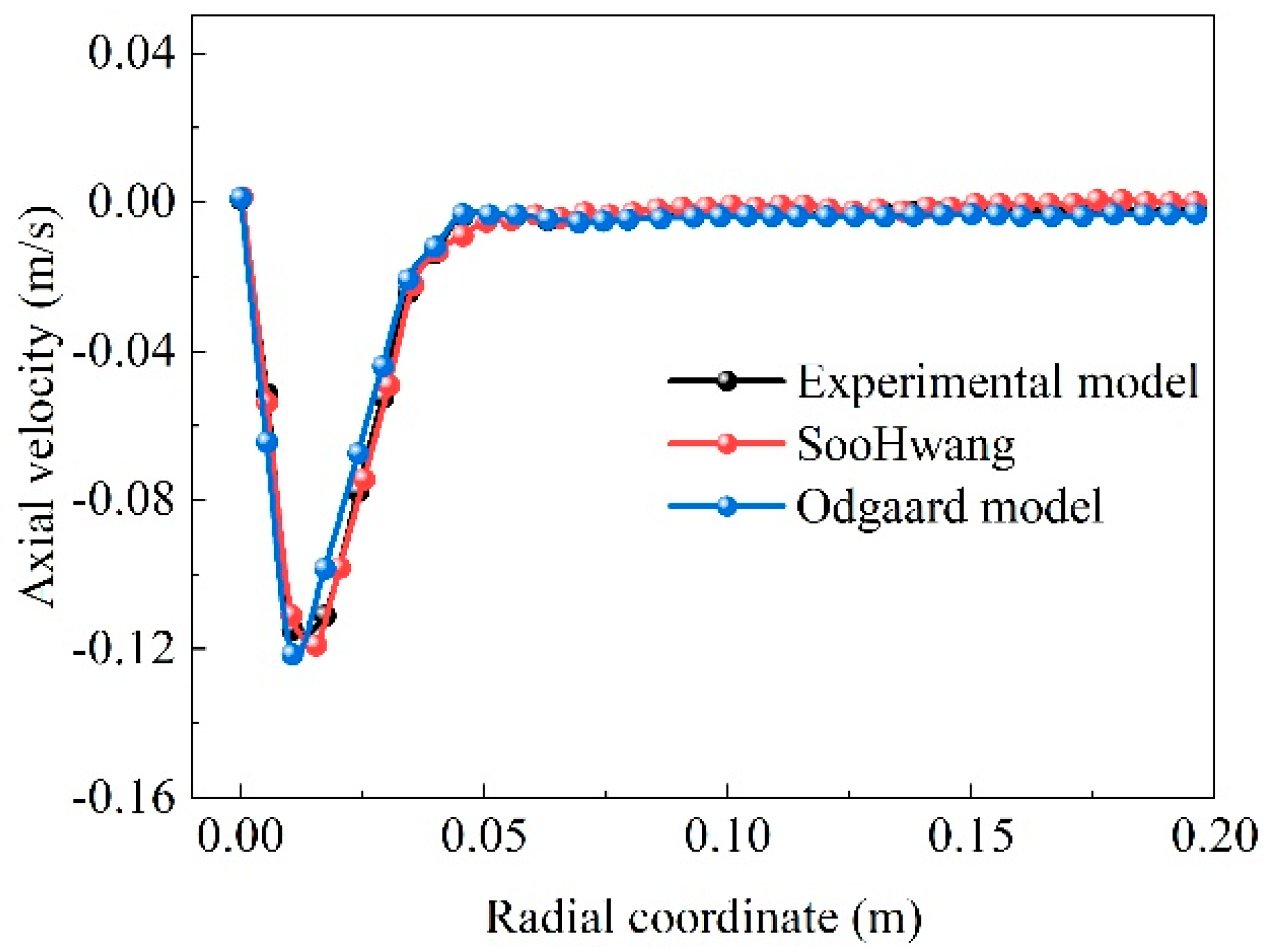
3.3. Model Validation
4. Numerical Results and Analysis
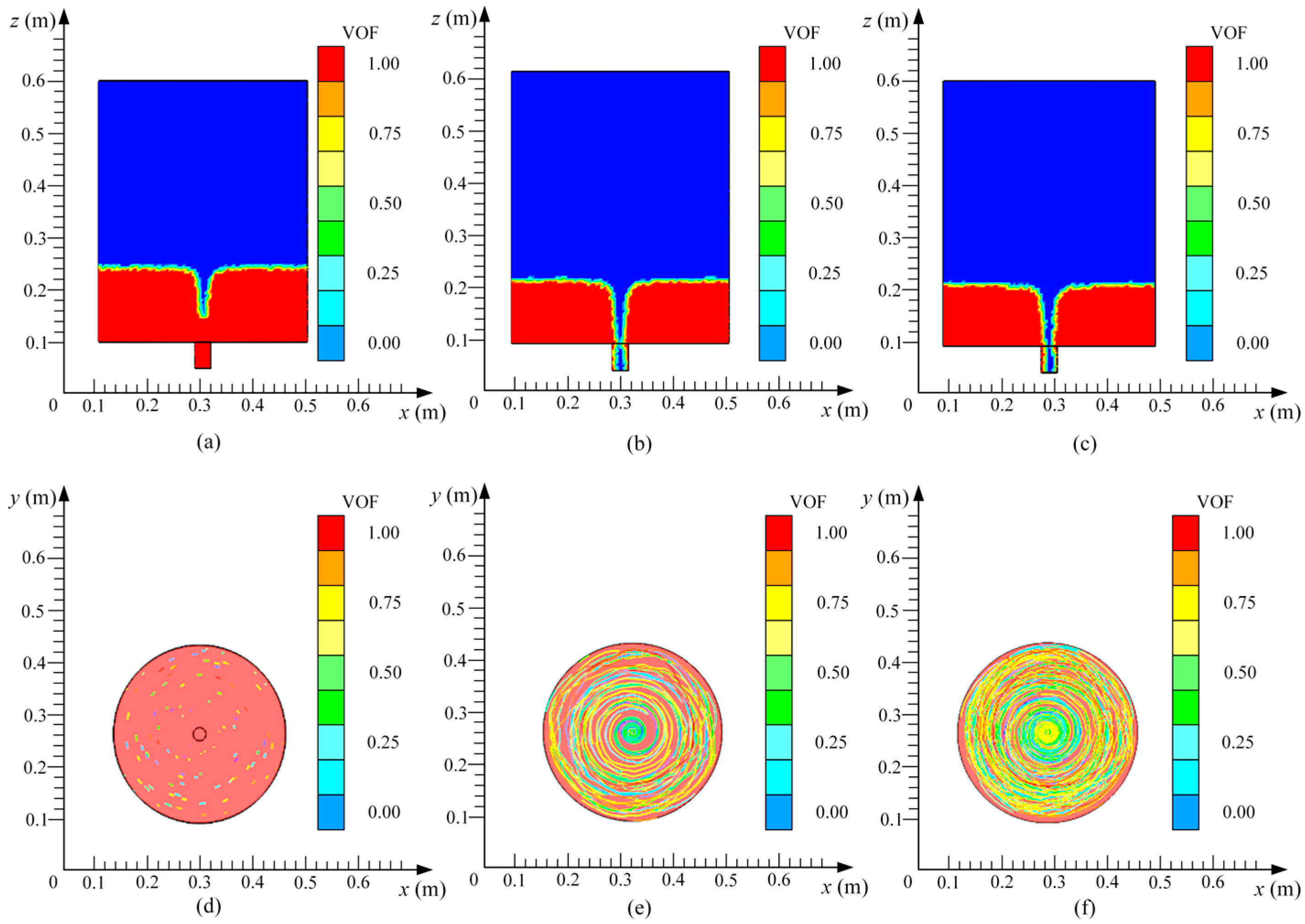
4.1. Formation Mechanism of Two-Phase Vortex Flow Transport
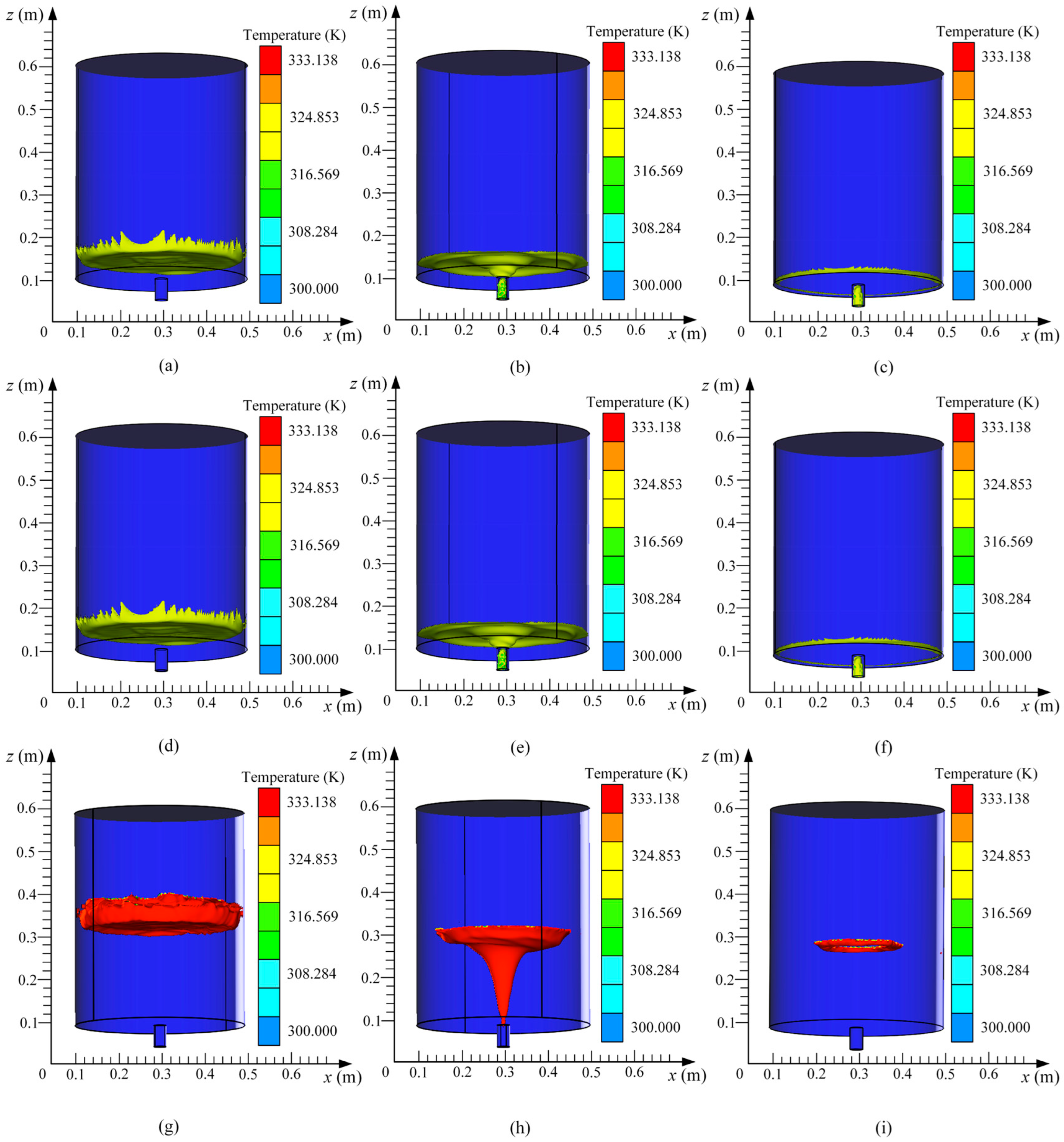
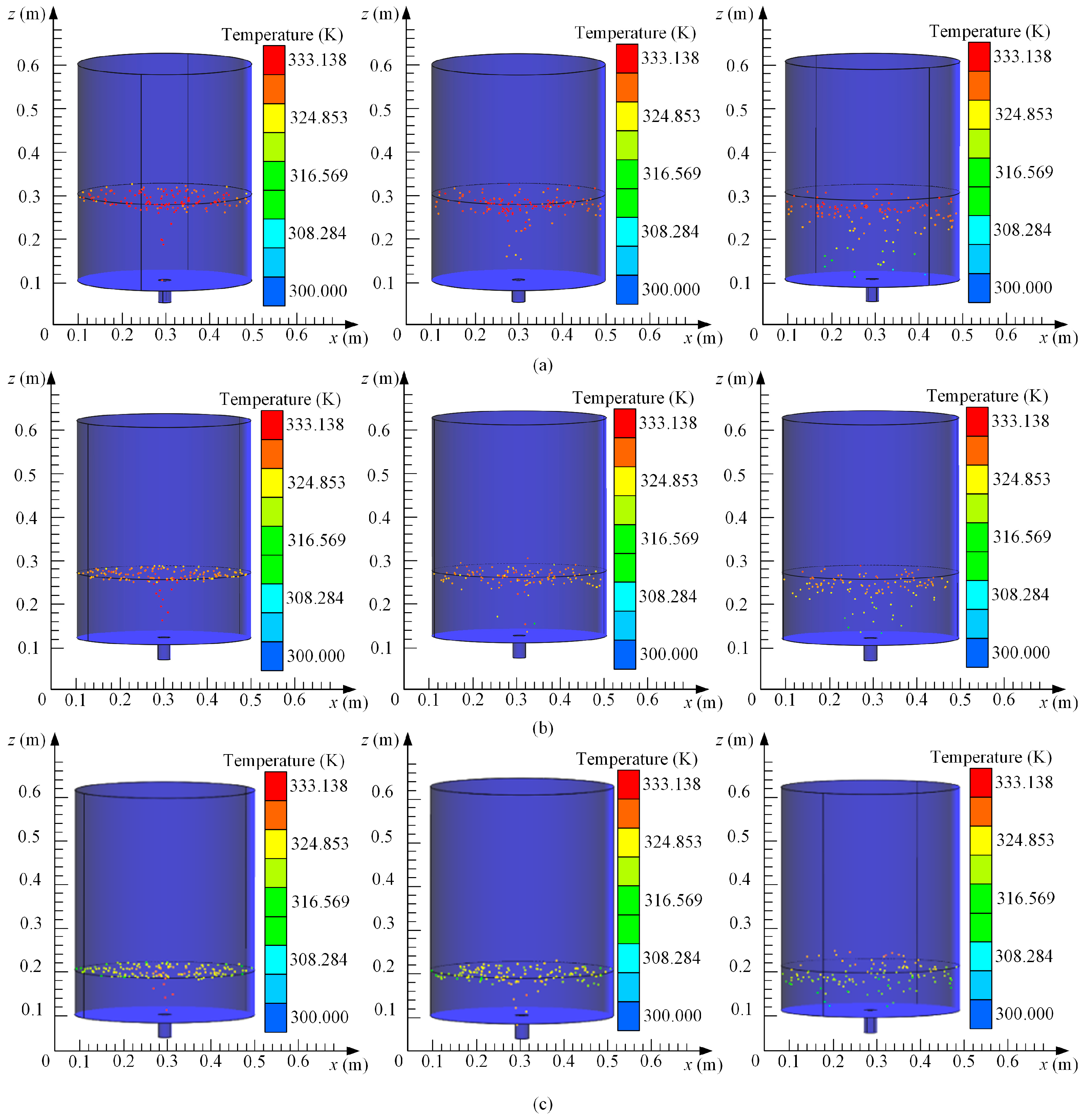
4.2. Effect of Temperature on Flow Field Evolution
5. Conclusions
- (1)
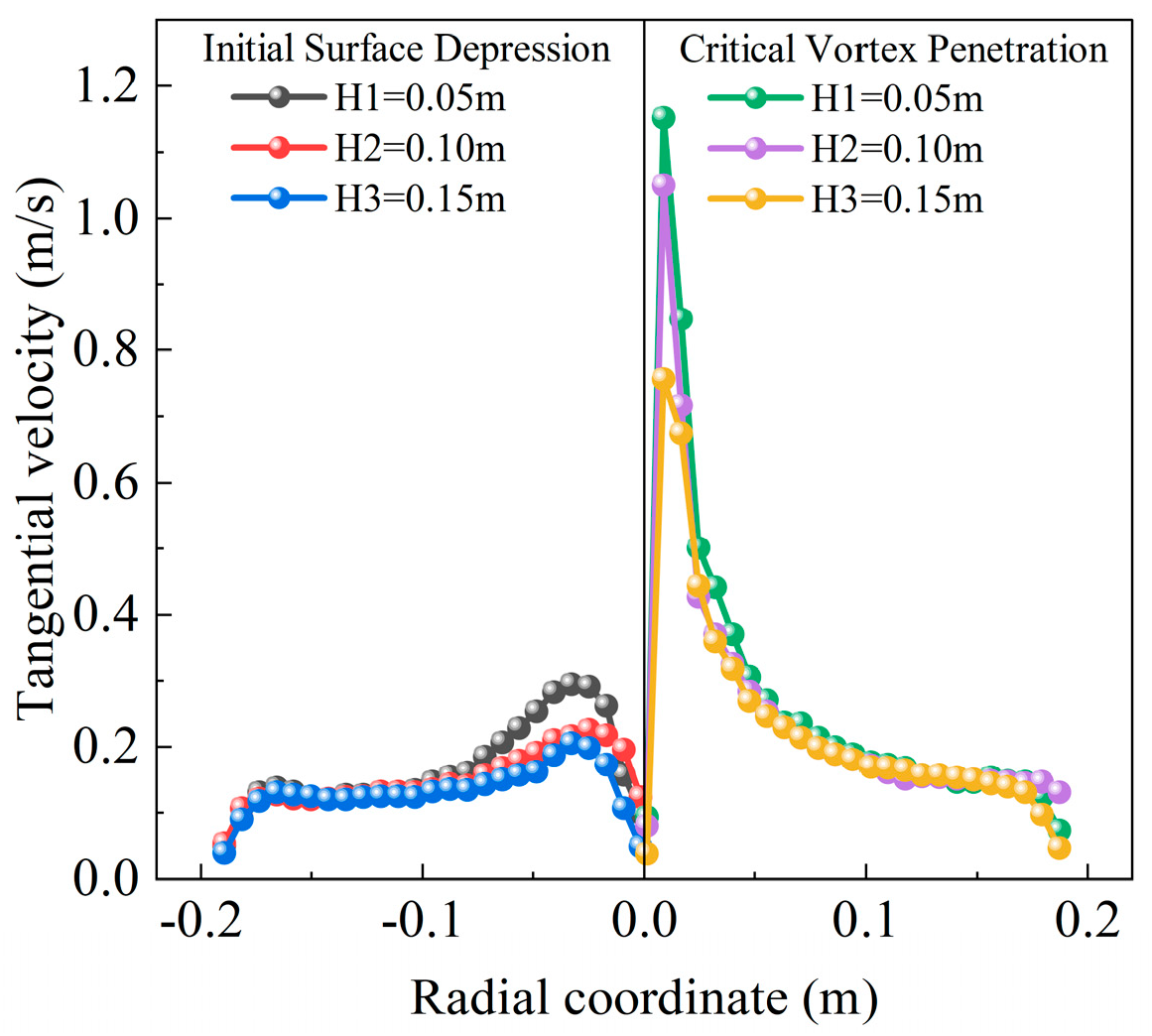
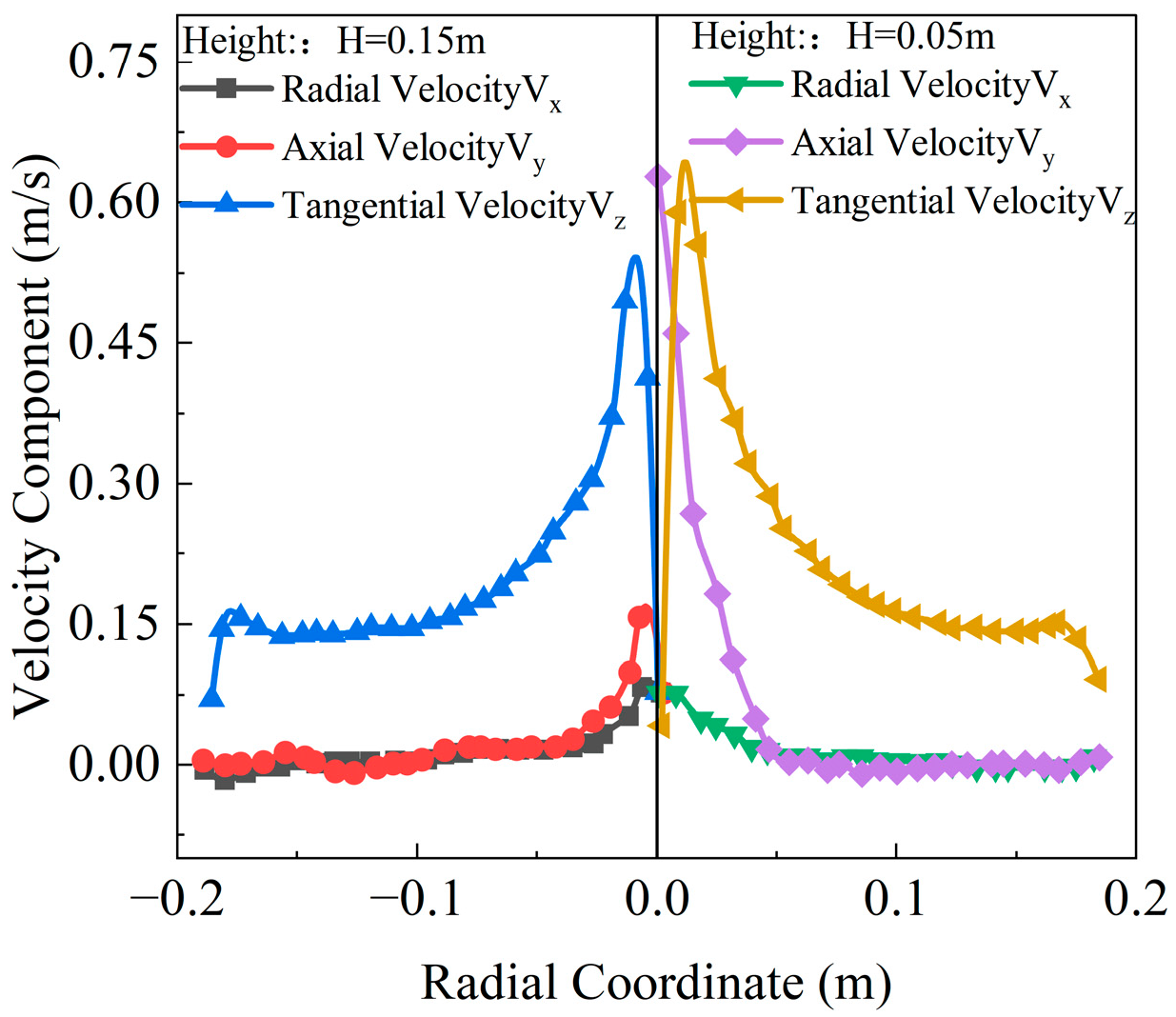
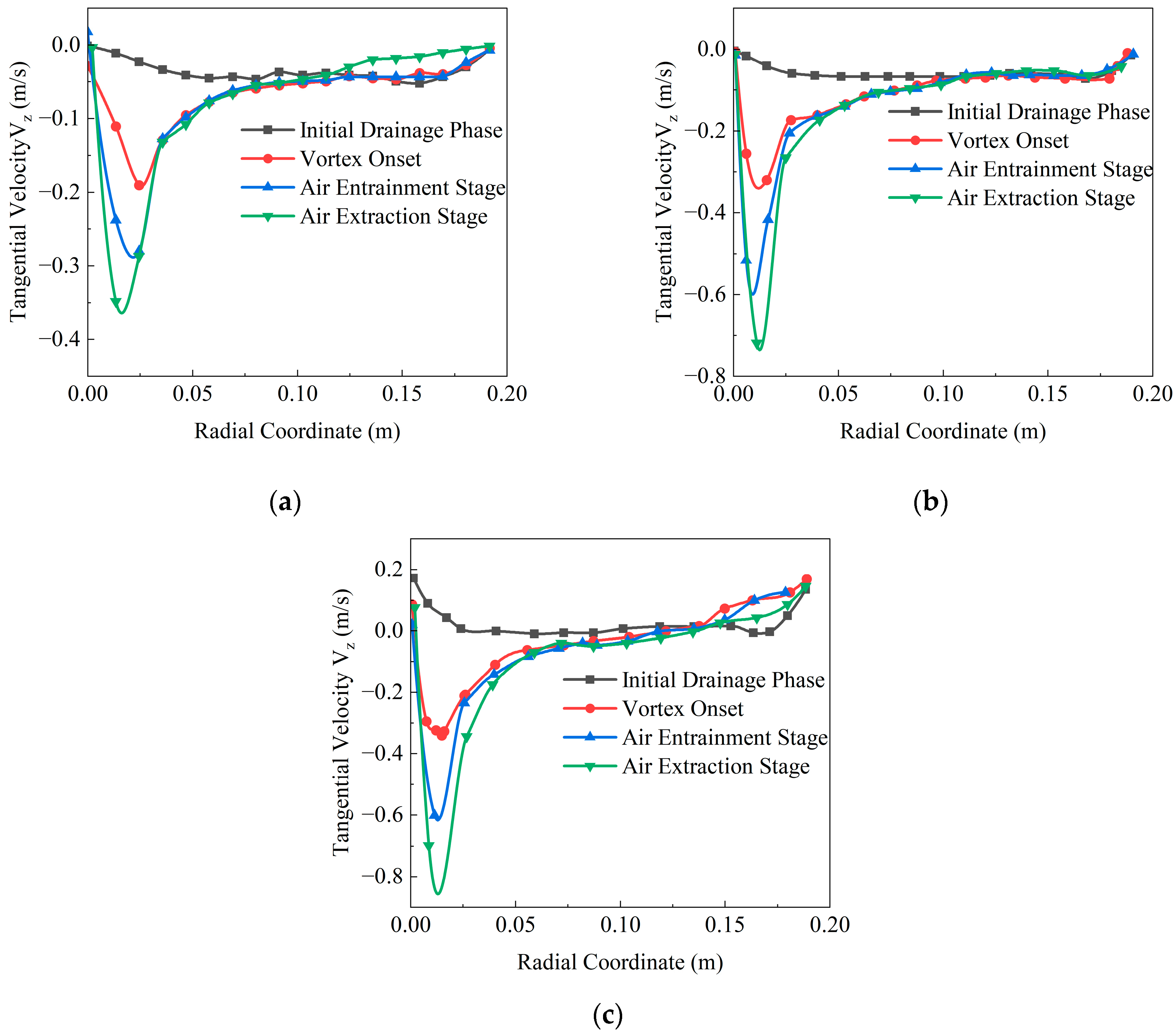
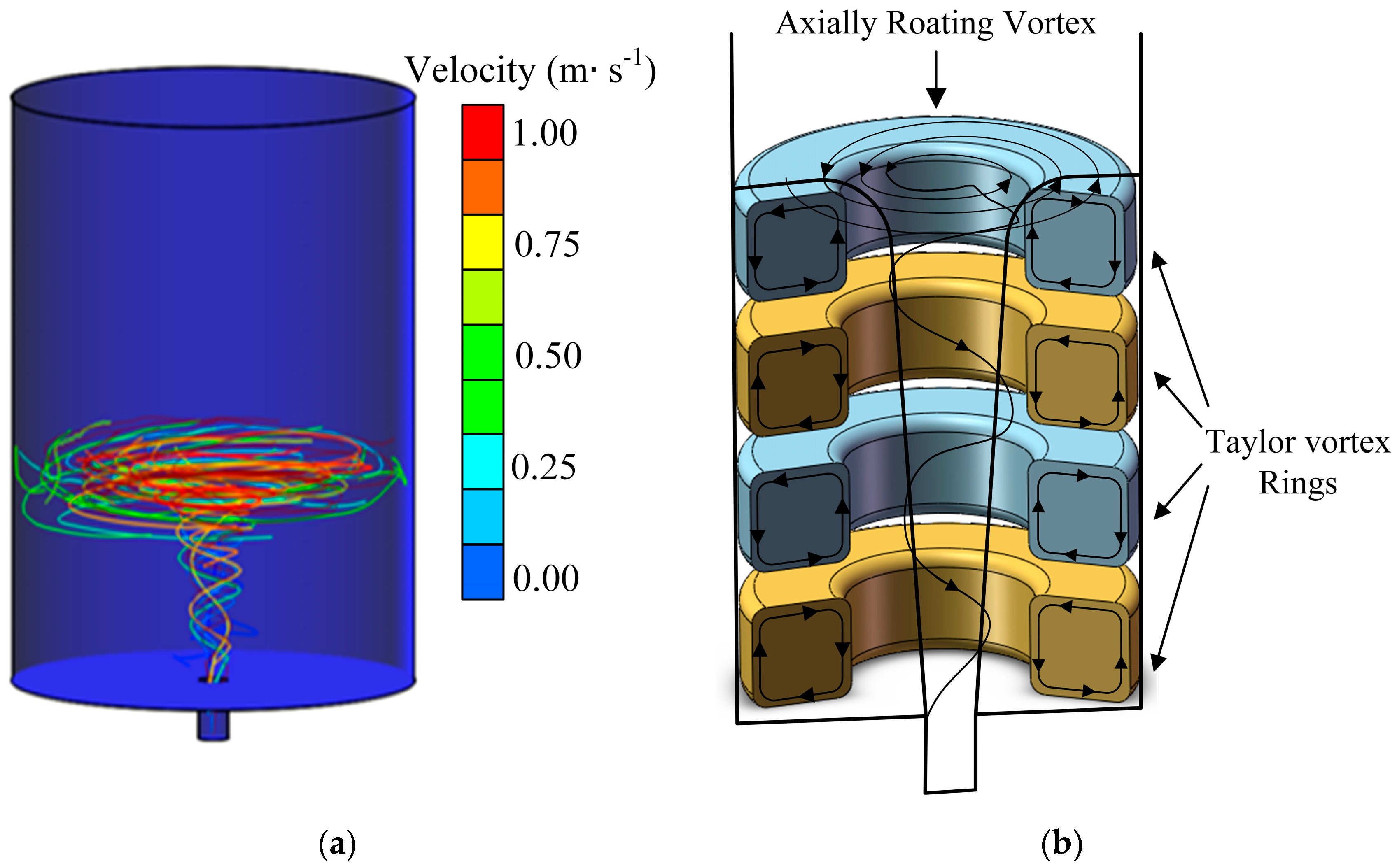
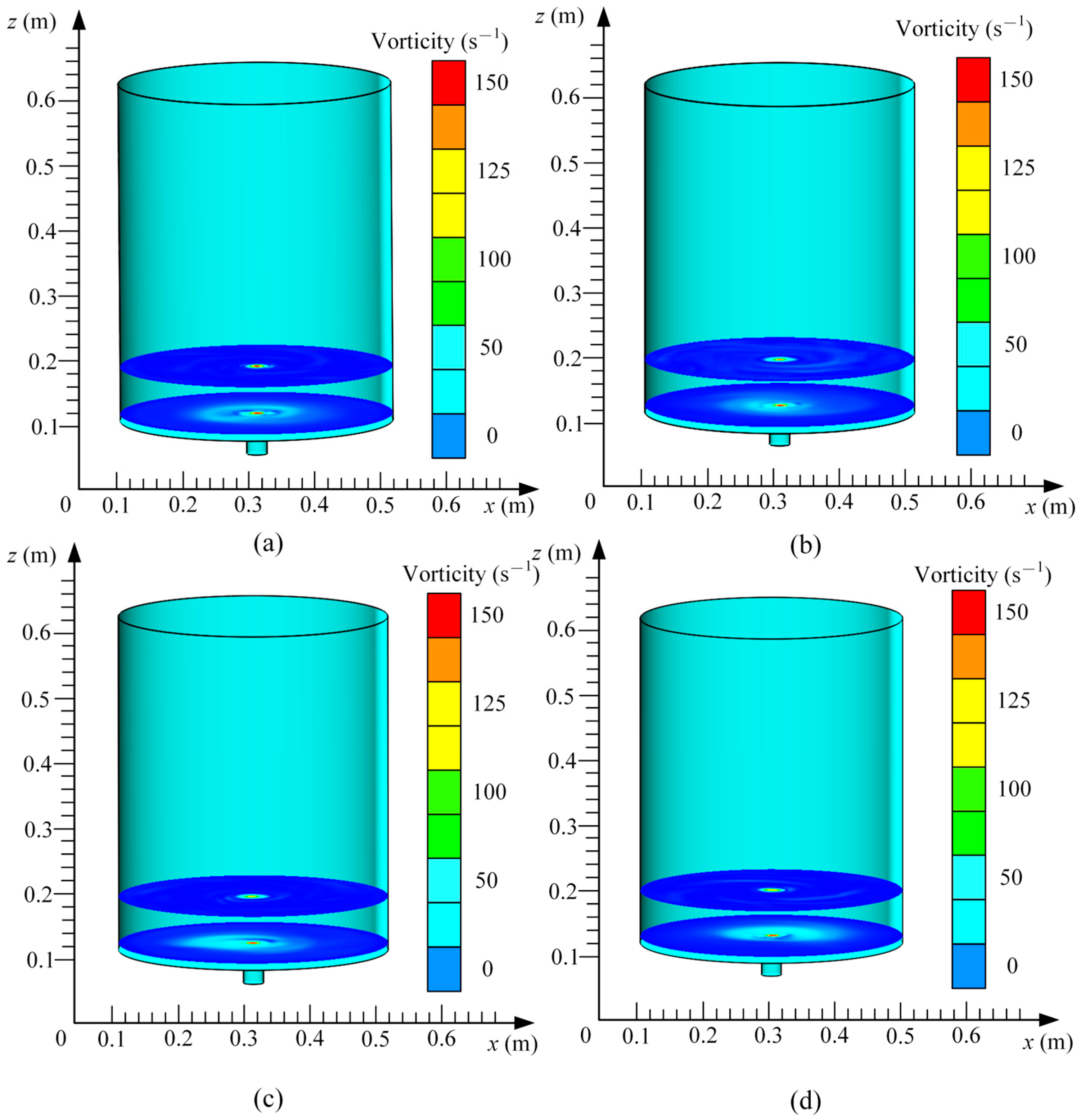
- Revealed vortex evolutionary dynamics and flow field structural characteristics. The vortex flow field strictly follows axisymmetric characteristics, with its tangential velocity distribution exhibiting the classical Rankine combined vortex structure. Vortex energy continuously concentrates toward the core during evolution, manifested as dynamic contraction of the vortex core radius and significantly higher peak tangential velocity during the critical penetration stage compared to the initial depression stage. This reflects the redistribution and concentration effect of angular momentum during vortex development.
- (2)
- Quantified the crucial regulatory role of initial perturbation on vortex behavior. The initial perturbation velocity is a key parameter controlling vortex intensity and stability. Increased perturbation velocity directly enhances vortex intensity and promotes earlier transition to fully developed stage. Furthermore, high perturbation conditions induce spatial instability of the vortex core position, directly leading to intensified pressure fluctuations near the outlet, posing potential risks to downstream flow field stability. This provides an important basis for vibration and noise control in engineering applications.
- (3)
- The bidirectional coupling mechanism between the temperature field and vortex evolution has been systematically elucidated. This study reveals that temperature regulates the physical pathway of vortex evolution by altering the thermophysical properties of the fluid. Under low-temperature conditions, the higher fluid viscosity induces stronger viscous dissipation, which suppresses the rotational motion of fluid microclusters and consequently delays the formation and development of the vortex. Conversely, as the temperature increases, the viscosity decreases, enabling the fluid to organize more effective rotational motion under the constraint of angular momentum conservation, thereby accelerating the vortex evolution process and prolonging the drainage duration.
Author Contributions
Funding
Data Availability Statement
Conflicts of Interest
References
- Wang, Z.; Sun, B.; Li, Y.; Ji, S.; Zhou, X.B.; Yue, Q. Comprehensive analysis of free-surface vortex formation mechanisms: Advancements and perspectives. J. Iron Steel Res. Int. 2025, 32, 2183–2212. [Google Scholar] [CrossRef]
- Mondal, R.K.; Rohilla, L.; Kumar, P. Vortex bifurcation and air entrainment mitigation using multi-point intakes. Phys. Fluids 2024, 36, 045149. [Google Scholar] [CrossRef]
- Wang, T.; Li, L.; Zhang, Y.; Li, J.C.; Wan, Q.J.; Tan, D.P. Analytical treatment and experimental investigation of forced displacement responses of cracked fluid-filled thin cylindrical shells. Thin-Walled Struct. 2025, 142, 115969. [Google Scholar]
- Sun, Z.; Yao, Q.; Jin, H.; Xu, Y.; Hang, W.; Chen, H.; Li, K.; Shi, L.; Gu, J.; Zhang, Q.; et al. A novel in-situ sensor calibration method for building thermal systems based on virtual samples and autoencoder. Energy 2024, 297, 131314. [Google Scholar] [CrossRef]
- Sun, Z.; Yao, Q.; Shi, L.; Jin, H.; Xu, Y.; Yang, P.; Xiao, H.; Chen, D.; Zhao, P.; Shen, X. Virtual sample diffusion generation method guided by large language model-generated knowledge for enhancing information completeness and zero-shot fault diagnosis in building thermal systems. J. Zhejiang Univ. Sci. A 2025, 26, 895–916. [Google Scholar] [CrossRef]
- Zhang, B.; Yang, A.; Cheng, L.; Jiao, W.; Xu, J.; Luo, C. Vortex-induced energy loss and pressure fluctuations in a closed sump under various conditions: An experimental investigation. Phys. Fluids 2023, 35, 115156. [Google Scholar] [CrossRef]
- Zhang, L.-R.; Li, J.-H.; Wang, Y.-Z.; Qiu, X.; Fu, Y.; Liu, Y.-L. Vortex dynamics induced by a finite wall-mounted cylinder with various corner shapes. Phys. Fluids 2024, 36, 075147. [Google Scholar] [CrossRef]
- Li, L.; Li, Q.H.; Xu, P. Heat transfer mechanism and dynamic regulation of the surface swirling flow based on LBM–LES multi-field coupling. Appl. Therm. Eng. 2026, in press. [Google Scholar]
- Song, X.; Jin, Y.; Wang, Z.; Presas, A.; Tang, F.; Liu, C. Energy dissipation and time–frequency analysis of characteristics induced by vortex breakdown in an axial flow pump. Phys. Fluids 2024, 36, 065147. [Google Scholar] [CrossRef]
- Li, Z.; Zheng, R.; Wang, C.; Li, L.; Wu, J.; Xie, Y.; Tan, D. Coupled design of cathode GC and GDL microporous structure for enhanced mass transport and electrochemical efficiency in PEMFCs. Appl. Sci. 2026, 16, 246. [Google Scholar] [CrossRef]
- Li, Z.; Zheng, R.; Wang, C.; Li, L.; Xie, Y.; Tan, D. Bidirectional-forcing cathode channels with fin-shaped barriers for enhanced gas–water management in PEMFCs. Appl. Sci. 2026, in press. [Google Scholar]
- Sridharan, A.; Padmanabhan, P.; Ranganayakulu, C. Thermal Effects of Vortex Generators on Transonic Aerodynamic Surfaces. In Proceedings of the 2024 IEEE Aerospace Conference, Big Sky, MT, USA, 2–9 March 2024; Available online: https://ieeexplore.ieee.org/abstract/document/10521013 (accessed on 30 November 2025).
- Harvey, A.H.; Hrubý, J.; Meier, K. Improved and always improving: Reference formulations for thermophysical properties of water. J. Phys. Chem. Ref. Data 2023, 52, 013101. [Google Scholar] [CrossRef]
- Tan, Y.; Li, Q.; Li, L.; Tan, D. Investigating the regulatory mechanism of the baffle geometric parameters on the lubrication transmission of high-speed gears. Appl. Sci. 2025, 15, 11080. [Google Scholar] [CrossRef]
- Huang, J.; Wang, L.; Yang, X. An efficient thermal lattice Boltzmann method for simulating three-dimensional liquid–vapor phase change. Comput. Fluids 2024, 273, 106214. [Google Scholar] [CrossRef]
- Dong, X.; Feng, L.; Zhang, Q. Droplet asymmetry bouncing on structured surfaces: A simulation based on SPH method. Int. J. Adhes. Adhes. 2024, 132, 103734. [Google Scholar] [CrossRef]
- Li, L.; Xu, P.; Li, Q.; Zheng, R.; Wu, N.; Bao, J.; Xu, W.; Ma, Q.; Yin, Z. Fluid-induced energy transfer and vibration modes of multiphase mixing in static mixers across flow regime transitions. Chem. Eng. J. 2026, in press. [Google Scholar]
- Liu, Y.; Zhou, Z.; Zhu, L.; Wang, S. Numerical investigation of flows around an axisymmetric body of revolution by using Reynolds-stress model based hybrid Reynolds-averaged Navier–Stokes/large eddy simulation. Phys. Fluids 2021, 33, 095102. [Google Scholar] [CrossRef]
- Mandegari, A.; Rahimian, M.H.; Jalali, A.; Jafari, A. Integration of Hertz–Knudsen–Schrage phase change in phase-field lattice Boltzmann method: Validation and parametric studies. Phys. Fluids 2024, 36, 075148. [Google Scholar] [CrossRef]
- Alaboodi, A.S.; Hussain, Z.; Abbas, S.; Rehman, M.U.; Zulfiqar, A. Mitigating surface vortex formation in pump sump intakes through anti-vortex devices: A comprehensive CFD study. Front. Phys. 2024, 12, 1456256. [Google Scholar] [CrossRef]
- Zhang, B.; Ma, L.; Cheng, L.; Zhu, B.; Qin, Y. Characterization of free-surface vortex evolution and its impact on hydraulic stability of the pump sump. Exp. Therm. Fluid Sci. 2025, 166, 111466. [Google Scholar] [CrossRef]
- Li, Q.; Yu, Y.; Luo, K.H. Improved three-dimensional thermal multiphase lattice Boltzmann model for liquid-vapor phase change. Phys. Rev. E 2022, 105, 025308. [Google Scholar] [CrossRef]
- Yuan, B.; Li, J.; Carrica, P.M.; Hendrickson, K.; Yue, D. VEnt: An air entrainment model for turbulent free surface flows. Phys. Fluids 2024, 36, 015147. [Google Scholar] [CrossRef]
- Zhang, B.; Ma, L.; Cheng, L.; Zhu, B.; Zhao, H.; Qin, Y. Sidewall-attached vortex hidden in a pump sump: Evolution process and induced pressure oscillation. Exp. Therm. Fluid Sci. 2025, 168, 111524. [Google Scholar] [CrossRef]
- Deng, B.Q.; Yang, Z.; Shen, L. Mechanisms underlying how free surfaces influence very-large-scale motions in turbulent plane open channel flows based on linear non-modal analysis. J. Fluid Mech. 2025, 1002, A9. [Google Scholar] [CrossRef]
- Zhang, B.; Yang, Z.; Lv, J.; Li, B.; Li, Z.; Zhao, X.; Li, H.; Zhang, R. Suppression of vortex-induced vibration of a circular cylinder using a pair of jets near the free surface. Phys. Fluids 2025, 37, 025147. [Google Scholar] [CrossRef]
- Ali, N.; Tariq, A. Vortex evolution and merging mechanism across 180° sharp bend for laminar inflow. Phys. Fluids 2023, 35, 075102. [Google Scholar] [CrossRef]
- Zhang, T.; Zhang, A.M.; Zhang, S.; Long, S.; Han, R.; Liu, L.; Ohl, C.-D.; Li, S. Free-surface jetting driven by a cavitating vortex ring. J. Fluid Mech. 2025, 1003, A4. [Google Scholar] [CrossRef]
- Amar, S.D.; Portnikov, D.; Rashkovan, A.; Ziskind, G. Three-dimensional vortex and gas entrainment analysis in rotating liquid flow with a free surface. Phys. Fluids 2024, 36, 085147. [Google Scholar] [CrossRef]
- Luo, M.; Su, X.; Kazemi, E.; Jin, X.; Khayyer, A. Review of smoothed particle hydrodynamics modeling of fluid flows in porous media with a focus on hydraulic, coastal, and ocean engineering applications. Phys. Fluids 2025, 37, 025148. [Google Scholar] [CrossRef]
- Chen, X.; Yang, K.; Yang, D.; Shan, X. Analysis and lattice Boltzmann simulation of thermoacoustic instability in a Rijke tube. J. Fluid Mech. 2024, 1000, A92. [Google Scholar] [CrossRef]
- Yin, M.; Ji, R.; Zhu, R.; Sun, K.; Wu, M.; Li, X.; Ye, Y.; Reabroy, R.; Zhang, Y. Hydrodynamic performance of a horizontal-axis tidal turbine subjected to terrain-induced turbulence using the lattice Boltzmann method. Phys. Fluids 2025, 37, 035147. [Google Scholar] [CrossRef]
- Wang, L.; Liu, Z.; Jin, B.R.; Huang, Q.; Young, J.; Tian, F.-B. Wall-modeled large eddy simulation in the immersed boundary-lattice Boltzmann method. Phys. Fluids 2024, 36, 035147. [Google Scholar] [CrossRef]
- Babiker, O.; Bjerkebk, I.; Xuan, A.; Shen, L.; Ellingsen, S.Å. Vortex imprints on a free surface as proxy for surface divergence. J. Fluid Mech. 2023, 964, A10. [Google Scholar] [CrossRef]
- Li, Z.; Chen, H.; Xu, H.; Feng, J.; Rossi, M.; Qian, S.; Yang, Z.; Kan, K. Floating particles transport through the free surface vortex technique: A novel numerical study to assess the interaction among different scales of vortex structures. Phys. Fluids 2024, 36, 105147. [Google Scholar] [CrossRef]
- Zheng, G.A.; Weng, X.X.; Wang, T.; Xu, P.; Xu, W.X.; Li, L.; Xu, X.F.; Tan, D.P. Piezoelectric ultrasonic coupling-based polishing of micro-tapered holes with abrasive flow. J. Zhejiang Univ. Sci. A 2025, 26, 1141–1162. [Google Scholar] [CrossRef]
- Fujino, J.; Motoori, Y.; Goto, S. Hierarchy of coherent vortices in turbulence behind a cylinder. J. Fluid Mech. 2023, 975, A13. [Google Scholar] [CrossRef]
- Zhou, J.; Qiu, X.; Li, J.; Liu, Y. Vortex evolution of flow past the near-wall circular cylinder immersed in a flat-plate turbulent boundary layer. Ocean Eng. 2022, 260, 112011. [Google Scholar] [CrossRef]
- Ou, G.H.; Li, Z.R.; Ji, W.T.; Tao, W.-Q. A fully coupled pressure-based method for compressible flows at all Mach numbers. Appl. Therm. Eng. 2024, 255, 123916. [Google Scholar] [CrossRef]
- Ma, W.; Yang, G.; Cao, W.; Bai, G.; Cao, C.; Song, S. Modeling and analysis of internal leakage characteristics of the internal curve motor by a CFD-based method. Processes 2024, 12, 2835. [Google Scholar] [CrossRef]
- Lian, J.; Yao, Q.; Jiang, Z. An overlapping IBM-PISO algorithm with an FFT-based Poisson solver for parallel incompressible flow simulations. Fluids 2025, 10, 176. [Google Scholar] [CrossRef]
- Wang, J.; Li, C.; Huang, S.; Zheng, Q.; Xiao, Y.; Ou, J. Large eddy simulation of turbulent atmospheric boundary layer flow based on a synthetic volume forcing method. J. Wind Eng. Ind. Aerodyn. 2023, 233, 105326. [Google Scholar] [CrossRef]
- Geier, M.; Lenz, S.; Schönherr, M.; Krafczyk, M. Under-resolved and large eddy simulations of a decaying Taylor–Green vortex with the cumulant lattice Boltzmann method. Theor. Comput. Fluid Dyn. 2021, 35, 577–603. [Google Scholar] [CrossRef]
- Chen, C.; Liang, J.; Gao, T.; Wu, X.; Zhao, W.; Zhang, L. Conservative compressible one-dimensional turbulence formulation and application to high-Reynolds-number compressible turbulent channel flows. Phys. Fluids 2022, 34, 065104. [Google Scholar] [CrossRef]
- Jo, C.H.; Hwang, S.J.; Tong, J.C.K.; Chan, J.C.L. Implementation of Tidal Energy Convertor in Low Current Area. In Proceedings of the International Conference on Renewable Energies Offshore, Lisbon, Portugal, 28–30 October 2019; Available online: https://scholars.cityu.edu.hk/en/publications/implementation-of-tidal-energy-convertor-in-low-current-area/ (accessed on 30 November 2025).
- Fu, L.; Ding, M.; Jiang, Y.; Ma, Z. A novel singular and harmonics-to-noise ratio deconvolution for fault diagnosis in rotating machinery. IEEE Trans. Instrum. Meas. 2025, 74, 3556012. [Google Scholar] [CrossRef]
- Khan, M.A.; Sharma, N.; Odgaard, J. Experimental and Numerical Studies of Velocity and Turbulence Intensities for Mid-Channel Bar. Water Resources 2021, 48, 746–762. [Google Scholar] [CrossRef]
- Yao, Y.Y.; Xiao, Y.X.; Zhu, W.; Zhai, L.M.; SooHwang, A.; Wang, Z.W. Numerical Analysis of a Model Pump-turbine Internal Flow Behavior in Pump Hump District. In IOP Conference Series: Earth and Environmental Science; IOP Publishing: Bristol, UK, 2014; Volume 22, p. 032040. [Google Scholar]






Disclaimer/Publisher’s Note: The statements, opinions and data contained in all publications are solely those of the individual author(s) and contributor(s) and not of MDPI and/or the editor(s). MDPI and/or the editor(s) disclaim responsibility for any injury to people or property resulting from any ideas, methods, instructions or products referred to in the content. |
© 2026 by the authors. Licensee MDPI, Basel, Switzerland. This article is an open access article distributed under the terms and conditions of the Creative Commons Attribution (CC BY) license.
Share and Cite
Yan, Q.; Li, L.; Tan, Y. Energy Transfer Characteristics of Surface Vortex Heat Flow Under Non-Isothermal Conditions Based on the Lattice Boltzmann Method. Processes 2026, 14, 378. https://doi.org/10.3390/pr14020378
Yan Q, Li L, Tan Y. Energy Transfer Characteristics of Surface Vortex Heat Flow Under Non-Isothermal Conditions Based on the Lattice Boltzmann Method. Processes. 2026; 14(2):378. https://doi.org/10.3390/pr14020378
Chicago/Turabian StyleYan, Qing, Lin Li, and Yunfeng Tan. 2026. "Energy Transfer Characteristics of Surface Vortex Heat Flow Under Non-Isothermal Conditions Based on the Lattice Boltzmann Method" Processes 14, no. 2: 378. https://doi.org/10.3390/pr14020378
APA StyleYan, Q., Li, L., & Tan, Y. (2026). Energy Transfer Characteristics of Surface Vortex Heat Flow Under Non-Isothermal Conditions Based on the Lattice Boltzmann Method. Processes, 14(2), 378. https://doi.org/10.3390/pr14020378