Article

Numerical and Performance Optimization Research on Biphase Transport in PEMFC Flow Channels Based on LBM-VOF


1
College of Mechanical Engineering, Zhejiang University of Technology, Hangzhou 310014, China
2
Key Laboratory of Special Purpose Equipment and Advanced Processing Technology, Ministry of Education & Zhejiang Province, Hangzhou 310014, China
3
College of Mechanical Engineering, Tianjin University, Tianjin 300350, China
*
Authors to whom correspondence should be addressed.
Processes 2026, 14(2), 360; https://doi.org/10.3390/pr14020360
Submission received: 11 December 2025 / Revised: 8 January 2026 / Accepted: 12 January 2026 / Published: 20 January 2026
(This article belongs to the Section Materials Processes)

Abstract

Proton exchange membrane fuel cells (PEMFC) are recognized as promising next-generation energy technology. Yet, their performance is critically limited by inefficient gas transport and water management in conventional flow channels. Current rectangular gas channels (GC) restrict reactive gas penetration into the gas diffusion layer (GDL) due to insufficient longitudinal convection. At the same time, the complex multiphase interactions at the mesoscale pose challenges for numerical modeling. To address these limitations, this study proposes a novel cathode channel design featuring laterally contracted fin-shaped barrier blocks and develops a mesoscopic multiphase coupled transport model using the lattice Boltzmann method combined with the volume-of-fluid approach (LBM-VOF). Through systematic investigation of multiphase flow interactions across channel geometries and GDL surface wettability effects, we demonstrate that the optimized barrier structure induces bidirectional forced convection, enhancing oxygen transport compared to linear channels. Compared with the traditional straight channel, the optimized composite channel achieves a 60.9% increase in average droplet transport velocity and a 56.9% longer droplet displacement distance, while reducing the GDL surface water saturation by 24.8% under the same inlet conditions. These findings provide critical insights into channel structure optimization for high-efficiency PEMFC, offering a validated numerical framework for multiphysics-coupled fuel cell simulations.

1. Introduction

Proton exchange membrane fuel cells (PEMFC) are recognized as a pivotal advancement in clean energy conversion technology, enabling efficient electrochemical conversion of hydrogen and oxygen with low environmental impact [1,2,3]. They are highly efficient, environmentally compatible, and produce pure water as the sole by-product, with no harmful emissions, making them a valuable and promising clean energy technology. PEMFC offers several advantages over conventional power generation methods and internal combustion engines, which rely on combustion processes [4,5]. These advantages include lower operating temperatures and higher energy conversion efficiencies, which provide a solid foundation for their widespread adoption in commercial applications. The technology has the potential to positively impact greenhouse gas emissions, air quality, and environmental sustainability. Nevertheless, despite the considerable theoretical potential of PEMFC, it continues to encounter several technical challenges in practical applications. The core challenge is the further improvement in energy conversion efficiency [6,7], which is restricted by gas–water management issues such as flooding and membrane drying. Another critical challenge is the limited durability of PEMFCs under long-term operation [8,9]: intricate operational conditions such as cyclic load changes and temperature fluctuations, and component aging including GDL pore clogging and catalyst degradation, lead to gradual performance deterioration, which remains a key barrier to commercialization.
The membrane electrode assembly (MEA) plays a pivotal role in the configuration of a PEMFC. The MEA comprises multiple layers, commencing with the gas channel (GC) in the outermost layer, traversing the gas diffusion layer (GDL), the microporous layer (MPL), and culminating in the catalytic layer (CL), with the proton exchange membrane (PEM) serving as the core component [10,11]. These layers collectively comprise the core reaction zone of the PEMFC. In a conventional air-cooled PEMFC, the primary functions of the GC are to distribute the reactive gases uniformly, remove excess liquid water, facilitate effective heat dispersion, prevent the reactive gases from crossing the two poles, and provide the necessary mechanical support for the membrane electrode assembly [12]. Among the challenges associated with GCs, the passage efficiency of reactive gases and water management are particularly significant, as they directly impact the reliability, stability, and cost-effectiveness of these devices. A well-designed gas channel (GC) with excellent gas permeability and a robust water management scheme guarantees adequate wetting of the catalytic layer (CL) while maintaining high ionic conductivity [13]. For large-scale commercialization of PEMFCs, high power density and long-term stability are core engineering requirements [14]. However, at high operating current densities, massive liquid water is generated in the cathode, leading to GDL flooding. This blocks reactive gas diffusion paths, reducing oxygen utilization by 30–40% and causing a 20–25% drop in cell power density [15]. Conversely, insufficient water retention leads to membrane drying, increasing proton transfer resistance by 50% or more [16,17]. Thus, optimizing GC fluid dynamics to achieve efficient water management is critical for meeting the engineering demands of high-performance, large-scale PEMFC applications.
Relevant scholars have conducted a series of studies on the structure of the GC to analyze its influence on the performance of the PEMFC [18,19]. These studies mainly focused on the overall layout of the GC on the bipolar plate, the shape of the GC cross-section, the contraction and enlargement of the GC ribs, and the placement of blocking blocks or plates inside the GC. The aim was to enhance the forced convection inside the GC in both lateral and longitudinal dimensions. The longitudinal forced convection promotes the reactive gases to cross the GCL to reach the CL layer, which makes the electrochemical reaction more complete and improves the discharge efficiency of the PEMFC. The transverse forced convection increases the pressure drop between the GC inlet and outlet, improves the gas passage rate and heat dissipation efficiency, and effectively drives the discharge of by-product water. Currently, the cross-section shape, rib width, and inlet/outlet area ratio of the flow channel are mostly optimized to improve the transport performance, etc. Brakni et al. [20] proposed a variable cross-section runner with a special side-contraction structure, in which the pressure difference between adjacent runners promotes the gas transport under the rib side of the runner. This is favorable for the uniform distribution of the reaction gas and the discharge of the liquid water. Chen et al. [21] designed a sinusoidal cross-section runner with depth changing along the direction of gas transport. This generates a pressure difference between the neighboring runners and at the same time enhances the gas flow under the ridge. This facilitates the reaction gas transport to the GDL. Li et al. [22] employed a method of inserting a barrier into the flow channel to enhance the mass transfer characteristics within the fuel cell. The barrier periodically reduced the flow area within the flow channel, thereby increasing the gas flow rate and facilitating the transfer of reactive gas to the GDL and the discharge of liquid water. Yan et al. [23] enhanced the mass transfer characteristics within the fuel cell by optimizing the configuration and disposition of the barrier blocks, as well as the configuration and disposition of the barrier blocks. They optimized the configuration of the barrier blocks and the arrangement of its components, thereby identifying the optimal barrier blocks configuration that balances fuel cell operational performance and pressure loss. Existing GC optimization is limited to enhancing either transverse or longitudinal forced convection alone, failing to effectively boost bidirectional forced convection within the channel [24]. Moreover, the coupling of mesoscopic-scale variables in the flow channel and the strong nonlinearity of the convection term [25] pose additional hurdles to the application of macroscopic-scale numerical simulations for multiphase flow.
In conclusion, existing research on the transport performance of reactive gases and their byproduct water in GC mainly focuses on two core aspects: on one hand, enhancing gas transport efficiency by adopting single transverse forced convection, and on the other hand, optimizing the reaction efficiency of reactive gases through single longitudinal forced convection. However, few studies have explored the potential of bidirectional forced convection in improving the transport performance of multiphase flows within GC, while fully considering the comprehensive characteristics of multiphase flows. Moreover, numerical simulations of multiphase coupling in GC face significant challenges due to the strong nonlinearity of multiphase flows inside GC and the difficulty of direct observation. It is therefore crucial to develop a modeling and solution method suitable for mesoscopic scales, which can handle multiphase-coupled transport with large density ratios. This method will help reveal the interphase transport laws of the multiphase flow mass transfer coupling process inside GC and GDL, and facilitate an in-depth understanding of the interaction between the multiphase flow transport mechanism in GC and the surface properties of GDL materials.
This study develops a numerical model coupling the Lattice Boltzmann Method (LBM) and Volume of Fluid (VOF) technique, integrated with volume correction and interphase coupling solutions. Its core goal is to establish a mesoscopic framework for multiphase coupled transport dynamics, overcoming the constraints associated with density and viscosity ratios in large density–ratio fluid systems during computations. Furthermore, this work features the first integration of fin-shaped and side-retracted barrier blocks with optimized geometric parameters to realize synergistic enhancement of bidirectional convection, and systematic revelation of its coupling mechanism with GDL wettability: the fin-shaped blocks are intended to enhance vertical forced convection, while the side-retracted blocks are designed to boost horizontal forced convection. We explore the feasibility and stability of multiphase flow in channels under the combined configuration of these two built-in blocks, while also revealing fluid transport characteristics across different GDL surface wettability conditions. The findings provide a theoretical basis for the design and feasibility of GC structures, as well as for investigating the mesoscopic coupled multiphase flow transport mechanism.

2. Numerical Model

2.1. Reconstruction of Two-Phase Interfaces

The central challenge of the two-phase flow transport problem within a GC in the PEMFC lies in tracking the flow shape of the large density ratio two-phase flow on the mesoscopic scale [26]. To simulate mesoscale gas–water two-phase flow in PEMFC channels, we integrate the LBM and VOF method. LBM is used to solve the hydrodynamic equations by simulating the migration and collision of microscopic particles, enabling efficient handling of complex boundary conditions [27,28,29]. VOF tracks the two-phase interface by labeling the liquid volume fraction in each lattice, ensuring accurate capture of interface evolution [30,31,32]. The key innovation of the coupled model is the interphase mass exchange mechanism: when gas and liquid lattices interact, mass is transferred according to the velocity difference and interface curvature, while volume correction ensures mass conservation. This coupling combines LBM’s advantages in fluid dynamics simulation and VOF’s strengths in interface tracking, enabling stable simulation of large density ratio two-phase flows.
The computational domain at the interface of the two phases is divided within the mesoscopic lattice domain of the LBM. The volume fraction of the liquid phase within each lattice is labeled and tracked.
m ( x , t ) = ρ ( x , t ) ε V
where m(x,t) is the mass fraction within the current lattice domain, ρ(x,t) is the density within the same lattice domain, ε is the liquid volume fraction, and V is the lattice volume.
The lattice domain where only one phase exists has m(x,t) = ρ(x,t). On the contrary, m(x,t) ≠ ρ(x,t) in the lattice domain that is at the free liquid surface, where a different ε is needed to characterize the current state of filling of the two-phase medium in the lattice domain. At liquid volume fraction, the lattice interior is filled with gas phase medium, and such lattice domains are recognized as pure gas phase. At liquid volume fraction, the lattice interior is filled with liquid phase medium, and such lattice domains are recognized as pure liquid phase. In the interphase lattice domain, where 0 < ε < 1, both liquid and solid phases are present, such lattice domains are defined as free liquid surfaces. Based on the assignment of ε = 1 values in each lattice domain, the migration functions for each migration direction within the lattice are reconstructed.
The free liquid surface is dynamically tracked by calculating the mass contained in the liquid phase within each lattice domain to track the motion of the free liquid surface. Two important parameters must be contained within the lattice domain L: the lattice domain mass mL(x,t) and the lattice domain liquid volume fraction εL.
ε L = m L ρ L
The lattice mass of each free-liquid surface lattice domain is determined by the exchange of mass ΔmL(x,t) between the free-liquid surface lattice point x and its adjacent lattice point x + Δt in the direction of lattice point, as illustrated in the following mass exchange model:
Δ m L ( x , t + Δ t ) = ε ( x + Δ t e i , t ) + ε ( x , t ) 2 ( f i ˜ ( x + Δ t e i , t ) f i ( x , t ) ) f i ˜ ( x + Δ t e i , t ) f i ( x , t ) 0 x + Δ t e i F S F G
where fi(x,t) is the particle distribution function of the lattice point x in direction i at moment t, denotes the opposite direction of i, and ΔmL( x , t + Δt) is the amount of change in the mass of the lattice L at the time t + Δt at the next moment from moment t. This leads to the following mass fraction within the lattice after one time step Δt for the free liquid surface lattice in the D3Q19 model:
m ( x , t + Δ t ) = m ( x , t ) + i = 1 19 Δ m i ( x , t + Δ t )
In the gas-phase lattice domain, the distribution function is equal to zero. In order to facilitate the normal migration of the distribution function in the lattice domain, it is necessary to reconstruct the distribution function for the migration of the gas lattice to the free-liquid-surface lattice. In the absence of surface tension, the distribution function exchange between the free liquid surface lattice at x and the gas lattice at +Δt is illustrated below:
f i ˜ ( x , t + Δ t ) = f i e q ( ρ , u ) + f i ˜ e q ( ρ , u ) f i ( x , t )
where fi( x , t + Δt) is the particle distribution function in the direction. The equilibrium distribution functions, fieq(ρ,) and fieq(ρ,), represent the particle distribution in the i ˜ and i directions, respectively. In this context, u represents the velocity of the lattice at x at the moment of t. Additionally, the atmospheric pressure is set to ρD = 1. The particle distribution function, fi(,t), describes the distribution of particles in the aforementioned directions.
To achieve equilibrium between the two phases at the free liquid surface, it is necessary to reconstruct the distribution function in the direction normal to the free liquid surface. The normal vector n of the distribution function must be satisfied for the migration of the gas lattice at the free liquid surface for the D3Q19 model. The following equation demonstrates this relationship:
n e i > 0 , n = i = 0 19 s i e i ε ( x + e i Δ t )
where n is the free surface normal vector on the FS lattice, s is a weighting coefficient (i.e., for D3Q19 s = [0, 1/2, 1/2, 1/2, 1/2, 1/2, 1/2, 1/4, 1/4, 1/4, 1/4, 1/4, 1/4, 1/4, 1/4, 1/4, 1/4, 1/4, 1/4]).
The density and velocity information of the current lattice domain is calculated by constructing the completed distribution function, and then the collision step is performed to determine whether the current lattice domain is a liquid phase lattice or a gas phase lattice under the collision end moment by using Equation (7).
m ( x , t + Δ t ) > ( 1 + k c ) ρ ( x , t + Δ t )     gas   lattice m ( x , t + Δ t ) < ( 0 k c ) ρ ( x , t + Δ t )     fluid   lattice
where kc = 10−3 is used to determine whether the lattice domain is filled or emptied by the liquid phase medium.
Throughout the time step of the simulation, individual lattice domains may be in different states at different time steps, so the kc values for judging lattice types are stored as a whole in a list to allow lattice type conversion after the body loop has ended.
The determination process is divided into two steps. Initially, all the liquid-phase lattices in the vicinity of the liquid-phase lattice are identified as free-liquid surface lattices. The velocity and density data within the marked lattice are then interpolated to obtain the average density and velocity, denoted as ρavg and uavg, respectively. The equilibrium distribution function, fieq(ρavg,uavg), is subsequently employed to initialize the distribution function of the adjacent gas-phase lattice. Subsequently, the excess mass mex, which has been calculated following the reconstruction of the distribution function, must be redistributed between the gas-phase and liquid-phase lattices.
m e x = m ( x ) ρ ( x )     for   gas   lattice m e x = m ( x )   for   fluid   lattice
In the event that the mass present within the gas-phase lattice is less than zero, or alternatively, if the liquid-phase lattice exhibits a mass of m that exceeds the density ρ, it can be inferred that the free liquid surface has migrated beyond the boundaries of this particular lattice. Consequently, the distribution of mex to neighboring lattices is not uniform, but rather contingent upon the direction of the free liquid surface normal to the phase n, as illustrated below:
m ( x + e i , t + Δ t ) = m ( x + e i , t + Δ t ) + m e x φ i φ r
where φr is the sum, the mass allocation weights in the i direction are determined by the following equation:
φ i = n e i n e i < 0 0 otherwise   for   gas   lattice φ i = n e i n e i > 0 0 otherwise   for   fluid   lattice
A direct transition between a liquid lattice state and a gas lattice state is not feasible. In particular, a transformation from a liquid lattice to a gas lattice, or vice versa, is not possible. Transformations of liquid and gas lattices are limited to transitions into free liquid lattices. Conversely, there are no restrictions on the transformation of a free liquid lattice into a gas lattice or a liquid lattice.
The continuous surface force (CSF) model can easily model surface tension [33]. In the direction perpendicular to the interface, the model treats the discontinuous pressure drop as a continuous function.
p b p a = σ κ α b α a
where κ denotes the curvature at the interface, which is given by ∇·n. Since p is a step function at the interface and αbαa ≤ 0, the curvature at the interface is expressed as
κ = n

2.2. Boundary Conditions and Initial Conditions

The application of bionic design in engineering has revealed its distinctive benefits, whereby the structural and functional characteristics of living organisms are emulated to develop innovative and efficient designs for human use [34].
The objective of this paper is to present an innovative shark-fin shaped bionic block structure (Figure 1c), designed to optimize the hydrodynamic performance of a PEMFC flow channel. As illustrated in Figure 1a, based on existing mainstream bipolar plate dimensions and numerical simulation scales [35], the vertical cross-sectional dimension of the runner is set to 1 × 1 mm with length and width both being 1 mm. Two distinct types of blockers with different functions are arranged inside, each having a total length of 2 mm. The first is a side-retracted block (Figure 1e), which is defined by the following characteristics: The inwardly retracted thickness is 0.2 mm, with a length of 1.25 mm on the windward side and 0.75 mm on the leeward side. The second is a fin-shaped block, with a width of 0.8 mm and a fin peak thickness of 0.5 mm. As can be observed in the top-view projection of Figure 1d, the fin-shaped block is divided into three segments by the intersection of the windward and leeward surfaces on both sides, with lengths of 0.5 mm, 0.75 mm, and 0.5 mm, in order from left to right. The dimensions of the blocks are 0.75 mm, 0.75 mm, and 0.75 mm, in order from left to right.
By combining these two types of blocks and adjusting their arrangement pattern and spacing inside the flow channel, L, the fluid flow characteristics can be optimized further. In this study, the total length of the selected flow channel is 20 mm. Table 1 provides a detailed comparison of the different flow channel models considered in this study.
The inlet of the flow channel (Figure 1b) adopts a velocity inlet boundary condition, with the gas flow rate specified as 5 m/s. This parameter setting is consistent with the typical operating gas velocity range of proton exchange membrane fuel cells (PEMFCs) under medium-load conditions, ensuring the simulation results are representative of practical engineering scenarios [36]. The flow channel outlet, located at the far-right end of the model, is defined as a non-return atmospheric pressure boundary condition. This boundary condition simulates the open environment of the fuel cell’s exhaust system, preventing backflow of gas or liquid phases and maintaining the stability of the flow field inside the channel. The peripheral wall of the flow channel and the surface of the built-in blocks are uniformly designated as no-slip boundary conditions.
In practical PEMFC operations, the droplets permeating from the GDL into the flow channel exhibit highly random spatial distribution, and the liquid output flux is also dynamically variable due to factors such as local reaction intensity and water saturation. To eliminate the interference of these random factors and ensure the reliability and comparability of the subsequent simulation results, a controlled variable method is adopted in this study to standardize the liquid inlet parameters. Specifically, a fixed liquid injection port with a size of 0.2 × 0.2 mm is selected in the inlet region of the flow channel (Figure 1b), and the liquid flow rate is set to 0.5 m/s. The selection of this liquid injection port size and flow rate is based on two considerations: first, the 0.2 × 0.2 mm cross-sectional dimension is comparable to the average pore size of the GDL, ensuring the simulated liquid permeation process is consistent with the actual mass transfer mechanism; second, the 0.5 m/s liquid flow rate corresponds to the typical liquid water output intensity of the GDL under medium-load conditions, avoiding unrealistic liquid accumulation or insufficient liquid supply in the.
To balance computational efficiency and simulation accuracy, the following assumptions are adopted: the operating temperature is fixed at 80 °C for the isothermal assumption, and calculations of flow channel temperature rise under different current densities show that when the current density is ≤1.5 A/cm2, the temperature rise is ≤5 K, leading to variations in fluid density and viscosity of ≤1% that have a negligible impact on two-phase flow simulation results, making the assumption applicable for low-to-medium power PEMFC operating conditions; electrochemical reactions in the catalytic layer are neglected with liquid water generated at a constant rate, and analysis indicates that neglecting the local current density distribution results in a relative error of ≤7% in two-phase flow parameters such as water saturation and droplet departure diameter, which falls within the acceptable range for engineering research focused on flow channel structure optimization; the membrane is assumed to be fully wetted, an assumption validated as valid under the simulated inlet humidity, while membrane dehydration effects will be incorporated in future studies addressing extreme operating conditions such as low humidity and high current density.
The operating temperature of a PEMFC spans a considerable range. This study selects a working temperature of 20 °C, as this temperature stabilizes the liquid water properties, thereby reducing the complexity of phase change factors on the calculated results. The fundamental parameters of the multiphase fluid medium within the computational domain are presented in Table 2.
When conducting studies on the actual dynamic evolution and force analysis of liquid droplets in microchannels under mesoscopic and microscopic scales, the static contact angle cannot effectively reflect the real motion of the droplets. To accurately predict the adhesion, detachment, and motion of liquid droplets in microchannels, it is necessary to consider the dynamic contact angle. The functional relationship between the contact angle of a droplet on an inclined surface and the azimuthal angle is as follows:
θ = 2 θ A θ R π 3 φ 3 3 θ A θ R π 2 φ 2 + θ A
where θA and θR denote the advancing contact angle and receding contact angle along the contact line of the liquid droplet, respectively, and φ is the azimuthal angle.

2.3. Model Validation

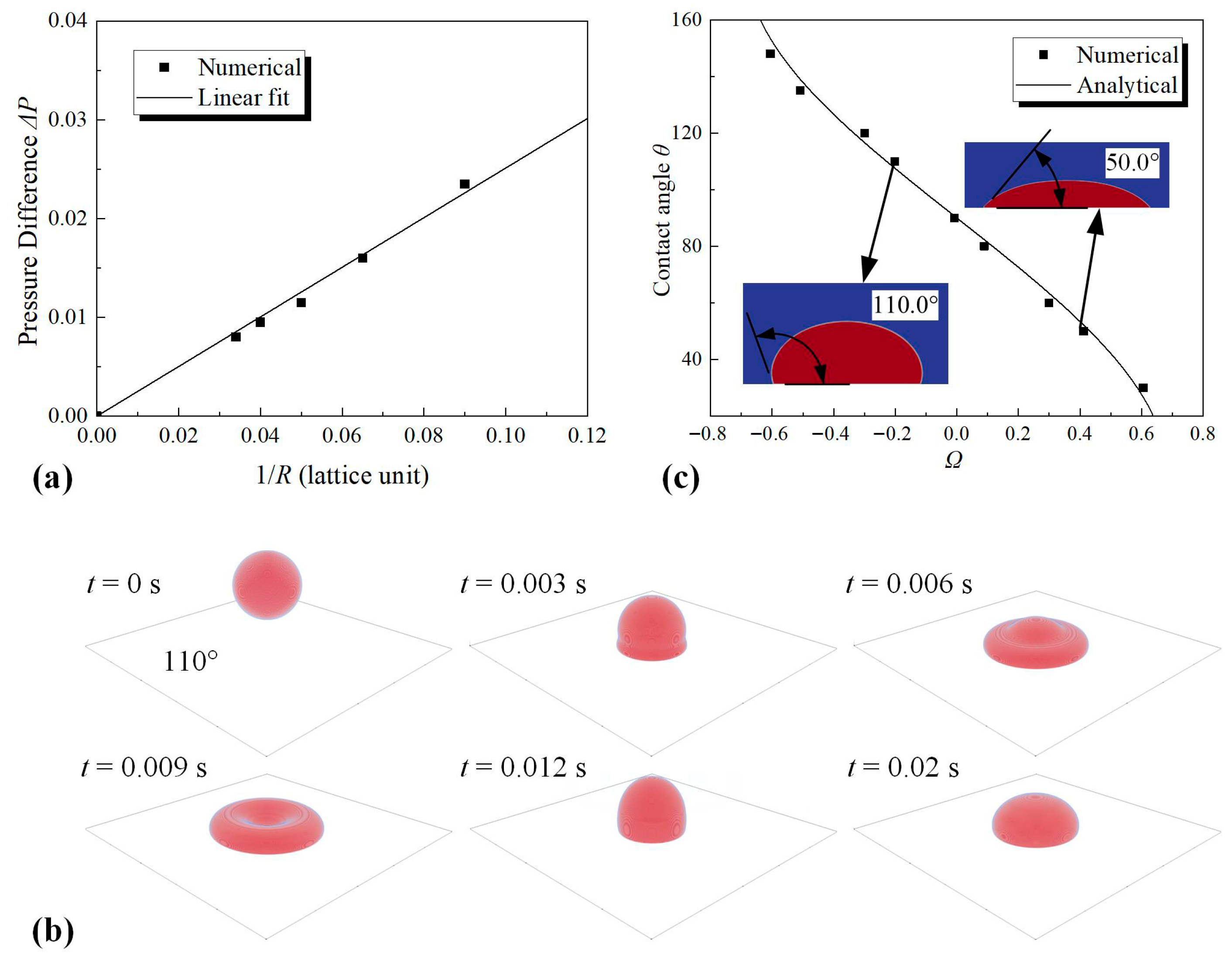
This section presents a verification of the accuracy of the mesoscale multiphase flow model in two typical multicomponent flow cases [37]. The validation process encompasses a surface tension test, which is designed to characterize the capillary pressure between the interfaces of two phases (e.g., water and air) induced by surface tension, and a wettability test, which evaluates the interaction of a liquid droplet with a solid surface as it strikes the solid surface. Moreover, the relationship between the pressure difference (ΔP) at the liquid/air interface and the radius of the bubble (R) is quantitatively described according to Laplace’s law in the case of bubbles suspended in liquids.
Δ P = p i n p o u t = 2 σ R
where pin is the pressure inside the droplet, pout is the pressure outside the droplet, σ is the surface tension, and R is the droplet radius.
In the context of constant surface tension, a linear relationship exists between the pressure difference between the interior and exterior of the droplet and the reciprocal of the droplet radius. In this study, bubbles with radii of 10, 15, 20, and 25 lattice units were selected and positioned at the center of a square flow field with a lattice number of 100 × 100. To maintain the stabilization of the bubbles in the presence of surface tension, the surrounding boundaries were set as periodic boundaries. Once equilibrium was reached, the pressure difference at the interface and the radius of the bubbles in their final equilibrium state were recorded. The data were used to verify whether the relationship between the pressure difference between the interior and exterior of the bubble and the reciprocal of the bubble radius is consistent with Laplace’s law. Figure 2a demonstrates the relationship between ΔP and R. The fitted straight line shows that the pressure difference between the interior and exterior of the droplet is proportional to 1/R, indicating that the simulation results are consistent with Laplace’s law.
The contact angle is a pivotal parameter for evaluating the wetting of a liquid on the surface of a solid material, offering invaluable insight into solid–liquid and solid–gas interfacial interactions. The contact angle is defined as the angle formed by the tangent line between the liquid surface and the solid surface in the three-phase junction region of a solid, a liquid, and a gas. The hydrophilic character of the solid surface exerts a promoting influence on the tendency of small droplets to diffuse over the surface and form a film, whereas the hydrophobic nature of the surface causes the droplets to retain their spherical shape. The value of the contact angle (θ) is determined by the liquid–gas interfacial tension (σg,l), the solid–liquid interfacial tension (σs,l), and the solid–gas interfacial tension (σs,g), by the relationship described by Young’s equation.
cos θ = σ s o l i d , g a s σ s o l i d , l i q u i d σ g a s , l i q u i d = ( 1 + Ω ) 3 / 2 ( 1 Ω ) 3 / 2 2
where Ω is a dimensionless parameter that is related to parameters such as wetting potential.
A droplet is impacted on a flat solid surface to simulate the shape evolution of the droplet, record the impact process and steady-state shape, and obtain the corresponding contact angle. A lattice size of 100 × 100 × 70 is selected, and the droplet is defined as a sphere with a radius of 25 lattice sizes. The droplet is then positioned at 100 lattice sizes from the surface and allowed to move freely toward it, maintaining a contact angle of 110°.
At the initial stage of droplet contact with the solid wall, radial diffusion occurs rapidly (Figure 2c). Upon reaching the maximum diffusion diameter, the external liquid shrinks inward due to surface tension, while the internal liquid continues to expand outward. This results in the formation of a crater in the center of the droplet. The differences in surface wettability result in variations in both the amplitude of droplet oscillation and the stabilization time. The presence of a hydrophobic surface results in a reduction in the radial spreading range of the droplet, with contraction commencing at 0.009 s. As the hydrophobic surface amplifies the contraction force exerted by the droplet on the internal diffusion force, the droplet displays a proclivity to dislodge from the solid surface and exhibits a prolonged oscillation period for the central shape, reaching a steady state at 0.02 s. These observations are in high agreement with the findings of Lee et al. [38]. Figure 2b demonstrates the numerical simulations performed under different contact angle conditions, and the simulation results are in good agreement with the theoretical analysis data.

2.4. Grid Independence Validation

In numerical simulations, the selection of an appropriate grid density is of paramount importance to ensure the computational efficiency of the flow field transients and the accuracy of the results [39,40]. An appropriate number of grids not only minimizes the resource consumption and shortens the computation time, but also ensures the accuracy of the simulation results. Therefore, it is crucial to perform a grid independence test, which has a decisive impact on ensuring the reproducibility and accuracy of the simulation results, as well as improving the computational efficiency.
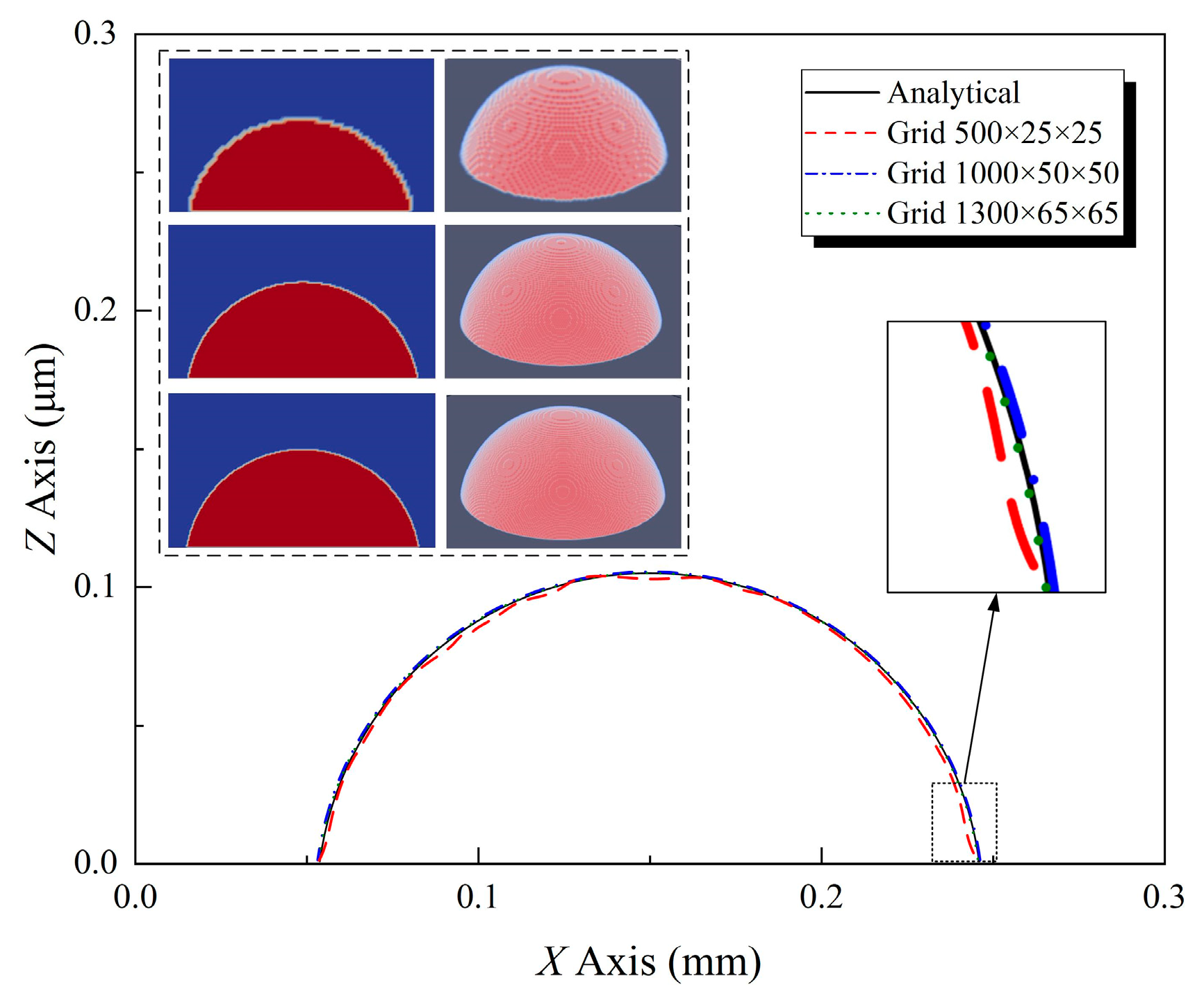
Three distinct grid configurations were utilized in an area with a volume of 20 × 1 × 1 mm3: 500 × 25 × 25, 1000 × 50 × 50, and 1300 × 65 × 65. To ensure the droplets retained a consistent physical dimension, the diameter was set to 0.02 mm in all cases. The equilibrium contact angle was set to 80°. Figure 3 depicts the state of the droplets under the grid sizes. The analysis demonstrates that the 1000 × 50 × 50 and 1300 × 65 × 65 grid sizes exhibit superior agreement between the numerical and theoretical solutions. Table 3 presents a quantitative comparison between the numerical and theoretical solutions for the three grid sizes under consideration, with computational errors below 1% for both the 1000 × 50 × 50 and 1300 × 65 × 65 grid sizes. However, droplet shapes at the 500 × 25 × 25 grid size show significant deviations from the theoretical solution. The 1000 × 50 × 50 grid size was selected for this study to ensure that the computational model achieves an optimal balance between efficiency, numerical accuracy, and reproducibility of results.

3. Results

3.1. Effect of GC Structure on Gas Velocity Distribution

This subsection presents a detailed analysis of each component within the designed block structure. The flow fields within the following four flow channels are simulated using numerical simulation methods: a straight-through shaped flow channel (Case 1), a single fin-shaped block flow channel (Case 2), a single side-retractable block flow channel (Case 3), and a combined flow channel (Case 4). The objective is to examine the impact of each block on the flow field and its cumulative effect on the bidirectional forced convection within the flow channel.
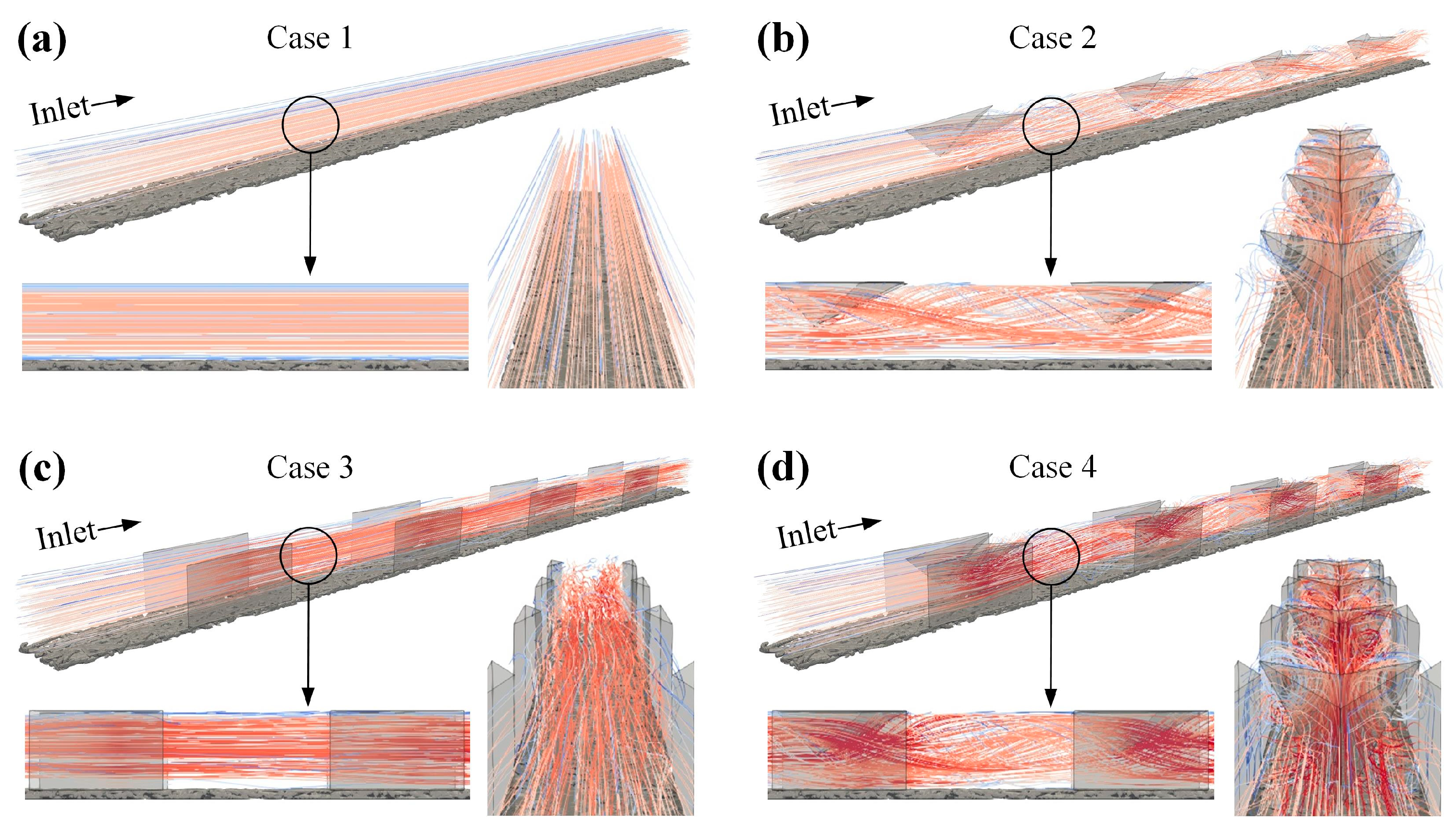
Figure 4 depicts the distribution of flow lines and flow velocity characteristics within the runner for the four cases. In the straight-through shaped runner (Figure 4a), the streamlines of the flow field exhibit a roughly parallel orientation concerning the runner axis. In the vicinity of the wall of the runner and the surface of the GDL, a notable reduction in flow velocity is observed, accompanied by the emergence of minor disturbances in the streamlines. This particular flow channel design results in an average fluid passage and is therefore unable to produce effective forced convection in the direction perpendicular to the flow channel. The reacting gas primarily relies on diffusion to enter the GDL and participate in the reaction, which results in low gas utilization and, consequently, a reduction in the efficiency of the discharge reaction. The introduction of a fin-shaped block at the top of the runner (Figure 4b) results in the initial guidance of the gas flow downward to both sides of the runner by the windward side of the block. Subsequently, the formation of a low-pressure region on the leeward side causes the airflow to diverge from the surface of the block after bypassing the fin peaks and converging towards the centerline at the top of the runner, forming a vortex. This configuration gives rise to periodic forced convection around each fin block, occurring at right angles to the flow path. In comparison to the blocked forced convection, this periodic convection results in a more uniform flow field distribution and enhances the gas flow in the GDL without impeding the passage of the gas in the flow channel, thereby effectively improving the reaction efficiency. The side-retractable block (Figure 4c) markedly amplifies the impact of forced convection in the direction parallel to the flow path while preserving the flow field in the direction perpendicular to the flow path. The combination of a finned block and a side-retractable block (Figure 4d) results in a flow field in the runner that generates periodic forced convection in the direction perpendicular to the runner direction and accelerates the flow field by modifying the vertical cross-sectional area of the runner, thereby enhancing the convective effect of the gas toward the GDL while maintaining high gas throughput.
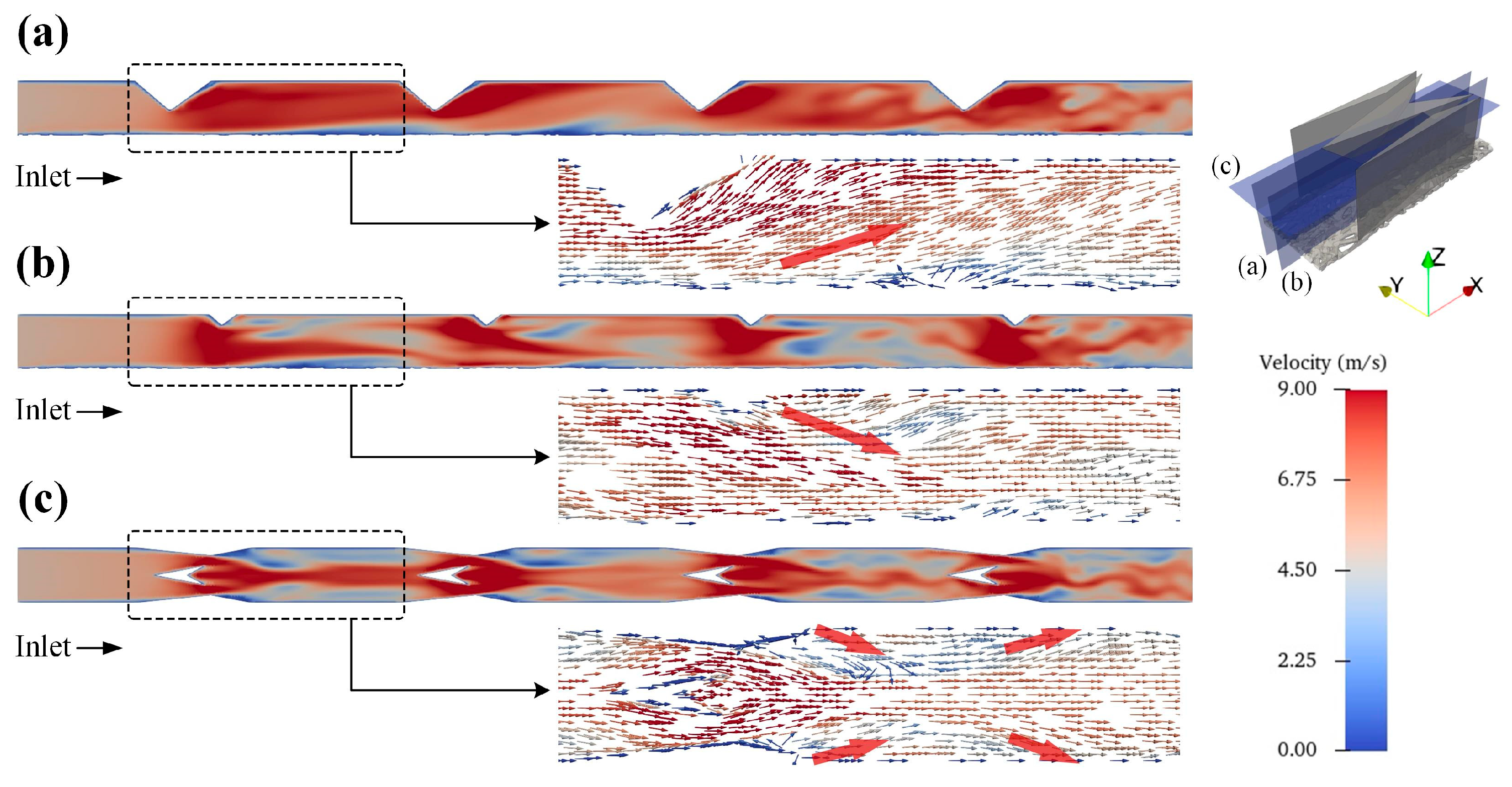
The distribution of the flow field in the vertical direction inside the flow channel was subjected to further analysis in Case 4. The interior of the flow channel was divided into upper and lower layers, as illustrated in Figure 5b. It was observed that the reacting gas gained a downward velocity component in the upper layer upon contact with the finned block. Furthermore, the gas flow is observed to spread to both sides of the flow channel as a consequence of the angular effect exerted by the windward side (Figure 5c). As the flow passes over the top of the finned block, the lower reactive gas acquires an upward velocity component due to the low air pressure at the leeward side and contracts towards the center of the flow path. Figure 5a provides further illustration of the direction perpendicular to the GDL within the flow channel, whereby the gas initially acquires a downward velocity component, which then transitions to an upward velocity component. Following the passage of the gas through a complete block, a regular exchange between the upper and lower layers is achieved within the runner, accompanied by an efficient circulation of the gas layer on the walls and center of the runner. This regular forced convection in the vertical direction within the runner can be significantly enhanced by the incorporation of side retractors in conjunction with the finned block sides.
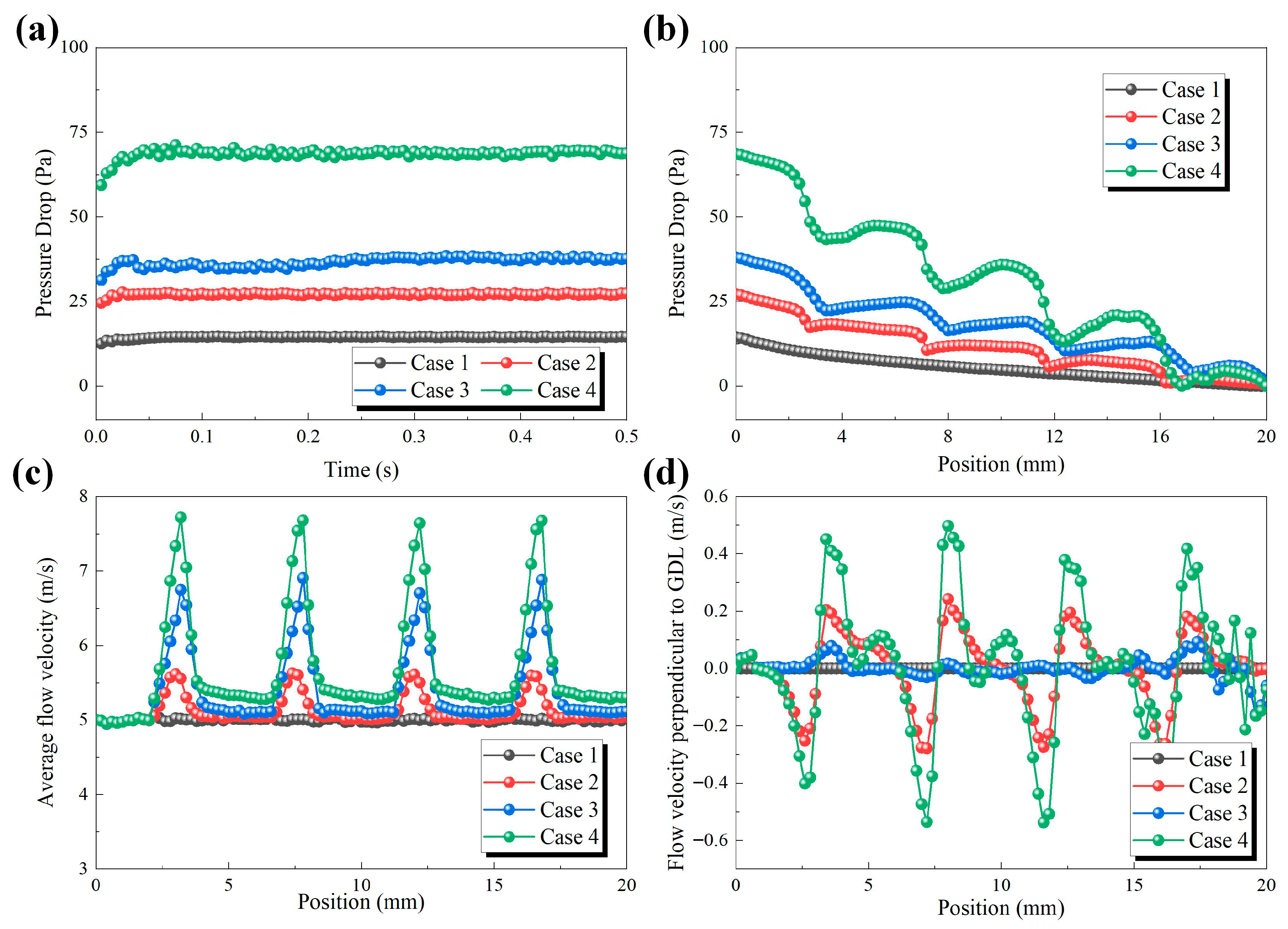
Figure 6a illustrates the inlet and outlet pressure drops over time for four distinct runner designs. The results demonstrate that the Case 1 runner exhibits the lowest and most stable pressure drop, while the Case 2 and Case 3 runners demonstrate a slight increase in pressure drop. In contrast, the Case 4 runner displays a more pronounced increase in pressure drop and exhibits some fluctuations over time. The incorporation of the built-in blocks resulted in a reduction in the average relative vertical cross-sectional area of the flow channel, which subsequently led to an increase in the pressure drop within the flow channel. Upon each iteration of the reactant gas flowing through a block, the pressure drop undergoes a stepwise increase (Figure 6b), while the flow rate demonstrates a periodic change. Figure 6c illustrates the distribution of the flow velocity of the reactive gas at different locations within the flow channel, demonstrating the pivotal role of the side-retractable block in enhancing the overall flow velocity of the flow channel. In contrast, the fin-shaped block has been observed to significantly promote the reactive gas flow rate perpendicular to the direction of the flow channel (Figure 4d). As previously stated, the reactive gas initially acquires a downward velocity component upon contact with the block, followed by an upward velocity component upon bypassing the fin peaks. This results in a regular vertically oriented forced convection flow within the flow channel.

3.2. Effect of GL Structure on Water Management

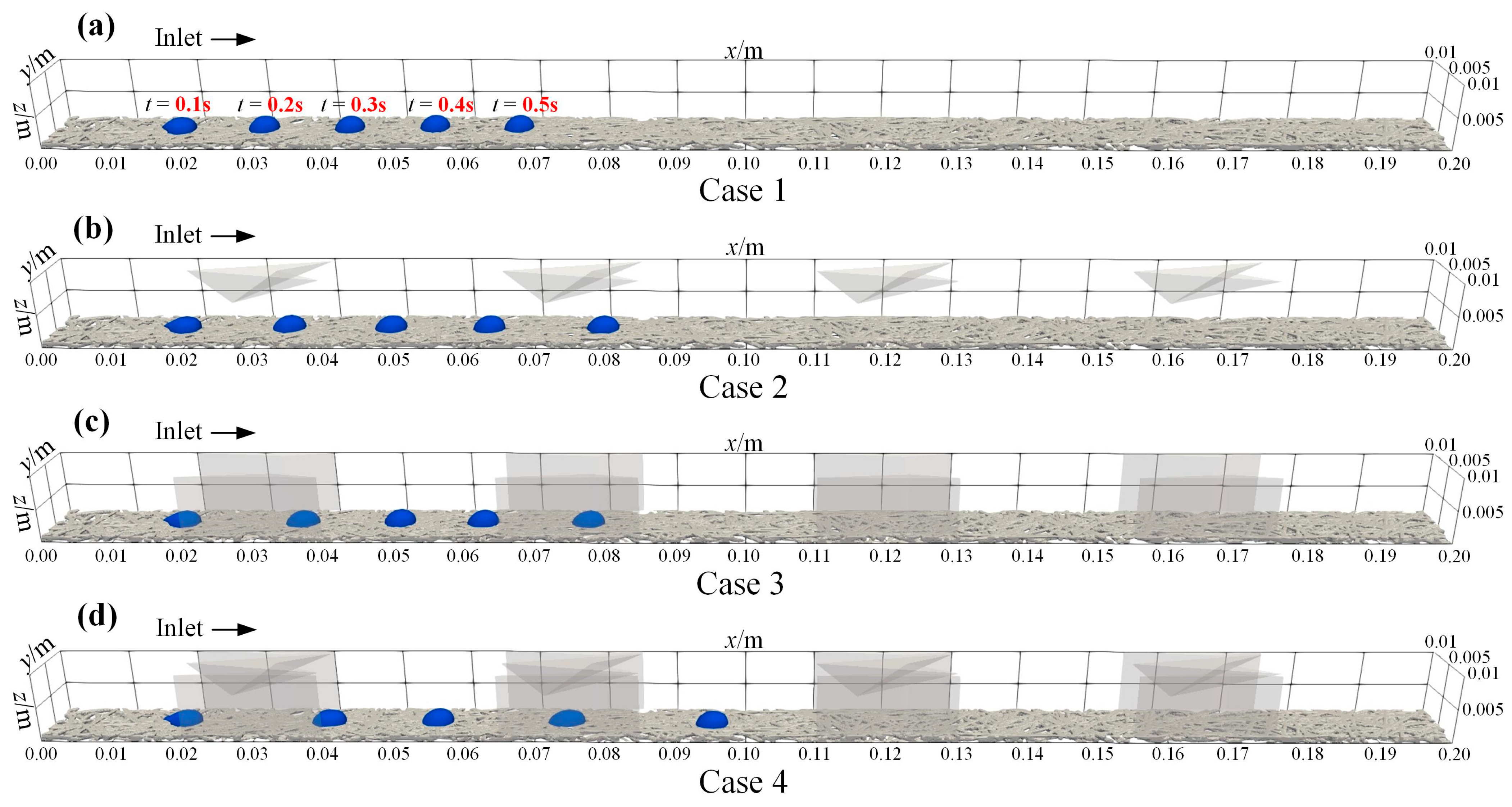
The PEMFC cathode electrode is characterized by the accumulation of condensed liquid water, which penetrates from the interior of the GDL to the surface. This phenomenon is attributed to the continuous generation of reaction-generated water and electro-osmotic drag water. Ultimately, the water is discharged through the flow channel. An investigation into the processes of growth, detachment, and removal of liquid water on the GDL surface represents a significant area of research, offering insights into the transport mechanisms of liquid water within PEMFCs and the potential for mitigating flooding phenomena. This section presents an analysis of the impact of the built-in block on the transport effect of multiphase flow within the flow channel. This is achieved through a comparison of the liquid water transport within four distinct types of flow channels, as illustrated in Figure 5. In the conventional straight-through shaped flow channel (Figure 7a), water droplets are transported along the centerline after being introduced to the surface of the GDL. Their positions and velocities are more average at all moments, but the transport speed is slow, which leads to untimely droplet discharge and consequently, obstruction to the transport of reactive gases into the GDL. The incorporation of built-in blocking blocks facilitates forced convection within the flow channel, thereby enhancing the efficiency of droplet transport to a certain extent. The finned block (Figure 7b) and the side-retracted block (Figure 7c) have comparable effects on droplets. When these two types of blocking blocks were used in conjunction (Figure 7d), the droplet movement speed was markedly enhanced, thereby markedly improving water management in the flow channel.
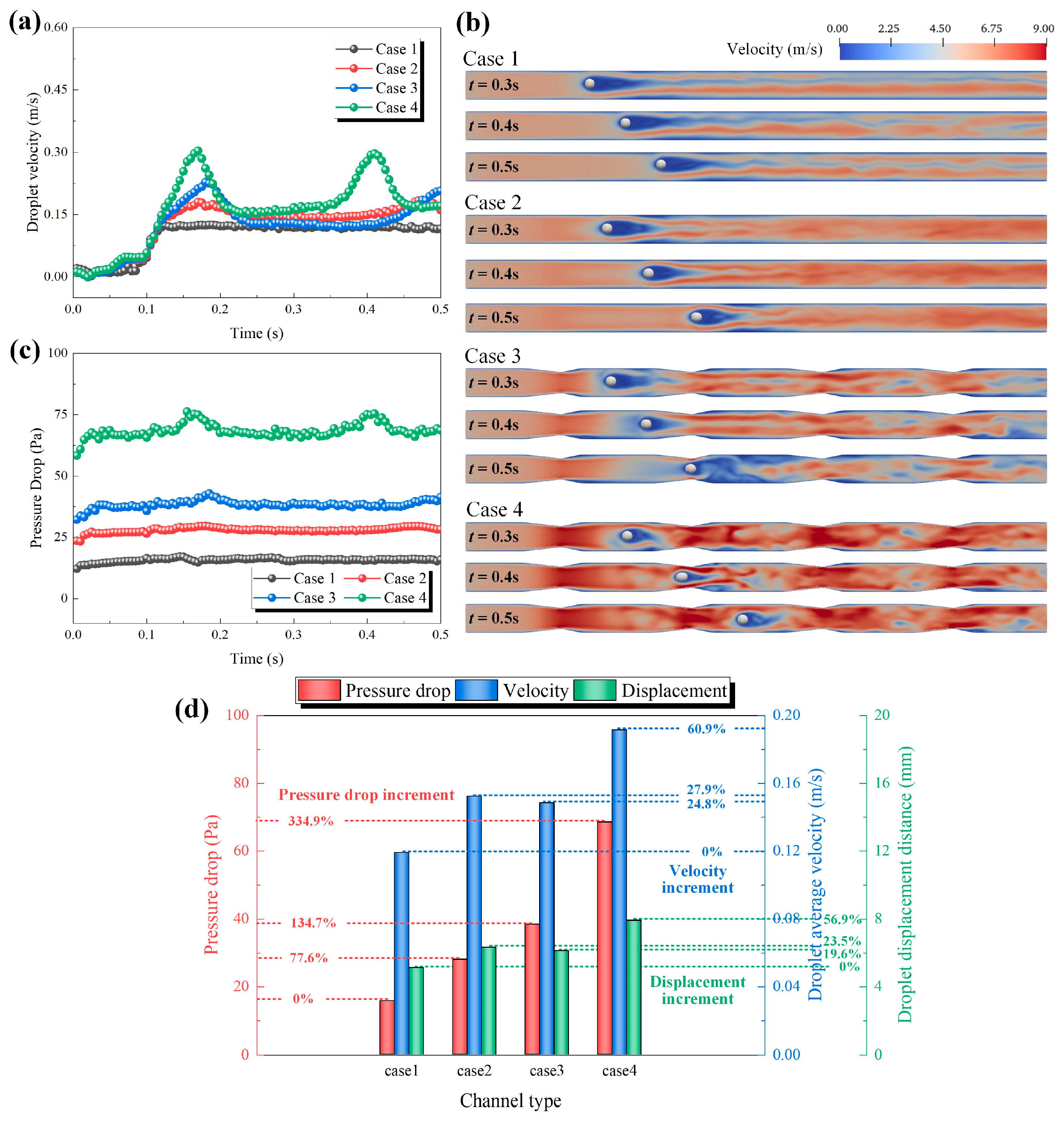
This is since the acceleration of the gas in Case 3 occurs primarily in the middle of the flow channel. As a result of the absence of vertical convection, the gas is not sufficiently conveyed on the walls of the flow channel or on the GDL surface (Figure 8b), and the gas flow is not effectively accelerated. The effective vertical forced convection in the finned block flow channel facilitates enhanced reactive gas movement on the GDL surface, which induces the droplets permeating from the GDL surface to move in the direction of the reactive gas transport. The joint utilization of a finned block and a side-retracting block resulted in the following enhancements: an increased vertically oriented forced convection within the flow channel, a notable increase in the overall flow velocity, and a substantial improvement in the drainage efficiency within the flow channel.
Figure 8d quantitatively compares the transport behaviors across four distinct channel structures. Integrating built-in blocks significantly affects the channel pressure drop and droplet transport velocity under the same discharge volume. Among the four test cases, Case 4 achieved the longest droplet displacement distance (20 mm), outperforming Case 1 in transport efficiency. Additionally, under identical inlet conditions, the substantial pressure drop increase in Case 4 led to a 56.9% extension of droplet displacement distance and a 60.9% enhancement in average droplet transport velocity compared to Case 1. This accelerates liquid water discharge in the channel, notably reduces GDL surface blockage, and improves the diffusion efficiency of reactive gases into the GDL. A logically designed internal channel structure can create a more efficient convective environment for reactive gases under the same external conditions, thereby effectively enhancing both the electrochemical reaction efficiency and water management performance within the channel.
To further verify the performance advantages and numerical model reliability of the proposed fin-shaped side-retracted integrated barrier channel, a comparison of key indicators was conducted with the gradient sinusoidal-wave fin channel proposed by Chen et al. [21]. under the same operating conditions. In terms of pressure drop, the proposed channel maintains a reasonable range while achieving higher mass transfer efficiency, without excessive energy consumption. Regarding the flow velocity in the channel, the maximum z-direction velocity of the proposed channel reaches 3.21 m/s, a 12.2% improvement over the 2.86 m/s of the gradient sinusoidal-wave fin channel, and the maximum y-direction velocity of 0.55 m/s is consistent with the latter, enhancing the bidirectional convection effect. For droplet removal performance, the mass fraction of droplets at the outlet of the GDL-CL interface in the proposed channel is 0.14, a 22.2% reduction compared to the latter’s 0.18, and the droplet residence time is shortened by 30%, demonstrating superior anti-flooding capability. The above comparison results are highly consistent with the experimentally validated numerical trends of Chen et al., which not only confirms the accuracy of the numerical model in this study but also highlights the comprehensive advantages of the proposed channel in velocity enhancement and droplet management.

3.3. Effect of Block Spacing on Multiphase Flow in GC

This section examines the impact of varying arrangement spacings and methodologies on the multiphase flow transport characteristics within the PEMFC flow channel. The investigation is conducted on a flow channel comprising a combination of fin-shaped blocks and side-retracted blocks.
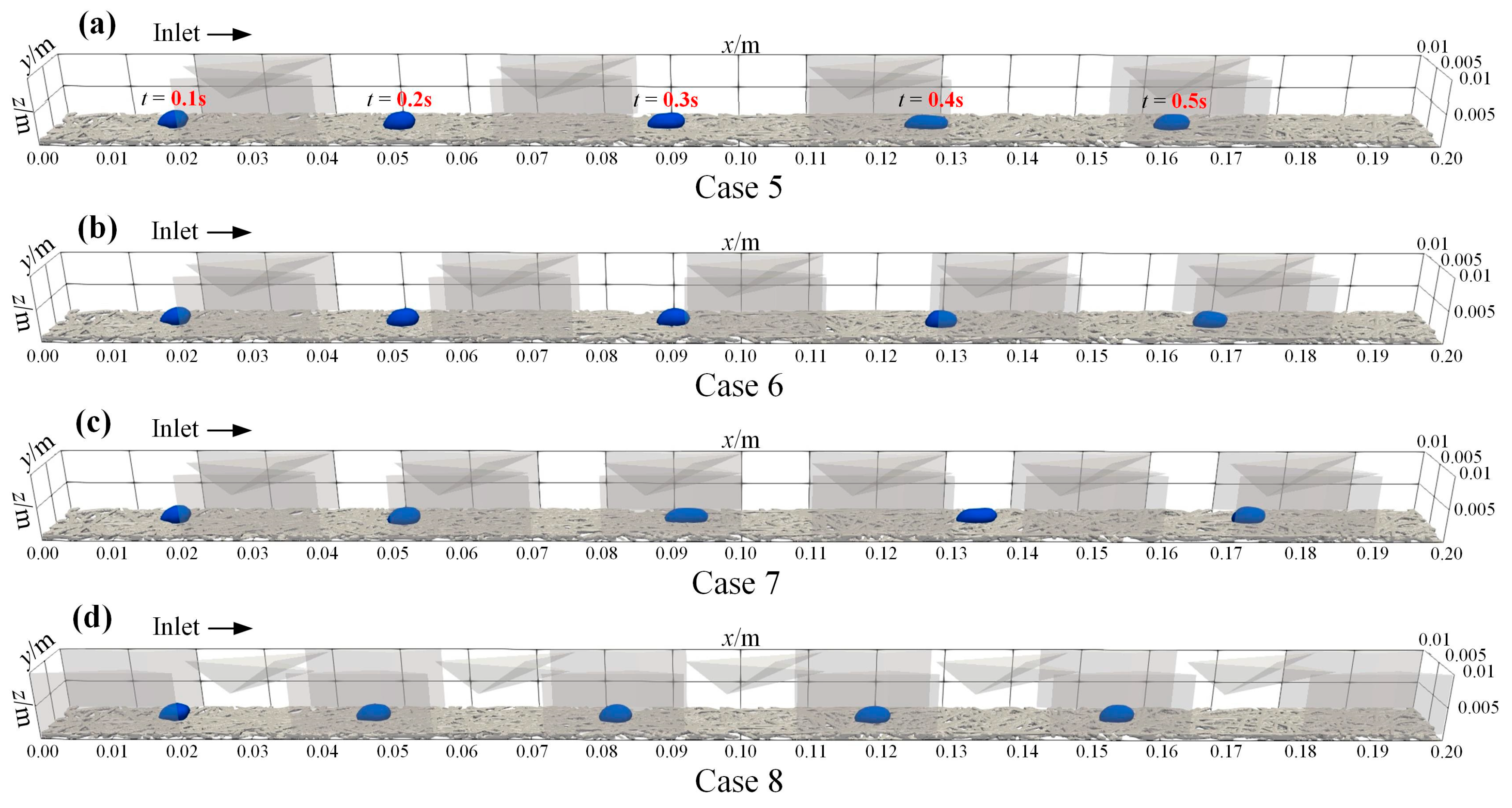
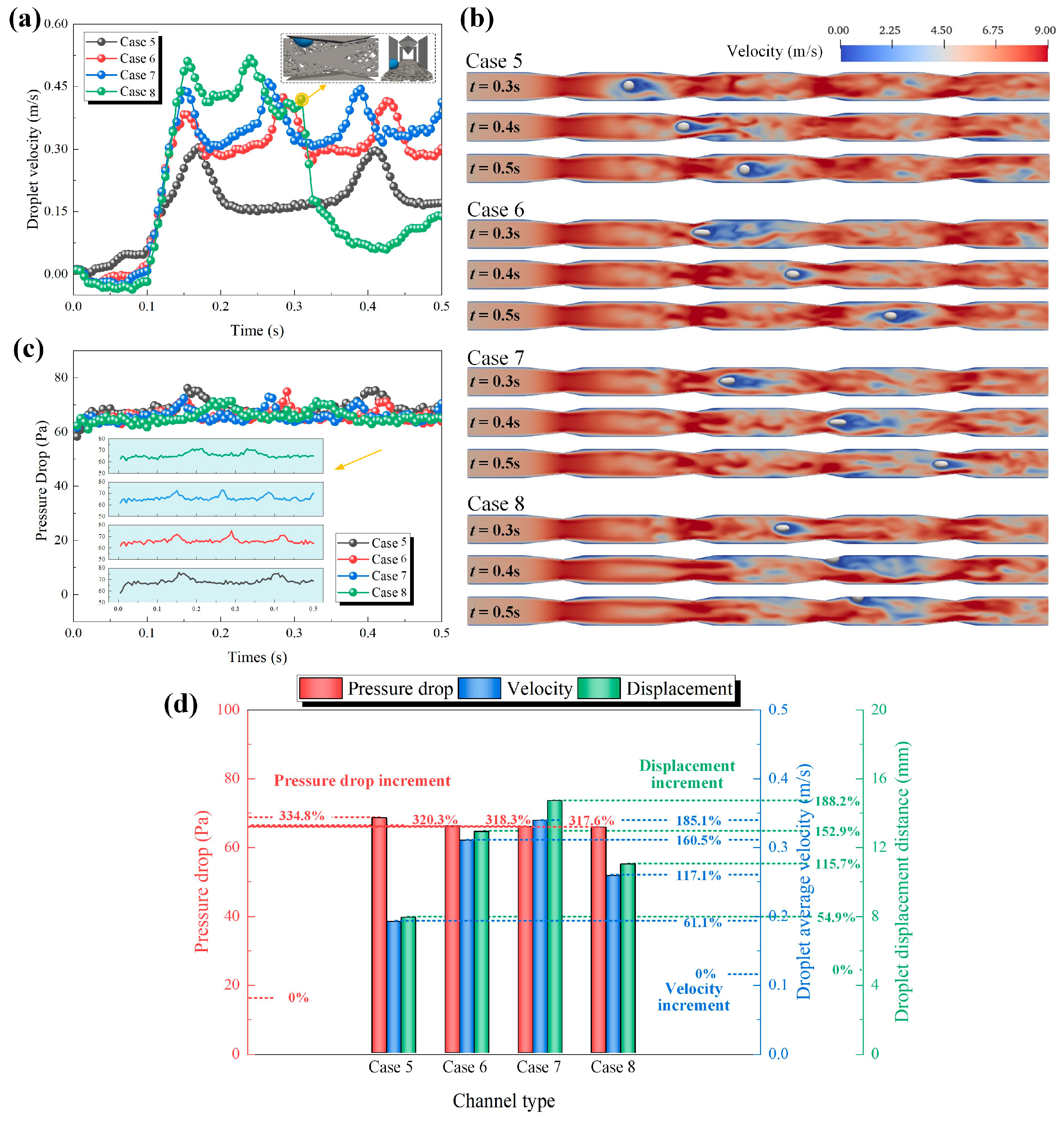
As illustrated in Figure 9, four distinct runner configurations were devised with block spacings of 2.5 mm (Case 5), 1.5 mm (Case 6), 1 mm (Case 7), and two staggered block arrangements (Case 8), all with a spacing of 1.5 mm. The gas inlet velocity and the droplet pumping velocity in the GDL were maintained at consistent levels across all cases, and a GDL with a surface wettability of 130° was selected for analysis. A GDL with a surface wettability of 130° was selected for the simulation. Figure 9a–c illustrate the impact of augmenting the number of blocks within a given runner length on the droplet displacement distance when the block spacing is reduced. It is noteworthy that when the two types of blocking blocks are staggered (Figure 9d), the droplet displacement distance appears to decrease to some extent.
Figure 10a shows the velocity distribution within the four runner structures. The blocking blocks accelerated the nearby reacting gases and created a vertically oriented velocity component, providing an acceleration effect as the droplets passed. In Case 5, Case 6, and Case 7, the number of spikes in the velocity distribution plots increased as the number of blocking blocks increased, increasing in the distance traveled by the droplet in the same amount of time. However, in case 8, the alternating arrangement of blocking blocks attenuated the accelerating effect on the droplets (Figure 10b), which may be due to the lack of functional complementarity between the finned and laterally retracted blocking blocks. Vertical forced convection is essential to promote droplet movement on the GDL surface, whereas the vertical forced convection generated by the fin block alone is usually confined to the block area. The addition of a laterally retractable block adjacent to the finned block can extend the area of action of the vertical forced convection and create effective vertical forced convection throughout the flow path, significantly improving the coherence of droplet movement on the surface of the GDL. As the block spacing is reduced, the pressure drop generated by the reactive gas after passing through the blocks increases progressively, so that the pressure drop in the flow channel increases as the density of the block array increases (Figure 10c).
Figure 10d presents a comparison of pressure drop, average droplet velocity, and displacement distance in the flow channels across Cases 5–8. The findings indicate that with the reduction in block spacing, the droplet transport velocity in the channels increases, exerting a favorable impact on water management. However, once the number of blocks reaches a threshold, the improvement in channel performance decelerates. Furthermore, as the density of the block array rises, the overall pressure drop in the channels increases. Excessive pressure drop necessitates more powerful pumping equipment to overcome it, which not only elevates system energy consumption and reduces energy conversion efficiency but also increases the manufacturing complexity and material usage of bipolar plates. Therefore, rational block arrangement is essential to enhancing the transport efficiency of reactive gases and liquid water within the channels, and profoundly affects the stability and service life of bipolar plates.

4. Conclusions

Investigating the multiphase flow mass transfer mechanism within PEMFCs holds significant implications for scientific inquiry and engineering practice. In this study, a cross-scale gas channel (GC) two-phase flow dynamics model was established via the LBM-VOF approach. Two types of integrated blocks with distinct functionalities were designed, and ten flow channel schemes were developed by combining GDL surfaces with varying wettabilities. Numerical analyses evaluated the impacts of different block combinations on channel flow fields and bidirectional forced convection. The key findings are summarized as follows:
The interaction between the windward and leeward surfaces of the fin-shaped blocks facilitates ordered forced convection of the upper and lower reactive gases in the flow channel, strengthens vertical gas mixing, and effectively promotes the diffusion of reactive gases into the GDL. The side-retractable blocks trigger periodic variations in the average flow area at the vertical interface of the channel, leading to a gradual increase in pressure drop and realizing cyclic acceleration of reactive gases. When combined with fin-shaped blocks, they not only amplify the vertical forced convection effect induced by the latter but also improve gas transport efficiency along the channel direction.
Reactive gas transport efficiency rises with the increasing density of the block array, though this enhancement exhibits a non-linear trend: as block density increases, the incremental gain in transport efficiency diminishes markedly. Additionally, more complex structural designs will increase the manufacturing cost of flow channels. When the spacing of the blocks is 3/4 of their length, the flow channel achieves superior overall performance. Relative to the conventional straight channel, the optimized composite channel yields a 60.9% enhancement in average droplet transport velocity and extends the droplet displacement distance by 56.9% under identical inlet conditions, while reducing the water saturation on the GDL surface by 24.8%.
The gas–liquid two-phase coupling in PEMFCs is a complex cross-scale multiphase fluid dynamics problem, and this study offers a valuable attempt to tackle it. The results provide useful references for investigating cross-scale multiphase flow mass transfer and transport mechanisms. Future research will improve the LBM-VOF model’s physical realism and further explore PEMFC modeling practicality, with specific directions including experimental verification of 3D-printed channels, machine learning-based block geometry optimization, and integration of thermal–electrochemical–fluid coupling models for full-cell performance simulation. This is expected to bridge the gap between numerical simulation and engineering application, providing comprehensive technical support for PEMFC GDL and flow channel structural optimization.

Author Contributions

Conceptualization, Z.L.; Methodology, Z.L. and C.W.; Validation, Z.L., L.L. and D.T.; Investigation, R.Z.; Data curation, C.W. and Y.X.; Writing—review & editing, Z.L.; Funding acquisition, L.L. and D.T. All authors discussed the results and edited or commented on the paper. All authors have read and agreed to the published version of the manuscript.

Funding

This work was partly supported by the Natural Science Foundation of China (NSFC) under Grant (Nos. U25A20294, and 52305139); Zhejiang Province Natural Science Foundation under Grant No. LQ23E050017; Fundamental Research Funds for the Provincial Universities of Zhejiang (RF-A2024001), the China Postdoctoral Science Foundation (No. 2025M771342).

Data Availability Statement

The original contributions presented in this study are included in the article. Further inquiries can be directed to the corresponding authors.

Conflicts of Interest

The authors declare no conflicts of interest.

References

  1. Jiao, K.; Xuan, J.; Du, Q.; Bao, Z.; Xie, B.; Wang, B.; Zhao, Y.; Fan, L.H.; Wang, H.Z.; Hou, Z.J.; et al. Designing the next generation of proton-exchange membrane fuel cells. Nature 2021, 595, 361–369. [Google Scholar] [CrossRef]
  2. Cho, H.; Moon Kim, S.; Sik Kang, Y.; Kim, J.; Jang, S.; Kim, M.; Park, H.; Bang, J.W.; Seo, S.; Suh, K.Y.; et al. Multiplex lithography for multilevel multiscale architectures and its application to polymer electrolyte membrane fuel cell. Nat. Commun. 2015, 6, 8484. [Google Scholar] [CrossRef]
  3. Cullen, D.A.; Neyerlin, K.C.; Ahluwalia, R.K.; Mukundan, R.; More, K.L.; Borup, R.L.; Weber, A.Z.; Myers, D.J.; Kusoglu, A. New roads and challenges for fuel cells in heavy-duty transportation. Nat. Energy 2021, 6, 462–474. [Google Scholar] [CrossRef]
  4. Wang, X.X.; Swihart, M.T.; Wu, G. Achievements, challenges and perspectives on cathode catalysts in proton exchange membrane fuel cells for transportation. Nat. Catal. 2019, 2, 578–589. [Google Scholar] [CrossRef]
  5. Wang, Y.D.; Meyer, Q.; Tang, K.; McClure, J.E.; White, R.T.; Kelly, S.T.; Crawford, M.M.; Iacoviello, F.; Brett, D.J.L.; Shearing, P.R.; et al. Large-scale physically accurate modelling of real proton exchange membrane fuel cell with deep learning. Nat. Commun. 2023, 14, 745. [Google Scholar] [CrossRef] [PubMed]
  6. Navarro, A.J.; Gómez, M.A.; Daza, L.; López-Cascales, J.J. Production of gas diffusion layers with cotton fibers for their use in fuel cells. Sci. Rep. 2022, 12, 4219. [Google Scholar] [CrossRef] [PubMed]
  7. Yang, K.; Kas, R.; Smith, W.A.; Burdyny, T. Role of the carbon-based gas diffusion layer on flooding in a gas diffusion electrode cell for electrochemical CO2 reduction. ACS Energy Lett. 2020, 6, 33–40. [Google Scholar] [CrossRef]
  8. Yan, X.; Lin, C.; Zheng, Z.; Chen, J.; Wei, G.; Zhang, J. Effect of clamping pressure on liquid-cooled PEMFC stack performance considering inhomogeneous gas diffusion layer compression. Appl. Energy 2020, 258, 114073. [Google Scholar] [CrossRef]
  9. Niblett, D.; Mularczyk, A.; Niasar, V.; Eller, J.; Holmes, S. Two-phase flow dynamics in a gas diffusion layer-gas channel-microporous layer system. J. Power Sources 2020, 471, 228427. [Google Scholar] [CrossRef]
  10. Ke, Y.; Zhang, B.; Yuan, W.; Bai, Y.F.; Zhao, Y.H.; Liu, Z.A.; Lin, Z.H.; Li, X.Z.; Wang, Y.A.; Tang, Y. Performance enhancement of proton exchange membrane fuel cells with bio-inspired gear-shaped flow channels. Chem. Eng. J. 2023, 474, 145870. [Google Scholar] [CrossRef]
  11. You, S.H.; Jung, S.M.; Park, J.; Kim, J.; Kim, J.K.; Son, J.; Kim, Y.T. Enhancing durability of automotive fuel cells via selective electrical conductivity induced by tungsten oxide layer coated directly on membrane electrode assembly. Sci. Adv. 2023, 9, 5696. [Google Scholar] [CrossRef] [PubMed]
  12. Ozden, A.; Shahgaldi, S.; Li, X.; Hamdullahpur, F. A review of gas diffusion layers for proton exchange membrane fuel cells—With a focus on characteristics, characterization techniques, materials and designs. Prog. Energy Combust. Sci. 2019, 74, 50–102. [Google Scholar] [CrossRef]
  13. Xu, Y.; Chang, G.; Fan, R.; Cai, T. Effects of various operating conditions and optimal ionomer-gradient distribution on temperature-driven water transport in cathode catalyst layer of PEMFC. Chem. Eng. J. 2023, 451, 138924. [Google Scholar] [CrossRef]
  14. Song, K.; Hou, T.; Jiang, J.; Grigoriev, S.A.; Fan, F.; Qin, J.; Wang, Z.; Sun, C. Thermal management of liquid-cooled proton exchange membrane fuel cell: A review. J. Power Sources 2025, 648, 237227. [Google Scholar] [CrossRef]
  15. Atz, K.; Grisoni, F.; Schneider, G. Geometric deep learning on molecular representations. Nat. Mach. Intell. 2021, 3, 1023–1032. [Google Scholar] [CrossRef]
  16. Chen, T.; Liu, S.; Zhang, J.; Tang, M. Study on the characteristics of GDL with different PTFE content and its effect on the performance of PEMFC. Int. J. Heat Mass Transf. 2019, 128, 1168–1174. [Google Scholar] [CrossRef]
  17. Atyabi, S.A.; Afshari, E.; Wongwises, S.; Yan, W.M.; Hadjadj, A.; Shadloo, M.S. Effects of assembly pressure on PEM fuel cell performance by taking into accounts electrical and thermal contact resistances. Energy 2019, 179, 490–501. [Google Scholar] [CrossRef]
  18. Sun, S.; Fang, L.; Guo, H.; Sun, L.; Liu, Y.; Cheng, Y. A bifunctional liquid fuel cell coupling power generation and V3.5+ electrolytes production for all vanadium flow batteries. Adv. Sci. 2023, 10, 2207728. [Google Scholar] [CrossRef]
  19. Shirsath, A.V.; Bonnet, C.; Arora, D.; Raël, S.; Lapicque, F. Characterization of water transport and flooding conditions in polymer electrolyte membrane fuel cells by electrochemical pressure impedance spectroscopy (EPIS). Int. J. Heat Mass Transf. 2022, 190, 122767. [Google Scholar] [CrossRef]
  20. Brakni, O.; Kerkoub, Y.; Amrouche, F.; Mohammedi, A.; Ziari, Y.K. CFD investigation of the effect of flow field channel design based on constriction and enlargement configurations on PEMFC performance. Fuel 2024, 357, 129920. [Google Scholar] [CrossRef]
  21. Chen, Z.; Zuo, W.; Zhou, K.; Li, Q.; Yi, Z.; Huang, Y. Numerical investigation on the performance enhancement of PEMFC with gradient sinusoidal-wave fins in cathode channel. Energy 2024, 288, 129894. [Google Scholar] [CrossRef]
  22. Li, Z.; Wang, C.; Li, L.; Wu, J.; Yin, Z.; Tan, D. Numerical investigation of mesoscale multiphase mass transport mechanism in fibrous porous media. Eng. Appl. Comput. Fluid Mech. 2024, 18, 2363246. [Google Scholar] [CrossRef]
  23. Yan, S.; Yang, M.; Sun, C.; Xu, S. Liquid water characteristics in the compressed gradient porosity gas diffusion layer of proton exchange membrane fuel cells using the Lattice Boltzmann Method. Energies 2023, 16, 6010. [Google Scholar] [CrossRef]
  24. Meng, X.; Sun, C.; Mei, J.; Tang, X.; Hasanien, H.M.; Jiang, J.; Fan, F.; Song, K. Fuel cell life prediction considering the recovery phenomenon of reversible voltage loss. J. Power Sources 2025, 625, 235634. [Google Scholar] [CrossRef]
  25. Feng, Y.; Gray, K.E. XFEM-based cohesive zone approach for modeling near-wellbore hydraulic fracture complexity. Acta Geotech. 2019, 14, 377–402. [Google Scholar] [CrossRef]
  26. Yan, Q.; Li, L.; Tan, Y.F. Energy transfer characteristics of surface vortex heat flow under non-isothermal conditions based on the lattice Boltzmann method. Processes 2026, in press. [Google Scholar]
  27. Wang, T.; Li, L.; Zhang, Y.; Li, J.C.; Wan, Q.J.; Tan, D.P. Analytical treatment and experimental investigation of forced displacement responses of cracked fluid-filled thin cylindrical shells. Thin Wall Struct. 2026, in press. [Google Scholar]
  28. Sun, Z.; Yao, Q.; Jin, H.; Xu, Y.; Hang, W.; Chen, H.; Li, K.; Shi, L.; Gu, J.; Zhang, Q.; et al. A novel in-situ sensor calibration method for building thermal systems based on virtual samples and autoencoder. Energy 2024, 297, 131314. [Google Scholar] [CrossRef]
  29. Li, L.; Xu, P.; Li, Q.; Zheng, R.; Wu, N.; Bao, J.; Xu, W.; Ma, Q.; Yin, Z. Fluid-induced energy transfer and vibration modes of multiphase mixing in static mixers across flow regime transitions. Chem. Eng. J. 2026, in press. [Google Scholar]
  30. Qi, H.; Zhang, Z.; Huang, M.; Song, C.; Yang, X.; Tang, H.P. Enhancing the mechanical behaviors of 18Ni300 steel through microstructural evolution in electron beam powder bed fusion. J. Mater. Res. Technol. 2025, 36, 4215–4228. [Google Scholar] [CrossRef]
  31. Yang, X.; Song, F.; Zhang, T.; Yao, X.; Wang, W.; Zhang, Z.; Hou, Y.; Qi, H.; Tang, H.P. Surface enhancement by micro-arc oxidation induced TiO2 ceramic coating on additive manufacturing Ti-6Al-4V. Chin. J. Mech. Eng. 2025, 100190, in press. [Google Scholar]
  32. Anyanwu, I.S.; Niu, Z.; Jiao, D.; Najmi, A.U.H.; Liu, Z.; Jiao, K. Liquid Water Transport Behavior at GDL-Channel Interface of a Wave-Like Channel. Energies 2020, 13, 2726. [Google Scholar] [CrossRef]
  33. Mohammadrezaei, S.; Siavashi, M.; Asiaei, S. Surface topography effects on dynamic behavior of water droplet over a micro-structured surface using an improved-VOF based lattice Boltzmann method. J. Mol. Liq. 2022, 350, 118509. [Google Scholar] [CrossRef]
  34. Iglesias van Montfort, H.P.; Li, M.; Irtem, E.; Abdinejad, M.; Wu, Y.; Pal, S.K.; Sassenburg, M.; Ripepi, D.; Subramaian, S.; Biemolt, J.; et al. Non-invasive current collectors for improved current-density distribution during CO2 electrolysis on super-hydrophobic electrodes. Nat. Commun. 2023, 14, 6579. [Google Scholar] [CrossRef] [PubMed]
  35. He, C.; Wen, Q.; Ning, F.; Shen, M.; He, L.; Li, Y.; Tian, B.; Pan, S.; Dan, X.; Li, W.; et al. A new integrated GDL with wavy channel and tunneled rib for high power density PEMFC at low back pressure and wide humidity. Adv. Sci. 2023, 10, 2302928. [Google Scholar] [CrossRef]
  36. Tang, H.; Geng, K.; Wu, L.; Liu, J.; Chen, Z.; You, W.; Yan, F.; Guiver, M.D.; Li, N. Fuel cells with an operational range of −20 °C to 200 °C enabled by phosphoric acid-doped intrinsically ultramicroporous membranes. Nat. Energy 2022, 7, 153–162. [Google Scholar] [CrossRef]
  37. Lee, T.; Liu, L. Lattice Boltzmann simulations of micron-scale drop impact on dry surfaces. J. Comput. Phys. 2010, 229, 8045–8063. [Google Scholar] [CrossRef]
  38. Zheng, G.; Weng, X.; Wang, T.; Xu, P.; Xu, W.; Li, L.; Xu, X.F.; Tan, D. Piezoelectric ultrasonic coupling-based polishing of micro-tapered holes with abrasive flow. J. Zhejiang Univ. Sci. A 2025, 1–22. [Google Scholar] [CrossRef]
  39. Fu, L.; Ding, M.; Jiang, Y.; Ma, Z. A Novel Singular and Harmonics-to-Noise Ratio Deconvolution for Fault Diagnosis in Rotating Machinery. IEEE Trans. Instrum. Meas. 2025, 74, 3556012. [Google Scholar] [CrossRef]
  40. Li, Z.; Zheng, R.; Wang, C.; Li, L.; Wu, J.; Xie, Y.; Tan, D.P. Coupled Design of Cathode GC and GDL Microporous Structure for Enhanced Mass Transport and Electrochemical Efficiency in PEMFCs. Appl. Sci. 2025, 16, 246. [Google Scholar] [CrossRef]
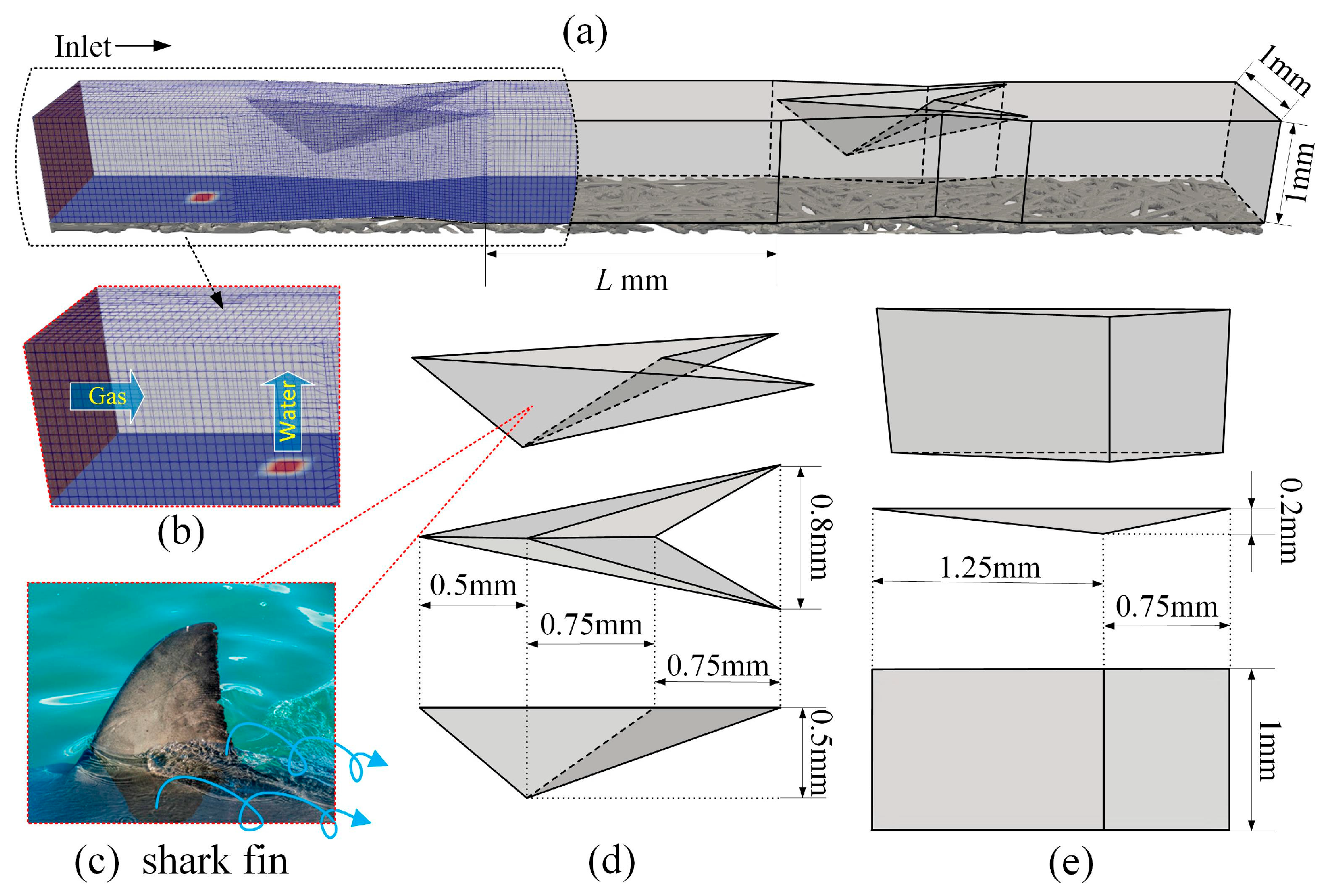
Figure 1. Schematic diagram of the GC in PEMFC. (a) Gas channel; (b) Initial grid condition; (c) Shark fin; (d) Fin-shaped block; (e) Side-retractable block.
Processes 14 00360 g001
Figure 2. Model validation. (a) Pressure difference as a function of bubble radius; (b) Static contact angle; (c) Visualization of droplets striking a flat solid surface.
Processes 14 00360 g002
Figure 3. Grid independence comparison.
Processes 14 00360 g003
Figure 4. Flow distribution of different flow channel designs in cathode-side GCs. (a) Straight-through shaped flow channel; (b) Single fin-shaped block flow channel; (c) Single side-retractable block flow channel; (d) Combined flow channel.
Processes 14 00360 g004
Figure 5. The flow field distribution within different sections of the GC. (a) Vertical centreline section; (b) Vertical off-centre section; (c) Horizontal centreline section.
Processes 14 00360 g005
Figure 6. Gas pressure drop and flow rate distribution in different flow channels. (a) Variation in pressure drop over time; (b) Variation in pressure drop with position; (c) Average flow velocity distribution in flow channel; (d) Vertical flow velocity distribution in the flow channel.
Processes 14 00360 g006
Figure 7. Dynamic transport properties of liquid water within a flow channel. (a) Case 1; (b) Case 2; (c) Case 3; (d) Case 4.
Processes 14 00360 g007
Figure 8. Effect of block type on gas flow rate and droplet distribution in a flow channel. (a) Variation in droplet velocity with time; (b) Velocity distribution in flow channel; (c) Variation in pressure drop with time; (d) Comparison of droplet transport performance in flow channels.
Processes 14 00360 g008
Figure 9. Dynamic transport properties of liquid water within a flow channel. (a) Case 5; (b) Case 6; (c) Case 7; (d) Case 8.
Processes 14 00360 g009
Figure 10. Effect of block arrangement density on gas flow rate and droplet distribution in a flow channel. (a) Variation in droplet velocity with time; (b) Velocity distribution in flow channel; (c) Variation in pressure drop with time; (d) Comparison of droplet transport performance in flow channels.
Processes 14 00360 g010
Table 1. Structural parameters of GC.
Case TypeBlock TypeBlock SpacingGDL Surface Wettability
Case 1//90°
Case 2FS block × 42.5 mm90°
Case 3SR block × 42.5 mm90°
Case 4FS block × 4, SR block × 42.5 mm90°
Case 5FS block × 4, SR block × 42.5 mm130°
Case 6FS block × 5, SR block × 51.5 mm130°
Case 7FS block × 6, SR block × 61 mm130°
Case 8FS block × 5, SR block × 5(interlacing)1.5 mm130°
Table 2. Physical parameters of fluid media.
MediumDensity (kg/m3)Kinematic
Viscosity (m2/s)
Dynamic
Viscosity (Pa·s)
Surface
Tension (N·m−1)
Contact
Angle (°)
Water998.21.01 × 10−61.01 × 10−37.3 × 10−290/130
Air1.2251.48 × 10−51.79 × 10⁻⁵
Table 3. Verification of grid independence at a contact angle of 80°.
Grid SizeNumerical (°)Analytical (°)Bulk Density (%)
500 × 25 × 2577.23°80°−3.47%
1000 × 50 × 5079.22°−0.97%
1300 × 65 × 6579.71°−0.36%
Disclaimer/Publisher’s Note: The statements, opinions and data contained in all publications are solely those of the individual author(s) and contributor(s) and not of MDPI and/or the editor(s). MDPI and/or the editor(s) disclaim responsibility for any injury to people or property resulting from any ideas, methods, instructions or products referred to in the content.