Article

Energy Evolution of Far-Field Surrounding Rock Under True Triaxial Compression Conditions: Taking Fissured Sandstone as an Example

1
College of Energy and Mining Engineering, Shandong University of Science and Technology, Qingdao 266590, China
2
School of Resources Environment and Safety Engineering, University of South China, Hengyang 421001, China
*
Author to whom correspondence should be addressed.
Processes 2026, 14(2), 356; https://doi.org/10.3390/pr14020356
Submission received: 12 December 2025 / Revised: 11 January 2026 / Accepted: 17 January 2026 / Published: 20 January 2026
(This article belongs to the Section Energy Systems)

Abstract

Fissured rock masses are widespread in deep underground mining engineering, and they are prone to inducing instability and failure during excavation activities. Borehole pressure relief is one of the most effective measures with which to control dynamic disaster in high-stress roadways. After pressure relief, redistribution of stress leads to stress concentration in the far-field surrounding rock (far away from working face), which can be represented by true triaxial compression state. However, current research on the energy evolution behavior of fissured rock masses under far-field conditions remains relatively limited. This study analyzes the energy evolution process, peak energy characteristics, and laws of energy storage and dissipation in fractured sandstone under different fissure dip angles (θ, 30°, 45°, 60°, 90°), with intermediate principal stresses (σ2, 10, 20, … 120 MPa) and minimum principal stresses (σ3, 10, 20, … 50 MPa). The results indicate that the curve of dissipated energy ratio versus maximum principal strain becomes more distinctly concave as θ increases under true triaxial compression. The growth rate of the dissipated energy ratio and dissipated energy with maximum principal strain gradually decreases when σ3 is high, and the fissured sandstone is prone to exhibiting ductile failure, leading to a reduced energy dissipation rate. The peak elastic strain energy of fissured sandstone increases gradually with increasing σ2 and shows a linear characteristic. The energy storage and dissipation law is nonlinear with increasing peak total energy for the fissured sandstone with different values of θ. However, the law exhibits a linear trend under varying σ2 and σ3. This study provides a new approach and insight into the failure characteristics of deep fissured sandstone and aims to offer theoretical guidance for the layout and construction safety of roadways or mining panels in far-field surrounding rock in future engineering practices.

1. Introduction

The failure process of rock mass is closely related to its own energy evolution process. The evolution of rock energy drives the rock to damage and eventually leads to rock failure [1,2,3,4,5,6]. Therefore, studying the energy evolution of fissured sandstone holds significant practical implications for underground mining operations.
Fissures in the structural plane and joint in rock mass have great influence on the mechanical properties of rock mass and deep engineering stability [7,8,9,10,11,12,13,14,15]. Scholars have conducted in-depth research on the energy evolution laws of fissured sandstone. For example, Li et al. [16] studied the effects of two fissure layouts on the uniaxial compression characteristics of sandstone. Their study involved strength and deformation properties, failure mode, acoustic emission (AE) characteristics, and energy evolution. Li et al. [17] carried out uniaxial cyclic loading tests on fissured sandstone with different angles. The evolution of deformation characteristics and energy index with peak load and fissured angle under cyclic loading was analyzed. Xia et al. [18] investigated the effects of fissure dip angle on sandstone mechanical properties, failure modes, energy characteristics, and damage progression through uniaxial compression and acoustic emission monitoring systems. Wang et al. [19] carried out numerical simulation tests of uniaxial compression and biaxial compression on single-joint sandstone by PFC2D and analyzed the influence of joint dip angle, joint length and confining pressure on the meso-energy conversion process and stage characteristics.
In fact, it is widely acknowledged that underground rock mass is subjected to a complex truly three-dimensional stress environment with unequal stresses, in which σ1 > σ2 > σ3 (where σ1 represents the maximum principal stress, σ2 represents the intermediate principal stress, and σ3 represents the minimum principal stress) [20,21]. This complex stress environment leads to frequent disasters in stopes and roadways, which seriously hinder the safe and efficient mining of deep mines.
Borehole pressure relief has emerged as one of the most convenient and effective measures for controlling high-stress roadway deformation [22,23]. This technique reduces high stress concentrations by drilling in near-field surrounding rock, thereby transferring peak stress to deeper areas and mitigating or eliminating mining hazards [24,25,26]. As shown in Figure 1a, stress concentrations develop in near-field surrounding rock after roadway excavation, while far-field surrounding rock remains an in situ stress condition (i.e., the true triaxial compression state) [27]. Stress concentration occurs in far-field rock after implementing pressure relief measures (Figure 1b). Under such conditions, fissured rock masses in far-field regions will be subjected to true triaxial compression. Therefore, there is a risk of instability and failure in far-field fissured rock masses due to increased tangential stress. Moreover, when subsequent construction of roadways and stopes is executed in these areas, the failure behavior will be more complicated due to secondary stress concentration. It is hugely important to study the energy evolution of deep far-field fissured rock mass (true triaxial compression) for the stability analysis and disaster control of surrounding rock in deep engineering. Current research on the energy evolution of fissured rock masses predominantly focuses on uniaxial compression, uniaxial cyclic loading–unloading, biaxial compression, and conventional triaxial compression conditions, which differ significantly from the true three-dimensional stress environment induced by borehole pressure relief. Studies on the energy evolution behavior of fissured rock masses under true triaxial loading are scarce, and further investigation in this area is urgently needed.
In this paper, the energy evolution process, peak energy characteristics and variation in dissipated energy ratio affected by fissure dip angles, and stress states are analyzed for fissured sandstone under true triaxial compression. The energy storage and dissipation law is investigated under different influencing factors, and the linear relationships between the law and influencing factors are discussed. This paper will help to further explore the energy distribution characteristics and instability characteristics of fissured sandstone in different stress states and fissure dip angles.

2. Energy Calculation Method

In true triaxial compression, the true triaxial test system is regarded as an adiabatic system. The physical process has no heat exchange with the outside world and is a closed system. The work done by external force on the specimen is the total input energy U. The total input energy (referred to as total energy) has two directions in the process of true triaxial compression. First, the material stores releasable elastic strain energy Ue (referred to as elastic strain energy) in the three principal stress directions. Elastic strain energy represents internally stored energy that enables material shape recovery upon external load removal. This elastic strain energy corresponds to elastic deformation along the σ1, σ2, and σ3 directions. Second, with increasing stress, crack initiation, propagation and plastic deformation of the material occur after exceeding the elastic limit. All these events lead to irreversible consumption of energy, which is dissipated energy Ud. From the first law of thermodynamics,
U = U d + U e
where U is the total input energy, and Ud is the dissipated energy; Ue is releasable elastic strain energy. The total energy and releasable elastic strain energy of each part of the rock mass unit in the principal stress space under true triaxial compression can be expressed as follows [28,29]:
U = σ 1 d ε 1 + σ 2 d ε 2 + σ 3 d ε 3
U e = 1 2 E ¯ [ σ 1 2 + σ 2 2 + σ 3 2 2 μ ¯ ( σ 1 σ 2 + σ 2 σ 3 + σ 1 σ 3 ) ]
where μ ¯ is the average Poisson’s ratio, and E ¯ is the average unloading elastic modulus, which is usually taken as the elastic modulus E0 and Poisson’s ratio μ0 in the late elastic stage [30,31].
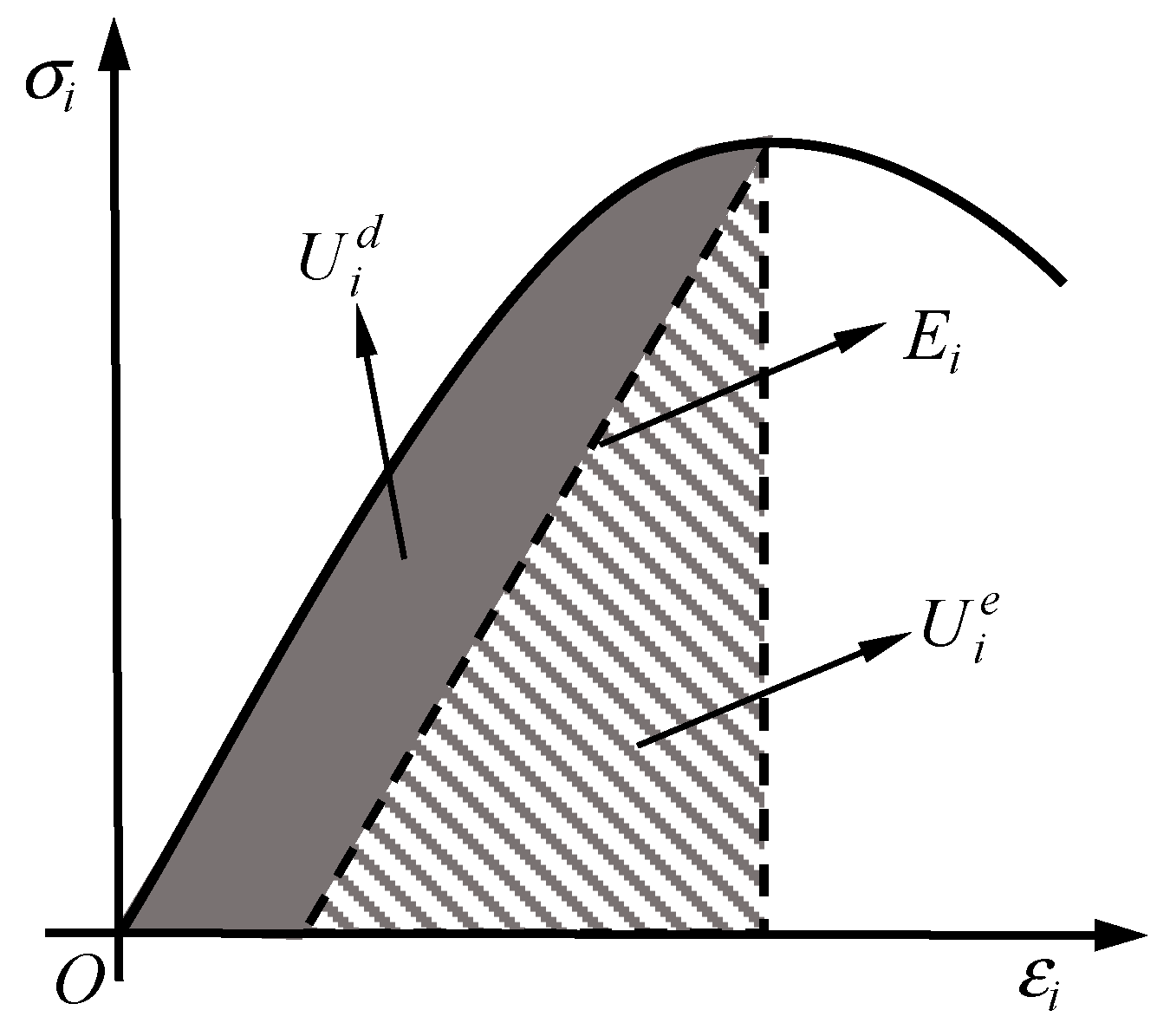
Figure 2 shows the stress–strain curve of rock mass element i. In Figure 2, the shaded area Uie represents the elastic strain energy of the rock mass unit. The gray area Uid represents the dissipated energy of the rock mass unit.
PFC3D is used to establish a numerical simulation model under true triaxial compression. The failure mode and strength characteristics of open jointed rock mass under true triaxial compression have been studied by various authors, and the relevant results can be found in the existing literature [32]. The description of the rock specimen and relevant parameters will not be introduced in the current study. In order to analyze the energy evolution of fissured sandstone under true triaxial compression, the macroscopic stress–strain data of the specimen during numerical simulation were obtained by monitoring and calculating the mechanical response of the loading walls in real time using a custom FISH function. The axial stress (σ1) was defined as the ratio of the average total contact reaction force on the top and bottom loading plates to the current cross-sectional area of the specimen. The axial strain (ε1) was determined by the ratio of the cumulative displacement of the loading walls to the initial height of the specimen. Similarly, the lateral stress and lateral strain were simultaneously monitored based on the force state and displacement field of the lateral servo walls. The corresponding energy calculation is based on above-mentioned equations, and the required stress and strain values can be obtained from previous numerical simulation results [21]. Table 1 shows the peak strength (σ1,peak) in the direction of maximum principal stress and the energy value at the peak strength (where Up is the total energy at the peak strength, Uep is the elastic strain energy at the peak strength, and Udp is the dissipated energy at the peak strength) of selected typical sandstone specimens under true triaxial compression. The specimens in the table are numbered in the form of “x-x-x”. For example, a “60-10-50 specimen” refers to a specimen with a fissure dip angle (θ) of 60°, an intermediate principal stress (σ2) of 50 MPa, and a minimum principal stress (σ3) of 10 MPa. In this paper, energy density (MJ⋅m−3) is used as the unit to express the energy accumulation and dissipation of rock mass in unit volume.

3. Energy Consumption Analysis in the Process of Rock Mass Failure

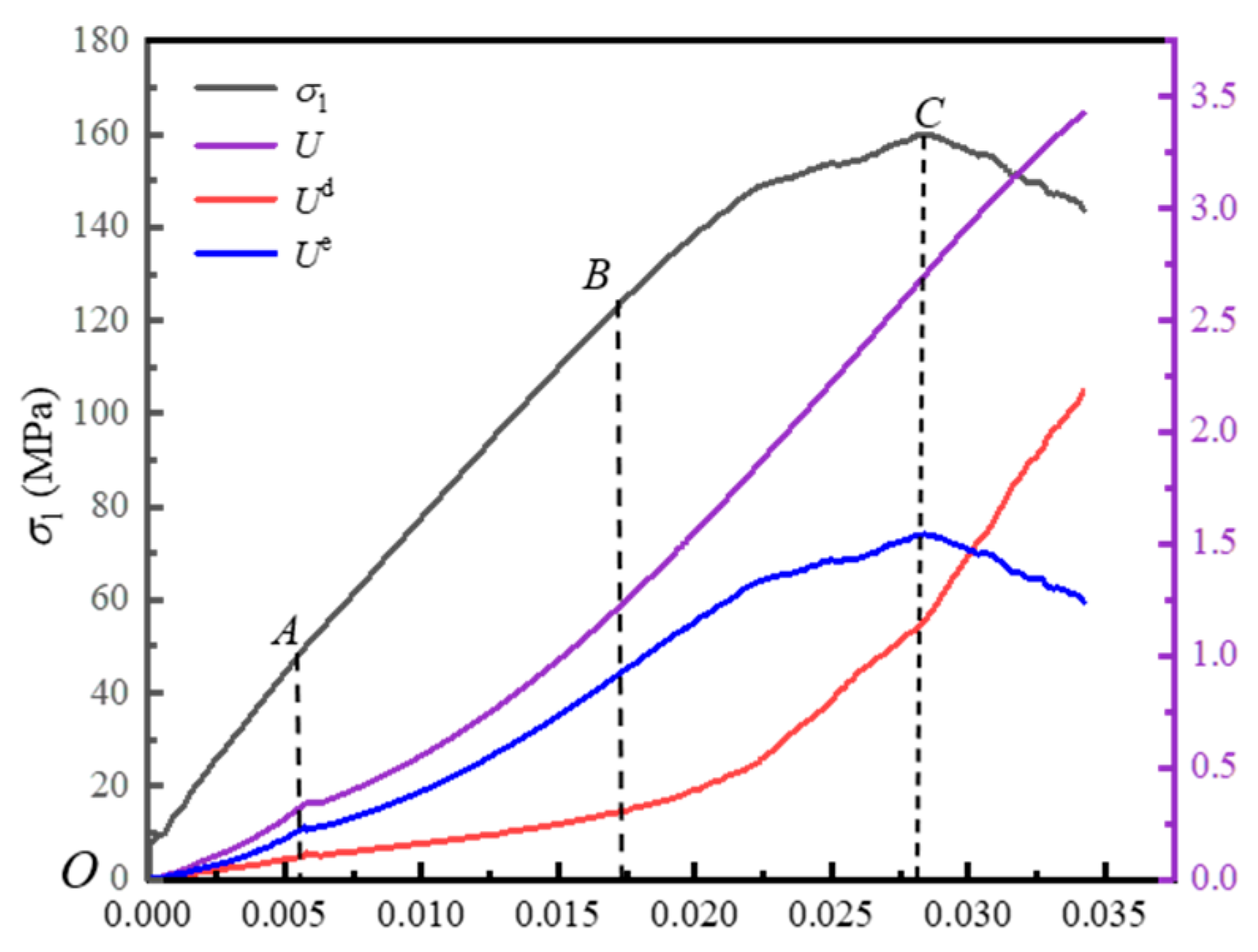
The energy evolution curve of the 60-20-50 specimen under true triaxial compression is selected for analysis. The test is stopped when the post-peak maximum principal stress reaches 90% of the peak strength. Based on the numerical simulation characteristics of discrete element method, rock mass usually does not directly show the compaction and closure stage caused by the gradual closure of pores or cracks in PFC3D numerical simulation. In Figure 3, in the initial loading stage (OA), before the maximum principal strain reaches 21.3% of the strain corresponding to the peak stress, the contact relationship between particles of fissured sandstone specimens is adjusted. Some particles may change from non-contact to contact, or the normal and tangential forces at the contact point will gradually increase. Most of U is converted into Ue. Only a small part is dissipated. In the linear elastic stage (AB), before the maximum principal strain reaches 60.3% of the strain corresponding to the peak stress, Ue increases rapidly with the increase in σ1, and slope gradually increases. However, Ud increases slowly with the stress. This indicates that there is less irreversible deformation and more reversible deformation at this stage, and U is more converted into Ue. In the fluctuating stage (BC), before the maximum principal strain reaches the strain corresponding to the peak stress, the stress–strain curve of rock mass presents nonlinear characteristics with the increase in σ1. The crack activity in rock mass is more active, and more input energy is used for the formation and propagation of cracks in rock mass. It is observed that Ud increases rapidly. Meanwhile, Ue continues to rise at a slow rate, with Ud still remaining below Ue. When the peak stress (point C) is reached, Ue reaches the maximum, and Ud still keeps growing rapidly. In the post-peak stage (after point C), the bearing capacity of rock mass decreases, the cracks propagate rapidly, and a large amount of energy is used up in the failure of rock mass. A rapid growth rate is observed, where Ud increases sharply, whereas Ue begins to decline. Consequently, Ud exceeds Ue at this stage.
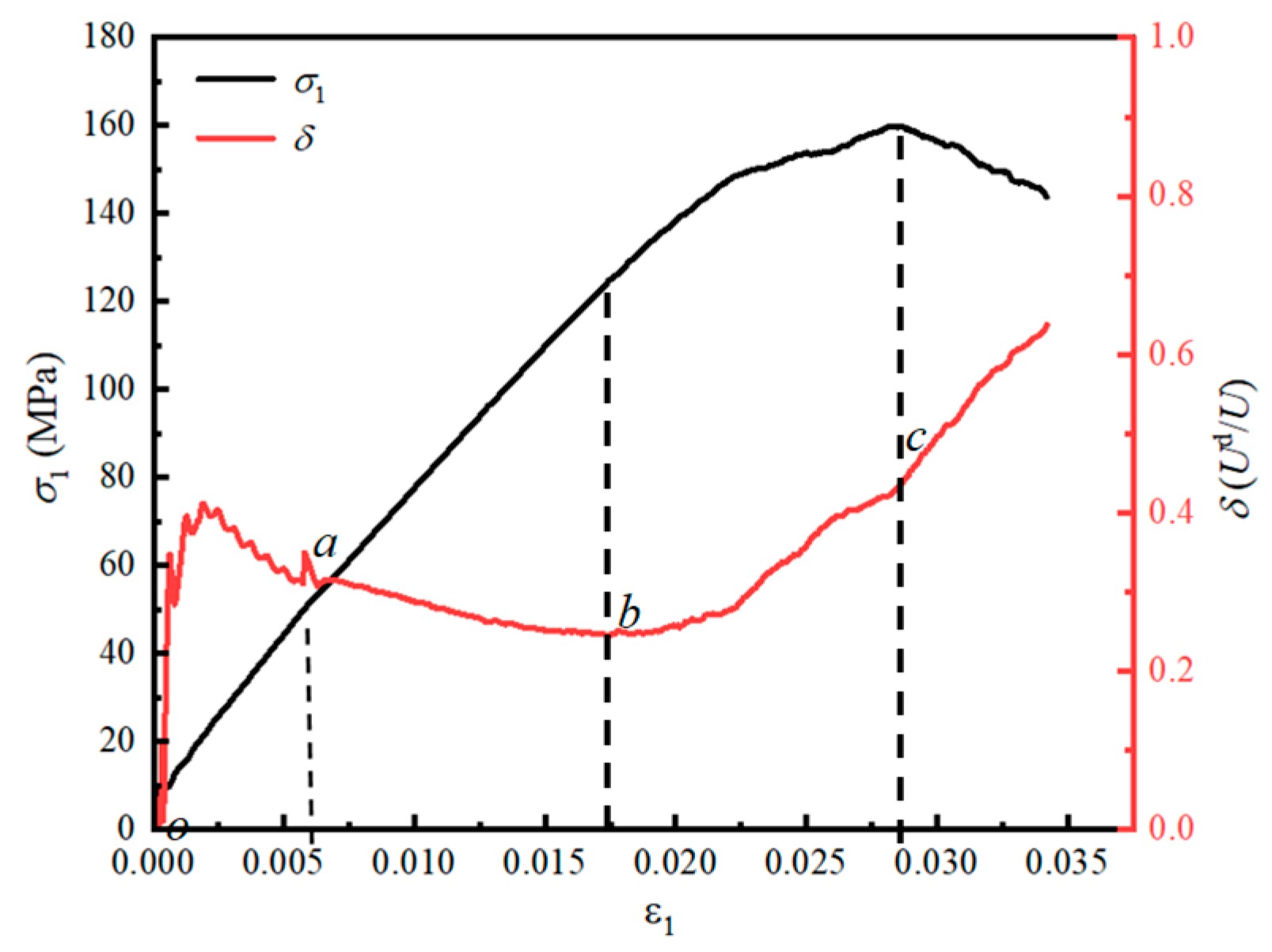
In the process of true triaxial loading, the ratio of dissipated energy to total energy (Ud/U) is called the dissipated energy ratio (δ). Dissipated energy ratio is an important index for evaluating internal structural changes in rock masses. A low dissipated energy ratio often indicates better elastic recovery and higher stability, while a high dissipated energy ratio suggests significant crack propagation and friction within the rock mass. Figure 4 shows the dissipated energy ratio and stress–strain curve for 60-20-50 specimen. It can be seen that the dissipated energy ratio first increases, then decreases, and increases again as the maximum principal strain increases. For easier analysis, the curve of dissipated energy ratio versus maximum principal strain is divided into four stages: the oa stage, ab stage, bc stage and post-c stage. In the oa stage, the dissipated energy ratio exhibits an overall trend of initial increase followed by decrease: The increase phase corresponds to the reorganization of particle contacts upon initial loading, which involves significant energy dissipation and leads to a rapid rise in the dissipated energy ratio. The decrease phase occurs as the total energy and elastic strain energy accumulate with increasing maximum principal strain, bringing the specimen closer to the elastic stage. Although the intensity of particle contact adjustments slows down, it has not yet fully stabilized, resulting in a decline in the dissipated energy ratio accompanied by certain fluctuations. In the ab stage, the stress–strain curve is in a linear elastic phase. The deformation of rock mass is mainly reversible. As the maximum principal strain increases, the input energy is mainly converted into stored elastic strain energy. Interparticle contact relationships tend to stabilize, and the variation in dissipated energy remains minimal. Consequently, the proportion of dissipated energy gradually decreases. In the bc stage, the stress–strain curve begins to fluctuate. A greater proportion of energy is consumed for crack initiation and growth, leading to rapid accumulation of internal damage and a sharp rise in the dissipated energy ratio. In the post-c stage, following the attainment of peak stress, cracks within the rock mass rapidly propagate and coalesce, accompanied by a continued increase in the dissipated energy ratio.

4. Results and Analysis

4.1. Energy Evolution Law of Fissured Sandstone Under Different Fissure Dip Angles

4.1.1. Energy Evolution of Fissured Sandstone Under Different Fissure Dip Angles

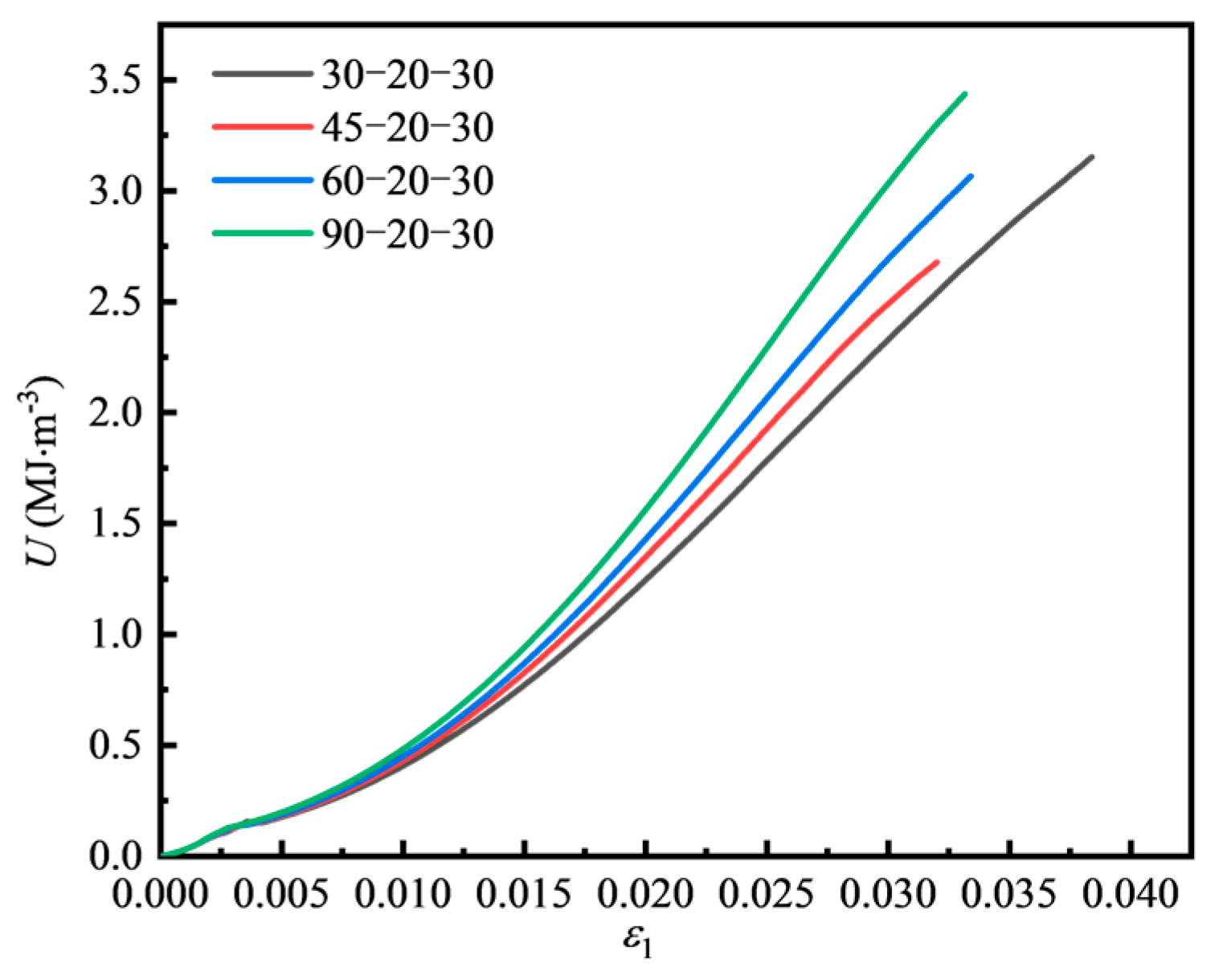
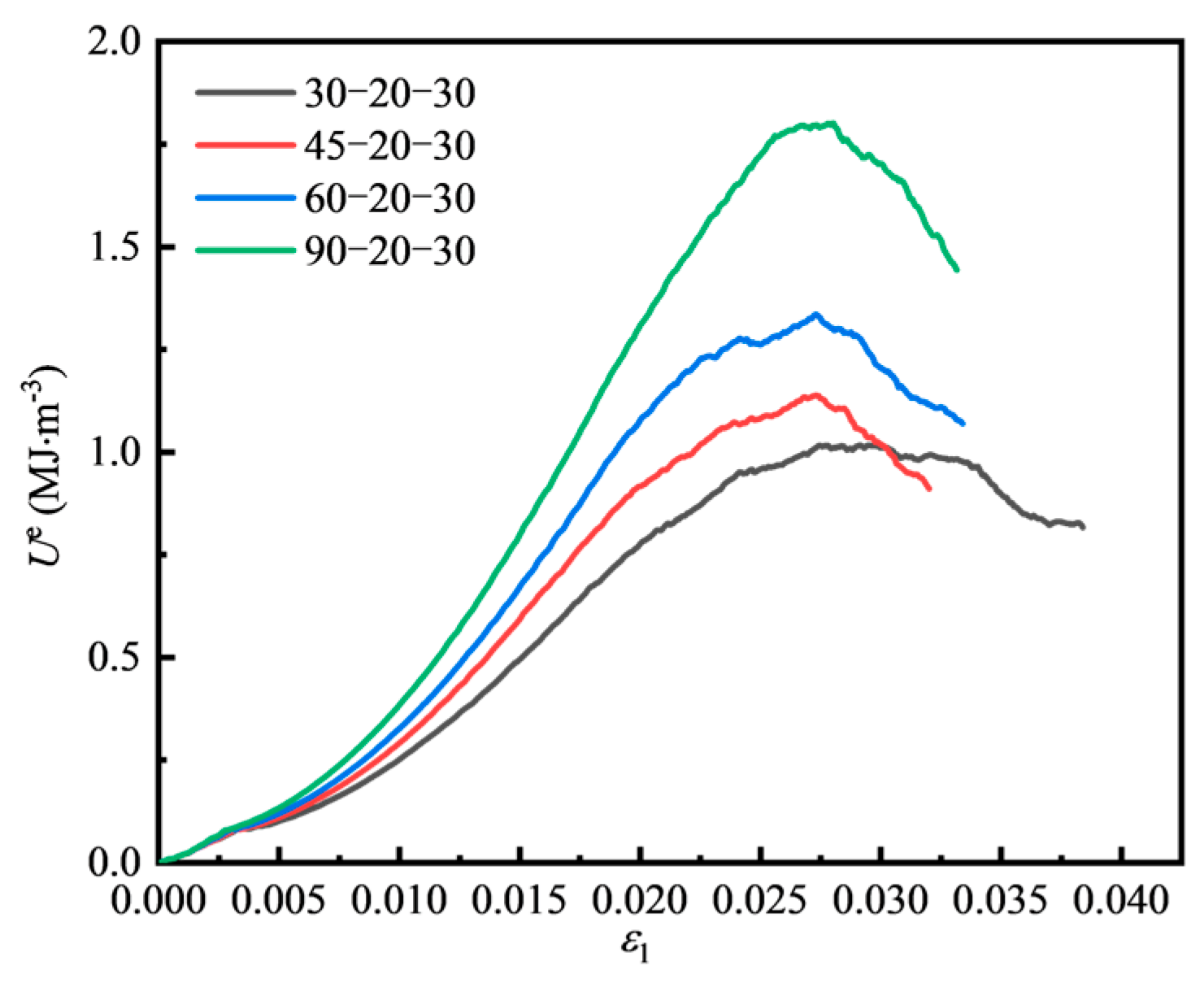
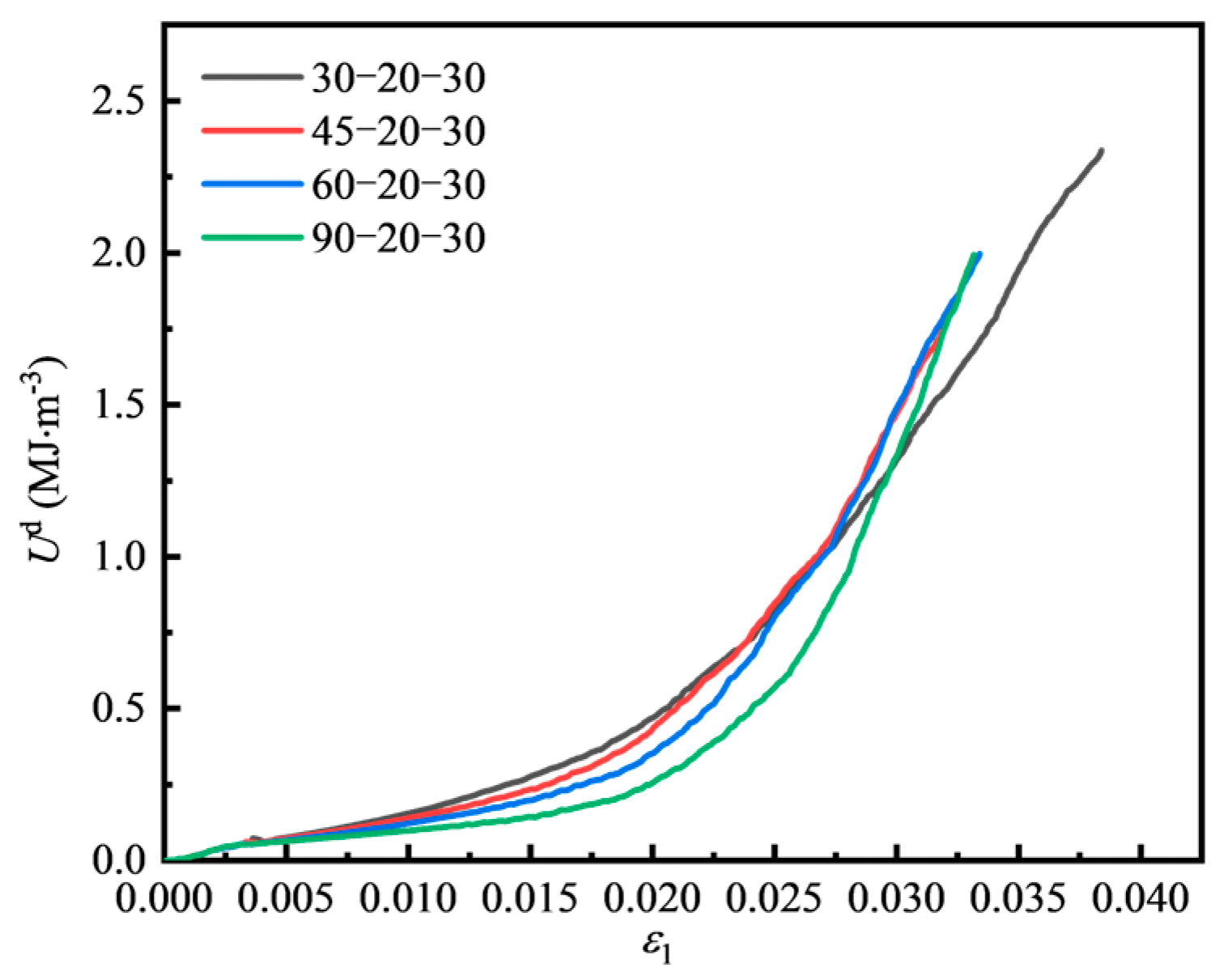
The energy evolution law of fissured sandstone specimens under different fissure dip angles is shown in Figure 5, Figure 6 and Figure 7. As shown in Figure 5, with the increase in fissure dip angle, the growth rate of the total energy of the specimen gradually slows down with the increase in the maximum principal strain. At the initial loading stage, the fissure dip angle has little effect on total energy, and the differences in total energy among specimens are small. However, the fissure dip angle significantly affects the rock mass after entering the linear elastic stage, leading to greater differences in total energy among specimens. With the increase in fissure dip angle, the total energy of the specimen increases obviously under larger maximum principal strains. Figure 6 shows that the elastic strain energy of all specimens first increases and then decreases with increasing maximum principal strain under different fissure dip angles, but the magnitude of change varies. As the fissure dip angle increases, the maximum elastic strain energy of the specimen increases gradually. The 90° specimen achieves the highest peak, which corresponds to its highest peak strength compared to other dip angles. As shown in Figure 7, the dissipated energy of specimens changes in a similar way under different fissure dip angles. The dissipated energy increases rapidly under larger maximum principal strains, and the curve becomes steeper, indicating that cracks rapidly propagate within the specimens.

4.1.2. Energy Variation at Peak Strength Under Different Fissure Dip Angles

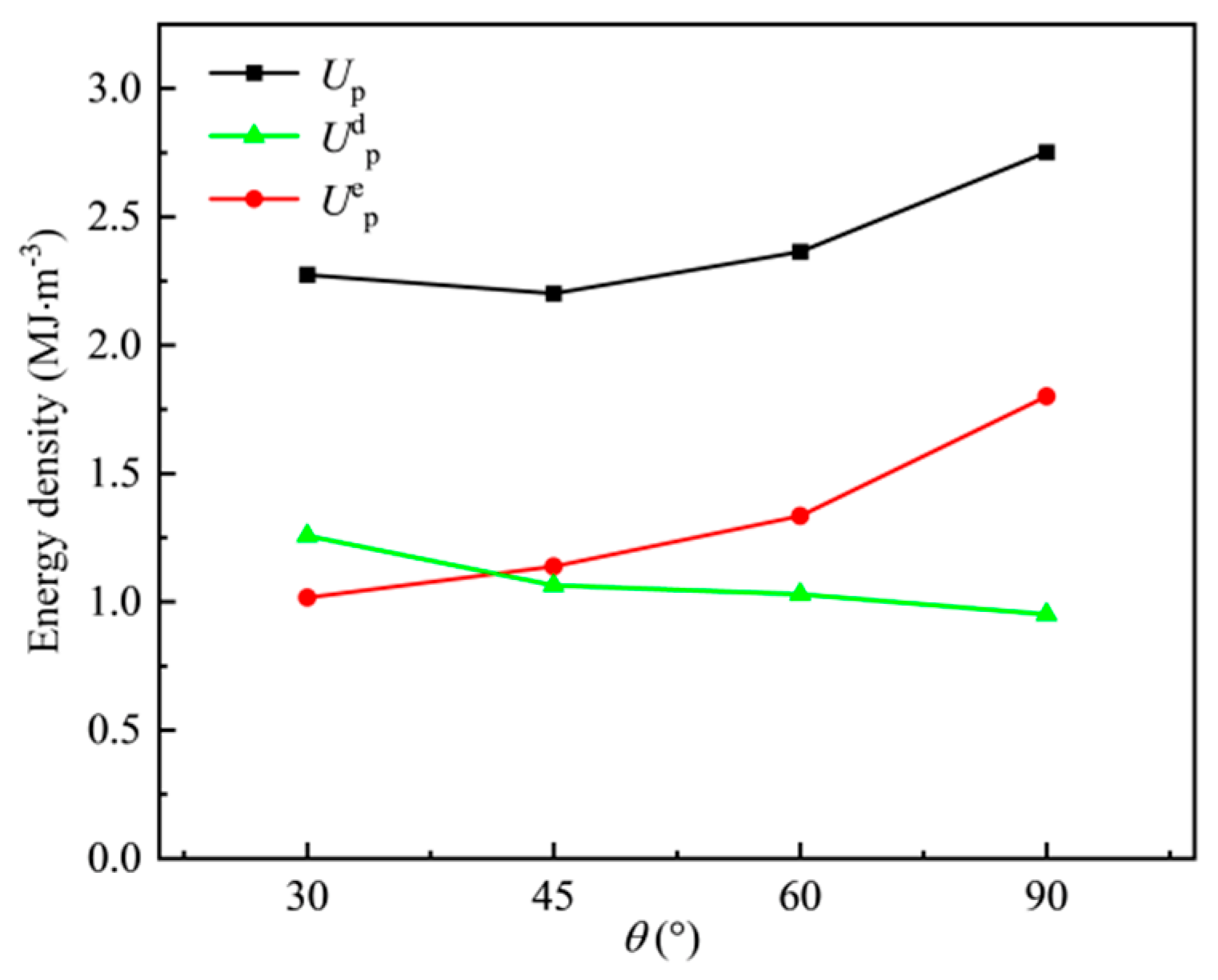
Figure 8 illustrates the energy variation at the peak strength of sandstone under different fissure dip angles. It can be seen that the total energy at the peak strength first decreases then increases as the fissure dip angle increases under the same stress state. The evolution law of total energy is as follows: the total energy at the peak strength is smaller for the 30° and 45° specimens, larger for the 60° specimen, and largest for the 90° specimen. This law aligns with the strength variation under different fissure dip angles (Table 1). The elastic strain energy at the peak strength gradually increases with the increase in fissure dip angle in the same stress state, reaching a maximum for the 90° specimen. Moreover, the dissipated energy at the peak strength of the specimen decreases gradually as the fissure dip angle increases, with the 30° specimen showing the highest value and the 90° specimen the lowest in the same stress state.

4.1.3. Variation in Dissipated Energy Ratio Under Different Fissure Dip Angles

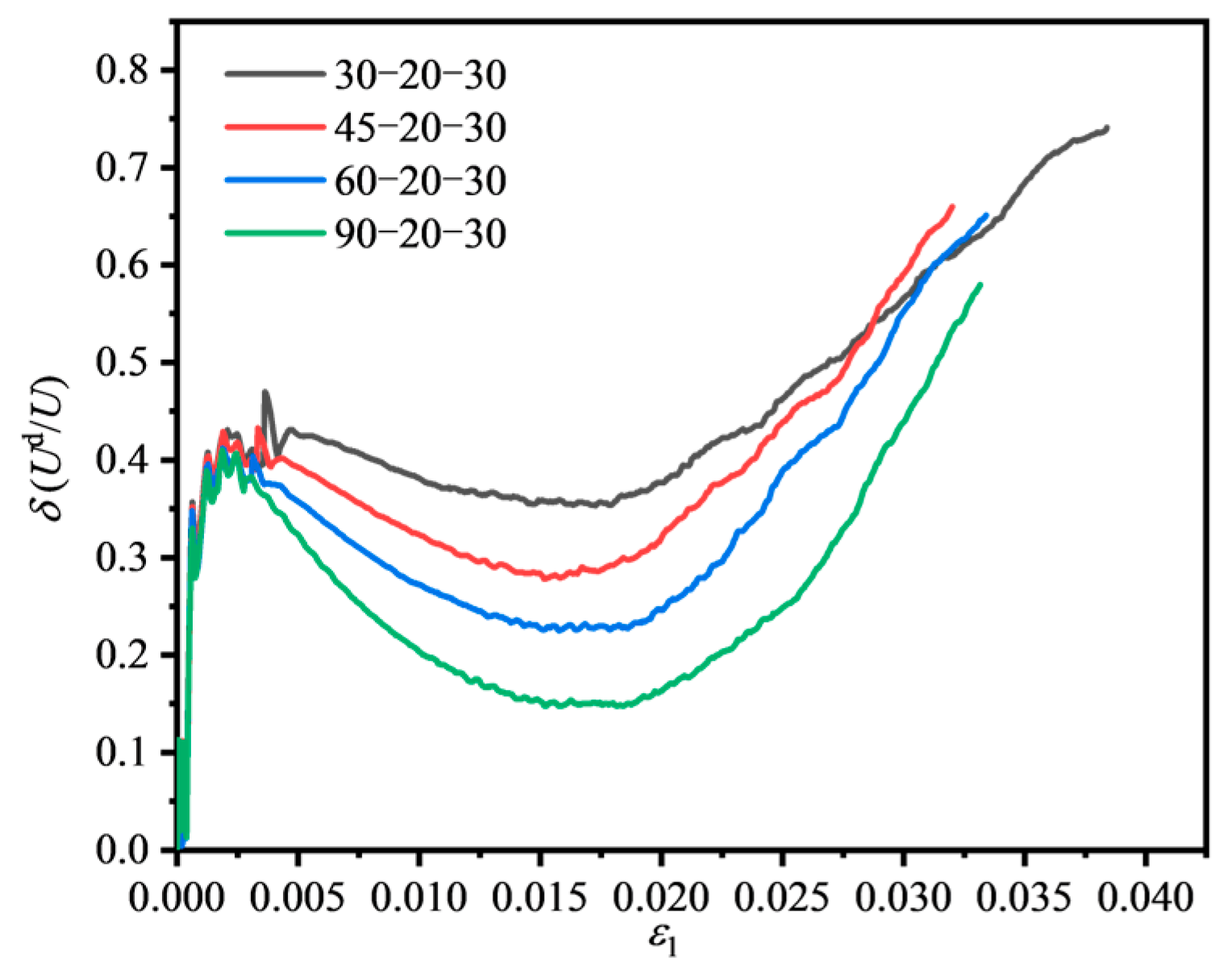
Figure 9 shows the variation in dissipated energy ratio with the maximum principal strain with different fissure dip angles. Specimens with different fissure dip angles exhibit a similar variation in dissipated energy ratio. However, the dissipated energy ratio of the 30° and 45° specimens increases rapidly during loading, and the dissipated energy ratio is obviously larger than that of the 60° and 90° specimens as a whole. This corresponds to the lower peak strength observed in the 30° and 45° specimens. In addition, as the fissure dip angle increases, the curves representing the variation in dissipated energy ratio with maximum principal strain become more distinctly downward and concave, and the minimum value of the dissipated energy ratio is smaller. In contrast, the curves for specimens with smaller fissure dip angles are relatively flat, maintaining a higher level of dissipated energy ratio throughout. This indicates that specimens with larger fissure dip angles possess better elastic recovery capabilities.

4.2. Energy Evolution Law of Fissured Sandstone Under Different Minimum Principal Stress Conditions

4.2.1. Energy Evolution of Fissured Sandstone Under Different Minimum Principal Stress Conditions

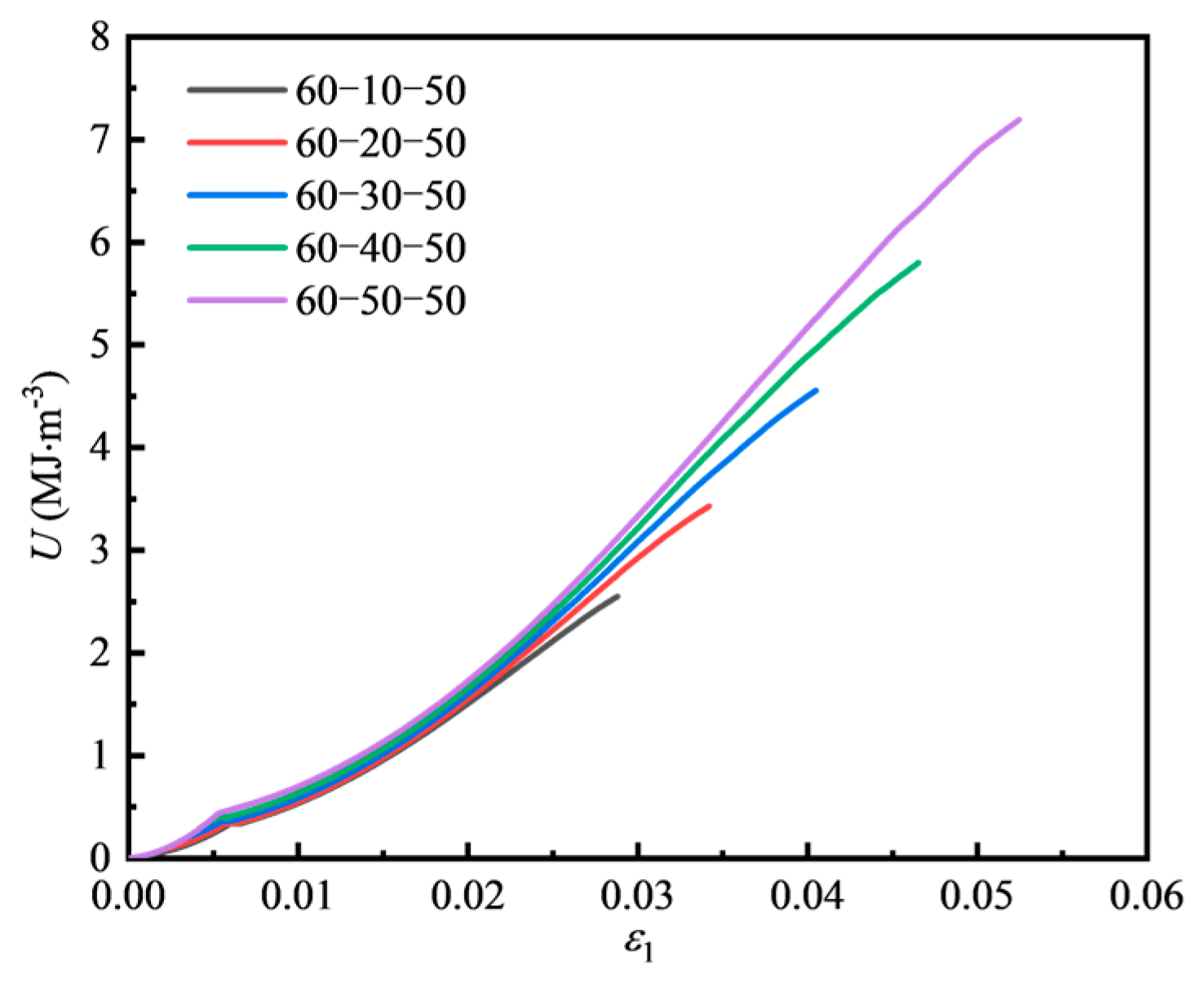
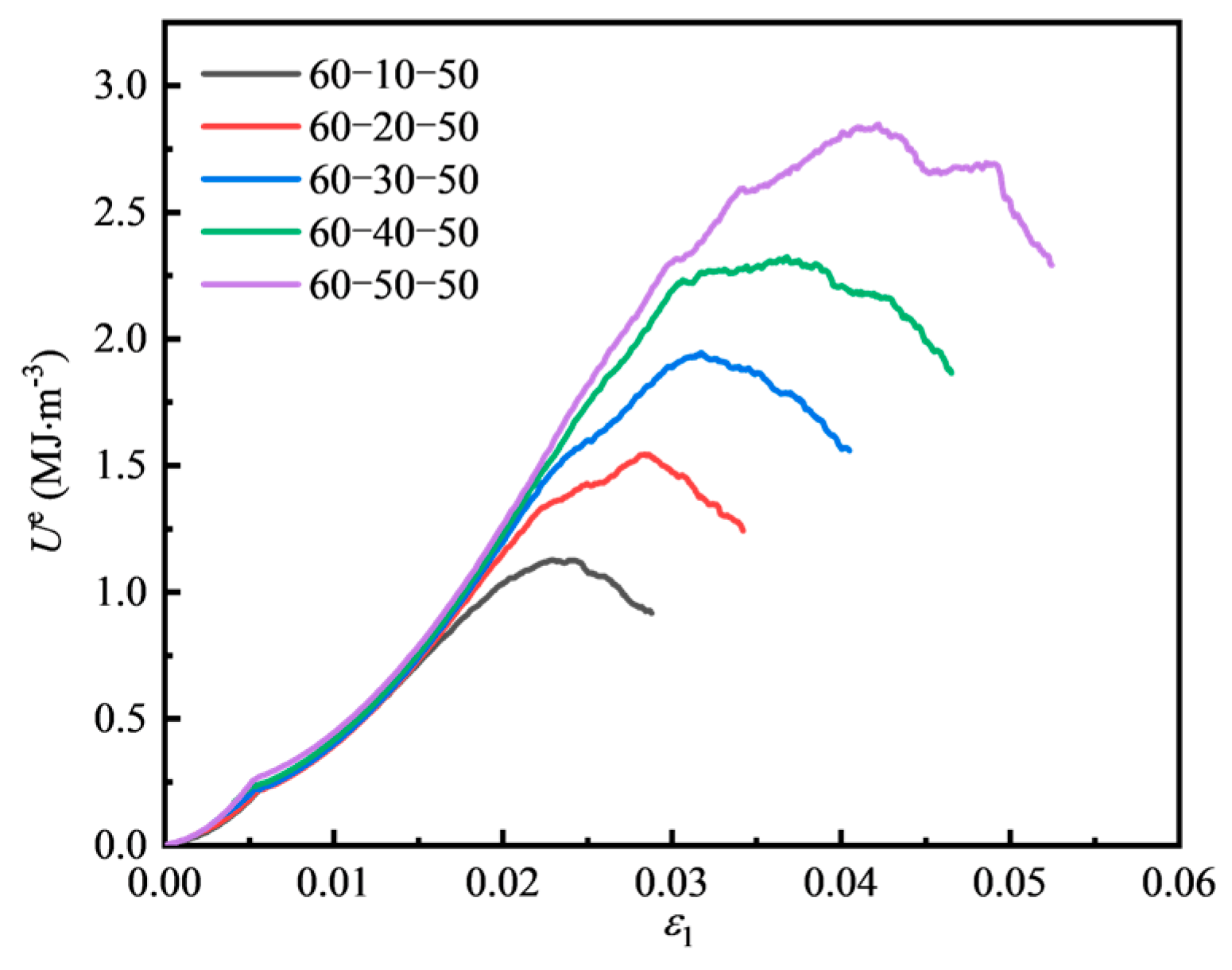
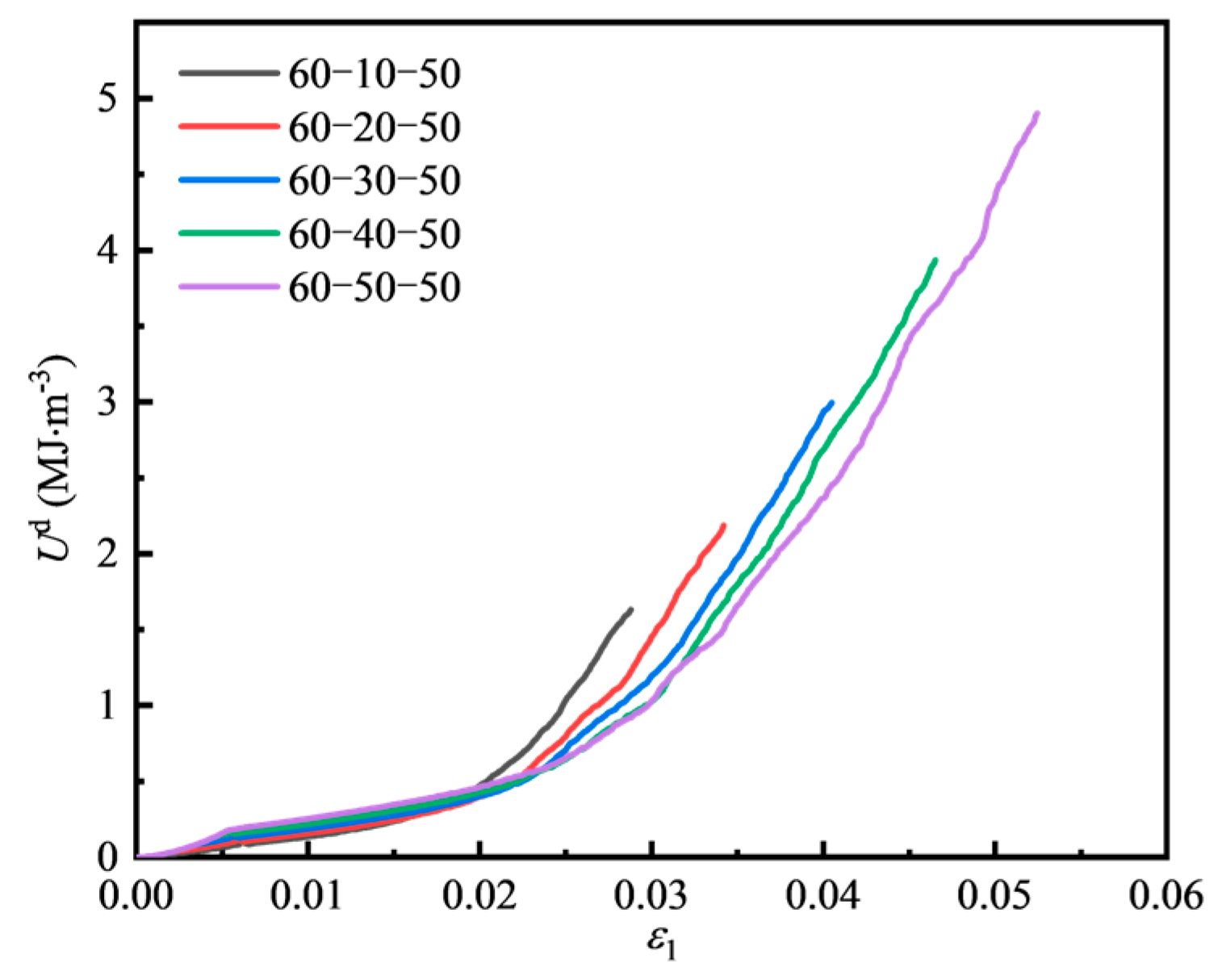
Figure 10, Figure 11 and Figure 12 show the energy evolution law of fissured sandstone specimens under different minimum principal stress conditions. As shown in Figure 10, the total energy of specimens changes similarly under different minimum principal stress conditions, increasing with the increase in maximum principal strain. At the initial loading stage, the change in minimum principal stress has little effect on total energy evolution. In the later loading stage, as the minimum principal stress increases, the slope of the curve representing total energy change with maximum principal strain increases, leading to a faster accumulation of total energy. This corresponds to higher strength in specimens under larger minimum principal stresses. Figure 11 indicates that the elastic strain energy of specimens under different minimum principal stresses initially increases and subsequently decreases with increasing maximum principal strain. In the initial loading stage, the minimum principal stress has little effect on the variation in elastic strain energy with the maximum principal strain. In the later loading stage, as minimum principal stress increases, the slope of elastic strain energy changes with the maximum principal strain, which increases gradually, resulting in a faster increase in elastic strain energy and a higher peak value. As shown in Figure 12, as minimum principal stress increases, the slope of the curve depicting dissipated energy change with maximum principal strain decreases, making the curve flatter. This suggests that under higher minimum principal stress conditions, rock masses tend to exhibit more ductile failure compared to lower minimum principal stress conditions, which result in a slower rate of energy dissipation.

4.2.2. Variation Law of Energy at Peak Strength Under Different Minimum Principal Stress Conditions

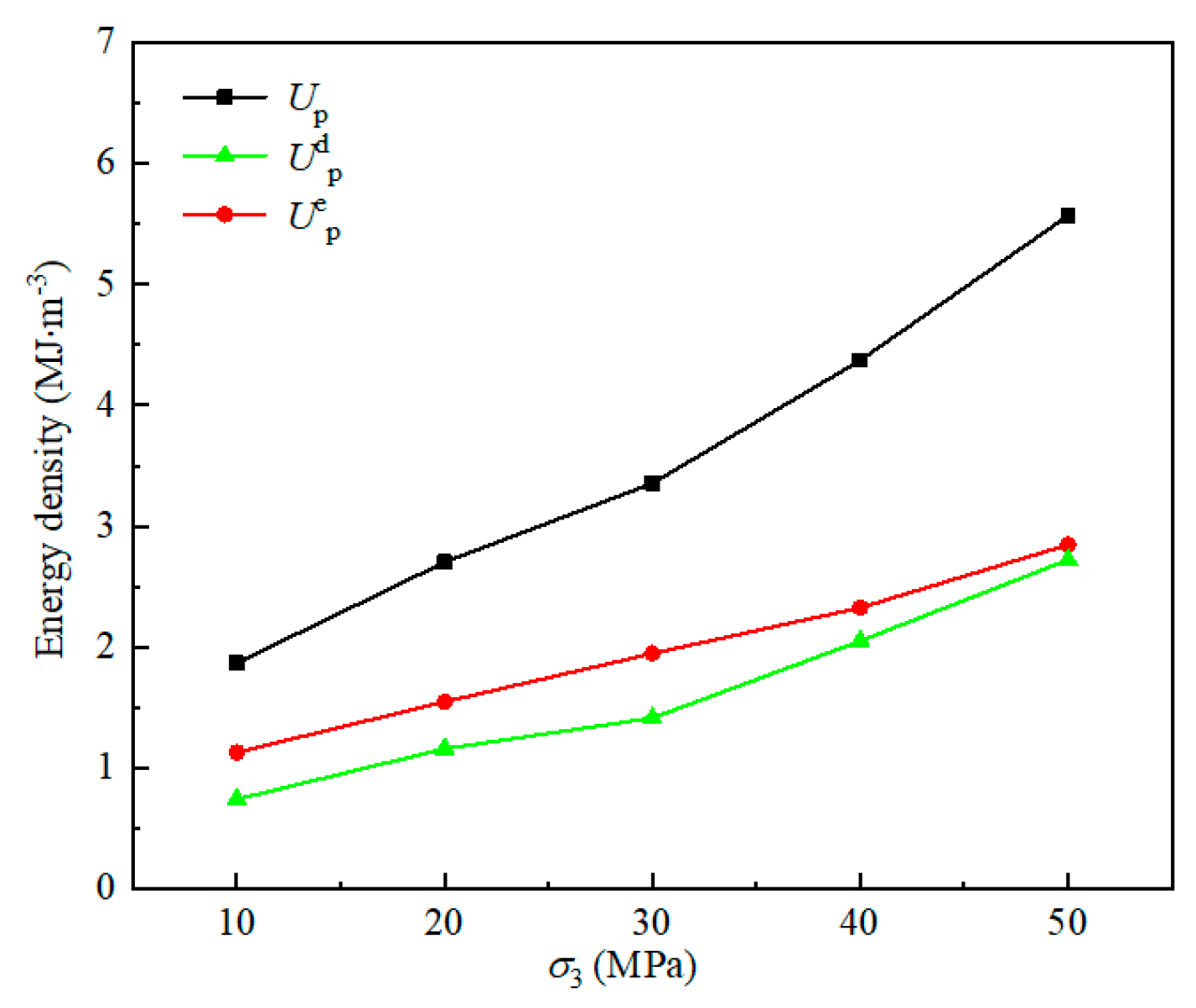
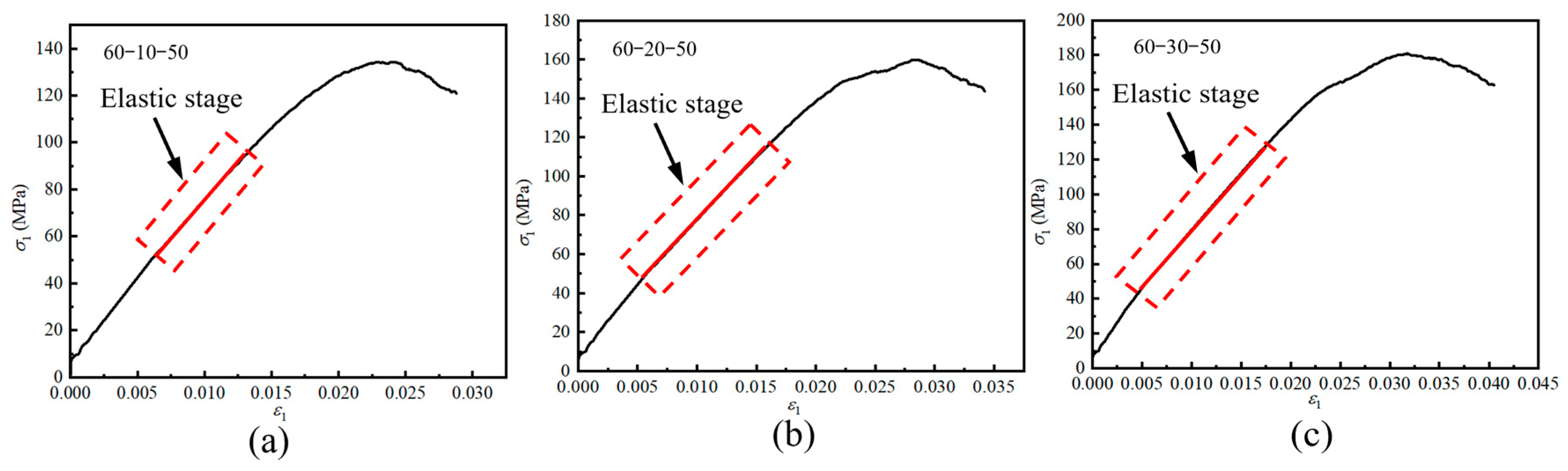
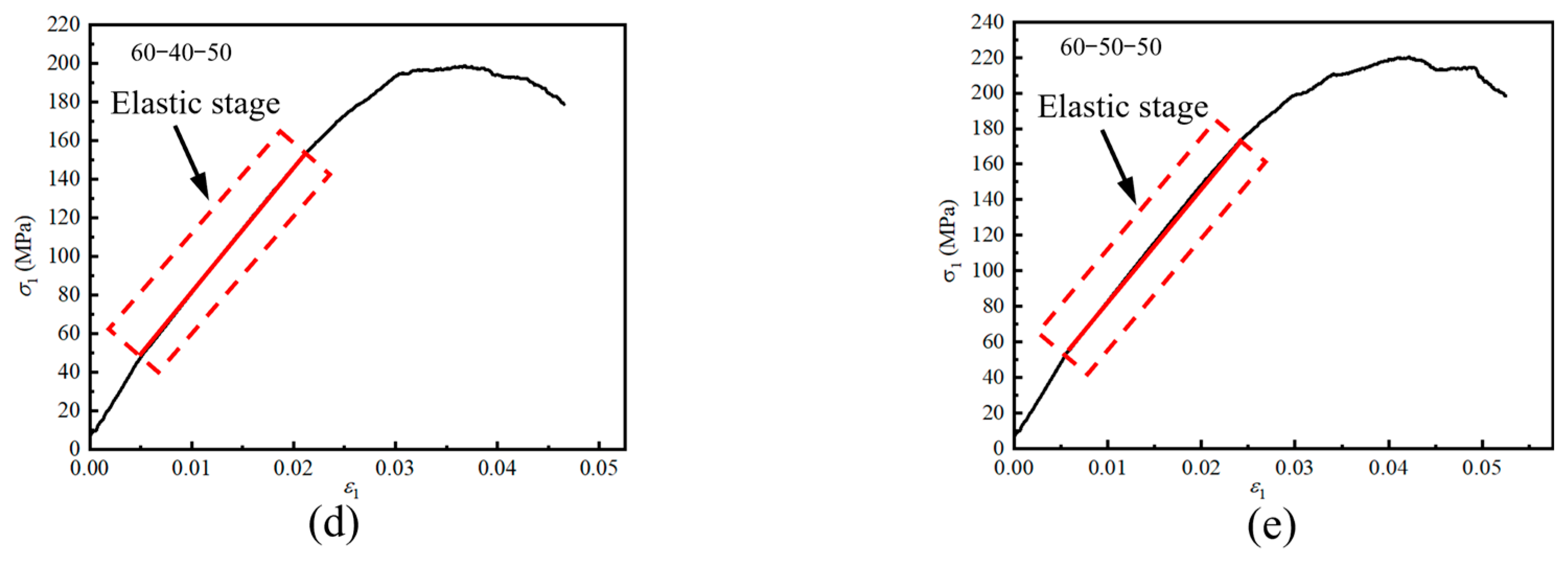
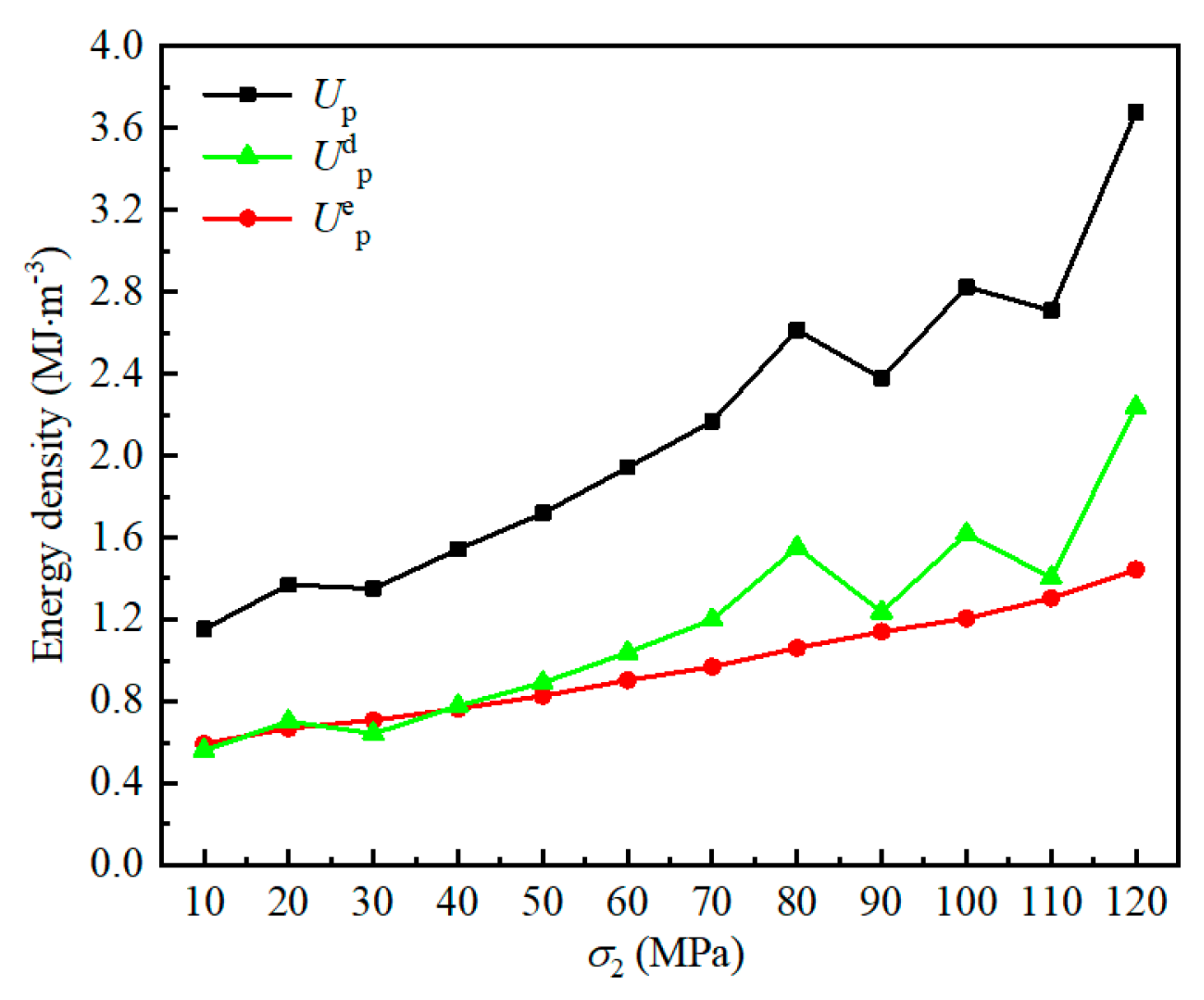
Figure 13 illustrates the energy evolution law at the peak strength of fissured sandstone under different minimum principal stress conditions. It shows that the total energy at the peak strength of sandstone increases with the increase in minimum principal stress when intermediate principal stress and fissure dip angle are unchanged. This reflects that rock mass might store more energy under the state of higher minimum principal stress. In Figure 13, the peak elastic strain energy of the rock mass also increases with increasing minimum principal stress. As the minimum principal stress increases from 10 MPa to 50 MPa, the peak elastic strain energy rises from 1.127 MJ/m3 to 2.847 MJ/m3. This is related to the elastic stage of fissured rock masses. Figure 14 shows the stress–strain curve in the direction of maximum principal stress of sandstone under different minimum principal stresses. Figure 14 indicates that as the minimum principal stress gradually increases, the difference between the two horizontal principal stresses decreases, and the experimental conditions approach a conventional triaxial state. Under such conditions, the brittleness of the sandstone specimen decreases, while its ductility increases. A higher degree of ductility implies a lower resistance to deformation of the specimen. Within the same range of maximum principal stress, a larger minimum principal stress leads to more pronounced elastic deformation in the stress–strain curve, allowing the rock mass to absorb and store more elastic strain energy within the elastic deformation range. This is specifically manifested as an increase in elastic strain energy at the peak strength. Under conditions where intermediate principal stress and fissure dip angle remain constant, the dissipated energy at the peak strength of sandstone also increases gradually with increasing minimum principal stress, and the gap between dissipated energy and elastic strain energy at the peak strength narrows.

4.2.3. Variation of Dissipated Energy Ratio Under Different Minimum Principal Stress Conditions

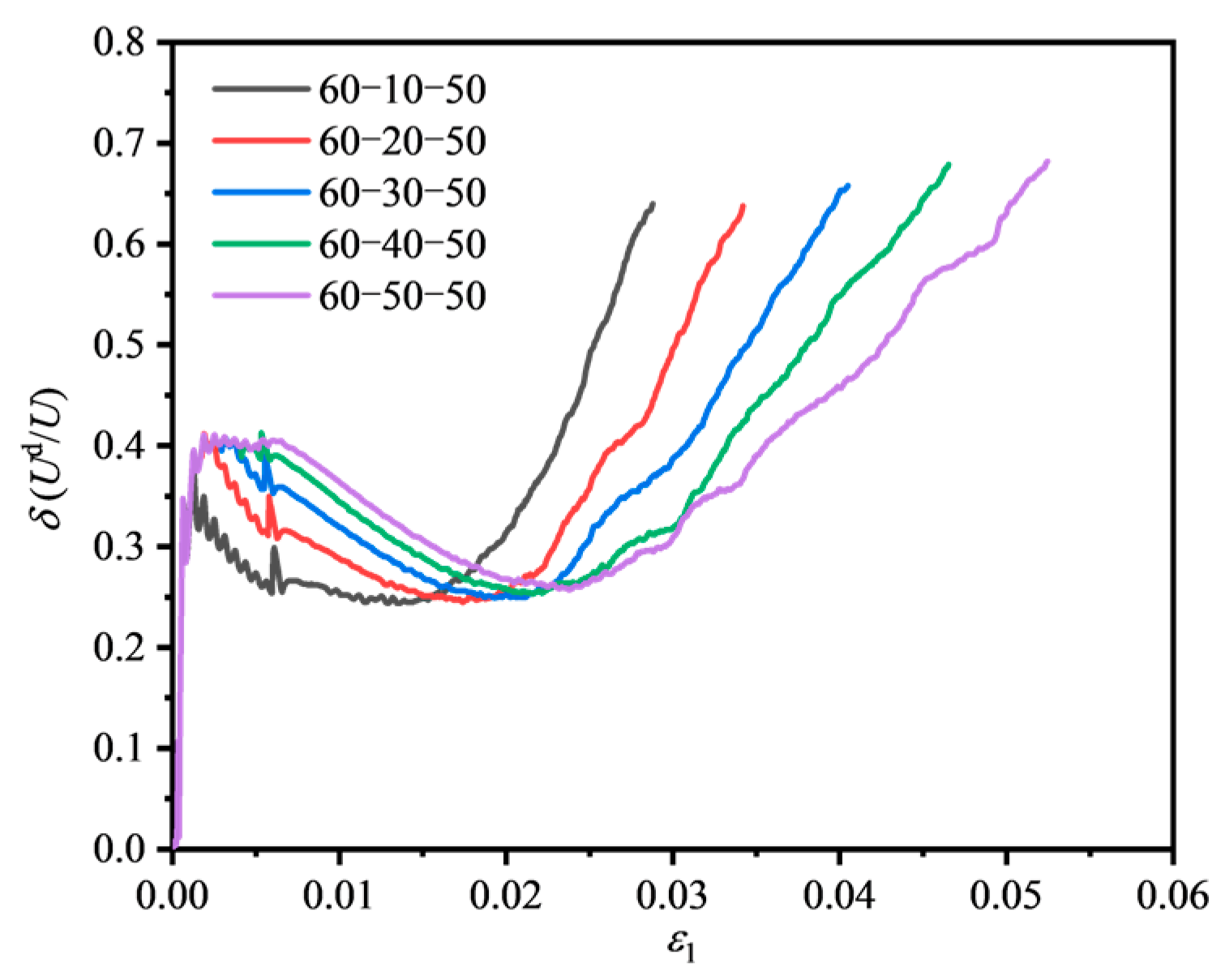
Figure 15 shows the curves of dissipated energy ratio with the maximum principal strain under different minimum principal stress conditions. The larger minimum principal stress leads to a larger dissipated energy ratio at the initial loading stage. In contrast, the condition of smaller minimum principal stress results in a lower dissipated energy ratio at the later loading stage. In the later loading stage, with the increase in the minimum principal stress, the curve slope of dissipated energy ratio with the maximum principal strain gradually decreases, making the curve become gentler. From the post-peak phase of the stress–strain curves, it can be observed that as the minimum principal stress increases, the descending trend of the post-peak curve becomes more gradual. According to the law of energy conservation, the sum of dissipated energy and elastic strain energy equals the total input energy. Therefore, under the condition of a largely constant total energy input rate (due to a fixed loading rate), the rate of elastic strain energy release gradually decreases, leading to a slower increase in dissipated energy and, consequently, a slower growth rate of the dissipated energy ratio. Conversely, when the minimum principal stress is low, once the specimen fails, elastic strain energy is released rapidly, and dissipated energy increases sharply. This results in a precipitous stress drop and a steep rise in the dissipated energy ratio within a relatively narrow range of maximum principal strain.

4.3. Energy Evolution Law of Fissured Sandstone Under Different Intermediate Principal Stress Conditions

4.3.1. Energy Evolution of Fissured Sandstone Under Different Intermediate Principal Stress Conditions

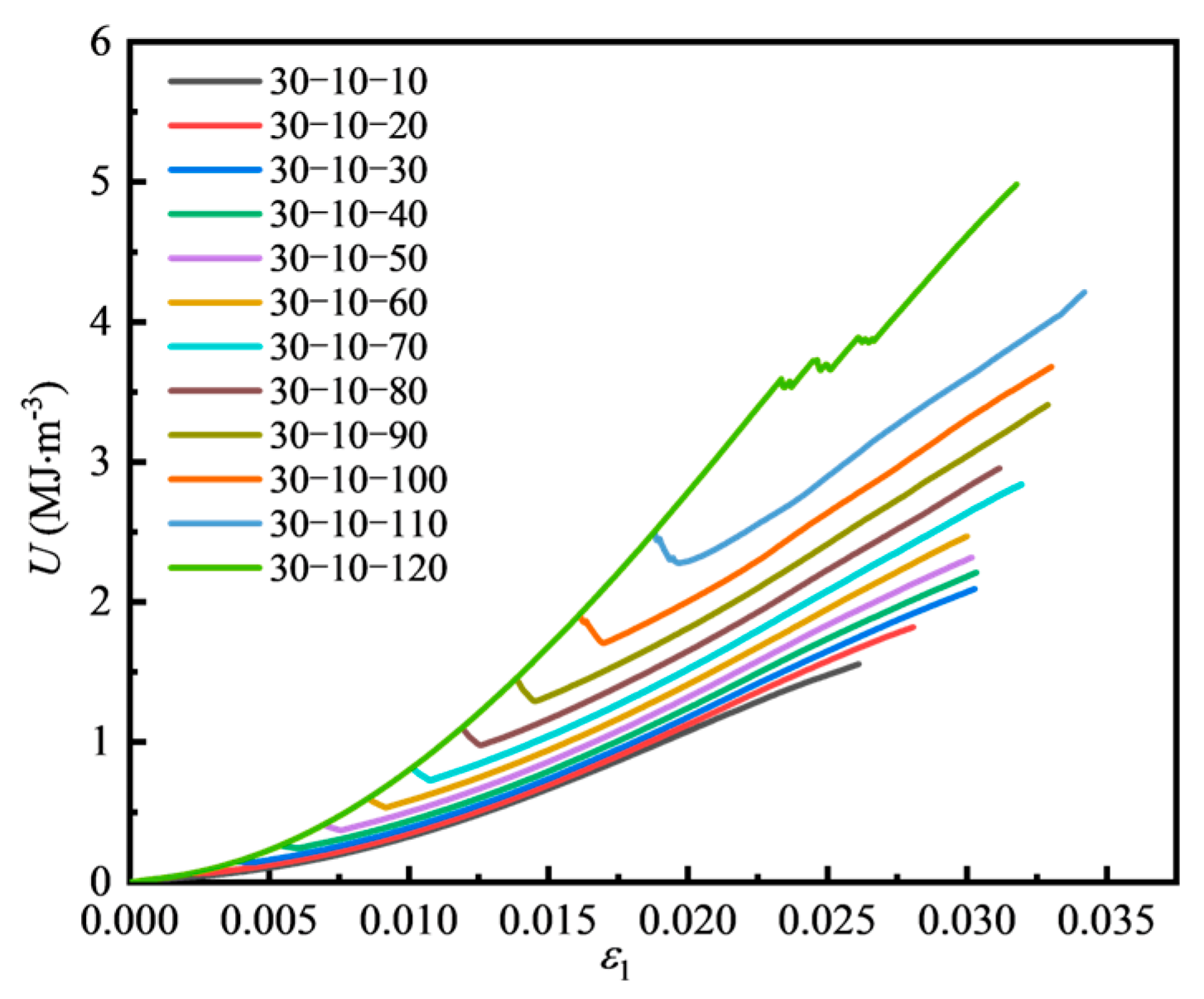
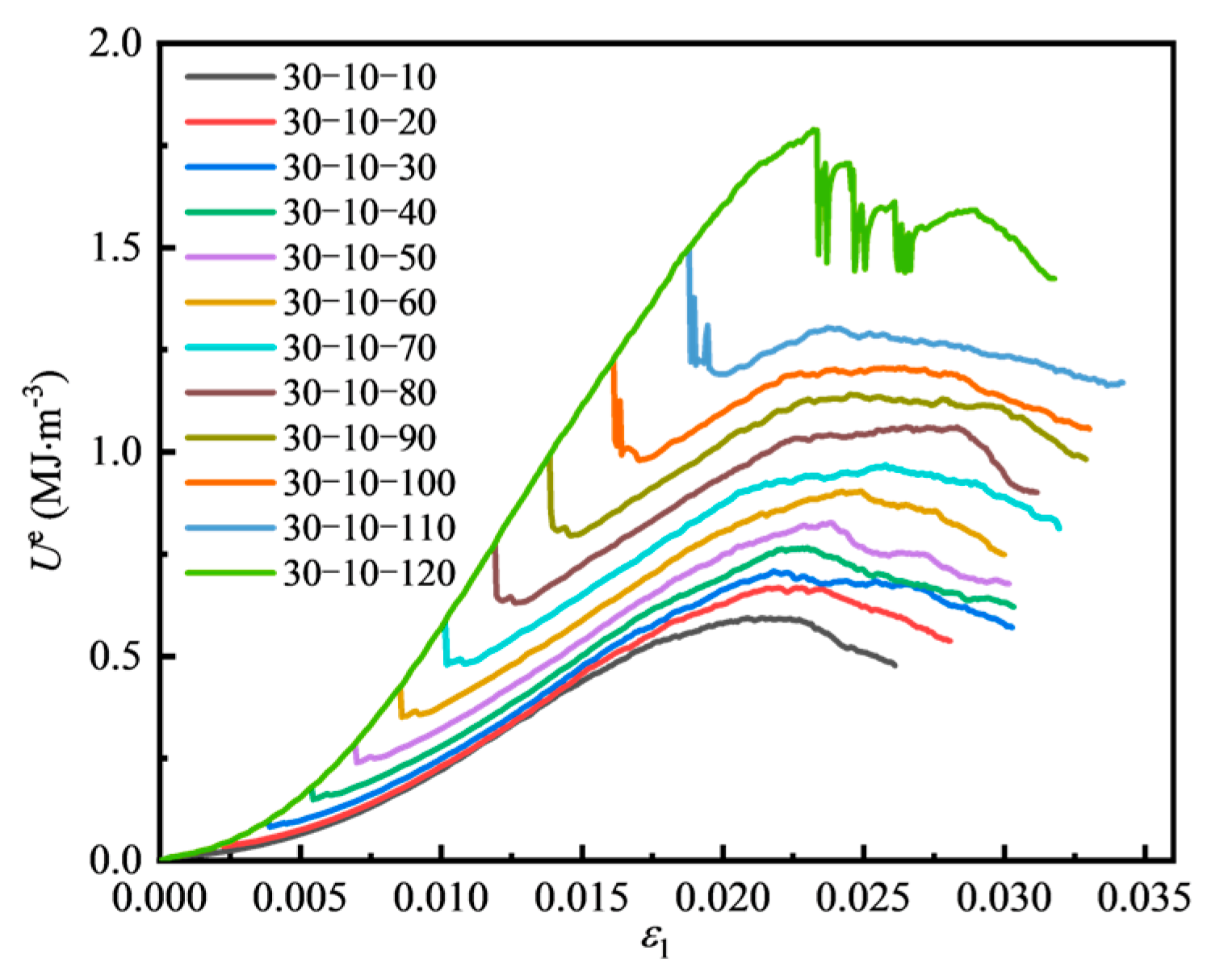
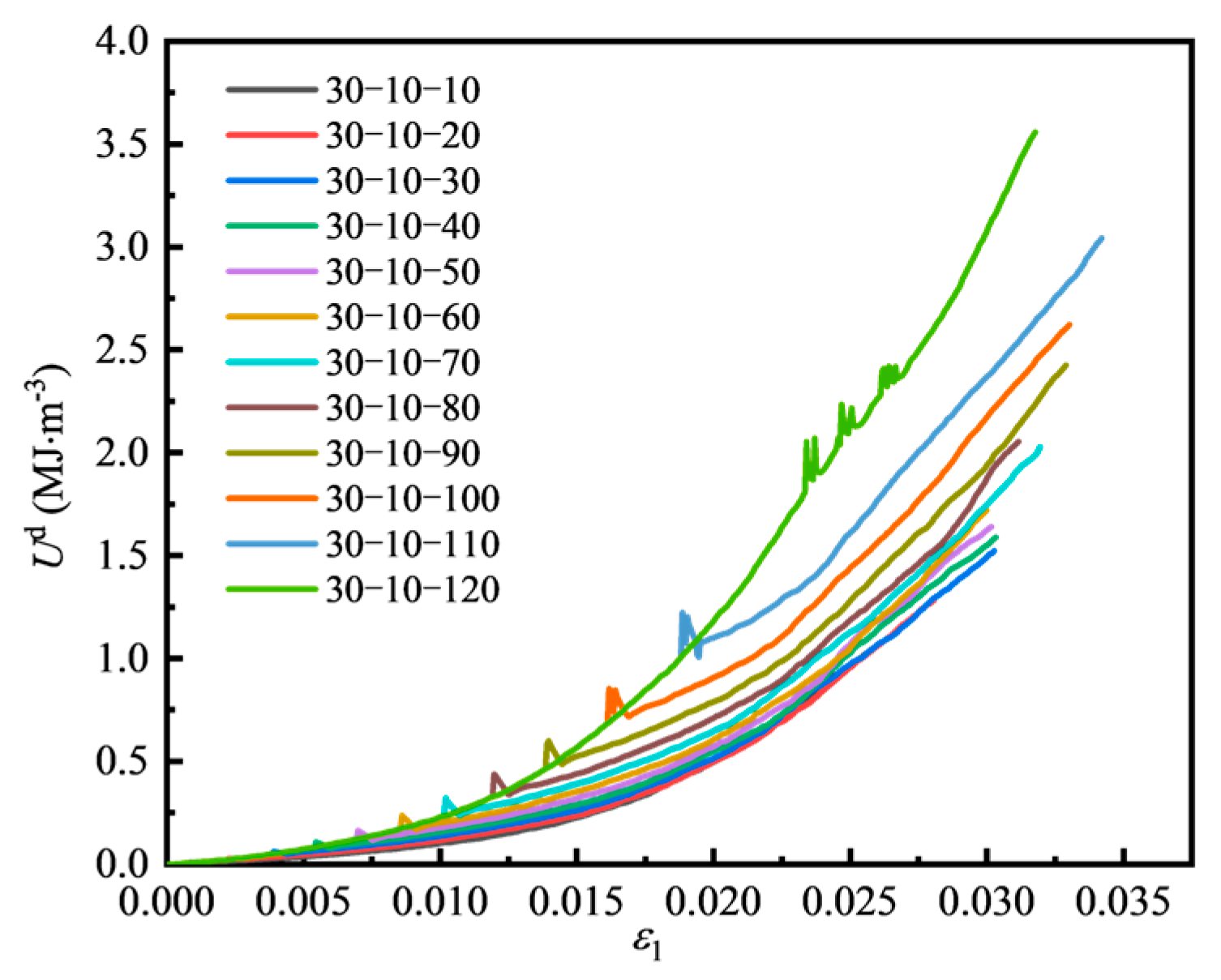
Figure 16, Figure 17 and Figure 18 show the energy evolution law of fissured sandstone under different intermediate principal stress conditions. As shown in Figure 16, the total energy of specimens changes in a similar way under different intermediate principal stress conditions. It increases with maximum principal strain and shows a fluctuation phase in each case. At the initial loading stage, the total energy values of specimens with different intermediate principal stresses are close, and the curves are nearly overlapping. However, in the later loading stage, lower intermediate principal stress causes the fluctuation phase to occur earlier. With the increase in the maximum principal strain, the slope of the total energy curve increases. Under an intermediate principal stress of 30 MPa and 120 MPa, the total energy increases from 1.996 to 2.074 MJ/m3 and from 4.407 to 4.618 MJ/m3, respectively, as the maximum principal strain rises from 0.029 to 0.03, indicating a faster energy accumulation rate. This suggests that higher intermediate principal stress leads to a faster change in total energy with maximum principal strain in fissured sandstone. As shown in Figure 17, the elastic strain energy of specimens increases with maximum principal strain and also shows fluctuations. The deformation behavior of the rock mass is more stable and continuous when the intermediate principal stress is low, resulting in smoother curves with less fluctuation. The curve fluctuations become more pronounced as the intermediate principal stress increases, especially when it approaches the peak strength (1.789 MJ/m3) of the specimen, where the elastic strain energy fluctuates significantly, ranging between 1.439 and 1.789 MJ/m3. As shown in Figure 18, the dissipated energy of specimens increases with maximum principal strain under different intermediate principal stress conditions. In the initial loading stage, the differences in dissipated energy among specimens are small, and the curves are nearly overlapping. In the later loading stage, the growth rate of dissipated energy becomes larger under the higher intermediate principal stress condition. As the maximum principal strain increases from 0.029 to 0.03, the dissipated energy under an intermediate principal stress of 30 MPa rises from 1.391 to 1.497 MJ/m3, while the total energy under 120 MPa increases more significantly from 2.801 to 3.075 MJ/m3. This indicates that damage accumulates more rapidly within the rock mass under higher intermediate principal stress.

4.3.2. Energy Evolution at Peak Strength Under Different Intermediate Principal Stress Conditions

Figure 19 shows the energy variation law at the peak strength of fissured sandstone under different intermediate principal stress conditions. It can be seen that the total energy at the peak strength increases with the increase in the intermediate principal stress under the smaller intermediate principal stress condition. The total energy at the peak strength begins to fluctuate in a certain range after the intermediate principal stress reaches a certain value. This is because at smaller intermediate principal stress, the rock mass has better lateral constraint and can resist damage from external forces more effectively with the increase in the intermediate principal stress, leading to an increased overall stress level and peak total energy. However, the ratio between the intermediate and minimum principal stresses increases as the intermediate principal stress reaches a higher level, causing greater deviatoric stress on the specimen. The presence of fissure in the sandstone specimen makes it more susceptible to deviatoric stress, reflecting the nonlinear response of fissured rock mass under complex stress conditions. With all other conditions unchanged, the dissipated energy of the specimen increases with the increase in intermediate principal stress. After the intermediate principal stress reaches a certain value, the peak dissipated energy begins to fluctuate within a certain range with the increase in the intermediate principal stress, similar to the trend in peak total energy. Keeping other conditions constant, the elastic strain energy at the peak strength of the sandstone specimen increases linearly with the increase in intermediate principal stress under smaller intermediate principal stress conditions.

4.3.3. Variation in Dissipated Energy Ratio Under Different Intermediate Principal Stress Conditions

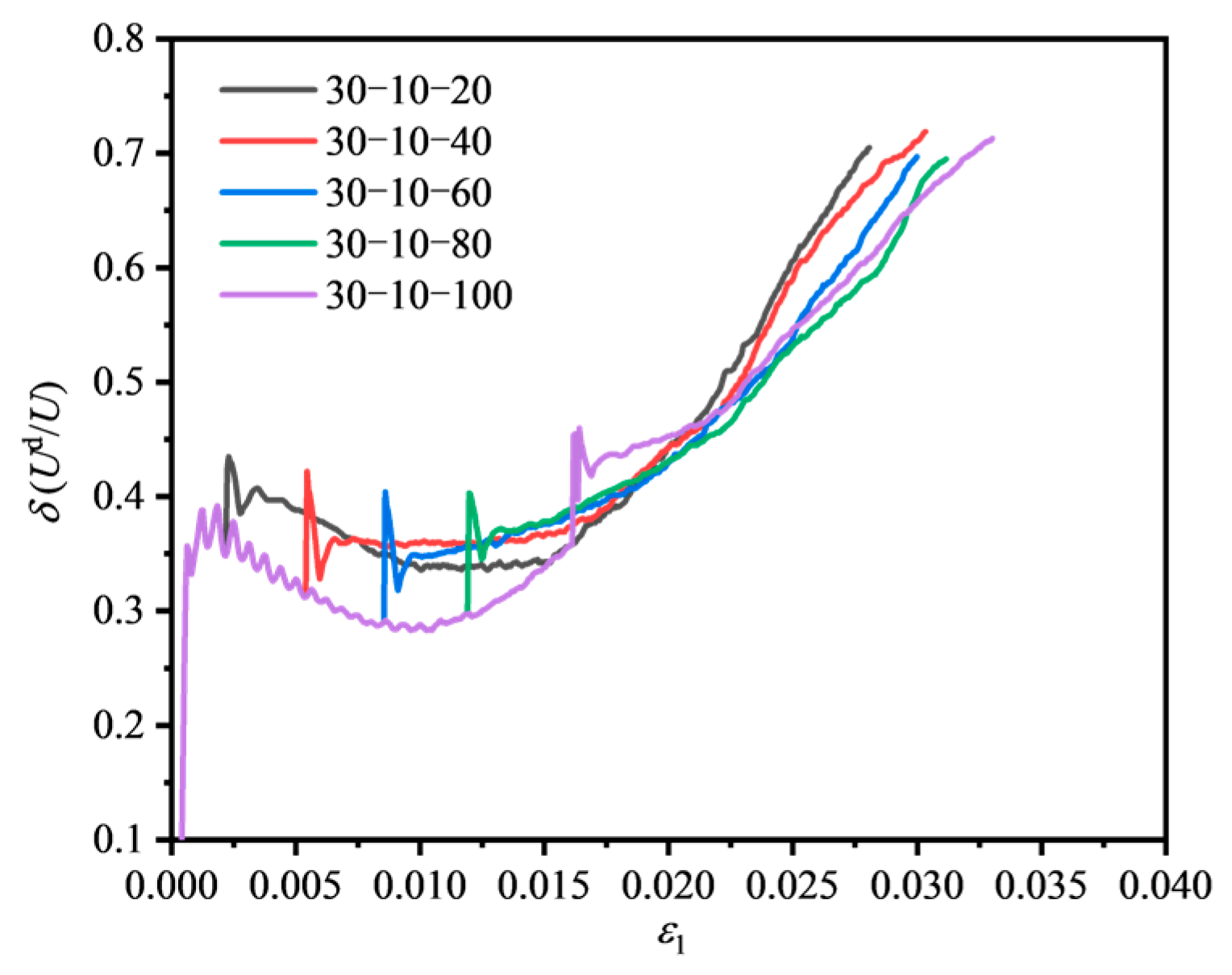
Figure 20 shows the variation in dissipated energy ratio with maximum principal strain for sandstone specimens under different intermediate principal stress conditions. At the initial loading stage, the change in dissipated energy ratio is smaller for specimens when intermediate principal stress is smaller. However, the change in dissipated energy ratio is greater with a larger intermediate principal stress. At the later loading stage, the dissipated energy ratios of specimens become similar under different intermediate principal stress conditions. This may be because all specimens undergo similar damage evolution processes as loading continues, including the formation and development of macroscopic cracks and the expansion of plastic deformation zones, etc. These common factors lead to a convergence in the dissipated energy ratios under different intermediate principal stress conditions. This also indicates that the intermediate principal stress has little effect on the mode of crack propagation.

4.4. Energy Storage and Dissipation Analysis of Fissured Sandstone Under True Triaxial Compression

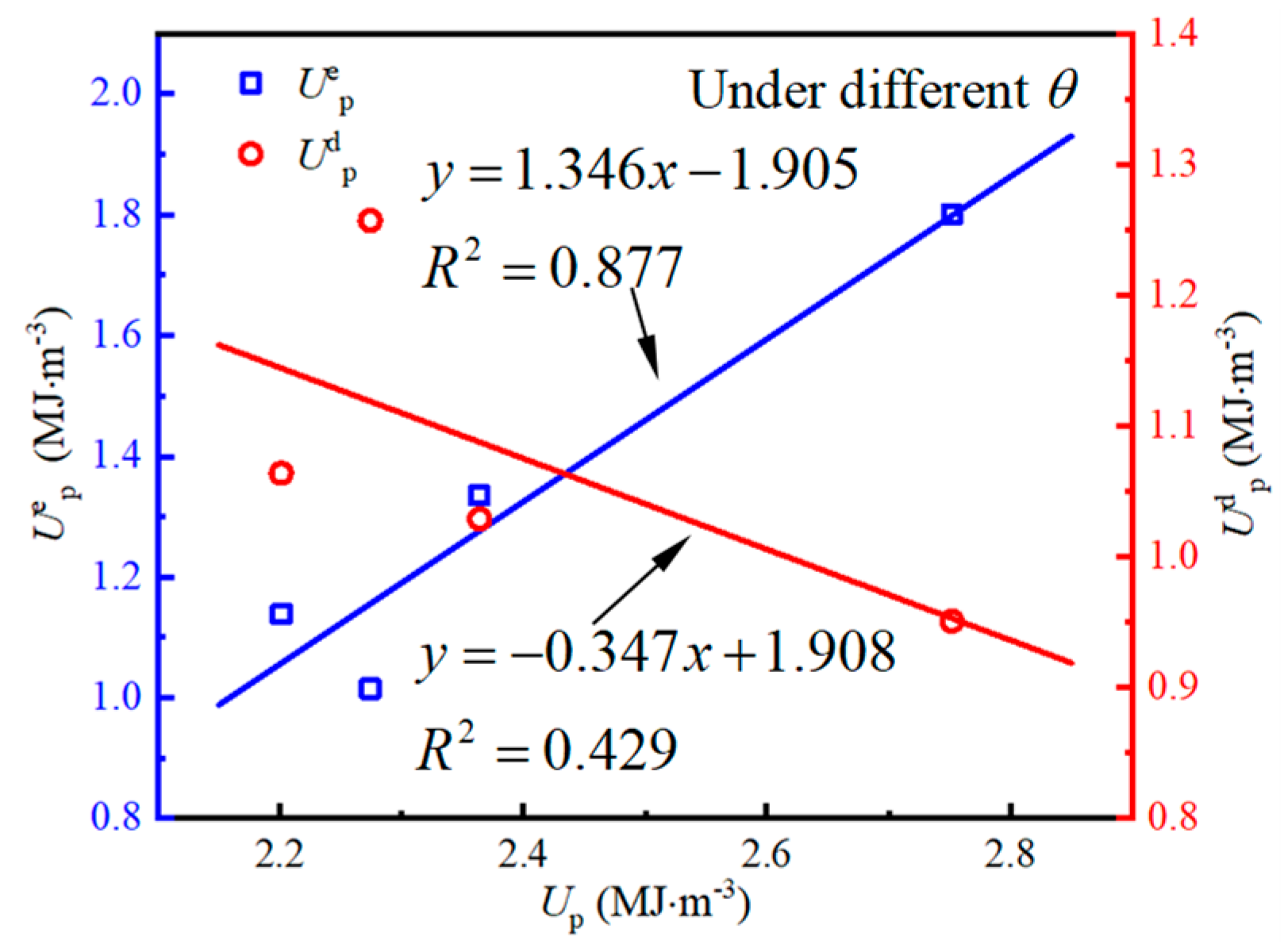
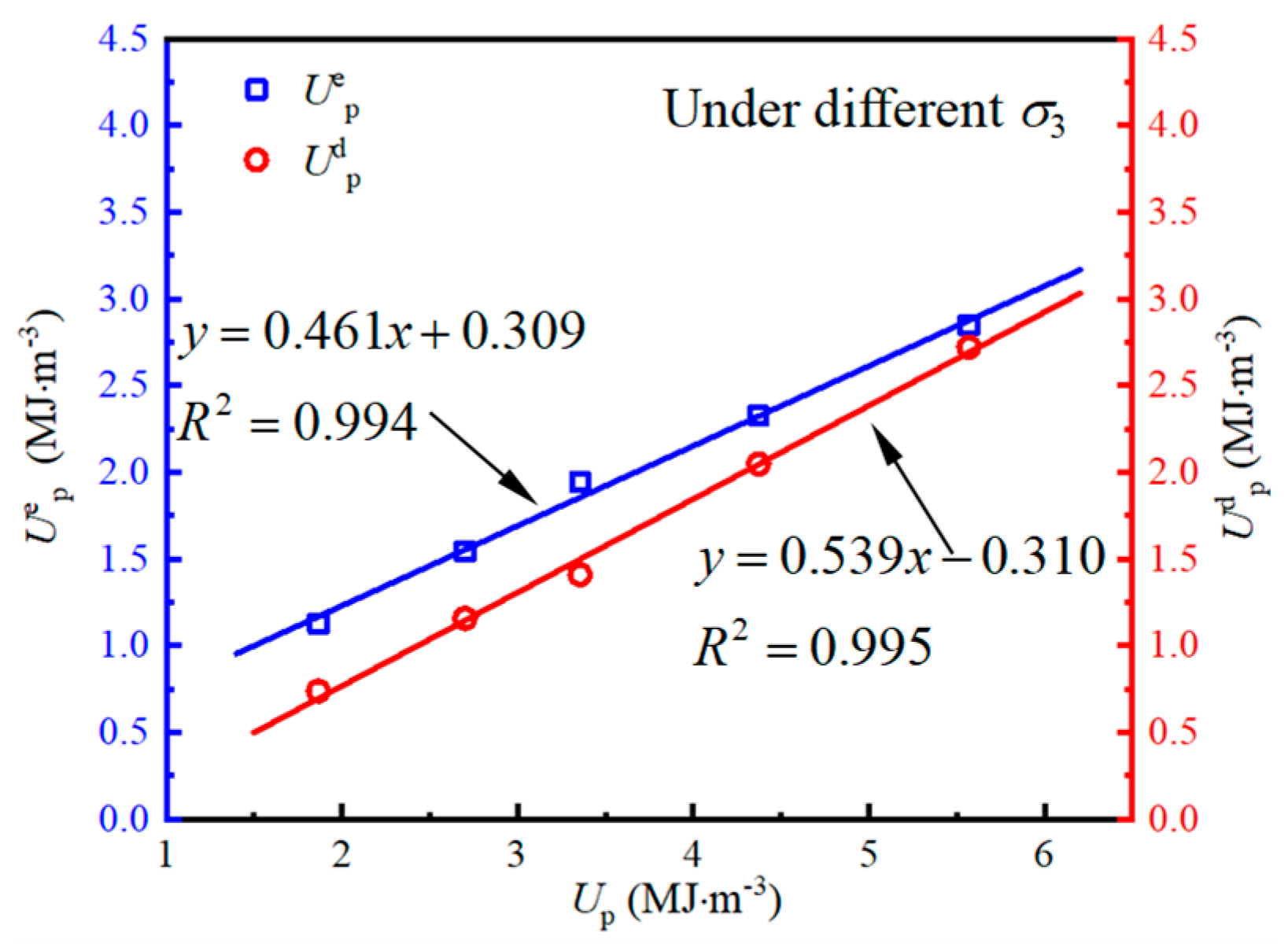
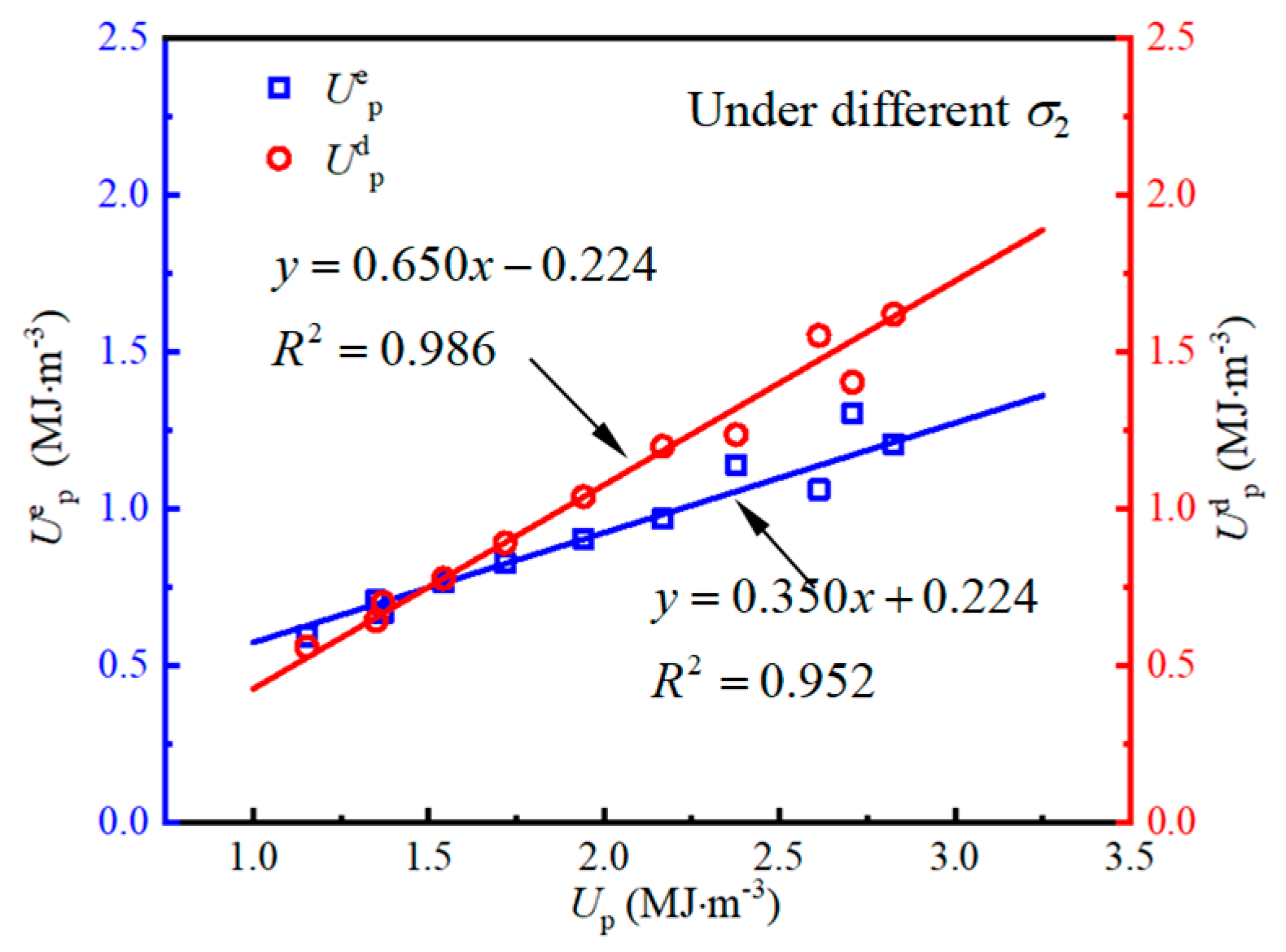
In the study of energy evolution under uniaxial, biaxial and conventional triaxial conditions, Gong et al. [33,34] put forward the linear energy storage and dissipation law based on the energy dissipation characteristics of rock mass during uniaxial loading. Xu et al. [35] obtained the law of linear energy storage and dissipation of pre-cracked rocks through uniaxial compression and uniaxial compression tests with a single cycle of loading and unloading, and they quantitatively determined the energy densities at peak strength of red sandstone with different fissured dip angles. Su et al. [36] found the linear energy storage law of granite specimens in the axial and lateral directions under biaxial compression with constant confining pressure. Luo et al. [37] carried out triaxial cyclic compression tests with different confining pressures. The results show that the pre-peak elastic strain energy and pre-peak dissipated strain energy are linearly related to the pre-peak input strain energy under different confining pressures, confirming the linear energy storage and dissipation laws in triaxial cyclic compression. To investigate the energy storage and dissipation characteristics of fissured rock masses under true triaxial compression, the dissipated energy, elastic strain energy and total energy at the peak strength are fitted to analysis. It is found that the elastic strain energy and dissipated energy have a good linear relationship with the total energy at the peak strength under conditions of different stress states and similar fissure angles. However, elastic strain energy and dissipated energy have a poor linear relationship with total energy at the peak strength under conditions of similar stress states and different fissure dip angles, as shown in Figure 21, Figure 22 and Figure 23.

4.4.1. Differing Fissure Dip Angles

Figure 21 shows the relationship between elastic strain energy, dissipated energy, and total energy at peak strength with different fissure dip angles. It can be seen that the linear correlation between the elastic strain energy and the dissipated energy at the peak strength of the rock mass with different fissure dip angles is weak under true triaxial compression. The dissipated energy at peak strength first increases and then decreases with the increase in total energy at peak strength with different fissure dip angles, while the elastic strain energy at peak strength first decreases and then increases.

4.4.2. Differing Minimum Principal Stresses

Figure 22 shows the relationship between elastic strain energy, dissipated energy, and total energy at peak strength under different minimum principal stress conditions. It can be seen that the energy evolution of rock mass under different minimum principal stress conditions obeys the law of linear energy storage and dissipation. Both elastic strain energy and dissipated energy at peak strength increase with the increase in total energy at peak strength, and a linear relationship is maintained with peak total energy under different minimum principal stress conditions.

4.4.3. Differing Intermediate Principal Stresses

Figure 23 shows the relationship between elastic strain energy, dissipated energy, and total energy at peak strength under different intermediate principal stress conditions. It can be seen that the energy evolution of rock mass under true triaxial compression roughly obeys the law of linear energy storage and dissipation with different intermediate principal stresses. Both elastic strain energy and dissipated energy at peak strength increase as total energy at peak strength increases, maintaining a linear relationship with total energy at peak strength. However, the linear relationship weakens when the total energy at peak strength is large.

5. Discussion

The stress of near-field fractured surrounding rock transfers to the deeper rock when drilling pressure relief is adopted, and the far-field fractured surrounding rock is prone to deformation and failure under the action of concentrated stress. This process, in turn, influences the planning of subsequent roadways or stopes and poses potential risks to construction safety in far-field surrounding rock. Therefore, the establishment of the internal relationship between energy storage–release, stress state, and fissure dip angle is conducive to exploring the instability and failure processes of deep far-field fractured rock masses.
It can be seen that different influencing factors have different effects on the linear energy storage and dissipation law of fissured rock mass under true triaxial compression. Table 2 lists the parameters of linear energy storage and dissipation fitting formula under various influencing conditions. As can be seen from Table 2, the linear correlation coefficients between elastic strain energy, dissipated energy, and total energy at peak strength are large under different stress states. This indicates that the fissured rock mass exhibits linear energy storage and dissipation behavior. However, the linear correlations between elastic strain energy, dissipated energy, and total energy at peak strength are weak under different fissure dip angles, showing a nonlinear energy storage and dissipation law in fissured rock mass. For more complex fissure networks, this nonlinear relationship also governs the fracture patterns and strength characteristics of rock masses. For instance, Qiu et al. [38,39] investigated the dynamic tensile behavior of fissured rock masses with different fissure networks and under different loading rates, and found that typical nonlinear characteristics are exhibited in their strength distribution, fragment size distribution, and microcrack orientation—the underlying mechanism is dominated by heterogeneous energy dissipation, while the external behavior is governed by the competitive interaction between fissures and disturbances.
Therefore, for far-field surrounding rock under the condition of true three-dimensional stress and gradually increasing tangential stress, the law between the energy evolution and the stress state can be more easily used to prevent the occurrence of accidents. The results show that the relationship between elastic strain energy and dissipated energy is not always that the former is greater than the latter with the increase in total energy. For instance, under different intermediate principal stress conditions, the dissipated energy is greater than the stored elastic strain energy when the total input energy is large. This means that the stress concentration in the far-field surrounding rock promotes the generation of a large number of cracks and the release of heat. The elastic strain energy is greater than the dissipated energy when the total input energy is small, which indicates that there is still energy waiting to be released inside the far-field surrounding rock. Therefore, more attention should be paid to this part of the rock mass before the roadway excavation work is carried out in order to prevent disasters. In addition, this work is indispensable when detecting the development of fissures in far-field surrounding rock. Combined with the true three-dimensional stress state of the far-field surrounding rock, the evolution of internal energy is scientifically predicted and evaluated.

6. Conclusions

In this study, based on experimental results from the existing literature, the energy evolution law and transfer mechanism of far-field fissured sandstone in different deformation and failure stages are analyzed, and the energy variation at peak strength with different fissure dip angles and stress states are investigated. The evolution of total input energy, dissipated energy, and elastic strain energy in fissured sandstone are summarized. Some important conclusions can be drawn and are detailed as follows.
(1)
In the initial loading stage and linear elastic stage, most of U in fissured sandstone is stored as Ue, with only a small part being dissipated. In the fluctuating stage, Ud increases faster, while Ue rises more slowly, though it still remains higher than dissipated energy. At the peak strength, Ue reaches its maximum. In the post-peak stage, Ud increases sharply, surpassing Ue, which begins to decline. The dissipated energy ratio first rises, then falls, and rises again as maximum principal strain increases. In the linear elastic stage, δ is low and almost unchanged.
(2)
As θ increases, both U and Ud increase with the rise in maximum principal strain, and Ue first increases and then decreases with increasing maximum principal strain. At peak strength, U first decreases and then increases with the increase in θ, while Ue gradually rises, and Ud gradually declines.
(3)
As σ3 increases, the curve slope of U changing with maximum principal strain gradually rises, indicating faster energy accumulation. The slope of Ue with maximum principal strain also increases. With the increase in σ3, Ud at the peak strength increases, as it promotes crack propagation and thus leads to greater energy dissipation.
(4)
With the increase in σ2, the curve slope of U with the maximum principal strain gradually increases, the curve becomes steeper, and energy accumulation becomes faster. With the increase in the maximum principal strain comes an increase in Ue with different values of σ2. With high σ2, Ud grows more rapidly, indicating faster damage accumulation in the rock mass. As σ2 increases, the Ue at peak strength of fissured sandstone specimens also rises, showing a nearly linear trend.
(5)
Under true triaxial compression, the linear correlation between Ue, Ud, and U at peak strength is weak with different values of θ, indicating nonlinear energy storage and dissipation behavior in fissured rock masses. Under different σ2 and σ3, linear correlation coefficients are high, showing a clear linear energy storage and dissipation law in fissured rock mass.
To address the current limitation that this study relies primarily on numerical simulation without direct validation against both field measurements and laboratory experiments, subsequent studies will integrate field data analysis, laboratory experiments, and numerical simulations to verify and further elucidate the aforementioned energy evolution patterns.

Author Contributions

Conceptualization, formal analysis, investigation, funding acquisition, F.F.; writing—original draft preparation, data curation, formal analysis, Y.L.; validation, writing—review and editing, C.L.; funding acquisition, investigation, software, J.Q.; writing—review and editing, methodology, T.Z.; supervision, investigation, formal analysis, S.C. All authors have read and agreed to the published version of the manuscript.

Funding

This research was funded by the Natural Science Foundation of Shandong Province (ZR2025QB45), the National Natural Science Foundation of China (Grant No. 52374095, 52004143, 52304091), and Shandong Province Youth Innovation Team Science and Technology Support Program for Higher Education Institutions (2024KJH068).

Data Availability Statement

The original contributions presented in this study are included in the article. Further inquiries can be directed to the corresponding author.

Conflicts of Interest

The authors declare no conflicts of interest.

References

  1. Yan, B.; Kang, H.; Zuo, J.; Wang, P.; Li, X.; Cai, M.; Liu, J. Study on damage anisotropy and energy evolution mechanism of jointed rock mass based on energy dissipation theory. Bull. Eng. Geol. Environ. 2023, 82, 294. [Google Scholar] [CrossRef]
  2. Shuang, H.; Liu, X.; Zhou, B.; Cheng, L.; Lin, H.; Hu, B.; Liu, Z. Study on the Energy Evolution and Damage Mechanism of Fractured Rock Mass Under Stress–Seepage Coupling. Processes 2025, 13, 270. [Google Scholar] [CrossRef]
  3. Deng, D.; Guo, L.J.; Zuo, J.; Li, Y.L.; Liu, G.F.; Hua, J.W. Discrete element simulations of fracture mechanism and energy evolution characteristics of typical rocks subjected to impact loads. Appl. Sci. 2025, 15, 12847. [Google Scholar] [CrossRef]
  4. Ren, Z.P.; Zhang, C.; Wang, Y.L.; Yang, S.L.; Li, Q.S. Collaborative movement characteristics of overlying rock and loose layer based on block–particle discrete-element simulation method. Int. J. Coal Sci. Technol. 2025, 12, 17. [Google Scholar] [CrossRef]
  5. Li, Y.; Li, S.; Liu, X.; Jiang, A.; Cui, D. Experimental Investigation on the Characteristic Stress and Energy Evolution Law of Carbonaceous Shale: Effects of Dry–Wet Cycles, Confining Pressure, and Fissure Angle. Processes 2025, 13, 3399. [Google Scholar] [CrossRef]
  6. He, Z.C.; Gong, F.Q.; Wu, W.X.; Wang, W.H. Experimental investigation of the mechanical behaviors and energy evolution characteristics of red sandstone specimens with holes under uniaxial compression. Bull Eng. Geol. Environ. 2021, 80, 5845–5865. [Google Scholar] [CrossRef]
  7. Zhou, C.; Gao, W.; Hu, C.J.; Chen, X.; Cui, S. Numerical study of related factors affecting mechanical properties of fractured rock mass and its sensitivity analysis. Comput. Part. Mech. 2023, 10, 369–386. [Google Scholar] [CrossRef]
  8. Zhu, K.; Wang, W.; Shi, L.; Sun, G. Shear-Induced Anisotropy Analysis of Rock-like Specimens Containing Different Inclination Angles of Non-Persistent Joints. Mathematics 2025, 13, 362. [Google Scholar] [CrossRef]
  9. Tang, X.; Xu, F.; Bi, Y.; Bi, R.; Guo, Y.; Huo, N. Mechanical and Permeability Characteristics of Gas-Bearing Coal Under Various Bedding Angles. Processes 2025, 13, 176. [Google Scholar] [CrossRef]
  10. Meng, H.; Xu, N.; Zhu, Y.; Mei, G. Generating Stochastic Structural Planes Using Statistical Models and Generative Deep Learning Models: A Comparative Investigation. Mathematics 2024, 12, 2545. [Google Scholar] [CrossRef]
  11. Meng, H.; Qi, X.; Mei, G. A Deep Learning Approach for Stochastic Structural Plane Generation Based on Denoising Diffusion Probabilistic Models. Mathematics 2022, 12, 1997. [Google Scholar] [CrossRef]
  12. Chen, X.; Gao, W.; He, T.Y.; Ge, S.S.; Ma, P.F.; Zhou, C. Study on constitutive model of fractured rock masses by using statistical strength theory. Math. Methods Appl. Sci. 2025, 48, 8274–8296. [Google Scholar] [CrossRef]
  13. Dai, B.; Zhao, G.; Zhang, L.; Liu, Y.; Zhang, Z.; Luo, X.; Chen, Y. Energy Dissipation of Rock with Different Parallel Flaw Inclinations under Dynamic and Static Combined Loading. Mathematics 2022, 10, 4082. [Google Scholar] [CrossRef]
  14. Feng, F.; Chen, S.J.; Zhao, X.D.; Li, D.Y.; Wang, X.L.; Cui, J.Q. Effects of external dynamic disturbances and structural plane on rock fracturing around deep underground cavern. Int. J. Coal Sci. Technol. 2022, 9, 15. [Google Scholar] [CrossRef]
  15. Feng, F.; Li, X.B.; Rostami, J.; Li, D.Y. Modeling hard rock failure induced by structural planes around deep circular tunnels. Eng. Fract. Mech. 2019, 205, 152–174. [Google Scholar] [CrossRef]
  16. Li, K.S.; Chen, L.X.; Zhao, Z.; Liu, C.X. Experimental investigation on mechanical, acoustic, and fracture behaviors and the energy evolution of sandstone containing non-penetrating horizontal fissures. Theor. Appl. Fract. Mech. 2023, 123, 103703. [Google Scholar] [CrossRef]
  17. Li, X.W.; Yao, Z.S.; Huang, X.W.; Liu, X.H.; Fang, Y.; Xu, Y.J. Mechanical properties and energy evolution of fractured sandstone under cyclic loading. Materials 2022, 15, 6116. [Google Scholar] [CrossRef] [PubMed]
  18. Xia, B.W.; Li, Y.; Hu, H.R.; Luo, Y.F.; Peng, J.J. Effect of Crack Angle on Mechanical Behaviors and Damage Evolution Characteristics of Sandstone Under Uniaxial Compression. Rock Mech. Rock Eng. 2022, 55, 6567–6582. [Google Scholar] [CrossRef]
  19. Wang, G.L.; Cao, T.C.; Sun, F.; Wen, X.X.; Zhang, L. Study on the meso-energy damage evolution mechanism of single-joint sandstone under uniaxial and biaxial compression. Adv. Mater. Sci. Eng. 2021, 5245402. [Google Scholar] [CrossRef]
  20. Feng, F.; Xie, Z.W.; Chen, S.J.; Li, D.Y.; Peng, S.Y.; Zhang, T. True triaxial unloading test on the mechanical behaviors of sandstone: Effects of the intermediate principal stress and structural plane. J. Rock Mech. Geotech. Eng. 2025, 17, 2208–2226. [Google Scholar] [CrossRef]
  21. Feng, F.; Zhang, T.; Chen, S.J.; Peng, S.Y.; Xie, Z.W.; Zhao, Y.M. Analysis of failure properties of red sandstone with structural plane subjected to true triaxial stress paths. Eng. Fract. Mech. 2024, 310, 110490. [Google Scholar] [CrossRef]
  22. Chen, D.D.; Wang, Z.Q.; Jiang, Z.S.; Xie, S.R.; Li, Z.J.; Ye, Q.C.; Zhu, J.K. Research on J2 evolution law and control under the condition of internal pressure relief in surrounding rock of deep roadway. Sustainability 2023, 15, 10226. [Google Scholar] [CrossRef]
  23. Ren, F.Q.; Zhu, C.; Karakus, M.; He, M.C. Rockburst mitigation mechanisms of pressure relief borehole and rock bolt support: Insights from granite true triaxial unloading rockburst tests. Eng. Geol. 2024, 336, 107571. [Google Scholar] [CrossRef]
  24. Jiang, M.W.; Fan, Y.Y.; Su, W.W.; Wang, J.C.; Lan, M.; Lin, Q.B. Optimization of support and relief parameters for deep-buried metal mine roadways. Geofluids 2024, 8816030. [Google Scholar] [CrossRef]
  25. Chen, Y.; Li, P.F.; Xu, C.B.; Chen, M.; Yang, J.Y. Failure characteristics and pressure relief effectiveness of non-persistent jointed rock mass with holes. Theor. Appl. Fract. Mech. 2024, 134, 104733. [Google Scholar] [CrossRef]
  26. Du, S.Y.; Zuo, Y.J.; Chen, Q.G.; Zheng, L.J.; Rong, P.; Liu, H.; Jin, K.Y.; Lin, J.Y.; Chen, B.; Xing, B. Study on the response characteristics of roadway borehole pressure relief surrounding rock under strike-slip high-stress distribution. Eng. Fail. Anal. 2024, 156, 107808. [Google Scholar] [CrossRef]
  27. Feng, X.T.; Zhang, X.W.; Kong, R.; Wang, G. A novel mogi type true triaxial testing apparatus and its use to obtain complete stress-strain curves of hard rocks. Rock Mech. Rock Eng. 2016, 49, 1649–1662. [Google Scholar] [CrossRef]
  28. Xie, H.P.; Peng, R.D.; Ju, Y. Energy dissipation of rock deformation and fracture. Chin. J. Rock Mech. Eng. 2004, 23, 3565–3570. [Google Scholar]
  29. Xie, H.P.; Ju, Y.; Li, L.Y.; Peng, R.D. Energy mechanism of deformation and failureof rock masses. Chin. J. Rock Mech. Eng. 2008, 27, 1729–1740. [Google Scholar]
  30. Huang, D.; Huang, R.Q.; Zhang, Y.X. Experimental investigations on static loading rate effects on mechanical properties and energy mechanismof coarse crystal grain marble under uniaxialcompression. Chin. J. Rock Mech. Eng. 2012, 31, 245–255. [Google Scholar]
  31. Zhang, L.M.; Gao, S.; Wang, Z.Q.; Cong, Y. Analysis of marble failure energy evolution under loading and unloading conditions. Chin. J. Rock Mech. Eng. 2013, 32, 1572–1578. [Google Scholar]
  32. Feng, F.; Zhang, T.; Rostami, J.; Chen, S.J.; Zhao, X.D.; Qiu, J.D. Crack propagation and strength characteristic of sandstone with structural defects under extensive true triaxial tests by using DEM simulation. Theor. Appl. Fract. Mech. 2025, 138, 104971. [Google Scholar] [CrossRef]
  33. Gong, F.Q.; Yan, J.Y.; Li, X.B.; Luo, S. A peak-strength strain energy storage index for rock burst proneness of rock materials. Int. J. Rock Mech. Min. Sci. 2019, 117, 76–89. [Google Scholar] [CrossRef]
  34. Gong, F.Q.; Yan, J.Y.; Luo, S.; Li, X.B. Investigation on the linear energy storage and dissipation laws of rock materials under uniaxial compression. Rock Mech. Rock Eng. 2019, 52, 4237–4255. [Google Scholar] [CrossRef]
  35. Xu, L.; Gong, F.Q.; Luo, S. Effects of pre-existing single crack angle on mechanical behaviors and energy storage characteristics of red sandstone under uniaxial compression. Theor. Appl. Fract. Mech. 2021, 113, 102933. [Google Scholar] [CrossRef]
  36. Su, Y.Q.; Gong, F.Q.; Luo, S.; Liu, Z.X. Experimental study on energy storage and dissipation characteristics of granite under two-dimensional compression with constant confining pressure. J. Cent. South Univ. 2021, 28, 848–865. [Google Scholar] [CrossRef]
  37. Luo, S.; Gong, F.Q.; Li, L.L.; Peng, K. Linear energy storage and dissipation laws and damage evolution characteristics of rock under triaxial cyclic compression with different confining pressures. Trans. Nonferrous Met. Soc. China 2023, 33, 2168–2182. [Google Scholar] [CrossRef]
  38. Qiu, J.D.; Huang, R.; Wang, H.W.; Wang, F.; Zhou, C.T. Rate-dependent tensile behaviors of jointed rock masses considering geological conditions using a combined BPM-DFN model: Strength, fragmentation and failure modes. Soil. Dyn. Earthq. Eng 2025, 195, 109393. [Google Scholar] [CrossRef]
  39. Zhou, C.T.; Rui, Y.C.; Qiu, J.D.; Wang, Z.H.; Zhou, T.; Long, X.T.; Shan, K. The role of fracture in dynamic tensile responses of fractured rock mass: Insight from a particle-based model. Int. J. Coal. Sci. Techn 2025, 12, 39. [Google Scholar] [CrossRef]
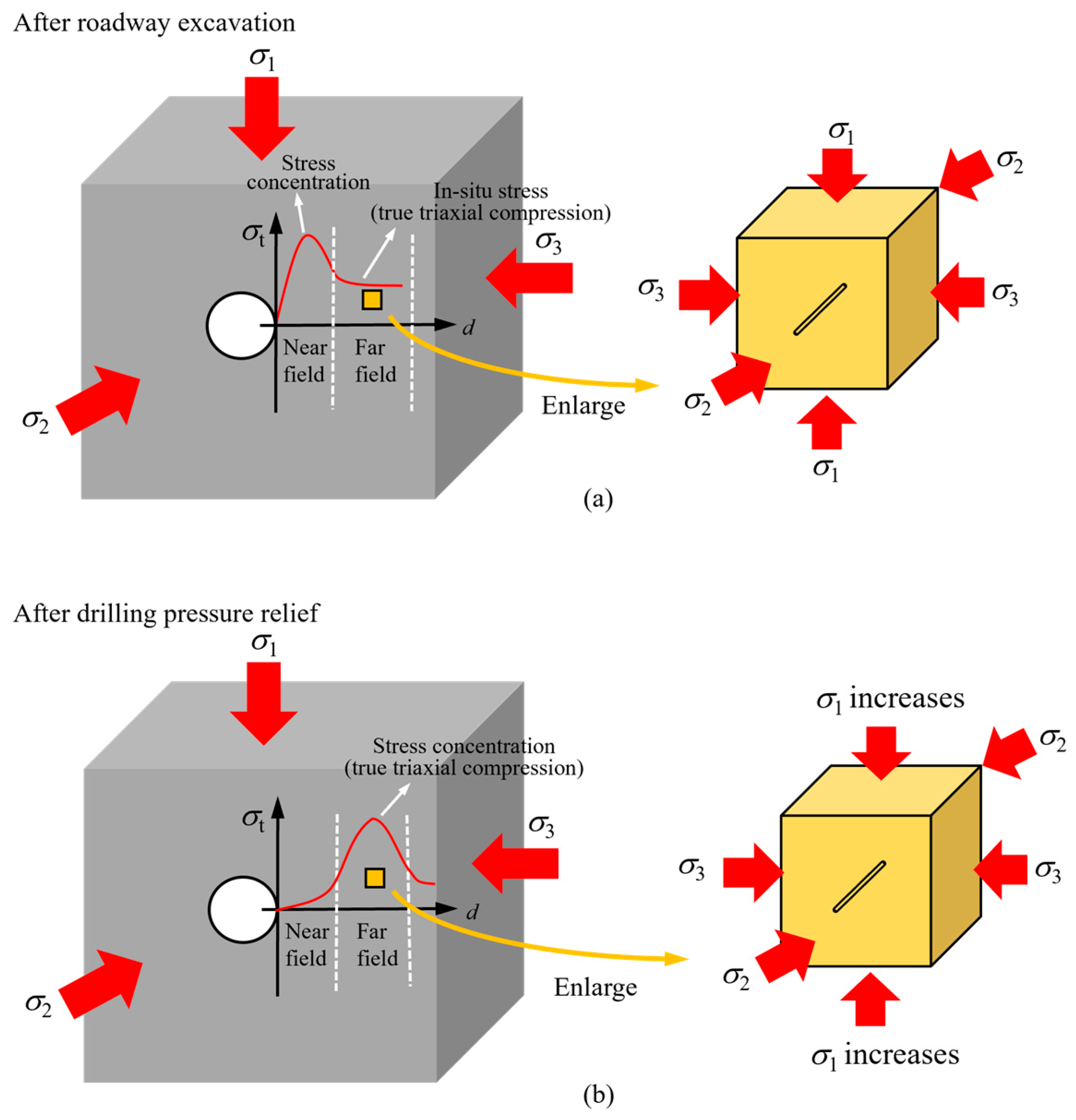
Figure 1. Schematic diagram of stress state of fissured rock mass in a deep underground far field: (σ1: maximum principal stress, σ2: intermediate principal tress, σ3: minimum principal stress, σt: tangential stress). (a) After roadway excavation; (b) after drilling pressure relief.
Processes 14 00356 g001
Figure 2. Relationship between dissipated energy and releasable energy of rock element.
Processes 14 00356 g002
Figure 3. Curves of maximum principal stress and elastic strain energy with the maximum principal strain of the 60-20-50 specimen. (A is the endpoint of the initial loading stage; B is the endpoint of the linear elastic stage; and C is the peak stress point).
Processes 14 00356 g003
Figure 4. Curves of dissipated energy ratio and maximum principal stress with the maximum principal strain of the 60-20-50 specimen. (a, b, and c represent the endpoints of the first three stages in the dissipated energy ratio curve, respectively).
Processes 14 00356 g004
Figure 5. Curves of total energy of sandstone specimens with maximum principal strain under different fissure dip angles.
Processes 14 00356 g005
Figure 6. Curves of elastic strain energy of sandstone specimens with maximum principal strain under different fissure dip angles.
Processes 14 00356 g006
Figure 7. Curves of dissipated energy of sandstone specimens with maximum principal strain under different fissure dip angles.
Processes 14 00356 g007
Figure 8. Energy evolution curves at peak strength for different fissure dip angles.
Processes 14 00356 g008
Figure 9. Curves of dissipated energy ratio with maximum principal strain under different fissure dip angles.
Processes 14 00356 g009
Figure 10. Curves of total energy with maximum principal strain under different minimum principal stress conditions.
Processes 14 00356 g010
Figure 11. Curves of elastic strain energy with maximum principal strain under different minimum principal stress conditions.
Processes 14 00356 g011
Figure 12. Curves of dissipated energy with maximum principal strain under different minimum principal stress conditions.
Processes 14 00356 g012
Figure 13. Energy evolution curves at peak strength under different minimum principal stress conditions.
Processes 14 00356 g013
Figure 14. Stress–strain curves in the direction of maximum principal stress under different minimum principal stress conditions: (a) 60-10-50; (b) 60-20-50; (c) 60-30-50; (d) 60-40-50; (e) 60-50-50.
Processes 14 00356 g014aProcesses 14 00356 g014b
Figure 15. Curves of dissipated energy ratio of sandstone specimens with maximum principal strain under different minimum principal stress conditions.
Processes 14 00356 g015
Figure 16. Curves of total energy with maximum principal strain under different intermediate principal stress conditions.
Processes 14 00356 g016
Figure 17. Curves of elastic strain energy with maximum principal strain under different intermediate principal stress conditions.
Processes 14 00356 g017
Figure 18. Curves of dissipated energy with maximum principal strain under different intermediate principal stress conditions.
Processes 14 00356 g018
Figure 19. Energy evolution curves at peak strength under different intermediate principal stress conditions.
Processes 14 00356 g019
Figure 20. Curves of the dissipated energy ratio of sandstone specimens with maximum principal strain under different intermediate principal stress conditions.
Processes 14 00356 g020
Figure 21. Relationship between elastic strain energy at peak strength, dissipated energy at peak strength, and total energy at peak strength with different fissure dip angles.
Processes 14 00356 g021
Figure 22. The relationship between elastic strain energy, dissipated energy, and total energy under different minimum principal stress conditions.
Processes 14 00356 g022
Figure 23. Relationship between elastic strain energy at peak strength, dissipated energy at peak strength, and total energy at peak strength under different intermediate principal stress conditions.
Processes 14 00356 g023
Table 1. Peak strength and energy at peak strength of typical sandstone specimens under true triaxial compression.
Specimen Numberθ
(°)
σ3
(MPa)
σ2
(MPa)
σ1,peak
(MPa)
Up
(MJ/m3)
Uep
(MJ/m3)
Udp
(MJ/m3)
30-20-30302030134.2632.2741.0171.257
45-20-30452030159.9042.2011.1381.064
60-20-30602030181.0292.3641.3351.029
90-20-30902030198.7272.7521.8010.951
60-10-50601050220.2151.8661.1270.738
60-20-5060205097.0582.7011.5441.157
60-30-50603050104.1083.3551.9451.410
60-40-50604050107.4954.3722.3242.048
60-50-50605050111.2815.5692.8472.722
30-10-10301010114.3551.1530.5940.560
30-10-20301020117.6671.3700.6680.702
30-10-30301030119.0481.3510.7080.643
30-10-40301040121.8041.5430.7650.778
30-10-50301050122.3081.7180.8270.891
30-10-60301060120.8631.9420.9041.038
30-10-70301070120.6202.1670.9681.199
30-10-80301080120.1732.6131.0611.552
30-10-90301090130.3832.3771.1401.236
30-10-1003010100137.5482.8251.2061.619
30-10-1103010110148.4842.7081.3041.404
30-10-1203010120171.3473.6781.4432.235
Table 2. Parameters of linear energy storage and dissipation fitting formula affected by various influencing factors.
Influencing FactorEnergy TypeSlopeInterceptR2
σ3Uep0.4610.3090.994
Udp0.539−0.310 0.995
σ2Uep0.350 0.2240.952
Udp0.650 −0.2240.986
θUep1.346 −1.9050.877
Udp−0.347 1.9080.429
Disclaimer/Publisher’s Note: The statements, opinions and data contained in all publications are solely those of the individual author(s) and contributor(s) and not of MDPI and/or the editor(s). MDPI and/or the editor(s) disclaim responsibility for any injury to people or property resulting from any ideas, methods, instructions or products referred to in the content.