Article

Analysis on the Transient Synchronization Stability of a Wind Farm with Multiple PLL-Based PMSGs


1
State Grid Jiangsu Electric Power Company Ltd. Research Institute, Nanjing 211103, China
2
School of Electrical Engineering, China University of Mining and Technology, Xuzhou 221116, China
*
Author to whom correspondence should be addressed.
Processes 2026, 14(2), 321; https://doi.org/10.3390/pr14020321
Submission received: 29 November 2025 / Revised: 28 December 2025 / Accepted: 14 January 2026 / Published: 16 January 2026

Abstract

The presence of multiple permanent magnet synchronous generators (PMSGs) results in a highly complex and high-dimensional wind-farm model, making its transient synchronizing stability characteristics insufficiently understood and difficult to analyze. This paper investigates the mechanism by which interactions among multiple wind generators trigger transient synchronizing instability in wind farms. First, considering the influence of line impedance ratios, a reduced single-machine aggregated model suitable for transient synchronizing stability analysis of a wind farm with multiple PMSGs was derived from the similarity normalization transformation of the state-space matrices. Based on the aggregated model, the concepts of equivalent accelerating area and equivalent decelerating area were introduced to evaluate transient synchronizing stability of the wind farm. Through a comprehensive analysis of the effects of the generator dynamics, number of generators, network topology, and system parameters on these indices, the mechanism by which multi-PMSG interactions induce transient synchronization instability in PMSG wind farms is revealed. Finally, case studies were conducted to validate the accuracy and applicability of the analysis.

1. Introduction

As wind power grows within modern grids, concerns about its impact on system stability have increased. Most grid-connected wind turbines use grid-following control. A phase-locked loop (PLL) tracks the voltage phase at the point of connection and takes it as the basis for synchronization [1,2,3]. Wind turbines have no physical rotor angle; yet, many studies show that the PLL behaves like a second-order system, much like the rotor dynamics of synchronous machines. Under large faults, the PLL can face similar transient stability issues. It may even lose synchronism and force the turbine to disconnect from the grid. This behavior has been widely documented [4,5,6,7,8,9,10,11].
Existing work on transient synchronization in wind-power systems builds on classical methods used for conventional power systems. The PLL usually has a bandwidth of a few to several tens of hertz. The inner current-control loop reaches several hundred hertz. Within the time scale of PLL transients, the current loop can therefore be treated as quasi-steady [4,5,6]. As a result, studies keep the PLL dynamics, and model the rest of the generator as a controlled current source. This gives a simplified model for transient synchronization analysis. The reduced model has a second-order form, much like the swing equation of a synchronous generator. It allows the use of the equal-area criterion, phase-plane tools, and energy-function methods. Work in [4,5,6,7,8,9,10,11,12,13] used phase-plane and energy-function approaches to identify key factors that shape converter synchronization. The results show that the PLL proportional gain adds positive damping. Active-current injection adds negative damping. Some researchers [14,15,16,17] used the equal-area criterion and reported similar findings. Studies [18,19] also included mode switching and current-limiting effects. Research in [20,21] further extended the analysis to grids with multiple converters. Together, these studies explain how PLL instability during large faults can drive wind generators out of synchronism with the external grid. Yet multi-machine systems remain difficult to analyze. Complex network structures and high model order limit analytical tractability. Current work mainly considers generators connected in parallel, which restricts the generality of the conclusions.
Regarding interactions among multiple wind generators, existing studies mainly focus on small-signal synchronization stability. Studies [22,23] examined PLL-driven small-signal instability in DFIG- and PMSG-based wind farms. They showed that intrinsic generator dynamics, the number of generators, and network structure and parameters all shape small-signal behavior. Small PLL proportional gains and large integral gains reduce stability. So do a higher number of generators, increased active-power output, and larger export-line reactance. Yet small-signal tools do not hold under large disturbances. The core mechanisms behind transient synchronization of multiple wind generators therefore remain to be explored.
To address these gaps, this study examines how interactions among multiple PMSG-based wind generators trigger transient synchronization instability in wind farms with any network layout and any number of units. The main challenge is the complexity of transient analysis in multi-machine systems. To overcome this, a single-machine equivalent model was developed by exploiting the typical structural features of wind-farm networks. This model applies to arbitrary topologies and generator counts. It converts the multi-machine problem into a tractable single-machine analysis while keeping clear links to generator dynamics, generator number, and network structure. Based on this model, equivalent accelerating and decelerating areas are defined as core indicators of transient synchronization stability. By studying how generator behavior, generator count, and network topology and parameters affect these areas, the work identifies the mechanisms through which multi-machine interactions produce transient instability. The contributions are as follows.
  • A single-machine equivalent model was developed for analyzing transient synchronization stability in complex wind-farm networks. It introduces equivalent accelerating and decelerating areas as key measures of wind-farm transient stability.
  • The mechanism by which interactions among multiple wind generators induce transient synchronization instability is clarified, considering generator dynamics, generator count, and network topology and parameters.
  • The mechanism by which transient synchronization instability is induced by interactions among multiple wind generators is clarified, with generator dynamics, generator number, and network topology and parameters all taken into account.
The remainder of the paper is structured as follows. Section 2 introduces the single-machine equivalent model for transient synchronization analysis. Section 3 defines the equivalent accelerating and decelerating areas and explains the mechanism of instability induced by generator interactions. Section 4 presents case studies that validate the method and the findings. Section 5 concludes the work.

2. Aggregated Wind-Farm Model for Transient Synchronization Stability Analysis

2.1. Wind-Farm Modeling for Transient Synchronization Stability

This section develops an aggregated wind-farm model for analyzing transient synchronization stability, forming the basis for the subsequent mechanism study. To retain generality, the wind-farm grid connection shown in Figure 1 is adopted. The farm comprises N generators connected through a collection network of arbitrary topology to a common bus, which links to the external grid. For grid-following wind generators, which are the most commonly used configuration in practice, transient synchronization stability is closely tied to PLL behavior. Considering the standard three-phase synchronous reference-frame PLL (TSRF-PLL), the dynamic model is expressed in (1).
d d t θ pll ( i ) = ω pll ( i ) d d t x pll ( i ) = K i ( i ) U w q ( i ) ω pll ( i ) = ω 0 + ( x pll ( i ) + K p ( i ) U w q ( i ) )
where the superscript (i) denotes the i-th generator (i = 1, 2, …, N), and N is the total number of generators. θpll(i) and ωpll(i) represent the PLL output angle and angular frequency, respectively. xpll(i) is the integrator output of the PLL controller, while Kp(i) and Ki(i) are the proportional and integral gains. Uwq(i) denotes the q-frame component of the generator terminal voltage, and ω0 is the power angular frequency.
The model in (1) considers the TSRF-PLL, which is currently the most fundamental and widely used in practice. Existing studies on transient synchronization stability of a single converter often employ this model to represent PLL dynamics, as it can essentially reflect the mechanism by which the PLL induces transient synchronization instability. However, this model does not account for the influence of the limiting link in the PLL, which may lead to relatively conservative conclusions. The single-machine aggregated model for wind farms and the analytical method for transient synchronization stability in multi-machine scenarios, proposed later in the paper, can also provide a foundation for further analyzing the transient synchronization stability mechanism of multi-PMSG wind farms with consideration of the PLL limiting link.
The PLL is the main factor governing the transient synchronization stability of wind generators. Its response is much slower than that of the inner current-control loop. Therefore, for transient stability studies, the converter dynamics outside the PLL can be modeled as a current source in the d-q reference frame [4,5,6,7,8,9,10,11,12,13,14,15,16,17]. The transformation between the d-q frame and the grid’s common x-y frame is given in (2).
I w i = T xy i I wdq i
I wdq i = I wdq i ref
where Iwi = [Iwx(i) Igy(i)]T, Iwdqi = [Iwd(i) Iwq(i)]T, Iwx(i) + jIwy(i), Iwd(i) + jIwq(i) represent the output current of generator i in the x-y and d-q frames. The superscript “ref” denotes the reference of the corresponding variable in T xy i = cos θ pll ( i ) sin θ pll ( i ) sin θ pll ( i ) cos θ pll ( i ) and I wdq i ref = I w d ref ( i ) I w q ref ( i ) T .
Similarly, the terminal voltage of each wind generator is given in (3).
U wdq i = T dq i U w i
where Uwi = [Uwx(i) Uwy(i)]T, Uwdqi = [Uwd(i) Uwq(i)]T, Uwx(i) + jUwy(i), and Uwd(i) + jUwq(i) represent the terminal voltage of generator i in the x-y and d-q frames, and T dq i = cos θ pll ( i ) sin θ pll ( i ) sin θ pll ( i ) cos θ pll ( i ) .
By combining (1)–(3), the system can be expressed in the state-space form as (4).
U wdq i = T dq i U w i
where Xi = [θpll(i) xpll(i)]T, A i = 0 1 0 0 , B i = 0 K p i 0 K i i , and ω0 = [ω0 0]T (i = 1, 2, …, N). The superscript “T” denotes the matrix transpose.
The models of all generators can be assembled into matrix form, as shown in (5).
d d t X = diag A i X + diag B i U wdq + ω M 0
I w = diag T x y i I wdq
U wdq = diag T dq i U w
where diag [Mi] denotes a block-diagonal matrix with Mi as its diagonal blocks. X = [X1T X2TXNT]T, Uwdq = [Uwdq1T Uwdq2TUwdqNT]T, ωM0 = 1N×1ω0, 1N×1 denotes an N × 1 column vector of ones, and represents the Kronecker product. Iw = [Iw1T Iw2TIwNT]T, Iwdq = [Iwdq1T Iwdq2TIwdqNT]T, Uw = [Uw1T Uw2TUwNT]T (i = 1, 2, …, N).
With bus C as the example, the network equations of the wind-farm grid connection can be expressed using the nodal impedance matrix as follows:
U w = Z w I w + U CM
where Zw is the nodal impedance matrix of the system; UCM = [UCT UCTUCT]T, Uc = [Ucx Ucy]T, Ucx + jUcy represents the voltage at bus in the common x-y reference frame. Thus, (6) can describe the network topology of any grid-connected wind-power system.
By combining (6) and (7), the offshore wind-power grid-connection system model suitable for transient synchronization stability analysis is obtained as follows:
d d t X = A X + B W 1 U C + B W 2 I wdq + ω M 0
where A = diag[Ai], BW1 = [B1Tdq1T B2Tdq2TBNTdqNT]T, and BW2 = diag[BiTdqi]Zwdiag[Txyi].

2.2. Aggregation of the Wind-Farm Model

The wind-farm model in (7) is complex and high-dimensional, making it difficult to analyze transient synchronization stability mechanisms in multi-machine systems. An aggregated wind-farm model is thereby developed for transient stability analysis, supporting mechanism studies. Using circuit principles, the system nodal impedance matrix Zw can be expressed in (8).
Z w = Z c + Z L
where Z c = z c 11 z c 12 z c 1 N z c 21 z c 22 z c 2 N z c N 1 z c N 1 z c N N is the nodal impedance matrix of the wind-farm internal collection network, ZL = 1N×NzL, z L = r L x L x L r L , and rL + jxL represent the equivalent impedance of the transformer and the transmission line. 1N×N denotes an N × N matrix with all elements equal to one.
Let λi and ui denote the eigenvalues and corresponding eigenvectors of the matrix 1N×N (i = 1, 2, …, N), such that UT1N×NU = diag[λi], where U = [u1 u2uN] [24]. Based on this, the following variable transformation can be defined:
X = U 2 Y , U w = U 2 U y , I w = U 2 I y
where U 2 = U E 2 , E2 is the 2 × 2 identity matrix; Y = [Y1T Y2TYNT]T, Uy = [Uy1T Uy2TUyNT]T, Iy = [Iy1T Iy2TIyNT]T; YiR2×1, UyiR2×1 and IyiR2×1 are newly introduced variables representing the system dynamics, for i = 1, 2, …, N.
In practice, wind farms generally use generators of the same make and model, so the PLL models and parameters are often identical [25,26]. Moreover, the collection lines mainly serve to aggregate power, and their impedances are usually much smaller than those of the export lines. Consequently, phase differences between the terminal voltages of generators within the farm are typically small. Therefore, A1A2 ≈ … ≈ AN = A0, B1B2 ≈ … ≈ BN = B0, Txy1Txy2 ≈ … ≈ TxyN = Txy0, Tdq1Tdq2 ≈ … ≈ TdqN = Tdq0, Iwdq1Iwdq2 ≈ … ≈ IwdqN = Iwdq0.
Substituting (9) into (5) indicates:
d d t Y = diag A 0 Y + diag B 0 T dq 0 U y + U s ω 0 I y = U s T xy 0 I wdq 0
where U s ω 0 = U 2 T ω M 0 , Us = [us1 us2usN]T, u s i = j = 1 N u j i , uji denotes the j-th element of the column vector ui.
Using the properties of the Kronecker product, substituting (8) and (9) into (6) gives:
U y = Z yw I y + U s U C
where Z yw = Z yw + diag λ i E and Z yw = U 2 T Z w U 2 .
From (9), the output current of the wind farm can be expressed in (12).
I c = i = 1 N I w i = i = 1 N u s i I y i
The eigenvalues and eigenvectors of the matrix 1N×N are given in (13).
λ i = 0 ,   λ N = N ; i = 1 , 2 , , N 1 u s i = 0 ,   u s N = N
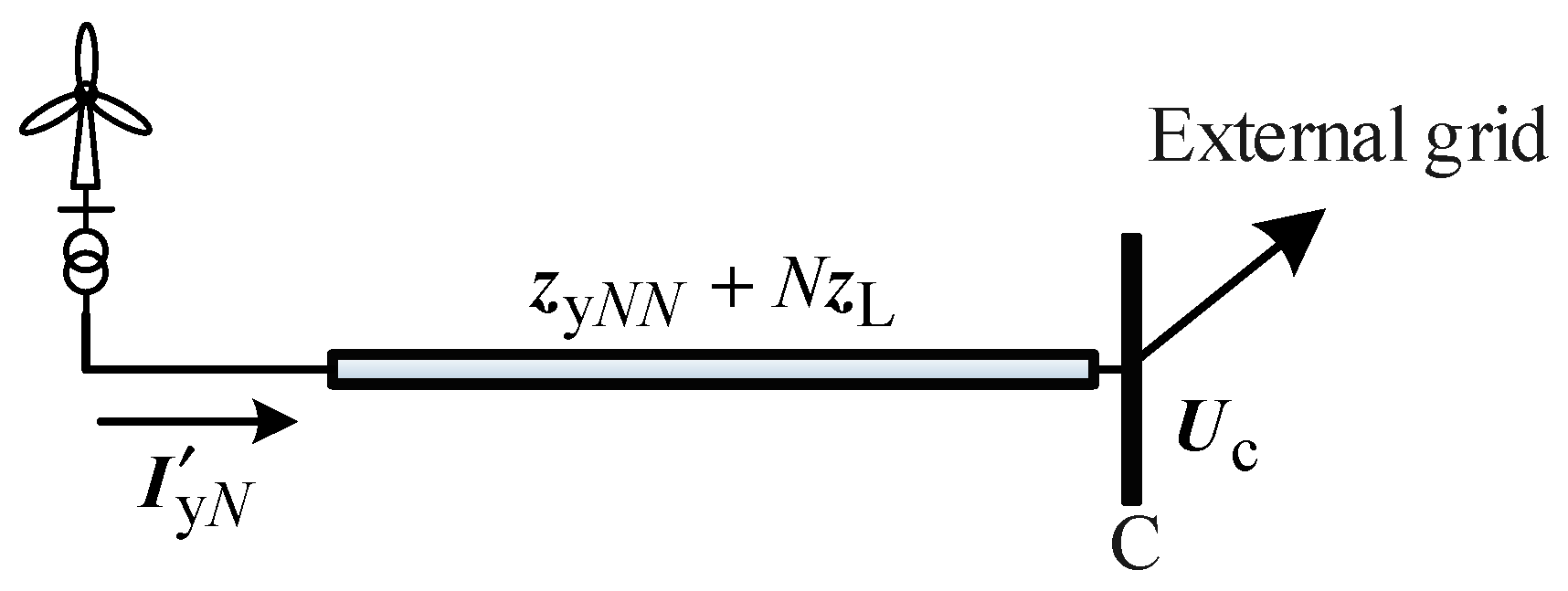
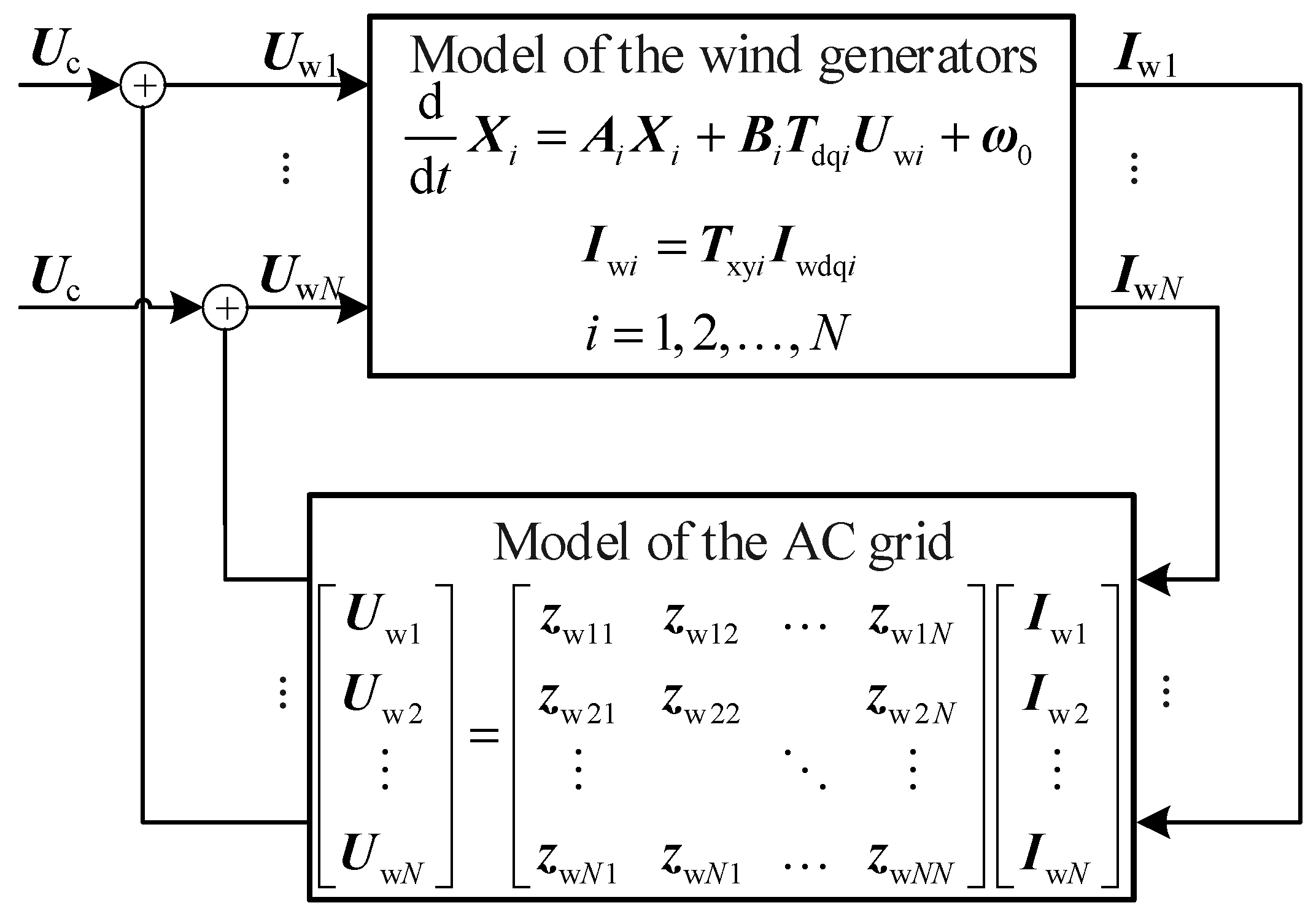
Therefore, based on (10), (12), and (13), the output current of the wind farm can be expressed as I c = N I y N , with Iyi = 02×1 (i = 1, 2, …, N − 1, 02×1 denoting a 2 × 1 zero vector). Furthermore, from (10) and (11), the overall transient response of the wind farm under external disturbances can be described by a multi-machine model, with the corresponding model shown in (14) and Figure 2.
d d t Y N = A 0 Y N + B 0 T dq 0 U y N + ω 0 I y N = T xy 0 I wdq 0 U y N = ( z y N N + N z L ) I y N + U C
where Y N = Y N N , U y N = U y N N , I y N = I y N N , and z y N N = 1 N i = 1 N j = 1 N z c i j .
In should be noted that the proposed aggregated modeling method does not impose specific requirements on the number of PMSGs. This method is derived under the precondition that all PMSGs are of the same model, making it applicable to wind farms where all PMSGs are from the same manufacturer and of the same type. For cases where the PMSG models differ, a multi-machine equivalence approach may be considered, which remains a subject for further research in the future.

3. Mechanism Analysis of Transient Synchronization Instability in Wind Farms

The wind-farm grid-connection system in Figure 1 can be viewed as an interconnected network of multiple wind generators and the external grid, as shown in Figure 3. A change in one generator’s output affects the inputs of others, which then alters their outputs in turn. This recursive process creates complex interactions among the generators. The strength of this coupling depends on generator dynamics, the number of generators, and the external grid’s topology and parameters. Its impact on the wind farm’s transient synchronization stability, however, remains unclear. This section presents a detailed analysis of the mechanism.
Based on the analysis in Section 2, for a wind farm with generators of the same make and model, transient synchronization behavior can be captured by the multi-machine aggregated model shown in Figure 2. In this model, the generator dynamics directly reflect those of the original units. The connecting impedance (zyNN + NzL) is derived from the nodal impedance matrix of the original system and depends on the number of generators, network topology, and system parameters. Thus, Figure 2 provides a foundation for analyzing how generator dynamics, generator number, and network topology and parameters influence the transient synchronization stability of the full wind-farm system.

3.1. Impact of Generator Dynamics on Transient Synchronization Stability

The multi-machine equivalent model in (14) can be expressed in the form of (15).
( 1 K p X I c d ) ω 0 K i s 2 θ pll = U c sin θ pll + R I c q + ω pll X ω 0 I c d K p K i U c cos θ pll ( ω pll ω 0 )
where Kp and Ki are the proportional and integral gains of the PLL, Icd + jIcq is the output current of the generator in Figure 2, Uc is the voltage magnitude at AC bus C in Figure 2, and θpll and ωpll are the PLL output angle and angular frequency, respectively. R and X denote the resistance and reactance of the grid-connection line in Figure 2. Since the PLL parameters of all generators are identical, the subscript i used in (1) to distinguish different generators is omitted here.
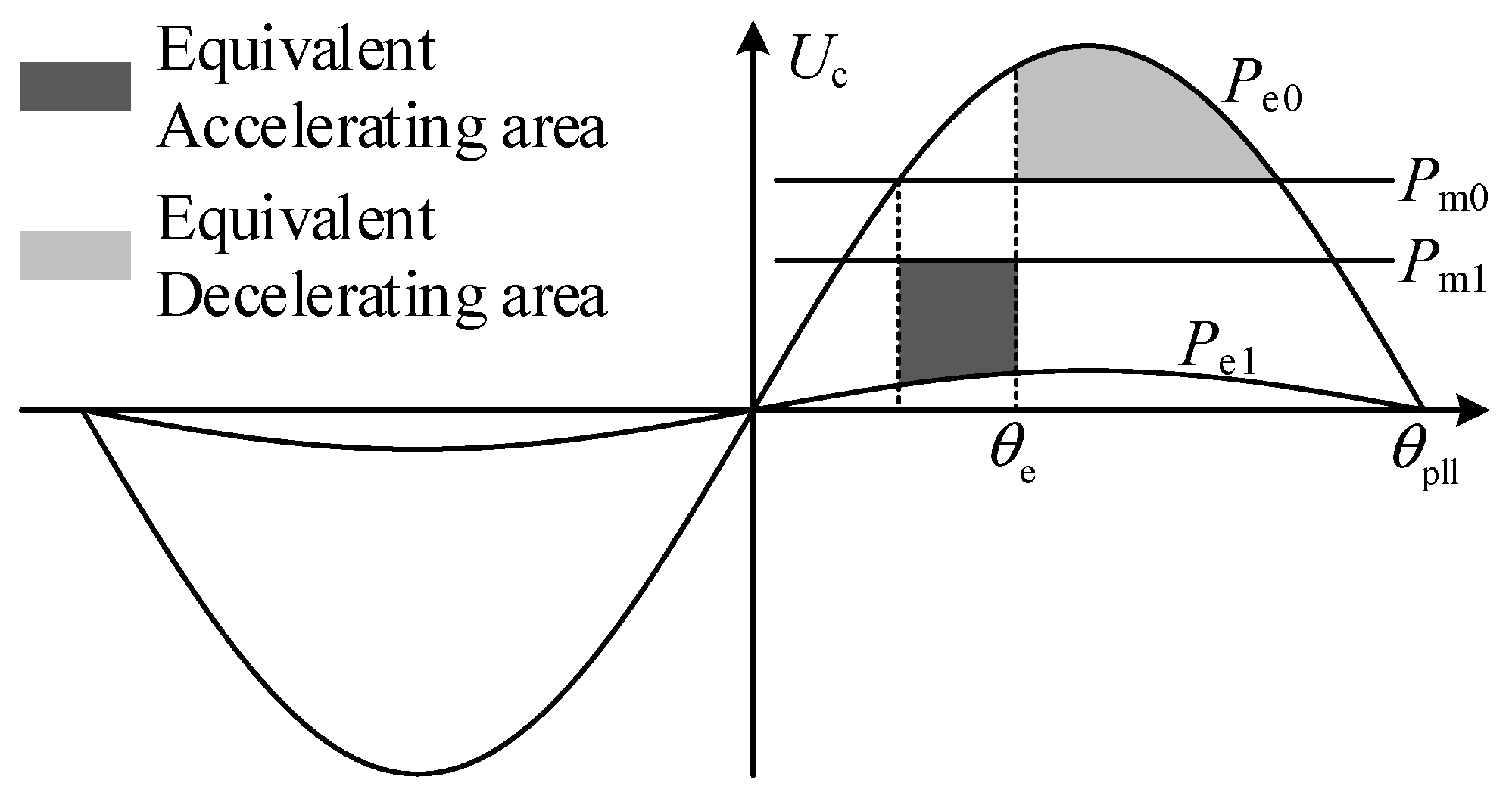
The equation in (15) has a form analogous to the rotor-motion equation of a conventional synchronous generator. That is, if the variation in the PLL angular speed is neglected, Pe = Ucsinθpll can be regarded as the equivalent electromagnetic power, and P m = R I c q + ω p l l X I c d / ω 0 can be represented as the equivalent mechanical power [16,17]. By transforming the transient synchronization analysis of a multi-machine system into a single-machine problem, standard direct methods from conventional power systems, such as the equal-area criterion, can be applied to assess the transient synchronization stability of the wind-farm grid-connection system.
For example, an external system fault typically causes a voltage drop at the wind-farm PCC (Uc), reducing the equivalent electromagnetic power, Pe. At the same time, the generator terminal voltage may fall, triggering low-voltage ride-through operation. This increases the q-axis component of the output current and decreases the d-axis component, thus altering the equivalent mechanical power, Pm. As a result, the equivalent electromagnetic and mechanical powers determine the accelerating and decelerating areas of the PLL angle during the fault and after fault clearance, as illustrated in Figure 4.
Owing to the equivalence of the multi-machine model for transient synchronization stability, these areas can be regarded as the wind farm’s equivalent accelerating area during the fault and equivalent decelerating area after fault clearance. If the equivalent accelerating area exceeds the maximum equivalent decelerating area, the generator, or the entire wind farm, will lose synchronism with the external grid under the fault condition.
From (15), the equivalent accelerating and decelerating areas depend on the generator output current and the connection impedance (R + jX) during and after a fault. This section first examines the effect of the output current. Consider a generator operating at unity power factor before the fault (Icq). In the PLL-defined d-q frame, when the generator supplies reactive power, Icq < 0. As is shown by (15) and Figure 4, if the line resistance is much smaller than the reactance, a smaller reactive current during the fault increases the equivalent mechanical power, enlarging the equivalent accelerating area and thereby reducing the transient synchronization stability of the wind farm.
The amplitude of the reactive current during a fault is mainly determined by the reactive-current coefficient. A smaller coefficient reduces the reactive current, thereby worsening transient synchronization stability. In addition, a higher active power output under normal conditions increases the equivalent mechanical power, enlarges the equivalent accelerating area during the fault, and reduces the equivalent decelerating area after fault clearance, further degrading the wind farm’s transient synchronization stability.

3.2. Impact of Network Topology and Parameters on Transient Synchronization Stability

As is demonstrated in (15) and Figure 4, assuming line resistance is much smaller than reactance, a larger grid-connection impedance increases the equivalent mechanical power for a given generator output current. As a result, the accelerating area during a grid fault grows, the decelerating area after fault clearance shrinks, and the wind farm’s transient synchronization stability is reduced.
According to (14), the connection impedance in the multi-machine aggregated model consists of two parts: one associated with z y N N = 1 N i = 1 N j = 1 N z c i j ( z c i j = r c i j x c i j x c i j r c i j ) and the other corresponding to NzL. Thus, it can be expressed as follows:
R = 1 N i = 1 N j = 1 N r c i j + N r L X = 1 N i = 1 N j = 1 N x c i j + N x L
Taking X as an example, the analysis based on (16) is as follows:
  • For a fixed number of generators, a larger export-line reactance xL increases X, which weakens the wind farm’s transient synchronization stability.
  • Since the internal collection-line impedance is typically much smaller than that of the export lines, for a given xL, a higher number of generators increases X, further reducing transient synchronization stability.
  • The collection-line reactance also influences X. From network theory, xcij can be regarded as the mutual reactance between generator i and generator j (ij) or the self-reactance from generator i to the collection bus (i = j). For a fixed number of generators, 1 N i = 1 N j = 1 N x c i j depends on the collection network topology and parameters (i, j = 1, 2, …, N). A greater electrical distance between generators and the collection bus, or higher mutual impedance between generators, increases xcij, which raises X and reduces the transient synchronization stability of the wind farm.
These observations reveal how generator number, network topology, and network parameters affect the transient synchronization stability of a wind farm.
It is worth noting that existing transient synchronization stability analysis of grid-connected wind power systems based on the direct method primarily focuses on single-machine systems. Direct-method-base transient synchronization stability analyses, considering the interaction between multiple wind turbines, remain challenging. Therefore, a single-machine aggregated model for PMSG wind farms is established through mathematical derivation in this paper. The proposed aggregated model is mainly used for transient synchronization stability mechanism analysis of a wind farm with multiple PLL-based PMSGs based on the direct method. Therefore, the mathematical formulas in this paper aim to reveal the mechanism of transient synchronization instability in PMSG wind farms considering the interaction between multiple PMSGs. Simulation in the following case study part, on the other hand, is primarily based on the detailed wind farm model (multi-machine model) to validate the effectiveness of the analytical conclusions.
Compared with the existing studies on the transient synchronization stability mechanism of grid-connected wind power systems, which primarily focus on single-machine grid-connected systems or simple two-machine grid-connected systems, the main innovative contribution of this paper lies in deriving a single-machine aggregated model for PMSG wind farm while considering the influence of multi-machine interactions, and establishing the relationship between the equivalent acceleration area and deceleration area in this aggregated model and number of PMSGs, network topology, and parameters of the original wind farm. Based on this, the transient synchronization stability mechanism of multi-PMSG wind farms is revealed. This is the main innovative work of this paper.

4. Case Study

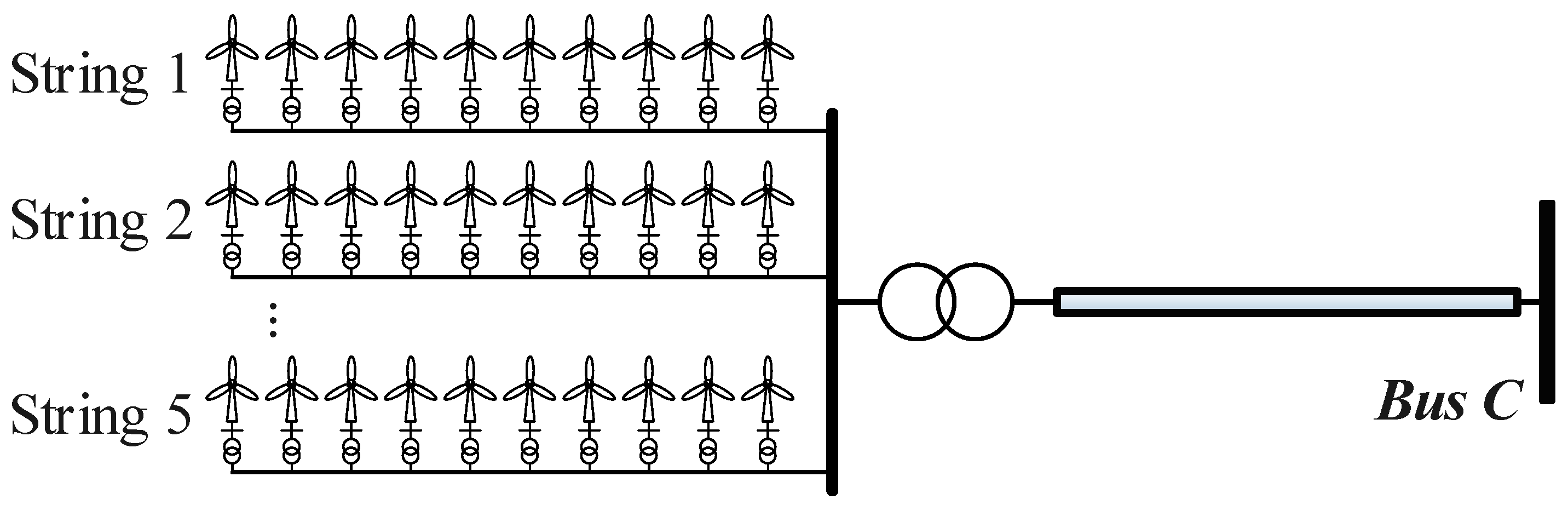
This section presents a simulation study of a typical offshore wind-power collection system with 50 generators. The transient synchronization stability was analyzed using both the aggregated and detailed models to validate the aggregation approach. The system topology is shown in Figure 5. All generators are connected to a collection bus via ten feeders, each comprising five generators in series. Each generator has a rated capacity of 0.05 p.u. on a 100 MVA base. Initially, the PMSGs operated at rated condition with a power factor of one and the short-circuit ratio at the 220 kV side of the offshore booster station is two. The collection-line impedance between adjacent generators is (0.004 + j0.01) p.u., while the export line, including transformer equivalent reactance, has an impedance of (0.022 + j0.22) p.u. The typical model of the PLL-based PMSG is adopted and the key parameters are given in the Appendix A.
The transient synchronization stability of PMSGs is primarily determined by the converter control systems, especially that of the grid-side converter. Existing studies on transient synchronization stability in grid-connected wind power systems mainly focus on whether wind turbines can maintain or restore synchronized operation with the external system after a fault occurs, assuming the wind farm operates under a given condition. Therefore, in the following simulation analysis, all PMSGs initially operate at a specific steady-state operating point under the given conditions, meaning the input wind speed for each PMSG is also constant. Furthermore, transient synchronization stability analysis typically focuses on the response characteristics of PMSGs within one or several seconds after a fault. During this period, the influence of wind speed is generally relatively minor, allowing the mechanical torque input to the permanent magnet synchronous generator to be regarded as constant. Therefore, in the simulation, the mechanical torque input is constant. In addition, it should be noted that the simulation analysis in this section is based on the detailed model (multi-machine system model) rather than the single-machine aggregated model, in order to validate the effectiveness of the analytical conclusions derived from the single-machine aggregated model. The proposed single-machine aggregated model is primarily used for analyzing the transient synchronization stability mechanism of a wind farm with multiple PMSGs.

4.1. Impact of Reactive-Current Coefficient on Transient Synchronization Stability

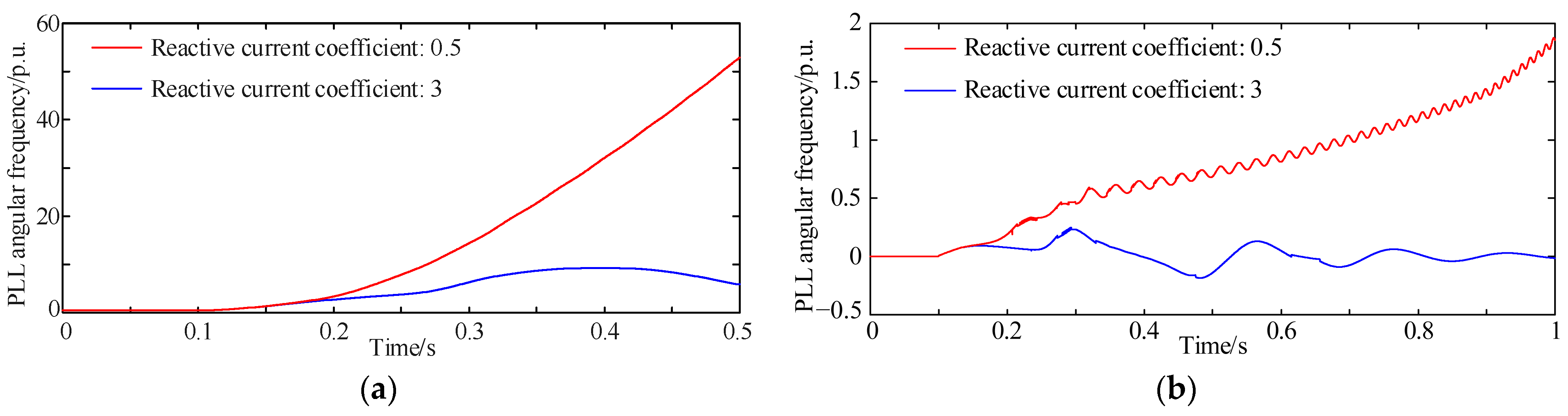
The effect of the reactive-current coefficient on transient synchronization stability was studied for values of 0.5 and 3. Simulations considered an external grid fault that reduced the voltage at the point of interconnection to 0.5 p.u., with a fault applied at 0.1 s and lasting 0.2 s. The results, shown in Figure 6, indicate that when the low-voltage ride-through reactive-current coefficient is 0.5, the wind farm loses synchronism with the external grid, consistent with the theoretical analysis.

4.2. Impact of Wind-Farm Export-Line Impedance on Transient Synchronization Stability

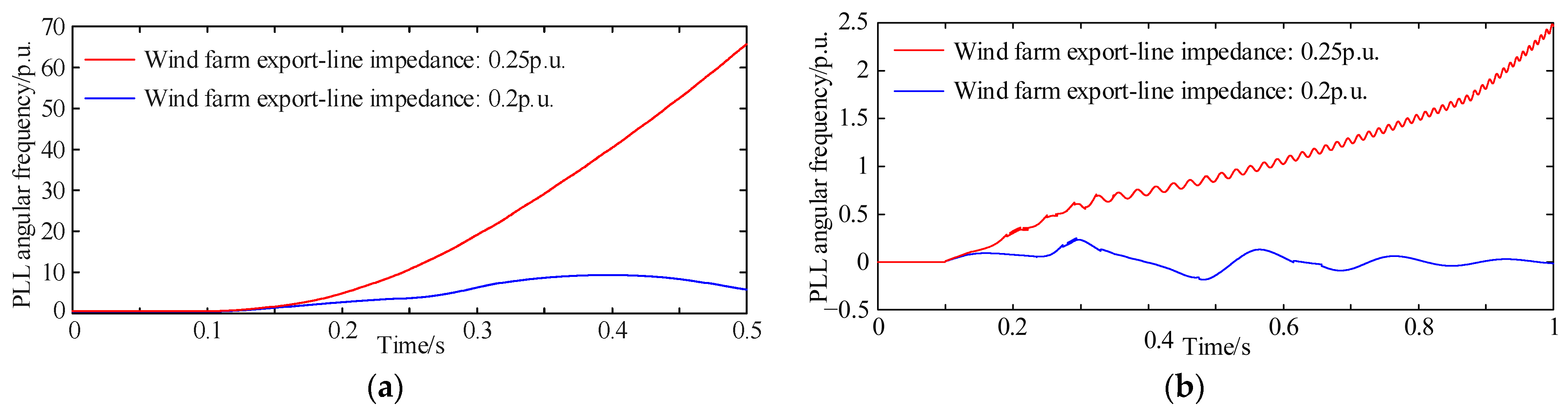
The effect of export-line reactance on transient synchronization stability was examined for values of 0.2 p.u. and 0.25 p.u. (impedance ratio 0.1). Simulations considered an external grid fault reducing the voltage at the point of interconnection to 0.5 p.u., applied at 0.1 s and lasting 0.2 s. As shown in Figure 7, when the export-line reactance is 0.25 p.u., the wind farm loses synchronism with the external grid, in agreement with the theoretical analysis.

4.3. Impact of Generator Number on Transient Synchronization Stability

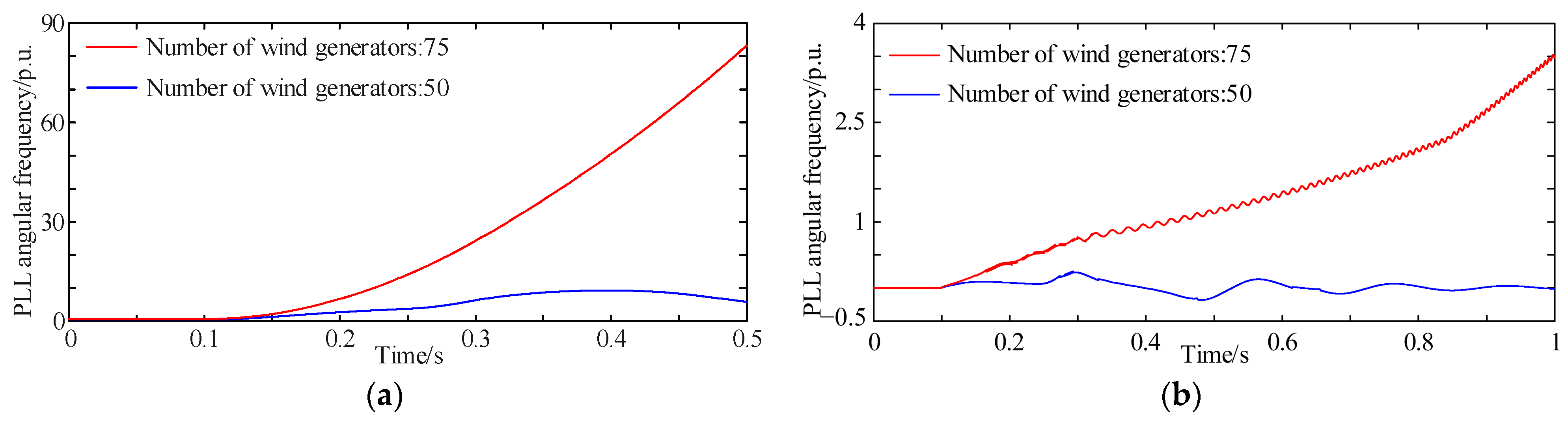
The effect of the number of generators on transient synchronization stability was analyzed for 100 and 125 units. Simulations considered an external grid fault reducing the voltage at the point of interconnection to 0.5 p.u., applied at 0.1 s and lasting 0.2 s. As shown in Figure 8, when 125 generators are connected, the wind farm loses synchronism with the external grid, consistent with the theoretical analysis.

4.4. Impact of Collection Network on Transient Synchronization Stability

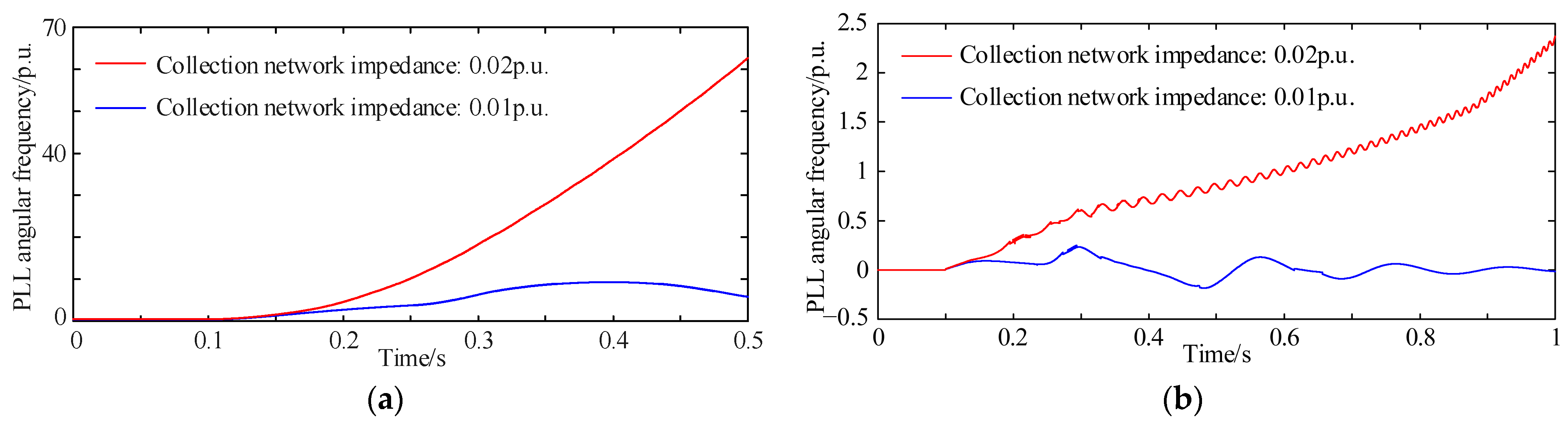
Initially, the reactance of the lines connecting adjacent generators is 0.01 p.u.. To study the impact of the collection network on transient synchronization stability, this reactance was increased to 0.02 p.u.. Simulations considered an external grid fault reducing the voltage at the point of interconnection to 0.5 p.u., applied at 0.1 s and lasting 0.2 s. As shown in Figure 9, when the line reactance between adjacent generators is 0.02 p.u., the wind farm loses synchronism with the external grid, in agreement with the theoretical analysis.

5. Conclusions

This study examined the mechanisms of transient synchronization instability in wind farms caused by interactions among multiple PMSGs.
  • A single-machine aggregated model was developed for analyzing transient synchronization stability of a wind farm considering the interactions between multiple generators. Using this model, the equivalent accelerating and decelerating areas of a wind farm were defined, providing key metrics to understand how multi-machine interactions induce transient synchronization instability.
  • The mechanism by which multi-PMSG interactions induce transient synchronization instability in a wind farm is analytically revealed, by analyzing the effects of the generator dynamics, number of generators, network topology, and system parameters on the equivalent accelerating and decelerating areas.
  • A smaller low-voltage ride-through reactive-current coefficient increases the equivalent accelerating area during a fault. Likewise, a higher steady-state active power output enlarges the accelerating area during the fault and reduces the decelerating area after fault clearance, adversely affecting transient synchronization stability.
  • A larger number of generators, higher export-line impedance, or greater self-impedance to the collection bus and mutual impedance between generators all increase the equivalent accelerating area during a fault and reduce the decelerating area after fault clearance, further degrading transient synchronization stability.

Author Contributions

Conceptualization, B.R., X.Z. and N.Z. methodology and modification, C.C. program and simulation modeling; B.R. validation; Q.L. and D.W. investigation; B.R. writing; D.W. writing—review and editing. All authors have read and agreed to the published version of the manuscript.

Funding

This research was funded by the State Grid Jiangsu Electric Power Company Ltd. (J2024JC-01).

Data Availability Statement

The data presented in this study are available on request from the corresponding author. (The data are not publicly available due to privacy or ethical restrictions.).

Conflicts of Interest

Authors Bixing Ren, Dajiang Wang, Xinyao Zhu, Ningyu Zhang, and Qiang Li was employed by the State Grid Jiangsu Electric Power Company Ltd. Research Institute. The remaining author declares that the research was conducted in the absence of any commercial or financial relationships that could be construed as a potential conflict of interest. The State Grid Jiangsu Electric Power Company Ltd. had no role in the design of the study; in the collection, analyses, or interpretation of data; in the writing of the manuscript, or in the decision to publish the results.

Appendix A

Table A1. Control parameter of the PMSG.
Control LoopParameters
Outer loop(5, 5000) DC voltage outer loop
(0.1, 10) Reactive power/voltage outer loop
Inner loop(0.15, 45) d/q-axis current inner loop
PLL(1.5, 5)
Low voltage ride through (LVRT)0.88 p.u. Activation threshold of the LVRT
1 Reactive power current coefficient

References

  1. Mao, L.; Huang, Y.; Zhao, J.; Zeng, Z. PLL positive feedback effect suppression and stability analysis of grid-connected inverter under weak grid. Electr. Power Autom. Equip. 2025, 45, 121–128. [Google Scholar] [CrossRef]
  2. Yuan, Z.; Guo, P.; Liu, G.; Zhao, Y.; Shi, Z. Review on control and protection for renewable energy integration through VSC-HVDC. High Volt. Eng. 2020, 46, 1460–1475. [Google Scholar] [CrossRef]
  3. Pan, L.; Li, X.; Wang, Z.; Tang, W.; Guo, L. Overview of transient stability analysis of phase locked loop synchronization in weak-grid connected VSC. Electr. Power Autom. Equip. 2023, 43, 138–151. [Google Scholar] [CrossRef]
  4. Ma, R. Nonlinear Modeling and Transient Synchronous Stability Analysis of PLL-Based VSC Systems. Ph.D. Thesis, Huazhong University of Science and Technology, Wuhan, China, 2023. [Google Scholar] [CrossRef]
  5. Liu, Y.; Xu, C.; Lin, Z.; Xiahou, K.; Wu, Q.H. Constructing an energy function for power systems with DFIGWT generation based on a synchronous-generator-mimicking model. CSEE J. Power Energy Syst. 2022, 8, 64–75. [Google Scholar] [CrossRef]
  6. Zhang, Y.; Zhang, C.; Cai, X. Transient grid- synchronization stability analysis of grid-tied voltage source converters: Stability region estimation and stabilization control. Proc. CSEE 2022, 42, 7871–7884. [Google Scholar] [CrossRef]
  7. Gao, Z.; Du, W.; Zhao, T.; Xie, H.; Wang, H..; Yi, S. Transient synchronization stability analysis of a grid-connected wind farm with multiple PMSGs. IEEE Trans. Power Syst. 2024, 39, 6934–6947. [Google Scholar] [CrossRef]
  8. Lu, Y.; Song, X.; Sheng, W.; Gao, F.; Liu, J. Analysis method and control strategy for transient synchronous stability of grid- connected new energy resources system considering current dynamics during LVRT. Power Syst. Technol. 2025, 49, 4556–4567. [Google Scholar] [CrossRef]
  9. Bao, Y.; Wu, F.; Ren, X.; Zhang, J.; Xu, T. Transient synchronizing stability margin assessment of phase-locked synchronous inverter based on potential energy boundary surface. High Volt. Eng. 2024, 50, 4802–4811. [Google Scholar] [CrossRef]
  10. Ma, R.; Li, J.; Kurths, J.; Cheng, S.; Zhan, M. Generalized swing equation and transient synchronous stability with PLL-based VSC. IEEE Trans. Energy Convers. 2022, 37, 1428–1441. [Google Scholar] [CrossRef]
  11. Taul, M.G.; Wang, X.; Davari, P.; Blaabjerg, F. An overview of assessment methods for synchronization stability of grid-connected converters under severe symmetrical grid faults. IEEE Trans. Power Electron. 2019, 34, 9655–9670. [Google Scholar] [CrossRef]
  12. Huang, S.; Yao, J.; Zhong, Q.; Gong, S.; Hao, X. Transient synchronization stability analysis of hybrid power system with grid-following and grid-forming renewable energy generation units. Proc. CSEE 2024, 44, 8378–8392. [Google Scholar] [CrossRef]
  13. Li, G.; Wang, K.; Liu, X.; Chen, J. A constant damping phase-locked loop for enhancing transient stability of grid-following inverter. IEEE Trans. Ind. Inform. 2025, 21, 3860–3870. [Google Scholar] [CrossRef]
  14. Zeng, P.; Zhang, T.; Li, Z. Control strategy of transient synchronization stability of full-scale wind turbines during grid faults. Proc. CSEE 2022, 42, 5935–5947. [Google Scholar] [CrossRef]
  15. Tang, Y.; Tian, Z.; Zha, X.; Li, X.; Huang, M.; Sun, J. An improved equal area criterion for transient stability analysis of converter-based microgrid considering nonlinear damping effect. IEEE Trans. Power Electron. 2022, 37, 11272–11284. [Google Scholar] [CrossRef]
  16. Li, X.; Liu, S.; Tian, Z.; Huang, M.; Sun, P.; Zha, X.; Hu, P. A conservatism improved transient stability analysis of grid-following converters based on the proposed elliptic-equal area criterion. IEEE Trans. Power Deliv. 2024, 39, 1110–1123. [Google Scholar] [CrossRef]
  17. Yi, X.; Huang, W.; Shen, C.; Lun, Y.; Shuai, Z. Transient synchronization stability analysis of paralleled converter systems with phase-locked loop. Proc. CSEE 2022, 42, 6338–6347. [Google Scholar] [CrossRef]
  18. Sun, H.; Zhao, B.; Xu, S.; Yu, L.; Wang, B.; Li, W. Definition, classification, and analysis method of the strength of power system integrated with high penetration of power electronics. Proc. CSEE 2024, 44, 7039–7049. [Google Scholar] [CrossRef]
  19. Wang, Z.; Guo, L.; Li, X.; Wang, Z.; Zang, X.; Zhu, J.; Zhou, X.; Wang, C. Transient synchronization stability of grid-tied multi-VSCs system considering nonlinear damping and transient interactions. IEEE Trans. Power Electron. 2024, 39, 16775–16791. [Google Scholar] [CrossRef]
  20. Li, X.; Tang, Y.; Tian, Z.; Cha, X.; Sun, J.; Li, Y. Synchronization stability analysis of grid-connected inverter based on improved equal area criterion. Autom. Electr. Power Syst. 2022, 46, 208–215. [Google Scholar] [CrossRef]
  21. Lu, Y.; Li, Y.; Yang, D.; Mou, T.; Liu, J.; Liu, M.; Hui, J.; Du, Z. Transient synchronization stability analysis of multi-virtual-synchronous-gene-rator system considering controller limiting. Autom. Electr. Power Syst. 2025, 49, 25–34. [Google Scholar] [CrossRef]
  22. Dong, W.; Du, W.; Wang, H. Small-signal stability of a grid-connected PMSG wind farm dominated by dynamics of PLLs under weak grid connection. Trans. China Electrochnical Soc. 2021, 36, 609–622. [Google Scholar] [CrossRef]
  23. Liu, J.; Yao, W.; Wen, J.; Fang, J.; Jiang, L.; He, H.; Cheng, S. Impact of power grid strength and PLL parameters on stability of grid-connected DFIG wind farm. IEEE Trans. Sustain. Energy 2020, 11, 545–557. [Google Scholar] [CrossRef]
  24. Wu, L.; Su, T.; Bu, H.; Dong, W.; Xie, X.; Wang, X. Small-signal equivalent modeling method for multiple distributed renewable energy clusters. Autom. Electr. Power Syst. 2025, 49, 69–78. [Google Scholar] [CrossRef]
  25. Dong, W.; Du, W.; Wang, H. Dynamic equivalent model of a grid-connected wind farm for oscillation stability analysis. Proc. CSEE 2021, 41, 75–87. [Google Scholar] [CrossRef]
  26. Dong, W.; Du, W.; Xie, X.; Wang, H. An approximate aggregated impedance model of a grid-connected wind farm for the study of small-signal stability. IEEE Trans. Power Syst. 2022, 37, 3847–3861. [Google Scholar] [CrossRef]
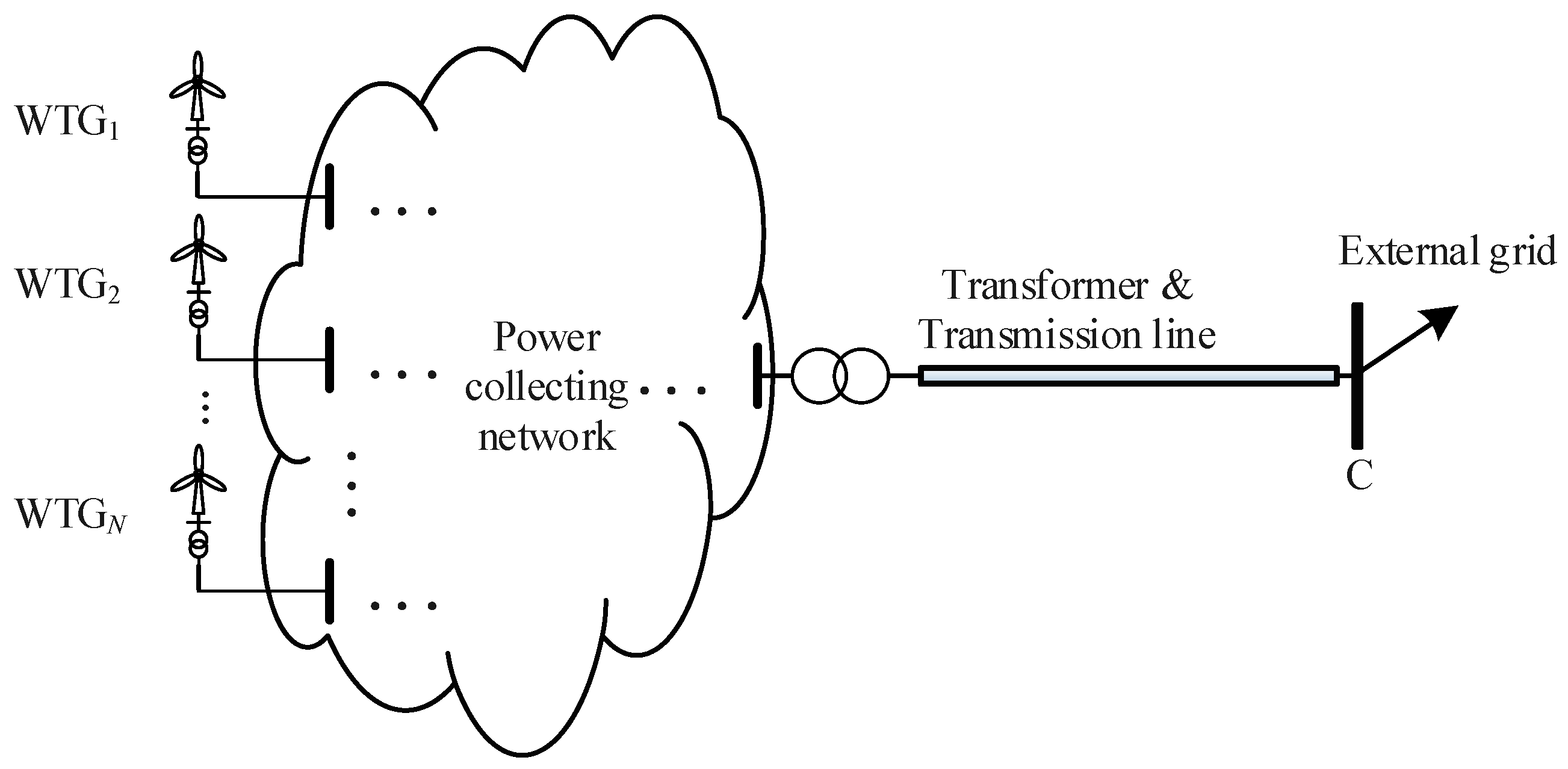
Figure 1. A typical wind power integrated system.
Processes 14 00321 g001
Figure 2. Multi-machine aggregated model of the wind farm for transient synchronization stability analysis.
Processes 14 00321 g002
Figure 3. Interconnected model of the wind generators and the external grid.
Processes 14 00321 g003
Figure 4. Example of equivalent PLL accelerating and decelerating areas during the transient process.
Processes 14 00321 g004
Figure 5. Topology of the example wind farm.
Processes 14 00321 g005
Figure 6. Simulation results under different reactive-current coefficients: (a) PLL angle; (b) PLL angular frequency.
Processes 14 00321 g006
Figure 7. Simulation results under different wind-farm export-line impedances: (a) PLL angle; (b) PLL angular frequency.
Processes 14 00321 g007
Figure 8. Simulation results for different numbers of wind generators: (a) PLL angle; (b) PLL angular frequency.
Processes 14 00321 g008
Figure 9. Simulation results under different collection-network impedances: (a) PLL angle; (b) PLL angular frequency.
Processes 14 00321 g009
Disclaimer/Publisher’s Note: The statements, opinions and data contained in all publications are solely those of the individual author(s) and contributor(s) and not of MDPI and/or the editor(s). MDPI and/or the editor(s) disclaim responsibility for any injury to people or property resulting from any ideas, methods, instructions or products referred to in the content.