Article

Environmental Impact Assessment of New Cement Production Blending Calcareous Green Algae and Fly Ash


1
Department of Chemical Engineering, National Cheng Kung University, Tainan 70101, Taiwan
2
Department of Civil Engineering, National Cheng Kung University, Tainan 70101, Taiwan
3
Department of Energy and Power Engineering, Tsinghua University, Beijing 100084, China
4
Academy of Innovative Semiconductor and Sustainable Manufacturing, National Cheng Kung University, Tainan 70101, Taiwan
*
Author to whom correspondence should be addressed.
Processes 2026, 14(2), 299; https://doi.org/10.3390/pr14020299
Submission received: 24 December 2025 / Revised: 6 January 2026 / Accepted: 13 January 2026 / Published: 14 January 2026
(This article belongs to the Section Environmental and Green Processes)

Abstract

To improve traditional cement manufacturing, which generates a large amount of greenhouse gases, blending calcareous green algae and fly ash as cement replacement materials is expected to achieve nearly zero carbon emissions. As a calcareous green alga, Halimeda macroloba is a significant producer of biogenic calcium carbonate (CaCO3), sequestering approximately 440 kg of carbon dioxide (CO2) per 1000 kg of CaCO3, with CaCO3 production reported in relation to algal biomass. To assess the new low-carbon/low-waste cement production process, the proposed scenarios (2 and 3) are validated via Python-based modeling (Python 3.12) and Aspen Plus® simulation (Aspen V14). The core technology is the pre-calcination of algae-derived CaCO3 and fly ash from coal combustion, which are added to a rotary kiln to enhance the proportions of tricalcium silicate (C3S) and dicalcium silicate (C2S) for forming the desired silicate phases in clinker. Through the lifecycle assessment (LCA) of all scenarios using SimaPro® (SimaPro 10.2.0.3), the proposed Scenario 2 achieves the GWP at approximately 0.906 kg CO2-eq/kg clinker, lower than the conventional cement production process (Scenario 1) by 47%. If coal combustion is replaced by natural gas combustion, the fly ash additive is reduced by 74.5% in the cement replacement materials, but the proposed Scenario 3 achieves the GWP at approximately 0.753 kg CO2-eq/kg clinker, lower than Scenario 2 by 16.9%. Moreover, the LCA indicators show that Scenario 3 has lower environmental impacts on human health, ecosystem, and resources than Scenario 1 by 24.5%, 60.0% and 68.6%, respectively.

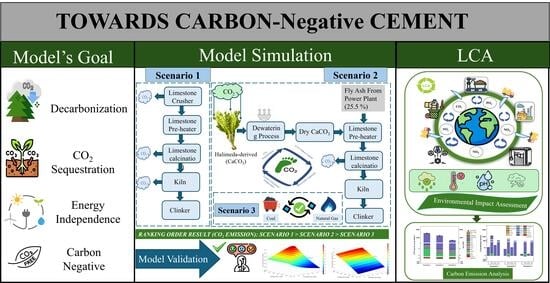
Graphical Abstract

1. Introduction

Cement remains one of the world’s most crucial construction materials due to its exceptional binding properties, durability, and structural reliability. However, its production is also one of the most energy-intensive and environmentally burdensome industrial processes [1,2]. According to the International Energy Agency (IEA) and the Cement Sustainability Initiative (CSI) Cement Technology Roadmap, global cement production will rise by approximately 12–23% by 2050, intensifying concerns over its carbon footprint and resource consumption [3]. Traditional clinker production relies heavily on limestone calcination and fossil fuel combustion, processes that release significant quantities of CO2, generate nitrogen oxide (NOx) and particulate emissions, and consume large amounts of thermal energy [4,5]. As cement manufacturing alone accounts for nearly 8% of global CO2 emissions, developing alternative sources of CaCO3 and reducing thermal energy requirements have become urgent sustainability priorities [6,7]. The production of one ton of cement results in approximately 0.94 tons of CO2 emissions, comprising 0.55 tons from calcination and 0.39 tons from fuel combustion [8]. During cement manufacturing, a mixture of calcium carbonate and aluminosilicate minerals, typically clay, is subjected to temperatures of approximately 1450–1500 °C to calcine the raw materials and form clinker [9,10]. This stage is highly energy-intensive, accounting for an estimated 85% of the total energy consumption in cement production [11,12]. The elevated temperature in cement production serves two essential purposes. First, the thermal decomposition of CaCO3 occurs at approximately 825 °C, producing CaO and releasing CO2. This process, known as calcination, is a critical step in the production of clinker. Once the calcium oxide is formed, the temperature is further increased to around 1450 °C, which is necessary to facilitate the formation of silicate minerals (C3S, C2S) and other clinker compounds [13]. In parallel, the environmental footprint of cement is increasingly scrutinized due to its consumption of natural resources. The construction sector alone accounts for nearly 50% of all raw material extraction worldwide. As cement production consumes significant quantities of limestone, clay, and energy, approximately 2 tons of raw materials and 4 GJ of thermal energy per ton of cement, its cumulative environmental burden continues to escalate [14,15,16]. This process also emits nearly 1 ton of CO2, approximately 3 kg of NOx, a key contributor to ground-level ozone formation, and up to 0.4 kg of PM10, a particulate matter known to pose significant risks to respiratory health upon inhalation [17].
The calcareous green alga Halimeda grows a broad distribution encompassing tropical and subtropical regions [18,19,20]. Halimeda is capable of utilizing bicarbonate ions (HCO3) for the process of calcification, wherein it facilitates the conversion of dissolved bicarbonate into calcium carbonate [21,22]. This alga precipitates aragonite, a polymorph of calcium carbonate, within its intercellular spaces, contributing to the formation of calcareous structures [23]. The biochemical mechanism involves the enzymatic fixation of CO2 and the subsequent incorporation of calcium ions (Ca2+) from the surrounding seawater, resulting in the precipitation of aragonite crystals [24]. Global estimates have indicated that Halimeda species contribute approximately 2 kg CaCO3 m−2 year−1, corresponding to an annual accumulation of around 0.15 Gt CaCO3, accounting for approximately 8% of global carbonate production [25,26]. These high calcification rates, coupled with Halimeda’s reliance on photosynthesis-driven carbon uptake, highlight its potential as a CO2-sequestering resource that could serve as a sustainable substitute for mined limestone [27]. The production of CaCO3 by Halimeda is influenced by both abiotic and biotic factors [28]. Temperature and light availability significantly regulate calcification and photosynthesis rates [29]. Growth and mineralization are optimized at 25–28 °C, conditions commonly found in nutrient-rich shallow marine habitats. Nutrient levels also affect productivity, with optimal growth at ~4 mg L−1 and CO2 enrichment up to 0.05 mg L−1 enhancing calcification efficiency [30]. Biologically, species-specific differences in turnover rate, morphology, and growth strategy influence overall CaCO3 output [31].
The high abundance of Halimeda species has been observed in various coral reef systems, including H. tuna in the Florida Keys, H. opuntia in the tropical South-west Atlantic Ocean, and H. macroloba in Thai waters [32,33]. Asexual reproduction through vegetative fragmentation, rather than sexual reproduction, is the primary mechanism contributing to the species’ abundance and maintaining populations on these reefs [34,35]. In this process, fragments of the organism break off and grow into new individuals, allowing for rapid colonization and population expansion. This method of reproduction ensures the species can sustain its presence even in environments where sexual reproduction may be less effective or slower, contributing to the resilience and persistence of populations on the reefs. Another dimension shaping CaCO3 mineralogy in marine environments is the long-term oscillation of seawater Mg/Ca ratios throughout the Phanerozoic Eon [36], as shown in Figure 1.
Variations in Mg/Ca ratios have determined whether marine systems favored the precipitation of low-Mg calcite, high-Mg calcite, or aragonite at different geological times. Calcareous green algae of the genus Halimeda have to generate substantial amounts of CaCO3, making for sustainable biogenic CaCO3 production rather than relying exclusively on mined limestone. For instance, field and modeling studies indicate that under favorable conditions, Halimeda populations can reach carbonate-accumulation rates of approximately 2 kg CaCO3 per square meter per year (kg m−2 yr−1) when averaged across reef systems [23]. In more sheltered micro-habitats, for example, beneath coral-reef canopies where herbivory pressure is reduced, even higher rates, up to 3.9 kg CaCO3 m−2 yr−1 for calcification and around 2.5 kg m−2 yr−1 for sediment production [37]. Based on these observations, it is conceivable to envision dedicated marine cultivation, e.g., aquaculture farms or managed sea-beds, where environmental conditions (light, water flow, nutrient supply) are optimized, and ecological disruptions are minimized. By scaling such cultivation systems across sufficiently large coastal or offshore areas, it might be possible to produce CaCO3 at volumes relevant for partial substitution of traditional limestone in cement production. However, realizing this potential at an industrial scale would require rigorous assessment of ecosystem impacts, yield variability, and life-cycle carbon balance to ensure that the environmental benefits (in terms of reduced mining and CO2 emissions) are not offset by negative ecological consequences.
In the framework of LCA, Mg/Ca ratios may affect the environmental impacts of scenarios involving marine carbon sequestration. However, the influence of Mg/Ca ratios on LCA outcomes is likely to be secondary to other factors, such as energy consumption and material tracking [38]. Most previous lifecycle assessment (LCA) studies have concentrated on technological improvements, plant variability, and alternative materials such as fly ash and granulated blast furnace slag in the production of blended cement [39,40]. Additionally, some studies have compared the environmental impacts of various cement production methods in different regions. Traditional cement manufacture, which depends mainly on mined limestone, contributes considerably to global CO2 emissions; therefore, investigating alternate sources of CaCO3 is crucial in lowering the carbon footprint of the construction sector [41,42,43].
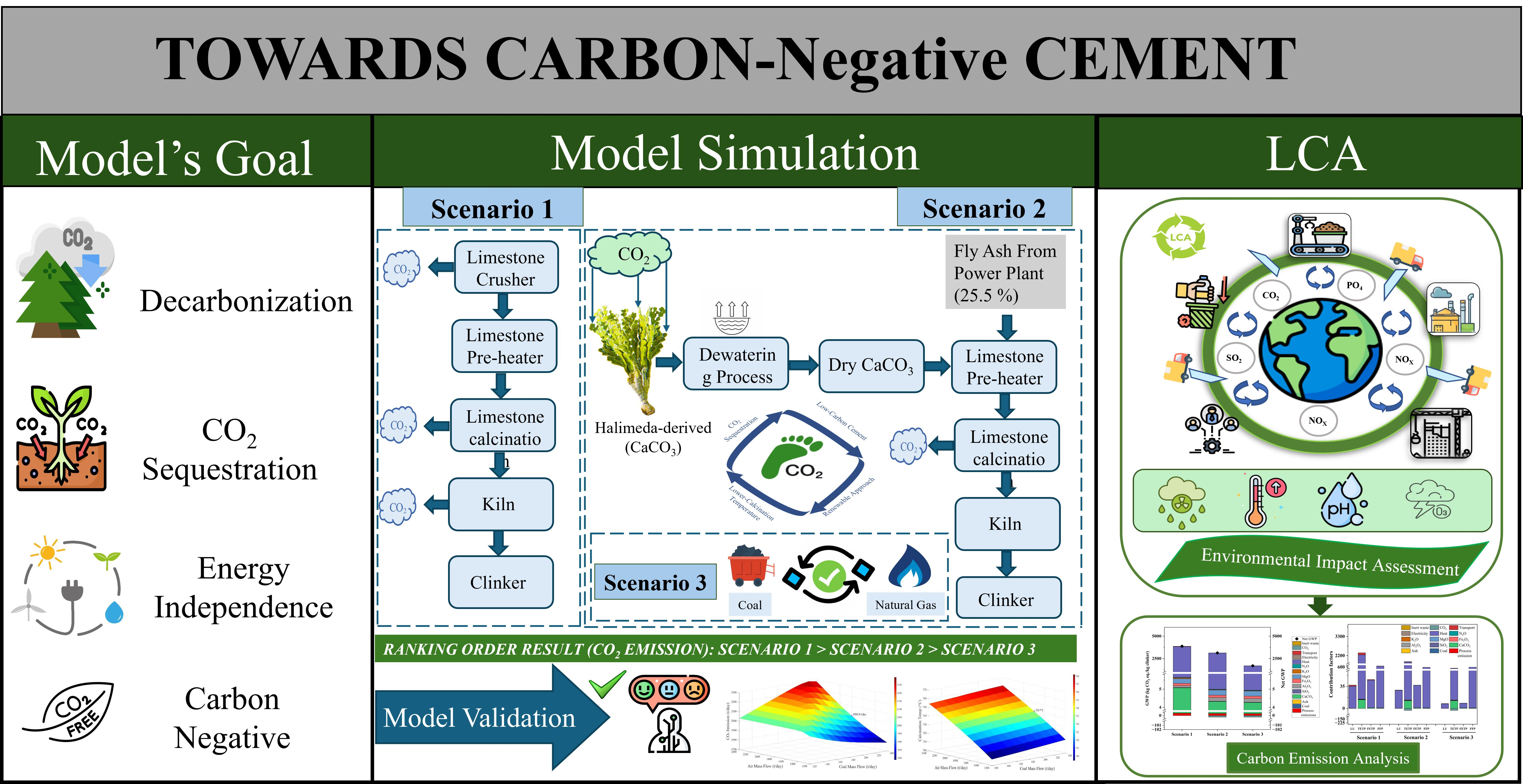
This study introduces an innovative approach to cement production by integrating biogenic CaCO3 derived from Halimeda macroloba, a marine alga, as a replacement for traditional limestone. This novel method not only explores the environmental impact of substituting biogenic CaCO3 for limestone but also incorporates the use of fly ash. The study presents three distinct scenarios for cement production to evaluate the sustainability of this approach. Scenario 1 represents conventional cement production based on traditional limestone and serves as the reference case. Scenario 2 examines the combined use of algae-derived CaCO3 and fly ash, focusing on the potential of biogenic materials and industrial by-products to reduce environmental burdens while maintaining clinker integrity. Scenario 3 further extends this framework by assessing the impact of fuel substitution in the calcination process, replacing coal with natural gas. The study details the materials selection, scenario validation methodology, and analytical framework used to assess energy flows, carbon sequestration potential, and lifecycle implications. Through this structured scenario-based approach, the study establishes a comprehensive foundation for evaluating the environmental relevance and feasibility of algae-based alternatives in cement production.

2. Methodology

Aspen Plus® software V.14 was employed to simulate both the existing and proposed additive processes. The model was constructed and validated using experimental data from relevant literature [44] and operational data from traditional cement plants to ensure the accuracy and reliability of the simulations. This approach provided a robust framework for evaluating the proposed process’s performance compared to the conventional methods used in cement production. This study differentiates between two types of simulations: one focusing on the reaction state of solids and gases and the other addressing the complex interactions of gas, liquid, solid, and ions.
The assumptions for the simulations are as follows: the system operates under steady-state and steady-flow conditions, meaning that all variables, such as temperature and pressure, remain constant over time, and the process is in equilibrium. Additionally, all reactors are assumed to be in thermodynamic equilibrium with no heat loss, implying that there are no losses through radiation, convection, or conduction. This idealized scenario simplifies the thermodynamic calculations by excluding heat transfer to the surroundings, such as from the reactors or air systems. These assumptions are commonly applied in process-level cement modeling to capture the dominant thermodynamic behavior of high-temperature kiln systems while maintaining computational efficiency. In industrial rotary kilns, although local temperature gradients, incomplete mixing, and heat losses through kiln walls do occur, the overall process operates close to thermodynamic equilibrium due to long residence times and sustained high temperatures exceeding 1400 °C. The no-heat-loss assumption, therefore, represents an idealized but reasonable approximation for comparative scenario analysis, particularly when the objective is to evaluate relative differences in energy use and CO2 emissions rather than to replicate detailed kiln hydrodynamics. Since identical assumptions are applied consistently across all scenarios, the comparative conclusions regarding emission reduction and environmental performance remain robust despite these explanations.
Furthermore, catalysis is excluded from the simulations and thermodynamic calculations, meaning that the study assumes no catalytic reactions, where a catalyst might speed up a chemical reaction without being consumed, affecting the process dynamics. The ambient conditions for the simulation are set at a temperature of 24.85 °C and a pressure of 101.325 kPa. By integrating these critical reference data and models, the cement production process can be simulated more comprehensively, ensuring that the model’s parameters and operating conditions align with the real data from cement plants as described in the literature [44]. This approach significantly improves the credibility and accuracy of the model, ensuring that it accurately reflects real-world conditions and data. The construction of the model primarily involves four key processes: the preheating process, the pre-calcination process, the rotary kiln process, and clinker generation. The heat required for the pre-calcination and rotary kiln processes is primarily derived from the combustion of pulverized coal, with the heat output calculated based on the conversion efficiency of coal combustion, including any losses associated with the system. These heat values are derived from operational data reflecting the actual usage and efficiency of coal in the cement production process, considering heat losses from the combustion and material handling systems. The combustion reaction for these processes is modeled using the combustion reaction system provided by Aspen Plus® software.
Before constructing the coal-fired process, analyzing the composition and particle size distribution of pulverized coal is essential. The data regarding the size distribution of pulverized coal particles, specifically the highest concentration between 120 μm and 200 μm, was obtained from the particle size distribution model in Aspen Plus® software. This model uses empirical data and predefined coal properties to simulate the particle size distribution during combustion. The cumulative weight fraction approaching 1, particularly in the 180–200 μm range, indicates that the majority of coal particles are relatively coarse, with most particles being larger than 120 μm. This information was used to model the combustion process and ensure accurate heat generation calculations in the pre-calcination and rotary kiln processes. Additionally, pulverized coal is considered a nonconventional component. In this simulation, the coal composition is specified with both inherent and surface moisture content, with the wet coal initially containing 10% moisture. Aspen Plus® software calculates the required heat for moisture removal, based on the moisture content and the specific properties of the coal. This approach eliminates the need for manually calculating enthalpies associated with drying, as Aspen Plus® software automatically accounts for the heat required to reduce the moisture content from 10% to 2% in the It’sDry-RStoic reactor. The heat of evaporation used in the model, using a Fortran block, is based on the standard value of approximately 40 kJ/mol for the vaporization of water. This value is typically derived from thermodynamic tables and represents the latent heat required to evaporate water at the given conditions. Equation (1) provides the relevant reaction for coal drying, but it does not specifically correspond to the evaporation enthalpy. The remaining moisture in the coal is then further evaporated through a Dry-Flash separator, which completes the drying process. Aspen Plus® automatically calculates the energy required for this evaporation based on the coal’s moisture content and the drying conditions.
C O A L w e t 0.0555084 H 2 O + C O A L ( d r y )
The remaining moisture is further evaporated through the Dry-Flash separator, completing the drying process of the pulverized coal. The completely dried pulverized coal is processed in the Decomp (RYield) reactor, where it undergoes pyrolysis and is decomposed into various products, which are then calculated in Aspen Plus®. The pyrolysis products are determined using a Fortran block, and the decomposed substances are combined with ash. Equation (2) governs the enthalpy equilibrium of the unit, and the enthalpy of the pulverized coal is calculated according to Equation (3). In this process, QP represents the heat absorbed by the pyrolysis reaction, mi and nj represent the masses of the reactant components i and product components j, respectively. Δ H f , i , 298 0 denote the standard enthalpy of formation of component i and component j at the reference temperature of 298 K. Cp,i and Cp,j are the temperature-dependent specific heat capacities of the reactant and product components, respectively. The integrals from 298 K to T account for the sensible enthalpy changes in each component as the temperature increases from the reference state to the system temperature T.
i = 1 I m i Δ H f , i , 298 0 + i = 1 I m i 298 T c p , T , i d T = j = 1 I n j Δ H f , i , 298 0 + j = 1 I n j 298 T c p , T , i d T + Q P
H f , i , 298 0 = H H V ( 327.86 C a r + 1418.79 H a r + 92.84 S a r + 158.67 M a r )
The decomposition products, including H2O, N2, O2, S, H2, Cl2, C, and Ash, are introduced into the Burn (RGibbs) reactor. The phase and chemical equilibrium of the reaction are determined by minimizing the Gibbs free energy of the system. The objective function for this calculation is presented in Equation (4).
M i n G , G = j = 1 S n j c G j 0 + j = S + 1 M l = 1 P n j l G j l
While more Equations (5)–(7), it ensures the conservation of mass, addresses the preservation of enthalpy, and imposes a non-negative constraint.
s t : b k = j = 1 S n j c m j k + j = S + 1 M l = 1 P n j l m j k k = 1,2 , , Z
i = 1 M n i Δ H f , i n , 298 , i 0 + i = 1 M n i H i , T ( i n , i ) + Q P = i = 1 M n i Δ H f , o u t , 298 , i 0 + i = 1 M n i H i , T ( o u t , i ) + Q L
n i 0
The total Gibbs free energy of the system is denoted as G, with S representing the number of single phases, M representing the total number of phases, P representing the number of components, and Z representing the number of elements. The system also includes an atomic matrix and accounts for heat loss QL. The main coal combustion products modeled in this process include H2O, N2, O2, S, SO2, SO3, H2, C (solids), CO, CO2, Cl2, and HCl [45]. After combustion, the gas–solid mixture is separated using a cyclone separator, which removes solid particles and directs the high-temperature gases into the necessary process units. These gases serve as the primary heat source for subsequent process stages. This study aims to verify the accuracy of the hypothesis model developed using Aspen Plus® software, referencing the works [45,46]. The pulverized coal composition is analyzed based on the settings shown in Table 1, which includes both proximate and ultimate analysis.
The construction of models for the preheating process, pre-calcination process, rotary kiln process, and cement generation primarily references the works of Benhelal et al. [44]. Scenario 1 outlines the clinker production process using a standard raw material composition commonly employed in conventional cement plants. Based on the data provided by [44] and the Taiwan Green Productivity Foundation (2017), as shown in Table 2, the particle size distribution of the raw material is modeled using a predefined size range in the Aspen Plus® particle size distribution model. In this model, the majority of the raw material particles are specified to fall between 40 μm and 100 μm, with a distinct peak observed between 74 μm and 80 μm. This distribution is inputted as a set of empirical data or a log-normal distribution, which Aspen Plus® uses to simulate the behavior of particles during the processing stages, including combustion and heat transfer calculations.
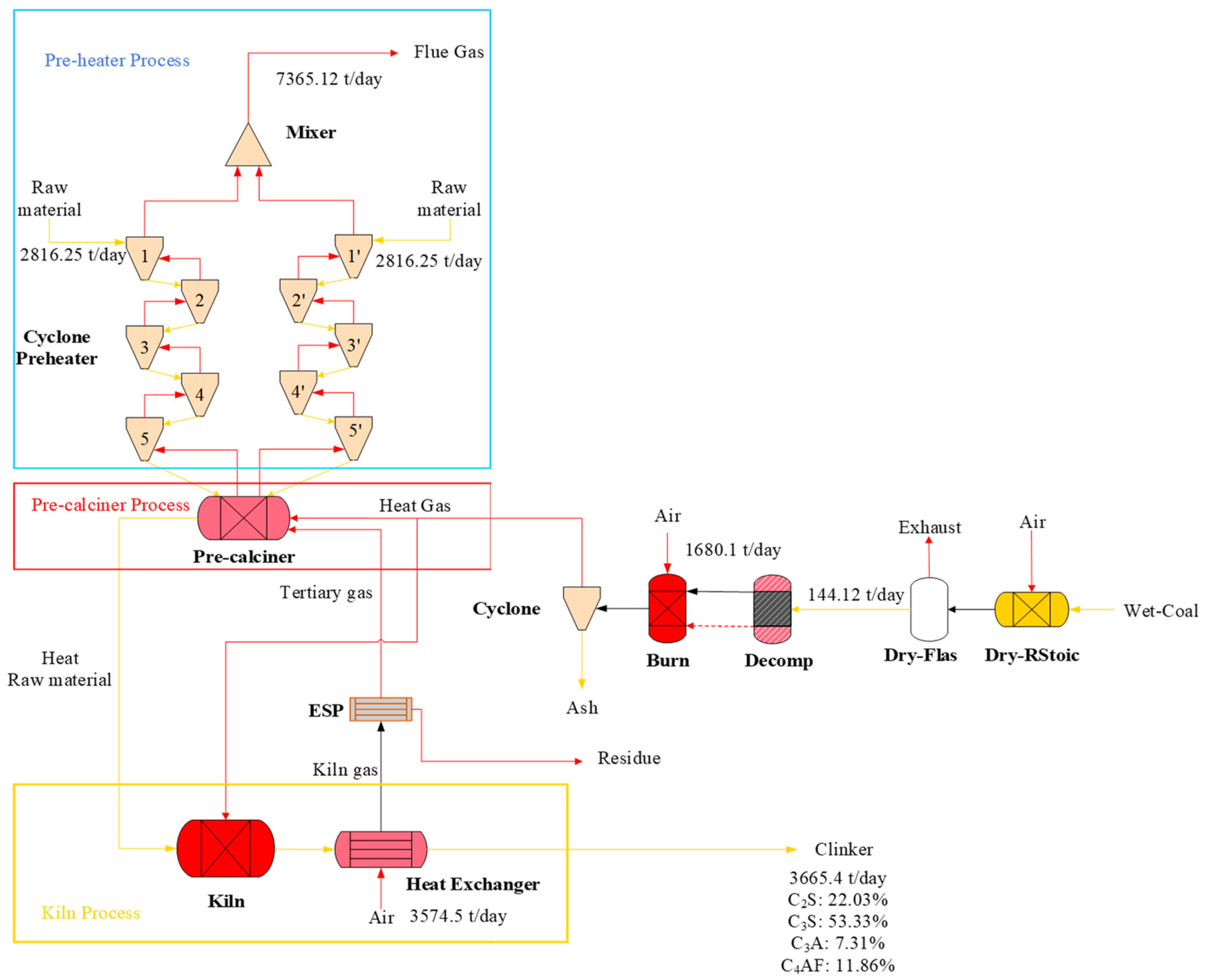
The raw material composition is derived from materials commonly used in Taiwan cement production, ensuring compliance with national standards for clinker composition. The primary chemical constituents of the raw material are listed in weight percentage (wt%), with each compound labeled for clarity and consistency throughout the study. The selection of raw materials in this design is carefully executed to maintain an appropriate balance of key oxides, including CaO, SiO2, Al2O3, and Fe2O3, which are vital for the formation of the desired mineral phases, such as C3S (tricalcium silicate), C2S (dicalcium silicate), C3A (tricalcium aluminate), and C4AF (calcium ferroaluminate) during the rotary kiln process. Once the raw material composition is defined, the process model for the pre-heating stage is developed. This model simulates the pre-heating process, where the raw material is mixed with high-temperature gases in the suspension preheater. The model incorporates relevant thermodynamic and kinetic parameters to simulate the heat transfer and temperature profile throughout the pre-heating stages. During this stage, gas–solid separation is performed using a cyclone separator in the suspension preheater. The raw material is mixed with high-temperature gas and subsequently separated to achieve the desired preheating effect. A double-string preheating tower is employed, enabling maintenance and repair operations without downtime and thereby enhancing the system’s overall operational efficiency. The overall traditional cement plant flow chart for scenario 1 is presented in Figure 2.
In the preheating process for scenario 1, the suspension preheaters are numbered sequentially from 1 to 5, with preheater 1 located closest to the raw material, and preheater 5 being closest to the rotary kiln. The reverse heat exchange between the raw material and the high-temperature gas determines the temperature in each preheater layer. Starting at 50 °C, the raw material temperatures increased progressively in each layer, reaching 760 °C after passing through preheaters 1 to 5. Once the raw material temperature reaches between 700 °C and 900 °C, it enters the pre-calciner process, where decarbonization occurs in the reactor (RStoic) [47]. In this reaction, CaCO3 decomposes into CaO and CO2, with a conversion efficiency exceeding 95%. In addition to the decarbonization reaction, the pre-calcining stage also involves other chemical and physical processes, as shown in Table 3, contributing to the preliminary calcination of the raw material.
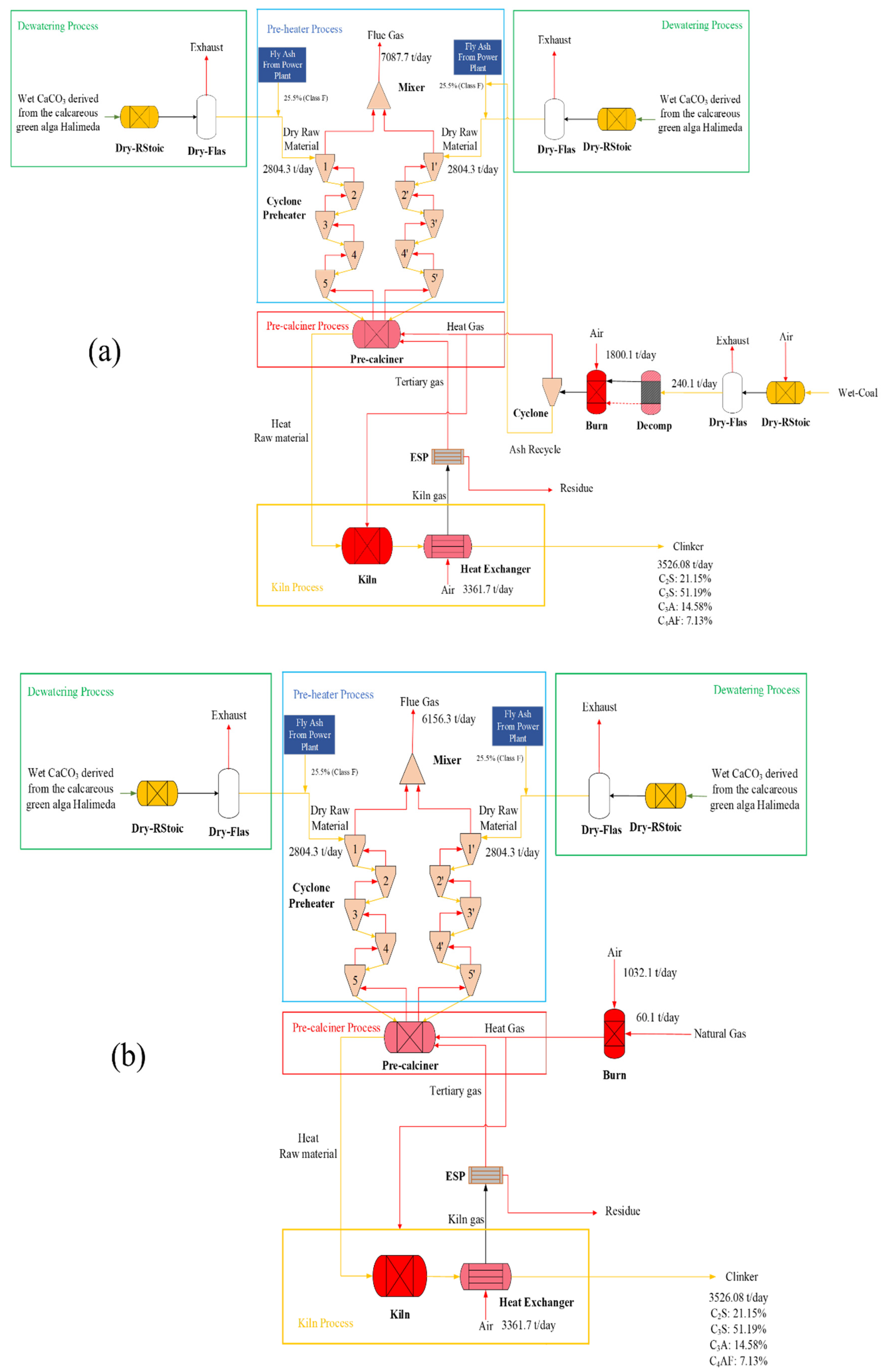
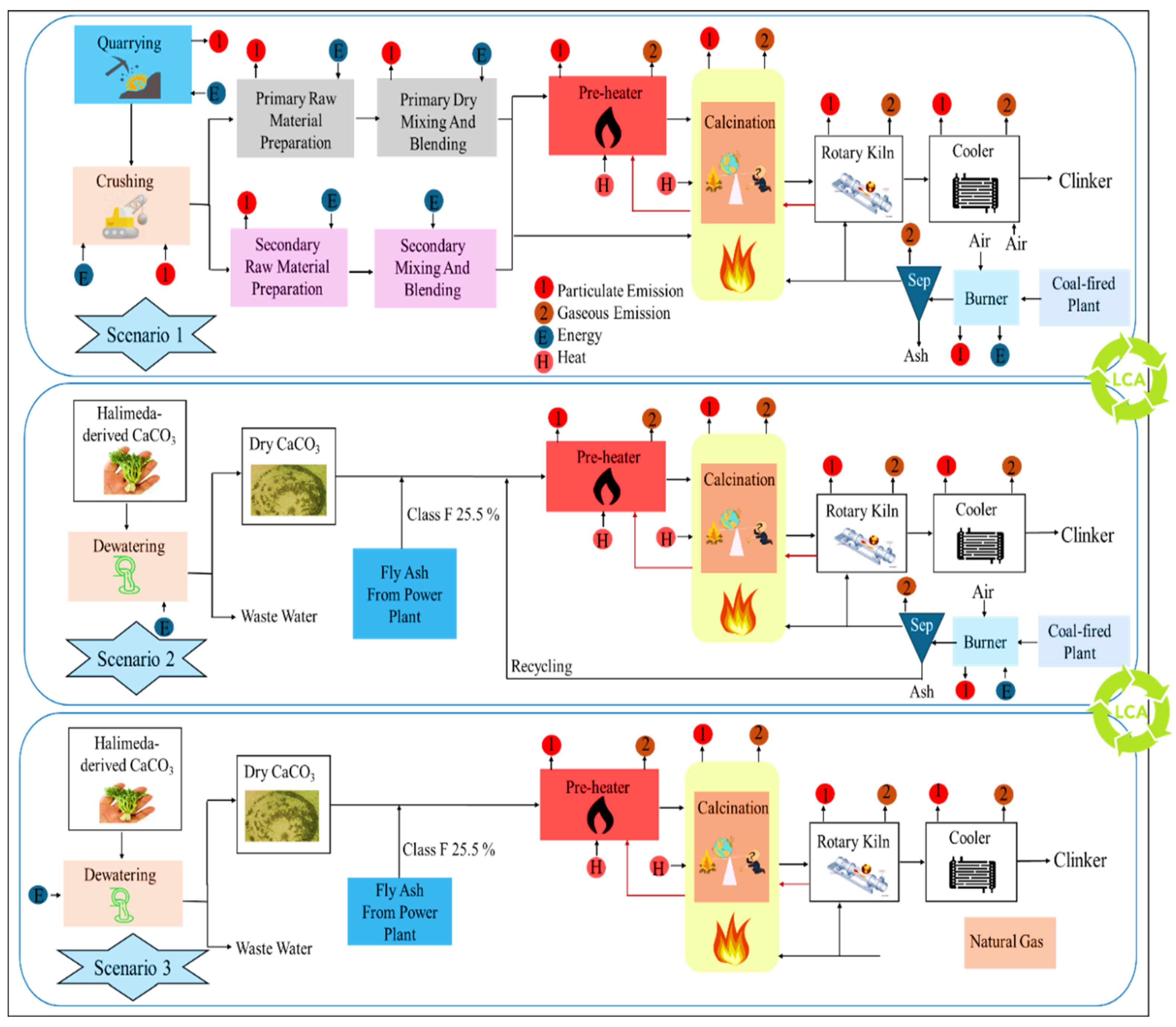
After calcination, the raw material is sent to the rotary kiln for clinker production through the reactor (RStoic), where the temperature reaches 1500 °C, promoting the transformation of the clinker composition. The high-temperature clinker is then cooled below 100 °C using a heat exchanger (HeatX, Houston, TX, USA), and the recovered gas is reused in the preheating process. The rotary kiln and cement generation exhaust gases are recovered and sent to the electrostatic precipitator (ESP) for gas–solid separation, separating CKD from the gas phase. An innovative approach to clinker production using calcareous green algae and recycled fly ash, similar to Scenario 2, is shown in Figure 3a. The large-scale availability of Halimeda-derived CaCO3 and its ecological implications remain important considerations for practical implementation. Although Halimeda species are widely distributed and show high carbonate production rates in tropical and subtropical marine environments, the present study does not assume unrestricted biomass harvesting from natural reef systems. Instead, the proposed scenarios represent a conceptual framework based on controlled or managed cultivation, such as marine farming or designated seabed systems, designed to minimize ecological disturbance. Potential environmental risks, including habitat alteration, biodiversity impacts, and nutrient imbalance, must be carefully evaluated through site-specific ecological assessments before industrial deployment. Therefore, while algae-derived CaCO3 shows promising potential as a low-carbon alternative to mined limestone, further research is required to validate sustainable production pathways, assess long-term ecosystem effects, and determine realistic supply limits at scale.
Scenario 3 presents a carbon-negative cement production system that integrates multiple sustainable strategies, as shown in Figure 3b. Calcareous green algae are used as the primary calcium source, replacing conventional limestone and offering a biogenic route to CO2 absorption. The system substitutes coal with natural gas in the pre-calciner process, significantly lowering CO2 emissions due to the cleaner combustion characteristics of natural gas. Natural gas is a cleaner alternative to coal in pre-calcination processes, reducing LCA impacts and global warming potential. It emits less CO2 per unit of energy and produces lower pollutants, improving air quality and reducing environmental burdens. Algae-derived CaCO3 provides a sustainable source of calcium carbonate, sourced from marine algae instead of traditional limestone. By reducing the moisture content before calcination, dewatering lowers the energy required for the process, as the moisture is removed using heat generated from the combustion of fuel in the pre-calciner and rotary kiln. This heat energy is transferred to the raw material, reducing the amount of external energy needed for drying. Consequently, the process benefits from reduced CO2 emissions and lower energy consumption during the heating and calcination stages. This alternative material offers a renewable resource and significantly reduces the environmental impact of conventional limestone. Class F fly ash (25.5%), derived from coal combustion and recycled ash, is blended with Halimeda-derived CaCO3 to enhance the performance of cementitious materials. In this study, a clear distinction is maintained between reactions occurring during clinker formation and those taking place during the subsequent hydration stage. Clinker formation reactions are limited to high-temperature solid–solid and solid–liquid transformations in the rotary kiln, including the formation of primary phases such as C3S, C2S, C3A, and C4AF, which are governed by thermodynamic equilibrium at temperatures above 1200 °C. In contrast, the reactivity of fly ash is not assumed to contribute to clinker-phase formation but is instead associated with post-clinker hydration processes, where amorphous SiO2 and Al2O3 participate in pozzolanic reactions with Ca(OH)2 to form secondary C–S–H and C–A–H gels. Accordingly, fly ash is treated as a supplementary cementitious material influencing hydration-stage performance and long-term durability rather than altering the fundamental clinker mineralogy. This separation ensures that kiln chemistry and hydration chemistry are evaluated independently and avoids conflating high-temperature phase formation with low-temperature cement hydration mechanisms.
The algae-derived CaCO3 acts as a drop-in replacement for traditional limestone in the cement mix, providing a sustainable alternative with similar chemical properties. The primary composition of Halimeda CaCO3 is calcium carbonate (CaCO3), which is similar to that of conventional limestone, with the added benefit of being biogenic and derived from a renewable resource. Because Halimeda CaCO3 alone lacks sufficient silica content, the high SiO2 content of Class F fly ash ensures enough reactive silica is available to consume excess Ca (OH)2, thereby minimizing portlandite-related weakness and enhancing long-term durability, but also reducing the amount of energy-intensive clinker required. The addition of fly ash improves the clinker composition by increasing the SiO2, Al2O3, and Fe2O3 levels, which are essential for forming the desired silicate phases in clinker, such as C3S and C2S. Fly ash, a byproduct of coal combustion, is a valuable added material to cement production. Moreover, the incorporation of algae-derived CaCO3 and fly ash contributes to significant reductions in both energy consumption and CO2 emissions in the cement production process.
The clinker composition (51.19%, 21.15%, 14.58%, and 7.13%) represents a technically feasible and performance-aligned cement formulation that meets the necessary industry standards and regulatory requirements for modern cement applications. This formulation is designed to ensure both high performance and compliance with environmental and quality regulations. A high C3S content ensures rapid early strength gain, crucial for precast components and early load-bearing infrastructure. C2S, at 21.15%, contributes to long-term strength development and enhances durability by increasing resistance to carbonation and sulfate environments. C3A proportion, although relatively high at 14.58%, remains manageable through gypsum addition and is beneficial in formulations demanding fast setting and early strength. Lastly, C4AF, 7.13%, facilitates clinker burnability and efficiently integrates iron and alumina from industrial byproducts like fly ash, promoting resource efficiency and sustainability. This composition remains within acceptable bounds for Portland clinker and aligns with sustainability-oriented innovations. Studies have shown [48,49] that calcareous green algae, when processed to yield calcium carbonate, can effectively replace limestone in cement production while significantly reducing CO2 emissions without sacrificing mineralogical development or cement performance.

3. Validation and Sensitivity Analysis

3.1. Validation Analysis for Scenario 1

The process validation for the cement plant in this study was carried out by comparing the simulated data with actual operational data from key stages of the process, specifically for the reference case (Scenario 1). This reference case represents the conventional method used in current cement plants without incorporating any alternative materials, such as algae-derived CaCO3 mixing with fly ash. The simulation results were validated by matching the main flow rates, temperatures, and other process parameters with real plant data, and are summarized in Table 4. In Scenario 1, the suspension preheater system was modeled with a raw material feed rate of 2788.32 tons per day (t/day) on one side, resulting in a total feed volume of 5576.64 t/day for both sides of the preheater. The validation also involved the amount of Cement Kiln Dust (CKD) separated from the process. According to the operational plant data, approximately 0.15–0.2 tons of CKD are produced for each ton of clinker, which was consistent with the simulated results. These data confirm that the simulation model accurately reflects the performance of the conventional cement production process under typical operational conditions.
The simulation results from this study show that, based on the validated process model, the actual emissions of CKD per ton of clinker are approximately 0.175 tons. Additionally, the CO2 emissions per ton of clinker are estimated to range from 0.75 to 0.9 tons. These values were derived from the validated simulation, where emissions data were calculated based on the process parameters and material flows, rather than being input variables. The emissions values are thus an outcome of the model, reflecting the system’s performance under typical operational conditions. These results confirm the accuracy and reliability of the model in predicting the emissions from the cement production process, aligning closely with the observed values from the operational plant data
To validate the composition of the clinker, the Bogue formula was employed to calculate the proportions of the four primary minerals present in Portland cement clinker. The formula, as outlined in Equations (8)–(11) utilizes the five key components of the raw material.
C 3 S = 4.071   ( C ) 7.600   ( S ) 6.718   ( A ) 1.430   ( F ) 2.852   ( S ^ )
C 2 S = 2.867   ( S ) 0.7544   ( C 3 S )
C 3 A = 2.650 A 1.692 F
C 4 A F = 3.043   ( F )
The Bogue calculation was conducted under the condition that the alumina to ferrite (A/F) ratio is a standard criterion for Portland cement clinker production. Using this condition, the proportions of the four main clinker mineral constituents, C3S, C2S, C3A, and C4AF, were determined. These calculated values were then analyzed and compared with the actual data, as presented in Table 5, thereby comprehensively verifying the clinker composition. This comparison confirms the reliability and accuracy of the Bogue formula in predicting the mineral content of the clinker.
In compliance with the national CNS 61 standard, the clinker produced for scenario 1 meets the requirements for Type II cement clinker. Through detailed analysis and comparison, the differences in the clinker composition were found to be within ±5%. This indicates that the cement plant process model established in this study is balanced and credible, demonstrating its reliability for simulating clinker production per industry standards.

3.2. Sensitivity Analysis for Scenario 2

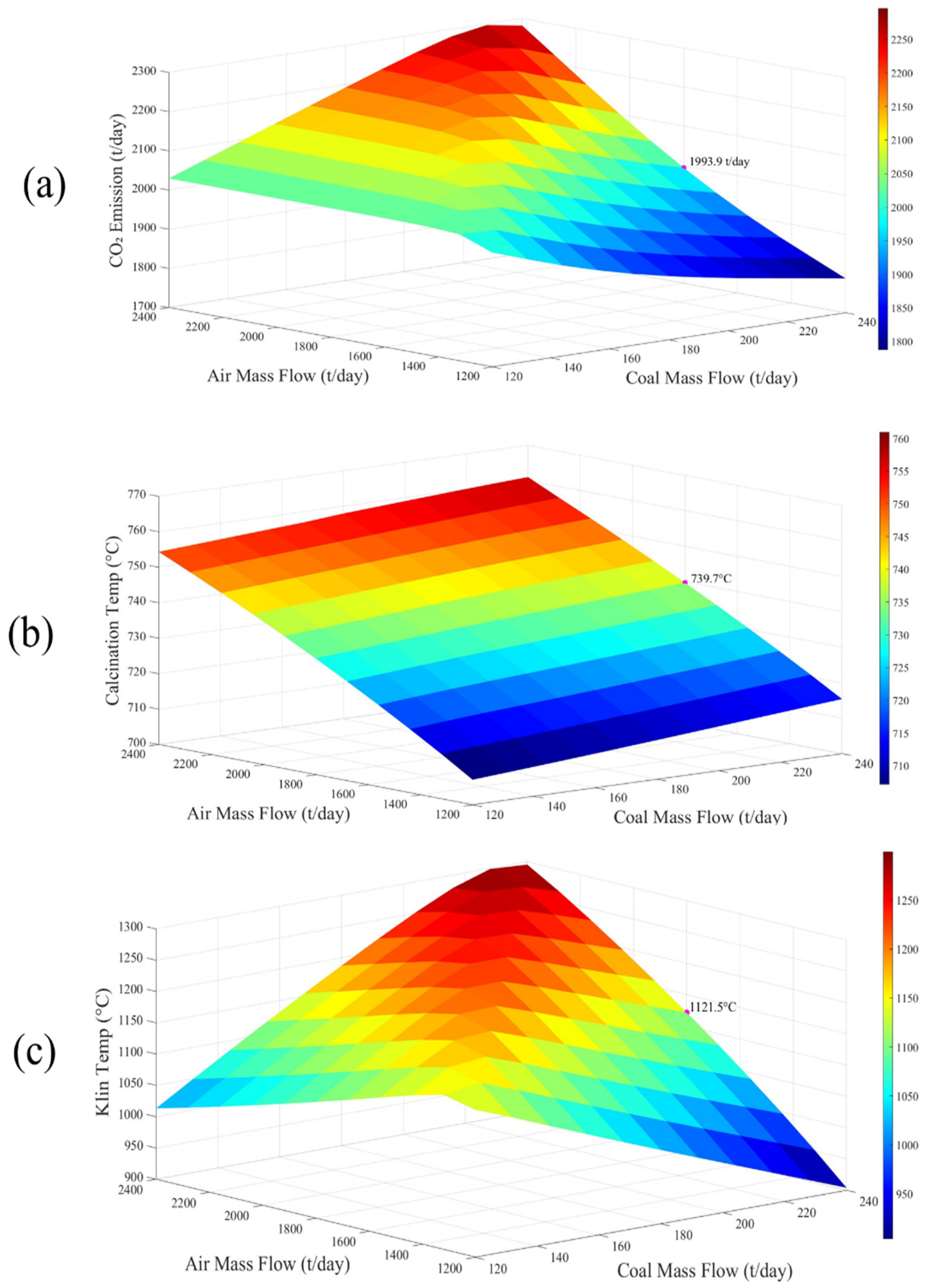
The sensitivity analysis for scenario 2, algae-derived CaCO3 as a raw material in cement production, evaluates the impact of air mass flow and coal mass flow on CO2 emissions in the cement production process, as presented in Figure 4a. Unit: t, where t stands for ton, the scheme shows that the variations in both air and coal mass flow rates influence CO2 emissions, with the color gradient indicating the level of emission, ranging from lower to higher values. It is observed that CO2 emissions increase with higher coal and air mass flow rates, reaching their peak in the upper regions of the graph. The analysis identifies the best range for minimizing CO2 emissions, represented by a specific range of values for air and coal mass flows. The marked point in the plot, with a coal mass flow of 240 t/day, highlights a significant condition under which emissions are optimized. This sensitivity analysis provides valuable insights that can influence environmental outcomes, offering a pathway to maximize fuel and air consumption for reduced CO2 emissions in cement production. The optimal calcination temperature, marked at 739.7 °C, corresponds to a balanced air and coal flow, as shown in Figure 4b. Additionally, the optimal kiln temperature is achieved within a specific range, with a marked temperature of 1121.5 °C, corresponding to a balanced combination of coal and air mass flow, as shown in Figure 4c. This analysis offers valuable insights into the impact of controlling these two parameters on kiln temperature, highlighting the importance of optimizing air and coal flows to ensure efficient energy consumption and maintain consistent production quality in cement manufacturing.

3.3. Environmental Impact Assessment

The process flow diagrams for each scenario are shown in Figure 5, which use Aspen Plus® and SimaPro® (SimaPro 10.2.0.3) to assess the environmental impacts from conventional cement production to low-carbon cement production processes. Notably, the mass and energy balance data collected from the process simulations for each scenario were then used to conduct extensive LCA evaluations. These balances, which incorporate the material flows and energy consumption at each stage of the process, offered the essential data required for calculating the impact on the environment of each scenario. The mass balance details the quantities of raw materials, clinker products, and waste streams, while the energy balance quantifies the energy inputs and outputs, including the use of electricity, heat, and fuel.
In this study, biogenic carbon from algae-derived CaCO3 is explicitly considered in the life cycle assessment. During the growth of Halimeda macroloba, atmospheric CO2 is naturally absorbed and stored through biological calcification, and this uptake is treated as biogenic carbon sequestration in accordance with established LCA frameworks ISO 14040/14044. CO2 emitted during the calcination of algae-derived CaCO3 is accounted for in the inventory and interpreted as the release of previously stored biogenic carbon, rather than an additional fossil emission. As a result, the near-zero or negative net CO2 values represent a cradle-to-gate balance between biological carbon uptake and process-related emissions, not the absence of emissions from clinker production itself. These results are scenario-dependent and do not rely on carbon trading schemes or externally assigned carbon credits.
Scenario 1 is based on a conventional method with predictable results but higher environmental impact due to energy consumption and CO2 emissions, whereas Scenario 2 seeks to enhance sustainability by utilizing renewable materials like algae-derived CaCO3 and fly ash, offering energy savings and CO2 reduction without compromising clinker quality. This approach contributes to a reduced carbon footprint, lower energy consumption, and a decreased dependence on non-renewable resources while maintaining the required quality of clinker. Consequently, Scenario 2 represents a promising pathway toward achieving more environmentally sustainable practices in cement production. Building upon these advancements, Scenario 3 further enhances environmental performance by completely replacing coal with natural gas as the primary fuel source for heat generation. Being cleaner and more efficient, natural gas combustion substantially reduces greenhouse gas emissions and other pollutants compared to coal. Scenario 3 thus demonstrates a progressive, environmentally optimized approach to clinker production that aligns with industry quality standards while significantly advancing sustainability objectives.
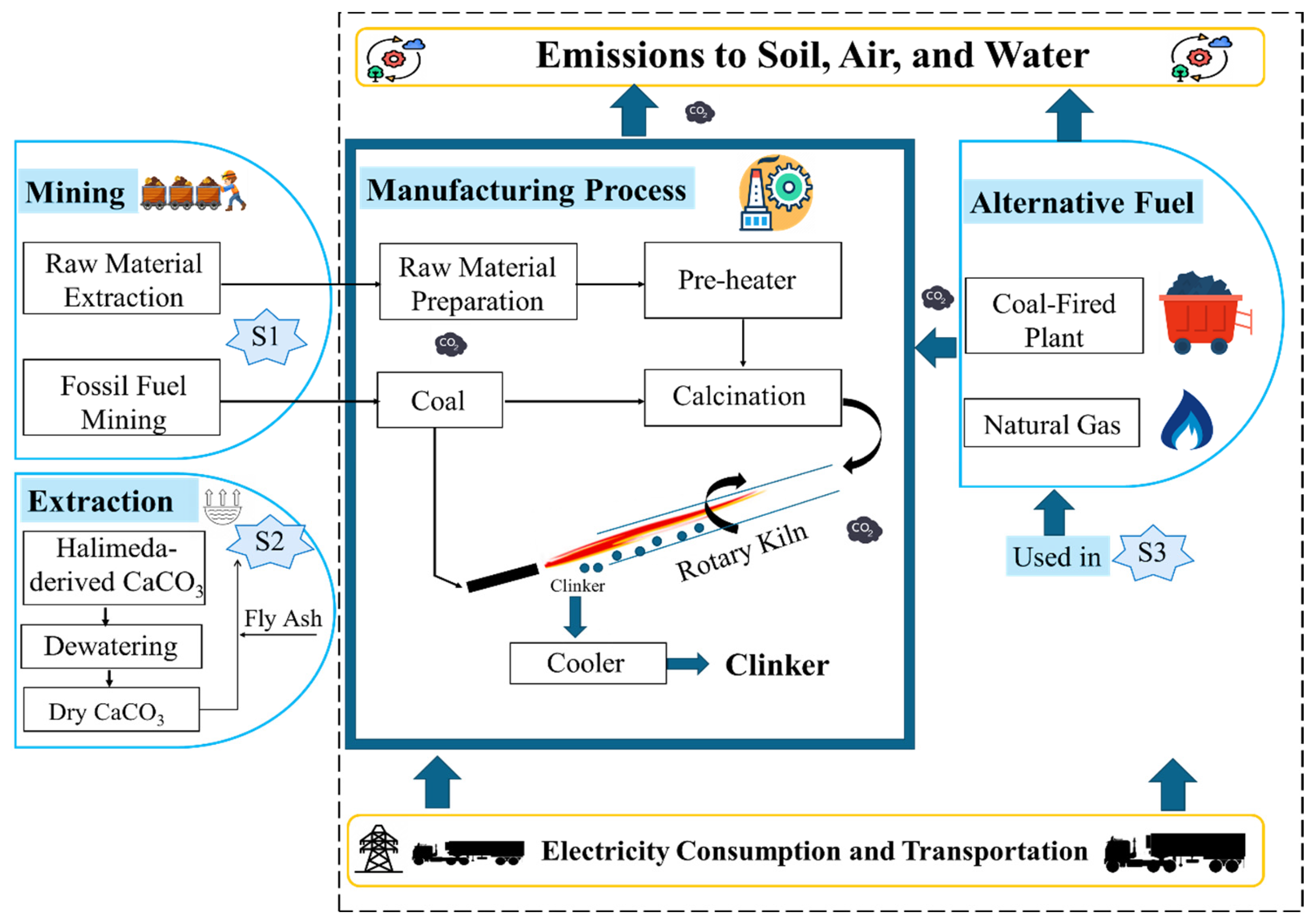
The Life Cycle Assessment (LCA) is a widely adopted methodology used to evaluate the environmental impacts of a process over its entire life cycle, from raw material extraction to disposal [50,51]. In this study, LCA plays a crucial role in identifying areas where environmental improvements can be made, especially when comparing algae-derived CaCO3 to traditional CaCO3. This assessment was conducted using SimaPro® software, integrated with the Ecoinvent Database, in full compliance with the ISO 14040:2006 standards. The material and energy inputs and outputs for the clinker production stages were estimated through simulations conducted using Aspen Plus® software, and the system boundary is shown in Figure 6.
The full LCA system boundaries are used to assess the environmental consequences of various process scenarios over the whole life cycle. This study aimed to identify critical ecological drivers and bottlenecks in carbon footprint and provide insights into potential improvements, advantages, and constraints. The cement production process is shown from a cradle-to-gate LCA perspective. The system boundary contains four critical stages: pre-heater, pre-calciner, kiln, and heat exchanger, which begin with raw feed input and finish with clinker output. The energy input is given by a coal-fired process, with accompanying flue gas emissions included inside the boundary. Air intake and heat exchanges are also considered. According to ISO 14040, LCA involves four main stages: defining the goal and scope, conducting the life cycle inventory (LCI), performing the life cycle impact assessment (LCIA), and interpreting the results [52,53,54,55]. The detailed life cycle inventory data are shown in Table 6, and the functional unit is 1 kg of clinker.
In the first stage, the study’s objectives, the materials involved, and the system boundaries are defined, specifying that the analysis is focused on algae-derived CaCO3 or traditional limestone as the primary source of calcium carbonate for clinker production. The second stage, LCI, collects data on the inputs (e.g., raw materials, energy), outputs (e.g., emissions, byproducts), and environmental factors (e.g., CO2 emissions) associated with each material used in the clinker production process. The third stage, LCIA, evaluates the potential environmental impacts of these materials across various categories, such as climate change, resource depletion, and pollution. The results obtained from the LCI were further analyzed to assess their environmental impacts using characterization models, as outlined in Equation (12). Finally, the interpretation stage analyzes the results, providing insights on by what method the use of algae-derived CaCO3 may offer reduced CO2 emissions and energy consumption compared to traditional limestone, while also promoting sustainability in clinker production.
E I k p i = r s E I f r , k p i i n X r , s i n + c s E I f c , k p i o u t X c , s o u t
where EIkpi represents the overall environmental impacts of a specific process, expressed through key performance indicators (KPIs) such as global warming potential. EIkpi is calculated based on the impact factors used to characterize the input resources ( E I f r , k p i i n ) or the compounds emitted ( E I f c , k p i o u t ), alongside the input of resource X r , s i n and output compound flows X c , s o u t at a particular life cycle stage denoted as “s”. Various characterization methods have been developed in LCA research since the early 2000s, including CML 2001, IMPACT 2002+, and ReCiPe 2016. For this study, the ReCiPe 2016 method was adopted, specifically employing a combination of the midpoint and endpoint approaches as the baseline for the LCIA.
The large-scale deployment of algae-derived CaCO3 may require additional pre-processing steps, including intensified dewatering and material conditioning, which could increase upstream energy demand and transport-related emissions. In this study, transport is explicitly accounted for within the life cycle inventory using ton-kilometer (tkm) values, and these transport-related emissions are fully included within the cradle-to-gate system boundary. This ensures that logistical contributions to global warming potential are quantitatively captured rather than neglected. Moisture removal associated with algae-derived CaCO3 is incorporated into the process energy balance of the Aspen Plus® model. Specifically, dewatering and drying are represented through the assumed moisture condition of the feed entering the pre-calcination stage, where thermal energy requirements for moisture removal are accounted for within the modeled heat demand. This approach reflects an integrated industrial configuration in which drying is coupled with existing thermal processes, rather than treated as an external standalone operation. Uncertainty associated with upstream handling parameters, including transport demand and moisture-related energy consumption, is addressed through the cradle-to-gate life cycle assessment framework combined with Monte Carlo uncertainty analysis. The Monte Carlo analysis propagates variability in inventory data, emission factors, and energy inputs, thereby capturing the influence of upstream uncertainties on the resulting environmental impact indicators. This probabilistic treatment provides confidence intervals for the reported results and allows evaluation of the robustness of scenario comparisons. As a result, relative differences among Scenarios 1–3 remain meaningful, and the observed environmental advantages of algae-derived CaCO3–based scenarios are not artifacts of omitted upstream processes but are instead attributable to fundamental differences in raw material sourcing and energy utilization.

4. Results and Discussion

Regarding CO2 emissions per ton of clinker produced, Table 7 shows the projected carbon footprint of the proposed conventional calcium carbonate-based Portland cement and algae-derived CaCO3.
Moreover, LCA is employed as a comprehensive tool to systematically evaluate the environmental impacts associated with various cement production processes. By integrating data collected from existing literature and detailed process simulations, the research thoroughly assesses the entire production lifecycle. The analysis focuses on several critical environmental impact categories, which are quantified and interpreted using the ReCiPe impact assessment methodology. This widely recognized framework explains inventory data about sensitive environmental indicators. The comparative analysis of Global Warming Potential (GWP) for clinker production across three scenarios reveals significant variations in environmental impacts driven primarily by fuel type and transport emissions.
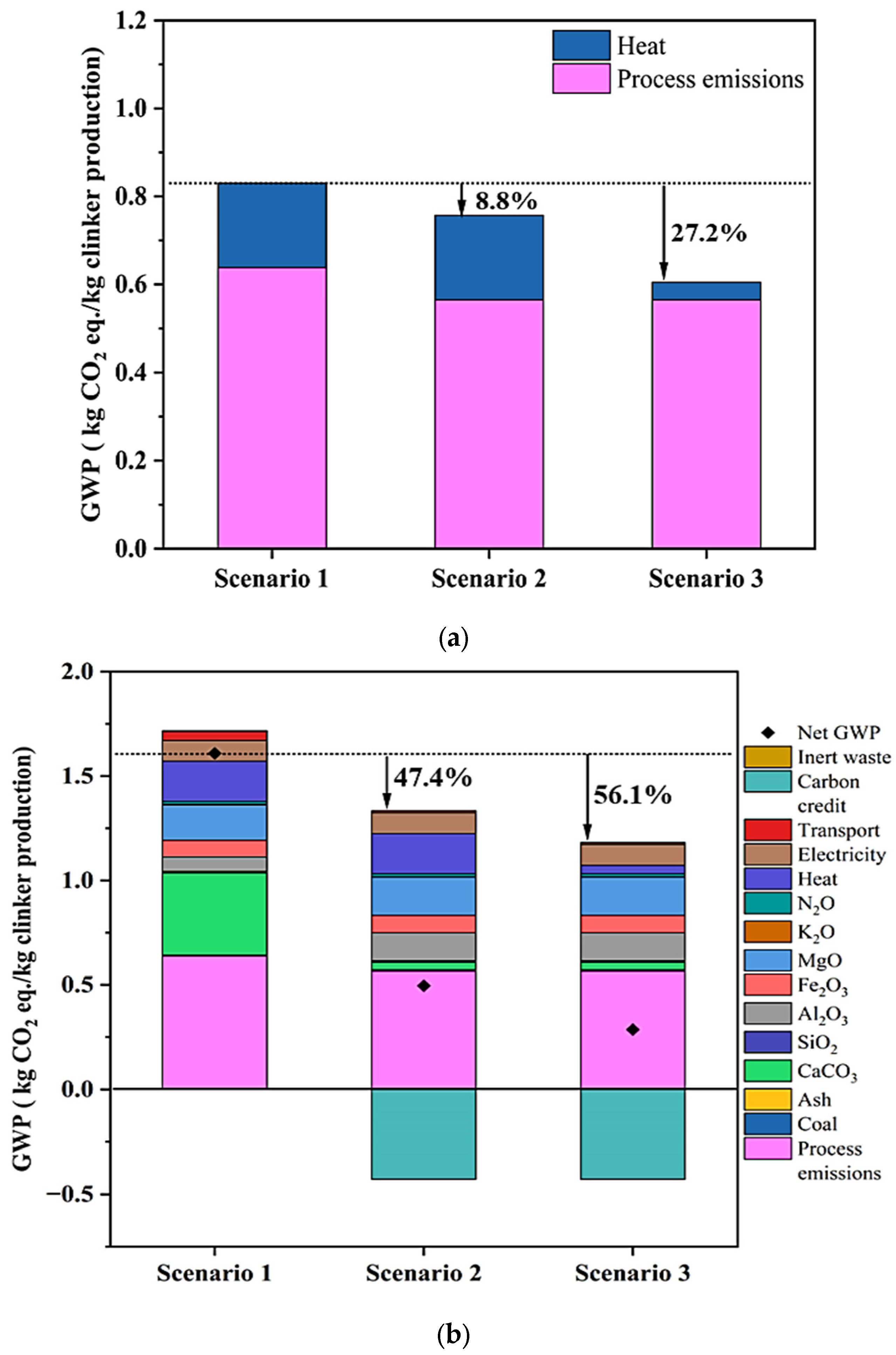
Figure 7a represents a Gate-to-Gate analysis, which evaluates the environmental impact entirely from the cement clinker process, including heat energy consumption and process emissions. In this analysis, heat and process emissions are the main contributors to GWP. Scenario 1, with a GWP of 0.83 kg CO2-eq/kg clinker, shows the highest emissions, while Scenario 2 and Scenario 3 exhibit reductions of 8.8% (0.757 kg CO2-eq/kg clinker) and 27.2% (0.60453 kg CO2-eq/kg clinker), respectively, highlighting the improvements in GWP from changes in production methods. Figure 7b represents a more comprehensive Cradle-to-Gate analysis, which includes the entire life cycle of cement clinker production, from raw material extraction to the point of production at the factory gate. This broader perspective accounts for additional factors such as inert waste, transport emissions, electricity usage, and the impacts of various raw materials like CaCO3, Fe2O3, and MgO. Carbon credits in this study are considered as part of the life cycle assessment (LCA) to represent potential offsets that could be generated from processes like the use of Halimeda-derived CaCO3, which sequesters carbon during its growth phase. These credits are not generated through direct carbon capture at the cement plant but are instead attributed to the carbon sequestration potential of algae-derived materials, which absorb and store CO2 from the atmosphere. By replacing conventional limestone with algae-derived CaCO3, the study accounts for the net reduction in CO2 emissions, which could be recognized as carbon credits if this sequestration were formally quantified and traded in carbon markets. Scenario 1, with a GWP of 1.715 kg CO2-eq/kg clinker, has the highest environmental impact, while Scenario 2 and Scenario 3 show improvements of 47.4% (0.902 kg CO2-eq/kg clinker) and 56.1% (0.753 kg CO2-eq/kg clinker), respectively. These reductions reflect the contributions of factors like carbon credits, which help offset emissions, as well as changes in raw material sourcing and energy use. The Cradle-to-Gate analysis provides a more complete picture of the environmental impact, incorporating both direct and indirect emissions from the entire production process.
Scenario 1 shows the highest GWP at approximately 1.7158 kg CO2-eq/kg clinker produced. The leading contributors in this scenario are heat (0.1923 kg CO2-eq.) from coal and transport emissions (0.0437 kg CO2-eq.), followed closely by the chemical process emissions from CaCO3 decomposition during calcination. Coal combustion and process emissions also contribute to the total GWP. This high emission profile reflects traditional clinker production methods where coal is extensively used both as a fuel source and in raw material processing. In Scenario 2, the total GWP decreases substantially to around 0.9061 kg CO2-eq/kg clinker produced, an improvement over Scenario 1. This reduction is mainly due to improved efficiency because of the Halimeda-based porous structure and slow reaction kinetics of calcination temperature, resulting in lower CO2 emissions from coal combustion. Although CaCO3 remains a major source of GWP due to inherent calcination emissions, the overall carbon footprint shows a clear descending trend in this intermediate stage.
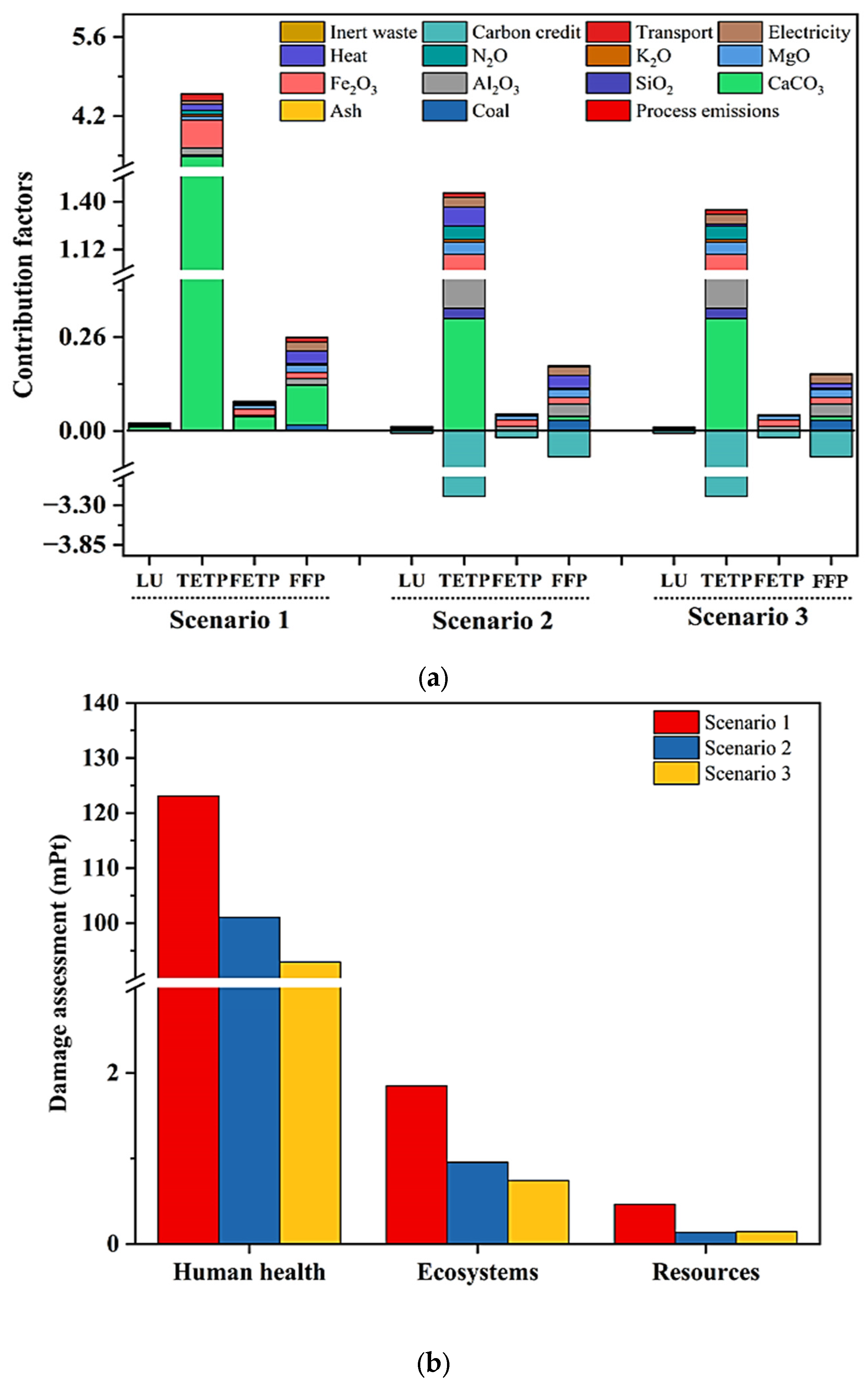
The environmental performance of clinker production was comprehensively assessed under three distinct scenarios, using multiple impact indicators to evaluate the contribution of various materials and processes. Figure 8a presents detailed contribution analysis across four key impact categories: Land Use (LU), Terrestrial Ecotoxicity Potential (TETP), Freshwater Ecotoxicity Potential (FETP), and Fossil Fuel Potential (FFP).
Scenario 1 exhibits the highest environmental burden in almost every category. The TETP (4.589 kg 1,4-DCB) and FFP (0.2587 kg, kg oil eq) impacts are alarmingly high, with contribution values exceeding, indicating substantial environmental toxicity and intensive fossil fuel consumption. The primary contributors to these elevated impacts in Scenario 1 are ash, electricity derived from hard coal, and transport. These elements reflect a production system heavily dependent on non-renewable energy sources and lacking efficiency in material use and logistics. Scenario 2 shows clear environmental improvements, especially in TETP (−1.7249 kg 1,4-DCB) and FFP (0.1089 kg, kg oil eq). Reduced ash impact and lower electricity and transport emissions suggest a shift toward cleaner energy, better waste management, lower CO2 emissions, and more efficient logistics. Scenario 3 is the most environmentally sustainable option, showing the lowest impact across all categories. Major reductions in TETP (−1.824 kg 1,4-DCB) and FFP (0.0868 kg, kg oil eq) are achieved by replacing coal with cleaner-burning natural gas, significantly lowering emissions and environmental toxicity. Figure 8b illustrates the endpoint environmental impacts of clinker production under three scenarios, measured in mPt (ecopoints) across three categories: human health, ecosystems, and resources, based on LCA data shown in Table 8.
Human health is the most affected category. Scenario 1 shows the highest impact on human health, nearly reaching 123.11 mPt, indicating significant damage from high emissions caused by coal combustion, heat, transport, and poor waste management. Scenario 2 shows a noticeable improvement, reducing the human health impact to about 101.08 mPt, likely due to partial fuel substitution and operational optimizations. Scenario 3 demonstrates the best performance, lowering the human health impact to around 92.91 mPt, reflecting the environmental benefits of switching entirely to cleaner natural gas and improving energy efficiency. Scenario 1 causes the highest ecosystem damage, while Scenario 3 has the lowest, due to less toxic release and better waste management. In Scenario 3, although natural gas was used instead of coal, resource damage is more likely due to the extraction and processing impacts of natural gas, which can be intensive.
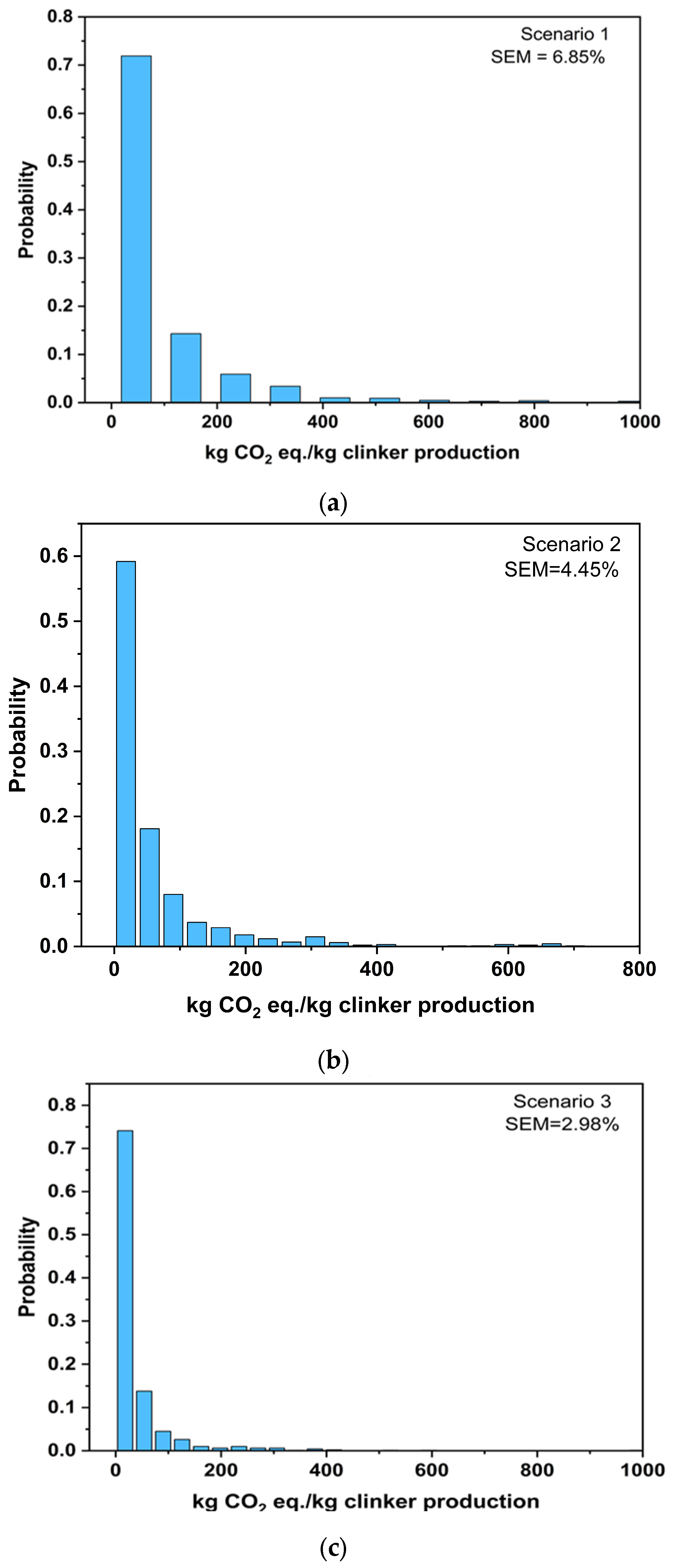
An uncertainty analysis of the LCA results for scenarios 1–3 was performed using a Monte Carlo simulation comprising 10,000 iterations, which are shown in Figure 9a, Figure 9b, and Figure 9c, respectively. This probabilistic approach was employed to rigorously account for inherent variability and uncertainties associated with key input parameters, including emission factors, energy consumption rates, and material inputs. Scenario 3 differs from Scenario 2 uniquely by the substitution of coal with natural gas as the heating source in the pre-calcination and rotary kiln processes, while all other material inputs and process configurations remain unchanged. By simulating a wide range of possible values within defined probability distributions, the analysis generated a comprehensive spectrum of potential environmental outcomes. A 95% confidence interval was applied to quantify the statistical reliability of the results. The analysis confirms that, despite variability in key inventory parameters, Scenario 3 consistently exhibits lower environmental impacts than the coal-based scenarios, particularly in terms of global warming potential. This probabilistic assessment demonstrates that the environmental advantages observed for Scenario 3 are vigorous and primarily driven by the fuel substitution strategy rather than model-specific assumptions. The simulation outcomes indicate that, despite the inherent variability in input parameters, the relative environmental performance trends among the different scenarios remain consistent. Specifically, each successive scenario demonstrates a clear reduction in environmental impacts, thereby confirming the robustness and validity of the primary assumptions drawn from the deterministic LCA results.

5. Conclusions

This study confirms that algae-derived calcium carbonate provides a sustainable alternative to traditional limestone. It enables almost zero CO2 emissions through its natural carbon sequestration during growth, as demonstrated by integrating a new green cement production process. Besides limestone feedstock being entirely replaced by algae-derived CaCO3, the recycled/added fly ash and natural gas in place of coal significantly reduce GWP by 47.18% and 56.1%, respectively. Compared to the traditional cement production process, the comparative LCA results show that Scenarios 2 and 3 reduce the environmental impact on the ecosystem by 48.43% and 60.01%, respectively (Scenario 1). This study highlights the substantial environmental advantages of using algae-derived CaCO3 in cement production, offering a viable pathway toward zero carbon emissions and aligning with broader global sustainability and decarbonization objectives.

Author Contributions

Conceptualization, H.M.I., M.S.H. and W.W.; Methodology, C.-Y.W.; Validation, H.M.I.; Investigation, C.-Y.W. and W.W.; Data curation, M.S.H.; Writing—original draft, H.M.I.; Writing—review and editing, W.W.; Supervision, W.W.; Funding acquisition, W.W. All authors have read and agreed to the published version of the manuscript.

Funding

This research was funded by the National Science and Technology Council, Taiwan under grant No. 113-2221-E-006-019 and 113-2622-8-006-020.

Data Availability Statement

The original contributions presented in this study are included in the article. Further inquiries can be directed to the corresponding author.

Conflicts of Interest

The authors declare no conflict of interest.

Nomenclature

CaCO3Calcium carbonate
CaOCalcium oxide
CKDCement kiln dust
C3ATricalcium aluminate
C3STricalcium silicate
C2SDicalcium silicate
C4AFCalcium ferroaluminate
CO2Carbon dioxide
A/FAlumina-to-ferrite ratio
FCdFixed carbon (dry basis)
FGDFlue-gas desulfurization
HHVHigher heating value
LCALife Cycle Assessment
LCILife Cycle Inventory
LCIALife Cycle Impact Assessment
LHVLower heating value
LOILoss on ignition
Mg/CaMolar ratio of magnesium to calcium in seawater
ReCiPeA life-cycle impact assessment method (2016 version)
RGibbsRGibbs reactor block (Gibbs energy minimization reactor)
RstoicRStoic reactor block (stoichiometric reactor)
EIkpiOverall environmental impact for KPI
KPIKey Performance Indicator

References

  1. Iqbal, A.; Swapnil, F.J. Sustainable green materials for building construction. In Proceedings of the International Conference on Mechanical, Industrial and Materials Engineering 2017 (ICMIME2017), Rajshahi, Bangladesh, 28–30 December 2017. [Google Scholar]
  2. Zheng, Y.; Xing, Y.; Li, G.; Gao, J.; Li, R.; Liu, Q.; Yue, T.A. Comprehensive Review of Deactivation and Modification of Selective Catalytic Reaction Catalysts Installed in Cement Kilns. J. Environ. Sci. 2025, 148, 451–467. [Google Scholar] [CrossRef] [PubMed]
  3. Mahmoudkhani, M.; Kasaeian, A.; Nazari, N.S.; Afshari, F.; Esmaeili Bidhendi, M. Enhancing Sustainability in Cement Manufacturing through Waste Heat Recovery and CCHP Systems. Energy 2025, 318, 134845. [Google Scholar] [CrossRef]
  4. Fayomi, G.U.; Mini, S.E.; Fayomi, O.S.I.; Ayoola, A.A. Perspectives on Environmental CO2 Emission and Energy Factor in Cement Industry. IOP Conf. Ser. Earth Environ. Sci. 2019, 331, 012035. [Google Scholar] [CrossRef]
  5. Neerup, R.; Øbro, K.L.; Løge, I.A.; Kottaki, N.; Frøstrup, C.F.; Gyorbiro, I.; Dimitriadi, M.; Halilov, H.; Jensen, S.; Karlsson, J.L. CO2 Capture Pilot Campaign: Understanding Solvent Degradation of CESAR1 in Cement Plant Operations. Chem. Eng. J. 2025, 510, 16152. [Google Scholar] [CrossRef]
  6. Attia, S. Net Zero Energy Buildings (NZEB): Concepts, Frameworks and Roadmap for Nnproject Analysis and Implementation; Butterworth-Heinemann: Oxford, UK, 2018; ISBN 0128124628. [Google Scholar]
  7. Amorim, A.; Filipe, R.M.; Matos, H.A. Analysis of Integrated Calcium Looping Alternatives in a Cement Plant. Chem. Eng. Sci. 2025, 313, 121709. [Google Scholar] [CrossRef]
  8. Asgharian, H.; Iov, F.; Nielsen, M.P.; Liso, V.; Burt, S.; Baxter, L. Analysis of Cryogenic CO2 Capture Technology Integrated with Water-Ammonia Absorption Refrigeration Cycle for CO2 Capture and Separation in Cement Plants. Sep. Purif. Technol. 2025, 353, 128419. [Google Scholar] [CrossRef]
  9. Ghalandari, V.; Majd, M.M.; Golestanian, A. Energy Audit for Pyro-Processing Unit of a New Generation Cement Plant and Feasibility Study for Recovering Waste Heat: A Case Study. Energy 2019, 173, 833–843. [Google Scholar] [CrossRef]
  10. Brandoni, C.; Kaldis, S.; Lappas, A.; Snape, C.; Jaffar, M.; Rolfe, A.; Hewitt, N.J.; Martinez, J.C.; Lysiak, B.; Huang, Y. Process Design and Techno-Economic Risk Assessment of a Solid Sorbent Silica Polyethyleneimine (Si-PEI) CCS Process Integrated into a Cement Plant. Energy 2025, 322, 135482. [Google Scholar] [CrossRef]
  11. Kim, A.; Miller, S.A. Meeting Industrial Decarbonization Goals: A Case Study of and Roadmap to a Net-Zero Emissions Cement Industry in California. Environ. Res. Lett. 2023, 18, 104019. [Google Scholar] [CrossRef]
  12. Driver, J.G.; Hills, T.; Hodgson, P.; Sceats, M.; Fennell, P.S. Simulation of Direct Separation Technology for Carbon Capture and Storage in the Cement Industry. Chem. Eng. J. 2022, 449, 137721. [Google Scholar] [CrossRef]
  13. Nazari, N.S.; Afshari, F.; Mahmoudkhani, M.; Ghaemi, A. Optimization of Carbon Dioxide Adsorption from Industrial Flue Gas Using Zeolite 13X: A Simulation Study with Aspen Adsorption and Response Surface Methodology. Results Eng. 2024, 24, 103206. [Google Scholar] [CrossRef]
  14. Sobuz, M.H.R.; Shuvo Dip, D.; Akid, A.S.M. Investigating the Combined Effect of Aggregate Size and Sulphate Attack on Producing Sustainable Recycled Aggregate Concrete. Aust. J. Civ. Eng. 2023, 21, 224–239. [Google Scholar] [CrossRef]
  15. Hossain, M.U.; Poon, C.S.; Wong, M.Y.K.; Khine, A. Techno-Environmental Feasibility of Wood Waste Derived Fuel for Cement Production. J. Clean. Prod. 2019, 230, 663–671. [Google Scholar] [CrossRef]
  16. Dankwa, J.; Jin, C.; Afrane, S.; Li, B.; Adun, H.; Liu, H.; Yao, M.; Morrow, D. Does China’s Pathway to Carbon Neutrality Require the Integration of Land-Based Biological Negative Emission Solutions with Geochemical and Chemical Alternatives? Sustain. Prod. Consum. 2024, 45, 27–41. [Google Scholar] [CrossRef]
  17. Sani, M.M.; Noorpoor, A.; Motlagh, M.S.-P. Optimal Model Development of Energy Hub to Supply Water, Heating and Electrical Demands of a Cement Factory. Energy 2019, 177, 574–592. [Google Scholar] [CrossRef]
  18. Verbruggen, H.; Kooistra, W.H.C.F. Morphological Characterization of Lineages within the Calcified Tropical Seaweed Genus Halimeda (Bryopsidales, Chlorophyta). Eur. J. Phycol. 2007, 39, 213–228. [Google Scholar] [CrossRef]
  19. Dijoux, L.; Verbruggen, H.; Mattio, L.; Duong, N.; Payri, C. Diversity of Halimeda (Bryopsidales, Chlorophyta) in New Caledonia: A Combined Morphological and Molecular Study. J. Phycol. 2012, 48, 1465–1481. [Google Scholar] [CrossRef]
  20. Cremen, M.C.M.; Huisman, J.M.; Marcelino, V.R.; Verbruggen, H. Taxonomic Revision of Halimeda (Bryopsidales, Chlorophyta) in South-Western Australia. Aust. Syst. Bot. 2016, 29, 41–54. [Google Scholar] [CrossRef]
  21. Borowitzka, M.A.; Larkum, A.W.D. Calcification in the Green Alga Halimeda: III. The Sources of Inorganic Carbon for Photosynthesis and Calcification and a Model of the Mechanism of Calcification. J. Exp. Bot. 1976, 27, 879–893. [Google Scholar] [CrossRef]
  22. Borowitzka, M.A.; Larkum, A.W.D. Calcification in the Green Alga Halimeda. I. An Ultrastructure Study of Thallus Development 1. J. Phycol. 1977, 13, 6–16. [Google Scholar] [CrossRef]
  23. Mayakun, J.; Bunruk, P.; Kongsaeng, R. Growth Rate and Calcium Carbonate Accumulation of Halimeda Macroloba Decaisne (Chlorophyta: Halimedaceae) in Thai Waters. Songklanakarin J. Sci. Technol. 2014, 36, 419–423. [Google Scholar]
  24. McNeil, M.A.; Webster, J.M.; Beaman, R.J.; Graham, T.L. New Constraints on the Spatial Distribution and Morphology of the Halimeda Bioherms of the Great Barrier Reef, Australia. Coral Reefs 2016, 35, 1343–1355. [Google Scholar] [CrossRef]
  25. Prathep, A.; Kaewsrikhaw, R.; Mayakun, J.; Darakrai, A. The Effects of Light Intensity and Temperature on the Calcification Rate of Halimeda Macroloba. J. Appl. Phycol. 2018, 30, 3405–3412. [Google Scholar] [CrossRef]
  26. Rees, S.A.; Opdyke, B.N.; Wilson, P.A.; Henstock, T.J. Significance of Halimeda Bioherms to the Global Carbonate Budget Based on a Geological Sediment Budget for the Northern Great Barrier Reef, Australia. Coral Reefs 2007, 26, 177–188. [Google Scholar] [CrossRef]
  27. Perry, C.T.; Morgan, K.M.; Salter, M.A. Sediment Generation by Halimeda on Atoll Interior Coral Reefs of the Southern Maldives: A Census-Based Approach for Estimating Carbonate Production by Calcareous Green Algae. Sediment. Geol. 2016, 346, 17–24. [Google Scholar] [CrossRef]
  28. Mayakun, J.; Liao, C.-P.; Liu, S.-L. The Standing Stock and CaCO3 Contribution of Halimeda Macroloba in the Tropical Seagrass-Dominated Ecosystem in Dongsha Island, the Main Island of Dongsha Atoll, South China Sea. J. Mar. Biol. Assoc. 2020, 100, 1219–1227. [Google Scholar] [CrossRef]
  29. VanTussenbroek, B.I.; VanDijk, J.K. Spatial and Temporal Variability in Biomass and Production of Psammophytic Halimeda Incrassata (Bryopsidales, Chlorophyta) in a Caribbean Reef Lagoon 1. J. Phycol. 2007, 43, 69–77. [Google Scholar] [CrossRef]
  30. Littler, M.M.; Littler, D.S.; Brooks, B.L. Herbivory, Nutrients, Stochastic Events, and Relative Dominances of Benthic Indicator Groups on Coral Reefs: A Review and Recommendations. In Proceedings of the Smithsonian Marine Science Symposium; Smithsonian Institution Scholarly Press: Washington, DC, USA, 2009. [Google Scholar]
  31. Ortegón-Aznar, I.; Chuc-Contreras, A.; Collado-Vides, L. Calcareous Green Algae Standing Stock in a Tropical Sedimentary Coast. J. Appl. Phycol. 2017, 29, 2685–2693. [Google Scholar] [CrossRef]
  32. Beach, K.; Walters, L.; Vroom, P.; Smith, C.; Coyer, J.; Hunter, C. Variability in the ecophysiology of Halimeda spp. (chlorophyta, bryopsidales) on conch reef, florida keys, USA. J. Phycol. 2003, 39, 633–643. [Google Scholar] [CrossRef]
  33. Vroom, P.S.; Smith, C.M.; Coyer, J.A.; Walters, L.J.; Hunter, C.L.; Beach, K.S.; Smith, J.E. Field Biology of Halimeda Tuna (Bryopsidales, Chlorophyta) across a Depth Gradient: Comparative Growth, Survivorship, Recruitment, and Reproduction. Hydrobiologia 2003, 501, 149–166. [Google Scholar] [CrossRef]
  34. de Macêdo Carneiro, P.B.; de Morais, J.O. Carbonate Sediment Production in the Equatorial Continental Shelf of South America: Quantifying Halimeda Incrassata (Chlorophyta) Contributions. J. S. Am. Earth Sci. 2016, 72, 1–6. [Google Scholar] [CrossRef]
  35. Carneiro, P.B.D.M.; Pereira, J.U.; Matthews-Cascon, H. Standing Stock Variations, Growth and CaCO3 Production by the Calcareous Green Alga Halimeda Opuntia. J. Mar. Biol. Assoc. 2018, 98, 401–409. [Google Scholar] [CrossRef]
  36. Stanley, S.M.; Ries, J.B.; Hardie, L.A. Increased production of calcite and slower growth for the major sediment-producing alga halimeda as the Mg/Ca ratio of seawater is lowered to A “calcite sea” level. J. Sediment. Res. 2010, 80, 6–16. [Google Scholar] [CrossRef]
  37. Castro-Sanguino, C.; Bozec, Y.-M.; Mumby, P.J. Dynamics of Carbonate Sediment Production by Halimeda: Implications for Reef Carbonate Budgets. Mar. Ecol. Prog. Ser. 2020, 639, 91–106. [Google Scholar] [CrossRef]
  38. Ridgwell, A.; Hargreaves, J.C. Regulation of Atmospheric CO2 by Deep-Sea Sediments in an Earth System Model. Glob. Biogeochem. Cycles 2007, 21, GB2008. [Google Scholar] [CrossRef]
  39. García-gusano, D.; Garraín, D.; Herrera, I.; Cabal, H.; Lechón, Y. Life Cycle Assessment of Applying CO2 Post-Combustion Capture to the Spanish Cement Production. J. Clean. Prod. 2025, 104, 328–338. [Google Scholar] [CrossRef]
  40. Habert, G.; Billard, C.; Rossi, P.; Chen, C.; Roussel, N. Cement Production Technology Improvement Compared to Factor 4 Objectives. Cem. Concr. Res. 2020, 40, 820–826. [Google Scholar] [CrossRef]
  41. Porter, H.; Mukherjee, A.; Tuladhar, R.; Dhami, N.K. Life Cycle Assessment of Biocement: An Emerging Sustainable Solution? Sustainability 2021, 13, 13878. [Google Scholar] [CrossRef]
  42. Rafiq, A.; Ren, J.; Laosiripojana, N.; Silalertruksa, T. Life Cycle Environmental and Economic Viability Analysis of CO2 Utilization for Chemical Production in the Cement Sector. Sustain. Prod. Consum. 2025, 58, 364–384. [Google Scholar] [CrossRef]
  43. Sambataro, L.; Bre, F.; Ukrainczyk, N.; Koenders, E.A.B. Environmental Benchmarks for the European Cement Industry. Sustain. Prod. Consum. 2024, 45, 429–449. [Google Scholar] [CrossRef]
  44. Benhelal, E.; Zahedi, G.; Hashim, H.A. Novel Design for Green and Economical Cement Manufacturing. J. Clean. Prod. 2012, 22, 60–66. [Google Scholar] [CrossRef]
  45. Pei, X.; He, B.; Yan, L.; Wang, C.; Song, W.; Song, J. Process Simulation of Oxy-Fuel Combustion for a 300 MW Pulverized Coal-Fired Power Plant Using Aspen Plus. Energy Convers. Manag. 2013, 76, 581–587. [Google Scholar] [CrossRef]
  46. Yadav, S.; Mondal, S.S. Numerical Investigation of 660 MW Pulverized Coal-Fired Supercritical Power Plant Retrofitted to Oxy-Coal Combustion. Int. J. Greenh. Gas Control 2021, 105, 103227. [Google Scholar] [CrossRef]
  47. Aldieb, M.A.; Ibrahim, H.G. Variation of Feed Chemical Composition and Its Effect on Clinker Formation–Simulation Process. In Proceedings of the World Congress on Engineering and Computer Science; International Association of Engineers: Hong Kong SAR, China, 2010; Volume 2, pp. 1–7. [Google Scholar]
  48. Mcdonald, L. Precipitated Calcium Carbonate as Sustainable Supplementary Cementitious Material to Reduce the Environmental Impact of Portland Cement. Ph.D. Thesis, University of Aberdeen, Aberdeen, Scotland, 2022. [Google Scholar]
  49. Kosmatka, S.H.; Kerkhoff, B.; Panarese, W.C. Design and Control of Concrete Mixtures; Portland Cement Assn: Washington, DC, USA, 2008; ISBN 0893122173. [Google Scholar]
  50. Irfan, H.M.; Iqbal, K.; Taipabu, M.I.; You, C.Y.; Mazumdar, D.; Wu, W. Decarbonization Frameworks to Industrial-Scale Ammonia Production: Techno-Economic and Environmental Implications. Int. J. Hydrogen Energy 2024, 78, 580–593. [Google Scholar] [CrossRef]
  51. Riondet, L.; Rio, M.; Zwolinski, P. Emerging Technologies Upscaling: A Framework for Matching LCA Practices with Upscaling Archetypes. Sustain. Prod. Consum. 2024, 50, 347–363. [Google Scholar] [CrossRef]
  52. Ige, O.E.; Olanrewaju, O.A.; Duffy, K.J.; Obiora, C.A. Review of the Effectiveness of Life Cycle Assessment for Gauging Environmental Impacts from Cement Production. J. Clean. Prod. 2021, 324, 129213. [Google Scholar] [CrossRef]
  53. ISO14040:2006; Environmental Management-Life Cycle Assessment-Principles and Framework. International Organization for Standardization: Geneva, Switzerland, 2006.
  54. Irfan, H.M.; Yang, C.; Wu, W.; Lin, B.; Shiau, J. Environmental and Techno-Economic Analyses of Oxygen Blast Furnace Systems Integrated with Carbon Capture and Utilization Strategy. Fuel Process. Technol. 2025, 274, 108238. [Google Scholar] [CrossRef]
  55. Arias, A.; Feijoo, G.; Moreira, M.T. Macroalgae as a Sustainable Biostimulant for Crop Production According to Techno-Economic and Environmental Criteria. Sustain. Prod. Consum. 2024, 48, 169–180. [Google Scholar] [CrossRef]
  56. Naqi, A.; Jang, J.G. Recent Progress in Green Cement Technology Utilizing Low-Carbon Emission Fuels and Raw Materials: A Review. Sustainability 2019, 11, 537. [Google Scholar] [CrossRef]
  57. Medas, D.; Cappai, G.; DeGiudici, G.; Piredda, M.; Podda, S. Accelerated Carbonation by Cement Kiln Dust in Aqueous Slurries: Chemical and Mineralogical Investigation. Greenh. Gases Sci. Technol. 2017, 7, 692–705. [Google Scholar] [CrossRef]
  58. Chiarathanakrit, C.; Mayakun, J.; Prathep, A.; Kaewtatip, K. Comparison of the Effects of Calci Fi Ed Green Macroalga (Halimeda Macroloba Decaisne) and Commercial CaCO3 on the Properties of Composite Starch Foam Trays. Int. J. Biol. Macromol. 2019, 121, 71–76. [Google Scholar] [CrossRef]
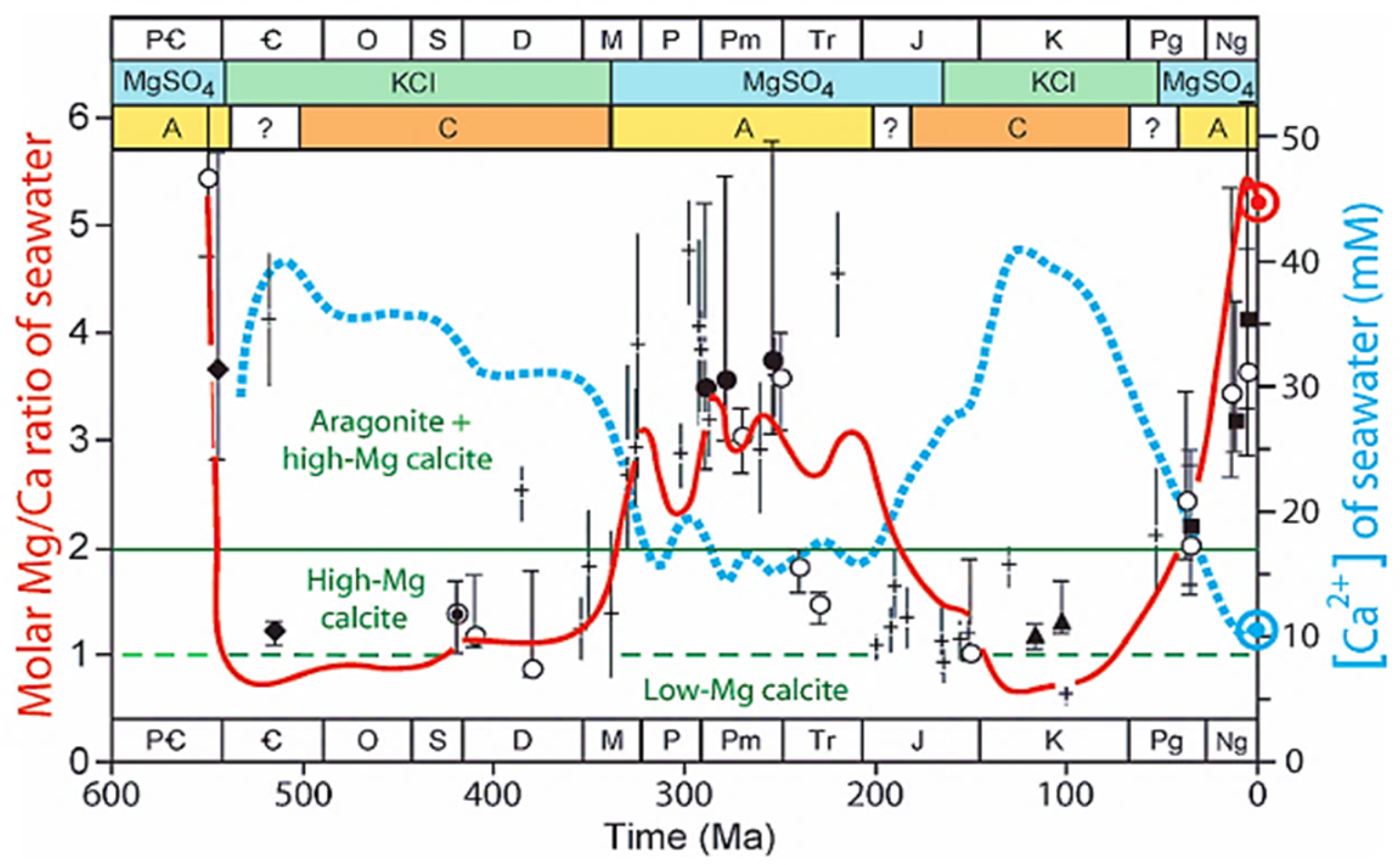
Figure 1. Evolution of Seawater Mg/Ca ratios and their impact on carbonate precipitation.
Processes 14 00299 g001
Figure 2. Scheme of the traditional cement production process (Scenario 1).
Processes 14 00299 g002
Figure 3. (a) Scenario 2: Scheme of the carbon-negative cement production systems using calcareous green algae and recycled fly ash, and (b) Scenario 3: Scheme of the carbon-negative cement production systems using calcareous green algae, natural gas combustion for the pre-calcination process, and fly ash from a coal-fired power plant.
Processes 14 00299 g003
Figure 4. Three-dimensional surface plots for scenario 2 showing the effect of air and coal mass flow rates on (a) CO2 emissions, (b) calcination temperature, and (c) kiln temperature in a calcination system.
Processes 14 00299 g004
Figure 5. Process flow diagrams of Scenario 1, Scenario 2, and Scenario 3.
Processes 14 00299 g005
Figure 6. LCA system boundaries for Scenarios 1–3.
Processes 14 00299 g006
Figure 7. (a) Carbon footprint reduction in clinker production: Gate-to-Gate analysis, and (b) Carbon footprint reduction in clinker production: Cradle-to-Gate analysis.
Processes 14 00299 g007
Figure 8. (a) Scenario-based contribution of midpoint environmental indicators. (b) endpoint environmental impacts of clinker production scenarios on human health, ecosystems, and resources.
Processes 14 00299 g008
Figure 9. Monte Carlo iterations for uncertainty analysis of (a) Scenario 1, (b) Scenario 2, and (c) Scenario 3.
Processes 14 00299 g009
Table 1. Composition Analysis of Pulverized Coal [45].
AnalysisValue (wt%)
Proximate analysis
Volatile matter (Vd)45.7
Ash (Ad)9.2
Moisture (Mar)10
Fixed carbon (FCd)45.1
Ultimate analysis
Carbon (Cd)67.1
Hydrogen (Hd)4.8
Nitrogen (Nd)1.1
Sulfur (Sd)1.3
Oxygen (Od)16.4
Chlorine (Cld)0.1
Total sulfur
Sulfate sulfur (Sp)0.6
Sulfide sulfur (Ss)0.1
Organic sulfur (So)0.6
Net calorific value(MJ/kg)
Qnet22.53
ar: as received, d: dry basis.
Table 2. Chemical composition of raw material (Pre-calciner feed).
ComponentComposition (%wt)
CaO41.51
SiO214.03
MgO2.59
Al2O33.39
Fe2O32.54
SO30.3
K2O0.57
Na2O0.24
Loss of ignition34.83
Table 3. Chemical and physical reaction pathways in cement production [44].
Reaction NameReactionTemperature Range (°C)Heat of Reaction
( H R ) ( kJ · mol−1)
Decalcination C a C O 3 C a O + C O 2 700–900+179.4
MgCO3 dissociation M g C O 3 M g O + C O 2 700–900+117.61
C2S formation 2 C a O + S i O 2 C 2 S 1200–1280−127.6
C3S formation C 2 S + C a O C 3 S 1200–1280+16
C3A formation 3 C a O + A l 2 O 3 C 3 A 1200–1280+21.8
C4AF formation 4 C a O + A l 2 O 3 + F e 2 O 3 C 4 A F 1200–1280−41.3
Table 4. Process data validation for Scenario 1.
Case Study
[44]
Simulation (Scenario 1) Errors (%)
StreamFlow Rate
(t/Day)
Temperature (°C)Flow Rate (t/Day)Temperature (°C)
Feed5576.64505632.512501%
Calciner Feed5548.87605632.5127822%
Kiln Feed3690.488903693.128900%
Hot Clinker360015003665.415002%
Cold Clinker3600803665.4802%
Exhaust Gas7563.123157364.64315−3%
Table 5. Comprehensive Validations of the Clinker Process in Cement Manufacturing.
Mineral CompositionBouge Calculation Case Study [44]Simulation (S1)Error %
C2S21.092%22.42%22.032%4.45%
C3S53.856%52.62%53.332%−0.97%
C3A7.190%7.34%7.313%1.71%
C4AF11.862%11.88%11.860%0.00%
SO30.68%0.66%0.68%0.00%
K2O0.88%0.87%0.88%0.00%
Na2O0.49%0.47%0.47%0.01%
MgO3.63%3.74%3.62%0.35%
Table 6. Lifecycle inventory for the clinker production using different scenarios.
Scenarios 123
StagesMaterials
InputN2 (kg/h)1.1911.1561.156
O2 (kg/h)0.3160.3070.307
Coal (kg/h)
Natural gas (kg/h)
0.039
-
0.068
-
-
0.017
Ash (kg/h)0.1750.110.11
CaCO3 (kg/h)1.1281.0081.008
SiO2 (kg/h)0.2130.2100.210
Al2O3 (kg/h)0.0510.1010.101
Fe2O3 (kg/h)
MgCO3 (kg/h)
K2O (kg/h)
Na2O (kg/h)
CaO (kg/h)
0.038
0.082
0.008
0.003
0.004
0.040
0.089
0.004
0.004
0.020
0.040
0.089
0.004
0.004
0.020
Transport (tkm)0.7700.1590.159
Heat (MW)0.000350.000320.00032
Emissions to airH2O (kg/h)0.0160.00690.0382
N2 (kg/h)1.1911.1571.157
O2 (kg/h)0.2290.2690.239
NO2 (kg/h)7.7 × 10−72.98 × 10−132.14 × 10⁻⁶
NO (kg/h)0.0013.86 × 10−70.00068
S (kg/h)4.4 × 10−111.53 × 10−60
SO2 (kg/h)
SO3 (kg/h)
H2 (kg/h)
CO2 (kg/h)
Ash (kg/h)
CO (kg/h)
C (kg/h)
0.0003
3.2 × 10⁻⁷
3.2 × 10⁻⁷
0.689
0.177
0.0005
0.00001
0.0008
7.87 × 10⁻¹⁰
0.0008
0.565
0.09
0.065
0
0
0
1.362 × 10⁻⁷
0.529
0
2.877 × 10⁻⁶
0
Solid output
Residue (kg/h)0.2010.1110.004
ProductClinker (kg/h)111
Table 7. Comparisons of Scenario 1–3 regarding CO2 emissions, CO2 sequestration, and net CO2 emissions.
CO2 Emission
(ton/ton of Clinker)
CO2 Sequestration
(ton/ton of Clinker)
Net CO2
(ton/ton of Clinker)
Ref.
Portland cement 0.75–0.9-0.75–0.9[56,57]
Scenario 10.72-0.72This Study
Scenario 20.5650.600 [58]−0.035This Study
Scenario 30.5170.600 [58]−0.083This Study
Table 8. Endpoint environmental impacts of clinker production scenarios.
Scenarios 123
Damage CategoryUnit
Human HealthmPt123.11101.0893.80
EcosystemsmPt1.8500.9540.740
ResourcesmPt0.4640.1380.146
Disclaimer/Publisher’s Note: The statements, opinions and data contained in all publications are solely those of the individual author(s) and contributor(s) and not of MDPI and/or the editor(s). MDPI and/or the editor(s) disclaim responsibility for any injury to people or property resulting from any ideas, methods, instructions or products referred to in the content.