Lint Cleaning Performance of a Pneumatic Fractionator: Impacts on Fiber Quality and Economic Value of Saw- and Roller-Ginned Upland Cotton

 ,
,  , and
, and
Abstract
1. Introduction
2. Materials and Methods
2.1. Cotton Variety
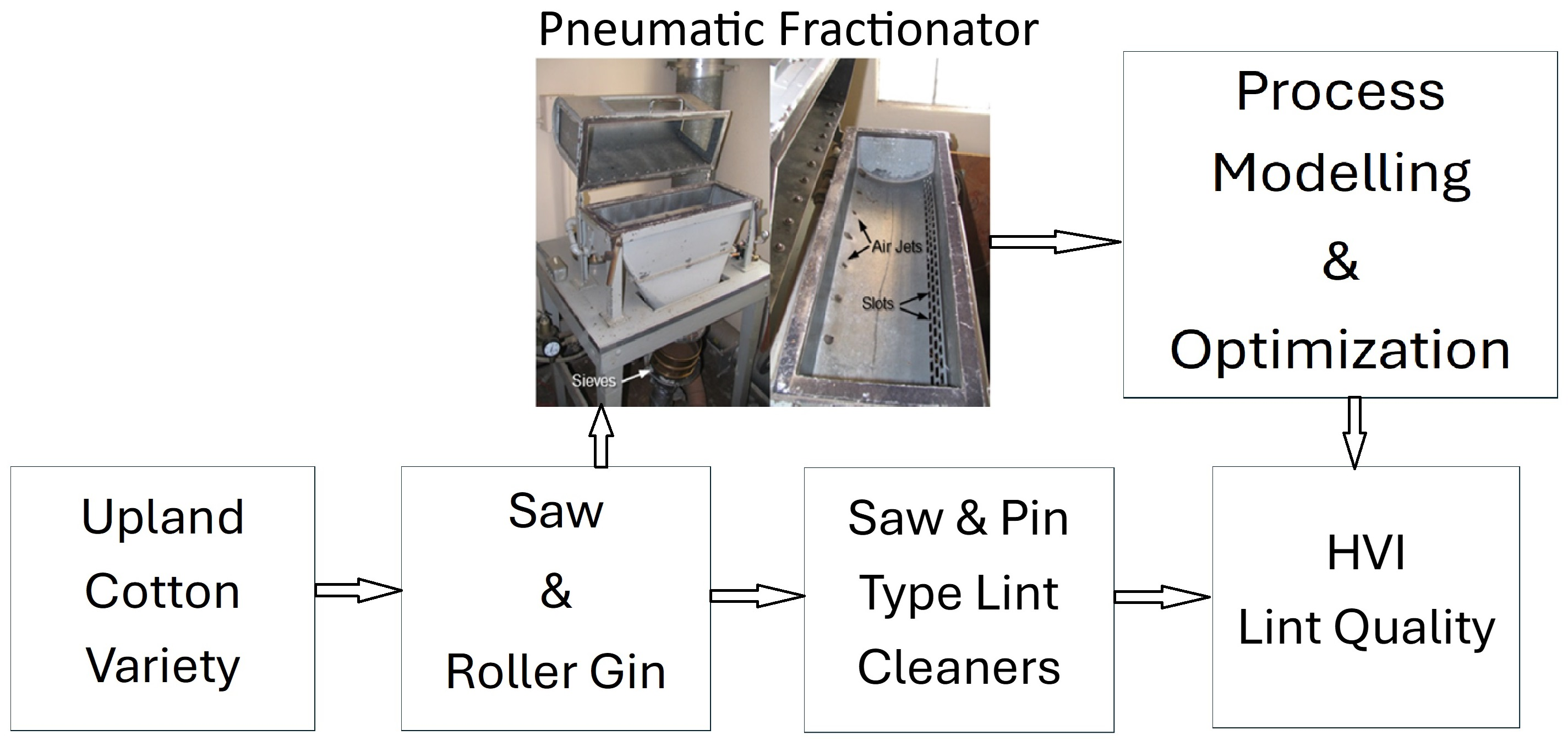
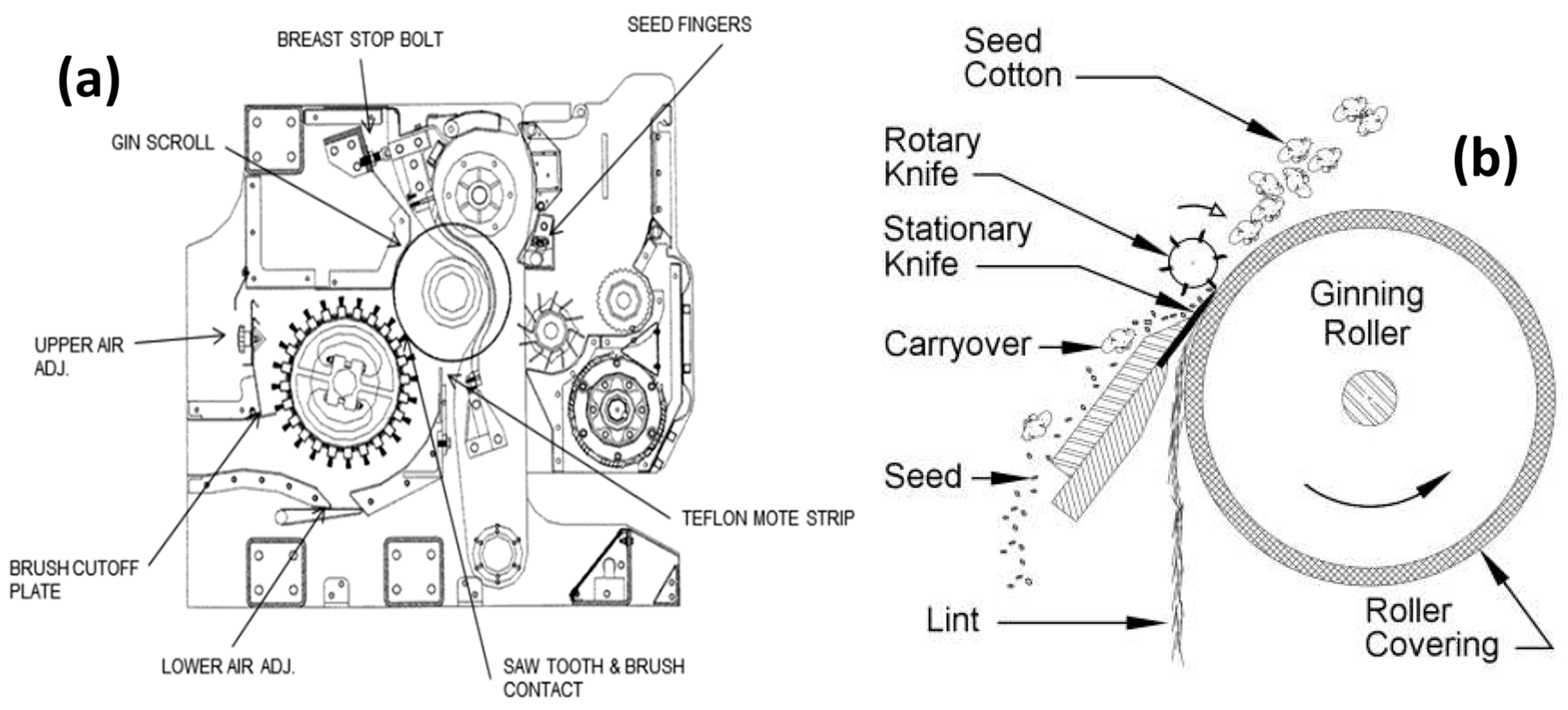
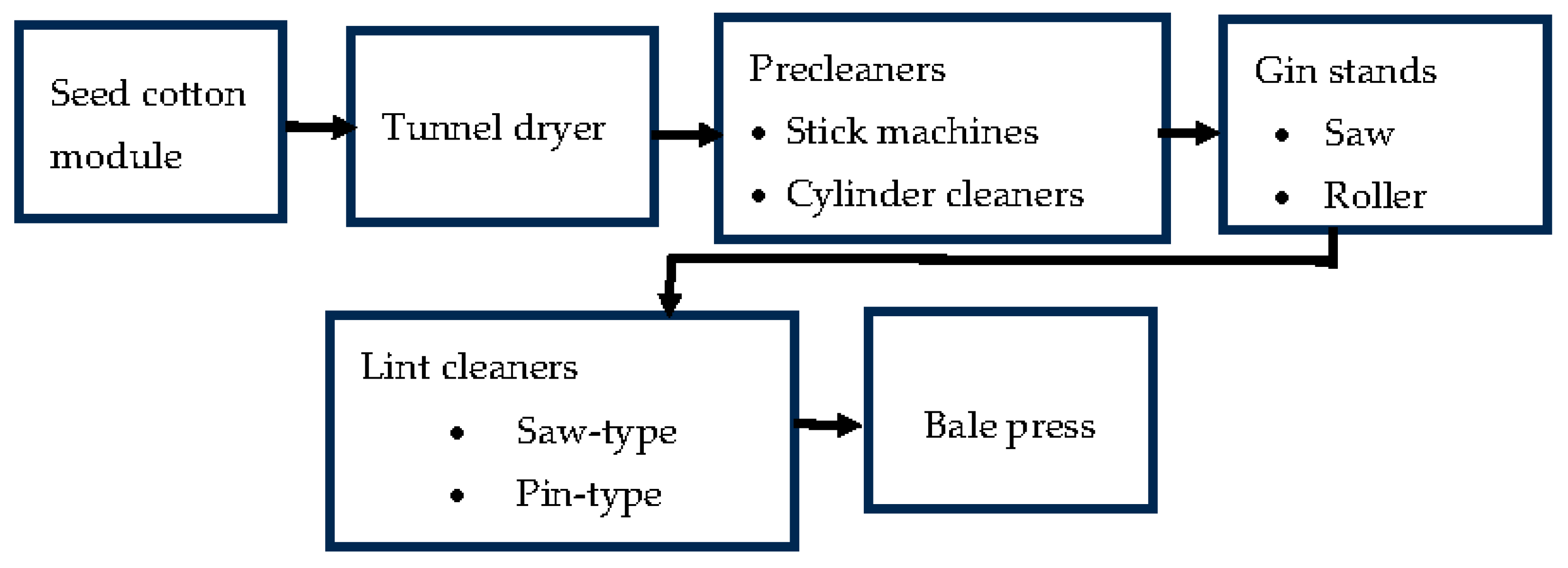
2.2. Equipment Used for Processing Upland Cotton
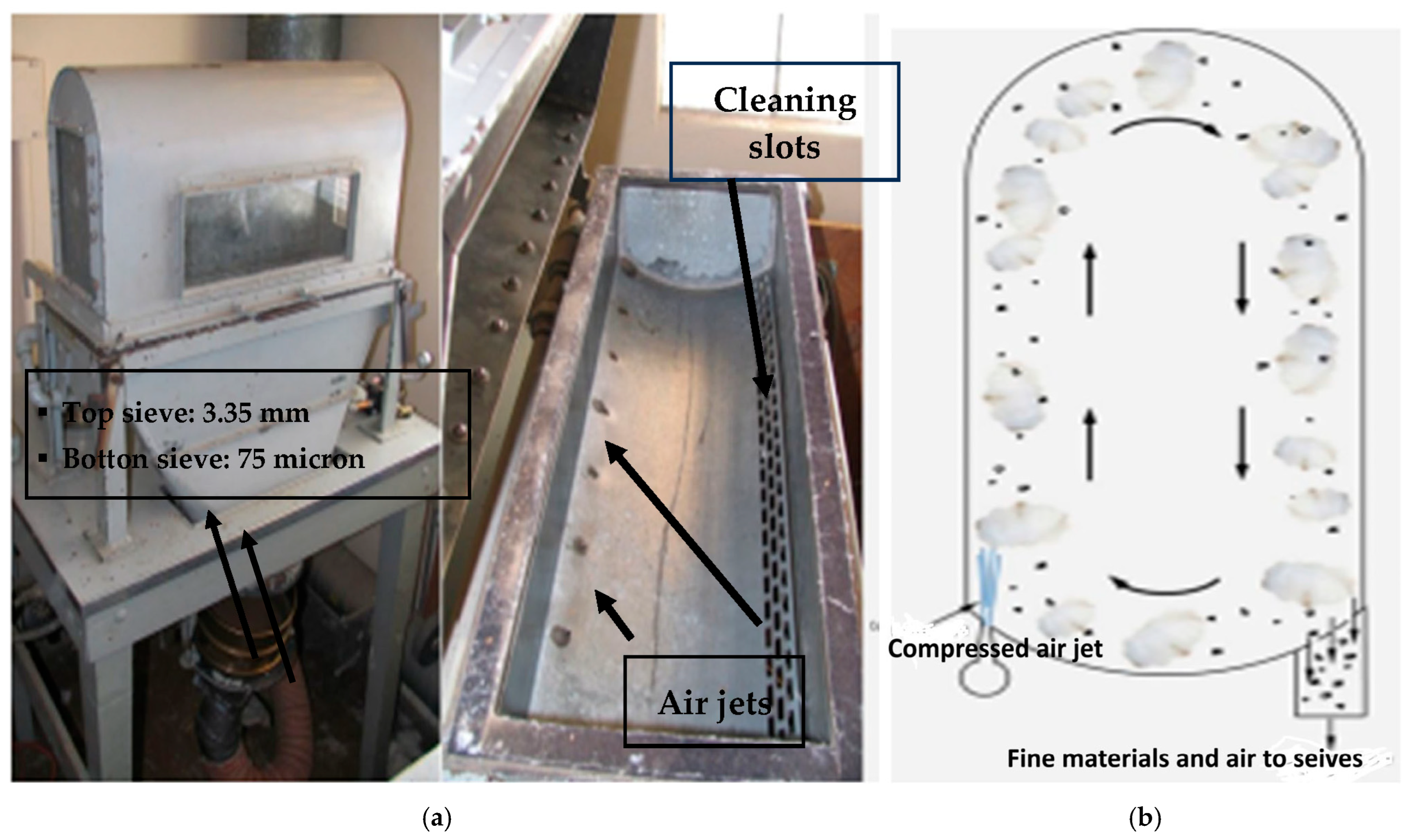
2.3. Pneumatic Fractionation Process
2.4. Experimental Plan
2.5. Experiment Procedure
2.6. Lint Moisture Adjustment Method
2.7. Lint Moisture Measurement (%, w.b.)
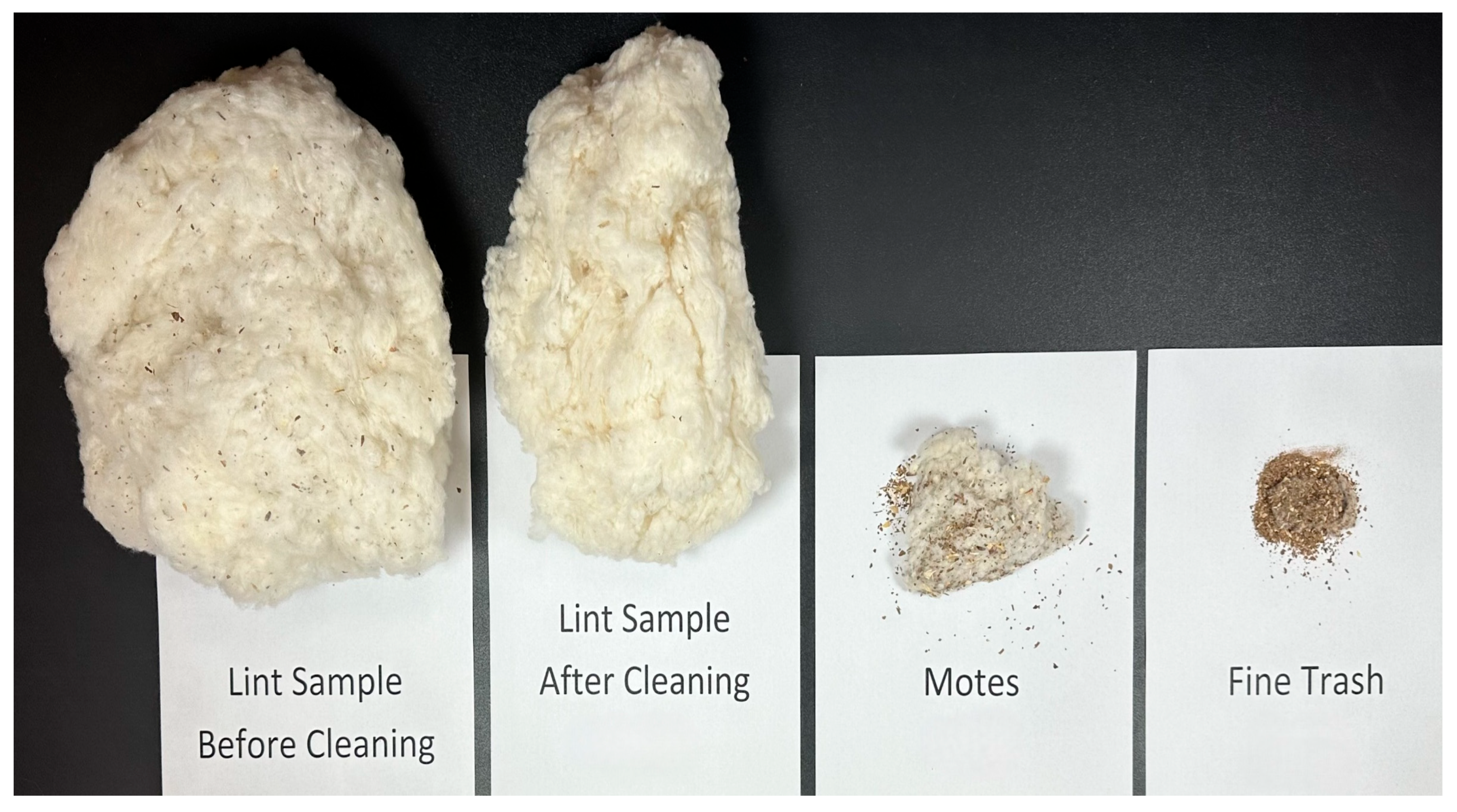
2.8. Total Trash Extracted (%)
2.9. HVI Properties Measured
- UHML is the average length of the longer half of the fibers in a sample.
- UI is the ratio of the average fiber length to the upper half mean length.
- Strength is the force needed to break a bundle of fibers.
- Micronaire is an indirect measure of fiber fineness and maturity.
- Color is the measure of cotton’s reflectance (brightness) and yellowness. These two values determine the color grade.
- Trash is the amount of non-lint material, such as leaf and bark.
- Leaf grade is calculated based on the trash meter percentage area and particle count.
- Short fiber content, which is an index calculated based on the HVI properties, is a measure of fibers less than half an inch or 12.7 mm.
2.10. Data Analysis and Modeling
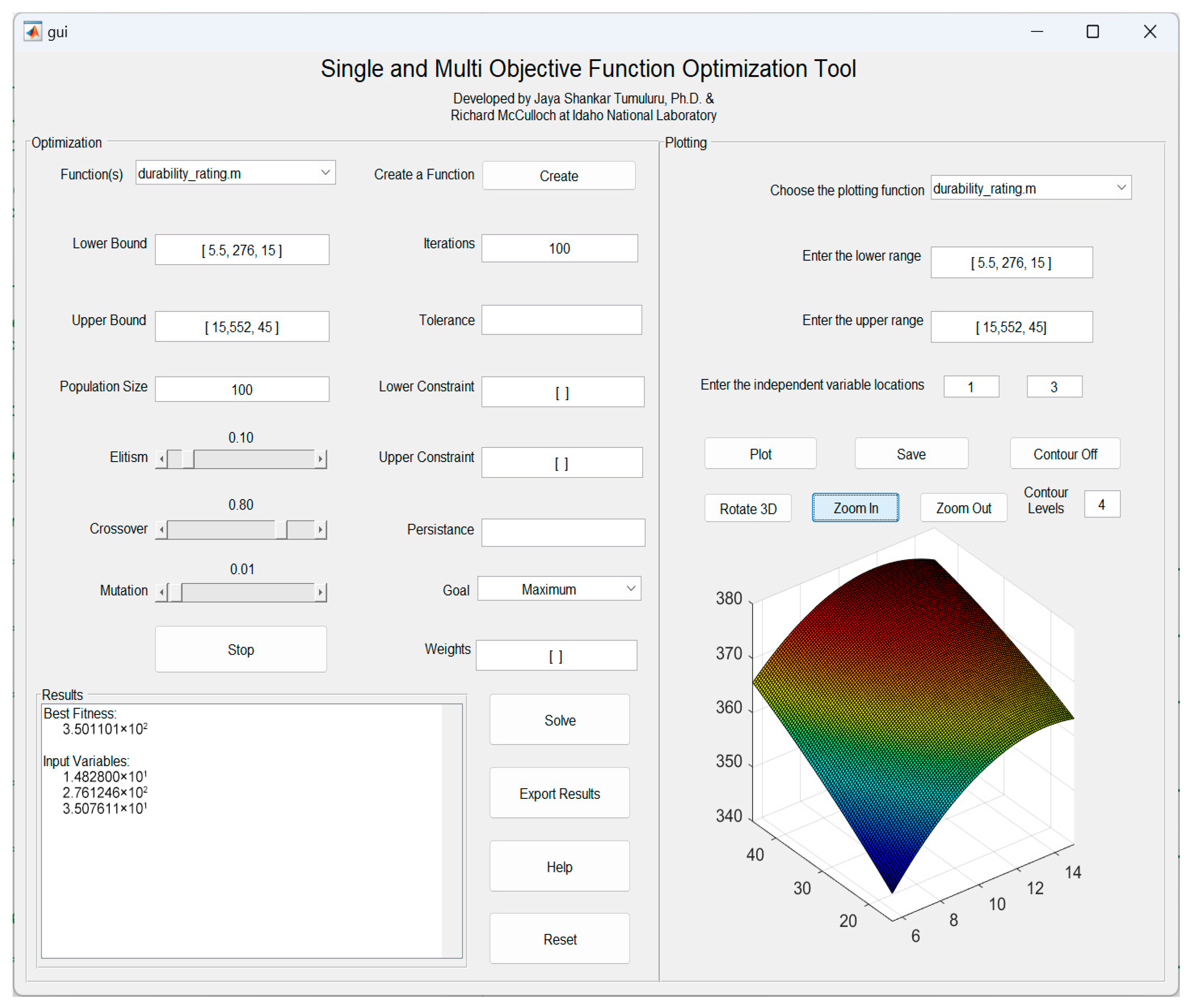
2.11. Pneumatic Fractionator Process Optimization
2.12. Loan Rate and Bale Value Calculation
3. Results and Discussion
3.1. Response Surface Models
3.1.1. Final Lint Moisture Content and Total Trash Extraction Models
3.1.2. HVI Properties Models
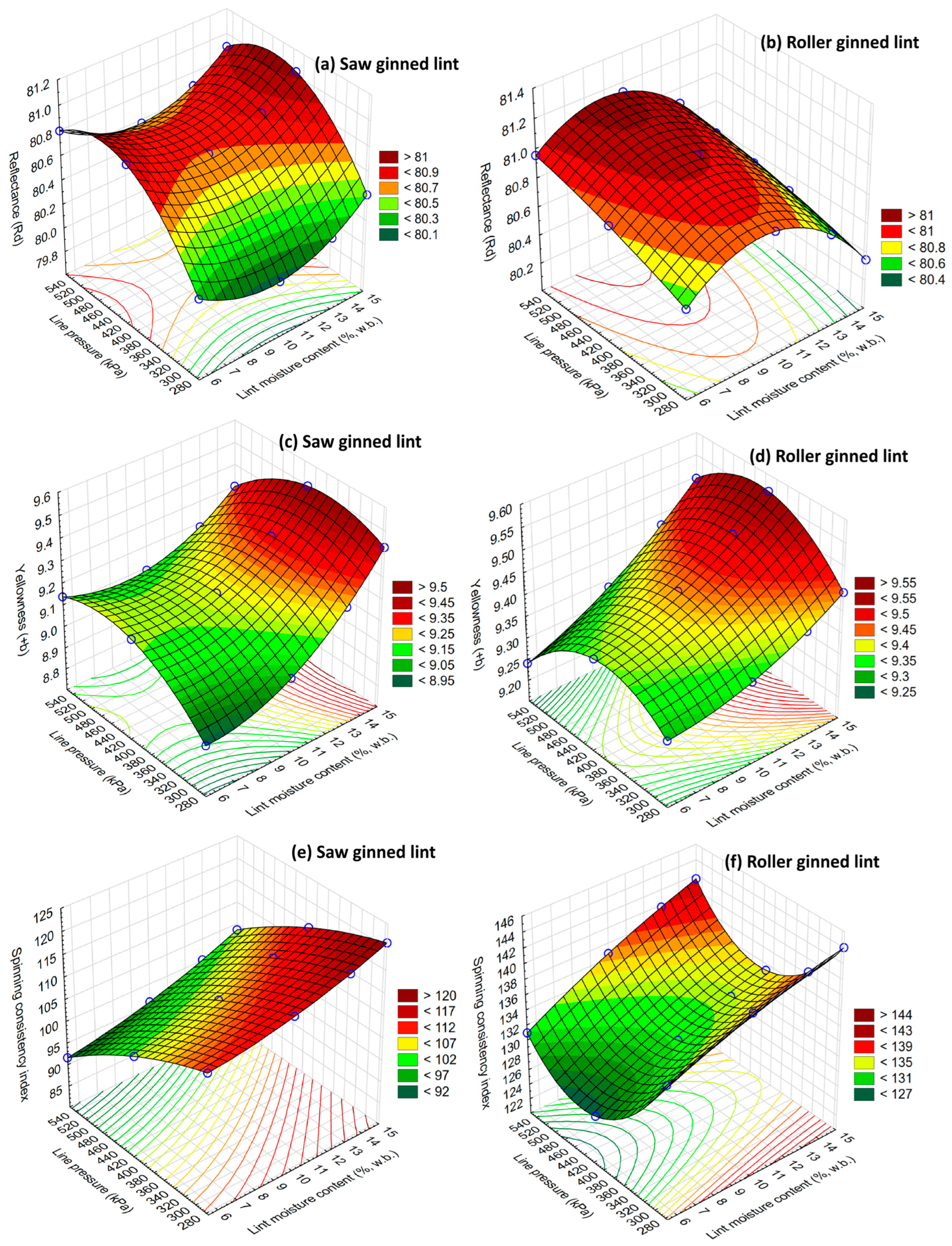
3.2. Response Surface Plots for Pneumatic Fractionated Saw- and Roller-Ginned Lint
3.2.1. Final Lint Moisture Content (%, w.b.) and Total Trash Extracted
3.2.2. HVI Properties
3.3. Optimization of Pneumatic Fractionation Process
Comparison of Lint Properties: No Lint Cleaning (NO LC), Industry-Standard Lint Cleaning (1-LC), and Pneumatic Fractionation
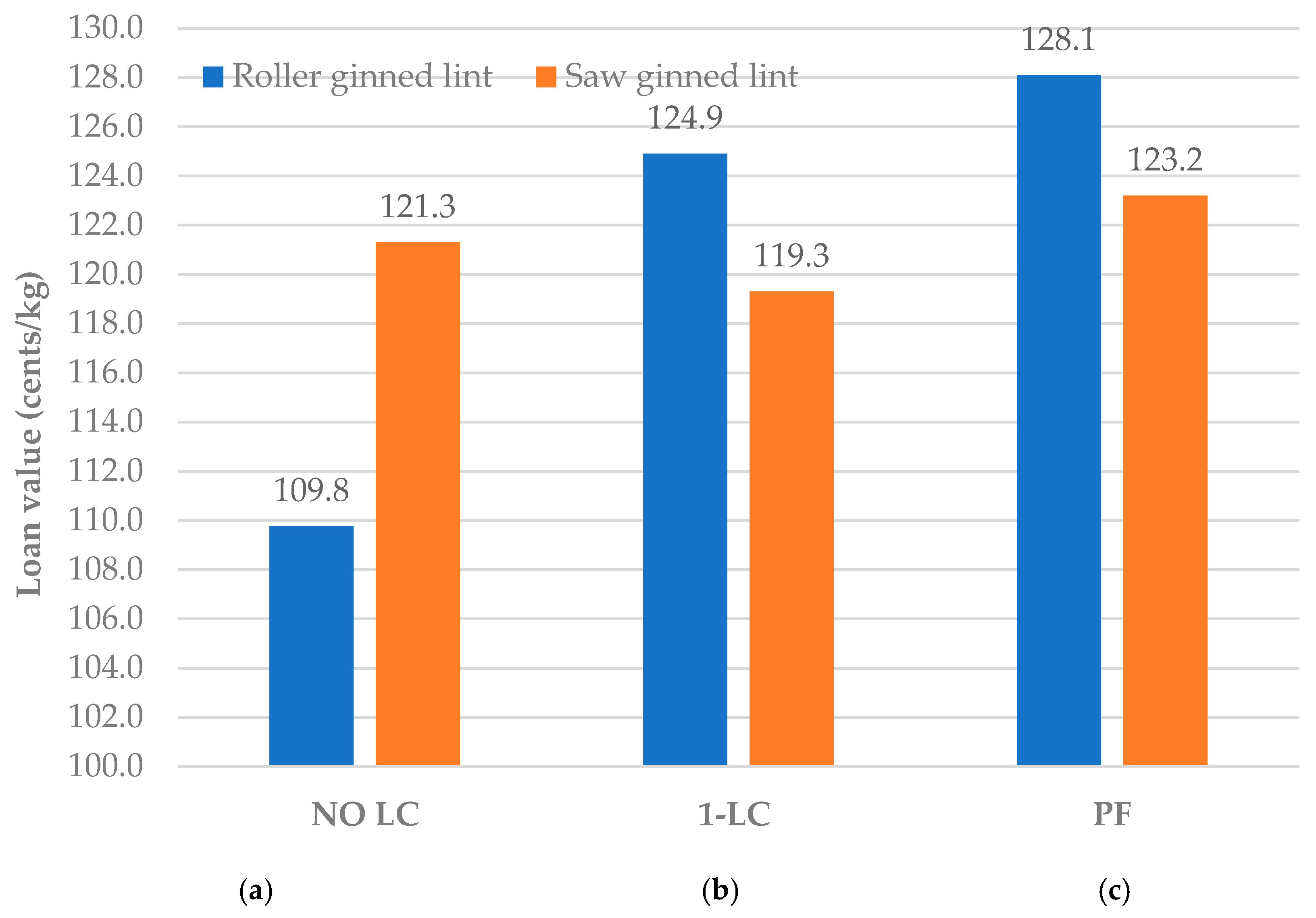
3.4. Loan Value
3.5. Discussion
4. Conclusions
Supplementary Materials
Author Contributions
Funding
Data Availability Statement
Acknowledgments
Conflicts of Interest
Abbreviations
| +b | Yellowness |
| 1-LC | Industry-standard lint cleaning |
| Final LMC | Final lint moisture content |
| HVI | High volume instrument |
| Mic | Micronaire |
| NO LC | No lint cleaning |
| PF | Pneumatic fractionator |
| Rd | Reflectance |
| SCI | Spinning consistency index |
| SFC | Short fiber content |
| Str | Strength |
| Trash cnt | Trash count |
| TT | Total trash |
| UHML | Upper half mean length |
| UI | Uniformity index |
References
- Ashraf, J.; Zuo, D.; Wang, Q.; Malik, W.; Zhang, Y.; Abid, M.A.; Song, G. Recent insights into cotton functional genomics: Progress and future perspectives. Plant Biotechnol. 2018, 16, 699–713. [Google Scholar] [CrossRef]
- Mishra, P.K.; Sharma, A.; Prakash, A. Current research and development in cotton harvesters: A review with application to Indian cotton production systems. Heliyon 2023, 9, e161124. [Google Scholar] [CrossRef]
- Rehman, A.-u.; Kamran, M.; Afzal, I. Production and processing of quality cotton seed. In Cotton Production and Uses; Ahmad, S., Hasanuzzaman, M., Eds.; Springer: Singapore, 2020. [Google Scholar] [CrossRef]
- Shuli, F.; Jarwar, A.H.; Wang, X.; Wang, L.; Ma, Q. Overview of the cotton in Pakistan and its future prospects. Pak. J. Agric. Res. 2018, 31, 396–407. [Google Scholar] [CrossRef]
- Pirnazarov, A. Design and Development of Seed Cotton PreCleaner Machinery. Engineering 2021, 13, 656–666. [Google Scholar] [CrossRef]
- Anthony, W.S.; Mayfield, W.D. Cotton Ginners Handbook; Agricultural Handbook No. 503; U.S. Department of Agriculture: Washington, DC, USA, 1994; p. 90.
- Hughs, E.; Holt, G.; Ross Rutherford, R. Saw gin stands. J. Cotton Sci. 2017, 21, 60–69. [Google Scholar] [CrossRef]
- Tumuluru, J.S.; Armijo, C.B.; Whitelock, D.P.; Funk, P.A. Modeling and optimization of high-capacity experimental reclaimers to minimize the seed and lint loss during roller ginning of Upland and Pima cotton. Processes 2023, 11, 2868. [Google Scholar] [CrossRef]
- Mangialardi, G.J., Jr.; Anthony, W.S. Field evaluations of air and saw lint cleaning systems. J. Cotton Sci. 1998, 2, 53–61. [Google Scholar]
- Byler, R.K.; Delhom, C.D. Comparison of saw dinning and high-speed roller ginning with different lint cleaners of Mid-South grown cotton. Appl. Eng. Agric. 2012, 28, 475–482. [Google Scholar] [CrossRef]
- Le, S. Performance of a pin cylinder lint cleaner. Appl. Eng. Agric. 2007, 23, 579–582. [Google Scholar] [CrossRef]
- Armijo, C.B.; Delhom, C.D.; Whitelock, D.P.; Tumuluru, J.S.; Yeater, K.M.; Blake, C.D.; Rowe, C.; Wanjura, J.D.; Sui, R.; Holt, G.A.; et al. Evaluation of alternative-design cotton gin lint cleaning machines on fiber length uniformity index. Agric. Eng. 2023, 5, 2123–2138. [Google Scholar] [CrossRef]
- Le, S. Fiber quality properties produced by saw-type lint cleaners. Appl. Eng. Agric. 2007, 23, 125–130. [Google Scholar] [CrossRef]
- Khalil, E. Comparative study on the quality parameters of ring and rotor spun yarn: A case study. Adv. Res. J. 2025, 8, 43–57. [Google Scholar] [CrossRef]
- Armijo, C.B.; Whitelock, D.P.; Hughs, S.E. Assessing a pneumatic fractionator as a lint cleaning device. J. Cotton Sci. 2015, 19, 307–318. [Google Scholar] [CrossRef]
- Whitelock, D.P.; Armijo, C.B.; Hughs, S.E. Evaluating a pneumatic fractionator for cleaning ginned lint. Appl. Eng. Agric. 2014, 31, 399–403. [Google Scholar] [CrossRef]
- Americot USA. Available online: https://www.americot.com/product/ng-4545-b2xf/ (accessed on 29 March 2024).
- JMP Pro Software, version 18.2.0; JMP Statistical Discovery: Cary, NC, USA, 2025. Available online: https://www.jmp.com/en/home (accessed on 10 April 2023).
- Uster Technologies AG. USTER®HVI 1000. Available online: https://csitc.org/sitecontent/RTCEA/internal_ea/02_RTC_Content/022_Training/0222_Training_documents/02225_USTER/Application%20Manual/0222511_TestResults.pdf (accessed on 12 December 2024).
- Tumuluru, J.S.; Conner, C.C.; Hoover, A.N. Method to produce durable pellets at lower energy consumption using high moisture corn stover and a corn starch binder in a flat die pellet mill. J. Vis. Exp. 2016, 112, e54092. [Google Scholar] [CrossRef]
- Shepherd, J.V. Standard Procedures for Foreign Matter and Moisture Analytical Tests Used in Cotton Ginning Research; Agricultural Handbook No. 422; USDA: Washington, DC, USA, 1972. Available online: https://www.govinfo.gov/content/pkg/GOVPUB-A-PURL-gpo25946/pdf/GOVPUB-A-PURL-gpo25946.pdf (accessed on 7 July 2023).
- Sayeed, M.A.; Hequet, E.F. Estimation of AFIS short fiber content using the HVI fibrogram. In Proceedings of the 2021 Beltwide Cotton Conferences, Virtual, 5–7 January 2021; Available online: https://cotton.org/beltwide/proceedings/2005-2022/data/conferences/2021/paper/20504.pdf (accessed on 16 December 2025).
- Cotton Incorporated. The Classification of Cotton. 2013. Available online: https://www.cottoninc.com/wp-content/uploads/2022/05/Classification-of-Cotton-EN.pdf (accessed on 20 August 2025).
- Khuri, A.Z.; Cornell, J.A. Response Surfaces; CRC Press: Boca Raton, FL, USA, 1996. [Google Scholar] [CrossRef]
- Statistica, Version 14.1.0.8. Data Science Workbench. Cloud Software Group, Inc.: Fort Lauderdale, LA, USA, 2023. Available online: https://docs.tibco.com/products/tibco-data-science-workbench-14-1-0 (accessed on 5 September 2023).
- Tumuluru, J.S.; McCulloch, R. Application of hybrid genetic algorithm routine in optimizing food and bioengineering processes. Foods 2016, 5, 76. [Google Scholar] [CrossRef]
- USDA, Farm Service Agency. Available online: https://www.fsa.usda.gov/ (accessed on 1 April 2024).
- Cotton Incorporated. Bale Sizes, 2025. Available online: https://www.cottoninc.com/cotton-production/quality/us-cotton-fiber-chart/bale-sizes/ (accessed on 24 September 2025).
- Gulyaev, R.A.; Mardonov, B.M.; Lugachev, A.E. Cotton fibre humidification at cotton ginneries. Indian J. Fibre Text. Res. 2019, 44, 244–247. [Google Scholar]
- Baker, K.D.; Hughs, E.; Chun, D.T.W. Use of a rotor spray system for moisture addition to cotton lint. Appl. Eng. Agric. 2008, 24, 491–495. [Google Scholar] [CrossRef]
- van der Sluijs, M.J.H. The effect of various processing stages during ginning on fiber quality. J. Cotton Sci. 2020, 24, 44–59. [Google Scholar] [CrossRef]
- Byler, R.K. Historical review on the effect of moisture content and the addition of the moisture to the seed cotton before ginning on fiber length. J. Cotton Sci. 2006, 10, 300–310. [Google Scholar]
- Ventura, I.G.; Martí, V.B.; Cortes, L.I.; Guerrero-Luzuriaga, S. Kinetic models of wood biomass drying in hot airflow systems. Appl. Sci. 2024, 14, 6716. [Google Scholar] [CrossRef]
- Cutz, L.; Tiringer, U.; Gilvari, H.; Schott, D.; Mol, A.; de Jong, W. Microstructural degradation during the storage of biomass pellets. Commun. Mater. 2021, 2, 2. [Google Scholar] [CrossRef]
- Radkar, S.S.; Amiri, A.; Ulven, C.A. Tensile Behavior and Diffusion of Moisture through Flax Fibers by Desorption Method. Sustainability 2019, 11, 3558. [Google Scholar] [CrossRef]
- Baker, R.V.; Brashears, A.D. Effects of multiple lint cleaning on the value and quality of stripper harvested cotton. Proc. Beltwide Cotton Conf. 1999, 2, 1391–1393. [Google Scholar]
- Chun, D.T.W.; Anthony, W.S. Effects of adding moisture at the gin lint slide on the cotton bale microbial activity and fiber quality. J. Cotton Sci. 2004, 8, 83–90. [Google Scholar]
- US Department of Labor, Occupational Safety and Health Administration (OSHA), Washington DC. Accident Report Detail, Employee Catches and Amputates Fingers in Lint Machine, 2012. Available online: https://www.osha.gov/ords/imis/accidentsearch.accident_detail?id=201497351#:~:text=Abstract:%20On%20Decem-ber%2011%2C%202012,BY%2C%20CLOGGED%2C%20MACHINE%2D%2DMISC (accessed on 12 September 2024).

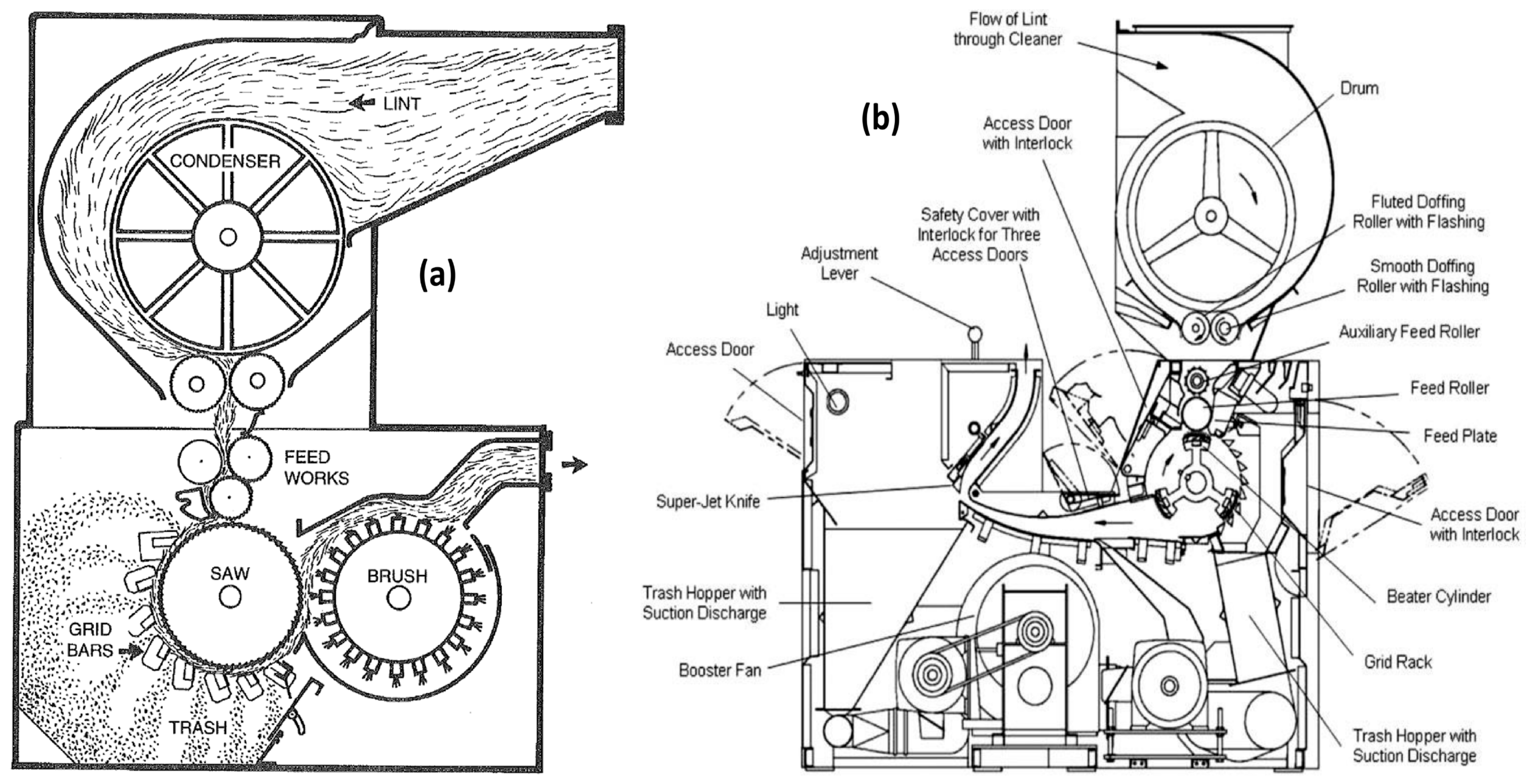





| System | Seed Cotton Precleaning Unit Operations | |
|---|---|---|
| Model | Specification or Dimensions | |
| Cylinder cleaner | Continental/Moss-Gordin (Prattville, AL, USA) | Gravity-fed six-drum inclines with 9.5 mm (3/8-in.) diameter, grids spaced 9.5 mm (3/8 in.) apart. The incline is 1300 mm (50 in.) wide and rated at 5.6 to 8.2 bales/h/m (1.7 to 2.5 bales/h/ft) of width. |
| Stick machine | Continental/Moss Gordin Little David (Prattville, AL, USA) | Gravity-fed, with two 349 mm (13.75-in.) diameter channel (sling off) saws and one reclaimer saw. The Little David is 1800 mm (72 in.) wide and rated at 3.3 to 6.6 bales/h/m (1.0 to 2.0 bales/h/ft) of width. |
| Seed Cotton Ginning Unit Operations | ||
| Roller ginning | ||
| Roller gin stand | Hardwicke–Etter roller gin stand (Sherman, TX, USA) | Roller diameter: 380 mm (14.785 in.) and 60DO (on durometer scale) in hardness. The stationary knife is made of hardened steel. The rotary knife is a 6-bladed spiral measuring 70 mm (2.75 in.) in diameter. The gin stand is 1000 mm (40 in.) width. |
| Air jet cleaner | Lummus, Super-Jet Cleaner (Lummus Cotton Gin Co., Ltd.; Columbus, GA, USA) | 1070 mm (42-Inch) wide. The air-jet cleaner connected to the pin-cylinder cleaner had an adjustable edge (4.77–31.75 mm) (3/16′-1 ¼″) to skim off heavier trash. |
| Pin-type lint cleaner | Aldrich Machine Works (Greenwood, SC, USA) | 406 mm (16.0 in.) diameter pin cylinder that rotated at 1100 rpm and 16 grid bars around the pin cylinder with each leading edge spaced 19.1 mm (0.75 in.) apart. The clearance between the pins and grid bars was 23.8 mm (0.94 in.). |
| Saw ginning | ||
| Saw gin stand | 46-Saw Continental/Murray Double Eagle saw gin stand (Prattville, Autauga County, AL, USA) | Gins saws 406.4 mm (16.0 in.) diameter spaced 1.6 mm (0.063 in.) apart, operated at 660 rpm. Motor: 22.4 kW (30 hp), with 1760 rpm. |
| Air jet cleaner | Air- Jet Cleaner (Northern Lucus Inc., Lubbock, TX, USA) | 1220 mm (48-in.) wide, the air-jet cleaner had an adjustable edge (4.77–31.75 mm) (3/16′–1 ¼″) to skim off heavier trash |
| Saw-type lint cleaner | Continental/ Moss–Gordin Lodestar controlled-batt saw-type lint cleaner (Continental Gin Co., Ltd.; Prattville, AL, USA) | Spiral-wrapped lint cleaner saw 406 mm (16.0 in.) in diameter; operated at about 1000 rpm. The lint cleaner had five grid bars with 1.59 mm (0.063 in.) clearance between each bar and the saw. |
| Process Conditions | Low | Mid | High | Lint Quality |
|---|---|---|---|---|
| Lint moisture content (%, w.b.) (x1) | ~5.5 (−1) | 9 (0) | 15 (1) | Pneumatic fractionator outputs
|
| Line pressure (kPa) (x2) | 276 (−1) | 414 (0) | 552 (1) | |
| Residence time (s) (x3) | 15 (−1) | 30 (0) | 45 (1) |
| Lint Properties | Model | R2 | Significance |
|---|---|---|---|
| Pneumatic fractionator outputs | |||
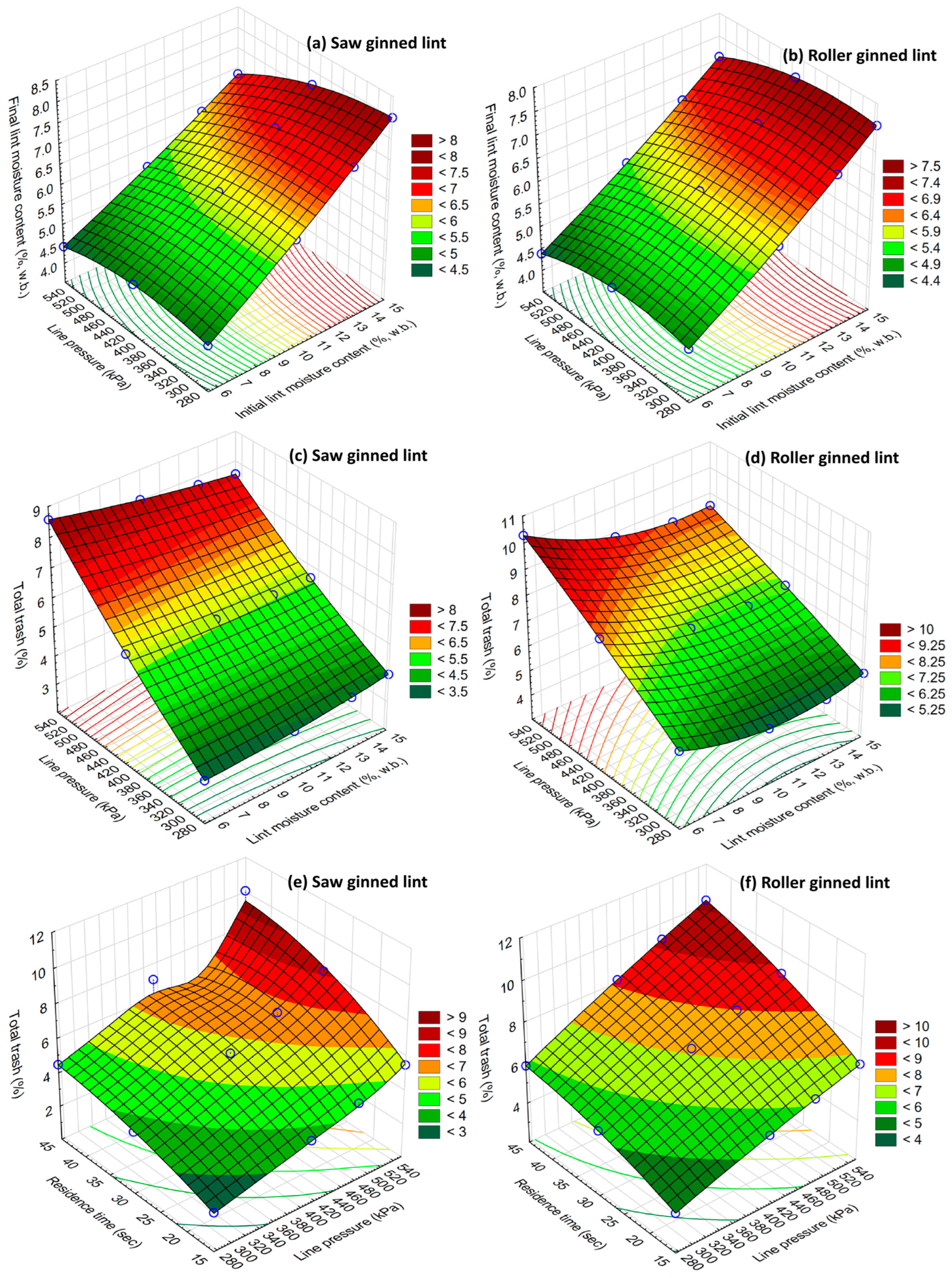
| Final lint moisture content (%, w.b.) | 0.98 | x1: p < 0.05; x1x3: p < 0.05; x1x2: p < 0.1 | |
| Total trash extracted (%) | 0.99 | x1x2: p < 0.05; x2x3: p < 0.05 | |
| HVI properties | |||
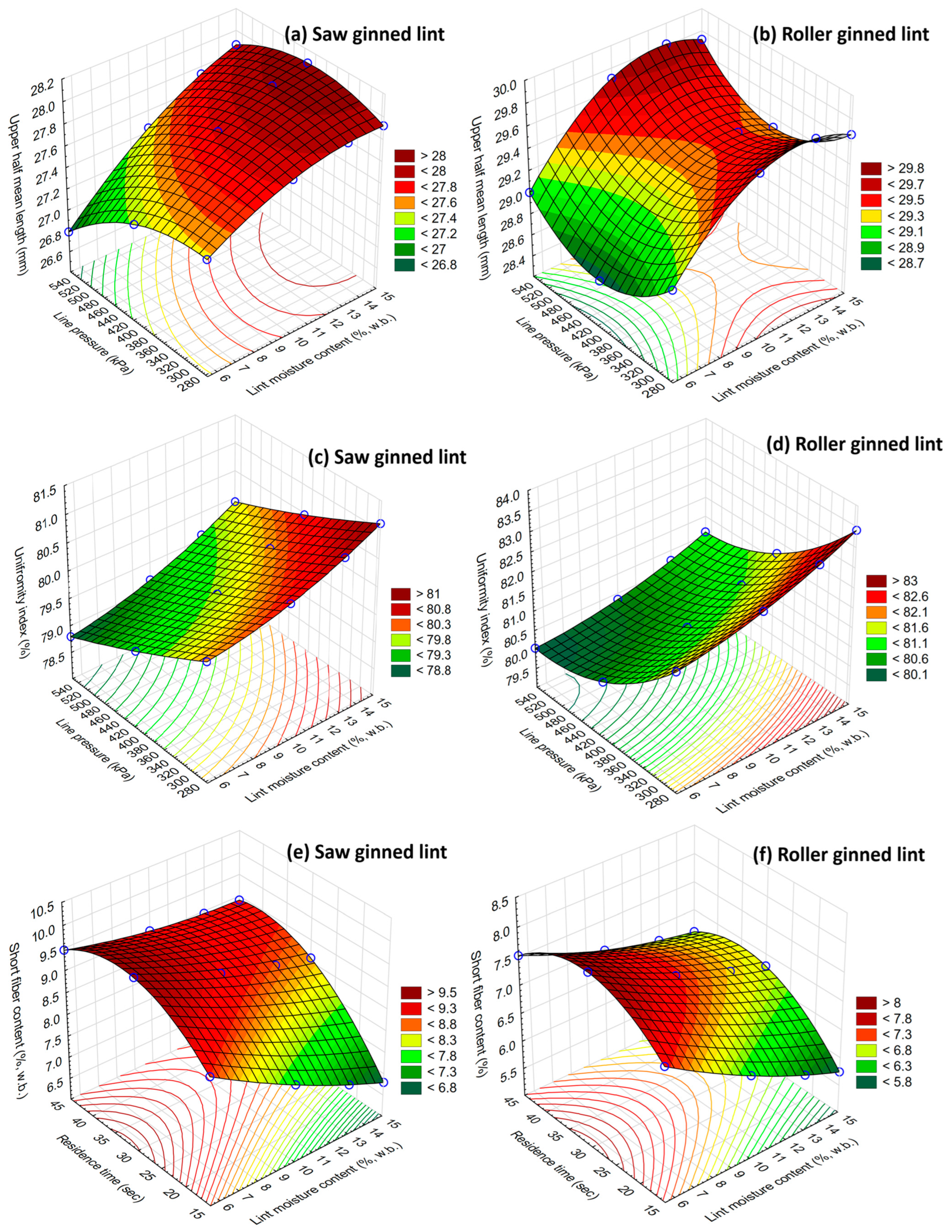
| Upper half mean length (mm) | 0.95 | x32: p < 0.05; x3: p < 0.05; x1x3: p < 0.1; x1x2: p < 0.1 | |
| Uniformity index (%) | 0.0000026 | 0.80 | ns |
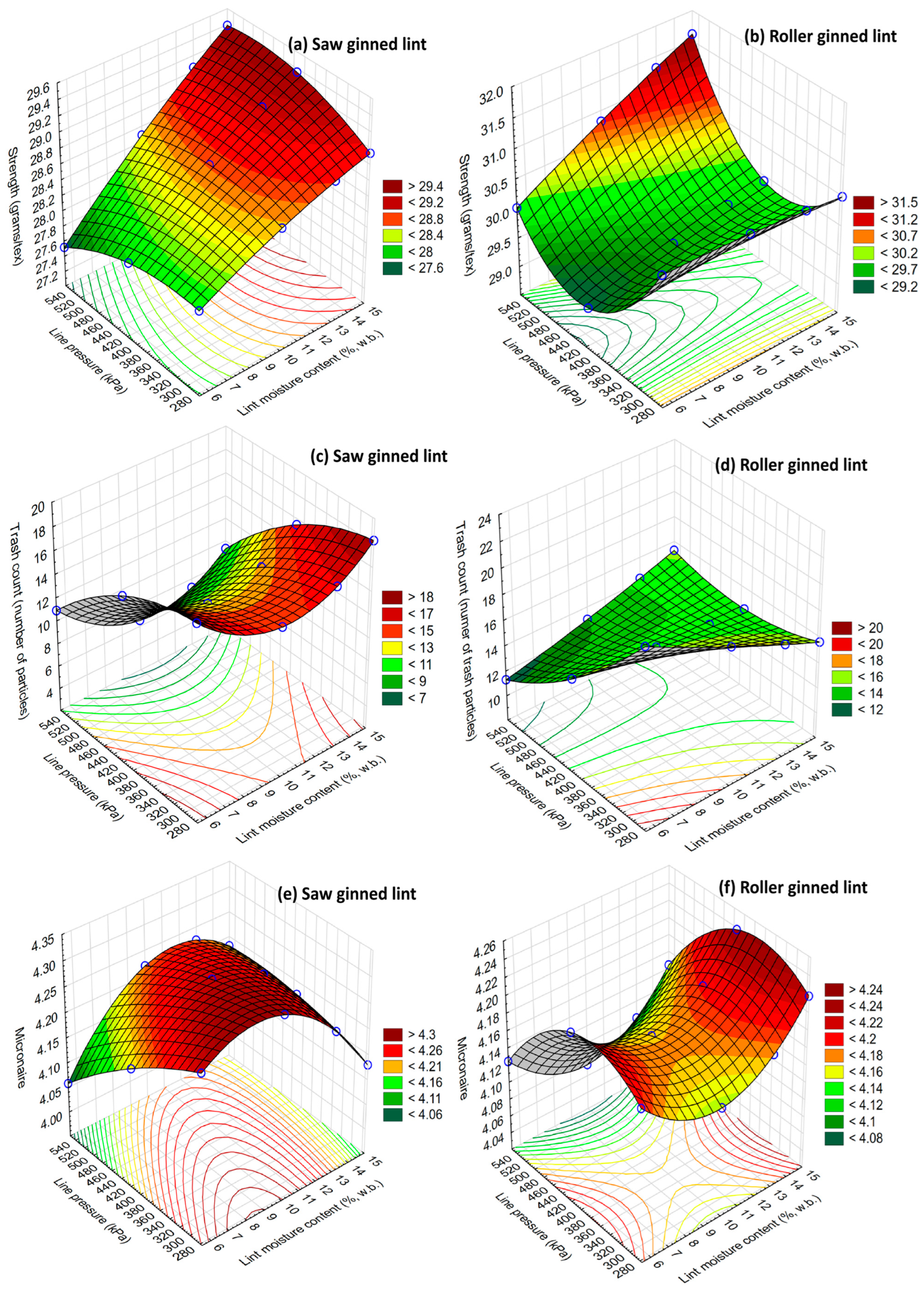
| Trash count (number of particles) | 0.89 | x1: p < 0.1; x12: p < 0.1 | |
| Strength (grams/tex) | 0.82 | ns | |
| Short fiber content (%) | 0.92 | x32: p < 0.1; x1x3: p < 0.1; x3: p < 0.1 | |
| Reflectance (Rd) | 0.77 | x2: p < 0.05; x22: p < 0.1 | |
| Yellowness (+b) | 0.83 | x2: p < 0.1; x22: p < 0.1; x1x2: p < 0.1 | |
| Micronaire | 0.88 | x1x2: p < 0.05; x12: p < 0.05; x1: p < 0.05; x1x3: p < 0.05 | |
| Spinning consistency index | 0.83 | ns | |
| Model | R2 | Significance | |
|---|---|---|---|
| Pneumatic fractionator outputs | |||
| Final lint moisture content (%, w.b.) | 0.98 | x1x3: p < 0.05; x1: p < 0.1 | |
| Total trash extracted (%) | 0.99 | x12: p < 0.05; x2x3: p < 0.05; x1x2: p < 0.1 | |
| HVI properties | |||
| Upper half mean length (mm) | 0.77 | x1: p < 0.1; x2: p < 0.1 | |
| Uniformity index (%) | 0.91 | x2: p < 0.05x22: p < 0.05 | |
| Trash count (number of particles) | 0.95 | x3: p < 0.05; x1x2: p < 0.05; x2x3: p < 0.05; x2: p < 0.05 x32: p < 0.1; x1x3: p < 0.1; x1: p < 0.1 | |
| Strength (grams/tex) | 0.61 | x2: p < 0.1 | |
| Short fiber content (%) | 0.90 | x3: p < 0.05; x32: p < 0.05 | |
| Reflectance (Rd) | 0.63 | ns | |
| Yellowness (+b) | 0.88 | x22: p < 0.1; x2: p < 0.1 | |
| Micronaire | 0.63 | x11: p < 0.10 | |
| Spinning consistency index | 0.83 | x2: p < 0.05; x22: p < 0.05 | |
| Optimized Process Conditions | Saw-Ginned Lint | Roller-Ginned Lint |
|---|---|---|
| Lint moisture content (%, w.b.) | 14.64 | 14.83 |
| Line pressure (kPa) | 276.01 | 276.12 |
| Residence time (s) | 44.92 | 35.07 |
| Saw-Ginned Cotton | Roller-Ginned Cotton | ||||||
|---|---|---|---|---|---|---|---|
| S. No. | Lint properties | No LC * | Saw LC * | PF * | No LC * | Pin LC * | PF * |
| 1 | Final Lint moisture content (% w.b.) | 5.25 | 5.29 | 7.28 | 5.35 | 5.30 | 7.25 |
| 2 | Total Trash Extracted (%) | 4.35 | 4.77 | 3.19 | 5.77 | ||
| 3 | Upper Half Mean Length (mm) | 28.4 | 26.9 | 27.9 | 29.2 | 28.4 | 29.6 |
| 4 | Uniformity Index (%) | 81.8 | 80.0 | 80.7 | 82.6 | 82.5 | 83.2 |
| 5 | Strength (grams/tex) | 29.4 | 27.3 | 28.6 | 29.6 | 28.5 | 30.6 |
| 6 | Reflectance (Rd) | 78.4 | 80.3 | 81.0 | 77.5 | 79.6 | 80.4 |
| 7 | Yellowness (+b) | 8.68 | 9.02 | 9.31 | 8.64 | 9.38 | 9.44 |
| 8 | Micronaire | 4.38 | 4.23 | 4.09 | 4.58 | 4.20 | 4.22 |
| 9 | Short Fiber Content (%) | 7.0 | 9.4 | 8.2 | 6.1 | 6.6 | 6.2 |
| 10 | Trash count (number of particles) | 43 | 13 | 13 | 97 | 32 | 14 |
| 11 | Spinning Consistency Index | 126 | 111 | 119 | 130 | 130 | 143 |
| Color Grade ** | 31 | 21 | 11 | 31 | 11 | 11 | |
| Leaf Grade *** | 3.4 | 1.1 | 1.2 | 5.4 | 2.8 | 1.4 | |
Disclaimer/Publisher’s Note: The statements, opinions and data contained in all publications are solely those of the individual author(s) and contributor(s) and not of MDPI and/or the editor(s). MDPI and/or the editor(s) disclaim responsibility for any injury to people or property resulting from any ideas, methods, instructions or products referred to in the content. |
© 2026 by the authors. Licensee MDPI, Basel, Switzerland. This article is an open access article distributed under the terms and conditions of the Creative Commons Attribution (CC BY) license.
Share and Cite
Tumuluru, J.S.; Armijo, C.B.; Whitelock, D.P.; Delhom, C.; Martin, V. Lint Cleaning Performance of a Pneumatic Fractionator: Impacts on Fiber Quality and Economic Value of Saw- and Roller-Ginned Upland Cotton. Processes 2026, 14, 290. https://doi.org/10.3390/pr14020290
Tumuluru JS, Armijo CB, Whitelock DP, Delhom C, Martin V. Lint Cleaning Performance of a Pneumatic Fractionator: Impacts on Fiber Quality and Economic Value of Saw- and Roller-Ginned Upland Cotton. Processes. 2026; 14(2):290. https://doi.org/10.3390/pr14020290
Chicago/Turabian StyleTumuluru, Jaya Shankar, Carlos B. Armijo, Derek P. Whitelock, Christopher Delhom, and Vikki Martin. 2026. "Lint Cleaning Performance of a Pneumatic Fractionator: Impacts on Fiber Quality and Economic Value of Saw- and Roller-Ginned Upland Cotton" Processes 14, no. 2: 290. https://doi.org/10.3390/pr14020290
APA StyleTumuluru, J. S., Armijo, C. B., Whitelock, D. P., Delhom, C., & Martin, V. (2026). Lint Cleaning Performance of a Pneumatic Fractionator: Impacts on Fiber Quality and Economic Value of Saw- and Roller-Ginned Upland Cotton. Processes, 14(2), 290. https://doi.org/10.3390/pr14020290