Article

Mass Deposition Rates of Carbon Dioxide onto a Cryogenically Cooled Surface

by
Martin Jan Tuinier
,
Wout Jacob René Ververs
,
Danica Tešić
,
Ivo Roghair
* and
Martin van Sint Annaland
Chemical Process Intensification, Multiphase Reactors Group, Department of Chemical Engineering and Chemistry, Eindhoven University of Technology, P.O. Box 513, 5600 MB Eindhoven, The Netherlands
*
Author to whom correspondence should be addressed.
Processes 2026, 14(2), 271; https://doi.org/10.3390/pr14020271
Submission received: 5 November 2025 / Revised: 8 December 2025 / Accepted: 25 December 2025 / Published: 12 January 2026
(This article belongs to the Section Chemical Processes and Systems)

Abstract

The rates of CO2 mass deposition onto cryogenically cooled surfaces are crucial for CO2 removal processes that rely on cryogenics. A dedicated experimental setup was constructed to measure CO2 mass deposition rates under controlled conditions. Experiments were carried out with both pure CO2 and CO2/N2 mixtures, growing frost layers up to 8 mm thick. Results demonstrated that heat transfer through the frost layer significantly slows down the mass deposition process. Furthermore, it was found that the addition of N2 to the gas phase has a considerable influence on mass deposition rates, because it introduces an additional mass transfer resistance toward the frost surface. To describe the experimentally observed behavior, a frost growth model based on mass and energy balances was developed. Expressions for the frost density as a function of the frost temperature and for the effective frost conductivity as a function of the frost density were derived and implemented in the model. When accounting for drift fluxes, the model accurately captures the behavior observed in experiments. The findings of this work highlight the significant impact of heat transfer limitations on processes that accumulate a thick solid CO2 layer, such as continuously cooled heat exchangers. Conversely, technologies like cryogenically refrigerated packed beds do not develop a thick solid CO2 layer; calculations showed that a frost layer of 3.24·10−5 m is formed, resulting in a Biot number well below 0.01, indicating that heat transfer in the frost layer is not limiting.

1. Introduction

The reduction in greenhouse gas emissions is essential to mitigate the accelerating impacts of climate change, including rising global temperatures and extreme weather events [1]. As carbon dioxide (CO2) and other emissions continue to accumulate in the atmosphere, urgent action is required to safeguard ecosystems, public health, and economic stability [2,3]. To reduce CO2 emissions, technologies that capture CO2 from flue gases are an interesting option, as some processes are complicated to make carbon-free. Additionally, CO2 capture technology can serve as an addition to existing plants. Capturing the CO2 emitted by these processes allows for storage or utilization of the captured CO2, commonly referred to as carbon capture, utilization, and storage (CCUS). Several technologies are available to separate CO2 from a (flue) gas mixture, such as absorption, adsorption, membrane separation, and cryogenic processes. The feasibilities of these technologies depend strongly on the discharge conditions of the CO2-containing stream and the utilities available at the location [4]. Cryogenic separation is a promising prospect, offering a highly efficient and cost-effective method for separating CO2 by cooling gas streams until CO2 condenses or desublimates, thereby enabling high-purity capture without the use of chemical solvents. On the other hand, cryogenic processes are always very energy-intensive due to the cooling duty required to reach cryogenic temperatures; therefore, careful energy integration is critical.
Several cryogenic CO2 separation processes have been developed, and some have been implemented. Cryogenic distillation is one of the most mature technologies but is typically limited to large-scale applications due to its high capital cost. Several more innovative processes rely on the desublimation of CO2 on cold surfaces. The Stirling process, proposed by Song et al., captures CO2 by cryogenically cooling flue gas with a Stirling cooler, causing CO2 to desublimate, after which the solid can be separated mechanically [5]. The antisublimation process introduced by Clodic and Younes desublimates CO2 in a cryogenically cooled heat exchanger [6]. Tuinier et al. proposed a cryogenic process in which CO2 desublimates on a pre-cooled packed bed, enabling a cyclic CO2 capture and recovery process [7,8].
Information on mass deposition rates is crucial for designing processes that involve the desublimation of CO2. In the case of dynamically operated packed beds, the mass deposition rate is essential, as the front of freezing CO2 would disperse, and early CO2 breakthrough would occur in the case of low deposition rates, resulting in an inefficient use of the cold stored in the bed [8]. For other CO2 removal processes in which the heat-exchanging surface is cooled continuously, mass deposition rates are also important. It was found that solid CO2 will build up locally in a heat exchanger, eventually leading to a significant pressure drop or even plugging when not switched to a regeneration step with time [9,10]. Understanding desublimation rates and how layer thickness influences desublimation is essential for predicting where CO2 will collect and when regeneration is needed. Naletov et al. already demonstrated in an experimental study that the rate of CO2 deposition is strongly limited by the heat transfer limitation induced by the frost layer formed [11].
Many cryogenic CO2 separation methods rely on the desublimation of CO2 on a cold surface; however, this phenomenon has not been widely studied in detail. The earliest work focusing on the dynamics of CO2 desublimation is that by Ogunbameru et al., which shows that the rate of desublimation is initially high, then gradually decreases to zero due to heat transfer limitations [12]. A more detailed investigation, focusing on the rate of desublimation of CO2, was published by Shchelkunov et al. and describes experimental tests of CO2 desublimation while monitoring the density, thickness, and surface temperature of the solid CO2 layer formed [13]. Two periods of desublimation were observed: first, there was a strongly transient change in solid layer thickness, density, and surface temperature, which was followed by a quasi-steady regime with a near-linear increase. Haddad et al. utilized the experimental data from the aforementioned work to validate a CO2 desublimation model incorporating internal and external mass and heat transfer [14]. Other computational works on CO2 desublimation onto a cold surface include a pore-scale lattice Boltzmann model simulation study with various operating conditions [15,16] and a molecular dynamics study investigating CO2 desublimation on different surfaces [17]. The lattice Boltzmann model by Lei et al. showed that during desublimation, different regimes can occur where diffusion, convection, desublimation, or a combination of these steps are rate-limiting. This highlights that the flow regime and the design of the packing are important for optimizing capture performance. Wang et al. demonstrated, using optical imaging, that the morphology and properties of solid CO2 formed during sublimation heavily depend on the temperature and CO2 concentration [18]. A study by Du et al. again highlighted the importance of heat transfer on the desublimation rate while also showing the influence of the gas flow rate and cooling temperature on the heat exchange coefficient [19]. A follow-up study by Cai et al. investigated the desublimation dynamics at elevated pressure [20]. The results showed that at increased pressure, the morphological structure of the formed solid CO2 changes from crystalline to a laminar/layered structure. The experimental studies on CO2 desublimation demonstrated that lower cooling temperatures drive faster and denser frost growth, causing a rapidly increasing thermal-resistance layer that progressively degrades heat-transfer performance [21]. Wang et al. experimentally tested and modeled the CO2 desublimation on the walls of a tubular counter-current heat exchanger, showing reduction due to both heat and mass transfer [22].
This work presents a comprehensive study on CO2 desublimation rates in precisely controlled conditions to gain better understanding of the roles of kinetics, mass transfer, and heat transfer under various CO2 (partial) pressures, surface and gas phase temperatures, and flow conditions. The organization of the work is as follows: first, the experimental setup and procedure are explained, followed by a description of the experimental results for pure CO2 and mixtures of N2 and CO2. Then, a frost growth model is developed to describe the experimental findings. Finally, the conclusions and their significance for cryogenic CO2 removal equipment are provided.

2. Experimental Section

2.1. Setup

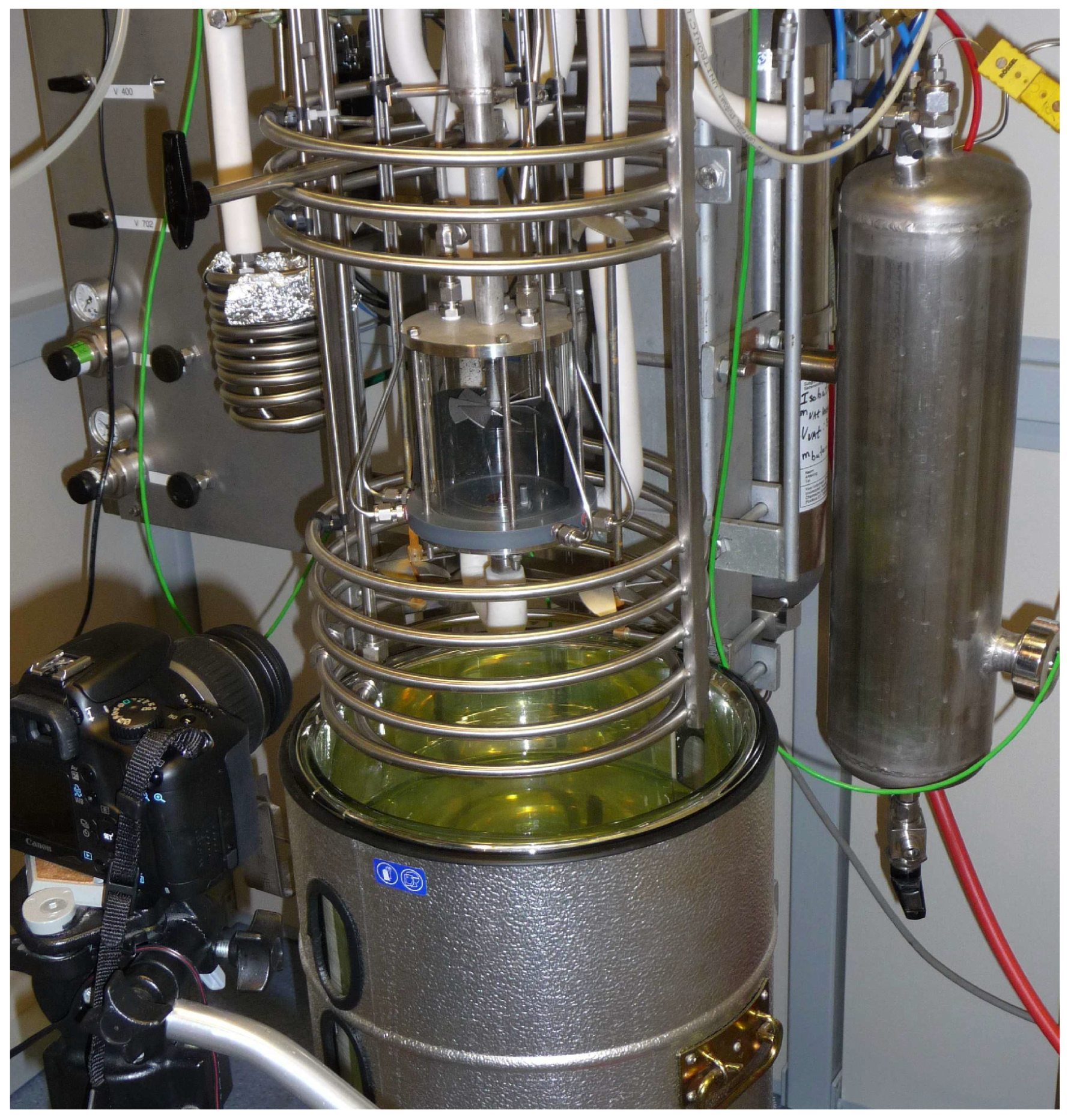
The design of the experimental setup was based on a configuration used to measure phase equilibria of CO2-containing gas mixtures, as described by Le and Trebble [23]. A schematic representation of the experimental setup is shown in Figure 1. The setup consists of a stirred cell with glass walls (inner diameter = 85 mm, height = 110 mm), containing a round, cooled surface (d = 20 mm) at the bottom, where CO2 is desublimating during measurement. The axial-propeller-type stirrer has a diameter of 50 mm and has a maximum rotation speed of 1730 RPM. The stirred cell is positioned in a large, custom-made dewar vessel with viewing stripes (KGW-isotherm). This dewar is filled with special cooling liquid (3M Novec 7200) and contains a large coil that can be fed with liquid N2 for cooling. A magnetic valve controls the flow of liquid N2 to control the temperature of the (stirred) liquid and hence of the gas phase in the stirred cell. The dewar contains two K-type thermocouples to monitor the temperature of the cooling liquid. The stirred cell is also connected to two outlets (of which one is to a vacuum pump), a premix vessel, and a CO2 feed line. The cell has an accurate vacuum gauge (Inficon CDG025D) and holds two K-type thermocouples in the gas phase at two different axial positions. The temperature of the cooled surface is regulated by a refrigerated gaseous N2 flow. This N2 flow passes through a coil submerged in a dewar filled with liquid N2, and the flow rate is controlled by a mass flow controller (Brooks Smart, 60 ln/min) connected to a PID control loop. The refrigerated N2 is then contacted intensively with the cooled copper plate in the stirred cell. Inside the cooled plate, four 0.5 mm calibrated T-type thermocouples have been installed at different locations to monitor the temperature in the cooled surface. The cooled surface is encased in PVC, which reduces heat transfer to other parts of the bottom of the cell due to its low thermal conductivity. Monitoring temperatures and pressures, as well as controlling valves and mass flow controllers, is performed using NI LabVIEW. A picture of the setup is shown in Figure 2. We have conducted one benchmark case in duplicate to verify the reproducibility of the setup.

2.2. Procedure

An experiment begins by evacuating the stirred cell and cooling the liquid in the dewar vessel surrounding it to the required set point temperature. Then, the cold surface is brought to the desired temperature. The premix vessel, equipped with a GE Sensing PTX 1400 pressure gauge, is filled with pure CO2 or a mixture of N2 and CO2. Valve V-3 is opened to let the gas enter the cell until the user-defined pressure set point is reached. At this point, CO2 immediately begins to desublimate at the surface, and the pressure in the cell drops. By controlling MFC-1 with a PID control loop, fresh (pure) CO2 is fed to the cell to maintain the set point pressure. The flow through the mass flow controller is precisely monitored and is directly proportional to the amount of CO2 desublimating at the cold surface. Frost growth during the measurement is recorded using a Canon EOS digital camera. After a measurement, cooling of the surface stops, and the system is flushed with N2.
To ensure there are no temperature or concentration gradients in the gas phase, the mixing behavior of the stirred cell was examined before commencing the experiments. This was done by feeding an N2/CO2 mixture into the cell and measuring the CO2 content in the outlet stream using an IR spectrometer. At some point, the CO2 feed was abruptly stopped, and the reduction in CO2 concentration at the outlet was measured over time. This process was repeated at multiple rotation speeds, and the results were compared to the theoretical profile of an ideally stirred tank reactor. It was observed that mixing approached ideal behavior (i.e., perfect uniformity of composition and temperature throughout the vessel) at rotation speeds above 130 RPM (this corresponds to a Reynolds number of approximately 104 or fully turbulent behavior).
Experiments have been conducted under various conditions. To eliminate any effects of dilution with N2, initial measurements were taken with pure CO2 in the gas phase. The impact of CO2 pressure and cold plate temperature have been examined. Next, the influence of the amount of N2 in the gas phase was investigated using different cold plate temperatures, as well as varying gas phase temperatures and stirrer rotation speeds. The conditions for all experiments are summarized in Table 1.

2.3. Data Processing

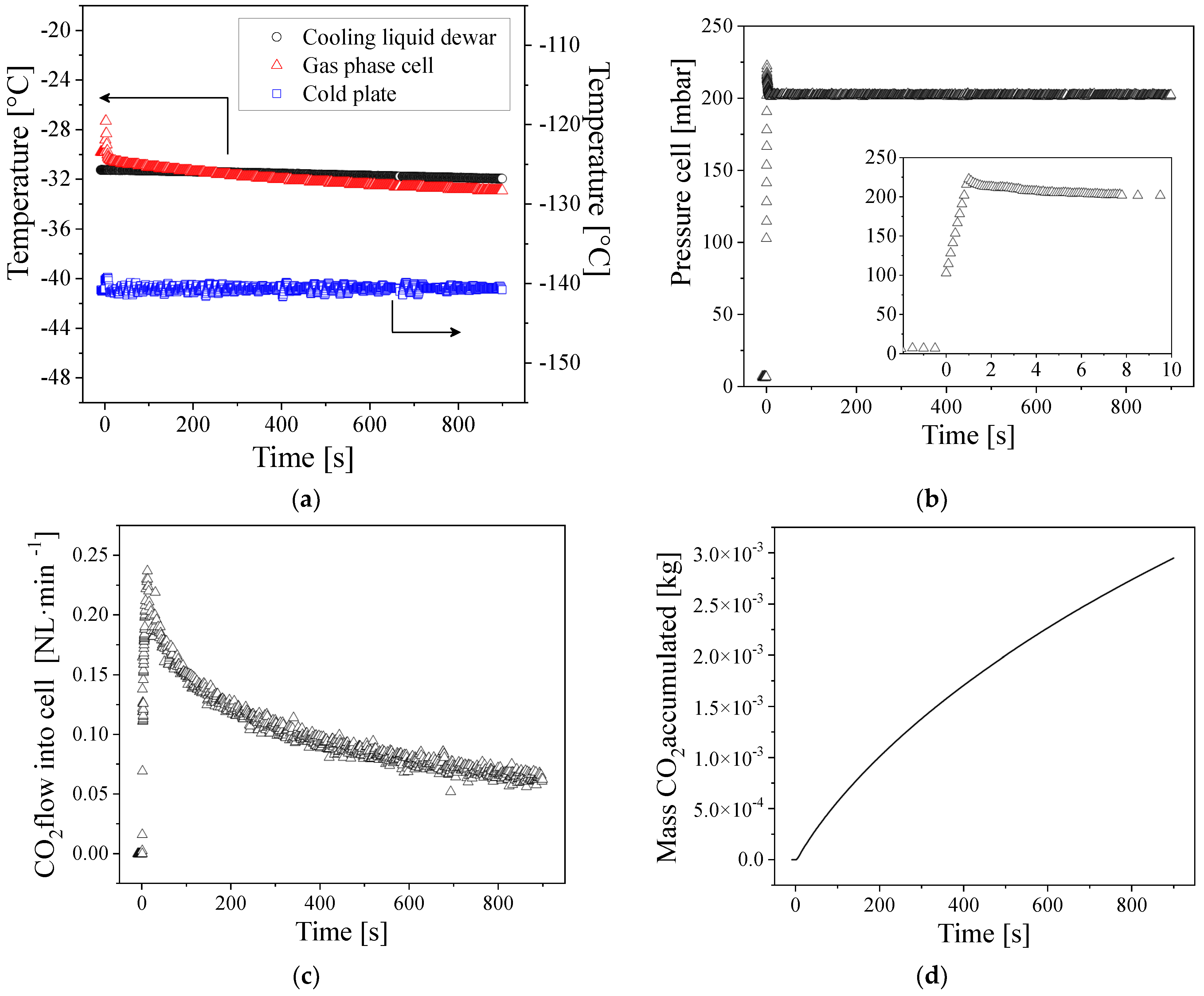
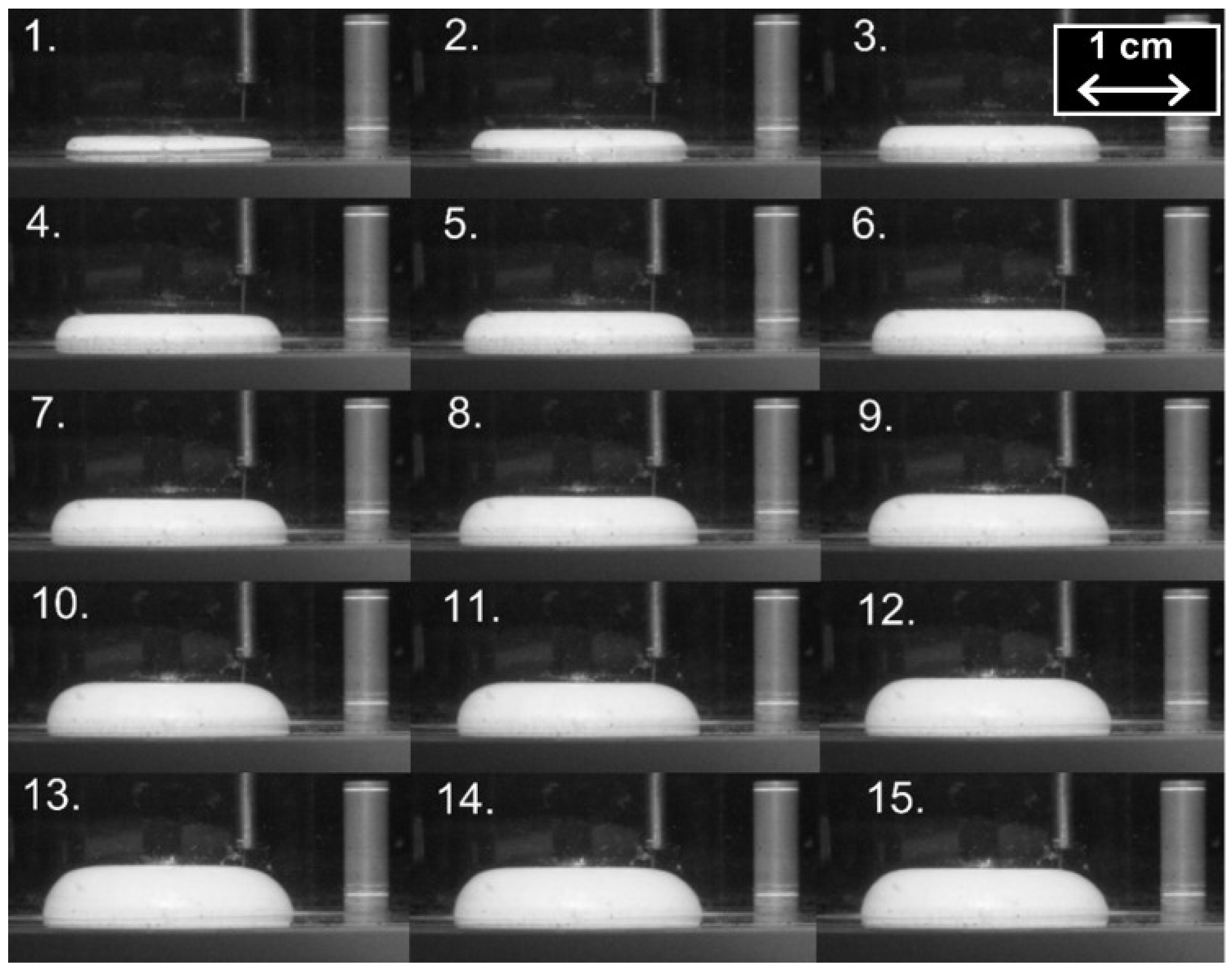
This section describes how the experimental data was processed, with a detailed demonstration of experiment 50T0-140. The temperatures of the cold plate, the gas phase in the stirred cell, and the cooling liquid in the dewar vessel during this experiment are shown in Figure 3a. The temperature of the cold plate can be well maintained at approximately −140 °C. The gas phase temperature decreases gradually during the measurement by about 2 °C. This is due to heat exchange with the cold surface at the bottom of the cell, which is much colder. The pressure in the cell, shown in Figure 3b, could be controlled well by compensating for the deposited CO2 with fresh CO2 feed into the cell. The initial output of the mass flow controller was high and decreases over time, as shown in Figure 3c. The accumulated mass on the cold plate can be determined from the mass flow controller output, as shown in Figure 3d. The camera observed the increase in volume of the frost layer, with the pictures of the growing ice layer depicted in Figure 4. These pictures were used to quantitatively calculate the volume of solid CO2 formed on the cold plate. These pictures clearly show that the ice layer was expanding both vertically and horizontally and that it has a curved surface at the edges. This behavior complicates calculating the mass deposition rate per unit of surface area, as the surface area changes over time. Additionally, heat transfer within the layer will also occur radially at the edges of the ice layer.
To simplify the interpretation of the experimental results and develop a model for ice layer growth, it is helpful to treat the growth as a one-dimensional process and to assume a constant density throughout the entire layer. The images show that within a specific radius, the ice layer remained nearly horizontal even after 900 s of measurement. It can be assumed that radial effects within this inner ice layer can be ignored. Therefore, only the growth of the layer within the inner 1 cm radius was considered. However, the mass deposition rate onto this inner part of the ice layer was not directly measured. The accumulated mass shown in Figure 3d was formed across the entire surface, including the curved outer areas. The mass of CO2 depositing onto the inner 1 cm radius was calculated as follows: first, both the total volume of the ice layer and the volume within the inner 1 cm radius were computed from the images. To find the volume from the two-dimensional image, the surface area of a pixel and the distance to the central axis were determined using the image magnification factor. Then, this area was rotated around the central axis of the ice layer to find the volume of revolution of the pixel. This was done for the pixels on both the left and right sides of the central axis, and the results were averaged, because the image was not perfectly symmetrical. This process was applied to both the inner radius and the entire frost layer. Thus, the ratio of the inner volume to the total volume was calculated for each image.
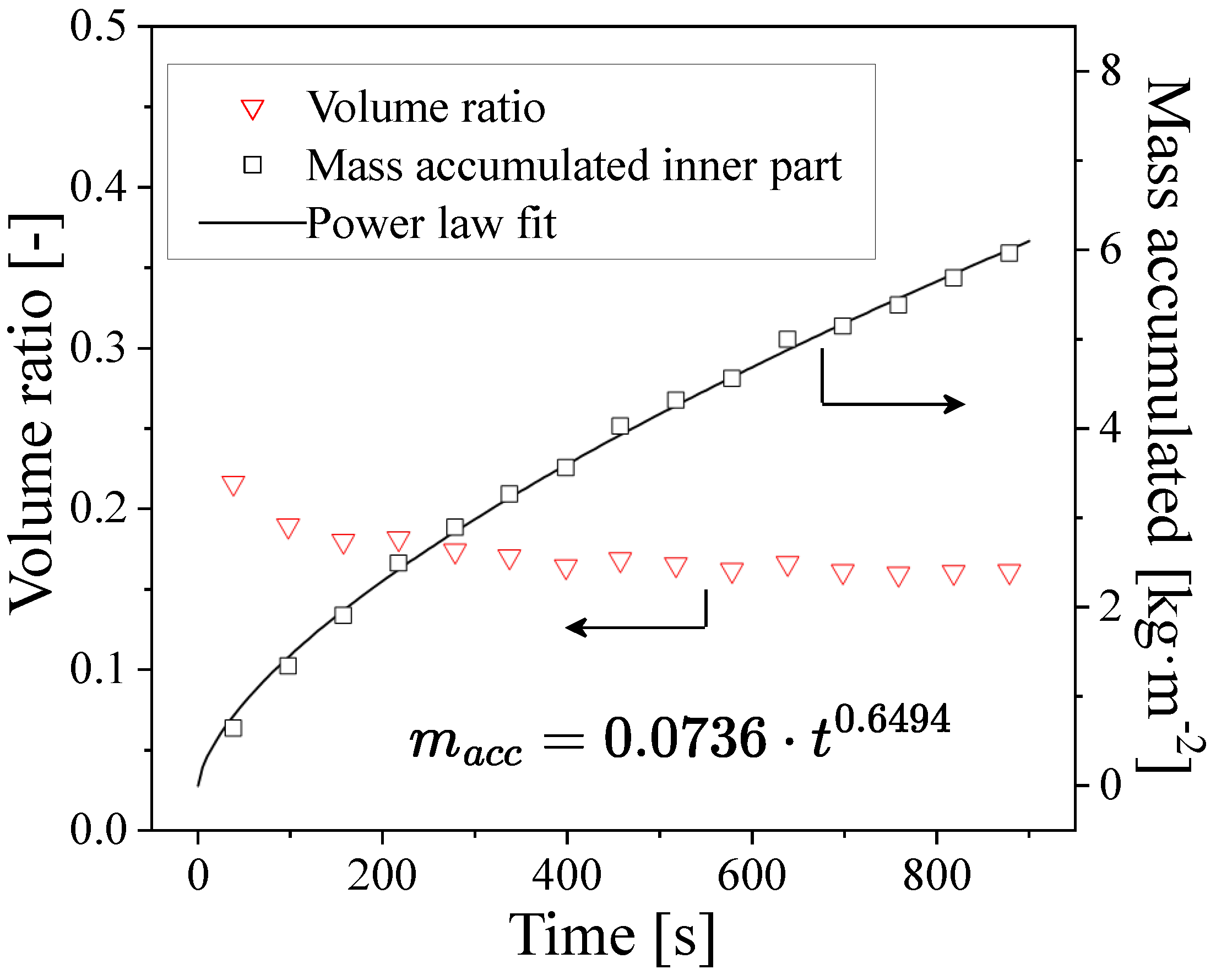
Figure 5 shows the result of this procedure for experiment 50T0-140. It can be observed that, especially at the beginning of the experiment, the volume ratio decreased, indicating that the ice layer mainly grew radially at first. Note that when no ice layer forms in the radial direction, the ratio would be 0.25, given the total radius of 2 cm compared to the inner 1 cm. When extrapolating to t = 0, this ratio approaches approximately 0.25.
The amount of CO2 deposited in the interior part was determined by multiplying the measured total accumulated mass (as shown in Figure 3d) by the obtained volume ratio. This is valid when assuming that the frost density at the interior of the ice layer is equal to the density of the entire layer. Figure 5 shows the amount of CO2 accumulated in the inner part of the ice layer. Finally, the mass deposition rate was calculated by fitting the accumulated mass with a power law (see Figure 5 for example) and by differentiating the resulting equation.
The bulk density of the layer was calculated by dividing the total mass by the layer’s volume. After analyzing the data, we obtained the following information for an experiment: the layer thickness, bulk density, and mass deposition rate over time. These results are shown for all experiments in Section 3.

3. Results

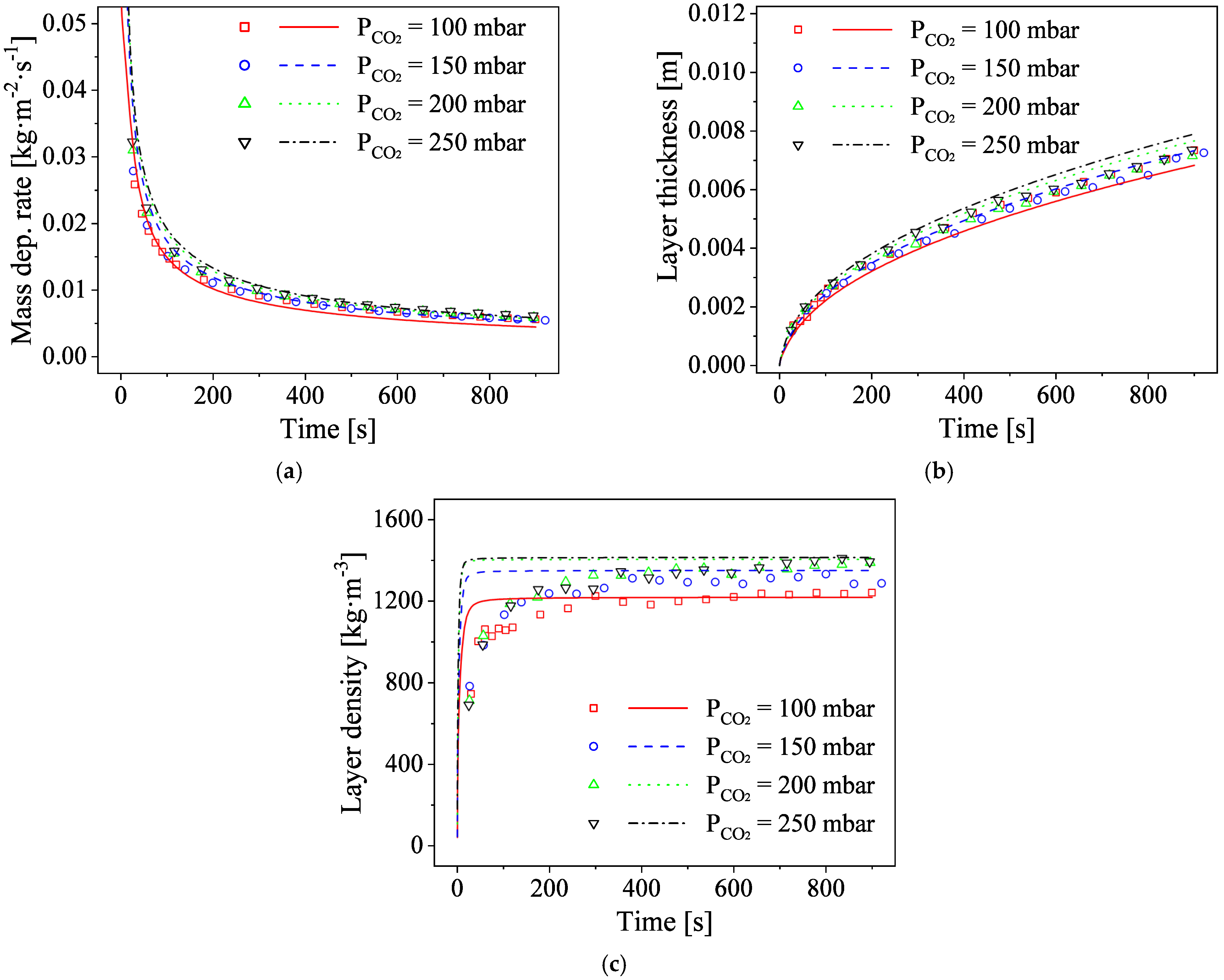
The results for the experiments listed in Table 1 are presented and discussed in this section. The effect of CO2 pressure (without the addition of N2) is shown in Figure 6. It can be observed that for all measurements, the initial mass deposition rate was very high, but it quickly decreased over time. This is due to the initial surface temperature of the cold plate being very low and the absence of any solid CO2 on the cold plate hindering mass and heat transfer. The only property changing during an experiment was the thickness of the ice layer (shown in Figure 6b). Therefore, it can be concluded that heat conduction through the ice layer toward the cold plate plays an important role. Remarkably, there was no significant effect of CO2 pressure on the deposition process. Apparently, surface kinetics do not influence the process under these conditions.
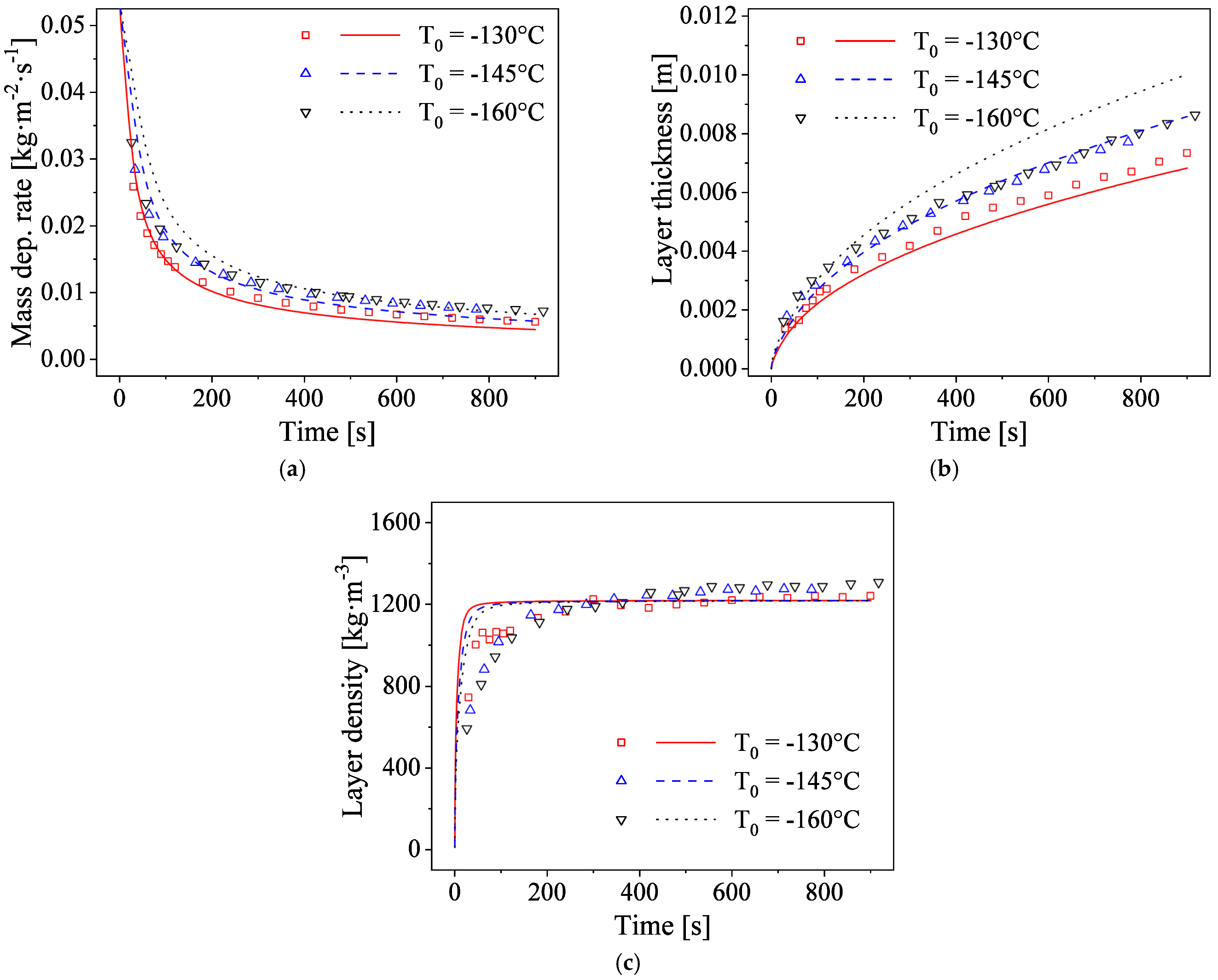
To further investigate the effect of heat conduction through the ice layer, experiments were conducted with various plate temperatures. At lower temperatures, the heat flux through the ice layer rose, leading to an increased mass deposition rate, as shown in Figure 7. This highlights the impact of heat transfer on the observed deposition rate.
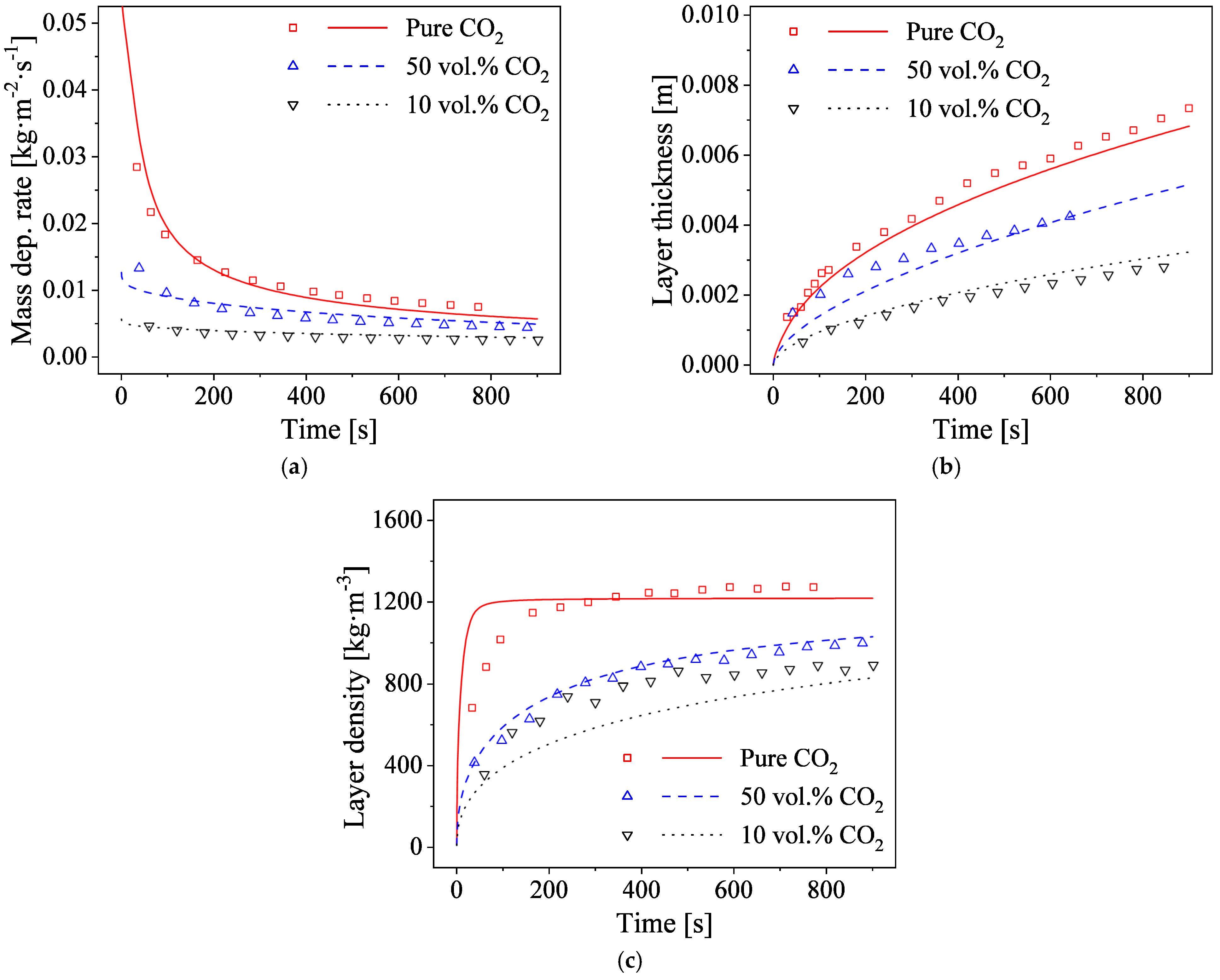
To examine the effect of gas dilution on deposition rates, measurements were taken by adding N2 to the feed gas while maintaining the CO2 partial pressure at 100 mbar. Figure 8 shows the results of measurements with pure CO2, 50 vol.% (total pressure of 200 mbar), and 10 vol.% (total pressure of 1000 mbar) mixtures. It can be observed that the presence of N2 in the gas phase slowed down the mass deposition rates and layer growth, indicating that mass transfer of CO2 from the gas phase to the frost layer played a significant role. It can also be discerned that the density of the frost layer was influenced by the presence of N2 in the gas phase. For the pure CO2 measurements, the frost density quickly rose to a plateau, while for the CO2/N2 mixtures, the frost density increased slowly over time. These effects will be further discussed in the Section 4.
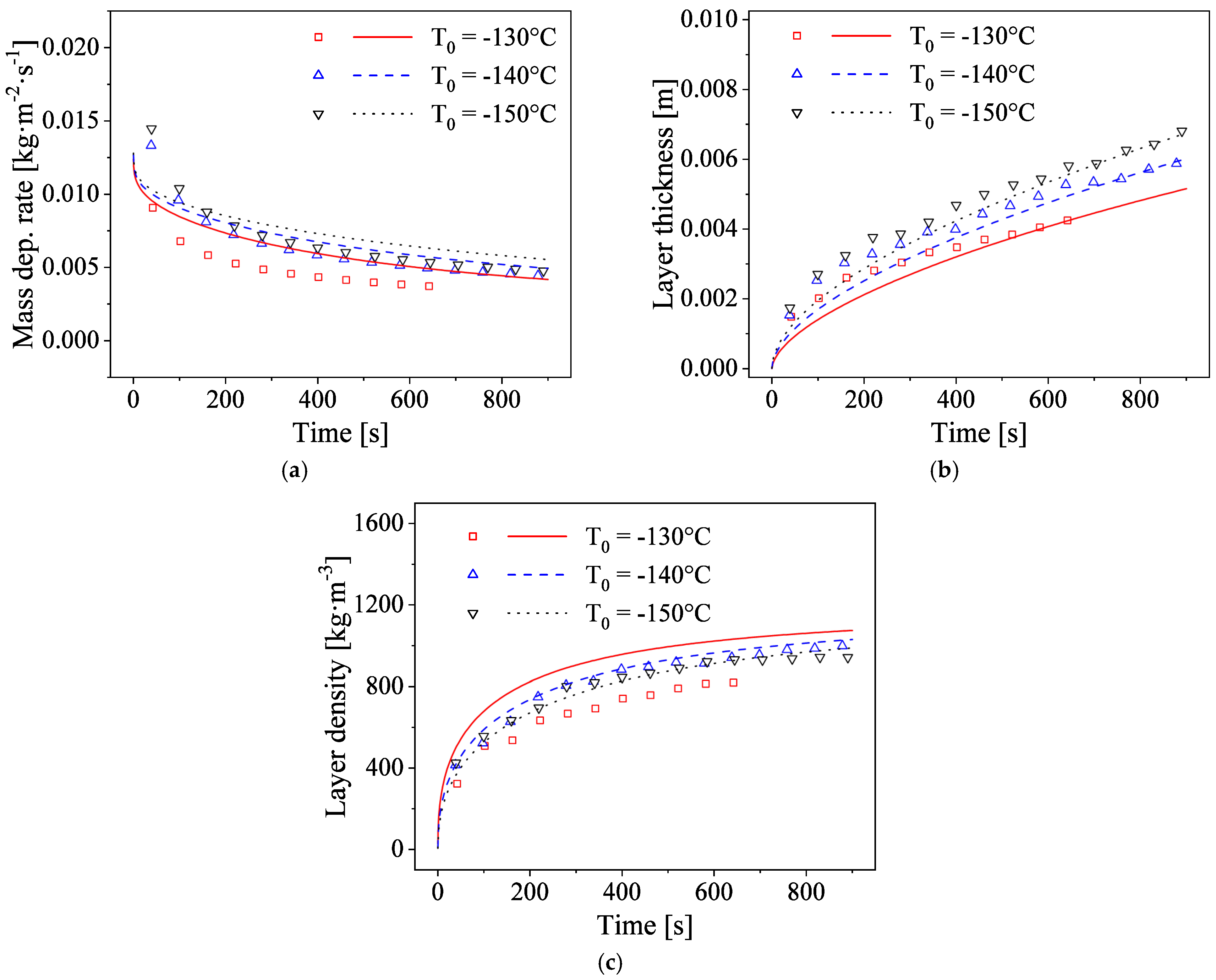
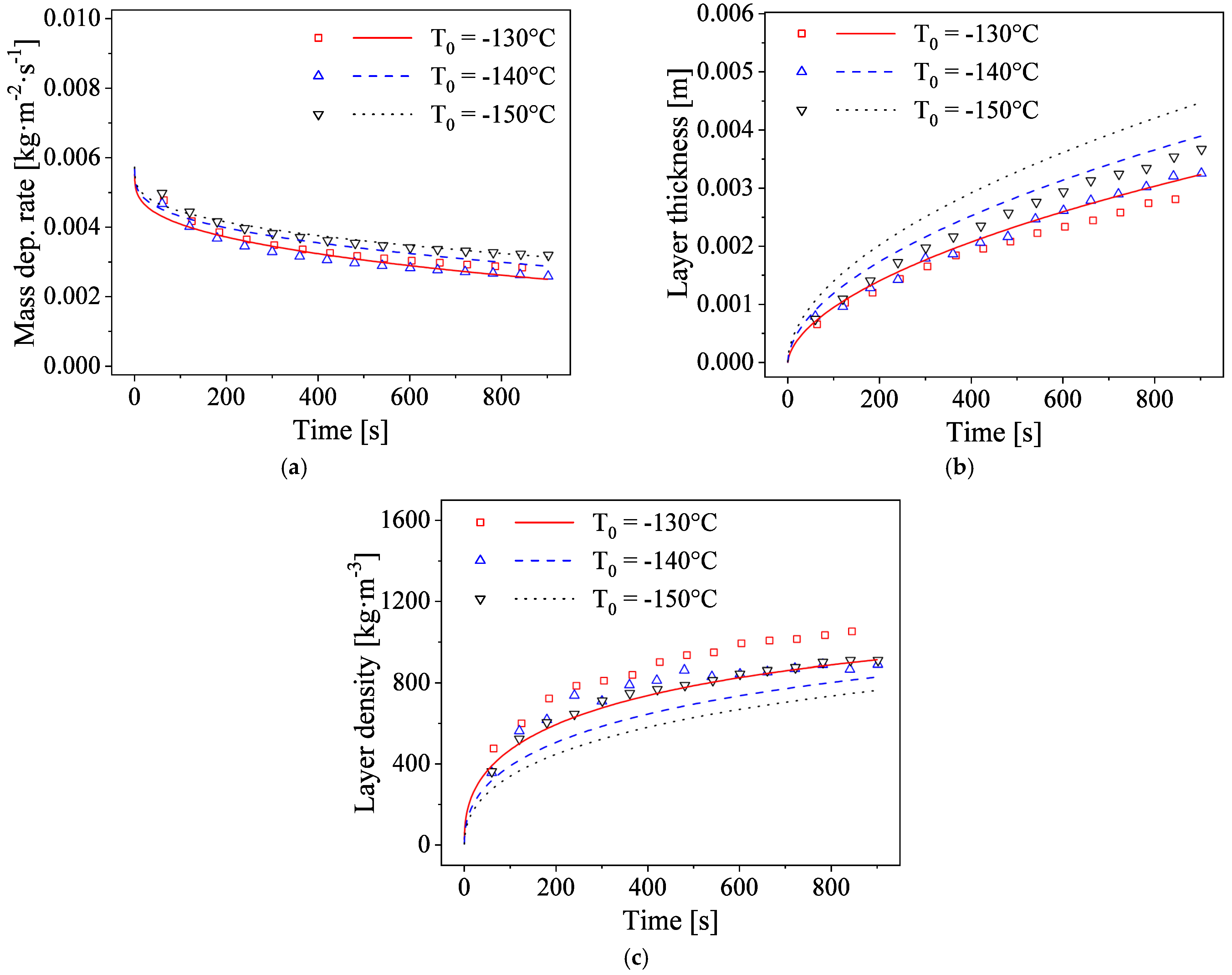
In conclusion, mass transfer significantly influences the deposition process. However, the mass deposition rate continues to decrease over time for measurements with the CO2/N2 mixtures, indicating that heat transfer through the solid layer still plays a role. To study this in more detail, the plate temperature was again varied, both for the 50 vol.% (Figure 9) as well as the 10 vol.% CO2/N2 (Figure 10) mixtures. Again, it can be observed that there is a general trend of increasing mass deposition rates when the cold plate temperature decreases. However, it should be noted that the differences are small.
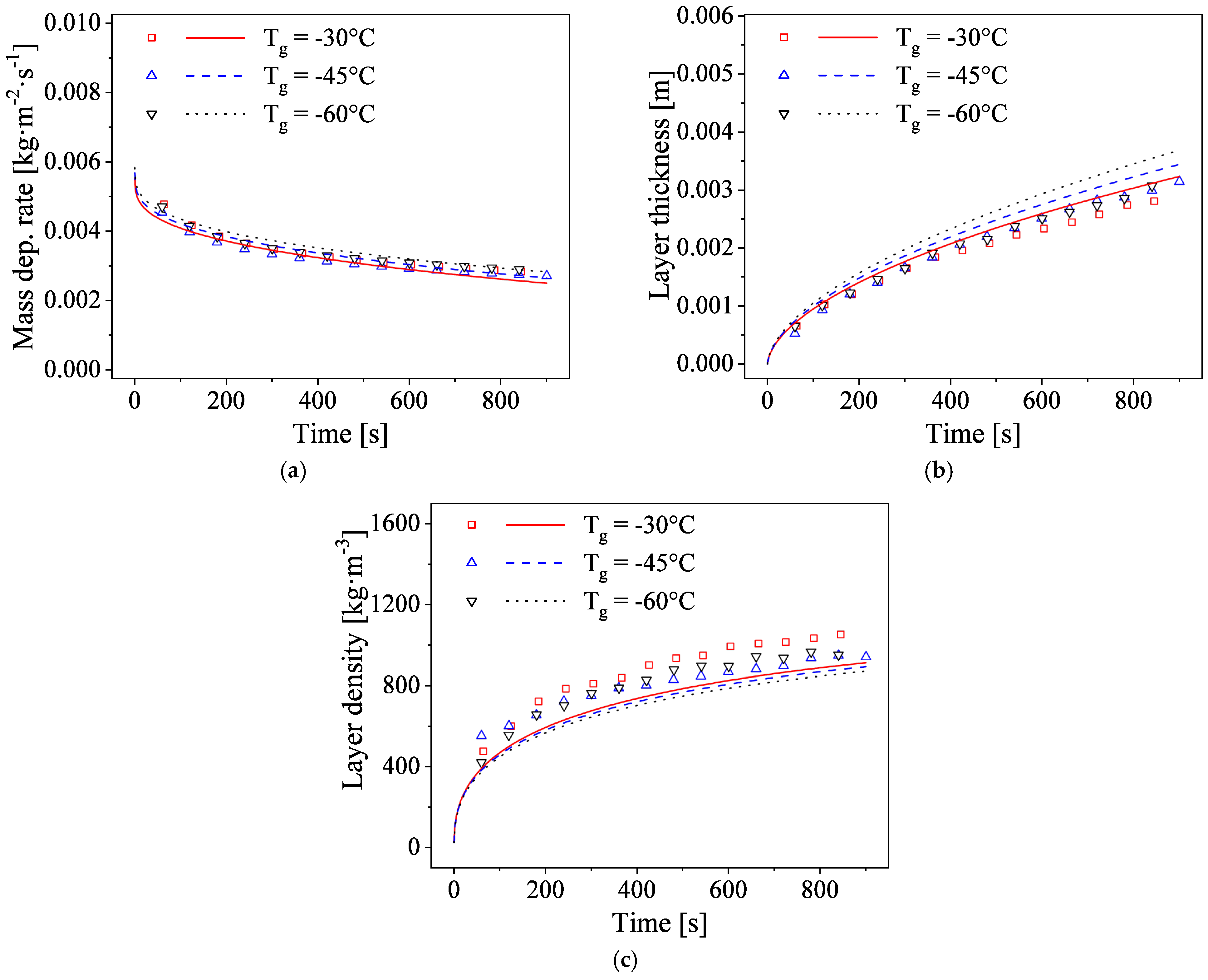
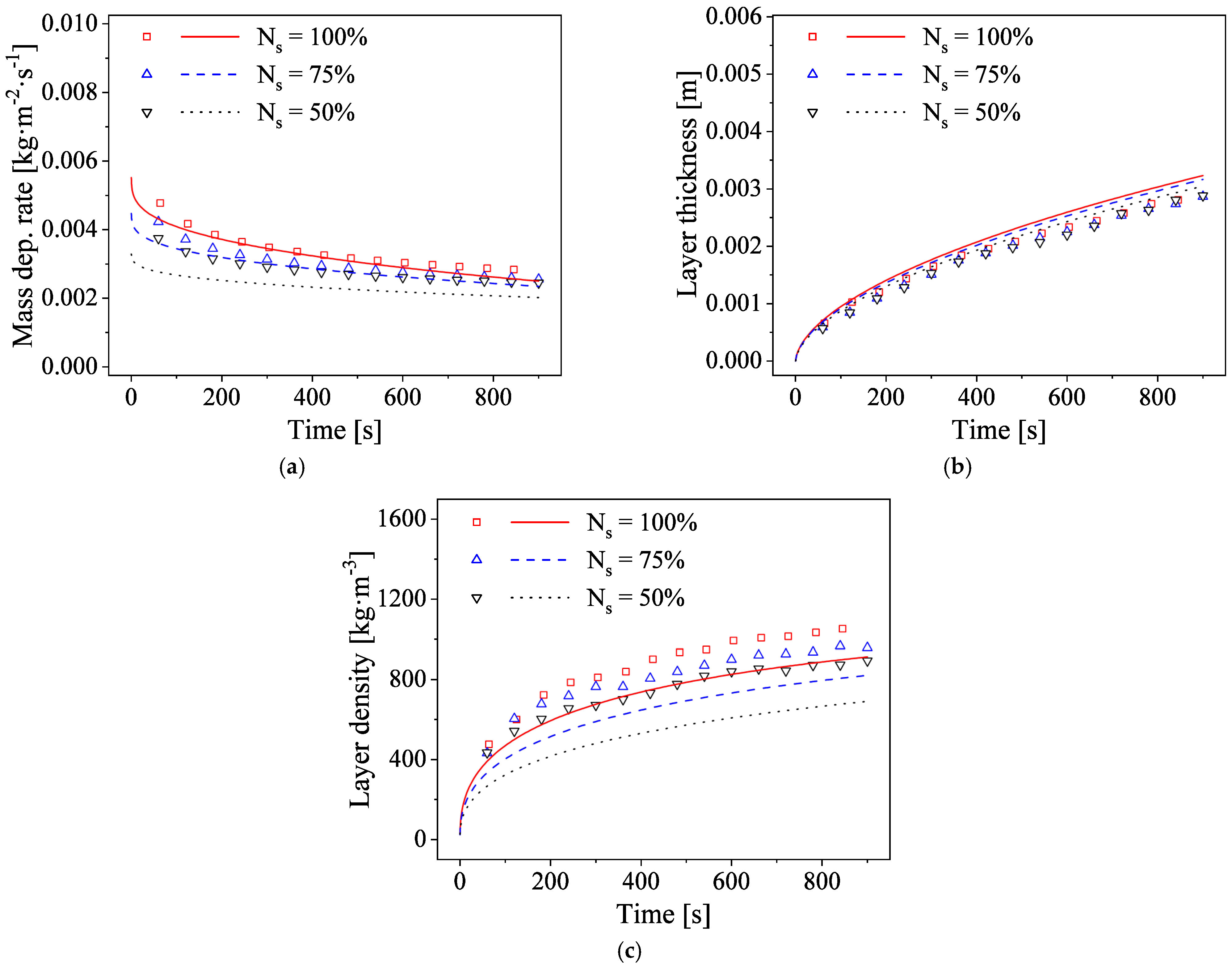
The influence of the gas phase temperature on the mass deposition rates is shown in Figure 11. A lower gas phase temperature results in slightly faster deposition rates, although the differences are close to the range of the experimental accuracy. Finally, the rotation speed of the stirrer was varied. The mass transfer toward the frost surface decreases at lower rotation speeds, leading to reduced deposition rates, as shown in Figure 12.

4. Development of a Frost Growth Model

To obtain a better understanding of the desublimation process of CO2 onto a cold surface, a model will be developed in this section. The outcomes will be compared with the experimental results, and ultimately, the significance of the findings for the cryogenic packed bed concept for CO2 capture will be discussed.

4.1. Model Development

The experimental results revealed that both heat transfer through the solid ice layer and mass transfer of CO2 toward the ice surface are significant. Therefore, frost growth is modeled as a moving boundary problem that includes both mass and heat transfer.
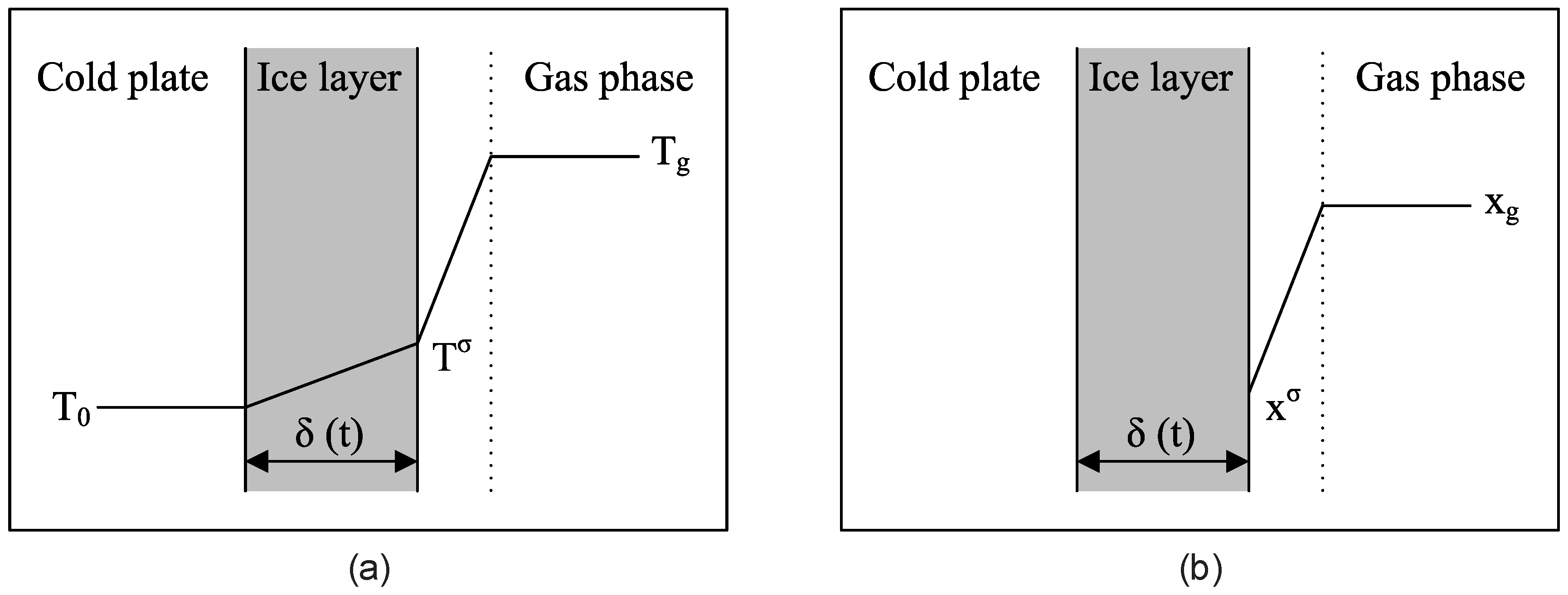
A schematic representation of the involved processes, together with the used variables, is given in Figure 13. The following assumptions are made:
-
The temperature profiles within the layer are established instantly (quasi-steady state approach), meaning the frost growth is much slower than the change over time of the temperature profiles in the layer.
-
The desublimated CO2 at the frost surface is in equilibrium with the gas phase.
-
The measurements revealed that density changes over time. The formed ice layer probably has a porous structure that becomes denser as time passes. The modeling study by Lei et al. also observed a gradual transformation from a loosely structured to a densely structured solid CO2 layer [16]. The porosity, density, and consequently the layer heat conductivity might vary depending on the location within the frost layer. However, this information could not be obtained from the experiments; therefore, it is assumed that the layer has a uniform density and thermal conductivity. CO2 desublimation inside the layer has been incorporated in a lumped manner into the bulk density.
-
The mass and heat transfer coefficients for the transfer from the gas bulk toward the frost surface are coupled according to the Chilton–Colburn analogy.
CO2 is transferred from the bulk of the gas phase to the solid phase and deposits on the surface. Because CO2 is removed from the gas phase, a net flow toward the solid occurs, and Fick’s diffusion law no longer applies; thus, drift fluxes must be considered as follows:
N C O 2 = x C O 2 , g N t o t + c t o t k g x C O 2 , g x σ
There is no net flux of N2; therefore,
N C O 2 = N t o t
resulting in
N C O 2 = c t o t k g x C O 2 , g x σ 1 x C O 2 , g , k g = k g ξ
and
ξ = Φ exp Φ 1 , Φ = N C O 2 c t o t k g
and consequently, the effective mass transfer coefficient can then be calculated by substituting Equation (4) into the expression for the effective mass transfer coefficient in Equation (3), obtaining
k g = N C O 2 c t o t 1 exp N C O 2 c t o t k g 1
Substituting Equation (5) into Equation (3) yields the following relation for the net CO2 mole flux to the ice layer, which is known as Stefan flow [24]:
N C O 2 = c t o t k g ln 1 x σ 1 x g
The heat transfer from the gas to the solid phase through conduction and radiation, along with the heat generated by desublimation, is conducted through the solid layer toward the cold surface. Again, the effects of drift fluxes on the heat flux exchanged between the bulk gas and the surface of the solid layer are considered as follows:
α g ξ h + Φ h T g T σ + σ ϵ T g 4 T σ 4 + N C O 2 Δ H s = λ e f f δ T σ T 0
in which
Φ h = N C O 2 C p , C O 2 α g , ξ h = Φ h exp Φ h 1
The concentration of CO2 at the frost surface is determined by combining Equations (6) and (7). The layer thickness is calculated as follows:
d ρ s δ d t = N C O 2 M C O 2 , δ t = 0 = 0
which can be solved with a standard ODE solver. Constitutive equations are summarized in Table 2.
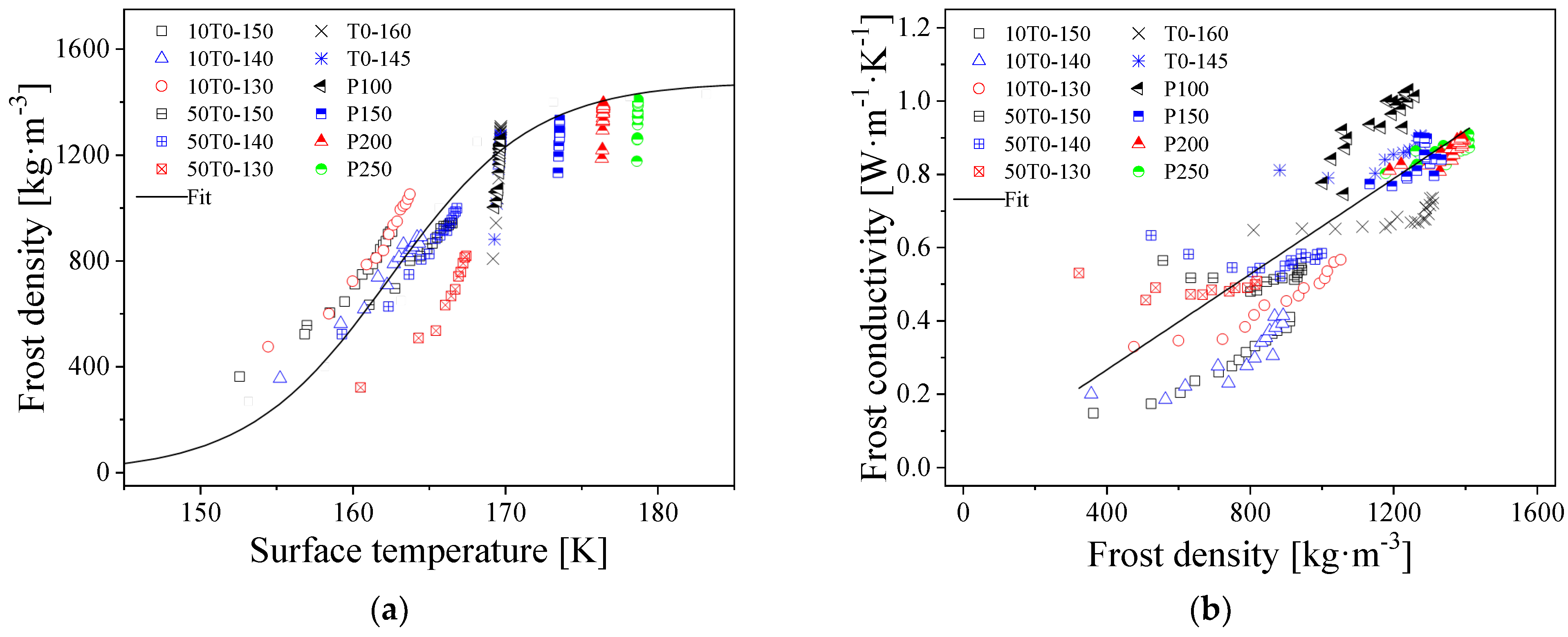
The density ρ s and conductivity λ e f f of the deposited CO2 layer are unknown. Assuming that these variables are constant is incorrect, as experiments show that the density increases over time but quickly reaches a plateau for measurements with pure CO2 in the gas phase. For pure CO2, the CO2 concentration at the frost surface equals the gas phase concentration, so the surface temperature can be expected to remain constant during these measurements. However, for measurements with mixtures, the surface temperature is not constant but increases over time. Therefore, a correlation for the layer density as a function of surface temperature is suggested.
When inspecting the measurements for different pure CO2 pressures in Figure 6, it can indeed be observed that the measured density of the layer is higher for measurements with a higher CO2 pressure in the gas phase (which corresponds to a higher interface temperature). To explore this relationship more closely, the following procedure is used. Based on the measured mass deposition rates, Equation (6) is applied to calculate what the surface concentration should have been. This concentration can once again be used to calculate the surface temperature due to equilibrium. In this way, the (measured) density can be plotted as a function of the estimated surface temperature for a large number of measurements, as shown in Figure 14a.
Although the results are somewhat scattered, a clear trend shows that the density increases as the surface temperature rises and then levels off at higher temperatures. Although not measured, it can be expected that density will also level off at lower temperatures. This behavior can be described using the following fit:
ρ s = a 1 + b exp c T σ , a = 1.4768 · 10 3 b = 1.122 · 10 15 c = 2.133 · 10 1
It would be more accurate to account for the effects of temperature and porosity profiles within the layer on ice density (profile). However, this would require detailed (experimental) data on the porosity of the ice layer, which could not be measured with the applied experimental setup.
The effective conductivity of the frost layer likely depends on the bulk density. Higher densities are associated with higher conductivities. To verify this, the surface temperature, calculated by solving Equation (6) with the estimated mass deposition rates, is substituted into the energy balance (Equation (7)). When the measured layer thickness is inserted into the equation, the effective conductivity of the frost layer can be calculated. The resulting conductivity is plotted as a function of the measured density, again for a large number of measurements (see Figure 14b). Although significant scatter is observed in the data, a clear trend is visible. This relationship can be described using a linear fit as follows:
λ e f f = a + b ρ s , a = 6.200 × 10 3   W / m / K b = 6.523 × 10 4   W × m 2 / k g / K
Although the developed frost growth model captures the main trends observed experimentally, several simplifications introduce limitations. The model was derived based on the central region of the frost layer, so wall and edge effects are not considered. Additionally, it assumes uniform density and thermal conductivity throughout the frost layer, whereas real frost can be porous and heterogeneous when it is formed [18,20]. This simplification may affect accuracy, particularly during the initial stage of frost formation on an empty surface, when significant morphological changes are expected. However, as the process progresses and the frost layer thickens, these effects are likely to diminish, meaning that for modeling the entire cycle, the impact of this assumption is expected to be minimal.

4.2. Simulation Results

The model developed in the Section 4.1 was used to simulate the mass deposition rate, layer thickness, and frost density as a function of time for all the measurements listed in Table 1. The results have been plotted in the same figures as the experimental results. The general conclusion is that the experimental and simulation results agree reasonably well; the Mean Absolute Error (MAE) of the predicted mass deposition rate was calculated to be 6.459·10−4. When examining the measurements for pure CO2, it is evident that the rapidly decreasing mass deposition rates are accurately described. The model also adequately predicts the initial rapid increase of frost density to a steady value.
The experiments showed that different pressures had a minimal effect on the deposition rates and layer growth, as demonstrated in Figure 6. The difference in surface temperatures for the various measurements was too small to affect the heat fluxes through the solid frost layer significantly. The simulation results show comparable results. The cold plate temperature had a larger effect (Figure 7), as the cold plate temperature directly affects the driving force for the heat flux, which is again well described by the model. The differences between measurements at various CO2 concentrations, shown in Figure 8, are accurately described by the developed model. The multiple measurements for the 50 vol.% and 10 vol.% mixtures are generally reasonably well represented. The mass deposition rates are well described, although the discrepancies between the measured and computed frost density and layer thickness are sometimes somewhat larger, which can be attributed to inaccuracies in the derived correlations for layer density and conductivity, as well as measurement errors. However, the calculated trends match the experimentally observed trends very well.
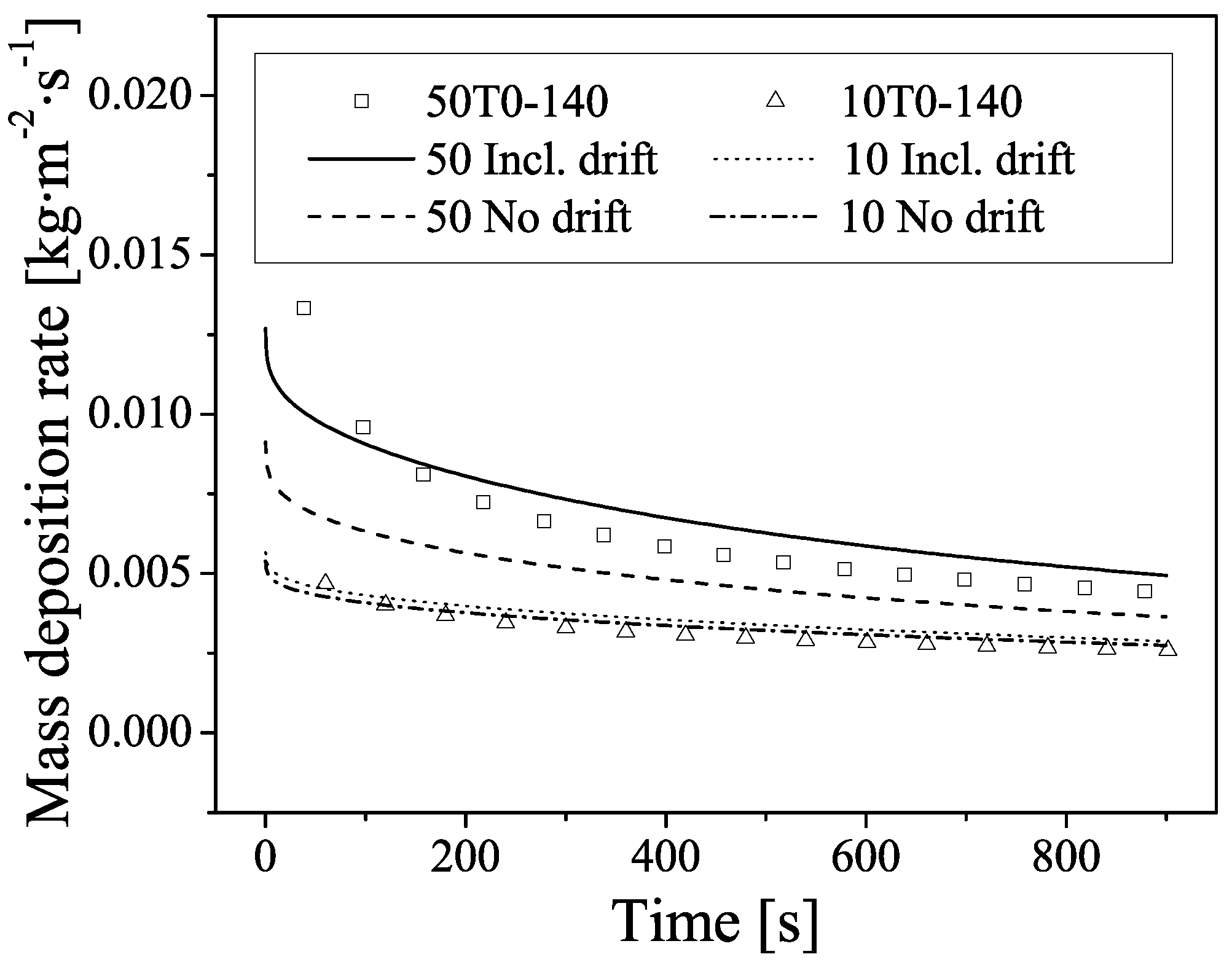
To demonstrate the importance of considering drift fluxes, the mass deposition rates have been calculated for experiments 50T0-140 and 10T0-140, both including and excluding drift effects. It can be observed in Figure 15 that the effect is quite small for the 10 vol.% CO2 measurement but has a significant impact for the 50 vol.% CO2 measurement. Additionally, it is noted that the contribution of radiation in the energy balance (Equation (7)) is negligible.

4.3. Significance for the Cryogenic Packed Bed Concept

A process concept for removing CO2 from gas mixtures using dynamically operated cryogenically cooled packed beds has been described in the introduction and previous works by Tuinier et al. [7,8]. The conditions inside the stirred cell differ from those encountered in cryogenically refrigerated packed beds. The temperature of the cold plate in the stirred cell is kept constant through continuous cooling. Meanwhile, the temperature of the packing material in the packed bed increases over time as a front of desublimating CO2 passes by. To demonstrate the importance of the developed model for mass deposition rates, the following situation will be evaluated: A refrigerated spherical particle, initially at T p , 0 is suddenly positioned in a gas phase at a temperature T g with a CO2 mole fraction of x C O 2 , g , which is the equilibrium concentration at that temperature T g . This is similar to the situation in the packed bed at the frost front, where saturated gas contacts cold packing. Due to this abrupt change in temperature and composition, CO2 begins to desublimate at the particle surface, and the particle heats up until the system reaches equilibrium, i.e., the particle temperature T p is equal to the gas phase temperature. The temperature increase of the particle can be described using
ρ p V p C p , p d T p d t = Φ h + N C O 2 M C O 2 Δ H s A p
where it is assumed that the heat capacity of the desublimated CO2 is much smaller than the heat capacity of the particle. The particle is being heated by desublimation of CO2 and by heat transfer from the gas phase to the ice layer ( Φ h ). As given in Equation (7), this amount is transferred through the solid CO2 layer toward the particle, and therefore Equation (12) can be written as
d T p d t = λ e f f δ T σ T p 6 d p 1 ρ p C p , p
This heat balance, coupled with the frost growth model, is solved numerically using a standard ODE solver. Frost growth on the spherical particle is calculated using the conditions and properties as provided in Table 3, which are similar to those used in the experiments described in the work by Tuinier et al. [8]. The mass and heat transfer coefficients are calculated for conditions occurring in a packed bed, according to Gunn [29].
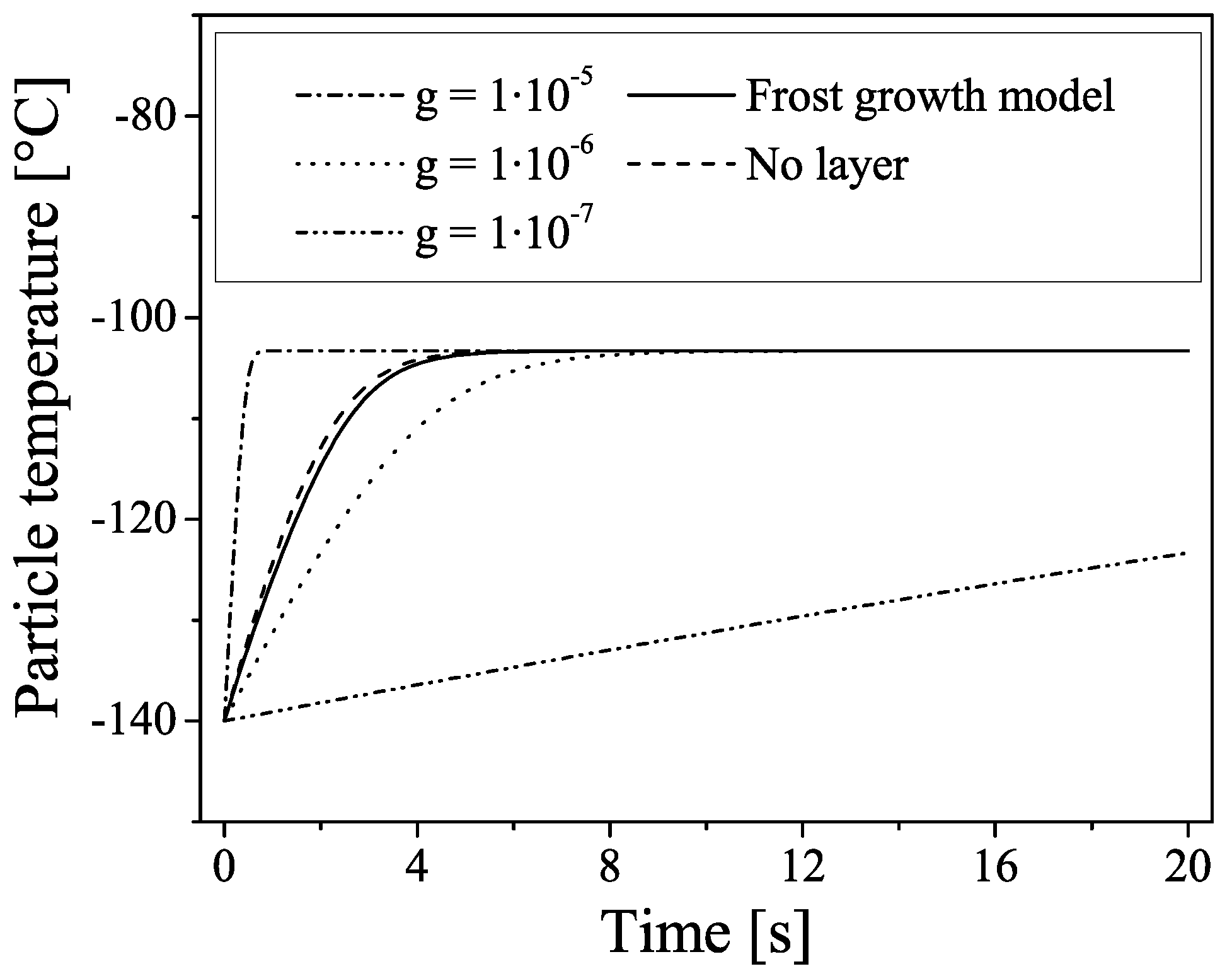
The computed temperature of the particle as a function of time is shown in Figure 16. It can be observed that equilibrium is already reached after approximately 5 s. The layer of solid CO2 formed at the particle surface at that moment is only 3.24 · 10 5   m thick (corresponding to 57.1   k g / m p a c k i n g 3 ). Therefore, heat transfer through the solid layer is negligible, and the frost surface temperature is roughly equal to the particle temperature. This also becomes visible when calculating the Biot number, giving values well below 0.01, indicating that the conduction of heat through the solid CO2 layer is significantly faster than the external heat transfer. This is mainly due to the fact that there is a limited amount of cold energy stored in one particle, effectively limiting the potential solid CO2 formed on each particle. This is very different from what happens on a continuously cooled surface, like in the case of a more traditional heat-exchanger-type process. To illustrate this in more detail, the temperature increase of the particle has been calculated without considering layer formation. The concentration of CO2 at the frost surface was computed using the particle temperature. Figure 16 indeed shows that the computed temperature rise of the particle is hardly influenced. Furthermore, it should be noted that heat transfer from the gas to the solid phase plays a minor role, meaning that the mass deposition rate for the conditions used in this case is mainly determined by the mass transfer of CO2 from the gas to the solid phase.
It was shown in the work by Tuinier et al. [8] that the axial temperature profiles within packed beds can be adequately described when assuming the following mass deposition rate equation:
N C O 2 M C O 2 = g x C O 2 , g P t o t P σ
with g = 1 · 10 6 s / m . The increase in temperature of the particle is also calculated using this simplified mass deposition rate for different values of g. Figure 16 shows that indeed a value slightly above 1 · 10 6 s / m matches the temperature profile calculated using the frost growth model best. It was shown in Figure 15 that for low concentrations of CO2 drift, fluxes have negligible effects on the mass deposition rate. Therefore, the mass deposition rate could be written as
N C O 2 = k g c t o t x C O 2 , g x σ
A combination of Equations (14) and (15), and using the ideal gas law to couple the concentration and the total pressure, yields
g = k g M C O 2 R T ¯
The values of k g and the average temperature in the film layer around the particle T are slightly changing with time. When taking the average values ( k g = 4.45 · 10 2   m / s and T = 105.5   ° C ), the value of g amounts 1.4 · 10 6 s / m , which is close to the assumed value of g .
Finally, it is noted that heat conduction within the particle was relatively fast, but it could influence glass particles. The internal temperature distribution in a particle is near-uniform if the Fourier number ( F o = a · t / R 2 ) equals 0.4, which is reached at 2.2 s for a glass particle with a 4 mm diameter [30]. However, for steel particles or monoliths, this effect is negligible due to their higher heat conductivity.

5. Discussion and Conclusions

This paper provides a detailed study of CO2 mass deposition rates onto cold surfaces. A specialized experimental setup was constructed to measure CO2 deposition rates under controlled conditions. The results demonstrated that heat transfer through the formed frost layer plays a key role in the deposition rates. Furthermore, it was demonstrated that diluting CO2 with N2 significantly affects the mass deposition rate due to the introduction of mass transfer limitations from the gas bulk to the frost surface. To describe the results, a frost growth model was developed. Based on the experimental data, fitted correlations for the bulk density of the frost layer as a function of the frost surface temperature and a correlation for the effective layer conductivity as a function of the frost density were derived. Using these correlations in the frost growth model, the developed model successfully described the experimental findings of the CO2 mass deposition rate as a function of time at different CO2 concentrations and gas and cooled surface temperatures. The model predicted the mass deposition rate of CO2 with an MAE of 6.459·10−4.
To demonstrate the importance of the results for the cryogenic packed bed concept, the temperature increase of a cold particle suddenly placed in a N2/CO2 mixture was calculated using the frost growth model. The results of the model showed that the frost layer reaches a stable and maximum thickness of 3.24·10−5 m in less than 5 s, with a particle temperature of −105.5 °C. The value of the Biot number (<0.01) for the frost layer was very low, indicating that heat transfer in the frost layer was negligible. Also, internal heat transfer in the particles is negligible, because the Fourier number reaches a value of 0.4 after at 2.2 s. So, it was shown that under packed bed conditions, internal heat transfer does not play a significant role, neither in the solid frost layer ( B i o t l a y e r < 0.01 ) nor in the solid particle ( F o u r i e r p a r t i c l e < 1 ,   a t   2.2   s ), as the process was mainly driven by the mass transfer of CO2 toward the particle, which aligns with the earlier findings reported in the work by Tuinier et al. [7,8].
It should be noted that for other cryogenic CO2 capture technologies based on continuously cooled heat exchange surfaces (such as those proposed by Clodic and Younes [6]), the increasing frost layer does play a significant role in the frost formation rates. Therefore, the frost growth model developed in this work could serve as a valuable tool in the design and study of these types of equipment.
The corresponding data used to create the graphs of this work have been made available at Zenodo [31].

Author Contributions

Conceptualization, M.v.S.A. and M.J.T.; methodology, M.v.S.A. and M.J.T.; software, M.J.T.; validation, M.J.T.; formal analysis, M.v.S.A. and M.J.T.; investigation, M.v.S.A. and M.J.T.; resources, M.v.S.A.; data curation, M.J.T.; writing—original draft preparation, M.J.T.; writing—review and editing, M.v.S.A., M.J.T., I.R., D.T. and W.J.R.V.; visualization, M.J.T.; supervision, M.v.S.A.; project administration, M.v.S.A.; funding acquisition, M.v.S.A. All authors have read and agreed to the published version of the manuscript.

Funding

This research was funded by Shell Global Solutions International.

Data Availability Statement

The data presented in this study are openly available in Zenodo at https://doi.org/10.5281/zenodo.17201470 [31].

Acknowledgments

Shell Global Solutions International is kindly acknowledged for its financial support. The contributions of Nhi Dang and Niels Hietberg to this work are also highly appreciated.

Conflicts of Interest

The authors declare that this study received funding from Shell Global Solutions International. The funder was not involved in the study design, collection, analysis, interpretation of data, the writing of this article or the decision to submit it for publication.

Nomenclature

A m 2 Area
a m 2 / s Thermal diffusivity
c m o l / m 3 Concentration
C p J / k g / K Heat capacity
D m 2 / s Diffusion coefficient
d m Diameter
d p m Particle diameter
g s / m Mass deposition rate constant
k g m / s Gas solid mass transfer coefficient
M k g / m o l Molecular weight
N m o l / m 2 / s Molar flux
N s 1 / s Stirrer rotations speed
N u Nusselt number ( α g d / λ g )
P P a , m b a r Pressure
P r Prandtl number ( C p , g η g / λ g )
R J / m o l / K Gas constant
R e Reynolds number ( ρ g N s d s 2 / η g , ρ g v g d p / η g )
S c Schmidt number ( η g / ρ g / D )
S h Sherwood number ( k g d / D )
t s Time
T K Temperature
V m 3 Volume
v m / s Superficial velocity
x Mole fraction
Greek letters
α g W / m 2 / K Gas solid heat transfer coefficient
δ m Layer thickness
Δ H J / m o l Sublimation enthalpy
ϵ Emissivity
η k g / m / s Viscosity
λ W / m / K Thermal conductivity
λ e f f W / m / K Effective conductivity frost layer
ξ Correction factor for drift flux
ρ k g / m 3 Mass density
ν Atomic diffusion volume
σ J / s / m 2 / K 4 Stefan–Boltzmann constant
Φ Dimensionless factor for drift flux
Φ h J / m 2 / s Gas–solid heat flux
Subscripts and superscripts
0 Cold plate, initial
g Gas phase
p Particle
s Solid phase
t o t Total
σ Equilibrium

References

  1. Intergovernmental Panel on Climate Change (IPCC). Technical Summary in Climate Change 2021—The Physical Science Basis; Cambridge University Press: Cambridge, UK, 2023; pp. 35–144. [Google Scholar] [CrossRef]
  2. The Paris Agreement. 2016. Available online: https://treaties.un.org/Pages/ViewDetails.aspx?src=TREATY&mtdsg_no=XXVII-7- (accessed on 1 September 2025).
  3. COP26. Special Report on Climate Change and Health: The Health Argument for Climate Action; WHO: Geneva, Switzerland, 2021. [Google Scholar]
  4. Song, C.; Liu, Q.; Deng, S.; Li, H.; Kitamura, Y. Cryogenic-Based CO2 Capture Technologies: State-of-the-Art Developments and Current Challenges; Elsevier Ltd.: Amsterdam, The Netherlands, 2019. [Google Scholar] [CrossRef]
  5. Song, C.F.; Kitamura, Y.; Li, S.H. Evaluation of Stirling cooler system for cryogenic CO2 capture. Appl. Energy 2012, 98, 491–501. [Google Scholar] [CrossRef]
  6. Clodic, D.; Younes, M. A new Method for CO2 Capture Frosting CO2 at Atmospheric Pressure. In Greenhouse Gas Control Technologies—6th International Conference; Elsevier: Kyoto, Japan, 2003; pp. 155–160. [Google Scholar] [CrossRef]
  7. Tuinier, M.J.; Van Sint Annaland, M.; Kuipers, J.A.M. A novel process for cryogenic CO2 capture using dynamically operated packed beds-An experimental and numerical study. Int. J. Greenh. Gas Control 2011, 5, 694–701. [Google Scholar] [CrossRef]
  8. Tuinier, M.J.; van Sint Annaland, M.; Kramer, G.J.; Kuipers, J.A.M. Cryogenic CO2 capture using dynamically operated packed beds. Chem. Eng. Sci. 2010, 65, 114–119. [Google Scholar] [CrossRef]
  9. Chang, H.-M.; Smith, J.L. Mass transfer of supersaturated contaminants in cryogenic helium heat exchangers. Int. J. Heat Mass Transf. 1990, 33, 1299–1306. [Google Scholar] [CrossRef]
  10. Chang, H.-M.; Chung, M.J.; Park, S.B. Cryogenic Heat-Exchanger Design for Freeze-out Removal of Carbon Dioxide from Landfill Gas. J. Therm. Sci. Technol. 2009, 4, 362–371. [Google Scholar] [CrossRef]
  11. Naletov, V.A.; Lukyanov, V.L.; Kulov, N.N.; Naletov, A.Y.; Glebov, M.B. An experimental study of desublimation of carbon dioxide from a gas mixture. Theor. Found. Chem. Eng. 2014, 48, 312–319. [Google Scholar] [CrossRef]
  12. Ogunbameru, A.N.; Brian, P.L.T.; Reid, R.C. On Carbon Dioxide Frost Formation. Ind. Eng. Chem. Fundam. 1973, 12, 385–387. [Google Scholar] [CrossRef]
  13. Shchelkunov, V.N.; Rudenko, N.Z.; Shostak, Y.V.; Dolganin, V.I. Surface desublimation of carbon dioxide from binary gas mixtures. J. Eng. Phys. 1986, 51, 1432–1435. [Google Scholar] [CrossRef]
  14. Haddad, S.; Rivera-Tinoco, R.; Bouallou, C. Modelling of CO2 Frost Formation and Growth on a Flat Plate. Chem. Eng. Trans. 2019, 76, 667–672. [Google Scholar] [CrossRef]
  15. Lei, T.; Luo, K.H.; Pérez, F.E.H.; Wang, G.; Yang, J.; Cano, J.R.; Im, H.G. Pore-scale study of CO2 desublimation and sublimation in a packed bed during cryogenic carbon capture. J. Fluid Mech. 2024, 990, A6. [Google Scholar] [CrossRef]
  16. Lei, T.; Luo, K.H.; Pérez, F.E.H.; Wang, G.; Wang, Z.; Cano, J.R.; Im, H.G. Study of CO2 desublimation during cryogenic carbon capture using the lattice Boltzmann method. J. Fluid Mech. 2023, 964, A1. [Google Scholar] [CrossRef]
  17. Ren, Z.Y.; Wang, B.B.; Qiu, G.D.; Bian, J.; Li, Q.Y.; Cai, W.H. Molecular dynamics study of carbon dioxide desublimation on surfaces with different hydrophobicity. Energy 2025, 318, 134972. [Google Scholar] [CrossRef]
  18. Wang, Y.N.; Pfotenhauer, J.M.; Qiu, L.M.; Zhi, X.Q.; Jiang, X.B. Experimental study of carbon dioxide desublimation and sublimation process on low temperature surface. In IOP Conference Series: Materials Science and Engineering; Institute of Physics Publishing: Bristol, UK, 2020. [Google Scholar] [CrossRef]
  19. Du, S.; Shi, Y.; Wang, H.; Qiu, G.; Li, Q.; Li, Q.; Cai, W. Experimental study on the effect of CO2 desublimation on heat transfer. Int. Commun. Heat Mass Transf. 2024, 159, 108136. [Google Scholar] [CrossRef]
  20. Cai, W.; Du, S.; Wang, H.; Qiu, G.; Wang, Z.; Li, Q. Desublimation characteristics of CO2 under pressurized cryogenic conditions. Appl. Therm. Eng. 2026, 282, 128845. [Google Scholar] [CrossRef]
  21. Du, S.; Wang, H.; Qiu, G.; Wan, H.; Wang, Z.; Li, Q.; Cai, W. The effect of CO2 desublimation on heat transfer in binary gas based on cryogenic experiment. Int. Commun. Heat Mass Transf. 2025, 169, 109834. [Google Scholar] [CrossRef]
  22. Wang, Y.N.; Pfotenhauer, J.M.; Zhi, X.Q.; Qiu, L.M.; Li, J.F. Transient model of carbon dioxide desublimation from nitrogen-carbon dioxide gas mixture. Int. J. Heat Mass Transf. 2018, 127, 339–347. [Google Scholar] [CrossRef]
  23. Le, T.T.; Trebble, M.A. Measurement of carbon dioxide freezing in mixtures of methane, ethane, and nitrogen in the solid-vapor equilibrium region. J. Chem. Eng. Data 2007, 52, 683–686. [Google Scholar] [CrossRef]
  24. Krishna, R.; Taylor, R. Multicomponent Mass Transfer, 1st ed.; John Wiley & Sons: New York, NY, USA, 1993. [Google Scholar]
  25. Winkelman, J.G.M.; Voorwinde, O.K.; Ottens, M.; Beenackers, A.A.C.M.; Janssen, L.P.B.M. Kinetics and chemical equilibrium of the hydration of formaldehyde. Chem. Eng. Sci. 2002, 57, 4067–4076. [Google Scholar] [CrossRef]
  26. Fuller, E.N.; Schettler, P.D.; Giddings, J.C. A new method for prediction of binary gas-phase diffusion coefficients. Ind. Eng. Chem. 1966, 58, 18–27. [Google Scholar] [CrossRef]
  27. Daubert, T.E.; Danner, R.P. Data Compilation Tables of Properties of Pure Compounds; American Institute of Chemical Engineers: New York, NY, USA, 1985. [Google Scholar]
  28. Reid, R.C.; Prausnitz, J.M.; Poling, B.E. The Properties of Gases and Liquids, 4th ed.; McGraw-Hill: Columbus, OH, USA, 1987. [Google Scholar]
  29. Gunn, D.J.; Misbah, M.M.A. Bayesian estimation of heat transport parameters in fixed beds. Int. J. Heat Mass Transf. 1993, 36, 2209–2221. [Google Scholar] [CrossRef]
  30. Carslaw, H.S.; Jaeger, J.C. Conduction of Heat in Solids, 2nd ed.; Oxford University Press: Oxford, UK, 1986. [Google Scholar]
  31. Tuinier, M.J.; Ververs, W.J.R.; Tešić, D.; Roghair, I.; van Sint Annaland, M. Corresponding data for ‘Mass deposition rates of carbon dioxide onto a cryogenically cooled surface’. Int. J. Greenh. Gas Control 2025, 230–254. [Google Scholar] [CrossRef]
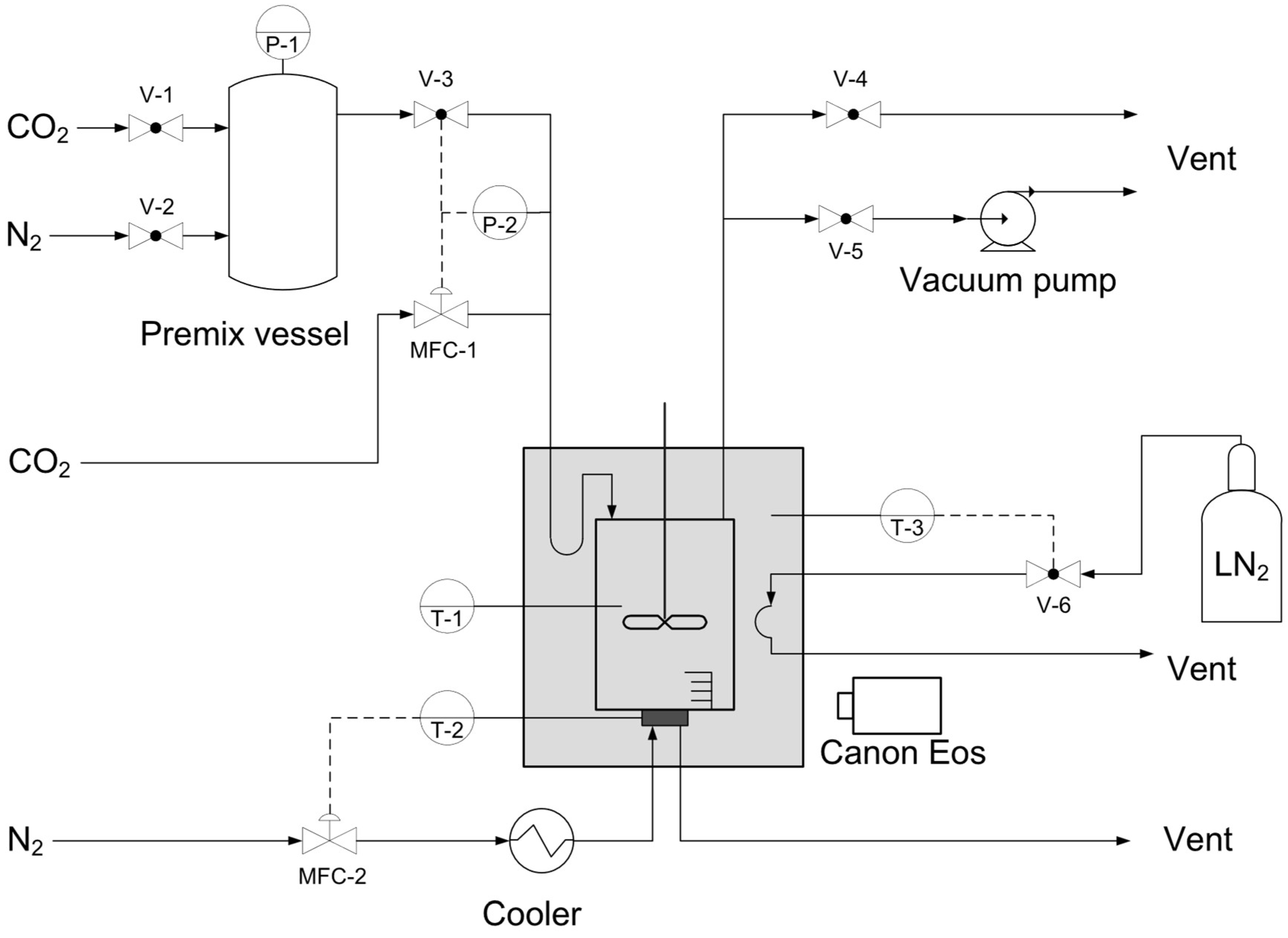
Figure 1. Simplified process scheme of the experimental setup. Dotted lines indicate electric (control) lines, solid lines indicate gas lines. The flow direction is indicated with arrow heads.
Processes 14 00271 g001
Figure 2. Picture of the experimental setup (with the dewar vessel lowered).
Processes 14 00271 g002
Figure 3. The measured temperatures (a), pressure (b), flow into the cell (c), and the accumulated mass on the cold plate (d) during experiment 50T0-140.
Processes 14 00271 g003
Figure 4. Photographs taken every minute of the CO2 layer for experiment 50T0-140.
Processes 14 00271 g004
Figure 5. The ratio of the ice layer volume formed at the inner 1 cm radius and the entire layer volume plotted as a function of time for experiment 50T0-140. The accumulated mass per area for the inner 1 cm radius is plotted on the right y axis.
Processes 14 00271 g005
Figure 6. The experimental (markers) and simulated (lines) mass deposition rate (a), frost layer thickness (b), and layer density (c) as a function of time for the pure CO2 experiments at different pressures (P100, P150, P200, and P250; see Table 1).
Processes 14 00271 g006
Figure 7. The experimental (markers) and simulated (lines) mass deposition rate (a), frost layer thickness (b), and layer density (c) as a function of time for the pure CO2 experiments at different cold plate temperatures (P100, T0-145, and T0-160; see Table 1).
Processes 14 00271 g007
Figure 8. The experimental (markers) and simulated (lines) mass deposition rate (a), frost layer thickness (b), and layer density (c) as a function of time for experiments with different CO2 concentrations (T0-145, 50T0-140, 10T0-140; see Table 1).
Processes 14 00271 g008
Figure 9. The experimental (markers) and simulated (lines) mass deposition rate (a), frost layer thickness (b), and layer density (c) as a function of time for the 50 vol.% CO2 experiments at different cold plate temperatures (50T0-130, 50T0-140, and 50T0-150; see Table 1).
Processes 14 00271 g009
Figure 10. The experimental (markers) and simulated (lines) mass deposition rate (a), frost layer thickness (b), and layer density (c) as a function of time for the 10 vol.% CO2 experiments at different cold plate temperatures (10T0-130, 10T0-140, and 10T0-150; see Table 1).
Processes 14 00271 g010
Figure 11. The experimental (markers) and simulated (lines) mass deposition rate (a), frost layer thickness (b), and layer density (c) as a function of time for the 10 vol.% CO2 experiments at different gas phase temperatures (10T0-130, 10Tg-45, and 10Tg-60; see Table 1).
Processes 14 00271 g011
Figure 12. The experimental (markers) and simulated (lines) mass deposition rate (a), frost layer thickness (b), and layer density (c) as a function of time for the 10 vol.% CO2 experiments at different stirrer rotation speeds (10T0-130, 10N75, and 10N50; see Table 1).
Processes 14 00271 g012
Figure 13. Schematic representation of temperature (a) and CO2 concentration (b) profiles during the frost growth process.
Processes 14 00271 g013
Figure 14. The measured density plotted as a function of the calculated surface temperature (a) and the conductivity of the ice layer as a function of the density (b).
Processes 14 00271 g014
Figure 15. The experimental mass deposition rates for experiments 50T0-140 and 10T0-140 (markers) and the simulated profiles (lines), with and without taking drift fluxes into account.
Processes 14 00271 g015
Figure 16. Temperature increase calculated for a cold particle positioned in a N2/CO2 mixture at t = 0, using different expressions for the mass deposition rate.
Processes 14 00271 g016
Table 1. Conditions for all experiments.
ExperimentxCO2 [%]PCO2 [mbar]PN2 [mbar]T0 [°C]Tg [°C]Ns [%]
P1001001000−130−30100
P1501001500−130−30100
P2001002000−130−30100
P2501002500−130−30100
T0-1451001000−145−30100
T0-1601001000−160−30100
50T0-13050100100−130−30100
50T0-14050100100−140−30100
50T0-15050100100−150−30100
10T0-13010100900−130−30100
10T0-14010100900−140−30100
10T0-15010100900−150−30100
10Tg-4510100900−130−45100
10Tg-6010100900−130−60100
10N7510100900−130−3075
10N5010100900−130−3050
Table 2. Constitutive equations used in the frost growth model.
The mass transfer coefficient k g is calculated according to
S h = a R e b S c c ,       a = 0.1 ,   b = 0.75 ,   c = 0.33
in which b and c are taken from Winkelman et al. [25], and a is fitted to experimental results.
The binary diffusivity for N2/CO2 mixtures is calculated according to the Fuller–Schettler–Giddings correlation [26]:
D A B = 0.0143 T ¯ 1.75 1 1000 M A + 1 1000 M B 0.5 P t o t ν A 1 / 3 + ν B 1 / 3 2
in which ν is the sum of atomic diffusion volumes, which is 26.9 for CO2 and 17.9 for N2.
The CO2 mole fraction at the interface is the equilibrium value at the surface temperature T σ [27] is defined as follows:
x σ = P σ T σ P t o t = exp 10.257 3082.7 T σ + 4.08 ln T σ 2.2658 T σ P t o t
The gas-to-solid heat transfer coefficient α g is coupled to the mass transfer coefficient k g , according to the Chilton–Colburn analogy, as follows:
N u S h = P r 1 / 3 S c 1 / 3
The physical properties of the gas phase were computed at the average gas phase temperature according to Reid et al. [28], using the pure component data supplied by Daubert and Danner [27].
Table 3. Properties and conditions used for a case study in which CO2 desublimates onto a spherical particle.
Particle diameter m 0.004
Particle material Glass
Solids material k g · m 3 2546
Heat capacity J · k g 1 · K 1 2.8 · 10 3 · T 2 + 3.48 · T 47.9
Initial particle temperature ° C 140
Gas phase temperature ° C 103.3
Gas phase mole fraction CO2 0.1
Gas mass flow k g · m 2 · s 1 0.249
Disclaimer/Publisher’s Note: The statements, opinions and data contained in all publications are solely those of the individual author(s) and contributor(s) and not of MDPI and/or the editor(s). MDPI and/or the editor(s) disclaim responsibility for any injury to people or property resulting from any ideas, methods, instructions or products referred to in the content.