Article

Sustainable Preservation of Opuntia ficus-indica Peel Waste for Resource Recovery Through Pretreatment and Convective-Drying Processes


1
Laboratory of Microbial Ecology and Technology, National Institute of Applied Science and Technology (INSAT), University of Carthage, BP 676, Tunis 1080, Tunisia
2
Faculty of Sciences of Bizerte (FSB), University of Carthage, Bizerte 7021, Tunisia
3
Laboratory of RIADI, University of Manouba, Manouba 2010, Tunisia
4
Department of Civil Engineering, University of Ottawa, CBY-604, 161 Louis Pasteur, Ottawa, ON K1N 6N5, Canada
*
Author to whom correspondence should be addressed.
Processes 2026, 14(2), 262; https://doi.org/10.3390/pr14020262
Submission received: 1 November 2025 / Revised: 23 December 2025 / Accepted: 6 January 2026 / Published: 12 January 2026
(This article belongs to the Special Issue Sustainable Processing Design for Functional Ingredients in Food)

Abstract

Opuntia ficus-indica peel waste (OPW) accounts for approximately 50% of the fresh fruit weight, a relatively higher rate in comparison to other fruits, making it a particularly abundant and underutilized agricultural by-product. This study investigates Tunisian OPW through convective drying (50, 60, 75, and 85 °C) using four different pretreatments: no pretreatment (Fresh OPW), dipped peels in acetic acid solution (AA OPW), frozen and thawed peels (FZ OPW), and dipped–frozen combined pretreatment (AA-FZ OPW). The drying kinetic evaluation clearly demonstrated an increase in drying rate by lowering the required drying time for the various pretreatments and drying temperatures. This drying time decreased by 8.64–17.39%, 23.46–36.70%, and 28.39–39.45% for AA OPW, FZ OPW, and AA-FZ OPW, respectively, as compared to fresh OPW. The total phenolic and betalain contents, found in dried OPW, ranged from 7.87 ± 0.254 g GAE/100 g dw to 12.29 ± 0.421 g GAE/100 g dw and from 22.74 ± 2.34 mg/100 g dw to 59.86 ± 3.24 mg/100 g dw, depending on the drying temperature and pretreatment applied. This study employs thin-layer and artificial neural network (ANN) modelling, finding that both methods produce highly accurate moisture-ratio prediction during the drying process. The peels from Opuntia ficus-indica have considerable potential to be reused as functional ingredients.

1. Introduction

The prickly pear (Opuntia ficus-indica) is a widely consumed fruit around the world. This generates an abundant resource in by-products, notably the peels, representing about 50% of the fruit’s fresh weight [1]. These peels are particularly interesting because they are extremely rich in bioactive compounds: pigments, minerals, antioxidants, polyphenols, and vitamins [2]. Therefore, their valorization offers an appealing method to recover beneficial substances suitable for the food, pharmaceutical, and cosmetic industries, as well as to reduce agri-food waste [2]. Nevertheless, these by-products are highly perishable due to the peel’s high moisture (from 75% to 85%) [3], organic content, and pH range from (4.4 to 5.6), leading to its rapid spoilage [1,4]. Their improper disposal requires further processing steps to guarantee their safe and sustainable use.
Drying is one of the most common methods for stabilizing this biomass since it reduces moisture content and, thus, the risk of microbial and enzymatic degradation.
Furthermore, the drying processes have to be carefully optimized, especially when applied for extended periods at high drying temperatures to preserve the most sensitive bioactive compounds as well as flavour and colour attributes. Therefore, several pretreatments prior to the drying process have been used to mitigate these drawbacks. Among them, soaking, dipping and spraying in ethanol and organic acids (such as citric acid and acetic acid) solutions have been largely applied as a drying pretreatment for fresh matrices of pumpkin [5], beetroot, peach peels [6], mango peels [7], Opuntia ficus-indica and Opuntia stricta fruit [8], carrots [9], and Opuntia ficus-indica peels [10]. These investigations concluded that drying rates are increased when compared to control samples (without pretreatment). This behaviour was linked to the Marangoni effect, which causes liquid to flow from matrices due to the naturally occurring surface tension gradient between two fluids, such as ethanol and water.
Additionally, freezing is one of the innovative pretreatments for fruit and vegetable drying. Since no chemicals or catalysts are required, it is both economically and environmentally friendly [11]. It induces the formation of ice crystals from free water within the cells, resulting in the breakdown of the cell wall and accelerating the drying process [12,13]. Also, the freezing rate has to be regulated to form intracellular ice crystals with the least amount of damage to the cellular structure in order to preserve the high-quality dried product [14].
Moreover, drying is recognized as one of the most energy-intensive processes in the food industry, accounting for up to 70% of the energy consumption related to fruit and vegetable processing [15]. This reality highlights the need to optimize this process in order to reduce production costs and limit its environmental impact. To tackle these challenges, mathematical modelling is commonly used to evaluate the effect of process parameters, optimize the drying process, and integrate energy sources. Thin-layer models, as well as empirical semi-theoretical ones, are widely used in drying processes for their simplicity and accuracy. Such models have been used to optimize dryers, drying settings, and improve process control [16,17]. Furthermore, an interesting alternative modelling is provided by a physical-based model. As it is based on Fick’s second law, this theoretical model accurately reflects the internal moisture diffusion during drying. To support its use, this model requires, unfortunately, several assumptions, including isothermal drying, low shrinkage, negligible external resistance, homogenous diffusivity, and uniform initial moisture content. In order to address the issues encountered with these latter models, Black-box modelling, such as artificial neural networks (ANN), has emerged in recent years as a novel method for nonlinear computational modelling in food material. This model successfully captures the biological properties of food and has the ability to accurately simulate intricate nonlinear processes in food engineering [18].
In drying processes, modelling has been particularly reported for its high performance, predictive capability and robustness in several studies [19]. Thus, ANN is examined as a potential alternative to predict drying kinetics as well as other physical and chemical properties in dried materials. The ANN framework includes three sections: the input layer, the hidden layer, and the output layer. In the drying process, the input layer incorporates parameters such as drying temperature, drying time, and possible pretreatments of the raw material. The output layer represents what is expected to be predicted, like moisture ratio, nutritional component deterioration, shrinkage level, and so on. The hidden layer will be employed for the intermediate computation from the input to the output layer [20].
Despite all of the drying research conducted on Opuntia ficus-indica by-products, to the knowledge of the authors, no study has been carried out to study the effect of combined organic acid and freezing pretreatment on the quality attributes of dried peels, as well as the modelling of the drying process using thin-layer and ANN during drying. Therefore, this study focuses on the valorisation of Opuntia ficus-indica peels using a drying process at four different temperatures (50 °C, 60 °C, 75 °C, and 85 °C) combined with acetic acid and freezing pretreatment in order to optimize the drying conditions while reducing energy consumption and preserving the quality of the dried peels as a natural source of high-value-added bioactive compounds, particularly betalains and total polyphenols.

2. Materials and Methods

2.1. Material

Opuntia Ficus-indica fruits used in the drying experiments were cultivated in the northern Tunisian province of Bou Argoube (Nabeul). The collecting period was from September to October 2023. The harvesting was carried out on physiologically mature fruits, either yellow or red in colour, showing uniform coloration, adequate firmness, no mechanical damage and homogeneous size. The peels were physically removed from the pulp using a knife and sliced into uniform 4 mm thick sections. They were subsequently divided into two portions; the first one was the fresh peels (Fresh OPW), which were instantly dried. The second portion was considered for pretreatment and drying experiments. The different dried OPW samples were ground to obtain OPW powder and stored in vacuum bags until later analysis.

2.2. Pretreatment Investigation

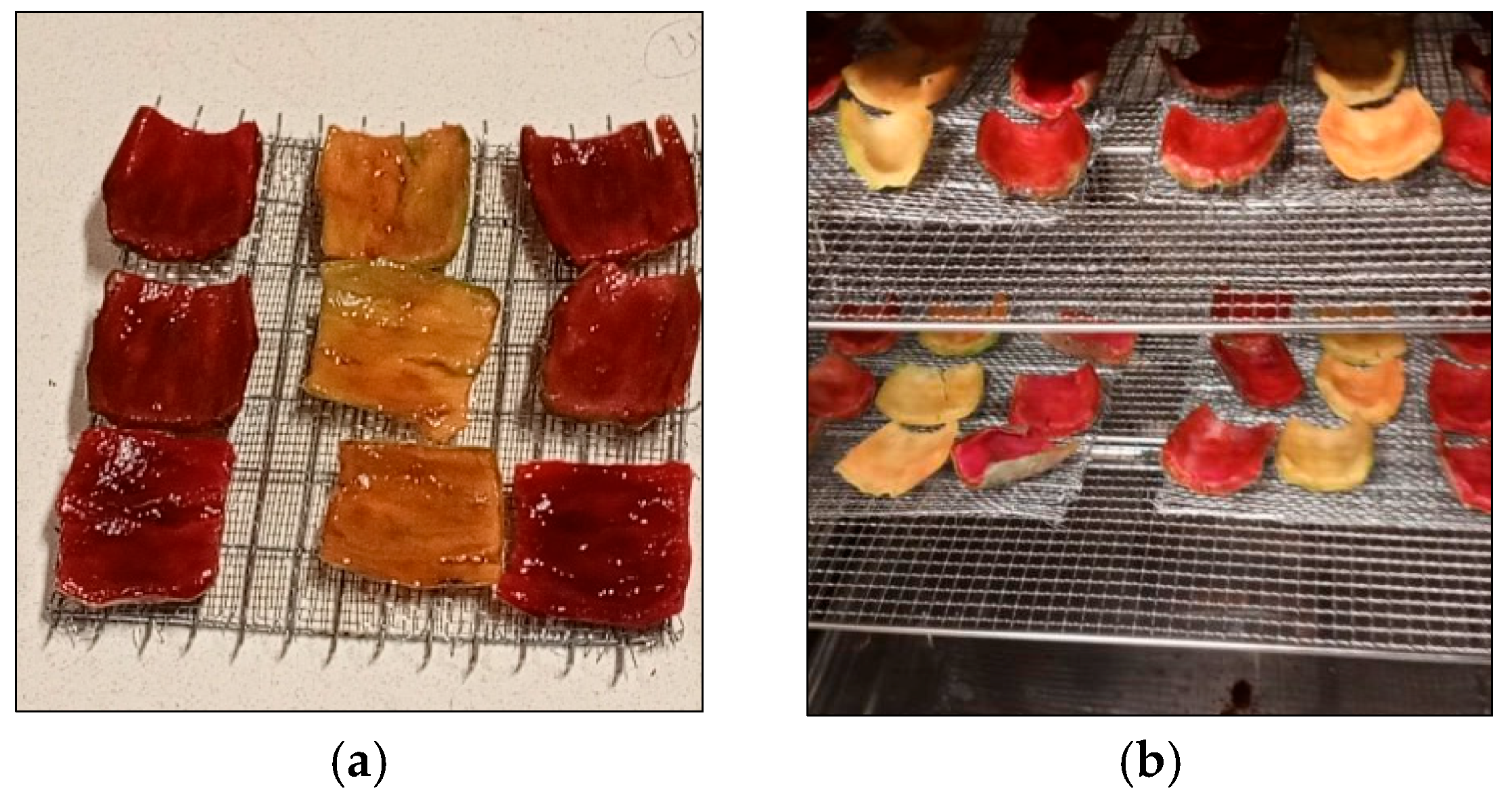
Two batches, either fresh or frozen peels (after slow thawing for approx. 2.5 h [21]), were cut into rectangular pieces measuring 5 cm in length, 4.5 cm in width, and 4 mm in thickness. A proportion of 1 piece of yellow peel versus 2 pieces of the red one was chosen to simulate the natural distribution of coloured fruits. Peel samples, approximately 100 g, were dipped into 200 mL acetic acid solution 1.5% (v/v) for 5 min. The excess liquid from the peels was drained after they were dipped in the acetic acid solution to prevent misleading measurements of moisture content during the drying process and to correctly compare treated and untreated samples (Figure 1).
As described, four different pretreatments were considered in this study: no pretreatment (Fresh OPW), dipped peels in acetic acid solution (AA OPW), frozen and thawed peels (FZ OPW), and dipped–frozen combined pretreatment (AA-FZ OPW).

2.3. Drying Experiments

The drying experiments were carried out in a Food Dehydrator (LT-91, Zhejiang Lian Teng Intelligent Equipment Co., Ltd., Zhejiang, China); an electric indirect forced-convection dryer, equipped with a circulation fan and a drying chamber. The configuration of its ventilation system ensures a uniform air circulation with a velocity of around 2 m·s−1. Samples (100 g) of the fresh (fresh OPW) or with the applied pretreatments (AA OPW, FZ OPW and AA-FZ OPW) were evenly spread in a thin layer on a holder tray and placed inside the convective dryer. Four different drying temperatures (55, 65, 75, and 85 °C) were applied for peels drying while maintaining constant air velocity and relative humidity. Every 20 min, the sample mass was measured to monitor the weight reduction. When the equilibrium moisture content was reached, which was defined as a 1.5% reduction in the total weight, the drying operation was stopped [22]. Every drying experiment was performed twice on different days.
To investigate the temperature effect on peel quality, drying kinetics were established by expressing the moisture content (Xt: g water (g dry basis)−1) and the dimensionless moisture ratio (MRt: (−)) during the drying process. They were calculated according to Equations (1) and (2), respectively.
X t = M t M d M d
where M t is the weight (g) at time t (min), and Md is the weight of the dry material.
M R t = X t X e X 0 X e = X t X 0
where Xt, X0, and Xe are the moisture content at any given drying time, the initial moisture content, and the equilibrium moisture content [kg H2O/kg d.b.], respectively. Under the experimental conditions, Xe was relatively small compared to X0; therefore, its value was numerically set to zero [21].

2.4. Mathematical Modelling of Thin-Layer Drying Kinetics

According to Table 1, different thin-layer drying models were selected and fitted to the experimental data following the non-linear regression analysis. The determination coefficient (R2), reduced chi-square (χ2) and root mean square error (RMSE) were used to assess the fitness quality. They were determined using Equations (7), (8) and (9), respectively. The model with a high R2 value, low χ2, and low RMSE values was considered best.
R 2 = 1 i = 1 N M R e x p , i M R p r e , i 2 i = 1 N M R e x p M R p r e , i 2
χ 2 = i = 1 N M R e x p , i M R p r e , i 2 N n
R M S E = i = 1 N M R e x p , i M R p r e , i 2 N
where MRexp,i and MRpre,i represent the experimental and predicted moisture ratio, respectively, MRexp is the mean experimentally measured value of MR, N is the number of observations, and n is the numb er of constants [23,24].

2.5. Artificial Neural Network

The configuration of the ANN was set up using drying time, temperature, and with and without the different applied pretreatments as inputs and moisture ratio as the output. The data was pre-processed. Numerical features were then standardized using a StandardScaler. Categorical variables were encoded as numerical values. The model was implemented and trained with Python (3.12.11), tensorflow (2.20.0), keras (3.11.3), and scikit-learn (1.7.2) [31]. The Adam function in TensorFlow is an optimizer used for training deep learning models. The Relu function was selected as the transfer function for the hidden layers. Different configurations were tested by varying the number of layers as well as the number of neurons per layer for creating artificial neural networks. For ANN training and validation, the experimental data were divided into 60% training data, 20% validation data, and 20% testing data. To avoid overfitting, training was terminated when one of the termination conditions was satisfied by reaching the maximum number of epochs (1000) or validation loss stopped improving for a certain number of epochs (patience = 30). To optimize the learning rate management and accelerate the learning process, the learning rate was reduced by a factor of 0.5 if validation loss stopped improving for 8 epochs, with a minimum learning rate of 10−6 as a limit. The performance of the ANN model was assessed by comparing the estimated data from the model with the experimental data using the RMSE and R2 values.

2.6. Methods of Analysis

2.6.1. Moisture Content and Water Activity

The moisture content (MC) of both fresh and dried Opuntia ficus-indica peels with and without different applied pretreatments was determined using an oven at 105 °C for 24 h [32]. Water activity (aw) was measured using an aw-meter (model CH-8853, LabSwift-aw, Novasina AG, Lachen, Switzerland).

2.6.2. Colour Parameters

The colour parameters of the OPW powder with (AA OPW, FZ OPW, and AA-FZ OPW) and without the different applied pretreatments (fresh OPW) were measured using a colorimeter (Minolta, model CR-400, Osaka, Japan). This device calculates the L, a, and b* values, which represent lightness, red–green hue, and yellow–blue hue, respectively. Measurements were taken eight times for each sample.

2.6.3. Betalain Content

The OPW powder obtained after the drying process with and without different applied pretreatments (fresh OPW, AA OPW, FZ OPW, and AA-FZ OPW) at four drying temperatures (55 °C, 65 °C, 75 °C, and 85 °C) was used for betalain content. The peel powder (100 mg) was shaken for 10 min in 20 mL of water, which was used as the extraction solvent. After shaking, the samples were centrifuged at 12,000× g at 15 °C for 15 min using a Hermle Z323K centrifuge (Wehingen, Germany). The supernatants were filtered through a 0.45 µm nylon membrane filter (Millipore Corp., Bedford, MA, USA), and the resulting extracts were analyzed by spectrophotometry. For the photometric quantification of betalains, all measurements were carried out using a UV/visible spectrophotometer (Shimadzu, Sydney, Australia). Pigments were extracted using water. Absorbance was measured at the maximum absorption wavelengths of 535 nm for betacyanins and 483 nm for betaxanthins, respectively.

2.6.4. Total Polyphenol Content

A mass of 2 g of OPW powder was macerated in 20 mL of 80% (v/v) methanol/water solvent at room temperature. The mixture was placed in an airtight container under agitation for 24 h. Next, the mixture was centrifuged at 3000 rpm for 10 min. Finally, the supernatant was collected in a test tube, sealed hermetically, and stored in the dark at −20 °C until further use.
The total polyphenol contents were determined using the Folin–Ciocalteu method [33], but slightly modified [34]. The Folin-Ciocalteau reagent, yellow in colour, consists of a mixture of phosphotungstic acid and phosphomolybdic acid, which are reduced during the oxidation of phenols into a mixture of blue tungsten and molybdenum oxides. The blue colouration produced is proportional to the levels of total phenolic compounds and has a maximum absorption around 765 nm. The polyphenol assay protocol involves mixing 100 μL of appropriately diluted extract with 500 μL of Folin–Ciocalteu reagent (10 times diluted). After 5 min, 400 μL of a Na2CO3 (7.5%) solution is added. The absorbance is measured at 765 nm, after an incubation of 90 min in the dark. The polyphenol contents of the different extracts are expressed in mg of gallic acid equivalent per 100 g of dry matter (mg GAE/100 g DM).

2.7. Statistical Analysis

All statistical analyses were performed using SPSS® Statistics version 26.0 software for Windows (IBM, Armonk, NY, USA). Results were represented as mean ± standard deviation, based on a minimum of three independent assays performed. Results obtained for the variables studied (physical and chemical parameters, betalain content, and TPC) were compared, at a significance level of 0.05, by one-way analysis of variance (ANOVA) and Tukey’s multiple comparison test for normally distributed data and homogenized variances, by Welch’s and the Games–Howell multiple comparison tests for normally distributed data and non-homogenized variances, and with the Kruskal–Wallis test and stepwise multiple comparison test for non-normally distributed data. The analyses of non-linear regression were performed by OriginPro 8.5.0 SR1 (2010) (OriginLab Corporation, Northampton, MA, USA; trial version) software for drying kinetics.

3. Results and Discussions

3.1. Effect of Drying Temperature and Pretreatment on Drying Characteristics

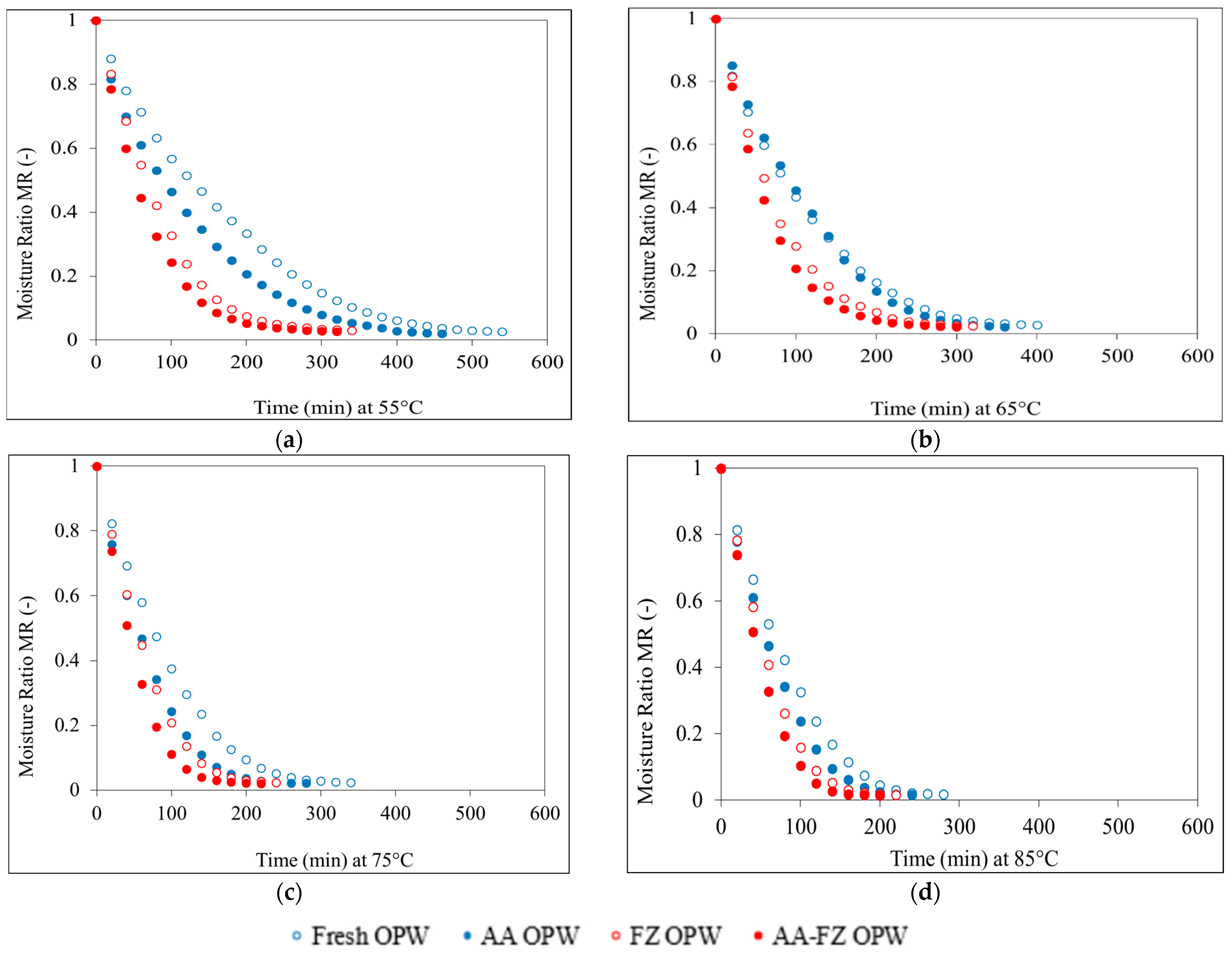
The effect of drying temperatures and pretreatments on the drying behaviour of Opuntia ficus-indica peel waste (OPW) was studied. Four different pretreatments were considered in this study: no pretreatment (Fresh OPW), dipped peels in acetic acid solution (AA OPW), frozen and thawed peels (FZ OPW), and dipped–frozen combined pretreatment (AA-FZ OPW). The drying kinetics were presented in Figure 1 showing the variation in reduced moisture content (MR) versus drying time for different drying temperatures (55, 65, 75, and 85 °C) for OPW with and without the different applied pretreatments (AA OPW, FZ OPW, AA-FZ OPW, and fresh OPW), respectively. The initial moisture content of the fresh peel waste used in this study was 88.298% ± 0.868% (wet basis). The drying process was conducted until the sample mass variation dropped to 1.5%, indicating a stable phase in which no more water could be removed from the dried OPW. As described, four different pretreatments were considered in this study: no pretreatment (Fresh OPW), dipped peels in acetic acid solution (AA OPW), frozen and thawed peels (FZ OPW), and dipped–frozen combined pretreatment (AA-FZ OPW).
The characteristics of the dried OPW (water activity (aw), moisture content (MC), and drying time (DT)) under different operating conditions were summarized in Table 2. The final aw and MC of dried OPW ranged from 0.3 ± 0.006 to 0.503 ± 0.003 and from 18.05% ± 0.008 to 11.98% ± 0.0004, respectively, depending on the drying temperature and pretreatment applied. This final MC variation in dried Opuntia ficus-indica peels has already been confirmed in previous studies by El-Said et al. (2011) [35] and Ettalibi et al. (2020) [36].
Figure 2 clearly shows that all drying kinetic curves follow a decreasing exponential trend, where water evaporation slows down as the peels become drier [37]. This behaviour is commonly observed in drying processes of plant material [38], where the drying entirely occurs in the second phase, and the drying process is governed by a diffusional water mechanism [39].
In addition, for the various drying temperatures, the drying kinetic curves (Figure 2) display an increase in drying rate by decreasing the necessary DT for the different pretreatments applied. This increase varied from 8.64 to 17.39%, 23.46 to 36.70%, and 28.39 to 39.45% for AA OPW, FZ OPW, and AA-FZ OPW, respectively, in comparison to fresh OPW. The freezing pretreatment used alone or combined with acetic acid appeared to be the most relevant in accelerating the drying process. In fact, freezing causes the formation of ice crystals inside the cells of OPW. These crystals can perforate the cell walls, thereby increasing the porosity of the material once thawed. This increase in porosity facilitates the release of water during the drying process, which explains the accelerated drying when frozen [39]. This result was also observed by Reyes et al. (2008) [40] during the drying of carrot pieces with freezing pretreatments. At higher temperatures, the thermal energy provided is sufficient to break the water bonds more quickly. This is true for both fresh and frozen peels, but the effect is amplified in frozen peels due to their already altered cellular structure.
Furthermore, when compared to FZ OPW, AA OPW exhibited a minor effect on drying kinetics (around 17.5% at 75 °C). This phenomenon is induced by a surface tension gradient between the two fluids: the acetic acid solution at the OPW surface and water contained within the OPW matrix. Based on the Marangoni effect, the liquid is induced to move from a low to a high surface tension region, hence accelerating the drying process [10]. In addition, acid dipping might potentially modify the pectin structure, which improves drying kinetics [41]. This result was similarly demonstrated by Hiranvarachat et al. (2011) [9], who studied the effect of soaking carrots in a citric acid solution before drying. It has been shown that this pretreatment allowed for a significant reduction in drying time compared to the untreated carrots. The acid treatment increased the permeability of the carrot cells, thus facilitating the removal of water.
This acceleration of the drying process was particularly marked during the first hours of the experiment. An initial reduction in MR was more significant for pretreated peels, indicating an accelerated loss of water from the beginning of the drying process. This phenomenon could be explained by the action of the acetic acid present on the cellular structure of the peels, which tends to damage the integrity of cell membranes by inducing structural changes in pectocellulosic cell wall structure (which plays a central role in cell cohesion and water diffusion), thereby facilitating the release of intracellular water.
The effect of pretreatment with acetic acid persists throughout the drying process, although it is less pronounced in the later phases. This trend suggests that acetic acid durably modifies the water transport properties in the peel tissues, allowing for more efficient drying even after the initial rapid evaporation.
The comparison between fresh and frozen peels shows that pretreatment with acetic acid is effective in both cases. This observation indicates that this pretreatment could be successfully applied to different states of the raw material, offering flexibility in the transformation process.

3.2. Thin-Layer Drying Kinetics and ANN Modelling of Opuntia ficus-indica Dried Peel Waste

Two different methods were used in this study for predicting the moisture ratio of the OPW samples during the drying process: thin-layer mathematical modelling and artificial neural network (ANN) as black-box modelling.
Concerning the first method, nonlinear regression analysis was applied to fit the experimental MR of OPW data using six thin-layer models (Newton, Page, Verma, Aghbaslo, Alibas, Balbay, and Sahin). The best model was evaluated using statistical parameters (R2, χ2, and RMSE) after fitting the models to the experimental data. Table 3 displays the model coefficients and statistical results for the selected models. It has been shown that the R2, χ2, and RMSE values of these models ranged from 0.79321 to 0.99994, 22.01 × 10⁻³ to 5.81 × 10⁻⁶, and 0.14835 to 0.0024, respectively, indicating that all of the models could demonstrate a satisfactory level of fit between experimental MR and the predicted one. Among the investigated models, the Aghbaslo model performed well in describing the drying process for both fresh OPW and AA OPW, particularly at the 85 °C drying temperature. However, for FZ OPW and AA-FZ OPW, Balbay and Sahin’s model was the best fit for explaining the OPW drying process at 65 °C drying temperature. These models (Aghbaslo, Balbay and Sahin) have also shown satisfactory MR prediction results for the freeze drying of Citrus medica fruit under varying thicknesses and cabin pressures [42].
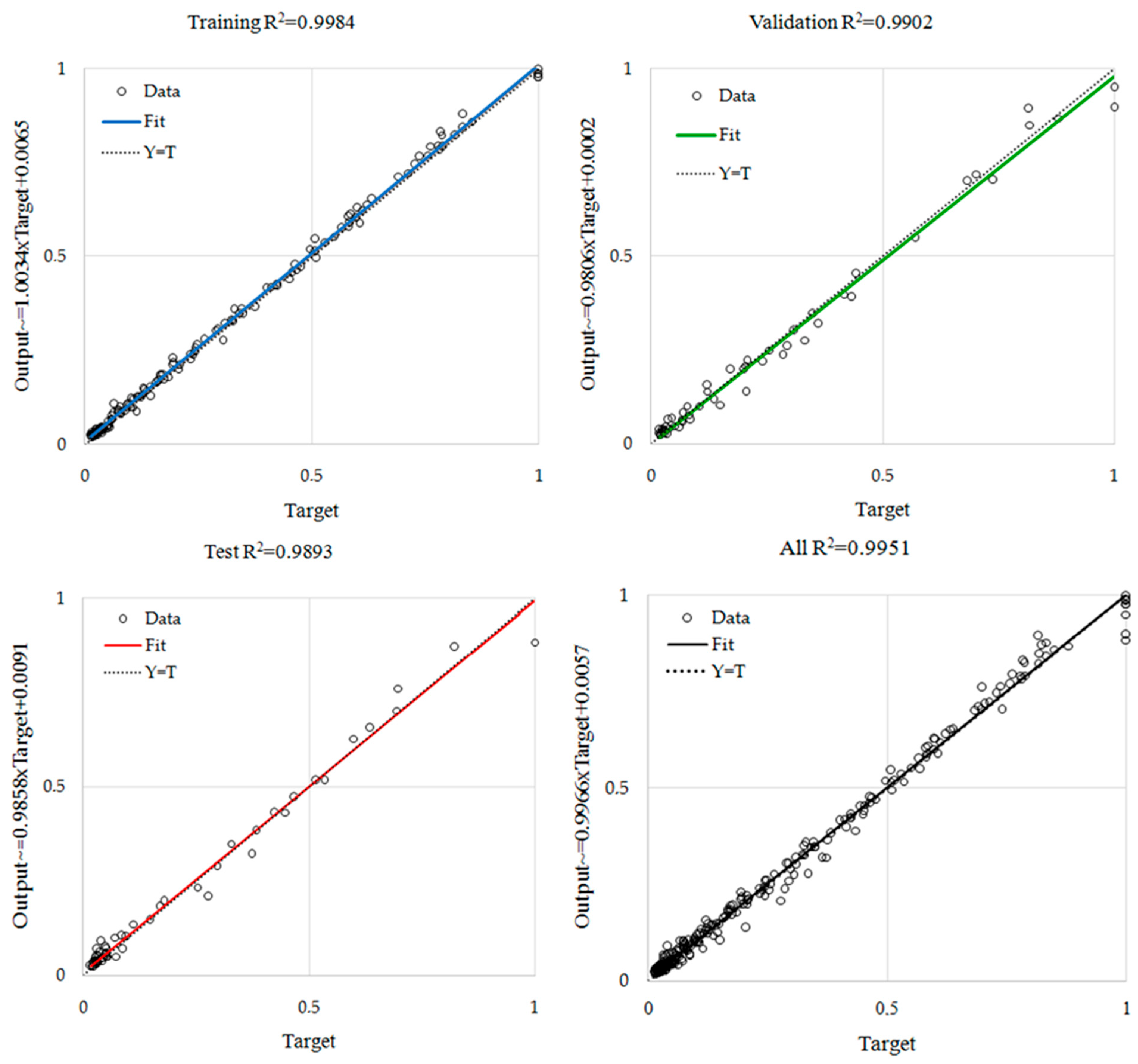
The ANN modelling was the second method adopted for MR estimation; this model was run using four input parameters: drying time, drying temperature, pretreatment or not, and peel quality (fresh or frozen). The training datasets were employed to evaluate the best neuronal and hidden layer count combination for neural network-based multi-layered modelling and to identify the most accurate prediction approach. The range of the hidden layers and the number of neurons were 1–14 and 4–32 (with a 4-step range), respectively. When a high R2 value and a lower RMSE value were combined, an optimum model was identified, signifying stronger prediction accuracy. For the Opuntia ficus-indica PW drying, the ANN model with 24 neurons and 14 hidden layers was determined to be the most effective structure with the lowest RMSE (0.016448) and the best R2 (0.996164). Based on this optimal ANN model, Figure 3 presents the comparison between the experimental and predicted moisture ratio (MR). For training, validation, and testing, the ANN predicted R2 values were 0.9984, 0.9902, and 0.9893, respectively.
Overall, according to statistical criteria, the R2 values were 0.79321–0.99994 and 0.996164 for thin-layer modelling and ANN, respectively. The RMSE values were 0.14835–0.0024 and 0.016448 for thin-layer modelling and ANN, respectively. It is clearly shown that mathematical models can accurately predict MR evolution during the drying process under each of the operating conditions. However, ANN stands out as a superior prediction tool since it is employed for solving more complex problems, analyzing all data simultaneously and generating different outputs (such as drying rate, moisture content, and physicochemical properties) [43,44].

3.3. Effect of Drying Temperature and Pretreatment on Physical Characteristics of Dried Peel Wastes

The fresh and frozen PW was dried under different operating temperature conditions without and with acetic acid pretreatment. Acetic acid (CH3COOH), the main component of vinegar, is widely used in the food industry for its preservative and acidifying properties [45]. As a preservative, it inhibits the growth of pathogenic microorganisms by lowering the pH of foods, making it an essential additive for extending the shelf life of products, such as pickles, sauces, and condiments. Its acidifying action also helps improve the flavour and stability of foods by balancing their taste profile and enhancing their texture.
In the context of this study, acetic acid was used as a chemical pretreatment to optimize the drying of Opuntia ficus-indica PW. Its application demonstrated a significant improvement in drying efficiency by modifying the cellular structure of the peels, thereby facilitating water evaporation. This approach aligns with the observations of Hiranvarachat et al. (2011) [9], who showed that acid treatments increase the permeability of plant tissues, thereby accelerating dehydration processes. Additionally, Deshmukh and Manyar (2020) [45] confirmed the versatile function of acetic acid in a range of industrial processes, including the food industry.

3.3.1. Effect of Drying Temperature and Pretreatment on Water Activity and Moisture Content of OPW Powder

The water activity (aw) and moisture content (MC) of the obtained OPW powder at different drying temperatures with and without the different applied pretreatments (AA OPW, FZ OPW, AA-FZ OPW, and fresh OPW), respectively, are presented in Table 2. The results showed a reduction in aw and MC of around 28% for Fresh OPW, AA OPW, FZ OPW, and AA-FZ OPW with increasing drying temperatures from 55 °C to 85 °C. These results confirmed the fundamental principles of drying, according to which a higher temperature accelerates the vaporization of water [24]. This trend is corroborated by the study of Lahsasni et al. (2002) [46], where equilibrium moisture content decreases with increasing temperatures determined by the sorption isotherms for Opuntia ficus-indica peels. In addition, it has already been shown in the kinetic drying results that the AA pretreatment reduced the drying time for all tested temperatures, even for AA OPW and AA-FZ OPW (Section 3.1). This shortest drying time was associated with a decrease in aw and MC of the OPW powder in the ranges of 1.99–4.84% and 4.42–15.77%, respectively. These results were consistent with the work of Kouhila et al. (2002) [47], which showed that chemical pretreatments can alter the cellular structure, thereby facilitating water extraction during the drying process. However, a higher decrease was recorded for the aw and MC in FZ OPW and AA-FZ OPW in comparison to fresh OPW in the range of 10.73–22.31% and 8.92–23.78%, respectively. This difference is explained by the structural damage caused by the formation of ice crystals, which create microchannels facilitating water migration during drying, as shown by Li, Zhu, and Sun (2018) [39]. These results aligned with the conclusions of Junqueira et al. (2017) [21], who demonstrated that high temperatures, combined with chemical pretreatment and prior freezing, optimize the drying kinetics and improve the quality of dehydrated fruits.
The interaction between temperature, chemical pretreatment, and freezing shows that the drying process is multifactorial. A high temperature accelerates evaporation, pretreatment modifies the permeability of the tissues, and freezing creates preferential pathways for water migration. These observations are consistent with the principles described by Mujumdar (2015) [48] in his reference work on drying technologies.

3.3.2. Effect of Drying Temperature and Pretreatment on the CIELab Colour Parameters

Colour is a key quality indicator that influences the commercial value and customer acceptance of food products. Its variation during the drying process can be monitored using the CIELab colour parameters (L*—lightness, a*—redness, and b*—yellowness). These colour parameters for OPW powder with and without the different applied pretreatments (AA OPW, FZ OPW, AA-FZ OPW, and fresh OPW), respectively, at different drying temperatures are summarized in Table 4. Their evolutions were variable regarding the drying temperatures and pretreatments. In fact, increasing drying temperatures enhanced lightness in Fresh OPW and AA OPW by the range of 15.22% and 17.81%, respectively, between 55 °C and 85 °C. However, this trend was the inverse in FZ OPW and AA-FZ OPW, since the L* values recorded a decrease in the range of 10.72% and 8.77%, respectively, for the same temperature interval. However, the a* and the b* intensities indicated an opposite behaviour by a significant increase in the redness character and a significant reduction in the yellowness by the range of 31.81–106.62% and 6.07–25.70%, respectively, between 55 °C and 85 °C. These outcomes were consistent with the Belkhir et al. (2025) [49] study on the convective drying of Opuntia ficus-indica peels at 40 °C and 60 °C. This observation might be the result of a significant temperature effect that causes enzymatic browning and degrading reactions like the Maillard reaction [49,50].
Furthermore, the lightness parameter showed a significant increase between fresh OPW and FZ OPW. This increase in L* values ranged from 17.49% to 31.03% and from 16.45% to 3.54%, respectively, in FZ OPW and AA–FZ OPW in comparison to fresh OPW for the different temperatures used, except for 85 °C. On the other hand, the colour parameters a* and b*, with inverted behaviour, demonstrated a significant decrease and increase, respectively, between FZ OPW and fresh OPW, and even in AA-FZ OPW and AA OPW. This behaviour might be explained by the pretreatment effect, which augmented the lightness of the dried samples by revealing a yellow aspect.

3.4. Effect of Drying Temperature and Pretreatment on Betalain Content in Dried OPW

Table 5 reports the betacyanin, betaxanthin, and betalain content in dried OPW obtained from various pretreatments at different drying temperatures (55, 65, 75 and 85 °C). The values, expressed in mg per 100 g dry weight PW (mg/100 g dw), are accompanied by their standard deviations, reflecting the variability of the measurements.
Betalain content in dried OPW ranged from 22.74 ± 2.34 mg/100 g dw to 59.86 ± 3.24 mg/100 g dw, with betacyanin (49%) and betaxanthin (51%) in the differently treated materials (Fresh OPW, AA OPW, FR OPW, and AA-FR OPW) and various drying temperatures (55, 65, 75 and 85 °C) (Table 5). These results were consistent with those reported by Ettalibi et al. (2020) [36] and Belkhir et al. (2025) [49] with 99.1 mg/100 g dry weight and 34.59 ± 0.34 mg/100 g dw, respectively, in Opuntia ficus-indica dried peels at 60 °C.
Furthermore, the betalain content increased significantly as drying temperatures increased, peaking at 75 °C before declining further. This behaviour is clearly linked to betalain thermal degradation (drying temperatures exceeding 75 °C). A number of well-established reactions, including decarboxylation, dehydrogenation, glycosidic bond cleavage, and hydrolysis, can convert betanin, a main fragment of betacyanin, into new derivatives, such as betanidin, neobetanin, betalamic acid, and cyclo-DOPA-5-O-glycoside (colourless) [51,52,53]. The isomerization and decarboxylation reactions, particularly, alter the betalain chromophore structure; these changes are typically followed by changes in absorption maxima, resulting in yellow pigments such as neobetacyanins, betalamic acid, and newly formed betaxanthins [54].
Additionally, among the pretreatments applied, the highest betalain content was recorded using the acetic acid dipping as a pretreatment with 46.85 ± 2.07 mg/100 g dw, at 75 °C drying temperature, followed by FR OPW (33.32 ± 1.38 mg/100 g dw) and AA-FR OPW (29.62 ± 1.50 mg/100 g dw), showing a decreasing rate of about 21.73%, 44.33%, and 50.51%, respectively, in comparison to fresh OPW at the same drying temperature. This result may be explained by different interfering mechanisms, such as polyphenoloxidase inactivation under slight acidification or betalain releasing in the dipped AA solution. Furthermore, the freezing pretreatment showed a significant effect on the reduction in betalain, by inducing intense cell rupture, increasing pigment exposure to oxygen and enzymes, and thus, accelerating betalain degradation. This result has already been demonstrated by Castro-Enríquez et al. (2020) [55], who reported that cell rupture brought on by ice crystal formation resulted in minimal betalain retention compounds.
At 75 °C, the combined pretreatment AA-FR OPW reduced betalain retention even further. In this case, the pretreatment changed the pH and oxygen accessibility of the cellular milieu, promoting specific breakdown pathways, including enzymatic and chemical oxidation.
Even if the AA and freezing pretreatments used in this study were intended to maintain the fresh OPW until the drying process, the results clearly showed that various pretreatments (AA OPW, FZ OPW, and AA-FZ OPW) had a limited effect on improving betalain retention from OPW in comparison to fresh OPW, although the energetic aspects were encouraging (Section 3.1) [56].

3.5. Effect of Drying Temperature and Pretreatment on Total Polyphenol Content in Dried Peel

Table 6 reports the total polyphenol content (TPC) determined in the dried OPW across the different applied pretreatments and drying temperatures. The TPC results ranged from 7.87 ± 0.254 g GAE/100 g dw to 12.29 ± 0.421 g GAE/100 g dw depending on the drying temperature and pretreatment applied. These values were similar to those reported by previous works that evaluated TPC in dried prickly-pear by-products, such as El Mannoubi (2021) [57] with 9.223 ± 0.371–86.287 ± 0.741, Scarano et al. (2022) [58] with 36.17 ± 0.003 mg/g, and Belkhir et al.(2025) [49] with 35.54 mg/g in convective drying at 60 °C [59].
The highest TPC (12.29 ± 0.421 g GAE/100 g dw) was found in fresh OPW at 75 °C. According to Shahidi et al. (2025) [56] and Belkhir et al. (2025) [49], this rise in TPC levels throughout the drying process can be attributed to the release of phenolic compounds originally bound to cell wall polymers, which become more extractable when heat weakens the bonds (as ester and glycosidic bonds). Furthermore, the lower TPC values observed in fresh OPW at 55° and 65 °C with extended drying durations can be related to enzymatic oxidation by endogenous enzymes (polyphenol oxidases or peroxidases), which, once released after tissue disruption, can oxidize phenolics into quinones, which may further polymerize into insoluble brown pigments, reducing the measurable TPC. This enzymatic degradation is often observed when drying is slow or at relatively mild temperatures [49,60].
When pretreatments were applied (AA OPW, FZ OPW, and AA-FZ OPW), the TPC values were decreased in comparison to the fresh OPW. The highest TPC value (10.75 ± 0.953 g GAE/100 g dw) was obtained for FR-OPW at 75 °C with no statistical difference between the different pretreatments (AA OPW, FR OPW, and AA-FR OPW), especially at 75 °C and 85 °C. Thus, the freezing pretreatment weakens cell integrity through ice-crystal formation and increases contact between phenolic substrates and oxidative enzymes, thereby accelerating enzymatic or chemical oxidation. Moreover, the leaching phenomenon during thawing may contribute to the additional loss of bioactive molecules [60]. This phenomenon has been observed in various fruits, as noted by Bonat Celli et al. (2015) [61]. As a result, the final TPC measured in dried OPW, whether fresh OPW or with the different pretreatments (AA OPW, FZ OPW, and AA-FZ OPW), reflects a dynamic balance between heat-induced phenolic liberation, which increases extractable polyphenols, and thermal and oxidative degradation mechanisms, which reduce polyphenol stability and extractability (Xiao, 2022 [62]). Given these considerations, preserving polyphenols seems optimal when drying is conducted at 75 °C without freezing or harsh pretreatments, maximizing release while minimizing degradation.

4. Conclusions

Opuntia ficus-indica peel waste (OPW) is a matrix rich in bioactive components with high nutritional and biotechnological benefits. This waste requires an innovative preservative process. Drying process results showed that the increase in temperature significantly accelerates the drying process, particularly at 85 °C. Both freezing and acetic acid pretreatments alter the cellular structure, thus facilitating a faster migration of water and a better drying rate. However, regarding the preservation of bioactive compounds, particularly polyphenols and betalains, the best results were observed at 75 °C without any pretreatment, especially for fresh samples. In general, acetic acid ad freezing pretreatments led to a decrease in these compounds, likely due to enzymatic degradation and oxidation. From a colorimetric perspective, high temperatures and freezing generally improved lightness (L*) and the intensity of the yellow value (b*), but reduced the red component (a*), especially in frozen samples. Thus, the ideal conditions for an effective and time-efficient drying process corresponded to 85 °C with pretreatment to accelerate the process, while the best compromise for preserving bioactive compounds was achieved with drying at 75 °C without pretreatment for fresh peels. Both thin-layer and ANN modelling had good performance in predicting the moisture ratio of OPW. This information is essential for developing strategies to enhance the recovery of this agri-food by-product, rich in functional compounds. These attributes, combined with their applications as natural colourants, fibre-enriched ingredients, or nutritional additives, make them an ideal candidate for the development of functional products in the agri-food, nutraceutical, and cosmetic sectors. Developing such uses for this agri-food by-product is fully aligned with a circular bioeconomy approach and sustainable development.

Author Contributions

Conceptualization, A.D., N.S. and M.H.; methodology, A.D., N.S., S.B. and O.K.; software, A.D., N.S. and O.K.; validation, N.S. and S.B.; formal analysis, A.D., N.S., S.B. and O.K.; investigation, N.S. and S.B.; resources, A.D. and M.H.; data curation, A.D., N.S. and O.K.; writing—original draft preparation, A.D. and N.S.; writing—review and editing, A.D., N.S., S.B., S.M. and M.H.; supervision, S.M. and M.H.; funding acquisition, S.M. and M.H. All authors have read and agreed to the published version of the manuscript.

Funding

This research was funded by Natural Sciences and Engineering Research Council of Canada (RGPIN-2021-03633; Grant #: DGECR-2021-00458).

Data Availability Statement

The original contributions presented in this study are included in the article. Further inquiries can be directed to the corresponding author.

Acknowledgments

The authors would like to thank the Ministry of Higher Education and Scientific Research in Tunisia, NSERC Discovery Grants (RGPIN-2021-03633; Grant #: DGECR-2021-00458), for their support in carrying out this work.

Conflicts of Interest

The authors declare no conflicts of interest.

References

  1. Bouazizi, S.; Montevecchi, G.; Antonelli, A.; Hamdi, M. Effects of Prickly Pear (Opuntia ficus-indica L.) Peel Flour as an Innovative Ingredient in Biscuits Formulation. LWT 2020, 124, 109155. [Google Scholar] [CrossRef]
  2. Liu, Z.; De Souza, T.S.P.; Holland, B.; Dunshea, F.; Barrow, C.; Suleria, H.A.R. Valorization of Food Waste to Produce Value-Added Products Based on Its Bioactive Compounds. Processes 2023, 11, 840. [Google Scholar] [CrossRef]
  3. Ferreira, R.M.; Queffelec, J.; Flórez-Fernández, N.; Saraiva, J.A.; Torres, M.D.; Cardoso, S.M.; Domínguez, H. Production of Betalain-Rich Opuntia ficus-indica Peel Flour Microparticles Using Spray-Dryer: A Holist Approach. LWT 2023, 186, 115241. [Google Scholar] [CrossRef]
  4. Bourhia, M.; Elmahdaoui, H.; Moussa, S.I.; Ullah, R.; Bari, A. Potential Natural Dyes Food from the Powder of Prickly Pear Fruit Peels (Opuntia spp.) Growing in the Mediterranean Basin under Climate Stress. BioMed Res. Int. 2020, 2020, 7579430. [Google Scholar] [CrossRef]
  5. Moura, J.R.R.D.O.; De Morais, B.R.S.; Da Silva, J.H.F.; Alves, A.S.S.; Brandão, S.C.R.; Azoubel, P.M. Evaluation of Organic Acids and Ultrasound as Pretreatment in Convective Drying Kinetics and Quality Parameters of Pumpkin. Foods 2024, 13, 2502. [Google Scholar] [CrossRef] [PubMed]
  6. Fotiou, D.; Argyropoulos, K.; Kolompourda, P.; Goula, A.M. Valorization of Peach Peels: Preservation with an Optimized Drying Process Based on Ultrasounds Pretreatment with Ethanol. Biomass Conv. Bioref. 2023, 13, 16345–16357. [Google Scholar] [CrossRef]
  7. Albuquerque, J.C.; De Figueirêdo, R.M.F.; Queiroz, A.J.D.M.; Dos Santos, F.S.; Santos, N.C.; Carvalho, R.D.O.; Moura, H.V.; Albuquerque Júnior, N.D.M.; Silva, A.P.D.F.; Gregório, M.G.; et al. Impact of Ethanol Pretreatment Drying Mango Peels as an Upcycling Strategy and on the Preservation of Carotenoids. Waste Biomass Valor. 2025, 17, 329–347. [Google Scholar] [CrossRef]
  8. Nyamgero, R.; Kinyanjui, P.K.; Owino, W.O. Effect of Drying Methods and Pretreatments on the Physical and Antioxidant Properties of Prickly Pear (Opuntia stricta and Opuntia ficus-indica). Front. Food Sci. Technol. 2025, 5, 1685877. [Google Scholar] [CrossRef]
  9. Hiranvarachat, B.; Devahastin, S.; Chiewchan, N. Effects of Acid Pretreatments on Some Physicochemical Properties of Carrot Undergoing Hot Air Drying. Food Bioprod. Process. 2011, 89, 116–127. [Google Scholar] [CrossRef]
  10. Aguilar, K.; Silva, L.; Ojeda-Piedra, S.A.; Miano, A.C. Innovative Drying Techniques for Purple Prickly Pear Peels: Drying Kinetics and Bioactive Compounds. J. Food Process Eng. 2025, 48, e70250. [Google Scholar] [CrossRef]
  11. Du, Z.; Wang, X.; Ge, B.; Zhao, F.; Zhang, Z.; Sun, Q.; Han, M.; Yu, X.; Li, Q. Numerical Simulation and Quality Analysis of Carrot Crisps Drying Based on Freezing Pretreatment. J. Food Process Eng. 2024, 47, e70005. [Google Scholar] [CrossRef]
  12. Zhang, S.; Cheng, X.; Yang, W.; Fu, Q.; Su, F.; Wu, P.; Li, Y.; Wang, F.; Li, H.; Ai, S. Converting Fruit Peels into Biodegradable, Recyclable and Antimicrobial Eco-Friendly Bioplastics for Perishable Fruit Preservation. Bioresour. Technol. 2024, 406, 131074. [Google Scholar] [CrossRef]
  13. Simsek, M.; Süfer, Ö. Influence of Different Pretreatments on Hot Air and Microwave-Hot Air Combined Drying of White Sweet Cherry. Turk. J. Agric.-Food Sci. Technol. 2021, 9, 1172–1179. [Google Scholar] [CrossRef]
  14. Tang, X.; Zhao, M.; Ren, A.; Duan, Z.; Liu, Y.; Xian, Z. Mitigating Browning and Improving Texture Issues in Persimmons: The Impact of Freezing Pretreatment on Vacuum Microwave Drying. Front. Sustain. Food Syst. 2025, 9, 1523548. [Google Scholar] [CrossRef]
  15. An, J.; Xie, H.; Yan, J.; Wei, H.; Wu, Y.; Liao, X. A Review of Applications of Energy Analysis: Grain, Fruit and Vegetable Drying Technology. Energy Rep. 2024, 12, 5482–5506. [Google Scholar] [CrossRef]
  16. Dundar, A.N.; Sahin, O.I.; Parlak, M.E.; Saricaoglu, F.T. Drying Kinetics and Change in Bioactive Compounds of Edible Flowers: Prunus domestica. J. Food Process Eng. 2023, 46, e14405. [Google Scholar] [CrossRef]
  17. Yarahmadi, N.; Hojjatoleslamy, M.; Sedaghat Boroujeni, L. Different Drying Methods of Pistacia atlantica Seeds: Impact on Drying Kinetics and Selected Quality Properties. Food Sci. Nutr. 2020, 8, 3225–3233. [Google Scholar] [CrossRef] [PubMed]
  18. Bhagya Raj, G.V.S.; Dash, K.K. Comprehensive Study on Applications of Artificial Neural Network in Food Process Modeling. Crit. Rev. Food Sci. Nutr. 2022, 62, 2756–2783. [Google Scholar] [CrossRef]
  19. Aghbashlo, M.; Hosseinpour, S.; Mujumdar, A.S. Application of Artificial Neural Networks (ANNs) in Drying Technology: A Comprehensive Review. Dry. Technol. 2015, 33, 1397–1462. [Google Scholar] [CrossRef]
  20. Omari, A.; Behroozi-Khazaei, N.; Sharifian, F. Drying Kinetic and Artificial Neural Network Modeling of Mushroom Drying Process in Microwave-hot Air Dryer. J. Food Process Eng. 2018, 41, e12849. [Google Scholar] [CrossRef]
  21. Junqueira, J.R.D.J.; Corrêa, J.L.G.; De Oliveira, H.M.; Ivo Soares Avelar, R.; Salles Pio, L.A. Convective Drying of Cape Gooseberry Fruits: Effect of Pretreatments on Kinetics and Quality Parameters. LWT-Food Sci. Technol. 2017, 82, 404–410. [Google Scholar] [CrossRef]
  22. Wang, H.; Liu, Z.-L.; Vidyarthi, S.K.; Wang, Q.-H.; Gao, L.; Li, B.-R.; Wei, Q.; Liu, Y.-H.; Xiao, H.-W. Effects of Different Drying Methods on Drying Kinetics, Physicochemical Properties, Microstructure, and Energy Consumption of Potato (Solanum tuberosum L.) Cubes. Dry. Technol. 2021, 39, 418–431. [Google Scholar] [CrossRef]
  23. Du, Y.; Yan, J.; Wei, H.; Xie, H.; Wu, Y.; Zhou, J. Drying Kinetics of Paddy Drying with Graphene Far-Infrared Drying Equipment at Different IR Temperatures, Radiations-Distances, Grain-Flow, and Dehumidifying-Velocities. Case Stud. Therm. Eng. 2023, 43, 102780. [Google Scholar] [CrossRef]
  24. Lahsasni, S.; Kouhila, M.; Mahrouz, M.; Jaouhari, J.T. Drying Kinetics of Prickly Pear Fruit (Opuntia ficus indica). J. Food Eng. 2004, 61, 173–179. [Google Scholar] [CrossRef]
  25. Lewis, W.K. The Rate of Drying of Solid Materials. J. Ind. Eng. Chem. 1921, 13, 427–432. [Google Scholar] [CrossRef]
  26. Kumar, N.; Sarkar, B.C.; Sharma, H.K. Mathematical Modelling of Thin Layer Hot Air Drying of Carrot Pomace. J. Food Sci. Technol. 2012, 49, 33–41. [Google Scholar] [CrossRef]
  27. Verma, L.R.; Bucklin, R.A.; Endan, J.B.; Wratten, F.T. Effects of Drying Air Parameters on Rice Drying Models. Trans. ASAE 1985, 28, 296–301. [Google Scholar] [CrossRef]
  28. Watson, R.R. Polyphenols in Plants: Isolation, Purification and Extract Preparation, 2nd ed.; Elsevier: London, UK, 2019. [Google Scholar]
  29. Addo, P.W.; Chauvin-Bossé, T.; Taylor, N.; MacPherson, S.; Paris, M.; Lefsrud, M. Freeze-Drying Cannabis sativa L. Using Real-Time Relative Humidity Monitoring and Mathematical Modeling for the Cannabis Industry. Ind. Crops Prod. 2023, 199, 116754. [Google Scholar] [CrossRef]
  30. Thamkaew, G.; Sjöholm, I.; Galindo, F.G. A Review of Drying Methods for Improving the Quality of Dried Herbs. Crit. Rev. Food Sci. Nutr. 2021, 61, 1763–1786. [Google Scholar] [CrossRef]
  31. Mihelič, E.; Klinar, D.; Rižnar, K.; Oprčkal, P. Analyzing and Modeling the Municipal Sewage Sludge Drying Process Using Python. Processes 2023, 11, 3263. [Google Scholar] [CrossRef]
  32. Christopoulos, M.V.; Gkatzos, D.; Kafkaletou, M.; Bai, J.; Fanourakis, D.; Tsaniklidis, G.; Tsantili, E. Edible Coatings from Opuntia ficus-indica Cladodes Alongside Chitosan on Quality and Antioxidants in Cherries during Storage. Foods 2022, 11, 699. [Google Scholar] [CrossRef]
  33. Singleton, V.L.; Rossi, J.A. Colorimetry of Total Phenolics with Phosphomolybdic-Phosphotungstic Acid Reagents. Am. J. Enol. Vitic. 1965, 16, 144–158. [Google Scholar] [CrossRef]
  34. Pereira, G.A.; Arruda, H.S.; Pastore, G.M. Modification and Validation of Folin-Ciocalteu Assay for Faster and Safer Analysis of Total Phenolic Content in Food Samples. Braz. J. Food Res. 2018, 9, 125. [Google Scholar] [CrossRef]
  35. El-Said, N.M.; Nagib, A.I.; Rahman, Z.A.; Deraz, S.F. Prickly Pear [Opuntia ficus-indica (L.) Mill] Peels: Chemical Composition, Nutritional Value and Protective Effects on Liver and Kidney Functions and Cholesterol in Rats. Funct. Plant Sci. Biotechnol. 2011, 5, 30–35. [Google Scholar]
  36. Ettalibi, F.; Elmahdaoui, H.; Amzil, J.; Gadhi, C.; Harrak, H. Drying Impact on Physicochemical and Biochemical Criteria of Prickly Pear Fruit Peels of Three Varieties of Opuntia spp. Mater. Today Proc. 2020, 27, 3243–3248. [Google Scholar] [CrossRef]
  37. Fufa, D.D.; Bekele, T.; Tamene, A.; Bultosa, G. Drying Kinetic Models, Thermodynamics, Physicochemical Qualities, and Bioactive Compounds of Avocado (Persea Americana Mill. Hass Variety) Seeds Dried Using Various Drying Methods. Heliyon 2025, 11, e41058. [Google Scholar] [CrossRef]
  38. Cai, J.; Zhu, L.; Wei, Q.; Huang, D.; Luo, M.; Tang, X. Drying Kinetics of a Single Biomass Particle Using Fick’s Second Law of Diffusion. Processes 2023, 11, 984. [Google Scholar] [CrossRef]
  39. Li, D.; Zhu, Z.; Sun, D.-W. Effects of Freezing on Cell Structure of Fresh Cellular Food Materials: A Review. Trends Food Sci. Technol. 2018, 75, 46–55. [Google Scholar] [CrossRef]
  40. Reyes, A.; Vega, R.; Bustos, R.; Araneda, C. Effect of Processing Conditions on Drying Kinetics and Particle Microstructure of Carrot. Dry. Technol. 2008, 26, 1272–1285. [Google Scholar] [CrossRef]
  41. Deng, L.-Z.; Pan, Z.; Zhang, Q.; Liu, Z.-L.; Zhang, Y.; Meng, J.-S.; Gao, Z.-J.; Xiao, H.-W. Effects of Ripening Stage on Physicochemical Properties, Drying Kinetics, Pectin Polysaccharides Contents and Nanostructure of Apricots. Carbohydr. Polym. 2019, 222, 114980. [Google Scholar] [CrossRef] [PubMed]
  42. Topal, M.E.; Şahin, B.; Vela, S. Artificial Neural Network Modeling Techniques for Drying Kinetics of Citrus Medica Fruit during the Freeze-Drying Process. Processes 2024, 12, 1362. [Google Scholar] [CrossRef]
  43. Bai, J.-W.; Xiao, H.-W.; Ma, H.-L.; Zhou, C.-S. Artificial Neural Network Modeling of Drying Kinetics and Color Changes of Ginkgo Biloba Seeds during Microwave Drying Process. J. Food Qual. 2018, 2018, 1–8. [Google Scholar] [CrossRef]
  44. Tepe, T.K. Enhancement of Convective Banana Drying: Effect of Ethanol Pretreatment on Drying Characteristics, Color Properties, Shrinkage Ratio and Comparison of Artificial Neural Network and Thin Layer Modeling. Karadeniz Fen. Bilim. Derg. 2023, 13, 1738–1758. [Google Scholar] [CrossRef]
  45. Deshmukh, G.; Manyar, H. Production Pathways of Acetic Acid and Its Versatile Applications in the Food Industry. In Biotechnological Applications of Biomass; Peixoto Basso, T., Olitta Basso, T., Carlos Basso, L., Eds.; IntechOpen: London, UK, 2020. [Google Scholar] [CrossRef]
  46. Lahsasni, S.; Kouhila, M.; Mahrouz, M.; Kechaou, N. Experimental Study and Modelling of Adsorption and Desorption Isotherms of Prickly Pear Peel (Opuntia ficus indica). J. Food Eng. 2002, 55, 201–207. [Google Scholar] [CrossRef]
  47. Kouhila, M.; Kechaou, N.; Otmani, M.; Fliyou, M.; Lahsasni, S. EXPERIMENTAL STUDY OF SORPTION ISOTHERMS AND DRYING KINETICS OF MOROCCAN EUCALYPTUS GLOBULUS. Dry. Technol. 2002, 20, 2027–2039. [Google Scholar] [CrossRef]
  48. Mujumdar, A.S. Handbook of Industrial Drying, 4th ed.; CRC Press: Boca Raton, FL, USA, 2015. [Google Scholar] [CrossRef]
  49. Belkhir, S.; Abdessemed, D.; Refas, I. Impact of Drying Methods on Physicochemical Properties, Bioactive Content, and Antioxidant Activity of Opuntia ficus-indica Fruits. J. Food Qual. Hazards Control 2025, 12, 46–60. [Google Scholar] [CrossRef]
  50. Guclu, G.; Polat, S.; Kelebek, H.; Capanoglu, E.; Selli, S. Elucidation of the Impact of Four Different Drying Methods on the Phenolics, Volatiles, and Color Properties of the Peels of Four Types of Citrus Fruits. J. Sci. Food Agric. 2022, 102, 6036–6046. [Google Scholar] [CrossRef]
  51. Mikołajczyk-Bator, K.; Pawlak, S. The Effect of Thermal Treatment on Antioxidant Capacity and Pigment Contents in Separated Betalain Fractions. Acta Sci. Pol. Technol. Aliment. 2016, 15, 257–265. [Google Scholar] [CrossRef] [PubMed]
  52. Smirani, N.; Bouazizi, S.; Bettaieb, E.; Torkhani, R.; Hamdi, M. Effect of Environmentally Friendly Betalain Extraction Methods on Antioxidant Compounds of Tunisian Opuntia stricta Fruit. Foods 2025, 14, 851. [Google Scholar] [CrossRef]
  53. Carreón-Hidalgo, J.P.; Román-Guerrero, A.; Navarro-Ocaña, A.; Gómez-Linton, D.R.; Franco-Vásquez, D.C.; Franco-Vásquez, A.M.; Arreguín-Espinosa, R.; Pérez-Flores, L.J. Chemical Characterization of Yellow-orange and Purple Varieties of Opuntia ficus-indica Fruits and Thermal Stability of Their Betalains. J. Food Sci. 2023, 88, 161–174. [Google Scholar] [CrossRef]
  54. Sadowska-Bartosz, I.; Bartosz, G. Biological Properties and Applications of Betalains. Molecules 2021, 26, 2520. [Google Scholar] [CrossRef] [PubMed]
  55. Castro-Enríquez, D.D.; Montaño-Leyva, B.; Del Toro-Sánchez, C.L.; Juaréz-Onofre, J.E.; Carvajal-Millan, E.; Burruel-Ibarra, S.E.; Tapia-Hernández, J.A.; Barreras-Urbina, C.G.; Rodríguez-Félix, F. Stabilization of Betalains by Encapsulation—A Review. J. Food Sci. Technol. 2020, 57, 1587–1600. [Google Scholar] [CrossRef]
  56. Shahidi, F.; Athiyappan, K.D. Polyphenol-Polysaccharide Interactions: Molecular Mechanisms and Potential Applications in Food Systems—A Comprehensive Review. Food Prod. Process Nutr. 2025, 7, 42. [Google Scholar] [CrossRef] [PubMed]
  57. El Mannoubi, I. Effect of Extraction Solvent on Phenolic Composition, Antioxidant and Antibacterial Activities of Skin and Pulp of Tunisian Red and Yellow–Orange Opuntia ficus indica Fruits. Food Meas. 2021, 15, 643–651. [Google Scholar] [CrossRef]
  58. Scarano, P.; Tartaglia, M.; Zuzolo, D.; Prigioniero, A.; Guarino, C.; Sciarrillo, R. Recovery and Valorization of Bioactive and Functional Compounds from the Discarded of Opuntia ficus-indica (L.) Mill. Fruit Peel. Agronomy 2022, 12, 388. [Google Scholar] [CrossRef]
  59. Albergamo, A.; Potortí, A.G.; Di Bella, G.; Amor, N.B.; Lo Vecchio, G.; Nava, V.; Rando, R.; Ben Mansour, H.; Lo Turco, V. Chemical Characterization of Different Products from the Tunisian Opuntia ficus-indica (L.) Mill. Foods 2022, 11, 155. [Google Scholar] [CrossRef]
  60. Neri, L.; Faieta, M.; Di Mattia, C.; Sacchetti, G.; Mastrocola, D.; Pittia, P. Antioxidant Activity in Frozen Plant Foods: Effect of Cryoprotectants, Freezing Process and Frozen Storage. Foods 2020, 9, 1886. [Google Scholar] [CrossRef]
  61. Bonat Celli, G.; Ghanem, A.; Su-Ling Brooks, M. Influence of Freezing Process and Frozen Storage on Fruits and Fruit Products Quality. Food Rev. Int. 2015, 32, 280–304. [Google Scholar] [CrossRef]
  62. Xiao, J. Recent Advances on the Stability of Dietary Polyphenols. eFood 2022, 3, e21. [Google Scholar] [CrossRef]
Figure 1. Fruit peel samples during the drying process: (a) before drying, (b) during drying.
Processes 14 00262 g001
Figure 2. Drying kinetics for untreated and treated fresh and frozen peel waste at different drying temperatures (a) 55 °C, (b) 65 °C, (c) 75 °C, and (d) 85 °C. Abbreviations: Fresh OPW—no pretreatment; AA OPW—dipped peels in acetic acid solution; FZ OPW—frozen and thawed peels; AA-FZ OPW—dipped–frozen combined pretreatment.
Processes 14 00262 g002
Figure 3. Regression ANN model of predicted and experimental data (moisture ratio) for Opuntia ficus-indica dried peel waste.
Processes 14 00262 g003
Table 1. Empirical drying models used.
Model NameModel EquationReferences
Newton M R = e x p ( k t ) [25]
Page M R = e x p ( k t n ) [26]
VermaMR = a exp (−kt) + (1 − a)exp(−gt)[27]
AghbasloMR = exp (−k1t/1 + k2t)[28]
AlibasMR = a exp ((−ktn) + (bt))+ g[29]
Balbay and SahinMR = (1 − a) exp (−ktn) + b[30]
Abbreviations: MR—moisture ratio (dimensionless); k, a, g, k1, k2, b—drying constants; t—time (min).
Table 2. Effect of drying temperature and pretreatment on drying characteristics of Opuntia ficus-indica peel waste (OPW).
Drying Temperatures
Quality OPW
55 °C65 °C75 °C85 °CF-Valuep-Value
Fresh OPWaw(-)0.503 ± 0.003 Aa0.490 ± 0.004 Ab0.484 ± 0.004 Ab0.372 ± 0.008 Ac20.1730.000
MC (%)18.05± 0.008 Aa17.50 ± 0.004 Aa14.97 ± 0.001 Ab12.68 ± 0.001 Ac347.8000.000
DT (min)545 ± 10 Aa405 ± 10 Ab345 ± 10 Ac290 ± 11.547 Ad14.4140.02
AA OPWaw(-)0.493 ± 0.005 Ba0.480 ± 0.006 Bb0.471 ± 0.001 Bc0.354 ± 0.005 Bd21.7420.000
MC (%)15.46 ± 0.005 Ba14.74 ± 0.003 Ca14.68 ± 0.001 Aa12.12 ± 0.00 Bb11.8010.008
DT (min)465 ± 10 Ba370 ± 11.547 Bb285 ± 10 Bc240 ± 00 Bd14.5450.002
FZ OPWaw(-)0.449 ± 0.008 Ca0.423 ± 0.023 Ca0.376 ± 0.006 Cb0.32 ± 0.006 Cc20.2650.000
MC (%)16.61 ± 0.005 Ba15.51 ± 0.005 Bab14.41± 0.006 Ab11.98 ± 0.0004 Bc151.9540.000
DT (min)345 ± 10 Ca310 ± 11.547 Cb240 ± 00 Cc220 ± 00 Cd14.6790.002
AA-FZ OPWaw(-)0.411 ± 0.010 Da0.382 ± 0.007 Db0.359 ± 0.007 Dc0.30 ± 0.006 Dd21.7130.000
MC (%)15.51 ± 0.005 Ba14.60 ± 0.004 Ca13.40 ± 0.003 Bb11.37 ± 0.002 Cc141.0750.000
DT (min)330 ± 11.547 Ca290 ± 11.547 Cb220 ± 00 Dc200 ± 00 Dd14.6340.002
F-value 21.666(aw)
17.103(MC)
13.848(DT)
21.519(aw)
11.912(MC)
90.333(DT)
21.694(aw)
10.853(MC)
14.724(DT)
138.800(aw)
74.011(MC)
14.815(DT)
p-value 0.000(aw)
0.000(MC)
0.003(DT)
0.000(aw)
0.008(MC)
0.000(DT)
0.000(aw)
0.013(MC)
0.002(DT)
0.000(aw)
0.000(MC)
0.002(DT)
Values are the mean of 3 independent determinations ± standard deviation. Uppercase letters indicate statistically significant differences (0.05) between Fresh OPW, AA OPW, FR OPW, and AA-FR OPW. Lowercase letters indicate statistically significant differences (0.05) between different drying temperatures Abbreviations: aw—water activity; MC—moisture content; DT—drying time; Fresh OPW—no pretreatment; AA OPW—dipped peels in acetic acid solution; FZ OPW—frozen and thawed peels; AA-FZ OPW—dipped–frozen combined pretreatment.
Table 3. Comparative thin-layer and ANN models, their model constants, and statistical parameters of OPW samples.
Peel MaterialTemperaturesConstantsR2χ2RMSE
Newton
Fresh OPW55k = 0.005980.993770.00052340.02288
65k = 0.009280.994130.000526240.01498
75k = 0.010380.992970.0006640.02576
85k = 0.011320.982750.001840.04288
AA OPW55k = 0.006590.998670.000103450.01341
65k = 0.009280.994130.0005260.03304
75k = 0.013440.995920.0003780.02213
85k = 0.015670.992540.000780.02795
FZ OPW55k = 0.01140.992910.0006630.02574
65k = 0.012690.996490.0003230.01798
75k = 0.014880.99020.001040.0323
85k = 0.016490.985240.001680.04093
AA-FZ OPW55k = 0.0140.997190.0002490.01577
65k = 0.014860.996290.0003430.01851
75k = 0.019120.99210.0008450.02907
85k = 0.019440.989060.001250.03539
Page
Fresh OPW55k = 0.00357; n = 1.096950.996470.00029610.01721
65k = 0.00694; n = 1.04960.997990.000170010.01304
75k = 0.00497; n = 1.154380.998340.0001570.01252
85k = 0.00309; n = 1.278230.99760.0002550.01598
AA OPW55k = 0.00561; n = 1.030630.998930.0000834230.01369
65k = 0.00549; n = 1.107390.996960.0002720.01773
75k = 0.00878; n = 1.093950.997720.0002110.01425
85k = 0.0069; n = 1.187720.999010.0001030.01017
FZ OPW55k = 0.00515; n = 1.170790.998290.000160.01264
65k = 0.00752; n = 1.114860.999040.00008840.0094
75k = 0.00554; n = 1.224490.999120.0000940.0097
85k =0.00452; n = 1.30080.999170.00009470.00973
AA-FZ OPW55k = 0.00944; n = 1.088270.998530.0001310.01143
65k = 0.00858; n = 1.124880.998910.0001010.01004
75k = 0.00764; n = 1.220740.99910.00009670.00983
85k = 0.00652; n = 1.263440.999370.00007180.00847
Verma
Fresh OPW55A = 1.02852; k = 0.00614; g = 47.204920.99390.00051170.02262
65A= 1.00983; k = 0.00895; g = 34.653010.997120.0002440.01562
75A = 1.07445; k = 0.01112; g = 35.438180.9951010.00047110.02171
85A = 1.13784; k = 0.01277; g = 37.278620.98950.001120.03345
AA OPW55A = 0.97335; k = 0.00721; g = 35.93450.998040.000154470.01243
65A = 1.08104; k = 0.0096; g = 40.819910.991240.000839140.02897
75A = 1.06304; k = 0.01496; g = 25.540050.995690.000414090.02035
85A = 1.11815; k = 0.01738; g = 26.178090.996120.000406360.02016
FZ OPW55A = 1.10596; k = 0.01256; g = 37.187690.9970.0002805330.01675
65A = 1.08762; k = 0.01376; g = 34.064610.999140.0000793500.00891
75A = 1.14358; k = 0.01686; g = 29.901150.996070.00041850.02046
85A = 1.19741; k = 0.01941; g = 28.86630.994530.000621380.02493
AA-FZ OPW55A = 1.06989; k = 0.01494; g = 29.231560.998580.0001260390.01123
65A = 1.10059; k = 0.01628; g = 29.332420.99910.0000829010.00911
75A = 1.17086; k = 0.02206; g = 23.062730.997770.0002386370.01545
85A = 1.19742; k = 0.02284; g = 23.219820.996460.000405680.02013
Aghbaslo
Fresh OPW55k1 = 0.00517; k2 = −5.714 × 10−40.99830.0001420.01193
65k1 = 0.00817; k2 = −4.8724 × 10−40.998730.00010720.01036
75k1 = 0.00867; k2 = −0.001220.999070.000880.00936
85k1 = 0.00828; k2 = −0.002210.99940.00006020.00776
AA OPW55k1 = 0.00721; k2 = −1.3821 × 10−40.997790.00017380.01319
65k1 = 0.00708; k2 = −0.001320.998790.0001160.01077
75k1 = 0.01217; k2 = −0.001370.998570.0001370.01171
85k1 = 0.01275; k2= −0.002070.999340.000260.00834
FZ OPW55k1 = 0.00984; k2 = −0.001130.996570.000320860.01791
65k1 = 0.01159; k2 = −7.78475 × 10−40.997920.0001909980.01382
75k1 = 001183; k2 = −0.00220.998490.0001606590.01268
85k1 = 0.01207; k2 = −0.003210.998740.00014330.01197
AA-FZ OPW55k1 = 0.01317; k2 = −5.88254 × 10−40.997720.0002023260.01422
65k1 = 0.01353; k2 = −9.41222 × 10−40.997620.0002196540.01482
75k1 = 0.01541; k2 = −0.002670.997930.00022160.01489
85k1 = 0.01474; k2 = −0.003360.999230.000087850.00937
Alibas
Fresh OPW55A = 0.67752; k = 1.03725; b = 1.08228
g = 0.1393; n = 1.01046
0.832030.01410.11875
65A = 0.91945; k = 1.0489; b = 1.0522
g = 0.03398; n = 1.00249
0.990270.0008250.02872
75A = 1.07997; k = 1.03027; b = 0.99764
g = −0.03033; n = 0.9962
0.955760.004630.01991
85A = 1.13884; k = 1.01224; b = 0.99139
g = −0.08807; n = 0.9977
0.957550.045260.06727
AA OPW55A = 0.95741; k = 1.06964; b = 1.05008
g = 0.06252; n = 0.99805
0.94540.00430.06554
65A = 0.84052; k = 0.97314; b = 0.99301
g = 0.06279; n = 1.00633
0.966610.00320.05657
75A = 1.05795; k = 1.01894; b = 0.9991
g = −0.03849; n = 0.99852
0.989380.001020.03195
85A = 1.07997; k = 1.03027; b = 0.99764
g = −0.03033; n = 0.9962
0.955760.004630.06807
FZ OPW55A = 1.10323; k = 1.02389; b = 0.99553
g = −0.03666; n = 0.99644
0.946710.004980.07059
65A = 1.02793; k = 1.01492; b = 1.00087
g = −0.00522; n = 0.99971
0.995510.0004130860.02032
75A = 0.98956; k = 1.04479; b = 0.98686
g = 0.8432; n = 0.99178
0.793210.022010.14835
85A = 1.09311; k = 1.01008; b = 0.97552
g = −0.03164; n = 0.99585
0.935920.007270.08529
AA-FZ OPW A = 1.04033; k = 1.02428; b = 1.00221
g = −0.00882; n = 0.99825
0.989180.0009587640.03096
65A = 1.04663; k = 1.02561; b = 1.00342
g = −0.01164; n = 0.99838
0.988830.001030.03212
75A = 1.06138; k = 1.01326; b = 0.98919
g = −0.02666; n = 0.99798
0.981210.002010.04483
85A = 1.10898; k = 1.02641; b = 0.98633
g = −0.05502; n = 0.99497
0.944670.006340.07961
Balbay and Sahin
Fresh OPW55A = −0.02701; k = 0.00408; n = 1.04862
b = −0.04427
0.997940.00017270.01315
65A = −0.01081; k = 0.0074; n = 1.02262
b = −0.02284
0.998460.000130220.01141
75A = 0.00248; k = 0.0068; n = 1.18729
b = −0.00407
0.998890.0001170.01229
85A = −0.00958; k = 0.00326; n = 1.25103
b = −0.02297
0.998090.002240.01428
AA OPW55A = −0.04615; k = 0.00968; n = 0.92108
b = −0.05546
0.999190.000063470.00797
65A = −0.01325; k = 0.00379; n = 1.1562
b = −0.02897
0.997450.0002440.01563
75A = 0.00773; k = 0.00773; n = 1.13041
b = −0.00297
0.997660.0002250.015
85A = 0.00248; k = 0.0068; n = 1.18729
b = −0.00407
0.998890.0001170.0108
FZ OPW55A = 0.03252; k = 0.00366; n = 1.25688
b = 0.02386
0.999370.00005905180.00768
65A = 0.01903; k = 0.00621; n = 1.16875
b = 0.01875
0.999670.00005006520.00548
75A = 0.01282; k = 0.00495; n = 1.2524
b = 0.00626
0.999040.000102580.01013
85A = 0.00819; k = 0.0042; n = 1.31749
b = 0.00167
0.999020.00011140.01056
AA-FZ OPW55A = 0.02503; k = 0.00729; n = 1.16029
b = 0.02219
0.999750.00002199450.00469
65A = 0.02077; k = 0.00686; n = 1.18901
b = 0.02001
0.999940.000005814210.00241
75A = 0.01716; k = 0.00647; n = 1.26956
b = 0.01361
0.999470.00005619020.0075
85A = 0.00424; k = 0.00628; n = 1.2718
b = 4.36784 × 10⁻⁴
0.999220.00008981750.00948
Abbreviations: R2—the determination coefficient; χ2—reduced chi-square; RMSE—root mean square error; Fresh OPW—no pretreatment; AA OPW—dipped peels in acetic acid solution; FZ OPW—frozen and thawed peels; AA-FZ OPW—dipped–frozen combined pretreatment; k, a, g, k1, k2, b—drying constants.
Table 4. Effect of drying temperature and pretreatment on colour parameters (L*, a*, and b*) of OPW powder.
Drying Temperatures
OPW Quality
55 °C65 °C75 °C85 °C
L*
Fresh OPW52.917 ± 1.634 Cb47.57 ± 3.043 Bd49.901 ± 0.858 Dc62.535± 1.06 Ba
AA OPW52.327 ± 1.051 Cc48.521 ± 1.143 Bd56.383 ± 3.133 Cb63.633 ± 0.296 Aa
FZ OPW62.141 ± 0.871 Bc63.391 ± 0.883 Ab64.305 ± 0.344 Ba58.496 ± 0.658 Dd
AA-FZ OPW65.274 ± 0.725 Aa63.391 ± 0.883 Ab65.621 ± 0.645 Aa60.637 ± 0.388 Cc
a*
Fresh OPW7.227 ±0.570 Ac11.119 ± 0.796 Aa11.029 ± 0.694 Aa9.687 ± 0.213 Ab
AA OPW5.534 ± 0.463 Bb7.004 ± 1.016 Ba7.328 ± 0.698 Ca7.295± 0.154 Ca
FZ OPW4.233 ± 1.010 Cc5.598 ± 0.193 Cb8.512 ± 0.488 Ba8.466 ± 0.223 Ba
AA-FZ OPW3.446 ± 0.285 Cc6.616 ± 0.791 Bb8.166 ± 0.767 Ba7.12 ± 0.218 Db
b*
Fresh OPW19.047 ± 1.412 Cc16.409 ± 3.709 Dc20.865 ± 0.764 Cb25.966 ±1.083 Ba
AA OPW24.292 ± 0.523 Ba20.077 ± 1.638 Cc23.418 ± 1.882 Bab22.818 ± 1.603 Cb
FZ OPW34.103 ± 1.78 Aa27.693 ± 0.236 Bc28.896 ± 0.371 Ab25.338 ± 0.505 Bd
AA-FZ OPW34.483 ± 1.100 Aa29.206 ± 0.636 Ab29.078 ± 0.303 Ab27.318 ± 0.251 Ac
Values are the mean of 3 independent determinations ± standard deviation. Uppercase letters indicate statistically significant differences (0.05) between Fresh OPW, AA OPW, FR OPW, and AA-FR OPW. Lowercase letters indicate statistically significant differences (0.05) between different drying temperatures. Abbreviations: Fresh OPW—no pretreatment; AA OPW—dipped peels in acetic acid solution; FZ OPW—frozen and thawed peels; AA-FZ OPW—dipped–frozen combined pretreatment.
Table 5. Effect of drying temperature and pretreatment on betacyanin, betaxanthin, and betalain content of OPW powder.
Drying Temperatures
Quality OPW
55 °C65 °C75 °C85 °CF-Valuep-Value
Fresh OPWBetacyanin22.54 ± 1.75 b26.05 ± 0.99 ab29.67 ± 2.08 a25.88 ± 0.69 ab7.6600.017
Betaxanthin21.57 ± 2.98 bc23.60 ± 0.06 c30.19 ± 1.15 a27.95 ± 0.32 ab220.0420.000
Betalain44.11 ± 4.73 Abc49.65 ± 0.93 Ac59.86 ± 3.24 Aa53.82 ± 1.01 Aab19.8670.01
AA OPWBetacyanin14.12 ± 0.02 b13.46 ± 0.83 b22.28 ± 1.06 a23.59 ± 1.46 a11.7860.008
Betaxanthin19.59 ± 3.51 c17.08 ± 2.32 c24.57 ± 1.01 b26.99 ± 0.04 a13.2140.004
Betalain33.71 ± 3.53 ABc30.53 ± 3.15 Bc46.85 ± 2.07 Bb50.59 ± 1.41 Ba13.2140.004
FZ OPWBetacyanin12.17 ± 1.65 d14.61 ± 0.25 c18.77 ± 1.78 a15.93 ± 0.28 b14.2860.003
Betaxanthin14.10 ± 1.3015.37 ± 1.4214.56 ± 0.3914.26 ± 0.330.9360.479
Betalain26.27 ± 2.95 BCb29.97 ± 1.67 Bab33.32 ± 1.38 Ca30.18 ± 0.05 Cab7.2790.028
AA-FZ OPWBetacyanin10.08 ± 1.31 c14.31 ± 0.41 b16.20 ± 0.70 a13.34 ± 0.57 b22.3490.001
Betaxanthin12.67 ± 1.0314.77 ± 1.3113.42 ± 0.8012.59 ± 0.573.9500.083
Betalain22.74 ± 2.34 BCb29.08 ± 0.89 Ba29.62 ± 1.50 Da25.93 ± 0.73 Db15.0660.003
F-valueBetalain21.7168.92914.28614.286
p-valueBetalain0.0010.030.0030.003
Values are the mean of 3 independent determinations ± standard deviation. Uppercase letters indicate statistically significant differences (0.05) between Fresh OPW, AA OPW, FR OPW, and AA-FR OPW. Lowercase letters indicate statistically significant differences (0.05) between different drying temperatures. Abbreviations: Fresh OPW—no pretreatment; AA OPW—dipped peels in acetic acid solution; FZ OPW—frozen and thawed peels; AA-FZ OPW—dipped–frozen combined pretreatment.
Table 6. Effect of drying temperature and pretreatment on total phenolic content of OPW powder.
Drying Temperatures
Quality OPW
55 °C65 °C75 °C85 °CF-Valuep-Value
Fresh OPW10.68 ± 0.18 Ac9.78 ± 0.815 Abc12.29 ± 0.421 Aa10.75 ± 0.647 Aab20.1180.000
AA OPW7.75 ± 0.365 Cb8.51 ± 0.814 Bab10.07 ± 1.151 Ba9.47 ± 0.525 Ba16.7570.000
FZ OPW9.37 ± 0.944 B10.08 ± 0.743 A10.75 ± 0.953 B9.56 ± 0.159 B3.4520.066
AA-FZ OPW8.56 ± 0.129 Bc7.87 ± 0.254 Bd9.53 ± 0.207 Ba9.08 ± 0.283 Bb59.8090.000
F-value19.69513.46161.77410.734
p-value0.0000.0000.0000.002
Values are the mean of 3 independent determinations ± standard deviation. Uppercase letters indicate statistically significant differences (0.05) between Fresh OPW, AA OPW, FR OPW, and AA-FR OPW. Lowercase letters indicate statistically significant differences (0.05) between different drying temperatures. Abbreviations: Fresh OPW—no pretreatment; AA OPW—dipped peels in acetic acid solution; FZ OPW—frozen and thawed peels; AA-FZ OPW—dipped–frozen combined pretreatment.
Disclaimer/Publisher’s Note: The statements, opinions and data contained in all publications are solely those of the individual author(s) and contributor(s) and not of MDPI and/or the editor(s). MDPI and/or the editor(s) disclaim responsibility for any injury to people or property resulting from any ideas, methods, instructions or products referred to in the content.