Article

Modeling of Methane + Propane Mixed-Gas Hydrate Formation Processes in a Batch-Type Reactor Under Isothermal Condition


1
Division of Applied Physics, Graduate School of Engineering, Hokkaido University, Sapporo 060-8628, Japan
2
Department of Energy and Environment, National Institute of Advanced Industrial Science and Technology (AIST), Sapporo 062-8517, Japan
3
Division of Applied Physics, Faculty of Engineering, Hokkaido University, Sapporo 060-8628, Japan
*
Author to whom correspondence should be addressed.
Processes 2026, 14(2), 261; https://doi.org/10.3390/pr14020261
Submission received: 9 December 2025 / Revised: 5 January 2026 / Accepted: 7 January 2026 / Published: 12 January 2026
(This article belongs to the Section Chemical Processes and Systems)

Abstract

When mixed-gas hydrates are formed in a closed system, such as in a batch reactor, the gas-phase composition changes during formation due to a preferred enclathration of one of the guest molecules. To understand this complex process, we developed two numerical models that we compare to experimental data obtained for a methane + propane mixed-gas system. The models are thermodynamic yet include kinetic processes such as the gas-consumption and composition heterogeneity in the crystal. Because we can calculate the time evolution of the gas-phase composition during crystal growth, which is difficult to measure experimentally, we can show that the rate-determining process of methane + propane mixed-gas hydrate formation is the enclathration rate of propane.

1. Introduction

New technologies using gas hydrates have shown promise in several industrial applications, including the storage and transportation of natural gases and carbon dioxide [1,2,3,4,5,6,7,8]. To achieve storage, one must first control the gas hydrate formation process. However, when forming gas hydrates in a closed system using a gas mixture such as natural gas, the composition in the gas phase changes as formation progresses because one guest molecule will enclathrate faster than the other [9]. The subsequent changes in the gas phase composition make it difficult to control such gas hydrate formation.
Concerning previous research on methane + propane mixed hydrates, Uchida et al. [10] formed a methane (CH4) + propane (C3H8) mixed gas in a batch-type reactor and used gas chromatography to measure changes in gas-phase composition during formation. They found that, initially, C3H8 in the gas phase was consumed more rapidly than CH4, resulting in a CH4-rich gas phase within about an hour, quickly leading to a temporary termination of crystallization. The termination was temporary because the temperature and pressure at this time were within the stable condition for CH4 hydrate; thus, the process then shifted to the formation of CH4 hydrate. Kobayashi and Mori [11] developed a model to reproduce this two-step crystallization numerically. They proposed a model in which the gas hydrate forms via multiple states, with the overall process repeatedly transitioning from one state to the next. Their model allows one to run calculations using CSMHYD [12], a software program that can calculate the phase equilibrium condition of gas hydrates with the assumption that an equilibrium state is established instantaneously at each intermediate stage. As a result, their model could reproduce the two-step crystallization, but their predictions differed by about 20% from the experimental values. The discrepancy was argued to be due to their assumption of equilibrium states during a clearly non-equilibrium process. It is therefore desirable to develop a calculation model without an equilibrium assumption.
For this study, we formed CH4 + C3H8 mixed-gas hydrate in a batch-type reactor, comparing the results to our two numerical models. We first present the experimental results, and then describe the details of the numerical models. One model we call a “homogeneous-type” model because it assumes that the composition of the entire gas hydrate crystal is uniform. The other model is a “layered-type” model that instead assumes that gas hydrate forms by depositing on already formed gas hydrate. We then test the model results against the experimental data to help gain a better understanding of the formation behavior of mixed-gas hydrate in a closed system.

2. CH4 + C3H8 Mixed-Gas Hydrate Formation Experiments

2.1. Experimental Procedures

We used a batch-type stirred reactor using a CH4 + C3H8 (90:10) mixed standard gas (Air Water Hokkaido Inc., Hokkaido, Japan), the same equipment and materials as those used in our previous study [13]. Briefly, a 232.2 cm3 reactor was filled with 50 cm3 of ion-exchanged water (resistivity about 15.2 MΩ cm) and placed in a thermostatic chamber to maintain a constant temperature of about 274 K. To prevent two-step crystallization from occurring, the initial pressure P0 was set relatively low, between 1.5 and 2.7 MPa (Figure 1). We measured temperature T and pressure P in the reactor while stirring at 300 rpm. In some experiments, we measured the sample composition ex situ. To retrieve the sample from the reactor without dissociation, we first cooled the reactor by immersing it in a liquid nitrogen bath after completing the formation process and maintaining the pressure. Once the temperature was below the equilibrium temperature of mixed-gas hydrate at atmospheric pressure, we released the gas in the reactor and retrieved the resulting hydrate. These samples were then dissociated to analyze their composition using gas chromatography (GC-2014, Shimadzu, Kyoto, Japan) with a Sunpac-A 50/80 mesh column (Shinwa Chemical Ind., Kyoto, Japan).

2.2. Experimental Results

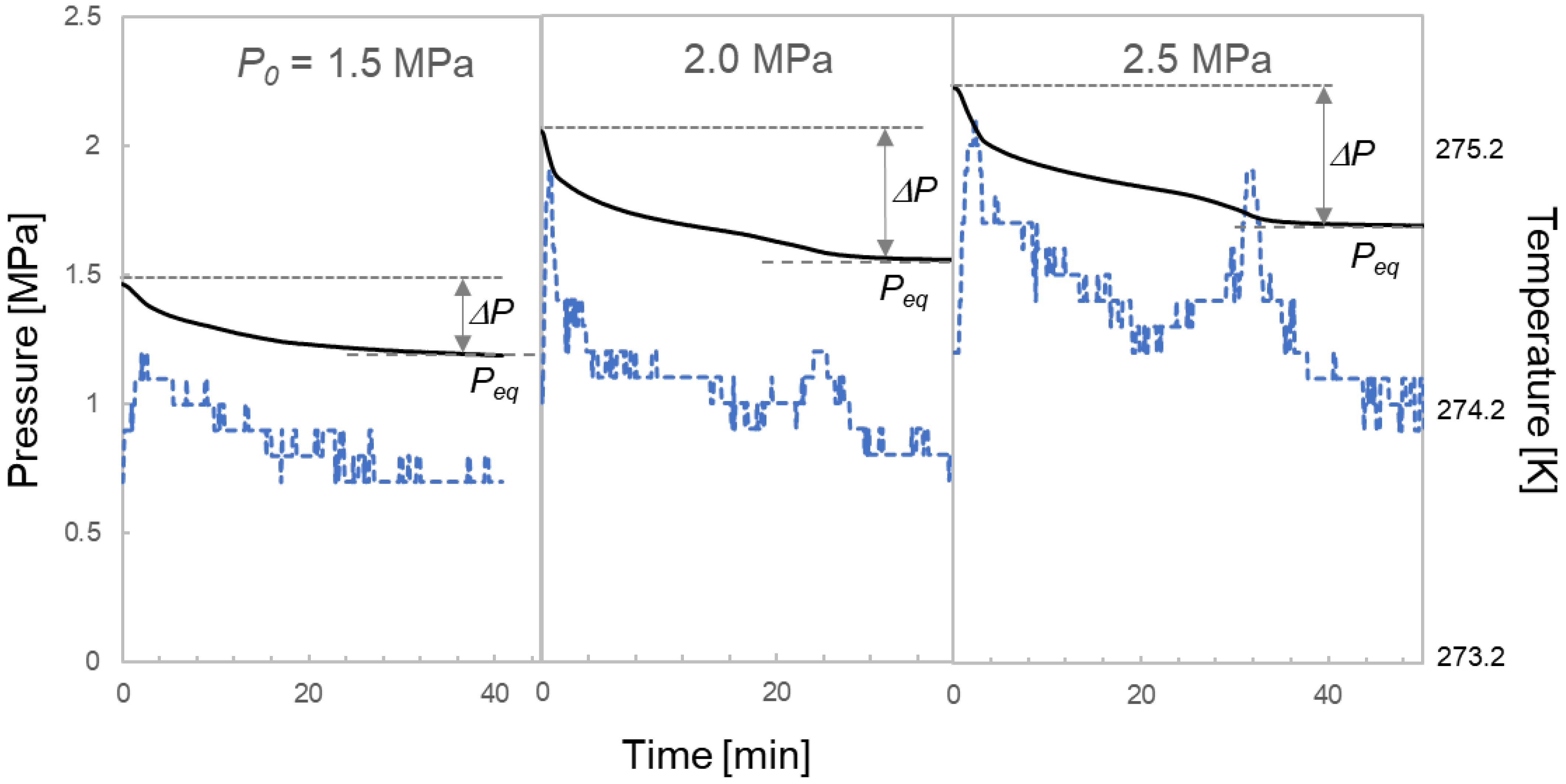
After an initial period of time called the induction time, the hydrate starts forming, causing the pressure to drop as gas molecules are consumed into the hydrate phase. At this time, the temperature increases due to the release of the heat of formation. Figure 2 shows some typical pressure and temperature profiles for initial P0 conditions of 1.5, 2.0, and 2.5 MPa, omitting the induction period. During the hydrate formation, temperature (in blue, right scale) remains higher than the set temperature. After a sufficient amount of time has passed, the system reaches the equilibrium pressure Peq and the temperature returns to the set value. As shown in the plots, the amount of pressure drop to equilibrium (ΔP = P0Peq) increases at higher P0. Although we did not measure the vapor phase composition change, the composition after the hydrate formed should also vary with P0. All experimental data obtained in this study are shown in Table A1, with two of the samples having a measurement of the gas composition in the obtained hydrate crystal. The data show that the gas compositions in the formed gas hydrates depend on P0.

3. Numerical Calculation Models for the Formation Processes of Methane + Propane Mixed-Gas Hydrates

3.1. Thermodynamic Model

3.1.1. Phase Equilibrium

In the formation of gas hydrate and its dissociation, gas + water ↔ hydrate, the chemical composition of each substance remains unchanged. As only the phase of the water changes, we can equate the chemical potential μ of each phase:
μ w   L = μ w   H ,
where subscript w represents a water molecule, and L and H represent the liquid and hydrate phases, respectively. To calculate the equilibrium condition expressed by this equation, van der Waals & Platteeuw [15] proposed a model that involves the crystal structure of the hydrate and the cage occupancy of the guest molecules.
In contrast, Klauda and Sandler [16] proposed a model that instead uses the fugacity f as the equilibrium condition:
f w   L = f w   H .
This model reduces the number of fitting parameters over that using Equation (1), thereby improving calculation accuracy and expanding the applicable temperature range. Because of these advantages, we use here a phase equilibrium model based on Equation (2).

3.1.2. Vapor Phase

For the equation of state of the vapor, Peng and Robinson [17] proposed the following:
P = R T v b a ( T ) v ( v + b ) + b ( v b ) ,
where ν is the molar volume of the gas phase. Constants a(T) and b, respectively, represent the intermolecular force and the molecular excluded volume and are unique to each substance. Their values depend on the critical temperature Tc, critical pressure Pc, and acentric factor ω as
a ( T ) = 0.45724   ( R T c ) 2 P c   { 1 + m ( 1 T T c ) } 2 ,
m = 0.37464 + 1.54226 ω 0.26992 ω 2 , and
b = 0.0778   R T c P c .
In addition, when two or more substances exist in the gas phase, the following mixing rule is applied [18]:
a m i x = i j x i x j ( 1 k i j ) a i a j
b m i x = i x i b i ,
where xi is the mole fraction of gas i and the coefficient kij is a parameter that corrects the magnitude of the intermolecular interaction between gases i and j. The values for kij used here are in Table 1.
Finally, the fugacity fiV of gas i in the vapor phase is given by Equation (9) below using A a P R T 2   ,     B b P R T   ,     Z P v R T :
l n f i   V P = Z 1 l n ( Z B ) A 2 2   B l n Z + ( 2 + 1 ) B Z ( 2 1 ) B .

3.1.3. Liquid Phase

Following reference [20], the fugacity of water in the liquid phase, fwL, on the left side of Equation (2) is
f w   L = x w γ w ϕ w   s a t ,   L P w   s a t ,   L   e x p { V w   L ( P P w   s a t ,   L ) R T } ,
where xw is the molar fraction of water in the liquid phase, γw is the activity coefficient of water, Pwsat,L and ϕwsat,L are the saturated vapor pressure and fugacity coefficient of water, respectively, and vwL is the molar volume of water.
For the mole fraction of water, we follow the equation from reference [21] that assumes that Henry’s law holds:
x w = 1 i ( f i   V H i ( T ) ) , with
l n ( H i ( T ) ) = a + b T + c T 2 + d R T P + e R P + f 2 R T P 2 ,
and the constants a, b, c, d, e given in Table 2 in units of H(T) [bar], T [K], P [Pa], and R [J/(mol K)].
As alkane gases have low solubilities, we assume that the liquid water is pure (for the calculation), approximating it with γ w = 1 . Therefore, this model is applicable to substances with low solubility, such as ethane and butane. However, when using gases with high solubility, such as carbon dioxide or acidic gases, it will be necessary to calculate the activity coefficients.
For the saturated vapor pressure of water Pwsat,L above 273.15 K, we use the following Equation [22]:
P w   s a t ,   L =   e x p { 4.1539   l n ( T ) 5500.9332 T + 7.6537 0.0161277   T } .
At T = 274.15 K, Pwsat,L = 655.58 Pa, which can be considered low enough that ϕwsat,L can be assumed to be unity.
From reference [11], the molar volume of water VwL is
V w   L = e x p { 10.9241 + 2.5 × 10 4   ( T 273.15 )   3.532 × 10 10   ( P 101325 ) + 1.559 × 10 19   ( P 101325 ) 2 } .

3.1.4. Hydrate Phase

For the right side of Equation (2), we use the relation in [16] for the fugacity of water in the hydrate phase fwH:
f w   H = f w   β   e x p ( Δ μ R T ) , where
f w   β = ϕ w   s a t ,   β P w   s a t ,   β   e x p { V w   β ( P P w   s a t ,   β ) R T } ,
and subscript β represents an empty lattice hydrate (a hypothetical hydrate crystal with no guest molecules encapsulated inside the cage).
The saturated vapor pressure Pwsat,β and molar volume Vwβ of the empty lattice hydrate are given by the following equations for the type II structure [23]:
P w   s a t ,   β = 10 5   e x p 17.332 6017.6 T and
V w   β = 17.13 + 2.429 × 10 4   T + 2.013 × 10 6   T 2 + 1.009 × 10 9   T 3 3 × 10 30   N A 136 8.006 × 10 15   P + 5.448 × 10 24   P 2 ,
where NA in Equation (18) is Avogadro’s number. When T = 274.15 K, Pwsat,β = 987.23 Pa, which can be considered a sufficiently low pressure, then ϕwsat,β is roughly unity.
In Equation (15), Δμ represents the change in chemical potential due to the entrance of a guest molecule into a vacant cage. Using the cage occupancy θij, this chemical potential is as follows [9,15]:
μ = R T k ν k   l n ( 1 i θ i   k ) ,
where subscript k represents the type of cage, and νk is a constant obtained by dividing the number of k cages contained in a unit cell of the hydrate crystal by the number of water molecules in the unit cell.
Using the Langmuir constant Ci k, the cage occupancy θi k is as follows [9,15]:
θ i   k = C i   k   f i   V 1 + j C j   k   f j   V ,
where Ci k is given by
C i   k = 4 π k B T 0 R k a x p ( w ( T ) k B T )   r 2 d r , with
w ( T ) = 2 ε z k [ σ 12 R 11 r ( δ 10 + a R δ 11 ) σ 6 R 5 r ( δ 4 + a R δ 5 ) ] and
δ N = 1 N [ ( 1 r R a R ) N ( 1 + r R a R ) N ] .
The values of the Kihara parameters are given in Table 3 and the other constants in Equations (21) and (22) are in Table 4.

3.2. Calculation Method

3.2.1. Matching to Experimental Conditions

We ran the hydrate formation experiments of Section 2 in a closed system under isothermal conditions. As no material exchange occurs with the outside, the initially prepared amount of water will equal the sum of the water molecules contained in vapor, liquid, and hydrate phases at any given state. The same holds true for other substances. Thus, if the initial molecular weight is n0i for the substance i and the molecular weights in the vapor, liquid, and hydrate phases at any given state are nVi, nLi, and nHi, respectively, the following equations hold:
n 0 ,   w = n w V + n w L + n w H ,
n 0 ,   C 1 = n C 1 V + n C 1 L + n C 1 H , and
n 0 ,   C 3 = n C 3 V + n C 3 L + n C 3 H ,
where i = w, C1, and C3 represent water, CH4, and C3H8, respectively. Also, the volume of the reactor used in the experiment does not change. Thus, if the volume of reactor is V0 and the volumes of the vapor, liquid, and hydrate phases in any state are VV, VL, and VH, respectively, then
V 0 = V V + V L + V H .
For the following calculations, we fixed T = 274.2 K, the composition of the gas initially supplied as CH4∶C3H8 = 90∶10, and the amount of water initially supplied as 50.0 mL, which agree with experimental conditions.

3.2.2. Numerical Models

When gas hydrate forms from a mixed gas, the ratios of gas molecules in the vapor and hydrate phases generally do not match. Therefore, whenever a small amount of gas hydrate forms, the vapor composition changes, as will the composition of the next gas hydrate to form. Due to this property, the composition distribution in the bulk gas hydrate should be nonuniform. However, guest molecules may diffuse within the crystal and thus reduce the nonuniformity. Because it is difficult to construct a single calculation model that accurately includes these issues, we use here the following two types of models.
  • Homogeneous-type model: after the hydrate forms, guest molecules are redistributed to result in a hydrate phase of uniform composition.
  • Layered-type model: after some hydrate forms, that hydrate composition is fixed, resulting in hydrate layers of different composition.

3.2.3. Calculation Flow for the Homogeneous-Type Model

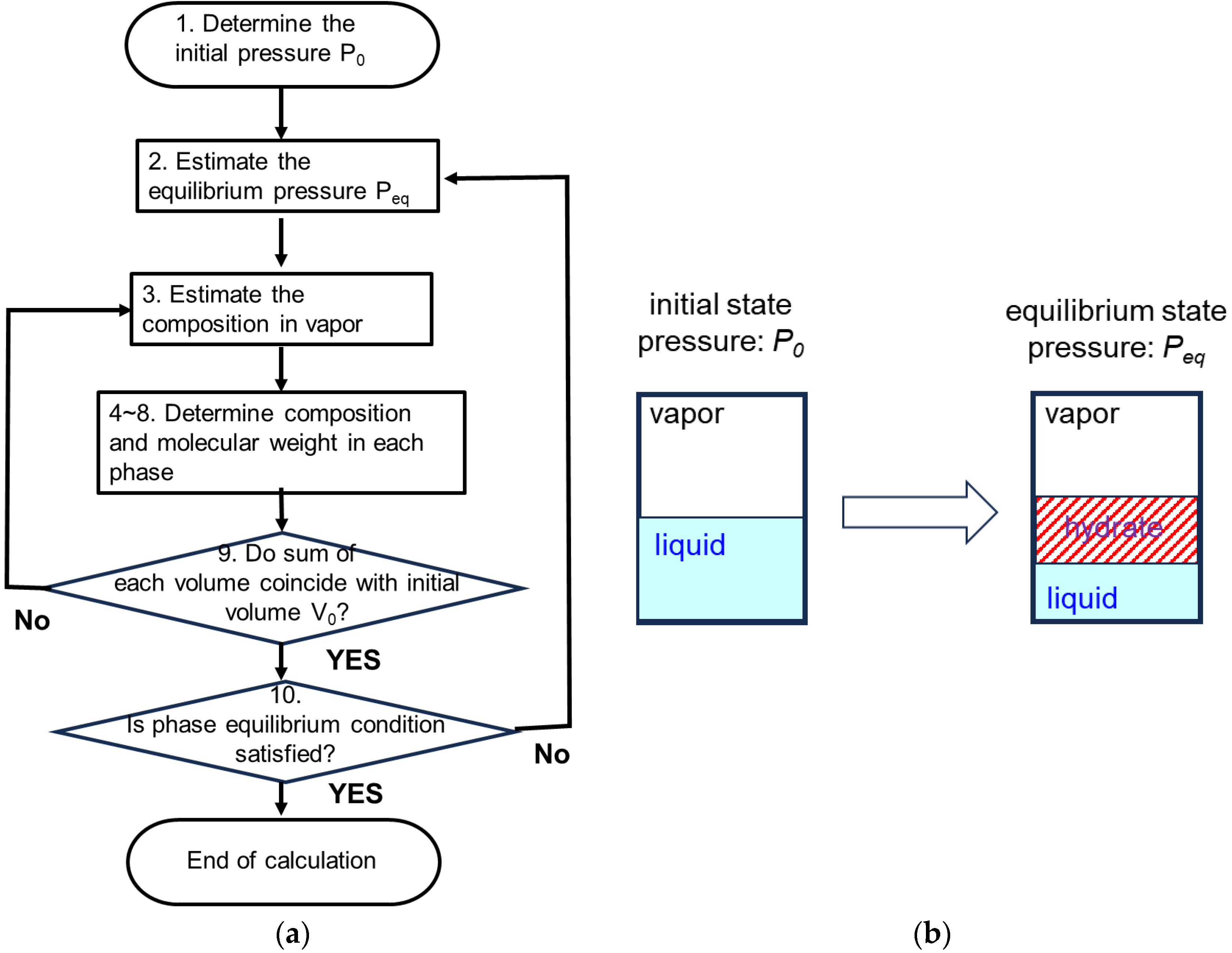
For each experiment at initial pressure P0, we follow the flowchart in Figure 3 to determine the equilibrium state.
  • Determine the initial state
    • Vapor phase: Determine the initial pressure P0 and determine the molecular weights of CH4 and C3H8 based on Equations (3)–(8).
    • Liquid phase: Determine the molecular weight of water based on the density of water.
  • Consider an arbitrary state St in which three phases exist: vapor, liquid, and hydrate. Assume that the pressure P of the vapor phase in this state is in the range 0 < P < P0.
  • Assume that the composition ratios in the vapor phase in the arbitrary state St are based on each vapor phase molecular weight by n w V   :   n C 1 V   :   n C 3 V
    • Here, the water ratio is Pwsat,L/P, based on Equation (13) and the P from step 2.
  • The vapor phase fugacity fV is calculated using Equations (3)–(9).
  • Using Henry’s law (11–12), the composition ratios of the liquid phase based on each liquid-phase molecular weight n w L   :   n C 1 L   :   n C 3 L is calculated using the fugacity of vapor phase fV.
  • Calculate cage occupancies in the hydrate phase using Equations (20)–(23) and the fugacity of vapor phase fV.
  • Based on the cage occupancies, calculate the hydrate composition based on each hydrate-phase molecular weight by n w H   :   n C 1 H   :   n C 3 H .
  • Using the composition of each phase from 3, 5, and 7, convert Equations (24)–(26) into a system of linear equations with three unknowns and solve them to find the molecular weight of each phase for each substance.
  • Calculate the volume of each phase using Equations (3), (14) and (18) and determine whether Equation (27) is sufficiently satisfied.
    • Satisfied: go to 10.
    • Not satisfied: the assumed vapor composition in 3 cannot exist, so try again with a different composition.
  • Calculate the fugacity using Equations (10), (15), and (16) to determine whether the phase equilibrium condition (2) is sufficiently satisfied.
    • Satisfied: pressure P, assumed in 2, and the arbitrary state St are considered to be in equilibrium. As such, the calculation ends.
    • Not satisfied: pressure P assumed in 2 could not be the equilibrium pressure, so try again with a different pressure as the equilibrium pressure.

3.2.4. Calculation Flow for Layered-Type Model

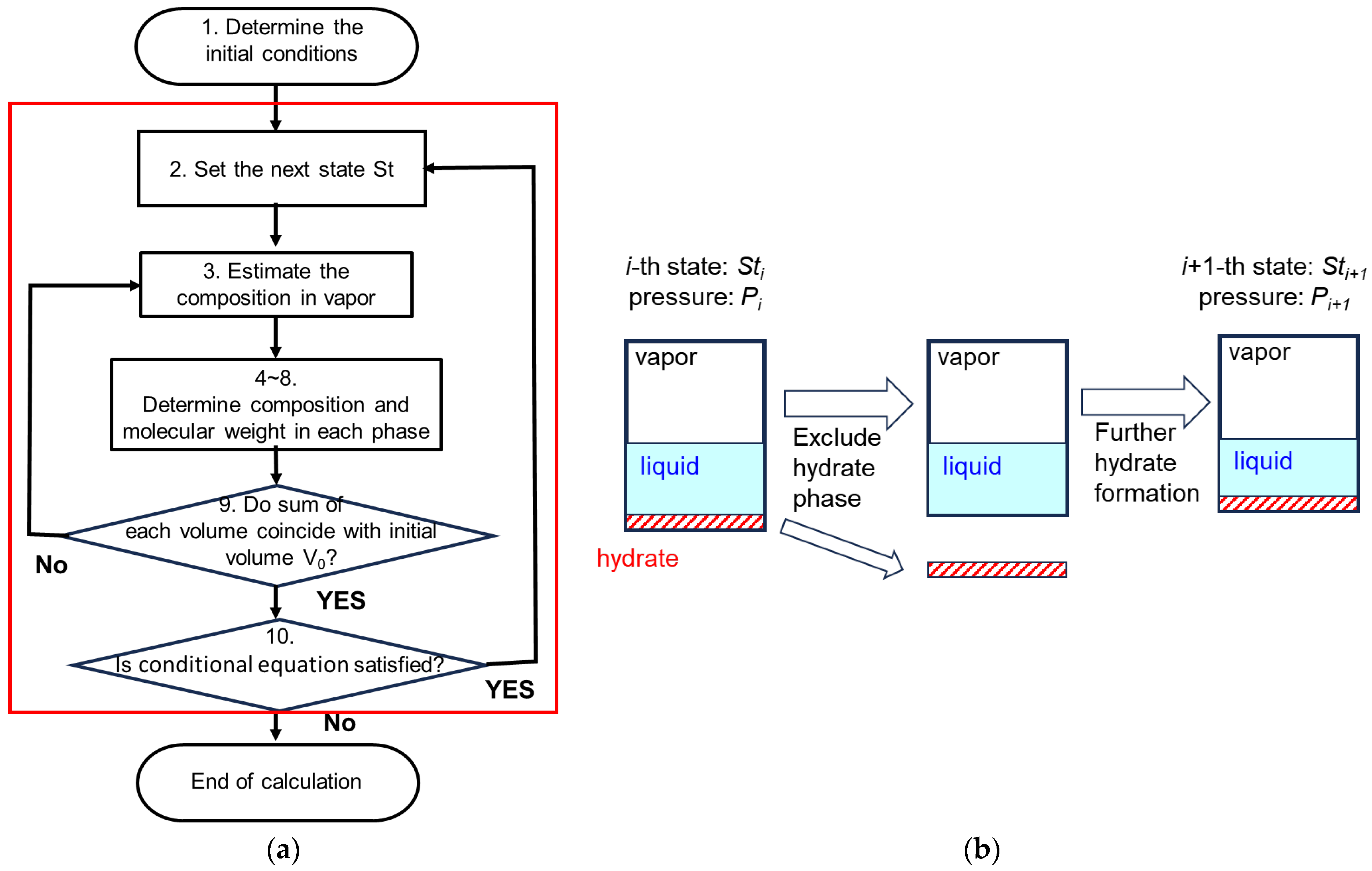
For each experiment at initial pressure P0, we follow the process in Figure 4 to determine the equilibrium state. Figure 4a shows the flowchart, with Figure 4b showing the transition from the i-th state to the i+1-th state within the red frame in Figure 4a.
  • Determine the initial state.
    • Vapor phase: Determine the initial pressure P0 to be calculated, and determine the molecular weights of CH4 and C3H8 based on Equations (3)–(8).
    • Liquid phase: Determine the molecular weight of water based on the water density.
  • Consider state Sti after some crystallization processes have occurred, dropping pressure to Pi.
  • As with the homogeneous-type model, assume the vapor phase in state Sti has a composition based on each vapor phase molecular weight as n w V   :   n C 1 V   :   n C 3 V .
    • Here, the water ratio is Pwsat,L/P, based on Equation (13) and P set in 2 above.
  • Calculate the vapor phase fugacity fV using Equations (3)–(9).
  • Using Henry’s law (Equations (11) and (12)) and the vapor phase fugacity fV, calculate the composition ratio of the liquid phase based on each liquid-phase molecular weight as n w L   :   n C 1 L   :   n C 3 L .
  • Calculate cage occupancies in the hydrate phase using Equations (20)–(23) and fV.
  • Based on the cage occupancies, calculate the composition ratio of the hydrate phase, based on each hydrate-phase molecular weight as n w H   :   n C 1 H   :   n C 3 H .
  • Using the composition ratios of each phase found in 4, 5, and 7, convert Equations (24)–(26) into a system of linear equations with three unknowns and solve them to find the molecular weight of each phase for each substance.
  • Calculate the volume of each phase using Equations (3), (14), and (18) and determine whether the following equation is sufficiently satisfied:
    f w   L f w   H 0
    • Satisfied: go to 10.
    • Not satisfied: the composition ratio of vapor phase assumed in 3 cannot exist, so try again with a different composition ratio.
  • Calculate the fugacity using Equations (10), (15), and (16) to determine whether the conditional Equation (28) is satisfied.
    • Satisfied: go to 11.
    • Not satisfied: the pressure Pi set in 2 and the state at that time Sti have reached equilibrium, so we assume that hydrate formation has stopped and thus end the calculation.
  • As the pressure Pi set in 2 was not the equilibrium pressure, we assume the gas hydrate crystallization will continue. Given that the composition in the gas hydrate phase does not change (in this model), the gas hydrate that has formed will be excluded. Then, repeating from 2, the process will proceed as we consider the state Sti+1 where the pressure has decreased to Pi+1.
  • From then on, steps 3 to 11 are repeated until gas hydrate formation stops.

3.3. Calculation Results

3.3.1. Pressure Drop ΔP and Compositions for the Two Calculation Models

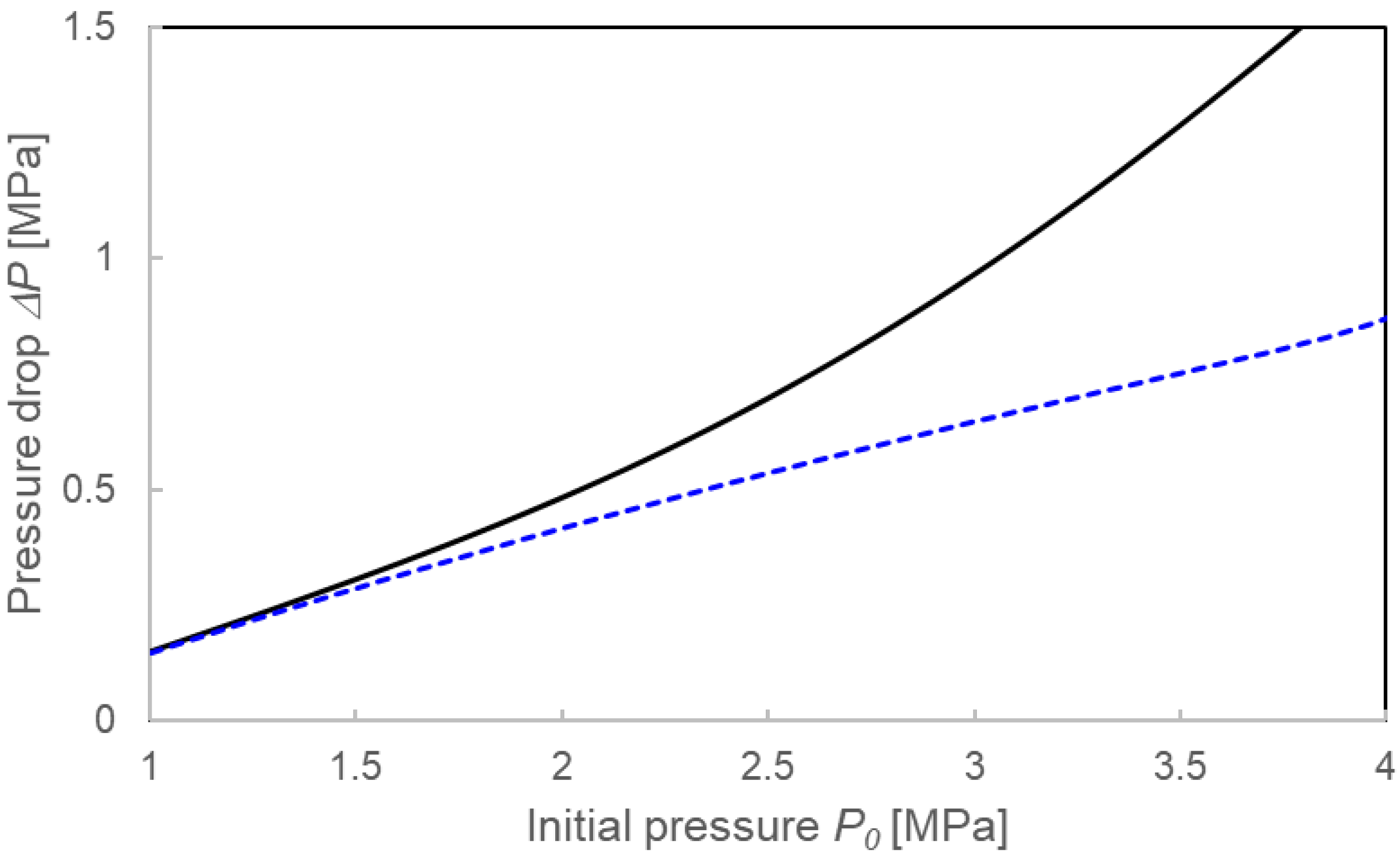
We ran the above calculation for various P0 values in the range of 1.0 to 4.0 MPa, obtaining the results for ΔP shown in Figure 5. In addition, we set the pressure drop between states Sti and Sti+1 in the layered-type according to
P i + 1 = P i 1000   [ P a ] .
The value δP = Pi+1 − Pi = 1000 [Pa] was set as a balance between speed and accuracy. If we increase this increment to δP = 10,000 [Pa], the relative change in ΔP is only about 3% for both models at P0 = 2.5 [MPa], so our setting at 1000 should be sufficiently accurate for our results here.
Figure 5 shows that ΔP increases with increasing P0 for both models, so qualitatively, the two models are consistent. However, their calculated values diverge at larger P0. For example, when P0 = 2.0 MPa, ΔP = 0.483 MPa for the homogeneous-type model whereas ΔP = 0.418 MPa for the layered-type model. Thus, their calculated equilibrium pressures are 1.517 and 1.582 MPa, respectively. The difference between these calculation models is small for P0 ≤ 1.5 MPa, but large as P0 approaches 4 MPa.
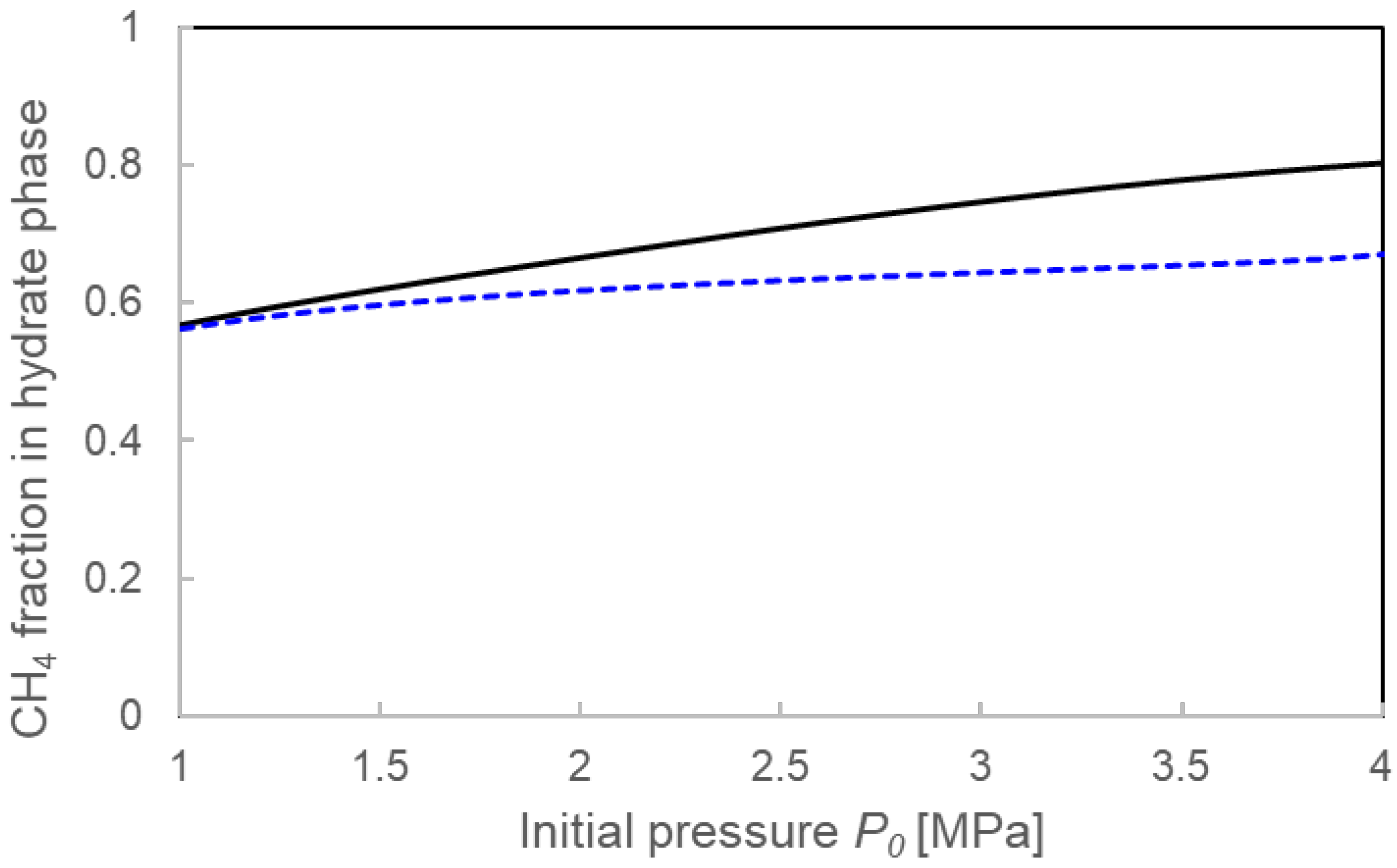
To investigate whether such differences due to the model are reflected in the resulting gas composition, we plot the CH4 ratio in the hydrate phase in Figure 6 for both models. This figure shows that the higher the initial pressure P0, the higher the CH4 ratio in the hydrate phase. Similar to Figure 4, the trend is similar for both models, but the difference in values increases at higher P0. For example, when P0 = 2.0 MPa, the composition in the hydrate phase is CH4:C3H8 = 66.6:33.4 for the homogeneous-type model, but 61.8:38.2 for the layered-type model. Also, the increase in the CH4 ratio with pressure for the layered-type model is less than that of the homogeneous type. Therefore, differences in the calculation models have a greater impact on the results at higher P0.
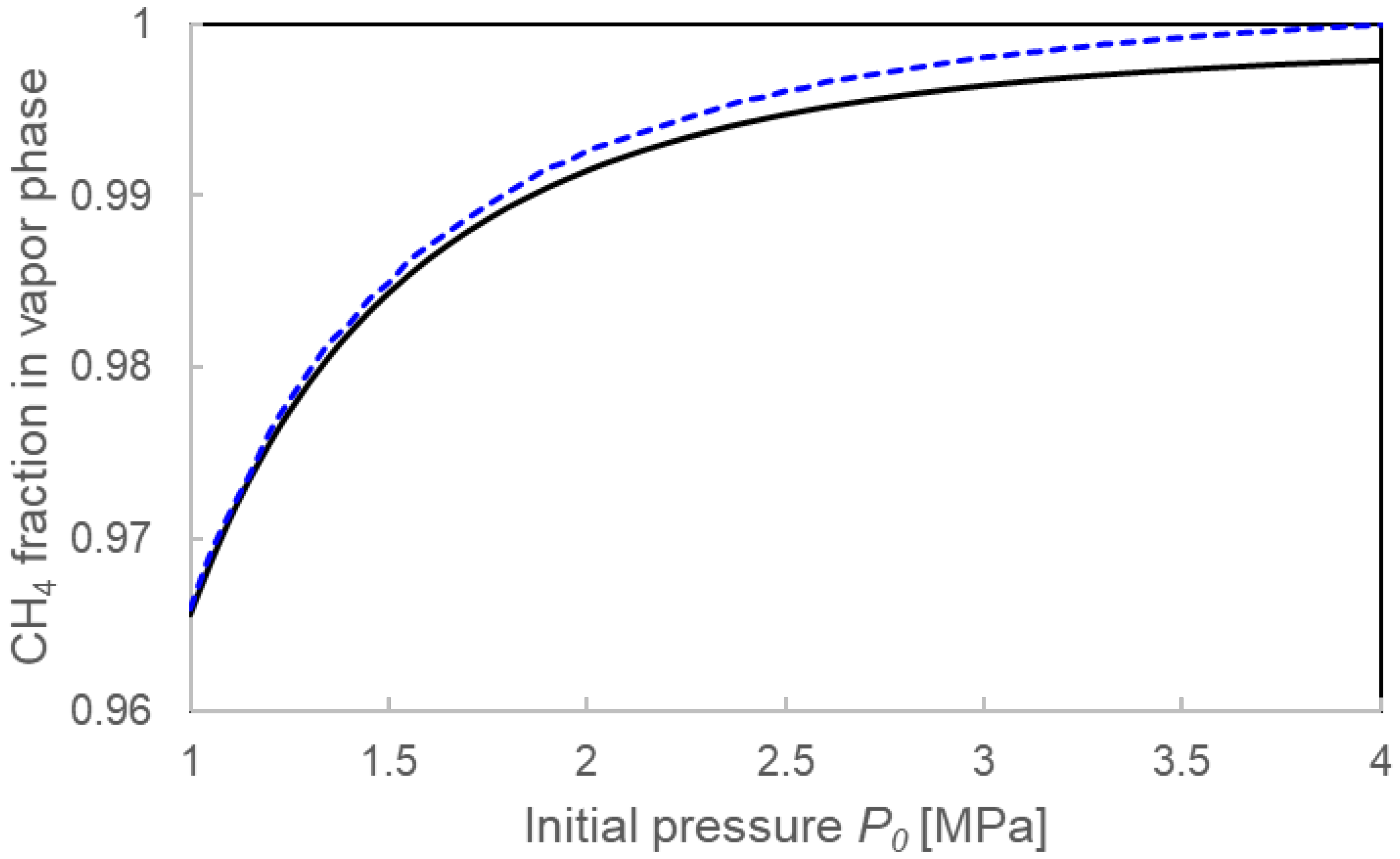
On the other hand, the CH4 fraction in the vapor phase when crystallization ends (Figure 7) increases as P0 increases, approaching unity. As a result, the C3H8 ratio in the vapor phase decreases towards zero as P0 increases. For example, when P0 = 2.0 MPa, the calculated gas composition in the vapor phase at the end of the process is CH4:C3H8 = 99.15:0.85 and 99.26:0.74 for the homogeneous-type and for the layered-type models, respectively. The discrepancy between the two results is relatively small.
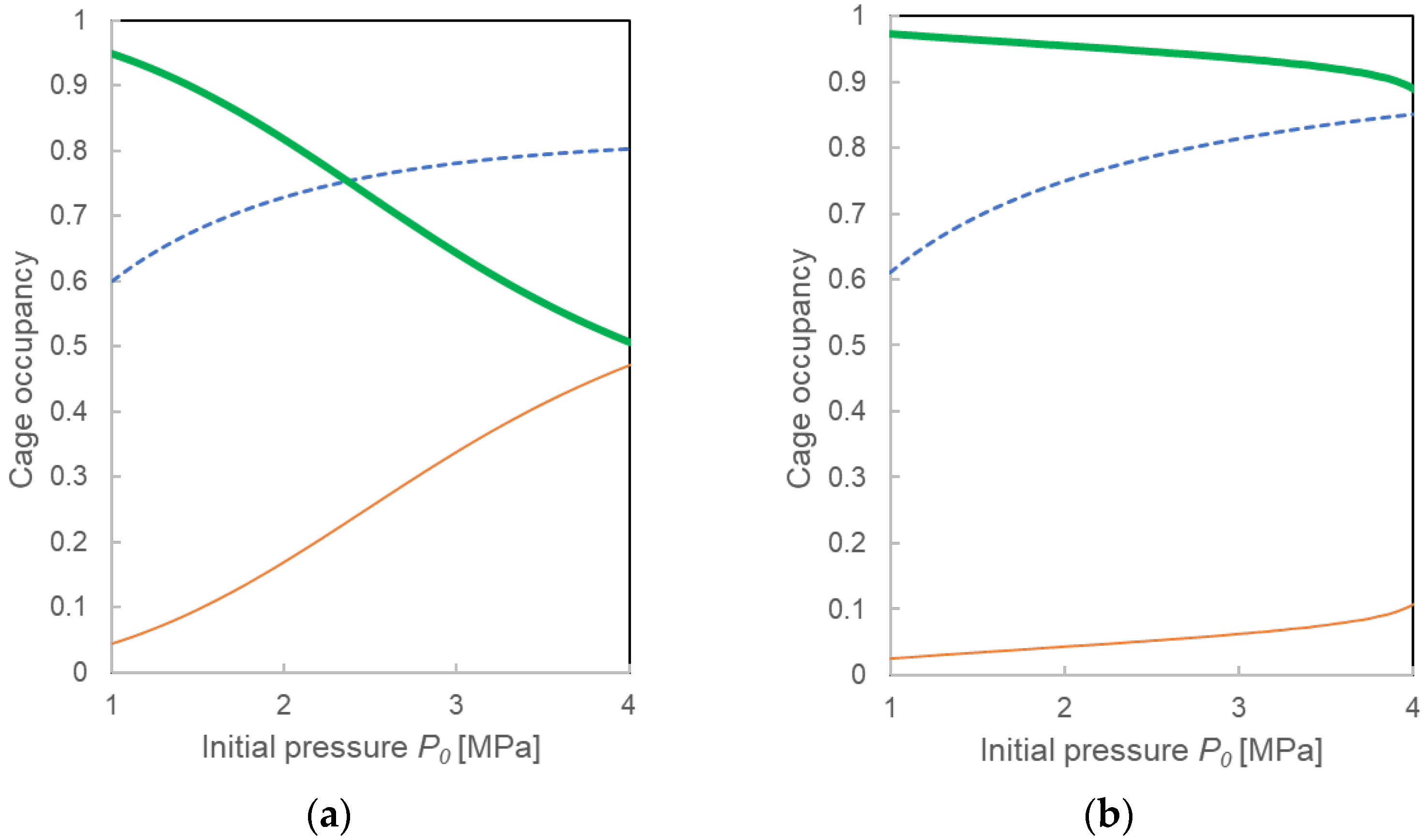
Figure 8 shows the cage occupancies of both guest molecules in the hydrate phase calculated using the (a) homogeneous-type and (b) layered-type models. For the layered-type model, the average value in the whole hydrate phases at the final step is shown. (C3H8 in the S-cage is omitted because it is expected to be zero.) These figures show that the CH4 occupancy in the S-cages hardly varies with P0 in both models. In contrast, the CH4 occupancy in the L-cages is relatively sensitive to P0 in the homogeneous-type model, though not so much in the layered-type model.

3.3.2. Calculation Results During the Formation Process from the Layered-Type Model

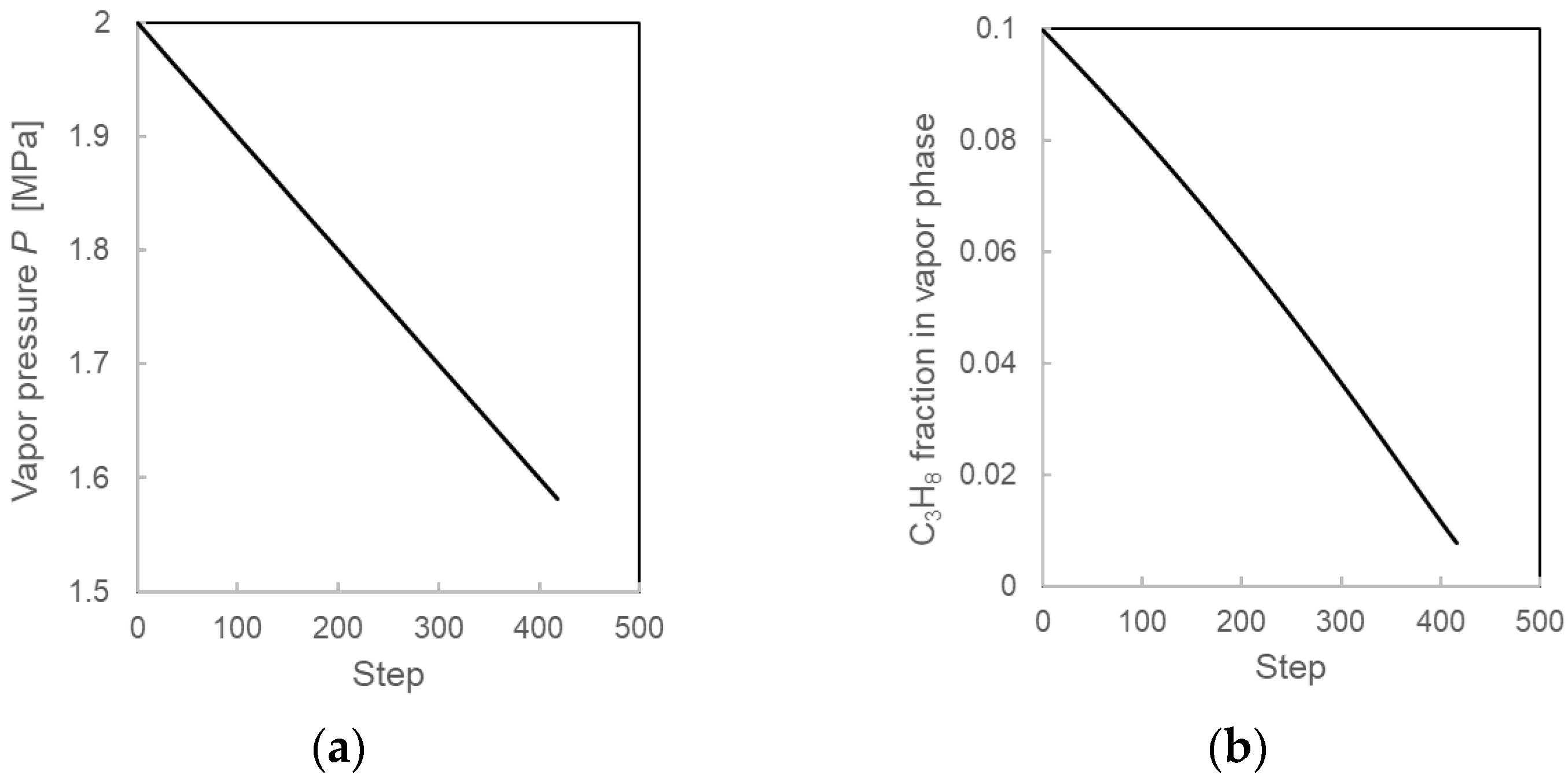
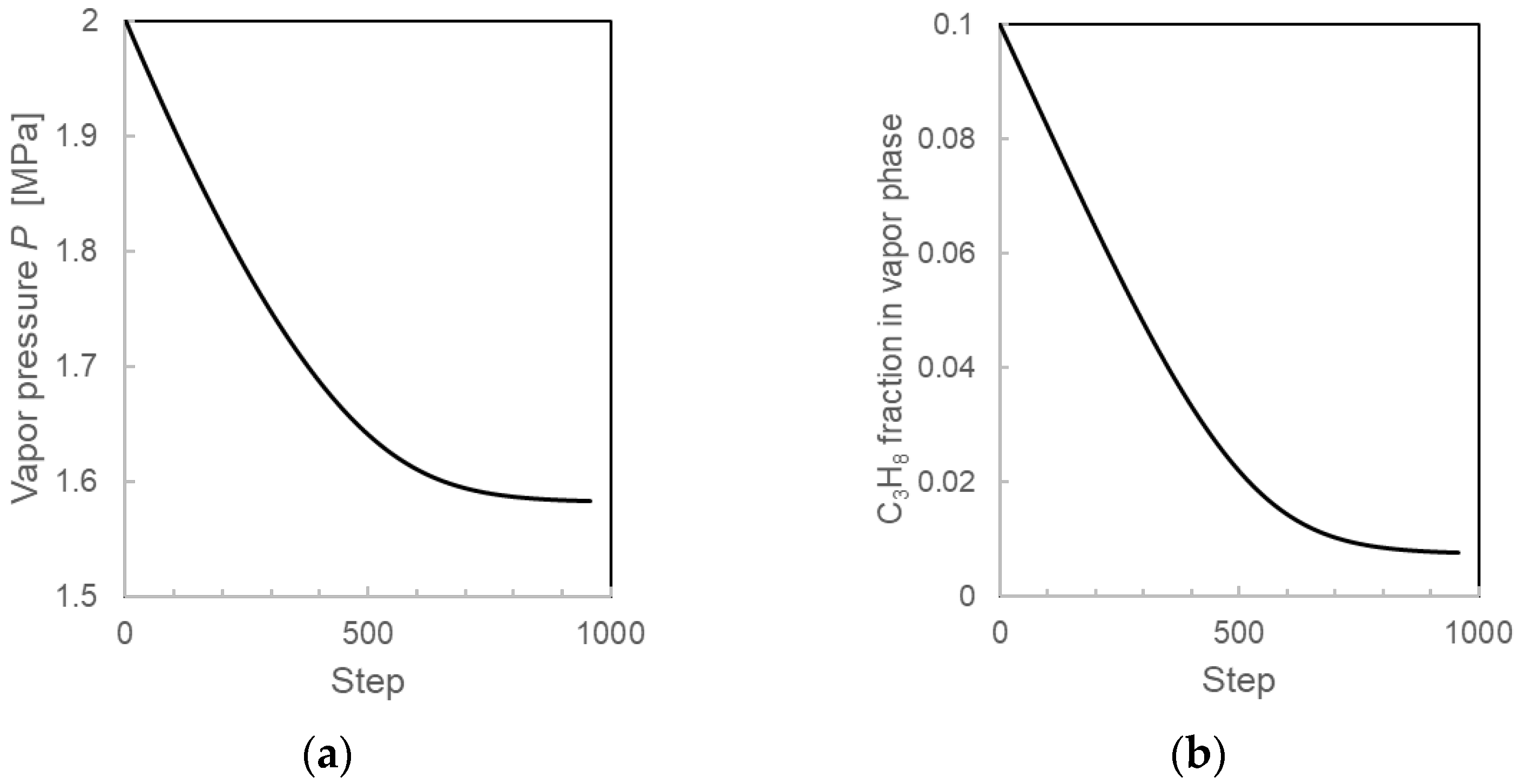
Of the two models used here, only the layered-type model can show the intermediate states before equilibrium is reached. For the case of P0 = 2.0 MPa, Figure 9 shows the resulting total pressure (a) and the fraction of C3H8 in the vapor phase (b) for each calculation step (i.e., representing the passage of time).
If we consider the horizontal axis in Figure 9 to be proportional to time, we can see that the trends with time differ from those seen in the experiments of Figure 2. This discrepancy may arise from the assumption that pressure change between states was fixed in Equation (29). To adapt this condition change to a timescale, a method has been proposed in which the pressure change between states is proportional to the difference between the pressure Pj at a certain state j and the equilibrium pressure Peq [11]. So, as a test, we modified the equation to the following:
P i + 1 P i = A ( f w   L f w   H ) B ,
where A = 10 and B = 1 are constants adjusted to include calculation costs. Using this new equation, we recalculated the system for P0 = 2.0 MPa and plot the results in Figure 10.
Figure 10a confirms that the change in total pressure over time associated with gas hydrate formation is consistent with that shown in Figure 2. Furthermore, the plots show that the decrease in C3H8 concentration is similar to the decrease in total pressure. This behavior suggests that the rate-determining process of CH4 + C3H8 mixed-gas hydrate formation would be the C3H8 consumption process into the hydrate phase.

4. Comparison of Model Calculation Results with Experimental Data

4.1. Validation of Two Calculation Models

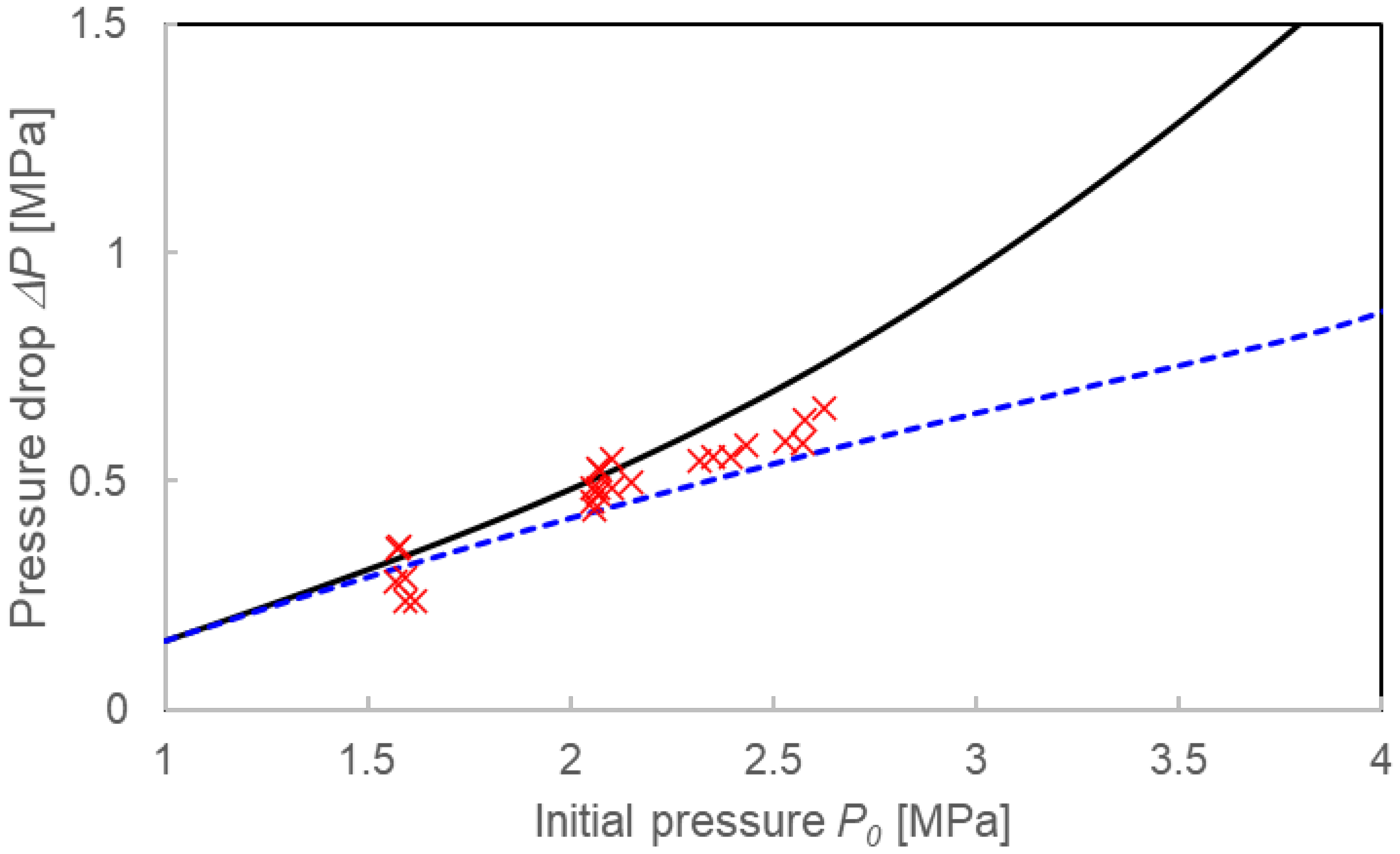
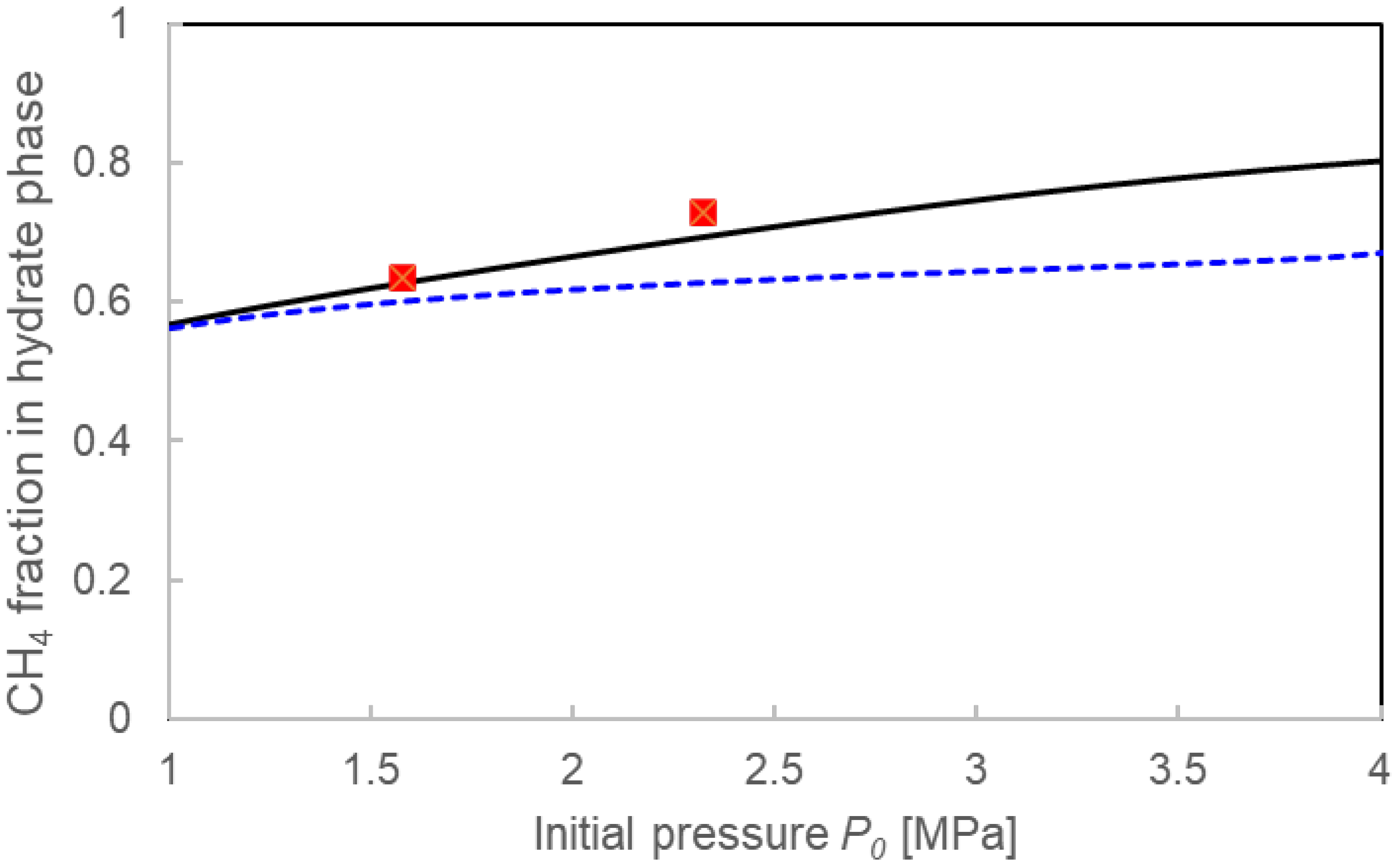
We evaluate the models here by comparing their results to experiment. In Figure 11 and Figure 12 we compare the ΔP results and the results for the CH4 concentration in the hydrate phase. For both figures, the experimental values are red X marks.
Figure 11 shows that within the P0 range for which experimental data is available, both calculation results agree within measurement uncertainty. Figure 12, on the other hand, shows a trend with increasing P0 in which the CH4 concentration in the hydrate phase increases more than that from the calculations, especially that from the layered-type model.
To evaluate the degree of discrepancy between these models and experimental data, we examine the reliability of the experimental data and evaluate the sensitivity of the models to the model input. First, consider the variability of the experimental ΔP data. The measurement accuracy of the temperature and pressure in the experiments were ±0.2 K and ±0.01 MPa, respectively. As the variation in the data exceeded these values, we believe that the variability in the data is due to variations in the experimental conditions. When gas hydrate forms in a batch-type reactor, the temperature temporarily rises due to the release of heat of formation. In our experimental system, an increase of at least 1 K was often observed (see Figure 2). This temperature rise would remain as long as crystallization continued. This rise may result in discrepancies with the model calculations, which were constant at a set temperature T = 274.2 K.
Although few in number, the experimental datapoints for CH4 concentration in the hydrate phase are close to the data calculated from the homogeneous-type model. There is uncertainty, however, as to whether the analyzed samples are equivalent to those when crystallization ended. In the experiments, the samples used for the gas composition measurements were retrieved from the reactor by cooling the reactor with the liquid nitrogen bath while maintaining pressure. Once temperature went sufficiently below the dissociation temperature at atmospheric pressure, the gas in the reactor was released and the sample was retrieved. During the cooling period and just before releasing the gas, the temperature and pressure conditions briefly returned to stable conditions for gas hydrates, potentially allowing the remaining CH4-rich gas to react with free water to form more gas hydrate. Such a potential reaction would make the dissociated gas from the recovered sample slightly more CH4-rich.
To better compare the models to the experiments, considering such experimental uncertainties, we now examine the temperature sensitivity of the model results. For the sensitivity test, the calculation temperatures were set to 274.0 K (set temperature − measurement accuracy) and 275.2 K (set temperature + reactor temperature rise). The resulting ΔP and the fraction of CH4 in the hydrate phase, along with the above results for 274.2 K, are shown in Appendix B.
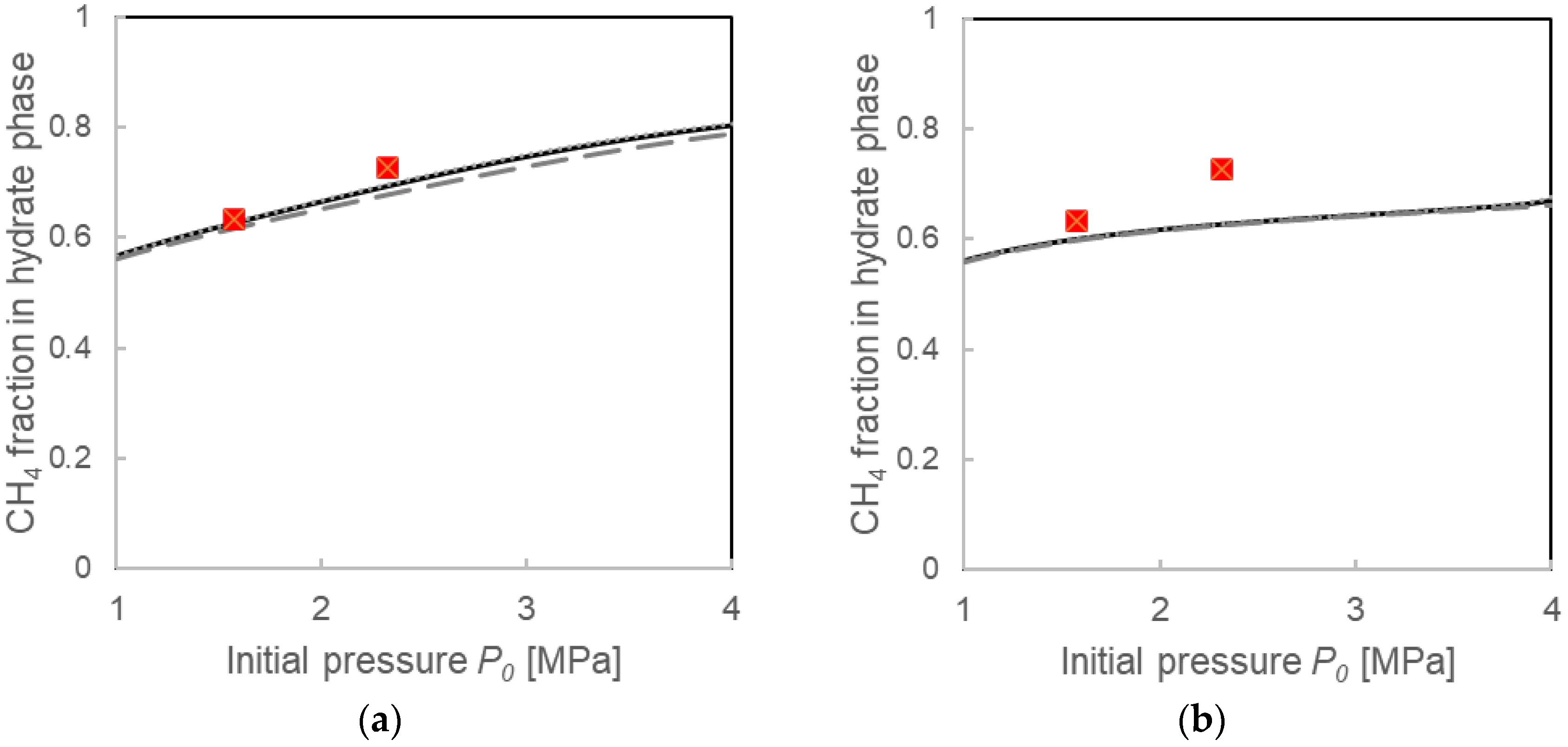
For the homogeneous-type model, ΔP decreases with increasing temperature, approaching the experimental data (Figure A1a). However, the CH4 concentration in the hydrate phase decreases with increasing temperature, indicating a greater deviation from the experimental data (Figure A2a). The change in calculated results due to the measurement accuracy are much smaller than variations in the experimental data. On the other hand, for the layered-type model, both ΔP (Figure A1b) and the CH4 concentration in the hydrate phase (Figure A2b) are less sensitive to temperature. Also, within the assumed range of variability in the experimental data, the deviation between the model and the experimental data remain almost unchanged.
Overall, the above results and this sensitivity test suggest that the homogeneous-type model better agrees with the experimental data than the layered-type model, but the evaluation is not definitive due to the near agreement of the two models. A better evaluation would involve experiments under high-pressure conditions where the two models give more distinct predictions. However, as the critical composition for the formation of type-II CH4 + C3H8 mixed-gas hydrates is 0.0–0.1 mol% [24], the layered-type model is no longer applicable at pressures P > 3.6 MPa, as shown in Figure 6 and Figure 7. Moreover, Uchida et al. [10], running experiments on the formation of CH4 + C3H8 mixed-gas hydrates with the same apparatus under high-pressure conditions, found that when the experiments started at high initial pressures, CH4 + C3H8 mixed-gas hydrates only formed at the start. After the C3H8 concentration in the residual gas phase decreased sufficiently, pure CH4 hydrate subsequently formed, thus adding a second formation step. But in the case of P0 = 2.8 MPa and an initial C3H8 concentration of 9%, this two-step formation phenomenon did not occur under the initial pressure condition [10]. Thus, those findings are consistent with our findings here. The results show that the final pressure drop was 2.2 MPa and the final C3H8 concentration in the vapor phase was 1.4%. Comparing these data to the model results in Figure 11 and Figure 12, neither model fits the data well, but the homogeneous-type model has better agreement.

4.2. Comparison with Calculations Using the Instantaneous Equilibrium Assumption

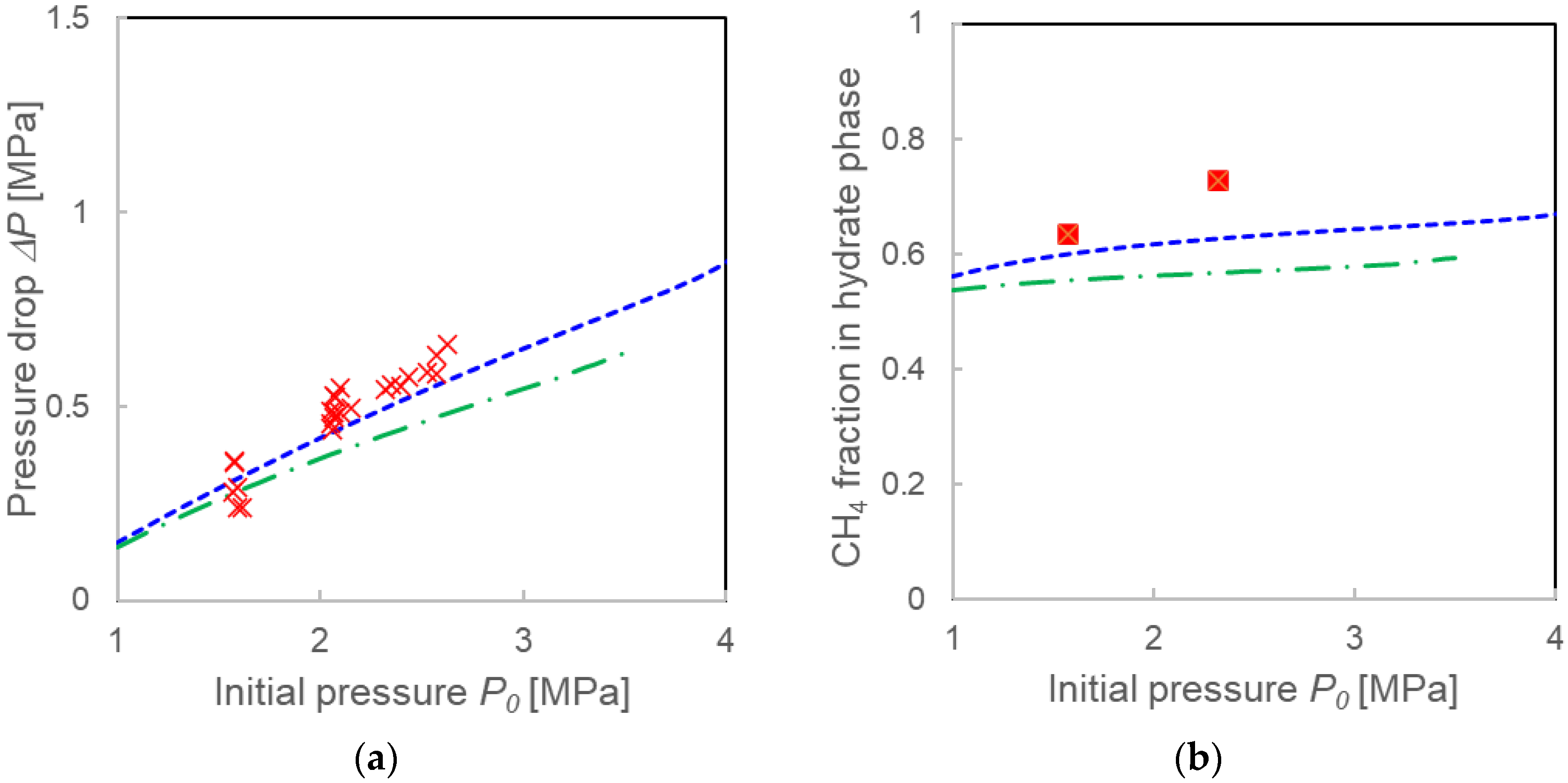
Kobayashi et al. [11] divided the gas hydrate formation process into multiple states and assumed that “instantaneous equilibrium” was established at each intermediate state, enabling calculations using the CSMHYD software [12] that can calculate the equilibrium conditions. Because this method is similar to the layered-type model in the present study, we now compare it with the results of the layered model. While the previous study [11] used the ideal gas equation of state, here, we use the more accurate Peng–Robinson equation of state [17] (assuming the vapor molecules decreased at 0.1% per step). Figure 13a shows the ΔP dependence, and Figure 13b shows the P0 dependence of the CH4 concentration in the hydrate phase. As the CSMHYD model suggested a two-step formation phenomenon at P0 > 3.5 MPa, well above our experimental pressures, we can ignore the two-step case in our comparison.
The results using CSMHYD show lower ΔP and the fraction of CH4 in the hydrate phase compared to our layered-type model (Figure 13). Even when compared with the experimental results, ΔP is underestimated, which means that the fraction of CH4 absorbed in the crystals is underestimated. Thus, the preferred enclathration of C3H8 is overestimated, which led to a faster decrease in C3H8 in the vapor phase, and the equilibrium pressure of the system was determined to be higher than it actually was, causing the crystallization to stop earlier, resulting in an underestimation of ΔP. This may also lead to the two-step crystallization in the calculation.

4.3. Formation Mechanisms of Mixed-Gas Hydrates Considered from a Comparison of Two Models

The two models developed in this study represent two extreme cases for modeling the formation of mixed-gas hydrates. In the homogeneous-type model, the composition within the hydrate phase changes in response to changes in the vapor phase composition during formation. In contrast, in the layered-type model, the composition of the hydrate crystal formed at a given time is determined by the vapor phase composition at that time, and then remains fixed as the vapor composition changes. Both models were able to reproduce the experimental data conditions, but the data agreed better with the homogeneous-type model. This model’s better agreement suggests that, at least in our experiments, sequentially formed crystals with different compositions are mixed together and, as the grain sizes are small, their compositions can approach homogeneity via diffusion. But as the molecular diffusion is not instantaneous, we expect that the experimental results should lie somewhere between the two extreme cases assumed in the models, as found in our results. Presumably, this would hold for other gas–liquid crystallization systems with stirring.
Concerning the rate-limiting process, Uchida et al. [25] found that the nucleation process of CH4 + C3H8 mixed-gas hydrate is limited by the rate of formation of the empty cages. Our experiments here follow the same nucleation process, but further examination of the time-dependent changes from the layered-type model (Figure 10) suggests that the crystal growth process of CH4 + C3H8 mixed-gas hydrates may be primarily rate-limited by the enclathration process of C3H8, with a rate proportional to the fraction of C3H8 in the vapor phase. We presently do not know which parameters (e.g., P0, T, and composition) affect the switching phenomenon of the rate-determining process from nucleation to the bulk crystal growth. Nevertheless, the present models should be useful for further examination of the rate-determining processes at various stages of crystal formation.

5. Conclusions

In this study, we developed two computational models to help predict how mixed-gas hydrates form in a batch reactor under isothermal conditions: in one, the composition of the resulting crystals has a uniform composition (homogeneous-type model); in the other, the composition of the new hydrate changes continuously depending on a continually changing vapor phase (layered-type model). Using these models, we predicted how the pressure drop and product composition depend on the initial pressure, and then compared predictions with experimental data for a CH4 + C3H8 mixed-gas system. Although the qualitative results were consistent, we were unable to quantitatively determine which model was more appropriate within the range of our experimental data. Nevertheless, the layered-type model may be a more versatile model because it can calculate and predict the state during crystallization, which is difficult to obtain in actual experiments. Finally, the computational results suggest that the rate-determining process for the formation of CH4 + C3H8 mixed-gas hydrates is likely to be the enclathration of C3H8 into the hydrate phase.
Further development will require better models that include the temperature sensitivity of the experimental system. Also, the experimental results showed that if the initial pressure P0 was sufficiently high (e.g., P0 > 3.6 MPa at T = 274.2 K), then pure CH4 hydrate can form after C3H8 in the vapor is consumed. The models used in this study should also be improved so they can reproduce this two-step phenomenon.

Author Contributions

Conceptualization, T.U. and T.T.; methodology, T.U. and T.T.; software, T.T.; validation, T.U., M.O. and T.T.; formal analysis, T.U., R.S., M.O. and T.T.; investigation, R.S., M.O. and T.T.; resources, T.U. and M.O.; data curation, T.U. and T.T.; writing—original draft preparation, T.U. and T.T.; writing—review and editing, T.U., R.S., M.O. and T.T.; visualization, T.U. and T.T.; supervision, T.U.; project administration, T.U.; funding acquisition, T.U.; present affiliation, T.T.: Information Planning Co., Ltd., Tokyo, Japan, R.S.: Mitsubishi Electric Mobility Corporation. All authors have read and agreed to the published version of the manuscript.

Funding

This work is partly supported by the joint project between Hokkaido University and AIST Hokkaido, and by the MH21-S R&D consortium (MH21-S) as funded by the Ministry of Economy, Trade and Industry (METI), Japan.

Data Availability Statement

The original contributions presented in this study are included in the article/Appendix A. Further inquiries can be directed to the corresponding author.

Acknowledgments

We acknowledge Amadeu K. Sum, Colorado School of Mines, for his fruitful supports on constructing the models. We would also like to thank Jon Nelson, the editor of Redmond Physical Sciences (www.redmondphysicalsciences.com) for the English language review.

Conflicts of Interest

The authors declare no conflicts of interest.

Abbreviations

The following abbreviations are used in this manuscript:
CSMHYDName of software that can calculate the equilibrium condition of gas hydrates, a code developed in the Colorado Schools of Mines [12].

Appendix A. Experimental Data List

Table A1. Experimental data list.
Initial Pressure P0 [MPa]Equilibrium Pressure Peq [MPa]Pressure Drop ΔP [MPa]CH4 Concentration in Hydrate Phase *
1.5681.2900.278
1.5761.2220.3540.634 ± 0.002
1.5801.2220.358
1.5931.3540.239
1.5951.3050.290
1.6181.3790.239
2.0521.5650.487
2.0561.6020.454
2.0581.6190.439
2.0661.5370.529
2.0681.5840.484
2.0701.6000.470
2.0751.5520.523
2.1021.6190.483
2.1021.5550.547
2.1491.6520.497
2.3201.7760.5440.727 ± 0.002
2.3501.7960.554
2.3961.8440.552
2.4331.8660.577
2.5301.9430.587
2.5731.9890.584
2.5761.9430.633
2.6261.9650.661
* The value was averaged for three measurements ± its standard deviation.

Appendix B. Temperature Sensitivity of the Calculation Results
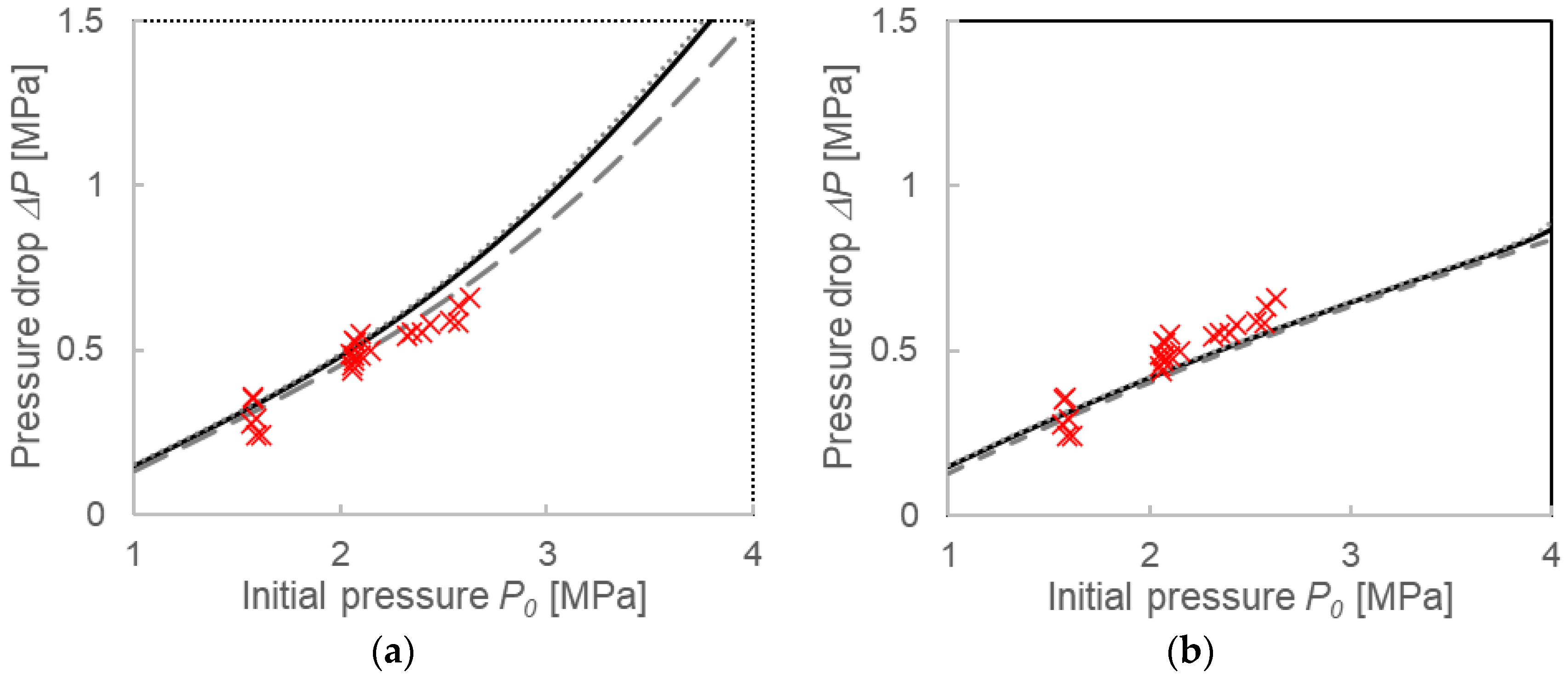
Figure A1. Calculated pressure drop ΔP for 274.0, 274.2, and 275.2 K. (a) Homogeneous-type model. (b) Layered-type model. Solid line: 274.2 K, dotted line: 274.0 K, dashed line: 275.2 K, red X: from experiment.
Processes 14 00261 g0a1
Figure A2. Calculated pressure drop ΔP for 274.0, 274.2, and 275.2 K. (a) Homogeneous-type model. (b) Layered-type model. Solid line: 274.2 K, dotted line: 274.0 K, dashed line: 275.2 K, red X: from experiment. These are same as Figure A1 except for the fraction of CH4 in the hydrate phase. Red squares: from experiment.
Processes 14 00261 g0a2

References

  1. Gudmundsson, J.S.; Mork, M.; Graff, O.F. Hydrate non-pipeline technology. In Proceedings of the 4th International Conference on Gas Hydrates, Yokohama, Japan, 19–23 May 2002; pp. 19–23. [Google Scholar]
  2. Takaoki, T. Natural gas transportation in form of hydrate. J. Jpn. Assoc. Pet. Technol. 2008, 73, 158–163, (In Japanese with English Abstract). [Google Scholar] [CrossRef]
  3. Rehder, G.; Eckl, R.; Elfgen, M.; Falenty, A.; Hamann, R.; Kahler, N.; Kuhs, W.F.; Osterkamp, H.; Windmeier, C. Methane hydrate pellet transport using the self-preservation effect: A techno-economic analysis. Energies 2012, 5, 2499–2523. [Google Scholar] [CrossRef]
  4. Taheri, Z.; Reza, M.; Nazari, S.K.; Mehdizaheh, A. Natural gas transportation and storage by hydrate technology: Iran case study. J. Nat. Gas Sci. Eng. 2014, 21, 846–849. [Google Scholar] [CrossRef]
  5. Mimachi, H.; Takahashi, M.; Takeya, S.; Gotoh, Y.; Yoneyama, A.; Hyodo, K.; Takeda, T.; Murayama, T. Effect of Long-Term Storage and Thermal History on the Gas Content of Natural Gas Hydrate Pellets under Ambient Pressure. Energy Fuels 2015, 29, 4827–4834. [Google Scholar] [CrossRef]
  6. Mimachi, H.; Takeya, S.; Gotoh, Y.; Yoneyama, A.; Hyodo, K.; Takeda, T.; Murayama, T. Dissociation behaviors of methane hydrate formed from NaCl solutions. Fluid Phase Equilib. 2016, 413, 22–27. [Google Scholar] [CrossRef]
  7. Matsuo, S.; Umeda, H.; Takeya, S.; Fujita, T. A Feasibility Study on Hydrate-Based Technology for Transporting CO2 from Industrial to Agricultural Areas. Energies 2017, 10, 728. [Google Scholar] [CrossRef]
  8. Uchida, K.; Watanabe, S. Development of Natural Gas Transportation Technology Using Hydrates: World’s First Natural Gas Hydrate Transport Demonstration Project. Enermix 2021, 100, 210–214. (In Japanese) [Google Scholar]
  9. Sloan, E.D.; Koh, C.A. Clathrate Hydrates of Natural Gases, 3rd ed.; CRC Press: Boca Raton, FL, USA, 2008; p. 752. [Google Scholar]
  10. Uchida, T.; Moriwaki, M.; Takeya, S.; Ikeda, I.Y.; Ohmura, R.; Nagao, J.; Minagawa, H.; Ebinuma, T.; Narita, H.; Gohara, K.; et al. Two-step formation of methane-propane mixed gas hydrates in a batch-type reactor. AIChE J. 2004, 50, 518–523. [Google Scholar] [CrossRef]
  11. Kobayashi, T.; Mori, Y.H. Thermodynamic simulations of hydrate formation from gas mixtures in batch operations. Energy Convers. Manag. 2007, 48, 242–250. [Google Scholar] [CrossRef]
  12. CSMHYD, a program package accompanying the following book: Sloan, E.D., Jr. In Clathrate Hydrates of Natural Gases, 2nd ed.; Revised and Expanded; CRC Press: Boca Raton, FL, USA, 1998; p. 705.
  13. Uchida, T.; Sugibuchi, R.; Hayama, M.; Yamazaki, K. Supersaturation dependent nucleation of methane plus propane mixed-gas hydrate. J. Chem. Phys. 2024, 160, 074502. [Google Scholar] [CrossRef]
  14. Kunneman, K.; Sum, A.K. p2f-hydratecalc: A web Python-based tool for the prediction of natural gas hydrate equilibrium and inhibition. SoftwareX 2025, 32, 102422. [Google Scholar] [CrossRef]
  15. van der Waals, J.H.; Platteeuw, J.C. Clathrate Solutions. Adv. Chem. Phys. 1958, 2, 1–57. [Google Scholar]
  16. Klauda, J.B.; Sandler, S.I. A Fugacity Model for Gas Hydrate Phase Equilibria. Ind. Eng. Chem. Res. 2000, 39, 3377–3386. [Google Scholar] [CrossRef]
  17. Peng, D.Y.; Robinson, D.B. A New Two-Constant Equation of State. Ind. Eng. Chem. Fundamen. 1976, 15, 59–64. [Google Scholar] [CrossRef]
  18. Jaubert, J.N.; Mutelet, F. VLE predictions with the Peng-Robinson equation of state and temperature dependent kij calculated through a group contribution method. Fluid Phase Equilib. 2004, 224, 285–304. [Google Scholar] [CrossRef]
  19. Qian, J.W.; Privat, R.; Jaubert, J.N. Predicting the Phase Equilibria, Critical Phenomena, and Mixing Enthalpies of Binary Aqueous Systems Containing Alkanes, Cycloalkanes, Aromatics, Alkenes, and Gases (N2, CO2, H2S, H2) with the PPR78 Equation of State. Ind. Eng. Chem. Res. 2013, 52, 16457–16490. [Google Scholar] [CrossRef]
  20. Sloan, E.D., Jr. Fundamental Principles and applications of natural gas hydrates. Nature 2003, 426, 353–363. [Google Scholar] [CrossRef] [PubMed]
  21. Mohebbi, V.; Naderifar, A.; Behbahani, R.M.; Moshfeghian, M. Determination of Henry’s law constant of light hydrocarbon gases at low temperatures. J. Chem. Thermodyn. 2012, 51, 8–11. [Google Scholar] [CrossRef]
  22. Anil, J.V.; Bhawangirkar, D.R.; Sangwai, J.S. Effect of guest-dependent reference hydrate vapor pressure in thermodynamic modeling of gas hydrate phase equilibria, with various combinations of equations of state and activity coefficient models. Fluid Phase Equilib. 2022, 556, 113356. [Google Scholar] [CrossRef]
  23. Eslamimanesh, A.; Mohammadi, A.H.; Richon, D. Thermodynamic model for predicting phase equilibria of simple clathrate hydrates of refrigerants. Chem. Eng. Sci. 2011, 66, 5439–5445. [Google Scholar] [CrossRef]
  24. Smith, C.; Pack, D.; Barifcani, A. Propane, n-butane and i-butane stabilization effects on methane gas hydrates. J. Chem. Thermodyn. 2017, 115, 293–301. [Google Scholar] [CrossRef][Green Version]
  25. Uchida, T.; Hayama, M.; Oshima, M.; Yamazaki, K. Nucleation probability of methane + propane mixed-gas hydrate depending on gas composition. Energy Fuels 2025, 39, 4782–4789. [Google Scholar] [CrossRef]
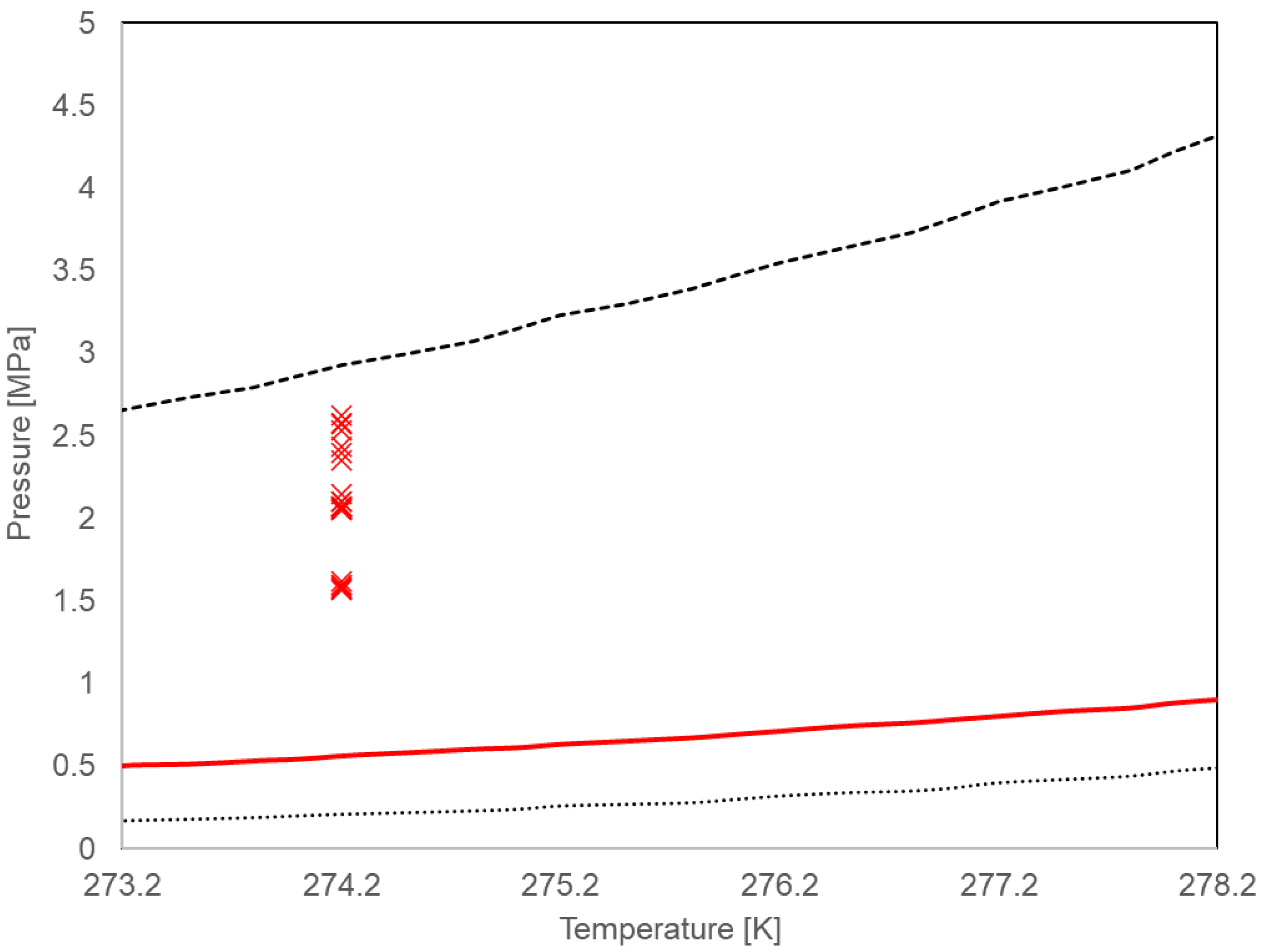
Figure 1. Phase equilibrium conditions of CH4 hydrate (black dashed line), C3H8 hydrate (black dotted line), and CH4 + C3H8 (90:10) mixed-gas hydrate (red solid line) calculated by p2f-hydratecalc [14]. Red Xs are the initial experimental conditions.
Processes 14 00261 g001
Figure 2. Pressure (black solid lines) and temperature (blue dashed lines) profiles during gas hydrate formation in CH4 + C3H8 (90:10) mixed gas for three initial pressures P0. The final pressure is the equilibrium pressure Peq at each condition, with ΔP = P0Peq.
Processes 14 00261 g002
Figure 3. The homogeneous-type model. (a) Flowchart. (b) The final versus the initial state.
Processes 14 00261 g003
Figure 4. The layered-type model. (a) Flowchart. (b) Detail for the transition states to the next state (shown as the red box in (a)).
Processes 14 00261 g004
Figure 5. Pressure drop ΔP calculated from the homogeneous-type model (black solid line) and the layered-type model (blue dashed line).
Processes 14 00261 g005
Figure 6. Calculated fraction of CH4 in the hydrate phase from the homogeneous-type model (black solid line) and the layered-type model (blue dashed line).
Processes 14 00261 g006
Figure 7. Calculated fraction of CH4 in vapor phase mixture with C3H8 from the homogeneous-type model (black solid line) and the layered-type model (blue dashed line).
Processes 14 00261 g007
Figure 8. Calculated cage occupancies for the hydrate guest molecules. (a) Homogeneous-type model. (b) Layered-type model. Blue dashed curves are the CH4 occupancy in S-cages, the thin orange curves are the CH4 occupancy in L-cages, and the thick green curves are the C3H8 occupancy in L-cages.
Processes 14 00261 g008
Figure 9. Calculated vapor phase properties during hydrate formation for P0 = 2.0 MPa. (a) Total pressure. (b) Fraction of C3H8 in the vapor phase.
Processes 14 00261 g009
Figure 10. Calculated vapor phase properties during hydrate formation for P0 = 2.0 MPa. (a) Total pressure. (b) Fraction of C3H8 in the vapor phase. These are same as Figure 9 except the abscissa scale modified to better represent the passage of time as described in the text.
Processes 14 00261 g010
Figure 11. Experimental (red X marks) and calculated pressure drop ΔP for a range of P0. As in other plots, the solid black curve is from the homogeneous-type model, the dashed blue curve is from the layered-type model.
Processes 14 00261 g011
Figure 12. Same as Figure 11 except for the fraction of CH4 in the hydrate phase. Experimental results are shown as red squares (error bar is included in the mark).
Processes 14 00261 g012
Figure 13. Calculated pressure drops and fraction of CH4 in hydrate phase from two layered-type models. Experimental values are also shown in red. Blue curve: layered-type model of the present study, green dash–dot curve: modified layered-type model using CSMHYD [12]. (a) ΔP. (b) Fraction of CH4 in the hydrate phase.
Processes 14 00261 g013
Table 1. Value of interaction parameter kij at T = 274.15 K [18,19].
i \ j WaterCH4C3H8
water 0 0.6437 1.6201
CH4 0.6437 0 0.0147
C3H8 1.6201 0.0147 0
Table 2. Values of the constants in Equation (12) [21].
iab
[K−1]
c
× 10 4
[ K 2 ]
d
× 10 4
[ J   m o l 1 P a 1 ]
e
× 10 7
[ J   m o l 1 K 1 P a 1 ]
f
× 10 14
[ J   m o l 1 P a 2 ]
CH4 7.037 0.1017 1.426 1.0 3.38 2.457
C3H8 22.61 0.1893 2.60 0.0 6.189 0.0
Table 3. Numerical values of Kihara parameters for methane and propane [12].
i ε / k B [ K ] σ [ Å ] a [ Å ]
CH4 154.54 3.1650 0.3834
C3H8 203.31 3.3093 0.6502
Table 4. Cage parameters for type II structure.
k R k [ Å ] z k
Small (512) 3.902 20
Large (51264) 4.682 28
Disclaimer/Publisher’s Note: The statements, opinions and data contained in all publications are solely those of the individual author(s) and contributor(s) and not of MDPI and/or the editor(s). MDPI and/or the editor(s) disclaim responsibility for any injury to people or property resulting from any ideas, methods, instructions or products referred to in the content.