Review

Advances in Bio-Based Production of 1,4-Butanediol

1
College of Fisheries and Life Science, Shanghai Ocean University, Shanghai 201306, China
2
State Key Laboratory of Quantitative Synthetic Biology, Shenzhen Institute of Synthetic Biology, Shenzhen Institutes of Advanced Technology, Chinese Academy of Sciences, Shenzhen 518055, China
3
Shenzhen Key Laboratory of Genome Manipulation and Biosynthesis, Shenzhen Institute of Synthetic Biology, Shenzhen Institutes of Advanced Technology, Chinese Academy of Sciences, Shenzhen 518055, China
4
Department of Biomedicine and Health Science, Shanghai Vocational College of Agriculture and Forestry, Shanghai 201699, China
*
Authors to whom correspondence should be addressed.
Processes 2026, 14(2), 221; https://doi.org/10.3390/pr14020221
Submission received: 25 October 2025 / Revised: 22 November 2025 / Accepted: 24 November 2025 / Published: 8 January 2026
(This article belongs to the Section Chemical Processes and Systems)

Abstract

1,4-Butanediol (1,4-BDO) is a bulk chemical widely used in the modern chemical industry as a solvent, a precursor for polymers, and an intermediate in fine-chemical synthesis. However, its current industrial production primarily relies on petrochemical processes, which are sensitive to fluctuations in fossil fuel prices and raise environmental concerns. To address these challenges, bio-based production of 1,4-BDO has emerged as a promising alternative. This review summarizes recent advances in the biological synthesis of 1,4-BDO, focusing on three engineered pathways: (i) the central carbon metabolism pathway that consists of glycolysis and the tricarboxylic acid cycle; (ii) the non-phosphorylative pathway that utilizes lignocellulose-derived sugars; and (iii) the synthetic pathway based on one-carbon compounds. Key progress in pathway optimization and substrate utilization is highlighted. The main bottlenecks of large-scale bio-based 1,4-BDO production including product toxicity, trade-offs between cell growth and synthesis, and the gap between laboratory conditions and industrial production are also discussed. Finally, future research directions are proposed to improve the economic viability and environmental sustainability of 1,4-BDO biomanufacturing.

1. Introduction

1,4-Butanediol (1,4-BDO) plays an indispensable role in the modern chemical industry, supporting multiple high-value sectors. As a solvent, 1,4-BDO shows strong solubility for a wide range of organic and inorganic compounds, exhibiting excellent compatibility in industrial raw material pretreatment and pharmaceutical formulations [1,2]. As a polymer precursor, 1,4-BDO is also essential for producing high-performance materials such as poly(butylene adipate-co-terephthalate) (PBAT) and poly(butylene succinate) (PBS) [3,4,5,6], which are widely used in the automotive, electronics, and packaging industries [7,8]. In the fine-chemical sector, 1,4-BDO serves as a key intermediate for synthesizing high-value-added compounds, including tetrahydrofuran (THF) and γ-butyrolactone (GBL). THF is an important solvent in polymer processing and a precursor for polyurethane elastomers, while GBL is used in pharmaceutical synthesis (e.g., as a building block for antibiotics) and in lithium-ion battery electrolytes—a vital component of the rapidly growing new energy sector [9,10,11].
The global market value of 1,4-BDO has surpassed USD 7.9 billion and is projected to reach USD 14.7 billion by 2030 [12]. Nevertheless, current production relies on petroleum-derived feedstocks entirely [13,14]. This dependence on fossil resources makes the process vulnerable to fluctuations in global oil prices and entails substantial environmental costs, including high pollution levels and conflicts with sustainability goals [15,16]. Moreover, the non-renewable nature of fossil resources poses long-term risks to the 1,4-BDO supply chain, making the development of sustainable alternatives an urgent priority [17].
The biochemical synthesis has emerged as a competitive and environmentally friendly alternative to traditional chemical processes in recent years [18,19,20,21]. Compared with petrochemical methods, biochemical approaches utilize renewable biomass, such as food industry by-products, forestry residues, and even household organic waste [22,23]. These waste-to-resource strategies align with circular economy principles and help reduce the environmental burden of waste disposal, offering both ecological and economic benefits. Researchers have successfully converted various carbon sources into 1,4-BDO using engineered microbial hosts such as Escherichia coli and Yarrowia lipolytica [24,25]. This review provides a comprehensive summary of recent advances in the biological synthesis of 1,4-BDO via the central carbon metabolic pathway (CCM), synthetic pathways based on one carbon compounds, and the non-phosphorylative pathway (Table 1). And those key progress in pathway optimization and substrate utilization is highlighted. By integrating recent developments in bio-based 1,4-BDO production, this review aims to serve as a timely reference for researchers in industrial biotechnology and green chemistry working toward sustainable 1,4-BDO manufacturing.

2. Biological Synthesis of 1,4-BDO

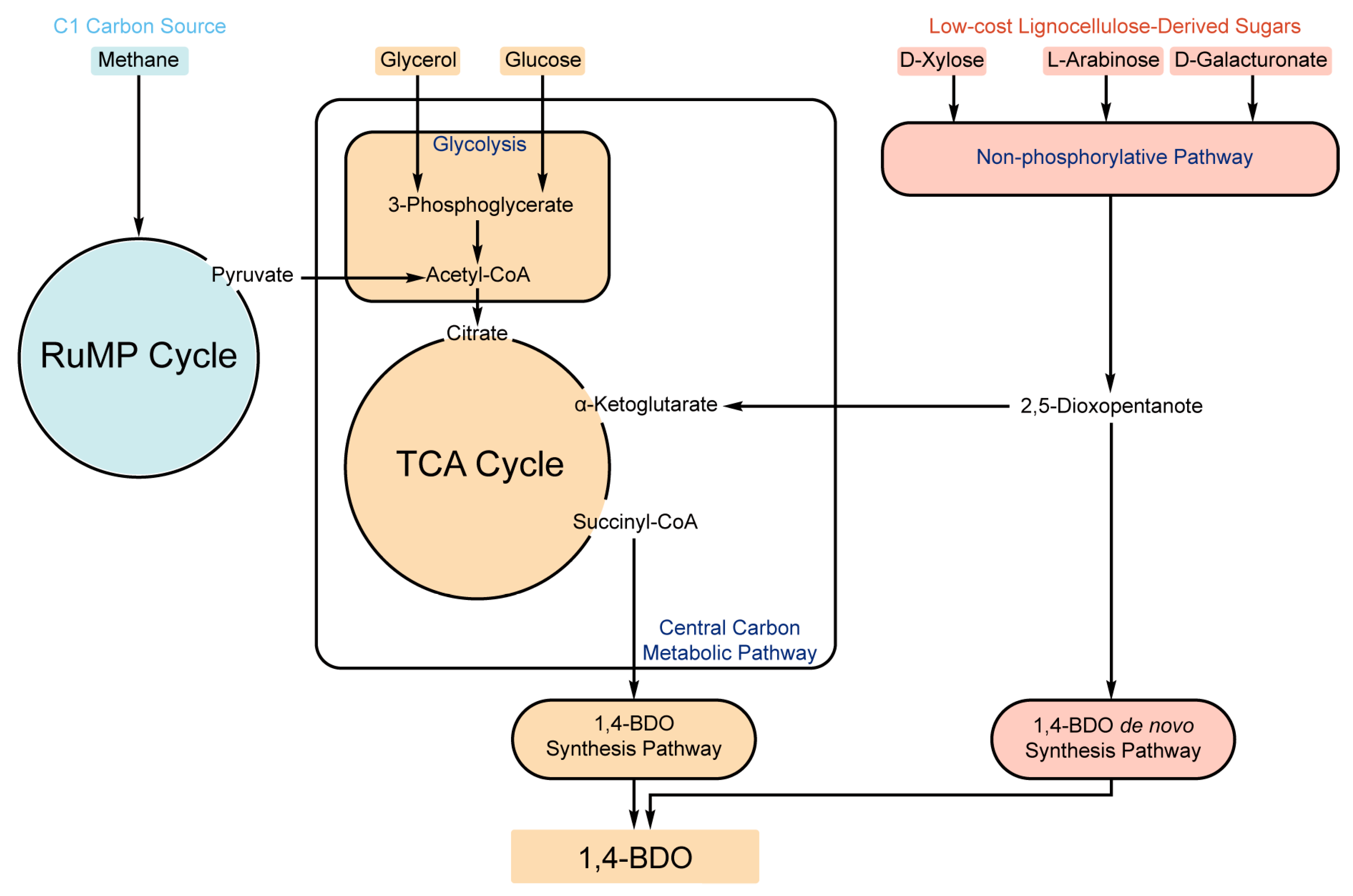
As a non-natural microbial metabolite, 1,4-BDO could be generated through artificially engineered metabolic pathways. To date, a series of studies have been reported on its biosynthesis in various bacterial hosts (Table 1). The main strategies for constructing downstream 1,4-BDO pathways include (i) the CCM pathway, which utilizes intermediates from the central metabolism as precursors; (ii) the non-phosphorylative pathway, which employs lignocellulose-derived sugars as substrates; and (iii) the synthetic pathway, based on one carbon compounds as substrates (Figure 1).

3. 1,4-BDO Biosynthesis Through Central Carbon Metabolic Pathway

In the CCM pathway, carbon sources are metabolized through glycolysis or the pentose phosphate (PP) pathway before entering the tricarboxylic acid (TCA) cycle [31,32,33]. This process generates key metabolic precursors—such as α-ketoglutarate, succinyl-CoA, and succinate—that feed into the downstream 1,4-BDO biosynthetic pathway. The refined carbon sources with defined compositions, high purity, and stable metabolic efficiency provide the foundation for the synthetic efficiency and batch-to-batch stability [34].

3.1. 1,4-BDO Biosynthesis Through CCM Pathway from Glucose

Glucose has become the preferred refined carbon source in most synthetic biology approaches because of its high compatibility with the native metabolic networks and its superior carbon-conversion efficiency in many chassis cells [35,36,37,38].
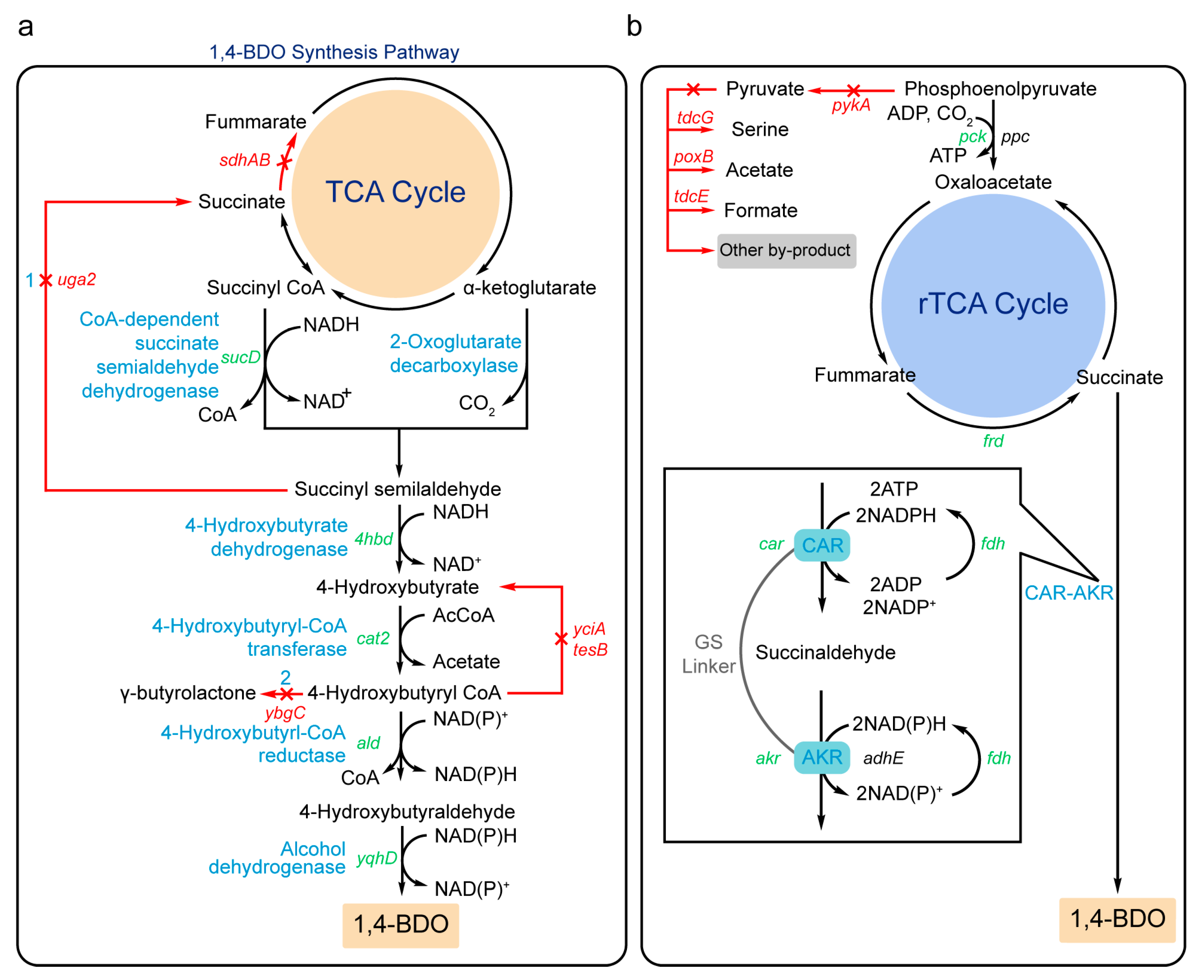
Recently, several studies have introduced modifications to the CCM pathway [24,25,26,27]. In a notable advancement beyond developing novel pathways, Yu et al. [24] achieved the highest reported 1,4-BDO production titer to date by systematically optimizing central carbon metabolism in E. coli (Figure 2a). For the downstream synthetic module, the authors identified an optimal enzyme combination through activity screening, i.e., succinate semialdehyde dehydrogenase and 4-hydroxybutyryl-CoA transferase from Porphyromonas gingivalis, 4-hydroxybutyrate dehydrogenase from Clostridium kluyveri, and aldehyde dehydrogenase from Clostridium beijerinckii. To address a key catalytic bottleneck, they subjected the rate-limiting aldehyde dehydrogenase (ALDH) to mutagenesis and identified an optimal mutant, M227V. This variant featured an enlarged hydrophobic active pocket, enhancing substrate affinity and ultimately increasing 1,4-BDO production by 11.19-fold. Furthermore, to eliminate dependence on inducers and antibiotics, the authors constructed a stable, auto-regulated fermentation system. They employed native E. coli regulatory elements to control pathway expression and integrated the hok/sok toxin–antitoxin system to ensure plasmid stability. This antibiotic-free design demonstrated high robustness, maintaining consistent 1,4-BDO production over 10 consecutive fermentation cycles. The final engineered strain, B21-pT19, produced 34.63 g/L of 1,4-BDO in a 72 h, 5 L fed-batch fermentation [24].
Traditionally, the biosynthetic pathway for 1,4-BDO begins with α-ketoglutarate and involves five to six enzymatic steps. A significant departure from this route is demonstrated in the work of Zhang et al. [39], which requires only one step (Figure 2b). Using E. coli ATCC 8739 as the host, Zhang et al. [39] engineered a pathway involving carboxylic acid reductase (CAR) and aldehyde reductase (AKR) for downstream synthesis of 1,4-BDO from glucose.
The researchers innovatively constructed a reductive tricarboxylic acid (rTCA) cycle by overexpressing genes encoding reductive enzymes (e.g., frd) within the TCA cycle. In the conventional aerobic catabolic TCA pathway, succinate serves only as an intermediate that is further oxidized, preventing the accumulation of this key precursor. In contrast, the rTCA cycle functions as an anabolic pathway under anaerobic conditions, enabling directed succinate synthesis and accumulation through CO2 fixation via phosphoenolpyruvate (PEP). Concurrently, genes encoding enzymes responsible for byproduct formation (e.g., pykA, tdcG) were knocked out to prevent carbon flux diversion during glycolysis. Additionally, the researchers fused the modified CAR and AKR enzymes using a glycine-serine (GS) linker to create a fusion protein (CAR-AKR). Furthermore, they retained the native adhE gene of E. coli, which encodes alcohol dehydrogenase. This enzyme helps degrade succinaldehyde, a toxic intermediate formed during the conversion process, thereby alleviating inhibitory effects on the host strain. As a result, 1,4-BDO production reached 4.62 g/L in a 5 L anaerobic fed-batch fermentation [39].
In the CCM pathway, the metabolic flux derived from glucose is channeled through CoA-level intermediates [40]. Byproducts mainly arise from two branching routes: the γ-butyrolactone branch, catalyzed by succinate semialdehyde dehydrogenase, and the succinate-producing branch, which involves esterase activity. To minimize carbon diversion and prevent the undesired reduction in key pathway intermediates, the researchers knocked out the genes encoding reducing enzymes, including sdhAB, yciA, and tesB. The formation of these byproducts decreases the overall conversion efficiency from glucose to 1,4-BDO [41].

3.2. 1,4-BDO Biosynthesis Through CCM Pathway from Glycerol

In addition to glucose, other carbon sources such as glycerol also show great potential as reductive substrates. As a byproduct of the biodiesel industry, crude glycerol is inexpensive [42]. Moreover, it provides stronger reducing power for synthetic pathways, making it an attractive alternative carbon source [34,43].
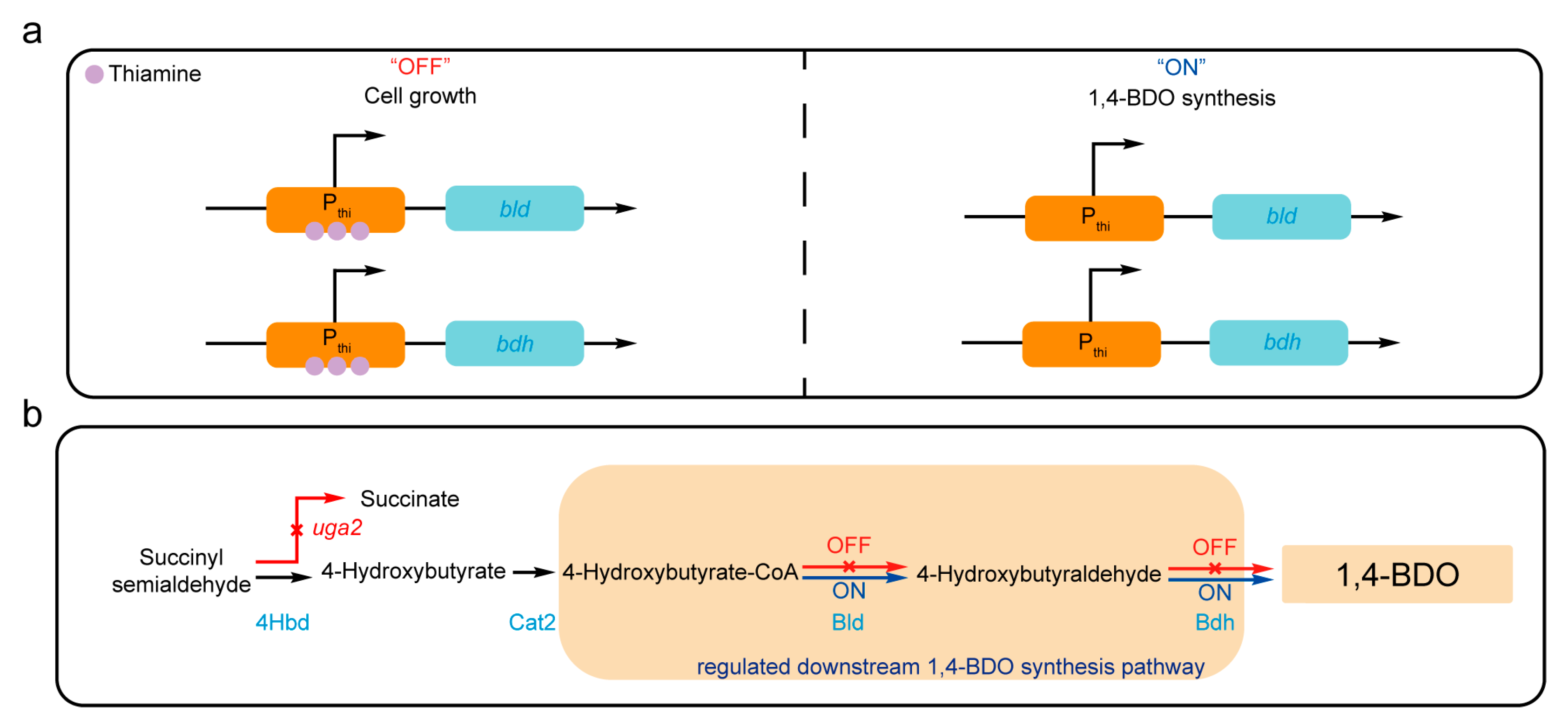
Guo et al. [25] constructed a de novo 1,4-BDO biosynthetic pathway in Y. lipolytica and enhanced product formation using a thiamine-integrated dynamic regulation strategy (Figure 3). A heterologous 1,4-BDO synthesis pathway was constructed including 4-hydroxybutyrate dehydrogenase (4Hbd), 4-HB-CoA transferase 2 (Cat2), butyraldehyde dehydrogenase (Bld) and butanol dehydrogenase (Bdh). Initial experiments showed that the recombinant strain produced 85.9 mg/L of 1,4-BDO in shake flasks. In this system, thiamine functions as a regulatory switch controlling the activity of key enzymes. A dynamic regulation strategy was implemented to control bdh and bld expression in response to thiamine concentration. Specifically, these two genes were repressed in the presence of thiamine to favor cell growth and derepressed upon thiamine depletion to redirect metabolic flux toward 1,4-BDO synthesis (Figure 3). During early-stage fermentation, thiamine supplementation keeps the thiamine-responsive promoter in the “off” state, preventing unnecessary enzyme expression and conserving cellular resources. As thiamine becomes depleted in the later stage, the promoter switches “on,” enabling a dynamic transition from cell growth to product synthesis. Further optimization improved 1,4-BDO production through thiamine dosage adjustment, promoter enhancement in the upstream module, and deletion of uga2 to prevent flux loss. The resulting strain DP-ΔU2G1K1 produced 3.76 g/L of 1,4-BDO in shake flasks and 6.22 g/L in a 3 L fed-batch fermentation—representing a 72-fold increase over the parent strain. This work not only demonstrates the potential of Y. lipolytica for synthesizing the non-natural compound 1,4-BDO but also provides valuable insights into balancing heterologous pathways and central metabolic flux through dynamic regulation [25].
Liu et al. [27] engineered E. coli to efficiently convert crude glycerol into 1,4-BDO. Researchers heterologously introduced the typical CCM pathway into E. coli JM109 (DE3), constructing the engineered strain 1,4-BDO-T1. Using glucose as the substrate, this strain achieved a 1,4-BDO yield of 0.055 g/g. Subsequent experiments highlighted the advantages of glycerol: its stronger reducing power promoted the synthesis of 1,4-BDO while decreased the byproduct accumulation. To further enhance the production of 1,4-BDO, the researchers constructed strain 1,4-BDO-T3 by overexpressing sucA, which encoding a subunit of α-ketoglutarate dehydrogenase. Using pure glycerol as the substrate, the yield increased to 0.080 g/g. To address rate-limiting steps caused by enzymes such as catalase and butanediol dehydrogenase in the classical pathway, a CAR was introduced to create a one-step synthetic route from 4-Hydroxybutyric Acid to 4-Hydroxybutyraldehyde, resulting in strain 1,4-BDO-N5. Strain 1,4-BDO-N5 maintained a comparable yield of 0.076 g/g when crude glycerol was used. Notably, after 48 h of fermentation, nearly all glycerol was consumed. To verify industrial potential, fed-batch fermentation of 1,4-BDO-N5 was performed in a 5 L bioreactor. A two-stage culture strategy was employed, with 20 g/L glycerol supplemented at the 24 h. Ultimately, the 1,4-BDO yield increased to 0.14 g/g [27].
Collectively, these studies addressed the issues of low enzyme expression levels and metabolic flux competition between heterologous and autologous pathways, aiming to efficiently direct carbon flux toward the bioproduction of 1,4-BDO.

4. 1,4-BDO Biosynthesis Through Non-Phosphorylative Pathway

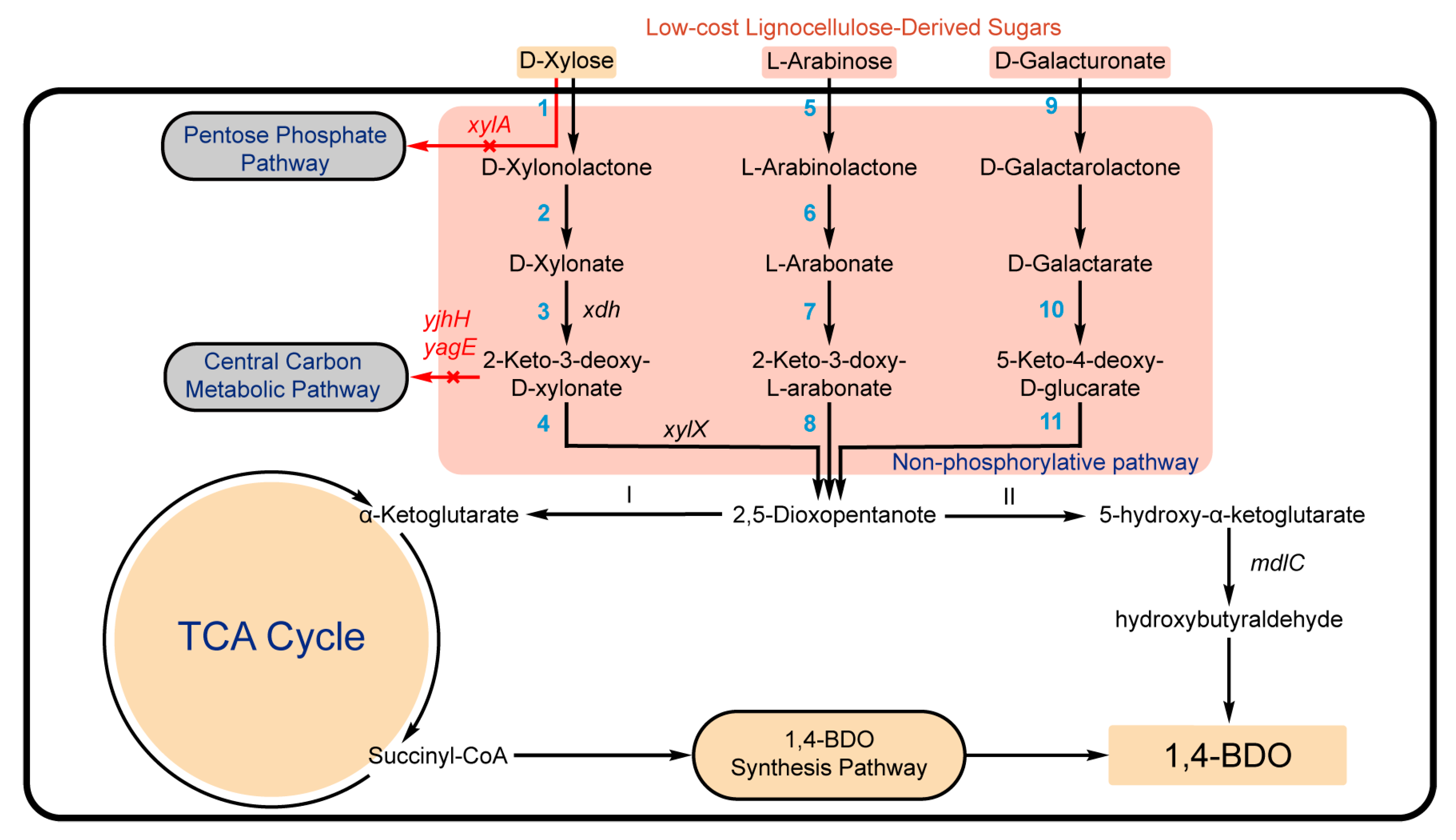
In the biomanufacturing of 1,4-BDO using E. coli, the high cost of high-purity monosaccharide feedstocks significantly limits its industrial-scale production. This limitation arises because the traditional phosphorylated pathway depends on refined carbon sources, which not only incur high feedstock costs but also require strict phosphate dependence and strong carbon catabolite repression [44]. To address this bottleneck, recent research has focused on using industrial waste streams rich in mixed sugars particularly lignocellulosic hydrolysates as alternative carbon sources. These studies employ non-phosphorylative pathways to generate 1,4-BDO [28,29] (Figure 4).
The non-phosphorylative pathways can significantly shorten the conversion feedstocks into α-ketoglutarate, a critical precursor of 1,4-BDO (Figure 4). Moreover, multiple studies have confirmed that developing non-phosphorylative metabolic pathways can significantly reduce feedstock costs and improve the sustainability of the entire bioprocess [45,46,47,48]. Lignocellulose, the most abundant renewable industrial waste on Earth, yields hydrolysates containing various sugars (e.g., glucose, xylose, arabinose), making it a highly promising, low-cost alternative feedstock [49,50,51].
Tai et al. [29] developed a non-phosphorylative metabolic platform by introducing a heterologous gene cluster into an engineered E. coli strain. This platform enabled the complete conversion of carbon sources including D-xylose, L-arabinose, and D-galacturonic acid into the TCA cycle intermediate α-ketoglutarate via non-phosphorylative metabolism (Figure 4). The researchers further designed a synthetic pathway, optimized the screening of α-keto acid decarboxylase and alcohol dehydrogenase enzymes, and obtained an α-keto acid decarboxylase V461I variant through protein engineering to enhance substrate selectivity. Each engineered pathway consisted of fewer than six enzymatic steps. Ultimately, the 1,4-BDO yields reached 0.26 g/g, 0.22 g/g, and 0.33 g/g when using D-xylose, L-arabinose, and D-galacturonic acid, respectively, as carbon sources in a 1.3 L bioreactor. These results validated the potential of the non-phosphorylative metabolic platform, providing a theoretical foundation for the high-value utilization of lignocellulosic biomass [29].
Among lignocellulose-derived sugars, xylose is the second most abundant in lignocellulosic hydrolysates (after glucose), and thus represents a major focus of research in this field. Liu et al. [28] selected heterogenous genes including xylX (encoding 2-deoxy-3-deoxy-D-xylulose dehydratase from Caulobacter crescentus) and mdlC (encoding ketoacid decarboxylase from Pseudomonas putida) genes from multiple candidates and incorporated them into E. coli to construct a de novo xylose conversion pathway that functions without phosphorylation activation. Using this pathway, the traditional 1,4-BDO synthesis route achieved a yield of 0.056 g/g. In this seven-step de novo pathway, metabolic engineering was performed to eliminate carbon diversion: xylA was deleted to inactivate D-xylose isomerase and block the PP pathway, while yjhH and yagE were knocked out to remove 2-dehydro-3-deoxy-D-xylonate aldolase activity, preventing intermediates from entering the CCM pathway.
Currently, non-phosphorylative pathways that operate through direct oxidation and dehydration reactions reduce energy consumption and phosphate dependence, making them especially suitable for industrial waste valorization [45,52]. However, challenges such as low substrate transport efficiency, suboptimal performance of key enzymes, and by-product accumulation continue to limit carbon-conversion efficiency compared to CCM pathways that utilize refined carbon sources.

5. 1,4-BDO Biosynthesis from One-Carbon Compounds

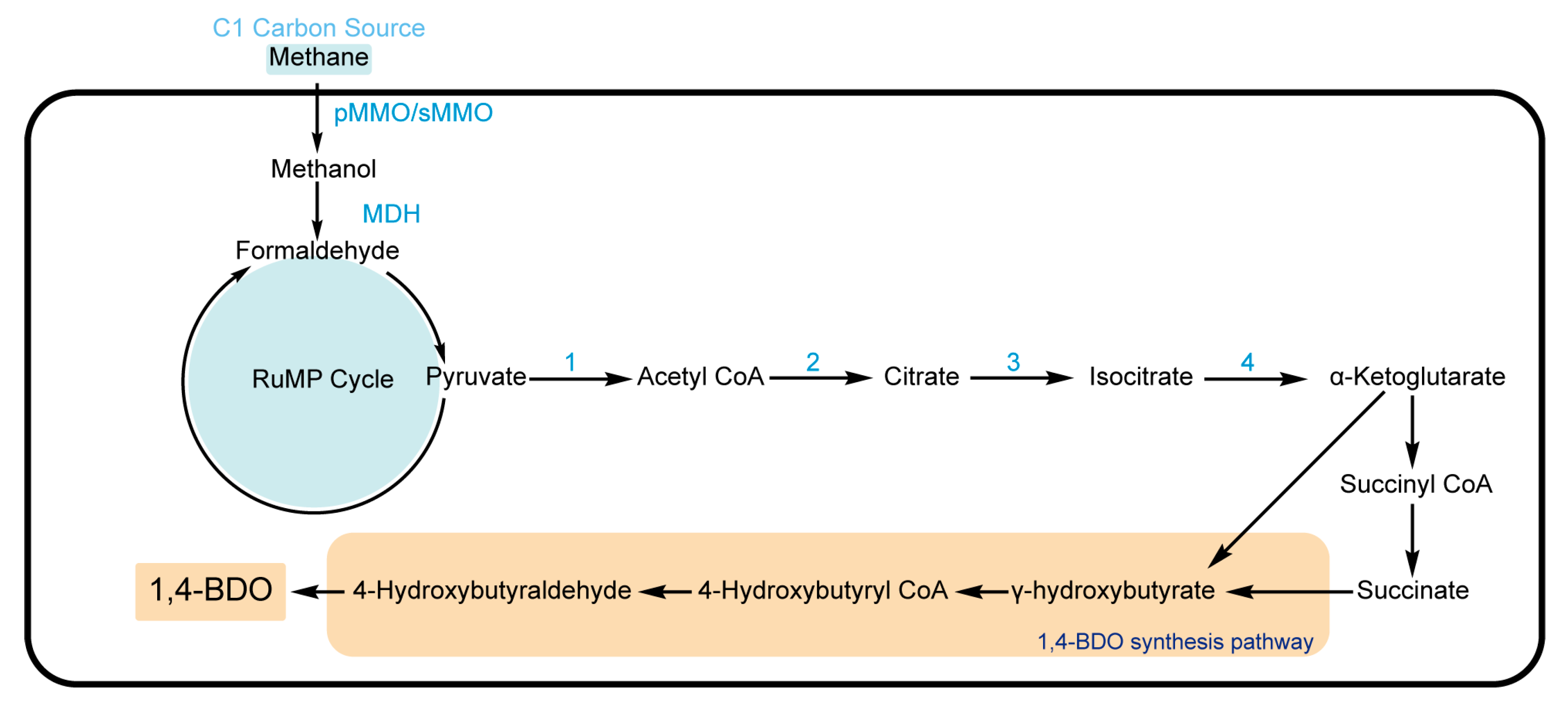
One-carbon (C1) compounds have emerged as promising feedstocks for 1,4-BDO biosynthesis due to their high availability and low cost. Zhao et al. [30] constructed a 1,4-BDO production platform by introducing modular heterologous gene clusters into Methylococcus capsulatus (Figure 5). This study leveraged the native C1 metabolic pathway of the methanotrophic host, which oxidizes methane to formaldehyde and subsequently converts it to pyruvate via the ribulose monophosphate (RuMP) cycle. Pyruvate was then directed through a series of four to five enzymatic steps to generate α-ketoglutarate and succinate, two key precursors for 1,4-BDO synthesis. To bridge the endogenous metabolism of M. capsulatus with the downstream 1,4-BDO biosynthetic pathway, the researchers introduced heterologous aceEF, gltA, acnA, and icdA genes from E. coli to establish a route from pyruvate to the required intermediates. Despite this genetic engineering, the engineered strain still accumulated insufficient levels of key precursors, including α-ketoglutarate and γ-hydroxybutyrate, rendering 1,4-BDO production virtually dependent on precursor supplementation. Indeed, only under optimized fermentation conditions with the addition of 0.4 g/L α-ketoglutarate and 0.05 mg/L γ-hydroxybutyrate did the strain achieve a final 1,4-BDO titer of 1.37 g/L [30].
The current process’s reliance on supplemented α-ketoglutarate and γ-hydroxybutyrate highlights the need for future efforts to achieve fully autonomous 1,4-BDO production solely from methane. Achieving this goal will require comprehensive metabolic engineering, including optimization of heterologous pathway, enhancement of enzyme kinetics, and redirection of carbon flux to increase precursor supply.

6. The Challenges and Perspectives in the Bio-Production of 1,4-BDO

The bio-based production of 1,4-BDO represents an eco-friendly and promising strategy for sustainable chemical manufacturing. Research on 1,4-BDO biosynthesis has progressed beyond the exploratory stage and is now entering the critical phase of route optimization. Although challenges such as low yield and high production costs remain, several promising avenues for technological advancement have emerged. These include the industrialization potential of central carbon metabolic pathways, the cost competitiveness of non-phosphorylative routes, and the carbon neutrality achievable through C1 compound-based biosynthetic systems.
While substantial progress has been made in laboratory-scale fundamental research, the industrial application of bio-based 1,4-BDO production continues to face multiple challenges. The primary bottlenecks hindering the industrial translation of bio-based 1,4-BDO production are three-fold. First, the inherent inefficiency of engineered metabolic pathways remains a major obstacle. This is frequently manifested through the low expression levels and inadequate catalytic activity of key heterologous enzymes. As demonstrated in the study by Zhao et al. [30], the heterologous pathway failed to sustain stable 1,4-BDO production without external precursor supplementation, highlighting a critical dependency that limits autonomous biosynthesis. Second, cellular metabolic function is adversely affected by intermediate toxicity and the inherent trade-off between cell growth and product synthesis. During rapid glucose consumption in central carbon metabolism, excess pyruvate accumulation diverts carbon flux toward competing byproducts. Moreover, the 1,4-BDO synthesis pathway itself generates toxic intermediates, such as succinate semialdehyde, which further inhibits cellular viability. This metabolic configuration creates direct competition for carbon flux and essential cofactors between biomass formation and product synthesis—a central challenge that remains to be resolved. Third, a significant gap exists between idealized laboratory conditions and industrial operational environments. While studies typically rely on pure, inhibitor-free carbon sources like glucose and sucrose, scalable processes must utilize complex and often inhibitory feedstocks, such as lignocellulosic hydrolysates or crude glycerol. These raw materials contain mixed sugars and fermentation inhibitors, which collectively impair microbial growth and carbon conversion efficiency.
The gap between laboratory-scale optimization and industrial implementation should be further studied in future research. A key strategy for advancing existing biosynthetic technologies lies in the application of cutting-edge synthetic biology tools to enable dynamic and precise control of metabolic flux. For instance, regulatory switches such as product concentration-responsive promoters demonstrate significant potential. They can be designed to automatically upregulate the expression of key enzymes while simultaneously downregulating genes responsible for byproduct synthesis (e.g., gabD, ybgC) in response to product accumulation. As a Complement, CRISPR interference (CRISPRi) can be deployed to dynamically modulate respiratory chain components, reducing aerobic metabolism during critical microaerobic phases and thereby redirecting carbon flux toward the desired product.
Furthermore, when selecting advanced microbial chassis and optimizing enzyme combinations, genome-scale metabolic models (GEMs) and flux balance analysis (FBA) can be employed to pinpoint gene targets for knockout or overexpression. In parallel, the performance of key enzymes can be enhanced through directed evolution and structure-guided rational design of active-site mutations. Additionally, multi-enzyme complexes connected by flexible linkers can be constructed to minimize the diffusion loss of intermediates and improve overall catalytic efficiency.
Finally, advances in industrial processing—such as high-efficiency in situ extraction and membrane separation technologies—are expected to enhance product purity and yield, complementing efforts in strain construction and evolution. Through interdisciplinary integration, these challenges can be overcome, paving the way for bio-based 1,4-BDO production that achieves both economic viability and environmental sustainability, thereby establishing a model for the green chemical industry.

Author Contributions

Writing—original draft preparation, K.Z. and W.Z.; writing—review and editing, K.Z., W.Z., L.X. and Y.L.; visualization, K.Z.; supervision, L.X. and Y.L. All authors have read and agreed to the published version of the manuscript.

Funding

This work is supported by the National Natural Science Foundation of China (No. U22A20540), the Shenzhen Science and Technology Plan Platform and Carrier Special Project (No. ZDSYS20220303153551001), and the Shenzhen Science and Technology Program (No. JCYJ20250604183238049).

Data Availability Statement

No new data were created or analyzed in this study. Data sharing is not applicable to this article.

Conflicts of Interest

The authors declare no conflicts of interest.

Abbreviations

The following abbreviations are used in this manuscript:
1,4-BDO1,4-Butanediol
4Hbd4-hydroxybutyrate dehydrogenase
AKRAldehyde reductase
ALDHAldehyde dehydrogenase
BdhButanol dehydrogenase
BldButyraldehyde dehydrogenase
C1One-carbon
CARCarboxylic acid reductase
Cat24-HB-CoA transferase 2
CCMCarbon metabolic pathway
CRISPRiCRISPR interference
FBAFlux balance analysis
GBLγ-butyrolactone
GEMsGenome-scale metabolic models
GS linkerGlycine-serine
PBATPoly(butylene adipate-co-terephthalate)
PBSPoly(butylene succinate)
PEPPhosphoenolpyruvate
PPPentose phosphate
rTCA cycleReductive tricarboxylic acid cycle
RuMP cycleRibulose monophosphate cycle
TCA cycleTricarboxylic acid cycle
THFTetrahydrofuran

References

  1. Du, Z.; Liu, B.; Liu, X.; Liu, L.; Liang, C.; Yao, S.; Qin, C. Study on high efficiency separation of low condensation lignin and its dissolution mechanism by 1,4 butanediol combined with p-toluene sulfonic acid pretreatment system. Sep. Purif. Technol. 2024, 360, 131059. [Google Scholar] [CrossRef]
  2. Dong, C.; Meng, X.; Yeung, C.S.; Tse, H.-Y.; Ragauskas, A.J.; Leu, S.-Y. Diol pretreatment to fractionate a reactive lignin in lignocellulosic biomass biorefineries. Green Chem. 2019, 21, 2788–2800. [Google Scholar] [CrossRef]
  3. Coralli, I.; Rombolà, A.G.; Fabbri, D. Analytical pyrolysis of the bioplastic PBAT poly(butylene adipate-co-terephthalate). J. Anal. Appl. Pyrolysis 2024, 181, 106577. [Google Scholar] [CrossRef]
  4. Ratshoshi, B.K.; Farzad, S.; Görgens, J.F. A techno-economic study of Polybutylene adipate terephthalate (PBAT) production from molasses in an integrated sugarcane biorefinery. Food Bioprod. Process. 2024, 145, 11–20. [Google Scholar] [CrossRef]
  5. Zhang, H.; Jiang, M.; Wu, Y.; Li, L.; Wang, Z.; Wang, R.; Zhou, G. Development of completely furfural-based renewable polyesters with controllable properties. Green Chem. 2021, 23, 2437–2448. [Google Scholar] [CrossRef]
  6. Lee, J.; Park, C.; Tsang, Y.F.; Lin, K.A. Towards Sustainable Production of Polybutylene Adipate Terephthalate: Non-Biological Catalytic Syntheses of Biomass-Derived Constituents. ChemSusChem 2024, 17, e202401070. [Google Scholar] [CrossRef]
  7. Flores Fernández, Y.; Pacheco-Romeralo, M.; Mboumba, E.; Alla, A.; Lagaron, J.M.; López Granados, M.; Martínez de Ilarduya, A.; Perret, N.; Torres-Giner, S. High-Pressure Catalytic Hydrogenation of Renewable Succinic Acid to 1,4-Butanediol for the Synthesis of Fully Bio-Based Poly(butylene succinate). ACS Sustain. Chem. Eng. 2025, 13, 8220–8233. [Google Scholar] [CrossRef]
  8. Haas, T.; Jaeger, B.; Weber, R.; Mitchell, S.F.; King, C.F. New diol processes: 1,3-propanediol and 1,4-butanediol. Appl. Catal. A Gen. 2005, 280, 83–88. [Google Scholar] [CrossRef]
  9. Zhu, Y.; Yang, J.; Mei, F.; Li, X.; Zhao, C. Bio-based 1,4-butanediol and tetrahydrofuran synthesis: Perspective. Green Chem. 2022, 24, 6450–6466. [Google Scholar] [CrossRef]
  10. Vaddeboina, V.; Kannapu, H.P.R.; Jeon, J.-K.; Park, Y.-K.; Bhaskar, K. Coupling of nitrobenzene hydrogenation and 1,4-butanediol dehydrogenation for the simultaneous synthesis of aniline and γ-butyrolactone over copper-based catalysts. Korean J. Chem. Eng. 2021, 39, 109–115. [Google Scholar] [CrossRef]
  11. Gidyonu, P.; Nagu, A.; Gundekari, S.; Varkolu, M. Formic acid assisted synthesis of Cu-CuO-ZnO composite catalyst for acceptor free selective dehydrogenation of 1,4-butanediol to γ-butrylactone. Catal. Commun. 2024, 187, 106870. [Google Scholar] [CrossRef]
  12. Grand View Research. 1,4 Butanediol Market Size, Share & Trends Analysis Report by Application (Tetrahydrofuran (THF), Polybutylene Terephthalate (PBT), Polyurethane), by, Drivers, by Opportunities & Restraints, by Region, and Segment Forecasts, 2025–2030. Available online: https://www.grandviewresearch.com/industry-analysis/1-4-butanediol-market (accessed on 23 November 2025).
  13. Rosenboom, J.-G.; Langer, R.; Traverso, G. Bioplastics for a circular economy. Nat. Rev. Mater. 2022, 7, 117–137. [Google Scholar] [CrossRef]
  14. Zhang, M.; Sun, Y.; Wang, L.; Gong, H.; Chen, Y. The microscopic mechanisms and essential factors governing regioselectivity in Rh-catalyzed hydroformylation of allyl acetate via DFT and microkinetic modeling. J. Catal. 2025, 450, 116307. [Google Scholar] [CrossRef]
  15. Mao, L.; Li, H.; Zhang, Y.; Wu, C. Preparing Coal Water Slurry from BDO Tar to Achieve Resource Utilization: Combustion Process of BDO Tar-Coal Water Slurry. Energy Fuels 2019, 33, 10297–10306. [Google Scholar] [CrossRef]
  16. Wang, D.; Li, Y.; Yang, Y.; Liao, Z.; Hong, X.; Liu, S. Process reconfiguration for the production of 1,4-butanediol integrating coal with off-grid renewable electricity. Int. J. Hydrog. Energy 2025, 102, 1295–1305. [Google Scholar] [CrossRef]
  17. Nyambuu, U.; Semmler, W. Trends in the extraction of non-renewable resources: The case of fossil energy. Econ. Model. 2014, 37, 271–279. [Google Scholar] [CrossRef]
  18. Meng, Q.; Hou, M.; Liu, H.; Song, J.; Han, B. Synthesis of ketones from biomass-derived feedstock. Nat. Commun. 2017, 8, 14190. [Google Scholar] [CrossRef]
  19. Suparmin, P.; Purwanti, N.; Oscar Nelwan, L.; Halomoan Tambunan, A. Syngas production by biomass gasification: A meta-analysis. Renew. Sustain. Energy Rev. 2024, 206, 114824. [Google Scholar] [CrossRef]
  20. Chi, H.; Liang, Z.; Kuang, S.; Jin, Y.; Li, M.; Yan, T.; Lin, J.; Wang, S.; Zhang, S.; Ma, X. Electrosynthesis of ethylene glycol from biomass glycerol. Nat. Commun. 2025, 16, 979. [Google Scholar] [CrossRef] [PubMed]
  21. Bai, Y.; Feng, H.; Liu, N.; Zhao, X. Biomass-Derived 2,3-Butanediol and Its Application in Biofuels Production. Energies 2023, 16, 5802. [Google Scholar] [CrossRef]
  22. Silva, R.G.C.; Ferreira, T.F.; Borges, É.R. Identification of potential technologies for 1,4-Butanediol production using prospecting methodology. J. Chem. Technol. Biotechnol. 2020, 95, 3057–3070. [Google Scholar] [CrossRef]
  23. Yang, Y.; Seo, K.; Kim, J.; Won, W. Biodegradable Plastic Production: Economic and Environmental Perspective. ACS Sustain. Chem. Eng. 2025, 13, 923–935. [Google Scholar] [CrossRef]
  24. Yu, T.; Zhou, J.; Chen, Y.; Wang, F.; Li, X.; Shen, J.; Liu, Z.; Zheng, Y. Sustainable antibiotic-free high-yield 1,4-butanediol production by engineered aldehyde dehydrogenase and carbon flux remodeling in Escherichia coli. Chem. Eng. J. 2025, 520, 166542. [Google Scholar] [CrossRef]
  25. Guo, H.; Zeng, Y.; Zhu, M.; Huang, T.; Wang, W.; Madzak, C.; Zhao, J.; Sun, X.; Chen, H.; Chen, G. Enhanced 1,4-Butanediol de Novo Synthesis in Yarrowia lipolytica by Incorporating Dynamic Regulation of Thiamine. ACS Synth. Biol. 2025, 14, 2572–2583. [Google Scholar] [CrossRef] [PubMed]
  26. Yim, H.; Haselbeck, R.; Niu, W.; Pujol-Baxley, C.; Burgard, A.; Boldt, J.; Khandurina, J.; Trawick, J.D.; Osterhout, R.E.; Stephen, R.; et al. Metabolic engineering of Escherichia coli for direct production of 1,4-butanediol. Nat. Chem. Biol. 2011, 7, 445–452. [Google Scholar] [CrossRef]
  27. Liu, H.; Liu, S.; Ning, Y.; Zhang, R.; Deng, L.; Wang, F. Metabolic engineering of Escherichia coli for efficient production of 1,4-butanediol from crude glycerol. J. Environ. Chem. Eng. 2023, 12, 111660. [Google Scholar] [CrossRef]
  28. Liu, H.; Lu, T. Autonomous production of 1,4-butanediol via a de novo biosynthesis pathway in engineered Escherichia coli. Metab. Eng. 2015, 29, 135–141. [Google Scholar] [CrossRef]
  29. Tai, Y.-S.; Xiong, M.; Jambunathan, P.; Wang, J.; Wang, J.; Stapleton, C.; Zhang, K. Engineering nonphosphorylative metabolism to generate lignocellulose-derived products. Nat. Chem. Biol. 2016, 12, 247–253. [Google Scholar] [CrossRef]
  30. Zhao, X.; Huynh, T.; Orth, J.; Chao, L.Y.; Kealey, J. Methods and Microorganisms for Making 1,4-Butanediol and Derivatives Thereof from C1 Carbons. Canadian Patent Application No. 3055612, 20 September 2018. [Google Scholar]
  31. Schink, S.J.; Christodoulou, D.; Mukherjee, A.; Athaide, E.; Brunner, V.; Fuhrer, T.; Bradshaw, G.A.; Sauer, U.; Basan, M. Glycolysis/gluconeogenesis specialization in microbes is driven by biochemical constraints of flux sensing. Mol. Syst. Biol. 2022, 18, e10704. [Google Scholar] [CrossRef]
  32. Westfall, C.S.; Levin, P.A. Comprehensive analysis of central carbon metabolism illuminates connections between nutrient availability, growth rate, and cell morphology in Escherichia coli. PLoS Genet. 2018, 14, e1007205. [Google Scholar] [CrossRef]
  33. Jahan, N.; Maeda, K.; Matsuoka, Y.; Sugimoto, Y.; Kurata, H. Development of an accurate kinetic model for the central carbon metabolism of Escherichia coli. Microb. Cell Factories 2016, 15, 112. [Google Scholar] [CrossRef] [PubMed]
  34. Kumar, L.R.; Yellapu, S.K.; Tyagi, R.D.; Zhang, X. A review on variation in crude glycerol composition, bio-valorization of crude and purified glycerol as carbon source for lipid production. Bioresour. Technol. 2019, 293, 122155. [Google Scholar] [CrossRef]
  35. Sakae, K.; Nonaka, D.; Kishida, M.; Hirata, Y.; Fujiwara, R.; Kondo, A.; Noda, S.; Tanaka, T. Caffeic acid production from glucose using metabolically engineered Escherichia coli. Enzym. Microb. Technol. 2023, 164, 110193. [Google Scholar] [CrossRef]
  36. Long, B.H.D.; Matsubara, K.; Tanaka, T.; Ohara, H.; Aso, Y. Production of glycerate from glucose using engineered Escherichia coli. J. Biosci. Bioeng. 2023, 135, 375–381. [Google Scholar] [CrossRef]
  37. Bennett, R.K.; Dillon, M.; Gerald Har, J.R.; Agee, A.; von Hagel, B.; Rohlhill, J.; Antoniewicz, M.R.; Papoutsakis, E.T. Engineering Escherichia coli for methanol-dependent growth on glucose for metabolite production. Metab. Eng. 2020, 60, 45–55. [Google Scholar] [CrossRef]
  38. Li, M.; Zhang, Y.; Li, J.; Tan, T. Biosynthesis of 1,3-Propanediol via a New Pathway from Glucose in Escherichia coli. ACS Synth. Biol. 2023, 12, 2083–2093. [Google Scholar] [CrossRef]
  39. Zhang, Z.; Liu, L.-H.; Yang, M.; Cui, H.; He, Q.; Zheng, X.; Yang, G.; Wang, H.; Zhang, Y.; Wu, Y.-R.; et al. Engineering Escherichia coli for robustly producing succinic acid and 1,4-butanediol together. Sustain. Mater. Technol. 2024, 43, e01223. [Google Scholar] [CrossRef]
  40. Noor, E.; Eden, E.; Milo, R.; Alon, U. Central Carbon Metabolism as a Minimal Biochemical Walk between Precursors for Biomass and Energy. Mol. Cell 2010, 39, 809–820. [Google Scholar] [CrossRef] [PubMed]
  41. Wu, M.-Y.; Sung, L.-Y.; Li, H.; Huang, C.-H.; Hu, Y.-C. Combining CRISPR and CRISPRi Systems for Metabolic Engineering of E. coli and 1,4-BDO Biosynthesis. ACS Synth. Biol. 2017, 6, 2350–2361. [Google Scholar] [CrossRef]
  42. Posada, J.A.; Rincón, L.E.; Cardona, C.A. Design and analysis of biorefineries based on raw glycerol: Addressing the glycerol problem. Bioresour. Technol. 2012, 111, 282–293. [Google Scholar] [CrossRef]
  43. D’Angelo, S.C.; Dall’Ara, A.; Mondelli, C.; Pérez-Ramírez, J.; Papadokonstantakis, S. Techno-Economic Analysis of a Glycerol Biorefinery. ACS Sustain. Chem. Eng. 2018, 6, 16563–16572. [Google Scholar] [CrossRef]
  44. Miklóssy, I.; Bodor, Z.; Sinkler, R.; Orbán, K.C.; Lányi, S.; Albert, B. In silico and in vivo stability analysis of a heterologous biosynthetic pathway for 1,4-butanediol production in metabolically engineered E. coli. J. Biomol. Struct. Dyn. 2016, 35, 1874–1889. [Google Scholar] [CrossRef]
  45. Watanabe, S.; Fukumori, F.; Nishiwaki, H.; Sakurai, Y.; Tajima, K.; Watanabe, Y. Novel non-phosphorylative pathway of pentose metabolism from bacteria. Sci. Rep. 2019, 9, 155. [Google Scholar] [CrossRef]
  46. Kopp, D.; Bergquist, P.L.; Sunna, A. Enzymology of Alternative Carbohydrate Catabolic Pathways. Catalysts 2020, 10, 1231. [Google Scholar] [CrossRef]
  47. Malán, A.K.; Tuleski, T.; Catalán, A.I.; de Souza, E.M.; Batista, S. Herbaspirillum seropedicae expresses non-phosphorylative pathways for d-xylose catabolism. Appl. Microbiol. Biotechnol. 2021, 105, 7339–7352. [Google Scholar] [CrossRef] [PubMed]
  48. Okano, K.; Zhu, Q.; Honda, K. In vitro reconstitution of non-phosphorylative Entner-Doudoroff pathway for lactate production. J. Biosci. Bioeng. 2019, 129, 269–275. [Google Scholar] [CrossRef]
  49. Wang, Z.; Xia, S.; Wang, X.; Fan, Y.; Zhao, K.; Wang, S.; Zhao, Z.; Zheng, A. Catalytic production of 5-hydroxymethylfurfural from lignocellulosic biomass: Recent advances, challenges and opportunities. Renew. Sustain. Energy Rev. 2024, 196, 114332. [Google Scholar] [CrossRef]
  50. Rath, S.; Pradhan, D.; Du, H.; Mohapatra, S.; Thatoi, H. Transforming lignin into value-added products: Perspectives on lignin chemistry, lignin-based biocomposites, and pathways for augmenting ligninolytic enzyme production. Adv. Compos. Hybrid Mater. 2024, 7, 1–29. [Google Scholar] [CrossRef]
  51. Dessbesell, L.; Paleologou, M.; Leitch, M.; Pulkki, R.; Xu, C. Global lignin supply overview and kraft lignin potential as an alternative for petroleum-based polymers. Renew. Sustain. Energy Rev. 2020, 123, 109768. [Google Scholar] [CrossRef]
  52. Domingues, R.; Bondar, M.; Palolo, I.; Queirós, O.; de Almeida, C.D.; Cesário, M.T. Xylose Metabolism in Bacteria—Opportunities and Challenges towards Efficient Lignocellulosic Biomass-Based Biorefineries. Appl. Sci. 2021, 11, 8112. [Google Scholar] [CrossRef]
Figure 1. Metabolic pathways for bio-based 1,4-BDO production. Various carbon sources are engineered to convert to 1,4-BDO through the CCM pathway (light-brown-shaded), the non-phosphorylative pathway (pink-shaded), the synthetic pathway based on one carbon compounds (blue-shaded) [28,29].
Processes 14 00221 g001
Figure 2. 1,4-BDO biosynthesis in E. coli based on central carbon metabolic pathway. Gene knockouts and overexpressions are indicated in red and green, respectively. The red arrows with cross indicate the branching byproducts pathway blocked by gene knock off. (a) The 1,4-BDO synthesis pathway from succinyl-CoA and α-ketoglutarate to 1,4-BDO [24]; Succinate pathway: succinyl-CoA synthetase first activates succinate to succinyl-CoA, followed by five further enzymes—including 4-HB-CoA transferase—to yield 1,4-BDO in six steps. α-Ketoglutarate pathway: irreversible decarboxylation by α-ketoglutarate decarboxylase yields succinate semialdehyde, which enters a CoA-dependent conversions to 1,4-BDO. 1, succinate semialdehyde dehydrogenase; 2, esterase [26]. (b) CAR-AKR fusion for elevated 1,4-BDO yield [39]. rTCA Cycle, reductive tricarboxylic acid cycle; CAR, carboxylic acid reductase; AKR, aldehyde reductase; CAR-AKR, carboxylic acid reductase and aldehyde reductase fused by GS Linker.
Processes 14 00221 g002
Figure 3. Thiamine-mediated dynamic regulation of 1,4-BDO synthesis pathway in Y. lipolytica. (a) Thiamine-mediated control achieves a growth-to-production shift: early supplementation keeps the promoter “off” to prevent wasteful expression, while late depletion turns it “on”, triggering 1,4-BDO synthesis. (b) The thiamine regulated 1,4-BDO metabolic pathway in E. coli, established by Guo et al. [25]. 4Hbd, 4-hydroxybutyrate dehydrogenase; Cat2, 4-HB-CoA transferase 2; Bld, 4-hydroxybutyraldehyde dehydrogenase; Bdh, butanediol dehydrogenase; Pthi, thiamine-dependent promoter. Gene knockouts and blocked byproduct pathways are represented by red markings and crossed arrows, respectively.
Processes 14 00221 g003
Figure 4. Non-phosphorylative metabolic pathway to 1,4-BDO from low-cost lignocellulose-derived sugars. 1, D-xylose dehydrogenase; 2, D-xylonolactonase; 3, D-xylonate dehydratase; 4, 2-keto-3-deoxy-D-xylonate dehydratase; 5, L-arabinose dehydrogenase; 6, L-arabinolactonase; 7, L-arabonate dehydratase; 8, 2-keto-3-deoxy-L-arabonate dehydratase; 9, D-galacturonate dehydrogenase; 10, D- galactarate dehydratase; 11, 5-keto-4-deoxy-D-glucarate dehydratase; I, non-phospholative pathway to produce 1,4-BDO by Tai et al. [29]; II, de novo pathway to produce 1,4-BDO by Liu et al. [28]. Heterogeneous genes are marked in blue in the figure.
Processes 14 00221 g004
Figure 5. C1 pathway for 1,4-BDO production in M. capsulatus. pMMO, particulate methane monooxygenase; sMMO, soluble methane monooxygenase; MDH, methanol dehydrogenase; RuMP Cycle, ribulose monophosphate cycle; 1, pyruvate dehydrogenase complex subunits; 2, citrate synthase; 3, aconitase A; 4, isocitrate dehydrogenase A. 1,4-BDO synthesis pathway and its final product 1,4-BDO are marked in light-brown in the figure.
Processes 14 00221 g005
Table 1. Comparison of selected microbial studies on 1,4-BDO biosynthesis.
Type 1YearStrainsSubstratesYield 2 (g/g)Production 3 (g/L)FermenterReferences
CCM2011E.coli ECKh-422Glucose0.37/Shake flask[26]
CCM2024E. coli JM109 1,4-BDO-N5Glycerol0.143755.755 L Bioreactor[27]
CCM2024E. coli JM109 1,4-BDO-N5Glycerol0.080421.31Shake flask[27]
CCM2024E. coli JM109 1,4-BDO-N570% crude glycerol0.076431.07Shake flask[27]
CCM2025Y. lipolytica MMGlycerol/0.3565Shake flask[25]
CCM2025E.coli B21-pT19Glucose/7.88Shake flask[24]
CCM2025E.coli B21-pT19Glucose0.3534.635 L Bioreactor[24]
NP2015E.coli EWCB3D-xylose0.0560.44Shake flask[28]
NP2016E. coli W3110L-arabinose0.285.65Shake flask[29]
NP2016E. coli W3110L-arabinose0.2215.61.3 L Bioreactor[29]
NP2016E. coli W3110D-xylose0.193.83Shake flask[29]
NP2016E. coli W3110D-xylose0.26121.3 L Bioreactor[29]
NP2016E. coli W3110D-Galacturonate0.122.34Shake flask[29]
NP2016E. coli W3110D-Galacturonate0.3316.51.3 L Bioreactor[29]
C12020M. capsulatus XZ76Methane/1.37Shake flask[30]
C12020M. capsulatus XZ344Methane/0.3Shake flask[30]
1 CCM, central carbon metabolic pathway; NP, non-phosphorylative pathway; C1, one-carbon pathway; 2 Yield: Efficiency of substrate convhhersion to BDO, calculated by 1,4-BDO produced (g)/substrate consumed (g); 3 Production: the final accumulation concentration of BDO.
Disclaimer/Publisher’s Note: The statements, opinions and data contained in all publications are solely those of the individual author(s) and contributor(s) and not of MDPI and/or the editor(s). MDPI and/or the editor(s) disclaim responsibility for any injury to people or property resulting from any ideas, methods, instructions or products referred to in the content.