Investigation of the Impact of Intensive EDM Regimes on Manufacturing Efficiency and Surface Quality of C120 Steel Parts

 , , , , , and
Abstract
1. Introduction
2. Materials and Methods
2.1. Experimental Conditions and Processed Material
2.2. Output Parameters
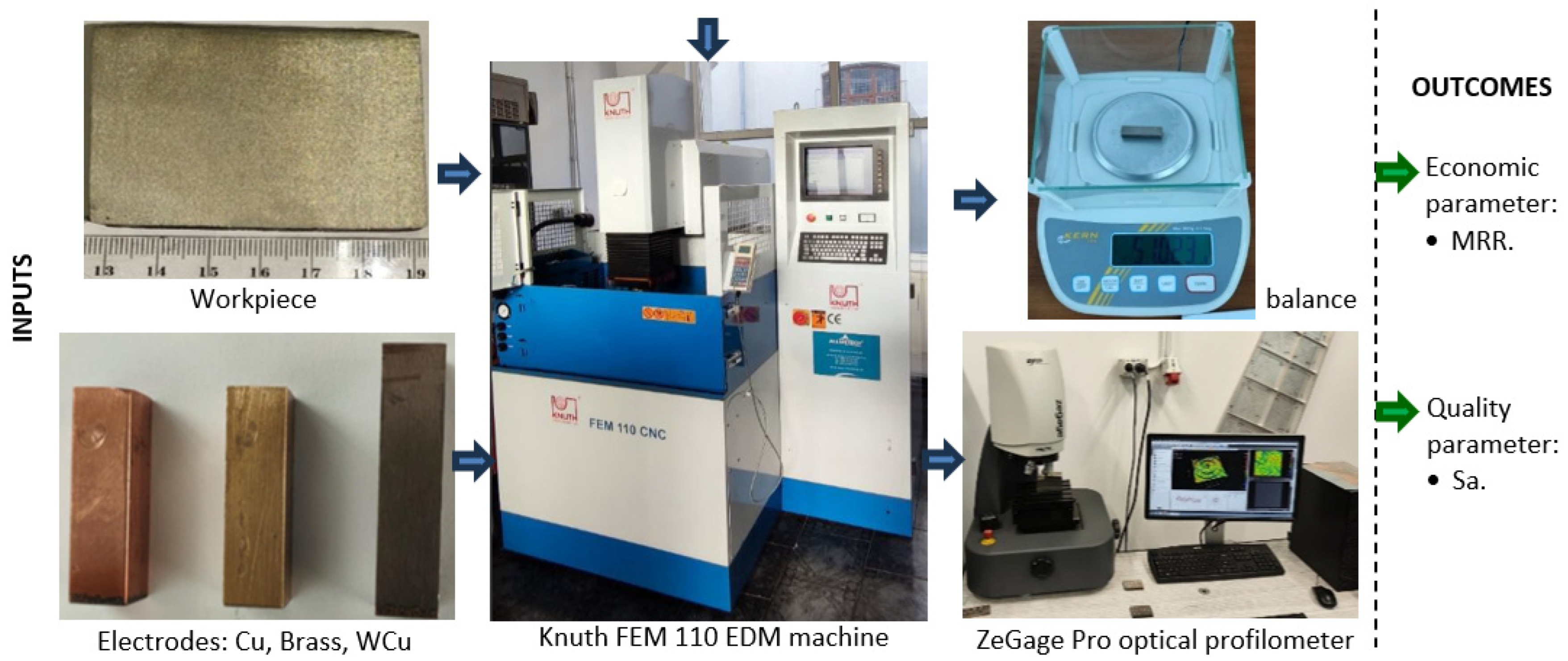
- a quality parameter—the surface roughness, Sa—used to quantify the quality of the machined surface.
3. Results and Discussion
3.1. Statistical Analysis of the Results
3.2. Regression Modeling of Material Removal Rate (MRR)
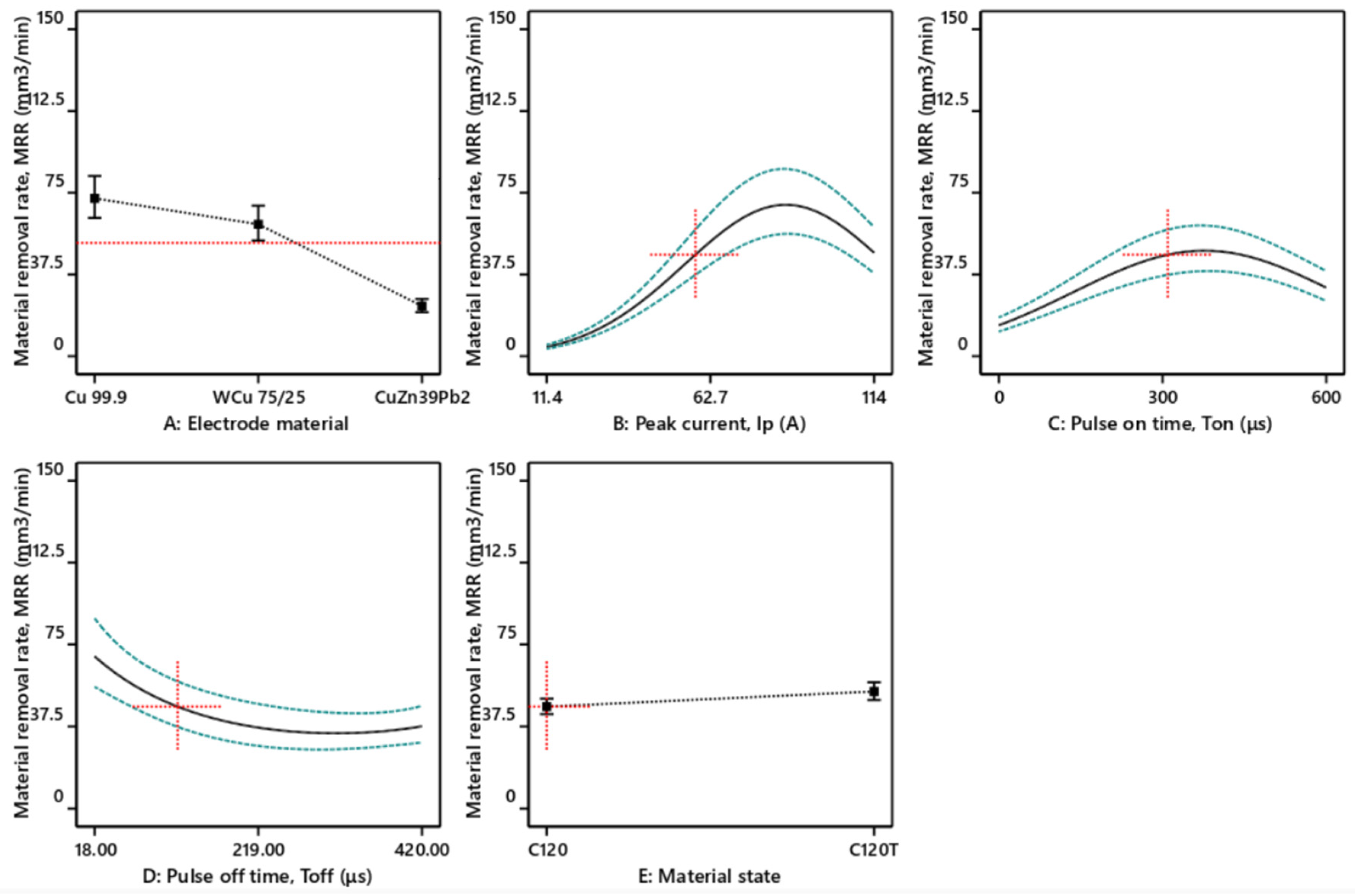
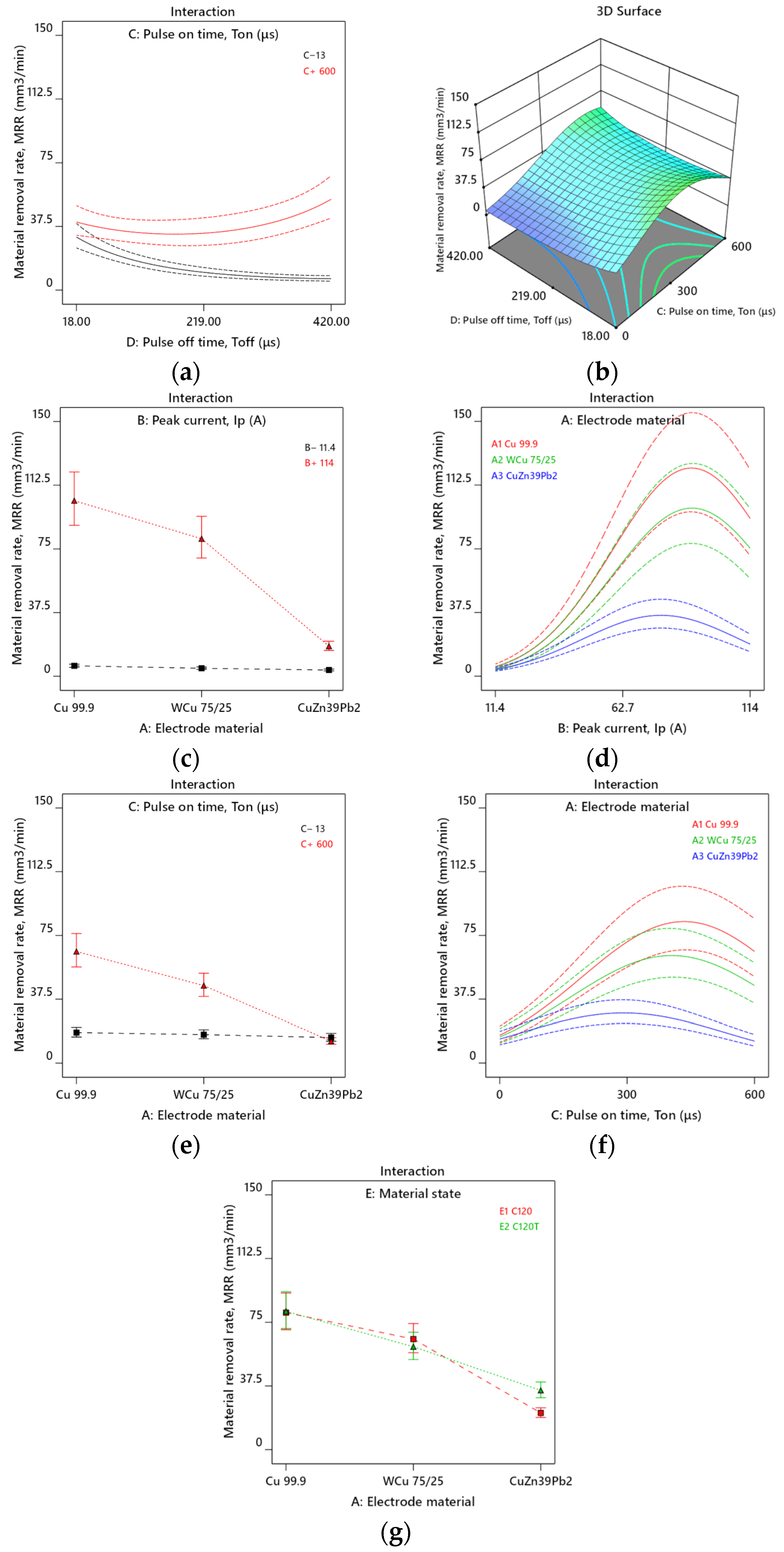
- The worst combination in terms of MRR consists of using large pulse-off time (Toff) and small pulse-on time (Ton) values (Figure 5a). This effect is diminished by minimizing Toff to the lowest limit (18 μs) and increasing Ton to around 300 μs; in this case, the highest possible MRR for this combination is obtained (Figure 5b). A significant reduction in MRR occurs when the values of these two parameters rise beyond these thresholds.
- The peak current effect on MRR is much more pronounced when machining with Cu 99.9 and Wcu 75/25 electrodes compared to the brass electrode CuZN39Pb2 when using a peak current of 114 A (Figure 5c). For low values of Ip, MRR values are not differentiated by the type of electrode material. Furthermore, for all variation curves, regardless of the electrode used, a maximum point is observed around 90 A, after which the peak-current effect on MRR is negative (Figure 5d).
- A similar variation can be observed in terms of the influence of pulse-on time (Ton) on MRR. At high Ton values (600 μs), the largest MRR is given by the Cu 99.9 electrode, followed by the Wcu 75/25 electrode. The MRR produced by the CuZn39Pb2 electrode is not influenced by Ton. For the 13 μs Ton, MRR values are almost the same for all electrode materials (Figure 5e). However, from Figure 5f it can be observed that MRR curves exhibit a maximum inflexion point, which for Cu 99.9 and Wcu 75/25 is around the interval 360–390 μs, while for the CuZn39Pb2 electrode the maximum is around 245 μs (Figure 5f). This shows that the increase in pulse-on time above a certain threshold is not necessarily beneficial and only increases the consumption of energy.
- The condition of the material does not influence the MRR, regardless of the electrode used for machining (Figure 5g).

- For the Cu 99.9 electrode:
- For the W/Cu 75/25 electrode:
- For the CuZn39Pb2 electrode:
3.3. Regression Modeling of Surface Roughness (Sa)
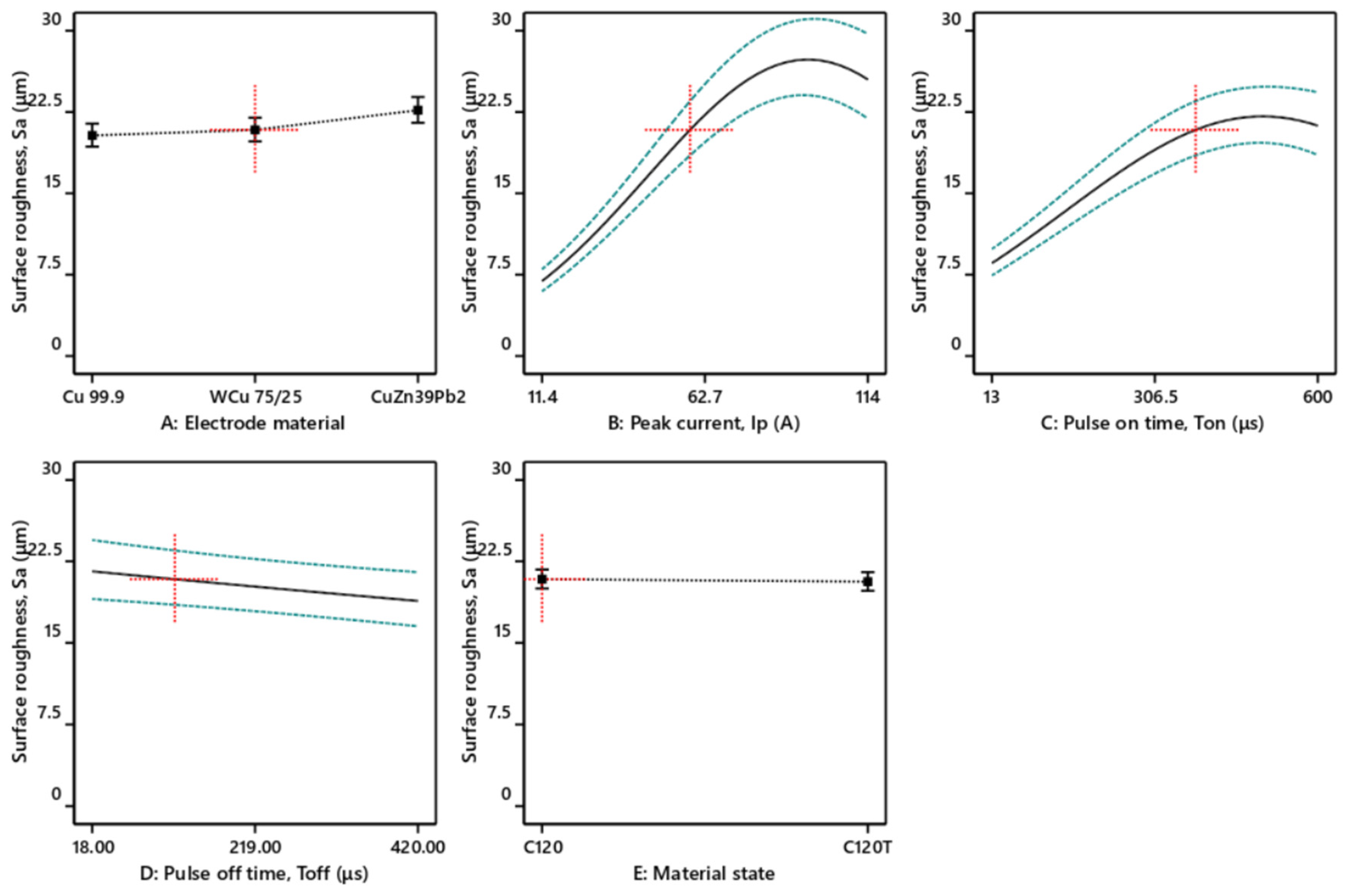
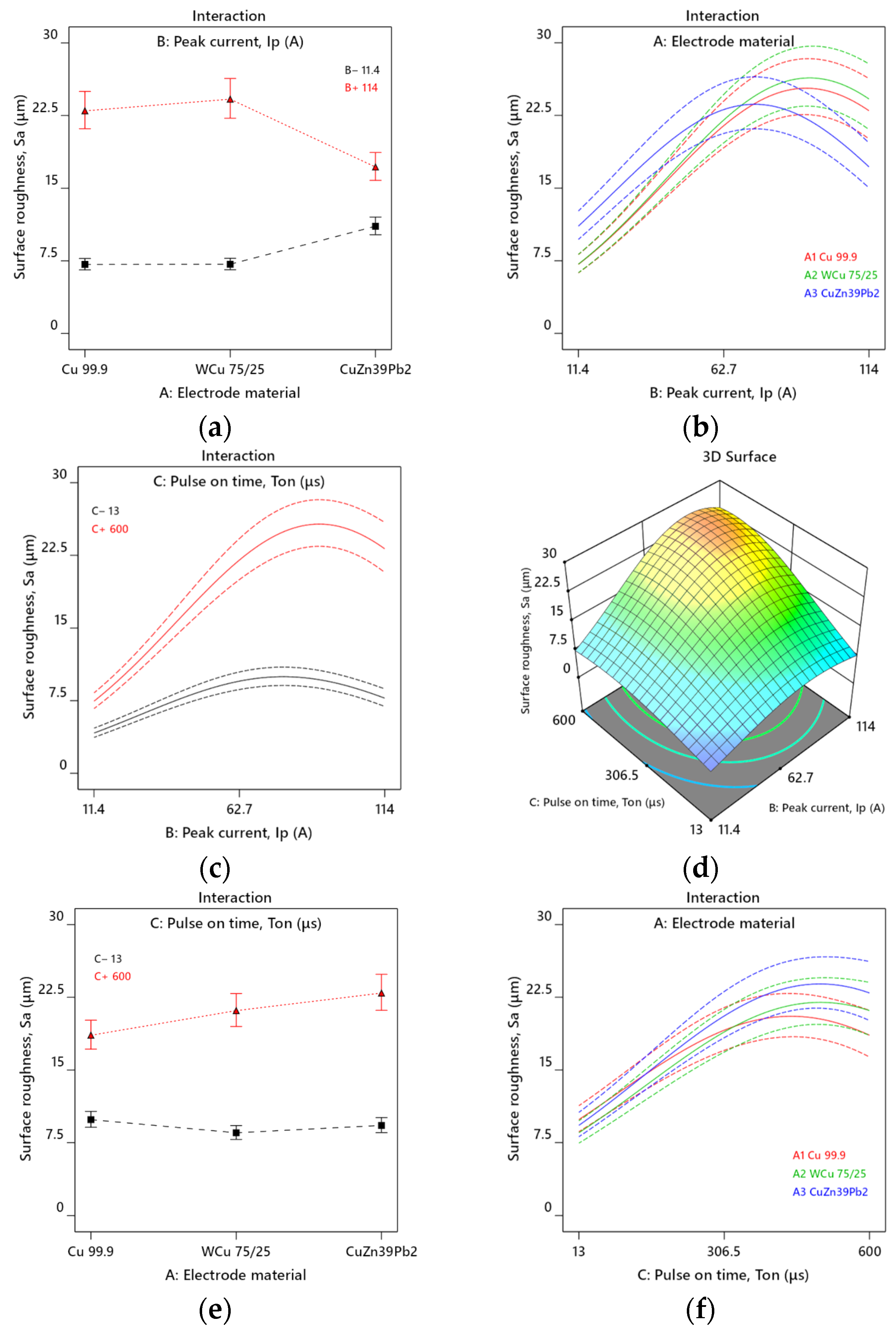
- The interaction electrode material—peak current (AB) reveals that for the larger currents (114 A), the brass electrode CuZn39Pb2 seems more favorable for a better surface quality by producing a lower value of surface roughness (Figure 7a). It can also be observed that the variation curves have maxima at around 100 A for the Cu99.9 and Wcu 75/25 electrodes, and approximately 67 A for the CuZn39Pb2 electrode (Figure 7b).
- The most favorable combination for an improved surface quality is low levels of peak current Ip and pulse-on time Ton (Figure 7c,d).
- The interaction AC reveals that for the lower Ton, the electrode material does not modify surface roughness. However, for larger Ton (600 μs), the surface roughness is significantly higher and increases from the Cu 99.9 electrode to Wcu 75/25 and CuZn39Pb2 (Figure 7e).

- For the Cu 99.9 electrode:
- For the W/Cu 75/25 electrode:
- For the CuZn39Pb2 electrode:
4. Conclusions
Author Contributions
Funding
Data Availability Statement
Conflicts of Interest
References
- United Nations. Transforming Our World: The 2030 Agenda for Sustainable Development. Available online: https://docs.un.org/en/A/RES/70/1 (accessed on 25 November 2025).
- European Commission. A New Industrial Strategy for Europe. Available online: https://eur-lex.europa.eu/legal-content/EN/TXT/PDF/?uri=CELEX:52020DC0102 (accessed on 19 November 2025).
- Barceló Delgado, A.; Sitárová, M. Reindustrialisation of Europe—Opportunity for Businesses, Employees and Citizens in the Context of the Cost-of-Living Crisis. Available online: https://www.eesc.europa.eu/en/our-work/opinions-information-reports/opinions/reindustrialisation-europe-opportunity-businesses-employees-and-citizens-context-cost-living-crisis (accessed on 20 November 2025).
- Sustainable Production Defined. Available online: https://www.uml.edu/research/lowell-center/about/sustainable-production-defined.aspx (accessed on 18 November 2025).
- Zia, M.K.; Pervaiz, S.; Anwar, S.; Samad, W.A. Reviewing Sustainability Interpretation of Electrical Discharge Machining Process Using Triple Bottom Line Approach. Int. J. Precis. Eng. Manuf. Green Technol. 2019, 6, 931–945. [Google Scholar] [CrossRef]
- Ulhakim, M.T.; Sukarman; Khoirudin; Mulyadi, D.; Susilo, H.; Rohman; Setiyo, M. Electrical Discharge Machining: Recent Advances and Future Trends in Modeling, Optimization, and Sustainability. Int. J. Lightweight Mater. Manuf. 2025, 8, 495–511. [Google Scholar] [CrossRef]
- Sommer, C.; Sommer, S.M.E. The Complete EDM Handbook. Practical Information for Designers, Engineers, Machinists, Tool and Die Makers, Mold Makers and Others in the Metal Machining Fields. Available online: https://reliableedm.com/handbook.php (accessed on 7 December 2025).
- Ding, H.; Zhao, C.; Zhao, D.; Dong, H. Research on Optimization of Electrical Parameters of EDM Based on a Neural Network Algorithm. Intell. Decis. Technol. 2024, 18, 2671–2685. [Google Scholar] [CrossRef]
- Dewangan, S.; Gangopadhyay, S.; Biswas, C.K. Study of Surface Integrity and Dimensional Accuracy in EDM Using Fuzzy TOPSIS and Sensitivity Analysis. Measurement 2015, 63, 364–376. [Google Scholar] [CrossRef]
- Gupta, A.; Kumar, H. Optimization of EDM Process Parameters: A Review of Technique, Process, and Outcome. Adv. Manuf. Ind. Eng. Sel. Proc. ICAPIE 2019, 2021, 981–996. [Google Scholar] [CrossRef]
- Chen, Y.; Hu, S.; Li, A.; Cao, Y.; Zhao, Y.; Ming, W. Parameters Optimization of Electrical Discharge Machining Process Using Swarm Intelligence: A Review. Metals 2023, 13, 839. [Google Scholar] [CrossRef]
- Straka, L.; Dittrich, G. Mechanism of Material Removal during Die-Sinking EDM of Tool Steel EN 90MnCrV8. MM Sci. J. 2020, 2020, 3955–3959. [Google Scholar] [CrossRef]
- Tran, V.T.; Le, M.H.; Vo, M.T.; Le, Q.T.; Hoang, V.H.; Tran, N.-T.; Nguyen, V.-T.; Nguyen, T.-A.-T.; Nguyen, H.N.; Nguyen, V.T.T.; et al. Optimization Design for Die-Sinking EDM Process Parameters Employing Effective Intelligent Method. Cogent Eng. 2023, 10, 2264060. [Google Scholar] [CrossRef]
- Belouettar, K.; Louar, M.A. Experimental Investigation of the Influence of Electrical Discharge Machining Process Parameters Using Response Surface Methodology. Int. J. Adv. Manuf. Technol. 2024, 135, 5287–5299. [Google Scholar] [CrossRef]
- Hanif, M.; Ahmad, W.; Hussain, S.; Jahanzaib, M.; Shah, A.H. Investigating the Effects of Electric Discharge Machining Parameters on Material Removal Rate and Surface Roughness on AISI D2 Steel Using RSM-GRA Integrated Approach. Int. J. Adv. Manuf. Technol. 2019, 101, 1255–1265. [Google Scholar] [CrossRef]
- Mondal, N.; Nishant; Chandra Mandal, M.; Das, S.; Banerjee, T. Comparative Study on EDM Process Parameters Optimization Using BBO and ACO Algorithms. Mater. Today Proc. 2022, 62, 6601–6605. [Google Scholar] [CrossRef]
- Abbas, A.M.; Khleif, A.A. Multi-Optimization Method for New Design of Angled Electrodes and Performance Enhancement Using Alloy Steel (X210). Manag. Syst. Prod. Eng. 2024, 32, 438–449. [Google Scholar] [CrossRef]
- Appadurai, S.; Ganesan, S.K.; Rangasamy, V.; Kanakasabapathi, K. Optimization and Effect of Dielectric Fluid with Zr and Ni on Electrical Discharge Machining of Die Steel Material. Chem. Ind. Chem. Eng. Q. 2023, 29, 311–318. [Google Scholar] [CrossRef]
- Selvarajan, L.; Elango, T.; Kannan, P.R.; Perumal, K.P.S.; Arun, C.; Sadhishkumar, S.; Kannan, S.; Muthusamy, P.; Sakthivel, G. Investigation of Electrical Discharge Machining Efficiency with Cryogenic Copper Electrodes for AISI D2 Steel: Enhancing Material Removal Rate, Reducing Electrode Wear Rate, and Minimizing Machining Time. J. Mater. Eng. Perform. 2025, 34, 11334–11348. [Google Scholar] [CrossRef]
- Mohanty, R.K.; Saini, S.K. Experimental Investigation on Electrical Discharge Machining of Steel H13. Mater. Today Proc. 2021, 44, 1949–1952. [Google Scholar] [CrossRef]
- Pourasl, H.H.; Javidani, M.; Khojastehnezhad, V.M.; Vatankhah Barenji, R. The Performance Prediction of Electrical Discharge Machining of AISI D6 Tool Steel Using ANN and ANFIS Techniques: A Comparative Study. Crystals 2022, 12, 343. [Google Scholar] [CrossRef]
- Nagaraju, N.; Surya Prakash, R.; Venkata Ajay Kumar, G.; Ujwala, N.G. Optimization of Electrical Discharge Machining Process Parameters for 17-7 PH Stainless Steel by Using Taguchi Technique. Mater. Today Proc. 2020, 24, 1541–1551. [Google Scholar] [CrossRef]
- Martin Sahayaraj, J.; Arravind, R.; Subramanian, P.; Marichamy, S.; Stalin, B. Artificial Neural Network Based Prediction of Responses on Eglin Steel Using Electrical Discharge Machining Process. Mater. Today Proc. 2020, 33, 4417–4419. [Google Scholar] [CrossRef]
- Sachit, Q.A.; Tawfiq, M.A. Effect of Nano Powders (SiO2—Graphite) Dielectric Mixture on Surface Integrity in Machining of Stainless Steel 304L. Manag. Syst. Prod. Eng. 2025, 33, 251–257. [Google Scholar] [CrossRef]
- Agarwal, N.; Singh, G.; Patel, P.K.; Mishra, R.; Singh, M.K.; Yadav, A.S. ANN Modeling and Optimization of Process Parameters for Material Removal Rate in Electrical Discharge Machining of OHNS Steel. In Proceedings of the International Conference on Advanced Engineering Optimization Through Intelligent Techniques, Incheon, Republic of Korea, 17–19 May 2024; pp. 393–401. [Google Scholar]
- Van, D.-N.; Van, B.-P.; Huu, P.-N. Application of Deng’s Similarity-Based Analytic Hierarchy Process Approach in Parametric Optimization of the Electrical Discharge Machining Process of SDK11 Die Steel. Trans. Can. Soc. Mech. Eng. 2020, 44, 294–310. [Google Scholar] [CrossRef]
- Zhang, W.; Li, L.; Wang, N.; Teng, Y.L. Machining of 7Cr13Mo Steel by US-PMEDM Process. Mater. Manuf. Process. 2021, 36, 1060–1066. [Google Scholar] [CrossRef]
- Rajesh, J.V.; Singh, K.; Giridharan, A. Comparison on Machining Characteristics of AISI 304 Steel during Micro and Nano Powder Mixed Electrical Discharge Machining Process. IOP Conf. Ser. Mater. Sci. Eng. 2020, 912, 032057. [Google Scholar] [CrossRef]
- Phan, N.H.; Muthuramalingam, T.; Minh, N.D.; Van Duc, N. Enhancing Surface Morphology of Machined SKD61 Die Steel in EDM Process Using DEAR Approach Based Multi Criteria Decision Making. Int. J. Interact. Des. Manuf. (IJIDeM) 2022, 16, 1155–1161. [Google Scholar] [CrossRef]
- Świercz, R.; Oniszczuk-Świercz, D.; Chmielewski, T. Multi-Response Optimization of Electrical Discharge Machining Using the Desirability Function. Micromachines 2019, 10, 72. [Google Scholar] [CrossRef] [PubMed]
- Huu, P.N.; Tien, L.B.; Duc, Q.T.; Van, D.P.; Xuan, C.N.; Van, T.N.; Duc, L.N.; Jamil, M.; Khan, A.M. Multi-Objective Optimization of Process Parameter in EDM Using Low-Frequency Vibration of Workpiece Assigned for SKD61. Sādhanā 2019, 44, 211. [Google Scholar] [CrossRef]
- Huo, J.; Liu, S.; Wang, Y.; Muthuramalingam, T.; Ngoc Pi, V. Influence of Process Factors on Surface Measures on Electrical Discharge Machined Stainless Steel Using TOPSIS. Mater. Res. Express 2019, 6, 086507. [Google Scholar] [CrossRef]
- Markopoulos, A.P.; Papazoglou, E.L.; Karmiris-Obratański, P. Experimental Study on the Influence of Machining Conditions on the Quality of Electrical Discharge Machined Surfaces of Aluminum Alloy Al5052. Machines 2020, 8, 12. [Google Scholar] [CrossRef]
- Radu, M.-C.; Herghelegiu, E.; Tampu, C.; Chirita, B.; Schnakovszky, C.; Radu, P.; Ghiorghe, O. Use of Vegetable Oils as Dielectric Fluids for Electrical Discharge Machining. A Case Study. Heliyon 2024, 10, e31772. [Google Scholar] [CrossRef]
- Zhu, X.; Li, G.; Mo, J.; Ding, S. Electrical Discharge Machining of Semiconductor Materials: A Review. J. Mater. Res. Technol. 2023, 25, 4354–4379. [Google Scholar] [CrossRef]
- Al-Amin, M.; Abdul-Rani, A.M.; Danish, M.; Thompson, H.M.; Abdu Aliyu, A.A.; Hastuty, S.; Zohura, F.T.; Bryant, M.G.; Rubaiee, S.; Rao, T.V.V.L.N. Assessment of PM-EDM Cycle Factors Influence on Machining Responses and Surface Properties of Biomaterials: A Comprehensive Review. Precis. Eng. 2020, 66, 531–549. [Google Scholar] [CrossRef]
- Messaoudi, I.; Ben Fraj, B.; Hentati, H.; Trabelsi, M.; Kamoun, T.; Meslameni, W.; Haddar, M. Phase Transformations and Electrothermal Effects in EDM-Machined Steel: Surface Topography, Crater Morphology, and Debris Evolution. Rom. J. Phys. 2025, 70, 912. [Google Scholar] [CrossRef]
- Radu, M.-C.; Tampu, R.; Nedeff, V.; Patriciu, O.-I.; Schnakovszky, C.; Herghelegiu, E. Experimental Investigation of Stability of Vegetable Oils Used as Dielectric Fluids for Electrical Discharge Machining. Processes 2020, 8, 1187. [Google Scholar] [CrossRef]





| Ref. | Workpiece Material | Electrode Material | Study Conditions | Outcomes | ||||||
|---|---|---|---|---|---|---|---|---|---|---|
| [13] | AISI P20 steel | Copper | Varied parameters: Peak current, Ip (A): 2; 4, 6 Pulse-on time, Ton (μs): 60; 90; 120 Pulse-off time, Toff (μs): 30; 60; 90 Positive polarity Methods: Taguchi and Analysis of Variance (ANOVA) | MRR; EWR; Surface Roughness (SR). Optimum parameters: | ||||||
| Findings | Ip | Ton | Toff | |||||||
| MRR | 6 | 120 | 30 | |||||||
| EWR | 2 | 120 | 90 | |||||||
| SR | 2 | 60 | 30 | |||||||
| Factors’ influence: I > Ton > Toff | ||||||||||
| [14] | 90MnCrV8 steel | Copper | Varied parameters: Ip (A): 5; 8; 11 Ton (μs): 50; 100; 200 Toff (μs): 6.4; 13; 25 Methods: Taguchi and ANOVA | MRR; SR; White layer thickness (WLT). | ||||||
| Findings | Ip | Ton | Toff | |||||||
| MRR ↑ | ↑ | ↓ | ↓ | |||||||
| SR ↓ | ↓ | ↓ | ↑ | |||||||
| WLTh ↓ | ↓ | ↓ | ↑ | |||||||
| Factors’ influence: I—the most significant parameter with contributions of 49.56%, 69.37%, and 51.83% for MRR, SR, and WLT, respectively | ||||||||||
| [15] | AISI D2 steel | Copper | Varied parameters: Ip (A): 9; 12; 15 Dielectric type: Distilled water; Kerosene oil; Transformer oil Spark Gap (mm): 2; 4; 6 Electrode polarity: positive; negative Methods: response surface methodology (RSM), grey relational analysis (GRA) and ANOVA | MRR and SR | ||||||
| Optimum machining parameters | ||||||||||
| Ip | Dielectric type | Spark gap | Polarity | |||||||
| 15 | kerosene | 6 | positive | |||||||
| Optimum outputs | ||||||||||
| MRR | 17.23 mm3/min | |||||||||
| SR | 3.86 µm | |||||||||
| Factors’ influence: Polarity > Spark gap > Peak current > Dielectric type | ||||||||||
| [16] | AISI 304 stainless steel | Tungsten | Varied parameters: Ip (A): 5; 7; 9 Ton (μs): 50; 150; 200 Gap voltage, V (V): 45; 55; 65 Methods: RSM, Biogeography-Based Optimization (BBO) and Ant Colony Optimization (ACO) | MRR and SR | ||||||
| Optimum machining parameters | ||||||||||
| Ip | Ton | V | ||||||||
| BBO | 9 | 200 | 45 | |||||||
| ACO | 8.97 | 194.33 | 44.65 | |||||||
| Maximum MRR | ||||||||||
| BBO | 9.481 mm3/min | |||||||||
| ACO | 9.232 mm3/min | |||||||||
| Optimum machining parameters | ||||||||||
| Ip | Ton | V | ||||||||
| BBO | 5 | 50 | 65 | |||||||
| ACO | 5.2 | 52.8 | 64.8 | |||||||
| Minimum SR | ||||||||||
| BBO | 2.582 μm | |||||||||
| ACO | 2.966 μm | |||||||||
| [17] | X210 steel | Copper | Varied parameters: Ip (A): 15; 20; 25; 30; 35 Ton (μs): 75; 150; 225; 300; 375 Toff (μs): 20; 50; 80; 110; 140 Angle of electrode (deg): 0; 22.5; 45; 67.5; 90 Methods: RSM, ANOVA | MRR, TWR, and WLT | ||||||
| Optimum machining parameters | ||||||||||
| Ip | Ton | Toff | Electrode angle | |||||||
| 30 | 300 | 110 | 67.5 | |||||||
| Maximum MRR: 6.465 mm3/min | ||||||||||
| 20 | 300 | 50 | 22.5 | |||||||
| Minimum TWR: 0.0112 mm3/min | ||||||||||
| Minimum WLT: electrode angles of 45 and 15 | ||||||||||
| [18] | HCHCr die steel | Copper | Varied parameters: Ip (A): 5; 6; 7 Ton (μs): 9; 49; 99 Toff (μs): 2; 6; 9 Dielectric powder: Zr, Ni, Ni + Zr Methods: Taguchi L9 OA and Technique for Order of Preference by Similarity to Ideal Solution (TOPSIS) | MRR and SR | ||||||
| Optimum machining parameters | ||||||||||
| Ip | Ton | Toff | Dielectric powder | |||||||
| 7 | 9 | 2 | Ni + Zr | |||||||
| Maximum MRR: 28.608 mm3/min Minimum Ra: 4.845 μm | ||||||||||
| [19] | AISI D2 steel | Copper, cryogenic and non-cryogenic treated (CTE and N-CTE) | Varied parameters: Ip (A): 7; 11; 15 Ton (μs): 400; 600; 800 Toff (μs): 45; 80; 150 Method: Taguchi L9 orthogonal array (OA) | MRR and EWR | ||||||
| Optimum machining parameters | ||||||||||
| Ip | Ton | Toff | ||||||||
| 15 | 600 | 45 | ||||||||
| Maximum MRR | ||||||||||
| CTE | 0.42152 mm3/min | |||||||||
| N-CTE | 0.33920 mm3/min | |||||||||
| Optimum machining parameters | ||||||||||
| Ip | Ton | Toff | ||||||||
| 7 | 400 | 45 | ||||||||
| Minimum EWR | ||||||||||
| CTE | 0.00076 mm3/min | |||||||||
| N-CTE | 0.00078 mm3/min | |||||||||
| [20] | AISI H-13 tool steel | Copper | Varied parameters: Ip (A): 1; 3; 5 Ton (μs): 200; 300; 400 Electrode thickness (mm): 5.2; 6.2 Method: Taguchi L18 OA | MRR, over cut (OC) | ||||||
| Optimum machining parameters | ||||||||||
| Ip | Ton | Electrode thickness | ||||||||
| 1.4 | 200 | 6.2 | ||||||||
| Optimum outputs | ||||||||||
| MRR | 12.254 mm3/min | |||||||||
| OC | 0.005 mm | |||||||||
| [21] | AISI-D6 steel | Copper | Varied parameters: Ip (A): 8; 10; 12; 14 Ton (μs): 10; 20; 30; 40 V (V): 150; 250 Methods: ANN and adaptive neuro-fuzzy inference system (ANFIS) | MRR, TWR, Ra | ||||||
| Findings | Ip | Ton | V | |||||||
| MRR ↑ | ↑ | ↑ | ↓ | |||||||
| TWR ↓ | ↓ | ↑ | ↑ | |||||||
| Ra ↓ | ↓ | ↓ | ↑ | |||||||
| ANFIS is superior to ANN in terms of lower RMSE | ||||||||||
| [22] | 17-7 PH stainless steel | Copper | Varied parameters: Ip (A): 8; 14; 20 Ton (μs): 400; 500; 600 V (V): 40; 50; 60 Inter Electrode Gap, IEG (μm): 100; 150; 250 Method: Taguchi L9 OA | MRR, TWR, Ra, OC, Clearance | ||||||
| Findings | Ip | V | IEG | Ton | ||||||
| MRR ↑ | 20 | 50 | 150 | 400 | ||||||
| TWR ↓ | 14 | 50 | 150 | 400 | ||||||
| Ra ↓ | 8 | 40 | 150 | 600 | ||||||
| OC ↓ | 8 | 40 | 150 | 600 | ||||||
| Clearance ↓ | 20 | 60 | 250 | 600 | ||||||
| [23] | Eglin steel | Tungsten | Varied parameters: Ip (A): 10; 20; 30 Ton (μs): 100; 200; 300 V (V): 40; 50; 60 Method: ANN | MRR | ||||||
| Optimum machining parameters | ||||||||||
| Ip | Ton | V | ||||||||
| 30 | 300 | 50 | ||||||||
| Maximum MRR: 15.68 mm3/min | ||||||||||
| [24] | 304L stainless steel | Copper | Varied parameters: Ip (A): 20; 40 Ton (μs): 50; 250 Toff (μs): 25; 125 Mix of powder (% SiO2): 30; 70 Powder concentration, PC (g/L): 1; 5 Method: RSM | MRR, SR, EWR | ||||||
| Findings | Ip | Ton | Toff | PC | % SiO2 | |||||
| MRR ↑ | 40 | 250 | 25 | 5 | 30 | |||||
| SR ↓ | 20 | 250 | 25 | 1 | 30 | |||||
| EWR↓ | 20 | 250 | 125 | 1 | 70 | |||||
| [25] | OHNS tool steel | Not specified | Varied parameters: Ip (A): 5; 10; 15 Ton (μs): 50; 75; 100 V (V): 40; 45; 50 Duty factor (Tau): 50; 66.5; 83 Methods: RSM, ANN | MRR | ||||||
| Optimum machining parameters | ||||||||||
| Ip | V | Ton | Tau | |||||||
| 15 | 40 | 100 | 50 | |||||||
| Maximum MRR: 1.272 mm3/min | ||||||||||
| [26] | SDK11 die steel | Copper | Varied parameters: Ip (A): 1; 2; 3; 4; 5 Ton (μs): 18; 25; 37; 50; 75 Toff (μs): 9; 12; 18; 25; 37 V (V): 30; 40; 50; 60; 70 Method: Taguchi—AHP—Deng’s similarity method | MRR, TWR, SR, HV (hardness of machined surface), WLT | ||||||
| Optimum machining parameters | ||||||||||
| Ip | Ton | Toff | V | |||||||
| 5 | 25 | 18 | 60 | |||||||
| Maximum MRR: 24.68 mm3/min Minimum SR: 1.84 μm Minimum TWR: 0.22 mm3/min Minimum HV: 781.98 Minimum WLT: 8.839 µm | ||||||||||
| [27] | 7Cr13Mo steel | Copper | Varied parameters: Ip (A): 1.5; 4.5; 6; 9 Ton (μs): 15; 60; 90; 120 Method: experimental tests, ultrasonic-assisted and powder-mixed electrical discharge machining (US-PMEDM); no optimization | MRR, SR, micro-hardness Findings: US-PMEDM process leads to better surface integrity; SR increases when Ip and Ton increase; MRR of US-PMEDM increased with 57%; Ip has the highest influence on MRR Micro-hardness was improved by 78% in US-PMEDM | ||||||
| [28] | AISI 304 stainless steel | Copper | Varied parameters: Duty factor (Tau): 2; 4; 6; 8; 10; 12 MoS2 powder size: 40 μm; 90 nm Method: experimental tests, no optimization | Discharge energy, MRR, Ra Findings: Discharge energy increases as duty factor increases; MRR is higher when nano powder mixed dielectric is used for Tau equal to 2; 4; 10 and 12; Micro powder offered better surface finish compared to nano powder, irrespective of the duty factor value | ||||||
| [29] | SKD61 die steel | Copper | Varied parameters: Ip (A): 6; 8; 10 Ton (μs): 100; 150; 200 V (V): 60; 75; 90 Method: Data Envelopment Analysis-based Ranking (DEAR) | MRR, Ra | ||||||
| Optimum machining parameters | ||||||||||
| Ip | Ton | V | ||||||||
| 10 | 100 | 90 | ||||||||
| 5% higher MRR with better surface finish | ||||||||||
| [30] | 55NiCrMoV7 tool steel | Graphite (EDM-3 POCO) | Varied parameters: Ip (A): 3; 8.5; 14 Ton (μs): 13; 206; 400 Toff (μs): 9; 80; 150 Method: RSM | MRR, Sa, WLT | ||||||
| Optimum machining parameters | ||||||||||
| Finishing | Ip | Ton | Toff | |||||||
| 3 | 176 | 10 | ||||||||
| MRR: 1.06 mm3/min; Sa: 1.8 μm; WLT: 6.3 μm | ||||||||||
| Optimum machining parameters | ||||||||||
| Semi-finishing | Ip | Ton | Toff | |||||||
| 14 | 52 | 24 | ||||||||
| MRR: 15 mm3/min; Sa: 5.4 μm; WLT: 15.8 μm | ||||||||||
| Optimum machining parameters | ||||||||||
| Roughing | Ip | Ton | Toff | |||||||
| 14 | 361 | 24 | ||||||||
| MRR: 28.1 mm3/min; Sa: 12.7 μm; WLT: 30.5 μm | ||||||||||
| [31] | SKD61 die steel | Copper | Varied parameters: Ip (A): 3; 6; 8 Ton (μs): 12; 25; 50 Toff (μs): 5.5; 12.5; 25 Frequency vibration, F (Hz): 128; 256; 512 Method: Multi-objective optimization based on ratio analysis (MOORA) | MRR, TWR, SR | ||||||
| Optimum machining parameters | ||||||||||
| Ip | Ton | Toff | F | |||||||
| 8 | 25 | 5.5 | 512 | |||||||
| Maximum MRR: 9.564 mm3/min Minimum TWR: 1.944 mm3/min Minimum SR: 3.24 μm | ||||||||||
| [32] | AISI 304 stainless steel | Tungsten carbide, brass, copper | Varied parameters: Ip (A): 9; 12; 15 V (V): 40; 60; 80 Duty factor (Tau): 0.4; 0.6; 0.8 Method: TOPSIS | SR, WLT, residual stress | ||||||
| Optimum machining parameters | ||||||||||
| Ip | V | Tau | Electrode | |||||||
| 15 | 80 | 0.6 | WC | |||||||
| Ip has the highest influence on the outputs | ||||||||||
| Electrolytic Copper Electrode (Cu 99.9) | |||||||||||
|---|---|---|---|---|---|---|---|---|---|---|---|
| Cu (%) | O (%) | Pb (%) | Bi (%) | ||||||||
| 99.9 | 0.04 | 0.005 | 0.0005 | ||||||||
| Tungsten–Copper Electrode (WCu 75/25) | |||||||||||
| Cu (%) | W (%) | Aditiv (max.%) | |||||||||
| 25 ± 2 | difference | 1 | |||||||||
| Brass Electrode (CuZn39Pb2) | |||||||||||
| Fe (%) | Ni (%) | Al (%) | Cu (%) | Pb (%) | Sn (%) | Others (%) | |||||
| max 0.3 | max 0.3 | max 0.05 | 59–60 | 1.6–2.5 | max 0.3 | total 0.2 | |||||
| Electrode Material | Electrolytic Copper (Cu 99.9) | Tungsten–Copper (WCu 75/25) | Brass (CuZn39Pb2) | |
|---|---|---|---|---|
| Properties | ||||
| Ultimate Tensile Strength (MPa) | 235–395 | 585–654 | 360–440 | |
| Modulus of Elasticity (GPa) | 115 | 260 | 96 | |
| Density (g/cm3) | 8.9 | 14.3 | 8.46 | |
| Hardness (HB) | 70–120 | 89–102 | 86–115 | |
| Electrical conductivity (m/Ω·mm2) | 100 | 41–48 | 24 | |
| Thermal conductivity (W/m·K) | 388 | 190 | 110 | |
| Control Parameters | Levels of Variation (Machine Codification) | Levels of Variation (In Real Values) | ||||
|---|---|---|---|---|---|---|
| Level 1 | Level 2 | Level 3 | Level 1 | Level 2 | Level 3 | |
| Peak current, Ip, (A) | 10 | 15 | 20 | 11.4 | 57.3 | 114 |
| Pulse-on time, Ton (μs) | 09 | 29 | 35 | 13 | 380 | 600 |
| Pulse-off time, Toff (μs) | 10 | 20 | 30 | 18 | 120 | 420 |
| C | Si | Mn | P | S | Cr | Ni |
|---|---|---|---|---|---|---|
| 1.15–1.25 | 0.1–0.3 | 0.1–0.4 | <0.030 | <0.030 | - | - |
| Density (g/cm3) | Electrical Resistivity (μΩ·m) | Coefficient of Linear Expansion (10−6/°C) | Thermal Conductivity (W/m·K) | Specific Heat Capacity (J/Kg·K) | Hardness (HB) | |
|---|---|---|---|---|---|---|
| Untreated (C120) | Heat Treated (C120T) | |||||
| 7.830 | 1.96 | 10.30 | 388 | 485 | 273 | 715 |
| Model | R2 | Adj.R2 | Pred.R2 |
|---|---|---|---|
| MRR | 0.9081 | 0.8978 | 0.8849 |
| Sa | 0.8528 | 0.8386 | 0.8198 |
| Source | Sum of Squares | df | Mean Square | F-Value | p-Value | Contribution |
|---|---|---|---|---|---|---|
| Model | 335.44 | 16 | 20.96 | 88.89 | <0.0001 | |
| A-Electrode material | 29.47 | 2 | 14.73 | 62.46 | <0.0001 | 7.98% |
| B-Peak current, Ip | 146.19 | 1 | 146.19 | 619.80 | <0.0001 | 39.57% |
| C-Pulse-on time, Ton | 34.48 | 1 | 34.48 | 146.20 | <0.0001 | 9.33% |
| D-Pulse-off time, Toff | 6.31 | 1 | 6.31 | 26.76 | <0.0001 | 1.71% |
| E-Material state | 0.7855 | 1 | 0.7855 | 3.33 | 0.0701 | 0.21% |
| AB | 9.53 | 2 | 4.77 | 20.21 | <0.0001 | 2.58% |
| AC | 10.60 | 2 | 5.30 | 22.46 | <0.0001 | 2.87% |
| AE | 2.38 | 2 | 1.19 | 5.05 | 0.0076 | 0.65% |
| CD | 16.39 | 1 | 16.39 | 69.50 | <0.0001 | 4.44% |
| B2 | 59.15 | 1 | 59.15 | 250.78 | <0.0001 | 16.01% |
| C2 | 17.09 | 1 | 17.09 | 72.46 | <0.0001 | 4.63% |
| D2 | 1.99 | 1 | 1.99 | 8.42 | 0.0043 | 0.54% |
| Residual | 33.96 | 144 | 0.2359 | |||
| Cor Total | 369.40 | 160 |
| Source | Sum of Squares | df | Mean Square | F-Value | p-Value | Contribution |
|---|---|---|---|---|---|---|
| Model | 59.79 | 14 | 4.27 | 60.01 | <0.0001 | |
| A-Electrode material | 0.1437 | 2 | 0.0718 | 1.01 | 0.3669 | 0.20% |
| B-Peak current, Ip | 20.12 | 1 | 20.12 | 282.66 | <0.0001 | 28.69% |
| C-Pulse-on time, Ton | 21.33 | 1 | 21.33 | 299.76 | <0.0001 | 30.43% |
| D-Pulse-off time, Toff | 0.5217 | 1 | 0.5217 | 7.33 | 0.0076 | 0.74% |
| E-Material state | 0.0093 | 1 | 0.0093 | 0.1303 | 0.7186 | 0.01% |
| AB | 3.42 | 2 | 1.71 | 24.04 | <0.0001 | 4.88% |
| AC | 0.4593 | 2 | 0.2297 | 3.23 | 0.0425 | 0.66% |
| BC | 1.20 | 1 | 1.20 | 16.91 | <0.0001 | 1.72% |
| BE | 0.1996 | 1 | 0.1996 | 2.80 | 0.0962 | 0.28% |
| B2 | 9.18 | 1 | 9.18 | 128.95 | <0.0001 | 13.09% |
| C2 | 3.59 | 1 | 3.59 | 50.41 | <0.0001 | 5.12% |
| Residual | 10.32 | 145 | 0.0712 | |||
| Cor Total | 70.11 | 159 |
Disclaimer/Publisher’s Note: The statements, opinions and data contained in all publications are solely those of the individual author(s) and contributor(s) and not of MDPI and/or the editor(s). MDPI and/or the editor(s) disclaim responsibility for any injury to people or property resulting from any ideas, methods, instructions or products referred to in the content. |
© 2026 by the authors. Licensee MDPI, Basel, Switzerland. This article is an open access article distributed under the terms and conditions of the Creative Commons Attribution (CC BY) license.
Share and Cite
Herghelegiu, E.; Ghiorghe, O.; Radu, M.-C.; Schnakovszky, C.; Radu, P.; Tampu, N.-C.; Chirita, B.-A.; Raveica, I.C.; Nita, B. Investigation of the Impact of Intensive EDM Regimes on Manufacturing Efficiency and Surface Quality of C120 Steel Parts. Processes 2026, 14, 189. https://doi.org/10.3390/pr14020189
Herghelegiu E, Ghiorghe O, Radu M-C, Schnakovszky C, Radu P, Tampu N-C, Chirita B-A, Raveica IC, Nita B. Investigation of the Impact of Intensive EDM Regimes on Manufacturing Efficiency and Surface Quality of C120 Steel Parts. Processes. 2026; 14(2):189. https://doi.org/10.3390/pr14020189
Chicago/Turabian StyleHerghelegiu, Eugen, Oana Ghiorghe, Maria-Crina Radu, Carol Schnakovszky, Petrica Radu, Nicolae-Catalin Tampu, Bogdan-Alexandru Chirita, Ionel Crinel Raveica, and Bogdan Nita. 2026. "Investigation of the Impact of Intensive EDM Regimes on Manufacturing Efficiency and Surface Quality of C120 Steel Parts" Processes 14, no. 2: 189. https://doi.org/10.3390/pr14020189
APA StyleHerghelegiu, E., Ghiorghe, O., Radu, M.-C., Schnakovszky, C., Radu, P., Tampu, N.-C., Chirita, B.-A., Raveica, I. C., & Nita, B. (2026). Investigation of the Impact of Intensive EDM Regimes on Manufacturing Efficiency and Surface Quality of C120 Steel Parts. Processes, 14(2), 189. https://doi.org/10.3390/pr14020189