Article

Quantitative Analysis of the Effects of Inclination and Flow Feature Length Ratio on Wormhole Development and Acidizing Efficiency


1
College of Petroleum and Natural Gas Engineering, Chongqing University of Science and Technology, Chongqing 401331, China
2
Exploration and Development Research Institute of Sinopec Zhongyuan Oilfield Branch, Puyang 457001, China
3
Guangxi Shale Gas Exploration and Development Company, Liuzhou 545000, China
4
Hubei Key Laboratory of Petroleum Geochemistry and Environment, Yangtze University, Wuhan 430100, China
*
Author to whom correspondence should be addressed.
Processes 2026, 14(18), 2950; https://doi.org/10.3390/pr14182950
Submission received: 28 August 2026 / Revised: 9 September 2026 / Accepted: 11 September 2026 / Published: 16 September 2026
(This article belongs to the Section Petroleum and Low-Carbon Energy Process Engineering)

Abstract

Carbonate reservoirs are typically characterized by well-developed natural fractures, and complex fracture-network geometries can significantly affect the effectiveness and efficiency of acidizing. In this study, a numerical simulation program for acidizing reactive transport in fractured carbonate reservoirs was developed based on a dual-continuum theory coupled with an Embedded Discrete Fracture Model. By decoupling complex fracture characteristics, we systematically investigated the controlling mechanisms of fracture dip angle and feature length ratio (FLR) on wormhole evolution and acidizing efficiency. The results show that fractures with small dip angles favor the development of the main wormhole trunk, whereas fractures with large dip angles redirect wormhole growth and promote the formation of complex branches. Under low FLR conditions, wormhole propagation is primarily governed by matrix heterogeneity, while a higher FLR markedly enhances the influence of fracture dip angle on overall wormhole development. The response of acid breakthrough volume ( PV BT ) to dip angle is strongly regulated by FLR. When FLR < 0.2, PV BT first increases and then decreases with dip angle, reaching a maximum at 45°, whereas for FLR > 0.2, PV BT increases approximately linearly with dip angle, indicating a substantial reduction in breakthrough efficiency. This study provides a theoretical basis for optimizing acidizing treatments in heterogeneous fractured carbonate reservoirs.

1. Introduction

Carbonate reservoirs dominate global oil and gas resources, contributing to approximately 50% of proved recoverable reserves. Faced with their inherent strong heterogeneity and low permeability characteristics, acidizing stimulation technology has become an indispensable method to ensure the efficient development of carbonate oil and gas reservoirs [1,2,3]. The effectiveness of improving rock conductivity through acidizing primarily depends on the morphological characteristics of acid-etched wormholes. Well-developed natural fracture networks (particularly governed by spatial configurations like fracture dip angle and scale parameters like the characteristic length ratio) and reservoir heterogeneity play a crucial role in guiding the direction of fluid flow within the reservoir, thereby determining the breakthrough morphology of wormholes in carbonate reservoirs [4]. Although fluid flow in actual reservoirs is highly complex, clarifying the acid–rock reaction mechanisms under conventional single-phase acidizing conditions remains the foundation for process optimization [5,6]. Therefore, it is of vital importance to study the effects of complex fracture-network morphology and reservoir heterogeneity on the breakthrough morphology and development of acid-etched wormholes during conventional single-phase acidizing.
Centering on the aforementioned key geological factors, numerous scholars have conducted extensive numerical simulation studies on the impact of reservoir heterogeneity on matrix acidizing in recent years. Heterogeneous characteristics at both macroscopic and microscopic levels profoundly alter the flow-field distribution and dissolution behavior of the acid. Large-scale heterogeneity (such as vugs) significantly enhances the propagation efficiency of the acid by providing additional fluid channels [7,8]; moreover, studies based on realistic pore space distributions have further confirmed the highly efficient inducing effect of heterogeneous pores on acid-etched wormholes [9]. More importantly, the intensity of heterogeneity directly determines the topological structure and microscopic characteristics of the wormholes. Under low heterogeneity intensity, wormholes tend to be more linear; however, as the heterogeneity intensity increases, dominant flow paths within the rock become prominent, and acid deflection intensifies, leading to the evolution of wormholes into narrow and densely branched tree-like structures, with significant changes in their tip characteristics and fractal dimensions [10,11,12]. Such dense network branches trigger a strong competitive growth mechanism, causing the growth rate of dominant wormholes to far exceed that of non-dominant branches. This easily leads to premature acid breakthrough, thereby substantially limiting the actual sweep volume of the acidizing stimulation [13].
Compared to matrix heterogeneity, natural fractures, acting as high-speed channels for fluids, exert a more pronounced perturbation on the flow field and an inducing effect on wormhole development. Limited by the constraints of laboratory physical experiments in characterizing complex fracture morphologies and associated costs [14], the research focus has comprehensively shifted towards numerical simulation. Among various mathematical models describing the reactive flow process [15,16,17,18], the Discrete Fracture Model (DFM), by explicitly treating fractures with dimension reduction, can accurately characterize the fluid crossflow between fractures and the matrix as well as local strong heterogeneous features. It has gradually become a mainstream approach, although it still faces meshing challenges when dealing with complex three-dimensional spaces or minuscule fracture intersection angles.
Based on these models and the assumption proposed by previous studies [19,20] that the influence of complex fracture networks on wormhole development and acidizing performance can essentially be regarded as the superposition of multiple single-fracture effects, this study conducts simulations focusing on a single fracture. For an individual fracture, in addition to fracture aperture, which directly alters flow resistance, a more critical factor is the actual disturbance range imposed on acid transport, namely its projection onto the principal flow direction. Therefore, two key parameters governing this disturbance range, namely the dip angle between the fracture and the main wormhole propagation trend and the feature length ratio, also exert a significant influence on wormhole development and acidizing performance [21,22].
In summary, previous studies have laid a solid foundation for revealing the acidizing response mechanisms of reservoir heterogeneity or complex fracture networks. However, actual reservoirs are often composite systems formed by the coupling of complex fracture networks and strong matrix heterogeneity. At present, there is still a lack of systematic studies that analyze the acid transport disturbance induced by the relative relationship between a single fracture and the principal flow trend, so as to further clarify its integrated control over acid loss, wormhole competitive growth, and the final breakthrough morphology under conventional acidizing conditions.
The remainder of this paper is organized as follows: Section 2 details the mathematical formulation. Section 3 describes the numerical discretization and the algorithm. Section 4 presents a systematic sensitivity analysis of the effect of inclination and flow feature length ratio on wormhole development and acidizing efficiency. Finally, conclusions are drawn in Section 5.

2. Mathematical Models

2.1. Darcy-Scale Model

The theoretical framework of the simulation in this paper is based on the Two-Scale Continuum (TSC) model and the Embedded Discrete Fracture Model (EDFM). The TSC is utilized to describe the macroscopic fluid transport at the Darcy scale and the alteration of pore structure induced by acid–rock reactions at the pore scale, while the EDFM is employed to describe the mass exchange between the matrix and fractures. The EDFM further extends the governing equations into a system of matrix-fracture equations. Therefore, subscript M and F in each equation denote quantities belonging to matrix (M) and fracture (F), respectively.
(1) Multi-phase pressure equation:
The acid (HCl) is assumed to be completely soluble in the water phase and compressibility is ignored. Accordingly, the pressure equation system, which is combined with the EDFM model, is given as follows:
· ( K M μ P M ) + ψ M F = Q M
· ( K F μ P F ) + ψ F M + ψ F F = Q F
where K denotes the permeability and μ is acid viscosity. The ψ represents the transfer term between the matrix and fracture media, and the specific calculation formulas can be found in Lee’s [23] and our papers [19,20]. P represents the pressure. Q is the source term.
(2) Unsteady-state thermal equilibrium temperature equation:
The unsteady-state thermal equilibrium temperature equation for acidizing, proposed by Kalia and Glasbergen [24], is adopted in this paper. When integrated with EDFM, it is derived as follows:
The temperature equation system of the fluid is
ϕ M ρ C p T l , M t +   · ( U M ρ C p T l , M ) + ψ M F ρ C p T l , M u p = · ( ϕ M k · T l , M ) + H m , M a v , M ( T r , M T l , M ) energy coupling term
ϕ F ρ C p T l , F t +   · ( U F ρ C p T l , F ) + ( ψ F M + ψ F F ) ρ C p T l , F u p = · ( ϕ F k · T l , F ) + H m , F a v , F ( T r , F T l , F ) energy coupling term
and the temperature equation system of the rock are
( 1 ϕ M ) ρ r C p , r T r , M t = · ( ( 1 ϕ M ) k r T r , M ) H m , M a v , M ( T r , M T l , M ) energy coupling term   Δ H r ( T r , M ) a v , M R ( C s , M ) chemical reaction heat
( 1 ϕ F ) ρ r C p , r T r , F t = · ( ( 1 ϕ F ) k r T r , F ) H m , F a v , F ( T r , F T l , F ) energy coupling term   Δ H r ( T r , F ) a v , F R ( C s , F ) chemical reaction heat
where the subscripts l and r denote fluid and rock, respectively. ϕ refers to the porosity and ρ r is the density. C p and k represent the specific heat capacity and thermal conductivity of different media, respectively. T represents the temperature. H m is the convective heat transfer coefficient. R ( C s ) refers to the chemical reaction rate. a v represents the interfacial area. In addition, Δ H r ( T r ) is the heat of chemical reaction for acid-dissolving rock, which can be calculated by referring to the article by Liu et al. [5]:
Δ H r ( T r ) = 13692 + ( 6.443 × 10 3 T r 2 + 16.075 T r 17.406 × 10 5 T r )
(3) Acid substance transport equation of HCl:
H + is the main substance of HCl involved in acid–rock reaction. Hence, the acid substance transport equation system of HCl, when integrated with EDFM, is derived as follows:
ϕ M C f , M t + · ( U w , M C f , M ) + ψ M F C f , M u p = · ( ϕ M D e , M · C f , M ) R ( C s , M ) a v , M reaction consumption
ϕ F C f , F t + · ( U w , F C f , F ) + ( ψ F M + ψ F F ) C f , F u p = · ( ϕ F D e , F · C f , F ) R ( C s , F ) a v , F reaction consumption
where U w represents the flow velocity. C f denotes the mass concentration of H + . C f u p represents the upwind mass concentration, which is similar to Equation (6). D e represents the effective diffusion coefficient.
φ u p = φ f , M , ψ M F > 0 0 , ψ M F = 0 φ f , F , ψ M F < 0 o r φ f , F , ψ F M > 0 0 , ψ F M = 0 φ f , M , ψ F M < 0
R ( C s ) characterizes the consumption of acid during transport due to acid–rock reactions within rock pores, with the calculation formula given as follows:
R ( C s ) = k c k s k c + k s C f
k c = S h + 0.7 m 1 / 2 Re p 1 / 2 S c 1 / 3 D e 2 r p
k s = 0.015 e x p ( 18616 / R T r ) C f 1.1997
where k c and k s denote the local mass transfer coefficient and reaction rate constant, respectively, and k s can be calculated by Liu et al. [25]. S h is the asymptotic Sherwood number. Re p denotes the pore Reynolds number. S c represents the Schmidt number. m is the ratio of pore length to hydraulic diameter. r p represents the pore radius.

2.2. Pore-Scale Model

Based on the TSC model, Pore-Permeability parameter of pore-scale need dynamically updates during whole acidizing [26]:
ϕ t = R ( C s ) a v α c ρ r
K n e w K i n i t = ϕ n e w ϕ i n i t ϕ n e w ( 1 ϕ i n i t ) ϕ i n i t ( 1 ϕ n e w ) 2 β
r p , n e w r p , i n i t = K n e w ϕ i n i t K i n i t ϕ n e w
a v , n e w a v , i n i t = ϕ n e w r p , i n i t ϕ i n i t r p , n e w
D e , L = α o s D e + 2 λ L U r p ϕ D e , T = α o s D e + 2 λ T U r p ϕ
where K n e w and K i n i t denote the permeability at the current and initial time steps, respectively. ϕ n e w and ϕ i n i t represent the porosity at the current and initial time steps, respectively. α c is the solubility of acid. r p , n e w and r p , i n i t represent the pore radius at the current and initial time steps, respectively. a v , n e w and a v , i n i t denote the interfacial area at the current and initial time steps, respectively. D e , L and D e , T are the effective diffusion coefficients along different directions, respectively. α o s and λ are both coefficients related to the pore structure. In this paper, we use the same values as Panga’s paper: β = 1 , α o s = 0.5 , λ L = 0.5 , and λ T = 0.1 [26].

3. Numerical Technique

3.1. Solution Strategy

The multiphysics coupling problem considered in this study was solved using the semi-implicit strategy proposed by Chang [19,20]. The Darcy-scale flow equation, the acid transport equation, and the pore-scale equation, which is highly sensitive to the distribution of H + concentration, were iteratively solved within an inner loop until convergence was achieved, after which the time step was advanced.The complete simulation procedure is summarized in the flowchart in Figure 1.

3.2. Model Verification

All governing equations and simulation procedures in this work are implemented within the PorMuX platform developed by Chang [19,20]. We reproduced the benchmark cases for Panga’s TSC model and Lee’s EDFM model. Figure 2 and Figure 3 illustrate the validation results for the TSC benchmark case, while Figure 4 presents those for the EDFM benchmark case.
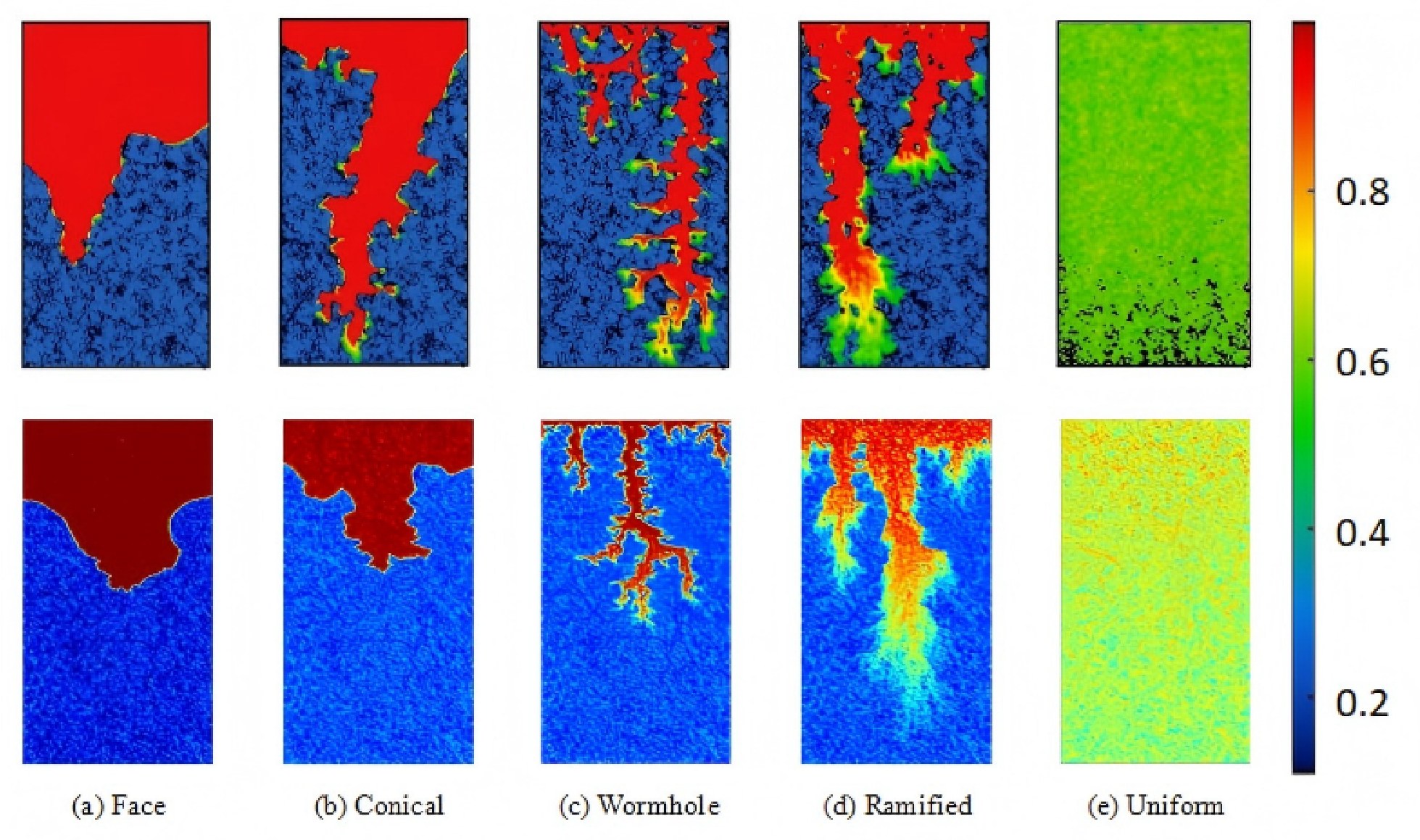
Under the same random porosity distribution range and simulation parameters, the five acidification development patterns calculated by our code are consistent with the benchmark results reported by Panga [26], as shown in Figure 2.
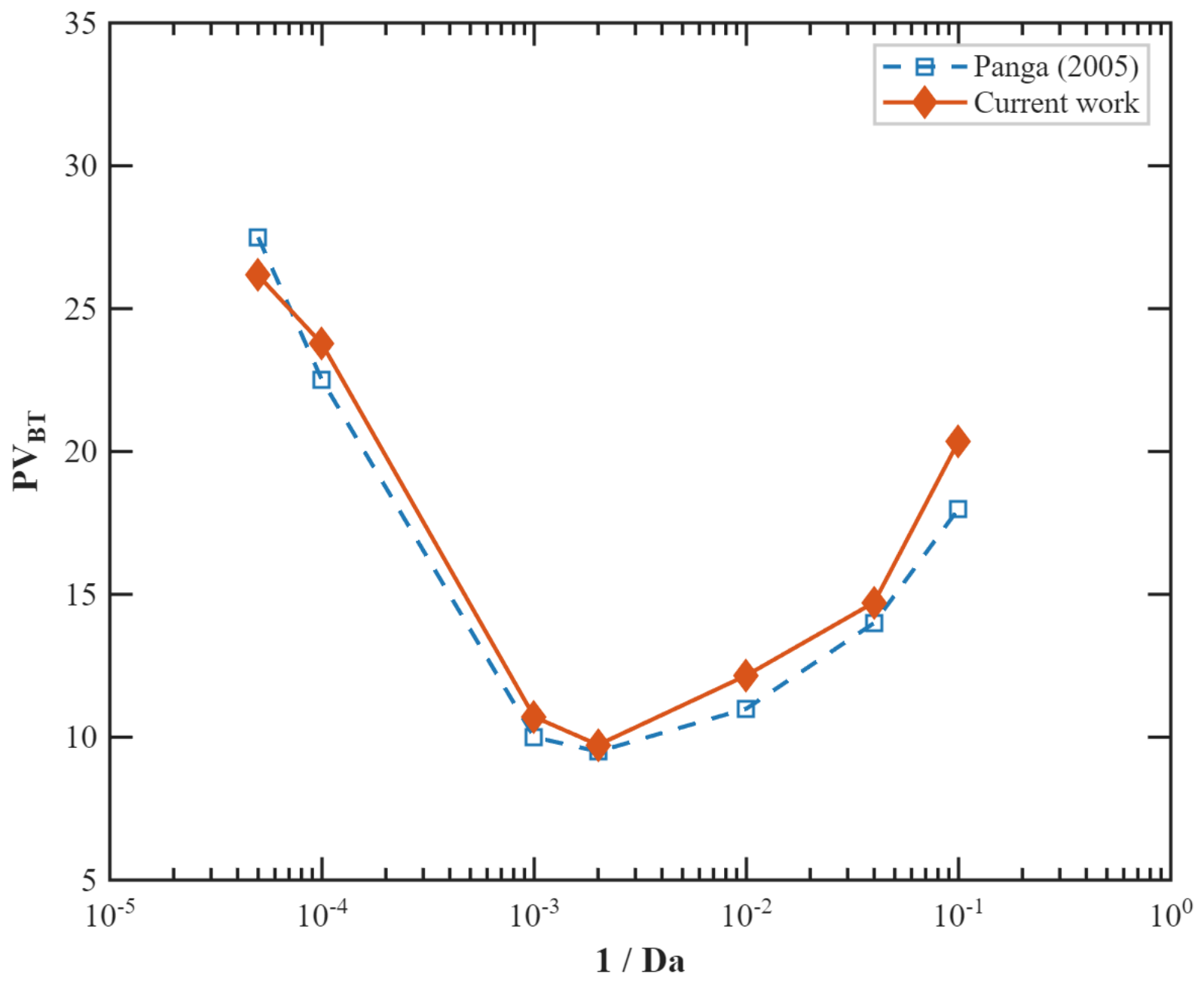
Figure 3 shows the pore volume of acid required to breakthrough the core at different injection rates. Our in-house simulator produces PV BT values and trends versus increasing Da that agree well with published results under the same Da. Discrepancies arise from different stochastic porosity distributions, as only the porosity range was provided in Panga’s work without full random-distribution details.
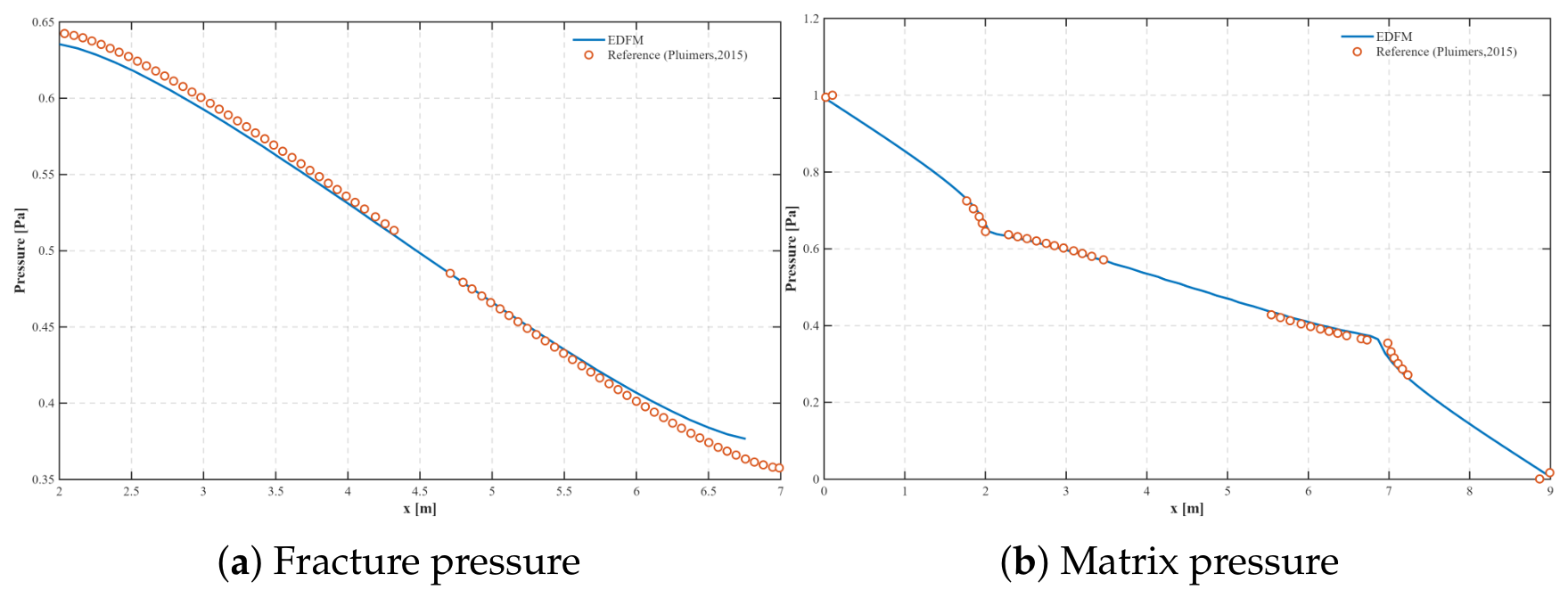
Figure 4 presents the pressure comparison for the EDFM benchmark case. The computational domain is 9 m × 9 m, with a cross-shaped fracture located at the domain center; both fracture arms have a length of 4.5 m. Figure 4a shows the pressure comparison inside the horizontal fracture, while Figure 4b gives the pressure profile along the horizontal midline of the matrix at y = 4.5 m. The comparison demonstrates that results obtained from our in-house simulator agree well with the benchmark solution, and the code can accurately capture mass exchange between the matrix and fractures.

4. Results and Discussion

The effect of a fracture network on acidizing is essentially the combined result of multiple individual fractures. Therefore, this section investigates how the main characteristics of a single fracture, namely its dip angle and length (i.e., the characteristic length ratio), affect the acidizing performance. In addition to the fracture-specific parameters, the general parameters required by the TSC model are listed in Table 1 [20]. The fracture is assumed to be fully developed, with its porosity numerically set to 0.99, and its permeability is back-calculated from the equivalent fracture aperture formula w f 2 / 12 .
The core-scale model is used in this section, which is set to 0.3 m × 0.1 m ( L × H ). A normal distribution is used to describe the random pore distribution of the rock core, and the permeability distribution is calculated by the classic Carman–Kozeny equation [28]:
K = 1 72 τ ϕ 3 d p 2 ( 1 ϕ ) 2 ,
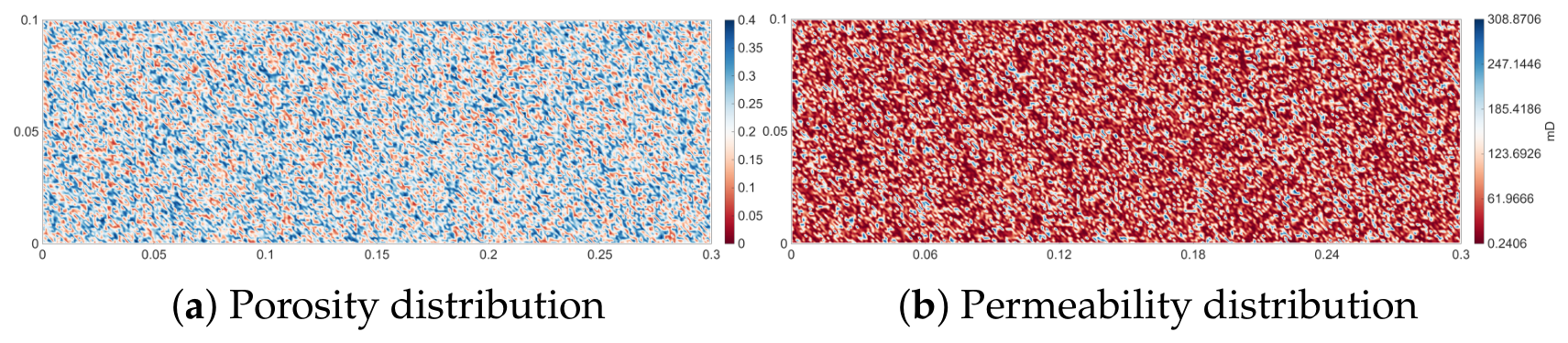
where τ denotes the pore tortuosity, and d p represents the pore diameter. In this paper, τ is 58 and d p is 1 × 10 3 . In this work, a conventional stochastic porosity–permeability model following a normal random distribution is adopted for the stochastic generation of porosity values. This approach is only suitable for generalized reservoir descriptions and cannot be applied to special reservoirs with local high-porosity contrasts. Considering the heterogeneity of carbonate rocks, porosity is sampled within the range of [0.05, 0.40]. All simulation cases share the same porosity-permeability field, as illustrated in Figure 5.
The feature length ratio formula we adopt is as follows:
F L R = L f L p ,
where F L R is the fracture length ratio, L f is the fracture length, and L p refers to the characteristic flow-length scale of the acidized region, i.e., the maximum dimension along the main flow direction. As an example, L p equals the length along the x-direction ( L ) when the left boundary is set as the injection boundary.
The pore volume of acid required to breakthrough the core ( PV BT ) is used to evaluate acidification efficiency:
PV BT = V inj , bt V p o r e
where V inj , bt denotes the cumulative acid injection volume at breakthrough and V p o r e represents the initial rock-pore volume. Furthermore, breakthrough is defined as the condition where the injection pressure falls to 1/100 of the initial injection pressure.
Three groups of boundary conditions are considered in this work: pressure boundary conditions, acid concentration boundary conditions, and temperature boundary conditions. Each type of boundary condition is specified separately for the matrix and fracture parts. Since mass exchange between fractures and the matrix is predominantly governed by the matrix in the present problem, zero-flux boundary conditions are imposed for all fracture boundaries. The boundary conditions for the matrix are given as follows:
At the inlet, a constant acid injection flow rate is maintained:
U i n j , M x = 0 = K M μ P M x x = 0 , P M x = L = 0 , K M μ P M y y = 0 = K M μ P M y y = H = 0 .
where U i n j , M is the acid injection rate for the matrix, L is the length of the model, and H is the width of the model.
C f , M x = 0 = C f , M , inj , C f , M x x = L = 0 , C f , M y y = 0 = C f , M y y = H = 0 .
where C f , M , i n j represents the concentration of the injected acid, which is set to 4.418 kmol · L 1 .
T l , M x = 0 = T l , M , inj , T l , M x x = L = 0 , T l , M y y = 0 = T l , M y y = H = 0 .
T r , M x = 0 = T r , M , initial , T r , M x x = L = 0 , T r , M y y = 0 = T r , M y y = H = 0 .
where T l , M , inj and T l , M , initial are the temperature of the injected acid and the initial rock temperature, respectively.

4.1. The Impact of Inclination on Acidizing Effect

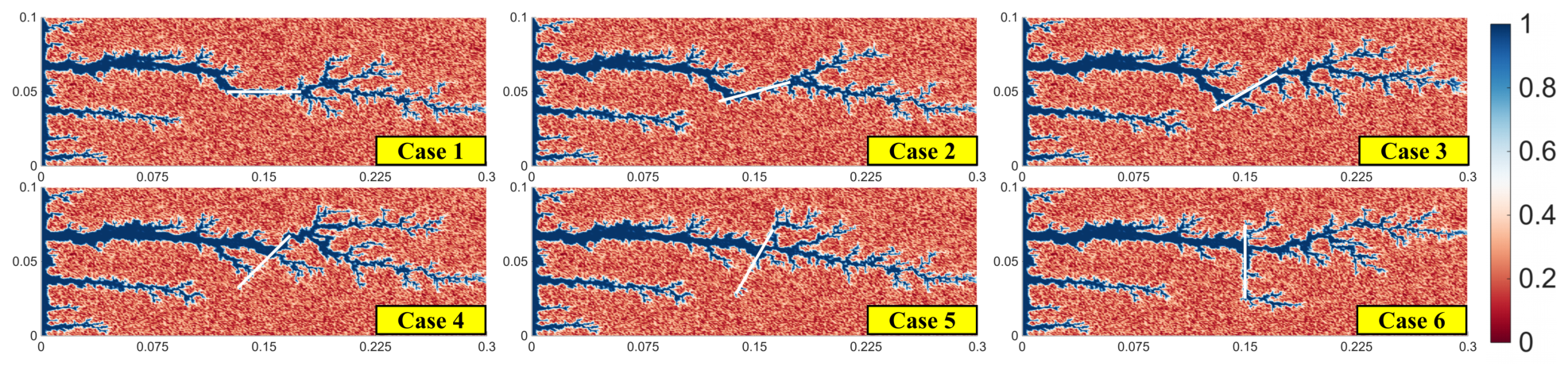
In this section, the effect of fracture dip angle on acidizing performance is investigated over the range from horizontal (0°) to vertical (90°). Angles greater than 90° are not considered because their effects are symmetric to those within the 0–90° range. The specific case settings are listed in Table 2.
Figure 6 shows the influence of inclination angle on the morphology of wormholes. Under a constant fracture length and feature length ratio, fracture inclination significantly alters the local acid flow field, dictating the development of the wormhole main trunk and branches. Horizontal fractures (e.g., Case 1, 0°) act as high-speed conduits that accelerate the main trunk’s forward propagation, suppressing branch development and resulting in a singular morphology. As inclination increases (e.g., Cases 2–5, 15–60°), flow perturbation intensifies, forcing the initially straight trunk to deflect along the fracture strike. Vertical fractures (e.g., Case 6, 90°) maximize this blocking effect by forcing strong crossflow, which dissipates forward breakthrough energy and induces prominent branches at both fracture ends, creating a highly dispersed morphology. Overall, fracture inclination controls the acid’s energy distribution: low inclinations favor main trunk extension, while high inclinations perturb the main path and promote complex branch development.
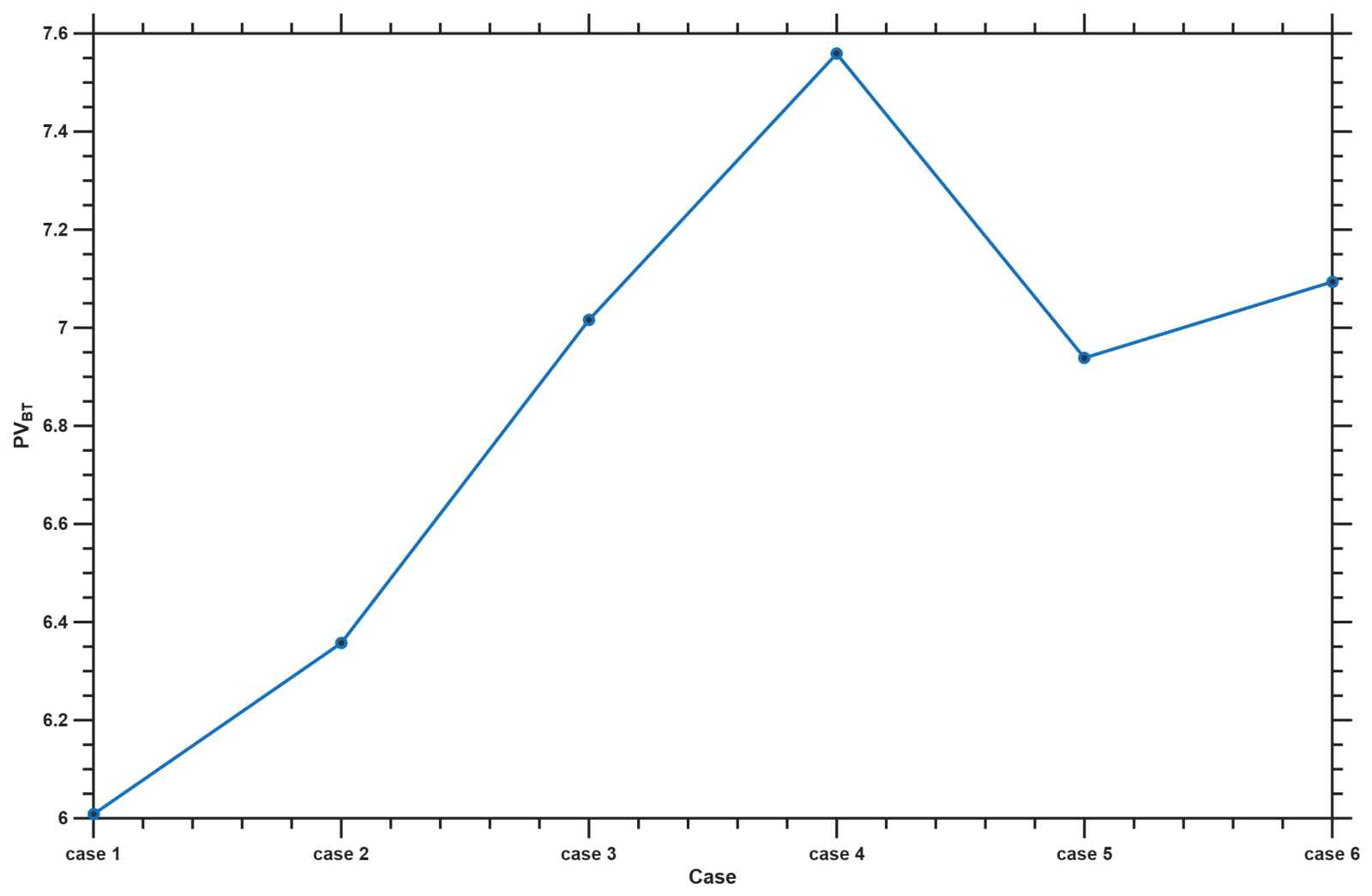
The breakthrough volume ( PV BT ) is a key metric for evaluating acidizing efficiency; a larger value indicates a lower acidizing efficiency. Figure 7 displays the influence of inclination angle on the acidizing efficiency. When the fracture is horizontal (Case 1, 0°), the fracture fully coincides with the wormhole propagation path, and PV BT reaches its minimum value. Compared with the matrix, the fracture provides a lower-resistance flow path for the acid, weakens its diffusive capacity, and thus accelerates breakthrough. As the fracture dip angle increases, the overlap between the fracture and the wormhole propagation path gradually decreases, and the ability of the fracture to suppress acid diffusion is correspondingly weakened. The fracture then evolves from promoting rapid growth of the main wormhole trunk to redirecting the trunk and promoting branch development, resulting in an increase in PV BT and a decrease in acidizing efficiency (Cases 2–4). When the dip angle increases further, the overlap region becomes very small. In particular, for the vertical fracture (Case 6), the fracture no longer significantly redirects the main wormhole trunk but only guides the development of branches, and the increase in PV BT is smaller than that in Case 4.

4.2. The Impact of Feature Length Ratio on Acidizing Effect

In this subsection, the ratio between fracture length and the characteristic flow-length scale of the acidized region, defined as the feature length ratio (FLR), is used to characterize the effect of fracture size on wormhole development. Since the maximum FLR is constrained by the y-direction, the upper limit is set to 0.3. Accordingly, three cases, i.e., FLR = 0.1, 0.2, and 0.3, are considered in this section, and the corresponding case settings are listed in Table 3.
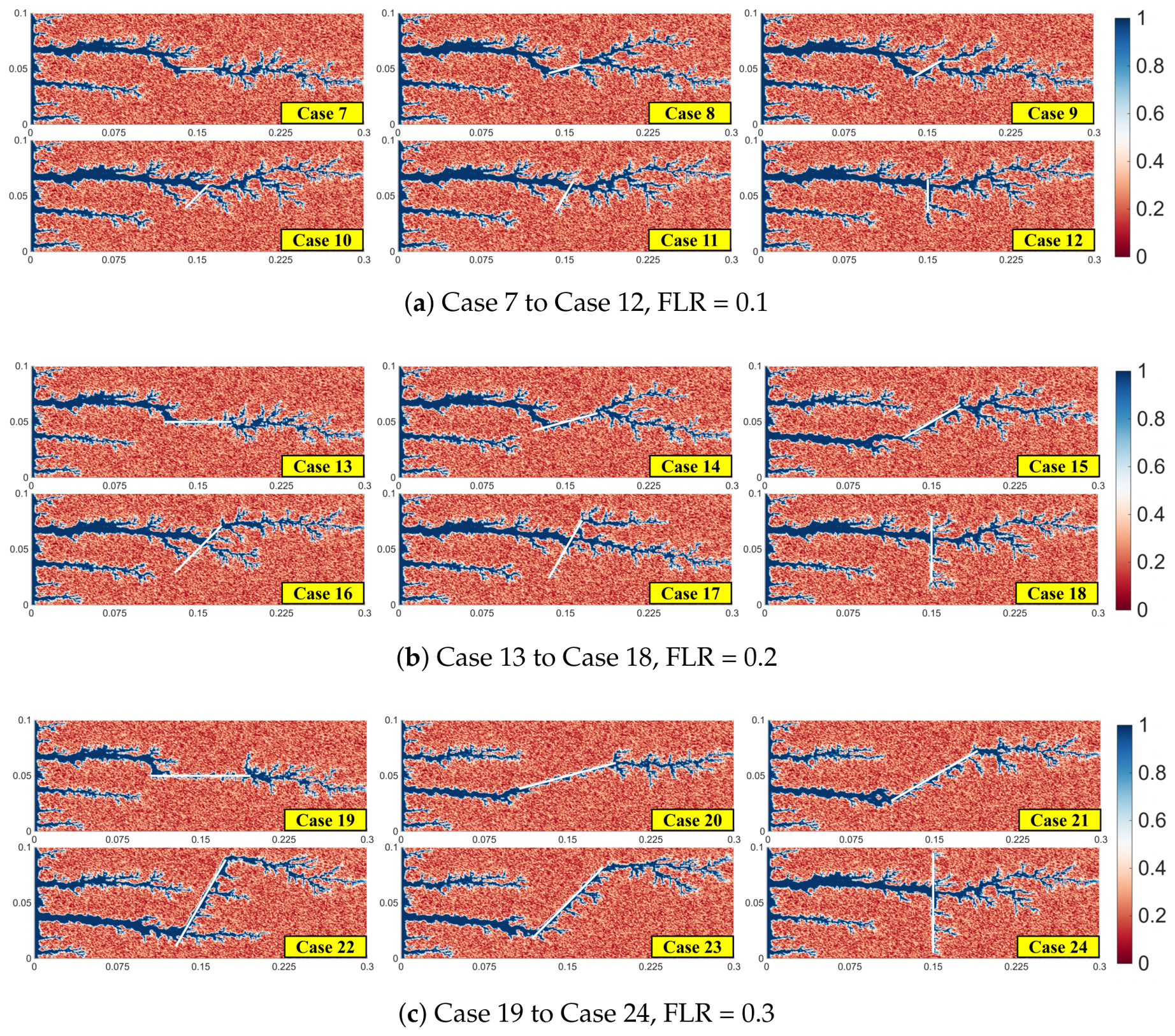
Figure 8 shows the influence of feature length ratio (FLR) on the morphology of wormholes. Taking the high feature length ratio scenario (FLR = 0.3, Figure 8c) as an example, the fracture inclination exhibits a dominant controlling effect on the acid-flow-field distribution and the morphological evolution of wormholes. Under horizontal fracture conditions (Case 19, 0°), the fracture evolves into a preferential conductive channel, promoting high acid convergence, which significantly accelerates main trunk breakthrough and effectively suppresses the development of secondary branches within the matrix. As the fracture inclination increases (Cases 20 to 23, 15–60°), the perturbation effect of the fracture on the flow field gradually intensifies, forcing the main trunk—initially propagating along the macroscopic pressure gradient—to undergo long-distance deflection and tortuous extension along the fracture strike. When the fracture is perpendicular to the initial flow direction (Case 24, 90°), the large-scale fracture transforms into a fluid transport barrier, triggering a strong tip-crossflow effect. This effect not only dissipates a massive amount of fluid kinetic energy required for main trunk breakthrough but also induces the development of thick, highly competitive secondary branches at the fracture tips, ultimately resulting in a highly dispersed dissolution pattern.
Furthermore, a horizontal comparison of the dissolution results across different feature length ratios (FLR = 0.1, 0.2, 0.3) reveals that at a low feature ratio (FLR = 0.1, Figure 8a), the fracture exists merely as a local micro-perturbation source. After penetrating the fracture zone, the development trajectory of the main trunk rapidly reverts to a complex network extension mode dominated by matrix heterogeneity. When the feature ratio increases to 0.2 (Figure 8b), the dual effects of fracture conduction and flow barrier begin to manifest, with a notable enhancement in the degree of main trunk deflection and the intensity of branch induction, though the main trunk still retains sufficient breakthrough kinetic energy to overcome local resistance. Under the influence of a high feature ratio (FLR = 0.3, Figure 8c), however, the influence of the fracture’s geometric characteristics becomes more significant.
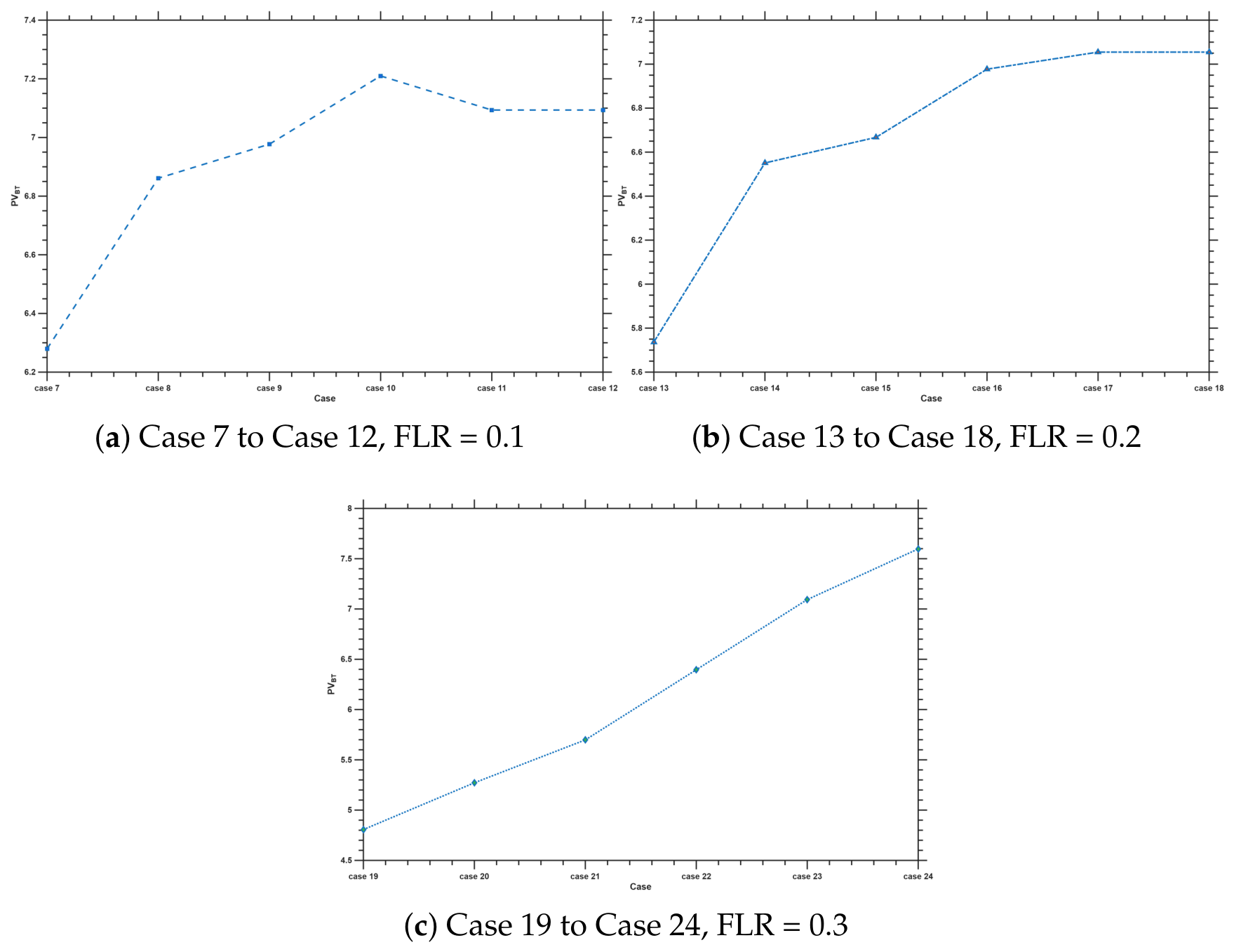
Figure 9 illustrates the influence of feature length ratio (FLR) on the acidizing efficiency. When the feature length ratio is 0.1, the horizontal fracture configuration (Case 7, 0°) provides a high-conductivity channel for the acid, resulting in minimal acid leakoff and the lowest global PV BT . As the dip angle increases, the fracture increasingly impedes and diverts the acid flow, leading to greater leakoff and a rapid rise in PV BT , which reaches its maximum at 45° (Case 10). When the dip angle further increases to 60° (Case 11) and the vertical configuration (Case 12, 90°), PV BT decreases slightly and then levels off. Overall, under this low feature length ratio, PV BT exhibits a pronounced trend of increasing first and then decreasing with fracture dip angle. When the feature length ratio is 0.2, the horizontal fracture configuration (Case 13, 0°) likewise forms a high-conductivity channel for the acid, resulting in minimal acid leakoff and the lowest global PV BT . As the dip angle increases gradually (Cases 14–16), PV BT continues to rise. When the dip angle further increases to 60° (Case 17), PV BT gradually tends to level off.
Under a high fracture length ratio (FLR = 0.3, Cases 19–24), PV BT exhibits a pronounced monotonic increase with increasing fracture dip angle. When the fracture is horizontal (Case 19, 0°), its orientation is aligned with the main flow direction, forming a high-speed channel for the acid. In this case, acid leakoff is minimized and the acid is primarily used for main wormhole extension; therefore, PV BT is the lowest and the acidizing efficiency is the highest. As the fracture dip angle increases, the resistance imposed by the fracture on acid flow becomes progressively more significant. When the fracture is vertical (Case 24, 90°), the large fracture strongly impedes wormhole propagation, forcing the acid to divert and partially branch away from the fracture tip. This not only generates a large number of ineffective secondary branches but also substantially consumes acid energy, leading to the maximum PV BT required for breakthrough. Overall, under a high length ratio, a larger fracture dip angle results in greater ineffective acid consumption and consequently a lower overall efficiency of single-phase acidizing.
Overall, under the same fracture length ratio (FLR), the breakthrough volume ( PV BT ) exhibits a pronounced non-linear dependence on the fracture dip angle. When the fracture is horizontal (0°, e.g., Cases 1, 7, and 13), it serves as a high-conductivity channel for the acid, resulting in minimal acid leakoff and thus the lowest PV BT and the highest acidizing efficiency. As the dip angle increases, the fracture increasingly diverts and impedes acid flow, leading to greater leakoff and a rapid rise in PV BT . Notably, under relatively low FLR conditions, PV BT does not continue to increase monotonically with dip angle, but instead reaches a peak at approximately 45° (e.g., Cases 4 and 10). This may be attributed to the more tortuous wormhole propagation path, which to some extent enhances the interaction between the acid and the pore structure and thereby improves local acidizing efficiency. When the dip angle further increases to 60° or becomes vertical (90°), PV BT decreases slightly or tends to level off. A comparison among different FLR values further shows that, at the same low dip angle, a larger FLR corresponds to a longer fracture flow path and a lower baseline PV BT . However, the trend at high dip angles varies with FLR. For relatively small FLR values (e.g., 0.1, 0.1667, and 0.2), the limited blocking capability of short fractures leads to a non-monotonic trend in PV BT , which first increases and then decreases. In contrast, when FLR increases to 0.3, the fracture exerts the strongest influence on acid flow, and PV BT increases approximately linearly with fracture dip angle, resulting in a marked reduction in overall acidizing efficiency.

5. Conclusions

In this work, targeting the single-phase acidizing process in carbonate reservoirs, the comprehensive impact of fracture networks and reservoir heterogeneity on the development morphology of acid-etched wormholes was deeply investigated to clarify the control mechanisms of complex geological factors on stimulation effectiveness. Based on the Two-Scale Continuum theory, a mathematical model for reactive flow coupled with complex fractures was established and solved. On this basis, the research focused on introducing a crucial parameter, the “feature length ratio” (defined as the ratio of fracture length to flow characteristic length), and systematically analyzed the perturbation mechanisms of its synergistic effect with fracture inclination on the acid-flow-field distribution, wormhole breakthrough paths, and ultimate acidizing performance. The test cases in this work are subject to the following limitations: single-phase acid flow conditions, a single fracture, and conventional heterogeneous porosity distributions. Based on these constraints and the analysis of simulation results, the following conclusions can be drawn:
(1) Fracture dip angle affects the propagation pattern of wormholes. At small dip angles, the fracture can effectively promote the growth of the main wormhole trunk; at larger dip angles, it redirects wormhole propagation and induces branches that deviate markedly from the main trunk, thereby resulting in a more complex dissolution pattern.
(2) Under a low feature length ratio (FLR), the influence of the fracture on wormhole propagation is relatively limited, and wormhole growth remains primarily controlled by medium heterogeneity. In contrast, under a high FLR, the fracture exerts a much stronger influence on the overall extension of the dominant wormhole.
(3) When FLR < 0.2, the breakthrough volume ( PV BT ) generally shows a trend of first increasing and then decreasing with increasing fracture dip angle, typically reaching its maximum at a dip angle of 45°, which corresponds to the lowest acidizing efficiency.
(4) Based on the test cases in this article, when FLR > 0.2 , PV BT increases linearly with the inclination angle, and the interfering effect of fractures on the flow field is significantly enhanced.

Author Contributions

Conceptualization, S.L.; methodology, C.L.; software, C.L.; validation, G.W., S.Z. and Q.C.; formal analysis, Y.H., S.L., H.R. and S.Z.; resources, Y.H. and C.C.; data curation, C.C. and N.Y.; writing—original draft, Y.H. and S.Z.; writing—review and editing, S.L., C.C., N.Y. and S.Z.; visualization, C.L. and H.R.; supervision, G.W., C.L. and H.R.; project administration, Y.H., G.W., N.Y. and H.R.; funding acquisition, S.L. and N.Y. All authors have read and agreed to the published version of the manuscript.

Funding

The project is supported by the Science and Technology Research Program of Chongqing Municipal Education Commission: Time-Varying Geomechanical Mechanisms and Intelligent Stability Evaluation of Geological Bodies under Cyclic Injection and Production in Underground Gas Storage, Grant No. KJZD-K202601509.

Data Availability Statement

The original contributions presented in this study are included in the article. Further inquiries can be directed to the corresponding author.

Conflicts of Interest

The Author Hong Ren was employed by the Exploration and Development Research Institute of Sinopec Zhongyuan Oilfield Branch. Seqiang Zhuo was employed by Guangxi Shale Gas Exploration and Development Company. The remaining authors declare that the research was conducted in the absence of any commercial or financial relationships that could be construed as a potential conflict of interest.

References

  1. Al-Shargabi, M.; Davoodi, S.; Wood, D.A.; Ali, M.; Rukavishnikov, V.S.; Minaev, K.M. A critical review of self-diverting acid treatments applied to carbonate oil and gas reservoirs. Pet. Sci. 2023, 20, 922–950. [Google Scholar] [CrossRef] [Scilit]
  2. Shafiq, M.; Mahmud, H. Sandstone matrix acidizing knowledge and future development. J. Pet. Explor. Prod. Technol. 2017, 7, 1205–1216. [Google Scholar] [CrossRef] [Scilit]
  3. Du, J.; Yuan, Y.; Liu, P.; Wang, Q.; Liu, J.; Huang, Q. A review of self-generating acid system of high temperature reservoir. Energy Sources Part A Recovery Util. Environ. Eff. 2024, 46, 2059–2079. [Google Scholar] [CrossRef] [Scilit]
  4. Wu, Y.; Salama, A.; Sun, S. Parallel simulation of wormhole propagation with the Darcy Brinkman Forchheimer framework. Comput. Geotech. 2015, 69, 564–577. [Google Scholar] [CrossRef] [Scilit]
  5. Liu, P.; Yan, X.; Yao, J.; Sun, S. Modeling and analysis of the acidizing process in carbonate rocks using a two-phase thermal-hydrologic-chemical coupled model. Chem. Eng. Sci. 2019, 207, 215–234. [Google Scholar] [CrossRef] [Scilit]
  6. Ma, G.; Chen, Y.; Wang, H.; Li, T.; Nie, W. Numerical analysis of two-phase acidizing in fractured carbonate rocks. J. Nat. Gas Sci. Eng. 2022, 103, 104616. [Google Scholar] [CrossRef] [Scilit]
  7. Izgec, O.; Zhu, D.; Hill, A.D. Models and Methods for Understanding of Early Acid Breakthrough Observed in Acid Core-floods of Vuggy Carbonates. In Proceedings of the 8th European Formation Damage Conference, Scheveningen, The Netherlands, 27–29 May 2009. [Google Scholar]
  8. Izgec, O.; Zhu, D.; Hill, A. Numerical and experimental investigation of acid wormholing during acidization of vuggy carbonate rocks. J. Pet. Sci. Eng. 2010, 74, 51–66. [Google Scholar] [CrossRef] [Scilit]
  9. Mou, J.; Li, S.; Zhao, X.; Cai, X. Modeling Wormhole Propataiton Behavior Based on Real Pore Spatial Distribution. Sci. Technol. Eng. 2014, 14, 40–46. [Google Scholar]
  10. Maheshwari, P.; Balakotaiah, V. 3-D Simulation of Carbonate Acidization with HCl: Comparison with Experiments. In Proceedings of the Society of Petroleum Engineers Production and Operations Symposium, Oklahoma City, OK, USA, 23–26 March 2013. [Google Scholar]
  11. Luo, J.; Liu, C.; Liu, A.; Zhang, X.; Nie, F. Impact of Heterogeneity in Low-Permeability Reservoirs on Self-Diverting Acid Wormhole Formation and Acidizing Parameter Optimization. Processes 2025, 13, 1029. [Google Scholar] [CrossRef] [Scilit]
  12. Yang, G.; Wu, X.; Hou, J.; Zhou, F.; Nie, F. Study on the Influence of Heterogeneity of Low-Permeability Reservoirs on Wormhole Morphology and Acidizing Process Parameters. Processes 2024, 12, 2740. [Google Scholar] [CrossRef] [Scilit]
  13. Bekibayev, T.T.; Beisembetov, I.K.; Assilbekov, B.K.; Zolotukhin, A.B.; Zhapbasbayev, U.K.; Turegeldieva, K.A. Study of the Impact of Reduced Permeability Due to Near-Wellbore Damage on the Optimal Parameters of the Matrix Acidizing in Carbonate Rocks. In Proceedings of the SPE Annual Caspian Technical Conference & Exhibition, Baku, Azerbaijan, 4–6 November 2015. (In Russian) [Google Scholar]
  14. Dong, C. Acid Etching Patterns in Naturally Fractured Formations. In Proceedings of the SPE Annual Technical Conference Exhibition, Houston, TX, USA, 3–6 October 1999. [Google Scholar]
  15. Deng, H.; Molins, S.; Steefel, C.; DePaolo, D.; Voltolini, M.; Yang, L.; Franklin, J.A. A 2.5D Reactive Transport Model for Fracture Alteration Simulation. Environ. Sci. Technol. 2016, 50, 7564–7571. [Google Scholar] [CrossRef] [Scilit] [PubMed]
  16. Dong, C.; Zhu, D.; Hill, A. Acid Penetration in Natural Fracture Networks. SPE Prod. Facil. 2002, 17, 160–170. [Google Scholar] [CrossRef] [Scilit]
  17. Li, Y.; Liao, Y.; Zhao, J.Z.; Wang, Y.C.; Peng, Y. Wormhole dissolution pattern study in complicated carbonate rock based on two-scale continuum model and equivalent seepage theory. Nat. Gas Geosci. 2016, 27, 121–127, 133. [Google Scholar]
  18. Alotaibi, M.; Chen, H.; Sun, S. Generalized multiscale finite element methods for the reduced model of Darcy flow in fractured porous media. J. Comput. Appl. Math. 2022, 413, 114305. [Google Scholar] [CrossRef] [Scilit]
  19. Chang, T.; Jiang, Y.; Zhao, H.; Chen, X.; Mo, W. Effect of two-phase viscosity difference and natural fractures on the wormhole morphology formed by two-phase acidizing with self-diverting acid in carbonate rocks. Phys. Fluids 2024, 36, 093623. [Google Scholar] [CrossRef] [Scilit]
  20. Chang, T.; Jiang, Y.; Li, Y.; Chen, X.; Kang, X.; Mo, W. Study on the effect of natural fractures and temperature on the wormhole morphology formed by two-phase acidizing in carbonate rocks. Phys. Fluids 2024, 36, 083333. [Google Scholar] [CrossRef] [Scilit]
  21. Qi, N.; Chen, G.; Liang, C.; Guo, T.; Liu, G.; Zhang, K. Numerical simulation and analysis of the influence of fracture geometry on wormhole propagation in carbonate reservoirs. Chem. Eng. Sci. 2019, 198, 124–143. [Google Scholar] [CrossRef] [Scilit]
  22. Mou, J.; Yu, X.; Wang, L.; Zhang, S.; Ma, X.; Lyu, X. Effect of natural fractures on wormhole-propagation behavior. SPE Prod. Oper. 2019, 34, 145–158. [Google Scholar] [CrossRef] [Scilit]
  23. Lee, S.H.; Lough, M.; Jensen, C. Hierarchical modeling of flow in naturally fractured formations with multiple length scales. Water Resour. Res. 2001, 37, 443–455. [Google Scholar] [CrossRef] [Scilit]
  24. Kalia, N.; Glasbergen, G. Wormhole formation in carbonates under varying temperature conditions. In Proceedings of the SPE European Formation Damage Conference and Exhibition; SPE: Richardson, TX, USA, 2009; p. SPE-121803. [Google Scholar]
  25. Liu, P.; Xue, H.; Zhao, L.; Zhao, X.; Cui, M. Simulation of 3D multi-scale wormhole propagation in carbonates considering correlation spatial distribution of petrophysical properties. J. Nat. Gas Sci. Eng. 2016, 32, 81–94. [Google Scholar] [CrossRef] [Scilit]
  26. Panga, M.K.; Ziauddin, M.; Balakotaiah, V. Two-scale continuum model for simulation of wormholes in carbonate acidization. AIChE J. 2005, 51, 3231–3248. [Google Scholar] [CrossRef] [Scilit]
  27. Pluimers, S.B. Hierarchical Fracture Modeling Approach. Ph.D. Thesis, Delft University of Technology, Delft, The Netherlands, 2015. [Google Scholar]
  28. Valdes-Parada, F.J.; Ochoa-Tapia, J.A.; Alvarez-Ramirez, J. Validity of the permeability Carman–Kozeny equation: A volume averaging approach. Physica A Stat. Mech. Appl. 2009, 388, 789–798. [Google Scholar] [CrossRef] [Scilit]
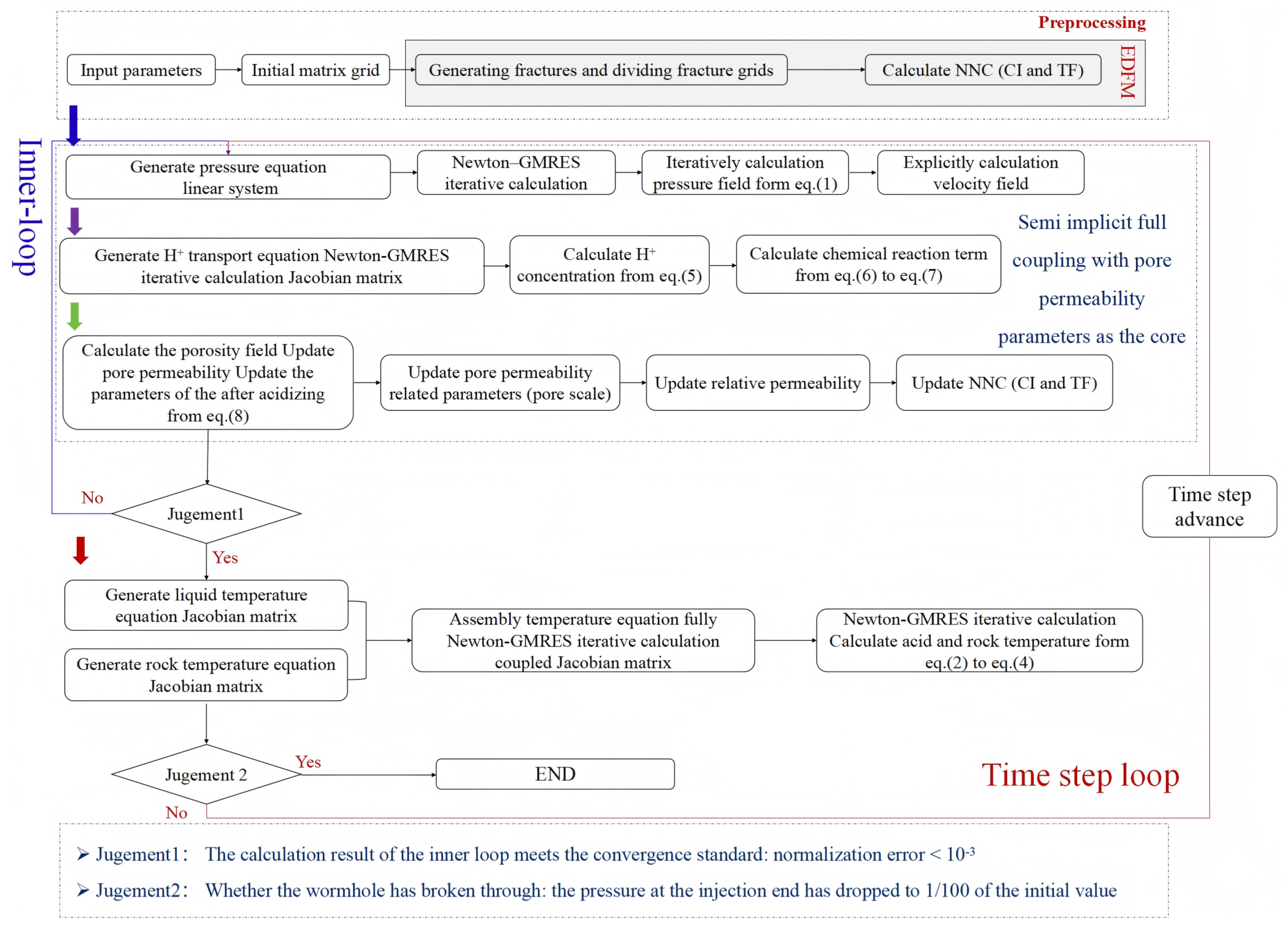
Figure 1. Solution strategy diagram.
Processes 14 02950 g001
Figure 2. The verification work: dissolution pattern.
Processes 14 02950 g002
Figure 3. The verification work: PV BT [26].
Processes 14 02950 g003
Figure 4. The verification work: EDFM [27].
Processes 14 02950 g004
Figure 5. The porosity and permeability distribution for the rock-core scale.
Processes 14 02950 g005
Figure 6. The influence of inclination angle on the morphology of wormholes.
Processes 14 02950 g006
Figure 7. The influence of inclination angle on the acidizing efficiency.
Processes 14 02950 g007
Figure 8. The influence of feature length ratio on the morphology of wormholes.
Processes 14 02950 g008
Figure 9. The influence of feature length ratio on the acidizing efficiency.
Processes 14 02950 g009
Table 1. General parameters of simulation cases.
ParameterSymbolValue
Initial porosity of matrix [dimLess] ϕ m 0.05–0.4
Initial porosity of fracture [dimLess] ϕ f 0.99
Initial permeability of matrix [ m 2 ] K m calculated
Initial permeability of fracture [ m 2 ] K f calculated
Initial width of fracture [m] w f 0.003
Viscosity of acid [mPa·s] μ w 1
Acid specific heat capacity [J/(kg·°C)] C p , l , w 4180
Rock specific heat capacity [J/(kg·°C)] C p , s 999
Acid thermal conductivity [W/(m·°C)] k l , w 0.6508
Rock thermal conductivity [W/(m·°C)] k s 5.2
Rock convective heat transfer coefficient [W/(m2·°C)] H m 600
Interfacial area of matrix [ m 2 / m 3 ] a v , m 5000
Interfacial area of fracture [ m 2 / m 3 ] a v , m 500
Molecular diffusion coefficient [ m 2 /s] D m 3.6 × 10 9
Asymptotic Sherwood number [dimLess] S h 3.66
Solubility of acid [kg/kmol] a c 50
Rock initial temperature [K] T r 333.15
Table 2. Parameters of Case 1 to Case 6.
ParameterCase 1Case 2Case 3Case 4Case 5Case 6
Fracture inclination [°]01530456090
Fracture length [m]0.05
Feature length ratio [dimLess]0.1667
Injection velocity [m/s]5 × 10 4
Table 3. Parameters of Case 7 to Case 24.
ParameterCase 7Case 8Case 9Case 10Case 11Case 12
Fracture inclination [°]01530456090
Fracture length [m]0.03
Feature length ratio [dimLess]0.1
Injection velocity [m/s]5 × 10 4
ParameterCase 13Case 14Case 15Case 16Case 17Case 18
Fracture inclination [°]01530456090
Fracture length [m]0.06
Feature length ratio [dimLess]0.2
Injection velocity [m/s]5 × 10 4
ParameterCase 19Case 20Case 21Case 22Case 23Case 24
Fracture inclination [°]01530456090
Fracture length [m]0.09
Feature length ratio [dimLess]0.3
Injection velocity [m/s]5 × 10 4
Disclaimer/Publisher’s Note: The statements, opinions and data contained in all publications are solely those of the individual author(s) and contributor(s) and not of MDPI and/or the editor(s). MDPI and/or the editor(s) disclaim responsibility for any injury to people or property resulting from any ideas, methods, instructions or products referred to in the content.