
Article

Material-Dependent, Agitation-Free Fermentation on 3D-Printed Polymer Matrices: Lactic Acid Bacteria Surpass Shaken Cultures


1
Department of Chemical and Biomolecular Engineering, University of Illinois Urbana-Champaign, Urbana, IL 61801, USA
2
Department of Materials Innovation Engineering, Dankook University, Yongin-si 16890, Republic of Korea
3
Department of Biological and Chemical Engineering, Hongik University, Sejong 30016, Republic of Korea
*
Authors to whom correspondence should be addressed.
Processes 2026, 14(17), 2730; https://doi.org/10.3390/pr14172730
Submission received: 8 July 2026 / Revised: 14 August 2026 / Accepted: 24 August 2026 / Published: 26 August 2026
(This article belongs to the Section Materials Processes)

Abstract

Industrial fermentation relies on mechanically agitated submerged culture, in which impeller-driven mixing improves oxygen and nutrient transfer but imposes an energy penalty and a hydrodynamic shear field that stresses cells. Solid supports offer an agitation-free alternative, yet their surface is typically ill-defined and only a single polymer and a single organism have been examined. Here we treat the support material as a controllable process variable. Using an identical scaffold geometry 3D-printed by fused-deposition modeling in four thermoplastics—ABS, TPU, PLA, and PETG—we compared static cultivation of a model yeast (Saccharomyces cerevisiae) and a model lactic acid bacterium (Lactobacillus plantarum) against shaken and static controls, and related the outcomes to polymer surface wettability. For S. cerevisiae, embedding a matrix in static medium nearly doubled biomass relative to the static control and drove glucose to near-complete assimilation, raising ethanol titres ~1.7–1.8-fold to shaken-culture levels without any agitation. For L. plantarum, three of the four matrices (PLA, ABS, PETG) exceeded both the static and the aerated shaking controls in biomass (by ~15–21%) and in lactic acid production, while the elastomeric TPU behaved like the controls. Because L. plantarum is microaerophilic, these results suggest that factors other than improved aeration, including interactions at the scaffold–liquid interface, contribute to the observed enhancement. The polymer type thus emerges as a tunable parameter for scaffold-assisted cultivation, enabling fermentation without mechanical agitation while achieving performance comparable to, and in some cases greater than, that of shaken culture. The polymer type thus emerges as a tunable determinant of performance, defining an agitation-free cultivation strategy in which the interface—rather than bulk flow—is engineered to achieve, and in some cases surpass, the productivity of conventional stirred culture.

1. Introduction

Microbial fermentation underpins a large share of the modern bioeconomy, from bulk metabolites such as ethanol and lactic acid to probiotics and recombinant proteins. At the industrial scale, the workhorse configuration remains the submerged, mechanically agitated stirred-tank bioreactor, in which oxygen transfer and homogenization are achieved by impeller-driven mixing [1]. Agitation, however, is not a neutral operation: it imposes a spatially heterogeneous hydrodynamic shear field on the culture. In the simplest description the local shear stress scales with viscosity and shear rate, τ = μ γ · , but fermentation broths are rarely Newtonian—as biomass accumulates they typically become shear-thinning, so that both the local viscosity and the shear rate experienced by cells vary throughout the vessel [2,3]. In the turbulent regime the smallest eddies are characterized by the Kolmogorov microscale, λ = (ν3/ε)1/4; when λ approaches cellular dimensions, cells are exposed to potentially damaging micro-scale shear [4]. Agitation therefore embodies an intrinsic trade-off: raising the power input per unit volume improves oxygen mass transfer (higher kLa) but simultaneously increases shear loading and energy consumption, while intensified gas–liquid contact promotes foaming and a reliance on antifoam agents that further perturb mass transfer [1,4,5,6]. From a materials- and process-engineering standpoint, this coupling between mixing, shear, and energy is a fundamental limitation rather than a mere operational nuisance. This reframing points to an alternative lever for productivity: instead of intensifying bulk mixing, one can furnish a solid–liquid interface at which cells preferentially reside, thereby shifting the controlling variable away from the vessel’s fluid mechanics and toward the properties of that interface. Because interfacial properties—wettability, surface energy, and roughness—are dictated by the choice of material, the support material itself becomes a design variable for cultivation performance, a possibility that the present work sets out to test.
These considerations motivate culture strategies that decouple high cell density from bulk mechanical agitation. Cell immobilization, biofilm-based cultivation, and solid-state fermentation (SSF) have all been explored as routes to improved mass transfer and product recovery without vigorous stirring [7,8,9]. In these approaches microorganisms colonize a solid surface—an organic moist substrate or an inert carrier such as polyurethane foam—that supplies attachment area and a favorable local microenvironment [9,10]. A recurring obstacle, however, is standardization: conventional substrates and inert carriers can vary in geometry, porosity, and surface area, which hampers reproducibility and mechanistic interpretation [9,10].
Additive manufacturing offers a direct answer to this standardization problem. Fused-deposition-modeling (FDM) 3D printing produces inert scaffolds with precisely defined and reproducible geometry, porosity, and surface area, turning the support into a controllable process element rather than an uncontrolled variable. Building on this idea, Molina-Menor et al. [11] showed that a 3D-printed polylactic acid (PLA) matrix embedded in static liquid medium dramatically enhanced the growth of Saccharomyces cerevisiae relative to an equivalent unagitated culture, with concomitant changes in sugar assimilation, ethanol production, and the proteome. This result suggests that agitation-free fermentation on a 3D-printed polymer scaffold could be extended to other polymers and to other microorganisms.
Solid inert surfaces are, in the same vein, natural supports for bacteria that grow as, or readily form, biofilms [12,13]. Lactic acid bacteria (LAB) are a particularly relevant target in this context: they are industrially important producers of lactic acid and widely used as probiotics and food-fermentation starters [14], and, being microaerophilic to facultatively anaerobic, they do not require the vigorous aeration that drives agitation in aerobic processes—making them a natural fit for an agitation-free, support-based strategy [15].
Despite this promise, three questions remain open. First, the effect has been demonstrated for a single polymer (PLA), yet common FDM thermoplastics differ markedly in surface chemistry and wettability—properties known to govern initial cell attachment and biofilm establishment [12,13]—so the material itself is an unexplored process variable rather than an interchangeable substrate. Second, the benefit has been shown only for an aerobic yeast, for which improved oxygen access is one plausible driver; however, if the colonizable attachment area and the low-shear interfacial microenvironment provided by the scaffold are themselves growth-promoting, then enlarging that surface should also favor organisms that do not depend on vigorous aeration, such as microaerophilic LAB. Whether the scaffold strategy extends to these organisms, and how large the effect can be, remains untested. Third, in the available report the matrix improved static cultures but did not reach the biomass of shaken controls, leaving open whether such supports can actually match or surpass mechanical agitation.
Here we address these gaps by systematically comparing four widely used FDM thermoplastics—ABS, TPU, PLA, and PETG—printed to an identical geometry and evaluated as scaffolds for static cultivation of a model yeast (S. cerevisiae) and a model LAB (Lactobacillus plantarum). For each material and organism we quantified biomass, substrate consumption, and principal metabolites (ethanol; lactic and acetic acid) against shaken and static controls, and related the outcomes to the surface wettability of the polymers. The results define the polymer type as a tunable process variable and identify conditions under which agitation-free, scaffold-supported cultures rival or exceed conventional shaken fermentation—offering a material- and process-level strategy for high-density cultivation that sidesteps the rheological shear penalty of mechanical agitation.

2. Materials and Methods

2.1. Design and Fabrication of the 3D-Printed Matrices

A single scaffold geometry was used for all materials to ensure that only the polymer varied between conditions. The matrix was designed in 3Ds MAX (Autodesk®, 2025) as a cylindrical open-lattice structure with regular perforations (nominal dimensions 22 mm × 22 mm × 82 mm) and exported as an STL file. Scaffolds were fabricated by fused-deposition modeling using a Bambu Lab X-1 Carbon 3D printer (Bambu Lab, Shenzhen, China) using four commercial filaments: acrylonitrile butadiene styrene (ABS), thermoplastic polyurethane (TPU), polylactic acid (PLA), and polyethylene terephthalate glycol (PETG). Material-specific printing parameters (nozzle temperature, bed temperature, layer height, infill density, and print speed) are summarized in Table 1. All other parameters were held constant across materials. This FDM-based fabrication strategy enables the reproducible production of polymer scaffolds with defined geometry, infill, and pore architecture [16,17].

2.2. Sterilization of the Matrices

Prior to use, the matrices were disinfected by immersion in 70% ethanol (v/v) for 30 min, followed by three washes with sterile double-distilled water (DDW). The cleaned matrices were then aseptically placed into individual 50 mL conical tubes using 70% ethanol-sterilized forceps in a biosafety cabinet.

2.3. Strains, Media, and Culture Conditions

Saccharomyces cerevisiae S288C and Lactobacillus plantarum ATCC 8014 were used as model yeast and lactic acid bacterium, respectively. Precultures were grown overnight in the corresponding medium—YPD medium (10.0 g/L yeast extract, 20.0 g/L peptone, and 20 g/L glucose) for S. cerevisiae [18] and MRS medium (10 g/L peptone, 10 g/L beef extract, 5 g/L yeast extract, 20 g/L glucose, 1 g/L tween 80, 2 g/L K2HPO4, 5 g/L sodium acetate trihydrate, 2 g/L triammonium citrate, 0.2 g/L MgSO4∙7H2O, 0.05 g/L MnSO4∙H2O) for L. plantarum [19]—and adjusted to an initial OD600 of 0.1 in fresh medium.
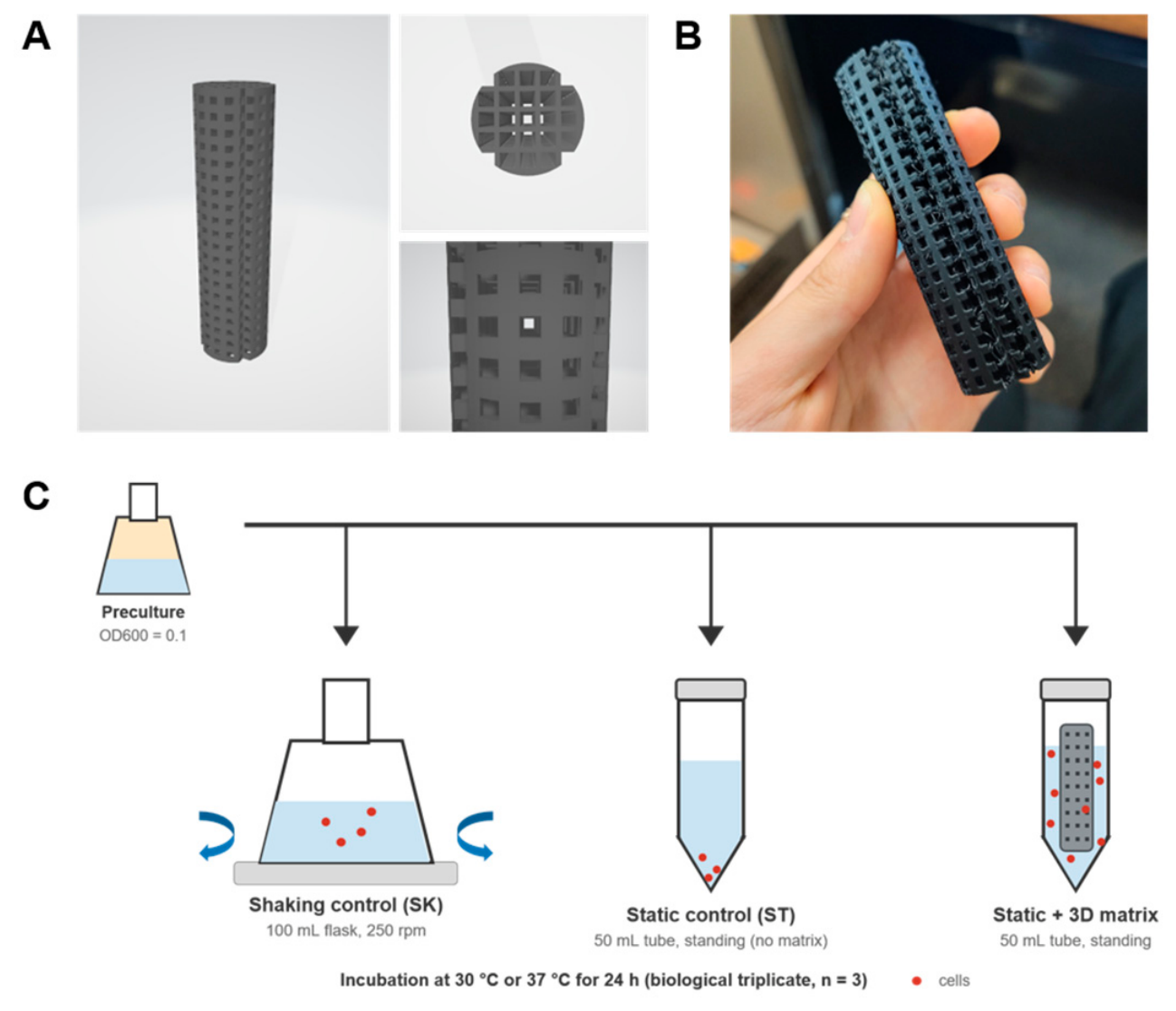
Three culture configurations were compared for each strain: (i) an agitated shaking control (SK), 25 mL of culture in a 100 mL flask incubated at 250 rpm; (ii) a static control (ST), 25 mL of culture in a 50 mL tube incubated without agitation; and (iii) static cultures containing one sterilized 3D-printed matrix (ABS, TPU, PLA, or PETG), also in 50 mL tubes without agitation. S. cerevisiae cultures were incubated at 30 °C and L. plantarum cultures at 37 °C. A tube without inoculum served as a sterility control. All conditions were run in biological triplicate and harvested at 24 h.

2.4. Biomass Quantification

At harvest, cultures were centrifuged (50 mL tubes, 4500 rpm, 5 min), the supernatant retained for metabolite analysis, and the cells washed by resuspension in sterile 1× phosphate-buffered saline (PBS; 8.0 g/L NaCl, 0.2 g/L KCl, 1.44 g/L Na2HPO4, 0.24 g/L KH2PO4, pH 7.4) followed by a second identical centrifugation. Cells were finally resuspended in sterile 1× PBS to a defined volume, and biomass was quantified as OD600.

2.5. Metabolite Measurement

Glucose and ethanol (S. cerevisiae) and glucose, lactic acid, and acetic acid (L. plantarum) in the culture supernatants were quantified using an Agilent 1200 HPLC system equipped with a refractive index detector (Agilent Technologies, Santa Clara, CA, USA) and Rezex ROA-organic Acid H+ (8%) column (Phenomenex, Torrance, CA, USA). For the mobile phase, 0.005 N H2SO4 was used at a flow rate of 0.6 mL/min, while maintaining the column temperature at 50 °C.

2.6. Surface Wettability

Static water contact angles were measured by the sessile-drop method on the flat disinfected coupons printed from each polymer under the same conditions as the matrices, using a Phoenix-300 goniometer (Surface Electro Optics Co., Ltd., Republic of Korea) with 10 µL of deionized water at room temperature (20 °C). Because fused-deposition modeling produces parallel surface rasters, each coupon was measured in two orthogonal directions relative to the print lines: along the rasters (“horizontal”) and across them (“vertical”); at least three droplets (n ≥ 3) per material and direction were averaged. The work of adhesion of water was calculated using the Young–Dupré relation, Wa = γL(1 + cos θ), with γL = 72.8 mN·m−1 [20], and the wetting anisotropy was expressed as Δθ = θvertical − θhorizontal.

2.7. Statistical Analysis

Data are presented as mean ± standard deviation of biological triplicates. Differences among conditions were evaluated for each strain and metric by one-way analysis of variance (ANOVA) followed by Tukey’s multiple-comparisons test, with p < 0.05 considered significant. Analyses were performed in OriginPro(OriginLab Corporation, 8.5).

3. Results and Discussion

3.1. Design and Additive Manufacturing of the Polymer Scaffolds

To isolate the influence of the support material from that of geometry, we adopted a single scaffold design and reproduced it identically in all four thermoplastics. The matrix was designed as a cylindrical open-lattice body with regular perforations (overall dimensions 22 mm × 22 mm × 82 mm; Figure 1A), a geometry chosen to maximize the accessible solid–liquid interfacial area and internal porosity while fitting within a 50 mL tube and remaining fully submerged in 25 mL of medium. Because every subsequent comparison is made against this common geometry, any difference in biological outcome between materials can be attributed to the material rather than to the shape or size of the support—the premise established above that the support material acts as the controlling design variable.
The four polymers—ABS, TPU, PLA, and PETG—were selected to span a deliberately wide range of the interfacial properties expected to govern cell–surface interactions. PLA and PETG are relatively rigid, moderately polar thermoplastics; ABS is a rigid, comparatively hydrophobic terpolymer; and TPU is a thermoplastic elastomer, contributing a softness and a distinct surface chemistry. This selection therefore samples a broad space of surface energy, wettability, roughness, and mechanical compliance within a single, widely available FDM material class, so that material-dependent effects—if present—can be resolved. All scaffolds were printed by fused-deposition modeling under material-specific conditions (Table 1); the resulting parts reproduced the target geometry across all four materials (Figure 1B), confirming that the identical-geometry premise holds at the level of the fabricated object and not merely the CAD model.
Prior to cultivation, all matrices were surface-disinfected (70% v/v ethanol, 30 min) and thoroughly rinsed in three sterile-water steps; every material tolerated this treatment without visible degradation or dimensional change, confirming their compatibility with a standard aseptic workflow. Two features of this fabrication route are worth emphasizing. First, additive manufacturing renders the support a standardized, reproducible element—in contrast to the geometrically ill-defined carriers (sand, sponges, foams) used in earlier immobilization and solid-state approaches—which is the prerequisite for any meaningful material comparison. Second, the same digital design can be re-printed on demand in any compatible polymer, so that the material becomes a freely selectable process parameter rather than a fixed property of the reactor. Together, these features highlight the broader utility of FDM-printed scaffolds as controllable porous supports in which geometry and material composition can be independently specified [16,17].

3.2. Surface and Physicochemical Characterization of the Polymers

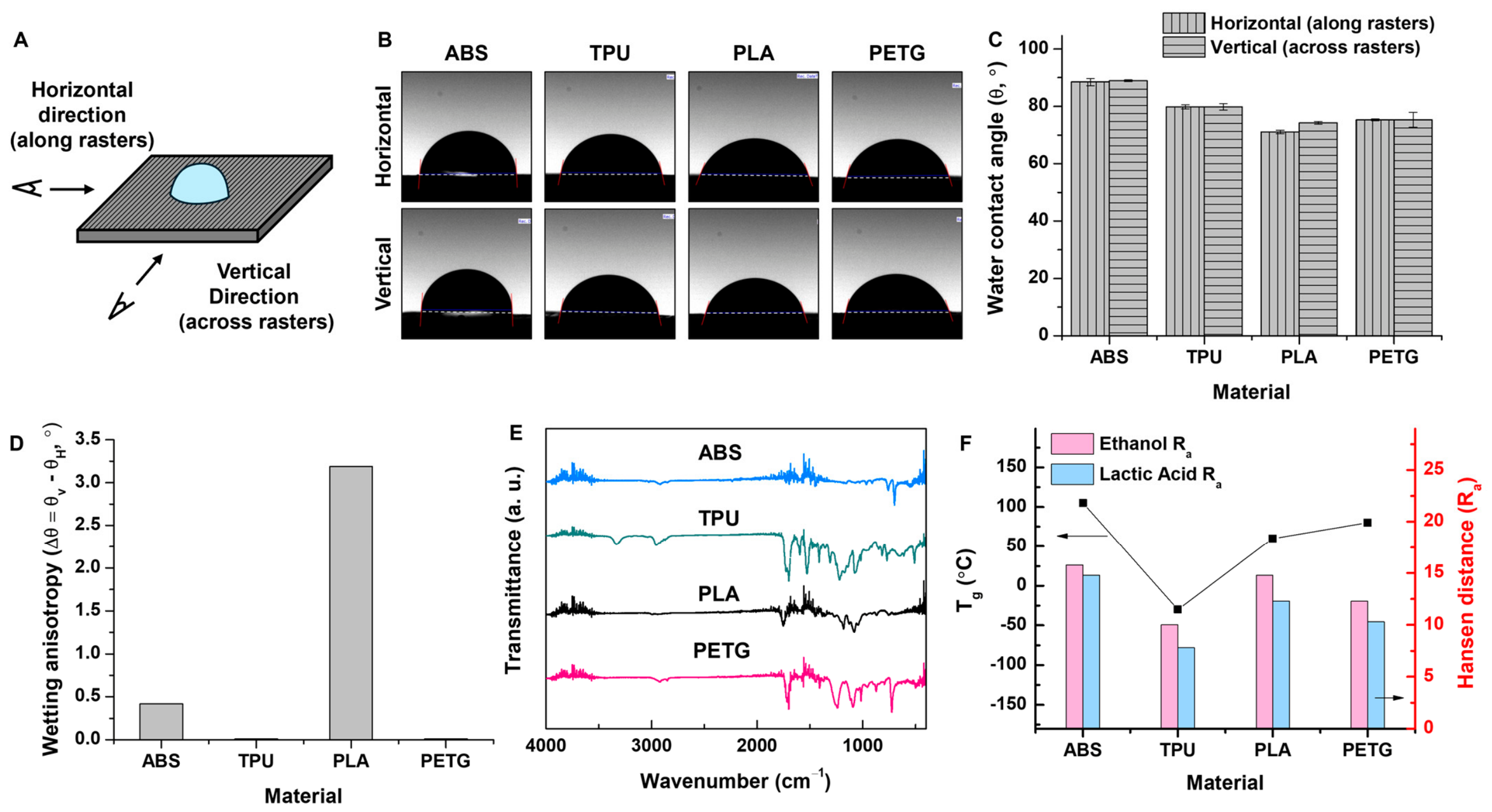
With the geometry fixed, we characterized the surface property most directly implicated in cell attachment, wettability, by sessile-drop water contact-angle measurement on flat coupons printed from each polymer and subjected to the same disinfection procedure as the scaffolds, and, because fused-deposition modeling lays material down as parallel rasters, along two orthogonal directions relative to the print lines: along the lines (“horizontal”) and across them (“vertical”) (Figure 2A,B) [21]. Two features emerged. First, wettability was strongly material-dependent: averaged over both directions, the water contact angle decreased in the order ABS (88.7°) > TPU (79.8°) > PETG (75.3°) > PLA (72.7°), so that ABS presented the least and PLA the most wettable surface (Figure 2C). Expressed as the work of adhesion of water, Wa = γL(1 + cos θ) with γL = 72.8 mN·m−1, the ranking inverts to PLA (94.5 mN·m−1) > PETG (91.3) > TPU (85.6) > ABS (74.5), providing a quantitative, material-specific descriptor of how strongly the aqueous culture adheres to each surface. Second, the surfaces were close to isotropic. Fused-deposition modeling is known to produce direction-dependent wetting on as-printed parts [22], but on the disinfected coupons used here the two directions differed by 0.42° for ABS and by 0.01° for both TPU and PETG (Figure 2D). Only PLA retained a measurable difference (3.19°). The print-line grooves therefore do not impose a strong directional wetting cue on the surface that the cells actually encounter, and wettability can be treated as a single material-level descriptor in the comparisons that follow.
The same coupons were examined by ATR-FTIR (Figure 2E). Each polymer showed the absorption bands expected from its structure, including ester carbonyl and C–O bands for PLA and PETG, nitrile and aromatic or butadiene bands for ABS, and urethane N–H and carbonyl bands for TPU. The spectra were not altered by printing or by the disinfection step, which confirms that the polymer surfaces remained chemically intact. However, they distinguish the four materials only in accordance with their bulk chemistry.
Because a change in filament alters several properties at the same time, we also considered two parameters that describe each polymer in the environment it experiences during cultivation (Figure 2F). The first is the glass transition temperature (Tg), which determines whether the scaffold surface is in the glassy or the rubbery state at the culture temperature. PLA (60 °C), PETG (80 °C) and ABS (105 °C) remain glassy at 30 °C and 37 °C, whereas TPU (−30 °C) is the only polymer in the rubbery state. The second is the Hansen solubility parameter distance (Ra) between each polymer and the principal metabolite of each organism, which sets the thermodynamic driving force for that metabolite to enter the surface. For ethanol, Ra increases in the order TPU (10.0) < PETG (12.3) < PLA (14.8) < ABS (15.8), and the same order holds for lactic acid at lower values, from TPU (7.8) to ABS (14.8). These two parameters are used in the interpretation of the cultivation results below.

3.3. Material-Dependent Enhancement of S. cerevisiae Growth and Fermentation

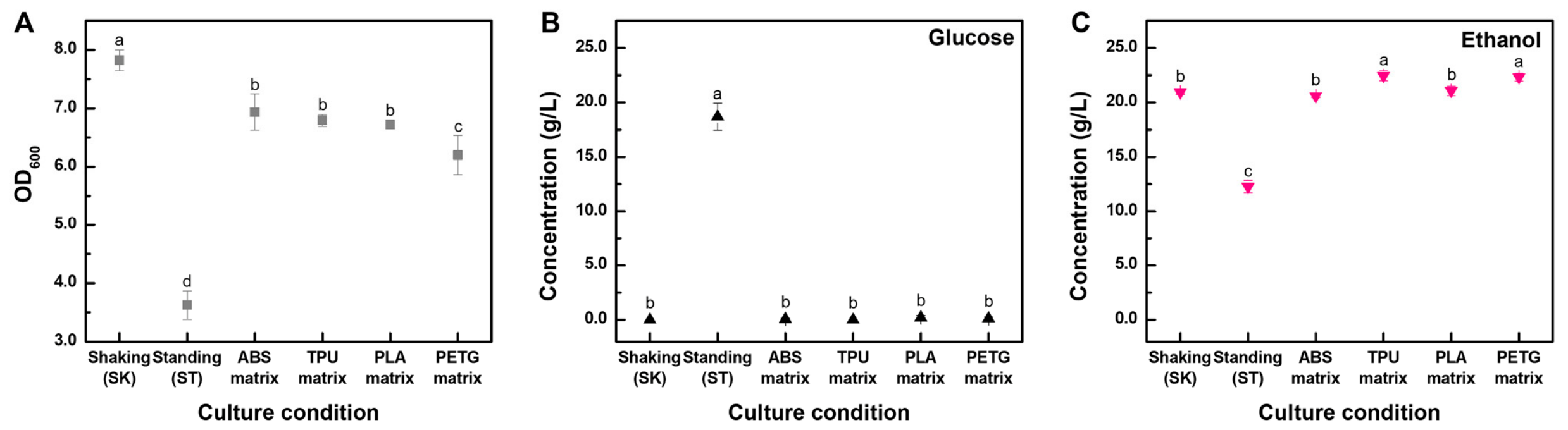
Static cultivation of S. cerevisiae in the presence of the printed matrices produced a pronounced increase in biomass relative to the unagitated control. Whereas the standing culture reached only OD600 = 3.62 ± 0.25, all four matrix conditions roughly doubled this value—ABS 6.94 ± 0.31, TPU 6.80 ± 0.10, PLA 6.72 ± 0.03, and PETG 6.20 ± 0.33—recovering approximately 79–89% of the biomass obtained under conventional shaking (7.82 ± 0.18) without any mechanical agitation (Figure 3A; Table 2). The effect on substrate utilization was even more clear-cut: the static control left 18.69 ± 1.25 g/L of glucose unconsumed (only ~58% assimilated), whereas every matrix condition drove glucose to near-completion (0–0.21 g/L residual), matching the shaking control (Figure 3B). Consistent with this, ethanol titres rose from 12.27 ± 0.59 g/L in the static control to 20.6–22.4 g/L in the presence of a matrix—a ~1.7–1.8-fold increase—reaching or slightly exceeding the shaking control (20.92 ± 0.18 g/L), with the highest titres on TPU (22.42 ± 0.46) and PETG (22.32 ± 0.37) (Figure 3C).
Two points deserve emphasis. First, although biomass under the matrices did not fully reach the shaken level, both glucose assimilation and ethanol production did, indicating that the scaffold restores the metabolic output of a static culture to that of an aerated one while dispensing with agitation entirely. The slight excess of ethanol over the shaking control on some materials is consistent with the respiro-fermentative physiology of S. cerevisiae, in which ethanol production can occur even in the presence of oxygen [23]. Second, biomass production differed among the scaffold materials. Basically, the biomass and ethanol production performance of all scaffold materials was significantly higher than standing control. Among the scaffold materials, ABS, TPU, and PLA showed comparable biomass values, whereas PETG resulted in slightly lower biomass. Ethanol production also differed among the materials, with TPU and PETG yielding higher ethanol levels than the other scaffold conditions and the shaking control.
Importantly, the enhancement over the static control should not be read as an oxygenation effect of the porous scaffold. For the same PLA system, Molina-Menor et al. [11] found that neither adding air bubbles by agitation nor removing them by mechanical tapping altered the result, ruling out trapped-air oxygen transfer as the driver; the matrix effect is therefore consistent with a contribution from the enlarged solid–liquid interfacial area rather than being explained solely by improved oxygen transfer. Oxygen nonetheless remains relevant in one specific sense—it sets the height of the shaking benchmark rather than the magnitude of the matrix effect. Because S. cerevisiae can benefit from oxygen availability under shaken culture, mechanical aeration raises the biomass benchmark, so the shaking control defines a high ceiling that the agitation-free matrices approach (79–89%) but do not surpass, even as they reach shaken-level substrate assimilation and ethanol output. This distinction—between what the matrix does (surface-driven enhancement) and why the shaking control remains high (aerobic respiration)—accounts for the otherwise puzzling combination of shaken-level metabolism with slightly sub-shaken biomass.

3.4. 3D-Printed Matrices Surpass Shaken Cultures for L. plantarum

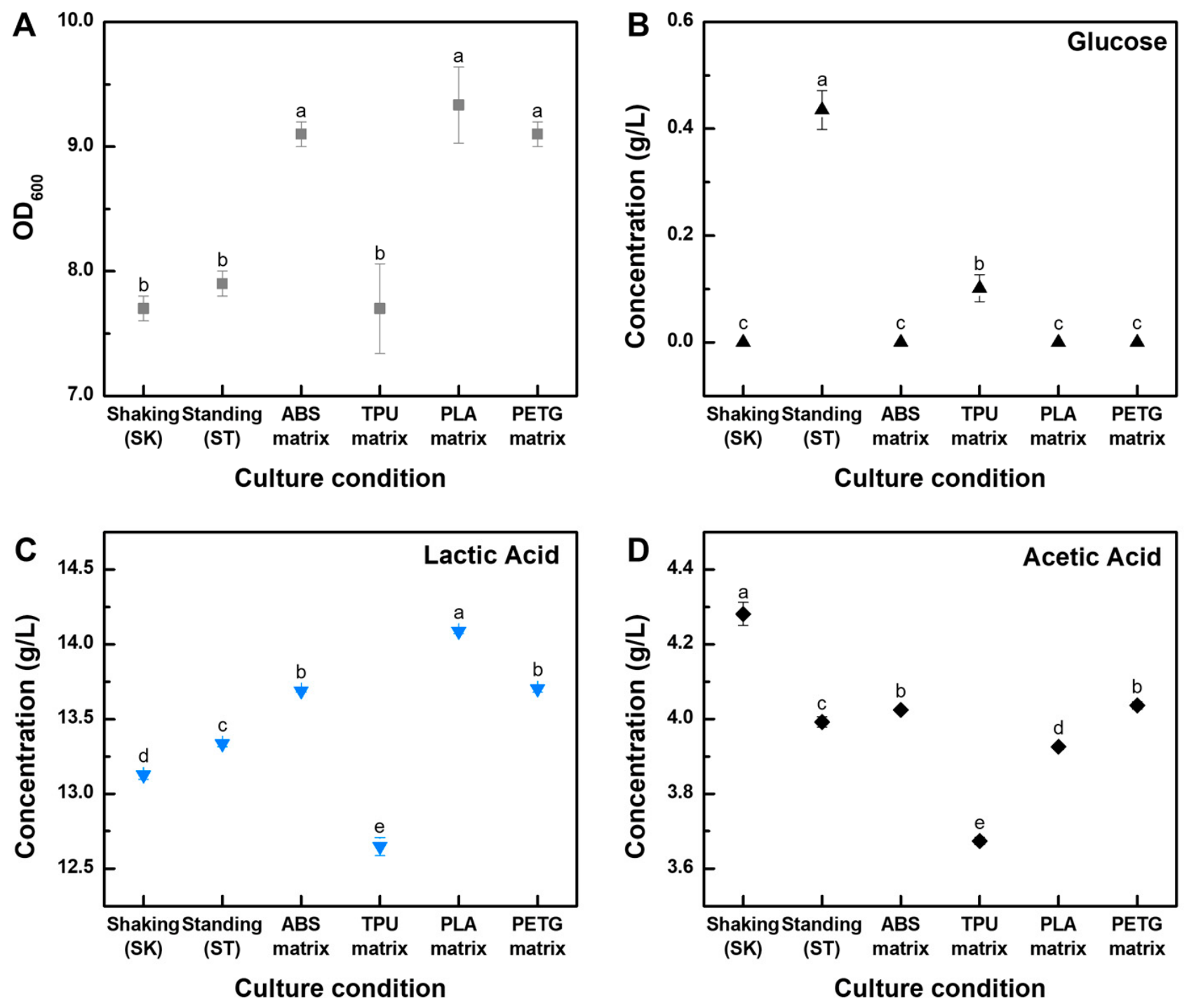
The behavior of L. plantarum was qualitatively different and, from the standpoint of the present study, more striking. Rather than merely approaching the shaken control, three of the four matrices exceeded it: final biomass reached OD600 = 9.33 ± 0.31 on PLA, 9.10 ± 0.10 on ABS, and 9.10 ± 0.10 on PETG, roughly 15–21% above both the shaking (7.70 ± 0.10) and standing (7.90 ± 0.10) controls (Figure 4A; Table 3). Lactic acid production followed the same ranking, peaking on PLA (14.09 ± 0.01 g/L) above the shaking (13.13 ± 0.03) and standing (13.34 ± 0.02) controls, with ABS and PETG also elevated (13.69 and 13.70 g/L) (Figure 4B). Acetic acid remained close to the static-control level (~3.9–4.0 g/L) for these three materials even as biomass rose, indicating that the gain in cell density and lactate was not achieved through a shift toward acetate production; glucose was fully consumed in all matrix conditions (Figure 4C).
Notably, TPU was the clear exception, yielding biomass (7.70 ± 0.36) and lactic acid (12.65 ± 0.06 g/L) indistinguishable from—or slightly below—the controls, in contrast to the three rigid polymers that surpassed them. The organism-specific pattern is itself informative: the elastomeric TPU surface, which performed comparably to the rigid materials for yeast, was distinctly unfavorable for the bacterium, whereas PLA and ABS were favorable for both. This divergence is difficult to reconcile with any geometry- or oxygen-based explanation and instead points to the material surface as the operative variable. These rankings can be read against the surface characterization of Figure 2, though with due caution given the four-material set. Wettability accounts for part of the trend: PLA, the most hydrophilic surface and that of highest work of adhesion (94.5 mN·m−1), gave the highest L. plantarum biomass and lactic acid titre, consistent with stronger aqueous adhesion favouring cell–substrate contact and colonization. Yet wettability alone cannot explain the full pattern—ABS, the most hydrophobic surface (Wa = 74.5 mN·m−1), nonetheless supported near-maximal growth, whereas the elastomeric TPU, of intermediate wettability, was the poorest performer. A second, mechanical axis offers a complementary reading: the three rigid thermoplastics (ABS, PLA, PETG) all supported high growth, and only the elastomer (TPU) underperformed, which would suggest that substrate rigidity sets a primary condition for favourable colonization while wettability modulates the outcome among the rigid materials (PLA highest). We present both descriptors as candidate contributors rather than asserting a single determinant: with four commercial filaments the trends are indicative rather than statistically resolved, and surface chemistry, groove topography (Figure 2C,D) and stiffness are inevitably confounded across materials [12,13,24]. What the data establish unambiguously is that the polymer is a material variable with a real, organism-dependent effect—one that a broader material library with dedicated stiffness and roughness controls could deconvolute in future work.
Because L. plantarum is microaerophilic and does not depend on vigorous aeration, the fact that the matrices exceeded even the aerated shaking control suggests that improved oxygen transfer alone is unlikely to explain the observed enhancement. Instead, scaffold-associated interfacial effects, potentially including increased available surface area and a quiescent local microenvironment, may contribute to the improved cultivation performance. The contrast with S. cerevisiae is also consistent with their different oxygen requirements: mechanical aeration can raise the biomass benchmark for S. cerevisiae, whereas such an advantage is less pronounced for L. plantarum. These observations support a role for the material interface in the observed phenotype, although the relative contributions of cell attachment, local hydrodynamics, and individual surface properties cannot be resolved from the present data.

3.5. The Polymer Type as a Tunable Process Variable

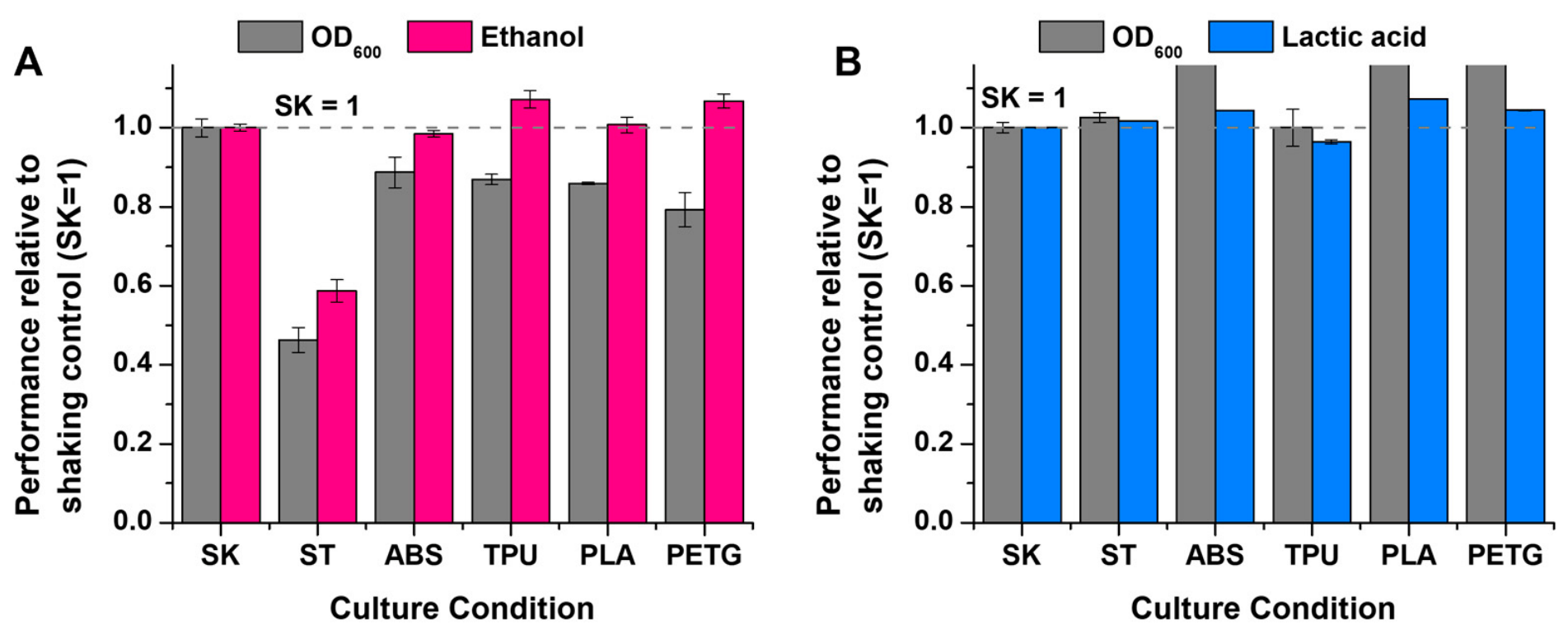
Viewed across both organisms, the data resolve into two regimes that are summarized in Figure 5, where performance is normalized to the shaking control. For S. cerevisiae, the matrices cluster just below shaking in biomass (≈0.79–0.89) while matching or exceeding it in ethanol (≈0.98–1.07), i.e., they constitute an agitation-free equivalent of the aerated process (Figure 5A). For L. plantarum, the rigid matrices sit above shaking in both biomass (up to ~1.21) and lactic acid, i.e., they outperform the conventional process (Figure 5B).
In both cases the material is not a passive carrier but a determinant of outcome: yeast tolerated all four polymers with a mild preference reflected in ethanol titre, whereas the bacterium sharply distinguished the rigid ABS/PLA/PETG from the elastomeric TPU. Mapping these outcomes onto the work of adhesion derived above provides a material-level rationale for the ranking and, more importantly, reframes scaffold cultivation as a design problem: by choosing the polymer, one selects an operating point on a performance surface, without altering geometry, medium, or energy input. This material-and-process perspective—achieving high-density cultivation by engineering the interface rather than the bulk flow—positions additive-manufactured polymer matrices as an energy-efficient, agitation-free alternative to stirred cultivation, and one whose behavior can be tuned simply by the choice of feedstock filament.

4. Conclusions

Using a fixed scaffold geometry printed in four common thermoplastics, we have shown that the choice of polymer is a decisive and tunable variable in scaffold-supported fermentation. Simply embedding a 3D-printed matrix in a static culture reproduced the substrate assimilation and ethanol output of an aerated shaken culture for S. cerevisiae, and, for the microaerophilic L. plantarum, the rigid polymers (PLA, ABS, PETG) surpassed even the shaking control in both biomass and lactic acid, whereas the elastomeric TPU did not. The consistency of the effect across two physiologically distinct organisms suggests that the wetted interfacial area and a quiescent local microenvironment may contribute to the observed enhancement, rather than oxygen transfer alone, consistent with prior observations on PLA-supported yeast growth and broader surface-adhesion principles [11,12,13,24]. Framed this way, high-density cultivation becomes an interfacial-materials problem: by selecting the feedstock filament, one selects an operating point on a performance surface without changing geometry, medium, or energy input. This offers an agitation-free route to fermentation that dispenses with the rheological shear penalty of mechanical stirring. Establishing the surface-property basis of the material ranking (via the contact-angle/work-of-adhesion analysis), extending the approach to additional strains and product classes, and evaluating scale-up and long-term operation are natural next steps toward translating this material-and-process strategy into practical bioprocessing.

Author Contributions

Conceptualization, H.G.K. and W.E.; methodology, S.L. and S.-C.J.; investigation, S.-C.J., S.L. and H.G.K.; formal analysis, S.-C.J. and W.E.; writing—original draft preparation, H.G.K. and W.E.; writing—review and editing, W.E. and H.G.K.; visualization, S.L.; supervision, W.E.; project administration, W.E. All authors have read and agreed to the published version of the manuscript.

Funding

This research was supported by the research fund of Dankook University in 2024.

Data Availability Statement

The raw and processed data supporting the findings of this study are available on reasonable request from the corresponding authors. The data are not publicly available due to ongoing follow-up research.

Conflicts of Interest

The authors declare no conflicts of interest.

References

  1. Garcia-Ochoa, F.; Gomez, E. Bioreactor Scale-up and Oxygen Transfer Rate in Microbial Processes: An Overview. Biotechnol. Adv. 2009, 27, 153–176. [Google Scholar] [CrossRef] [Scilit] [PubMed]
  2. Goudar, C.T.; Strevett, K.A.; Shah, S.N. Influence of Microbial Concentration on the Rheology of Non-Newtonian Fermentation Broths. Appl. Microbiol. Biotechnol. 1999, 51, 310–315. [Google Scholar] [CrossRef] [Scilit] [PubMed]
  3. Kilonzo, P.M.; Margaritis, A. The Effects of Non-Newtonian Fermentation Broth Viscosity and Small Bubble Segregation on Oxygen Mass Transfer in Gas-Lift Bioreactors: A Critical Review. Biochem. Eng. J. 2004, 17, 27–40. [Google Scholar] [CrossRef] [Scilit]
  4. Nienow, A.W. The Impact of Fluid Dynamic Stress in Stirred Bioreactors—The Scale of the Biological Entity: A Personal View. Chem. Ing. Tech. 2021, 93, 17–30. [Google Scholar] [CrossRef] [Scilit]
  5. Routledge, S.J. Beyond De-Foaming: The Effects of Antifoams on Bioprocess Productivity. Comput. Struct. Biotechnol. J. 2012, 3, e201210014. [Google Scholar] [CrossRef] [Scilit] [PubMed]
  6. Jahanian, A.; Ramirez, J.; O’Hara, I. Advancing Precision Fermentation: Minimizing Power Demand of Industrial Scale Bioreactors through Mechanistic Modelling. Comput. Chem. Eng. 2024, 188, 108755. [Google Scholar] [CrossRef] [Scilit]
  7. Donlan, R.M. Biofilms: Microbial Life on Surfaces. Emerg. Infect. Dis. 2002, 8, 881–890. [Google Scholar] [CrossRef] [Scilit] [PubMed]
  8. Qureshi, N.; Annous, B.A.; Ezeji, T.C.; Karcher, P.; Maddox, I.S. Biofilm Reactors for Industrial Bioconversion Processes: Employing Potential of Enhanced Reaction Rates. Microb. Cell Fact. 2005, 4, 24. [Google Scholar] [CrossRef] [Scilit] [PubMed]
  9. Abu Yazid, N.; Barrena, R.; Komilis, D.; Sánchez, A. Solid-State Fermentation as a Novel Paradigm for Organic Waste Valorization: A Review. Sustainability 2017, 9, 224. [Google Scholar] [CrossRef] [Scilit]
  10. John, R.P.; Nampoothiri, K.M.; Pandey, A. Polyurethane Foam as an Inert Carrier for the Production of L(+)-lactic Acid by Lactobacillus Casei under Solid-state Fermentation. Lett. Appl. Microbiol. 2007, 44, 582–587. [Google Scholar] [CrossRef] [Scilit] [PubMed]
  11. Molina-Menor, E.; Vidal-Verdú, À.; Gomis-Olcina, C.; Peretó, J.; Porcar, M. A 3D Printed Plastic Frame Deeply Impacts Yeast Cell Growth. Front. Bioeng. Biotechnol. 2023, 11, 1250667. [Google Scholar] [CrossRef] [Scilit] [PubMed]
  12. Yuan, Y.; Hays, M.P.; Hardwidge, P.R.; Kim, J. Surface Characteristics Influencing Bacterial Adhesion to Polymeric Substrates. RSC Adv. 2017, 7, 14254–14261. [Google Scholar] [CrossRef] [Scilit]
  13. Song, F.; Koo, H.; Ren, D. Effects of Material Properties on Bacterial Adhesion and Biofilm Formation. J. Dent. Res. 2015, 94, 1027–1034. [Google Scholar] [CrossRef] [Scilit] [PubMed]
  14. Bintsis, T. Lactic Acid Bacteria as Starter Cultures: An Update in Their Metabolism and Genetics. AIMS Microbiol. 2018, 4, 665–684. [Google Scholar] [CrossRef] [Scilit] [PubMed]
  15. Brooijmans, R.J.W.; de Vos, W.M.; Hugenholtz, J. Lactobacillus plantarum WCFS1 Electron Transport Chains. Appl. Environ. Microbiol. 2009, 75, 3580–3585. [Google Scholar] [CrossRef] [Scilit] [PubMed]
  16. Wickramasinghe, S.; Do, T.; Tran, P. FDM-Based 3D Printing of Polymer and Associated Composite: A Review on Mechanical Properties, Defects and Treatments. Polymers 2020, 12, 1529. [Google Scholar] [CrossRef] [Scilit] [PubMed]
  17. Buj-Corral, I.; Bagheri, A.; Petit-Rojo, O. 3D Printing of Porous Scaffolds with Controlled Porosity and Pore Size Values. Materials 2018, 11, 1532. [Google Scholar] [CrossRef] [Scilit] [PubMed]
  18. Sherman, F. Getting Started with Yeast. Methods Enzym. 2002, 350, 3–41. [Google Scholar] [CrossRef] [Scilit] [PubMed]
  19. de Man, J.C.; Rogosa, M.; Sharpe, M.E. A Medium for the Cultivation of Lactobacilli. J. Appl. Bacteriol. 1960, 23, 130–135. [Google Scholar] [CrossRef] [Scilit]
  20. Nagy, N. Determination of Solid-Liquid Adhesion Work on Flat Surfaces in a Direct and Absolute Manner. Sci. Rep. 2024, 14, 29991. [Google Scholar] [CrossRef] [Scilit] [PubMed]
  21. Kingman, J.; Dymond, M.K. Fused Filament Fabrication and Water Contact Angle Anisotropy: The Effect of Layer Height and Raster Width on the Wettability of 3D Printed Polylactic Acid Parts. Chem. Data Collect. 2022, 40, 100884. [Google Scholar] [CrossRef] [Scilit]
  22. Kusumaatmaja, H.; Vrancken, R.J.; Bastiaansen, C.W.M.; Yeomans, J.M. Anisotropic Drop Morphologies on Corrugated Surfaces. Langmuir 2008, 24, 7299–7308. [Google Scholar] [CrossRef] [Scilit] [PubMed]
  23. Pfeiffer, T.; Morley, A. An Evolutionary Perspective on the Crabtree Effect. Front. Mol. Biosci. 2014, 1, 17. [Google Scholar] [CrossRef] [Scilit] [PubMed]
  24. Zheng, S.; Bawazir, M.; Dhall, A.; Kim, H.-E.; He, L.; Heo, J.; Hwang, G. Implication of Surface Properties, Bacterial Motility, and Hydrodynamic Conditions on Bacterial Surface Sensing and Their Initial Adhesion. Front. Bioeng. Biotechnol. 2021, 9, 643722. [Google Scholar] [CrossRef] [Scilit] [PubMed]
Figure 1. Design and additive manufacturing of the polymer scaffolds. (A) CAD model of the cylindrical open-lattice matrix with overall dimensions and internal channel geometry. (B) Photographs of the same geometry FDM-printed in ABS, TPU, PLA, and PETG. (C) Schematic of the assay: a single matrix immersed in 25 mL of static medium in a 50 mL tube, versus the shaking and matrix-free static controls.
Processes 14 02730 g001
Figure 2. Surface and physicochemical characterization of the four scaffold polymers (ABS, TPU, PLA, and PETG). (A) Schematic of a printed coupon defining the two sessile-drop measurement directions relative to the FDM raster: along the print lines (“horizontal”) and across them (“vertical”). (B) Representative water-droplet images on each polymer in both directions (top row, horizontal; bottom row, vertical); dashed lines mark the baseline and red arcs the fitted drop profile. (C) Mean water contact angle (θ) for each material and direction; the dashed line at 90° separates hydrophilic from hydrophobic surfaces. (D) Wetting anisotropy, Δθ = θvertical − θhorizontal, measured on the disinfected coupons. (E) ATR-FTIR spectra of the four printed polymers after the 70% (v/v) ethanol disinfection procedure. (F) Glass transition temperature (Tg, left axis) of each polymer, and Hansen solubility parameter distance (Ra, right axis) from each polymer to ethanol and to lactic acid.
Processes 14 02730 g002
Figure 3. Growth and alcoholic fermentation of S. cerevisiae after 24 h (YPD, 30 °C; n = 3, error bars = SD). (A) Final biomass (OD600). (B) Residual glucose. (C) Ethanol titre. Conditions: shaking (SK), static (ST), and static + ABS/TPU/PLA/PETG matrices. Different lowercase letters above the bars indicate significant differences among conditions within each panel, as determined by one-way ANOVA followed by Tukey’s multiple-comparisons test (p < 0.05). Bars sharing at least one letter are not significantly different.
Processes 14 02730 g003
Figure 4. Growth and organic-acid production of L. plantarum after 24 h (MRS, 37 °C; n = 3, error bars = SD). (A) Final biomass (OD600). (B) Residual glucose. (C) Lactic acid. (D) Acetic acid. Conditions: shaking (SK), static (ST), and static + ABS/TPU/PLA/PETG matrices. Different lowercase letters above the bars indicate significant differences among conditions within each panel, as determined by one-way ANOVA followed by Tukey’s multiple-comparisons test (p < 0.05). Bars sharing at least one letter are not significantly different.
Processes 14 02730 g004
Figure 5. Material dependence of bioprocess performance, expressed relative to the shaking control (SK = 1.00). (A) S. cerevisiae and (B) L. plantarum: normalized final biomass (OD600) and normalized principal metabolite (ethanol for S. cerevisiae, lactic acid for L. plantarum) for each condition. Values are means of biological triplicates normalized to the shaking control; error bars represent the standard deviation divided by the shaking-control mean (n = 3). The dashed line at 1.0 marks the shaking-control level: bars below it indicate performance approaching, and bars above it exceeding, conventional agitated culture. Conditions: shaking (SK), static (ST), and static + ABS/TPU/PLA/PETG matrices.
Processes 14 02730 g005
Table 1. Material-specific fused-deposition-modeling parameters used to print the scaffolds.
MaterialNozzle T (°C)Bed T (°C)Layer Height (mm)Infill (%)Speed (mm/s)
ABS260900.1615200
TPU225350.1615140
PLA210550.1615200
PETG240700.1615150
Table 2. Growth and metabolite data for S. cerevisiae (mean ± SD, n = 3; concentrations in g/L).
ConditionOD600Residual GlucoseEthanol
Shaking (SK)7.82 ± 0.180.00 ± 0.0020.92 ± 0.18
Static (ST)3.62 ± 0.2518.69 ± 1.2512.27 ± 0.59
ABS6.94 ± 0.310.08 ± 0.0920.59 ± 0.17
TPU6.80 ± 0.100.00 ± 0.0022.42 ± 0.46
PLA6.72 ± 0.030.21 ± 0.1921.06 ± 0.42
PETG6.20 ± 0.330.13 ± 0.1422.32 ± 0.37
Table 3. Growth and metabolite data for L. plantarum (mean ± SD, n = 3; concentrations in g/L).
ConditionOD600Residual GlucoseLactic AcidAcetic Acid
Shaking (SK)7.70 ± 0.100.00 ± 0.0013.13 ± 0.034.28 ± 0.03
Static (ST)7.90 ± 0.100.44 ± 0.0413.34 ± 0.023.99 ± 0.01
ABS9.10 ± 0.100.00 ± 0.0013.69 ± 0.014.02 ± 0.00
TPU7.70 ± 0.360.10 ± 0.0312.65 ± 0.063.67 ± 0.01
PLA9.33 ± 0.310.00 ± 0.0014.09 ± 0.013.93 ± 0.01
PETG9.10 ± 0.100.00 ± 0.0013.70 ± 0.024.04 ± 0.01
Disclaimer/Publisher’s Note: The statements, opinions and data contained in all publications are solely those of the individual author(s) and contributor(s) and not of MDPI and/or the editor(s). MDPI and/or the editor(s) disclaim responsibility for any injury to people or property resulting from any ideas, methods, instructions or products referred to in the content.