



“Four-in-One” Coal Mine Safety Management Method for Coal Mines Based on Time and Space Characteristics of Potential Safety Hazards

 ,
,  and
and
Abstract
1. Introduction
2. Correspondence Analysis
2.1. Potential Safety Hazards of SS Coal Mine
2.2. Correspondence Analysis Model of Temporal and Spatial Distribution of Coal Mine Potential Safety Hazards
- (1)
- The original data matrix is transformed, and each element of the data set is divided by the sum of each element to obtain the probability matrix to ensure that the row and column vectors have the same non-zero eigenvalue, as follows:
- (2)
- A transformation matrix is constructed, and the formulas are as follows:
- (3)
- R-type and Q-type factor analyses are performed. The eigenvalues and eigenvectors of the covariance matrix ZTZ are calculated. The first y feature values and feature vectors are selected based on the cumulative percentage of feature values. Thus, the y-dimensional factor loading matrix U is obtained:
- (4)
- An empirical study is conducted on the temporal and spatial distribution of potential safety hazards in the SS coal mine. During the research process, the 1142 potential safety hazards in the investigation records of the SS coal mine were taken as a sample set for this study, as shown in Table 1 and Table 2.
- (5)
- Model analysis
3. A “Four-in-One” Collaborative Safety Management Framework Based on the Spatiotemporal Evolution Characteristics of Hazards
3.1. APN-Based Mechanism for Precise Risk Identification Based on Spatiotemporal Heterogeneity of Hidden Hazards
3.2. The TWR Active Participation Governance Mechanism Based on Behavioral Incentives
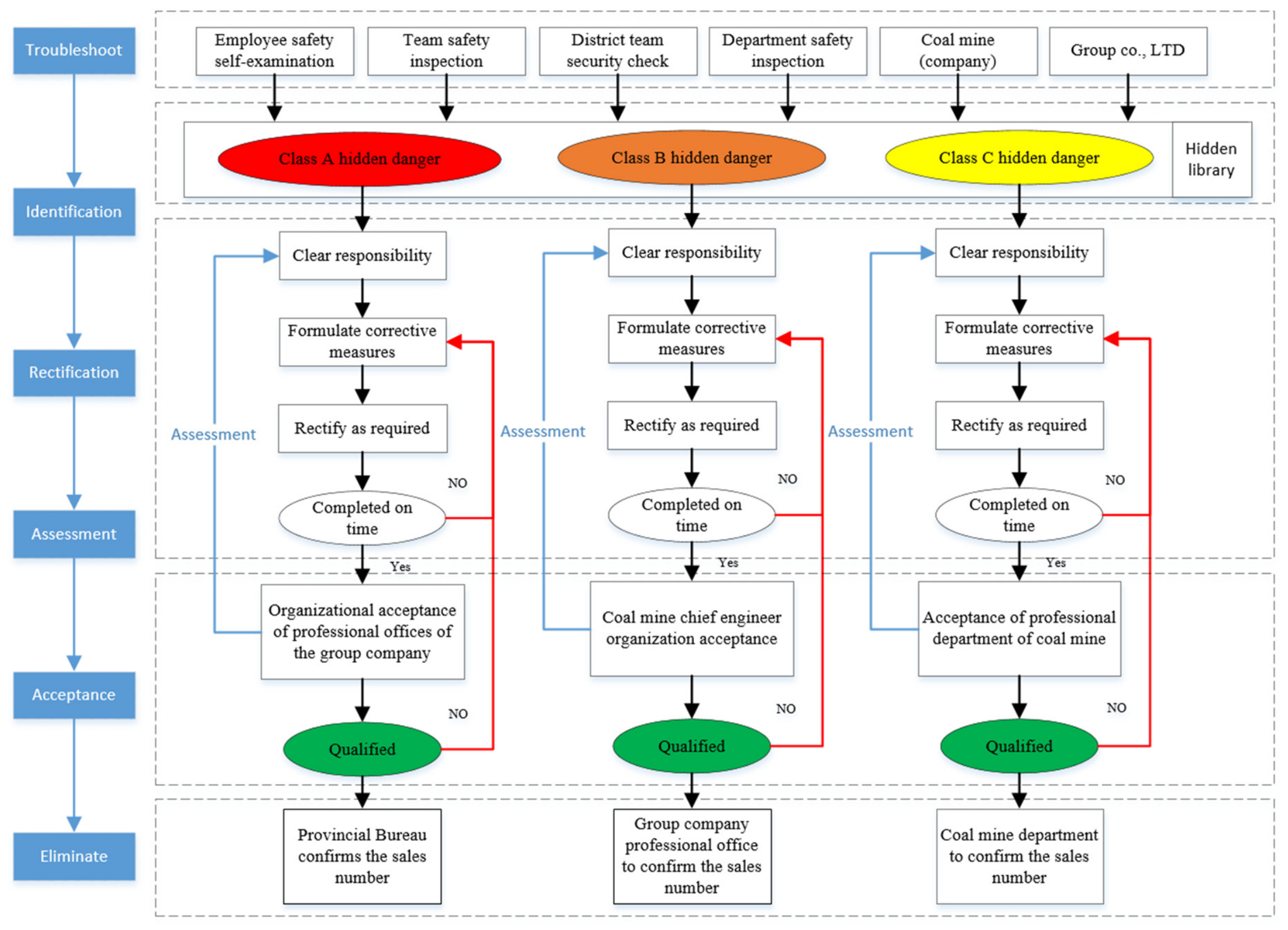
3.3. SST Full-Process Closed-Loop Governance Mechanism Based on Chain-of-Responsibility Coordination
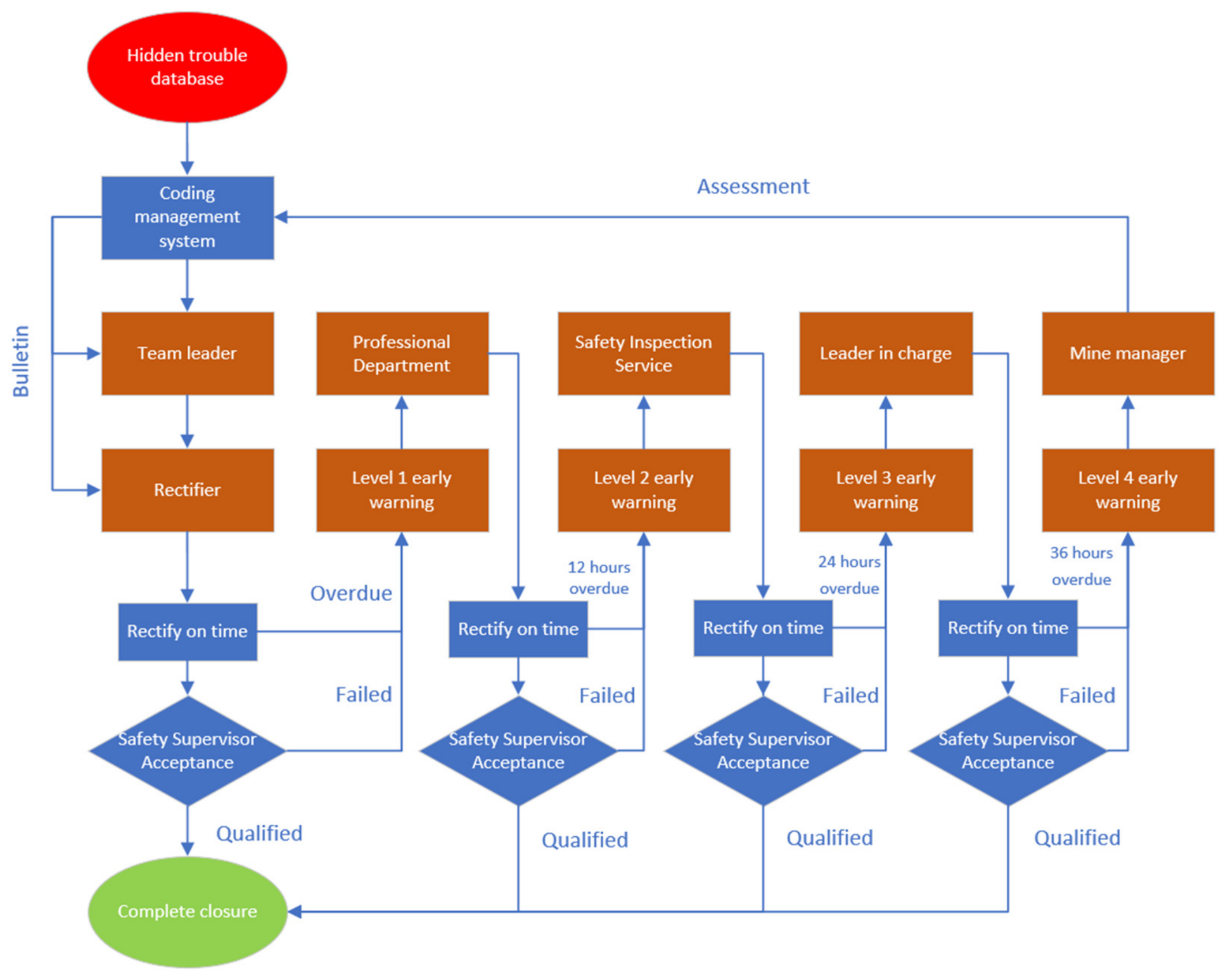
3.4. HAS Dynamic Risk Feedback Mechanism Based on Hazard Data Integration
4. Discussion
4.1. Mechanism of Synergy Among APN, SST, TWR, and HAS
- (1)
- APN enables the precise spatial identification of safety risks and serves as the foundational layer of the “Four-in-One” system.
- (2)
- SST facilitates organizational coordination in the hazard remediation process and serves as the execution layer of the “Four-in-One” system.
- (3)
- TWR reinforces employee proactive participation and serves as a key driver for the transformation of safety management from passive compliance to active governance. Coal mine production sites are highly dynamic, and relying solely on management inspections makes it difficult to fully grasp real-time risk conditions. Frontline employees, who are constantly immersed in the production environment, possess a natural advantage in identifying latent risks. By establishing a hazard value assessment and incentive-based feedback mechanism, TWR transforms employee safety behaviors into corporate risk control resources, thereby increasing the enthusiasm of frontline personnel to participate in hazard identification and risk management. This mechanism embodies the crucial role of “human adaptive capacity” in safety management, as outlined in socio-technical systems theory.
- (4)
- The HAS implements a closed-loop information system for safety management and serves as the dynamic feedback layer of the “Four-in-One” system. In complex coal mine production systems, addressing potential hazards requires timely information transmission and status feedback. Through hazard coding, accountability assignment, and a tiered early warning mechanism, HAS enables dynamic tracking of hazard statuses and timely management responses. Essentially, the system establishes an information feedback mechanism focused on the hazard lifecycle, shifting safety management from manual processes to data-driven decision-making, thereby enhancing the timeliness and reliability of risk control.
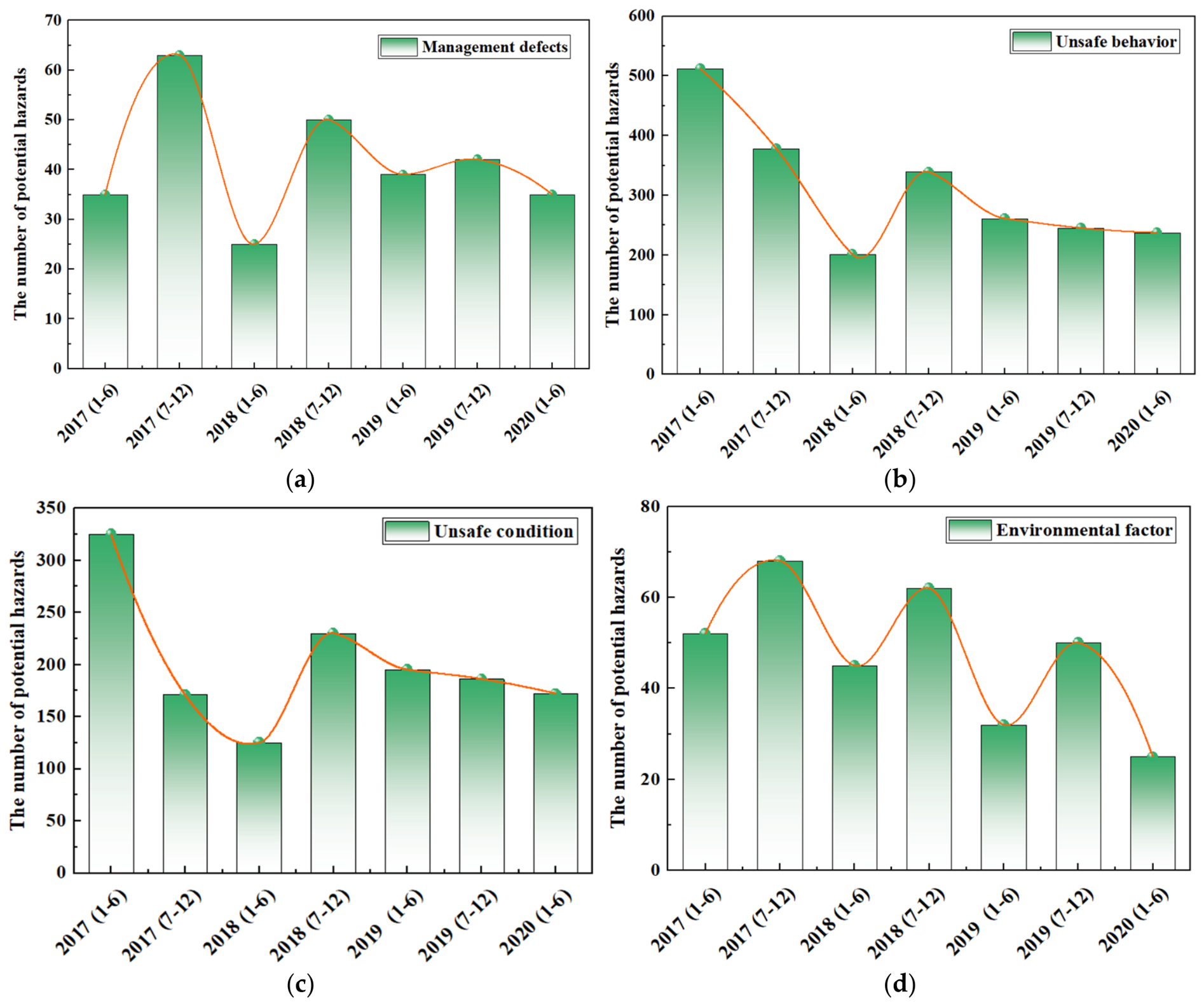
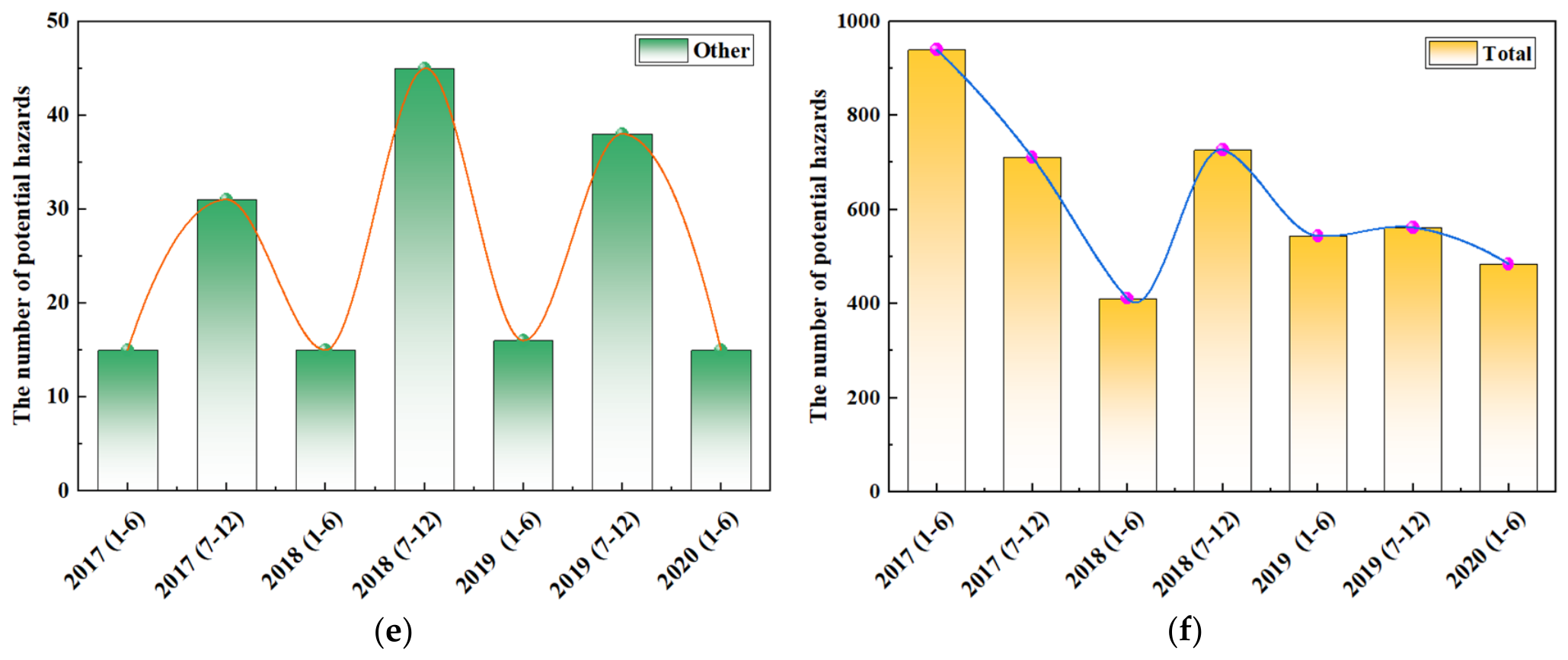
4.2. An Analysis of the Implementation Effectiveness of the “Four-in-One” Safety Management Method
5. Conclusions
- (1)
- A multidimensional collaborative safety management framework was established, integrating APN risk classification and control, the TWR active participation mechanism, the SST closed-loop governance model, and the HAS dynamic early warning system. This framework achieves coordinated control over spatial risks, human behavior, organizational responsibilities, and digital information, driving the transformation of coal mine safety management from single-factor governance to systematic governance.
- (2)
- A dynamic closed-loop mechanism covering the entire lifecycle of hidden hazards was established, effectively linking risk identification, hazard remediation, and feedback on outcomes. This facilitated a shift in safety management from post-incident rectification to proactive prevention and from experience-driven to data-assisted decision-making, thereby enhancing the dynamic adaptability of the safety management system.
- (3)
- A proactive governance mechanism targeting human factor risks was proposed. By incentivizing frontline employees to participate in risk identification and hazard detection, this mechanism strengthened employees’ sense of responsibility for safety, integrated external oversight with internal self-regulation, and effectively enhanced the ability to detect latent risks on-site.
- (4)
- A smart mine safety management model based on “digital technology empowerment + organizational collaborative governance” was developed. This model overcomes the limitations of traditional intelligent monitoring, which tends to focus on equipment status perception, and provides a new theoretical framework and practical pathway for the coordinated control of human factor risks, management risks, and equipment risks in the context of intelligent mine construction.
Author Contributions
Funding
Data Availability Statement
Conflicts of Interest
References
- Li, M.; Wang, D.; Shan, H. Risk assessment of mine ignition sources using fuzzy Bayesian network. Process Saf. Environ. Prot. 2019, 125, 297–306. [Google Scholar] [CrossRef] [Scilit]
- Xiao, W.; Xu, J.; Lv, X. Establishing a georeferenced spatio-temporal database for Chinese coal mining accidents between 2000 and 2015. Geomat. Nat. Hazards Risk 2019, 10, 242–270. [Google Scholar] [CrossRef] [Scilit]
- Cao, Q.; Li, K.; Liu, Y.; Sun, Q.; Zhang, J. Risk management and workers’ safety behavior control in coal mine. Saf. Sci. 2012, 50, 909–913. [Google Scholar] [CrossRef] [Scilit]
- Liu, R.; Cheng, W.; Yu, Y.; Xu, Q. Human factors analysis of major coal mine accidents in China based on the HFACS-CM model and AHP method. Int. J. Ind. Ergon. 2018, 68, 270–279. [Google Scholar] [CrossRef] [Scilit]
- Feng, Y.; Chen, H.; Zhang, Y.; Jing, L. The hybrid systems method integrating human factors analysis and classification system and grey relational analysis for the analysis of major coal mining accidents. Syst. Res. Behav. Sci. 2019, 36, 564–579. [Google Scholar]
- Belodedenko, S.; Bilichenko, G.; Rassokhin, D. Engineering safety in the aspect of the safety and security civilization. Emerg. Manag. Sci. Technol. 2024, 5, e002. [Google Scholar]
- Wang, C.; Wang, J.; Wang, X.; Yu, H.; Bai, L.; Sun, Q. Exploring the impacts of factors contributing to unsafe behavior of coal miners. Saf. Sci. 2019, 115, 339–348. [Google Scholar] [CrossRef] [Scilit]
- Liu, T.; Wang, Z.; Li, W.; Li, Z. Utility optimization strategy of safety management capability of coal mine—A case study of JCIA. Saf. Sci. 2012, 50, 684–688. [Google Scholar] [CrossRef] [Scilit]
- Liu, Q.; Meng, X.; Hassall, M.; Li, X. Accident-causing mechanism in coal mines based on hazards and polarized management. Saf. Sci. 2016, 85, 276–281. [Google Scholar] [CrossRef] [Scilit]
- Lang, L.; Wang, D.; Chen, B.; Li, D.; Gu, L. Efficient stabilization of dredged sediment by combining nano-modification and low-carbon supersulfated cement. J. Rock. Mech. Geotech. Eng. 2025, 18, 4034–4049. [Google Scholar]
- Wang, H.; Ding, Y.; Dong, L.; Wang, D.; Sun, D.; Yan, F. Solidified high moisture and high organic content sediment as liquefied backfill material for urban underground space. Acta Geotech. 2026, 1–25. [Google Scholar] [CrossRef] [Scilit]
- Bird, F.E.; Germain, G.L. Practical Loss Control Leadership; International Loss Control Institute: Loganville, GA, USA, 2012. [Google Scholar]
- Festag, S. Counterproductive (safety and security) strategies: The hazards of ignoring human behaviour. Process Saf. Environ. Prot. 2017, 110, 21–30. [Google Scholar] [CrossRef] [Scilit]
- Fu, G.; Xie, X.; Jia, Q.; Tong, W.; Ge, Y. Accidents analysis and prevention of coal and gas outburst: Understanding human errors in accidents. Process Saf. Environ. Prot. 2020, 134, 1–23. [Google Scholar] [CrossRef] [Scilit]
- Benzecri, J.P. L’analyse des données. In L’analyse Des Correspondances; Dunod: Paris, France, 1973; Volume 2. [Google Scholar]
- Li, Z.; Wang, S.; Zhao, T.; Liu, B. A hazard analysis via an improved timed colored petri net with time–space coupling safety constraint. Chin. J. Aeronaut. 2016, 29, 1027–1041. [Google Scholar] [CrossRef] [Scilit]
- Rode, J.B.; Ringel, M.M. Statistical software output in the classroom: A comparison of R and SPSS. Teach. Psychol. 2019, 46, 319–327. [Google Scholar] [CrossRef] [Scilit]
- Zhang, J.; Xu, K.; Reniers, G.; You, G. Statistical analysis the characteristics of extraordinarily severe coal mine accidents (ESCMAs) in China from 1950 to 2018. Process Saf. Environ. Prot. 2020, 133, 332–340. [Google Scholar] [CrossRef] [Scilit]
- Aljubayrin, S.; Qi, J.; Jensen, C.S.; Zhang, R.; He, Z.; Li, Y. Finding lowest-cost paths in settings with safe and preferred zones. VLDB J. 2017, 26, 373–397. [Google Scholar] [CrossRef] [Scilit]
- Ding, L.; Khan, F.; Ji, J. Risk-based safety measure allocation to prevent and mitigate storage fire hazards. Process Saf. Environ. Prot. Trans. Inst. Chem. Eng. Part B 2020, 135, 282–293. [Google Scholar] [CrossRef] [Scilit]
- Ahmad, S.I.; Hashim, H.; Hassim, M.H.; Rashid, R. A graphical inherent safety assessment technique for preliminary design stage. Process Saf. Environ. Prot. 2019, 130, 275–287. [Google Scholar] [CrossRef] [Scilit]
- Jiang, F.; Lai, E.; Shan, Y.; Tang, F.; Li, H. A set theory-based model for safety investment and accident control in coal mines. Process Saf. Environ. Prot. 2020, 136, 253–258. [Google Scholar] [CrossRef] [Scilit]
- Srinivasan, R.; Natarajan, S. Developments in inherent safety: A review of the progress during 2001–2011 and opportunities ahead. Process Saf. Environ. Prot. 2012, 90, 389–403. [Google Scholar] [CrossRef] [Scilit]
- Zhou, W.; Wang, H.; Wang, D.; Du, Y.; Zhang, K.; Qiao, Y. An experimental investigation on the influence of coal brittleness on dust generation. Powder Technol. 2020, 364, 457–466. [Google Scholar] [CrossRef] [Scilit]
- Zainal Abidin, M.; Rusli, R.; Khan, F.; Shariff, A.M. Development of inherent safety benefits index to analyse the impact of inherent safety implementation. Process Saf. Environ. Prot. 2018, 117, 454–472. [Google Scholar] [CrossRef] [Scilit]
- Śliwiński, M. Safety integrity level verification for safety-related functions with security aspects. Proc. Process Saf. Environ. Prot. 2018, 118, 79–92. [Google Scholar] [CrossRef] [Scilit]
- Liaw, H. Deficiencies frequently encountered in the management of process safety information. Process Saf. Environ. Prot. 2019, 132, 226–230. [Google Scholar] [CrossRef] [Scilit]
- Lee, J.; Cameron, I.; Hassall, M. Improving process safety: What roles for digitalization and industry 4.0? Process Saf. Environ. Prot. 2019, 132, 325–339. [Google Scholar] [CrossRef] [Scilit]
- O’Connor, M.; Pasman, H.J.; Rogers, W.J. Sam Mannan’s safety triad, a framework for risk assessment. Process Saf. Environ. Prot. 2019, 129, 202–209. [Google Scholar] [CrossRef] [Scilit]
- Ade, N.; Liu, G.; Al-Douri, A.F.; El-Halwagi, M.M.; Mannan, M.S. Investigating the effect of inherent safety principles on system reliability in process design. Process Saf. Environ. Prot. 2018, 117, 100–110. [Google Scholar] [CrossRef] [Scilit]
- Chebila, M. Simultaneous evaluation of safety integrity’s performance indicators with a generalized implementation of common cause failures. Process Saf. Environ. Prot. 2018, 117, 214–222. [Google Scholar] [CrossRef] [Scilit]
- Ee, A.W.L.; Shaik, S.M.; Khoo, H.H. Development and application of a combined approach for inherent safety and environmental (CAISEN) assessment. Process Saf. Environ. Prot. 2015, 96, 138–148. [Google Scholar] [CrossRef] [Scilit]
- Li, W.; Cao, Q.; He, M.; Sun, Y. Industrial non-routine operation process risk assessment using job safety analysis (JSA) and a revised Petri net. Process Saf. Environ. Prot. 2018, 117, 533–538. [Google Scholar] [CrossRef] [Scilit]
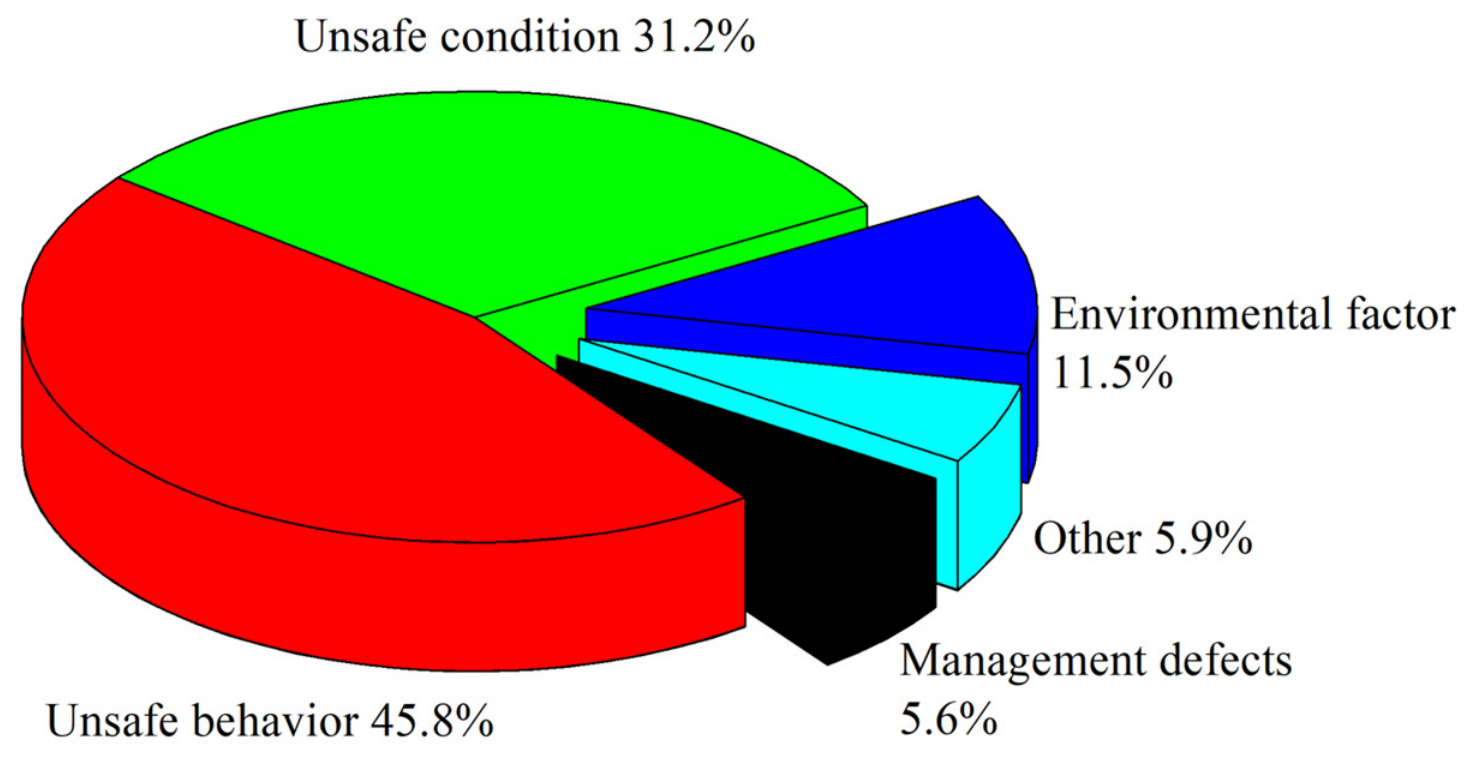
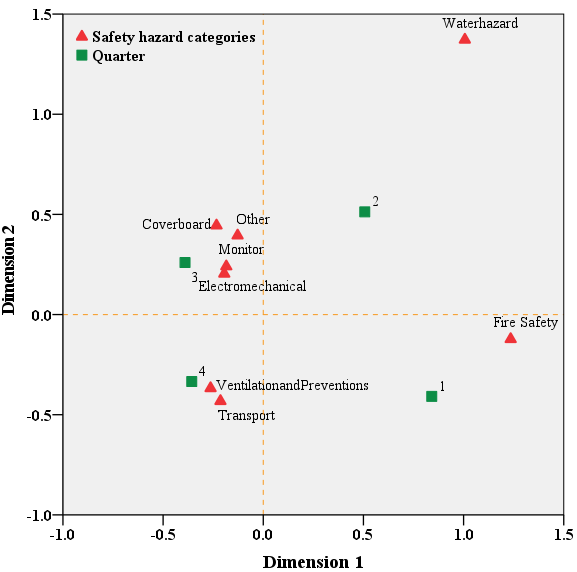
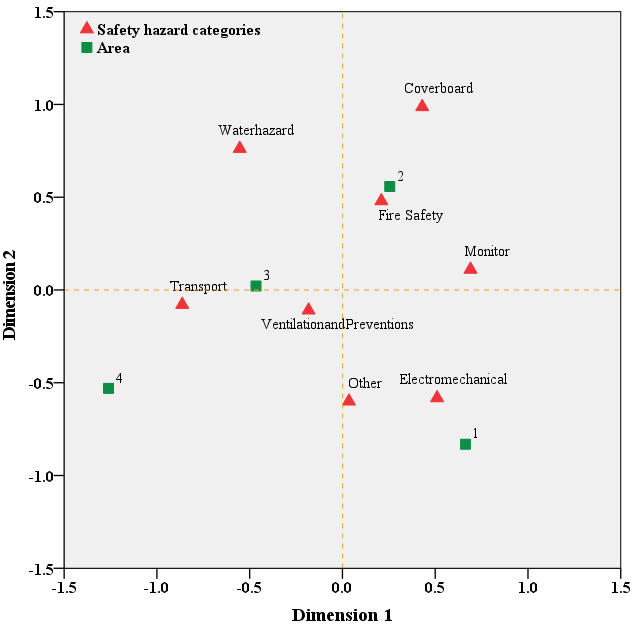
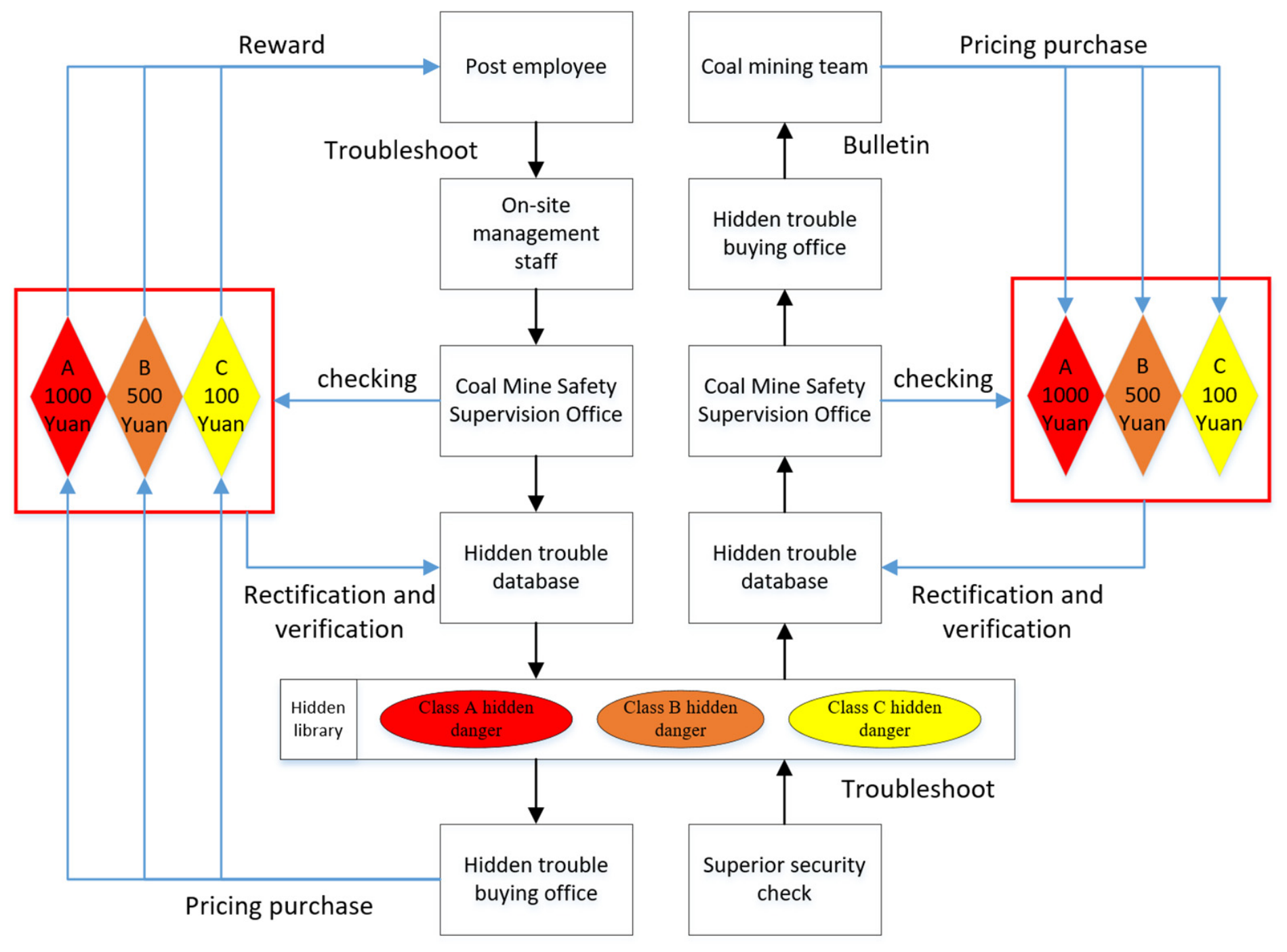

| Quarter | Coal Mining | Driving | Electromechanical | Transport | Ventilation | Monitor | Geodesy | Other |
|---|---|---|---|---|---|---|---|---|
| First—1 | 10 | 18 | 48 | 53 | 55 | 2 | 2 | 4 |
| Second—2 | 12 | 38 | 67 | 43 | 45 | 1 | 8 | 5 |
| Third—3 | 20 | 65 | 131 | 95 | 25 | 5 | 2 | 11 |
| Fourth—4 | 33 | 55 | 116 | 132 | 29 | 2 | 3 | 7 |
| Area | Ventilation and Prevention | Coverboard | Electromechanical | Transport | Fire Safety | Monitor | Water Hazard | Other |
|---|---|---|---|---|---|---|---|---|
| Coal face—1 | 16 | 18 | 145 | 35 | 25 | 3 | 0 | 9 |
| Excavation roadway—2 | 28 | 121 | 121 | 98 | 81 | 5 | 8 | 6 |
| Auxiliary roadway—3 | 21 | 37 | 71 | 122 | 43 | 2 | 5 | 10 |
| Other—4 | 10 | 0 | 25 | 68 | 5 | 0 | 2 | 2 |
| Dimension | Sig. | Inertia Ratio | |
|---|---|---|---|
| Explanation | Accumulation | ||
| 1 | - | 0.718 | 0.718 |
| 2 | - | 0.201 | 0.918 |
| 3 | - | 0.082 | 1.000 |
| Total | <0.001 | 1.000 | 1.000 |
| Dimension | Sig. | Inertia Ratio | |
|---|---|---|---|
| Explanation | Accumulation | ||
| 1 | - | 0.540 | 0.540 |
| 2 | - | 0.446 | 0.985 |
| 3 | - | 0.015 | 1 |
| Total | <0.001 | 1 | 1 |
| Node | Description | Inspection Times | Remark |
|---|---|---|---|
| AI | Class A area level I checkpoint | 1–3 | per day |
| AII | Class A area level II checkpoint | 1–3 | per day |
| AIII | Class A area level III checkpoint | 1–3 | per day |
| BI | Class B area level I checkpoint | 1–3 | per week |
| BII | Class B area level II checkpoint | 1–3 | per week |
| BIII | Class B area level III checkpoint | 1–3 | per week |
| CI | - | - | - |
| CII | Class C area level II checkpoint | 2–4 | per half month |
| CIII | Class C area level III checkpoint | 2–4 | per half month |
| DI | - | - | - |
| DII | - | - | - |
| DIII | Class D area level III checkpoint | 3–5 | per month |
| Node | Description | Number of Inspection Days per Quarter | |||
|---|---|---|---|---|---|
| First | Second | Third | Fourth | ||
| AJ | Follow-up Safety Inspector | 7 × 4 × 3 | 7 × 4 × 3 | 7 × 4 × 3 | 7 × 4 × 3 |
| CM | Coal Mining Inspection Team | 2 × 4 × 3 | 2 × 4 × 3 | 1 × 4 × 3 | 3 × 4 × 3 |
| JJ | Tunneling Inspection Team | 1 × 4 × 3 | 2 × 4 × 3 | 3 × 4 × 3 | 1 × 4 × 3 |
| JD | Mechanical and Electrical Inspection Team | 1 × 4 × 3 | 2 × 4 × 3 | 3 × 4 × 3 | 2 × 4 × 3 |
| YS | Transportation Inspection Team | 2 × 4 × 3 | 2 × 4 × 3 | 1 × 4 × 3 | 3 × 4 × 3 |
| TF | Ventilation Inspection Team | 1 × 4 × 3 | 1 × 4 × 3 | 3 × 4 × 3 | 1 × 4 × 3 |
| FC | Dust Inspection Team | 1 × 4 × 3 | 1 × 4 × 3 | 3 × 4 × 3 | 1 × 4 × 3 |
| JC | Monitoring Inspection Team | 1 × 4 × 3 | 2 × 4 × 3 | 3 × 4 × 3 | 1 × 4 × 3 |
| DC | Geophysical Inspection Team | 2 × 4 × 3 | 3 × 4 × 3 | 2 × 4 × 3 | 1 × 4 × 3 |
| FP | Firing Inspection Team | 1 × 4 × 3 | 1 × 4 × 3 | 1 × 4 × 3 | 1 × 4 × 3 |
| ZL | Quality Supervision Team | 1 × 4 × 3 | 1 × 4 × 3 | 1 × 4 × 3 | 1 × 4 × 3 |
| GG | Public Supervision Team | 1 × 4 × 3 | 1 × 4 × 3 | 1 × 4 × 3 | 1 × 4 × 3 |
Disclaimer/Publisher’s Note: The statements, opinions and data contained in all publications are solely those of the individual author(s) and contributor(s) and not of MDPI and/or the editor(s). MDPI and/or the editor(s) disclaim responsibility for any injury to people or property resulting from any ideas, methods, instructions or products referred to in the content. |
© 2026 by the authors. Licensee MDPI, Basel, Switzerland. This article is an open access article distributed under the terms and conditions of the Creative Commons Attribution (CC BY) license.
Share and Cite
Gan, J.; Hossain, S.; Yang, D.; Cao, Y.; Tian, F.; Zhu, X. “Four-in-One” Coal Mine Safety Management Method for Coal Mines Based on Time and Space Characteristics of Potential Safety Hazards. Processes 2026, 14, 2612. https://doi.org/10.3390/pr14162612
Gan J, Hossain S, Yang D, Cao Y, Tian F, Zhu X. “Four-in-One” Coal Mine Safety Management Method for Coal Mines Based on Time and Space Characteristics of Potential Safety Hazards. Processes. 2026; 14(16):2612. https://doi.org/10.3390/pr14162612
Chicago/Turabian StyleGan, Jian, Shahadad Hossain, Dongshan Yang, Yaolin Cao, Fuchao Tian, and Xiaolong Zhu. 2026. "“Four-in-One” Coal Mine Safety Management Method for Coal Mines Based on Time and Space Characteristics of Potential Safety Hazards" Processes 14, no. 16: 2612. https://doi.org/10.3390/pr14162612
APA StyleGan, J., Hossain, S., Yang, D., Cao, Y., Tian, F., & Zhu, X. (2026). “Four-in-One” Coal Mine Safety Management Method for Coal Mines Based on Time and Space Characteristics of Potential Safety Hazards. Processes, 14(16), 2612. https://doi.org/10.3390/pr14162612

