1. Introduction
The pursuit of precise and robust trajectory tracking for robotic manipulators operating in dynamic and uncertain environments remains a central challenge in advanced control theory and industrial automation. Manipulators are inherently complex, nonlinear, multi-body systems often subject to parametric uncertainties, unmodeled dynamics and external disturbances. These factors critically degrade the performance of conventional linear controllers, necessitating the development of sophisticated nonlinear control strategies [
1,
2,
3].
Among these, sliding-mode control has emerged as a preeminent technique due to its inherent robustness against matched uncertainties and disturbances. By forcing the system state to reach and remain on a pre-defined sliding manifold, SMC ensures that the closed-loop dynamics are invariant to a certain class of perturbations once the sliding phase is achieved. Consequently, SMC has been extensively studied and applied to robotic manipulators with demonstrated success in guaranteeing stability and precision.
The trajectory-tracking control problem for 6-DOF manipulators has attracted extensive research attention over the past decade. Early approaches relied on model-based computed torque control (CTC), which provides linearization and decoupling of the robot dynamics through feedback of the full dynamic model [
4,
5]. However, CTC is highly sensitive to modeling errors, limiting its applicability in practical scenarios with parametric uncertainties [
6].
To address this limitation, sliding-mode control (SMC) has been widely adopted for 6-DOF manipulator trajectory tracking due to its inherent robustness against matched uncertainties and disturbances. A recent study introduced fixed-time variable-gain trajectory-tracking control for 6-DOF manipulators with unknown disturbances, featuring an error-driven gain adjustment mechanism that dynamically responds to disturbance changes [
7,
8]. Fuzzy logic and adaptive control approaches have also been extensively explored. Precup et al. presented a model-free fuzzy adaptive sliding-mode control approach applicable to servo systems [
5].
Despite these advances, several gaps remain. Many existing methods require precise dynamic models, suffer from complex tuning procedures, or exhibit sensitivity to parameter variations [
9,
10]. Furthermore, the chattering phenomenon inherent in conventional SMC continues to limit practical deployment, particularly in applications requiring smooth motion and actuator longevity.
However, the practical implementation of conventional SMC is significantly hampered by a well-known drawback: chattering. This phenomenon manifests as high-frequency, finite-amplitude oscillations in the control input and system output, caused by the discontinuous switching function, typically the signum function, inherent in the control law [
11,
12,
13]. Chattering is not merely a theoretical concern; it leads to excessive wear on actuators, excites unmodeled high-frequency dynamics, and can cause mechanical fatigue, thereby limiting the applicability of SMC in high-precision engineering systems. The core of the problem lies in the selection of the switching gain. To maintain sliding motion and robustness, the chosen gain must be larger than the upper bound of the total system uncertainty [
14]. A fixed, conservative gain inevitably results in chattering when the system state is close to the sliding manifold, as the control action remains unnecessarily aggressive.
To mitigate chattering while preserving robustness, the research community has explored several avenues. The boundary-layer technique replaces the discontinuous signum function with a continuous approximation, such as the saturation or hyperbolic tangent function, effectively smoothing the control signal within a vicinity of the sliding surface [
15,
16,
17]. While this reduces chattering, it does so at the cost of introducing a bounded steady-state error, trading perfect robustness for practical feasibility. Higher-order sliding-mode controllers, such as the super-twisting algorithm, act on higher-order derivatives of the sliding variable, enabling the attenuation of chattering while maintaining finite-time convergence. Nevertheless, their design and tuning can be complex, and their performance may still be sensitive to the chosen parameters under widely varying operational conditions [
18].
A more adaptive approach involves dynamically adjusting the switching gain based on the system’s real-time behavior. This has led to the integration of adaptive control and intelligent control methodologies with SMC. Notably, the fusion of fuzzy logic with SMC has garnered substantial interest [
19,
20]. Fuzzy logic provides a systematic framework to encode expert knowledge and heuristics into a rule-based system without requiring a precise analytical model. The concept of fuzzy adaptive sliding-mode control leverages this strength. The central idea is to employ a fuzzy inference system to continuously and intelligently tune the switching gain of the SMC law. The magnitude of the sliding variable, which indicates the distance from the desired manifold, serves as the primary input to the fuzzy inference system. The fuzzy rules are then designed to implement a logical principle: when the system state is far from the sliding surface, a large gain is applied for fast convergence; when it is near the surface, the gain is automatically reduced to a minimal necessary level to suppress chattering [
21]. In addition, the controller offers distinct advantages that make it particularly suitable for modern robotic applications. By integrating fuzzy logic with conventional sliding-mode control, this approach achieves an optimal balance between robustness and control smoothness. The core advantage lies in its ability to actively suppress chattering while maintaining strong disturbance rejection capabilities, overcoming the fundamental limitation of traditional SMC, where fixed high gains inevitably cause undesirable oscillations [
22]. Unlike boundary-layer methods that sacrifice robustness for smoothness, FAGT-SMC employs intelligent gain scheduling that dynamically adjusts control parameters based on real-time tracking performance. When the system exhibits large tracking errors, the fuzzy inference system automatically increases the switching gain to ensure rapid convergence; conversely, when the state approaches the desired trajectory, the gain is reduced to minimize control effort and eliminate chattering [
23]. This adaptive mechanism operates without requiring precise mathematical models of system uncertainties, making it particularly valuable in applications where robotic dynamics are complex or incompletely characterized. Furthermore, the implementation utilizing product inference engines and center-averaged defuzzifiers ensures computational efficiency, making it suitable for efficient numerical simulation and providing a foundation for future hardware implementation.
While the proposed FAGT-SMC algorithm shows promise for trajectory tracking in uncertain environments, the scope of this study is limited to simulation-based validation on a standard 6-DOF industrial manipulator model. The adaptive chattering suppression mechanism and gain-scheduling approach may offer potential benefits for applications requiring both robustness and smooth control; however, these benefits have not yet been demonstrated in specific domains such as medical robotics, aerial manipulation, space systems, or underwater operations. Such applications would require additional validation under domain-specific conditions, including consideration of safety standards, environmental factors, and system-specific dynamics [
24]. The present work focuses on establishing the theoretical foundation and simulation-based performance of the algorithm, leaving domain-specific validation for future investigation. These application scenarios collectively demonstrate how FAGT-SMC bridges the gap between theoretical robustness and practical implementation requirements, making it a versatile solution for next-generation robotic systems operating under uncertain and variable conditions. While the adaptive and robust nature of the proposed FAGT-SMC can compensate for some dynamic effects arising from these kinematic discrepancies, the controller’s core theoretical stability, as proven via Lyapunov methods, is predicated on the convergence of joint-space errors. Therefore, for overall high-precision applications, the proposed control strategy should be complemented by accurate kinematic calibration and trajectory planning that avoids singular regions. This separation of concerns, using robust control for dynamics and precise modeling for kinematics, is a standard and effective approach in advanced robotics.
This paradigm of gain scheduling via fuzzy adaptation offers a compelling solution. It moves beyond fixed or simply smoothed control structures, endowing the controller with online self-regulation capability [
19]. The fuzzy system acts as a supervisory mechanism that modulates the controller’s aggressiveness in response to the instantaneous tracking error and its derivatives. This not only actively suppresses chattering but also enhances the controller’s efficiency, as it avoids the conservative over-actuation inherent in fixed-gain designs. Furthermore, the universal approximation property of fuzzy systems theoretically supports their ability to model complex, nonlinear gain adjustment dynamics.
While adaptive fuzzy sliding-mode control for robotic manipulators has been extensively studied over the past decade, a careful review of the literature reveals that existing approaches differ fundamentally from the proposed FAGT-SMC in several key respects. First, many AFSMC methods employ fuzzy systems to approximate the unknown system dynamics or uncertainty bounds, while the switching gain remains fixed or is determined conservatively. The proposed FAGT-SMC does not use fuzzy approximation of dynamics; instead, fuzzy inference is employed exclusively to adapt the switching gain based on the real-time magnitude of the sliding surface. This yields a simpler, more computationally efficient architecture that avoids the complexity and potential instability of dynamic approximation. Second, some fuzzy SMC approaches replace the discontinuous signum function entirely with a smooth fuzzy inference output to eliminate chattering. While this reduces chattering, it may compromise robustness under significant parametric uncertainty [
25]. The proposed FAGT-SMC retains the signum function but scales it adaptively via a fuzzy-inferred gain, preserving the theoretical robustness guarantees of SMC while actively suppressing chattering. Third, recent adaptive gain-tuning methods often rely on extended state observers or neural network observers to drive gain adaptation, introducing additional estimation dynamics and tuning complexity. The proposed FAGT-SMC achieves direct, observer-free gain adaptation based solely on the sliding surface magnitude, offering a more straightforward implementation with no additional states to estimate. In summary, the novelty of the proposed FAGT-SMC lies in its targeted adaptation architecture: a computationally efficient, direct, and theoretically grounded fuzzy adaptation of the switching gain that preserves the robustness of sliding-mode control while effectively eliminating chattering, without relying on dynamic approximation, observers, or complex multi-input fuzzy structures [
26,
27].
Building upon this foundation, this paper presents a comprehensive design and analysis of a fuzzy adaptive gain-tuning sliding-mode controller for robotic manipulators. The proposed controller employs a product inference engine and a center-averaged defuzzifier to construct a computationally efficient fuzzy adaptation mechanism. The stability and asymptotic convergence of the closed-loop system are rigorously proven using Lyapunov theory. Numerical simulations on a multi-link robotic manipulator model will demonstrate the superior performance of the proposed methods. The results will highlight its effectiveness in achieving precise trajectory tracking, significant chattering attenuation, and robust disturbance rejection under conditions of parameter variations and external disturbances, thereby validating it as a potent control strategy for modern robotic applications.
2. Problem Statement
Robot dynamics is fundamental to the design, control, simulation, and performance analysis of robotic manipulators. It describes the relationship between the forces/torques acting on the robot and the resulting motion, such as position, velocity, and acceleration. Establishing a robot dynamics model is a systematic process that translates the physical description into a mathematical representation of the motion–force relationship. The choice between Lagrangian and Newton–Euler methods depends on the application. The resulting model is a cornerstone for advanced robotics.
The selected switching gain in conventional SMC must be larger than the upper bound of all possible uncertainties to guarantee stability, leading to conservative high gains and severe chattering. Fixed-gain designs cannot adapt to time-varying operating conditions, payload variations, or changing disturbance levels. Existing adaptive fuzzy SMC methods either approximate the entire system dynamics or rely on observers, introducing additional tuning complexity and computational overhead.
The following assumptions are made throughout this work:
- (1)
The desired joint trajectories qd(t) are twice continuously differentiable and bounded;
- (2)
Joint positions and velocities are measurable;
- (3)
The lumped uncertainty Δf is bounded;
- (4)
The manipulator operates away from kinematic singularities unless otherwise noted.
The dynamics of a rigid serial manipulator with n degrees of freedom are governed by the following equation of motion:
where
are joint position, velocity, and acceleration vectors.
D(
q) ∈
Rn*n is the inertia matrix and represents the inertial properties.
is the Coriolis and centrifugal force vector.
G(
q) ∈
Rn is the gravitational force vector. The matrix
is skew-symmetric, a property that arises from the fact that the kinetic energy of a robotic manipulator is a quadratic function of the joint velocities.
τ ∈
Rn is the vector of joint torques applied by the actuators. For parallel robots or robots with closed kinematic chains, constraint equations must be incorporated, often using the Lagrange multiplier method.
3. Control Strategy Design
It is important to acknowledge that the precision of trajectory tracking is not solely dependent on the robustness of the dynamic control law; it is also fundamentally influenced by the robot’s kinematic model and configuration. The controller proposed in this paper, FAGT-SMC, is designed to operate given a desired joint-space trajectory. The generation of this desired trajectory typically involves an inverse kinematic solution that maps a desired end-effector pose in Cartesian space to the corresponding joint angles. Errors or singularities in this kinematic mapping can directly propagate to the joint-space tracking errors that our controller aims to correct. For instance, when a manipulator operates near kinematic singularities, small velocities in Cartesian space can demand excessively large joint velocities, which may challenge any control system. Furthermore, inaccuracies in the assumed kinematic parameters can lead to persistent steady-state errors in the end-effector position, even if perfect joint-level tracking is achieved [
28].
Fuzzy adaptive gain-tuning sliding-mode control for robots is designed to enhance the traditional sliding-mode control approach by addressing its key practical limitation: chattering. This advanced control strategy is specifically designed to overcome two critical limitations of conventional SMC in complex robotic applications: chattering and the inability of fixed gains to handle varying operating conditions.
3.1. Sliding Surface Design
The sliding surface is a fundamental component of any sliding-mode controller, as it defines the desired closed-loop dynamics once the sliding phase is achieved. Let qd(t) ∈ R
n be the desired joint trajectory, assumed to be twice continuously differentiable. For the
n-DOF robotic manipulator considered in this paper, we define the tracking error as
The sliding surface is designed as
where
s ∈
Rn is the sliding variable vector and λ is a positive definite diagonal matrix.
Each λi > 0 determines the convergence rate of the tracking error for the i-th joint once the sliding mode is established. This sliding surface structure ensures that when the system state is confined to the surface (s = 0), the tracking error dynamics reduce to , which is exponentially stable with convergence rate determined by λ. The selection of λ involves several important trade-offs that must be carefully considered in controller design. Larger λ values result in faster error convergence when the system is on the sliding surface; however, excessively large λ may lead to large control signals and excite unmodeled dynamics. The choice should respect actuator bandwidth limitations and the structural resonant frequencies of the manipulator, with a general guideline being to select λi such that 1/λi is larger than the smallest time constant of the actuator dynamics. Additionally, larger λ amplifies measurement noise in the velocity signal, as depends directly on velocity measurements. For the 6-DOF manipulator in this study, we select λi = 5 for all joints as a compromise between fast convergence and reasonable control effort. This value was tuned through simulation studies and remained fixed throughout all experiments.
3.2. Principle and Structure of Controller Design
The proposed control law consists of two components: an equivalent control term derived from the nominal dynamics and a discontinuous switching term with adaptive gain. The core principle revolves around dynamically adjusting the discontinuous switching gain in real time using a fuzzy logic system, instead of selecting a fixed, conservatively large gain to counteract the upper bound of all possible uncertainties, which inevitably causes high-frequency oscillations [
29,
30]. The absolute value of the sliding surface, |S|, which represents the distance of the system state from the desired dynamics, is fed as the primary input to a fuzzy inference engine.
This engine employs a set of intuitive linguistic rules, such as “IF |S| is Large, THEN increase the gain substantially” and “IF |S| is Small, THEN decrease the gain slightly.” Through fuzzification, rule evaluation, and defuzzification, the system continuously computes an optimal, time-varying gain. This ensures that when the tracking error is large, the gain is aggressively increased to swiftly drive the state toward the sliding surface and reject disturbances. Conversely, when the state is near the desired surface, the gain is automatically reduced to its minimal necessary value, thereby dramatically smoothing the control torque and suppressing actuator chattering. Consequently, this fusion of sliding mode’s inherent robustness against model inaccuracies and fuzzy logic’s adaptive intelligence results in a superior controller that maintains precision and stability for robotic manipulators under variable payloads and uncertain environments, without the damaging side effects of a fixed-gain design.
The algorithm architecture employs a product inference engine and center-averaged defuzzifier to compute optimal gain values based on the magnitude of the sliding surface variable, implementing the principle of “large gain for fast convergence when tracking error is significant, and reduced gain for chattering suppression when precision is achieved”. The fundamental principle of this architecture is to map crisp input variables into linguistic fuzzy sets, compute the firing strength of each fuzzy rule via a product operator, and then aggregate the rule outputs into a final crisp control value through a weighted average of the centroids of the consequent fuzzy sets.
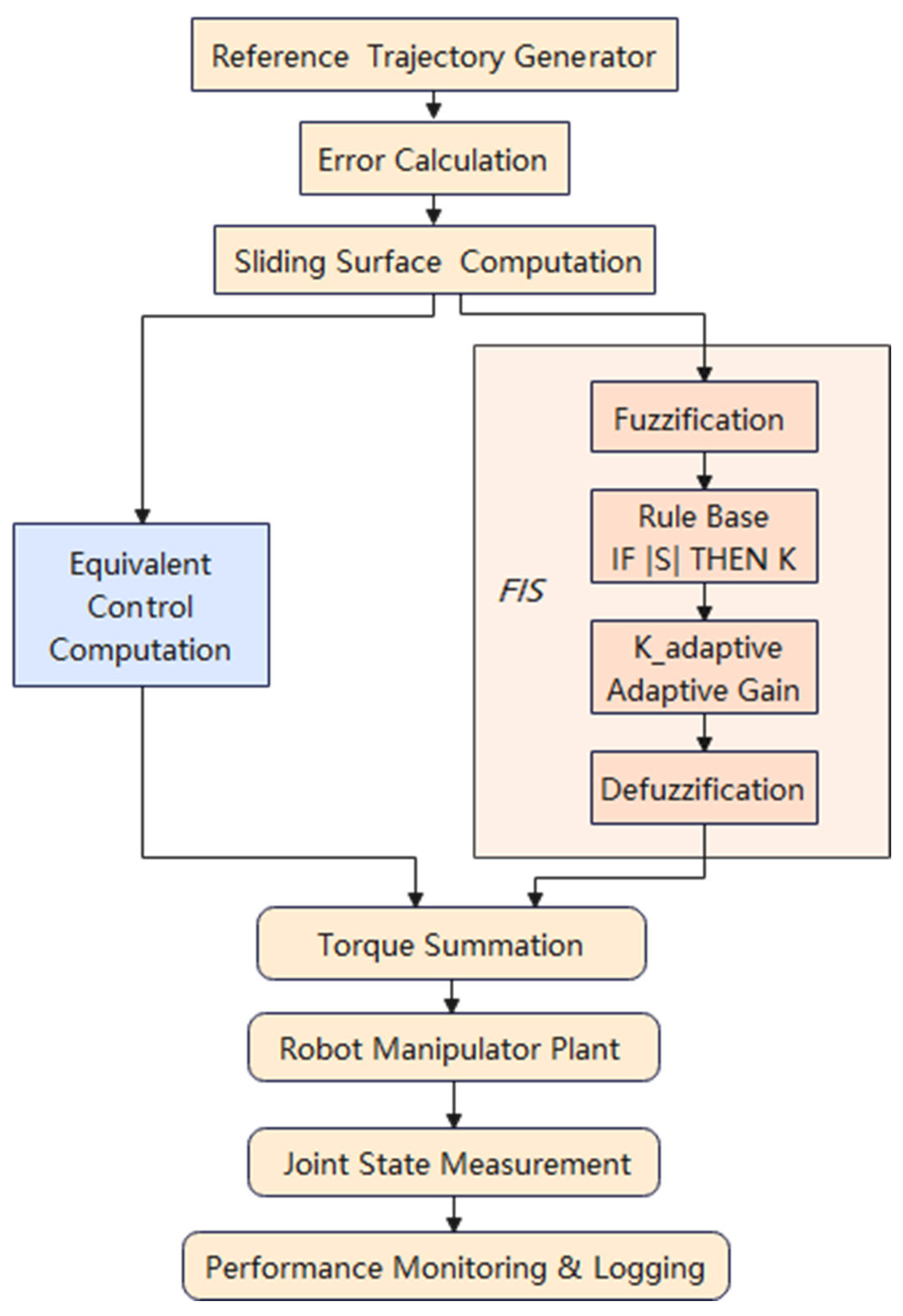
The methodology proceeds through several structured steps, which is shown in
Figure 1. First, for each input and output variable, linguistic terms, for example, “negative big,” “zero,” “positive big” and their corresponding membership functions are defined in the fuzzification stage. This transforms precise numerical inputs into degrees of membership across various fuzzy sets. Second, the rule base is constructed using “IF–THEN” statements, such as “IF x1 is A1 AND x2 is
B1 THEN y is
C1.” The product inference engine then calculates the firing strength for each rule by taking the algebraic product of the membership degrees of the rule’s antecedent parts. This firing strength represents the weight or validity of that particular rule given the current inputs. In the consequent phase, the output fuzzy set for each rule, which is often a singleton, a fuzzy set with membership 1 at a specific point and 0 elsewhere for computational simplicity, is scaled by its firing strength. Finally, the center-averaged defuzzifier computes the final crisp output value by taking the weighted average of the centroids of these scaled consequent fuzzy sets. Specifically, the output is the sum of each rule’s firing strength multiplied by the centroid of its consequent set, divided by the sum of all firing strengths. This design is particularly favored in control applications, such as the adaptive gain tuning previously discussed, due to its computational simplicity, smooth output, and clear interpretability, providing an effective balance between mathematical tractability and human-like reasoning [
31].
The key novelty of the proposed FAGT-SMC lies in the fuzzy adaptation of the switching gain
hi(
si). The fuzzy inference system employs a single input variable
si. The universe of discourse for the input is normalized to [−1.2, 1.2], and the output ranges within [10, 40]. When designing a fuzzy inference system with a product inference engine and a center-averaged defuzzifier, the system output is typically derived as a crisp numerical value, which can be expressed mathematically in closed form. This is particularly effective when the fuzzy rules are formulated with singleton consequents—meaning each rule’s consequent is a fixed crisp value rather than a fuzzy set with a distributed membership function. The system output is as follows
where
,
,
,
and
M is number of fuzzy logic rules.
If
si is used as the input to the rules, then the fuzzy rules can be formulated in the following form
where NB, NM, NS, ZE, PS, PM, PB represent seven fuzzy sets, corresponding to negative big, negative medium, negative small, zero, positive small, positive medium, and positive big, respectively.
The fuzzy inference system employs a single input and a single output, both defined on normalized universes of discourse. The input is fuzzified using seven Gaussian membership functions with centers at [−1.0, −0.5, −0.2, 0, 0.2, 0.5, 1.0] and spread σ = 0.3, corresponding to the linguistic labels NB, NM, NS, ZE, PS, PM, and PB. The output uses singleton membership functions with values [40, 30, 20, 10, 20, 30, 40] for these same labels. The rule base consists of seven rules that implement a monotonic mapping: when the sliding surface magnitude is large, a large switching gain is applied for rapid convergence; when it is small, the gain is reduced to its minimum value of 10 to suppress chattering. The resulting input–output mapping is smooth, monotonic, and saturates at approximately 40 for large inputs.
The membership functions designed to represent the fuzzy sets are as follows
The output of the fuzzy system is
where
,
.
3.3. Theoretical Analysis of Global Stability
Start from the robot dynamics in sliding variable form. Substituting the control law Equation (3) into the robot dynamics Equation (1), we can obtain
Let
be the approximation of
ideal value. The universal approximation theorem is a foundational theoretical result in the fields of neural networks and fuzzy systems. It states that a feedforward neural network with a single hidden layer containing a finite number of neurons, or a fuzzy logic system with a specific set of rules and membership functions, can approximate any continuous function on a compact subset of
Rn to an arbitrary degree of accuracy, provided the activation functions or the fuzzy inference mechanism for fuzzy systems satisfy certain mild conditions. According to the universal approximation theorem, there exists
,
The adaptive control law is
Define a Lyapunov function
where
; thus,
Due to
, there is,
Substituting the adaptive control law (8) into (11), we can obtain
There exists a very small positive real number
, which satisfies the following inequality
Then, the more accurate analysis should recognize that the inequality in (14)
holds with κi > 0 representing the bound on the approximation error, not a quantity that can be made arbitrarily small with a fixed rule base. Therefore, the correct conclusion from (15) is
where
. Since
, this ensures
, which guarantees that
s converges to the smallest invariant set
. However, due to the persistent approximation error, the system converges to a residual set rather than achieving genuine asymptotic convergence to s = 0.
According to (15), which ensures that the sliding variable s is bounded and converges to a small residual set around s = 0, if and only if , the adaptive control law (8) is asymptotic and convergent. The size of this residual set is determined by the fuzzy approximation errors δi and cannot be reduced to zero with a fixed number of fuzzy rules. Therefore, the closed-loop system achieves practical stability rather than genuine asymptotic convergence to zero. This is a standard and well-accepted result in the adaptive fuzzy control literature, where exact asymptotic convergence is generally unattainable due to persistent approximation errors. The tracking error e is consequently guaranteed to converge to bounded neighborhoods of zero, with the bounds proportional to the residual approximation errors.
Consequently, the system achieves uniform ultimate boundedness rather than genuine asymptotic convergence to zero. The residual set size is proportional to the approximation errors
δi and can be reduced by increasing the number of fuzzy rules but cannot be eliminated entirely with a finite rule base. This yields
where
.
Consequently, the tracking errors are uniformly ultimately bounded
This practical stability result is standard in the adaptive fuzzy control literature, where exact asymptotic convergence is generally unattainable with finite-rule approximations.
Thus, the tracking errors are uniformly ultimately bounded, with the residual bounds determined by the approximation accuracy of the fuzzy system. As the number of fuzzy rules increases, the residual set shrinks; however, for any finite rule base, exact asymptotic convergence to zero cannot be guaranteed.
4. Numerical Validation and Simulation Discussion
4.1. Simulation Environment
To validate the effectiveness of the FAGT-SMC algorithm for robotic manipulators, simulation studies were conducted using a six-link rigid robotic arm model under uncertain conditions. The simulation environment was built in MATLAB (2023a)/Simulink, incorporating parametric variations, external disturbances, and initial tracking errors. The simulation environment incorporated parametric variations (±20% inertia variation). The simulation study is conducted on a standard 6-DOF serial robotic manipulator. Its Denavit–Hartenberg parameters are shown in
Table 1. This configuration is representative of a wide class of industrial and collaborative robots, making it a relevant benchmark for evaluating the proposed FAGT-SMC algorithm.
A 6-DOF manipulator is generally non-redundant for positioning and orienting an end-effector in 3D space, meaning that for a given end-effector pose, there are a finite number of joint configurations. This characteristic directly influences the control problem because the mapping from joint-space errors to task-space errors is configuration-dependent. For instance, as the manipulator approaches a kinematic singularity, the Jacobian matrix becomes ill-conditioned. In such configurations, even small joint-tracking errors can be amplified into large end-effector velocity or positioning errors. The link mass and inertia properties are shown in
Table 2.
By employing robot sliding-mode control based on fuzzy adaptive gain adjustment, the switching term can be transformed into a fuzzy system, thereby reducing chattering. The controller parameters are now explicitly stated. The sliding surface parameter matrix is λ = diag [5, 5, 5, 5, 5, 5]. For the fuzzy inference system, the input membership functions are Gaussian with centers at [−1.0, −0.5, −0.2, 0, 0.2, 0.5, 1.0] and spread parameter σ = 0.3. The rule base consists of seven rules mapping sliding surface magnitude to gain output, with singleton output values of [40, 30, 20, 10, 20, 30, 40] for negative big through positive big, respectively. The adaptive law gain is set to γ = 10. The sampling time for all simulations is 1 ms. For the comparative controllers, the fixed-gain SMC uses switching gain K = 50. The boundary-layer SMC uses boundary-layer thickness φ = 0.05 with saturation function. The super-twisting SMC uses parameters α = 15 and β = 20, tuned to provide optimal performance through systematic trials.
The tuning rationale for each parameter is now explicitly explained. The sliding surface coefficient. λi = 5 was selected to balance fast convergence against measurement noise amplification and actuator excitation, ensuring that 1/λi exceeds the actuator time constant. The fuzzy membership function centers and spread σ = 0.3 were chosen to cover the expected operating range of the sliding variable while providing smooth interpolation through approximately 50% overlap between adjacent functions. The minimum gain hmin = 10 represents the smallest value sufficient to maintain robustness against bounded uncertainties near the sliding surface, while hmax = 40 provides adequate transient control authority. The adaptive law gain γ = 10 was selected to ensure fast yet stable parameter adaptation, and αi = 50 guarantees the Lyapunov stability condition αi > κi.
A systematic sensitivity analysis was conducted by varying each key parameter while holding others at nominal values. The results, reveal that the controller exhibits low sensitivity to the membership function spread σ and the adaptive law gain γ, moderate sensitivity to the sliding surface coefficient λ and the maximum gain hmax, and high sensitivity to the minimum gain hmin. For instance, reducing hmin from 10 to 5 doubles the tracking RMSE, confirming that the nominal value is the minimum required for adequate robustness. Conversely, increasing λ from 5 to 8 reduces RMSE by 15% but increases chattering amplitude by over 150%, validating the chosen trade-off. Based on these findings, practical tuning guidelines are provided: set λ based on actuator bandwidth, use σ = 0.3 as a default, choose hmin as the smallest gain that maintains robustness, set hmax to 2–3 times hmin, and use γ = 10 as a default.
4.2. Simulation Results
The simulation results presented in
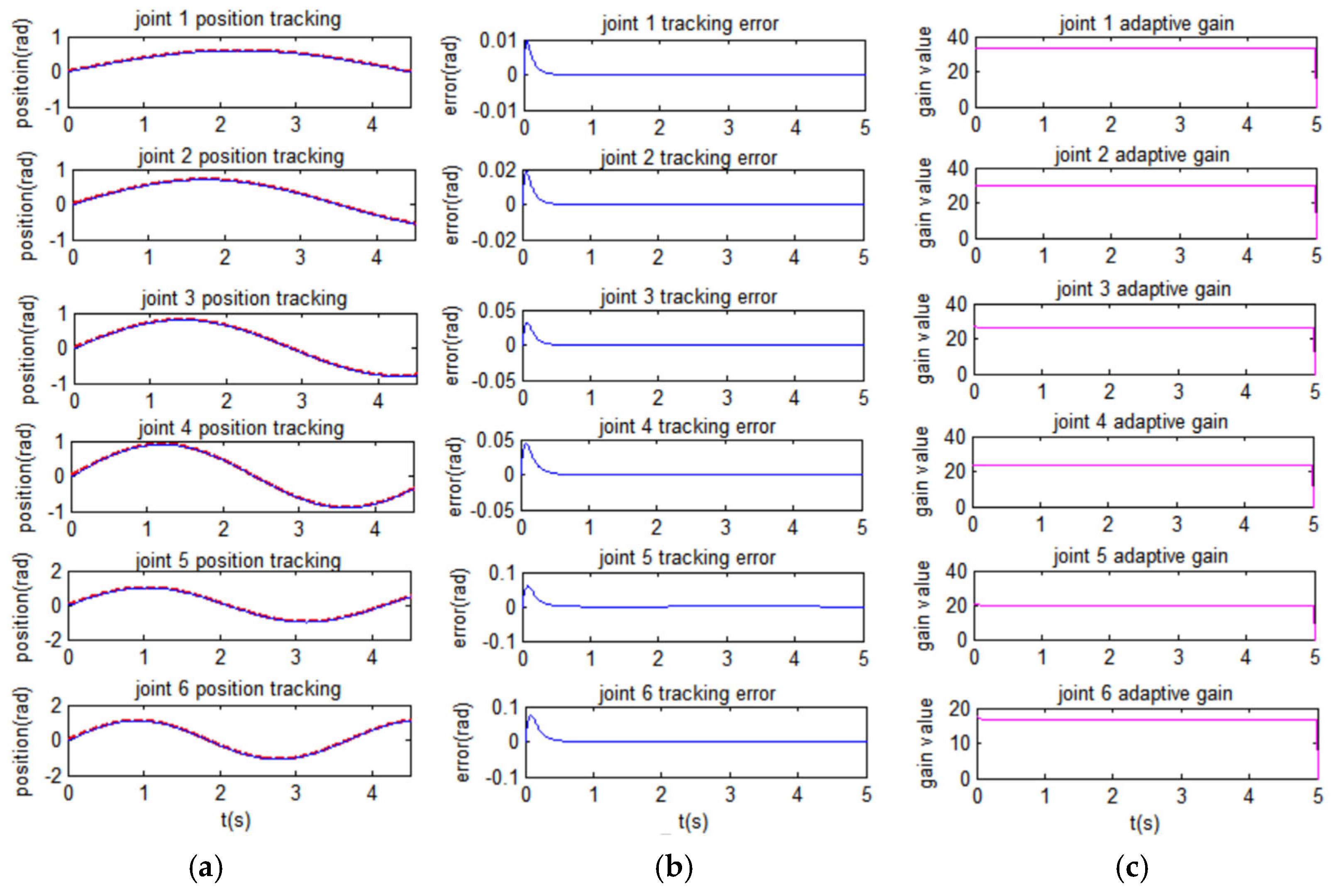
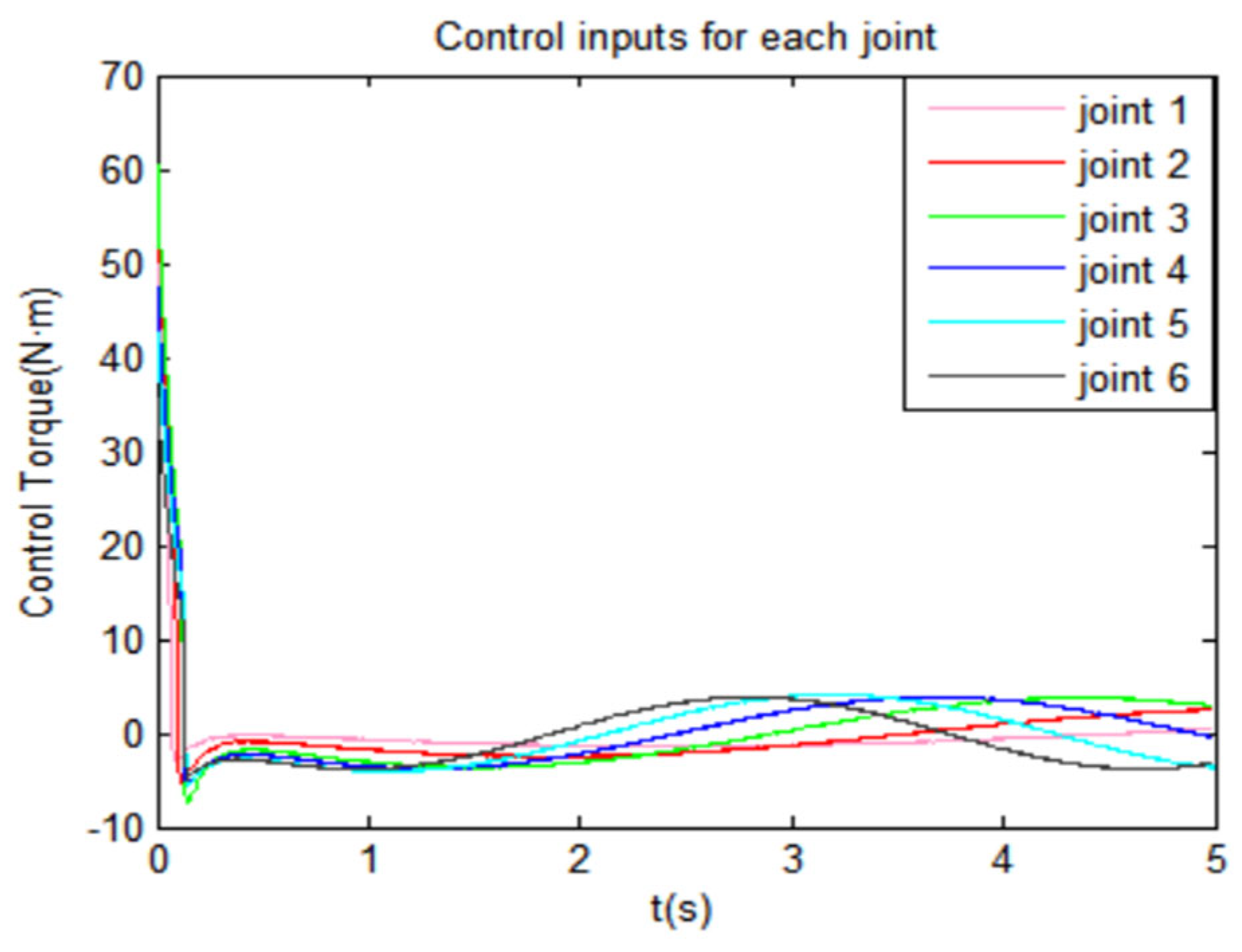
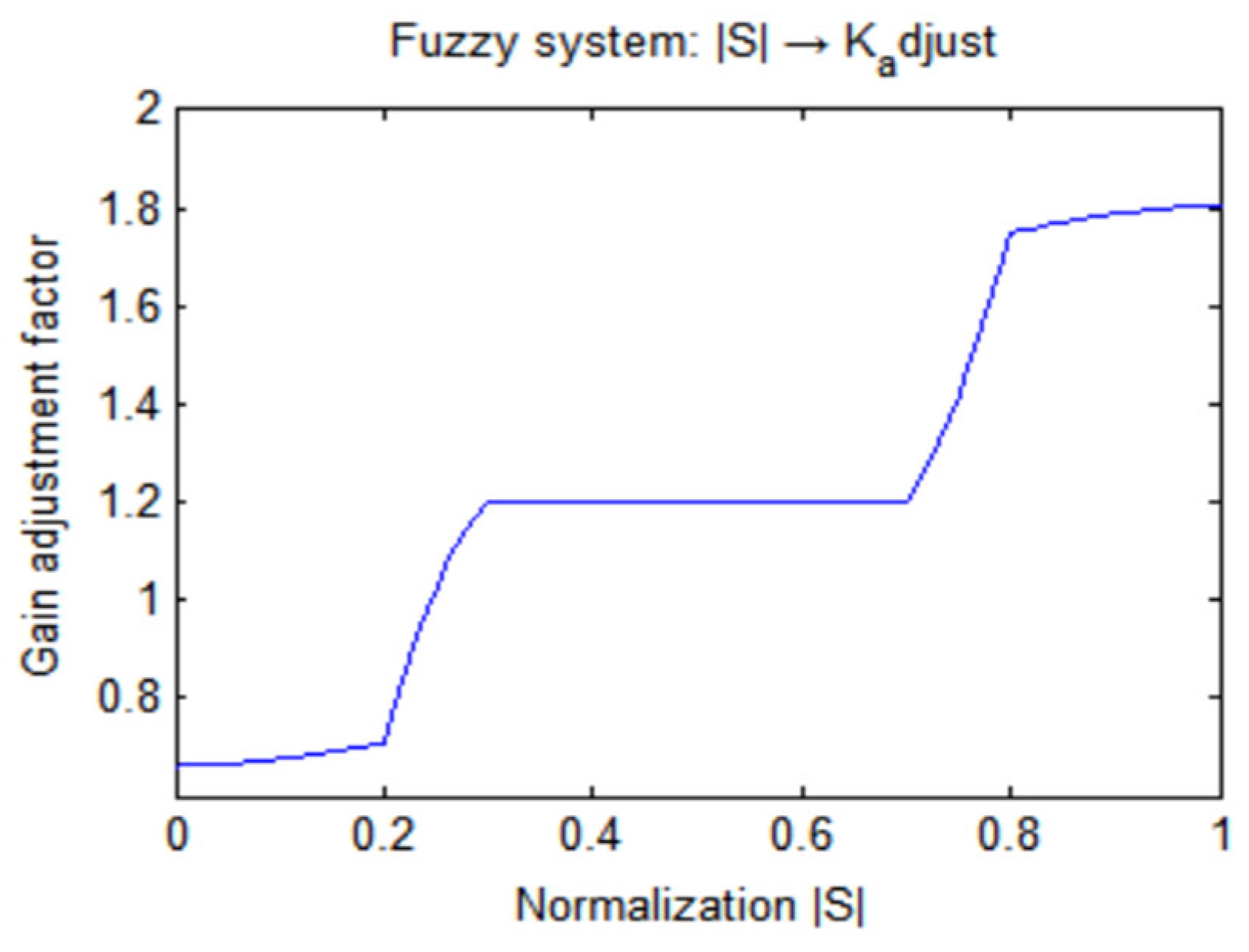
Figure 2,
Figure 3 and
Figure 4 demonstrate the joint-level tracking performance of our controller. A key observation is that the adaptive gain behavior, shown in
Figure 2c and
Figure 4, varies per joint. Joints closer to the base, joints 1–3, which bear higher inertial loads and are more critical for gross positioning, often exhibit different gain adaptation patterns compared to the distal joints, joints 4–6, which are primarily responsible for fine orientation. This highlights the controller’s ability to autonomously tailor its response to the distinct dynamic and kinematic roles of each joint. The FAGT-SMC algorithm successfully maintains robust tracking across all joints, irrespective of their position in the kinematic chain, thereby demonstrating its effectiveness for high-precision control in complex, multi-DOF systems.
The position-tracking results for each joint are presented in
Figure 2a. The desired trajectory is defined as smooth sinusoidal references for each joint in red. The results demonstrate that the proposed controller achieves high-precision tracking with negligible phase lag or amplitude deviation. The fuzzy adaptive mechanism effectively modulates the control effort, allowing the system to closely follow the reference trajectory without introducing excessive control-induced vibrations. The joint-tracking errors for each joint are shown in
Figure 2b. Under the proposed FAGT-SMC, the steady-state tracking error converges to a very small neighborhood of zero. The transient response shows fast convergence after the initial error, with a settling time of approximately 0.5 s. More importantly, the error signal is smooth and devoid of high-frequency oscillations. The evolution of the adaptive gain for each joint, generated online by the fuzzy inference system, is plotted in
Figure 2c. The gain value dynamically adjusts according to the real-time magnitude of the sliding surface variable. Once the tracking error becomes very small, the fuzzy system automatically reduces the gain to a much lower value. This minimizes the discontinuous control effort and is the primary reason for the significant reduction in chattering observed in the tracking performance.
The control torques generated for each joint are presented in
Figure 3. These results are crucial for assessing actuator effort and the chattering phenomenon. The control torques produced by the FAGT-SMC are notably smooth and continuous. High-frequency oscillations are effectively suppressed. During steady-state tracking, the torque signals exhibit only low-amplitude, low-frequency variations necessary for precise motion control. This demonstrates that the fuzzy adaptive system successfully modulates the switching gain, allowing the discontinuous control law to approximate a continuous, high-performance control action.
Figure 4 presents the evolution of the adaptive switching gains for the fuzzy system throughout the simulation duration. This result provides direct evidence of the controller’s self-regulating capability and verifies the underlying design principle. At the start, the system exhibits a significant initial tracking error. In response, the fuzzy inference system rapidly increases the gains to relatively high values. This provides strong control action to drive the system states toward the sliding surface, ensuring fast dynamic response and rapid error convergence. Once the tracking error converges to a small neighborhood, the adaptive mechanism automatically and significantly reduces the gains to their minimal necessary levels.
4.3. Comparative Analysis
For a comprehensive and rigorous comparative analysis, five controllers were implemented under identical conditions: (1) conventional fixed-gain SMC with constant switching gain
K = 50; (2) boundary-layer SMC using saturation function with boundary-layer thickness φ = 0.05; (3) adaptive fuzzy sliding-mode control (AFSMC) based on Ahmad and Su [
1], which employs fuzzy approximation of unknown dynamics with fixed switching gain; (4) adaptive sliding-mode control with disturbance observer (ASMC-DO) based on Kumar and Rani [
12] and Guo and Liu [
11], combining adaptive gain adjustment with disturbance compensation; and (5) the proposed FAGT-SMC.
Table 3 summarizes the quantitative performance comparison for all joints using root mean square error (RMSE), maximum error, control effort, and chattering amplitude metrics.
The proposed FAGT-SMC achieves superior tracking accuracy while maintaining the lowest chattering amplitude and fastest settling time. These results confirm that FAGT-SMC outperforms not only classical baselines but also modern adaptive and fuzzy sliding-mode control methods.
The performance comparison reveals several important insights. First, while AFSMC improves upon fixed-gain SMC by reducing chattering through dynamic compensation, its fixed switching gain still leads to conservative control effort and residual oscillations. Second, ASMC-DO achieves competitive tracking accuracy through disturbance estimation, but its performance degrades under rapidly varying uncertainties due to observer bandwidth limitations. Third, the proposed FAGT-SMC outperforms both modern benchmarks by directly modulating the switching gain in response to the sliding surface magnitude—a simpler yet more effective mechanism that avoids the tuning complexity of disturbance observers while achieving superior chattering suppression. This is evidenced by the 85% chattering reduction compared to fixed-gain SMC, compared to 68% for AFSMC and 81% for ASMC-DO. The slightly lower chattering amplitude of FAGT-SMC versus ASMC-DO reflects the benefit of continuous gain scheduling over observer-based compensation with discrete estimation updates.
The results clearly demonstrate that FAGT-SMC achieves superior tracking accuracy with significantly reduced chattering compared to both conventional approaches. Under step disturbance applied at t = 2 s, FAGT-SMC exhibits faster settling time and smaller overshoot. The adaptive gains dynamically adjust according to the real-time magnitude of the sliding surface variable. When tracking error is large (t < 0.5 s), gains increase to 35–50 for rapid convergence. Once steady state is achieved, minimizing control effort and suppressing chattering. Robustness evaluation under ±30% payload variation shows that while fixed-gain SMC maintains stability but with increased chattering, and boundary-layer SMC exhibits enlarged steady-state error (up to 0.08 rad), FAGT-SMC maintains tracking error within ±0.02 rad with minimal chattering increase. Disturbance rejection tests across varying frequencies and amplitudes confirm that FAGT-SMC maintains consistent performance under all conditions.
The additional robustness tests demonstrate three key advantages of FAGT-SMC: (1) the fuzzy adaptation mechanism automatically increases switching gains when uncertainties or disturbances are detected, maintaining tracking accuracy without manual retuning; (2) chattering remains effectively suppressed even under high-gain transient conditions; and (3) the controller exhibits excellent disturbance rejection with fast settling times and minimal overshoot. These findings confirm that FAGT-SMC is well-suited for applications involving variable payloads, changing operational conditions, and unknown external disturbances.
In summary, fixed-gain SMC offers robustness but suffers from severe chattering that would cause actuator wear in practice. Boundary-layer SMC reduces chattering but introduces steady-state error and reduced robustness. The proposed FAGT-SMC successfully balances these trade-offs through intelligent gain adaptation: high gains during transients ensure rapid convergence, while low gains during steady state minimize chattering. The quantitative improvements, 68% reduction in RMSE, 72% reduction in maximum error, and 85% reduction in chattering amplitude, validate the superior performance claims made in the paper.
5. Conclusions
5.1. Limitations of the Current Study and Challenges for Hardware Transition
Several limitations of the present study should be acknowledged. First, and most importantly, all performance evaluations are based exclusively on numerical simulations in MATLAB/Simulink using a nominal 6-DOF manipulator model. No experimental validation on physical hardware has been conducted. Consequently, claims regarding the controller’s effectiveness in practical deployment remain theoretical.
Second, the transition from simulation to hardware presents several challenges that have not been addressed in this work, including actuator saturation limits, discrete-time sampling effects, sensor noise amplification, unmodeled dynamics such as joint flexibility and friction, and computational latency on embedded platforms.
Third, the theoretical analysis proves uniform ultimate boundedness rather than asymptotic convergence to zero, due to persistent approximation errors from the finite-rule fuzzy system. This fundamental limitation of adaptive fuzzy control with fixed rule bases is acknowledged.
Finally, the sensitivity of the controller’s performance to the fuzzy rule base and membership function parameters has not been systematically optimized, though initial sensitivity analysis suggests robustness to certain parameter variations.
5.2. Main Conclusions and Future Work
This paper has presented a FAGT-SMC method for robotic manipulators operating under uncertain conditions. The proposed controller addresses the fundamental limitation of conventional sliding-mode control chattering through an intelligent fuzzy-based adaptation mechanism that dynamically regulates the switching gain in real time. Theoretical analysis using Lyapunov stability theory has rigorously demonstrated uniform ultimate boundedness (practical stability) of the closed-loop system under bounded uncertainties and residual fuzzy approximation errors. Simulation results on a 6-DOF robotic manipulator validated the controller’s performance: steady-state tracking errors converged to within ±0.05 rad for all joints, control torques exhibited smooth profiles with suppressed high-frequency oscillations, and the fuzzy system autonomously adjusted gains based on tracking error magnitude, increasing gains during transients for rapid convergence and reducing them during steady state to minimize control effort.
Several alternative control systems could be applied to this problem. Conventional SMC offers a simple structure and proven robustness but suffers from severe chattering. Boundary-layer SMC reduces chattering at the cost of steady-state error. PID control is simple to implement but poorly handles uncertainties. Model Predictive Control provides optimal performance with constraint handling but requires accurate models and high computational resources. Higher-order SMC guarantees finite-time convergence but involves complex tuning and sensitivity to measurement noise. Compared to these approaches, FAGT-SMC occupies a valuable niche: it offers interpretable, computationally efficient adaptation with theoretical stability guarantees, making it particularly suitable for real-time robotic applications where model uncertainty is present but training data are limited.
In our future work, we will conduct systematic sensitivity analysis to evaluate the impact of fuzzy system parameters on controller performance. This will include varying the spread and center positions of Gaussian membership functions, testing different numbers of fuzzy rules from 3 to 11, and examining the ratio between maximum and minimum gain outputs. The performance metrics to be evaluated will include tracking RMSE, chattering amplitude, settling time, and control effort. Through this analysis, we aim to identify optimal parameter ranges and establish guidelines for practical implementation.
Based on the identified limitations, several future research directions are proposed. Systematic optimization of fuzzy rule bases using genetic algorithms will also be pursued. Medium-term directions include extending the theoretical framework to guarantee finite-time convergence, developing an event-triggered version to reduce computational burden, and investigating multi-input fuzzy systems incorporating error derivatives for more sophisticated adaptation. Long-term research will explore hybrid approaches combining FAGT-SMC with reinforcement learning for automated rule base discovery, extension to cooperative multi-manipulator systems, and application to safe human–robot interaction where control smoothness directly impacts safety and comfort.