3D Particle Field Reconstruction for Tomographic Particle Image Velocimetry Based on a Single Light-Field Camera: A Survey


Abstract
1. Introduction
2. Light-Field Imaging and Light-Field Tomo-PIV
2.1. Principles of the Light-Field Imaging
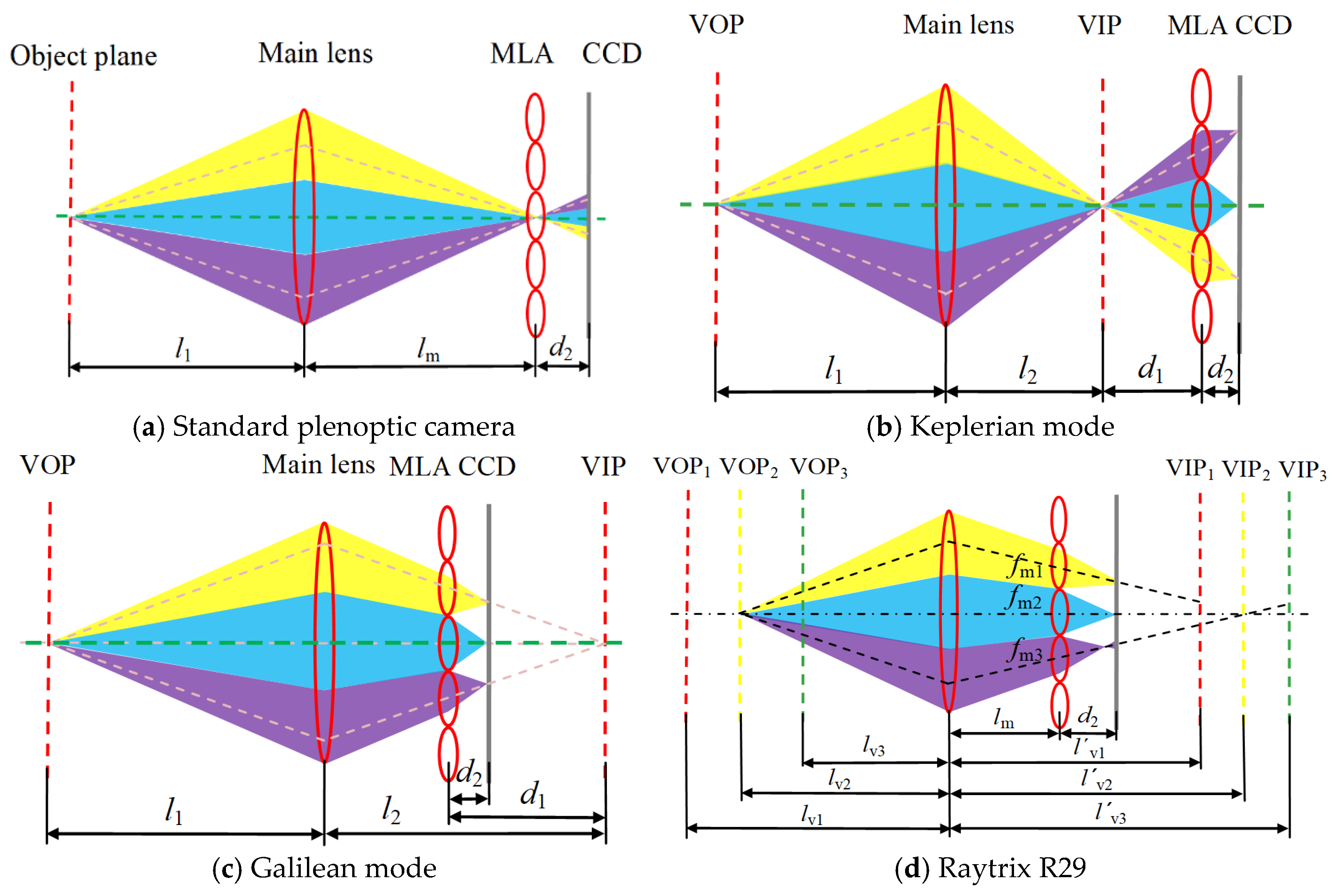
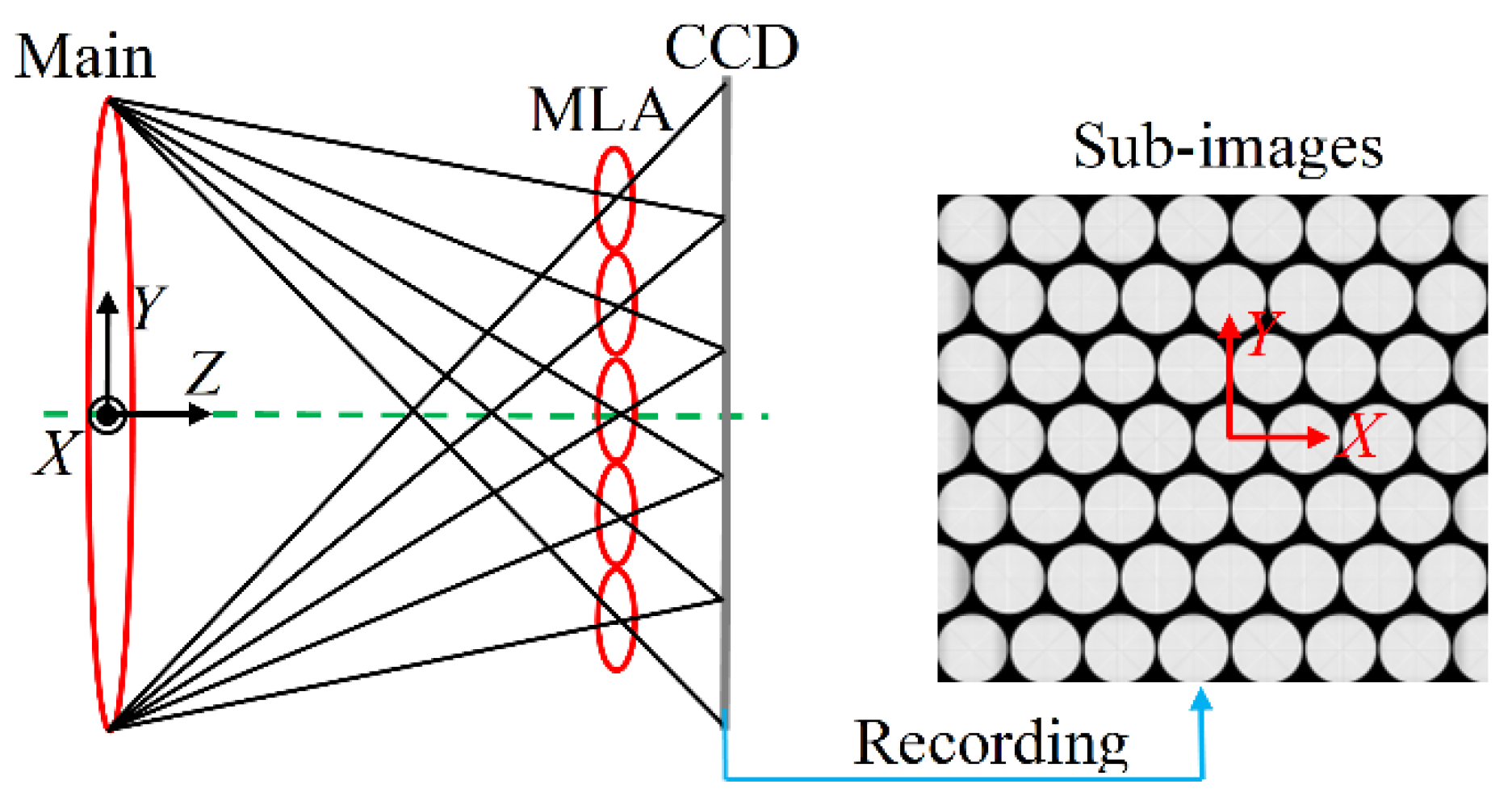
2.1.1. Structure of the Light-Field Camera
2.1.2. Conjugate Relationship of the Light-Field Camera
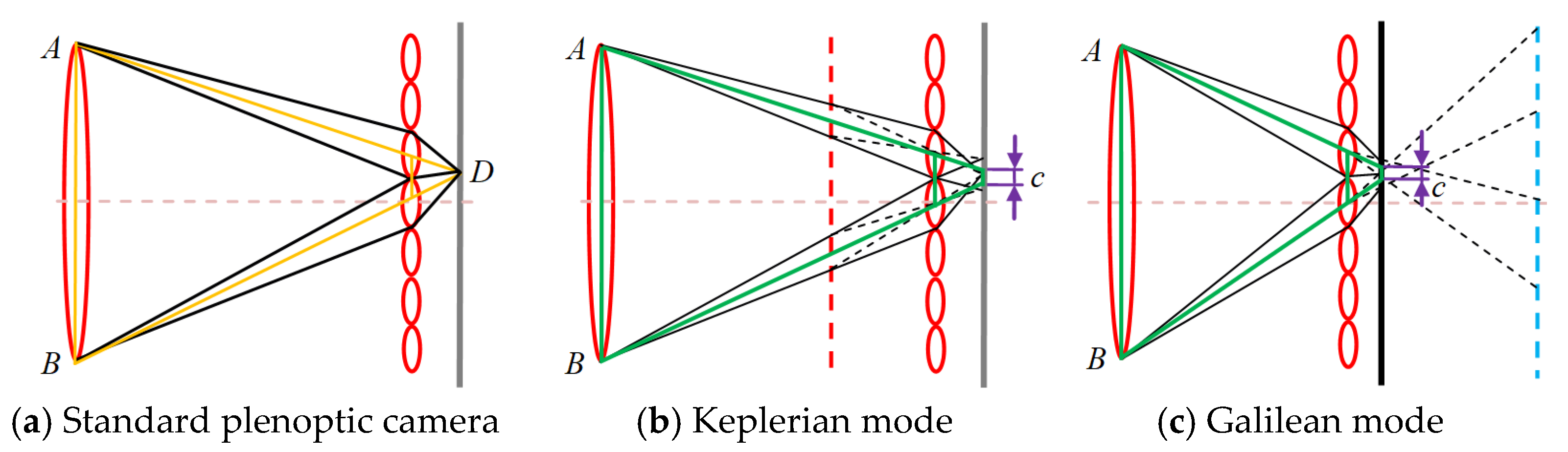
2.1.3. F-Number Matching of the Light-Field Camera
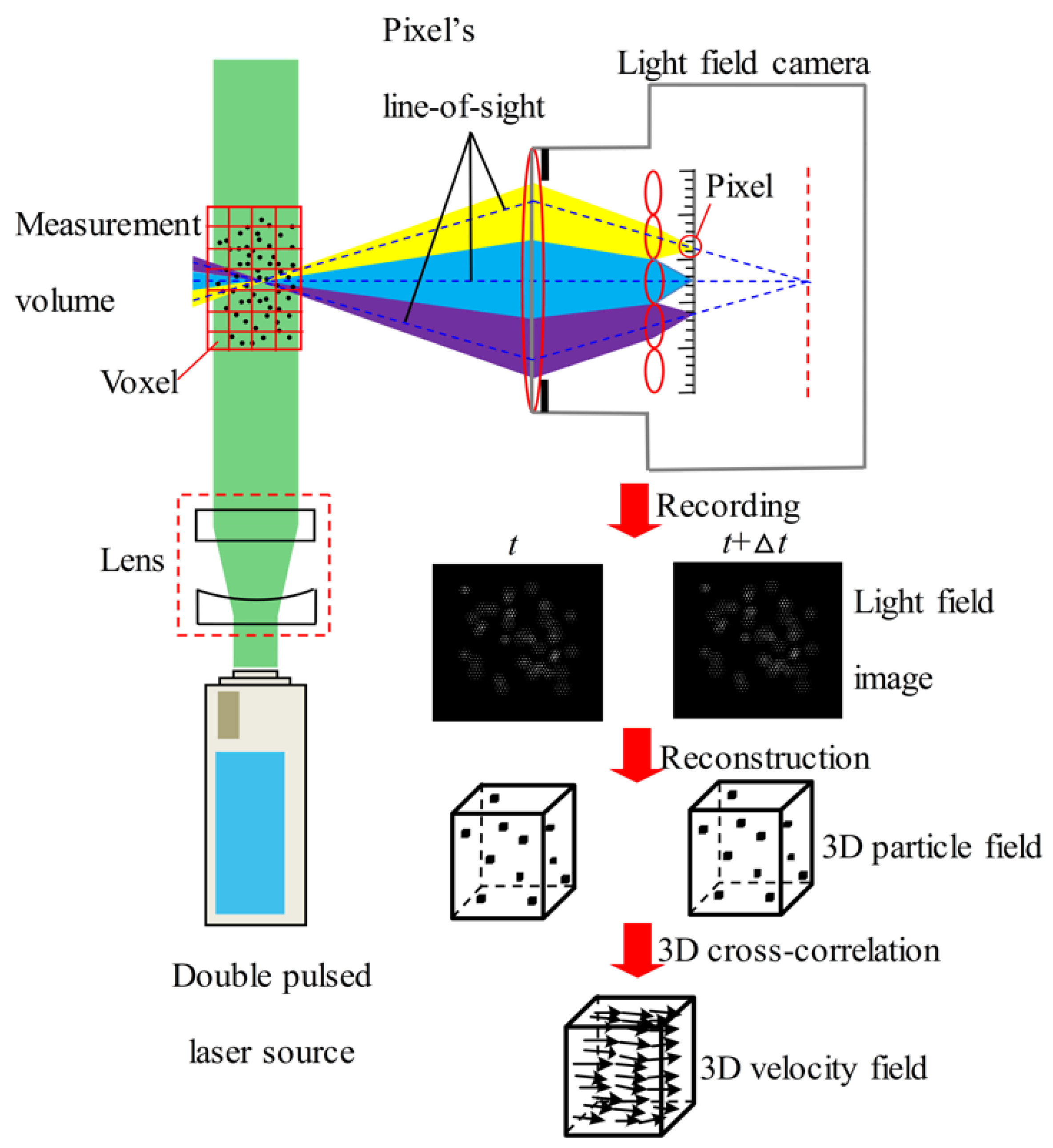
2.2. Principle of the Light-Field Tomo-PIV
- •
- Tracer particle seeding: Tracer particles are dispersed into the flow field. The particle density should be close to that of the fluid to ensure excellent flow following performance. Tracer particles with diameters of 20 μm and 50 μm are typically used in experiments. In general, a larger particle size produces a stronger scattered light signal, resulting in a higher signal-to-noise ratio and better imaging quality of the light-field image.
- •
- Dual-pulse laser illumination: A typical dual-pulse volumetric laser used in a light-field Tomo-PIV system is adopted for illumination. The laser emits two short pulses into the measured flow field, with a time interval Δt between the two pulses. This time interval Δt serves as the critical time base for the subsequent flow velocity calculation.
- •
- Light-field image capture: When the laser pulses illuminate the tracer particles, the particles generate scattered light. A light-field camera performs double frame synchronous exposure, such that the dual laser pulses correspond exactly to the two exposure instants of the camera. In this way, a pair of particle light-field images is recorded. The time interval between the two light-field images is consistent with the laser pulse interval, both of which are equal to Δt.
- •
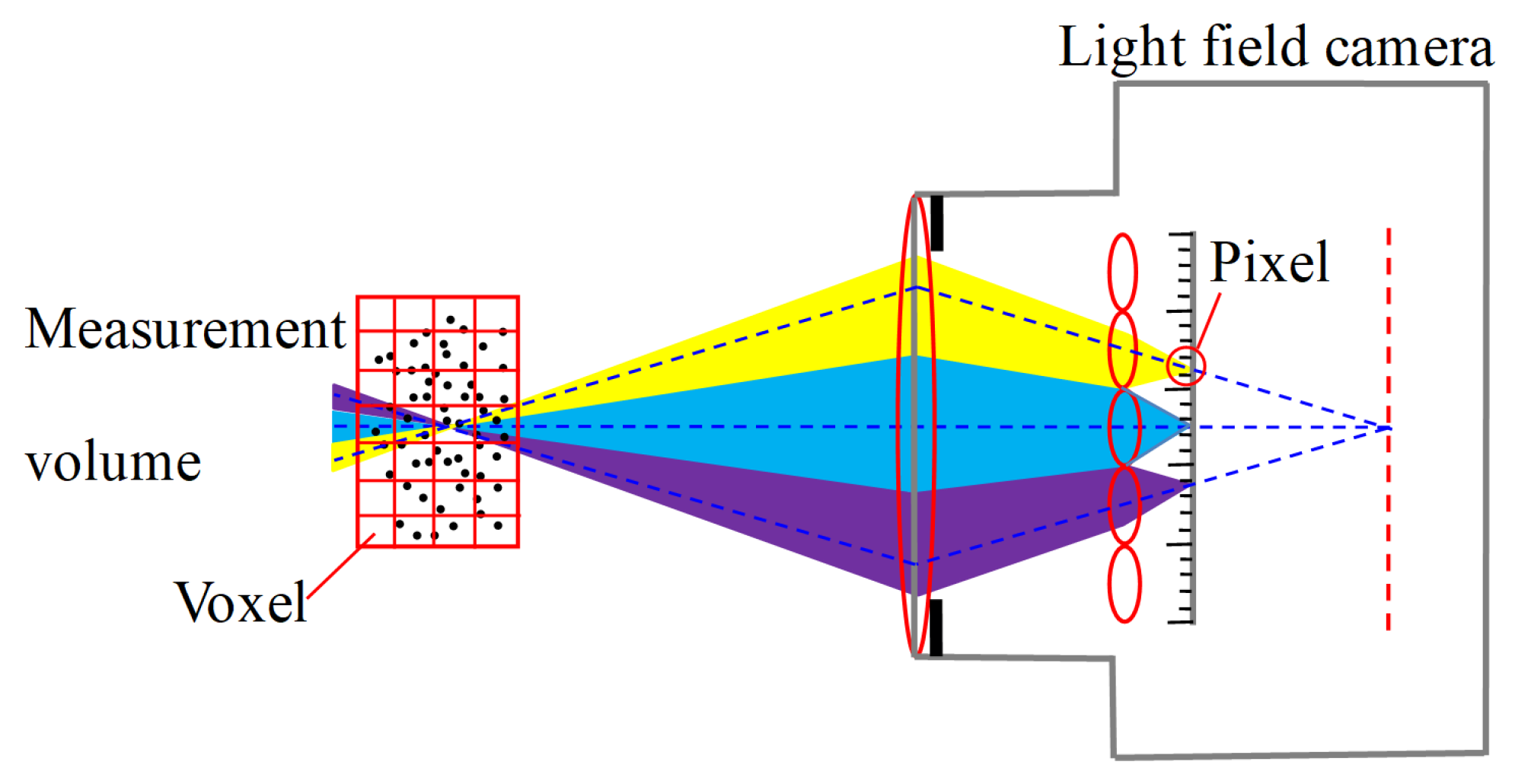
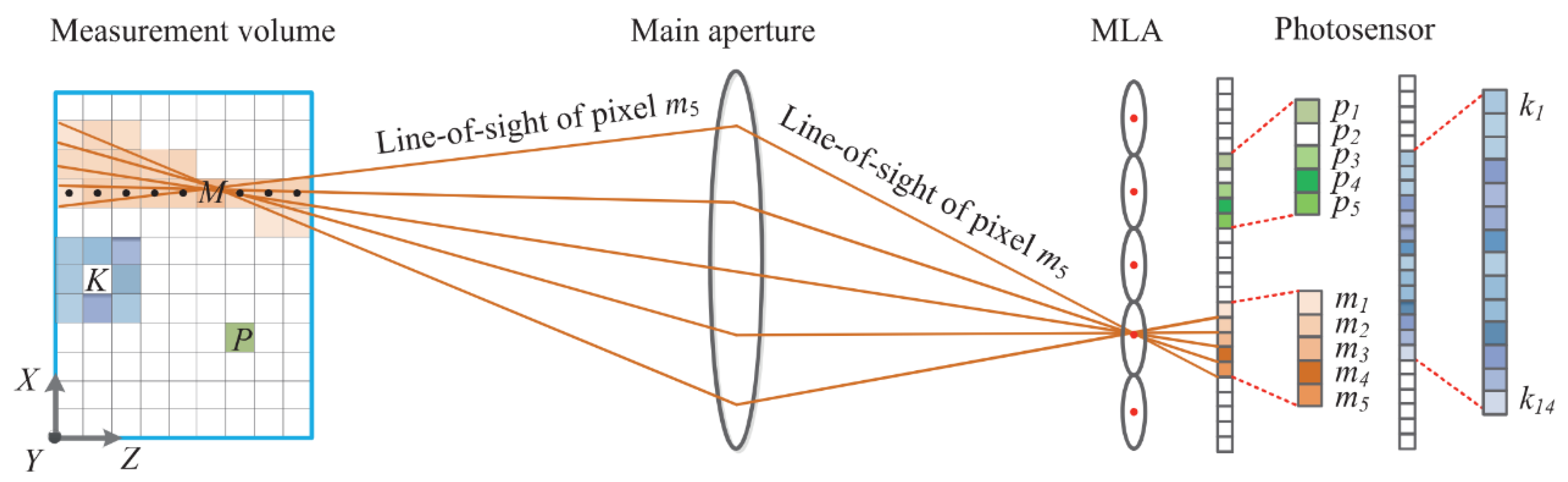
- Reconstruction of the 3D particle field: The measurement volume is discretized into a 3D grid composed of voxels, each with a corresponding light intensity value E. The light intensity distribution of the 3D particle field E and the gray levels of the light-field image P on the camera sensor satisfy the following linear projection relationship:where m is the total number of pixels on the CCD sensor, n is the total number of the discretized voxels in the measurement volume, and Wi, j is the contribution of the jth voxel to the ith pixel, which is referred to as the weight matrix.Equation (8) represents a typical ill-posed inverse problem, which is usually solved using iterative reconstruction algorithms to reconstruct the 3D spatial distribution of tracer particles from a 2D light-field image. The reconstruction process is complex and computationally intensive.
- •
- 3D cross-correlation and velocity field: Finally, 3D cross-correlation is performed on the 3D particle field reconstructed at two successive instants, yielding the 3D displacement vector of the particle group R within the time interval Δt. The expression of 3D cross-correlation is as follows:According to R/∆t, the 3D velocity distribution of the entire measured flow volume can then be calculated.
2.3. Evaluation Indicators in the Light-Field Tomo-PIV
2.3.1. Reconstruction Accuracy
2.3.2. Particle Concentration
2.3.3. Uncertainty in Tomo-PIV
- Reconstruction uncertainty
- 2.
- Calibration uncertainty
- 3.
- Cross-correlation uncertainty
3. Traditional Iterative Reconstruction Algorithms and Deep Learning Techniques for 3D Particle Field Reconstruction
3.1. Traditional Iterative Reconstruction Algorithms for 3D Particle Field Reconstruction
3.1.1. MART
3.1.2. Expectation-Maximization (EM)
3.1.3. DRT-MART
3.1.4. Pre-SART
3.2. Deep Learning Techniques for 3D Particle Field Reconstruction
3.2.1. 3D U-Net
3.2.2. LF-DNN
3.3. Summary of the Advantages and Disadvantages for Reconstruction Algorithms
4. Future Prospects
4.1. Traditional Iterative Algorithms
4.1.1. Influence of the Tracer Particle Concentration
- Research significance
- 2.
- Existing bottlenecks
- 3.
- Feasible solutions and implementation approaches
4.1.2. Reconstruction of Multiframe Light-Field Images
- Research significance
- 2.
- Existing bottlenecks
- 3.
- Feasible solutions and implementation approaches
4.2. Deep Learning
4.2.1. Training Time of the Neural Network
- Research significance
- 2.
- Existing bottlenecks
- 3.
- Feasible solutions and implementation approaches
4.2.2. Creation of the Dataset
- Research significance
- 2.
- Existing bottlenecks
- 3.
- Feasible solutions and implementation approaches
4.2.3. Interpretability
- Research significance
- 2.
- Existing bottlenecks
- 3.
- Feasible solutions and implementation approaches
4.2.4. Time-Resolved Flow Measurement
- Research significance
- 2.
- Existing bottlenecks
- 3.
- Feasible solutions and implementation approaches
Funding
Data Availability Statement
Acknowledgments
Conflicts of Interest
References
- Cao, L.X.; Zhang, B.; Li, J.; Song, X.; Tang, Z.; Xu, C. Characteristics of tomographic reconstruction of light-field Tomo-PIV. Opt. Commun. 2019, 442, 132–147. [Google Scholar] [CrossRef]
- Georgiev, T.G.; Lumsdaine, A. Reducing plenoptic camera artifacts. Comput. Graph. Forum 2010, 29, 1955–1968. [Google Scholar] [CrossRef]
- Lumsdaine, A.; Georgiev, T.G. Full Resolution Light Field Rendering; Technical Report; Indiana University and Adobe Systems: San Jose, CA, USA, 2008; pp. 1–12. [Google Scholar]
- Lynch, K.P.; Fahringe, T.W.; Thurow, B.S. Three-dimensional particle image velocimetry using a plenoptic camera. In Proceedings of the 50th AIAA Aerospace Sciences Meeting Including the New Horizons Forum and Aerospace Exposition; American Institute of Aeronautics and Astronautics: Reston, VA, USA, 2012; pp. 1–14. [Google Scholar]
- Fahringer, T.W.; Lynch, K.P.; Thurow, B.S. Volumetric particle image velocimetry with a single plenoptic camera. Meas. Sci. Technol. 2015, 26, 115201. [Google Scholar] [CrossRef]
- Shi, S.X.; Ding, J.F.; New, T.H.; Soria, J. Light-field camera-based 3D volumetric particle image velocimetry with dense ray tracing reconstruction technique. Exp. Fluids 2017, 58, 78. [Google Scholar] [CrossRef]
- Cao, L.X.; Zhang, B.; Hossain, M.M.; Li, J.; Xu, C.L. Tomographic reconstruction of light field PIV based on backward ray-tracing technique. Meas. Sci. Technol. 2020, 32, 044007. [Google Scholar]
- Zhu, X.Y.; Wu, Z.A.; Li, J.; Zhang, B.; Xu, C.L. A pre-recognition SART algorithm for the volumetric reconstruction of the light field PIV. Opt. Lasers Eng. 2021, 143, 106625. [Google Scholar] [CrossRef]
- Bolton, J.T.; Thurow, B.S.; Alvi, F.S.; Arora, N. Single Camera 3D Measurement of a Shock Wave-Turbulent Boundary Layer Interaction. In Proceedings of the AIAA Aerospace Sciences Meeting; American Institute of Aeronautics and Astronautics: Reston, VA, USA, 2017; pp. 1–16. [Google Scholar]
- Ding, J.F.; Xu, S.M.; Zhao, Z.; Shi, S.X.; Kaufmann, R.; Ganapathisubramani, B. Volumetric Measurement of Synthetic Jet Impingement with Single-camera Light-field PIV. In Proceedings of the 13th International Symposium on Particle Image Velocimetry-ISPIV; Universität der Bundeswehr München: Neubiberg, Germany, 2019; pp. 22–24. [Google Scholar]
- Zhao, Z.; Buchner, A.J.; Ding, J.F.; Shi, S.; Atkinson, C.H.; Soria, J. Volumetric Measurements of a Self-similar Adverse Pressure Gradient Turbulent Boundary Layer Using Single-camera Light-field Particle Image Velocimetry. Exp. Fluids 2019, 60, 141. [Google Scholar] [CrossRef]
- Ding, J.F.; Lim, H.D.; Sheikh, S.; Xu, S.; Shi, S.; New, T.H. Volumetric Measurement of a Supersonic Jet with Single-Camera Light-Field PIV. In Proceedings of the 19th International Symposium on the Application of Laser and Imaging Techniques to Fluid Mechanics; LISBON Symposia: Lisboa, Portugal, 2018; pp. 1–10. [Google Scholar]
- Chen, L.; Lei, G.; Wang, T.X.; Xu, C.L. Improved blur circle detection method for geometric calibration of multifocus light field cameras. Opt. Eng. 2022, 61, 093101. [Google Scholar] [CrossRef]
- Hall, E.M.; Fahringer, T.W.; Guildenbecher, D.R.; Thurow, B.S. Volumetric calibration of a plenoptic camera. Appl. Opt. 2018, 57, 914–923. [Google Scholar] [CrossRef] [PubMed]
- Shi, S.X.; Ding, J.F.; New, T.H.; Liu, Y.; Zhang, H. Volumetric calibration enhancements for single-camera light-field PIV. Exp. Fluids 2019, 60, 21. [Google Scholar] [CrossRef]
- Zhao, Y.Y.; Li, H.T.; Mei, D.; Shi, S.X. Metric calibration of unfocused plenoptic cameras for three-dimensional shape measurement. Opt. Eng. 2020, 59, 073104. [Google Scholar] [CrossRef]
- Zhu, X.Y.; Xu, C.L.; Che, Z.Z.; Zhang, L. Calibration refinement for light field particle image velocimetry through iterative polynomial model tweaking. Phys. Fluids 2026, 38, 013603. [Google Scholar] [CrossRef]
- Fahringer, T.W.; Thurow, B.S. Tomographic reconstruction of a 3-D flow field using a plenoptic camera. In Proceedings of the 42nd AIAA Fluid Dynamics Conference and Exhibit; American Institute of Aeronautics and Astronautics: Reston, VA, USA, 2012; p. 2826. [Google Scholar]
- Thurow, B.S.; Fahringer, T.W. Recent development of volumetric PIV with a plenoptic camera. In Proceedings of the 10th International Symposium on Particle Image Velocimetry; Delft University of Technology (TU Delft): Delft, The Netherlands, 2013; pp. 1–7. [Google Scholar]
- Ding, J.F.; Wang, J.H.; New, T.H.; Soria, J. Dense ray tracing based reconstruction algorithm for light-field volumetric particle image velocimetry. In Proceedings of the 18th International Symposium on the Application of Laser and Imaging Techniques to Fluid Mechanics, Lisbon, Portugal, 4–7 July 2016. [Google Scholar]
- Zhu, X.Y.; Hossain, M.M.; Li, J.; Zhang, B.; Xu, C. Weight coefficient calculation through equivalent ray tracing method for light field particle image velocimetry. Measurement 2022, 193, 110982. [Google Scholar] [CrossRef]
- Zhu, X.Y.; Xu, C.L.; Hossain, M.M.; Li, J.; Zhang, B.; Khoo, B.C. Approach to select optimal cross-correlation parameters for light field particle image velocimetry. Phys. Fluids 2022, 34, 073601. [Google Scholar] [CrossRef]
- Elsinga, C.E.; Scarano, F.; Wieneke, B.; van Oudheusden, B.W. Tomographic particle image velocimetry. Exp. Fluids 2006, 41, 933–947. [Google Scholar] [CrossRef]
- Shi, S.X.; Wang, J.H.; Ding, J.F.; Zhao, Z.; New, T. Parametric study on light field volumetric particle image velocimetry. Flow Meas. Instrum. 2016, 49, 70–88. [Google Scholar] [CrossRef]
- Zhu, X.Y.; Zhang, B.; Li, J.; Xu, C. Volumetric resolution of light field imaging and its effect on the reconstruction of light field PIV. Opt. Commun. 2020, 462, 125263. [Google Scholar] [CrossRef]
- Mei, D.; Ding, J.F.; Shi, S.X.; New, T.H.; Soria, J. High resolution volumetric dual-camera light-field PIV. Exp. Fluids 2019, 60, 132. [Google Scholar] [CrossRef]
- Zhu, X.Y.; Xu, C.L.; Hossain, M.M.; Khoo, B.C. Fast and accurate flow measurement through dual-camera light field particle image velocimetry and ordered-subset algorithm. Phys. Fluids 2023, 35, 063603. [Google Scholar]
- Zhu, X.Y.; Xu, C.L.; Hossain, M.M.; Khoo, B.C. High-resolution three-dimensional flow measurement through dual-frame light field particle tracking velocimetry. Phys. Fluids 2025, 37, 023617. [Google Scholar] [CrossRef]
- Xing, F.; He, X.M.; Wang, D.P.; Tan, H.J. Single camera based dual-view light-field particle imaging velocimetry with isotropic resolution. Opt. Lasers Eng. 2023, 167, 107592. [Google Scholar] [CrossRef]
- Ding, Y.; Li, Z.; Chen, Z.; Ji, Y.; Yu, J.; Ye, J. Full-volume 3D fluid flow reconstruction with light field PIV. IEEE Trans. Pattern Anal. Mach. Intell. 2023, 45, 8405–8418. [Google Scholar] [CrossRef] [PubMed]
- Mei, D.; Wei, Y.; Liu, P.; Yuan, W. Single sensor tomographic particle image velocimetry using kaleidoscopic light field camera. Opt. Lasers Eng. 2024, 180, 108309. [Google Scholar] [CrossRef]
- Cao, L.X.; Hossain, M.M.; Li, J.; Xu, C. Three-dimensional particle image velocimetry measurement through three-dimensional U-Net neural network. Phys. Fluids 2024, 36, 16. [Google Scholar] [CrossRef]
- Zhu, X.Y.; Fu, M.X.; Xu, C.L.; Hossain, M.; Khoo, B.C. Volumetric reconstruction of flow particles through light field particle image velocimetry and deep neural network. Phys. Fluids 2024, 36, 19. [Google Scholar] [CrossRef]
- Adelson, E.H.; Wang, J.Y. A Single Lens Stereo with a Plenoptic Camera. IEEE Trans. Pattern Anal. Mach. Intell. 1992, 14, 99–106. [Google Scholar] [CrossRef]
- Ng, R. Digital Light Field Photography. Ph.D. Thesis, Stanford University, Stanford, CA, USA, 2006. [Google Scholar]
- Lumsdaine, A.; Georgiev, T. The focused plenoptic camera. In Proceedings of the IEEE International Conference on Computational Photography (ICCP); IEEE: New York, NY, USA, 2009; pp. 1–8. [Google Scholar]
- Tan, Z.P.; Alarcon, R.; Allen, J.; Thurow, B.S.; Moss, A. Development of a high-speed plenoptic imaging system and application to marine biology PIV. Meas. Sci. Technol. 2020, 31, 054005. [Google Scholar] [CrossRef]
- Tan, Z.P.; Johnson, K.; Clifford, C.; Thurow, B.S. Development of a modular, high-speed plenoptic-camera for 3D flow-measurement. Opt. Express 2019, 27, 13400–13415. [Google Scholar] [CrossRef] [PubMed]
- Perwass, U.; Perwass, C. Digital Imaging System, Plenoptic Optical Device and Image Data Processing Method. US8619177B2, 31 December 2013. [Google Scholar]
- De Silva, C.M.; Baidya, R.; Marusic, I. Enhancing Tomo-PIV reconstruction quality by reducing ghost particles. Meas. Sci. Technol. 2012, 24, 024010. [Google Scholar] [CrossRef]
- Worth, N.A.; Nickels, T.B. Acceleration of Tomo-PIV by estimating the initial volume intensity distribution. Exp. Fluids 2008, 45, 847–856. [Google Scholar] [CrossRef]
- Novara, M.; Batenburg, K.J.; Scarano, F. Motion tracking-enhanced MART for tomographic PIV. Meas. Sci. Technol. 2010, 21, 035401. [Google Scholar] [CrossRef]
- Fahringer, T.W.; Thurow, B.S. Filtered refocusing: A volumetric reconstruction algorithm for plenoptic-PIV. Meas. Sci. Technol. 2016, 27, 094005. [Google Scholar] [CrossRef]
- Scarano, F. Tomographic PIV: Principles and practice. Meas. Sci. Technol. 2013, 24, 012001. [Google Scholar] [CrossRef]
- Wieneke, B. Volume self-calibration for 3D particle image velocimetry. Exp. Fluids 2008, 45, 549–556. [Google Scholar] [CrossRef]
- Raffel, M.; Willert, C.E.; Scarano, F.; Kähler, C.J.; Wereley, S.T.; Kompenhans, J. Particle Image Velocimetry: A Practical Guide; Springer: Berlin/Heidelberg, Germany, 2018. [Google Scholar]
- Atkinson, C.; Soria, J. An efficient simultaneous reconstruction technique for tomographic particle image velocimetry. Exp. Fluids 2009, 47, 553–568. [Google Scholar] [CrossRef]
- Shi, S.X.; New, T.H. Development and Application of Light-Field Cameras in Fluid Measurements; Springer: Cham, Switzerland, 2023. [Google Scholar]
- Dempster, A.P.; Laird, N.M.; Rubin, D.B. Maximum likelihood from incomplete data via the EM algorithm. J. R. Stat. Soc. Ser. B 1977, 39, 1–22. [Google Scholar] [CrossRef]
- Thiébaut, É.; Thi, E. Introduction to image reconstruction and inverse problems. In Optics in Astrophysics; Springer: Dordrecht, The Netherlands, 2005; pp. 1–397. [Google Scholar]
- Çiçek, Ö.; Abdulkadir, A.; Lienkamp, S.S.; Brox, T.; Ronneberger, O. 3D U-Net: Learning dense volumetric segmentation from sparse annotation. In Proceedings of the 19th International Conference on Medical Image Computing and Computer-Assisted Intervention; Lecture Notes in Computer Science Volume 9901; Springer: Berlin/Heidelberg, Germany, 2016; pp. 424–432. [Google Scholar]
- Lasinger, K.; Vogel, C.; Pock, T.; Schindler, K. Variational 3D-PIV with sparse descriptors. Meas. Sci. Technol. 2018, 29, 064010. [Google Scholar] [CrossRef]
- Lynch, K.P.; Scarano, F. An efficient and accurate approach to MTE-MART for time-resolved tomographic PIV. Exp. Fluids 2015, 56, 66. [Google Scholar] [CrossRef]
- Gao, Q.; Pan, S.W.; Wang, H.P.; Wei, R.; Wang, J. Particle reconstruction of volumetric particle image velocimetry with the strategy of machine learning. Adv. Aerodyn. 2021, 3, 28. [Google Scholar] [CrossRef]
- Novara, M.; Schanz, D.; Schröder, A. Two-pulse 3D particle tracking with shake-the-box. Exp. Fluids 2023, 64, 93. [Google Scholar] [CrossRef]



| Reconstruction Category | Reconstruction Quality | Reconstruction Time | Advantages | Disadvantages |
|---|---|---|---|---|
| MART | 0.35–0.5 (1 ppm) | 0.38 h | (1) Relatively fast convergence with a limited number of iterations; (2) Guarantees non-negative reconstructed intensities; (3) Robust and widely validated for volumetric particle reconstruction. | (1) Requires an accurate weighting matrix and substantial computational resources; (2) Reconstruction time increases significantly with volume size and particle concentration; (3) Susceptible to ghost particles and reconstruction artifacts; (4) Reconstructed particles often exhibit noticeable elongation along the depth direction. |
| EM | ≈0.35 (1 ppm) | 0.056 h (200 s) | (1) Simple and easy-to-implement iterative framework; (2) Fast convergence and computational efficiency; (3) Less dependent on the precision of the weighting matrix than MART; (4) Stable reconstruction performance under moderate particle densities. | (1) Requires considerable memory for large-scale reconstructions; (2) Highly sensitive to errors in optical calibration and light-field parameters; (3) Reconstructed particles tend to be elongated in depth; (4) Reconstruction quality deteriorates at high particle concentrations. |
| DRT-MART | ≈0.5 (1 ppm) | Not reported | (1) Effectively suppresses ghost particles through direct ray tracing; (2) Produces particles with shorter elongation lengths and better localization accuracy; (3) Achieves high reconstruction fidelity under sparse seeding conditions. | (1) Computational cost increases with particle concentration; (2) Sensitive to camera vibration and calibration errors; (3) Performance may degrade in densely seeded flow fields. |
| Pre-SART | ≈0.325 (1 ppm) | 0.375 h (22.5 min) | (1) Faster reconstruction than conventional algebraic iterative methods; (2) Reduced particle elongation and improved particle localization; (3) Suitable for sparse particle fields. | (1) Reconstruction time still increases with particle concentration; (2) Reconstruction quality decreases in highly dense particle fields; (3) Requires accurate preprocessing and system calibration. |
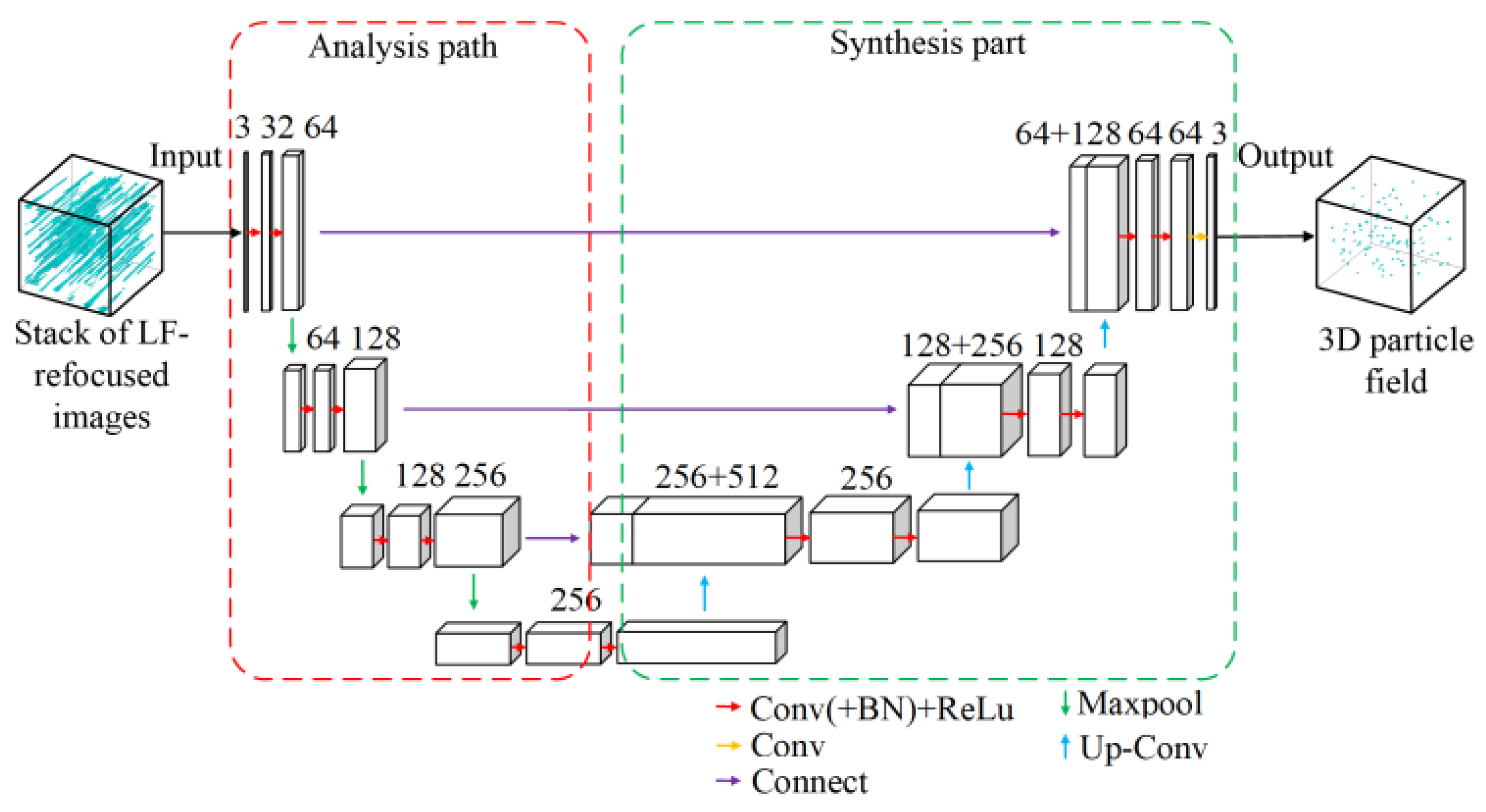
| 3D U-Net | >0.7 (0.1 ppm) ≈0.55 (1 ppm) | (1) Digital refocused algorithm: ≈140 s (standard plenoptic camera)/≈150s (Raytrix R29) (2) Training time: ≈25.5 h (GPU) | (1) Reconstruction time is largely independent of particle concentration after training; (2) Significantly reduces particle elongation artifacts; (3) Capable of learning complex nonlinear mappings from light-field data to 3D particle distributions; (4) Provides high reconstruction accuracy at low particle concentrations. | (1) Requires digitally refocused images as input, introducing additional preprocessing cost; (2) Performance strongly depends on the quality and diversity of the training dataset; (3) Generalization to unseen experimental conditions may be limited; (4) Reconstruction quality decreases at high particle concentrations. |
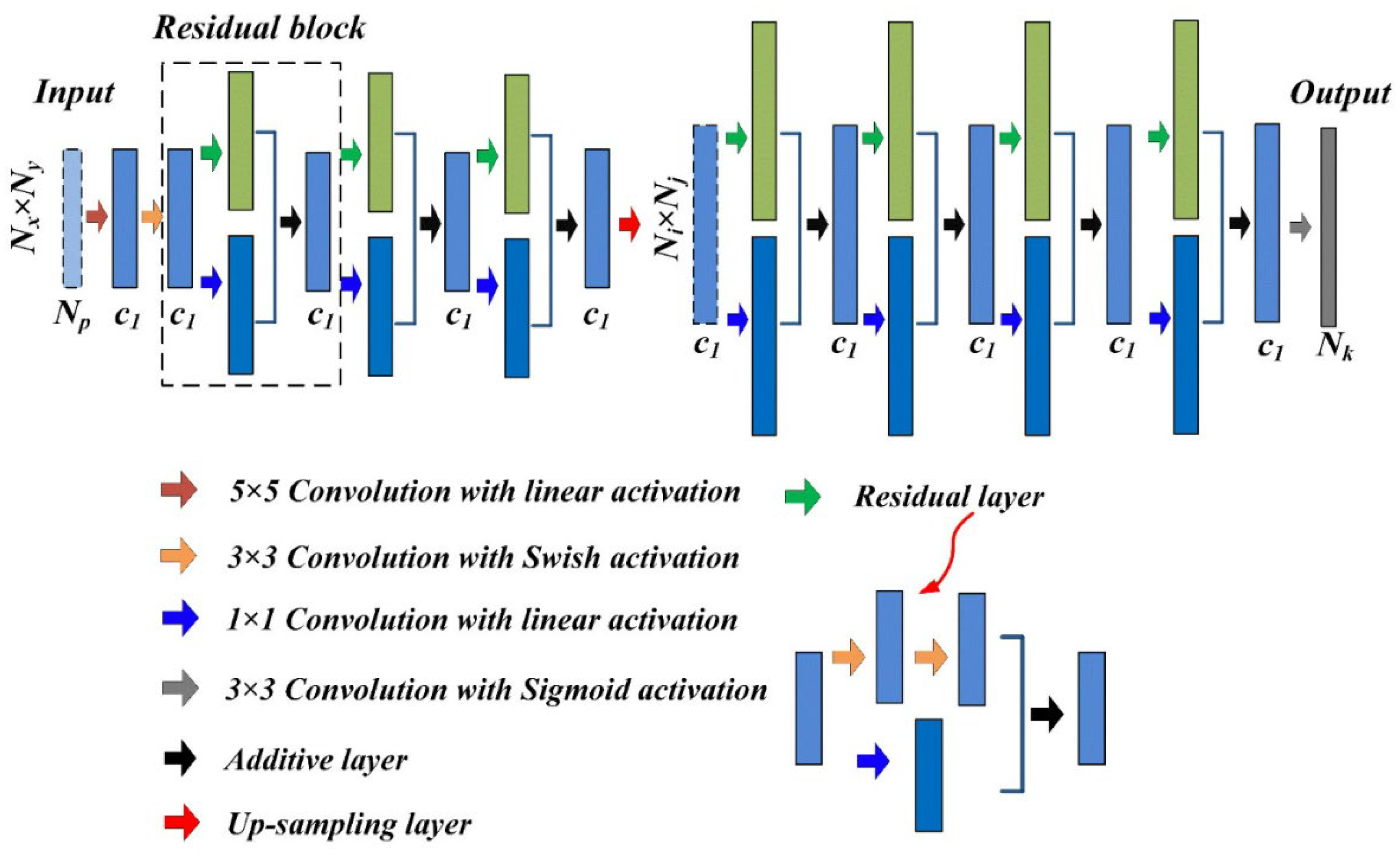
| LF-DNN | >0.75 (1 ppm) | 1. Reconstruction time: 3.7 s (CPU)/1.2 s (GPU) 2. Training time: about 50.75 h (CPU)/15.92 h (GPU) | (1) Extremely fast reconstruction after training; (2) Reconstruction time is independent of particle concentration; (3) Produces particles with reduced depth elongation; (4) Achieves high reconstruction accuracy while avoiding iterative optimization. | (1) Requires perspective-shift images as input; (2) Demands a large amount of labeled training data; (3) Long training time and high GPU memory consumption; (4) Generalization capability may deteriorate when imaging conditions differ from those used for training; (5) Limited physical interpretability compared with model-based reconstruction methods. |
Disclaimer/Publisher’s Note: The statements, opinions and data contained in all publications are solely those of the individual author(s) and contributor(s) and not of MDPI and/or the editor(s). MDPI and/or the editor(s) disclaim responsibility for any injury to people or property resulting from any ideas, methods, instructions or products referred to in the content. |
© 2026 by the authors. Licensee MDPI, Basel, Switzerland. This article is an open access article distributed under the terms and conditions of the Creative Commons Attribution (CC BY) license.
Share and Cite
Cao, L.; Gu, W.; Tian, X. 3D Particle Field Reconstruction for Tomographic Particle Image Velocimetry Based on a Single Light-Field Camera: A Survey. Processes 2026, 14, 2101. https://doi.org/10.3390/pr14132101
Cao L, Gu W, Tian X. 3D Particle Field Reconstruction for Tomographic Particle Image Velocimetry Based on a Single Light-Field Camera: A Survey. Processes. 2026; 14(13):2101. https://doi.org/10.3390/pr14132101
Chicago/Turabian StyleCao, Lixia, Wei Gu, and Xing Tian. 2026. "3D Particle Field Reconstruction for Tomographic Particle Image Velocimetry Based on a Single Light-Field Camera: A Survey" Processes 14, no. 13: 2101. https://doi.org/10.3390/pr14132101
APA StyleCao, L., Gu, W., & Tian, X. (2026). 3D Particle Field Reconstruction for Tomographic Particle Image Velocimetry Based on a Single Light-Field Camera: A Survey. Processes, 14(13), 2101. https://doi.org/10.3390/pr14132101