Article

Integration of Experimental Analysis and Predictive Modeling with Crayfish Optimization for Enhanced Biogas and Methane Production in Anaerobic Digestion

by
Khalideh Al bkoor Alrawashdeh
1,*,
La’aly A. Al-Samrraie
2,
Abeer Al-Bsoul
3,
Arwa Abdelhay
4,
Khalid Bani-Melhem
5,
Muhammad Rasool Al-Kilani
6,
Haitham Elnakar
7,8 and
Eid Gul
9,*
1
Mechanical Engineering Department, Al-Huson University College, Al-Balqa Applied University, Al-Huson, Irbid 19117, Jordan
2
Water and Environmental Engineering Department, Al-Balqa Applied University, Al-Huson, Irbid 19117, Jordan
3
Department of Chemical Engineering, Al-Huson University College, Al-Balqa Applied University, Irbid 21510, Jordan
4
Pharmaceutical and Chemical Engineering Department, School of Applied Medical Sciences, German Jordanian University, Amman 11180, Jordan
5
Center for Advanced Materials (CAM), Qatar University, Doha P.O. Box 2713, Qatar
6
Department of Smart Irrigation and Agriculture, Faculty of Agriculture, Irbid National University, Irbid 21110, Jordan
7
Department of Civil and Environmental Engineering, King Fahd University of Petroleum & Minerals, Dhahran 31261, Saudi Arabia
8
Interdisciplinary Research Center for Membranes & Water Security, King Fahd University of Petroleum & Minerals, Dhahran 31261, Saudi Arabia
9
Department of Environmental Science and Technology, University of Maryland, College Park, MD 20742, USA
*
Authors to whom correspondence should be addressed.
Processes 2026, 14(12), 2020; https://doi.org/10.3390/pr14122020 (registering DOI)
Submission received: 24 March 2026 / Revised: 10 June 2026 / Accepted: 19 June 2026 / Published: 22 June 2026
(This article belongs to the Special Issue Advances in Bioprocess Technology, 2nd Edition)

Abstract

This study presents an integrated optimization framework for enhancing biogas and methane production through anaerobic digestion, addressing the challenge of identifying optimal operating conditions across multiple interacting parameters. Biochemical methane potential tests were conducted to evaluate the individual effects of four critical operational parameters: temperature, mixing regime, inoculum-to-substrate (I-S) ratio, and chemical oxygen demand load (COD-L). Experimental findings confirmed that thermophilic conditions, mixing once a day, I-S ratio of 1:2, and moderate COD loading consistently delivered the most favorable biogas and methane yields. Kinetic modeling, including the Modified Gompertz and Logistic models, showed strong predictive agreement with experimental data (R2 > 0.90), reliably capturing production dynamics across all tested conditions. Polynomial response surface methodology further identified COD-L as the dominant driver of methane yield, with optimal operating conditions falling within moderate temperature and COD-L ranges. This revealed significant nonlinear interactions between parameters. Building on these findings, the Crayfish Optimization algorithm successfully determined global optimal conditions, achieving a maximum biogas production of 0.371 Nm3/kg.VS. These results highlight how combining experimental investigation with predictive modeling and metaheuristic optimization creates a powerful decision-support framework for improving the efficiency and stability of anaerobic digestion systems.

1. Introduction

In the current energy crisis, the focus on researching clean and sustainable energy sources has increased. Biogas technology is regarded as a viable alternative to using organic waste and biomass, transforming them into renewable energy with little effect on the environment [1,2].
Although anaerobic digestion (AD) is a commonly used source of energy generation using waste, biogas production faces several issues, which include system instability, low efficiency, and waste composition requirements. The precise control of the main operating parameters: temperature, mixing speed, pH, residence time, mixing ratios, and organic loading rate can significantly increase productivity and efficiency [3]. AD often suffers from a lack of carbon, moisture, and microbial community growth rate, leading to the production of less biogas than what is expected. To eliminate these challenges, a combined appropriate operational parameter may be implemented to enhance the AD process [4,5].
Among those parameters, the temperature of an AD system is a critical factor that affects the physical and chemical characteristics of the substrate, the structure of the microbial communities and their activities, the kinetic and thermal characteristics of the biological processes, the chemical stability, and methanogenesis. Various temperature ranges can be utilized: psychrophilic organisms prefer temperatures below 30 °C [6], mesophilic organisms can be active at 30–40 °C [7], and thermophilic organisms can be used at 50–60 °C [8]. AD is usually conducted under mesophilic conditions for best performance. The traditional temperature regimes have been studied extensively, but they remain challenging in practice. Mesophilic-thermophilic temperature ranges (40–50 °C) are usually overlooked, and there is little knowledge concerning microbial communities in this range. Further, previous studies have focused more on generating biogas at a specific temperature per reactor to reduce the likelihood of microbial community instability [9]. Mesophilic conditions require less energy and are more stable than other processes, and lower temperatures slow down the growth of microorganisms, reduce the decomposition of organic matter, and reduce the production of biogas [10]. Conversely, Fezzani and Ben Cheikh (2010) stated that the high temperatures in AD influence the activity of methanogens, which may result in low yield of biogas [11]. Chae et al. (2008) have performed experiments that reveal that the digestion is most efficient at approximately 35 °C and that by reducing the temperature to 30 °C, production was also reduced [12]. The temperature range of 35–37 °C is generally thought to be the ideal temperature range to maximize methane (CH4) production, though, since the mesophilic to thermophilic transition can be sudden, production can temporarily decline before the microbial communities can adjust. Sidi habib et al. (2024) showed that co-digestion of bio-waste achieved the maximum biogas production at 35 °C, and they applied the Taguchi experimental design method to optimize the temperature and obtain the maximum possible production [13].
Mixing speed is regarded as one of the key aspects that has a definite impact on the digestion process. In an AD, the MS is necessary to mix new organic material with the product of digestion, contributing to the enhancement of the distribution of microorganisms and stimulating their growth and activity inside the system [14,15,16]. The absence of agitation within an AD leads to the settling of suspended solids at the bottom, and they will form a solid layer on the surface, thus limiting biogas release. Frequent mixing assists in leveling temperatures inside the reactor and minimizes the formation of foam, which can hinder bacterial activity if it accumulates. A continuous surface layer in a sufficiently thin layer is operationally stable in large-scale industrial systems, but higher amounts of that layer or loss of permeability can inhibit the release of biogas and cause operational disturbances, which can cause digester failure [15,17]. The quantity and type of mixing media are based on the kind of solids digestion and concentration [18]. Some digesters do not incorporate any mixing media but depend on the circulation of the digestate to enhance the stirring of the new material with the microorganisms. The digester parts should be properly adjusted to maximize the production of biogas, but overdoing it in the digester must be avoided because it may destroy the microorganisms [14,15,16,17,18].
In the case of AD, an inoculation with cow manure or digested sludge, which is ideally combined with water in equal amounts, is used to start the process [19]. This assists in the activation of the bacteria, high production of biogas, and a decline in the dwelling time [20]. Bacterial imbalance and failure of the digester may occur due to disturbances and overloading; the remedy for this may be provided by additional cow manure to balance [21].
Chemical oxygen demand (COD) loads are some of the most significant indicators that are used to determine the quantity of biodegradable organic matter in the AD process. COD is the quantity of organic matter accessible and may be used by anaerobic microorganisms and transformed into CH4. COD values are directly proportional to total solids (TS) and volatile solids (VS), with VS being the organic portion of TS, which is the biologically active portion, and this is the one producing biogas [22]. In most cases, a higher VS ratio results in a higher COD value, which implies increased nutrient availability for the bacteria that produce CH4. Nonetheless, greater than desired COD may cause organic excess in the system, which causes the buildup of volatile fatty acids (VFA), thereby inhibiting the activity of methanogens and decreasing CH4 generation [22,23]. Hence, a high COD is not always beneficial, but rather a certain and reasonable type, to achieve the efficiency of bacteria and the stability of the process of biogas development [23].
Optimizing thermal and physical parameters to make biogas production more efficient: In traditional approaches, parameters are modified separately, and it is hard to examine their interactions [24,25,26,27]. Thus, researchers are employing modern techniques such as experimental design and neural networks to manage the factors of production in a better way [28,29,30]. Some intelligent models have been applied to enhance biogas production and the efficiency of AD. Holubar et al. (2003) constructed a hierarchical neural network model to enhance the production of CH4 as well as reduce the chemical demand for oxygen (COD) and excessive sludge [31].
Zareei and Khodaei (2017) applied an ANFIS model to manage thermal and physical conditions, including total solids content (TS), carbon-to-nitrogen ratio, and agitation intensity, to enhance biogas generation when using co-anaerobic digestion [32]. Similar models of machine learning have been used by many other researchers to control and optimize these factors, which facilitate greater efficiency in biogas plants. A swarm intelligence optimization algorithm was created, which mimics how biological groups behave in the natural environment to find the best solution through individual collaboration and information sharing [28]. Compared to conventional algorithms, swarm intelligence algorithms are more resilient, adaptable, and capable of handling a variety of challenging optimization problems. All these issues are complicated, and a swarm intelligent optimization algorithm can assist in locating the ideal or nearly ideal answer [25], increasing the effectiveness and caliber of the solution. Recently, a number of swarming optimization algorithms have been developed because of their robust optimization capabilities and ease of use [26]. The Enhanced Crayfish Optimization algorithm (CFO) has demonstrated significant effectiveness in handling operational variable interference and enhancing the efficiency of AD systems [24].
Although the effect of the separate operating parameters has been well documented in previous research, there is still a large scope for developing models that correlate isolated laboratory results with intelligent optimization frameworks to investigate the multidimensional synergistic interactions. Thus, this study focuses on modeling an integrative approach to connecting isolated experiments to a complete optimization system.
To handle this scientific issue, this study provides a holistic methodology. The study starts with the following implementation of rigorous experimental tests, then the development and analysis of a series of simulation models to evaluate their capability to model actual process behavior accurately and reliably. The most effective model was identified, after which the important operating variables in the process of biogas and CH4 production were integrated and introduced simultaneously. The performance of the system is then assessed using these models in scenarios that were not investigated experimentally or that lie between experimental values. The objective function is then attained by applying meta-optimization, which involves combining many factors to ascertain their combined impact on performance. Because so many trials are required and each trial must be repeated several times to ensure dependability, this is challenging to do experimentally.
A set of experimental tests was performed based on the use of a BMP system to produce biogas. The influence of temperature, mixing regime (MR), ratio of inoculum/substrate (I-S), and COD loads on biogas and CH4 production, as well as the AD efficiency, was studied individually. The potential, on an individual basis, of these factors on the performance and biodegradation efficiency of a system was then analyzed. This was followed by statistical analysis of the results of the simulation and the Crayfish Optimization CFO algorithm, and identification of the optimal operational parameters to maximize the production of biogas and CH4.

2. Materials and Methods

2.1. Substrates

Active sludge (AS) substrate was obtained from the final treatment basin of the Yarmouk Water Wastewater Plant in Irbid, Jordan. Inoculum was taken from previous anaerobic digestion experiments with the same bio-waste. Both substrates were kept at 4 °C until use.

2.2. Analytical Methods

As described by Alrawashdeh et al. [32], the substrates of AS and inoculum were prepared for AD tests in accordance with UNI 5667-13:2000; Water Quality—Sampling—Part 13: Guidance on Sampling of Sludges from Sewage and Water-Treatment Works. Publisher: Ente Nazionale Italiano di Unificazione (UNI), Milan, Italy, 2000 UNI 5667-13/2000 [32]. Based on physicochemical and proximate characteristics, the thermogravimetric analyzer (TGA 701, LECO, St. Joseph, MI, USA) was used to analyze substrate characteristics. Among the variables analyzed were volatile solids (VS), total solids (TS), humidity (U), ash, and fixed carbon (F.C). In order to determine the total solids (TS) of a sample, the sample is dried at a temperature of 100–105 °C. It is possible for mass errors to occur as a result of the loss of volatile substances, including VFAs. As part of determining the sample’s ash content, all organic matter is burned at 550 °C to remove it. Only the ash is left after the VS portion is burned off. TS less the ash content can be used to compute VS.
The carbon, hydrogen, and total nitrogen concentrations were measured with the LECO TruSpec CHN analyzer based on the ASTM D5373; Standard Test Methods for Instrumental Determination of Carbon, Hydrogen, and Nitrogen in Laboratory Samples of Coal and Coke. Publisher: ASTM International, West Conshohocken, Pennsylvania, USA. ASTM D5373 concentrations [33,34], and phosphorus concentration was determined using a colorimetric method [2]. Gas chromatography was used in the measurement of volatile fatty acids (VFAs) [35]. Standard methods were used to define the chemical oxygen demand (COD) with the help of a thermal reactor [36], whereas biogas samples were tested, and pH was measured in accordance with reports of the previous literature [32].

2.3. Experimental Setup

In order to investigate each contributing factor’s impact on AD separately, sets of experimental tests were created, maintaining one variable for assessment and keeping all other factors constant. The effects of temperature, MR, mixing I-S ratio, and COD loading were examined in the first, second, and third sets, respectively. These parameters’ effects on biogas generation, CH4 content, and AD efficiency were thoroughly assessed.
The biochemical methane potential (BMP) test was used to evaluate biogas production. The test was conducted in a 2 L vessel, with 400 mL allocated as the actual reaction volume. The vessel has two exit holes used for sample collection and controlling pH, which allow the generated biogas to pass through. To establish an active microbial population that promotes AD, the inoculum was introduced. By ensuring a balanced response between organic waste and microorganisms, this setup seeks to improve and improve the efficiency of biogas generation.
To ensure that the vessels in the test were devoid of air and oxygen, the gases within were eliminated by passing nitrogen gas through them. After that, the vessels were properly sealed and kept at a specific temperature in a water bath. A 1 L gas collecting bag with a double valve and flexible hoses was attached to each vessel to make it easier to sample and monitor the gas produced. Biogas production was monitored daily using thermometers and pressure gauges connected to the bags [36,37,38,39]. To improve the quality and dependability of the data, experiments were carried out in triplicate, and the mean values are shown. An automated testing system was not used, but all of the manual test equipment, such as a pressure gauge and temperature sensor, was carefully calibrated before the testing was performed. Systematic errors were avoided to achieve a high level of experimental precision by systematically verifying the volume of gas by using the manometric conversion formulas recommended in international standards. Several parameters were analyzed to determine how stable the AD’s were in terms of how well they performed. Various parameters were examined to identify the AD performance regarding process stability, digestion retention time, CH4 content, and biogas production, and the removal efficiencies of the VS, S, and TCOD. The pH was recorded daily, and it was adjusted whenever it fell below 7 by adding KOH.
The characteristics of AS and inoculum substrates are shown in Table 1. The AS substrates have the appropriate C/N ratio 22, which is in the range of 20 to 30 [40]. A magnetic stirrer was used to mix the substrate in compliance with Al Rabadi et al. [19].

2.3.1. Analysis of Temperature Performance

This set of experiments was designed to study the effect of temperature on biogas production and AD efficiency. Three different temperature condition modes—psychrophilic (25 °C), mesophilic (35 °C), and thermophilic (55 °C)—were selected, as recommended in the previous literature [12,39,41]. All experimental steps and procedures were followed as previously mentioned. The I-S ratio was set at 1:1 to ensure bacterial activity and biogas production efficiency [39]. The procedure was carried out with a constant 90% moisture content in the substrate, and the mixture was stirred at 20 rpm once a day for one minute, as per previous recommendations [32].

2.3.2. Analysis of Mixing Regime (MR) Performance

This experimental trial was performed to assess the MR effect of a 20 rpm constant speed for 1 min with three stirring modes of operation, once, twice, and thrice a day. They were chosen according to the findings of the previous research that suggested they could work, and their acceptability depended on the nature of the organic material, the type of the digestion process (mono- or co-), and the type of the operating system applied [15,17,18]. The purpose of these tests is to investigate how a varying MR affects the biogas production and the efficiency of AD, microorganism activity, and process stability. Also, analyze its effects on the formation of VFA, VS, and COD removal efficiency, which are critical system performance indicators. All operational parameters remained constant at a 1:1 I-S ratio, thermophilic (55 °C) conditions, and only MR was varied.

2.3.3. Analysis of Mixing I-S Ratio Performance

The aim of this string of experiments was to investigate the influence of the mixing I-S ratio on AD. A systematic comparison between them was done in three ratios of 1:1, 1:2, and 2:1; these ratio values were selected according to the previous literature [19,20,21]. Measurements were aimed at tracking the changes in the reactor and how bioreactions, such as the behavior of microbial communities and the products of digestion, respond to the I-S ratio to clarify its role in controlling the progression of AD.
A set of operating parameters was kept constant throughout all tests, which were conducted at a temperature of 35 °C and a constant mixing speed of 20 rpm (once/day for 1 min) as the base operating pattern, keeping all other conditions constant to ensure reliable comparison so that the variation was limited to the MR and frequency only [41,42].

2.3.4. Analysis of COD Load Performance

The last series of tests examined the influence of the chemical oxygen demand (COD) loads on microbial activity, anaerobic digestion efficiency, and biogas production efficiency. To attain this, three loads of COD, namely 2500, 5000, and 7500 mg/L, were used to evaluate the systems’ response to these changes and their effects on the productivity and biological stability. For a COD concentration of 5000 mg/L, the substrate was diluted by adding 0.5 L of water per liter of substrate, while for a concentration of 2500 mg/L, 2 L of water per liter of substrate was added.
All the other operational variables were held constant in order to reduce the impact of other factors and make the comparison valid. All the experiments were carried out at a constant temperature of 35 °C and an I-S ratio of 1:1 and 20 rpm—once per day. In this way, the COD level was the only variable in the experiments to provide the possibility of directly correlating the level of available organic load, the response of the microbes, and the efficiency of biogas production.

2.4. Kinetic Study

AD in different operating conditions can be evaluated using the modeling of biogas and CH4. Among the popular mathematical models used in this study are the first-order model, the M.logistic model, and the Gompertz model. First-order models assume that biogas production is directly proportional to organic material in the substrate, making it possible to estimate the rate of decomposition and stop it. M.logistic models express finite growth, where production grows rapidly at first and then slows down as resources (substrate) or microbial activity become scarcer. In contrast, the Gompertz model is better at explaining the first microbial lag phase, making it possible to estimate maximum production, growth rate, and lag time. Based on test data, the selected mathematical models (first order, M.logistic, and Gompertz) were implemented to evaluate AD and biogas production. A model that reflects the actual findings of the process will be selected. With the selected model, the integration of all variables of operation will be simulated, with the goal of investigating a variety of values that have not been explicitly investigated in laboratory experiments.
As shown in Table 2, to reflect AD performance, M.logistic (Equation (1)), first order (Equation (2)) and Gompertz (Equation (3)) were constructed to assess the kinetics of biogas and CH4 production. Equations (1)–(3) illustrate these models, according to the literature [43,44,45,46,47]. The kinetic parameters (Rm, S, K, λ, e, and t) applied to the AD process were also evaluated using these models.
To calculate the kinetic parameters for each experiment, the biogas and CH4 production values measured from the experiments were entered into Equations (1)–(3) and then fitted using the nonlinear fitting curve in MATLAB tools (R2024a). The statistical metrics determination coefficient (R2) and root mean square error (RMSE) were calculated. Furthermore, in accordance with Equations (5)–(7), square error (SSE) and AdjR2 were computed to ascertain the correlation between the experimental data and models.

2.5. Crayfish Optimization Algorithm

In this study, the Crayfish Optimization algorithm (CFO) was employed to obtain the objective function. CFO is an optimization algorithm based on the natural behavior of lobsters as a numerical instrument to combine and analyze different operational factors in a single optimization model. This algorithm is based on the simulation of three primary behavioral patterns: summer refuge, competition, and foraging, which simulate the exploration and exploitation steps in the solution space. This algorithm is inspired by the simulation of three basic behavioral patterns: summer refuge, competition, and foraging, which mimic the exploration/exploitation phase of the solution space. These behaviors are dynamically modified with a time-varying parameter to avoid premature convergence and to avoid local optimum solutions, by promoting exploration/exploitation. With greater heterogeneity in the summer refuge and foraging periods, a large-scale global scan and population diversity are maintained during initial generations. The competition pattern systematically dominates as iterations go on, fine-tuning the solutions locally as the iterations proceed. This proposed framework is a staged approach to achieving the optimum scope of search and gradual improvement in effective solutions [43].
This staged methodology helps to attain the best balance between the widening of the scope of search and the progressive enhancement of the effective solutions [43]. The algorithm is applied by coming up with an initial set of random solutions for the operational variables. Each of the solutions is then compared with an objective function based on biogas or methane generation. The solution positions are updated in every iteration depending on the current best solutions, which are achieved by mechanisms that symbolize exploration (searching to find new areas) and exploitation (optimizing the current solutions). This is repeated until the optimal solution is achieved or a set stopping point is attained.
The operational variables were confined to predetermined limits of minimum and maximum to ensure that the results were realistic and to make sure that the algorithm would not come up with unrealistic solutions. All the operational variables were set to range within an acceptable parameter, i.e., within the allowed range of values that do not surpass the minimum and maximum values set according to the empirical and practical restrictions of the system. These limits are important in that they help to direct the search process within a realistic, safe range and keep the efficiency of the algorithm in exploring the solution space. Incorporating these limits into the optimization process enables the assessment of the combined impact of the operational factors in their real realm and ensures that the solutions obtained are viable and typical of the actual workings of the system under investigation. As shown by the results obtained in the fitting equations of the experiments, the algorithm was applied to determine optimal operating conditions, including those that were not directly examined; the reliability of the process of optimization was improved, and a more insightful picture of the interaction among various operational variables was gained.
The objective function is stated to be the production of biogas (or CH4) based on the operational variables, in such a way that it is determined on the anticipated values of the mathematical representation of the experimental data.
Also, it is offered in terms of maximizing the key performance indicators of the system and considering the set operational constraints, and can be mathematically formulated in the following manner:
Objective Function: Maximize f x = B i o g a s   y i e l d   ( Nm 3 kg . VS )
Subject to the following limitations: xmin ≤ x ≤ xmax
Also, as an additional indicator, CH4 was analyzed to identify the biogas quality. In which x is the set of operational variables (temperature, MR, I-S ratio, and COD load), its lower and upper limits were chosen according to operational and experimental limitations in order to make the solutions realistic.
The minimum and maximum values for each variable that were empirically confirmed served as the basis for identifying the optimization constraints. This approach guarantees that the results represent the actual state of AD and stay within safe and practical ranges. As a result, each variable’s limitations were followed as indicated below, enabling performance evaluation and the accomplishment of the goal function within acceptable and experimentally verified limits.
2500 < COD-L (mg/L) < 7500
25 ≤ T(C) ≤ 55
1 ≤ MR(/day) ≤ 3
1:1 ≤ 1-S ≤ 2:1
The pair of variables x represents the operational factors that were experimentally confirmed. The algorithm uses an iterative updating of the position of the solutions by balancing the exploration and the local search, and the initial solutions can be changed to more efficient and stable ones. The stopping criteria and the number of iterations were also decided to make the solution stable and not to enter into localized solutions, which increases the efficiency of the optimization process. The calibration and validation of the model were done using the statistical results of the experiments, which allowed predicting the best operating conditions, including those that were not experimented with in practice during the experiments or those that were explicitly incorporated in the computational models. The method increases the accuracy of the optimization procedure and offers a greater insight into the relationship between the variables of operation within the system.
Empirical laboratory data were methodically included in the optimization framework in order to create a strong link between the experimental work and the mathematical models. A training set (80%) and an independent validation set (20%) were created from the dataset, which included operational inputs and the measured goals (biogas output and cumulative methane yield). The objective (fitness) function of the CFO method was directly built using training data, with the optimization aim being to minimize the residual error RMSE between the model’s predictions and the actual laboratory measurements. The CFO method successfully tuned the model parameters to reflect the physical dynamics of the anaerobic digestion process through this repeated feedback loop, and the remaining unseen validation data confirmed the model’s predicted accuracy and prevented overfitting.

3. Results

The substrate showed steady behavior in the four AD experiments with VS/TS at about 69.5% and C/N at 22.8:1. The values are within the best range for the AD process because they offer appropriate conditions for the activity and development of bacteria. There was a wide range of incubation periods and biological production according to operating conditions and treatments, but most experiments showed stability and completion within a 26 to 32-day period. Keeping pH close to seven and adjusting KOH to a minimum was essential for maintaining the system’s chemical characteristics and digesting efficiency. Every change was also documented to ensure an accurate evaluation of its effects.

3.1. Experimental Data Analysis

3.1.1. Temperature Effects

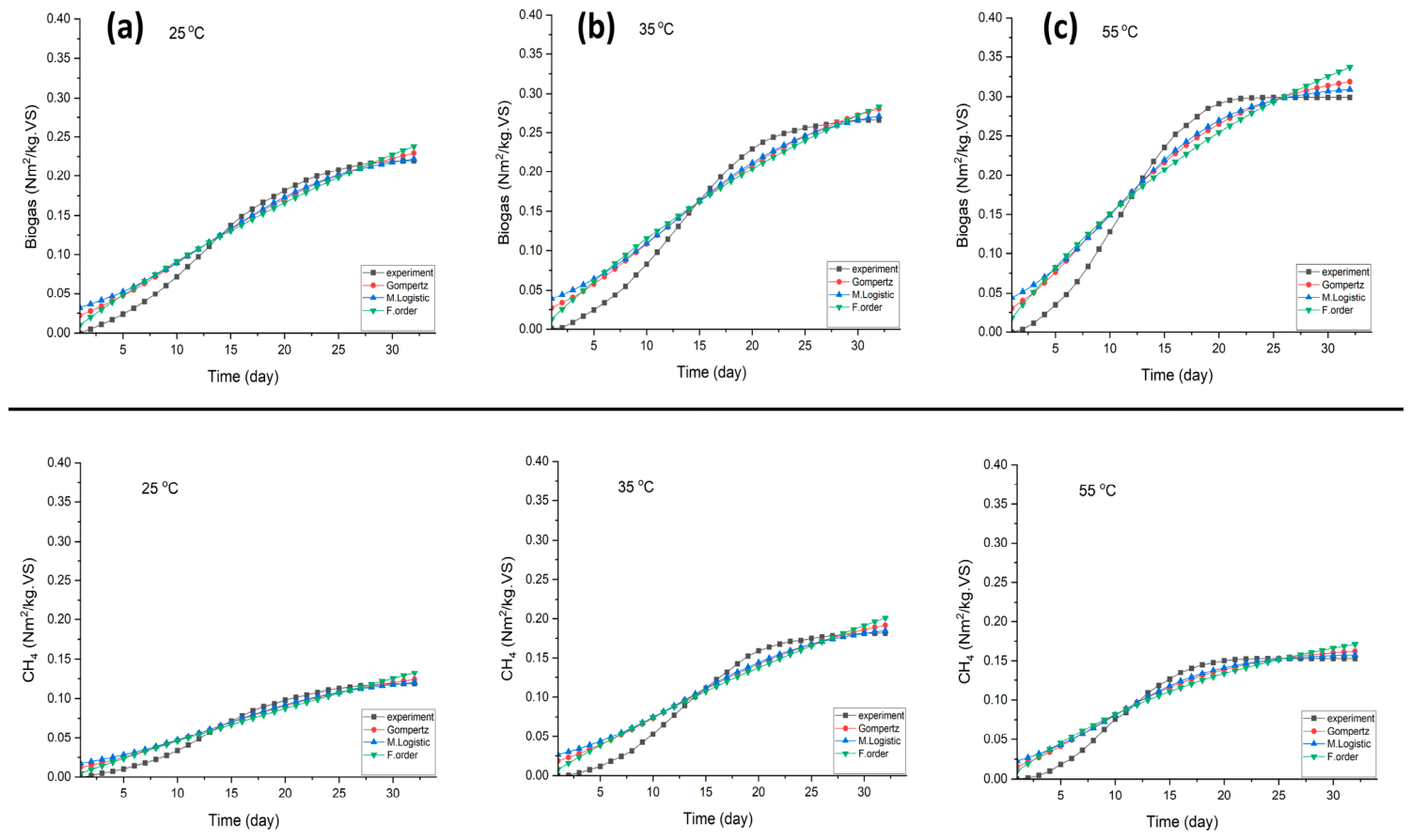
Temperature changes affected the system’s performance, with biogas production rates and incubation periods varying according to the operating temperature as follows: Biogas production was steady up to day 12 and until day 16 at 25 °C and peaked with the highest production rate of 0.0142 Nm3/kg.VS on day 14. The total gas was about 0.22 Nm3/kg.VS with 54% CH4. Performance was enhanced at 35 °C, and production went up from day 11 to day 17, with the highest daily value of 0.0168 Nm3/kg.VS on the 14th day. The total biogas production was 0.266 Nm3/kg.VS, and the content of CH4 was 68.2%. During the 55 °C operation, production was initiated earlier compared to the other experiments (after day 8) and proceeded until day 15, after which it started reducing slowly. The period of incubation was the shortest and was 25 days, which was the shortest in relation to the temperatures studied. Day 13 had the highest daily production value of 0.0232 Nm3/kg.VS, and the total gas production was 0.299 Nm3/kg.VS with 51.12% CH4 content. The removal concentration (kg COD/kg.VS) of COD was 0.441, 0.523, and 0.342, resulted by test at 55 °C, 35 °C, and 25 °C, respectively. According to Figure 1a, 35 °C is the most suitable temperature to produce CH4, whereas 55 °C produces more biogas, even though all temperatures studied are within the recommended range of AD [12,39,40,48,49,50]. Some studies have reported temperatures as high as 55 °C [51], while others report temperature levels as low as 25 °C [39]. Higher heat has a stimulating effect on the microbial communities, which produce enzymes that digest sugars, proteins, and fats; thus increasing the decomposing rate, releasing more free electrons. However, this causes the microthermal methanogens’ efficiency to decrease; these are responsible for converting the substrate into methane, and these changes appear in the bacterial composition and disturb the thermal equilibrium.

3.1.2. Mixing Regime (MR) Effects

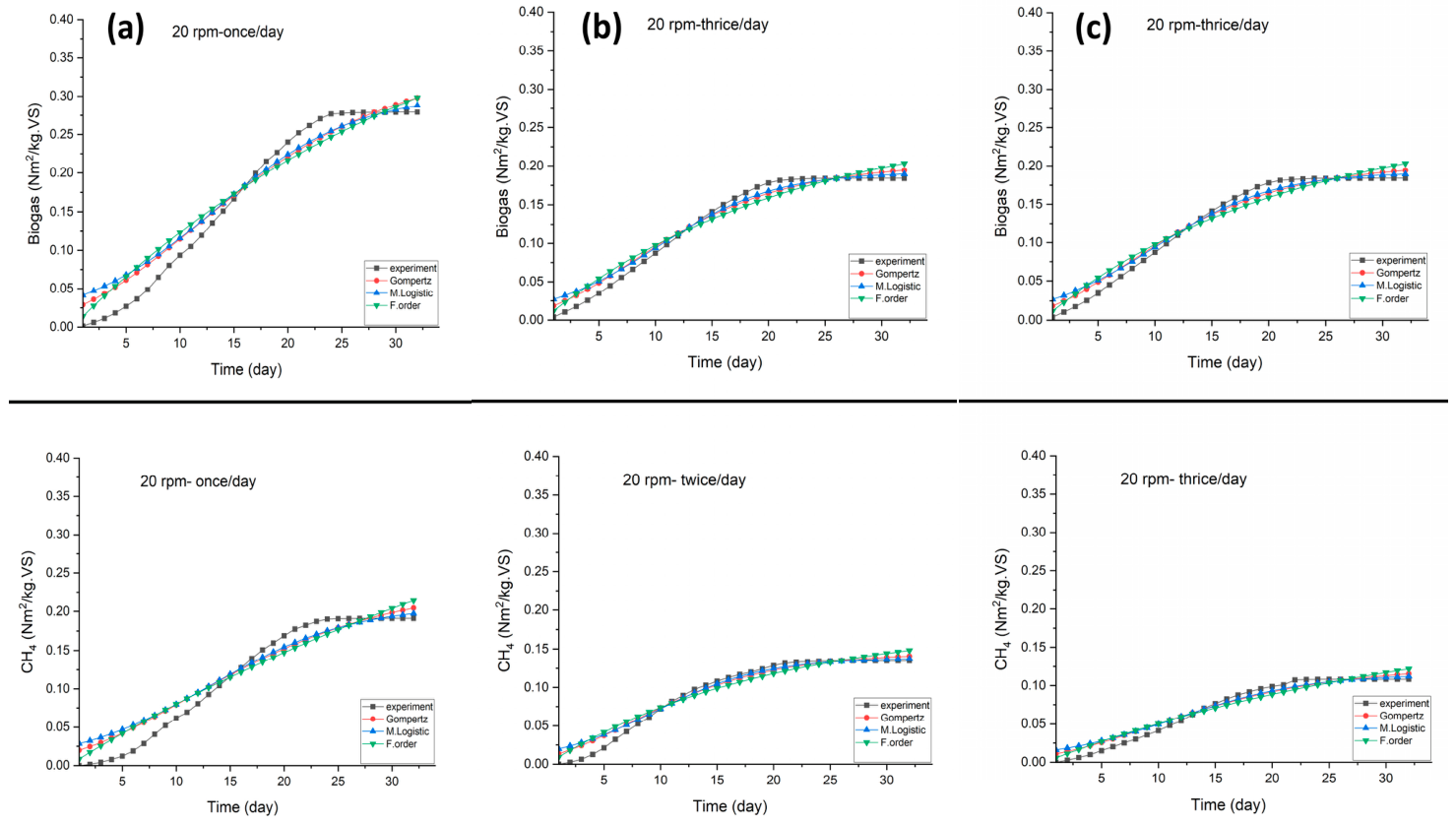
An experiment on the effect of MR on AD demonstrated that 20 rpm once/day for 1 min led to low starting production, which reached a high between days 7–18 with the maximum daily production of 0.0164 Nm3/kg.VS on day 17. Biogas production and CH4 content stopped on day 29, and the total biogas was 0.2179 standard Nm3/kg.VS with 68.84% CH4. MR twice/day gave an opportunity to produce higher initially and a peak between days 5 and 13 with two peaks of 0.0141 Nm3/kg.VS and 0.0142 Nm3/kg.VS at day 6 and day 10, respectively. Production was observed up to day 28, and then it slowly decreased; cumulative biogas production during that time was 0.209 Nm3/kg.VS, with 64.65%. As shown in Figure 1b, the thrice/day mixes sped up production, beginning on day 1, to a peak of activity between days 11 and 14, with a maximum production on day 13 with 0.0112 Nm3/kg.VS. During the period between day 14 and day 19, production was comparatively unchanged before it slowly decreased. The total gas was 0.184 Nm3/kg.VS, and the CH4 was 58.84% on average. The removal concentration (kg COD/kg VS) of COD was 0.548, 0.389, and 0.313, resulting from MR effect tests at 1/day, 2/day, and 3/day, respectively. The findings revealed that low mixing frequency enhanced the rate at which the peak was achieved and maintained, whereas a higher one resulted in a retarded rate of peaking and a reduction in initial production, which was evident in the production of CH4.
The experiment showed that MR once a day provides suitable conditions for biogas production [52]. This is because continuous or intensive stirring may negatively affect the bacterial environment within the concentrate. Increasing the MR to two or more times a day resulted in a complication of the substrate interaction, leading to unbalanced distributions of free electrons and enzymes within the medium. This limited the bacterial decomposition, in turn increasing the buffer accumulation and poisoning the substrate. Less stirring causes lower disturbance to the bacteria and maintains their metabolic activity, which helps to sustain the vital reactions necessary for efficient CH4 production.

3.1.3. Mixing I-S Ratio Effects

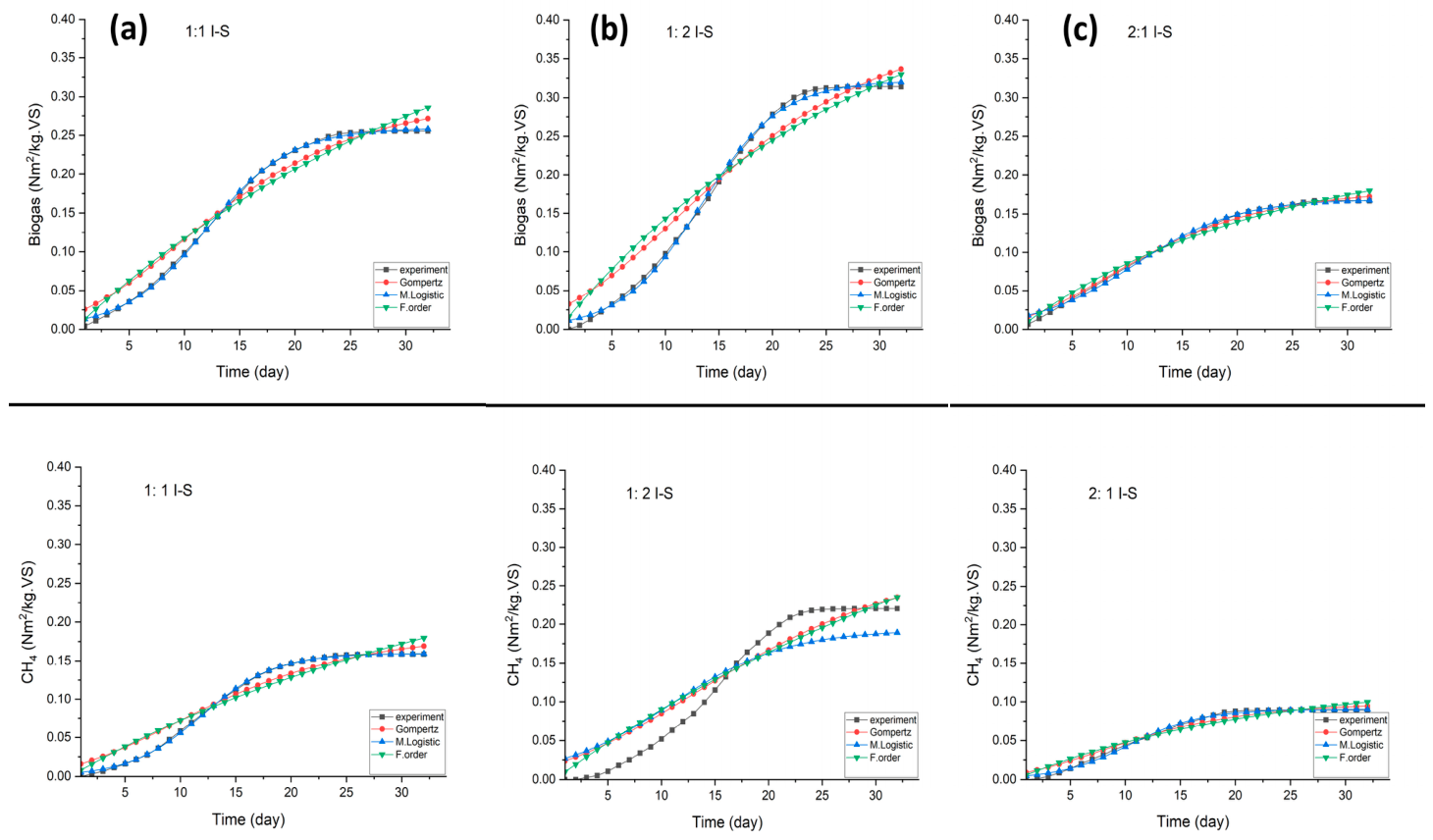
The I-S ratio experiment results revealed that the 1:2 system was the most favorable out of all the tests, as it had high and constant daily production throughout the days, with maximum production between days 15 and 17, and the highest daily production was 0.0222 Nm3/kg.VS on the sixteenth day. As illustrated in Figure 1c, the maximum percentage of CH4 is approximately 70.7, and overall biogas production was also high in this system at 0.314 Nm3/kg.VS. In the case of the second system with a 2:1 I-S ratio, the period of production was the same as in the first system at 27 days, and daily production was constant at 0.007 to 0.0085 Nm3/kg.VS, whereas production decreased sharply after day 18, and the total gas production was 0.16 with 53.7% CH4. The third system had a 1:1 I-S ratio, and it had relatively high daily production, but it did not exceed 0.0164 Nm3/kg.VS, which was on the 13th day. After 16 days, production remained low with overall gas production of 0.256 and 62.1% CH4. The removal concentration (kg COD/kg VS) of COD was 0.631, 0.229, and 0.452, resulting from I-S ratio tests at 1:2, 2:1, and 1:1, respectively.
Overall, the 1:2 I-S ratio was the most applicable, as had been reported in earlier studies [53]. This system gives the maximum possible number of bacteria, and this increases their metabolism and results in a high rate of biogas and CH4 production. It also helps the bacteria to quickly adapt to the substrate and helps to enhance the rates of biochemical reactions that cause efficient production of CH4. Nonetheless, this finding contrasts with what other researchers have concluded, as only 1:1 was the most appropriate I-S ratio [54,55,56,57].

3.1.4. COD Load Effects

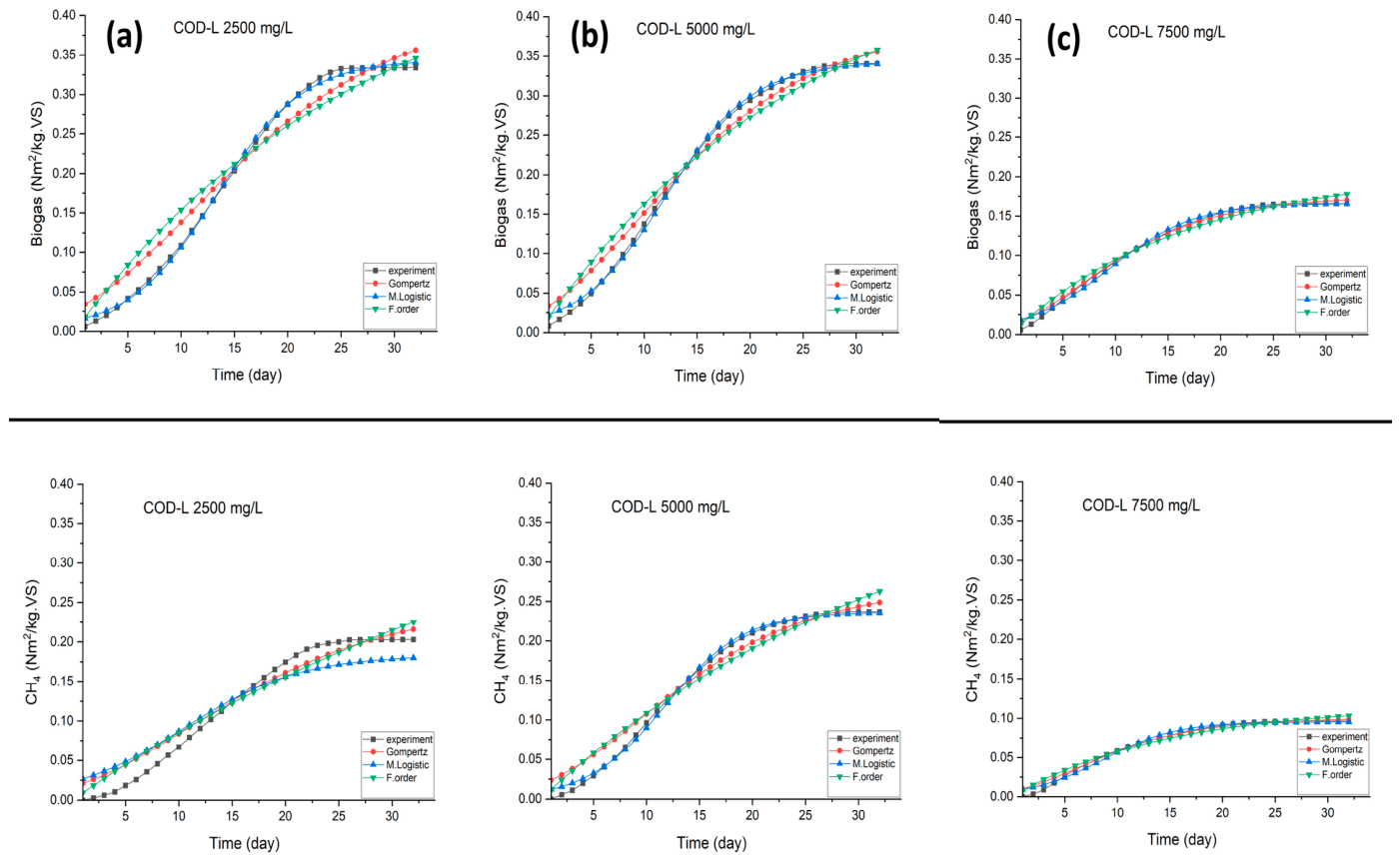
As shown in Figure 1d, the performance of AD under the influence of COD loading was investigated. The 2500 mg/L load was maintained at a production period of 31 days, and the maximum production per day was 0.0192 Nm3/kg.VS was on day 15. The highest production occurred between days 11 and 18 with an average of 0.018 Nm3/kg.VS, and the overall production of biogas was 0.334 Nm3/kg.VS, and 60.78% CH4. The maximum daily production is 0.0204 Nm3/kg.VS was noted on day 10, and the maximum production was between day 8 and day 16 at a 5000 mg/L load. The maximum cumulative production of biogas and CH4 was recorded in all the experiments, with a maximum cumulative production of 0.34 Nm3/kg.VS, and 69.63% CH4. Conversely, when the load was increased to 7500 mg/L, production was sustained at a low and constant rate to produce 27 days with not more than 0.0097 Nm3/kg.VS, daily production, and total production of 0.166 Nm3/kg.VS, containing 58.23% CH4. It was found that there was a major reduction after day 17, meaning that this load could not be sustained in the reactor by bacterial capacity. The removal concentration (kg COD/kg VS) of COD was 0.582, 0.648, and 0.277, resulting from COD-L effect tests at 2500 mg/L, 5000 mg/L, and 7500 mg/L, respectively. At high COD loads, there is an increase in VFAs accumulation, leading to a decreased ability in the bacterial production of the necessary enzymes and causing partial digestion failure. This impairs the substrate conversion to CH4 and reflects on the limiting capability of the system.
According to the results, a COD load of 5000 mg/L is optimal to stimulate CH4 and biogas production while achieving the highest digestion and bacterial activity [22,23].

3.2. Mathematical Model Evaluation

According to the figures and the statistical results presented in Figure 2, Figure 3, Figure 4 and Figure 5, Table 3 and Table 4, and the kinetic parameters (S, Rm, λ, k), the results suggest that the process of biogas and CH4 production possesses a controlled behavior of kinetics and can be well explained by mathematical models. The Gompertz model was better when compared to the two other models since it was the best mathematical model used to fit experimental data.
According to Figure 2 and both Table 3 and Table 4, the model fit with the experimental data of the AD under temperature effects was the Gompertz model. This is evidenced by the unusually high values of adjR2 that are 0.9657 (at 25 °C for biogas), 0.9535 (at 35 °C for biogas), and 0.94745 (at 55 °C for biogas), and these are very high compared to the M.logistic model and first-order model. This superiority was further confirmed by the RMSE, as the Gompertz model had 0.014533 (at 25 °C), which showed outstanding accuracy in determining the actual production path.
Microbes responded immediately to the production stages illustrated in the graphs, as reflected by the extremely low λ, which stabilized at approximately 0.0009 in most cases. Microbial adaptation to organic material is exhibited by this minimal dormancy period. According to the Gompertz model, raising the temperature above 55 °C (thermophilic phase) allows a maximum biogas production rate of 0.0150 Nm3/kg.VS per day. In contrast, the rate drops to 0.0088 Nm3/kg.VS at 25 °C, confirming that higher temperatures act as a catalyst for accelerating microbial reactions. Regarding the expected S, the Gompertz model was the most realistic in estimating the production ceiling. The maximum biogas yield was achieved at 55 °C (0.3371 Nm3/kg.VS). In contrast, the first-order model exhibited significant deviations and a high SSE (0.0296), making it unsuitable for estimating the system. As for CH4, the models maintained the same performance pattern, with the Gompertz model recording a maximum yield of 0.1686 at 55 °C with an R2 of 0.9487. This improved Gompertz model, followed by M.logistic, provides a powerful predictive tool for understanding the dynamics of the process. The close alignment between the Gompertz model and the experiment in the figure, supported by superior numerical values in the statistical tables, determines the advantage of this model over other models.
Figure 3 and Table 3 and Table 4 show that the Gompertz model provided the most accurate description of the experimental data under all MR studied. When MR was used once daily, the model recorded the highest R2 and adj R2 for biogas production (0.9573 and 0.95589), which beat both the logistic and first-order models, along with the lowest RMSE = 0.0217. When MR was increased to twice daily, the Gompertz model continued to perform better, with an R2 = 0.9744 and a significantly lower SSE = 0.0043 compared to the 0.0075 resulting from the first-order model. When MR was done a day thrice, the model achieved the highest statistical efficiency across all study conditions, with an R2 = 0.9773 for biogas production. It also demonstrated superior accuracy in representing CH4 production, registering the lowest RMSE = 0.0076. These results indicate that the Gompertz model is most suitable for describing the behavior of biogas and CH4 production under the influence of MR.
As shown in Figure 5, the highest R2 = 0.9991 and 0.9992 with the lowest RMSE = 0.0016, where CH4 and biogas were at a 1:1 I-S ratio, respectively, were reached with the M.logistic model, as compared to the Gompertz model. It has given R2 = 0.998 at a 1:2 ratio and R2 = 0.996 at a 2:1 ratio, in comparison to R2 = 0.969 at 1:1 and 0.995 at 2:1 of the Gompertz model. As shown in Figure 5, the Gompertz model was best used in CH4 only, where R2 = 0.92108 and RMSE approximately equals 0.02524. The M.logistic model reflects better the lag phase and has a definite correlation in the growth phase, intersecting nearly halfway through the experimental values. The stasis period at a 1:1 ratio was approximately 4.46 days, whereas the estimates of the Gompertz and first-order models were very low. Accordingly, this modified logistic model is the most appropriate for the kinetics of biogas and CH4 generation under the impact of I-S ratios.
The variation in model performance is attributable to a microbial kinetics perspective. The Gompertz model is characterized by the fact that it can represent the lag stage during which microorganisms are adapted to the substrate and only then commence actual production. This makes it more precise in situations where there is a lag in the consumption of organic matter or the activity of methanogens. Contrarily, the logistic model is a mirror image of a symmetrical growth pattern and is more applicable to systems with stable and rapid microbial activity without an apparent lag, where substrate depletion is high at the early stages. Hence, the disparity in model performance lies in the behavior and operating conditions of the microbial community and is not exclusively in statistical concordances.
The first-order model appeared to be the least representative of the other two models. It is worth mentioning that these findings coincide with what Khadka et al. (2022) reported, that the Gompertz models were the best among models to predict biogas production [56], and agree with Alrawashdeh et al. (2024), who concluded that biogas and CH4 were best fitted by Gompertz models [15].
Table 4 shows that all three kinetic models produced high R2 > 0.90 and low SSE and RMSE. In general, Gompertz’s model showed the best agreement for temperature-affected and MRs, while M.logistic’s model had higher accuracy in some special cases, such as I-S ratios and certain COD loads. Despite its acceptable agreement with the first-order model, it performed very poorly compared to the other two models, suggesting that the Gompertz and M.logistic models are the best at describing the system’s behavior.
To address the practical limitations, lab costs and long testing time of the exhaustive testing of multiple variables, a systematic optimization approach was used: response surface methodology and CFO were used to comprehensively investigate the multi-variable interactions. So, the experimental data were applied by using accurate analytical equations (Poly), and mathematical modeling was conducted to obtain a three-dimensional response surface to establish the interactions of the operating factors. The objectives of this sequence are to have maximum production, and the accuracy of the statistic is above 99%, so that the optimal combination conditions (temperature, MR, mixing I-S ratio, and COD load) can be found with maximum efficiency.
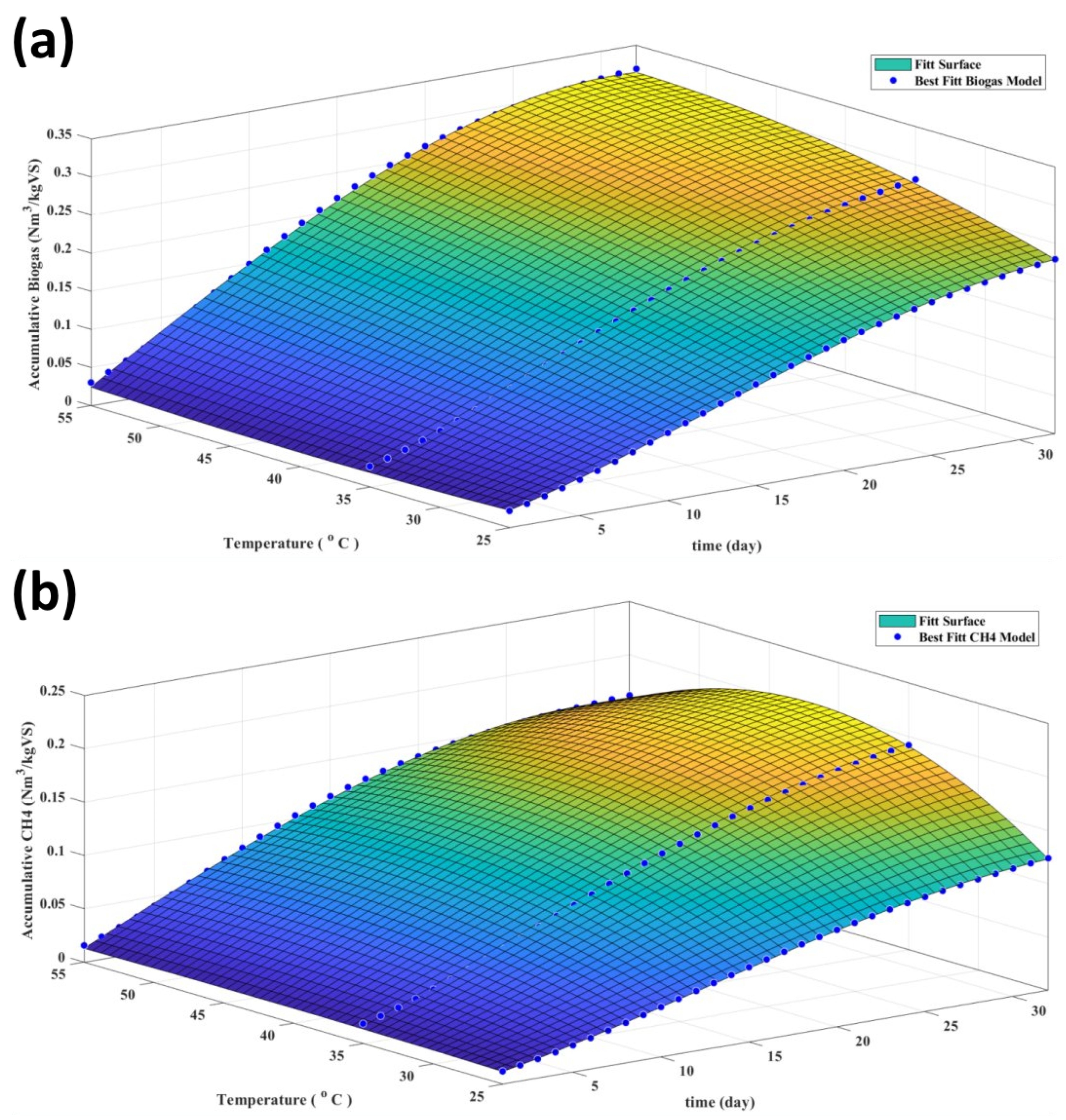
The results in Figure 6a indicate the existence of a positive correlation between higher temperature and biogas production, and the mathematical model, Poly32, best fits the data with an R2 = 0.9991 and RMSE = 0.0027. Higher temperature increases the rate of reaction, and the optimum point of production is 52 °C, where the cumulative biogas is a maximum of 0.312 Nm3/kg.VS in 30 days. Figure 6b is the response surface of temperature and time effects on CH4 production, with the maximum value of 0.199–0.197 Nm3/kg.VS at 45 °C after 29–30 days, and 0.194 Nm3/kg.VS after 29 days at 47 °C. The third-order model fits the data reasonably well (R2 = 0.9992, Adjusted R2 = 0.9991); the model shows a small error (RMSE = 0.0015, SSE = 2.02 × 10⁻⁴), which means high predictive power and accuracy.
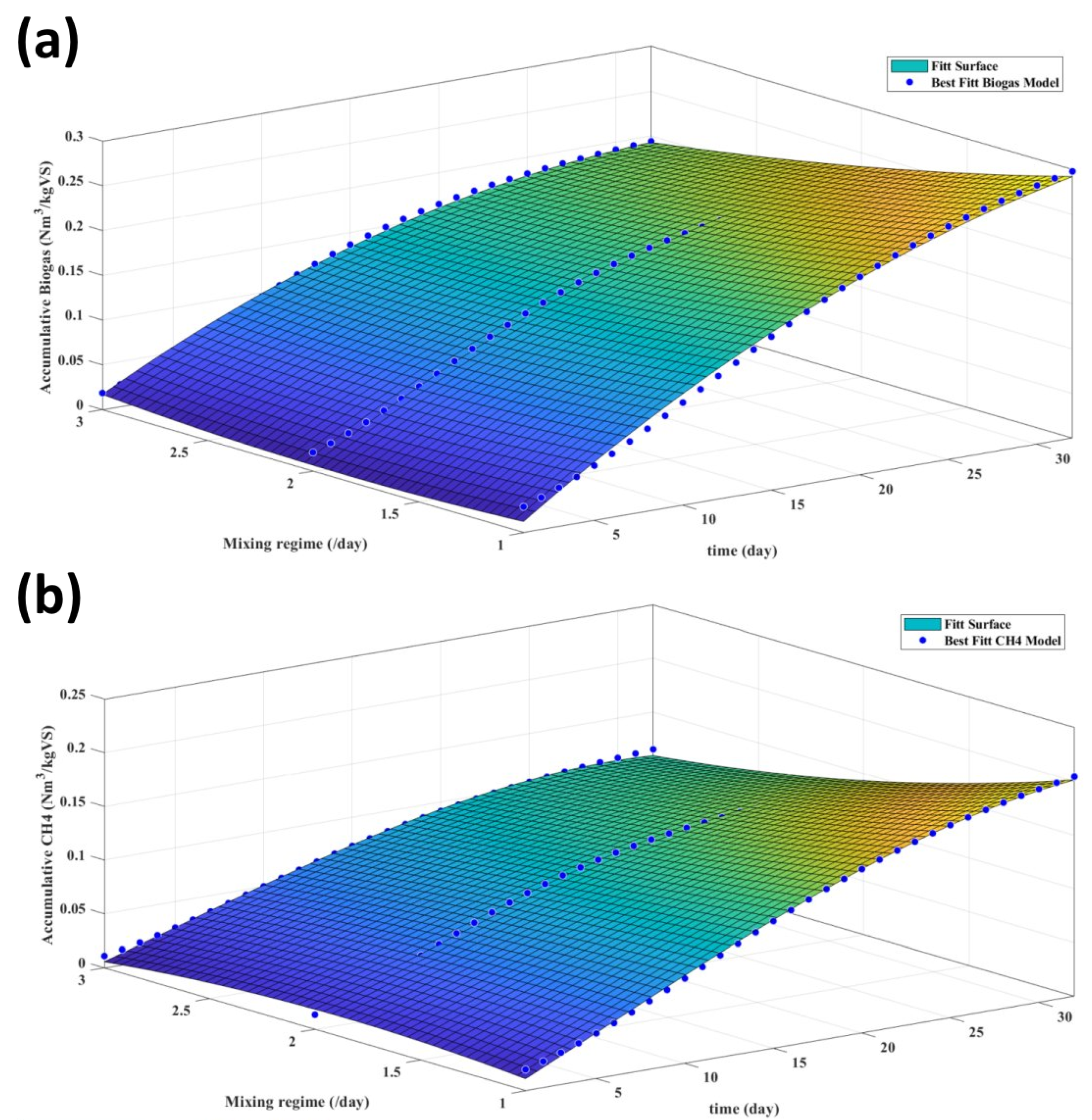
According to Figure 7a, mathematical modeling (Poly22) and biogas production, there is a minor negative effect of increasing the MR. The matching accuracy of the model is excellent (99.34% with R2 = 0.9934), and the error is very low (RMSE = 0.0061). The analysis shows that time had a significant positive influence on coefficients (p10 = 0.01584), whereas the increasing frequency of the mixing rate led to a slight drop in productivity (p01 = −0.02822). Production reaches its peak (0.26 Nm3/kg.VS) when MR is once/day after 30 days and at a maximum endpoint (optimal productivity).
As shown in Figure 7b, the number represents the reaction surface of the MR along with the cumulative buildup of CH4 over time. A maximum increase in production is observed at around 0.17–0.18 (≈65.38%) after 28–30 days, and the MR is once/day in the optimum operating range between the experimental parameters. It was found that the third-order model correctly captured the data, with a coefficient of determination (R2) of 0.9964 and RSE of 0.9961, as well as low error values (RMSE = 0.0031 and SSE = 8.62 × 10⁻⁴), demonstrating the effectiveness of the third-order model for explaining system behavior and predicting production performance.
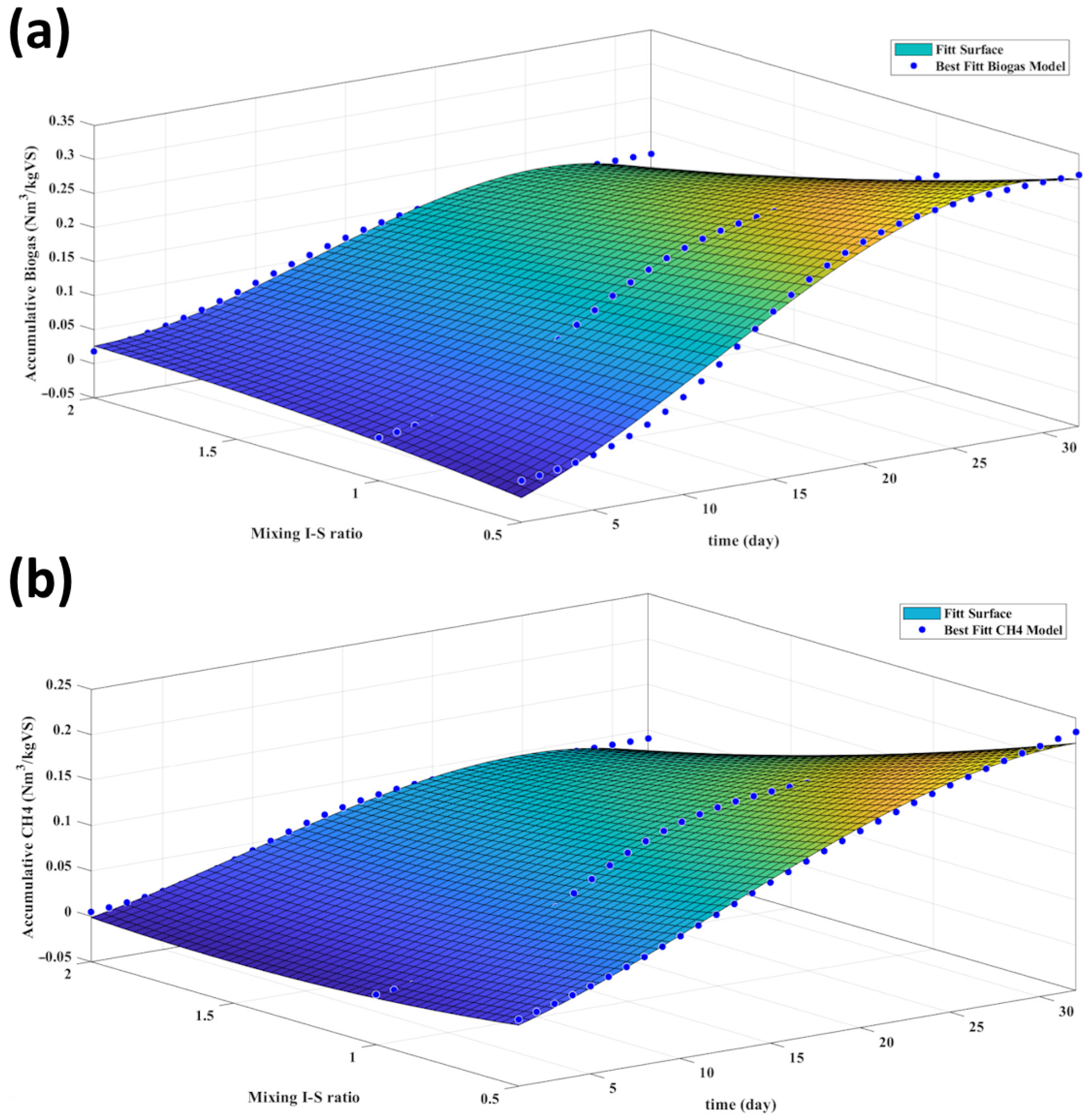
As illustrated in Figure 8a, the surface profile of the third-order representation of the poly (Poly32) indicates that there is a non-linear variable relationship between the I-S ratio and its influence on biogas yield, where on the x-axis the values of 0.5, 1, and 2 are act 1:2, 1:1, and 2:1. The biogas production reached 0.317 Nm3/kg.VS after 29 days with an I-S ratio of 0.55 (≈1:2.09). There is a slight flattening or a depression after this, which would signify an optimal operating range. Moreover, the indices of conformation were found to be highly accurate in the model (R2 = 0.9900, Adj-R2 = 0.9891, RMSE = 0.0100, SSE = 0.0087, Degrees of Freedom for Error “dfe” = 87), which showed that the model is effective in the representation of the surface and the ability to predict optimal values.
According to Figure 8b, it was observed that the mathematical model (Poly32) was very efficient in the simulation of CH4 production, as the R2 = 0.9938 was high, and RMSE = 0.0051 was very low. It was demonstrated that the 3-D surface exhibits an increment in the production of CH4 over time and the I-S ratio. The maximum value was 0.227 Nm3/KgVS (71.61%) after 30 days, with an I-S ratio of 0.5 (1:2), and there was a slight statistical significance (p = 0.036).
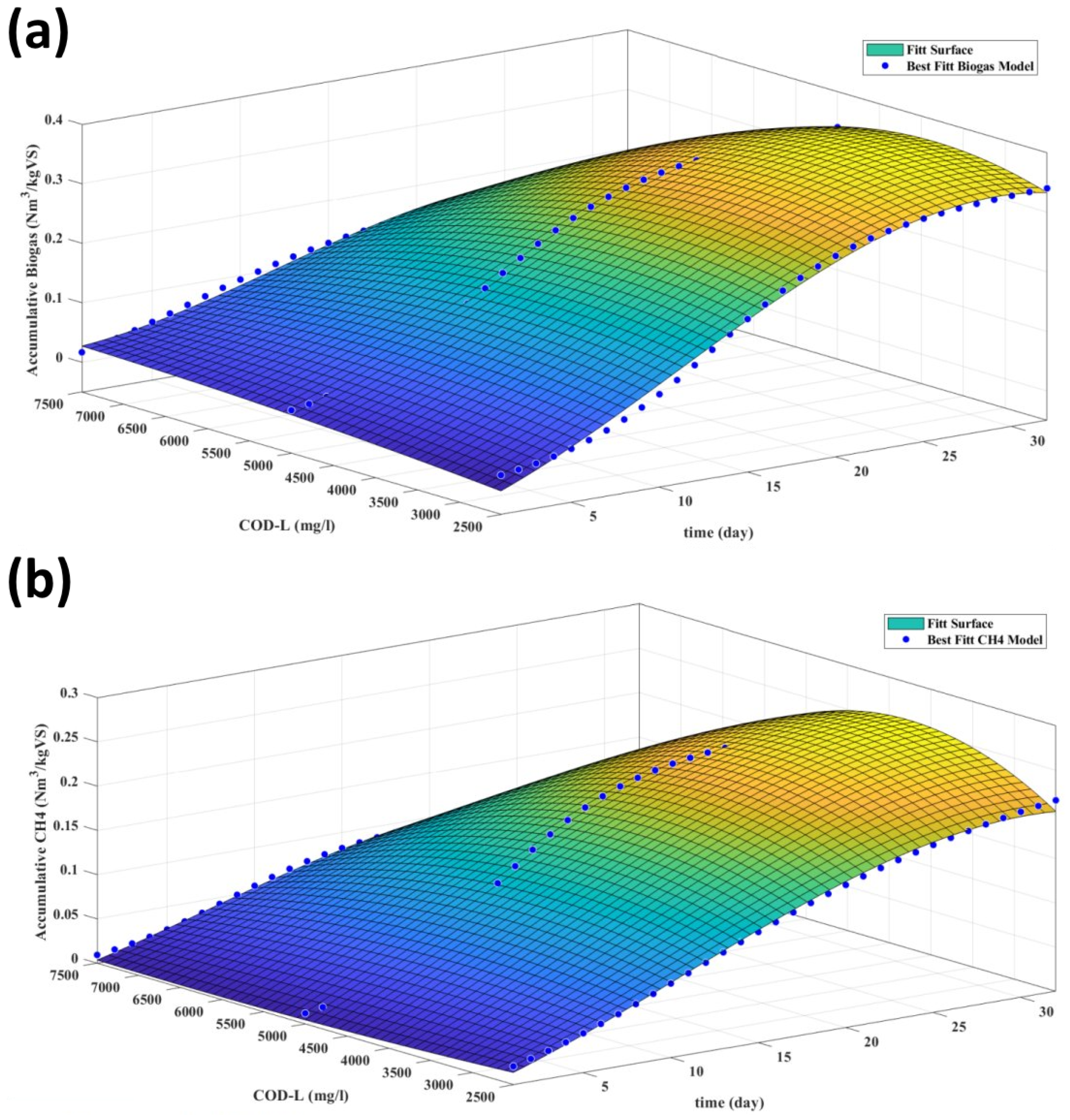
According to the resultant surface (Poly32) in Figure 9a, it is clear that there is an optimum location where biogas can be produced. At a load of about 4250 mg/L COD and 28 days, the product is 0.366 Nm3/kg.VS, which is the maximum biogas. The curve becomes horizontal and then slopes a bit downwards, which means that additional time and COD growth will not yield a substantial improvement in efficiency. The model parameters demonstrate an interaction effect, p11 = 3.21 × 10⁻⁶, between COD load and performance, and the best performance is achieved as a result of the combined action between these two variables. Model performance is good (R2 = 0.9908, Adj-R2 = 0.9900, RMSE = 0.0109), both of which imply strong agreement between the expected and experimental values.
Figure 9b shows that the cumulative CH4 production against the COD load is best represented by the Poly32 polynomial model with an R2 = 0.9871 and RMSE = 0.0085. The three-dimensional surface demonstrates that the production of CH4 rises with time but falls in high concentrations of COD-L (exceeding 7000 mg/L), and the peak is in the range of 4000 to 4400 mg/L with 0.249 (68.03–0.251 Nm3/kg.VS) at 28 days.
The model fitting was done using a mathematical equation (Equations (8) and (9)) to explain the correlation between the operational variables and their combined impact on biogas and CH4 production. This equation is based on the linear, quadratic effects, and the effects of interactions between variables, which allows establishing the contribution of each variable and its weight to the overall system. The equation can, therefore, be used to determine whether the effect of a variable is strong or weak, whether alone or in combination with other variables, thus giving further insight into the way the system behaves and assisting in bringing out the factors that affect production efficiency the most. Equation 2 shows the impact of all variables on biogas production; the researched variables are the MR (X1), the temperature (X2), the COD load (X3), the mixing I-S ratio (X4), and the incubation time (t).
B i o g a s   p r o d u c t i o n = a 1 + a 2 a X 1 + a 3 X 2 + a 4 X 3 + a 5 X 4 + a 6 t + a 7 X 1 2 + a 8 X 2 2 + a 9 X 3 2 + a 10 X 4 2 + a 11 X 1 X 2 + a 12 X 3 X 4 + a 13 X 1 X 3 + a 14 X 1 X 4 + a 15 X 2 X 3
C H 4   p r o d u c t i o n = a 1 + a 2 a X 1 + a 3 X 2 + a 4 X 3 + a 5 X 4 + a 6 t + a 7 X 1 2 + a 8 X 2 2 + a 9 X 3 2 + a 10 X 4 2 + a 11 X 1 X 2 + a 12 X 3 X 4 + a 13 X 1 X 3 + a 14 X 1 X 4 + a 15 X 2 X 3
The model coefficients (a1–a15) indicate the intensity and direction of each variable’s interaction with biogas production (Equation (9)). Coefficients show whether effects are positive or negative, allowing estimation of variable influence under different conditions. As shown in Table 5, most operational variables do not have linear effects; X1, X2, X3, and X4 have coefficients of zero, indicating they do not manifest independently. Operating time has a positive direct linear impact (a6 = 0.0087). The variable MR, both univariately and in combination with others, did not significantly affect production, with all coefficients being zero. COD load has the strongest negative nonlinear effect (a9 < 0) and negatively interacts with I-S ratio (a12 < 0), suggesting that high COD load and increased I-S ratio can lower output. Conversely, temperature positively interacts with COD load (a15 > 0), indicating its effectiveness at specific COD levels. Thus, the influence of elements in the system relies on their interactions. COD load and its interactions are the strongest factors in biogas production. The fitting results show R2 = 0.9281 and RMSE = 0.0233, indicating strong predictive capability for biogas production.
According to Equation (9), the model results indicate that there are no linear impacts from X1, X2, X3, and X4 on CH4 production, as their linear coefficients are zero. The time factor shows a positive linear effect. Nonlinearly, the COD load has a negative quadratic effect, indicating an optimal point beyond which increased load reduces production. Interactions show a positive influence between temperature and COD load, while a more negative interaction exists between COD load and I-S ratio. COD load is the most significant variable for CH4 production, with the I-S ratio acting as a moderator. The least significant variable is MR. The quadratic model demonstrates strong predictive ability with an R2 value of 0.9401 and an RMSE of 0.0132, indicating high accuracy.

3.3. Optimization CFO Algorithm Results

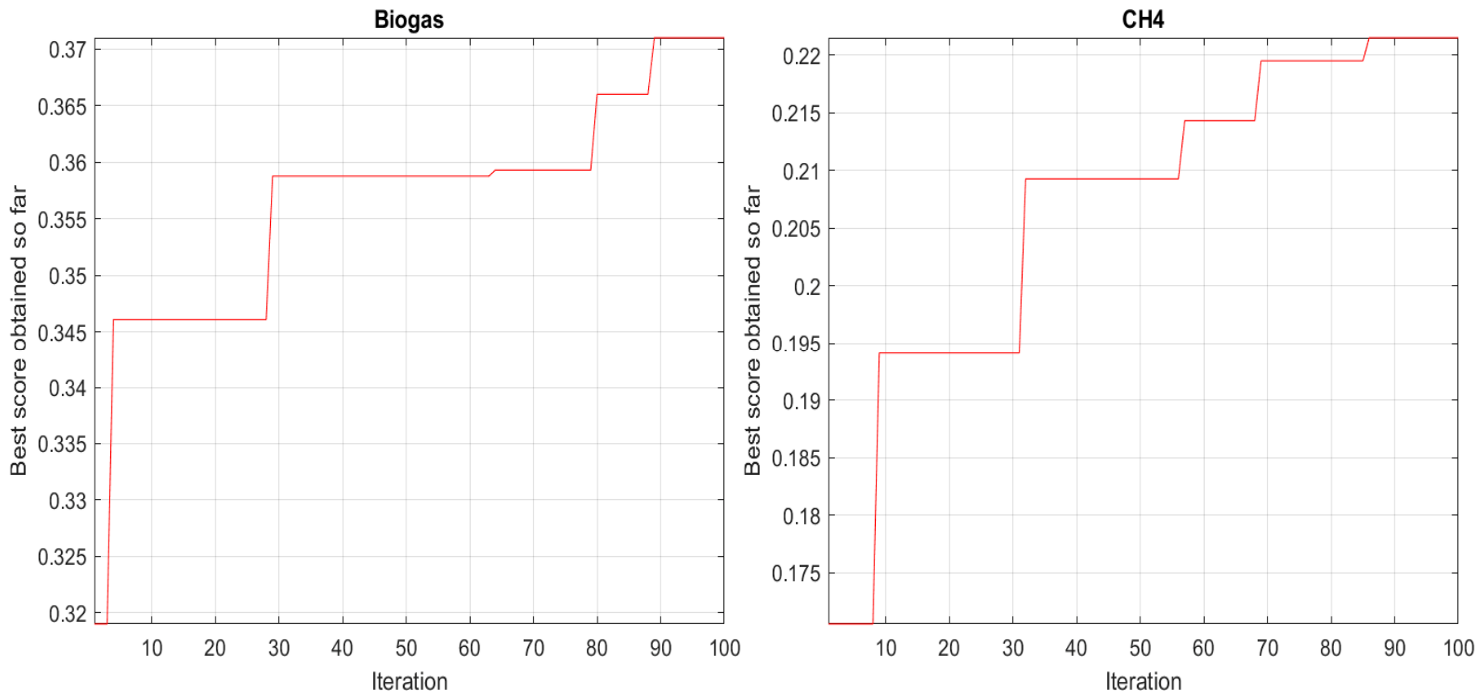
The results of the simulations and optimizations carried out with the use of the CFO algorithm to establish the most effective operating conditions for biogas and CH4 production are given. The 100 systematic iterations of the optimization process helped to effectively search the solution space and extract the most useful solutions, which were marked in Table 6 and Table 7. The consistency of the results in successive iterations is a sign that the algorithm effectively does not get trapped in local optimum values, and it is an indicator of the mechanical efficiency of a cryfish herd in striking a balance between exploration and exploitation.
The results indicate that the algorithm has exhibited a better capacity to effectively explore the search space, attaining a maximum biogas yield (0.37 Nm3/kg.VS) resulted at temperature of 54.3 C, MR of 1.23 (once every 19–20 h on average), I-S ratio of 0.544, and CO-L of 6221.9 mg/L, while optimum CH4 resulted at (0.222 Nm3/kg.VS) at a temperature of 53 °C, MR of 0.89 (once every 18–19 h on average), I-S ratio of 0.89, and CO-L of 4785 mg/L.
The convergence curves of the optimization CFO algorithm that was employed to estimate the optimal values of biogas and CH4 production in 100 iterations, as presented in Figure 10, represent the results of the simulated process. Observing the optimization process, it is evident that the algorithm proved to be very efficient in the transition from the exploration phase to the exploitation phase, that is, the transition between the exploration phase and the exploitation phase (exploration). It made large jumps in the optimal score in the first third of iterations, then swung into relative stasis, which is an indication of the ability of the model to escape the local optimum regions. With the process approaching the 90th (biogas) and slightly before the 90th (CH4) iteration, the two curves showed the highest level of stability at the maximum values, which proves the accuracy of the algorithm to reach the global optimum of the process and guarantees the stability of the production predictions of bioenergy under the conditions studied. The graph itself shows how the algorithm is stable even as the values of temperature and the COD-L change, and the proposed model is robust enough to deal with the complex and nonlinear variables of AD, and finally offers stability at the last iteration. As shown in Section 2.5, the dynamic modification of the CFO algorithm’s behavioral patterns is essentially responsible for its excellent optimization performance and robustness in identifying the global optimal configuration. By maintaining high population diversity, this time-varying transition mechanism successfully avoided premature convergence during the early stages of the search, enabling the algorithm to consistently converge toward the true global optimum and escape local optima.
The proposed framework can improve biogas plant performance on a large scale, as shown in the study. In order to increase the efficiency of the reactors, the optimum values can be used. In contrast, plants that run at thermophilic conditions consume more energy than those operated under mesophilic conditions. In this situation, it is necessary to strike a balance between productivity and operating costs. Furthermore, by utilizing the proposed optimization model, the system will be less expensive to operate, resulting in a higher degree of scalability and economic viability.

4. Conclusions

The experimental results revealed that the substrate in use offered stable AD operating conditions that were maintained over 26–32 days, and the effectiveness of production was evidently influenced by the changes in operational variables. Experimentally, the optimum performance was at 35 °C in regard to biogas with a CH4 content of 68%, and the thermophilic (55 °C) increased kinetics and resulted in high cumulative production. The I-S ratio of 1–2 proved the most effective, and the once/day MR proved to be the most stable in terms of operation and had a biogas production of 0.314 Nm3/kg.VS with a CH4 of 70%. Moreover, the COD load (5000 mg/L) was the optimum load that was able to completely produce biogas (0.34 Nm3/kg.VS) and produce the highest CH4 content, 69.6% without inhibitory effects observed at the higher loads.
Kinetically, the three models were all showing good agreement with experiment (R2 > 0.90); the Gompertz model was the most representative of the temperature and MR, I-S ratio effects (R2 up to 0.977). The M.logistic model had been further improved, even with the influence of COD loads (R2 up to 0.999 and a substantial reduction in RMSE). The models of the polynomial response surface also showed high predictive power (R2 between 0.99 and 0.999), optimal production conditions at a temperature of about 45–52 °C, an I-S ratio of 1:2, and a COD load (~4000–5000 mg/L).
The modeling equation results showed a distinct difference in the intensity of the impact of the variables on the production of biogas and CH4 production, also indicating that there were no direct linear effects among the operational variables. COD load appeared as the most important influencing factor, as it had negative quadratics and had interactions with temperature and I-S ratios. The prediction equations had strong explanatory power for biogas (R2 = 0.9281, RMSE = 0.0233) and CH4 (R2 = 0.9401, RMSE = 0.0132) production. The results demonstrate that combining operational optimization with advanced statistical modeling allows highly efficient biogas and CH4 production systems to be reliably predicted and optimized.
The study has verified that the CFO algorithm is powerful and efficient in modeling and optimization of complex AD systems, since it is better at balancing search and exploitation of the search space to arrive at the best solutions with a minimal number of iterations and high levels of statistical reliability. It also offers a robust approach for capturing multi-variable synergistic interactions in AD systems.

Author Contributions

K.A.b.A. prepared the research paper and explained the data, in addition to clarifying the biogas process. A.A.-B., E.G. and A.A. analyzed the biogas production (BMP) test data. L.A.A.-S., H.E. and M.R.A.-K. created and analyzed the modeling and design optimization. K.A.b.A., A.A.-B. and A.A. conducted the experiments. A.A., K.B.-M. and M.R.A.-K. reviewed and analyzed the data. E.G., K.A.b.A., L.A.A.-S. and K.B.-M. prepared the methodological framework. All authors have read and agreed to the published version of the manuscript.

Funding

This research received no external funding.

Data Availability Statement

Data will be made available on request and with permission of the institutions.

Acknowledgments

The author acknowledges the support provided by the Mechanical Engineering Department, Al-Huson University College, Al-Balqa Applied University to conduct this research.

Conflicts of Interest

The authors declare that there is no conflicts of interest. The authors also declare that the research was conducted in the absence of any commercial or financial relationships that could be construed as a potential conflict of interest.

References

  1. Moreau, V.; Vuille, F. Decoupling energy use and economic growth: Counter evidence from structural effects and embodied energy in trade. Appl. Energy 2018, 215, 54–62. [Google Scholar] [CrossRef]
  2. Rice, E.; Baird, R.; Eaton, A.; American Water Works Association. Joint Statement of American Water Works Association and American Public Health Association on Procedure for Issuing “Standard Methods for the Examination of Water and Sewage”. J.-Am. Water Work. Assoc. 1932, 24, 1609–1612. [Google Scholar] [CrossRef]
  3. Al bkoor Alrawashdeh, K.; Al-Samrraie, L.A.; Damseh, R.A.; Al Bsoul, A.; Gul, E. Improving Biogas Production and Organic Matter Degradation in Anaerobic Co-Digestion Using Spent Coffee Grounds: A Kinetic and Operational Study. Fermentation 2025, 11, 295. [Google Scholar] [CrossRef]
  4. Yee, E.; Chan, Y.J.; Wan, Y.K.; Tiong, T.J.; Chong, W.C.; Lim, J.W. Examining the synergistic effects through machine learning prediction and optimisation in the anaerobic Co-digestion (ACoD) of palm oil mill effluent (POME) and decanter cake (DC) with economic analysis. J. Clean. Prod. 2024, 437, 140666. [Google Scholar] [CrossRef]
  5. Kabeyi, M.J.B.; Olanrewaju, O.A. Sustainable Energy Transition for Renewable and Low Carbon Grid Electricity Generation and Supply. Front. Energy Res. 2022, 9, 743114. [Google Scholar] [CrossRef]
  6. Fernández-Rodríguez, J.; Pérez, M.; Romero, L.I. Semicontinuous Temperature-Phased Anaerobic Digestion (TPAD) of Organic Fraction of Municipal Solid Waste (OFMSW). Comparison with single-stage processes. Chem. Eng. J. 2016, 285, 409–416. [Google Scholar] [CrossRef]
  7. Wang, S.; Ruan, Y.; Zhang, W.; Li, Z.; Wu, J.; Liu, D. Net energy analysis of a small-scale biogas self-supply anaerobic digestion system operated at psychrophilic to thermophilic conditions. J. Clean. Prod. 2018, 174, 226–236. [Google Scholar] [CrossRef]
  8. Madigou, C.; Lê Cao, K.-A.; Bureau, C.; Mazéas, L.; Déjean, S.; Chapleur, O. Ecological consequences of abrupt temperature changes in anaerobic digesters. Chem. Eng. J. 2019, 361, 266–277. [Google Scholar] [CrossRef]
  9. Roopnarain, A.; Rama, H.; Ndaba, B.; Bello-Akinosho, M.; Bamuza-Pemu, E.; Adeleke, R. Unravelling the anaerobic digestion ‘black box’: Biotechnological approaches for process optimization. Renew. Sustain. Energy Rev. 2021, 152, 111717. [Google Scholar] [CrossRef]
  10. Trzcinski, A.P.; Stuckey, D.C. Treatment of municipal solid waste leachate using a submerged anaerobic membrane bioreactor at mesophilic and psychrophilic temperatures: Analysis of recalcitrants in the permeate using GC-MS. Water Res. 2010, 44, 671–680. [Google Scholar] [CrossRef] [PubMed]
  11. Fezzani, B.; Ben Cheikh, R. Two-phase anaerobic co-digestion of olive mill wastes in semi-continuous digesters at mesophilic temperature. Bioresour. Technol. 2010, 101, 1628–1634. [Google Scholar] [CrossRef] [PubMed]
  12. Chae, K.J.; Jang, A.; Yim, S.K.; Kim, I.S. The effects of digestion temperature and temperature shock on the biogas yields from the mesophilic anaerobic digestion of swine manure. Bioresour. Technol. 2008, 99, 1–6. [Google Scholar] [CrossRef] [PubMed]
  13. Sidi Habib, S.; Torii, S.; Kavitha Mol, S.; Nair, A. Optimization of the Factors Affecting Biogas Production Using the Taguchi Design of Experiment Method. Biomass 2024, 4, 687–703. [Google Scholar] [CrossRef]
  14. Neuner, T.; Meister, M.; Pillei, M.; Senfter, T.; Draxl-Weiskopf, S.; Ebner, C.; Winkler, J.; Rauch, W. Impact of Design and Mixing Strategies on Biogas Production in Anaerobic Digesters. Water 2024, 16, 2205. [Google Scholar] [CrossRef]
  15. Al bkoor Alrawashdeh, K.; Al-Sameraie, L.; Al Bsoul, A.; Khasawneh, A.; Al-Tabbal, J. Correlation between kinetic parameters, reactor performance, and biogas and methane potential of co-digestion and mono-digestion of active sludge and olive mill wastewater. Int. J. Low.-Carbon Technol. 2024, 19, 1501–1515. [Google Scholar] [CrossRef]
  16. Hajji, A.; Louartassi, Y.; Garoum, M.; Laaroussi, N.; Rhachi, M. Modification and extension of the anaerobic model N°2 (AM2) for the simulation of anaerobic digestion of municipal solid waste. Int. J. Renew. Energy Dev. 2023, 12, 913–922. [Google Scholar] [CrossRef]
  17. Deublein, D.; Steinhauser, A. Biogas from Waste and Renewable Resources; Wiley-VCH Verlag GmbH & Co. KGaA: Weinheim, Germany, 2010. [Google Scholar] [CrossRef]
  18. Wang, X.; Liu, T.; Liu, Y.; Sun, Y. Effects of stirring time on anaerobic digestion of cattle manure-corn stover: Microbial diversity and metabolic pathways. Fuel 2024, 367, 131468. [Google Scholar] [CrossRef]
  19. Al Rabadi, S.; Al Bkoor Alrawashdeh, K.; Saed, H.; Al–Samrraie, L.A.; Al-Tabbal, J.A. Synergistic Impact of Nanoscale Zero-Valent Iron in Anaerobic Co-digestion Treatment and Biogas Upgrading from the Organic Fraction of Municipal Solid Waste-Activated Sludge. Waste Biomass Valorization 2023, 15, 1323–1338. [Google Scholar] [CrossRef]
  20. Jurgutis, L.; Slepetiene, A.; Volungevicius, J.; Amaleviciute-Volunge, K. Biogas production from chicken manure at different organic loading rates in a mesophilic full scale anaerobic digestion plant. Biomass Bioenergy 2020, 141, 105693. [Google Scholar] [CrossRef]
  21. Maamri, S.; Amrani, M. Biogas Production from Waste Activated Sludge Using Cattle Dung Inoculums: Effect of Total Solid Contents and Kinetics Study. Energy Procedia 2014, 50, 352–359. [Google Scholar] [CrossRef]
  22. Al bkoor Alrawashdeh, K. Anaerobic Co-digestion efficiency under the stress exerted by different heavy metals concentration: An energy nexus analysis. Energy Nexus 2022, 7, 100099. [Google Scholar] [CrossRef]
  23. Bishoff, D.; AlSayed, A.; Hosen, S.; Menon, P.; ElDyasti, A. Effect of COD on methanotrophic growth and the anaerobic digestibility of its sludge as a further step for integration in WWTPS. J. Environ. Manag. 2021, 290, 112543. [Google Scholar] [CrossRef] [PubMed]
  24. Zhang, Y.; Liu, P.; Li, Y. Implementation of an Enhanced Crayfish Optimization Algorithm. Biomimetics 2024, 9, 341. [Google Scholar] [CrossRef] [PubMed]
  25. Li, W.; Wang, G.-G.; Gandomi, A.H. A Survey of Learning-Based Intelligent Optimization Algorithms. Arch. Comput. Methods Eng. 2021, 28, 3781–3799. [Google Scholar] [CrossRef]
  26. El-Kenawy, E.-S.M.; Khodadadi, N.; Mirjalili, S.; Abdelhamid, A.A.; Eid, M.M.; Ibrahim, A. Greylag Goose Optimization: Nature-inspired optimization algorithm. Expert Syst. Appl. 2024, 238, 122147. [Google Scholar] [CrossRef]
  27. Elseify, M.A.; Hashim, F.A.; Hussien, A.G.; Kamel, S. Single and multi-objectives based on an improved golden jackal optimization algorithm for simultaneous integration of multiple capacitors and multi-type DGs in distribution systems. Appl. Energy 2024, 353, 122054. [Google Scholar] [CrossRef]
  28. Tang, J.; Liu, G.; Pan, Q. A Review on Representative Swarm Intelligence Algorithms for Solving Optimization Problems: Applications and Trends. IEEE/CAA J. Autom. Sin. 2021, 8, 1627–1643. [Google Scholar] [CrossRef]
  29. Holl, E.; Oskina, A.; Baier, U.; Lemmer, A. Optimization of Thermodynamic Parameters of the Biological Hydrogen Methanation in a Trickle-Bed Reactor for the Conditioning of Biogas to Biomethane. Energies 2023, 16, 4720. [Google Scholar] [CrossRef]
  30. Tsegaye, D.; Leta, S. Optimization of operating parameters for biogas production using two-phase bench-scale anaerobic digestion of slaughterhouse wastewater: Focus on methanogenic step. Bioresour. Bioprocess. 2022, 9, 125. [Google Scholar] [CrossRef] [PubMed]
  31. Holubar, P.; Zani, L.; Hager, M.; Fröschl, W.; Radak, Z.; Braun, R. Start-up and recovery of a biogas-reactor using a hierarchical neural network-based control tool. J. Chem. Technol. Biotechnol. 2003, 78, 847–854. [Google Scholar] [CrossRef]
  32. Zareei, S.; Khodaei, J. Modeling and optimization of biogas production from cow manure and maize straw using an adaptive neuro-fuzzy inference system. Renew. Energy 2017, 114, 423–427. [Google Scholar] [CrossRef]
  33. Alrawashdeh, K.A.b.; Al-Essa, A.H. Anaerobic Co-digestion Mill Wastewater—Activated Sludge Effect of Aerobic Pretreatment on the Performance of OMW Anaerobic Digestion. Waste Biomass Valorization 2020, 11, 4781–4788. [Google Scholar] [CrossRef]
  34. Al bkoor Alrawashdeh, K.; Slopiecka, K.; Alshorman, A.A.; Bartocci, P.; Fantozzi, F. Pyrolytic Degradation of Olive Waste Residue (OWR) by TGA: Thermal Decomposition Behavior and Kinetic Study. J. Energy Power Eng. 2017, 11, 497–510. [Google Scholar] [CrossRef]
  35. Mouftahi, M.; Tlili, N.; Hidouri, N.; Bartocci, P.; Bkoor Alrawashdeh, K.A.; Gul, E.; Liberti, F.; Fantozzi, F. Bio methanation Potential (BMP) Study of Mesophilic Anaerobic Co-Digestion of Abundant Bio-Wastes in Southern Regions of Tunisia. Processes 2021, 9, 48. [Google Scholar] [CrossRef]
  36. Boe, K.; Batstone, D.J.; Angelidaki, I. An innovative online VFA monitoring system for the anerobic process, based on headspace gas chromatography. Biotechnol. Bioeng. 2007, 96, 712–721. [Google Scholar] [CrossRef] [PubMed]
  37. APHA (Standard Methods Committee of the American Public Health Association, American Water Works Association, and Water Environment Federation). 4500-p phosphorus. In Standard Methods for the Examination of Water and Wastewater; Lipps, W.C., Baxter, T.E., Braun-Howland, E., Eds.; APHA Press: Washington, DC, USA, 2018. [Google Scholar] [CrossRef]
  38. Puyuelo, B.; Ponsá, S.; Gea, T.; Sánchez, A. Determining C/N ratios for typical organic wastes using biodegradable fractions. Chemosphere 2011, 85, 653–659. [Google Scholar] [CrossRef] [PubMed]
  39. Al bkoor Alrawashdeh, K. Improving Anaerobic Co-digestion of Sewage Sludge with Thermal Dried Olive Mill Wastewater. Waste Biomass Valorization 2018, 10, 2213–2219. [Google Scholar] [CrossRef]
  40. Wang, S.; Ma, F.; Ma, W.; Wang, P.; Zhao, G.; Lu, X. Influence of Temperature on Biogas Production Efficiency and Microbial Community in a Two-Phase Anaerobic Digestion System. Water 2019, 11, 133. [Google Scholar] [CrossRef]
  41. Smith, D.E. Dynamic satellite geodesy. Rev. Geophys. 1979, 17, 1411–1418. [Google Scholar] [CrossRef]
  42. Mansouri, N.; Toufouti, B.K.M.; Hamouche, L.; Oubiri, R. Impact of inoculum/substrate ratio and dilution rate on biogas production from the anaerobic co-digestion of date pits and household waste. J. Renew. Energy Environ. 2026, 13, 35–43. [Google Scholar] [CrossRef]
  43. El Gnaoui, Y.; Sounni, F.; Bakraoui, M.; Karouach, F.; Benlemlih, M.; Barz, M.; El Bari, H. Anaerobic co-digestion assessment of olive mill wastewater and food waste: Effect of mixture ratio on methane production and process stability. Processes 2020, 8, 103874. [Google Scholar] [CrossRef]
  44. Singh, B.; Kovács, K.L.; Bagi, Z.; Nyári, J.; Szepesi, G.L.; Petrik, M.; Siménfalvi, Z.; Szamosi, Z. Enhancing Efficiency of Anaerobic Digestion by Optimization of Mixing Regimes Using Helical Ribbon Impeller. Fermentation 2021, 7, 251. [Google Scholar] [CrossRef]
  45. Parra-Orobio, B.A.; Donoso-Bravo, A.; Torres-Lozada, P. Digestión anaerobia de residuos de alimentos. Predicción de la producción de metano mediante la comparación de modelos cinéticos. Ing. Y Compet. 2017, 19, 210. [Google Scholar] [CrossRef]
  46. Donoso-Bravo, A.; Pérez-Elvira, S.I.; Fdz-Polanco, F. Application of simplified models for anaerobic biodegradability tests. Evaluation of pre-treatment processes. Chem. Eng. J. 2010, 160, 607–614. [Google Scholar] [CrossRef]
  47. Zhu, J. Development of General Gompertz Models and Their Simplified Two-Parameter Forms Based on Specific Microbial Growth Rate for Microbial Growth, Bio-Products and Substrate Consumption. Adv. Biotechnol. Microbiol. 2017, 4, 555640. [Google Scholar] [CrossRef]
  48. Alrawashdeh, K.A.B.; Al-Samrraie, L.A.; Al Issa, H.A.; Qasem, I.; Hussien, A.A.; Al-Zboon, K.K.; Damseh, R.A.; Gul, E. Prediction and Optimization of Biogas Production from OMW Digestion Using Fenton Pre-Treatment Process with Particle Swarm Optimization. Int. J. Des. Nat. Ecodynamics 2022, 17, 157–168. [Google Scholar] [CrossRef]
  49. Jia, H.; Rao, H.; Wen, C.; Mirjalili, S. Crayfish optimization algorithm. Artif. Intell. Rev. 2023, 56, 1919–1979. [Google Scholar] [CrossRef]
  50. Ghatak, M.D.; Mahanta, P. Effect of temperature on biogas production from lignocellulosic biomasses. In Proceedings of the 2014 1st International Conference on Non Conventional Energy (ICONCE 2014), Kalyani, India, 16–17 January 2014. [Google Scholar] [CrossRef]
  51. Liu, C.; Wachemo, A.C.; Tong, H.; Shi, S.; Zhang, L.; Yuan, H.; Li, X. Biogas production and microbial community properties during anaerobic digestion of corn stover at different temperatures. Bioresour. Technol. 2018, 261, 93–103. [Google Scholar] [CrossRef] [PubMed]
  52. Uzodinma, E.O.U.; Ofoefule, A.U.; Eze, J.I.; Onwuka, N.D. Optimum Mesophilic Temperature of Biogas Production from Blends of Agro-Based Wastes. Trends Appl. Sci. Res. 2007, 2, 39–44. [Google Scholar] [CrossRef]
  53. Karne, H.U.; Sharif, A.A. Study of Different Parameters of Mixing on Biogas Production from Food Waste. E3S Web Conf. 2023, 405, 02002. [Google Scholar] [CrossRef]
  54. Lawal, A.A.; Dzivama, A.U.; Wasinda, M.K. Effect of inoculum to substrate ratio on biogas production of sheep paunch manure. Res. Agric. Eng. 2016, 62, 8–14. [Google Scholar] [CrossRef]
  55. Owamah, H.I.; Ikpeseni, S.C.; Alfa, M.I.; Oyebisi, S.O.; Gopikumar, S.; David Samuel, O.; Ilabor, S.C. Influence of inoculum/substrate ratio on biogas yield and kinetics from the anaerobic co-digestion of food waste and maize husk. Environ. Nanotechnol. Monit. Manag. 2021, 16, 100558. [Google Scholar] [CrossRef]
  56. Khadka, A.; Parajuli, A.; Dangol, S.; Thapa, B.; Sapkota, L.; Carmona-Martínez, A.A.; Ghimire, A. Effect of the Substrate to Inoculum Ratios on the Kinetics of Biogas Production during the Mesophilic Anaerobic Digestion of Food Waste. Energies 2022, 15, 834. [Google Scholar] [CrossRef]
  57. Jain, S.; Sharma, K.D. Effect of different inoculum and substrate inoculum ratios on biogas yield for anaerobic digestion of organic fraction of solid waste. Glob. NEST J. 2023, 25, 15–24. [Google Scholar] [CrossRef]
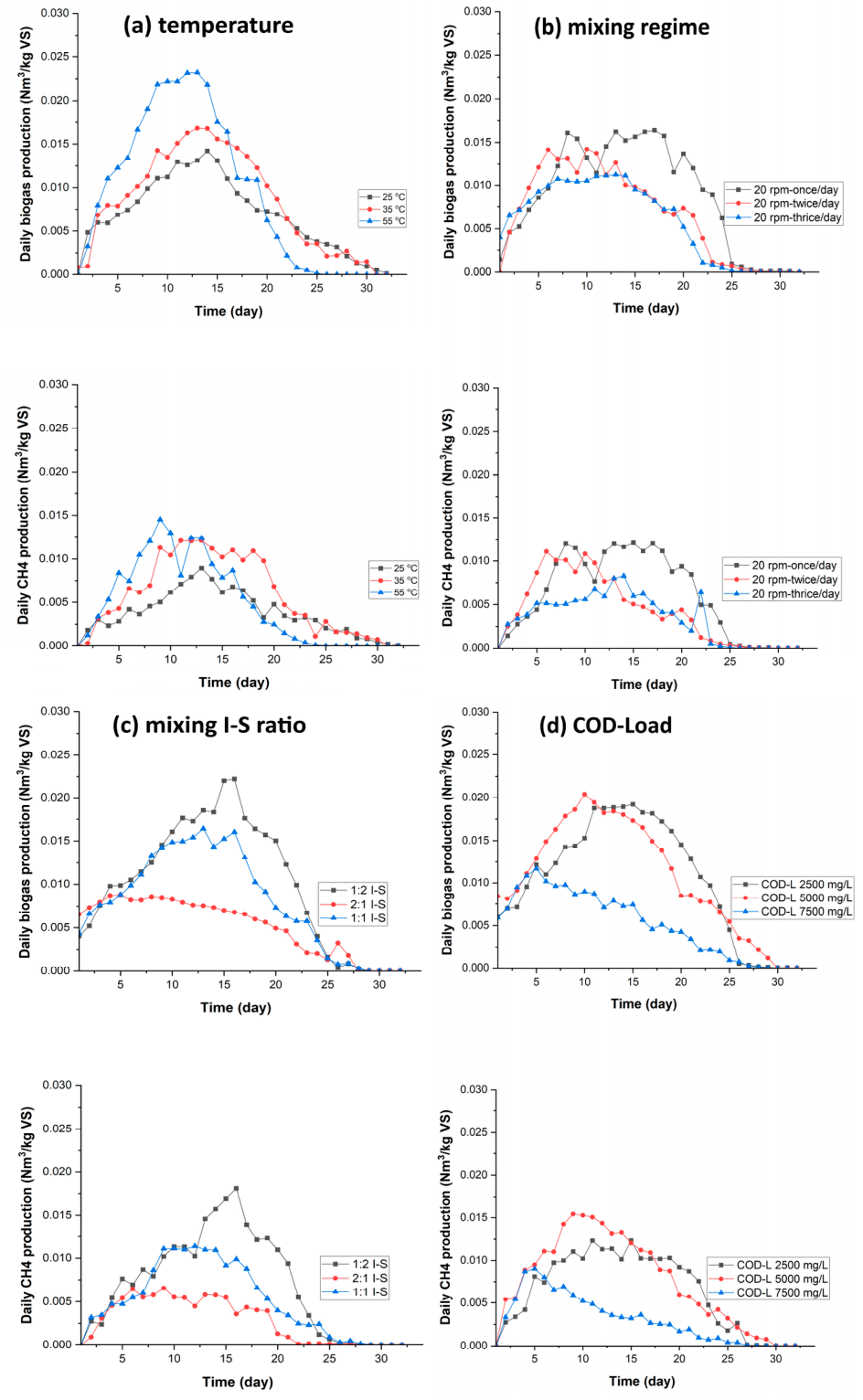
Figure 1. Daily biogas and CH4 production under the effect of (a) temperature, (b) MR, (c) mixing I-S ratio, and (d) COD load.
Processes 14 02020 g001
Figure 2. Comparison between experimental and predictions of biogas production under temperature effect; (a) 25 °C, (b) 35 °C, (c) 55 °C.
Processes 14 02020 g002
Figure 3. Comparative analysis of biogas production under the MR effect: (a) once/day, (b) twice/day, (c) thrice/day.
Processes 14 02020 g003
Figure 4. Experimental results under mixing I-S ratio effect and cumulative biogas production predictions based on different models: (a) 1:1 I-S, (b) 1:2 I-S, (c) 2:1 I-S.
Processes 14 02020 g004
Figure 5. The cumulative biogas production of experimental results and the expected values using different kinetic models under the influence of different COD loads: (a) 2500 mg/L, (b) 5000 mg/L, (c) 7500 mg/L.
Processes 14 02020 g005
Figure 6. The 3-D response surface of cumulative (a) biogas and (b) CH4 production under the influence of temperature.
Processes 14 02020 g006
Figure 7. The 3-D response surface of cumulative (a) biogas and (b) CH4 production under the influence of MR.
Processes 14 02020 g007
Figure 8. The 3-D response surface of cumulative (a) biogas and (b) CH4 production under the influence of mixing I-S ratio.
Processes 14 02020 g008
Figure 9. The 3-D response surface of cumulative (a) biogas and (b) CH4 production under the influence of COD load.
Processes 14 02020 g009
Figure 10. Optimization algorithms for estimating biogas and CH4 production and their convergence curves.
Processes 14 02020 g010
Table 1. Characteristics of AS substrate and inoculum.
ParameterUnitASInoculum
Total solid (TS)g/L5.6 ± 0.622.32 ± 0.26
Humidity (U)%94.40 ± 2.1197.68 ± 2.09
Volatile solid (VS)g/L3.89 ± 0.311.25 ± 0.09
Ashg/L1.03 ± 0.330.44 ± 0.02
Fixed carbon F.Cg/L0.08 ± 0.010.44 ± 0.09
TCODmg/L7500 ± 2.261248 ± 0.70
SCODmg/L202 ± 0.58289 ± 0.40
C/N-22.8:19.24:1
Ammonia Nitrogen NH3-Nmg/L38 ± 2.0417.24 ± 1.94
Table 2. The investigation’s model for figuring out the kinetic parameters and the nonlinear regression assessment formulas.
ModelMathematical DefinitionEquation No
modified logistic S ( t ) = S 1 + e ( 4 R m λ t S + 2 ) (1)
first order S ( t ) = S [ 1 e ( k t ) ] (2)
Gompertz S ( t ) = S e e ( e R m S λ t + 1 ) (3)
Statistical MeasureMathematical DefinitionEquation No
root mean square error R M S E = i = 1 N ( S e x p , i S m o d , i ) 2 N (4)
square error S S E = i = 1 N ( S e x p , i S m o d , i ) 2 (5)
determination coefficient R 2 = 1 i = 1 N ( S e x p , i S m o d , i ) 2 i = 1 N ( S e x p , i m e a n ( S e x p ) ) 2 (6)
  A d j u s t e d   R 2 = 1 ( ( 1 R 2 )   ( n p n p 1 ) ) (7)
Where the S(t): the accumulative biogas/CH4 (Nm3/kg.VS), S: optimal biogas/CH4 production (Nm3/kg.VS), λ: the lag time phase (day), Rm: maximum rate (Nm3/kg.VS)/day, t: time (day), K: rate constant slowly degradable substrate (day−1), e is 2.7183, α: number of data pairs and P: the number of regression coefficients. S e x p , i and S m o d , i maximum biogas/CH4 resulted from the experiment of AD and predicted by models (Nm3/kg.VS).
Table 3. The kinetic parameters of different biogas production models were calculated using the experimental data.
Temperature Effect
25 °C 35 °C 55 °C
 GempertsM.logisticfirst orderM.logisticM.logisticfirst orderGempertsM.logisticfirst order
SSE0.0063340.008530.0075470.0134650.0168620.0173020.0199060.0216660.029687
R20.9668570.9553670.9605090.9550670.9437320.9422610.9491490.9446550.924164
AdjR20.9657530.953880.9605090.9535690.9418560.9403360.9474540.942810.921636
RMSE0.014530.0168620.0156030.0211860.0237080.0240160.0257590.0268740.031458
    MR effect    
  20 rpm—once/day 20 rpm—twice/day 20 rpm—thrice/day
 GempertsM.logisticfirst orderGempertsM.logisticfirst orderGempertsM.logisticfirst order
SSE0.0141731480.0176389930.0192968840.0043278710.0053691510.0075419010.0028630.0031760.00567
R20.9573109190.9468719040.9418783880.9744040.9682460.9553960.9773620.974890.955172
AdjR20.955887950.9451009670.9399410010.9735510.9671870.9539090.9766070.9740530.953678
RMSE0.0217360.0242480.0253620.0120110.0133780.0158550.0097690.0102890.013747
    Mixing I-S ratio effect    
  01:02  02:01  01:01 
 GempertsM.logisticfirst orderGempertsM.logisticfirst orderGempertsM.logisticfirst order
SSE0.021350.000750.0315150.0004060.0003480.0013330.0080040.0002310.012077
R20.9506350.9982670.9271340.9954350.9960870.9849960.9693180.9991150.953707
AdjR20.9489890.9981470.9271340.995120.9958170.9844950.9682960.9990540.952164
RMSE0.0266770.0050840.0318840.003740.0034630.0066670.0163340.0028220.020064
    COD load effect    
  2500 mg/L  5000 mg/L  7500 mg/L 
 Gempertslogisticfirst orderGempertslogisticfirst orderGempertslogisticfirst order
SSE0.0162130.0006860.0279880.0084630.0007970.0157990.0004430.0004950.001594
R20.9644710.9984980.9386680.9803480.9981490.9633140.9948440.9942280.981434
AdjR20.9632870.9983940.9386680.9796930.9980220.9633140.9944880.993830.980816
RMSE0.0232470.0048620.0300470.0167960.0052420.0225760.0039060.0041330.007288
Table 4. The kinetic parameters of different CH4 production models were calculated using experimental data.
Temperature Effect
25 °C 35 °C 55 °C
 GempertsM.logisticfirst orderGempertsM.logisticfirst orderGempertsM.logisticfirst order
SSE0.0026380.0033870.0027510.0084350.010220.0093660.0051930.0055750.008105
R20.9550750.9423110.9531410.9426260.9304890.9362940.9487240.9449470.919967
AdjR20.9535770.9403880.9515790.9407130.9281720.934170.9451870.941150.9173
RMSE0.0093760.0106250.0095760.0167680.0184570.017670.0133810.0138660.016437
    MR effect    
  20 rpm—once/day 20 rpm—twice/day 20 rpm—thrice/day
 GempertsM.logisticfirst orderGempertsM.logisticfirst orderGempertsM.logisticfirst order
SSE0.0092524630.0111018550.0105520730.002039880.0024696890.0036657110.0017510.0020530.002554
R20.9441589440.9329973730.9363154530.9709540.9648340.9478040.9638430.957610.947255
AdjR20.9422975760.9307639520.9363154530.9699860.9624090.9460640.9626380.9561970.945497
RMSE0.0175620.0192370.018450.0082460.0092280.0110540.0076390.0082720.009227
    Mixing I-S ratio effect    
  01:02  02:01  01:01 
 GempertsM.logisticfirst orderGempertsM.logisticfirst orderGempertsM.logisticfirst order
SSE0.0184840.0333990.0211860.0011290.0001490.0019030.0053418.19 × 10−50.007196
R20.9210820.8574010.9095460.9651670.9954150.9412820.9514240.9992550.934554
AdjR20.915640.8475660.9065310.9640050.9950990.9393250.9480740.9992040.932373
RMSE0.0252460.0339370.0265740.0061340.0022640.0079640.0135720.0016810.015488
    COD load effect    
  2500 mg/L  5000 mg/L  7500 mg/L 
 GempertsM.logisticfirst orderGempertsM.logisticfirst orderGempertsM.logisticfirst order
SSE0.0077070.0170720.0089860.0067260.000630.0097230.0003920.0003920.000872
R20.9564090.9034410.9491750.969860.9971760.9564320.9870460.9870630.971212
AdjR20.9549560.8967820.9474810.9688560.9969810.9549790.9861520.986170.970252
RMSE0.0160280.0242630.0173070.0149740.0046620.0180030.0036780.0036760.005391
Table 5. Biogas and CH4 models regression coefficients.
CoefficientValue (Biogas—Equation (8))Value (CH4—Equation (9))
a 1 00
a 2 00
a 3 00
a 4 00
a 5 00
a 6 0.008694837720475930.00530622437869624
a 7 00
a 8 00
a 9 −1.19807143191201 × 10⁻⁹−1.06417436103144 × 10⁻⁹
a 10 00
a 11 00
a 12 −3.40545149055543 × 10⁻⁶−1.08334019466436 × 10⁻⁶
a 13 00
a 14 00
a 15 4.61971617293939 × 10−73.18307053020739 × 10−7
Table 6. Optimal operational solutions to biogas accumulation resulting from CFO.
IterationMR
(day−1)
Temperature (O C)COD-L (mg/L)I-STime
(day)
Biogas
(Nm3/kg.VS)
11.290231555511.0891.229994320.35879
21.347049556903.7710.56777627.963150.3481
32.61762151.399947325.8720.92166331.355940.359298
41.43697553.7515750.6130.559632320.370452
51.22818454.332296221.9020.54367231.367530.371006
61.22818452.332296221.9020.54367231.367530.365257
71.15399347.233286438.6550.66277631.979260.354349
81.61998750.64556074.2010.67595331.665340.359255
92.7341335060000.5300.34609
102.395165505366.5860.715184300.33723
112.95120847.512195585.0750.94471428.955940.319016
121.157778505391.7390.5320.358767
1335070000.5320.3693
1414540001320.328599
1524755000.7320.348302
161.3025249.73665680.7890.594028290.332522
171.245195524751.0230.5320.357234
1815157040.914982320.355871
19147.4795457040.867521320.347516
201.45257040.5320.366567
Table 7. Optimal operational solutions to CH4 accumulation resulting from CFO.
IterationMR
(day−1)
Temperature (O C)COD-L (mg/L)I-STime
(day)
CH4
(Nm3/kg.VS)
115060000.57502300.212631
214955500.5290.204659
31.14959400.6280.199812
41.5029935050000.6320.219522
51.14548400.74320.210317
61.5515953.7050.856298290.207287
72.8412985265000.687280.206363
81.398506556828.3250.687200.170967
91.183269455955.2551.5250.170539
101.285347850.89320.221544
111.224950200.7245320.217339
121.65323450.966777410.9911.0114830.378470.214856
131.46926850.603495191.1061.43067131.551740.214313
141.57439947.3324890.5260.90427331.25160.209266
152.95207153.130986038.7741.07602225.974240.194106
16350.331866864.2931.26245227.57640.196769
172.98207851.421275677.4480.70652428.618330.206135
181.91199346.843465319.5591.41079127.285560.185857
191.03237250.537446530.2691.21754631.73730.219459
201.85697250.686984017.7320.81308425.371380.178731
Disclaimer/Publisher’s Note: The statements, opinions and data contained in all publications are solely those of the individual author(s) and contributor(s) and not of MDPI and/or the editor(s). MDPI and/or the editor(s) disclaim responsibility for any injury to people or property resulting from any ideas, methods, instructions or products referred to in the content.