Article

A Physics-Informed Neural Network for Unified Multi-Regime Pressure-Drop Representation of Inflow Control Devices in Reservoir–Wellbore Coupled Simulation


1
College of Petroleum Engineering, China University of Petroleum (Beijing), Beijing 102249, China
2
PetroChina Changqing Oilfield Company, Xi’an 710018, China
*
Author to whom correspondence should be addressed.
Processes 2026, 14(12), 2011; https://doi.org/10.3390/pr14122011 (registering DOI)
Submission received: 11 May 2026 / Revised: 3 June 2026 / Accepted: 17 June 2026 / Published: 20 June 2026

Abstract

Accurate representation of the pressure drop–flow rate (Δp–q) relationship of nozzle-type inflow control devices (ICDs) is critical for reliable reservoir–wellbore coupled simulation. Conventional ICD models in reservoir simulators rely primarily on empirical correlations or tabulated data, but commonly used formulations cannot consistently capture the linear behavior in the low-flow regime or the transition between flow regimes, which may reduce physical fidelity and numerical robustness. To overcome this limitation, this study proposes a unified characteristic-curve representation that integrates linear, transitional, and quadratic flow regimes into a single continuous and differentiable function through a physically constrained least-squares formulation, and further develops a physics-informed neural network (PINN) to learn the ICD pressure–flow relationship while enforcing physical consistency. The trained PINN model is embedded into a multi-segment well model within a reservoir–wellbore coupled simulation framework and evaluated using a mechanistic reservoir model containing permeability streaks with varying permeabilities. The results show that the proposed method improves numerical convergence and accurately reproduces ICD pressure–flow behavior across multiple flow regimes, providing a more physically consistent and robust representation of ICD performance for inflow control analysis and reservoir simulation.

1. Introduction

Horizontal wells are widely deployed in bottom-water and edge-water reservoirs to delay water encroachment and enhance sweep efficiency [1,2]. However, in highly heterogeneous formations, water advancement along the lateral is often uneven, leading to premature breakthrough at selective segments, early water production, and reduced oil recovery. Segmented inflow control devices (ICDs) are, therefore, installed to impose tailored pressure drops along the wellbore, balancing local influx and suppressing water coning or cresting [3,4,5,6,7,8,9]. However, the effectiveness of ICD completions is ultimately governed by the coupled interactions among reservoir flow, wellbore hydraulics, and device-induced pressure losses [10]. Achieving reliable predictions of ICD performance requires a fully coupled reservoir–wellbore formulation, as simplified well models or explicit coupling cannot capture crossflow, nonlinear two-phase hydraulics, or the dynamic interactions between reservoir pressure, fluid mobilities, and device-induced throttling. Fully implicit coupling remains the most rigorous approach for evaluating ICD design and water-control effectiveness under field-relevant operating conditions [11,12,13].
Despite the widespread operational use of nozzle-type ICDs, their representation in reservoir simulators remains limited. Current fully coupled workflows typically rely on segmented well models combined with static Δp–q tables or empirical correlations derived from single-phase laboratory tests [14,15]. These mappings offer limited adaptability to changes in viscosity, density, water cut, or multiphase flow regime, resulting in accuracy degradation when reservoir conditions deviate from those originally tested. Moreover, Δp–q tables are often implemented via piecewise or non-smooth interpolation schemes, which introduce discontinuities in derivatives and reduce the robustness of Newton-based fully implicit solvers [16,17,18].
The pressure drop–flow rate relationship of a nozzle-type ICD exhibits distinct regimes. In the low-flow regime, the pressure drop varies linearly with flow rate, whereas in the high-flow regime, it follows a quadratic dependence. However, a physically consistent and differentiable formulation capable of smoothly bridging the linear low-flow regime and the quadratic high-flow regime has not been widely reported in existing ICD modeling studies [19,20].
Recent advances in data-driven surrogate modeling offer an attractive alternative for ICD characterization. Machine learning surrogates can learn complex Δp–q relationships across fluids, geometries, and flow regimes, while maintaining differentiability for seamless integration with Newton iterations [21,22,23]. Several studies have demonstrated successful application of neural networks or regression-based models for predicting ICD pressure drops, accelerating design optimization, or exploring multi-scenario behaviors [24,25,26]. However, most existing surrogates remain purely data-driven and lack physical consistency guarantees, such as enforcing mechanical energy balance. This absence can lead to nonphysical predictions, particularly under extrapolation to unseen viscosities, flow rates, or water cuts [27,28,29]. As a solution, physics-informed neural networks (PINNs) have been widely applied across various industries [30,31,32]. In recent years, the application of PINNs in the petroleum industry has been steadily increasing; however, these applications are predominantly concentrated on seepage problems within porous media [33,34,35], while applications related to downhole equipment remain extremely scarce. Moreover, current data-driven ICD models are rarely embedded in fully implicit black-oil solvers, and their use within Newton iterations remains limited due to insufficient smoothness or lack of analytical derivatives.
To address these limitations, this study develops an integrated framework for physics-informed, data-driven ICD modeling and its embedding into a fully implicit reservoir–wellbore simulator. The main contributions are as follows.
(1)
Data-Driven Characterization of Flow Regime-Dependent Behavior of ICD Devices
In this study, a power-law transitional segment was introduced to bridge the linear low-flow regime and the quadratic high-flow regime of the ICD characteristic curve. By incorporating physical constraints into a least-squares formulation, the three functional segments were unified into a smooth and continuously differentiable curve. A data-driven approach was subsequently employed to characterize this distinctive pressure–flow relationship, enabling consistent representation of the regime-dependent hydraulic behavior of the ICD device.
(2)
Physics-constrained ICD surrogate modeling
A neural-network-based Δp–q surrogate is proposed with embedded fundamental physical consistency constraints, ensuring physically realistic pressure-drop behavior across a wide range of operating conditions.
(3)
Fully implicit embedding with analytical derivatives
The surrogate is implemented as a smooth residual term with analytical or automatically differentiated Jacobians within a MATLAB-based black-oil simulator, enabling stable Newton iterations and robust convergence behavior.

2. Methodology

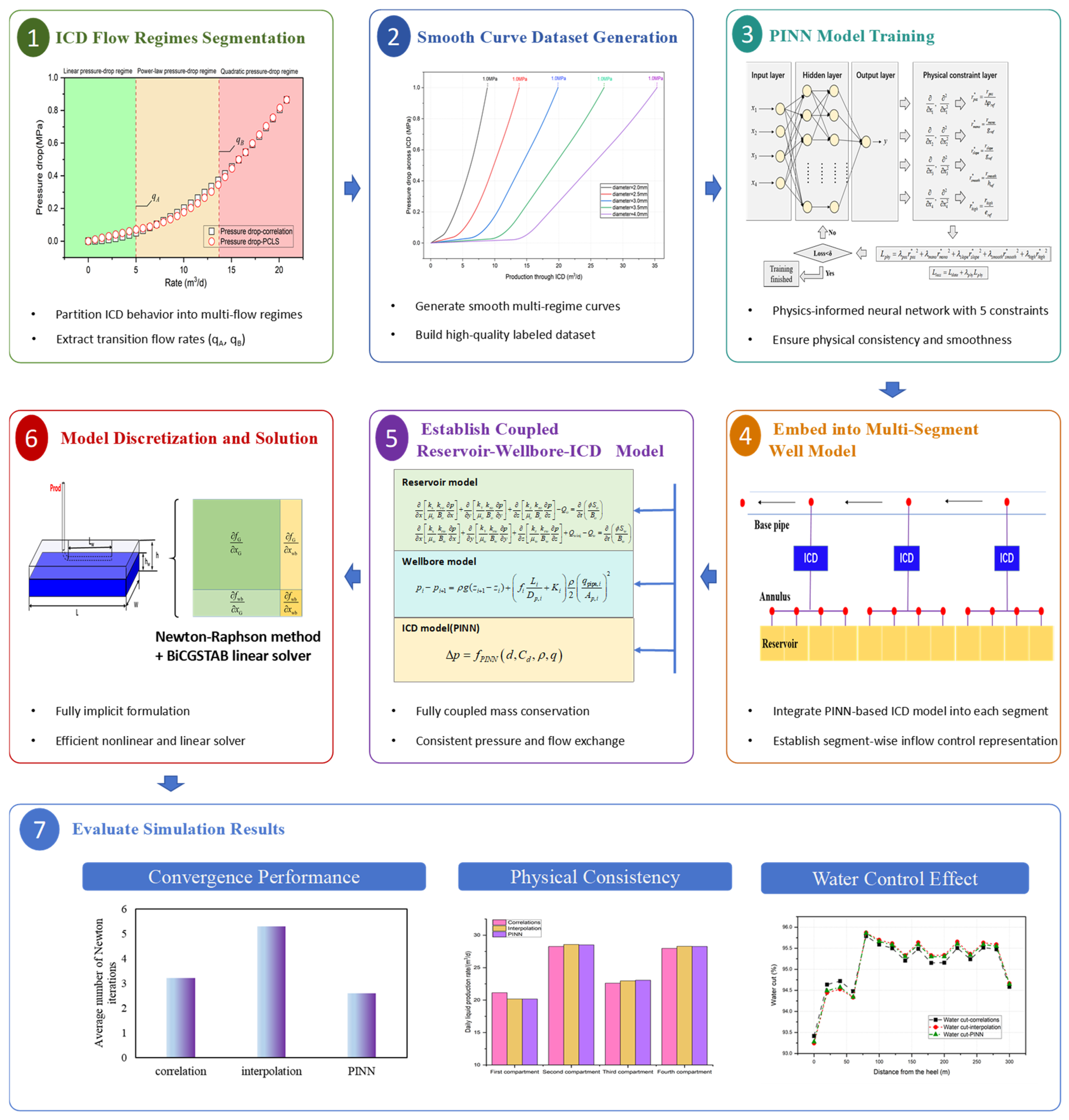
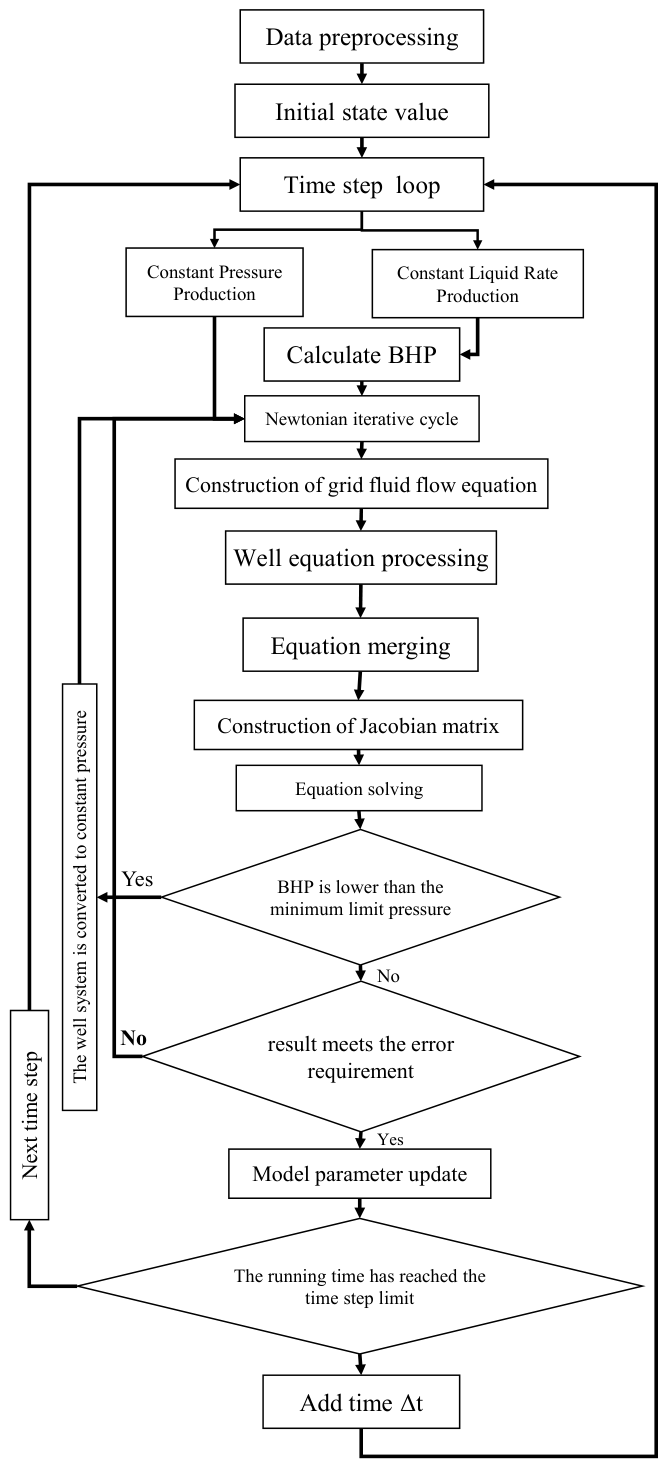
To facilitate understanding of the proposed methodology, Figure 1 summarizes the overall workflow of this study. The framework consists of three major stages: (1) construction of smooth multi-regime ICD pressure-drop characteristics, (2) development of a physically constrained PINN surrogate model, and (3) integration of the PINN-based ICD model into a fully coupled reservoir–wellbore simulation framework for performance evaluation.
All numerical simulations and data processing were performed using MATLAB R2023b (The MathWorks, Inc., Natick, MA, USA) and Python 3.9 (Python Software Foundation, Wilmington, DE, USA). The coupled reservoir–wellbore simulation framework, PINN training procedures, and post-processing routines were implemented using these software environments.

2.1. Construction of Smooth Multi-Regime ICD Pressure-Drop Characteristic Curves

Direct interpolation often introduces derivative discontinuities, which deteriorate Newton convergence. A single analytical expression is insufficient to accurately describe the viscosity-dominated low-flow behavior and the transitional characteristics between the low- and high-flow regimes. In this work, a physically constrained composite method is proposed to construct a smooth pressure-drop–flow-rate relationship while preserving established empirical behavior in different regimes [36,37,38,39].

2.1.1. Empirical Regime Definitions

The commonly used empirical correlations are presented as follows. Equations (1)–(3) describe the flow rate–pressure drop relationships in the low-, intermediate-, and high-flow regimes, respectively [8,21,40]:
Δ p L ( q ) = α q
Δ p M ( q ) = a q b
Δ p H ( q ) = k q 2
where q denotes the flow rate (m3/d), Δp is the pressure drop (MPa), and α, a, b, and k are model parameters.
For the low-flow regime, the linear pressure-drop coefficient α was estimated based on laminar-flow scaling arguments derived from the Hagen–Poiseuille relation [41]:
α = 128 μ L 86400 π d 4
where μ is the dynamic viscosity (Pa·s), L is the equivalent nozzle-flow length (m), d is the nozzle diameter (m), and q is the flow rate expressed in m3/d. Accordingly, α has the unit of Pa·d/m3.
Because the internal flow structure of nozzle-type ICDs involves local contraction and expansion effects, the above expression is used as an equivalent scaling relation rather than a strict analytical solution. In the present work, the oil-phase viscosity (100 mPa·s) was adopted for α estimation because viscous dissipation in the low-flow regime was dominated by the high-viscosity oil phase.
For the high-flow regime, the quadratic coefficient k was derived from the nozzle equation [42]:
q = C d A 2 Δ p ρ , A = π d 2 4
which yields
Δ p = ρ 2 ( C d A ) 2 q 2
After rearrangement and unit conversion, a maximum allowable pressure drop of Δpmax = 1 MPa was specified, and the corresponding maximum flow rate was subsequently determined.

2.1.2. Composite Formulation and Constraints

Two transition flow rates, qA and qB, were introduced to delineate the low-, intermediate-, and high-flow regimes of the ICD response. They are characteristic parameters of the ICD pressure-drop curve and are used solely to identify flow-regime transitions, independent of spatial location and production history. To avoid nonphysical artifacts—such as derivative discontinuities and slope mismatches—commonly observed in direct analytical blending, the composite curve was constructed by enforcing continuity of the pressure-drop gradient across regime transitions. The pressure-drop gradient is defined as follows:
r ( q ) = d Δ p d q
In the intermediate regime, the target gradient was defined as the derivative of the power-law relation:
r tar ( q ) = d Δ p M d q = a b q b 1
And the following physical constraints were imposed:
  • Continuity of pressure drop:
Δ p ( q A ) = α q A , Δ p ( q B ) = k q B 2
  • Continuity of slope (C1 continuity):
r ( q A ) = α ,   r ( q B ) = 2   k   q B
  • Monotonicity:
d r d q 0
  • Integral consistency:
q A q B r ( q ) d q = Δ p ( q B ) Δ p ( q A )

2.1.3. Regularized Slope Optimization and Reconstruction

The intermediate gradient distribution was obtained by minimizing a regularized least-squares objective:
min r ( q ) q A q B ( r ( q ) r tar ( q ) ) 2 d q + λ q A q B d r d q 2 d q
where λ controls the smoothness of the gradient profile. The problem was discretized on a uniform flow-rate grid and solved using a projected gradient approach, in which the solution was iteratively projected onto the constraint sets enforcing endpoint slopes, monotonicity, and integral consistency.
The regularization term penalizes excessive fluctuations in the pressure-drop gradient, thereby preventing nonphysical slope mismatches at the regime-transition boundaries and ensuring a smooth C1-continuous composite curve.
The composite pressure-drop curve was then reconstructed by integration:
Δ p ( q ) = α q , 0 q q A Δ p ( q A ) + q A q r ( ξ ) d ξ , q A < q < q B k q 2 , q B q q max

2.1.4. Method Characteristics

The proposed formulation guarantees global monotonicity, C1 continuity across regime transitions, and strict compliance with the prescribed maximum pressure drop. By formulating the intermediate regime as a constrained optimization problem rather than an explicit analytical blend, the method eliminates nonphysical slope distortions, ensures smooth regime transitions, and enhances numerical robustness in fully implicit simulations, while maintaining physical consistency of the resulting ICD characteristic curve for reservoir-scale inflow modeling.

2.2. Intelligent Characterization of ICD Completions Based on a Data–Physics-Driven Framework

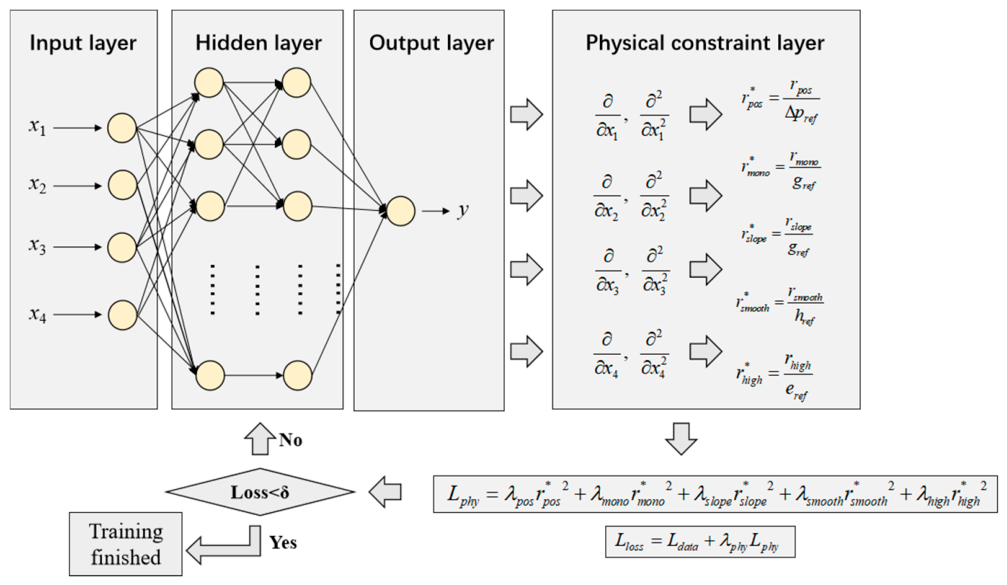
The method in Section 2.1 is an optimization-based procedure for constructing the flow rate–pressure drop curve, without a fixed analytical expression. Hence, it cannot be directly embedded into reservoir numerical simulations as an ICD pressure-drop model. Therefore, a data-driven model is trained to represent this relationship and integrated into the reservoir simulation framework. First, the key variables governing the pressure-drop behavior of the ICD device were identified. For a static ICD model neglecting water-cut effects, the characteristic curve represents the relationship between the inflow rate and pressure drop under varying fluid viscosities. A static surrogate model was then constructed, with nozzle diameter, discharge coefficient, density of the mixed liquid and flow rate as inputs and the corresponding pressure drop as the output. To ensure a smooth and continuously differentiable mapping suitable for numerical simulation, a fully connected neural network was employed as the surrogate model. To capture the nonlinear transition across different flow regimes, a neural network architecture with two hidden layers was adopted. A dropout ratio of 0.5 was introduced to mitigate overfitting and improve the generalization capability of the model. To ensure physical consistency, produce smoother data curves, and facilitate convergence in subsequent numerical simulations, a PINN model was constructed by embedding physics-based constraints into the loss function. Five constraints were considered: positivity, monotonicity, slope upper bound, smoothness, and scale consistency. Figure 2 shows the basic architecture of the PINN.
In Figure 2, x1, x2, x3 and x4 represent the nozzle diameter, discharge coefficient, density of the mixed liquid and flow rate data, respectively. The calculation process is as follows.
First, the data are input into the first hidden layer:
h j ( 1 ) =   σ 1 ( w j 1 ( 1 ) x 1 + w j 2 ( 1 ) x 2 + w j 3 ( 1 ) x 3 + w j 4 ( 1 ) x 4 + b j ( 1 ) ) , j = 1 , 2 , , m 1
The calculation results are then input into the second hidden layer:
h k ( 2 ) =   σ 2 ( j = 1 m 1 w k j ( 2 ) h j ( 1 ) + b k ( 2 ) ) , k = 1 , 2 , , m 2
Finally, the output of the second layer is input into the output layer to obtain the final result y, which is the additional pressure drop, expressed as follows:
y =   σ 3 ( k = 1 m 2 w 1 k ( 3 ) h k ( 2 ) + b 1 ( 3 ) )
Because purely data-driven models may produce pressure-drop predictions that violate fundamental physical laws [43,44,45], governing physical constraint equations are incorporated into the loss function prior to neural network training.
First, define the input features x = [ d , C d , ρ , Q ] T . The network prediction result is Δ p ^ = Δ p ^ ( x ) . The first derivative and the second derivative (differentiated with respect to the flow rate Q) are respectively Δ p ^ Q = Δ p ^ Q and Δ p ^ Q Q = 2 Δ p ^ Q 2 .
Set positive value constraint residuals r pos = max 0 , Δ p ^ and monotonicity-constrained residuals r mono = max 0 , Δ p ^ Q . This is to ensure that the pressure is positive and increases monotonically. In addition, to improve the convergence and smoothness of the trained model, upper-bound constraints are set on the slope residual r slope = max 0 , Δ p ^ Q s max and smoothness constraints on the residual r smooth = Δ p ^ Q Q .
In the high-flow regime, the pressure drop across the ICD nozzle is proportional to the quadratic term of the flow rate. First, the threshold defining the high-flow regime is set at the top 20% of the flow-rate range. The local flow exponent for this upper 20% subset of samples is then calculated as follows:
b loc = Q Δ p ^ + ε Δ p ^ Q
Finally, constraints are imposed on the local exponent:
r b = b loc b 0 m ( Q )
Subsequently, a characteristic scaling parameter for the high-flow regime is defined:
s = Δ p ^ ρ Q 2 + ε
A reference value for the high-flow regime is specified:
s ref = i = 1 N s i m ( Q i ) i = 1 N m ( Q i )
The scale-consistency residual is then formulated as follows:
r scale = s s ref m ( Q )
The residuals in the high-flow regime are aggregated, yielding
r high = r b + r scale
First, the scaling variables are normalized, and a characteristic pressure-drop scale is defined:
Δ p ref = m e a n Q q t h r Δ p ^
The reference slope scale is defined:
g ref = m e a n Δ p Q
The reference curvature scale is defined:
h ref = m e a n Δ p Q Q
If the mean of bloc is set to 2, then the exponential scaling e ref = 2 .
Normalize the five physical constraint residuals, and let r pos * = r pos Δ p ref , r mono * = r mono g ref , r slope * = r slope g ref , r smooth * = r smooth h ref , and r high * = r high e ref .
Each residual is assigned a weight based on its importance. Let the weight be λ = [ λ pos , λ mono , λ slope , λ smooth , λ high ] T , where λ pos = 10 , λ mono = 10 , λ slope = 1 , λ high = 1 , and λ smooth = 0.01 .
Based on this, the total physical loss is obtained:
L phy = λ pos r pos * 2 + λ mono r mono * 2 + λ slope r slope * 2 + λ smooth r smooth * 2 + λ high r high * 2
Among the imposed constraints, the smoothness and bounded-slope constraints primarily regulate local gradient variations and, therefore, provide the strongest regularization effect on the network predictions.
Let λ phy = 1 . Then, we get the total loss function:
L l o s s = L d a t a + λ p h y L p h y

2.3. Reservoir Inflow–Multi-Segment Well Model Architecture

Although the PINN model developed in Section 2.2 can accurately characterize the pressure-drop behavior of ICDs, the ultimate objective of this study is not merely to predict ICD pressure drops, but to evaluate the impact of ICDs on reservoir production performance and water-control effectiveness. Therefore, the trained PINN model must be integrated into a dynamic reservoir–wellbore flow model capable of describing fluid transport and inflow distribution along horizontal wells.
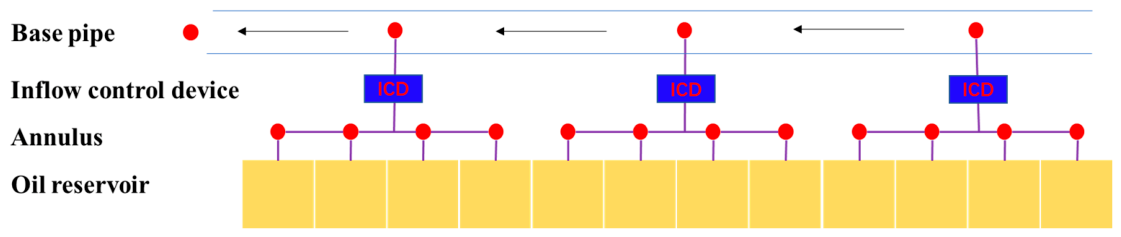
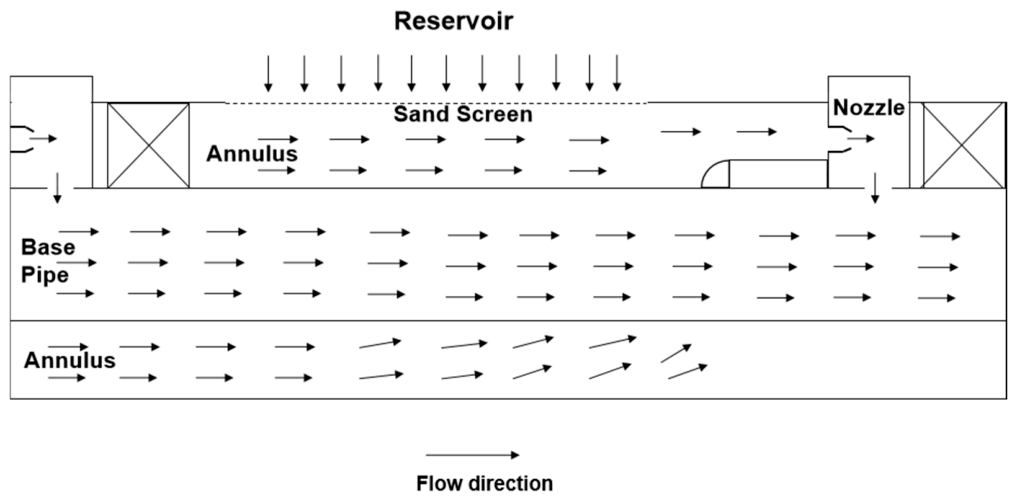
The proposed framework is based on a multi-segment well model [46,47]. The multi-segment well (MSW) model was adopted because it explicitly represents pressure losses, fluid transport, and inflow exchange along the wellbore. Compared with conventional well models that treat the entire well as a single node, the MSW model captures the spatial variation in the pressure and flow rate among different well segments, which is essential for representing compartmentalized ICD completions. Figure 3 presents the overall model architecture, consisting of four major components: the reservoir grid, the annulus, the inflow control device (ICD), and the base pipe. The red dots in Figure 3 represent pressure nodes, which are used to mark the positions for pressure difference calculation, and the arrows point to the direction of fluid flow. To facilitate the investigation of ICD water-control performance, the pressure drop from the reservoir to the annulus is incorporated into an equivalent well skin factor. To simplify the model while retaining the dominant hydraulic behavior, several assumptions are made: cross-flow in the annulus is neglected; the nozzle diameter is assumed to be uniform for each ICD; and the effects of the internal chamber are lumped into an equivalent nozzle representation.
The present model assumes uniform annular pressure within each compartment and neglects annular cross-flow. This assumption is reasonable when the compartment length is relatively short, and the annular pressure drop is much smaller than the ICD pressure drop. The assumption may become less accurate under long-compartment, high-rate, or highly heterogeneous reservoir conditions, where significant annular pressure gradients may develop. If annular flow were considered, additional annular flow-balance equations would be required. However, the PINN-based ICD model would remain unchanged because it represents the local ICD pressure-drop relationship and can be directly coupled with the updated local annular pressure.
The flow from the reservoir to the annulus is calculated using the Peaceman equation, where the oil phase equation is as follows:
q o = W I k ro μ o B o p block p wf
where qo is the well production; pblock is the average pressure of the grid block containing the well; pwf is the bottom-hole flowing pressure; kro is the relative permeability of the oil phase; μo is the oil phase viscosity; Bo is the oil volume factor; and the well index (WI) is defined as
W I = 2 π k h I n r e r w + s
where k is the formation permeability; h is the effective completion thickness; s is the skin factor; rw is the wellbore radius; and re is the equivalent radius. The calculation formula is as follows:
r e = 0.28 Δ x 2 + Δ y 2 k y k x 4 + k x k y 4
The flow from the annulus to the base pipe of the wellbore, which corresponds to the flow through the ICD, is modeled using the aforementioned ICD model. The internal flow within the base pipe for each segment is calculated using the following equations.
p i p i + 1 = ρ g ( z i + 1 z i ) + f i L i D p , i + K i ρ 2 q pipe , i A p , i 2
where pi-pi+1 is the pressure difference at the fluid inlet of two adjacent ICD sections; ρ is the density of the mixed liquid; g is the gravitational acceleration, taken as 9.8 m/s2; zi+1-zi is the height difference between two adjacent ICDs; f i , K i is the friction coefficient and local loss coefficient; Li is the length of the current section; Dp,i is the pipe diameter; q pipe , i is the flow rate in the base pipe of this section; and A p , i is the cross-sectional area of the base pipe.

2.4. Formation–Wellbore Coupled Numerical Simulation Method

The integration of the PINN-based ICD model into the multi-segment well framework enables the calculation of local ICD pressure losses and segment-wise inflow distribution. However, predicting reservoir production performance requires simultaneous solution of the reservoir flow, wellbore flow, and ICD coupling equations. Therefore, a fully coupled formation–wellbore numerical simulation framework is established, as described in the following section.

2.4.1. Formation–Wellbore Coupling Model Construction

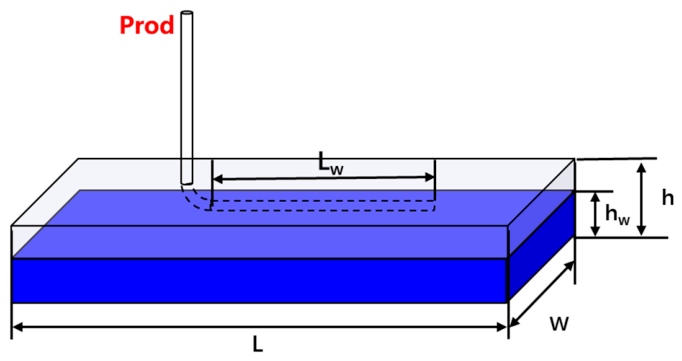
A physical formation model representing depletion production in a strong bottom-water reservoir is established, as illustrated in Figure 4.
The model assumptions are as follows:
  • The target reservoir has a low solution gas–oil ratio; therefore, an oil–water two-phase compressible model is adopted.
  • The temperature variation within the reservoir is negligible; hence, an isothermal seepage model is employed.
Subsequently, a physical wellbore model is developed. Figure 5 shows a single wellbore element.
Based on the physical model, a mathematical model of formation and wellbore flow is established:
x k x μ o k ro B o p x + y k y μ o k ro B o p y + z k z μ o k ro B o p z Q o = t ϕ S o B o x k x μ w k rw B w p x + y k y μ w k rw B w p y + z k z μ w k rw B w p z + Q winj Q w = t ϕ S w B w Q = Q w + Q o r p o r r = r w ( x w , y w , z w , t ) = Q o μ o 2 π k av k ro L r p w r r = r w ( x w , y w , z w , t ) = Q w μ w 2 π k av k rw L p w p o = p cwo p x x = W m = 0       p y y = L m = 0       p z z = h = 0       p x x = 0 = 0         p y y = 0 = 0       p z z = 0 = 0 p 0 = p ( x , y , z , 0 ) S w 0 = S w ( x , y , z , 0 ) S w z < h w = 1  
Reservoir fluids flow from the formation through the screen, annulus, and ICD into the base pipe, with frictional pressure loss accounted for along the pipe. Figure 5 illustrates this process.
For each segment of the base pipe, the frictional pressure drop equation is applied. The coupled flow from the formation to the base pipe and the outflow is governed by the integration of the base pipe flow equation, ICD equation, and Peaceman equation.
Combined with nodal mass balance and the ICD characteristic equations, this yields a fully coupled set of nonlinear algebraic equations from which the pressure and flow distribution along the ICD-equipped wellbore can be computed.

2.4.2. Solution Method for Formation–Wellbore Coupled Model

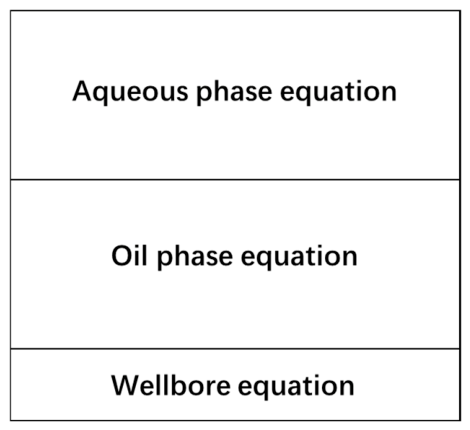
The formation–wellbore coupled model is discretized to yield a system of nonlinear algebraic equations, whose Jacobian matrix is constructed accordingly. The system is solved using a Newton–Raphson method [48,49,50,51,52]. The equations are organized into three components—water-phase, oil-phase, and wellbore equations—whose block structure in the Jacobian matrix is illustrated in Figure 6.
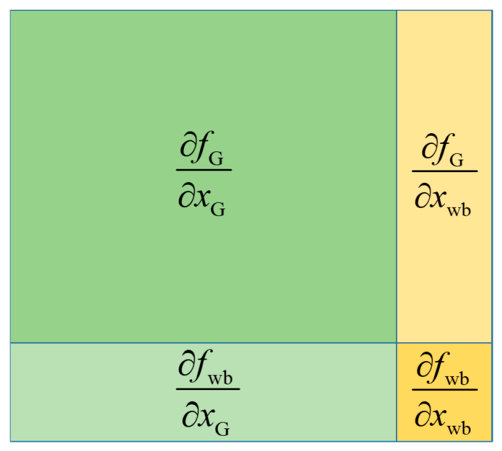
Let f G denote the formation equations, including the water-phase equation and oil-phase equation; f wb denote the wellbore equation; x G denote the grid parameters; and x wb denote the wellbore parameters. The distribution of partial derivatives in the Jacobian matrix is illustrated in Figure 7.
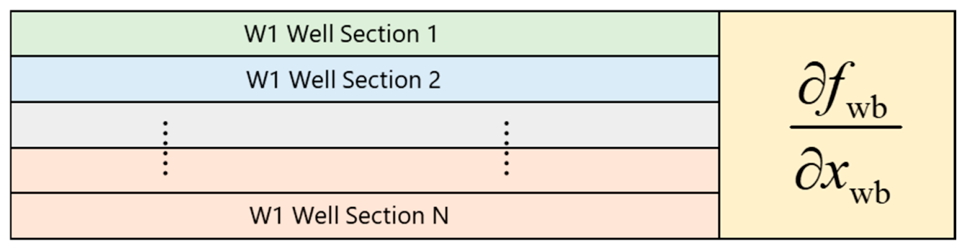
In the multilateral well model, each segment is associated with a governing equation [53]. The resulting equation system for the wellbore subsystem is organized as shown in Figure 8.
The coupled nonlinear system is solved using a Newton–Raphson method, with the linearized system at each iteration handled by a biconjugate gradient method. The overall solution framework is illustrated in Figure 9.
A data-driven surrogate ICD characterization model is embedded in the solution process to improve the convergence of the model and its adaptability to complex flow conditions, thereby achieving a fully implicit solution.

2.4.3. Advantages of Embedded Data-Driven Coupled Simulation Methods

  • The data-driven surrogate model enables the fusion and processing of multi-source data, thereby improving the adaptability of the model to complex field data conditions.
  • A data-driven method is adopted to achieve the unified characterization of different pressure-drop functions across low-, medium- and high-flow-rate regimes for ICD devices.
  • Compared with the conventional table interpolation method, the data-driven model yields smoother and more gradual derivatives, thus reducing the number of Newton iteration steps.

3. Results and Discussion

3.1. Synthesis of ICD Characterization Datasets

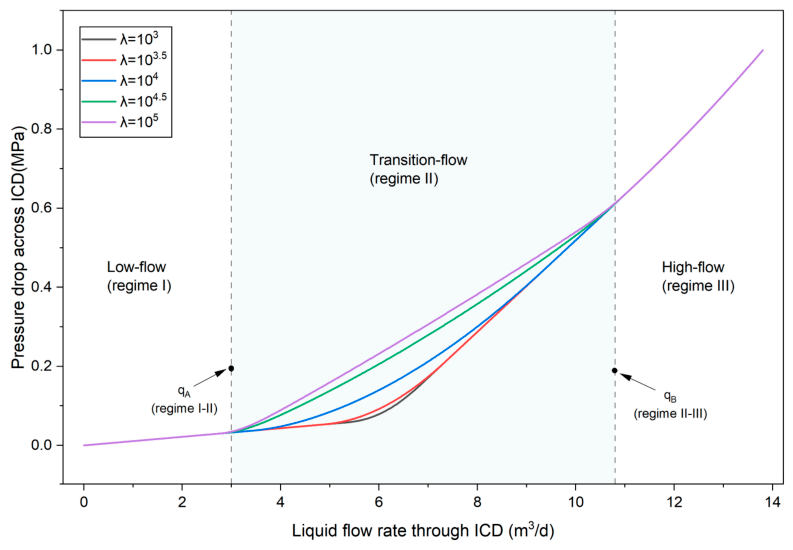
The reconstructed ICD pressure-drop characteristics are influenced by several key parameters, particularly the regularization parameter λ and the transition flow rate _qB. To evaluate the robustness of the proposed curve reconstruction method and identify appropriate parameter values, sensitivity analyses were conducted for both λ and qB.
λ is a key factor influencing the effect of the transition section. To ensure the selection of an appropriate λ value, a relevant sensitivity analysis is conducted. Take the ICD device with a nozzle diameter of 2.5 mm as an example to conduct a sensitivity analysis experiment.
As shown in Figure 10, the selection of λ significantly influences the smoothness of the reconstructed transition regime. For relatively small λ values (103–103.5), the transition region exhibits rapid slope variation, indicating insufficient regularization near the regime boundaries. In contrast, excessively large λ values (104.5–105) lead to over-smoothing and noticeable deviation from the target low-flow and intermediate-flow characteristics.
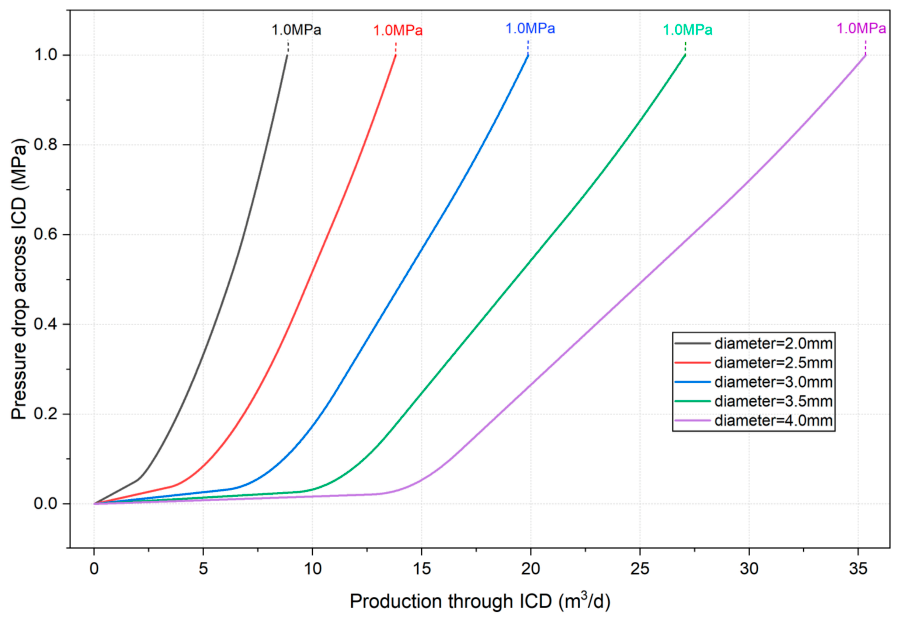
Among the tested cases, λ = 104 provides the best compromise between smooth transition behavior and preservation of the original flow-regime characteristics. The resulting curve maintains monotonicity and C1 continuity while avoiding both abrupt slope changes and excessive smoothing distortion. Therefore, λ = 104 was adopted in this work. Figure 11 shows the ICD flow-pressure difference curves for different nozzle diameters when λ = 104.
It should be noted that λ is introduced as a numerical regularization parameter rather than a physical property of the ICD device. After normalization of the pressure-gradient formulation, the same λ value was found sufficient across the investigated nozzle diameters and fluid viscosities, indicating limited sensitivity of λ to operating conditions within the considered parameter range.
Moreover, as the flow rate approaches its maximum value, inertial effects become increasingly dominant, and the pressure-drop behavior gradually converges toward the quadratic regime. Therefore, the upper 20% of the flow-rate range was selected as the transition interval for establishing the quadratic pressure-drop relationship. Sensitivity analyses were performed using thresholds of 15%, 20%, and 25%. The results presented in Table 1 show only minor variations in the fitted exponent b, demonstrating that the proposed reconstruction method is weakly sensitive to the threshold selection. Consequently, the 20% threshold was retained for subsequent dataset generation.
In the low-flow-rate regime, the flow within nozzle-type ICDs is characterized by low Reynolds numbers, where viscous effects dominate, and inertial effects are negligible. The pressure drop is primarily governed by viscous friction and local losses along the flow path, resulting in an approximately linear relationship between the pressure drop and flow rate, consistent with classical viscous-dominated flow behavior at low Reynolds numbers. The use of a quadratic model in this regime underestimates the pressure drop at small flow rates and fails to capture the experimentally observed near-linear onset behavior. In addition, it introduces unnecessary nonlinear stiffness into the numerical solution. Therefore, a linear model is adopted for the low-flow regime.
The medium-flow-rate regime is governed by a combination of viscous, inertial, and geometric effects, and cannot be described by a single dominant mechanism. In this regime, viscous effects gradually diminish, while inertial effects increase, and the internal geometry of the nozzle, including upstream and downstream structures and local contraction/expansion, plays an increasingly important role. The flow is typically in a transitional or mixed-control regime between laminar and turbulent states. A power-law model is adopted to provide a smooth transition between the linear and quadratic regimes, capturing the nonlinear curvature of the pressure–flow relationship under varying geometric and operating conditions.
In the high-flow rate regime, the Reynolds number is sufficiently high such that inertial effects dominate completely. The nozzle behaves equivalently to an orifice/throttling device, and the pressure drop is governed primarily by the change in kinetic energy. Therefore, a quadratic relationship between the pressure drop and flow rate is established based on the classical orifice model.
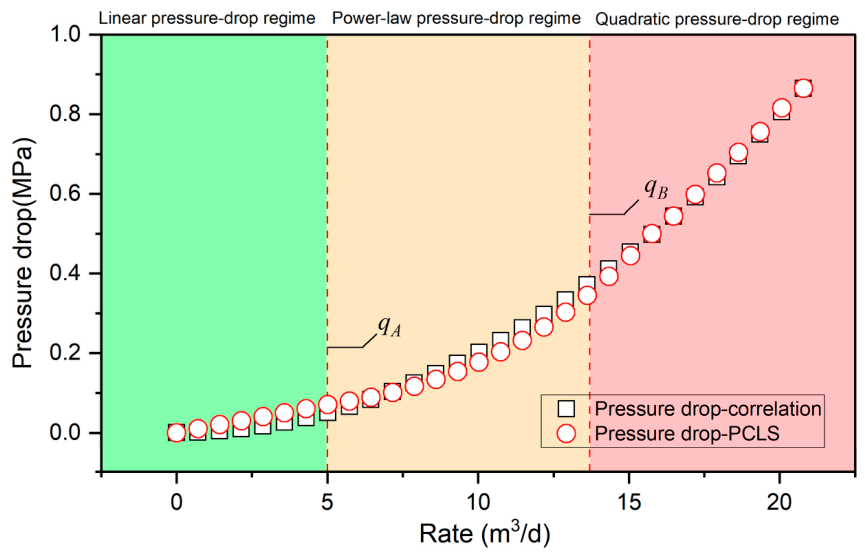
Considering the scarcity of publicly available ICD data, three functional forms are adopted to characterize the flow behavior in different regimes, enabling the construction of a dataset consistent with realistic ICD performance. The segment-wise curves are fitted and connected using a physics-constrained least squares approach (PCLS) to ensure continuity and physical consistency. The schematic representation is shown in Figure 12. The three regimes are represented by linear, power-law, and quadratic pressure–flow relationships, corresponding to viscous-dominated, transitional, and inertial-dominated flow behavior, respectively.
The traditional empirical correlation underestimates the pressure drop in the low-flow regime, exhibits a transition from underestimation to overestimation in the medium-flow regime, and shows reasonable agreement with field data in the high-flow regime. The proposed method provides a better representation of the variation trend of field ICD characteristic curves.
A synthetic dataset is generated based on four key variables: nozzle diameter, discharge coefficient Cd, fluid density, and flow rate. The nozzle diameter is uniformly sampled within the range of 2–4 mm, while Cd is sampled within 0.65–0.8. The fluid density is specified as 850 kg/m3 for the oil phase and 1000 kg/m3 for the water phase. The mixture density is determined based on randomly sampled water cut values between 0 and 1. The maximum pressure drop is set to 1 MPa, and the corresponding maximum flow rate is determined using the following equation.
q max = C d A 2 Δ p max ρ ,   A = π d 2 / 4
Each pressure–flow curve is constructed using 30 uniformly distributed points over the flow-rate range defined by the maximum flow rate. In total, 2000 synthetic curves and 60,000 pressure prediction samples are generated for dataset construction.
Uniform sampling with 30 flow-rate points per curve was adopted to ensure consistent coverage of the entire operating range. Although the pressure-drop curve exhibits relatively larger curvature variations near the transition flow rates qA and qB, the proposed reconstruction method enforces smoothness and C1 continuity across regime boundaries, thereby reducing local gradient discontinuities. As a result, the PINN maintained satisfactory prediction accuracy throughout the flow-rate range. Adaptive sampling may further improve local resolution near transition regions; however, its benefit is expected to be limited for the present smooth pressure-drop characteristics and is, therefore, not considered in this study.

3.2. Construction and Training of ICD Characterization Model Based on PINN

Based on the dataset established in Section 3.1, the physical–data dual-driven model is trained. A neural network model is developed using the PyTorch (torch version 2.0.1) framework, with physical constraints enforced during training to ensure consistency with governing flow behavior. These constraints include positivity, monotonicity, slope upper bounds, smoothness, and exponent- and scale-related constraints for the high-flow-rate regime.

3.2.1. Optimization of the Single-Hidden-Layer Model Architecture

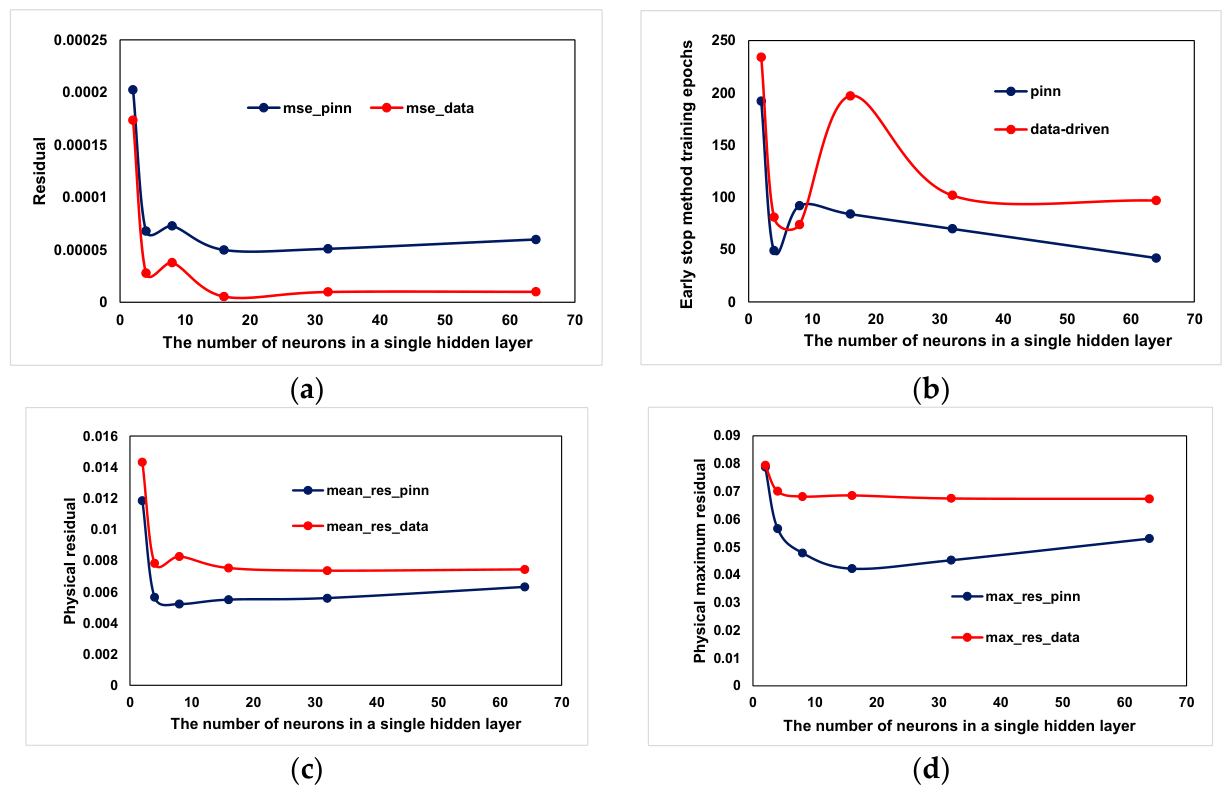
The ICD characterization model is embedded into the reservoir simulation framework. A balance between model complexity and computational efficiency is required, motivating the evaluation of single- and double-hidden-layer neural network architectures. An early stopping strategy is adopted to reduce unnecessary computational cost after convergence. Table 2 summarizes the relationship between hidden-layer size and training epochs for PINN and data-driven models.
Figure 13 presents the architecture optimization results of the single-hidden-layer neural network. The model error saturates when the number of neurons exceeds 16, indicating diminishing sensitivity to network size. The PINN framework accelerates convergence and reduces training epochs (Figure 13b), while also decreasing physical residuals (Figure 13c,d). Based on the overall performance, 16 neurons are selected as the optimal configuration.

3.2.2. Optimization of the Double-Hidden-Layer Model Architecture

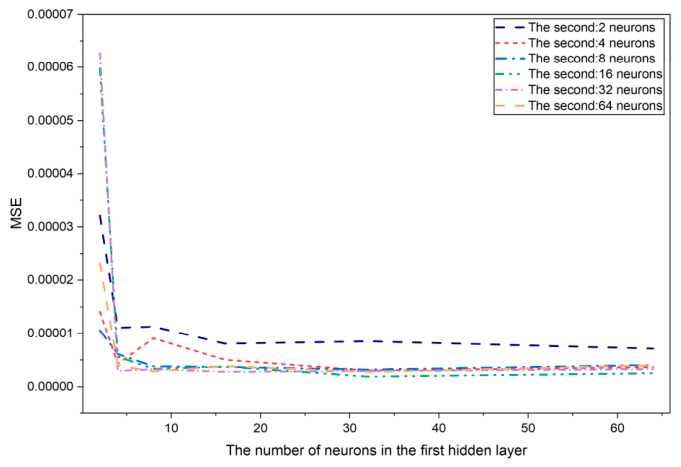
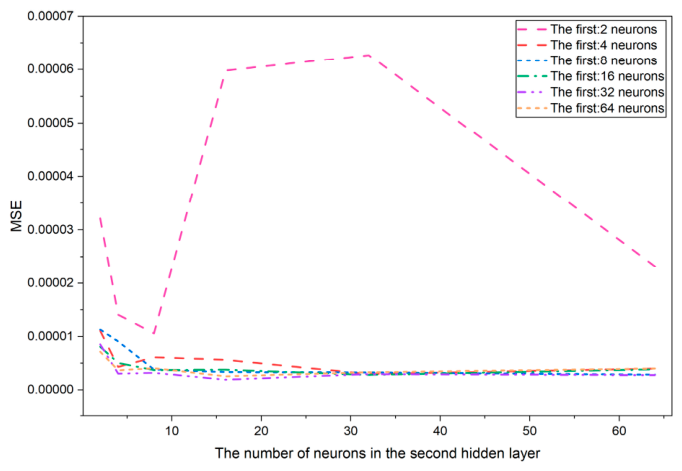
The ICD pressure–flow curve exhibits distinct segment-dependent nonlinear characteristics, making overly simple models insufficient for accurate representation. Therefore, architecture optimization is performed for a double-hidden-layer neural network. Figure 14 and Figure 15 show that the second hidden layer has a more pronounced influence on MSE than the first layer. The prediction error becomes nearly insensitive when the number of neurons exceeds eight. The optimal configuration is determined as four neurons in the first hidden layer and eight neurons in the second hidden layer.

3.2.3. Model Architecture Selection

The optimal single- and double-hidden-layer models exhibit only marginal differences in prediction accuracy. Computational efficiency is further evaluated using 1000 sample points (Table 3). The results show that the double-hidden-layer model is computationally more efficient and is selected as the final architecture.

3.3. Reservoir–Wellbore–ICD Coupling Numerical Simulation

The results presented in Section 3.2 demonstrate that the proposed physically constrained PINN model can accurately characterize the pressure-drop behavior of ICDs while maintaining smoothness and physical consistency. However, the ultimate objective of this work is not only to predict ICD pressure drops, but also to evaluate their impact on wellbore hydraulics, inflow distribution, water-control performance, and reservoir production behavior. Therefore, the trained PINN model was embedded into a fully coupled reservoir–wellbore–ICD numerical simulation framework.
The numerical simulator was developed using MATLAB R2023b based on a self-developed reservoir–wellbore coupling code. The framework combines a two-phase oil–water reservoir flow model, a multi-segment well model, and the PINN-based ICD pressure-drop model within a fully implicit formulation. The resulting nonlinear system was solved using the Newton–Raphson method, while the linearized equations were solved using the biconjugate gradient method. This implementation enables direct evaluation of the influence of ICD characteristics on production performance under realistic reservoir conditions.

3.3.1. Basic Parameters of the Mechanism Model

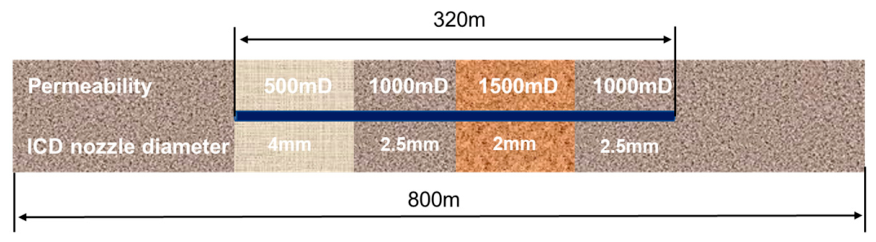
Figure 16 illustrates the key parameters of the mechanism model, with detailed values summarized in Table 4.
The reservoir model spans 800 m × 400 m × 16 m, discretized into a 40 × 20 × 10 grid with a cell size of 20 m × 20 m × 1.6 m. A background permeability of 1000 mD is assumed. As illustrated in Figure 16, near-wellbore heterogeneity is introduced by alternating low- and high-permeability zones (500 mD, 1000 mD, 1500 mD, and 1000 mD) along the wellbore from heel to toe. Accordingly, the 320 m horizontal well is segmented into four 80 m compartments, each aligned with one permeability interval.
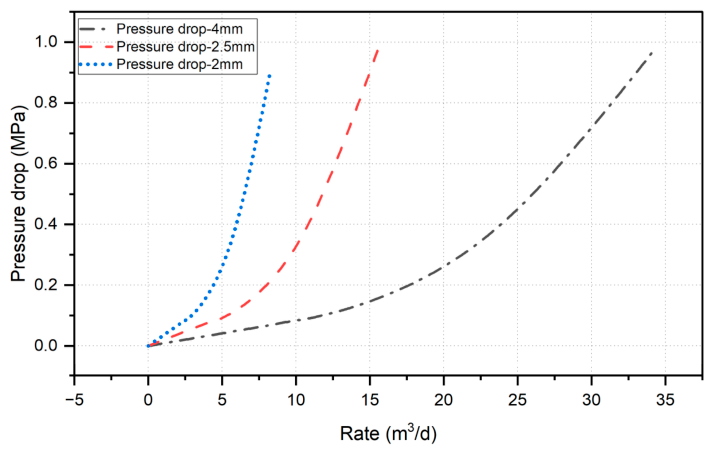
ICDs are deployed in each compartment to regulate inflow distribution, with nozzle diameters of 4 mm, 2.5 mm, 2 mm, and 2.5 mm, respectively. Figure 17 shows the ICD pressure–flow relationships predicted by the PINN-based characterization model.
The model also includes an 8 m bottom-water layer, representing half of the reservoir thickness. The porosity is set to 34%, with initial water saturation of 30% in the oil-bearing zone and 100% in the bottom-water zone.

3.3.2. Convergence Evaluation of Coupled Simulation

A coupled simulation framework is developed to evaluate the convergence behavior and numerical performance of three ICD characterization approaches, including the traditional interpolation method, an empirical ICD correlation model, and a PINN-based model.
In this study, a physics-guided data-driven ICD characterization method is proposed. Physically consistent training data are generated based on a flow-pattern model, and a machine learning model is trained to represent the ICD constitutive relationship for integration into numerical simulation. The proposed method improves stability, extrapolation capability, and physical consistency compared with traditional interpolation methods, empirical correlation models, and purely data-driven approaches.
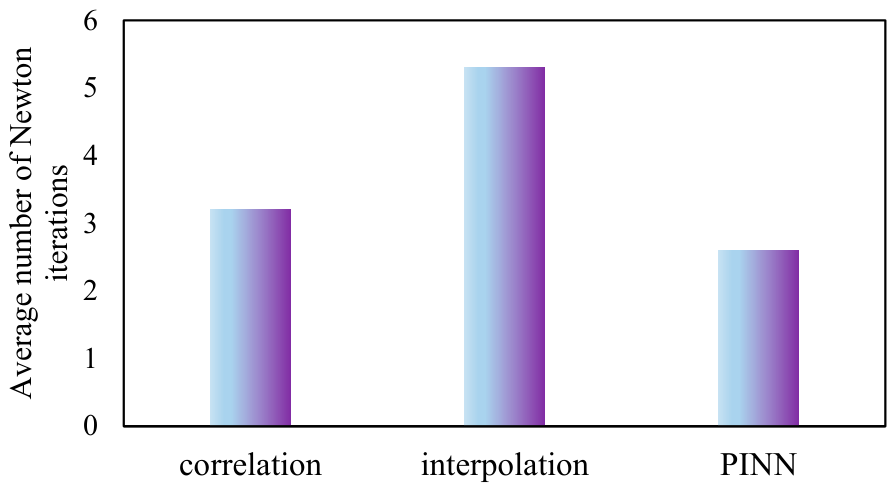
Figure 18 compares the nonlinear convergence behavior of three ICD characterization approaches for multi-segment wells. The interpolation-based approach shows degraded convergence performance, with frequent timestep cuts and elevated nonlinear iteration counts, mainly caused by derivative discontinuities that lead to non-smooth system responses. In contrast, the physics-informed neural network (PINN)-based method yields more stable convergence and consistently outperforms the empirical correlation approach.
The novelty of the proposed method does not lie in the use of a neural network alone. Instead, it lies in the construction of a physically constrained and continuously differentiable ICD constitutive model specifically designed for fully implicit reservoir–wellbore coupling.
Unlike purely data-driven neural networks, the proposed formulation explicitly enforces monotonicity, smoothness, bounded slope behavior, and physically consistent asymptotic trends in different flow regimes. These constraints reduce the occurrence of nonphysical predictions and improve the smoothness of the Jacobian matrix.
Compared with interpolation-based characterization, the proposed PINN model reduced the average number of Newton iterations from 5.3 to 2.6 (Figure 18), demonstrating improved nonlinear convergence behavior. Furthermore, the physically constrained formulation preserves physically meaningful extrapolation behavior outside the training range, whereas purely data-driven approaches may generate unrealistic pressure-drop predictions.

3.3.3. Analysis of Coupled Simulation Performance

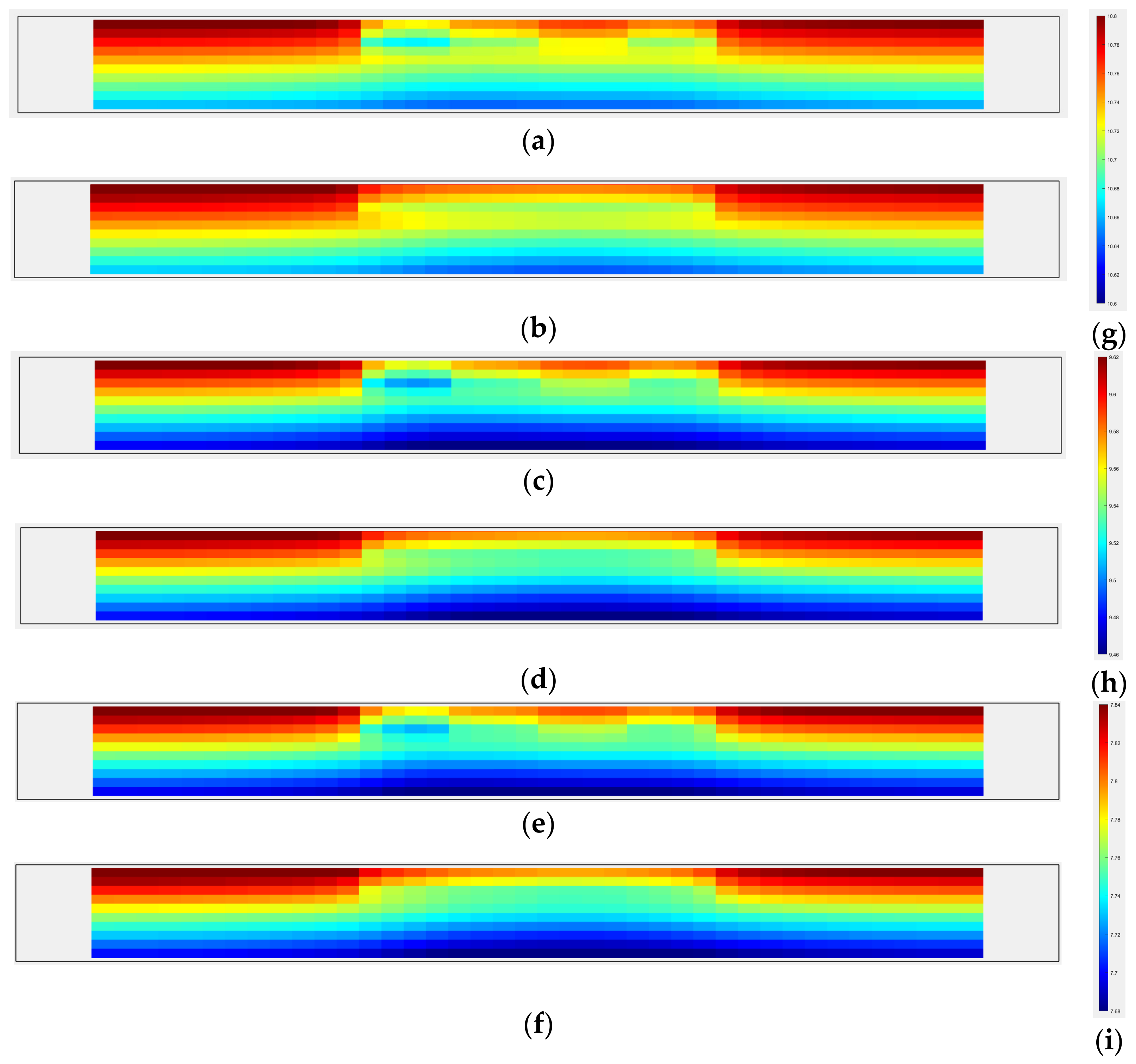
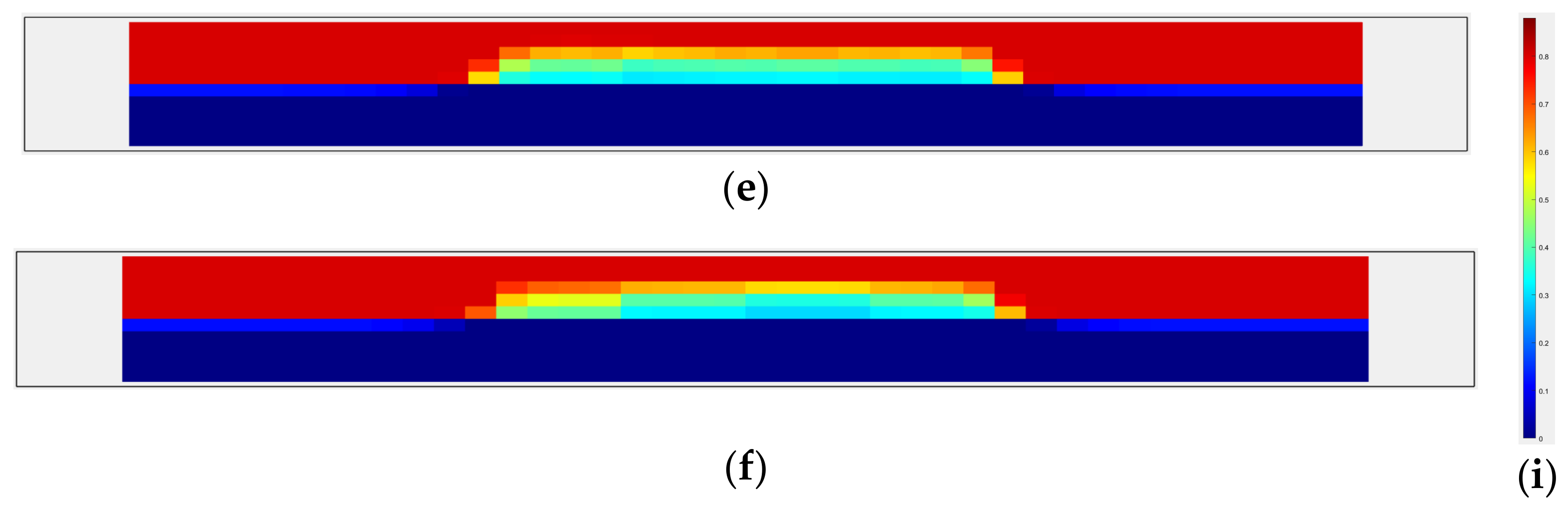
Since ICD installation introduces an extra pressure drop, simulations conducted under constant bottom-hole pressure would yield different liquid production rates, thereby compromising a fair comparison of production performance. To eliminate this effect, all cases were evaluated at a fixed liquid production rate of 100 m3/d. The inclusion of ICDs in the horizontal well redistributed the pressure loss along the wellbore and, consequently, improved inflow balancing. The control effect of ICDs was assessed by comparing the water-cut increase predicted by the reservoir–wellbore coupled model with that predicted by the reservoir–wellbore–ICD coupled model. To illustrate the underlying mechanism, the pressure field and oil saturation field along the horizontal well are shown in Figure 19 and Figure 20, respectively. The results indicate that ICD implementation enhances pressure heterogeneity along the wellbore owing to the section-dependent pressure drop introduced by the devices. In low-permeability sections, where larger-nozzle ICDs are used, the imposed pressure drop is relatively small; in contrast, high-permeability sections equipped with smaller-nozzle ICDs experience a greater pressure drop. Without ICDs, the pressure distribution along the horizontal well is much more uniform, which promotes inflow nonuniformity and accelerates water breakthrough in high-permeability intervals.
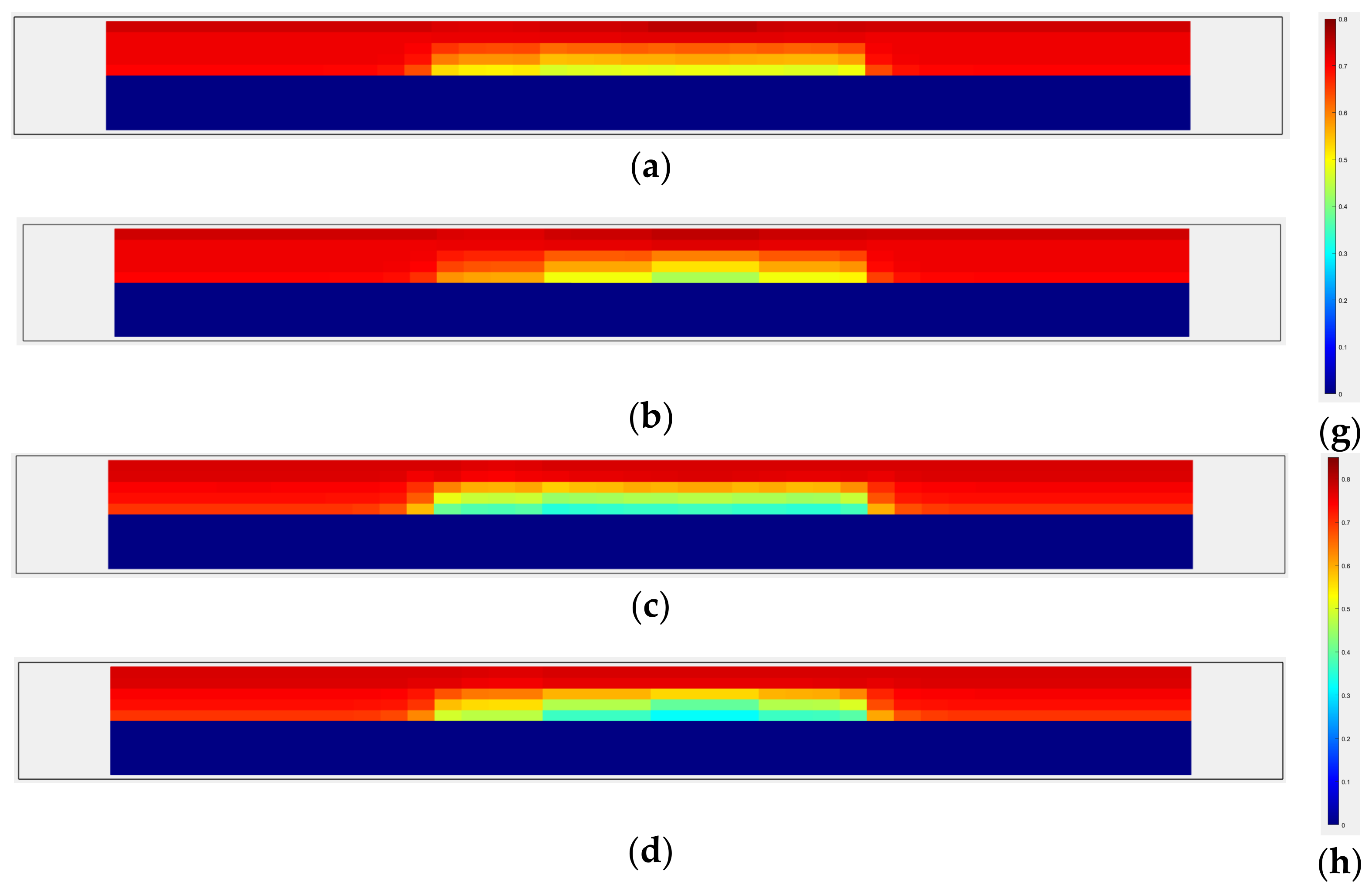
The variation in the saturation field shows an inverse trend relative to the pressure field. After ICD installation, oil saturation depletion along the horizontal wellbore becomes more evenly distributed, resulting in a more homogeneous oil saturation field in the surrounding reservoir. Without ICDs, however, oil saturation declines slowly in low-permeability intervals and remains relatively high at the end of production, whereas it decreases much more rapidly in high-permeability intervals. This nonuniform depletion intensifies interlayer production imbalance and eventually leads to the accumulation of remaining oil in low-permeability zones.
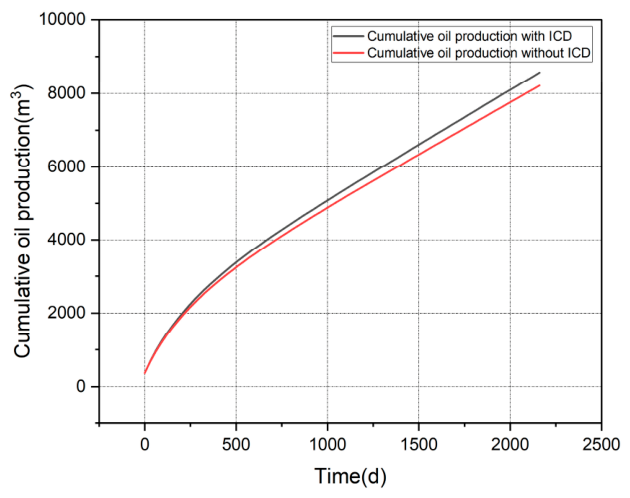
Figure 21 presents the cumulative oil production curves for horizontal wells with and without ICDs. The well with ICD installation yields an additional 358 m3 of oil over 6 years, representing a 4.36% increase in cumulative oil production. This improvement highlights the potential of ICDs to enhance production performance by mitigating inflow imbalance and delaying excessive water production.
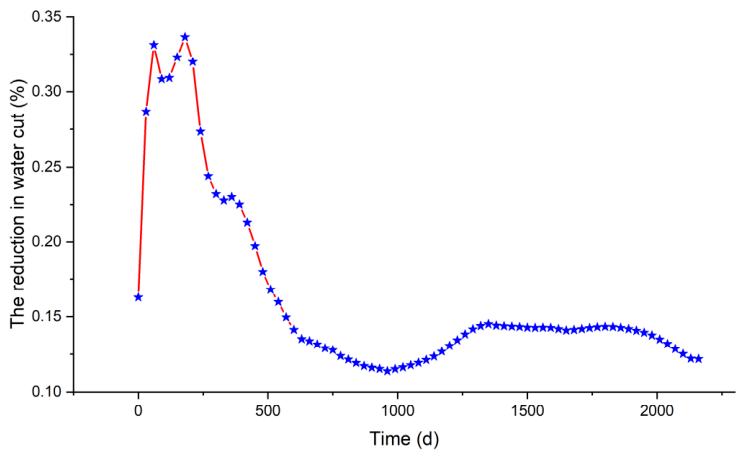
Figure 22 illustrates the time-dependent evolution of water-cut reduction resulting from ICD installation, compared with the case without ICDs. The reduction in water cut rises rapidly at the beginning of production, enters a plateau stage, then decreases gradually before approaching a stable level. These results suggest that the water-control effect of ICDs is most pronounced in the early production stage and weakens progressively thereafter.

3.3.4. Evaluation of Reservoir–Wellbore–ICD Coupled Simulation Performance

The water-control effect of ICDs is most pronounced during the early production stage of horizontal wells. Therefore, a 6-year production period was selected to further investigate the simulation results obtained using three ICD characterization approaches. The predictive performance of these approaches was evaluated by comparing oil production behavior and production-profile-related parameters.
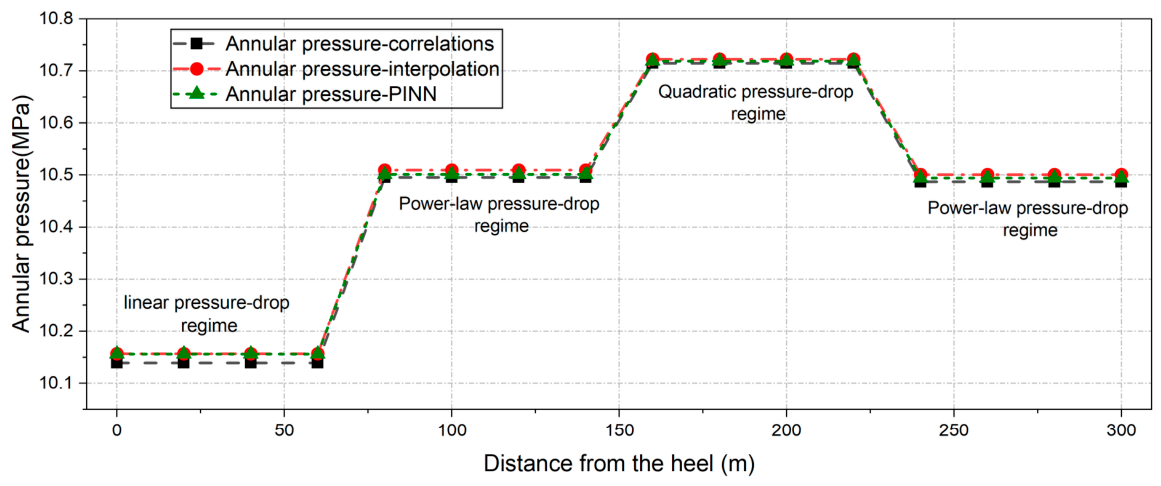
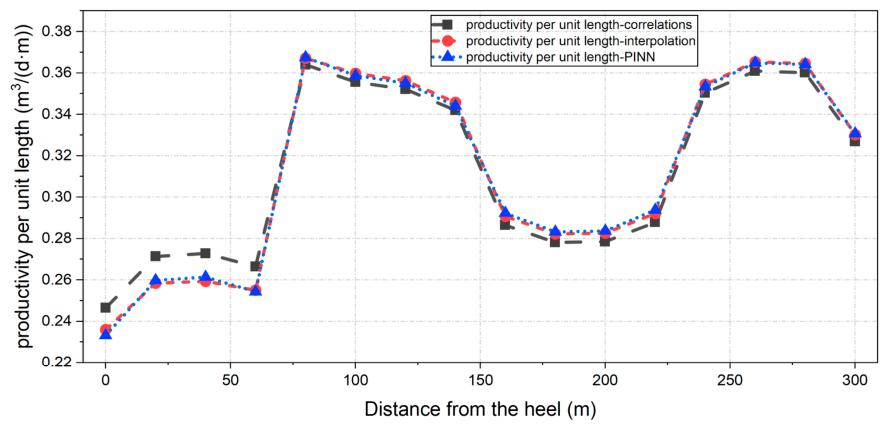
Figure 23 presents the annulus pressure comparison for a four-compartment horizontal well. The permeabilities of the four compartments, from left to right, are 500, 1000, 1500, and 1000 mD, respectively. To balance the non-uniform inflow profile caused by permeability heterogeneity, ICD nozzles with diameters of 4.0, 2.5, 2.0, and 2.5 mm were assigned to the corresponding compartments. The Δp–Q relationships for the three nozzle sizes are shown in Figure 17. To enable a consistent comparison among different ICD characterization methods, the nozzle configuration of each compartment was kept unchanged. Each compartment contains three ICDs uniformly distributed around the base pipe at 120° intervals, with one nozzle in each ICD. Therefore, the flow rate through a single ICD is one-third of the total flow rate of the corresponding compartment. Figure 24 further shows the liquid production rate per unit length after one year of production.
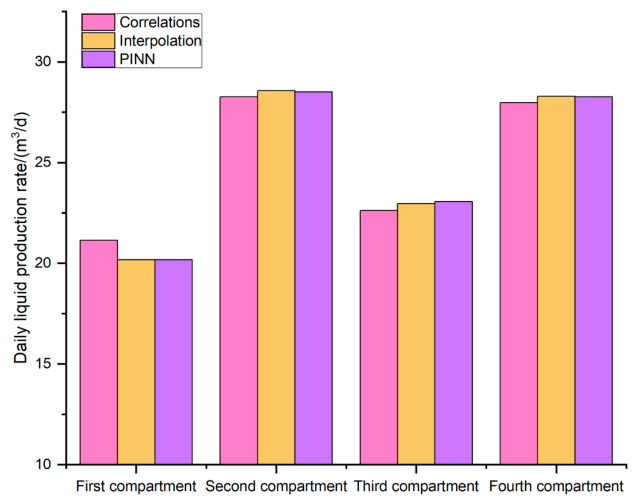
Based on Figure 23, Figure 24 and Figure 25, the liquid production rates of the first, second, third, and fourth compartments are 21.14, 28.27, 22.62, and 27.98 m3/d, respectively. With three ICDs installed in each compartment, the flow rates through an individual ICD are, therefore, 7.05, 9.42, 7.54, and 9.33 m3/d. These differences place the four compartments in distinct flow regimes. The first compartment, fitted with a 4.0 mm nozzle, operates in the low-flow regime; the second and fourth compartments, both fitted with 2.5 mm nozzles, operate in the medium-flow regime; and the third compartment, fitted with a 2.0 mm nozzle, operates in the high-flow regime.
Figure 12 compares the results obtained using the empirical formula method and the physics-constrained least squares method. The dataset generated by the physics-constrained least squares method serves as the training dataset for the PINN. To ensure consistency, the interpolation method was also based on sampling points extracted from the same dataset, with adjacent points connected by straight-line segments.
As shown in Figure 12, the prediction error of each method varies with the flow regime. In the low-flow regime, the linear interpolation method agrees closely with the PINN, whereas the empirical formula underestimates the additional ICD pressure drop. In the medium-flow regime, the nonlinear Δp-Q behavior causes the interpolation method to overpredict the pressure drop, while the empirical formula shifts from underestimation at lower flow rates to overestimation at higher flow rates. In the high-flow regime, the empirical formula remains close to the PINN, but the interpolation method still yields higher pressure-drop predictions because it replaces the nonlinear relationship with straight-line approximations. Since the pressure loss inside the base pipe is negligible compared with the ICD-induced pressure drop, a larger additional ICD pressure drop directly implies a higher annulus pressure.
Figure 23 presents the annular pressure distribution along the wellbore. In the first compartment, which lies in the low-flow regime, the empirical correlation predicts a lower annular pressure, consistent with its underestimation of the ICD pressure drop. In the second and fourth compartments, operating in the intermediate-flow regime, the annular pressure follows the order interpolation method > PINN > empirical correlation, suggesting that these compartments are located in the lower portion of this regime. In the third compartment, which operates in the high-flow regime, the interpolation method predicts the highest annular pressure, whereas the PINN and empirical correlation yield nearly identical results. Overall, the annular pressure distribution agrees well with the relative ICD pressure drops predicted by the three methods.
Numerical simulations were carried out using three ICD characterization methods, and the predicted flow rates for the same compartment differ accordingly. Figure 24 and Figure 25 show the liquid production per unit length along the wellbore after one year of production and the corresponding compartmental liquid production predicted by the three methods. For the empirical correlation, the additional pressure drop in the first compartment is underestimated, resulting in reduced inflow resistance and a higher predicted flow rate. The second and fourth compartments exhibit a similar but weaker trend, while the pressure-drop predictions for the third compartment are nearly identical among the three methods. As a result, the empirical correlation underestimates the inflow resistance in the first, second, and fourth compartments, with little effect on the third compartment. Under the constant-liquid-production constraint, this leads to a higher predicted production in the first compartment than that obtained with the PINN method, whereas the other compartments exhibit lower predicted production, with the largest negative deviation occurring in the third compartment. These results indicate that the PINN method captures the variation in additional ICD pressure drop across different flow regimes more accurately, thereby improving the predictive accuracy of ICD simulation.
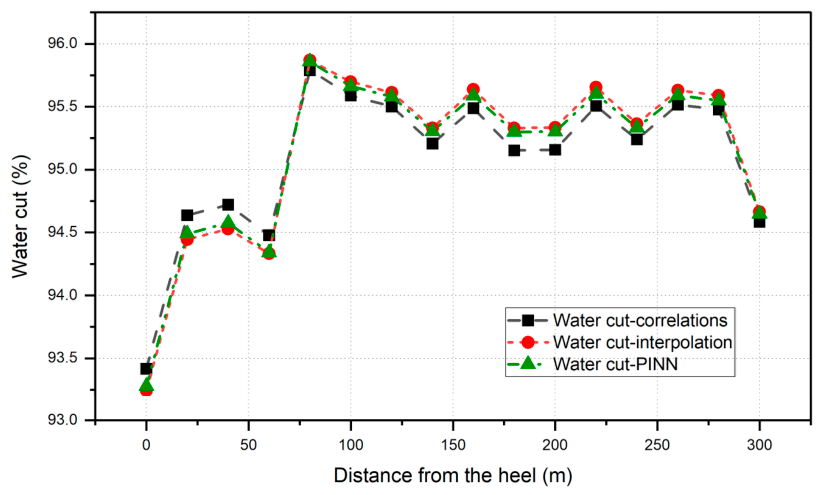
Figure 26 presents the water-cut distribution along the wellbore after one year of production. As shown in the figure, the drainage regions near the heel and toe are relatively large, resulting in a slower increase in water cut in these two sections. A comparison of water cut with liquid production per unit length indicates that the three ICD characterization methods exhibit a generally consistent relative ordering for both quantities. Specifically, a higher liquid production rate corresponds to a faster rise in water cut and a higher final water cut, and the compartmental water-cut distribution closely reflects this relationship. For example, in the first compartment, the empirical correlation predicts both the highest liquid production and the highest water cut.
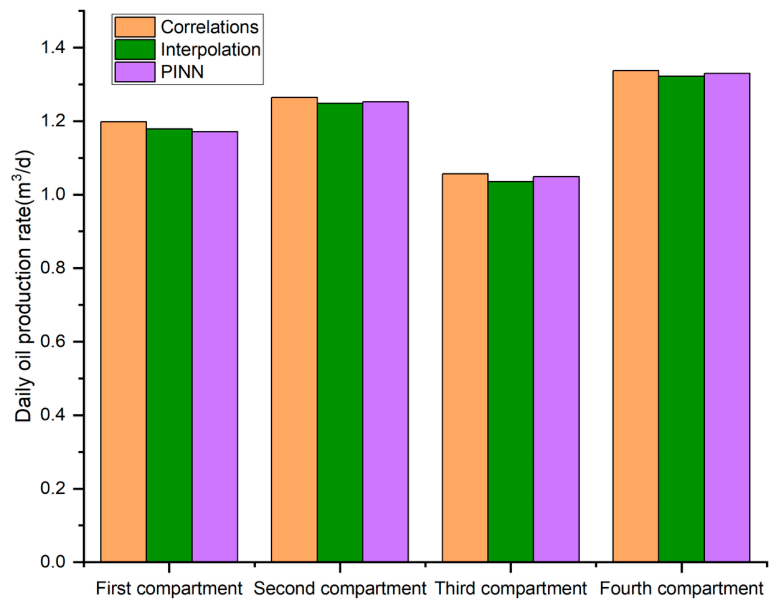
As shown in Figure 27, different ICD characterization methods lead to different daily oil production rates in each compartment. The empirical correlation fails to capture the variation in ICD behavior across different flow regimes, whereas the interpolation method introduces approximation errors by representing nonlinear curves with straight-line segments. In contrast, the PINN method accurately captures the flow–pressure-drop relationship of the ICD, thereby improving the predictive accuracy of ICD simulation.
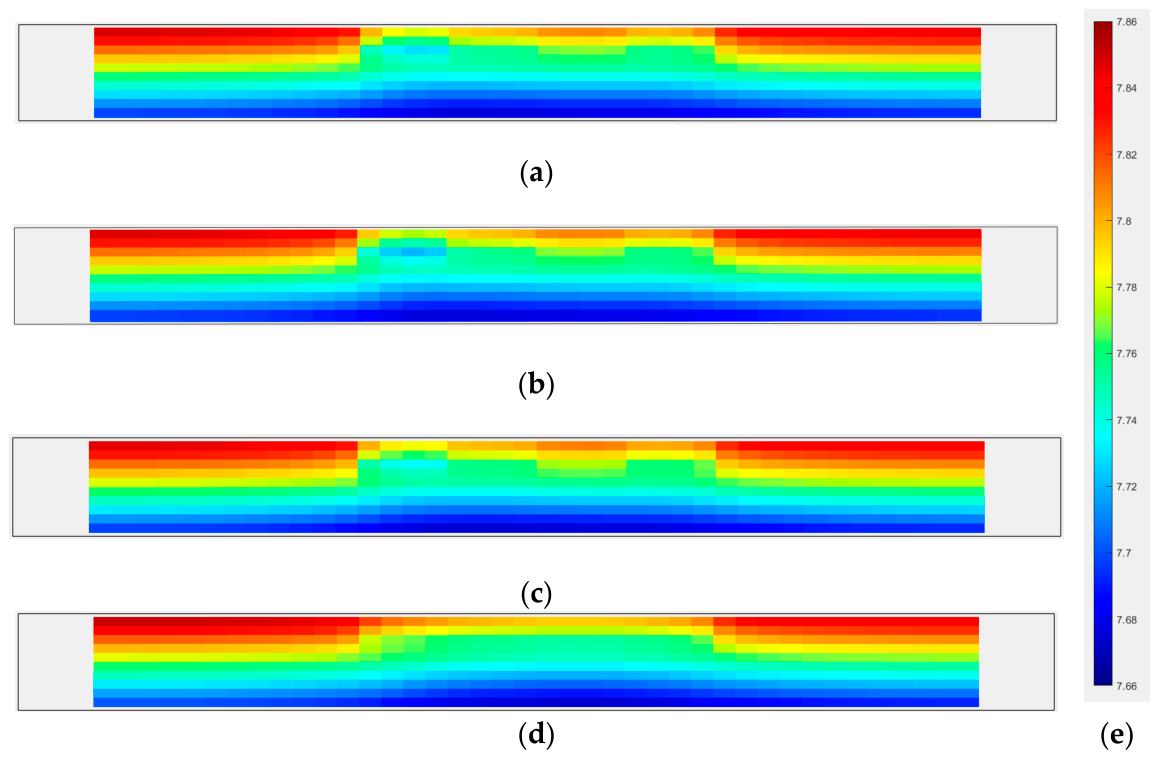
Figure 28 presents the simulated pressure field along the horizontal well during production. The first compartment exhibits the largest difference among the three methods. The empirical correlation predicts the lowest formation pressure near this compartment, followed by the PINN method, whereas the interpolation method yields the highest pressure, although the difference from the PINN result is small. Without ICD installation, the formation pressures near the compartments differ only slightly, indicating a relatively uniform pressure field along the wellbore.
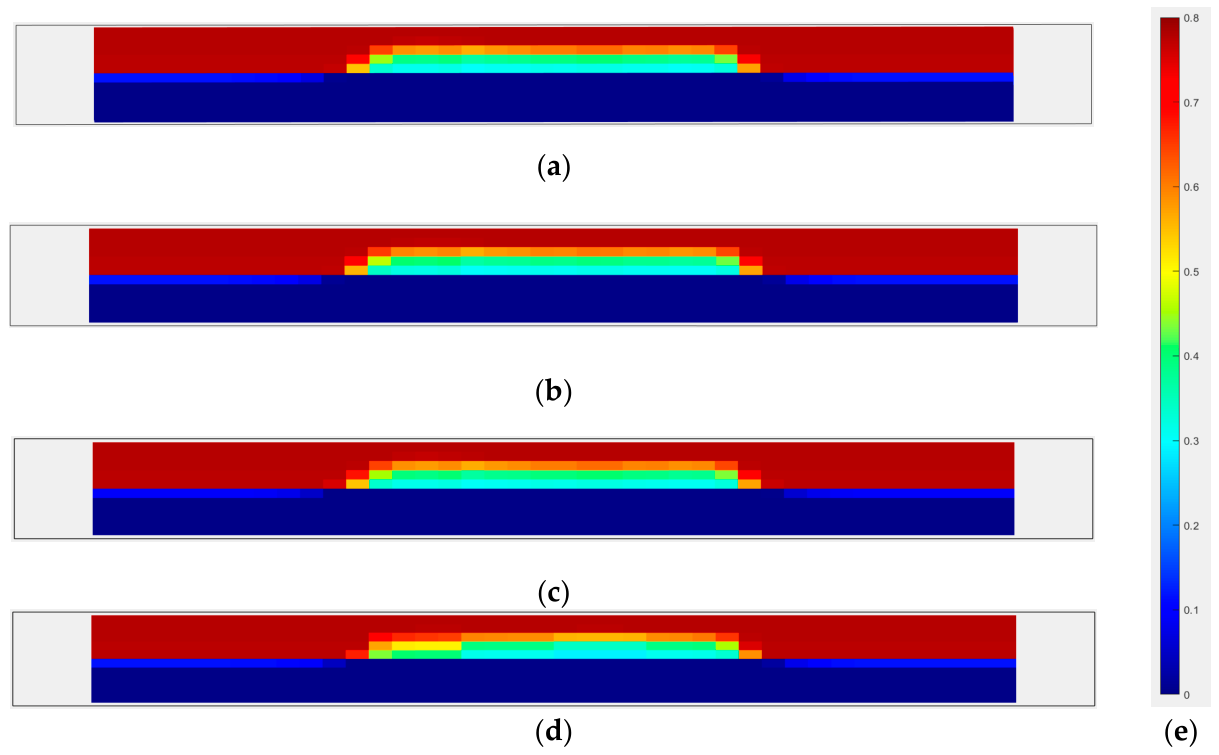
Figure 29 shows the saturation fields predicted by the three ICD characterization methods. Only minor differences are observed among the PINN, empirical correlation, and interpolation results. Without ICD installation, however, the saturation field exhibits substantially stronger sectional heterogeneity.
The integration of the PINN-based data-driven ICD characterization method into numerical simulation provides several key advantages. First, it introduces a more rigorous representation of ICDs as completion components, thereby enhancing the reliability and robustness of reservoir simulation for engineering applications. Second, the proposed modeling approach improves the smoothness of well–reservoir coupling and supports more stable time stepping during simulation. In addition, the flow-regime-based strategy yields inter-compartment flow allocation and long-term dynamic predictions that are more consistent with the underlying flow physics. Finally, the method accounts for the combined effects of multiple parameters in ICD characterization, providing a flexible and generalizable framework for engineering-scale simulations.

4. Conclusions

This study developed a PINN-based representation of the flow rate–pressure drop relationship for nozzle-type ICDs and embedded the trained PINN model into a coupled reservoir–wellbore numerical simulation framework. A fully coupled reservoir–wellbore–ICD simulation was thereby achieved, leading to the following conclusions:
  • The optimal PINN architecture for ICD characterization was identified as a network with two hidden layers and eight neurons per layer, which achieves an effective trade-off between accuracy and computational cost.
  • Embedding different ICD characterization models into the numerical simulation leads to distinct convergence performance. The PINN-based model exhibits the most favorable convergence behavior, followed by the empirical correlation model, while the interpolation model performs the worst.
  • ICD installation redistributes the pressure drop along the horizontal well and thereby improves inflow uniformity. This results in a more uniform upward movement of formation water, a more even oil saturation depletion pattern, and a 4.36% increase in cumulative oil production over six years relative to the case without ICDs.
  • Since different compartments fall into different ICD flow regimes, the accuracy of ICD characterization strongly affects production-profile prediction. The empirical correlation method shows limited applicability across flow regimes, particularly in the low- and intermediate-flow regions, whereas the PINN-based method accurately captures the nonlinear flow–pressure-drop relationship under different operating conditions. Consequently, it provides more reliable ICD representation in reservoir simulation and a more physically consistent prediction of liquid production distribution.

Supplementary Materials

The following supporting information can be downloaded at: https://www.mdpi.com/article/10.3390/pr14122011/s1.

Author Contributions

Conceptualization, Q.J., Y.X. and W.Z.; Methodology, Q.J., Y.L., J.H. and Y.Z.; Software, Q.J., Y.L. and Y.Z.; Validation, Y.X., T.J., J.H., Y.Z. and W.Z.; Formal analysis, Q.J., Y.L. and J.H.; Investigation, Q.J.; Resources, J.L. and Z.F.; Data curation, Q.J., J.L., T.J., J.H. and X.R.; Writing—original draft, Q.J. and Y.L.; Writing—review & editing, Y.X., Z.F., X.R. and L.Q.; Visualization, J.L., X.R. and L.Q.; Supervision, T.J.; Project administration, Y.X.; Funding acquisition, Y.X., J.L. and T.J. All authors have read and agreed to the published version of the manuscript.

Funding

This research was funded by the research project “Dynamic Evolution of Fluid–Solid Interfaces and Mechanisms of Remaining Oil Occurrence and Mobilization in Offshore Strong Water-Drive Reservoirs” (grant number: U25B20123), and the APC was funded by China University of Petroleum (Beijing) (Unified Social Credit Identifier: 12100000400006110Y).

Data Availability Statement

The original contributions presented in this study are included in the article/Supplementary Materials. Further inquiries can be directed to the corresponding author.

Conflicts of Interest

Authors Junjian Li, Zhi Fan, Tao Jiao and Yan Lei were employed by PetroChina Changqing Oilfield Company. The remaining authors declare that the research was conducted in the absence of any commercial or financial relationships that could be construed as a potential conflict of interest.

Abbreviations

The following abbreviations are used in this manuscript:
ICDInflow control device
PINNPhysics-informed neural network
PCLSPhysics-constrained least squares approach

References

  1. Frauenfeld, T.; Jossy, C.; Rispler, K.; Kissel, G. Evaluation of the Bottom Water Reservoir VAPEX Process. J. Can. Pet. Technol. 2006, 45, 29–35. [Google Scholar] [CrossRef]
  2. Yue, P.; Du, Z.; Chen, X.; Liang, B. The Critical Rate of Horizontal Wells in Bottom-Water Reservoirs with an Impermeable Barrier. Pet. Sci. 2012, 9, 223–229. [Google Scholar] [CrossRef]
  3. Asuaje, M.; Rincón, N.; Ratkovich, N.; Pinilla, A.; Nieto, R. Water Inflow Controller Devices as a Solution for Production for Mature Oil Fields: A Literature Review. Processes 2025, 13, 144. [Google Scholar] [CrossRef]
  4. Atkinson, C.; Monmont, F.; Zazovsky, A. Flow Performance of Horizontal Wells with Inflow Control Devices. Eur. J. Appl. Math. 2004, 15, 409–450. [Google Scholar] [CrossRef]
  5. Birchenko, V.M.; Muradov, K.M.; Davies, D.R. Reduction of the Horizontal Well’s Heel-Toe Effect with Inflow Control Devices. J. Pet. Sci. Eng. 2010, 75, 244–250. [Google Scholar] [CrossRef]
  6. Birchenko, V.M.; Bejan, A.I.; Usnich, A.V.; Davies, D. Application of Inflow Control Devices to Heterogeneous Reservoirs. J. Pet. Sci. Eng. 2011, 78, 534–541. [Google Scholar] [CrossRef]
  7. Daneshy, A.; Guo, B.; Krasnov, V.; Zimin, S. Inflow-Control-Device Design: Revisiting Objectives and Techniques. SPE Prod. Oper. 2012, 27, 44–51. [Google Scholar] [CrossRef]
  8. Prakasa, B.; Muradov, K.; Davies, D. Principles of Rapid Design of an Inflow Control Device Completion in Homogeneous and Heterogeneous Reservoirs Using Type Curves. J. Pet. Sci. Eng. 2019, 176, 862–879. [Google Scholar] [CrossRef]
  9. Zhang, R.; Zhang, Z.; Li, Z.; Jia, Z.; Yang, B.; Zhang, J.; Zhang, C.; Zhang, G.; Yu, S. A Multi-Objective Optimization Method of Inflow Control Device Configuration. J. Pet. Sci. Eng. 2021, 205, 108855. [Google Scholar] [CrossRef]
  10. von Hohendorff Filho, J.C.; Victorino, I.R.S.; Bigdeli, A.; Schiozer, D.J. Application of water flooding and water alternative gas (wag) flooding techniques in a carbonate reservoir: Integration of reservoir and production systems for decision making. Braz. J. Pet. Gas 2023, 17, 179–202. [Google Scholar] [CrossRef]
  11. An, Y.; Sun, Z.; Kang, Y.; Yang, G. A Fully Coupled Numerical Simulation Model for Bottom-Water Gas Reservoirs Integrating Horizontal Wellbore, ICD Screens, and Zonal Water Control: Development, Validation, and Optimization Strategies. Energies 2025, 18, 3607. [Google Scholar] [CrossRef]
  12. Flauraud, E.; Ding, D.Y. A Semi-Implicit Approach for the Modeling of Wells with Inflow Control Completions. Oil Gas Sci. Technol. 2020, 75, 39. [Google Scholar] [CrossRef]
  13. Qin, S.; Zhang, N.; Cao, B.; An, Y.; Huo, R. Mathematical Modeling of Prediction of Horizontal Wells with Gravel Pack Combined with ICD in Bottom-Water Reservoirs. Processes 2023, 11, 2777. [Google Scholar] [CrossRef]
  14. Cui, X.; Li, Y.; Li, H.; Luo, H.; Zhang, J.; Liu, Q. A Novel Automatic Inflow-Regulating Valve for Water Control in Horizontal Wells. ACS Omega 2020, 5, 28056–28072. [Google Scholar] [CrossRef] [PubMed]
  15. Olsen, J.J.; Hemmingsen, C.S.; Bergmann, L.; Nielsen, K.K.; Glimberg, S.L.; Walther, J.H. Characterization and Erosion Modeling of a Nozzle-Based Inflow-Control Device. SPE Drill. Complet. 2017, 32, 224–233. [Google Scholar] [CrossRef]
  16. Taghavi, S.; Aakre, H.; Tahami, S.A.; Moldestad, B.M.E. The Impact of Autonomous Inflow Control Valve on Improved Oil Recovery in a Thin-Oil-Rim Reservoir. SPE J. 2024, 29, 1989–2003. [Google Scholar] [CrossRef]
  17. Zeng, Q.; Wang, Z.; Wang, X.; Wei, J.; Zhang, Q.; Yang, G. A Novel Autonomous Inflow Control Device Design and Its Performance Prediction. J. Pet. Sci. Eng. 2015, 126, 35–47. [Google Scholar] [CrossRef]
  18. Emegano, T.C.; Baloch, S.A.; Alrefaai, M.M.; Al Nuimi, S.M.; Radwan, E.S. Inflow Control Devices ICD—A Historical Performance Analysis. In Abu Dhabi International Petroleum Exhibition & Conference (ADIPEC); Society of Petroleum Engineers (SPE): Richardson, TX, USA, 2020; p. SPE-202847-MS. [Google Scholar] [CrossRef]
  19. Al-Khelaiwi, F.T.; Davies, D.R. Inflow Control Devices: Application and Value Quantification of a Developing Technology. In SPE International Oil Conference and Exhibition in Mexico; Society of Petroleum Engineers (SPE): Richardson, TX, USA, 2007; p. SPE-108700-MS. [Google Scholar] [CrossRef]
  20. Li, Z.; Fernandes, P.; Zhu, D. Understanding the Roles of Inflow-Control Devices in Optimizing Horizontal-Well Performance. SPE Drill. Complet. 2011, 26, 376–385. [Google Scholar] [CrossRef]
  21. Yavari, H.; Khosravanian, R.; Wood, D.A.; Aadnoy, B.S. Application of Mathematical and Machine Learning Models to Predict Differential Pressure of Autonomous Downhole Inflow Control Devices. Adv. Geo-Energy Res. 2021, 5, 386–406. [Google Scholar] [CrossRef]
  22. Jin, Z.L.; Liu, Y.; Durlofsky, L.J. Deep-Learning-Based Surrogate Model for Reservoir Simulation with Time-Varying Well Controls. J. Pet. Sci. Eng. 2020, 192, 107273. [Google Scholar] [CrossRef]
  23. Chen, J.; Gildin, E.; Killough, J. Multi-Step Embed to Control: A Novel Deep Learning-Based Approach for Surrogate Modelling in Reservoir Simulation. arXiv 2024, arXiv:2409.09920. [Google Scholar] [CrossRef]
  24. Ahdeema, J.; Haghighat Sefat, M.; Muradov, K. Hybrid Framework for Enhanced Dynamic Optimization of Intelligent Completion Design in Multilateral Wells with Multiple Types of Flow Control Devices. Energies 2023, 16, 7189. [Google Scholar] [CrossRef]
  25. Ahdeema, J.; Sefat, M.H.; Muradov, K.; Moradi, A.; Moldestad, B.M.E. Completion Performance Evaluation in Multilateral Wells Incorporating Single and Multiple Types of Flow Control Devices Using Grey Wolf Optimizer. Processes 2024, 12, 785. [Google Scholar] [CrossRef]
  26. Tan, C.; Chua, A.; Muniandy, S.; Lee, H.; Chai, P. Optimization of Inflow Control Device Completion Design Using Metaheuristic Algorithms and Supervised Machine Learning Surrogate. In International Petroleum Technology Conference; OnePetro: Richardson, TX, USA, 2025; p. IPTC-24725-MS. [Google Scholar] [CrossRef]
  27. Ahdeema, J.; Moradi, A.; Sefat, M.H.; Muradov, K.; Moldestad, B.M.E. Bridging the Performance Gap between Passive and Autonomous Inflow Control Devices with a Hybrid Dynamic Optimization Technique Integrating Machine Learning and Global Sensitivity Analysis. Geoenergy Sci. Eng. 2024, 240, 213037. [Google Scholar] [CrossRef]
  28. Kanin, E.A.; Osiptsov, A.A.; Vainshtein, A.L.; Burnaev, E.V. A Predictive Model for Steady-State Multiphase Pipe Flow: Machine Learning on Lab Data. J. Pet. Sci. Eng. 2019, 180, 727–746. [Google Scholar] [CrossRef]
  29. Zheng, H.; Lin, B.; Jiang, J.; Jin, Y.; Peng, L. Knowledge-Guided Machine Learning Method for Downhole Gauge Record Prediction in Deep Water Gas Field. In Offshore Technology Conference Asia; Offshore Technology Conference (OTC): Houston, TX, USA, 2024; p. OTC-34844-MS. [Google Scholar] [CrossRef]
  30. Raissi, M.; Perdikaris, P.; Karniadakis, G.E. Physics-informed neural networks: A deep learning framework for solving forward and inverse problems involving nonlinear partial differential equations. J. Comput. Phys. 2019, 378, 686–707. [Google Scholar] [CrossRef]
  31. Karniadakis, G.E.; Kevrekidis, I.G.; Lu, L.; Perdikaris, P.; Wang, S.; Yang, L. Physics-informed machine learning. Nat. Rev. Phys. 2021, 3, 422–440. [Google Scholar] [CrossRef]
  32. Cuomo, S.; Di Cola, V.S.; Giampaolo, F.; Rozza, G.; Raissi, M.; Piccialli, F. Scientific machine learning through physics–informed neural networks: Where we are and what’s next. J. Sci. Comput. 2022, 92, 88. [Google Scholar] [CrossRef]
  33. Fraces, C.G.; Tchelepi, H. Physics informed deep learning for flow and transport in porous media. In Proceedings of the SPE Reservoir Simulation Conference, Virtual, 26 October–1 November 2021; SPE: Richardson, TX, USA, 2021; p. D011S006R002. [Google Scholar] [CrossRef]
  34. Fuks, O.; Tchelepi, H. Physics based deep learning for nonlinear two-phase flow in porous media. In Proceedings of the ECMOR XVII, Online, 14–17 September 2020; European Association of Geoscientists & Engineers: Bunnik, The Netherlands, 2020; Volume 2020, pp. 1–10. [Google Scholar] [CrossRef]
  35. Fuks, O.; Tchelepi, H.A. Limitations of physics informed machine learning for nonlinear two-phase transport in porous media. J. Mach. Learn. Model. Comput. 2020, 1, 19–37. [Google Scholar] [CrossRef]
  36. Sabet, N.; Irani, M.; Hassanzadeh, H. Inflow Control Devices Placement: A Computational Fluid Dynamics Approach. SPE J. 2022, 27, 1562–1576. [Google Scholar] [CrossRef]
  37. Onimowo, D.A. The Effects of Fluid Flow Geometry on the Physics of Flow; Anglia Ruskin University: Cambridge, UK, 2023; Available online: https://hdl.handle.net/10779/aru.23762964 (accessed on 16 June 2026).
  38. Gualdrón, M.G.; Anaya, A.F.; Araujo, Y.E.; Parra, W.; Bolaños, V.; Landaeta, L. Passive Inflow Control Device (ICDs) Application in Horizontal Wells Completions in Rubiales Area, Heavy Oil Reservoir. In SPE Latin America and Caribbean Heavy and Extra Heavy Oil Conference; Society of Petroleum Engineers (SPE): Richardson, TX, USA, 2014; p. SPE-171040-MS. [Google Scholar] [CrossRef]
  39. Chua, A.; Tan, C.; Muniandy, S. The Design of Inflow Control Device Completion Using Machine Learning Optimization. In Abu Dhabi International Petroleum Exhibition and Conference; Society of Petroleum Engineers (SPE): Richardson, TX, USA, 2024; p. SPE-222454-MS. [Google Scholar] [CrossRef]
  40. Pinilla, A.; Stanko, M.; Asuaje, M.; Ratkovich, N. In-depth understanding of ICD completion technology working principle. Processes 2022, 10, 1493. [Google Scholar] [CrossRef]
  41. Kundu, P.K.; Cohen, I.M.; Dowling, D.R.; Capecelatro, J. Fluid Mechanics; Elsevier: Amsterdam, The Netherlands, 2024. [Google Scholar]
  42. Lee, G.J. Dynamic orifice flow model and compartment models for flooding simulation of a damaged ship. Ocean Eng. 2015, 109, 635–653. [Google Scholar] [CrossRef]
  43. Beucler, T.; Pritchard, M.; Rasp, S.; Ott, J.; Baldi, P.; Gentine, P. Enforcing Analytic Constraints in Neural Networks Emulating Physical Systems. Phys. Rev. Lett. 2021, 126, 098302. [Google Scholar] [CrossRef] [PubMed]
  44. De Cursi, J.S.; Koscianski, A. Physically Constrained Neural Network Models for Simulation. In Advances and Innovations in Systems, Computing Sciences and Software Engineering; Springer: Dordrecht, The Netherlands, 2007; pp. 567–572. [Google Scholar] [CrossRef]
  45. Mohan, A.T.; Lubbers, N.; Livescu, D.; Chertkov, M. Embedding Hard Physical Constraints in Neural Network Coarse-Graining of 3D Turbulence. arXiv 2020, arXiv:2002.00021. [Google Scholar] [CrossRef]
  46. Holmes, J.A.; Barkve, T.; Lund, Ø. Application of a Multisegment Well Model to Simulate Flow in Advanced Wells. In SPE Europec Featured at EAGE Conference and Exhibition; Society of Petroleum Engineers (SPE): Richardson, TX, USA, 1998; p. SPE-50646-MS. [Google Scholar] [CrossRef]
  47. Stone, T.; McKee, F.; Istchenko, C. Boundary Segments for Multisegment Well Models. In SPE Reservoir Simulation Conference; Society of Petroleum Engineers (SPE): Richardson, TX, USA, 2019; p. SPE-193853-MS. [Google Scholar] [CrossRef]
  48. Wong, Z.Y.; Horne, R.; Voskov, D. A Geothermal Reservoir Simulator in AD-GPRS; Stanford University: Stanford, CA, USA, 2015. [Google Scholar]
  49. Rin, R. Implicit Coupling Framework for Multi-Physics Reservoir Simulation; Stanford University: Stanford, CA, USA, 2017. [Google Scholar]
  50. Klevtsov, S. Linear Solution Techniques for Reservoir Simulation with Fully Coupled Geomechanics; Stanford University: Stanford, CA, USA, 2017. [Google Scholar]
  51. Zhou, Y. Parallel General-Purpose Reservoir Simulation with Coupled Reservoir Models and Multisegment Wells; Stanford University: Stanford, CA, USA, 2012. [Google Scholar]
  52. Wong, Z.Y. Sequential-Implicit Newton’s Method for Geothermal Reservoir Simulation; Stanford University: Stanford, CA, USA, 2018. [Google Scholar]
  53. Li, J. Multi-Segment Well Modeling in a Sequential Implicit Coupling Framework; Stanford University: Stanford, CA, USA, 2018. [Google Scholar]
Figure 1. Overall workflow of the proposed physics-informed ICD characterization and reservoir–wellbore coupled simulation framework.
Processes 14 02011 g001
Figure 2. The architecture of physics-informed neural networks.
Processes 14 02011 g002
Figure 3. The architecture of the multi-segment well model.
Processes 14 02011 g003
Figure 4. Physical model of depletion production for horizontal wells in strong bottom-water reservoirs.
Processes 14 02011 g004
Figure 5. A single wellbore element.
Processes 14 02011 g005
Figure 6. Position of the equation corresponding to the partial derivatives of the Jacobian matrix.
Processes 14 02011 g006
Figure 7. Composition of the Jacobian matrix.
Processes 14 02011 g007
Figure 8. Wellbore equations divided by well section.
Processes 14 02011 g008
Figure 9. Framework of the numerical simulation solution module.
Processes 14 02011 g009
Figure 10. The influence of λ on the flow transition section curve.
Processes 14 02011 g010
Figure 11. The ICD flow-pressure difference curves for different nozzle diameters when λ = 104.
Processes 14 02011 g011
Figure 12. Schematic diagram of flow regime segmentation and comparison between the PCLS and the empirical correlation method.
Processes 14 02011 g012
Figure 13. Variation in key performance metrics for the PINN method and the purely data-driven method with the number of neurons in a single hidden layer: (a) model prediction mean squared error (MSE), (b) number of training epochs, (c) average physical residual of the model predictions, and (d) maximum physical residual of the model predictions.
Processes 14 02011 g013
Figure 14. Variation curve of mean squared error with the number of neurons in the first hidden layer (fixed number of neurons in the second hidden layer).
Processes 14 02011 g014
Figure 15. Variation curve of mean squared error with the number of neurons in the second hidden layer (fixed number of neurons in the first hidden layer).
Processes 14 02011 g015
Figure 16. Schematic diagram of reservoir and wellbore parameters (along horizontal well profile).
Processes 14 02011 g016
Figure 17. PINN-based characterization results of ICDs with different nozzle diameters.
Processes 14 02011 g017
Figure 18. Evaluation of model convergence.
Processes 14 02011 g018
Figure 19. Pressure field distributions along the horizontal wellbore profile for wells with and without ICDs at different production stages. (a) With ICDs after one year of production; (b) without ICDs after one year; (c) with ICDs after three years; (d) without ICDs after three years; (e) with ICDs after six years; and (f) without ICDs after six years. (gi) Unified pressure color scales for the three production stages, with pressure expressed in MPa.
Processes 14 02011 g019
Figure 20. Water saturation distributions along the horizontal wellbore profile for wells with and without ICDs at different production stages. (a) With ICDs after one year of production; (b) without ICDs after one year; (c) with ICDs after three years; (d) without ICDs after three years; (e) with ICDs after six years; and (f) without ICDs after six years. (gi) Unified water saturation color scales for the three production stages (dimensionless).
Processes 14 02011 g020aProcesses 14 02011 g020b
Figure 21. Comparison of 6-year production in horizontal wells with and without ICD.
Processes 14 02011 g021
Figure 22. Variation in water cut reduction by ICD with production time (compared with the case without ICD).
Processes 14 02011 g022
Figure 23. Comparison of simulated annular pressure distributions in the first year using different ICD characterization methods.
Processes 14 02011 g023
Figure 24. Distribution of liquid production per unit length along the wellbore after one year of production under different ICD characterization models.
Processes 14 02011 g024
Figure 25. Comparison of daily liquid production of each segment after one year of production under different ICD characterization methods.
Processes 14 02011 g025
Figure 26. Distribution of water cut along the wellbore after one year of production under different ICD characterization methods.
Processes 14 02011 g026
Figure 27. Comparison of daily oil production for each compartment after one year of production under different ICD characterization methods.
Processes 14 02011 g027
Figure 28. Comparison of pressure fields along the horizontal wellbore after six years of production under three ICD characterization methods: (a) the PINN-based method, (b) the empirical correlation, and (c) the tabulated interpolation method. (d) shows the pressure field along the horizontal wellbore without ICDs. (e) Unified pressure color scale, with pressure expressed in MPa.
Processes 14 02011 g028
Figure 29. Comparison of oil saturation distributions along the horizontal wellbore after six years of production under three ICD characterization methods: (a) the PINN-based method, (b) the empirical correlation, and (c) the tabulated interpolation method. (d) Oil saturation distribution along the horizontal wellbore without ICDs. (e) Unified oil saturation color scale (dimensionless).
Processes 14 02011 g029
Table 1. Sensitivity of the power-law exponent b to the high-flow threshold selection.
High-Flow ThresholdFlow-Rate Range for Quadratic FittingFitted Exponent (b)Relative Deviation (%)
15%Top 15% of samples1.581.25
20%Top 20% of samples1.600.00
25%Top 25% of samples1.631.88
Table 2. Effect of the number of neurons in a single hidden layer on the number of training epochs.
Number of Neurons in the Single Hidden LayerTraining Epochs of the Physically Constrained ModelTraining Epochs of the Purely Data-Driven Model
2192234
44981
89274
1684197
3270102
644297
Table 3. Performance comparison of data-driven ICD characterization models.
Model StructureMSE of PinnMSE of Data-DrivenMean Physical Residual of PINNMean Physical Residual of Data-DrivenModel Speed Evaluation (1000 Samples; Unit: Seconds)
Single: 16 neurons4.99 × 10−55.50 × 10−60.0055110.0075380.0009975
Double: 4 + 8 neurons4.22 × 10−56.13 × 10−60.0046650.0076200.0009968
Table 4. Basic parameters of the model.
Model ScaleGrid ScaleNumber of GridsPermeability/mDICD Nozzle Diameter/mmAquifer Thickness/mPorosity/%Water Saturation/%
800 m × 400 m × 16 m20 m × 20 m × 1.6 m40 × 20 × 10[500, 1000, 1500, 1000][4, 2.5, 2, 2.5]83430
Disclaimer/Publisher’s Note: The statements, opinions and data contained in all publications are solely those of the individual author(s) and contributor(s) and not of MDPI and/or the editor(s). MDPI and/or the editor(s) disclaim responsibility for any injury to people or property resulting from any ideas, methods, instructions or products referred to in the content.