1. Introduction
Cordyceps militaris is a well-known medicinal mushroom that has attracted growing scientific and commercial interest due to its diverse bioactive compounds, including cordycepin, adenosine, polysaccharides, carotenoids, and other secondary metabolites, with proven antioxidant, antimicrobial, immunomodulatory, and antitumor effects [
1,
2,
3,
4]. Unlike wild
Ophiocordyceps species, which are ecologically limited and difficult to harvest sustainably,
Cordyceps species demonstrate stable growth under artificial conditions, making them especially suitable for controlled cultivation systems [
5]. Over the past two decades, significant advances have been made in cultivating
Cordyceps under artificial conditions, especially in East Asia, where standardized production methods based on liquid culture, cereal-based substrates, and carefully regulated environmental conditions have been developed [
6,
7]. Many studies have shown that key factors, including the nutritional composition of the substrate, vitamin supplementation, temperature, and cultivation strategy, strongly influence outcomes such as mycelial growth rate, fruiting body development, and cordycepin accumulation, underscoring the importance of precise control of growth parameters [
1,
6,
8].
Despite these advances, much of this knowledge remains concentrated on the laboratory or industrial scale, relying on specialized equipment, advanced technical skills, and substantial capital, which restricts its reach to beginners, home growers, and small farms. A clear gap, therefore, persists between scientific research and cultivation methods that are accessible, affordable, and reproducible at a small scale, particularly for family-operated, small-scale producers, who typically lack the sophisticated infrastructure and capital required for industrial systems and are further constrained by the limited translation of academic knowledge into practical, resource-conscious workflows. Developing simplified, cost-effective protocols would reduce these technical and financial barriers, enabling small-scale producers to enter this growing market while preserving biological performance and product quality [
1,
7]. Yet whether small-scale
Cordyceps production is genuinely economically viable, and under what conditions, has received comparatively little systematic study.
Although the biological optimization of
Cordyceps is well documented, rigorous economic assessments of its cultivation remain comparatively scarce, and the available evidence consistently shows that profitability is strongly scale-dependent. An enterprise-level analysis of
Cordyceps cultivation across small, medium, and large units in India found that fixed costs dominate the cost structure of the smallest operations and that average production cost falls steadily with scale, so that the smallest units can operate below their break-even point while larger units achieve substantial margins of safety [
9]. Reviews of commercial
Cordyceps production likewise note that culture degeneration and yield instability translate into tangible economic losses, discouraging investment, particularly in Western markets [
1]. In closely related work, comparative techno-economic modeling of centralized versus decentralized
Cordyceps production in shipping containers found both configurations economically viable, but these container-based systems target modular, commercial-scale production rather than the small-scale operation examined here [
10]. Beyond
Cordyceps, the broader literature on specialty and gourmet mushrooms reports favorable but scale-sensitive economics: small-scale edible-mushroom production from lignocellulosic substrates is technically accessible, yet consistent quality and contamination control remain the principal barriers to profitability [
11]; cost–benefit analyses of oyster mushroom cultivation report positive benefit–cost ratios and low break-even volumes [
12]; and multiple-case evidence from household mushroom enterprises in the Philippines shows that home-based, low-capital ventures can achieve cultivator profit margins of roughly 63–99% while allowing household members, particularly women, to combine income generation with domestic responsibilities [
13]. In the United States, forest-farmed and integrated systems offer attractive returns and a supplementary, year-round income stream for small farms [
14,
15], consistent with broader assessments of profitability pathways for small-scale US agriculture [
16]. Mushrooms are increasingly positioned as nutritionally and economically significant future foods with rapidly expanding global demand [
17]. Economic viability at this scale also depends on post-harvest processing, since drying conditions strongly influence the retention of cordycepin, polysaccharides, and other bioactive compounds, and therefore product value, in the nutraceutical market [
6,
8,
18,
19]. Taken together, this evidence confirms that small-scale mushroom enterprises can be profitable, yet it also exposes the distinct constraints faced by family-operated, small-scale operators: high relative fixed costs, capital intensity, and acute sensitivity to yield and contamination.
To our knowledge, few prior studies have integrated a reproducible, step-by-step cultivation protocol with a detailed techno-economic framework calibrated specifically to family-operated, small-scale production, leaving this scale underexplored. Accordingly, this paper provides a practical, comprehensive guide for individuals and small enterprises seeking to establish a Cordyceps cultivation business at the family-operated, small-scale level, combining step-by-step cultivation procedures with detailed figures, guidance on equipment and consumables, realistic cost estimates, and post-harvest drying and basic processing methods. By translating existing scientific knowledge into accessible, economically feasible practice and by pairing it with a comprehensive economic analysis of CapEx, OpEx, revenue projections, and profitability timeline, this work aims to reduce the technical and financial barriers that small-scale producers face and to support informed decisions about establishing consistent, high-quality Cordyceps enterprises suitable for small farms and cottage industries.
2. Materials and Methods
2.1. Study Organism
Cordyceps produces distinctive orange, club-shaped fruiting bodies that are usually 6–8 cm tall. It is distinguished from the wild-harvested
Cordyceps by its ability to be reliably cultivated under controlled conditions on grain-based substrates [
20]. Its main bioactive compounds, especially cordycepin and adenosine, are highly valued in the pharmaceutical and nutraceutical industries [
21]. For laboratory maintenance,
Cordyceps cultures are routinely preserved on agar plates (such as potato dextrose agar or similar media) and stored under refrigerated conditions (~4 °C) to preserve viability and genetic stability. Periodic subculturing keeps the cultures actively growing, and they can be revived by transferring mycelial plugs onto fresh agar plates and incubating at optimal temperatures (usually 20–25 °C) to promote vigorous mycelial growth for subsequent inoculation and production.
2.2. Study Site and Infrastructure
For this study, Cordyceps cultivation was carried out at R&P Biotics in Chennai, India, in a dedicated grow room measuring 10 × 14 feet (140 ft2). The room was insulated with cross-linked polyethylene sheets and equipped with steel racks holding 18 rows of shelving, capable of holding ~4880 cultivation cups. The growing room included a split air-conditioning unit with a voltage stabilizer, pink-spectrum LED grow lights on a timer-controlled 12-h photoperiod, two exhaust fans for air circulation, an ultrasonic humidifier, and a digital thermometer/hygrometer for continuous environmental monitoring. A generator was kept as a backup to ensure an uninterrupted power supply. Laboratory equipment included a laminar airflow (LAF) cabinet, an autoclave (121 °C, 15 PSI), and a rotary shaker operating at 60–70 RPM.
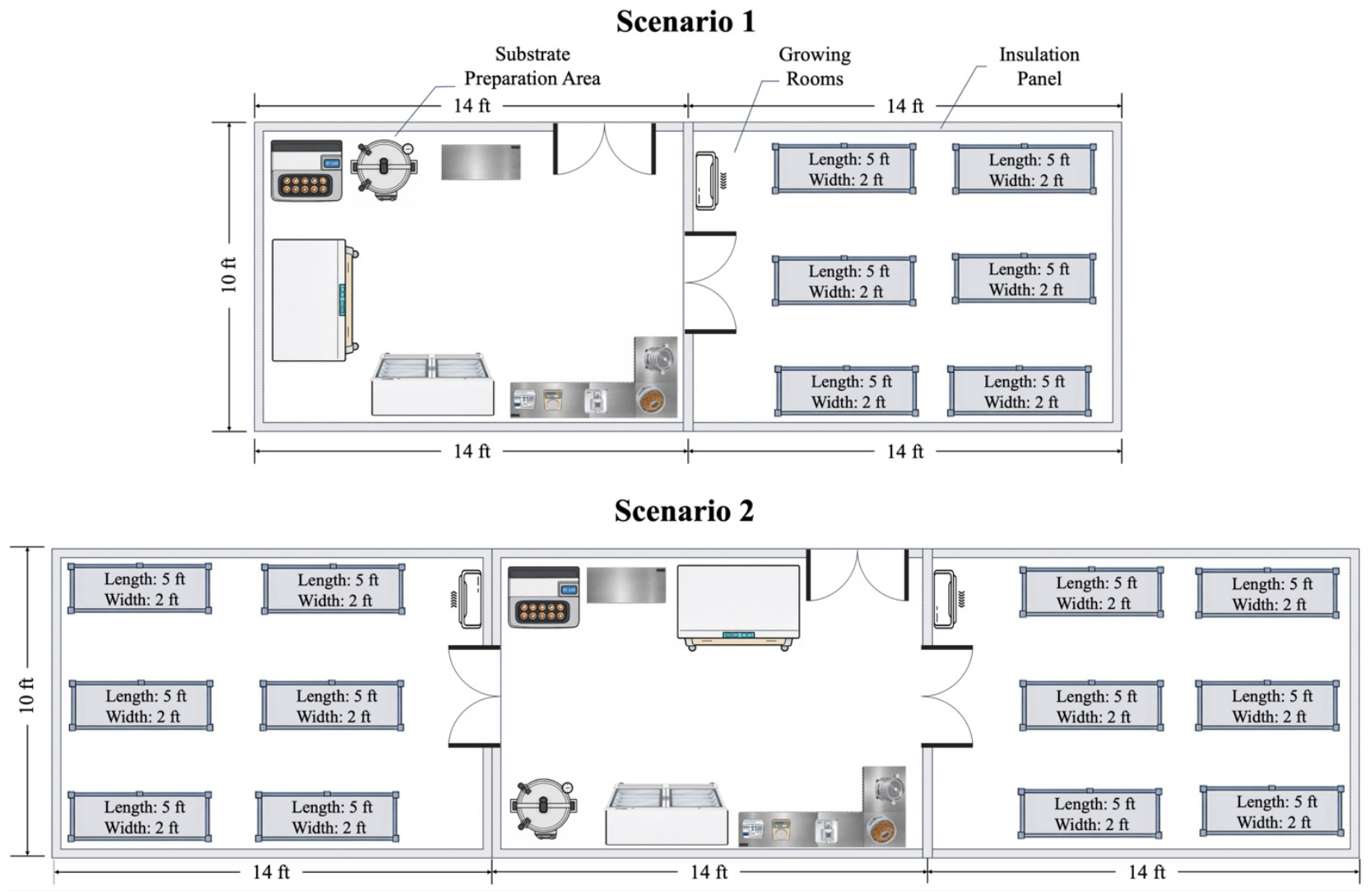
As illustrated in
Figure 1, Scenario 1 is directly based on the experimental setup described above, replicating the single-room configuration used at R&P Biotics, a substrate preparation area (14′ × 10′, 140 ft
2) housing the autoclave, laminar flow hood, and associated laboratory equipment, and a single growing room (14′ × 10′, 140 ft
2) with insulation panels and six shelving units (5′ × 2′, three rows each), yielding 18 shelf rows for bag placement. Scenario 2 is a modeled expansion beyond the experimental setup, adding a second independent growing room of the same dimensions to create a two-room configuration and doubling shelf capacity to 36 rows across both rooms. Each growing room operates as a self-contained unit with its own HVAC system, LED lighting, and exhaust fans, while the substrate preparation area is shared between the two rooms on a staggered schedule.
Both scenarios share identical assumptions for biological yield, contamination rate, substrate composition, selling price, and family labor, with no hired workforce, ensuring that observed differences in financial performance arise solely from the scale and scheduling of production rather than from changes in underlying unit economics.
The experimental cultivation trials were conducted in polypropylene cups. However, for economic modeling in both scenarios, polypropylene fruiting bags are assumed as the production unit rather than cups. This substitution is justified on several grounds. First, reusable cups require repeated washing, sterilization, and handling between batches, adding labor, water, and energy costs that are particularly burdensome in a family-operated, no-hired-labor system. Second, bag cultivation provides superior moisture retention, better aeration, and more uniform mycelial colonization than rigid container systems, leading to higher yields and biological efficiency (BE) [
22]. Third, at the production volumes modeled in this study, polypropylene fruiting bags represent a lower per-unit cost than reusable rigid containers. Bags are also the dominant cultivation vessel in small-scale mushroom production globally, accounting for ~92% of worldwide output [
23], and have been identified as a low-cost, economically viable cultivation strategy [
22], ensuring that the cost assumptions here are directly comparable to real-world commercial benchmarks. Because bags provide equal or better moisture retention, aeration, colonization, and BE than cups, as established above, applying the cup-derived BE and yield values to the bag-based model is a conservative assumption rather than an optimistic one. Contamination control was applied identically in both formats; however, container-specific differences in contamination risk cannot be fully ruled out and warrant confirmation in dedicated bag-based trials.
2.3. Chemicals and Reagents
All chemicals were sourced from HIMedia Laboratories, Mumbai, India. The reagents were used across the three-culture media.
2.4. Equipment and Consumables
The glassware used included disposable Petri dishes, 250-mL and 500-mL conical flasks, test tubes, glass funnels, beakers, and measuring jars. Additional consumables included non-absorbent cotton for plugging, butter paper, aluminum foil, rubber bands, micropore tape (3 mm), disposable syringes, forceps, and surgical blades. A comprehensive visual inventory of all essential equipment, instruments, and consumables required for small-scale
Cordyceps cultivation is provided in the
Supplementary Materials (Supplementary Figures S1–S3). These detailed photographs illustrate major laboratory equipment, ancillary instruments, and complete lists of consumables, glassware, and laboratory tools necessary for successful cultivation operations. These comprehensive visual guides serve as practical reference materials for families and small-scale producers to systematically identify, procure, and organize all necessary components before initiating cultivation, ensuring thorough preparation and minimizing setup delays.
2.5. Culture Medium
Three media were used, each tailored to a distinct stage of the production chain: Medium 1 (PDA-based solid medium) for culture maintenance and tissue-culture initiation; Medium 2 (liquid medium) for rapid liquid-spawn proliferation; and Medium 3 (nutrient solution applied to the red rice substrate) to support fruiting body development. The formulations were adapted from previously reported optimization studies for each respective stage [
24,
25,
26,
27,
28,
29].
Medium 1 (for culture plates): About 32.5 g of PDA powder and 0.5 g of MgSO
4 were mixed with 1000 mL of preheated water at 70–80 °C and stirred continuously until homogeneous. The volume was then adjusted to 1000 mL to compensate for evaporation. The medium was poured into test tubes (one-quarter capacity) or conical flasks for Petri dish preparation, sealed with non-absorbent cotton plugs covered with butter paper and aluminum foil, and autoclaved at 121 °C and 15 PSI for 30 min. It was then allowed to equilibrate at room temperature for 24 h before inoculation. Medium 2 (for liquid culture) was prepared by dissolving potato dextrose broth (24 g/L), glucose (30 g/L), peptone (5 g/L), yeast extract (4 g/L), potassium dihydrogen orthophosphate (1 g/L), magnesium sulfate (0.5 g/L), and vitamin B1 (0.2 g/L) in 1000 mL of distilled water [
24]. The medium was poured into conical flasks at 80% capacity, sealed with non-absorbent cotton plugs, wrapped in butter paper and aluminum foil, and autoclaved at 15 PSI for 30 min. Inoculation was performed within 24 h of cooling to room temperature to prevent fermentation.
Medium 3 (nutrient solution for fruiting cup substrate): This basal nutrient solution was prepared at pH 7.5 by dissolving glucose (30 g/L), peptone (5 g/L), yeast extract (4 g/L), potassium dihydrogen orthophosphate (1 g/L), magnesium sulfate (0.5 g/L), ammonium citrate (1 g/L), vitamin B1 (0.2 g/L), and vitamin B12 (0.01 g/L) in 1000 mL of distilled water [
25,
26,
27,
28,
29]. For substrate preparation, 20 g of red rice was mixed with 32 mL of nutrient solution at a ratio of 1 g to 1.6 mL per fruiting cup. The loaded fruiting bags were autoclaved at 121 °C for 30 min, then cooled to room temperature before inoculation.
2.6. Tissue Culture Initiation
Tissue culture was initiated by aseptically halving a healthy Cordyceps fruiting body and removing ~5 mm of the central medullary tissue. The tissue was transferred to PDA medium in a sterilized test tube or Petri dish. Petri dish rims were taped to prevent opening while allowing limited gas exchange. All cultures were incubated in darkness at 18–22 °C for 15 days. After the dark phase, cultures were exposed to ambient light for two to four days; successful isolation was confirmed by a color change in the mycelium from white to orange.
2.7. Liquid Spawn Preparation
Conical flasks containing sterilized Medium 2 were placed in the UV-treated LAF for 30 min before inoculation. A fragment of
Cordyceps mycelium (0.5–1.0 cm) was aseptically transferred from the test tube culture into each Erlenmeyer flask, ensuring the forceps did not touch the inner flask walls. Inoculated flasks were closed using a cotton plug for air exchange, placed on a rotary shaker at 60–70 RPM, covered with opaque black polyethylene to block light, and incubated for five to seven days. Liquid-spawn cultures were considered ready when the mycelium was evenly distributed throughout the medium [
25].
2.8. Fruiting Bag Inoculation
Sterilized fruiting bags were placed in the UV-treated laminar airflow cabinet for 30 min before inoculation. Five milliliters of liquid spawn were injected into each fruiting cup or bag containing 20 g of red rice using a sterile disposable syringe. The bag was gently rotated to evenly distribute the inoculum across the rice substrate.
2.9. Cultivation Conditions
After inoculation, the inoculated fruiting cups were placed on shelves and covered with opaque black polythene to block all light. Temperature was maintained between 19 and 21 °C with no added humidity. Colonization was monitored by visual inspection through the container walls. When the red rice substrate was fully covered with white mycelium, usually within 7–10 days after inoculation, it signaled readiness to move to the light phase. After full colonization, fruiting bags were transferred to shelves fitted with pink-spectrum LED lights operating on a 12-h light:12-h dark cycle, controlled by timer switches. The temperature was kept between 16 and 20 °C, and the relative humidity was maintained at 90–95% using an ultrasonic humidifier [
30]. The change in mycelium color from white to orange, which usually occurs within 2 days of light exposure, served as a key developmental indicator. Primordia were expected to appear between days 17 and 20 post-inoculation, with visible fruiting bodies developing from day 25 onward. Each production batch comprised 36 sequential sub-batches of ~54 fruiting cups, for a total of 1944 cups per cycle. One batch (~54 cups) was inoculated per day. Cycles were run sequentially. After each harvest, the room was closed, sterilized, and cleaned before the next batch was started. Because production was carried out as sequential single batches under uniform environmental conditions, no randomized experimental layout was applied, and the measured per-unit biological performance was used to parameterize the techno-economic model, with parameter variation explored through the sensitivity analysis in
Section 3.6. During fruiting, CO
2 concentration was maintained at ~800 ppm, with the two exhaust fans providing ~10 air exchanges per hour; illumination was provided by pink-white-spectrum LEDs, 1500 ± 250 lux at shelf level.
2.10. Fruiting Body Harvest
Fruiting bodies were harvested between days 56 and 60 post-inoculation, once they reached full maturity. Alcohol sprayed gloves were used during harvesting. Mushrooms were carefully hand-picked to minimize mechanical damage. Any fruiting bags showing signs of contamination at any stage of growth were immediately removed from the grow room and discarded [
31].
At harvest, fresh fruiting bodies from each unit were weighed on a calibrated balance to obtain fresh weight per unit and per batch. A representative subsample was dried in the food-grade dehydrator at 40 °C to a final moisture content of ~10% and reweighed to determine dry yield. Moisture content was calculated as [(fresh weight − dry weight)/fresh weight] × 100. BE was calculated as the ratio of total fresh fruiting body weight to the dry weight of the loaded red rice substrate, expressed as a percentage: BE (%) = (fresh fruiting body weight/dry substrate weight) × 100.
2.11. Post-Harvest Drying and Storage
Harvested fruiting bodies were dried in a food-grade vegetable dehydrator at 40 °C until reaching a final moisture content of ~10%. Drying significantly influences the retention of bioactive compounds in
Cordyceps: freeze-drying preserves the highest cordycepin content, sun-drying maximizes adenosine retention, and hot-air and vacuum drying achieve the best balance for other thermolabile metabolites [
32]. Hot-air dehydration was selected for this study as a practical compromise among cost, accessibility, and preservation of bioactive compounds, making it well-suited for family-operated, small-scale operations. The dried mushrooms were then vacuum sealed in airtight pouches to prevent moisture reabsorption.
2.12. Growth Monitoring and Quality Control
Development was monitored daily in accordance with the timeline outlined in
Table 1. Fruiting bags were discarded if mycelium did not turn from white to orange within three days of moving to the light phase, or if any visible contamination was present; bags were kept sealed until harvest to avoid moisture loss.
Beyond visual inspection, contamination monitoring was conducted throughout the cultivation cycle by examining bags daily for abnormal coloration, unusual odor, or visible mold growth; any compromised bags were immediately removed from the grow room and discarded to prevent cross-contamination. At harvest, the microbial quality of the fruiting bodies is recommended to be further assessed using ATP (adenosine triphosphate) bioluminescence assay kits, which provide a rapid and sensitive measure of total microbial load by quantifying cellular ATP as a proxy for viable microbial biomass. The ATP assay was not performed in our study; however, ATP assay results will help verify that harvested mushrooms meet acceptable microbiological standards prior to packaging [
33,
34,
35]. This dual approach, combining continuous visual monitoring during cultivation with quantitative biochemical assessment at harvest, ensured consistent quality control across all production batches and supported the assumption of a 15% contamination rate used in the calculations.
2.13. Techno-Economic Analysis (TEA)
TEA was conducted to assess the financial viability of small-scale
Cordyceps production under two scenarios. Scenario 1 represents the baseline configuration operated by one family member. Scenario 2 represents a scaled-up configuration operated by two family members. Both scenarios assume no hired labor, the same cultivation cycle, market pricing, and financial parameters. All financial values are reported in United States Dollars (USD). Production assumptions, CapEx, OpEx, and 5-year projections were modeled in a purpose-built spreadsheet to estimate return on investment (ROI), net present value (NPV), internal rate of return (IRR), payback period, and break-even analysis. The key production parameters used are shown in
Table 2. Although the cultivation protocol was developed and demonstrated at the facility in Chennai, India, given that the United States was selected as a representative high-value target market for
Cordyceps nutraceutical products, the techno-economic model was parameterized using United States market prices and financial assumptions, and all values are reported in USD for comparability with the cited small-scale specialty-mushroom benchmarks. Absolute returns would differ under local input and product pricing; however, the structural conclusions are robust to market context.
In this model, mushroom yield is assumed to be 55 lb/batch (Scenario 1) and 110 lb/batch (Scenario 2) at 90% moisture. Pricing benchmarks were established at
$80/lb (wholesale low),
$90/lb (average), and
$100/lb (retail high), based on prevailing US market rates for organic
Cordyceps fresh fruiting bodies. An 8% discount rate, a 30% tax rate, an annual cost escalation of 2.5%, and loan financing covering 80% of CapEx expenses were applied consistently across the financial models. CapEx included all one-time investments required to set up the growth rooms and major/ancillary equipment, totaling
$32,180 for Scenario 1 and
$44,654 for Scenario 2, as shown in
Table 3.
Equipment was grouped into four categories: (a) major laboratory instruments, (b) ancillary equipment, (c) grow room infrastructure, and (d) glassware and lab tools. A 5% contingency was added to the subtotal. OpEx was evaluated on a per-batch basis and categorized into three components: substrate and growth media, consumables, and utilities. Labor costs were excluded from both scenarios because the operation is family-operated and has no hired labor.
Total OpEx per batch was
$1683 for Scenario 1 and
$3309 for Scenario 2. The detailed per-batch OpEx breakdown for both scenarios is presented in
Table 4.
2.14. Economic Modeling and Cost Analysis
The economic viability of small-scale
Cordyceps production was evaluated using a 5-year discounted net return (DNR) model built in Microsoft Excel (version 16.109.2, 2026). The model calculated earnings before tax (EBT), net return after tax, NPV, IRR, payback period, ROI, and break-even points. Each analytical component and its governing equations are described in the following subsections. In developing the DNR, the annual EBT was first calculated by subtracting total annual OpEx, maintenance expenses, depreciation, and loan interest from the gross return. Depreciation was computed using the straight-line method using category-specific useful lives (5 years for electronics, sensors, and lab tools; 10 years for major instruments and durable appliances; 15 years for grow-room infrastructure) with zero salvage value, with the 5% contingency allocated across categories in proportion to their share of total CapEx, and loan interest was fixed at 8% of the remaining loan balance for all projection years. All financial metrics were computed using standard engineering-economic methods [
36] and managerial cost-accounting principles [
37]. EBT thus reflected the operation’s true economic EBT, as shown in Equation (1).
where
Income tax was applied at 30% of EBT in each projection year (Equation (2)), consistent with the assumption of a representative income tax rate for small, family-operated enterprises. Net return after tax was then calculated as EBT plus depreciation minus the income tax charge (Equation (3)). Annual revenue and OpEx increased by 2.5% each year from Year 2 onward to reflect inflationary effects on prices and input costs.
Adding annual depreciation back to EBT is necessary because depreciation is a non-cash accounting charge that reduces reported return but does not involve any actual cash outflow from the business. Net return (from this point forward, net return after tax is referred to simply as net return) thus represents the actual return generated by operations each year, available to cover CapEx. Cumulative net return was calculated as the running total of annual net return values, with the full CapEx outlay recorded as a negative value at Year 0 (Equation (4)). This allowed the payback period to be defined as the point at which cumulative net return first crossed zero.
NPV was calculated by discounting each year
to its present value at an 8% discount rate, then summing over all 5 projection years and subtracting the CapEx (Equation (5)). Discounting adjusts future returns to reflect the time value of money; a dollar received in the future is worth less than a dollar received today. A positive NPV indicates that the project is expected to generate returns that exceed its total cost over the projection period.
IRR is the discount rate at which the NPV of the project equals zero (Equation (6)). Unlike NPV, which evaluates project viability at a fixed discount rate, IRR expresses the project’s inherent return as a single percentage, independent of any assumed rate. IRR was calculated iteratively using Microsoft Excel’s built-in IRR function applied to the full net return series, including the Year 0 CapEx outflow. A project with an IRR exceeding the discount rate (8% in this study) is considered financially viable.
The discounted payback period is the first year in which the cumulative present value of DNR becomes non-negative (Equation (7)), indicating the complete recovery of the initial CapEx, adjusted for the time value of money. By discounting each year’s net return at 8%, this metric provides a more conservative measure of investment recovery than the simple payback period, as it reflects the opportunity cost of CapEx over the entire recovery horizon.
where
ROI was calculated as the ratio of the total cumulative net after-tax return over the full 5-year projection period to the total CapEx, expressed as a percentage (Equation (8)). This metric provides a simple, single-period measure of capital efficiency, with CapEx of
$32,180 in Scenario 1 and
$44,654 in Scenario 2.
Break-even analysis was performed using the contribution margin method to determine the minimum production volume and minimum selling price at which the operation covers all costs. The contribution margin per pound is the portion of the selling price remaining after variable costs, available to recover CapEx (Equation (9)). The break-even volume is the annual output at which total contribution exactly matches total CapEx (Equation (10)). The break-even selling price at the current annual production volume was found by rearranging the cost-coverage condition (Equation (11)). Finally, the safety margin is measured as the percentage by which the actual selling price exceeds the break-even price, indicating the buffer before the operation starts incurring losses (Equation (12)).
3. Results and Discussion
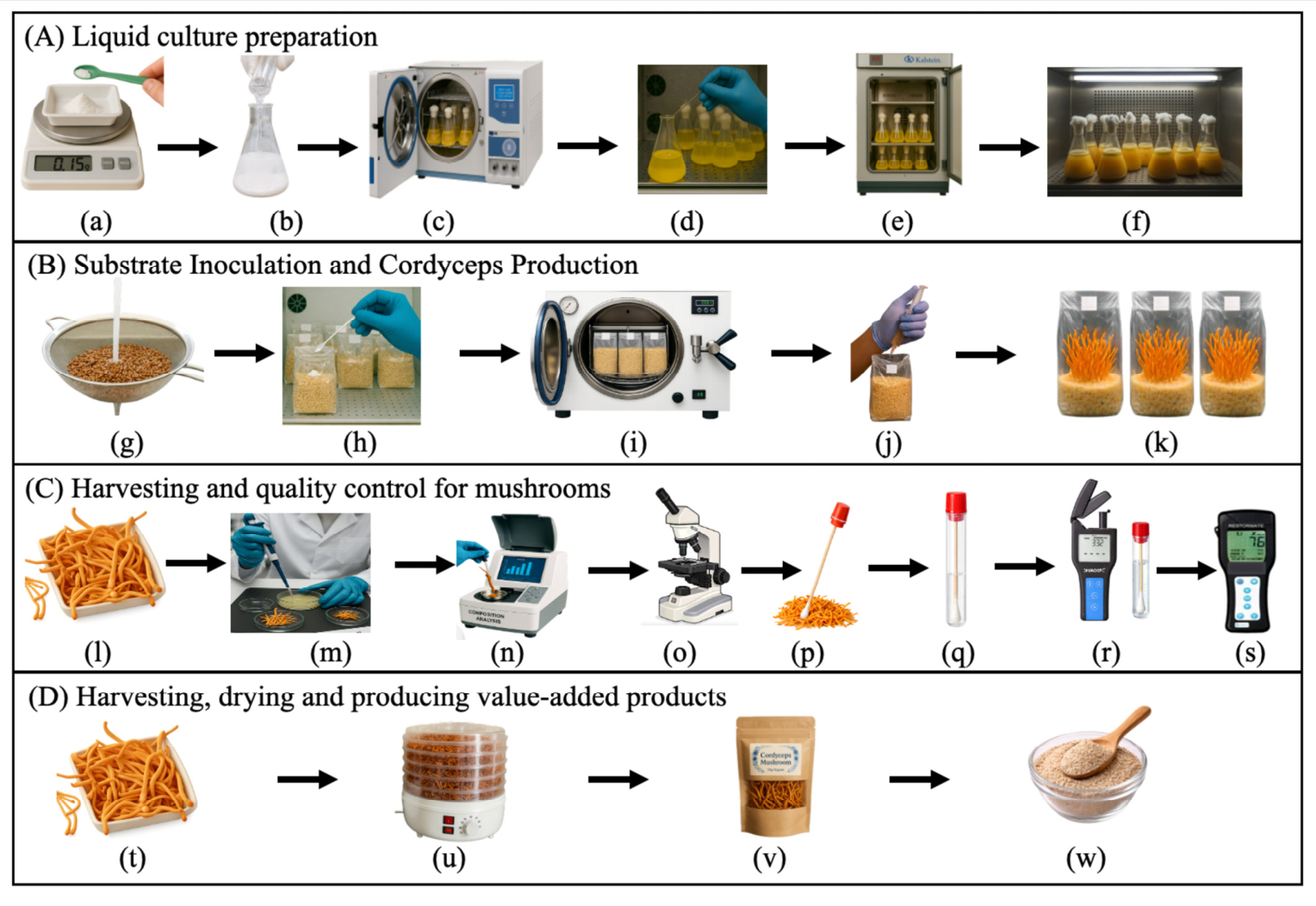
The complete small-scale cultivation workflow for
Cordyceps used in this study is summarized in
Figure 2. The production cycle comprises four consecutive stages: (A) liquid culture preparation, in which nutrient media are prepared, sterilized, and inoculated to produce liquid spawn; (B) substrate inoculation and fruiting body development, involving grain substrate preparation, sterilization, inoculation, and incubation through dark and light phases until harvest-ready fruiting bodies form; (C) harvesting and quality control, including collecting fresh mushrooms, conducting microbiological assessment, performing compositional analysis, and measuring moisture and water activity; and (D) post-harvest processing and development of value-added products, such as dehydration, packaging, and powder production. Each stage is explained in detail in the following subsections.
3.1. Production Scheduling and Batch Cycle Management
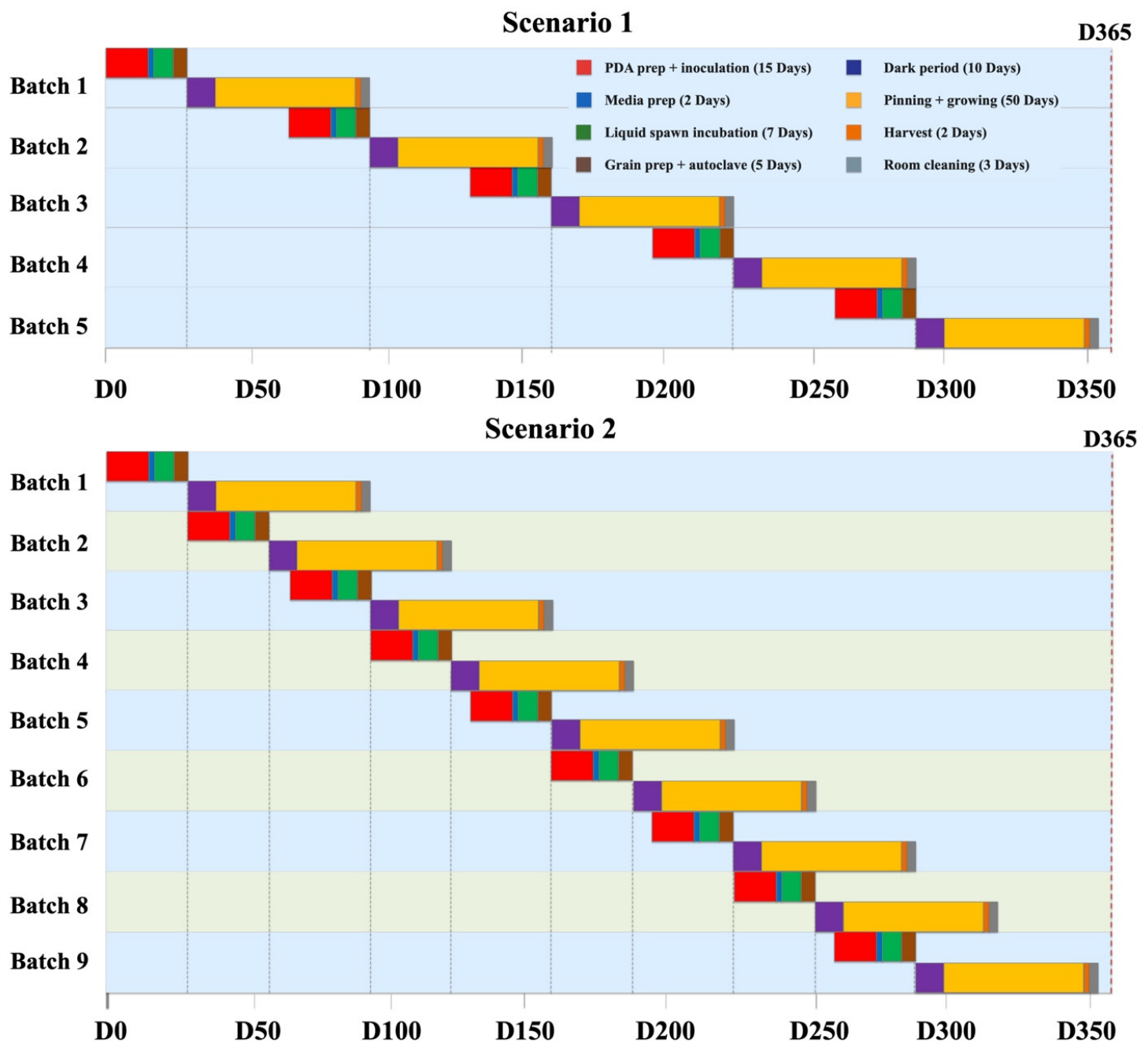
The production cycle spans 91 active days per batch, covering the full process from culture preparation through harvest, followed by 3 days of room cleaning at the end of each cycle, bringing the total cycle duration to 94 days. The phase sequence per batch is as follows: PDA preparation and inoculation (15 days), liquid media preparation (2 days), liquid spawn incubation in a rotary shaker (7 days), grain preparation and autoclaving (5 days), dark colonization period (10 days), pinning and fruiting body development (50 days), and harvest (2 days). Room fumigation and cleaning are conducted for 3 days immediately after harvest to prepare the space for the next batch.
In Scenario 1, the single growing room operates sequentially, with all preparatory stages completed in the substrate preparation area before each batch enters the dark colonization phase. Because only one room is available, a new batch cannot begin until the previous cycle, including room cleaning, is fully completed, limiting annual throughput to five production cycles within 365 days (
Figure 3, Scenario 1).
In Scenario 2, two independent growing rooms operate with a 29-day offset between them. From the second batch onward, the preparatory stages for the incoming batch, including PDA preparation, media preparation, liquid spawn incubation, and grain preparation, are initiated in the shared substrate preparation area while the previous batch is still in its fruiting stage in the other room. The 29-day offset precisely matches the total substrate preparation duration, ensuring that each incoming batch is ready to enter the dark phase exactly when the preparation area becomes available. This staggered two-room scheduling eliminates idle time between consecutive cycles, maintains physical separation between concurrent batches to minimize the risk of cross-contamination, and increases annual throughput to 9 production cycles within 365 days (
Figure 3).
3.2. Cultivation Yield and BE
BE, defined as the ratio of fresh fruiting body weight to the dry weight of the substrate used, was calculated as follows. Cultivation of these 1944 cups produced a gross fresh fruiting-body yield of ~85.7 lb, equal to the dry substrate mass and therefore corresponding to an average BE of ~100% (individual cups ranged from 90% to 110%). After applying the 15% contamination rate used throughout the analysis, the net fresh yield from the demonstration was ~73 lb, equivalent to roughly 7.3 lb of dried product (a ~10:1 fresh-to-dry ratio). The relatively high BE achieved in this study may be attributed to the optimized nutrient solution formulation used in Medium 3, particularly the inclusion of vitamin B12, ammonium citrate, and a balanced carbon-to-nitrogen ratio, all of which have been reported to enhance fruiting body biomass accumulation in
Cordyceps [
31]. The per-unit yield established in this demonstration was then applied to the modeled production batches of 1250 and 2500 fruiting bags in the techno-economic analysis (Scenarios 1 and 2).
On this basis, the gross fresh fruiting body yield for Scenario 1 (1250 fruiting bags) was 55 lb per batch, derived directly from the experimentally determined per-unit yield rather than from external benchmarks. After accounting for the 15% contamination rate, consistent with contamination risks reported under small-scale aseptic conditions, the adjusted average fresh yield was 47 lb per batch, based on ~1063 effective bags. Dry yield, based on the ~90% moisture content of fresh fruiting bodies (a ~10:1 fresh-to-dry ratio), averaged 5 lb per batch for Scenario 1 and 9 lb per batch for Scenario 2. Across 5 production cycles per year for Scenario 1, annual fresh and dry yields were 234 lb and 23 lb, respectively. For Scenario 2, operating 9 production cycles per year across 2 growing rooms, the annual fresh yield reached 842 lb, with a corresponding dry yield of 84 lb, reflecting the combined effect of doubled bag capacity and increased batch frequency.
3.3. OpEx and CapEx
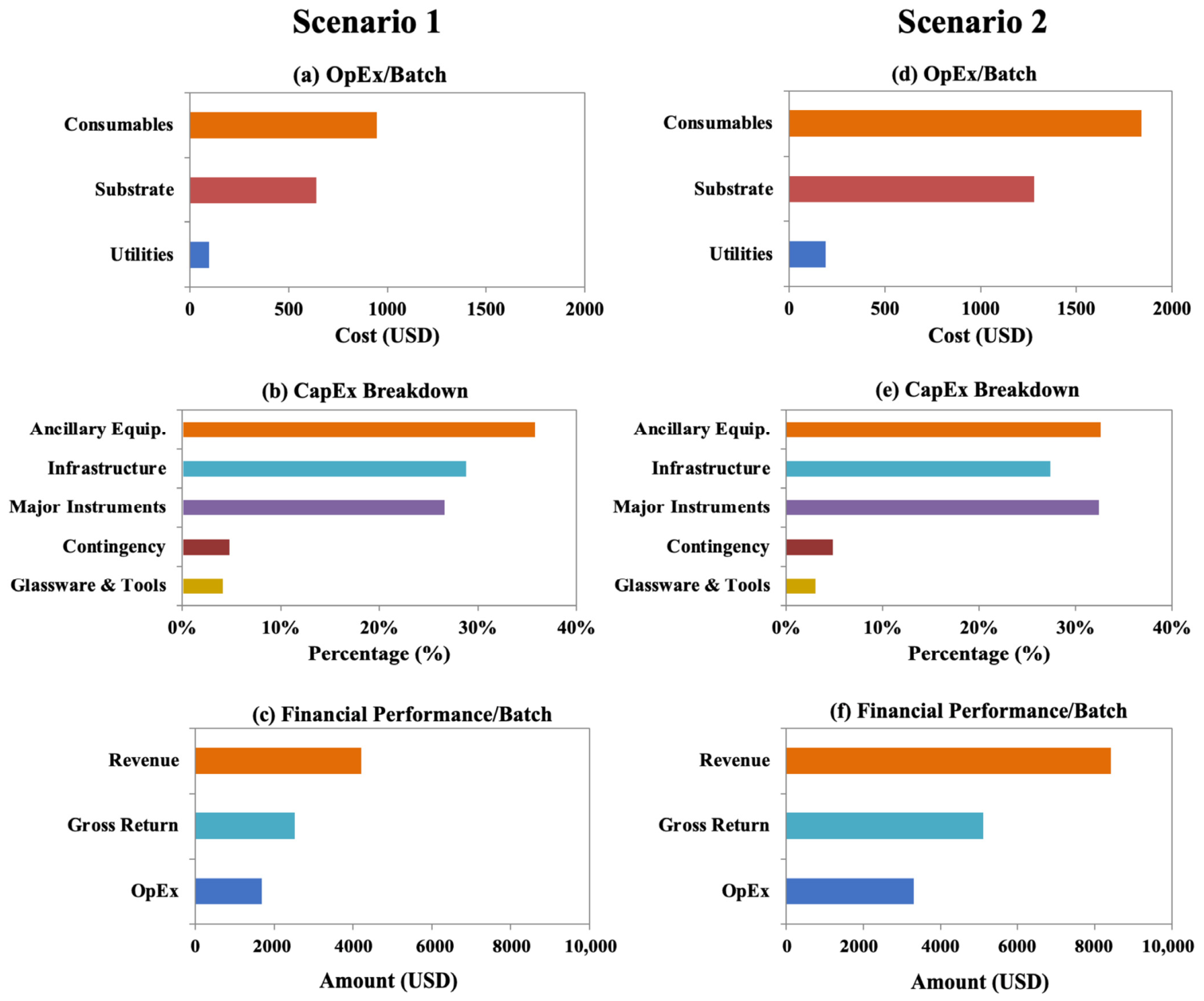
The per-batch OpEx for Scenario 1 totaled
$1683, distributed across three categories (
Table 4 and
Figure 4a). Consumables accounted for the largest share at
$948 (56%), driven primarily by the assay kit (
$300) and mushroom packaging bags (
$500). The dominance of consumable costs reflects the quality-assurance-intensive nature of medicinal mushroom production, where ATP assay kits, PPE, and sterile packaging are unavoidable per-batch expenditures.
Substrate and growth media accounted for
$640 (38%), while utilities contributed
$95 (6%), reflecting electricity consumption of 1270 kWh per batch based on a bottom-up equipment model. Detailed electricity consumption calculations for both scenarios, including a bottom–up equipment-level breakdown of power ratings, operating hours, efficiency factors, and system losses, are provided in
Tables S1 and S2. These findings suggest that cost-reduction strategies should primarily target consumable procurement through bulk purchasing or reusable PPE components, rather than substrate formulation, where ingredient costs are already low relative to total OpEx. Under Scenario 2, per-batch OpEx increased to
$3309, with consumables remaining in the dominant category at
$1840 (55%), followed by substrate at
$1280 (39%) and utilities at
$189 (6%) (
Table 4 and
Figure 4d).
Total CapEx was
$32,180 for Scenario 1 and
$44,654 for Scenario 2 (
Table 3,
Figure 4b,e). The composition of CapEx differs notably between the two scenarios. In Scenario 1, ancillary equipment formed the largest share at 36%, followed by room infrastructure at 29%, major laboratory instruments at 27%, glassware and lab tools at 4%, and contingency at ~5%. In Scenario 2, ancillary equipment and major laboratory instruments became nearly equal at 33% and 32%, respectively, followed by grow room infrastructure at 27%, glassware and lab tools at 3%, and contingency at ~5%.
The high combined share of instrumentation and infrastructure costs reflects the precision-controlled environment required for consistent Cordyceps production, in which the HVAC system, autoclave, LAF cabinet, and dehydrator are indispensable investments regardless of production scale. In Scenario 2, doubling key equipment to support two concurrent growing rooms increased the share of major laboratory instruments in total CapEx from 27% to 32%. Despite this, the incremental CapEx of $12,474, representing ~39% additional CapEx above Scenario 1, yielded more than a fivefold improvement in Year 1 net return, confirming that physical expansion costs remain highly justified relative to the financial gains achieved.
3.4. Per-Batch Financial Performance
Per-batch financial performance for Scenario 1 (
Figure 4c) showed strong unit economics. Revenue per batch was
$4208 at an average selling price of
$90/lb, with OpEx of
$1683, yielding a gross return of
$2525 and a gross margin of 60%. These results indicate that the primary financial challenge for small-scale operators is not per-batch profitability but rather the recovery of initial CapEx over repeated production cycles.
Per-batch financial performance for Scenario 2 (
Figure 4f) showed substantially stronger unit economics. Revenue per batch was
$8415 at an average selling price of
$90/lb, with OpEx of
$3309, yielding a gross return of
$5106 and a gross margin of 61%. This margin is consistent with Scenario 1 at 60%, reflecting that while bag count doubled, consumable and substrate costs scaled proportionally. The result confirms that scaling production volume substantially increases absolute return even as gross margin percentage remains similar, because the CapEx structure means the primary financial gain comes from throughput rather than unit cost reduction.
3.5. TEA Summary and Financial Feasibility Assessment
The comprehensive TEA of both production scenarios is summarized in
Figure 5, with a full comparative breakdown of financial and operational parameters in
Table 5. For Scenario 1, the variable cost per pound of fresh mushrooms was
$36/lb, calculated by dividing total OpEx by the fresh yield per batch. The resulting contribution margin was
$54/lb. Break-even analysis showed that the operation required a minimum of 111 lb of fresh mushrooms per year, equivalent to 2.4 of five batches completed annually, to cover all CapEx and OpEx. This represents ~47% of annual production capacity, confirming that the system operates above its break-even threshold under normal conditions.
The break-even selling price at full annual production volume was
$62/lb, yielding a safety margin of 31%, indicating a price buffer above the cost-recovery threshold. These findings are consistent with prior economic evaluations of small-scale specialty mushroom production in the Northeastern United States, which similarly report favorable break-even thresholds and strong contribution margins when premium-priced gourmet and medicinal mushrooms are produced on small-scale grain- or log-based substrate systems [
14], with comparable IRR-based feasibility outcomes reported for integrated small-scale mushroom production systems in the United States [
15] and similar break-even and margin-of-safety patterns observed across small, medium, and large
Cordyceps enterprise scales in India [
9].
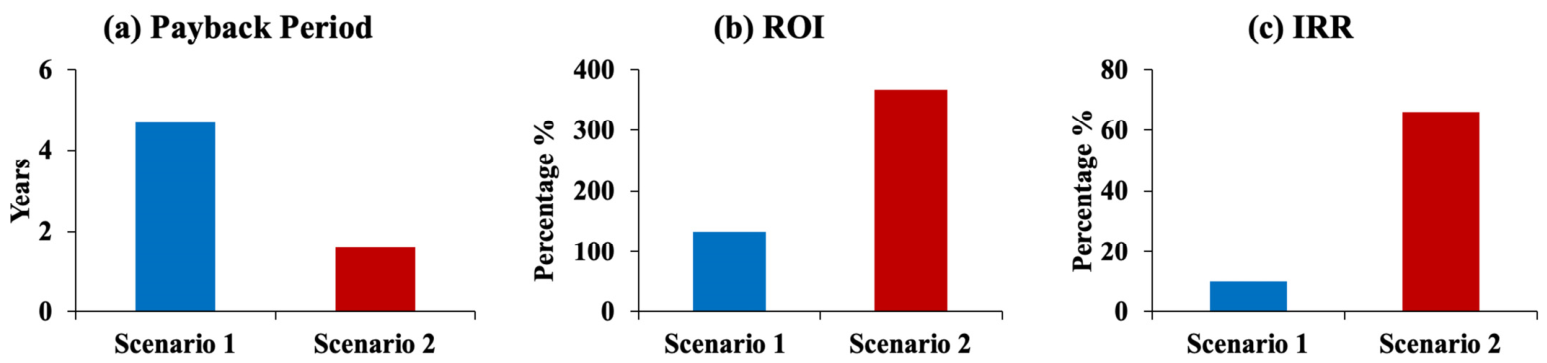
The broader financial indicators further confirmed the economic viability of Scenario 1. The IRR of 10% over the 5-year projection exceeded the 8% discount rate, and the 5-year NPV of
$1761 was positive, collectively confirming that the project generates economic value above its cost of capital. The discounted payback period of 4.7 years indicates that full capital recovery is achievable within 5 years of operation (
Figure 5a). The 5-year cumulative ROI of 133% (27% average annual) (
Figure 5b) and gross margin per batch of 60% collectively reinforce the conclusion that
Cordyceps cultivation is a financially sound enterprise model for small-scale producers operating with modest capital and a single family member.
Scaling production to Scenario 2 substantially improved all financial metrics, as detailed in
Table 5. The variable cost per pound was
$35/lb, and the contribution margin was
$55/lb. Break-even volume was 149 lb per year, equivalent to 1.6 batches, accounting for a slightly higher cost of the larger operation. The break-even selling price was
$45/lb, lower than in Scenario 1, and the safety margin rose to 50%. The IRR was 66% (
Figure 5c), and the 5-year NPV reached
$85,437, confirming that the scaled model generates substantially greater long-term value. The discounted payback period declined to 1.6 years (
Figure 5a), indicating that full capital recovery is achievable within approximately the first two years of operation. The 5-year cumulative ROI of 366% (73% average annual) (
Figure 5b) further underscores the financial leverage achieved by doubling production volume and increasing batch frequency under a partially shared CapEx structure, confirming that both production scale and scheduling intensity are critical levers for improving financial performance in this cultivation system.
3.6. Effect of BE and Contamination Rate on Financial Viability
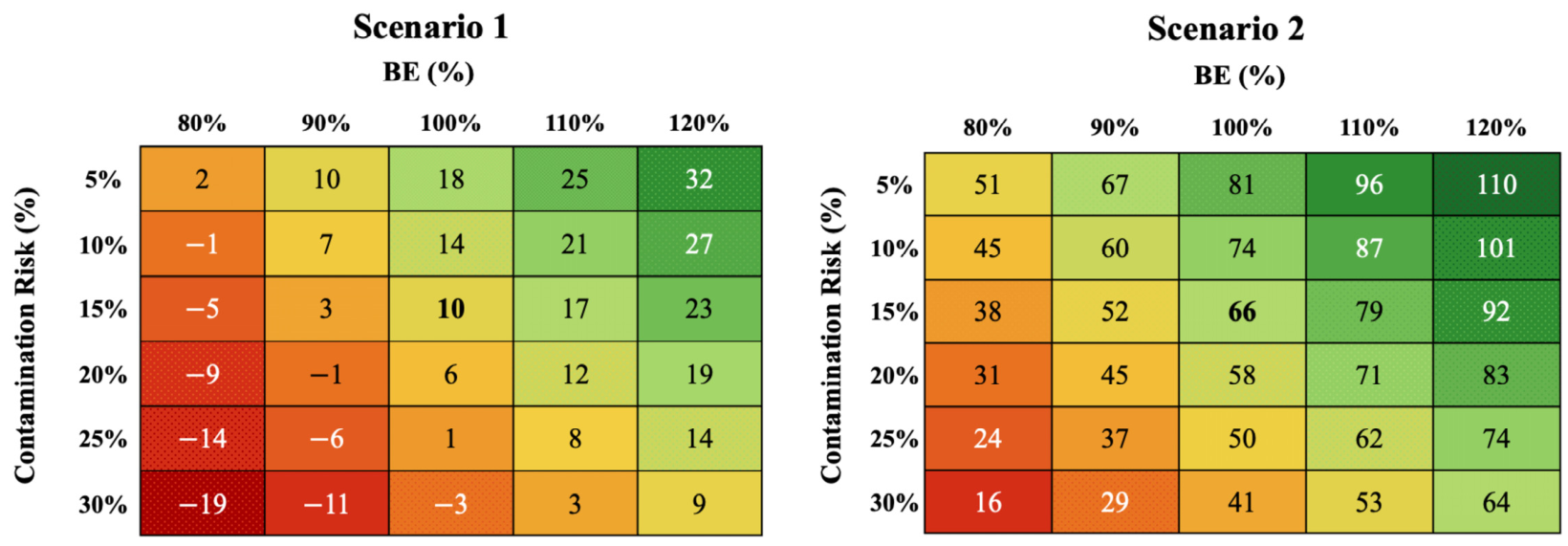
A two-dimensional sensitivity analysis was conducted to quantify the combined influence of BE and contamination rate on the IRR for both production scenarios (
Figure 6). BE was varied across five levels (80%, 90%, 100% base, 110%, 120%) and contamination across six (5–30%), yielding a 5 × 6 IRR matrix per scenario. Scenario 1 produced a base case IRR of 10% (100% BE, 15% contamination), just above the 8% hurdle rate, with values ranging from −19% at the worst combination (80% BE, 30% contamination) to 32% at the best (120% BE, 5% contamination). BE was the stronger driver: at 15% contamination, raising BE from 80% to 120% improved IRR by 28% (−5% to 23%), versus 21% (−3% to 18%) from reducing contamination from 30% to 5% at 100% BE. A substantial portion of the matrix (contamination ≥ 10% and BE ≤ 100%) fell below the hurdle rate, indicating that Scenario 1 requires near-optimal performance on both parameters to remain viable. Scenario 2 was markedly more robust, with IRR ranging from 16% to 110% and a base case of 66%. Even the worst-case combination yielded 16%, roughly twice the hurdle rate, confirming financial viability across every tested condition. BE remained the dominant driver, contributing a 54-percentage-point gain at 15% contamination (38% to 92%), compared with 40% from contamination reduction at 100% BE (41% to 81%).
These results confirm that production scale is the decisive determinant of financial resilience, while BE optimization and contamination control remain operationally critical, particularly for the smaller Scenario 1 configuration.
4. Conclusions
This study presented a comprehensive technical and economic framework for small-scale Cordyceps cultivation across two production scenarios. Both scenarios demonstrated strong financial viability, with Scenario 2 substantially outperforming Scenario 1 across all metrics. Scenario 1 delivered an IRR of 10% and a discounted payback period of 4.7 years, with Capex of $32,180. Scenario 2 achieved an IRR of 66% and full recovery within 1.6 years, with a capital increment ~39% above Scenario 1, driven by the addition of a single growing room, duplication of key instruments, and staggered scheduling. Sensitivity analysis confirmed that BE is the dominant operational risk factor, with Scenario 2 remaining financially viable across all tested combinations of BE and contamination rate. The break-even prices of $62/lb and $45/lb for Scenarios 1 and 2, respectively, provide a substantial cushion relative to the $90/lb average selling price. Beyond financial performance, both configurations function as viable family-operated enterprises, with Scenario 1 generating supplementary family income and Scenario 2 approaching a substantial secondary or near-primary livelihood at cottage-industry scale. This work provides an integrated, evidence-based guide to support consistent, profitable Cordyceps cultivation at the family-operated, small-scale level, with future work needed to validate projections using longitudinal farm-level data and to explore direct-to-consumer pricing and substrate optimization strategies.




 ,
,