Article

Study on the Arresting Performance and Efficiency Prediction of Arrestors for Sandwich Pipes with Corrosion Defects

School of Mechanical Engineering, Yangtze University, Jingzhou 434023, China
*
Author to whom correspondence should be addressed.
Processes 2026, 14(12), 1910; https://doi.org/10.3390/pr14121910
Submission received: 9 May 2026 / Revised: 9 June 2026 / Accepted: 9 June 2026 / Published: 12 June 2026
(This article belongs to the Section Process Safety and Risk Management)

Abstract

The existing arresting efficiency evaluation method overlooks corrosion defects in its formulation. If directly applied to evaluate and design arrestors for corroded sandwich pipes, it often leads to conservative evaluations of arresting efficiency and unreasonably designed arrestors. Based on this, this paper first verifies the reliability of numerical simulation results through physical experiments. On this basis, the influence of the structural parameters and material parameters of the arrestor on the arresting efficiency of the integral arrestor is analyzed. The results show that an increase in the length, thickness and material strength of the arrestor not only affects the arresting efficiency of the arrestor but also changes the arresting crossing mode, from parallel crossing to orthogonal crossing. A chart of arresting efficiency suitable for engineering design is proposed. Finally, a systematic comparison is conducted of different modeling methods. The results show that, considering both prediction accuracy and training efficiency, the Genetic Algorithm–Back Propagation (GA-BP) model significantly outperforms the empirical model, the Whale Optimization Algorithm–Back Propagation (WOA-BP) model, and the Particle Swarm Optimization–Back Propagation (PSO-BP) model. The average prediction error is only 6.56%, and 94.42% of the data error is less than 20%. The model provides a theoretical basis for the arrestor design and failure assessment of sandwich pipes with corrosion defects and has clear engineering guidance value.

1. Introduction

As the development of offshore oil and gas resources continues to advance into deep and ultra-deep waters, deep-sea subsea pipelines face severe challenges in terms of flow assurance and structural integrity [1,2]. The development of sandwich pipes with both good thermal insulation and structural strength has become an important technical pathway. It ensures the strategic safety of deep-sea oil and gas development. However, with the increase in the service life of the pipeline, the local or overall thinning of the pipe wall caused by corrosion significantly weakens the structural resistance of the pipeline. Under high hydrostatic pressure in deep water, this can easily induce buckling instability failure, leading to overall pipeline failure and causing serious economic losses [3,4,5,6]. Therefore, it is of great significance for guiding the design and safe operation of deep-sea submarine pipelines to carry out research on the evaluation of the buckling arrest performance of corroded sandwich pipes.
In early 1970, Mesloh et al. first discovered the phenomenon of buckle propagation in subsea pipelines through laboratory experiments. Their study pointed out that attempting to design deepwater pipelines to completely avoid buckle propagation would be extremely costly [7]. In order to prevent buckling propagation in pipelines, Johns et al. proposed the method of using an arrestor to suppress buckling propagation in 1978 and published the corresponding test results [8]. Since then, various types of arrestors have gradually become a hot topic in the study of buckling control over submarine pipelines [9,10,11,12,13,14,15,16,17,18,19,20,21,22]. Kyriakides et al. conducted research on three types of buckle arrestors (slip-on, spiral, and integral) and provided empirical formulas relating buckle arrestor length, thickness, and material properties to arresting efficiency [9,10,11]. Through a combination of experiments and numerical simulations, Lee et al. found that the arresting efficiency formula proposed by Kyriakides is too conservative for certain combinations of arrestors and pipe yield stress [12,13]. For this reason, the design formula was modified through a broader parametric analysis, and finally, an arresting efficiency formula with a wider range of applicability was obtained. Gong et al. investigated the buckle crossover pressure of welded-ring buckle arrestors under external pressure; revealed the effects of weld size, geometric characteristics, and material properties on arrestor efficiency; and established an empirical expression for the crossover pressure of welded-ring arrestors. Combined with a lower-bound envelope line, this expression can reasonably estimate arresting efficiency [14]. Huang investigated the performance of spiral buckle arrestors using scaled-model tests. It was found that the buckle crossover pressure depends on the pipe diameter-to-thickness ratio and mechanical properties, as well as the rod diameter, number of turns, and mechanical properties of the spiral buckle arrestor [15]. Lee et al. conducted research on the arresting efficiency of snap-on buckle arrestors for pipelines applicable to moderately deep and deep water. Through experiments and full-scale numerical simulations, they performed parametric analyses of arrestor efficiency and proposed a corresponding empirical formula for arrestor efficiency [16]. Prasad et al. proposed a new type of Double-C clamp arrestor to improve the buckling load capacity of a pipeline. The experimental results show that the addition of an arrestor has a significant effect on the critical buckling load of the pipeline. When a Double-C clamp buckle arrestor is used, the critical buckling load of the pipeline is significantly higher than that of a single group configuration and a pipeline without the device, which is 42.8% higher than that of the pipeline without the arrestor device and 19% higher than that of the pipeline only equipped with the single group arrestor [17].
With the advancement of new materials, carbon fiber buckle arrestors have emerged as a research focus in the field of submarine pipeline buckling control, attributed to their excellent properties such as low weight, high strength, and corrosion resistance. Compared with conventional metal buckle arrestors, carbon fiber composites offer higher arresting efficiency while reducing structural weight, thereby demonstrating great application potential in medium-deep and deep-water pipeline engineering [23,24,25,26,27,28]. Wang et al. investigated the effects of the number of carbon-fiber-reinforced polymer (CFRP) layers, CFRP thickness, and adhesive performance on the crossover pressure through small-scale pipe collapse experiments and non-linear finite element simulations. They found that the number of CFRP layers and CFRP thickness significantly influence the arresting performance of CFRP arrestors, while the effect of interface bonding performance on the arresting ability is less significant [23,24]. Alrsai et al. investigated the feasibility and efficiency of CFRP buckle arrestors in steel pipelines through high-pressure laboratory tests. The arrestors were fabricated using prepreg, wet layup, and vacuum bagging and were subjected to rough and fine sand surface treatments. The results showed that the efficiency of CFRP buckle arrestors produced by different methods ranged from 0.74 to 1.0, with the highest efficiency achieved by the wet layup technique using fine grinding and circumferentially oriented fibers. Moreover, under the same efficiency conditions, CFRP buckle arrestors can be much thinner than conventional snap-on or integral buckle arrestors [25,26]. Wang et al. studied the effect of interfacial bonding behavior on the arresting efficiency of carbon-fiber-reinforced plastic buckling arrestors. The failure mechanism of the interface between the pipe and the carbon-fiber-reinforced plastic arrestor was revealed [27]. Yu et al. employed a multi-objective optimization method based on the Non-Dominated Sorting Genetic Algorithm III (NSGA-III) algorithm to optimize the fiber shape of CFRP laminates, with the objectives of maximizing arresting efficiency and structural fundamental frequency while minimizing fiber waviness. Through parametric studies on the optimization results, they verified the feasibility of this optimization method and the application value of the novel buckle arrestor [28].
Based on the above research, a large number of scholars have carried out systematic research on arrestors, focusing on the influence of structural parameters, material parameters, the number of arrestors, and interface bonding performance on the arresting efficiency. However, most of these studies have taken intact pipelines as the evaluation object, and the established arresting efficiency indicators are all based on the load-bearing capacity of intact pipelines. Directly applying the above research results obtained from intact pipelines to the arresting evaluation and arrestor design of corroded sandwich pipes often leads to problems such as unreasonable design and low arresting efficiency.
Thus, the main purpose of this research is to develop a comprehensive methodology for evaluating the effectiveness of buckling arrestors for sandwich pipes with corrosion defects. This purpose involves solving the following key tasks: conducting physical and numerical modeling of the buckle-crossing process of the buckling arrestor, taking into account corrosion defects; analyzing the influence of structural and material parameters of buckling arrestors on their effectiveness; the development of an empirical GA-BP methodology and algorithm for predicting buckling arrest performance; and the creation of practical recommendations on the design of buckling arrestors for pipelines with corrosion damage.

2. Finite Element Model

2.1. Finite Element Modelling

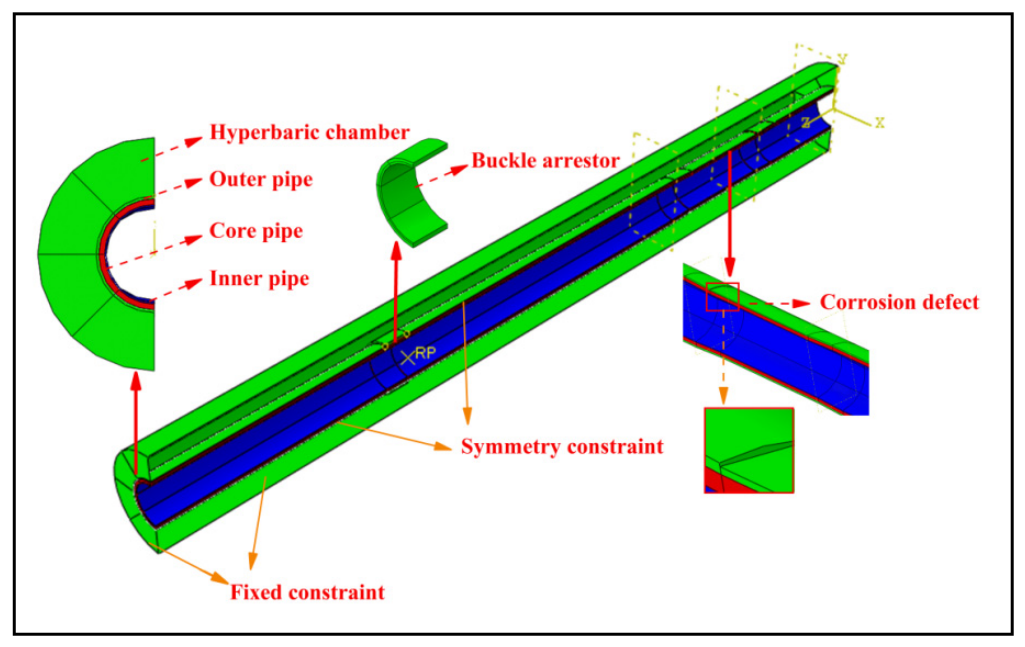
A three-dimensional finite element model was established using the ABAQUS 2020 software. The finite element model includes a high-pressure chamber and a sandwich pipe. The sandwich pipe includes an outer pipe, a core layer, and an inner pipe. The integral buckle arrestor is installed on the outer pipe, as shown in Figure 1. The contact between the layers of the sandwich pipe is surface-to-surface contact. In the surface-to-surface contact model, when the core layer contacts the inner and outer pipes, the inner and outer pipes are defined as the main contact surface, and the core layer is defined as the slave contact surface. In the ABAQUS software, the friction model is used to define the interlayer behavior of the sandwich pipe. In the normal direction, the hard contact is used to prevent penetration between the sandwich pipes, which affects the accuracy of the calculation results. The Coulomb friction model is used in the radial direction, and the penalty function model is used between the core layer and the inner and outer pipes. Fully fixed constraints are applied to both ends of the sandwich pipe and the pressure chamber, and a symmetry boundary condition is imposed on the symmetry plane. To simulate the collapse process of locally corroded sandwich pipes in a deep-sea environment, a hydrostatic fluid loading method is employed. For this purpose, the hydrostatic fluid element F3D4 in ABAQUS is introduced. This element can simulate a closed cavity filled with fluid and enclosed by structures. By specifying the volume change of a controlled region, this converts externally pressure-controlled loading into volume-controlled loading and then calculates the fluid pressure based on the volume change. In the finite element model, the hyperbaric chamber and the outer surface of the outer pipe together form a closed fluid region. Volume-controlled loading is applied through a reference point, and the buckling collapse pressure, the buckling propagation pressure, and the buckle arrestor crossing pressure are determined.

2.2. Material Properties

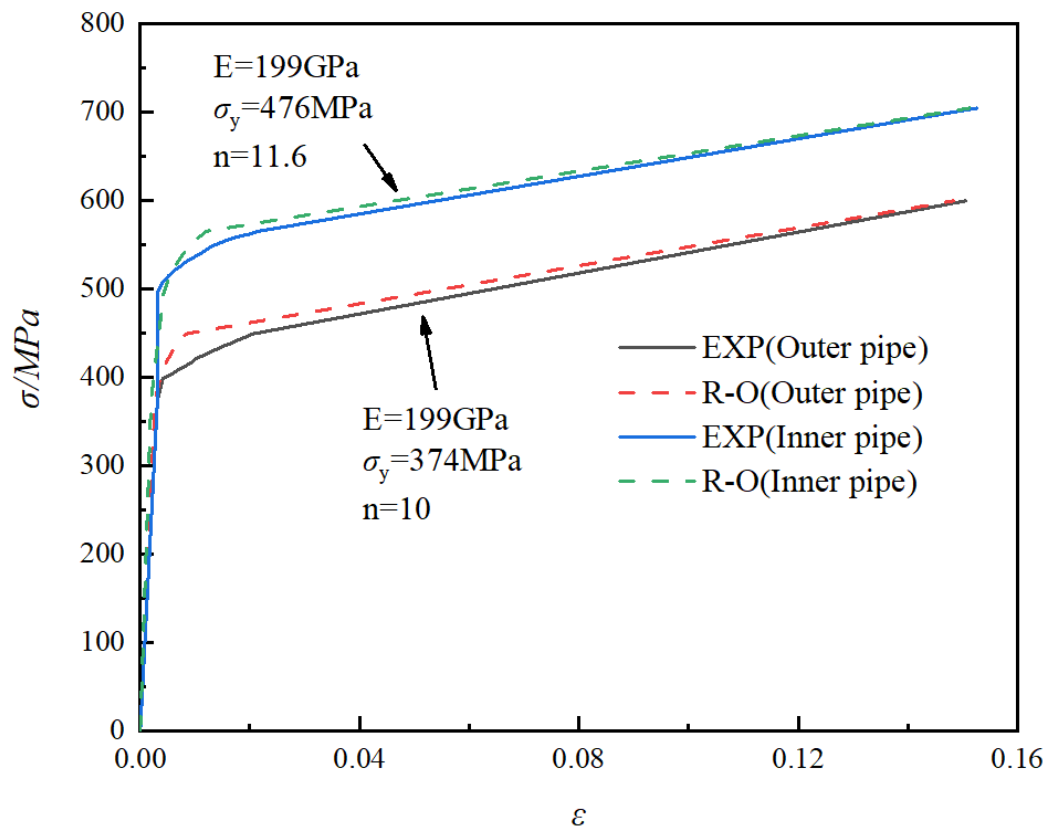
In order to accurately determine the material properties of inner and outer pipes, laser cutting technology was used to cut tensile samples directly from SS304 stainless steel pipe. According to the GB/T 228.1-2021 metal material tensile test room temperature test method, the uniaxial tensile test is carried out on a universal testing machine [29]. The maximum test pressure of the test instrument is 1000 kN, the effective force range is 2%~100%, the test accuracy is 0.5%, and the displacement measurement resolution is 0.01 mm, as shown in Figure 2.
Figure 2 compares the Ramberg–Osgood model with the true stress–strain curve, and it can be seen that the Ramberg–Osgood model can well describe the stress–strain relationship of the inner and outer pipes of the sandwich pipe. The Ramberg–Osgood model can be expressed by Equation (1).
ε = σ E 1 + 3 7 σ σ y n 1
In the equation, E represents Young’s modulus, σ y represents the yield strength of the material, and n is the strain hardening coefficient, which characterizes the hardening behavior of the material after it enters the plastic stage.
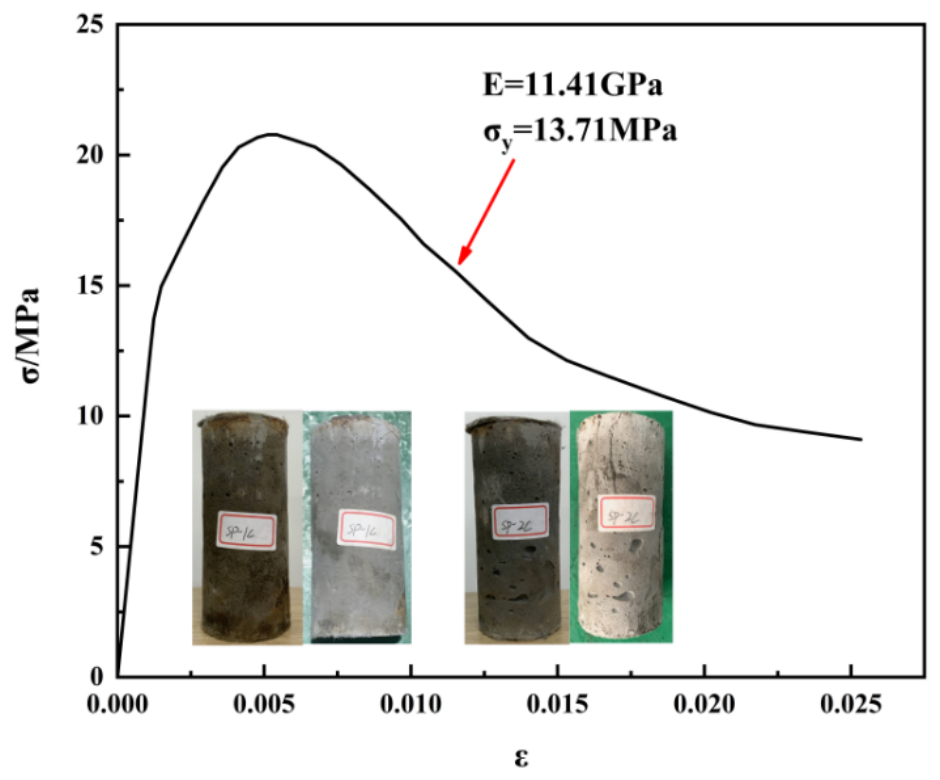
The core layer of the sandwich pipe is made of a lightweight cement-based material. To accurately determine its mechanical properties, Φ50 mm × 100 mm cylindrical specimens of the cement-based composite material were prepared during the pouring process of the sandwich pipe. After curing at room temperature for 28 days, uniaxial compression tests were conducted to determine the uniaxial compressive strength of the material. The test was carried out according to the standard for test methods of physical and mechanical properties of concrete (GB/T 50081-2019) [30]. Figure 3 shows the uniaxial compression test device of the core material and the corresponding average true stress–strain curve. The elastic modulus, E = 14.11 GPa, and the yield strength, σ y = 13.71 MPa, were measured.

2.3. Validation of Finite Element Model

Equation (2) is the calculation formula for arresting efficiency. It can be seen from Equation (2) that the calculation of arrest efficiency is directly related to the buckling instability pressure, the buckle propagation pressure, and the arrestor crossover pressure. To ensure the accuracy and computational efficiency of the arresting efficiency calculation for deep-sea sandwich pipes under corrosion effects, this paper separately calculates the buckling collapse pressure under local corrosion conditions and the buckle arrestor control, thereby avoiding the computational burden caused by complex coupling analysis while ensuring the accuracy of each key parameter.
η = P X P p P c r P p
In the equation, P c r is the buckling instability pressure, P X is the arrestor crossover pressure, and P P is the buckle propagation pressure. For an intact pipeline, the arrestor crossing pressure is typically less than or equal to the buckling instability pressure of the pipeline, and the arrestor efficiency η ranges from 0 to 1. However, when corrosion defects are present in the pipeline, the buckling instability pressure decreases, which may cause the arrestor crossover pressure to exceed the buckling instability pressure, thereby resulting in an arrestor efficiency η > 1.
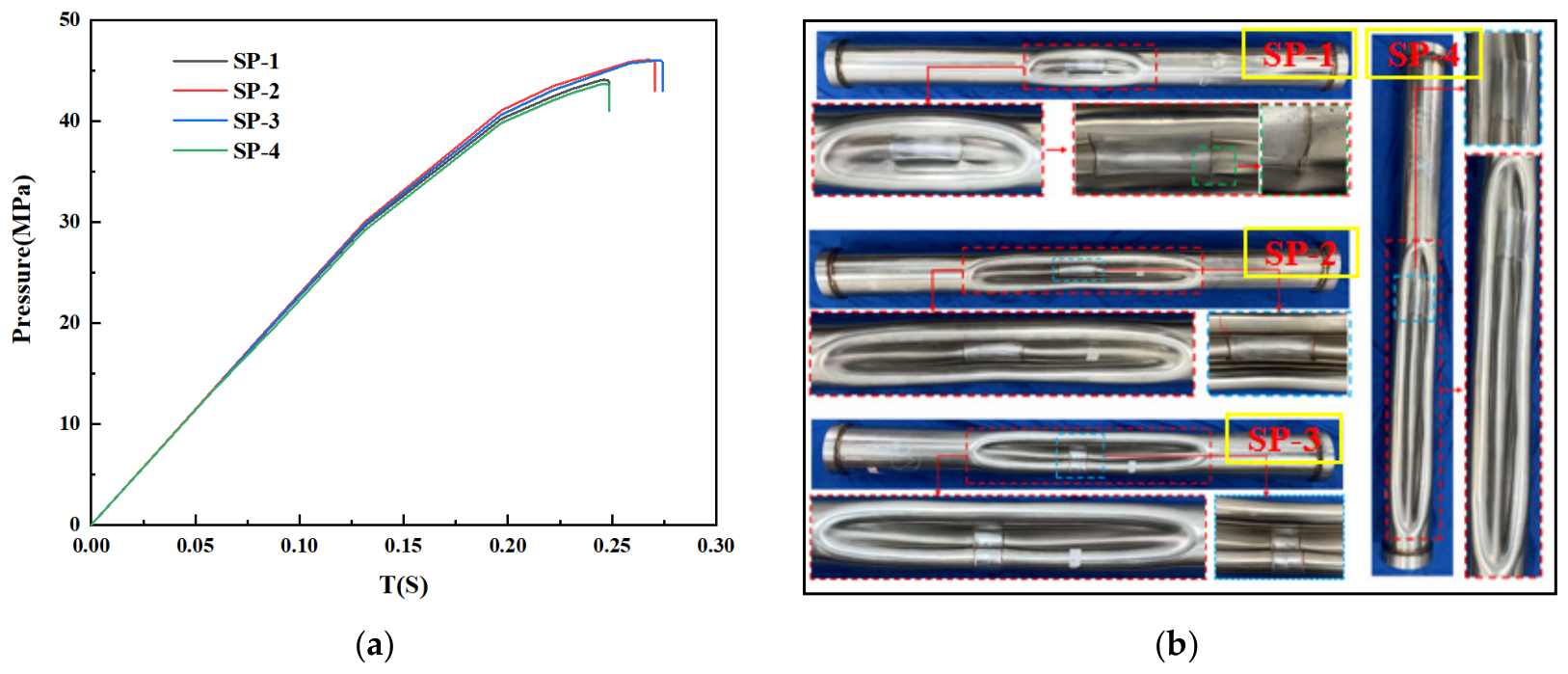
Figure 4 and Table 1 compare the buckling instability pressure obtained by numerical simulation with the experimental results. The error range is 0.24%~4.51%, and the average error is only 1.68%. This verifies that the finite element model of buckling instability pressure of local corrosion sandwich pipes established in this paper has high reliability and can provide a reliable analysis basis for the evaluation of arresting efficiency.
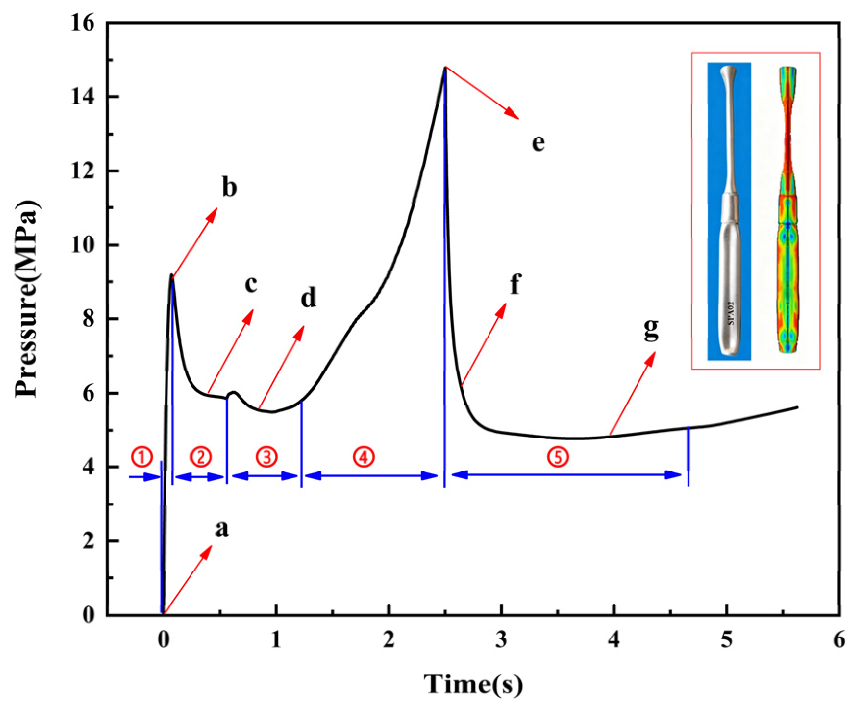
By reproducing Gong et al.’s sandwich pipe buckling arrestor crossing process, the accuracy of the finite element model in calculating the buckling-arresting crossing process is evaluated. The specific size of the reproduced sample is the outer pipe diameter thickness ratio Do/to = 23.33 and the inner pipe diameter thickness ratio Di/ti = 16.55; Do = 70.00 mm, Di = 50.96 mm, La/Do = 1.64, and h/t = 2.38. Figure 5 is the pressure–time curve obtained by the numerical simulation. Table 2 lists a comparison between the numerical simulation results and experimental results. The calculation results show that the error between the numerical simulation results and the experimental values of local buckling instability pressure is 2.85%, the error between the numerical simulation results and the experimental values of buckling propagation pressure is 1.48%, and the error between the numerical simulation results and the experimental values of the arrestor crossover pressure is 13.76%. It can be observed that the error in the arrestor crossover pressure is significantly higher than that of the buckling instability pressure and the buckle propagation pressure. The main reason for this noticeable increase is that the dimensions and material properties of the weld were not provided in the relevant literature, which forced us to neglect the effect of the weld between the arrestor and the outer pipe during model validation, thereby preventing accurate modeling of the weld. It can be seen from Equation (2) that when the denominator P c r P p is small (i.e., P c r is very close to P P ), even a small error in P X will be significantly amplified, thereby seriously affecting the accuracy of the calculation of the arresting efficiency η. Under such operating conditions, where the denominator is small, a relative error of 13.76% in P X may become unacceptable. Therefore, it is necessary to ensure that P c r P p is sufficiently large. Research based on buckling instability pressure shows that the initial ovality significantly affects the size of the buckling instability pressure. When the initial ovality is small, the P c r increases so that the P c r P p increases; that is, the denominator of Equation (2) becomes larger, thus weakening the effect of P X calculation error on the arresting efficiency η. In other words, the smaller initial ovality is beneficial to reducing the influence of P X calculation error on the calculation results of the arresting efficiency η. Based on this, we recommend that the initial ellipticity be controlled within a small range, that is, not more than 1.0% [31,32,33,34]. The recommended range mainly considers the initial ovality actually generated during the manufacture and installation of the sandwich pipe. Therefore, for the engineering application of this paper [14,21,27,35], the overall calculation error of 13.76% is still considered acceptable. The above analysis shows that the numerical simulation method can effectively calculate the buckling instability pressure, buckling propagation pressure and arrestor crossover pressure of a sandwich pipe.
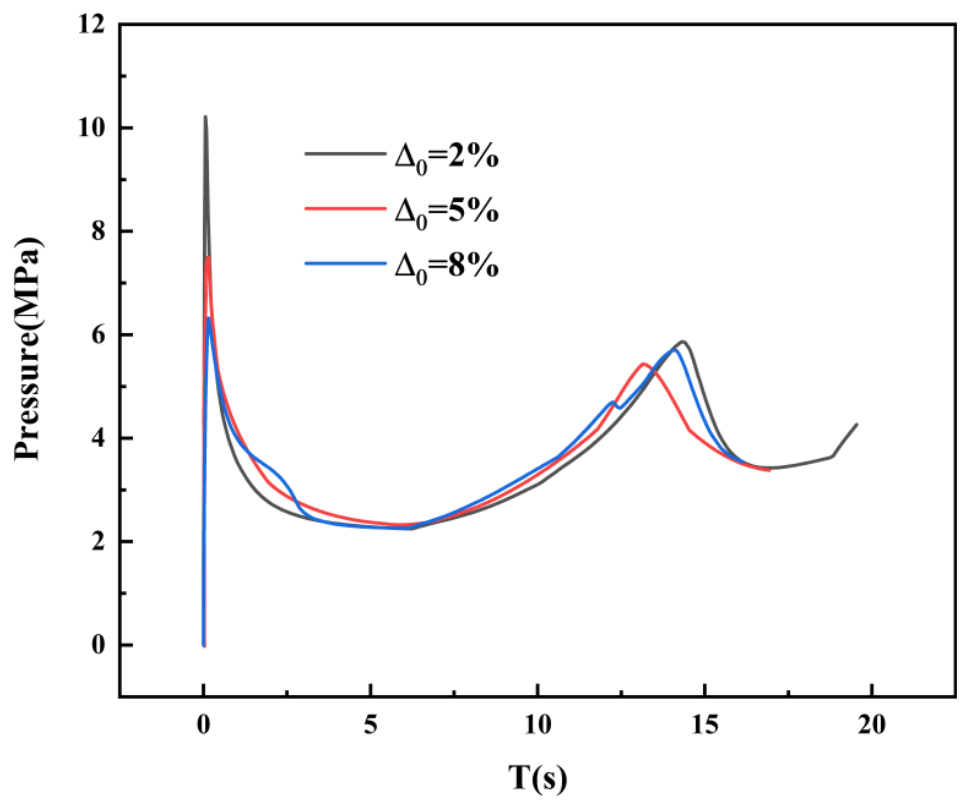
In order to verify the reliability of the calculation results of buckling instability pressure and buckling control under local corrosion conditions, the corrosion shape is adjusted by changing the ovality of the corrosion area, and the finite element simulation of three ovality sandwich tubes is carried out. The results are shown in Figure 6. When the ovality values of the corrosion area are 2%, 5% and 8%, the buckling stability pressure changes significantly, whereas the corresponding buckling propagation pressure and arrestor crossover pressure show no significant changes. When the ovality values of the corrosion area are 2%, 5% and 8%, the buckling propagation pressures are 2.23 MPa, 2.43 MPa and 2.26 MPa respectively, whilst the arrestor crossover pressures are 5.82 MPa, 5.44 MPa and 5.72 MPa respectively. The maximum fluctuation amplitude of the buckling propagation pressure was 0.2 MPa, whilst that of the arrestor crossover pressure was 0.38 MPa. This indicates that the influence of corrosion defects on the buckling propagation pressure and the arrestor crossover pressure is relatively minor, illustrating that the buckling instability pressure and buckling control of sandwich pipes caused by corrosion can be calculated separately to improve computational efficiency.

2.4. Mesh Independence and Boundary Constraint Effect Research

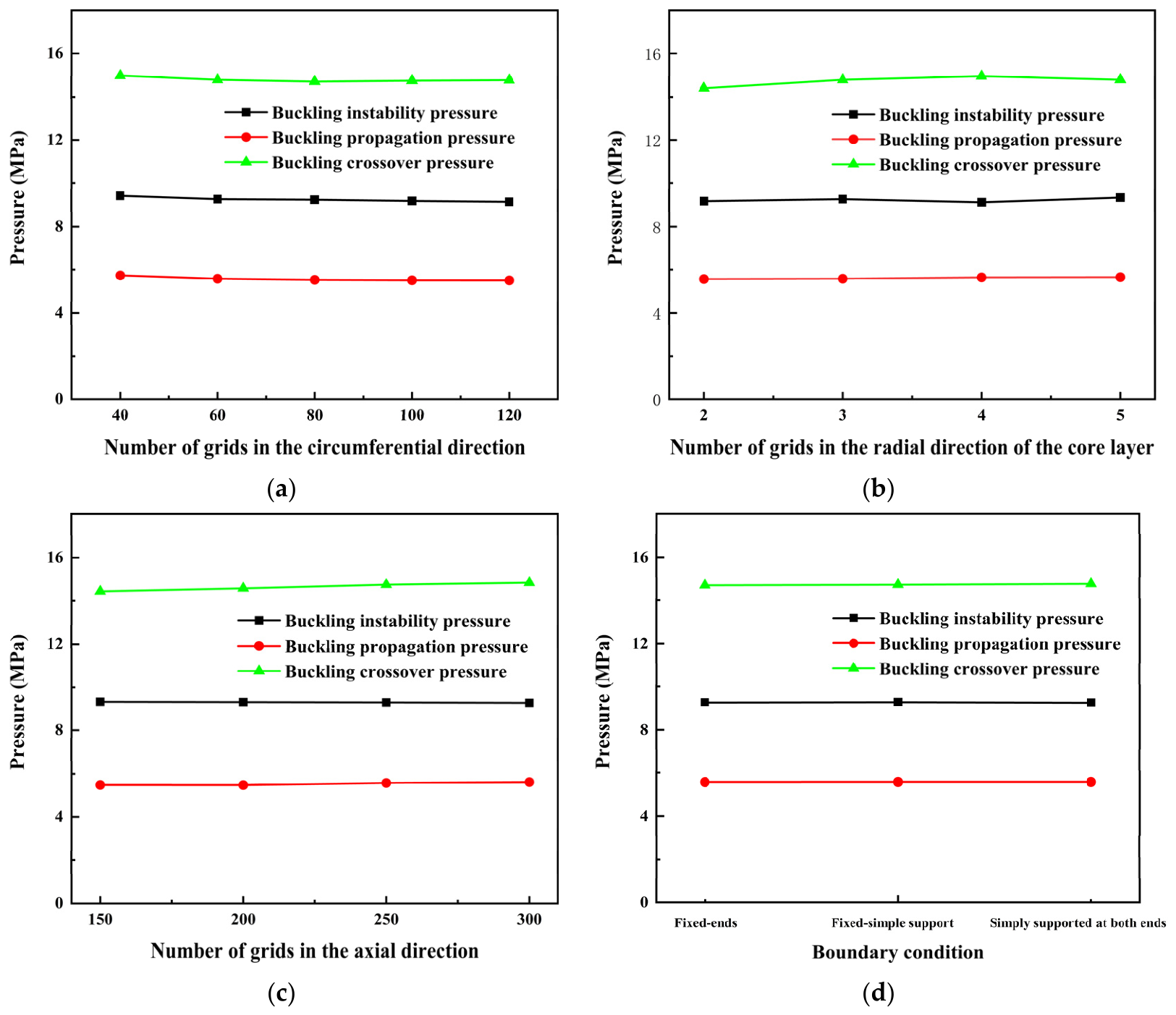
To eliminate the potential influence of mesh density and boundary constraint conditions in the sandwich pipe model on the numerical simulation results, we conducted a mesh independence analysis. The specific results are shown in Figure 7. Figure 7a, Figure 7b, and Figure 7c present the mesh independence analysis for the axial, circumferential, and radial directions of the sandwich pipe, respectively. It can be observed that the number of axial, circumferential, and radial mesh elements has little effect on the buckling instability pressure, buckling propagation pressure, and buckling crossover pressure, indirectly indicating that these mesh parameters also have little effect on the arresting efficiency. Therefore, in the subsequent study, we selected 250, 100, and 3 as the numbers of axial, circumferential, and radial mesh elements, respectively. In the mesh independence analysis, the number of radial mesh elements we adopted is that of the core layer. This is because the inner and outer pipes are thinner compared to the core layer, and generally three layers of mesh are sufficient [2]. Furthermore, we conducted an independence analysis for three types of boundary conditions: fixed–fixed, fixed–simply supported, and simply supported–simply supported. The results show that the boundary conditions have virtually no effect on the buckling instability pressure, buckling propagation pressure, or arrestor crossover pressure, thereby indicating that the boundary constraints of the sandwich pipe have little influence on arrestor efficiency. Therefore, in the subsequent study of this paper, the sandwich pipe is modeled with 250, 100, and 3 mesh elements in the axial, circumferential, and radial directions, respectively, and the boundary condition is set as fixed–fixed.

3. Behavior of Arrestor Crossing

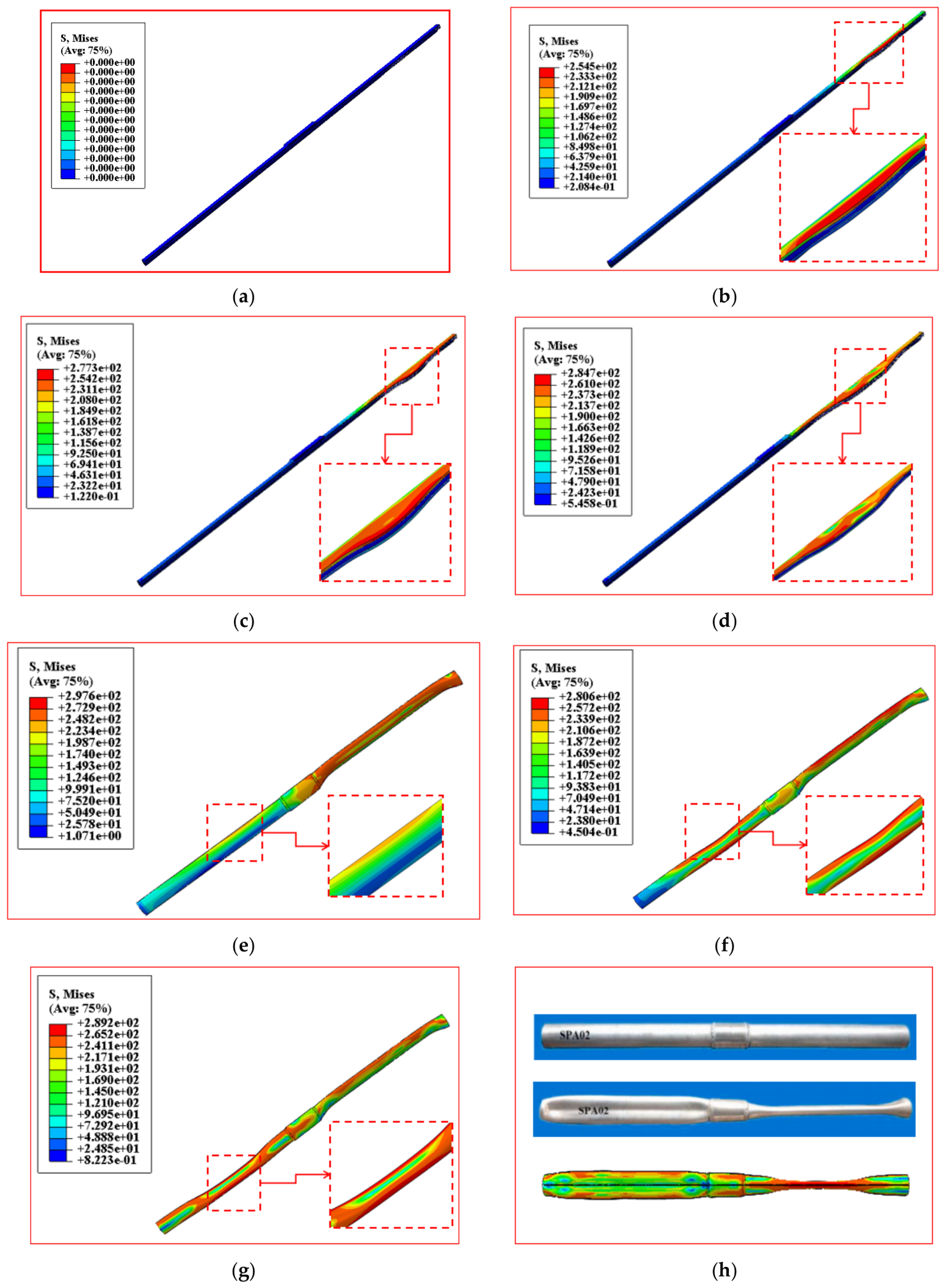
Figure 5 shows the orthogonal crossing pressure curve of the integral arrestor for the SPA02 sandwich pipe specimen. It can be observed that during the buckling crossing process, the pipeline undergoes five stages: elastic–plastic deformation, local buckling instability, buckle propagation, buckling crossing, and downstream pipe deformation. Stage ① is the elastic–plastic deformation stage, during which the pressure increases rapidly until the load-carrying capacity at the initial defect reaches its maximum, and local deformation occurs at the initial defect. Stage ② is the local buckling instability stage, in which the local deformation of the pipe evolves into global deformation, and local buckling instability first occurs at the initial defect, causing a sharp drop in pressure. Stage ③ is the buckle propagation stage, during which the buckle propagates steadily along the axial direction of the pipeline, and a stable pressure plateau appears; this pressure is termed the buckle propagation pressure, denoted as P P . Stage ④ is the buckling crossing stage. When the propagating buckle encounters the arrestor, the pressure begins to rise rapidly again to further flatten the upstream pipe, causing the arrestor to deform into an elliptical shape. However, because the thickness of the arrestor is greater than that of the downstream pipe, the stiffness of the arrestor is higher than that of the downstream pipe; buckling instability then occurs in the downstream pipe, resulting in buckling crossing. The pressure at this stage is termed the arrestor crossover pressure, denoted as P X . Stage ⑤ is the downstream pipe deformation and buckle propagation stage, in which the local deformation of the pipe evolves into global deformation and propagates steadily along the length of the pipeline until it reaches the arrestor. The stress contours corresponding to each stage are shown in Figure 8.

4. Parameter Study

Currently, common buckling arrestors can be classified into four types: integral, slip-on, welded-ring, and spiral arrestors. Among them, the integral buckle arrestor is recognized as the best choice to suppress buckling propagation in deep-sea and ultra-deep-sea submarine pipelines due to its continuous structure, high strength, and good reliability. Therefore, this paper selects the integral buckle arrestor as the research object to carry out subsequent analysis.
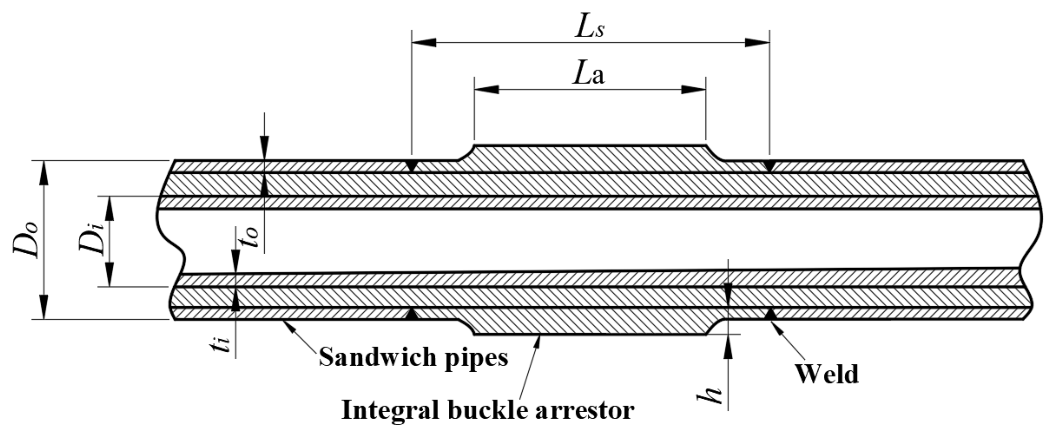
The integral buckle arrestor is a small reinforced structure welded between two sections of the outer pipe. Its inner diameter is consistent with the inner diameter of the outer pipe, but the wall thickness is significantly increased, so it has higher strength and stiffness, which can effectively suppress the propagation of buckling along the axial direction of the pipe. As shown in Figure 9, the main geometric parameters of this arrestor include the total length Ls, the effective length La, and the reinforcement thickness h, as well as the outer diameter Do and wall thickness to, which match those of the outer pipe. Among these, La and h are the key design parameters affecting the arresting efficiency.

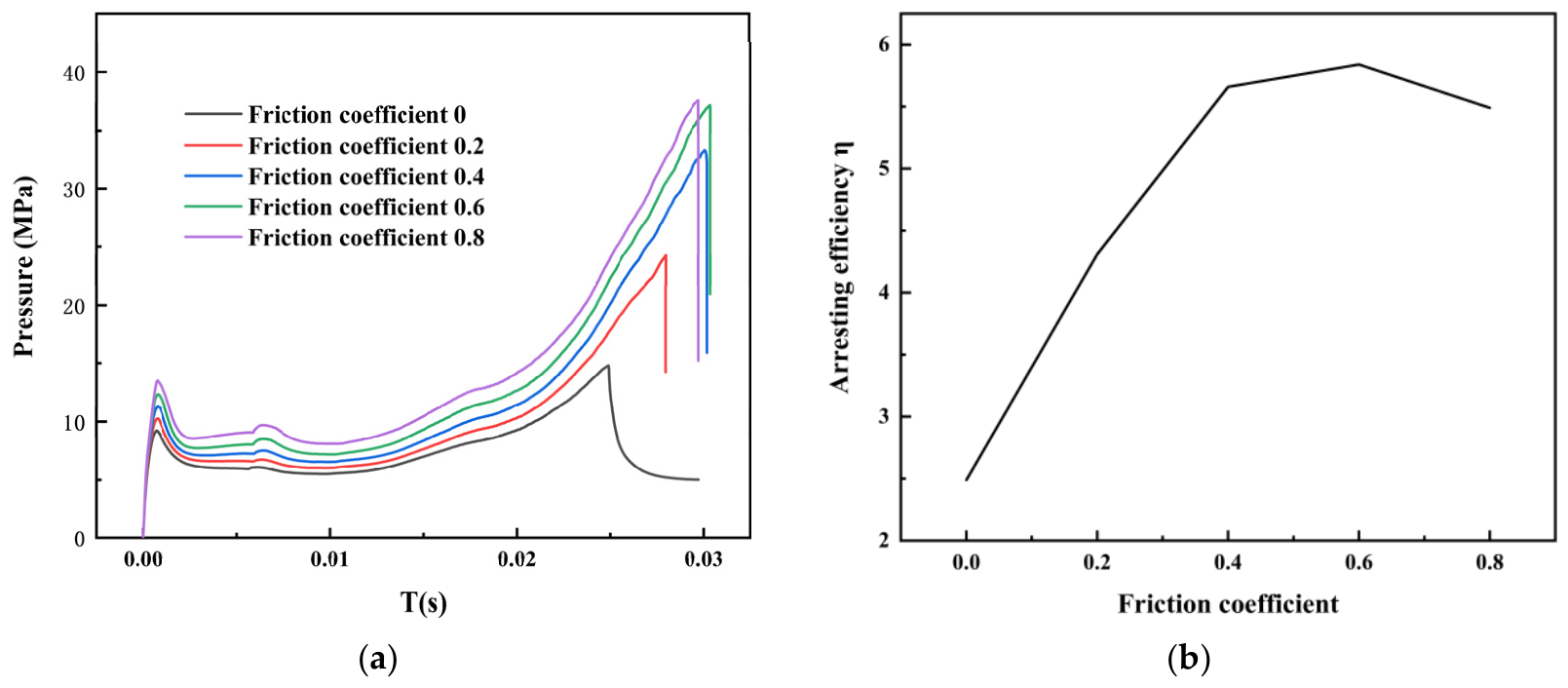
4.1. Friction Coefficient

The arresting efficiency of the sandwich pipe is closely related to the contact model between layers. The magnitude of the contact force directly affects the buckling instability pressure, buckling propagation pressure, and arrestor crossover pressure and can usually be characterized by the interlayer frictional coefficient. Figure 10 illustrates the effect of the frictional coefficient on the arresting efficiency. It can be seen from Figure 10a that as the frictional coefficient increases, the buckling instability pressure, buckling propagation pressure, and arrestor crossover pressure all show an increasing trend, but with significant differences in the rates of increase. Among them, the buckling instability pressure and the buckling propagation pressure increase slowly, while the arrestor crossover pressure first increases rapidly and then slowly. This leads to a situation where the increase rate of the denominator in the arresting efficiency formula is first lower than that of the numerator and then greater than that of the numerator, resulting in the arresting efficiency first rising rapidly and then declining slowly, as clearly shown in Figure 10b.

4.2. Arrestor Length

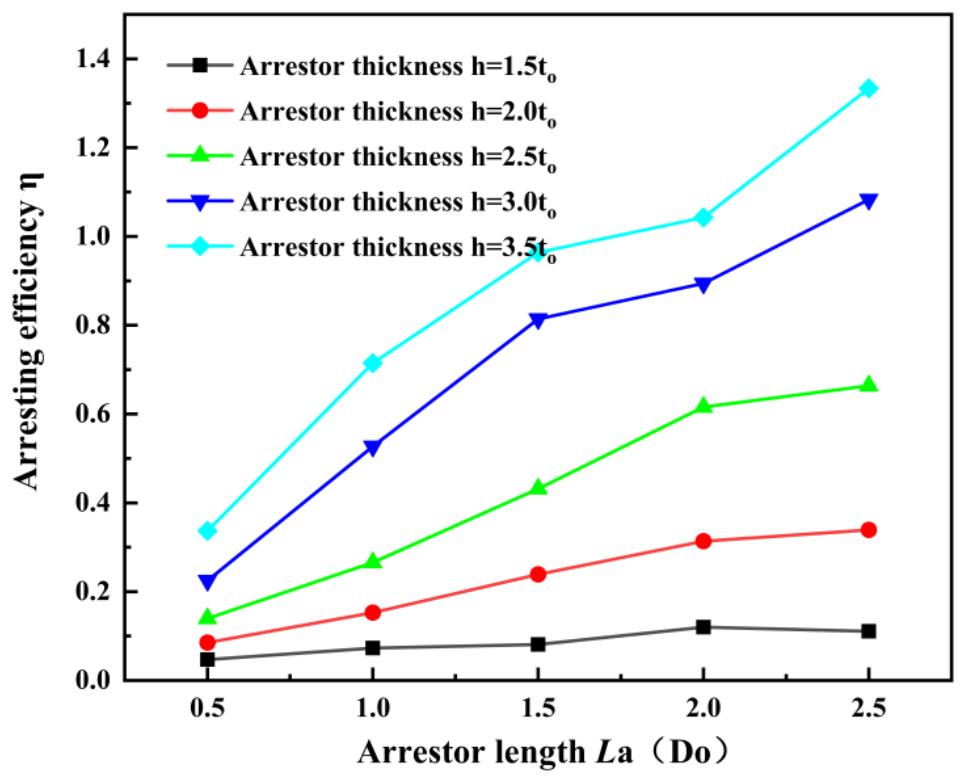
In order to analyze the effect of the arrestor length on the arresting efficiency η, the study was conducted using arrestors with lengths La of 0.5Do, 1.0Do, 1.5Do, 2.0Do and 2.5DO. Figure 11 illustrates the effect of arrestor length on arresting efficiency. It can be observed that as the arrestor length increases, the arresting efficiency η shows an increasing trend. Under fixed corrosion depth and width conditions, when the arrestor length increases from 0.5Do to 2.5Do and the arrestor thickness increases from 1.5to to 3.5to in increments of 0.5to, and the arresting efficiency increases by 135.24%, 296.77%, 375.08%, 381.70%, and 295.85%.
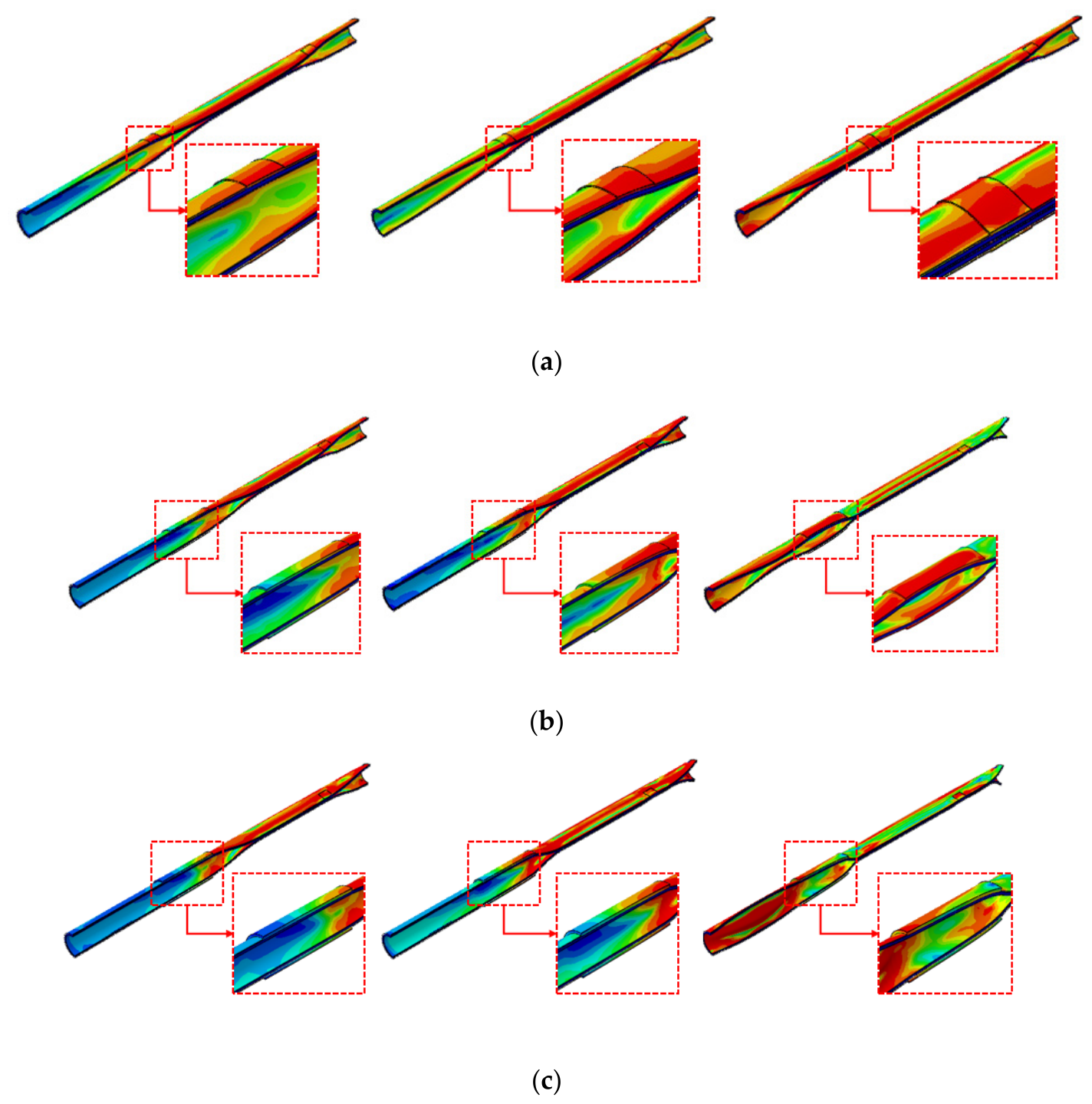
As the arrestor length increases, the arrestor crossover modes of the locally corroded sandwich pipe change. When the arrestor is short, it behaves like a high-stiffness but narrow ring. Buckling propagation cannot effectively propagate along the length direction, leading to stress concentration at the arrestor edges. The buckling propagation forms a concentrated plastic hinge at the end of the arrestor and directly passes through it. As the arrestor length further increases, the arrestor behaves as a long shell and begins to show an overall structural response. In this case, buckling propagation is often completely prevented within the arrestor, or it gradually transitions via axisymmetric bulging. This phenomenon can be clearly observed in Figure 12. Figure 12 shows the influence of the length of the arrestor on the arrestor crossover modes of the local corrosion sandwich pipe arrestor. Figure 12a, Figure 12b and Figure 12c correspond to three different arrestor crossover modes. The first and second types of arrestor crossover modes belong to the parallel crossing category, while the third type is orthogonal crossing, and the arresting efficiency of orthogonal crossing is generally higher than that of parallel crossing.

4.3. Arrestor Thickness

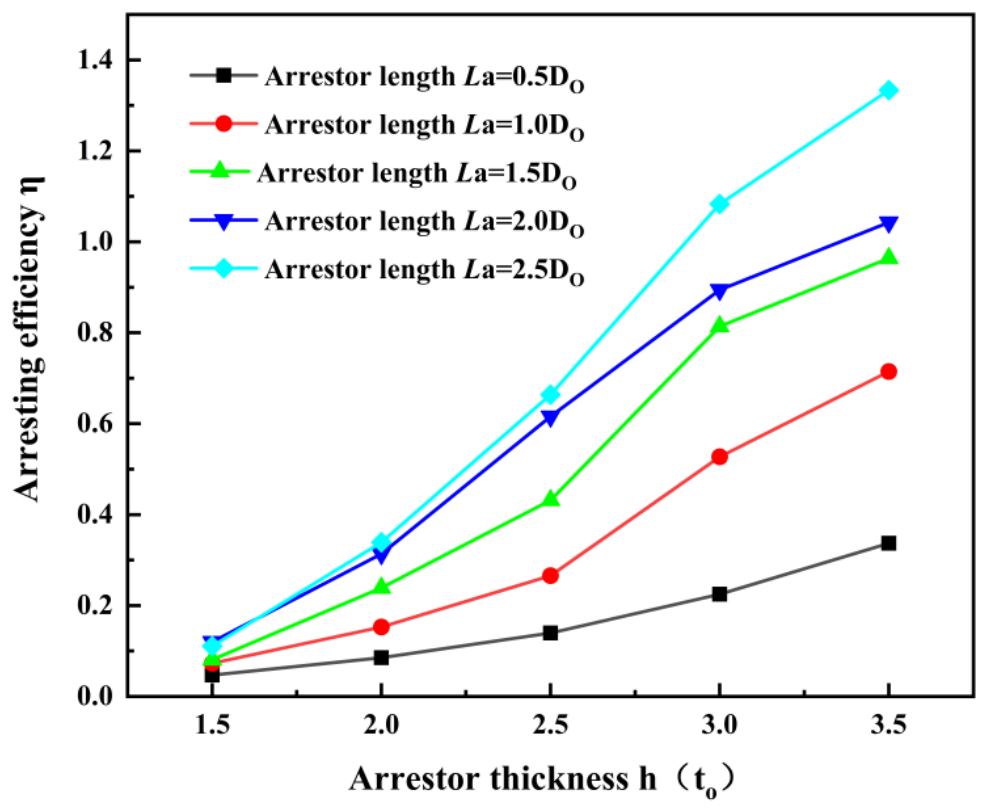
To investigate the effect of arrestor thickness on arresting efficiency, five arrestors with different thicknesses are selected for comparative analysis in this subsection. The arrestor thicknesses h are 1.5to, 2.0to, 2.5to, 3.0to, and 3.5to. Figure 13 shows the effect of the thickness of the arrestor on the arresting efficiency. It can be found that with the increase in the thickness of the arrestor, the arresting efficiency η of the arrestor shows an increasing trend. Under fixed corrosion depth and width conditions, as the arrestor thickness increases from 1.5to to 3.5to and the arrestor length increases from 0.5Do to 2.5Do in increments of 0.5Do, the arrest efficiency η increases by 616.00%, 879.64%, 1088.87%, 769.12%, and 1104.84%, respectively. In addition, it is found that with the increase in the thickness of the arrestor, the arrestor crossing mode of the locally corroded sandwich pipe changes regularly. When the arrestor thickness is small, the first type of crossing mode tends to occur. When the thickness increases to a certain extent, it transitions to the second type of crossing mode. With a further increase in thickness, the third type of crossing mode appears.
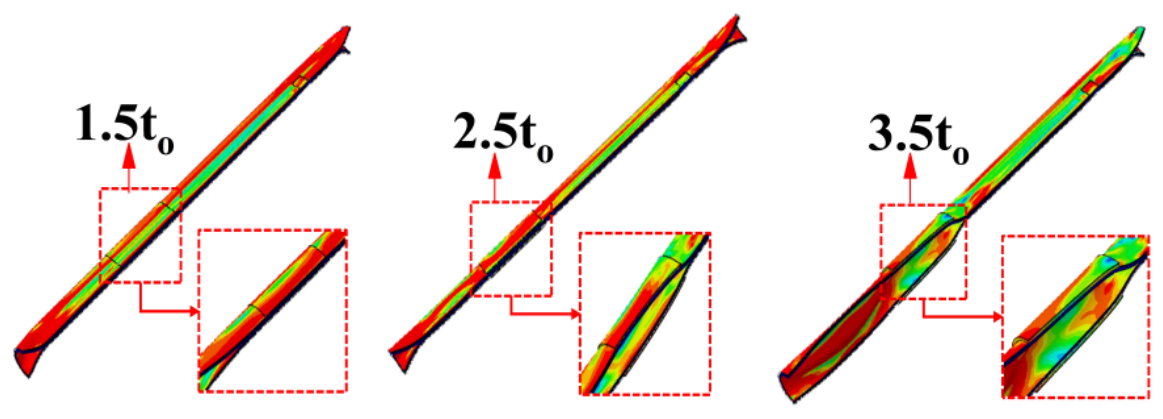
Figure 14 shows the arrestor crossover modes of the locally corroded sandwich pipe with an arrestor length of 2.5Do and arrestor thicknesses of 1.5to, 2.5to, and 3.5to. The beneficial effect of increasing arrestor thickness can be clearly observed. When the arrestor thickness is 1.5to, the structural stiffness of the sandwich pipe is insufficient to resist buckling, resulting in the collapse of the arrestor and direct crossing. When the arrestor thickness is 2.5to, the structural stiffness of the sandwich pipe is enhanced, and the arrestor undergoes axisymmetric bulging followed by gradual collapse. When the thickness increases to 3.5to, the arrestor, with sufficient stiffness, successfully blocks the buckling propagation path. This indicates that increasing arrestor thickness can significantly improve its structural stiffness, thereby enhancing the ability to resist buckling crossing.

4.4. Arrestor Material

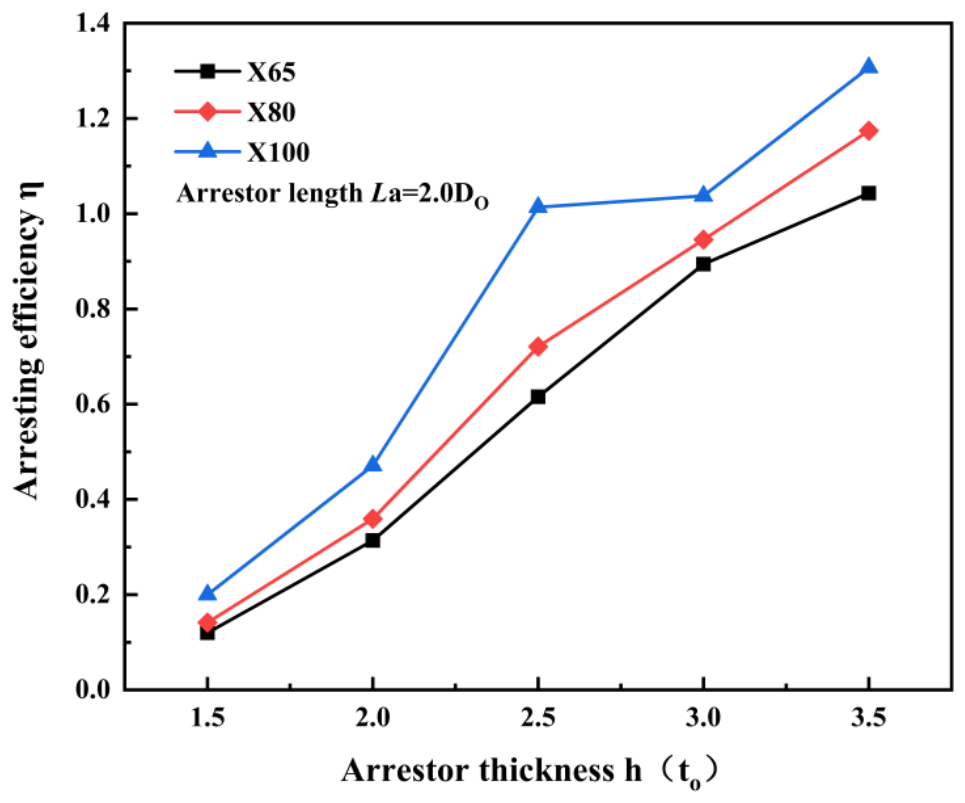
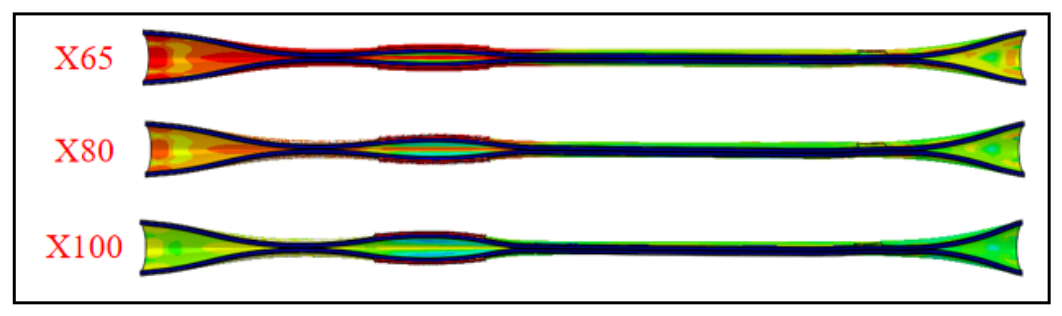
To investigate the effect of arrestor material on the arrest efficiency of the locally corroded sandwich pipe, this section selects X-series pipe materials commonly used in engineering as the research object, specifically X65, X80, and X100. Figure 15 reflects the effect of different arrestor materials on the arresting efficiency η. It can be observed that as the strength of the arrestor material increases, the arresting efficiency η shows an increasing trend. Under a constant arrestor length, when the arrestor thickness increases from 1.5to to 3.5to and the arrestor materials are X65, X80, and X100, the arresting efficiency η increases by 769.12%, 729.74%, and 553.31%, respectively, with the growth rate exhibiting a decreasing trend. This phenomenon is mainly attributed to the fact that while increasing the material strength enhances the arrestor crossover pressure of the arrestor, it simultaneously increases the buckle propagation pressure. The combined effect of these two factors leads to a gradual reduction in the increase in the arresting efficiency η.
In addition, in this study, it is found that with the increase in steel strength, the arrestor crossover modes of the local corrosion sandwich pipe also change regularly, from the first type of arrestor crossover modes at lower strength to the second and even the third type of arrestor crossover modes, which further reflects the enhancement effect of material strength on the buckling performance of the arrestor. Figure 16 shows the influence of different strength materials on the arrestor crossover modes. From the stress cloud diagram, it can be found that the buckle crossover modes of the X65 material arrestor are close to the first type of arrestor crossover modes. With the increase in material strength, the resistance provided by the arrestor increases, and the ability to hinder buckling propagation is enhanced, which promotes the evolution of the arrestor crossover modes from the first type to the second type at lower strength. On the whole, the influence of the material on the arrestor crossover modes of the arrestor is less than that of the structural parameters of the arrestor itself.

4.5. Arrestor Structural Optimization

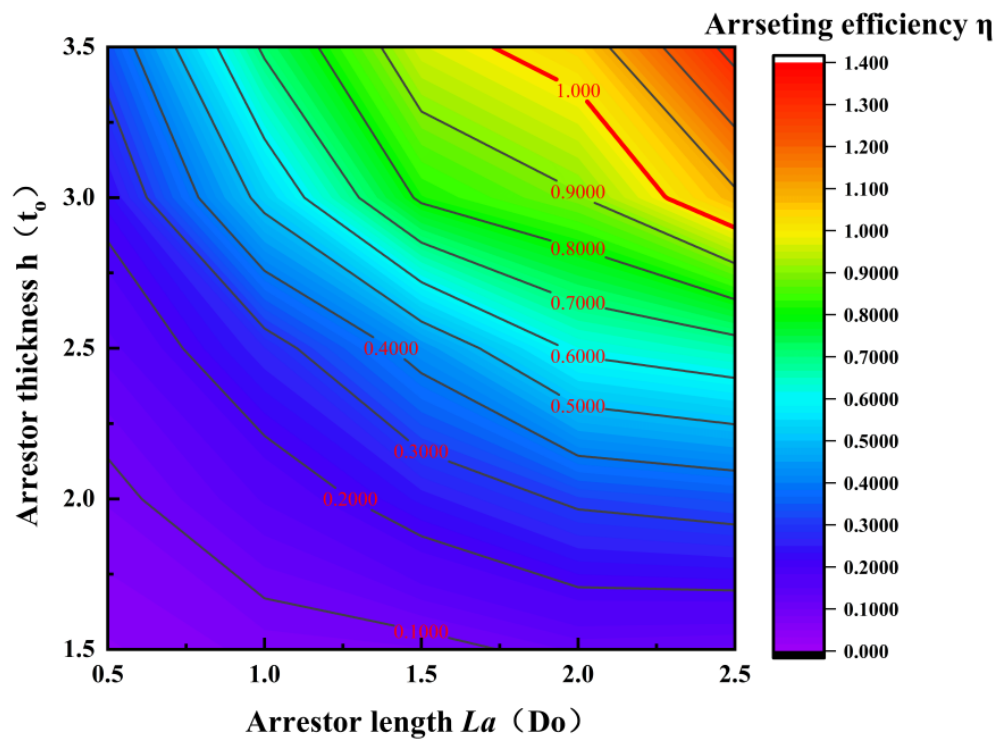
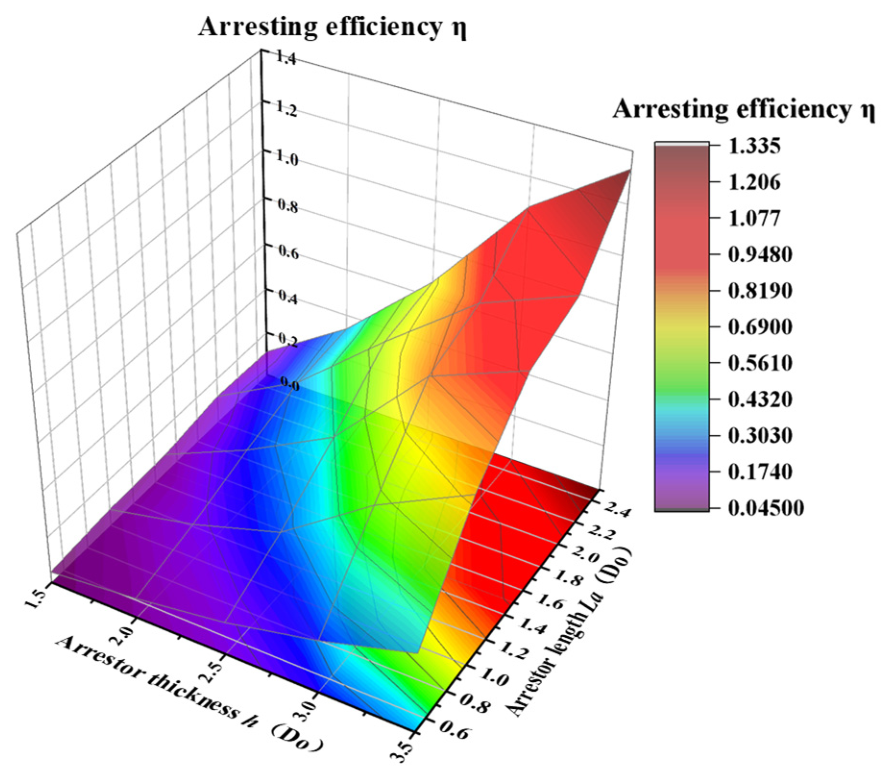
Figure 17 shows the effect of the length and thickness of the arrestor on the arresting efficiency η of the locally corroded sandwich pipe. The thickness range of the arrestor is 1.5to~3.5to, and the length range is 0.5Do~2.5Do. From Figure 17, it can be seen that the area with higher arresting efficiency is concentrated in the upper right corner of the figure. The closer to the upper-right corner, the higher the arresting efficiency, with η even exceeding 1, which indicates that the arrestor can effectively enhance the buckle propagation resistance of the pipeline and provide an additional safety margin. In the field application process, it is generally believed that when the arresting efficiency η = 1, the arresting effect of the arrestor is the best. Based on this, when designing the structural parameters of the arrestor, it is recommended to use η = 1 as the design basis. This benchmark ensures that the arrestor functions fully when necessary and avoids material waste caused by excessive design.
In order to facilitate the engineering application, the recommended chart of arresting efficiency is given in the form of a contour line in Figure 18, which visually displays the distribution of arresting efficiency under different combinations of arrestor structural parameters. Engineering designers can directly check the chart to obtain parameter combinations that meet the arrest efficiency requirements, thereby quickly completing the preliminary selection and structural dimensioning of the arrestor.

5. Prediction of Arresting Efficiency

In the deep-sea environment, corrosion is one of the key factors that induces local or even overall collapse of pipelines. However, the existing evaluation methods for the arresting efficiency of submarine pipelines are difficult to effectively apply to a sandwich pipe structure with local corrosion defects. Through structural analysis of locally corroded sandwich pipes, it can be found that corrosion parameters, structural parameters, and arrestor structural parameters are all closely related to the arresting efficiency. Specifically, corrosion weakens the effective load-bearing area of the pipe wall, induces local stress concentration, and consequently reduces the load-carrying capacity and buckling instability pressure of the pipe. Meanwhile, the structural parameters of the sandwich pipe not only affect its buckling instability pressure but also further influence the buckling propagation pressure and the buckling crossover pressure. The arrestor structure parameter itself directly determines the magnitude of the crossover pressure. Variations in these parameters ultimately lead to changes in the arresting efficiency. Therefore, to ensure the safe operation of locally corroded sandwich pipes during their service life, it is necessary to accurately reveal the intrinsic relationships among corrosion parameters, structural parameters, arrestor structural parameters, and the arresting efficiency. Based on the above numerical simulation analysis, this paper further supplements the calculation and obtains a total of 1200 sets of data. Based on this, an evaluation model of buckling efficiency suitable for locally corroded sandwich pipes is established. The model can provide a theoretical basis and engineering guidance for the rational design of the arrestor.
Based on the parameter ranges from the existing literature [33,36,37], the parameters selected in this paper are shown in Table 3.
According to the calculation formula of arresting efficiency, it can be found that arresting efficiency η is closely related to buckling instability pressure, arrestor crossing pressure and buckling propagation pressure. These parameters are related to material properties, corrosion parameters, sandwich pipe section parameters and arresting device structure parameters. Thus, this can be expressed by Equation (3):
P X P P = f ( d t o , L D O , θ 360 , t o r O , t i r i , χ , L a D O , h a t o , σ y a σ x 100 )
Since P X / P P > 1 , the function can be expressed as a power function, as shown in Equation (4):
P X P P = 1 + π d t o π 0 L D O π 1 θ 360 π 2 t o r O π 3 t i r i π 4 χ π 5 L a D O π 6 h a t o π 7 σ y a σ x 100 π 8
Further, the arresting efficiency model for the locally corroded sandwich pipe can be obtained, and the arrest efficiency η can be expressed by Equation (5):
η = π d t o π 0 L D O π 1 θ 360 π 2 t o D O π 3 t i D i π 4 χ π 5 L a D O π 6 h a t o π 7 σ y a σ x 100 π 8 P C O P P 1
By analyzing Equation (5), the process of solving for the arrest efficiency η essentially involves determining the coefficients π, π0, π1, π2, π3, π4, π5, π6, π7, and π8 in this expression. In order to determine the undetermined coefficients in Equation (5), this paper uses the singular value decomposition method to solve it. The singular value decomposition method is a numerical method for solving the least squares problem. By applying a logarithmic transformation to both sides of Equation (5), it is converted into a linear relationship with respect to the coefficients π, π0, π1, π2, π3, π4, π5, π6, π7, and π8, as shown in Equation (6).
L n ( π ) = α + π 0 L n ( d t o ) + π 1 L n ( L D O ) + π 2 L n ( θ 360 ) + π 3 L n ( t o r o ) + π 4 L n ( t i r i ) + π 5 L n ( χ ) + π 6 L n ( L a D O ) + π 7 L n ( h a t o ) + π 8 L n ( σ y a σ x 100 )
Therefore, based on m sets of input–output experimental data pairs, a system of linear equations containing 10 unknown coefficients and m equations can be established, as shown in Equation (7).
α + π 0 ζ 11 + π 1 ζ 12 + π 2 ζ 13 + π 3 ζ 14 + π 4 ζ 15 + π 5 ζ 16 + π 6 ζ 17 + π 7 ζ 18 + π 8 ζ 19 = ζ 10 α + π 0 ζ 21 + π 1 ζ 22 + π 2 ζ 23 + π 3 ζ 24 + π 4 ζ 25 + π 5 ζ 26 + π 6 ζ 27 + π 7 ζ 28 + π 8 ζ 29 = ζ 20 α + π 0 ζ m 1 + π 1 ζ m 2 + π 2 ζ m 3 + π 3 ζ m 4 + π 4 ζ m 5 + π 5 ζ m 6 + π 6 ζ m 7 + π 7 ζ m 8 + π 8 ζ m 9 = ζ 10
In the Equation,
ζ i j = L n ( π i j ) ,   i = 1 ,   2 , ,   m ,   j = 1 ,   2 ,   3 , ,   9
ζ i 0 = L n ( π i 0 ) ,   i = 1 ,   2 , ,   m
The matrix form of the above equation can be expressed by Equation (10).
A X = Y
Among them,
X = α π 0 π 1 π 2 π 3 π 4 π 5 π 6 π 7 π 7 π 8 T
Y = ζ 10 ζ 20 ζ m 0 T
A = 1 ζ 10 ζ 11 ζ 12 ζ 13 ζ 14 ζ 15 ζ 16 ζ 17 ζ 18 1 ζ 20   ζ 21 ζ 22 ζ 23 ζ 24 ζ 25 ζ 26 ζ 27 ζ 28 1 ζ m 0 ζ m 1 ζ m 2 ζ m 3 ζ m 4 ζ m 5 ζ m 6 ζ m 7 ζ 18
The singular value decomposition of matrix A R m × k can be expressed by Equation (14):
A = U o o o   V T
where = d i a g ( σ 1 , σ 2 , , σ r ) is a diagonal matrix, m is the number of input–output data pairs, U and V are m-order and k-order unitary matrices, respectively, and σ i ( i = 1 , 2 , , r ) is all non-zero singular values of matrix A .
At this point, the coefficient matrix X can be obtained by the following formula:
X = V r 1 0 0 0 U T Y
Based on a total of 1200 pairs of input ( d t o , L D O , θ 360 , t o r O , t i r i , χ , L a D O , h a t o , σ y a σ x 100 ) and output data η ( P C O P P 1 ) obtained from parametric analysis, the arrest efficiency model for the locally corroded sandwich pipe is derived using dimensional analysis and the singular value decomposition method, as shown in Equation (16).
η = 190.2534 d t o 0.0056 L D O 0.0084 θ 360 0.074 t o D O 1.8385 t i D i 0.0245 χ 1.3531 L a D O 1.0382 h a t o 1.2691 σ y a σ x 100 0.4301 P C O P P   1
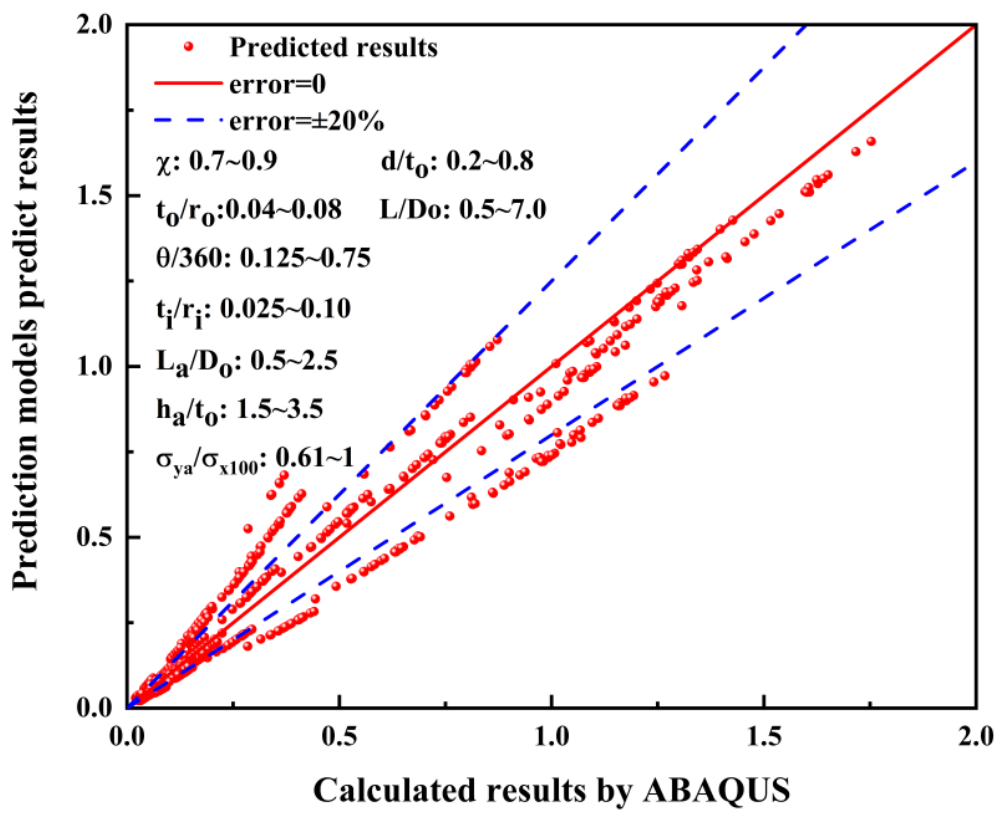
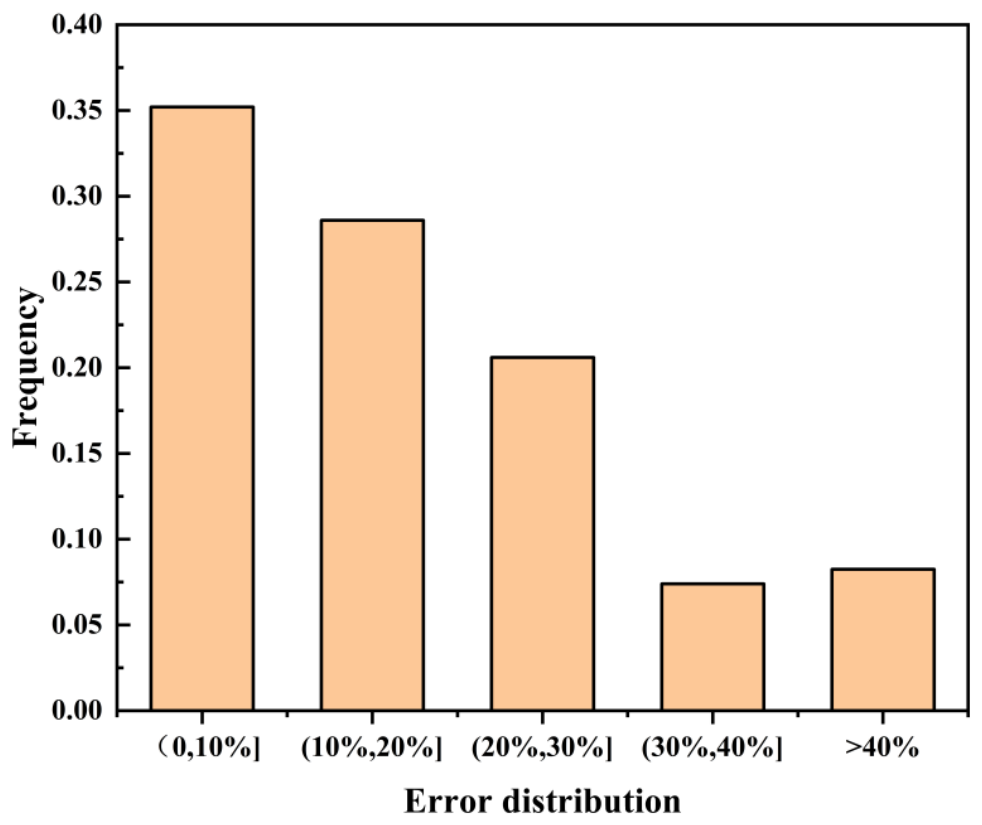
Figure 19 compares the finite element calculation results with the prediction model calculation results. The calculated coefficient of determination R2 is 0.93788, indicating that the model has a good fitting effect. To further elucidate the error distribution between the predicted results and the sample data, an error analysis was conducted on the prediction results of 1200 sets of locally corroded sandwich pipes, and the results are shown in Figure 20. It can be seen from the figure that the error between the prediction model results and the sample data results is mainly concentrated within 20%, accounting for 62.16%. The proportion of samples with errors within 30% reached 83.52%. This shows that the prediction model has high accuracy, the error distribution is relatively concentrated, and the overall agreement is good, but the accuracy of the model still has room for further improvement.
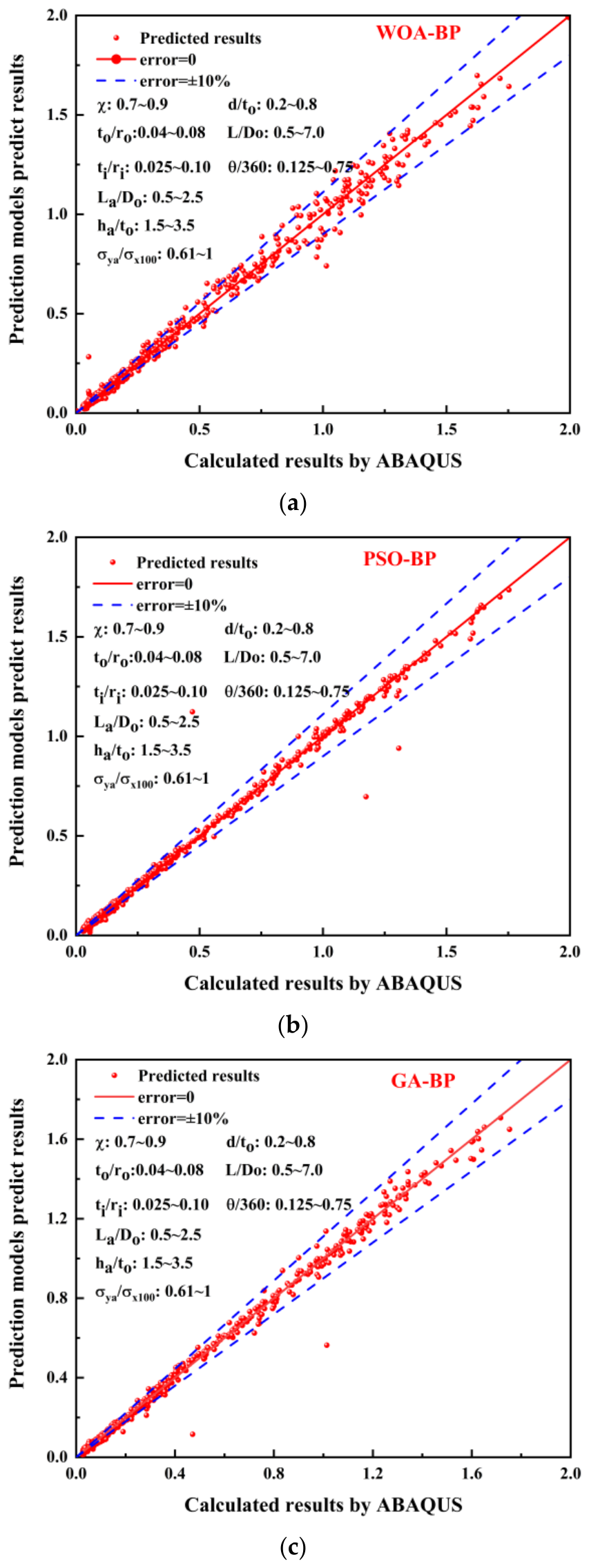
In order to improve the accuracy of the prediction model, three neural network models, GA-BP, PSO-BP and WOA-BP, were used to establish the prediction model of the arresting efficiency of the local corrosion sandwich pipe. The input variables of the model are corrosion parameters, structural parameters and arrestor parameters, and the output variable is arresting efficiency. The training set and the test set were divided according to a ratio of 80% and 20%. In order to optimize the optimization algorithm that is most suitable for the prediction of local corrosion sandwich pipe arresting efficiency, the prediction effects of the WOA-BP, PSO-BP and GA-BP models were compared. It can be seen from Figure 21 that the three optimization algorithms have greatly improved the prediction accuracy of the prediction model compared with the empirical formula. Table 4 shows the distribution of prediction errors based on different optimization algorithms.
As shown in Table 4, the prediction accuracy of the three optimization algorithms is superior to that of the empirical formulas established by the empirical method, demonstrating good predictive performance. Specifically, for the WOA-BP algorithm, 68.5% of the samples have prediction errors below 10%, while for the PSO-BP and GA-BP algorithms, the proportion of samples with errors below 10% exceeds 80%. Under the condition of errors below 20%, the sample proportions for the WOA-BP, PSO-BP, and GA-BP algorithms reach 91.33%, 95.09%, and 94.42%, respectively. This indicates that the adopted optimization methods can effectively improve the accuracy and stability of the model, but in comparison, the prediction accuracy of the WOA-BP algorithm is slightly inferior to that of the PSO-BP and GA-BP algorithms.
To systematically evaluate the performance of the three optimization models, four evaluation metrics are selected. They are mean squared error (MSE), root mean squared error (RMSE), mean absolute error (MAE), and coefficient of determination (R2). A comprehensive comparison of the prediction results from the three models is conducted. This allows for the selection of a suitable prediction model for the buckling arrest efficiency of locally corroded sandwich pipes. The calculation formulas for MSE, RMSE, MAE, and R2 are expressed by Equations (17)–(20). The results are shown in Table 5.
MSE = 1 m i = 1 m ( y i y i ) 2
RMSE = 1 m i = 1 m ( y i y i ) 2
MAE = 1 m i = 1 m ( y i y i )
R 2 = 1 ( y i y i ^ ) 2 ( y i y i ¯ ) 2
where m denotes the number of samples, y i y i is the difference between the actual value and the predicted value, and y i ¯ y i is the difference between the mean value and the actual value.
As shown in Table 5, the differences in the evaluation metrics among the three optimization algorithms are not significant, and their prediction accuracies are relatively close. Based on this, we further examined the training time of the three optimization algorithms, and the results are presented in Table 6. It can be seen that the GA-BP algorithm requires the least training time, significantly outperforming the other two algorithms. In engineering applications, model training efficiency is often as important as prediction accuracy. Therefore, taking into account both the error distribution and training time, the GA-BP algorithm is recommended as the optimal algorithm for predicting buckling efficiency.


6. Conclusions

In this paper, the reliability of the numerical simulation results is first verified through physical tests. On this basis, the effects of arrestor structural parameters and material parameters on the arresting efficiency of integral arrestors are analyzed. Finally, based on the results of extensive parametric analysis, an arresting efficiency prediction model was constructed. It integrates corrosion parameters, structural parameters, and arrestor parameters.
(1)
Based on experimental and numerical simulation results, the buckling propagation process of locally corroded sandwich pipes under the action of an arrestor is revealed. The process consists of five consecutive stages: elastic–plastic deformation, local buckling instability, buckle propagation, buckling crossing, and downstream pipe deformation.
(2)
Arrestor structural parameters significantly affect its arrestor crossover mode and arresting efficiency. As the length, thickness, and material strength of the arrestor increase, the arresting efficiency for locally corroded sandwich pipes is significantly enhanced, while the arrestor crossing mode shifts from parallel crossing to orthogonal crossing. Furthermore, the structural parameters of the arrestor have a greater impact on the arrestor crossover mode than the arrestor material itself; therefore, structural parameters should be prioritized in design optimization.
(3)
Based on the results of the parametric analysis, a recommended chart for arresting efficiency has been proposed, using the contour lines for an arresting efficiency of η = 1 as the design benchmark. This chart can serve as a reference for the structural optimization of the arrestor, ensuring that the arrestor fully performs its arresting function when necessary while avoiding material waste caused by overdesign.
(4)
Taking corrosion parameters, structural parameters, and arrestor parameters as inputs, the methods for modeling the buckling arrestor efficiency were optimized. The GA-BP model performs excellently in both prediction accuracy and training time. This model provides a theoretical basis for the design and failure assessment of subsea pipeline arrestors containing corrosion defects and has significant engineering application value.
(5)
Given that an increase in the thickness and length of the arrestor leads to an increase in the overall weight of the pipeline, which in turn adversely affects the economy of laying operations and construction feasibility, future research should focus on lightweight design strategies for novel buckle arrestors, while also exploring optimization pathways for pipeline corrosion repair technologies. The goal is to achieve an effective balance between weight reduction and cost control while ensuring structural integrity and arresting efficiency.

Author Contributions

H.T.: Investigation, Methodology, Validation, Writing—Original Draft, Conceptualization. F.G.: Funding Acquisition, Methodology, Writing—Review and Editing, Supervision, Conceptualization. F.W.: Conceptualization, Methodology, Investigation, Writing—Review and Editing, Funding Acquisition. Y.L.: Resources, Supervision. All authors have read and agreed to the published version of the manuscript.

Funding

This research was funded by the National Natural Science Foundation of China, grant number 52201305, and the National Key Research and Development Program of China: “Development of Large Diameter Point-to-the-bit RSS for Offshore Oil”, grant number 2023YFC2810900.

Data Availability Statement

The data presented in this study are available upon request from the corresponding author.

Acknowledgments

We express our gratitude to the anonymous reviewers for their invaluable insights and constructive feedback. This research was supported by the National Natural Science Foundation of China, grant number 52201305, and the National Key Research and Development Program of China: “Development of Large Diameter Point-to-the-bit RSS for Offshore Oil”, grant number 2023YFC2810900.

Conflicts of Interest

We declare no financial or personal relationships with other people or organizations that could inappropriately influence our work; there is no conflict of interest.

References

  1. Wen, J.; Lu, Y.; Jia, Y.; Luo, H.; You, C.; Huang, Z.; Wang, C.; Luo, Y. Progress on wax deposition characteristics and prediction methods for crude oil pipelines. Processes 2025, 13, 1651. [Google Scholar] [CrossRef]
  2. Liu, X.; Zhou, C.; Wan, F.; Tian, H.; Chen, W.; Guan, F. The difference of dent characteristics between the inner and outer tubes of sandwich pipes under lateral loading. Ocean Eng. 2023, 271, 113726. [Google Scholar] [CrossRef]
  3. Yang, Y.; Xu, T.; Qin, J.; He, Z.; Yu, Q.; Su, J.; Zhou, X. Experimental study on the compression mechanical behaviour of steel pipes with mechanically induced pitting corrosion. Appl. Ocean Res. 2021, 116, 102880. [Google Scholar] [CrossRef]
  4. Nan, Z.; Chen, L.; Cheng, C.; Zhou, X. An interpretable machine learning model for fatigue life prediction of long-distance natural gas pipelines with Internal corrosion defects. Processes 2025, 13, 3963. [Google Scholar] [CrossRef]
  5. Chen, Z.F.; Wang, W.; Yang, H.; Yan, S.-T.; Jin, Z.-J. On the effect of long corrosion defect and axial tension on the burst pressure of subsea pipelines. Appl. Ocean Res. 2021, 111, 102637. [Google Scholar] [CrossRef]
  6. Chen, W.; Wan, F.; Guan, F.; Liu, X.; Yang, Y.; Zhou, C. The effect of seabed flexibility on the impact damage behavior of submarine sandwich pipes. Appl. Ocean Res. 2024, 142, 103838. [Google Scholar] [CrossRef]
  7. Mesloh, R.E.; Sorenson, J.E.; Atterbury, T.J. Buckling and offshore pipeline. Gas Mag. 1973, 49, 40–43. [Google Scholar]
  8. Johns, T.G.; Mesloh, R.E.; Sorenson, J.E. Propagating buckle arrestors for offshore pipelines. J. Press. Vessel Technol. 1978, 100, 206–214. [Google Scholar] [CrossRef]
  9. Kyriakides, S.; Babcock, C.D. On the “Slip-On” buckle arrestor for offshore pipelines. J. Press. Vessel Technol. 1980, 102, 188–193. [Google Scholar] [CrossRef]
  10. Kyriakides, S.; Babcock, C.D. The spiral arrester—A new buckle arrestor design for offshore pipelines. J. Energy Resour. Technol. 1982, 104, 73–77. [Google Scholar] [CrossRef]
  11. Kyriakides, S.; Park, T.D.; Netto, T.A. On the design of integral buckle arrestors for offshore pipelines. Appl. Ocean Res. 1998, 20, 95–104. [Google Scholar] [CrossRef]
  12. Lee, L.H.; Kyriakides, S.; Netto, T.A. Integral buckle arrestors for offshore pipelines: Enhanced design criteria. Int. J. Mech. Sci. 2008, 50, 1058–1064. [Google Scholar] [CrossRef]
  13. Kyriakides, S. On the Propagating Buckle and Its Arrest. Ph.D. Dissertation, California Institute of Technology, Pasadena, CA, USA, 1980. [Google Scholar] [CrossRef]
  14. Gong, S.; Wang, X.; Yuan, L. On the arresting performance of welded-ring buckle arrestor for subsea pipelines. Ships Offshore Struct. 2020, 15, 1057–1069. [Google Scholar] [CrossRef]
  15. Huang, J.C.M. On the Arresting Efficiency of Spiral Buckle Arrestors for Offshore Pipelines. Ph.D. Dissertation, The University of Texas at Austin, Austin, TX, USA, 2012; pp. 1–106. Available online: http://hdl.handle.net/2152/ETD-UT-2012-05-5490 (accessed on 30 April 2026).
  16. Lee, L.H.; Kyriakides, S. On the arresting efficiency of slip-on buckle arrestors for offshore pipelines. Int. J. Mech. Sci. 2004, 46, 1035–1055. [Google Scholar] [CrossRef]
  17. Prasad, P.; Kaliveeran, V. Double-C clamped buckle arrestors for offshore pipelines. Mar. Syst. Ocean Technol. 2026, 21, 17. [Google Scholar] [CrossRef]
  18. Yu, J.; Duan, J.; Sun, Z.; Yu, Y.; Wu, M. The cross-over mechanisms of integral buckle arrestors for offshore pipelines. Appl. Ocean Res. 2017, 67, 236–247. [Google Scholar] [CrossRef]
  19. Gong, S.; Li, G. On the prediction of arresting efficiency of integral buckle arrestors for deepwater pipelines. Int. J. Steel Struct. 2017, 17, 1443–1458. [Google Scholar] [CrossRef]
  20. Gong, S.; Ren, X.; Liu, C. An experimental and numerical study on inward integral buckle arrestors for pipe-in-pipe systems. Ships Offshore Struct. 2019, 14, 265–280. [Google Scholar] [CrossRef]
  21. Gong, S.; Wang, X.; Yuan, L.; Liu, C. The arresting performance of integral buckle arrestor for sandwich pipe systems. Int. J. Press. Vessel. Pip. 2019, 177, 103973. [Google Scholar] [CrossRef]
  22. Netto, T.A.; Estefen, S.F. Buckle arrestors for deepwater pipelines. Mar. Struct. 1996, 9, 873–883. [Google Scholar] [CrossRef]
  23. Wang, X.; Ding, Z.; Yuan, L.; Wang, Y.; Gong, S. Influences of interface bonding behavior on the arresting performance of CFRP buckle arrestors—Part I: Experiments. Ocean Eng. 2024, 313, 119462. [Google Scholar] [CrossRef]
  24. Wang, X.; Ding, Z.; Yuan, L.; Wang, Y.; Gong, S. Influences of interface bonding behavior on the arresting performance of CFRP buckle arrestors—Part II: Analysis. Mar. Struct. 2026, 105, 103922. [Google Scholar] [CrossRef]
  25. Alrsai, M. Numerical analysis and optimization of CFRP buckle arrestors in subsea pipelines. Mar. Struct. 2024, 94, 103574. [Google Scholar] [CrossRef]
  26. Alrsai, M.; Karampour, H.; Hall, W.; Lindon, A.K.; Albermani, F. Carbon fibre buckle arrestors for offshore pipelines. Appl. Ocean Res. 2021, 111, 102633. [Google Scholar] [CrossRef]
  27. Wang, X.; Yuan, L.; Gong, S.; Liu, C. On the Arresting efficiency of CFRP-winding buckle arrestors for subsea pipelines. Thin-Walled Struct. 2023, 182, 110154. [Google Scholar] [CrossRef]
  28. Yu, J.; Jin, Z.; Yu, Y.; Zhao, M.; Ma, W.; Wu, J. Multi-objective optimization of variable-stiffness composite for CFRP-winding buckle arrestor by using NSGA-III. Mar. Struct. 2024, 96, 103633. [Google Scholar] [CrossRef]
  29. GB/T 228.1-2021; Metallic Materials-Tensile Testing-Part1: Method of Test at Room Temperature. Standards Press of China: Beijing, China, 2021.
  30. GB/T 50081-2019; Standard for Test Methods of Concrete Physical and Mechanical Properties. China Architecture & Building Press: Beijing, China, 2019.
  31. Yang, J.; Paz, C.M.; Estefen, S.F.; Fu, G.; Lourenço, M.I. Collapse pressure of sandwich pipes with strain-hardening cementitious composite-part 1: Experiments and parametric study. Thin-Walled Struct. 2020, 148, 106605. [Google Scholar] [CrossRef]
  32. Fu, G.; Li, M.; Yang, J.; Li, S.; Sun, B.; Estefen, S.F. A simplified equation for the collapse pressure of sandwich pipes with different core materials. Ocean Eng. 2022, 254, 111292. [Google Scholar] [CrossRef]
  33. Wang, X.; Wang, C.; Yuan, L.; Xu, P.; Ding, Z. Predictions of failure mode and arresting efficiency of integral buckle arrestors using FEM and machine learning methods. Eng. Fail. Anal. 2024, 159, 108096. [Google Scholar] [CrossRef]
  34. Yu, J.; Xu, W.; Chen, N.Z.; Jiang, S.; Xu, S.; Li, H.; Han, M. Effect of dent defects on the collapse pressure of sandwich pipes. Thin-Walled Struct. 2022, 170, 108608. [Google Scholar] [CrossRef]
  35. Wang, X.; Yuan, L.; Ding, Z.; Gong, S. Confined buckle propagation of offshore pipelines under external pressure. Structures 2023, 57, 105299. [Google Scholar] [CrossRef]
  36. Shen, X.; Yan, S.; Wang, F.; Zhang, M.; Ye, H.; Jin, Z.-J. On collapse failure analysis of subsea corroded sandwich pipelines under external pressure. In OCEANS 2016 MTS/IEEE Monterey; IEEE: New York, NY, USA, 2016; pp. 1–8. [Google Scholar] [CrossRef]
  37. Tian, H.; Guan, F.; Wan, F.; Yang, Y.; Liu, W. The effect of corrosion defects on the collapse pressure of submarine pipelines. Ocean Eng. 2024, 310, 118647. [Google Scholar] [CrossRef]
Figure 1. Finite element model.
Processes 14 01910 g001
Figure 2. The true stress–strain curves of inner and outer pipe materials.
Processes 14 01910 g002
Figure 3. The true stress–strain curve of the core layer material.
Processes 14 01910 g003
Figure 4. Numerical simulation of the buckling instability pressure of mechanical specimens of a local corrosion sandwich pipe (a,b).
Processes 14 01910 g004
Figure 5. Orthogonal crossing pressure curve of the SPA02 sandwich pipe specimen with integral buckle arrestor.
Processes 14 01910 g005
Figure 6. Pressure–time curves for different ovalities.
Processes 14 01910 g006
Figure 7. Mesh independence and boundary constraint effect analysis (ad).
Processes 14 01910 g007
Figure 8. Stress cloud diagram of orthogonal crossing of the SPA02 sandwich pipe specimen and integral buckle arrestor (ah).
Processes 14 01910 g008
Figure 9. Structure diagram of integral buckle arrestor.
Processes 14 01910 g009
Figure 10. Effect of friction coefficient on buckle arresting efficiency η (a,b).
Processes 14 01910 g010
Figure 11. Effect of arrestor length on buckle arresting efficiency η.
Processes 14 01910 g011
Figure 12. The influence of the length of the arrestor on the arrestor crossing mode: (a) The first type of buckle crossover mode. (b) The second type of buckle crossover mode. (c) The third type of buckle crossover mode.
Processes 14 01910 g012
Figure 13. Effect of arrestor thickness on buckle arresting efficiency η.
Processes 14 01910 g013
Figure 14. Buckling crossing modes under different arrestor thicknesses.
Processes 14 01910 g014
Figure 15. Effect of arrestor materials on buckle arrest efficiency η.
Processes 14 01910 g015
Figure 16. Effect of buckling crossing modes under arrestor materials.
Processes 14 01910 g016
Figure 17. Effect of arrestor parameters on buckle arrest efficiency η of sandwich pipes.
Processes 14 01910 g017
Figure 18. Contour plot of the effect of arrestor parameters on arresting efficiency η of sandwich pipes.
Processes 14 01910 g018
Figure 19. Comparison between finite element results and predicted model results.
Processes 14 01910 g019
Figure 20. Error distribution between finite element results and predicted model results.
Processes 14 01910 g020
Figure 21. Comparison of predicted values and true values for the three optimization algorithms: (a) WOA-BP, (b) PSO-BP, and (c) GA-BP.
Processes 14 01910 g021
Table 1. Comparison of numerically simulated buckling instability pressures and experimental buckling instability pressures.
Sandwich Pipe
Sample
Experiment P c r
(MPa)
Numerical Simulation P c r
(MPa)
Error (%)
SP-144.0044.120.28
SP-246.2046.090.24
SP-347.5046.073.01
SP-445.1044.501.32
Table 2. Numerical simulation results are compared with the data in Reference [21].
∆O (%)Characteristic PressureExperimentNumerical SimulationError
8.98 P c r /MPa9.479.202.85%
8.98 P P /MPa5.425.501.48%
8.98 P X /MPa12.9414.7213.76%
Table 3. Parameter ranges of the prediction model.
Corrosion ParametersStructural ParametersArrestor Structural Parameters
d t o 0.2~0.8χ0.7~0.9 L a D o 0.5~2.5
θ 360 0.125~0.75 t o r o 0.04~0.08 h o t o 1.5~3.5
L D o 0.5~7 t i r o 0.025~0.10
Table 4. The error distribution obtained by different optimization algorithms.
Optimistic AlgorithmWOA-BPPOS-BPGA-BP
Error RangeFrequencyFrequencyFrequency
≤5%0.43580.62330.5742
(5%, 10%]0.24920.18580.2350
(10%, 15%]0.14830.09100.0900
(15%, 20%]0.0800.05080.0450
>20%0.08670.04910.0558
Table 5. Model reliability indicator calculation results.
Optimistic AlgorithmMSERMSEMAER2
WOA-BP0.00070.02660.01140.9939
POS-BP0.00080.02840.00840.9935
GA-BP0.00060.02410.01040.9953
Table 6. Training times for different optimization algorithms.
Number of TestsWOA-BPPOS-BPGA-BP
1436.39 s481.30 s3.21 s
2481.92 s408.45 s5.49 s
3437.44 s431.62 s3.51 s
Disclaimer/Publisher’s Note: The statements, opinions and data contained in all publications are solely those of the individual author(s) and contributor(s) and not of MDPI and/or the editor(s). MDPI and/or the editor(s) disclaim responsibility for any injury to people or property resulting from any ideas, methods, instructions or products referred to in the content.