Phase Separation Behavior and CO2 Capture Performance/Mechanism of TETA/AEP/DMAC Biphasic Absorbent
Abstract
1. Introduction
- Organic solvents compatible with the TETA aqueous system were screened, and DMAC was identified as a phase separation agent capable of enabling reversible liquid–liquid phase separation during the CO2 absorption–desorption process, thereby establishing the basic biphasic absorbent system.
- A quaternary TETA/AEP/DMAC/H2O biphasic absorbent system was constructed, and the functions of each component were clarified. TETA served as the primary reactive amine to provide CO2 absorption capacity, AEP acted as an absorption promoter and precipitation inhibitor, and DMAC was used to regulate the phase separation behavior of the system.
- Under a fixed total amine concentration of 30 wt%, the TETA/AEP ratio and DMAC/H2O ratio were systematically optimized to identify a TADH absorbent formulation with favorable comprehensive performance.
- The key carbon capture performance of the TADH system was comprehensively evaluated, including CO2 absorption capacity, absorption/desorption rate, phase distribution behavior, CO2 enrichment, viscosity variation, precipitation suppression, and cyclic stability, thereby clarifying its overall application advantages.
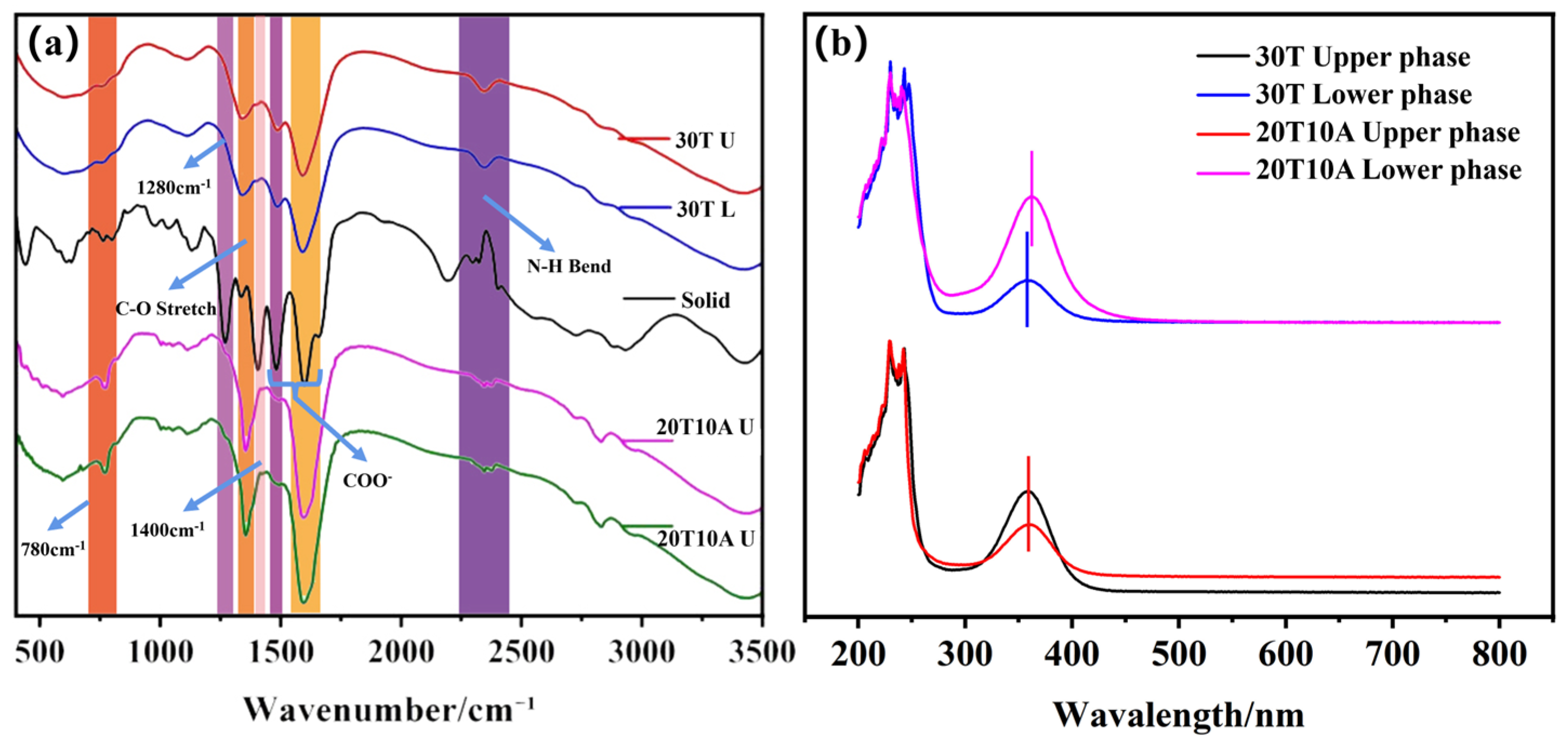
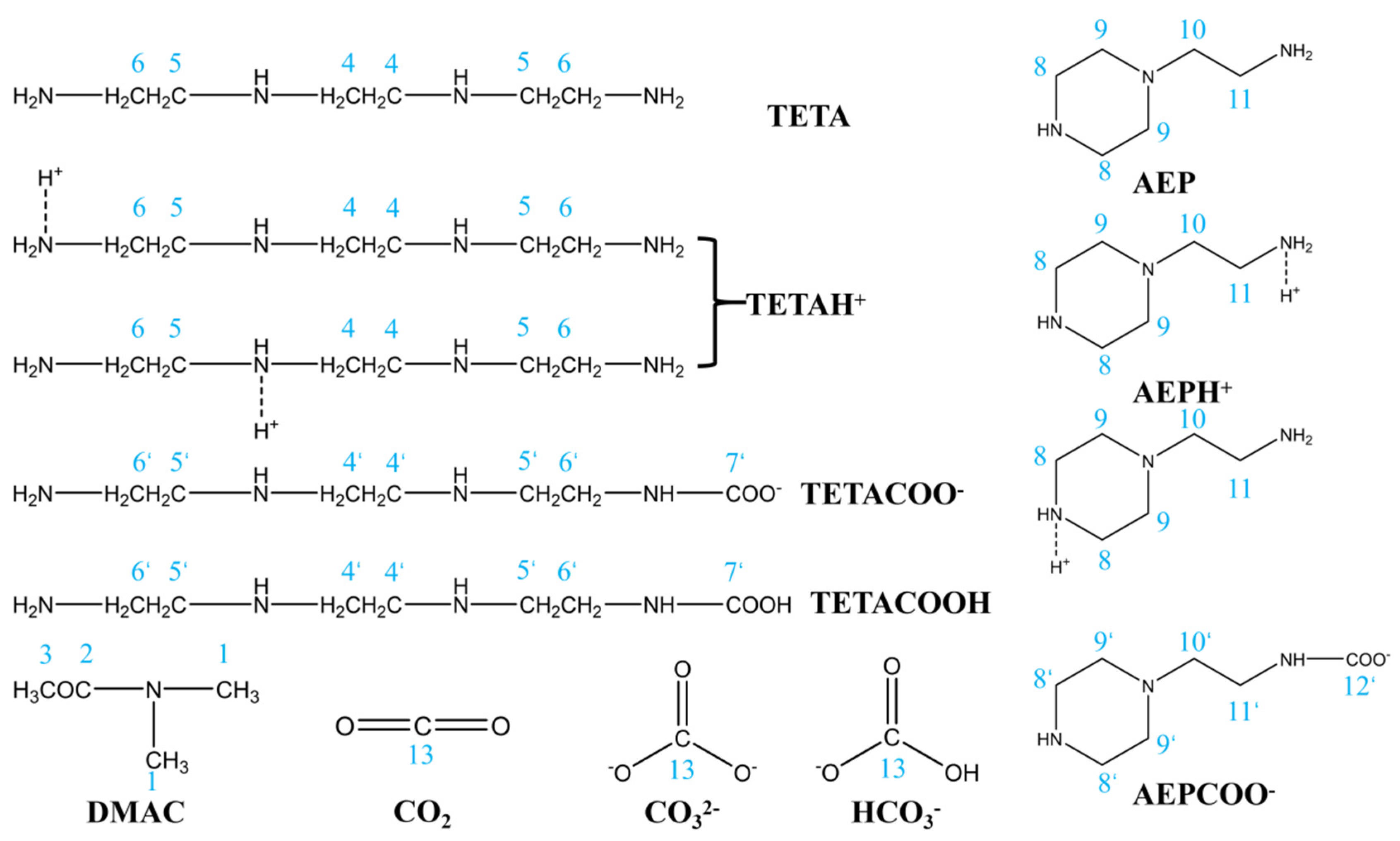
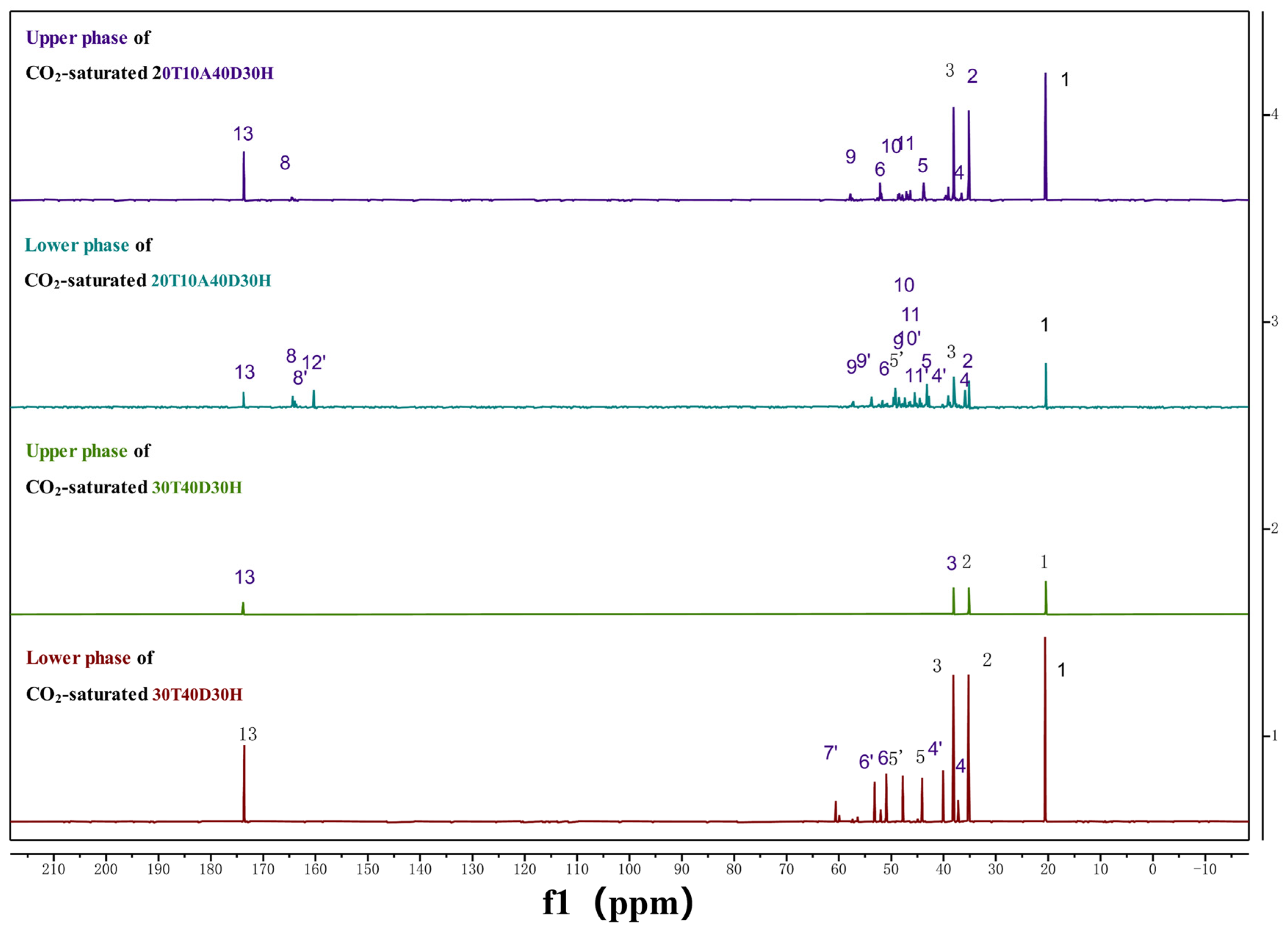
- Combined with FTIR, UV–Vis, and 13C NMR analyses, the phase separation and CO2 reaction mechanisms of the TADH system were investigated, with particular emphasis on elucidating the microscopic modification mechanism of AEP.
2. Materials and Methods
2.1. Material
2.2. Characterization Analysis
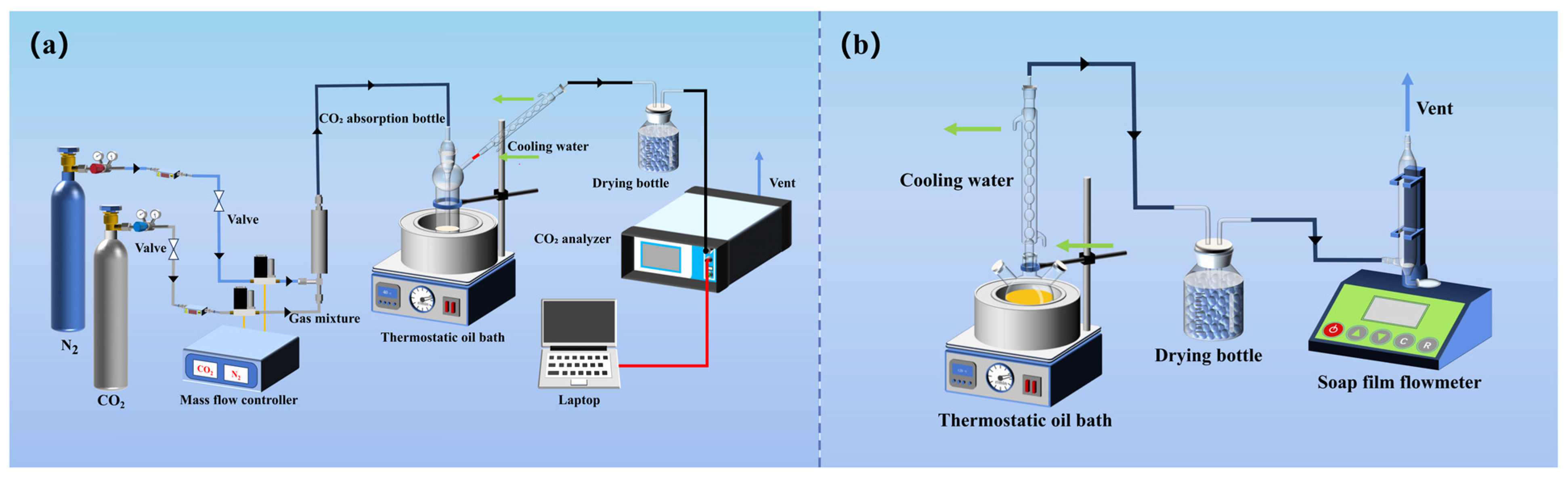
2.3. CO2 Absorption–Desorption Experiments
2.4. CO2 Distribution Between the Upper and Lower Phases of the Phase-Change Absorbent
2.5. Absorption Kinetics Analysis
3. Results
3.1. Phase Separator Optimization
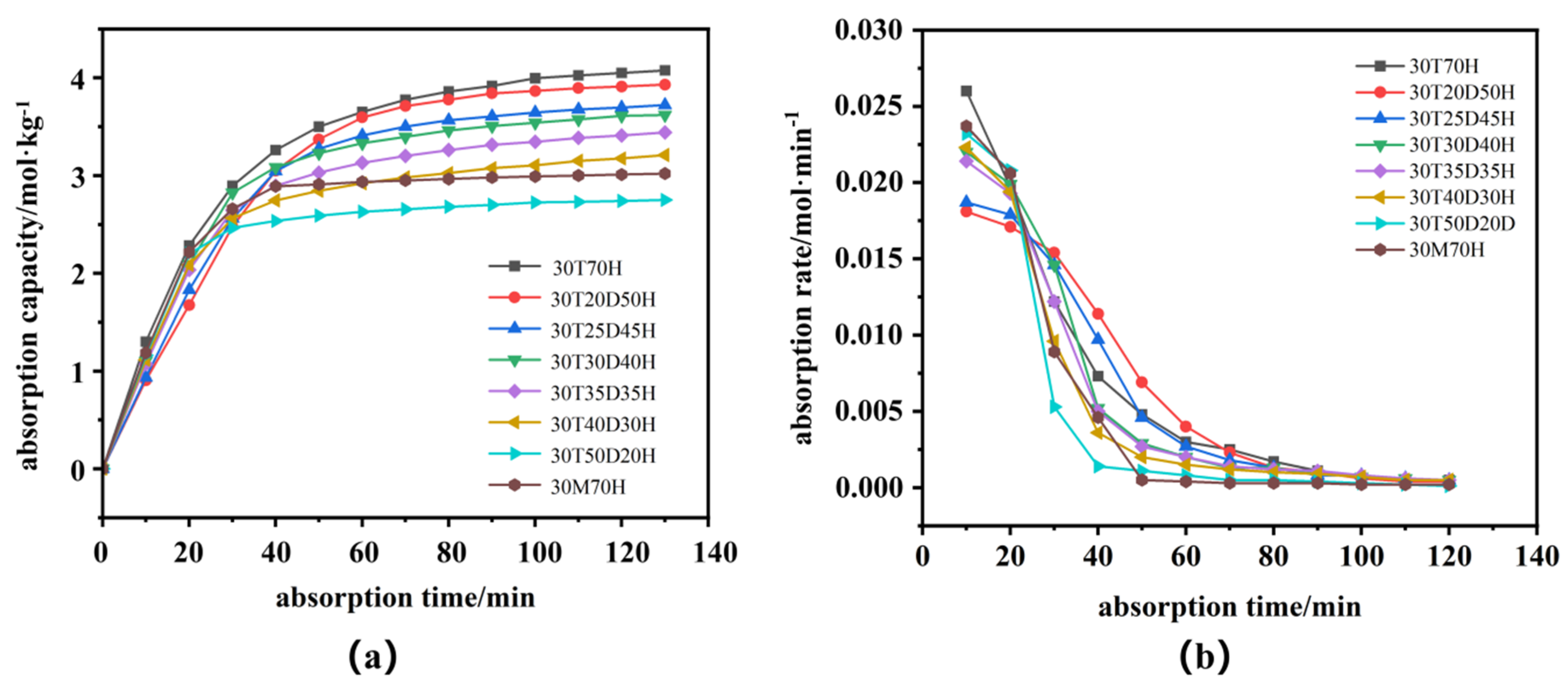
3.2. Capture Performance of TDH Biphasic Absorbents
3.3. Optimization of CO2 Phase-Change Absorbent
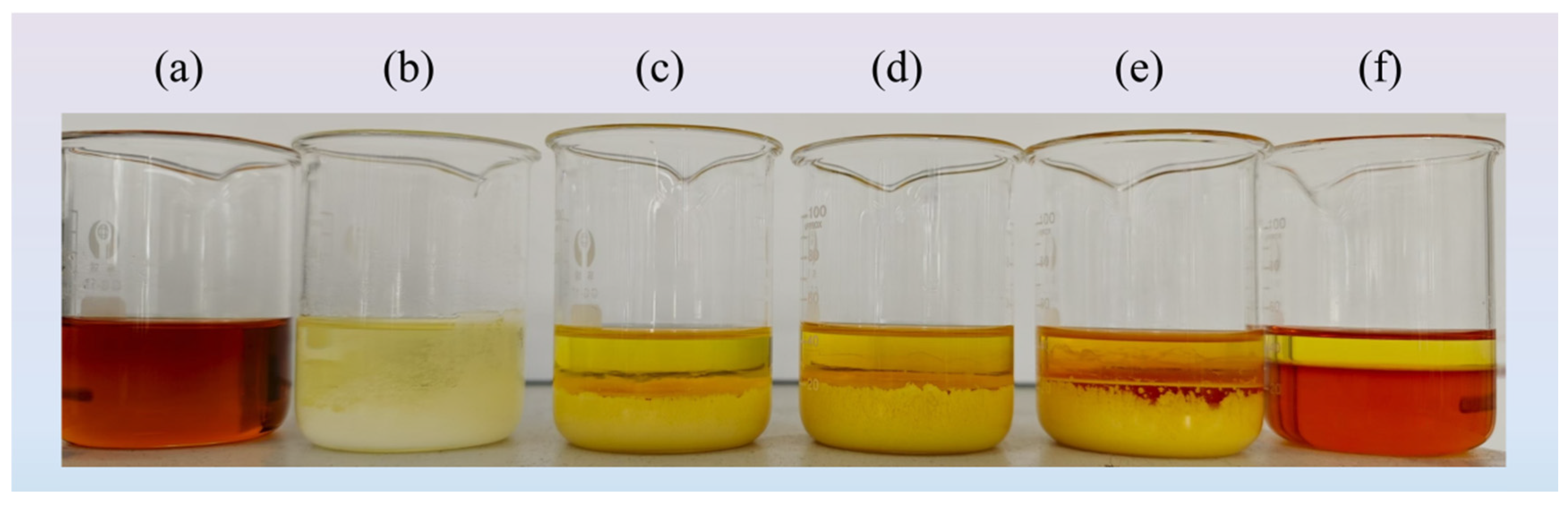
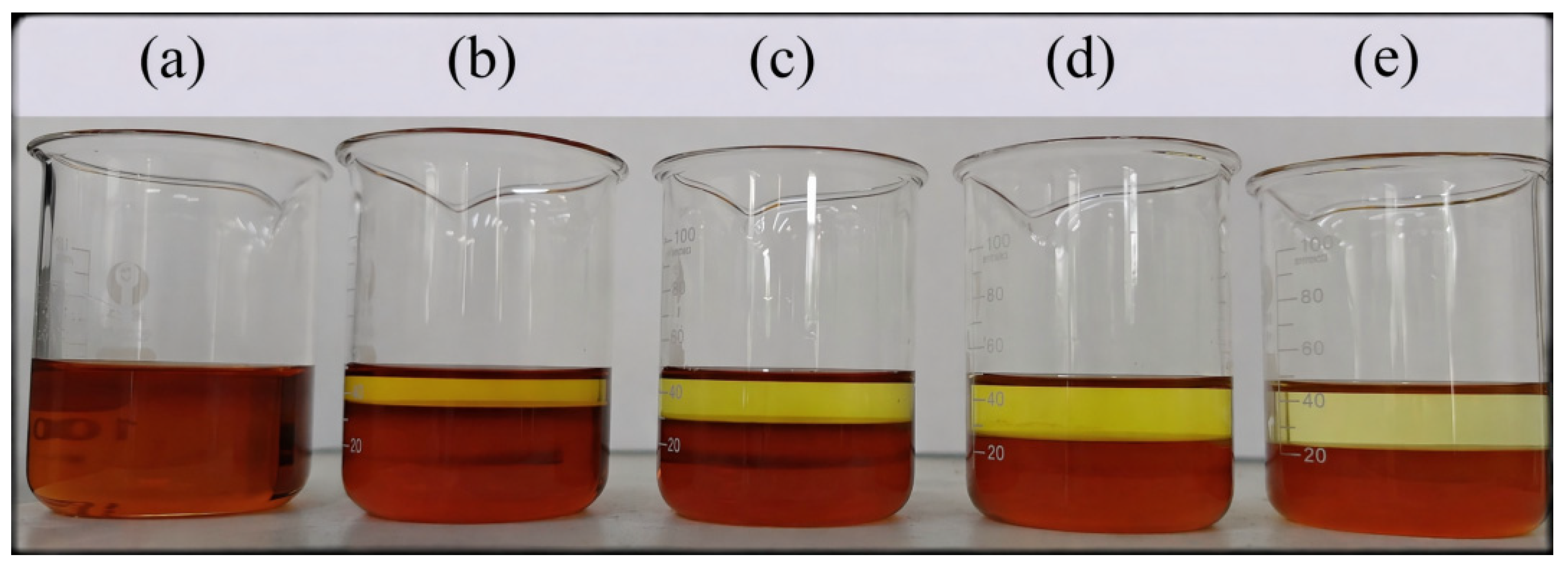
3.3.1. Phase Separation and Product Distribution
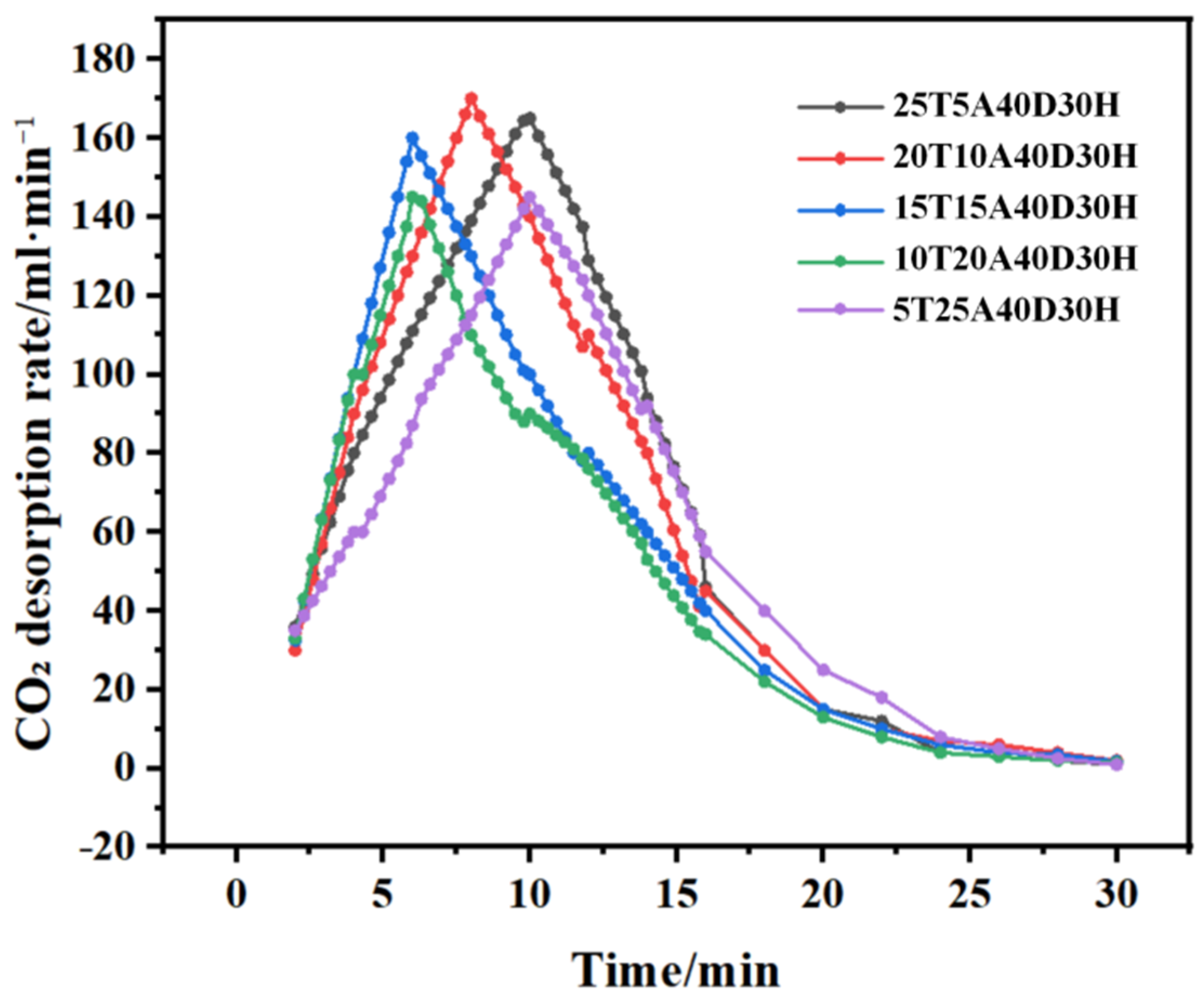
3.3.2. Effect of Different Ratios of TADH on CO2 Capture Performance
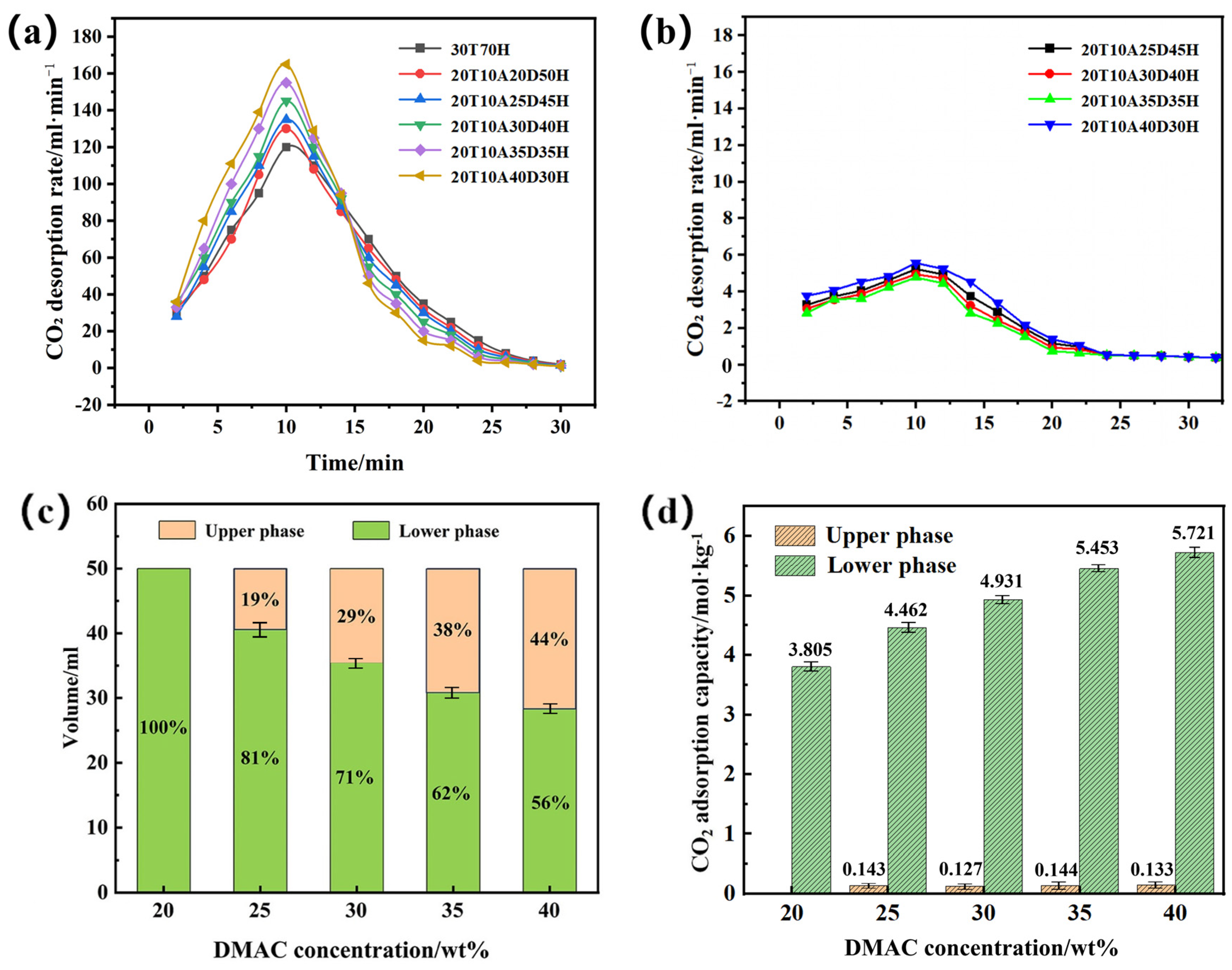
3.3.3. Impact of TADH Ratio Variations on Phase Separation
3.3.4. Viscosity Change
3.3.5. Comparison with Representative Biphasic Absorbents
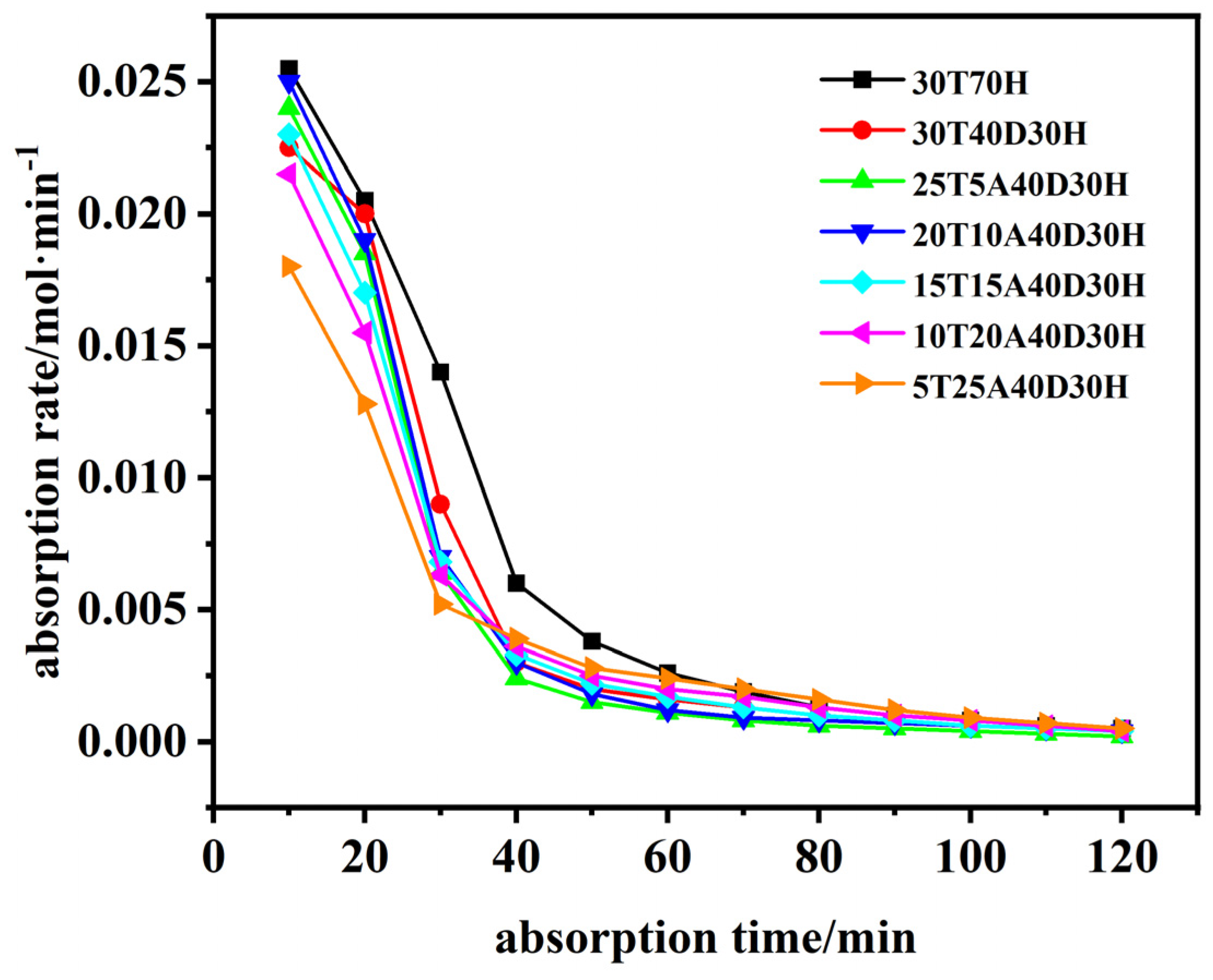
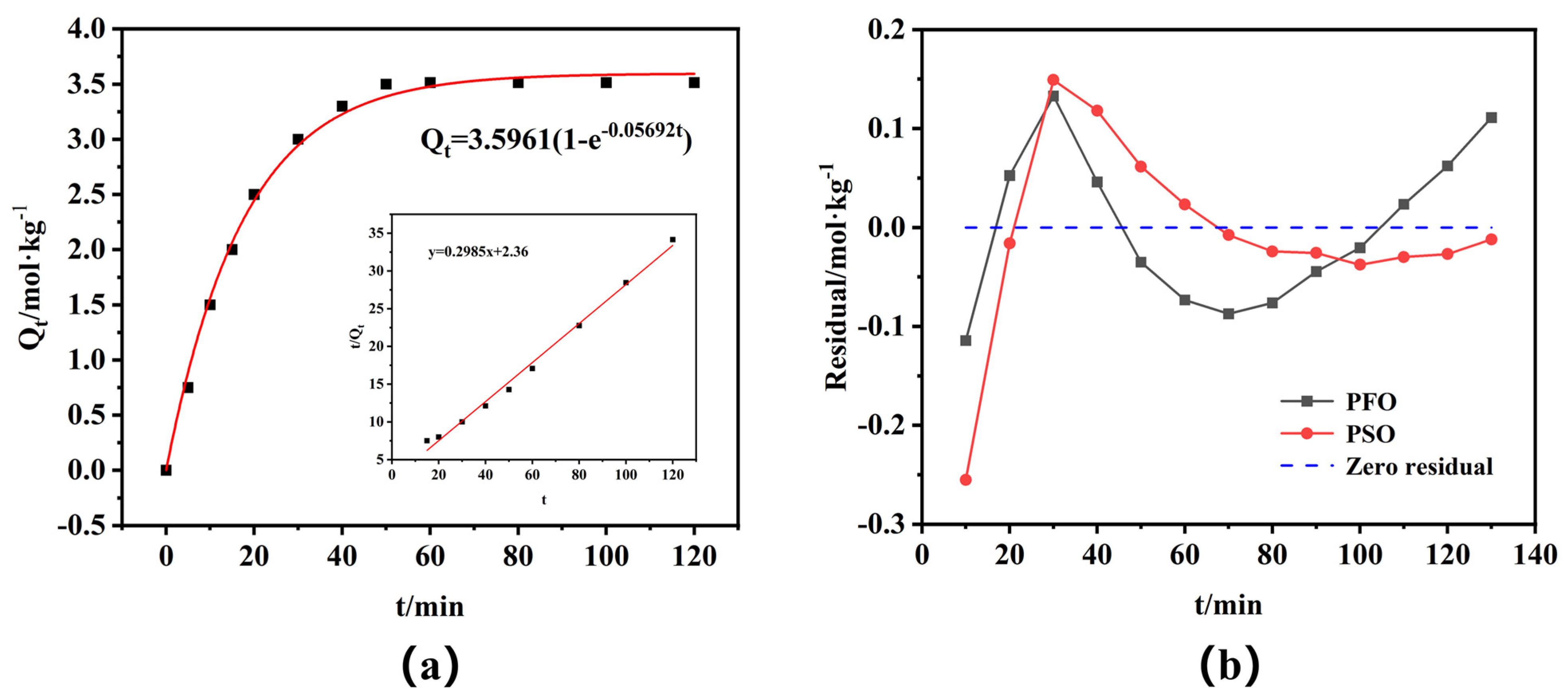
3.4. Absorption Kinetics Analysis
3.5. Mechanism Analysis
3.5.1. Properties and Morphological Evolution During CO2 Absorption
3.5.2. Reaction Mechanism
4. Conclusions
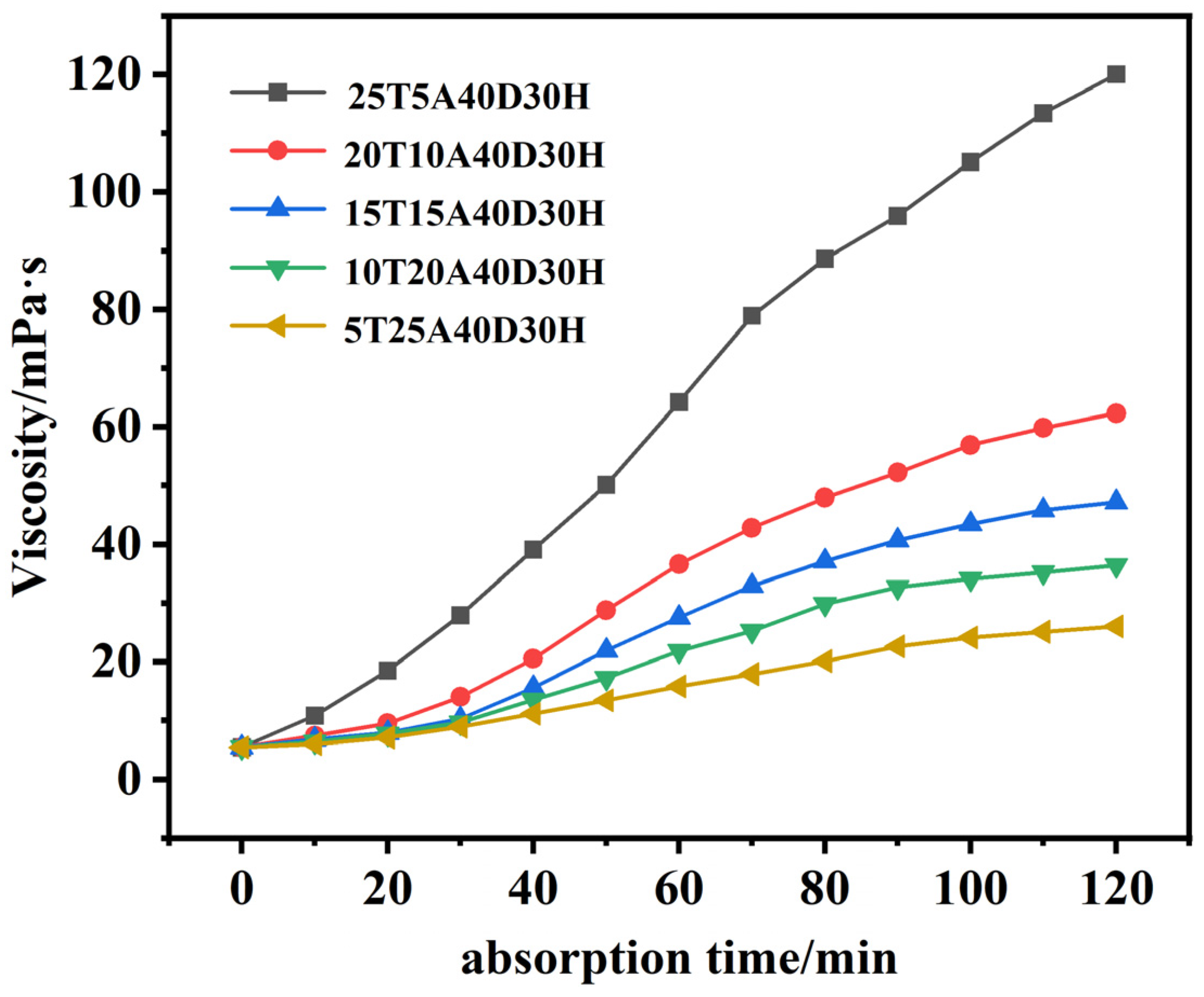
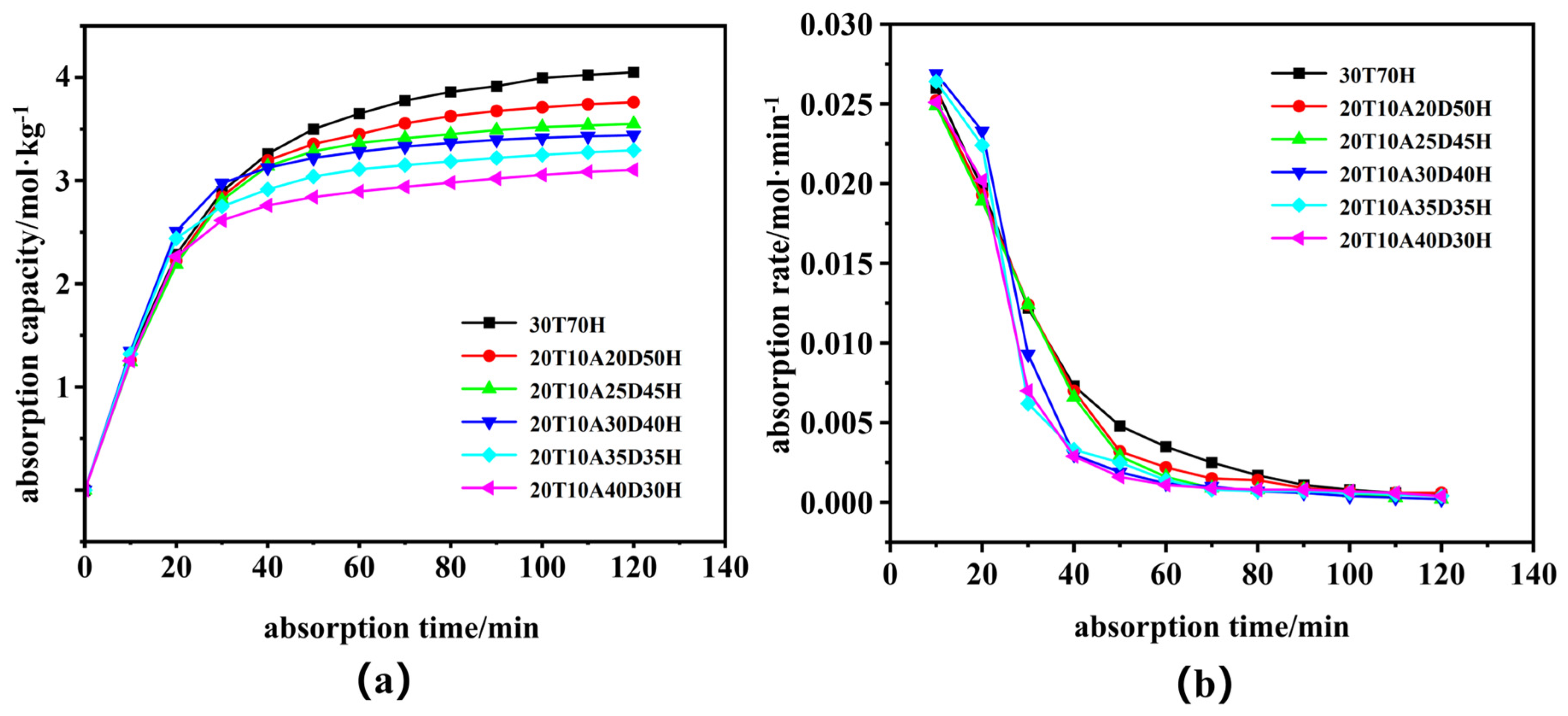
- AEP significantly reduces the viscosity of the CO2-rich lower phase and enhances desorption performance. With the addition of AEP, the viscosity of the lower phase in the TADH system decreases by 32.9–75.8% compared with the TDH system. The optimal formulation, 20T10A40D30H, achieves a CO2 enrichment efficiency exceeding 98%, and its maximum desorption rate is approximately 1.5 times that of both the 30T70H and TDH systems. Regenerating only the CO2-rich lower phase may reduce the amount of solvent requiring heating, suggesting a potential advantage in reducing the regeneration energy requirement.
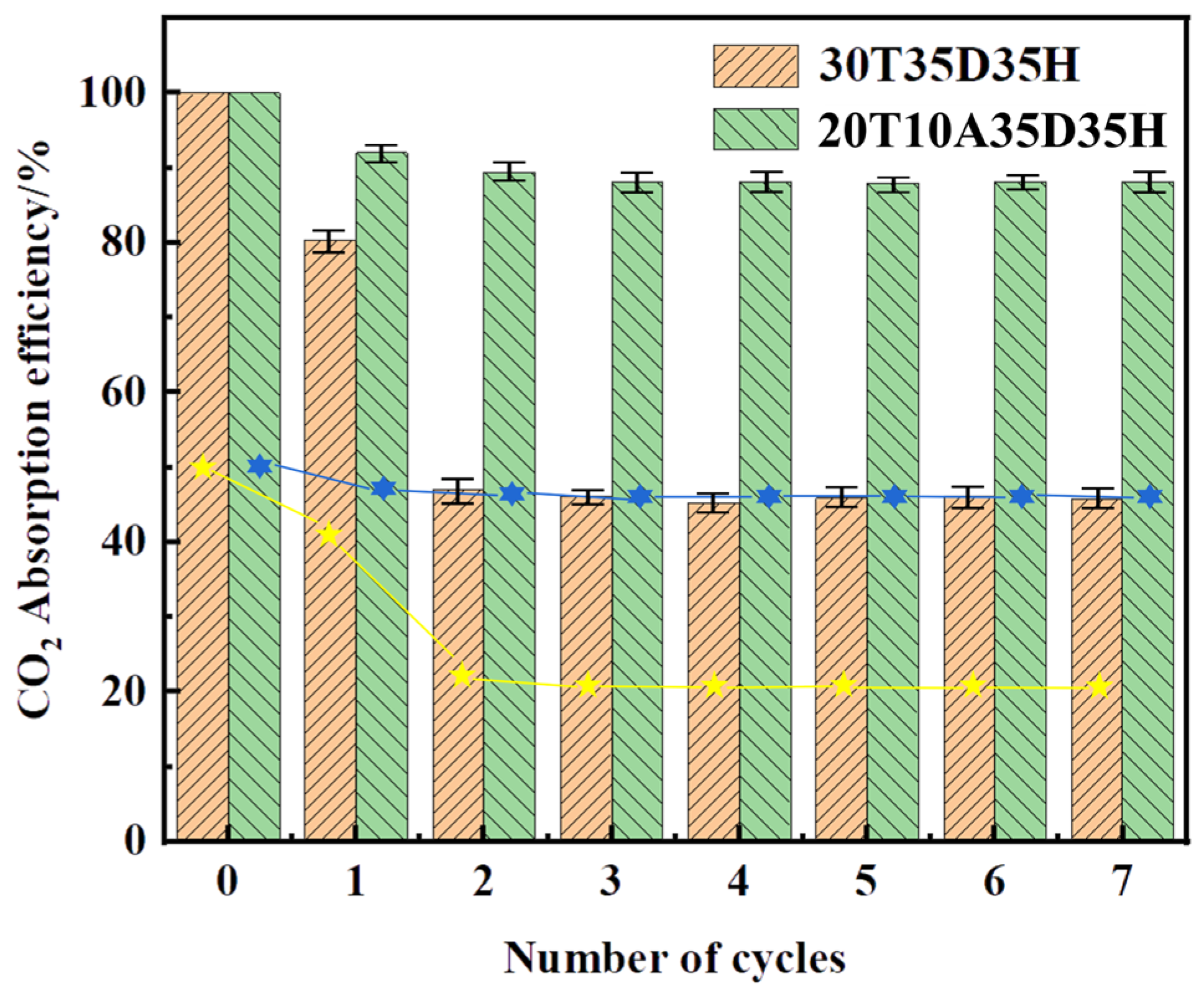
- The cyclic stability is remarkably improved. The TADH system retains more than 92% of its initial CO2 loading over the first three cycles, with desorption efficiency remaining above 90%; its cyclic absorption capacity is approximately twice that of the AEP-free system. AEP inhibits the aggregation and precipitation of carbamate species and catalyzes CO2 hydration, while synergistically working with DMAC to mitigate the thermal degradation of TETA, thus significantly enhancing long-term operational stability.
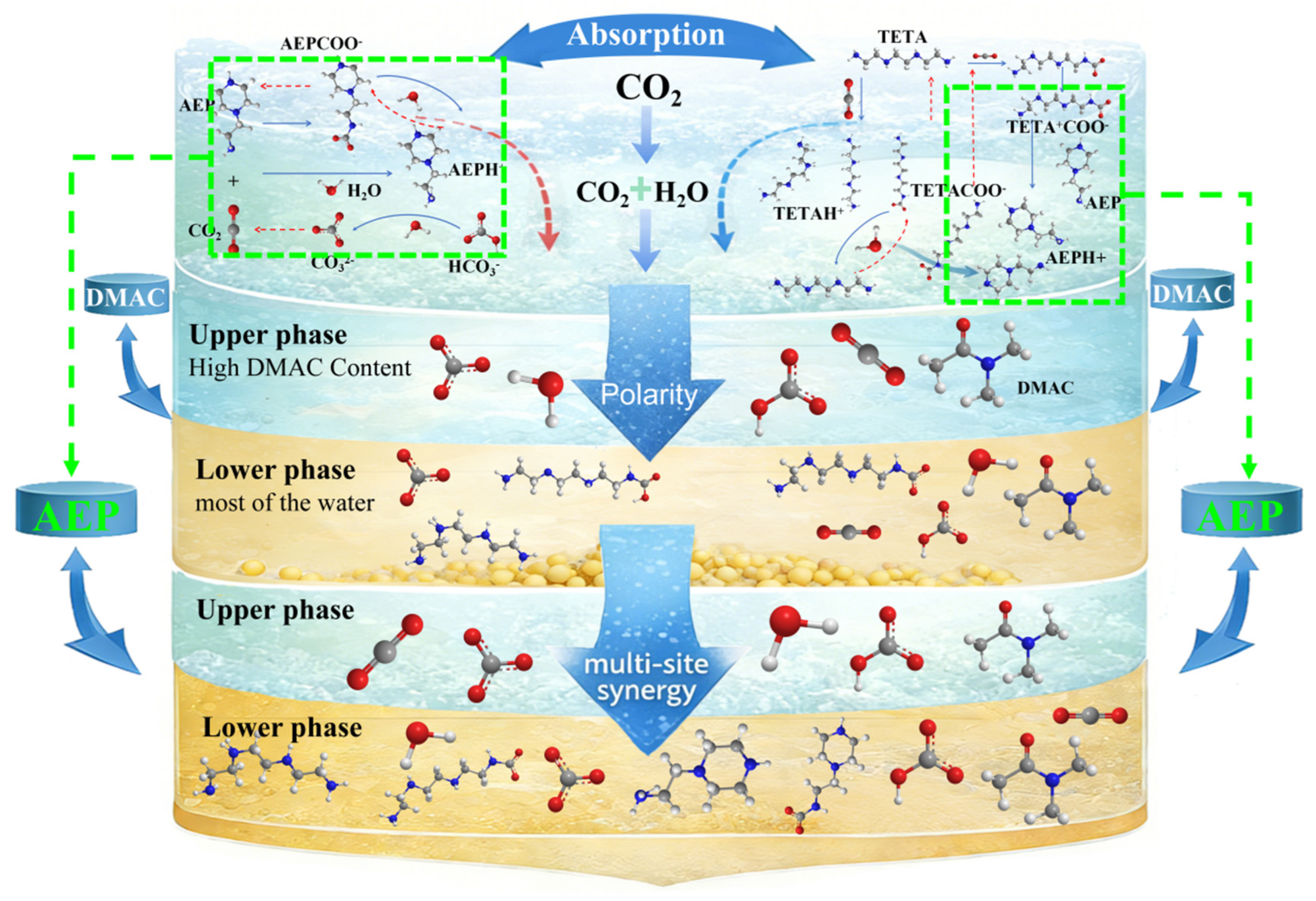
- The proposed reaction and phase separation mechanism is supported by spectroscopic evidence, and the kinetic characteristics are improved. The reaction mechanism is clarified and the kinetic characteristics are improved. The system follows a “synergistic absorption-proton transfer-hydrolysis conversion-salting-out phase separation and enrichment” mechanism. AEP and TETA provide complementary active sites, and AEP promotes the formation of easily regenerable HCO3− through steric hindrance effects. DMAC drives phase separation and directional enrichment of reaction products via the salting-out effect. Kinetic analysis demonstrates that the absorption process conforms to a pseudo-first-order model, and an appropriate amount of AEP improves mass transfer in the later stage of absorption while enhancing desorption activity and cyclic stability.
Supplementary Materials
Author Contributions
Funding
Data Availability Statement
Conflicts of Interest
Abbreviations
| TETA | Triethylenetetramine |
| DMAC | N,N-dimethylacetamide |
| AEP | 1-(2-aminoethyl)piperazine |
| TADH | TETA/AEP/DMAC/H2O biphasic absorbent |
| 30T/A40D30H | 20 wt% TETA + 10 wt% AEP + 40 wt% DMAC + 30 wt% H2O |
| 30T70H | 30 wt% TETA aqueous solution |
| TDH | TETA/DMAC/H2O biphasic absorbent |
| CCS | Carbon capture and storage |
| MEA | monoethanolamine |
| DEA | diethanolamine |
| MDEA | methyldiethanolamine |
| DETA | Diethylenetriamine |
| DMCA | N,N-dimethylcyclohexylamine |
| DMI | 1,3-dimethyl-2-imidazolidinone |
| DMF | N,N-dimethylformamide |
| NMP | N-methyl-2-pyrrolidone |
| AAILs | amino acid ionic liquids |
References
- Friedlingstein, P.; O’Sullivan, M.; Jones, M.W.; Andrew, R.M.; Gregor, L.; Hauck, J.; Le Quéré, C.; Luijkx, I.T.; Olsen, A.; Peter, G.P.; et al. Global Carbon Budget 2022. J. Earth Syst. Sci. Data 2022, 14, 4811–4900. [Google Scholar] [CrossRef]
- Borhani, T.N.; Wang, M.H. Role of solvents in CO2 capture processes: The review of selection and design methods. Renew. Sustain. Energy Rev. 2019, 114, 109299. [Google Scholar] [CrossRef]
- Vega, F.; Baena-Moreno, F.M.; Fernandez, L.M.G.; Portillo, E.; Navarrete, B.; Zhang, Z.E. Current status of CO2 chemical absorption research applied to CCS: Towards full deployment at industrial scale. Appl. Energy 2020, 260, 114313. [Google Scholar] [CrossRef]
- Liu, S.; Ling, H.; Gao, H.; Tontiwachwuthikul, P.; Liang, Z.; Zhang, H. Kinetics and new Brønsted correlations study of CO2 absorption into primary and secondary alkanolamine with and without steric-hindrance. Sep. Purif. Technol. 2020, 233, 115998. [Google Scholar] [CrossRef]
- Barzagli, F.; Mani, F.; Peruzzini, M. A Comparative Study of the CO2 Absorption in Some Solvent-Free Alkanolamines and in Aqueous Monoethanolamine (MEA). Environ. Sci. Technol. 2016, 50, 7239–7246. [Google Scholar] [CrossRef]
- MacInnes, J.M.; Ayash, A.A.; Dowson, G.R.M. CO2 absorption using diethanolamine-water solutions in a rotating spiral contactor. Chem. Eng. J. 2017, 307, 1084–1091. [Google Scholar] [CrossRef]
- Li, J.; Li, Y.; Li, C.; Tu, R.; Xie, P.; He, Y.; Shi, Y. CO2 absorption and microwave regeneration with high-concentration TETA nonaqueous absorbents. Greenh. Gases Sci. Technol. 2022, 12, 362–375. [Google Scholar] [CrossRef]
- Hu, D.; Yoon, B.; Hu, Y.; Cao, D.; Wang, Q.; Wang, B.; Lu, S. Tailoring amine activators in MDEA/NHD/H2O biphasic absorbents for energy-efficient CO2 capture: Mechanistic insights into polarity-driven phase separation and multi-component synergy. Sep. Purif. Technol. 2025, 376, 133908. [Google Scholar] [CrossRef]
- Ying, J.; Eimer, D.A.; Mathisen, A.; Brakstad, F.; Haugen, H.A. Ultrasound intensify CO2 desorption from pressurized loaded monoethanolamine solutions. II. Optimization and cost estimation. Energy 2019, 173, 218–228. [Google Scholar] [CrossRef]
- Zhao, H.; Liu, J.; Cheng, S.; Wang, R.; Li, Q.; An, S.; Zhang, S.; Wang, L. Enhancing low-temperature desorption performance toward energy-saving CO2 capture via the multifunctional design of diethylethanolamine-based biphasic solvents. Energy 2024, 307, 132613. [Google Scholar] [CrossRef]
- Shen, S.; Shi, X.; Li, C.; Guo, H.; Long, Q.; Wang, S.; Yin, X. Nonaqueous (amine + glycol ether) solvents for energy-efficient CO2 capture: New insights into phase change behaviors and assessment of capture performance. Sep. Purif. Technol. 2022, 300, 121908. [Google Scholar] [CrossRef]
- Alipour, M.; Hafizi, A.; Kanani, M.; Dara, A. Biphasic systems of mutual amine solution with tunable phase separation for CO2 capture: Optimal compositions and volume of rich phase. J. Mol. Liq. 2023, 385, 122433. [Google Scholar] [CrossRef]
- Hu, H.T.; Fang, M.X.; Liu, F.; Wang, T.; Xia, Z.X.; Zhang, W.; Ge, C.L.; Yuan, J.J. Novel alkanolamine-based biphasic solvent for CO2 capture with low energy consumption and phase change mechanism analysis. Appl. Energy 2022, 324, 119570. [Google Scholar] [CrossRef]
- Li, X.; Zhou, X.; Wei, J.; Fan, Y.; Liao, L.; Wang, H. Reducing the energy penalty and corrosion of carbon dioxide capture using a novel nonaqueous monoethanolamine-based biphasic solvent. Sep. Purif. Technol. 2021, 265, 118481. [Google Scholar] [CrossRef]
- Chen, Z.; Meng, F.; Xia, Z.; An, Y.; Fang, M.; Qin, Z.; Hu, X.; Chen, W.; Yin, H. Phase separation behavior and thermal degradation analysis of DETA/DEA/DMAC biphasic absorbent. Chem. Eng. J. 2024, 500, 157163. [Google Scholar] [CrossRef]
- Chen, Z.; Wang, T.; Li, C.; Fang, M.; Chen, W.; Hu, X.; Shao, Y.; Liu, Z.; Zhang, W.; Zhang, L.; et al. Phase separation behavior and CO2 absorption kinetic analysis of DETA/DEA/DMAC biphasic absorbent. Chem. Eng. J. 2024, 496, 154002. [Google Scholar] [CrossRef]
- Zhang, Z.; Zhao, W.B.; Nong, J.J.; Feng, D.; Li, Y.H.; Chen, Y.; Chen, J. Liquid-Solid Phase-Change Behavior of Diethylenetriamine in Nonaqueous Systems for Carbon Dioxide Absorption. Energy Technol. 2017, 5, 461–468. [Google Scholar] [CrossRef]
- Zheng, S.; Tao, M.; Liu, Q.; Ning, L.; He, Y.; Shi, Y. Capturing CO2 into the Precipitate of a Phase-Changing Solvent after Absorption. Environ. Sci. Technol. 2014, 48, 8905–8910. [Google Scholar] [CrossRef]
- Wang, Y.; Nwaoha, C.; Sema, T.; Liu, B.; Liang, Z.; Tontiwachwuthikul, P.; Li, J.-H. Investigation of CO2 absorption and desorption performance of DETA-based phase-change solvents in alcohol-water systems. Chem. Eng. J. 2025, 520, 165495. [Google Scholar] [CrossRef]
- Zhang, S.; Shen, Y.; Shao, P.; Chen, J.; Wang, L. Kinetics, Thermodynamics, and Mechanism of a Novel Biphasic Solvent for CO2 Capture from Flue Gas. Environ. Sci. Technol. 2018, 52, 3660–3668. [Google Scholar] [CrossRef] [PubMed]
- Gao, X.; Li, X.; Cheng, S.; Lv, B.; Jing, G.; Zhou, Z. A novel solid–liquid ‘phase controllable’ biphasic amine absorbent for CO2 capture. Chem. Eng. J. 2022, 430, 132932. [Google Scholar] [CrossRef]
- Jiang, C.; Chen, H.; Wang, J.; Shen, Y.; Ye, J.; Zhang, S.; Wang, L.; Chen, J. Phase Splitting Agent Regulated Biphasic Solvent for Efficient CO2 Capture with a Low Heat Duty. Environ. Sci. Technol. 2020, 54, 7601–7610. [Google Scholar] [CrossRef]
- Tao, M.; Xu, N.; Gao, J.; Zhang, W.; Li, Y.; Bernards, M.T.; Shi, Y.; He, Y.; Pan, H. Phase-Change Mechanism for Capturing CO2 into an Environmentally Benign Nonaqueous Solution: A Combined NMR and Molecular Dynamics Simulation Study. Energy Fuels 2019, 33, 474–483. [Google Scholar] [CrossRef]
- Zhan, X.; Lv, B.; Yang, K.; Jing, G.; Zhou, Z. Dual-Functionalized Ionic Liquid Biphasic Solvent for Carbon Dioxide Capture: High-Efficiency and Energy Saving. Environ. Sci. Technol. 2020, 54, 6281–6288. [Google Scholar] [CrossRef]
- Zhao, S.; Wang, Y.; Zhu, K.; Zhao, D.; Song, Q. Improving the absorption load, high viscosity, and regeneration efficiency of CO2 capture using a novel tri-solvent biphasic solvents of TETA-AMP-1DMA2P. Environ. Sci. Pollut. Res. 2022, 29, 84903–84915. [Google Scholar] [CrossRef]
- Chen, W.; Chen, M.; Jiang, B.; Lei, T.; Zhang, F.; Zhang, Z. The improvement of ionic liquids on CO2 capture with biphasic absorbents. Chem. Eng. J. 2024, 493, 152720. [Google Scholar] [CrossRef]
- Liang, Y.; Duan, H.; Chen, W.; Sun, L.; Zhang, F. Product Optimization of Biphasic Absorbents for CO2 Capture. Energy Fuels 2025, 39, 16327–16334. [Google Scholar] [CrossRef]
- Guo, R.-T.; Li, G.-Y.; Liu, Y.; Pan, W.-G. Recent Progress on CO2 Capture Based on Sterically Hindered Amines: A Review. Energy Fuels 2023, 37, 15429–15452. [Google Scholar] [CrossRef]
- Dey, A.; Saini, B.; Balchandani, S.C.; Kumar Dash, S. Investigation of equilibrium CO2 solubility in 35 wt% aqueous 1-(2-aminoethyl) piperazine (AEP) and performance study over monoethanolamine for CO2 absorption. Mater. Today Proc. 2022, 61, 498–503. [Google Scholar] [CrossRef]
- Ye, Q.; Wang, X.; Lu, Y. Screening and evaluation of novel biphasic solvents for energy-efficient post-combustion CO2 capture. Int. J. Greenh. Gas Control 2015, 39, 205–214. [Google Scholar] [CrossRef]
- Crooks, J.E.; Donnellan, J.P. Kinetics and mechanism of the reaction between carbon dioxide and amines in aqueous solution. J. Chem. Soc. Perkin Trans. 1989, 2, 331–333. [Google Scholar] [CrossRef]
- Liu, F.; Jing, G.; Zhou, X.; Lv, B.; Zhou, Z. Performance and Mechanisms of Triethylene Tetramine (TETA) and 2-Amino-2-methyl-1-propanol (AMP) in Aqueous and Nonaqueous Solutions for CO2 Capture. ACS Sustain. Chem. Eng. 2018, 6, 1352–1361. [Google Scholar] [CrossRef]
- Gao, G.; Gao, X.; Xu, B.; Jiang, W.; Zhao, Z.; Wu, F.; Li, X.; Luo, C.; Zhang, L. Novel biphasic solvent based on 2MPRZ absorbent for post-combustion CO2 capture with low viscosity, superior phase-splitting behavior and low energy consumption. Sep. Purif. Technol. 2024, 330, 125424. [Google Scholar] [CrossRef]
- Yang, Y.; Wang, S.; Yang, K.; Xu, W.; Wang, X.; Geng, Z.; Liao, G.; Ning, P.; Zhu, T. Organic solvents induced enhancement of phase-splitting behaviors and CO2 absorption performance in biphasic absorbent. Sep. Purif. Technol. 2025, 362, 131798. [Google Scholar] [CrossRef]
- Wang, N.; Peng, Z.; Gao, H.; Sema, T.; Shi, J.; Liang, Z. New insight and evaluation of secondary Amine/N-butanol biphasic solutions for CO2 Capture: Equilibrium Solubility, phase separation Behavior, absorption Rate, desorption Rate, energy consumption and ion species. Chem. Eng. J. 2022, 431, 133912. [Google Scholar] [CrossRef]
- Wang, R.; Zhao, H.; Wang, Y.; Qi, C.; Zhang, S.; Wang, L.; Li, M. Development of biphasic solvent for CO2 capture by tailoring the polarity of amine solution. Fuel 2022, 325, 124885. [Google Scholar] [CrossRef]
- Shen, L.; Liu, F.; Shen, Y.; Sun, C.; Zhang, Y.; Wang, Q.; Li, S.; Li, W. Novel biphasic solvent of AEP/1-propanol/H2O for CO2 capture with efficient regeneration performance and low energy consumption. Sep. Purif. Technol. 2021, 270, 118700. [Google Scholar] [CrossRef]
- Ye, J.; Jiang, C.; Chen, H.; Shen, Y.; Zhang, S.; Wang, L.; Chen, J. Novel Biphasic Solvent with Tunable Phase Separation for CO2 Capture: Role of Water Content in Mechanism, Kinetics, and Energy Penalty. Environ. Sci. Technol. 2019, 53, 4470–4479. [Google Scholar] [CrossRef] [PubMed]
- Liu, J.; Qian, J.; He, Y. Water-lean triethylenetetramine/N,N-diethylethanolamine/n-propanol biphasic solvents: Phase-separation performance and mechanism for CO2 capture. Sep. Purif. Technol. 2022, 289, 120740. [Google Scholar] [CrossRef]
- Liu, J.; Qian, J.; Hu, H. Effect of H2O on absorption performance of tetraethylenepentamine-ethanol-CO2 two-phase absorbent and its mechanism. Int. J. Greenh. Gas Control 2021, 110, 103406. [Google Scholar] [CrossRef]
- Zhang, W.; Jin, X.; Tu, W.; Ma, Q.; Mao, M.; Cui, C. Development of MEA-based CO2 phase change absorbent. Appl. Energy 2017, 195, 316–323. [Google Scholar] [CrossRef]
- Zhang, W.; Jin, X.; Tu, W.; Ma, Q.; Mao, M.; Cui, C. A Novel CO2 Phase Change Absorbent: MEA/1-Propanol/H2O. Energy Fuels 2017, 31, 4273–4279. [Google Scholar] [CrossRef]
- Morrison, T.J. 729. The salting-out of non-electrolytes. Part I. The effect of ionic size, ionic charge, and temperature. J. Chem. Soc. 1952, 3814–3818. [Google Scholar] [CrossRef]
- Duan, J.; Zhu, J.; Lu, S.; Kang, J.; Zhao, F. Influence of EtOH and n-PrOH on the CO2 absorption and phase separation of amine-functionalized ionic liquid phase separation system. Chem. Eng. J. 2025, 515, 163670. [Google Scholar] [CrossRef]
- Saeed, A.; Qyyum, M.A.; Lee, D.; Al-Hajri, R. The evolving role of biphasic solvents in CO2 capture: Recent developments, deployment challenges, and opportunities for AI-assisted screening. Chem. Eng. J. 2025, 519, 165027. [Google Scholar] [CrossRef]







| Abbreviation | Absorbent Composition |
|---|---|
| 30M70H | 30 wt% MEA + 70 wt% H2O |
| 30T70H | 30 wt% TETA + 70 wt% H2O |
| 30T20D50H | 30 wt% TETA + 20 wt% DMAC + 50 wt% H2O |
| 30T25D45H | 30 wt% TETA + 25 wt% DMAC + 45 wt% H2O |
| 30T30D40H | 30 wt% TETA + 30 wt% DMAC + 40 wt% H2O |
| 30T35D35H | 30 wt% TETA + 35 wt% DMAC + 35 wt% H2O |
| 30T40D30H | 30 wt% TETA + 40 wt% DMAC + 30 wt% H2O |
| 30T50D20H | 30 wt% TETA + 50 wt% DMAC + 20 wt% H2O |
| 25T5A40D30H | 25 wt% TETA + 5 wt% AEP + 40 wt% DMAC + 30 wt% H2O |
| 20T10A40D30H | 20 wt% TETA + 10 wt% AEP + 40 wt% DMAC + 30 wt% H2O |
| 15T15A40D30H | 15 wt% TETA + 15 wt% AEP + 40 wt% DMAC + 30 wt% H2O |
| 10T20A40D30H | 10 wt% TETA + 20 wt% AEP + 40 wt% DMAC + 30 wt% H2O |
| 5T25A40D30H | 5 wt% TETA + 25 wt% AEP + 40 wt% DMAC + 30 wt% H2O |
| 20T10A20D50H | 20 wt% TETA + 10 wt% AEP + 20 wt% DMAC + 50 wt% H2O |
| 20T10A25D45H | 20 wt% TETA + 10 wt% AEP + 25 wt% DMAC + 45 wt% H2O |
| 20T10A30D40H | 20 wt% TETA + 10 wt% AEP + 30 wt% DMAC + 40 wt% H2O |
| 20T10A35D35H | 20 wt% TETA + 10 wt% AEP + 35 wt% DMAC + 35 wt% H2O |
| 20T10A40D30H | 20 wt% TETA + 10 wt% AEP + 40 wt% DMAC + 30 wt% H2O |
| Organic Solvent | Boiling Point (K) | After Absorption | After Desorption | Dipole Moment (Debye) |
|---|---|---|---|---|
| 2-Methyl-1-propanol | 108.0 | Two Phases | Two Phases | 1.64 |
| DMF | 153.0 | Single Phase | Single Phase | 3.82 |
| Ethanol | 78.4 | Single Phase | Single Phase | 1.68 |
| DMAC | 165.1 | Two Phases | Single Phase | 3.70 |
| 1-Butanol | 117.6 | Two Phases | Two Phases | 1.66 |
| 1-propanol | 97.0 | Two Phases | Single Phase | 1.55 |
| 2-propanol | 82.3 | Two Phases | Single Phase | 1.58 |
| Absorbent | Viscosity/(mPa·s) | |
|---|---|---|
| Upper Phase | Lower Phase | |
| 30T70H | 12.0 ± 0.07 | |
| 30T/A20D50H | 5.4 ± 0.05 | 22.4 ± 0.24 |
| 30T/A25D45H | 5.4 ± 0.05 | 36.8 ± 0.48 |
| 30T/A30D40H | 5.4 ± 0.07 | 42.7 ± 0.50 |
| 30T/A35D35H | 5.4 ± 0.05 | 55.5 ± 0.70 |
| 30T/A40D30H | 5.4 ± 0.07 | 62.3 ± 0.82 |
| 30T20D50H | 4.9 ± 0.05 | 33.4 ± 0.44 |
| 30T25D45H | 5.4 ± 0.08 | 71.7 ± 0.95 |
| 30T30D40H | 5.4 ± 0.04 | 105.7 ± 1.15 |
| 30T35D35H | 5.0 ± 0.07 | 185.6 ± 2.12 |
| 30T40D30H | 5.2 ± 0.07 | 257.9 ± 2.87 |
| Sr | Solvent Name | Solvent Abbreviation | Solvent Type | Split Mode Phases | Concentration of Solvent | CO2 Loading Capacity | Rich Phase Ratio | Viscosity | Ref. |
|---|---|---|---|---|---|---|---|---|---|
| 1 | triethylenetetramine/N,N-dimethylcyclohexylamine/water | TETA/DMCA/H2O | Amine blend | Liquid- Liquid | 1 M TETA, 3 M DMCA | 0.8 mol/mol | 65.0% | N/A | [20] |
| 2 | Triethylenetetramine/2-(diethylamino)ethanol/ Water | TETA/DEEA/ H2O | Amine blend | Liquid- Liquid | 1 M TETA, 4 M DEEA | 0.9 mol/mol | 88.0% | N/A | [30] |
| 3 | Triethylenetetramine/2-amino-2-methyl-1-propanol/Ethanol | TETA/AMP/C2H5OH | Amine-Alcohol blend | Solid- Liquid | 1 M TETA, 2 M AMP, 60 wt% C2H5OH | 3.71 mol·kg−1 | N/A | 198.32 mPa·s | [32] |
| 4 | Triethylenetetramine/Ethanol/Water | TETA/C2H5OH/H2O | Amine-Alcohol blend | Solid- Liquid | N/A | 1.72 mol/mol | N/A | N/A | [18,19] |
| 5 | TETA-DEEA-H2O with phase-splitting agents, such as DMI, DMF, NMP | TETA/DEEA/H2O + phase splitter | Amine-Physical solvent blend | Liquid–liquid | 1 M TETA, 3 M DEEA, 25 wt% H2O | 0.64–0.73 mol/mol | N/A | ~450 mPa·s | [45] |
| 6 | Tetraethylenepentamine/1-ethylimidazole/H2O | TEPA/Eim/H2O | Amine blend | Solid- Liquid | 20 wt% TEPA, 60 wt% Eim, 20 wt% H2O | 1.50 mol·kg−1 | 41.0% | N/A | [26] |
| 7 | Tetraethylenepentamine/1-ethylimidazole/water/serine-based amino acid ionic liquid | TEPA/Eim/H2O-Ser | Amine-Ionic Liquid blend | Liquid–liquid | 20 wt% TEPA, 50 wt% Eim, 20 wt% H2O, 10 wt% Ser | 1.85 mol·kg−1 | 67.0% | 108.6 mPa·s | [26] |
| 8 | Triethylenetetramine/N,N-dimethylacetamide/H2O | TDH | Amine-Physical solvent blend | Solid- Liquid | 30 wt% TETA, 40 wt% DMAC, 30 wt% H2O | 3.305 mol·kg−1 | 49.0% | 257.9 mPa·s | this work |
| 9 | Triethylenetetramine/1-(2-aminoethyl)piperazine/N,N-dimethylacetamide/H2O | TADH | Amine-Physical solvent blend | Liquid–liquid | 20 wt% TETA,10 wt% AEP, 40 wt% DMAC, 30 wt% H2O | 3.204 mol·kg−1 | 56.0% | 62.3 mPa·s | this work |
| Sample | PFO (Qe) | PFO (k1) | PFO R2 | PFO RMSE | PFO AIC | PSO (Qe) | PSO (k2) | PSO R2 | PSO RMSE | PSO AIC | ΔAIC |
|---|---|---|---|---|---|---|---|---|---|---|---|
| 30T70H | 4.0386 | 0.03513 | 0.9956 | 0.0549 | −71.44 | 4.9748 | 0.00754 | 0.9944 | 0.0621 | −68.25 | 3.20 |
| 30T20D50H | 4.0917 | 0.02797 | 0.9903 | 0.0934 | −57.63 | 5.3187 | 0.00489 | 0.9740 | 0.1532 | −44.78 | 12.85 |
| 30T25D45H | 3.7960 | 0.03189 | 0.9918 | 0.0765 | −62.83 | 4.7991 | 0.00659 | 0.9760 | 0.1313 | −48.78 | 14.05 |
| 30T30D40H | 3.6090 | 0.03837 | 0.9880 | 0.0815 | −61.20 | 4.4015 | 0.00948 | 0.9769 | 0.1129 | −52.71 | 8.49 |
| 30T35D35H | 3.4259 | 0.03818 | 0.9882 | 0.0759 | −63.05 | 4.1758 | 0.00998 | 0.9826 | 0.0921 | −58.00 | 5.06 |
| 30T40D30H | 3.1703 | 0.04233 | 0.9788 | 0.0890 | −58.91 | 3.7968 | 0.01278 | 0.9813 | 0.0836 | −60.53 | −1.63 |
| 30T50D20H | 2.7569 | 0.05539 | 0.9580 | 0.0962 | −56.88 | 3.1817 | 0.02215 | 0.9555 | 0.0989 | −56.15 | 0.73 |
| Sample | PFO (Qe) | PFO (k1) | PFO R2 | PFO RMSE | PFO AIC | PSO (Qe) | PSO (k2) | PSO R2 | PSO RMSE | PSO AIC | ΔAIC |
|---|---|---|---|---|---|---|---|---|---|---|---|
| 20T10A20D50H | 3.7587 | 0.03869 | 0.9949 | 0.0545 | −65.84 | 4.6239 | 0.00894 | 0.9885 | 0.0821 | −55.99 | 9.85 |
| 20T10A25D45H | 3.5656 | 0.04183 | 0.9945 | 0.0529 | −66.57 | 4.3326 | 0.01063 | 0.9808 | 0.0985 | −51.62 | 14.95 |
| 20T10A30D40H | 3.4133 | 0.05082 | 0.9806 | 0.0866 | −54.70 | 4.0240 | 0.01511 | 0.9681 | 0.1111 | −48.73 | 5.97 |
| 20T10A35D35H | 3.2552 | 0.05019 | 0.9753 | 0.0922 | −53.20 | 3.8397 | 0.01566 | 0.9760 | 0.0910 | −53.54 | −0.33 |
| 20T10A40D30H | 3.0728 | 0.04989 | 0.9730 | 0.0912 | −53.46 | 3.6292 | 0.01641 | 0.9770 | 0.0841 | −55.42 | −1.96 |
Disclaimer/Publisher’s Note: The statements, opinions and data contained in all publications are solely those of the individual author(s) and contributor(s) and not of MDPI and/or the editor(s). MDPI and/or the editor(s) disclaim responsibility for any injury to people or property resulting from any ideas, methods, instructions or products referred to in the content. |
© 2026 by the authors. Licensee MDPI, Basel, Switzerland. This article is an open access article distributed under the terms and conditions of the Creative Commons Attribution (CC BY) license.
Share and Cite
Zhang, Q.; Wu, F.; Ning, X.; Yi, L.; Wu, L.; Ye, G.; Zhou, J. Phase Separation Behavior and CO2 Capture Performance/Mechanism of TETA/AEP/DMAC Biphasic Absorbent. Processes 2026, 14, 1909. https://doi.org/10.3390/pr14121909
Zhang Q, Wu F, Ning X, Yi L, Wu L, Ye G, Zhou J. Phase Separation Behavior and CO2 Capture Performance/Mechanism of TETA/AEP/DMAC Biphasic Absorbent. Processes. 2026; 14(12):1909. https://doi.org/10.3390/pr14121909
Chicago/Turabian StyleZhang, Qiuli, Fan Wu, Xiaogang Ning, Linxin Yi, Lei Wu, Gan Ye, and Jun Zhou. 2026. "Phase Separation Behavior and CO2 Capture Performance/Mechanism of TETA/AEP/DMAC Biphasic Absorbent" Processes 14, no. 12: 1909. https://doi.org/10.3390/pr14121909
APA StyleZhang, Q., Wu, F., Ning, X., Yi, L., Wu, L., Ye, G., & Zhou, J. (2026). Phase Separation Behavior and CO2 Capture Performance/Mechanism of TETA/AEP/DMAC Biphasic Absorbent. Processes, 14(12), 1909. https://doi.org/10.3390/pr14121909