Article

Phase Separation Behavior and CO2 Capture Performance/Mechanism of TETA/AEP/DMAC Biphasic Absorbent

1
School of Chemistry and Chemical Engineering, Xi’an University of Architecture and Technology, Xi’an 710055, China
2
Chlor-Alkali Business Unit, Sinochem Holdings Corporation Ltd., Beijing 100080, China
*
Author to whom correspondence should be addressed.
Processes 2026, 14(12), 1909; https://doi.org/10.3390/pr14121909
Submission received: 4 May 2026 / Revised: 4 June 2026 / Accepted: 8 June 2026 / Published: 11 June 2026
(This article belongs to the Topic Green and Sustainable Chemical Processes)

Abstract

To address the common drawbacks of polyamine-based CO2 absorbents, such as high viscosity and precipitation at high CO2 loading, a novel liquid–liquid biphasic absorbent composed of triethylenetetramine (TETA), 1-(2-aminoethyl)piperazine (AEP), N,N-dimethylacetamide (DMAC), and H2O was developed in this study. By comprehensively evaluating CO2 saturation loading, phase separation behavior, rheological properties of the CO2-rich phase, precipitation suppression, and desorption–regeneration performance, the optimal absorbent formulation was identified as 20 wt% TETA + 10 wt% AEP + 40 wt% DMAC + 30 wt% H2O. The optimized system enabled more than 98% of the CO2 absorption products to be concentrated in the lower phase, which accounted for only 56% of the total liquid volume. Compared with the AEP-free TETA/DMAC/H2O system, the optimized AEP-modified absorbent effectively eliminated precipitation and reduced the viscosity of the CO2-rich phase to 62.3 mPa·s, while also improving the desorption behavior and cyclic stability of the system. In addition, 13C NMR analysis suggested that the salting-out effect is the main driving force for phase separation, with ionic products preferentially enriched in the aqueous phase to form the CO2-rich lower phase. AEP contributes to viscosity reduction, precipitation suppression, and enhanced regeneration by weakening carbamate aggregation through steric hindrance and promoting bicarbonate formation.

1. Introduction

As the primary greenhouse gas, the continuous increase in CO2 emissions is accelerating global warming, posing a critical global environmental challenge that demands urgent attention [1]. Carbon capture and storage (CCS) technology represents a key pathway for mitigating carbon dioxide emissions [2,3]. Among the various existing CCS methods, chemical absorption has garnered significant attention due to its high CO2 capture efficiency. In this field, amine compounds such as monoethanolamine (MEA), TETA, diethanolamine (DEA), and methyldiethanolamine (MDEA) have been extensively studied as CO2 absorbents [4,5,6,7]. Aqueous organic amine solutions, as mainstream absorbents for CO2 capture, offer advantages including excellent absorption efficiency [8], mature industrial application, and low material costs [9]. However, the substantial energy consumption required for solvent regeneration severely limits their widespread application in CO2 absorption processes. Third-generation biphasic absorbents have become a research focus in CO2 capture because of their potential to reduce the amount of solvent requiring regeneration and improve cyclic capacity [10]. In principle, the selective regeneration of the CO2-rich phase may reduce the sensible and latent heat requirements associated with solvent regeneration [11], driving the development of various amine-based biphasic absorbents [12,13,14].
Polyamine compounds (such as TETA and DETA) feature molecular structures containing multiple primary and secondary amine groups, endowing them with high CO2 loading capacity and rapid absorption rates. They are commonly used in the preparation of biphasic absorbents. DMAC, as a typical aprotic polar solvent, combines high polarity with low vapor pressure (3.76 kPa at 25 °C), low viscosity (0.92 mPa·s at 25 °C), and high boiling point (166.1 °C), exhibiting characteristics typical of physical organic solvents [15,16]. DMAC exhibits stable properties in aqueous solutions and does not decompose at its boiling point. During absorption–desorption cycles, its low volatility and minimal solvent loss maintain a stable salt precipitation phase separation effect. The solvent’s excellent thermal compatibility with the system’s active components significantly enhances the long-term economic viability and operational stability of the two-phase absorption process.
Zheng, Zhang et al. [17,18] found that polyamines such as TETA and DETA exhibit significantly higher CO2 absorption capacity in ethanol-based non-aqueous systems compared to aqueous solutions, but solid–liquid phase separation occurs after absorption. Zheng and Liu et al. [18,19] further observed that regardless of ethanol mass fraction, precipitation formed upon CO2 saturation absorption, primarily consisting of carbamate esters and alkyl carbonates [17]. To enhance the flow properties of polyamine biphasic absorbents, specific solvents must be introduced to regulate their phase separation characteristics.
Zhang et al. [20] demonstrated that the TETA-DMCA-H2O system could achieve a CO2 capture capacity of 0.88 mol CO2/mol absorbent within 120 min, with a corresponding reduction in regeneration heat of approximately 40%. However, the carbamate formed during absorption significantly increases the viscosity of the enriched phase and may even produce solid precipitation, thereby hindering mass transfer and regeneration efficiency. In a similar study, when the CO2 loading was 0.85 mol CO2/mol amine, the TETA-AMP-NMP system exhibited solid precipitation accounting for 42% of the enriched phase [21]. To address the high viscosity issue, Jiang et al. [22] incorporated 1,3-dimethyl-2-imidazolidinone (DMI), N,N-dimethylformamide (DMF), N-methyl-2-pyrrolidone (NMP), and cyclobutanesulfonic acid. Nevertheless, the lower phase viscosity remained elevated at approximately 450 mPa·s. Research suggests that increased CO2 loading weakens hydrogen bonding between CO2-loaded zwitterionic products and solvents, while strong intermolecular interactions among urethane molecules promote aggregation and eventual precipitation [18,23]. To address this issue, researchers proposed methods to disrupt the hydrogen bond network. Zhan and Zhao et al. [24,25] introduced 1-propanol and AMP into the absorbent, respectively, utilizing their hydroxyl groups to interfere with the system’s hydrogen bond network, thereby reducing the rich-phase viscosity. Similarly, Chen et al. [26] incorporated six amino acid ionic liquids (AAILs) as phase modifiers into polyamine absorbent systems. The hydrogen bond network formed by AAILs and the electrostatic environment modification of phase separation behavior effectively suppressed precipitation formation while enhancing CO2 absorption and desorption efficiency.
Therefore, special substances can be added to disrupt the molecular interactions between carbamates. This inhibits solid formation, allowing the absorbent to remain liquid during the absorption process.
AEP, as a piperazine derivative, possesses primary, secondary, and tertiary amine groups within its molecule, offering both excellent water solubility and physicochemical stability [27,28]. Leveraging these unique structural characteristics, it demonstrates critical application value in CO2 capture. Research indicates that the carbamate formed from AEP’s reaction with CO2 is unstable due to steric hindrance, readily hydrolyzing into bicarbonate (HCO3). This reaction pathway is expected to facilitate solvent regeneration and reduce the accumulation of stable carbamate species, which are potential precursors for precipitation [29]. AEP exhibits a second-order reaction rate constant of 56,354.2 m3·kmol−1·s−1 at 313.2 K, substantially exceeding that of conventional MEA and AMP, thereby achieving a significant increase in CO2 absorption rate [28]. Subsequently, Dey et al. [29], investigated AEP-AMP composite systems and found that AEP addition substantially enhances the CO2 loading capacity of mixed solvents, exhibiting superior absorption performance under high-pressure conditions compared to conventional solvents like MEA and DEA. The unique structure of AEP and the highly polar ionic products formed upon reaction with CO2 can regulate the polarity distribution between the two-phase absorbent solutions and interact with charged particles [30,31]. This is expected to eliminate precipitation and reduce the viscosity of the absorbent.
Conventional polyamine-based biphasic CO2 absorbents commonly suffer from high viscosity of the CO2-rich phase, precipitation at high CO2 loading, and poor cyclic stability, which restrict their industrial application. Although existing TETA-based biphasic systems exhibit considerable CO2 absorption capacity, their rheological regulation, precipitation resistance, and cyclic performance remain insufficient. Meanwhile, current AEP-related studies mainly focus on improving absorption and kinetic performance, while the intrinsic mechanism by which AEP regulates phase behavior, product distribution, and rich-phase viscosity in polyamine-based biphasic systems remains unclear.
Based on these research gaps, a quaternary TETA/AEP/DMAC/H2O liquid–liquid biphasic absorbent system was constructed in this study. The core innovation of this work lies in introducing AEP as a multifunctional modifier into the conventional TETA-based biphasic system. Particular emphasis is placed on elucidating its synergistic roles in promoting CO2 absorption, reducing viscosity, suppressing precipitation, and improving regeneration performance. This study aims to clarify the intrinsic regulation mechanism of AEP on phase separation behavior and CO2 product distribution, thereby providing a theoretical basis for the modification and design of high-performance and stable polyamine-based absorbents for carbon capture.
To achieve these objectives, the following research tasks were carried out:
  • Organic solvents compatible with the TETA aqueous system were screened, and DMAC was identified as a phase separation agent capable of enabling reversible liquid–liquid phase separation during the CO2 absorption–desorption process, thereby establishing the basic biphasic absorbent system.
  • A quaternary TETA/AEP/DMAC/H2O biphasic absorbent system was constructed, and the functions of each component were clarified. TETA served as the primary reactive amine to provide CO2 absorption capacity, AEP acted as an absorption promoter and precipitation inhibitor, and DMAC was used to regulate the phase separation behavior of the system.
  • Under a fixed total amine concentration of 30 wt%, the TETA/AEP ratio and DMAC/H2O ratio were systematically optimized to identify a TADH absorbent formulation with favorable comprehensive performance.
  • The key carbon capture performance of the TADH system was comprehensively evaluated, including CO2 absorption capacity, absorption/desorption rate, phase distribution behavior, CO2 enrichment, viscosity variation, precipitation suppression, and cyclic stability, thereby clarifying its overall application advantages.
  • Combined with FTIR, UV–Vis, and 13C NMR analyses, the phase separation and CO2 reaction mechanisms of the TADH system were investigated, with particular emphasis on elucidating the microscopic modification mechanism of AEP.

2. Materials and Methods

2.1. Material

1-Butanol (purity ≥ 99.5%) and triethylenetetramine (purity ≥ 65.0%) were purchased from Macklin. 2-Methyl-1-propanol (purity ≥ 99.0%), 2-ethoxyethanol (purity ≥ 99.0%), and 1-(2-aminoethyl)piperazine (purity ≥ 99.0%) were obtained from Ron Reagent. N,N-Dimethylformamide (purity ≥ 99.5%) and N,N-dimethylacet-amide (purity ≥ 99.5%) were supplied by Tianjin Fuyu Fine Chemical Co., Ltd., Tianjin, China. All chemical reagents in this work were diluted to target concentrations using deionized H2O. High-purity N2 (99.99%) and CO2 (99.9%), sourced from Wuhan Huawen Industrial Co., Ltd. (Wuhan, China), were employed in the experiments.

2.2. Characterization Analysis

This study employed a digital viscometer (Model: DV2T, Brookfield, Middleboro, MA, USA; Accuracy: ±0.25%) to determine the viscosity of the absorbing phase. For measurement, 16 mL of the sample solution was placed into the measurement cylinder, and its temperature was controlled using a dedicated viscometer thermostatic bath (Model: TC100SW, China, accuracy: 0.01 K). Under constant atmospheric pressure, the approximate viscosity range of the unknown sample was first estimated, after which appropriate combinations of spindle speeds and rotors were selected for the actual measurement. To analyze the functional groups of the products formed during the absorption and desorption processes, Fourier-transform infrared (FTIR) spectroscopy was utilized. A Fourier-transform infrared spectrometer (Model: FTIR-8400S, Shimadzu, Kyoto, Japan) was employed to characterize 0.1 mL samples collected during different stages of CO2 absorption. The wavenumber range was set from 400 cm−1 to 4000 cm−1. To elucidate the intrinsic mechanism of phase separation, the composition of reactants and products was determined using a 13C nuclear magnetic resonance (NMR) spectrometer (Model: AVANCE III HD 500, Bruker, Rheinstetten, Germany). In NMR measurements, samples were dissolved in D2O to achieve deuterium locking [32,33,34].

2.3. CO2 Absorption–Desorption Experiments

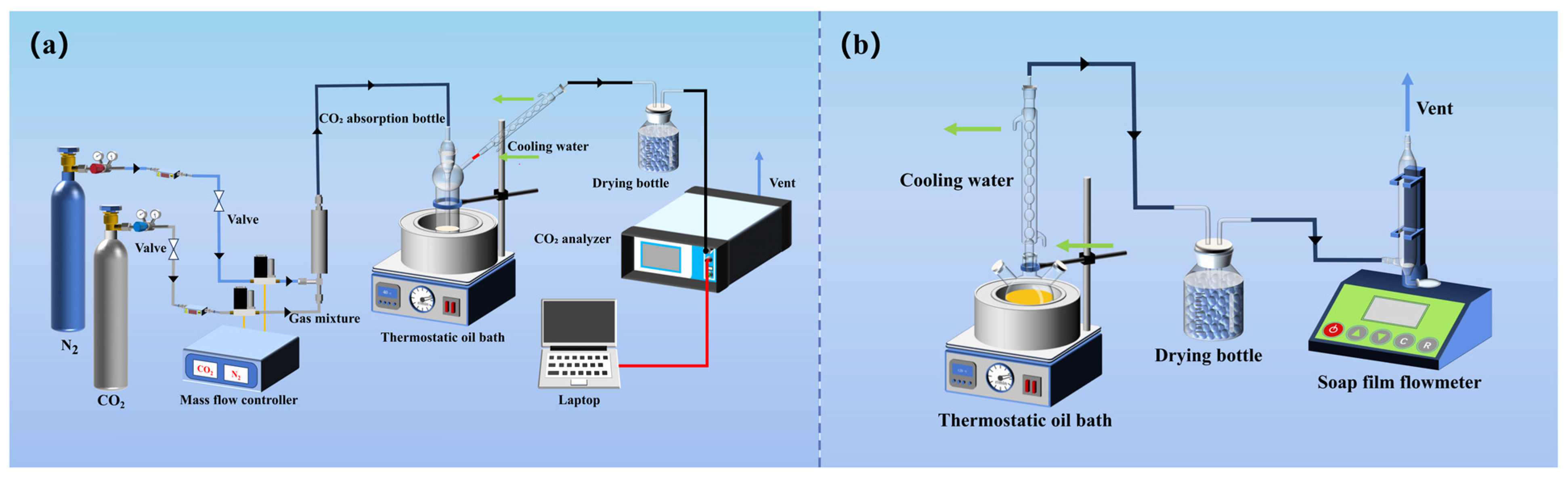
The experimental setup for CO2 absorption using the TETA/AEP/DMAC biphasic absorbent is shown in Figure 1a. The absorption experiments were conducted in an impinger-type gas absorption bottle at 40 °C. The absorbents were prepared by mixing TETA, AEP, and DMAC at different mass ratios, followed by dilution with deionized water to a predetermined total mass before being transferred into the absorption bottle. High-purity N2 was used only for pipeline purging before the experiment, gas-tightness testing of the apparatus, and removal of residual CO2 from the pipelines after absorption. It did not participate in the absorption reaction throughout the experiment. The CO2 used in the experiment had a purity of 99.9% and was supplied from a gas cylinder. The gas was regulated and metered through a gas flowmeter before being introduced into the absorption reactor. The pressure gauge at the cylinder outlet indicated an upstream supply pressure of approximately 3.4 MPa. During the experiment, the inlet gas flow rate was maintained at 120 mL·min−1. For convenient calculation and analysis, the total mass of the absorbent was kept at 50 g in the subsequent experiments. Absorbent formulations with different compositions were denoted by abbreviations. For example, 30T35D35H represents an absorbent containing 30 wt% TETA, 35 wt% DMAC, and 35 wt% H2O. The specific definitions of the abbreviations are listed in Table 1.
The CO2 absorption rate and the corresponding CO2 loading were determined from the time-resolved absorption curve. The absorption rate and cumulative loading were calculated using the following equations:
r a b = Q i n Q o u t 22.4 × 1000 ( P a c t T 0 P 0 T a c t )
C t = 1 m 0 t r a b · d t
where ‘rab’ is the CO2 absorption rate (mol·min−1); ‘m’ is the mass of the absorbent (kg); ‘Qin’ and ‘Qout’ are the CO2 flow rates at the inlet and outlet of the bubbling reactor (mL·mi−1); ‘Pact’ and ‘P0’ are the actual and standard pressure (kPa); ‘Tact’ and ‘T0’ are the actual and standard temperature (°C); ‘Ct’ is the CO2 loading of the absorbent at time ‘t’ (mol·kg−1); and ‘t’ is the absorption time (min).
The CO2-saturated absorbent was transferred into a three-necked flask and regenerated in an oil bath using a DF-101S heat-collecting constant-temperature magnetic stirrer. The desorption temperature was maintained at 120 °C. Magnetic stirring was continuously applied during desorption at a stirring rate of 260 rpm. Each desorption experiment was conducted for 30 min until the CO2 desorption rate approached zero. The vapor generated during desorption was condensed and refluxed back into the flask to minimize solvent loss. The regenerated solvent was then reused for CO2 absorption. The regeneration efficiency of the solvent was calculated as follows:
η = C n C 0 × 100%
where η stands for the absorbent regeneration efficiency. The terms Cn and C0 are the respective absorption loadings (mol·kg−1) of the absorbent after the nth regeneration cycle and of the fresh absorbent.
All key absorption–desorption experiments were repeated three times under identical experimental conditions. The CO2 absorption capacity, absorption/desorption rate, viscosity, and phase volume fraction reported in this manuscript are presented as average values. The error bars in the corresponding figures represent standard deviations. When the error bars are not visible, the standard deviation is smaller than the size of the data point symbols.

2.4. CO2 Distribution Between the Upper and Lower Phases of the Phase-Change Absorbent

The CO2 content loaded in 1 mL of CO2-saturated absorbent was determined using a sulfuric acid decomposition method. Specifically, 1 mL of the saturated absorbent was transferred into a conical flask, followed by the slow addition of 1.5 mL of 3 mol·L−1 H2SO4 solution to release the chemically bound CO2 from the absorbent. The apparatus was kept well sealed throughout the experiment to prevent gas leakage, and the measurement was conducted under constant temperature and pressure conditions to ensure accuracy. During the reaction, the CO2-loaded amine absorbent reacted with sulfuric acid and released CO2 gas. The generated CO2 was conducted through a U-shaped tube connected to the conical flask. The liquid in the U-shaped tube reflected the change in gas volume through the variation in liquid level. The initial liquid level height (H1) and the liquid level height after the reaction reached equilibrium (H2) were recorded. The volume of CO2 released from 1 mL of absorbent, denoted as α, was calculated based on the liquid level difference. Each experiment was performed in triplicate, and the average value was used. The released CO2 volume (α) was calculated according to Equation (4):
α = H 1 H 2
The number of moles of CO2 was calculated using the ideal gas equation:
n = P × ( H 1 H 2 ) 22.4 × 1000 × R T
where p = 101325 Pa, T = 273.15 K, and R = 8.31 J·mol−1·K−1. The number of moles of CO2 in the CO2-saturated amine absorbent was calculated accordingly, and the CO2 content in the upper and lower phases was then determined.

2.5. Absorption Kinetics Analysis

To quantitatively evaluate the CO2 absorption process in the TDH absorbent, apparent kinetic analysis was carried out based on the loading-time data obtained from the bubbling absorption experiments. Given that the bubbling reactor used in this study cannot decouple gas-film resistance, liquid-film resistance, and chemical enhancement effects in the manner of a wetted-wall column or a stirred-cell reactor, an empirical pseudo-first-order kinetic equation was adopted to describe the absorption behavior:
Q t = Q e ( 1 e k 1 t )
where ‘Qt’ is the CO2 loading at absorption time ‘t’ (mol·kg−1); ‘Qe’ is the apparent saturation loading (mol·kg−1); ‘k1’ is the pseudo-first-order rate constant (min−1); and ‘t’ is the absorption time (min).
The pseudo-second-order kinetic model is expressed as:
t Q t = 1 k 2 Q e 2 + t Q e
Linearization of Equation (7) gives the slope and intercept, from which the pseudo-second-order rate constant ‘k2’ (min−1) and the saturation loading ‘Qe’ can be determined.

3. Results

3.1. Phase Separator Optimization

Phase separation in CO2 phase-change absorbents is commonly driven by a salting-out phenomenon [35,36]. The ionic products (carbamates, protonated amines, bicarbonates) formed during CO2 capture [36,37,38], These products possess a markedly higher polarity in aqueous media compared to organic solvents [39,40]. The difference in polarity drives carbamates to preferentially interact with water. These strongly polar salts aggregate with adjacent polar solvent molecules, resulting in the concentration of reaction products within the polar solvent phase. When a critical CO2 loading—namely, the phase separation point—is reached, the initially homogeneous solution ultimately separates into a biphasic system comprising an aqueous phase and an organic phase [41,42]. After phase separation, the two phases exhibit different amine concentrations and CO2 loading capacities [40,43].
First, the adsorbent dissolves in two mutually miscible solvents. As CO2 is absorbed, the resulting salts exhibit higher solubility in the polar solvent while repelling the less polar solvent, thereby inducing the formation of two distinct phases.
The TETA/H2O system (TH) inherently possesses superior CO2 capture capability while maintaining low viscosity both before and after absorption [44]. This study uses water as the base polar solvent and introduces an organic phase splitter to regulate the phase behavior of the system, with the aim of achieving liquid–liquid phase separation after CO2 absorption and restoring a homogeneous single phase upon desorption. The screening of phase splitters was conducted by comprehensively evaluating phase transition reversibility, boiling point, and compatibility with the host system.
Table 2 summarizes the phase behavior and basic physical properties of several organic solvents tested as phase splitters. The results show that the regulatory effectiveness varied markedly among the solvents examined. Both DMF and ethanol remained as a single phase after absorption and desorption, failing to induce phase separation. 2-Methyl-1-propanol and 1-butanol underwent phase separation after absorption but remained biphasic after desorption, with poor reversibility that would be detrimental to cyclic operation. In contrast, 1-propanol, isopropanol, and DMAC all exhibited reversible phase transition behavior-biphasic after absorption and returning to a single phase after desorption-meeting the basic requirements for process application.
Among the solvents capable of reversible phase separation, DMAC offers the most pronounced advantages. Its boiling point (165.1 °C) is substantially higher than those of 1-propanol (97.0 °C) and isopropanol (82.3 °C), giving it lower volatility loss during repeated absorption–desorption cycles and thus facilitating long-term compositional stability of the system. Overall, DMAC provides the best match in terms of both phase transition reversibility and thermal stability. It was therefore selected as the phase splitter for the TETA/H2O system to construct the TDH biphasic absorbent. Furthermore, the results in Table 1 indicate that the phase separation behavior is not solely governed by the dipole moment: DMF has a slightly higher dipole moment (3.82 D) than DMAC (3.7 D), yet does not induce phase separation, whereas alcohols with lower dipole moments fail to restore a homogeneous phase owing to excessively weak compatibility, suggesting that further experiments are necessary to elucidate the underlying phase separation mechanism.

3.2. Capture Performance of TDH Biphasic Absorbents

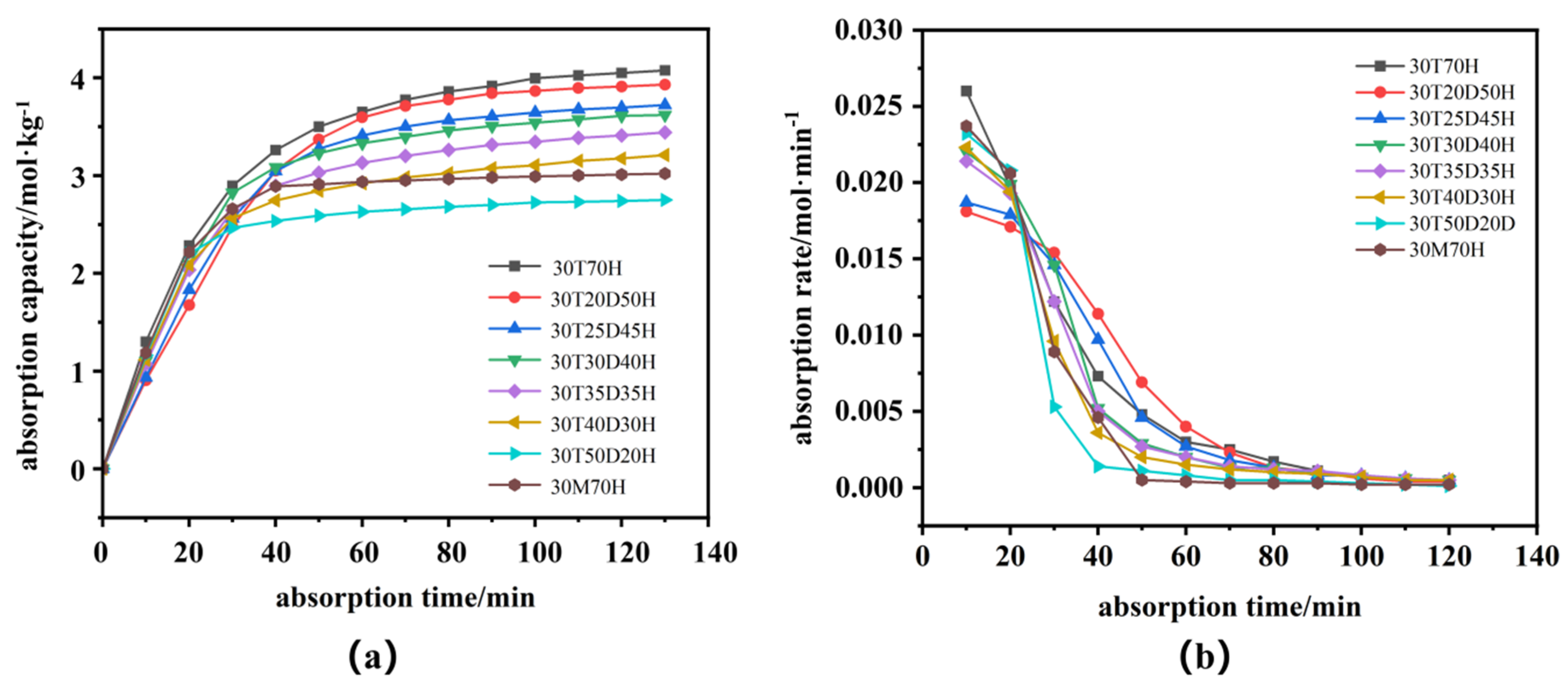
As shown in Figure 2a, the CO2 loading of each absorbent system increased with absorption time and exhibited a distinct two-stage pattern: a rapid uptake phase, followed by a slow approach to equilibrium. Specifically, the rapid absorption stage occurred within the first 30 min; thereafter, the absorption rate gradually declined, and equilibrium was essentially reached between 80 and 120 min. The 30T70H system delivered the highest saturation loading of 4.081 mol·kg−1. When a moderate amount of DMAC was introduced, the 30T20D50H formulation retained a relatively high final loading. However, as the DMAC mass fraction increased further, the saturation loading of the TDH system progressively decreased, with the lowest value recorded for 30T50D20H.
These results indicate that the CO2 saturation loading of the TDH system exhibits an overall downward trend with increasing DMAC content and is consistently lower than that of the DMAC-free 30T70H formulation, suggesting that the addition of DMAC impairs the equilibrium absorption capacity to some extent.
Nevertheless, compared with the benchmark MEA system, TDH absorbents with a low-to-moderate DMAC content still demonstrated a clear advantage. As can be seen from the data in Figure 2, the saturation loading of 30M70H was approximately 3.108 mol·kg−1. The loading of 30T20D50H reached about 3.959 mol·kg−1, representing an increase of roughly 27.38% relative to MEA. The corresponding values for 30T25D45H and 30T30D40H were 3.768 and 3.677 mol·kg−1, respectively, which are still approximately 24.24% and 18.31% higher than that of MEA. Even when the DMAC content was increased to 35 wt% and 40 wt%, the saturation loading of the TDH system remained slightly higher than that of the MEA system. Only when the DMAC mass fraction was raised to 50 wt% did the loading drop significantly, falling below that of the MEA system, indicating that an excessively high DMAC content is detrimental to CO2 absorption and unsuitable for further study.
As illustrated in Figure 2b, all TDH systems exhibited a similar trend in absorption rate, characterized by a rapid initial rate that began to decline after approximately 25 min. The rate attenuation beyond 25 min became more pronounced with increasing DMAC content. Within the low-to-moderate DMAC content range, however, the overall absorption performance of the TDH systems remained favorable, with no evident deactivation or severe rate decay. Taken together, the loading and rate data demonstrate that although a moderate addition of DMAC somewhat reduces the absorption performance of the parent TETA system, most TDH formulations still outperform MEA in terms of capacity. Formulations with DMAC mass fractions in the 25–40 wt% range maintain a relatively high absorption level while offering the potential for tuning of the system’s phase behavior.
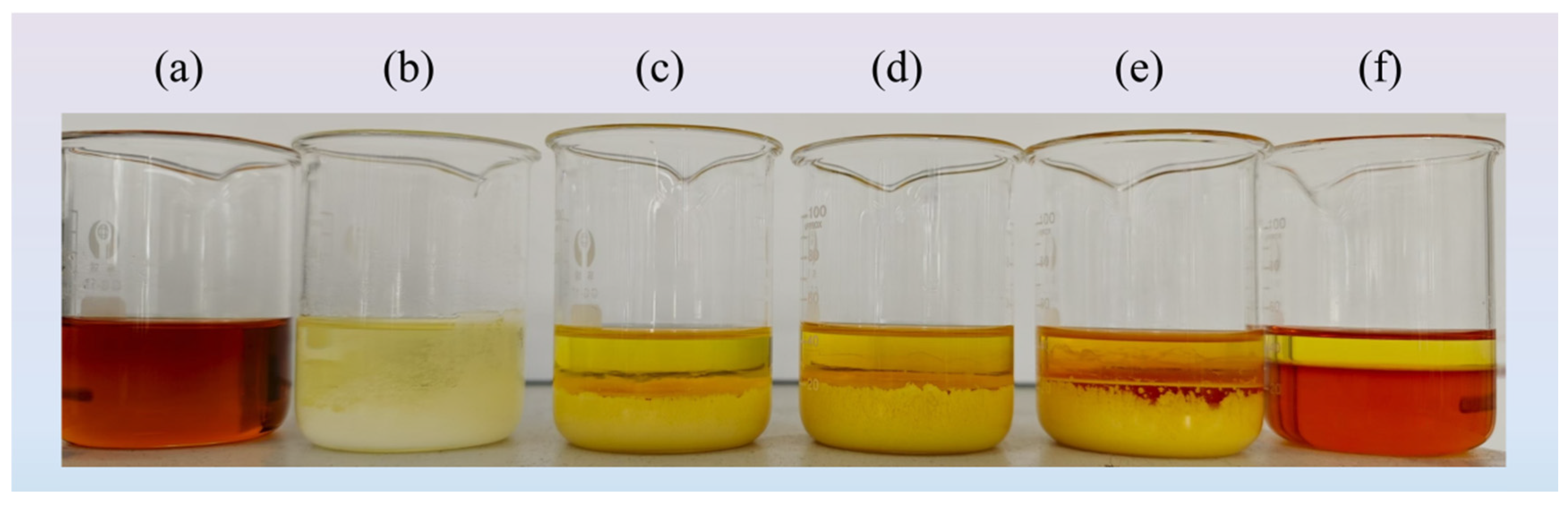
However, during desorption, an excessively low temperature results in a slow desorption rate, which is unfavorable for efficient stripping. Conversely, if the desorption temperature is too high, the solution may solidify during the process, making desorption impossible. As shown in Figure 3, the CO2-loaded solution also tends to form precipitates upon standing, which is detrimental to both desorption and cyclic operation. These precipitates can block equipment passages, hinder gas–liquid contact, and reduce the cyclic utilization efficiency of the absorbent, thereby severely compromising the long-term operational stability of the system. The underlying cause lies in the reaction between TETA and CO2, which produces highly ordered, strongly polar TETA-carbamate species. As the CO2 loading increases, the number of hydrogen bonds between the zwitterionic products and the solvent in the CO2-rich phase decreases, while the proportion of carbamate molecules gradually rises. These species tend to aggregate through intermolecular interactions and eventually form solid precipitates. This phenomenon can be summarized as “hydrogen-bond disruption and network collapse leading to polarity-driven condensation”. This critical issue also points the way toward the subsequent introduction of functional additives to optimize the absorbent performance.

3.3. Optimization of CO2 Phase-Change Absorbent

3.3.1. Phase Separation and Product Distribution

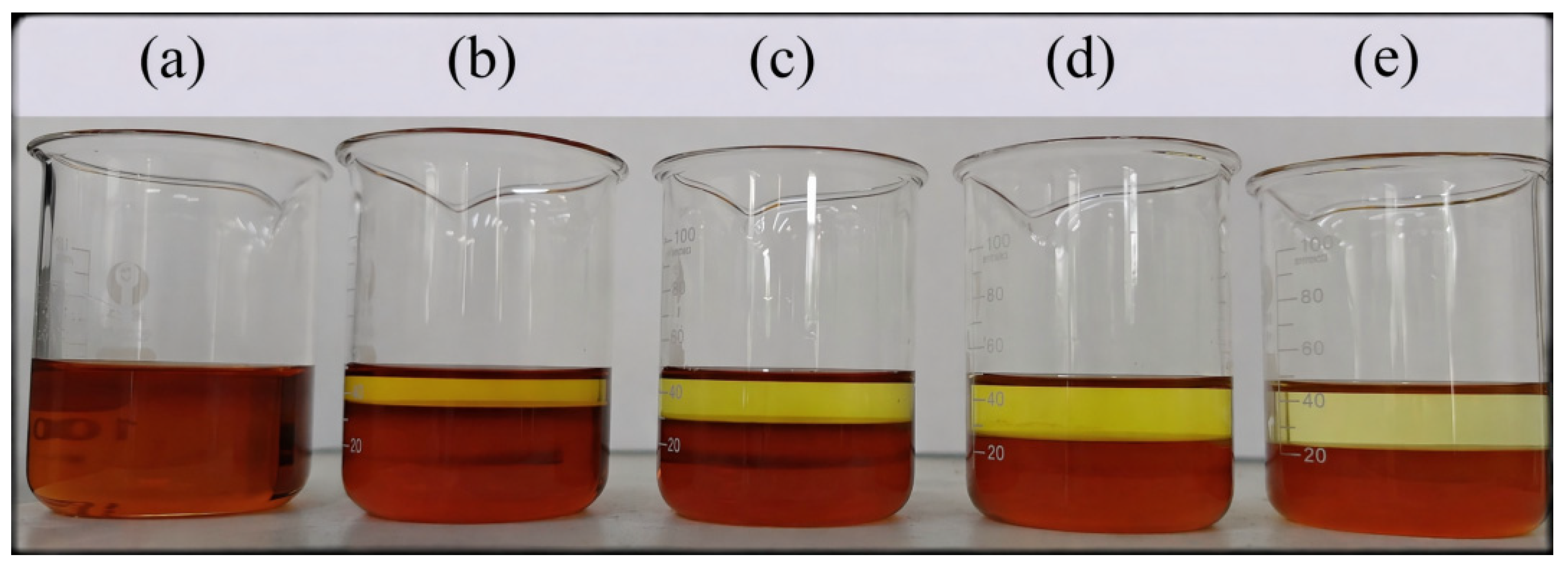
AEP was added to the TDH absorbent, partially replacing TETA, to prevent solution aggregation and precipitation during CO2 capture. This effect is shown in Figure 4, the addition of this agent effectively prevented precipitate formation. Furthermore, it remained in a liquid state and underwent a complete desorption process even at 120 °C, thereby satisfying the essential requirements for its use as a CO2 absorbent.
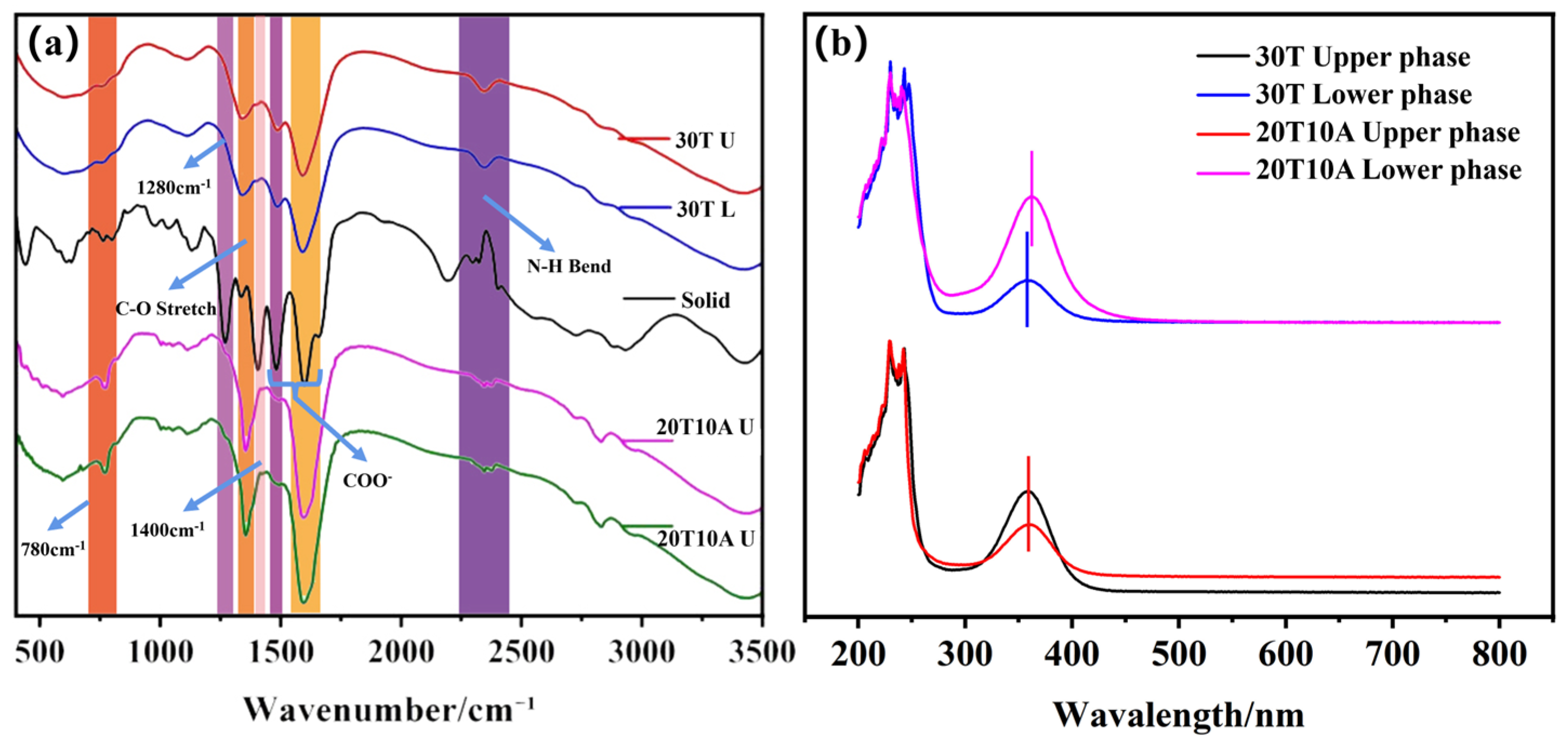
The FTIR spectra of the biphasic absorption products and the solid precipitate before and after the addition of AEP were also compared, as shown in Figure 5a. During CO2 absorption, a new peak appeared at 780 cm−1 in the AEP-containing solution, which is assigned to the rocking vibration of the ethyl group (-CH2-CH2-), confirming the incorporation of AEP into the system. For the solid precipitate, two peaks were observed at 1280 cm−1 and 1400 cm−1; these peaks were eliminated after the addition of AEP. The spectrum of the solid product at 2359 cm−1 showed peak positions identical to those observed in the liquid phase, but the intensity changes were opposite. These observations collectively provide strong evidence that the precipitation process was effectively suppressed upon introducing AEP. The appearance of COO peaks near 1568 cm−1 and 1477 cm−1 indicates the formation of carbamate and carbonate species. Figure 5b displays the UV-Vis spectra of the biphasic absorption products before and after the addition of AEP. A red shift was observed in the CO2-rich lower phase after AEP addition, whereas no shift occurred in the upper phase, indicating that the AEP-CO2 reaction products are predominantly concentrated in the lower phase.

3.3.2. Effect of Different Ratios of TADH on CO2 Capture Performance

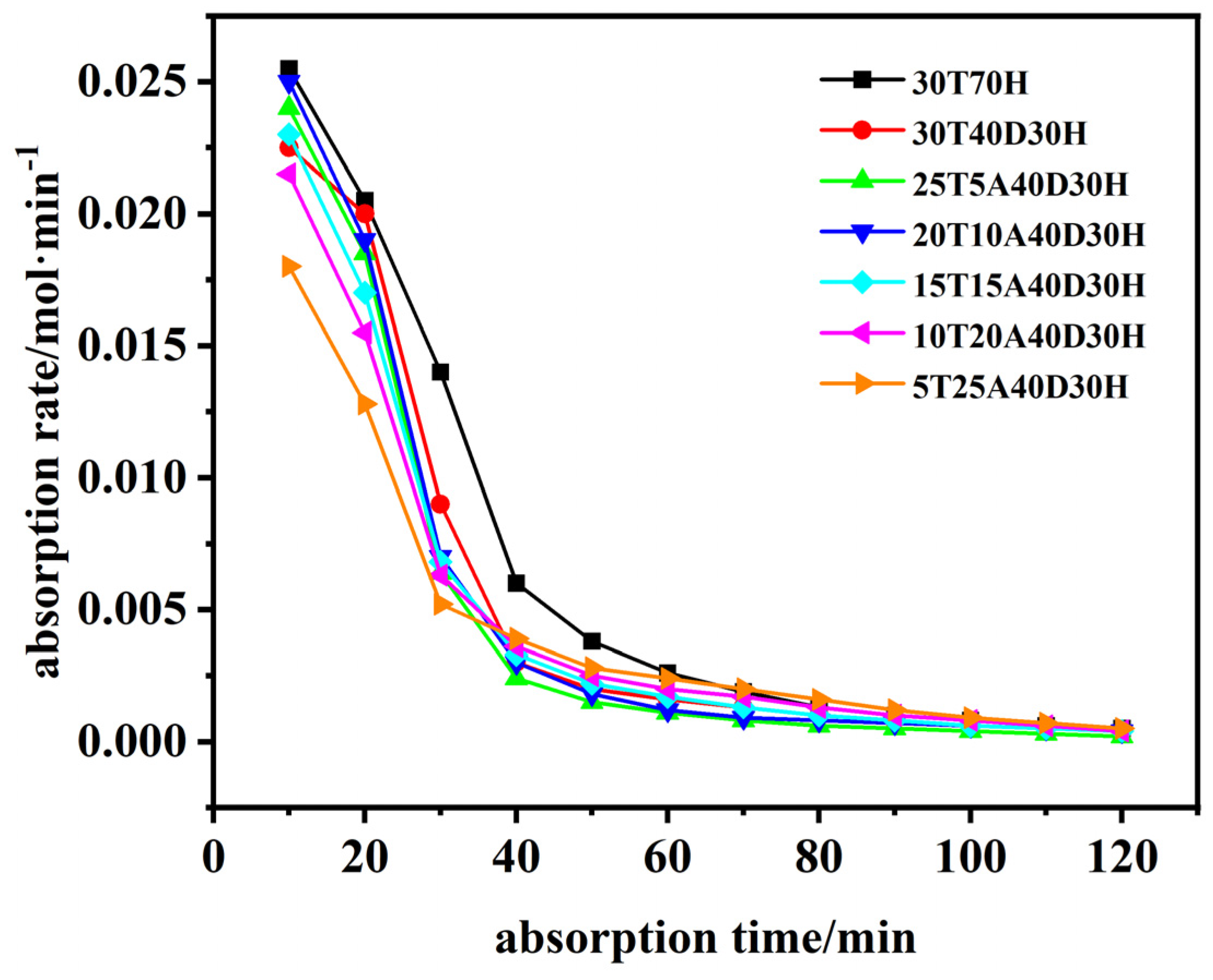
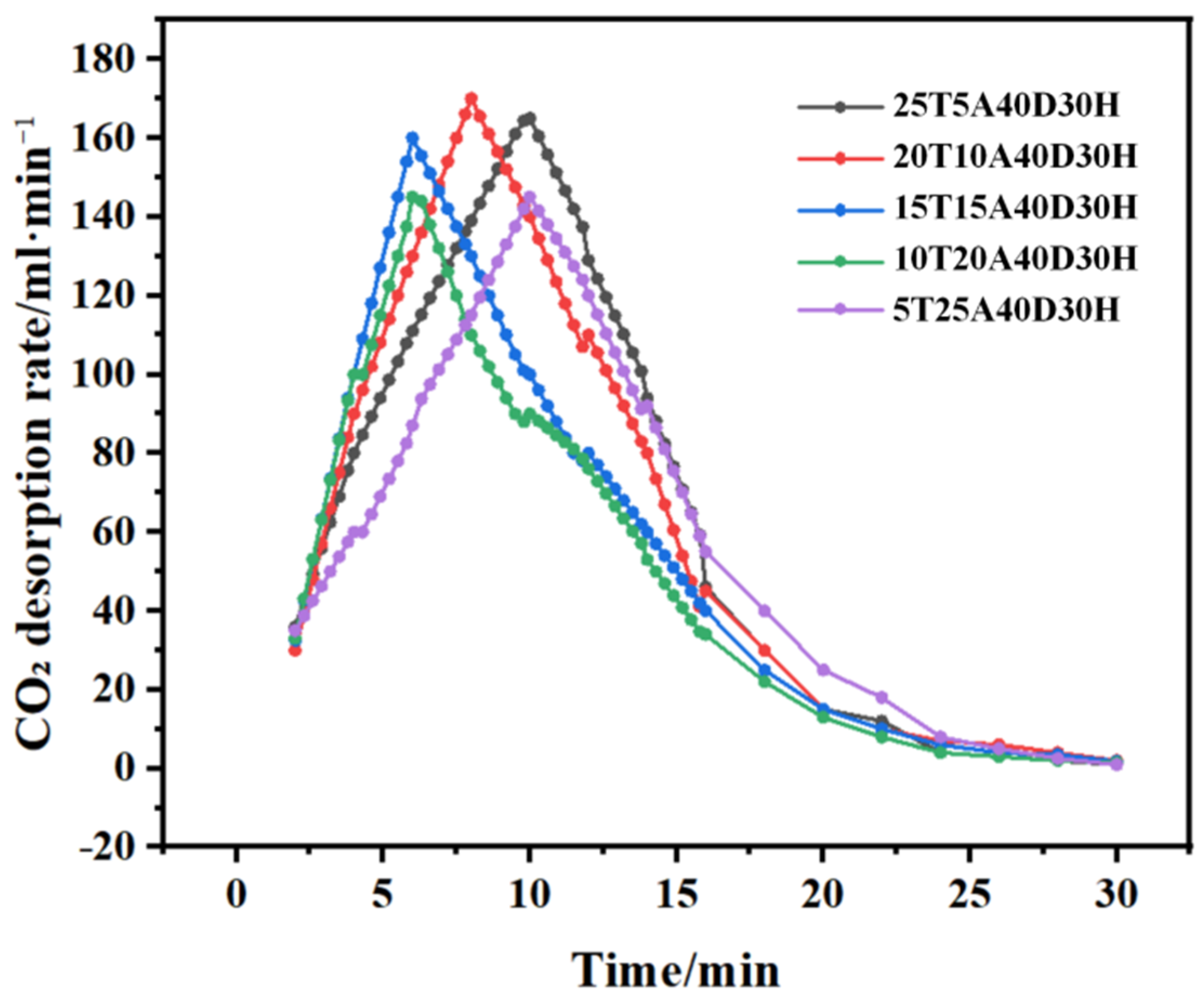
To systematically evaluate the regulatory effect of AEP content on the overall performance of the TADH biphasic absorbent, we performed a correlative analysis of the CO2 absorption rate, the bulk viscosity evolution during absorption, and the desorption behavior of the CO2-rich lower phase at different AEP mass fractions. The results are presented in Figure 6, Figure 7 and Figure 8, respectively.
As shown in Figure 6, all absorbents displayed a kinetic pattern of rapid initial absorption followed by a gradual slowdown. Within the first 25 min, the initial absorption rate decreased with increasing AEP mass fraction. This trend is attributed to the difference in the number of active amino groups: TETA possesses four, whereas AEP possesses only two; thus, a higher TETA content provides more reactive sites at the early stage of absorption. After approximately 40 min, the order of the absorption rate reversed relative to the initial stage: 5T25A40D30H exhibited the highest rate, while 25T5A40D30H showed the lowest. All formulations essentially reached saturation by 90 min. This reversal indicates that although the AEP-free or low-AEP–high-TETA systems have high initial rates, the progressive buildup of CO2 loading causes a rapid increase in mass transfer resistance, which limits sustained absorption. With the introduction of an appropriate amount of AEP, the system can maintain a more stable mass transfer state at the later stage. When the TETA-to-AEP ratio was adjusted from 25:5 to 15:15, the absorption capacity first decreased and then increased, demonstrating the positive effect of a proper AEP dosage on sustained absorption. Further decreasing the ratio to 5:25 caused the absorption rate to drop markedly again, due to an insufficient total number of highly active amino groups.
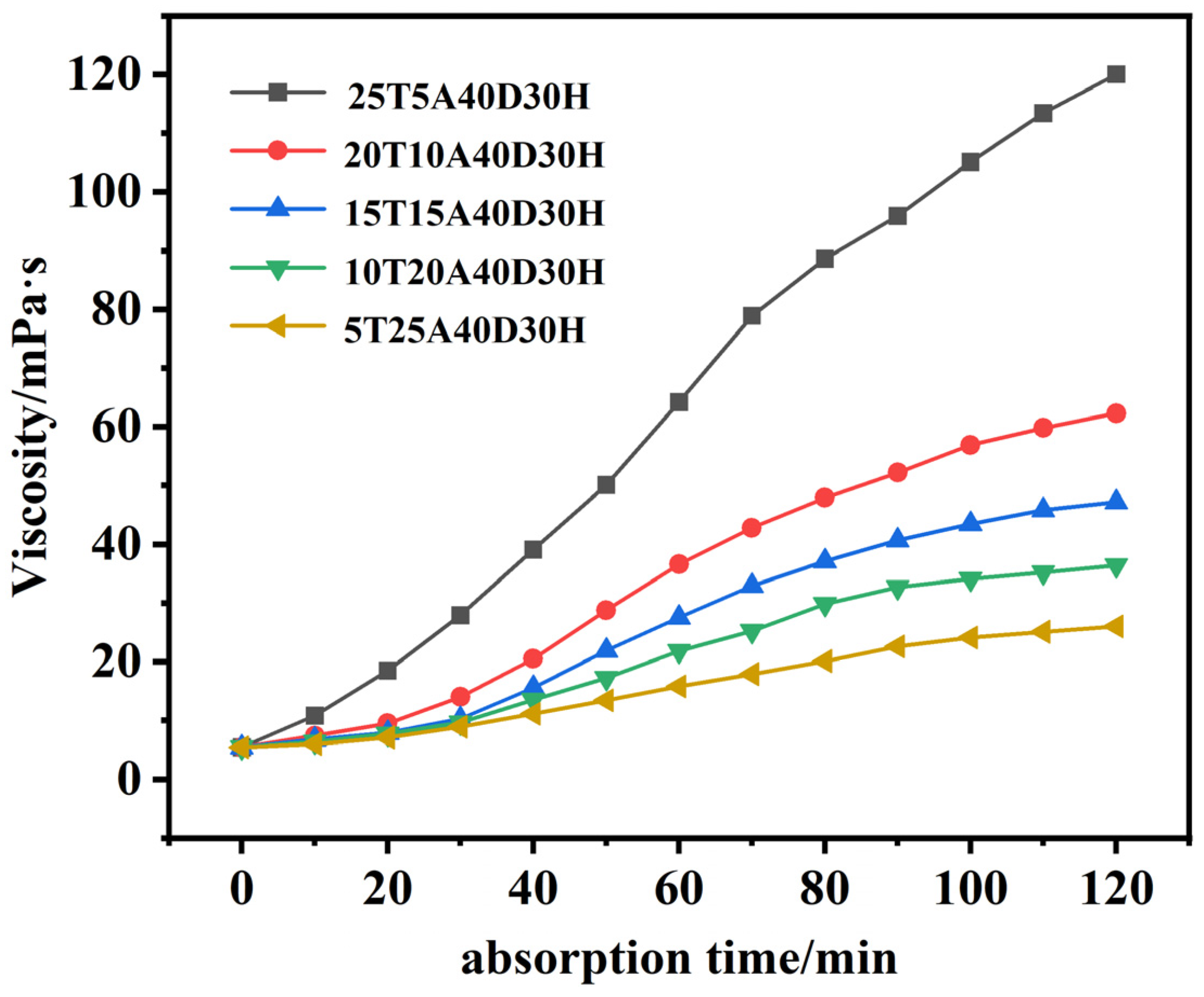
Figure 7 presents the real-time variation in the bulk viscosity of the absorbents during absorption. Prior to CO2 introduction, all systems were homogeneous. Upon introducing CO2, the absorbents gradually emulsified as the CO2 loading increased, eventually undergoing phase separation. The viscosity of all systems increased continuously with time, but the magnitude of increase differed significantly. For the high-TETA system (e.g., 25T5A40D30H), the viscosity rose sharply after approximately 30 min, reaching 120.31 mPa·s at 120 min. In contrast, the high-AEP system (e.g., 5T25A40D30H) exhibited a much more gradual increase, with a viscosity of only about 25.32 mPa·s at 120 min. The pronounced suppression of the viscosity surge by AEP likely originates from the steric hindrance effect in its molecular structure, which weakens the close packing and aggregation of carbamate and protonated amine ion pairs, thereby improving the solvation and dispersion of reaction products. The fact that high-AEP systems maintained a relatively high absorption rate at the later stage also corroborates the idea that low viscosity helps reduce liquid-phase mass transfer resistance.
Figure 8 compares the desorption performance of the CO2-rich lower phases with different formulations at 120 °C. For all systems, the desorption rate first increased rapidly to a peak and then gradually decayed to zero; desorption was essentially complete within about 30 min. As the AEP content increased from 5% to 25%, the peak desorption rate first increased and then decreased, with 20T10A40D30H exhibiting the highest peak. This reflects a synergistic effect between TETA and AEP: TETA provides a high CO2 loading capacity, while AEP weakens the amine–CO2 bonding strength through steric hindrance, thus lowering the activation energy for desorption. When the TETA content is too high, the proportion of strongly bound carbamate is large, limiting desorption. Conversely, an excessive AEP content reduces the total CO2 loading capacity, which also depresses the peak desorption rate. The 20T10A40D30H formulation achieves an optimal balance between loading capacity and desorption activity.
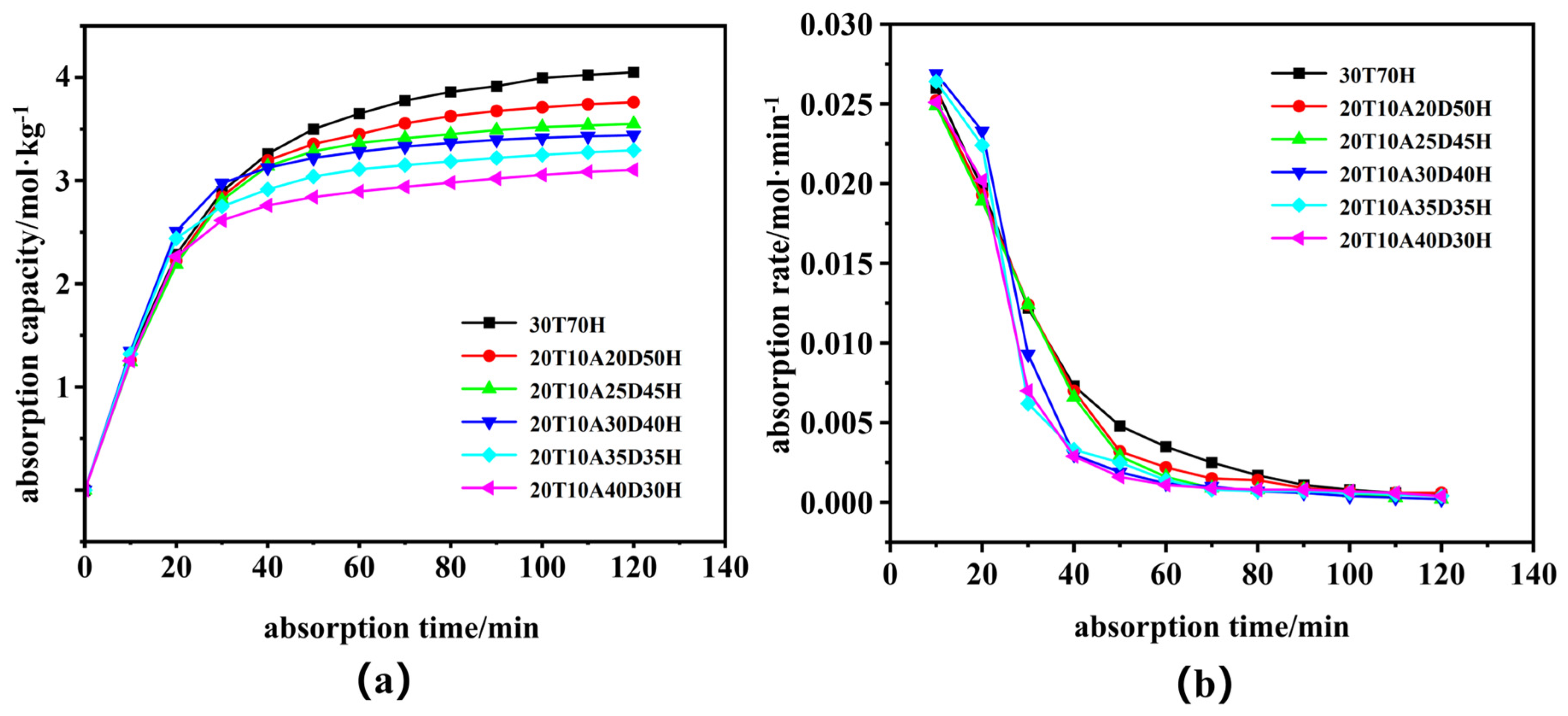
Keeping the TETA-to-AEP mass ratio at 2:1 and maintaining the total amine mass concentration constant at 30 wt%, the CO2 capture performance of the TETA/AEP system was investigated under varying H2O and DMAC gradients. As shown in Figure 9a, the CO2 absorption process of the TADH biphasic absorbent is similar to that of the TDH system, both exhibiting a typical pattern of rapid initial absorption followed by a gradual approach to equilibrium. Within the first 20–40 min, the CO2 loading of each formulation increased rapidly; thereafter, the uptake rate slowed significantly, approaching equilibrium at around 100–120 min. The 30T70H system displayed the highest saturation loading of 4.081 mol·kg−1. With the introduction of AEP and DMAC, the saturation loadings of the TADH systems decreased progressively to 3.805, 3.614, 3.500, 3.381, and 3.204 mol·kg−1, indicating that the equilibrium absorption capacity of the TADH system gradually weakened as the DMAC mass fraction increased. Compared with the corresponding TDH absorbents at the same DMAC content, the saturation loadings of the TADH systems were all slightly lower, suggesting that substituting part of the TETA with AEP reduces the total number of highly active amino groups, thereby leading to a decrease in absorption capacity.
However, the instantaneous absorption rate curves in Figure 9b reveal that the TADH system exhibits more stable kinetic characteristics compared with the TDH system. In the TDH system, the differences in both the initial absorption rate and the degree of later-stage attenuation among the various formulations are relatively pronounced. In contrast, these differences are narrowed in the TADH system, and the overall absorption rate displays a “high-efficiency, low-variation” feature. This indicates that the introduction of AEP did not significantly enhance the initial absorption capacity of the system, but effectively improved the mass-transfer stability during the absorption process, leading to more balanced rate variations among different formulations across the entire absorption stage. Taken together, although AEP sacrifices part of the absorption capacity, it enhances the stability of the absorption behavior, providing a basis for subsequent viscosity reduction, precipitation inhibition, and improved desorption performance.

3.3.3. Impact of TADH Ratio Variations on Phase Separation

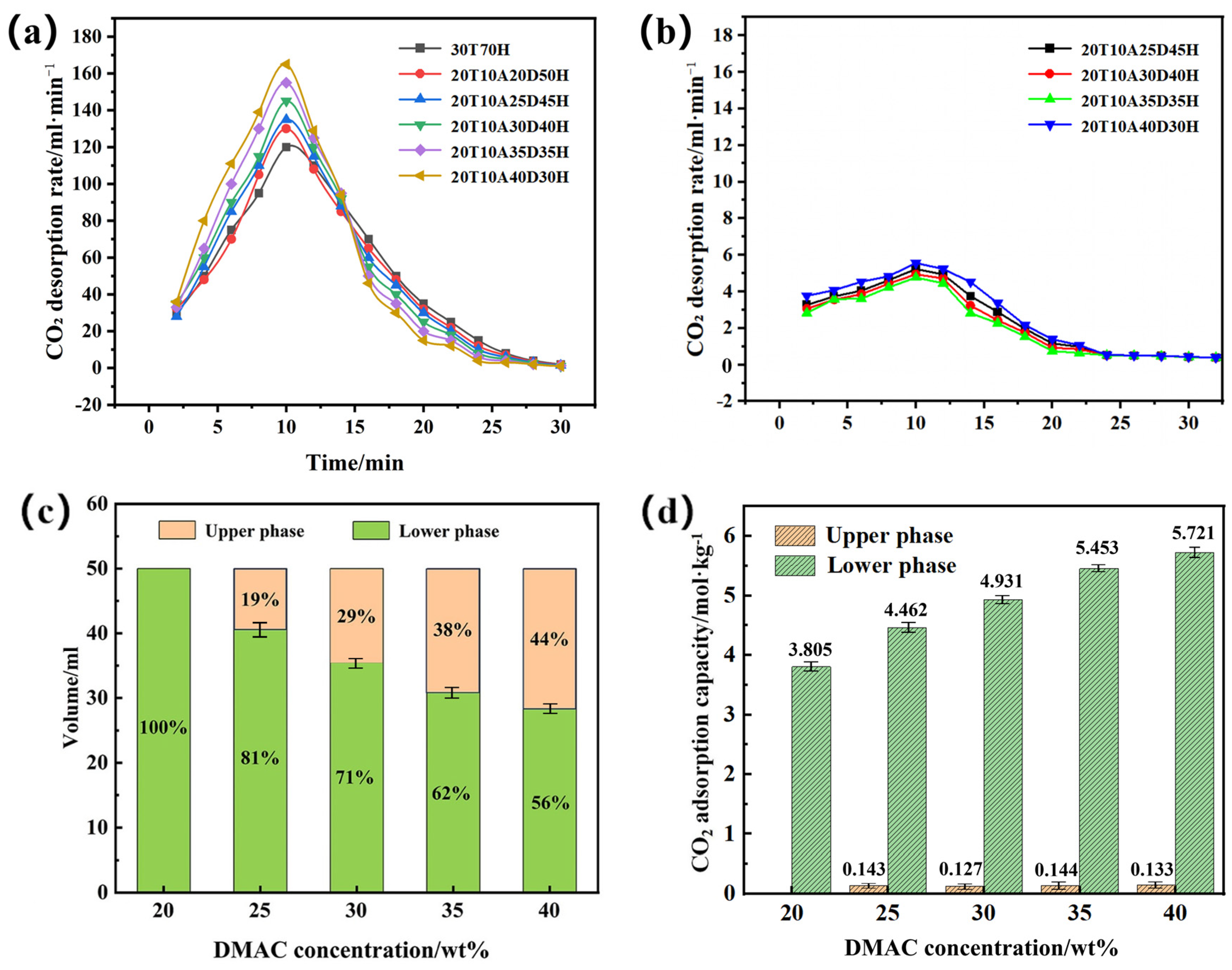
As shown in Figure 10, the TADH biphasic absorbent exhibited distinct liquid–liquid phase separation after CO2 absorption, accompanied by a pronounced CO2 enrichment effect. Figure 10a shows that the desorption rate of the CO2-rich phase for each system followed a consistent pattern: a rapid increase to a peak value followed by a gradual decay to zero, with desorption essentially completed within approximately 30 min. As the DMAC mass fraction increased from 20 wt% to 40 wt%, the peak desorption rate of the CO2-rich phase generally increased, with the 20T10A40D30H system delivering the highest rate, indicating that a higher DMAC content favors a stronger driving force for CO2 release from the rich phase. In contrast, the desorption rate of the lean phase remained consistently low across all formulations (Figure 10b), and the differences among the various DMAC contents were negligible, confirming that the CO2 content in the lean phase is extremely small and its contribution to the overall regeneration process can be considered insignificant.
Figure 10c further reveals that the degree of phase separation was gradually enhanced with increasing DMAC mass fraction. At DMAC contents of 25, 30, 35, and 40 wt%, the volume fraction of the upper phase was approximately 19%, 29%, 38%, and 44%, whereas that of the lower phase was approximately 81%, 71%, 62%, and 56%, respectively. This trend indicates that a higher DMAC content allows a larger portion of the regenerable solvent to partition into the upper phase while compressing the CO2-laden reaction products into a progressively smaller lower-phase volume. This interpretation is corroborated by Figure 10d: the CO2 loading of the upper phase remained almost invariant, ranging only from 0.132 to 0.153 mol·kg−1 regardless of the DMAC content, whereas the loading of the lower phase increased continuously from 3.805 to 5.721 mol·kg−1. These results demonstrate that the vast majority of CO2 and its reaction products are concentrated in the lower phase, which accounts for more than 98% of the total CO2 absorbed. The extremely low and nearly unchanged CO2 loading in the upper phase can be attributed to its organic-rich and CO2-lean nature. After CO2 absorption, reaction products, including carbamate, bicarbonate/carbonate, and protonated amines, preferentially remain in the water-rich lower phase rather than partitioning into the DMAC-rich upper phase. Therefore, increasing the DMAC content mainly changes the phase volume distribution and further concentrates the CO2-containing ionic products in the lower phase, but does not significantly increase the CO2 loading of the upper phase. This behavior indicates that the upper phase primarily acts as a regenerated solvent-rich phase, whereas the lower phase serves as the CO2-rich phase, further supporting the salting-out-driven phase separation mechanism of the TADH system. Considering the combined evidence from the desorption behavior, phase volume distribution, and CO2 enrichment characteristics, the 30T/A40D30H formulation delivers the best overall performance in terms of rich-phase desorption rate, phase separation behavior, and CO2 enrichment capability.
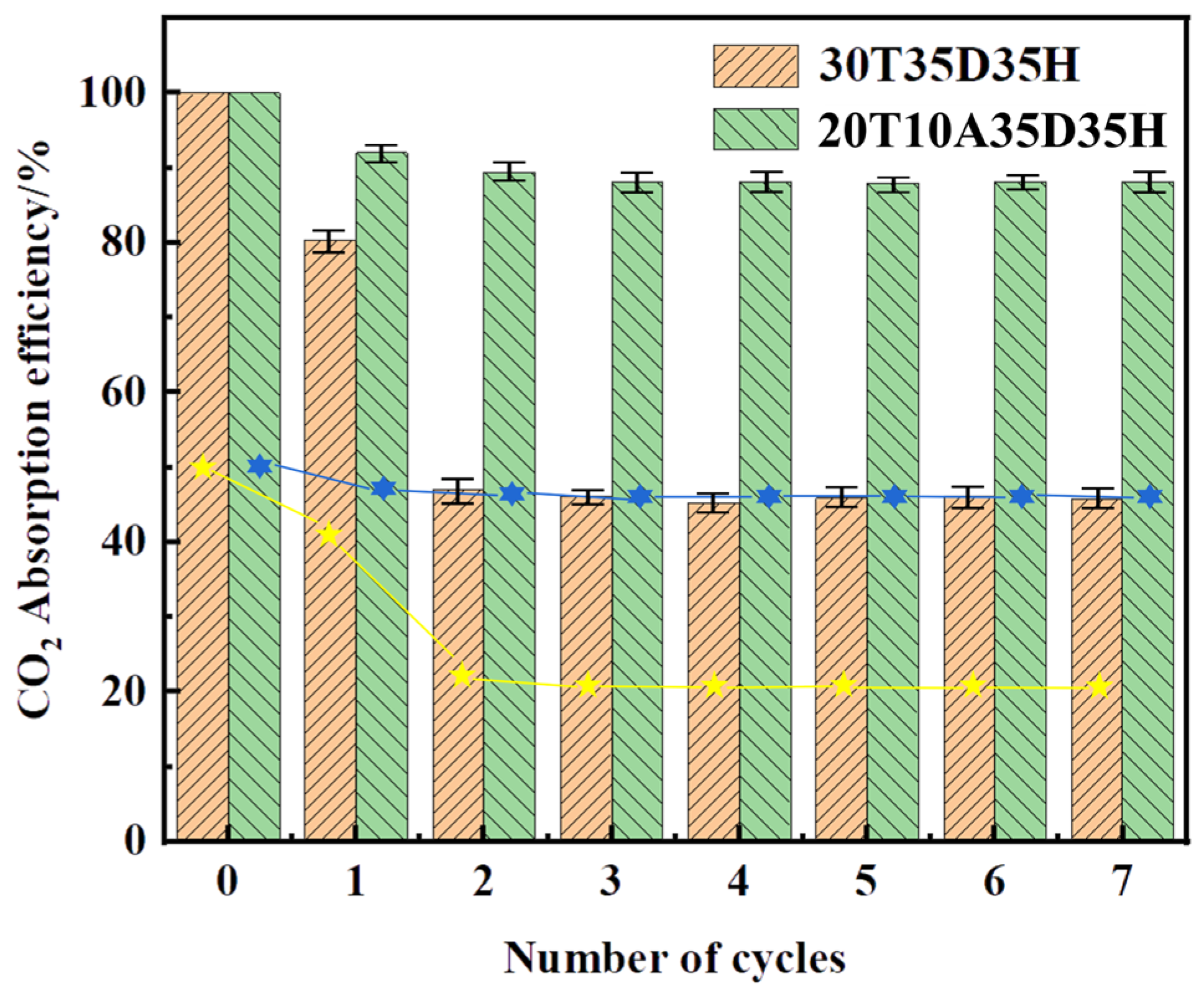
The 20T10A40D30H biphasic absorbent exhibited the best CO2 desorption behavior, with its maximum CO2 desorption rate being nearly 1.5 times that of the 30T70H absorbent. Based on the comprehensive discussion thus far, 20T10A40D30H is identified as the optimal biphasic absorbent. Accordingly, the CO2 cyclic absorption stability and the underlying mechanism of the TADH biphasic absorbent were further investigated. The cyclic stability of the 20T10A35D35H biphasic solvent was examined at an absorption temperature of 40 °C and a desorption temperature of 120 °C, in comparison with the 30T35D35H system, as shown in Figure 11.
As can be seen from the figure, both absorbents exhibited an initial CO2 absorption efficiency of 100%, yet their stability profiles during cycling differed substantially. For the 30T35D35H system, the absorption efficiency dropped sharply to 80% after the first cycle and further declined to 47% after the second cycle. Although the rate of decay slowed in subsequent cycles, the efficiency remained consistently low, within the range of 45–47%, reflecting poor overall cyclic stability. This result indicates that in the system without AEP, severe loss of active components occurred after repeated desorption, and the absorption performance could not be effectively restored. In contrast, the 20T10A35D35H system experienced only a modest decrease in absorption efficiency, to 92.3%, after the first cycle, and maintained a stable high level of 88–90% during the second to seventh cycles.
In the AEP-containing 20T10A35D35H system, the absorption efficiency exhibited only a slight decline over the first three cycles, and the regeneration efficiency became essentially stable over the subsequent four cycles. Conversely, the unmodified 30T35D35H system showed a continuously decreasing absorption efficiency and a markedly inferior cycling performance compared with the modified system. These findings demonstrate that the introduction of AEP effectively improves the completeness of desorption of the biphasic absorbent and reduces the irreversible loss of active components, thereby significantly enhancing both the CO2 cyclic absorption efficiency and the long-term operational stability. This outcome provides crucial support for the industrial continuous application of the absorbent.

3.3.4. Viscosity Change

Viscosity measurements for both the lean and rich phases were carried out at 40 °C after CO2 absorption and complete phase separation. The separated phases were collected immediately after phase separation, and no degassing treatment was performed before viscosity measurement in order to avoid changing the CO2 loading and phase composition, with results provided in Table 3. In the TADH systems, rising DMAC content led to a stable lean-phase viscosity but an increasing viscosity in the rich phase. Figure 10d indicates that this rise in viscosity strongly correlates with higher CO2 concentrations. Relative to the CO2-saturated 30 wt% TETA solution, the viscosity of the rich phase in the biphasic absorbent increased by approximately 9–50 mPa·s. However, when the content of TETA and AEP was reduced, the viscosity also decreased notably, suggesting that viscosity is primarily related to CO2 reaction products. For TADH formulations containing AEP tested under identical conditions, the viscosity of the CO2-loaded rich phase was 32.9% to 75.8% lower than that of the corresponding TDH rich phase. This substantial reduction indicates that AEP and its CO2 reaction products effectively lower the viscosity of the solution and enhance the fluidity of the biphasic system. The lean phase, irrespective of AEP addition, maintained consistently low viscosity. This can be explained by the concentration of CO2-derived products in the rich phase, while they are largely absent from the lean phase, leading to its persistently low viscosity.

3.3.5. Comparison with Representative Biphasic Absorbents

To systematically evaluate the overall decarbonization performance of the TADH phase-change absorbent developed in this study, several representative amine-based biphasic absorbents reported in the literature were selected for comparison. The comparison focused on key parameters, including absorbent composition, solvent type, phase separation behavior, CO2 saturation loading capacity, CO2-rich phase volume fraction, and rich-phase viscosity. The relevant data are summarized in Table 4.
As shown in Table 4, various amine-based biphasic absorbents reported in the literature exhibit their own performance advantages and can achieve effective CO2 capture under specific formulation conditions. Conventional TETA/DMCA/H2O and TETA/DEEA/H2O liquid–liquid biphasic systems show favorable phase separation behavior, but their overall CO2 loading capacities are relatively low. In contrast, systems such as TETA/AMP/ethanol, TETA/ethanol/H2O, and TDH can achieve relatively high CO2 loading capacities; however, they undergo solid–liquid phase separation, leading to solid precipitation during absorption and significantly increased rich-phase viscosity. For example, the viscosity of the TDH system can reach 257.9 mPa·s, while that of the TETA/AMP/ethanol system is 198.32 mPa·s. The viscosity of the TETA/DEEA/H2O system containing a phase separation promoter is even as high as 450 mPa·s, which may adversely affect operational stability. Notably, the TEPA/Eim/H2O-Ser ionic-liquid-modified system successfully converts solid–liquid phase separation into liquid–liquid phase separation through formulation optimization, effectively resolving the solid precipitation problem during absorption and significantly improving the operational performance of the system.
These results indicate that the quaternary TADH absorbent system constructed in this study exhibits notable advantages in terms of overall performance. Similar to the optimization strategy of the TEPA/Eim/H2O-Ser system, the introduction of AEP as a functional component enables stable liquid–liquid phase separation, thereby avoiding solid precipitation commonly observed in conventional amine-based systems and improving operational stability. Meanwhile, the TADH system maintains a high CO2 absorption capacity, which is comparable to that of the high-loading TDH system. More importantly, the rich-phase viscosity of the TADH system is only 62.3 mPa·s, which is lower than those of previously reported comparable biphasic absorbent systems, demonstrating its superior rheological properties. In addition, due to the limited completeness of the literature data, regeneration performance and cyclic stability have not been uniformly reported in most previous studies. Nevertheless, the experimental results of this work confirm that the TADH absorbent also exhibits a higher CO2 desorption rate and better cyclic stability than the TDH absorbent.

3.4. Absorption Kinetics Analysis

To quantitatively evaluate the CO2 absorption behavior of the TDH and TADH biphasic absorbents, apparent kinetic fitting was performed on the capacity-time data using both a pseudo-first-order model and a pseudo-second-order model. As described in the experimental section, the pseudo-first-order kinetic model is expressed as Q t = Q e ( 1 e k 1 t ) , where ‘Qt’ is the CO2 loading at absorption time ‘t’, ‘Qe’ is the apparent saturation loading, and ‘k1’ is the pseudo-first-order rate constant. The pseudo-second-order model employs the linear relationship between ‘t/Qt’ and ‘t’ to derive the relevant parameters. Because a bubbling absorption apparatus was used in this study, gas-film resistance, liquid-film resistance, and chemical enhancement effects cannot be further decoupled in the manner possible with a wetted-wall column or a stirred-cell reactor. Therefore, the parameters obtained in this section should be regarded as apparent kinetic parameters and are primarily intended for relative comparison among different formulations.
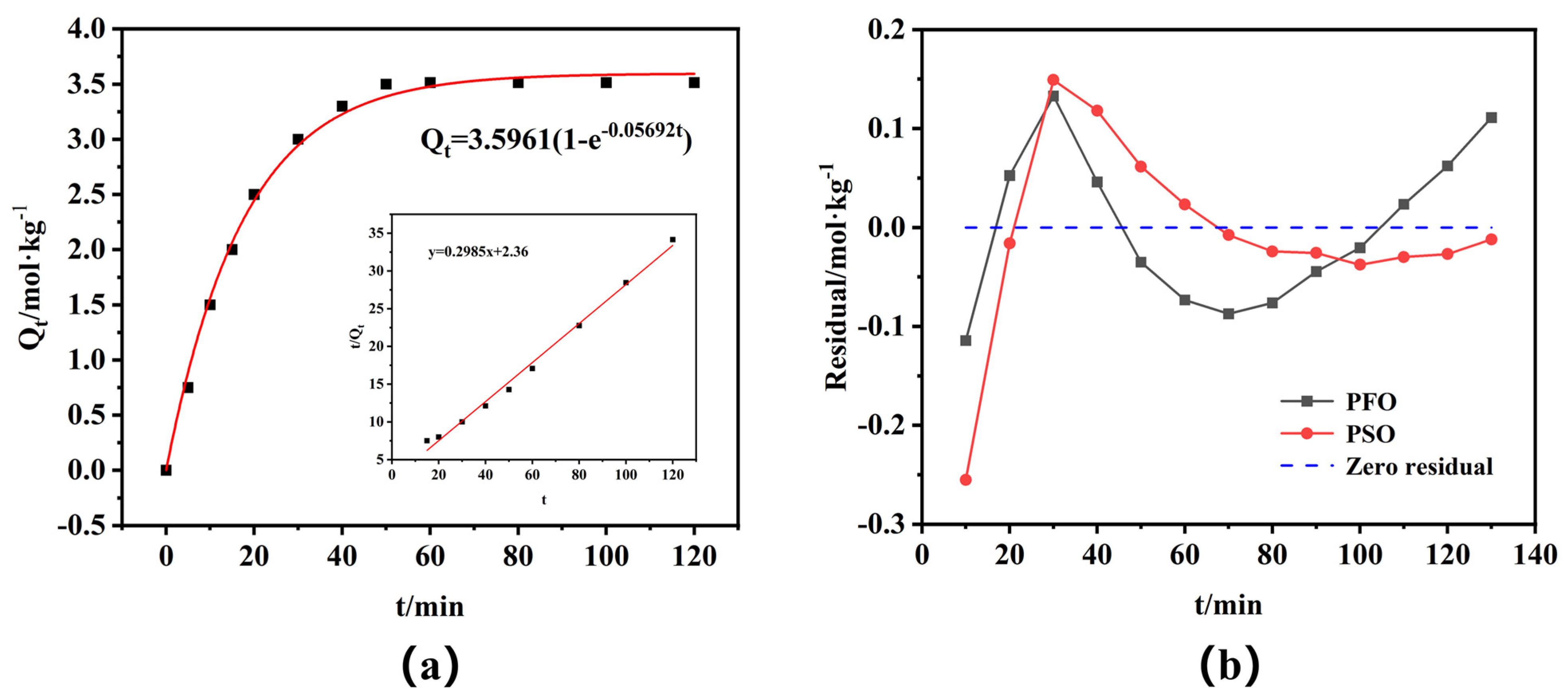
As shown in Table 5 and Table 6, both the pseudo-first-order (PFO) and pseudo-second-order (PSO) models provide acceptable fitting results for the apparent CO2 absorption behavior of the TDH and TADH systems, as indicated by their relatively high R2 values. However, because the R2 values of the two models are generally very close, it is difficult to determine which model is clearly superior based solely on R2. Therefore, RMSE, AIC, 95% confidence intervals, and residual plots were further introduced to enable a more reliable comparison of fitting quality and parameter uncertainty.Taking 30T35D35H as a representative sample, its kinetic fitting results and residual analysis are shown in Figure 12.
For the TADH system, when the TETA/AEP mass ratio was fixed at 2:1 and the total amine concentration was maintained at 30 wt%, the CO2 absorption capacity also gradually decreased with increasing DMAC content. However, the decrease was less pronounced than that observed for the corresponding TDH system, indicating that the introduction of AEP partially mitigated the negative effect of DMAC on absorption capacity. The apparent rate constant (k1) of the TADH system also increased with increasing DMAC content, while the differences among different formulations became narrower, suggesting that the apparent absorption behavior became more stable after the addition of AEP.
Further comparison based on RMSE, AIC, and residual plots showed that, for most formulations, the PFO model yielded slightly lower RMSE and AIC values, indicating marginally better empirical fitting performance. As shown in Figure 12a, the PFO model described well the variation trend of CO2 loading with time for the 30T35D35H system. The residual plot in Figure 12b shows that the residuals of both the PFO and PSO models were mostly distributed around the zero line, indicating that both models could reasonably describe the apparent absorption behavior.However, for some formulations, the PSO model also provided comparable or even slightly better fitting results. Therefore, the PFO model should be regarded as providing a slightly better or comparable empirical description of the apparent CO2 absorption process, rather than being clearly superior to the PSO model.
Figure 12. Representative kinetic fitting and residual analysis of CO2 absorption by 30T35D35H. (a) Experimental CO2 loading data and pseudo-first-order kinetic fitting curve. The inset shows the corresponding pseudo-second-order linear fitting plot. (b) Residual plots of the pseudo-first-order and pseudo-second-order models.
Processes 14 01909 g012
In summary, the CO2 absorption processes of both the TDH and TADH systems can be well described by the pseudo-first-order kinetic model. In the TDH system, the introduction of DMAC is characterized by a kinetic feature of “capacity decline accompanied by apparent acceleration”, with the preferred DMAC range being 25–40 wt%. In the TADH system, the introduction of AEP further moderates the capacity decay, improves the stability of the rate variation, and results in superior overall kinetic characteristics. Combined with the absorption rate, viscosity, and desorption rate data obtained at different AEP mass fractions, it can be concluded that an appropriate amount of AEP not only improves the mass transfer state during the later stage of absorption, but also enhances the desorption activity and cyclic stability. Among the formulations examined, 20T10A40D30H delivers the best comprehensive performance.

3.5. Mechanism Analysis

3.5.1. Properties and Morphological Evolution During CO2 Absorption

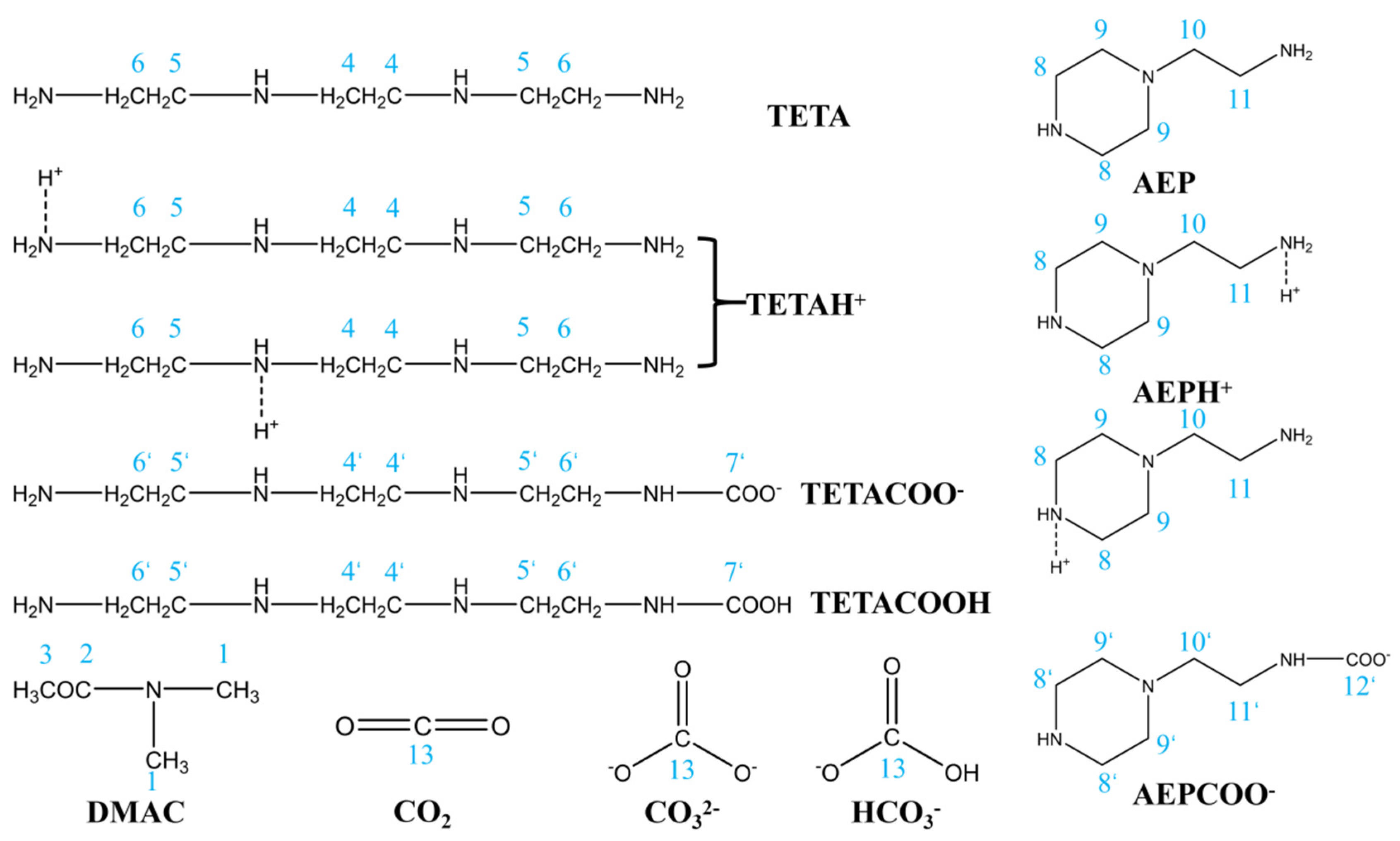
To identify the main CO2-containing species and compare their phase-selective distribution, CO2-loaded samples from the separated upper and lower phases were analyzed by 13C NMR spectroscopy. Figure 13 shows the molecular structures of the main components and possible CO2 reaction products used for peak assignment. The 13C NMR spectra were mainly used for product identification and semi-quantitative comparison of the relative distribution of carbon-containing species between the two phases.
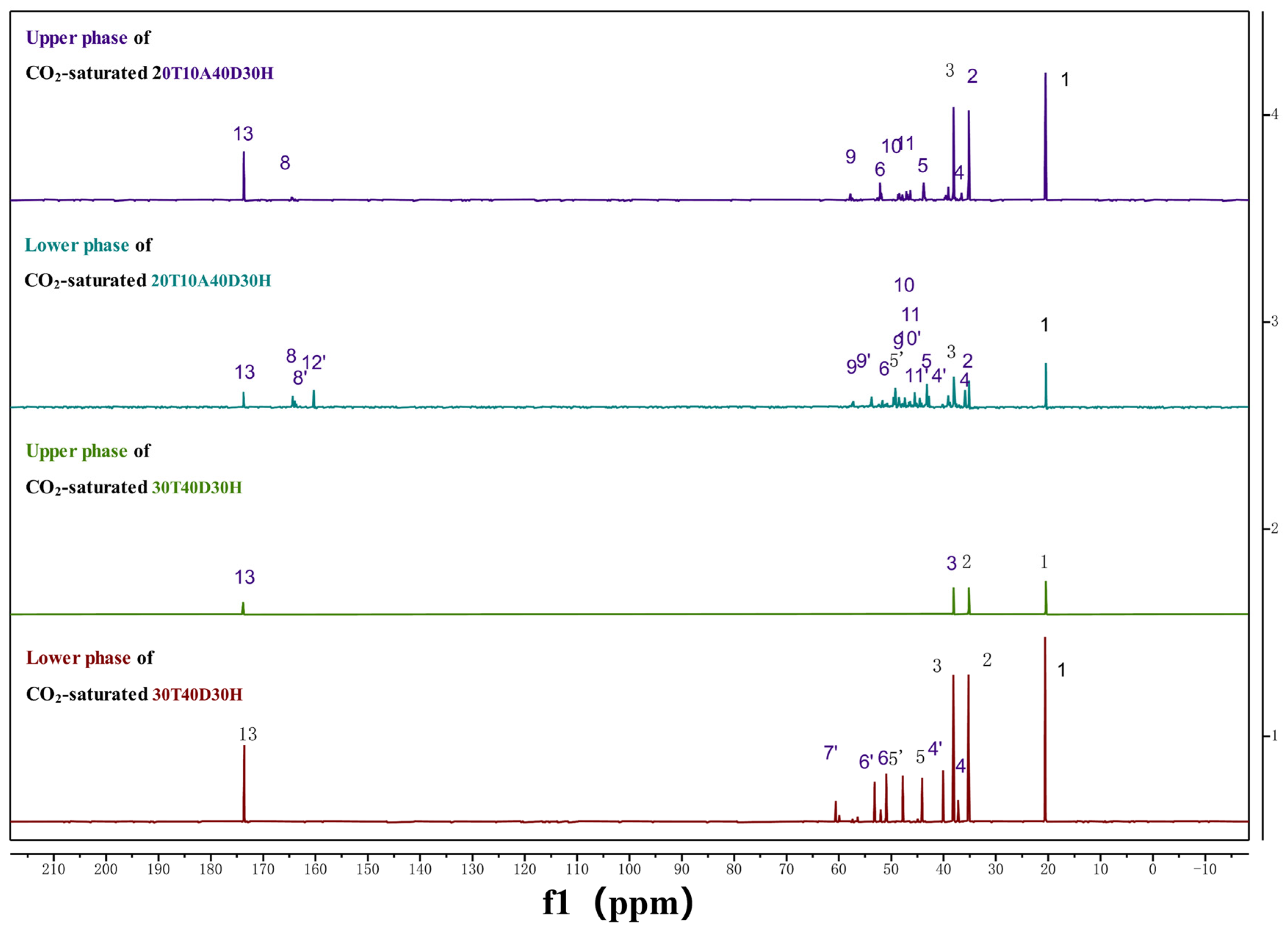
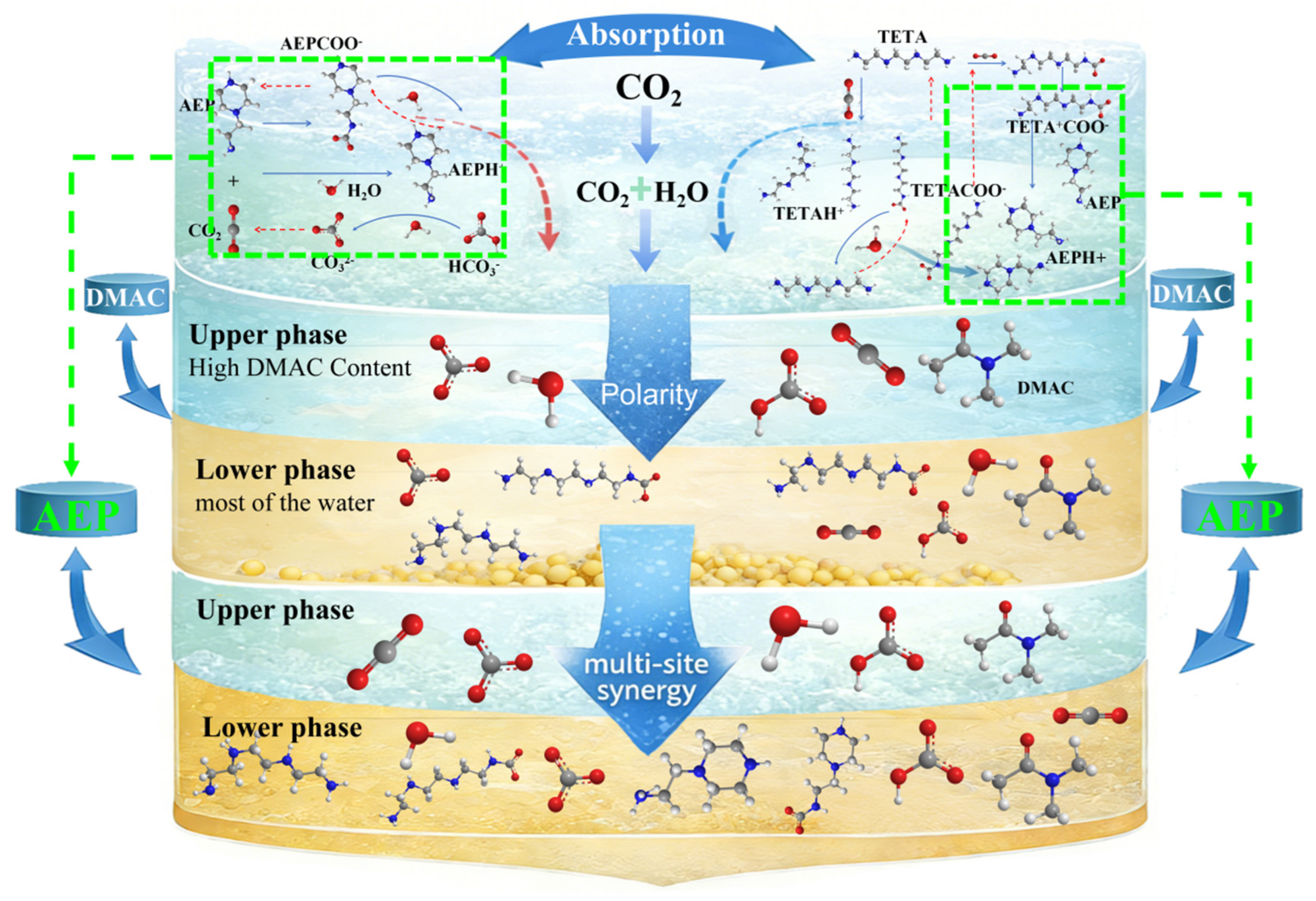
The distribution of the products in each phase is shown in Figure 14. Before the addition of AEP, unreacted TETA and reaction products were predominantly located in the lower phase after phase separation. Only CO2 and its hydrolysis products were detected in the upper phase, which can be attributed to the limited solubility of CO2 in the solution, whereas DMAC was distributed in both phases. The carbon signals appearing at 60.9 and 163.4 ppm are assigned to carbamate and carbonate (including bicarbonate) species, respectively. Upon reaching absorption saturation, the carbon signals originated mainly from the reaction products and DMAC. This confirms that the vast majority of TETA participated in the reaction and that the reaction products were concentrated in the CO2-rich lower phase. DMAC mainly functions as a physical phase splitter in the TADH absorbent. According to the FTIR and 13C NMR results, no new characteristic signals attributable to DMAC-derived chemical reaction products were observed after CO2 absorption or desorption. The spectral changes were mainly associated with the formation of CO2-containing ionic species, including carbamate and bicarbonate/carbonate species. Therefore, under the present experimental conditions, no evidence indicates that DMAC participates in the chemical absorption reaction of CO2. DMAC is thus considered to remain chemically inert and mainly contributes to the liquid–liquid phase separation by regulating the solvent polarity and phase composition.
In the AEP-containing absorbent, upon saturation, signals corresponding to AEP were detected in both the upper and lower phases, whereas the AEP-derived reaction products were mainly concentrated in the lower phase, indicating that the reaction products are predominantly located in the lower phase and that AEP partially participates in the reaction. Unlike primary and secondary amine-based absorbents, the TADH system exhibited markedly stronger bicarbonate/carbonate signals relative to the two carbamate signals. Because carbonate species are more readily desorbed than carbamates, the higher HCO3/CO32− signal intensity is more favorable for reducing the regeneration energy consumption. Carbamate and related carbon signals were detected exclusively in the lower phase, demonstrating that the CO2-containing species after absorption are concentrated in the lower phase. This observation is in good agreement with the CO2 distribution data, which show that 98% of the absorbed CO2 resides in the lower phase.

3.5.2. Reaction Mechanism

Figure 15 illustrates the absorption mechanism of the TETA/AEP/DMAC absorbent. Within an aqueous environment, the interaction of CO2 with TETA, AEP, and water first proceeds through the zwitterion mechanism (a characteristic pathway for CO2 capture by amine solutions). Therefore, on one hand, the primary and secondary amine groups follow reactions (8) and (9) to form carbamates. TETA reacts with CO2 to produce TETAH+, TETA+COO, and TETACOO. Subsequently, AEP acts as a proton acceptor, facilitating the formation of TETACOO and AEPH+, as shown in Equation (10). Simultaneously, AEP promotes the hydrolysis of CO2 through base catalysis, as shown in Equation (11), following the zwitterion exchange mechanism described by Equations (12) and (13). Specifically, AEP reacts with CO2 to form an unstable zwitterionic intermediate AEP+COO, which rapidly reacts with water to generate bicarbonate species. Concurrently, the amine group in AEP can directly undergo an addition reaction with CO2, yielding products such as carbamates, which further enhance CO2 absorption and conversion. CO2 binds to the alkaline sites provided by AEP, promoting its hydration reaction. CO2 reacts with water to form carbonic acid (H2CO3), which subsequently dissociates into bicarbonate ions (HCO3) and protons (H+). AEP efficiently accepts these protons to form a protonated state (AEPH+), driving the reaction equilibrium toward bicarbonate formation. These species are less prone to aggregation and precipitation, thereby effectively reducing the viscosity of the solution. This weaker aggregation behavior can be attributed to the multi-site molecular structure of AEP and its regulation of CO2 reaction-product distribution. The tertiary amine site in AEP can act as a proton acceptor and promote the formation of highly soluble bicarbonate species, while its primary and secondary amine sites participate in CO2 absorption and form sterically hindered carbamate/protonated amine ion pairs. Compared with linear TETA-derived carbamate species, these AEP-related products are less likely to undergo close packing and ordered aggregation. Therefore, AEP weakens the hydrogen bonding network and ion-pair association among carbamate-rich products, thereby reducing the viscosity of the CO2-rich phase and suppressing solid precipitation.
T E T A + C O 2 T E T A + C O O
T E T A + T E T A + C O O T E T A H + + T E T A C O O
A E P + T E T A + C O O T E T A C O O + A E P H +
A E P + C O 2 + H 2 O A E P H + + H C O 3
A E P + C O 2 A E P + C O O
A E P + C O O + H 2 O A E P H + + H C O 3
T E T A C O O + H 2 O H C O 3 + T E T A
T E T A + C O 2 + H 2 O H C O 3 + T E T A H +
C O 2 + H 2 O H C O 3 + H +
H C O 3 + H 2 O C O 3 2 + H 3 + O

4. Conclusions

This study systematically developed a TETA-AEP-DMAC-H2O quaternary biphasic absorbent and investigated its CO2 capture behavior, phase separation mechanism, kinetics, and cyclic stability. The main conclusions are as follows:
  • AEP significantly reduces the viscosity of the CO2-rich lower phase and enhances desorption performance. With the addition of AEP, the viscosity of the lower phase in the TADH system decreases by 32.9–75.8% compared with the TDH system. The optimal formulation, 20T10A40D30H, achieves a CO2 enrichment efficiency exceeding 98%, and its maximum desorption rate is approximately 1.5 times that of both the 30T70H and TDH systems. Regenerating only the CO2-rich lower phase may reduce the amount of solvent requiring heating, suggesting a potential advantage in reducing the regeneration energy requirement.
  • The cyclic stability is remarkably improved. The TADH system retains more than 92% of its initial CO2 loading over the first three cycles, with desorption efficiency remaining above 90%; its cyclic absorption capacity is approximately twice that of the AEP-free system. AEP inhibits the aggregation and precipitation of carbamate species and catalyzes CO2 hydration, while synergistically working with DMAC to mitigate the thermal degradation of TETA, thus significantly enhancing long-term operational stability.
  • The proposed reaction and phase separation mechanism is supported by spectroscopic evidence, and the kinetic characteristics are improved. The reaction mechanism is clarified and the kinetic characteristics are improved. The system follows a “synergistic absorption-proton transfer-hydrolysis conversion-salting-out phase separation and enrichment” mechanism. AEP and TETA provide complementary active sites, and AEP promotes the formation of easily regenerable HCO3 through steric hindrance effects. DMAC drives phase separation and directional enrichment of reaction products via the salting-out effect. Kinetic analysis demonstrates that the absorption process conforms to a pseudo-first-order model, and an appropriate amount of AEP improves mass transfer in the later stage of absorption while enhancing desorption activity and cyclic stability.
Although the TADH biphasic absorbent developed in this study exhibits favorable overall performance, further validation and optimization are still required before industrial application. Future work will focus on systematically addressing key engineering issues. Specifically, the long-term operational stability of the absorbent should be comprehensively evaluated by extending the absorption–desorption cycling period. Solvent volatility loss, oxidative degradation behavior, and corrosion characteristics toward process equipment should also be systematically investigated. In addition, the regeneration energy consumption of the system should be accurately measured under continuous operating conditions to clarify its potential energy-saving advantages and process compatibility. Furthermore, process parameter optimization and scale-up experiments may be conducted under simulated real flue gas conditions to further verify the adaptability and reliability of the TADH system in complex industrial scenarios.

Supplementary Materials

The following supporting information can be downloaded at: https://www.mdpi.com/article/10.3390/pr14121909/s1, Table S1. CO2 absorption capacity of TDH absorbent and benchmark aqueous amine solutions. Table S2. Kinetic fitting results of TDH absorbent and benchmark aqueous amine solutions. Table S3. 95% confidence intervals for the kinetic parameters of TDH absorbents and benchmark aqueous amine solutions. Table S4. CO2 absorption capacity of TADH absorbent. Table S5. Kinetic fitting results of TADH absorbent. Table S6. 95% confidence intervals for the kinetic parameters of TDH absorbents.

Author Contributions

Q.Z.: Resources, writing—review and editing, supervision, data curation. F.W.: Writing—original draft. X.N.: Validation, methodology, visualization. L.Y.: Validation, Visualization, software. L.W.: Validation, formal analysis, visualization. G.Y.: Resources, review, supervision. J.Z.: Conceptualization, methodology, software. All authors have read and agreed to the published version of the manuscript.

Funding

The author acknowledges support from the National Natural Science Foundation of China project “Study on Radical Behavior in Microwave Pyrolysis of Oil-Rich Coal Based on Non-Thermal Effects and Mechanism of Tar ‘Lightening’” (Grant No.: 22578348).

Data Availability Statement

The original contributions presented in this study are included in the article/Supplementary Material. Further inquiries can be directed to the corresponding author.

Conflicts of Interest

Author Xiaogang Ning was employed by the company Sinochem Holdings Corporation Ltd. The remaining authors declare that the research was conducted in the absence of any commercial or financial relationships that could be construed as a potential conflict of interest.

Abbreviations

The following abbreviations are used in this manuscript:
TETATriethylenetetramine
DMACN,N-dimethylacetamide
AEP1-(2-aminoethyl)piperazine
TADHTETA/AEP/DMAC/H2O biphasic absorbent
30T/A40D30H20 wt% TETA + 10 wt% AEP + 40 wt% DMAC + 30 wt% H2O
30T70H30 wt% TETA aqueous solution
TDHTETA/DMAC/H2O biphasic absorbent
CCSCarbon capture and storage
MEAmonoethanolamine
DEAdiethanolamine
MDEAmethyldiethanolamine
DETADiethylenetriamine
DMCAN,N-dimethylcyclohexylamine
DMI1,3-dimethyl-2-imidazolidinone
DMFN,N-dimethylformamide
NMPN-methyl-2-pyrrolidone
AAILsamino acid ionic liquids

References

  1. Friedlingstein, P.; O’Sullivan, M.; Jones, M.W.; Andrew, R.M.; Gregor, L.; Hauck, J.; Le Quéré, C.; Luijkx, I.T.; Olsen, A.; Peter, G.P.; et al. Global Carbon Budget 2022. J. Earth Syst. Sci. Data 2022, 14, 4811–4900. [Google Scholar] [CrossRef]
  2. Borhani, T.N.; Wang, M.H. Role of solvents in CO2 capture processes: The review of selection and design methods. Renew. Sustain. Energy Rev. 2019, 114, 109299. [Google Scholar] [CrossRef]
  3. Vega, F.; Baena-Moreno, F.M.; Fernandez, L.M.G.; Portillo, E.; Navarrete, B.; Zhang, Z.E. Current status of CO2 chemical absorption research applied to CCS: Towards full deployment at industrial scale. Appl. Energy 2020, 260, 114313. [Google Scholar] [CrossRef]
  4. Liu, S.; Ling, H.; Gao, H.; Tontiwachwuthikul, P.; Liang, Z.; Zhang, H. Kinetics and new Brønsted correlations study of CO2 absorption into primary and secondary alkanolamine with and without steric-hindrance. Sep. Purif. Technol. 2020, 233, 115998. [Google Scholar] [CrossRef]
  5. Barzagli, F.; Mani, F.; Peruzzini, M. A Comparative Study of the CO2 Absorption in Some Solvent-Free Alkanolamines and in Aqueous Monoethanolamine (MEA). Environ. Sci. Technol. 2016, 50, 7239–7246. [Google Scholar] [CrossRef]
  6. MacInnes, J.M.; Ayash, A.A.; Dowson, G.R.M. CO2 absorption using diethanolamine-water solutions in a rotating spiral contactor. Chem. Eng. J. 2017, 307, 1084–1091. [Google Scholar] [CrossRef]
  7. Li, J.; Li, Y.; Li, C.; Tu, R.; Xie, P.; He, Y.; Shi, Y. CO2 absorption and microwave regeneration with high-concentration TETA nonaqueous absorbents. Greenh. Gases Sci. Technol. 2022, 12, 362–375. [Google Scholar] [CrossRef]
  8. Hu, D.; Yoon, B.; Hu, Y.; Cao, D.; Wang, Q.; Wang, B.; Lu, S. Tailoring amine activators in MDEA/NHD/H2O biphasic absorbents for energy-efficient CO2 capture: Mechanistic insights into polarity-driven phase separation and multi-component synergy. Sep. Purif. Technol. 2025, 376, 133908. [Google Scholar] [CrossRef]
  9. Ying, J.; Eimer, D.A.; Mathisen, A.; Brakstad, F.; Haugen, H.A. Ultrasound intensify CO2 desorption from pressurized loaded monoethanolamine solutions. II. Optimization and cost estimation. Energy 2019, 173, 218–228. [Google Scholar] [CrossRef]
  10. Zhao, H.; Liu, J.; Cheng, S.; Wang, R.; Li, Q.; An, S.; Zhang, S.; Wang, L. Enhancing low-temperature desorption performance toward energy-saving CO2 capture via the multifunctional design of diethylethanolamine-based biphasic solvents. Energy 2024, 307, 132613. [Google Scholar] [CrossRef]
  11. Shen, S.; Shi, X.; Li, C.; Guo, H.; Long, Q.; Wang, S.; Yin, X. Nonaqueous (amine + glycol ether) solvents for energy-efficient CO2 capture: New insights into phase change behaviors and assessment of capture performance. Sep. Purif. Technol. 2022, 300, 121908. [Google Scholar] [CrossRef]
  12. Alipour, M.; Hafizi, A.; Kanani, M.; Dara, A. Biphasic systems of mutual amine solution with tunable phase separation for CO2 capture: Optimal compositions and volume of rich phase. J. Mol. Liq. 2023, 385, 122433. [Google Scholar] [CrossRef]
  13. Hu, H.T.; Fang, M.X.; Liu, F.; Wang, T.; Xia, Z.X.; Zhang, W.; Ge, C.L.; Yuan, J.J. Novel alkanolamine-based biphasic solvent for CO2 capture with low energy consumption and phase change mechanism analysis. Appl. Energy 2022, 324, 119570. [Google Scholar] [CrossRef]
  14. Li, X.; Zhou, X.; Wei, J.; Fan, Y.; Liao, L.; Wang, H. Reducing the energy penalty and corrosion of carbon dioxide capture using a novel nonaqueous monoethanolamine-based biphasic solvent. Sep. Purif. Technol. 2021, 265, 118481. [Google Scholar] [CrossRef]
  15. Chen, Z.; Meng, F.; Xia, Z.; An, Y.; Fang, M.; Qin, Z.; Hu, X.; Chen, W.; Yin, H. Phase separation behavior and thermal degradation analysis of DETA/DEA/DMAC biphasic absorbent. Chem. Eng. J. 2024, 500, 157163. [Google Scholar] [CrossRef]
  16. Chen, Z.; Wang, T.; Li, C.; Fang, M.; Chen, W.; Hu, X.; Shao, Y.; Liu, Z.; Zhang, W.; Zhang, L.; et al. Phase separation behavior and CO2 absorption kinetic analysis of DETA/DEA/DMAC biphasic absorbent. Chem. Eng. J. 2024, 496, 154002. [Google Scholar] [CrossRef]
  17. Zhang, Z.; Zhao, W.B.; Nong, J.J.; Feng, D.; Li, Y.H.; Chen, Y.; Chen, J. Liquid-Solid Phase-Change Behavior of Diethylenetriamine in Nonaqueous Systems for Carbon Dioxide Absorption. Energy Technol. 2017, 5, 461–468. [Google Scholar] [CrossRef]
  18. Zheng, S.; Tao, M.; Liu, Q.; Ning, L.; He, Y.; Shi, Y. Capturing CO2 into the Precipitate of a Phase-Changing Solvent after Absorption. Environ. Sci. Technol. 2014, 48, 8905–8910. [Google Scholar] [CrossRef]
  19. Wang, Y.; Nwaoha, C.; Sema, T.; Liu, B.; Liang, Z.; Tontiwachwuthikul, P.; Li, J.-H. Investigation of CO2 absorption and desorption performance of DETA-based phase-change solvents in alcohol-water systems. Chem. Eng. J. 2025, 520, 165495. [Google Scholar] [CrossRef]
  20. Zhang, S.; Shen, Y.; Shao, P.; Chen, J.; Wang, L. Kinetics, Thermodynamics, and Mechanism of a Novel Biphasic Solvent for CO2 Capture from Flue Gas. Environ. Sci. Technol. 2018, 52, 3660–3668. [Google Scholar] [CrossRef] [PubMed]
  21. Gao, X.; Li, X.; Cheng, S.; Lv, B.; Jing, G.; Zhou, Z. A novel solid–liquid ‘phase controllable’ biphasic amine absorbent for CO2 capture. Chem. Eng. J. 2022, 430, 132932. [Google Scholar] [CrossRef]
  22. Jiang, C.; Chen, H.; Wang, J.; Shen, Y.; Ye, J.; Zhang, S.; Wang, L.; Chen, J. Phase Splitting Agent Regulated Biphasic Solvent for Efficient CO2 Capture with a Low Heat Duty. Environ. Sci. Technol. 2020, 54, 7601–7610. [Google Scholar] [CrossRef]
  23. Tao, M.; Xu, N.; Gao, J.; Zhang, W.; Li, Y.; Bernards, M.T.; Shi, Y.; He, Y.; Pan, H. Phase-Change Mechanism for Capturing CO2 into an Environmentally Benign Nonaqueous Solution: A Combined NMR and Molecular Dynamics Simulation Study. Energy Fuels 2019, 33, 474–483. [Google Scholar] [CrossRef]
  24. Zhan, X.; Lv, B.; Yang, K.; Jing, G.; Zhou, Z. Dual-Functionalized Ionic Liquid Biphasic Solvent for Carbon Dioxide Capture: High-Efficiency and Energy Saving. Environ. Sci. Technol. 2020, 54, 6281–6288. [Google Scholar] [CrossRef]
  25. Zhao, S.; Wang, Y.; Zhu, K.; Zhao, D.; Song, Q. Improving the absorption load, high viscosity, and regeneration efficiency of CO2 capture using a novel tri-solvent biphasic solvents of TETA-AMP-1DMA2P. Environ. Sci. Pollut. Res. 2022, 29, 84903–84915. [Google Scholar] [CrossRef]
  26. Chen, W.; Chen, M.; Jiang, B.; Lei, T.; Zhang, F.; Zhang, Z. The improvement of ionic liquids on CO2 capture with biphasic absorbents. Chem. Eng. J. 2024, 493, 152720. [Google Scholar] [CrossRef]
  27. Liang, Y.; Duan, H.; Chen, W.; Sun, L.; Zhang, F. Product Optimization of Biphasic Absorbents for CO2 Capture. Energy Fuels 2025, 39, 16327–16334. [Google Scholar] [CrossRef]
  28. Guo, R.-T.; Li, G.-Y.; Liu, Y.; Pan, W.-G. Recent Progress on CO2 Capture Based on Sterically Hindered Amines: A Review. Energy Fuels 2023, 37, 15429–15452. [Google Scholar] [CrossRef]
  29. Dey, A.; Saini, B.; Balchandani, S.C.; Kumar Dash, S. Investigation of equilibrium CO2 solubility in 35 wt% aqueous 1-(2-aminoethyl) piperazine (AEP) and performance study over monoethanolamine for CO2 absorption. Mater. Today Proc. 2022, 61, 498–503. [Google Scholar] [CrossRef]
  30. Ye, Q.; Wang, X.; Lu, Y. Screening and evaluation of novel biphasic solvents for energy-efficient post-combustion CO2 capture. Int. J. Greenh. Gas Control 2015, 39, 205–214. [Google Scholar] [CrossRef]
  31. Crooks, J.E.; Donnellan, J.P. Kinetics and mechanism of the reaction between carbon dioxide and amines in aqueous solution. J. Chem. Soc. Perkin Trans. 1989, 2, 331–333. [Google Scholar] [CrossRef]
  32. Liu, F.; Jing, G.; Zhou, X.; Lv, B.; Zhou, Z. Performance and Mechanisms of Triethylene Tetramine (TETA) and 2-Amino-2-methyl-1-propanol (AMP) in Aqueous and Nonaqueous Solutions for CO2 Capture. ACS Sustain. Chem. Eng. 2018, 6, 1352–1361. [Google Scholar] [CrossRef]
  33. Gao, G.; Gao, X.; Xu, B.; Jiang, W.; Zhao, Z.; Wu, F.; Li, X.; Luo, C.; Zhang, L. Novel biphasic solvent based on 2MPRZ absorbent for post-combustion CO2 capture with low viscosity, superior phase-splitting behavior and low energy consumption. Sep. Purif. Technol. 2024, 330, 125424. [Google Scholar] [CrossRef]
  34. Yang, Y.; Wang, S.; Yang, K.; Xu, W.; Wang, X.; Geng, Z.; Liao, G.; Ning, P.; Zhu, T. Organic solvents induced enhancement of phase-splitting behaviors and CO2 absorption performance in biphasic absorbent. Sep. Purif. Technol. 2025, 362, 131798. [Google Scholar] [CrossRef]
  35. Wang, N.; Peng, Z.; Gao, H.; Sema, T.; Shi, J.; Liang, Z. New insight and evaluation of secondary Amine/N-butanol biphasic solutions for CO2 Capture: Equilibrium Solubility, phase separation Behavior, absorption Rate, desorption Rate, energy consumption and ion species. Chem. Eng. J. 2022, 431, 133912. [Google Scholar] [CrossRef]
  36. Wang, R.; Zhao, H.; Wang, Y.; Qi, C.; Zhang, S.; Wang, L.; Li, M. Development of biphasic solvent for CO2 capture by tailoring the polarity of amine solution. Fuel 2022, 325, 124885. [Google Scholar] [CrossRef]
  37. Shen, L.; Liu, F.; Shen, Y.; Sun, C.; Zhang, Y.; Wang, Q.; Li, S.; Li, W. Novel biphasic solvent of AEP/1-propanol/H2O for CO2 capture with efficient regeneration performance and low energy consumption. Sep. Purif. Technol. 2021, 270, 118700. [Google Scholar] [CrossRef]
  38. Ye, J.; Jiang, C.; Chen, H.; Shen, Y.; Zhang, S.; Wang, L.; Chen, J. Novel Biphasic Solvent with Tunable Phase Separation for CO2 Capture: Role of Water Content in Mechanism, Kinetics, and Energy Penalty. Environ. Sci. Technol. 2019, 53, 4470–4479. [Google Scholar] [CrossRef] [PubMed]
  39. Liu, J.; Qian, J.; He, Y. Water-lean triethylenetetramine/N,N-diethylethanolamine/n-propanol biphasic solvents: Phase-separation performance and mechanism for CO2 capture. Sep. Purif. Technol. 2022, 289, 120740. [Google Scholar] [CrossRef]
  40. Liu, J.; Qian, J.; Hu, H. Effect of H2O on absorption performance of tetraethylenepentamine-ethanol-CO2 two-phase absorbent and its mechanism. Int. J. Greenh. Gas Control 2021, 110, 103406. [Google Scholar] [CrossRef]
  41. Zhang, W.; Jin, X.; Tu, W.; Ma, Q.; Mao, M.; Cui, C. Development of MEA-based CO2 phase change absorbent. Appl. Energy 2017, 195, 316–323. [Google Scholar] [CrossRef]
  42. Zhang, W.; Jin, X.; Tu, W.; Ma, Q.; Mao, M.; Cui, C. A Novel CO2 Phase Change Absorbent: MEA/1-Propanol/H2O. Energy Fuels 2017, 31, 4273–4279. [Google Scholar] [CrossRef]
  43. Morrison, T.J. 729. The salting-out of non-electrolytes. Part I. The effect of ionic size, ionic charge, and temperature. J. Chem. Soc. 1952, 3814–3818. [Google Scholar] [CrossRef]
  44. Duan, J.; Zhu, J.; Lu, S.; Kang, J.; Zhao, F. Influence of EtOH and n-PrOH on the CO2 absorption and phase separation of amine-functionalized ionic liquid phase separation system. Chem. Eng. J. 2025, 515, 163670. [Google Scholar] [CrossRef]
  45. Saeed, A.; Qyyum, M.A.; Lee, D.; Al-Hajri, R. The evolving role of biphasic solvents in CO2 capture: Recent developments, deployment challenges, and opportunities for AI-assisted screening. Chem. Eng. J. 2025, 519, 165027. [Google Scholar] [CrossRef]
Figure 1. (a) Schematic for the CO2 absorption experiment; (b) schematic for the CO2 desorption experiment.
Processes 14 01909 g001
Figure 2. CO2 absorption performance of TDH absorbents and benchmark aqueous amine absorbents: (a) CO2 absorption capacity; (b) instantaneous CO2 absorption rate. The TDH absorbents contain 30 wt% TETA with different DMAC/H2O ratios.
Processes 14 01909 g002
Figure 3. Photographs of CO2-loaded TDH absorbents after standing, showing the phase state and precipitation behavior: (a) 30T70H; (b) 30T70D; (c) 30T40D30H; (d) 30T35D35H; (e) 30T30D40H; (f) 30T25D45H.
Processes 14 01909 g003
Figure 4. Phase transition behavior of TADH absorbents with different DMAC/H2O ratios after CO2 absorption: (a) 20T10A20D50H; (b) 20T10A25D45H; (c) 20T10A30D40H; (d) 20T10A35D35H; (e) 20T10A40D30H.
Processes 14 01909 g004
Figure 5. Spectroscopic analysis of CO2 absorption products in TDH and TADH systems after CO2 absorption and phase separation. (a) FTIR spectra of the upper phase, lower phase, and solid precipitate in the AEP-free TDH system, together with the upper and lower phases of the AEP-containing TADH system. (b) UV-Vis spectra of the upper and lower phases of TDH and TADH absorbents after CO2 absorption. 30T U and 30T L represent the upper and lower phases of 30T40D30H, respectively; 30T P represents the solid precipitate formed in the 30T40D30H system. 20T10A U and 20T10A L represent the upper and lower phases of 20T10A40D30H, respectively.
Processes 14 01909 g005
Figure 6. Instantaneous CO2 absorption rates of TADH absorbents with different TETA/AEP mass ratios at fixed DMAC/H2O composition. The total amine concentration was maintained at 30 wt%, and the DMAC and H2O contents were fixed at 40 wt% and 30 wt%, respectively.
Processes 14 01909 g006
Figure 7. Viscosity evolution of TADH absorbents with different TETA/AEP mass ratios during CO2 absorption. The total amine concentration was fixed at 30 wt%, with 40 wt% DMAC and 30 wt% H2O.
Processes 14 01909 g007
Figure 8. CO2 desorption rates of the CO2-rich lower phases of TADH absorbents with different TETA/AEP mass ratios at 120 °C.
Processes 14 01909 g008
Figure 9. CO2 absorption performance of TADH absorbents with different DMAC/H2O ratios at a fixed TETA/AEP mass ratio of 2:1: (a) CO2 absorption capacity; (b) instantaneous CO2 absorption rate.
Processes 14 01909 g009
Figure 10. Phase separation behavior of the CO2 absorbent: (a) desorption rate of the lower phase; (b) desorption rate of the upper phase; (c) volume distribution of the two phases after phase separation; (d) concentration distribution of the products in the two phases after CO2 absorption.
Processes 14 01909 g010
Figure 11. Cyclic CO2 absorption performance of 20T10A35D35H and its AEP-free counterpart 30T35D35H during repeated absorption–desorption cycles. The yellow and blue lines are center reference lines derived from the cyclic absorption efficiency data of 30T35D35H and 20T10A35D35H, respectively.
Processes 14 01909 g011
Figure 13. Solution species: molecular structure and carbon-type identification.
Processes 14 01909 g013
Figure 14. Phase-selective 13C NMR Analysis of the TDH and TADH absorbents. The TETA- and AEP-derived carbamate signals are labeled separately where distinguishable, whereas HCO3 and CO32− are collectively assigned as HCO3/CO32−-related species because their signals partially overlap under the present spectral conditions.
Processes 14 01909 g014
Figure 15. CO2 absorption mechanism of the TADH absorbent.
Processes 14 01909 g015
Table 1. Definitions of abbreviations for the absorbent formulations used in this study.
AbbreviationAbsorbent Composition
30M70H30 wt% MEA + 70 wt% H2O
30T70H30 wt% TETA + 70 wt% H2O
30T20D50H30 wt% TETA + 20 wt% DMAC + 50 wt% H2O
30T25D45H30 wt% TETA + 25 wt% DMAC + 45 wt% H2O
30T30D40H30 wt% TETA + 30 wt% DMAC + 40 wt% H2O
30T35D35H30 wt% TETA + 35 wt% DMAC + 35 wt% H2O
30T40D30H30 wt% TETA + 40 wt% DMAC + 30 wt% H2O
30T50D20H30 wt% TETA + 50 wt% DMAC + 20 wt% H2O
25T5A40D30H25 wt% TETA + 5 wt% AEP + 40 wt% DMAC + 30 wt% H2O
20T10A40D30H20 wt% TETA + 10 wt% AEP + 40 wt% DMAC + 30 wt% H2O
15T15A40D30H15 wt% TETA + 15 wt% AEP + 40 wt% DMAC + 30 wt% H2O
10T20A40D30H10 wt% TETA + 20 wt% AEP + 40 wt% DMAC + 30 wt% H2O
5T25A40D30H5 wt% TETA + 25 wt% AEP + 40 wt% DMAC + 30 wt% H2O
20T10A20D50H20 wt% TETA + 10 wt% AEP + 20 wt% DMAC + 50 wt% H2O
20T10A25D45H20 wt% TETA + 10 wt% AEP + 25 wt% DMAC + 45 wt% H2O
20T10A30D40H20 wt% TETA + 10 wt% AEP + 30 wt% DMAC + 40 wt% H2O
20T10A35D35H20 wt% TETA + 10 wt% AEP + 35 wt% DMAC + 35 wt% H2O
20T10A40D30H20 wt% TETA + 10 wt% AEP + 40 wt% DMAC + 30 wt% H2O
Table 2. Phase Transition Behavior of Organic Solvents as Phase Separators.
Organic SolventBoiling Point (K)After AbsorptionAfter DesorptionDipole Moment (Debye)
2-Methyl-1-propanol108.0Two PhasesTwo Phases1.64
DMF153.0Single PhaseSingle Phase3.82
Ethanol78.4Single PhaseSingle Phase1.68
DMAC165.1Two PhasesSingle Phase3.70
1-Butanol117.6Two PhasesTwo Phases1.66
1-propanol97.0Two PhasesSingle Phase1.55
2-propanol82.3Two PhasesSingle Phase1.58
Table 3. Comparison of viscosities of the upper and lower phases of TDH and TADH absorbents with different compositions at 40 °C.
AbsorbentViscosity/(mPa·s)
Upper PhaseLower Phase
30T70H12.0 ± 0.07
30T/A20D50H5.4 ± 0.0522.4 ± 0.24
30T/A25D45H5.4 ± 0.0536.8 ± 0.48
30T/A30D40H5.4 ± 0.0742.7 ± 0.50
30T/A35D35H5.4 ± 0.0555.5 ± 0.70
30T/A40D30H5.4 ± 0.0762.3 ± 0.82
30T20D50H4.9 ± 0.0533.4 ± 0.44
30T25D45H5.4 ± 0.0871.7 ± 0.95
30T30D40H5.4 ± 0.04105.7 ± 1.15
30T35D35H5.0 ± 0.07185.6 ± 2.12
30T40D30H5.2 ± 0.07257.9 ± 2.87
Table 4. Performance comparison of the TADH biphasic absorbent with literature-reported CO2 capture systems.
SrSolvent NameSolvent AbbreviationSolvent TypeSplit Mode PhasesConcentration of SolventCO2 Loading Capacity Rich Phase
Ratio
ViscosityRef.
1triethylenetetramine/N,N-dimethylcyclohexylamine/waterTETA/DMCA/H2OAmine blendLiquid-
Liquid
1 M TETA, 3 M DMCA0.8 mol/mol65.0%N/A[20]
2Triethylenetetramine/2-(diethylamino)ethanol/
Water
TETA/DEEA/
H2O
Amine blendLiquid-
Liquid
1 M TETA, 4 M DEEA 0.9 mol/mol88.0%N/A[30]
3Triethylenetetramine/2-amino-2-methyl-1-propanol/EthanolTETA/AMP/C2H5OHAmine-Alcohol
blend
Solid-
Liquid
1 M TETA, 2 M AMP,
60 wt% C2H5OH
3.71 mol·kg−1N/A198.32 mPa·s[32]
4Triethylenetetramine/Ethanol/WaterTETA/C2H5OH/H2OAmine-Alcohol
blend
Solid-
Liquid
N/A1.72 mol/molN/AN/A[18,19]
5TETA-DEEA-H2O with phase-splitting agents, such as DMI, DMF, NMPTETA/DEEA/H2O + phase splitterAmine-Physical
solvent blend
Liquid–liquid1 M TETA, 3 M DEEA, 25 wt% H2O0.64–0.73 mol/molN/A~450 mPa·s[45]
6Tetraethylenepentamine/1-ethylimidazole/H2OTEPA/Eim/H2OAmine blendSolid-
Liquid
20 wt% TEPA, 60 wt% Eim, 20 wt% H2O1.50 mol·kg−141.0%N/A[26]
7Tetraethylenepentamine/1-ethylimidazole/water/serine-based amino acid ionic liquidTEPA/Eim/H2O-SerAmine-Ionic
Liquid blend
Liquid–liquid20 wt% TEPA, 50 wt% Eim, 20 wt% H2O, 10 wt% Ser1.85 mol·kg−167.0%108.6 mPa·s[26]
8Triethylenetetramine/N,N-dimethylacetamide/H2OTDHAmine-Physical
solvent blend
Solid-
Liquid
30 wt% TETA, 40 wt% DMAC, 30 wt% H2O3.305 mol·kg−149.0%257.9 mPa·sthis work
9Triethylenetetramine/1-(2-aminoethyl)piperazine/N,N-dimethylacetamide/H2OTADHAmine-Physical
solvent blend
Liquid–liquid20 wt% TETA,10
wt% AEP, 40 wt% DMAC, 30 wt% H2O
3.204 mol·kg−156.0%62.3 mPa·sthis work
Note: The CO2 loading data in the table are listed according to the reporting methods used in the original references. Because different studies employed different absorbent concentrations, CO2 partial pressures, temperatures, and loading calculation bases, these values should not be directly compared in a simple manner. This table is mainly intended to compare the overall performance of different systems in terms of CO2 saturation loading capacity, phase separation behavior, CO2-rich phase volume fraction, and rich-phase viscosity.
Table 5. Kinetic fitting results of TDH absorbent and benchmark aqueous amine solutions.
SamplePFO (Qe)PFO (k1)PFO R2PFO RMSEPFO AICPSO (Qe)PSO (k2)PSO R2PSO RMSEPSO AICΔAIC
30T70H4.03860.035130.99560.0549−71.444.97480.007540.99440.0621−68.253.20
30T20D50H4.09170.027970.99030.0934−57.635.31870.004890.97400.1532−44.7812.85
30T25D45H3.79600.031890.99180.0765−62.834.79910.006590.97600.1313−48.7814.05
30T30D40H3.60900.038370.98800.0815−61.204.40150.009480.97690.1129−52.718.49
30T35D35H3.42590.038180.98820.0759−63.054.17580.009980.98260.0921−58.005.06
30T40D30H3.17030.042330.97880.0890−58.913.79680.012780.98130.0836−60.53−1.63
30T50D20H2.75690.055390.95800.0962−56.883.18170.022150.95550.0989−56.150.73
Note: (Qe) represents the model-fitted equilibrium CO2 loading, with a unit of mol·kg−1. (k1) and (k2) are the apparent rate constants of the pseudo-first-order and pseudo-second-order kinetic models, respectively, with units of min−1 and kg·mol−1·min−1. RMSE represents the root mean square error and has the same unit as (Qe), namely mol·kg−1. AIC is the Akaike information criterion and is dimensionless. (R2) is the coefficient of determination and is dimensionless.
Table 6. Pseudo-first-order and pseudo-second-order kinetic parameters for TADH biphasic absorbents.
SamplePFO (Qe)PFO (k1)PFO R2PFO RMSEPFO AICPSO (Qe)PSO (k2)PSO R2PSO RMSEPSO AICΔAIC
20T10A20D50H3.75870.038690.99490.0545−65.844.62390.008940.98850.0821−55.999.85
20T10A25D45H3.56560.041830.99450.0529−66.574.33260.010630.98080.0985−51.6214.95
20T10A30D40H3.41330.050820.98060.0866−54.704.02400.015110.96810.1111−48.735.97
20T10A35D35H3.25520.050190.97530.0922−53.203.83970.015660.97600.0910−53.54−0.33
20T10A40D30H3.07280.049890.97300.0912−53.463.62920.016410.97700.0841−55.42−1.96
Note: (Qe) represents the model-fitted equilibrium CO2 loading, with a unit of mol·kg−1. (k1) and (k2) are the apparent rate constants of the pseudo-first-order and pseudo-second-order kinetic models, respectively, with units of min−1 and kg·mol−1·min−1. RMSE represents the root mean square error and has the same unit as (Qe), namely mol·kg−1. AIC is the Akaike information criterion and is dimensionless. (R2) is the coefficient of determination and is dimensionless.
Disclaimer/Publisher’s Note: The statements, opinions and data contained in all publications are solely those of the individual author(s) and contributor(s) and not of MDPI and/or the editor(s). MDPI and/or the editor(s) disclaim responsibility for any injury to people or property resulting from any ideas, methods, instructions or products referred to in the content.