1. Introduction
Fault fracture zones represent ubiquitous structural hazards in underground coal extraction. Their presence degrades the geomechanical integrity of the adjacent coal-rock mass relative to undisturbed strata, thereby inducing severe tectonic stress concentration and localized stress field perturbations [
1]. To mitigate the detrimental effects of tectonic stress on gallery stability and face extraction safety, mining panels are typically demarcated using the fault as a natural boundary. Consequently, a barrier coal pillar is isolated within the fault-affected zone to obstruct mining-induced stress propagation toward the fault plane. However, induced by the dual mining disturbances of drifting and stoping, the fault zone is highly susceptible to reactivation. This structural slip fundamentally alters the surrounding rock stress profiles and fracturing evolution, while concurrently generating a severe stress superposition effect between the advancing abutment pressure and tectonic stress fields. Ultimately, a conventional tunnel support deficit precipitates systemic anchorage failure, inducing violent rock mass instabilities, including roof falls and rib spalling. These severe asymmetric closures pose substantial hazards to underground coal safety and productivity.
The stability mechanisms and asymmetric deformation control of near-fault ground behavior have been heavily investigated, with numerous advancements recorded in past decades. Previous works [
2,
3] evaluated stope stress redistributions induced by mining-triggered thrust fault reactivation and the corresponding rockburst precursor mechanisms, thereby establishing the fundamental coupling framework between mining disturbances and structural faults. Focusing on near-fault ground control, previous studies [
4,
5] interpreted the mechanistic behaviors of asymmetric roof failure and subsequent dynamic instability characterizing roadways cutting through steeply dipping fault zones. Dynamic disaster discrepancies between adjacent normal fault blocks were investigated previously [
6], establishing a mechanistic framework for understanding fault-driven differential tunnel deformations. Previous frameworks [
7,
8] defined near-fault tunnel instability boundaries and predisposing criteria, highlighting the distinct roles of fault-tip stress concentrations and deep-seated fracturing of broken coal-rock mass. In the domain of mitigation technologies, a synergetic “unloading-consolidation” rib-control approach was developed for deep coal roadways [
9], while a creep–erosion coupled influx model advanced the theoretical prevention of water inrush across weakly consolidated fault rocks [
10]. Additionally, adaptive support architectures and ground-stabilization frameworks were parameterized to control fractured soft formations within kilometer-deep fault-impacted tunnels [
11,
12], alongside mechanistic solutions designed to counter roadway floor heave inside geological fault zones [
13]. Parallel to these field efforts, numerical modeling has been extensively deployed to validate ground control efficiency under intense mining dynamic loads [
14,
15,
16]. Concurrently, deep insights into asymmetric deformation kinematics and corporate stability configurations have been advanced [
17,
18,
19,
20,
21,
22], establishing a valuable benchmark for analogous engineering geological conditions.
Despite the referencing value of past works for near-fault roadway supports, they infrequently address the intricate coupling mechanics of superimposed mining and tectonic loads. This widespread academic focus on individual stress fields and standard symmetrical timbering falls short of controlling severe surrounding rock displacements triggered by combined structural and extraction disturbances. Consequently, analyzing asymmetric entry failure modes under standard geological settings is vital. Based on the 14# coal seam tailgate at the Pinggang Mine, this study incorporates multi-method logical frameworks—analytical formulas, computational models, and in situ practices—to determine near-fault plastic boundaries and asymmetric failure behaviors. A comprehensive countermeasure based on “coal pillar size optimization + surrounding rock grouting modification + high-strength anchor cable strengthening” was subsequently proposed and successfully field-validated. The coupled faulting–mining mechanics and resultant asymmetric roadway distortion are mathematically and numerically parameterized in this work. These mechanistic findings deliver critical practical blueprints for advancing standard strata control strategies within neighboring fault-affected mining layouts.
2. Engineering Geological Conditions
2.1. Geological Conditions
The Pinggang Coal Mine is affiliated with the Jixi Mining Area in Heilongjiang Province. The object of this study is the return roadway of the left first working face of 14# coal seam. The surface elevation is 316~391 m, the underground mining elevation is −474~−509 m, and the coal seam burial depth reaches 790~900 m; the advance length is 348 m, and the dip length is 167 m.
The F
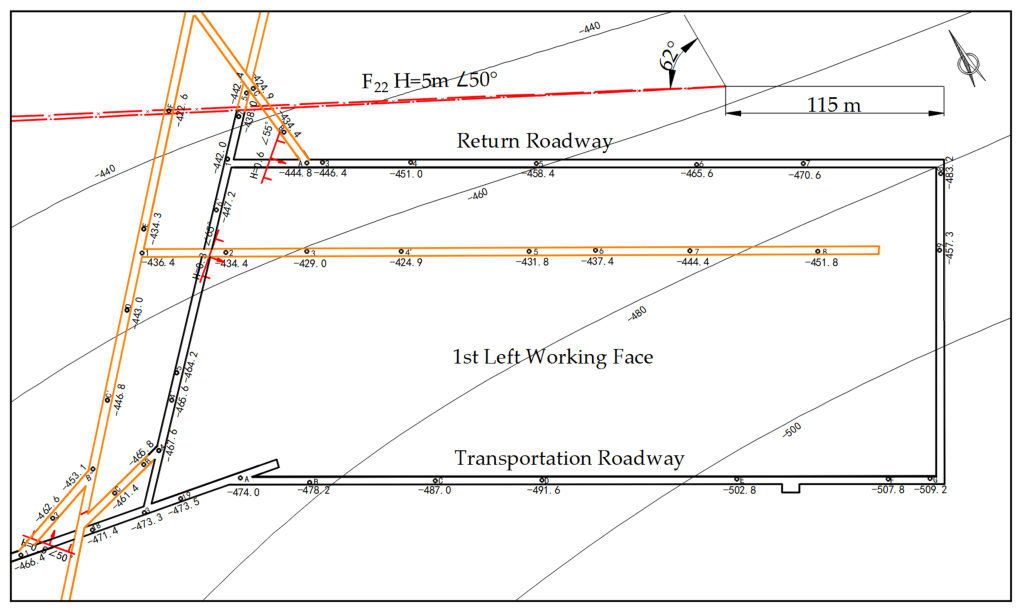
22 fault structure is developed in the area. The horizontal distance between the fault and the return roadway is 20 m, the distance between the fault end and the open-off cut is 115 m, the throw is 5 m, the dip angle is 50°, and the azimuth angle is N 62° W. The return roadway is arranged in the footwall of the F
22 fault, and the excavation axis of the roadway is approximately parallel to the strike of the fault. The total length section affected by fault structure disturbance is 233 m. The engineering plan view of the left first working face of 14
# coal seam in the East No.2 Mining Area is shown in
Figure 1.
The 14
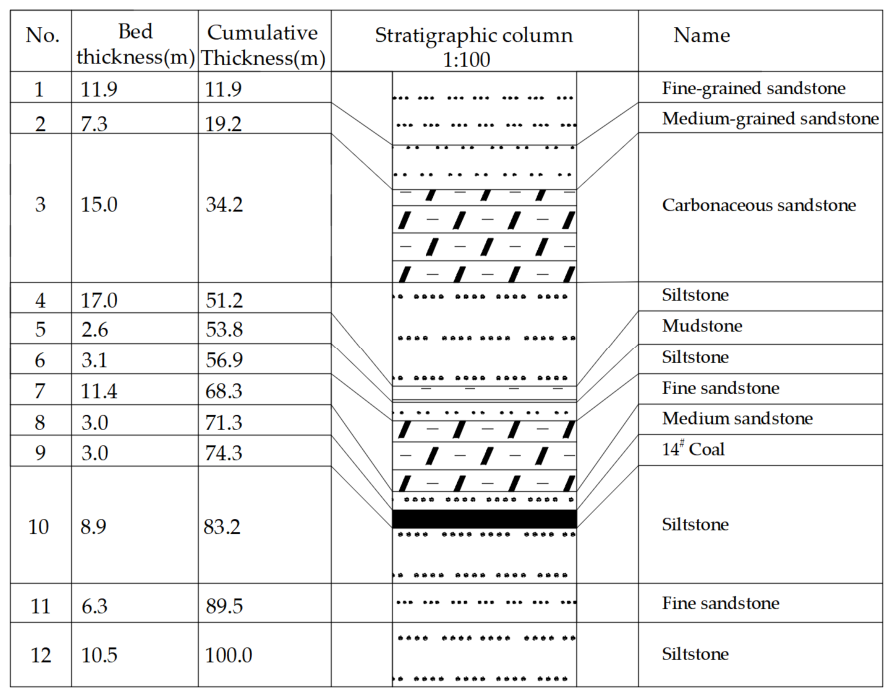
# coal seam is gently occurring as a whole, with a dip angle between 3° and 10°, and a coal thickness of 3.0 m. In the roof rock stratum, the immediate roof is medium sandstone with a thickness of 3.0 m, which has high rock strength and good structural stability. The immediate floor is 8.9 m siltstone. The floor rock mass is, overall, dense and intact. The comprehensive column diagram of the left first working face is shown in
Figure 2.
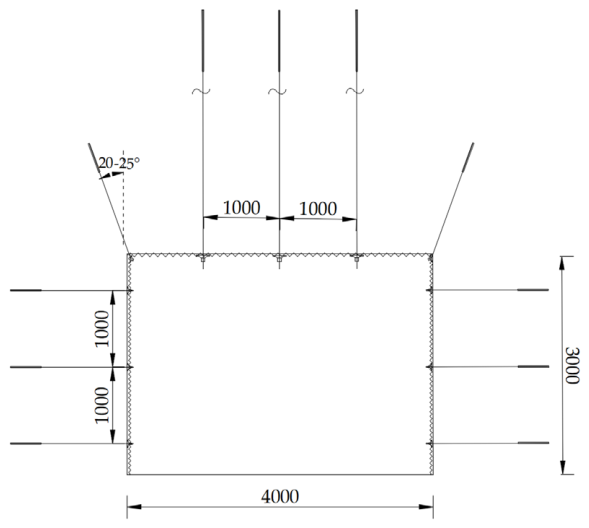
The return roadway adopts a rectangular section with a section size of width × height = 4.0 m × 3.0 m. The support adopts a combined support system of “bolt + steel strip + metal mesh + anchor cable”. Among the fasteners, the high-strength bolts have a specification of
φ20 mm ×
L2000 mm, the spacing and row spacing are set to 1000 mm × 1000 mm, and 120 mm × 120 mm × 8 mm disc pallets are used to enhance the anchoring bearing effect of the bolts; the high-strength anchor cables have a specification of
φ21.8 mm ×
L6700 mm, the spacing and row spacing are set to 1000 mm × 1000 mm, and 300 mm × 300 mm × 14 mm disc pallets are matched; the roof support is equipped with 4000 mm × 260 mm × 2.75 mm steel strips, which work together with the metal mesh. The original support section design scheme is shown in
Figure 3.
2.2. Deformation Characteristics of Roadway-Surrounding Rock
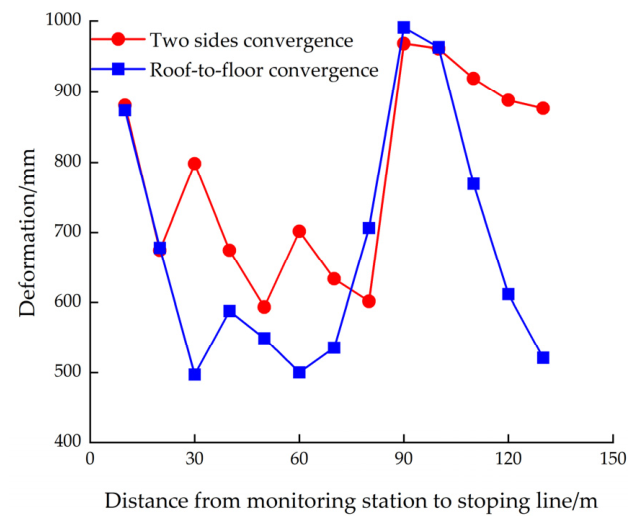
To obtain effective deformation data of the surrounding rock during excavation, the monitoring scheme adopts the method of arranging monitoring stations along the roadway axis. From the stoping line to the excavation face, a surrounding rock deformation monitoring station is arranged every 10 m, and continuous monitoring of the deformation is carried out for 45 d. The monitoring results are shown in
Figure 4.
The deformation monitoring data analysis is as follows:
(1) Under the superposition of fault tectonic stress and excavation disturbance, the surrounding rock is severely disturbed during the roadway excavation, the overall deformation increases, the surrounding rock integrity is compromised, and overall stability is poor. The overall shrinkage and extrusion of the roadway section are prominent, which is manifested as broken roof rock stratum, floor cracking and heave, and convergence of the two sidewalls; in particular, the coal mass on the fault sidewall is broken, which is prone to sidewall spalling and instability disasters. Under the action of large deformation, the original support system has a large range of failure and damage, which is manifested as damage to the metal mesh and local bolt anchoring failure.
(2) It can be seen from the on-site monitoring data that in the 90~100 m section of the excavated roadway, the deformation is the most severe, and both convergences reach the peak; among them, the two maximum convergences are 991 mm and 968 mm. In the 30~60 m section near the stoping line, the coupling influence of fault tectonic stress and excavation mining disturbance is small, and the stress environment is relatively stable.
(3) Under the action of excavation disturbance, the damage degree of the roadway roof and the fault sidewall is the most serious, and the deformation degree is greater than that of the floor and the mining sidewall. It presents typical asymmetric large deformation characteristics. The deformation law is fault sidewall > roof > floor > mining sidewall.
3. Analysis of Critical Instability Range of Near-Fault Roadways
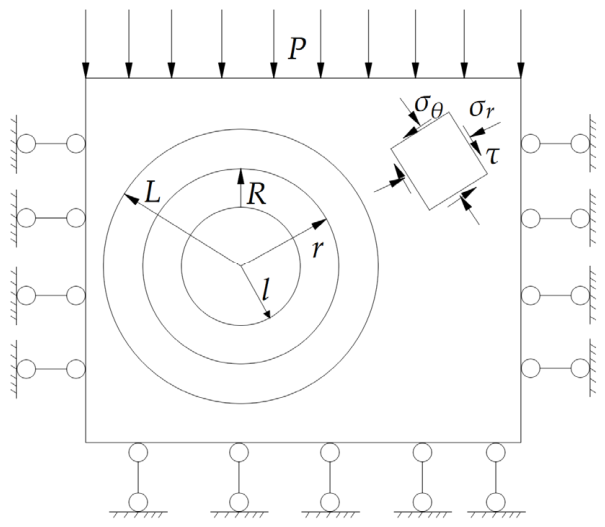
After the roadway excavation, the original rock stress balance state is broken, the surrounding rock stress is redistributed, and an annular rock fracture zone is formed within a certain range around the roadway, that is, the roadway surrounding the rock instability zone. For near-fault roadways, the corresponding relationship among the critical instability range (
R), roadway radius (
l), and the distance (
r) between the roadway center and the elastoplastic interface is shown in
Figure 5, which is expressed by the relationship (1):
To simplify the calculation process of the critical instability range of near-fault roadways, the equivalent radius method is adopted to convert the rectangular section roadway into a circular roadway. The equivalent radius of the equivalent circle of the rectangular roadway is calculated according to the relationship (2):
In the formula, the rectangular roadway section correction coefficient (η) is 1.2; the width (a) is 4.0 m; and the height (b) is 3.0 m.
According to the critical limit stress state of the surrounding rock plastic zone, when the stress on the roadway-surrounding rock exceeds its own ultimate strength, the surrounding rock will undergo plastic yield accompanied by instability and failure. At the interface between the elastic zone and the plastic zone, it is in a dynamic stress balance state. At this time, the critical limit stress of the surrounding rock plastic zone is equal to the stress value of the elastic zone. Based on the above stress balance conditions and the ultimate strength criterion, it can be obtained [
8] as follows:
In the formula, the rock fragmentation constant mb = mi·exp(GSI−100)/(24−14D), and the material constant s = exp(GSI−100)/(9−3D).
It can be seen from the relationship (3) that the critical instability range of near-fault roadways is closely related to the surrounding rock Geological Strength Index (
GSI), disturbance factor (
D), surrounding rock uniaxial compressive strength (
σc), rock fragmentation constant (
mi) and overlying rock load (
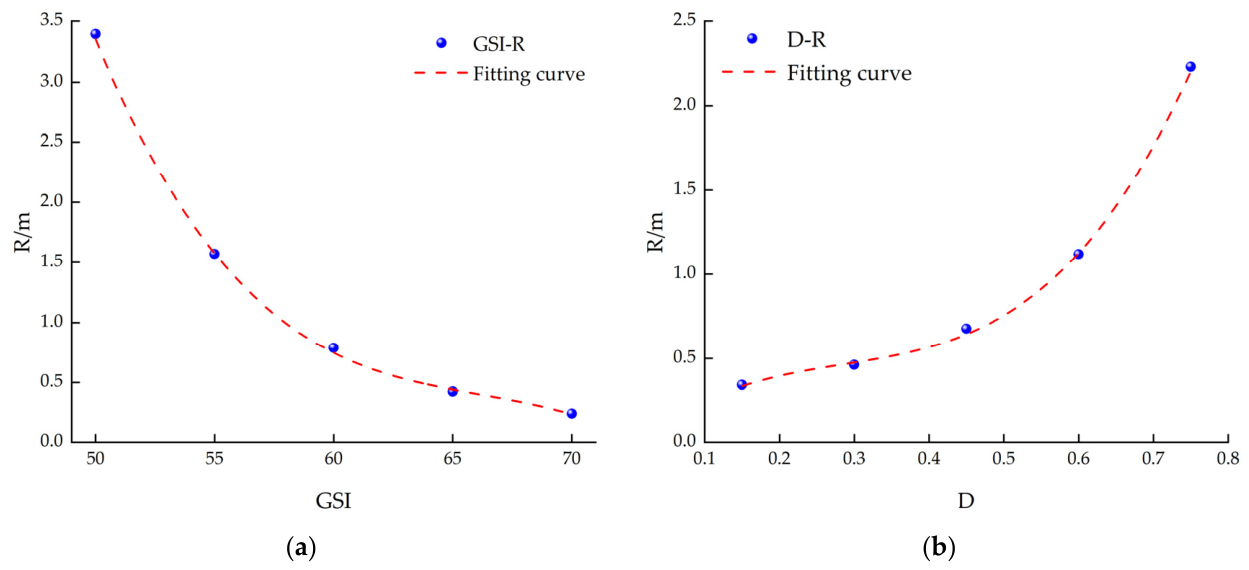
P). To clarify the influence law of each parameter on the critical instability range, this study focuses on exploring the influence of two parameters, namely, the surrounding rock Geological Strength Index and the disturbance factor, on the critical instability range of near-fault roadways by using the single variable method. The relevant analysis results are shown in
Figure 6.
As shown in
Figure 6a, when the
GSI is within the range of 50 to 70, the
GSI and the critical instability range exhibit a non-linear negative correlation. That is, as the
GSI continues to increase, the critical instability range of the roadway decreases. When
GSI increases from 50 to 70, the critical instability range decreases from 3.40 m to 0.25 m. Polynomial fitting is carried out on 5 sets of theoretical calculation data, and the relationship is obtained:
R = 166.66 − 7.47
GSI + 0.11
GSI2 − 0.0006
GSI3, R
2 = 0.99.
As can be seen from
Figure 6b, when the disturbance factor is within the range of 0.15 to 0.75, the disturbance factor shows a nonlinear positive correlation with the critical instability range. With the intensification of excavation and structural disturbance effects, the disturbance factor increases, the damage degree increases, and the plastic failure zone continues to expand. When
D increases from 0.15 to 0.75, the critical instability range increases from 0.38 m to 2.33 m. Polynomial fitting is carried out on five sets of theoretical calculation data, and the relationship is obtained:
R = −0.06 + 4.14
D − 12.06
D2 + 14.09
D3, R
2 = 0.99.
Combined with the geological conditions of the return roadway and the test results of indoor rock mechanics experiments, the parameters are determined to be l = 2.35 m, σc = 10 MPa, P = 20 MPa, mi = 2, GSI = 60, and D = 0.5. Substitute the above parameters into Formula (3) to solve, and finally, R is 3.44 m.
4. Numerical Simulation of Asymmetric Deformation of Near-Fault Roadways
In mining, the roadway excavation disturbance breaks the original rock stress balance state, inducing the redistribution of the stress field; under the continuous disturbance of mining operations, stress concentration occurs in local areas, which in turn causes plastic yield and structural instability, seriously threatening the support’s safety and normal mining. Therefore, numerical simulation is used to systematically analyze the stress evolution and surrounding rock displacement deformation law inside the pillar during excavation and mining and then reveal the influence law of the overall stability of the near-fault coal pillar under different pillar sizes.
4.1. Numerical Model Establishment and Simulation Scheme
Combined with the geological situation of the left first working face of 14# coal seam in the East No.2 Mining Area of the Pinggang Coal Mine, the FLAC3D is used to build a three-dimensional model. The model size is X × Y × Z = 200 m × 400 m × 70 m, comprising a total of 2,051,083 elements and 360,675 nodes.
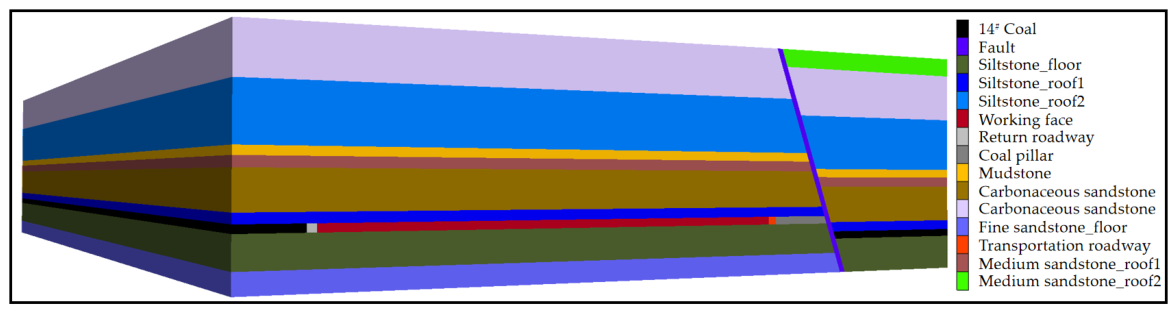
The model is assigned these on-site actual parameters: the dip length is 167 m, and the advance length is 348 m; the excavated roadway adopts a rectangular section of 4.0 m × 3.0 m; the reserved fault protection pillar width is 20 m; the fault structure throw is 5 m; and the dip angle is 50°. To further enhance the accuracy of numerical simulation calculations, local grid densification was carried out in the 20 m influence range. The size of the fine grids was set at 1 m by 1 m. The numerical calculation model is shown in
Figure 7.
After the roadway excavation is completed, the working face is immediately mined. This study focuses on the instantaneous mechanical response during the excavation. Therefore, the numerical simulation adopts the Mohr–Coulomb constitutive model. Displacement constraints are applied to the nodes on the four sides and the bottom boundary of the model, and the equivalent overlying rock self-weight stress of 20 MPa is applied to the top boundary according to the on-site burial depth conditions. The rock strata of the model are divided according to the on-site comprehensive column, including six layers of roof rock strata, two layers of floor rock strata, and one layer of coal seam, totaling nine layers. Fault modeling is carried out using the method of equivalent solid weak rock layer modeling. The mechanical parameters of the rock are determined based on the geological exploration data of the mining area and the mechanical test results of the rock samples. The specific parameters are shown in
Table 1.
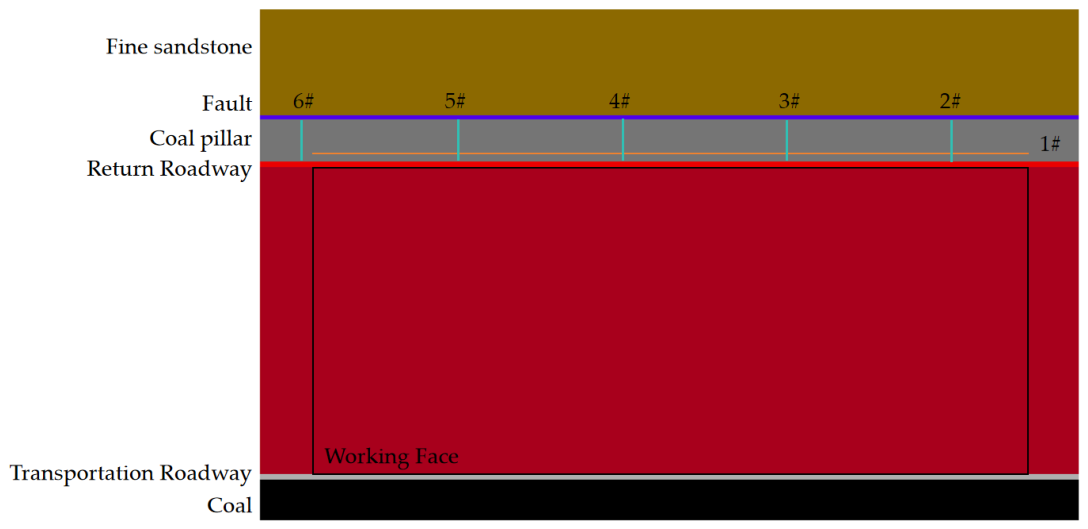
To monitor the stability of the pillar, a total of six monitoring lines, including horizontal and vertical types, are arranged inside the coal pillar. Among them, the 1# vertical monitoring line is arranged along the strike direction, 4 m horizontally away from the roadway sidewall, and both ends extend to the open-off cut and stoping line respectively; the numerical simulation mining process implements step-by-step excavation, with an initial advance of 28 m, followed by four cycles of 80 m advance each, totaling five excavation disturbance calculations. The 2#~6# horizontal monitoring lines are uniformly arranged 5 m in front of the working face and distributed along the fault strike. The monitoring layout scheme and the form of monitoring line layout are shown in
Figure 8.
4.2. Stability Analysis of Near-Fault Roadway Coal Pillar During Excavation
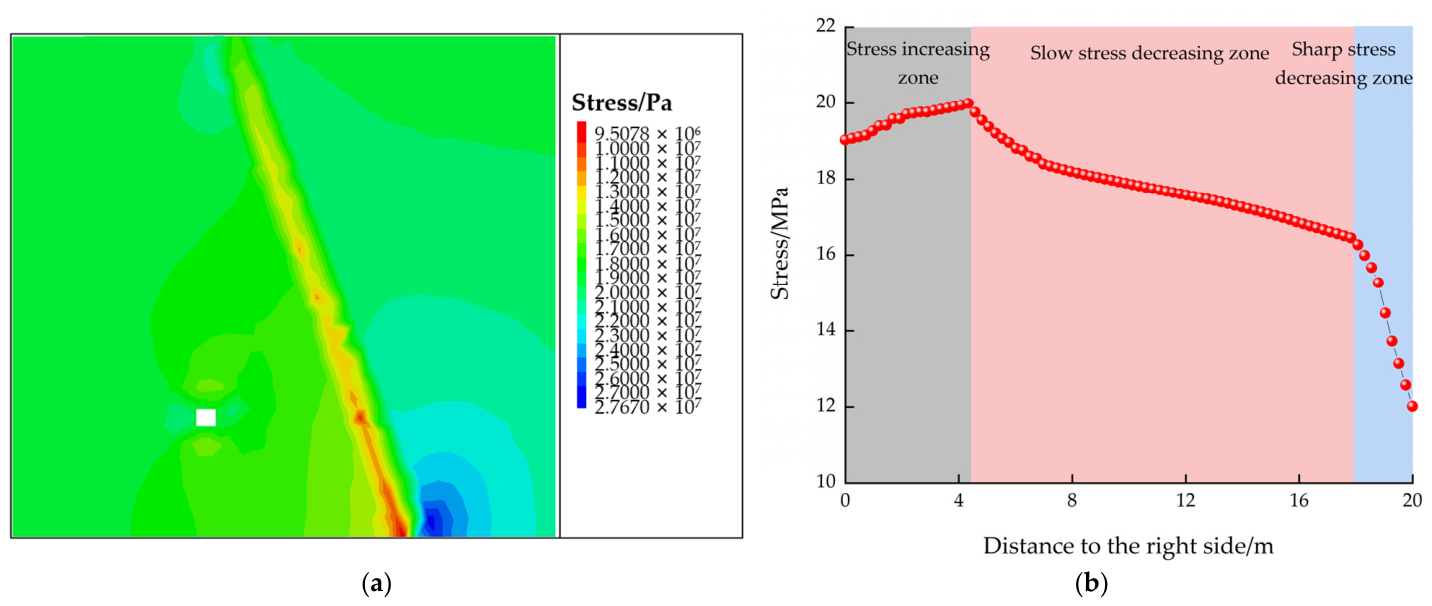
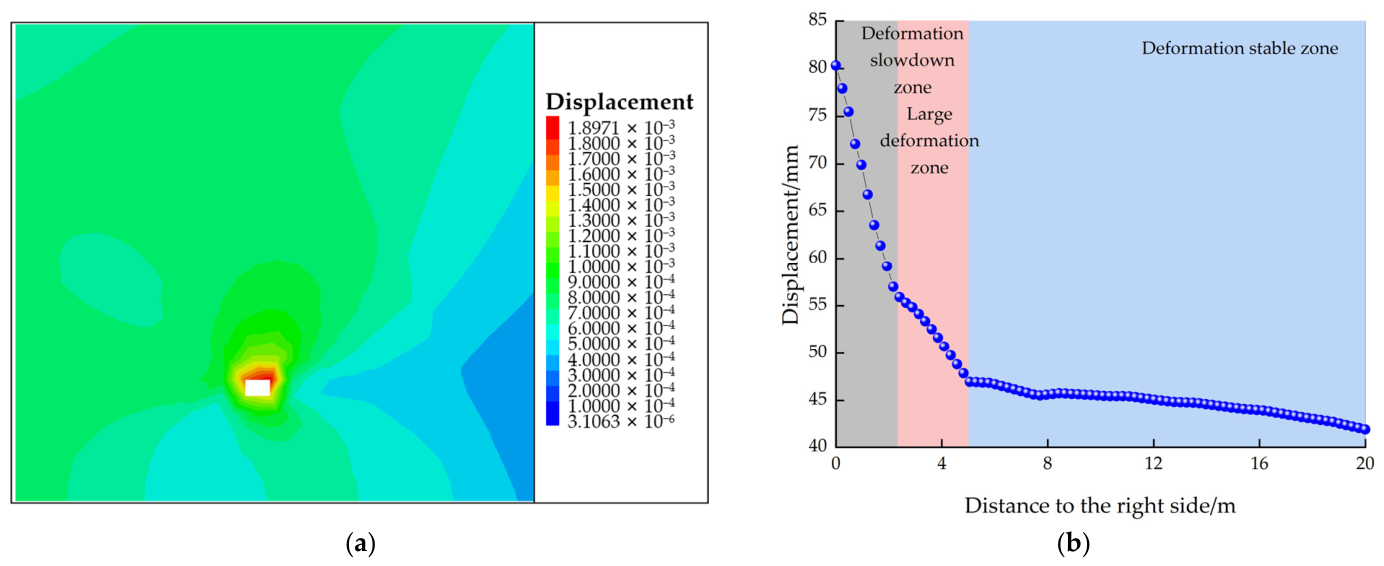
The stress distribution and displacement evolution characteristics of the pillar during excavation are shown in
Figure 9 and
Figure 10, respectively.
Figure 9 shows that after the excavation of the near-fault roadway, the internal stress of the pillar generally presents a distribution law of first increasing and then decreasing; the high stress is mainly concentrated on the side close to the sidewall, and the stress level in the middle of the pillar is relatively low and uniformly distributed. The peak stress of the coal pillar is 19.99 MPa, which appears 4.3 m away from the right sidewall, and this area belongs to the stress increase zone; at 17.83 m away from the roadway sidewall, the stress drops to 16.45 MPa, and the stress in this section decreases gently; continuing to extend to the fault side, the coal pillar stress enters a rapid decline zone.
Figure 10 shows that during the excavation period, the displacement of the pillar generally shows a monotonically decreasing change characteristic, and the large deformation is mainly concentrated in the surface area of the sidewall, and the displacement near the fault structure decreases sharply. The displacement of the surface layer of the sidewall reaches the maximum value of 80 mm, which is the large deformation zone of the pillar; at 2.41 m away from the sidewall, the displacement drops to 56 mm, the deformation rate slows down, and enters the deformation slowdown zone; the displacement of the deep pillar is stably maintained in the range of 42~47 mm, and the whole enters the stable and controlled stage of deformation.
From the characteristics of stress distribution and the evolution law of displacement, it can be known that the excavation disturbance breaks the original rock stress balance state and induces the reconstruction of the stress field, and the high stress is gradually transferred and concentrated on the pillar, which overlaps with the tectonic stress generated by the fault occurrence, forming stress increase. With the continuous increase of the distance from the sidewall, the influence of excavation disturbance is gradually weakened, the stress superposition effect shows an attenuation trend, and the stress environment in the deep part of the coal pillar gradually tends to be stable.
4.3. Stability Analysis of Near-Fault Roadway Coal Pillar Under Mining Influence
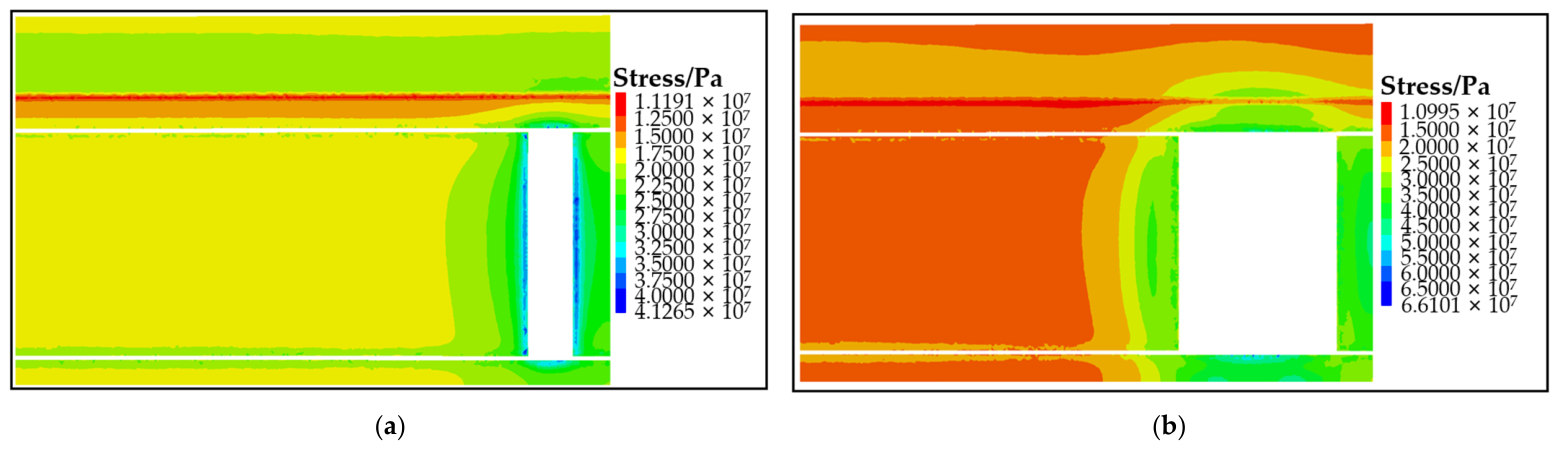
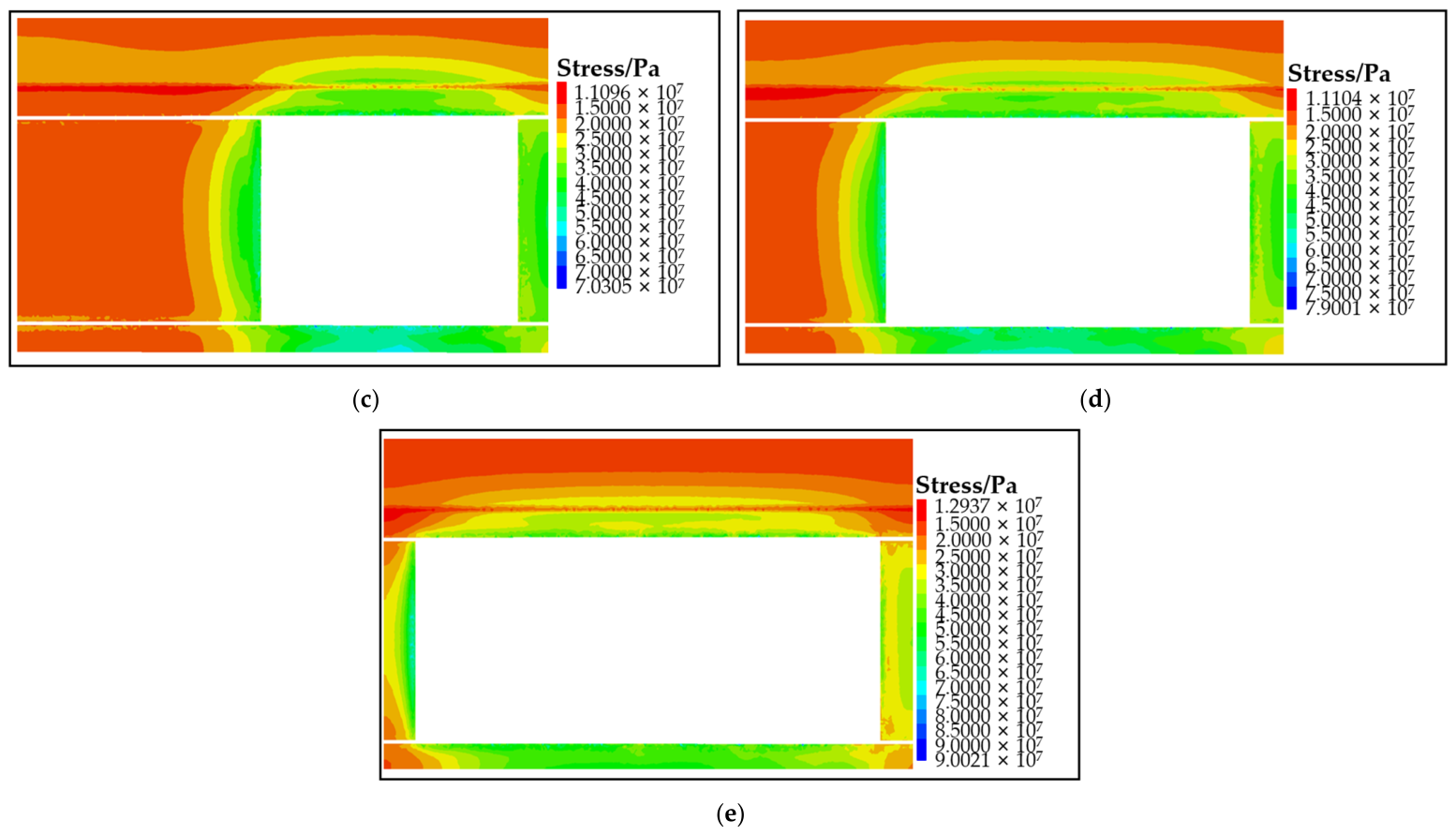
The stress nephograms of the pillar during the mining are shown in
Figure 11. In the initial mining stage, the influence range of mining disturbance is limited, and the stress concentration phenomenon is only concentrated on the sidewall surface, as shown in
Figure 11a. At this time, the pillar is weakly affected by mining disturbance, the stress peak is low, and the stress concentration area is small.
With continuous mining, the influence of the advanced support pressure increases, the stress concentration area gradually migrates and expands from the surface of the sidewall to the middle of the pillar, and the influence of mining disturbance on the pillar gradually increases; at the same time, the self-weight load of the overlying rock is continuously transferred to the pillar, so that the support pressure borne by the coal pillar continues to increase, as shown in
Figure 11b–d. After the completion of the mining operation, the mining influence tends to be stable, and the internal stress of the pillar re-reaches a balanced state, but the overall stress level is higher than during excavation, and the pillar is in a high-stress environment for a long time, as shown in
Figure 11e.
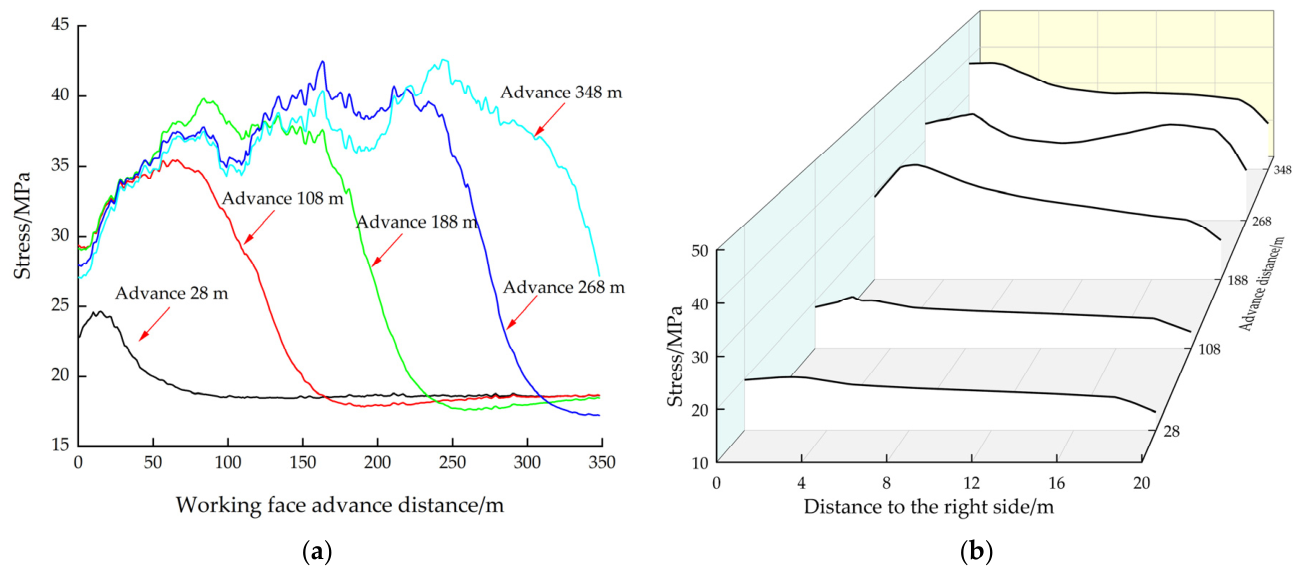
The stress evolution curves of the pillar under different advance distances during the mining are shown in
Figure 12. With continuous mining, the maximum internal stress of the pillar shows an increasing trend, and the stress peak is always stably distributed within 0~4 m from the sidewall. When advancing to 28 m, the stress peak of the coal pillar is 24 MPa; when advancing to 108 m, affected by the superposition of advanced support pressure, the stress peak increases to 36 MPa; in the subsequent stages of advancing to 188 m, 268 m, and 348 m, the mining influence tends to be stable, and the stress peak is basically maintained in the range of 40~43 MPa.
The internal stress of the pillar presents a distribution characteristic of first increasing and then decreasing along the transverse direction, and the change law is basically consistent with that in the excavation. The stress peak appears in the shallow area about 4 m away from the sidewall, which is the key part for high stress concentration and surrounding rock instability prevention and control of the pillar.
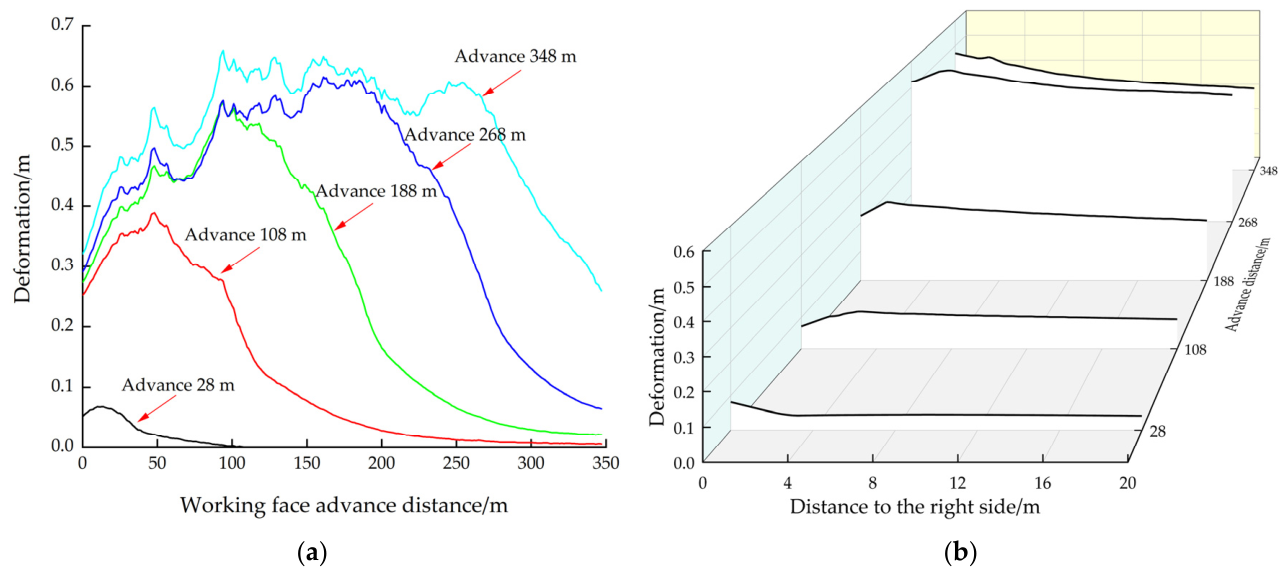
The deformation evolution curves of the pillar during mining are shown in
Figure 13. With continuous mining, the deformation peak of the pillar shows an increasing trend. When advancing to 28 m, the deformation peak of the pillar is about 0.07 m; when advancing to 108 m and 188 m, the superposition effect of mining disturbance and fault tectonic stress is significantly enhanced, and the deformation peak increases to about 0.3 m; when advancing to 268 m and 348 m, the pillar deformation tends to be stable, and the deformation peak is stably maintained at about 0.4 m.
According to the deformation law inside the pillar, the deformation peak is concentrated in the surface area 0~4 m away from the sidewall; after advancing to 108 m, the pillar presents a large deformation state. Until advancing to 268 m, the mining influence tends to be stable, and the internal deformation is basically stable, which proves that the shallow part of the sidewall near the fault is the key area for surrounding rock deformation control.
4.4. Analysis of Coal Pillar Size Effect in Near-Fault Roadways
To optimize the size of the pillar on the premise of ensuring the stability of the roadway, six groups of pillar width schemes (10 m, 12 m, 14 m, 16 m, 18 m, and 20 m) were set up to systematically explore the law of different pillar widths on the stability of the roadway.
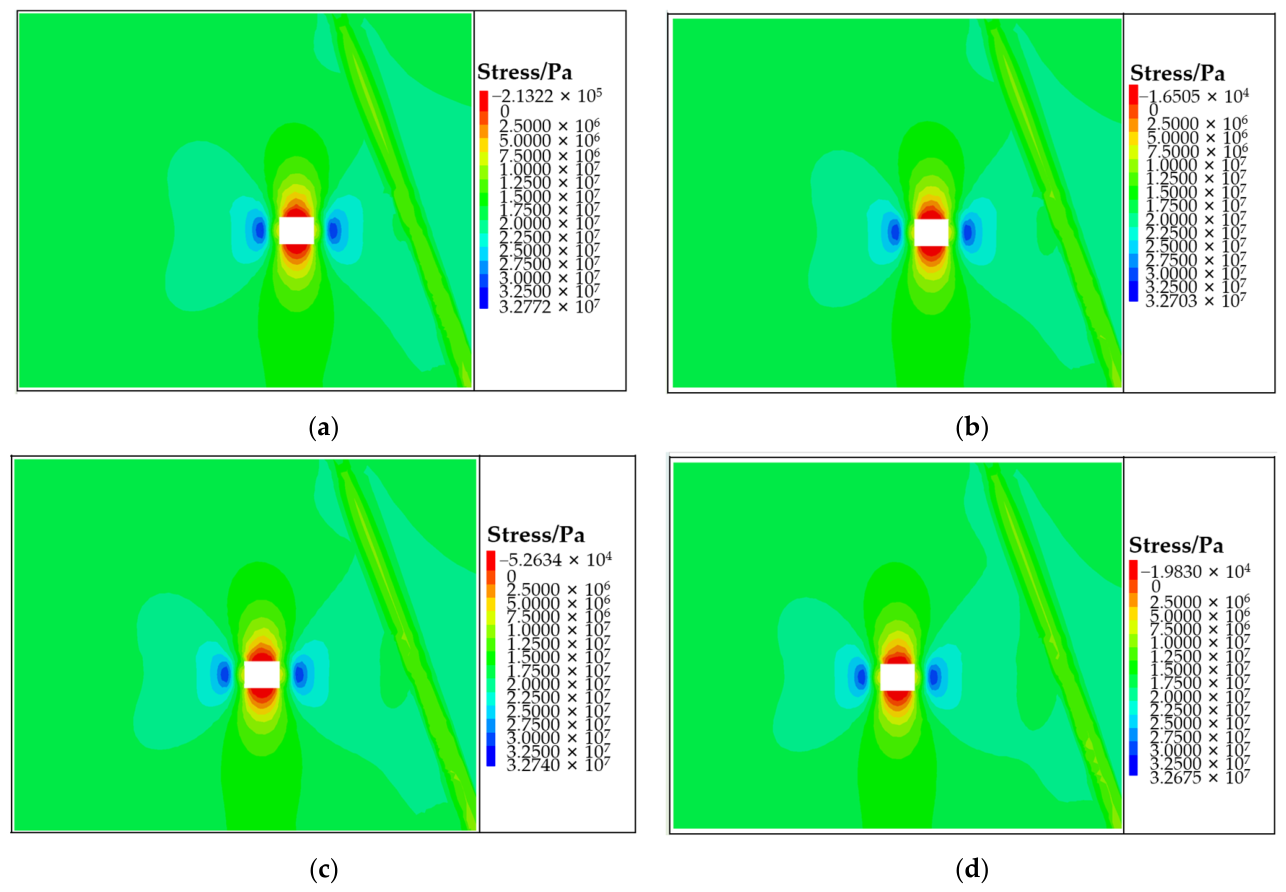
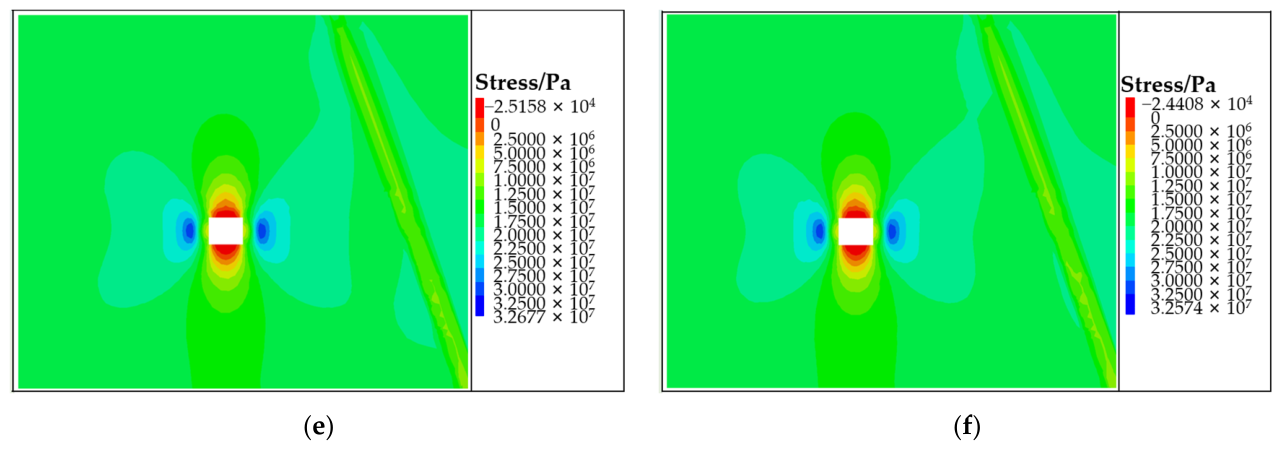
The working face advancing 108 m was selected as the typical working condition for analysis, and the stress distribution characteristics corresponding to different pillar widths are shown in
Figure 14. Combined with the distribution law of the butterfly-shaped stress field in the roadway surrounding rock, the smaller the pillar width, the more obvious the stress concentration. When the pillar widths are 10 m, 12 m and 14 m, the right wing of the butterfly-shaped stress field is connected to and superimposed with the fault structural zone, the superposition effect of mining disturbance and fault tectonic stress is strong, and the high-stress range is large; when the pillar width increases to 16 m, the boundary of the butterfly-shaped stress field is separated from the fault influence zone, and the stress superposition effect is weakened. From
Figure 14e,f, when the pillar width reaches 18 m and 20 m, the butterfly-shaped stress field is less affected by the fault, and the stress distribution around the roadway tends to be stable.
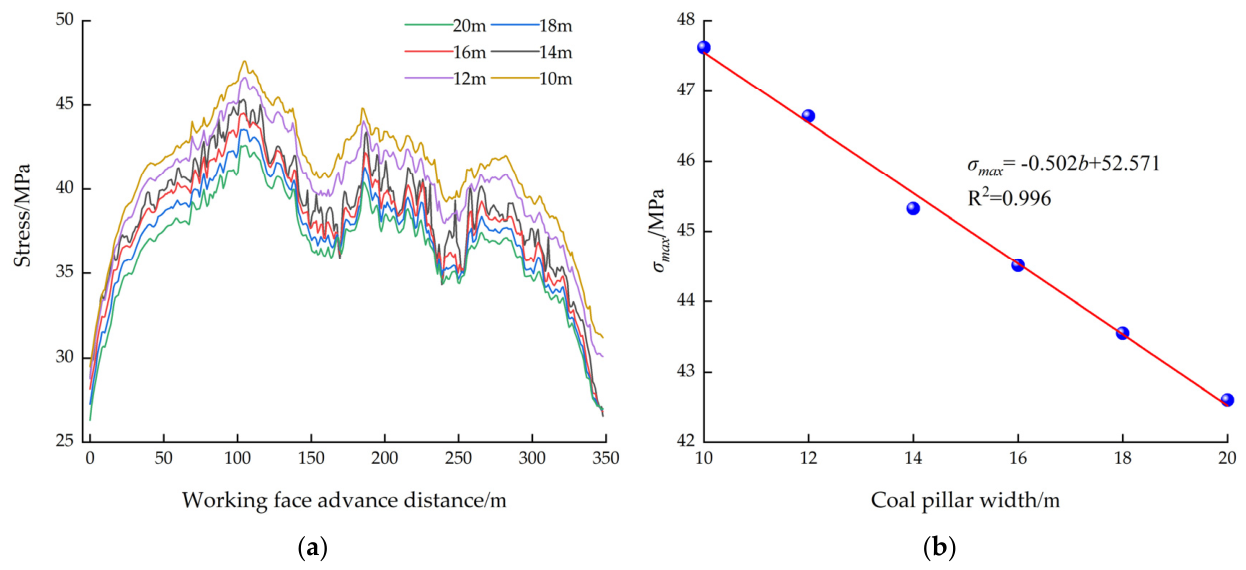
The stress evolution law under different pillar widths is shown in
Figure 15. With the continuous advancement, the overall stress evolution trend of pillars with different widths is basically consistent; that is, the pillar stress increases when advancing from the open-off cut to 108 m; the stress shows a fluctuating decline characteristic when the advance distance exceeds 108 m.
The correlation analysis between the stress peak and pillar width in each scheme shows that the stress peak decreases with the increase of pillar width, the maximum stress peak is 47.6 MPa, the minimum stress peak is 42.8 MPa, and the decline range of stress peak is 10.08%. Fitting the stress peak, the relational expression is obtained: σmax = −0.502b + 52.571, R2 = 0.996. When the pillar width is between 10 and 20 m, the stress peak shows a linear negative correlation with the pillar width.
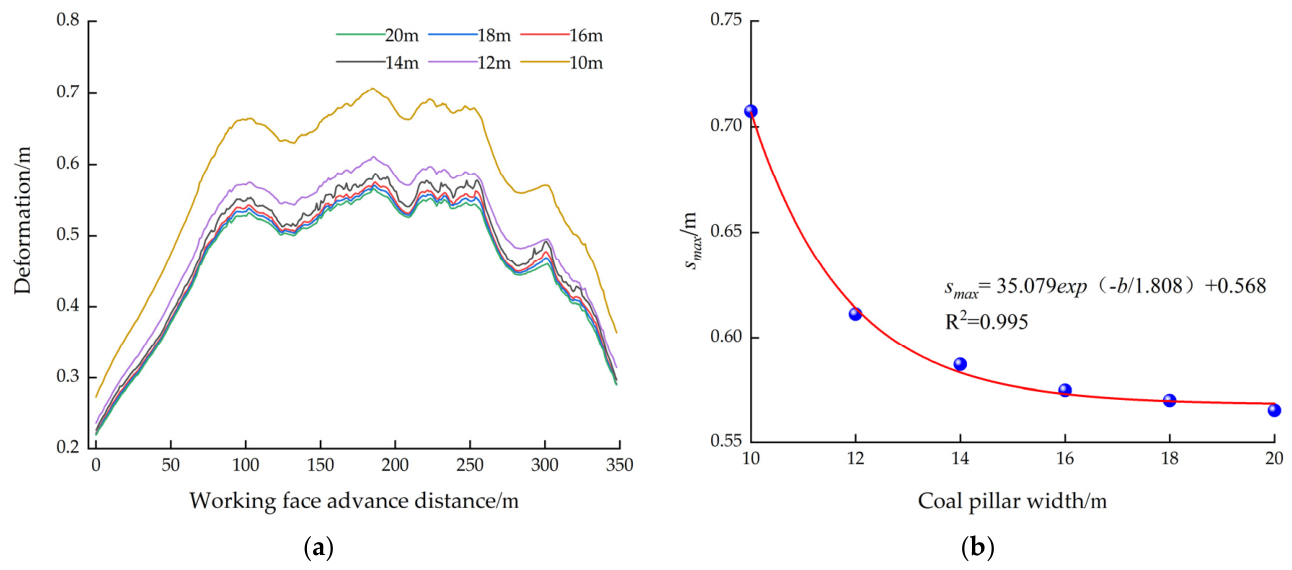
The deformation evolution law under different pillar widths is shown in
Figure 16. The deformation evolution of pillars with different widths is basically consistent, and the pillars show large deformation characteristics when advancing to the range of 100~260 m; among them, the deformation of the 10 m pillar scheme is higher than that of the other groups, with prominent roadway instability risk; when pillar width increases to 14 m, 16 m, 18 m and 20 m, the difference in deformation peak of pillars is small.
The correlation analysis between the maximum deformation peak and pillar width in each scheme shows that the deformation peak decreases with the increase of pillar width, the maximum deformation peak is 0.705 m, the minimum deformation peak is 0.571 m, and the decline range is 19.01%. Fitting the deformation peak and pillar width, the relational expression is obtained: smax = 35.079e(−b/1.808) + 0.568, R2 = 0.995. When the width of the pillar is between 10 and 20 m, it indicates that the deformation peak is negatively correlated with the width of the pillar in a non-linear manner.
According to the numerical simulation results, under the typical mining condition where the working face advances to 108 m, when the width of the pillar is within the range of 14 to 20 m, the reduction in the deformation of the surrounding rock is relatively low. Based on the analysis of the butterfly-shaped stress field distribution pattern, when the pillar width is 14 m, the right side of the stress field is significantly disturbed by the fault structure; when the pillar width increases to 16 to 20 m, this area gradually moves out of the influence range of the fault. In conclusion, a pillar width of 16 m can achieve the dual optimal goals of minimizing the combined influence of structure and mining and maximizing the recovery efficiency of coal resources.
4.5. Mechanism of Asymmetric Deformation of Near-Fault Roadways
Synthesizing the stress and deformation laws during excavation and mining and under different pillar widths, the failure mechanism of asymmetric large deformation and instability of surrounding rock of near-fault roadways is concluded to be as follows:
(1) The mass in the fault fracture zone is extremely developed with joints and fissures, and its integrity and mechanical strength are significantly deteriorated; during excavation and mining, the mining disturbance and fault tectonic stress produce a superposition effect, resulting in a decrease in the overall bearing capacity of the surrounding rock, which creates the basic conditions for large deformation and instability.
(2) Although the on-site combined support system of “bolt + steel strip + metal mesh + anchor cable” can effectively improve the bearing capacity of surrounding rock and inhibit the deformation under conventional geological conditions; under the superposition of tectonic mining stress, the surrounding rock has a large damage and fracture depth and high fragmentation degree, resulting in the failure of the anchoring foundation of some bolts and anchor cables, with which it is difficult to exert effective pre-tightening and anchoring support efficiency, and it further aggravates the continuous deterioration and deformation expansion of the surrounding rock.
(3) The original conventional symmetric support form is difficult to construct as a continuous and uniform common bearing structure inside the surrounding rock and cannot adapt to the complex mechanical environment of the stress field in the near-fault area, which ultimately induces the deformation of the roadway roof and fault sidewall to be much larger than that of the floor and mining sidewall, resulting in the characteristics of asymmetric deformation and failure.
5. Control Scheme for Asymmetric Deformation of Near-Fault Roadways
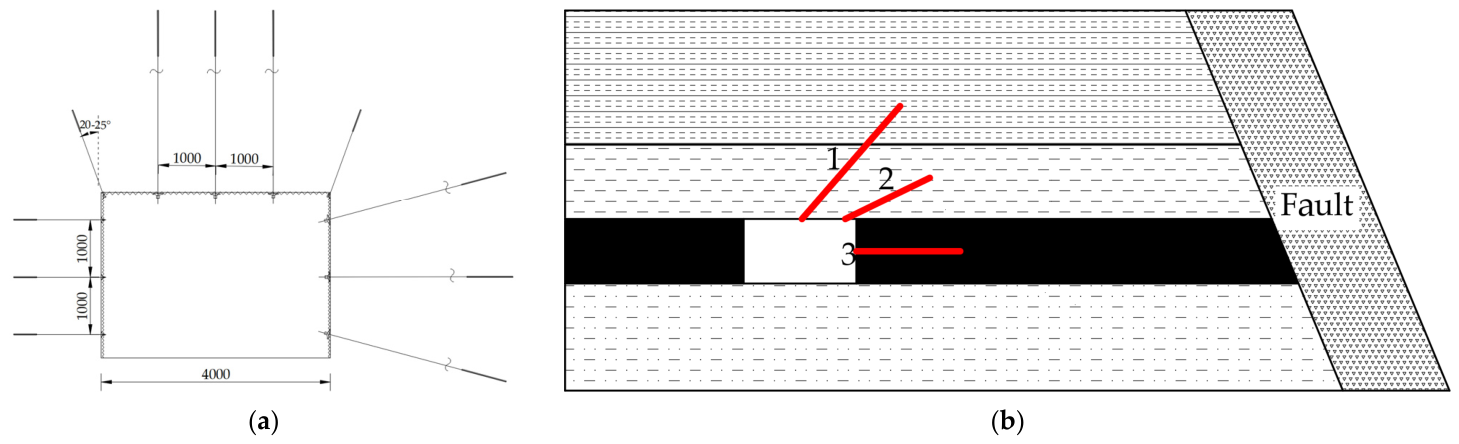
Combined with the on-site surrounding rock deformation characteristics and numerical simulation evolution laws, a reinforcement technology system for near-fault roadways was proposed, and a combined support scheme of “coal pillar size optimization + surrounding rock grouting modification + high-strength anchor cable strengthening” was adopted to realize the stability control under the superposition of tectonic stress and mining disturbance. The reinforced support scheme for near-fault roadways is shown in
Figure 17.
(1) Coal pillar size optimization. The pillar width affects the bearing capacity of the surrounding rock, and the stability and resource recovery efficiency are closely related to the pillar size. Combined with the stress and deformation evolution laws of pillars with different widths, the difference in deformation peak and stress concentration degree of the surrounding rock is small when the pillar width is between 16 and 20 m; considering the roadway safety and stability, and high-efficiency coal resource recovery under the complex near-fault stress environment, the optimally reasonable reserved width of the pillar is determined to be 16 m.
(2) Surrounding rock grouting modification. Grouting reinforcement can effectively cement the weak surface structure inside the roadway surrounding rock, optimize the mechanical parameters of the mass, improve the cohesion and internal friction angle, enhance its own bearing capacity, and jointly ensure the roadway stability with the external support system. To improve the penetration and diffusion effects of slurry in the coal fracture network and ensure the consolidation and cementation strength to meet the standard, the effective diffusion radius of the slurry is required to be not less than 2.5 m to realize the overlapping and crossing of the slurry between adjacent grouting holes; the depth of grouting holes penetrates the conventional fracture zone and extends to the adjacent area affected by the fault. In this study, high-water grouting material was selected, and the water–cement ratio of the slurry was set to 1:1. The grouting pressure is controlled in stages, with the initial pressure ranging from 0.5 to 1.0 MPa, the mid-stage pressure ranging from 1.5 to 2.0 MPa, and the final pressure ranging from 2.0 to 3.0 MPa. The grouting hole diameter was 42 mm, and the borehole row spacing was 1600 mm; a 38 mm diameter self-expanding hole packer was used for the closed hole sealing operation, and the hole sealing section was 1500 mm deep from the hole mouth, so as to ensure the tightness of high-pressure grouting construction and the modification and reinforcement effect of deep surrounding rock. Due to the constraints of the on-site engineering conditions underground, the effect of this grouting reinforcement was indirectly determined through the monitoring of the deformation of the surrounding rock.
(3) High-strength anchor cable strengthening. Based on the original support scheme, a long–short anchor cable support structure is arranged on the fault-side sidewall to construct a high-strength support system, which can inhibit the sliding and shear deformation and strengthen the bearing capacity. In view of the stability control requirements of the near-fault sidewall, a combined support form of “long anchor cable + short anchor cable + metal mesh” is adopted. The short anchor cables perform superficial anchoring reinforcement on the fractured zones of the surrounding rock within the critical instability range (R = 3.44 m); while the long anchor cables extend to the deep part of the surrounding rock, achieving deep anchoring suspension reinforcement and forming a deep–shallow collaborative support system. The roof anchor cable is a prestressed steel strand with the specification of φ21.8 mm × L6700 mm, and the spacing and row spacing are set to 1000 mm × 1000 mm; the long anchor cable on the near-fault sidewall is a prestressed steel strand with the specification of φ21.8 mm × L6700 mm, and the spacing and row spacing are 1000 mm × 1000 mm; the short anchor cable on the near-fault sidewall is a prestressed steel strand with the specification of φ21.8 mm × L5200 mm, and the row spacing is 1000 mm; the bolt has the specification of φ20 mm × L2000 mm, and the spacing and row spacing are 1000 mm × 1000 mm; the roof is equipped with a 4000 mm × 260 mm × 2.75 mm steel strip.
6. On-Site Industrial Test
The on-site industrial test was based on the return roadway of the left first working face of 14
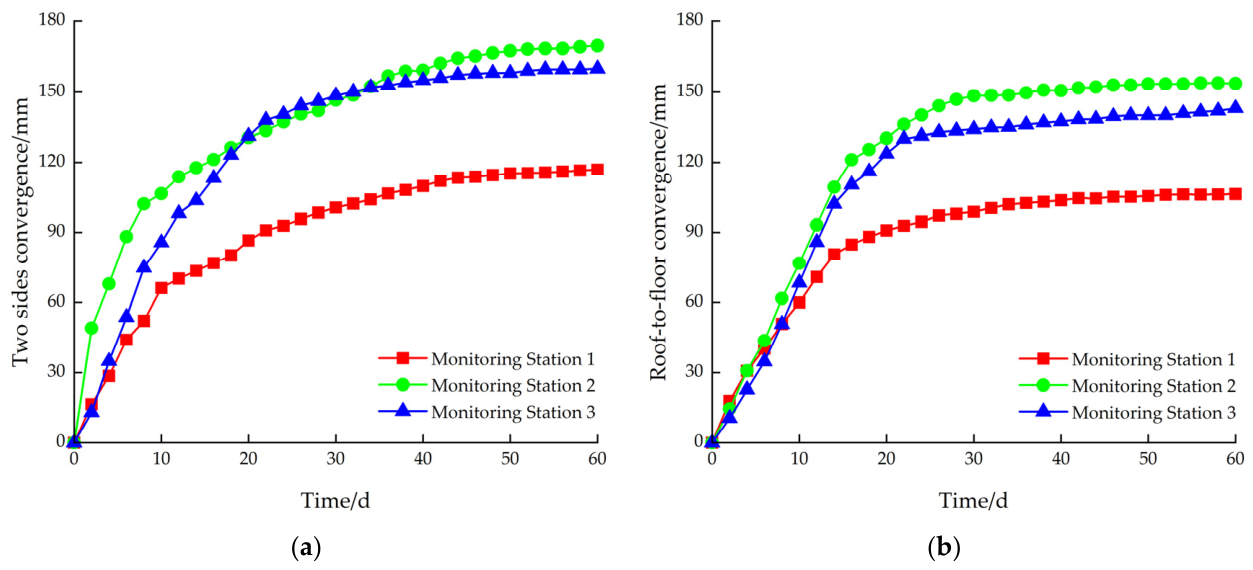
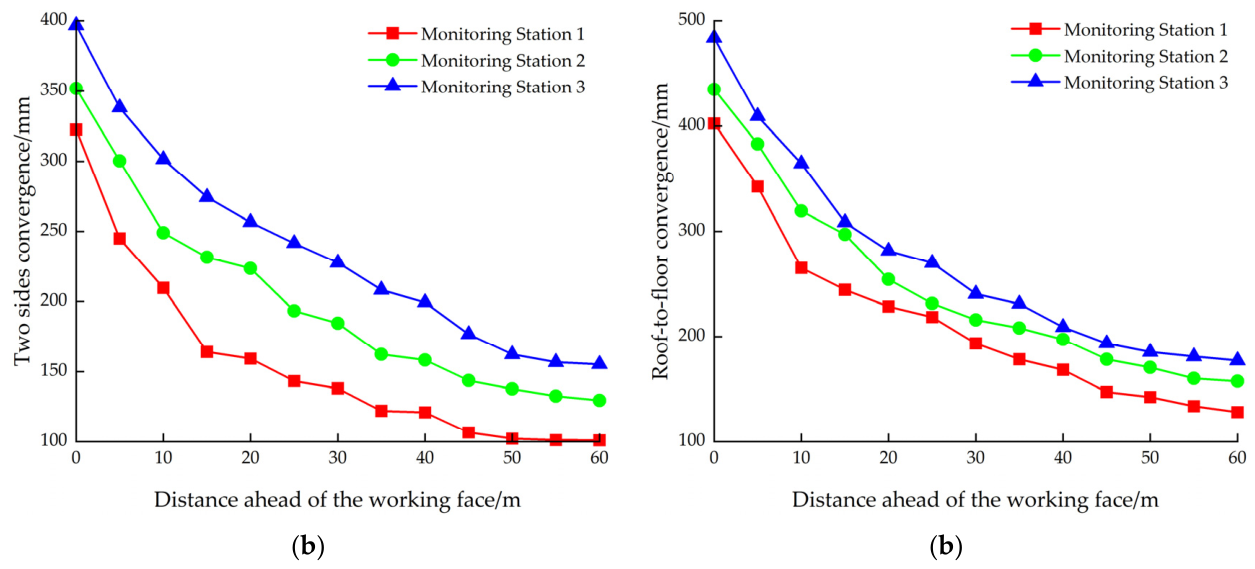
# coal seam in the East No.2 Mining Area of the Pinggang Coal Mine. After completion of roadway excavation and support and based on the surrounding rock deformation zoning characteristics revealed by numerical simulation, three typical displacement monitoring stations were arranged. Monitoring Station 1 was arranged 50 m from the stoping line, Monitoring Station 2 was 180 m from the stoping line, and Monitoring Station 3 was 210 m from the stoping line. Dynamic monitoring of the surrounding rock displacement was conducted for 60 days. The monitoring period covered the main deformation stages of the surrounding rock. The evolution curves of surrounding rock surface displacement during excavation are shown in
Figure 18, and the evolution curves of surface displacement during mining corresponding to the three groups of monitoring stations after the working face enters the mining disturbance stage are shown in
Figure 19.
Figure 18 and
Figure 19 show that after the application of the reinforced support scheme for near-fault roadways, the overall support effect in the excavation was good, and the deformation tended to be stable. After the excavation was stable, the two-side convergence peak was 170 mm, and the roof-to-floor convergence peak was 154 mm; compared with the original conventional support scheme, the convergence was reduced by 82.4% and 84.5%. The roadway was formed completely without roof fragmentation, spalling, bolt and anchor cable disanchoring failure, and other phenomena, and the overall stability was significantly improved.
Under the mining disturbance, the surrounding rock deformation evolution laws of the three monitoring stations are basically consistent. In the area more than 40 m ahead of the working face, the deformation tended to be gentle and was in a slow and steady deformation stage as a whole; in the range of 40 m, the deformation increased under the mining disturbance; at the position of 0 m ahead of the working face, the deformation of Monitoring Station 3 reached the peak, with the two-side convergence peak of 397 mm and the roof-to-floor convergence peak of 484 mm.
The current research results are only applicable to the specific geological and mining technology conditions of the Pinggang Coal Mine. If the conclusions of this study are to be extended to other mines, targeted adaptation and correction based on the engineering geological conditions of the target mine need to be carried out. At the same time, this on-site monitoring focused mainly on the surface deformation of the roadway. Due to the limitations of the underground construction conditions, it was not possible to carry out corresponding work, such as monitoring the deep displacement of the surrounding rock, the axial force of the anchor cables, the observation of boreholes, and the stress testing of the interior of the surrounding rock. Therefore, it is currently not possible to quantitatively analyze the detailed characteristics, such as deep layer separation of the surrounding rock, failure of the anchoring system, and the filling effect of the injection cracks.
On-site measured verification shows that the asymmetric control technology of “coal pillar size optimization + surrounding rock grouting modification + high-strength anchor cable strengthening” can effectively inhibit the asymmetric large deformation of roadway surrounding rock under the complex near-fault stress environment, avoid the instability risk induced by the superposition of tectonic mining, not only ensuring the safe and efficient mining of the working face, but also improving the coal resource recovery rate by reasonably reducing the width of protective pillars.
7. Conclusions
(1) The return roadway of the left first working face of 14# coal seam in the East No.2 Mining Area of the Pinggang Coal Mine is affected by the superposition of F22 fault tectonic stress and mining disturbance, showing the characteristics of asymmetric large deformation, with the deformation degree of fault sidewall > roof > floor > mining sidewall.
(2) The return roadway is non-linearly negatively correlated with the geological strength index GSI (50~70) of the surrounding rock, and non-linearly positively correlated with the disturbance factor D (0.15~0.75). Based on engineering calculations, the critical instability range of this roadway is determined to be 3.44 m.
(3) During the excavation, due to the combined effect of fault structural stress and mining stress, the stress and displacement of the pillar reach their peak within a range of 0~4 m from the right sidewall. The width of the pillar has a significant impact on the stability of the near-fault roadway. When the width of the pillar is 16 m, it can simultaneously ensure the stability of the roadway and the utilization rate of resources.
(4) A control scheme for the asymmetric deformation of the return roadway was proposed, which included “coal pillar size optimization + surrounding rock grouting modification + high-strength anchor cable strengthening”. Field monitoring results showed that during the excavation, the displacement of the two sides and the displacement of the roof-to-floor significantly decreased. During the mining, the deformation of the surrounding rock of station 3 in the roadway reached its maximum.