Article

The Influence of Water Temperature Conditions on the Tracer Transport Process in the Tundish Water Model


1
Key Laboratory for Ecological Metallurgy of MultiMetallic Mineral (Ministry of Education), School of Metallurgy, Northeastern University, Shenyang 110819, China
2
College of Materials Science and Engineering, Taiyuan University of Technology, Taiyuan 030024, China
3
College of Architecture and Arts, Taiyuan University of Technology, Taiyuan 030024, China
4
College of Mechanical Engineering, Taiyuan University of Technology, Taiyuan 030024, China
5
Department of Mechanical Engineering, Taiyuan Institute of Technology, Taiyuan 030008, China
*
Authors to whom correspondence should be addressed.
These authors contributed equally to this work.
Processes 2026, 14(12), 1897; https://doi.org/10.3390/pr14121897
Submission received: 7 May 2026 / Revised: 2 June 2026 / Accepted: 8 June 2026 / Published: 11 June 2026

Abstract

During continuous casting, the flow behavior of liquid steel in the tundish directly affects the temperature distribution of liquid steel, inclusion removal, and billet quality. In tundish-related research, water model experiments remain an intuitive method for investigating the flow process in the tundish. However, water model experiments are often conducted in different seasons, and variations in experimental temperature can change fluid properties such as density and viscosity, thereby affecting flow characteristics and the comparability of experimental results. In this study, a 1:3.57 transparent bare single-strand tundish model made of acrylic was used, and the differences in tracer transport processes at 7 °C and 20 °C, as well as the influence of different tracer dosages on the experimental results, were systematically investigated through flow visualization and stimulus-response experiments. The results showed that, under the 7 °C condition, the upward transport tendency of the pure ink tracer was weakened, the overall flow remained closer to the tundish bottom, the transport speed decreased, and the time required to reach the outlet was significantly prolonged. For the saturated KCl solution tracer, a lower temperature enhanced its transport along the bottom toward the outlet and suppressed its diffusion toward the liquid surface. The RTD results showed that, after the temperature was increased, the curves shifted to the left as a whole, and both the peak time and the mean residence time were shortened. The outflow percentage of tracer results showed that the difference for the 10 mL saturated KCl solution between the 7 °C and 20 °C conditions was the most significant. At 7 °C, the total outflow percentage of the 10 mL salt solution tracer at 1500 s was 76.86%, which was 22.97% lower than that at 20 °C. As the tracer dosage increased, the differences in the transport process, RTD curves, and outflow percentage curves under different temperature conditions gradually decreased, indicating that the effect of dosage on the experimental results gradually became stronger than that of temperature. These results indicate that the combined effects of experimental temperature and tracer dosage cannot be neglected in tundish water model experiments.

1. Introduction

The tundish is an important metallurgical reactor connecting the ladle and the mold, and the flow behavior of liquid steel inside it directly affects the temperature distribution of liquid steel, inclusion removal, and billet quality [1,2,3]. Because liquid steel in an industrial tundish is at high temperature and in an opaque state, its internal flow behavior is difficult to observe directly. Therefore, physical models [4,5,6] and numerical simulations [7,8,9] are usually adopted to investigate the flow-field characteristics in the tundish. Among them, water models are mostly used in physical simulation. Owing to the advantages of convenient operation, relatively low cost, and easy visualization of flow fields, water models have been widely applied in tundish flow studies. Under the premise that geometric similarity and dynamic similarity are satisfied, water model experiments for tundishes are usually conducted by taking advantage of the similarity in kinematic viscosity between water at 20 °C and liquid steel at 1600 °C. In this way, water is used instead of liquid steel to simulate the flow behavior in the tundish, and the flow, mixing, and residence characteristics of the fluid are analyzed by combining the stimulus-response method, flow visualization, and particle image velocimetry [10,11,12]. Because flow-field characteristics in the tundish can be characterized from different perspectives by these methods, they have been widely used in tundish flow studies.
At present, the major international institutions engaged in tundish water model research mainly include McGill University in Canada [13,14], the University of Toronto in Canada [15,16,17], RWTH Aachen University in Germany [18,19,20], KTH Royal Institute of Technology in Sweden [21,22,23], the Indian Institute of Technology in India [24,25,26], Częstochowa University of Technology in Poland [27], Silesian University of Technology in Poland [28], the Instituto Politécnico Nacional in Mexico [29,30,31], the Morelia Institute of Technology in Mexico [32,33,34], the Universidad Nacional Autónoma de México in Mexico [35], Aalto University (Helsinki University of Technology) in Finland [36,37], VSB-Technical University of Ostrava in the Czech Republic [38], and many universities in China, such as the Northeastern University [39,40,41,42,43], the University of Science and Technology Beijing [44,45,46,47,48], Chongqing University [49,50], Shanghai University [51], Central South University [52], Wuhan University of Science and Technology [53,54], Inner Mongolia University of Science and Technology [55,56], University of Science and Technology Liaoning [57,58], Soochow University [59], Taiyuan University of Technology [60,61,62], Jiangxi University of Science and Technology [63] and the Anhui University of Technology [64,65,66]. However, in most existing water model experiments, only limited influence has been assumed for experimental temperature conditions on the experimental results, and systematic attention has not been paid to the differences in flow-field results obtained under different water temperature conditions. In fact, annual temperature varies greatly across different regions. Table 1 summarizes the maximum annual temperature differences in 2025 for the regions where different institutions conducting tundish water model research are located. The city locations of these institutions were taken from Wikipedia [67], and the maximum and minimum temperatures in 2025 were taken from the 2025 historical weather data of Time and Date [68]. The data in Table 1 show that the maximum annual temperature differences for these institutions range from 24 to 66 °C in 2025. Because laboratory environments and water-supply conditions vary, the temperature of the simulated medium often differs by more than ten degrees Celsius between seasons, which may lead to changes in the physical properties of water and may further affect the macroscopic flow behavior in the tundish and the tracer transport results.
Taking the experimental location of this study as an example, the relevant research was carried out in Taiyuan, Shanxi Province, China, which is located at 37°52′13.44″ N, 112°32′58.92″ E [69]. In 2025, the highest air temperature recorded in this region was 38 °C (19 May 2025) [70], whereas the lowest air temperature was −17 °C (7 February 2025) [71]. Therefore, the maximum annual temperature difference reached 55 °C. Experimental measurements show that the water temperature in the tundish is usually 5 to 10 °C in winter, whereas it is 20 to 25 °C in summer. Therefore, 7 °C and 20 °C were selected in this study as two representative experimental temperatures corresponding to the low-temperature season and the commonly used water-model condition, respectively. The purpose of this work was not to establish a continuous temperature-response curve, but to determine whether these two representative conditions would lead to significantly different flow characterization results. The physical properties of liquid steel and water at 7, 15, 20, and 25 °C are listed in Table 2. Water density and viscosity data at different temperatures were obtained from the NIST Chemistry WebBook [72] and the IAPWS viscosity formulation [73], while general thermophysical-property reference values were checked against the CRC Handbook of Chemistry and Physics [74]. As shown in Table 2, when the water temperature increases to 25 °C, the similarity in kinematic viscosity between water and liquid steel is further weakened. At 7 °C, although the two values remain within the same order of magnitude, the kinematic viscosity of water is already obviously higher than that at 20 °C. Meanwhile, thermophysical properties such as the density and viscosity of water also vary with temperature, thereby affecting the flow structure, mixing behavior, and tracer transport characteristics in the model. This suggests that additional deviations may exist among water model experimental results obtained in different seasons or under different batches of conditions, thus weakening the comparability of the results. Therefore, the first objective of this paper is to reveal the variation mechanism of fluid flow behavior in the tundish water model under different experimental temperature conditions, to clarify the influence of temperature variation on the macroscopic flow results, and to provide a basis for the reasonable comparison of experimental results obtained in different seasons.
In addition to the influence of experimental temperature on the macroscopic flow in the tundish, the influence of the tracer itself on the results of water model experiments should not be neglected [75,76]. In stimulus-response experiments with tundish water models, KCl and NaCl solutions are mainly used as tracers. Residence time distribution (RTD) curves are obtained by measuring the variation in tracer concentration at the outlet with time, and the flow and mixing characteristics of fluids in the tundish are then analyzed accordingly. As an important flow characterization index, RTD curves [77] are also often used for the validation of CFD models. Jha et al. [78,79], Odenthal et al. [80,81], and Sheng et al. [82] all used a bare single-strand tundish as the research object, and related CFD models were optimized and validated, but certain deviations between simulation results and experimental results are still generally observed. Previous studies have indicated that, when a density difference exists between the tracer and the bulk fluid, even a small amount of tracer addition may alter the local flow state and may further affect the RTD curve and the judgment of the flow field [83]. In previous studies [45,84], the ratio of saturated salt solution dosage to the water volume in the tundish, defined as Dta (i.e., dimensionless tracer amount), varied significantly among different studies, ranging from 0.008 × 10⁻³ to 2.680 × 10⁻³, with the maximum value being 335 times the minimum value. With regard to the volume effect of tracers, the results reported by Chen et al. [22,45,83] and Ding et al. [85,86] show that stronger downward flow appears in the tundish as the tracer volume increases. When the tracer volume is reduced or the concentration is lowered, the disturbance of the flow field caused by the tracer is gradually weakened, and the RTD curves obtained experimentally become closer to those under ideal tracer conditions. However, the tundishes investigated in these studies were all equipped with flow-control devices. In 2025, Wang et al. [84] further used a bare single-strand tundish as the research object, and the results showed that when Dta was lower than 0.375 × 10⁻³, that is, when less than 35 mL of saturated KCl solution was used, only a weak influence of the tracer on the flow field was produced. Beyond this range, strong downward flow, short-circuit flow, and return flow were induced by the tracer. It can therefore be concluded that tracer dosage is an important factor affecting the results of tundish water model experiments. However, existing studies have mainly focused on specific experimental temperature conditions, and insufficient attention has still been paid to the effect of tracer dosage under different experimental temperatures. Therefore, the second objective of this paper is to further investigate the variation law associated with different tracer dosages under different experimental temperature conditions.
In summary, most existing tundish water model studies have assumed that results obtained under different experimental temperature conditions have good comparability. In fact, however, changes in experimental temperature alter the physical properties of water, such as density and viscosity, and may therefore affect the flow behavior of fluids in the model. In addition, variations in tracer dosage may further alter the transport and diffusion characteristics of the tracer, thereby affecting the judgment of macroscopic flow in the tundish. Therefore, whether experimental results obtained under different experimental temperature conditions and different tracer dosages are consistent and comparable still needs to be further investigated.
On this basis, the flow behavior in a bare single-strand tundish water model under different experimental temperature conditions is investigated in this paper. First, the differences in macroscopic flow characteristics in the tundish under 7 and 20 °C conditions are compared, and the influence mechanism of experimental temperature variation on flow-field results is revealed. Second, the influence of different tracer dosages on the macroscopic flow results in the tundish under these two temperature conditions is further analyzed, and the applicability of the recommended tracer dosage determined under the 20 °C condition (less than 35 mL saturated KCl solution, that is, Dta < 0.375 × 10⁻³) at other experimental temperatures is discussed. It is expected that this study will provide a basis for the reasonable comparison of tundish water model experimental results obtained in different seasons and for the optimal selection of tracer dosage.

2. Experimental Principle and Scheme

2.1. Principle of Experiment

This study conducted physical simulation based on the bare single-strand tundish reported by Singh and Koria [87]. Under the premise of ensuring both geometric and dynamic similarity, this study carried out water model experiments with an organic glass model at a model-to-prototype scale ratio of 1:3.57. Table 3 lists the geometric parameters of the industrial tundish and the corresponding water model tundish, and Figure 1 shows the detailed dimensions of the tundish water model.
To ensure compliance with the similarity principle, geometric similarity was first maintained between the model and the prototype. In terms of dynamic similarity, the Reynolds number was used to verify that both the water model and the industrial prototype remained within the same turbulent self-modeling regime, while the Froude number was taken as the main criterion for establishing the flow similarity between the two systems. The corresponding equations are given as follows:
λ = L m L p = 1 3.57 = 0.28 ,
F r p = u p 2 g L p = u m 2 g L m = F r m ,
Q m Q p = u m L m 2 u p L p 2 = λ 5 2 ,
where m and p represent the tundish water model and the industrial prototype, respectively. Fr is the Froude number. u is the outlet velocity, m/s. L is the characteristic length of the tundish, m. g is the gravitational acceleration, m/s2. Q is the outlet flow rate of the tundish, m3/h. λ is the scale factor, with a value of 0.28.

2.2. Experimental Scheme

To examine the differences in fluid flow behavior in the tundish water model between winter and summer, this study used pure ink and saturated KCl solution for investigation. In summer, both the water temperature and tracer temperature remained at 20 °C. In winter, both the water temperature and tracer temperature remained at 7 °C. In the two seasons, this study carried out flow visualization experiments using 15 mL of ink and mixtures of ink with 35, 55, and 150 mL of saturated KCl solution, respectively. The details are shown in Table 4. In addition, in the two seasons, this study carried out stimulus-response experiments using 10, 35, 55, and 150 mL of saturated KCl solution. The details are shown in Table 5. In all experiments, the tracer volume was measured using a graduated cylinder and then introduced into the tundish through the same funnel and following the same injection procedure, so as to ensure consistency and accuracy of tracer addition.
The tracer dosages were selected on the basis of previous studies. In the study by Wang et al. [84], it was found that when the ratio of tracer dosage to the water volume in the tundish (Dta) was lower than 0.375 × 10⁻³, the tracer had almost no influence on the flow field, whereas when Dta was higher than 0.589 × 10⁻³, a strong downward flow was generated in the tundish. Therefore, salt solution tracers with Dta values of 0.107 × 10⁻³, 0.375 × 10⁻³, 0.589 × 10⁻³, and 1.608 × 10⁻³ were selected in the present study to further investigate the effects of different tracer dosages on the macroscopic flow behavior in the tundish under the two temperature conditions. In addition, the applicability of the recommended tracer dosage determined at 20 °C (i.e., Dta < 0.375 × 10⁻³) under other experimental temperature conditions was further evaluated. The ink tracer was mainly selected to investigate the macroscopic flow behavior in the tundish through visualization. As shown in Table 5, the density of ink at both temperatures was close to that of water, and the influence of the density difference on the flow field was small. In addition, to reduce the influence of tracer volume on the flow field in the tundish, the Dta of the ink tracer was controlled at 0.161 × 10⁻³ (i.e., 15 mL).

2.3. Analysis Method

2.3.1. RTD Curve Analysis Method

The Concentration Curve and Effluent Curve were commonly used to analyze the transport process of tracers in the tundish [88]. The C curve was directly obtained from the water model experiments, and it represented a concentration–time curve or a conductivity-time curve. The E curve was the dimensionless form of the C curve, namely, the RTD curve. The E curve was calculated by Equations (4)–(6).
E ( θ ) = C ( θ ) / 0 C ( θ ) d θ ,
θ = t t theory ,
t theory = V Q in ,
In the equations, θ represents the dimensionless time. E(θ) denotes the dimensionless concentration at the outlet at time θ. C(θ) is the volume fraction of the tracer at the outlet at time θ. t is the measurement time, with a unit of s. ttheory is the theoretical residence time, with a unit of s. In this study, ttheory is 599.98 s. V refers to the volume of water in the tundish, with a unit of m3. Qin is the volumetric flow rate at the inlet of the tundish, with a unit of m3/h.

2.3.2. Outflow Percentage Curve Analysis Method

Taking the saturated KCl solution tracer as an example, the outflow percentage analysis method [89,90] initially refers to the calculation of ratio w(t) of mass of the tracer at the outlet during time interval Δt to the total mass of the added tracer, and the ratio W(t) of the accumulated mass of tracer at the outlet at time point t to the total mass of the added tracer. The following formulas could be used:
w ( t ) = m ( t ) / M ,
M = ρ tracer Q in Δ t ,
m ( t ) = ρ tracer Q out ω ( t ) Δ t ,
W ( t ) = t = 0 t w ( t ) ,
where m(t) is mass of the tracer flow out from the tundish during time interval Δt, with a unit of kg. M is the total mass of the tracer injected at the inlet, with a unit of kg. ρtracer is the density of the added tracer solution, with a unit of kg/m3. In the water model, ρtracer is numerically equal to the density of the added saturated KCl solution tracer. Δt′ is the time interval for injection of the tracer at the inlet, with a unit of s. Δt is the data sampling time interval, with a unit of s. Qin and Qout are the volume flow rate at the inlet and outlet in the tundish, with a unit of L/s. ω(t) is the volume fraction ratio of the volume of saturated KCl solution with KCl solute of the same mass to the volume of the outflow solution during time interval Δt. In the water model experiment, the real-time conductivity difference at outlet can be converted into the volume fraction ratio of the added tracer by the following formula:
Δ κ = A V tracer ( t ) V solution ( t ) + B = A ω ( t ) + B ,
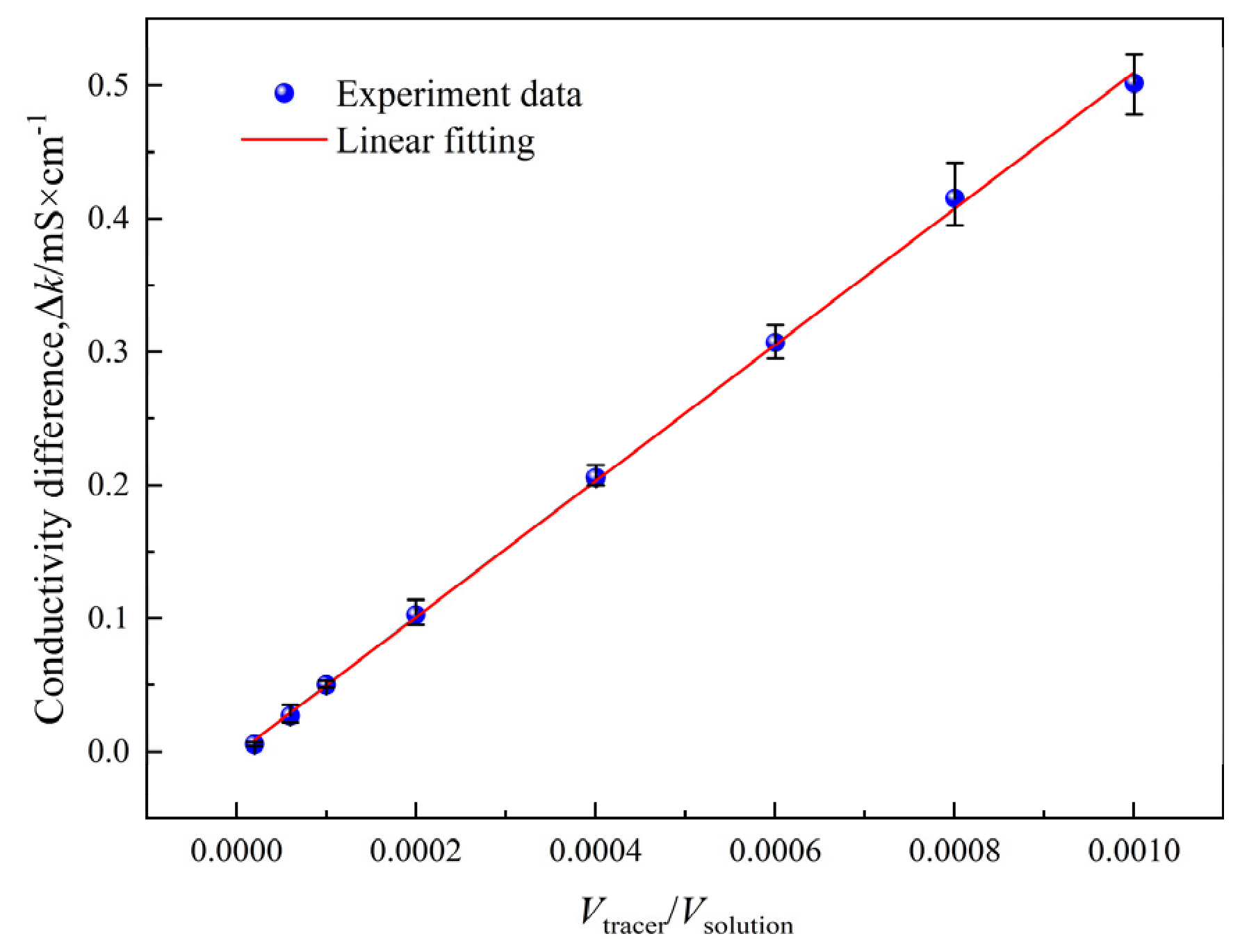
where Δκ(t) is the real-time conductivity difference at the tundish outlet, with a unit of S/m. Vtracer(t) is the volume of saturated KCl solution corresponding to the KCl solute contained in the outflowing KCl solution during time interval Δt, with a unit of L. And Vsolution(t) is the volume of solution flows out of outlet during time interval Δt, with a unit of L. Vtracer/Vsolution is the volume fraction ratio of the volume of saturated KCl solution with KCl solute of the same mass in the diluted solution to the volume of the outflow solution during time interval Δt. Based on the results of the water model experiment, A′ = 520.61467, and B = −0.00433, with a coefficient of determination of R2 = 0.9994. The experimental data and fitted result are given in Appendix A.

3. Results and Analysis

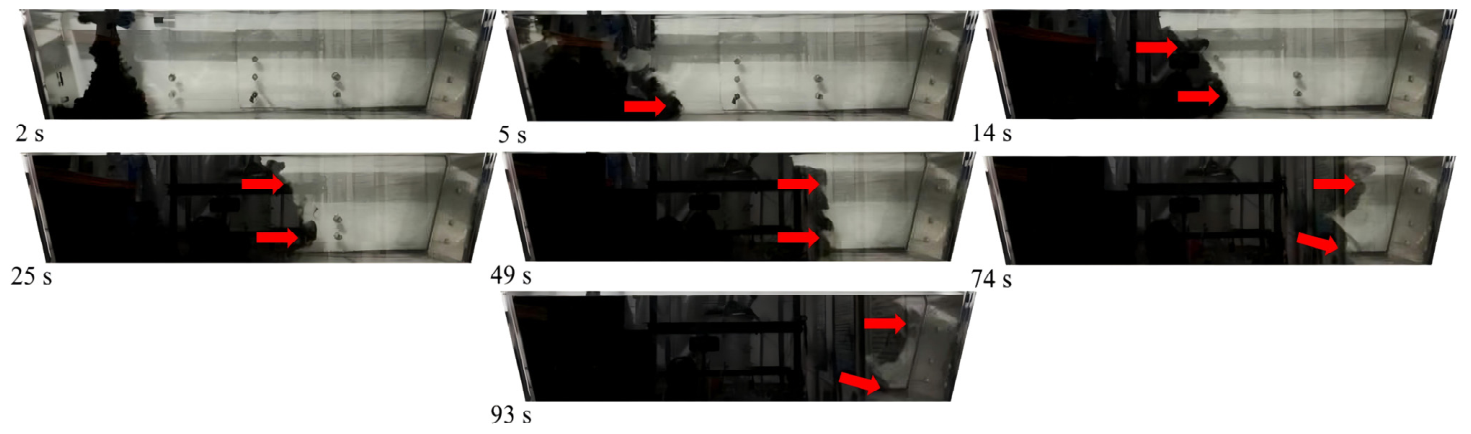
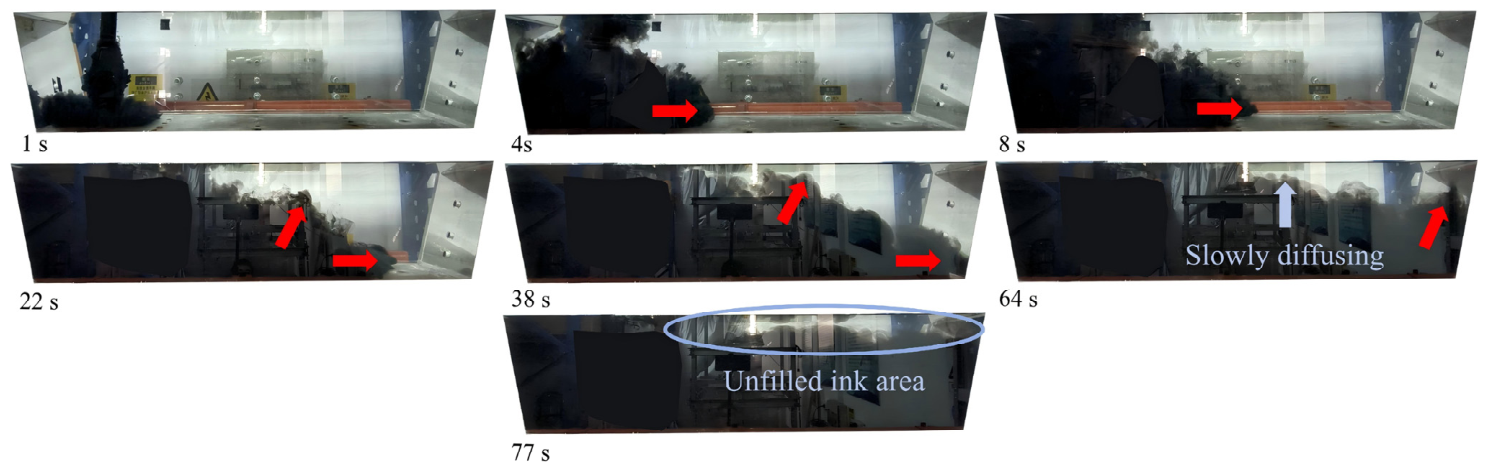
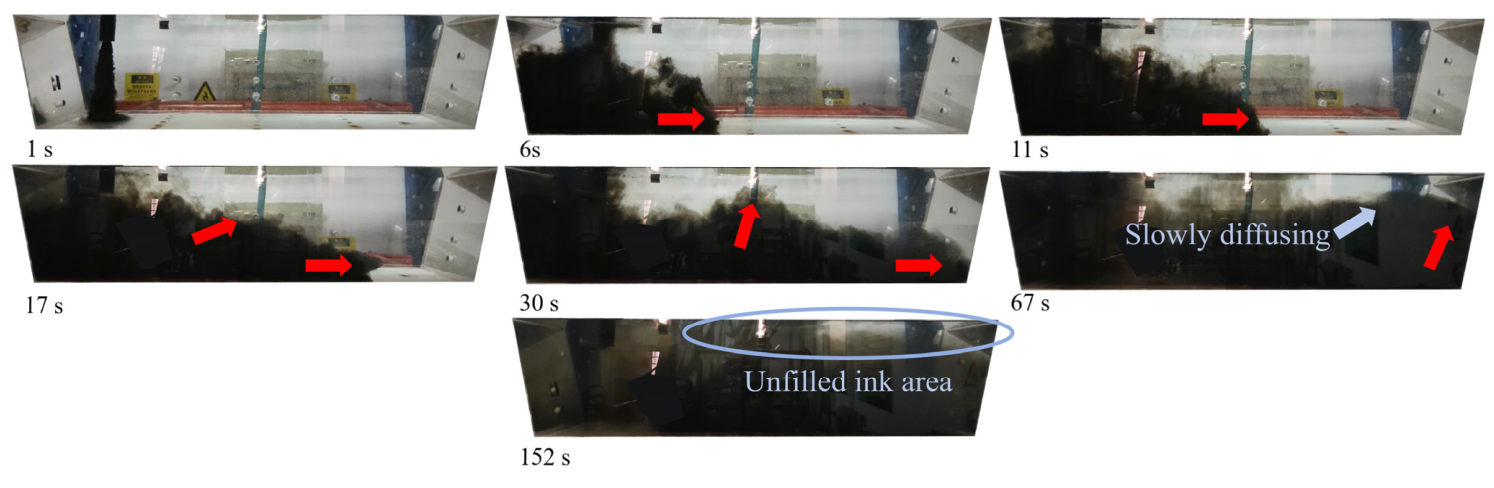
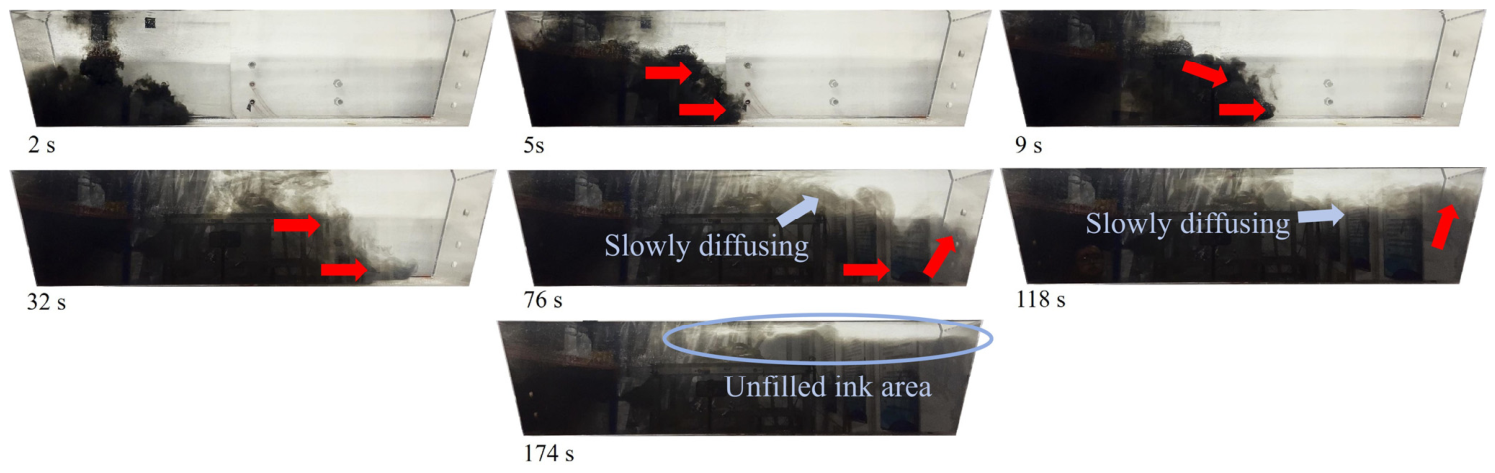
In this section, the selected ink transport results were based on the transport of ink to fixed positions in the tundish. The seven subfigures correspond to the following positions, respectively: (1) the moment when the ink had just reached the tundish bottom, (2) the moment when the ink reached 1/3 of the tundish length, (3) the moment when the ink reached 1/2 of the tundish length, (4) the moment when the ink reached a position close to 2/3 of the tundish length, (5) the moment when the ink reached 2/3 of the tundish length, (6) the moment when the ink reached the outlet, and (7) the moment when part of the ink reached the side wall near the outlet. By analyzing the time required for the ink to reach these seven positions, the changes in ink transport at different temperatures were further investigated; that is, the differences in the flow-field structure in the tundish were examined. The red arrows in the figures indicated the diffusion direction of the ink tracer.

3.1. Transport Process of Pure Ink

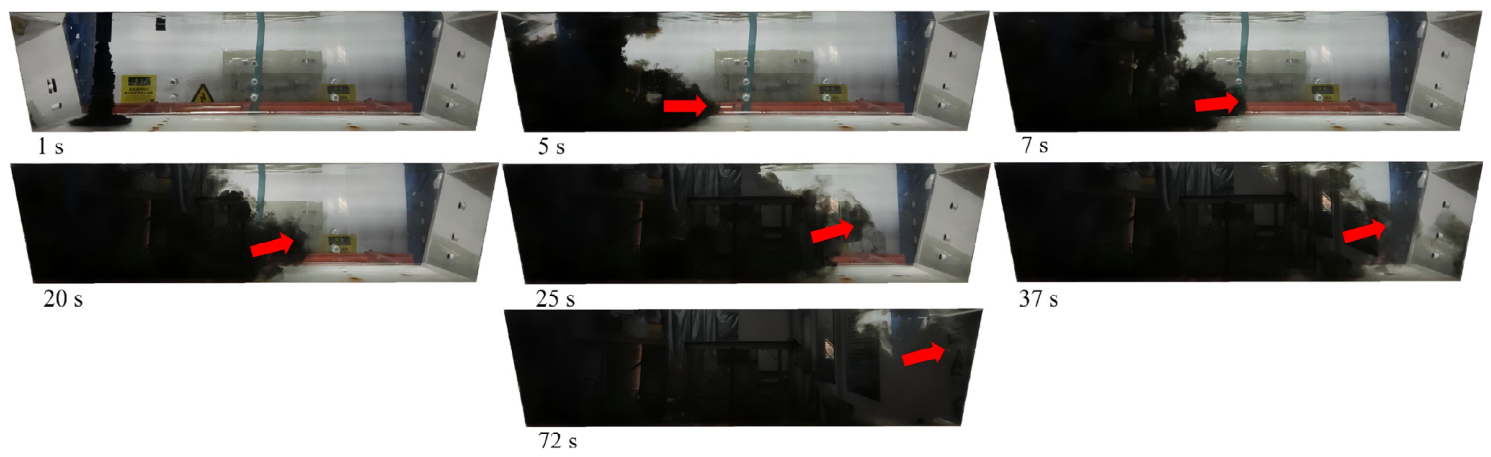
Figure 2 shows the transport process of 15 mL pure ink at 20 °C (scheme A1). After the pure ink flowed from the shroud to the bottom of the tundish, it was divided into two streams. One stream was transported along the free surface, and the other was transported upward from the bottom of the tundish. The transport of ink at the bottom was slightly faster than that near the liquid surface. At 20 s, the ink dispersed from the bottom reached the central region of the tundish. Between 20 s and 37 s, a clear upward transport trend of the ink tracer was observed, and the leading edge of diffusion was located at half of the liquid level. At 37 s, the ink began to flow out from the outlet and simultaneously diffused into the region above the outlet. However, the diffusion rate in this region, especially near the liquid surface, was very slow. The ink did not gradually diffuse into this region until 72 s, and a long time was still required for it to disperse throughout the entire region.
Figure 3 shows the transport process of 15 mL pure ink at 7 °C (scheme A2). After flowing out from the shroud, the ink was also divided into two streams for transport. Unlike in scheme A1, in scheme A2, the upward transport tendency of the ink from the bottom was slightly weakened. No obvious difference was observed between the transport rate of the ink at the bottom and that near the liquid surface. From 14 s until just before 74 s, the ink was dispersed toward the right region of the tundish in a plug-flow manner. At 74 s, the ink transported along the bottom began to flow out from the outlet, and this stream stagnated on the left side of the outlet. At 93 s, the ink near the liquid surface was further transported toward the right wall of the tundish. Subsequently, the ink in the right region above the outlet mainly originated from this stream. In the region above the outlet and on the right side, a longer time was required for the ink to diffuse. Overall, the ink transport in scheme A2 was slowed down, and some stagnation was observed after 49 s. As a result, the arrival of the ink at the outlet (74 s) was significantly delayed compared with that in scheme A1.
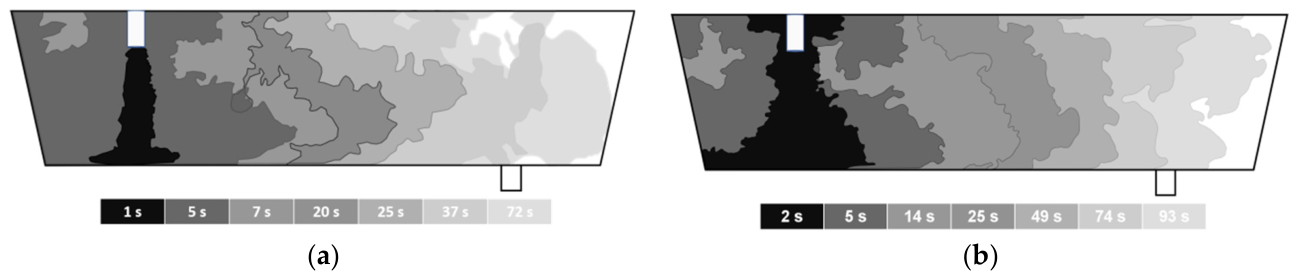
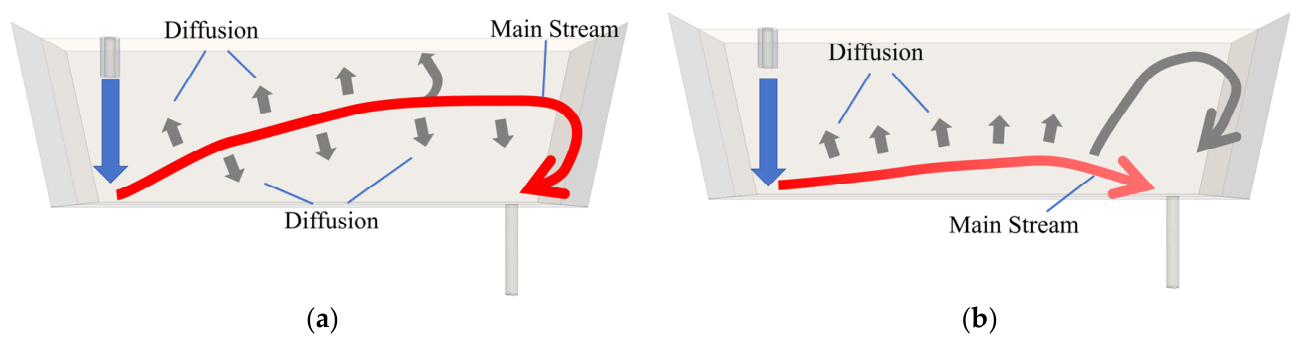
Figure 4 shows the overall transport schematics of pure ink in the tundish for schemes A1 and A2. As shown in Figure 4, in scheme A1, a continuous upward transport trend of the ink was observed. In this scheme, the ink in the right region of the tundish was mainly formed by the diffusion of ink transported upward from the bottom toward the region near the liquid surface. Compared with scheme A1, a lower experimental temperature was used in scheme A2. Under this condition, the upward transport tendency of the ink at the tundish bottom was weakened, and the ink was transported toward the right region of the tundish in the form of “plug flow”. In addition, the ink transported along the bottom stagnated after it reached the outlet. The ink in the right region of the tundish was mainly formed by the diffusion of ink near the liquid surface.

3.2. Transport Process of Saturated KCl Solution at 20 °C

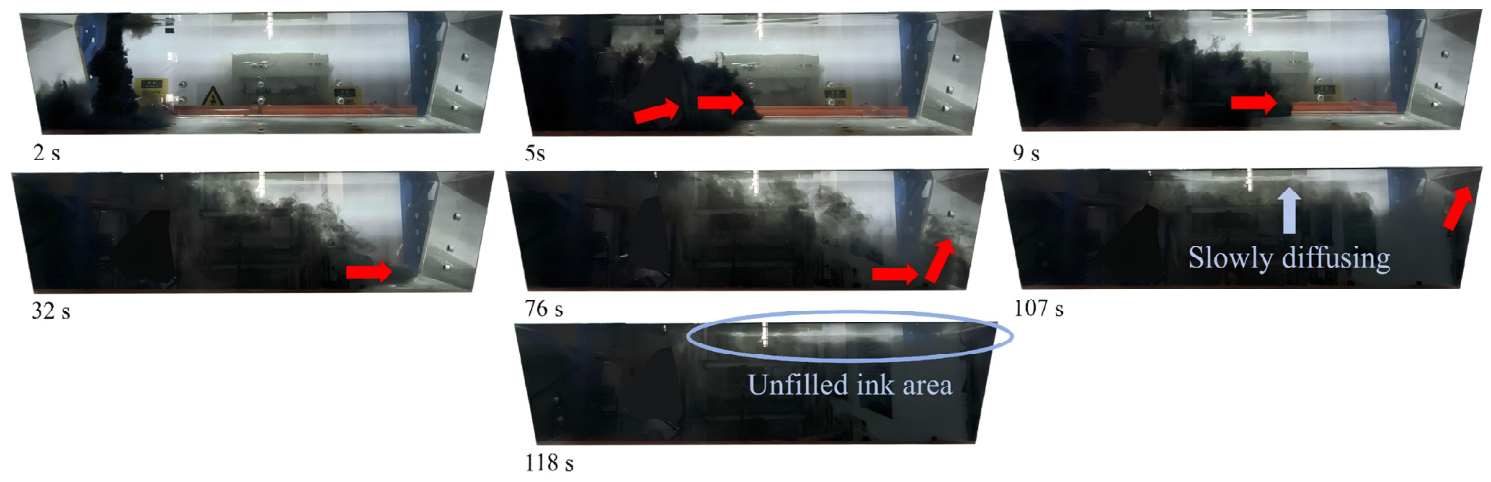
Figure 5 shows the transport process of 35 mL saturated KCl solution at 20 °C in scheme A3. Transport of the tracer along the bottom was clearly strengthened. At 5 s, an upward flow tendency was observed, but the bottom stream then developed strongly, and tracer transport near the liquid surface became very slow. No particularly strong short-circuit flow was observed in the tundish, but less tracer was transported along the liquid surface. Although the stream in the lower half of the tundish still dominated, it gradually shifted downward during transport compared with the ink transport process. The tracer did not reach the outlet region until 32 s, and the tracer diffused slowly. At 76 s, the tracer reached the right wall and then diffused upward along the wall toward the liquid surface. At 107 s, the tracer at the liquid surface had only diffused to one-third of the tundish length. During this process, a large amount of tracer accumulated in the middle region of the tundish and then slowly diffused from this region toward the liquid surface. At 118 s, the tracer still had not completely diffused to the liquid surface.
Figure 6 shows the transport process of 55 mL saturated KCl solution at 20 °C in scheme A4. Similar to scheme A3, transport of the tracer along the bottom was further strengthened. At 22 s, the tracer reached the region near the outlet. At 38 s, the tracer reached the right wall and then diffused upward along the wall toward the liquid surface. At 64 s, the tracer at the liquid surface had diffused to one-half of the tundish length. At 77 s, a transport state similar to that in scheme A3 at 118 s was observed. In other words, a large area near the liquid surface of the tundish still remained undiffused.
Figure 7 shows the transport process of 150 mL saturated KCl solution at 20 °C in scheme A5. Transport of the tracer along the bottom was further strengthened, and a pronounced short-circuit flow was observed in the tundish. At 17 s, the tracer had already reached the tundish outlet. From 30 s to 67 s, two transport paths were clearly observed during the tracer transport process. In one path, the tracer was transported along the right wall to the liquid surface. In the other path, the tracer was transported upward from the middle region of the tundish to the liquid surface. At 152 s, the tracer still had not diffused into the upper right region of the tundish. This result was mainly attributed to the strong short-circuit flow, by which a large amount of tracer was carried out of the tundish. As a result, the tracer concentration in the tundish was reduced, and the tracer diffusion rate was slowed.
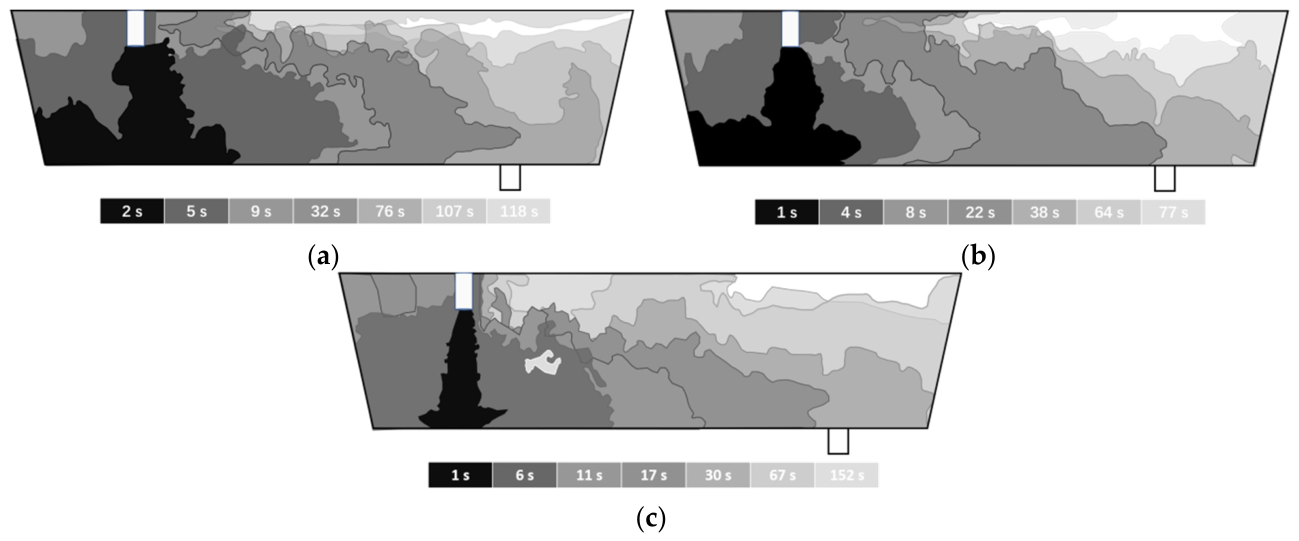
Figure 8 shows the overall transport schematics of saturated KCl solution at 20 °C under different dosages. After tracer injection, short-circuit flow was observed in the tundish. In schemes A3, A4, and A5, the tracer reached the tundish outlet at 32 s, 22 s, and 17 s, respectively. Compared with scheme A1 (37 s), the time required for the tracer to reach the tundish outlet was shortened as the dosage of the salt solution tracer was increased in these three schemes. When the dosage of the salt solution tracer was low (35 mL saturated KCl solution, with a Dta value of 0.375 × 10⁻³, scheme A3), its diffusion process remained similar to that in scheme A1, although some changes were observed in the overall flow field and diffusion process. In schemes A4 and A5, the higher dosage of the salt solution tracer altered the flow field in the tundish, and strong downward flow and short-circuit flow were generated. As a result, a large amount of tracer was accumulated at the tundish bottom, and the transport process was significantly changed. As the dosage of the salt solution tracer was increased, tracer diffusion at the tundish bottom was accelerated, but transport toward the liquid surface was suppressed. Therefore, more time was required for the tracer to diffuse throughout the entire tundish.

3.3. Transport Process of Saturated KCl Solution at 7 °C

Figure 9 shows the transport process of 35 mL saturated KCl solution at 7 °C in scheme A6. The overall transport process in this scheme was similar to that in scheme A3 (35 mL saturated KCl solution, 20 °C), but transport of the tracer along the tundish bottom was slightly strengthened, and diffusion toward the liquid surface was slowed. The tracer reached the outlet at 32 s and reached the right wall of the tundish at 76 s. It was then slowly transported along the wall toward the liquid surface. Notably, compared with scheme A3, transport of the tracer toward the liquid surface was slower. In scheme A3, 107 s was required for the tracer to reach the region near the liquid surface, whereas 118 s was required in scheme A6. Thus, the required time was slightly prolonged. At 174 s, a large area near the liquid surface in scheme A6 still remained undiffused, whereas in scheme A3, a similar diffusion state near the liquid surface was reached at 118 s.
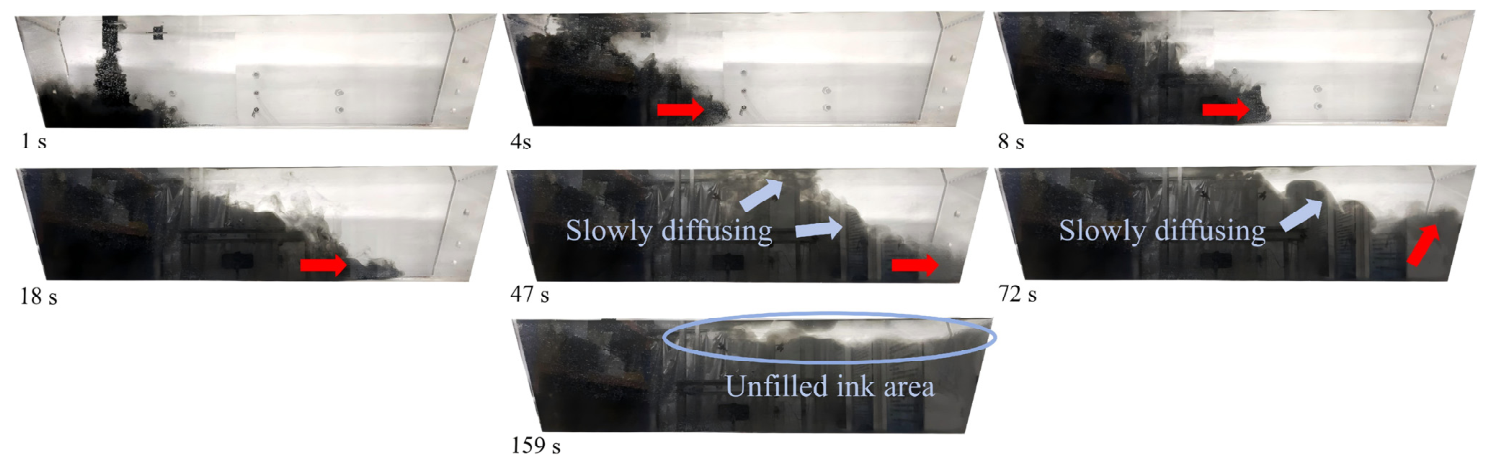
Figure 10 shows the transport process of 55 mL saturated KCl solution at 7 °C in scheme A7. Compared with the transport process in scheme A4 (55 mL saturated KCl solution, 20 °C), a marked change in the overall transport behavior was observed in scheme A7, and transport along the bottom was significantly strengthened. Before 18 s, similar times were required in the two schemes for the tracer to reach the same position, but the figure clearly shows that the tracer in scheme A7 was transported closer to the tundish bottom. At 18 s, the tracer in scheme A7 reached the region near the outlet, which was slightly earlier than the 22 s observed in scheme A4. However, after the tracer reached the outlet, transport and diffusion in scheme A7 became clearly slower than those in scheme A4, and the difference between the two became increasingly obvious as transport and diffusion proceeded. At 47 s, the tracer in scheme A7 reached the right wall of the tundish and was then transported along the wall toward the liquid surface. At 72 s, the tracer reached half of the liquid level height. At 159 s, the tracer reached the region near the liquid surface, but a large area still remained undiffused. By contrast, in scheme A4, the diffusion state near the liquid surface at 77 s was already similar to that in scheme A7 at 159 s. In summary, the lower temperature strengthened the downward short-circuit flow in the tundish, shortened the time required for the tracer to reach the outlet, and suppressed diffusion of the tracer toward the liquid surface.
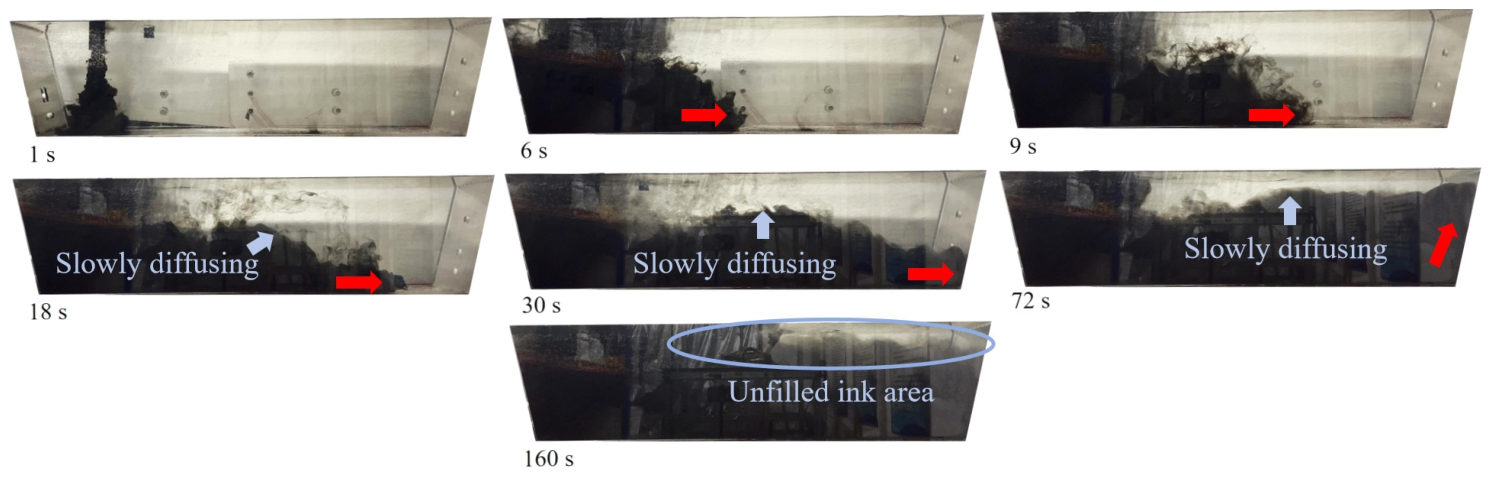
Figure 11 shows the transport process of 150 mL saturated KCl solution at 7 °C in scheme A8. The process from tracer injection through the ladle shroud to its arrival at the tundish outlet was basically consistent with that in scheme A5 (150 mL saturated KCl solution, 20 °C). In scheme A8, the tracer reached the outlet at 18 s and reached the right wall of the tundish at 30 s, where it began to be transported along the wall toward the liquid surface. At this stage, the transport path through which the tracer diffused from the middle region toward the liquid surface still existed. After 30 s, tracer transport was slowed. At 72 s, the tracer reached the region near the liquid surface, which was slightly later than the 67 s observed in scheme A5. At 160 s, the tracer had diffused into most regions of the tundish, but it still had not diffused into the upper right region of the tundish, which was slightly later than the 152 s observed in scheme A5.
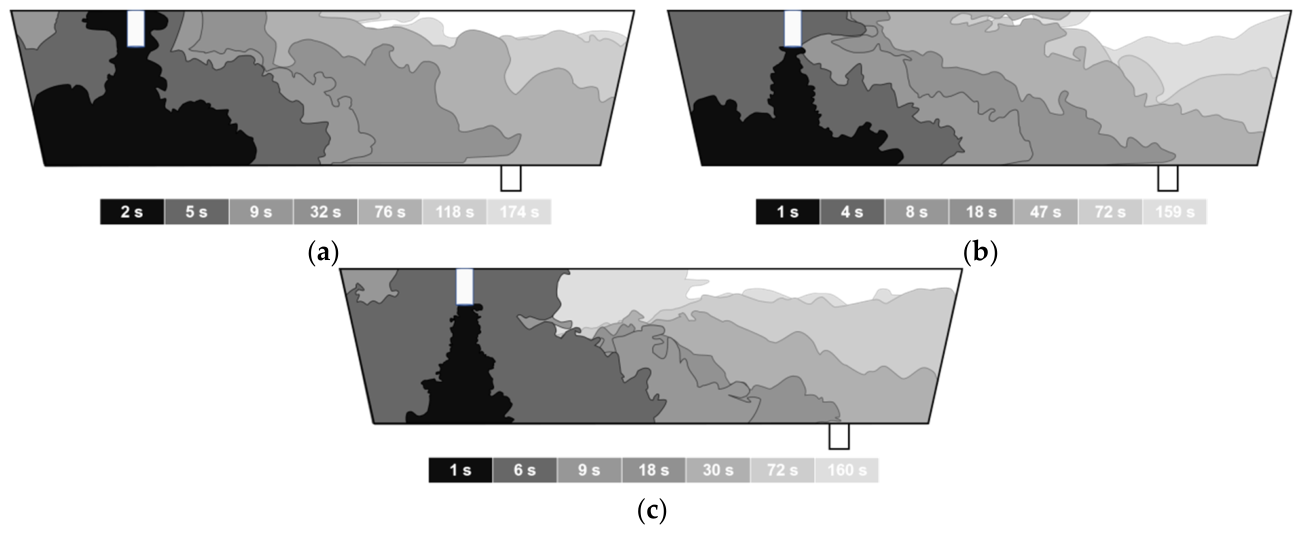
Figure 12 shows the overall transport process schematics of saturated KCl solution at 7 °C under different dosages. As the dosage of the salt solution tracer was increased, the downward flow and short-circuit flow in the tundish were strengthened. Compared with the transport behavior at 20 °C, when the dosage of the salt solution tracer was kept the same, a lower experimental temperature (schemes A6 to A8) strengthened the downward flow in the tundish, intensified the short-circuit flow, and caused the tracer to be transported along paths closer to the bottom. When the dosage of the salt solution tracer remained low (35 mL and 55 mL saturated KCl solution, with Dta values of 0.375 × 10⁻³ and 0.589 × 10⁻³, respectively), nearly the same time was required for the tracer to reach the same position during transport toward the tundish outlet at different temperatures. Therefore, during this stage, only a limited effect of lower temperature was exerted on the transport and diffusion rates of the tracer. After the tracer reached the outlet, it began to be transported toward the region near the liquid surface. For these two dosages, the time required for the tracer to diffuse into most regions of the tundish was prolonged by 56 s and 82 s, respectively, compared with the time required at 20 °C to reach the same diffusion state. These results indicated that, when the dosage of the salt solution tracer remained low, the effect of temperature was greater than that of tracer dosage, and the lower temperature suppressed transport and diffusion of the tracer toward the liquid surface. However, when the dosage of the salt solution tracer was increased to 150 mL (schemes A5 and A8), the overall transport and diffusion processes remained basically the same. At this stage, the effect of tracer dosage on the flow field became stronger than that of water temperature.

3.4. Analysis of Tracer Transport Paths

Figure 13 shows the transport path schematics of pure ink in the tundish for schemes A1 and A2. In the figure, the red arrows indicate the main flow stream of the tracer, the black arrows indicate the downward flow induced by the tracer, and the gray arrows indicate the diffusion effect caused by the concentration difference between the tracer and water. For the gray arrows, a darker color indicates a stronger diffusion effect at that position. At an experimental temperature of 20 °C, in scheme A1, because the density difference between the ink and water was small, the ink was mainly transported along the upward main flow stream. When the experimental temperature was decreased to 7 °C, in scheme A2, the ink transport path shifted closer to the tundish bottom, the transport mainly took the form of “plug flow”, and transport near the right wall of the tundish became very slow.
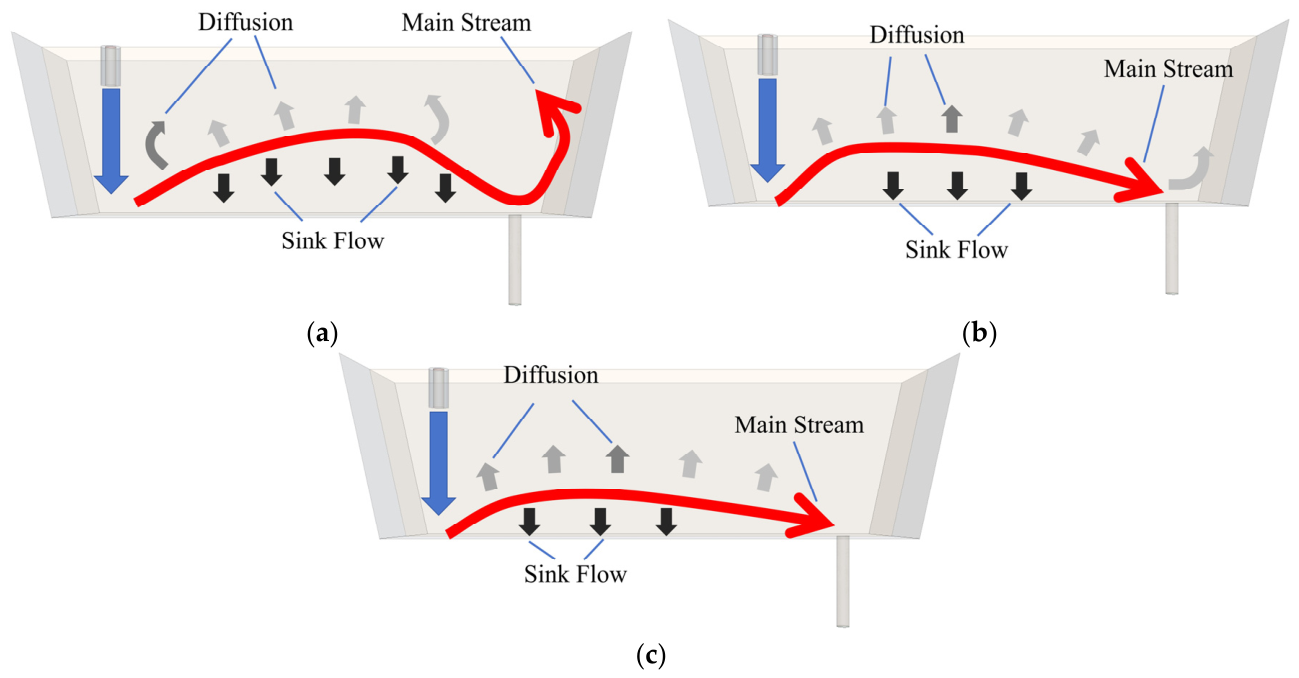
Figure 14 shows the transport path schematics of saturated KCl solution in the tundish for schemes A3 to A8. Because the tracer had a higher density than water, the main flow stream gradually shifted closer to the tundish bottom as the dosage of the salt solution tracer was increased, and short-circuit flow was generated at the same time. Compared with the results at 20 °C, stronger downward flow was observed in the experiments at 7 °C. As a result, the main flow stream was driven closer to the tundish bottom, and the transport and diffusion rates of the tracer near the right wall were reduced. However, compared with the ink transport schemes, no major change was caused in the transport path of saturated KCl solution by the temperature variation. As the dosage of the salt solution tracer was increased, the short-circuit flow became more obvious. The effect of tracer dosage on transport of the salt solution tracer gradually became stronger than that of water temperature, and the differences in tracer transport under different experimental temperatures were reduced. When the dosage of the salt solution tracer remained low (35 mL saturated KCl solution, with a Dta value of 0.375 × 10⁻³), the upward transport tendency of the salt solution tracer was weakened compared with that in the pure ink transport (schemes A1 and A2). After the dosage of the salt solution tracer was increased (55 mL and 150 mL saturated KCl solution, with Dta values of 0.589 × 10⁻³ and 1.608 × 10⁻³, respectively), the main flow stream changed into strong short-circuit flow and downward flow.

3.5. RTD Curves of Saturated KCl Solution

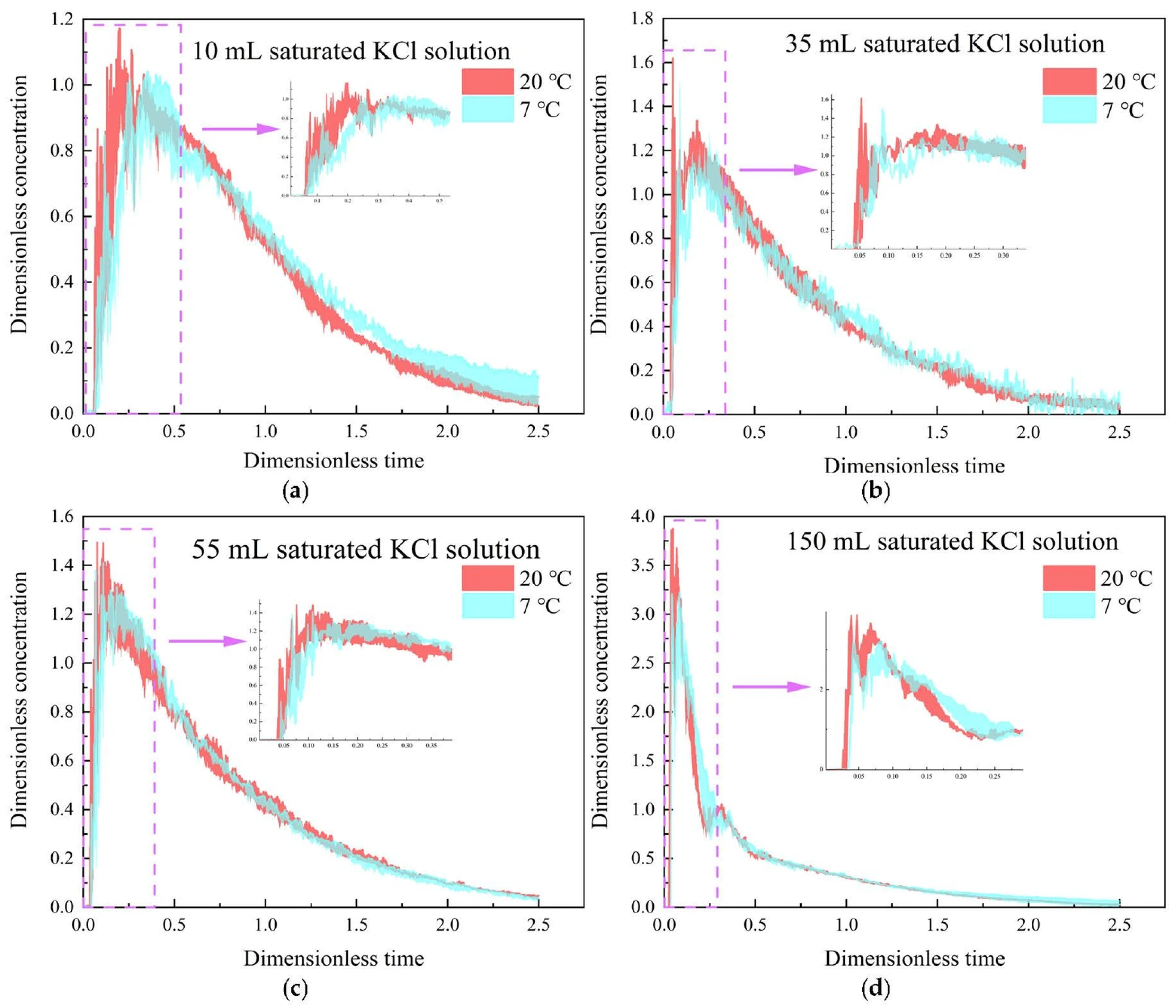
Figure 15 shows the RTD curves obtained after different dosages of saturated KCl solution were injected through the ladle shroud at experimental temperatures of 20 °C and 7 °C, and Table 6 lists the characteristic parameters of the average RTD curves for each dosage under different experimental temperatures. As the experimental temperature was increased from 7 °C to 20 °C, a leftward shift in the RTD curves was observed, and the dimensionless concentration of the RTD curves at 2.5 times the theoretical residence time (1500 s) was reduced. Among these results, the RTD curves corresponding to 10 mL saturated KCl solution showed the most significant difference between the two temperatures. As the tracer dosage was increased from 35 mL to 150 mL, the differences in the RTD curves under different temperature conditions were gradually reduced. According to the parameters listed in Table 6, only slight changes were observed in the response time of the RTD curves at each dosage after the temperature was increased, whereas the peak time and mean residence time were obviously shortened. This phenomenon was attributed to the decrease in water viscosity caused by the temperature increase, by which tracer transport was promoted and a large amount of the salt solution tracer was allowed to flow out from the outlet at an earlier time. However, as the dosage of the salt solution tracer was increased from 10 mL to 150 mL, the extent to which the peak time of the RTD curves was shortened at different temperatures was gradually reduced. Under the 10 mL condition, the difference in peak time between 7 °C and 20 °C was 93 s, which was clearly greater than the corresponding values of 24 s, 22 s, and 5 s under the 35 mL, 55 mL, and 150 mL conditions, respectively. This result indicates that, when the dosage of the salt solution tracer exceeded 35 mL (Dta > 0.375 × 10⁻³), the effect of tracer dosage on the transport of the salt solution tracer became stronger than that of water temperature. This conclusion is consistent with the results presented in this paper regarding the effect of experimental temperature on the tracer transport process.

3.6. Outflow Percentage Curves of Saturated KCl Solution

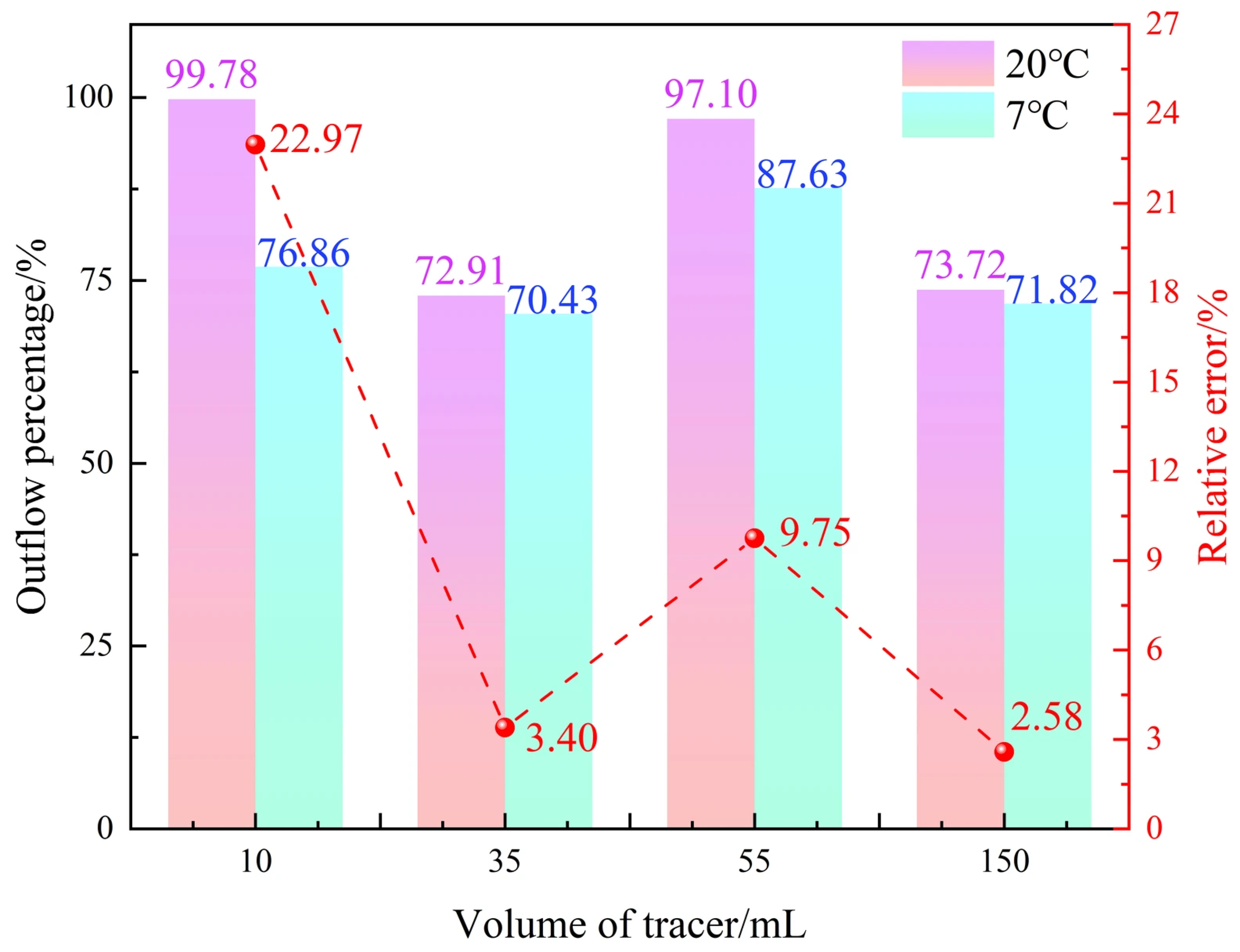
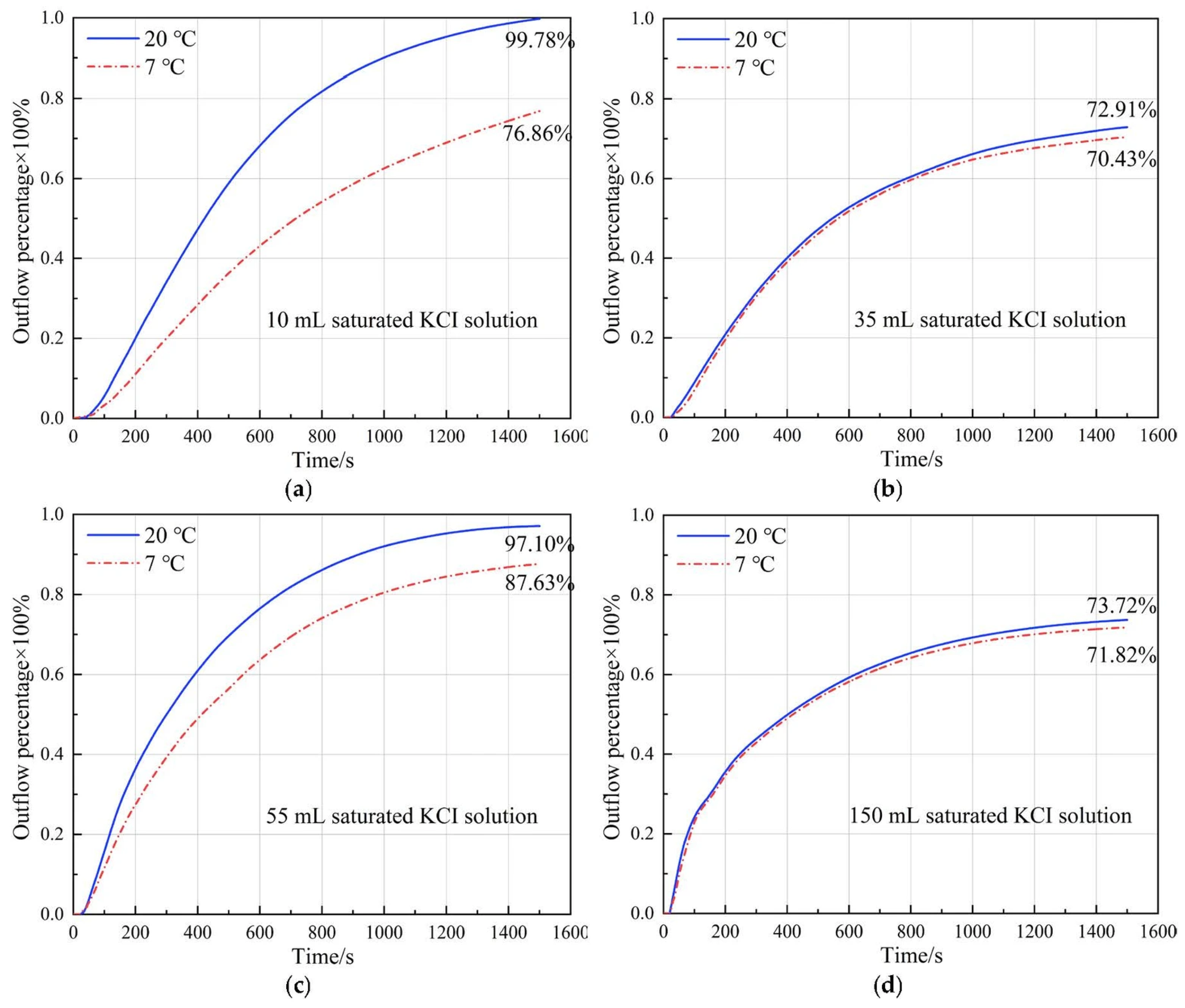
Figure 16 shows the outflow percentage curves [89,90] of saturated KCl solution at experimental temperatures of 20 °C and 7 °C for different dosages and Figure 17 shows the total outflow percentages of saturated KCl solution at 1500 s for the corresponding schemes. It can be seen that the outflow percentage curves of the 10 mL salt solution tracer showed the largest difference at different temperatures. At 7 °C, the total outflow percentage of the 10 mL salt solution tracer at 1500 s was 76.86%, which was 22.97% lower than that at 20 °C, indicating that part of the salt solution tracer had not flowed out from the tundish outlet at that time, and that temperature significantly affected the flow behavior of the low-dosage salt solution tracer in the tundish. In a previous study [84], 35 mL salt solution tracer at 20 °C was identified as the turning point at which tracer dosage affected the tundish flow field. The outflow percentage curves of the 35 mL salt solution tracer at different temperatures were similar, and at 7 °C, its total outflow percentage at 1500 s was 3.40% lower than that at 20 °C. As the tracer dosage was further increased, the total outflow percentages of the 55 mL and 150 mL salt solution tracer at 1500 s were reduced, and the differences between the outflow percentage curves of the tracer at the same dosage under different temperatures were gradually decreased. At 7 °C, the total outflow percentage of the 55 mL salt solution tracer at 1500 s was 87.53%, which was 9.75% lower than that at 20 °C. At 7 °C, the total outflow percentage of the 150 mL salt solution tracer at 1500 s was 73.72%, which was 2.58% lower than that at 20 °C. These results indicate that, as the tracer dosage was increased, the effect of dosage on the experimental results gradually became stronger than that of temperature variation, thereby reducing the differences in the outflow percentage curves of the salt solution tracer at different temperatures.

4. Discussion

In this study, the Dta values corresponding to 10 mL, 35 mL, 55 mL, and 150 mL saturated KCl solution were 0.107 × 10⁻³, 0.375 × 10⁻³, 0.589 × 10⁻³, and 1.608 × 10⁻³, respectively. From the comparison between the 20 °C and 7 °C conditions, it was found that tracer transport and diffusion in the tundish were accelerated at the higher experimental temperature. The diffusion of the tracer toward the region near the liquid surface was also enhanced. In contrast, under the 7 °C condition, the overall tracer transport path remained closer to the tundish bottom, and the upward diffusion rate after the tracer reached the outlet was markedly reduced. For the saturated KCl solution tracer, this “temperature effect” was more significant at low dosage. As the tracer dosage was increased, rapid tracer transport along the bottom toward the outlet became more obvious, whereas the differences in the transport process under different temperature conditions were gradually reduced. It was therefore indicated that the effect of tracer dosage on the flow field and transport path gradually became stronger than that of temperature variation. Therefore, when the tracer dosage was small, special attention needed to be paid to the errors caused by changes in experimental temperature. When the tracer dosage was large, the differences in the experimental results under different temperature conditions became smaller. However, the disturbance of the flow field caused by the tracer itself became significantly stronger, and the accuracy of the experimental results was thereby reduced. Previous studies rarely reported the effect of water temperature on experimental results. This may have been attributed to the relatively large dosage of salt solution tracer used in earlier experiments. Under such conditions, downward flow was dominant, and the effect of temperature variation was relatively weak. However, the original flow field could be significantly disturbed, and the measurement results could be affected by a high dosage of salt solution tracer. Therefore, reduction in the salt solution tracer dosage had already been suggested in recent studies [22,83,85,86].
To further interpret the observed temperature effect from a dimensionless viewpoint, it should be noted that the geometry and flow rate were kept unchanged in the present experiments. Therefore, the Froude number of the tundish system remained essentially unchanged, and the macroscopic inertial-gravity flow pattern was not fundamentally altered by temperature variation. In contrast, the Reynolds number changed with water viscosity. Taking the outlet diameter as the characteristic length, the Reynolds number remained on the order of 104 under both 7 °C and 20 °C conditions, indicating that both cases were still within the turbulent regime, although the 20 °C condition corresponded to a higher Reynolds number and thus stronger convective transport and mixing. This provides one explanation for the faster tracer transport and the shorter peak and mean residence times observed at 20 °C.
In addition, the relative density difference between the tracer and water, defined as (ρtracerρw)/ρw, also changed with temperature. At 7 °C, both the pure ink tracer and the saturated KCl solution showed a larger relative density difference with respect to water than at 20 °C. As a result, the tendency of the tracer to remain near the tundish bottom was strengthened, and transport toward the free surface was weakened. For the saturated KCl solution tracer, this effect became more evident as the tracer dosage increased. Therefore, the observed flow behavior can be understood as the combined result of viscosity-dependent transport, temperature-dependent density difference, and dosage-dependent flow disturbance. When the tracer dosage was low, the temperature effect was more clearly reflected in the experimental results; when the tracer dosage was high, the disturbance induced by the tracer itself became dominant, and the difference between 7 °C and 20 °C was correspondingly reduced.
In a previous study [84], it was shown that, at 20 °C, less than 35 mL of saturated KCl solution should be used in experiments with a bare single-strand tundish water model. When the RTD curve results and the outflow percentage curve results obtained in this study were considered together, large differences were observed between the results for 10 mL saturated KCl solution at 7 °C and 20 °C. Compared with the results at 20 °C, under the 7 °C condition, the mean residence time of 10 mL saturated KCl solution was increased by 10%, and the total outflow percentage at 1500 s was reduced from 99.78% to 76.86%, corresponding to a decrease of 22.97%. These results indicated that the transport process of 10 mL saturated KCl solution was strongly affected by temperature. Therefore, when the dosage of the salt solution tracer remained low at 7 °C (Dta < 0.375 × 10⁻³), the experimental results were strongly influenced by water temperature conditions, and particular attention needed to be paid to the errors caused by changes in experimental conditions. When tundish water model experiments were conducted, the effects of season and water temperature conditions needed to be taken into consideration.

5. Conclusions

In this study, the differences in fluid flow behavior in the tundish water model between winter and summer were investigated. The following conclusions were obtained:
(1)
Tracer transport and diffusion behavior in the tundish water model were significantly affected by experimental temperature. Compared with the condition at 20 °C, under the condition at 7 °C, a weaker upward transport tendency was observed for the pure ink tracer. The overall transport path was found to remain closer to the tundish bottom, and “plug flow” characteristics were more easily exhibited. In addition, the overall transport speed was reduced, and the time required for the tracer to reach the outlet was significantly prolonged. These results indicated that changes in the overall experimental temperature significantly affected the macroscopic flow characteristics in the tundish.
(2)
For the saturated KCl solution tracer, transport along the bottom toward the outlet was strengthened and diffusion toward the liquid surface was suppressed at lower experimental temperatures. Under the 7 °C condition, stronger downward flow and short-circuit flow were observed in the tundish, and the tracer was more likely to be transported rapidly toward the outlet along the bottom. Among the tested dosages, the 10 mL saturated KCl solution tracer showed the most obvious differences in the RTD curves and outflow percentage curves between 7 °C and 20 °C. This result indicated that the low-dosage tracer was more sensitive to temperature changes.
(3)
As the dosage of saturated KCl solution was increased, the influence of temperature on the experimental results was gradually weakened, whereas the influence of tracer dosage on the flow field and transport behavior was gradually strengthened. After the experimental temperature was increased, the RTD curves were shifted to the left as a whole, and both the peak time and the mean residence time were shortened. These results indicated that the tracer was transported faster at higher temperatures. At the same time, large differences were observed in the outflow percentage curves of the low-dosage tracer at different temperatures, whereas the differences in the tracer transport process, RTD curves, and outflow percentage curves under different temperature conditions were gradually reduced as the dosage was increased. When the tracer dosage was increased to 150 mL, the influence of tracer dosage on the flow field became clearly stronger than that of temperature variation. These results indicated that, in tundish water model experiments, especially under low-dosage tracer conditions, the errors caused by changes in experimental temperature should be carefully considered.
(4)
In summary, when tundish water model experiments are conducted in different seasons, sufficient attention should be paid to water temperature conditions, and the consistency and comparability of water temperature should be maintained as far as possible. When the water temperature deviates from the commonly used condition of around 20 °C, its influence on flow characterization results and tracer transport behavior should be carefully considered, so as to improve the reliability and practical value of the experimental results.

Author Contributions

Conceptualization, L.C. and C.C.; methodology, L.C., C.C., K.Y., W.L., M.G. and T.W.; software, T.W., M.G., Z.D., X.Z., J.L., J.W. and K.Y.; validation, T.W., M.G., K.Y. and W.L.; formal analysis, T.W., M.G. and Z.D.; investigation, T.W., M.G., X.Z., J.L., Z.D. and J.W.; resources, L.C., C.C. and W.L.; data curation, M.G., T.W., J.W. and K.Y.; writing—original draft preparation, X.Z., J.L. and Z.D.; writing—review and editing, T.W., M.G., L.C. and C.C.; visualization, T.W., M.G., X.Z. and J.L.; supervision, L.C. and C.C.; project administration, C.C., L.C. and W.L.; funding acquisition, C.C., L.C. and J.W. All authors have read and agreed to the published version of the manuscript.

Funding

The authors are grateful for the financial support from the Undergraduate Innovation and Entrepreneurship Training Program of Taiyuan University of Technology (2026) and the Applied Fundamental Research Programs of Shanxi Province (202403021222046).

Data Availability Statement

Data are contained within the article.

Conflicts of Interest

The authors declare no conflicts of interest.

Appendix A

The experimental data and fitting results for the coefficients involved in Equation (11) are presented in Table A1 and Figure A1. To determine the values of A’ and B in Equation (11), a calibration experiment was carried out in the water model to establish the relationship between the conductivity difference and tracer concentration. The principle of this experiment was as follows: after an appropriate amount of tracer (saturated KCl solution) was added into a container with a fixed water volume, the conductivity difference after complete mixing was measured, and the relationship between conductivity difference and tracer volume fraction was thus obtained. In the calibration experiment, the water volume in the container was 50 L, and the added tracer volumes were 1, 3, 5, 10, 20, 30, 40, and 50 mL, respectively. The corresponding ratio of tracer volume to water volume ranged from 1/50,000 to 1/1000. Under these conditions, the tracer volume was much smaller than the water volume, and its influence could therefore be neglected. Accordingly, Vsolution in Equation (11) could be taken as the water volume. The measured data are listed in Table A1. The conductivity difference ranged from 0.0055 to 0.5016 mS/cm, and all conductivity differences measured at the tundish outlet fell within this range. Therefore, the relationship between the conductivity difference measured at the tundish outlet and the tracer volume fraction could be represented with reasonable accuracy, as shown in Figure A1. The slope and intercept of the fitted curve correspond to the values of A’ and B in Equation (11), respectively.
Table A1. Experimental data of adding different volume of tracer.
Volume of Tracer (mL)Volume FractionConductivity Difference (μS/cm)Average Value (mS/cm)
10.0000254455776750.0055
30.00006352224262427272826280.0267
50.0001515348515150494850490.05
100.0002951011141041071021011011011000.1026
200.00042102082152052052022042032042000.2056
300.00063153083143073183022962963202950.3071
400.00084424104314194294164044064013950.4153
500.0015235185065195084964934894784860.5016
Figure A1. Linear relationship between tracer volume fraction ratio and corresponding conductivity difference.
Processes 14 01897 g0a1

Appendix B

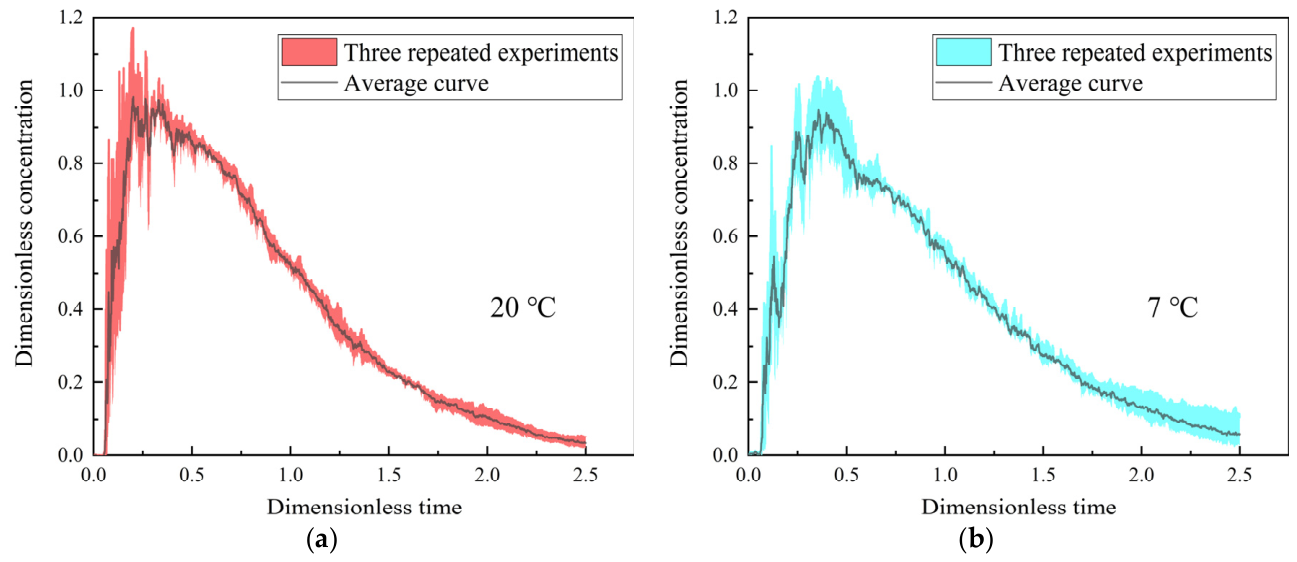
To evaluate the repeatability of the experiment, a representative case involving the addition of 10 mL of saturated KCl solution was selected for three repeated trials. The resulting RTD curves were compared and analyzed. As shown in Figure A2, the maximum and minimum concentration curves were used to generate a shaded region over time, visually representing the range of variation. These figures indicate that the variation range of the repeated experimental data is reatively small compared to the average curve.
Figure A2. Error analysis of the RTD curve for 10 mL saturated KCl solution: (a) 20 °C; (b) 7 °C.
Processes 14 01897 g0a2

References

  1. Sahai, Y. Tundish Technology for Clean Steel Production; World Scientific Publisher: Singapore, 2007; pp. 8–12. [Google Scholar]
  2. Mazumdar, D. Review, analysis, and modeling of continuous casting tundish systems. Steel Res. Int. 2019, 90, 1800279. [Google Scholar] [CrossRef]
  3. Song, J.T.; Chen, C.; Guo, Z.J.; Geng, M.J.; Rong, Z.R.; Wang, T.Y.; Wang, J.; E, D.Y.; Fan, J.P.; Sun, Y.H. Analysis of flow field, temperature, and inclusion evolution in a 12-strand tundish during ladle changeover process. Metall. Mater. Trans. B 2025, 56, 2700–2714. [Google Scholar] [CrossRef]
  4. Chattopadhyay, K.; Isac, M.; Guthrie, R.I.L. Physical and mathematical modelling of steelmaking tundish operations: A review of the last decade (1999–2009). ISIJ Int. 2010, 50, 331–348. [Google Scholar] [CrossRef]
  5. Chen, C.; Cheng, G.G.; Yang, H.K.; Hou, Z.B. Physical modeling of fluid flow characteristics in a delta-shaped, four-strand continuous casting tundish with different flow control devices. Adv. Mater. Res. 2011, 284, 1071–1079. [Google Scholar] [CrossRef]
  6. Li, D.; Duan, H.; Chen, W.; Zhang, L. Deriving tundish flow fields through ink diffusion experiments based on image processing. Metal. Mater. Trans. B 2025, 56, 4742–4753. [Google Scholar] [CrossRef]
  7. Fang, Q.; Zhao, P.; Zhang, H.; Zhou, W.H.; Yu, G.; Wang, J.H.; Ni, H.W. Formation of free-surface vortex and vortex suppression by rotating stopper-rod at end of tundish casting. J. Iron Steel Res. Int. 2024, 31, 1104–1116. [Google Scholar] [CrossRef]
  8. Wang, J.C.; Liu, Z.T.; Chen, W.; Chen, H.L.; Zhang, L.F. Numerical simulation on the multiphase flow and reoxidation of the molten steel in a two-strand tundish during ladle change. Int. J. Miner. Metall. Mater. 2024, 31, 1540–1553. [Google Scholar] [CrossRef]
  9. Wan, Z.H.; Yang, S.L.; Kong, D.S.; Li, D.B.; Hu, J.H.; Wang, H. Numerical investigation of sinusoidal pulsating gas intake to intensify the gas-slag momentum transfer in the top-blown smelting furnace. Int. J. Miner. Metall. Mater. 2024, 31, 301–314. [Google Scholar] [CrossRef]
  10. Mohammadi, A.; Nili-Ahmadabadi, M.; Mohammadi, S.; Joulaei, A.; Ha, M.Y. Optimizing flow patterns and residence time in a two-strand steelmaking tundish via PIV and tracer-based flow detection. Metall. Res. Technol. 2025, 122, 203. [Google Scholar] [CrossRef]
  11. Jiang, L.; Zhou, T.; Suo, S.; Dai, Y.; Hamid, M.O.A.; Zhang, Y.; Qi, H.; Yang, X.; Xie, M. Visualization on the turbulent structure and restructure characteristic in the wake of a packed bed reactor: PIV measurements and POD analysis. Renew. Energy 2025, 246, 122895. [Google Scholar] [CrossRef]
  12. Liu, T.; Zhou, Y.; Zhao, Z.; Luo, Z.; Wang, H.; Deng, X.; Liu, Q. Lift enhancement optimization for an airfoil with distributed dual synthetic jets based on deep reinforcement learning. Chin. J. Aeronaut. 2026, 104128. [Google Scholar] [CrossRef]
  13. Nakajima, H.; Sebo, F.; Tanaka, S.; Dumitru, L.; Harris, D.J.; Guthrie, R.I.L. On the separation of non-metallic inclusions from tundishes in continuous casting operations-a water model study. In Proceedings of the Fifth International Iron and Steel Congress, 69th Steelmaking Conference, Washington, DC, USA, 6–9 April 1986. [Google Scholar]
  14. Chattopadhyay, K.; Isac, M.; Guthrie, R.I.L. Modelling of Non-isothermal Melt Flows in a Four Strand Delta Shaped Billet Caster Tundish Validated by Water Model Experiments. ISIJ Int. 2012, 52, 2026–2035. [Google Scholar] [CrossRef]
  15. McLean, A. The turbulent tundish-contaminator or refiner? In Proceedings of the 71st Steelmaking Conference, Toronto, ON, Canada, 17–20 April 1988. [Google Scholar]
  16. Chatterjee, S.; Chattopadhyay, K. Formation of slag ‘eye’ in an inert gas shrouded tundish. ISIJ Int. 2015, 55, 1416–1424. [Google Scholar] [CrossRef]
  17. Konar, B.; Li, D.; Leung, J.; Sengupta, J.; Chattopadhyay, K. Tundish open eye formation: Integrated troubleshooting using computational modeling, physical modeling, and plant trials. In Proceedings of the AISTech 2019-Proceedings of the Iron and Steel Technology Conference, Pittsburgh, PA, USA, 6–9 May 2019. [Google Scholar]
  18. Odenthal, H.J.; Bölling, R.; Pfeifer, H.; Holzhauser, J.F.; Wahlers, F.J. Mechanism of fluid flow in a continuous casting tundish with different turbo-stoppers. Steel Res. 2001, 72, 466–476. [Google Scholar] [CrossRef]
  19. Warzecha, M.; Merder, T.; Pfeifer, H.; Pieprzyca, J. Investigation of flow characteristics in a six-strand CC tundish combining plant measurements, physical and mathematical modeling. Steel Res. Int. 2010, 81, 987–993. [Google Scholar] [CrossRef]
  20. Thumfart, M.; Pelss, A.; Pfeifer, H. Experimental investigation of the influence of a centered line sparger on the jet from the shroud in a 1:3 water model of a tundish. Steel Res. Int. 2019, 90, 1800639. [Google Scholar] [CrossRef]
  21. Solhed, H.; Jonsson, L.; Jönsson, P. A theoretical and experimental study of continuous-casting tundishes focusing on slag-steel interaction. Metall. Mater. Trans. B 2002, 33, 173–185. [Google Scholar] [CrossRef]
  22. Chen, C.; Jonsson, L.T.I.; Tilliander, A.; Cheng, G.G.; Jönsson, P.G. A mathematical modeling study of tracer mixing in a continuous casting tundish. Metall. Mater. Trans. B 2015, 46, 169. [Google Scholar] [CrossRef]
  23. Sheng, D.Y. Application of mean age theory in multi-strand tundish. ISIJ Int. 2023, 63, 91–101. [Google Scholar] [CrossRef]
  24. Mazumdar, D.; Yamanoglu, G.; Guthrie, R.I.L. Hydrodynamic performance of steelmaking tundish systems: A comparative study of three different tundish designs. Steel Res. Int. 1997, 68, 293–300. [Google Scholar] [CrossRef]
  25. Ranjan, S.; Mazumdar, D. Role of gas aspiration through ladle shroud and influence on tundish hydrodynamic performances: A physical and mathematical modeling study. Steel Res. Int. 2024, 95, 2300709. [Google Scholar] [CrossRef]
  26. Maurya, A.; Singh, P.K. Effect of ladle shroud design on tundish hydrodynamic performance and attendant influence on tundish open eye. Steel Res. Int. 2026, 97, 180–191. [Google Scholar] [CrossRef]
  27. Cwudziński, A.; Fogaraš, L.; Demeter, J.; Demeter, P.; Buľko, B. Influence of novel “umbrella”-type ladle shroud on liquid steel flow in a two-strand slab tundish: Physical and numerical modelling. Materials 2026, 19, 96. [Google Scholar] [CrossRef] [PubMed]
  28. Merder, T.; Warzecha, M.; Warzecha, P.; Pieprzyca, J.; Hutny, A. Modeling research technique of nonmetallic inclusions distribution in liquid steel during its flow through the tundish water model. Steel Res. Int. 2019, 90, 1900193. [Google Scholar] [CrossRef]
  29. Morales, R.D.; López-Ramírez, S.; Palafox-Ramos, J.; Zacharias, D. Numerical and modeling analysis of fluid flow and heat transfer of liquid steel in a tundish with different flow control devices. ISIJ Int. 1999, 39, 455–462. [Google Scholar] [CrossRef]
  30. Nájera-Bastida, A.; Morales, R.D.; Guarneros-Guarneros, J.; Rodríguez-Ávila, J.; Solís-Marcial, O.J. Effect of the tundish inhibitor design on the flotation efficiency of nonmetallic inclusions: Water modeling and mathematical simulations by the reynolds stress model. Steel Res. Int. 2024, 95, 2400087. [Google Scholar] [CrossRef]
  31. Flores Jazmín, O.; Coronado Rivera, M.d.C.; Davila, R.M.; Guarneros, J.; Rodriguez, J.; Nájera-Bastida, A.; Servín Castañeda, R. Comparative analysis of liquid steel fluid dynamics, including spillage and spreading on the bottom of a three-strand tundish between two turbulence inhibitors at the start of the casting sequence. Metals 2024, 14, 1370. [Google Scholar] [CrossRef]
  32. Barreto, J.J.; Hills, A.W.D.; Allen-Booth, D.M. Model studies of plasma heating in the continuous casting tundish. In Proceedings of the 13th PTD Conference, Nashville, TN, USA, 5 April 1993. [Google Scholar]
  33. Gutiérrez, E.; Garcia-Hernandez, S.; Davila, R.M.; Barreto, J.J. Deeper flow behavior explanation of temperature effects on the fluid dynamic inside a tundish. Fluids 2024, 9, 21. [Google Scholar] [CrossRef]
  34. Constantino, M.; Barreto, J.J.; Garcia-Hernandez, S.; Gutierrez, E.; Constantino, A.; Venegas-Rebollar, V. Analogous water modelling of an asymmetric multiple strand tundish using turbulence inhibitors and bubble diffusers. ISIJ Int. 2025, 65, 417–425. [Google Scholar] [CrossRef]
  35. Velázquez-Sánchez, A.; Jardón-Pérez, L.E.; González-Rivera, C.; Amaro-Villeda, A.M.; Ramírez-Argáez, M.A. PLIF and PIV as tools to analyze and validate mathematical models on mixing and fluid flow of physical models of two-strand tundishes. Processes 2025, 13, 3341. [Google Scholar] [CrossRef]
  36. Väyrynen, P.J.; Vapalahti, S.K.; Louhenkilpi, S.J. On validation of mathematical fluid flow models for simulation of tundish water models and industrial examples. In Proceedings of the 2008 AISTech, Pittsburgh, PA, USA, 5–8 May 2008. [Google Scholar]
  37. Smirnov, O.; Väyrynen, P.; Kravchenko, A.; Louhenkilpi, S. Modern methods of modeling fluid flow and inclusions motion in tundish bath: General view. In Proceedings of the SteelSim 2009-3rd International Conference on Simulation and Modelling of Metallurgical Processes in Steelmaking, Leoben, Austria, 8–10 September 2009. [Google Scholar]
  38. Walek, J.; Tkadlečková, M.; Velička, M.; Machů, M.; Cupek, J.; Huczala, T.; Cibulka, J.; Růžička, J.; Michalek, K. Physical experiments and numerical simulations of the influence of turbulence inhibitors and the position of ladle shroud on the steel flow in an asymmetric five-strand tundish. Metals 2023, 13, 1821. [Google Scholar] [CrossRef]
  39. Zhong, L.C.; Li, L.Y.; Wang, B.; Jiang, M.F.; Zhu, L.X.; Zhang, L.; Chen, R.R. Water modelling experiments of argon bubbling curtain in a slab continuous casting tundish. Steel Res. Int. 2006, 77, 103–106. [Google Scholar] [CrossRef]
  40. Wang, J.; Zhu, M.Y.; Zhou, H.B.; Wang, Y. Fluid flow and interfacial phenomenon of slag and metal in continuous casting tundish with argon blowing. J. Iron Steel Res. Int. 2008, 15, 26–31. [Google Scholar] [CrossRef]
  41. Liu, Z.Q.; Yao, Y.C.; Wang, N.; Yang, J.; Xu, G.D.; Li, B.K. Physical and numerical simulations on the unsteady three-phase flow in a continuous casting tundish during ladle changeover process. Metall. Mater. Trans. B 2025, 56, 1982–1993. [Google Scholar] [CrossRef]
  42. Yao, Y.C.; Liu, Z.Q.; Wei, Y.Z.; Wang, N.; Yang, J.; Li, B. Effect of ladle shroud immersion depth on unsteady three-phase flow in continuous casting tundish during ladle change-over process. J. Iron Steel Res. Int. 2026, 33, 34. [Google Scholar] [CrossRef]
  43. Zou, Y.; Zhan, D.P.; Li, P.C.; Li, H.B.; Li, W.M.; Xu, B.; Duan, H. Simulation of flow field under asymmetric casting condition of seven strand tundish. Steel Res. Int. 2026, 97, 1410–1421. [Google Scholar] [CrossRef]
  44. Yang, S.F.; Zhang, L.F.; Li, J.S.; Peaslee, K. Structure optimization of horizontal continuous casting tundishes using mathematical modeling and water modeling. ISIJ Int. 2009, 49, 1551–1560. [Google Scholar] [CrossRef][Green Version]
  45. Chen, C.; Cheng, G.G.; Sun, H.B.; Hou, Z.B.; Wang, X.C.; Zhang, J.Q. Effects of salt tracer amount, concentration and kind on the fluid flow behavior in a hydrodynamic model of continuous casting tundish. Steel Res. Int. 2012, 83, 1141. [Google Scholar] [CrossRef]
  46. Qin, B.; Zhang, J.; Yang, C.; Yang, S.; Liu, Q. Study on influencing factors and their combined effects on multiphase behavior in tundish pouring zone. Metall. Mater. Trans. B 2025, 56, 1176–1191. [Google Scholar] [CrossRef]
  47. Wang, Y.H.; Tang, H.Y.; Wang, K.M.; Wang, Z.D.; Jia, X.Y.; Zhang, J.Q. Interface behavior of steel-slag-air during tundish filling process: Physical modeling and mathematical simulation. J. Iron Steel Res. Int. 2026, 33, 90. [Google Scholar] [CrossRef]
  48. Duan, H.J.; Li, D.H.; Zhang, L.F. Quantitative analysis of flow characteristics within tundishes using dye experiments and image processing techniques. J. Iron Steel Res. Int. 2026, 33, 50. [Google Scholar] [CrossRef]
  49. Chen, D.F.; Xie, X.; Long, M.J.; Zhang, M.; Zhang, L.L.; Liao, Q. Hydraulics and mathematics simulation on the weir and gas curtain in tundish of ultrathick slab continuous casting. Metall. Mater. Trans. B 2014, 45, 392–398. [Google Scholar] [CrossRef]
  50. Zhu, M.M.; Peng, S.K.; Jiang, K.; Jiang, K.C.; Luo, J.; Zhong, Y.; Tang, P. Fluid flow and heat transfer behaviors under non-isothermal conditions in a four-strand tundish. Metals 2022, 12, 840. [Google Scholar] [CrossRef]
  51. Ruan, Y.; Yao, Y.; Shen, S.; Wang, B.; Zhang, J.; Huang, J. Physical and mathematical simulation of surface-free vortex formation and vortex prevention design during the end of casting in tundish. Steel Res. Int. 2020, 91, 1900616. [Google Scholar] [CrossRef]
  52. Wu, D.; Wu, D.L.; Liu, B.; Zhou, P.; Liu, J.D. A method of reducing trace deviation of the flow field in the model experiment: An example of a tundish. Metall. Mater. Trans. B 2024, 55, 2515–2524. [Google Scholar] [CrossRef]
  53. Liu, C.; Xiao, A.; He, Z.; Yan, W.; Li, G.; Wang, Q. Numerical investigation on motion and removal of inclusions in continuous casting tundish with multiorifice filter. Steel Res. Int. 2022, 93, 2100818. [Google Scholar] [CrossRef]
  54. Lu, P.S.; Huang, K.J.; Fang, Q.; Wang, J.H.; Li, Y.X.; Zhang, H.; Ni, H.W. Analysis of multiphase flow and steel mixing in a single-strand tundish-mold system during grade change. Metall. Mater. Trans. B 2026, 57, 2445–2459. [Google Scholar] [CrossRef]
  55. Huang, J.; Zhang, Y.J.; Zhang, Y.Z.; Zhang, Y.K.; Ye, X.; Wang, B.F. Study of flow characteristics of tundish based on digital image velocimetry technique. Metall. Mater. Trans. B 2016, 47, 3144–3157. [Google Scholar] [CrossRef]
  56. Huang, J.; Yuan, Z.; Shi, S.; Wang, B.; Liu, C. Flow characteristics for two-strand tundish in continuous slab casting using PIV. Metals 2019, 9, 239. [Google Scholar] [CrossRef]
  57. Ai, X.G.; Han, D.; Li, S.L.; Zeng, H.B.; Li, H.Y. Optimization of flow uniformity control device for six-stream continuous casting tundish. J. Iron Steel Res. Int. 2020, 27, 1035–1044. [Google Scholar] [CrossRef]
  58. Lv, A.; Ding, G.Q.; Luo, X.D. Influence of elevation angle of tundish filter on removal rate of impurity in molten steel. Sci. Rep. 2025, 15, 782. [Google Scholar] [CrossRef] [PubMed]
  59. Quan, Q.; Zhang, Z.X.; Qu, T.P.; Li, X.L.; Tian, J.; Wang, D.Y. Physical and numerical investigation on fluid flow and inclusion removal behavior in a single-strand tundish. J. Iron Steel Res. Int. 2023, 30, 1182–1198. [Google Scholar] [CrossRef]
  60. Wang, T.Y.; Wang, J.; Chen, C.; Chen, L.; Geng, M.J.; Song, J.T.; Fan, J.P.; Lin, W.M. Physical and numerical study on right side and front side gas blowing at walls in a single-strand tundish. Steel Res. Int. 2024, 95, 2400037. [Google Scholar] [CrossRef]
  61. Geng, M.J.; Wang, T.Y.; Chen, C. Assessment of the volume effect and application of an improved tracer in physical model of a single-strand bare tundish. Metall. Mater. Trans. B 2024, 55, 4121–4131. [Google Scholar] [CrossRef]
  62. Zhao, Y.; Wang, T.; Geng, M.; Huang, Y.; Liu, J.; Wang, H.; Zhang, X.; Yang, K.; Wang, J.; Chen, C. Effects of Sidewall Gas Blowing and Slag Layer on Flow and Tracer Transport in a Single-Strand Tundish. Modelling 2025, 6, 87. [Google Scholar] [CrossRef]
  63. Wang, G.C.; Yun, M.F.; Zhang, C.M.; Xiao, G.D. Flow mechanism of molten steel in a single-strand slab caster tundish based on the residence time distribution curve and data. ISIJ Int. 2015, 55, 984–992. [Google Scholar] [CrossRef]
  64. Ling, H.T.; Xu, R.; Wang, H.J.; Chang, L.Z.; Qiu, S.T. Multiphase flow behavior in a single-strand continuous casting tundish during ladle change. ISIJ Int. 2020, 60, 499–508. [Google Scholar] [CrossRef]
  65. Lin, Q.; Xu, L.; Song, Y.; Zhang, L.; Zhang, C.; Li, J. Study on asymmetry and temperature difference between different strands in 7-outlets tundish. Ironmak. Steelmak. 2023, 50, 150–158. [Google Scholar] [CrossRef]
  66. Deng, A.J.; Wu, Z.Q.; Sun, T.A.; Xia, Y.J.; Wang, H.C. Study on the influence of unsteady casting on the flow characteristics and behavior of liquid steel in tundish. Ironmak. Steelmak. 2025, 52, 447–463. [Google Scholar] [CrossRef]
  67. Wikipedia Contributors. Wikipedia, the Free Encyclopedia. Available online: https://en.wikipedia.org/wiki/ (accessed on 28 April 2026).
  68. Time and Date AS. Past Weather. Available online: https://www.timeanddate.com/weather/ (accessed on 28 April 2026).
  69. Wikipedia Contributors. Taiyuan. In Wikipedia, the Free Encyclopedia. Available online: https://en.wikipedia.org/wiki/Taiyuan (accessed on 28 April 2026).
  70. Time and Date AS. Past Weather in Taiyuan, Shanxi, China. May 2025 Weather in Taiyuan—Graph. Available online: https://www.timeanddate.com/weather/china/taiyuan/historic?month=5&year=2025 (accessed on 28 April 2026).
  71. Time and Date AS. Past Weather in Taiyuan, Shanxi, China. February 2025 Weather in Taiyuan—Graph. Available online: https://www.timeanddate.com/weather/china/taiyuan/historic?month=2&year=2025 (accessed on 28 April 2026).
  72. National Institute of Standards and Technology. NIST Chemistry WebBook, SRD 69: Thermophysical Properties of Fluid Systems. Available online: https://webbook.nist.gov/chemistry/fluid/ (accessed on 28 April 2026).
  73. International Association for the Properties of Water and Steam. Release on the IAPWS Formulation 2008 for the Viscosity of Ordinary Water Substance (R12-08). Available online: https://iapws.org/relguide/viscosity.html (accessed on 28 April 2026).
  74. Rumble, J. (Ed.) CRC Handbook of Chemistry and Physics, 106th ed.; CRC Press: Boca Raton, FL, USA, 2025. [Google Scholar]
  75. Chen, C.; Rui, Q.; Cheng, G. Effect of salt tracer amount on the mixing time measurement in a hydrodynamic model of gas-stirred ladle system. Steel Res. Int. 2013, 84, 900–907. [Google Scholar] [CrossRef]
  76. Zhao, Y.; Tao, X.; Li, L.; Guo, Z.; Qi, H.; Wang, J.; Yang, K.; Lin, W.; Fan, J.; Chen, C. Assessment of the measured mixing time in a water model of asymmetrical gas-stirred ladle with a low gas flowrate part II: Effect of the salt solution tracer volume and concentration. Symmetry 2025, 17, 802. [Google Scholar] [CrossRef]
  77. Yue, Q.; Li, Y.; Wang, Z.M.; Sun, B.C.; Wang, X.Z. Analysis model of internal residence time distribution for fluid flow in a multi-strand continuous casting tundish. J. Iron Steel Res. Int. 2024, 31, 2186–2195. [Google Scholar] [CrossRef]
  78. Jha, P.K.; Ranjan, R.; Mondal, S.S.; Dash, S.K. Mixing in a tundish and a choice of turbulence model for its prediction. Int. J. Numer. Methods Heat Fluid Flow 2003, 13, 964–996. [Google Scholar] [CrossRef]
  79. Jha, P.K.; Dash, S.K. Employment of different turbulence models to the design of optimum steel flows in a tundish. Int. J. Numer. Methods Heat Fluid Flow 2004, 14, 953–979. [Google Scholar] [CrossRef]
  80. Odenthal, H.J.; Javurek, M.; Kirschen, M. CFD benchmark for a single-strand tundish (Part I). Steel Res. Int. 2009, 80, 264–274. [Google Scholar] [CrossRef]
  81. Odenthal, H.J.; Javurek, M.; Kirschen, M.; Vogl, N. CFD benchmark for a single-strand tundish (Part II). Steel Res. Int. 2010, 81, 529–541. [Google Scholar] [CrossRef]
  82. Sheng, D.Y. Synthesis of a CFD benchmark exercise: Examining fluid flow and residence-time distribution in a water model of tundish. Materials 2021, 14, 5453. [Google Scholar] [CrossRef]
  83. Chen, C.; Jonsson, L.T.I.; Tilliander, A.; Cheng, G.G.; Jönsson, P.G. A mathematical modeling study of the influence of small amounts of KCl solution tracers on mixing in water and residence time distribution of tracers in a continuous flow reactor-metallurgical tundish. Chem. Eng. Sci. 2015, 137, 914. [Google Scholar] [CrossRef]
  84. Wang, T.; Geng, M.; Chen, C. The “volume effect” of salt solution tracer on the flow field within a single-strand bare tundish. Steel Res. Int. 2025, 96, 553–568. [Google Scholar] [CrossRef]
  85. Ding, C.Y.; Lei, H.; Niu, H.; Zhang, H.; Yang, B.; Li, Q. Effects of tracer solute buoyancy on flow behavior in a single-strand tundish. Metall. Mater. Trans. B 2021, 52, 3788. [Google Scholar] [CrossRef]
  86. Ding, C.Y.; Lei, H.; Niu, H.; Zhang, H.; Yang, B.; Zhao, Y. Effects of salt tracer volume and concentration on residence time distribution curves for characterization of liquid steel behavior in metallurgical tundish. Metals 2021, 11, 430. [Google Scholar] [CrossRef]
  87. Singh, S.; Koria, S.C. Physical modelling of steel flow in continuous casting tundish. Ironmak. Steelmak. 1993, 20, 221–230. [Google Scholar]
  88. Levenspiel, O. Tracer Technology: Modeling the Flow of Fluids; Springer Science & Business Media: New York, NY, USA, 2012. [Google Scholar]
  89. Fan, J.P.; Li, Y.Q.; Chen, C.; Ouyang, X.; Wang, T.Y.; Lin, W.M. Effect of uniform and non-uniform increasing casting flow rate on dispersion and outflow percentage of tracers in four-strand tundishes under strand blockage conditions. Metals 2022, 12, 1016. [Google Scholar] [CrossRef]
  90. Li, Y.Q.; Chen, C.; Cheng, G.G.; Wang, T.Y.; Li, L.B.; Geng, M.J.; Fan, J.P. Analysis method of outflow percentage of data of water model of tundishes. Chin. J. Process Eng. 2022, 22, 1447. [Google Scholar] [CrossRef]
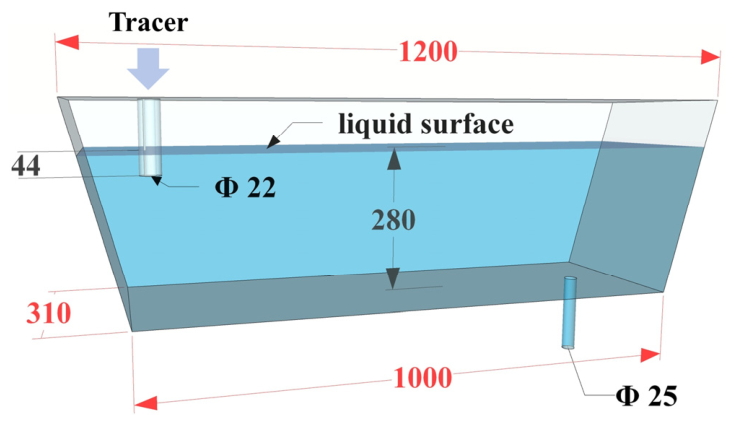
Figure 1. Schematic diagram of the bare single-strand tundish dimensions.
Processes 14 01897 g001
Figure 2. Transport photos of pure ink at 20 °C (scheme A1).
Processes 14 01897 g002
Figure 3. Transport photos of pure ink at 7 °C (scheme A2).
Processes 14 01897 g003
Figure 4. The overall transport schematics of pure ink at different experimental temperatures: (a) 20 °C (scheme A1), (b) 7 °C (scheme A2).
Processes 14 01897 g004
Figure 5. Transport photos of 35 mL ink salt solution mixture at 20 °C (scheme A3).
Processes 14 01897 g005
Figure 6. Transport photos of 55 mL salt solution tracer at 20 °C (scheme A4).
Processes 14 01897 g006
Figure 7. Transport photos of 150 mL ink salt solution mixture at 20 °C (scheme A5).
Processes 14 01897 g007
Figure 8. The overall transport schematics of different doses of salt solution tracer at 20 °C: (a) 35 mL salt solution tracer (scheme A3), (b) 55 mL salt solution tracer (scheme A4), (c) 150 mL salt solution tracer (scheme A5).
Processes 14 01897 g008
Figure 9. Transport photos of 35 mL salt solution tracer at 7 °C (scheme A6).
Processes 14 01897 g009
Figure 10. Transport photos of 55 mL salt solution tracer at 7 °C (scheme A7).
Processes 14 01897 g010
Figure 11. Transport photos of 150 mL salt solution tracer at 7 °C (scheme A8).
Processes 14 01897 g011
Figure 12. The overall transport schematics of different doses of salt solution tracer at 7 °C: (a) 35 mL salt solution tracer (scheme A6), (b) 55 mL salt solution tracer (scheme A7), (c) 150 mL salt solution tracer (scheme A8).
Processes 14 01897 g012
Figure 13. The transport path schematics of 15 mL pure ink at different experimental temperatures: (a) 20 °C (scheme A1), (b) 7 °C (scheme A2).
Processes 14 01897 g013
Figure 14. The transport path schematics of the salt solution tracer in schemes A3 to A8: (a) 35 mL salt solution tracer (scheme A3 and A6), (b) 55 mL salt solution tracer (scheme A4 and A7), (c) 150 mL salt solution tracer (scheme A5 and A8).
Processes 14 01897 g014
Figure 15. The RTD curves of the salt solution tracer at different experimental temperatures: (a) 10 mL salt solution tracer, (b) 35 mL salt solution tracer, (c) 55 mL salt solution tracer, (d) 150 mL salt solution tracer.
Processes 14 01897 g015
Figure 16. The outflow percentage curves of the salt solution tracer at different experimental temperatures: (a) 10 mL salt solution tracer, (b) 35 mL salt solution tracer, (c) 55 mL salt solution tracer, (d) 150 mL salt solution tracer.
Processes 14 01897 g016
Figure 17. Total outflow percentages of the salt solution tracer at 1500 s under different experimental temperatures.
Processes 14 01897 g017
Table 1. Maximum annual temperature difference in 2025 in the regions where different universities conducting tundish water model research are located [67,68].
UniversityCountryCityLatitude
and Longitude
Annual Maximum Temperature (°C)Annual Minimum Temperature (°C)Annual Maximum
Temperature
Difference (°C)
McGill UniversityCanadaMontréal45°30′32″ N, 73°33′15″ W35−2257
University of TorontoCanadaToronto43°39′9″ N, 79°22′54″ W36−1854
RWTH Aachen UniversityGermanyAachen50°46′32″ N, 6°5′1″ E38−846
KTH Royal Institute of TechnologySwedenStockholm59°19′46″ N, 18°4′7″ E30−1343
Indian Institute of TechnologyIndiaNew Delhi28°36′50.04″ N, 77°12′32.04″ E43637
Częstochowa University of TechnologyPolandCzęstochowa50°48′0″ N, 19°7′0″ E33−1548
Silesian University of TechnologyPolandGliwice50°17′39″ N, 18°39′57″ E33−1548
Instituto Politécnico NacionalMexicoCiudad de México19°26′0″ N, 99°8′0″ W32329
Morelia Institute of TechnologyMexicoMorelia19°46′6″ N, 101°11′22″ W34034
Universidad Nacional Autónoma de MéxicoMexicoMexico City19°26′0″ N, 99°8′0″ W32329
Aalto UniversityFinlandEspoo60°12′20″ N, 24°39′20″ E30−1747
VSB-Technical University of OstravaCzech RepublicOstrava49°50′8″ N, 18°17′33″ E34−1246
Northeastern UniversityChinaShenyang41°48′9″ N, 123°25′41″ E36−3066
University of Science and Technology BeijingChinaBeijing39°54′24″ N, 116°23′51″ E38−1452
Chongqing UniversityChinaChongqing29°33′49.32″ N, 106°33′1.44″ E41239
Shanghai UniversityChinaShanghai31°13′57″ N, 121°28′9″ E39−544
Central South UniversityChinaChangsha28°13′40.8″ N, 112°56′20.4″ E39−241
Wuhan University of Science and TechnologyChinaWuhan30°35′42″ N, 114°17′51″ E39−443
Inner Mongolia University of Science and TechnologyChinaBaotou40°37′16.68″ N, 109°57′11.52″ E33−2659
University of Science and Technology LiaoningChinaAnshan41°6′28.8″ N, 122°59′38.4″ E36−3066
Soochow UniversityChinaSuzhou31°18′0″ N, 120°37′10″ E39−544
Taiyuan University of TechnologyChinaTaiyuan37°52′13.44″ N, 112°32′58.92″ E38−1755
Jiangxi University of Science and TechnologyChinaGanzhou25°49′51.6″ N, 114°55′58.8″ E39−443
Anhui University of TechnologyChinaMa’anshan31°40′8.4″ N, 118°30′25.2″ E39−1049
Table 2. Physical properties of liquid steel and water at different temperatures [72,73,74].
Working Temperature (°C)Density (kg·m−3)Dynamic Viscosity (kg·m−3)Kinematic Viscosity (m2·s−1)Pr Number
liquid steel1873.157000.006.1 × 10−30.87 × 10⁻⁶ 
Water280.15999.931.35 × 10−31.45 × 10−610.77
288.15999.001.16 × 10−31.16 × 10−68.27
293.15998.201.00 × 10−31.01 × 10−67.02
298.15997.009.03 × 10−49.06 × 10−76.22
Table 3. Size parameters of the industrial prototype and water model [62].
ParametersWater ModelIndustrial Tundish
Volumetric flowrate nozzle (L/min)9.3224
Diameter of the outlet nozzle (mm)2589.25
Depth of liquid (mm)2801000
Diameter of the shroud (mm)2278.54
Immerse of shroud depth (mm)44157.08
Table 4. The scheme for the flow visualization experiments under different experimental temperature conditions.
SchemesWater
Temperature (°C)
Tracer
Temperature (°C)
The Types and Volumes of TracerTracer Density (kg/m3)
A1202015 mL pure ink1037
A2771077
A3202035 mL Saturated KCl solution+3.5 mL ink1116
A455 mL Saturated KCl solution+5.5 mL ink
A5150 mL Saturated KCl solution+15 mL ink
A67735 mL Saturated KCl solution+3.5 mL ink1166
A755 mL Saturated KCl solution+5.5 mL ink
A8150 mL Saturated KCl solution+15 mL ink
Table 5. The stimulus-response experimental scheme under different experimental temperature conditions.
The Types of TracerWater Temperature (°C)Tracer Temperature (°C)The Volumes of Tracer (mL)Tracer Density (kg/m3)
Saturated KCl solution202010, 35, 55, 1501119
7710, 35, 55, 1501168
Table 6. Characteristic parameters of the average RTD curves of the tracer at different experimental temperatures.
The Volumes of Saturated KCl Solution (mL)103555150
parametersTemperature (°C)
720720720720
Response time (s)3735242426222116
peak concentration time (s)21512213511194724843
peak concentration0.950.981.181.241.211.323.093.35
Mean residence time (s)521.33473.95438.09412.5423.38415.39338.86321.42
Dimensionless concentration at 1500 s0.0590.0340.0570.0160.0330.0300.0270.023
Disclaimer/Publisher’s Note: The statements, opinions and data contained in all publications are solely those of the individual author(s) and contributor(s) and not of MDPI and/or the editor(s). MDPI and/or the editor(s) disclaim responsibility for any injury to people or property resulting from any ideas, methods, instructions or products referred to in the content.