1. Introduction
Long horizontal wells are an important well type for improving single-well control, enlarging the contacted reservoir volume, and enhancing development performance in high-permeability reservoirs. Compared with vertical wells, long horizontal wells have a larger contact area with the reservoir, thereby reducing near-wellbore flow resistance and improving well productivity. However, in complex fault-block reservoirs, horizontal well trajectories often intersect or approach multiple faults. The coupling among the wellbore, faults, fault-block properties, and external boundaries can significantly complicate the pressure-transient response. For reservoirs with well-developed fault systems and complex structural compartmentalization, pressure and pressure–drawdown derivative curves are controlled not only by permeability, skin factor, wellbore storage, and effective producing length, but also by fault location, sealing capacity, transmissibility, and inter-block connectivity [
1,
2,
3].
Conventional pressure-transient analysis generally relies on type-curve diagnosis, pressure-derivative interpretation, and manual history matching to determine reservoir and wellbore parameters [
4,
5,
6]. The pressure–drawdown derivative curve can amplify the differences among flow regimes and boundary responses and has therefore long been used as a key diagnostic tool for identifying radial flow, linear flow, boundary-dominated behavior, and composite-flow characteristics in well-test interpretation. Recent monographs and studies have continued to emphasize the central role of pressure-derivative data in pressure-transient interpretation [
7,
8,
9]. However, when a long horizontal well intersects multiple faults, strong coupling among different parameters occurs. For example, reduced permeability, weakened fault transmissibility, variation in effective producing length, and changes in skin factor may all lead to similar derivative uplift, broadened transition periods, or distorted derivative plateaus, thereby resulting in pronounced non-uniqueness in conventional well-test interpretation.
With the development of machine-learning techniques, data-driven models have increasingly been applied to model identification and parameter estimation in pressure-transient analysis. Previous studies have shown that machine-learning models can use pressure-derivative signals to identify reservoir models and estimate parameters such as permeability and skin factor, thereby improving the efficiency of automated well-test interpretation [
10]. However, conventional data-driven models usually require a large number of training samples and lack explicit constraints from governing flow equations, wellbore boundary conditions, and fault-interface physics. When training samples are insufficient, testing cases fall outside the training distribution, or field data contains strong noise, the predicted results may become physically inconsistent. Therefore, for the well-test interpretation of long horizontal wells in complex fault-block reservoirs, purely data-driven models remain insufficient to ensure parameter interpretability and engineering reliability.
Physics-informed neural networks (PINNs) provide a promising approach for intelligent inversion of complex flow problems. The PINN framework proposed by Raissi et al. embeds partial differential equation residuals into the loss function, enabling a neural network to fit observational data while satisfying governing equation constraints; it can therefore be used for both forward modeling and inverse parameter identification [
11]. In reservoir engineering, several studies have attempted to apply PINNs to well-test analysis and pressure-diffusion problems by combining diffusion equation constraints with well-test data, thereby improving pressure-prediction capability under limited-sample conditions [
12,
13,
14,
15]. Other studies have integrated PINNs with well-test measurements to invert reservoir and wellbore parameters [
16,
17]. These studies indicate that PINNs have become an important research direction for intelligent well-test interpretation and reservoir-parameter inversion. In addition to classical pressure-transient analysis, recent studies have increasingly emphasized automated interpretation, uncertainty-aware inversion, and data-assisted reservoir characterization for horizontal wells and faulted reservoirs. For long horizontal wells, the pressure response may contain multiple flow regimes associated with early-time wellbore effects, horizontal-well linear flow, fault/boundary interaction, and late-time reservoir support. For faulted reservoirs, the pressure derivative is strongly affected by fault sealing capacity, cross-fault communication, fault distance, and the geometric relationship between the well trajectory and the fault system [
18]. These factors make the inverse problem highly coupled and non-unique, thereby motivating the development of inversion workflows that combine diagnostic pressure features with physical constraints.
Although PINNs and deep-learning methods have been explored in pressure-transient analysis, most existing studies have focused on simple well configurations, regular boundaries, single reservoir parameters, or general pressure–drawdown curve fitting. For long horizontal wells intersecting multiple faults in high-permeability complex fault-block reservoirs, pressure propagation is jointly controlled by multiple fault transmissibility coefficients, leading to stronger parameter coupling and more pronounced non-uniqueness in the pressure response. To date, specialized studies that simultaneously address long horizontal wells, multiple faults, joint inversion of multiple fault transmissibility coefficients, and pressure–drawdown/derivative constraints remain limited. Therefore, it is necessary to develop an intelligent inversion method that uses pressure–drawdown and derivative data, incorporates flow-physics constraints, and quantitatively identifies fault transmissibility [
19,
20,
21].
The objective of this study is to develop a PINN-based well-test parameter inversion method for long horizontal wells intersecting multiple faults, to jointly identify key parameters, including reservoir permeability, fault transmissibility coefficient, skin factor, and the effective producing length of the horizontal well. Compared with conventional manual well-test matching, the proposed method is designed to reduce the workload of trial-and-error parameter adjustment and improve the automation of parameter inversion under complex multiple-fault pressure responses. Compared with ordinary neural network models, the proposed method enhances the well-test interpretability and physical plausibility of the inversion results by incorporating pressure-derivative constraints and low-weight physics regularization. This study provides an interpretable intelligent inversion tool for dynamic characterization, fault connectivity evaluation, and subsequent development adjustment in complex fault-block reservoirs.
The novelty of this study lies in a well-test-oriented neural inversion workflow rather than in proposing a new neural network architecture. The workflow integrates pressure–drawdown data, pressure-derivative diagnostics, logarithmic parameter scaling, stage-wise optimization, and low-weight physics regularization to jointly identify permeability, fault transmissibility, skin factor, and effective producing length in long horizontal wells intersecting multiple faults. In addition, this study explicitly discusses the identifiability limitation of low-transmissibility fault combinations and clarifies the applicable role of physics residuals under a simplified forward model.
The main contributions of this study are as follows. First, a joint well-test parameter inversion framework is developed for long horizontal wells intersecting multiple faults. In this framework, fault sealing capacity and connectivity are represented by continuous fault transmissibility coefficients that can be inverted, and the identifiability of these coefficients under different fault combinations is further analyzed. Second, a combined pressure–drawdown and pressure–drawdown derivative constraint is introduced. The model, therefore, not only fits the overall trend of the pressure–drawdown curve, but also captures flow-regime transitions, boundary responses, and fault-related features contained in the pressure–drawdown derivative, thereby improving the relevance of the inversion to well-test interpretation. Third, because the simplified line-source forward model is not fully consistent with the two-dimensional pressure-diffusion equation and fault-interface residuals, a physics-loss consistency test is performed to determine safe weighting ranges for the PDE and fault-interface residuals. These residuals are then used as low-weight physics regularization terms during training to avoid parameter bias caused by overly strong physics constraints. Based on these components, the proposed method is systematically evaluated through a base case, different fault properties, multiple-fault combinations, noise-robustness tests, ablation experiments, and comparisons across multiple initialization methods, thereby assessing its effectiveness, stability, applicability, and limitations.
2. Well-Test Inversion Model for Long Horizontal Wells Intersecting Multiple Faults
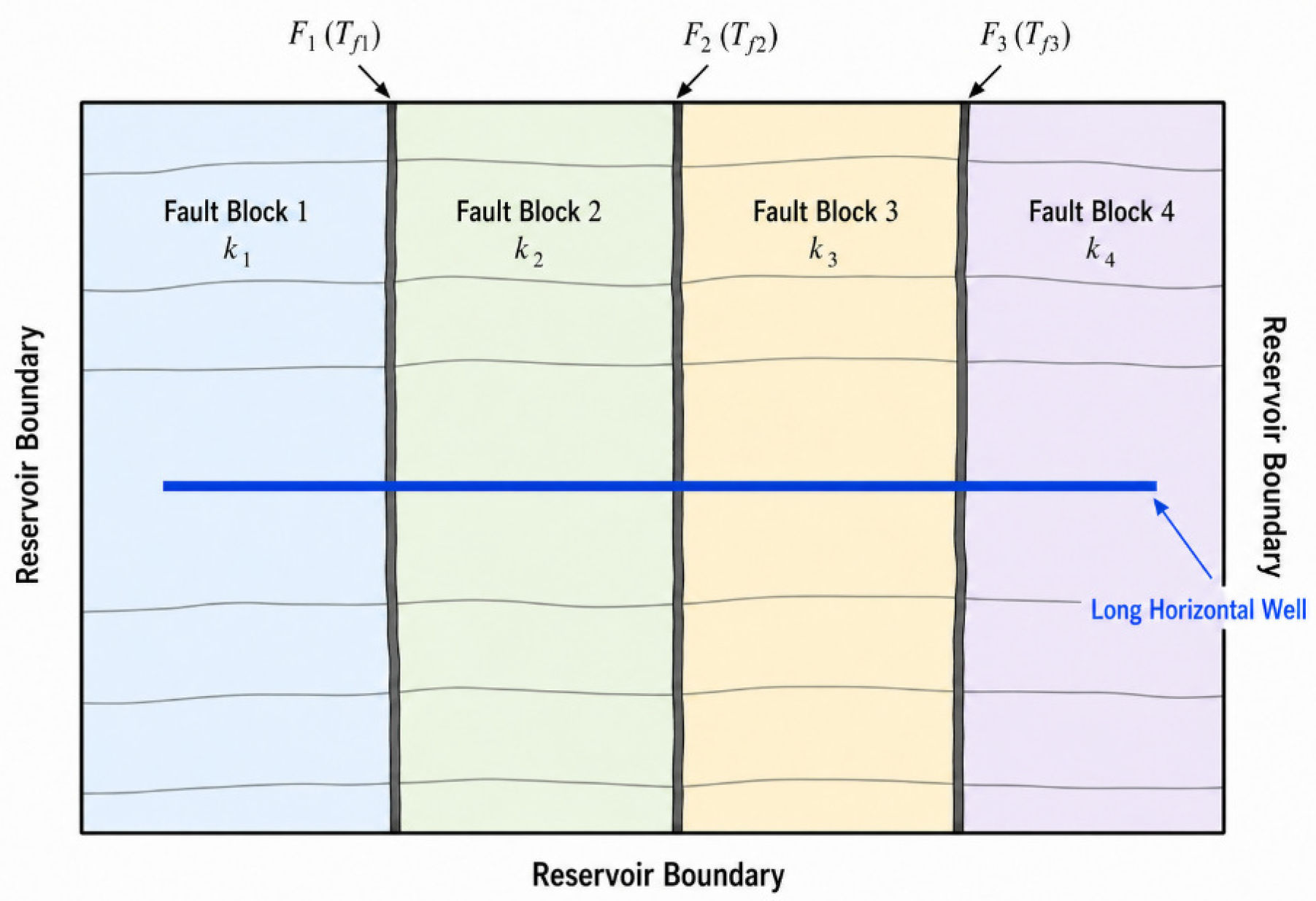
This study focuses on long horizontal wells intersecting multiple faults in high-permeability complex fault-block reservoirs. Owing to tectonic faulting, the reservoir is divided into several fault blocks, between which pressure communication and fluid connectivity may vary significantly. During production or injection from a long horizontal well, the bottom-hole pressure response is controlled not only by reservoir permeability, wellbore skin, and effective producing length, but also by fault transmissibility, the number of faults, and the spatial relationship between faults and the well trajectory. The physical model of a long horizontal well intersecting multiple faults is shown in
Figure 1. The reservoir is divided by multiple faults into several fault-block regions, and different blocks may have different permeability values. Pressure communication occurs across each fault with finite transmissibility. The long horizontal well can be represented as a segmented line source, and its bottom-hole pressure response is jointly controlled by reservoir permeability, the fault transmissibility coefficient, the skin factor, and the effective producing length. Therefore, the well-test interpretation problem for a long horizontal well intersecting multiple faults is formulated as a multi-parameter joint inversion problem, with emphasis on reservoir permeability, fault transmissibility coefficient, skin factor, and effective producing length.
Based on the physical model shown in
Figure 1, the sealing capacity and connectivity of different faults are uniformly characterized by the fault transmissibility coefficient
. When
is small, the fault behaves as a sealing fault or a strong baffle; when
is large, the fault behaves as a weak baffle or a leaking fault. Therefore, the well-test interpretation problem for a long horizontal well intersecting multiple faults can be transformed into a joint inversion problem for parameters such as
,
,
, and
[
22].
In this study,
is defined as a normalized equivalent fault transmissibility coefficient used to characterize the relative pressure-transfer capacity across a fault. To facilitate comparison among different fault properties, a normalized relative transmissibility parameter is adopted rather than directly inverting the actual fault permeability or fault width. Therefore, the value of
is mainly used to distinguish order-of-magnitude differences in fault connectivity. Specifically,
,
,
, and
represent typical sealing, strong-baffle, weak-baffle, and leaking fault states, respectively. In field applications,
can be regarded as an equivalent parameter jointly controlled by fault permeability, fault width, clay filling, and cross-fault connectivity. Its absolute value should therefore be interpreted in conjunction with the reservoir scale and geological information [
22,
23,
24].
In this study, should not be interpreted as a directly measured fault permeability or a unique geological property. Instead, it is an equivalent dynamic parameter that reflects the combined effect of fault-zone permeability, fault thickness or width, clay or shale filling, fracture development, juxtaposition relationship, and cross-fault pressure communication. A larger indicates stronger hydraulic communication across the fault, whereas a smaller indicates weaker cross-fault pressure transfer. Therefore, the normalized is mainly used for order-of-magnitude classification of fault connectivity in the inversion experiments. In field applications, its interpretation should be jointly constrained by geological fault interpretation, seismic information, well trajectory, and production or injection dynamics.
To highlight the pressure-transient response and parameter-inversion characteristics under multiple-fault conditions, a two-dimensional single-phase slightly compressible flow model is first established. Each fault block is assumed to be homogeneous and of uniform thickness, and finite pressure communication is allowed across fault interfaces. The fluid is assumed to be single-phase and slightly compressible, while gravity, capillary pressure, and oil–water two-phase flow are neglected. The horizontal well is modeled as a distributed line source, with the skin effect accounted for near the wellbore. The outer boundary can be specified as a closed boundary, a constant-pressure boundary, or an infinite-acting boundary, depending on the problem considered. This simplified model is mainly used to reveal the influence of multiple fault transmissibility on the pressure response of a long horizontal well and to provide synthetic samples and physical constraints for subsequent PINN-based inversion [
25].
Assume that the reservoir is divided by
faults into
fault-block regions, and the
-th fault block is denoted as
. Within the
-th block, the pressure-diffusion equation can be written as
where
where
is the reservoir pressure in the
-th fault block;
is time;
and
are spatial coordinates;
is the pressure diffusivity;
is the permeability of the
-th block;
is the porosity;
is the fluid viscosity; and
is the total compressibility. The initial condition is given by
where
is the initial reservoir pressure. For a closed outer boundary, the boundary condition is
For a constant-pressure outer boundary, the boundary condition is
where
denotes the outward normal direction of the boundary, and
is the external boundary pressure. The long horizontal well can be discretized into
line-source segments in the plane. If the length of the
-th segment is
, the effective producing length of the horizontal well is
Under constant-rate production, the total production rate of the horizontal well is the sum of the flow rates from all line-source segments:
The additional pressure drop caused by the skin effect is considered between the bottom-hole pressure and the near-wellbore reservoir pressure:
where
where
is the bottom-hole flowing pressure;
is the wellbore radius;
is the production rate;
is the reservoir thickness; and
is the skin factor. The skin factor mainly reflects near-wellbore damage or stimulation, whereas the effective producing length represents the actual horizontal section participating in flow. Both parameters affect early- and middle-time pressure-derivative responses and are therefore treated as key inversion parameters in this study.
The fault-interface condition is the core of the well-test inversion model for long horizontal wells intersecting multiple faults. Let the pressures on the two sides of the
-th fault be
and
, respectively. A pressure difference is allowed across the fault, and the cross-fault flow rate is controlled by the fault transmissibility coefficient
[
23]:
Correspondingly, the normal fluxes on both sides of the fault satisfy:
where
is the transmissibility coefficient of the
-th fault;
and
are the permeabilities of the fault blocks on the two sides of the fault; and
is the normal direction of the fault. A smaller fault transmissibility coefficient indicates that the fault behaves more like a sealing boundary. In contrast, a larger value indicates stronger pressure communication across the fault and a behavior closer to a leaking or connected fault. Therefore,
is used in this study to uniformly characterize fault sealing capacity and cross-fault conductivity, transforming geologically defined sealing, strong-baffle, weak-baffle, and leaking faults into continuous invertible parameters.
According to the magnitude of fault transmissibility, faults can be classified into several types. When , the fault can be approximated as a sealing fault. When is small, the fault behaves as a strong baffle. When is at an intermediate level, the fault behaves as a weak baffle. When is large, the fault behaves as a leaking fault. Compared with treating a fault as either a closed or connected boundary, using a continuous fault transmissibility coefficient provides a more flexible description of the transition from sealing to leaking behavior and is better suited to multi-fault joint inversion.
The set of parameters to be inverted in this study is defined as
where
denotes the permeability of each fault block,
denotes the transmissibility coefficient of each fault,
is the skin factor,
is the effective producing length of the horizontal well, and
is the wellbore storage coefficient. Considering the ill-posed nature of multi-parameter joint inversion, the wellbore storage coefficient
is treated as a known parameter or a weakly inverted parameter in the initial stage. The main inversion targets are
,
,
, and
. Among them,
is the key parameter of interest in this study, because it is used to quantitatively evaluate the sealing capacity and connectivity of different faults (
Table 1).
It should be noted that the synthetic samples in this study are generated using a simplified line-source well-response model. In contrast, the PDE residual and fault-interface residual introduced in the PINN are based on the two-dimensional pressure-diffusion equation and interface transmissibility relationship. At the present stage, these two components do not constitute a fully consistent, strongly coupled forward system. Therefore, the PDE residual and fault-interface residual are not used as dominant hard physics constraints in training. Instead, a physics-loss consistency test is conducted to determine safe weighting ranges, and these residuals are incorporated into the inversion as low-weight physics regularization terms. This treatment preserves useful flow-physics information while avoiding parameter bias caused by model inconsistency.
Table 1.
Parameters to be inverted and their physical meanings.
Table 1.
Parameters to be inverted and their physical meanings.
| Parameter | Physical Meaning | Main Influence on Pressure Response |
|---|
| Permeability of the -th fault block | Controls pressure-diffusion rate and derivative plateau level |
| Transmissibility coefficient of
the -th fault | Controls cross-fault pressure communication and inter-block connectivity |
| Skin factor | Controls early-time derivative hump and near-wellbore additional pressure drop |
| Effective producing length of the horizontal well | Controls the duration of horizontal-well linear flow and the contacted reservoir volume |
| Wellbore storage coefficient | Controls the early-time unit-slope segment |
3. PINN-Based Well-Test Parameter Inversion Method
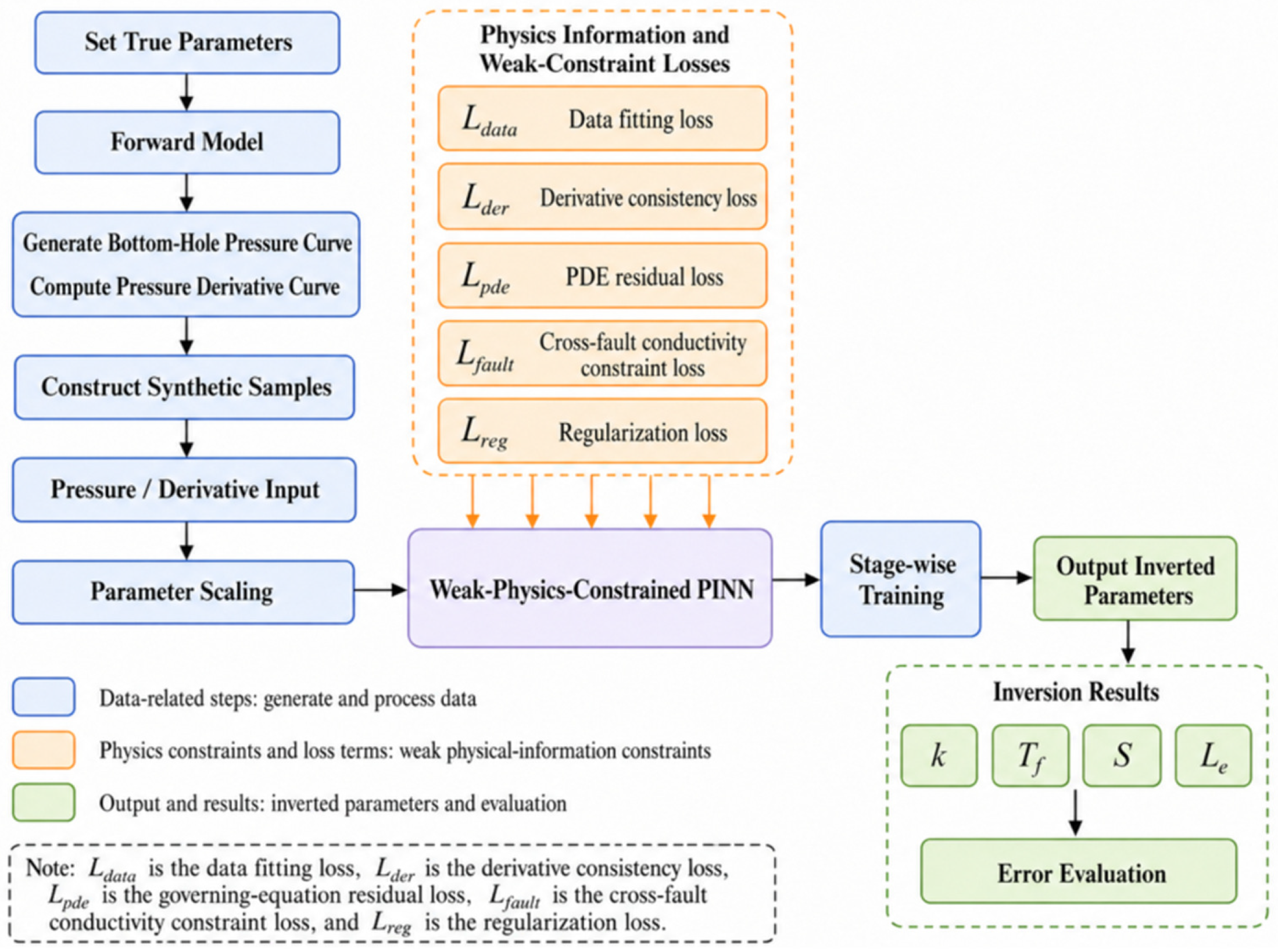
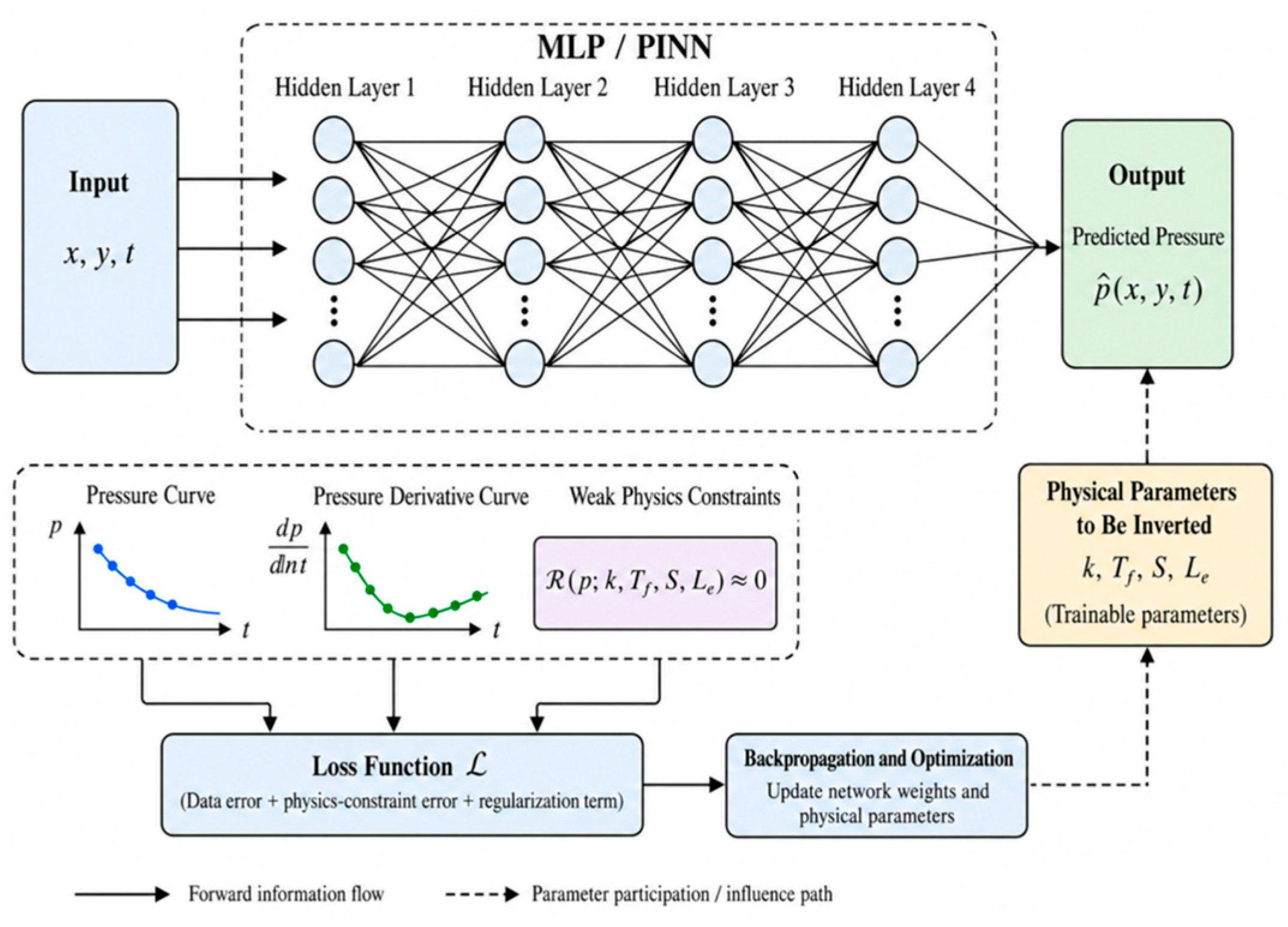
In this study, the well-test interpretation problem for long horizontal wells intersecting multiple faults is formulated as a neural network-based parameter-inversion problem with physics-based regularization. The overall workflow of the proposed PINN-based well-test inversion method is shown in
Figure 2. First, pressure and pressure-derivative data are generated using the forward model for a long horizontal well intersecting multiple faults. Then, a neural network is constructed with spatial coordinates and time as inputs and pressure as the output. During training, the pressure-data loss, pressure-derivative loss, PDE residual loss, fault-interface loss, and parameter regularization term are all incorporated simultaneously. Finally, reservoir permeability, fault transmissibility coefficient, skin factor, and effective producing length of the horizontal well are inverted through joint optimization of the neural network weights and physical parameters.
It should be emphasized that the proposed method is formulated as a physics-regularized neural inversion framework rather than a fully physics-consistent PINN solver for the complete reservoir flow problem. In the present workflow, the pressure–drawdown and pressure-derivative data provide the primary inversion constraints. The PDE residual and fault-interface residual are used only as auxiliary low-weight regularization terms to improve physical plausibility. This design is adopted because the simplified line-source response model used for synthetic data generation is not fully identical to the two-dimensional pressure-diffusion equation and fault-interface residuals used in the PINN loss. Therefore, the physics losses are introduced to guide the inversion and reduce physically unreasonable solutions, but they are not enforced as hard constraints for a fully coupled forward model.
Unlike conventional data-driven neural networks, the proposed method does not merely aim to fit pressure–drawdown curves. Instead, well-test data, pressure-derivative features, parameter scaling, and low-weight physics regularization are incorporated into the inversion process. It should be noted that the PDE residual and fault-interface residual used in this study primarily provide regularized information on pressure diffusion and fault transmissibility and are not used as dominant hard constraints in a fully consistent forward model.
Based on this idea, the manual parameter-adjustment process in conventional well-test interpretation is transformed into a joint optimization problem involving neural network weights and physical parameters. In traditional well-test interpretation, permeability, skin factor, wellbore storage coefficient, effective producing length, and fault-boundary parameters are manually adjusted until the theoretical pressure and pressure-derivative curves match the observed curves. This process strongly depends on the initial model and the experience with interpretation. Under complex multiple-fault conditions, several different parameter combinations may fit the pressure curves similarly well. To reduce manual trial-and-error work and improve inversion stability, the proposed PINN inversion framework jointly uses the pressure–drawdown curve, the pressure–drawdown derivative curve, parameter regularization, and low-weight physics residuals during network training. The basic form of the PINN is a neural network that takes spatial coordinates and time as inputs and outputs pressure:
where
is the pressure predicted by the network, and
denotes the neural-network weights. Unlike ordinary neural networks, which optimize only network weights, the proposed method treats the physical parameter set Θ as trainable variables. Thus, the training process simultaneously accomplishes pressure–drawdown curve fitting and physical-parameter identification:
where
is the total loss function. The network input is
, and the output is the predicted pressure field
. The bottom-hole pressure can be obtained from the predicted pressure at the wellbore location, together with a wellbore response operator:
where
denotes the wellbore pressure-response operator, which accounts for the effects of the equivalent horizontal-well line source, skin effect, and wellbore storage on bottom-hole pressure. The network architecture and input–output relationship are shown in
Figure 3. In this study, an MLP-based PINN is adopted. The normalized spatial coordinates
and logarithmic time
are used as inputs, and the pressure
is used as the output. Meanwhile, permeability
, fault transmissibility coefficient
, skin factor
, and effective producing length
are treated as trainable physical parameters and optimized together with the network weights.
To improve training stability, parameter scaling is applied to parameters that vary across orders of magnitude. Permeability, fault transmissibility coefficient, and effective producing length are all positive parameters. Among them, the fault transmissibility coefficient
may span several orders of magnitude. If it is directly used as a trainable variable, the optimization process may become unstable. Therefore, these parameters are transformed into logarithmic variables for training:
After training, the transformed variables are converted back to the corresponding physical parameters:
The skin factor can be directly used as a trainable variable or constrained within a reasonable range through a bounded mapping. Parameter scaling reduces gradient imbalance among parameters with different magnitudes and is a key step for improving the inversion stability of .
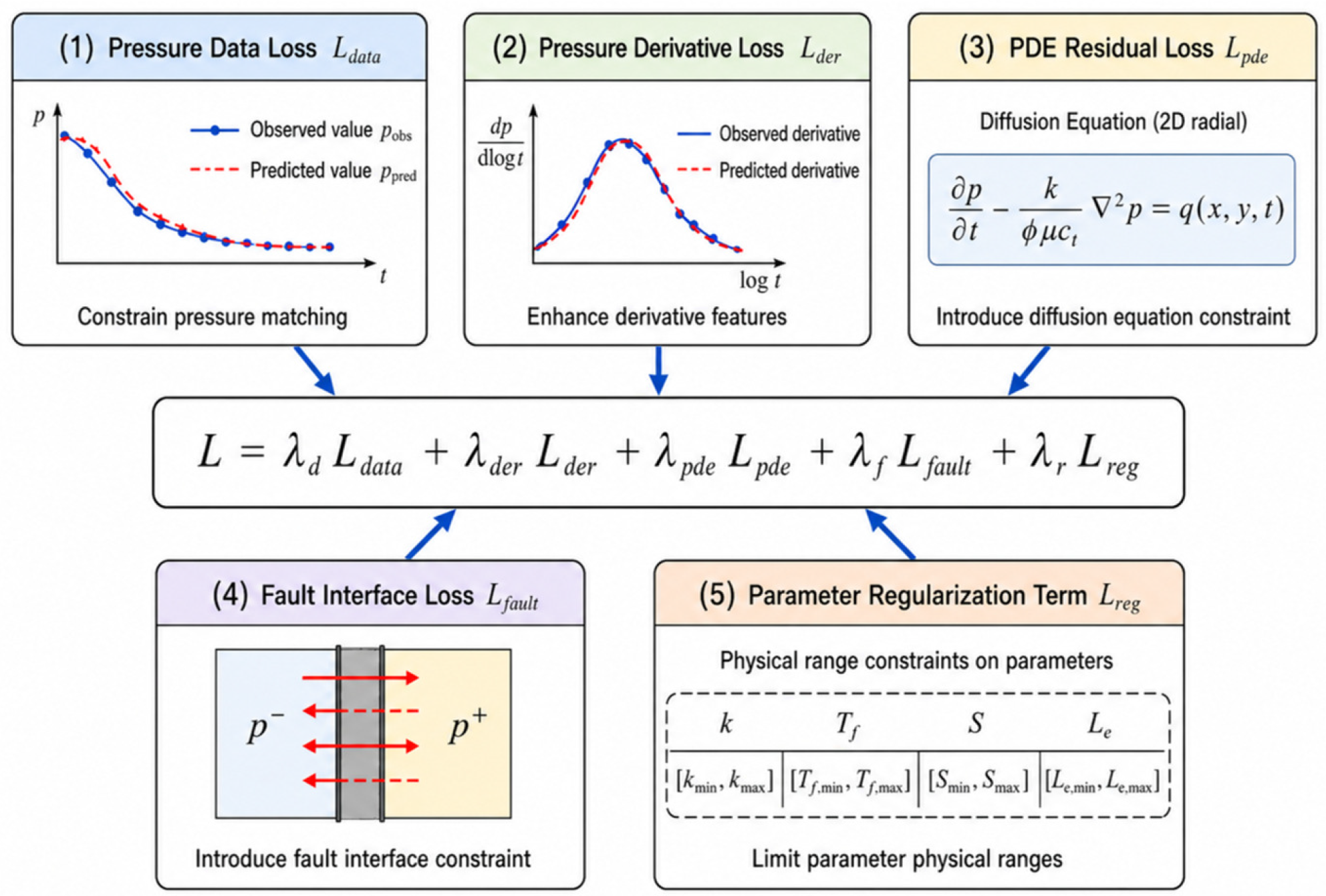
The total loss function consists of the pressure-data loss, pressure-derivative loss, PDE residual loss, fault-interface loss, and parameter regularization term:
where
is the pressure-data fitting loss,
is the pressure–drawdown derivative fitting loss,
is the residual loss of the pressure-diffusion equation,
is the fault-interface transmissibility residual loss, and
is the physical-range regularization term for the parameters. The coefficients
,
,
,
, and
are the weights of the corresponding loss terms.
To illustrate the relationship among different loss terms, the composition of the loss function in the proposed PINN framework is shown in
Figure 4. The pressure-data loss and pressure-derivative loss are used to fit the bottom-hole pressure response and derivative features. The PDE residual and fault-interface residual provide regularized information on pressure diffusion and fault transmissibility, while the parameter regularization term constrains the inverted parameters within physically reasonable ranges.
The pressure-data loss constrains the mismatch between the predicted bottom-hole pressure and the observed bottom-hole pressure:
where
is the observed bottom-hole pressure at the
-th time point,
is the predicted bottom-hole pressure, and
is the number of observation points.
The pressure derivative is an important basis for identifying flow regimes, boundary responses, and fault effects in well-test interpretation. Relying only on pressure–drawdown curve fitting may produce a good pressure match but distorted derivative features, which can affect fault-property identification and parameter interpretation. Therefore, a pressure-derivative loss is introduced: [
26]
This term enhances the fitting of diagnostic well-test features such as derivative plateaus, inflection points, transition periods, and late-time boundary responses. As a result, the model not only fits the overall pressure–drawdown curve but also captures local derivative features that are more sensitive to fault responses.
The PDE residual loss is used to constrain the predicted pressure field to satisfy the pressure-diffusion equation. Collocation points
are sampled inside the computational domain, and the residual of the pressure-diffusion equation can be written as
The corresponding loss term is defined as
where
is the number of collocation points inside the computational domain. Automatic differentiation is used to calculate the derivatives of the network-predicted pressure with respect to time and spatial coordinates, thereby constructing the pressure-diffusion residual [
27].
The fault-interface loss constrains the pressure-transmission relationship across each fault. For collocation points sampled on a fault interface, let the predicted pressures on the two sides of the fault be
and
, respectively. The residuals on the two sides of the fault are then expressed as
The fault-interface loss is defined as
This term enables the network training process to account for the fault-transmission relationship and provides a regularization constraint on the fault transmissibility coefficient during inversion. Because the synthetic forward model and the two-dimensional PDE/fault residuals are not fully consistent, large weights are not assigned to these physics constraints. Instead, safe weights are determined through consistency tests, and
and
are used as low-weight regularization terms in physics. This strategy introduces physical prior information while preventing inconsistent physics residuals from dominating the training process. The parameter regularization term constrains the inverted parameters within physically reasonable ranges:
where
denotes any parameter to be inverted, and
and
are the lower and upper physical bounds of that parameter, respectively. This term prevents negative permeability, abnormal skin factors, or physically unreasonable fault transmissibility coefficients during inversion.
Because well-test inversion for long horizontal wells intersecting multiple faults involves strong parameter coupling, a stage-wise training strategy is adopted. First, the physical parameters are fixed, and only the network weights are trained, to examine the network’s ability to represent pressure and pressure–drawdown derivative curves. Then, permeability, skin factor, fault transmissibility coefficient, and effective producing length are gradually released to evaluate the stability of single-parameter and multi-parameter inversion. Finally, multi-parameter joint inversion is performed under the combined effects of parameter scaling, pressure–drawdown/derivative constraints, and physics regularization. For optimization, the Adam optimizer is first used for initial training, followed by LBFGS for local refinement to improve final convergence accuracy.
As shown above, the proposed method does not simply use a neural network to fit the pressure–drawdown curve. Instead, it integrates pressure data, derivative features, parameter scaling, stage-wise training, and physics regularization into a parameter inversion framework for well-test interpretation of long horizontal wells intersecting multiple faults. This framework retains neural networks’ ability to approximate complex nonlinear mappings while enhancing the interpretability of the inversion results through derivative features and physics-based regularization.
4. Synthetic Sample Construction and Experimental Design
To evaluate the applicability of the proposed PINN method for well-test parameter inversion in long horizontal wells intersecting multiple faults, synthetic pressure-response data are generated using the forward model. Based on these data, a series of experiments is conducted, including a base case, different fault types, multiple-fault combinations, noise-robustness tests, ablation experiments, and method comparisons. The synthetic samples mainly include bottom-hole pressure response, pressure–drawdown curves, and pressure–drawdown derivative curves. The inversion targets are the reservoir permeability
, fault transmissibility coefficient
, skin factor
, and effective producing length
of the horizontal well. To avoid sign ambiguity caused by decreasing bottom-hole pressure during production, pressure response is represented in terms of pressure–drawdown in all figures and error evaluations:
where
is the initial reservoir pressure, and
is the bottom-hole flowing pressure. The corresponding pressure–drawdown derivative is defined as
Using pressure–drawdown and pressure–drawdown derivative ensures a positive drawdown response during production and facilitates comparison with conventional pressure-derivative diagnostic plots in pressure-transient analysis. In the numerical implementation, the pressure–drawdown derivative is calculated on the logarithmic time scale, i.e., , using the discrete pressure–drawdown sequence. It should be noted that the drawdown derivative is not an independent observation, but a diagnostic feature derived from the pressure–drawdown data. Its role is to enhance local well-test characteristics such as flow-regime transitions, boundary responses, and fault-related effects. Therefore, the derivative term is used as a diagnostic constraint derived from the pressure data, rather than as an additional independent measurement. Under noisy conditions, numerical differentiation may amplify local pressure fluctuations; therefore, derivative errors and the resulting parameter deviations serve as important indicators of the method’s applicability limits.
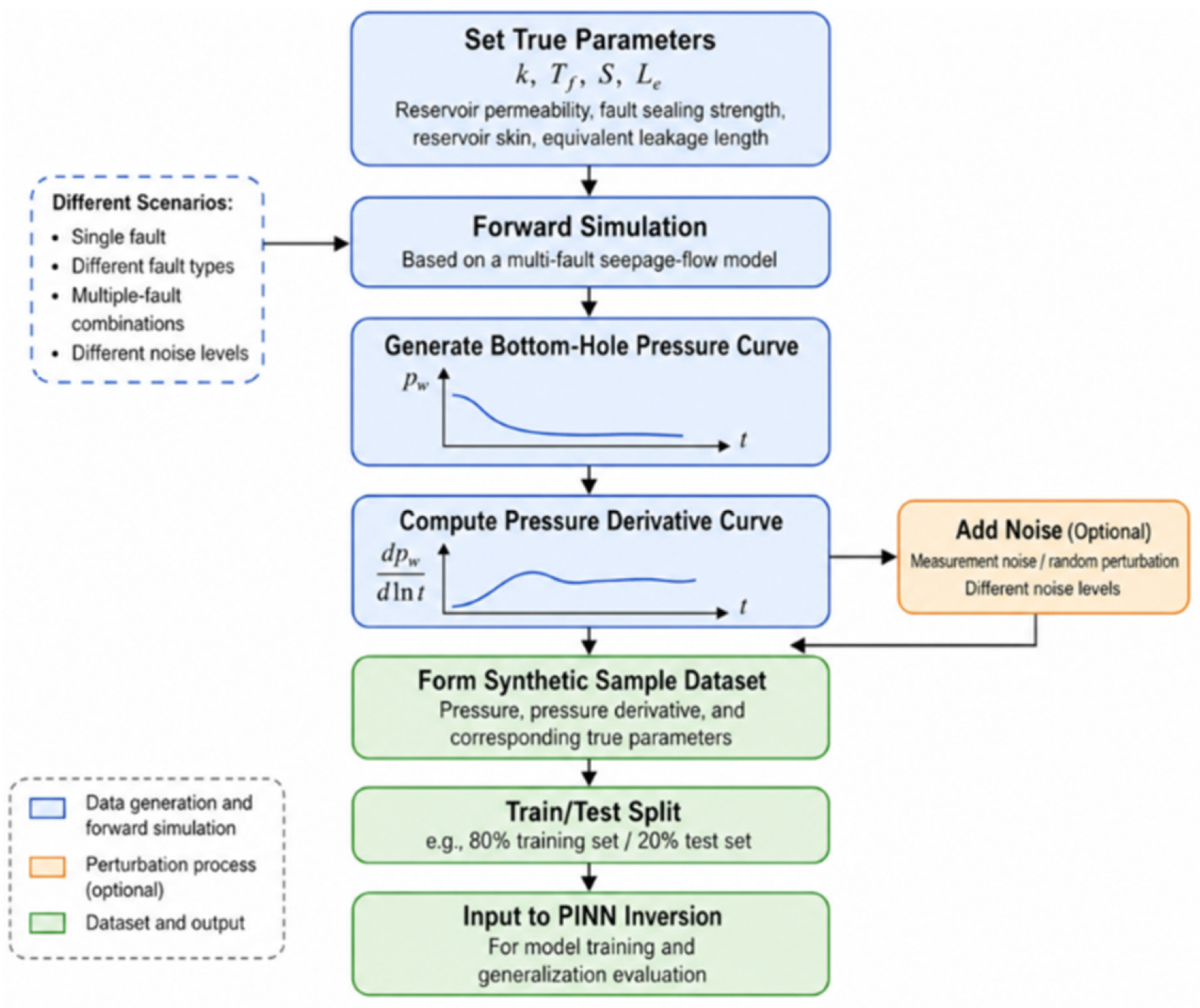
The synthetic-sample generation workflow is shown in
Figure 5. First, forward cases for long horizontal wells intersecting multiple faults are constructed using prescribed reservoir, wellbore, and fault transmissibility parameters. Then, the corresponding bottom-hole pressure response is calculated, and the pressure–drawdown derivative curve is further obtained. Finally, time, pressure–drawdown, pressure–drawdown derivative, and the true physical parameters are combined to form inversion samples for the subsequent base-case, fault-property, multiple-fault, noise-robustness, and ablation experiments.
Through the above workflow, the accuracy of the inversion results can be systematically evaluated under known true-parameter conditions. The synthetic samples are used not only to assess the model’s ability to fit pressure–drawdown and pressure–drawdown derivative curves, but also to analyze the identifiability of key parameters under different fault transmissibility levels, multiple-fault combinations, and noise levels. The forward calculation is based on a simplified long-horizontal-well pressure-response model under high-permeability reservoir conditions. Logarithmic time sampling is adopted to ensure sufficient data points for the early-time near-wellbore response, the middle-time horizontal-well linear flow, and the late-time fault/boundary response. For each synthetic case, the true physical parameters are first specified, after which the corresponding bottom-hole pressure response and pressure–drawdown derivative curve are calculated. The generated synthetic data are used as input for PINN-based inversion, and the true parameters are used as references for evaluating inversion accuracy.
The synthetic cases were constructed using a controlled scenario-based sampling strategy rather than a large supervised-learning dataset. The purpose of the synthetic data was to evaluate the identifiability and inversion stability of key parameters under representative fault-connectivity conditions. For the base case, a representative weak-baffle single-fault scenario was selected. For the single-fault tests, four representative values of were used to describe sealing, strong-baffle, weak-baffle, and leaking fault states. For the multiple-fault tests, several combinations of these transmissibility levels were constructed to evaluate both identifiable cases and low-identifiability cases. Therefore, the synthetic data were designed for controlled inversion evaluation, sensitivity analysis, and method comparison rather than for training a general supervised prediction model.
The parameter ranges in
Table 2 were selected according to the target high-permeability fault-block reservoir conditions and the engineering scale of long horizontal wells. Permeability was assigned a value of 500–3000 mD to represent high-permeability reservoirs. Porosity was assigned to the 0.20–0.30 range to represent typical porous reservoir conditions in the simplified single-phase model. The normalized fault transmissibility coefficient was varied from
to
on a logarithmic scale to cover the transition from sealing to leaking fault behavior. The skin factor range of −3 to 20 was used to include stimulated, normal, and damaged near-wellbore conditions. The effective producing length range of 200–1000 m represents the possible contributing length of long horizontal wells. The wellbore storage coefficient was fixed or weakly perturbed to reduce the ill-posedness of multi-parameter joint inversion.
The parameter ranges used in this study are listed in
Table 2. The reservoir permeability range covers typical high-permeability reservoir conditions. The fault transmissibility coefficient varies on a logarithmic scale to represent different connectivity states, including sealing, strong-baffle, weak-baffle, and leaking faults. The skin factor characterizes near-wellbore damage or stimulation, whereas the effective producing length represents the actual horizontal section participating in flow. In the initial stage of this study, the wellbore storage coefficient is treated as a known parameter or a weakly inverted parameter to reduce the ill-posedness of multi-parameter joint inversion.
To ensure the stability and reproducibility of the inversion results, a unified PINN training configuration is adopted. The neural network uses an MLP-based residual architecture with four hidden layers, each containing 48 neurons, and the activation function is . The network inputs are the spatial coordinates and time , where time is represented in logarithmic form. The network output is the predicted pressure or the corresponding bottom-hole pressure response. Before training, the input variables are normalized: are mapped approximately to , and is normalized as . Pressure and pressure-derivative data are standardized separately in the loss function to reduce the influence of differences in dimensionality and magnitude on training. The time range is –, with 120 logarithmically spaced sampling points.
During training, an optimization strategy combining Adam and LBFGS is used. Adam is first applied for initial training with a learning rate of . The standard experiments are usually trained for 3000 Adam steps, whereas the multiple-fault combination experiments are trained for 2200 Adam steps. LBFGS is then used for local refinement, with 500 iterations for the standard experiments and 300 iterations for the multiple-fault experiments. To reduce compensation effects arising from the simultaneous optimization of multiple parameters, a stage-wise training strategy is adopted. The physical parameters are first fixed, and only the network weights are trained. Then, permeability , skin factor , and fault transmissibility coefficient , and effective producing length are gradually released, followed by full-parameter joint inversion. This strategy helps improve the convergence stability of multi-parameter inversion.
The loss function consists of the pressure-data loss, pressure-derivative loss, PDE residual loss, fault-interface loss, and parameter regularization term. The corresponding weights are set to , , , , and . The number of internal PDE collocation points is 256, the number of fault-interface points is 96, and the number of boundary-condition and initial-condition points is 96. In the main configuration, boundary-condition and initial-condition losses are not activated, i.e., and . Because the synthetic forward model is not fully consistent with the two-dimensional PDE/fault residuals, the PDE residual and fault-interface residual are not normalized and are included as low-weight physics regularization terms. This avoids dominance of the inversion process by overly strong physics constraints and reduces parameter bias.
To invert the physical parameters, parameter scaling is used to improve optimization stability. Permeability is optimized in the form of and recovered after training by . The fault transmissibility coefficient is optimized in the form of and recovered by . The effective producing length is optimized in the form of and recovered by . The skin factor is constrained within through a sigmoid mapping. In the formal experiments, each case is repeated with at least three random seeds, and the mean and standard deviation of the inversion results are reported to evaluate model stability. The model is implemented using Python 3.12 and PyTorch 2.11.0, and the computing device is automatically selected from the available PyTorch devices.
To improve reproducibility, the main hyperparameters used in the formal experiments are reported in this section, including the network architecture, optimizer settings, loss weights, collocation-point numbers, parameter transformations, and training iterations. All synthetic cases were generated using the same forward-model implementation under the parameter ranges listed in
Table 2, and repeated runs were performed using independent random initializations. The loss definitions, parameter-scaling strategy, training stages, evaluation metrics, and experimental settings are provided to support independent reproduction and verification of the main synthetic experiments.
It should be noted that the term “training” in this study refers to the inversion optimization process for a single well-test case, rather than cross-sample training in the sense of supervised learning. For different cases, the network weights and physical parameters are initialized separately and optimized independently. The repeated random-seed experiments are used mainly to evaluate the influence of network initialization and optimization randomness on the inversion results. Therefore, the proposed method is closer to case-by-case well-test inversion based on a neural network parameterization than to a supervised surrogate model that can be directly generalized to all cases.
A base-case inversion experiment is first conducted to verify the effectiveness of the network architecture, parameter scaling, and stage-wise training strategy. The base case is a single-fault weak-baffle model, and the true parameters include permeability, fault transmissibility coefficient, skin factor, and the effective producing length of the horizontal well. The training process is divided into multiple stages. First, the physical parameters are fixed, and only the network weights are trained to test the network’s ability to represent pressure and pressure–drawdown derivative curves. Then, , , , and are gradually released, followed by multi-parameter joint inversion. This experiment is used to determine whether the proposed inversion framework can stably identify key parameters under a relatively simple fault condition.
Based on the base-case verification, experiments with different fault types are further designed. According to the magnitude of the transmissibility coefficient, faults are classified as sealing, strong-baffle, weak-baffle, and leaking faults, corresponding to , , , and , respectively. This group of experiments is used to evaluate the proposed method’s ability to identify different fault-connectivity states and to analyze the identifiability differences between low-transmissibility faults and medium- to high-transmissibility faults.
To further represent the multiple-fault long-horizontal-well scenario, multiple-fault combination experiments are designed. In these cases, the transmissibility coefficient of each fault is treated as an independent parameter in the forward and inversion models. The main combinations include strong-baffle + weak-baffle, weak-baffle + leaking, strong-baffle + weak-baffle + leaking, sealing + strong-baffle, and sealing + weak-baffle + leaking faults. The purpose of this experiment is not only to verify the pressure–drawdown curve fitting capability, but also to investigate the identifiability and ambiguity characteristics when multiple fault transmissibility coefficients are inverted simultaneously. To confirm that the multiple-fault parameters indeed affect the pressure response, a sensitivity check is performed before formal inversion by perturbing each fault transmissibility coefficient and observing changes in the pressure–drawdown derivative curve.
Field well-test data are often affected by testing procedures, measurement errors, and the methods used to calculate derivatives. The pressure–drawdown derivative curve is particularly sensitive to noise. To evaluate the stability of the proposed method under different data-quality conditions, random noise with different levels is added to the synthetic pressure data:
where
The noise levels are set to 0%, 1%, 3%, and 5%. Parameter inversion is performed separately under each noise level, and the inversion errors of permeability, fault transmissibility coefficient, skin factor, and effective producing length are recorded, together with the pressure–drawdown and pressure–drawdown derivative fitting errors. This experiment is used to assess the applicability limits of the proposed method under low- and relatively high-noise conditions.
To analyze the contribution of each methodological component to the inversion results, ablation experiments are conducted. The pressure-derivative loss, parameter scaling, stage-wise training strategy, and physics regularization term are progressively added, and the differences in parameter-inversion accuracy and curve-fitting performance among different models are compared. The pressure-only loss model is used to examine the limitation of fitting only the pressure–drawdown curve. The model with pressure-derivative loss is used to evaluate the contribution of derivative features to well-test parameter identification. The models with parameter scaling and stage-wise training are used to examine the effect of optimization strategies on multi-parameter inversion stability. The complete model is used to evaluate the improvement in identifying fault transmissibility coefficients provided by physics regularization.
To further evaluate the relative advantages of the proposed method, the PINN-based inversion method is compared with a traditional least-squares fitting method and an ordinary neural network model. The traditional least-squares method adjusts physical parameters to match theoretical curves to synthetic curves and represents a conventional well-test history-matching approach. The ordinary MLP model is used mainly as a pressure-response fitting model. It does not explicitly include governing flow equations, pressure-derivative constraints, or fault-interface transmissibility relationships, and is therefore used to represent purely data-driven pressure–drawdown fitting. In contrast, the proposed PINN method uses pressure–drawdown data, pressure–drawdown derivative data, parameter scaling, stage-wise training, and low-weight physics regularization simultaneously for inversion. The comparison metrics include pressure–drawdown fitting error, pressure–drawdown derivative fitting error, key-parameter inversion error, and fault transmissibility identification stability.
The inversion performance is evaluated using the following metrics. For permeability, skin factor, and effective producing length, the relative error is used:
where
is the true parameter value, and
is the inverted value. Because the fault transmissibility coefficient spans several orders of magnitude, a logarithmic error is used to evaluate its inversion accuracy:
The fitting errors of pressure–drawdown and pressure–drawdown derivative are evaluated using the root-mean-square error (RMSE) and normalized root-mean-square error (NRMSE). The RMSE of pressure–drawdown is defined as
The RMSE of the pressure–drawdown derivative is defined as
To facilitate comparison among different cases, the normalized errors are further defined as
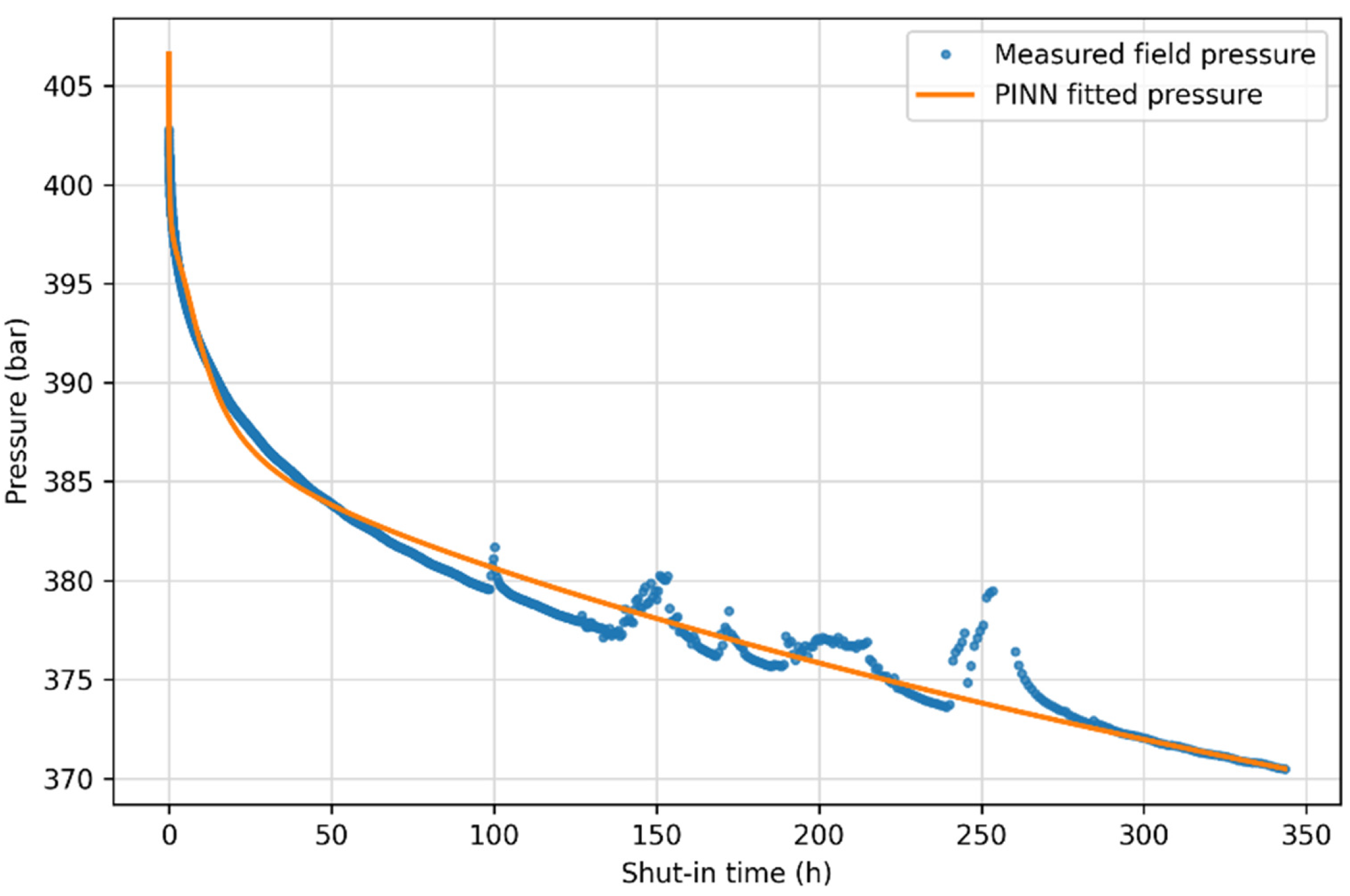
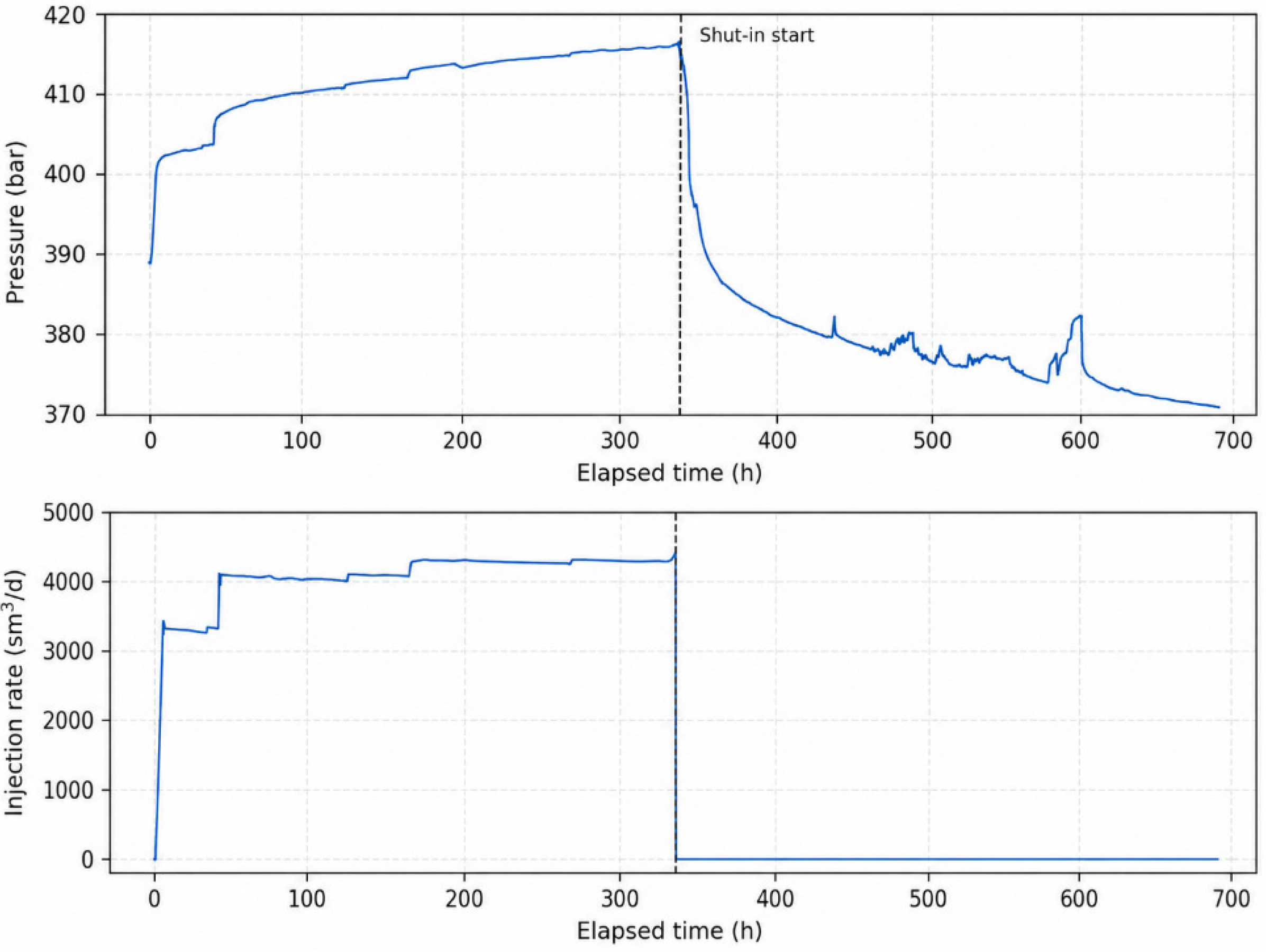
Using the above experimental design, the proposed PINN method is systematically evaluated for base-case inversion capability, fault-property identification, multiple-fault joint inversion, noise robustness, module contribution, and method comparison, thereby assessing its effectiveness and applicability limits under controlled synthetic conditions. In addition, a preliminary reduced-field PINN fitting test is conducted using a pressure falloff event from well X in a high-permeability fault-block reservoir to examine the applicability of the workflow to real, variable-rate pressure-transient data.
5. Inversion Results and Analysis for Synthetic Cases
To evaluate the applicability of the proposed PINN method for well-test parameter inversion in long horizontal wells intersecting multiple faults, inversion experiments are conducted sequentially for the base case, different fault types, and multiple-fault combination cases. The base case is used to verify the model’s ability to invert the pressure–drawdown response and key parameters under a single weak-baffle fault condition. The different-fault-type experiments are used to analyze the identifiability of the fault transmissibility coefficient under sealing, strong-baffle, weak-baffle, and leaking fault states. The multiple-fault combination experiments are used to examine the stability and non-uniqueness characteristics of simultaneous inversion of multiple fault transmissibility coefficients.
5.1. Inversion Results for the Base Case
The base case adopts a single-fault weak-baffle model. The true parameters are set as permeability mD, fault transmissibility coefficient , skin factor , and effective producing length m. This case is used to verify whether parameter scaling, the combined pressure–drawdown and pressure–drawdown derivative constraints, and the stage-wise training strategy can support stable multi-parameter inversion.
Stage-wise training is used for the base case. First, the physical parameters are fixed, and only the network weights are trained to evaluate the neural network’s ability to represent the pressure and pressure–drawdown derivative curves. Then, , , , and are gradually released, followed by multi-parameter joint inversion. The stage-wise training results show that when the true physical parameters are fixed, the network can accurately reconstruct the pressure and pressure–drawdown derivative curves, indicating that the model has sufficient representational capacity for well-test curve fitting. As the parameters are gradually released, the inversion errors remain low, suggesting that parameter scaling and stage-wise training can effectively mitigate compensation effects arising from the simultaneous optimization of multiple parameters.
The inversion results for the base case are listed in
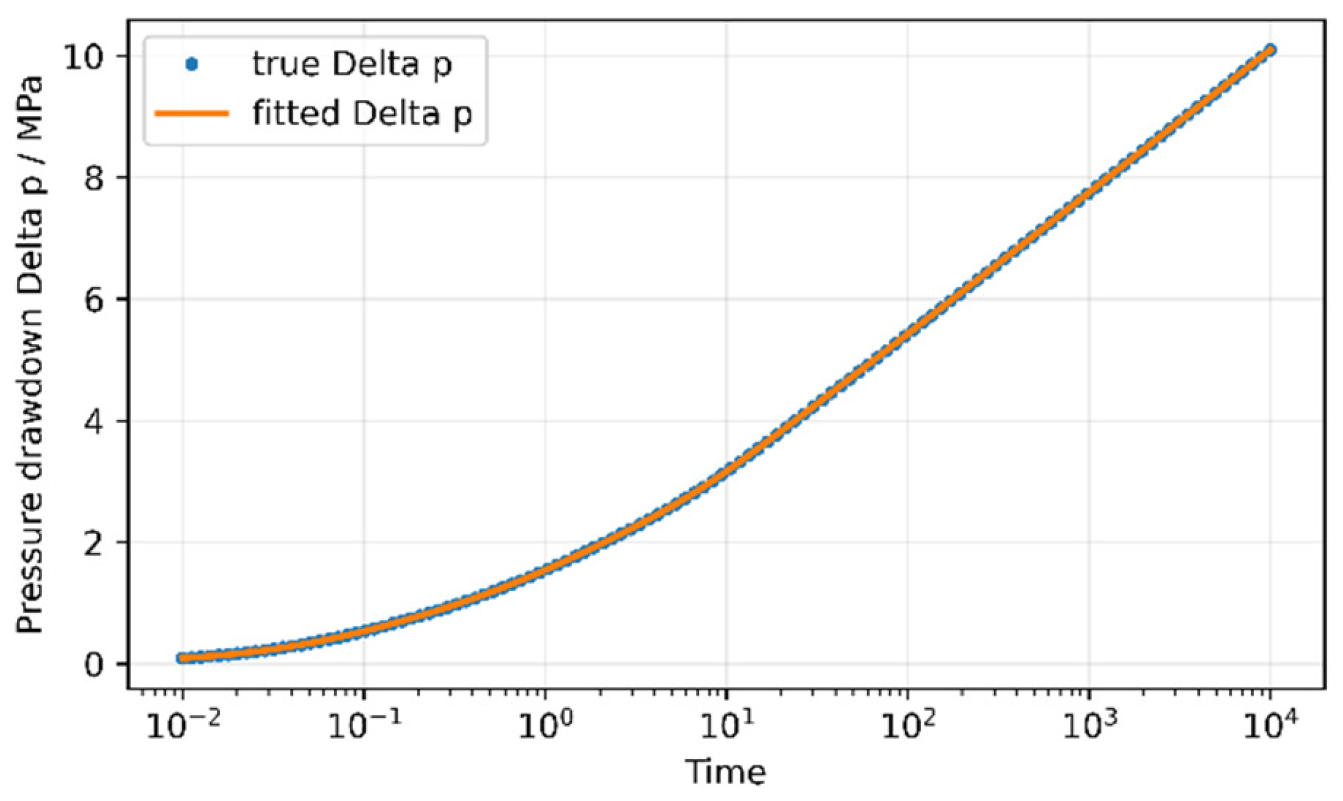
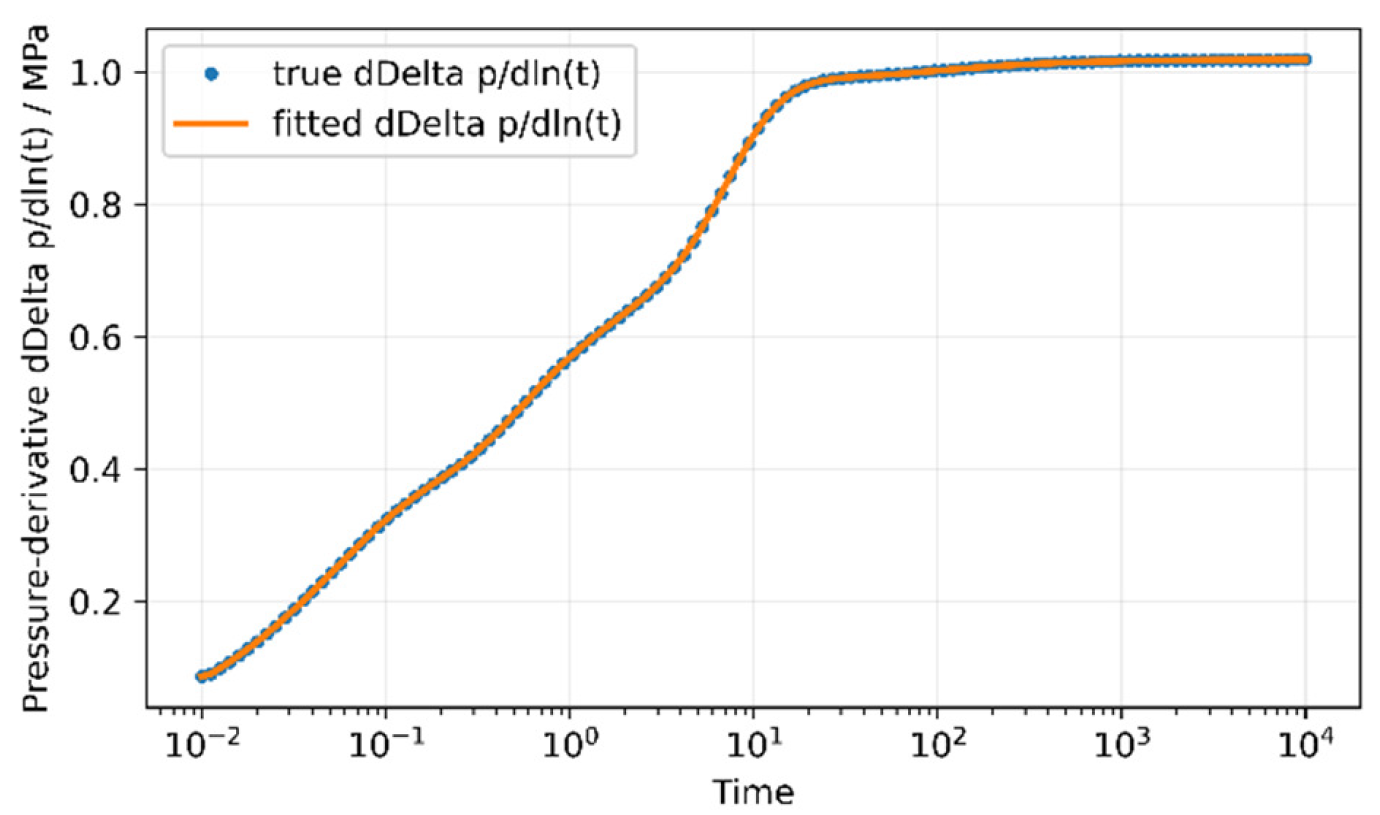
Table 3. For three repeated runs, the average pressure–drawdown NRMSE is 0.000166%, and the average pressure–drawdown derivative NRMSE is 0.000617%. The relative errors of permeability, skin factor, and effective producing length are 1.412%, 0.015%, and 0.712%, respectively, and the logarithmic error of the fault transmissibility coefficient is 0.000151. These results indicate that, under the single-fault weak-baffle condition, the proposed PINN method can accurately fit the pressure–drawdown and pressure–drawdown derivative responses and stably identify the key well-test parameters.
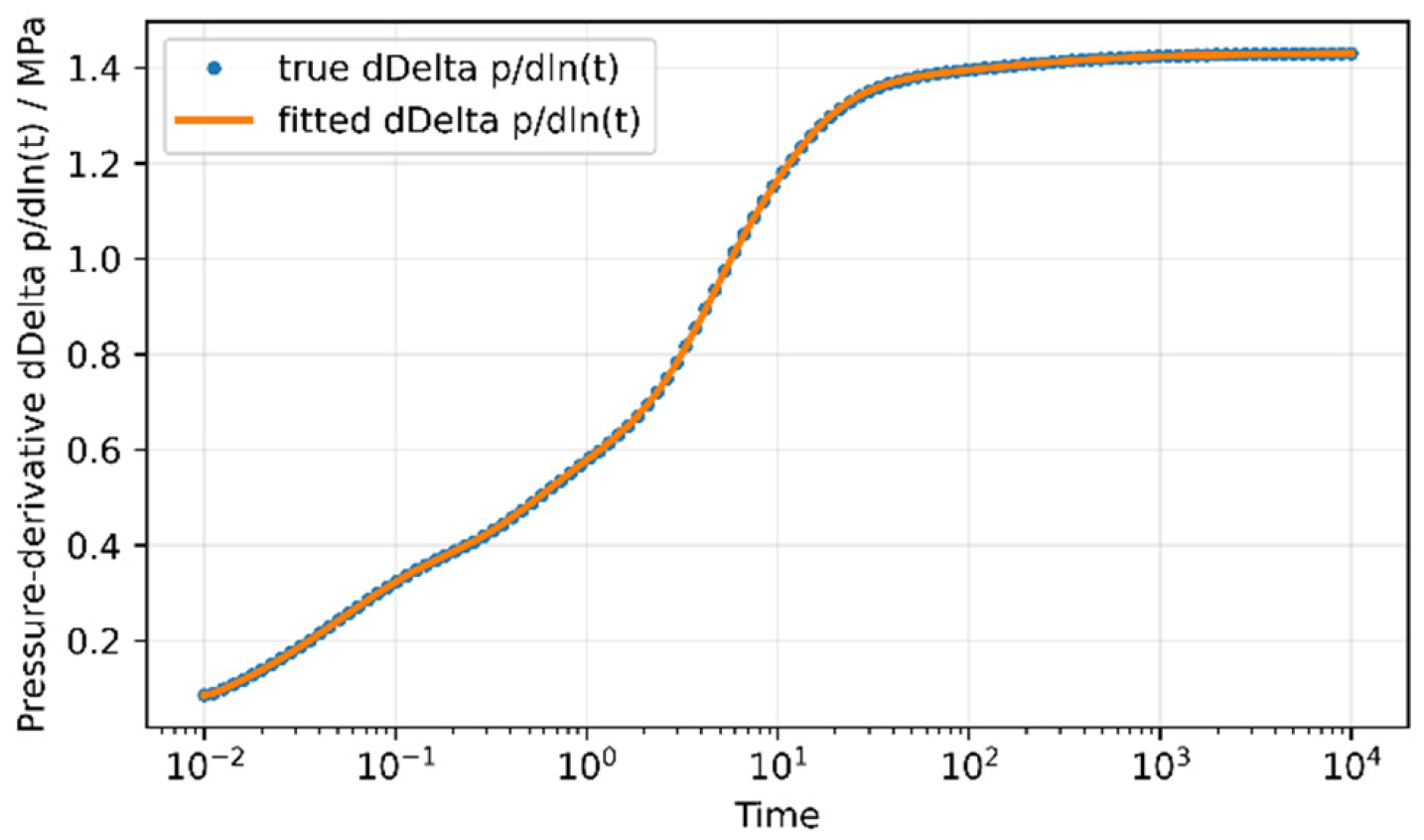
The pressure–drawdown and pressure–drawdown derivative fitting results for the base case are shown in
Figure 6 and
Figure 7 .
The base-case results show that, under the single-fault weak-baffle condition, the pressure–drawdown derivative curve is sensitive to changes in fault transmissibility. Therefore, can be inverted with relatively high stability. This result provides a basis for subsequent analyses of different fault types and multiple-fault combinations. For sealing faults, strong-baffle faults, and combinations of multiple low-transmissibility faults, the sensitivity of the pressure response to may decrease, and parameter identifiability requires further analysis.
5.2. Inversion Results for Different Fault Types
To evaluate the identifiability of under different fault transmissibility levels, four types of fault cases are considered: sealing fault, strong-baffle fault, weak-baffle fault, and leaking fault. These cases correspond to , , , and , respectively. Each case is repeated three times to evaluate the stability of the inversion results.
The inversion results for different fault types are listed in
Table 4. Overall, the fitting errors of pressure–drawdown and pressure–drawdown derivative are small for all four single-fault cases. The pressure–drawdown NRMSE values are all below 0.0003%, and the pressure–drawdown derivative NRMSE values are all below 0.001%. In terms of parameter inversion, the permeability error ranges from 1.412% to 3.410%, the effective producing length error ranges from 0.712% to 1.662%, and the skin-factor error remains below 0.02%. These results indicate that conventional well-test parameters can be stably inverted under controlled single-fault synthetic conditions.
For the fault transmissibility coefficient, remains low for all four fault types. The errors for the weak-baffle and leaking faults are close to the order of , whereas the error is 0.00275 for the strong-baffle fault and 0.0204 for the sealing fault. This result indicates that, under single-fault conditions, pressure–drawdown and pressure–drawdown derivative are sufficiently sensitive to variations in fault transmissibility and can support order-of-magnitude identification of Tf.
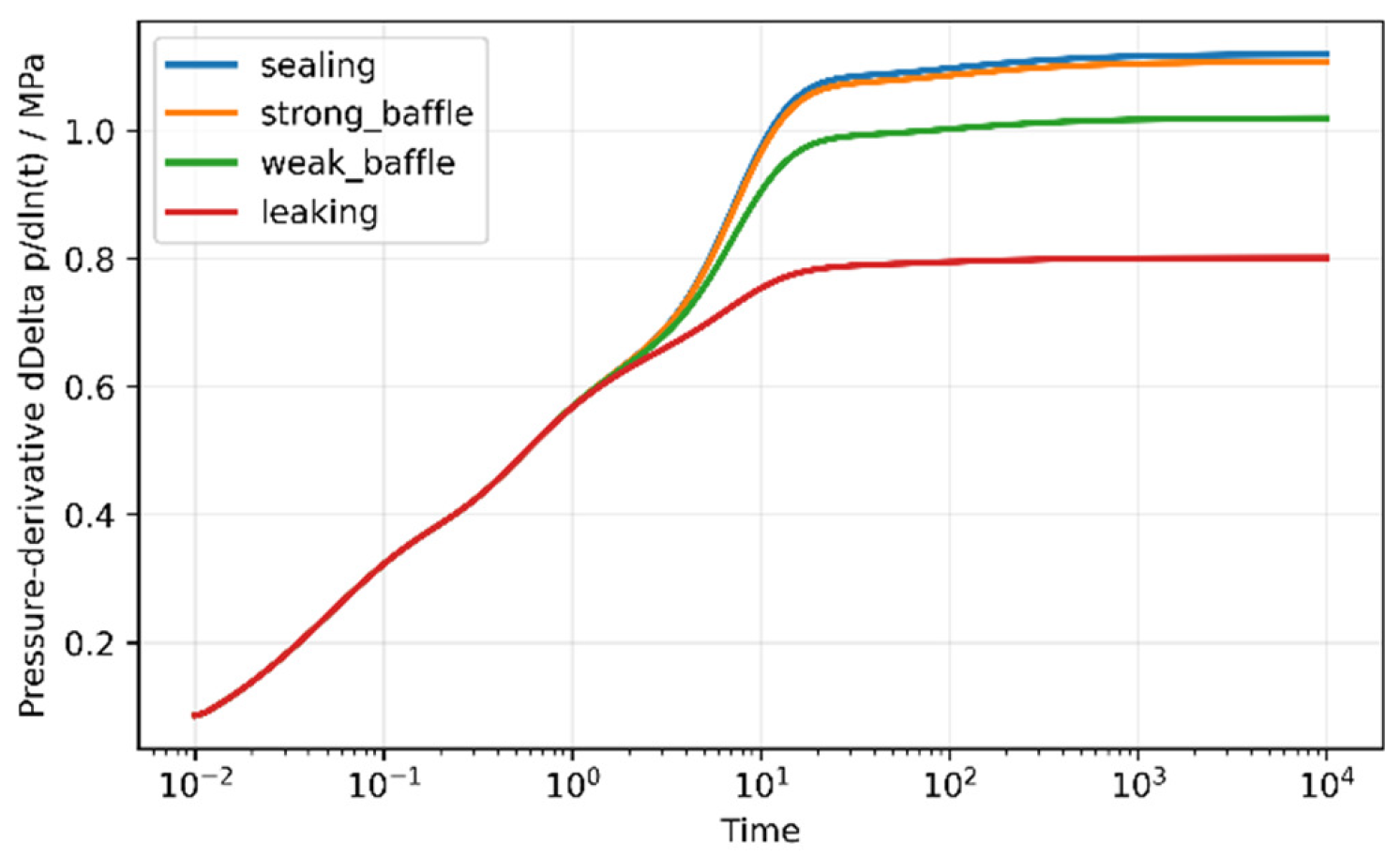
The pressure–drawdown derivative responses for different fault types are shown in
Figure 8. The late-time derivative levels of the sealing and strong-baffle faults are relatively high, indicating limited cross-fault support and significant obstruction of pressure propagation. The weak-baffle fault shows an intermediate derivative level. In contrast, the leaking fault has the lowest derivative level, suggesting that stronger fault transmissibility leads to more sufficient cross-fault pressure communication. These results demonstrate that the pressure–drawdown derivative curve can reflect the influence of different fault transmissibility levels on the pressure response of a long horizontal well and is an important dynamic feature for identifying fault-connectivity states.
Therefore, the different-fault-type experiments show that, under single-fault conditions, the proposed method can stably fit the pressure–drawdown and pressure–drawdown derivative responses for different fault transmissibility levels and can accurately identify the order of magnitude of . It should be noted that the fault response is relatively clear and the parameter identifiability is strong in single-fault cases. When multiple faults coexist, especially when several low-transmissibility faults are superimposed, compensation effects may occur among different fault transmissibility coefficients. Their identifiability, therefore, needs to be further analyzed through multiple-fault combination experiments.
5.3. Inversion Results for Multiple-Fault Combination Cases
To further verify the applicability of the proposed method to long horizontal wells intersecting multiple faults, five multiple-fault combination cases are designed: strong-baffle + weak-baffle, weak-baffle + leaking, strong-baffle + weak-baffle + leaking, sealing + strong-baffle, and sealing + weak-baffle + leaking. Unlike the single-fault cases, , , and are introduced as independent parameters in both the forward and inversion models for the multiple-fault combination experiments, to examine the stability of joint identification of multiple fault transmissibility coefficients.
Before formal inversion, a multiple-fault sensitivity check is performed for the representative MF3 case.
,
, and
are perturbed separately, and the corresponding changes in pressure–drawdown and pressure–drawdown derivative responses are observed. The results show that perturbations in each fault transmissibility coefficient can alter the pressure–drawdown derivative curve, indicating that multiple fault transmissibility coefficients have detectable effects on the bottom-hole pressure response and thus satisfy the basic requirement for joint inversion. To avoid excessive tables in the main text, the sensitivity-check results are not listed separately; instead, they are used as a preliminary verification before multiple-fault joint inversion. The inversion results for the multiple-fault combination cases are listed in
Table 5.
Overall, the fitting accuracy of the pressure–drawdown and the pressure–drawdown derivative remains high across multiple-fault cases. The pressure–drawdown NRMSE ranges from 0.000185% to 0.00844%, and the pressure–drawdown derivative NRMSE ranges from 0.000806% to 0.10519%. The inversion results of conventional parameters are also relatively stable, with permeability errors ranging from 0.972% to 3.510% and effective producing length errors ranging from 0.480% to 1.508%. These results indicate that the proposed PINN method can accurately reconstruct the pressure–drawdown response of long horizontal wells intersecting multiple faults.
Compared with the single-fault cases, the instability of joint inversion for fault transmissibility coefficients becomes more pronounced under multiple-fault conditions. The average logarithmic errors of in MF1 and MF2 are relatively low, indicating that when the differences in fault transmissibility are clear, and the number of low-transmissibility faults is limited, the model can identify individual fault transmissibility coefficients relatively stably. In MF3, the error of the low-transmissibility fault increases, with an average logarithmic error of 0.25891. In MF4 and MF5, the average logarithmic errors increase to 1.29845 and 0.91706, respectively, indicating that low-transmissibility combinations such as sealing/strong-baffle faults are prone to parameter ambiguity. These results show that well-test interpretation for long horizontal wells intersecting multiple faults is not merely a curve-fitting problem, but also a parameter-identifiability problem.
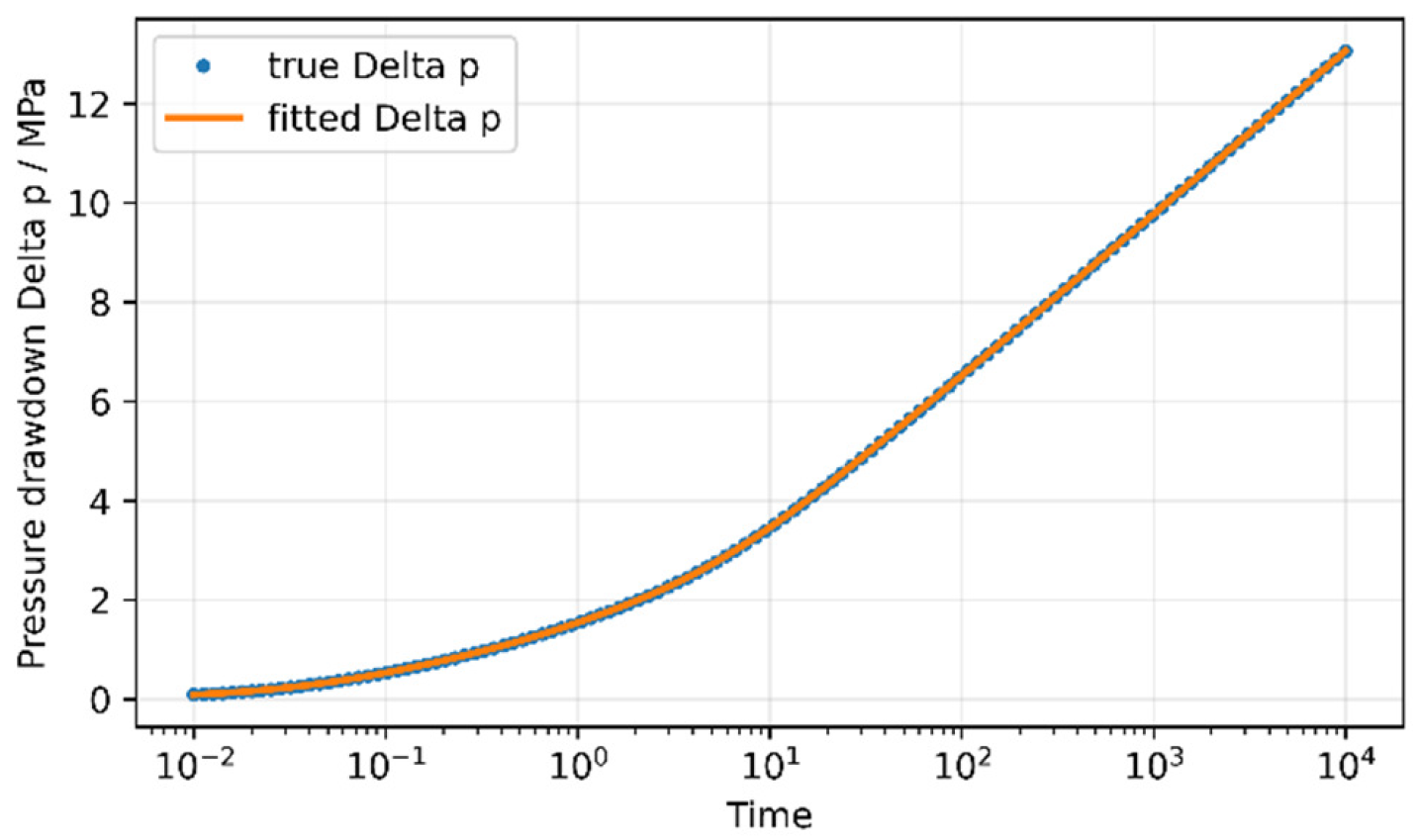
The pressure–drawdown and pressure–drawdown derivative fitting results for the representative MF3 case are shown in
Figure 9 and
Figure 10. The MF3 case contains strong-baffle, weak-baffle, and leaking faults with distinct transmissibility levels, and the pressure response is jointly controlled by multiple faults. The PINN-predicted curves nearly overlap with the synthetic curves, indicating that the proposed method can effectively represent superimposed multiple-fault responses. However, a good curve match does not necessarily imply that all fault transmissibility coefficients can be uniquely inverted. Compensation effects may still exist among low-transmissibility faults. The larger errors in MF4 and MF5 can be attributed to the weak sensitivity of the bottom-hole pressure response to further reductions in already low fault transmissibility. When both sealing and strong-baffle faults are present, their effects on late-time pressure support and derivative uplift become similar in magnitude. As a result, different combinations of low
values may produce nearly indistinguishable pressure–drawdown and derivative responses at the wellbore. This explains why the pressure curves can still be accurately fitted even though the individual fault transmissibility coefficients remain non-unique. Therefore, MF4 and MF5 should be regarded as low-identifiability cases rather than simple inversion-failure cases.
Therefore, the quality of curve fitting and the reliability of parameter identification should be evaluated separately. A small pressure–drawdown or derivative-fitting error indicates that the model can reproduce the observed transient response, but it does not necessarily guarantee the unique identification of each fault transmissibility coefficient. This distinction is particularly important for multiple low-transmissibility fault combinations, in which different combinations may generate highly similar bottom-hole pressure responses.
5.4. Identifiability Analysis for Low-Transmissibility Multiple-Fault Cases
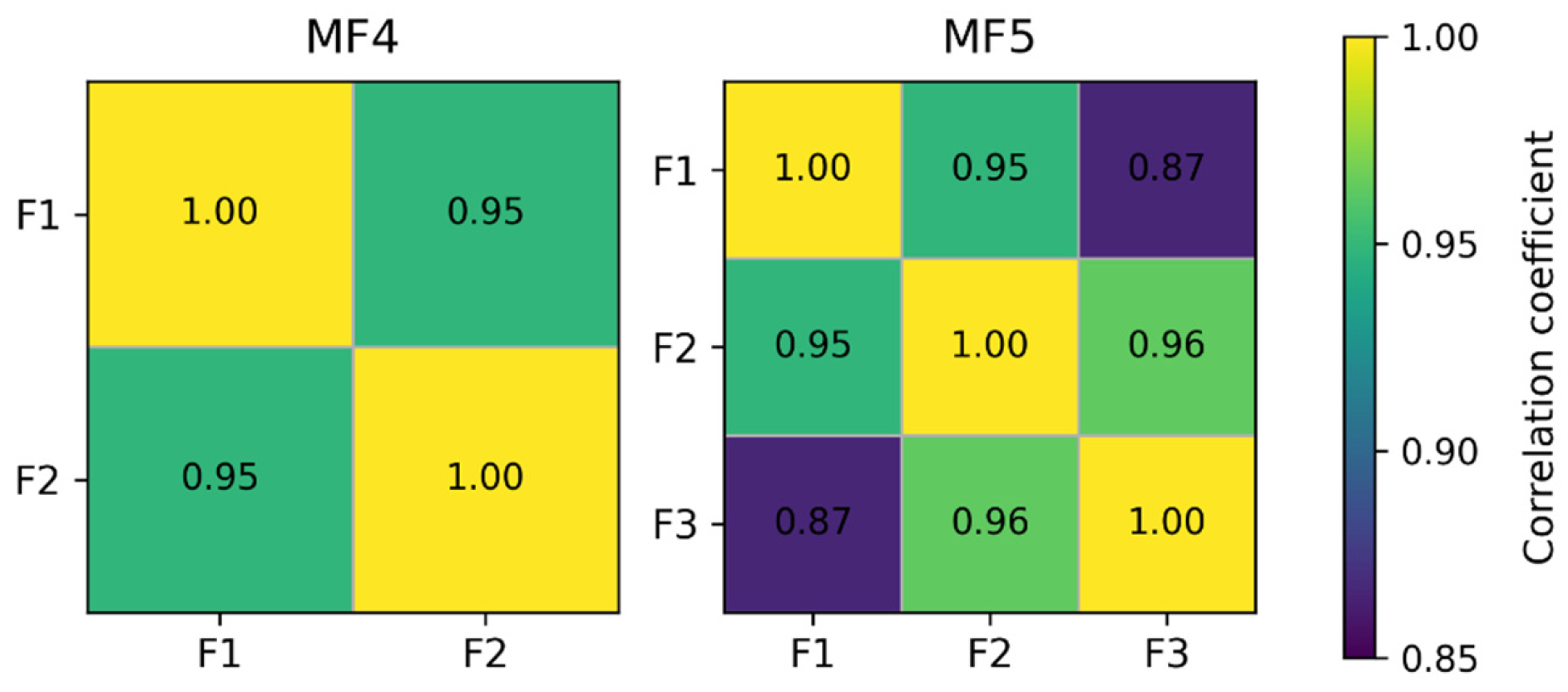
To further explain the relatively large inversion errors in MF4 and MF5, a finite-difference sensitivity analysis was performed around the true parameter values. For each fault transmissibility coefficient, was perturbed by 0.5 while the other parameters were fixed, and the corresponding changes in the pressure–drawdown and pressure–drawdown derivative responses were calculated. The normalized sensitivity norm and the correlation between sensitivity vectors were then used to evaluate the observability and separability of different fault transmissibility coefficients.
The results are listed in
Table 6. In MF4, the derivative sensitivity norm of F1 is only 0.00107, whereas that of F2 is 0.00752. In MF5, the derivative sensitivity norm of F1 is 0.00108, which is much lower than those of F2 and F3, namely 0.04430 and 0.03752, respectively. This indicates that the pressure response of a single well is weakly sensitive to further changes in already low fault transmissibility. Therefore, sealing faults are difficult to identify quantitatively from single-well pressure-transient data alone.
In addition to weak sensitivity, the sensitivity vectors of different faults are highly correlated, as shown in
Figure 11. In MF4, the derivative-sensitivity correlation between F1 and F2 reaches 0.9486. In MF5, the correlations are 0.9486 between F1 and F2, 0.8660 between F1 and F3, and 0.9636 between F2 and F3. These high correlations indicate that different fault transmissibility coefficients can produce similar dynamic signatures in the bottom-hole pressure response. Therefore, MF4 and MF5 should be regarded as low-identifiability cases rather than simple inversion-failure cases. This explains why the pressure–drawdown and derivative curves can still be fitted accurately while the individual low-transmissibility fault parameters remain non-unique.
6. Robustness Analysis and Method Comparison
After completing the inversion experiments for the base case, different fault types, and multiple-fault combinations, the stability and applicability limits of the proposed method are further evaluated from four aspects: physics-loss weighting, noise robustness, ablation experiments, and method comparison. Because well-test parameter inversion requires not only accurate pressure–drawdown curve fitting, but also interpretable derivative features and physical parameters, this section focuses on analyzing the influence of different constraint terms and methods on the inversion results.
6.1. Physics-Loss Consistency Analysis
The proposed method introduces the PDE residual loss and fault-interface residual loss to improve the physical plausibility of the inversion results. However, the synthetic samples in this study are generated using a simplified line-source well-response model. In contrast, the PDE residual and the fault-interface residual are based on the two-dimensional pressure-diffusion equation and the interface transmissibility relationship, respectively. At the present stage, these two components do not form a fully consistent, strongly coupled forward system. Therefore, assigning large weights to the PDE or fault-interface loss may lead to a conflict between fitting the synthetic pressure–drawdown curve and satisfying the physics residuals, thereby further biasing the inverted parameters.
To avoid unreasonable interference of physics-loss terms with parameter inversion, a physics-loss consistency test is first conducted. The selection of the physics-loss weights followed a stability-oriented criterion. A physics-loss weight was considered acceptable only when the pressure–drawdown fitting error, pressure-derivative fitting error, and key parameter errors remained close to those of the baseline inversion without physics losses. If a larger weight caused systematic deviations in permeability, skin factor, or the fault transmissibility coefficient, it was considered too strong for the current simplified forward model. Therefore, the adopted weights were selected not to maximize the magnitude of the physics constraint, but to introduce auxiliary physical regularization while avoiding the inversion being dominated by inconsistent residual terms. For the baseline model without physics losses, the pressure–drawdown NRMSE is 0.0059%, the derivative NRMSE is 0.0317%, , , , and . This result indicates that stable inversion can already be achieved by parameter scaling, combined pressure–drawdown/derivative constraints, and stage-wise training, even without the PDE and fault-interface residuals.
The influence of different PDE loss weights on the inversion results is then tested. The results show that the inversion remains stable when , , and . When , the parameters begin to deviate significantly: the permeability error increases to 14.00%, the logarithmic error of the fault transmissibility coefficient increases to 0.315, and the skin-factor error increases to 36.32%. Normalizing the PDE loss does not improve stability within the tested range. Even with a normalized PDE weight of 0.01, and , exceeding the stability threshold defined in this study.
The fault-interface loss shows relatively better stability. With , the inversion results remain stable when , , , and . When a normalized fault loss is used, the results are still relatively stable for weights of 0.01 and 0.05; for example, when . However, when the normalized weight increases to 0.1, rises to 0.414, and the skin-factor error reaches 30.51%, indicating that an overly strong fault-interface constraint can also cause parameter deviation.
Based on the above consistency tests, conservative physics-regularization weights are adopted in the formal experiments.
Specifically, and were selected because they remained within the stable range identified by the consistency tests. Larger PDE or fault-interface weights produced clear parameter bias, especially in permeability and skin factor, indicating that overly strong physics residuals were not suitable under the current model-inconsistency condition.
PDE and fault losses are not normalized. This setting introduces a certain degree of physics regularization while maintaining inversion stability. It should be emphasized that the PDE and fault-interface residuals used in this study are not treated as strongly consistent hard physics constraints at the present stage. Instead, they are incorporated into training as low-weight physics regularization terms. This treatment preserves useful physical information while avoiding parameter bias arising from inconsistencies between the simplified forward model and the two-dimensional physics residuals. Therefore, the present framework should be regarded as a physics-regularized neural inversion approach rather than a strongly physics-consistent PINN solver. The role of the PDE and fault-interface residuals is to provide auxiliary physical plausibility control in the presence of model inconsistency. At the same time, the primary inversion information comes from pressure–drawdown and pressure-derivative data.
6.2. Noise-Robustness Analysis
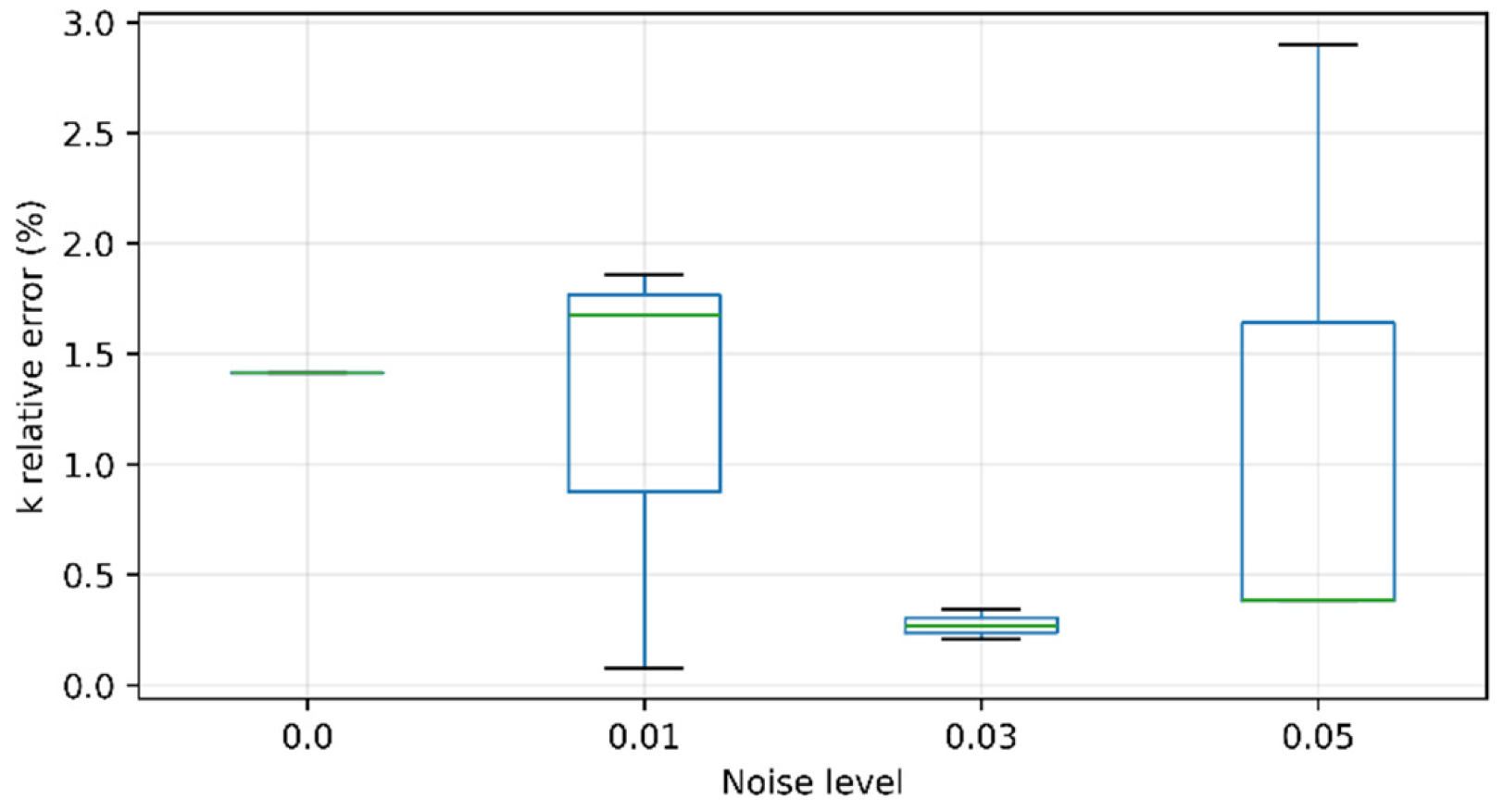
The inversion results under different noise levels are listed in
Table 7. Under the noise-free condition, the fitting errors of pressure–drawdown and pressure–drawdown derivative are extremely low, and
is only 0.000151, indicating that the model has high inversion accuracy under controlled synthetic conditions. When the noise level increases to 1%, the pressure–drawdown NRMSE increases to 0.318%, the pressure–drawdown derivative NRMSE increases to 10.188%, the skin-factor error increases to 15.156%, and
increases to 0.2955. These results indicate that the pressure–drawdown derivative and near-wellbore parameters are sensitive to noise.
When the noise level further increases to 3% and 5%, the pressure–drawdown derivative NRMSE reaches 14.865% and 16.174%, respectively, and becomes 0.7387 and 0.6655, respectively. In contrast, the permeability error remains relatively low, and the effective producing length error remains below 4%. This indicates that noise mainly affects derivative features, the skin factor, and the fault transmissibility coefficient, whereas its influence on permeability and effective well length is relatively weak. In field applications, pressure-data preprocessing, outlier removal, and derivative smoothing should be emphasized to avoid unstable inversion of and caused by noise amplification.
Figure 12 shows the variation in parameter-inversion errors under different noise levels. The pressure–drawdown derivative error is most sensitive to noise because the derivative calculation amplifies local perturbations in the pressure data. As the noise level increases, the errors of skin factor and fault transmissibility coefficient increase noticeably, indicating that
and
are sensitive to local curve morphology and derivative features. The error of effective producing length remains relatively low, although it also increases with noise level. The permeability error remains low overall.
In summary, the proposed method exhibits good parameter-inversion stability under noise-free and low-noise conditions. When the noise level exceeds 3%, the pressure–drawdown derivative error increases significantly, affecting the inversion accuracy of the skin factor and fault transmissibility coefficient. Therefore, in field applications, pressure data preprocessing and derivative smoothing should be carefully performed to avoid instability in well-test parameter inversion due to noise amplification. The present noise test considers only Gaussian random perturbations. Other field-data uncertainties, such as isolated outliers, systematic gauge drift, rate-history errors, and different derivative-smoothing methods, were not explicitly simulated in this study. These factors may introduce additional inversion bias, especially for the skin factor and fault transmissibility coefficient. Therefore, robust preprocessing, outlier detection, pressure-rate consistency checking, and derivative-smoothing strategies should be incorporated before applying the method to complex field datasets.
6.3. Ablation Experiment Analysis
The ablation experiment results are listed in
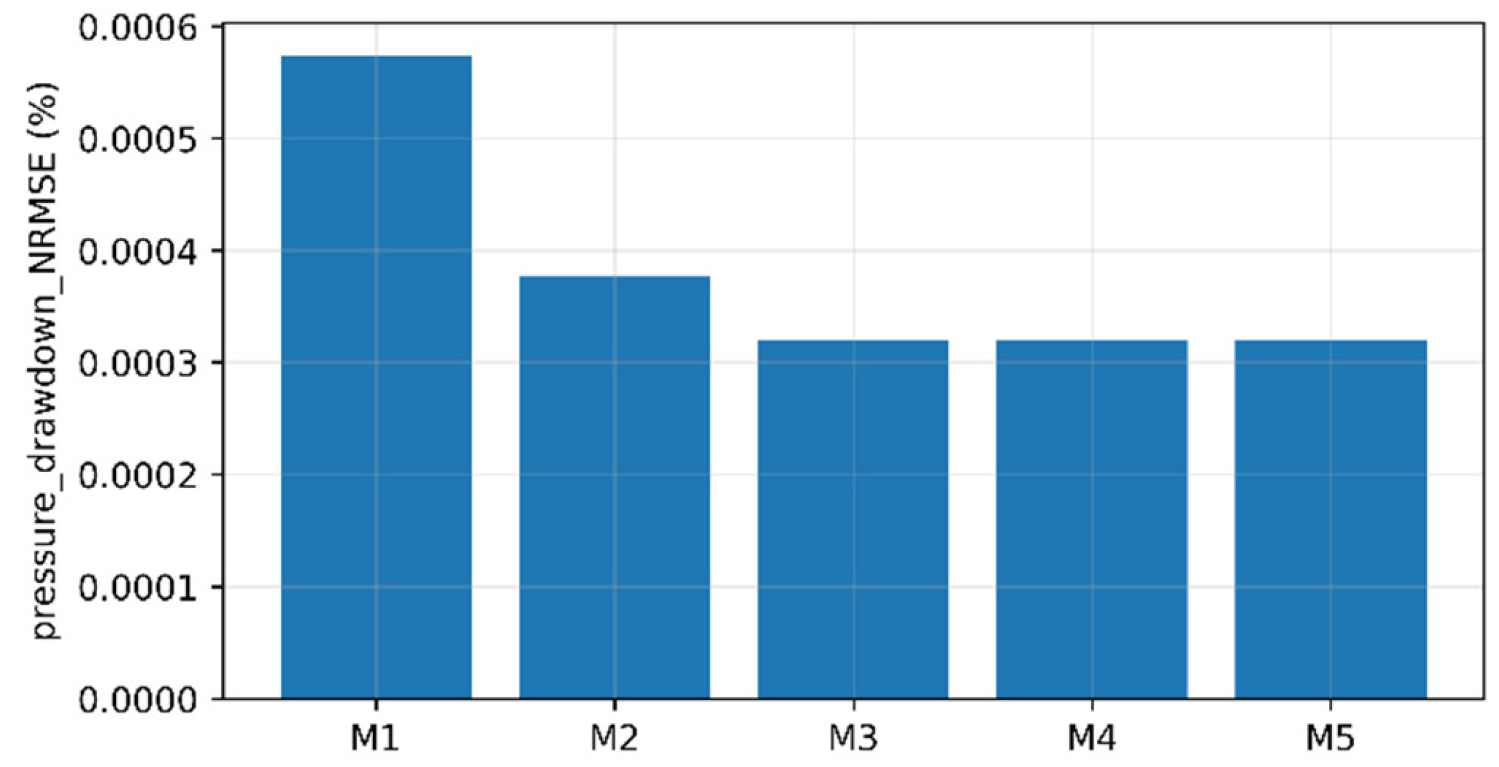
Table 8. When only the pressure–drawdown loss is used in M1, the pressure–drawdown NRMSE is already low. However, the permeability error and effective producing length error reach 8.990% and 4.814%, respectively, indicating that parameter compensation still exists when only the pressure–drawdown curve is fitted. After the pressure–drawdown derivative loss is introduced in M2, the pressure–drawdown derivative NRMSE decreases from 0.00291% to 0.000887%, and the skin-factor error and
are also significantly reduced. This indicates that the derivative constraint improves curve-feature fitting and the stability of identification for the fault transmissibility coefficient (
Figure 13).
After parameter scaling is added in M3, the permeability error decreases from approximately 8.99% to 1.349%, and the effective producing length error decreases from approximately 4.82% to 0.679%. This indicates that parameter scaling is a key factor in improving the stability of multi-parameter inversion. The results of M4 and M5 are nearly identical to those of M3, suggesting that, under the current noise-free controlled case, stage-wise training and low-weight PDE/fault regularization do not further change the final converged solution. This phenomenon indicates that parameter scaling has already dominated the improvement in optimization stability for the main parameters in this base case. The effects of stage-wise training and physics regularization need to be further evaluated under multiple-fault, noisy, or more complex conditions.
Figure 13.
Results of the ablation experiments.
Figure 13.
Results of the ablation experiments.
Quantitatively, the pressure-derivative loss mainly improves derivative-feature fitting and fault-transmissibility identification. Compared with M1, M2 reduces the pressure–drawdown derivative NRMSE from 0.00291% to 0.000887% and reduces the logarithmic error from 0.000927 to 0.000314. Parameter scaling provides the most evident improvement for permeability and effective producing length. Compared with M2, M3 reduces the permeability error from 8.989% to 1.349% and the effective producing length error from 4.819% to 0.679%. In the base case, stage-wise training and low-weight PDE/fault regularization do not further reduce the final errors, indicating that their role is mainly to improve training organization and physical plausibility rather than to dominate the accuracy improvement in this simple case.
The ablation experiments show that the pressure–drawdown derivative loss and parameter scaling make clear contributions to improving inversion performance. The pressure–drawdown derivative loss significantly reduces the derivative fitting error and improves the identification stability of . Parameter scaling substantially reduces errors in permeability and effective producing length and is a key factor in improving multi-parameter inversion stability. In the current base case, the results of M3, M4, and M5 are nearly identical, indicating that parameter scaling accounts for the majority of the error reduction. In contrast, the benefits of stage-wise training and low-weight PDE/fault regularization are more likely to appear in more complex cases. Therefore, the complete model is still used as the main scheme in subsequent experiments to maintain consistency in the training process and physics-regularization settings. Nevertheless, the role of the low-weight PDE/fault residuals in this study should be interpreted mainly as a physical regularization and plausibility-control mechanism rather than as the dominant source of accuracy improvement in the base case.
An additional ablation test was further conducted for the difficult MF4 and MF5 cases to examine whether the low-weight PDE/fault regularization improves stability under low-identifiability multiple-fault conditions. For each case, 20 random initializations were tested, with and without PDE/fault regularization, while all other settings remained unchanged. The results show that the stabilizing effect of the PDE/fault regularization is limited under the current simplified forward model. In MF4, the mean changes from 1.182 without regularization to 1.211 with regularization, and the success rate changes from 20% to 15%. In MF5, the mean remains nearly unchanged, from 1.257 to 1.265, whereas the standard deviation decreases from 1.177 to 1.046, and the mean maximum decreases from 2.049 to 1.978. Therefore, the low-weight PDE/fault residuals should be interpreted primarily as physical plausibility-control terms rather than as the dominant source of improved accuracy. Their ability to resolve low-transmissibility non-uniqueness remains limited.
6.4. Method Comparison Analysis
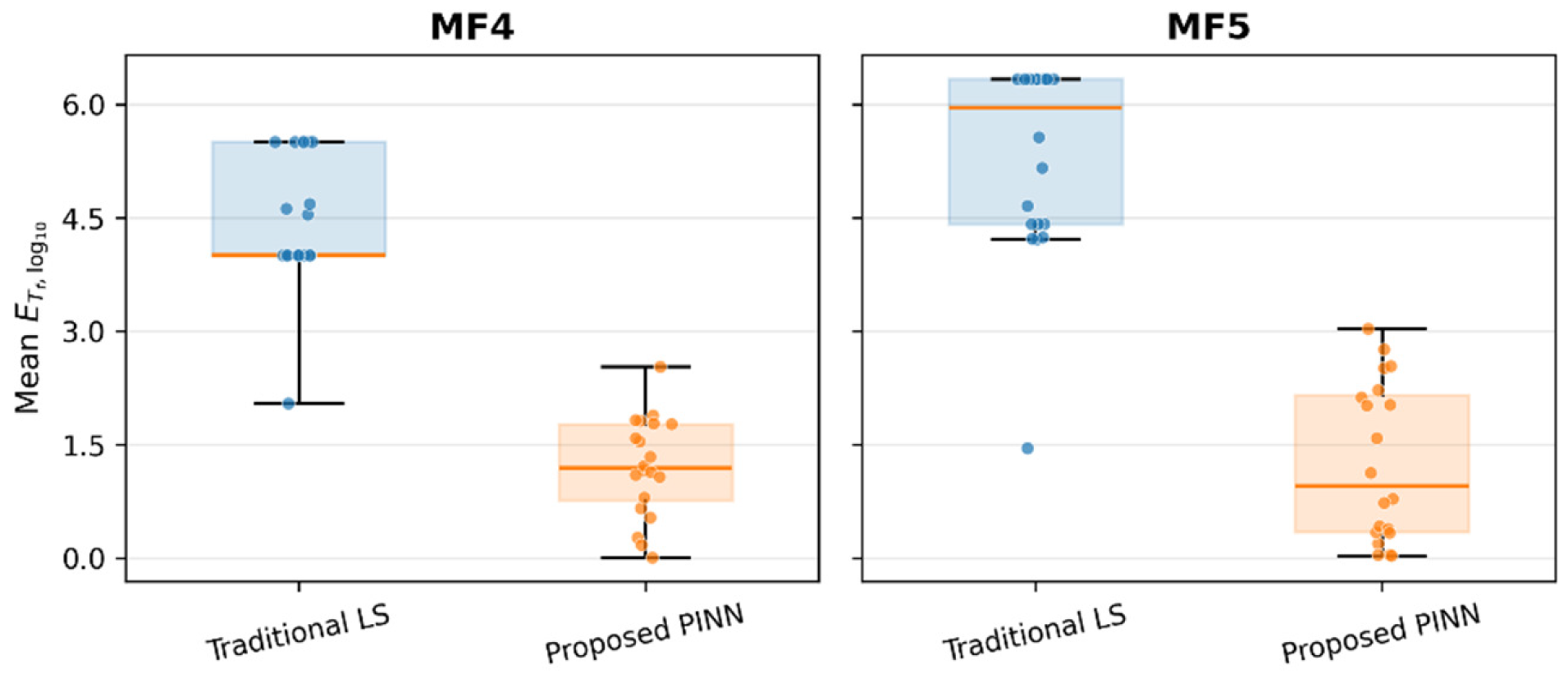
To further evaluate the inversion stability of different methods under multiple low-transmissibility fault combinations, two difficult cases, MF4 and MF5, are selected for multi-initialization comparison experiments. For each method and each case, 20 random initializations are used to repeat the inversion, to examine the sensitivity to initial values and the stability of fault transmissibility coefficient identification. The compared methods include Traditional LS, Ordinary MLP, and Proposed PINN. Traditional LS represents a conventional least-squares parameter-fitting method, Ordinary MLP represents a purely data-driven pressure–drawdown fitting model, and Proposed PINN represents the proposed physics-regularized neural inversion method.
It should be noted that the three methods do not have identical objectives or output forms. Traditional LS directly optimizes physical parameters and therefore provides parameter estimates, but is sensitive to initial values. Ordinary MLP is mainly used as a data-driven pressure-response fitting baseline and does not directly output physical parameters. The proposed PINN combines pressure fitting with physical-parameter optimization. Therefore, the comparison is not intended to claim strict algorithmic equivalence among the three methods. Instead, it evaluates their practical roles in well-test interpretation from three aspects: curve-fitting accuracy, physical-parameter output capability, and sensitivity to initialization.
The comparison results of different methods are listed in
Table 9. In the MF4 and MF5 cases, both the pressure–drawdown and pressure–drawdown derivative fitting errors of Traditional LS are significantly higher than those of Proposed PINN. The average
values of Traditional LS reach 4.446 and 5.305, respectively, indicating that the traditional least-squares method is sensitive to initial values under multiple low-transmissibility fault combinations and can easily lead to misidentification of fault transmissibility coefficients. Although Ordinary MLP has lower pressure–drawdown fitting errors than Traditional LS, it does not directly output physical parameters such as
,
,
, and
. Therefore, it does not provide complete well-test parameter inversion capability.
In contrast, the average values of Proposed PINN decrease to 1.211 and 1.265 in MF4 and MF5, respectively. Its pressure–drawdown NRMSE and pressure–drawdown derivative NRMSE are also lower than those of Traditional LS. These results indicate that the pressure–drawdown derivative constraint, parameter scaling, stage-wise training, and physics regularization help improve the stability of joint inversion for multiple fault transmissibility coefficients.
To further demonstrate the sensitivity of different methods to initialization perturbations,
Figure 14 shows the distributions of fault transmissibility coefficient errors for the MF4 and MF5 cases. The
values of Traditional LS are generally high in both cases, and the error distributions are relatively scattered. In contrast, the median and overall distributions of errors for the Proposed PINN are significantly lower, indicating that the proposed method has better inversion stability for low-transmissibility fault combinations across multiple initializations.
It should be noted that both MF4 and MF5 are difficult cases involving low-transmissibility fault combinations. Even with Proposed PINN, the non-uniqueness among low-transmissibility faults is not completely eliminated. Therefore, the advantage of the proposed method lies mainly in its better error stability and physical-parameter interpretability relative to Traditional LS under multiple initializations, rather than in completely resolving ambiguity among multiple low-transmissibility faults.
6.5. Preliminary Reduced Field PINN Fitting
To further examine the applicability of the proposed workflow to real pressure-transient data, a preliminary reduced field PINN fitting test was conducted using a pressure falloff event from well X in an anonymized high-permeability fault-block reservoir. This anonymized field case is characterized by a complex fault system, multiple fault stages, and partially sealing faults. The reservoir mainly consists of deepwater turbidite channel and lobe deposits, with porosity ranging from 14% to 36% and permeability ranging from 200 to 2600 mD, with an average permeability of approximately 1436 mD. Therefore, the field provides a representative geological setting for evaluating pressure-transient interpretation in high-permeability faulted reservoirs.
The well X was selected because it represents a long horizontal well affected by multiple faults. Previous field interpretation identified well X as a representative multiple-fault well in the target reservoir interval, and several pressure falloff events with acceptable data quality were extracted from long-term pressure monitoring records. In the conventional pressure-transient interpretation, well X was interpreted to have a permeability of approximately 336.9 mD, a skin factor of 0.893, a reservoir pressure of 36.68 MPa, and a wellbore storage coefficient of 0.943 m3/MPa. These interpreted parameters provide an engineering reference for evaluating the consistency of the proposed inversion workflow.
The selected field dataset contains records of continuous time, bottom-hole pressure, injection rate, segment type, and original timestamp. The pressure is recorded in bar, time in seconds, and injection rate in sm3/d. The test event consists of an injection period followed by a shut-in period, from which the pressure falloff response can be extracted. Because the injection rate before shut-in varies with time rather than remaining strictly constant, the field case is treated as a variable-rate falloff test. Therefore, it is used as a reduced field fitting case rather than as a strict constant-rate benchmark.
The field pressure and injection rate records for the selected well X falloff event are shown in
Figure 15. The dataset contains an injection period followed by a shut-in period, and the injection rate varies with time before shut-in. This confirms that the field case represents a real variable-rate pressure-transient test rather than an ideal constant-rate synthetic case.
Based on the extracted shut-in segment, a preliminary reduced-field PINN fitting test was performed. The actual project PINN workflow was invoked using the project neural network, loss function, and training batch construction. Several fitting scenarios were compared, including pressure-only, low-derivative, robust-pressure, and selected-window PINN settings. The pressure-only PINN with full shut-in data and was selected because it achieved the lowest pressure NRMSE among the stable scenarios without obvious unreasonable oscillation. The reduced field PINN fitting used 1466 cleaned shut-in pressure points after removing six isolated abnormal pressure spikes. The abnormal points were removed using a conservative isolated-spike criterion based on local pressure discontinuity rather than manual visual selection, and the removed points accounted for less than 0.5% of the shut-in data. The pre-shut-in variable-rate history was retained in the raw diagnostic data but was not explicitly superposed in the current PINN workflow.
As shown in
Figure 16, the reduced field PINN captures the main pressure-decline trend of the well X falloff response. The pressure-fitting RMSE is 0.794 bar, corresponding to an NRMSE of 2.457%. The remaining mismatch mainly occurs during the middle-to-late shut-in period, when field operational fluctuations and pressure disturbances are more pronounced. This result indicates that the proposed workflow can be extended to real field pressure-transient data, although the present field case should still be interpreted as a preliminary reduced-model fitting test rather than a full field-scale multi-fault inversion.
It should be emphasized that the current field PINN fitting remains a reduced-model pressure-fitting test under variable-rate field conditions. The pre-shut-in variable-rate injection history was preserved in the raw diagnostic data but was not explicitly superposed in the current PINN workflow. Therefore, this field case is used only as an engineering-scale applicability check for reduced-model pressure fitting, rather than as a complete field-scale multi-fault inversion or a unique field-scale validation of fault transmissibility. The inverted parameters should be treated as effective reduced-model parameters rather than unique reservoir-scale estimates. A complete field-scale PINN inversion should further incorporate variable-rate superposition, field-calibrated geometry, geological fault interpretation, and conventional PTA constraints.
7. Discussion and Conclusions
7.1. Discussion
This study develops a PINN-based intelligent inversion framework for well-test parameter inversion of long horizontal wells intersecting multiple faults. The proposed method integrates pressure–drawdown curves, pressure–drawdown derivative curves, parameter scaling, stage-wise training, and low-weight physics regularization into a unified inversion process. While fitting the bottom-hole pressure response, it also outputs physically meaningful parameters, including reservoir permeability, fault transmissibility coefficient, skin factor, and effective producing length of the horizontal well. Compared with ordinary neural networks, the proposed method does not simply aim for pressure–drawdown curve-fitting accuracy, but emphasizes pressure-derivative features and physical-parameter interpretability. Therefore, it is more consistent with the practical requirements of well-test interpretation.
The results show that a small pressure–drawdown curve-fitting error does not necessarily imply parameter uniqueness in inversion. An ordinary MLP can serve as a baseline for pressure–drawdown curve fitting. Still, it does not explicitly output physically meaningful well-test parameters and lacks pressure-derivative and flow-physics constraints. The multi-initialization comparison results show that, in low-transmissibility multiple-fault cases such as MF4 and MF5, the traditional least-squares method is sensitive to initial values and produces relatively scattered fault-transmissibility errors. In contrast, the proposed PINN method has lower average values and more concentrated error distributions, indicating that the pressure–drawdown derivative constraint, parameter scaling, and stage-wise training help improve the stability of joint inversion for multiple fault transmissibility coefficients. It should be noted that the proposed method is not intended to completely replace conventional well-test interpretation, but rather to provide an intelligent auxiliary approach for automated parameter inversion under complex multiple-fault conditions.
Experiments with different fault types show that the identifiability of the fault transmissibility coefficient is closely related to the fault transmissibility. In single-fault cases, the pressure–drawdown derivative responses for sealing, strong-baffle, weak-baffle, and leaking faults exhibit clear differences. Therefore, the order of magnitude of can be identified with relatively high stability. It should be noted that the identifiability observed under single-fault conditions does not necessarily mean that each fault parameter can be uniquely identified under multiple-fault conditions. When multiple faults coexist, especially when sealing and strong-baffle faults occur together, the effects of different low-transmissibility faults on the bottom-hole pressure response may overlap or compensate for each other, thereby increasing the difficulty of joint inversion for .
The multiple-fault combination experiments further reveal the non-uniqueness in joint inversion of fault transmissibility coefficients. Although the overall fitting of pressure–drawdown and pressure–drawdown derivative curves remains good in multiple-fault cases, parameter ambiguity may still occur when several values are inverted simultaneously. In particular, when sealing and strong-baffle faults coexist, multiple low-transmissibility faults may have similar effects on the pressure response, which can easily lead to unstable inversion results. This phenomenon indicates that well-test interpretation for long horizontal wells intersecting multiple faults is not only a curve-fitting problem, but also a parameter-identifiability problem. For pressure responses jointly controlled by multiple faults, single-well well-test data are more sensitive to the dominant faults and medium- to high-transmissibility faults, but have limited ability to distinguish remote faults or differences among low-transmissibility faults.
The physics-loss consistency analysis shows that the PDE residual and fault-interface residual are more suitable as low-weight physics regularization terms in the proposed method, rather than as dominant hard physics constraints. This is because the synthetic samples in this study are generated using a simplified line-source well-response model. In contrast, the PDE/fault residuals are based on the two-dimensional pressure-diffusion equation and fault-interface transmissibility relationship. These components do not form a fully consistent forward system at the present stage. When the weights for the PDE or fault loss are too large, the network may struggle to fit the synthetic pressure–drawdown data while satisfying the physics residuals, leading to biased parameter estimates. After safe weighting ranges are determined through consistency tests, low-weight PDE/fault regularization can improve identification without significantly damaging inversion stability. These results also indicate that the physics regularization used in this study is not merely a weakened form of a physics constraint, but rather a balance between data fitting and physical consistency in the face of model inconsistency. Therefore, in PINN-based well-test parameter inversion, stronger physics losses are not necessarily better; instead, the weights should be controlled according to forward-model consistency and parameter stability.
The noise-robustness experiments show that the proposed method is stable under noise-free and low-noise conditions. When the noise level reaches 3–5%, the pressure–drawdown derivative fitting error increases significantly, affecting the inversion of the skin factor and fault transmissibility coefficient. This is consistent with well-test interpretation practice, as pressure–drawdown derivative calculations amplify local perturbations in pressure data. These results suggest that data preprocessing, outlier removal, and derivative smoothing are important for PINN-based well-test inversion in field applications. For field data with strong noise, automated inversion results should not be used alone; they should be interpreted together with the testing procedure, production dynamics, and geological understanding.
The preliminary reduced-field PINN fitting using the well X falloff event further demonstrates the engineering applicability of the proposed workflow. Compared with synthetic data, field data includes variable injection rates, operational fluctuations, and measurement noise, which make the pressure-transient response more complex. Therefore, the field result is used as an engineering-scale applicability test rather than as a complete field-scale inversion validation.
This study still has several limitations. First, most quantitative evaluations in this study are based on controlled synthetic samples with known true parameters. Although a preliminary reduced field PINN fitting test is conducted using the well X falloff event, this field case does not constitute a complete field-scale multi-fault inversion because the pre-shut-in variable-rate history and field-calibrated geometry are not fully incorporated into the current workflow. Therefore, the field results are primarily used as an engineering-scale applicability check, whereas comprehensive field validation still requires additional well-test cases, geological fault interpretation, and conventional PTA constraints. Second, this study adopts a simplified long-horizontal-well pressure-response model and a two-dimensional single-phase slightly compressible flow assumption. Factors such as wellbore storage, pressure drop along the wellbore, two-phase oil–water flow, relative permeability variation, and complex production schedules are not fully accounted for. Third, the fault transmissibility coefficient is simplified as a constant, whereas real faults may exhibit spatial heterogeneity and pressure sensitivity. Finally, joint inversion of
under multiple-fault conditions remains non-unique, especially for low-transmissibility combinations involving sealing and strong-baffle faults. The multi-initialization comparison results show that the proposed PINN method can reduce the
error distribution and improve inversion stability to some extent, but it cannot completely eliminate non-uniqueness among low-transmissibility faults. Therefore, in field applications, additional constraints from well trajectory, seismic fault interpretation, 4D seismic response, and production-dynamic data are still required [
28]. In addition, the present sensitivity analysis focuses mainly on fault transmissibility because it is the primary inversion target. The effects of fault distance, fault dip, fault length, and the relative position between the well trajectory and the fault system remain underexplored. These geometric factors may change pressure-propagation paths and may further affect the identifiability of
. Future work should include geometric sensitivity tests using more realistic two- or three-dimensional reservoir models. The current noise analysis considers only random pressure perturbations. More complex field-data errors, including isolated outliers, systematic pressure-gauge drift, rate-history uncertainty, and different derivative-smoothing algorithms, may affect the inversion results. These factors should be investigated in future field-oriented applications. The present method comparison is limited to Traditional LS, Ordinary MLP, and the proposed PINN framework. Bayesian inversion, MCMC, ensemble-based inversion, and regularized least-squares methods can provide posterior or ensemble uncertainty estimates, which are important for evaluating non-uniqueness in fault-transmissibility inversion [
29,
30]. A full comparison with these uncertainty-aware inversion methods requires a separate probabilistic inversion framework and is therefore left for future work. The field validation in this study remains preliminary. More field wells, multiple test events, field-calibrated geometry, geological fault interpretation, and production-dynamic constraints are required before the method can be used as a complete field-scale multi-fault inversion tool.
Future work can be extended in three directions. First, the forward model can be extended to a two- or three-dimensional numerical model that better aligns with the PINN residuals, thereby improving the consistency and applicability of the physics constraints. Second, wellbore storage, pressure drop along the wellbore, oil–water two-phase flow, and multi-well dynamic data can be incorporated to construct a joint well-test and production-dynamic inversion framework under multi-source data constraints. Third, additional real well-test data from longer horizontal wells, together with well trajectories, fault interpretations, and development-performance data, should be integrated to validate the proposed method in field applications and further evaluate its engineering applicability. In addition, the present comparison is limited to Traditional LS, Ordinary MLP, and the proposed PINN framework. Future work should further compare the proposed method with Bayesian inversion, MCMC, ensemble-based inversion, and regularized least-squares methods to comprehensively evaluate uncertainty quantification and robustness of inversion.
7.2. Conclusions
- (1)
To address the strong non-uniqueness in well-test interpretation for long horizontal wells intersecting multiple faults in high-permeability complex fault-block reservoirs, a physics-regularized neural well-test parameter inversion method based on a PINN parameterization is developed. The method combines pressure–drawdown data, pressure–drawdown derivatives, parameter scaling, stage-wise training, and low-weight PDE/fault regularization terms to jointly invert reservoir permeability, fault transmissibility coefficient, skin factor, and effective producing length of the horizontal well.
- (2)
The base-case results show that, under the single-fault weak-baffle condition, the proposed method can accurately fit the pressure–drawdown and pressure–drawdown derivative responses and stably invert key well-test parameters. For three repeated runs, the average pressure–drawdown NRMSE is 0.000166%, and the average pressure–drawdown derivative NRMSE is 0.000617%. The relative errors of permeability, skin factor, and effective producing length are 1.412%, 0.015%, and 0.712%, respectively, and the logarithmic error of the fault transmissibility coefficient is 0.000151.
- (3)
The different-fault-type experiments show that the pressure–drawdown derivative can effectively reflect changes in fault transmissibility under single-fault conditions. The late-time derivative levels of sealing and strong-baffle faults are relatively high, whereas the derivative level of the leaking fault is relatively low. For the four fault types, ranges from 0.000145 to 0.0204, indicating that the order of magnitude of can be identified stably under single-fault conditions.
- (4)
The multiple-fault combination experiments show that the proposed PINN method can accurately fit pressure–drawdown and pressure–drawdown derivative curves for long horizontal wells intersecting multiple faults. However, joint inversion of multiple fault transmissibility coefficients remains non-unique. In particular, low-transmissibility faults are prone to ambiguity in cases containing sealing or strong-baffle faults, such as MF4 and MF5, where the average values reach 1.29845 and 0.91706, respectively. The multi-initialization comparison further shows that the proposed method can reduce the error distribution in such difficult cases, but it cannot completely eliminate non-uniqueness among low-transmissibility faults.
- (5)
The noise experiments show that the pressure–drawdown derivative is sensitive to noise. With 1% noise, the pressure–drawdown derivative NRMSE increases to 10.188%; with 3% and 5% noise, it reaches 14.865% and 16.174%, respectively. Skin factor and fault transmissibility coefficient are significantly affected by noise. Therefore, field applications should incorporate pressure-data preprocessing, derivative smoothing, and joint constraints from geological and dynamic data.
- (6)
The method comparison results show that, in multiple low-transmissibility fault combination cases such as MF4 and MF5, the traditional least-squares method is sensitive to initial values and produces relatively large fault transmissibility errors. In the multi-initialization comparison, the average values of Proposed PINN are 1.211 and 1.265 for MF4 and MF5, respectively, which are significantly lower than the corresponding values of 4.446 and 5.305 for Traditional LS. Its error distribution is also more concentrated, indicating that the pressure–drawdown derivative constraint, parameter scaling, stage-wise training, and physics regularization help improve the stability of joint inversion for multiple fault transmissibility coefficients. Nevertheless, the non-uniqueness of low-transmissibility fault combinations is not completely eliminated, and geological and dynamic data are still required as joint constraints in practical applications. The additional difficult-case ablation further indicates that the low-weight PDE/fault residuals mainly serve as physical plausibility-control terms and do not dominate the accuracy improvement under the current simplified forward model.
- (7)
A preliminary reduced field PINN fitting test was conducted using the well X falloff event. The actual project PINN workflow was invoked to fit the extracted shut-in pressure response. The optimized pressure-only PINN setting achieved a pressure RMSE of 0.794 bar and an NRMSE of 2.457%, indicating that the main field pressure-decline trend can be reproduced. Because the pre-shut-in variable-rate history was not explicitly superposed in the current workflow, the field result is interpreted as a reduced-model fitting test rather than a complete field-scale multi-fault inversion.