Article

γ-MnO2-Catalyzed Subcritical and Supercritical Water Oxidation for the Rapid Degradation and Defluorination of Perfluorooctanoic Acid

1
State Key Laboratory of Green Chemical Synthesis and Conversion, Zhejiang Key Laboratory of Low-Carbon Control Technology for Industrial Pollution, Institute of Environmental-Chemical Engineering, College of Environment, Zhejiang University of Technology, Hangzhou 310014, China
2
Interdisciplinary Research Academy (IRA), Zhejiang Shuren University, Hangzhou 310015, China
3
Shaoxing Research Institute, Zhejiang University of Technology, Shaoxing 312000, China
*
Author to whom correspondence should be addressed.
Processes 2026, 14(11), 1822; https://doi.org/10.3390/pr14111822
Submission received: 13 April 2026 / Revised: 28 May 2026 / Accepted: 2 June 2026 / Published: 4 June 2026
(This article belongs to the Section Chemical Processes and Systems)

Abstract

To achieve efficient removal and defluorination of perfluorooctanoic acid (PFOA), a visualized micro-scale fused quartz tube reactor (FQTR) was constructed to systematically investigate sub/supercritical water oxidation (SCWO) processes. Under operating conditions of 200–400 °C and 8–27.3 MPa, PFOA underwent rapid degradation with near-complete conversion. The incorporation of γ-MnO2 markedly enhanced the PFOA degradation at low temperature and achieved faster fluorine removal. At the conditions of 300 °C, 40 min, O/C ratio (oxygen-to-carbon molar ratio) = 1.5, and pH = 7, the degradation and defluorination efficiencies increased by 12.56% and 15.21%, respectively, compared with the non-catalytic system. This enhancement is primarily attributed to the efficient activation of H2O2 by γ-MnO2, which promotes the breaking of C–F bond and accelerates the converting of PFOA into CO2 and fluoride ions. The SEM, Raman and leaching experiment results demonstrated that γ-MnO2 exhibits excellent structural stability and reusability. Furthermore, density functional theory (DFT) calculations were performed to identify potential reactive sites and elucidate degradation pathways at the molecular level, providing mechanistic support for the experimental observations. Overall, the γ-MnO2-catalyzed SCWO exhibits excellent degradation and defluorination performance for PFOA removal, providing useful insight into the treatment of fluorinated wastewater.

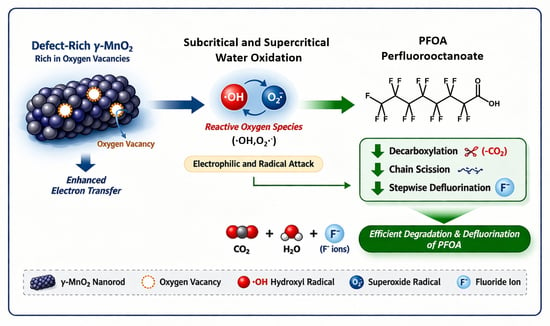
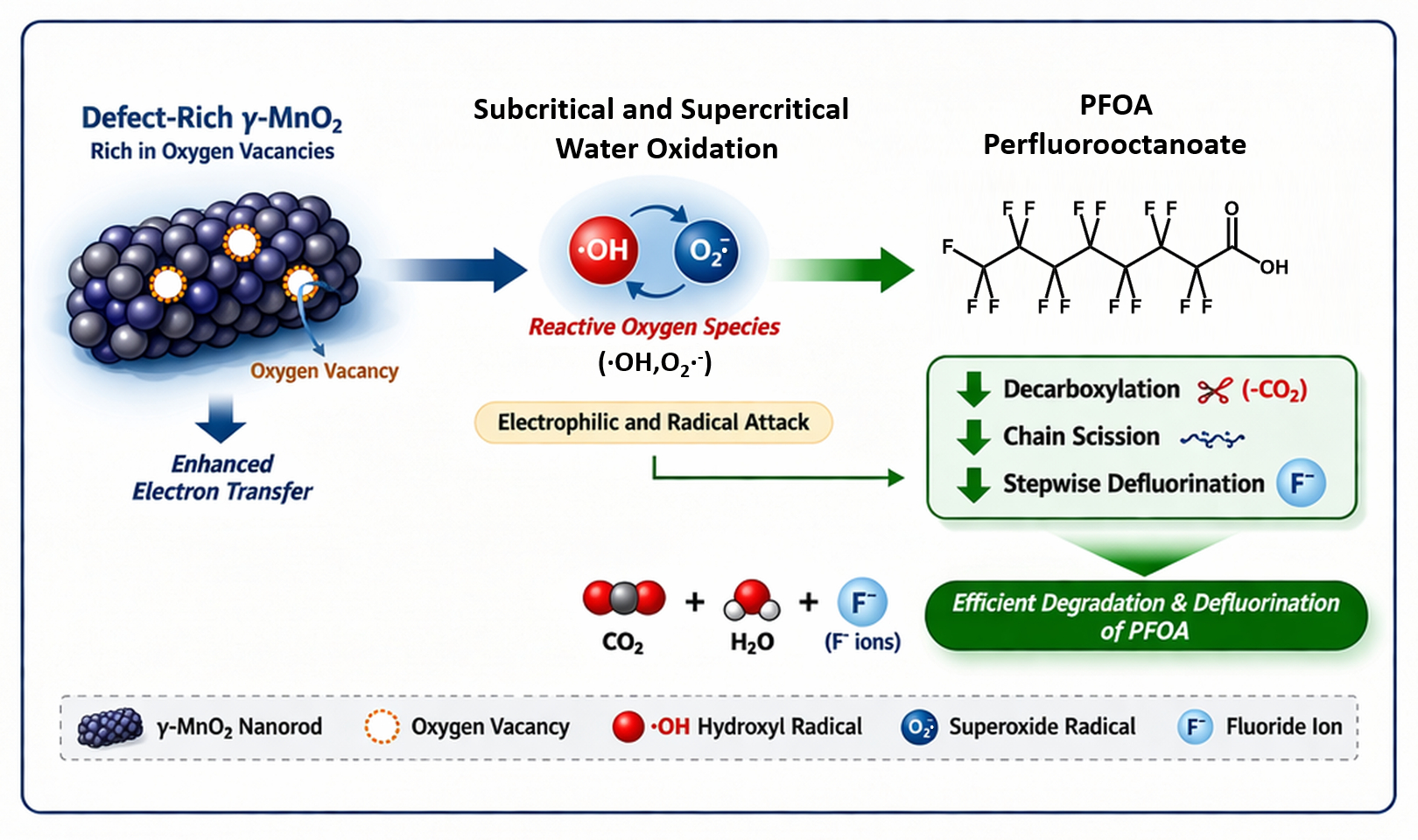
Graphical Abstract

1. Introduction

Perfluorooctanoic acid (PFOA), a representative member of perfluoroalkyl substances (PFASs), has attracted extensive attention due to its exceptional chemical stability, environmental persistence, bioaccumulation potential, and toxicity. Owing to these characteristics, PFOA can be transported across different trophic levels, posing long-term threats to ecological systems and human health [1]. Previous investigations have shown that human exposure to PFOA occurs via multiple routes, such as contaminated drinking water, food packaging materials, atmospheric particles, and occupational activities. After entering the human body, PFOA tends to accumulate in serum, exhibiting slow elimination kinetics and high resistance to metabolic breakdown [2,3]. PFASs have been widely detected in water, air, soil, and even in human tissues and organs, highlighting their global distribution and multiple exposure pathways [4]. In light of these concerns, increasing attention has been devoted to understanding their environmental behavior, toxicological impacts, and removal technologies. Consequently, developing effective methods for the identification and elimination of PFOA remains a pressing issue in environmental science.
A variety of treatment approaches have been explored to address the persistence of PFOA, including advanced oxidation processes (AOPs), photocatalysis, electrochemical techniques, and other emerging physicochemical methods. Among these, AOPs are of particular interest because they rely on highly reactive radicals, such as hydroxyl (·OH) and sulfate (SO42−), to attack organic pollutants [5,6]. However, the effectiveness of ·OH in degrading PFOA is limited due to its non-selective reactivity, which leads to preferential consumption by coexisting organic matter, thereby reducing degradation efficiency [7]. In addition, the non-selective nature of ·OH further limits its effective utilization during PFOA degradation [8]. Although semiconductor photocatalysis can generate reactive species such as electron–hole pairs and radicals under irradiation [9], its large-scale application is hindered by high energy consumption and limited quantum efficiency [10,11]. Electrochemical oxidation (EO) degrades PFOA via the generation of strong oxidizing species at the electrode interface, enabling C–F bond cleavage and defluorination [12]. However, its practical application is constrained by high energy consumption, electrode passivation, and reagent costs [13].
In addition to oxidation-based methods, adsorption and microbial degradation have also been investigated. Adsorption transfers PFOA from water to solid phases without achieving actual destruction, and adsorbent regeneration may induce secondary pollution [14]. Microbial degradation is typically slow and highly sensitive to environmental conditions, further limited by the recalcitrance of PFOA and the complexity of microbial systems [15]. Overall, most existing methods fail to achieve complete mineralization, often producing shorter-chain fluorinated intermediates that may still pose environmental risks. Therefore, more efficient and sustainable degradation strategies are urgently required.
Subcritical and supercritical water oxidation (SCWO) has emerged as a promising process for the treatment of refractory and highly toxic organic pollutants [16,17]. Subcritical water oxidation operates under elevated temperature and pressure (200–374 °C, 2–22 MPa), where water remains in the liquid phase, forming a highly reactive environment. When temperature and pressure exceed the critical point of water (374.3 °C and 22.1 MPa), water enters a supercritical state with unique physicochemical properties [18]. Under these conditions, enhanced mass transfer and accelerated reaction kinetics enable efficient degradation pathways that are difficult to achieve under ambient conditions [19]. When combined with oxidants such as H2O2, these systems can significantly improve the removal efficiency of organic pollutants [20]. However, previous studies have shown that hydroxyl radicals alone are insufficient for efficient PFOA mineralization in conventional water treatment processes [21,22]. In contrast, catalytic hydrogen peroxide propagation (CHP) involves continuous activation of H2O2 to generate reactive oxygen species (ROS), including ·OH, HO2, and O2·, which play a critical role in C–F bond cleavage and pollutant degradation. For example, Kim J. et al. reported that synergistic effects among these species significantly enhanced degradation efficiency under specific conditions [22].
Among various catalytic materials, γ-MnO2 has attracted increasing attention due to its distinctive structural characteristics. This polymorph exhibits a hybrid framework combining tunnel and layered structures, which contributes to its enhanced reactivity [23]. Compared with other MnO2 phases, γ-MnO2 possesses higher surface area, abundant defect sites, and improved dispersion in aqueous systems, all of which are favorable for catalytic reactions [24]. Furthermore, γ-MnO2 can promote the decomposition of oxidants through interfacial electron transfer, thereby facilitating the formation of reactive species [25].
Based on these considerations, this study systematically investigates the degradation of PFOA in a γ-MnO2-catalyzed subcritical and supercritical water oxidation system using H2O2 as the oxidant. The effects of key operating parameters, including temperature, reaction time, oxidant dosage, and pH, are comprehensively evaluated, along with catalyst stability. Furthermore, density functional theory (DFT) calculations are performed to identify reactive sites and elucidate degradation pathways at the molecular level, thereby providing mechanistic insights into the catalytic process.

2. Materials and Methods

2.1. Materials

Perfluorooctanoic acid (PFOA, 99%) was sourced from Shanghai Meryer Chemical Technology Co., Ltd. (Shanghai, China). Sodium hydroxide (NaOH, analytical grade) was provided by Hangzhou JG Biotech Co., Ltd. (Hangzhou, China). Hydrogen peroxide (H2O2, analytical grade, ≥30.0%) was supplied by Sinopharm Chemical Reagent Co., Ltd. (Shanghai, China). Manganese sulfate monohydrate (MnSO4·H2O) and ammonium persulfate ((NH4)2S2O8) were acquired from Hangzhou Shuangmu Chemical Co., Ltd. (Hangzhou, China). All reagents were of analytical grade and directly applied without additional purification. A PFOA stock solution (5.0 g·L−1) was freshly prepared prior to use.

2.2. Preparation of the Catalyst

MnSO4·H2O (4.23 g) and (NH4)2S2O8 (5.71 g) were mixed with 75 mL of deionized water to form precursor solutions, with each component adjusted to 0.33 mol·L−1. Once fully dissolved, the mixture was loaded into a 100 mL stainless-steel autoclave and subjected to thermal treatment at 80 °C for 12 h. A black–gray solid was subsequently formed, which was separated by filtration and repeatedly rinsed with deionized water. The obtained material was then dried at 70 °C in an oven until no further mass change was observed. After drying, the solid was ground into a fine powder for later use.

2.3. Experimental Procedure

In this work, the starting concentration of perfluorooctanoic acid (PFOA) was fixed at 5.0 g·L−1. Reaction temperatures were investigated at 200, 250, 300, 350, and 400 °C, while the reaction duration varied from 0 to 80 min. A transparent micro-scale fused quartz tube (outer diameter: 4 mm; length: 80 mm) served as the reactor for SWO/SCWO experiments.
A specified volume of PFOA solution (5.0 g·L−1) was first introduced into the reactor, after which an appropriate amount of H2O2 was added as the oxidant. The initial pH of the PFOA solution was acidic (approximately 2–3) due to the nature of PFOA, and it was adjusted to the desired value using NaOH solution prior to the reaction. No buffer was used, and the reported pH values represent the initial solution conditions prior to reaction rather than constant pH conditions during the degradation process. Deionized water was then supplemented to ensure that the total reaction volume remained constant at 100 μL. The oxidant coefficient (OC) ranged from 0.5 to 2.5 times the stoichiometric requirement for complete oxidation. To maintain consistent reaction conditions, the total liquid volume in the reactor was controlled at 100 μL by adjusting the amount of deionized water, thereby keeping both pollutant concentration and system pressure stable. The reactor was preheated to the desired temperature prior to the reaction. Due to the extremely small thermal mass of the system and preheating in an isothermal furnace, rapid heating was achieved, and the contribution of the heating period to the overall reaction process was considered negligible. Therefore, the reaction time was defined as the duration after the system reached the target temperature, which is consistent with previous micro-scale SCWO studies. Although direct in situ measurement of temperature and pressure evolution was not feasible in the present configuration, similar micro-reactor systems have been widely reported to reach near thermal equilibrium rapidly under sub/supercritical water conditions, where convection-dominated mixing further enhances heat and mass transfer. Due to the micro-reactor configuration, mixing was dominated by thermal convection under high-temperature and high-pressure conditions.
Under these conditions, the internal pressure of the reactor was estimated to be within 8–27.3 MPa. Each experiment was performed in triplicate, and the reported results correspond to the average values.

2.4. Analytical Methods

The levels of PFOA and its transformation products were quantified using ultra-performance liquid chromatography coupled with triple quadrupole mass spectrometry (UPLC–MS/MS, Waters Micromass Quattro Micro API, Waters Corporation, Milford, MA, USA). Separation was achieved on an ACQUITY UPLC BEH C18 column (2.0 mm × 100 mm, 1.7 μm) under gradient elution conditions. Fluoride ions (F) were analyzed via ion chromatography. PFOA removal efficiency was evaluated according to the change in its concentration during the reaction, whereas defluorination efficiency was assessed based on the proportion of released fluoride relative to the total fluorine content in the parent molecule. Dissolved Mn species in the post-reaction solutions were analyzed using inductively coupled plasma mass spectrometry (ICP–MS, NexION 1000G, PerkinElmer, Shelton, CT, USA). Detailed operating conditions and calculation methods are described in the Supporting Information (Text S1).
Density functional theory (DFT) calculations were carried out to explore the reactive sites of the PFOA molecule, including Fukui function and frontier molecular orbital analyses. Structural optimization and single-point energy calculations were conducted using the ORCA program package (version 4.2.1). Fukui indices were obtained with Materials Studio, while atomic frontier electron densities were analyzed using the Multiwfn program [26]. Detailed computational procedures and parameters are given in the Supporting Information (Text S2).
The catalytic degradation pathways were further examined through DFT simulations performed with the Vienna Ab initio Simulation Package (VASP, version 5.4.4) [27]. The projector augmented-wave (PAW) method was applied to describe ion–electron interactions [28], and the exchange–correlation energy was treated using the generalized gradient approximation (GGA) with the Perdew–Burke–Ernzerhof (PBE) functional [29]. In addition, solvent effects were considered by introducing an implicit solvation model (VASPsol) [30].
Furthermore, the toxicity of PFOA and its potential degradation intermediates was predicted using the Toxicity Estimation Software Tool (TEST, version 4.2.1) developed by the U.S. Environmental Protection Agency (EPA) [31], based on quantitative structure–activity relationship (QSAR) models. This method allows rapid estimation of toxicity endpoints for organic compounds according to their molecular structures.

3. Results and Discussion

3.1. Catalyst Characterization

The structural features, surface chemical states, morphology, and defect properties of γ-MnO2 were systematically characterized by XRD, XPS, SEM, and EPR. Detailed characterization methods are provided in Text S3.
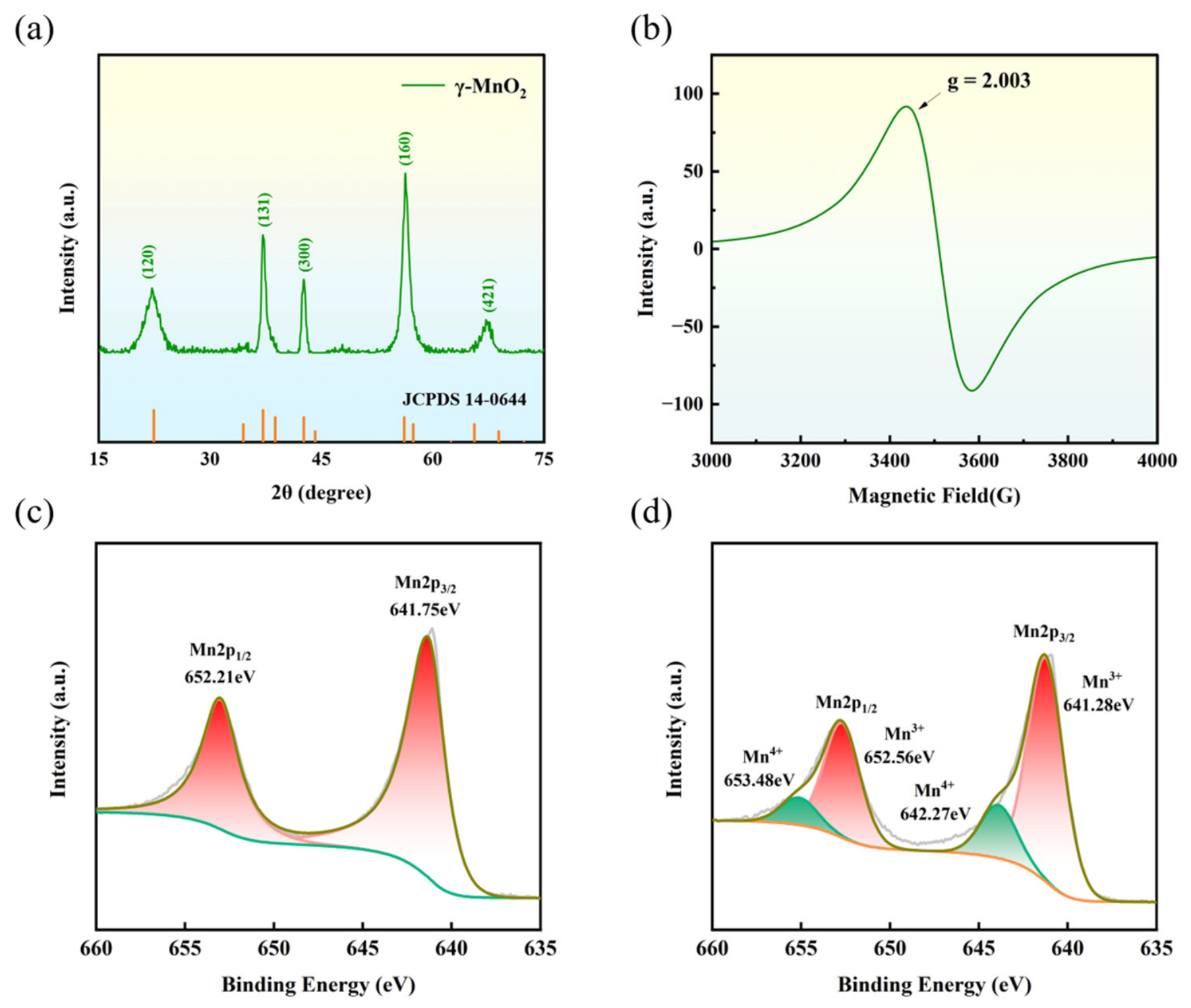
The XRD pattern (Figure 1a) shows diffraction peaks at 22.24°, 37.22°, 42.62°, 56.56°, and 67.35°, which can be tentatively indexed to the (120), (131), (300), (160), and (421) planes of γ-MnO2, respectively. It should be noted that the broad feature around ~22° may also arise from structural disorder or intergrowth characteristics of γ-MnO2, and thus cannot be unambiguously assigned to a single crystallographic plane. The diffraction profile is consistent with the standard JCPDS card (No. 14-0644), supporting the successful formation of the γ-MnO2 phase. The broadened and partially split peaks indicate a disordered structure with low crystallinity [32], characteristic of defect-rich manganese oxides, while the presence of several sharp reflections suggests the coexistence of locally ordered domains.
The EPR spectrum (Figure 1b) exhibits a distinct signal at g ≈ 2.003, which is commonly associated with unpaired electrons related to oxygen vacancies [33], suggesting the possible presence of defect structures in γ-MnO2. These defect sites may be associated with interfacial electron transfer and H2O2 activation in the SCWO system, which could contribute to the degradation of organics [34]. The thermal stability of γ-MnO2 was further evaluated by thermogravimetric analysis, and is detailed in the Supporting Information (Text S4 and Figure S1).
XPS analysis was further conducted to examine the surface electronic structure. The spin–orbit splitting between Mn 2p3/2 and Mn 2p1/2 was taken into account during peak fitting. As shown in Figure 1, two main peaks located at 641.75 eV and 653.22 eV correspond to Mn 2p3/2 and Mn 2p1/2, respectively, which are commonly attributed to manganese oxide species [35]. Deconvolution results of the Mn 2p3/2 spectra are summarized in Table S1. The fresh catalyst solely exhibits Mn4+, whereas both Mn3+ and Mn4+ components are observed after reaction under 300 °C, 40 min, O/C = 1.5, pH = 7 (Figure 1d), suggesting changes in Mn valence states during the reaction.
The O 1 s spectra (Figure S2) were deconvoluted into three distinct components: lattice oxygen (Olat) at ~529.1 eV, defect oxygen (Ovac) at ~531 eV, and adsorbed hydroxyl oxygen (Oads) at ~533 eV [36]. Olat corresponds to lattice oxygen in the Mn–O framework, Ovac is related to oxygen species in defective or oxygen-deficient sites, and Oads represents surface-adsorbed hydroxyl groups and water-derived oxygen species. It can be observed that γ-MnO2 (32.3%) has a higher concentration of Ovac than β-MnO2 (24.7%), which is consistent with previous studies [37]. Under the same conditions, γ-MnO2 exhibited higher PFOA degradation efficiency than β-MnO2 (Figure S3), indicating that Ovac promotes PFOA degradation.
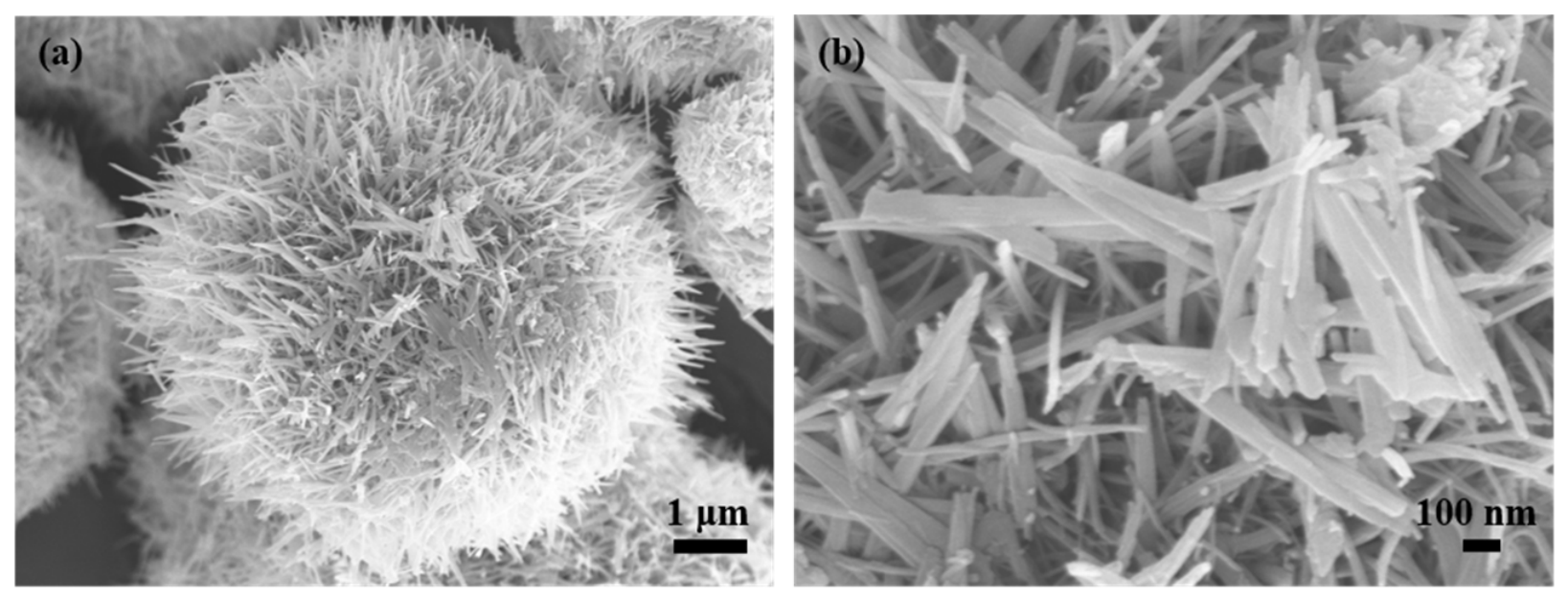
SEM images (Figure 2) show that γ-MnO2 possesses a typical urchin-like morphology composed of radially aligned nanorods forming a three-dimensional architecture. This structure provides a large specific surface area and abundant exposed active sites, which are beneficial for catalytic performance [38]. The elemental composition and spatial distribution were further confirmed by EDS analysis, with detailed results presented in the Supporting Information (Text S5, Figure S4).

3.2. Recyclability and Stability of the Catalyst

Catalyst durability and recyclability are key considerations for practical applications. The cycling performance of γ-MnO2 was evaluated under conditions of 300 °C, an O/C ratio of 1.5, pH = 7, and a reaction time of 40 min. After each run, the catalyst was recovered, thoroughly rinsed with ethanol and deionized water, and dried at 60 °C for 12 h prior to reuse.
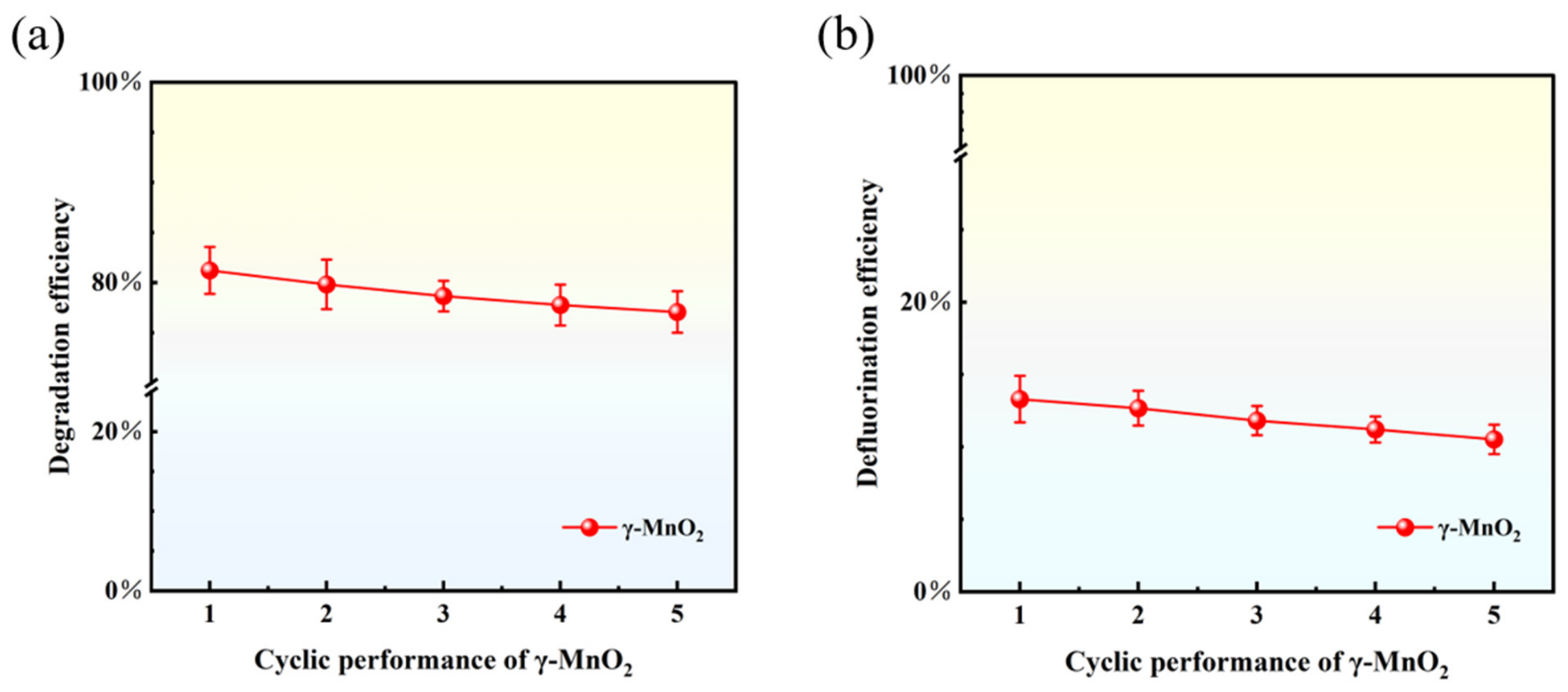
The degradation and defluorination efficiencies over five cycles are shown in Figure 3. After five cycles, γ-MnO2 retained high catalytic activity, with only a 3.27% decrease in degradation efficiency and a 2.84% decrease in defluorination efficiency, indicating good reusability. Raman spectra of the fresh and reused γ-MnO2 catalysts after different catalytic cycles are presented in Figure S5, and no obvious structural changes were observed after repeated use. In addition, SEM images of the catalyst after five cycles are shown in Figure S6. No obvious morphological changes were observed after repeated use, demonstrating the structural stability of γ-MnO2. Table 1 summarizes Mn leaching after repeated cycles, showing consistently low Mn concentrations without noticeable accumulation. Detailed ICP–MS analytical procedures are provided in Text S1. Overall, γ-MnO2 exhibits good stability, and durability in SCWO of PFOA.

3.3. Effect of γ-MnO2 on the Removal of PFOA

3.3.1. Effect of Temperature

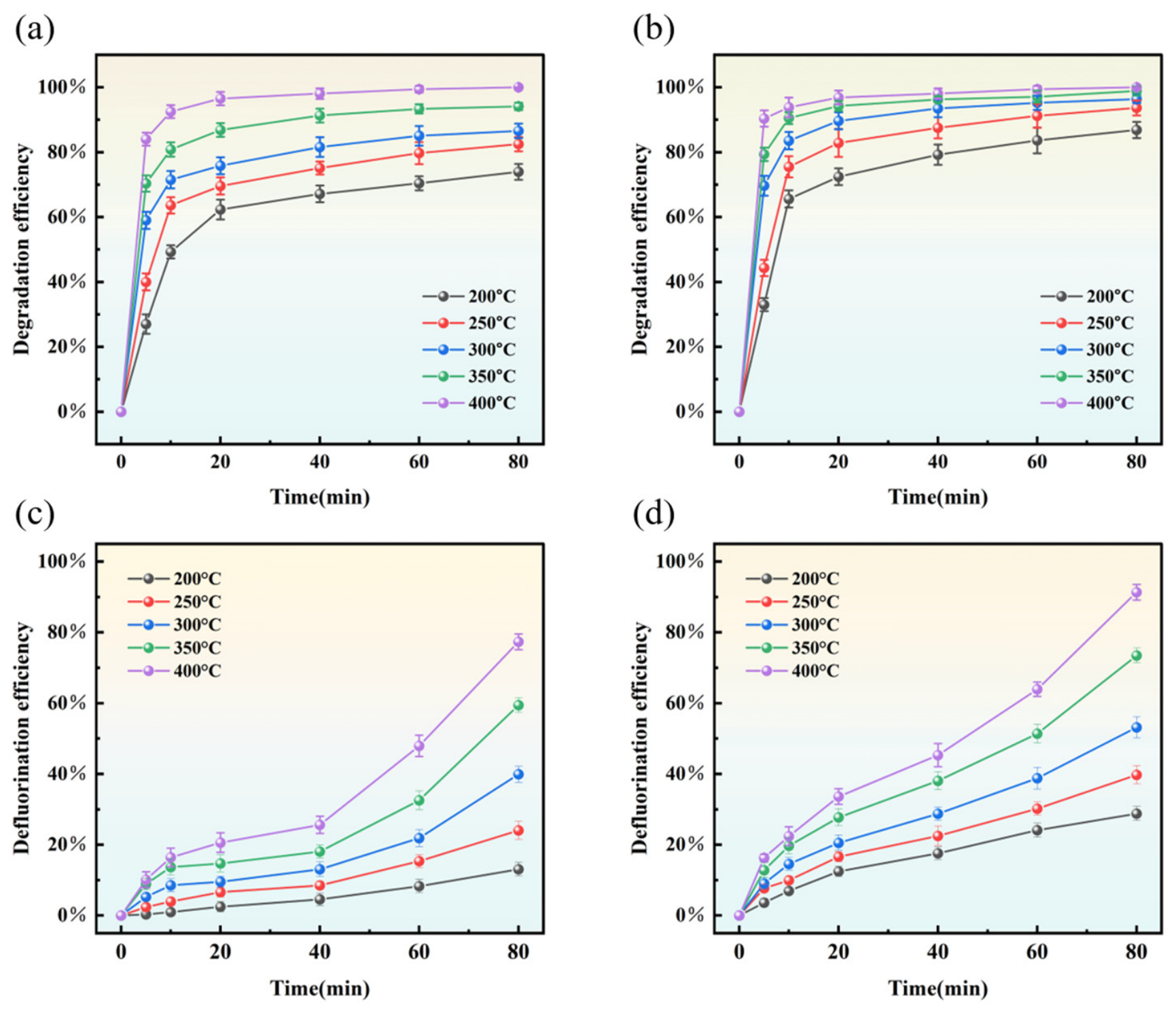
To evaluate the catalytic role of γ-MnO2 in PFOA degradation, the removal and defluorination efficiencies under varying temperatures, both in the presence and absence of the catalyst, are summarized in Figure 4a–d. Temperature plays a key role in controlling the degradation behavior of PFOA, as higher temperatures significantly accelerate reaction kinetics [39], particularly in supercritical/subcritical water systems.
Figure 4a–d shows that both degradation and defluorination efficiencies increase markedly as the temperature rises from 200 to 400 °C. This trend may be attributed to enhanced PFOA solubility and intensified reactive species generation at elevated temperatures, which promote the cleavage of C–C and C–F bonds [40].
In comparison with the non-catalytic system, the addition of γ-MnO2 leads to a clear improvement in degradation performance. For instance, at 300 °C and 10 min, the degradation efficiency increases from 71.83% to 82.56% after introducing γ-MnO2. However, defluorination proceeds more slowly and requires harsher conditions, such as higher temperatures and extended reaction times. At 300 °C and 40 min, the defluorination efficiency increases from 11.56% to 28.69% in the presence of γ-MnO2. According to the practical application and for the convenience of observing changes in the defluorination, 300 °C and 40 min were set as fixed parameters to conduct the subsequent single-factor experiments.
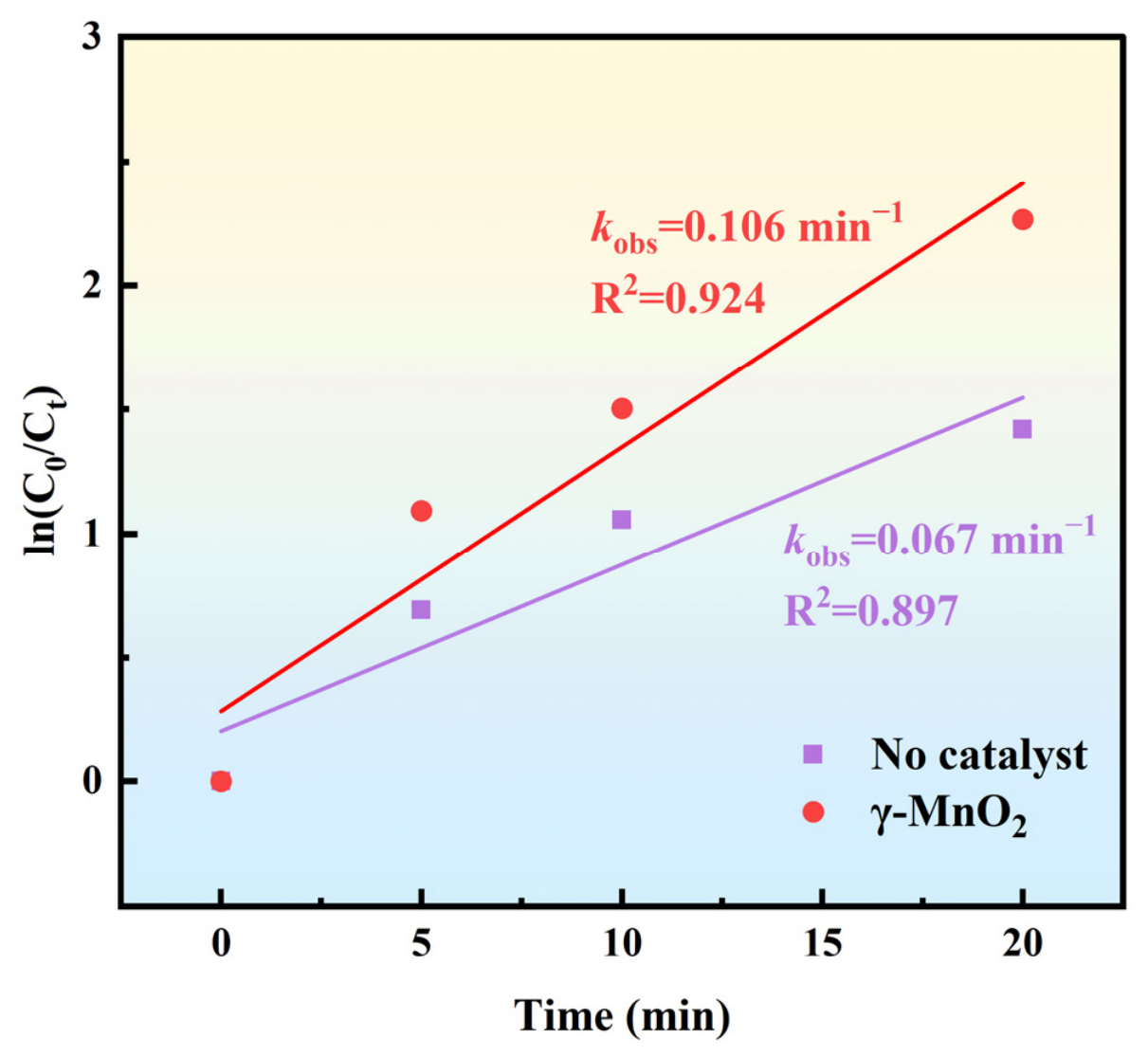
To compare the catalytic effect, the degradation kinetics at 300 °C were analyzed using a pseudo-first-order approximation based on the initial reaction stage (0–20 min), as shown in Figure 5. The kinetic analysis was performed using ln(C0/Ct) versus reaction time. The apparent rate constant (kobs) increased from 0.0435 min−1 in the non-catalytic system to 0.0706 min−1 in the presence of γ-MnO2, corresponding to an approximately 1.6-fold increase. Within the limited time window, the ln(C0/Ct) relationship shows reasonable linearity, suggesting that the pseudo-first-order model serves as an apparent empirical approximation for comparing initial reaction rates rather than a strict mechanistic description. The overall degradation process under supercritical conditions is complex and involves multiple reaction steps not captured by this simplified model.
The superior performance of the catalytic system can be explained by several contributing factors. Elevated temperatures enhance mass transfer and diffusion behavior, improving the interaction between PFOA molecules and the catalyst surface. At the same time, γ-MnO2 facilitates oxidant decomposition and promotes the formation of reactive oxygen species, allowing the system to rapidly build up a high concentration of reactive radicals and thus accelerate the overall reaction process.
Notably, PFOA degradation may involve the cleavage of the carbon chain, potentially generating shorter-chain fluorinated intermediates during the reaction process. Preliminary UPLC–MS/MS analysis (Table S2, Figure S7) suggested the possible presence of several short-chain fluorinated intermediates. These intermediates may still contain stable C–F bonds [41], which could make further transformation and defluorination more difficult under the current reaction conditions. Therefore, the lower defluorination efficiency compared with the overall degradation efficiency may be related to the persistence of partially fluorinated intermediates in the reaction system.

3.3.2. Effect of O/C Ratio

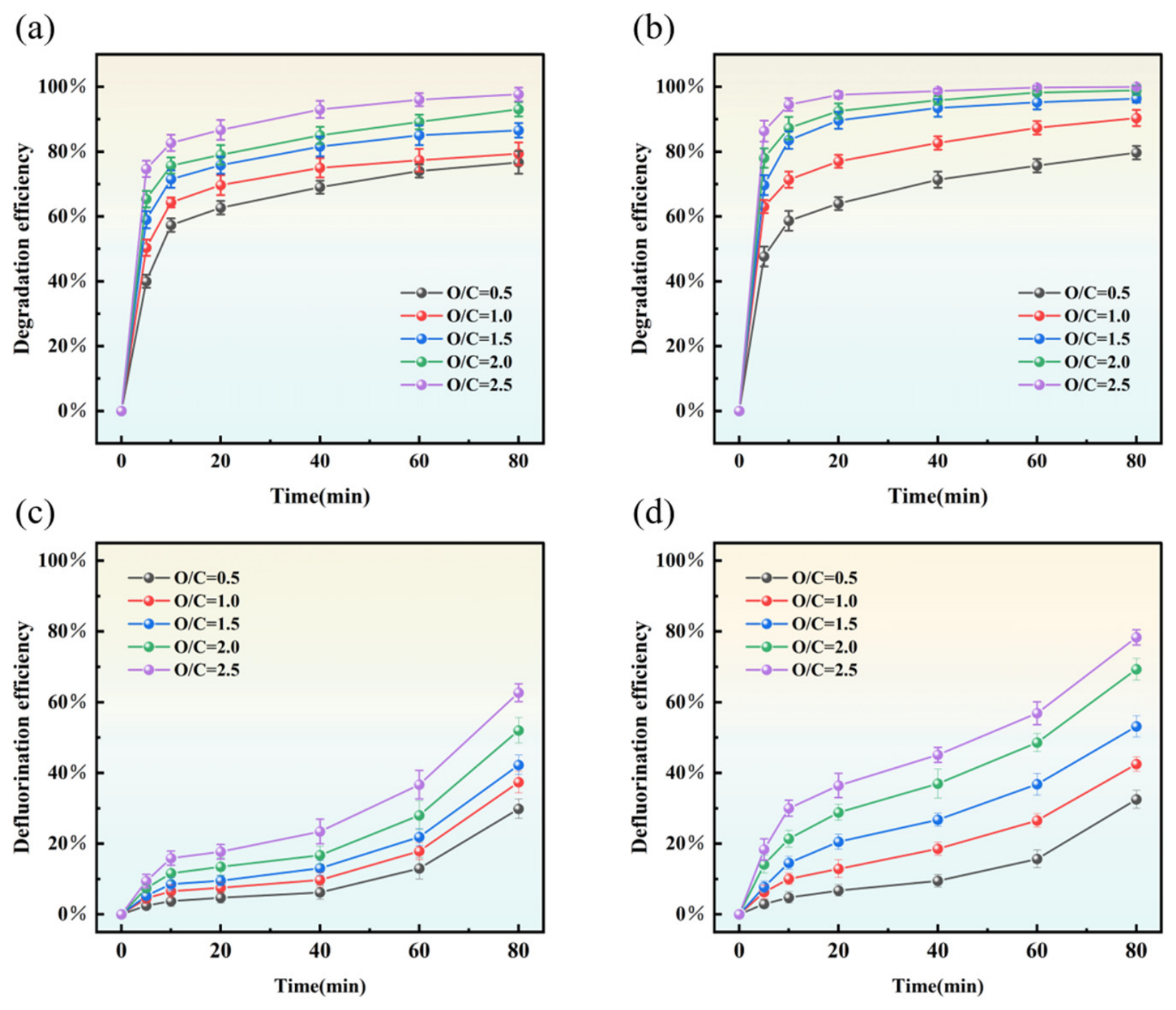
Hydrogen peroxide (H2O2) serves as a key oxidant in sub/supercritical water systems, acting as an important precursor for reactive species generation, and has been extensively employed for the removal of organic contaminants [42]. Figure 6a–d illustrates that the degradation efficiency of PFOA increases progressively with increasing O/C ratio.
The oxidation behavior in subcritical and supercritical water is predominantly driven by radical reactions. During the degradation process, reactive species generated under SCWO conditions may be associated with C–C bond cleavage and the formation of shorter-chain fluorinated intermediates.
At a relatively low O/C ratio (0.5), the amount of oxidative species generated is insufficient, resulting in limited interaction with PFOA molecules and thus lower degradation efficiency. With increasing O/C ratio, the availability of oxidative species may increase accordingly, which promotes the degradation process. This trend suggests that radical-mediated reactions may contribute to the degradation process. However, when the O/C ratio increases to higher levels (e.g., 2.5), the degradation efficiency continues to improve, although the extent of improvement becomes less pronounced. This may be attributed to the partial consumption of reactive radicals through side reactions, possibly involving interactions with excess H2O2 to form less reactive species such as HO2· [43]. However, it should be noted that this interpretation is based on commonly reported radical reaction pathways and has not been directly verified in the present study.
After introducing γ-MnO2, H2O2 can be effectively activated on the catalyst surface, facilitating the generation of reactive species. When the O/C ratio exceeded 1.5, the improvement in PFOA degradation efficiency became limited. Therefore, 1.5 is regarded as the optimal O/C ratio.

3.3.3. Effect of pH

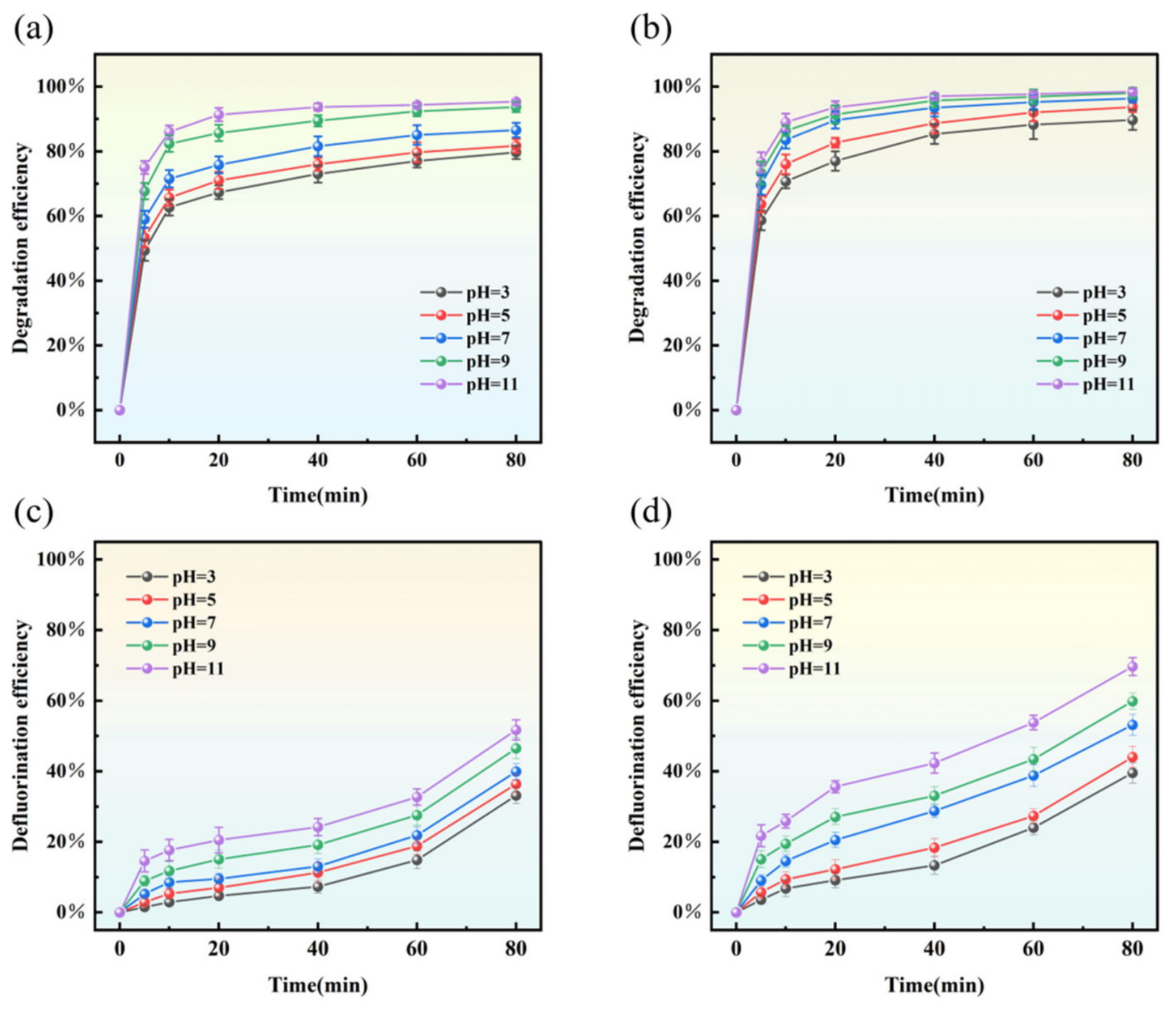
The acidity or alkalinity of the reaction medium significantly influences the degradation behavior of PFOA. As a weak acid, the ionization state of PFOA depends on the initial pH conditions, which may influence its interaction with reactive species. In addition, the initial pH may influence the decomposition pathway of H2O2 as well as the formation of reactive oxygen species (ROS). Figure 7a–d shows that under initially alkaline conditions, PFOA predominantly exists in its deprotonated form (PFOA), leading to improved solubility and dispersion in the reaction system and thus increasing the likelihood of interaction with reactive species during the early stage of the reaction. Meanwhile, the initial alkaline environment may favor the formation of reactive species, including superoxide (O2) [44]. Furthermore, OH may facilitate the activation of H2O2 at catalyst surface sites, thereby promoting interfacial electron transfer and enhancing the overall oxidation performance.
Under initially acidic conditions, however, the elevated concentration of H+ may inhibit the formation of reactive intermediates and facilitate their conversion into less reactive species, resulting in decreased oxidation efficiency. In addition, initially acidic conditions may modify the surface charge properties and active site configuration of the catalyst, which could hinder the effective adsorption and activation of PFOA molecules. These observations are generally consistent with previously reported trends in radical-based oxidation systems [45]. Therefore, the observed differences are more appropriately attributed to the initial pH adjustment and its influence on the early-stage reaction environment.

3.4. Mechanistic Analysis

3.4.1. Predicted Reactive Sites of PFOA

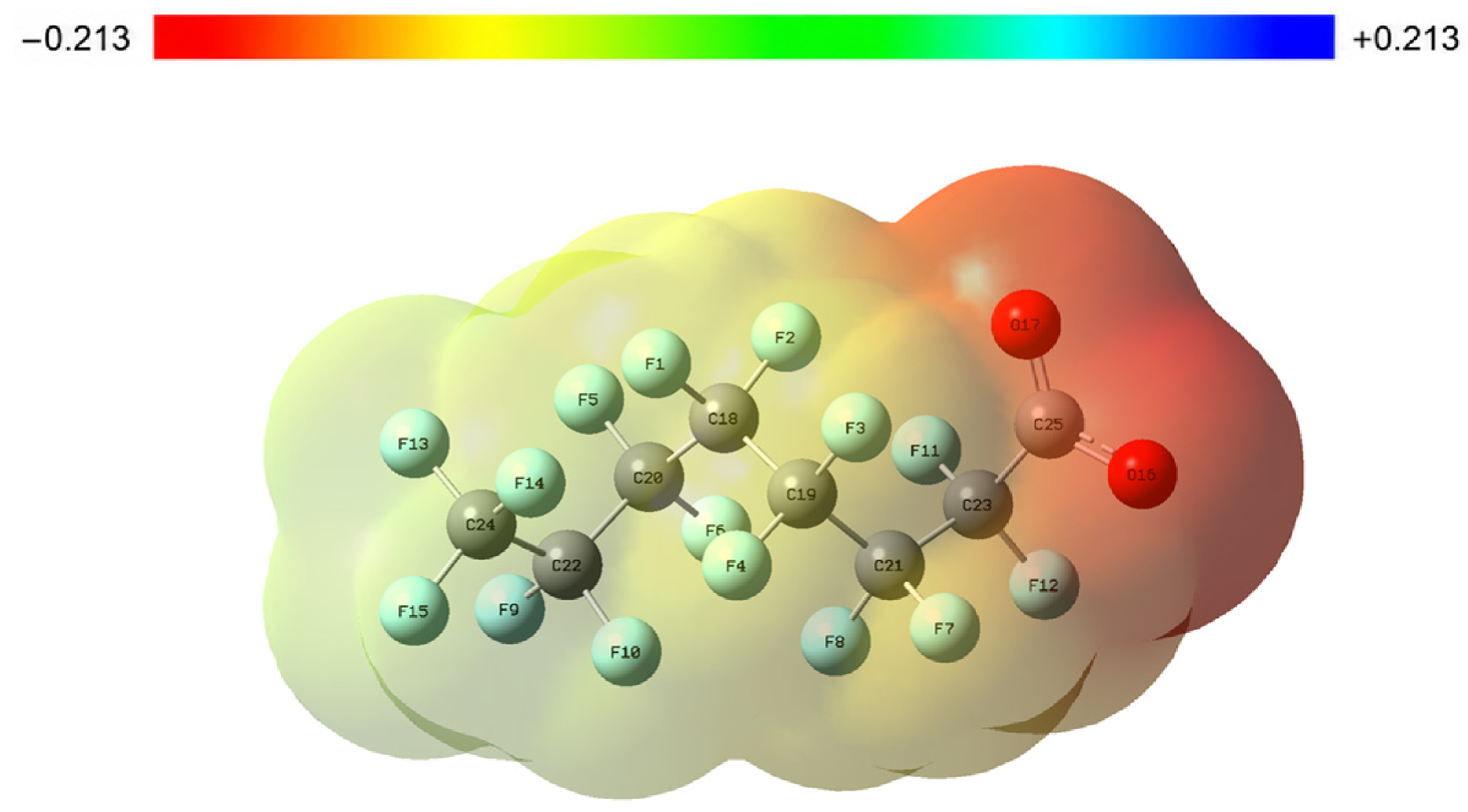
Identification of reactive regions is essential for elucidating the degradation mechanism of PFOA. In this work, the structure of the PFOA anion was optimized, and the electrostatic potential (ESP) distribution mapped on its molecular surface was analyzed to evaluate its chemical reactivity.
As shown in Figure 8, when PFOA exists in aqueous solution in the form of C7F15COO, its molecular surface is predominantly characterized by negative electrostatic potential. Notably, the carboxyl group exhibits a more negative potential region, with oxygen atoms displaying the highest electron density (highlighted in red), indicating that these sites are more susceptible to electrophilic attack.
Under SCWO conditions, various reactive species can be generated, including electrophilic radicals such as ·OH. Therefore, degradation of PFOA may preferentially occur at the carboxyl group, where electron-rich sites facilitate interactions with reactive species. This interpretation is consistent with the subsequent frontier molecular orbital analysis and provides theoretical support for the proposed degradation tendency.
However, it should be emphasized that these DFT-based descriptors reflect predicted reactive susceptibility under simplified electronic structure conditions rather than direct evidence of the actual reaction pathway under high-temperature SCWO environments. The complex radical-dominated environment and extreme reaction conditions may significantly influence the dominant reaction routes. Therefore, the present analysis should be regarded as a qualitative indication of potential reactive sites rather than definitive identification of the reaction initiation step.
To systematically identify the reactive sites of PFOA, a combined analysis based on Fukui functions and frontier molecular orbitals (FMOs) was conducted. According to Fukui theory, atoms with higher index values are more likely to participate in electrophilic, nucleophilic, or radical reactions [46].
The results indicate that the carboxyl group exhibits the highest reactivity (Table S3). The carboxyl oxygen O(16) shows a relatively high f+ value (0.115), suggesting strong electron-accepting tendency, whereas the carboxyl carbon C(25) presents a negative f+ value (−0.220), indicating significant charge redistribution that may facilitate bond cleavage.
Along the perfluorinated chain, several carbon atoms display relatively high f values, implying susceptibility to electrophilic attack, while fluorine atoms show much lower values, reflecting the intrinsic stability of C–F bonds. The distribution of f0 values further suggests that radical-mediated pathways may contribute to subsequent degradation steps.
Frontier molecular orbital (FMO) and frontier electron density (FED) analyses (Table S4) show that both HOMO and LUMO are mainly localized on the carboxyl group and adjacent α-carbon region, where higher FED values are also observed. These results suggest that the carboxyl group is the most probable region for initial reactive interaction rather than a strictly confirmed reaction initiation site.
The relatively large HOMO–LUMO energy gap (5.26 eV) indicates high molecular stability, making direct C–F bond cleavage energetically unfavorable (Figure S8). Therefore, PFOA degradation is more likely initiated by decarboxylation, followed by stepwise chain scission and progressive defluorination.
Overall, these results suggest that PFOA degradation preferentially initiates at the carboxyl group and proceeds via decarboxylation, sequential chain fragmentation, and gradual defluorination.

3.4.2. Degradation Pathway of PFOA in SCWO and DFT Insights

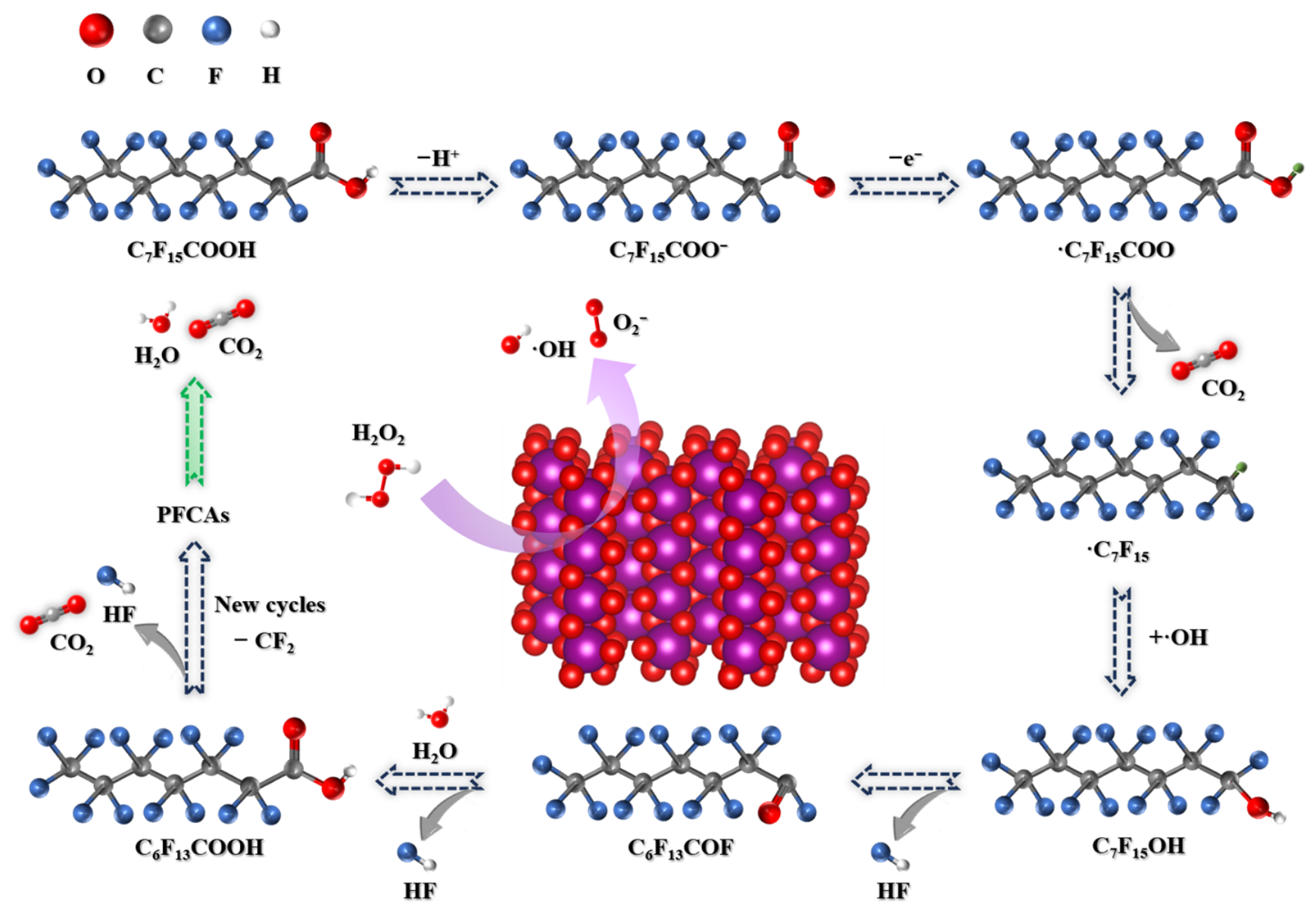
A degradation pathway of PFOA in SCWO was proposed based on the intermediate species, as illustrated in Figure 9. In the γ-MnO2-catalyzed SCWO system, the decomposition of H2O2 can generate ROS such as superoxide radicals (O2·) and hydroxyl radicals (·OH) [47]. These species can participate in C-C cleavage and C–F bond activation. Under the same reaction conditions, lower degradation and defluorination efficiencies were observed in the absence of H2O2, suggesting that the ROS generated during the reaction contribute to PFOA degradation, as shown in Figure S9.
XPS analysis indicates changes in Mn valence states before and after reaction. Previous studies have suggested that manganese oxide catalysts can undergo reversible Mn4+/Mn3+ redox transitions during H2O2-related catalytic processes, which could contribute to catalytic activity [48]. In addition, manganese oxides containing oxygen vacancies have been reported to be associated with H2O2 activation and the generation of reactive oxygen species in oxidation systems [49]. Accordingly, the enhanced degradation performance observed in this system can be associated with the catalytic properties of γ-MnO2 under SCWO conditions.
With increasing temperature, interfacial electron transfer between the catalyst surface and PFOA is enhanced, potentially facilitating the formation of the C7F15COO· radical. This intermediate may subsequently undergo decarboxylation to generate C7F15· and CO2, which has been widely proposed as an important initial step in PFAS degradation [50]. Subsequently, the C7F15· radical can react with ROS such as ·OH, forming unstable intermediates such as C7F15OH [51]. The resulting intermediates further undergo hydrolysis and oxidation reactions, potentially forming shorter-chain perfluorocarboxylic acids (e.g., C7F13OOH) accompanied by partial fluorine release (i.e., HF). Such transformations may involve the gradual shortening of the fluorinated carbon chain through repeated decarboxylation, oxidation, and defluorination processes. Accordingly, short-chain perfluorinated intermediate, such as C7F13OOH (m/z = 364), C6F11OOH (m/z = 314), C5F9OOH (m/z = 264), C4F7OOH (m/z = 214), and C2F3OOH (m/z = 114) were detected, as shown in Figure S7. In addition to these perfluorinated intermediates, the low-mass signals of fluorinated fragments or decomposition products, for instance COF2 (m/z = 66), CF3 (m/z = 69), and CF3O (m/z = 85), were also detected. Based on Figure 4, Figure 6 and Figure 7, a large discrepancy was observed between the PFOA degradation and defluorination efficiencies, indicating that the defluorination of these intermediates remains challenging. Therefore, the removal of small-molecule fluorinated organic compounds must be considered to achieve high defluorination efficiency.
Overall, PFOA degradation in the SCWO system (Equations (1)–(6)) involve stepwise pathways including decarboxylation, hydroxylation, C–F bond cleavage, and hydrolysis. Radical-mediated processes may contribute to C–F bond activation during degradation. The proposed reaction equations should be regarded as simplified transformation pathways based on experimental observations (detected by UPLC–MS/MS) and previous studies [52]. To further verify fluorine distribution, a fluorine mass balance analysis was performed (Table S5). Since the concentration of the fluorine intermediate products has not been quantitatively analyzed, the fluorine balance only takes into account the conversion between organic and inorganic fluorine.
C 7 F 15 COO   e   C 7 F 15 COO ·
C7F15COO· → C7F15· + CO2
C7F15· + ·OH → C7F15OH
C7F15OH → C7F14O + HF
C 7 F 14 O + H 2 O   e   C 6 F 13 COOH + HF
C 6 F 13 COO   e   C 6 F 13 COO ·
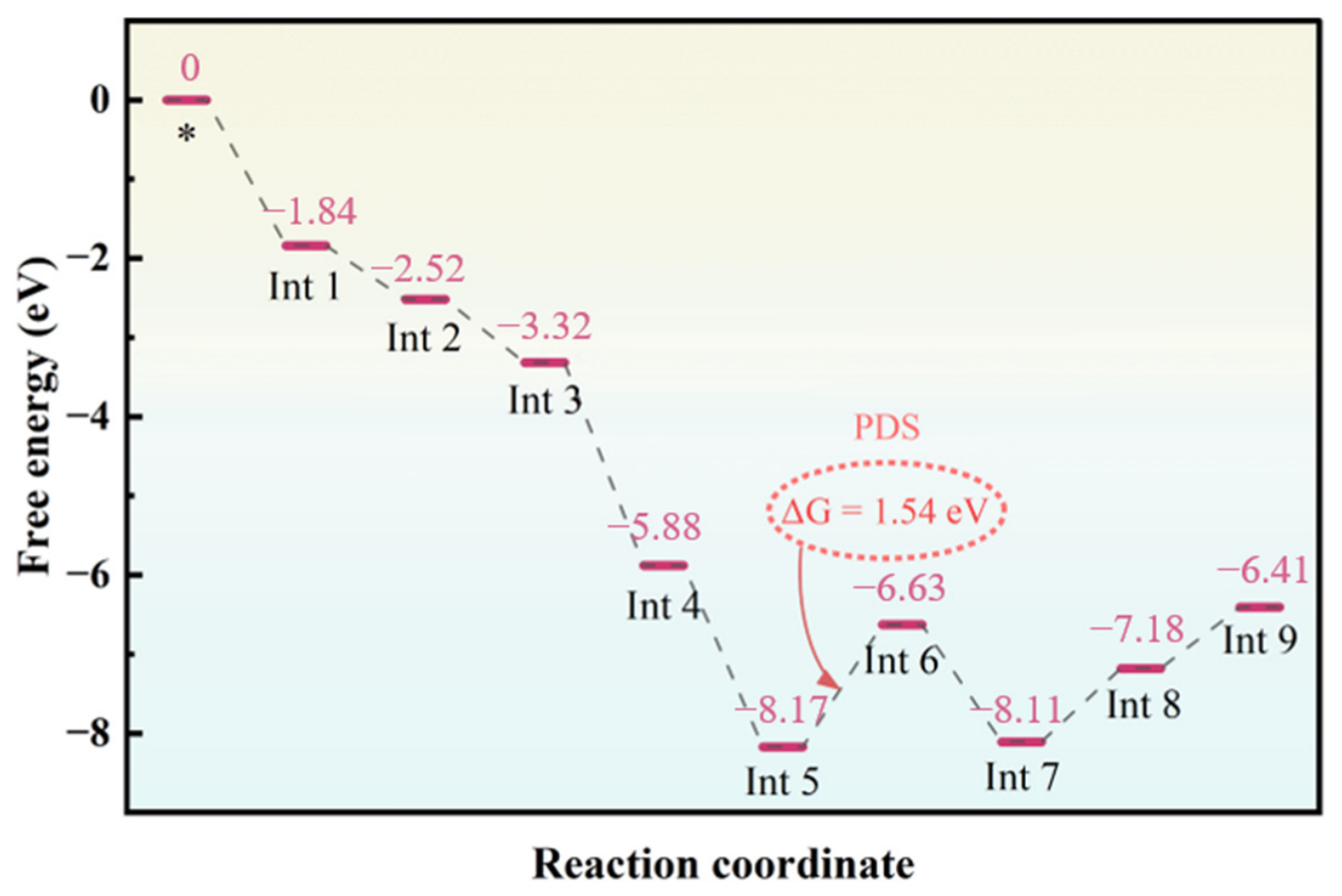
Density functional theory (DFT) calculations were performed using the Vienna ab initio Simulation Package (VASP) to elucidate the catalytic degradation mechanism of PFOA on the γ-MnO2 surface. The γ-MnO2 (110) surface was selected as a representative model due to its high thermodynamic stability and prevalence. Oxygen vacancies were also introduced to represent defect sites commonly observed in transition metal oxides. Based on these considerations, a defective surface model was constructed. To better approximate the SCWO environment, an implicit solvation model (VASPsol) was employed to account for solvent effects. The calculated free energy profile is presented in Figure 10.
The results show that PFOA is initially adsorbed on the catalyst surface in the form of C7F15COO, followed by a decarboxylation step generating the perfluoroalkyl radical (C7F15·) and CO2. This step is thermodynamically favorable and is therefore not expected to be the rate-limiting step, consistent with widely reported initial transformation pathways of PFAS.
Subsequently, the perfluoroalkyl intermediate undergoes hydroxylation to form C7F15OH, which is further converted into C7F14O via a defluorination process accompanied by HF release (*C7F15OH → * C7F14O + HF). The Int5 → Int6 transition exhibits a significantly positive free energy change (ΔG = 1.54 eV), indicating a strongly endergonic and thermodynamically unfavorable step that requires external energy input. Nevertheless, under the high-temperature conditions of the SCWO system, this transformation can still proceed.
Following this step, the calculated free energy barriers of subsequent reactions decrease considerably, including hydration, hydroxylation, and carbon-chain scission processes, potentially leading to the formation of short-chain perfluorocarboxylates (e.g., C6F13COO). These theoretical results are generally consistent with the intermediates identified by UPLC–MS/MS, including perfluorobutanoic acid and perfluorohexanoic acid, thereby supporting the proposed degradation pathway.
Oxygen vacancies may be related to the catalytic behavior of γ-MnO2 under SCWO conditions [53]. Specifically, defect sites can facilitate the reaction process by reducing the free energy of the C–F bond activation step in the calculated profile. In addition, they are associated with improved reactivity and enhanced defluorination performance in the γ-MnO2-catalyzed system.
Overall, PFOA degradation proceeds through stepwise defluorination accompanied by progressive carbon-chain shortening. Among the elementary steps, C–F bond cleavage is likely to govern the reaction kinetics, while decarboxylation and subsequent oxidation steps are thermodynamically favorable. This mechanistic understanding explains the experimental observation that high overall degradation efficiency can be achieved even in the absence of a catalyst, whereas defluorination remains limited. In contrast, the introduction of γ-MnO2 significantly enhances defluorination efficiency, likely by facilitating the kinetically relevant C–F bond activation step, thereby improving overall reaction performance.

3.5. Toxicity Prediction of Transformation Products

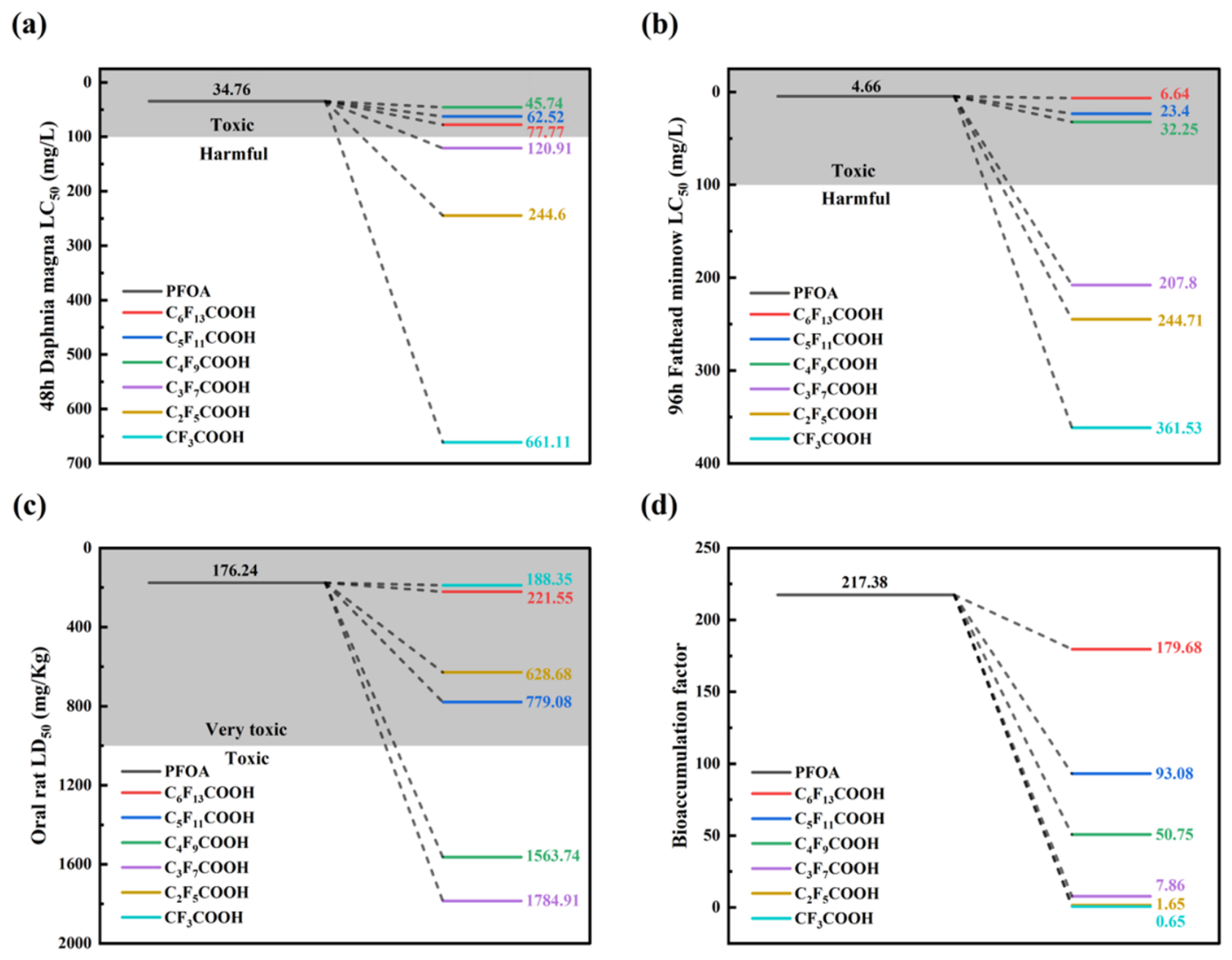
The toxicity of PFOA and its proposed transformation products was evaluated using the Toxicity Estimation Software Tool (T.E.S.T.) as a computational screening approach, including acute toxicity (LC50 values for Pimephales promelas and Daphnia magna), oral LD50, and bioaccumulation factor (BCF). As shown in Figure 11a,b, PFOA exhibits relatively high acute toxicity, whereas the tentatively assigned intermediates display increased LC50 values, suggesting a general reduction in acute toxicity after SCWO treatment.
Consistent trends are observed for oral toxicity (Figure 11c), where the proposed transformation products present higher LD50 values than PFOA (176.24 mg·kg−1), suggesting a decrease in predicted mammalian toxicity. In addition, BCF analysis (Figure 11d) shows a significant reduction in bioaccumulation potential for the proposed intermediates compared with PFOA (217.38), although some short-chain species still exhibit relatively higher acute toxicity.
Overall, these results suggest that the SCWO process may reduce the toxicity potential and environmental persistence of PFOA transformation products. However, these QSAR-based conclusions are limited to the proposed transformation products inferred from UPLC–MS/MS observations and previously reported degradation pathways and do not consider all possible products or their combined effects. Therefore, the results should be interpreted as a preliminary risk screening rather than direct evidence of detoxification. These findings are consistent with previous studies reporting decreasing toxicity and bioaccumulation with PFAS chain shortening [54,55,56].

3.6. Techno-Economic Analysis

According to our experience, the economic feasibility of SCWO is closely related to the treatment scale, and the unit treatment cost generally decreases as the treatment scale increases. Among the cost components, labor cost is negatively correlated with the SCWO treatment scale; that is, a larger treatment scale requires lower labor input per unit of wastewater. When the treatment scale is approximately 100 t d−1, the unit investment cost is about 30,000 USD t−1. Since SCWO operates under high-temperature and high-pressure conditions, the reactor is exposed to a highly corrosive environment. Therefore, corrosion-resistant zirconium alloy or titanium alloy liners are usually required to ensure long-term stable operation and may also help reduce equipment investment. On the other hand, SCWO is an exothermic process, and the heat released during the reaction can be reused through heat recovery, thereby effectively reducing the operating energy consumption. According to engineering experience, the overall electricity consumption for removing 1 kg of COD is approximately 1–2 kWh, with the main energy consumption coming from the air compressor and high-pressure water pump. In addition, because air is usually used as the oxidant in the system, the oxidant cost is relatively low.
The techno-economic feasibility of SCWO for PFOA treatment was evaluated based on the available data sources, as shown in Table S6, and compared with the Fenton process. The results indicated that SCWO has advantages in terms of post-treatment requirements and secondary pollution control.

4. Conclusions

In this study, a γ-MnO2-catalyzed SCWO system was developed for the efficient degradation and defluorination of PFOA. The effects of key operating parameters, including reaction temperature, oxidant dosage (O/C ratio), reaction time, and pH, were systematically investigated. Among these factors, reaction temperature played a dominant role, and increasing initial pH further enhanced the overall performance. The γ-MnO2 catalyst exhibited stable performance with only slight activity loss after repeated cycles, indicating good reusability under SCWO conditions. Mechanistic analysis combined with DFT calculations suggested that γ-MnO2 effectively facilitates the reaction process by promoting favorable reaction steps, consistent with experimental observations. Furthermore, toxicity evaluation of transformation products suggests a reduction in toxicity potential after treatment. Overall, the γ-MnO2-catalyzed SCWO process demonstrated high degradation and defluorination performance for PFOA removal, along with favorable catalytic reusability and reduced predicted ecological risk.

Supplementary Materials

The following supporting information can be downloaded at: https://www.mdpi.com/article/10.3390/pr14111822/s1, Text S1: Analytical Methods; Text S2: Computational Details; Text S3: Characterization Methods; Text S4: Thermogravimetric (TG) Analysis; Text S5: Energy-Dispersive X-ray Spectroscopy (EDS) Analysis; Text S6: Calculation of fluorine mass balance; Figure S1: TG curve of γ-MnO2; Figure S2: O 1s XPS spectra of MnO2 with different crystal structures: (a) β-MnO2; (b) γ-MnO2; Olat, Ovac, Oads represent lattice oxygen, defect oxygen, and adsorbed hydroxyl oxygen, respectively; Figure S3: Comparison of PFOA removal performance over γ-MnO2 and β-MnO2: (a) degradation efficiency; (b) defluorination efficiency. (300 °C, O/C = 1.5, pH = 7); Figure S4: EDS spectrum and elemental mapping of γ-MnO2; Figure S5: Raman spectra of fresh and reused γ-MnO2 catalysts after five catalytic cycles; Figure S6: SEM images of γ-MnO2 after five successive reaction cycles; Figure S7: UPLC–MS/MS spectra of PFOA and representative fluorinated intermediates formed during degradation: (a) C8HF15O2, (b) C7HF13O2, (c) C6HF11O2, (d) C5HF9O2, (e) C4HF7O2, and (f) C2HF3O2; Figure S8: Frontier molecular orbital (HOMO and LUMO) distributions of the PFOA anion; Figure S9: PFOA degradation and defluorination in the absence of H2O2 under the reaction conditions: (a) degradation efficiency; (b) defluorination efficiency. (300 °C, O/C = 1.5, pH = 7); Table S1: Peak fitting parameters of Mn 2p3/2 XPS spectra before and after reaction; Table S2: Identification of fluorinated intermediates detected during PFOA degradation; Table S3: Fukui indices of atoms in the PFOA anion; Table S4: Frontier molecular orbital energies and related parameters of the PFOA anion. Table S5: Fluorine mass balance of catalytic subcritical water oxidation of PFOA (300 °C, 40 min, O/C = 1.5, pH = 7); Table S6: Comparison of representative wastewater treatment technologies in terms of techno-economic and energy consumption performance. References cited in Supplementary Materials [36,57,58,59,60,61,62,63].

Author Contributions

Conceptualization and writing—original draft preparation, X.Y.; investigation, formal analysis and writing—review and editing, Z.P.; Data curation, X.P. and J.W.; methodology, M.H. and Z.H.; investigation (DFT calculations using VASP), S.W.; funding acquisition, M.H., J.W. and Z.P. All authors have read and agreed to the published version of the manuscript.

Funding

This work was funded by the National Key Research and Development Program of China (2019YFE0117200), the National Natural Science Foundation of China (22278375) and Technical Research and Development Special Project of Shaoxing City (2024B43004 & 2024B23002).

Data Availability Statement

The data that support the findings of this study are available from the corresponding author upon reasonable request.

Conflicts of Interest

The authors declare no conflicts of interest.

References

  1. Wenxiu, H.; Lei, F.; Shengpeng, Z.; Boqiang, Q.; Shoubiao, Z.; Xiaofeng, J.; Ying, D. Pollution Mechanism and Toxicological Effects of Perfluorinated Compounds as a Novel POPs. Environ. Sci. Technol. 2017, 40, 75–82. [Google Scholar]
  2. Pan, G.; Zhang, T. The degradation pathways and mineralization of perfluorooctanoic acid (PFOA). Chin. Sci. Bull. 2015, 60, 1574–1591. [Google Scholar] [CrossRef][Green Version]
  3. Suja, F.; Pramanik, B.K.; Zain, S.M. Contamination, bioaccumulation and toxic effects of perfluorinated chemicals (PFCs) in the water environment: A review paper. Water Sci. Technol. 2009, 60, 1533–1544. [Google Scholar] [CrossRef]
  4. Yanmin, S.; Lianning, Z.; Wenlong, H.; Wenen, S.; Yinglong, L. Pollution status and related research progress of perfluorinated compounds. Environ. Eng. 2017, 35, 82–86. [Google Scholar]
  5. Hajalifard, Z.; Kazemi, S.; Eftekhari, S.; Rezaei, S.; Mousazadeh, M.; Usman, M. Per- and polyfluoroalkyl substances degradation using hydroxyl- and sulphate- radical-based advanced oxidation from water matrices: Which one is the best approach? Int. J. Environ. Anal. Chem. 2024, 104, 9128–9152. [Google Scholar] [CrossRef]
  6. Annamalai, S.; Kim, N.; Hwang, S. Enhanced PFOA degradation via persulfate-assisted electrochemical oxidation: Performance, mechanistic insights, and toxicity analysis. J. Environ. Chem. Eng. 2025, 13, 119424. [Google Scholar] [CrossRef]
  7. Yang, J.; Xiao, Y.; Wang, Y.; Tang, Q.; Zhu, X.; Zhang, W.; Qiu, R. Discerning the roles of various reactive oxygen species on PFOA degradation. Res. Sq. 2023. [Google Scholar] [CrossRef]
  8. Ding, W.; Tang, T.; Tan, X.; Huang, Y. Enhancing Photocatalytic Decarboxylation by Frustrated Lewis Acid-Base Pairs for Efficient Degradation of Perfluorooctanoic Acid. Environ. Sci. Technol. 2025, 59, 17899–17908. [Google Scholar] [CrossRef]
  9. Luo, P.; Zhang, Y.; Peng, Z.; He, Q.; Zhao, W.; Zhang, W.; Yin, D.; Zhang, Y.; Tang, J. Photocatalytic degradation of perfluorooctanoic acid (PFOA) from water: A mini review. Environ. Pollut. 2024, 343, 123212. [Google Scholar] [CrossRef] [PubMed]
  10. Navidpour, A.H.; Safaei, J.; Johir, M.A.H.; Ni, B.-J.; Dashti, A.; Li, X.; Zhou, J.L. Zinc oxide@citric acid-modified graphitic carbon nitride nanocomposites for adsorption and photocatalytic degradation of perfluorooctanoic acid. Adv. Compos. Hybrid Mater. 2024, 7, 53. [Google Scholar] [CrossRef]
  11. Luo, J.; Li, W.; Yin, R.; Liu, Q.; Xin, X.; Yang, L.; He, K.; Ma, D.; Lv, S.; Xing, D. Photocatalyst degradation of perfluorooctanoic acid in water: Mechanisms, approaches, and perspectives. Sep. Purif. Technol. 2024, 338, 126503. [Google Scholar] [CrossRef]
  12. Song, D.; Qiao, B.; Wang, X.; Zhao, L.; Li, X.; Zhang, P.; Yao, Y.; Chen, H.; Zhu, L.; Sun, H. Degradation of Perfluorooctanoic Acid by Chlorine Radical Triggered Electrochemical Oxidation System. Environ. Sci. Technol. 2023, 57, 9416–9425. [Google Scholar] [CrossRef]
  13. Chen, Z.F.; Wang, X.J.; Feng, H.L.; Chen, S.H.; Niu, J.F.; Di, G.L.; Kujawski, D.; Crittenden, J.C. Electrochemical Advanced Oxidation of Perfluorooctanoic Acid: Mechanisms and Process Optimization with Kinetic Modeling. Environ. Sci. Technol. 2022, 56, 14409–14417. [Google Scholar] [CrossRef] [PubMed]
  14. Chen, F.; Zhou, Y.; Wang, L.; Wang, P.; Wang, T.; Ravindran, B.; Mishra, S.; Chen, S.; Cui, X.; Yang, Y.; et al. Elucidating the degradation mechanisms of perfluorooctanoic acid and perfluorooctane sulfonate in various environmental matrices: A review of green degradation pathways. Environ. Geochem. Health 2024, 46, 349. [Google Scholar] [CrossRef] [PubMed]
  15. Zango, Z.U.; Khoo, K.S.; Garba, A.; Kadir, H.A.; Usman, F.; Zango, M.U.; Da Oh, W.; Lim, J.W. A review on superior advanced oxidation and photocatalytic degradation techniques for perfluorooctanoic acid (PFOA) elimination from wastewater. Environ. Res. 2023, 221, 115326. [Google Scholar] [CrossRef]
  16. Yabalak, E.; Isik, Z.; Dizge, N. Catalytical efficiency, mechanism and characterization of hydrolysed waste eggshell in the subcritical water oxidation of pistachio processing wastewater. J. Environ. Manag. 2022, 317, 115326. [Google Scholar] [CrossRef]
  17. Javaid, R.; Qazi, U.Y.; Ikhlaq, A.; Zahid, M.; Alazmi, A. Subcritical and supercritical water oxidation for dye decomposition. J. Environ. Manag. 2021, 290, 112605. [Google Scholar] [CrossRef]
  18. Moeller, M.; Nilges, P.; Harnisch, F.; Schroeder, U. Subcritical Water as Reaction Environment: Fundamentals of Hydrothermal Biomass Transformation. Chemsuschem 2011, 4, 566–579. [Google Scholar] [CrossRef]
  19. Toor, S.S.; Rosendahl, L.; Rudolf, A. Hydrothermal liquefaction of biomass: A review of subcritical water technologies. Energy 2011, 36, 2328–2342. [Google Scholar] [CrossRef]
  20. Luo, C.; Xi, H.; Feng, Y.-Q.; Hung, T.-C. Performance evaluation of a supercritical water oxidation cogeneration system using hydrogen peroxide as oxidant. Energy Convers. Manag. 2022, 267, 115914. [Google Scholar] [CrossRef]
  21. Li, Z.; Li, S.; Tang, Y.; Li, X.; Wang, J.; Li, L. Highly efficient degradation of perfluorooctanoic acid: An integrated photo-electrocatalytic ozonation and mechanism study. Chem. Eng. J. 2020, 391, 123533. [Google Scholar] [CrossRef]
  22. Kim, M.; Kwon, J.; Lee, H.J.; Park, K.S.; Kim, J.; Kim, J.; Baek, K.; Yuan, H.; Hyun, J.K.; Cho, Y.S.; et al. Bespoke selenium nanowires with comprehensive piezo-phototronic effects as viable p-type semiconductor-based piezo-photocatalysts. Nano Energy 2023, 114, 108680. [Google Scholar] [CrossRef]
  23. Wang, F.; Zheng, Y.; Chen, Q.; Yan, Z.; Lan, D.; Lester, E.; Wu, T. A critical review of facets and defects in different MnO2 crystalline phases and controlled synthesis—Its properties and applications in the energy field. Coord. Chem. Rev. 2024, 500, 215537. [Google Scholar] [CrossRef]
  24. He, X.; Sun, B.; He, M.; Chi, H.; Wang, Z.; Zhang, W.; Ma, J. Highly efficient simultaneous catalytic degradation and defluorination of perfluorooctanoic acid by the H2O2-carbon/MnO2 system generating O2- and OH synchronously. Appl. Catal. B Environ. 2020, 277, 119219. [Google Scholar] [CrossRef]
  25. Wang, Y.; Zhou, T.; Chen, D.; Zhang, Z.-X.; Zhang, Q.; Ye, X.; Wan, J.; Zou, J.-P. Fenton-like catalysis by MnO2 membrane reactor with oxygen vacancies for carbamazepine degradation. Appl. Catal. B Environ. Energy 2024, 353, 124106. [Google Scholar] [CrossRef]
  26. Lu, T.; Chen, F. Multiwfn: A multifunctional wavefunction analyzer. J. Comput. Chem. 2012, 33, 580–592. [Google Scholar] [CrossRef] [PubMed]
  27. Kresse, G.; Furthmuller, J. Efficient iterative schemes for ab initio total-energy calculations using a plane-wave basis set. Phys. Rev. B Condens. Matter 1996, 54, 11169–11186. [Google Scholar] [CrossRef] [PubMed]
  28. Kresse, G.; Joubert, D. From ultrasoft pseudopotentials to the projector augmented-wave method. Phys. Rev. B 1999, 59, 1758–1775. [Google Scholar] [CrossRef]
  29. Perdew, J.P.; Burke, K.; Ernzerhof, M. Generalized Gradient Approximation Made Simple. Phys. Rev. Lett. 1996, 77, 3865–3868. [Google Scholar] [CrossRef]
  30. Mathew, K.; Sundararaman, R.; Letchworth-Weaver, K.; Arias, T.A.; Hennig, R.G. Implicit solvation model for density-functional study of nanocrystal surfaces and reaction pathways. J. Chem. Phys. 2014, 140, 084106. [Google Scholar] [CrossRef]
  31. U.S. Environmental Protection Agency. User’s Guide for T.E.S.T. (Version 4.2): Toxicity Estimation Software Tool; US EPA Office of Research and Development: Washington, DC, USA, 2016.
  32. Cuéllar-Herrera, L.; Arce-Estrada, E.; Romero-Serrano, A.; Ortiz-Landeros, J.; Cabrera-Sierra, R.; Tirado-López, C.; Hernández-Ramírez, A.; López-Rodríguez, J. Microwave-Assisted Synthesis and Characterization of γ-MnO2 for High-Performance Supercapacitors. J. Electron. Mater. 2021, 50, 5577–5589. [Google Scholar] [CrossRef]
  33. Wu, H.; Dai, X.; Li, J. Oxygen Vacancy-Driven Improvement of NH3-SCR Performance over α-MnO2: Mechanistic Insights. Catalysts 2025, 15, 607. [Google Scholar] [CrossRef]
  34. Wang, Q.; Zhou, W.; Zhang, Y.; Jin, H.; Li, X.; Zhang, T.; Wang, B.; Zhao, R.; Zhang, J.; Li, W.; et al. Rescue of dead MnO2 for stable electrolytic Zn–Mn redox-flow battery: A metric of mediated and catalytic kinetics. Natl. Sci. Rev. 2024, 11, nwae230. [Google Scholar] [CrossRef]
  35. Nesbitt, H.W.; Banerjee, D. Interpretation of XPS Mn(2p) spectra of Mn oxyhydroxides and constraints on the mechanism of MnO2 precipitation. Am. Miner. 1998, 83, 305–315. [Google Scholar] [CrossRef]
  36. Shi, B.; Di, Z.; Guo, X.; Wei, Y.; Zhang, R.; Jia, J. Facet control of manganese oxides with diverse redox abilities and acidities for catalytically removing hazardous 1,2-dichloroethane. Mater. Adv. 2022, 3, 1101–1114. [Google Scholar] [CrossRef]
  37. Chen, H.; Wang, Y.; Lv, Y.-K. Catalytic oxidation of NO over MnO2 with different crystal structures. RSC Adv. 2016, 6, 54032–54040. [Google Scholar] [CrossRef]
  38. Huo, G.; Wang, X.-W.; Zhang, Z.-B.; Song, Z.; Kang, X.-M.; Chen, M.-X.; Wang, Q.; Fu, X.-Z.; Luo, J.-L. γ-MnO2 nanorod-assembled hierarchical micro-spheres with oxygen vacancies to enhance electrocatalytic performance toward the oxygen reduction reaction for aluminum-air batteries. J. Energy Chem. 2020, 51, 81–89. [Google Scholar] [CrossRef]
  39. Liu, S.; Ge, Z.; Du, M.; Guo, L. Supercritical water partial oxidation of indole: Reaction variables, migration pathways, and nitrogen distribution. Chem. Eng. J. 2023, 451, 138638. [Google Scholar] [CrossRef]
  40. Liu, C.S.; Higgins, C.P.; Wang, F.; Shih, K. Effect of temperature on oxidative transformation of perfluorooctanoic acid (PFOA) by persulfate activation in water. Sep. Purif. Technol. 2012, 91, 46–51. [Google Scholar] [CrossRef]
  41. Glüge, J.; Scheringer, M.; Cousins, I.T.; DeWitt, J.C.; Goldenman, G.; Herzke, D.; Lohmann, R.; Ng, C.A.; Trier, X.; Wang, Z. An overview of the uses of per- and polyfluoroalkyl substances (PFAS). Environ. Sci. Process. Impacts 2020, 22, 2345–2373. [Google Scholar] [CrossRef]
  42. Hu, M.; Zheng, J.; Ye, Z.; Jin, Y.; Pan, X.; Huang, J.; Zhang, Y.; Wang, J.; Hu, Z.-T.; Pan, Z. Subcritical catalytic water oxidation for conversion DMAC waste carbon resources to acetic acid. J. Environ. Chem. Eng. 2025, 13, 115965. [Google Scholar] [CrossRef]
  43. Wang, J.; Yao, Z.; Dong, M.; Ye, Z.; Chen, M.; Hu, Z.; Pan, Z.; Hu, M. Rapid degradation of glyphosate via catalytic subcritical water oxidation using Ru-CuFe2O4: Acceleration of nitrogen migration and transformation. J. Water Process Eng. 2025, 71, 107417. [Google Scholar] [CrossRef]
  44. Bai, L.; Jiang, Y.; Xia, D.; Wei, Z.; Spinney, R.; Dionysiou, D.D.; Minakata, D.; Xiao, R.; Xie, H.; Chai, L. Mechanistic Understanding of Superoxide Radical-Mediated Degradation of Perfluorocarboxylic Acids. Environ. Sci. Technol. 2021, 56, 624–633. [Google Scholar] [CrossRef]
  45. Briega-Martos, V.; Herrero, E.; Feliu, J.M. Pt(hkl) surface charge and reactivity. Curr. Opin. Electrochem. 2019, 17, 97–105. [Google Scholar] [CrossRef]
  46. Yang, W.; Mortier, W.J. The use of global and local molecular parameters for the analysis of the gas-phase basicity of amines. J. Am. Chem. Soc. 1986, 108, 5708–5711. [Google Scholar] [CrossRef]
  47. Mitchell, S.M.; Ahmad, M.; Teel, A.L.; Watts, R.J. Degradation of Perfluorooctanoic Acid by Reactive Species Generated through Catalyzed H2O2 Propagation Reactions. Environ. Sci. Technol. Lett. 2014, 1, 117–121. [Google Scholar] [CrossRef]
  48. Mamani, M.; Valdés, C.; Quispe, C.; Flores, M.; Vergara, C.; Villaseñor, J. Crystalline phase over surface area: Controlled redox cycling in pyrolusite governs H2O2 decomposition on Mn oxides. Appl. Catal. A General. 2026, 719, 120925. [Google Scholar] [CrossRef]
  49. Zheng, J.; Lim, H.J.; Hedtke, T.; Kim, J.-H.; Zhang, S. Manganese oxide for heterogeneous Fenton treatment: Catalyst or inhibitor? Appl. Catal. B Environ. Energy 2024, 359, 124531. [Google Scholar] [CrossRef]
  50. Liu, Y.; Fan, X.; Quan, X.; Fan, Y.; Chen, S.; Zhao, X. Enhanced Perfluorooctanoic Acid Degradation by Electrochemical Activation of Sulfate Solution on B/N Codoped Diamond. Environ. Sci. Technol. 2019, 53, 5195–5201. [Google Scholar] [CrossRef] [PubMed]
  51. Trojanowicz, M.; Bojanowska-Czajka, A.; Bartosiewicz, I.; Kulisa, K. Advanced Oxidation/Reduction Processes treatment for aqueous perfluorooctanoate (PFOA) and perfluorooctanesulfonate (PFOS)—A review of recent advances. Chem. Eng. J. 2018, 336, 170–199. [Google Scholar] [CrossRef]
  52. Li, G.; Peng, M.; Huang, Q.; Huang, C.-H.; Chen, Y.; Hawkins, G.; Li, K. A review on the recent mechanisms investigation of PFAS electrochemical oxidation degradation: Mechanisms, DFT calculation, and pathways. Front. Environ. Eng. 2025, 4, 1568542. [Google Scholar] [CrossRef]
  53. Zeng, J.; Xie, H.; Liu, Z.; Liu, X.; Zhou, G.; Jiang, Y. Oxygen vacancy induced MnO2 catalysts for efficient toluene catalytic oxidation. Catal. Sci. Technol. 2021, 11, 6708–6723. [Google Scholar] [CrossRef]
  54. Eeso, K.; Gallan, R.; Goukeh, M.N.; Tate, K.; Raja, R.K.B.; Popovic, Z.; Abichou, T.; Chen, H.; Locke, B.R.; Tang, Y. Degradation of per- and polyfluoroalkyl substances in landfill leachate by a thin-water-film nonthermal plasma reactor. Waste Manag. 2023, 161, 104–115. [Google Scholar] [CrossRef]
  55. Solan, M.E.; Lavado, R. The use of in vitro methods in assessing human health risks associated with short-chain perfluoroalkyl and polyfluoroalkyl substances (PFAS). J. Appl. Toxicol. 2022, 42, 1298–1309. [Google Scholar] [CrossRef] [PubMed]
  56. Guo, J.; Zhang, Y.; Sun, Q.; Qu, G.; Wei, L.; Wang, T.; Jia, H.; Zhu, L. Theoretical and experimental insights into electron-induced efficient defluorination of perfluorooctanoic acid and perfluorooctane sulfonate by mesoporous plasma. Chem. Eng. J. 2022, 430, 132922. [Google Scholar] [CrossRef]
  57. Zhang, F.; Li, Y.; Liang, Z.; Wu, T. Energy conversion and utilization in supercritical water oxidation systems: A review. Biomass Bioenergy 2022, 156, 106322. [Google Scholar] [CrossRef]
  58. Zhang, F.; Chen, J.; Su, C.; Chen, S.; Chen, Z.; Ding, Y. Combined effects of protective film and oxidant on the performance of the supercritical water oxidation system with a film protective reactor: A simulation study. Process Saf. Environ. Prot. 2019, 131, 268–281. [Google Scholar] [CrossRef]
  59. Abeln, J.; Kluth, M.; Pagel, M. Results and rough cost estimation for SCWO of painting effluents using a transpiring wall and a pipe reactor. J. Adv. Oxid. Technol. 2007, 10, 169. [Google Scholar]
  60. Gerek, E.E.; Yılmaz, S.; Koparal, A.S.; Gerek, Ö.N. Combined energy and removal efficiency of electrochemical wastewater treatment for leather industry. J. Water Process Eng. 2019, 30, 100382. [Google Scholar] [CrossRef]
  61. Naje, A.S.; Samaka, I.S.; Zwain, H.M.; Ajeel, M.A. Photovoltaic cell electro-Fenton oxidation process for treatment of organic content in methyl orange wastewater. J. Sustain. Sci. Manag. 2021, 16, 53–63. [Google Scholar] [CrossRef]
  62. Cañizares, P.; Paz, R.; Sáez, C.; Rodrigo, M.A. Costs of the electrochemical oxidation of wastewaters: A comparison with ozonation and Fenton oxidation processes. J. Environ. Manag. 2009, 90, 410–420. [Google Scholar] [CrossRef] [PubMed]
  63. Ismail, O.; Farrag, T.E.; Reda, Y.; Hazzaa, R. Comparative experimental evaluation and empirical modeling of advanced oxidation processes for organic compounds removal from cosmetic wastewater with statistical assessment. Sci. Rep. 2025, 15, 33335. [Google Scholar] [CrossRef] [PubMed]
Figure 1. Characterization of γ-MnO2: (a) XRD pattern; (b) EPR spectrum; (c) XPS spectrum before reaction; (d) XPS spectrum after reaction.
Processes 14 01822 g001
Figure 2. SEM images of γ-MnO2: (a) low-magnification image with scale bar of 1 μm; (b) high-magnification image with scale bar of 100 nm.
Processes 14 01822 g002
Figure 3. Cycling performance of γ-MnO2: (a) degradation efficiency; (b) defluorination efficiency.
Processes 14 01822 g003
Figure 4. Effect of temperature on PFOA degradation (a,b) and defluorination (c,d) efficiencies. (a,c): non-catalytic system; (b,d): γ-MnO2 system (O/C = 1.5, pH = 7).
Processes 14 01822 g004
Figure 5. Pseudo-first-order kinetic plots of PFOA degradation at 300 °C in the absence and presence of γ-MnO2 (O/C = 1.5, pH = 7).
Processes 14 01822 g005
Figure 6. Effect of O/C ratio on PFOA degradation (a,b) and defluorination (c,d) efficiencies. (a,c): non-catalytic system; (b,d): γ-MnO2 system (T = 300 °C, pH = 7).
Processes 14 01822 g006
Figure 7. Effect of pH on PFOA degradation (a,b) and defluorination (c,d) efficiencies. (a,c): non-catalytic system; (b,d): γ-MnO2 system (T = 300 °C, O/C = 1.5).
Processes 14 01822 g007
Figure 8. Electrostatic potential (ESP) map of the PFOA anion.
Processes 14 01822 g008
Figure 9. Proposed mechanism for the catalytic degradation of PFOA in the γ-MnO2/H2O2 system under subcritical and supercritical water conditions.
Processes 14 01822 g009
Figure 10. Free energy profile for PFOA degradation on γ-MnO2 in the SCWO system. (lnt 1: *C7F15COO; Int 2: *C7F15; Int 3: *C7F15-H2O2; Int 4: *C7F15-OH; Int 5: *C7F15OH; Int 6: *C7F15O; Int 7: *C7F15O-H2O; Int 8: *C7F14O-OH; Int 9: *C6F13COO). * denotes species adsorbed on the γ-MnO2 surface.
Processes 14 01822 g010
Figure 11. Toxicity assessment of transformation products during PFOA degradation: (a) 48 h LC50 for Daphnia magna; (b) 96 h LC50 for Pimephales promelas; (c) oral LD50 in rats; (d) bioaccumulation factor (BCF).
Processes 14 01822 g011
Table 1. Metal concentration in solution.
CatalystMetalConcentration (mg/L)
Run-1Run-2Run-3Run-4Run-5
γ-MnO2Mn0.0720.0810.0940.1070.115
Disclaimer/Publisher’s Note: The statements, opinions and data contained in all publications are solely those of the individual author(s) and contributor(s) and not of MDPI and/or the editor(s). MDPI and/or the editor(s) disclaim responsibility for any injury to people or property resulting from any ideas, methods, instructions or products referred to in the content.