1. Introduction
Drying of Mongolian Astragalus (
Astragalus membranaceus var.
mongholicus) slices is a key link in its post-harvest processing, slicing, and storage, which directly affects storage stability, processing suitability, and product quality [
1]. Mongolian Astragalus is mainly produced in northern China, especially in Inner Mongolia, where primary processing is closely associated with regional climatic and resource conditions. During drying, moisture removal from Astragalus slices becomes increasingly limited by internal diffusion as drying proceeds, which may prolong drying time and increase energy consumption [
2]. Therefore, applying an appropriate pretreatment to improve internal heat and mass transfer is important for enhancing drying efficiency of Astragalus slices [
3,
4].
Solar hot-air drying is an environmentally friendly drying method that can utilize solar radiation resources and reduce dependence on conventional energy input [
5]. For Inner Mongolia and other northern production areas with abundant solar radiation, this method has practical potential for the post-harvest processing of Mongolian Astragalus slices. However, Astragalus slices are plant tissue materials with complex internal structures, and the later stage of drying is usually controlled by internal moisture migration rather than surface evaporation alone. Thus, improving internal moisture transport is an important prerequisite for enhancing the solar hot-air drying performance of Astragalus slices [
6].
In recent years, advanced green pretreatment technologies, such as pulsed electric field [
7], ultrasound [
8], and cold plasma [
9], have been used to regulate cell membrane permeability, water distribution, and drying behavior of agricultural and food materials. Although these methods can improve moisture transfer, they generally require specialized equipment and controlled operating conditions. Compared with these technologies, freeze–thaw pretreatment may be more suitable for Mongolian Astragalus produced in cold regions, because natural low-temperature resources can be used to induce ice-crystal formation and thawing-related structural changes before solar hot-air drying.
Freeze–thaw pretreatment can affect the subsequent drying behavior by changing the cellular structure, water storage state and internal migration channels through the formation and ablation of ice crystals during the freezing and thawing process. It has been shown that this treatment can affect the drying rate, drying time and effective moisture diffusion coefficient in materials such as red dragon fruit [
10], hawthorn [
11], wolfberry [
12], lotus root [
13], onion [
14], orange-fleshed sweet potato [
15], apricot fruit [
16], etc., but its effect is constrained by the characteristics of the material and the process conditions, and it does not always behave as a consistent promotion [
17,
18,
19].
Meanwhile, LF-NMR has been widely used to characterize the internal moisture state and migration behavior of materials [
20]. It has also been applied to the drying studies of Stropharia rugosoannulata [
21], shiitake mushrooms [
22], figs [
23], wolfberries [
24], and ginger [
25], and some of them have been combined with quality indicators or modeling analyses in order to reveal the connection between moisture evolution and structural changes [
26,
27,
28]. Nevertheless, limited information is available on how freeze–thaw pretreatment regulates the solar hot-air drying kinetics, apparent effective moisture diffusivity, moisture migration behavior, and microstructural changes of Mongolian Astragalus slices. In particular, the relationship between freeze–thaw-induced water redistribution and condition-dependent drying responses remains insufficiently clarified.
The main production areas of Mongolian Astragalus are mostly distributed in cold regions of northern China, such as Inner Mongolia, where the harvesting period is connected with the natural low-temperature period. This provides climatic conditions for low-cost pretreatment based on natural freezing and thawing. Meanwhile, this region has abundant solar radiation resources, which also provides favorable conditions for solar hot-air drying [
29,
30,
31]. Based on these regional and process considerations, this study used Mongolian Astragalus slices as the research material and combined solar hot-air drying experiments, thin-layer drying model fitting, effective moisture diffusivity analysis, LF-NMR characterization, and scanning electron microscopy (SEM) observation to systematically investigate the effects of freeze–thaw pretreatment on drying kinetics, internal moisture migration, and microstructural characteristics. The aim was to clarify whether and how freeze–thaw pretreatment affects solar hot-air drying performance under different process conditions, thereby providing a theoretical basis for a low-cost and regionally adaptable drying process optimization of Mongolian Astragalus slices.
3. Results
3.1. Drying Characterization
3.1.1. Changes in Moisture Ratio
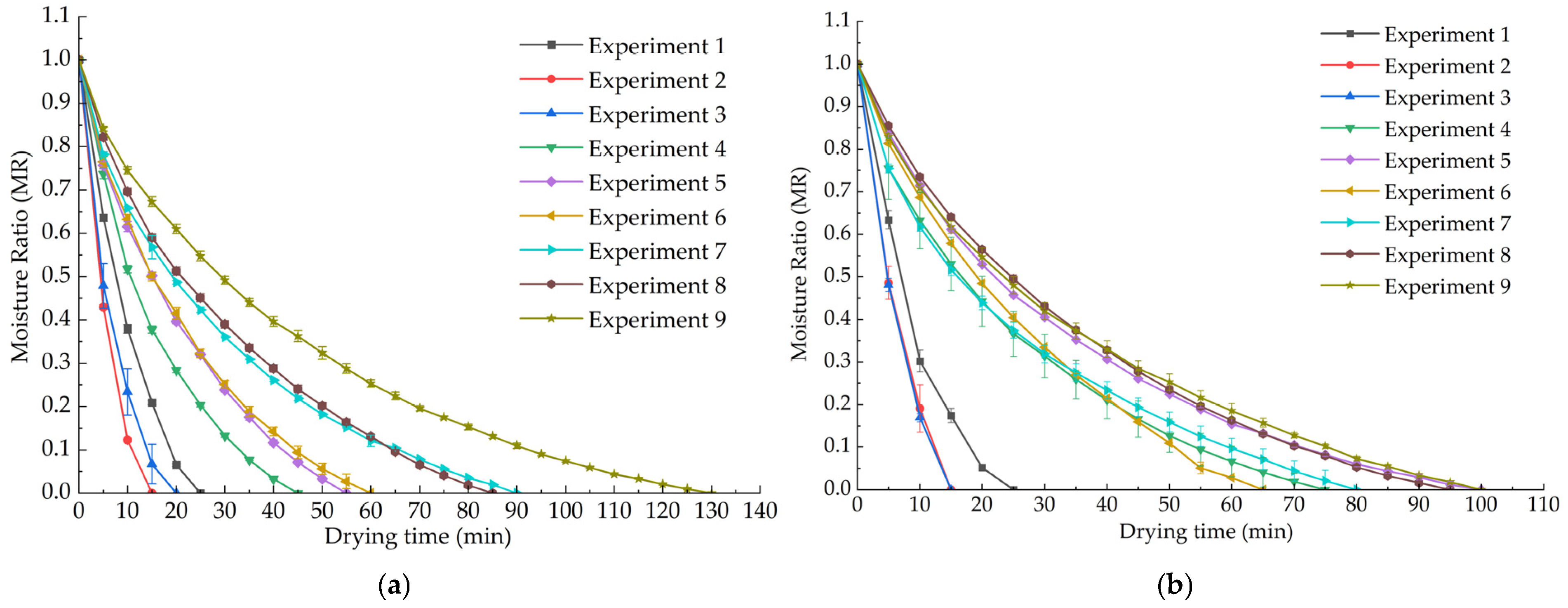
Under different process combinations, the moisture ratios of Astragalus slices in both the control group and the freeze–thaw group decreased continuously with the prolongation of drying time, and the overall performance was characterized by a faster decline in the early stage and a gradual slowdown in the later stage, as shown in
Figure 3. The error bars represent the standard deviations of three repeated measurements, providing a visual indication of the repeatability of the drying experiments. This
MR trend was consistent with a drying process dominated by a falling-rate period, which was further supported by the subsequent drying-rate analysis. In the later stage of drying, moisture removal was mainly limited by the internal moisture migration capacity. Differences in curve trends and drying endpoints between different experimental groups indicate that the way thickness, diameter, air velocity and temperature are combined affected the dehydration behavior of the samples.
In the control group, the moisture-ratio curves corresponding to each process combination were more obviously differentiated, with Experiment 1 and Experiment 2 decreasing faster and reaching the drying endpoint earlier, while Experiment 9 had the slowest decrease and the longest drying time, reflecting that thinner slices and better heat and mass-transfer conditions were more favorable to the dehydration of the samples.
Compared with the control group, the changes in the moisture ratios of the experimental combinations after freeze–thaw treatment did not show a consistent promoting effect, but showed an obvious condition-dependence, with some combinations showing an accelerated drying process after freeze–thawing and some experiencing a delayed process, which suggests that the effect of freeze–thaw pretreatment on the drying behavior of Astragalus slices was not simply enhanced or weakened, but depended on the matching relationship between the sample state and the process parameters.
For the treatment with the longest drying duration, the time required for Experiment 9 to reach the drying endpoint was shortened from approximately 130 min in the control group to approximately 100 min after freeze–thaw pretreatment, indicating that freeze–thaw pretreatment could shorten the total drying time under specific process conditions. Overall, the effect of freeze–thaw pretreatment on the mid- to late-stage dehydration behavior was more apparent, indicating that it affects the drying process mainly by regulating the internal mass-transfer conditions rather than simply increasing the rate of water loss in the early stage.
3.1.2. Changing Law of Drying Rate
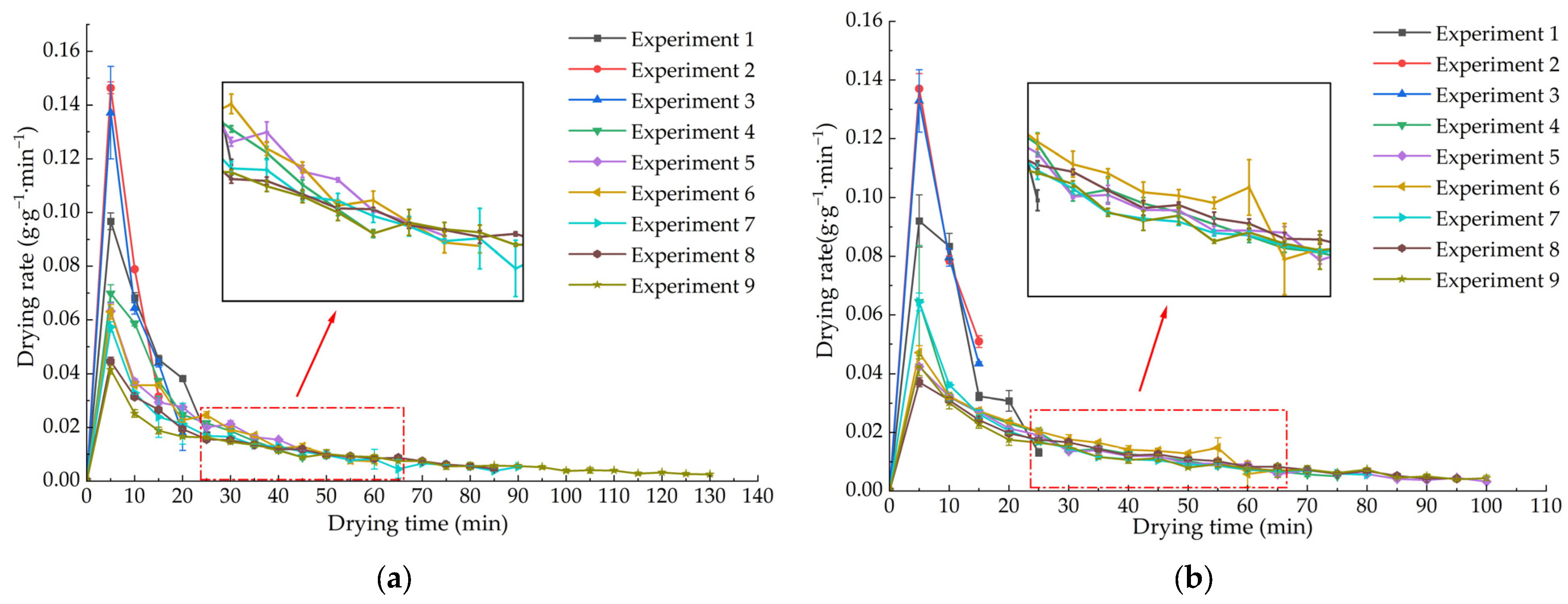
In order to reveal the stage-by-stage water loss characteristics of Astragalus slices in the process of solar hot-air drying, the change rule of drying rate with time was analyzed under different experimental combinations, and the results are shown in
Figure 4. The drying rates of both the control group and the freeze–thaw group samples rapidly increased and peaked at the early stage of drying, and then continued to decline, and overall there did not appear to be an obvious constant speed drying stage, indicating that the solar hot-air drying process of Astragalus slices was dominated by the falling-rate period, and the later dehydration was mainly limited by internal moisture migration.
As can be seen from the comparison between the different treatments, the freeze–thaw pretreatment did not show a consistent enhancement of the peak drying rate, and only Experiments 7 and 9 showed a slight increase after freeze–thaw, while Experiments 5 and 6 showed a more pronounced decrease, suggesting that its effect on the initial transient water loss capacity was significantly condition-dependent.
In contrast, the freeze–thaw treatment regulated the mid- to late-stage drying rate decay more clearly in most experimental combinations, with a relatively gentle and less fluctuating curve decline, suggesting that the freeze–thaw action was not mainly to enhance the pre-surface evaporation but to regulate the water loss process in the rate reduction stage by improving the internal water migration path and alleviating the mass-transfer resistance in the late stage.
The effect of freeze–thaw pretreatment on the change rule of drying rate of Astragalus slices is mainly reflected in the middle and late stage of rate reduction, rather than the initial peak stage, and its role is essentially manifested in the stage of internal moisture redistribution and mass-transfer process regulation.
3.1.3. Average Drying Rate and Orthogonal Analysis
The average drying rate was used as an indicator to compare the overall moisture removal performance of Astragalus slices under different process combinations in the control and freeze–thaw groups. The average drying rate represents the mean decrease in dry-basis moisture content per unit drying time over the whole drying process. As an integrated indicator covering the whole drying process, the average drying rate reflects the combined heat and mass-transfer performance of the samples and helps characterize how freeze–thaw pretreatment influences solar hot-air drying behavior.
As can be seen from
Table 3, the average drying rates of Astragalus slices in the control and freeze–thaw groups varied among the nine process combinations, indicating that the combinations of thickness, diameter, air velocity, and temperature affected the overall water loss efficiency of the samples. The values ranged from 0.01007 to 0.08560 g·g
−1·min
−1 in the control group and from 0.01245 to 0.08615 g·g
−1·min
−1 in the freeze–thaw group, showing clear numerical variations among different treatments.
The variation ranges of the average drying rate of different treatment groups were generally close to each other, but the response trends under each experimental combination were not consistent, indicating that the freeze–thaw pretreatment did not simply produce a uniform increase in the average drying rate of Astragalus slices, but changed the response pattern of the samples to process parameters.
The average drying rate was higher for combinations with smaller thicknesses and lower overall for combinations with larger thicknesses, suggesting that thickness is a key factor limiting the dehydration efficiency of Astragalus slices. The statistical contribution of each factor was further evaluated by orthogonal range analysis and ANOVA in the subsequent analysis.
In order to clarify the degree of influence of each factor on the average drying rate, the control group and the freeze–thaw group were analyzed by polar analysis, and the results are shown in
Table 4. In different treatment groups, the K value and R value of each factor at different levels differed, among which the R value of factor A was always the largest, indicating that the thickness was the dominant factor influencing the average drying rate of the Astragalus slices. In contrast, factors B, C and D are less influential than factor A. However, their order of action varied between the two treatments, with the order of influence being A > D > C > B in the control group and A > D > B > C in the freeze–thaw group, suggesting that the freeze–thaw pretreatment did not change the predominance of thickness, but altered the relative contributions of diameter, air velocity and temperature to the mean drying rate, particularly enhancing the moderating effect of the diameter factor. The optimal level combinations of the two treatment groups were A
1B
2C
2D
2 and A
1B
3C
3D
2, respectively, further indicating that freeze–thawing changed the response characteristics of Astragalus slices to external process parameters.
The results of ANOVA were generally consistent with the conclusions of the extreme variance analysis, as shown in
Table 5. In the control group, factors A, C and D all reached highly significant levels, with factor A having the highest F-value, indicating that thickness was still the dominant factor influencing the average drying rate of Astragalus slices, while the role of factor B was relatively weak. In the freeze–thaw group, factors A, B, C and D all reached highly significant levels, with factor A still dominating, but factor B shifted from a weak to a highly significant role, indicating that the freeze–thaw pretreatment significantly enhanced the moderating effect of the diameter factor on the mean drying rate. The freeze–thaw treatment did not change the dominant control of thickness on average drying rate, but reinforced the effect of structural scale differences on the drying process under different diameter conditions.
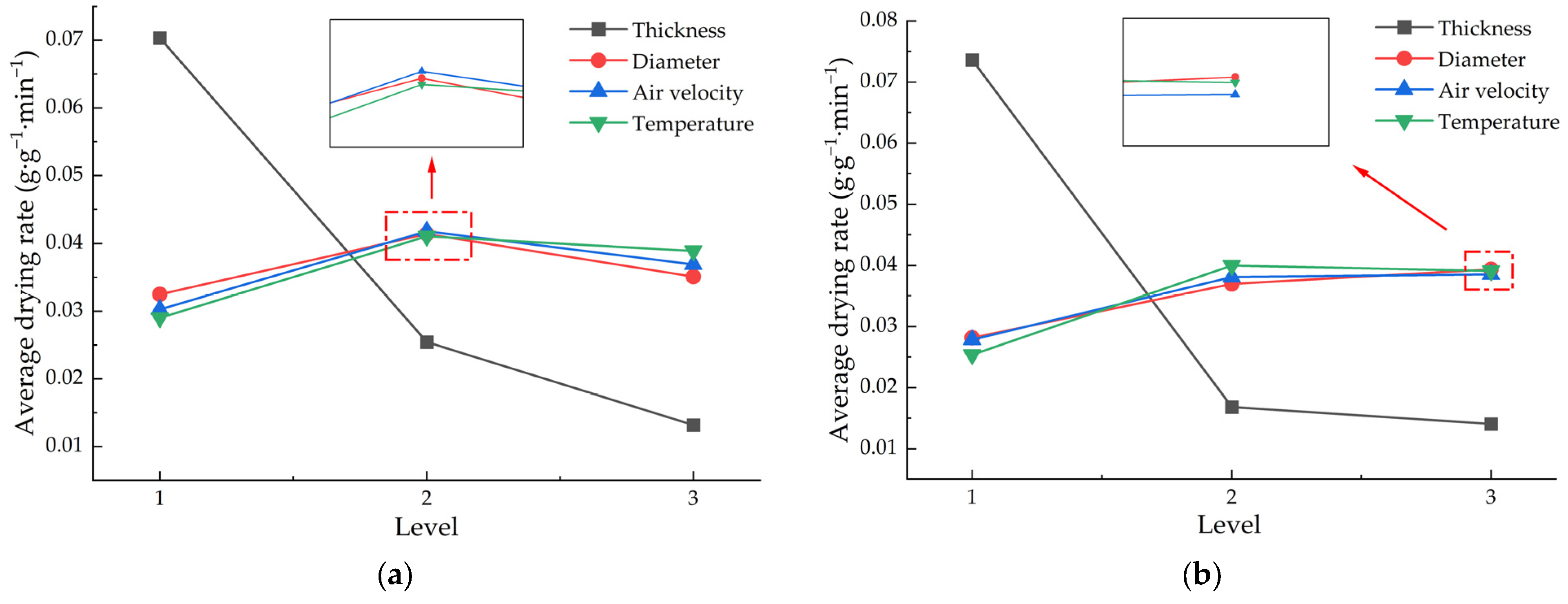
As can be seen in
Figure 5, the main effect curves for factor A showed a marked downward trend in both treatment groups, again indicating that thickness was the primary determinant of average drying rate. In the control group, factors B, C and D performed better around the intermediate level, while in the freeze–thaw group, factor B maintained a higher response at a higher level, and the optimal response intervals of factors C and D were also shifted. This suggests that freeze–thaw pretreatment altered the adaptability of Astragalus slices to diameter, air velocity and temperature conditions and resulted in a more pronounced parameter-matched characterization of their drying behavior.
3.2. Thin-Layer Drying Kinetic Model Fitting and Optimal Model Checking
3.2.1. Model Fitting Results and Optimal Model Screening
The moisture-ratio curves of Astragalus slices during solar hot-air drying were analyzed using four thin-layer drying models, including Midilli, Page, Henderson–Pabis, and Logarithmic. These four models were selected because they are commonly used empirical or semi-empirical models in thin-layer drying studies and can describe nonlinear moisture-ratio changes with different model structures and parameter forms. These models were separately applied to the nine experimental datasets obtained from the control and freeze–thaw groups.
The results summarized in
Table 6 indicate that the four selected thin-layer drying models could effectively characterize the moisture-ratio variation of Astragalus slices during drying solar hot-air drying, suggesting good agreement with the experimental data. Considering
R2,
χ2, and
RMSE together, the Midilli model exhibited the best fitting performance in both the control and freeze–thaw groups. For the control group, the Midilli model yielded average
R2 and
RMSE values of 0.99970 and 0.00486, respectively, while the corresponding values for the freeze–thaw group were 0.99958 and 0.00505. These results were superior to those obtained with the Page, Henderson–Pabis, and Logarithmic models, indicating that the Midilli model was more appropriate for describing the solar hot-air drying behavior of Astragalus slices. The Midilli model is more suitable for characterizing the nonlinear water loss process of Astragalus slices under solar hot-air drying conditions.
Freeze–thaw pretreatment did not change the type of optimal model, and in this paper the optimal model for both treatment groups was the Midilli model, indicating that the freeze–thaw effect mainly affected the drying parameter response and the water loss process without changing the basic descriptive framework of the drying kinetics of Astragalus slices. Therefore, this paper recommends that the Midilli model can be selected subsequently for further characterization and prediction of the solar hot-air drying process of Astragalus slices.
3.2.2. Tests of the Effectiveness of the Optimal Model Fit
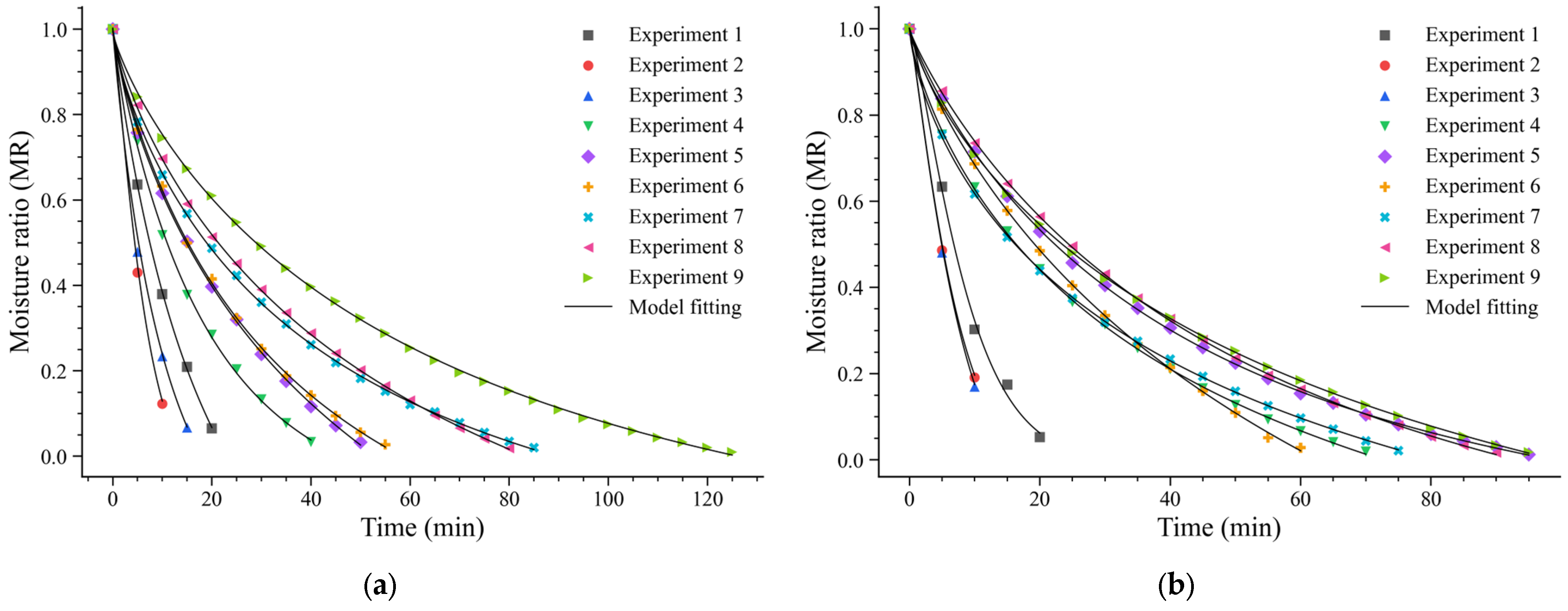
The predictive performance of the optimal model was further examined by comparing the Midilli-predicted moisture ratios with the corresponding experimental values during solar hot-air drying of Astragalus slices, as shown in
Figure 6 The Midilli model showed close agreement with the experimental data for both the control and freeze–thaw groups, indicating its ability to accurately describe the time-dependent variation in
MR during the drying of Astragalus slices. The model effectively captured both the sharp decrease in
MR at the initial stage and the subsequent gradual reduction in the drying rate during the middle and later stages.
Comparing the two treatment groups, it can be seen that although the difference in drying response between the different process combinations after freeze–thaw pretreatment was more obvious, the Midilli model was still able to fit the experimental data of each group stably and did not show obvious systematic bias. Combined with
Table 6 and
Figure 6, it can be seen that the Midilli model has high fitting accuracy and good applicability in both treatment groups, and can be used as the optimal thin-layer drying kinetic model to characterize the solar hot-air drying process of Astragalus slices.
3.3. Analysis of Apparent Effective Moisture Diffusivity
As can be seen from
Table 7, the apparent effective moisture diffusion coefficients of Astragalus slices in both control and freeze–thaw groups were in the order of 10
−9 m
2/s, indicating that both groups of samples were dominated by internal diffusion mass transfer in the drying process.
Deff ranged from 1.00338 × 10
−9 to 1.90530 × 10
−9 m
2·s
−1 in the control group and 0.77769 × 10
−9 to 1.97167 × 10
−9 m
2·s
−1 in the freeze–thaw group, which indicated that there were clear differences in the internal water migration capacity of the samples under the different combinations of processes. To further evaluate the reliability of
Deff estimation, the fitting indices of the linear regression between ln
MR and drying time were added in
Table 7. Except for Experiment 1 in both groups, the
R2 values were higher than 0.98, and the corresponding
χ2 and
RMSE values were generally low, indicating that the linear fitting used for the
Deff calculation was acceptable.
The maximum values of both groups appeared in Experiment 7, with Deff values of 1.90530 × 10⁻⁹ m2·s−1 and 1.97167 × 10⁻⁹ m2·s−1 in control and freeze–thaw groups, respectively, and the minimum values appeared in Experiments 1 and 4, respectively. The relatively high Deff in Experiment 7 did not mean that thicker slices had higher overall drying efficiency. Deff was estimated from the ln(MR)–time regression based on the slab model and was affected by both the regression slope and the square of the equivalent half-thickness. Therefore, a higher apparent Deff may occur in thicker slices under specific combinations of sample size and drying conditions. In Experiment 7, the larger thickness was combined with a smaller diameter and higher air velocity, which may have promoted moisture-ratio decay during the falling-rate stage.
In contrast, drying rate and average drying rate directly describe the overall moisture removal rate and are more strongly affected by diffusion path length and total drying time. Therefore, the trends in drying rate and apparent Deff were not completely consistent.
Further comparison of the same process combinations showed that freeze–thaw pretreatment did not increase Deff under all conditions; Deff was higher than that of the control group only in Experiments 1, 3, 7 and 9, whereas it decreased in the remaining combinations. It indicates that the effect of freeze–thawing on the internal diffusion ability of Astragalus slices has obvious condition-dependence, and its effect depends on the matching relationship between the organizational state of the samples and the external drying parameters.
Combined with the moisture ratio, average drying rate and drying rate change rule, it can be seen that the freeze–thaw pretreatment did not change the basic characteristics of the drying process of Astragalus slices, which was mainly controlled by internal diffusion, but through the regulation of the internal tissue structure and moisture storage state, it changed the mass-transfer ability of the sample and its response to the external process conditions.
3.4. LF-NMR Characterization of Moisture Migration
3.4.1. Initial Moisture State Before Drying
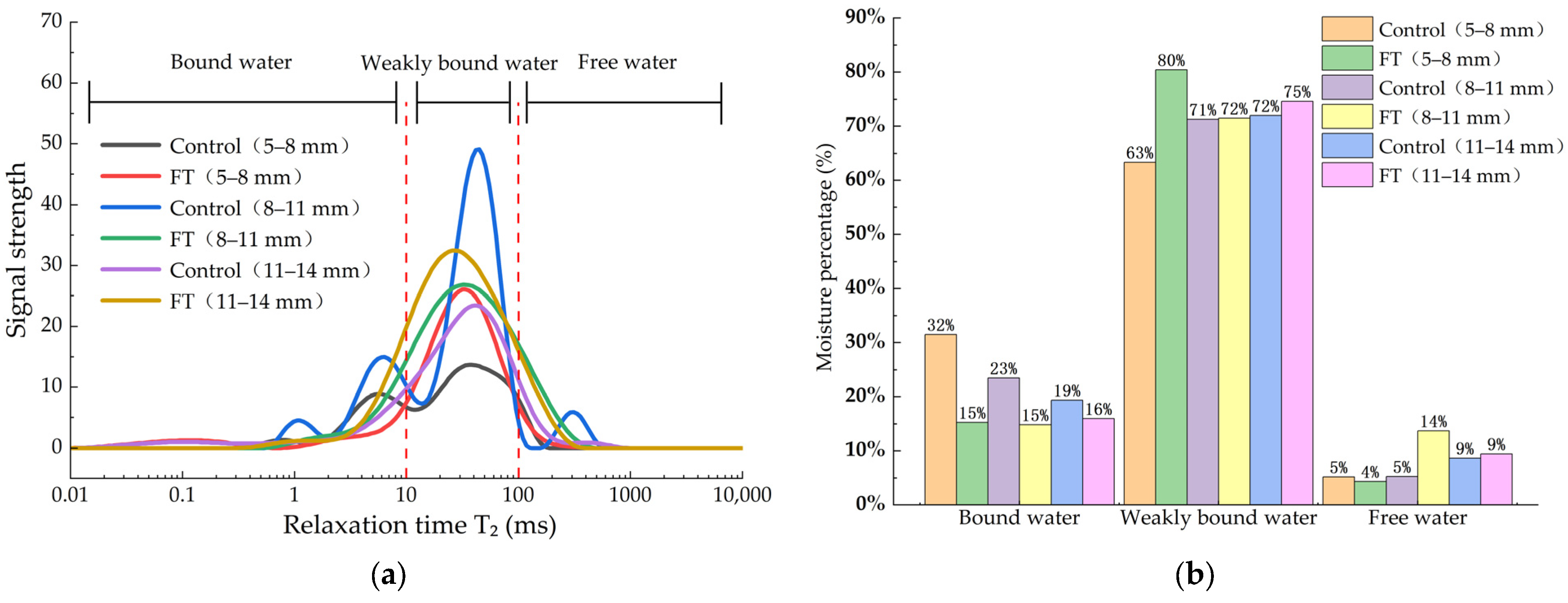
Before the start of drying, the T
2 relaxation signals of samples with different diameters of Astragalus slices were mainly concentrated in the T
22 region, indicating that the initial moisture of the samples was dominated by weakly bound water, as shown in
Figure 7. The largely overlapping main peak regions observed in the control and freeze–thaw groups indicate that freeze–thaw pretreatment did not fundamentally change the initial moisture distribution pattern of Astragalus slices, which was still mainly characterized by weakly bound water. Nevertheless, the treatment modified the proportional distribution among different water fractions.
In the control group, samples of different diameters showed some differences in initial water storage, with a relatively high proportion of bound water in the 5–8 mm group, a high proportion of free water in the 8–11 mm group, and an in-between proportion of free water in the 11–14 mm group, suggesting that the change in sample size has affected the water storage status within the Astragalus slices. This indicates that the change in sample size has affected the internal water storage status of Astragalus slices. After the freeze–thaw treatment, the main peak of T2 in each diameter group is still located in the T22 zone, but the proportion was redistributed, mainly in the form of a decrease in the proportion of bound water and an increase in the proportion of weakly bound water, while the change in free water is relatively limited. This result suggests that the effect of freeze–thawing on the initial moisture state of Astragalus slices is mainly reflected in the redistribution of water among existing moisture states rather than the fundamental change in the dominant moisture type. The freeze–thaw pretreatment may reshape the mass-transfer basis at the initiation stage of drying by altering the internal local structure and moisture distribution characteristics of the samples, and further influence the subsequent moisture migration behavior.
3.4.2. Moisture Distribution at the Drying Endpoint
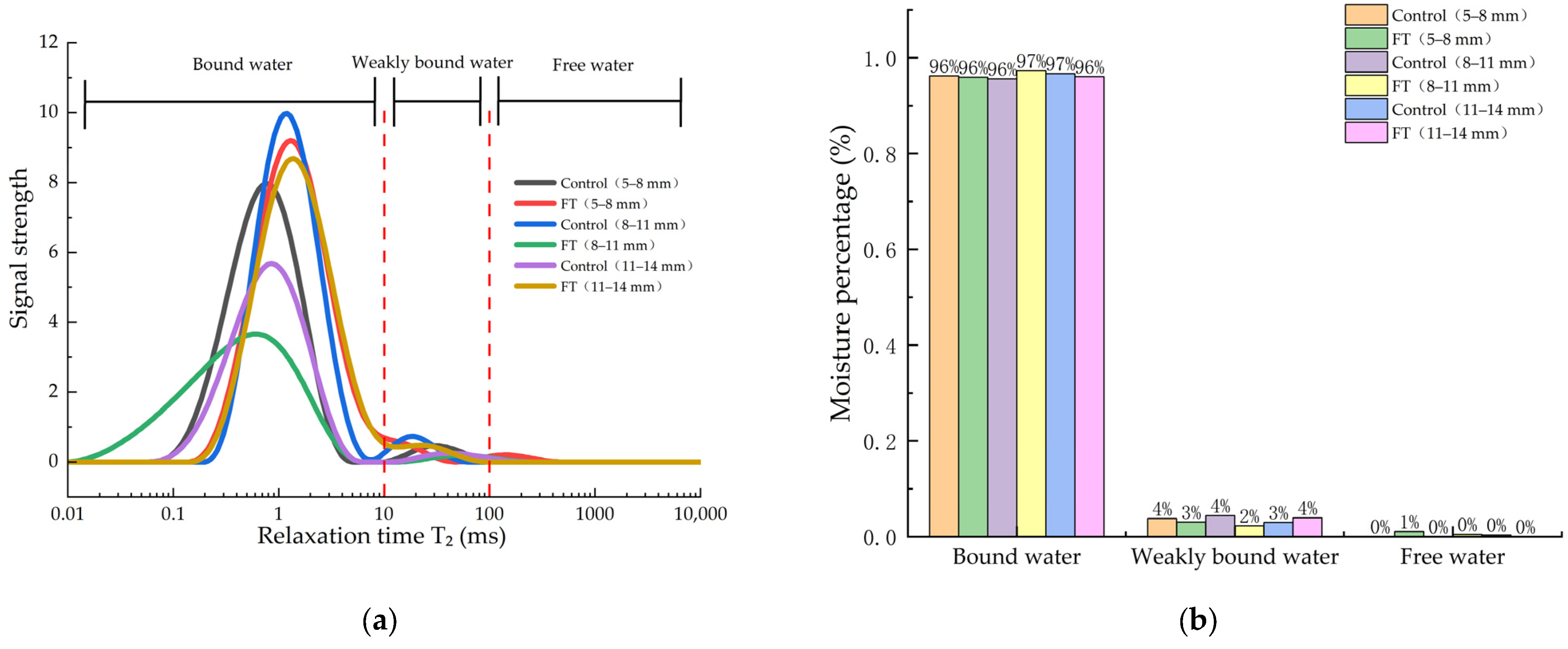
In order to evaluate the residual moisture status inside the Astragalus slices at the drying endpoint, the LF-NMR T
2 relaxation characteristics and the ratio of the peak area of each moisture component of the samples with different diameters at the drying endpoint were analyzed, and the results are shown in
Figure 8.
The T
2 relaxation peaks of each group of samples at the end of drying were mainly distributed in the short relaxation time interval, and the main peaks were concentrated in the region of bound water. The weakly bound water signal was weak, and the free water signal nearly disappeared, which indicated that most of the migratable water in the samples had been removed after the solar hot-air drying, and the residual water mainly existed in the form of bound water. Compared with the initial state, the T
2 spectra of all groups became more similar, indicating that the differences in the initial water storage between samples of different treatments and diameters were significantly weakened at the end of the drying period, as shown in
Figure 8a. Further combined with
Figure 8b, it can be seen that the proportion of bound water in each group of samples was 96–97%, the weakly bound water only accounted for 2–4%, and the free water was close to 0, and there were only slight fluctuations between different treatments and different diameters, indicating that the residual moisture composition of Astragalus slices generally converged after reaching the same drying endpoint. It can be seen that the freeze–thaw pretreatment did not change the basic pattern of residual moisture at the end of drying. Its effect was mainly reflected in regulating moisture migration behavior during drying, especially during the middle and late stages of mass transfer, rather than changing the final residual moisture composition.
3.5. SEM Characterization of Dried Astragalus Slices
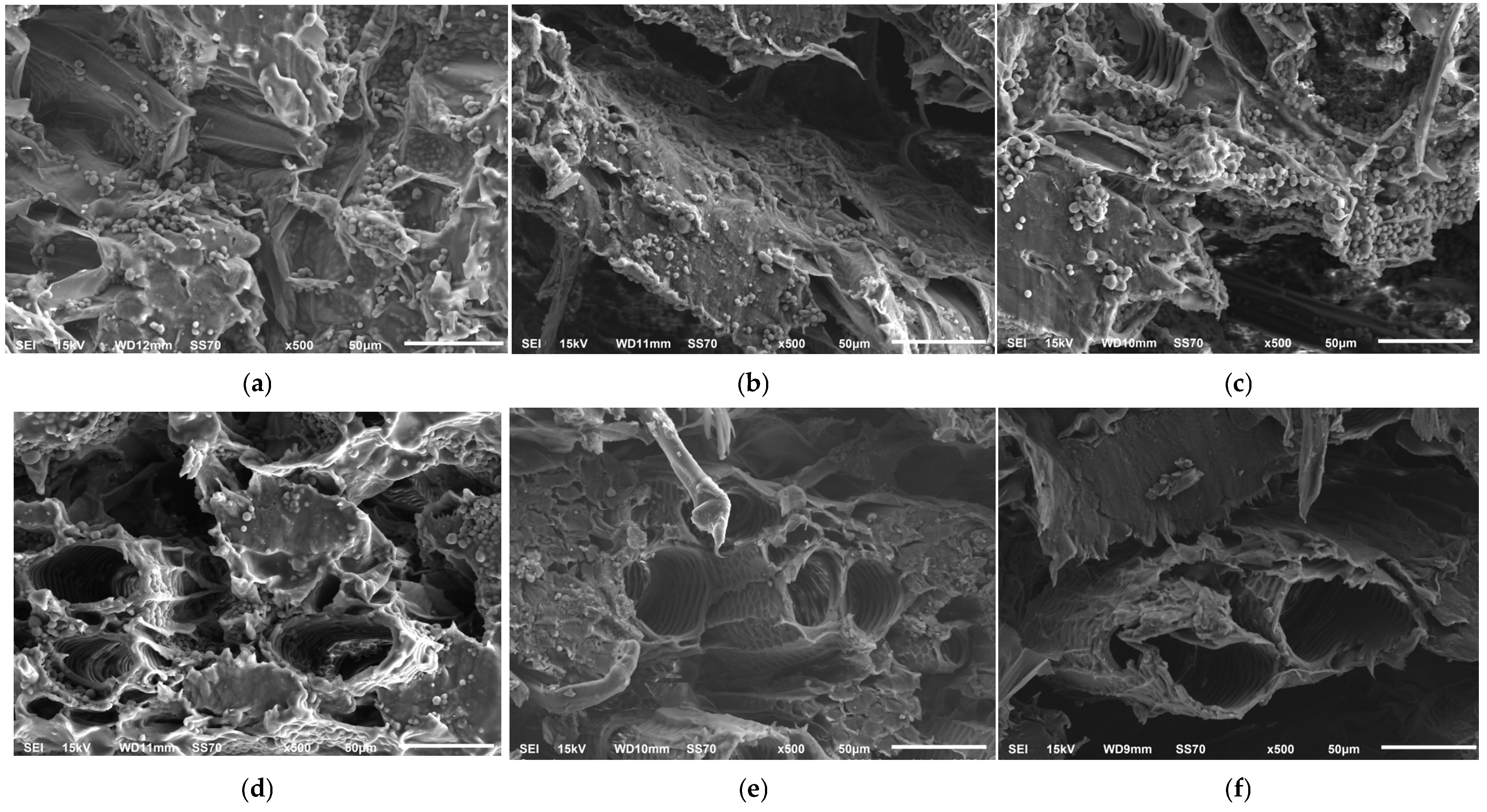
To provide supplementary morphological evidence for the effect of freeze–thaw pretreatment on moisture migration and mass-transfer behavior, SEM observations were conducted on representative matched dried samples from the orthogonal experiment. The SEM analysis was not used as an independent evaluation of the effect of slice size, but was intended to compare the microstructural differences between the control and freeze–thaw groups under matched treatment combinations. Therefore, samples with the same diameter level of 8–11 mm were selected to reduce the influence of slice diameter on microstructural observation. For each matched pair, the control and freeze–thaw-treated samples had the same slice size and drying parameters, except for freeze–thaw pretreatment. The microstructures were observed at 500× magnification, and the results are shown in
Figure 9.
The SEM micrographs showed that the dried samples in the control group generally exhibited a relatively compact surface morphology, with local shrinkage and fewer visible cracks or pores. In contrast, the freeze–thaw-treated samples showed a looser tissue structure, with more evident cracks, pores, and discontinuous surface morphology. These structural differences may be related to ice crystal formation and melting during freeze–thaw pretreatment, which could partially disrupt tissue continuity and provide additional pathways for moisture migration. Therefore, the SEM results provide supplementary morphological evidence that freeze–thaw pretreatment affected the drying behavior of Astragalus slices by modifying the microstructure and internal mass-transfer channels. However, this comparison was based on representative matched samples and should not be interpreted as an independent analysis of the effect of slice size.
4. Discussion
Igbozulike et al. [
51] reported that drying process variables affected the effective moisture diffusivity and activation energy of African oil bean seeds, indicating that the dehydration of plant materials is controlled not only by external temperature and air-flow conditions but also by internal moisture migration. Gonzalez-Camacho et al. [
52] also used Fick’s diffusion model to describe moisture migration within beetroot slices. Compared with these seed or fruit-and-vegetable slice materials, Mongolian Astragalus is a root-type medicinal plant with more complex vascular tissues, fibers, and cell wall structures. Therefore, the internal moisture migration pathway and tissue compactness may exert a stronger limitation on the drying process. Accordingly, the solar hot-air drying behavior of Astragalus slices should not be explained only by external heat supply, but should also be interpreted in relation to sample geometry and internal diffusion resistance.
From the perspective of process factors, the effect of freeze–thaw pretreatment on the drying behavior of Astragalus slices should not be simply regarded as direct drying acceleration, but rather as a regulation of internal mass-transfer pathways. Liu et al. [
53] found that contact ultrasound-assisted hot-air drying affected the drying characteristics and quality attributes of Sichuan pepper by modifying its microstructure. Ye et al. [
54] also indicated that changes in cell wall structure and water distribution influenced the drying quality of asparagus lettuce. Unlike ultrasound and other externally applied physical fields, freeze–thaw pretreatment mainly depends on cell damage, pore formation, and tissue loosening induced by ice crystal formation and melting. Moderate structural disturbance may help reduce internal diffusion resistance during the middle and later drying stages; however, when sample size, air-flow rate, and temperature are not well matched, local collapse, shrinkage, or uneven moisture redistribution may also occur. Therefore, the preferred combinations obtained from the L9 orthogonal design should be interpreted as optimized results within the selected factor levels, rather than absolute optima in the sense of response surface optimization.
The applicability of thin-layer models should also be interpreted in relation to material properties and drying conditions. Stephenus et al. [
55] reported that drying temperature affected drying rate, model parameters, and quality retention during the drying of plant materials, indicating that model applicability is closely associated with material type and drying method. Therefore, the Midilli model can be considered suitable for describing the nonlinear changes in the moisture ratio of Mongolian Astragalus slices within the experimental range of this study, but it should not be generalized as the universally optimal model for all Astragalus drying methods or processing conditions. The model-fitting results mainly reflect the moisture-ratio variation under the specific combination of sample size, freeze–thaw condition, air-flow rate, and drying temperature used in this work, rather than a universal judgment for all processing scenarios.
The inconsistent trends between effective moisture diffusivity and drying rate do not indicate contradictory results. DR reflects the actual moisture removal capacity per unit time and is influenced by sample thickness, exposed surface area, moisture state, and total drying time. In contrast, Deff is an apparent parameter estimated from the ln(MR)–t fitting based on Fick’s diffusion assumption, and its value is also affected by the square of the equivalent half-thickness, the selected fitting range, and tissue heterogeneity. Therefore, some thicker slices may show relatively higher apparent Deff values due to the thickness term or local diffusion-channel changes, but this does not necessarily mean higher overall drying efficiency. Deff is more appropriate for characterizing internal moisture migration capacity under model assumptions and should be interpreted together with MR curves, DR, average drying rate, and drying time.
LF-NMR and SEM analyses further help explain the effect of freeze–thaw pretreatment on moisture migration pathways. Yi et al. [
56] used LF-NMR to analyze moisture migration and distribution during nut drying, demonstrating that changes in different water states can reflect internal mass-transfer behavior in plant materials. Zhou et al. [
57] further combined LF-NMR with structural and quality changes during black tea drying, showing that moisture migration behavior is closely related to tissue status. Yue et al. [
58] also emphasized that heat and mass transfer during Astragalus root drying were associated with tissue structure and water distribution. Based on these findings, the effect of freeze–thaw pretreatment on Mongolian Astragalus slices should be understood as the modification of tissue structure and water state through ice-crystal damage, thereby affecting mass-transfer resistance during the middle and later drying stages, rather than simply changing the residual moisture composition at the drying endpoint.
In addition, solar radiation input, fan power, auxiliary heating energy consumption, freeze–thaw energy consumption, and specific energy consumption were not recorded in real time in this study. Therefore, it is not possible to directly determine whether the combined freeze–thaw and solar hot-air drying process reduced the total energy consumption. The shortened drying time observed under some treatment conditions only suggests the potential to reduce energy consumption during the drying stage, whereas whether the freeze–thaw process itself increases the overall energy input still requires further verification. Future studies should combine energy/exergy analysis, quality evaluation, and scale-up experiments to further assess the comprehensive applicability of this combined drying strategy in terms of efficiency, product quality, and energy utilization.
5. Conclusions
This study investigated the effects of freeze–thaw pretreatment on the solar hot-air drying behavior, moisture migration, and microstructural characteristics of sliced Mongolian astragalus. The drying process was comprehensively evaluated through solar hot-air drying experiments, L9(34) orthogonal analysis, thin-layer drying kinetics model fitting, analysis of the apparent effective moisture diffusion coefficient, and LF-NMR and SEM characterization. The main conclusions are as follows:
- (1)
The solar hot-air drying process of Mongolian Astragalus slices was dominated by a falling-rate period, with no distinct constant-rate drying stage observed. Freeze–thaw pretreatment did not consistently promote drying under all experimental conditions; its effect was condition-dependent. Within the range of factor levels set in this study, slice thickness was the dominant factor influencing the average drying rate. The parameter combination yielding the highest average drying rate in the control group was: thickness 1–3 mm, diameter 8–11 mm, airflow velocity 1.0 m/s, and drying temperature 50 °C; the parameter combination yielding the highest average drying rate in the freeze–thaw group was: thickness 1–3 mm, diameter 11–14 mm, airflow velocity 1.5 m/s, and drying temperature 50 °C. The above results indicate that the L9(34) orthogonal design is suitable for screening the relative effects of process factors and identifying optimal combinations; however, the resulting combinations should be interpreted as preferred outcomes within the specified range of factor levels, rather than as absolute optimal parameters in the sense of global response surface optimization.
- (2)
Among the four thin-layer drying models, the Midilli model best describes the variation in the moisture content of Mongolian Astragalus slices under the experimental conditions of this study. The apparent effective water diffusion coefficients for both the control group and the freeze–thaw group were in the order of 10−9 m2/s. The trend of Deff does not always fully align with the drying rate; this is because Deff is an apparent parameter calculated under the assumptions of a diffusion model and is influenced by factors such as sample thickness, the fitting interval, and tissue heterogeneity. Therefore, Deff should be interpreted in conjunction with the MR curve, drying rate, average drying rate, and drying time, and should not be used alone as a basis for evaluating drying efficiency.
- (3)
LF-NMR results indicate that freeze–thaw pretreatment altered the distribution of the initial water states in the samples prior to drying, but did not fundamentally change the dominant water state characteristics during the drying process. At the end of drying, the residual moisture in the samples primarily existed as bound water, while free water was essentially removed. SEM observations further indicated that freeze–thaw pretreatment altered the microstructure of the Astragalus slices, providing additional evidence for its influence on moisture migration. Overall, freeze–thaw pretreatment primarily affects the moisture migration process during the middle and late stages by altering internal mass-transfer pathways, rather than simply increasing the surface evaporation rate at the beginning of drying.
Overall, freeze–thaw pretreatment can influence the solar hot-air drying process of Astragalus mongholicus slices by modulating tissue structure and internal moisture migration pathways, demonstrating potential for application in the primary processing of medicinal materials in cold-climate production areas. However, since this study did not conduct a full-process energy consumption evaluation, its energy-saving effects still require further verification in subsequent research through energy consumption/power analysis, quality preservation assessments, and scale-up experiments.