Review

Removal of Metformin from Wastewater: A Review on Physical, Chemical and Biological Processes

by
Claudia Victoria
1,
Deysi Amado-Piña
1,
Rubi Romero
1,*,
Sandra Luz Martínez-Vargas
2,
Alejandro Regalado-Méndez
3,
Patricio J. Espinoza-Montero
4 and
Reyna Natividad
1,*
1
Chemical Engineering Laboratory, Centro Conjunto de Investigación en Química Sustentable, UAEM-UNAM, Autonomous University of the State of Mexico, Km 14.5 Toluca-Atlacomulco Road, Toluca 50200, Mexico
2
Faculty of Chemistry, Autonomous University of the State of Mexico, Paseo Colón esq. Paseo Tollocan, Colonia Residencial Colón, Toluca 50120, Mexico
3
Research Laboratories, Universidad del Mar, Campus Puerto Ángel, Puerto Angel, Oaxaca 70902, Mexico
4
Escuela de Ciencias Químicas, Pontificia Universidad Católica del Ecuador, Quito 170525, Ecuador
*
Authors to whom correspondence should be addressed.
Processes 2026, 14(11), 1713; https://doi.org/10.3390/pr14111713
Submission received: 24 April 2026 / Revised: 20 May 2026 / Accepted: 22 May 2026 / Published: 25 May 2026

Abstract

Metformin (MET) is a widely prescribed pharmaceutical compound used for the management of glucose levels and body weight. However, it is only partially metabolized in the human body, and a significant fraction is excreted unchanged, leading to its frequent detection in aquatic environments. Consequently, the removal of MET from wastewater has become a matter of increasing concern due to its potential impact on aquatic ecosystems. Furthermore, as a nitrogen-containing compound, MET has been extensively employed as a model pollutant to evaluate the performance of physical and chemical treatment technologies for pharmaceutical contaminants. This review aims to critically assess and summarize the efficiency and key limitations of various processes applied for MET removal. The reviewed approaches include physical–chemical treatments such as adsorption; biological treatments (activated sludge, biofiltration and phytoremediation), which rely on microbial metabolic activities or plant uptake to degrade or sequester metformin; and advanced oxidation processes (AOPs), such as ozonation, photolysis, photocatalysis, Fenton, and photo-Fenton systems. The efficiency of MET removal and mineralization is strongly dependent on the treatment method employed. Among the evaluated processes, the photo-Fenton reaction emerges as one of the most promising technologies, achieving high removal efficiencies under both ultraviolet (UV) and visible (Vis) irradiation.

1. Introduction

Metformin (MET) is the most prescribed oral antidiabetic drug and the first-line treatment for type 2 diabetes mellitus (T2DM). This disease accounts for approximately 90% of diabetes cases and affects more than 537 million people worldwide, which has been estimated to increase to 795 million by 2045 [1,2,3]. In addition to its efficacy in glycemic control, metformin has been investigated for its therapeutic potential in cancer, polycystic ovary syndrome [4,5], and COVID-19, as well as for its antiketogenic properties in weight management [6]. Furthermore, its global market continues to expand due to rising obesity rates, lifestyle changes, and increased investment in healthcare. Therefore, metformin has become established as one of the most prescribed drugs worldwide [7]. However, its widespread use has raised concerns about its environmental impact on aquatic ecosystems due to its high levels in wastewater.
One of the critical problems associated with MET is its incomplete metabolism in the human body. A substantial fraction of the administered dose is excreted unchanged through urine and feces, subsequently entering wastewater systems [1,3,4,6]. Furthermore, Wilkinson et al. [8] reported that rivers in Asia exhibit the highest metformin occurrence index (80.1%), followed by South America (67.7%) and Europe (65%), whereas Oceania presents the lowest levels (Figure 1). This widespread distribution is primarily attributed to its low metabolic degradation and continuous discharge from wastewater treatment plants (WWTPs).
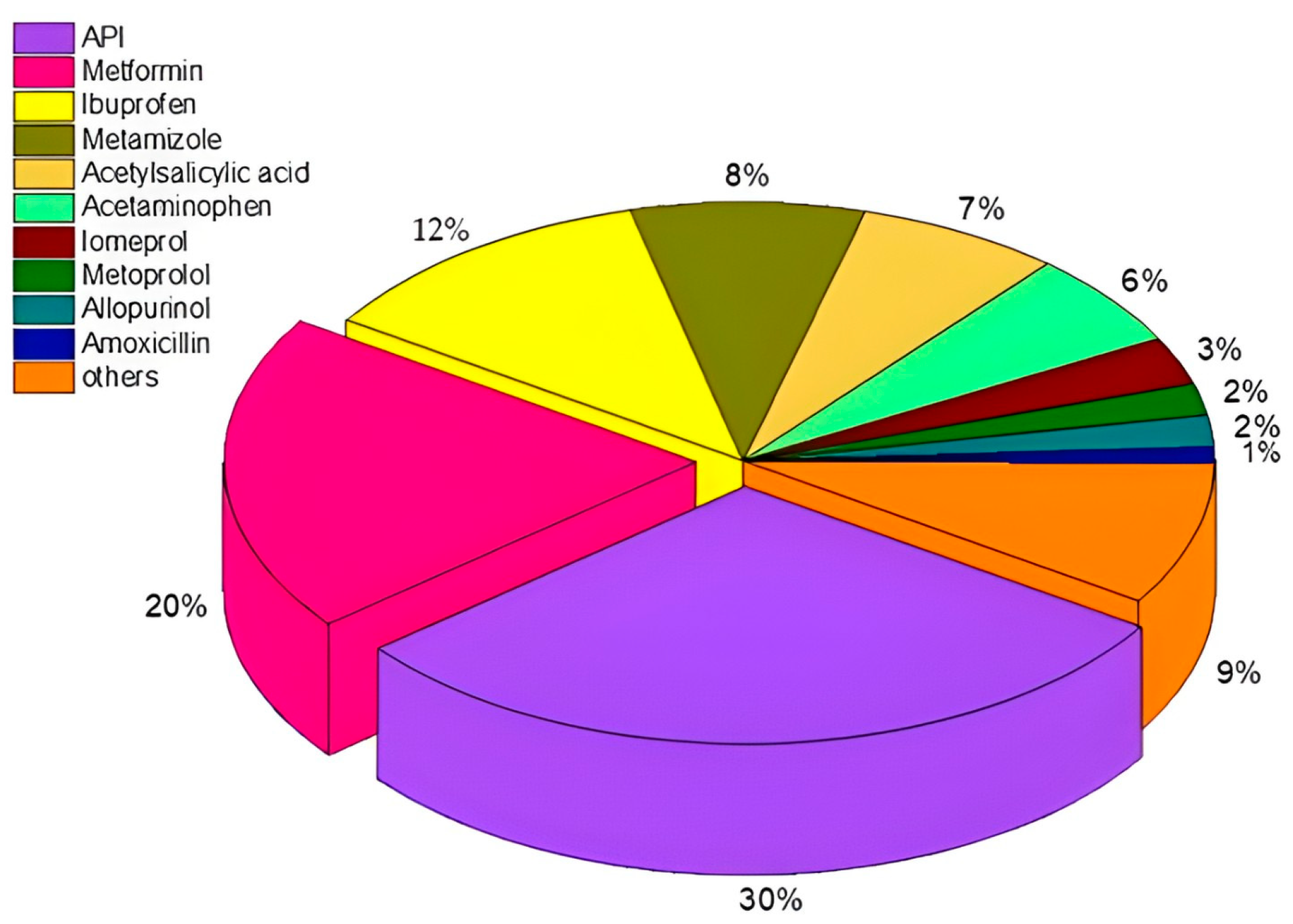
In addition, inadequate pharmaceutical disposal practices and insufficient waste management programs further contribute to the direct release of metformin into aquatic systems. As a result, MET has become one of the most frequently detected pharmaceutical compounds globally (Figure 2), posing significant challenges for water quality management and environmental protection [1,5,6].
The presence of MET in wastewater poses multifaceted concerns, encompassing ecological integrity, potential human health risks, and regulatory challenges. Previous studies have demonstrated that MET can induce endocrine disruption and adversely affect reproductive systems in aquatic organisms [5]. In addition, concerns remain about the potential for bioaccumulation and biomagnification of metformin and its metabolites in aquatic food chains, with implications for human exposure, as high concentrations can cause diseases such as lactic acidosis and vitamin B12 insufficiency. Given its high production volume and widespread use, this drug may pose problems for water treatment in the future [6].
The removal of MET from wastewater has emerged as a critical issue in environmental management and the sustainable use of water resources. Increasing efforts are being directed toward reducing the release of pharmaceutical contaminants into natural water bodies through the implementation of advanced treatment technologies and the optimization of existing processes. Nevertheless, addressing the complex interactions between pharmaceutical pollution, environmental health, and regulatory frameworks requires a multidisciplinary approach that integrates scientific research, policy development, and public awareness initiatives.
The present study aims to evaluate the environmental relevance of metformin in wastewater, its removal and its implications for sustainability. Through a comprehensive analysis of the literature and selected case studies, this review seeks to (i) elucidate the current state of knowledge regarding MET occurrence and removal, (ii) assess the effectiveness of existing treatment methodologies, and (iii) identify key challenges and future research directions.
In this context, the assessment of MET concentrations in different water matrices—including wastewater, surface waters, and groundwater—is essential to understand its environmental distribution and to evaluate the magnitude of the problem. This aspect is particularly relevant considering the adverse effects reported in various aquatic species, which will be discussed in Section 2.
Numerous studies have reported the presence of MET across a wide range of concentrations, depending on the water source and the treatment processes applied. As summarized in Table 1, the highest concentrations are typically observed in influent wastewater streams, while treated effluents exhibit a noticeable reduction. However, residual concentrations—often in the order of thousands of ng∙L−1—are still detected after treatment. In surface waters such as rivers and lakes, MET concentrations are generally lower than those found in wastewater; nevertheless, they remain sufficiently significant to pose risks to aquatic organisms, including Oryzias latipes [9] and Danio Rerio [10]. Furthermore, the environmental occurrence and persistence of MET are strongly influenced by its physicochemical properties, which are discussed in the following section.

2. Properties and Effects of Metformin in the Environment

MET belongs to the biguanide class of pharmaceuticals and is primarily used to reduce hepatic glucose production and enhance insulin sensitivity. Pharmaceutically, metformin is commonly administered as metformin hydrochloride, which exhibits an absolute oral bioavailability of approximately 40–60%. Following administration, MET is excreted predominantly unchanged via the kidneys, with a mean plasma elimination half-life of 2–6 h [13].
The physicochemical properties of metformin, summarized in Table 2, play a crucial role in determining its environmental behavior, including its high-water solubility, low volatility, and persistence in aqueous systems.
The enhanced adsorption of MET onto sludge, compared to soil matrices, is primarily associated with its low soil–organic carbon partition coefficient (log Koc). Additionally, its high aqueous solubility and low octanol–water partition coefficient (log Kow) favor its dispersion in the liquid phase, thereby increasing its mobility in aquatic environments. Consequently, MET is more frequently detected in water bodies than in soils [6].
The continuous large-scale release of metformin, combined with its persistence and limited biodegradation, poses a potential risk to both aquatic flora and fauna [6]. Recent studies have identified endocrine disruption and oxidative stress as key toxicological effects in exposed aquatic species. Table 3 summarizes the reported biological effects associated with metformin exposure in different organisms.
Previous studies have demonstrated that MET can induce physicochemical, biochemical, and reproductive alterations in aquatic organisms, even at environmentally relevant concentrations. Its persistent presence in rivers, lakes, and wastewater treatment plant effluents has raised concerns due to its proven effects on essential physiological processes and its disruption of ecological balance. These findings highlight the potential ecological risks associated with its widespread occurrence in aquatic systems [12,15,16,17,18].

3. Technologies for Metformin Removal

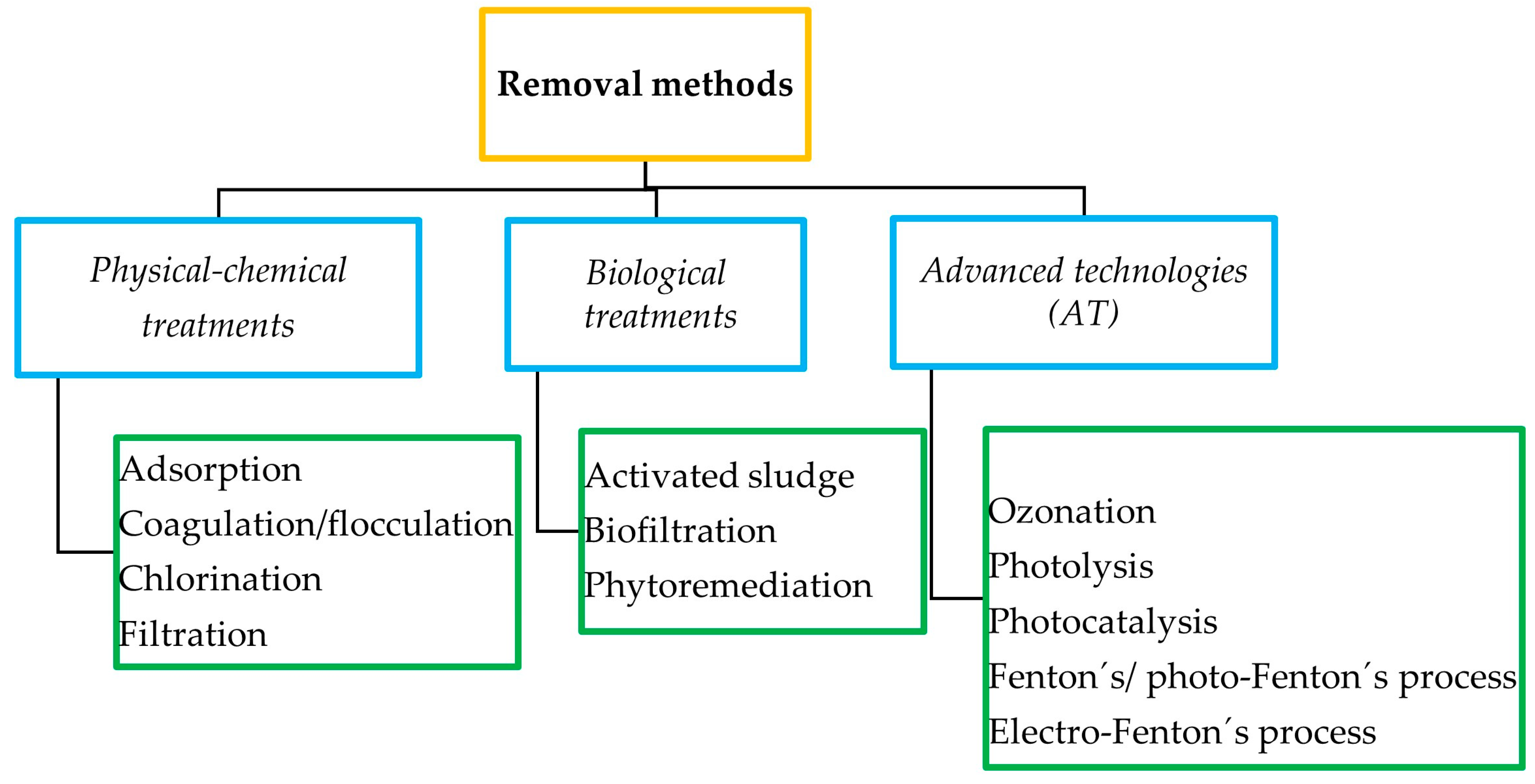
This section reviews the principal wastewater treatment technologies employed for MET removal, with a focus on evaluating their efficiency and elucidating the underlying removal mechanisms. For this, the Scopus, Web of Science and Google Scholar databases were used, covering the period from 2018 to 2026 with special attention to the last 5 years. The selected keywords were metformin, biological treatments, advanced oxidation processes, photo-Fenton, photocatalysis, chlorination, adsorption, phytoremediation, coagulation, flocculation and ozonation. These technologies are considered to provide a comprehensive overview of current treatment approaches. A schematic summary of these techniques is presented in Figure 3.

3.1. Physical–Chemical Processes

Water purification has traditionally been achieved through various treatment strategies that exploit the physicochemical properties of the present compounds, such as solubility and surface charge, among others. Some methods, such as adsorption, allow for the removal of substances without altering their original chemical structure. Nevertheless, other processes induce modifications to these properties through the addition of chemical agents; notably, coagulation, flocculation, and chlorination. These processes are reviewed in this section.
  • Adsorption
Adsorption is a widely applied technique for the removal of emerging contaminants from aqueous systems [24,25]. It is particularly advantageous due to its operational simplicity, high efficiency, selectivity, and ability to function over a wide pH range. Moreover, unlike some advanced treatment methods, adsorption does not generate potentially toxic transformation by-products; however, the process is inherently limited by the maximum adsorption capacity of the materials used [26].
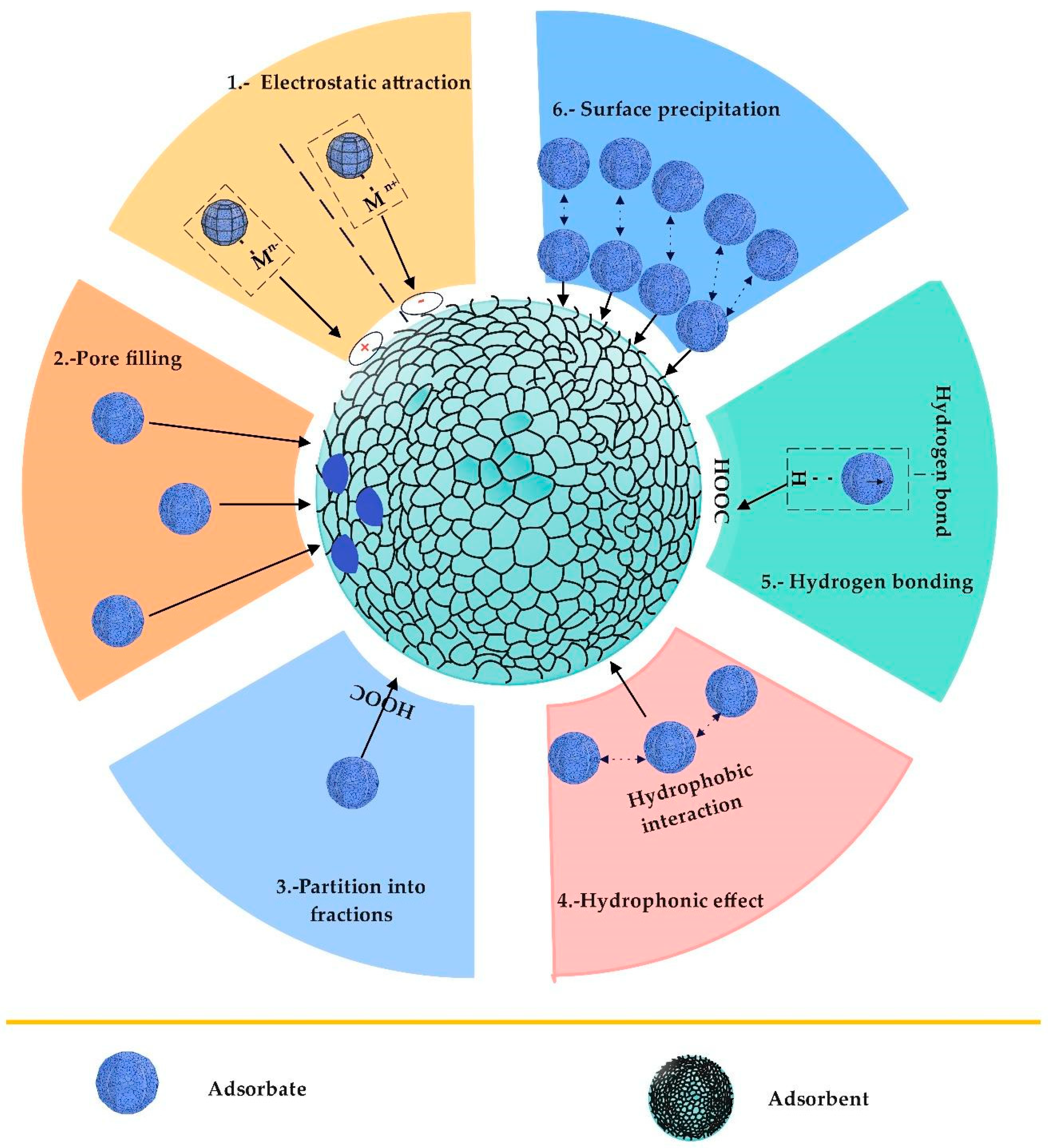
A variety of adsorbent materials have been investigated for metformin (MET) removal, including activated carbon, graphene oxide [4], biochar, and xerogels [25]. The adsorption process generally involves multiple mechanisms, such as electrostatic interactions, hydrogen bonding, π–π interactions, and pore filling (Figure 4) [6].
Studies on xerogels [25], natural zeolites [24] and agricultural residues (Byrsonima crassifolia) [27] highlight that MET removal depends on two critical parameters: surface functionalization and pH, which regulate the electrostatic attraction between the adsorbent surface and MET. Furthermore, these processes were found to fit the Langmuir and Freundlich models.
Similarly, advanced materials such as oxide (GO) [28,29], hydrogel-based composites [30], magnetized biochar [31] and pillared clay [11] demonstrate that increasing active site density and surface area significantly improve the adsorption process (>60%), allowing for rapid MET removal without by-product generation.
Despite these advances, adsorption efficiency remains highly sensitive to the specific properties of the adsorbent material, which may lead to low removal rates or the need for regeneration agents, such as citric acid (0.2 M), to ensure economic viability [11,31]. Consequently, adsorption is often combined with complementary treatment technologies, such as biodegradation, abiotic degradation, or phytoremediation, to enhance overall removal efficiency [28].
  • Coagulant/Flocculation
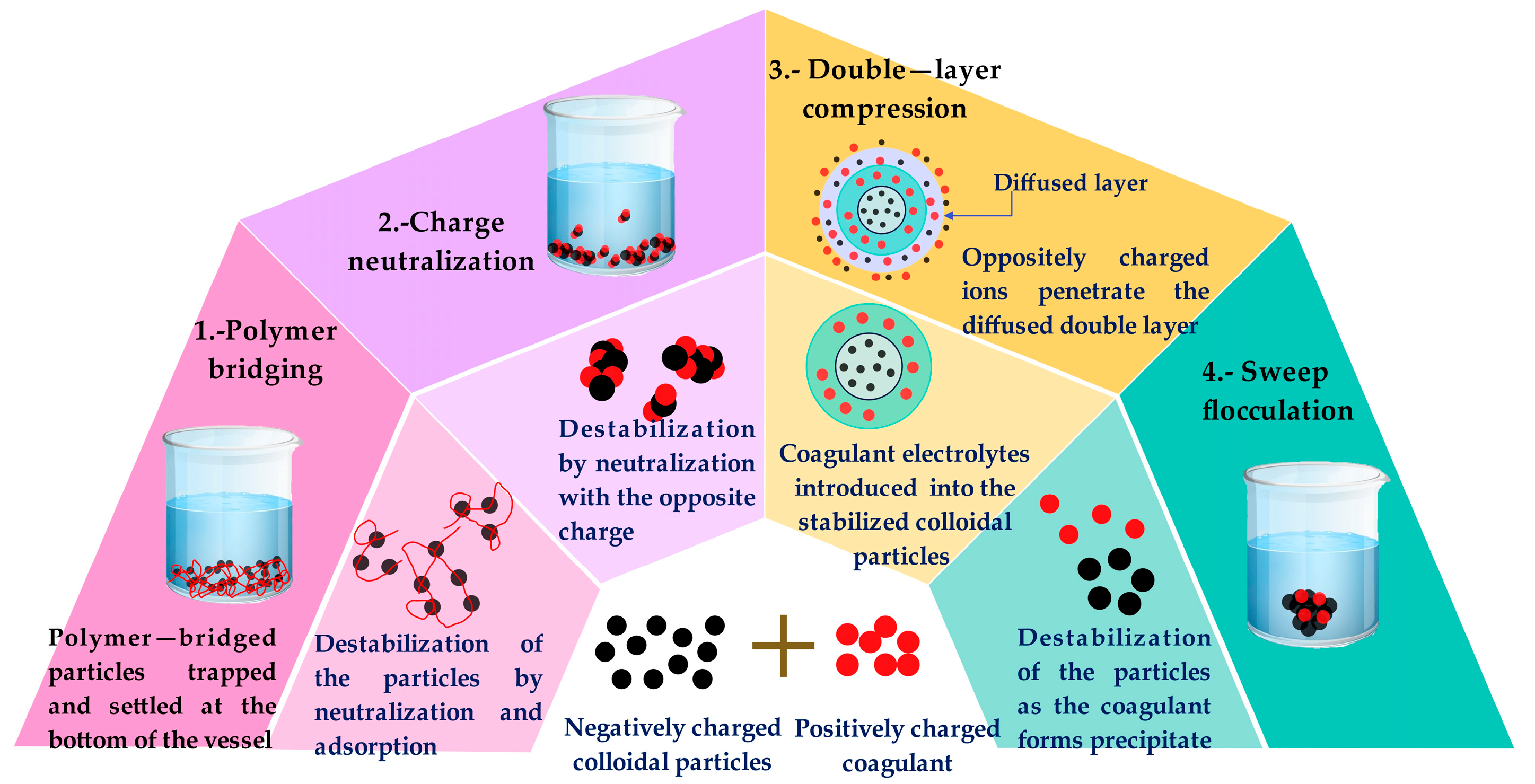
Coagulation–flocculation is a conventional treatment process commonly employed in WWTPs. It involves the addition of coagulants to destabilize suspended particles and promote their aggregation into larger flocs that can be easily removed [6]. During coagulation, the surface charges of colloidal particles, emulsified oils, and other suspended materials are neutralized, reducing electrostatic repulsion and enabling particle agglomeration.
Four primary mechanisms are typically involved in coagulation: (i) polymer bridging, (ii) charge neutralization, (iii) double-layer compression, and (iv) sweep flocculation (Figure 5). In polymer bridging, long-chain polyelectrolytes adsorb onto multiple particles, forming interparticle bridges that generate stable aggregates. Charge neutralization occurs when oppositely charged ions reduce or eliminate the surface charge of colloidal particles, thereby decreasing repulsive forces. In the double-layer compression mechanism, the addition of electrolytes increases ionic strength, compressing the electrical double layer surrounding colloids and facilitating aggregation. Finally, sweep flocculation involves the enmeshment of particles within precipitated coagulant hydroxides, leading to their removal from the aqueous phase [32].
Following coagulation and flocculation, the generated flocs undergo gravitational sedimentation, allowing for their efficient separation from the treated water [32,33].
Coagulation–flocculation processes have been reported to achieve removal efficiencies of up to 80% for certain micropollutants present in water [33,34]. However, their effectiveness for MET removal remains limited. For instance, Balakrishnan et al. [6] reported that the combination of clays and starch resulted in only 21% MET removal after 1 h of treatment. Similarly, Scheurer et al. [35] demonstrated that laboratory-scale flocculation using iron (Fe) and aluminum (Al) salts did not achieve significant removal of MET.
The low efficiency of the conventional coagulation–flocculation process for metformin removal can be attributed to the following factors,
  • Metformin is a low-molecular-weight pharmaceutical compound and is highly water-soluble due to its octanol–water partition coefficient (log Kow = −2.64) [20]. This physicochemical property promotes its preferential distribution in the aqueous phase rather than adsorption onto the solid flocs formed during coagulation. Consequently, metformin exhibits negligible affinity toward solid or hydrophobic phases. Furthermore, commonly used metal-based coagulants, such as Al2(SO4)3 and FeCl3, are highly effective for removing hydrophobic organic matter from contaminated effluents. However, given the hydrophilic nature of metformin, these coagulants are ineffective at destabilizing metformin molecules, primarily due to the strong hydration shell surrounding the compound.
  • In addition, metformin exists predominantly in its protonated form at neutral pH, indicating that it carries a positive charge (cationic species) [36]. This results in electrostatic repulsion forces [37] when metal coagulants with similarly positive charge characteristics are applied. As a result, metformin molecules are not effectively incorporated into the forming flocs. This limitation is further exacerbated by its low molecular weight, which hinders its removal via conventional coagulation–flocculation mechanisms.
The aforementioned factors are not surprising, since the literature related to adsorption indicates the need for a negatively charged surface to form hydrogen bonds with MET, thus limiting steps i and ii (see Figure 5). Thus, it can be concluded that coagulation–flocculation alone is insufficient for the effective elimination of MET, highlighting the need to integrate this process with more advanced treatment technologies to enhance overall removal efficiency or to conduct further research on proper coagulants for MET.
  • Chlorination
Chlorination is one of the most widely used chemical processes in water treatment due to its effectiveness, low cost, and operational simplicity. MET removal via chlorination is highly efficient (>99% at 1 mg L−1 Cl2); however, low mineralization efficiency (<10%) has been reported, which indicates that the process primarily involves chemical transformation rather than complete degradation [35]. Under typical water treatment conditions (pH 7–9 and chlorine concentrations of 28–100 μM), the hypochlorite ion (ClO) has been identified as the dominant reactive species during MET chlorination [38]. This transformation is also associated with hypochlorous acid (HOCl). These main reactive chlorine species are produced as follows (Equations (1)–(4)) [38]:
Cl2 + H2O → HOCl + H+ + Cl
HOCl → H+ + ClO
H+ + ClO → HOCl
H2O → H+ + OH
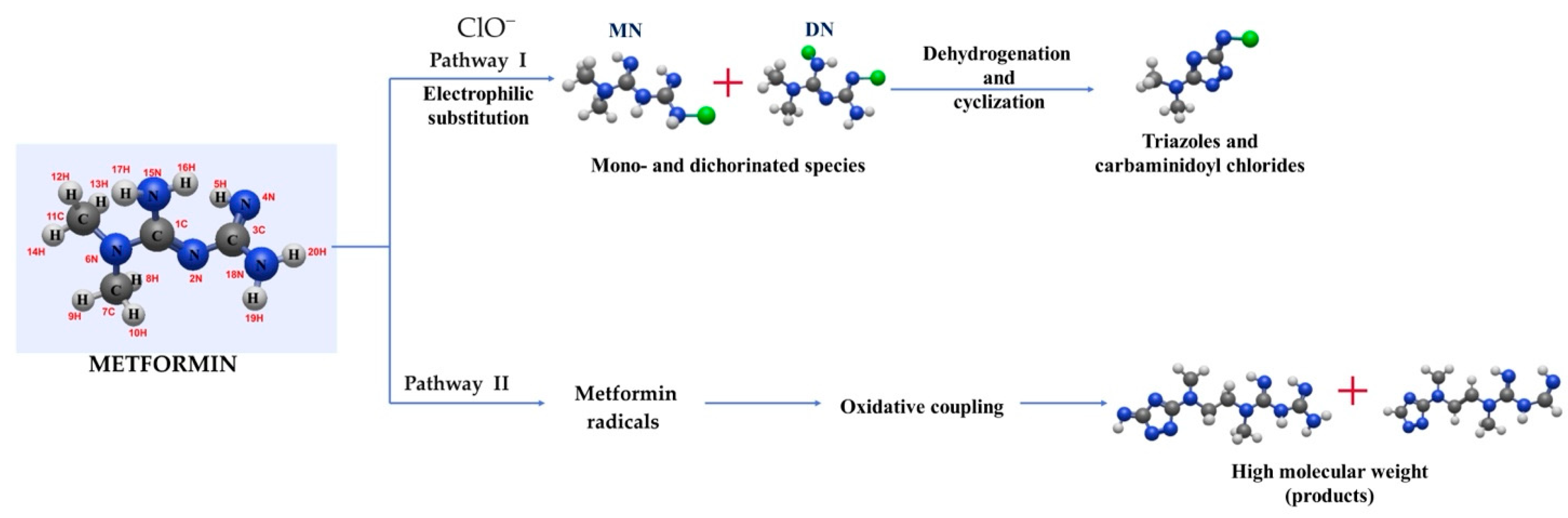
These species promote, by electrophilic substitution preferent at 4 N and 18 N (see Figure 6), the formation of mono- and dichlorinated intermediates (MN and DN), which subsequently undergo dehydrogenation and intramolecular cyclization reactions to yield secondary products such as triazoles and carbamimidic chlorides [1,2,36,38] (see Figure 6). Additionally, an alternative reaction pathway (Pathway II) involves radical-mediated mechanisms that lead to oxidative coupling and the formation of higher molecular weight products [36].
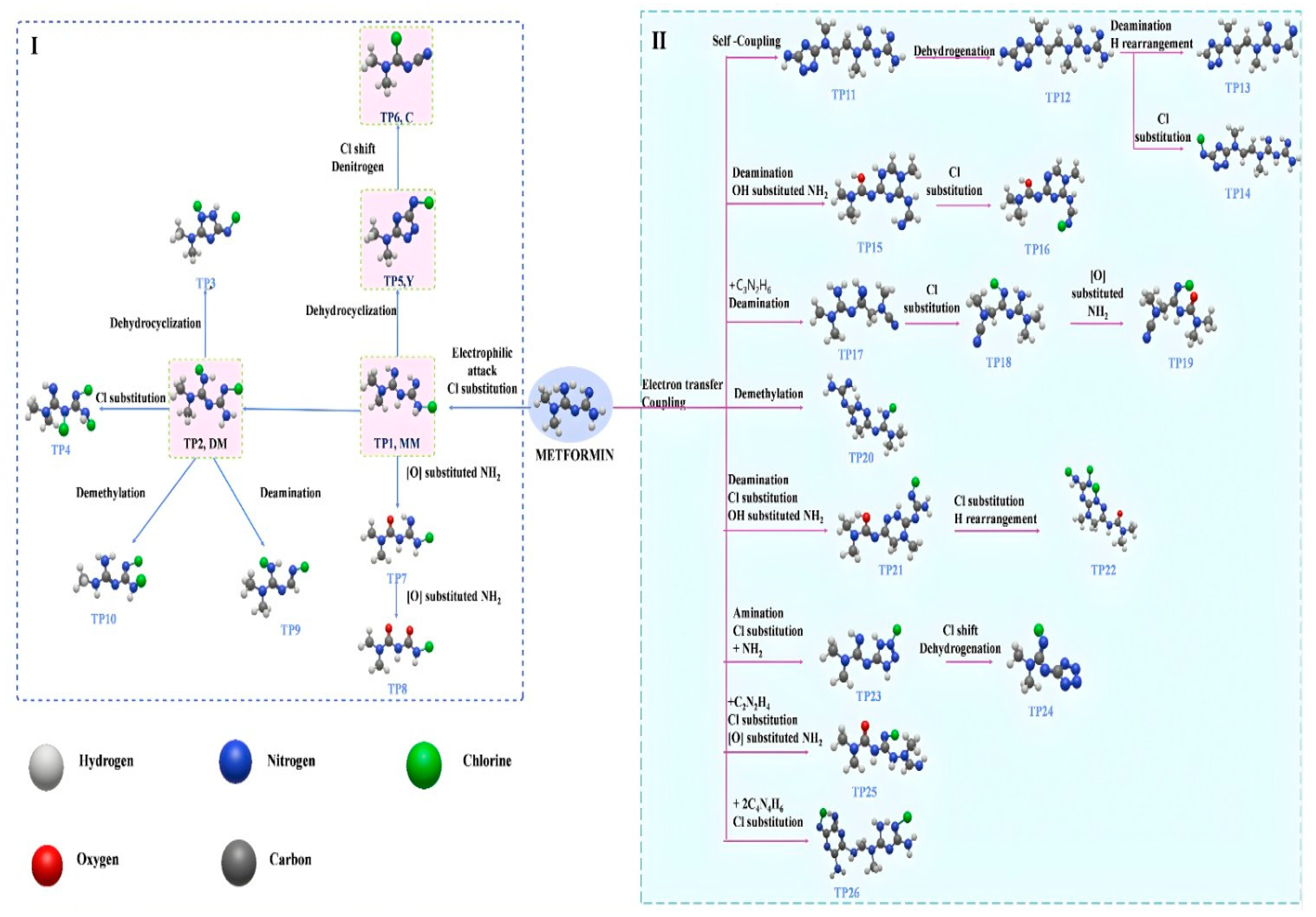
Recent studies employing high-resolution mass spectrometry have identified more than 20 transformation products (TPs), which can be broadly classified into three groups (see Table 4): (i) N-chlorinated compounds, (ii) oxygenated derivatives, and (iii) high-molecular-weight coupling products [36,39]. The products of the two pathways are detailed in Figure 7.
In pathway II, radical-mediated reactions are proposed, involving electron transfer and bond cleavage processes. These reactions generate reactive intermediates that participate in oxidative coupling, leading to the formation of dimeric or high-molecular-weight products. In this pathway, MET radicals formed via hydrogen abstraction may undergo dimerization, followed by dehydrogenation, deamination, and sequential chlorination steps. The formation of dimethylcyanamide fragments has also been reported [38].
Toxicological assessments indicate that many of these transformation products exhibit higher toxicity than the parent compound (Table 4). This increased toxicity is often associated with higher lipophilicity (log Kow), which enhances their bioavailability and potential for bioaccumulation in aquatic organisms [39]. These findings highlight that, although chlorination can effectively reduce MET concentration, the formation of potentially hazardous by-products represents a significant limitation (see Table 4). Therefore, chlorination cannot be considered an environmentally safe option. Consequently, there is a need to develop alternative or complementary treatment technologies that are capable of achieving both efficient removal and safe mineralization of metformin. No results with this approach were found in the existing literature.
Table 5 shows some studies of physical–chemical processes used for the removal of metformin in aqueous medium.

3.2. Biological Processes

3.2.1. Sequential Treatment Processes

The integration of multiple treatment processes in a sequential configuration has emerged as an effective strategy for enhancing the removal of MET and other pharmaceutical contaminants from wastewater. In particular, the combination of conventional or biological treatments with advanced oxidation processes (AOPs) has demonstrated improved removal efficiencies by coupling complementary mechanisms, such as biodegradation and chemical oxidation.
Sequential treatment systems enable an initial reduction in contaminant loads through biological or physicochemical processes, followed by the degradation of recalcitrant compounds using advanced techniques. For instance, biological treatments can partially degrade MET, while subsequent AOPs facilitate further oxidation and mineralization of residual compounds, thereby increasing overall treatment performance.
However, the effectiveness of these combined approaches is highly dependent on several operational factors, including the initial concentration of metformin, the design and infrastructure of the WWTP, and specific process conditions such as pH, temperature, and reaction time. Furthermore, matrix effects—such as the presence of organic matter and inorganic ions—can influence treatment efficiency.
Ongoing research is therefore focused on optimizing hybrid and sequential systems to achieve higher removal efficiencies, reduced energy consumption, and improved sustainability in the treatment of pharmaceutical contaminants in wastewater.

3.2.2. Biological Treatment

  • Activated sludge process
Biological treatment processes, particularly activated sludge systems, are among the most widely applied methods for the removal of pharmaceutical contaminants, including MET, in WWTPs [6,44,45]. These systems rely on the metabolic activity of microbial communities to degrade organic pollutants through enzymatic pathways.
Several studies have investigated the biodegradation of MET using activated sludge under controlled conditions. For instance, Poursat et al. [44] evaluated the capacity of microbial consortia from the Amsterdam West WWTP to degrade metformin (15 mg∙L−1) and its primary transformation product, guanylurea, using chemostat systems and biodegradation assays. The results demonstrated complete removal of both compounds within 28 days. However, prolonged exposure under controlled conditions did not necessarily enhance degradation performance and, in some cases, led to a decline in microbial degradation capacity. Additionally, a bacterial strain belonging to the genus Aminobacter was isolated, which could transform MET into guanylurea within 3 days.
Biodegradation studies have consistently shown that MET removal is favored under aerobic conditions. For example, experiments using sewage sludge reported complete elimination of MET within 15 days by sequential dealkylation steps [4].
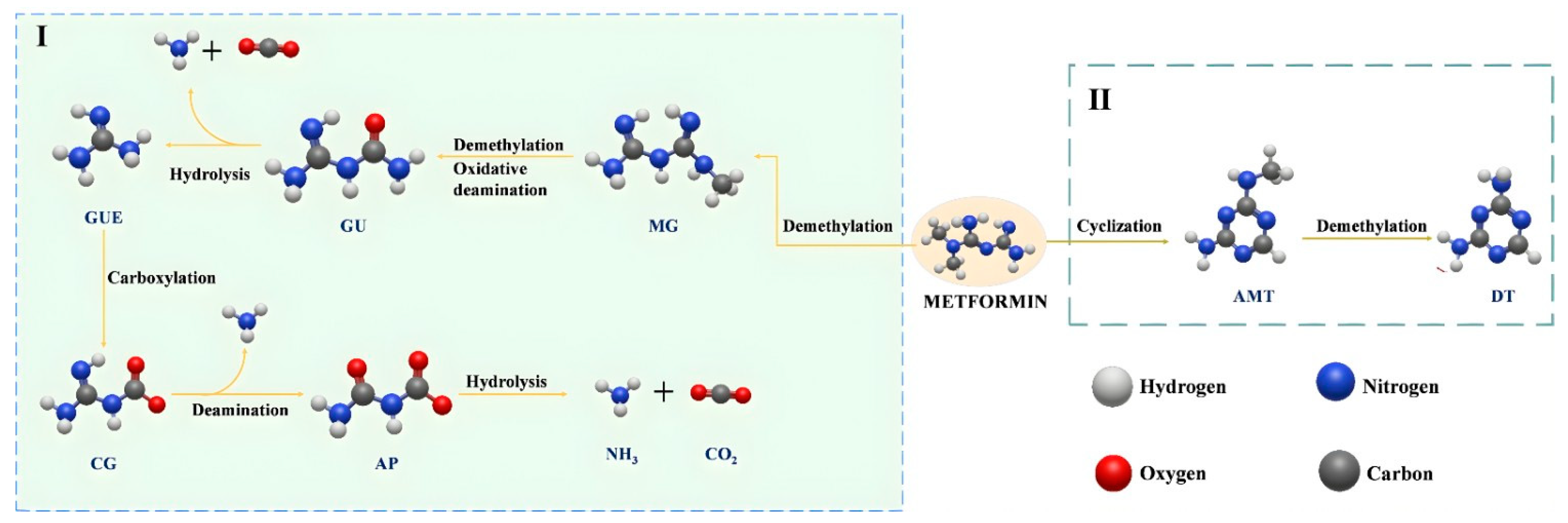
The biodegradation of MET in aerobic activated sludge systems is plausibly governed by two major transformation pathways (Figure 8). In pathway I, MET initially undergoes demethylation to form methylbiguanide (MG), which is subsequently converted through oxidative demethylation and deamination reaction into guanylurea (GU). This is then hydrolyzed, generating guanidine, carbon dioxide (CO2), and ammonia (NH3). Finally, guanidine undergoes successive carboxylation, hydrolysis, and deamination steps, ultimately resulting in complete mineralization. The high degree of mineralization achieved through these sequential biotransformations highlights aerobic activated sludge systems as a highly promising and efficient strategy for MET removal from aqueous environments.
In pathway II, MET is transformed via cyclization and dehydrogenation to form 2-amino-4-methylamino-1,3,5-triazine (AMT), which is further demethylated to 2,4-diamino-1,3,5-triazine (DT). However, these intermediates typically account for less than 1% of the initial MET concentration in laboratory studies, indicating that aerobic degradation is predominantly governed by pathway I [1].
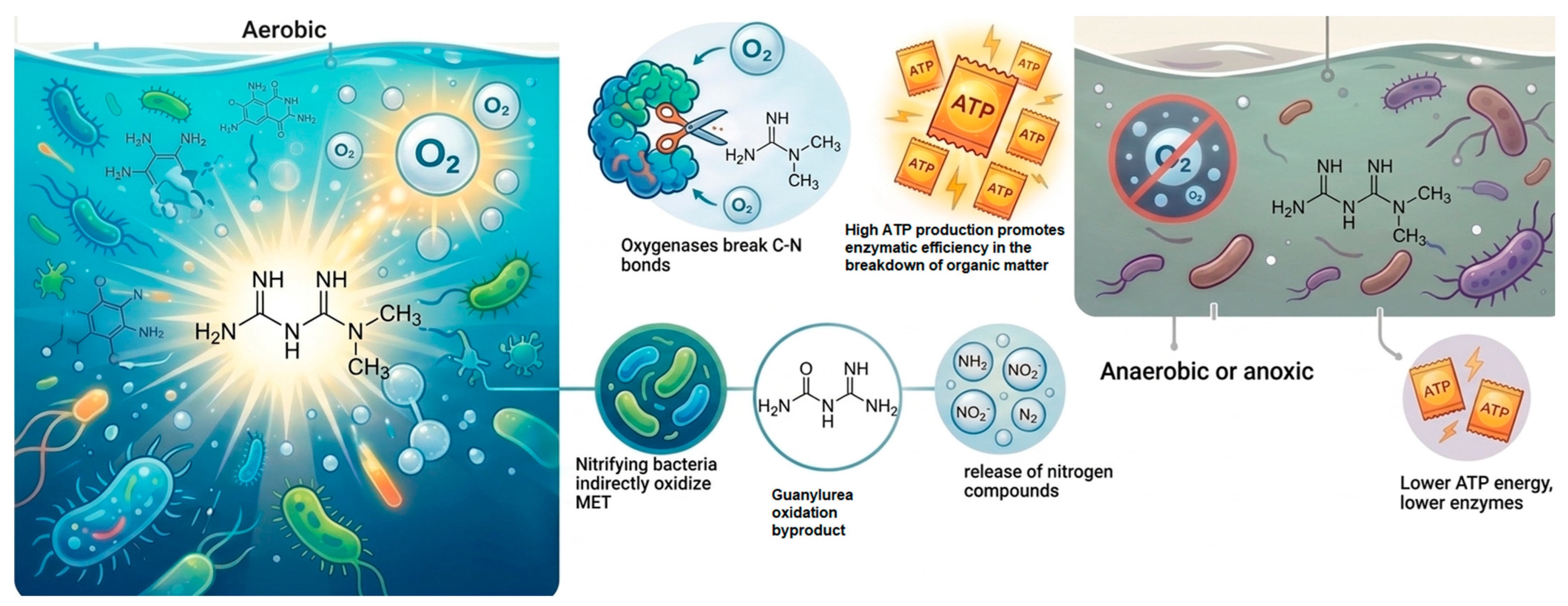
The superior removal efficiency of MET in aerobic biological systems can be ascribed to the high metabolic activity of aerobic bacterial consortia. In the presence of molecular oxygen (O2), oxygenase and dehydrogenase enzymes are activated [46], promoting the cleavage of C-N bonds in the MET molecule (see Figure 9). Because MET degradation proceeds primarily through oxidative biochemical pathways, oxygen acts as a key electron acceptor that enables microorganisms to initiate enzymatic attacks on the compound structure (see Figure 9). Under anaerobic or anoxic conditions, the lack of oxygen significantly limits these oxidative reactions and reduces the biodegradation capacity of the microbial community.
  • Biological filtration
Biological filtration systems, including trickling filters and biofilters, represent effective treatment technologies that facilitate the degradation of metformin (MET) through microbial activity. These systems combine physical filtration with biological processes, enabling the simultaneous removal of organic contaminants and nutrients.
For example, García-Sánchez et al. [47] investigated the performance of membrane bioreactors operated under anaerobic, anoxic, and aerobic conditions, reporting removal efficiencies of approximately 20% for MET and 99% for ciprofloxacin. Similarly, Santos et al. [48] reported that full-scale treatment of hospital wastewater using trickling filters achieved up to 70% MET removal.
In another study, García-Sánchez et al. [47] evaluated an aerated biofilter packed with wood shavings from Ficus benjamina for the removal of metformin, ciprofloxacin, organic matter, and ammonia nitrogen (NH3–N). The results demonstrated that wood-based media exhibit high sorption capacity for MET, while nitrification–denitrification processes significantly contribute to pharmaceutical removal. Additionally, system performance was strongly influenced by the hydraulic loading rate; higher surface hydraulic loads resulted in reduced removal efficiency, with maximum MET removal reaching 94% under optimized conditions.
  • Phytoremediation
Phytoremediation has emerged as a sustainable and cost-effective approach for the removal of organic and inorganic contaminants from soil and water systems. This technology can be applied both in situ and ex situ and offers advantages such as low operational costs, minimal environmental impact, and the potential for habitat restoration [49]. Moreover, phytoremediation has been proposed as a tertiary treatment option in WWTPs [50].
The selection of appropriate plant species is a critical factor influencing phytoremediation efficiency. Typically, candidate species are identified based on prior studies, and native plants are subsequently evaluated for their capacity to remove contaminants. Post-harvest biomass can be treated through chemical, thermal, or biological methods to reduce volume and facilitate reuse or disposal [51].
Cui and Schröder et al. [50] reported that MET removal using Typha latifolia follows first-order kinetics, with rapid uptake occurring primarily in plant roots and limited translocation to aerial tissues. This behavior may be influenced by factors such as plant species, physiological characteristics, environmental conditions, and metabolic activity. Similarly, Moogouei et al. [51] evaluated the phytoremediation potential of several plant species, including Amaranthus retroflexus, Ricinus communis, Brassica napus, Celosia cristata, Helianthus annuus, and Phragmites australis. The results indicated that H. annuus and C. cristata are particularly effective for treating waters with high MET concentrations (50 mg∙L−1), whereas other species performed better at lower concentrations. These findings suggest that plant selection should be tailored to the contamination level for optimal performance.
Despite its advantages, phytoremediation presents several limitations, including long treatment times, relatively low removal rates, and the potential for phytotoxic effects. Additionally, MET and its transformation products may accumulate in plant biomass, raising concerns regarding secondary environmental risks. The large-scale implementation of this technology is further constrained by land requirements and environmental conditions.
Table 6 shows some studies of biological treatment used for the removal of metformin in aqueous medium.

3.3. Advanced Technologies

3.3.1. Membrane Filtration

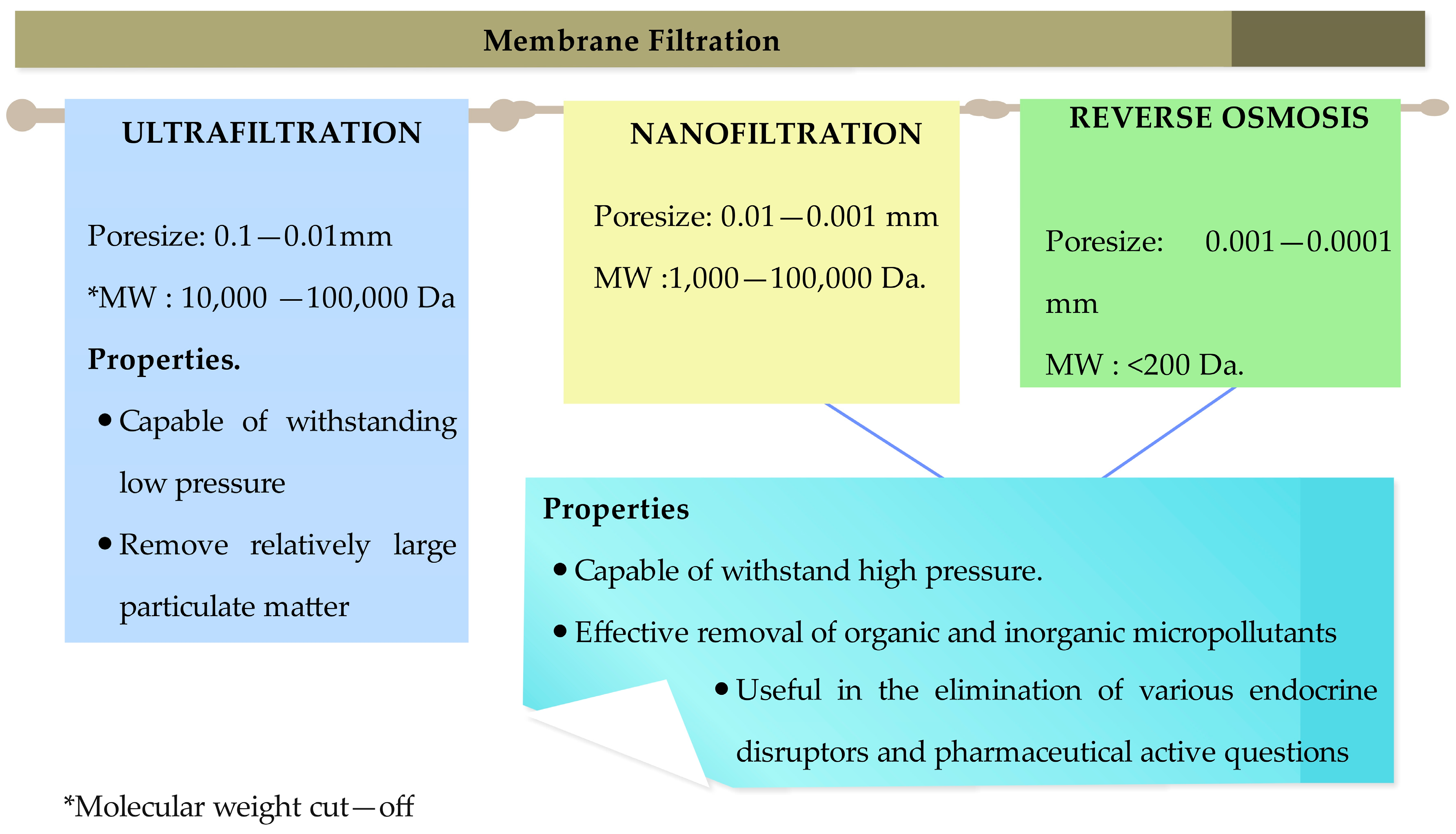
Membrane-based filtration processes, including ultrafiltration (UF), nanofiltration (NF), and reverse osmosis (RO) (Figure 10), have demonstrated considerable potential for the removal of MET through size exclusion and physicochemical interactions. These technologies enable the selective separation of contaminants without the need for additional chemical reagents, offering advantages such as high rejection efficiency, scalability, and operational versatility.
Two fundamental characteristics distinguish membrane filtration systems. First, membrane asymmetry reduces pressure loss across the membrane while influencing fouling behavior by directing the feed toward the selective layer. Second, effective operation requires sufficient crossflow velocity across the membrane surface to minimize concentration polarization and fouling effects [52].
Hidalgo et al. [53] evaluated the performance of a thin-film nanofiltration membrane (NF99) for the removal of metformin, caffeine, and methylparaben. The permeate flux exhibited a linear relationship with the applied hydraulic pressure, independent of the contaminant type. MET removal efficiencies ranged between 70% and 80%, while caffeine removal reached 80–90%. The relatively high rejection of MET was attributed to its positive net charge, which enhances its hydration and effective molecular size.
Similarly, Anike et al. [54] investigated the performance of two tubular nanofiltration membranes (AFC 30 and AFC 80) for the removal of antimicrobial compounds, including metformin. Using the steric hindrance pore (SHP) model and the Spiegler–Kedem–Katchalsky (SKK) model, the authors analyzed solute transport and retention mechanisms. The AFC 30 membrane, with a pore radius of 0.353 nm, exhibited higher permeability but lower selectivity, achieving a maximum MET rejection of 87%. In contrast, the AFC 80 membrane, characterized by a smaller pore radius (0.268 nm), demonstrated enhanced selectivity and achieved up to 98% removal. These results highlight the critical role of membrane pore size in determining separation efficiency.
Due to their high selectivity, nanofiltration processes have attracted significant attention for the removal of a wide range of pharmaceutical contaminants, including diclofenac, ibuprofen, paracetamol, dexamethasone, caffeine, omeprazole, and sulfamethoxazole [52,53,54,55]. From an environmental perspective, NF represents a promising technology for advanced water treatment.
Reverse osmosis (RO), another widely applied membrane process, can achieve near-complete removal of pharmaceutical contaminants from wastewater, particularly in hospital effluents. This process relies on diffusion through a dense semipermeable membrane and is particularly effective for the removal of dissolved ions and small organic molecules [56]. Reported removal efficiencies for compounds such as metformin, cotinine, trimethoprim, caffeine, venlafaxine, carbamazepine, erythromycin, and fluoxetine range from 92.6% to 99.9% [52,55].
However, some studies have reported lower rejection efficiencies for MET under specific conditions. For example, Choe et al. [57] compared ozonation, granular activated carbon adsorption, and reverse osmosis processes for the removal of several pharmaceuticals. While most compounds exhibited rejection rates above 98%, MET showed significantly lower removal (<20%) in certain cases, attributed to its low molecular weight and physicochemical properties. Furthermore, adsorption onto activated carbon was limited under acidic and neutral conditions (<30%), although removal efficiency improved at higher pH values due to reduced molecular charge and increased hydrophobicity.
These findings indicate that factors such as membrane surface charge, solute pKa, molecular size, hydrophobicity, solution pH, and the presence of organic and inorganic constituents in wastewater significantly influence removal efficiency [57,58].
Recent research has been oriented towards advanced materials with adjustable porosity. Zhang et al. [59] developed a covalent organic framework (COF) membrane with a double-charged structure, using sodium dodecyl sulfate-mediated interfacial polymerization, followed by crosslinking with polyethylenimine. The membrane had a precise pore size of approximately 0.209 nm and a positive surface charge (+36.4 mV). This "double charge" strategy is particularly effective for MET, as the positive membrane charge creates strong electrostatic repulsion against the cationic drug (Donnan exclusion), achieving rejection rates of 92.6% for low molecular weight drugs.
Complementing this, Aouay et al. [60] recently developed bifunctional ceramic membranes by incorporating spent coffee grounds into a kaolin matrix. This approach shifts the separation mechanism from simple physical sieving to a synergistic process. The membranes exhibit high porosity (45.5%) and a strong negative surface charge (−36.8 mV), which facilitates the selective removal of MET through electrostatic attraction. Specifically, the primary retention mechanism involves the interaction between the membrane’s negatively charged carboxyl groups (-COO) and the protonated amine groups (-NH3+) of the MET molecule. Through this synergy between physical size exclusion and electrostatic adsorption, a 91% removal rate was achieved, effectively overcoming the flux and rejection constraints typical of conventional ceramic membranes.
These capabilities of membranes have allowed them to be integrated into even more complex systems, such as algae-based membrane bioreactors [61]. In these hybrid systems, the technology does not act in isolation but rather enhances the treatment. However, despite the reported high performance in membrane technologies, their long-term applicability remains limited by challenges related to cleaning protocols, regeneration, and management of concentrated waste streams.

3.3.2. Advanced Oxidation Processes (AOPs)

Advanced oxidation processes (AOPs) have emerged as effective alternatives to conventional treatment methods for the removal of recalcitrant pharmaceutical contaminants. These processes are based on the in situ generation of highly reactive species, primarily hydroxyl radicals (OH), which possess strong oxidative potential and can induce significant transformations in the chemical structure of pollutants such as MET.
AOPs—including ozonation, UV photolysis, photocatalysis, and Fenton-based processes—are capable of degrading MET through the generation of reactive radicals that oxidize organic compounds toward simpler molecules, ultimately leading to partial or complete mineralization into water (H2O) and carbon dioxide (CO2) [62]. Reported removal efficiencies for MET vary widely, typically ranging from 9.2% to 60%, depending on the specific process conditions and system configuration [1].
  • Ozonation
Ozonation is widely employed in water treatment as both a pre-treatment and disinfection process [63]. During ozonation, ozone (O3) can decompose in the presence of hydroxide ions to generate OH, which significantly enhance oxidation efficiency [64]. The overall performance of this process is strongly influenced by operational parameters such as pH, temperature, and ozone dosage.
Ozone is characterized by a relatively short half-life, which necessitates continuous generation and contributes to the high energy demand and operational cost of the process. Furthermore, although ozonation can effectively degrade pharmaceutical compounds, complete mineralization is often limited, and persistent by-products may be formed during treatment [65].
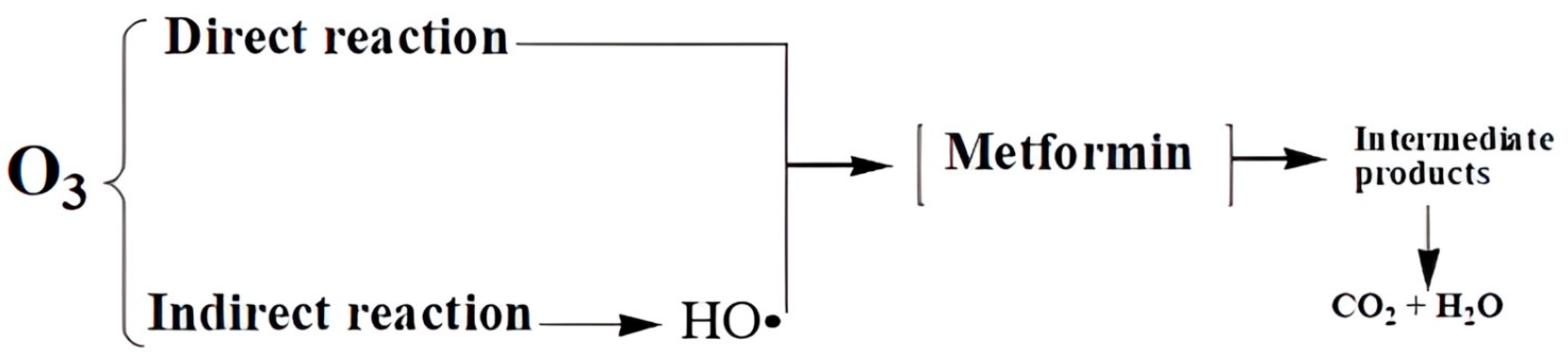
The oxidation of MET by ozone can proceed through two main pathways, as illustrated in Figure 11. Under acidic conditions (pH < 7), direct ozonation predominates, in which ozone reacts selectively with the target compound. In contrast, under alkaline conditions, indirect oxidation becomes dominant, as ozone decomposition leads to the formation of reactive oxygen species (ROS), including OH, which promote non-selective oxidation (Equations (5)–(9)).
O3 + OH → HO4
HO4 → HO2 + O2−•
O2−•+ O3 → O2 + O−•
O3−• → O2 + O−•
O−• + H2O → OH + OH
Ozone has demonstrated the ability to degrade MET within approximately 30 min of reaction, achieving removal efficiencies of up to 60%. The primary site of oxidative attack is believed to be the dimethylamine moiety of the molecule. To date, approximately 18 ozonation products have been identified [1].
Seiwert et al. [66] investigated the formation of ozonation products (OPs) in a pilot-scale system using an ozone dose of 0.8 mg O3 ∙mg−1, a temperature of 23 ± 2 °C, and an initial MET concentration of 20 μM. The study revealed the formation of smaller, more polar transformation products generated through reactions with ozone and hydroxyl radicals. Due to their increased polarity, these OPs exhibit high mobility and persistence in aquatic environments.
Liao et al. [67] demonstrated that nitrosodimethylamine (NDMA), a known carcinogenic compound, can be directly formed during MET ozonation. NDMA formation was found to increase significantly with pH, rising from 69.6 ng∙L−1 at pH 5 to 235.9 ng∙L−1 at pH 9. Additionally, higher ozone doses promoted increased NDMA formation. These findings highlight the importance of controlling operational conditions, particularly pH and ozone dosage, to minimize the generation of toxic by-products.
Scheurer et al. [35] compared different treatment methods for MET removal and reported the following order of efficiency: chlorination > ozonation > activated carbon filtration > flocculation. Although ozonation was effective, it resulted in only partial removal of MET and its primary metabolite, guanylurea, in raw water. At ozone concentrations of 0.5 and 1 mg∙L−1, both compounds exhibited similar degradation kinetics, with higher ozone doses accelerating removal rates and reducing residual concentrations.
Gartiser et al. [68] provided a systematic evaluation of combined biodegradation and ozonation processes, demonstrating that MET is not completely removed by ozonation alone and that guanylurea is formed as a transformation product, detectable by LC–MS analysis. Guanylurea has been identified as a metabolite with potentially higher toxicity than MET itself [66,67] and, therefore, its removal is relevant and justifies the combination of ozonation with bioprocesses.
  • UV photolysis and photochemical oxidation processes
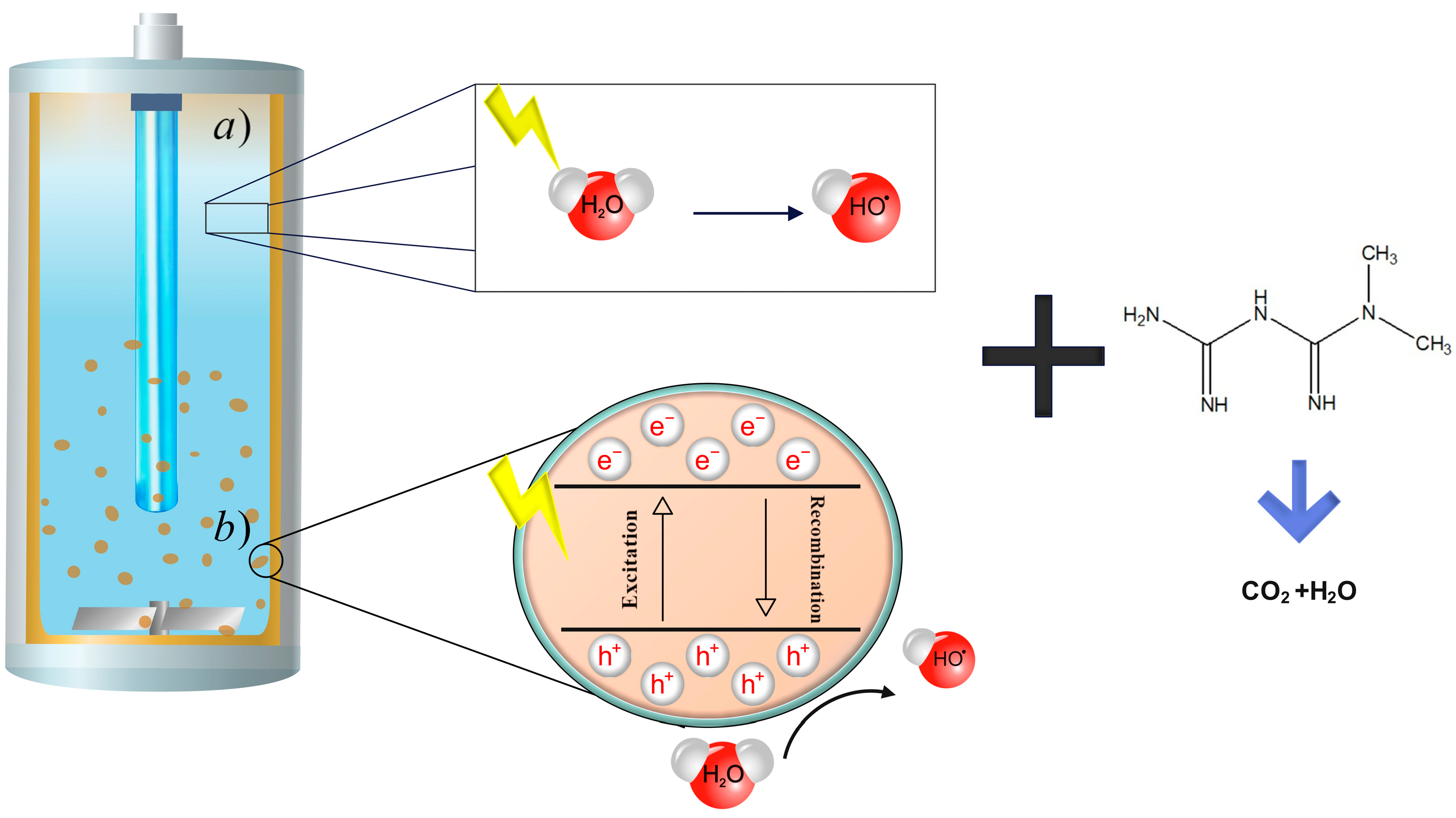
Ultraviolet (UV) photolysis is a well-established technology in water treatment that has gained increasing attention for the degradation of pharmaceutical contaminants [69]. This process involves the absorption of UV radiation by target molecules (Figure 12a), resulting in molecular excitation and subsequent cleavage of chemical bonds [6].
The effectiveness of UV photolysis is largely attributed to the generation of reactive species, including OH, hydrogen radicals (H), and solvated electrons (e), as described in Equations (10)–(12) [69]. These species participate in both oxidation and reduction reactions, promoting mechanisms such as electron transfer, bond cleavage, and hydrogen abstraction. As a result, complex organic pollutants are transformed into smaller, more polar compounds.
However, the efficiency of UV photolysis depends strongly on several factors, including the wavelength and intensity of irradiation, the composition of the aqueous matrix, and the optical properties of the target compound [69,70].
H2O + hvOH + H
H2O + hv → e + H+ + OH
Organic pollutant + OH → Homolytic Scission
UV photolysis generally exhibits lower removal efficiencies for MET compared to other AOPs, such as photocatalysis, Fenton, and photo-Fenton systems. Quintão et al. [71] reported that direct photolysis of MET achieved only 9.2% removal after 30 min of irradiation, whereas ozonation and photocatalysis reached removal efficiencies of 60% and 20%, respectively.
Similarly, Carbuloni et al. [72] observed approximately 30% MET removal after 60 min of UV treatment at an initial concentration of 10 mg L−1. Comparable results were reported by Amado-Piña et al. [11], who achieved a removal efficiency of 45% under similar conditions. This improvement in performance has been attributed to the in situ generation of hydrogen peroxide (H2O2) according to Equations (13)–(15), and reactive oxygen species such as hydroperoxyl (HO2) and superoxide (O2•−) radicals.
H2O + hv → H2O*
H2O* + H2O → H2O2 + H2(g)
H2O* + O2 → H2O2 + ½ O2
The experimental configuration employed by Amado-Piña et al. [11] is noteworthy, as it utilizes a cylindrical photoreactor with a narrow diameter, enabling enhanced photon distribution and improved irradiation efficiency throughout the reaction medium.
The involvement of reactive oxidizing species indicates that MET degradation under UV irradiation is not solely governed by direct photolysis but is significantly enhanced by indirect photochemical oxidation processes. This highlights the potential of photochemical oxidation processes (POPs), particularly when combined with oxidizing agents such as H2O2, to improve the removal of organic contaminants.
In UV/H2O2 systems, OH are generated through the photolysis of hydrogen peroxide under UV irradiation (typically at 254 nm), leading to a substantial increase in oxidative capacity and enhanced pollutant degradation [73]. Studies have reported near-complete MET degradation after 90 min of treatment, with approximately 72% removal occurring within the first 10 min of reaction. This rapid initial degradation is attributed to the combined effects of UV irradiation and the high reactivity of OH produced during H2O2 photolysis, as described in Equation (16) [11]:
H2O2 + hv → 2 OH
Alanís-leal et al. [73] compared UV/H2O2 and UV/persulfate (UV/PS) systems, observing similar degradation trends for MET. However, the UV/PS system exhibited slightly higher removal efficiencies, reaching approximately 30% removal after 60 min of treatment. This behavior is attributed to the photolytic activation of persulfate ions (S2O82−) under UV irradiation (254 nm), which leads to the formation of sulfate radicals (SO4•−), as shown in Equation (17):
S 2 O 8 2   +   hv     2 S O 4
Sulfate radicals possess high oxidation potential, greater selectivity, and lower recombination rates compared to hydroxyl radicals, which can enhance degradation performance under certain conditions [62].
  • Photocatalytic process
In recent years, heterogeneous photocatalysis has been extensively investigated for the degradation of organic pollutants, including pharmaceutical compounds such MET [74]. This technology is characterized by its high efficiency, relatively low cost, and ability to generate highly reactive species capable of oxidizing contaminants. Photocatalytic reactions involve the interaction between a semiconductor material, water, and light irradiation, leading to the formation of reactive oxygen species (ROS), OH, which are responsible for pollutant degradation [6,69].
Photocatalysis is based on the excitation of semiconductor materials upon irradiation with photons of energy equal to or greater than their bandgap. Under these conditions, electrons are promoted from the valence band (VB) to the conduction band (CB), generating electron–hole pairs (e/h+). These charge carriers participate in redox reactions at the catalyst surface, producing ROS such as OH and superoxide radical anions (O2•−), which drive the degradation of organic compounds (Figure 12b) [75,76].
The efficiency of photocatalytic processes is strongly influenced by factors such as the surface properties of the catalyst, light absorption capacity, and the recombination rate of electron–hole pairs. Various semiconductor materials have been evaluated as photocatalysts, including ZnS and ZnO; however, titanium dioxide (TiO2) remains the most widely used due to its low toxicity, chemical stability, and high photocatalytic activity [6,69]. The fundamental reactions involved in TiO2 photocatalysis are described in Equations (18)–(20) [77]
TiO2 + hv → e + h+
h+ + H2O → OH
h+ + OHOH
To enhance photocatalytic performance, several strategies have been developed to improve light absorption and charge separation [75]. These include doping with metallic elements (e.g., Cu, Co, Pt, Ag, Au) and non-metallic elements (e.g., B, N, S, F, C), co-doping, and the formation of semiconductor heterojunctions [76].
In type II heterojunction systems, photogenerated electrons migrate from the semiconductor with higher conduction band energy to one with lower energy, while holes transfer in the opposite direction. This spatial separation of charge carriers reduces recombination rates and enhances ROS generation, leading to improved photocatalytic efficiency [76].
Carbuloni et al. [71] compared the performance of TiO2, ZrO2–TiO2 (95:5), and ZrO2 for the degradation of MET (10 mg L−1). After 30 min of irradiation, approximately 50% removal was achieved using both TiO2 and ZrO2–TiO2 catalysts. Kinetic analysis indicated pseudo-first-order behavior, with the following performance order: ZrO2–TiO2 > TiO2 > ZrO2. The enhanced activity of the composite catalyst was attributed to improved structural and electronic properties resulting from semiconductor coupling.
Similarly, Solano et al. [76] reported that a TiO2–CuO heterojunction containing 1 wt% CuO achieved MET removal efficiencies of 71% in batch systems and up to 75% in a fluidized bed annular photoreactor (FBAP). Identified transformation products included methylbiguanide and 4-amino-2-imino-1-methyl-1,2-dihydro-1,3,5-triazine. Kumar et al. [3] reported similar degradation pathways using a poly(3,4-ethylenedioxythiophene)-based system, achieving removal efficiencies exceeding 99%.
Furthermore, the incorporation of oxidizing agents into photocatalytic systems has become increasingly common, as it enhances the generation of reactive species and improves degradation efficiency. This synergistic approach has contributed to the development of more advanced and efficient treatment technologies for the removal of pharmaceutical contaminants from water.
  • Fenton, Fenton-like and Photo-Fenton
The Fenton reaction, first reported by H. J. Fenton in 1894 [78], is based on the catalytic decomposition of hydrogen peroxide (H2O2) by ferrous ions (Fe2+) under acidic conditions, leading to the generation of highly reactive OH. This process significantly enhances the oxidative capacity of H2O2 and is widely applied for the degradation of organic contaminants (Equations (21)–(25)) [11,78].
Fe2+ + H2O2 → Fe3+ + OH + OH
OH + H2O2 → HO2 + H2O
Fe2+ + OH → Fe3+ + OH
Fe3+ + HO2 → Fe2+ + O2 + H+
OH + OH → H2O2
Despite its effectiveness in generating hydroxyl radicals, the conventional Fenton process presents several operational limitations. These include the accumulation of Fe3+, which reduces the availability of Fe2+, and the requirement for a narrow acidic pH range (typically 2.5–3.0). As Fe2+ is depleted, the reaction rate decreases, limiting overall degradation efficiency [79].
To overcome these limitations, modified Fenton-based processes have been developed, including the photo-Fenton process. This approach combines H2O2, iron species (Fe2+/Fe3+), and light irradiation (UV or visible), promoting the photochemical regeneration of Fe2+ and enhancing OH production (Equations (26)–(27)) [78].
Fe3+ + H2O2 + hv → Fe2+ + OH + H+
Fe3+ + H2O + hv → Fe2+ + HO2 + H+
Neamţu et al. [80] reported that under UV/H2O2/Fe(II) conditions, MET exhibited relatively low oxidation rates (<24% after 60 min), with the formation of multiple transformation products, including guanylurea, phenol, oxalic acid, tartaronic acid, glycolic acid, oxamic acid, maleic acid, nitrate, and ammonia. These results suggest that, under certain conditions, Fenton and photo-Fenton processes may exhibit limited efficiency for MET removal, particularly when using simulated sunlight.
In contrast, other studies have demonstrated significantly higher removal efficiencies. Estrada-Arriaga et al. [81] compared photocatalysis (TiO2), photo-Fenton, and photo-ferrioxalate systems, reporting MET removal efficiencies of 97%, 66%, and 41%, respectively, after 120 min of treatment. The study highlighted the importance of nitrogen-containing structures in MET, which contribute substantially to the formation of nitrogenous transformation products during degradation. These nitrogen species can be further oxidized into compounds such as nitrogen gas (N2), nitrogen oxides, nitrites, and nitrates (Equations (28)–(29)) [82].
NH4+ → NH3 + OH → NH2OH → NOH → NO→ NO2→ NO3
NO → N2O → N2
More recently, Amado-Piña et al. [11] evaluated the performance of photo-Fenton processes under UV (254 nm) and visible light irradiation. Under UV conditions, complete MET degradation (100%) was achieved within 10 min, with mineralization reaching 83% after 90 min. Under visible light, complete degradation was also achieved, although at longer reaction times (30 min), with mineralization efficiencies of approximately 75%.
The degradation pathway of MET in photo-Fenton systems involves the initial formation of cyanoguanidine, followed by further oxidation into low-molecular-weight carboxylic acids, such as formic, acetic, and oxalic acids. These transformations are driven by hydroxyl radicals and photogenerated holes and are often accompanied by a decrease in pH due to the accumulation of acidic intermediates.
Table 7 summarizes selected studies on advanced treatment methods for the removal of metformin in aqueous media.
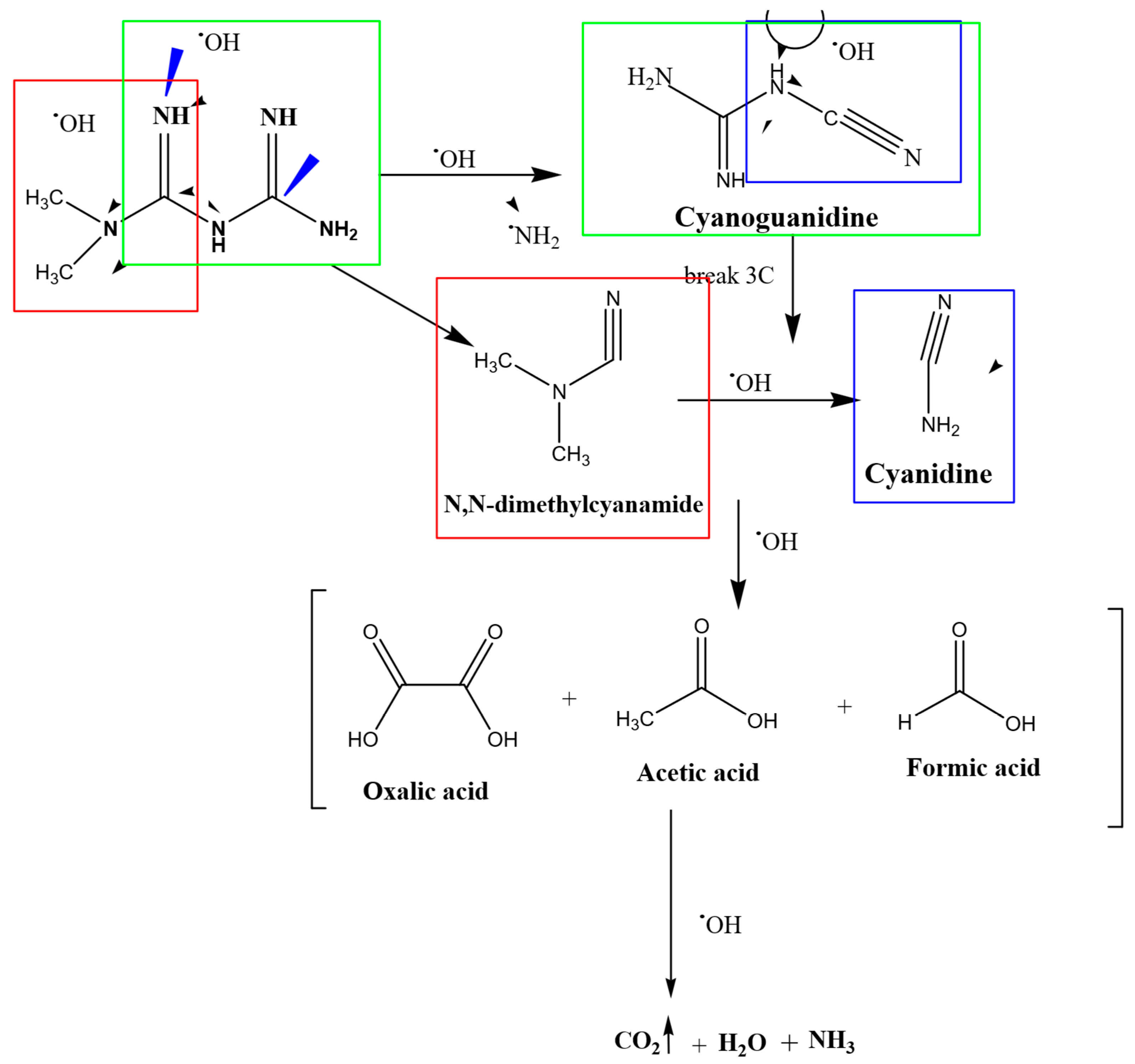
As described above, the main reactive species produced by advanced oxidation technologies is the hydroxyl radical. The degradation of MET molecule by hydroxyl radicals is depicted in Figure 13. MET poses different sites susceptible to be oxidized by hydroxyl radicals attack; i.e., two double bonds between carbon and nitrogen, five electron pairs and two methyl groups. The oxidation process via hydroxyl radicals can proceed by electron abstraction, extraction of a hydrogen atom and the addition to double-bonds [83]. According to Liao (2021) [67], the order of vulnerability of the atoms in the MET molecule to the hydroxyl radicals attack is 4N > 6N > 3C > 1C > 15N > 18N > 2N > 7C > 11C. The attack of hydroxyl radicals to 4N and 6N, as indicated by blue arrow points in Figure 13, leads to biguanide. In this case the first identified MET oxidation product was cyanoguanidine, which is in concordance with previous works [75]. Then the hydroxyl radicals might attack the adjacent N-H bond and produce cyanidin, as proposed by [83]. The production of carboxylic acids indicates the abstraction of methyl groups and scavenging by hydroxyl radicals.
Table 7. Comparison of advanced treatments for metformin removal in aqueous media.
Type of TreatmentConditionsResults
% Removal
Reference
Nanofiltration[MET]initial: 20 mg⋅L−1
Membrane: AFC 30 and AFC 80
15–30 bar
87 (AFC 30)
98 (AFC 80)
[54]
[MET]initial: 10 mg∙L−1
Polyamide NF Membrane (NF 99)
10 bar
70[53]
[MET]initial: 200 µg∙L−1
Membrane: dual-charged dense COF membrane
5 bar
24 h
92.6[84]
Ultrafiltration[MET]initial: -
Membrane: bifunctional ceramics based on kaolin and coffee waste
COD: 320 mg∙L−1
pH: 6.7
1 bar
91[84]
Reverse osmosis[MET]initial: 0.002815 µg∙L−1
spiral wound reverse osmosis membrane
Flow: 7.08 m3∙h−1
active surface area: 37.2 m2
92.6[57]
[MET]initial: 100 µg∙L−1
Membranes RE2012–100 and RE2012-PF
pH: 7
10 bar
99[55]
OzonationTOC 50 mg∙L−1
Ozone dose of 10 mg∙L−1
Time: 0.75 h
65[68]
[MET]initial: 1 µg∙L−1
pH: 7.3
TOC: 0.9 mg∙L−1
Ozone dose of 1 mg∙L−1
Time: 1 h
70[35]
[MET]initial: 0.94 µg∙L−1
pH: 8.5
Ozone dose of 5 mg∙L−1
~100[66]
Photolysis[MET]initial: 10 mg∙L−1
Radiation: UV
pH: 5.4
Time: 1 h
Temperature: 25 °C
Volume: 500 mL
~30[72]
[MET]initial: 0.5 mg∙L−1
Lamp (125 W, 365 nm)
Volume: 100 mL
Cylindrical quartz reactor: (φ14 cm × 13 cm)
Temperature: 25 °C
Time: 5 h
64.7 (ultrapure water)
96.1 (Secondary effluent)
[70]
[MET]initial: 13,000 ng∙L−1
Lamp: UV radiation (254 nm)
Volume: 100 mL
Time: 0.5 h
pH: 6.2
Temperature: 25 °C
Time: 1.5 h
45[11]
[MET]initial: 10 mg∙L−1
Radiation: UV-C
Time: 0.5 h
9.2[75]
photochemical oxidation processes[MET]initial: 1 mg∙L−1
UV
oxidizing agent: Hydrogen peroxide (HP) 6 mM, sodium percarbonate (SP) 6 mM, and peracetic acid (PA)
pHUV/HP: 3
pHUV/SP: 5
pHUV/PA: 9
Time: 1.25 h
40.7 (UV/HP)
74.1 (UV/SP)
47.9 (UV/PA)
[85]
[MET]initial: 5 mg∙L−1
UV radiation
Time: 1 h
pH 6.5
Temperature: 45 °C
K2S2O8: 2750 μM
87.3[62]
[MET]initial: 13,000 ng∙L−1
Lamp: UV radiation (254 nm)
Volume: 100 mL
Material: 0.5 g∙L−1 iron pillared clay
pH: 6.2
Temperature: 25 °C
Time: 1.5 h
H2O2: 11.2 mg·L−1
~100[11]
[MET]initial: 20 mg∙L−1
UV
oxidizing agent: Hydrogen peroxide (HP) 1.5 mM, sodium percarbonate (SP) 1.5 mM
pHUV/HP: 6.2
pHUV/SP: 6.2
Time: 1 h
20 (UV/HP)
30% (UV/SP)
[73]
Photocatalysis[MET]initial: 100 mg∙L−1
Lamp: UV radiation (365 nm)
Volume: 100 mL
TiO2: 1000 mg∙L−1
Time: 0.5 h
81[86]
[MET]initial: 13,000 ng∙L−1
Lamp: UV radiation (254 nm)
Volume: 100 mL
Material: 0.5 g∙L−1 iron pillared clay
Time: 0.5 h
pH: 6.2
Temperature: 25 °C
Time: 0.5 h
98[11]
[MET]initial: 1 mg∙L−1
Light wavelengths (UVA, UVB, UVC, and visible light)
Poly(3,4- ethylenedioxythiophene) (PEDOT) polymer: 0.5 g∙L−1
Stirred: 250 rpm
Time: 1 h
pH: 5.6
>99[3]
[MET]initial: 9.7 mg∙L−1
Catalyst: TiO2 nanoparticle prepared through green synthesis using Calotropis gigantea (CG) leaf extract
pH 9.7
A 300 W tungsten halogen lamp
The irradiation of the lamp was 41.4 kilolux (0.006 W∙cm−2)
Catalyst (CG-TiO2) dosage: 0.7 g∙L−1
Volume: 100 mL
Time: 4 h
96.7[87]
[MET]initial: 5mg∙L−1
Catalyst: TiO2 Degussa P25 (80% anatase, 20% rutile)
Catalyst concentration: 0.1 g∙L−1
Reaction time: 240 min
Q: 254.80 mL∙min−1,
pH free
Volume: 500 mL
Sunlight irradiation
inclination angle: 36.8°
83[88]
[MET]initial: 10 mg∙L−1
Material: 120 mg∙L−1 TiO2
Radiation: UV-C
Time: 0.5 h
31[4]
[MET]initial: 5mg L−1
Material: 5000 µM de K2S2O8
Temperature: 30 °C
pH: 6.5
84.2[62]
Fenton’s process[MET]initial: 1027 ng∙L−1
Time: 0.5 h
Volume: 400 mL
Cylindrical water-jacketed glass reactor
Mercury lamp at 254 nm
Temperature at 17 °C ± 1 °C
5 mg∙L−1 of Fe2+ (ferrous sulfate), H2O2 (10, 25 or 50 mg∙L−1)
photo-Fenton, UV/H2O2 (without Fe2+) and dark Fenton
43 (Fenton process)
88 (photo-Fenton)
[89]
[MET]initial: 320 mg∙L−1
Volume: 1.5 L
Two 36 W UV lamps (PL-L 36W/841/4P, radiation peak at 365 nm.
Photoreactor: quartz tube (diameter of 2.5 cm, 100 cm in length)
Catalysts: TiO2
pH 5.5
H2O2: 250 mg∙L−1
Fe3+ concentration: 30 mg∙L−1
Reaction time: 2 h
97 (photocatalytic)
66 (photo-Fenton)
41 (photo-ferrioxalate)
[81]
[MET]initial: 13,000 ng∙L−1
Lamp: UV radiation (254 nm)
0.05 g∙L−1 iron pillared clay
Volume: 100 mL
Reaction time: 0.5 h
H2O2: 11.2 mg∙L−1
pH: 6.2
Temperature: 25 °C
Time: 0.17 h
~100 (photo-Fenton)[11]
[MET]initial: 0.02 mg∙L−1
Lamp: UV radiation (254 nm)
0.05 g∙L−1 iron pillared clay
Volume: 100 mL
Reaction time: 0.5 h
H2O2: 7.3 × 10⁻² μL∙L−1
pH: 6.2
Temperature: 25 °C
Time: 0.17 h
~100 (photo-Fenton)[90]
Electro-Fenton process[MET]initial: 230.8 ng∙L−1
Time: 10 min
Current density: 6 mA cm−2
H2O2: 250 mL∙L−1
Clay smectite (SME): 60 mg∙L−1
pH: 7 ± 0.3
Volume: 2 L
21[40]
[MET]initial: 33.12 mg∙L−1
Supporting electrolyte: 16 g∙L−1
Volume: 500 mL
Boron-doped diamond (BDD) anode and carbon as a cathode.
FeSO4: 22.8 mg
Fe2+ concentration: 0.3 mM
Time: 27 min
pH: 3
Current: 300 mA
H2O2: 600 mg∙L−1
99.6[91]
Other hybrid methodsVUV/Fe/PMS process
[MET]initial: 5 mg∙L−1
~100[92]
Electro-activation of persulfate and H2O289.3[93]
Aerated biofilter packed with Ficus benjamina wood chips94[47]
A pilot aerated sub-surface flow constructed wetland treating municipal and hospital wastewater99 (with aeration)
68 (without aeration)
[94]
Biocatalyzed microbial electrosynthesis system[MET]initial: 0.5 mg∙L−1
Cathodic potential: −800 mV
Time: 2 h
Anaerobic conditions
Temperature: 35 °C
90[95]
Electrocatalytic oxidation[MET]initial: 10 mg∙L−1
Material: 10 mg two-dimensional transition metal carbide nanosheets interspersed with sodium ions
Time: 24 h
pH: 4–9
99–95%[96]
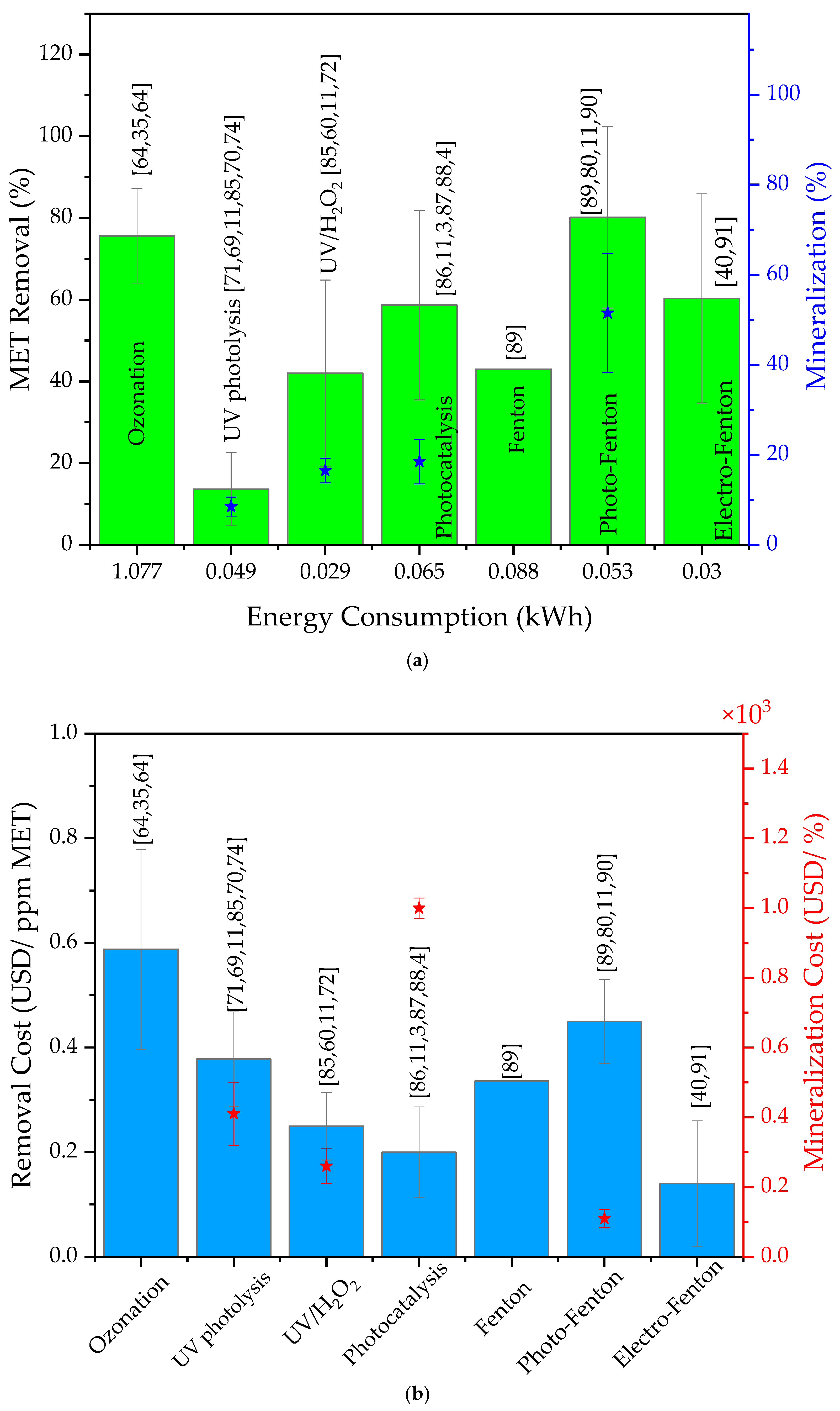
Figure 14a,b were prepared with experimental data from each reference indicated within brackets. To determine the removal and mineralization costs, Equations (30) and (31) were applied, respectively.
R C = E C · 0.17 C t t C o
M C = E C · 0.17 %   T O C r e m o v e d  
where RC is the cost of removing 1 ppm of metformin in USD/ppm MET, MC is the cost of mineralizing 1% of total organic carbon (TOC), and Ctt and Co are the metformin concentrations after 0.5 h of treatment and at the beginning of treatment, respectively, in ppm. For the mineralization cost, the reported percentage of TOCremoved was used because in many cases the initial and final TOC were not reported. EC is the energy consumption in kWh, calculated according to the reported use of equipment and inherent to each process multiplied by a treatment time of 0.5 h. This treatment time was chosen because it was the maximum presented in some of the revised references. Further, 0.17 is the reference rate according to the U.S. Energy Information Administration (EIA) in USD/kWh [97]. It is worth noting that the values in Figure 14a,b are the average of those calculated for each reference, and this is the reason for including deviation bars.
It can be observed from Figure 14a that the energy consumption per %MET removed in the first 30 min of treatment follows the order: ozonation > UV photolysis > Fenton > Photocatalysis > UV+H2O2 > Photo-Fenton > Electro-Fenton. This order was established by dividing the energy consumption value in the X-axis in Figure 14a by the % of removed MET shown in the Y-axis of the same figure. The same order is maintained for the energy consumption per percentage of TOC removal, for the cases where this parameter was reported: UV photolysis > Photocatalysis > UV H2O2 > Photo-Fenton. It is important to keep in mind that this order is different with respect to the removal rate. Under this parameter (i.e., the MET removal rate), ozonation is the fastest process, followed by photo-Fenton and electro-Fenton.
Regarding economical costs per ppm of MET removed, the order is ozonation > photo-Fenton > UV-Photolysis > Fenton > UV/H2O2 > Photocatalysis > Electro-Fenton. This order changes when the cost per % of TOC removed is analyzed; in this case, the order is photocatalysis > UV-photolysis > UV/H2O2 > photo-Fenton. It is important to note that the costs in Figure 14b are mainly dictated by the energy consumption. Thus, if renewable sources of energy are used (e.g., photovoltaic panels) that imply lower costs than fossil energy sources, then the above orders may be altered.
Therefore, it can be concluded that the most promising process in terms of economic cost, energy consumption, MET removal efficiency and rate, and TOC removal percentage is the photo-Fenton process. It is worth pointing out that the energy consumption not only affects the cost of the process but also environmental impact categories such as global warming potential (carbon footprint). In addition, the mineralization percentage impacts environmental indicators like freshwater ecotoxicity. The lower these parameters, the higher the sustainability of the process. Therefore, photo-Fenton is promising also in terms of sustainability. Nevertheless, it is worth noting that the environmental impact categories are also affected by the addition of reagents like hydrogen peroxide or acids. Actually, it has been shown that the addition of hydrogen peroxide in the Fenton or photo-Fenton processes impacts the toxicity of the treated water [90] and also the mid-term environmental impact categories [98]. Therefore, it is of paramount importance to optimize the amount of H2O2 used in Fenton-based treatments and eliminate the use of acids to contribute to the sustainability of the process.

4. Future Perspective

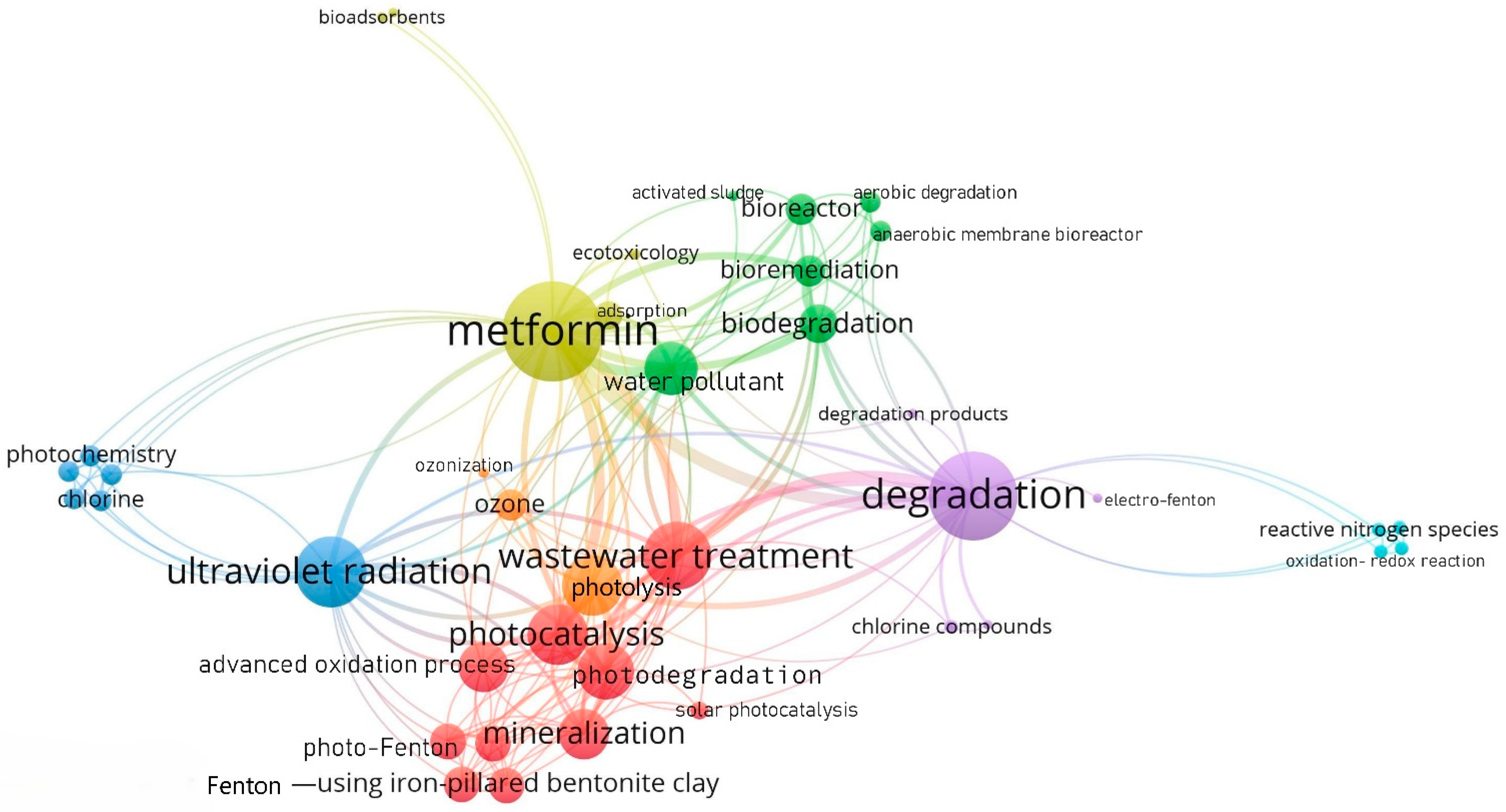
Figure 15 presents a bibliometric co-occurrence analysis identifying current research trends on metformin (MET) and its removal from aquatic systems. This was generated using the free software VOSviewer version 1.6.20. This approach provides insights into dominant research areas as well as existing knowledge gaps. The search topic was metformin, and the keywords were divided into 7 clusters. The clusters clearly reveal the main strategies for the elimination and degradation of metformin in aqueous media. The node corresponding to degradation (purple) is among the most dominant, suggesting that research has focused primarily on the degradation mechanisms of this compound. Consequently, a close interconnection is observed between the different nodes associated with physicochemical and biological processes, as well as advanced technologies. Likewise, a relationship is identified with two smaller nodes: reactive nitrogen species and chlorine compounds (light blue connections). This indicates that, during the elimination process (depending on the technology applied), reactive nitrogen species—mainly generated in redox reactions—or chlorinated compounds derived from chlorination processes can be produced. This latter term directly connects to water treatment, suggesting that implementing disinfection steps, such as chlorination, favors the formation of these compounds. The water treatment node (red) is directly connected to the central metformin node, indicating that it is one of the main techniques used to eliminate this drug. Likewise, a direct connection is observed between the central node and the photodegradation node, from which various photochemical processes are derived, such as photolysis, photocatalysis, and the photo-Fenton process. These processes primarily use ultraviolet radiation as an energy source, which explains the close interconnection between the photodegradation node and the ultraviolet radiation node.
While photochemical processes driven by sunlight are present in a limited or practically nonexistent way, as observed in the solar photocatalysis node, the red cluster is primarily composed of nodes associated with photochemical processes. This indicates that research has focused on comparing these processes, with degradation and mineralization as the main indicators of their efficiency. In contrast, the ozonation process is less represented and is mainly associated with the wastewater treatment and degradation nodes. This suggests that, despite being a widely used technology for treating organic pollutants, available studies focus primarily on the degradation of the original drug, paying less attention to other aspects such as mineralization and the formation of intermediate products.
On the other hand, in the yellow cluster corresponding to physicochemical processes, only the bioadsorbents node is identified, suggesting that current research is not focused on conventional adsorption. Instead, there is greater interest in developing materials obtained from biological waste to make the disposal process more sustainable. This could explain the limited interconnection of this node with other terms within the network.
Regarding the cluster associated with biological processes (green), it is less represented compared to the cluster corresponding to photochemical processes, which could be attributed to the limited amount of research conducted in this area.
Finally, the ecotoxicology and degradation products nodes are identified, which, considering the conceptual relationship between them, might be expected to be interconnected elements; however, this relationship is not observed within the network. This suggests that, once the degradation process is carried out, studies generally do not delve deeper into analysis of the generated products or the evaluation of their potential ecotoxicological effects. Consequently, this could also explain the absence of nodes related to life cycle analysis, which demonstrates a limited comprehensive assessment of the impacts associated with the disposal processes.
Based on this analysis, it can be identified that future research should be oriented toward a more comprehensive approach, as it is essential that studies not only report the percentage of removal of the original contaminant but also delve deeper into the evaluation of the levels of mineralization achieved. Likewise, it is fundamental to consider toxicological evaluation of the byproducts generated, along with the incorporation of life cycle analyses that allow for validation of the true sustainability and economic viability of the different technologies employed.

5. Conclusions

Extensive research has been conducted on the removal of MET from aqueous media using a variety of treatment technologies, including AOPs such as ozonation, photocatalysis, Fenton and photo-Fenton, as well as biological treatments, chlorination, adsorption, and membrane-based separation processes. The reported studies demonstrate that removal efficiency is highly dependent on operational conditions, water matrix composition, catalyst properties, and the nature of the oxidizing or biological agents employed.
It can be concluded that, from the analyzed processes, neither chlorination nor coagulation–flocculation are efficient standalone alternatives for MET removal—the former because of the produced compounds and toxicity, and the latter because of the low removal efficiencies. On the contrary, high removal efficiencies (near 100%) have been reported with adsorption. In this process, the key characteristics are the adsorbent type, pH, textural properties (i.e., surface area and pore size) and surface charge. A negatively charged surface must be pursued to promote the hydrogen bonding of MET to the surface. Graphene oxide seems to be the most promising adsorbent for MET.
Aerobic activated sludge is a promising and efficient strategy for MET removal from aqueous environments, while anaerobic microbial consortia are not as efficient. A disadvantage of this process is the accumulation of guanylurea.
Guanylurea and chlorinated by-products should be minimized in any MET removal treatment, in order to reduce toxicity. These by-products are especially associated with ozonation and chlorination.
Separation technologies, such as reverse osmosis and membrane filtration, exhibit high MET removal efficiencies and effectively prevent the formation of transformation products. Nevertheless, challenges remain regarding membrane fouling, regeneration, and long-term operational sustainability.
Overall, photo-Fenton processes represent one of the most effective AOPs for MET removal, offering rapid degradation and high mineralization efficiencies at relatively low economical cost and energy consumption. Special attention must be paid to the use of heterogenous catalysts to reduce the production of sludge, and avoiding the use of acids.
In AOPs, the produced •OH has been demonstrated to be the main reactive oxygen species responsible of MET degradation and its mineralization.
Special attention must be paid to determining the environmental impacts of the assessed technologies through life cycle analysis, providing an additional indicator for decision-making from the perspective of sustainability.

Author Contributions

Conceptualization, R.R. and R.N.; methodology, C.V., D.A.-P., R.R., S.L.M.-V., A.R.-M., P.J.E.-M. and R.N.; software, D.A.-P., C.V. and A.R.-M.; validation, D.A.-P., R.R., A.R.-M., P.J.E.-M., C.V., R.N. and S.L.M.-V.; formal analysis, C.V., R.R. and R.N.; investigation, C.V., D.A.-P., R.R. and R.N.; resources, R.R., S.L.M.-V. and R.N.; data curation, D.A.-P. and C.V.; writing—original draft preparation, C.V., D.A.-P., R.R. and R.N.; writing—review and editing, R.R. and R.N. and P.J.E.-M.; visualization, C.V., D.A.-P., R.R., S.L.M.-V., A.R.-M., P.J.E.-M. and R.N.; supervision, R.R. and R.N.; project administration, R.R. and R.N.; funding acquisition, R.R. and R.N. All authors have read and agreed to the published version of the manuscript.

Funding

This research was funded by Autonomous University of the State of Mexico, grant number 7467/2026.

Data Availability Statement

No new data were created or analyzed in this study.

Acknowledgments

Claudia Victoria (CVU 1318520) is grateful to SECIHTI for the financial support provided to conduct postgraduate studies. During the preparation of this manuscript, the authors used ChatGPT version GPT-5 and Microsoft Copilot (Microsoft 365) to improve English writing. For this, the prompt used was: you are an expert on editing scientific texts in English for journals specialized on water remediation and contaminants removal, improve the clarity and grammar of the following text “…”. To generate Figure 9, the authors used Google AI Plus (NotebookLM and Gemini). The prompt in NotebookLM was: with this information, “Activated sludge process” (3.2.2. Biological treatment in the manuscript), generate the infographic. Then, in Gemini the prompt was: you are an expert on biological treatments; please eliminate the organic structure and replace it with the metformin structure and byproducts. The authors have reviewed and edited the output and take full responsibility for the content of this publication.

Conflicts of Interest

The authors declare no conflicts of interest.

Abbreviations

METMetformin
Log KocSoil–organic carbon partition coefficient
Log KowOctanol–water partition coefficient
pKaionization constant
pHhydrogen potential
UFultrafiltration
ROreverse osmosis
NFnanofiltration
GOgraphene oxide
qeconcentration of compound
Cecompound concentration at equilibrium
KLconstant related to the adsorption equilibrium
KFequilibrium constant of the Freundlich isotherm
aconstant of the isotherm of Prausnitz–Radke
bconstant of the isotherm of Prausnitz–Radke
βconstant of the isotherm of Prausnitz–Radke
qmmaximum mass of adsorbed solute on the adsorbent
nconstant related to the adsorption intensity
DBPschlorinated disinfection by-products
THMstrihalomethanes
TTHMstotal trihalomethanes
TPstransformation products
Y(3E)-3-(chloroimino)-N,Ndimethyl-3H-1,2,4-triazole-5-amine
CN-cyano-N,N-dimethylcarbaminmidic chloride
DMAdimethylamine
MNmonochloro-metformin
DMdichloro-metformin
DMGdimethylguanidine
NDMAnitrosodimethylamine
NDno data
TTransformed
OOriginal
MGmethylbiguanid
GUguanylurea
GUEguanidine
AMT2-amino-4-methylamino-1,3,5-triazine
DT2,4-diamine-1,3,5-triazine
CODchemical oxygen demand
AOPAdvanced Oxidation Process
ROSreactive oxygen species
OPsozonation products
POPphotochemical oxidation process
BVvalence band
BCconduction band

References

  1. He, Y.; Zhang, Y.; Ju, F. Metformin Contamination in Global Waters: Biotic and Abiotic Transformation, Byproduct Generation and Toxicity, and Evaluation as a Pharmaceutical Indicator. Environ. Sci. Technol. 2022, 56, 13528–13545. [Google Scholar] [CrossRef]
  2. Zhang, R.; He, Y.; Yao, L.; Chen, J.; Zhu, S.; Rao, X.; Tang, P.; You, J.; Hua, G.; Zhang, L.; et al. Metformin chlorination byproducts in drinking water exhibit marked toxicities of a potential health concern. Environ. Int. 2021, 146, 106244. [Google Scholar] [CrossRef]
  3. Kumar, R.; Akbarinejad, A.; Jasemizad, T.; Fucina, R.; Travas-Sejdic, J.; Padhye, L.P. The removal of metformin and other selected PPCPs from water by poly(3,4-ethylenedioxythiophene) photocatalyst. Sci. Total Environ. 2021, 751, 142302. [Google Scholar] [CrossRef]
  4. Elizalde-Velázquez, G.A.; Gómez-Oliván, L.M. Occurrence, toxic effects and removal of metformin in the aquatic environments in the world: Recent trends and perspectives. Sci. Total Environ. 2020, 702, 134924. [Google Scholar] [CrossRef]
  5. Wu, L.; Wang, L.; Huang, C.; Gu, C.; Tan, W.; Tian, Y.; Ma, J. Advances in the detection of emerging contaminant metformin: A critical review. Microchem. J. 2024, 200, 110422. [Google Scholar] [CrossRef]
  6. Balakrishnan, A.; Sillanpää, M.; Jacob, M.M.; Vo, D.-V.N. Metformin as an emerging concern in wastewater: Occurrence, analysis and treatment methods. Environ. Res. 2022, 213, 113613. [Google Scholar] [CrossRef] [PubMed]
  7. Global Metformin Market—Industry Trends and Forecast to 2030. Available online: https://www.databridgemarketresearch.com/reports/global-metformin-market (accessed on 24 July 2024).
  8. Wilkinson, J.L.; Boxall, A.B.A.; Kolpin, D.W.; Leung, K.M.Y.; Lai, R.W.S.; Galbán-Malagón, C.; Adell, A.D.; Mondon, J.; Metian, M.; Marchant, R.A.; et al. Pharmaceutical pollution of the world’s rivers. Proc. Natl. Acad. Sci. USA 2022, 119, e2113947119. [Google Scholar] [CrossRef]
  9. Barros, S.; Alves, N.; Pinheiro, M.; Ribeiro, M.; Morais, H.; Montes, R.; Rodil, R.; Quintana, J.B.; Coimbra, A.M.; Santos, M.M.; et al. Are Fish Populations at Risk? Metformin Disrupts Zebrafish Development and Reproductive Processes at Chronic Environmentally Relevant Concentrations. Environ. Sci. Technol. 2023, 57, 1049–1059. [Google Scholar] [CrossRef] [PubMed]
  10. Ussery, E.J.; Nielsen, K.M.; Simmons, D.; Pandelides, Z.; Mansfield, C.; Holdway, D. An ‘omics approach to investigate the growth effects of environmentally relevant concentrations of guanylurea exposure on Japanese medaka (Oryzias latipes). Aquat. Toxicol. 2021, 232, 105761. [Google Scholar] [CrossRef]
  11. Amado-Piña, D.; Romero, R.; Ramírez-Serrano, A.; Martínez-Vargas, S.L.; Torres-Blancas, T.; Natividad, R. Metformin Mineralization via an Fe-PILC-Catalyzed Photo-Fenton Reaction Driven by UV and Visible Light. Water 2025, 17, 3028. [Google Scholar] [CrossRef]
  12. Lertxundi, U.; Domingo-Echaburu, S.; Barros, S.; Santos, M.M.; Neuparth, T.; Quintana, J.B.; Rodil, R.; Montes, R.; Orive, G. Is the Environmental Risk of Metformin Underestimated? Environ. Sci. Technol. 2023, 57, 8463–8466. [Google Scholar] [CrossRef] [PubMed]
  13. da Trindade, M.T.; Kogawa, A.C.; Salgado, H.R.N. Metformin: A Review of Characteristics, Properties, Analytical Methods and Impact in the Green Chemistry. Crit. Rev. Anal. Chem. 2018, 48, 66–72. [Google Scholar] [CrossRef]
  14. Information NC for Biotechnology. Metformin 2025. Available online: https://pubchem.ncbi.nlm.nih.gov/compound/Metformin (accessed on 24 June 2025).
  15. Sousa, M.; Rodrigues, S.; Pretti, C.; Meucci, V.; Battaglia, F.; Freitas, R.; Antunes, S.C. A forecast effects of climate change and anthropogenic compounds in Gambusia holbrooki: Ecotoxicological effects of salinity and metformin. Aquat. Toxicol. 2023, 258, 106494. [Google Scholar] [CrossRef]
  16. Nielsen, K.M.; DeCamp, L.; Birgisson, M.; Palace, V.P.; Kidd, K.A.; Parrott, J.L.; McMaster, M.E.; Alaee, M.; Blandford, N.; Ussery, E.J. Comparative Effects of Embryonic Metformin Exposure on Wild and Laboratory-Spawned Fathead Minnow (Pimephales promelas) Populations. Environ. Sci. Technol. 2022, 56, 10193–10203. [Google Scholar] [CrossRef]
  17. Parrott, J.L.; Restivo, V.E.; Kidd, K.A.; Zhu, J.; Shires, K.; Clarence, S.; Khan, H.; Sullivan, C.; Pacepavicius, G.; Alaee, M. Chronic Embryo-Larval Exposure of Fathead Minnows to the Pharmaceutical Drug Metformin: Survival, Growth, and Microbiome Responses. Environ. Toxicol. Chem. 2022, 41, 635–647. [Google Scholar] [CrossRef]
  18. Elizalde-Velázquez, G.A.; Herrera-Vázquez, S.E.; Gómez-Oliván, L.M.; García-Medina, S. Health impact assessment after Danio rerio long-term exposure to environmentally relevant concentrations of metformin and guanylurea. Chemosphere 2023, 341, 140070. [Google Scholar] [CrossRef]
  19. Sibiya, A.; Al-Ghanim, K.A.; Govindarajan, M.; Nicoletti, M.; Sachivkina, N.; Vaseeharan, B. Biochemical Patterns and Genotoxicity of the Endocrine Disruptor Metformin in the Freshwater Fish Labeo rohita. Fishes 2023, 8, 380. [Google Scholar] [CrossRef]
  20. Zheng, Y.; Shao, Y.; Zhang, Y.; Liu, Z.; Zhao, Z.; Xu, R.; Ding, J.; Li, W.; Wang, B.; Zhang, H. Metformin as an Emerging Pollutant in the Aquatic Environment: Occurrence, Analysis, and Toxicity. Toxics 2024, 12, 483. [Google Scholar] [CrossRef] [PubMed]
  21. Giannouli, M.; Panagiotidis, K.; Rochfort, K.D.; Grintzalis, K. Development and application of a sensitive feeding assay for daphnids based on the ingestion of fluorescent microparticles. Environ. Sci. Adv. 2023, 2, 1351–1359. [Google Scholar] [CrossRef]
  22. Tominaga, F.K.; Boiani, N.F.; Silva, T.T.; Garcia, V.S.G.; Borrely, S.I. Acute and chronic ecotoxicological effects of pharmaceuticals and their mixtures in Daphnia similis. Chemosphere 2022, 309, 136671. [Google Scholar] [CrossRef] [PubMed]
  23. Bernardini, I.; Mezzelani, M.; Panni, M.; Dalla Rovere, G.; Nardi, A.; El Idrissi, O.; Peruzza, L.; Gorbi, S.; Ferraresso, S.; Bargelloni, L.; et al. Transcriptional modulation in Mediterranean Mussel Mytilus galloprovincialis following exposure to four pharmaceuticals widely distributed in coastal areas. Aquat. Toxicol. 2025, 279, 107255. [Google Scholar] [CrossRef]
  24. Ferri, B.B.; Wernke, G.; Resende, J.F.; Ribeiro, A.C.; Cusioli, L.F.; Bergamasco, R.; Vieira, M.F. Natural zeolite as adsorbent for metformin removal from aqueous solutions: Adsorption and regeneration properties. Desalination Water Treat. 2024, 320, 100602. [Google Scholar] [CrossRef]
  25. Aguilar-Maruri, S.A.; Perera-Triana, D.; Flórez, E.; Forgionny, A.; Palestino, G.; Gómez-Durán, C.F.A.; Ocampo-Pérez, R. Highly Adsorptive Organic Xerogels for Efficient Removal of Metformin from Aqueous Solutions: Experimental and Theoretical Approach. Processes 2024, 12, 1431. [Google Scholar] [CrossRef]
  26. Raji, Z.; Karim, A.; Karam, A.; Khalloufi, S. Adsorption of Heavy Metals: Mechanisms, Kinetics, and Applications of Various Adsorbents in Wastewater Remediation—A Review. Waste 2023, 1, 775–805. [Google Scholar] [CrossRef]
  27. Sanchez-Silva, J.M.; Collins-Martínez, V.H.; Padilla-Ortega, E.; Aguilar-Aguilar, A.; Labrada-Delgado, G.J.; Gonzalez-Ortega, O.; Palestino-Escobedo, G.; Ocampo-Pérez, R. Characterization and transformation of nanche stone (Byrsonima crassifolia) in an activated hydrochar with high adsorption capacity towards metformin in aqueous solution. Chem. Eng. Res. Des. 2022, 183, 580–594. [Google Scholar] [CrossRef]
  28. Vieira, Y.; Ribeiro, T.H.; Leichtweis, J.; Dotto, G.L.; Foletto, E.L.; Georgin, J.; Franco, D.S.P.; Lima, E.C. A critical review of the current environmental risks posed by the antidiabetic Metformin and the status, advances, and trends in adsorption technologies for its remediation. J. Water Process Eng. 2023, 54, 103943. [Google Scholar] [CrossRef]
  29. Balasubramani, K.; Sivarajasekar, N.; Naushad, M. Effective adsorption of antidiabetic pharmaceutical (metformin) from aqueous medium using graphene oxide nanoparticles: Equilibrium and statistical modelling. J. Mol. Liq. 2020, 301, 112426. [Google Scholar] [CrossRef]
  30. Dave, P.N.; Chopda, L.V.; Kamaliya, B.P. Adsorption of Metformin hydrochloride and sodium diclofenac over Gum ghatti-g-poly(NIPAM-co-AA)/-o-MWCNT. Next Mater. 2024, 4, 100190. [Google Scholar] [CrossRef]
  31. Pap, S.; Shearer, L.; Gibb, S.W. Effective removal of metformin from water using an iron-biochar composite: Mechanistic studies and performance optimisation. J. Environ. Chem. Eng. 2023, 11, 110360. [Google Scholar] [CrossRef]
  32. Alazaiza, M.; Albahnasawi, A.; Ali, G.; Bashir, M.; Nassani, D.; Al Maskari, T.; Abu Amr, S.S.; Abujazar, M.S.S. Application of Natural Coagulants for Pharmaceutical Removal from Water and Wastewater: A Review. Water 2022, 14, 140. [Google Scholar] [CrossRef]
  33. Nguyen, T.A.; Nguyen, H.D.; Schmalz, B.; Tran, L.L. Coagulation/floculation as a key unit in the decentralized surface water treatment systems in upland rural areas of Vietnam: Results from a lab scale to a pilot scale system. Process Saf. Environ. Prot. 2025, 194, 1194–1205. [Google Scholar] [CrossRef]
  34. Kooijman, G.; de Kreuk, M.K.; Houtman, C.; van Lier, J.B. Perspectives of coagulation/flocculation for the removal of pharmaceuticals from domestic wastewater: A critical view at experimental procedures. J. Water Process Eng. 2020, 34, 101161. [Google Scholar] [CrossRef]
  35. Scheurer, M.; Michel, A.; Brauch, H.-J.; Ruck, W.; Sacher, F. Occurrence and fate of the antidiabetic drug metformin and its metabolite guanylurea in the environment and during drinking water treatment. Water Res. 2012, 46, 4790–4802. [Google Scholar] [CrossRef] [PubMed]
  36. Abd-El Hafeez, S.I.; Eleraky, N.E.; Hafez, E.; Abouelmagd, S.A. Design and optimization of metformin hydrophobic ion pairs for efficient encapsulation in polymeric drug carriers. Sci. Rep. 2022, 12, 1–14. [Google Scholar] [CrossRef]
  37. Bharti, S. A Critical Review on Flocculants and Flocculation. Non-Met. Mater. Sci. 2019, 1, 11–21. [Google Scholar] [CrossRef]
  38. He, Y.; Chen, Y.; Zhang, Y.; Wang, W.; Ju, F. Chlorination of metformin: Deciphering transformation kinetics, novel products and pathways, and evaluating chlorination-derived risks. Chem. Eng. J. 2025, 513, 162973. [Google Scholar] [CrossRef]
  39. He, Y.; Jin, H.; Gao, H.; Zhang, G.; Ju, F. Prevalence, production, and ecotoxicity of chlorination-derived metformin byproducts in Chinese urban water systems. Sci. Total Environ. 2022, 816, 151665. [Google Scholar] [CrossRef]
  40. Mohd Amin, M.F.; Heijman, S.G.J.; Rietveld, L.C. Clay–starch combination for micropollutants removal from wastewater treatment plant effluent. Water Sci. Technol. 2016, 73, 1719–1727. [Google Scholar] [CrossRef]
  41. Rahman, N.; Bharti, M.; Nasir, M.; Azmi, S.N.H. Performance assessment of graphene oxide decorated with silver nanoparticles as adsorbent for removal of metformin from water: Equilibrium modeling, kinetic and thermodynamic studies. Next Mater. 2024, 3, 100046. [Google Scholar] [CrossRef]
  42. Adel Niaei, H.; Rostamizadeh, M. Adsorption of metformin from an aqueous solution by Fe-ZSM-5 nano-adsorbent: Isotherm, kinetic and thermodynamic studies. J. Chem. Thermodyn. 2020, 142, 106003. [Google Scholar] [CrossRef]
  43. Hethnawi, A.; Alnajjar, M.; Manasrah, A.D.; Hassan, A.; Vitale, G.; Jeong, R.; Nassar, N.N. Metformin Removal from Water Using Fixed-bed Column of Silica-Alumina Composite. Colloids Surf. A Physicochem. Eng. Asp. 2020, 597, 124814. [Google Scholar] [CrossRef]
  44. Poursat, B.A.J.; van Spanning, R.J.M.; Braster, M.; Helmus, R.; de Voogt, P.; Parsons, J.R. Biodegradation of metformin and its transformation product, guanylurea, by natural and exposed microbial communities. Ecotoxicol. Environ. Saf. 2019, 182, 109414. [Google Scholar] [CrossRef]
  45. Oosterhuis, M.; Sacher, F.; Ter Laak, T.L. Prediction of concentration levels of metformin and other high consumption pharmaceuticals in wastewater and regional surface water based on sales data. Sci. Total Environ. 2013, 442, 380–388. [Google Scholar] [CrossRef]
  46. Carrillo-Campos, J. Estructura y función de las oxigenasas tipo Rieske/mononuclear. TIP Rev. Espec. Ciencias. Químico-Biol. 2019, 22, 1–12. [Google Scholar] [CrossRef]
  47. García-Sánchez, L.; Gutiérrez-Macías, T.; Estrada-Arriaga, E.B. Assessment of a Ficus benjamina wood chip-based aerated biofilter used for the removal of metformin and ciprofloxacin during domestic wastewater treatment. J. Chem. Technol. Biotechnol. 2019, 94, 1870–1879. [Google Scholar] [CrossRef]
  48. Santos, L.H.; Gros, M.; Rodriguez-Mozaz, S.; Delerue-Matos, C.; Pena, A.; Barceló, D.; Montenegro, M.C.B.S.M. Contribution of hospital effluents to the load of pharmaceuticals in urban wastewaters: Identification of ecologically relevant pharmaceuticals. Sci. Total Environ. 2013, 461–462, 302–316. [Google Scholar] [CrossRef]
  49. Kitamura, R.S.A.; Marques, R.Z.; Kubis, G.C.; Kochi, L.Y.; Barbato, M.L.; Maranho, L.T.; Juneau, P.; Gomes, M.P. The phytoremediation capacity of Lemna minor prevents deleterious effects of anti-HIV drugs to nontarget organisms. Environ. Pollut. 2023, 329, 121672. [Google Scholar] [CrossRef] [PubMed]
  50. Cui, H.; Schröder, P. Uptake, translocation and possible biodegradation of the antidiabetic agent metformin by hydroponically grown Typha latifolia. J. Hazard. Mater. 2016, 308, 355–361. [Google Scholar] [CrossRef] [PubMed]
  51. Moogouei, R.; Borghei, M.; Hosseini, S.; Tajadod, G. Potential of plant species for phytoremediation of metformin from solutions. Int. J. Environ. Sci. Technol. 2018, 15, 593–598. [Google Scholar] [CrossRef]
  52. Gupta, S.; Singh, A.; Sharma, T.; Kaur, R.; Khandelwal, V.; Rawat, K.D.; Pathak, S.; Sharma, M.K.; Singh, J.; Shah, M.P.; et al. Applications of ultrafiltration, nanofiltration, and reverse osmosis in pharmaceutical wastewater treatment. Dev. Wastewater Treat. Res. Process. 2024, 33–49. [Google Scholar] [CrossRef]
  53. Hidalgo, A.M.; León, G.; Murcia, M.D.; Gómez, M.; Gómez, E.; Gómez, J.L. Using Pressure-Driven Membrane Processes to Remove Emerging Pollutants from Aqueous Solutions. Int. J. Environ. Res. Public. Health 2021, 18, 4036. [Google Scholar] [CrossRef]
  54. Anike, O.; Cuhorka, J.; Ezeogu, N.; Mikulášek, P. Separation of Antibiotics Using Two Commercial Nanofiltration Membranes—Experimental Study and Modelling. Membranes 2024, 14, 248. [Google Scholar] [CrossRef]
  55. Matin, A.; Jillani, S.M.S.; Baig, U.; Ihsanullah, I.; Alhooshani, K. Removal of pharmaceutically active compounds from water sources using nanofiltration and reverse osmosis membranes: Comparison of removal efficiencies and in-depth analysis of rejection mechanisms. J. Environ. Manag. 2023, 338, 117682. [Google Scholar] [CrossRef]
  56. Patel, M.; Kumar, R.; Kishor, K.; Mlsna, T.; Pittman, C.U.; Mohan, D. Pharmaceuticals of Emerging Concern in Aquatic Systems: Chemistry, Occurrence, Effects, and Removal Methods. Chem. Rev. 2019, 119, 3510–3673. [Google Scholar] [CrossRef] [PubMed]
  57. Choe, H.-S.; Kim, K.Y.; Oh, J.-E.; Kim, J.-H. Parallel study on removal efficiency of pharmaceuticals and PFASs in advanced water treatment processes: Ozonation, GAC adsorption, and RO processes. Environ. Eng. Res. 2020, 27, 200509. [Google Scholar] [CrossRef]
  58. Al-Juboori, R.A.; Hilal, N. Pharmaceuticals removal from wastewater: Ultrasound technology and its potential amalgamation with membrane processes. J. Water Process Eng. 2023, 53, 103810. [Google Scholar] [CrossRef]
  59. Zhang, S.Y.; Kong, F.X.; Wang, Y.; Chen, J.F.; Zhou, A.G. Dual-charged dense COF membranes for efficient removal of low-molecular-weight pharmaceuticals. J. Membr. Sci. 2025, 734, 124369. [Google Scholar] [CrossRef]
  60. Aouay, F.; Deratani, A.; Attia, A.; Dammak, L.; Amar, R.B. Bifunctional ceramic membranes from spent coffee grounds for selective removal of pharmaceuticals and textile dyes. Sep. Purif. Technol. 2026, 396, 137971. [Google Scholar] [CrossRef]
  61. Roy, G.; Gautam, M.K.; Bobde, K.; Mondal, D.; Mondal, S. A conceptual framework for algal-based membrane bioreactors (AMBR) in the removal of pharmaceutical micropollutants from wastewater. Clean. Water 2026, 6, 100263. [Google Scholar] [CrossRef]
  62. Parra-Marfil, A.; López-Ramón, M.V.; Aguilar-Aguilar, A.; García-Silva, I.A.; Rosales-Mendoza, S.; Romero-Cano, L.A.; Bailón-García, E.; Ocampo-Pérez, R. An efficient removal approach for degradation of metformin from aqueous solutions with sulfate radicals. Environ. Res. 2023, 217, 114852. [Google Scholar] [CrossRef]
  63. Arvanitoyannis, I.S.; Kassaveti, A. Olive Oil Waste Management: Treatment Methods and Potential Uses of Treated Waste. In Waste Management for the Food Industries; Academic Press: Cambridge, MA, USA, 2008; pp. 453–568. [Google Scholar] [CrossRef]
  64. Sorokhaibam, L.G.; Ahmaruzzaman, M. Phenolic Wastewater Treatment. Ind. Wastewater Treat. Recycl. Reuse 2014, 1, 323–368. [Google Scholar] [CrossRef]
  65. Chavoshani, A.; Hashemi, M.; Mehdi Amin, M.; Ameta, S.C. Pharmaceuticals as emerging micropollutants in aquatic environments. In Micropollutants and Challenges; Elsevier: Amsterdam, The Netherlands, 2020; pp. 35–90. [Google Scholar] [CrossRef]
  66. Seiwert, B.; Nihemaiti, M.; Bauer, C.; Muschket, M.; Sauter, D.; Gnirss, R.; Reemtsma, T. Ozonation products from trace organic chemicals in municipal wastewater and from metformin: Peering through the keyhole with supercritical fluid chromatography-mass spectrometry. Water Res. 2021, 196, 117024. [Google Scholar] [CrossRef]
  67. Liao, X.; Shen, L.; Jiang, Z.; Gao, M.; Qiu, Y.; Qi, H.; Chen, C. NDMA formation during ozonation of metformin: Roles of ozone and hydroxyl radicals. Sci. Total Environ. 2021, 796, 149010. [Google Scholar] [CrossRef] [PubMed]
  68. Gartiser, S.; Hafner, C.; Kronenberger-Schäfer, K.; Happel, O.; Trautwein, C.; Kümmerer, K. Approach for detecting mutagenicity of biodegraded and ozonated pharmaceuticals, metabolites and transformation products from a drinking water perspective. Environ. Sci. Pollut. Res. 2012, 19, 3597–3609. [Google Scholar] [CrossRef]
  69. Khan, S.; Raja, M.A.; Sayed, M.; Shah, L.A.; Sohail, M. Advanced Oxidation and Reduction Processes. Adv. Water Purif. Tech. 2019, 135–164. [Google Scholar] [CrossRef]
  70. Lin, W.; Zhang, X.; Li, P.; Tan, Y.; Ren, Y. Ultraviolet photolysis of metformin: Mechanisms of environmental factors, identification of intermediates, and density functional theory calculations. Environ. Sci. Pollut. Res. 2020, 27, 17043–17053. [Google Scholar] [CrossRef]
  71. Quintão, F.J.O.; Freitas, J.R.L.; de Fátima Machado, C.; Aquino, S.F.; de Queiroz Silva, S.; de Cássia Franco Afonso, R.J. Characterization of metformin by-products under photolysis, photocatalysis, ozonation and chlorination by high-performance liquid chromatography coupled to high-resolution mass spectrometry. Rapid Commun. Mass. Spectrom. 2016, 30, 2360–2368. [Google Scholar] [CrossRef]
  72. Carbuloni, C.F.; Savoia, J.E.; Santos, J.S.P.; Pereira, C.A.A.; Marques, R.G.; Ribeiro, V.A.S.; Ferrari, A.M. Degradation of metformin in water by TiO2–ZrO2 photocatalysis. J. Environ. Manag. 2020, 262, 110347. [Google Scholar] [CrossRef]
  73. Alanís-Leal, I.A.; Hincapié-Mejía, G.; Granda-Ramírez, F.; Blanco, L.M.; Peral, J. Degradation of Metformin Hydrochloride and Glibenclamide by Several Advanced Oxidation Processes. Photocatal. Res. Potential 2025, 2, 10001. [Google Scholar] [CrossRef]
  74. Zou, Y.; Hu, Y.; Shen, Z.; Yao, L.; Tang, D.; Zhang, S.; Wang, S.; Hu, B.; Zhao, G.; Wang, X. Application of aluminosilicate clay mineral-based composites in photocatalysis. J. Environ. Sci. 2022, 115, 190–214. [Google Scholar] [CrossRef] [PubMed]
  75. Castañeda-Sánchez, J.M.; Silerio-Vázquez, F.D.J.; Villanueva-Fierro, I.; García-Prieto, J.C.; González-Burciaga, L.A.; Proal-Nájera, J.B. Metformin Degradation by Advanced Oxidation Processes: Performance, Limitations, and Environmental Concerns. Int. J. Mol. Sci. 2025, 26, 5925. [Google Scholar] [CrossRef] [PubMed]
  76. Solano, R.; Mallarino, L.; Mueses, M.; Herrera, A. Photocatalytic degradation of metformin using TiO2-CuO heterojunctions synthesized by green chemistry and immobilized on beach sand granules in fluidized bed annular photoreactor (FBAP). J. Environ. Chem. Eng. 2024, 12, 113576. [Google Scholar] [CrossRef]
  77. Nevárez-martínez, M.C.; Espinoza-montero, P.J.; Quiroz-chávez, F.J.; Ohtani, B. Fotocatálisis: Inicio, actualidad y perspectivas a través del TiO2. Av. En. Química 2017, 12, 45–59. [Google Scholar]
  78. Ameta, R.; Chohadia, A.K.; Jain, A.; Punjabi, P.B. Fenton and Photo-Fenton Processes. In Advanced Oxidation Processes for Waste Water Treatment; Academic Press: Cambridge, MA, USA, 2018; pp. 49–87. [Google Scholar] [CrossRef]
  79. Shokri, A.; Fard, M.S. A critical review in Fenton-like approach for the removal of pollutants in the aqueous environment. Environ. Chall. 2022, 7, 100534. [Google Scholar] [CrossRef]
  80. Neamţu, M.; Grandjean, D.; Sienkiewicz, A.; Le Faucheur, S.; Slaveykova, V.; Colmenares, J.J.V.; Pulgarín, C.; de Alencastro, L.F. Degradation of eight relevant micropollutants in different water matrices by neutral photo-Fenton process under UV254 and simulated solar light irradiation—A comparative study. Appl. Catal. B Environ. 2014, 158–159, 30–37. [Google Scholar] [CrossRef]
  81. Estrada-Arriaga, E.B.; García-Sánchez, L.; Falcón-Rojas, A. Experimental design approach for the removal of the antidiabetic drug, metformin at a high concentration by photocatalytic processes. Water Environ. J. 2021, 35, 759–771. [Google Scholar] [CrossRef]
  82. Kim, K.-W.; Kim, Y.-J.; Kim, I.-T.; Park, G.-I.; Lee, E.-H. The electrolytic decomposition mechanism of ammonia to nitrogen at an IrO2 anode. Electrochim. Acta 2005, 50, 4356–4364. [Google Scholar] [CrossRef]
  83. Collin, F.; Khoury, H.; Bonnefont-Rousselot, D.; Thérond, P.; Legrand, A.; Jore, D.; Gardès-Albert, M. Liquid chromatographic/electrospray ionization mass spectrometric identification of the oxidation end-products of metformin in aqueous solutions. J. Mass Spectrom. 2004, 39, 890–902. [Google Scholar] [CrossRef]
  84. Hollman, J.; Khan, M.F.; Dominic, J.A.; Achari, G. Pilot-Scale Treatment of Neutral Pharmaceuticals in Municipal Wastewater Using Reverse Osmosis and Ozonation. J. Environ. Eng. 2020, 146, 04020121. [Google Scholar] [CrossRef]
  85. Garazade, N.; Can-Güven, E.; Güven, F.; Yazici Guvenc, S.; Varank, G. Application of machine learning algorithms for the prediction of metformin removal with hydroxyl radical-based photochemical oxidation and optimization of process parameters. J. Hazard. Mater. 2025, 489, 137552. [Google Scholar] [CrossRef]
  86. Chinnaiyan, P.; Thampi, S.G.; Bharath Krishnaa, A.; Sasi, M.; Tejashwi, L. Optimisation of system parameters for the removal of Metformin in a photocatalytic reactor employing TiO2. IOP Conf. Ser. Mater. Sci. Eng. 2019, 561, 012087. [Google Scholar] [CrossRef]
  87. Prashanth, V.; Priyanka, K.; Remya, N. Solar photocatalytic degradation of metformin by TiO2 synthesized using Calotropis gigantea leaf extract. Water Sci. Technol. 2021, 83, 1072–1084. [Google Scholar] [CrossRef]
  88. Nezar, S.; Laoufi, N.A. Electron acceptors effect on photocatalytic degradation of metformin under sunlight irradiation. Sol. Energy 2018, 164, 267–275. [Google Scholar] [CrossRef]
  89. De la Cruz, N.; Giménez, J.; Esplugas, S.; Grandjean, D.; de Alencastro, L.F.; Pulgarín, C. Degradation of 32 emergent contaminants by UV and neutral photo-fenton in domestic wastewater effluent previously treated by activated sludge. Water Res. 2012, 46, 1947–1957. [Google Scholar] [CrossRef] [PubMed]
  90. Elizalde-Velázquez, G.A.; Victoria, C.; Amado-Piña, D.; Herrera-Vázquez, S.E.; Romero, R.; Natividad, R.; Gómez-Oliván, L.M. Detrimental impact of photo-Fenton treated COVID-19 drugs on liver function: A thorough investigation in Danio rerio. J. Environ. Manag. 2025, 381, 125182. [Google Scholar] [CrossRef] [PubMed]
  91. Orata, E.D.; De Leon, P.D.P.; Doma, B.T. Degradation of metformin in water using electro-Fenton process. IOP Conf. Ser. Earth Environ. Sci. 2019, 344, 012007. [Google Scholar] [CrossRef]
  92. Karimian, S.; Moussavi, G.; Fanaei, F.; Mohammadi, S.; Shekoohiyan, S.; Giannakis, S. Shedding light on the catalytic synergies between Fe(II) and PMS in vacuum UV (VUV/Fe/PMS) photoreactors for accelerated elimination of pharmaceuticals: The case of metformin. Chem. Eng. J. 2020, 400, 125896. [Google Scholar] [CrossRef]
  93. Aseman-Bashiz, E.; Sayyaf, H. Metformin degradation in aqueous solutions by electro-activation of persulfate and hydrogen peroxide using natural and synthetic ferrous ion sources. J. Mol. Liq. 2020, 300, 112285. [Google Scholar] [CrossRef]
  94. Auvinen, H.; Havran, I.; Hubau, L.; Vanseveren, L.; Gebhardt, W.; Linnemann, V.; Van Oirschot, D.; Du Laing, G.; Rousseau, D.P. Removal of pharmaceuticals by a pilot aerated sub-surface flow constructed wetland treating municipal and hospital wastewater. Ecol. Eng. 2017, 100, 157–164. [Google Scholar] [CrossRef]
  95. Ali, A.S.; Tahir, K.; Kim, B.; Lim, Y.; Lee, D.S. Microbially catalyzed anode and cathode microbial electrosynthesis system for efficient metformin removal and volatile fatty acid production. Fuel 2024, 358, 130237. [Google Scholar] [CrossRef]
  96. Ghani, A.A.; Maile, N.; Tahir, K.; Kim, B.; Lim, Y.; Jang, J.; Lee, D.S. Electrocatalytic oxidation of antidiabetic drug metformin adsorbed on intercalated MXene. Chemosphere 2022, 307, 135767. [Google Scholar] [CrossRef]
  97. Electricity Monthly Update-U.S. Energy Information Administration (EIA). Available online: https://www.eia.gov/electricity/monthly/update/end-use.php (accessed on 17 May 2026).
  98. Alanis, C.; Padilla-Rivera, A.; Romero, R.; Ramírez-Serrano, A.; Natividad, R. Life Cycle Assessment of a Cu/Fe-Pillared Clay Catalyzed Photo-Fenton Process for Paracetamol Removal. Processes 2025, 13, 3165. [Google Scholar] [CrossRef]
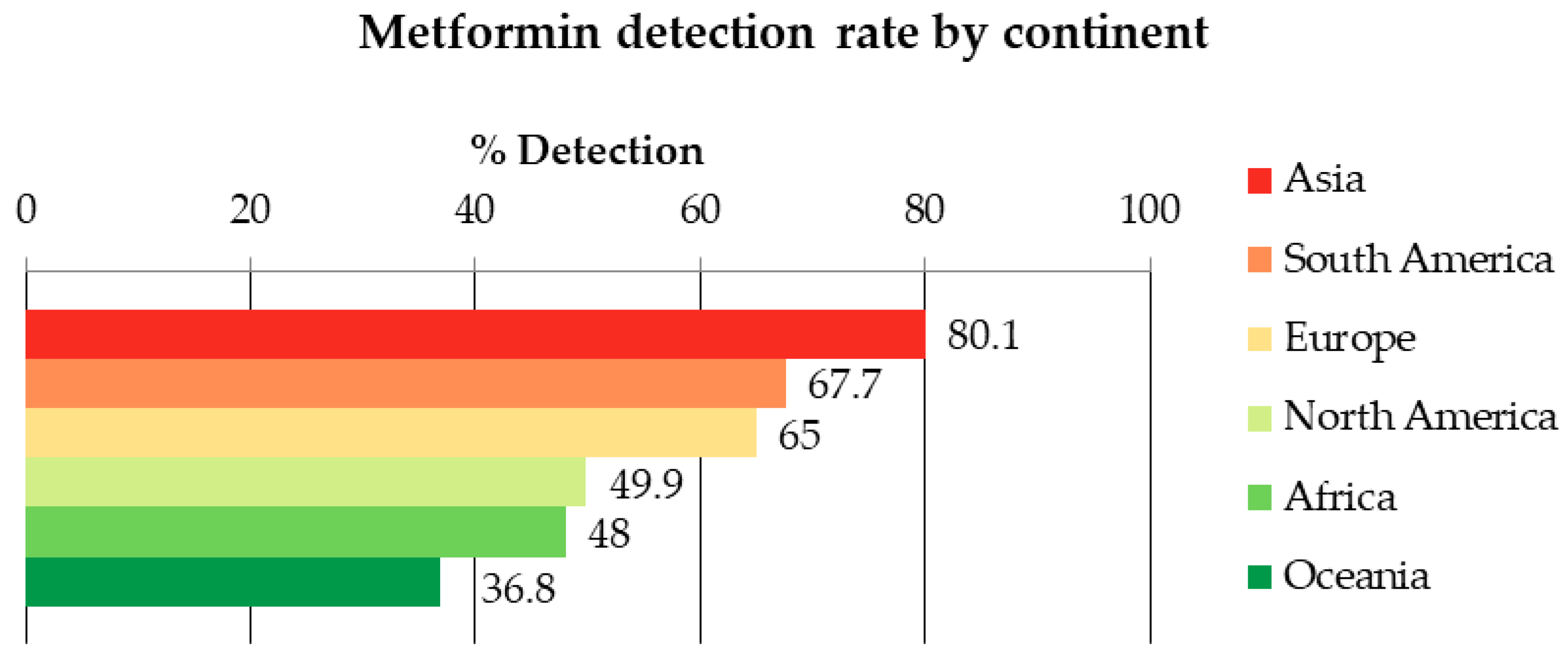
Figure 1. Metformin detection rates by continent (Own elaboration, data from [9]).
Processes 14 01713 g001
Figure 2. Global occurrence of selected pharmaceutical compounds (Own elaboration, data from [6]).
Processes 14 01713 g002
Figure 3. Overview of wastewater treatment methods for metformin removal.
Processes 14 01713 g003
Figure 4. Schematic representation of adsorption mechanisms involved in metformin removal.
Processes 14 01713 g004
Figure 5. Schematic representation of coagulation mechanisms in wastewater treatment.
Processes 14 01713 g005
Figure 6. Chlorination pathway of metformin.
Processes 14 01713 g006
Figure 7. TPs obtained in the elimination of metformin by chlorination, based on [1,36].
Processes 14 01713 g007
Figure 8. Transformation pathways and products formed during metformin removal by activated sludge, based on [1].
Processes 14 01713 g008
Figure 9. Schematic representation of metformin biodegradation.
Processes 14 01713 g009
Figure 10. Types of membrane systems for wastewater purification.
Processes 14 01713 g010
Figure 11. Proposed pathways for metformin oxidation during ozonation.
Processes 14 01713 g011
Figure 12. Schematic representation of (a) UV photolysis, (b) photocatalysis processes for metformin degradation.
Processes 14 01713 g012
Figure 13. Proposed reaction pathway of metformin oxidation via hydroxyl radicals, based on [11].
Processes 14 01713 g013
Figure 14. (a) Energy consumption by MET removal treatments, (b) costs associated with the removal and mineralization of MET by Advanced Oxidation Technologies.
Processes 14 01713 g014
Figure 15. Bibliometric co-occurrence map of metformin-related research based on the Scopus database. The node size indicates the weight of the keyword.
Processes 14 01713 g015
Table 1. Reported concentrations of metformin in different water matrices across countries and regions.
Water SourceTypeConcentration Range [ng∙L−1]Country/RegionReference
Surface waterReservoir Madín378–11,694Mexico[11]
River/lake588–107,000Mexico[1]
River/lake0.2–5800China
River/lake191–6680Malaysia
River2800–51,000Pakistan[12]
River/lake189–42,900Pakistan[1]
River/laker8–4471Brazil
WastewaterInfluent21,000–38,300China[1]
Effluent10–7667China
Influent14,000–250,100Germany
Effluent500–13,700Germany
Influent8950–32,000Sweden
Effluent600–54,000Sweden
Influent13,400–94,600Mexico
Effluent57.6–3770Mexico
Drinking waterTreated water
(drinking water)
0−32.1South Korea[1]
14.5−1203China
1.7–8.0Poland
Table 2. Physicochemical properties of metformin (data from [14]).
PropertyValues
Molecular FormulaC4H11N5
Synonyms1,1-Dimethylbiguanide
N,N-dimethylimidodicarbonimidic diamide
Molecular Weight165.2 g∙mol−1
Topological Polar Surface Area91.5 Å2
Water solubility (25 °C)300 g∙mol−1
pH *2.7
pKa *12.4
Log Kow *−2.6 at 25 °C
Log Koc *39.2 for biological sludge
3.1 for soil matrix
Boiling Point224.1 °C (760 mmHg)
Melting Point223–226 °C
* pH: hydrogen potential; pKa: ionization constant; Log Kow: the octanol–water partition coefficient; Log Koc: the soil–organic carbon partition coefficient.
Table 3. Toxic effects of metformin on selected aquatic species.
OrganismSpeciesConditionsEffectsReference
FishPimephales promelas[MET]initial: 40 µg∙L−1
Time: 4 weeks
Upregulation of vitellogenin mRNA expression in male specimens[15]
[MET]initial: 5 and 50 µg∙L−1
Time: 7 days
Imbalances in energy homeostasis and visual impacts.[16]
[MET]initial: 0.02, 3.4, 33.6, and 269 µg∙L−1
Time: 21 days
Modification of the microbial flora imbalance.[17]
[MET]initial: 0.39−5 µg∙L−1Interruption of embryonic development.[12]
Danio Rerio[MET]initial: 390–14,423 ng∙L−1Alterations in embryonic development, growth, reproduction, and gene expression[9]
[MET]initial: 1.40 and 100 µg∙L−1
Time: 6 months
Oxidative damage, apoptosis in liver, gills, brain, and intestine, as well as hematological alterations[18]
Oryzias latipes[MET]initial: 0.39–40 µg∙L−1Endocrine disruption (intersex, gene alteration), oxidative stress, and alteration of the antioxidant system[12]
[MET]initial: 1, 3,2, 10, 32, and 100 ng∙L−1
Time: 28 days
Change in several crucial pathways linked to the overall health of ELS fish, such as:
Biomolecular metabolism cellular energy
Neurobiological growth and function
Cellular communication and structure.
Neutralization of reactive oxygen species
[10]
Labeo rohita[MET]initial: 40−80 µg∙L−1
Time: 28 days
Hematologic, oxidative, and genotoxic damage.[19]
Gambusia holbrooki[MET]initial: 0.5−5 µg∙L−1
Time: 28 days
Oxidative stress and increased glycogen content[15]
Clarias gariepinus[MET]initial: 10 and 50 mg∙L−1
Time: 7 days
It causes oxidative stress in cells by reducing the activity of antioxidant enzymes such as superoxide dismutase (SOD) and total antioxidant capacity (TAC).
Elevation of the manifestation of inflammatory mediators’ interleukin-1β (IL-1β) and interleukin-6 (IL-6)
[20]
CrustaceansDaphnia magna[MET]initial: 5 and 20 mg∙L−1
Time: 24 h
Decreased the activity of several metabolic enzymes.
Increased the activity of several detoxification enzymes.
[21]
Daphnia similis[MET]initial: 2.5 mg∙L−1
Time: 21 days
Sublethal effects on reproduction.[22]
MusselsMytilus galloprovincialis[MET]initial: 1 µg∙L−1
Time: 30 days
Changes in the manifestation of genes linked to energy metabolism and insulin signaling in physiological physiology.[23]
Mytilus edulis[MET]initial: 40 µg∙L−1
Time: 7 days
Lysosomal membrane destabilization.[4]
Table 4. Comparison of toxicity of metformin and its chlorinated supplements in some organisms.
CompoundTypeLog KowCriterion
(IC50/EC50/LC50)
Value
[mg∙L−1]
Species AffectedReference
MetforminO−2.6EC501470Chlorophyceae[39]
EC50 (72 h)320Desmodesmus subspicatus
NDNo toxic effects at 258.3Pseudokirchneriella subcapitata
LC503000Pimephales promelas[38]
YT−0.05IC50 (72 h)0.6Pseudokirchneriella subcapitata[39]
IC500.3chlorophyceae
LC50~31Pimephales promelas[38]
CT−1.02IC50 (72 h)4.4Pseudokirchneriella subcapitata[39]
IC502.5chlorophyceae
LC50~15Pimephales promelas[38]
NMTNDLC50~609Pimephales promelas[38]
DM~1562
TP4 [C4H8N5Cl3 + H]+~1125
TP15
[C8H15N7O + H]+
~313
TP16
[C8H14N7OCl + H]+
~312
TP21
[C8H15N8OCl + H]+
~15
TP26
[C8H13N11Cl2 + H]+
~1625
ND: no data, T: Transformed, O: Original, Y: TP5 (Figure 7), C: TP6 (Figure 7).
Table 5. Comparison of physical–chemical methods for metformin removal.
Type of TreatmentConditionsResults
% Removal
Reference
Coagulation/flocculation[MET]initial: 1 µg∙L−1
Material: Al and Fe salts
pH: 7–8
Time: 1 h
<10[35]
[MET]initial: 230.8 ng∙L−1
Material: 60 mg∙L−1 Clay–starch combination
pH: 7
Time: 1 h
21[6,40]
Chlorination[MET]initial: 1 µg∙L−1
pH: 7–8
Chlorine: 0.2 and 1 mg∙L−1
Time: 48 h
~99 (1 mg∙L−1 Cl2)
~90 (0.2 mg∙L−1 Cl2)
[35]
[MET]initial: 8 and 1280 µg∙L−1
100 mg∙L−1 NaOCl
Time: 24 h
~ 100[39]
[MET]initial: 10 µM
pH: 8
Chlorine: 100 µM
Time: 1 h
~75[38]
Adsorption[MET]initial: 10 mg∙L−1
Material: 0.003 g graphene oxide
pH: 4–11
Temperature: 14.85–44.85 °C
Time: 0.33 h
60[4]
[MET]initial: 50 mg∙L−1
Material: 0.015g graphene oxide with AgNPs
pH: 6.5
Time: 0.83 h
99.3 [41]
[MET]initial: 10 mg∙L−1
Material: 1.1 g∙L−1 Fe-Z
Contact time of 2 h
pH = 8.33
Temperature: 25 °C
95.7[42]
[MET]initial: 75 mg∙L−1
Flow rate: 2 mL∙min−1
pH: 9
Bed height: 3.63 cm.
Fixed-bed Column of Silica–Alumina Composite
84.2[43]
[MET]initial: 50–500 mg∙L−1
Material: 0.5 g Resorcinol–Formaldehyde xerogels
pH: 11
Temperature: 25 °C
Time: 7 days
~ 32[25]
[MET]initial: 10 mg∙L−1
Material: 1 g∙L−1 zeolite
pH: 7
Temperature: 25 °C
Time: 6 h
76[24]
[MET]initial: 500 mg∙L−1
Material: 100 g∙L−1 of graphene oxide
pH: 6.5
Temperature: 30 °C
Time: 1–3 h
97.6 [29]
[MET]initial: 1000 mg∙L−1
Material: 2.5 g∙L−1 of hydrochar
pH: 7
Temperature: 25 °C
Time: 7 days
28.4 [27]
[MET]initial: 100 mg∙L−1
Material: 40 mg of biopolymer
pH: 6
Temperature: 25 °C
Time: 24 h
60.4[30]
[MET]initial: 0.1 mg∙L−1
Material: 5 g∙L−1 Magnetic Brewery Spent Grain Biochar
pH: 8
Room Temperature
Time: 24 h
95[31]
[MET]initial: 13,000 ng∙L−1
Material: 0.5 g∙L−1 iron pillared clay
pH: 5.5
Temperature: 25 °C
Time: 1.5 h
10[11]
Table 6. Summarizes selected studies on biological treatment processes applied for metformin removal in aqueous systems.
Type of TreatmentConditionsResults
% Removal
Reference
Activated sludge process[MET]initial: 20 mg∙L−1
Aerobic
Material: 0.4 g∙L−1 sludge
Temperature: 20 °C
Time: 25 days
76[4]
Mix 215 mL [MET]initial + 245.2 mg∙L−1 [GU]initial + 5000 mg∙L−1 [Glu]
Aerobic
Material: 0.5 mL sludge
Temperature: 30 °C
pH: 7
Time: 30 days
34
Mix 215 mg∙L−1 [MET]initial + 5000 mg∙L−1 [GU]initial
Aerobic
Material: 0.5 mL sludge
Temperature: 30°C
pH: 7
Time: 10 days
~100
[MET]initial: 215 mg∙L−1
Anaerobic
Material: 0.5 mL sludge
Temperature: 30 °C
pH: 7
Time: 10 days
~100
Mix 5 mg∙L−1 [MET]initial + 13 mg∙L−1 [GU]initial
Anaerobic
Material: 3 g∙L−1 sludge
Temperature: 22°C
Time: 12 days
99
[MET]initial: 9 mg∙L−1
Anaerobic
Material: 8 g∙L−1 sludge
Temperature: 22 °C
Time: 36 days
~100
[MET]initial: 6 mg∙L−1
Anaerobic
Material: 30 g∙L−1 sludge
Temperature: 22 °C
Time: 40 days
~100
Biological filtrationMix 100 µg∙L−1 [Met]initial + 5 µg∙L−1 [CPF]
Aerated biofilter packed with Ficus benjamina wood chips
Constant aeration: 500 mL∙min−1
Temperature: 25 °C
Time: 7 h
94[47]
[MET]initial: 1568 ng∙L−1
trickling filters
Room temperature
70[48]
Phytoremediation[MET]initial: 6.5–32.3 mg∙L−1
Material: Typha latifolia
Time: 28 days
74–81.1[50]
[MET]initial: 20 and 50 mg∙L−1
hydroponics
Material: Amaranthus retroflexus
pH: 5.5
Temperature: 36–17 °C
Time: 14 days
63 (20 mg∙L−1)
58 (50 mg∙L−1)
[51]
[MET]initial: 20 and 50 mg∙L−1
hydroponics
Material: Phragmites australis
pH: 5.5
Temperature: 36–17 °C
Time: 14 days
32.1 (20 mg∙L−1)
35.7 (50 mg∙L−1)
[MET]initial: 20 and 50 mg∙L−1
hydroponics
Material: Ricinus communis
pH: 5.5
Temperature: 36–17 °C
Time: 14 days
~11 (20 mg∙L−1)
39.5 (50 mg∙L−1)
[MET]initial: 20 and 50 mg∙L−1
hydroponics
Material: Brassica napus
pH: 5.5
Temperature: 36–17 °C
Time: 14 days
13.8 (20 mg∙L−1)
21.5 (50 mg∙L−1)
[MET]initial: 20 and 50 mg∙L−1
hydroponics
Material: Celosia cristata
pH: 5.5
Temperature: 36–17 °C
Time: 14 days
8.4 (20 mg∙L−1)
20.9 (50 mg∙L−1)
[MET]initial: 20 and 50 mg∙L−1
hydroponics
Material: Amaranthus retroflexus
pH: 5.5
Temperature: 36–17 °C
Time: 14 days
63 (20 mg∙L−1)
58 (50 mg∙L−1)
Disclaimer/Publisher’s Note: The statements, opinions and data contained in all publications are solely those of the individual author(s) and contributor(s) and not of MDPI and/or the editor(s). MDPI and/or the editor(s) disclaim responsibility for any injury to people or property resulting from any ideas, methods, instructions or products referred to in the content.