Article

Transformation of Waste Coca-Cola® and Pepsi® into Activated Carbons with Enhanced Electrocatalytic Performance for Oxygen Reduction in Alkaline Media


by
Aleksandar Mijajlović
1,
Jelena Potočnik
2,
Biljana Šljukić
3,4,
Nikola Cvjetićanin
3 and
Jadranka Milikić
3,*
1
University of Belgrade, Faculty of Chemistry, Studentski trg 12-16, 11158 Belgrade, Serbia
2
University of Belgrade, “VINČA” Institute of Nuclear Sciences—National Institute of the Republic of Serbia, Mike Petrovića Alasa 12-14, 11000 Belgrade, Serbia
3
University of Belgrade, Faculty of Physical Chemistry, Studentski trg 12-16, 11158 Belgrade, Serbia
4
Center of Physics and Engineering of Advanced Materials, Laboratory of Physics for Materials and Emerging Technologies, Instituto Superior Tècnico, Universidade de Lisboa, 1049-001 Lisbon, Portugal
*
Author to whom correspondence should be addressed.
Processes 2026, 14(11), 1694; https://doi.org/10.3390/pr14111694
Submission received: 27 April 2026 / Revised: 19 May 2026 / Accepted: 22 May 2026 / Published: 24 May 2026

Abstract

This study investigates the morphological, compositional, and electrochemical properties of carbon materials derived from Pepsi (P) and Coca-Cola (CC) precursors, before and after chemical activation with ZnCl2. Scanning electron microscopy revealed a lower density of surface cracks in non-activated hydrothermal carbon (NAHC) samples compared to activated carbons (ACs), indicating structural changes induced by the corrosive activation process. Particle size analysis showed an increase in average diameter after activation, particularly pronounced in CC-derived samples, which also exhibited a broader particle size distribution. Elemental mapping confirmed carbon as the dominant and homogeneously distributed element, while oxygen-containing functional groups decreased significantly after activation. Oxygen reduction reaction investigation demonstrated that all synthesized non-activated and activated samples are electrocatalytically active in alkaline solution. CC-NAHC demonstrated the lowest Tafel slope (99 mV dec−1), while activated samples showed higher values, indicating slower kinetics and increased reaction limitations. Despite this, activated carbons—particularly CC-AC—displayed significantly higher diffusion-limited current densities (~−4.8 mA cm−2 at 1600 rpm), suggesting improved mass transport and conductivity. Furthermore, electron transfer number (n) analysis indicated that P-NAHC and CC-AC follow a near four-electron ORR pathway (n ≈ 3.6–3.9).

1. Introduction

The growing use of fossil fuels has caused significant environmental problems, making clean and efficient energy sources increasingly important [1,2]. Fuel cells and metal-air batteries are promising due to their high energy density and eco-friendly nature [3,4,5,6,7,8]. A key limitation in these devices is the slow oxygen reduction reaction (ORR) [9]. Platinum is an effective catalyst for ORR, but its high cost, scarcity, and limited stability restrict its practical use [10,11,12,13,14]. Therefore, developing efficient and affordable non-noble metal catalysts for ORR is essential [13]. Carbon-based metal-free electrocatalysts have emerged as promising materials for ORR in alkaline media due to their high surface area, tunable porosity, and abundant sites derived from heteroatom doping or structural defects, achieving performance similar to or better than that of commercial Pt catalysts [15,16]. Unlike metal-doped carbons [8,17,18,19,20,21], their activity relies on the intrinsic properties of the carbon framework, such as electronic structure and surface functional groups. These catalysts offer sustainable and cost-effective alternatives to precious-metal-based systems, demonstrating high activity, selectivity, and stability in alkaline environments [15,22,23,24,25,26].
Boron (B), nitrogen (N), and fluorine (F) tri-doped lignin-based carbon porous nanofibers (BNF-LCFs) [23] were synthesized via electrospinning and pyrolysis and examined for ORR in 0.1 M KOH. The onset potential (Eonset) of 0.959 V and half-wave potential (E1/2) of 0.844 V of BNF-LCFs were superior to all other catalysts, demonstrating the synergistic effect of B, N, and F tri-doping. BNF-LCFs also showed the smallest Tafel slope (82.0 mV dec−1), indicating excellent ORR kinetics [23]. A metal-free ORR catalyst, F-N co-doped hollow carbon (FNC) [25], was developed to overcome the limitations of conventional catalysts. The FNC was synthesized via template-assisted pyrolysis, yielding a hollow, porous architecture with a high specific surface area and abundant active sites. Fluorine doping modified the electronic structure of pyridinic nitrogen, enhancing its catalytic activity, while the formation of C-F bonds reduced the reaction energy barrier and stabilized the nitrogen centers. This synergistic effect of F and N dopants resulted in outstanding ORR performance in alkaline media. The catalyst exhibited an E1/2 of 0.87 V, surpassing that of commercial Pt/C (0.85 V), demonstrating the effectiveness of the heteroatom co-doping strategy in designing highly active, metal-free carbon-based electrocatalysts [25]. Due to their good thermal stability, chemical robustness, and high surface area, carbon nanotubes (CNTs) are excellent candidates for ORR. P. Wei et al. [27] used a simple, controllable solid-phase method to synthesize porous nitrogen and boron-co-doped CNTs (NBCNTs) from tubular polypyrrole (PPy) and sodium tetraphenylboron. The combination of a porous one-dimensional hollow structure and dual heteroatom doping granted the optimized NBCNTs’ excellent ORR activity in an alkaline solution. The average electron transfer numbers ranged from 3.2 to 3.82, indicating a four-electron ORR pathway. L. Bouleau et al. [26] indicated that porous carbon materials are promising metal-free electrocatalysts for ORR, with active sites arising from their porosity and surface chemistry rather than metal doping. While metal-doped carbons have been widely studied, porous carbons require careful optimization of experimental conditions to achieve their best performance. This study examined key factors affecting ORR activity in alkaline media. A higher-porosity carbon material (HP-CM) showed electron transfer from 2.4 to 3.1 during ORR, depending on experimental conditions.
Herein, we synthesized four different metal-free carbon electrocatalysts using a simple method: hydrothermal carbonization of waste PEPSI® and COCA COLA®, followed by ZnCl2 activation. Their structure and morphology were characterized by field-emission scanning electron microscopy with energy dispersive X-ray spectroscopy (FESEM-EDS). The materials exhibited good ORR activity in alkaline media both before and after carbon activation. Activated carbons derived from waste Coca-Cola® have already been examined for CO2 adsorption and supercapacitor applications [28].

2. Materials and Methods

The materials used in this study were waste (postconsumer/naturally flat) Coca-Cola and Pepsi. In 100 mL of Coca-Cola, there are about 11 g of sugar (half glucose and half fructose) [28], making it a very rich source of carbon. In addition to sugar, Coca-Cola contains high-fructose syrup, caramel coloring (which may contain 4-methylimidazole, C4H6N2), carbon dioxide, phosphoric acid, natural flavors (essential oils, fruit extracts, and spices), and caffeine.
A total of 50 mL of Coca-Cola/Pepsi was mixed with 0.4 mL of diluted ammonia and 0.0503 g of hexadecyltrimethylammonium bromide (CTAB, Sigma-Aldrich Chemie GmbH, Schnelldorf, Germany) for 10 min using an ultrasonic bath. Then, 24 mL of the mixture was transferred into each of two hydrothermal digestion chambers (HDCs) and placed in an oven at 200 °C for 4 h. After removal from the oven, the sample was washed three times with distilled water and ethanol (>99, 5%, Sani-Hem, Novi Sad, Serbia). For the non-activated sample, 500 mg of the mixture obtained in HDC was placed in a furnace under a nitrogen flow, heated from room temperature to 350 °C at 2 °C min−1, held at 350 °C for 2 h; then it was heated from 350 to 600 °C at 2 °C min−1 and held at 600 °C for 4 h. These non-activated hydrothermal carbon (NAHC) samples were denoted as CC-NAHC and P-NAHC. For activation, ZnCl2 was used: 500 mg of the precipitate obtained in HDC was mixed with 1.5 g of ZnCl2 (Carl Roth, Karlsruhe, Germany) and 20 mL of water. The mixture was stirred for 90 min at 60 °C using an ultrasonic bath and then dried overnight at 110 °C. After drying, the obtained mixture was placed in a furnace and heated from room temperature to 350 °C at 2 °C min−1, held at 350 °C for 2 h, and then heated from 350 to 800 °C at 1 °C min−1; then it was held at 800 °C for 2 h at 800 °C under a nitrogen flow. The resulting sample was washed with 100 mL of 1 M HCl (37%, Carl Roth, Karlsruhe, Germany) and 1 L of distilled water. It was then placed in a drying oven at 60 °C for 2 h. Since the sample remained moist, it was further dried in a vacuum oven for an additional hour to obtain CC-AC and P-AC. These samples were activated with ZnCl2, as significantly increased total pore volume and BET surface area are expected compared to non-activated samples [28]. ZnCl2 acts as a dehydrating and structure-directing agent during activation, promoting carbonization and preventing structural collapse [29]. At high temperatures, it infiltrates the carbon matrix and facilitates the development of a porous structure. Subsequent volatilization and acid washing remove Zn-containing species, leaving a highly porous carbon network with increased surface area and pore volume, thereby enhancing the access of electroactive species to active sites, charge transfer, and overall electrocatalytic performance [29].
The morphology of the synthesized P- and CC-samples was analyzed by field-emission scanning electron microscopy, equipped with energy-dispersive X-ray spectroscopy (FESEM-EDS, Scios2 Dual Beam, Thermo Fisher Scientific, Waltham, MA, USA), operated at 10 kV. In order to determine the elemental composition of the samples, EDS mapping was recorded with an acquisition time of one hour.
An Ivium VO1107 Potentiostat/Galvanostat (Ivium Technologies B.V., Eindhoven, The Netherlands) with Gamry Instruments RDE710 Rotating Electrode (Gamry Instruments, Warminster, PA, USA) was used for all electrochemical measurements, with a saturated calomel electrode (SCE) as the reference electrode and a graphite rod as the counter electrode, in a glass cell of 40 cm3 volume with 0.1 M KOH (≥85%, Sigma-Aldrich, St. Louis, MO, USA). A detailed investigation of the four synthesized electrodes for ORR was conducted in N2 and O2-saturated solutions at 20 mV s−1 using linear sweep voltammetry (LSV). Voltammograms at different rotation rates—ranging from 400 to 3600 rpm—were recorded, while chronoamperometry was recorded at 0.6 V for 3600 s for P-AC, P-NAHC, and CC-NAHC, and for 7000 s for CC-AC.
A catalytic ink was prepared by ultrasonically mixing 5 mg of the synthesized sample powder, 980 μL of ethanol, and 20 μL of Nafion solution (5 wt%, Sigma-Aldrich, St. Louis, MO, USA). The obtained ink (14 μL) was pipetted on a glassy carbon rotating disk electrode (RDE, geometric area 0.19625 cm2). Nafion (a perfluorosulfonic acid polymer) was used as a binder to improve the mechanical stability and adhesion of the catalyst layer to the electrode surface. In addition, Nafion provides proton-conducting pathways within the catalyst film, which facilitates charge transport and enhances the overall electrochemical performance [30]. Hence, Nafin is commonly used in the preparation of catalytic inks [31].

3. Results

3.1. Characterization of the P- and CC-Electrocatalysts

The CC-sample, activated by ZnCl2 [28], is characterized by a ca. fivefold increased BET surface area of 1994 m2 g−1 compared to the non-activated sample (405 m2 g−1). The ZnCl2 treatment also increases the total pore volume, as Zn species are incorporated into the carbon structure and later removed by HCl washing, leaving micropores. However, in this case, the pores become larger and the proportion of very fine micropores (<0.7 nm) decreases. Instead, pores in the 0.8–2 nm range dominate (29.4% and 58.5% of the total pore volume), resulting in a more multimodal porous structure [28].
The samples’ morphology was investigated using FESEM, and the results are shown in Figure 1. Well-defined spheres are observed in all samples, consistent with previous reports in the literature [28]. As can be seen, the non-activated carbon samples, P-NAHC (Figure 1B) and CC-NAHC (Figure 1D), exhibited fewer cracks on the spheres’ surfaces than the activated carbon samples, P-AC and CC-AC (Figure 1A and Figure 1C, respectively). These differences are likely due to the corrosive activation process using ZnCl2.
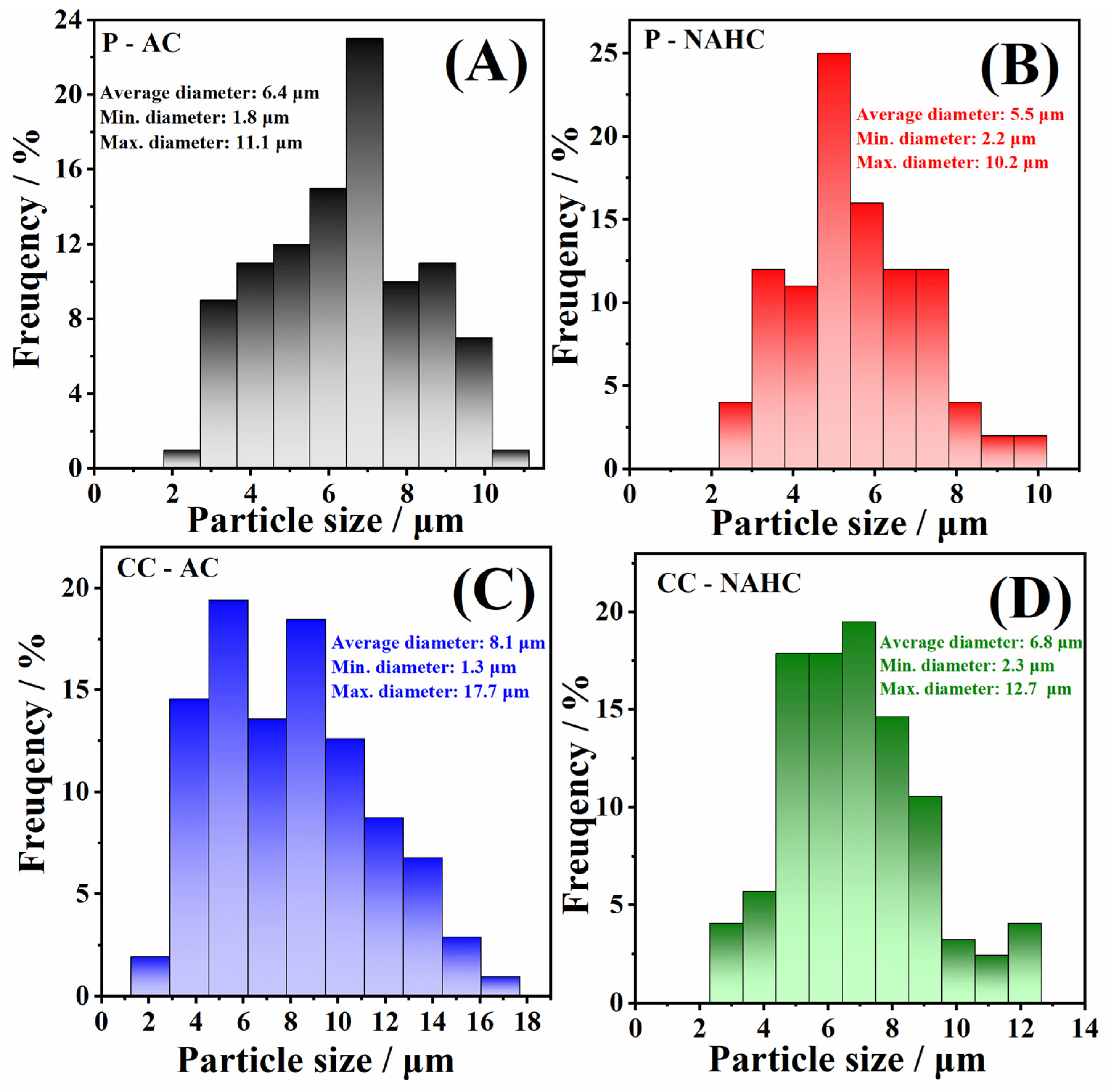
Furthermore, a detailed examination of the corresponding particle size distributions for all samples is shown in Figure 2. The average diameters of 5.5 and 6.8 μm were observed for P-NAHC (Figure 2B) and CC-NAHC (Figure 2D), respectively. After activation, somewhat higher average diameters of 6.4 and 8.1 μm were obtained for P-AC (Figure 2A) and CC-AC (Figure 2C) samples. A more pronounced change in particle size distribution was observed for CC-samples before and after activation. The CC-AC exhibits a wide particle size range of 1.3–17.7 μm, whereas the CC-NAHC sample shows a significantly lower maximum average diameter of 12.7 μm. In contrast, P-samples revealed only minor changes after activation, with a slight increase in maximum diameter from 10.2 to 11.1 μm. The surface area distribution of spherical particles was calculated for each sample, and the corresponding percentage contribution was determined. The P-AC sample exhibited particle surface areas in the range of 0.003–0.03 cm2, accounting for approximately 98% of the total particles. For the P-NAHC sample, particle surface areas ranged from 0.004 to 0.02 cm2, representing about 92% of the particles. In the CC-NAHC sample, particle surface areas were between 0.008 and 0.025 cm2, covering approximately 96% of the total particles. Finally, the CC-AC sample showed particle surface areas in the range of 0.004–0.045 cm2, corresponding to around 88% of the particles. The obtained results indicate that most particles in all investigated samples are distributed within relatively narrow surface area ranges, suggesting good uniformity of the synthesized spherical structures. Among the analyzed materials, the P-AC sample showed the highest percentage of particles within the selected surface area interval (98%), indicating the most homogeneous particle size distribution. In contrast, the CC-AC sample exhibited the broadest surface area range and the lowest percentage contribution (88%), suggesting a higher degree of particle size heterogeneity. The surface area of spherical particles influences the electrocatalytic performance of prepared materials by directly affecting the active-site density and mass transport; smaller surface area typically increases the electrochemically active surface area and active-site density, and enhances transport of electroactive species to the active sites resulting in improved ORR kinetics.
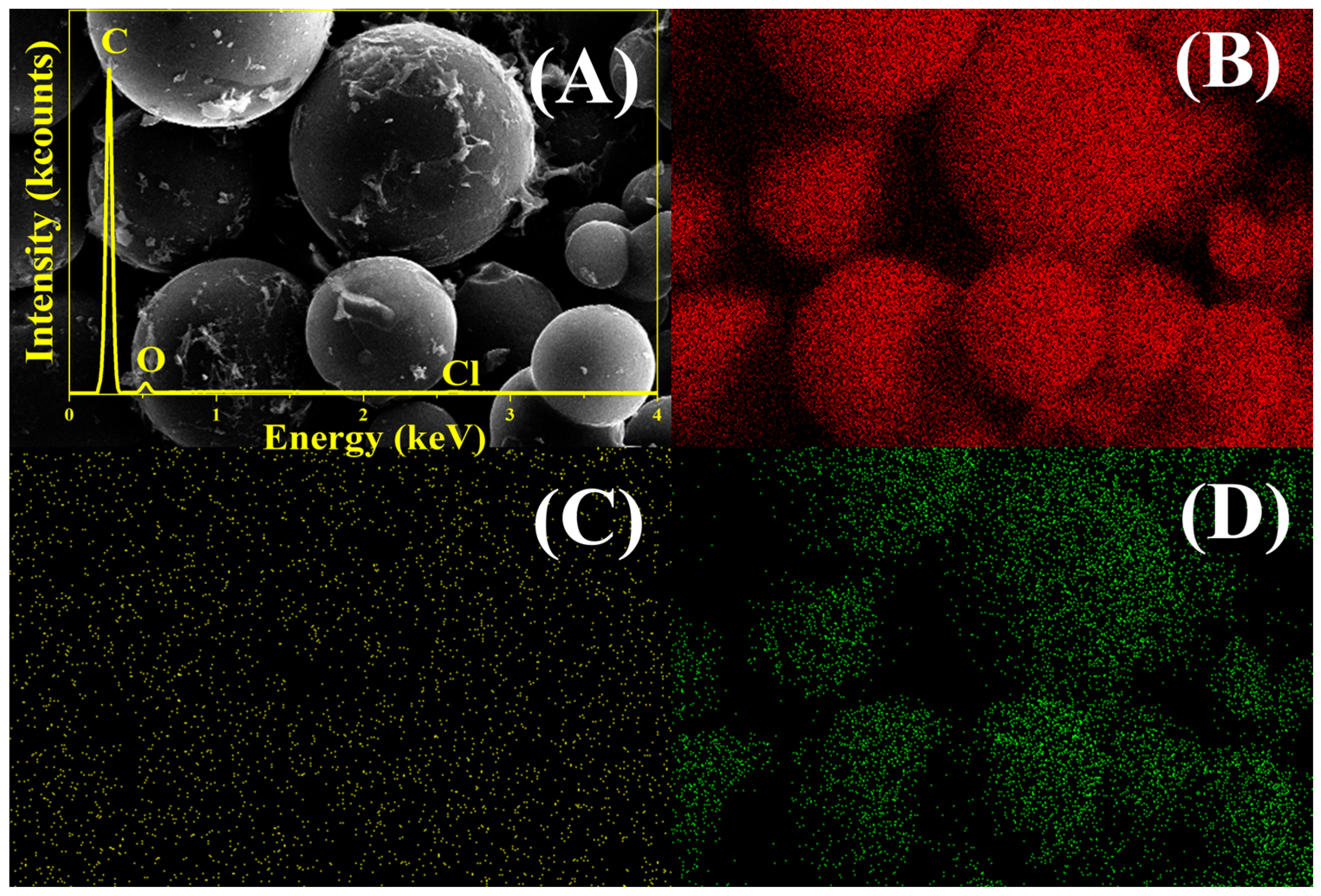
To complement the morphological information obtained from FESEM, EDS elemental mapping was performed, with the results presented in Figure 3, with each element displayed in distinct colors for clarity: carbon (C) in green (Figure 3B), chlorine (Cl) in yellow (Figure 3C), and oxygen (O) in green (Figure 3D). The maps show that carbon (C) is the dominant element and is homogeneously distributed throughout the sample, confirming the carbonaceous nature of the material. Oxygen (O) is also evenly dispersed, indicating the presence of oxygen-containing functional groups on the surface. In contrast, chlorine (Cl) is detected in lower amounts and appears uniformly but sparsely distributed, which may be attributed to residual species from the activation process. The EDS spectrum (Figure 3A inset) further supports these findings, with C as the main element and smaller contributions from O and Cl. Weight and atomic percentages of the noticed elements obtained by EDS analysis of P-AC, P-NAHC, CC-AC, and CC-NAHC are presented in Table 1. The weight amount of C increases from 75.878 to 85.704% for P-NAHC and P-AC, respectively. A similar situation was noticed for CC-samples, where the weight amount of C increased from 77.382 to 86.339% of CC-NAHC and CC-AC, respectively. The opposite was observed for oxygen, with the amount being almost twice as low after activation of both samples. About 1.5 and ~2% of Cl were observed in both samples due to activation by ZnCl2.

3.2. Investigation of the ORR

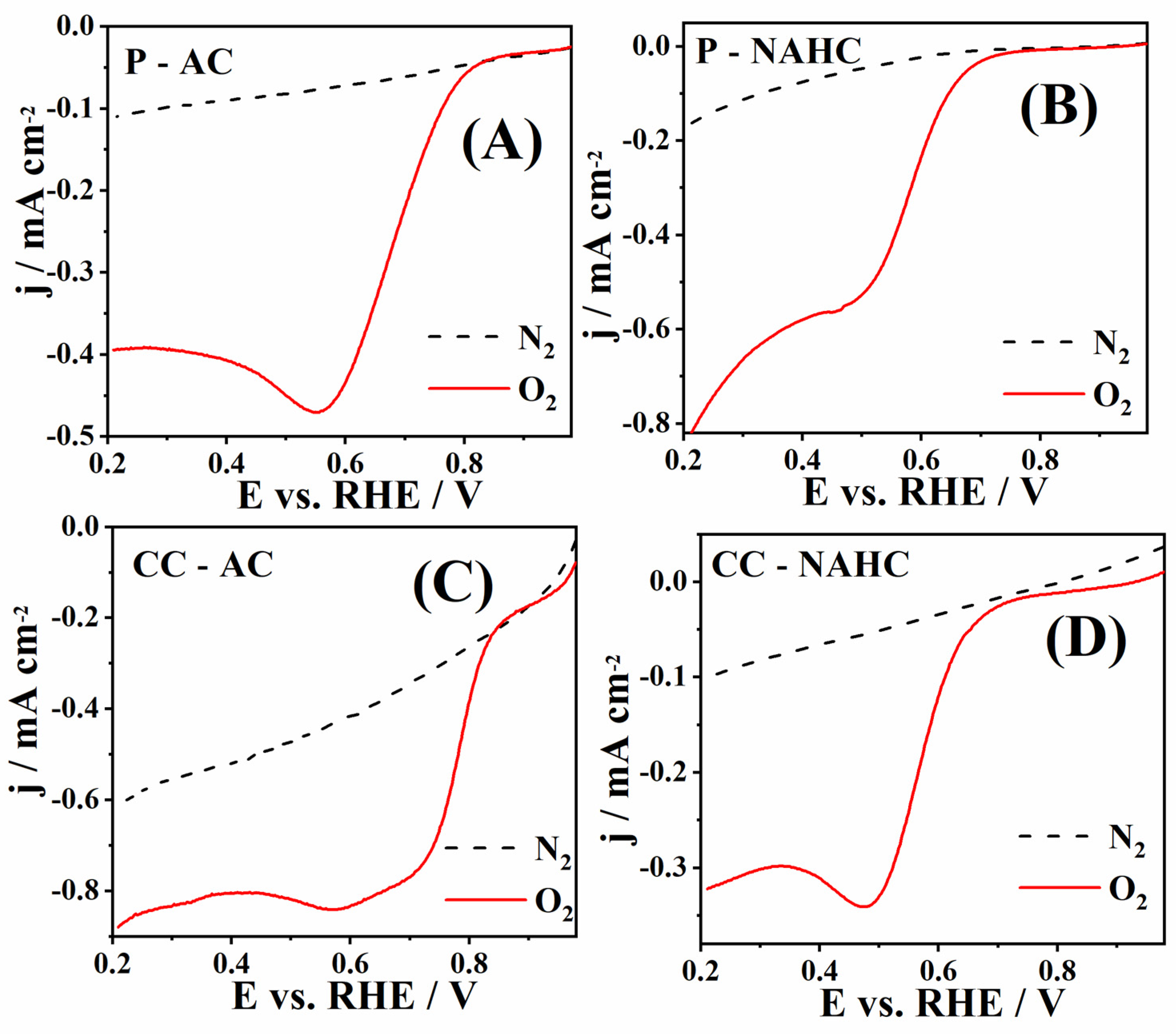
The electrocatalytic activity of the investigated materials toward the ORR was evaluated by LSV in O2-saturated and N2-saturated 0.1 M KOH (Figure 4A–D). By comparing the responses obtained under oxygen and inert atmospheres, a distinct cathodic current is observed in O2-saturated conditions, confirming that the recorded electrochemical signal is directly associated with the ORR process. For P-AC (Figure 4A), almost a six-times increase in cathodic current is observed in the presence of O2 compared to N2. Also, P-NAHC (Figure 4B) exhibits good ORR activity, as evidenced by a significant increase in cathodic current under O2-saturated conditions. The enhanced performance can be attributed to modifications in the surface chemistry and structural properties of P-AC, which facilitate more efficient electron transfer and promote favorable oxygen adsorption. A similar trend is observed for CC-AC (Figure 4C) and CC-NAHC (Figure 4D). CC-AC demonstrates substantially higher current densities compared to P-AC, indicating enhanced ORR activity. Namely, these results are in agreement with results obtained by BET analysis [28], which showed that the activated sample has even fivefold-higher specific surface area than the non-activated sample.
To compare the catalytic efficiency of the investigated materials, the following parameters were evaluated: onset potential (Eonset), half-wave potential (E1/2), Tafel slope, and long-term operational stability. In addition, the obtained results were compared with previously reported studies on carbon-based electrocatalysts derived from biomass or natural precursors (Table 2).
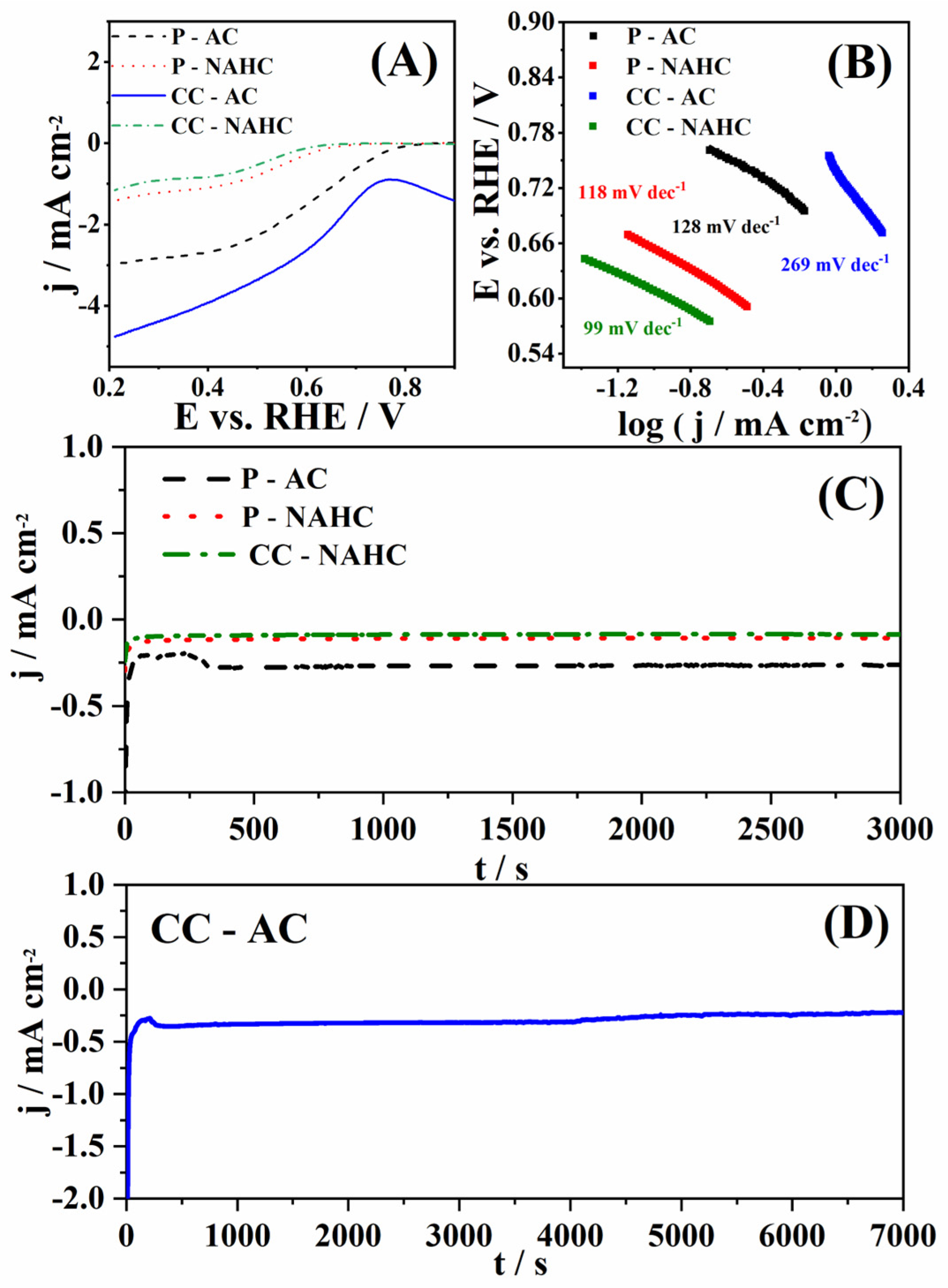
The Eonset and half-wave potential E1/2 values for all investigated catalysts were determined from the LSV curves presented in Figure 5A. Among the examined materials, the CC-NAHC catalyst exhibited the least positive onset potential of 0.60 V. A slightly more positive Eonset value was observed for P-NAHC (0.65 V), while the activated carbon samples showed considerably more positive onset potentials, specifically 0.72 V for CC-AC and 0.80 V for P-AC. Comparable Eonset values have been reported by Su et al. [32] for defect-rich porous carbon microspheres synthesized from orange peel biomass. However, in that study, the catalyst exhibited a lower Tafel slope and followed a dominant four-electron oxygen reduction pathway, indicating more favorable ORR kinetics. Such behavior is comparable to that observed for the CC-AC catalyst in the present work, suggesting that structural defects and porosity in biomass-derived carbon materials can significantly influence ORR activity and reaction pathways. The E1/2 followed the order: P-AC (0.629 V) > CC-AC (0.602 V) > P-NAHC (0.598 V) > CC-NAHC (0.530 V), which is in good agreement with the trend observed for the onset potentials of the investigated catalysts (Table 2). Though E1/2 values represent estimation in the case of catalysts that did not reach diffusion-limited currents, this correlation indicates a consistent variation in the ORR activity among the prepared materials. Comparable catalysts have been reported in the literature. For instance, Macchi et al. [33] achieved somewhat improved ORR performance using activated carbon (AC) catalysts prepared by chemical activation with KOH. In their work, the carbonized precursor underwent KOH activation to generate a highly developed micro- and mesoporous architecture, resulting in a substantial increase in the specific surface area and consequently enhanced catalytic activity. In addition, a dominant four-electron ORR pathway similar to that observed for the CC-AC sample in the present study (please see below) has also been reported by Sun et al. [34] In their work, the most active catalyst (Au@Pd@Pt-NSC-900), synthesized from soybean-derived carbon precursors, exhibited a Tafel slope as low as 65 mV dec−1 and a half-wave potential of 0.82 V, reflecting favorable ORR kinetics. Likewise, Zhang et al. [35] reported a four-electron reduction pathway with a half-wave potential of 0.83 V for a CE-Fe-MWNT (carbonized egg-Fe-MWNT hybrid) catalyst. Although these studies achieved lower Tafel slopes and higher half-wave potentials than those obtained in the present work, the results demonstrate that an efficient four-electron ORR pathway with competitive electrocatalytic parameters can be achieved through a metal-free, simpler synthesis strategy.
The kinetic analysis was further supported by the corresponding Tafel plots (Figure 5B). The lowest Tafel slope was recorded for CC-NAHC (99 mV dec−1), indicating the most favorable ORR kinetics and a more efficient electron transfer during the reaction. Somewhat higher slopes were obtained for P-NAHC (118 mV dec−1) and P-AC (128 mV dec−1), whereas CC-AC exhibited a significantly higher Tafel slope (269 mV dec−1), suggesting pronounced kinetic limitations and a less favorable reaction mechanism (Table 2). These results confirm that although CC-AC generates high current densities, the intrinsic ORR kinetics on this material are considerably slower compared to the NAHC catalysts. The Tafel slopes of 118 and 128 mV dec−1 obtained for P-NAHC and P-AC are close to the characteristic value of ~120 mV dec−1 commonly associated with a rate-determining first electron-transfer step during ORR in alkaline media [36,37,38,39]. The lower slope obtained for CC-NAHC (99 mV dec−1) indicates somewhat faster ORR kinetics and more favorable charge-transfer behavior [36,38]. In contrast, the significantly higher Tafel slope observed for CC-AC (269 mV dec−1) suggests complex kinetic limitations and deviation from conventional ORR pathways [36,38]. Karaman [40] demonstrated that orange peel can serve as a viable carbon precursor for the preparation of advanced ORR electrocatalysts. In that study, a N,S-CDs@3D-GNs catalyst (N,S-co-doped carbon dots supported on three-dimensional graphene networks) was synthesized, achieving an onset potential of 0.98 V and a Tafel slope of 67 mV dec−1, which reflects favorable reaction kinetics and efficient electron transfer during the oxygen reduction process. Lignin-based carbon porous nanofibers doped with B, N, and F (BNF-LCFs, NF-LCFs, and N-LCFs) were examined in detail for ORR in alkaline media, where BNF-LCF gave the lowest Tafel slope of 82 mV dec−1 while NF-LCF and N-LCFs showed 90.5 and 92.2 mV dec−1, which is somewhat lower than the values obtained herein for CC-NAHC [23]. Also, Pt/C (40 wt%) showed a lower Tafel slope of 68 mV dec−1 [41] than the 99 mV dec−1 obtained here for CC-NAHC sample under the same experimental conditions.
Table 2. Comparison of the ORR kinetic parameters of the synthesized electrocatalysts with those reported for related electrocatalysts in the literature.
ORR ElectrocatalystsCatalyst Loading
(mg/cm2)
Scan Rate
(mVs−1)
Eonset (V)E1/2 (V)b (mV dec−1)nRef.
P-AC0.36200.800.629128≈2.5–3.0This work
P-NAHC0.36200.650.598118≈3.6–3.9This work
CC-AC0.36200.720.602269≈3.6–3.9This work
CC-NAHC0.36200.600.53099≈2.5–3.0This work
Porous CS0.4650.790.74534.0[32]
BNF-LCF0.31100.9590.844823.85[23]
NF-LCF0.31100.9340.83390.5/[23]
N-LCFs0.31100.9160.79192.23.23[23]
AC/500.910.78724.0[33]
Au@Pd@Pt-NSC-900/101.040.91644.0[34]
CE–Fe–MWNT0.350.960.83713.83[35]
HDPC-8000.15100.950.79≈684.0[42]
HDPC-7000.15100.910.71 3.72[42]
HDPC-9000.15100.890.68 3.32[42]
N,S CDs@3D GNs0.20150.980.84–0.85≈673.89[40]
Pt/C (40 wt%)0.61200.960.8768/[41]
Abbreviations: Porous CS—defect-rich porous carbon microspheres; AC—activated carbon; Au@Pd@Pt-NSC-900—Au@Pd@Pt core–shell on a beancurd-derived mesoporous carbon; CE–Fe–MWNT—egg-derived N-doped carbon + Fe + multi-walled carbon nanotubes; N,S CDs@3D GNs—N,S-doped carbon dots on a 3D graphene networks; HDPC-800—heteroatom-doped porous carbon.
Finally, the stability of all synthesized samples was evaluated. Chronoamperometric measurements were performed at the ORR peak potential (Figure 5C). Relatively stable current responses without any abrupt current decay were observed for P-AC, P-NAHC, and CC–NAHC over 3000 s, and for CC-AC over 7000 s, indicating satisfactory electrochemical durability under the applied conditions.
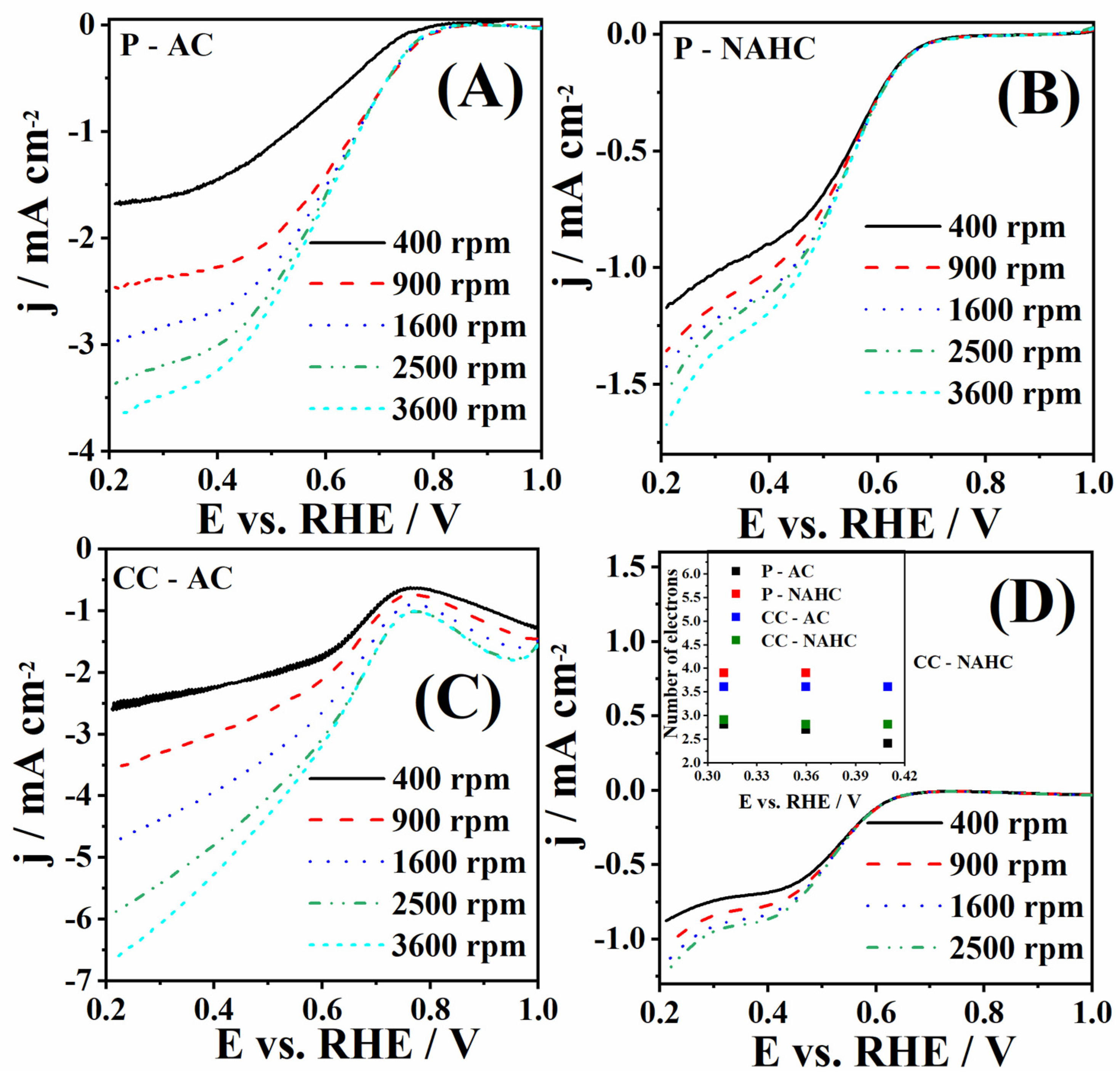
For a deeper understanding of the ORR kinetics, voltammograms of the investigated catalysts were recorded in O2-saturated 0.1 M KOH at various rotation rates of the rotating disk electrode (400–3600 rpm) (Figure 6A–D). A clear increase in cathodic current density with increasing rotation rate was observed, though a diffusion-limited current plateau was not reached in the case of P-NAHC and CC-NHAC. This suggests that complete diffusion control was not realized, with a similar observation previously reported for carbon-based electrocatalysts with lower uniformity in active-site distribution [43]. Among the investigated catalysts, P-AC (Figure 6A) exhibits relatively moderate current densities, with the maximum cathodic current at 3600 rpm reaching approximately −3.5 to −3.8 mA cm−2 in the diffusion-limited region. For P-NAHC (Figure 6B), a significantly lower cathodic current density is observed compared to P-AC, with a maximum value of approximately −1.5 mA cm−2 at 3600 rpm. In contrast, CC-AC (Figure 6C) demonstrates the highest cathodic current densities among all examined samples, reaching ≈−6.5 to −7.0 mA cm−2 at 3600 rpm. These high current densities of CC-AC indicate a substantial contribution from the diffusion-controlled process and suggest a highly developed electroactive surface area. For CC-NAHC (Figure 6D), the current densities are more moderate, yet the polarization curves are well-defined and stable, with minimal potential shift as the rotation rate increases. The number of electrons transferred per O2 molecule (n) was calculated from the slopes of the Koutecký–Levich (K-L) plots at potentials of 0.41, 0.36, and 0.31 V. The linear increase in current density with increasing electrode rotation rate confirms first-order reaction kinetics with respect to dissolved O2. The inset in Figure 6D presents the calculated n as a function of potential for all catalysts. Notably, the P-AC and CC–NAHC catalyst exhibit lower n values (≈2.5–3.0), indicating a significant contribution from the two-electron ORR pathway. In contrast, P-NAHC and CC-AC show higher n values (≈3.6–3.9), approaching the ideal four-electron reduction pathway of oxygen. Guo et al. (Table 2) reported the synthesis of N-doped porous carbon nanosheets (HDPC-700, HDPC-800, and HDPC-900) [42] prepared via KOH activation of natural tea-leaf biomass followed by high-temperature pyrolysis under an inert atmosphere. The resulting material exhibited a dominant four-electron oxygen reduction pathway, indicating highly efficient ORR electrocatalytic activity.
Although the electrocatalytic parameters reported in these studies surpass those obtained for the catalysts investigated in the present work, it is important to emphasize that such high performances are typically achieved through relatively complex and multistep synthesis strategies involving heteroatom doping, chemical activation, and the construction of hierarchical composite architectures. In contrast, the synthesis approach employed in this study is considerably simpler and more cost-effective, without the presence of any metal. Despite this methodological simplicity, the obtained catalysts still demonstrate efficient ORR activity with competitive electrochemical characteristics. This highlights the practical advantage of the proposed strategy, particularly in terms of scalability and the potential for the large-scale production and industrial implementation of carbon-based electrocatalysts.

4. Conclusions

ZnCl2 activation effectively tailors the structural and chemical properties of carbon materials derived from P- and CC-precursors, increasing carbon content, reducing oxygen functionalities, and introducing minor chlorine residues, which enhance electrical conductivity and promote higher current densities during ORR. Activated samples, particularly CC-AC, exhibit superior diffusion-limited current densities, confirming the beneficial role of activation in improving mass transport and overall electrocatalytic output. At the same time, non-activated carbon materials demonstrate excellent intrinsic ORR activity, with favorable onset potentials and low Tafel slopes. P-NAHC and CC-AC exhibit electron transfer numbers close to 4 (n ≈ 3.6–3.9), indicating a dominant and efficient four-electron ORR pathway. These results clearly demonstrate that both precursor selection and activation strategy are key parameters in designing high-performance carbon-based ORR catalysts, with an optimal balance between conductivity and intrinsic activity enabling enhanced electrochemical performance.

Author Contributions

J.M.; formal analysis, J.M., J.P. and N.C.; investigation, J.M., J.P. and N.C.; supervision, J.M., J.P., N.C. and B.Š.; visualization, J.M., A.M. and J.P.; writing—original draft, J.M., A.M. and J.P.; writing—review and editing, J.M., J.P., A.M., N.C. and B.Š. All authors have read and agreed to the published version of the manuscript.

Funding

The authors express their gratitude for the financial support provided by the Ministry of Science, Technological Development and Innovation of the Republic of Serbia (contracts no. 451-03-34/2026-03/200146 and 451-03-33/2026-03/200146), as well as by the Foundation for Science and Technology, FCT, Portugal (contracts no. LA/P/0095/2020 and UID/PRR2/04540/2025, https://doi.org/10.54499/UID/PRR2/04540/2025).

Data Availability Statement

Data are available upon request from the corresponding authors.

Conflicts of Interest

The authors declare no conflicts of interest.

References

  1. Milikić, J.; Nastasić, A.; Martins, M.; Sequeira, C.A.C.; Šljukić, B. Air Cathodes and Bifunctional Oxygen Electrocatalysts for Aqueous Metal–Air Batteries. Batteries 2023, 9, 394. [Google Scholar] [CrossRef]
  2. Radinovi, K.; Mladenovi, D.; Nastasi, A.; Radinović, K.; Mijajlović, A.; Mladenović, D.; Tomić, D.; Nastasić, A.; Stanković, D.; Milikić, J. Non-Precious Electrocatalysts for Alkaline Oxygen Evolution: Transition Metal Compounds, Carbon Supports, and Metal-Free Systems. Processes 2026, 14, 1085. [Google Scholar] [CrossRef]
  3. Xu, J.; Xue, B.; Xia, C.; Liu, C.; Li, M.; Xiao, R. Transforming Bio-Oil into Nitrogen-Doped Hierarchical Porous Carbons: Excellent Oxygen Reduction Electrocatalysts for Zn-Air Batteries. J. Alloys Compd. 2023, 947, 169584. [Google Scholar] [CrossRef]
  4. Riquelme-García, P.; García-Rodríguez, M.; Flores-Lasluisa, J.X.; Cazorla-Amorós, D.; Morallon, E. Enhanced Electrocatalytic Performance of SrMn1−XCoxO3 Perovskite Metal Oxides for Oxygen Reactions in Zn-Air Batteries: Influence of Mn/Co Ratio. Appl. Surf. Sci. Adv. 2025, 27, 100725. [Google Scholar] [CrossRef]
  5. Vilas Bôas, N.; Souza Junior, J.B.; Varanda, L.C.; Machado, S.A.S.; Calegaro, M.L. Bismuth and Cerium Doped Cryptomelane-Type Manganese Dioxide Nanorods as Bifunctional Catalysts for Rechargeable Alkaline Metal-Air Batteries. Appl. Catal. B Environ. 2019, 258, 118014. [Google Scholar] [CrossRef]
  6. Yu, X.; Chen, X.; Yue, D.; Zheng, F.; Li, Q.; Ma, Z.; Wang, H. MnS Doping Regulating Co Active Sites on Fibrous Cobalt Nitride as Bifunctional Oxygen Electrocatalyst for High-Performance Zn-Air Battery. J. Alloys Compd. 2024, 1005, 176153. [Google Scholar] [CrossRef]
  7. Chen, Y.; Xu, J.; He, P.; Qiao, Y.; Guo, S.; Yang, H.; Zhou, H. Metal-Air Batteries: Progress and Perspective. Sci. Bull. 2022, 67, 2449–2486. [Google Scholar] [CrossRef] [PubMed]
  8. Tu, F.-D.; Wu, Z.-Y.; Guo, P.; Shen, L.-X.; Zhang, Z.-Y.; Dai, Y.-K.; Ma, M.; Liu, J.; Xu, B.; Zhang, Y.-L.; et al. Fe-N-C Catalysts Decorated with Oxygen Vacancies-Rich CeOx to Increase Oxygen Reduction Performance for Zn-Air Batteries. J. Colloid Interface Sci. 2023, 637, 10–19. [Google Scholar] [CrossRef] [PubMed]
  9. Mijajlović, A.; Milikić, J.; Jovanović, A.; Lisnichuk, M.; Fabian, M.; Šljukić, B.; Stanković, D. La-MOF/MXene Catalyst for Efficient Two-Electron Oxygen Reduction to H2O2. J. Electroanal. Chem. 2026, 1011, 120105. [Google Scholar] [CrossRef]
  10. Chen, X.; Niu, K.; Xue, Z.; Liu, X.; Liu, B.; Zhang, B.; Zeng, H.; Lv, W.; Zhang, Y.; Wu, Y. Ultrafine Platinum Nanoparticles Supported on N,S-Codoped Porous Carbon Nanofibers as Efficient Multifunctional Materials for Noticeable Oxygen Reduction Reaction and Water Splitting Performance. Nanoscale Adv. 2022, 4, 1639–1648. [Google Scholar] [CrossRef] [PubMed]
  11. Mladenović, D.; Daş, E.; Santos, D.M.F.F.; Bayrakçeken Yurtcan, A.; Šljukić, B.; Bayrakçeken, A.B.; Šljukić, B. Highly Efficient Oxygen Electrode Obtained by Sequential Deposition of Transition Metal-Platinum Alloys on Graphene Nanoplatelets. Materials 2023, 16, 3388. [Google Scholar] [CrossRef]
  12. Zhang, C.; Shen, X.; Pan, Y.; Peng, Z. A Review of Pt-Based Electrocatalysts for Oxygen Reduction Reaction. Front. Energy 2017, 11, 268–285. [Google Scholar] [CrossRef]
  13. Ma, R.; Lin, G.; Zhou, Y.; Liu, Q.; Zhang, T.; Shan, G.; Yang, M.; Wang, J. A Review of Oxygen Reduction Mechanisms for Metal-Free Carbon-Based Electrocatalysts. npj Comput. Mater. 2019, 5, 78. [Google Scholar] [CrossRef]
  14. Wu, D.; Shen, X.; Pan, Y.; Yao, L.; Peng, Z. Platinum Alloy Catalysts for Oxygen Reduction Reaction: Advances, Challenges and Perspectives. ChemNanoMat 2020, 6, 32–41. [Google Scholar] [CrossRef]
  15. Khan, S.; Chishti, A.N.; Noor, R.; Wang, N.; Guo, X.; Yu, F. Rational Design of Platinum-Free Electrocatalysts for Zinc-Air Batteries via Zinc Chloride Activation and Controlled Nitrogen, Sulfur Co-Doping of Biomass-Derived Carbon. J. Power Sources 2026, 667, 239219. [Google Scholar] [CrossRef]
  16. Arif, M.; Mahsud, A.; Muhmood, T.; Deepak, F.L. Design, Synthesis, and Electronic Structure Modulation of ORR Electrocatalysts. J. Environ. Chem. Eng. 2024, 12, 113417. [Google Scholar] [CrossRef]
  17. Chang, H.; Guo, Y.-F.; Liu, X.; Wang, P.-F.; Xie, Y.; Yi, T.-F. Dual MOF-Derived Fe/N/P-Tridoped Carbon Nanotube as High-Performance Oxygen Reduction Catalysts for Zinc-Air Batteries. Appl. Catal. B Environ. 2023, 327, 122469. [Google Scholar] [CrossRef]
  18. Niu, W.J.; Yan, Y.Y.; Li, R.J.; Zhao, W.W.; Chen, J.L.; Liu, M.J.; Gu, B.; Liu, W.W.; Chueh, Y.L. Identifying the Impact of Fe Nanoparticles Encapsulated by Nitrogen-Doped Carbon to Fe Single Atom Sites for Boosting Oxygen Reduction Reaction toward Zn-Air Batteries. Chem. Eng. J. 2023, 456, 140858. [Google Scholar] [CrossRef]
  19. Yang, T.; Chen, Y.; Tian, M.; Liu, X.; Zhang, F.; Zhang, J.; Wang, K.; Gao, S. Engineering the Electronic Structure of Fe-N/C Catalyst via Fluorine Self-Doping for Enhanced Oxygen Reduction Reaction in Liquid and All-Solid-State Zn-Air Batteries. Electrochim. Acta 2023, 443, 141907. [Google Scholar] [CrossRef]
  20. Yu, A.; Long, W.; Zhu, L.; Zhao, Y.; Peng, P.; Li, F.-F. Transformation of Postsynthesized F-MOF to Fe/N/F-Tridoped Carbon Nanotubes as Oxygen Reduction Catalysts for High Power Density Zn-Air Batteries. Chin. Chem. Lett. 2023, 34, 107860. [Google Scholar] [CrossRef]
  21. Begaw, G.A.; Ayele, D.W.; Worku, A.K.; Wubieneh, T.A.; Yemata, T.A.; Ambaw, M.D. Recent Advances and Challenges of Cobalt-Based Materials as Air Cathodes in Rechargeable Zn—Air Batteries. Results Chem. 2023, 5, 100896. [Google Scholar] [CrossRef]
  22. Diao, Y.; Hu, G.; Cui, S.; Shi, Y.; Wang, H.; Li, Z. Waste Corn Stalk-Derived Biomass Carbon Materials as Two-Electron ORR Electrocatalysts for Dye Contaminant Degradation and Water Disinfection. Bioresour. Technol. 2025, 429, 132512. [Google Scholar] [CrossRef]
  23. Wang, Y.; Gan, R.; Zhao, S.; Ma, W.; Zhang, X.; Song, Y.; Ma, C.; Shi, J. B, N, F Tri-Doped Lignin-Derived Carbon Nanofibers as an Efficient Metal-Free Bifunctional Electrocatalyst for ORR and OER in Rechargeable Liquid/Solid-State Zn-Air Batteries. Appl. Surf. Sci. 2022, 598, 153891. [Google Scholar] [CrossRef]
  24. Yan, C.; Zhang, W.; Ye, J.; Li, X.; Deng, Q. Metal-Free Bifunctional Catalysis on Carbon-Doped o-B2N2: Site-Dependent Activity for ORR and OER. Int. J. Hydrogen Energy 2026, 198, 152601. [Google Scholar] [CrossRef]
  25. Liu, B.; Pan, W.; Huang, Z.; Zhao, Y.; Luo, Z.; Isimjan, T.T.; Wang, B.; Yang, X. Unlocking 5300-h Ultrastable Metal-Free ORR Catalysts for Zn-Air Batteries via F–N Co-Doped Tailored Carbon Pore Architectures and Synergistic Adsorption Modulation. Chin. J. Catal. 2025, 79, 100–111. [Google Scholar] [CrossRef]
  26. Bouleau, L.; Pérez-Rodríguez, S.; Quílez-Bermejo, J.; Izquierdo, M.T.; Xu, F.; Fierro, V.; Celzard, A. Best Practices for ORR Performance Evaluation of Metal-Free Porous Carbon Electrocatalysts. Carbon 2022, 189, 349–361. [Google Scholar] [CrossRef]
  27. Wei, P.; Li, X.; He, Z.; Sun, X.; Liang, Q.; Wang, Z.; Fang, C.; Li, Q.; Yang, H.; Han, J.; et al. Porous N, B Co-Doped Carbon Nanotubes as Efficient Metal-Free Electrocatalysts for ORR and Zn-Air Batteries. Chem. Eng. J. 2021, 422, 130134. [Google Scholar] [CrossRef]
  28. Boyjoo, Y.; Cheng, Y.; Zhong, H.; Tian, H.; Pan, J.; Pareek, V.K.; Jiang, S.P.; Lamonier, J.F.; Jaroniec, M.; Liu, J. From Waste Coca Cola® to Activated Carbons with Impressive Capabilities for CO2 Adsorption and Supercapacitors. Carbon 2017, 116, 490–499. [Google Scholar] [CrossRef]
  29. Sangon, S.; Kotebantao, K.; Suyala, T.; Ngernyen, Y.; Hunt, A.J.; Supanchaiyamat, N. ZnCl2 Activated Mesoporous Carbon from Rice Straw: Optimization of Its Synthetic Process and Its Application as a Highly Efficient Adsorbent for Amoxicillin. Environ. Sci. Water Res. Technol. 2024, 10, 1389–1405. [Google Scholar] [CrossRef]
  30. Li, G.-F.; Yang, D.; Abel Chuang, P.-Y. Defining Nafion Ionomer Roles for Enhancing Alkaline Oxygen Evolution Electrocatalysis. ACS Catal. 2018, 8, 11688–11698. [Google Scholar] [CrossRef]
  31. Nastasić, A.; Radinović, K.; Bogdanović, D.B.; Jovanović, A.; Rakočević, L.; Stanković, D.; Šljukić, B.; Milikić, J. Nanosized Cobalt-Metal Composites on Reduced Graphene Oxide (Fe, Mn, Mo, and Ni) as Efficient Catalysts for Oxygen Reduction. Mater. Chem. Phys. 2026, 360, 132585. [Google Scholar] [CrossRef]
  32. Su, C.; Liu, Y.; Luo, Z.; Veder, J.-P.; Zhong, Y.; Jiang, S.P.; Shao, Z. Defects-Rich Porous Carbon Microspheres as Green Electrocatalysts for Efficient and Stable Oxygen-Reduction Reaction over a Wide Range of PH Values. Chem. Eng. J. 2021, 406, 126883. [Google Scholar] [CrossRef]
  33. Macchi, S.; Watanabe, F.; Viswanathan, T.; Siraj, N. Characterization and Electrocatalytic Performance of Molasses Derived Co-Doped (P, N) and Tri-Doped (Si, P, N) Carbon for the ORR. Electrochem 2021, 2, 311–322. [Google Scholar] [CrossRef]
  34. Sun, Y.; Zhang, W.; Wang, Q.; Han, N.; Núñez-Delgado, A.; Cao, Y.; Si, W.; Wang, F.; Liu, S. Biomass-Derived N,S Co-Doped 3D Multichannel Carbon Supported Au@Pd@Pt Catalysts for Oxygen Reduction. Environ. Res. 2021, 202, 111684. [Google Scholar] [CrossRef]
  35. Zhang, J.; Wu, S.; Chen, X.; Pan, M.; Mu, S. Egg Derived Nitrogen-Self-Doped Carbon/Carbon Nanotube Hybrids as Noble-Metal-Free Catalysts for Oxygen Reduction. J. Power Sources 2014, 271, 522–529. [Google Scholar] [CrossRef]
  36. Golubović, J.; Varničić, M.; Štrbac, S. Study of Oxygen Reduction Reaction on Polycrystalline Rhodium in Acidic and Alkaline Media. Catalysts 2024, 14, 327. [Google Scholar] [CrossRef]
  37. Siddika, M.; Hosen, N.; Althomali, R.H.; Al-Humaidi, J.Y.; Rahman, M.M.; Hasnat, M.A. Kinetics of Electrocatalytic Oxygen Reduction Reaction over an Activated Glassy Carbon Electrode in an Alkaline Medium. Catalysts 2024, 14, 164. [Google Scholar] [CrossRef]
  38. Shinagawa, T.; Garcia-Esparza, A.T.; Takanabe, K. Insight on Tafel Slopes from a Microkinetic Analysis of Aqueous Electrocatalysis for Energy Conversion. Sci. Rep. 2015, 5, 13801. [Google Scholar] [CrossRef]
  39. van der Heijden, O.; Park, S.; Vos, R.E.; Eggebeen, J.J.J.; Koper, M.T.M. Tafel Slope Plot as a Tool to Analyze Electrocatalytic Reactions. ACS Energy Lett. 2024, 9, 1871–1879. [Google Scholar] [CrossRef]
  40. Karaman, C. Orange Peel Derived-Nitrogen and Sulfur Co-doped Carbon Dots: A Nano-booster for Enhancing ORR Electrocatalytic Performance of 3D Graphene Networks. Electroanalysis 2021, 33, 1356–1369. [Google Scholar] [CrossRef]
  41. Tomić, D.; Samancı, M.; Milikić, J.; Santos, D.M.F.; Bayrakçeken, A.; Šljukić, B. Synthesis and Characterization of Transition Metal Fluorides for Electrochemical Energy Conversion Devices. Appl. Surf. Sci. 2026, 741, 167216. [Google Scholar] [CrossRef]
  42. Guo, Z.; Xiao, Z.; Ren, G.; Xiao, G.; Zhu, Y.; Dai, L.; Jiang, L. Natural Tea-Leaf-Derived, Ternary-Doped 3D Porous Carbon as a High-Performance Electrocatalyst for the Oxygen Reduction Reaction. Nano Res. 2016, 9, 1244–1255. [Google Scholar] [CrossRef]
  43. Zdolšek, N.; Dimitrijević, A.; Bendová, M.; Krstić, J.; Rocha, R.P.; Figueiredo, J.L.; Bajuk-Bogdanović, D.; Trtić-Petrović, T.; Šljukić, B. Electrocatalytic Activity of Ionic-Liquid-Derived Porous Carbon Materials for the Oxygen Reduction Reaction. ChemElectroChem 2018, 5, 1037–1046. [Google Scholar] [CrossRef]
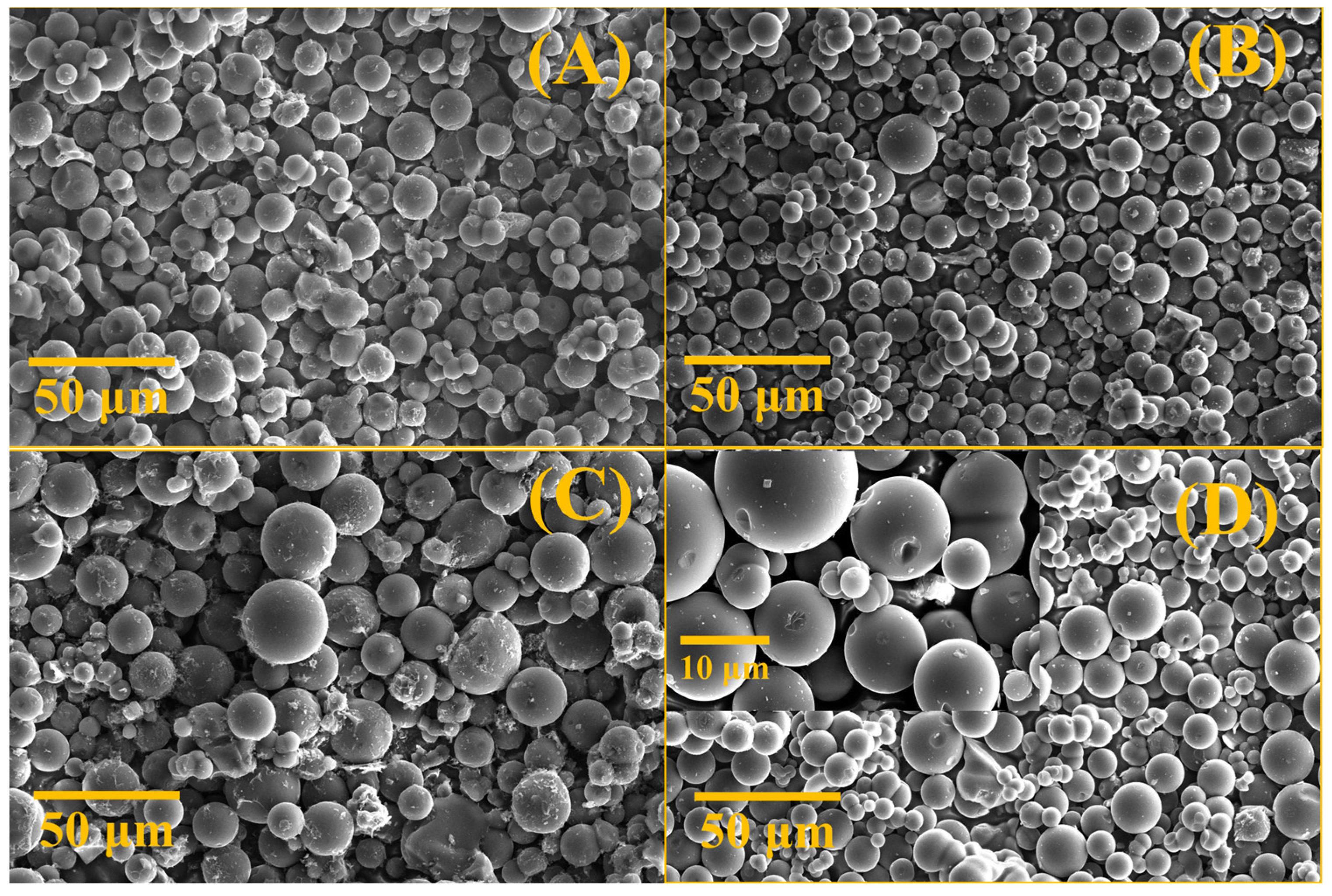
Figure 1. FESEM images of P-AC (A), P-NAHC (B), CC-AC (C), and CC-NAHC with image at higher magnification in the inset (D).
Processes 14 01694 g001
Figure 2. Particle size distribution of P-AC (A), P-NAHC (B), CC-AC (C), and CC-NAHC (D).
Processes 14 01694 g002
Figure 3. FESEM image of the CC-AC sample with corresponding mapping images of C (B), Cl (C), and O (D), and EDS spectrum in the inset of (A).
Processes 14 01694 g003
Figure 4. Voltammograms of P-AC (A), P-NAHC (B), CC-AC (C), and CC-NAHC (D) at a scan rate of 20 mV s−1 in N2- and O2-saturated 0.1 M KOH solution.
Processes 14 01694 g004
Figure 5. ORR polarization curves recorded in O2-saturated 0.1 M KOH at 20 mV s−1 and 1600 rpm for P-AC, P-NAHC, CC-AC, and CC-NAHC (A); corresponding Tafel plots derived from the kinetic region of the ORR (B); CA responses of P-AC, P-NAHC, and CC-NAHC over 3000 s, (C) and over 7000 s for CC-AC (D).
Processes 14 01694 g005
Figure 6. ORR polarization curves recorded in O2-saturated 0.1 M KOH at a scan rate of 20 mV s−1 and various rotation speeds (400–3600 rpm) for: (A) P-AC, (B) P-NAHC, (C) CC-AC, and (D) CC-NAHC. The inset in (D) presents the calculated n as a function of applied potential.
Processes 14 01694 g006
Table 1. EDS results of the elemental compositions of P-AC, P-NAHC, CC-AC, and CC-NAHC.
SampleElementLine TypeWeight%Atom%
CC-NAHCCK77.38282.006
OK22.61817.994
CC-ACCK86.33989.947
OK14.1909.533
ClK1.4710.519
P-NAHCCK75.87880.732
OK24.12219.268
P-ACCK85.70489.603
OK12.3839.719
ClK1.9130.678
Disclaimer/Publisher’s Note: The statements, opinions and data contained in all publications are solely those of the individual author(s) and contributor(s) and not of MDPI and/or the editor(s). MDPI and/or the editor(s) disclaim responsibility for any injury to people or property resulting from any ideas, methods, instructions or products referred to in the content.