Article

Selective Synthesis of Nitrite and Nitrate by Liquid-Phase Plasma Using a Dual-Cell: Role of Active Species


Division of Ocean Advanced Materials Convergence Engineering, National Korea Maritime & Ocean University, 727 Taejong-ro, Yeongdo-gu, Busan 49112, Republic of Korea
*
Author to whom correspondence should be addressed.
Processes 2026, 14(10), 1668; https://doi.org/10.3390/pr14101668
Submission received: 16 April 2026 / Revised: 12 May 2026 / Accepted: 18 May 2026 / Published: 21 May 2026
(This article belongs to the Section Environmental and Green Processes)

Abstract

Plasma-assisted nitrogen fixation has emerged as a promising strategy for sustainable nitrate production. However, the coexistence of multiple interfaces and complex multi-step reaction pathways within the plasma-liquid system often leads to the formation of mixed nitrogen species, posing a significant challenge for achieving high product selectivity. In this study, a dual-cell reactor was introduced in liquid-phase plasma (LPP) system, enabling selective product distribution. Optical emission spectroscopy revealed pronounced signals corresponding to the second positive system (SPS) of N2 and the first negative system (FNS) of N2+, indicative of strong plasma excitation and ionization processes that facilitated the formation of reactive nitrogen oxide intermediates. These species were subsequently converted into aqueous NO2 and further oxidized into NO3 only in the reaction cell where reactive species are generated. The effects of key parameters, including electrode material, treatment time, solution pH, and discharge conditions, were comprehensively evaluated. As a result, the reaction cell achieved a nitrate selectivity of 98.9%, whereas the absorption cell achieved a nitrite selectivity of 100%. Findings from EPR and scavenger analyses collectively provide a detailed mechanistic understanding of LPP-driven nitrogen fixation and highlight the importance of controlling plasma parameters to achieve highly selective production of nitrogen compounds.

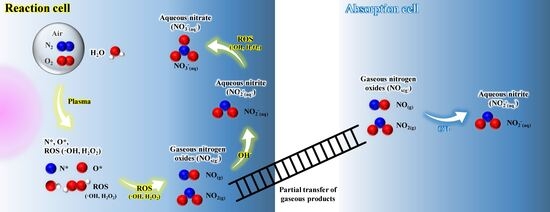
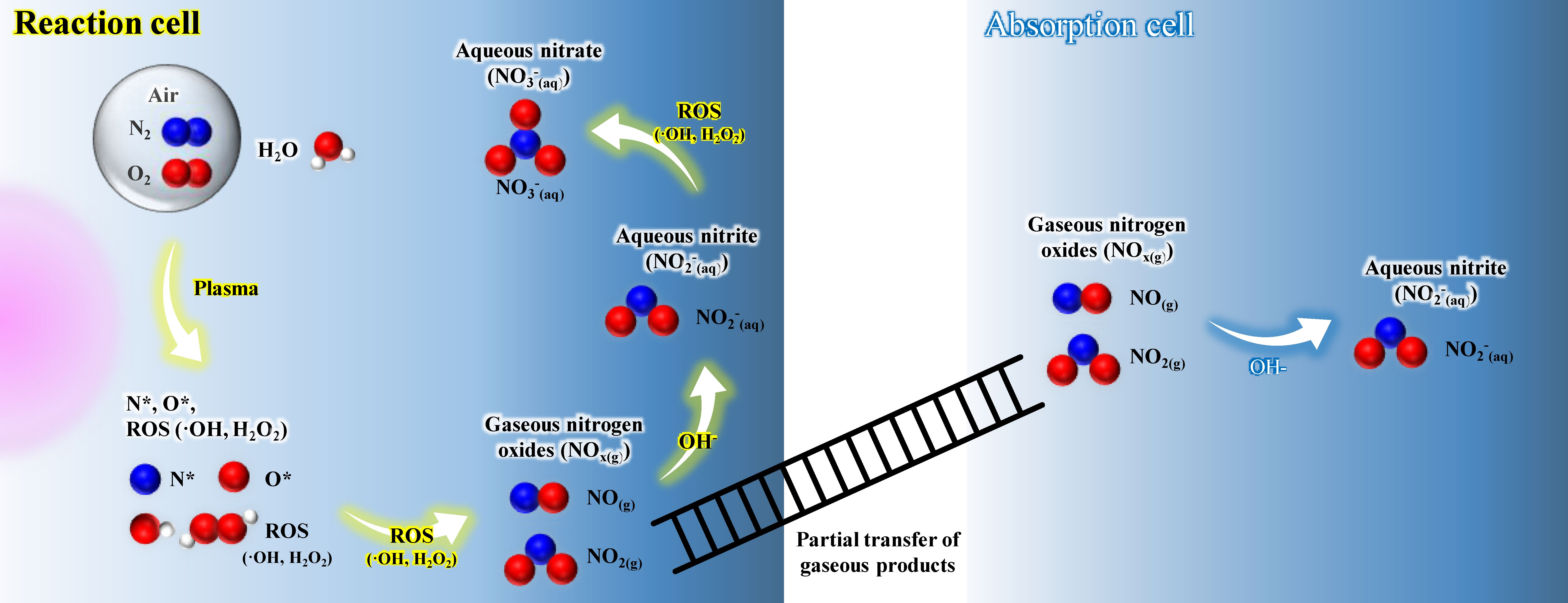
Graphical Abstract

1. Introduction

Nitrogen is widely distributed in both the natural environment and human society, and serves as an essential element for living organisms. However, atmospheric nitrogen (N2) possesses an extremely stable triple bond (941 kJ/mol), rendering it largely inaccessible for direct biological utilization [1]. Thus, nitrogen must be converted into biologically available compounds such as nitrite (NO2), nitrate (NO3), and ammonia (NH3) through a process known as nitrogen fixation. In natural systems, nitrogen fixation can occur through abiotic processes such as lightning and ultraviolet irradiation; however, more than 90% of total nitrogen fixation is facilitated by soil-dwelling microorganisms [2]. Driven by rapid population growth, the increasing demand for nitrogen in agriculture and related industries has far surpassed the natural supply, necessitating the development of artificial nitrogen fixation technologies. Currently, approximately 40% of the global population depends on nitrogen compounds produced via the Haber-Bosch (H-B) process, which accounts for nearly 90% of global ammonia-based fertilizer production [3,4,5]. The H-B process utilizes nitrogen and hydrogen gases as feedstocks, with the hydrogen primarily derived from fossil fuel reforming. Notably, it consumes approximately 50% of global hydrogen production, about 95% of which originates from fossil sources, highlighting the urgent need for cleaner hydrogen alternatives [6]. To overcome the strong triple bond of nitrogen, the reaction is conducted under high-temperature (450–600 °C) and high-pressure (150–350 atm) conditions [7]. These energy-intensive conditions, combined with the fossil-based hydrogen input, result in substantial greenhouse gas emissions. The process requires approximately 0.48 MJ of energy per mole of N2, and is estimated to account for 1–2% of global energy consumption, contributing over 300 million metric tons of CO2 emissions annually [8,9,10]. These concerns underscore the urgent need to develop sustainable and energy-efficient alternatives to the Haber-Bosch process for nitrogen fixation.
Plasma nitrogen fixation has attracted considerable attention as an eco-friendly strategy without emitting harmful byproducts, as it leverages a variety of highly reactive species, including radicals, accelerated electrons, excited molecular species and photons, generated during electrical discharge [11,12,13]. Theoretically, the energy demand for plasma nitrogen fixation is approximately 0.2 MJ per mole of N2, which is about 2.5 times lower than that of the conventional H-B process [14]. Moreover, plasma systems are highly modular and scalable, making them well suited for decentralized and flexible production infrastructures [15]. Owing to these features, plasma nitrogen fixation was first industrially attempted as early as 1903 through the Birkeland-Eyde process [3]. However, that approach relied on electric arc treatment of air and suffered from excessive energy consumption, ultimately limiting its economic viability [16]. Subsequent efforts involving thermal plasma technologies demonstrated improved conversion rates and product concentrations, but required high energy input to heat the entire gas phase, which significantly reduced overall efficiency [17]. In contrast, non-thermal plasma (NTP) technologies leverage their non-equilibrium characteristics, featuring high electron temperatures and low gas temperatures, to enable efficient nitrogen dissociation at significantly lower energy cost, and are increasingly being recognized as promising next-generation alternatives for sustainable nitrogen fixation under mild reaction conditions [18,19,20,21].
Among the non-thermal plasma technologies, the liquid-phase plasma (LPP) process, in which plasma is generated directly within the liquid medium, exhibits several advantages over conventional approaches. In particular, when water is used as the reaction medium, the plasma discharge can simultaneously supply hydrogen and reactive oxygen species from water, while nitrogen is provided from ambient air, thus enabling self-sufficient nitrogen fixation without the need for additional gas feeding systems. In addition, other plasma-water-based nitrogen fixation systems typically generate discharge only at the plasma-gas or gas-liquid interface, limiting the interaction area and confining the reaction to a narrow interfacial region. In contrast, LPP involves direct discharge within the liquid phase, creating a complex multi-interface reaction zone that includes plasma-electrode, plasma-gas, gas-liquid, and plasma-liquid interfaces [22]. This significantly increases the specific interfacial area and activates multiple reactive pathways, thereby enhancing the efficiency of nitrogen fixation [23]. Furthermore, since the discharge occurs within the bulk liquid, the generated nitrogen-containing products are immediately captured into the solution, minimizing product loss and simplifying process configuration [24]. The use of pulsed power supply in the LPP system also allows intermediate species to diffuse into the bulk phase during off-times between pulses, promoting the formation of diverse intermediate products rather than only fully oxidized end-products. Despite these advantages, plasma–liquid nitrogen fixation systems are commonly known to involve multiple concurrent interfaces and reaction pathways, resulting in a highly complex and multi-step reaction environment. As a result, post-reaction solutions often contain a mixture of nitrogen species, such as NO2, NO3, and NH3, which poses a significant challenge for product selectivity in applications that demand targeted nitrogen compounds. To address this challenge, it is essential to establish process-control strategies capable of regulating product distribution and enabling selective synthesis in LPP-based nitrogen fixation systems. Therefore, a deeper understanding of the chemically active species generated during plasma discharge, together with experimental validation of their roles in nitrogen-species formation and conversion, is required for the rational design of selective LPP processes. In this context, spatial separation of the plasma reaction zone and the gas absorption zone can serve as a practical process-control strategy for regulating the local reaction environment and product distribution. By decoupling the strongly oxidative plasma–liquid reaction environment from the downstream gas absorption environment, a dual-cell LPP configuration may enable selective accumulation of different nitrogen products in each cell.
In this study, a dual-cell LPP reactor was designed based on this spatial-separation concept for selective nitrogen-product formation. The reactor consisted of a reaction cell, where plasma discharge was directly generated in the liquid phase, and an absorption cell, where exhaust-gas-derived nitrogen species transported from the reaction cell were captured into the liquid phase. This configuration was intended to decouple the strongly oxidative plasma reaction environment from the downstream gas absorption environment, thereby enabling selective liquid-phase accumulation of NO3 in the reaction cell and NO2 in the absorption cell. Using this dual-cell system, the effects of electrode material, treatment time, solution pH, and electrical discharge parameters, including frequency and pulse width, were systematically investigated to regulate nitrogen-product distribution. In addition, OES, EPR, H2O2 analysis, and scavenger experiments were employed to evaluate the generation of chemically active species and their roles in nitrogen-species formation and conversion. Through this approach, the present study demonstrates that spatial separation of reaction and absorption environments can serve as a practical strategy for improving product selectivity in LPP-based nitrogen fixation.

2. Experimental Section

2.1. Chemicals and Materials

Hydrochloric acid (HCl, EP grade), sodium nitrate (NaNO3, EP grade), ammonium chloride (NH4Cl, EP grade), and potassium chloride (KCl, EP grade) were purchased from Duksan Chemical Co., Ltd. (Ansan, Republic of Korea). Potassium hydroxide (KOH, EP grade) and Nessler reagent were obtained from Samchun Chemical Co., Ltd. (Seoul, Republic of Korea). Sodium nitrite (NaNO2, EP grade) was purchased from Daejung Chemicals & Metals Co., Ltd. (Siheung, Republic of Korea). High-purity metal wires of copper, nickel, zinc, iron, aluminum, and tungsten (Cu, Ni, Zn, Fe, Al, W; Φ 1.0 mm, ≥99.5%) were purchased from Nilaco Corporation (Tokyo, Japan). Deionized water was prepared in the laboratory using an ultrapure water purification system (New Pure Power, Human Corporation, Seoul, Republic of Korea). All reagents were used as received without further purification.

2.2. Experimental Setup

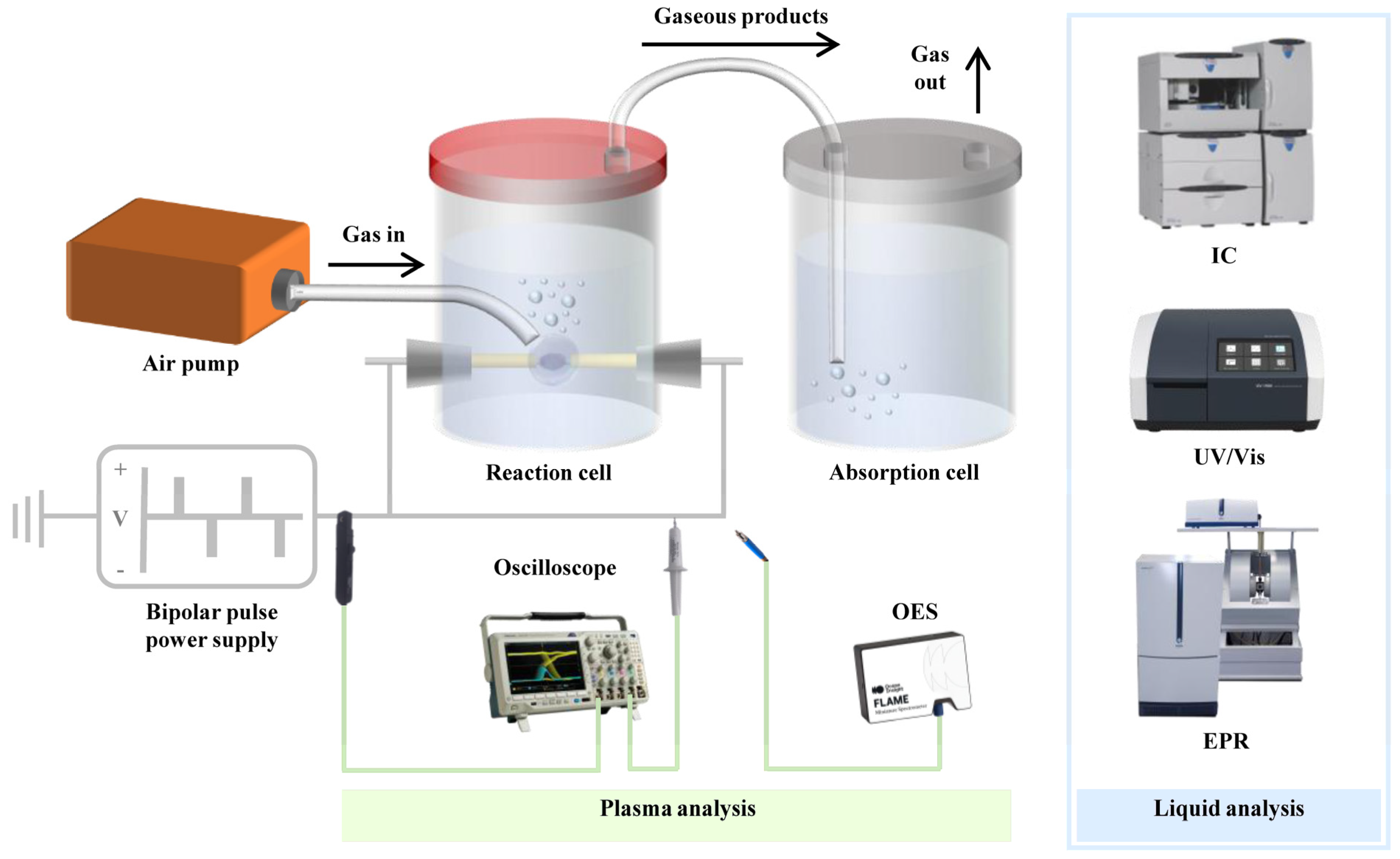
A schematic diagram of the liquid-phase plasma system used for nitrogen fixation in this study is shown in Figure 1. The system consisted of an air pump for supplying the nitrogen source (air), a reaction cell and an absorption cell for selective synthesis of nitrogen products, and bipolar pulse power supply, electrodes, and water for plasma generation. The two coaxial electrodes were positioned face-to-face at the bottom of the reaction cell. To focus the energy on the electrode tips, the electrodes were partially insulated with alumina tubes, leaving only the tips exposed. The diameter and protrusion length were set to 1 mm and inter-electrode gap was set to 0.5 mm. An air injection hose was placed 1 mm away from the electrode tips, and air was continuously supplied at a flow rate of 2 L min−1. Considering that air contains approximately 78% N2, the N2 input was approximately 1.56 L min−1. To optimize the nitrogen fixation performance, the electrode materials, treatment time, solution type, and discharge parameters, were systematically varied. Unless otherwise specified, the standard conditions were as follows: 3 mM KCl was used in the reaction cell to improve electrical conductivity and facilitate plasma generation, while deionized water was used in the absorption cell. The reaction and absorption solutions were physically separated and connected only through a gas-transfer line for collecting gaseous products from the reaction cell. Because KCl is a nonvolatile salt and direct liquid contact between the two solutions was avoided, the influence of KCl transfer to the absorption cell is expected to be limited under the present experimental configuration. Tungsten (W) electrodes were used, with a discharge frequency of 20 kHz and a pulse width of 2 μs. The plasma treatment was conducted for up to 20 min. The voltage–current waveforms were recorded using an oscilloscope, and the optical emission behavior was observed by optical emission spectroscopy during plasma discharge. After 20 min of treatment, no noticeable changes were observed in the voltage–current waveforms or optical emission features, confirming that the plasma discharge was maintained stably under the applied conditions.
The electrical characteristics of the LPP were monitored using a digital oscilloscope (MSO 3014, Tektronix, Beaverton, OR, USA) equipped with a high-voltage probe (P6015A, Tektronix) and a current probe (TCP0020, Tektronix). The voltage and current waveforms during plasma discharge were recorded to evaluate the discharge behavior and input energy. Reactive species generated in the plasma region were characterized using optical emission spectroscopy (OES) (FLAME-T-XR1, Ocean Insight, Orlando, FL, USA). The optical fiber probe was positioned approximately 1 mm from the reactor wall and aligned with the electrode tip to detect the emission spectra from the plasma core region. All experiments were performed at room temperature (25 °C) and ambient pressure (1 bar).

2.3. Measurement Methods

The primary nitrogen-containing products analyzed were nitrite (NO2), nitrate (NO3), and ammonia (NH3). NO2 and NO3 concentrations were quantified using ion chromatography (IC) equipped with an AS18 analytical column and an AG18 guard column (Dionex, Thermo Fisher Scientific, Waltham, MA, USA). The eluent consisted of 33 mM potassium hydroxide. The flow rate was maintained at 1.0 mL min−1, and the injection volume was set to 25 μL. Stock standard solutions of 0.1 M were prepared by dissolving 6.9 g of NaNO2 and 8.5 g of NaNO3 in 1.0 L of deionized water, respectively. The retention times of NO2 and NO3 were approximately 5.4 and 8.5 min, respectively. Working standards were freshly prepared by diluting the stock solutions to concentrations that bracketed the expected sample concentrations and were used immediately before analysis. NH3 was quantified using Nessler’s method. Although this colorimetric method may be susceptible to matrix-dependent interferences, representative samples were additionally examined by ion chromatography to assess the reliability of NH3/NH4+ quantification. The results showed no substantial discrepancy between the two methods under the present experimental conditions. Because NH3 was detected only as a minor product compared with NO2 and NO3, possible small deviations in NH3 quantification were considered to have a limited influence on the overall nitrogen-product distribution. Therefore, Nessler’s method was used for routine NH3 analysis because of its simplicity and suitability for repeated measurements. A series of ammonium chloride (NH4Cl) standard solutions with known concentrations were prepared to establish a calibration curve. For each measurement, 10 mL of the LPP-treated solution was mixed with 1 mL of potassium sodium tartrate solution and 1 mL of Nessler’s reagent. The mixture was allowed to react for 30 min at room temperature. Subsequently, UV-Vis absorbance was measured at 420 nm using a spectrophotometer (UV-1900i, Shimadzu, Kyoto, Japan). The NH3 concentration in each sample was calculated by substituting the measured absorbance value into the standard calibration curve. In the present study, gas-phase NO and NO2 were not directly quantified. Because the LPP reaction field involves highly non-equilibrium reactions at multiple interfaces, including plasma–gas, plasma–liquid, gas–liquid, and plasma–electrode interfaces, downstream gas analysis may not fully reflect the transient NOx species generated in the plasma reaction zone. Therefore, this study focused on the quantification of liquid-phase nitrogen-containing products collected in the reaction and absorption cells. NO2, NO3, and NH3/NH4+ were quantified as the target liquid-phase nitrogen products and used to calculate product yield, nitrogen output, and liquid-phase product selectivity. All measurements were conducted in triplicate to ensure accuracy and reproducibility.

2.4. Data Processing

The amounts of nitrogen-containing products reported in this study were expressed in μmol and were calculated from the measured concentration and the corresponding solution volume:
n i = C i × V
where n i is the amount of the target nitrogen product, C i is the measured concentration, and V is the solution volume. Since the solution volume used in this study was 1 L, the measured concentration in μmol L−1 was converted to the accumulated product amount in μmol.
The liquid-phase product selectivity was calculated based on the detected nitrogen-containing species in solution, including NO2, NO3, and NH3/NH4+, using the following equation:
S e l e c t i v i t y   % = n i n N O 2 + n N O 3 + n N H 3 / N H 4 + × 100
the amount of each product was obtained by multiplying the measured concentration by the corresponding solution volume. Gas-phase nitrogen-containing species, such as residual NO and NO2 in the exhaust gas, were not included in the selectivity calculation because they were not directly quantified in this study. Therefore, the reported selectivity values represent liquid-phase product selectivity rather than overall nitrogen-product selectivity.
The electrical energy consumed during plasma treatment was calculated from the voltage–current waveform. The energy consumed per pulse was obtained by integrating the instantaneous power, V ( t ) I ( t ) , over a single pulse:
E p u l s e = 0 τ V ( t ) I t d t
where E p u l s e is the electrical energy consumed per pulse, V t is the applied voltage, I t is the discharge current, and τ is the pulse duration. The total electrical energy input during plasma treatment was then calculated by multiplying the pulse energy by the applied frequency and treatment time:
E t o t a l = f × t t r e a t m e n t × E p u l s e
where f is the pulse frequency and t t r e a t m e n t is the plasma treatment time. The energy consumption for nitrogen-containing product formation was calculated by normalizing the total electrical energy input by the amount of product formed:
E n e r g y   c o n s u m p t i o n   M J   m o l 1 = E t o t a l n i × 10 6 = f × t t r e a t m e n t × 0 τ V ( t ) I ( t ) d t n i × 10 6

3. Results

3.1. Optical Diagnostics of Liquid-Phase Plasma

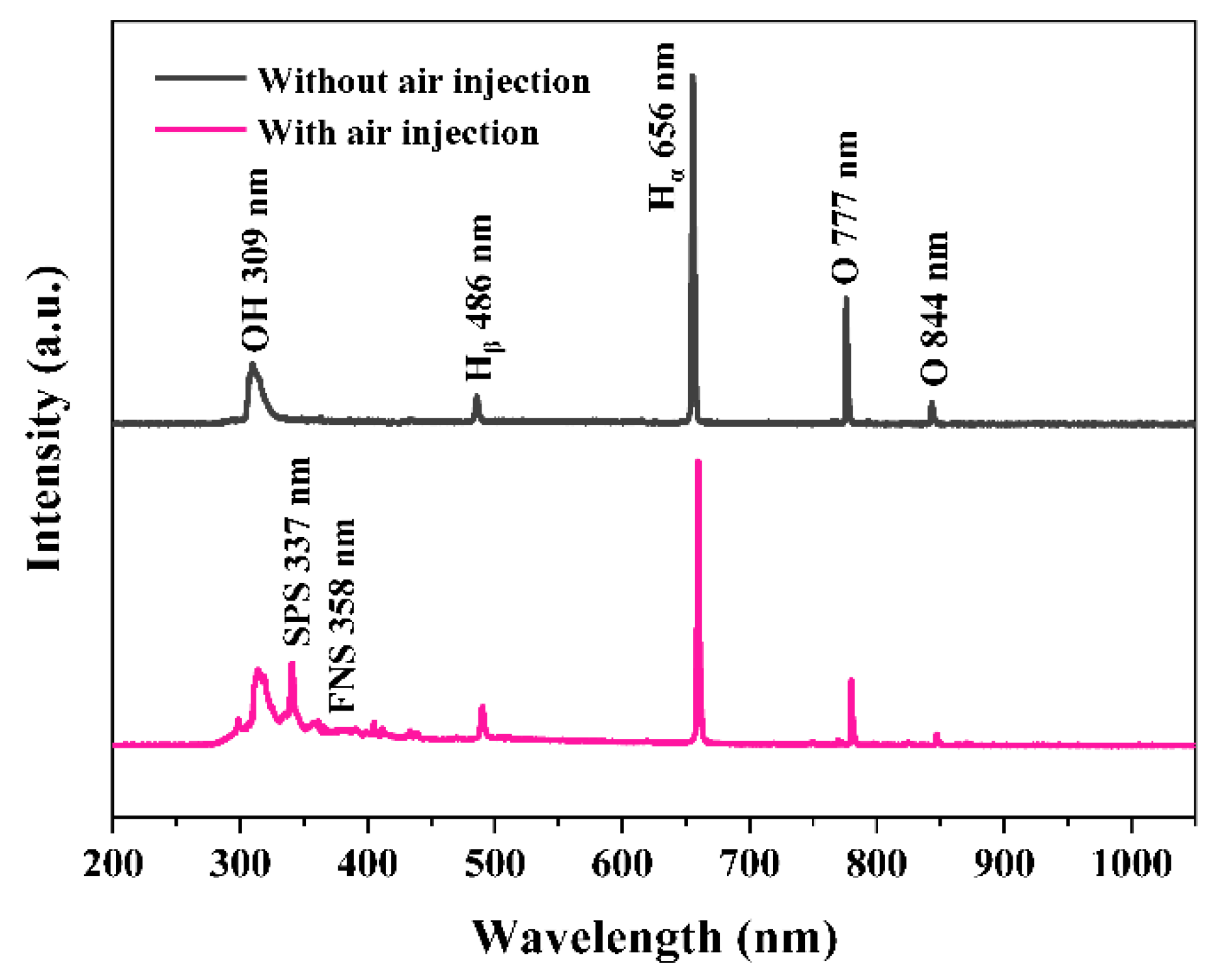
Optical diagnostics were conducted to identify the active species generated during plasma discharge in water. As shown in Figure 2, in the absence of external air supply, characteristic emission peaks were observed at 486 and 656 nm, corresponding to atomic hydrogen transitions (Hβ and Hα), and at 777 and 844 nm, which are attributed to atomic oxygen transitions from the excited states of 3p5P → 3s5S0 and 3p3P → 3s3S, respectively. In addition, the emission at 309 nm corresponds to the electronic transition (A2Σ+ → X2Π) of hydroxyl radicals (·OH), indicating the presence of highly reactive species such as atomic H, atomic O, and ·OH within the plasma-liquid interface. These radicals are generated primarily through the following electron-impact reactions [25]:
e + H2O → ·OH + ·H + e
e + O2 → O(3P) + O(1D) + e
O(1D) + H2O → ·OH + ·OH
·H + O2 → ·OH + O
O + O → O2
These species undergo subsequent reactions, either with each other or with other plasma-generated intermediates, UV photons, and aqueous components to produce higher oxidative species such as ozone (O3), hydrogen peroxide (H2O2), hydroperoxyl radicals (O2H·), and additional ·OH. These oxygen-based reactive species are known to possess strong oxidative potentials and play key roles in oxidation and nitrogen transformation reactions within the plasma-treated solution.
When air was introduced into the reaction cell, additional emission bands were detected, representatively, the N2 s positive system (SPS) at 337 nm and the N2+ first negative system (FNS) at 358 nm [26]. These spectral features indicate the presence of electronically excited molecular nitrogen (N2(C3Πu) and ionized nitrogen species (N2+(B2Σu+)), which are generated via energetic electron collisions with ground-state N2 molecules from the air. Their subsequent radiative transitions to lower energy states, N2(B3Πg) and N2+(X2Σg+), respectively, produce the observed spectral lines. The emergence of SPS and FNS peaks suggests the activation of plasma-induced nitrogen pathways that can lead to the generation of nitrogenous intermediates. These excited or ionized nitrogen species participate in various plasma-liquid or plasma-gas reactions, forming critical precursors. Representative reaction pathways that may be initiated or facilitated by these species include [27,28,29]:
E + N2(X) → e + N2(Xv=1)
E + N2(X) → e + N2(A3Σu+)
N(2D) + H2O → OH + NH
N + O2 → NO + O
NO + O3 → NO2 + O2
NO2 + O3 → NO3 + O2
NH + OH → NO + H2
NH + O2 → OH + NO
Such reactions contribute to the formation of both oxidized nitrogen species (NO2 and NO3) and reduced nitrogen species (NH3), depending on the discharge conditions. Accordingly, systematic investigations were conducted to evaluate how key operational factors, including the type of electrode, plasma treatment time, electrolyte composition, and discharge conditions, influence the selectivity and efficiency of nitrogen fixation pathways.

3.2. Optimal Conditions of Liquid-Phase Plasma for Nitrogen Fixation

3.2.1. Electrode-Dependent Nitrogen Fixation Selectivity

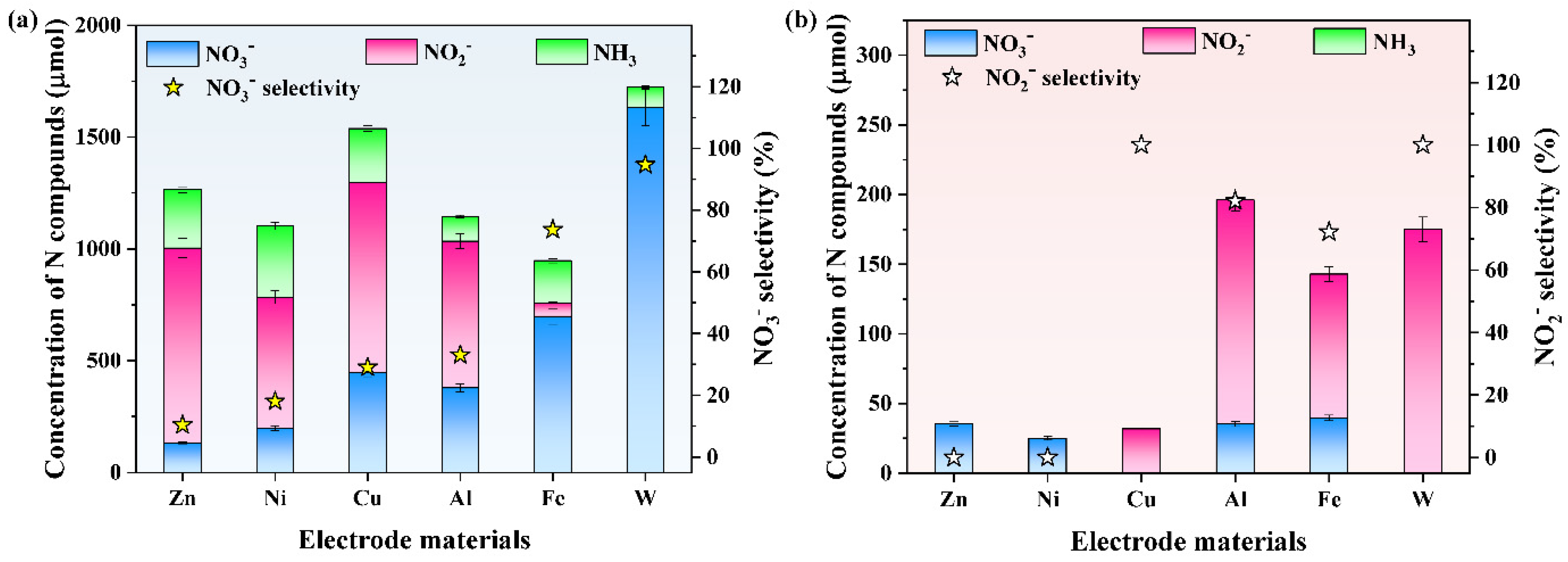
To investigate the catalytic influence of metallic electrodes on plasma characteristics and the selectivity of nitrogen fixation, a series of experiments were conducted using various metal electrodes under identical plasma operating conditions. As illustrated in Figure 3, the type of electrode material significantly influenced both the discharge behavior of the plasma and the distribution of nitrogen fixation products in the reaction and absorption cells. Notably, the tungsten electrode demonstrated superior performance, achieving a NO3 yield of 1631.8 μmol with a high selectivity of 94.7% in the reaction cell and a NO2 yield of 175.0 μmol with a selectivity of 100% in the absorption cell. In contrast, other electrode materials resulted in the simultaneous formation of NO2 alongside NO3, indicating lower product selectivity.
The role of the tungsten electrode should be understood primarily in terms of physical durability and discharge stability rather than catalytic activity. Tungsten has a very high melting point, high thermal stability, high hardness, and strong resistance to thermal erosion, which make it suitable for plasma processes where electrode erosion and metal contamination should be minimized. In the plasma reaction field, the collision of high-energy electrons with the electrode surface can induce sputtering, releasing metal atoms or ions into the reaction environment. These sputtered species can act as catalysts for various electrochemical reactions or locally enhance the electric field, thereby modifying the electron energy distribution and influencing the reaction pathways of intermediate and final products in the reaction and absorption cell [30,31,32,33]. Indeed, as shown in Supplementary Figure S1, prominent emission peaks corresponding to the intrinsic optical signatures of each metal were observed in the optical emission spectra for all electrodes except tungsten. This observation confirms the presence of sputtered metal species within the plasma reaction field, suggesting their active participation in plasma-liquid interactions. The sputtered metal species can significantly affect plasma behavior by modifying the population and type of active species generated in the reaction field. These changes can enhance the concentration of certain products or improve energy efficiency by influencing the reaction kinetics and pathways [34]. As a result, the generation pathways of NO2 and NH3 may be altered or promoted depending on the nature of the metallic species involved. In contrast, the OES spectrum of the W electrode, shown in Figure 2, revealed no significant peaks corresponding to tungsten-specific emission lines, indicating minimal sputtering. The absence of detectable W species implies that metal-induces side reactions were effectively suppressed, allowing the plasma to engage more selectively and efficiently in the primary nitrogen fixation reactions. Consequently, the generation of highly reactive species such as hydroxyl radicals and atomic oxygen may have proceeded more efficiently, promoting the activation of nitrogen molecules and facilitating their conversion into nitrate.

3.2.2. Effect of Treatment Time on Product Selectivity

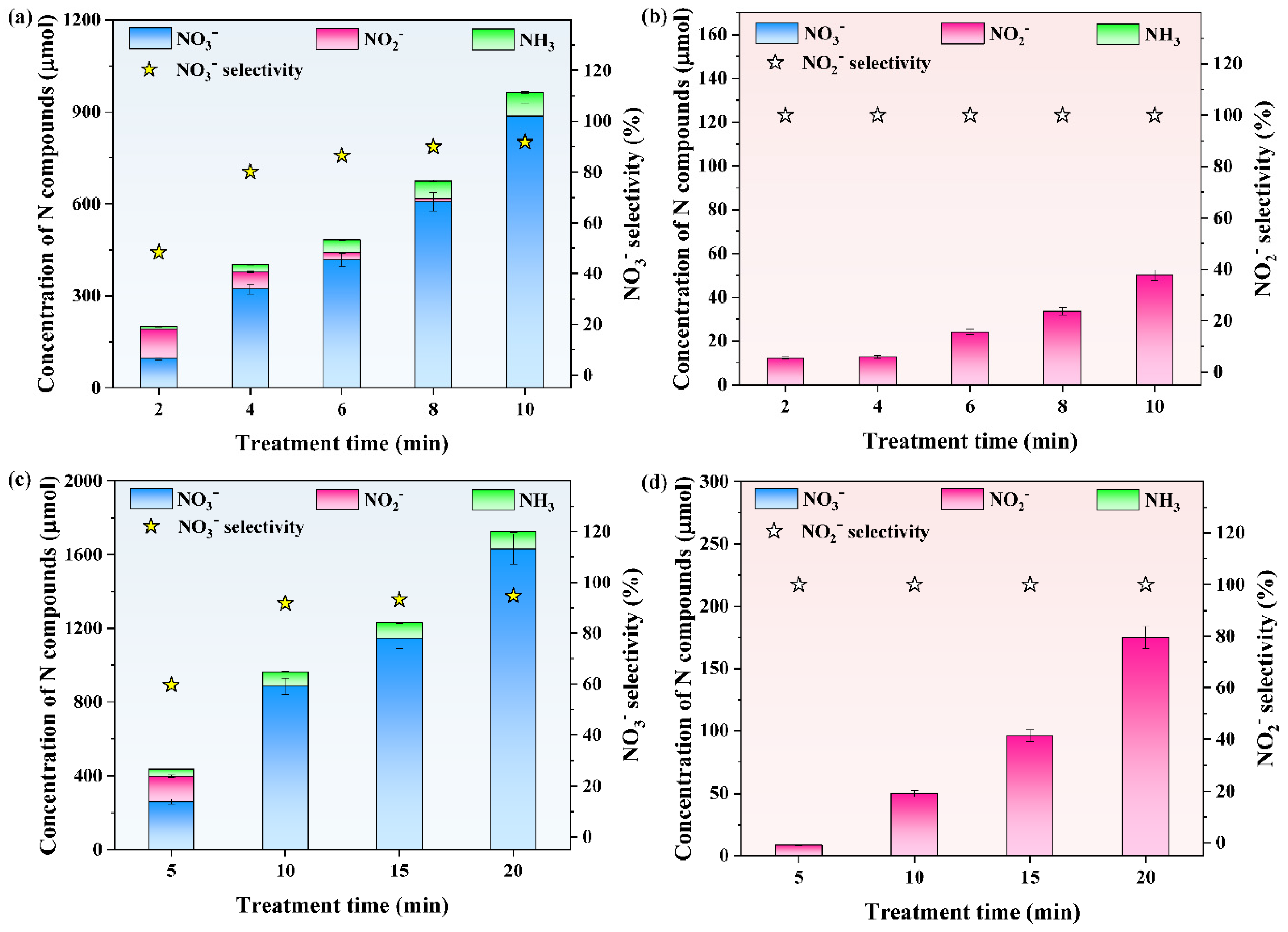
To gain insight into the time-dependent formation, conversion, and selectivity of nitrogen fixation products under plasma conditions, the treatment time was controlled, and samples were collected at various intervals for detailed analysis. The results clearly demonstrate distinct trends in the accumulation and distribution of nitrogen species within the reaction and absorption cells. As shown in Figure 4a, NO3 emerged as the dominant product in the reaction cell, with its concentration increasing as the plasma treatment time progressed. After 10 min of discharge, the NO3 concentration reached 884.4 μmol, corresponding to a high product selectivity of 91.7%. Conversely, NO2 exhibited a different trend: at 2 min, its concentration peaked at 95.3 μmol, which was nearly equivalent to that of NO3 (96.4 μmol), accounting for 47.7% of the total nitrogen compounds formed at that stage. However, the NO2 level rapidly declined with extended treatment, and it became undetectable after 10 min of operation. These results strongly suggest that although NO2 is initially generated in the plasma-liquid interface, it is subsequently oxidized to NO3 via reactions with highly reactive oxygen species (ROS), such as OH, O, and H2O2, which are abundantly produced under plasma discharge conditions. Interestingly, while hydrogen activation generally occurs more readily than nitrogen due to its lower bond dissociation energy, making it unlikely to be a rate-limiting step, the notably lower concentration of NH3 compared to NOx species suggests that NH3, once formed, may undergo rapid decomposition under LPP conditions [18]. This inference aligns with previous findings showing that LPP can effectively decompose NH3 under optimized conditions, with the removal mechanism mainly attributed to accelerated electron collisions and ·OH-mediated oxidation [35].
In contrast, as shown in Figure 4b, only NO2 was detected in the absorption cell, which passively collects gaseous products released from the reaction cell, and the concentration steadily increased with treatment time. This observation reflects the initial reaction pathway in which NOx gases (primarily NO and NO2), generated in the plasma gas phase, dissolve into the water and convert into aqueous nitrogen species because NO and NO2 possess relatively low Henry’s law constants (0.044 and 0.28, respectively), indicating poor solubility in water. The absence of other nitrogen compounds in the absorption cell suggests that, in the absence of direct plasma interaction and ROS, NO2 remains stable and does not undergo further oxidation to NO3.
By comparing both cells, a mechanistic understanding emerges: NO2 acts as the initial product of nitrogen fixation, particularly at the early stages of plasma treatment. Over time, in the presence of persistent ROS generated in the plasma reaction field, NO2 undergoes further oxidation to form NO3. This mechanism is further corroborated by the time-resolved product distribution: after 10 min, all solutions showed a shift toward high NO3 selectivity, and by 20 min, the reaction cell achieved a NO3 yield of 1631.8 μmol with a 94.7% selectivity (Figure 4c). Meanwhile, the absorption cell, unaffected by direct plasma exposure, accumulated 175.0 μmol of NO2 with a selectivity of 100% (Figure 4d, indicating the absence of further oxidation pathways under those conditions. These findings emphasize the critical role of treatment time and localized plasma chemistry in determining the product selectivity and conversion efficiency of plasma-induced nitrogen fixation in a dual-cell system.

3.2.3. pH-Dependent Nitrogen Fixation Selectivity

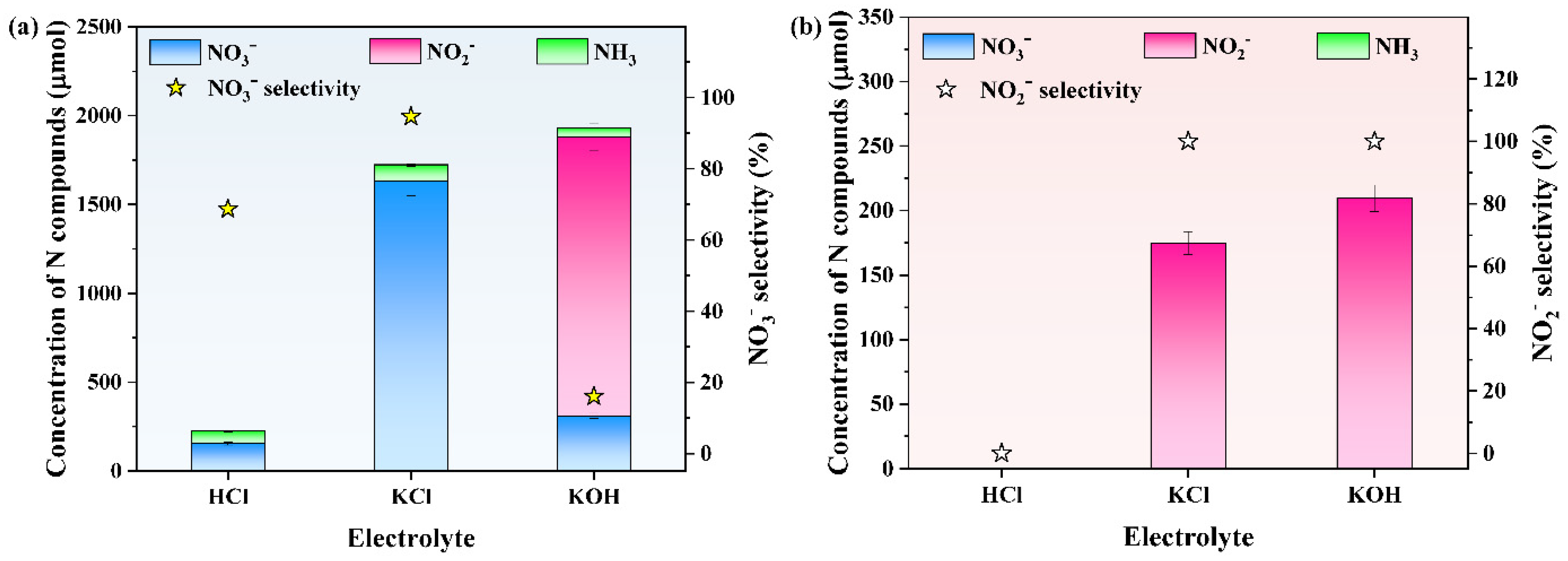
To investigate the transformation pathways between intermediate and final products during plasma-driven nitrogen fixation and to identify favorable solution conditions for selective product formation, the pH of the solution was systematically varied. The impact of the solution environment in the reaction cell on product formation and selectivity was evaluated. As illustrated in Figure 5, the type and the number of nitrogen-containing products generated in the reaction cell were significantly influenced by the pH of the solution. In acidic conditions (HCl solution), NO3 was observed as the predominant product, exhibiting a selectivity of 68.6%. However, the overall production yield was relatively low, reaching only 153.2 μmol. Conversely, under alkaline conditions (KOH solution), NO2 emerged as the dominant product with a high selectivity of 81.4% and a substantial production amount of 1569.7 μmol.
The high selectivity and yield of NO2 under alkaline conditions can be rationalized by the thermodynamic favorability of NOx(g)-to-NOx(aq) conversion reactions in basic media. Specifically, as shown in Equations (19) and (20), the reactions between NOx(g) species (NO, NO2) and hydroxide ions (OH) exhibit significantly more negative standard Gibbs free energy changes compared to the analogous reactions involving water molecules in neutral or acidic conditions (Equations (21) and (22)) [36,37]. This indicates that, in an alkaline environment, NOx(g) species are more readily converted into their ionic forms (NO2 and NO3), promoting the accumulation of NO2(aq).
2NO2 + 2OH → NO3 + NO2 + H2O (ΔG = −165.66 kJ/mol)
NO2 + NO +2OH → 2NO2 + H2O (ΔG = −128.04 kJ/mol)
2NO2 + H2O → H+ + NO3 + HNO2 (ΔG = −25.28 kJ/mol)
NO2 + NO + H2O → 2HNO2 (ΔG = −7.91 kJ/mol)
On the other hand, while acidic conditions favor the selective formation of NO3, the overall product yield remains low. This may be attributed to the less favorable energetics required for NOx(g)-to-NOx(aq) conversion in acidic media. Furthermore, as described in Equation (23), the instability of nitrous acid (HNO2) under acidic and neutral conditions can lead to its spontaneous disproportionation, producing a mixture of NO3, NO, and H3O+ [38,39]. This secondary pathway may account for the limited accumulation of NO2 and the moderate formation of NO3 observed under such conditions.
3HNO2 → NO3 + 2NO + H3O+ (ΔG = −9.46 kJ/mol)
Although the pH-dependent product distribution can be partly interpreted from thermodynamic considerations, the formation and accumulation of nitrogen species in LPP are also influenced by kinetic processes. In non-thermal LPP, energetic electrons generate short-lived oxidative species such as •OH, O, O3, and H2O2, and their contribution to liquid-phase reactions is governed by their generation, diffusion, recombination, and interfacial transport. Therefore, the observed NO2/NO3 distribution should be regarded as the result of competing processes, including the formation and dissolution of plasma-derived NOx/nitrite intermediates and their subsequent oxidation to nitrate. pH can affect this competition by altering the chemical form and reactivity of nitrite-derived species, thereby influencing whether NO2 accumulates in solution or is further oxidized to NO3 within the experimental time scale. Thus, the enhanced NO3 accumulation under acidic conditions and the greater persistence of NO2 under neutral or alkaline conditions are interpreted as the combined result of thermodynamic driving forces, pH-dependent liquid-phase conversion kinetics, and interfacial mass transfer.
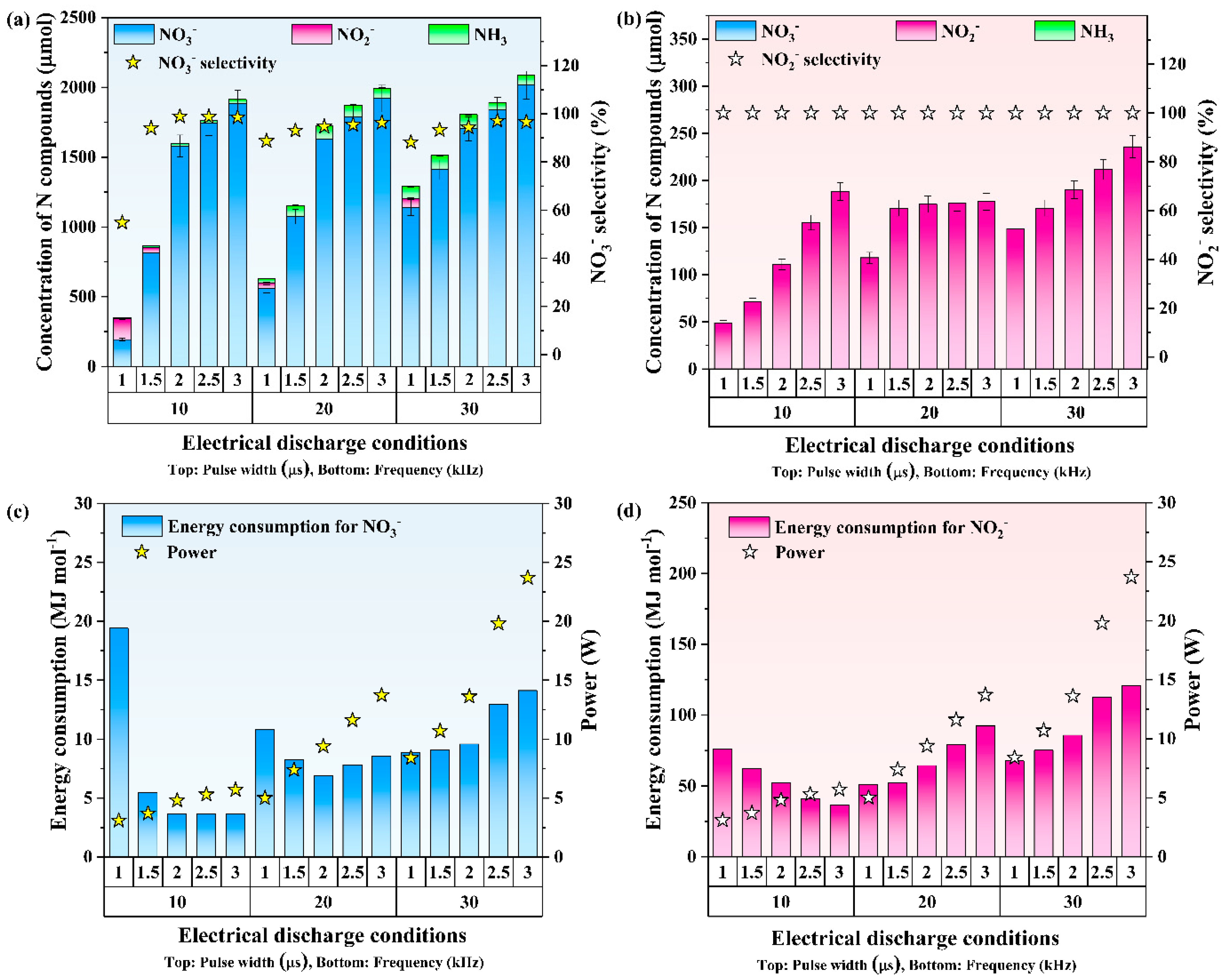
To establish the optimal plasma discharge parameters that maximize nitrogen fixation efficiency and selectivity, the relationship between applied electrical parameters, specifically frequency and pulse width, and nitrogenous product formation was systematically investigated. As presented in Figure 6a,b, a general trend was observed in which the total amount of nitrogen-containing products increased with higher frequencies and longer pulse widths, both of which correspond to elevated energy input conditions. This indicates that the formation of reactive nitrogen species is strongly influenced by the total input energy delivered during plasma discharge. Notably, across all discharge conditions, high selectivity toward NO3 was achieved, with values exceeding 98.9% in most cases. The only exceptions were observed under low-energy input scenarios: specifically, at a narrow pulse width of 1 μs across all frequencies and at 1.5 μs under the lowest frequency condition of 10 kHz. In these conditions, a small quantity of NO2 was detected alongside NO3, suggesting that the concentration of reactive oxidative species, such as ·OH, O3, and H2O2, was insufficient to fully oxidize the initially generated NO2 into NO3. This observation aligns well with previously discussed time-resolved results, where NO2 appeared as a transition intermediate during the early stages of plasma treatment (prior to 10 min) before being progressively converted to NO3 under prolonged exposure. Therefore, the presence of NO2 under low-energy discharge conditions not only highlights the importance of sufficient ROS generation for complete oxidation, but also reinforces the proposed sequential reaction mechanism in which NO2 is an early-stage product that undergoes subsequent oxidation to form NO3. These findings collectively underscore the critical role of electrical discharge parameters in determining both the yield and the product selectivity in plasma-assisted nitrogen fixation. By tailoring the pulse width and frequency to ensure adequate generation of reactive species, it is possible to optimize process efficiency and favor the formation of the desired end-product, NO3.
The actual power was further measured under each discharge condition, and the corresponding energy consumption for nitrogen fixation was evaluated, as shown in Figure 6c,d. In general, the discharge power increased with increasing frequency and pulse width, indicating that both parameters directly affected the energy input to the system. Although higher frequency or longer pulse duration enhanced nitrogen oxide formation, the improvement in product yield was not always proportional to the increase in power consumption. As a result, the energy performance varied significantly depending on the discharge condition. For the reaction cell, the most favorable energy consumption for nitrate production was achieved at a frequency of 10 kHz and a pulse width of 3 μs, giving an energy consumption of 3.6 MJ mol−1. In addition, the absorption cell also exhibited the best energy performance for nitrite production, with a energy consumption of 36.3 MJ mol−1. These results indicate that the optimal discharge condition in terms of energy efficiency was not necessarily the condition with the highest electrical input, but rather the one that provided the most balanced relationship between product formation and power consumption. Although selective nitrate formation was achieved under ambient, aqueous, and chemical-additive-free plasma conditions, the energy consumption remained relatively high compared with established industrial nitrogen-fixation processes. This higher energy demand is likely associated with energy losses inherent to non-equilibrium plasma processes, including gas heating, radical recombination, limited gas–liquid mass transfer, and incomplete utilization of short-lived chemically active species. Representative plasma-based NOx synthesis studies have reported that energy consumption strongly depends on plasma power, gas composition, gas flow rate, residence time, and product-collection pathway. In this context, the studies by Rouwenhorst et al. and Patil et al. provide useful reference points for evaluating the energy-efficiency challenges of plasma nitrogen fixation [14,40]. In addition, the energy consumption for nitrite production in the absorption cell was higher than that for nitrate production in the reaction cell. This difference can be attributed to the distinct product-formation and collection pathways in the dual-cell LPP system. In the reaction cell, plasma-generated nitrogen-containing intermediates and chemically active species are produced directly at the plasma–liquid interface and can be immediately captured and converted in the liquid phase, resulting in efficient nitrate accumulation. In contrast, the absorption cell mainly collects residual NOx-related species transported with the exhaust gas after the primary plasma–liquid reactions and liquid-phase capture in the reaction cell. Therefore, only a fraction of the generated nitrogen-containing intermediates reaches the absorption cell and contributes to nitrite formation. The lower nitrite accumulation in the absorption cell consequently results in higher energy consumption when the total plasma energy input is normalized by the amount of nitrite collected. Previous studies using separated reaction and absorption zones have also shown that spatial separation can be an effective strategy for improving product selectivity. Building on this concept, the present dual-cell LPP system combines selective liquid-phase accumulation of nitrate and nitrite with experimental observations of chemically active species, providing further insight into the product-formation pathways in separated plasma reaction and gas absorption environments.

4. Discussion

The results presented above collectively indicate that product selectivity in the dual-cell liquid-phase plasma system is governed not only by the physical separation of the reaction and absorption zones, but also by the generation, distribution, and reactivity of plasma-induced active species. In particular, the selective formation of NO2 or NO3 appears to be closely associated with the local oxidative environment established under different operating conditions. Therefore, a more detailed discussion is needed to clarify how active species participate in nitrogen conversion pathways and determine the final product distribution. The following discussion focuses on how these factors influence the formation of reactive oxygen species and, consequently, regulate the sequential conversion of nitrogen intermediates in the dual-cell system.
To further elucidate the mechanism underlying the selective nitrogen fixation in the dual-cell liquid-phase plasma system, the roles of key plasma-generated active species, particularly hydroxyl radicals (·OH) and hydrogen peroxide (H2O2), were investigated. Previous studies have identified these ROS as critical contributors to a wide range of chemical reactions occurring in plasma-liquid interaction system [41,42,43]. In this study, the presence and concentrations of these species were evaluated as a function of discharge time in order to elucidate how the selectivity toward nitrogenous products (e.g., NO2, NO3, and NH3) is regulated by the oxidative species generated during LPP treatment.
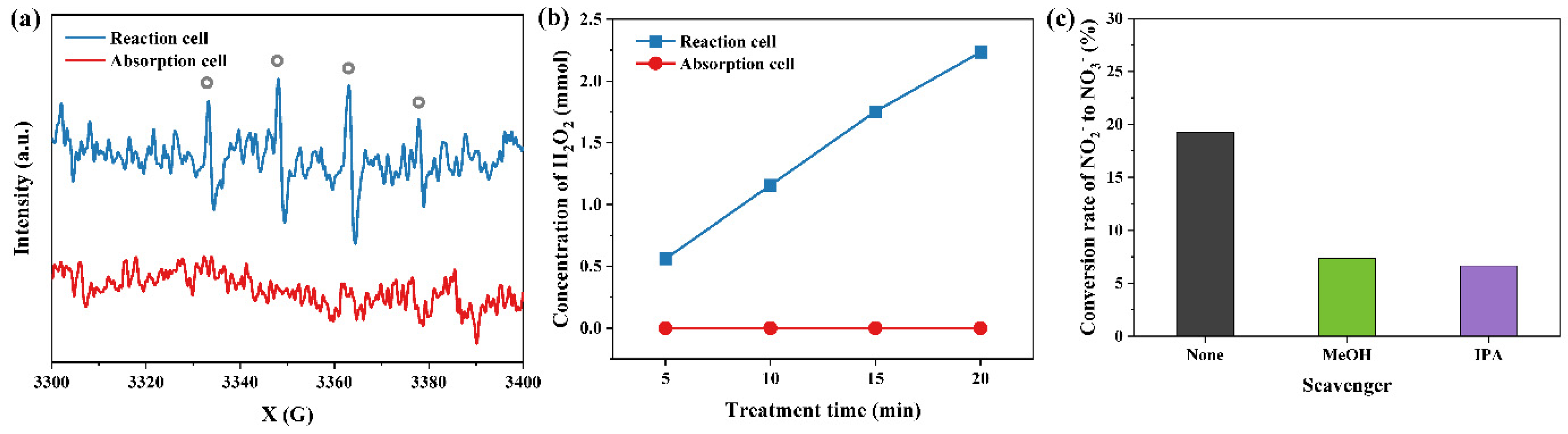
Figure 7a presents the EPR spectra used to detect ·OH in both the reaction and absorption cells. In parallel, Figure 7b illustrates the time-dependent concentration profile of H2O2. The distinct spectra of the DMPO-OH adducts, which showed a 1:2:2:1 quartet characteristic, was observed only in the reaction cell. Additionally, H2O2 accumulation was confirmed in the reaction cell through colorimetric analysis. By contrast, none of these ROS were detected in the absorption cell, indicating that highly oxidative species are primarily generated in the region where plasma discharge is directly applied. This suggests that the high selectivity for NO3 observed in the reaction cell is directly attributable to the strong oxidative environment created by the locally produced ROS. This inference is further supported by additional experiments where methanol (MeOH) and isopropanol (IPA), known scavengers of hydroxyl radicals, were introduced into the solution. To assess the influence of active species on the oxidation of NO2 to NO3, we evaluated conversion ratios for 2 mM NO2 solutions without scavengers and with 0.1 M MeOH or IPA added as radical scavengers. As shown in Figure 7c, in the presence of the MeOH and IPA, the oxidation of NO2 to NO3 decreased, reinforcing the pivotal role of ·OH in promoting the oxidation of NO2 to NO3.
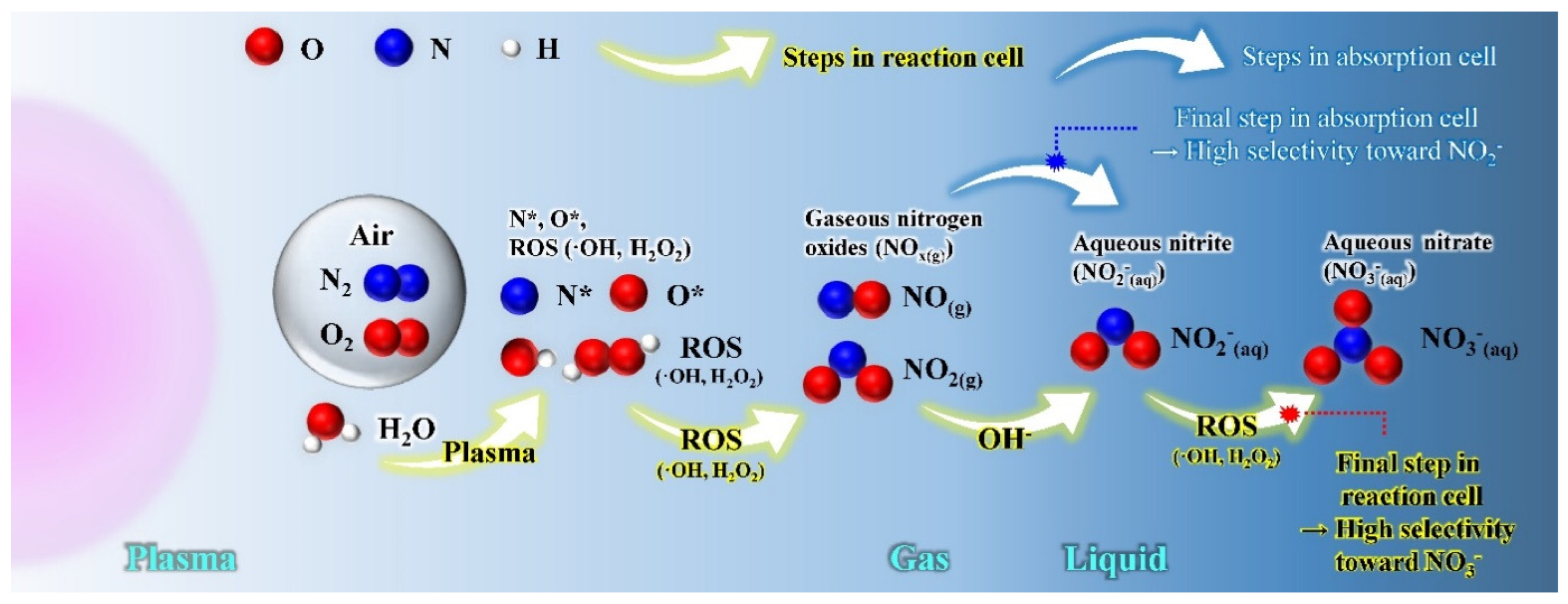
Based on the comprehensive interpretation of these results, a mechanistic pathway for LPP-assisted nitrogen fixation is proposed and schematically illustrated in Figure 8. Upon plasma discharge in ambient air, a variety of reactive nitrogen and oxygen species are generated, including electronically excited nitrogen states such as N2u+), N(2D), N(2P), and reactive oxygen species such as O(1D), O(1S) [17]. These excited species participate in secondary reactions with ·OH, H2O2, O3, as well as undergo self-reactions, forming gaseous nitrogen oxide intermediates (NO, NO2) [44,45,46,47]. Then, gas-phase reactions that convert these species into their aqueous counterpart, NO2, are considered predominant due to the poor solubility in water [48]. Subsequently, in the reaction cell, NO2 is further oxidized to NO3 by generated ROS, which are abundantly produced by direct plasma discharge. In contrast, in the absorption cell, where plasma is not directly applied and no strong oxidants are present, NO2 remains unconverted and accumulates as the final product. This spatial differentiation in oxidative environment explains the distinct product distributions observed between the two zones. Taken together, these findings reveal that the interplay of plasma-generated reactive species and liquid-phase chemistry governs the selective formation of nitrogen-containing products. Particularly, the presence of ·OH and other strong oxidants in the plasma-liquid interface region plays a decisive role in promoting the conversion of NO2 to NO3, thus shifting product selectivity based on the discharge duration and chemical environment.
Overall, the novelty of this work lies in combining spatial separation with mechanistic evaluation. By separating the reaction and absorption environments, the dual-cell LPP system achieved selective accumulation of nitrate and nitrite in different cells. More importantly, the chemically active species generated in each environment were observed, and their effects on nitrogen-species formation and conversion were experimentally evaluated. This combined approach allowed us to propose a mechanistic picture in which the reaction cell functions as a strongly oxidative plasma–liquid environment favoring nitrate formation, whereas the absorption cell provides a distinct gas–liquid absorption environment that promotes nitrite accumulation. In addition, this strategy provides a simple and additive-free route to control product distribution in plasma nitrogen fixation. Because the reaction and absorption zones are physically separated, each zone can be optimized independently, offering potential advantages in scalability, process flexibility, and selective product recovery.

5. Conclusions

This study elucidated the mechanisms underlying liquid phase plasma-assisted nitrogen fixation by employing a dual-cell reactor system that spatially separated the plasma reaction and absorption zones. Optical emission spectroscopy confirmed the generation of highly reactive nitrogen and oxygen species, which initiated a cascade of downstream reactions with oxidative species such as ·OH, H2O2, and O3 leading to the formation of gaseous nitrogen oxide intermediates (NO, NO2). These intermediates were subsequently converted into aqueous NOx (NO2 and NO3), with product selectivity shown to be highly dependent on electrode materials, treatment time, solution pH, and electrical discharge conditions. Notably, tungsten electrodes demonstrated superior performance by minimizing metal-induced side reactions and enhancing NO3 selectivity due to their high chemical and thermal stability. Additionally, reactive oxygen species generated at the plasma–liquid interface played a pivotal role in selectively oxidizing NO2 to NO3, as confirmed by EPR and scavenger experiments. As a result, the reaction cell achieved a nitrate selectivity of 98.9%, whereas the absorption cell predominantly accumulated NO2 due to the absence of reactive species. Overall, these findings provide a comprehensive understanding of the plasma–liquid–gas interfacial phenomena governing nitrogen fixation and offer actionable insights for optimizing selective, energy-efficient NO3 production in future plasma-driven systems.

Supplementary Materials

The following supporting information can be downloaded at: https://www.mdpi.com/article/10.3390/pr14101668/s1, OES spectra of LPP with diverse electrode materials (PDF). Figure S1: Optical emission spectra of liquid-phase plasma with different electrode materials.

Author Contributions

Writing–original draft, U.K.; formal analysis, U.K.; conceptualization, U.K. and S.L.; data curation, U.K. and C.P.; investigation, U.K.; Methodology, U.K. and C.P.; project administration, S.L.; Resources, S.L.; Supervision, S.L.; Writing—review & editing, S.L. All authors have read and agreed to the published version of the manuscript.

Funding

This research was supported by Korea Institute of Marine Science & Technology Promotion (KIMST) funded by the Ministry of Oceans and Fisheries (No. 20220603).

Data Availability Statement

The original contributions presented in this study are included in the article. Further inquiries can be directed to the corresponding author.

Conflicts of Interest

The authors declare that they have no known competing financial interests or personal relationships that could have appeared to influence the work reported in this paper.

References

  1. Shilov, A.E. Catalytic reduction of molecular nitrogen in solutions. Russ. Chem. Bull. 2003, 52, 2555–2562. [Google Scholar] [CrossRef]
  2. Harindintwali, J.D.; Wang, F.; Yang, W.; Zhou, J.; Muhoza, B.; Mugabowindekwe, M.; Yu, X. Harnessing the power of cellulolytic nitrogen-fixing bacteria for biovalorization of lignocellulosic biomass. Ind. Crops Prod. 2022, 186, 115235. [Google Scholar] [CrossRef]
  3. Smil, V. Enriching the Earth: Fritz Haber, Carl Bosch, and the Transformation of World Food Production; MIT Press: Cambridge, MA, USA; London, UK, 2004. [Google Scholar]
  4. Smil, V. Nitrogen and food production: Proteins for human diets. Ambio 2002, 31, 126–131. [Google Scholar] [CrossRef]
  5. Shen, H.; Choi, C.; Masa, J.; Li, X.; Qiu, J.; Jung, Y.; Sun, Z. Electrochemical ammonia synthesis: Mechanistic understanding and catalyst design. Chem 2021, 7, 1708–1754. [Google Scholar] [CrossRef]
  6. Martín, A.J.; Shinagawa, T.; Pérez-Ramírez, J. Electrocatalytic reduction of nitrogen: From Haber-Bosch to ammonia artificial leaf. Chem 2019, 5, 263–283. [Google Scholar] [CrossRef]
  7. Chen, H.; Wu, A.; Mathieu, S.; Gao, P.; Li, X.; Xu, B.Z.; Yan, J.; Tu, X. Highly efficient nitrogen fixation enabled by an atmospheric pressure rotating gliding arc. Plasma Process. Polym. 2021, 18, e2000200. [Google Scholar] [CrossRef]
  8. Majeed, M.; Iqbal, M.; Altin, M.; Kim, Y.N.; Dinh, D.K.; Lee, C.; Ali, Z.; Lee, D.H. Effect of thermal gas quenching on NOx production by atmospheric pressure rotating arc plasma: A pathway towards Eco-Friendly fertilizer. Chem. Eng. J. 2024, 485, 149727. [Google Scholar] [CrossRef]
  9. Tanabe, Y.; Nishibayashi, Y. Developing more sustainable processes for ammonia synthesis. Coord. Chem. Rev. 2013, 257, 2551–2564. [Google Scholar] [CrossRef]
  10. Yang, J.; Weng, W.; Xiao, W. Electrochemical synthesis of ammonia in molten salts. J. Energy Chem. 2020, 43, 195–207. [Google Scholar] [CrossRef]
  11. Patil, B.S.; Wang, Q.; Hessel, V.; Lang, J. Plasma N2-fixation: 1900–2014. Catal. Today 2015, 256, 49–66. [Google Scholar] [CrossRef]
  12. Li, S.; Medrano, J.A.; Hessel, V.; Gallucci, F. Recent progress of plasma-assisted nitrogen fixation research: A review. Processes 2018, 6, 248. [Google Scholar] [CrossRef]
  13. Klimek, A.; Piercey, D.G. Nitrogen fixation via plasma-assisted processes: Mechanisms, applications, and comparative analysis—A comprehensive review. Processes 2024, 12, 786. [Google Scholar] [CrossRef]
  14. Rouwenhorst, K.H.; Jardali, F.; Bogaerts, A.; Lefferts, L. From the Birkeland-Eyde process towards energy-efficient plasma-based NOX synthesis: A techno-economic analysis. Energy Environ. Sci. 2021, 14, 2520–2534. [Google Scholar] [CrossRef]
  15. Winter, L.R.; Chen, J.G. N2 fixation by plasma-activated processes. Joule 2021, 5, 300–315. [Google Scholar] [CrossRef]
  16. Kelly, S.; Verheyen, C.; Cowley, A.; Bogaerts, A. Producing oxygen and fertilizer with the Martian atmosphere by using microwave plasma. Chem 2022, 8, 2797–2816. [Google Scholar] [CrossRef]
  17. Denra, A.; Saud, S.; Nguyen, D.B.; Trinh, Q.T.; Nguyen, T.K.; An, H.; Nguyen, N.T.; Teke, S.; Mok, Y.S. Nitrogen fixation by rotational gliding arc plasma at surrounding conditions. J. Clean. Prod. 2024, 436, 140618. [Google Scholar] [CrossRef]
  18. Chen, H.; Yuan, D.; Wu, A.; Lin, X.; Li, X. Review of low-temperature plasma nitrogen fixation technology. Waste Dispos. Sustain. Energy 2021, 3, 201–217. [Google Scholar] [CrossRef] [PubMed]
  19. Peng, P.; Chen, P.; Schiappacasse, C.; Zhou, N.; Anderson, E.; Chen, D.; Liu, J.; Cheng, Y.; Hatzenbeller, R.; Addy, M.; et al. A review on the non-thermal plasma-assisted ammonia synthesis technologies. J. Clean. Prod. 2018, 177, 597–609. [Google Scholar] [CrossRef]
  20. Roy, N.C.; Maira, N.; Pattyn, C.; Remy, A.; Delplancke, M.P.; Reniers, F. Mechanisms of reducing energy costs for nitrogen fixation using air-based atmospheric DBD plasmas over water in contact with the electrode. Chem. Eng. J. 2023, 461, 141844. [Google Scholar] [CrossRef]
  21. Muzammil, I.; Lee, D.H.; Dinh, D.K.; Kang, H.; Roh, S.A.; Kim, Y.N.; Choi, S.; Jung, C.; Song, Y.H. A novel energy efficient path for nitrogen fixation using a non-thermal arc. RSC Adv. 2021, 11, 12729–12738. [Google Scholar] [CrossRef]
  22. Chokradjaroen, C.; Wang, X.; Niu, J.; Fan, T.; Saito, N. Fundamentals of solution plasma for advanced materials synthesis. Mater. Today Adv. 2022, 14, 100244. [Google Scholar] [CrossRef]
  23. Ye, Y.; Wei, X.; Zhang, L.; Wang, S.; Fang, Z. Sustainable nitrogen fixation by bubble discharge plasma: Performance optimization and mechanism. J. Energy Chem. 2024, 98, 692–701. [Google Scholar] [CrossRef]
  24. Du, J.; You, H.; Zhu, C.; Wang, C.; Zhang, X.; Liu, Y. Energy-efficient, sustainable nitrogen fixation in water via in situ electrode-activated pulsed plasma. ACS Sustain. Chem. Eng. 2025, 13, 2596–2603. [Google Scholar] [CrossRef]
  25. Chokradjaroen, C.; Niu, J.; Panomsuwan, G.; Saito, N. Insight on solution plasma in aqueous solution and their application in modification of chitin and chitosan. Int. J. Mol. Sci. 2021, 22, 4308. [Google Scholar] [CrossRef]
  26. Lofthus, A.; Krupenie, P.H. The spectrum of molecular nitrogen. J. Phys. Chem. Ref. Data 1977, 6, 113–307. [Google Scholar] [CrossRef]
  27. Atkinson, R.; Baulch, D.L.; Cox, R.A.; Hampson, R.F.; Kerr, J.A.; Rossi, M.J.; Troe, J. Evaluated kinetic and photochemical data for atmospheric chemistry: Supplement VI. IUPAC Subcommittee on Gas Kinetic Data Evaluation for Atmospheric Chemistry. Phys. Chem. Ref. Data 1997, 26, 1329–1499. [Google Scholar] [CrossRef]
  28. Herron, J.T. Evaluated chemical kinetics data for reactions of N(2D), N(2P), and N2(A3Σu+) in the gas phase. J. Phys. Chem. Ref. Data 1999, 28, 1453–1483. [Google Scholar] [CrossRef]
  29. Baulch, D.L.; Cobos, C.J.; Cox, R.A.; Esser, C.; Frank, P.; Just, T.; Kerr, J.A.; Pilling, M.J.; Troe, J.; Walker, R.W.; et al. Evaluated kinetic data for combustion modelling. J. Phys. Chem. Ref. Data 1992, 21, 411. [Google Scholar] [CrossRef]
  30. Hu, X.; Shen, X.; Takai, O.; Saito, N. Facile fabrication of PtAu alloy clusters using solution plasma sputtering and their electrocatalytic activity. J. Alloys Compd. 2013, 552, 351–355. [Google Scholar] [CrossRef]
  31. Watthanaphanit, A.; Panomsuwan, G.; Saito, N. A novel one-step synthesis of gold nanoparticles in an alginate gel matrix by solution plasma sputtering. RSC Adv. 2014, 4, 1622–1629. [Google Scholar] [CrossRef]
  32. Kim, U.; Choi, J.; Lee, S. Fabrication of NiCu bimetallic catalyst for ammonia oxidation reaction using liquid-phase plasma process: Incorporation of Cu into Ni (Oxy)hydroxide. Int. J. Hydrogen Energy 2025, 105, 126–136. [Google Scholar] [CrossRef]
  33. Neyts, E.C.; Ostrikov, K.K.; Sunkara, M.K.; Bogaerts, A. Plasma catalysis: Synergistic effects at the nanoscale. Chem. Rev. 2015, 115, 13408–13446. [Google Scholar] [CrossRef] [PubMed]
  34. Zhu, X.; Hu, X.; Wu, X.; Cai, Y.; Zhang, H.; Tu, X. Ammonia synthesis over γ—Al2O3 pellets in a packed-bed dielectric barrier discharge reactor. J. Phys. D Appl. Phys. 2020, 53, 164002. [Google Scholar] [CrossRef]
  35. Back, S.; Saito, N.; Lee, S. A facile and efficient approach for the removal of high concentrations of ammonia nitrogen in wastewater: Liquid-phase plasma treatment. J. Environ. Chem. Eng. 2023, 11, 109075. [Google Scholar] [CrossRef]
  36. Li, L.; Tang, C.; Cui, X.; Zheng, Y.; Wang, X.; Xu, H.; Zhang, S.; Shao, T.; Davey, K.; Qiao, S.Z. Efficient nitrogen fixation to ammonia through integration of plasma oxidation with electrocatalytic reduction. Angew. Chem. Int. Ed. Engl. 2021, 60, 14131–14137. [Google Scholar] [CrossRef]
  37. Bian, W.; Song, X.; Shi, J.; Yin, X. Nitrogen fixed into HNO3 by pulsed high voltage discharge. J. Electrost. 2012, 70, 317–326. [Google Scholar] [CrossRef]
  38. Haynes, W.M. CRC Handbook of Chemistry and Physics; CRC Press: Boca Raton, FL, USA; London, UK, 2016. [Google Scholar]
  39. Meng, Z.; Yao, J.X.; Sun, C.N.; Kang, X.; Gao, R.; Li, H.R.; Bi, B.; Zhu, Y.F.; Yan, J.M.; Jiang, Q. Efficient ammonia production beginning from enhanced air activation. Adv. Energy Mater. 2022, 12, 2202105. [Google Scholar] [CrossRef]
  40. Patil, B.S.; Peeters, F.J.J.; van Rooij, G.J.; Medrano, J.A.; Gallucci, F.; Lang, J.; Wang, Q.; Hessel, V. Plasma assisted nitrogen oxide production from air: Using pulsed powered gliding arc reactor for a containerized plant. AIChE J. 2018, 64, 526–537. [Google Scholar] [CrossRef]
  41. Kim, J.; Kim, U.; Lee, S. Decomplexation of cu(II)-EDTA by liquid-phase plasma: Enhanced performance by inducing self-catalytic Fenton reaction. J. Water Process Eng. 2025, 71, 107356. [Google Scholar] [CrossRef]
  42. Kim, U.J.; Saito, N.; Lee, S.H. Remediation of water contaminated with polycyclic aromatic hydrocarbons using liquid phase plasma: Influence of electrical discharge condition. Front. Mar. Sci. 2022, 9, 1033962. [Google Scholar] [CrossRef]
  43. Anandan, S.; Kumar Ponnusamy, V.K.K.; Ashokkumar, M. A review on hybrid techniques for the degradation of organic pollutants in aqueous environment. Ultrason. Sonochem. 2020, 67, 105130. [Google Scholar] [CrossRef]
  44. Huang, Z.; Xiao, A.; Liu, D.; Lu, X.; Ostrikov, K. Plasma-water-based nitrogen fixation: Status, mechanisms, and opportunities. Plasma Process. Polym. 2022, 19, 2100198. [Google Scholar] [CrossRef]
  45. Sieck, L.W.; Heron, J.T.; Green, D.S. Chemical kinetics database and predictive schemes for humid air plasma chemistry. Part I: Positive ion–molecule reactions. Plasma Chem. Plasma Process. 2000, 20, 235–258. [Google Scholar] [CrossRef]
  46. Herron, J.T.; Green, D.S. Chemical kinetics database and predictive schemes for nonthermal humid air plasma chemistry. Part II. Neutral species reactions. Plasma Chem. Plasma Process. 2001, 21, 459–481. [Google Scholar] [CrossRef]
  47. Murakami, T.; Niemi, K.; Gans, T.; O’Connell, D.; Graham, W.G. Interacting kinetics of neutral and ionic species in an atmospheric-pressure helium–oxygen plasma with humid air impurities. Plasma Sources Sci. Technol. 2013, 22, 045010. [Google Scholar] [CrossRef]
  48. Tian, W.; Kushner, M.J. Atmospheric pressure dielectric barrier discharges interacting with liquid covered tissue. J. Phys. D Appl. Phys. 2014, 47, 165201. [Google Scholar] [CrossRef]
Figure 1. Schematic diagram of liquid-phase plasma system using a dual-cell for nitrogen fixation.
Processes 14 01668 g001
Figure 2. Optical emission spectra of liquid-phase plasma with and without air injection.
Processes 14 01668 g002
Figure 3. Concentrations and selectivity of nitrogen compounds in the (a) reaction cell and (b) absorption cell as a function of electrode material.
Processes 14 01668 g003
Figure 4. Concentrations and selectivity of nitrogen compounds in the (a) reaction cell and (b) absorption cell in the early stage and those in the (c) reaction cell and (d) absorption cell in the late stage.
Processes 14 01668 g004
Figure 5. Concentrations and selectivity of nitrogen compounds in the (a) reaction cell and (b) absorption cell as a function of the electrolyte in reaction cell.
Processes 14 01668 g005
Figure 6. Concentrations and selectivity of nitrogen compounds in the (a) reaction cell and (b) absorption cell, and input power and energy consumption for (c) NO3 production in the reaction cell and (d) NO2 production in the absorption cell as a function of electrical discharge conditions.
Processes 14 01668 g006
Figure 7. (a) EPR spectra of DMPO-hydroxyl radical adducts, (b) the concentration of H2O2 in the reaction cell and absorption cell, and the (c) conversion rate of NO2 to NO3 with the addition of scavengers.
Processes 14 01668 g007
Figure 8. Proposed mechanism of nitrogen fixation in liquid-phase plasma system.
Processes 14 01668 g008
Disclaimer/Publisher’s Note: The statements, opinions and data contained in all publications are solely those of the individual author(s) and contributor(s) and not of MDPI and/or the editor(s). MDPI and/or the editor(s) disclaim responsibility for any injury to people or property resulting from any ideas, methods, instructions or products referred to in the content.