Article

Synergistic Electrocoagulation–Electro-Fenton Coupling for Petroleum Refinery Wastewater Mineralization: Statistical Optimization and Cost Analysis

1
Chemistry Department, College of Sciences, University of Ha’il, P.O. Box 2440, Ha’il 81451, Saudi Arabia
2
Chemical Engineering Department, National Institute of Applied Sciences & Technology, University of Carthage, P.O. Box 676, Tunis 1080, Tunisia
3
Laboratory of Eco-Chimie, National Institute of Applied Sciences & Technology, University of Carthage, P.O. Box 676, Tunis 1080, Tunisia
4
Ecole Nationale Supérieure de Chimie de Rennes, Université de Rennes 1, CNRS, UMR 6226, 11 Allée de Beaulieu, CS 50837, 35708 Rennes, France
*
Author to whom correspondence should be addressed.
Processes 2026, 14(10), 1623; https://doi.org/10.3390/pr14101623
Submission received: 17 March 2026 / Revised: 11 May 2026 / Accepted: 12 May 2026 / Published: 17 May 2026

Abstract

Petroleum refinery wastewaters are highly recalcitrant and recognized as one of the most challenging industrial effluents requiring advanced treatment strategies. This study aims to investigate the synergistic performance of a sequential electrocoagulation (EC) and electro-Fenton (EF) process for the mineralization of this complex effluent. The EC pretreatment was optimized using response surface methodology via Doehlert design, establishing optimal conditions at pH 6.0, 0.8 A, and a 75 min electrolysis time. Under these conditions, 39% of total organic carbon (TOC) and 56% of chemical oxygen demand (COD) were removed. The quadratic polynomial model developed for the EC stage presented an excellent fit with the experimental data (R2 = 0.99, R2adj = 0.97, p < 0.05), confirming its strong predictive robustness. In order to degrade the remaining recalcitrant organic pollutants, the pretreated effluent underwent EF oxidation (0.01 M ferrous ion, 0.8 A, pH 3), leading to TOC and COD removal rates of 68% and 76%, respectively, after a 360 min electrolysis time. The integrated EC-EF process achieved an overall mineralization of 81% and an oxidation efficiency of 89%. Finally, a comprehensive evaluation of the system’s energy consumption and economic viability established a solid techno-economic baseline for this sequential approach, indicating a competitive total operating cost of USD 0.036 per gram of TOC removed.

1. Introduction

The exponential growth of industrial activities within the petroleum and petrochemical sectors has led to the continuous production of huge amounts of wastewater at a rapid rate [1,2]. As Coelho et al. reported, the volume of effluent generated during crude oil processing can be 0.4 to 1.6 times greater than the amount of raw oil treated [1]. The composition of wastewater derived from petroleum industries is dictated by two key factors: the characteristics of the crude oil feedstock and the prevailing operational parameters within the refinery [1]. These effluents mainly have four types of compounds: aliphatics such as methane, propane, butane, and hexane; cycloaliphatics such as cyclohexane, methylcyclohexane, and methylcyclophentane; aromatics like benzene, ethylbenzene, naphthalene, toluene, xylene, and phenanthrene; and other components like phenols, ketones, quinolones, and sulphonates [3]. These recalcitrant pollutants can spread throughout the environment, which induces their entry and propagation into air, soil, and water compartments, thereby posing a potential threat. Because of their physicochemical properties such as lipophilicity and electrochemical stability, these compounds tend to bioaccumulate in living tissues and cause harmful and chronic effects [3]. In fact, polycyclic aromatic hydrocarbons are absorbed into fish tissues and thereby accumulate in food chains [3,4]. Furthermore, Brinkmann et al. [5] demonstrated that prolonged exposure to petroleum-based pollutants induces oxidative stress and DNA damage in rainbow trout (Oncorhynchus mykiss). This damage is attributed to the presence of benzo[a]pyrene, a polycyclic aromatic hydrocarbon (PAH) in petroleum effluents, which forms stable DNA adducts that subsequently cause DNA strand breakage [6].
Consequently, effective procedures for the treatment of pollutants generated by petroleum refineries are urgently required to comply with public health and environmental standards.
Conventional petroleum refinery wastewater treatment methods, including biological processes under aerobic and anaerobic conditions, reverse osmosis, membrane filtration, chemical oxidation, coagulation-floculation and adsorption, were assessed for the removal of hydrocarbons [2,7,8,9,10]. While these traditional methods effectively remove petroleum pollutants from the wastewater, they often transfer the pollutants to different materials like sludge and may generate secondary pollutants during the process [11,12].
In this vein, electrochemical processes, including electro-oxidation, electro-Fenton and electrocoagulation offer a good and promising alternative for the remediation of complex wastewater due to their effectiveness, practicality, and environmental friendliness [13].
Electrocoagulation (EC) stands out as one of the most efficient and widely used electrochemical treatment technologies due to its easy installation and operation, reduced chemical requirements and minimal sludge generation [14,15]. This technique achieves efficient coagulation and pollutant separation through the in situ generation of coagulant species from aluminum or iron electrodes [16]. In this study, aluminum was preferred to minimize undesirable side reactions during electrolysis [17].
Although the fundamental electrodissolution of this aluminum anode (Equations (1)–(3)) is well established, its specific application to petroleum refinery wastewater involves targeted interactions with complex organic and inorganic matrices. During electrolysis, anodic dissolution generates Al3+ cations alongside various monomeric and polymeric hydroxide complexes. These positive species target negatively charged oil droplets and colloidal particles, neutralizing their electrical double layer [17,18]. This charge neutralization eliminates electrostatic repulsion, breaking the recalcitrant oil-in-water emulsion and allowing aliphatic hydrocarbons and suspended solids to agglomerate [17,18]. At the cathode, H2O molecules are reduced to produce hydroxide ions (OH). These anions react with the generated aluminum cations to precipitate aluminum hydroxide (Al(OH)3) [11,16,18,19,20]. This amorphous species exhibits a strong affinity for the diverse refinery effluent constituents; it forms a dynamic sludge blanket that actively adsorbs dissolved pollutants, such as aromatic compounds, while physically enmeshing the dispersed emulsion droplets and solid aggregates [11,16,18,19,20]. At the final step, the destabilized flocs are removed through two simultaneous pathways: H2-driven electroflotation for the gas-enmeshed hydrocarbons, and sedimentation for the denser particulate flocs [17,20].
Al → Al3+ + 3e
3 H 2 O + 3 e     3 OH + 3 2 H 2
Al3+ + 3H2O → Al(OH)3 + 3H+
Despite its advantages, electrocoagulation presents limitations in treating petroleum refinery wastewater rich in recalcitrant organic compounds because it fails to remove these dissolved and highly stable molecules. The treated effluent thus retains a significant level of toxicity, requiring the integration of an Advanced Oxidation Process (AOP) [16].
Advanced oxidation processes (AOPs) have emerged as a promising solution for the removal of refractory organic compounds from wastewater [20]. The effectiveness of these technologies depends on the in situ generation of powerful oxidizing agents, namely hydroxyl radicals (•OH). AOPs include a wide range of proven methods, such as the Fenton process, Fenton-like processes, high-pH ozonation, wet air oxidation, and photocatalysis (homogeneous or heterogeneous). It also extends to more complex processes such as peroxide/ozone coupling and ultrasound, as well as advanced electrochemical techniques, notably anodic oxidation and electro-Fenton [21,22,23,24,25,26,27].
As an indirect oxidation technique, electro-Fenton relies on the Fenton reaction to produce hydroxyl radicals. A key feature of this process is the continuous electrochemical generation of hydrogen peroxide (H2O2) and the regeneration of ferrous ions (Fe2+) during the reaction [28,29,30,31]. The supplied oxygen undergoes reduction at the cathode to generate H2O2, which then reacts with the introduced Fe2+ ions under acidic conditions, leading to the production of hydroxyl radicals (•OH) [32,33,34]. This radical is considered the main reactive oxygen species (ROS) driving the electro-Fenton process; comprehensive inspection methods and identification strategies for its precise detection have been detailed in the recent literature [35,36]. Due to its extremely high oxidation potential, •OH can rapidly degrade organic pollutants via hydrogen atom abstraction reaction, electron transfer, or electrophilic addition to π systems, ultimately mineralizing them into inorganic ions, CO2 and H2O [20,37,38].
Many studies have focused on the fundamental mechanisms of EC and EF [11,19,20,26,31,39,40]. The originality of this work lies in the synergistic and sequential integration of these two processes, specifically designed to overcome the extreme complexity of raw petroleum refinery wastewater. The pretreatment step with EC acts as indispensable matrix conditioning, allowing for the bulk removal of colloids, suspended solids, and heavy organic fractions. This sequential approach is vital; it prevents the rapid organic fouling and passivation of the electrodes (particularly the carbon felt cathode) which causes the failure of direct EF treatment on such effluents. Once the matrix is clarified, the subsequent EF process can operate at its maximum oxidative efficiency, ensuring that the generated hydroxyl radicals (•OH) are targeted specifically towards the deep mineralization of the remaining recalcitrant pollutants.
Moreover, the implementation of a robust statistical optimization via a Doehlert design allows for the systematic evaluation of the interactive effects of the studied parameters, thus maximizing the treatment efficiency. This modeling, combined with an analysis of operating costs that translates energy and chemical consumption into practical economic metrics (USD/g TOCremoved), provides a pragmatic, industry-ready framework that goes beyond conventional laboratory-scale observations.
Although EC-EF systems optimized by RSM have been applied to the treatment of synthetic solutions or effluents with low organic loads [41,42], this study advances the state of the art. It proves the operational and economic viability of the sequential system on a complex, real-world petroleum matrix.
This study aims to achieve three objectives. The first is to apply the Doehlert experimental design with response surface methodology (RSM) to optimize the electrocoagulation (EC) operating conditions for the pretreatment of petroleum refinery wastewater. The Doehlert matrix enables the development of a second-order polynomial model [43]. This quadratic modeling is an efficient approach that minimizes the required number of experiments while ensuring the collection of relevant data and the optimization of the variables of interest [43]. Furthermore, it allows the simultaneous variation in multiple factors to reveal their real impact and reciprocal interactions, instead of the traditional approach of modifying one factor at a time [43]. The second objective is to sequentially couple the EC pretreatment with the electro-Fenton process to mineralize recalcitrant organic pollutants and transform them into H2O, CO2 and inorganic ions. To achieve this goal, the treatment efficiency was continuously monitored by measuring the total organic carbon (TOC). The final objective concerns the evaluation of the system’s energy consumption and the operational cost of this combined process. Overall, this research provides a substantial contribution to sustainable wastewater management, which is essential for mitigating the discharge of toxic organics into the environment.

2. Materials and Methods

2.1. Petroleum Refinery Wastewater

The petroleum refinery wastewater used in this study was obtained from an oil refinery located in Saudi Arabia. The samples were carefully collected and sealed in an airtight container. To preserve their physicochemical integrity, they were stored in the dark at a constant temperature of 4 °C prior to the experiments. The initial physicochemical and biological characteristics of the petroleum refinery wastewater were determined using standard methods and are presented in Table 1.
As summarized in Table 1, this effluent is characterized by a high organic load with a chemical oxygen demand (COD) of 8.742 mg·L−1 and a total suspended solids (TSS) concentration of 490 mg/L. Furthermore, the calculated biodegradability index (BOD5/COD) of 0.27 confirms the highly recalcitrant nature of the petroleum refinery wastewater.

2.2. Chemicals

FeSO4·7H2O (99% purity) and Na2SO4 (99% purity), used as reactant and electrolyte support, respectively, were provided by Acros Organics (Thermo Fisher Scientific, Illkirch, France). The pH of treated solutions was adjusted using analytical grade hydrochloric acid (HCl) obtained from Acros Organics. All solutions were prepared using ultrapure water. Sigma Aldrich (Saint-Quentin-Fallavier, France) and Acros Organics supplied all analytical grade chemicals.

2.3. Analytical Determinations

Prior to analysis, samples were filtered through 0.40 μm GF filters (Sartorius Stedim Minisart, Göttingen, Germany). Their TOC content was then determined using a TOC-VCPH/CPN analyzer (Shimadzu Corporation, Kyoto, Japan). In this process, the organic matter is oxidized to form CO2, which is subsequently detected by a non-dispersive infrared (NDIR) sensor. The standard NPOC (Non-Purgeable Organic Carbon) method was employed, and all measurements were performed in triplicate to ensure reproducibility [33].
In order to analyze the organic content of the petroleum refinery wastewater, the chemical oxygen demand (COD) was quantified using Nanocolor® CSB 4000 test kits (Macherey-Nagel, Düren, Germany). The samples underwent standard closed-tube digestion in a thermoreactor, followed by photometric measurement to evaluate the oxidized organic matter.
BOD5 was measured using an OxiTop® IS 6 respirometer (WTW, Weilheim, Germany) at pH 7.0 ± 0.2. The samples were supplemented with a mineral medium (MgSO4·7H2O (22.50 g·L−1), CaCl2 (27.50), FeCl3 (0.15), NH4Cl (2.00), Na2HPO4 (6.80), and KH2PO4 (2.80)), washed activated sludge (0.05 g·L−1 dry matter), and N-allylthiourea (10 mg·L−1) to inhibit nitrification. A glucose-glutamic acid solution (150 mg·L−1 each) and distilled water served as the positive control and blank, respectively.
Total dissolved solids (TDS) and conductivity were measured directly using a CON500 meter (Clean Instruments, Shanghai, China).
Due to the complex matrix of the petroleum refinery wastewater, total suspended solids (TSS) were determined in triplicate via a modified centrifugation protocol. A 200 mL effluent sample was centrifuged in a pre-weighed aluminum tube at 4000 rpm for 1 h. The supernatant and floating oil were carefully aspirated. To remove interstitial salts and oils, the pellet was washed by resuspending it in 100 mL of distilled water with sonication, followed by a second centrifugation for 15 min. After removing the wash supernatant, the aluminum tube containing the pellet was dried at 105 °C to a constant weight. TSS concentration was calculated from the net dry mass per initial sample volume (0.2 L).

2.4. Experimental Procedure

2.4.1. Electrocoagulation Process

Electrocoagulation pretreatment was performed in a 250 mL undivided cylindrical glass reactor (Figure 1). The electrochemical cell was equipped with four high-purity (99%) aluminum electrodes (80 mm × 45 mm × 3 mm), arranged in a monopolar parallel configuration (two anodes and two cathodes) and powered by a direct current supply (Model AX 322, Metrix, Annecy, France). Before initiating the treatment, the initial pH of the effluent was adjusted using hydrochloric acid (HCl), and 50 mM Na2SO4 was added as an inert supporting electrolyte to maintain stable electrical conditions and minimize the ohmic drop during electrolysis. This provided a high and constant background conductivity across all tested pH levels, exceeding the minor contributions of HCl.
After each experiment, the aluminum electrodes were first mechanically cleaned using fine-grit abrasive paper to remove surface passivation layers and corrosion products, then rinsed thoroughly with deionized water, degreased with acetone in an ultrasonic bath for 5 min, and finally dried prior to being reinserted into the electrochemical cell.

2.4.2. Electro-Fenton Process

The electro-Fenton experiments were carried out in an undivided 250 mL cylindrical glass reactor equipped with a two-electrode setup (Figure 1). A carbon felt piece (Le Carbone Lorraine RVG 4000, Mersen, Paris, France) with dimensions of 90 mm × 75 mm, a thickness of 12 mm, a specific surface area of 0.7 m2 g−1, and a density of 0.088 g cm−3 served as the cathode and was positioned against the inner wall of the cell. To ensure a uniform potential distribution, a double platinum wire anode (Metrohm, 6.0338.100) was centered within the reactor. The operating conditions for the EF process were determined after preliminary single-variable optimization tests to ensure a stable oxidative regime. Prior to the experiments, the effluent pH was adjusted to 3.0 using HCl, and the ionic strength was maintained by adding 0.05 M Na2SO4 as a supporting electrolyte. Immediately before initiating the electrolysis, 10 mM FeSO4·7H2O was introduced into the cell. The system was driven by a direct current power supply (Metrix, model AX 322) operating in galvanostatic mode at a constant current of 0.8 A. All kinetic experiments were performed in triplicate to ensure reproducibility, and the data are presented as mean values with their standard deviations.

2.5. Doehlert Experimental Design

Response surface methodology (RSM) is a powerful statistical method widely used to model and optimize complex multi-variable processes [44]. Among the various RSM designs, the Doehlert design is particularly advantageous. This matrix employs a second-order polynomial model while reducing the number of required experimental runs [31]. This reduction is important for the resource-intensive environmental studies, minimizing both the costs and the duration of experimental procedures [44]. Furthermore, the Doehlert matrix provides a uniform distribution of experimental points across the parameter space, ensuring a comprehensive evaluation of all interacting factors [44].
In order to maximize the performance of the electrocoagulation pretreatment, a Doehlert design was implemented. Three important experimental parameters were studied, namely: current intensity (U1), electrolysis time (U2), and pH (U3). The response variable (Y) was defined as the TOC removal efficiency.
The formula N = k2 + k + 1 (where k is the number of parameters) was used to construct the experimental set and determine the number of trials. Accordingly, for k = 3, the matrix consisted of 13 experiments, uniformly distributed throughout the coded experimental region. The measurement at the central point was performed in triplicate (experiments 13 to 15) and included in the design to estimate the experimental error. Natural variables (Ui) were converted to coded variables (Xi) according to Equation (4) [45]:
X i   =   [ U i   U i   ( 0 ) U i ]   α
In this equation, Ui(0) is the central value of the experimental domain and ΔUi is the variation step. The parameter α represents the maximum coded value for each variable, set at 1 for X1, 0.866 for X2, and 0.816 for X3.
U i   ( 0 ) = u p p e r   l i m i t   o f   U i + l o w e r   l i m i t   o f   U i 2
U i = u p p e r   l i m i t   o f   U i l o w e r   l i m i t   o f   U i 2
The experimental domains were established based on preliminary tests to optimize the electrochemical performance: applied current (0.2 < U1 < 1 A) ensures adequate Al3+ dissolution and H2 evolution while preventing excessive energy consumption, and electrolysis time (20 < U2 < 120 min) guarantees sufficient continuous coagulant generation and optimal floc growth. The pH range (2 < U3 < 10) covers the complete spectrum of aluminum speciation. The central value and the variation step for each variable are reported in Table 2.
The experimental response was fitted to a quadratic polynomial equation based on the Doehlert matrix:
Y = b0 + b1X1 + b2X2 + b3X3 + b11X12 + b22X22 + b33X32 + b12X1X2 + b13X1X3 + b23X2X3
In this equation, Y represents the experimental response and b0 is the model intercept.
bi, bii, and bij are the estimated regression coefficients corresponding to the linear, quadratic, and interaction terms.
The coefficients were determined using the least squares method according to Equation (8):
B = (XT X)−1 XT Y
B is the vector of estimated coefficients, X is the design matrix (where XT is its transpose), and Y represents the measured response vector.
The suitability and statistical significance of the model were verified using the analysis of variance (ANOVA). The two-dimensional isoresponse curves and their corresponding three-dimensional response surfaces were used to illustrate the relationship between the experimental variables and the response. NemrodW® software (2000, LPRAI, Marseille, France) was employed for all data processing.

3. Results and Discussion

3.1. Electrocoagulation Pretreatment of Petroleum Refinery Wastewater

3.1.1. Doehlert Experimental Design and Statistical Analysis

The performance of the electrocoagulation process is related to several variables, such as pH, electrolysis time and current intensity. The Doehlert matrix was applied in order to obtain the optimal operating conditions for the pretreatment of petroleum refinery wastewater. This effluent was characterized by a pH of 8.9, a conductivity of 3.11 mS·cm−1, a COD of 8742 mg·L−1 and a TOC of 2732 mg·L−1. In fact, the application of this design methodology allowed the establishment of a predictive mathematical model that correlates the operating variables (I (A), t (min), and pH) with the TOC removal efficiency.
Table 3 presents the experimental design matrix and the observed responses.
The model equation shown in Equation (9) was obtained by calculating the coefficients of the polynomial regression using the experimental results (Table 3).
Y = 37 + 10.3 X1 + 2.6 X2 + 1.8 X3 − 11.5 X12 − 13.5 X22 − 17 X32 − 0.7 X2X3
Equation (9) presents the second-order polynomial model and describes the empirical relationship between the three operating variables and the target response by incorporating their linear, quadratic, and interaction effects.
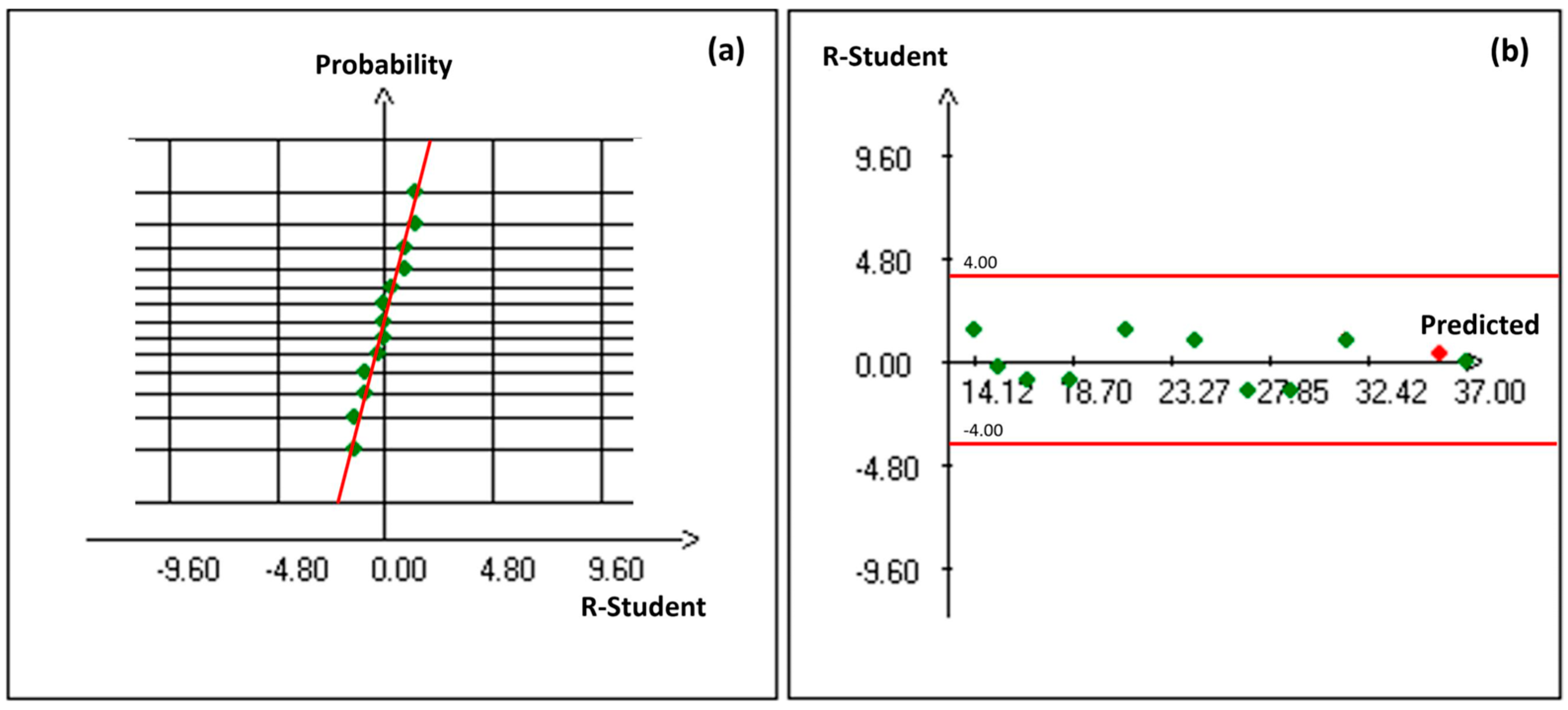
Analysis of variance (ANOVA) was performed to evaluate the statistical significance of the obtained model (Equation (9)). As shown in Table 4, the model demonstrated high significance with a probability value equal to 0.00016 (p-value < 0.01). Furthermore, diagnostic plots (Figure 2) were examined to confirm the suitability of the model. The normal probability plot (Figure 2a) indicates that the residuals follow a normal distribution, while the plot of residuals versus predicted values (Figure 2b) reveals a symmetrical and homogeneous distribution within the range of −2 to +2. All these findings confirm the high precision of the fitted model.
Moreover, the determination coefficient (R2 = 0.99) indicates that 99% of the variation in the response within the domain under study can be explained by Equation (9). This demonstrates that the second-order polynomial model fits the experimental data perfectly and can be used with confidence to predict the response. Most importantly, the high adjusted coefficient (R2adj) of 0.97 mathematically confirms that the model is highly predictive without being over-fitted.

3.1.2. Response Surfaces Analysis and Determination of the Optimal Conditions

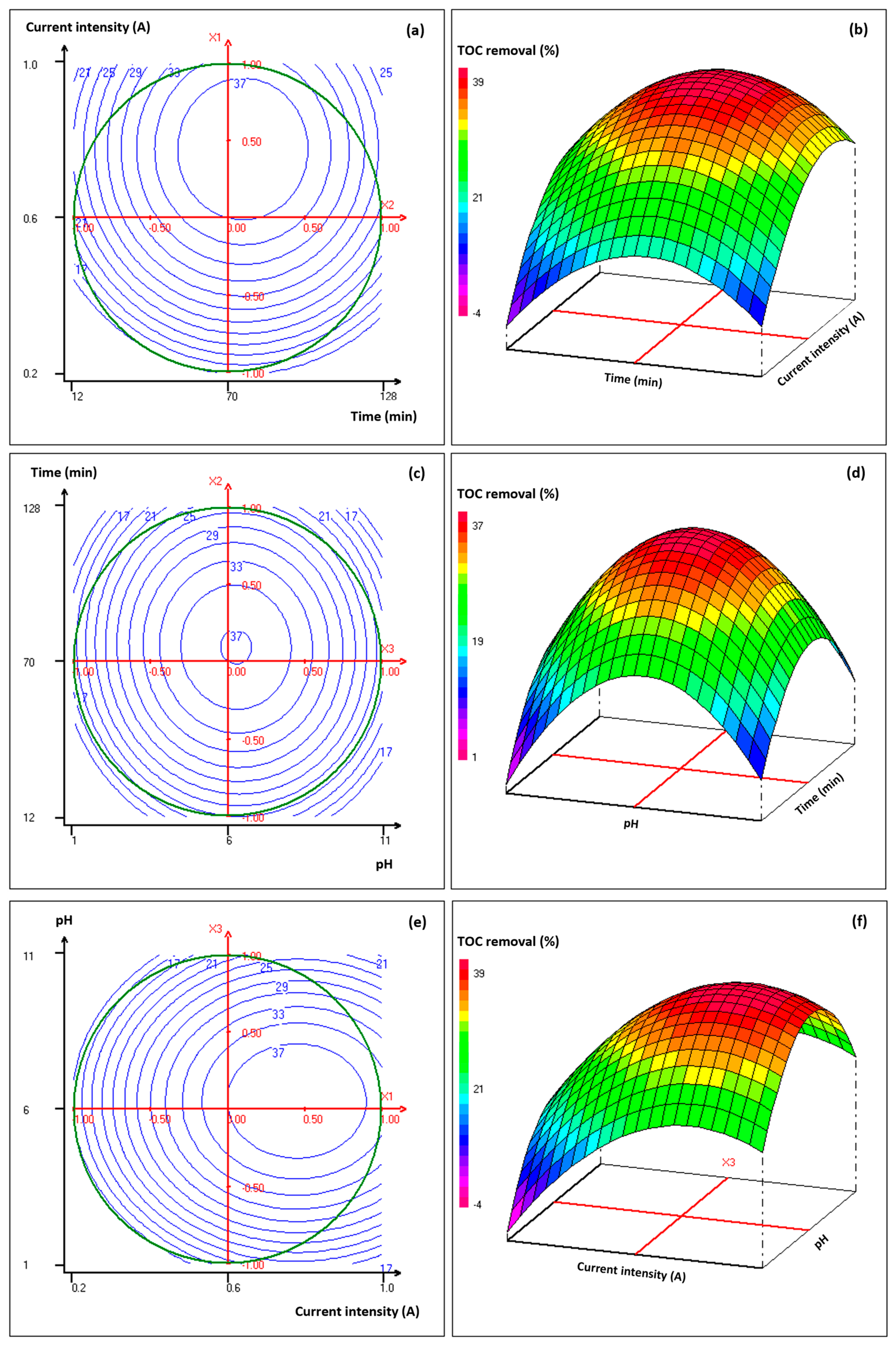
The 2D isoresponse curves of the TOC removal rate and their corresponding 3D surface plots are presented in Figure 3. As the graphs show, the current intensity is positively correlated with the treatment efficiency. Raising the current from 0.2 A to 0.8 A increased the TOC removal from 15 to 39% at pH 6.0 within 70 min of electrolysis (Figure 3a,b). This result is due to the enhanced anodic release of Al3+ ions, which maximizes the formation of aluminum hydroxide (Al(OH)3) flocs, characterized by a large surface area favorable for pollutant adsorption. Such behavior obeys Faraday’s first law, indicating that the quantity of the constituents produced at the electrodes by electrochemical decomposition is directly proportional to the quantity of electricity Q (ampere × second) [46].
The intensity of the applied current determines more than just the Al3+ generation rate; it also impacts the density, size, and growth dynamics of the gas bubbles and flocculants [11]. As the current intensity rises, an increased flux of dissolved gases concentrates within the diffusion layer at the electrode surface [47]. This rapid accumulation shortens the nucleation time, inducing the formation of microbubbles that subsequently expand due to their internal pressure and the continuous diffusion of dissolved gas from the bulk solution [47]. The resulting bubble density alters the system’s hydrodynamics, which influences the mass transfer among contaminants, coagulants, and microbubbles to facilitate particle collisions and accelerate floc formation [48].
However, when the current intensity exceeded 0.8 A, a significant decrease in the TOC removal rate was observed. This reduction demonstrates the adverse effects of current overloading on the treatment process; an excessive anodic release of Al3+ ions provokes a charge reversal of the colloidal pollutants, restabilizing them and preventing their aggregation. Alongside the fall in coagulation efficiency, applying these extreme currents not only degrades the treatment performance but also causes wasteful consumption of the electrode and reduces its lifespan [11,48].
The electrolysis time emerged as another key parameter that significantly influenced the remediation of the petroleum refinery wastewater. As illustrated in Figure 3c,d, extending the treatment duration improved the TOC removal rate. At a constant I = 0.6 A and pH = 6.0, the increase in reaction time from 20 to 75 min raised the TOC removal from 25 to 37%. The observed improvement is due to the continuous production of Al3+ and OH ions throughout the process, which promotes the formation of aluminum hydroxide (Al(OH)3) (Equation (3)), and hence enhances the treatment effectiveness [11]. These amorphous (Al(OH)3) species, often described as a flocculation field, possess a large surface area which provides ample sites for the adsorption of dissolved pollutants and the capture of colloidal particles, via van der Waals forces [49]. Exceeding 75 min of reaction time did not improve removal efficiency, which suggests that the solution reached the optimal coagulant dosage [50]. Therefore, longer electrolysis times would be considered a waste of energy.
The performance of the electrocoagulation process is also significantly influenced by the initial pH of the petroleum refinery wastewater. This parameter mainly controls the coagulation mechanism by determining which hydrolyzed aluminum species are generated in the reactor [11,48]. As shown in Figure 3e,f, raising the pH from 2.0 to 6.0 increased the removal efficiency from 22 to 37% at I = 0.6 A after 70 min of electrolysis. The optimum TOC removal rate was achieved within a pH range of 4.0 to 8.0. This peak performance is attributed to the dominant precipitation of insoluble aluminum hydroxide (Al(OH)3) in this range, at the expense of soluble aluminum ions [48]. The anodic aluminum cations polymerize into complex multinuclear species such as Al6(OH)153+, Al7(OH)174+ and Al13O4(OH)247+, which then convert into Al(OH)3 through complex precipitation kinetics, ensuring a highly effective remediation [11].
Outside this optimal pH range, the process exhibited a lower efficiency under both highly acidic (pH < 4.0) and alkaline (pH > 8.0) conditions; this decline in performance is due to the amphoteric nature of aluminum hydroxide. At low pH, Al(OH)3 fails to precipitate, which maintains aluminum in the form of soluble Al3+ cations [11,50]. Under highly basic conditions, the solid Al(OH)3 redissolves to generate soluble aluminate ions (Al(OH)4). Because both of these ionic forms remain dissolved, they provide no flocculation matrix and are entirely ineffective for treating the effluent [11,50].
The electrocoagulation technique inherently functions as a pH buffer [48]. For acidic effluent, the final pH increases as the cathode continuously generates OH ions during hydrogen gas evolution. When the initial effluent is highly alkaline, the final pH of the treated solution decreases. This neutralization occurs due to the generation of H+ ions in the solution through two main pathways: the precipitation of aluminum hydroxides and the anodic oxidation of H2O [48].
According to Figure 3, the electrocoagulation process achieves its maximum efficiency at a current of 0.8 A, a 75 min reaction time, and an initial pH of 6.0. Conducting the electrolysis under these experimental conditions for the pretreatment of petroleum refinery wastewater led to a 39% TOC removal rate.

3.1.3. External Validation and Experimental Uncertainty

To physically verify the predictive accuracy of the statistical model established in Section 3.1.1, an external validation experiment was conducted. The petroleum refinery wastewater was treated by electrocoagulation under the exact optimal conditions identified by the software (0.8 A, 75 min, pH 6.0). The experimental COD removal efficiency reached 39.0%; this empirical result aligns perfectly with the theoretical maximum of 39.2% predicted by the model, yielding a negligible relative error. Finally, triplicate runs at the center point of the experimental domain (Runs 13–15) exhibited minimal variance, thereby confirming the low experimental uncertainty and high reproducibility of the process.

3.2. Electro-Fenton Treatment

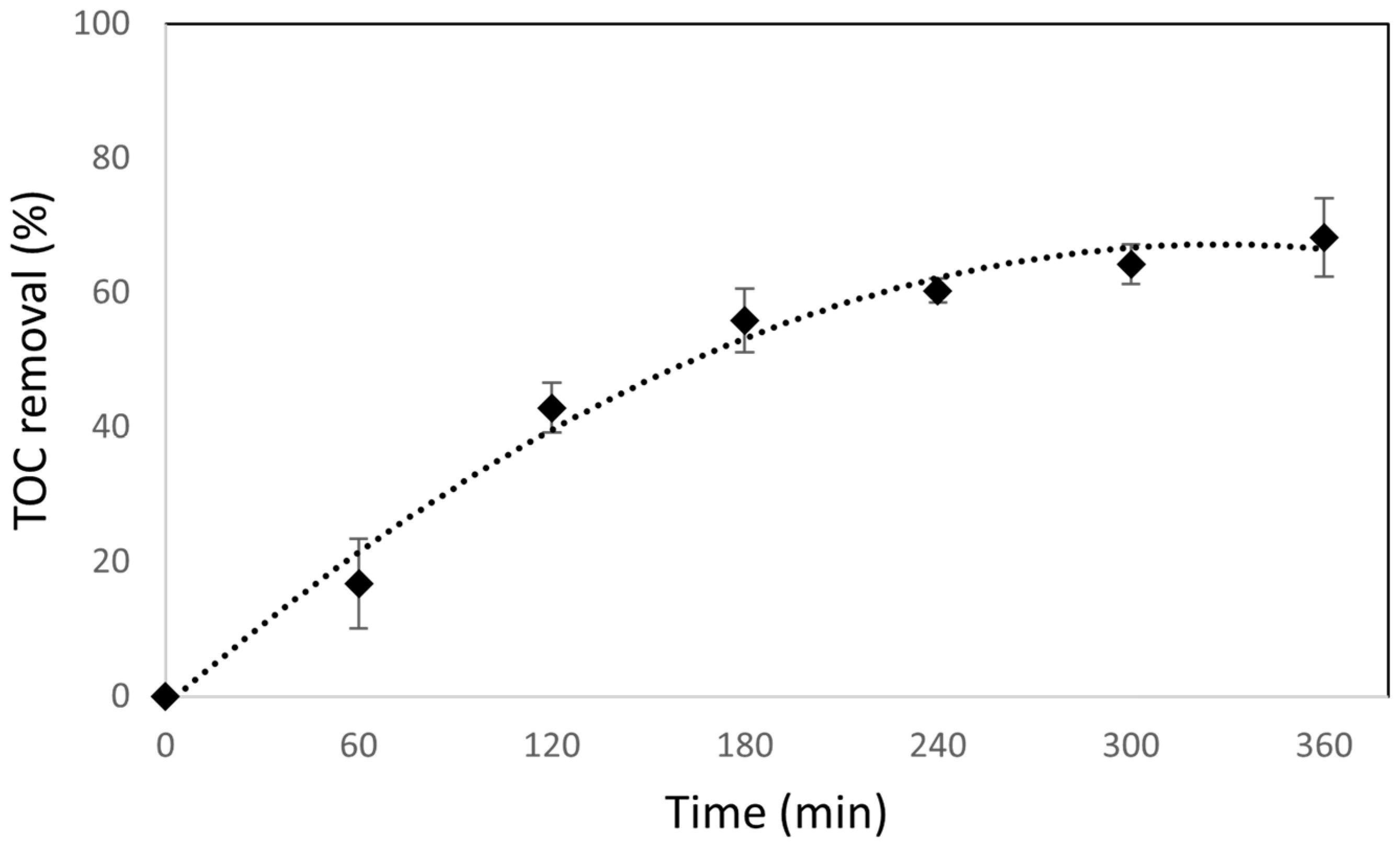
The electro-Fenton treatment was conducted on 250 mL of the EC-pretreated petroleum refinery wastewater. Prior to electrolysis, the sample was filtered and adjusted to pH 3.0; 0.01 M of ferrous ions (Fe2+) was added, and the process was then operated at a constant current intensity of 0.8 A. Figure 4 illustrates the evolution of the TOC removal rate over time.
As shown in Figure 4, extending the reaction time improved the TOC removal and consequently enhanced the overall mineralization rate of the petroleum refinery wastewater. Increasing the treatment duration from 60 to 180 min raised the TOC removal efficiency from 16 to 55%. This performance gain is attributed to the continuous in situ generation of the H2O2 and Fe2+ reagents at the cathode, as described by Equations (10) and (11). These simultaneous cathodic processes fuel the Fenton reaction (Equation (12)), promoting the uninterrupted formation of powerful hydroxyl radicals (•OH) that degrade recalcitrant pollutants and maximize the treatment effectiveness [31,34,37].
O2 + 2e + 2H+ → H2O2
Fe3+ + e → Fe2+
Fe2+ + H2O2 → Fe3+ + OH + OH
The synergistic interaction between the EC and EF stages relies on mitigating competitive radical scavenging. As demonstrated in recent comparative study of sequential processes [51], applying direct EF to complex matrices forces the hydroxyl radicals (•OH), generated via the Fenton reaction (Equation (12)), to indiscriminately attack suspended colloids and bulk macromolecules. This parasitic consumption acts as a massive radical sink which impedes the mineralization kinetics. By deploying EC as the initial pretreatment, heavy colloidal fractions are selectively coagulated and precipitated. Consequently, the pretreated petroleum refinery wastewater entering the EF reactor is fundamentally altered, and the •OH radicals are thus exclusively directed toward the deep oxidation of the remaining dissolved, recalcitrant pollutants.
The TOC removal kinetics showed two-stage behavior: an initial rapid phase reaching 60% after 240 min of electrolysis, followed by a slow mineralization phase that achieved a 68% removal rate. During the first stage, the electro-Fenton process rapidly degrades aromatic intermediates through ring cleavage to yield short-chain aliphatic carboxylic acids [39]. The decrease in the reaction rate, observed subsequently, is due to the system of delocalized π electrons of aromatic compounds [28,52]. The aromatic rings undergo initial electrophilic addition by •OH radicals, which generate intermediate radical species such as hydroxycyclohexadienyl radicals where the unpaired electron is delocalized on the ring via resonance [28,52]. This thermodynamic stabilization prevents the immediate cleavage of the aromatic ring, which negatively influences the mineralization process [28,52].
To quantitatively substantiate these observations, the pseudo-first-order kinetic model (ln (TOC0/TOC) = kt) was applied to the experimental data. This mathematical analysis reflects the thermodynamic stabilization discussed above. Indeed, the initial phase yielded a fast rate constant (kfast) of 0.0041 min−1 (R2 = 0.9903). In contrast, the slower phase was quantified by a reduced rate constant (kslow) of 0.0034 min−1 (R2 = 0.9944), thus proving the stabilization of reaction intermediates at this stage. Despite this slight decrease in the reaction rate during the EF step, the complete sequential EC-EF treatment demonstrated a strong synergistic performance, achieving an overall TOC mineralization of 81%.
As reported by Haidar et al. [52], hydroxyl radicals preferentially attack these aromatic structures rather than the resulting carboxylic acids, as these short-chain acids are resistant to the oxidation by •OH radicals. Indeed, the hydroxyl radical is a powerful electrophile that actively searches for electron-rich sites to attack. In short-chain aliphatic carboxylic acids, the electronegative carboxyl group (-COOH) exerts an electron-withdrawing inductive effect. This effect depletes the electron density from the adjacent carbon chain, which becomes electron-poor and chemically deactivated. Therefore, the electrophilic attack by •OH becomes unfavorable in terms of thermodynamics and kinetics. This resistance is amplified by the formation of stable Fe(III)-carboxylic acid complexes [53]. Because of their low reactivity toward hydroxyl radicals, these complexes restrict the mineralization efficiency compared to the rapid kinetics observed at the start of the process [53].
Given these kinetic constraints, a 360 min electrolysis seems prolonged at the bench scale. This operational duration, however, supports industrial scale-up. Translating the batch process into a continuous-flow configuration yields a standard hydraulic retention time (HRT) of six hours, which aligns with conventional oxidation basin designs. The required reaction phase thus poses no structural barrier for the full-scale treatment of petroleum refinery wastewaters.
The COD/TOC ratio is an important indicator in the systematic assessment of wastewater treatment; while TOC quantifies the amount of organic carbon, COD measures the total oxygen required to chemically oxidize both the organic and certain inorganic compounds present in the effluent. The determination of the COD/TOC ratio at specific stages of the treatment reveals the oxidation state of the dissolved organics [54,55]. A high COD/TOC ratio reflects the presence of reduced organic matter that consumes oxygen, whereas a low ratio indicates that the remaining dissolved pollutants are already heavily oxidized [54,55].
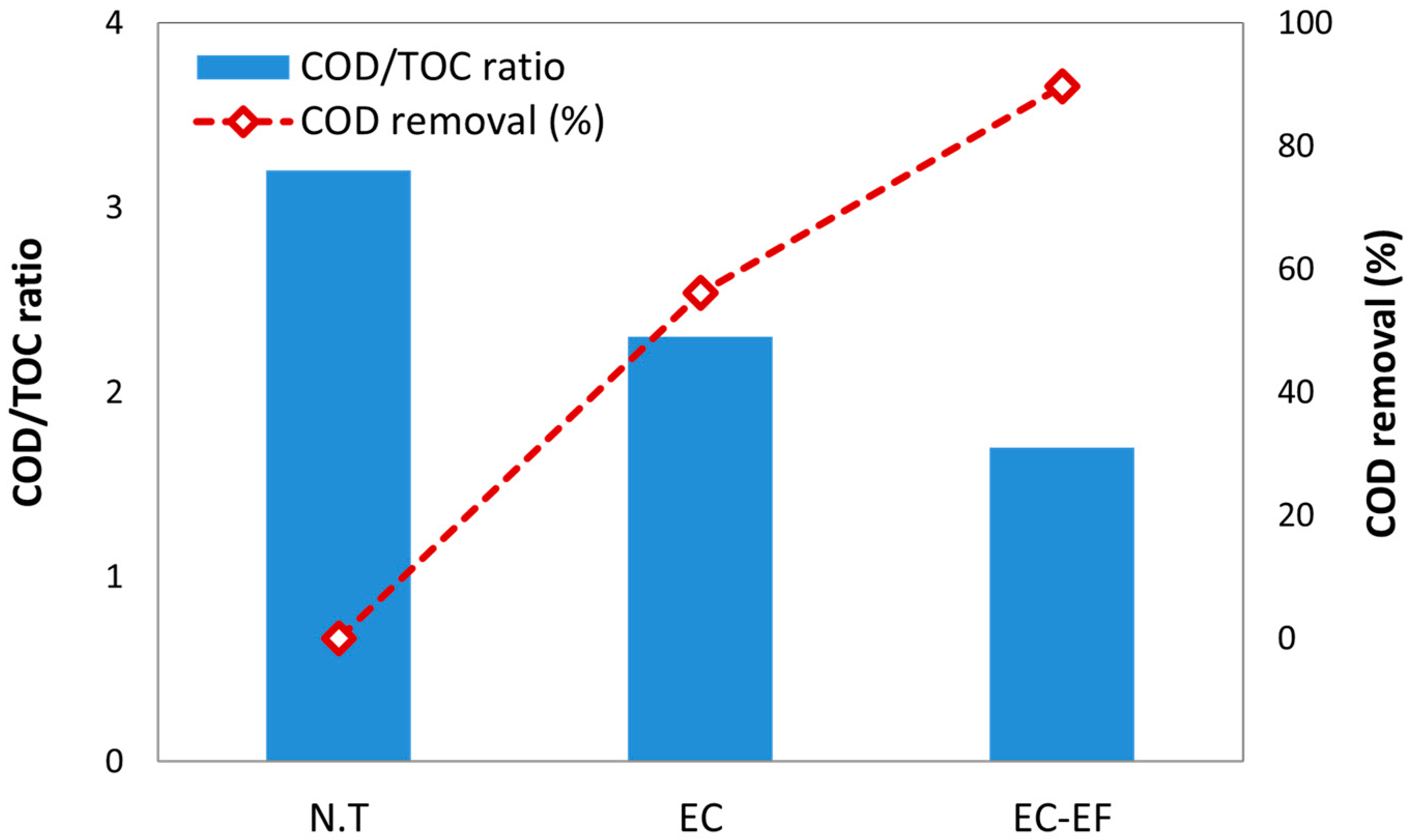
In order to monitor the progression of pollutants’ oxidation during petroleum refinery wastewater treatment, the samples were analyzed for COD and TOC. Figure 5 shows that the COD removal rate reached 89%, and the COD/TOC ratio decreased from 3.2 to 1.6 after treatment by the combined EC-EF process, which indicates a significant increase in the oxidation state of the organic matter [54]. Overall, the coupled EC-EF system yielded final mineralization and oxidation efficiency of 81% and 89%, respectively. Since the residual organics are highly oxidized but not fully mineralized, these findings support an integrated treatment strategy. The implementation of a final biological degradation step following the EC-EF treatment stands out as the most logical approach to achieving total mineralization.

3.3. Cost Analysis and Comparative Evaluation

The total operating cost per gram of TOC removed (OCTOC) of the combined process coupling the electrocoagulation pretreatment and the electro-Fenton treatment consists of the cost of the consumed electrical energy, chemicals, labor, and maintenance [56]. In order to determine this cost, the consumption of energy per gram of TOC removed (ENCTOC) and the consumption of chemicals per gram of TOC removed (CHCTOC) for 1 m3 of petroleum refinery wastewater were calculated according to the following equations [28,56].
E N C T O C   ( k W h · g 1   T O C ) = U × I × t × 10 3 V × ( T O C ) e x p
where U: the applied cell voltage (V), I: the intensity of current (A), t: the electrolysis time (h), V: the wastewater volume (m3), and ∆(TOC)exp: the experimental decay of total organic carbon (g·m−3).
E L C T O C   ( k g · g 1 T O C ) = M × I × t z × F × V × ( T O C ) e x p
where M: the aluminum molar mass (kg·mol−1), I: the intensity of current (A), t: the electrolysis time (s), z: the number of transferred electrons (zAl = 3), F: the Faraday constant (96,487 C·mol−1), V: the wastewater volume (m3) and ∆(TOC)exp: the experimental decay of total organic carbon (g·m−3).
C H C T O C   ( k g · g 1 T O C ) = ρ i ( T O C ) e x p
where ρi: the mass concentration of chemicals (kg·m−3) and ∆(TOC)exp: the experimental decay of total organic carbon (g·m−3).
The obtained results indicate that the treatment of 1 m3 petroleum refinery wastewater by the EC-EF process under the determined operating conditions (Section 3.1.2 and Section 3.2) required an electrical energy of 0.632 kWh·g−1 TOC and an aluminum, ferrous sulfate and sodium sulfate amount of 1.3 × 10⁻³, 2.4 × 10⁻³, and 3.2 × 10⁻³ kg·g−1 TOC, respectively.
The total operating cost per gram of TOC removed (OCTOC) for the treatment of 1 m3 of petroleum refinery wastewater was calculated according to the following equation [19,56].
O C T O C = a × C e n e r g y + b × C A l + c × C F e 2 + + d × C N a 2 S O 4 +   other   costs   ( maintenance   and   labor   costs )
where a: the electricity cost ($/kWh), b: the aluminum cost ($/kg), c: the ferrous sulfate cost ($/kg), and d: the sodium sulfate cost ($/kg).
Considering unit costs of USD 0.05 per kWh for energy, USD 2.5 per kg for aluminum, USD 0.25 per kg for ferrous sulfate, and USD 0.15 per kg for sodium sulfate, alongside estimated maintenance and labor costs of USD 3 × 10⁻⁶ and USD 6 × 10⁻⁵, respectively [56], the total operating cost (OCTOC) for the combined sequential process was calculated. For the treatment of 1 m3 of petroleum refinery wastewater, the integrated system requires USD 0.036 per gram of TOC removed.
This economic evaluation serves as a preliminary baseline estimate of direct operational expenditures (OPEX), intended for comparative purposes. A comprehensive industrial techno-economic assessment (TEA) incorporating capital expenditures (CAPEX), auxiliary energy, sludge disposal, and long-term electrode replacement remains highly speculative at this bench scale. Therefore, quantifying these macroscopic parameters represents an essential next step for future continuous-flow pilot studies.
To benchmark this operational expenditure (0.036 USD/g·TOC), it must be evaluated against other advanced oxidation technologies applied to recalcitrant matrices. Literature data indicates that achieving deep mineralization of complex aromatic structures, such as bisphenol A, via anodic oxidation, requires between 0.063 and 0.905 USD/g·TOC depending on the selected anode material [57]. Furthermore, recent comparative assessments of AOPs demonstrate that while conventional homogeneous Fenton is adequate for partial degradation, electro-Fenton strictly emerges as the most economical technology for high mineralization yields (>75%), distinctly outperforming ozonation and photo-electrochemical methods [58,59]. Since the proposed sequential system achieved an 81% overall TOC removal, the specific integration of the EF mechanism guarantees optimal cost-efficiency for treating petroleum refinery wastewaters.
Table 5 presents a comparative evaluation of the integrated EC-EF process against previous studies utilizing stand-alone EC and EF for industrial wastewater treatment.
As indicated in Table 5, stand-alone electrochemical treatments possess undeniable merits. For instance, simple electrocoagulation can remove up to 94.0% of COD in oily wastewaters with a relatively low initial COD of 700 mg·L−1; however, high-strength industrial matrices often resist these single-stage methods. Stand-alone EF process applied to petrochemical or distillery effluents frequently plateau at COD reduction rates between 67.3% and 79.5%, which is precisely where our sequential methodology demonstrates its true value. Despite confronting a massive initial pollutant load of 8742 mg·L−1, the sequential EC-EF coupling achieves a remarkable COD removal efficiency of 89.0%.
Although macroscopic parameters confirm a robust overall mineralization, the methodological limitations of this study require acknowledgment. Due to the extreme complexity of the petroleum refinery wastewater, systematic molecular identification of reaction intermediates was not performed. Specific ecotoxicological assessments were similarly excluded. Recognizing these boundaries defines the scope of the current findings and establishes a baseline for future pilot-scale evaluations.

4. Conclusions

A systematic experimental design was applied to determine the optimal operating conditions for the electrocoagulation pretreatment of petroleum refinery wastewater. The results demonstrated that a TOC removal efficiency of 39% was reached after 75 min for an effluent electrolyzed at pH 6 with an applied current of 0.8 A. Concurrently, a significant COD removal efficiency of 56% was achieved, yielding a COD/TOC ratio of 2.3. The experimental data successfully fit a quadratic polynomial model, validated by statistical metrics including the Adjusted R2, F-value, and p-value. In the subsequent stage, the pretreated effluent underwent electro-Fenton oxidation for 360 min at pH 3, using a ferrous ion concentration of 0.01 M and an applied current of 0.8 A. This step achieved TOC and COD removal efficiencies of 68% and 76%, respectively. Ultimately, the synergistic EC-EF coupling led to overall mineralization and oxidation efficiencies of 81% and 89%. The cost analysis establishes a solid techno-economic baseline for this integrated approach, yielding an estimated operating cost of USD 0.036 per gram of TOC removed.
To bridge the gap between bench-scale results and full industrial implementation, future studies must prioritize toxicity evolution, intermediate by-product monitoring via advanced chromatographic techniques [67], and continuous-flow evaluations. Furthermore, assessing long-term electrode durability and developing comprehensive sludge management strategies will be essential to validate the operational stability of the sequential EC-EF process under realistic refinery conditions.

Author Contributions

Conceptualization, methodology and writing: D.M.; Experimental procedures: D.M., E.A. and R.H.L.; Resources: D.M. and A.K.D.A.; Analyses: D.M., R.H.L. and S.T.; Software and validation: D.M.; Investigation: D.M. and N.B.; Review: H.B. and A.A. All authors have read and agreed to the published version of the manuscript.

Funding

This research was funded by the Scientific Research Deanship at the University of Hail, Saudi Arabia, through project number RG–21171.

Data Availability Statement

The data that support the findings of this study are available from the corresponding author upon reasonable request.

Acknowledgments

The authors express their sincere thanks to the University of Hail, Kingdom of Saudi Arabia for financing this study. Thanks also go to the Chemistry Department of College of Sciences at Hail University for their valuable assistance in providing with the required information.

Conflicts of Interest

The authors declare that they have no known competing financial interests or personal relationships that could appear to influence the work reported in this paper.

References

  1. Al-Tameemi, H.M.; Sukkar, K.A.; Abbar, A.H. Treatment of Petroleum Refinery Wastewater by a Combination of Anodic Oxidation with Photocatalyst Process: Recent Advances, Affecting Factors and Future Perspectives. Chem. Eng. Res. Des. 2024, 204, 487–508. [Google Scholar] [CrossRef]
  2. Atiyah, Z.Y.; Muallah, S.K.; Abbar, A.H. Removal of COD from Petroleum Refinery Wastewater by Adsorption Using Activated Carbon Derived from Avocado Plant. S. Afr. J. Chem. Eng. 2024, 48, 467–483. [Google Scholar] [CrossRef]
  3. Fatehbasharzad, P.; Aliasghari, S.; Tabrizi, I.S.; Khan, J.A.; Boczkaj, G. Microbial Fuel Cell Applications for Removal of Petroleum Hydrocarbon Pollutants: A Review. Water Resour. Ind. 2022, 28, 100178. [Google Scholar] [CrossRef]
  4. Yu, L.; Xia, W.; Du, H. The Toxic Effects of Petroleum Pollutants to Microalgae in Marine Environment. Mar. Pollut. Bull. 2024, 201, 116235. [Google Scholar] [CrossRef]
  5. Brinkmann, M.; Hudjetz, S.; Kammann, U.; Hennig, M.; Kuckelkorn, J.; Chinoraks, M.; Cofalla, C.; Wiseman, S.; Giesy, J.P.; Schäffer, A.; et al. How Flood Events Affect Rainbow Trout: Evidence of a Biomarker Cascade in Rainbow Trout after Exposure to PAH Contaminated Sediment Suspensions. Aquat. Toxicol. 2013, 128–129, 13–24. [Google Scholar] [CrossRef]
  6. Wang, Y.; Zhang, M.; Ding, G.; Shi, H.; Cong, Y.; Li, Z.; Wang, J. Polystyrene Microplastics Alleviate Adverse Effects of Benzo[a]Pyrene on Tissues and Cells of the Marine Mussel, Mytilus Galloprovincialis. Aquat. Toxicol. 2023, 256, 106430. [Google Scholar] [CrossRef]
  7. Li, Y.; Zhang, Q.; Guo, D.; Dang, J. Characteristics and Risk Assessment of PAH Pollution in Soil of a Retired Coking Wastewater Treatment Plant in Taiyuan, Northern China. Toxics 2023, 11, 415. [Google Scholar] [CrossRef] [PubMed]
  8. Youssef, H.H.; Younis, S.A.; El-Fawal, E.M.; Ali, H.R.; Moustafa, Y.M.; Mohamed, G.G. Synthesis of Polyaluminum Chloride Coagulant from Waste Aluminum Foil and Utilization in Petroleum Wastewater Treatment. Separations 2023, 10, 570. [Google Scholar] [CrossRef]
  9. Lawan, M.S.; Kumar, R.; Rashid, J.; Barakat, M.A.E.-F. Recent Advancements in the Treatment of Petroleum Refinery Wastewater. Water 2023, 15, 3676. [Google Scholar] [CrossRef]
  10. McCay, J.; Mehta, S. Microfiber Fragment Pollution: Sources, Toxicity, Strategies, and Technologies for Remediation. Sustainability 2024, 16, 3077. [Google Scholar] [CrossRef]
  11. Mansour, D.; El-Sofany, W.I.; Faiza, I.A.A.; Masood, N.; Alsukaibi, A.K.D.; Bellakhal, N. Doehlert Experimental Design for the Optimization of Electrocoagulation Treatment of Landfill Leachate. Environ. Pollut. Bioavailab. 2021, 33, 395–401. [Google Scholar] [CrossRef]
  12. Fang, K.; Zeng, X.; Yao, G.; Xia, S.; Zhao, J.; Zhou, Y.; Zhu, Y.; Li, X.; Qu, C. Wet Oxidation of Pharmaceutical Sludge for the Treatment and Production of Value-Added Materials. Processes 2023, 11, 2747. [Google Scholar] [CrossRef]
  13. Ding, J.; Jiang, M.; Zhao, G.; Wei, L.; Wang, S.; Zhao, Q. Treatment of Leachate Concentrate by Electrocoagulation Coupled with Electro-Fenton-like Process: Efficacy and Mechanism. Sep. Purif. Technol. 2021, 255, 117668. [Google Scholar] [CrossRef]
  14. Jasim, R.A.; Salman, R.H. Congo Red Removal from Aqueous Solution by Electrocoagulation- Electro-Oxidation Combined System with Al and Cu–Mn–Ni Nano Composite as Efficient Electrodes. Case Stud. Chem. Environ. Eng. 2024, 9, 100747. [Google Scholar] [CrossRef]
  15. Ankoliya, D.; Mudgal, A.; Sinha, M.K.; Patel, V.; Patel, J. Application of Electrocoagulation Process for the Treatment of Dairy Wastewater: A Mini Review. Mater. Today Proc. 2023, 77, 117–124. [Google Scholar] [CrossRef]
  16. Kashani, M.R.K.; Wang, Q.; Khatebasreh, M.; Li, X.; Asadi, A.M.S.; Boczkaj, G.; Ghanbari, F. Sequential Treatment of Landfill Leachate by Electrocoagulation/Aeration, PMS/ZVI/UV and Electro-Fenton: Performance, Biodegradability and Toxicity Studies. J. Environ. Manag. 2023, 338, 117781. [Google Scholar] [CrossRef]
  17. Fotovat, F.; Hosseini, M. Treatment of Oily Wastewater by Electrocoagulation: Simultaneous Optimization of Oil Removal Efficiency and Specific Energy Consumption. J. Water Process Eng. 2023, 55, 104221. [Google Scholar] [CrossRef]
  18. Gökkuş, Ö.; Brillas, E.; Sirés, I. Sequential Use of a Continuous-Flow Electrocoagulation Reactor and a (Photo)Electro-Fenton Recirculation System for the Treatment of Acid Brown 14 Diazo Dye. Sci. Total Environ. 2024, 912, 169143. [Google Scholar] [CrossRef]
  19. Bel Hadj Hmida, E.S.; Mansour, D.; Bellakhal, N. Treatment of Lixiviate from Jebel Chakir-Tunis by Electrocoagulation. Desalination Water Treat. 2010, 24, 266–272. [Google Scholar] [CrossRef]
  20. Jiad, M.M.; Abbar, A.H. Treatment of Petroleum Refinery Wastewater by Electrofenton Process Using a Low Cost Porous Graphite Air-Diffusion Cathode with a Novel Design. Chem. Eng. Res. Des. 2023, 193, 207–221. [Google Scholar] [CrossRef]
  21. Oturan, M.A.; Aaron, J.-J. Advanced Oxidation Processes in Water/Wastewater Treatment: Principles and Applications. A Review. Crit. Rev. Environ. Sci. Technol. 2014, 44, 2577–2641. [Google Scholar] [CrossRef]
  22. Akpotu, S.O.; Oseghe, E.O.; Ayanda, O.S.; Skelton, A.A.; Msagati, T.A.M.; Ofomaja, A.E. Photocatalysis and Biodegradation of Pharmaceuticals in Wastewater: Effect of Abiotic and Biotic Factors. Clean Technol. Environ. Policy 2019, 21, 1701–1721. [Google Scholar] [CrossRef]
  23. Liu, Z.; Wardenier, N.; Hosseinzadeh, S.; Verheust, Y.; De Buyck, P.-J.; Chys, M.; Nikiforov, A.; Leys, C.; Van Hulle, S. Degradation of Bisphenol A by Combining Ozone with UV and H2O2 in Aqueous Solutions: Mechanism and Optimization. Clean Technol. Environ. Policy 2018, 20, 2109–2118. [Google Scholar] [CrossRef]
  24. Rashmishree, K.N.; Bhaskar, S.; Shri Hari, S.; Thalla, A.K. Correction: Green Synthesis of Laterite Iron-based Nanocatalysts Using Psidium Guajava and Macaranga Peltata Plant Extract for Its Catalytic Application in Fenton’s Oxidation of Triclosan. Clean Technol. Environ. Policy 2023, 26, 4009. [Google Scholar] [CrossRef]
  25. Gasmi, I.; Hamdaoui, O.; Ferkous, H.; Alghyamah, A. Sonochemical Advanced Oxidation Process for the Degradation of Furosemide in Water: Effects of Sonication’s Conditions and Scavengers. Ultrason. Sonochem. 2023, 95, 106361. [Google Scholar] [CrossRef]
  26. Mansour, D.; Fourcade, F.; Soutrel, I.; Hauchard, D.; Bellakhal, N.; Amrane, A. Mineralization of Synthetic and Industrial Pharmaceutical Effluent Containing Trimethoprim by Combining Electro-Fenton and Activated Sludge Treatment. J. Taiwan Inst. Chem. Eng. 2015, 53, 58–67. [Google Scholar] [CrossRef]
  27. Ljubas, D.; Juretić, H.; Badrov, A.; Biošić, M.; Babić, S. Photocatalytic Degradation of Pharmaceutical Trimethoprim in Aqueous Solution over Nanostructured TiO2 Film Irradiated with Simulated Solar Radiation. Appl. Sci. 2023, 13, 5681. [Google Scholar] [CrossRef]
  28. Mansour, D.; Fourcade, F.; Huguet, S.; Soutrel, I.; Bellakhal, N.; Dachraoui, M.; Hauchard, D.; Amrane, A. Improvement of the Activated Sludge Treatment by Its Combination with Electro Fenton for the Mineralization of Sulfamethazine. Int. Biodeterior. Biodegrad. 2014, 88, 29–36. [Google Scholar] [CrossRef]
  29. Puga, A.; Moreira, M.M.; Figueiredo, S.A.; Delerue-Matos, C.; Pazos, M.; Rosales, E.; Sanromán, M.Á. Electro-Fenton Degradation of a Ternary Pharmaceutical Mixture and Its Application in the Regeneration of Spent Biochar. J. Electroanal. Chem. 2021, 886, 115135. [Google Scholar] [CrossRef]
  30. Mahmoudi, N.; Farhadian, M.; Nazar, A.R.S.; Eskandari, P.; Esfahani, K.N. Investigation and Optimization of the Performance of Sono-Photo-Electro-Fenton Process for Removal of Acid Black 172 and Disperse Blue 56 from Polluted Water: Comparison of the Degradation Activity with Electro-Fenton-Based Processes. Int. J. Environ. Sci. Technol. 2022, 19, 1671–1682. [Google Scholar] [CrossRef]
  31. Mansour, D.; Alblawi, E.; Alsukaibi, A.K.D.; Al Shammari, B. Removal of Congo Red Dye by Electrochemical Advanced Oxidation Process: Optimization, Degradation Pathways, and Mineralization. Sustain. Water Resour. Manag. 2024, 10, 41. [Google Scholar] [CrossRef]
  32. Mansour, D.; Fourcade, F.; Bellakhal, N.; Dachraoui, M.; Hauchard, D.; Amrane, A. Biodegradability Improvement of Sulfamethazine Solutions by Means of an Electro-Fenton Process. Water Air Soil Pollut. 2012, 223, 2023–2034. [Google Scholar] [CrossRef]
  33. Mansour, D.; Fourcade, F.; Soutrel, I.; Hauchard, D.; Bellakhal, N.; Amrane, A. Relevance of a Combined Process Coupling Electro-Fenton and Biological Treatment for the Remediation of Sulfamethazine Solutions—Application to an Industrial Pharmaceutical Effluent. Comptes Rendus Chim. 2015, 18, 39–44. [Google Scholar] [CrossRef]
  34. Chi, C.; Zhou, X.; Wang, Y.; Gao, X.; Bai, J.; Guo, Y.; Ni, J. Treatment of Coking Wastewater Using a Needle Coke Electro-Fenton Cathode: Optimizing of COD, NH4+-N, and TOC Removal and Characterization of Pollutants. Water Sci. Technol. 2023, 88, 106–122. [Google Scholar] [CrossRef]
  35. Xiao, C.; Li, S.; Yi, F.; Zhang, B.; Chen, D.; Zhang, Y.; Chen, H.; Huang, Y. Enhancement of Photo-Fenton Catalytic Activity with the Assistance of Oxalic Acid on the Kaolin–FeOOH System for the Degradation of Organic Dyes. RSC Adv. 2020, 10, 18704–18714. [Google Scholar] [CrossRef]
  36. Barrocas, B.T.; Osawa, R.; Oliveira, M.C.; Monteiro, O.C. Enhancing Removal of Pollutants by Combining Photocatalysis and Photo-Fenton Using Co, Fe-Doped Titanate Nanowires. Materials 2023, 16, 2051. [Google Scholar] [CrossRef]
  37. Oturan, M.A. Outstanding Performances of the BDD Film Anode in Electro-Fenton Process: Applications and Comparative Performance. Curr. Opin. Solid State Mater. Sci. 2021, 25, 100925. [Google Scholar] [CrossRef]
  38. García-Espinoza, J.D.; Robles, I.; Durán-Moreno, A.; Godínez, L.A. Study of Simultaneous Electro-Fenton and Adsorption Processes in a Reactor Containing Porous Carbon Electrodes and Particulate Activated Carbon. J. Electroanal. Chem. 2021, 895, 115476. [Google Scholar] [CrossRef]
  39. Mansour, D.; Alblawi, E.; Alsukaibi, A.K.D.; Humaidi, J.; Tahraoui, H.; Shatat, M.; Teka, S.; Maisara, S.; Bellakhal, N.; Binous, H.; et al. Modeling and Optimization of Electrochemical Advanced Oxidation of Clopidogrel Using the Doehlert Experimental Design Combined with an Improved Grey Wolf Algorithm. Water 2024, 16, 1964. [Google Scholar] [CrossRef]
  40. Akkaya, G.K. Treatment of Petroleum Wastewater by Electrocoagulation Using Scrap Perforated (Fe-Anode) and Plate (Al and Fe-Cathode) Metals: Optimization of Operating Parameters by RSM. Chem. Eng. Res. Des. 2022, 187, 261–275. [Google Scholar] [CrossRef]
  41. Agarwal, P.; Sangal, V.K.; Mathur, S. Sequential Electro-coagulation and electro-Fenton Processes for the Treatment of Textile Wastewater. Water Environ. Res. 2024, 96, e11118. [Google Scholar] [CrossRef]
  42. Souza, C.G.C.; De Freitas Silva Valente, G.; Pinto, B.B.A.; Da Silva Medeiros, J. Electrocoagulation-Electro-Fenton Hybrid System for Dairy Wastewater Treatment: A Comprehensive Test and Analysis, in Aqueous Solution. Desalination Water Treat. 2024, 320, 100849. [Google Scholar] [CrossRef]
  43. El Faroudi, L.; El Jemli, Y.; Zari, R.; Barakat, A.; Ismael, M.K.; Abdelouahdi, K.; Solhy, A. Optimization of Photocatalytic Parameters Using Doehlert Experimental Design to Improve the Photodegradation of Orange G. J. Photochem. Photobiol. A Chem. 2023, 445, 115012. [Google Scholar] [CrossRef]
  44. Ben Khalifa, E.; Cecone, C.; Rzig, B.; Azaiez, S.; Cesano, F.; Malandrino, M.; Bracco, P.; Magnacca, G. Green Surface Modification of Polyvinyl Alcohol Fibers and Its Application for Dye Removal Using Doehlert Experimental Design. React. Funct. Polym. 2023, 193, 105763. [Google Scholar] [CrossRef]
  45. Hammami, S.; Ouejhani, A.; Bellakhal, N.; Dachraoui, M. Application of Doehlert Matrix to Determine the Optimal Conditions of Electrochemical Treatment of Tannery Effluents. J. Hazard. Mater. 2009, 163, 251–258. [Google Scholar] [CrossRef]
  46. Shioyama, T. Newton, Faraday, Einstein: From Classical Physics to Modern Physics; World Scientific: Hackensack, NJ, USA, 2021. [Google Scholar]
  47. Da Cruz, S.G.; Dutra, A.J.B.; Monte, M.B.M. The Influence of Some Parameters on Bubble Average Diameter in an Electroflotation Cell by Laser Diffraction Method. J. Environ. Chem. Eng. 2016, 4, 3681–3687. [Google Scholar] [CrossRef]
  48. Hakizimana, J.N.; Gourich, B.; Chafi, M.; Stiriba, Y.; Vial, C.; Drogui, P.; Naja, J. Electrocoagulation Process in Water Treatment: A Review of Electrocoagulation Modeling Approaches. Desalination 2017, 404, 1–21. [Google Scholar] [CrossRef]
  49. Janpoor, F.; Torabian, A.; Khatibikamal, V. Treatment of Laundry Waste-water by Electrocoagulation. J. Chem. Technol. Biotechnol. 2011, 86, 1113–1120. [Google Scholar] [CrossRef]
  50. Negarestani, M.; Motamedi, M.; Kashtiaray, A.; Khadir, A.; Sillanpää, M. Simultaneous Removal of Acetaminophen and Ibuprofen from Underground Water by an Electrocoagulation Unit: Operational Parameters and Kinetics. Groundw. Sustain. Dev. 2020, 11, 100474. [Google Scholar] [CrossRef]
  51. Dindaş, G.B.; Çalışkan, Y.; Çelebi, E.E.; Tekbaş, M.; Bektaş, N.; Yatmaz, H.C. Treatment of Pharmaceutical Wastewater by Combination of Electrocoagulation, Electro-Fenton and Photocatalytic Oxidation Processes. J. Environ. Chem. Eng. 2020, 8, 103777. [Google Scholar] [CrossRef]
  52. Haidar, M.; Dirany, A.; Sirés, I.; Oturan, N.; Oturan, M.A. Electrochemical Degradation of the Antibiotic Sulfachloropyridazine by Hydroxyl Radicals Generated at a BDD Anode. Chemosphere 2013, 91, 1304–1309. [Google Scholar] [CrossRef]
  53. Fernandes, C.H.M.; Silva, B.F.; Aquino, J.M. On the Performance of Distinct Electrochemical and Solar-Based Advanced Oxidation Processes to Mineralize the Insecticide Imidacloprid. Chemosphere 2021, 275, 130010. [Google Scholar] [CrossRef]
  54. Mella, B.; Barcellos, B.S.D.C.; Da Silva Costa, D.E.; Gutterres, M. Treatment of Leather Dyeing Wastewater with Associated Process of Coagulation-Flocculation/Adsorption/Ozonation. Ozone Sci. Eng. 2018, 40, 133–140. [Google Scholar] [CrossRef]
  55. Bristol, P.; Civiello, J.; Harp, D.; Radu, R. The beneficial use of the cod/toc ratio in the treatment of paper manufacturing wastewater. Proc. Water Environ. Fed. 2001, 2001, 224–237. [Google Scholar] [CrossRef]
  56. Suhan, M.B.K.; Shuchi, S.B.; Anis, A.; Haque, Z.; Islam, M.S. Comparative Degradation Study of Remazol Black B Dye Using Electro-Coagulation and Electro-Fenton Process: Kinetics and Cost Analysis. Environ. Nanotechnol. Monit. Manag. 2020, 14, 100335. [Google Scholar] [CrossRef]
  57. Can, O.T.; Tutun, M.M.; Keyikoglu, R. Anodic Oxidation of Bisphenol A by Different Dimensionally Stable Electrodes. Water Sci. Technol. 2021, 83, 1907–1919. [Google Scholar] [CrossRef]
  58. Mousset, E.; Loh, W.H.; Lim, W.S.; Jarry, L.; Wang, Z.; Lefebvre, O. Cost Comparison of Advanced Oxidation Processes for Wastewater Treatment Using Accumulated Oxygen-Equivalent Criteria. Water Res. 2021, 200, 117234. [Google Scholar] [CrossRef]
  59. Lucas, M.S.; Peres, J.A.; Li Puma, G. Treatment of Winery Wastewater by Ozone-Based Advanced Oxidation Processes (O3, O3/UV and O3/UV/H2O2) in a Pilot-Scale Bubble Column Reactor and Process Economics. Sep. Purif. Technol. 2010, 72, 235–241. [Google Scholar] [CrossRef]
  60. Deghles, A.; Kurt, U. Treatment of Raw Tannery Wastewater by Electrocoagulation Technique: Optimization of Effective Parameters Using Taguchi Method. Desalination Water Treat. 2016, 57, 14798–14809. [Google Scholar] [CrossRef]
  61. Shahawy, A.E.; Ahmed, I.A.; Nasr, M.; Ragab, A.H.; Al-Mhyawi, S.R.; Elamin, K.M.A. Organic Pollutants Removal from Olive Mill Wastewater Using Electrocoagulation Process via Central Composite Design (CCD). Water 2021, 13, 3522. [Google Scholar] [CrossRef]
  62. Al-Obaidi, Q.; Saeed, A.W.; Al Mesfer, M.K.; Danish, M.; Shah, M.; Ansari, K.B. Efficient Oily Wastewater Treatment via Electrocoagulation: Process Optimization and Sludge Analysis. Water 2025, 17, 3529. [Google Scholar] [CrossRef]
  63. Nidheesh, P.V.; Kumar, A.; Babu, D.S.; Scaria, J.; Kumar, M.S. Treatment of Mixed Industrial Wastewater by Electrocoagulation and Indirect Electrochemical Oxidation. Chemosphere 2020, 251, 126437. [Google Scholar] [CrossRef]
  64. Omar, B.M.; Zyadah, M.A.; Ali, M.Y.; El-Sonbati, M.A. Pre-Treatment of Composite Industrial Wastewater by Fenton and Electro-Fenton Oxidation Processes. Sci. Rep. 2024, 14, 27906. [Google Scholar] [CrossRef]
  65. Davarnejad, R.; Mohammadi, M.; Ismail, A.F. Petrochemical Wastewater Treatment by Electro-Fenton Process Using Aluminum and Iron Electrodes: Statistical Comparison. J. Water Process Eng. 2014, 3, 18–25. [Google Scholar] [CrossRef]
  66. Senguttuvan, K.R.M.; Sellappa, K.; Kuppusamy, S. Performance Evaluation of the Electro-Fenton Process for Distillery Wastewater Treatment. Sustainability 2024, 16, 6512. [Google Scholar] [CrossRef]
  67. Stepnowski, P.; Siedlecka, E.M.; Behrend, P.; Jastorff, B. Enhanced Photo-Degradation of Contaminants in Petroleum Refinery Wastewater. Water Res. 2002, 36, 2167–2172. [Google Scholar] [CrossRef]
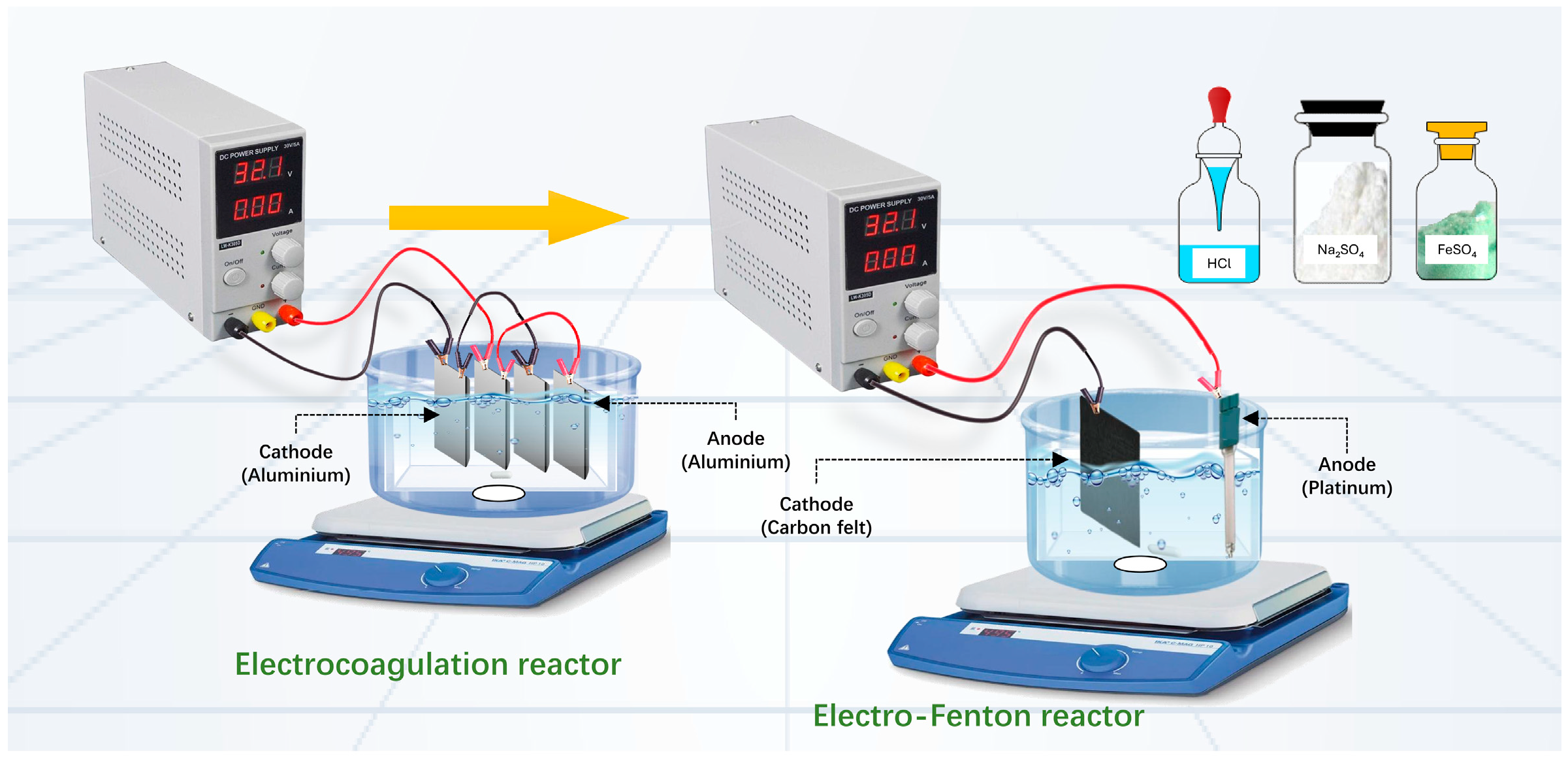
Figure 1. Experimental setup of the sequential EC-EF process for petroleum refinery wastewater treatment.
Processes 14 01623 g001
Figure 2. (a) Normal probability plot; (b) Residuals versus fits plot.
Processes 14 01623 g002
Figure 3. (a) TOC removal efficiency contours versus the intensity of current (A) and the electrolysis time (min); (b) the 3D surface plot that corresponds; (c) TOC removal efficiency contours versus the electrolysis time (min) and the pH; (d) the 3D surface plot that corresponds; (e) TOC removal efficiency contours versus the pH and the intensity of current (A); (f) the 3D surface plot that corresponds. Data collected through the matrix of Doehlert (Table 3).
Processes 14 01623 g003
Figure 4. Evolution of TOC removal rate during electro-Fenton mineralization of pretreated petroleum refinery wastewater. EC pretreatment conditions: I = 0.8 A, t = 75 min, pH = 6. EF treatment conditions: [Fe2+] = 0.01 M, I = 0.8 A, t = 360 min, pH = 3.
Processes 14 01623 g004
Figure 5. COD/TOC ratio and COD removal (%) of non-pretreated petroleum refinery wastewater (N.T), effluent pretreated by electrocoagulation (EC) and effluent treated by combined process (EC-EF). Electrocoagulation pretreatment conditions: I = 0.8 A, t = 75 min, pH = 6. Electro-Fenton treatment conditions: [Fe2+] = 0.01 M, I = 0.8 A, t = 360 min, pH = 3.
Processes 14 01623 g005
Table 1. Main characteristics of the petroleum refinery wastewater.
ParameterUnitValue
pH-8.9
ConductivitymS·cm−13.11
Total Dissolved Solids (TDS)mg·L−11931
Total Suspended Solids (TSS)mg·L−1490
Chemical Oxygen Demand (COD)mg·L−18742
Total Organic Carbon (TOC)mg·L−12732
Biochemical Oxygen Demand (BOD5)mg·L−12360
Biodegradability Index (BOD5/COD)-0.27
Table 2. Central value and Variation step.
Coded Variable (Xi)Factor (Ui)UnitUi (0)ΔUi
X1U1: current intensityA0.60.4
X2U2: electrolysis timemin7050
X3U3: pH 64
Table 3. Doehlert matrix experiments and experimental results.
Experiment NumberCoded VariablesReal VariablesResults
X1X2X3Current Intensity:Electrolysis Time:pHY (%)
U1 (A)U2 (min)U3
1100170636
2−1000.270615
3 1 2 3 2 00.8120632
4 1 2 3 2 00.420616
5 1 2 3 2 00.820626
6 1 2 3 2 00.4120622
7 1 2 3 6 6 3 0.8871028
8 1 2 3 6 6 3 0.453215
9 1 2 3 6 6 3 0.853225
100 3 3 6 3 0.6103220
11 1 2 3 6 6 3 0.4871018
120 3 3 6 3 0.6371023
130000.670637
140000.670637
150000.670637
Table 4. Result of variance analysis for the removal of TOC.
Source of
Variation
Sum of SquaresDegrees of
Freedom
Mean SquareF-Ratiop-Value
TOC removal (%)Regression961.1489106.79457.7170.00016
Residual9.25251.850
Total970.414
R2 = 0.99; R2adj = 0.97.
Table 5. Comparison of the sequential EC-EF process with stand-alone electrochemical treatments for recalcitrant industrial wastewaters.
Treatment TechniqueType of WastewaterOperating ConditionsCOD Initial (mg·L−1)COD Removal (%)Reference
ECTannery WastewaterpH 7.0, current density 50 mA·cm−2, electrolysis time 25 min195963.3[60]
ECOlive Mill Wastewater pH 4.0, current density 18.41 mA·cm−2, electrolysis time 36.8 min25,80058.9[61]
ECOily WastewaterpH 6.7, current density 6 mA·cm−2, electrolysis time 60 min70094.0[62]
ECMixed Industrial WastewaterpH 7.7, applied voltage 1.5 V, electrolysis time 60 min172755.0[63]
EFComposite Industrial Wastewater (From Petrochemical, Food and Beet Sugar Industries)pH 5,
applied voltage 2 V, [H2O2] = 300 mg·L−1, [Fe2+] =1 mg·L−1, electrolysis time 120 min
151284.3[64]
EFPetrochemical WastewaterpH 2.67,
current density 59.7 mA·m−2, H2O2/Fe2+ molar ratio of 3.65, electrolysis time 73.19 min
1700 67.3[65]
EFDistillery WastewaterpH 3,
applied voltage 5 V, [H2O2] = 1665 mg·L−1, electrolysis time 60 min
600079.5[66]
EC–EFPetroleum WastewaterEC: pH 6.0, current density 10.1 mA·cm−2, electrolysis time 75 min
EF: pH 3,
applied current 0.8 A, [Fe2+] = 0.01 M, electrolysis time 360 min
874289.0This Study
Disclaimer/Publisher’s Note: The statements, opinions and data contained in all publications are solely those of the individual author(s) and contributor(s) and not of MDPI and/or the editor(s). MDPI and/or the editor(s) disclaim responsibility for any injury to people or property resulting from any ideas, methods, instructions or products referred to in the content.