Subcritical Water Extraction as a Green Technology for the Development of Standardized Plant Extracts for Food and Pharmaceutical Uses


Abstract
1. Introduction
2. Fundamentals of Subcritical Water Extraction
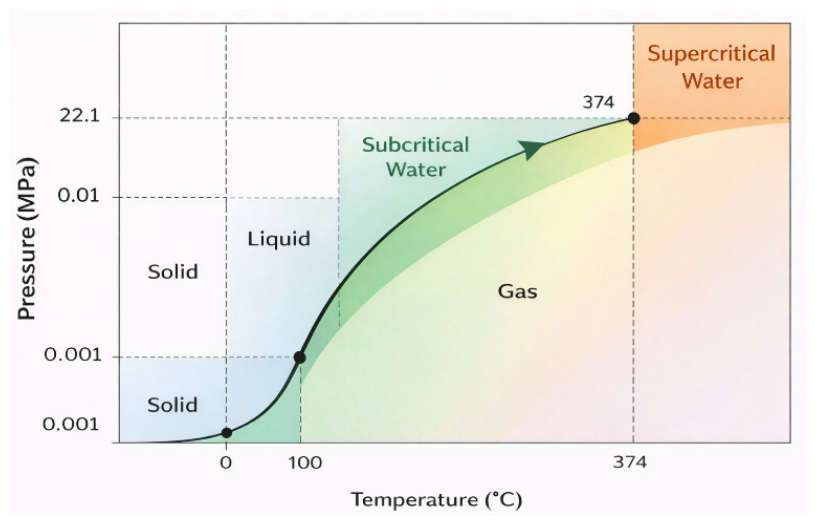
2.1. Definition and Thermophysical Properties of Subcritical Water
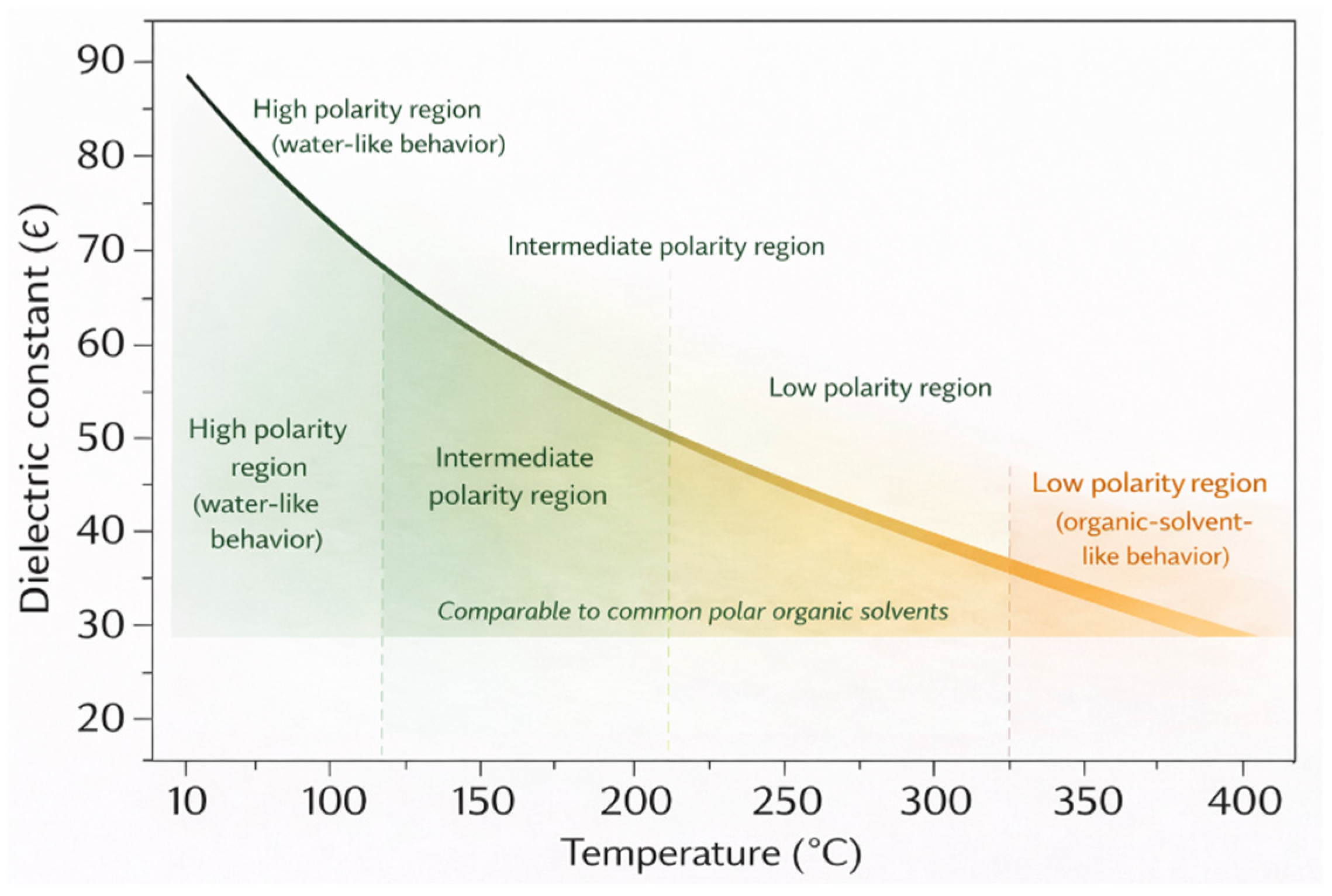
2.2. Dielectric Constant, Solvent Polarity Setting, and Surface Tension
2.3. Extraction Mechanisms (Solubilization, Hydrolysis, Diffusion)
3. Degradation of Plant Polymers Under SWE Conditions and Its Influence on Extract Quality
3.1. Degradation of Carbohydrates Under SWE Conditions
3.2. Degradation of Proteins and Lignin Under SWE Conditions; Protein-Polyphenol Interactions
3.3. Formation of Potentially Toxic Metabolites Under SWE Conditions
4. Applications of Subcritical Water Extraction for Recovery of Plant Bioactives and Development of Standardized Botanical Extracts
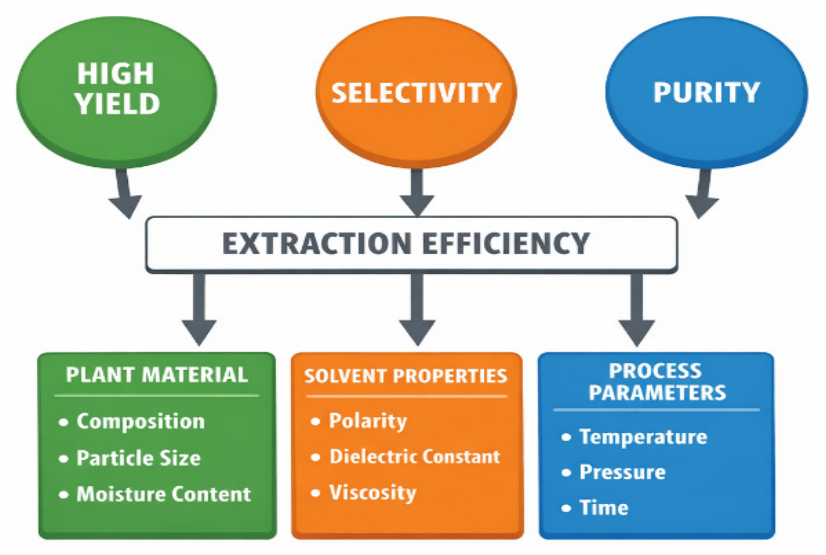
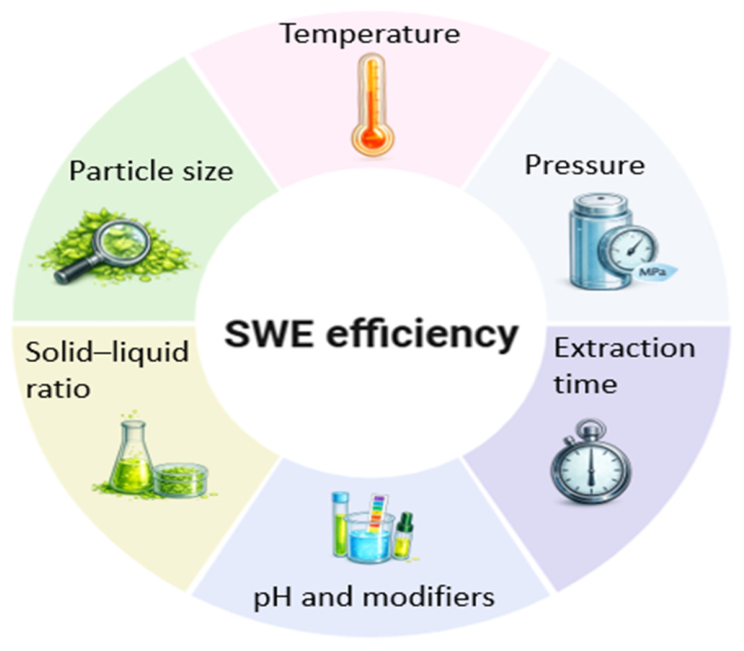
4.1. Process Parameters Affecting SWE Efficiency; Optimization of the Extraction
4.1.1. Temperature
4.1.2. Pressure
4.1.3. Extraction Time
4.1.4. Solid-to-Liquid Ratio
4.1.5. Particle Size and Matrix Characteristics
4.1.6. pH and Water Modifiers
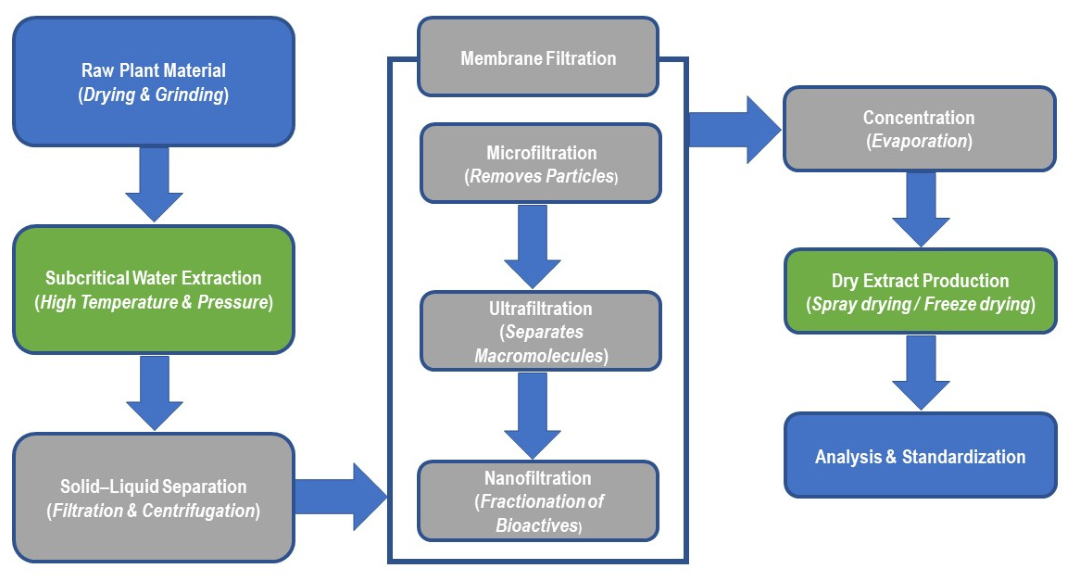
4.2. Development of Standardized Dry Botanical Extracts
5. Advantages, Limitations and Technical Challenges of SWE
5.1. Solvent Use
5.2. Energy Consumption
5.3. Selectivity
5.4. Suitability for Standardization
5.5. Regulatory Framework
5.6. Scaling Up
6. Conclusions and Future Perspectives
Author Contributions
Funding
Data Availability Statement
Acknowledgments
Conflicts of Interest
Abbreviations
| SWE | Subcritical water extraction |
| 5-HMF | 5-hydroxymethylfurfural |
| FDA | U.S. Food and Drug Administration |
References
- Dewick, P.M. Medicinal Natural Products: A Biosynthetic Approach, 3rd ed.; John Wiley & Sons: Chichester, UK, 2009. [Google Scholar]
- Wink, M. Modes of action of herbal medicines and plant secondary metabolites. Medicines 2015, 2, 251–286. [Google Scholar] [CrossRef] [PubMed]
- Crozier, A.; Clifford, M.N.; Ashihara, H. Plant Secondary Metabolites: Occurrence, Structure and Role in the Human Diet; Blackwell Publishing: Oxford, UK, 2006. [Google Scholar]
- Dai, J.; Mumper, R.J. Plant phenolics: Extraction, analysis and their antioxidant and anticancer properties. Molecules 2010, 15, 7313–7352. [Google Scholar] [CrossRef] [PubMed]
- Pandey, K.B.; Rizvi, S.I. Plant polyphenols as dietary antioxidants in human health. Oxid. Med. Cell. Longev. 2009, 2, 270–278. [Google Scholar] [CrossRef]
- Atanasov, A.G.; Waltenberger, B.; Pferschy-Wenzig, E.M.; Linder, T.; Wawrosch, C.; Uhrin, P.; Temml, V.; Wang, L.; Schwaiger, S.; Heiss, E.H.; et al. Discovery and resupply of pharmacologically active plant-derived natural products. Biotechnol. Adv. 2015, 33, 1582–1614. [Google Scholar] [CrossRef]
- Martins, R.; Barros, L.; Carvalho, A.M.; Ferreira, I.C.F.R. Green extraction techniques of bioactive compounds from plants. Processes 2023, 11, 2255. [Google Scholar] [CrossRef]
- Gil-Chávez, G.J.; Villa, J.A.; Ayala-Zavala, J.F.; Heredia, J.B.; Sepulveda, D.; Yahia, E.M.; González-Aguilar, G.A. Technologies for extraction and production of bioactive compounds to be used as nutraceuticals and food ingredients. Food Eng. Rev. 2013, 5, 5–23. [Google Scholar] [CrossRef]
- Shahidi, F.; Ambigaipalan, P. Phenolics and polyphenolics in foods, beverages and spices: Antioxidant activity and health effects—A review. J. Funct. Foods 2015, 18, 820–897. [Google Scholar] [CrossRef]
- Wang, H.; Zhang, Y.; Xie, Y.; Liu, H.; Liu, J.; Xu, Z. Advancing herbal medicine: Enhancing product quality and standardization. Front. Pharmacol. 2023, 14, 1265178. [Google Scholar] [CrossRef]
- Balekundri, A.; Mannur, V. Quality control of traditional herbal medicines and their standardization. Future J. Pharm. Sci. 2020, 6, 67. [Google Scholar] [CrossRef]
- Monagas, M.; Urpi-Sarda, M.; Sánchez-Patán, F.; Llorach, R.; Garrido, I.; Gómez-Cordovés, C.; Andres-Lacueva, C.; Bartolomé, B. Insights into the metabolism and microbial biotransformation of dietary flavan-3-ols and the bioactivity of their metabolites. Food Funct. 2010, 1, 233–253. [Google Scholar] [CrossRef]
- Umamaheswari, D.; Muthuraja, R.; Kumar, M.; Venkateswarlu, B.S. Standardization of herbal drugs—An overview. Int. J. Pharm. Sci. Rev. Res. 2021, 68, 213–219. [Google Scholar] [CrossRef]
- Kaundal, R.; Kumar, D. Current demands for standardization of Indian medicinal plants: A critical review. Med. Drug Discov. 2025, 27, 100211. [Google Scholar] [CrossRef]
- van Breemen, R.B.; Fong, H.H.S.; Farnsworth, N.R. Ensuring the safety and quality of botanical dietary supplements. Am. J. Clin. Nutr. 2008, 87, 509S–513S. [Google Scholar] [CrossRef]
- Srinivasan, V.S. Challenges in standardization of herbal medicines. J. Pharm. Pharmacol. 2006, 58, 1017–1023. [Google Scholar]
- Williamson, E.M.; Liu, X.; Izzo, A.A. Trends in herbal medicine use and regulation. Phytother. Res. 2020, 34, 1441–1450. [Google Scholar] [CrossRef]
- Wachtel-Galor, S.; Benzie, I.F.F. Herbal medicine: An introduction to its history, usage, regulation, current trends, and research needs. In Herbal Medicine: Biomolecular and Clinical Aspects, 2nd ed.; Benzie, I.F.F., Wachtel-Galor, S., Eds.; CRC Press: Boca Raton, FL, USA; Taylor & Francis: Boca Raton, FL, USA, 2011; pp. 1–10. [Google Scholar]
- Ong, E.S. Extraction methods and chemical standardization of botanicals and herbal preparations. J. Chromatogr. B 2004, 812, 23–33. [Google Scholar] [CrossRef]
- Li, S.; Han, Q.; Qiao, C.; Song, J.; Cheng, C.L.; Xu, H. Chemical markers for the quality control of herbal medicines: An overview. J. Chromatogr. B 2008, 3, 7. [Google Scholar] [CrossRef]
- Heinrich, M.; Barnes, J.; Gibbons, S.; Williamson, E.M. Fundamentals of Pharmacognosy and Phytotherapy, 2nd ed.; Elsevier: London, UK, 2018. [Google Scholar]
- Mukherjee, P.K. Quality Control and Evaluation of Herbal Drugs; Elsevier: Amsterdam, The Netherlands, 2019. [Google Scholar]
- Basak, S.; Guha, P.; Sarkar, P. Applications of subcritical water extraction for recovery of bioactive compounds from plant materials. Food Chem. 2022, 367, 130695. [Google Scholar] [CrossRef]
- He, L.; Zhang, X.; Xu, H.; Xu, C.; Yuan, F.; Knez, Ž.; Novak, Z.; Gao, Y. Subcritical water extraction of phenolic compounds from pomegranate seed residues. Food Chem. 2012, 134, 157–162. [Google Scholar] [CrossRef]
- Gil, K.A.; Bączek, N.; Rohn, S.; Kroh, L.W. Comparison of green extraction techniques for flavonoids. Plants 2023, 12, 1502. [Google Scholar] [CrossRef]
- Cheng, Y.; Xie, Y.; Chen, J.; Nie, S.; Xie, M. Subcritical water extraction of natural products. Molecules 2021, 26, 4004. [Google Scholar] [CrossRef]
- Awaluddin, S.A.; Aziz, R.; Sulaiman, A.Z.; Baharum, S.N. Subcritical water technology for extraction of bioactive compounds. J. Chem. 2016, 2016, 5816974. [Google Scholar] [CrossRef]
- Somat, H.A.; Thani, N.M.; Mustapha, W.A.W.; Lim, S.J.; Seng, N.S.S.; Rahman, H.A.; Razali, N.S.M.; Ali, M.M.; Kamal, S.M.M. Subcritical water extraction of bioactive compounds from plant materials: Recent advances. J. Future Foods 2026, 6, 753–764. [Google Scholar] [CrossRef]
- Mustafa, A.; Turner, C. Pressurized liquid extraction as a green approach in food and herbal plants. Anal. Chim. Acta 2011, 703, 8–18. [Google Scholar] [CrossRef]
- Žagar, T.; Hrnčič, M.K.; Škerget, M.; Knez, Ž.; Bren, U. Polyphenol-rich extracts obtained by subcritical water extraction: Composition and antioxidant activity. Foods 2024, 13, 1224. [Google Scholar] [CrossRef]
- Smith, R.M. Extractions with superheated water. J. Chromatogr. A 2002, 975, 31–46. [Google Scholar] [CrossRef]
- Plaza, M.; Turner, C. Pressurized hot water extraction of bioactives. TrAC Trends Anal. Chem. 2015, 71, 39–54. [Google Scholar] [CrossRef]
- Heng, M.Y.; Tan, S.N.; Yong, J.W.H.; Ong, E.S. Emerging green technologies for the chemical standardization of botanicals and herbal preparations. TrAC Trends Anal. Chem. 2013, 50, 1–10. [Google Scholar] [CrossRef]
- Cannavacciuolo, C.; Pagliari, S.; Celano, R.; Campone, L.; Rastrelli, L. Critical analysis of green extraction techniques used for botanicals: Trends, priorities, and optimization strategies—A review. TrAC Trends Anal. Chem. 2024, 173, 117627. [Google Scholar] [CrossRef]
- Zhang, J.; Wen, C.; Zhang, H.; Duan, Y.; Ma, H. Recent advances in the extraction of bioactive compounds with subcritical water: A review. Trends Food Sci. Technol. 2020, 95, 183–195. [Google Scholar] [CrossRef]
- Plaza, M.; Marina, M.L. Pressurized hot water extraction of bioactives. TrAC Trends Anal. Chem. 2023, 166, 117201. [Google Scholar] [CrossRef]
- Yu, S.; Zhang, J.; Li, S.; Chen, Z.; Wang, Y. Mass Transfer and Droplet Behaviors in Liquid-Liquid Extraction Process Based on Multi-Scale Perspective: A Review. Separations 2023, 10, 264. [Google Scholar] [CrossRef]
- Sixt, M.; Uhlenbrock, L.; Strube, J. Toward a Distinct and Quantitative Validation Method for Predictive Process Modelling—On the Example of Solid-Liquid Extraction Processes of Complex Plant Extracts. Processes 2018, 6, 66. [Google Scholar] [CrossRef]
- Chanioti, S.; Liadakis, G.; Tzia, C. Solid–Liquid Extraction. In Food Engineering Handbook: Food Process Engineering; Varzakas, T., Tzia, C., Eds.; CRC Press: Boca Raton, FL, USA, 2014; pp. 253–286. [Google Scholar] [CrossRef]
- Cacace, J.E.; Mazza, G. Mass transfer process during extraction of phenolic compounds from milled berries. J. Food Eng. 2003, 59, 379–389. [Google Scholar] [CrossRef]
- Barbero, G.F.; Ferreiro-González, M.; Freitas, V.C.M.; Carrera, C.; Espada-Bellido, E.; Ruiz-Rodríguez, A.; Liazid, A.; Rostagno, M.A.; Prado, J.M.; Palma, M. Extraction of Natural Products: Principles and Applications. In Natural Product Extraction: Principles and Applications, 2nd ed.; Rostagno, M.A., Prado, J.M., Eds.; Royal Society of Chemistry: Cambridge, UK, 2022; pp. 66–116. [Google Scholar]
- Albarri, R.; Toprakçı, İ.; Kurtulbaş, E.; Şahin, S. Estimation of diffusion and mass transfer coefficients for the microwave-assisted extraction of bioactive substances from Moringa oleifera leaves. Biomass Convers. Biorefin. 2021, 13, 5125–5132. [Google Scholar] [CrossRef]
- Bhagya Raj, G.V.S.; Dash, K.K. Ultrasound-assisted extraction of phytocompounds from dragon fruit peel: Optimization, kinetics and thermodynamic studies. Ultrason. Sonochem. 2020, 68, 105180. [Google Scholar] [CrossRef]
- Krishnan, R.Y.; Rajan, K.S. Microwave assisted extraction of flavonoids from Terminalia bellerica: Study of kinetics and thermodynamics. Sep. Purif. Technol. 2016, 157, 169–178. [Google Scholar] [CrossRef]
- Kush, M.; Eship, A.; Ibrahim, A. Kinetics and thermodynamics studies on oil extraction from Southern Kaduna palm kernel seeds using subcritical water extraction technology. Int. J. Converg. Inf. Sci. Res. 2024, 6, 9. [Google Scholar]
- Jurinjak Tušek, A.; Benković, M.; Belščak Cvitanović, A.; Valinger, D.; Jurina, T.; Gajdoš Kljusurić, J. Kinetics and Thermodynamics of the Solid–Liquid Extraction Process of Total Polyphenols, Antioxidants, and Extraction Yield from Asteraceae Plants. Ind. Crops Prod. 2016, 91, 205–214. [Google Scholar] [CrossRef]
- Korobiichuk, I.; Mel’nick, V.; Ostapenko, Z.; Ruzhinska, L. Study of heat and mass transfer processes during extraction of plant raw materials under the influence of ultrasound. Ultrason. Sonochem. 2023, 98, 106512. [Google Scholar] [CrossRef]
- Sun, S.; Yu, Y.; Jo, Y.; Han, J.H.; Xue, Y.; Cho, M.; Bae, S.J.; Ryu, D.; Park, W.; Ha, K.T.; et al. Impact of extraction techniques on phytochemical composition and bioactivity of natural product mixtures. Front. Pharmacol. 2025, 16, 1615338. [Google Scholar] [CrossRef]
- Nair, A.; Maity, S.; Pai, V. Sustainable extraction: A comprehensive review of advancements beyond conventional methods. Microchem. J. 2025, 220, 116360. [Google Scholar] [CrossRef]
- AL Ubeed, H.M.S.; Bhuyan, D.J.; Alsherbiny, M.A.; Basu, A.; Vuong, Q.V. A Comprehensive Review on the Techniques for Extraction of Bioactive Compounds from Medicinal Cannabis. Molecules 2022, 27, 604. [Google Scholar] [CrossRef]
- Ju, Z.Y.; Howard, L.R. Subcritical Water and Sulfured Water Extraction of Anthocyanins and Other Phenolics from Dried Red Grape Skin. J. Food Sci. 2005, 70, C270–C276. [Google Scholar] [CrossRef]
- Shitu, A.; Izhar, S.; Tahir, T.M. Sub-critical water as a green solvent for production of valuable materials from agricultural waste biomass: A review of recent work. Glob. J. Environ. Sci. Manag. 2015, 1, 255–264. [Google Scholar] [CrossRef]
- Hassas-Roudsari, M.; Chang, P.R.; Pegg, R.B.; Tyler, R.T. Antioxidant Capacity of Bioactives Extracted from Canola Meal by Subcritical Water, Ethanolic, and Hot Water Extraction. Food Chem. 2009, 114, 717–726. [Google Scholar] [CrossRef]
- Alghoul, Z.M.; Ogden, P.B.; Dorsey, J.G. Characterization of the polarity of subcritical water. J. Chromatogr. A 2017, 1486, 42–49. [Google Scholar] [CrossRef] [PubMed]
- Sutmann, G.; Vallauri, R. Dynamics of the Hydrogen Bond Network in Liquid Water. J. Mol. Liq. 2002, 98, 215–226. [Google Scholar] [CrossRef]
- Wang, Z.; Bhattacharya, A.; Yagmurcukardes, M.; Kravets, V.; Díaz-Núñez, P.; Mullan, C.; Timokhin, I.; Taniguchi, T.; Watanabe, K.; Grigorenko, A.N.; et al. Quantifying Hydrogen Bonding Using Electrically Tunable Nanoconfined Water. Nat. Commun. 2025, 16, 3447. [Google Scholar] [CrossRef] [PubMed]
- Carr, A.G.; Branch, A.; Mammucari, R.; Foster, N.R. The solubility and solubility modelling of budesonide in pure and modified subcritical water solutions. J. Supercrit. Fluids 2010, 55, 37–42. [Google Scholar] [CrossRef]
- Song, Y.; Wu, X. Pressure-induced structural and dielectric changes in liquid water at room temperature. J. Chem. Phys. 2025, 162, 114502. [Google Scholar] [CrossRef]
- Fuentes-Azcatl, R.; Bordin, J.R.; Barbosa, M.C. Dielectric properties of water inside charged nanoslits: A comparison of rigid and flexible three-site models. J. Mol. Liq. 2025, 427, 127385. [Google Scholar] [CrossRef]
- Galamba, N.; Paiva, A.; Barreiros, S.; Simões, P. Solubility of polar and nonpolar aromatic molecules in subcritical water: The role of the dielectric constant. J. Chem. Theory Comput. 2019, 15, 6277–6293. [Google Scholar] [CrossRef]
- Kamiński, P.; Gruba, M.; Fekner, Z.; Tyśkiewicz, K.; Kobus, Z. The Influence of Water Extraction Parameters in Subcritical Conditions and the Shape of the Reactor on the Quality of Extracts Obtained from Norway Maple (Acer platanoides L.). Processes 2023, 11, 3395. [Google Scholar] [CrossRef]
- Mao, X.; Li, H.; Yang, L.; Zhang, H.; Wang, J. A critical review of the possible effects of physical and chemical properties of subcritical water on the performance of water-based drilling fluids designed for ultra-high temperature and ultra-high pressure drilling applications. J. Pet. Sci. Eng. 2020, 187, 106795. [Google Scholar] [CrossRef]
- Zaibunnisa, A.H.; Norashikin, S.; Mamot, S.; Osman, H. An experimental design approach for the extraction of volatile compounds from turmeric leaves (Curcuma domestica) using pressurised liquid extraction (PLE). LWT Food Sci. Technol. 2009, 42, 233–238. [Google Scholar] [CrossRef]
- Priego-Capote, F. Superheated Liquid Extraction. In Natural Product Extraction: Principles and Applications, 2nd ed.; Rostagno, M.A., Prado, J.M., Eds.; Royal Society of Chemistry: Cambridge, UK, 2022; pp. 241–268. [Google Scholar] [CrossRef]
- Ferreira, C.; Moreira, M.M.; Delerue-Matos, C.; Sarraguça, M. Subcritical Water Extraction to Valorize Grape Biomass—A Step Closer to Circular Economy. Molecules 2023, 28, 7538. [Google Scholar] [CrossRef] [PubMed]
- Putra, N.R.; Rizkiyah, D.N.; Veza, I.; Jumakir, J.; Waluyo, W.; Suparwoto, S.; Qomariyah, L.; Yunus, M.A.C. Solubilization and extraction of valuable compounds from peanut skin in subcritical water. J. Food Process. Preserv. 2022, 46, e17005. [Google Scholar] [CrossRef]
- Toor, S.S.; Rosendahl, L.; Rudolf, A. Hydrothermal liquefaction of biomass: A review of subcritical water technologies. Energy 2011, 36, 2328–2342. [Google Scholar] [CrossRef]
- Domínguez-Rodríguez, G.; Marina, M.L.; Plaza, M. Strategies for the extraction and analysis of non-extractable polyphenols from plants. J. Chromatogr. A 2017, 1514, 1–15. [Google Scholar] [CrossRef] [PubMed]
- Vuong, Q.V.; Golding, J.B.; Stathopoulos, C.E.; Nguyen, M.H.; Roach, P.D. Optimizing conditions for the extraction of catechins from green tea using hot water. J. Sep. Sci. 2011, 34, 3099–3106. [Google Scholar] [CrossRef]
- Pattnaik, M.; Pandey, P.; Martin, G.J.O.; Mishra, H.N.; Ashokkumar, M. Innovative Technologies for Extraction and Microencapsulation of Bioactives from Plant-Based Food Waste and Their Applications in Functional Food Development. Foods 2021, 10, 279. [Google Scholar] [CrossRef]
- Getachew, A.T.; Holdt, S.L.; Meyer, A.S.; Jacobsen, C. Effect of Extraction Temperature on Pressurized Liquid Extraction of Bioactive Compounds from Fucus vesiculosus. Mar. Drugs 2022, 20, 263. [Google Scholar] [CrossRef]
- Žagar, T.; Frlan, R.; Kočevar Glavač, N. Using Subcritical Water to Obtain Polyphenol-Rich Extracts with Antimicrobial Properties. Antibiotics 2024, 13, 334. [Google Scholar] [CrossRef]
- Kim, D.-S.; Lim, S.-B. Kinetic study of subcritical water extraction of flavonoids from Citrus unshiu peel. Sep. Purif. Technol. 2020, 250, 117259. [Google Scholar] [CrossRef]
- Badenhorst, E.; Hills, P.; Moore, J.P. Profiling the plant cell wall: A comparison of glycan array and immunological methods for studying plant polysaccharides and glycoproteins. S. Afr. J. Bot. 2025, 185, 448–457. [Google Scholar] [CrossRef]
- Rose, J.K.C.; O’Neill, M.A.; Albersheim, P.; Darvill, A. The Primary Cell Walls of Higher Plants. In Carbohydrates in Chemistry and Biology, 1st ed.; Ernst, B., Hart, G.W., Sinaÿ, P., Eds.; Wiley-VCH: Weinheim, Germany, 2000; Volume 4, pp. 783–804. [Google Scholar] [CrossRef]
- Sasaki, M.; Kabyemela, B.; Malaluan, R.; Hirose, S.; Takeda, N.; Adschiri, T.; Arai, K. Cellulose hydrolysis in subcritical and supercritical water. J. Supercrit. Fluids 1998, 13, 261–268. [Google Scholar] [CrossRef]
- Sasaki, M.; Fang, Z.; Fukushima, Y.; Adschiri, T.; Arai, K. Dissolution and hydrolysis of cellulose in subcritical and supercritical water. Ind. Eng. Chem. Res. 2000, 39, 2883–2890. [Google Scholar] [CrossRef]
- Yang, W.; Shimanouchi, T.; Wu, S.; Kimura, Y. Investigation of the degradation kinetic parameters and structure changes of microcrystalline cellulose in subcritical water. Energy Fuels 2014, 28, 6974–6980. [Google Scholar] [CrossRef]
- Kamio, E.; Sato, H.; Takahashi, S.; Noda, H.; Fukuhara, C.; Okamura, T. Liquefaction kinetics of cellulose treated by hot compressed water under variable temperature conditions. J. Mater. Sci. 2008, 43, 2179–2188. [Google Scholar] [CrossRef]
- Bobleter, O. Hydrothermal degradation of polymers derived from plants. Prog. Polym. Sci. 1994, 19, 797–841. [Google Scholar] [CrossRef]
- Rogalinski, T.; Liu, K.; Albrecht, T.; Brunner, G. Hydrolysis kinetics of biopolymers in subcritical water. J. Supercrit. Fluids 2008, 46, 335–341. [Google Scholar] [CrossRef]
- Nagamori, M.; Funazukuri, T. Glucose production by hydrolysis of starch under hydrothermal conditions. J. Chem. Technol. Biotechnol. 2004, 79, 229–233. [Google Scholar] [CrossRef]
- Miyazawa, T.; Ohtsu, S.; Funazukuri, T. Hydrothermal degradation of polysaccharides in a semi-batch reactor: Product distribution as a function of severity parameter. J. Mater. Sci. 2008, 43, 2447–2451. [Google Scholar] [CrossRef]
- Li, F.; Liu, L.; An, Y.; He, W.; Themelis, N.J.; Li, G. Hydrothermal liquefaction of three kinds of starches into reducing sugars. J. Clean. Prod. 2016, 112, 1049–1054. [Google Scholar] [CrossRef]
- Shan, S.; Liu, M.; Hong, B.; Zhang, S.; Yuan, D.; Zhang, J.; Gao, X.; Wu, Q.; Lu, W.; Ren, C.; et al. A comprehensive review of inulin-type fructans and their neo-series: Plant sources, preparation, structural characterization, and bioactivities. Carbohydr. Polym. 2026, 372, 124562. [Google Scholar] [CrossRef]
- Petrova, A.; Ognyanov, M.; Petkova, N.; Denev, P. Phytochemical Characterization of Purple Coneflower Roots (Echinacea purpurea (L.) Moench.) and Their Extracts. Molecules 2023, 28, 3956. [Google Scholar] [CrossRef]
- Martínez, C.M.; Adamovic, T.; Cantero, D.A.; Cocero, M.J. Ultrafast hydrolysis of inulin in supercritical water: Fructooligosaccharides reaction pathway and Jerusalem artichoke valorization. Ind. Crop. Prod. 2019, 133, 72–78. [Google Scholar] [CrossRef]
- Itoh, T.; Shimizu, N. Mass spectrometry of inulin hydrolyzate prepared using subcritical water. Jpn. J. Food Eng. 2014, 15, 165–172. [Google Scholar] [CrossRef]
- Asghari, F.S.; Yoshida, H. Acid-catalyzed production of 5-hydroxymethyl furfural from D-fructose in subcritical water. Ind. Eng. Chem. Res. 2006, 45, 2163–2173. [Google Scholar] [CrossRef]
- Zong, X.; Lei, N.; Yin, J.; He, W.; Nie, S.; Xie, M. Exploration and improvement of acid hydrolysis conditions for inulin-type fructans monosaccharide composition analysis: Monosaccharide recovery and by-product identification. Foods 2024, 13, 1241. [Google Scholar] [CrossRef]
- Paulsen, P.S.; Barsett, H. Bioactive pectic polysaccharides. Adv. Polym. Sci. 2005, 186, 69–101. [Google Scholar] [CrossRef]
- Klinchongkon, K.; Khuwijitjaru, P.; Adachi, S. Degradation kinetics of passion fruit pectin in subcritical water. Biosci. Biotechnol. Biochem. 2017, 81, 712–717. [Google Scholar] [CrossRef]
- Martínez, M.; Gullón, B.; Yáñez, R.; Alonso, J.L.; Parajó, J.C. Kinetic assessment on the autohydrolysis of pectin-rich by-products. Chem. Eng. J. 2010, 162, 480–486. [Google Scholar] [CrossRef]
- Usuki, C.; Kimura, Y.; Adachi, S. Degradation of pentoses and hexouronic acids in subcritical water. Chem. Eng. Technol. 2008, 31, 133–137. [Google Scholar] [CrossRef]
- Miyazawa, T.; Funazukuri, T. Hydrothermal production of mono(galacturonic acid) and the oligomers from poly(galacturonic acid) with water under pressures. Ind. Eng. Chem. Res. 2004, 43, 2310–2314. [Google Scholar] [CrossRef]
- Preciado Ocampo, V.; Yepes Hernandez, A.L.; Marratte, R.; Baena, Y.; Gutiérrez-López, G.F.; Ambrose, K.; Carvajal, M.T. Effect of Drying Methods on the Physical and Surface Properties of Blueberry and Strawberry Fruit Powders: A Review. Appl. Sci. 2025, 15, 13094. [Google Scholar] [CrossRef]
- Pycia, K.; Gałkowska, D.; Juszczak, L.; Fortuna, T.; Witczak, T. Physicochemical, thermal and rheological properties of starches isolated from malting barley varieties. J. Food Sci. Technol. 2015, 52, 4797–4807. [Google Scholar] [CrossRef]
- Ye, M.; Wang, Z.; Yan, X.; Zeng, Z.; Peng, T.; Xia, J.; Zhao, J.; Wang, W.; Gong, D.; Yu, P. Effects of Drying Methods on the Physicochemical and Functional Properties of Cinnamomum camphora Seed Kernel Protein Isolate. Foods 2024, 13, 968. [Google Scholar] [CrossRef]
- Qadri, T.; Naik, H.R.; Hussain, S.Z.; Naseer, B.; Bhat, T.; Vijaykumar; Wani, F.J. Spray dried apple powder: Qualitative, rheological, structural characterization and its sorption isotherm. LWT 2022, 165, 113694. [Google Scholar] [CrossRef]
- Bhandari, B.R.; Datta, N.; Howes, T. Problems associated with spray drying of sugar-rich foods. Dry. Technol. 1997, 15, 671–684. [Google Scholar] [CrossRef]
- Muzaffar, K.; Nayik, G.A.; Kumar, P. Stickiness problem associated with spray drying of sugar and acid rich foods: A mini review. J. Nutr. Food Sci. 2015, S12, 003. [Google Scholar] [CrossRef]
- Lamport, D.T.A.; Kieliszewski, M.J.; Chen, Y.; Cannon, M.C. Role of the extensin superfamily in primary cell wall architecture. Plant Physiol. 2011, 156, 11–19. [Google Scholar] [CrossRef]
- Belitz, H.D.; Grosch, W.; Schieberle, P. Food Chemistry, 4th ed.; Springer: Berlin/Heidelberg, Germany, 2009; pp. 40–89. [Google Scholar] [CrossRef]
- Ravber, M.; Knez, Ž.; Škerget, M. Hydrothermal degradation of fats, carbohydrates and proteins in sunflower seeds after treatment with subcritical water. Chem. Biochem. Eng. Q. 2015, 29, 351–355. [Google Scholar] [CrossRef]
- Fennema, O.R. Food Chemistry, 3rd ed.; Marcel Dekker, Inc.: New York, NY, USA, 1996; pp. 321–430. [Google Scholar]
- Náthia-Neves, G.; Alonso, E. Optimization of the subcritical water treatment from sunflower by-product for producing protein and sugar extracts. Biomass Conv. Bioref. 2024, 14, 1637–1650. [Google Scholar] [CrossRef]
- Rogalinski, T.; Herrmann, S.; Brunner, G. Production of amino acids from bovine serum albumin by continuous sub-critical water hydrolysis. J. Supercrit. Fluids 2005, 36, 49–58. [Google Scholar] [CrossRef]
- Koh, B.-B.; Lee, E.-J.; Ramachandraiah, K.; Hong, G.-P. Characterization of bovine serum albumin hydrolysates prepared by subcritical water processing. Food Chem. 2019, 278, 203–207. [Google Scholar] [CrossRef]
- Körner, P. Hydrothermal degradation of amino acids. ChemSusChem 2021, 14, 4947–4957. [Google Scholar] [CrossRef]
- Powell, T.; Bowra, S.; Cooper, H.J. Subcritical water hydrolysis of peptides: Amino acid side-chain modifications. J. Am. Soc. Mass Spectrom. 2017, 28, 1775–1786. [Google Scholar] [CrossRef]
- Zheng, X.; Zhang, X.; Liu, W.; Jiang, H.; Zeng, F. Lignin in fruits: Structure, function, and frontier perspectives on biosynthesis and regulation. Food Res. Int. 2026, 225, 117943. [Google Scholar] [CrossRef]
- Huang, J.; Fu, S.; Gan, L. Lignin Chemistry and Applications, 1st ed.; Elsevier: Amsterdam, The Netherlands, 2019; pp. 25–50. [Google Scholar] [CrossRef]
- Dence, C.W.; Lin, S.Y. Introduction. In Methods in Lignin Chemistry, 1st ed.; Lin, S.Y., Dence, C.W., Eds.; Springer: Berlin/Heidelberg, Germany, 1992; pp. 3–19. [Google Scholar] [CrossRef]
- Kim, J.-Y.; Oh, S.; Hwang, H.; Kim, U.-J.; Choi, J.W. Structural features and thermal degradation properties of various lignin macromolecules obtained from poplar wood (Populus albaglandulosa). Polym. Degrad. Stab. 2013, 98, 1671–1678. [Google Scholar] [CrossRef]
- Moustaqim, M.E.; Kaihal, A.E.; Marouani, M.E.; Men-La-Yakhaf, S.; Taibi, M.; Sebbahi, S.; Hajjaji, S.E.; Kifani-Sahban, F. Thermal and thermomechanical analyses of lignin. Sustain. Chem. Pharm. 2018, 9, 63–68. [Google Scholar] [CrossRef]
- Jiang, L.; Zhu, Y.; Wei, J.; Ren, H.; Zhai, H. Solubilization and structural changes of lignin in naked oat stems during subcritical water autohydrolysis. Int. J. Biol. Macromol. 2024, 265, 130911. [Google Scholar] [CrossRef] [PubMed]
- Bembenic, M.A.H.; Clifford, C.E.B. Subcritical water reactions of lignin-related model compounds with nitrogen, hydrogen, carbon monoxide, and carbon dioxide gases. Energy Fuels 2013, 27, 6681–6694. [Google Scholar] [CrossRef]
- Jadhav, B.; Roy, R.; Rahman, M.S.; Amit, T.A.; Subedi, S.; Hummel, M.; Gu, Z.; Raynie, D.E. Enhancing the efficacy of the subcritical water-based alkali lignin depolymerization by optimizing the reaction conditions and using heterogeneous catalysts. Biomass 2022, 2, 178–187. [Google Scholar] [CrossRef]
- Onwudili, J.A.; Williams, P.T. Catalytic depolymerization of alkali lignin in subcritical water: Influence of formic acid and Pd/C catalyst on the yields of liquid monomeric aromatic products. Green Chem. 2014, 16, 4740–4748. [Google Scholar] [CrossRef]
- Lu, M.; Guo, Y.; Ji, L.; Xue, H.; Li, X.; Tan, J. Insights into interactions between polyphenols and proteins and their applications: An updated overview. J. Agric. Food Res. 2025, 23, 102269. [Google Scholar] [CrossRef]
- Zhang, H.; Yu, D.; Sun, J.; Liu, X.; Jiang, L.; Guo, H.; Ren, F. Interaction of plant phenols with food macronutrients: Characterisation and nutritional–physiological consequences. Nutr. Res. Rev. 2014, 27, 1–15. [Google Scholar] [CrossRef]
- Zhang, K.; Huang, J.; Wang, D.; Wan, X.; Wang, Y. Covalent polyphenols-proteins interactions in food processing: Formation mechanisms, quantification methods, bioactive effects, and applications. Front. Nutr. 2024, 11, 1371401. [Google Scholar] [CrossRef]
- Schefer, S.; Oest, M.; Rohn, S. Interactions between Phenolic Acids, Proteins, and Carbohydrates—Influence on Dough and Bread Properties. Foods 2021, 10, 2798. [Google Scholar] [CrossRef]
- Günal-Köroğlu, D.; Lorenzo, J.M.; Capanoglu, E. Plant-Based Protein-Phenolic Interactions: Effect on different matrices and in vitro gastrointestinal digestion. Food Res. Int. 2023, 173, 113269. [Google Scholar] [CrossRef] [PubMed]
- Buitimea-Cantúa, N.E.; Gutiérrez-Uribe, J.A.; Serna-Saldívar, S.O. Phenolic–Protein Interactions: Effects on Food Properties and Health Benefits. J. Med. Food 2018, 21, 188–198. [Google Scholar] [CrossRef]
- Xue, H.; Gao, Y.; Shi, Z.; Gao, H.; Xie, K.; Tan, J. Interactions between polyphenols and polysaccharides/proteins: Mechanisms, effect factors, and physicochemical and functional properties: A review. Int. J. Biol. Macromol. 2025, 309, 142793. [Google Scholar] [CrossRef]
- Ozdal, T.; Capanoglu, E.; Altay, F. A review on protein–phenolic interactions and associated changes. Food Res. Int. 2013, 51, 954–970. [Google Scholar] [CrossRef]
- Purlis, E. Browning development in bakery products—A review. J. Food Eng. 2010, 99, 239–249. [Google Scholar] [CrossRef]
- Wang, H.-Y.; Qian, H.; Yao, W.-R. Melanoidins produced by the Maillard reaction: Structure and biological activity. Food Chem. 2011, 128, 573–584. [Google Scholar] [CrossRef]
- El Hosry, L.; Elias, V.; Chamoun, V.; Halawi, M.; Cayot, P.; Nehme, A.; Bou-Maroun, E. Maillard reaction: Mechanism, influencing parameters, advantages, disadvantages, and food industrial applications: A review. Foods 2025, 14, 1881. [Google Scholar] [CrossRef]
- Fan, R.; Gao, Y. Maillard and Hydrolytic Reactions in Subcritical Water Extraction of Bioactive Compounds from Licorice. Molecules 2022, 27, 6851. [Google Scholar] [CrossRef] [PubMed]
- Herrero, M.; Castro-Puyana, M.; Rocamora-Reverte, L.; Ferragut, J.A.; Cifuentes, A.; Ibáñez, E. Formation and relevance of 5-hydroxymethylfurfural in bioactive subcritical water extracts from olive leaves. Food Res. Int. 2012, 47, 31–37. [Google Scholar] [CrossRef]
- Özkaynak Kanmaz, E. 5-Hydroxymethylfurfural (HMF) formation during subcritical water extraction. Food Sci. Biotechnol. 2018, 27, 981–986. [Google Scholar] [CrossRef] [PubMed]
- Anadon, A.; Binderup, M.-L.; Bursch, W.; Castle, L.; Crebelli, R.; Engel, K.-H.; Franz, R.; Gontard, N.; Haertle, T.; Husøy, T.; et al. Scientific Opinion on Flavouring Group Evaluation 218, Revision 1 (FGE.218Rev1): Alpha,beta-Unsaturated aldehydes and precursors from subgroup 4.2 of FGE.19: Furfural derivatives. EFSA J. 2011, 9, 1840. [Google Scholar] [CrossRef]
- Shapla, U.M.; Solayman, M.; Alam, N.; Khalil, M.I.; Gan, S.H. 5-Hydroxymethylfurfural (HMF) levels in honey and other food products: Effects on bees and human health. Chem. Cent. J. 2018, 12, 35. [Google Scholar] [CrossRef]
- Surh, Y.-J.; Liem, A.; Miller, J.A.; Tannenbaum, S.R. 5-Sulfooxymethylfurfural as a possible ultimate mutagenic and carcinogenic metabolite of the Maillard reaction product, 5-hydroxymethylfurfural. Carcinogenesis 1994, 15, 2375–2377. [Google Scholar] [CrossRef]
- Abraham, K.; Gurtler, R.; Berg, K.; Heinemeyer, G.; Lampen, A.; Appel, K.E. Toxicology and risk assessment of 5-Hydroxymethylfurfural in food. Mol. Nutr. Food Res. 2011, 55, 667–678. [Google Scholar] [CrossRef]
- Martins, F.C.O.L.; Alcantara, G.M.R.N.; Silva, A.F.S.; Melchert, W.R.; Rocha, F.R.P. The role of 5-hydroxymethylfurfural in food and recent advances in analytical methods. Food Chem. 2022, 395, 133539. [Google Scholar] [CrossRef]
- Rodriguez-Amaya, D.B.; Amaya-Farfan, J. Chapter Six—The Maillard reactions: Pathways, consequences, and control. Vitam. Horm. 2024, 125, 149–182. [Google Scholar] [CrossRef]
- Lund, M.N.; Ray, C.A. Control of Maillard reactions in foods: Strategies and chemical mechanisms. J. Agric. Food Chem. 2017, 65, 4537–4552. [Google Scholar] [CrossRef] [PubMed]
- Jaeger, H.; Janositz, A.; Knorr, D. The Maillard reaction and its control during food processing. The potential of emerging technologies. Pathol. Biol. 2010, 58, 207–213. [Google Scholar] [CrossRef] [PubMed]
- Teo, C.C.; Tan, S.N.; Yong, J.W.H.; Hew, C.S.; Ong, E.S. Pressurized hot water extraction (PHWE). J. Chromatogr. A 2010, 1217, 2484–2494. [Google Scholar] [CrossRef]
- Fernández, D.P.; Goodwin, A.R.H.; Lemmon, E.W.; Levelt Sengers, J.M.H.; Williams, R.C. A formulation for the static permittivity of water and steam at temperatures from 238 K to 873 K at pressures up to 1200 MPa, including derivatives and Debye–Hückel coefficients. J. Phys. Chem. Ref. Data 1997, 26, 1125–1166. [Google Scholar] [CrossRef]
- Ginting, A.R.; Kit, T.; Mingvanish, W.; Thanasupsin, S.P. Valorization of coffee silverskin through subcritical water extraction: An optimization based on T-CQA using response surface methodology. Sustainability 2022, 14, 8435. [Google Scholar] [CrossRef]
- Arya, O.P.; Bhatt, I.D.; Mohanty, K. Improving phenolic antioxidants in Illicium griffithii fruit through optimizing subcritical water extraction method. Sci. Rep. 2025, 15, 37387. [Google Scholar] [CrossRef] [PubMed]
- Park, Y.-S.; Roy, V.C.; Park, J.-S.; Zhang, W.; Chun, B.-S. Optimization of subcritical water extraction parameters of phlorotannins from brown alga (Ecklonia stolonifera): Bipotentialities and possible applications. J. Supercrit. Fluids 2025, 218, 106502. [Google Scholar] [CrossRef]
- Lorenzo, J.M.; Putnik, P.; Bursać Kovačević, D.; Petrović, M.; Munekata, P.E.; Gómez, B.; Marszałek, K.; Roohinejad, S.; Barba, F.J. Silymarin compounds: Chemistry, innovative extraction techniques and synthesis. In Studies in Natural Products Chemistry; Elsevier: Amsterdam, The Netherlands, 2020; Volume 67, pp. 111–130. [Google Scholar] [CrossRef]
- Yu, X.M.; Zhu, P.; Zhong, Q.P.; Li, M.Y.; Ma, H.R. Subcritical water extraction of antioxidant phenolic compounds from XiLan olive fruit dreg. J. Food Sci. Technol. 2015, 52, 5012–5020. [Google Scholar] [CrossRef]
- Zhang, H.; Liu, S.; Li, H.; Xue, F.; Han, S.; Wang, L.; Cheng, Y.; Wang, X. Extraction of isoflavones from Puerariae lobata using subcritical water. RSC Adv. 2018, 8, 29623–29635. [Google Scholar] [CrossRef]
- Ko, M.-J.; Cheigh, C.-I.; Cho, S.-W.; Chung, M.-S. Subcritical water extraction of flavonol quercetin from onion skin. J. Food Eng. 2011, 102, 327–333. [Google Scholar] [CrossRef]
- Shalmashi, A.; Abedi, M.; Golmohammad, F.; Eikani, M.H. Isolation of caffeine from tea waste using subcritical water extraction. J. Food Process Eng. 2010, 33, 701–711. [Google Scholar] [CrossRef]
- Kamiński, P.; Tyśkiewicz, K.; Fekner, Z.; Gruba, M.; Kobus, Z. The influence of subcritical water extraction parameters on the chemical composition and antioxidant activity of walnut (Juglans regia L.) bark extracts. Appl. Sci. 2022, 12, 12490. [Google Scholar] [CrossRef]
- Carr, A.G.; Mammucari, R.; Foster, N.R. A review of subcritical water as a solvent and its utilisation for the processing of hydrophobic organic compounds. Chem. Eng. J. 2011, 172, 1–17. [Google Scholar] [CrossRef]
- Klinchongkon, K.; Chanthong, N.; Ruchain, K.; Khuwijitjaru, P.; Adachi, S. Effect of ethanol addition on subcritical water extraction of pectic polysaccharides from passion fruit peel. J. Food Process. Preserv. 2017, 41, e13138. [Google Scholar] [CrossRef]
- Dinh, T.V.; Saravana, P.S.; Woo, H.C.; Chun, B.S. Ionic liquid-assisted subcritical water enhances the extraction of phenolics from brown seaweed and its antioxidant activity. Sep. Purif. Technol. 2018, 196, 287–299. [Google Scholar] [CrossRef]
- United States Pharmacopeial Convention. United States Pharmacopeia and National Formulary (USP 43–NF 38); USP Convention: Rockville, MD, USA, 2020. [Google Scholar]
- Pharmacopoeia of the People’s Republic of China; China Medical Science Press: Beijing, China, 2020.
- World Health Organization. WHO Monographs on Selected Medicinal Plants; World Health Organization: Geneva, Switzerland, 1999; Volume 1. [Google Scholar]
- World Health Organization. WHO Monographs on Selected Medicinal Plants; World Health Organization: Geneva, Switzerland, 2002; Volume 2. [Google Scholar]
- The Ministry of Health, Labour and Welfare of Japan. The Japanese Pharmacopoeia, 18th ed.; The Ministry of Health, Labour and Welfare of Japan: Tokyo, Japan, 2021.
- Blumenthal, M.; Goldberg, A.; Brinckmann, J. Herbal Medicine: Expanded Commission e Monographs; American Botanical Council: Austin, TX, USA, 2000. [Google Scholar]
- Liu, J.; Chen, P.; Yao, W.; Wang, J.; Wang, L.; Deng, L.; He, J.; Zhang, G.; Lei, J. Subcritical water extraction of betulinic acid from birch bark. Ind. Crops Prod. 2015, 74, 557–565. [Google Scholar] [CrossRef]
- Kim, Y.-J.; Choi, H.-J.; Chung, M.-S.; Ko, M.-J. Selective extraction of oxygenated terpene in caraway (Carum carvi L.) using subcritical water extraction (SWE) technique. Food Chem. 2022, 381, 132192. [Google Scholar] [CrossRef] [PubMed]
- Gagić, T.; Knez, Ž.; Škerget, M. Subcritical Water Extraction of Chestnut Bark and Optimization of Process Parameters. Molecules 2020, 25, 2774. [Google Scholar] [CrossRef] [PubMed]
- Kim, W.J.; Kim, J.; Veriansyah, B.; Kim, J.D.; Lee, Y.W.; Oh, S.G.; Tjandrawinata, R.R. Extraction of bioactive components from Centella asiatica using subcritical water. J. Supercrit. Fluids 2009, 48, 211–216. [Google Scholar] [CrossRef]
- Cvetanović, A.; Švarc-Gajić, J.; Gašić, U.; Tešić, Ž.; Zengin, G.; Zeković, Z.; Đurović, S. Isolation of apigenin from subcritical water extracts: Optimization of the process. J. Supercrit. Fluids 2017, 120, 32–42. [Google Scholar] [CrossRef]
- Zakaria, S.M.; Mustafa Kamal, S.M.; Harun, R.; Omar, R.; Siajam, S.I. Characterization on phenolic acids and antioxidant activity of Chlorella sp. microalgae using subcritical water extraction. Sains Malays. 2020, 49, 765–774. [Google Scholar] [CrossRef]
- Kim, J.W.; Nagaoka, T.; Ishida, Y.; Hasegawa, T.; Kitagawa, K.; Lee, S.C. Subcritical water extraction of nutraceutical compounds from citrus pomaces. Sep. Sci. Technol. 2009, 44, 2598–2608. [Google Scholar] [CrossRef]
- Xu, H.; Wang, W.; Liu, X.; Yuan, F.; Gao, Y. Antioxidative phenolics obtained from spent coffee grounds (Coffea arabica L.) by subcritical water extraction. Ind. Crops Prod. 2015, 76, 946–954. [Google Scholar] [CrossRef]
- Zeković, Z.; Vidović, S.; Vladić, J.; Radosavljević, R.; Cvejin, A.; Elgndi, M.A.; Pavlić, B. Optimization of subcritical water extraction of antioxidants from Coriandrum sativum seeds by response surface methodology. J. Supercrit. Fluids 2014, 95, 560–566. [Google Scholar] [CrossRef]
- Kim, D.-S.; Lim, S.-B. Subcritical water extraction of rutin from the aerial parts of common buckwheat. J. Supercrit. Fluids 2019, 152, 104561. [Google Scholar] [CrossRef]
- Machmudah, S.; Lestari, S.D.; Widiyastuti; Wahyudiono; Kanda, H.; Winardi, S.; Goto, M. Subcritical water extraction enhancement by adding deep eutectic solvent for extracting xanthone from mangosteen pericarps. J. Supercrit. Fluids 2018, 133, 615–624. [Google Scholar] [CrossRef]
- Baek, J.Y.; Lee, J.M.; Lee, S.C. Extraction of nutraceutical compounds from licorice root with subcritical water. Sep. Purif. Technol. 2008, 63, 661–664. [Google Scholar] [CrossRef]
- Kanmaz, E.Ö. Subcritical water extraction of phenolic compounds from flaxseed meal sticks using accelerated solvent extractor (ASE). Eur. Food Res. Technol. 2013, 238, 85–91. [Google Scholar] [CrossRef]
- Cvetanović, A.; Švarc-Gajić, J.; Zeković, Z.; Gašić, U.; Tešić, Z.; Zengin, G.; Mašković, P.; Mahomoodally, M.F.; Ðurović, S. Subcritical water extraction as a cutting edge technology for the extraction of bioactive compounds from chamomile: Influence of pressure on chemical composition and bioactivity of extracts. Food Chem. 2018, 266, 389–396. [Google Scholar] [CrossRef]
- Atanasova, A.; Petrova, A.; Teneva, D.; Ognyanov, M.; Georgiev, Y.; Nenov, N.; Denev, P. Subcritical Water Extraction of Rosmarinic Acid from Lemon Balm (Melissa officinalis L.) and Its Effect on Plant Cell Wall Constituents. Antioxidants 2023, 12, 888. [Google Scholar] [CrossRef]
- Jamaludin, R.; Kim, D.-S.; Salleh, L.M.; Lim, S.-B. Kinetic Study of Subcritical Water Extraction of Scopoletin, Alizarin, and Rutin from Morinda citrifolia. Foods 2021, 10, 2260. [Google Scholar] [CrossRef] [PubMed]
- Çalhan, S.D.; Meryemoğlu, B.; Eroğlu, P.; Saçlı, B.; Kalderis, D. Subcritical Water Extraction of Onosma mutabilis: Process Optimization and Chemical Profile of the Extracts. Molecules 2023, 28, 2314. [Google Scholar] [CrossRef]
- Zhang, G.; Chi, X. A green strategy for obtaining anthraquinones from Rheum tanguticum by subcritical water. Open Chem. 2020, 18, 702–710. [Google Scholar] [CrossRef]
- Kapalavavi, B.; Doctor, N.; Zhang, B.; Yang, Y. Subcritical Water Extraction of Salvia miltiorrhiza. Molecules 2021, 26, 1634. [Google Scholar] [CrossRef]
- Nastić, N.; Švarc-Gajić, J.; Delerue-Matos, C.; Morais, S.; Barroso, M.F.; Moreira, M.M. Subcritical water extraction of antioxidants from mountain germander (Teucrium montanum L.). J. Supercrit. Fluids 2018, 138, 200–206. [Google Scholar] [CrossRef]
- Jokić, S.; Gagić, T.; Knez, Ž.; Šubarić, D.; Škerget, M. Separation of Active Compounds from Food by-Product (Cocoa Shell) Using Subcritical Water Extraction. Molecules 2018, 23, 1408. [Google Scholar] [CrossRef]
- Ozel, M.Z.; Gogus, F.; Lewis, A.C. Subcritical water extraction of essential oils from Thymbra spicata. Food Chem. 2003, 82, 381–386. [Google Scholar] [CrossRef]
- Duba, K.S.; Casazza, A.A.; Mohamed, H.B.; Perego, P.; Fiori, L. Extraction of polyphenols from grape skins and defatted grape seeds using subcritical water: Experiments and modeling. Food Bioprod. Process 2015, 94, 29–38. [Google Scholar] [CrossRef]
- Ibáñez, E.; Herrero, M.; Mendiola, J.A.; Castro-Puyana, M. Extraction and characterization of bioactive compounds with subcritical water. J. Chromatogr. A 2012, 1250, 37–46. [Google Scholar] [CrossRef]
- Jacyna, J.; Kordalewska, M.; Markuszewski, M.J. Design of experiments in metabolomics-related studies: An overview. J. Pharm. Biomed. Anal. 2019, 164, 598–606. [Google Scholar] [CrossRef] [PubMed]
- Radovanović, K.; Gavarić, N.; Švarc-Gajić, J.; Brezo-Borjan, T.; Zlatković, B.; Lončar, B.; Aćimović, M. Subcritical water extraction as an effective technique for the isolation of phenolic compounds of Achillea species. Processes 2023, 11, 86. [Google Scholar] [CrossRef]
- Myint, A.A.; Aregay, M.G.; Kang, M.; Kim, B.S.; Lee, Y.W.; Kim, J. Comprehensive study on the formation mechanism of highly bioactive compounds from Allium hookeri root using subcritical water and their antioxidant and anticancer effects. J. Supercrit. Fluids 2020, 157, 104709. [Google Scholar] [CrossRef]
- Zaini, A.S.; Putra, N.R.; Idham, Z.; Mohd Faizal, A.N.; Che Yunus, M.A.; Mamat, H.; Abdul Aziz, A.H. Comparison of Alliin Recovery from Allium sativum L. Using Soxhlet Extraction and Subcritical Water Extraction. ChemEngineering 2022, 6, 73. [Google Scholar] [CrossRef]
- Niu, A.; Wang, C.; Liu, F.; Ling, G.; Wang, Y.; Liu, S.; Hu, X. Mechanism and Regulation of Tea Saponin Extraction from C. oleifera Seed Meal in Subcritical Water. Foods 2025, 14, 1849. [Google Scholar] [CrossRef] [PubMed]
- Liu, X.; Wang, Y.; Zhang, J.; Yan, L.; Liu, S.; Taha, A.A.; Wang, J.; Ma, C. Subcritical water extraction of phenolic antioxidants with improved α-amylase and α-glucosidase inhibitory activities from exocarps of Castanea mollissima Blume. J. Supercrit. Fluids 2020, 158, 104747. [Google Scholar] [CrossRef]
- Pinto, D.; Vieira, E.F.; Peixoto, A.F.; Freire, C.; Freitas, V.; Costa, P.; Delerue-Matos, C.; Rodrigues, F. Optimizing the extraction of phenolic antioxidants from chestnut shells by subcritical water extraction using response surface methodology. Food Chem. 2021, 334, 127521. [Google Scholar] [CrossRef]
- Cravotto, C.; Grillo, G.; Binello, A.; Gallina, L.; Olivares-Vicente, M.; Herranz-López, M.; Micol, V.; Barrajón-Catalán, E.; Cravotto, G. Bioactive Antioxidant Compounds from Chestnut Peels through Semi-Industrial Subcritical Water Extraction. Antioxidants 2022, 11, 988. [Google Scholar] [CrossRef]
- Hwang, H.J.; Kim, H.J.; Ko, M.J.; Chung, M.S. Recovery of hesperidin and narirutin from waste Citrus unshiu peel using subcritical water extraction aided by pulsed electric field treatment. Food Sci. Biotechnol. 2021, 30, 217–226. [Google Scholar] [CrossRef]
- Zabidi, N.A.; Ishak, N.A.; Hamid, M.; Ashari, S.E. Subcritical water extraction of antioxidants from Curculigo latifolia root. J. Chem. 2019, 2019, 8047191. [Google Scholar] [CrossRef]
- Rizkiyah, D.N.; Putra, N.R.; Idham, Z.; Che Yunus, M.A.; Veza, I.; Harny, I.; Syahlani, N.; Abdul Aziz, A.H. Optimization of Red Pigment Anthocyanin Recovery from Hibiscus sabdariffa by Subcritical Water Extraction. Processes 2022, 10, 2635. [Google Scholar] [CrossRef]
- Kumar, M.Y.; Dutta, R.; Prasad, D.; Misra, K. Subcritical water extraction of antioxidant compounds from Seabuckthorn (Hippophae rhamnoides) leaves for the comparative evaluation of antioxidant activity. Food Chem. 2011, 127, 1309–1316. [Google Scholar] [CrossRef]
- Mesquita, P.C.; Rodrigues, L.G.G.; Mazzutti, S.; Ribeiro, P.R.V.; de Brito, E.S.; Lanza, M. Untargeted metabolomic profile of recovered bioactive compounds by subcritical water extraction of acerola (Malpighia emarginata DC.) pomace. Food Chem. 2022, 397, 133718. [Google Scholar] [CrossRef]
- Rodríguez-Meizoso, I.; Marin, F.R.; Herrero, M.; Señorans, F.J.; Reglero, G.; Cifuentes, A.; Ibáñez, E. Subcritical water extraction of nutraceuticals with antioxidant activity from oregano. Chemical and functional characterization. J. Pharm. Biomed. Anal. 2006, 41, 1560–1565. [Google Scholar] [CrossRef]
- Ko, M.J.; Nam, H.H.; Chung, M.S. Subcritical water extraction of bioactive compounds from Orostachys japonicus A. Berger (Crassulaceae). Sci. Rep. 2020, 10, 10890. [Google Scholar] [CrossRef]
- Fabian, C.; Tran-Thi, N.Y.; Kasim, N.S.; Ju, Y.-H. Release of phenolic acids from defatted rice bran by subcritical water treatment. J. Sci. Food Agric. 2010, 90, 2576–2581. [Google Scholar] [CrossRef]
- Ho, T.C.; Chun, B.-S. Extraction of bioactive compounds from Pseuderanthemum palatiferum (Nees) Radlk. using subcritical water and conventional solvents: A comparison study. J. Food Sci. 2019, 84, 1201–1207. [Google Scholar] [CrossRef]
- Zhao, T.; Luo, Y.; Zhang, X.; Zhang, W.; Qu, H.; Mao, G.; Zou, Y.; Wang, W.; Li, Q.; Chen, Y.; et al. Subcritical water extraction of bioactive compounds from Radix Puerariae and optimization study using response surface methodology. Chem. Eng. Commun. 2019, 206, 1218–1227. [Google Scholar] [CrossRef]
- He, L.; Zhang, X.; Xu, H.; Xu, C.; Yuan, F.; Knez, Ž.; Novak, Z.; Gao, Y. Subcritical water extraction of phenolic compounds from pomegranate (Punica granatum L.) seed residues and investigation into their antioxidant activities with HPLC–ABTS+ assay. Food Bioprod. Process. 2012, 90, 215–223. [Google Scholar] [CrossRef]
- Yildiz-Ozturk, E.; Tag, O.; Yesil-Celiktas, O. Subcritical water extraction of steviol glycosides from Stevia rebaudiana leaves and characterization of the raffinate phase. J. Supercrit. Fluids 2014, 95, 422–430. [Google Scholar] [CrossRef]
- Xu, H.; Wang, W.; Jiang, J.; Yuan, F.; Gao, Y. Subcritical water extraction and antioxidant activity evaluation with on-line HPLC-ABTS·+ assay of phenolic compounds from marigold (Tagetes erecta L.) flower residues. J. Food Sci. Technol. 2015, 52, 3803–3811. [Google Scholar] [CrossRef]
- Vergara-Salinas, J.R.; Pérez-Jiménez, J.; Torres, J.L.; Agosin, E.; Pérez-Correa, J.R. Effects of temperature and time on polyphenolic content and antioxidant activity in the pressurized hot water extraction of deodorized thyme (Thymus vulgaris). J. Agric. Food Chem. 2012, 60, 10920–10929. [Google Scholar] [CrossRef]
- European Directorate for the Quality of Medicines & HealthCare (EDQM). European Pharmacopoeia, 11th ed.; Council of Europe: Strasbourg, France, 2022. [Google Scholar]
- Ong, E.S.; Len, S.M. Pressurized hot water extraction of berberine, baicalein and glycyrrhizin in medicinal plants. Anal. Chim. Acta 2003, 482, 81–89. [Google Scholar] [CrossRef]
- Mokgadi, J.; Turner, C.; Torto, N. Pressurized Hot Water Extraction of Alkaloids in Goldenseal. Am. J. Anal. Chem. 2013, 4, 398–403. [Google Scholar] [CrossRef]
- Miller, D.J.; Hawthorne, S.B. Method for determining the solubilities of hydrophobic organics in subcritical water. Anal. Chem. 1998, 70, 1618–1621. [Google Scholar] [CrossRef]
- Ferrer, I.; Furlong, E.T. Accelerated solvent extraction followed by on-line solid-phase extraction coupled to ion trap LC/MS/MS for analysis of benzalkonium chlorides in sediment samples. Anal. Chem. 2002, 74, 1275–1280. [Google Scholar] [CrossRef]
- Burkhardt, M.R.; Revello, R.C.; Smith, S.G.; Zaugg, S.D. Pressurized liquid extraction using water/isopropanol coupled with solid-phase extraction cleanup for industrial and anthropogenic waste-indicator compounds in sediment. Anal. Chim. Acta 2005, 534, 89–100. [Google Scholar] [CrossRef]
- Baker, R.W. Membrane Technology and Applications, 3rd ed.; John Wiley & Sons: Chichester, UK, 2012. [Google Scholar]
- Nguyen, H.T.; Truong, D.H.; Nguyen, T.T.; Golding, J.B.; Vuong, Q.V. Assessment and comparison of phytochemicals and antioxidant properties from various parts of the Australian maroon bush (Scaevola spinescens). Heliyon 2021, 7, e06810. [Google Scholar] [CrossRef]
- Nguyen, H.T.; Truong, D.H.; Golding, J.B.; Vuong, Q.V. The effects of drying conditions on bioactive compounds and antioxidant activity of the Australian maroon bush (Scaevola spinescens). J. Food Process. Preserv. 2018, 42, e13711. [Google Scholar] [CrossRef]
- Vuong, Q.V.; Golding, J.B.; Stathopoulos, C.E.; Nguyen, M.H.; Roach, P.D. Effects of aqueous brewing solution pH on the extraction of the major green tea constituents. Food Res. Int. 2013, 53, 713–719. [Google Scholar] [CrossRef]
- Ajila, C.M.; Brar, S.K.; Verma, M.; Tyagi, R.D.; Godbout, S.; Valéro, J.R. Extraction and analysis of polyphenols: Recent trends. Crit. Rev. Biotechnol. 2011, 31, 227–249. [Google Scholar] [CrossRef]
- Dailey, A.; Vuong, Q.V.; Golding, J.B.; Stathopoulos, C.E.; Roach, P.D. Effect of extraction solvents on recovery of bioactive compounds and antioxidant properties from macadamia (Macadamia tetraphylla) skin waste. Cogent Food Agric. 2015, 1, 1115646. [Google Scholar] [CrossRef]
- Bitwell, C.; Miller, S.; Li, Y.; Thompson, R. A review of modern and conventional extraction techniques and their applications for extracting phytochemicals from plants. Sci. Afr. 2023, 19, e01585. [Google Scholar] [CrossRef]
- Yuan, S.; Zhao, W.; Wang, Y.; Dong, H.; Song, K.; Shi, D. Mechanism-Driven Green Extraction of Plant Polyphenols: From Molecular Interactions to Process Integration and Intelligent Optimization. Plants 2026, 15, 596. [Google Scholar] [CrossRef]
- Yabalak, E.; Aminzai, M.T.; Gizir, A.M.; Yang, Y. A Review: Subcritical Water Extraction of Organic Pollutants from Environmental Matrices. Molecules 2024, 29, 258. [Google Scholar] [CrossRef]
- European Union. Regulation (EC) No 178/2002 of the European Parliament and of the Council of 28 January 2002 laying down the general principles and requirements of food law, establishing the European Food Safety Authority and laying down procedures in matters of food safety. Off. J. Eur. Communities 2002, L 031, 1–24. Available online: https://eur-lex.europa.eu/legal-content/EN/TXT/?uri=CELEX:32002R0178 (accessed on 17 April 2026).
- European Medicines Agency (EMA). Guideline on Quality of Herbal Medicinal Products/Traditional Herbal Medicinal Products; EMA/HMPC/CHMP/CVMP/201116/2005 Rev. 3; EMA: Amsterdam, The Netherlands, 2022; Available online: https://www.ema.europa.eu/en/documents/scientific-guideline/final-guideline-quality-herbal-medicinal-productstraditional-herbal-medicinal-products-revision-3_en.pdf (accessed on 17 April 2026).
- U.S. Food and Drug Administration (FDA). Federal Food, Drug, and Cosmetic Act (FFDCA); 21 U.S.C. § 301 et Seq.; U.S. Government Printing Office: Washington, DC, USA, 1938. Available online: https://www.fda.gov/regulatory-information/laws-enforced-fda/federal-food-drug-and-cosmetic-act-fdc-act (accessed on 17 April 2026).
- U.S. Food and Drug Administration (FDA). Dietary Supplement Health and Education Act of 1994 (DSHEA); Public Law 103-417; U.S. Government Printing Office: Washington, DC, USA, 1994. Available online: https://ods.od.nih.gov/About/DSHEA_Wording.aspx (accessed on 17 April 2026).
- European Union. Regulation (EU) 2015/2283 of the European Parliament and of the Council of 25 November 2015 on novel foods, amending Regulation (EU) No 1169/2011 of the European Parliament and of the Council and repealing Regulation (EC) No 258/97 of the European Parliament and of the Council and Commission Regulation (EC) No 1852/2001. Off. J. Eur. Union 2015, L 327, 1–22. Available online: https://eur-lex.europa.eu/legal-content/EN/TXT/?uri=CELEX:32015R2283 (accessed on 17 April 2026).
- European Commission. EudraLex the Rules Governing Medicinal Products in the European Union. Volume 4: Good Manufacturing Practice (GMP) Guidelines; European Commission: Brussels, Belgium. Available online: https://health.ec.europa.eu/medicinal-products/eudralex/eudralex-volume-4_en (accessed on 17 April 2026).
- Ko, M.-J.; Kwon, H.-L.; Chung, M.-S. Pilot-scale subcritical water extraction of flavonoids from satsuma mandarin (Citrus unshiu Markovich) peel. Innov. Food Sci. Emerg. Technol. 2016, 38, 175–181. [Google Scholar] [CrossRef]
- Sganzerla, W.G.; Zabot, G.L.; Torres-Mayanga, P.C.; Buller, L.S.; Mussatto, S.I.; Forster-Carneiro, T. Techno-economic assessment of subcritical water hydrolysis process for sugars production from brewer’s spent grains. Ind. Crops Prod. 2021, 171, 113836. [Google Scholar] [CrossRef]



| Plant Source | Subcritical Water Extraction Conditions | Bioactive Compounds | Yield, mg/g | Pharmacopoeial Requirements | Reference | |
|---|---|---|---|---|---|---|
| Subcritical Water Extraction | Conventional Extraction | |||||
| Betula pendula (birch) bark | 160–200 °C, 10–30 min, static, 1 g/40–60 mL | Betulinic acid | 1.60–2.80 | - | No | [162] |
| Brassica napus pressings (canola meal) | 110–160 °C, 30 min, dynamic, 1 g/30 mL | Total phenolics | 7.03–8.29; | 5.60–10.00 | No | [53] |
| 15.42–16.30 | ||||||
| Carum carvi (caraway) seeds | 110–190 °C, 5–15 min, static, 1 g/22 mL | Carvone | 28.48 | ≈15.00–20.00 | Yes | [163] |
| Limonene | 0.28 | ≈0.20–1.60 | ||||
| Carveol | 0.11 | ≈0.10–0.15 | ||||
| Castanea sativa (sweet chestnut) bark | 150–250 °C, 10–60 min, static, 1 g/10–30 mL | Total phenolics | 38.30–85.20 | - | No | [164] |
| Total tannins | 42.80–98.30 | |||||
| Centella asiatica (Gotu kola) whole plants | 150–250 °C, 300 min, static, 50 g/232 mL | Asiatic acid: | 0–7.00 | 0–10.00 | Yes | [165] |
| Asiaticoside | 1.10–8.40 | 1.3–17.7 | ||||
| Chamomilla matricaria (chamomile) flowers | 65–210 °C, 5–60 min, static, 1 g/30–100 mL | Total phenolics | 74.84–215.15 | - | Yes | [166] |
| Total flavonoids | 15.99–38.89 | |||||
| Apigenin | 1.30–11.50 | |||||
| Chlorella sp. microalgae | 100–250 °C, 5–20 min, static, 1 g/5 mL | Ferulic acid | 0.015–0.032 | 0.004–0.021 | No | [167] |
| p-Coumaric acid | 0.012–0.030 | 0.003–0.029 | ||||
| Caffeic acid | 0.018–0.033 | 0.002–0.023 | ||||
| Citrus unshiu (Satsuma orange) pomaces | 25–250 °C, 10–60 min, static, 0.1 g/10 mL | Total phenolics | 0.03–0.50 | - | No | [168] |
| Coffea arabica (spent coffee grounds) | 110–190 °C, 15–75 min, static, 1 g/30–70 mL | Total phenolics | 21.09–56.59 | - | No | [169] |
| Coriandrum sativum (coriander) seeds | 100–200 °C, 10–30 min, static, 10 g/100 mL | Total phenolics | 5.11–26.29 | - | Yes | [170] |
| Total flavonoids | 2.31–6.18 | |||||
| Fagopyrum esculentum (common buckwheat) aerial parts | 80–120 °C, 20 min, dynamic, 2 g/14 mL | Rutin | 62.00–75.00 | - | No | [171] |
| Garcinia mangostana (mangosteen) pericarps | 120–160 °C, 30–180 min, dynamic, 2.5 g/50 mL | Total phenolics | 75.87–372.69 | - | No | [172] |
| Xanthone | 3.10–27.15 | |||||
| Glycyrrhiza uralensis (licorice) root | 50–300 °C, 10–60 min, static, 0.1 g/10 mL | Total phenolics | 0.20–1.52 | - | Yes | [173] |
| Glycyrrhizin | 0.03–1.44 | |||||
| Glycyrrhetic acid | 0.01–0.24 | |||||
| Liquiritin | 0.03–0.60 | |||||
| Linum usitatissimum (flax) seeds | 160–180 °C, 5–60 min, static, 5 g/33 mL | Total phenolics | 1.91–10.81 | - | No | [174] |
| Total flavonoids | 0.04–0.96 | |||||
| Matricaria chamomilla (German chamomile) flowers | 100 °C, 30 min, static, 10 g/300 mL | Apigenin | 0.06–1.34 | - | Yes | [175] |
| Melissa officinalis (lemon balm) leaves | 100–150 °C, 10–20 min, dynamic, 100 g/2000 mL | Rosmarinic acid | 12.20–16.20 | 13.80–15.3 | Yes | [176] |
| Total phenolics | 80.00–92.60 | 78.90–79.10 | ||||
| Morinda citrifolia (noni) fruits | 100–140 °C, 20 min, dynamic, 2 g/14 mL | Scopoletin | 0.36–0.53 | - | No | [177] |
| Alizarin | 0.01–0.08 | |||||
| Rutin | 0.36–0.45 | |||||
| Onosma mutabilis aerial parts, roots | 100–200 °C, 30–180 min, static, 1–25 g/10–100 mL | Total phenolics | 14.49–184.58 | - | No | [178] |
| Pyrocatechol | 0.54–1.06 | 0.01–0.02 | ||||
| Epicatechin | 0.51–1.10 | 0.02–0.07 | ||||
| Rheum tanguticum (Chinese rhubarb) root | 100–200 °C, 33–67 min, dynamic, 10 g/50 mL | Total anthraquinones | 15.50–37.90 | - | Yes | [179] |
| Salvia miltiorrhiza (red sage) aerial parts | 75–150 °C, 30 min, static, 2 g/10 mL | Protocatechualdehyde | 0.01–1.76 | 0.01 | No | [180] |
| Caffeic acid | 0.01–0.05 | 0.05 | ||||
| Ferulic acid | 0.001–0.04 | - | ||||
| Tanshinone I: | 0.004–0.07 | 0.0002 | ||||
| Tanshinone IIA | 0.003–0.01 | 0.0008 | ||||
| Teucrium montanum (mountain germander) aerial parts | 60–200 °C, 30 min, static, 1 g/10 mL | Total phenolics | 143.89–174.61 | - | No | [181] |
| Theobroma cacao (cocoa) shells | 120–220 °C, 15–75 min, static, 1 g/10–30 mL | Total phenolics | 33.41–130.33 | - | No | [182] |
| Theobromine | 13.10–47.70 | |||||
| Thymbra spicata (spiked savory) leaves | 100–175 °C, 30 min, dynamic, 1.5 g/10.4 mL | p-Cymene | 6.40–29.30 | - | No | [183] |
| γ-Terpinene | 3.70–19.00 | |||||
| E-3-caren-2-ol | 30.80–77.10 | |||||
| Thymol | 9.70–36.70 | |||||
| Carvacrol | 795.00–862.00 | |||||
| Vitis vinifera (grapes, var. Arkansas-1575) skins | 100–160 °C, 5–7 min, static, 0.4 g/22 mL | Total phenolics | 32.90–52.30 | 22.90–53.70 | No | [51] |
| Total anthocyanins | 29.60–49.40 | 21.50–50.20 | ||||
| Vitis vinifera (grapes, var. Pinot Nero) seeds | 80–120 °C, 120 min, dynamic, 2 g/100 mL | Total phenolics | 44.30–77.00 44.00–124.00 | - | No | [184] |
| Plant Source | Subcritical Water Extraction Conditions | Bioactive Compounds | Content in Dry Extract, mg/g | Pharmacopoeial Requirements | Reference | |
|---|---|---|---|---|---|---|
| Subcritical Water Extraction | Conventional Extraction | |||||
| Achillea asplenifolia flower | 130 °C, 30 min, static, 1 g/20 mL | Total phenolics | 75.02 | 23.51–34.99 | No | [187] |
| Total flavonoids | 4.13 | 4.64–6.03 | ||||
| Achillea clypeolata flower | 130 °C, 30 min, static, 1 g/20 mL | Total phenolics | 77.61 | 25.75–34.70 | No | [187] |
| Total flavonoids | 4.78 | 3.99–9.76 | ||||
| Achillea crithmifolia flower | 130 °C, 30 min, static, 1 g/20 mL | Total phenolics | 90.12 | 24.59–34.59 | No | [187] |
| Total flavonoids | 7.38 | 4.55–7.55 | ||||
| Achillea millefolium flower | 130 °C, 30 min, static, 1 g/20 mL | Total phenolics | 93.63 | 25.71–30.01 | Yes | [187] |
| Total flavonoids | 6.24 | 4.28–5.44 | ||||
| Achillea nobilis subsp. Nelreichii flower | 130 °C, 30 min, static, 1 g/20 mL | Total phenolics | 67.38 | 31.83–37.76 | No | [187] |
| Total flavonoids | 7.75 | 6.79–11.11 | ||||
| Allium hookeri (garlic chives) root | 160 °C, 30 min, static, 1 g/20 mL | Gallic acid | 2.70 | 0.20–0.50 | No | [188] |
| Total phenolics | 29.40 | 2.40–3.10 | ||||
| Total flavonoids | 30.60 | 4.10–6.20 | ||||
| Allium sativum (garlic) root | 120–180 °C, 10 min, dynamic, 5 g/10 mL | Alliin | 100.52–136.82 | 31.54–65.18 | Yes | [189] |
| Camellia oleifera seed | 120–160 °C, 20–60 min, static, 1 g/18–22 mL | Saponins | 17.80–316.90 | - | No | [190] |
| Castanea mollissima (Chinese chestnut) exocarp | 100–220 °C, 20 min, static, 5 g/600 mL | Total phenolics | 159.37–746.71 | 87.64–295.23 | No | [191] |
| Castanea sativa (chestnut) shells | 51–249 °C, 6–30 min, static, 10 g/100 mL | Total phenolics | 315.21–496.80 | - | No | [192] |
| Castanea sativa (chestnut) peels | 100–220 °C, 0–45 min, static, 1 g/20–30 mL | Total phenolics | 60.00–160.70 | - | No | [193] |
| Catechin | 112.85 | |||||
| Total tannins | 828.40 | |||||
| Hydrolyzable | 63.54 | |||||
| Nonhydrolyzable | 764.86 | |||||
| Citrus unshiu (Satsuma orange) peel | 150 °C, 15 min, static, 190 °C, 5 min, static, 3 g/22 mL | Hesperidin | 38.45 | 2.10–22.00 | No | [194] |
| Narirutin | 6.56 | 3.10–7.50 | ||||
| Coffea genus (coffee) silverskin | 120–240 °C, 10–60 min, static, 1 g/10–40 mL | Total phenolics | 19.01–93.83 | - | No | [144] |
| Total chlorogenic acid | 0.48–2.33 | |||||
| Curculigo latifolia root | 100–200 °C, 30–120 min, dynamic, 1 g/10 mL | Total phenolics | 34.43–92.55 | - | No | [195] |
| Total flavonoids | 5.72–13.26 | |||||
| Hibiscus sabdariffa (calyces of roselle) | ≈100–140 °C, 5 min, dynamic, 0.2 g/25 mL | Total phenolics | 0.07–0.39 | - | Yes | [196] |
| Total flavonoids | 1.82–7.62 | |||||
| Total anthocyanins | 6.56–9.74 | |||||
| Hippophae rhamnoides (sea buckthorn) leaves | 80–260 °C, 15 min, static, 2 g/33 mL | Total phenolics | 76.07–93.72 | 28.35–77.85 | No | [197] |
| Total flavonoids | 47.06–66.40 | 14.14–42.93 | ||||
| Quercetin-3-galactoside | 0.16–0.26 | 0.04–0.17 | ||||
| Kaempferol | 0.01–0.04 | 0.01–0.02 | ||||
| Isorhamnetin | 0.02–0.11 | 0.02–0.06 | ||||
| Malpighia emarginata (acerola) seeds, pomace | 70–130 °C, 15 min, dynamic, 5 g/90 mL | Total phenolics | 119.10–362.00 | 292.60 | No | [198] |
| Melissa officinalis (lemon balm) leaves | 100–150 °C, 10–20 min, dynamic, 100 g/2000 mL | Rosmarinic acid | 23.60–53.10 | 55.50 | Yes | [176] |
| Total phenolics | 0.26–0.30 | 0.27 | ||||
| Origanum vulgare (oregano) leaves | 25–200 °C, 15–30 min, static, 0.75 g/11 mL | Total phenolics | 84.00–182.00 | - | Yes | [199] |
| Orostachys japonicus stems, leaves | 110–240 °C, 15 min, static, 1 g/22 mL, 30 g/900 mL | Total phenolics | 9.40–39.90 | 3.50–10.70 | No | [200] |
| Total flavonoids | 2.50–11.40 | 3.6–6.1 | ||||
| Oryza sativa rice bran | 125–200 °C, 30 min, static, 4 g/10 mL | Total phenolics | 2.01–19.48 | - | No | [201] |
| Pseuderanthemum palatiferum (Hoan-Ngoc) leaves | 110–270 °C, 15 min, static, 2 g/140 mL | Total phenolics | 9.48–33.68 | 6.94–15.27 | No | [202] |
| Total flavonoids | 8.16–20.71 | 6.22–14.71 | ||||
| Total saponins | 5.12–33.82 | 1.38–4.09 | ||||
| Pueraria lobata (kudzuvine) root | 120–160 °C, 20–60 min, static, 1 g/15–20 mL | Total flavonoids | 130.00 | 48.00–150.00 | Yes | [203] |
| Puerarin | 48.00 | 22.00–69.00 | ||||
| Daidzin | 9.00 | 4.00–10.00 | ||||
| Daidzein | 0.60 | 0.30–0.50 | ||||
| Punica granatum (pomegranate) seed | 80–280 °C, 15–120 min, dynamic, 1 g/10–50 mL | Total phenolics | 9.92–27.52 | 3.12–21.94 | No | [204] |
| Stevia rebaudiana (stevia) leaves | 100–150 °C, 30–60 min, dynamic, 1 g/10 mL | Total phenolics | 28.96–48.63 | - | No | [205] |
| Total flavonoids | 24.27–29.81 | |||||
| Rebaudioside A | 6.20–35.68 | |||||
| Stevioside | 3.27–38.67 | |||||
| Tagetes erecta flower | 80–260 °C, 15–90 min, dynamic, 1 g/20–60 mL | Total phenolics | 116.00 | 10.94–96.66 | No | [206] |
| Total flavonoids | 135.00 | 12.78–127.54 | ||||
| Thymus vulgaris (thyme) leaves | 50–200 °C, 5–30 min, static, 5 g/100 mL | Total phenolics | 131.00–262.00 | - | Yes | [207] |
| Plant Source | Pharmacopoeial Requirements for Standardization | Bioactive Compounds in SWE | Compliance with Pharmacopoeial Requirements | Comment | Reference |
|---|---|---|---|---|---|
| Achillea millefolium (yarrow) flower | Essential oil: minimum 2 mL/kg in dried drug; Proazulenes, expressed as chamazulene: minimum 0.02 per cent in dried drug. | Total phenolics Total flavonoids | No | The study does not analyze the content of essential oil. | [187] |
| Carum carvi (caraway) seeds | Minimum 30 mL/kg of essential oil | Carvone Limonene Carveol | No | The study does not analyze the content of essential oil. | [163] |
| Centella asiatica (Gotu kola) whole plants | Minimum 6.0 per cent of total triterpenoid derivatives, expressed as asiaticoside in dried drug | Asiatic acid 0–0.70% Asiaticoside 0.11–0.84% | No | The study does not use pharmacopoeial assay. | [165] |
| Coptis chinensis (Chinese goldthread) rhizome | Minimum 5.0 per cent of berberine in dried drug | Extracted berberine from dried drug 6.07–7.19% | Yes | All tested SWE temperatures extracted more than 5% berberine. | [209] |
| Coriandrum sativum (coriander) seeds | Minimum 3 mL/kg of essential oil in dried drug | Total phenolics Total flavonoids | No | The study does not analyze the content of essential oil. | [170] |
| Hibiscus sabdariffa (calyces of roselle) | Minimum 13.5 per cent of acids, expressed as citric acid in dried drug | Total phenolics Total flavonoids Total anthocyanins | No | The study does not analyze the content of acids. | [196] |
| Hydrastis canadensis (Goldenseal) rhizoma | Minimum 2.5 per cent hydrastine in dried drug Minimum 3.0 per cent berberine in dried drug | Extracted hydrastin and berberine from dried drug 4.30% | No | The study does not use pharmacopoeial assay and does not present the individual contents of the extracted hydrastin and berberine. | [210] |
| Matricaria chamomilla (German chamomile) flowers | Minimum 4 mL/kg blue essential oil in dried drug; Minimum 0.25 per cent apigenin 7-glucoside in dried drug | Extracted total flavonoids (1.75–2.04%) and apigenin (0.20–3.20%) from dried drug | No | The study does not analyze the content of essential oil, does not use pharmacopoeial assay and analyze apigenin instead of apigenin 7-glucoside. | [166] |
| Melissa officinalis (lemon balm) dry extract | Minimum 2.0 per cent of rosmarinic acid in dried extract. | Rosmarinic acid content in dry extract 2.36–5.28% | Yes | Extracts obtained at different extraction conditions (temperature 100 °C and 150 °C) and duration (10 min and 20 min) colmply with pharmacopoeial requirements. | [176] |
| Melissa officinalis (lemon balm) leaves | Minimum 1.0 per cent of rosmarinic acid in dried drug | Extracted rosmarinic acid from dried drug 1.22–1.51% | Yes | All tested extraction parameters (temperature 100 °C and 150 °C) and duration (10 min and 20 min) extracted more than 1% rosmarinic acid. | [176] |
| Origanum vulgare (oregano) leaves | Essential oil: minimum 25 mL/kg in anhydrous drug; Sum of the contents of carvacrol and thymol in the essential oil. | Total phenolics | No | The study does not analyze the content of essential oil and the sum of the contents of thymol and carvacrol in the essential oil. | [199] |
| Pueraria lobata (kudzuvine) root | Minimum 6.5 per cent of total isoflavonoids, expressed as puerarin in dried drug, of which minimum 45 per cent consists of puerarin | Total flavonoids, Puerarin, Daidzin and Daidzein in dry extract | No | The methodology used to analyze total flavonoids does not comply with the pharmacopoeial procedure that analazyes the conent of 3-hydroxypuerarin, puerarin, 3-methoxypuerarin, 6-O″-d-xylosylpuerarin and daidzin. | [203] |
| Rheum tanguticum (Chinese rhubarb) root | Minimum 2.0 per cent of the sum of hydroxyanthracene glycosides, expressed as rhein-8-glucoside in dried drug | Total anthraquinones 1.55–3.79% | Yes | The study did not employ pharmacopoeial assay. | [179] |
| Scutellaria baicalensis (Baical skullcap) root | Not less than 9.0 per cent of baicalin in dried drug | Extracted baicalin from dried drug 2.28–2.43% | No | Extracted baicalin content lower than pharmacopoeial requirements. | [209] |
| Thymus vulgaris (Thyme) leaves | Essential oil: minimum 12 mL/kg (anhydrous drug); Sum of the contents of thymol and carvacrol: minimum 40 per cent in the essential oil | Total phenolics Individual phenolic compounds in dry extract | No | The study does not analyze the content of essential oil and the sum of the contents of thymol and carvacrol in the essential oil. | [207] |
| Glycyrrhiza glabra (Liquorice) root | Minimum 4.0 per cent of 18β-glycyrrhizic acid in dried drug | Extracted glycyrrhizin from dried drug 1.72–1.84% | No | The study does not use pharmacopoeial assay. | [209] |
Disclaimer/Publisher’s Note: The statements, opinions and data contained in all publications are solely those of the individual author(s) and contributor(s) and not of MDPI and/or the editor(s). MDPI and/or the editor(s) disclaim responsibility for any injury to people or property resulting from any ideas, methods, instructions or products referred to in the content. |
© 2026 by the authors. Licensee MDPI, Basel, Switzerland. This article is an open access article distributed under the terms and conditions of the Creative Commons Attribution (CC BY) license.
Share and Cite
Denev, P.; Ognyanov, M.; Pimpilova, M.; Teneva, D. Subcritical Water Extraction as a Green Technology for the Development of Standardized Plant Extracts for Food and Pharmaceutical Uses. Processes 2026, 14, 1564. https://doi.org/10.3390/pr14101564
Denev P, Ognyanov M, Pimpilova M, Teneva D. Subcritical Water Extraction as a Green Technology for the Development of Standardized Plant Extracts for Food and Pharmaceutical Uses. Processes. 2026; 14(10):1564. https://doi.org/10.3390/pr14101564
Chicago/Turabian StyleDenev, Petko, Manol Ognyanov, Mariya Pimpilova, and Desislava Teneva. 2026. "Subcritical Water Extraction as a Green Technology for the Development of Standardized Plant Extracts for Food and Pharmaceutical Uses" Processes 14, no. 10: 1564. https://doi.org/10.3390/pr14101564
APA StyleDenev, P., Ognyanov, M., Pimpilova, M., & Teneva, D. (2026). Subcritical Water Extraction as a Green Technology for the Development of Standardized Plant Extracts for Food and Pharmaceutical Uses. Processes, 14(10), 1564. https://doi.org/10.3390/pr14101564