1. Introduction
When the underground longwall panel advances to a certain distance—approximately one-fourth to one-half of the mining depth—the influence of mining extends upward to the ground surface [
1,
2]. Under the effect of mining-induced strata movement, the ground surface begins to subside from its original elevation, forming a subsidence zone above the gob (mined-out area) that is much larger than the mined-out zone itself [
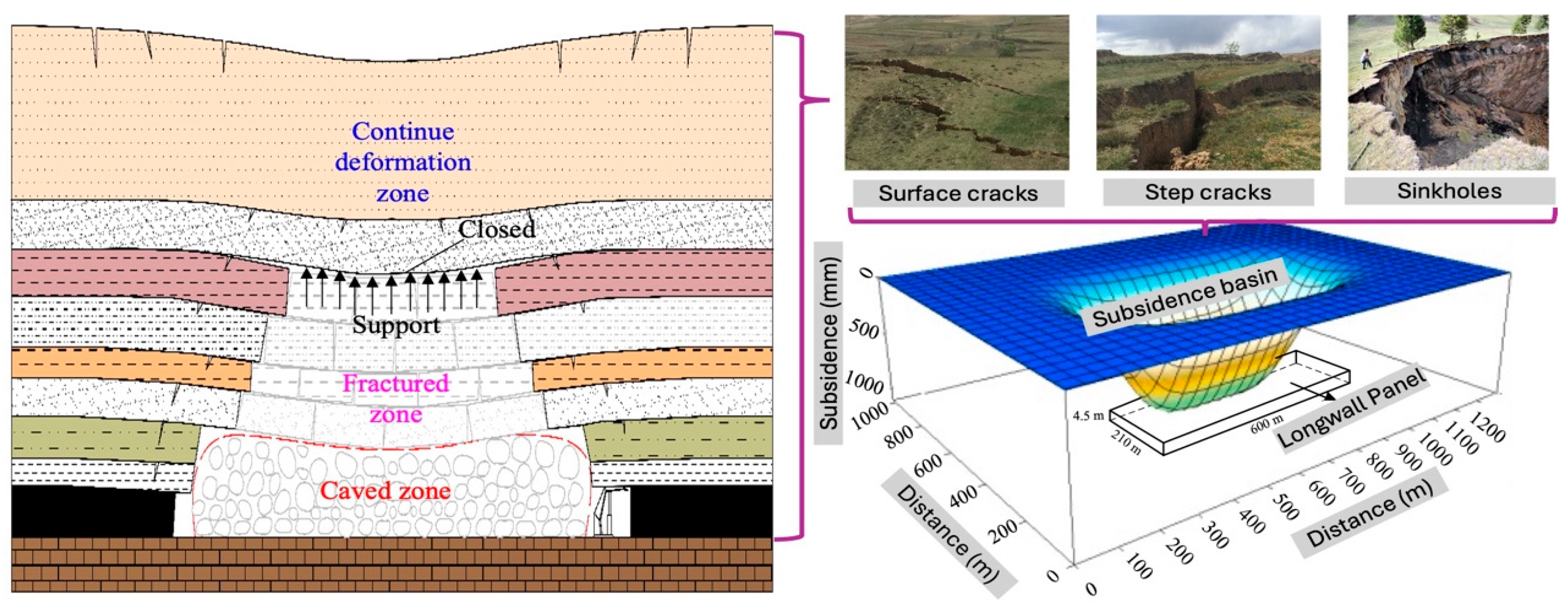
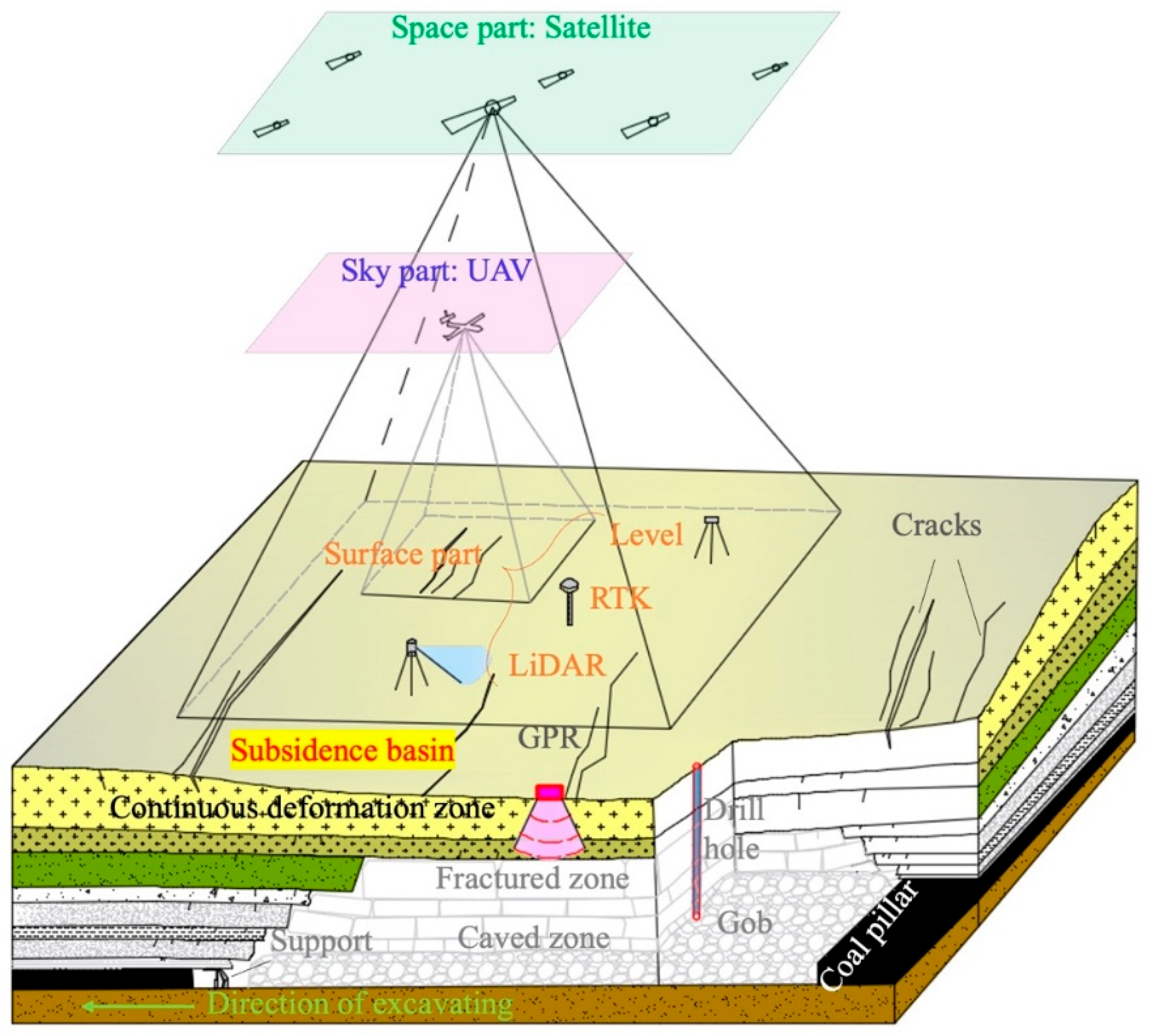
3]. This zone is referred to as the surface movement basin or surface subsidence basin (
Figure 1). The formation of the basin alters the original topography, resulting in changes in ground elevation and horizontal displacement, thereby affecting surface structures, roads, rivers, railways, and the surrounding environment [
1,
4,
5].
At the outer edge of the surface movement basin, cracks may develop on the ground surface. The depth and width of these cracks depend on the presence and thickness of the loose overburden [
6]. When the loose layer exhibits high plasticity, cracks typically form only when tensile deformation exceeds 6–10 mm/m; conversely, when plasticity is low, cracks may develop once deformation exceeds 2–3 mm/m [
7]. Generally, surface cracks do not connect with the underground gob and taper out at a certain depth. Under conditions of high mining intensity, surface steps or fissures may appear. Collapse pits are more common under steeply inclined coal seam conditions, but may also develop under special geological settings—particularly when the mining depth is shallow, but the mining thickness is large. In such cases, uneven overburden failure heights can lead to the formation of funnel-shaped collapse pits [
8]. These surface features—cracks, steps, and collapse pits—pose severe risks to surface infrastructure. Therefore, when mining beneath buildings, railways, or bodies of water, measures must be taken to prevent the formation of large cracks or collapse pits [
4,
5,
9].
With the continued extraction of coal resources, both the scale and extent of mining-induced surface movement have expanded significantly. Effectively controlling surface subsidence has thus become a critical challenge for ensuring the safety of surface structures and maintaining ecological stability in mining regions. At the same time, large volumes of coal-based solid waste generated during coal production have emerged as a major constraint on the green transformation of the coal industry [
2,
10].
To address surface subsidence in mining areas and ensure the safety of surface buildings, infrastructure, rivers, and farmland, overburden delamination grouting has been widely implemented in coal mines, especially across central and eastern China [
11,
12,
13]. By injecting slurry materials such as fly ash or coal gangue into delaminated spaces within the overburden, this technique effectively fills the voids generated by strata separation, limits the movement of overlying strata, and thereby mitigates surface subsidence [
1,
14].
The effectiveness of overburden delamination grouting, however, depends critically on the accurate determination and control of key grouting parameters during the filling process [
6,
15,
16]. Among these, the selection of an appropriate grouting horizon is paramount, as it directly governs the success of subsidence control [
13,
17]. Improper horizon selection not only reduces the effectiveness of grouting but may also disrupt normal mining operations or lead to adverse environmental consequences, such as groundwater contamination [
18,
19,
20]. To ensure stable confinement of the injected slurry, the grouting horizon should be located within the bending subsidence zone, with a sufficient thickness of isolation strata maintained between the water-conducting fracture zone and the grouting layer to prevent slurry migration into mining voids [
4,
13]. During overburden delamination grouting operations, the injected slurry must remain stably confined within the delamination space, analogous to the stable retention of groundwater within an aquifer. Consequently, the principles governing aquiclude design can serve as a reference for grouting horizon selection.
To provide a comprehensive methodology for surface subsidence control, this study integrates all critical aspects of grouting design. First, the height of fractured and bending zones above the panel is analyzed to determine the spatial coverage and flow pathways for grout. Next, the grouting layer design and isolation layer stability are evaluated to ensure effective confinement and long-term performance. The mechanical properties of grouting materials—comprising fly ash, finely ground coal gangue, and slag powder—are systematically tested to identify optimal compositions for field application. Finally, the workflow and material selection approach are validated through three representative engineering case studies, demonstrating applicability under varied geological and mining conditions. This integrated study provides a complete workflow for overburden delamination grouting, offering both theoretical guidance and practical solutions for controlling mining-induced surface subsidence.
2. Methodology
2.1. Determination of Fractured Zone Height in Longwall Mining
In longwall mining, the overburden experiences a dynamic process of progressive failure and surface subsidence [
4,
21,
22]. At the initial stage of extraction, the height of overburden failure gradually increases, forming the caved zone. During this period, the surface subsidence remains sub-critical. As mining advances, the overburden failure height reaches its maximum, corresponding to critical overburden failure. At this stage, most rock layers become detached and fractured, resulting in the formation of both the caved zone and the fractured zone. However, some residual voids still remain, and the surface subsidence has not yet reached its maximum. Eventually, as the overburden failure height stabilizes, the surface subsidence attains its maximum value—this condition is referred to as critical surface subsidence [
23].
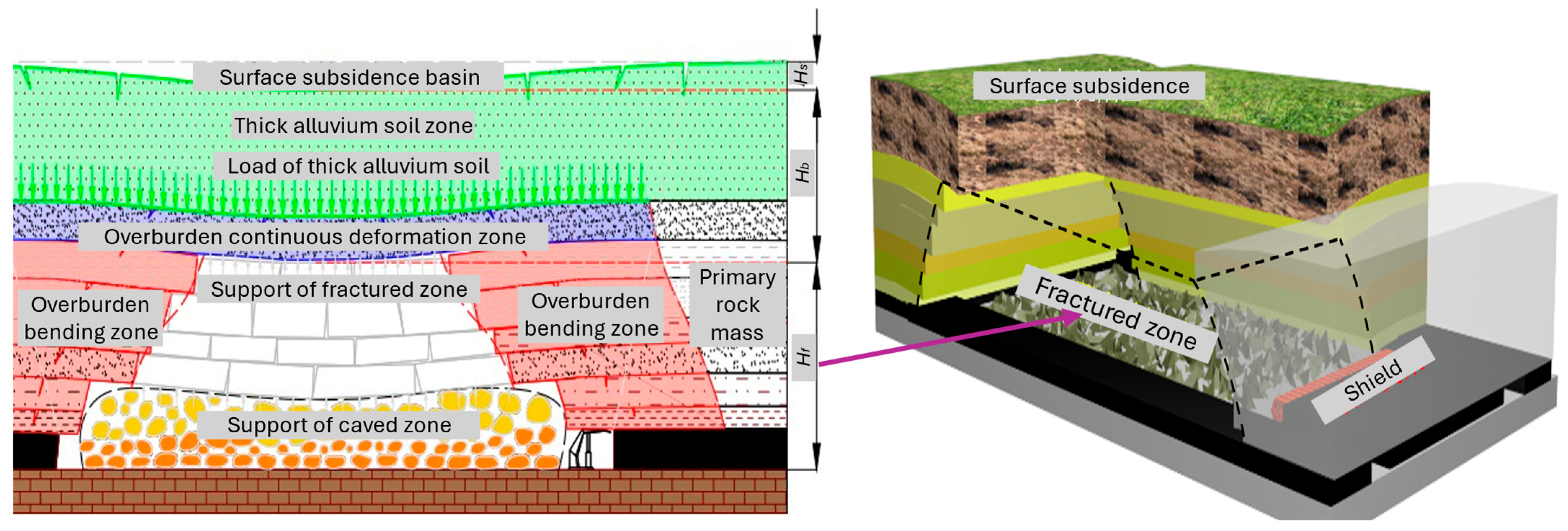
Following this evolution, the overburden can be divided into distinct mechanical zones according to its deformation characteristics. These include the caved zone, the fractured zone, and the continuous deformation (or bending) zone [
4]. A conceptual “π-shaped” model has been proposed to represent the spatial distribution of these zones [
1], as illustrated in
Figure 2. The right-hand side of
Figure 2 presents a three-dimensional view of the overburden structure.
In
Figure 2, the relationship among the fractured zone height (
Hf), bending zone height (
Hb), and surface subsidence (
Hs) can be expressed as:
where
Hm is the mining depth.
The fractured zone is of particular significance because it defines the potential pathways for grout migration, which may pose a hazard to mine safety. Typically, the fractured zone contains strata that have broken into blocks whose sizes are governed by vertical and subvertical fractures and horizontal cracks due to bed separation [
24,
25]. When the failure of overburden transfers to stratum
n above the coal seam, each of the strata 1 to
n has failed. The failure height (
Hf) is given by
where
m is the mining thickness, and
hi is the thickness of failure stratum
i.
Based on Equation (2), the fractured height is related to mining thickness and the failed strata. To calculate the failed strata, the separation distance between strata
n–1 and
n is introduced, which is given by
where
is the total thickness of strata 1 to
n–1,
hi is the thickness of the layer
i, and
Ki is the bulking factor of the rock, which is related to the size of failed rock, as shown in
Table 1.
When (negative values of are taken to be 0), failed stratum n–1 no longer transfers to stratum n, and thus the transfer process ceases at stratum n–1. So we can get the maximum fractured zone height.
The above method describes the overburden failure process through changes in separation distance, which can be used to infer the evolution of fracture height. However, this approach relies on several assumptions that are difficult to verify in practice. For instance, the parameter
Ki, which is related to the size of the fractured rock blocks, is challenging to determine accurately due to the difficulty in obtaining the actual block size [
26]. Therefore, in practical applications, it is more common to estimate the maximum fracture height using empirical equations derived from specific mining and geological conditions, as shown below.
In China, the fractured zone height has been determined based on extensive field observations and experimental studies across hundreds of mines. By considering factors such as coal seam thickness, mining method, coal seam dip angle, and the strength characteristics of the overlying strata, statistical calculation formulas have been developed to estimate the height under different overburden conditions. These predictive formulas have been incorporated into the Guidelines for Coal Pillar Design and Mining under Buildings, Water Bodies, Railways, and Major Roadways, providing guidance for practical mining operations [
19]. The equation is shown in
Table 2.
The equations in
Table 2 are widely used to determine the height of the fractured zone. When applying these formulas, the lithology of the overburden should be considered, along with the uniaxial compressive strength (UCS) and thickness of each overlying rock layer. Once the fractured zone height is determined, the overlying strata can be identified. These strata are generally more stable and suitable for grout injection. The design of both the grout layer and the isolation layer will be discussed in the next chapter.
2.2. Grouting Layer and Grout-Isolation Layer Selection
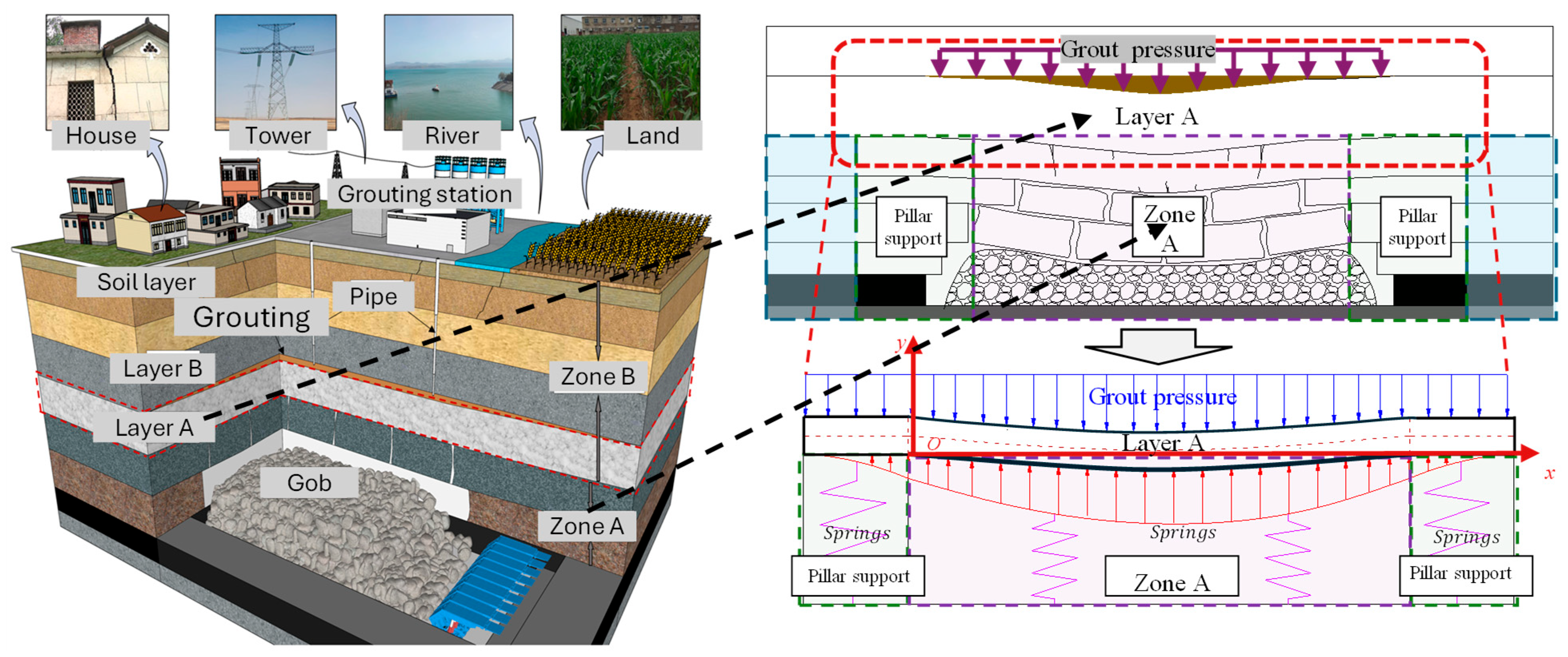
The grout-isolation layer (Layer A in
Figure 3) refers to all or part of the coal and rock strata located between the fractured zone and the grout-bearing layer [
27,
28]. Situated above the fractured zone (Zone A in
Figure 3), this layer generally exhibits high integrity and low permeability, effectively blocking or slowing grout collapse and infiltration. Consequently, it isolates the grout, maintains the stability of the grout-bearing zone, and prevents large-scale grout inflow into the mining or excavation space.
As shown in
Figure 3 right, the deformation of the grout-isolation layer (Layer A) is analyzed based on the overlying strata cross-section above the panel. Within the bending zone (Zone B), the movement of the strata is continuous and integrated, typically occurring across multiple layers as a collective behavior. During overburden delamination grouting, the multiple strata beneath the grout layer jointly help maintain the stability of the grout within the separation zone. Therefore, the grout-isolation layer can be regarded as an integrated entity (i.e., a group of strata).
As the longwall face advances, the overlying strata move upward layer by layer, transmitting the void space of the mined-out area to beneath the grout isolation layer and providing the necessary space for its deformation. At this stage, the grout-isolation layer forms a downward-suspended, fixed-ended beam structure constrained at both ends, which bends and subsides under its own weight (
Figure 3-right). As the span of the fixed-ended beam gradually increases, the bending-subsidence at the middle of the isolation layer also increases, causing asynchronous subsidence relative to the overlying key strata. Eventually, a separation grouting space is formed beneath the key strata. Filling this interlayer space with grout while maintaining a certain injection pressure supports the key strata and simultaneously reduces the height of the space below it, thereby limiting the bending-subsidence magnitude. Under the combined effect of “upward lift and downward pressure” from the grouting, the bending deformation of the isolation layer further increases, allowing the bottom of the layer to contact the underlying strata and form an elastic foundation beam structure. This structure transmits the pressure downward through the strata, further compacting the underlying mined-out area.
To assess the condition of the strata, it is necessary to compare the maximum subsidence deformation of the strata with the free height of the separation zone beneath it. As the longwall face advances, the free space generated by coal extraction is transmitted upward through the fractured overlying strata. Due to the bulking effect of broken strata and the presence of a beam-arch composite structure, the free height of the separation zone beneath the strata gradually decreases. When the maximum deflection of a stratum exceeds its available free subsidence height, the stratum as a whole enters a bending-subsidence state without forming through-going fractures. This criterion can therefore be used to evaluate the structural integrity of the grout isolation layer.
Due to the significant variability in the mechanical properties of the overburden under different geological conditions, it is necessary to determine the physical and mechanical parameters of the overlying strata according to the actual field conditions of the panel. This can be done by: (1) obtaining specific rock mechanical parameters based on the geological exploration report and laboratory test data of the panel; and (2) referring to existing data from similar mining and geological conditions in the same mine area or adjacent panels to determine reasonable physical and mechanical parameters.
The potential grouting layers corresponding to the key strata are numbered sequentially according to their spatial height (1, 2, …, 5). When the separation space extends to the development zone of the fractured zone, the lower part of the grout-sealing layer becomes suspended, forming a fixed–end beam structure. At this stage, the broken rocks in the gob are not yet fully compacted, and the height of the separation space is mainly influenced by the mining thickness and the expansion of rock fragments within the fractured zone.
2.3. Grout Material Mechanical Properties Testing
After determining the grout layer, the next step is selecting and testing the grout materials. Three types of industrial solid wastes were chosen as base materials: fly ash, finely ground coal gangue, and slag powder. (1) Fly ash was obtained from a power plant and classified as Class II, with a density of 2.1 g/cm3 and an average particle size of 25 μm. Its main chemical components are silicon dioxide (SiO2), aluminum oxide (Al2O3), and iron oxide (Fe2O3). (2) Finely ground coal gangue was sourced from a coal mine, crushed and milled to an average particle size of 28 μm, with a density of 2.4 g/cm3. Its primary components are silicon dioxide, aluminum oxide, and calcium oxide (CaO). (3) Slag powder, obtained from iron ore tailings, has a density of 2.8 g/cm3 and an average particle size of 30 μm, with major components including iron oxide, silicon dioxide, and aluminum oxide.
All materials were dried at 105 °C for 24 h and passed through a 200-mesh sieve to ensure uniform particle size distribution. A three-factor, three-level orthogonal experimental design (L9 orthogonal table) was employed to investigate the effects of different proportions of the three materials on the compressive properties of the grout. The experimental factors and their corresponding levels are listed in
Table 3. Nine mix proportion tests were designed, and each mix was repeated three times. Materials were weighed according to the designated proportions and mixed for 30 min in a mechanical mixer to ensure uniformity.
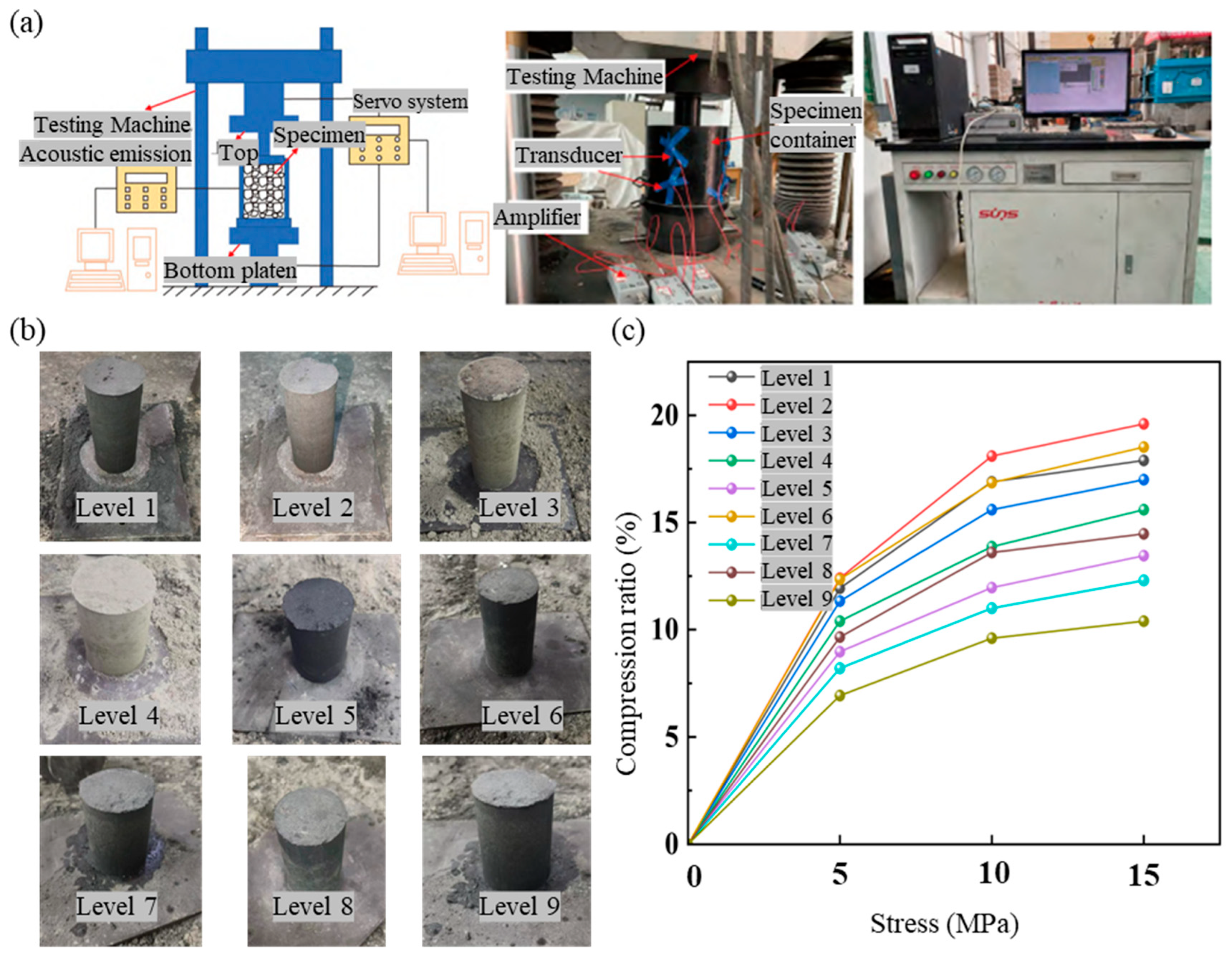
The compression test setup, prepared specimens, and test results are shown in
Figure 4. The compression tests were conducted using a confined compression apparatus, as illustrated in
Figure 4a. The specimen container has an inner diameter of 150 mm, a height of 300 mm, and a wall thickness of 20 mm. It is constructed from high-strength alloy steel, and its stiffness fully satisfies the test requirements.
The test procedure was as follows: First, the uniformly mixed grout material was loaded into the pressure cylinder in layers, with each layer approximately 50 mm high, and lightly compacted. Next, the displacement and pressure sensors were installed, and the data acquisition frequency was set to 10 hertz. Axial pressure was then applied at a rate of 1 mm per minute, using four stepwise loading levels of 7.5, 10, 12.5, and 15 MPa, with each level maintained for 30 min. During the test, axial displacement and pressure data were recorded for each loading level, and the compressive strain and compression ratio were calculated. After the test, the specimen was removed to measure its final height, and the change in porosity was determined. The equation for calculating the compression ratio is:
where
η is the compression ratio,
h0 is the initial height, and
h is the height after compression.
From
Figure 4c, all specimens exhibit nonlinear compressive behavior, which can be divided into three distinct stages. (1) Rapid Compression Stage (0–5 MPa): The materials have a high initial porosity, and the compressive strain increases rapidly, with a strain rate of 0.8–1.2 percent per megapascal. (2) Transition Stage (5–10 MPa): The pores are gradually filled, and the strain growth rate slows to 0.3–0.5 percent per megapascal. (3) Stabilization Stage (10–15 MPa): The material structure becomes more compact, and the strain growth rate further decreases to 0.1–0.2 percent per megapascal.
Among all the mix proportions, the ternary combination (Level 9) demonstrated the best compressive stability. Under a confining pressure of 15 MPa, its total strain was only 8.2%, which is significantly lower than that of the single-component materials—fly ash (12.5%), coal gangue (14.3%), and slag powder (11.8%). These results indicate that appropriately increasing the proportion of slag powder can effectively reduce the compression ratio, whereas an excessively high proportion of coal gangue tends to increase it. The optimal mix ratio was determined to be fly ash: coal gangue: slag powder = 4:3:3.
It is important to note that, in this paper, the confined compression test used in this study does not simulate the initial flow stage; instead, it represents the long-term mechanical response of the grout after the separation space has been completely filled and the material has fully cured. Once hardened, the grout mass is subjected to sustained overburden pressure, and its compressive stability becomes the dominant factor controlling the effectiveness of the delamination reinforcement. Therefore, the confined compression apparatus—loaded up to 15 MPa—was used to reproduce the magnitude of stresses acting on the cured grout under deep overburden. While the laboratory loading condition replicates the stress environment reasonably well, differences remain: field conditions involve spatially variable loading, interactions with surrounding strata, and time-dependent stress evolution. These differences are acknowledged and discussed to clarify that the confined compression test is intended to evaluate the long-term bearing capacity of the cured grout rather than its early-age fluid behavior.
2.4. Grouting Effects Assessment by Surface Subsidence Monitoring
After the grout material has been selected, grouting is carried out according to the engineering design and construction specifications. The effectiveness of grouting is primarily assessed by monitoring the surface subsidence before and after the treatment. Although various approaches exist to evaluate grouting performance—such as borehole inspection, ground deformation analysis, or numerical modeling—the most direct and reliable method is through surface subsidence monitoring [
29].
At present, a variety of modern surveying techniques are available for subsidence monitoring. Ground-based methods include Ground Penetrating Radar (GPR), Real-Time Kinematic (RTK) positioning, and level surveying; aerial methods utilize Unmanned Aerial Vehicles (UAVs); and space-based methods rely on satellite remote sensing, such as InSAR (Interferometric Synthetic Aperture Radar) [
4,
6,
8,
17,
30]. These technologies collectively enable comprehensive, multi-scale monitoring from the ground, air, and space, as illustrated in
Figure 5.
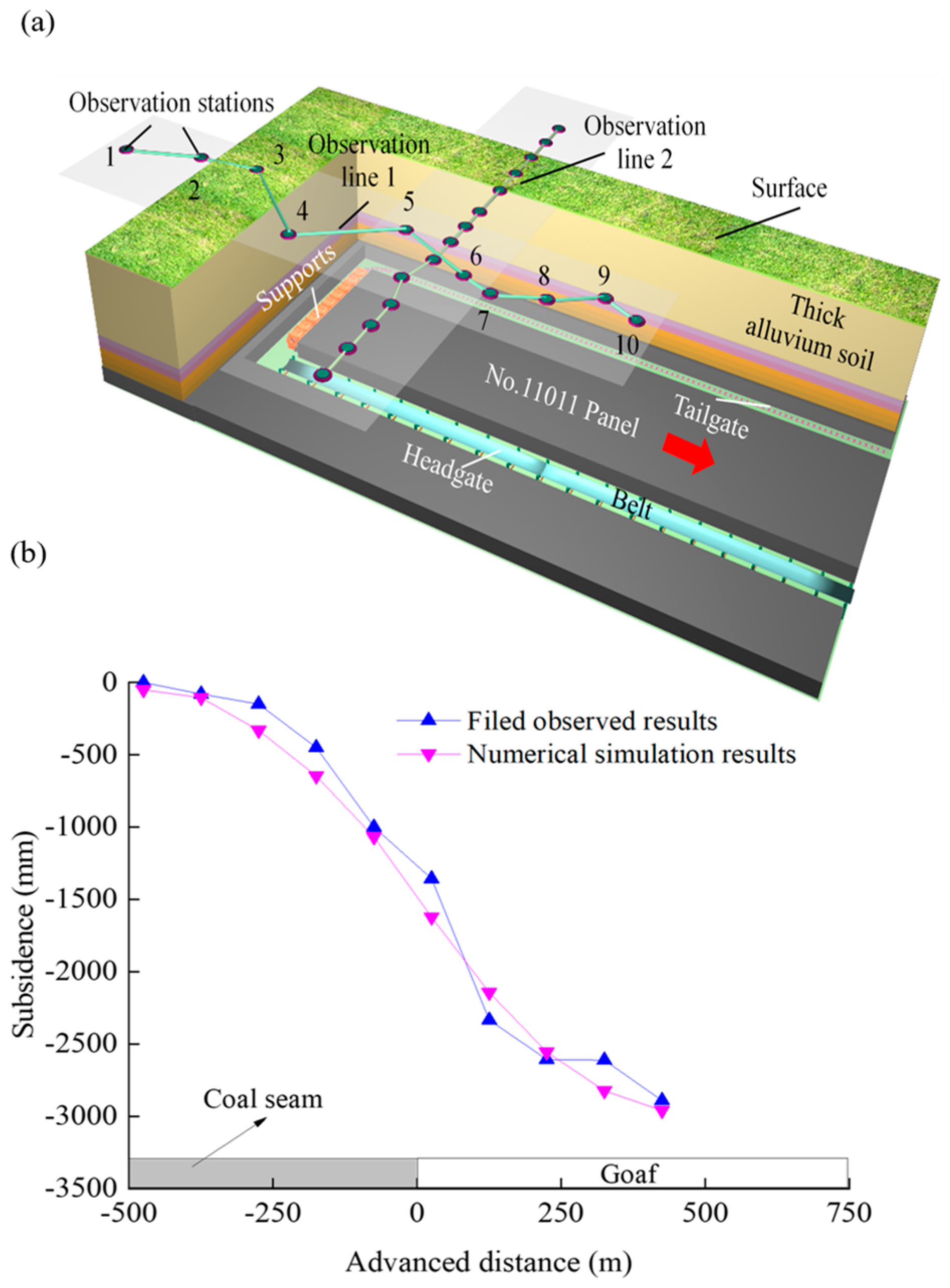
In field practice, RTK remains the most widely applied technique due to its high precision, operational simplicity, and cost-effectiveness. Typically, two observation lines are established above the mining panel: Observation Line I, aligned along the strike direction, and Observation Line II, aligned along the dip direction, as shown in
Figure 6a.
When numerical modeling is used to simulate surface deformation [
9,
31,
32], the field-measured subsidence data from Observation Line I are commonly used for comparison and validation against numerical results, as illustrated in
Figure 6b. The observed and simulated subsidence curves generally exhibit similar trends, indicating that the model effectively captures the deformation behavior of the overburden and surface.
In this study, the assessment of grouting effectiveness focuses on RTK-based surface subsidence monitoring. The measured data from multiple observation stations are analyzed to quantify the reduction in maximum subsidence and to evaluate the overall stabilization performance of the grout injection. This approach provides a quantitative basis for verifying the success of the grouting treatment and its contribution to surface stability.
2.5. Integrated Workflow for Overburden Delamination Grouting Design
The grouting process for preventing surface subsidence in longwall mining follows a systematic workflow that begins with analyzing the mining and geological conditions and determining the fractured zone height. Accurate estimation of this height provides the fundamental basis for identifying the location of both the grout-bearing layer and the grout-isolation layer. Using either theoretical separation-distance models or widely adopted empirical equations derived from long-term field observations, the maximum height of the fractured zone can be estimated from mining thickness and overburden lithology. Once the fractured zone height is defined, the remaining overlying strata can be systematically evaluated to locate stable layers situated above the fractured zone and capable of effectively forming a grout-bearing space during mining-induced bed separation. These same strata also serve as the reference for selecting an appropriate grout-isolation layer that prevents slurry loss into the highly fractured zone.
With the fractured zone height established, attention shifts to identifying the grouting layer and the grout-isolation layer. The selection process relies on analyzing the mechanical behavior of the strata within the bending zone and key-stratum system. By examining coordinated deformation, available free subsidence space, and the bending–subsidence characteristics of each layer, the isolation layer is required to maintain structural integrity without forming through-going fractures. Once the grout-isolation layer is confirmed, the grout-bearing layer immediately above it is identified as the target layer for slurry injection. This spatial configuration ensures that injected grout fills the separation space, limits excessive deformation, supports the overlying key strata, and stabilizes the overburden during subsequent face advance.
After these layers are selected, the next step is the determination and testing of the grout material. Because the injected material must sustain long-term compression under high confining pressure and cyclic loading, laboratory testing is essential for quantifying its compressibility and mechanical stability. Using industrial waste materials such as fly ash, coal gangue, and slag powder, orthogonal testing is conducted to evaluate how different mix ratios influence compressive behavior under confined loading. Through staged loading tests and analysis of strain development, the optimal mix proportion is selected to ensure adequate strength, low compression ratio, and overall material stability. This optimized grout serves as the primary medium for filling the overburden delamination space and transferring load downward to compact broken rock masses.
Following material optimization, grouting is carried out according to engineering design specifications. During this stage, the injection pressure, volume, and sequence must be carefully controlled to ensure full filling of the separation space while avoiding uncontrolled fracture propagation or slurry loss. As mining continues, the injected grout interacts with the bending and subsiding overburden, providing upward support to the key strata and downward compression to the fractured zone. This dual action reduces the height of the separation zone, enhances backfilling efficiency, and contributes directly to surface-subsidence mitigation.
The final step involves assessing the effectiveness of the grouting treatment. Surface subsidence monitoring is performed before and after grouting using techniques such as RTK, UAV photogrammetry, or satellite remote sensing. Among these, RTK monitoring is the most commonly used due to its high precision and operational efficiency. By establishing strike- and dip-oriented observation lines above the mining panel, surface deformation can be continuously measured throughout the mining process. The monitoring data are compared with numerical simulation results to evaluate the reduction in maximum subsidence and analyze overall surface stability. Through this quantitative approach, the success of the grouting treatment can be reliably verified, providing a scientific basis for validating the selected grout layer, isolation layer, and material composition.
In summary, as shown in
Figure 7, the procedure begins with determining the fractured-zone height using theoretical and empirical models to define the spatial extent of mining-induced damage. Based on this height, the grout-bearing layer and grout-isolation layer are selected by analyzing key-stratum deformation, separation potential, and integrity. Laboratory testing is then conducted to optimize the grout mixture, focusing on compressibility and long-term strength under confined loading. Field grouting is implemented following engineering design criteria to fill separation spaces and provide structural support to the overburden during mining. Finally, grouting effectiveness is evaluated through continuous surface-subsidence monitoring, allowing quantitative assessment of deformation reduction and verification of the overall control strategy.
3. Case Studies
3.1. Case 1
3.1.1. Mining and Geological Conditions
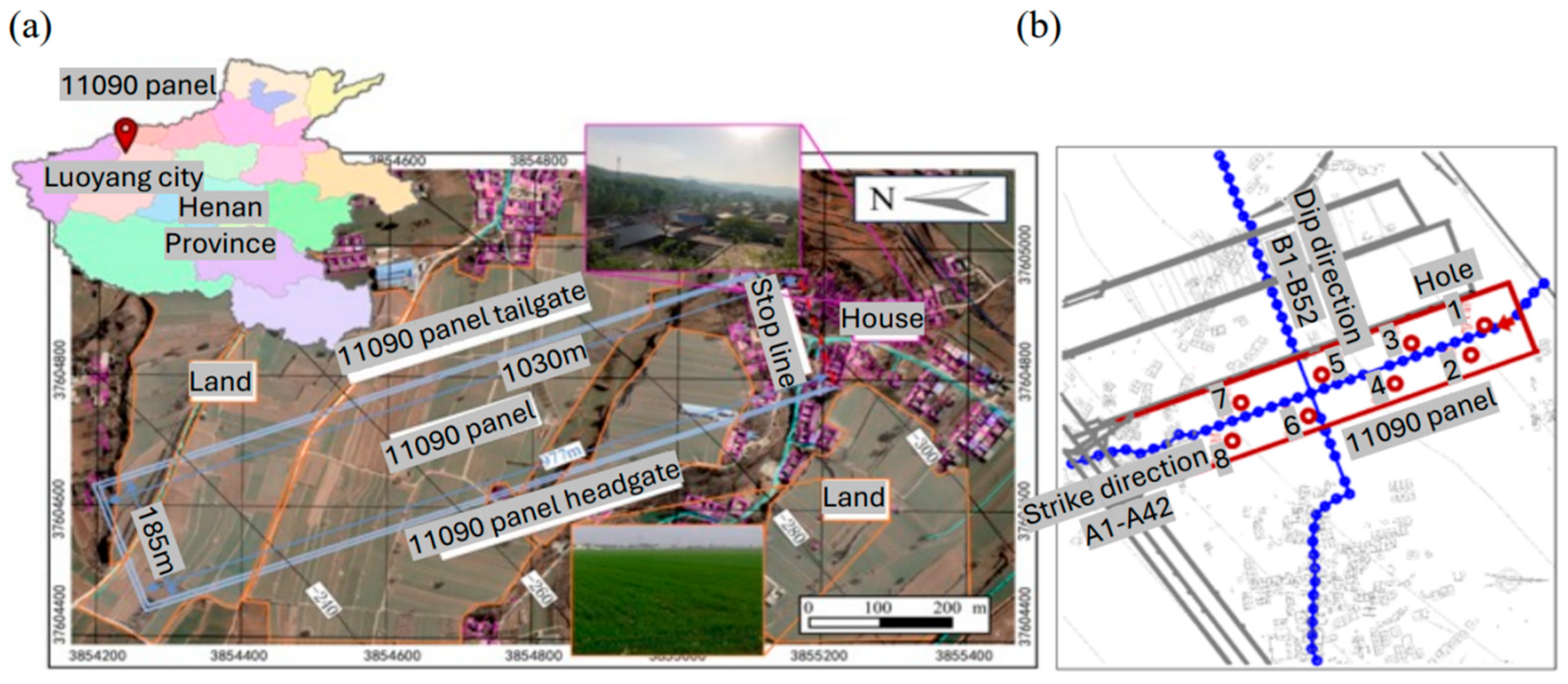
The No. 11090 longwall panel is located in Luoyang City, Henan Province, with the surface corresponding to residential buildings and roads in parts of Jinxi Village and Gu Village, and large areas of farmland overlying the longwall panel, as shown in
Figure 8a. After comprehensive consideration, the protective measure of overburden delamination grouting was selected to safeguard the surface.
The longwall face has a dip length of 974.9–1002.4 m and a strike length of 185.2 m. Its elevation ranges from −313.4 m to −225.0 m, while the ground elevation is +361.9 m to +400.6 m. The face is mined using the inclined longwall fully mechanized method, and the roof is managed using the caving method. The coal seam has an average thickness of approximately 4.7 m.
To evaluate the effectiveness of overburden delamination grouting in reducing surface subsidence at the face and to assess damage to village houses, surface observation lines were established. On the main cross-section of the surface subsidence basin above the face, one strike-direction observation line and one dip-direction observation line were arranged. The distribution of observation lines relative to the face location is shown in
Figure 8b.
In
Figure 8b, the strike-direction observation line has 52 measurement points spaced at 35 m intervals (B1 to B52), while the dip-direction observation line has 42 measurement points spaced at 35 m intervals (A1 to A42). Surface observation stations were designed with reference to the face orientation and the distribution of surface houses.
3.1.2. Overburden Delamination Grouting Design and Application
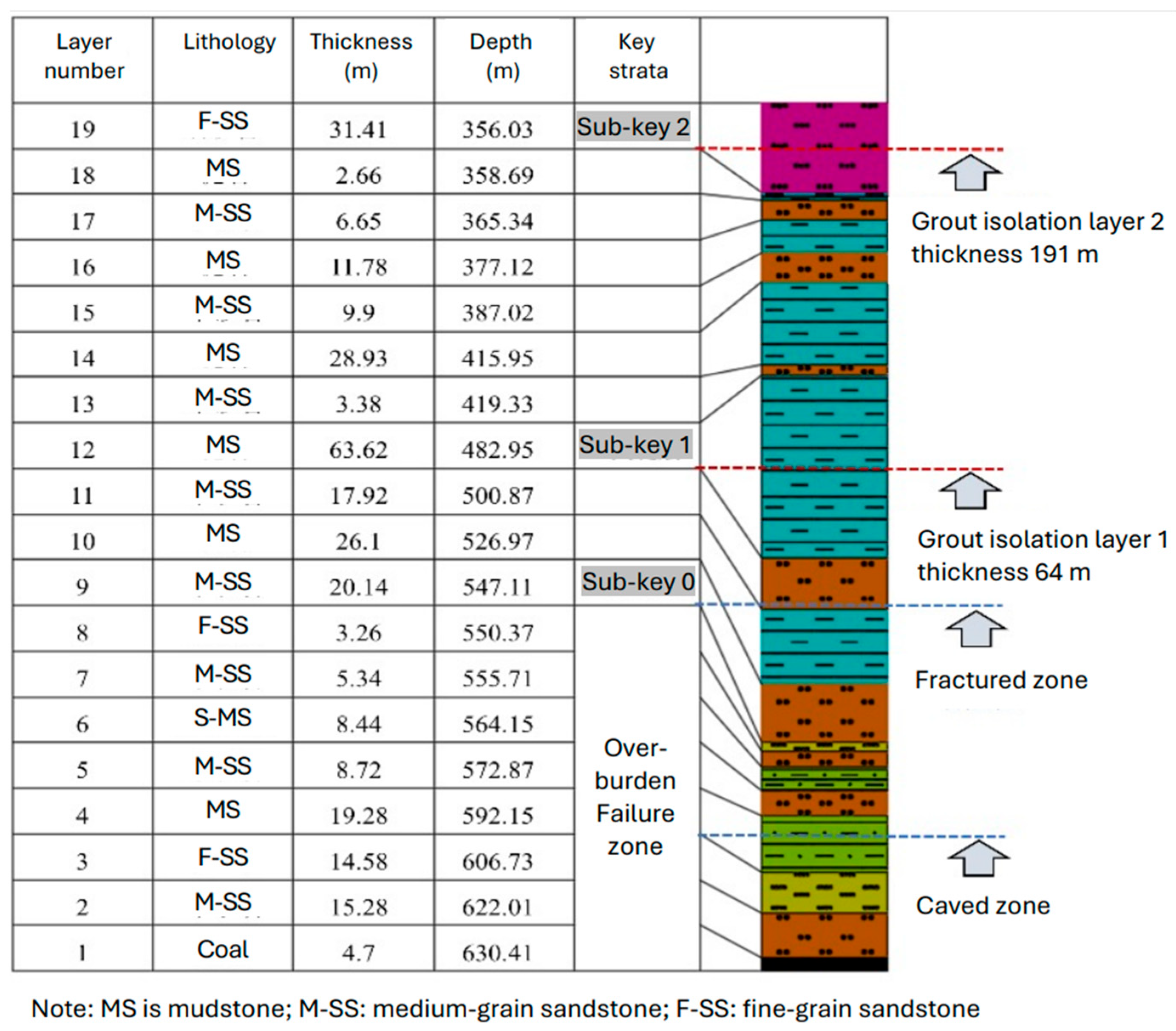
According to the geological borehole lithology of the panel No. 11090 in
Figure 9, the immediate roof of the coal seam consists of sandy mudstone; the old roof is composed of medium-grained sandstone; the immediate floor is siltstone; and the old floor consists of siliceous mudstone. In addition, the comprehensive overburden evaluation coefficient
P of the face is 0.36, indicating that the overburden is of medium–hard lithology, with an upper bedrock thickness of 596.5–606.5 m containing multiple hard rock layers, satisfying the conditions for grouting in overburden delamination zones.
Based on field measurements of the height of the fractured zone in adjacent mining panels, the average coal seam thickness is 5.2 m, with a maximum fractured zone height of 75 m and a mining-to-fracture ratio of 14.42. Accordingly, the predicted fractured height above the No. 11090 face is 67.77 m. Using the parameters of the No. 11090 face and the overburden lithology, the empirical formulas listed in
Table 2 yield a fractured zone height range of 55 m to 104 m. In summary, the fractured zone height is 55–104 m. By combining empirical formulas, theoretical analysis, and research results on the fractured height in adjacent longwall faces, and considering the geological borehole logs of the face, the fractured zone is expected to develop down to the medium sandstone located 75 m above the coal seam.
All strata between the top of the fractured zone and the grouting design horizon are treated as an integrated unit, serving as the grouting isolation layer beneath the target grouting layer. The thickness of this isolation layer is determined by the elevation difference between its upper boundary and the fractured-zone height. In practice, the isolation layer is typically required to be at least five times the mining height. For the present case, the mining height is 4.7 m, indicating a minimum required isolation thickness of approximately 24 m. Based on this criterion, mudstone sub-key layer 1, located at a burial depth of 419.33 m with a thickness of 63.62 m, is selected as the designed grouting layer.
Based on the surface topography above the longwall panel, mining dimensions, surrounding gob areas, and the distribution and protection level of surface buildings and structures, a total of eight grouting boreholes were designed and numbered 1–8, as shown in
Figure 8b. The planned spacing between boreholes is 130 m. However, because Boreholes 1 and 2 are critical for grouting, their spacing was reduced to 60 m. Borehole 1 is located 60 m from the setup entry, and Borehole 2 is positioned 85 m from the setup entry.
The grouting and filling parameters were determined to ensure effective control of mining-induced subsidence. The designed grouting pressure ranges from 5.0 to 5.3 MPa, and the optimal slurry mix ratio was determined to be fly ash: coal gangue: slag powder = 4:3:3. The overburden delimitation grouting project for the No. 11090 panel was carried out from 26 September 2019 to 6 October 2020, spanning a total of 377 calendar days.
3.1.3. Surface Subsidence Mitigation Assessment
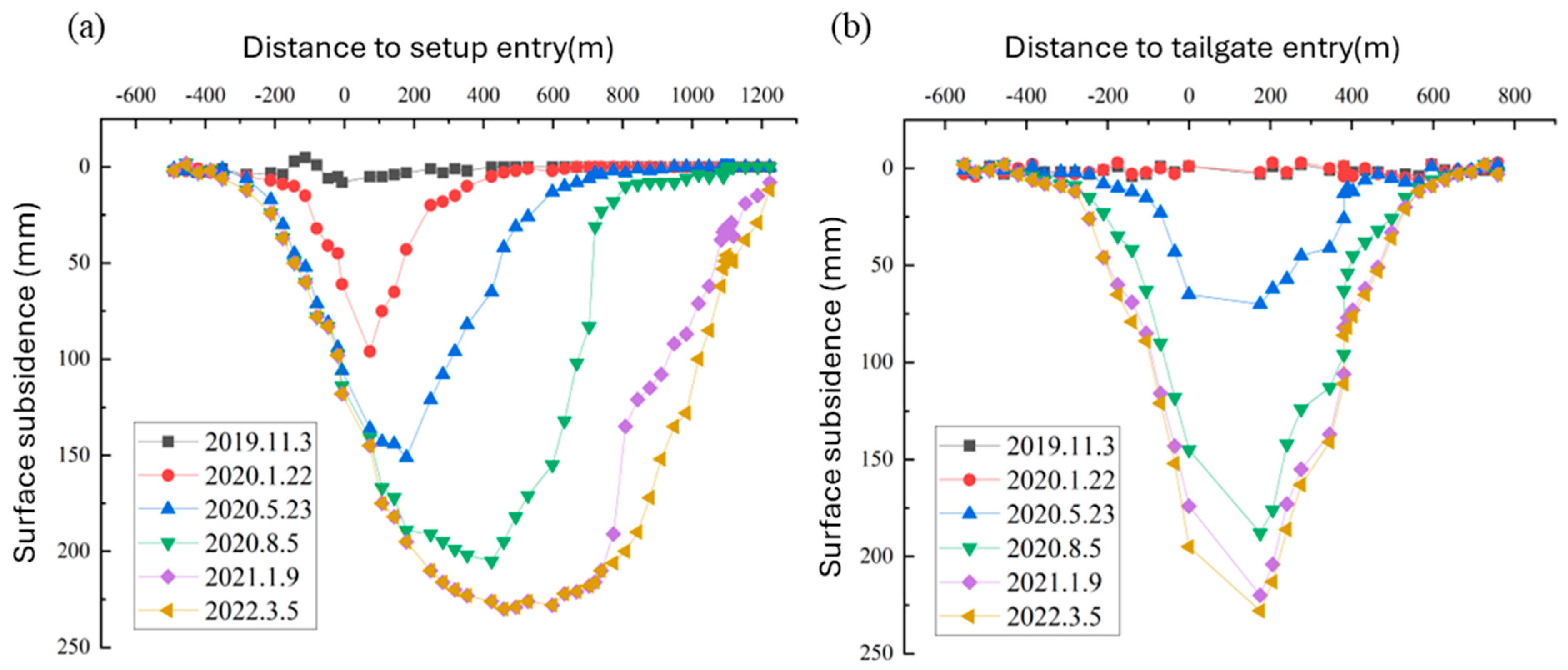
As shown in
Figure 8b, a strike-direction observation line was arranged above the No. 11090 face, consisting of measurement points A1 to A42. The subsidence values were used to plot the subsidence curve shown in
Figure 10a.
In
Figure 10a, the strike-direction curves show that surface subsidence gradually increases as the No. 11090 face advances. During the first three months after the start of retreat mining in early November 2019, surface subsidence remained minor. Beginning in January 2020, the slope of the subsidence curve became significantly steeper, marking the onset of an active subsidence phase. Subsidence then accelerated until reaching its peak in May 2020, with a maximum value of 228 mm at point A19. In
Figure 10b, the dip-direction subsidence curve indicates that the maximum subsidence point occurs at B24, 230 mm. After January 2021, with six months of continuous monitoring, surface deformation was observed to stabilize, and further subsidence ceased.
Following completion of mining, the overall shape of the movement basin resembles a shallow bowl. Under the protection of delamination grouting, the magnitude and rate of surface movement are markedly lower than typical values expected under full-extraction conditions. Overall, post-mining monitoring confirms that no further subsidence occurred after stabilization, and pressure in the grouting boreholes remained normal. The final maximum subsidence of 230 mm indicates that overburden delamination grouting provided a significant and effective subsidence-mitigation effect. In addition, field measurements show that after applying overburden delamination grouting and filling, the maximum surface subsidence was 230 mm, the maximum ground-surface tilt near residential houses was approximately 0.8 mm/m, and the maximum horizontal deformation was 0.7 mm/m. These deformation values fall within Category I damage levels, demonstrating that the surface buildings and structures were effectively protected.
3.2. Case 2
3.2.1. Mining and Geological Conditions
The No. 12030 longwall panel is an isolated panel. The west side of the face adjoins the gob of the No. 12040 panel (retreat mining completed in June 2014), and the east side adjoins the gob of the No. 12020 panel (retreat mining completed in December 2015). Since both adjacent panels have been mined, the No. 12030 panel is characterized by varying degrees of overburden and surface damage on both sides.
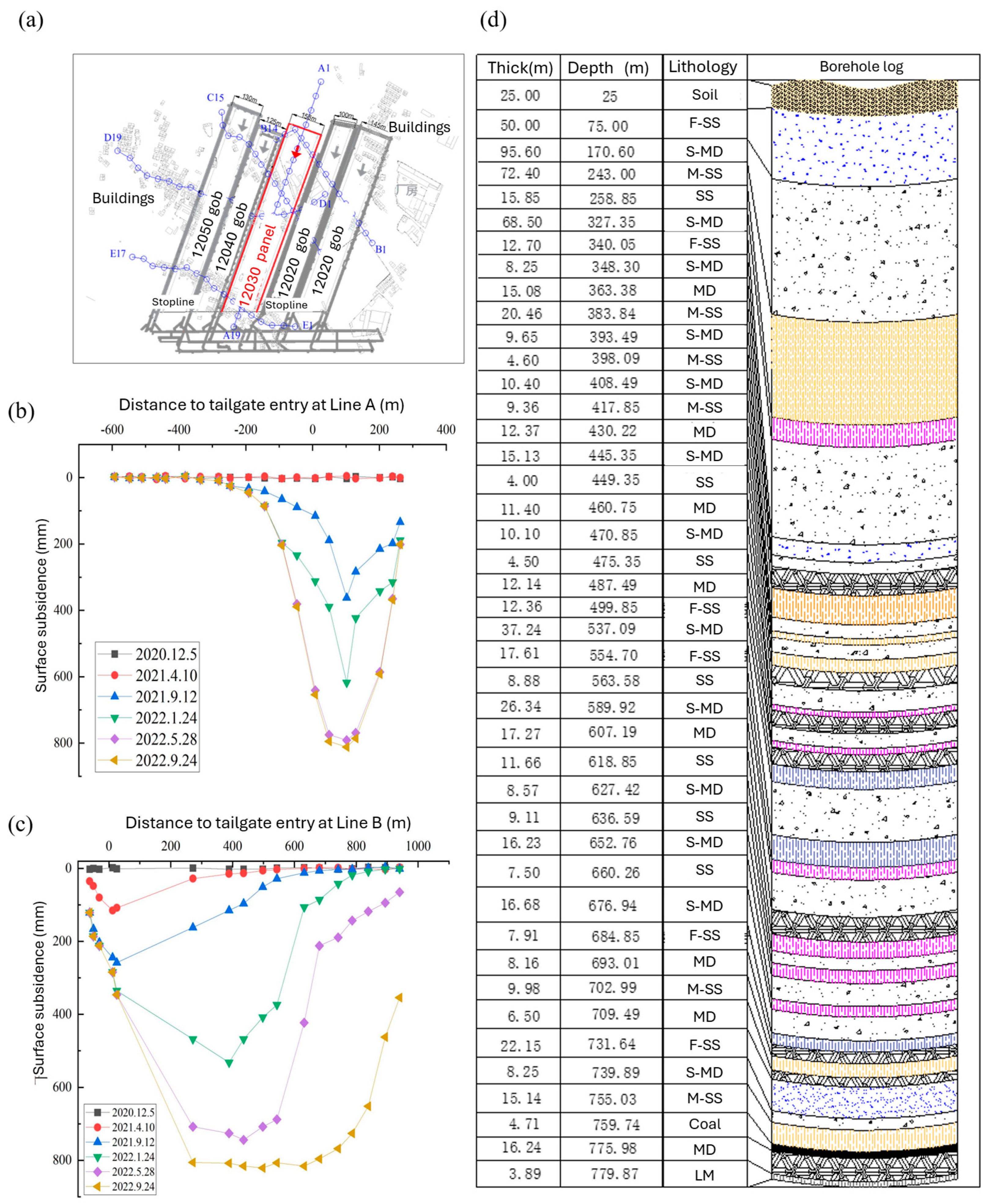
In addition, the coal seam in No. 12030 longwall panel dip ranges from 1° to 10°, with an average of 5°. Mining is conducted using the inclined longwall fully mechanized method, with the caving method applied for roof management. The No. 12030 panel has a dip length of 810–870.3 m, a strike length of 158 m. The corresponding surface areas include Zhaogou, Xibai, and Yingli Villages, with no surface water bodies. The surrounding conditions of the No. 12030 panel and the layout of surface observation stations are shown in
Figure 11a. The subsidence monitoring results is shown in
Figure 11b,c.
The overbuden strata, from bottom to top, in
Figure 11d, primarily include the Upper Carboniferous Taiyuan Formation, the Lower Permian Shanxi Formation, the Lower Shihezi Formation, and the Upper Shihezi Formation. Locally, carbonaceous mudstone pseudo-roofs are present. The immediate roof consists of sandstone or sandy mudstone, the old roof is medium-grained sandstone, the immediate floor is siltstone, and the old floor is siliceous mudstone.
3.2.2. Overburden Delamination Grouting Design and Application
Within the Shanxi Formation, the Bin 1 coal seam is the main mineable seam in the mine, with an average thickness of 4.81 m. Other coal seams are either unminable or only occasionally minable. From
Figure 11c, it can be seen that the overburden consists of alternating soft and hard rock layers, including 72.4 m of medium-grained sandstone and 68.5 m of sandy mudstone, providing suitable conditions for overburden delamination grouting. Using the key-stratum identification method, the key strata above the 12030 panel were determined. The results indicate that the fine–medium sandstone at a depth of 499.85 m with a thickness of 12.36 m is a sub-key stratum. The auxiliary grouting horizon is located at the separation zone beneath the sub-key siltstone at a depth of 449.3 m with a thickness of 4 m (overlain by 15.13 m of sandy mudstone).
Six grouting boreholes were designed for the subsidence control project. The boreholes were spaced approximately 110 m apart and arranged in a staggered configuration to ensure effective coverage of the target grouting zone. The normal grouting pressure was set at 5.3 MPa. During the early stage of grouting, the applied pressure should not be lower than the natural formation pressure of the grouting horizon (i.e., ≥5.3 MPa). In the mid-stage, pressurized grouting should be maintained (p > 0). In the late stage, the pressure should be increased to 1.2–1.5 times the natural formation pressure, with real-time adjustments made based on field test feedback.
During preparatory pressurization, two pumps are operated through four pressure stages to inject water at a total flow rate of 30 m3/h for no less than 6 h. If the borehole head remains unpressurized after water injection, a low-concentration slurry (~30%) is used for trial grouting for at least 24 h. A rapid pressure increase exceeding 1 MPa indicates that overburden delamination has not yet developed, and additional water injection is needed to further induce separation. If the borehole head pressure remains below 1 MPa during trial grouting, formal grouting can begin. The slurry concentration is then gradually increased to 60%, and the pump output is adjusted according to pressure conditions. The daily grout injection volume should be coordinated with the daily mining advance and maintained continuously.
Based on prior grouting experience, suitable conditions for overburden delamination grouting are generally met when the panel advances to within 20 m of the borehole bottom. Under hard-strata conditions, the separation may develop only after the panel passes the borehole. If water-level changes in the borehole remain minimal, pressurization can be conducted when the panel is 20 m from the borehole bottom to enhance permeability in the formation.
3.2.3. Surface Subsidence Mitigation Assessment
A single strike-direction observation line (Line A) was arranged above the 12030 longwall face, and the subsidence curve is plotted in
Figure 11b.
From the subsidence curves along the strike direction (
Figure 11b), it can be seen that as the longwall face advances, subsidence values increase, with the maximum subsidence point located along the main dip cross-section. The No. 12030 longwall face began retreat mining in November 2020, and the maximum subsidence at measurement point XA1 on Line A reached 821 mm.
A single dip-direction observation line was established at the No. 12030 longwall face. The subsidence curve is plotted in
Figure 11c. From the measured subsidence curves along the strike line, the maximum subsidence point is located at B9. Under the mining and geological conditions of the area, as the face advances, subsidence values increase and the maximum subsidence point shifts forward, resulting in both an expansion of the surface movement basin and an increase in the magnitude of movement. However, with the support provided by overburden delamination grouting, the slope of the surface subsidence curve is gentler than it would be without grouting, and field investigations indicate that the subsidence mitigation effect is effective.
After the retreat mining of the face, the profile of the surface movement basin resembles a bowl. Under the protection of separation grouting, surface movement and deformation values are much lower than those expected under fully mined conditions for the given geological setting. The surface movement process is relatively gradual, showing a continuous and progressive variation. Once full mining-induced deformation is reached, the maximum subsidence point remains stable at measurement point B9, though the affected surface area continues to expand.
Following the completion of mining at the No. 12030 panel, continuous surface subsidence monitoring indicated no further subsidence at the observation points. The grouting boreholes maintained stable pressure, and the maximum recorded surface subsidence reached 821 mm. The stabilization of surface deformation demonstrates that the grouting effectively reduced subsidence. Field inspections of the ground surface and key buildings/structures above the face showed that, aside from a few minor cracks requiring repair, houses, roads, and other structures exhibited no significant damage. The grouting operation prevented further deterioration of village buildings and avoided the need for village relocation, yielding significant economic and social benefits. Throughout the overburden delamination grouting, and backfilling process, surface roads remained fully operational, and residential houses remained safely occupied. Most residential structures experienced maximum horizontal surface deformation within Grade I damage levels, indicating effective protection of surface buildings and structures. Overall, the overburden delamination grouting and backfilling achieved a clear and substantial subsidence-reduction effect.
3.3. Case 3
3.3.1. Mining and Geological Conditions
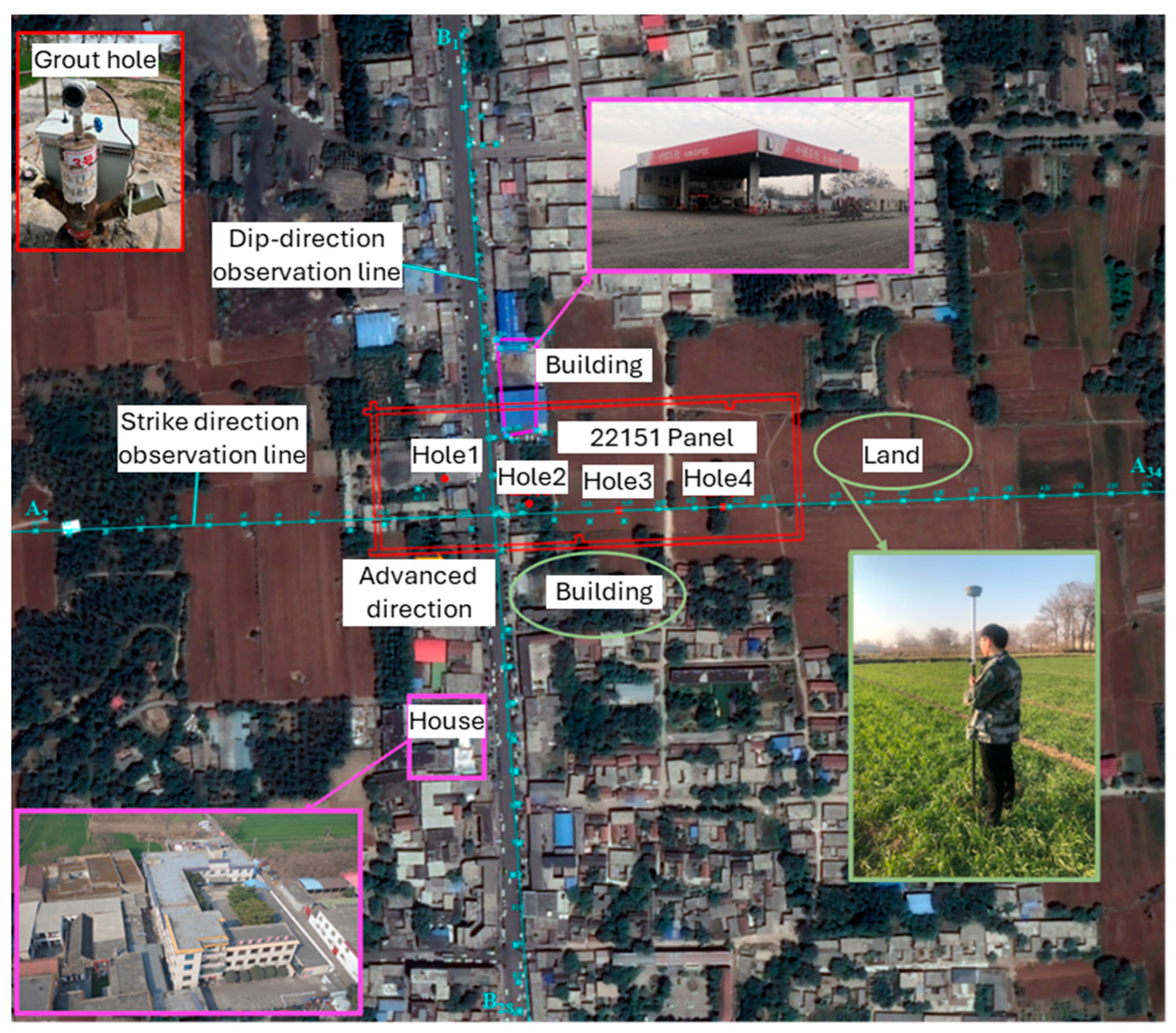
The No. 22151 longwall panel of Peigou Coal Mine was selected as the study area for overburden delamination grouting, as shown in
Figure 12. The mining coal seam is generally a thick and relatively stable seam. The longwall panel has a strike length of approximately 300 m and a dip length of about 106 m. The surface elevation of the panel ranges from +220.1 m to +226.4 m, while the panel elevation is −60.5 m to −97 m, with an average burial depth of 302 m. The coal seam has an average thickness of approximately 7.1 m and an average dip of about 12°. Mining is conducted using the fully mechanized top-coal caving method, with the roof managed using the natural caving method.
The surface above the longwall panel is primarily composed of village houses and farmland. The Wangguan Highway passes north–south through the area, with relatively dense buildings along both sides of the highway. Field investigations indicate that most buildings along the highway are 1–2 story brick–concrete structures, with a few 3–5 story buildings, as well as important facilities such as gas stations and hospitals, as shown in
Figure 12.
3.3.2. Overburden Delamination Grouting Design and Application
The overburden above the No. 22151 panel of Peigou Coal Mine mainly consists of weak rock layers, such as sandy mudstone and mudstone, and hard rock layers, such as medium-grained sandstone and fine-grained sandstone, as shown in
Table 4. The ratio of weak to hard layers in the overburden is 1.59:1. Based on the lithology and thickness of each overburden layer, and referring to the stratified lithology evaluation coefficient table, the overburden lithology of the panel is classified as medium–hard.
Using the formula for calculating the height of the fractured zone under hard conditions for thick coal seam mining (
Table 2), the approximate development height of the fractured zone is 81.4–152 m. Based on the adjacent panel data, where the average coal seam thickness is 8.1 m, the fracture zone height induced by mining is 117.7 m, corresponding to a fracture-to-mining ratio of 14.5. Considering the No. 22151 face coal seam thickness at 7.1 m, empirical formulas, and field measurements, the fractured height is determined to be 103–152 m. Since full mining-induced deformation along the strike has not yet occurred, the median value of this range is selected as the fractured height at 127.5 m.
Using the key-strata calculation formulas, it is determined that a total of 14 key-strata layers overlie the coal seam of the No. 22151 longwall face, among which three layers are expected to develop separation beneath them. The first hard rock layer is a fine-grained sandstone located 4.46 m above the coal seam roof. The second hard rock layer, also fine-grained sandstone, is 69.42 m above the roof. The third hard rock layer is fine-grained sandstone as well, located 175.21 m above the roof (burial depth 126.51 m).
According to the obtained fractured height at 127.5 m, the first and second hard rock layers lie within the caving zone and fractured zone after mining the No. 22151 longwall face; therefore, no separation will develop beneath them. The third hard rock layer is situated above the upper boundary of the fractured zone at a distance of 48 m above the top of the fractured zone (based on a mining height of 7.1 m and a fracture–mining ratio of 17.9). This distance is much greater than the required thickness of the protective layer (5 M, where M is the mining height).
Therefore, the most suitable grouting location is directly beneath the third hard rock layer. Performing overburden delamination grouting and backfilling at this horizon can prevent bending and breakage of the third hard rock layer and reduce surface subsidence.
3.3.3. Surface Subsidence Mitigation Assessment
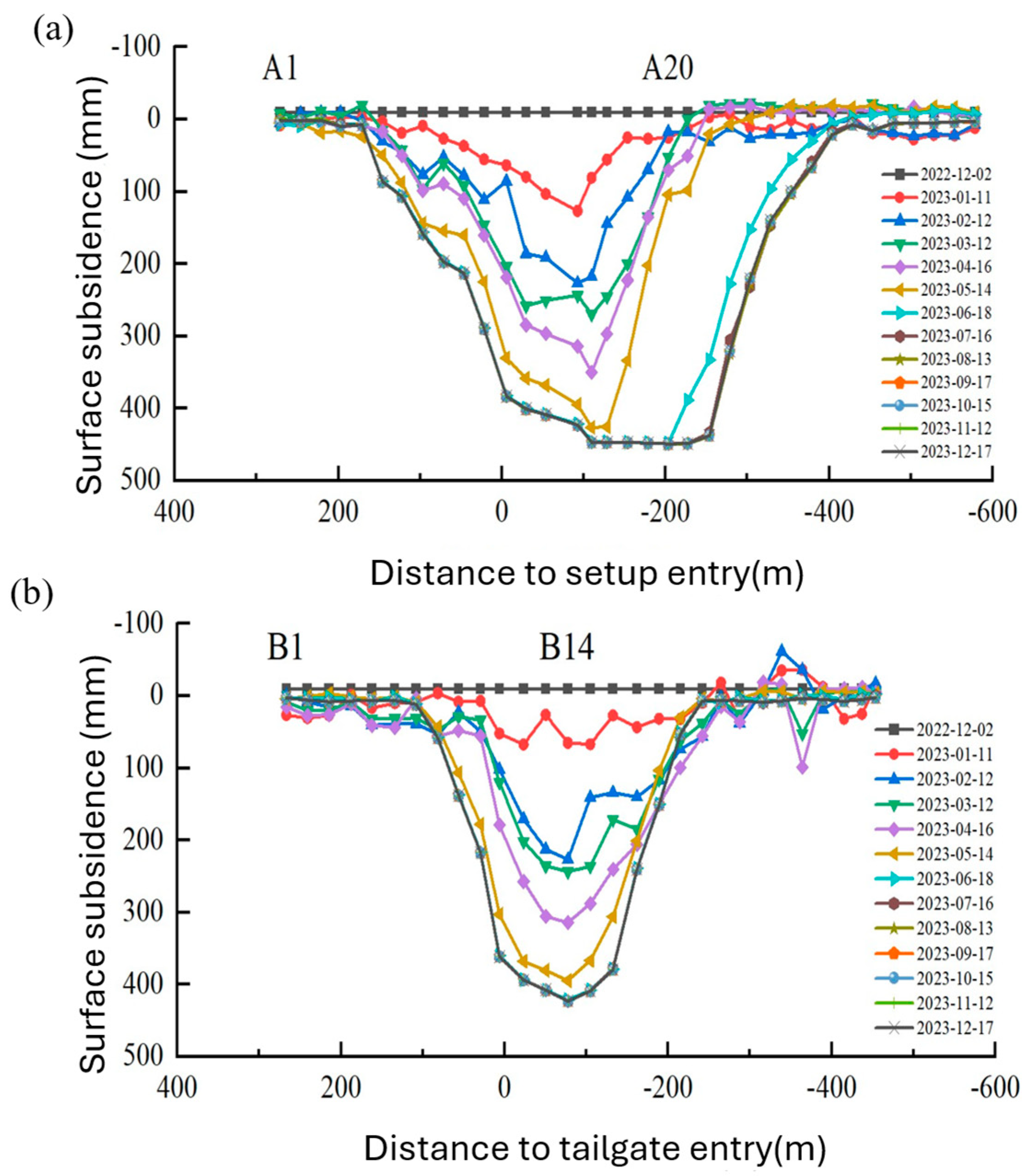
A single strike-direction observation line was arranged, with measurement points numbered A1 to A35. The subsidence curve is plotted in
Figure 13.
From the measured subsidence curves along the strike line, the maximum subsidence point is located at A20. Under the mining and geological conditions of the Peigou mine, as the longwall face advances, subsidence values increase and the maximum subsidence point gradually shifts forward, resulting in both an expansion of the surface movement basin and an increase in the magnitude of movement. During the active subsidence period, the slope of the subsidence curve is steep, and subsidence is rapid and concentrated. From the data, the active period for this face is identified as 12 February 2023 to 18 June 2023.
However, with the support provided by overburden delamination grouting, the slope of the surface subsidence curve is gentler than it would be without grouting, and field investigations indicate that the subsidence mitigation effect is good. Under the protection of separation grouting, after 18 June 2023, continuous monitoring over six months shows that surface subsidence ceased, entering a stable period. The maximum subsidence remains at point A20, with a value of 448.9 mm, demonstrating that overburden delamination grouting achieved effective subsidence reduction.
After the retreat mining of the panel, the profile of the surface movement basin resembles a bowl. Under the protection of separation grouting, surface movement and deformation values are much lower than those expected under fully mined conditions for the given geological setting. The surface movement process is relatively gradual, showing continuous and progressive variation. Once full mining-induced deformation occurs, the maximum subsidence point stabilizes at A20, although the affected surface area continues to expand. Observations after 18 June 2023, indicate that along the strike direction, the surface has essentially reached full mining-induced deformation, with subsequent measurements showing that the maximum subsidence stabilizes and varies little.
A single dip-direction observation line was designed for this observation station, with measurement points numbered B1 to B29. The subsidence curve is plotted in
Figure 13b.
From the subsidence curves along the dip direction, it can be seen that as the panel advances, subsidence values increase, with the maximum subsidence point located along the main strike cross-section. The No. 22151 face began retreat mining in early December 2022. During the first two months of mining, the impact on the panel was minimal. After January 2023, the slope of the subsidence curve increased sharply, marking the active subsidence period. The maximum subsidence continuously increased, reaching its peak in June 2023, with measurement point B14 recording a maximum subsidence of 422.9 mm.
The longwall face completed mining on 6 August 2023. Continuous surface subsidence monitoring for more than four months thereafter showed no further subsidence at the observation points. Grouting boreholes maintained pressure, and the maximum surface subsidence remained at 448.9 mm. These results indicate that surface subsidence stabilized and that overburden delamination grouting achieved a significant subsidence mitigation effect. Based on field measurements, after mining with multilayer overburden delamination grouting, the maximum horizontal surface deformation at most residential houses remained within Grade I damage levels. Only a few houses experienced surface movement and deformation slightly exceeding Grade I, which was controlled within Grade II damage levels.
4. Discussion
Overburden delamination grouting has been effectively applied in the No. 11090, No. 12030, and No. 22151 longwall faces to mitigate surface subsidence and protect surface structures, including villages, roads, and farmland. This method is particularly suitable for thick coal seams with moderately hard to hard overburden, where water-conducting fracture zones may develop, and mining occurs near populated areas. In all three cases, overburden delamination grouting was chosen due to the presence of sensitive surface infrastructure and the need to reduce the impact of subsidence caused by underground mining.
The selection of grouting layers was based on geological stratigraphy, coal seam thickness, overburden lithology, and predicted fractured height, determined from empirical formulas, field measurements, and data from adjacent panels. For instance, in the No. 11090 longwall face, the primary grouting layer was placed in a sub-key mudstone layer at a depth of 419.33 m with a thickness of 63.62 m. In the No. 12030 face, the primary grouting layer was located below a medium-grained sandstone sub-key layer at 485.2 m depth, while a secondary layer below a siltstone sub-key layer at 443.3 m depth was also included. In the No. 22151 longwall face, the protective layer thickness above the coal seam was estimated at 48 m, sufficient for safe implementation of grouting.
Boreholes were arranged in a staggered layout to ensure uniform coverage of the longwall face and overburden. Typical borehole spacing ranged from 60 m to 130 m, depending on the criticality of the location and the dimensions of the longwall face. Grouting pressures were typically maintained at 5.0–5.3 MPa, with late-stage pressures sometimes increased to 1.2–1.5 times the natural formation pressure. Timing was critical: grouting was initiated when the longwall face was approximately 20 m from the borehole bottom to ensure sufficient overburden separation.
The effectiveness of the grouting was evaluated through systematic surface subsidence monitoring along strike and dip observation lines. Key indicators included maximum subsidence at critical points, subsidence rates, the extent of the surface movement basin, and stabilization periods following mining. In all cases, the surface movement basins formed a bowl-like shape, but the implementation of overburden delamination grouting significantly reduced both the magnitude and rate of surface subsidence compared with expected values under fully mined conditions without grouting. The subsidence process was more gradual and continuous, and the maximum subsidence points stabilized while the surface movement area expanded only slightly. Field observations confirmed that the overburden delamination grouting method effectively mitigated surface subsidence, protected surface structures, and ensured stability after mining completion.
To quantitatively evaluate the effectiveness of overburden delamination grouting, the theoretical maximum subsidence for each case under conventional (non-grouted) conditions was calculated using the probability integral method [
33].
Table 5 summarizes the predicted maximum surface subsidence for both scenarios: (1) normal mining and (2) mining with overburden delamination grouting. For the No. 11090 panel, maximum subsidence decreases from 1112.7 mm to 230 mm (a 79.3% reduction). Similarly, the No. 12030 panel shows a reduction from 3393.9 mm to 821 mm (a 75.8% reduction). For the No. 22151 panel, the maximum subsidence decreases from 3276.3 mm under normal conditions to 453.9 mm with grouting, representing an 86.1% reduction. These results provide direct quantitative evidence that overburden delamination grouting significantly mitigates surface subsidence across different geological and mining conditions.
In addition, the grouting parameters used in this study, including an injection pressure of 5.0–5.3 MPa and initiation of grouting when the longwall face is approximately 20 m from the borehole, were selected based on field experience from previous longwall mining operations. No formal formation pressure calculations or numerical simulations were conducted for these parameters. The chosen values have been shown in practice to ensure effective grout penetration and overburden stabilization. For future work, detailed theoretical analysis and numerical modeling could be conducted to refine and optimize grouting pressure and timing under varying geological conditions.
Overburden delamination grouting technology recycles mine waste, such as coal gangue, after proper treatment, and injects it back into the overlying strata above the panel. Based on the discontinuous characteristics of overburden movement and deformation induced by mining, overburden delamination grouting uses surface boreholes to inject high-pressure filling materials into the delamination spaces of the overlying strata above the gob. This restricts the upward development of delamination zones that could cause the failure of key strata, thereby controlling surface movement and deformation, facilitating the extraction of “three-lower” coal resources, and reducing surface damage caused by mining, with significant economic and social benefits.
5. Conclusions
1. The development and characteristics of the fractured and bending zones above longwall coal seams were systematically analyzed, and their influence on overburden movement and surface subsidence was explored. This analysis provided a basis for determining suitable grouting horizons and understanding potential separation layers.
2. A comprehensive overburden delamination grouting methodology was developed, integrating fractured zone and bending zone analysis, grouting layer placement design, evaluation of isolation layer stability, and consideration of field operational constraints. The methodology was validated through engineering case studies, demonstrating its applicability under varied geological and mining conditions.
3. Laboratory testing of grout materials was conducted to evaluate compressive behavior, stress–strain response, and porosity reduction. Ternary grout mixtures composed of fly ash, finely ground coal gangue, and slag powder in a 4:3:3 ratio were identified as having the best performance, achieving minimal compressive deformation (8.2% under 15 MPa) and the smallest long-term creep. This optimized composition was successfully applied in field grouting, confirming its effectiveness in reducing overburden movement and surface subsidence.
Author Contributions
Conceptualization, H.Y. and M.G.; methodology, W.G.; software, L.L.; validation, H.Y., M.G. and W.G.; formal analysis, Y.G.; investigation, H.Y., M.G., W.G. and G.Z.; resources, H.Y. and W.G.; data curation, G.L. and L.L.; writing—original draft preparation, M.G., L.L. and G.Z.; writing—review and editing, H.Y. and W.G.; visualization, G.Z.; supervision, H.Y.; project administration, H.Y.; funding acquisition, W.G. All authors have read and agreed to the published version of the manuscript.
Funding
This research was funded by National Natural Science Foundation of China (grant number: U21A20108 and 52322403) and the Research Fund of Henan Key Laboratory for Green and Efficient Mining & Comprehensive Utilization of Mineral Resources (Henan Polytechnic University) (KCF202002).
Data Availability Statement
The raw data supporting the conclusions of this article will be made available by the authors on request.
Acknowledgments
The study was funded by the National Natural Science Foundation of China (U21A20108 and 52322403) and the Research Fund of Henan Key Laboratory for Green and Efficient Mining & Comprehensive Utilization of Mineral Resources (Henan Polytechnic University) (KCF202002). The authors wish to acknowledge these financial contributions and their appreciation of the organizations for supporting this basic research.
Conflicts of Interest
Authors Heng Yang and Yu Guo were employed by the company Henan Energy Group Co., Ltd. Authors Mingjie Guo and Guodong Li were employed by the company Jiaozuo Coal Industry (Group) Co., Ltd. Author Gaobo Zhao was employed by the company RESPEC. The remaining authors declare that the research was conducted in the absence of any commercial or financial relationships that could be construed as a potential conflict of interest.
References
- Guo, W.; Zhao, G.; Bai, E.; Guo, M.; Wang, Y. Effect of Overburden Bending Deformation and Alluvium Mechanical Parameters on Surface Subsidence Due to Longwall Mining. Bull. Eng. Geol. Environ. 2021, 80, 2751–2764. [Google Scholar] [CrossRef]
- Xu, J. Research and Progress of Coal Mine Green Mining in 20 Years. Coal Sci. Technol. 2020, 48, 1–15. [Google Scholar]
- Li, Z.; Xu, G.; Zhang, Z.; Zhao, G. Hydraulic Fracturing Pressure Relief for Pillar Size Optimization in Ultra-Thick Coal Seam Longwall Panels: Design, Monitoring, and Field Verification. Processes 2025, 13, 2975. [Google Scholar] [CrossRef]
- Peng, S.S. Surface Subsidence Engineering: Theory and Practice; CRC Press: Boca Raton, FL, USA, 2020. [Google Scholar]
- Zhao, G.; Guo, W.; Li, X. Mechanical Properties of Mega-Thick Alluvium and Their Influence on the Surface Subsidence. Geotech. Geol. Eng. 2020, 38, 137–149. [Google Scholar] [CrossRef]
- Ma, H.; Sui, W.; Ni, J. Environmentally Sustainable Mining: A Case Study on Surface Subsidence Control of Grouting into Overburden. Environ. Earth Sci. 2019, 78, 320. [Google Scholar] [CrossRef]
- Luo, Y. Assessment and Mitigation of Subsidence Effects on a Tall Self-Supporting and Free-Standing Communication Tower. In Proceedings of the 27th International Conference on Ground Control in Mining, Morgantown, WV, USA, 29–31 July 2008; pp. 153–160. [Google Scholar]
- Prakash, A.; Singh, K.B.; Singh, K.K.K. Subsidence Control Measures in Coalmines: A Review. J. Sci. Ind. Res. 2005, 64, 323–332. [Google Scholar]
- Helm, P.R.; Davie, C.T.; Glendinning, S. Numerical Modelling of Shallow Abandoned Mine Working Subsidence Affecting Transport Infrastructure. Eng. Geol. 2013, 154, 6–19. [Google Scholar] [CrossRef]
- Xiao, Y.; Deng, H.; Wang, P.; Xu, J. Exploring Green Mining Research Trends through Web of Science: A Bibliometric Analysis Based on VOSviewer and CiteSpace. Sustain. Environ. 2025, 11, 2505288. [Google Scholar] [CrossRef]
- Nikbakhtan, B.; Osanloo, M. Effect of Grout Pressure and Grout Flow on Soil Physical and Mechanical Properties in Jet Grouting Operations. Int. J. Rock Mech. Min. Sci. 2009, 46, 498–505. [Google Scholar] [CrossRef]
- Wang, J. Geotechnical Grouting Theory and Engineering Cases; Science Press: Beijing, China, 2001. [Google Scholar]
- Shen, B.; Poulsen, B. Investigation of Overburden Behaviour for Grout Injection to Control Mine Subsidence. Int. J. Min. Sci. Technol. 2014, 24, 317–323. [Google Scholar] [CrossRef]
- Guo, W.; Guo, M.; Tan, Y.; Bai, E.; Zhao, G. Sustainable Development of Resources and the Environment: Mining-Induced Eco-Geological Environmental Damage and Mitigation Measures-a Case Study in the Henan Coal Mining Area, China. Sustainability 2019, 11, 4366. [Google Scholar] [CrossRef]
- Boschi, K.; di Prisco, C.G.; Ciantia, M.O. Micromechanical Investigation of Grouting in Soils. Int. J. Solids Struct. 2020, 187, 121–132. [Google Scholar] [CrossRef]
- Yun, J.W.; Park, J.J.; Kwon, Y.S.; Kim, B.K.; Lee, I.M. Cement-Based Fracture Grouting Phenomenon of Weathered Granite Soil. KSCE J. Civ. Eng. 2017, 21, 232–242. [Google Scholar] [CrossRef]
- Guo, H.; Shen, B.; Chen, S. Investigation of Overburden Movement and a Grout Injection Trial for Mine Subsidence Control. In Proceedings of the ARMA Canada-US Rock Mechanics Symposium, Vancouver, BC, Canada, 27–31 May 2007. Paper Number ARMA-07. [Google Scholar]
- Yang, D.; Guo, W.; Zhao, G.; Tan, Y.; Yang, W. Height of Water-Conducting Zone in Longwall Top-Coal Caving Mining under Thick Alluvium and Soft Overburden. J. China Coal Soc. 2019, 44, 3308–3316. [Google Scholar] [CrossRef]
- Coal Industry of South Africa. Code for Coal Mining under Buildings, Water Bodies, Railways and Main Shafts Roadways; Coal Industry of South Africa, Ed.; Coal Industry Press: Beijing, China, 2017. [Google Scholar]
- Cao, S.; Ge, Z.; Zhang, D.; Zhou, Z.; Lu, Y.; Zhao, H. An Experimental Study of Ultra-High Pressure Water Jet-Induced Fracture Mechanisms and Pore Size Evolution in Reservoir Rocks. Int. J. Rock Mech. Min. Sci. 2022, 150, 104995. [Google Scholar] [CrossRef]
- Peng, S. Roof Bolting and Underground Roof Falls. Coal Int. 2024, 272, 30–37. [Google Scholar] [CrossRef]
- Peng, S.S. Advances in Coal Mine Ground Control; Woodhead Publishing: Cambridge, UK, 2017; ISBN 0081012802. [Google Scholar]
- Guo, W.; Zhao, G.; Mishra, B.; Bai, E. Critical Failure Criteria of the Overlying Rock Strata Due to High-Intensity Longwall Coal Mining in China. In Proceedings of the 38th International Conference on Ground Control in Mining, Morgantown, WV, USA, 25 February 2019; pp. 311–318. [Google Scholar]
- Esterhuizen, G.S.; Gearhart, D.F.; Tulu, I.B. Analysis of Monitored Ground Support and Rock Mass Response in a Longwall Tailgate Entry. Int. J. Min. Sci. Technol. 2018, 28, 43–51. [Google Scholar] [CrossRef]
- Tulu, I.B.; Esterhuizen, G.S.; Heasley, K.A. Calibration of FLAC3D to Simulate the Shear Resistance of Fully Grouted Rock Bolts. In Proceedings of the 46th US Rock Mechanics/Geomechanics Symposium, Chicago, IL, USA, 24–27 June 2012; Volume 1, pp. 78–88. [Google Scholar]
- Guo, W.; Li, L.; Yang, W.; Bai, E.; Wu, D. Determination of Grouting Layer and Stability Analysis of Slurry-Resisting Overburden in Separation Grouting. J. China Coal Soc. 2025, 50, 264–280. [Google Scholar]
- Wang, X.; Cai, M. Modeling of Brittle Rock Failure Considering Inter- and Intra-Grain Contact Failures. Comput. Geotech. 2018, 101, 224–244. [Google Scholar] [CrossRef]
- Kaiser, P.K. How Highly Stressed Brittle Rock Failure Impacts Tunnel Design. Rock Mechanics in Civil and Environmental Engineering. In Proceedings of the European Rock Mechanics Symposium, EUROCK, Lausanne, Switzerland, 15–18 June 2010; pp. 27–38. [Google Scholar] [CrossRef]
- Cai, L.; Liu, Y.; Meng, W.; Xu, Z.; Wang, S. High-Voltage Power Lines Pylons Foundation Subsidence Dynamic Prediction and Monitoring Method in Mining Area. Met. Mine 2016, 3, 168–171. [Google Scholar]
- Xinling, L.I.; Wenbing, G.U.O.; Gaobo, Z.; Science, E.; Production, C.S.; Province, H.; Henan, J. Study on Influence of Compression Characteristics of Super-Thick Alluvium on Mining Subsidence. China Saf. Sci. J. 2018, 28, 135. [Google Scholar]
- Luo, Y.; Qiu, B. Enhanced Subsurface Subsidence Prediction Model That Considers Overburden Stratification. Int. J. Min. Eng. 2012, 64, 78–84. [Google Scholar]
- Yuan, G.; Shu, Q.; Zhang, Y.; Liu, T.; Ji, Y.; Xu, G. Model Experiment on Anti-Deformation Performance of a Self-Supporting Transmission Tower in a Subsidence Area. Int. J. Min. Sci. Technol. 2012, 22, 57–61. [Google Scholar] [CrossRef]
- Guo, W.; Yang, Z.; Zhan, M. Mining Subsidence Law of “Three Soft” Coal Seam and Its Application; Science Press: Beijing, China, 2013. [Google Scholar]
| Disclaimer/Publisher’s Note: The statements, opinions and data contained in all publications are solely those of the individual author(s) and contributor(s) and not of MDPI and/or the editor(s). MDPI and/or the editor(s) disclaim responsibility for any injury to people or property resulting from any ideas, methods, instructions or products referred to in the content. |