
Research on Leakage Temperature Field of Open-Hole Wells by Distributed Fiber Optic

 ,
,  ,
,
Abstract
1. Introduction
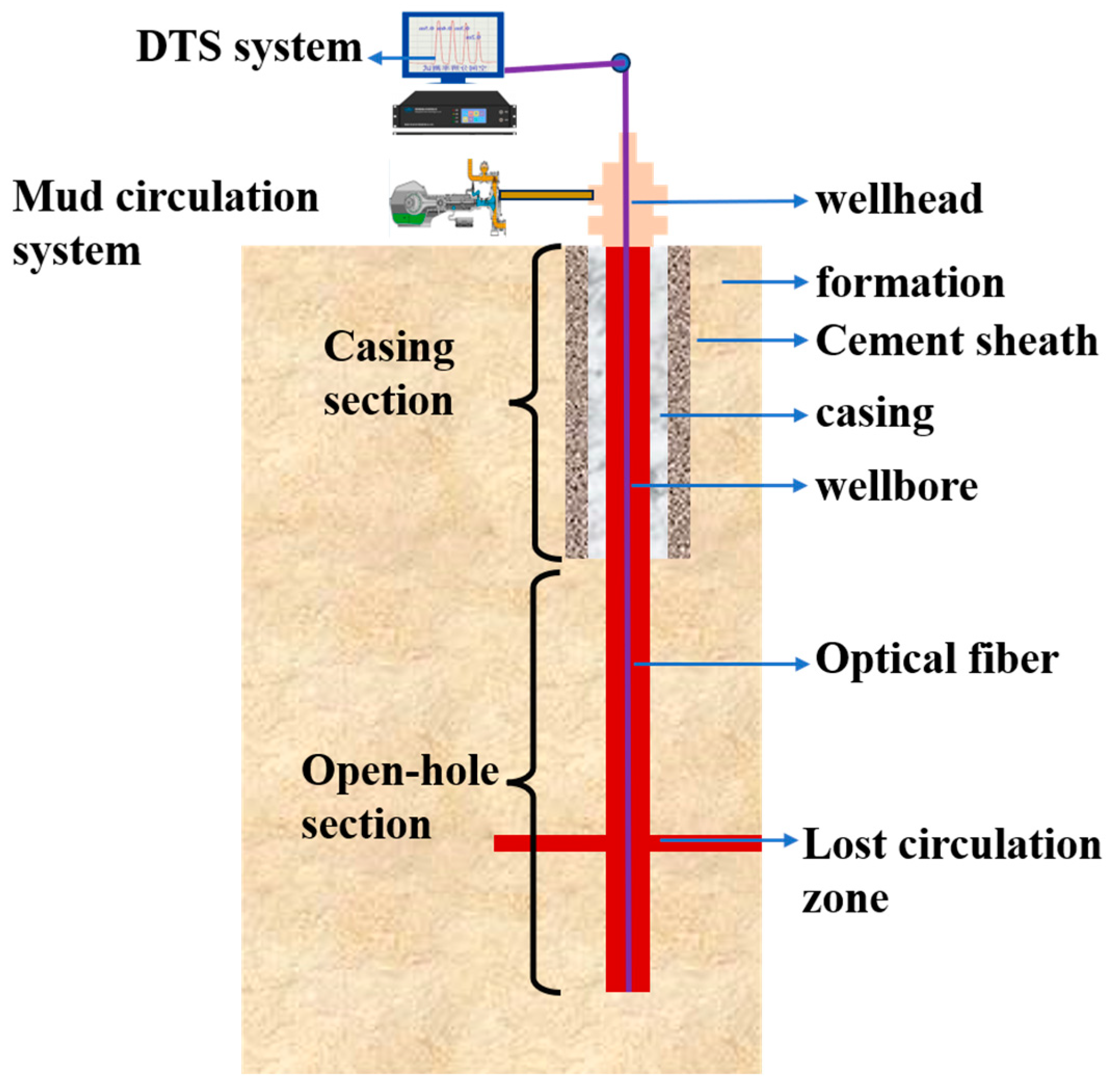
2. Distributed Optical Fiber Open—Hole Wellbores
- (1)
- On the condition that the wellbore is secure, lower the distributed optical fiber into the wellbore for measurement using specialized tools, and complete the instrument connection and calibration.
- (2)
- Keep the wellbore stationary for an adequate duration to allow the drilling fluid, casing, cement sheath, and formation temperature within the wellbore to achieve a balanced state.
- (3)
- Utilize the drilling fluid circulation system to inject drilling fluid with a certain flow rate into the wellbore. The pressure balance between the wellbore and the formation is broken, causing the drilling fluid to flow into the formation through the leakage point.
- (4)
- Once the drilling fluid begins to flow, the thermal equilibrium within the wellbore is altered, destabilizing the temperature distribution throughout the entire wellbore. The temperature must vary above and below the leakage point due to the different modes of heat transfer. Thus, obtaining the temperature curve and the variation characteristics of the wellbore can help identify the location of leakage points in the open-hole wellbore.
3. Study on the Temperature—Field Model of the Lost-Circulation Process in an Open-Hole Wellbore
3.1. Basic Assumptions
- (1)
- The fluid temperature field varies solely in the axial direction.
- (2)
- The impact of wellbore trajectory eccentricity is minimal.
- (3)
- The flow regime has no impact.
- (4)
- The drilling fluid beneath the lost-circulation zone is assumed to be stationary.
- (5)
- The properties of the formation rocks, casing, and cement sheath are considered to be unaffected by temperature and pressure.
3.2. Transient Heat Transfer Model
3.2.1. Drilling Fluid Energy Conservation Equation
3.2.2. Energy Conservation Equation for Casing
3.2.3. Cement Sheath Heat Transfer Model
3.2.4. Formation Heat Transfer Model
3.3. Initial Conditions and Boundary Conditions
3.3.1. Initial Conditions
3.3.2. Boundary Conditions
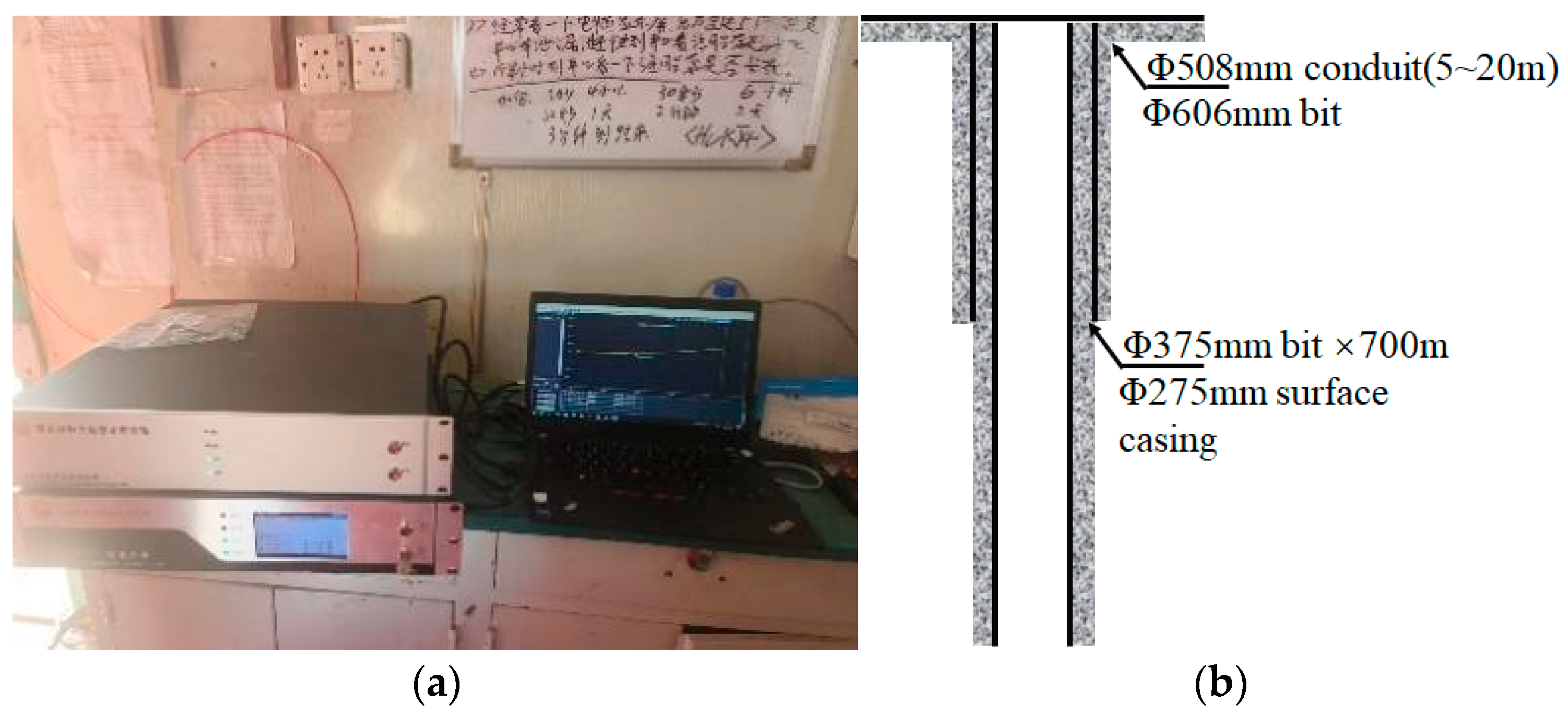
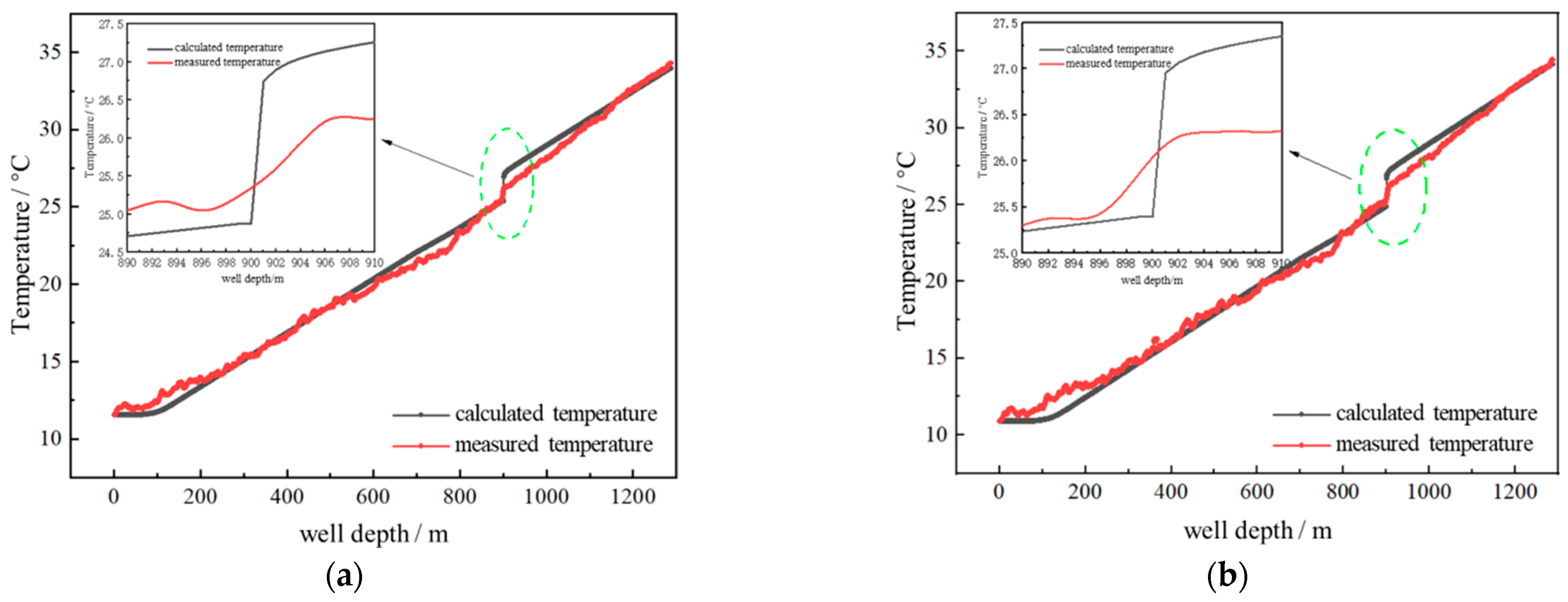
4. Model Validation
5. Example Analysis
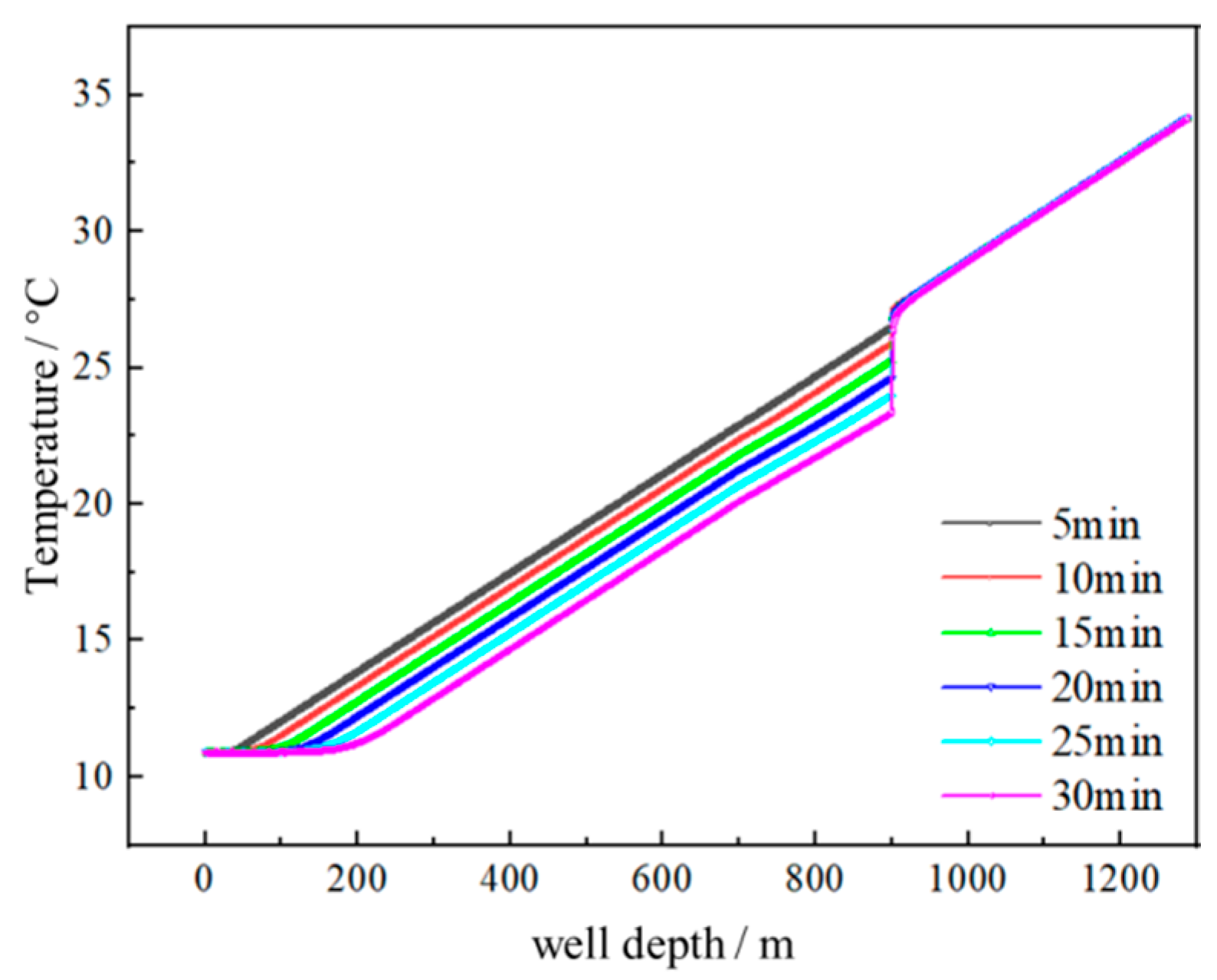
5.1. The Impact of Flow Duration
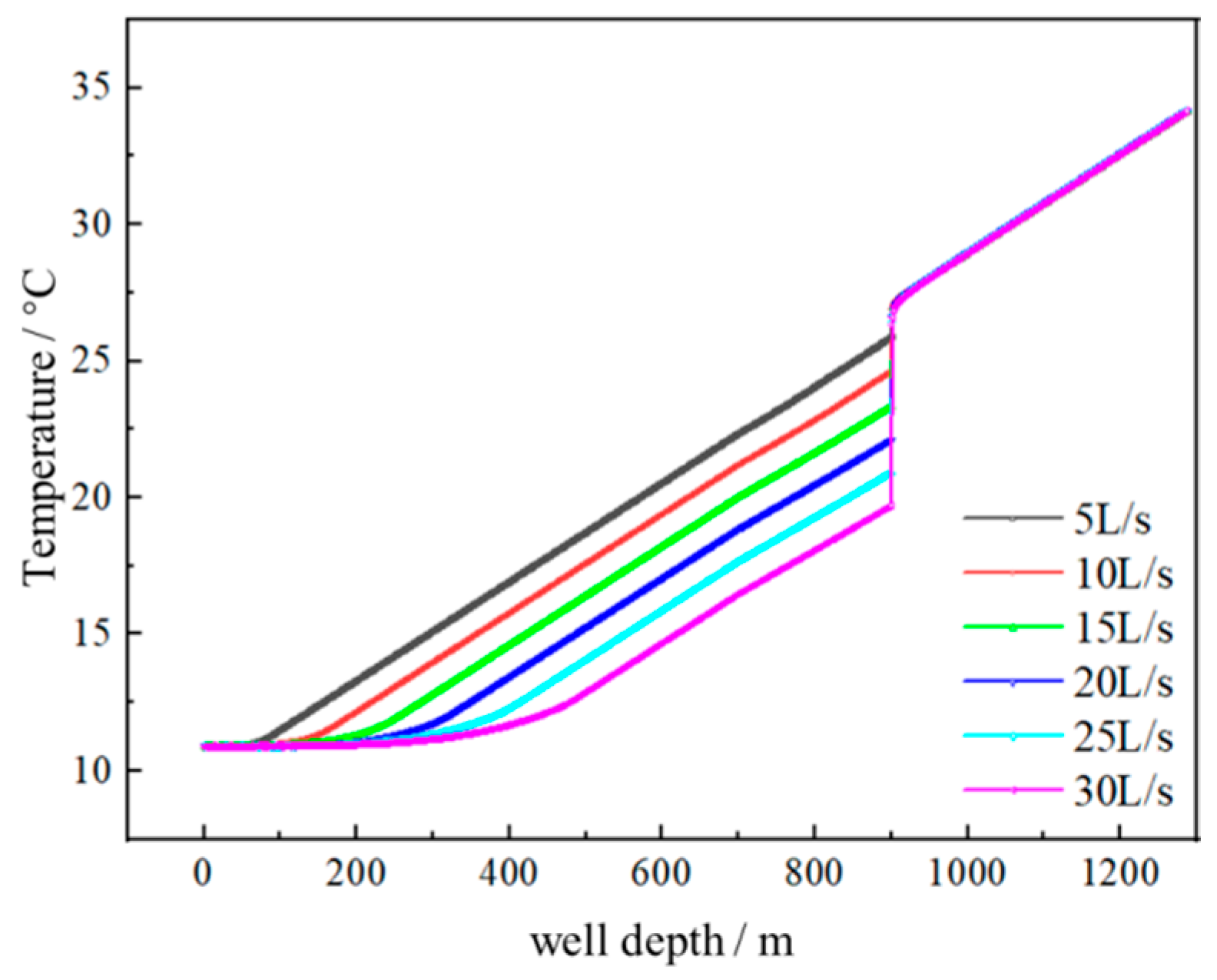
5.2. The Impact of Flow Rate
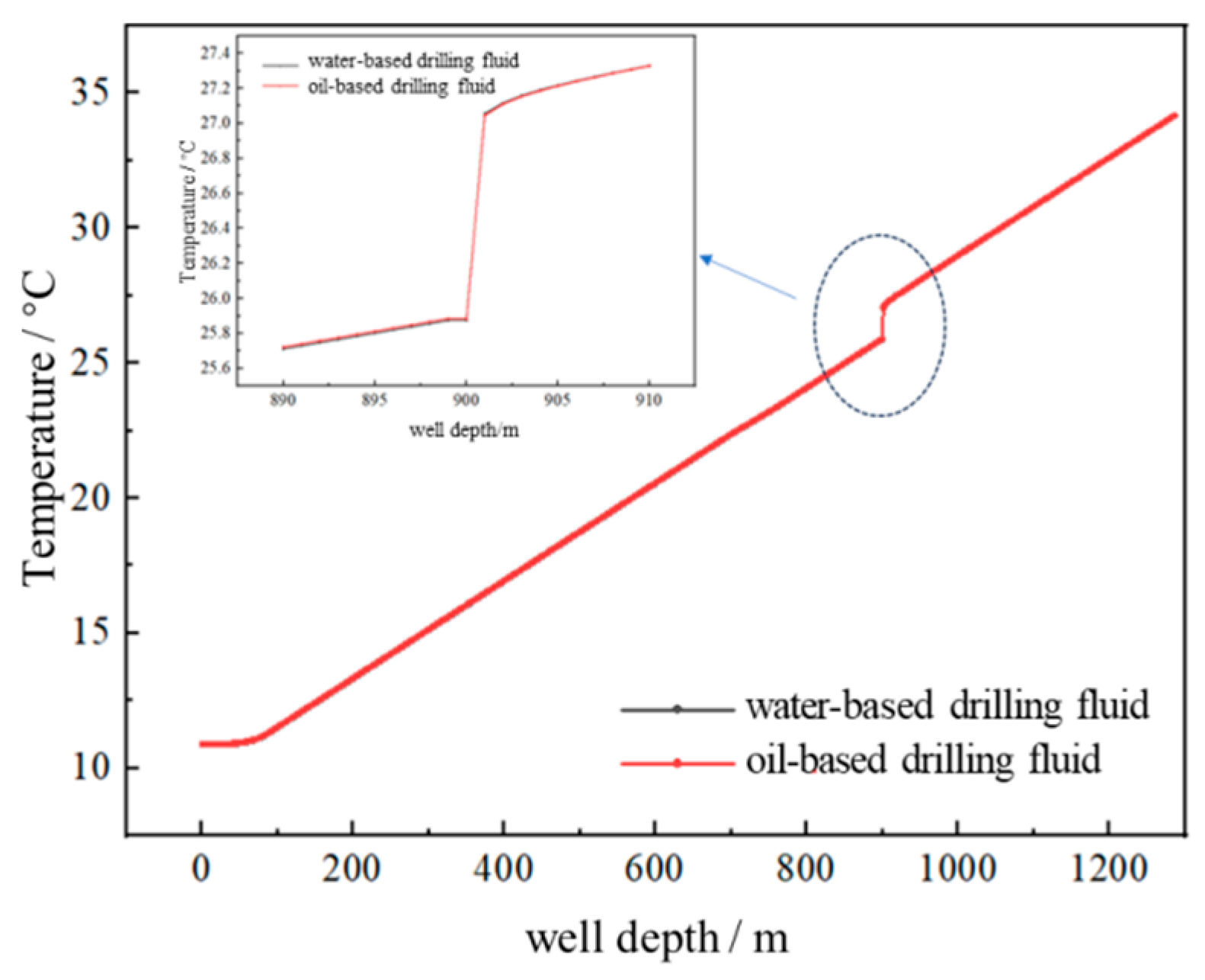
5.3. The Impact of Drilling Fluid Type
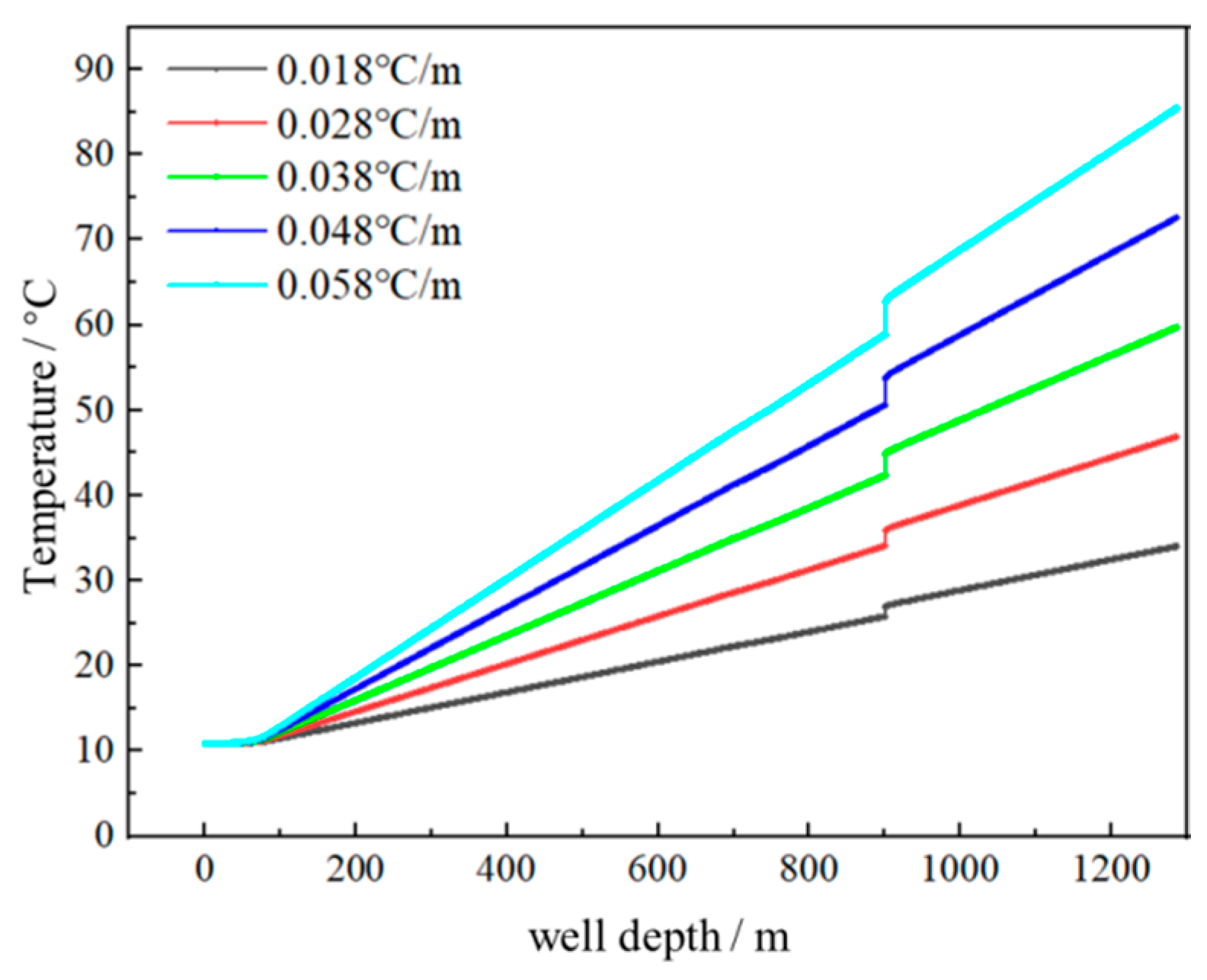
5.4. The Impact of Temperature Gradient During Formation
6. Conclusions
Author Contributions
Funding
Data Availability Statement
Conflicts of Interest
References
- Zheng, Y.; Guo, J. Application of expandable tubular plugging technology in long open-hole wells with severe lost circulation. Nat. Gas Ind. 2023, 43, 98–107. [Google Scholar]
- Zhao, J.; Zhang, H.; Wang, H. Key technical challenges and prospects of drilling and completion in ultra-deep reservoirs. Drill. Prod. Technol. 2024, 47, 28–34. [Google Scholar]
- Sun, J.; Liu, W.; Wang, Q.; Huang, H.; Ji, G. Challenges and development prospects of oil and gas drilling and completion in myriametric deep formation in China. Drill. Prod. Technol. 2024, 47, 1–9. [Google Scholar]
- Lin, J.; Yan, F.; Pi, S. Seeking fundamental innovations in geoscientific instruments to explore geophysical technology. Chin. J. Geophys. 2024, 67, 4433–4455. [Google Scholar]
- Wei, C.; Li, H.; Zhu, X.; Lu, H.; Tu, K. Fracture parameters diagnosis during staged multi-cluster fracturing based on distributed temperature sensing. Pet. Explor. Dev. 2025, 52, 496–505. [Google Scholar] [CrossRef]
- Yang, M.; Meng, Y.; Li, G.; Li, Y.; Chen, Y.; Zhao, X.; Li, H. Estimation of wellbore and formation temperatures during the drilling process under lost circulation conditions. Math. Probl. Eng. 2013, 2013, 579091. [Google Scholar] [CrossRef]
- Pan, B.; Li, D.; Chen, G.; Wang, Q.; Ma, L.; Liu, S. Numerical simulation of wellbore and formation temperature fields in carbonate formations during drilling and shut-in in the presence of lost circulation. Pet. Sci. 2014, 11, 293–299. [Google Scholar] [CrossRef]
- Chen, Y.; Yu, M.; Miska, S.; Ozbayoglu, E.; Zhou, S.; Al-Khanferi, N. Fluid flow and heat transfer modeling in the event of lost circulation and its application in locating loss zones. J. Pet. Sci. Eng. 2017, 148, 1–9. [Google Scholar] [CrossRef]
- Wu, X.; Zou, Y.; Lu, Y.; Zhao, Z.; Zhou, C. The prediction of wellbore temperature and the determination of thief zone position under conditions of lost circulation. Pet. Drill. Tech. 2019, 47, 54–59. [Google Scholar]
- Zhang, Z.; Zhao, Y.; Wang, G. Influence of leakage on wellbore temperature distribution during geothermal well drilling. Sci. Technol. Eng. 2024, 24, 9819–9826. [Google Scholar]
- Li, Y.; Ji, H.; Xing, P.; Su, Y.; Liu, S.; Wei, F. Theoretical solutions of temperature field and thermal stress field in wellbore of a gas well. Acta Pet. Sin. 2021, 42, 84–94. [Google Scholar]
- Wang, J.; Li, J.; Liu, G. New model of wellbore temperature field during drilling process. Fault-Block Oil Gas Field 2018, 25, 240–243. [Google Scholar]
- Liu, J.; Li, J.; Liu, G.; Li, H.; Ya, H. Prediction model of wellbore temperature field during deepwater cementing circulation stage. Pet. Drill. Tech. 2024, 52, 66–74. [Google Scholar]
- Wang, J.; Zeng, X.; Jia, S.; Sui, X.; Zhang, Y.; He, H. Wellbore temperature field prediction and influencing factors analysis of gas storage injection production wells. Sci. Technol. Eng. 2022, 22, 7890–7902. [Google Scholar]
- Zhao, X.; Zhao, C.; Wang, P.; Liang, X.; Yang, M. A comparative study on the calculation accuracy of numerical and analytical models for wellbore temperature in ultra-deep wells. Pet. Drill. Tech. 2022, 50, 69–75. [Google Scholar]
- Liu, T.; He, M.; Zhang, Y. Research on wellbore temperature prediction model and cooling method for small-diameter ultra-deep wells. Drill. Prod. Technol. 2024, 47, 65–72. [Google Scholar]
- Zhang, W.; Luo, M.; Wu, J.; Han, C.; Xiang, S.; Zhang, Z. Coupling analysis of wellbore temperature and pressure field in offshore extreme high pressure-high temperature drilling. J. Saf. Sci. Technol. 2023, 19, 128–135. [Google Scholar]
- Zheng, J.; Hu, Z.; Wang, W.; Dou, Y.; Li, J.; Yang, X.; Zhang, Y.; Cao, Y. Computational fluid dynamics modeling and analysis of axial and radial temperature of wellbore during injection and production process. SPE J. 2024, 29, 2399–2413. [Google Scholar] [CrossRef]
- Li, W.; Gao, D.; Yang, J. Prediction of wellbore temperature profile for deep-water ultra-deep wells. Pet. Drill. Prod. Technol. 2020, 42, 558–563. [Google Scholar]
- Zhang, Z.; Wang, X.; Xiong, Y.; Peng, G.; Wang, G.; Lu, J.; Zhong, L.; Wang, J.; Yan, Z.; Wei, R. Study on borehole temperature distribution when the well-kick and the well-leakage occurs simultaneously during geothermal well drilling. Geothermics 2022, 104, 102441. [Google Scholar] [CrossRef]



| Drilling Fluid Type | Specific Heat Capacity J/(kg·°C) | Density kg/m3 | Thermal Conductivity W/(m·°C) |
|---|---|---|---|
| Water-based Drilling Fluid | 4050 | 1250 | 0.6 |
| Oil-based Drilling Fluid | 2250 | 1150 | 0.2 |
Disclaimer/Publisher’s Note: The statements, opinions and data contained in all publications are solely those of the individual author(s) and contributor(s) and not of MDPI and/or the editor(s). MDPI and/or the editor(s) disclaim responsibility for any injury to people or property resulting from any ideas, methods, instructions or products referred to in the content. |
© 2025 by the authors. Licensee MDPI, Basel, Switzerland. This article is an open access article distributed under the terms and conditions of the Creative Commons Attribution (CC BY) license.
Share and Cite
Zhang, W.; Huang, Z.; He, X.; Qiu, L.; Wu, J.; Tang, H.; Li, Z.; Jing, Z. Research on Leakage Temperature Field of Open-Hole Wells by Distributed Fiber Optic. Processes 2026, 14, 74. https://doi.org/10.3390/pr14010074
Zhang W, Huang Z, He X, Qiu L, Wu J, Tang H, Li Z, Jing Z. Research on Leakage Temperature Field of Open-Hole Wells by Distributed Fiber Optic. Processes. 2026; 14(1):74. https://doi.org/10.3390/pr14010074
Chicago/Turabian StyleZhang, Wenyuan, Zhiqiang Huang, Xiaobo He, Linjun Qiu, Jie Wu, Haiping Tang, Zhenbao Li, and Zhe Jing. 2026. "Research on Leakage Temperature Field of Open-Hole Wells by Distributed Fiber Optic" Processes 14, no. 1: 74. https://doi.org/10.3390/pr14010074
APA StyleZhang, W., Huang, Z., He, X., Qiu, L., Wu, J., Tang, H., Li, Z., & Jing, Z. (2026). Research on Leakage Temperature Field of Open-Hole Wells by Distributed Fiber Optic. Processes, 14(1), 74. https://doi.org/10.3390/pr14010074