
Production of Kefir and Kefir-like Beverages: Fundamental Aspects, Advances, and Future Challenges


Abstract
1. Introduction
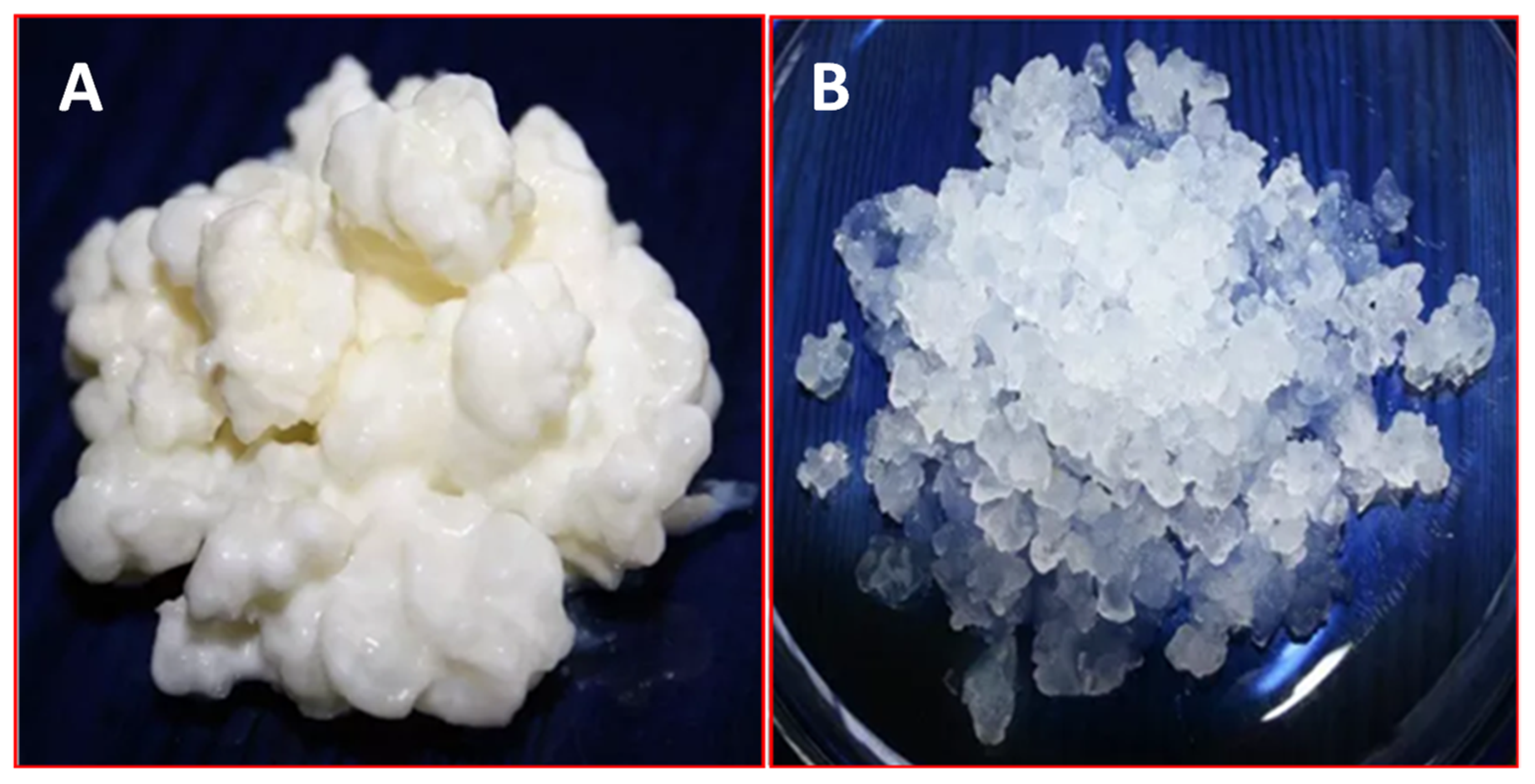
2. Kefir Grains
3. Kefiran Production
- It is produced by food-grade lactic acid bacteria with GRAS (Generally Recognized As Safe) status [72];
4. Kefir and Kefir-like Beverages
5. Characteristics of Kefir Production
5.1. Fermentation Parameters
5.1.1. Fermentation Temperature

| Substrate and Inoculum | Culture Variables | Dependent Variables | Optimal Conditions | References |
|---|---|---|---|---|
| Kiwifruit juice and MKG | A = 25–147 rpm; MKGW = 0.79–2.81 g/60 mL substrate; three MKGP transferred into fresh juice every 24 h | TSc, CAc, and QAc; LAB, AAB, and Y; X, LA, AA, EtOH, GOH; AntA | TSc: 125 rpm; 2.81 g MKGW, 3rd MKGP; CAc: 147 rpm; 2.04 g MKGW, 1st MKGP; QA): 147 rpm; 2.13 g MKGW, 1st MKGP; LA): 25 rpm; 1.80 g MKGW, 2nd MKGP; AAB: 147 rpm; 1.80 g MKGW, 1st MKGP; Y: 147 rpm; 1.80 g MKGW, 3rd MKGP; X: 147 rpm; 1.80 g MKGW, 3rd MKGP; LA: 128 rpm; 2.81 g MKGW, 1st MKGP; AA: 147 rpm; 2.81 g MKGW, 3rd MKGP; EtOH: 76 rpm; 2.81 g MKGW, 3rd MKGP; GOH: 147 rpm; 1.80 g MKGW, 3rd MKGP; AntA: 132 rpm; 2.68 g MKGW, 3rd MKGP | [29] |
| Pumpkin (C. pepo) puree and 5% (w/v) WKG | PP: 20–30% (w/v); BS: 0–10% (w/v); T = 22–32 °C | FTpH4.5, OA, EtOH, Lb, AAB, Y | Lowest FTpH4.5: PP 30%, BS 5%, 32 °C; OA: PP 20%, BS 10%, 27 °C; EtOH: PP 30%, BS 10%, 27 °C; Lb: PP 25%, BS 10%, 32 °C; AAB: PP 30%, BS 5%, 32 °C; Y: PP 30%, BS 5%, 32 °C | [32] |
| Lentil flour and 5% (w/v) WKG | T = 20–36 °C; A = 0–150 rpm; t = 0–12 h | TAA | 28 °C, 75 rpm, 4 h | [33] |
| Concentrated apple juice diluted with whey to 14 °Bx (pasteurized at 60 °C/30 min) and MKG | T = 17.93–32.07 °C; MKGW = 0.76–9.24% (w/v); t = 48 h | Final pH, Ac, [Kef], LA, V, Lb, YC, OA | Lowest final pH, highest Ac, LA, highest V, Lb, and Y: 25 °C and 9.24% MKGW; [Kef]: 20 °C and 8.0% MKGW; OA: 25 °C, 5% MKGW | [39] |
| Date whey-based substrate and MKG | DS = 0–50% (w/v); WP = 0–5% (w/v); MKGW = 2–5% (w/v); T = 25 °C; t = 24 h | Final pH, LAB, Y, TPC, TAA, OA | DS: 36.76%, WP: 2.99%, and MKGW: 2.08% for all response variables | [40] |
| * Pasteurized skimmed cow milk and MKG | T = 15–50 °C; initial MKGW = 1–10% w/v; A = 0–250 rpm; t = 1–10 d; initial pH 2–9 | Ac, MKGW, LA, [Kef], V | Ac and LA: 6 d, initial pH 5.5, 35 °C, 4% initial MKGW, static conditions; MKGW, [Kef], and V: 5 d, initial pH 6.0, 30 °C, 5% initial MKGW, static | [96] |
| UHT full-fat cow milk and 4.2% (w/v) MKG | T = 25–43 °C; A = 0–160 rpm; carbon sources (G, F, Suc, and Lact); nitrogen sources (Trypt, ME, NH4Cl, and NH4NO3); vitamins (YE, C, B1, and B3); minerals (KCl, CaCl2, FeCl3, MgSO4); t = 24 h | MKGW, [Kef] | MKGW: 37 °C, 80 rpm; Lact; Trypt; no added vitamins and minerals; [Kef]: 25 °C, 80 rpm; Lact; no nitrogen source; B1; FeCl3 | [110] |
| UHT skim milk and 4.5% (w/v) MKG | T = 20–32 °C; A = 100–200 rpm or magnetic stirring; t = 4–72 h, carbon source (G, G:Gal mixture, Lact, G:Suc); nutrients (MgSO4·H2O:MnSO4·H2O), Trypt, YE, B-complex | MKG growth rate | 25 °C, 24 h, 125 rpm, no nutrient addition | [111] |
| Whey and 4.2% (w/v) MKG | Carbon source (G, Gal, Lact, and Suc): 5–20% (w/v); T = 25–35 °C; A = 50–90 rpm; t = 12–36 h | [Kef] | 15% G, 30 °C, 10 h, static | [112] |
| * High temperature pasteurized full-fat cow milk and 4.2% (w/v) MKG | T = 15–31 °C; A = 60 rpm (1 min every h); t = 24 h | MKGW, EtOH, Lb, St, Y | MKGW and EtOH: 31 °C; Lb: 27–31 °C; St: 19 °C; Y: 25 °C | [123] |
| UHT bovine milk and MKG | Fat = 0–3.5% (w/w); MKGW = 1–7% (w/w); T = 22 °C; t = 22 h | Final pH, Lc, Lb, Y | Lowest pH: 3.5% fat, MKGW = 7%; Lc: 0% fat, MKGW = 1%; Lb: 0% fat, MKGW = 7%; Y: 1.5% fat, MKGW = 7% | [124] |
| Cheese whey and MKG | Lact = 20–100 g/L; YE = 0–24 g/L; initial pH = 3.5–7.5; T = 15–35 °C; t = 120 h | MKGW | 88.4 g Lact/L, 21.3 g YE/L, initial pH: 5.2, 20 °C | [125] |
| Skim milk and MKG | Skim milk = 23.2–56.8% (w/v); T = 21.6–38.4 °C; MKGW = 0.32–3.68% (w/v); t = 16–24 h; A = 0–150 rpm | MKGW | 41.6% skim milk; 30 °C, 1.86% MKGW, 20 h, static | [126] |
| Whey (5% (w/v) lactose) enriched with additives and 1.5% (w/v) MKG | T = 17–37 °C; MKGW = 2.5–7.5% (w/v); t = 24 h | MKGW | 27 °C, 5.0% MKGW | [127] |
| Full-fat milk and 2.0% (w/v) MKG | T = 25–35 °C; five MKGP into fresh milk every 24 h | MKGW | 25 °C, fifth MKGP | [128] |
| Goat milk and 5% (v/v) milk kefir starter | Room temperature or 37 °C; t = 24 or 48 h | LA, final pH, V | LA and V: 37 °C, 48 h; lowest pH: room temperature, 48 h | [129] |
| Reconstituted whole milk (10%, w/v), pasteurized (90 °C/20 min) and 0.07% (w/v) CLKC | T = 17 or 32 °C; P = 0.1–50 MPa; t = 28 h | Fermentation rate, Ac, LA, AA | Faster fermentation rate and Ac: 32 °C, 15 MPa; LA and AA: 32 °C, 0.1 MPa | [130] |
| Full-fat and skim milk and 10% (v/v) MKG | Milk type (NFM or FFM); T = 25 or 37 °C; A = 0 or 80 rpm; t = 24–120 h | [Kef] | FFM, 37 °C, 80 rpm, 48–120 h | [131] |
| Pasteurized (63 °C/30 min) camel milk and MKG | MKGW = 2–10% (w/v); T = 25 °C; t = 18 h | Final pH, Ac, V, fat, protein, Lact, LAB, Y | Lowest pH and highest Ac, V, and protein at 10% MKGW; Lact, fat, and LAB and yeast counts unchanged | [132] |
5.1.2. Type and Amount of Inoculum Used
5.1.3. Agitation Speed
5.1.4. Fermentation Time
5.2. Metabolite Production
Organic Acid and Alcohol Production
5.3. Volatile Profile
5.3.1. Volatile Organic Acids
5.3.2. Volatile Alcohols
5.3.3. Volatile Aldehydes
5.3.4. Volatile Esters
5.3.5. Volatile Ketones
6. Advances and Future Challenges in the Production of Kefir-like Beverages
7. Conclusions
Supplementary Materials
Author Contributions
Funding
Data Availability Statement
Conflicts of Interest
References
- Bintsis, T.; Papademas, P. The Evolution of Fermented Milks, from Artisanal to Industrial Products: A Critical Review. Fermentation 2022, 8, 679. [Google Scholar] [CrossRef]
- Al-Habsi, N.; Al-Khalili, M.; Haque, S.A.; Elias, M.; Al Olqi, N.; Al Uraimi, T. Health Benefits of Prebiotics, Probiotics, Synbiotics, and Postbiotics. Nutrients 2024, 16, 3955. [Google Scholar] [CrossRef]
- Dahiya, D.; Nigam, P.S. Antibiotic-Therapy-Induced Gut Dysbiosis Affecting Gut Microbiota-Brain Axis and Cognition: Restoration by Intake of Probiotics and Synbiotics. Int. J. Mol. Sci. 2023, 24, 3074. [Google Scholar] [CrossRef]
- Pannerchelvan, S.; Rios-Solis, L.; Wasoh, H.; Sobri, M.Z.M.; Faizal Wong, F.W.; Mohamed, M.S.; Mohamad, R.; Halim, M. Functional Yogurt: A Comprehensive Review of its Nutritional Composition and Health Benefits. Food Funct. 2024, 15, 10927–10955. [Google Scholar] [CrossRef]
- Comerford, K.B.; Miller, G.D.; Boileau, A.C.; Schuette, S.N.M.; Giddens, J.C.; Brown, K.A. Global Review of Dairy Recommendations in Food-Based Dietary Guidelines. Front. Nutr. 2021, 8, 671999. [Google Scholar] [CrossRef]
- Yépez, A.; Russo, P.; Spano, G.; Khomenko, I.; Biasioli, F.; Capozzi, V.; Aznar, R. In Situ Riboflavin Fortification of Different Kefir-like Cereal-based Beverages using Selected Andean LAB Strains. Food Microbiol. 2019, 77, 61–68. [Google Scholar] [CrossRef]
- Teijeiro, M.; Pérez, P.F.; De Antoni, G.L.; Golowczyc, M.A. Suitability of Kefir Powder Production using Spray Drying. Food Res. Int. 2018, 112, 169–174. [Google Scholar] [CrossRef] [PubMed]
- IMARC Group. Kefir Market Size, Share, Trends and Forecast by Nature, Category, Product Type, Distribution Channel, and Region, 2025–2033. Available online: https://www.imarcgroup.com/kefir-market (accessed on 28 November 2025).
- Future Market Insights Inc. (FMI). Kefir Market Analysis by Form, Category, Application, Distribution Channel, Region and Other Product Types Through 2035. Outline of Important Trends Shaping the Kefir Business Progress. Available online: https://www.futuremarketinsights.com/reports/kefir-market (accessed on 28 November 2025).
- Grand View Horizon Inc. Global Kefir Market Size & Outlook, 2025–2030. Available online: https://www.grandviewresearch.com/horizon/outlook/kefir-market-size/global (accessed on 28 November 2025).
- Korbekandi, H.; Abedi, D.; Maracy, M.; Jalali, M.; Azarman, N.; Iravani, S. Evaluation of Probiotic Yoghurt Produced by Lactobacillus paracasei ssp. tolerans. J. Food Biosci. Technol. 2015, 5, 37–44. [Google Scholar]
- Sayes, C.; Leyton, Y.; Riquelme, C. Probiotic Bacteria as an Healthy Alternative for Fish Aquaculture. In Antibiotic Use in Animals, 1st ed.; Savić, S., Ed.; IntechOpen: London, UK, 2018; Volume 1; pp. 115–132. [Google Scholar] [CrossRef]
- Gallina, D.A.; Menezes Barbosa, P.P.; Celeste Ormenese, R.C.S.; Garcia, A.O. Development and Characterization of Probiotic Fermented Smoothie Beverage. Rev. Ciência Agronômica 2019, 50, 378–386. [Google Scholar] [CrossRef]
- Olivo, D.; Galván, M.; López-Rodríguez, G.; Suárez-Diéguez, T.; González-Unzaga, M.; Anaya-Cisneros, L.; López-Piña, D. Actividad Biológica y Potencial Terapéutico de los Probióticos y el Kefiran del Grano de Kefir. Rev. Iberoam. Cienc. 2017, 4, 49–56. [Google Scholar]
- CXS 243-2003; Codex Alimentarius Commission: Standard for Fermented Milks. FAO: Rome, Italy; WHO: Rome, Italy, 2003; Amended 2022, 2024.
- Chen, H.C.; Wang, S.Y.; Chen, M.J. Microbiological Study of Lactic Acid Bacteria in Kefir Grains by Culture-Dependent and Culture-Independent Methods. Food Microbiol. 2008, 25, 492–501. [Google Scholar] [CrossRef]
- Yamane, T.; Sakamoto, T.; Nakagaki, T.; Nakano, Y.; Yamane, T.; Sakamoto, T.; Nakagaki, T.; Nakano, Y. Lactic Acid Bacteria from Kefir Increase Cytotoxicity of Natural Killer Cells to Tumor Cells. Foods 2018, 7, 48. [Google Scholar] [CrossRef]
- Amorim, F.G.; Coitinho, L.B.; Dias, A.T.; Friques, A.G.F.; Monteiro, B.L.; Rezende, L.C.D.D.; Pereira, T.D.M.C.; Campagnaro, B.P.; De Pauw, E.; Vasquez, E.C.; et al. Identification of New Bioactive Peptides from Kefir Milk Through Proteopeptidomics: Bioprospection of Antihypertensive Molecules. Food Chem. 2019, 282, 109–119. [Google Scholar] [CrossRef]
- Kim, D.H.; Jeong, D.; Kim, H.; Seo, K.H. Modern Perspectives on the Health Benefits of Kefir in Next Generation Sequencing Era: Improvement of the Host Gut Microbiota. Crit. Rev. Food Sci. Nutr. 2019, 59, 1782–1793. [Google Scholar] [CrossRef]
- Alves, E.; Ntungwe, E.N.; Gregório, J.; Rodrigues, L.M.; Pereira-Leite, C.; Caleja, C.; Pereira, E.; Barros, L.; Aguilar-Vilas, M.V.; Rosado, C.; et al. Characterization of Kefir Produced in Household Conditions: Physicochemical and Nutritional Profile, and Storage Stability. Foods 2021, 10, 1057. [Google Scholar] [CrossRef]
- Guzel-Seydim, Z.B.; Gökırmaklı, C.; Greene, A.K. A Comparison of Milk Kefir and Water Kefir: Physical, Chemical, Microbiological and Functional Properties. Trends Food Sci. Technol. 2021, 113, 42–53. [Google Scholar] [CrossRef]
- Yilmaz, L.; Özcan Yilsay, T.; Akpinar Bayizit, A. The Sensory Characteristics of Berry-Flavoured Kefir. Czech J. Food Sci. 2006, 24, 26–32. [Google Scholar] [CrossRef]
- Fiorda, F.A.; de Melo Pereira, G.V.; Thomaz-Soccol, V.; Rakshit, S.K.; Pagnoncelli, M.G.B.; de Vandenberghe, L.P.S.; Soccol, C.R. Microbiological, Biochemical, and Functional Aspects of Sugary Kefir Fermentation. Food Microbiol. 2017, 66, 86–95. [Google Scholar] [CrossRef] [PubMed]
- Cufaoglu, G.; Erdinc, A.N. An Alternative Source of Probiotics: Water Kefir. Food Front. 2023, 4, 21–31. [Google Scholar] [CrossRef]
- Gökırmaklı, Ç.; Erol, Z.; Gun, I.; Ozmen, O.; Guzel-Seydim, Z.B. Prophylaxis Effects of Water Kefir on Post-infectious Irritable Bowel Syndrome in Rat Model. Int. J. Food Sci. Technol. 2023, 58, 3371–3378. [Google Scholar] [CrossRef]
- La Torre, C.; Caputo, P.; Cione, E.; Fazio, A. Comparing Nutritional Values and Bioactivity of Kefir From Different Types of Animal Milk. Molecules 2024, 29, 2710. [Google Scholar] [CrossRef]
- Zhang, T.; Chang, M.; Zhou, Y.; Wang, M.; Yan, M.; Hou, X.; Liu, R.; Yuan, Y.; Yue, T. Dynamic Alterations of Flavor, Functional Nutrients, and Microbial Community during Fermentation of Different Animal Milk Kefirs. Food Res. Int. 2024, 186, 114305. [Google Scholar] [CrossRef]
- Bazán, D.L.; del Río, P.G.; Domínguez, J.M.; Cortés-Diéguez, S.; Mejuto, J.C.; Pérez-Guerra, N. The Chemical, Microbiological and Volatile Composition of Kefir-like Beverages Produced from Red Table Grape Juice in Repeated 24-h Fed-Batch Subcultures. Foods 2022, 11, 3117. [Google Scholar] [CrossRef]
- Bazán, D.L.; Del-Río, P.G.; Pérez-Guerra, N. Microbiological and Chemical Profiles of Kiwi Kefir-like Beverages Produced Using Different Agitation Speeds and Kefir Grain Weights. Foods 2025, 14, 1681. [Google Scholar] [CrossRef]
- Corona, O.; Randazzo, W.; Miceli, A.; Guarcello, R.; Francesca, N.; Erten, H.; Moschetti, G.; Settanni, L. Characterization of Kefir-like Beverages Produced from Vegetable Juices. LWT Food Sci. Technol. 2016, 66, 572–581. [Google Scholar] [CrossRef]
- Randazzo, W.; Corona, O.; Guarcello, R.; Francesca, N.; Germanà, M.A.; Erten, H.; Moschetti, G.; Settanni, L. Development of New Non-Dairy Beverages from Mediterranean Fruit Juices Fermented with Water Kefir Microorganisms. Food Microbiol. 2016, 54, 40–51. [Google Scholar] [CrossRef]
- Koh, W.Y.; Utra, U.; Rosma, A.; Effarizah, M.; Rosli, W.I.W.; Park, Y.H. Development of a Novel Fermented Pumpkin-Based Beverage Inoculated with Water Kefir Grains: A Response Surface Methodology Approach. Food Sci. Biotechnol. 2018, 27, 525–535. [Google Scholar] [CrossRef]
- Oliveira, I.M.A.; Castro, R.J.S. Kefir Fermentation as a Bioprocess to Improve Lentils Antioxidant Properties: Is it Worthwhile? Braz. J. Food Technol. 2020, 23, e2019120. [Google Scholar] [CrossRef]
- Comak Gocer, E.M.; Koptagel, E. Production of Milks and Kefir Beverages from Nuts and Certain Physicochemical Analysis. Food Chem. 2023, 402, 134252. [Google Scholar] [CrossRef] [PubMed]
- Pugliese, A.; Ulzurrun, M.; Leskow, F.C.; De Antoni, G.; Kakisu, E. Microbiological and Chemical Characterization of Fermented Quinoa Beverages Obtained with Kefir Microorganisms. J. Food Nutr. Res. 2023, 62, 363–373. [Google Scholar]
- Spizzirri, U.G.; Loizzo, M.R.; Aiello, F.; Prencipe, S.A.; Restuccia, D. Non-dairy Kefir Beverages: Formulation, Composition, and Main Features. J. Food Compos. Anal. 2023, 117, 105130. [Google Scholar] [CrossRef]
- Agirman, B.; Yildiz, I.; Polat, S.; Erten, H. The Evaluation of Black Carrot, Green Cabbage, Grape, and Apple Juices as Substrates for the Production of Functional Water Kefir-like Beverages. Food Sci. Nutr. 2024, 12, 6595–6611. [Google Scholar] [CrossRef]
- Bazán, D.L.; Diéguez, S.C.; Domínguez, J.M.; Pérez-Guerra, N. Part II—Volatile Profiles of Kiwi Kefir-like Beverages Influenced by the Amount of Inoculum, Shaking Rate, and Successive Kefir Grain Passages. Foods 2025, 14, 2502. [Google Scholar] [CrossRef]
- Sabokbar, N.; Moosavi-Nasab, M.; Khodaiyan, F. Preparation and Characterization of an Apple Juice and Whey-Based Novel Beverage Fermented Using Kefir Grains. Food Sci. Biotechnol. 2015, 24, 2095–2104. [Google Scholar] [CrossRef]
- M’hir, S.; Rtibi, K.; Mejri, A.; Ziadi, M.; Aloui, H.; Hamdi, M.; Ayed, L. Development of a Novel Whey Date Beverage Fermented with Kefir Grains Using Response Surface Methodology. J. Chem. 2019, 2019, 1218058. [Google Scholar] [CrossRef]
- Gao, J.; Ding, G.; Li, Q.; Gong, L.; Huang, J.; Sang, Y. Tibet Kefir Milk Decreases Fat Deposition by Regulating the Gut Microbiota and Gene Expression of Lpl and Angptl4 in High Fat Diet-fed Rats. Food Res. Int. 2019, 121, 278–287. [Google Scholar] [CrossRef] [PubMed]
- Magalhães, K.T.; de Melo Pereira, G.V.; Dias, D.R.; Schwan, R.F. Microbial Communities and Chemical Changes during Fermentation of Sugary Brazilian Kefir. World J. Microbiol. Biotechnol. 2010, 26, 1241–1250. [Google Scholar] [CrossRef]
- Nejati, F.; Junne, S.; Neubauer, P. A Big World in Small Grain: A Review of Natural Milk Kefir Starters. Microorganisms 2020, 8, 192. [Google Scholar] [CrossRef]
- González-Orozco, B.D.; García-Cano, I.; Jiménez-Flores, R.; Alvárez, V.B. Milk Kefir Microbiota—Direct and Indirect Antimicrobial Effects. J. Dairy Sci. 2022, 105, 3703–3715. [Google Scholar] [CrossRef] [PubMed]
- van Wyk, J. Kefir: The Champagne of Fermented Beverages. In Fermented Beverages, 1st ed.; Grumezescu, A.M., Holban, A.M., Eds.; Elsevier Inc.: Amsterdam, The Netherlands, 2019; Volume 5; Chapter 12; pp. 473–527. [Google Scholar] [CrossRef]
- Piermaria, J.A.; de la Canal, M.L.; Abraham, A.G. Gelling Properties of Kefiran, a Food-grade Polysaccharide Obtained from Kefir Grain. Food Hydrocol. 2008, 22, 1520–1527. [Google Scholar] [CrossRef]
- Davidovic, Z.S.; Miljkovic, G.M.; Antonovic, G.D.; Rajilic-Stojanovic, D.M.; Dimitrijevic-Brankovic, I.S. Water Kefir Grain as a Source of Potent Dextran Producing Lactic Acid Bacteria. Hem. Ind. 2015, 69, 595–604. [Google Scholar] [CrossRef]
- Fels, L.; Jakob, F.; Vogel, R.F.; Wefers, D. Structural Characterization of the Exopolysaccharides from Water Kefir. Carbohydr. Polym. 2018, 189, 296–303. [Google Scholar] [CrossRef]
- Moretti, A.F.; Moure, M.C.; Quiñoy, F.; Esposito, F.; Simonelli, N.; Medrano, M.; León-Peláez, A. Water Kefir, a Fermented Beverage Containing Probiotic Microorganisms: From Ancient and Artisanal Manufacture to Industrialized and Regulated Commercialization. Future Foods 2022, 5, 100123. [Google Scholar] [CrossRef]
- György, B.; Bujdoš, M.; Vojtková, H.; Diviš, P.; Slaný, M.; Matúš, P.; Urík, M. Comparative Study of Water and Milk Kefir Grains as Biopolymeric Adsorbents for Copper(II) and Arsenic(V) Removal from Aqueous Solutions. Polymers 2024, 16, 3340. [Google Scholar] [CrossRef] [PubMed]
- Oviedo-León, J.F.; Higuera, A.R.; Yáñez-Fernández, J.; Hernández-Sánchez, H.; Castro-Rodríguez, D.C. Exploring Exopolysaccharides Produced in Indigenous Mexican Fermented Beverages and Their Biotechnological Applications. Fermentation 2025, 11, 463. [Google Scholar] [CrossRef]
- Bozkir, E.; Yilmaz, B.; Sharma, H.; Esatbeyoglu, T.; Ozogul, F. Challenges in Water Kefir Production and Limitations in Human Consumption: A Comprehensive Review of Current Knowledge. Heliyon 2024, 10, e33501. [Google Scholar] [CrossRef]
- Coma, M.E.; Peltzer, M.A.; Delgado, J.F.; Salvay, A.G. Water Kefir Grains as an Innovative Source of Materials: Study of Plasticiser Content on Film Properties. Eur. Polym. J. 2019, 120, 109234. [Google Scholar] [CrossRef]
- Nielsen, B.; Gürakan, C.G.; Ünlü, G. Kefir: A Multifaceted Fermented Dairy Product. Probiotics Antimicrob. Proteins 2014, 6, 123–135. [Google Scholar] [CrossRef]
- Ustaoğlu-Gençgönül, M.; Gökırmaklı, Ç.; Üçgül, B.; Karagül-Yüceer, Y.; Guzel-Seydim, Z.B. Chemical, Microbial, and Volatile Compounds of Water Kefir Beverages Made from Chickpea, Almond, and Rice Extracts. Eur. Food Res. Technol. 2024, 250, 2233–2244. [Google Scholar] [CrossRef]
- Marsh, A.J.; O’Sullivan, O.; Hill, C.; Ross, R.P.; Cotter, P.D. Sequencing-based Analysis of the Bacterial and Fungal Composition of Kefir Grains and Milks from Multiple Sources. PLoS ONE 2013, 8, e69371. [Google Scholar] [CrossRef] [PubMed]
- Rosa, D.D.; Dias, M.M.S.; Grześkowiak, Ł.M.; Reis, S.A.; Conceição, L.L.; Peluzio, M. Milk Kefir: Nutritional, Microbiological and Health Benefits. Nutr. Res. Rev. 2017, 30, 82–96. [Google Scholar] [CrossRef]
- Gao, X.; Li, B. Chemical and Microbiological Characteristics of Kefir Grains and their Fermented Dairy Products: A Review. Cogent Food Agric. 2016, 2, 1272152. [Google Scholar] [CrossRef]
- Takizawa, S.; Kojima, S.; Tamura, S.; Fujinaga, S.; Benno, Y.; Nakase, T. The Composition of the Lactobacillus Flora in Kefir Grains. Syst. Appl. Microbiol. 1998, 21, 121–127. [Google Scholar] [CrossRef]
- Vardjan, T.; Mohar Lorbeg, P.; Rogelj, I.; Canžek Majhenič, A. Characterization and Stability of Lactobacilli and Yeast Microbiota in Kefir Grains. J. Dairy Sci. 2013, 96, 2729–2736. [Google Scholar] [CrossRef]
- Prado, M.R.; Blandón, L.M.; Vandenberghe, L.P.S.; Rodrigues, C.; Castro, G.R.; Thomaz-Soccol, V.; Soccol, C.R. Milk Kefir: Composition, Microbial Cultures, Biological Activities, and Related Products. Front. Microbiol. 2015, 6, 1177. [Google Scholar] [CrossRef]
- Wang, H.; Zhou, X.; Sun, Y.; Sun, X.; Guo, M. Differences in Protein Profiles of Kefir Grains from Different Origins When Subcultured in Goat Milk. J. Agric. Food Chem. 2022, 70, 7515–7524. [Google Scholar] [CrossRef]
- Moradi, Z.; Kalanpour, N. Kefiran, a Branched Polysaccharide: Preparation, Properties and Applications: A Review. Carbohydr. Polym. 2019, 223, 115100. [Google Scholar] [CrossRef]
- Rodrigues, K.L.; Caputo, L.R.G.; Carvalho, J.C.T.; Evangelista, J.; Schneedorf, J.M. Antimicrobial and Healing Activity of Kefir and Kefiran Extract. Int. J. Antimicrob. Agents 2005, 25, 404–408. [Google Scholar] [CrossRef]
- Ghasemlou, M.; Khodaiyan, F.; Oromiehie, A.; Yarmand, M.S. Characterization of Edible Emulsified Films with Low Affinity to Water Based on Kefiran and Oleic Acid. Int. J. Biol. Macromol. 2011, 49, 378–384. [Google Scholar] [CrossRef] [PubMed]
- Gradova, N.B.; Khokhlacheva, A.A.; Murzina, E.D.; Myasoyedova, V.V. Microbial Components of Kefir Grains as Exopolysaccharide Kefiran Producers. Appl. Biochem. Microbiol. 2015, 51, 873–880. [Google Scholar] [CrossRef]
- Ahmed, Z.; Wang, Y.; Anjum, N.; Ahmad, H.; Ahmad, A.; Raza, M. Characterization of New Exopolysaccharides Produced by Coculturing of L. kefiranofaciens with Yoghurt Strains. Int. J. Biol. Macromol. 2013, 59, 377–383. [Google Scholar] [CrossRef]
- Piermaria, J.; Pinotti, A.; García, M.A.; Abraham, A.G. Films Based on Kefiran, an Exopolysaccharide Obtained from Kefir Grain: Development and Characterization. Food Hydrocol. 2009, 23, 684–690. [Google Scholar] [CrossRef]
- Garrote, G.L.; Abraham, A.G.; De Antoni, G.L. Chemical and Microbiological Characterisation of Kefir Grains. J. Dairy Res. 1998, 65, 149–154. [Google Scholar] [CrossRef]
- Piermaria, J.; Bosch, A.; Pinotti, A.; Yantorno, O.; García, M.A.; Abraham, A.G. Kefiran Films Plasticized with Sugars and Polyols: Water Vapor Barrier and Mechanical Properties in Relation to their Microstructure Analyzed by ATR/FT-IR Spectroscopy. Food Hydrocol. 2011, 25, 1261–1269. [Google Scholar] [CrossRef]
- Rimada, P.S.; Abraham, A.G. Polysaccharide Production by Kefir Grains during Whey Fermentation. J. Dairy Res. 2001, 68, 653–661. [Google Scholar] [CrossRef]
- Rimada, P.S.; Abraham, A.G. Kefiran Improves Rheological Properties of Glucono-δ-lactone Induced Skim Milk Gels. Int. Dairy J. 2006, 16, 33–39. [Google Scholar] [CrossRef]
- Maeda, H.; Zhu, X.; Omura, K.; Suzuki, S.; Kitamura, S. Effects of an Exopolysaccharide (Kefiran) on Lipids, Blood Pressure, Blood Glucose, and Constipation. Biofactors 2004, 22, 197–200. [Google Scholar] [CrossRef] [PubMed]
- Schoevers, A.; Britz, T.J. Influence of Different Culturing Conditions on Kefir Grain Increase. Int. J. Dairy Technol. 2003, 56, 183–187. [Google Scholar] [CrossRef]
- Vinderola, G.; Perdigón, G.; Duarte, J.; Thangavel, D.; Farnworth, E.; Matar, C. Effects of Kefir Fractions on Innate Immunity. Immunobiol. 2006, 211, 149–156. [Google Scholar] [CrossRef]
- Maeda, H.; Zhu, X.; Susuki, K.; Kitamura, S. Structural Characterization and Biological Activities of an Exopolysaccharide Kefiran Produced by Lactobacillus kefiranofaciens WT-2BT. J. Agric. Food Chem. 2004, 52, 5533–5538. [Google Scholar] [CrossRef] [PubMed]
- Badel, S.; Bernardi, T.; Michaud, P. New Perspectives for Lactobacilli Exopolysaccharides. Biotechnol. Adv. 2011, 29, 54–66. [Google Scholar] [CrossRef]
- Cheirsilp, B.; Shimizu, H.; Shioya, S. Enhanced Kefiran Production of Lactobacillus kefiranofaciens by Mixed Culture with Saccharomyces cerevisiae. J. Biotechnol. 2003, 100, 43–53. [Google Scholar] [CrossRef]
- Tramšek, M.; Goršek, A. Analysis of Growth Models for Batch Kefir Grain Biomass Production in RC1 Reaction System. J. Food Proc. Eng. 2008, 31, 754–767. [Google Scholar] [CrossRef]
- Cheirsilp, B.; Shimizu, H.; Shioya, S. Kinetic Modeling of Kefiran Production in Mixed Culture of Lactobacillus kefiranofaciens and Saccharomyces cerevisiae. Process. Biochem. 2007, 42, 570–579. [Google Scholar] [CrossRef]
- Cheirsilp, B.; Radchabut, S. Use of Whey Lactose from Dairy Industry for Economical Kefiran Production by Lactobacillus kefiranofaciens in Mixed Cultures with Yeast. New Biotechnol. 2011, 28, 574–580. [Google Scholar] [CrossRef] [PubMed]
- Athanasiadis, I.; Paraskevopoulou, A.; Blekas, G.; Kiosseoglou, V. Development of a Novel Whey Beverage by Fermentation with Kefir Granules. Effect of Various Treatments. Biotechnol. Prog. 2004, 20, 1091–1095. [Google Scholar] [CrossRef]
- Koutinas, A.A.; Athanasiadis, I.; Bekatorou, A.; Iconomopoulou, M.; Blekas, G. Kefir Yeast Technology: Scale-Up in SCP Production Using Milk Whey. Biotechnol. Bioeng. 2005, 89, 788–796. [Google Scholar] [CrossRef] [PubMed]
- Yeesang, C.; Chanthachum, S.; Cheirsilp, B. Sago Starch as a Low-cost Carbon Source for Exopolysaccharide Production by Lactobacillus kefiranofaciens. World J. Microbiol. Biotechnol. 2008, 24, 1195–1201. [Google Scholar] [CrossRef]
- de Lima Falcão, M.S.; da Silva Afonso, R.; da Silva Fernandes, M.; da Silva Bezerra, P.A.; Brandão Costa, R.M.P.; Couto Teixeira, J.A.; Figueiredo Porto, A.L.; Holanda Cavalcanti, M.T. Brazilian Kefir-Fermented Sheep’s Milk, a Source of Antimicrobial and Antioxidant Peptides. Probiotics Antimicrob. Proteins 2018, 10, 446–455. [Google Scholar] [CrossRef] [PubMed]
- Purutoğlu, K.; Ispirli, H.; Yüzer, M.O.; Serencam, H.; Dertli, E. Diversity and Functional Characteristics of Lactic Acid Bacteria from Traditional Kefir Grains. Int. J. Dairy Technol. 2020, 73, 57–66. [Google Scholar] [CrossRef]
- Satir, G.; Guzel-Seydim, Z.B. How Kefir Fermentation can affect Product Composition? Small Rumin. Res. 2016, 134, 1–7. [Google Scholar] [CrossRef]
- Sharifi, M.; Moridnia, A.; Mortazavi, D.; Salehi, M.; Bagheri, M.; Sheikhi, A. Kefir: A Powerful Probiotics with Anticancer Properties. Med. Oncol. 2017, 34, 183. [Google Scholar] [CrossRef]
- Irigoyen, A.; Arana, I.; Castiella, M.; Torre, P.; Ibáñez, F.C. Microbiological, Physicochemical, and Sensory Characteristics of Kefir during Storage. Food Chem. 2005, 90, 613–620. [Google Scholar] [CrossRef]
- Kneifel, W.; Mayer, H.K. Vitamin Profiles of Kefirs made from Milks of Different Species. Int. J. Food Sci. Technol. 1991, 26, 423–428. [Google Scholar] [CrossRef]
- Turker, G.; Kizil, B.; Cevik, N. The Mineral Composition of Kefir Produced from Goat and Cow Milk. J. Food Agric. Environ. 2013, 11, 62–65. [Google Scholar]
- Gamba, R.R.; Yamamoto, S.; Abdel-Hamid, M.; Sasaki, T.; Michihata, T.; Koyanagi, T.; Enomoto, T. Chemical, Microbiological, and Functional Characterization of Kefir Produced from Cow’s Milk and Soy Milk. Int. J. Microbiol. 2020, 2020, 7019286. [Google Scholar] [CrossRef] [PubMed]
- Setyawardani, T.; Sumarmono, J.; Arief, I.I.; Rahardjo, A.H.D.; Widayaka, K.; Santosa, S.S. Improving Composition and Microbiological Characteristics of Milk Kefir. Food Sci. Technol. 2020, 40, 699–707. [Google Scholar] [CrossRef]
- Laureys, D.; De Vuyst, L. The Water Kefir Grain Inoculum Determines the Characteristics of the Resulting Water Kefir Fermentation Process. J. Appl. Microbiol. 2016, 122, 719–732. [Google Scholar] [CrossRef] [PubMed]
- Laureys, D.; Aerts, M.; Vandamme, P.; De Vuyst, L. Oxygen and Diverse Nutrients Influence the Water Kefir Fermentation Process. Food Microbiol. 2018, 73, 351–361. [Google Scholar] [CrossRef]
- Ismaiel, A.A.; Ghaly, M.F.; El-Naggar, A.K. Some Physicochemical Analyses of Kefir Produced Under Different Fermentation Conditions. J. Sci. Ind. Res. 2011, 70, 365–372. [Google Scholar]
- Kök-Taş, T.; Seydim, A.C.; Özer, B.; Güzel-Seydim, Z.B. Effects of Different Fermentation Parameters on Quality Characteristics of Kefir. J. Dairy Sci. 2013, 96, 780–789. [Google Scholar] [CrossRef]
- Wang, H.; Wang, C.; Guo, M. Impact of Polymerized Whey Protein/Pectin Thickening (PP) System on Physical Properties and Volatile Compounds of Goat Milk Kefir Mild and Kefir. J. Food Sci. 2021, 86, 1014–1021. [Google Scholar] [CrossRef]
- Güzel-Seydim, Z.B.; Seydim, A.C.; Greene, A.K.; Bodine, A.B. Determination of Organic Acids and Volatile Flavor Substances in Kefir during Fermentation. J. Food Comp. Anal. 2000, 13, 35–43. [Google Scholar] [CrossRef]
- Fontan, M.C.G.; Martinez, S.; Franco, I.; Carballo, J. Microbiological and Chemical Changes during the Manufacture of Kefir made from Cows’ Milk, Using a Commercial Starter Culture. Int. Dairy J. 2006, 16, 762–767. [Google Scholar] [CrossRef]
- Grønnevik, H.; Falstad, M.; Narvhus, J.A. Microbiological and Chemical Properties of Norwegian Kefir during Storage. Int. Dairy J. 2011, 21, 601–606. [Google Scholar] [CrossRef]
- Magalhães, K.T.; de Melo Pereira, G.V.; Campos, C.R.; Dragone, G.; Schwan, R.F. Brazilian Kefir: Structure, Microbial Communities and Chemical Composition. Braz. J. Microbiol. 2011, 42, 693–702. [Google Scholar] [CrossRef] [PubMed]
- Leite, A.M.; Leite, D.C.; Del Aquila, E.M.; Alvares, T.S.; Peixoto, R.S.; Miguel, M.A.; Silva, J.T.; Paschoalin, V.M. Microbiological and Chemical Characteristics of Brazilian Kefir During Fermentation and Storage Processes. J. Dairy Sci. 2013, 96, 4149–4159. [Google Scholar] [CrossRef] [PubMed]
- Gul, O.; Mortas, M.; Atalar, I.; Dervisoglu, M.; Kahyaoglu, T. Manufacture and Characterization of Kefir Made from Cow and Buffalo Milk, Using Kefir Grain and Starter Culture. J. Dairy Sci. 2015, 98, 1517–1525. [Google Scholar] [CrossRef]
- Fiorda, F.A.; Pereira, G.V.M.; Thomaz-Soccol, V.; Medeiros, A.P.; Rakshit, S.K.; Soccol, C.R. Development of Kefir-based Probiotic Beverages with DNA Protection and Antioxidant Activities Using Soybean Hydrolyzed Extract, Colostrum and Honey. LWT Food Sci. Technol. 2016, 68, 690–697. [Google Scholar] [CrossRef]
- Bazán, D.L.; del Río, P.G.; Cortés-Diéguez, S.; Domínguez, J.M.; Pérez-Guerra, N. Main Composition and Visual Appearance of Milk Kefir Beverages Obtained from Four Consecutive 24- and 48-h Batch Subcultures. Processes 2024, 12, 1419. [Google Scholar] [CrossRef]
- Afonso, M.J.; Ramalhosa, E.; del Río, P.G.; Martins, F.; Baptista, P.; Pereira, E.L.; Guerra, N.P. Production of Non-Dairy Fermented Products with Chestnut Puree as Substrate and Milk Kefir Grains or Two Lactic Acid Bacteria. J. Food Sci. 2025, 90, e17474. [Google Scholar] [CrossRef] [PubMed]
- Beshkova, D.M.; Simova, E.D.; Frengova, G.I.; Simov, Z.I.; Dimitrov, Z.P. Production of Volatile Aroma Compounds by Kefir Starter Cultures. Int. Dairy J. 2003, 13, 529–535. [Google Scholar] [CrossRef]
- Zongo, O.; Cruvellier, N.; Leray, F.; Bideaux, C.; Lesage, J.; Zongo, C.; Traoré, Y.; Savadogo, A.; Guillouet, S. Physicochemical Composition and Fermentation Kinetics of a Novel Palm Sap-Based Kefir Beverage from the Fermentation of Borassus aethiopum Mart. Fresh Sap with Kefir Grains and Ferments. Sci. Afr. 2020, 10, e00631. [Google Scholar] [CrossRef]
- Zajšek, K.; Goršek, A.; Kolar, M. Cultivating Conditions Effects on Kefiran Production by the Mixed Culture of Lactic Acid Bacteria Imbedded within Kefir Grains. Food Chem. 2013, 139, 970–977. [Google Scholar] [CrossRef]
- Pop, C.; Apostu, S.; Salanţă, L.; Rotar, A.M.; Sindic, M.; Mabon, N.; Socaciu, C. Influence of Different Growth Conditions on the Kefir Grains Production, Used in the Kefiran Synthesis. Bull. UASVM Food Sci. Technol. 2014, 71, 147–153. [Google Scholar] [CrossRef]
- Blandón, L.M.; Noseda, M.D.; Islan, G.A.; Castro, G.R.; Pereira, G.V.M.; Thomaz-Soccol, V.; Soccol, C.R. Optimization of Culture Conditions for Kefiran Production in Whey: The Structural and Biocidal Properties of the Resulting Polysaccharide. Bioact. Carbohydr. Diet Fibre 2018, 16, 14–21. [Google Scholar] [CrossRef]
- Adamberg, K.; Kask, S.; Laht, T.M.; Paalme, T. The effect of Temperature and pH on the Growth of Lactic Acid Bacteria: A pH-auxostat Study. Int. J. Food Microbiol. 2003, 85, 171–183. [Google Scholar] [CrossRef] [PubMed]
- König, H.; Fröhlich, J. Lactic Acid Bacteria. In Biology of Microorganisms on Grapes, in Must and in Wine, 2nd ed.; König, H., Unden, G., Fröhlich, J., Eds.; Springer: Cham, Switzerland, 2017; Volume 1; pp. 3–41. [Google Scholar] [CrossRef]
- Guillamón, J.M.; Mas, A. Acetic Acid Bacteria. In Biology of Microorganisms on Grapes, in Must and in Wine, 2nd ed.; König, H., Unden, G., Fröhlich, J., Eds.; Springer: Cham, Switzerland, 2017; Volume 1; pp. 43–64. [Google Scholar] [CrossRef]
- Walker, G.M. Yeast Physiology and Biotechnology, 1st ed.; John Wiley & Sons Ltd: Chichester, UK, 1998; pp. 146–147. [Google Scholar]
- Margesin, R. Effect of Temperature on Growth Parameters of Psychrophilic Bacteria and Yeasts. Extremophiles 2009, 13, 257–262. [Google Scholar] [CrossRef] [PubMed]
- Yalcin, S.K.; Ozbas, Z.Y. Effects of pH and Temperature on Growth and Glycerol Production Kinetics of two Indigenous Wine Strains of Saccharomyces cerevisiae from Turkey. Braz. J. Microbiol. 2008, 39, 325–332. [Google Scholar] [CrossRef]
- Arroyo-López, F.N.; Orlić, S.; Querol, A.; Barrio, E. Effects of Temperature, pH and Sugar Concentration on the Growth Parameters of Saccharomyces Cerevisiae, S. Kudriavzevii and Their Interspecific Hybrid. Int. J. Food Microbiol. 2009, 131, 120–127. [Google Scholar] [CrossRef]
- Wang, X.; Wang, Z.; Feng, T. Screening of Yeast in Various Vineyard Soil and Study on Its Flavor Compounds from Brewing Grape Wine. Molecules 2022, 27, 512. [Google Scholar] [CrossRef] [PubMed]
- Haycocks, N.; Goldschmidt, N.; Thomsen, U. Temperature and Humidity Requirements in Pharmaceutical Facilities. Pharm. Eng. 2021. Available online: https://ispe.org/pharmaceutical-engineering/september-october-2021/temperature-humidity-requirements-pharmaceutical (accessed on 28 November 2025).
- Singh, P.K.; Shah, N.P. Other Fermented Dairy Products: Kefir and Koumiss. In Yogurt in Health and Disease Prevention, 1st ed.; Shah, N.P., Ed.; Academic Press: London, UK, 2017; Chapter 5; pp. 87–106. [Google Scholar] [CrossRef]
- Zajšek, K.; Goršek, A. Mathematical Modelling of Ethanol Production by Mixed Kefir Grains Yeast Population as a Function of Temperature Variations. Biochem. Eng. J. 2010, 49, 7–12. [Google Scholar] [CrossRef]
- Magra, T.I.; Antoniou, K.D.; Psomas, E.I. Effect of Milk Fat, Kefir Grain Inoculum and Storage Time on the Flow Properties and Microbiological Characteristics of Kefir. J. Texture Stud. 2012, 43, 299–308. [Google Scholar] [CrossRef]
- Ghasemlou, M.; Khodaiyan, F.; Gharibzahedi, S.M.T. Enhanced Production of Iranian Kefir Grain Biomass by Optimization and Empirical Modeling of Fermentation Conditions Using Response Surface Methodology. Food Bioproc. Technol. 2012, 5, 3230–3235. [Google Scholar] [CrossRef]
- Gao, J.; Gu, F.; Ruan, H.; Chen, Q.; He, J.; He, G. Culture Conditions Optimization of Tibetan Kefir Grains by Response Surface Methodology. Proc. Eng. 2012, 37, 132–136. [Google Scholar] [CrossRef]
- Apar, D.K.; Demirhan, E.; Özel, B.; Özbek, B. Kefir Grain Biomass Production: Influence of Different Culturing Conditions and Examination of Growth Kinetic Models. J. Food Proc. Eng. 2017, 40, e12332. [Google Scholar] [CrossRef]
- Barão, C.E.; Klososki, S.J.; Pinheiro, K.H.; Marcolino, V.A.; Valarini Junior, O.; da Cruz, A.G.; da Silva, T.T.; Pimentel, T.C. Growth Kinetics of Kefir Biomass: Influence of the Incubation Temperature in Milk. Chem. Eng. Trans. 2019, 75, 499–504. [Google Scholar] [CrossRef]
- Putri, Y.D.; Setiani, N.A.; Warya, S. The Effect of Temperature, Incubation, and Storage Time on Lactic Acid Content, pH, and Viscosity of Goat Milk Kefir. Curr. Res. Biosci. Biotechnol. 2020, 2, 101–104. [Google Scholar] [CrossRef]
- Ribeiro, A.C.; Lemos, Á.T.; Lopes, R.P.; Mota, M.J.; Inácio, R.S.; Gomes, A.M.P.; Sousa, S.; Delgadillo, I.; Saraiva, J.A. The Combined Effect of Pressure and Temperature on Kefir Production—A Case Study of Food Fermentation in Unconventional Conditions. Foods 2020, 9, 1133. [Google Scholar] [CrossRef] [PubMed]
- Ajam, F.; Koohsari, H. The Effect of Some Fermentation Conditions on the Production of Kefiran by Kefir Grains in Fermented Milk. J. Res. Inn. Food Sci. Technol. 2021, 9, 399–410. [Google Scholar] [CrossRef]
- Arroum, S.; Sboui, A.; Fguiri, I.; Dbara, M.; Ayeb, N.; Hammadi, M.; Khorchani, T. Influence of Kefir Grain Concentration on the Nutritional, Microbiological, and Sensory Properties of Camel Milk Kefir and Characterization of Some Technological Properties. Fermentation 2025, 11, 170. [Google Scholar] [CrossRef]
- Garofalo, C.; Osimani, A.; Milanovic, V.; Aquilanti, L.; De Filippis, F.; Stellato, G.; Di Mauro, S.; Turchetti, B.; Buzzini, P.; Ercolini, D.; et al. Bacteria and Yeast Microbiota in Milk Kefir Grains from Different Italian Regions. Food Microbiol. 2015, 49, 123–133. [Google Scholar] [CrossRef] [PubMed]
- Guangsen, T.; Xiang, L.; Jiahu, G. Microbial Diversity and Volatile Metabolites of Kefir Prepared by Different Milk Types. CyTA–J. Food 2021, 19, 399–407. [Google Scholar] [CrossRef]
- Tzavaras, D.; Papadelli, M.; Ntaikou, I. From Milk Kefir to Water Kefir: Assessment of Fermentation Processes, Microbial Changes, and Evaluation of the Produced Beverages. Fermentation 2022, 8, 135. [Google Scholar] [CrossRef]
- Ouwehand, A.C.; Salminen, S.J. The Health Effects of Cultured Milk Products with Viable and Non-viable Bacteria. Int. Dairy J. 1998, 8, 749–758. [Google Scholar] [CrossRef]
- Mirdula, D.; Sharma, M. Development of Non-dairy Probiotic Drink Utilizing Sprouted Cereals, Legume and Soymilk. LWT Food Sci. Technol. 2015, 62, 482–487. [Google Scholar] [CrossRef]
- Sun, M.C.; Fan, X.J.; Wang, J.T.; Yang, F.S.; Yang, L.; Li, Z.; Fei, P.; Zhang, T.; Zhao, C. Exploring the Mechanism of Milk Kefir Grain Fermentation to Improve the Palatability of Chokeberry Juice. LWT Food Sci. Technol. 2024, 213, 117074. [Google Scholar] [CrossRef]
- McGovern, C.J.; González-Orozco, B.D.; Jiménez-Flores, R. Evaluation of Kefir Grain Microbiota, Grain Viability, and Bioactivity from Fermenting Dairy Processing By-Products. J. Dairy Sci. 2024, 107, 4259–4276. [Google Scholar] [CrossRef]
- Maldonado, R.R.; Pedreira, A.J.R.M.; Cristianini, L.B.; Guidi, M.; Capato, M.O.; Ávila, P.F.; Goldbeck, R.; Kamimura, E.S. Application of Soluble Fibres in the Osmotic Dehydration of Pineapples and Reuse of Effluent in a Beverage Fermented by Water Kefir. LWT Food Sci. Technol. 2020, 132, 109819. [Google Scholar] [CrossRef]
- Dikmetas, D.N.; Acar, E.G.; Ceylan, F.D.; İlkadım, F.; Özer, H.; Karbancioglu-Guler, F. Functional Fermented Fruit Juice Production and Characterization by Using Water Kefir Grains. J. Food Sci. Technol. 2025. [Google Scholar] [CrossRef]
- Puerari, C.; Magalhães-Guedes, K.T.; Schwan, R.F. Physicochemical and Microbiological Characterization of Chicha, a Rice-Based Fermented Beverage Produced by Umutina Brazilian Amerindians. Food Microbiol. 2015, 46, 210–217. [Google Scholar] [CrossRef] [PubMed]
- Freire, A.L.; Ramos, C.L.; de Almeida, E.G.; Duarte, W.F.; Schwan, R.F. Study of the Physicochemical Parameters and Spontaneous Fermentation During the Traditional Production of Yakupa, an Indigenous Beverage Produced by Brazilian Amerindians. World J. Microb. Biotechnol. 2014, 30, 567–577. [Google Scholar] [CrossRef]
- Guzel-Seydim, Z.; Wyffels, J.T.; Seydim, A.C.; Greene, A.K. Turkish Kefir and Kefir Grains: Microbial Enumeration and Electron Microscopic Observation. Int. J. Dairy Technol. 2005, 58, 25–29. [Google Scholar] [CrossRef]
- Rodmui, A.; Kongkiattikajorn, J.; Dandusitapun, Y. Optimization of Agitation Conditions for Maximum Ethanol Production by Coculture. Nat. Sci. 2008, 42, 285–293. [Google Scholar]
- Tissot, S.; Michel, P.O.; Douet, C.J.; Grezet, S.; Baldi, L.; Hacker, D.L.; Wurm, F.M. Helical-Track Bioreactors for Bacterial, Mammalian and Insect Cell Cultures. Processes 2013, 1, 3–11. [Google Scholar] [CrossRef]
- Lange, H.; Taillandier, P.; Riba, J.P. Effect of High Shear Stress on Microbial Viability. J. Chem. Technol. Biotechnol. 2001, 76, 501–505. [Google Scholar] [CrossRef]
- Yépez Silva-Santisteban, B.O.; Maugeri Filho, F. Agitation, Aeration and Shear Stress as Key Factors in Inulinase Production by Kluyveromyces marxianus. Enzym. Microb. Technol. 2005, 36, 717–724. [Google Scholar] [CrossRef]
- Santharam, L.; Easwaran, S.N.; Mohanakrishnan, A.S.; Mahadevan, S. Effect of Aeration and Agitation on Yeast Inulinase Production: A Biocalorimetric Investigation. Bioprocess Biosyst. Eng. 2019, 42, 1009–1021. [Google Scholar] [CrossRef]
- Rotsatchakul, P.; Visesanguan, W.; Smitinont, T.; Chaiseri, S. Changes in Volatile Compounds during Fermentation of Nham (Thai Fermented Sausage). Int. Food Res. J. 2009, 16, 391–414. [Google Scholar]
- Chen, Y.; Xu, H.; Ding, S.; Zhou, H.; Qin, D.; Deng, F.; Wang, R. Changes in Volatile Compounds of Fermented Minced Pepper during Natural and Inoculated Fermentation Process Based on Headspace–Gas Chromatography–Ion Mobility Spectrometry. Food Sci. Nutr. 2020, 8, 3362–3379. [Google Scholar] [CrossRef]
- Meng, Y.; Wang, X.; Li, Y.; Chen, J.; Chen, X. Microbial Interactions and Dynamic Changes of Volatile Flavor Compounds during the Fermentation of Traditional Kombucha. Food Chem. 2024, 430, 137060. [Google Scholar] [CrossRef]
- Molimard, P.; Spinnler, H.E. Review: Compounds Involved in the Flavor of Surface Mold-Ripened Cheeses: Origins and Properties. J. Dairy Sci. 1996, 79, 169–184. [Google Scholar] [CrossRef]
- Kirtadze, E.; Nutsubidze, N. Metabolic Potential of Alcoholic Fermentation Yeasts. Bull. Georgian Natl. Acad. Sci. 2009, 3, 110–116. [Google Scholar]
- Åkerberg, C.; Hofvendahl, K.; Zacchi, G.; Hahn-Hägerdal, B. Modelling the Influence of pH, Temperature, Glucose, and Lactic Acid Concentrations on the Kinetics of Lactic Acid Production by Lactococcus lactis ssp. lactis ATCC 19435 in Whole-Wheat Flour. Appl. Microbiol. Biotechnol. 1998, 49, 682–690. [Google Scholar] [CrossRef]
- Sayed, W.F.; Salem, W.M.; Sayed, Z.A.; Abdalla, A.K. Production of Lactic Acid from Whey Permeate Using Lactic Acid Bacteria Isolated from Cheese. SVU Int. J. Vet. Sci. 2020, 3, 78–95. [Google Scholar] [CrossRef]
- Alvarez-Martin, P.; Florez, A.B.; Hernandez-Barranco, A.; Mayo, B. Interaction between Dairy Yeasts and Lactic Acid Bacteria Strains during Milk Fermentation. Food Cont. 2008, 19, 62–70. [Google Scholar] [CrossRef]
- Wang, Z.; Yan, M.; Chen, X.; Li, D.; Qin, L.; Zhijun, L.; Yao, J.; Liand, X. Mixed Culture of Saccharomyces cerevisiae and Acetobacter pasteurianus for Acetic Acid Production. Biochem. Eng. J. 2013, 79, 41–45. [Google Scholar] [CrossRef]
- Ferreira, A.M.; Mendes-Faia, A. The Role of Yeasts and Lactic Acid Bacteria on the Metabolism of Organic Acids During Winemaking. Foods 2020, 9, 1231. [Google Scholar] [CrossRef] [PubMed]
- Rachwał, K.; Gustaw, K. Lactic Acid Bacteria in Sustainable Food Production. Sustainability 2024, 16, 3362. [Google Scholar] [CrossRef]
- Valli, M.; Sauer, M.; Branduardi, P.; Borth, N.; Porro, D.; Mattanovich, D. Improvement of Lactic Acid Production in Saccharomyces cerevisiae by Cell Sorting for High Intracellular pH. Appl. Environ. Microbiol. 2006, 72, 5492–5549. [Google Scholar] [CrossRef]
- Sauer, M.; Porro, D.; Mattanovich, D.; Branduardi, P. 16 Years Research on Lactic Acid Production with Yeast–Ready for the Market? Biotechnol. Genet. Eng. Rev. 2010, 27, 229–256. [Google Scholar] [CrossRef]
- Cocaign-Bousquet, M.; Garrigues, C.; Lubiere, P.; Lindley, N. Physiology of Pyruvate Metabolism in Lactococcus lactis. Antonie Van Leeuwen 1996, 70, 253–267. [Google Scholar] [CrossRef]
- Garrigues, C.; Loubiere, P.N.; Lindley, D.; Cocaign-Bousquet, M. Control of Shift from Homolactic Acid to Heterolactic Fermentation in Lactococcus lactis: Predominant Role of the NADH/NAD+ Ratio. J. Bacteriol. 1997, 179, 5282–5287. [Google Scholar] [CrossRef]
- Sjöberg, A.; Hahn-Hägerdal, B. β-Glucose-1-Phosphate, a Possible Mediator for Polysaccharide Formation in Maltose-Assimilating Lactococcus lactis. Appl. Environ. Microbiol. 1989, 55, 1549–1554. [Google Scholar] [CrossRef]
- Thomas, T.D.; Turner, K.W.; Crow, V.L. Galactose Fermentation by Streptococcus lactis and Streptococcus cremoris: Pathways, Products, and Regulation. J. Bacteriol. 1980, 144, 672–682. [Google Scholar] [CrossRef] [PubMed]
- Guerra, N.P.; Pastrana, L. Enhancement of Nisin Production by Lactococcus lactis in Periodically Re-Alkalized Cultures. Biotechnol. Appl. Biochem. 2003, 38, 157–167. [Google Scholar] [CrossRef]
- Thomas, T.D.; Ellwood, D.C.; Longyear, V.M.C. Change from Homo- to Heterolactic Fermentation by Streptococcus lactis Resulting from Glucose Limitation in Anaerobic Chemostat Cultures. J. Bacteriol. 1979, 138, 109–117. [Google Scholar] [CrossRef]
- Liu, S.Q. Practical Implications of Lactate and Pyruvate Metabolism by Lactic Acid Bacteria in Food and Beverage Fermentations. Int. J. Food Microbiol. 2003, 83, 115–131. [Google Scholar] [CrossRef] [PubMed]
- Pintado, J.; Raimbault, M.; Guyot, J. Influence of Polysaccharides on Oxygen-Dependent Lactate Utilization by an Amylolytic Lactobacillus plantarum Strain. Int. J. Food Microbiol. 2005, 98, 81–88. [Google Scholar] [CrossRef] [PubMed]
- De Vuyst, L.; Comasio, A.; Van Kerrebroeck, S. Sourdough Production: Fermentation Strategies, Microbial Ecology, and Use of Non-Flour Ingredients. Crit. Rev. Food Sci. Nutr. 2023, 63, 2447–2479. [Google Scholar] [CrossRef]
- Puerari, C.; Magalhães, K.T.; Schwan, R.F. New Cocoa Pulp-Based Kefir Beverages: Microbiological, Chemical Composition, and Sensory Analysis. Food Res. Int. 2012, 48, 634–640. [Google Scholar] [CrossRef]
- Azhar, S.H.M.; Abdulla, R.; Jambo, S.A.; Marbawi, H.; Gansau, J.A.; Faik, A.A.M.; Rodrigues, K.F. Yeasts in Sustainable Bioethanol Production: A Review. Biochem. Biophys. Rep. 2017, 10, 52–61. [Google Scholar] [CrossRef]
- Outeiriño, D.; Costa-Trigo, I.; Ochogavias, A.; Pinheiro de Souza Oliveira, R.; Guerra, N.P.; Salgado, J.M.; Domínguez, J.M. Biorefinery of Brewery Spent Grain to obtain Bioproducts with High Value-added in the Market. New Biotechnol. 2024, 79, 111–119. [Google Scholar] [CrossRef] [PubMed]
- Elferink, S.J.W.H.O.; Krooneman, E.J.; Gottschal, J.C.; Spoelstra, S.F.; Faber, F.; Driehuis, F. Anaerobic Conversion of Lactic Acid to Acetic Acid and 1,2-Propanediol by Lactobacillus buchneri. Appl. Environ. Microbiol. 2001, 67, 125–132. [Google Scholar] [CrossRef]
- Yamada, M. Systematics of Acetic Acid Bacteria. In Acetic Acid Bacteria; Matsushita, K., Toyama, H., Tonouchi, N., Okamoto-Kainuma, A., Eds.; Springer: Tokyo, Japan, 2016; Chapter 1; pp. 1–50. [Google Scholar] [CrossRef]
- Tada, S.; Katakura, Y.; Ninomiya, K.; Shioya, S. Fed-Batch Coculture of Lactobacillus kefiranofaciens with Saccharomyces cerevisiae for Effective Production of Kefiran. J. Biosci. Bioeng. 2007, 103, 557–562. [Google Scholar] [CrossRef]
- Felipe, M.G.; Vieira, D.C.; Vitolo, M.; Silva, S.S.; Roberto, I.C.; Manchilha, I.M. Effect of Acetic Acid on Xylose Fermentation to Xylitol by Candida guilliermondii. J. Basic Microbiol. 1995, 35, 171–177. [Google Scholar] [CrossRef]
- Lonvaud-Funel, A. Lactic Acid Bacteria in Winemaking: Influence on Sensorial and Hygienic Quality. In Biotransformations: Bioremediation Technology for Health and Environmental Protection; Singh, V.P., Stapleton, R.D., Eds.; Elsevier Science: Amsterdam, The Netherlands, 2002; pp. 231–262. [Google Scholar] [CrossRef]
- Garai-Ibabe, G.; Ibarburu, I.; Berregi, I.; Claisse, O.; Lonvaud-Funel, A.; Irastorza, M.T.; Dueñas, M. Glycerol Metabolism and Bitterness-Producing Lactic Acid Bacteria in Cidermaking. Int. J. Food Microbiol. 2008, 121, 253–261. [Google Scholar] [CrossRef] [PubMed]
- Gomes, R.J.; Borges, M.F.; Rosa, M.F.; Castro-Gómez, R.J.H.; Spinosa, W.A. Acetic Acid Bacteria in the Food Industry: Systematics, Characteristics and Applications. Food Technol. Biotechnol. 2018, 56, 139–151. [Google Scholar] [CrossRef]
- Aghlara, A.; Mustafa, S.; Manap, Y.A.; Mohamad, R. Characterization of Headspace Volatile Flavor Compounds formed During Kefir Production: Application of Solid Phase Microextraction. Int. J. Food Prop. 2009, 12, 808–818. [Google Scholar] [CrossRef]
- Walsh, A.M.; Crispie, F.; Kilcawley, K.; O’Sullivan, O.; O’Sullivan, M.G.; Claesson, M.J.; Cotter, P.D. Microbial Succession and Flavor Production in the Fermented Dairy Beverage Kefir. mSystems 2016, 1, e00052-e16. [Google Scholar] [CrossRef]
- Rutkowska, J.; Antoniewska-Krzeska, A.; Zbikowska, A.; Cazón, P.; Vázquez, M. Volatile Composition and Sensory Profile of Lactose-Free Kefir, and Its Acceptability by Elderly Consumers. Molecules 2022, 27, 5386. [Google Scholar] [CrossRef] [PubMed]
- Wang, H.; Guo, M. Microbiological Profiles, Physicochemical Properties and Volatile Compounds of Goat Milk Kefir Fermented by Reconstituted Kefir Grains. LWT Food Sci. Technol. 2023, 183, 114943. [Google Scholar] [CrossRef]
- Nejati, F.; Capitain, C.C.; Krause, J.L.; Kang, G.U.; Riedel, R.; Chang, H.D.; Kurreck, J.; Junne, S.; Weller, P.; Neubauer, P. Traditional Grain-Based vs. Commercial Milk Kefirs, How Different Are They? Appl. Sci. 2022, 12, 3838. [Google Scholar] [CrossRef]
- Bourrie, B.C.T.; Diether, N.; Dias, R.P.; Nam, S.L.; Paulina de la Mata, A.; Forgie, A.J.; Gaur, G.; Harynuk, J.J.; Gänzle, M.; Cotter, P.D.; et al. Use of Reconstituted Kefir Consortia to determine the Impact of Microbial Composition on Kefir Metabolite Profiles. Food Res. Int. 2023, 173, 113467. [Google Scholar] [CrossRef]
- Kesler, M.K.; González-Orozco, B.D.; Barringer, S.A.; Alvarez, V.B. Mitigation of Undesirable Volatile Aroma Compounds in Kefir by Freeze Drying and Vacuum Evaporation. J. Food Sci. 2023, 88, 3216–3227. [Google Scholar] [CrossRef] [PubMed]
- Guo, X.; He, Y.; Cheng, Y.; Liang, J.; Xu, P.; He, W.; Che, J.; Men, J.; Yuan, Y.; Yue, T. The Composition of Tibetan Kefir Grain TKG-Y and the Antibacterial Potential and Milk Fermentation Ability of S. warneri KYS-164 Screened from TKG-Y. Food Funct. 2024, 15, 5026–5040. [Google Scholar] [CrossRef] [PubMed]
- Moretton, M.; Khomenko, I.; Cunedioğlu, H.; Spano, G.; Capozzi, V.; Biasioli, F.; Fragasso, M. Comparative Volatilome Profiling of Milk Kefir and Cereal-based Kefir Analogues Fermented with Milk and Water Kefir Grains. Food Biosci. 2025, 74, 107731. [Google Scholar] [CrossRef]
- Yiğitvar, İ.; Hayaloğlu, A.A. Incorporation of Aloe Vera Gel Into Kefir: Impact on Volatile Composition, Rheological, Techno-Functional, and Microbiological Properties. J. Food Sci. 2025, 90, e70292. [Google Scholar] [CrossRef]
- Capitain, C.C.; Nejati, F.; Zischka, M.; Berzak, M.; Junne, S.; Neubauer, P.; Weller, P. Volatilomics-Based Microbiome Evaluation of Fermented Dairy by Prototypic Headspace-Gas Chromatography–High-Temperature Ion Mobility Spectrometry (HS-GC-HTIMS) and Non-Negative Matrix Factorization (NNMF). Metabolites 2022, 12, 299. [Google Scholar] [CrossRef]
- Sooresh, M.M.; Jayawickrama, A.; Silva, A.; Nguyen, S.; Schmidt, S.; Sebastian, J.; Carey, S.; Harynuk, J.; Willing, B.P.; Bourrie, B. Fermentation of Kefir with Traditional Freeze-dried Starter Cultures Successfully Recreates Fresh Culture Fermented Kefir. Front. Microbiol. 2025, 16, 1655390. [Google Scholar] [CrossRef]
- Güler, Z.; Tekin, A.; Park, Y.W. Comparison of Biochemical Changes in kefirs Produced from Organic and Conventional Milk at Different Inoculation Rates of kefir Grains. J. Food Sci. Nut. Ther. 2016, 2, 8–14. Available online: https://europub.co.uk/articles/-A-544974 (accessed on 28 November 2025). [CrossRef]
- Yuan, L.; Li, Y.; Zheng, L.; Qin, Y.; Zhang, X.; Ma, L.; Zhang, H.; Du, L. Impact of Organic Acids on Aroma Release in Light-flavor Baijiu: A Focus on Key Aroma-active Compounds. Food Biosci. 2025, 65, 106071. [Google Scholar] [CrossRef]
- Zareba, D.; Ziarno, M.; Obiedzinski, M. Volatile Profile of Non-fermented Milk and Milk Fermented by Bifidobacterium animalis subsp. lactis. Int. J. Food Prop. 2012, 15, 1010–1021. [Google Scholar] [CrossRef]
- Qi, J.; Huang, H.; Wang, J.; Liu, N.; Chen, X.; Jiang, T.; Xu, H.; Lei, H. Insights into the Improvement of Bioactive Phytochemicals, Antioxidant Activities and Flavor Profiles in Chinese Wolfberry Juice by Select Lactic Acid Bacteria. Food Sci. 2021, 43, 101264. [Google Scholar] [CrossRef]
- Aiello, F.; Restuccia, D.; Spizzirri, U.G.; Carullo, G.; Leporini, M.; Loizzo, M.R. Improving Kefir Bioactive Properties by Functional Enrichment with Plant and Agro-Food Waste Extracts. Fermentation 2020, 6, 83. [Google Scholar] [CrossRef]
- Marques Soutelino, M.E.; da Silva Rocha, R.; Teixeira Mársico, E.; Almeida Esmerino, E.; de Oliveira Silva, A.C. Innovative Approaches to Kefir Production, Challenges, and Current Remarks. Curr. Opin. Food Sci. 2025, 61, 101252. [Google Scholar] [CrossRef]
- Ceylan, B.; Öncül, N. Production of Probiotic Kefir from Different Plant-based Milks. Cogent Food Agric. 2025, 11, 2458351. [Google Scholar] [CrossRef]
- Dianti, E.P.; Anjani, G.; Afifah, D.N.; Rustanti, N.; Panunggal, B. Nutrition Quality and Microbiology of Goat Milk Kefir Fortified with Vitamin B12 and Vitamin D3 during Storage. IOP Conf. Ser. Earth Environ. Sci. 2018, 116, 012032. [Google Scholar] [CrossRef]
- Chulibert, M.E.; Casabonne, C.; Ramadán, S.S.; Rigalli, A. Development of a Calcium-fortified Drink based on Kefir, Eggshell, Citric Fruits, and Tap Water. J. Microbiol. Biotech. Food Sci. 2022, 11, e4418. [Google Scholar] [CrossRef]
- Uruc, S.; Tekin, S.; Matejčeková, Z.; Valík, L. An Alternative Plant-based Fermented Milk with Kefir Culture Using Apricot (Prunus armeniaca L.) Seed Extract: Changes in Texture, Volatiles and Bioactivity during Storage. Innov. Food Sci. Emerg. Technol. 2022, 82, 103189. [Google Scholar] [CrossRef]
- Tekin, A.; Vurmaz, M.; Fidan, Ş.; Dursun, A.; Şekerli, Y.E.; İncili, G.K.; Hayaloğlu, A.A. Water Kefir-assisted Fermentation Improved Quality of Plant-based Cheese Alternative Comparable with Cow’s Milk Cheese by Reducing Plant-origin Odor and Enhancing Cheese-like Flavours. Innov. Food Sci. Emerg. Technol. 2025, 106, 104270. [Google Scholar] [CrossRef]
- Matejčeková, Z.; Valík, L. Kefir Alternatives, an Innovative Source of Probiotics: Review of Production, Microbial Ddiversity, and Health Benefits. Appl. Food Res. 2025, 5, 100775. [Google Scholar] [CrossRef]
- Zahidah, I.; Bölek, S. The Potential of Non-dairy Kefir Products: Their Health Benefits, Physiochemical, Sensory, and Bioactive Properties. Curr. Nutr. Food Sci. 2024, 20, 476–489. [Google Scholar] [CrossRef]
- Blasche, S.; Kim, Y.; Mars, R.; Machado, D.; Maansson, M.; Kafkia, E.; Milanese, A.; Zeller, G.; Teusink, B.; Nielsen, J.; et al. Metabolic Cooperation and Spatiotemporal Niche Partitioning in a Kefir Microbial Community. Nat. Microbiol. 2021, 6, 196–208. [Google Scholar] [CrossRef]
- Patel, H.; Tan, J.P.; Börner, R.A.; Zhang, S.J.; Priour, S.; Lima, A.; Ngom-Bru, C.; Cotter, P.D.; Duboux, S. A Temporal View of the Water Kefir Microbiota and Flavour Attributes. Innov. Food Sci. Emerg. Technol. 2022, 80, 103084. [Google Scholar] [CrossRef]
- Kopsahelis, N.; Kanellaki, M.; Bekatorou, A. Low Temperature Brewing using Cells Immobilized on Brewer’s Spent Grains. Food Chem. 2007, 104, 480–488. [Google Scholar] [CrossRef]
- Golfinopoulos, A.; Soupioni, M.; Kopsahelis, N.; Tsaousi, K.; Koutinas, A.A. Lactose Uptake Rate Measurements by 14C-labelled Lactose Reveals Promotional Activity of Porous Cellulose in Whey Fermentation by Kefir Yeast. Food Chem. 2012, 134, 1973–1981. [Google Scholar] [CrossRef] [PubMed]
- Soupioni, M.; Golfinopoulos, A.; Kanellaki, M.; Koutinas, A.A. Study of Whey Fermentation by Kefir Immobilized on Low Cost Supports using 14C-labelled Lactose. Bioresource. Technol. 2013, 145, 326–330. [Google Scholar] [CrossRef]
- Hristovski, K.D.; Burge, S.R.; Boscovic, D.; Burge, R.G.; Babanovska-Milenkovska, F. Real-time Monitoring of Kefir-facilitated Milk Fermentation Using Microbial Potentiometric Sensors. J. Environ. Chem. Eng. 2022, 10, 107491. [Google Scholar] [CrossRef]
- Ritonja, J.; Goršek, A.; Pečar, D.; Petek, T.; Polajžer, B. Dynamic Modeling of the Impact of Temperature Changes on CO2 Production during Milk Fermentation in Batch Bioreactors. Foods 2021, 10, 1809. [Google Scholar] [CrossRef] [PubMed]
- Ritonja, J.; Goršek, A.; Pečar, D.; Andriukaitis, D.; Polajžer, B. Practical Approaches to the Control of Milk Fermentation with Kefir Grains. In Adaptive Control Theory and Applications, 1st ed.; Ioannou, P., Ed.; IntechOpen: London, UK, 2024; Volume 1; pp. 1–25. [Google Scholar] [CrossRef]
- Yee, C.S.; Zahia-Azizan, N.A.; Abd Rahim, M.H.; Mohd Zaini, N.A.; Raja-Razali, R.B.; Ushidee-Radzi, M.A.; Ilham, Z.; Wan-Mohtar, W.A.A.Q.I. Smart Fermentation Technologies: Microbial Process Control in Traditional Fermented Foods. Fermentation 2025, 11, 323. [Google Scholar] [CrossRef]
- Axelsson, L. Lactic Acid Bacteria: Classification and Physiology. In Lactic Acid Bacteria: Microbiological and Functional Aspects, 3rd ed.; Salminen, S., Wright, A.V., Ouwehand, A., Eds.; Marcel Dekker: New York, USA, 2004; Chapter 1; pp. 1–67. [Google Scholar] [CrossRef]
- Arai, H.; Sakurai, K.; Ishii, M. Metabolic Features of Acetobacter aceti. In Acetic Acid Bacteria; Matsushita, K., Toyama, H., Tonouchi, N., Okamoto-Kainuma, A., Eds.; Springer: Tokyo, Japan, 2016; Chapter 12; pp. 255–271. [Google Scholar] [CrossRef]

| Commercial Product | Ingredients |
|---|---|
| * Natural kefir | Whole pasteurized milk, cream (pasteurized milk), pasteurized skimmed milk powder, and kefir lactic ferments, although the microbial composition of these inocula is not specified on the product labels. |
| Pasteurized skimmed milk, pasteurized cream, skimmed milk powder, bifidobacteria and other lactic bacteria, and kefir-specific bacteria and yeasts. | |
| Pasteurized whole milk (97.7%), milk proteins in powder form, and dairy cultures (Streptococcus thermophilus, Lactobacillus bulgaricus, Lactococcus lactis, and L. cremoris). | |
| Pasteurized semi-skimmed milk, kefir grains, yeasts, and vitamin D. May contain gluten. | |
| Pasteurized milk (3% fat), milk proteins, lactic ferments, kefir grains, yeasts, and vitamin D. May contain nuts and gluten. | |
| Natural kefir 0% | Pasteurized skimmed milk and lactic ferments (which may or may not originate from kefir grains); the microbial composition of these inocula is not specified on product labels. |
| Natural liquid kefir | Pasteurized whole milk (99.98%), kefir yeasts (Debaryomyces sp., Saccharomyces sp., and other yeasts), and lactic acid bacteria (L. lactis, Leuconostoc sp., Lactobacillus sp., and S. thermophilus). |
| Coconut kefir | Coconut drink (89.5%), coconut water (7.6%), corn starch, salt, thickeners (gellan gum and pectins), natural coconut flavoring, and Agave syrup. |
| Strawberry–banana kefir | Whole milk kefir supplemented with strawberry purée (1.8%) and banana purée (1.1%), flavoring ingredients, sugar, modified corn starch, natural flavorings, salt, concentrated lemon juice, black carrot extract (coloring agent), sucrose (sweetener), stabilizer (xanthan gum), and preservative (potassium sorbate). |
| Strawberry–raspberry kefir | Pasteurized skimmed milk, pasteurized cream, sugar, strawberry (4.4%), skimmed milk powder, raspberry purée (0.6%), corn starch, natural flavors, concentrated carrot and blueberry, concentrated lemon juice, dairy solids, bifidobacteria and other lactic ferments, and kefir-specific ferments and yeasts. |
| Peach–passion fruit kefir | Pasteurized skimmed milk, pasteurized cream, peach (4.6%), sugar, skimmed milk powder, concentrated passion fruit juice (0.5%), corn starch, concentrated pumpkin and apple juice, concentrated lemon juice, natural flavors, dairy solids, bifidobacteria, other lactic bacteria, and kefir-specific fermenting agents and yeasts. |
| Blueberry kefir | Pasteurized skimmed milk, pasteurized cream, sugar, blueberry (1%), skimmed milk powder, concentrated lemon juice, carrot, chokeberry and grape concentrates, natural flavorings, Bifidobacteria, kefir-specific cultures, and other lactic ferments. May contain traces of cereals containing gluten (wheat, oats, barley, and rye). |
| Strawberry-flavored kefir | Pasteurized whole milk (94.98%), strawberry flavor preparation (5%) (water, natural flavoring, coloring: concentrated black carrot juice; stabilizers: pectins; acidity regulator: lactic acid; sweeteners: sucralose and acesulfame K), kefir yeasts (Debaryomyces sp., Saccharomyces sp., and other yeasts), and lactic ferments (L. lactis, Leuconostoc sp., Lactobacillus sp., and S. thermophilus). |
| Mango-flavored Kefir | Pasteurized whole milk (94.98%), mango flavor preparation (5%) (water, natural flavoring, coloring: carotenoids, stabilizer: pectins, acidity regulator: lactic acid, sweeteners: sucralose and acesulfame K), kefir yeasts (Debaryomyces sp., Saccharomyces sp., and other yeasts), and lactic ferments (L. lactis, Leuconostoc sp., Lactobacillus sp., and S. thermophilus). |
| Organic natural goat kefir | Pasteurized whole goat milk (Spain) and kefir lactic ferments. |
| Organic skimmed goat and sheep kefir | Pasteurized skimmed goat milk (80%) and pasteurized skimmed sheep milk (20%) from Spain, and kefir lactic ferments. |
| Substrate | Fermentation Conditions | [EtOH] Max | [OA] Max | References |
|---|---|---|---|---|
| UHT semi-skimmed cow milk | Batch fermentation with 10% (w/v) MKG, static, 20 ± 1 °C, 24 h | NR | [LA]: 0.63 ± 0.01% (w/v); [AA]: NR | [20] |
| * Pasteurized skim milk (0.15% fat) | Batch fermentation with 2% (w/v) MKG, static, 23 ± 1 °C, 18 h to pH 4.6 | 0.34% (v/v) | NR | [22] |
| Red table grape juice adjusted to pH 3.99 or 5.99 | Fed-batch fermentation with 5% (w/v) MKG at 150 rpm, room temperature; four kefir grain passages into fresh juice every 24 h | 21.25 g/L at pH 3.99; 28.23 g/L at pH 5.99 | [LA]: 2.32 g/L at pH 3.99, 2.15 g/L at pH 5.99; [AA]: 3.16 g/L at pH 3.99, 3.36 g/L at pH 5.99 | [28] |
| Carrot, fennel, melon, onion, strawberry, tomato juices | Batch fermentation with commercial water kefir culture (~109 CFU/g Lactobacillus, Lactococcus, Leuconostoc, and Saccharomyces), static, 25 °C, 48 h | 3.00%, v/v (carrot), 0.63% (fennel), 2.56% (melon), 0.09% (onion), 2.35% (strawberry), 1.48% (tomato) | [LA]: 4.81 g/L (carrot), 3.55 g/L (fennel), 4.80 g/L (melon), 1.24 g/L (onion), 0.58 g/L (strawberry), 2.41 g/L (tomato); [AA]: 1.90 g/L (carrot), 0.18 g/L (fennel), 0.59 g/L (melon), 0.03 g/L (onion), 0.10 g/L (strawberry), 1.25 g/L (tomato) | [30] |
| Apple, grape, kiwifruit, pomegranate, prickly pear, quince juices | Batch fermentation with commercial water kefir culture (~ 109 CFU/g of Lactobacillus, Lactococcus, Leuconostoc, and Saccharomyces), static, 25 °C, 48 h | 2.67%, v/v (apple), 4.44% (grape), 1.03% (kiwifruit), 4.96% (pomegranate), 2.31% (prickly pear), 4.51% (quince) | [LA]: 0.02 g/L (apple), 0.02 g/L (grape), 0.13 g/L (kiwifruit), 0.05 g/L (pomegranate), 1.00 g/L (prickly pear), 0.18 g/L (quince); [AA]: 0.06 g/L (apple), 0.16 g/L (grape), 0.11 g/L (kiwifruit), 0.07 g/L (pomegranate), 0.16 g/L (prickly pear), 0.11 g/L (quince) | [31] |
| 5% brown sugar in distilled water | Batch fermentation with 0.011% (w/v) WKG, static, 25 °C, 24 h | ~1.2 g/L | [LA]: ~2.75 g/L; [AA]: ~1.5 g/L | [42] |
| Whey: 5% (w/v) lactose, 0.3% fat, 0.7% protein, 0.16% KH2PO4, 0.75% (NH4)2SO4 | Batch fermentation with kefir yeasts immobilized on delignified cellulosic materials, static, 30 °C | 2.38% (v/v) | NR | [82] |
| Batch fermentation with kefir yeasts, static, 30 °C | 2.40% (v/v) | NR | ||
| Batch fermentation with kefir grains, static, 30 °C | 2.18%, (v/v) | NR | ||
| Batch fermentation with MKG + 1% black raisin extract (v/v), static, 30 °C | 2.45% (v/v) | NR | ||
| Batch fermentation with MKG + 2% (w/v) fructose, static, 30 °C | 3.42% (v/v) | NR | ||
| Batch fermentation with MKG, static, 30 °C, until final pH = 4.7 | 1.78% (v/v) | NR | ||
| Batch fermentation with MKG, static, 30 °C, until final pH = 4.1 | 2.15 (%, v/v) | NR | ||
| Batch fermentation with MKG, static, 30 °C, until final pH = 3.0 | 2.28 (%, v/v) | NR | ||
| Cow or soy milk | Batch fermentation with 10% (w/v) MKG, static, 25 °C, 24 h | 0.02 g/L (cow milk); 0.004 g/L (soy milk) | [LA]: 13.06 g/L (cow milk), 6.98 g/L (soy milk); [AA]: 1.35 g/L (cow milk), 0.52 g/L (soy milk) | [92] |
| Heat-treated (85 °C/15 min) cow milk (0.1% fat) | Batch fermentation with 2% (w/v) MKG, 25 °C, 22 h to pH 4.6 | 0.11 g/L | [LA]: 0.89% (v/v); [AA]: NR | [97] |
| * Pasteurized whole cow’s milk | Batch fermentation with 0.625% (w/v) MKG, 75–100 rpm, 25 ± 1 °C, 22 h | 0.07 μg/g | [LA]: 6.4 mg/g; [AA]: Nd | [99] |
| Whole cow’s milk with 49.2% (w/w) lactose, pasteurized at 90–93 °C/15 min | Batch fermentation with freeze-dried culture (LAB and yeasts) from kefir grains (0.8 g/L), static, 20–23 °C, 168 h | 0.018% (w/w) at 168 h | L–[LA]: 0.76% (w/w), 24 h; D–[LA]: 0.57% (w/w), 168 h; [AA]: NR | [100] |
| Cow’s milk | Batch fermentation with a 0.2% (v/v) mother kefir culture, static, 20–22 °C, 20 h to pH 4.5 | ~24.4 mg/kg | [LA]: ~8 g/kg; [AA]: ~750 mg/kg | [101] |
| * Pasteurized whole cow’s milk | Batch fermentation with 0.011% (w/v) MKG, static, 25 °C, 24 h | ~0.5 g/L | [LA]: ~19.0 g/L; [AA]: ~2.6 g/L | [102] |
| Commercial UHT skim cow’s milk | Batch fermentation with 3% (w/v) MKG, static, 25 °C, 24 h | 0.32 g/L | [LA]: 7.38 g/L; [AA]: 0.93 g/L | [103] |
| Buffalo and cow milks pasteurized at 90 °C/15 min | Batch fermentation with 5% (w/v) MKG, static, 24 °C, 18 h | ~31.80 mg/L in buffalo and cow milks | [LA]: 7.90 mg/g (cow’s milk), 6.8 mg/g (buffalo milk); [AA]: ~0.53 mg/g (cow milk), ~0.30 mg/g (buffalo milk) | [104] |
| Cow’s milk, bovine colostrum, and soybean hydrolyzed extract | Batch fermentation with 5% (w/v) MKG, static, 30 °C, 24 h | 3.54 g/L (milk), 1.80 g/L (colostrum), 4.50 g/L (soybean extract) | [LA]: 30.45 g/L (milk), 13.67 g/L (colostrum), 5.65 g/L (soybean extract); [AA]: NR | [105] |
| Honey must | Batch fermentation with 5% (w/v) WKG, static, 30 °C, 24 h | 9.34 g/L | [LA]: 3.51 g/L; [AA]: NR | [105] |
| Whole cow’s milk | Batch fermentation with MKG (30.6 ± 0.94 g/L), static, room temperature, 24–48 h | 3.34 g/L (24 h); 5.17 g/L (48 h) | [LA]: 5.6 g/L (24 h), 9.5 g/L (48 h); [AA]: 0.8 g/L (24 h), 1.1 g/L (48 h) | [106] |
| Chestnut purée | Batch fermentation with 5% (w/w) MKG, 20 °C, static, 28 h | Nd | [LA]: 5.79 mg/g; [AA]: 0.56 mg/g | [107] |
| Sterilized (115 °C/15 min) skim milk (3% fat) | Batch fermentation with 10% (w/v) MKG, intermittent stirrings, 22 °C, 22 h | 2876 µg/g | [LA]: NR; [AA]: NR | [108] |
| Pasteurized (85 °C/15 min) palm sap (Palmyra Borassus Mart.) | Batch fermentation with 4% (w/v) MKG or WKG, static, 22 °C, 48 h | 16.61 g/L (MKG); 17.30 g/L (WKG) | [LA]: 9.31 g/L (MKG), 5.18 g/L (WKG); [AA]: 1.69 g/L (MKG), 1.32 g/L (WKG) | [109] |
Disclaimer/Publisher’s Note: The statements, opinions and data contained in all publications are solely those of the individual author(s) and contributor(s) and not of MDPI and/or the editor(s). MDPI and/or the editor(s) disclaim responsibility for any injury to people or property resulting from any ideas, methods, instructions or products referred to in the content. |
© 2025 by the authors. Licensee MDPI, Basel, Switzerland. This article is an open access article distributed under the terms and conditions of the Creative Commons Attribution (CC BY) license.
Share and Cite
Justel, M.A.; Outeiriño, E.B.; Guerra, N.P. Production of Kefir and Kefir-like Beverages: Fundamental Aspects, Advances, and Future Challenges. Processes 2026, 14, 73. https://doi.org/10.3390/pr14010073
Justel MA, Outeiriño EB, Guerra NP. Production of Kefir and Kefir-like Beverages: Fundamental Aspects, Advances, and Future Challenges. Processes. 2026; 14(1):73. https://doi.org/10.3390/pr14010073
Chicago/Turabian StyleJustel, Marta Abajo, Eduardo Balvis Outeiriño, and Nelson Pérez Guerra. 2026. "Production of Kefir and Kefir-like Beverages: Fundamental Aspects, Advances, and Future Challenges" Processes 14, no. 1: 73. https://doi.org/10.3390/pr14010073
APA StyleJustel, M. A., Outeiriño, E. B., & Guerra, N. P. (2026). Production of Kefir and Kefir-like Beverages: Fundamental Aspects, Advances, and Future Challenges. Processes, 14(1), 73. https://doi.org/10.3390/pr14010073