Article

Freeze-Drying and Convective Drying of the Underutilized Red Seaweed Sarcodiotheca gaudichaudii: A Comparative Study on Key Chemical Parameters and Biological Activities


1
Food Engineering Department, Universidad de La Serena, Av. Raúl Bitrán 1305, La Serena 1700000, Chile
2
Centro de Investigación y Desarrollo Tecnológico en Algas (CIDTA), Facultad de Ciencias del Mar, Universidad Católica del Norte, Larrondo 1281, Coquimbo 1780000, Chile
3
Laboratorio de Fitoquímica y Productos Naturales, Departamento de Química, Facultad de Ciencias, Universidad de La Serena, Av. Raúl Bitrán 1305, La Serena 1700000, Chile
*
Author to whom correspondence should be addressed.
Processes 2026, 14(1), 66; https://doi.org/10.3390/pr14010066
Submission received: 11 November 2025 / Revised: 18 December 2025 / Accepted: 22 December 2025 / Published: 24 December 2025
(This article belongs to the Special Issue Processes in Agri-Food Technology)

Abstract

Seaweeds are emerging renewable biomass resources rich in valuable phytochemicals; however, effective stabilization strategies are required to enable their incorporation into sustainable food and bioprocessing applications. This study investigated the effects of convective drying (40–80 °C) and freeze-drying on the chemical composition and functional properties of the underexplored red seaweed Sarcodiotheca gaudichaudii. The drying method significantly modulated nutrient retention, pigment stability, and bioactivity. Freeze-drying and high-temperature convective drying (≥70 °C) resulted in higher protein and saturated fatty acid contents but led to substantial losses of pigments and antioxidant capacity. In contrast, moderate convective drying (40–60 °C) favored the retention of minerals, polyunsaturated fatty acids, essential amino acids, and pigments, while enhancing total phenolic and flavonoid contents and improving antioxidant performance (DPPH and ORAC). All extracts exhibited dose-dependent α-glucosidase inhibition (25–58%) within a concentration range of 0.10–40.0 mg/mL, with freeze-dried samples showing the strongest inhibitory effect. Similarly, cytotoxicity assays conducted on A549 and AGS cancer cell lines at concentrations of 1.25–40.0 mg/mL revealed that freeze-dried extracts consistently displayed the lowest IC50 values. Overall, convective drying better preserved nutritional quality, whereas freeze-drying maintained higher biological functionality, revealing a process-dependent trade-off relevant to industrial biomass stabilization and functional ingredient development.

1. Introduction

Among the approximately 11,000 known seaweed species, around 700 have been traditionally consumed as food, including about 195 brown, 345 red, and 125 green seaweeds [1]. This practice is particularly prominent in Asian countries such as Japan, Korea, Thailand, Malaysia, and China, where seaweed-based cuisine has been continuously maintained from ancient times to the present [2]. In contrast, in Europe and the Americas, this tradition has persisted only in a limited number of regions, including Great Britain, Ireland, Iceland, Peru, and Chile [3]. In Chile, approximately 440 seaweed species have been identified [4]. Despite being a country rich in fisheries and aquaculture resources, Chile commercially exploits only about 14 seaweed species, mainly as low-value raw materials for hydrocolloid extraction [5]. Among these, the only species currently cultivated is the red alga Gracilaria chilensis, whereas brown seaweeds such as Lessonia spp., Macrocystis pyrifera, and Durvillaea incurvata are harvested from natural beds under government-regulated extraction quotas. In contrast, for species such as Ulva sp., Cladophora obovata, Acrosorium sp., and Sarcodiotheca gaudichaudii, further research is required to develop effective cultivation techniques and sustainable management practices [6].
S. gaudichaudii (Montagne) is a conspicuous red seaweed that inhabits both intertidal and subtidal zones along the eastern Pacific coast, ranging from British Columbia to central Chile [7]. Assessing the biochemical and functional potential of this seaweed is a prerequisite for justifying its cultivation, as such information is essential for diversifying its potential applications and promoting its valorization as a high-value marine resource. Although information on S. gaudichaudii remains limited, several studies have reported a promising nutritional composition, including proteins, lipids, minerals, and essential amino acids [6,8]. Furthermore, Véliz et al. [6] reported very low concentrations of heavy metals, with an average hazard index (HI) of 0.29 and a maximum value of 0.46, confirming its negligible toxicological risk. This favorable safety profile supports its potential use in animal nutrition, as reflected in studies in which S. gaudichaudii has been evaluated as a dietary supplement, showing prebiotic effects that improve productivity, egg quality, and gut health in laying hens [9].
Other studies have highlighted the antimicrobial potential of S. gaudichaudii against Salmonella Enteritidis [10]. In this context, aqueous extracts of this red seaweed have been shown to inhibit bacterial growth and virulence while improving gut health and reducing Salmonella colonization in vivo [11]. Subsequent research demonstrated that combinations of seaweed extracts or purified compounds, such as floridoside, with conventional antibiotics enhanced antibacterial efficacy, indicating a synergistic effect that could represent an alternative strategy for controlling antibiotic-resistant pathogens in poultry production [12]. Although studies addressing other bioactivities of S. gaudichaudii remain scarce, recent works have revealed the antioxidant [13] and immunomodulatory [14] potential of its polysaccharides (carrageenan and xylan), which have been shown to mitigate inflammation, stimulate cell proliferation, and promote wound healing, thereby highlighting their promise for future health-related applications.
Although research on seaweed drying has expanded substantially over recent decades, species-specific assessments of drying technologies remain limited, underscoring the relevance of the present study on S. gaudichaudii. A recent review of seaweed-drying techniques identifies three major technological streams: (i) conventional methods, which remain widely used but may compromise the retention of bioactive compounds; (ii) emerging approaches, including vacuum-based and dielectric techniques, which aim to improve energy efficiency and product quality; and (iii) hybrid systems that combine multiple mechanisms to optimize performance, cost, and sustainability [1]. However, the adoption of advanced technologies in small-scale operations is often constrained by high capital and operating costs, highlighting the need for practical and affordable drying options for local producers.
Traditionally, seaweeds have been sun-dried at ambient temperature as a simple and low-cost technique for biomass preservation [15]. However, prolonged exposure to sunlight and fluctuating environmental conditions can degrade heat-sensitive compounds, lead to losses of volatile compounds, and increase contamination risks [16]. As an improved alternative, oven drying employs the circulation of hot air to accelerate water removal and ensure uniform dehydration [1]. This controlled process can achieve final moisture contents of approximately 2% and allows better retention of pigments, such as phycobiliproteins and chlorophyll, relative to sun drying [17]. Moreover, oven drying can be readily adapted for use in low- and middle-income fishing communities. Nevertheless, prolonged exposure to elevated temperatures may still degrade thermolabile compounds, including certain antioxidants [15].
Therefore, freeze-drying is considered one of the most suitable methods for preserving seaweeds, as it minimizes physical and chemical alterations and reduces nutrient losses. This process involves freezing the seaweed followed by pressure reduction to enable the sublimation of ice directly into water vapor, thereby preserving heat-sensitive components such as antioxidants [18]. However, freeze-drying also presents several drawbacks, including low throughput, high energy demand, and elevated production costs [19].
The aim of the present study was to evaluate the effect of two drying methods (freeze-drying and convective drying) on the chemical composition, including proximate composition, mineral, amino acid, and fatty acid profiles, as well as biological properties (antioxidant activity, α-glucosidase inhibitory activity, and cytotoxic potential) of Sarcodiotheca gaudichaudii. To date, the impact of drying on the biological activities of this seaweed has not been previously investigated. In addition, the color and pigment characteristics of the dehydrated samples were evaluated. Finally, relationships among the chemical composition parameters of the dehydrated seaweeds were explored using hierarchical clustering analysis.

2. Materials and Methods

2.1. Collection and Preparation of Seaweed Sample

Fresh S. gaudichaudii was hand-harvested at low tide from the north coast area of La Serena (Chile) in July 2024 by local seaweed collectors. During the transport to the laboratory, seaweeds were kept in clear polyethylene bags with ice packs placed inside to preserve their freshness. Upon arrival at the laboratory, the raw material was washed sequentially with tap and distilled water to remove sand, salts, and other adhering impurities. The cleaned biomass was then divided into separate batches of 1 kg each. One batch was distributed into stainless-steel trays suitable for lyophilization and frozen at −80 °C, whereas the remaining batches were subjected to convective drying at different temperatures. The drying procedures are described in the following section.

2.2. Freeze-Drying and Convective Drying Processes

Freeze-drying was used as the control method, as it is recognized for its superior ability to preserve the structural and chemical integrity of marine algae components. A freeze-dryer (Friologic, Given One 5K, Santiago, Chile) equipped with an ice condenser operating at −55 °C was employed. The frozen S. gaudichaudii biomass (1 kg per batch, previously stored at −80 °C) was briefly held in the freeze-dryer chamber at −20 °C under atmospheric pressure to prevent thawing while the lyophilization program was being prepared and initiated. During the lyophilization process, the chamber pressure was gradually reduced during the initial stage until reaching 0.027 kPa. Subsequently, the temperature was progressively increased to 25 °C, and the entire freeze-drying process lasted approximately 24 h, allowing for complete sublimation of the frozen water.
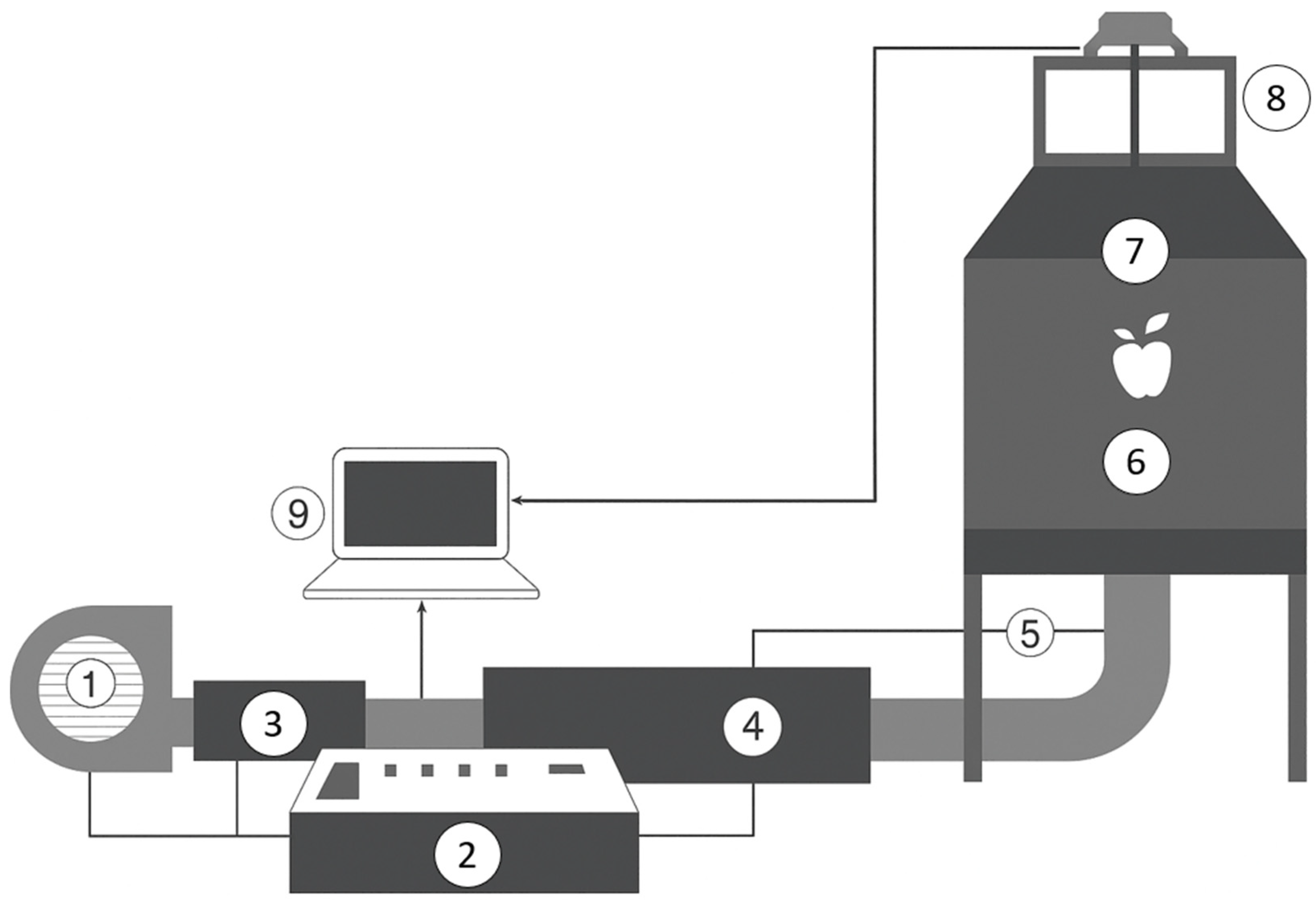
On the other hand, a convective drying system equipped with forced-air circulation was used to ensure the precise control of temperature and airflow during the dehydration of 1 kg batches of seaweed biomass (Figure 1).
The system consisted of nine main components: (1) Blower air filter, which supplied a continuous stream of filtered air to remove particulates before heating; (2) Control panel, enabling regulation and monitoring of air temperature, flow rate, and drying time; (3) Pre-heating air section, acting as an initial heat exchange zone to stabilize inlet air temperature; (4) Heating air section, containing electrical resistances that generated and distributed hot air uniformly through the system; (5) Thermocouple, positioned at the chamber inlet to monitor and maintain the set temperature; (6) Drying chamber (oven), a vertical cylindrical unit where samples were placed on trays to ensure homogeneous exposure to the hot air stream; (7) Sample, the biological material subjected to dehydration; (8) Digital balance (RS-232 interface), continuously recording mass loss to monitor real-time moisture content; and (9) PC, connected to the balance for automated data acquisition, visualization, and storage of drying kinetics.
During the operation of the drying equipment, filtered air, with an average relative humidity of 77% and an average temperature of 18 °C, was driven through the pre-heating and heating sections and then directed into the drying chamber, where it flowed uniformly over the samples. Drying was carried out at 40, 50, 60, 70, and 80 ± 0.2 °C, requiring effective drying times of 9.0, 6.5, 5.5, 5.0, and 4.0 h, respectively. The air velocity was maintained at 1.5 ± 0.2 m/s throughout the process to ensure consistent heat transfer.
Once the dehydration step was completed, the dried material was finely ground, placed in high-density polyethylene containers, and kept refrigerated and protected from light prior to use.

2.3. Chemical Composition Analysis of Dried Seaweed

(i)
The proximate composition of S. gaudichaudii, including moisture, ash, crude protein, total lipids, and crude fiber, was determined for both fresh and dried samples according to standard AOAC [20] procedures, with the only modification being the use of a nitrogen-to-protein conversion factor of 5.0 for crude protein determination [6]. For the fresh seaweed, the respective mean contents (±standard deviation (SD), %) were as follows: moisture 90.90 ± 0.28 (wet basis), lipids 0.06 ± 0.03, ash 47.66 ± 2.84, crude protein 20.52 ± 1.31, and crude fiber 3.82 ± 0.35 (dry matter [d.m.] basis). All analyses were performed in triplicate.
(ii)
The determination of micro- and macrominerals was carried out by wet digestion followed by quantification through atomic absorption spectroscopy (AAS), using a Varian SpectrAA 220 Fast Sequential (FS) atomic absorption spectrometer (Agilent Technologies, Santa Clara, CA, USA), according to the modified AOAC Official Method 968.08. Approximately 0.1–0.2 g of dried and finely ground seaweed powder was weighed into 250 mL beakers suitable for acid digestion. Subsequently, 14 mL of concentrated nitric acid (HNO3, 65%) and 6 mL of concentrated perchloric acid (HClO4, 70–72%) were carefully added. The beakers were covered with watch glasses and heated on a hot plate until near dryness, as indicated by the appearance of dense white fumes, signaling the complete removal of acids. After heating, the beakers were removed from the hot plate and allowed to cool naturally at room temperature (20 °C). Once cooled to a safe handling temperature, approximately 30 mL of distilled water was added to dissolve the remaining salts. The digested samples were quantitatively filtered using Whatman N°1 filter paper into 100 mL volumetric flasks, brought to the volume with distilled water, and mixed thoroughly. This solution was designated as solution A. From this solution A, an aliquot of 5 mL was transferred into a 100 mL volumetric flask, to which 10 mL of a 2% lanthanum chloride (LaCl3) solution was added as a releasing agent. The mixture was then diluted to an appropriate volume with distilled water and homogenized, obtaining solution B. Microminerals, such as iron (Fe), copper (Cu), manganese (Mn), and zinc (Zn) were determined from solution A, while macrominerals, such as calcium (Ca), magnesium (Mg), sodium (Na), and potassium (K), were quantified from solution B. All measurements were performed by AAS using external calibration curves for each element.
(iii)
The amino acid composition was determined by HPLC system equipped with a diode array detector (Jasco MD-2015Plus, Jasco Inc., Tokyo, Japan) after pre-column derivatization with o-phthalaldehyde (OPA). The AAS-18 amino acid standard (Sigma-Aldrich, St. Louis, MO, USA), containing 18 amino acids with a concentration of 2.5 μmol/mL each, was used for calibration. Additionally, glutamine, asparagine, and tryptophan were prepared at 2.3 × 10⁻³ M in borate buffer (pH 10.2) and incorporated into the standard mixture. Free and protein-bound amino acids were extracted from dried S. gaudichaudii (200 ± 0.5 mg) according to the extraction, hydrolysis, and purification procedures described by Araya et al. [21]. Chromatographic separation was performed on a ZORBAX Eclipse AAA column (150 × 4.6 mm, 3.5 μm; Agilent, Santa Clara, CA, USA) at a temperature of 40 °C, with UV detection at 338 nm under the chromatographic conditions reported by Araya et al. [21].
(iv)
The fatty acid profile was analyzed following the method of Folch et al. [22]. For lipid extraction, approximately 1.000 ± 0.005 g (d.m.) of sample was used, and the recovered lipids were subsequently transesterified to fatty acid methyl esters (FAMEs) using boron trifluoride in 14% methanol (BF3–MeOH). FAMEs were extracted with hexane, washed with 20% aqueous NaCl solution, evaporated to dryness, and reconstituted in 1 mL of hexane. Chromatographic analyses were performed using a GC–FID system (Clarus 600, PerkinElmer, Waltham, MA, USA) equipped with an OmegaWax 320 capillary column (30 m × 0.32 mm × 0.25 µm; Supelco, Bellefonte, PA, USA). The oven temperature was programmed from 60 °C (held for 3 min) to 260 °C at 10 °C min−1. Gaseous nitrogen served as the carrier gas at a flow rate of 1.0 mL min−1. Fatty acids were identified and quantified by comparing retention times and peak areas with the Supelco 37 Component FAME Mix (Sigma-Aldrich, CRM47885, St. Louis, MO, USA).

2.4. Color and Phycobiliprotein Analysis of Dried Seaweed

(i) Color measurements were recorded according to the International Commission on Illumination (CIE) L*a*b* color space system using a portable HunterLab colorimeter (MiniScan™ XE-Plus, Reston, VA, USA), equipped with a xenon flash lamp and operated under a D65 standard illuminant. The derived color attributes—chroma (C*), hue angle (h°), saturation (S*), and total color difference (ΔE*)—were calculated using the equations described in reference [23]:
C * =   a * 2 +   b * 2
h ° = a t a n 2   ( b * , a * ) × 180 π
S * = C * L *
Δ E = L 0 * L * 2 + a 0 * a * 2 + b 0 * b * 2
where L0*, a0*, and b0* values represent freeze-dried sample, and a*, b*, and L* is convective-dried samples. The h° was calculated using the atan2 (b*, a*) function, which correctly assigns the angular position within the a*–b* chromatic plane. The resulting value was then converted to degrees and normalized to the 0–360° interval. All tests were repeated six times for reliability.
(ii) Pigments were quantified by extracting phycobiliproteins following the method described by Moradi et al. [24], with minor modifications. Briefly, 1 g of sample was homogenized with 10 mL of 50 mM phosphate buffer (pH 7.0). The mixture was agitated for 20 min using an orbital shaker (OS-100, HiLab, Bahasa, Indonesia), followed by a single freeze–thaw cycle (freezing at −80 °C for 30 min and thawing at 4 °C). Subsequently, the suspension was agitated again at 4 °C for 24 h. After extraction, the samples were centrifuged at 5000 rpm for 30 min, and the supernatant was collected for spectrophotometric analysis. Absorbance was measured at 562, 620, and 652 nm using a UV–Vis spectrophotometer (Spectronic 20 Genesys, Spectronics Instruments, New York, NY, USA). Phycoerythrin (PE), phycocyanin (PC), and allophycocyanin (APC) concentrations were calculated using the equations presented below:
P C   ( m g / m L ) = A 620 0.74 × A 652 5.34
A P C   ( m g / m L ) = A 652 0.208 × A 620 5.09
P E   ( m g / m L ) = ( A 562 0.241 P C ) 0.849 ( A P C ) 9.62

2.5. Antioxidant Propierties Analysis of Dried Seaweed

(i)
Seaweed extracts were obtained by solid–liquid extraction using an aqueous methanolic solvent system. Dried seaweed samples were finely ground, and a defined mass (1.0 g) was suspended in 50 mL of a methanol–water mixture (60:40, v/v). The suspension was agitated at 200 rpm and maintained at ambient temperature for 24 h to promote the diffusion of soluble compounds into the solvent phase. After extraction, insoluble residues were removed by filtration through Whatman No. 1 filter paper. The resulting extract was concentrated under reduced pressure using a rotary evaporator (Büchi, R-210, Flawil, Switzerland), freeze-dried to remove residual water, and finally reconstituted in an appropriate solvent and volume according to the requirements of each analytical assay.
(ii)
The total phenolic content (TPC) was determined using a microplate-adapted Folin–Ciocalteu assay following the method described by Pasten et al. [25], with minor modifications. Aliquots of sample or standard solutions (15 μL) were dispensed into 96-well microplates and reacted with Folin–Ciocalteu reagent (100 μL, 0.2 M) and sodium carbonate solution (100 μL, 60 mg/mL), promoting the reduction of phosphomolybdic–phosphotungstic complexes under alkaline conditions. The reaction mixtures were homogenized and incubated at room temperature for 90 min to allow chromophore formation. Absorbance was measured at 750 nm using a microplate reader (OptiPlate™-96 F HB, PerkinElmer, Turku, Finland). Quantification was carried out using a phloroglucinol calibration curve (0–0.6 mg/mL), and results were expressed as mg phloroglucinol equivalents per gram of extract (mg PGE/g extract). The calibration equation was Y = 3.5281x − 0.0002 (R2 = 0.9935).
(iii)
Total flavonoid content (TFC) was determined using the aluminum chloride colorimetric method, as previously described [25]. This assay is based on the formation of stable complexes between aluminum ions and the hydroxyl groups of flavonoids, allowing the estimation of total flavonoid content associated with their characteristic structural features. Aliquots of the extracts were sequentially reacted with sodium nitrite, aluminum chloride, and sodium hydroxide at predefined time intervals, followed by dilution with distilled water. Absorbance was measured at 415 nm using a UV–Vis spectrophotometer. Quantification was carried out using a quercetin calibration curve (0–50 μg/mL), and results were expressed as milligrams of quercetin equivalents per gram of extract (mg QE/g extract). The calibration equation was Y = 0.0014x + 0.0291 (R2 = 0.9978).
(iv)
The radical-scavenging capacity of the extracts was evaluated using the DPPH assay according to Grajeda-Iglesias et al. [26], with minor modifications. This assay determines antioxidant activity through a combined electron transfer and hydrogen atom transfer mechanism, depending on the antioxidant structure and the reaction conditions. Briefly, extract samples (20 μL) were mixed with a DPPH solution (180 μL, 120 μM) in transparent 96-well microplates and incubated in the dark for 30 min. Absorbance was measured at 517 nm using a microplate reader. Antioxidant capacity was calculated from a Trolox calibration curve (y = −0.0011x + 0.5676; R2 = 0.9911) and expressed as μmol Trolox equivalents per gram of extract (μmol TE/g extract).
(v)
Oxygen radical absorbance capacity (ORAC) was determined according to the method described by Ou et al. [27], which primarily reflects hydrogen atom transfer reactions against peroxyl radicals. Extracts (40 µL), diluted in phosphate buffer (75 mM, pH 7.4), were mixed with fluorescein solution (200 µL, 100 nM) in black 96-well microplates and pre-incubated at 37 °C for 20 min. The oxidative reaction was initiated by adding AAPH solution (35 µL, 0.36 M). Fluorescence decay was monitored at 1 min intervals at 37 °C (excitation: 485 nm; emission: 535 nm), and antioxidant capacity was calculated from the area under the fluorescence decay curve. A Trolox standard curve (5–250 µM; y = 0.0002x − 20.5775; R2 = 0.9808) was used for quantification, and results were expressed as µmol TE/g extract.

2.6. α-Glucosidase Inhibitory Activity Analysis of Dried Seaweed

The inhibitory effect of seaweed extracts on α-glucosidase activity was evaluated using a colorimetric kinetic assay based on the enzymatic hydrolysis of a synthetic substrate [28]. The enzyme α-glucosidase (from Saccharomyces cerevisiae) was dissolved in 0.1 M phosphate buffer and used as the catalytic system. Enzyme activity was monitored using 4-nitrophenyl-α-D-glucopyranoside (pNPG), which releases p-nitrophenol upon cleavage, enabling spectrophotometric detection. To assess concentration-dependent inhibition, dried seaweed extracts were diluted in the reaction medium to obtain working solutions ranging from 0.10 to 40.0 mg/mL. For each assay, extract solutions were mixed with the enzyme preparation and incubated at 25 °C for 10 min prior to substrate addition. The enzymatic reaction was initiated by adding the chromogenic substrate (pNPG, 5 mM) to the mixture. Product formation was monitored by measuring absorbance at 405 nm using a microplate reader at 30 s intervals over a 10 min reaction period. Control reactions without extract were included to represent uninhibited enzyme activity, while acarbose was tested under identical conditions as a reference inhibitor. Enzyme inhibition was expressed as a percentage relative to the control and calculated according to the equation presented below:
%   i n h i b i t i o n = A 405 b l a n k A 405 i n h i b i t o r A 405 b l a n k × 100
where A 405 b l a n k corresponds to the change in absorbance of the blank between the initial and final time points, and A 405 i n h i b i t o r represents the change in absorbance measured for the sample containing the inhibitor over the same interval. The substrate was present under all assay conditions. Nonlinear regression analysis was used to calculate the half-maximal inhibitory concentration (IC50).

2.7. Cytotoxicity Analysis of Dried Seaweed

Human gastric adenocarcinoma (AGS) and human lung adenocarcinoma (A549) cell lines were used as in vitro models to evaluate the cytotoxic effects of S. gaudichaudii extracts. Both cell lines were obtained from the Faculty of Sciences, Universidad Austral de Chile (Valdivia, Chile). Cells were routinely cultured in Kaighn’s modification of Ham’s F-12 medium (F-12K), supplemented with 10% (v/v) fetal bovine serum and 1% antibiotic solution (antibiotic–antimycotic for AGS cells and penicillin–streptomycin for A549 cells). Cultures were maintained at 37 °C in a humidified atmosphere containing 5% CO2 (INCO153med incubator, Memmert, Schwabach, Germany). Only healthy cells at optimal confluence and within a limited number of passages were used for cytotoxicity assays.
For cytotoxicity assays, AGS and A549 cells were seeded in 96-well plates at a density of 5 × 10³ cells per well and allowed to adhere for 24 h, reaching approximately 70–80% confluence before treatment. Dried seaweed extracts were freshly prepared in F-12K culture medium, sterile-filtered through 0.22 µm membranes, and applied to the cells at final concentrations ranging from 1.25 to 40 mg/mL. After a 24 h exposure period, cell membrane integrity was evaluated using propidium iodide (PI) staining. Briefly, PI was added to each well to obtain a final concentration of 5 µM, and the plates were incubated for 10 min in the dark.
Fluorescence signals corresponding to PI uptake were measured using a microplate reader (Infinite M Nano+, TECAN, Männedorf, Switzerland) with excitation at 530 nm and emission detection between 617 and 620 nm. Cells incubated with culture medium alone served as negative controls, whereas treatment with 50% (v/v) dimethyl sulfoxide (DMSO) was used as a positive control. Cytotoxicity was expressed as PI fluorescence intensity, and half-maximal inhibitory concentration (IC50) values were calculated by nonlinear regression analysis of the dose–response curves.

2.8. Statistical Analysis

Statistical analyses were performed using Statgraphics Centurion 18 (version 18.1.12; Statgraphics Technologies, Inc., The Plains, VA, USA). Differences among treatments were assessed by one-way analysis of variance (ANOVA), and mean comparisons were conducted using Fisher’s least significant difference (LSD) test at a 95% confidence level (p < 0.05). In addition, hierarchical cluster analysis (HCA) was applied as an exploratory multivariate approach [29]. Clustering was carried out using an agglomerative procedure with between-group linkage and squared Euclidean distance as the dissimilarity metric, enabling the identification of similarities among drying treatments based on their chemical characteristics. Multivariate analyses were implemented in Python (version 3.9.4; Python Software Foundation, Beaverton, OR, USA) using the Google Colab platform.

3. Results and Discussion

3.1. Drying Effect on the Chemical Composition of S. gaudichaudii

The chemical composition of freeze-dried and convective-dried S. gaudichaudii, including proximate composition, macro- and micronutrients, amino acids, and fatty acids, is summarized in Table 1. In addition, all dried samples contained less than 5% residual moisture (2.67–5.06%) and exhibited low water activity values (0.0552–0.2643), which were well below the threshold required for microbial growth, thereby supporting microbiological stability during storage.
To date, only two studies have reported the chemical composition of S. gaudichaudii, both based on freeze-dried material [6,8]. In agreement with these reports, the proximate composition, macro- and micronutrient contents, and amino acid profile obtained in the present study were within the ranges previously described. Nevertheless, significant differences (p < 0.05) were observed when freeze-drying was compared with convective drying at different temperatures (Table 1).
Convective drying significantly increased the ash content in comparison to freeze-dried samples, with the greatest value recorded at 40 °C (46.98%). This apparent enrichment reflects concentration effects associated with the thermal degradation of organic constituents (e.g., proteins, pigments, and soluble carbohydrates) [18], which increases the relative proportion of minerals in the dry matrix. Accordingly, freeze-dried samples exhibited lower ash and mineral values, not because minerals were lost but because they were less concentrated due to the non-thermal nature of freeze-drying, which better preserves organic components. The elevated ash contents observed at 40–60 °C corresponded to higher levels of macrominerals such as sodium (Na, 17,138–17,544 mg/kg) and potassium (K, 117,515–129,516 mg/kg), which dominate the mineral fraction of S. gaudichaudii [6] and several other red seaweeds [23,30]. In contrast, samples dried at 70–80 °C exhibited lower ash contents than those treated at 40–60 °C, suggesting partial thermal redistribution or volatilization of Na and K. At elevated temperatures, these elements may form unstable oxides or hydroxides, facilitating their loss from the matrix [31]. Meanwhile, microminerals such as Fe, Mn, and Ca became relatively more abundant at 70–80 °C due to their higher thermal stability.
Freeze-dried samples exhibited a significantly higher protein content (21.08 g/100 g d.m.) than convective-dried samples (11.33–20.04 g/100 g d.m.), which is consistent with the well-documented ability of freeze-drying to preserve protein structure by minimizing heat-induced denaturation and degradation [18]. In contrast, convective drying may promote protein denaturation and Maillard reactions, thereby contributing to the lower protein levels observed at certain temperatures. In line with these trends, variations in crude protein content were closely reflected in the profiles of individual amino acids (Table 1). At 60 °C, where crude protein reached its lowest concentration (11.33 g/100 g d.m.), thermolabile amino acids such as tyrosine (TYR), cysteine (CYS), and lysine (LYS) exhibited the greatest reductions, reflecting their susceptibility to thermal degradation, oxidation, and Maillard-type reactions [32]. This pronounced decline appears to result from a critical interaction between moderate temperature and extended drying time. Conversely, samples dried at 70–80 °C, despite experiencing higher thermal intensity, were subjected to considerably shorter drying durations. This condition likely promoted rapid enzyme inactivation and reduced the time window for oxidative or Maillard reactions, resulting in better retention or even relatively higher levels of certain essential amino acids, such as valine (VAL), isoleucine (ILE), and methionine (MET). These findings highlight the importance of time–temperature interactions rather than drying temperature alone.
Freeze-drying is generally reported to preserve crude fiber in seaweeds by minimizing thermal damage to polysaccharide structures, whereas thermal drying may result in either fiber degradation or apparent increases in crude fiber, depending on processing conditions [18]. In the present study, crude fiber content increased significantly (p < 0.05) at 70 and 80 °C compared with the freeze-dried samples. This behavior can be attributed to thermally induced insolubilization or cross-linking of cell wall components, which may convert soluble fiber fractions into forms quantified as crude fiber during proximate analysis [33].
Although the lipid content of S. gaudichaudii was below 1% (d.m.), the nutritional quality of its lipid fraction was noteworthy due to its diverse fatty acid profile [23]. Freeze-dried samples exhibited the greatest proportion of saturated fatty acids (SFAs; 66.65%), mainly due to the predominance of palmitic acid (C16:0). In contrast, convective drying at 40–60 °C reduced SFA levels (≈46%) and increased monounsaturated and polyunsaturated fatty acids (MUFAs and PUFAs) up to 11.1% and 46.9%, respectively, particularly arachidonic acid (C20:4n6) and eicosapentaenoic acid (C20:5n3). These differences should be interpreted considering that fatty acid data were expressed as relative proportions of total fatty acid methyl esters (FAMEs) and therefore reflect redistribution effects rather than absolute gains or losses. In this context, freeze-drying, as a non-thermal process, preserves lipid integrity and cellular structures, thereby favoring the retention of structurally stable fatty acids [17]. Notably, palmitic acid (C16:0), due to its abundance, intrinsic oxidative stability, and ordered crystalline organization, remained proportionally higher in freeze-dried samples compared with other saturated fatty acids, which are more sensitive to matrix disruption and relative reorganization during convective drying [34].
Conversely, convective drying promotes partial disruption of cellular membranes and lipid–protein complexes, thereby enhancing the extractability of unsaturated fatty acids, particularly those associated with phospholipids. This mechanism explains the higher relative proportions of MUFAs and PUFAs observed at 40–60 °C compared with freeze-drying. At higher temperatures (70–80 °C), a partial recovery of SFAs (53.5–63.7%) was observed, suggesting that a fraction of PUFAs underwent thermal or oxidative degradation [18]. However, the shorter drying times at these temperatures limited cumulative oxidative damage, allowing MUFA and PUFA levels to remain higher than those detected in freeze-dried samples.
In contrast, although freeze-drying is conducted under vacuum, ice sublimation generates a highly porous structure with increased surface area [28], which may render PUFAs more susceptible to oxidation during subsequent handling and exposure to air. This phenomenon favors relative PUFA losses and contributes to the higher proportion of SFAs observed in freeze-dried samples [34].

3.2. Hierarchical Clustering of the Chemical Composition of S. gaudichaudii

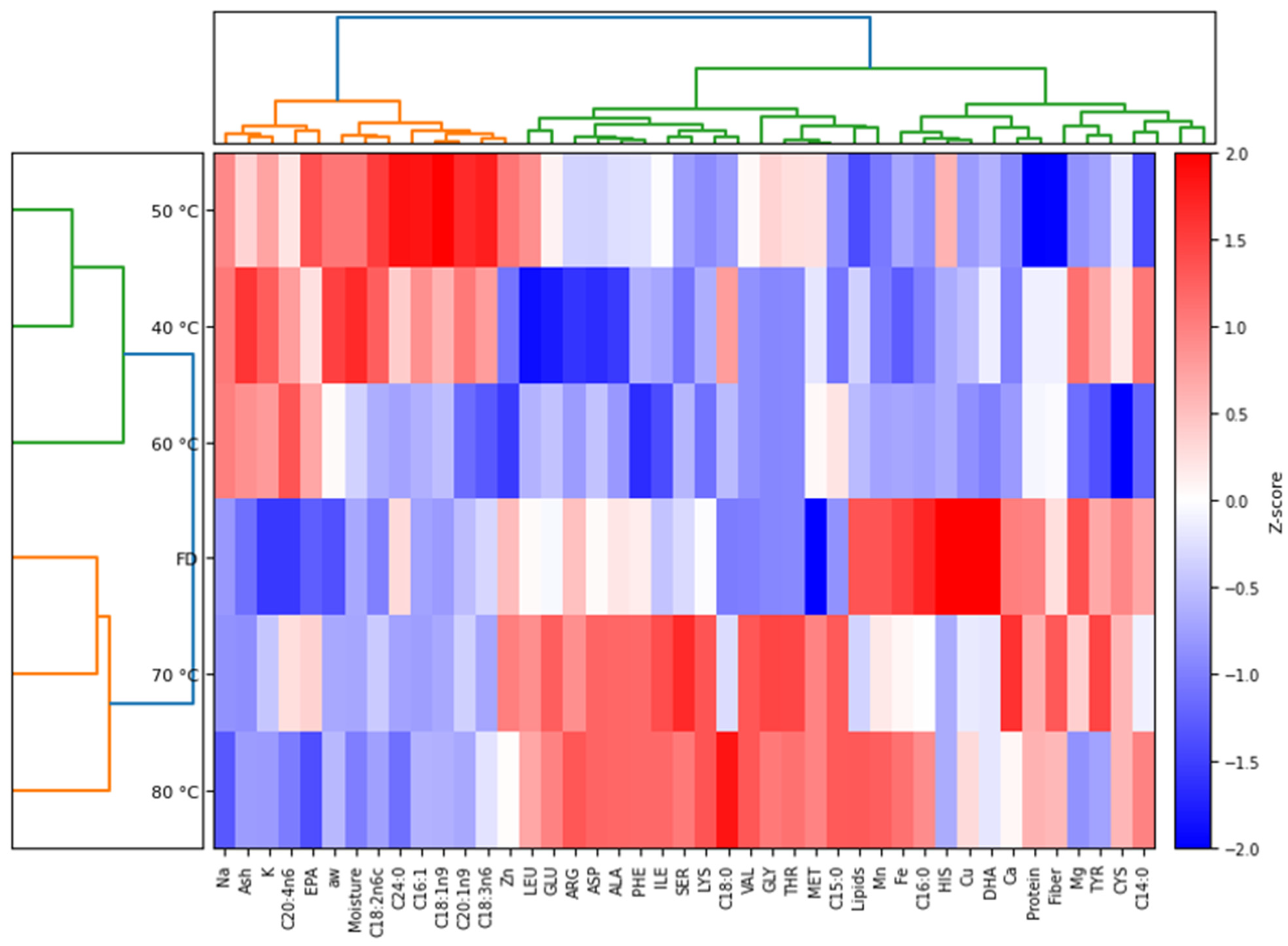
Hierarchical cluster analysis was employed to integrate proximate composition, amino acid, mineral, and fatty acid data from S. gaudichaudii. As shown in Figure 2, the treatments formed two principal clusters: freeze-drying grouped with convective drying at 80 °C, whereas intermediate temperatures (40–60 °C) constituted a distinct cluster. The 70 °C treatment occupied an intermediate position, reflecting its transitional chemical profile. This clustering pattern directly reflected the compositional differences discussed in the previous section, thereby providing an integrated interpretation of the nutritional data.
Nutritional indicators within each cluster were closely correlated, indicating that representative variables could be used to simplify the dataset. The extreme conditions (freeze-drying and convective drying at 80 °C) resulted in convergent chemical profiles despite relying on distinct dehydration mechanisms: freeze-drying removes water through ice sublimation under low pressure, whereas convective drying at 80 °C promotes moisture removal by vaporization driven by high thermal and vapor pressure gradients [18]. Both processes clustered together primarily due to similarities in lipid and protein contents, as both treatments exhibited relatively elevated levels of saturated fatty acids (C16:0 and C18:0) and concentrated protein contents. This similarity indicates that, despite contrasting drying mechanisms, both treatments lead to a comparatively preserved structural matrix dominated by stable lipid and protein fractions.
Within this grouping, freeze-drying was primarily distinguished by a higher content of CYS, whereas ASP, GLU, and ARG were comparatively more abundant in samples dried at 80 °C. These patterns likely reflect the retention of sulfur-containing amino acid residues under freeze-drying conditions, while the apparent increase in acidic and basic amino acid contents at 80 °C may be attributed to concentration effects associated with excessive moisture loss rather than true preservation of these components. Moreover, at elevated temperatures, the functional quality of proteins may be compromised by thermal denaturation [33].
In contrast, the 40–60 °C treatments were distinguished by lower protein content levels (particularly at 60 °C) and by partial reductions in several branched-chain amino acids (ILE, LEU, and VAL) as well as two hydroxylated amino acids (SER and THR). Nevertheless, these conditions promoted strong retention of minerals (Na, K, Ca, and Mg) and polyunsaturated fatty acids (notably ARA and EPA), highlighting the role of moderate convective drying in enhancing mineral concentration and the extractability of unsaturated lipids through partial matrix disruption. These compositional features explain the clear separation of the intermediate-temperature cluster from both freeze-drying and the 80 °C treatment in the hierarchical analysis. This enhanced mineral preservation distinguished the intermediate cluster from freeze-drying and the 80 °C treatment, in which ash contents were comparatively lower.
Convective drying at 70 °C displayed a transitional compositional signature, with higher protein content than at 60 °C and relative stabilization of sulfur-containing amino acids (CYS and MET), together with a distinct increase in Ca. Its intermediate position between clusters highlights the balance between nutrient degradation and concentration at near-threshold temperatures. This intermediate placement confirms the sensitivity of S. gaudichaudii composition to time–temperature interactions, as also reflected in the multivariate clustering.

3.3. Drying Effect on Color Parameters and Phycobiliprotein Content of S. gaudichaudii

The results of the color analysis of S. gaudichaudii samples subjected to freeze-drying and convective drying at different temperatures are presented in Table 2. The total color difference (ΔE*) was calculated using the freeze-dried sample as the reference.
Overall, the color parameters of the red seaweed were markedly influenced by convective drying temperature when contrasted with those of the freeze-dried samples. Lightness (L*) increased at 40–50 °C, indicating surface lightening likely associated with moisture loss and enhanced light scattering within the dehydrated matrix. However, L* decreased markedly at 70–80 °C, suggesting sample darkening due to non-enzymatic browning reactions, such as lipid and protein oxidation, occurring during heat treatment [32]. In contrast, both the redness index (a*) and the yellowness coordinate (b*) exhibited an overall decreasing trend with increasing temperature, with a* being more strongly affected than b*. This behavior reflects the thermal degradation and instability of pigments such as chlorophyll a, carotenoids, and particularly phycoerythrin (PE), the major light-harvesting pigment in red algae, resulting from structural damage to cellular membranes and pigment–protein complexes during drying [17,35].
Interestingly, samples dried at 50–60 °C showed slightly higher b* values relative to the freeze-dried control. This transient increase in yellowness may be attributed to moderate heating promoting early non-enzymatic browning reactions, leading to the formation of intermediate chromophores that enhance yellow hues before pronounced darkening occurs [36].
According to the ΔE* classification reported by Zhu et al. [37], samples dried at 40–60 °C exhibited distinct but not pronounced color differences (1.5 < ΔE* ≤ 3), indicating good color retention relative to the freeze-dried control and suggesting a preservation of visual quality suitable for food processing and commercialization. In contrast, drying at 70–80 °C produced very distinct color differences (ΔE* > 3), reflecting clearly perceptible visual changes that are typically associated with noticeable quality loss from a consumer perspective.
The combined variation in the hue angle (h°), chroma (C*), and saturation (S*) provided a comprehensive description of the color evolution of S. gaudichaudii during drying. The freeze-dried control exhibited a low h° (51.98 ± 1.36°), high C* (6.77 ± 0.16), and maximum S* (0.17 ± 0.00), corresponding to a vivid red–orange hue with high color purity and representing the highest visual quality reference among the evaluated treatments. As the drying temperature increased to 50 and 60 °C, h° shifted toward the yellow–orange region (64.56 and 64.68°, respectively), while both C* and S* declined moderately. This trend indicates a hue displacement accompanied by reduced chromatic intensity and purity, suggesting a partial thermal denaturation of phycobiliproteins and other light-harvesting pigments [17,38], while maintaining an appearance that remained visually acceptable. At higher temperatures (70–80 °C), the samples exhibited h° values around 61°, combined with the lowest C* (4.63 ± 0.16) and S* (0.14–0.16). This combination denotes a pronounced loss of color vividness and purity, resulting in dull orange–brown tones on the color wheel, which negatively affected product attractiveness and perceived quality. Such changes reflect advanced pigment oxidation and denaturation of protein–chromophore complexes, along with the possible formation of melanoidin-like or other brown polymeric compounds, which reduce the saturation of red components and enhance light scattering [17,36,38,39].
The observed color variations in S. gaudichaudii were closely related to the degradation patterns of its phycobiliproteins (Table 2). The freeze-dried control contained the highest concentrations of phycoerythrin (PE), phycocyanin (PC), and allophycocyanin (APC) (PE = 86.72 ± 0.39 mg/100 g d.m., PC = 32.74 ± 0.24 mg/100 g d.m., and APC = 23.39 ± 0.58 mg/100 g d.m.), which was consistent with its intense red–orange hue. Similar values have been reported for other freeze-dried red seaweeds, such as Pyropia orbicularis [40] and Gracilaria sp. [24,38].
Convective air drying caused a pronounced loss of these pigments at 40–60 °C, with PE decreasing by more than 75%, in parallel with the increase in h° (toward yellowish tones) and the decline in C* and S*. This relationship confirms that color fading is primarily driven by the thermal denaturation and dissociation of phycobiliprotein chromophores, which reduce red light absorption and shift the hue toward the yellow–orange region of the CIELab color space. Phycobiliproteins are protein complexes containing linear tetrapyrrole chromophores (bilins) covalently bound to cysteine residues, functioning as auxiliary pigments in photosynthesis [24,35]. Disruption of these covalent bonds under thermal stress destabilizes the chromophoric structure, leading to pigment bleaching and color loss. At higher temperatures (70–80 °C), partial pigment retention was observed, likely due to rapid dehydration that limited complete oxidation of some protein complexes. This behavior is consistent with that reported by Uribe et al. [40] for P. orbicularis. Nevertheless, pigment levels remained substantially lower than those of the control, and the color still exhibited high h° and low C*, indicating partial phycobiliprotein preservation but an overall loss of color purity and the appearance of dull brownish tones.

3.4. Drying Effect on Antioxidant Properties of S. gaudichaudii

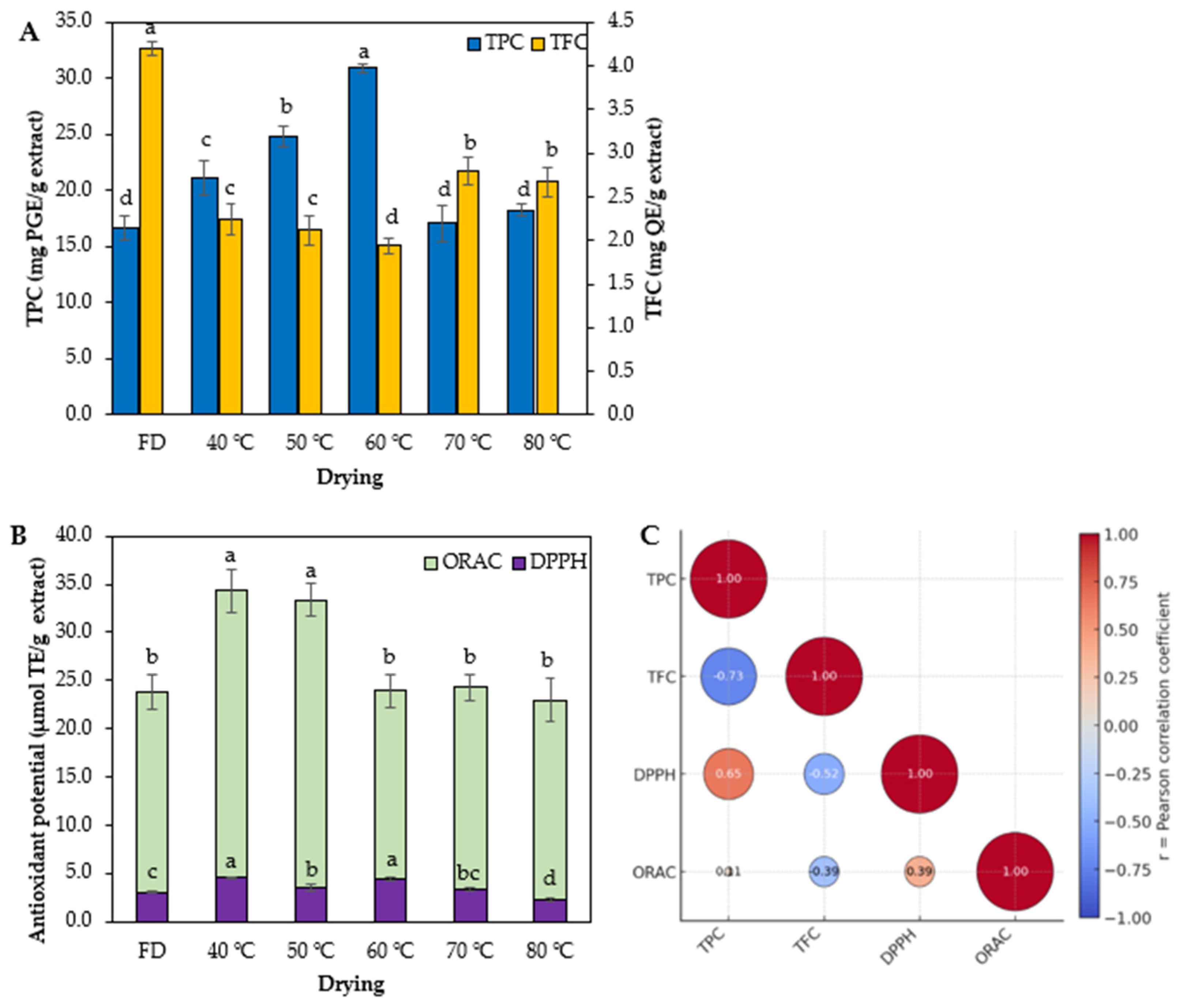
The effects of drying on the antioxidant properties of S. gaudichaudii were evaluated by determining total phenolic content (TPC), total flavonoid content (TFC), and antioxidant capacity using the DPPH and ORAC assays. As shown in Figure 3, the freeze-dried sample exhibited values of 16.68 mg PGE/g extract for TPC, 4.20 mg QE/g extract for TFC (Figure 3A), 3.07 µmol TE/g extract for DPPH, and 20.76 µmol TE/g extract for ORAC (Figure 3B).
To the best of our knowledge, this is the first study to report the antioxidant properties of whole extracts of S. gaudichaudii. Previous research, such as that conducted by Premarathna et al. [13], has focused exclusively on polysaccharide fractions of this seaweed rather than on its complete chemical matrix. Consequently, direct comparisons with the present findings are limited. Nevertheless, several of the values obtained in this study are comparable to those reported for other red algae in the literature [40,41,42,43,44].
Freeze-drying yielded a significantly higher value (p < 0.05) only for TFC, whereas for all other antioxidant parameters it resulted in lower values than those obtained by convective drying. Similarly, Ling et al. [45] and Charles et al. [29] reported that oven drying surpassed freeze-drying in terms of TPC and antioxidant activity in Kappaphycus alvarezii. These findings support the notion that thermal drying promotes the release of matrix-bound phenolic compounds, enhances the hydrolysis of complex conjugated forms, and induces the formation of stress- or cell-disruption-related phenolic derivatives [19,46]. Moreover, thermal processing may lead to the formation of low-molecular-weight or Maillard-derived reducing compounds that can react with the Folin–Ciocalteu reagent, thereby contributing to the apparent increase in TPC [47]. In contrast, the simultaneous exposure to heat and oxygen during convective drying enhances the thermal degradation of flavonoids, leading to a marked reduction in their overall content [18].
Significant differences were also seen in the antioxidant potential between the freeze-drying and convective drying methods, as determined by DPPH and ORAC assays (Figure 3B). The DPPH radical-scavenging capacity increased under moderate convective drying, reaching its maximum at 40 °C (4.54 ± 0.11 µmol TE/g of extract) and 60 °C (4.44 ± 0.23 µmol TE/g of extract), both exceeding the freeze-dried value (3.07 ± 0.07 µmol TE/g of extract). A marked decrease occurred at 80 °C (2.30 ± 0.13 µmol TE/g extract), suggesting progressive thermal degradation of redox-active compounds. In contrast, the ORAC assay (reflecting peroxyl radical-scavenging capacity under aqueous conditions) showed its highest activity at 40 °C (29.76 ± 2.30 µmol TE/g extract) and 50 °C (29.80 ± 1.72 µmol TE/g extract), whereas a pronounced decline was observed at 60 °C and higher temperatures. Overall, these results indicate that mild drying conditions favor the preservation or formation of compounds effective against both DPPH and peroxyl radicals, while excessive heat reduces the overall antioxidant potential.
Several studies have reported that the total antioxidant potential of seaweeds is largely influenced by their phenolic compounds, which are well known for their free radical-scavenging capacity and strong antioxidant properties [18,40]. Pearson correlation analysis (Figure 3C) revealed a moderate positive correlation between DPPH activity and TPC (r = 0.65), confirming that phenolic compounds play an important role in single-electron transfer (SET) and/or hydrogen atom transfer (HAT) mechanisms underlying the DPPH assay. Subbiah et al. [19] also reported a significant correlation between TPC and antioxidant potential in Australian beach-cast brown seaweeds. In contrast, DPPH activity was negatively correlated with TFC (r = −0.52). This inverse relationship can be attributed to the analytical specificity of the aluminum chloride colorimetric assay used for TFC determination, which selectively detects flavonoids possessing free hydroxyl groups at the C-3 or C-5 positions and a 4-keto group capable of forming complexes with Al3+ ions [48]. Consequently, this method is particularly responsive to flavonols and the flavone luteolin but is less sensitive to other subclasses, such as flavanones, flavanols, or glycosylated derivatives (commonly found in seaweeds [43]), which may exhibit greater reactivity toward the DPPH radical.
In contrast, ORAC activity showed no correlation with TPC (r = 0.11) and only a weak negative association with TFC (r = −0.39), implying that peroxyl radical neutralization depends on a broader pool of antioxidants, including bromophenols, polysaccharide-associated compounds, and low-molecular-weight Maillard reaction products [17,49]. This lack of correlation may also be attributed to structural and mechanistic factors influencing the reactivity of phenolic compounds in the ORAC system. Unlike the DPPH assay, which is governed primarily by single-electron transfer reactions, the ORAC method involves hydrogen atom transfer in aqueous media, where steric accessibility and electronic delocalization strongly affect reaction kinetics [50,51]. Furthermore, the large molecular size and complex polymeric skeletons of certain seaweed phenolic compounds, such as phlorotannins ranging from 126 Da to over 650 kDa, can limit steric access to radical species, thereby underestimating their true antioxidant action [52].

3.5. Drying Effect on α-Glucosidase Inhibitory Activity of S. gaudichaudii

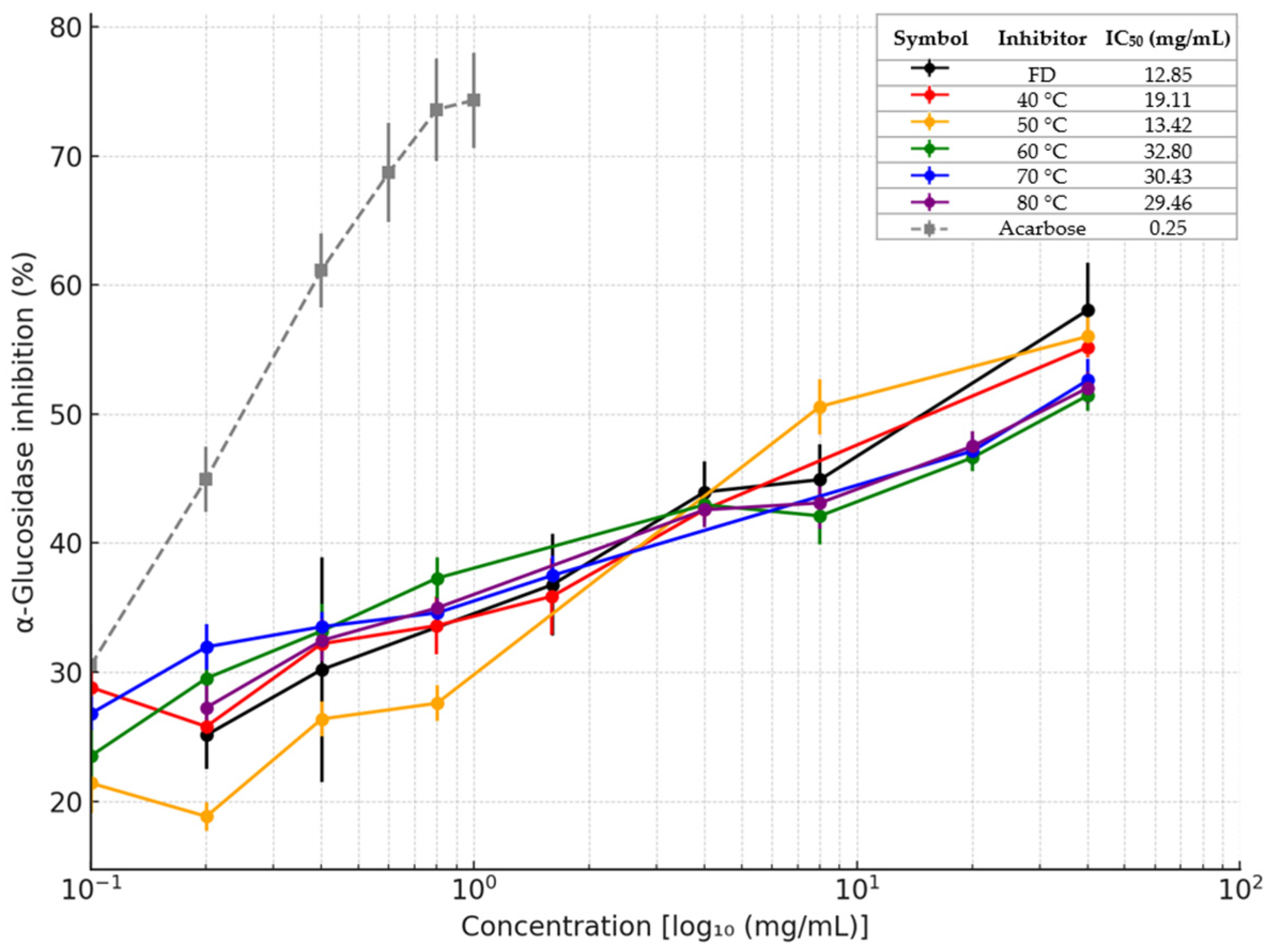
The α-glucosidase inhibitory activity of extracts obtained from S. gaudichaudii subjected to freeze-drying and convective drying was evaluated for their potential role in regulating type II diabetes. Acarbose, a clinically used reversible α-glucosidase inhibitor of bacterial origin, was employed as a positive control. As expected, when compared with acarbose (which achieved 74% inhibition at 1 mg/mL), all seaweed extracts exhibited lower inhibitory capacities across the tested concentration range (Figure 4).
For the S. gaudichaudii extracts, α-glucosidase inhibition increased progressively with concentration for both drying treatments. At the highest concentration tested (40 mg/mL), inhibition ranged from 51 to 58%, with the freeze-dried extract exhibiting the greatest activity. At intermediate concentrations (1.6–4 mg/mL), inhibition values remained between 33 and 45%, with the freeze-dried extract and the extract obtained from samples dried at 60 °C showing comparatively higher responses than the other treatments. Kim et al. [53] reported that a methanol–water (4:1, v/v) extract of the red seaweed Polyopes lancifolia exhibited 52.2% α-glucosidase inhibition at 5 mg/mL, followed by Grateloupia elliptica (42.0%) and Grateloupia lanceolata (22.0%). Accordingly, the inhibitory activity of S. gaudichaudii extracts observed in the present study falls within a comparable range. Similarly, Magwaza et al. [54] reported that ethanol extracts from the red seaweed Callophyllis variegata showed α-glucosidase inhibition values between 34 and 41.5%, which agree with the present findings, although those inhibition percentages were achieved at lower extract concentrations (31.24–1000 µg/mL). In the current study, inhibition at the lowest concentrations tested (<0.4 mg/mL) reached approximately 25–30% for all extracts (Figure 4), indicating a comparable inhibitory potential despite differences in concentration range, seaweed species, and extraction solvent.
The IC50 values confirmed the differences observed in the dose–response profiles. The freeze-dried extract exhibited the lowest IC50 value (12.85 mg/mL), followed by the extract obtained from samples dried at 50 °C (13.42 mg/mL), indicating stronger inhibitory activity. In contrast, the extract dried at 40 °C showed a higher IC50 value (19.11 mg/mL), whereas samples obtained at ≥60 °C exhibited substantially higher IC50 values (Figure 4).
These results indicate a consistent reduction in inhibitory effectiveness with increase in drying temperature, where FD shows the best performance in terms of α-glucosidase inhibition. Zhao et al. [28] also observed that Sargassum fusiforme dried by freeze-drying exhibited higher α-glucosidase inhibitory activity when contrasted with that obtained by convective drying. They attributed this effect to the ability of freeze-drying to minimize the thermal degradation of phenolic compounds with inhibitory activity against digestive enzymes, as water is removed by sublimation at low temperatures. Bromophenols extracted from Symphyocladia latiuscula, such as 2,3,6-tribromo-4,5-dihydroxybenzyl methyl ether and its derivatives, have been shown to inhibit α-glucosidase, thereby improving insulin sensitivity and glucose uptake [55]. The inhibitory mechanism of bromophenols involves oxidation of their hydroxyl groups to quinones, which subsequently form covalent bonds with amino acid residues at the enzyme active site, thereby blocking its catalytic activity [53].
To the best of our knowledge, this represents the first report describing the α-glucosidase inhibitory activity of S. gaudichaudii. Nevertheless, further comprehensive studies are warranted to isolate and characterize the bromophenols and other phenolic compounds responsible for the observed inhibitory effects of this seaweed against digestive enzymes.

3.6. Drying Effect on Cytotoxicity Activity of S. gaudichaudii

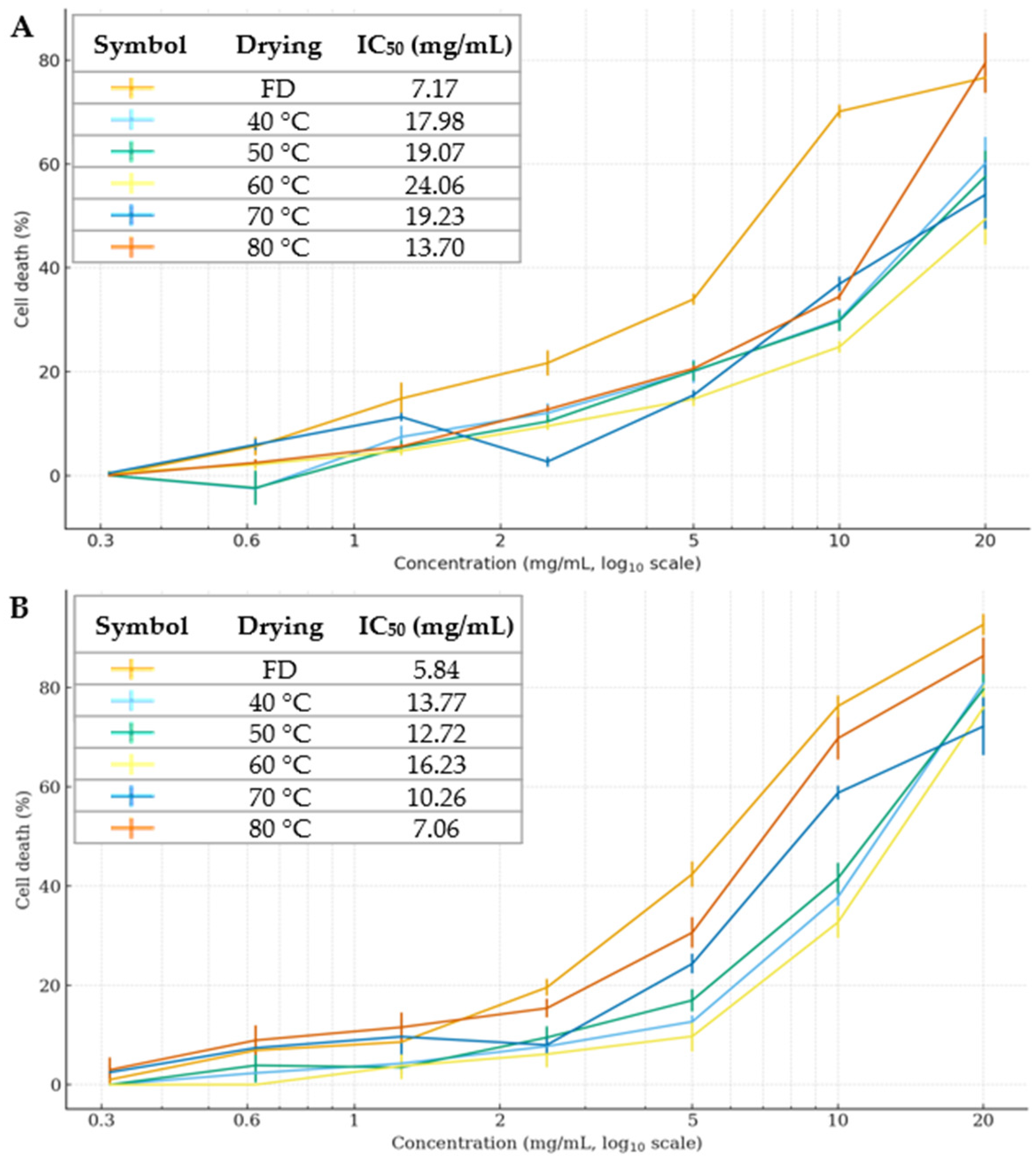
Given the high global prevalence and mortality associated with lung and gastric cancers, the A549 lung adenocarcinoma and AGS gastric adenocarcinoma cell lines were selected as clinically relevant and widely used models to evaluate the cytotoxic potential of dried S. gaudichaudii extracts. Figure 5 illustrates the cytotoxic effects of S. gaudichaudii extracts obtained under different drying conditions on A549 (Figure 5A) and AGS (Figure 5B) cell lines across a concentration range of 0.312–20 mg/mL. In both cell lines, the extracts exhibited a clear dose-dependent increase in cell death, although the magnitude of the response varied markedly among drying conditions and between cell types.
At low concentrations (≤1.25 mg/mL), all extracts induced minimal cytotoxicity in both models, with cell death typically remaining below 15%. However, as concentrations increased above 2.5 mg/mL, the responses of the two cell lines diverged, revealing a higher overall sensitivity in AGS cells compared with A549 cells. This pattern suggests cell line-specific susceptibility, possibly linked to differences in membrane composition, metabolic activity, or uptake mechanisms between gastric and lung cancer cells.
Among all seaweed extracts, the freeze-dried extract consistently exhibited the strongest cytotoxic effects, reaching approximately 78–93% cell death at 20 mg/mL, depending on the cell line. Extracts obtained from seaweed dried at 80 °C also demonstrated high cytotoxic activity (~85–90%), suggesting that the preservation or transformation of bioactive compounds under these conditions enhanced overall bioactivity. In contrast, the 60 °C drying treatment yielded the lowest cytotoxicity, with consistently reduced responses in both A549 and AGS cells across the entire concentration range.
When the data were converted to IC50 values, S. gaudichaudii extracts exhibited higher cytotoxic activity against AGS gastric cancer cells (IC50 = 5.84 ± 1.08–16.23 ± 1.12 mg/mL) than against A549 lung cancer cells (IC50 = 7.17 ± 1.07–24.66 ± 1.08 mg/mL). Consistently, the most potent effects were observed for the freeze-dried and 80 °C extracts, whereas the lowest cytotoxic activity corresponded to the 60 °C treatment.
Previous studies on seven red seaweed species from the Arabian Sea reported significant proliferation-inhibitory activity (~40–44%) against HeLa and Huh-7 cancer cell lines in species such as Grateloupia indica and Halymenia porphyriformis, whereas other species exhibited moderate effects (26–35%) [42]. This interspecific variability highlights the influence of chemical composition on bioactivity. Sudhakar et al. [56] demonstrated that phycoerythrin extracted from the red seaweed Gracilaria corticata exerts significant cytotoxicity against colon cancer cell lines such as SW620 and HCT-116 in a concentration- and time-dependent manner. Collectively, these studies indicate that seaweed extracts can inhibit cancer cell growth to varying degrees, depending on cell type and species-specific chemical characteristics. The bioactive compounds may interact with specific receptors or intracellular targets, potentially affecting cell viability through mechanisms such as apoptosis [57].
Although the present study demonstrated clear differences in cytotoxic activity among extracts obtained under different drying conditions, the underlying molecular mechanisms were not investigated, as this work focused on comparative bioactivity rather than mechanistic validation. Therefore, further studies are required, including targeted metabolite profiling and molecular-level assays, to elucidate the compounds and pathways responsible for the observed cytotoxic effects.

4. Conclusions

This study advances the current understanding of how convective drying and freeze-drying influence the chemical composition and biological functionality of Sarcodiotheca gaudichaudii. The results demonstrate that drying temperature strongly modulates the retention of proteins, lipids, minerals, polyunsaturated fatty acids, phycobiliproteins, and antioxidant-related compounds, highlighting distinct process-dependent trade-offs. Freeze-drying preserves phycobiliproteins and enhances α-glucosidase inhibitory and cytotoxic responses, whereas moderate convective drying improves total phenolic content and overall antioxidant capacity. Collectively, these findings provide practical guidance for selecting drying strategies aligned with targeted functional properties, thereby supporting future biomass stabilization and functional ingredient development.
A key limitation of this work is the absence of individual metabolite profiling, which restricts mechanistic interpretation of the observed bioactivities. In addition, although previous studies report low heavy-metal concentrations in S. gaudichaudii, the lack of direct quantification of elements such as As, Cd, Pb, and Hg in the present samples limits a comprehensive toxicological assessment. Future studies should integrate detailed chemical characterization, including phenolic, pigment, and other secondary metabolite profiling, together with heavy-metal analysis, structure–activity relationship studies, and process optimization. Such efforts are essential to identify the compounds responsible for the observed functional responses and to fully clarify the potential of S. gaudichaudii as a resource for value-added applications.

Author Contributions

Writing—review and editing, A.P.; Resources, Validation, Visualization, A.V.-G.; Investigation, Methodology, M.A. and F.J.; Supervision, Writing—original draft, E.U.; Formal analysis, Investigation, N.M. and J.M. All authors have read and agreed to the published version of the manuscript.

Funding

This study was supported by the SATREPS Project “Recovering High-Value Bioproducts for Sustainable Fisheries in Chile (ReBiS)” funded by JST/JICA (Grant Number JPMJSA2206).

Data Availability Statement

The datasets produced in this study are available upon request from the corresponding author.

Acknowledgments

Antonio Vega-Galvez acknowledges the financial support of DIDULS/ULS through the funding N°ADI2553852.

Conflicts of Interest

The authors declare that they have no conflicts of interest. Furthermore, the funders had no involvement in the study’s design, data collection, analysis, interpretation, manuscript writing, or decision to publish the results.

References

  1. Santhoshkumar, P.; Yoha, K.S.; Moses, J.A. Drying of seaweed: Approaches, challenges and research needs. Trends Food Sci. Technol. 2023, 138, 153–163. [Google Scholar] [CrossRef]
  2. Chopin, T.; Tacon, A.G.J. Importance of seaweeds and extractive species in global aquaculture production. Rev. Fish. Sci. Aquac. 2021, 29, 139–148. [Google Scholar] [CrossRef]
  3. Mouritsen, O.G.; Rhatigan, P.; Pérez-Lloréns, J.L. World cuisine of seaweeds: Science meets gastronomy. Int. J. Gastron. Food Sci. 2018, 14, 55–65. [Google Scholar] [CrossRef]
  4. Pacheco, L.V.; Parada, J.; Pérez-Correa, J.R.; Mariotti-Celis, M.S.; Erpel, F.; Zambrano, A.; Palacios, M. Bioactive polyphenols from southern Chile seaweed as inhibitors of enzymes for starch digestion. Mar. Drugs 2020, 18, 353. [Google Scholar] [CrossRef] [PubMed]
  5. Camus, C.; Infante, J.; Buschmann, A.H. Revisiting the economic profitability of giant kelp Macrocystis pyrifera (Ochrophyta) cultivation in Chile. Aquaculture 2019, 502, 80–86. [Google Scholar] [CrossRef]
  6. Véliz, K.; Toledo, P.; Araya, M.; Gómez, M.F.; Villalobos, V.; Tala, F. Chemical composition and heavy metal content of Chilean seaweeds: Potential applications of seaweed meal as food and feed ingredients. Food Chem. 2023, 398, 133866. [Google Scholar] [CrossRef]
  7. Gabrielson, P.W. Morphological studies of members of the tribe Agardhielleae (Solieriaceae, Rhodophyta). II. Sarcodiotheca gaudichaudii (Montagne) comb. nov. Phycologia 1982, 21, 86–96. [Google Scholar] [CrossRef]
  8. Tibbetts, S.M.; Milley, J.E.; Lall, S.P. Nutritional quality of some wild and cultivated seaweeds: Nutrient composition, total phenolic content and in vitro digestibility. J. Appl. Phycol. 2016, 28, 3575–3585. [Google Scholar] [CrossRef]
  9. Kulshreshtha, G.; Rathgeber, B.; Stratton, G.; Thomas, N.; Evans, F.; Critchley, A.; Hafting, J.; Prithiviraj, B. Feed supplementation with red seaweeds, Chondrus crispus and Sarcodiotheca gaudichaudii, affects performance, egg quality, and gut microbiota of layer hens. Poult. Sci. 2014, 93, 2991–3001. [Google Scholar] [CrossRef]
  10. Kulshreshtha, G.; Borza, T.; Rathgeber, B.; Stratton, G.S.; Thomas, N.A.; Critchley, A.; Hafting, J.; Prithiviraj, B. Red seaweeds Sarcodiotheca gaudichaudii and Chondrus crispus downregulate virulence factors of Salmonella Enteritidis and induce immune responses in Caenorhabditis elegans. Front. Microbiol. 2016, 7, 421. [Google Scholar] [CrossRef]
  11. Kulshreshtha, G.; Rathgeber, B.; MacIsaac, J.; Boulianne, M.; Brigitte, L.; Stratton, G.; Thomas, N.A.; Critchley, A.T.; Hafting, J.; Prithiviraj, B. Feed supplementation with red seaweeds, Chondrus crispus and Sarcodiotheca gaudichaudii, reduces Salmonella Enteritidis in laying hens. Front. Microbiol. 2017, 8, 567. [Google Scholar] [CrossRef]
  12. Kulshreshtha, G.; Critchley, A.; Rathgeber, B.; Stratton, G.; Banskota, A.H.; Hafting, J.; Prithiviraj, B. Antimicrobial effects of selected, cultivated red seaweeds and their components in combination with tetracycline against poultry pathogen Salmonella enteritidis. J. Mar. Sci. Eng. 2020, 8, 511. [Google Scholar] [CrossRef]
  13. Premarathna, A.D.; Ahmed, T.A.E.; Kulshreshtha, G.; Humayun, S.; Darko, C.N.S.; Rjabovs, V.; Hammami, R.; Critchley, A.T.; Tuvikene, R.; Hincke, M.T. Polysaccharides from red seaweeds: Effect of extraction methods on physicochemical characteristics and antioxidant activities. Food Hydrocoll. 2024, 147, 109307. [Google Scholar] [CrossRef]
  14. Premarathna, A.D.; Ahmed, T.A.E.; Rjabovs, V.; Hammami, R.; Critchley, A.T.; Tuvikene, R.; Hincke, M.T. Immunomodulation by xylan and carrageenan-type polysaccharides from red seaweeds: Anti-inflammatory, wound healing, cytoprotective, and anticoagulant activities. Int. J. Biol. Macromol. 2024, 260, 129433. [Google Scholar] [CrossRef] [PubMed]
  15. Wu, J.; Pan, N.; Chen, X.; Shan, D.; Shi, H.; Qiu, Y.; Liu, Z.; Su, Y.; Weng, J. Comparative evaluation of physical characteristics and volatile flavor components of Bangia fusco-purpurea subjected to hot air drying and vacuum freeze-drying. Curr. Res. Food Sci. 2023, 7, 100624. [Google Scholar] [CrossRef] [PubMed]
  16. Khan, N.; Sudhakar, K.; Mamat, R. Seaweed processing: Efficiency, kinetics, and quality attributes under solar drying. Food Chem. Adv. 2025, 6, 100859. [Google Scholar] [CrossRef]
  17. Uribe, E.; Vega-Gálvez, A.; García, V.; Pastén, A.; Rodríguez, K.; López, J.; Di Scala, K. Evaluation of physicochemical composition and bioactivity of a red seaweed (Pyropia orbicularis) as affected by different drying technologies. Dry. Technol. 2020, 38, 1218–1230. [Google Scholar] [CrossRef]
  18. Ullah, M.R.; Haque, M.A.; Hasan, M.M.; Islam, M.A.; Bhadra, A. The influences of different drying procedures on the nutritional contents and antioxidant activities of brown seaweed, Sargassum oligocystum Mont. (Sargassaceae). Appl. Food Res. 2025, 5, 101055. [Google Scholar] [CrossRef]
  19. Subbiah, V.; Duan, X.; Agar, O.T.; Dunshea, F.R.; Barrow, C.J.; Suleria, H.A.R. Comparative study on the effect of different drying techniques on phenolic compounds in Australian beach-cast brown seaweeds. Algal Res. 2023, 72, 103140. [Google Scholar] [CrossRef]
  20. AOAC. Official Methods of Analysis, 15th ed.; Association of Official Analytical Chemists: Washington, DC, USA, 1990. [Google Scholar]
  21. Araya, M.; García, S.; Rengel, J.; Pizarro, S.; Álvarez, G. Determination of free and protein amino acid content in microalgae by HPLC-DAD with pre-column derivatization and pressure hydrolysis. Mar. Chem. 2021, 234, 103999. [Google Scholar] [CrossRef]
  22. Folch, J.; Lees, M.; Sloane, G. A simple method for the isolation and purification of total lipids from animal tissues. J. Biol. Chem. 1957, 226, 497–509. [Google Scholar] [CrossRef]
  23. López-Hortas, L.; Caleja, C.; Pinela, J.; Petrović, J.; Soković, M.; Ferreira, I.C.F.R.; Torres, M.D.; Domínguez, H.; Pereira, E.; Barros, L. Comparative evaluation of physicochemical profile and bioactive properties of red edible seaweed Chondrus crispus subjected to different drying methods. Food Chem. 2022, 383, 132450. [Google Scholar] [CrossRef]
  24. Moradi, F.; Aghamaali, M.; Hadavi, M. Osteogenic differentiation of human amniotic mesenchymal stem cells by phycocyanin and phycoerythrin pigments isolated from Spirulina platensis and Gracilaria gracilis algae. Tissue Cell 2023, 85, 102216. [Google Scholar] [CrossRef]
  25. Pasten, A.; Vega-Gálvez, A.; Uribe, E.; Carvajal, M.; Mejías, N.; Araya, M.; Goñi, M.G. A comparison of the effects of low-temperature vacuum drying and other methods on cauliflower’s nutritional–functional properties. Processes 2024, 12, 1629. [Google Scholar] [CrossRef]
  26. Grajeda-Iglesias, C.; Salas, E.; Barouh, N.; Baréa, B.; Panya, A.; Figueroa-Espinoza, M.C. Antioxidant activity of protocatechuates evaluated by DPPH, ORAC, and CAT methods. Food Chem. 2016, 194, 749–757. [Google Scholar] [CrossRef]
  27. Ou, B.; Hampsch-Woodill, M.; Prior, R.L. Development and validation of an improved oxygen radical absorbance capacity assay using fluorescein as the fluorescent probe. J. Agric. Food Chem. 2001, 49, 4619–4626. [Google Scholar] [CrossRef] [PubMed]
  28. Zhao, T.; Dong, Q.; Zhou, H.; Yang, H. Drying kinetics, physicochemical properties, antioxidant activity and antidiabetic potential of Sargassum fusiforme processed under four drying techniques. LWT–Food Sci. Technol. 2022, 163, 113578. [Google Scholar] [CrossRef]
  29. Charles, A.L.; Sridhar, K.; Alamsjah, M.A. Effect of drying techniques on color and bioactive potential of two commercial edible Indonesian seaweed cultivars. J. Appl. Phycol. 2020, 32, 563–572. [Google Scholar] [CrossRef]
  30. Biancarosa, I.; Belghit, I.; Bruckner, C.G.; Liland, N.S.; Waagbø, R.; Amlund, H.; Heesch, S.; Lock, E.-J. Chemical characterization of 21 species of marine macroalgae common in Norwegian waters: Benefits of and limitations to their potential use in food and feed. J. Sci. Food Agric. 2018, 98, 2035–2042. [Google Scholar] [CrossRef] [PubMed]
  31. Wang, L.; Liu, X.; Liu, J.; Zheng, T.; Wang, Z.; Liu, X.; Luo, G. Effects of different drying methods on the nutritional components, microstructure, and metabolomic profile of Spirulina maxima. Algal Res. 2024, 84, 103788. [Google Scholar] [CrossRef]
  32. Coleman, B.; Van Poucke, C.; De Witte, B.; Casciaro, V.; Moerdijk-Poortvliet, T.; Muylaert, K.; Robbens, J. The effect of drying, cell disruption and storage on the sensory properties of Nannochloropsis sp. Algal Res. 2023, 71, 103092. [Google Scholar] [CrossRef]
  33. Wong, K.; Cheung, P.C. Influence of drying treatment on three Sargassum species. J. Appl. Phycol. 2001, 13, 43–50. [Google Scholar] [CrossRef]
  34. Adeniyi, A.G.; Iwuozor, K.O.; Emenike, E.C.; Tijani, I.A.; Adeleke, J.A. Impact of freeze drying on the properties of palmitic acid extracted from plantain stalk waste. Sustain. Chem. Pharm. 2024, 42, 101820. [Google Scholar] [CrossRef]
  35. Osório, C.; Machado, S.; Peixoto, J.; Bessada, S.; Pimentel, F.B.; Alves, R.C.; Oliveira, M.B.P.P. Pigments content (chlorophylls, fucoxanthin and phycobiliproteins) of different commercial dried algae. Separations 2020, 7, 33. [Google Scholar] [CrossRef]
  36. Tello-Ireland, C.; Lemus-Mondaca, R.; Vega-Gálvez, A.; López, J.; Di Scala, K. Influence of hot-air temperature on drying kinetics, functional properties, colour, phycobiliproteins, antioxidant capacity, texture and agar yield of Gracilaria chilensis. LWT–Food Sci. Technol. 2011, 44, 2112–2118. [Google Scholar] [CrossRef]
  37. Zhu, X.; Healy, L.E.; Sevindik, O.; Sun, D.-W.; Selli, S.; Kelebek, H.; Tiwari, B.K. Impacts of novel blanching treatments combined with commercial drying methods on the physicochemical properties of Irish brown seaweed Alaria esculenta. Food Chem. 2022, 369, 130949. [Google Scholar] [CrossRef]
  38. Silva, A.F.R.; Abreu, H.; Silva, A.M.S.; Cardoso, S.M. Effect of oven-drying on the recovery of valuable compounds from Ulva rigida, Gracilaria sp., and Fucus vesiculosus. Mar. Drugs 2019, 17, 90. [Google Scholar] [CrossRef]
  39. Seghiri, R.; Legrand, J.; Hsissou, R.; Essamri, A. Comparative study of the impact of conventional and unconventional drying processes on phycobiliproteins from Arthrospira platensis. Algal Res. 2021, 53, 102165. [Google Scholar] [CrossRef]
  40. Uribe, E.; Vega-Gálvez, A.; Heredia, V.; Pastén, A.; Di Scala, K. An edible red seaweed (Pyropia orbicularis): Influence of vacuum drying on physicochemical composition, bioactive compounds, antioxidant capacity, and pigments. J. Appl. Phycol. 2018, 30, 673–683. [Google Scholar] [CrossRef]
  41. Lajili, S.; Ali Azouaou, S.; Turki, M.; Muller, C.D.; Bouraoui, A. Anti-inflammatory, analgesic activities and gastro-protective effects of the phenolic contents of the red alga Laurencia obtusa. Eur. J. Integr. Med. 2016, 8, 298–306. [Google Scholar] [CrossRef]
  42. Tanna, B.; Choudhary, B.; Mishra, A.; Yadav, S.; Chauhan, O.P.; Elansary, H.O.; Shokralla, S.; Zin El-Abedin, T.K.; Mahmoud, E.A. Biochemical and antiproliferative activities of seven abundant tropical red seaweeds confirm nutraceutical potential of Grateloupia indica. Arab. J. Chem. 2022, 15, 103868. [Google Scholar] [CrossRef]
  43. Ebrahimi, F.; Subbiah, V.; Agar, O.T.; Bringloe, T.T.; Legione, A.R.; Suleria, H.A.R. LC-ESI-QTOF-MS/MS characterization of phenolic compounds from Victorian shorebound red seaweeds and their antioxidant capacity. Algal Res. 2024, 82, 103609. [Google Scholar] [CrossRef]
  44. Hossain, A.; Yasir, M.; Guo, Y.; Singh, A.; Kitts, D.D.; Pratap-Singh, A. First comprehensive phenolic profiling and antioxidant assessment of red seaweed (Mazzaella japonica) using cold plasma-treated water. Food Chem. 2025, 496, 146582. [Google Scholar] [CrossRef]
  45. Ling, A.L.M.; Yasir, S.; Matanjun, P.; Abu Bakar, M.F. Effect of different drying techniques on the phytochemical content and antioxidant activity of Kappaphycus alvarezii. J. Appl. Phycol. 2015, 27, 1717–1723. [Google Scholar] [CrossRef]
  46. Gupta, S.; Cox, S.; Abu-Ghannam, N. Effect of different drying temperatures on the moisture and phytochemical constituents of edible Irish brown seaweed. LWT–Food Sci. Technol. 2011, 44, 1266–1272. [Google Scholar] [CrossRef]
  47. Tang, Y.; Huang, Y.; Li, M.; Zhu, W.; Zhang, W.; Luo, S.; Zhang, Y.; Ma, J.; Jiang, Y. Balancing Maillard reaction products formation and antioxidant activities for improved sensory quality and health benefit properties of pan baked buns. Food Res. Int. 2024, 195, 114984. [Google Scholar] [CrossRef]
  48. Sultana, S.; Hossain, M.L.; Sostaric, T.; Lim, L.Y.; Foster, K.J.; Locher, C. Investigating flavonoids by HPTLC analysis using aluminium chloride as derivatization reagent. Molecules 2024, 29, 5161. [Google Scholar] [CrossRef] [PubMed]
  49. Olsen, E.K.; Hansen, E.; Isaksson, J.; Andersen, J.H. Cellular antioxidant effect of four bromophenols from the red algae Vertebrata lanosa. Mar. Drugs 2013, 11, 2769–2784. [Google Scholar] [CrossRef]
  50. Skroza, D.; Šimat, V.; Vrdoljak, L.; Jolić, N.; Skelin, A.; Čagalj, M.; Frleta, R.; Generalić Mekinić, I. Investigation of antioxidant synergisms and antagonisms among phenolic acids in model matrices using FRAP and ORAC methods. Antioxidants 2022, 11, 1784. [Google Scholar] [CrossRef]
  51. Sakurai, S.; Kawakami, Y.; Kuroki, M.; Gotoh, H. Structure–antioxidant activity (oxygen radical absorbance capacity) relationships of phenolic compounds. Struct. Chem. 2022, 33, 1055–1062. [Google Scholar] [CrossRef]
  52. Cruces, E.; Rojas-Lillo, Y.; Ramirez-Kushel, E.; Atala, E.; López-Alarcón, C.; Lissi, E.; Gómez, I. Comparison of different techniques for the preservation and extraction of phlorotannins in the kelp Lessonia spicata (Phaeophyceae): Assays of DPPH, ORAC-PGR, and ORAC-FL as testing methods. J. Appl. Phycol. 2016, 28, 573–580. [Google Scholar] [CrossRef]
  53. Kim, K.Y.; Nam, K.A.; Kurihara, H.; Kim, S.M. Potent α-glucosidase inhibitors purified from the red alga Grateloupia elliptica. Phytochemistry 2008, 69, 2820–2825. [Google Scholar] [CrossRef] [PubMed]
  54. Magwaza, S.N.; Olofinsan, K.A.; Mohamed, A.I.; Meriga, B.; Islam, M.S. Bioactivities of Sargassum elegans, Bryopsis myosuroides, Callophyllis variegata seaweeds on diabetes and obesity-related biochemical parameters: A comparative in vitro study. Fitoterapia 2024, 179, 106252. [Google Scholar] [CrossRef]
  55. Paudel, P.; Seong, S.H.; Park, H.J.; Jung, H.A.; Choi, J.S. Anti-diabetic activity of 2,3,6-tribromo-4,5-dihydroxybenzyl derivatives from Symphyocladia latiuscula through PTP1B downregulation and α-glucosidase inhibition. Mar. Drugs 2019, 17, 166. [Google Scholar] [CrossRef]
  56. Sudhakar, M.P.; Dharani, G.; Paramasivam, A. Evaluation of antimicrobial, antioxidant and cytotoxicity potential of R-phycoerythrin extracted from Gracilaria corticata seaweed. Curr. Res. Green Sustain. Chem. 2023, 6, 100352. [Google Scholar] [CrossRef]
  57. Sanger, G.; Wonggo, D.; Taher, N.; Dotulong, V.; Setiawan, A.A.; Permatasari, H.K.; Maulana, S.; Nurkolis, F.; Tsopmo, A.; Kim, B. Green seaweed Caulerpa racemosa—Chemical constituents, cytotoxicity in breast cancer cells and molecular docking simulation. J. Agric. Food Res. 2023, 12, 100621. [Google Scholar] [CrossRef]
Figure 1. Schematic representation of the convective drying system used for S. gaudichaudii dehydration. The equipment consisted of a forced-air unit with temperature and airflow control, comprising: (1) Blower air filter, (2) Control panel, (3) Pre-heating air section, (4) Heating air section, (5) Thermocouple, (6) Drying chamber (oven), (7) Sample, (8) Digital balance with RS-232 interface, and (9) PC for real-time data acquisition.
Processes 14 00066 g001
Figure 2. Hierarchical clustering heatmap of freeze- and convective-dried S. gaudichaudii at different temperatures (40–80 °C). Data were standardized by variable (Z-score) and clustered using Ward’s method with Euclidean distance. Rows represent treatments, while columns correspond to proximal composition, minerals, amino acids, and fatty acids. The color scale indicates deviations from the mean (blue = below average; red = above average).
Processes 14 00066 g002
Figure 3. Antioxidant Properties of freeze- and convective-dried S. gaudichaudii at different temperatures (40–80 °C) determined by (A) TPC and TFC; (B) DPPH and ORAC assays. Values are means of triplicate analyses (n = 3), and error bars are standard deviation. Different letters on the bars indicate statistically significant differences (p < 0.05). (C) Pearson correlation matrix among TPC, TFC, and antioxidant assays. Abbreviations: 2,2-diphenyl-1-picryl-hydrazyl (DPPH), Oxygen Radical Absorbance Capacity (ORAC), Total Polyphenol Content (TPC), Total Flavonoid Content (TFC), Phloroglucinol Equivalents (PGE), Quercetin equivalent (QE), Trolox equivalent (TE).
Processes 14 00066 g003
Figure 4. α-Glucosidase inhibitory activity at multiple concentrations for acarbose (drug control) and for extracts obtained from freeze- and convective-dried S. gaudichaudii at different temperatures (40–80 °C). Values are means of triplicate analyses (n = 3), and error bars are standard deviation.
Processes 14 00066 g004
Figure 5. Cytotoxicity activity at multiple concentrations for extracts obtained from freeze- and convective-dried S. gaudichaudii at different temperatures (40–80 °C) against (A) lung adenocarcinoma (A549) and (B) gastric adenocarcinoma (AGS) cells. Values are means of triplicate analyses (n = 3), and error bars are standard error of the mean (SEM).
Processes 14 00066 g005
Table 1. Chemical composition of freeze- and convective-dried S. gaudichaudii at different temperatures (40–80 °C).
ParametersControlConvective Drying Temperatures
FD40 °C50 °C60 °C70 °C80 °C
Proximate composition (g/100 g d.m.) and water activity (dimensionless)
1 Moisture2.96 ± 0.04 cd5.06 ± 0.03 a4.52 ± 0.34 b3.26 ± 0.09 c2.96 ± 0.71 de2.67 ± 0.18 e
Water activity0.0552 ± 0.0032 e0.2643 ± 0.0032 a0.2336 ± 0.0045 b0.1573 ± 0.0061 c0.1047 ± 0.0116 d0.1144 ± 0.0049 d
Fat0.70 ± 0.03 a0.37 ± 0.02 b0.18 ± 0.01 c0.34 ± 0.01 b0.38 ± 0.02 b0.70 ± 0.05 a
Ash34.73 ± 0.44 e46.98 ± 1.44 a41.34 ± 0.91 c43.75 ± 0.39 b35.78 ± 0.48 de36.26 ± 0.88 d
Crude protein21.08 ± 0.05 a17.59 ± 0.23 c17.73 ± 0.05 d11.33 ± 0.41 e20.04 ± 0.23 b19.87 ± 0.37 b
Crude fiber3.73 ± 0.17 bc3.49 ± 0.19 c2.25 ± 0.09 d3.54 ± 0.12 c4.44 ± 0.26 a3.94 ± 0.33 b
Macrominerals (mg/kg)
Sodium (Na)10,541 ± 394 b17,544 ± 899.85 a17,138 ± 1274.5 a17,426 ± 621.0 a10,391 ± 425.4 b8643 ± 144.3 c
Potassium (K)70,203 ± 2967 e129,516 ± 1372 a117,515 ± 915 b119,335 ± 436 b93,478 ± 1342 c86,161 ± 2602 d
Magnesium (Mg)418.00 ± 8.00 a409.00 ± 2.52 a346.00 ± 3.79 c337.00 ± 10.97 c386.00 ± 11.15 b346.00 ± 15.04 c
Calcium (Ca)11,722 ± 243 b5686 ± 42.71 e5898 ± 80.28 de6248 ± 138.6 d13,539 ± 388.9 a8896 ± 140.2 c
Microminerals (mg/kg)
Zinc (Zn)41.86 ± 1.27 bc29.05 ± 2.00 d46.35 ± 3.13 a25.46 ± 2.09 d45.81 ± 3.24 ab37.90 ± 1.43 c
Iron (Fe)2096 ± 88.71 a973 ± 21.07 e1210 ± 52.03 d1210 ± 43.00 d1516 ± 33.06 c1936 ± 32.72 b
Manganese (Mn)25.92 ± 1.28 a1.66 ± 0.43 d1.42 ± 0.29 d4.79 ± 0.86 c14.01 ± 0.25 b25.05 ± 1.45 a
Copper (Cu)23.67 ± 1.13 a12.56 ± 0.30 d11.48 ± 0.46 e11.08 ± 0.27 e14.13 ± 0.44 c16.09 ± 0.23 b
Essential amino acids (EAA; g/100 g of sample)
Histidine (His)0.98 ± 0.08 a0.83 ± 0.08 a0.90 ± 0.00 a0.83 ± 0.08 a0.83 ± 0.08 a0.83 ± 0.08 a
Threonine (Thr)2.12 ± 0.14 a2.12 ± 0.24 a2.26 ± 0.09 a2.12 ± 0.05 a2.40 ± 0.14 a2.36 ± 0.09 a
Arginine (Arg)3.11 ± 0.12 abc2.53 ± 0.12 d2.88 ± 0.12 bcd2.76 ± 0.12 cd3.22 ± 0.12 ab3.34 ± 0.12 a
Valine (Val)1.67 ± 0.18 b1.70 ± 0.07 b1.88 ± 0.18 ab1.70 ± 0.00 b2.13 ± 0.07 a2.13 ± 0.07 a
Methionine (Met)0.42 ± 0.33 b0.80 ± 0.14 ab0.89 ± 0.05 ab0.85 ± 0.00 ab1.04 ± 0.00 a1.04 ± 0.09 a
Tryptophan (Trp)0.71 ± 0.00 e1.79 ± 0.00 ab1.97 ± 0.18 a0.89 ± 0.18 de1.25 ± 0.18 cd1.43 ± 0.00 bc
Phenylalanine (Phe)1.71 ± 0.00 ab1.57 ± 0.13 ab1.64 ± 0.20 ab1.38 ± 0.07 b1.90 ± 0.07 a1.90 ± 0.07 a
Isoleucine (Ile)1.90 ± 0.11 ab1.85 ± 0.16 ab2.00 ± 0.21 ab1.69 ± 0.21 b2.32 ± 0.11 a2.27 ± 0.05 a
Leucine (Leu)1.84 ± 0.15 a1.54 ± 0.10 a1.97 ± 0.17 a1.74 ± 0.10 a1.97 ± 0.12 a1.94 ± 0.05 a
Lysine (Lys)1.01 ± 0.03 b0.92 ± 0.07 b0.88 ± 0.03 b0.85 ± 0.00 b1.21 ± 0.10 a1.21 ± 0.03 a
Non-essential amino acids (NEAA; g/100 g of sample)
Aspartic acid (Asp)3.11 ± 0.04 b2.59 ± 0.00 c2.99 ± 0.16 b2.95 ± 0.04 b3.47 ± 0.16 a3.47 ± 0.08 a
Glutamic acid (Glu)3.50 ± 0.23 ab2.96 ± 0.05 b3.55 ± 0.18 a3.37 ± 0.09 ab3.91 ± 0.18 a3.82 ± 0.18 a
Asparagine (Asn)2.54 ± 0.00 a2.08 ± 0.00 a1.73 ± 0.35 a2.20 ± 0.58 a2.54 ± 0.00 a2.54 ± 0.23 a
Serine (Ser)1.32 ± 0.10 bc1.15 ± 0.00 c1.22 ± 0.07 bc1.26 ± 0.10 bc1.73 ± 0.24 a1.60 ± 0.03 ab
Glutamine (Gln)0.90 ± 0.13 a0.77 ± 0.00 a0.90 ± 0.13 a0.38 ± 0.38 abNDND
Glycine (Gly)1.34 ± 0.09 a1.34 ± 0.15 a1.43 ± 0.06 a1.34 ± 0.03 a1.51 ± 0.09 a1.48 ± 0.06 a
Alanine (Ala)2.01 ± 0.14 a1.82 ± 0.11 a1.96 ± 0.14 a1.90 ± 0.08 a2.12 ± 0.08 a2.12 ± 0.08 a
Tyrosine (Tyr)0.78 ± 0.00 a0.78 ± 0.22 a0.67 ± 0.11 a0.62 ± 0.06 a0.84 ± 0.06 a0.67 ± 0.00 a
Cystine (Cys)3.91 ± 0.13 a3.64 ± 0.13 ab3.51 ± 0.27 ab2.83 ± 0.40 b3.78 ± 0.27 a3.78 ± 0.27 a
Saturated fatty acids (SFA; g/100 g FAMES)
Myristic acid (C14:0)2.73 ± 0.34 a2.83 ± 0.19 a2.16 ± 0.11 b2.21 ± 0.18 b2.51 ± 0.16 ab2.81 ± 0.13 a
Pentadecanoic acid (C15:0)0.35 ± 0.08 a0.34 ± 0.07 a0.35 ± 0.01 a0.40 ± 0.05 a0.45 ± 0.05 a0.45 ± 0.00 a
Palmitic acid (C16:0)59.20 ± 2.23 a37.57 ± 5.51 d38.57 ± 3.05 d39.48 ± 1.23 cd45.44 ± 1.33 c52.78 ± 0.60 b
Stearic acid (C18:0)4.12 ± 0.31 c6.35 ± 0.63 ab4.43 ± 1.22 c4.72 ± 0.40 c5.05 ± 0.50 bc7.69 ± 0.77 a
Lignoceric acid (C24:0)0.24 ± 0.04 a0.26 ± 0.06 a0.51 ± 0.60 a0.07 ± 0.05 a0.07 ± 0.04 aND
Monounsaturated fatty acids (MUFA; g/100 g FAMES)
Palmitoleic acid (C16:1)1.39 ± 0.29 b2.48 ± 0.57 ab3.15 ± 1.09 a1.46 ± 0.11 b1.36 ± 0.12 b1.47 ± 0.13 b
Oleic acid/Elaidic acid
(C18:1n9c/C18:1n9t)
4.34 ± 0.36 b6.02 ± 0.47 ab7.69 ± 3.10 a4.68 ± 0.72 b4.48 ± 0.55 b4.55 ± 0.56 b
Gondoic acid (C20:1n9)0.16 ± 0.00 a0.26 ± 0.07 a0.30 ± 0.22 a0.12 ± 0.03 a0.17 ± 0.02 a0.15 ± 0.01 a
Polyunsaturated fatty acids (PUFA; g/100 g FAMES)
Linoleic acid (C18:2 n6c)0.30 ± 0.07 b1.13 ± 0.38 a1.23 ± 0.36 a0.43 ± 0.11 b0.51 ± 0.09 b0.39 ± 0.05 b
Gamma-linolenic acid
(C18:3 n6)
0.25 ± 0.04 a0.34 ± 0.05 a0.42 ± 0.34 a0.17 ± 0.02 a0.22 ± 0.02 a0.26 ± 0.06 a
Arachidonic acid (C20:4 n6)17.55 ± 1.54 c30.65 ± 2.59 ab27.51 ± 4.74 b33.81 ± 1.55 a27.76 ± 1.36 b20.54 ± 0.93 c
Eicosapentaenoic acid
(C20:5 n3)
8.65 ± 0.73 b11.34 ± 2.95 ab13.33 ± 1.09 a12.15 ± 1.07 a11.55 ± 1.15 ab8.41 ± 0.86 b
Docosahexaenoic acid
(C22:6 n3)
0.77 ± 0.09 a0.43 ± 0.11 b0.36 ± 0.05 b0.30 ± 0.08 b0.42 ± 0.08 b0.42 ± 0.12 b
Values are presented as mean ± standard deviation (n = 3). Within each row, different lowercase superscript letters indicate statistically significant differences according to Fisher’s LSD post hoc test (p < 0.05). ND: not detected. 1 Expressed as g per 100 g. FAMES: Fatty Acid Methyl Ester Standard.
Table 2. Color parameters and phycobiliprotein content of freeze- and convective-dried S. gaudichaudii at different temperatures (40–80 °C).
ParametersControlConvective Drying Temperatures
FD40 °C50 °C60 °C70 °C80 °C
Color parameters (dimensionless)
L*39.02 ± 0.31 c41.64 ± 1.98 a41.44 ± 1.32 a40.06 ± 1.59 b33.96 ± 0.12 e35.18 ± 0.10 d
a*4.17 ± 0.20 a3.24 ± 0.19 b2.64 ± 0.20 c2.48 ± 0.18 d2.26 ± 0.20 e2.63 ± 0.64 c
b*5.33 ± 0.10 a4.65 ± 0.24 c5.56 ± 0.22 a5.35 ± 0.71 a4.05 ± 0.20 d4.93 ± 0.64 b
E*-2.87 ± 1.01 c2.88 ± 0.98 cd1.99 ± 0.59 e5.56 ± 0.62 a4.15 ± 1.26 b
h°51.98 ± 1.36 d55.13 ± 1.51 c64.56 ± 2.28 a64.68 ± 5.72 a60.82 ± 2.08 b61.53 ± 4.50 b
C*6.77 ± 0.16 a5.66 ± 0.27 d6.15 ± 0.18 b5.90 ± 0.55 c4.63 ± 0.16 e5.59 ± 0.55 d
S*0.17 ± 0.00 a0.14 ± 0.01 d0.15 ± 0.01 c0.15 ± 0.01 c0.14 ± 0.01 d0.16 ± 0.01 b
Phycobiliproteins (mg/100 g d.m)
Phycocyanin (PC)32.74 ± 0.24 a7.43 ± 0.57 d6.66 ± 0.35 d6.77 ± 0.22 d15.43 ± 0.44 b12.97 ± 1.00 c
Allophycocyanin (APC)23.39 ± 0.58 a6.91 ± 0.40 cd5.70 ± 0.56 d5.69 ± 0.09 d12.49 ± 0.99 b7.50 ± 0.52 c
Phycoerythrin (PE)86.72 ± 0.39 a23.69 ± 0.69 c18.31 ± 0.08 d17.98 ± 0.10 d28.03 ± 0.34 b24.79 ± 1.93 c
Values are presented as mean ± standard deviation (n = 6 for color measurements and n = 3 for phycobiliprotein analysis). Within each row, different lowercase superscript letters indicate statistically significant differences according to Fisher’s LSD post hoc test (p < 0.05).
Disclaimer/Publisher’s Note: The statements, opinions and data contained in all publications are solely those of the individual author(s) and contributor(s) and not of MDPI and/or the editor(s). MDPI and/or the editor(s) disclaim responsibility for any injury to people or property resulting from any ideas, methods, instructions or products referred to in the content.