Article

Kinetic Study of Color, Texture and Exergy Analysis of Halloumi Cheese During Deep-Fat Frying Process
by
Yağmur Erim Köse
1,2
1
Department of Food Engineering, Engineering Faculty, Van Yuzuncu Yıl University, 65080 Van, Turkey
2
Department of Food Engineering, Chemical and Metallurgical Engineering Faculty, Yıldız Technical University, 34210 Istanbul, Turkey
Processes 2026, 14(1), 39; https://doi.org/10.3390/pr14010039
Submission received: 4 December 2025 / Accepted: 19 December 2025 / Published: 22 December 2025
(This article belongs to the Topic Advanced Heat and Mass Transfer Technologies, 2nd Edition)

Abstract

Halloumi cheese is commonly consumed in fried form, yet the effects of frying conditions on its quality and energy performance have not been fully clarified. This study aimed to investigate the color and texture changes of halloumi cheese during deep-fat frying at 140, 150 and 160 °C for 0, 2, 4, 6 and 8 min. It also evaluated the exergy efficiency of the process to clarify how frying temperature and time influence energy use. Based on regression analysis, the reaction kinetics of L*, a*, and b* followed first-order behavior, while changes in ΔE were best described by a zero-order model. The texture parameters chewiness and springiness decreased in accordance with first-order kinetics, whereas the observed increases in hardness and adhesiveness followed a zero-order reaction model. Activation energies for both color and texture changes, calculated using the Arrhenius equation, ranged from 12.976 to 50.857 kJ/mol. Exergy efficiency varied between 31.08% and 46.83%, with the highest value obtained at 150 °C for 8 min. The combined kinetic and exergy approach provides practical information for selecting frying conditions that ensure consistent quality while improving energy use in fried dairy products.

1. Introduction

Halloumi (or hellim) is a semi-hard traditional cheese produced in Cyprus, registered as a Protected Designation of Origin (PDO) product, and widely consumed across the Eastern Mediterranean and the Middle East, including Turkey, as well as several Western countries such as the United Kingdom, Australia, and the United States [1,2,3]. In recent years, it has gained popularity and international recognition [2] and is now produced industrially by many companies. Halloumi cheese is traditionally produced from sheep’s milk or a mixture of sheep’s and goat’s milk. However, in recent years, it has become increasingly common to produce it from cow’s milk [3]. The ingredients of halloumi cheese are fresh milk, rennet, salt, and optionally, dried or fresh mint [4].
Halloumi cheese is usually consumed in a deep-fried form rather than raw. Thanks to its unique texture, which is characterized by a firm and elastic structure without holes and ease of slicing, it does not melt when fried [5]. Instead, its flavor intensifies, developing a mild and slightly salty aroma that makes it highly appealing to consumers. While research on the characteristics of halloumi cheese during deep fat frying is quite limited, the literature has focused on improving the quality of cheese production, as well as its physicochemical, textural, and sensory properties. For example, Basiony and Hassabo [6] reported that adding modified starch to cheese milk improved the composition and quality of low-fat halloumi cheese, resulting in better appearance, texture, and flavor. Tzamaloukas et al. [7] investigated that organic farming practices improve the lipid profile of milk and halloumi cheese by increasing monounsaturated fatty acids (MUFAs) and polyunsaturated fatty acids (PUFAs) and reducing saturated fatty acid (SFA), which also lowers atherogenic indices. Lteif et al. [8] evaluated that bovine and ovine halloumi cheeses with varying fat contents and reported that fat reduction significantly affected physicochemical and sensory quality of the cheese. The study also revealed that while lower-fat halloumi maintained acceptable quality, full-fat samples showed superior sensory attributes.
Researchers have also investigated the fortification of halloumi cheese with essential micronutrients to improve its sensory, microbiological, and physicochemical characteristics. For example, Gamage et al. [9] fortified halloumi cheese with garlic and pepper powder, reporting enhanced microbial diversity and higher consumer acceptance. Karimy et al. [10] investigated the effect of spirulina addition on the characteristics of halloumi cheese. The fortification of halloumi cheese with spirulina powder during processing resulted in unique colors, mineral compositions, and a distinct texture and rheology of the cheese.
The frying temperature and time combinations are very important factors for the color, texture and sensory properties of fried products [11,12,13]. However, predicting the optimal temperature–time combinations for quality changes during deep-fat frying solely through experimental studies is difficult, as it would require numerous designs that are neither practical nor cost-effective [14]. Therefore, developing kinetic models of quality changes is essential for maximizing product quality and minimizing losses during the frying process [15]. Kinetic models significantly reduce the trial-and-error involved in experimentation and serve as quick and practical tools for pre-design, optimization, and process validation [16]. In addition, the kinetic data provide valuable information on the complex reactions—such as protein denaturation, starch gelatinization, caramelization and Maillard reactions etc.—that occur during the deep-fat frying, helping to understand and predict quality changes in food products [17].
Several kinetic models have been developed in the literature to evaluate quality parameters such as color and/or texture in fried foods. Velez-Ruiz and Sosa-Morales [18] analyzed the instrumental texture profile analysis (TPA) and crust color characteristics of wheat-flour-based donuts during deep-fat frying at 180–200 °C. The chewiness, cohesiveness, gumminess, and springiness increased as a function of frying time, but the hardness decreased slightly. Moreover, the crust color followed first-order reaction kinetics, and the activation energy was calculated as 4.44 kcal/mol. Baik and Mittal [19] investigated the kinetics of color changes in tofu, which is also known as bean curd, during deep-fat frying at 147–172 °C, and all the color parameters followed first-order reaction kinetics. They also reported that the activation energy ranging from 76.0 to 165 kJ/mol for color parameters. Nourian and Ramaswamy [20] developed a kinetic approach to describe changes in texture, such as hardness, stiffness, and firmness, during the cooking and frying of potatoes. The textural attributes of fried potatoes increased over time, following a first-order kinetic model. The kinetics of color and texture during deep-fat frying of chhena jhili were analyzed by Mondal and Dash [21]. It was reported that zero- and first-order models were fitted for textural and color parameters, and first-order kinetics for fat absorption.
In addition, the deep-fat frying process is characterized by simultaneous heat and mass transfer phenomena and is known as a highly energy-intensive process [22]. Therefore, it is essential to evaluate the kinetic model with energy and exergy analyses for a comprehensive investigation and optimization of this process. Energy analysis is a traditional approach widely used to evaluate the performance of the frying process. However, due to its limitations, exergy analysis has recently gained popularity for its ability to provide more reliable and realistic results [23].
For this reason, this study, aimed to investigate the changes in color and texture parameters of fried halloumi cheese during deep fat frying at different temperatures and times, both experimentally and kinetically. The study also aimed to perform a comprehensive analysis of thermal and exergy analysis of halloumi cheese during the frying process. The findings are significant for the design of equipment, the control of processes, and the assurance of quality. Furthermore, it was confirmed that all these measurements are extremely useful for the evaluation of the process of halloumi cheese and similar dairy products exposed to frying.

2. Materials and Methods

2.1. Manufacture of Halloumi Cheese

Halloumi cheese was manufactured following the traditional methods described in the literature [24] with slight modifications. The fresh cow’s milk was first pasteurized at 65 °C for 30 min and then cooled to 32 °C. Coagulation was achieved by the addition of 0.1% (v/v) rennet without starter cultures, and the milk was allowed to set for approximately 80 min. After coagulation, the curd was cut into small cubes (~1 cm3) using round knives in the process. The curds were then gently stirred and gradually heated to 40 °C, and then allowed to settle. The curd grains were transferred into rectangular molds and pressed to remove excess whey and consolidate the curd mass. Following pressing, the cheese blocks were scalded in hot whey at 90 °C for 30 min, a characteristic step in halloumi production that enhances texture and contributes to its unique heat stability. After scalding, the cheese was kept in salted whey (14%) for one day and then deep-fried.

2.2. Deep-Fat Frying of Halloumi Cheese

A 5-liter countertop electric fryer with digital temperature control (Angelo Po, Carpi, Italy) was used for the deep-fat frying process. The frying temperatures and times were selected as 140, 150, and 160 °C at 0, 2, 4, 6, and 8 min, respectively. The cheese was cut into 20 × 20 × 20 mm pieces and fried in sunflower oil. The fried samples were filtered for 1 min, placed on an absorbent paper to remove surface oil, and then left to reach room temperature. Frying experiments were conducted in triplicate.

2.3. Measurements of Color Values

Hunter L*, a*, and b* values of cheese samples were determined by Konica Minolta Chroma Meter CR-400 (Osaka, Japan). L* value is 100 lightness/0 darkness, a* value + redness/greenness, and b* value yellowness/blueness. The total color change was calculated using the following formula [21].
Δ E = L 2 L 1 2 + a 2 a 1 2 + b 2 b 1 2
where ∆E is the total color, L1, a1, b1, L2, a2, b2 are the lightness, redness, and yellowness before and after frying time, respectively.

2.4. Texture Profile Analysis (TPA)

TPA of the cheese samples was carried out at 25 °C using a texture analyzer (TA.XT2i; Stable Micro Systems Ltd., Godalming, UK) equipped with a 50 kg load cell and a cylindrical probe (25.4 mm in diameter). TPA was determined by compressing twice using a probe to make a 10 mm penetration with a speed of 1 mm/s. Hardness, adhesiveness, springiness, and chewiness were determined from TPA by using software [25].

2.5. Kinetic Modeling

Zero-order (Equation (2)), first-order (Equation (3)), and second-order (Equation (4)) kinetic models were used to describe the changes in color and texture parameters of halloumi cheese samples during deep fat frying with different temperatures and times.
C = C 0 ± k t
C = C 0 exp ± k t
1 / C = 1 / C 0 ± kt
In these equations, C is a quality parameter, C0 is the value of this quality parameter at its initial state, t is the frying time (min), and k is the kinetic constant (min−1). Where (+) and (−) indicate formation and degradation of the quality parameters, respectively.

2.6. Exergy Analysis

The exergy analysis of the deep-fat frying process of halloumi cheese was conducted to evaluate the efficiency of energy utilization. Exergy represents the maximum useful work obtainable from a system as it comes into equilibrium with its environment. Both the exergy transferred to the product and the exergy associated with water evaporation were considered.
The total heat requirement of the frying process consists of sensible heating of the product and water evaporation:
Q t = Q h + Q e
Q h = m r c p ( T c o r e T i )
Q e = m e c p w 100   ° C T i + h f g
In these equations,  Q m c p T c o r e T i c p w , and  h f g    denote heat, mass, specific heat capacity, core temperature, initial temperature, specific heat capacity of water, and latent heat of vaporization, respectively.
The exergy input supplied from the oil was expressed as:
Ψ i n = Q t ( 1 T o i l . T 0 )
The exergy gained by the product during frying was calculated as:
Ψ c h e e s e = m r c p   [ ( T c o r e T i ) T 0 l n ( T i T c o r e ) ]
The exergy associated with water evaporation was determined by Zisopoulos et al. [26]:
Ψ v a p = m e h f g ( 1 T v a p T 0 )
Exergy destruction (irreversibility) was obtained as:
Ψ l o s s = Ψ i n Ψ c h e e s e Ψ v a p
Finally, exergy efficiency was calculated in two forms [27]:
Without evaporation:
η c h e e s e = Ψ i n Ψ c h e e s e × 100
With evaporation:
η c h e e s e + v a p = Ψ i n Ψ c h e e s e + Ψ v a p × 100 %
where T0 is the reference temperature (25 °C),  T o i l  and  T v a p  oil and vapor temperature, Ψ is the specific exergy and  η  is exergy efficiency, respectively.

2.7. Statistical Analysis and Model Evaluation

A two-way ANOVA was conducted to evaluate the effects of frying temperature and time on color, texture and exergy efficiency parameters. When significant differences were detected (p < 0.05), mean comparisons were performed using Duncan’s multiple range test (IBM SPSS v20.0 for Mac; SPSS Inc., Chicago, IL, USA). All observed data were fitted to the selected kinetic models using Microsoft Excel (Microsoft Corp., Roselle, IL, USA), and the coefficient of determination (R2) and root mean square error (RMSE) were calculated to assess the goodness of fit. All analyses were performed in triplicate (n = 3).

3. Results and Discussion

3.1. Kinetics of Color

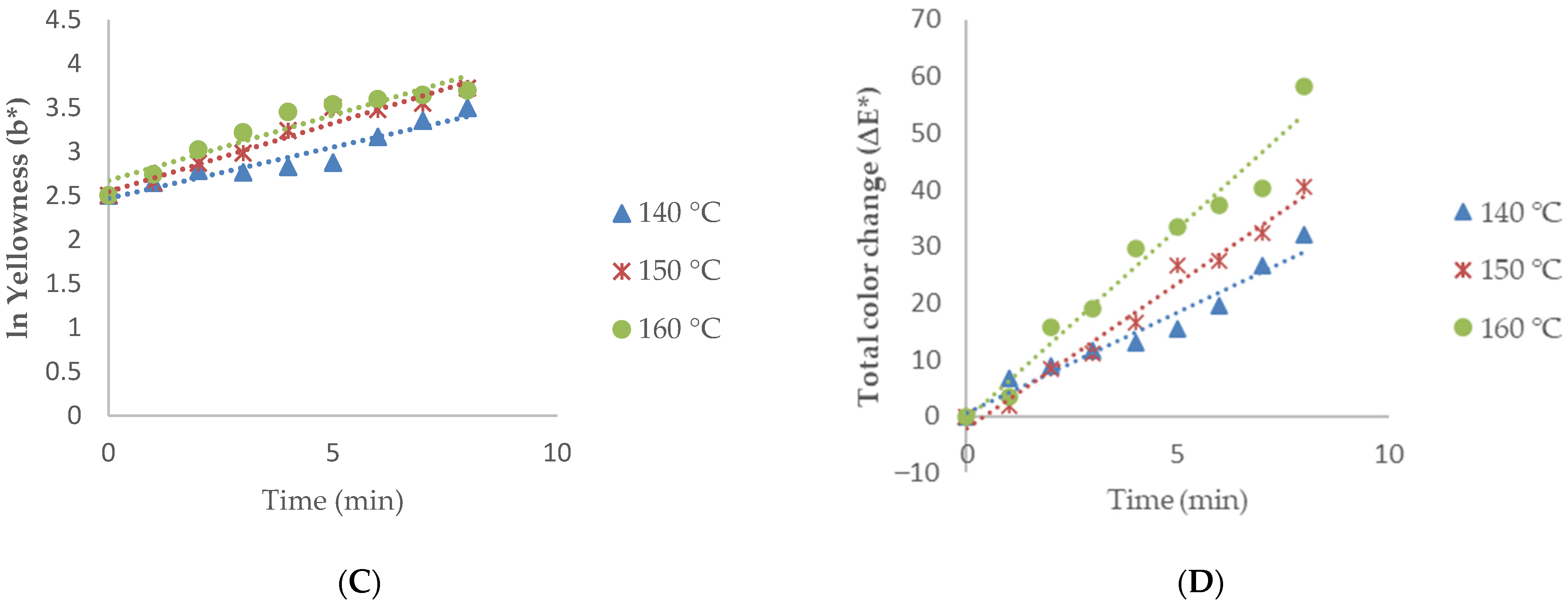
Figure 1A–D illustrates the L*, a*, b*, and ΔE changes of halloumi cheese for increasing frying times and temperatures during deep fat frying, respectively. The experimental results showed a temperature-dependent decrease in L* values from an initial (before frying) value of 80.02 to 59.19–48.46 for 8 min. The reduction in L* values during frying of halloumi cheese is mainly related to surface browning reactions, in particular the Maillard reaction and caramelization, both of which increase with increasing temperature. These reactions cause the surface to darken, resulting in a measurable decrease in lightness [28,29]. The Maillard reaction is particularly sensitive to environmental conditions such as moisture content, pH, and the presence of reducing sugars (lactose) and amino compounds, all of which are affected during thermal processing [30]. In addition, lipid oxidation on the cheese surface can contribute to discoloration, producing brown pigments that affect visual quality. Oil absorption during frying can also play a role by increasing heat transfer and promoting more intense browning. In addition, prolonged frying time or high temperature can lead to excessive surface dehydration [31], accelerating the browning process and further reducing of L* values.
In contrast, the a* and b* values showed an increasing trend, which can also be associated with similar browning mechanisms. These reactions promote the formation of colored pigments, enhancing the red and yellow hues on the surface of the halloumi cheese, as shown in Figure 1B,C. The a* and b* values increased exponentially from 0.72 to 13.21–17.15 and from 12.22 to 33.09–41.49, respectively. The total color change (ΔE) also increased during the frying process. The most rapid change in ΔE occurred within the first minute (0–1 min), with maximum values observed in the range 32.00–58.36, as shown in Figure 1D. In addition, the increase in a*, b* and ΔE values was significantly influenced by frying temperature (p < 0.05), with 160 °C showing the highest rates of browning and color formation, followed by 150 °C and 140 °C. These results confirm that higher temperatures accelerate pigment development and intensify overall color change in fried halloumi cheese.
Similar trends of color parameters were also obtained for several fried products like tofu [19], gulabjamun balls [17], khaja [32], sweet potato strips [33], sesame crackers [34], malpoa [35], etc.
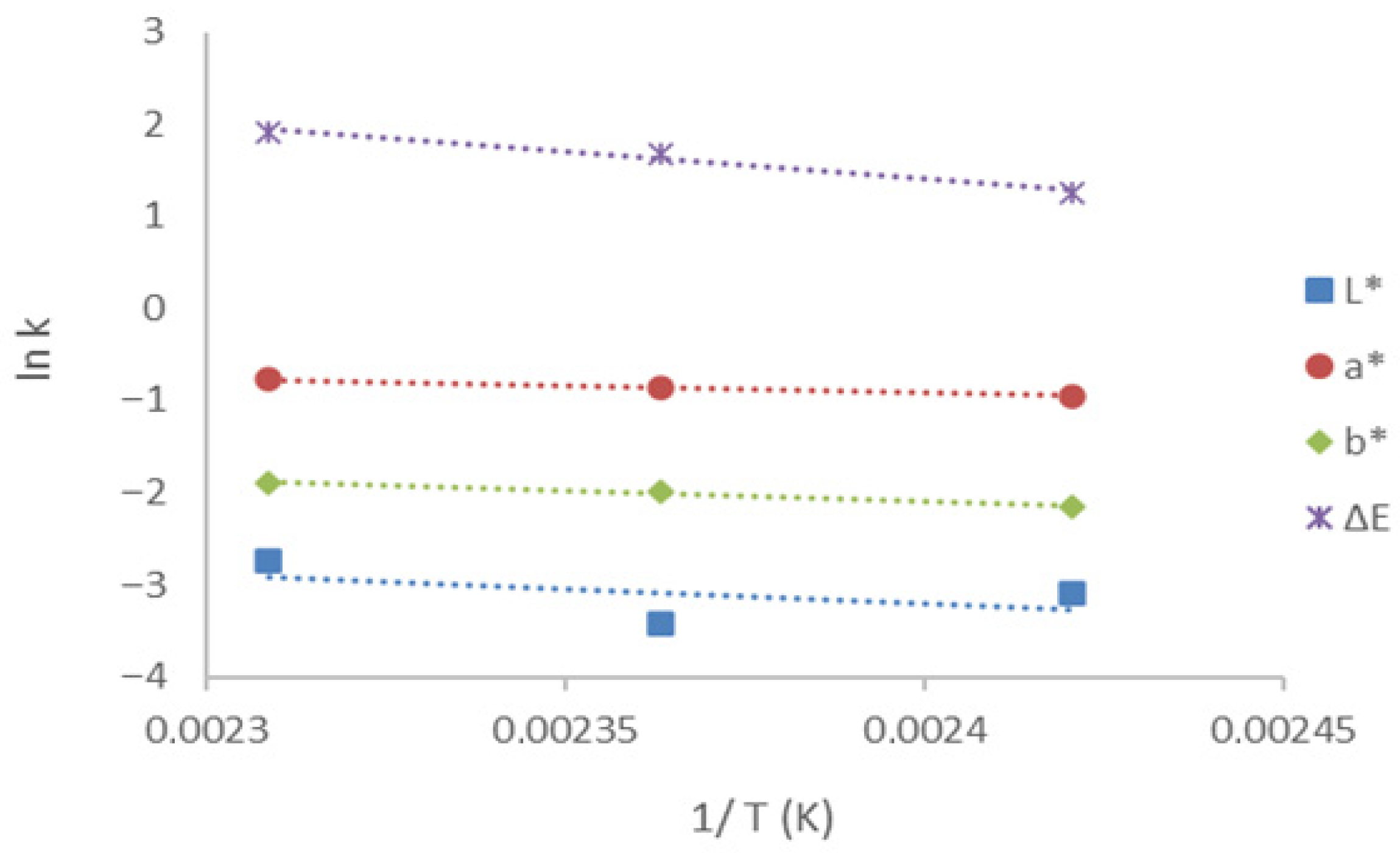
Based on the regression analysis, the reaction kinetics of L*, a*, and b* followed first order, whereas the changes in ΔE followed zero order kinetics (Figure 1). Table 1 shows the estimated surface color kinetic parameters of halloumi cheese during frying. Only the models with the highest determination coefficients (R2) and lowest root mean square error (RMSE) values are presented in this table. The activation energy (Ea) was also calculated for all the color kinetic parameters as shown in Figure 2. The observed activation energy (Ea) values for the color parameters L*, a*, b*, and ΔE were 25.235, 12.976, 18.516, and 48.950 kJ/mol, respectively.
Baik and Mittal [19] reported Ea values for fried tofu cheese of 76.0, 165, 117, and 119.3 kJ/mol for the L*, a*, b*, and ΔE color parameters, respectively. Although tofu is classified as a type of fried cheese, the values observed in the present study for halloumi cheese are considerably higher. The differences are due to several factors, such as the chemical composition and moisture content of the product. These parameters influence the Maillard reaction rate and pigment formation directly. Additionally, differences in frying conditions—such as the type of oil used, temperature uniformity, and the shape of the food sample—can significantly impact the heat and mass transfer mechanisms. As shown in previous research on fried food products, Ea values depend on product formulation and processing parameters. For example, Gupta et al. [35] reported Ea values of 58.19, 42.21, and 64.34 kJ/mol for the L*, b*/a*, and ΔE parameters, respectively, in fried malpoa.
In another study, Ea values for gulab jamun were found to be 43.52, 31.34, and 28.66 kJ/mol for L*, b*/a*, and ΔE, respectively [17]. A comparable trend was observed for chhena jili, with Ea values recorded at 38.46 kJ/mol for L*, 35.43 kJ/mol for b*/a*, and 32.59 kJ/mol for ΔE [21].
The results indicate that the color change in fried halloumi is less influenced by frying temperature compared to other fried foods within the range of 140–160 °C that was studied. Moreover, the non-enzymatic browning of halloumi cheese during the frying process is a rapid one. Not much energy is needed to promote color changes (darkness) at the cheese crust. This behavior can be explained by the characteristic composition of halloumi. The cheese contains very low levels of reducing sugars due to curd washing, but is rich in lysine-containing caseins and other free amino groups, which rapidly initiate Maillard browning even at moderate temperatures [36,37]. In protein-rich systems, pigment formation proceeds quickly with relatively small additional influence of higher temperatures [38]. Moreover, the rapid moisture loss at the surface during frying further accelerates early browning [39]. These mechanisms explain why the color change in halloumi develops quickly but shows comparatively less sensitivity to temperature increases within the 140–160 °C range.

3.2. Kinetics of Texture

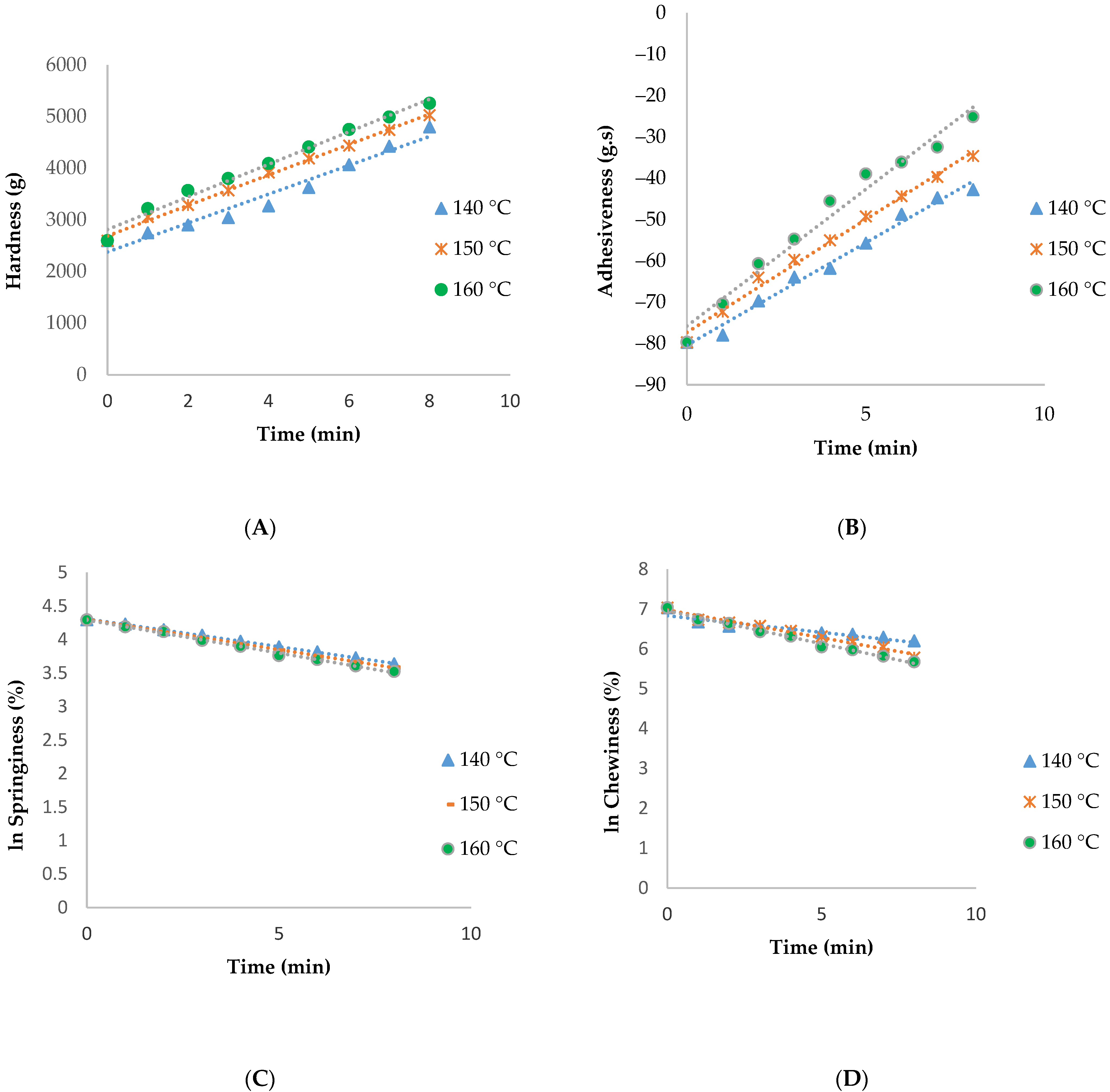
Figure 3A–D illustrates the hardness, adhesiveness, springiness, and chewiness changes of halloumi cheese for increasing frying times and temperatures during deep fat frying, respectively. The texture kinetic parameters play an important role in optimizing the frying process in terms of temperature, time, and the type of frying etc.
It is clear from Figure 3A that the hardness value of halloumi cheese increased gradually with time in proportion to the frying temperature. The increase could be due to higher moisture loss at high temperatures, which accelerated the crust formation process in the cheese. The initial hardness value of 2597.471 g increased to 4799.280, 5026.650, and 5256.719 g at 140, 150, and 160 °C, respectively, after 8 min of frying. These experimental changes in hardness value were best fitted to the zero-order kinetic model (Figure 3A). Similar increases in the texture kinetics of fried products were also explained by Mondal and Dash [21], Kumar et al. [17], and Moghaddam et al. [40] for chhena jhili, gulab jamun balls, and cookies, respectively, depending on the composition of the fried products.
Adhesiveness is measured as the negative force field of the product following the initial compression [41], and it exhibited a similar trend to that of hardness, as shown in Figure 3B. The initial value of the unfried cheese was −79.703 g·s, indicating a high level of stickiness. After 8 min of frying at temperatures of 140, 150, and 160 °C, the value significantly decreased to −42.780, −34.631, and −25.107 g·s, respectively. The data showed that frying resulted in a significant decrease in surface stickiness, most likely due to crust formation and moisture loss. A similar study by Khamrui et al. [42] found that frying paneer significantly reduced its stickiness to almost negligible levels, but made the product brittle. The rate constants obtained using the mathematical equation for zero-order kinetics are plotted against temperature in Figure 3B. The R2 and RMSE values found between the experimental and predicted data were in the acceptable range in Table 2.
Springiness followed the first-order kinetic model as shown in Figure 3C. Increasing the frying temperatures and times resulted in a reduction in springiness. The initial value was 73.248%, which decreased to 38.022%, 36.040%, and 33.842% in 8 min at 140, 150, and 160 °C, respectively. The reduction in springiness of halloumi cheese was attributed to structural and compositional changes induced by thermal treatment. Prolonged exposure to high temperatures caused the cheese’s proteins to denature and aggregate, disrupting the elastic network responsible for its springy texture [43]. Furthermore, the loss of moisture during frying resulted in a firmer, more compact structure that was less able to return its original shape after deformation [44]. These combined effects resulted in a decline in the springiness values, as also indicated by the first-order kinetic model observed in Figure 3C. The R2 and RMSE values between the experimental and predicted data were well within the limits of experimental error and are given in Table 2.
As can be seen in Figure 3D, the chewiness of the halloumi cheese followed the same pattern as its springiness during frying. The initial chewiness value was 1130.011%, which decreased to 492.518–290.506% with a higher frying temperature, causing a smaller chewiness. The reduction in chewiness was attributed to the combined effects of heat-induced protein denaturation and moisture loss. These mechanisms, which were also responsible for the reduction in springiness, indicated that the two textural parameters were subject to similar structural and compositional changes during frying. Consequently, the cheese’s ability to deform and return to its original shape decreased, resulting in lower chewiness values [1,44]. The reaction kinetics followed a first-order reaction (Figure 3D), and high regression coefficient values were calculated (Table 2).
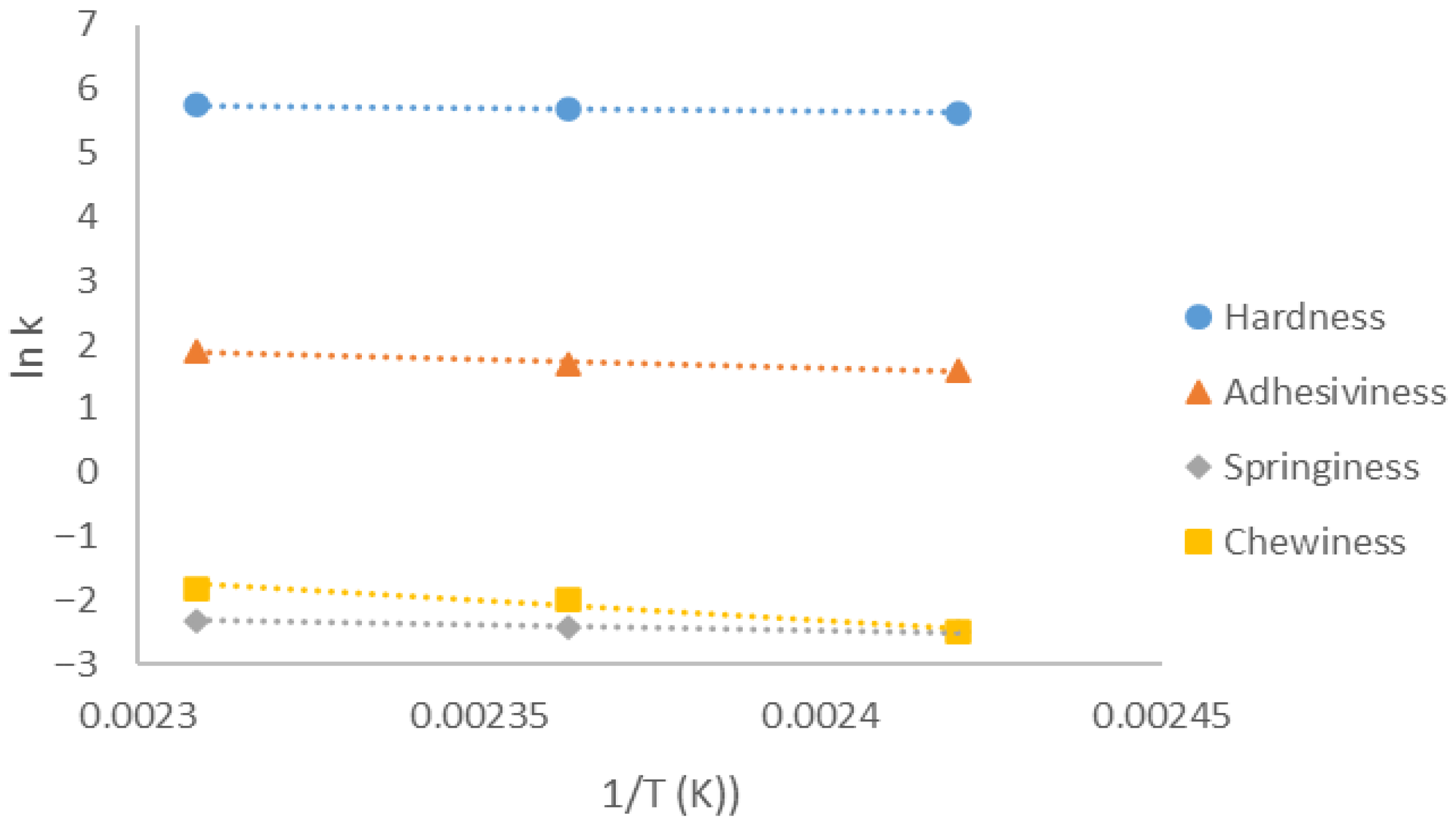
Figure 4 shows the Arrhenius plot of rate constants for texture parameter changes during the frying of halloumi cheese in the temperature range of 140–160 °C. The activation energy was 9.089, 21.438, 12.761, and 50.857 kJ/mol for the hardness, adhesiveness, springiness, and chewiness, respectively. The absence of published data on the activation energies of the texture parameters under frying conditions, especially about halloumi cheese, complicates meaningful comparisons with other studies. Therefore, this study provides valuable basic data for such dairy products and may assist in the optimization of frying processes.

3.3. Exergy Analysis Results

The exergy efficiency values for the frying process of halloumi cheese were calculated with and without considering evaporation, based on the values given in Table 3. The highest exergy efficiency (46.83%) was achieved with evaporation at 150 °C for 8 min, which was slightly higher than the value obtained at 160 °C for the same time period (46.31%). Conversely, shorter frying times and lower temperatures resulted in lower exergy efficiencies due to incomplete heat transfer and moisture removal. For example, the exergy efficiency values for all temperatures over two minutes were between 31.08% and 33.99%. This means that the energy used to fry the halloumi cheese is not being used as effectively.
When the exergy efficiency was calculated without considering evaporation, significantly lower values were observed across all frying conditions. At 140 °C, the exergy efficiency ranged from 5.62% at 2 min to 15.15% at 8 min. At 150 °C, it increased slightly from 5.97% at 2 min to 14.63% at 8 min, while at 160 °C, the efficiency varied from 5.57% at 2 min to 13.33% at 8 min. These results clearly demonstrate that neglecting the contribution of moisture removal considerably underestimates the energy utilization, highlighting the critical role of evaporation in enhancing the overall exergy performance during the frying of halloumi cheese.
Table 3 clearly shows that a moderate frying temperature, when combined with sufficient frying time, can achieve comparable or even superior energy utilization performance to higher temperatures. The result is interesting because it shows that higher frying temperatures do not always use energy most efficiently. Instead, it emphasizes the importance of finding the right balance between temperature and time for environmentally friendly and energy-efficient frying processes.
Several previous studies have shown a similar trend that high frying temperatures can adversely affect energy consumption, product quality, and process uniformity. Erim Köse [45] observed that increasing the frying temperature significantly increases mass transfer rates, particularly moisture diffusivity, during the deep-fat frying of churros, leading to elevated energy loss through moisture evaporation. Rywotycki [46] reported that continuous frying process models show the majority of the energy input is consumed by water evaporation rather than contributing to thermal processing, highlighting the important role of moisture dynamics in exergy analysis.
To the best of our knowledge, this is the first study investigating the exergy efficiency of halloumi cheese during the deep-fat frying process.

4. Conclusions

This study demonstrated that frying temperature and time significantly influence the color and texture development of halloumi cheese, with higher temperatures accelerating browning and intensifying textural changes. The optimum parameters of color texture and energy use were found at 150 °C for 8 min, where exergy efficiency reached its highest level. These findings show that the desired quality of the product can be achieved under moderate frying conditions, without the need for higher temperatures and longer frying times.
This study shows the importance of combining kinetic modeling and energy analysis as a useful method for comprehending the thermophysical behavior of dairy products during frying, in addition to quality assessment. This combined approach provides a science-based strategy for optimizing frying conditions, reducing energy losses and enhancing overall process sustainability. The knowledge gained from this research can assist manufacturers in designing more energy-efficient systems, improving process control, and ensuring consistent product performance across batches.
In conclusion, this study provides a practical guideline for fried halloumi production and a methodology that can be applied to other high-protein, deep-fat-fried foods. Future studies could build upon this approach by integrating sensory evaluation, characterizing oil-degradation behavior, and employing real-time energy monitoring to achieve a more comprehensive optimization of frying processes.

Funding

This research received no external funding.

Data Availability Statement

The original contributions presented in this study are included in the article. Further inquiries can be directed to the corresponding author.

Conflicts of Interest

The author declares no conflicts of interest.

Abbreviations

The following abbreviations are used in this manuscript:
ANOVAAnalysis of Variance
TFrying Temperature (°C)
tFrying Time (min)
Core TCore Temperature of Cheese (°C)
ΨExergy (kJ)
Ψ_inInput Exergy (kJ)
Ψ_cheeseProduct (Cheese) Exergy (kJ)
Ψ_vapEvaporation Exergy (kJ)
η_cheeseExergy Efficiency without Evaporation (%)
QtTotal Heat Input (kJ)
hfgLatent Heat of Vaporization (kJ/kg)
mMass (kg)
minminute
kThermal Conductivity (W/m·K)
ρDensity (kg/m3)
cpSpecific Heat Capacity (kJ/kg·K)
SPSSStatistical Package for the Social Sciences
L*Lightness (0 = black, 100 = white)
a*Redness (+a)/Greenness (−a)
b*Yellowness (+b)/Blueness (−b)
ΔETotal Color Difference
R2Coefficient of Determination
RMSERoot Mean Square Error

References

  1. Papademas, P.; Robinson, R.K. The sensory characteristics of different types of halloumi cheese as perceived by tasters of different ages. Int. J. Dairy Technol. 2001, 54, 94–99. [Google Scholar] [CrossRef]
  2. Kaminarides, S.; Rogoti, E.; Mallatou, H. Comparison of the characteristics of halloumi cheese made from ovine milk, caprine milk or mixtures of these milks. Int. J. Dairy Technol. 2000, 53, 100–105. [Google Scholar] [CrossRef]
  3. Gümüş, S. Branding within the scope of destination marketing: Hallum example. ASES Int. J. Cult. Art Lit. 2024, 3, 79–93. [Google Scholar]
  4. Scott, R.; Robinson, R.K.; Wilbey, R.A. Cheesemaking Practice; Springer: Berlin/Heidelberg, Germany, 1998. [Google Scholar]
  5. Elgaml, N.B.; Moussa, M.A.; Saleh, A.E. Impact of adding Moringa oleifera on the quality and properties of halloumi cheese. Egypt. J. Agric. Res. 2018, 96, 687–701. [Google Scholar] [CrossRef]
  6. Basiony, M.; Hassabo, R. Composition and quality of low-fat halloumi cheese made using modified starch as a fat replacer. Starch-Stärke 2022, 74, 2100211. [Google Scholar] [CrossRef]
  7. Tzamaloukas, O.; Neofytou, M.C.; Simitzis, P.E.; Miltiadou, D. Effect of farming system (organic vs. conventional) and season on composition and fatty acid profile of bovine, caprine and ovine milk and retail Halloumi cheese produced in Cyprus. Foods 2021, 10, 1016. [Google Scholar] [CrossRef]
  8. Lteif, L.; Olabi, A.; Baghdadi, O.K.; Toufeili, I. The characterization of the physicochemical and sensory properties of full-fat, reduced-fat, and low-fat ovine and bovine Halloumi. J. Dairy Sci. 2009, 92, 4135–4145. [Google Scholar] [CrossRef] [PubMed]
  9. Gamage, A.N.; Jeyasiri, R.; Hettiarachchi, D.D.; Munasinghe, S.S.; Dilrukshi, N. Physicochemical, microbiological, and sensory characterization of halloumi cheese fortified with garlic (Allium sativum) and pepper (Piper nigrum). Eng. Proc. 2023, 37, 109. [Google Scholar]
  10. Karimy, M.F.; Febrisiantosa, A.; Sefrienda, A.R.; Setiyawan, A.I.; Pratiwi, D.; Khasanah, Y.; Wahyono, T. The impact of adding different levels of spirulina on the characteristics of halloumi cheese. Int. J. Gastron. Food Sci. 2024, 38, 101050. [Google Scholar] [CrossRef]
  11. Bordin, K.; Tomihe Kunitake, M.; Kazue Aracava, K.; Silvia Favaro Trindade, C. Changes in food caused by deep fat frying—A review. Arch. Latinoam. Nutr. 2013, 63, 5–13. [Google Scholar] [CrossRef]
  12. Asokapandian, S.; Swamy, G.J.; Hajjul, H. Deep fat frying of foods: A critical review on process and product parameters. Crit. Rev. Food Sci. 2020, 60, 3400–3413. [Google Scholar] [CrossRef]
  13. Rani, L.; Kumar, M.; Kaushik, D.; Kaur, J.; Kumar, A.; Oz, F.; Oz, E. A review on the frying process: Methods, models and their mechanism and application in the food industry. Food Res. Int. 2023, 172, 113176. [Google Scholar] [CrossRef] [PubMed]
  14. Erim Köse, Y.; Doğan, İ.S. Determination of simultaneous heat and mass transfer parameters of tulumba dessert during deep-fat frying. J. Food Process Preserv. 2017, 41, e13082. [Google Scholar] [CrossRef]
  15. Ling, B.; Tang, J.; Kong, F.; Mitcham, E.J.; Wang, S. Kinetics of food quality changes during thermal processing: A review. Food Bioprocess Technol. 2014, 8, 343–358. [Google Scholar] [CrossRef]
  16. Šeruga, B.; Budžaki, S.; Ugarčić-Hardi, Ž. Individual heat transfer modes during baking of “mlinci” dough. Agric. Conspect. Sci. 2007, 72, 257–263. [Google Scholar]
  17. Kumar, A.J.; Singh, R.R.B.; Patel, A.A.; Patil, G.R. Kinetics of colour and texture changes in Gulabjamun balls during deep-fat frying. LWT-Food Sci. Technol. 2006, 39, 827–833. [Google Scholar] [CrossRef]
  18. Vélez-Ruiz, J.F.; Sosa-Morales, M.E. Evaluation of physical properties of dough of donuts during deep-fat frying at different temperatures. Int. J. Food Prop. 2003, 6, 341–353. [Google Scholar] [CrossRef]
  19. Baik, O.D.; Mittal, G.S. Kinetics of tofu color changes during deep-fat frying. LWT-Food Sci. Technol. 2003, 36, 43–48. [Google Scholar] [CrossRef]
  20. Nourian, F.; Ramaswamy, H.S. Kinetics of quality change during cooking and frying of potatoes: Part II. Color. J. Food Process Eng. 2003, 26, 395–411. [Google Scholar] [CrossRef]
  21. Mondal, I.H.; Dash, K.K. Textural, color kinetics, and heat and mass transfer modeling during deep fat frying of Chhena Jhili. J. Food Process Preserv. 2017, 41, e12828. [Google Scholar] [CrossRef]
  22. Vitrac, O.; Trystram, G.; Raoult-Wack, A.L. Deep-fat frying of food: Heat and mass transfer, transformations and reactions inside the frying material. Eur. J. Lipid Sci. Technol. 2000, 102, 529–538. [Google Scholar] [CrossRef]
  23. Genç, Ş.; Hepbaşlı, A. Performance assessment of a potato crisp frying process. Drying Technol. 2015, 33, 865–875. [Google Scholar] [CrossRef]
  24. Papademas, P.; Robinson, R.K. Halloumi cheese: The product and its characteristics. Int. J. Dairy Technol. 1998, 51, 98–103. [Google Scholar] [CrossRef]
  25. Kahyaoğlu, T.; Kaya, S.; Kaya, A. Effects of fat reduction and curd dipping temperature on viscoelasticity, texture and appearance of Gaziantep cheese. Food Sci. Technol. Int. 2005, 11, 191–198. [Google Scholar] [CrossRef]
  26. Zisopoulos, F.K.; Rossier-Miranda, F.J.; Van der Goot, A.J.; Boom, R.M. The use of exergetic indicators in the food industry—A review. Crit. Rev. Food Sci. Nutr. 2017, 57, 197–211. [Google Scholar] [CrossRef] [PubMed]
  27. Bühler, F.; Nguyen, T.V.; Jensen, J.K.; Holm, F.M.; Elmegaard, B. Energy, exergy and advanced exergy analysis of a milk processing factory. Energy 2018, 162, 576–592. [Google Scholar] [CrossRef]
  28. Pedreschi, F.; Kaack, K.; Granby, K. Acrylamide content and color development in fried potato strips. Food Res. Int. 2006, 39, 40–46. [Google Scholar] [CrossRef]
  29. Abduh, S.B.M.; Leong, S.Y.; Zhao, C.; Baldwin, S.; Burritt, D.J.; Agyei, D.; Oey, I. Kinetics of colour development during frying of potato pre-treated with pulsed electric fields and blanching: Effect of cultivar. Foods 2021, 10, 2307. [Google Scholar] [CrossRef]
  30. Sun, Y.; Lin, L.; Zhang, P. Color development kinetics of Maillard reactions. Ind. Eng. Chem. Res. 2021, 60, 3495–3501. [Google Scholar] [CrossRef]
  31. Oke, E.K.; Idowu, M.A.; Sobukola, O.P.; Adeyeye, S.A.O.; Akinsola, A.O. Frying of food: A critical review. J. Culin. Sci. Technol. 2018, 16, 107–127. [Google Scholar] [CrossRef]
  32. Kumar, S.; Nema, P.K.; Kumar, S.; Chandra, A. Kinetics of change in quality parameters of khaja during deep-fat frying. J. Food Process Preserv. 2022, 46, e16265. [Google Scholar] [CrossRef]
  33. Abd Rahman, N.A.; Abdul Razak, S.Z.; Lokmanalhakim, L.A.; Taip, F.S.; Mustapa Kamal, S.M. Response surface optimization for hot air-frying technique and its effects on the quality of sweet potato snack. J. Food Process Eng. 2017, 40, e12507. [Google Scholar] [CrossRef]
  34. Tan, S.B.; Shamsudin, R.; Mohammed, A.P.; Abdul Rahman, N.A. Colour changes during deep-frying of sesame cracker’s dough balls. In Proceedings of the III International Conference on Agricultural and Food Engineering, Kuala Lumpur, Malaysia, 23–25 August 2016; Volume 1152, pp. 55–62. [Google Scholar]
  35. Gupta, P.; Mondal, I.H.; Dash, K.K.; Geetika; Suthar, T.; Ramzan, K.; Béla, K. Deep fat frying characteristics of Malpoa: Kinetics, heat, and mass transfer modeling. Processes 2024, 12, 2662. [Google Scholar] [CrossRef]
  36. Hayaloglu, A.A. Cheese varieties of Cyprus. Int. J. Dairy Technol. 2009, 62, 13–23. [Google Scholar]
  37. Morales, F.J.; Jiménez-Pérez, S. Free radical scavenging capacity of Maillard reaction products. Food Chem. 2004, 90, 695–701. [Google Scholar]
  38. Martins, S.I.F.S.; Jongen, W.M.F.; van Boekel, M.A.J.S. A review of Maillard reaction in food and implications to kinetic modelling. Trends Food Sci. Technol. 2001, 11, 364–373. [Google Scholar] [CrossRef]
  39. Buera, M.P.; Schebor, C.; Elizalde, B.E. Effects of carbohydrate–protein interactions on Maillard browning kinetics in dehydrated food systems. Food Sci. Technol. Int. 2003, 9, 143–155. [Google Scholar]
  40. Abdollahi Moghaddam, M.R.; Rafe, A.; Taghizadeh, M. Kinetics of color and physical attributes of cookie during deep-fat frying by image processing techniques. J. Food Process Preserv. 2015, 39, 91–99. [Google Scholar] [CrossRef]
  41. Antoniou, K.D.; Petridis, D.; Raphaelides, S.; Omar, Z.B.; Kesteloot, R. Texture assessment of French cheeses. J. Food Sci. 2000, 65, 168–172. [Google Scholar] [CrossRef]
  42. Khamrui, K.; Dutta, S.; Dave, K. Effect of frying, freezing and rehydration on texture profile of Paneer and relationships between its instrumental and sensory textural attributes. Milchwiss.-Milk Sci. Int. 2004, 59, 640–645. [Google Scholar]
  43. Freire, P.; Zambrano, A.; Zamora, A.; Castillo, M. Thermal denaturation of milk whey proteins: A comprehensive review on rapid quantification methods being studied, developed and implemented. Dairy 2022, 3, 500–512. [Google Scholar] [CrossRef]
  44. Tarapata, J.; Szymańska, E.; van der Meulen, L.; Miltenburg, J.; Huppertz, T. Moisture Loss from Cheese During Baking: Influence of Cheese Type, Cheese Mass, and Temperature. Foods 2025, 14, 165. [Google Scholar] [CrossRef] [PubMed]
  45. Erim Köse, Y. Kinetic Modeling of Heat and Mass Transfer During Deep Fat Frying of Churro. Bilge Int. J. Sci. Technol. Res. 2025, 6, 46–51. [Google Scholar] [CrossRef]
  46. Rywotycki, R. A model of heat energy consumption during frying of food. J. Food Eng. 2003, 59, 343–347. [Google Scholar] [CrossRef]
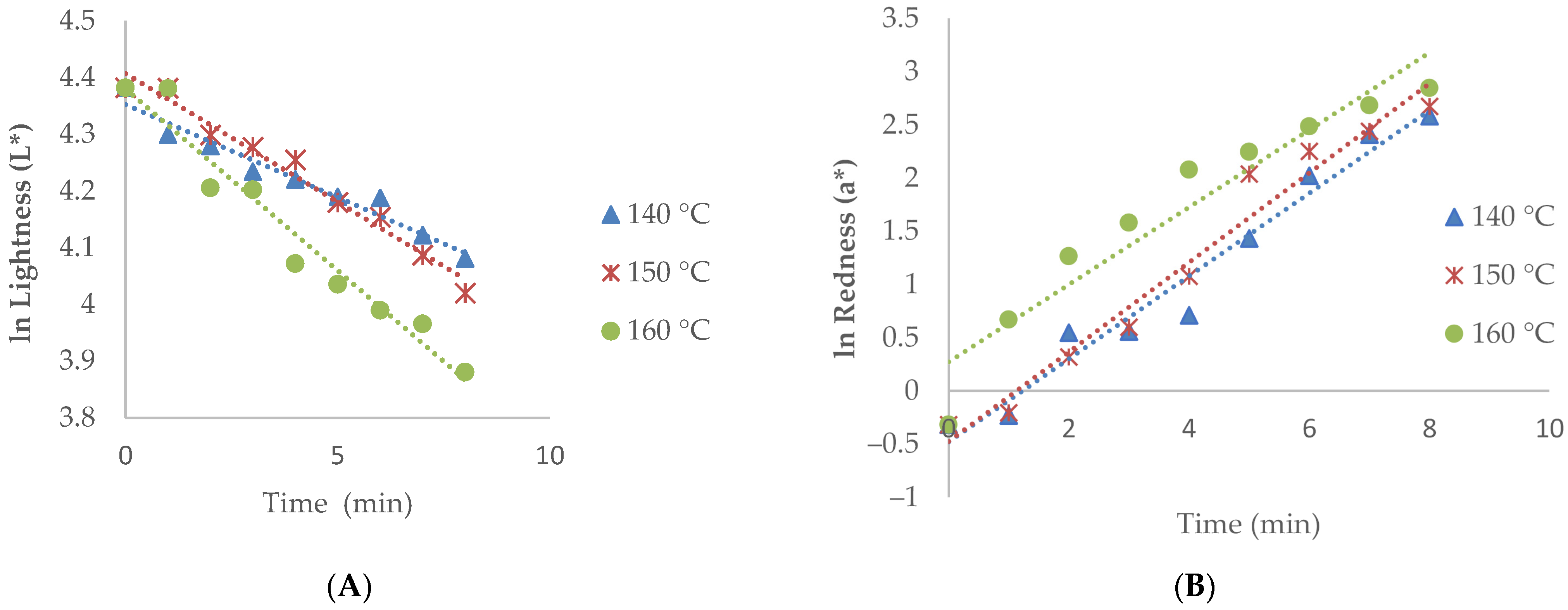
Figure 1. Changes in color parameters of halloumi cheese during deep-fat frying: (A) lightness (L*), (B) redness (a*), (C) yellowness (b*), (D) total color change (ΔE).
Processes 14 00039 g001aProcesses 14 00039 g001b
Figure 2. Arrhenius plot of temperature dependence of rate constant of lightness (L*), redness (a*), yellowness (b*) and total color change (ΔE).
Processes 14 00039 g002
Figure 3. Changes in textural properties of halloumi cheese during deep-fat frying: (A) hardness, (B) adhesiveness, (C) springiness, and (D) chewiness.
Processes 14 00039 g003
Figure 4. Arrhenius plot of temperaure dependence of rate constant of hardness, adhesiveness, springiness and chewiness.
Processes 14 00039 g004
Table 1. Parameters of color kinetics.
ParameterT (°C)Modelk (min−1)R2RMSEEa (kJ/mol)
L*140
150
160
First-order kinetic0.0453 ± 0.21 b
0.0237 ± 0.04 a
0.0641 ± 1.01 c
0.975
0.9573
0.9567
0.035
0.033
0.033
25.235 ± 0.59 c
a*140
150
160
First-order kinetic0.3889 ± 0.35 a
0.4220 ± 0.05 b
0.4631 ± 0.21 c
0.966
0.967
0.914
0.178
0.189
0.186
12.976 ± 0.44 a
b*140
150
160
First-order kinetic0.1163 ± 0.02 a
0.1358 ± 0.42 b
0.1491 ± 0.11 c
0.919
0.963
0.911
0.084
0.073
0.113
18.516 ± 0.28 b
∆E140
150
160
Zero-order kinetic3.4849 ± 1.22 a
5.3454 ± 1.20 b
6.7192 ± 0.82 c
0.934
0.982
0.950
1.005
1.007
0.993
48.950 ± 0.46 d
T: frying temperature; k: reaction rate constant; R2: coefficient of determination, RMSE: root mean square error between experimental and predicted data. a–d Within the same parameter, values with different letters indicate significant differences between frying temperatures (p < 0.05). ±Standard deviation (n = 3).
Table 2. Parameters of texture kinetics.
ParameterT (°C)Modelk (min−1)R2RMSEEa (kJ/mol)
Hardness140
150
160
Zero-order kinetic279.24 ± 0.59 a
294.85 ± 0.42 b
315.57 ± 0.29 c
0.957
0.996
0.986
0.143
0.411
0.880
9.089 ± 0.11 a
Adhesiveness140
150
160
Zero-order kinetic4.957 ± 0.22 a
5.467 ± 0.21 b
6.619 ± 0.22 c
0.9865
0.9917
0.9762
0.151
0.122
0.253
21.438 ± 0.08 c
Springiness140
150
160
First-order kinetic−0.082 ± 0.011 c
−0.090 ± 0.010 b
−0.098 ± 0.011 a
0.999
0.998
0.995
0.005
0.007
0.016
12.761 ± 0.08 b
Chewiness140
150
160
First-order kinetic−0.083 ± 0.22 c
−0.138 ± 0.19 b
−0.164 ± 0.018 a
0.895
0.988
0.976
0.083
0.052
0.043
50.857 ± 0.41 d
T: frying temperature; k: reaction rate constant; R2: coefficient of determination, RMSE: root mean square error between experimental and predicted data. a–d Within the same parameter, values with different letters indicate significant differences between frying temperatures (p < 0.05). ±Standard deviation (n = 3).
Table 3. Exergy efficiency values of halloumi cheese during deep fat frying.
T (°C)Time (min)Core T (°C)Product Exergy (kJ)Evaporation Exergy (kJ)Exergy Efficiency Without Evap (%)Exergy Efficiency with Evap (%)
140241.20.01090.04925.62 a31.08 a
140455.10.03600.09849.80 b36.58 c
140667.00.06790.147712.90 e40.97 e
140877.30.10160.196915.15 g44.52 f
150245.40.01690.07895.97 a33.53 b
150462.50.10390.157710.07 c39.20 d
150676.80.12190.236912.83 e43.52 f
150888.80.14210.314514.63 f46.83 h
160246.80.01920.09845.57 a33.99 b
160465.10.06100.19699.32 b39.30 b
160680.40.11050.295311.78 d43.29 f
160893.30.15920.393813.33 f46.31 g
T: frying temperature; Time: frying time; Core T: core temperature of cheese; Product exergy: exergy of fried cheese; Evaporation exergy: exergy of evaporated moisture; Exergy efficiency (without/with evap.): exergy efficiency excluding or including evaporation. a–h Within the same parameter, values with different letters indicate significant differences between frying temperatures (p < 0.05). ±Standard deviation (n = 3).
Disclaimer/Publisher’s Note: The statements, opinions and data contained in all publications are solely those of the individual author(s) and contributor(s) and not of MDPI and/or the editor(s). MDPI and/or the editor(s) disclaim responsibility for any injury to people or property resulting from any ideas, methods, instructions or products referred to in the content.