


Abstract
The commitment to the Sustainable Development Goals and the need for increasing the circularity of industrial processes call for the exploitation of byproducts to generate value-added chemicals in cost- and energy-advantageous processes. In this process simulation-based research, two technologies were evaluated for the synthesis of isoamyl acetate from fusel oil: (A) an indirect process, and (B) a direct process using reactive distillation. Aspen Hysys v14.0 was used for simulation. A sensitivity analysis was performed to identify the influence of operating parameters on product purity, isoamyl acetate recovery and productivity, and energy consumption. Technology B was found to be the most favorable, obtaining 22.27 kg/h of isoamyl acetate with a purity of 98%. The total consumption values of cooling water and heating were 24.33 kW and 24.50 kW, respectively. Based on the best conditions, a technical–economic analysis was performed that demonstrated the viability of the process, obtaining a net present value (NPV) of US$3,587,110/year, an internal rate of return (IRR) of 38.95% and a payback period (PP) of 5.05 years. If acid recirculation is considered in the process, an NPV of US$7,232,950, an IRR of 56.34%, and a PP of 3.56 years are obtained.
1. Introduction
The production of bioethanol has grown in recent years, becoming one of the most important activities in the development of the renewable energy sector. This growth is closely tied to the value of its production and the increasing demand for renewable fuels [1]; however, its production is associated with the generation of byproducts and waste that call its sustainability into question. Currently, agro-industrial waste has emerged as a valuable resource in the pursuit of renewable energy sources, as it can be exploited to produce a wide range of chemical components, thereby improving the sustainability of the production chain [2].
Resulting from the distillation of the wine produced in the fermentation of sugarcane juice for bioethanol production, the byproduct fusel oil has high potential for transformation into high-value-added compounds [3,4]. It is primarily composed of a mixture of higher alcohols and water. Its prominent components include ethanol, isoamyl alcohol (3-methyl-1-butanol), 1-propanol, 2-propanol, butanol isomers (n-butanol, isobutanol), as well as traces of other organic compounds, such as esters and aldehydes. These components vary depending on the raw material source, fermentation and distillation conditions, and nitrogen content [1,3,5,6].
Fusel oil yields can vary between 1 and 11 L per 1000 L of bioethanol produced [2,7,8]. In countries with high bioethanol production, the potential to valorize fusel oil to produce more profitable and less polluting products represents a great opportunity to transform the bioethanol industry into a more sustainable one, with increasing circularity. Among the potential uses of fusel oil, the production of esters from its constituent alcohols emerges as an alternative for obtaining natural acetates from this low-cost agro-industrial byproduct. Esters, renowned for their flavor and fragrance properties, are valuable compounds in multiple industrial sectors, notably used in the development of fragrances, food additives, pharmaceuticals, cosmetics, toiletries, and beverages [9,10,11,12].
In this context, Sánchez et al. [13] propose two approaches for the esterification of alcohols present in fusel oil: the indirect process, which requires prior separation of individual alcohols before their esterification with carboxylic acids, and the direct process, where the complete mixture of alcohols reacts simultaneously with the carboxylic acid.
The separation of fusel oil into its constituent alcohols is achieved by batch or continuous distillation, which involves multiple columns in an energy-intensive process, since fusel oil contains several azeotropes that make separation difficult. In this sense, reactive distillation (RD) is presented as an innovative process intensification technology that offers significant advantages over conventional technologies by integrating the reaction and separation stages into a single unit. This synergy not only significantly reduces energy requirements but also avoids the difficult task of separating azeotropes, due to the consumption of components by the reaction [14,15,16,17,18].
Process simulation is a tool that enables the representation and analysis of complex real systems through mathematical models. Its application is particularly useful in scenarios involving multiple interrelated variables, as it facilitates conceptual design, optimization, control, and comparative evaluation of technologies. This justifies its use as a tool for assessing fusel oil valorization technologies [19,20].
Previous studies have proposed different alternatives for fusel oil valorization. Table 1 presents a summary of the literature studies, highlighting the technologies employed and their main results.

Table 1.
Fusel oil valorization studies.
These studies confirm the potential of this byproduct for obtaining high-value-added esters and highlight the need to evaluate the technical and economic efficiency of the processes involved.
Although fusel oil has been extensively studied as a byproduct of the bioethanol industry, few studies analyze its direct esterification via reactive distillation, starting directly from the complex mixture of alcohols present in fusel oil. Most existing research focuses on the esterification of pure isoamyl alcohol with acetic acid or on the prior separation of isoamyl alcohol through independent processes. Previous studies do not address operations that integrate both stages, nor do they offer a comparison between direct and indirect routes for fusel oil valorization.
In this context, the present research evaluates two technological routes for the synthesis of isoamyl acetate from fusel oil: a direct process and an indirect process, both based on reactive distillation technology. This study aims to compare both processes to identify differences in energy performance, separation efficiency, operational complexity, and economic viability—aspects that have not been comprehensively addressed in the literature on fusel oil valorization. To this end, the Aspen Hysys simulator was used to evaluate these technologies. A sensitivity analysis was performed to analyze the influence of different variables (reflux ratio, temperature, reactant feed ratio, and feed stage) on the process results. Subsequently, the economic viability of the most advantageous technology was evaluated.
2. Materials and Methods
Based on studies carried out in the literature, two technologies were evaluated for the synthesis of isoamyl acetate from fusel oil [26]:
- Technology A (indirect process): Separation of isoamyl alcohol followed by its esterification via reactive distillation.
- Technology B (direct process): Esterification of fusel oil through reactive distillation, with subsequent purification of isoamyl acetate.
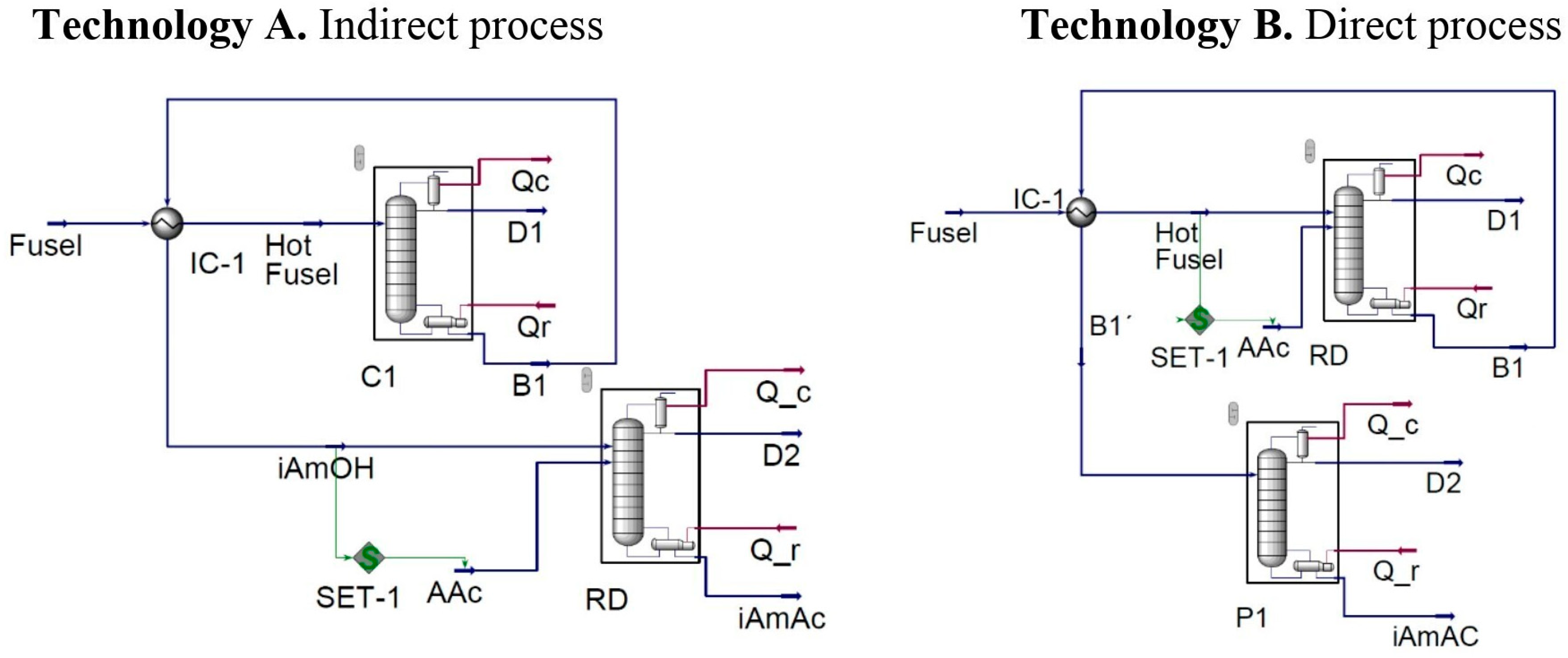
In the case of Technology A, the first step corresponds to a conventional distillation (column C1), whose objective is to separate the isoamyl alcohol in the bottom stream (B1), simultaneously removing water and other light components present in the fusel oil, which are collected in the distillate stream (D1). In the second step, the isoamyl alcohol (iAmOH stream) is fed to a reactive distillation (RD) column, where it reacts with acetic acid (AAc stream) to form the desired product, isoamyl acetate, which is obtained in the bottom stream (iAmAc).
Technology B proposes an inverse configuration: in the first step, the entire alcohol mixture from the fusel oil reacts directly with acetic acid in a reactive distillation (RD) column, generating isoamyl acetate as the main product, collected in the bottom stream (B1). This stream is subsequently treated in a second distillation column (P1), whose function is to purify the final product, obtaining a stream rich in isoamyl acetate (iAmAc).
2.1. Selecting Components and Property Packages
For this study, the Aspen Hysys v14.0 simulator (AspenTech, Bedford, MA, USA) was used as a tool widely recognized for its application in research, development, simulation, and design of chemical processes [20]. For the simulation of the technologies, 31.36 kg/h of fusel was considered, whose composition in volumetric fraction was previously characterized by Aleaga et al. [24], and this is detailed in Table 2. Both the flow rate and composition were selected from data obtained from a distillery with a production capacity of 90,000 L/d of extrafine ethanol, in which the generated fusel oil flow represents approximately 1% of the plant’s capacity.
Table 2.
Volumetric fraction composition of fusel oil.
For selecting thermodynamic properties based on the polar and non-electrolytic nature of fusel oil, the Nonrandom Two-Liquid (NRTL) property package was employed for the liquid phase. This model was used due to the highly non-ideal nature of fusel oil, which is a complex mixture of alcohols and water with strong specific interactions and significant deviations from ideal behavior. The NRTL model is one of the most suitable and widely used in the literature for representing polar, highly non-ideal, and partially miscible systems such as those that characterize fusel oil [4,24].
For the vapor phase, due to the non-ideality of the system introduced by the dimerization of acetic acid in this phase [27,28], the Peng-Robinson (PR) equation of state was used. This equation is employed in the literature to accurately represent simultaneously properties such as liquid-vapor equilibrium, liquid-phase volume, and excess enthalpy of complex mixtures formed by non-polar and polar substances [29,30,31]. Therefore, the NRTL-PR thermodynamic model was selected to estimate the thermodynamic properties in the simulations.
The Supplementary Material provides the vapor pressure coefficient values of the Antoine equation for the thermodynamic systems considered in this study.
2.2. Modeling and Operating Conditions
The simulated processes are structured in two main steps, as illustrated in Figure 1. For the construction of the simulation models for both technologies, a total of three modules were used to represent the main steps of the process: Heat Exchanger, Distillation column, and Set.
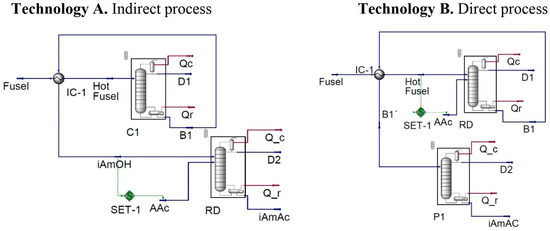
Figure 1.
Simulation models of Technologies A and B.
In Technology A, the fractionation of fusel oil into its constituent alcohols is simulated using the Distillation column module (C1), and in the case of Technology B, this module simulates the isoamyl acetate purification column (P1) to obtain higher purity in the final product. The Heat Exchanger (IC-1) module is employed in both technologies to integrate the distillation bottom stream and the incoming fusel oil, allowing for a reduction in heat consumption.
The Set module (SET-1) is used in both technologies to establish a relationship between two process streams. In the case of Technology A, the molar flow rate of acetic acid was related to the molar flow rate of isoamyl alcohol separated at the bottom of the first column. In Technology B, the molar flow rate of acetic acid was related to the molar flow rate of fusel oil at the reactive distillation column inlet. In both technologies, the Set module uses a ratio of 1 between the involved streams [24,26].
To simulate the reactive distillation process, a system that simultaneously integrates reaction and separation stages, the Distillation column module (RD) was used. This module allows the esterification chemical reactions of the process to be associated with it. The corresponding equilibrium reactions were added, in which isoamyl (C5H11OH), isobutyl (C4H9OH), and ethyl (C2H5OH) alcohols react with acetic acid (C2H4O2) to form their respective esters, isoamyl acetate (C7H14O2), isobutyl acetate (C6H12O2), and ethyl acetate (C2H5OH), along with water. The equilibrium reactions employed were as follows:
Technology A:
C5H11OH + C2H4O2 ↔ C7H14O2 + H2O
Technology B:
C5H11OH + C2H4O2 ↔ C7H14O2 + H2O
C4H9OH + C2H4O2 ↔C6H12O2 + H2O
C2H5OH + C2H4O2 ↔ C4H8O2 + H2O
The operating conditions for the simulation of the distillation columns are detailed in Table 3. All columns operate at constant pressure with equilibrium stages. In the case of Technology A, the feed conditions of the reactive column and the reactive stages correspond to those reported by Sánchez et al. [26] for the synthesis of isoamyl acetate by indirect process (esterification of isoamyl alcohol with acetic acid).
Table 3.
Operating conditions of Technologies A and B.
In the case of Technology B, the operating conditions of the reactive distillation column were taken from the study conducted by Aleaga et al. [24], in which the authors evaluated a reactive distillation process for the synthesis of esters from the direct process (esterification of the mixture of fusel alcohols with acetic acid).
2.3. Sensitivity Analysis
A sensitivity analysis was conducted to determine the influence of key operating parameters on process efficiency, product purity, and energy consumption. To do this, one operating variable was modified while holding all other parameters constant. The various parameters were selected based on those most studied and influential in this type of system. Reflux ratio, feed stage location, feed temperature, and reactant molar ratio were evaluated according to previous studies available in the literature [7,14,32,33].
For the feed temperature, the literature reports fusel oil esterification studies in ranges from 40–50 °C [7] to values close to 90 °C [26]. Consequently, a study range of 50–90 °C was selected.
Regarding the molar ratio of reactant feed, de Lima et al. [7] report that operating with an excess of acid favors higher ester yields, while an excess of alcohol reduces alcohol consumption but also limits the formation of the desired product. Considering these results, this study evaluated the molar ratio of feed in the range of 1:1–2:1.
For the Technology A distillation column, three main variables were considered. Firstly, the influence of the fusel oil feed temperature (50 to 90 °C) on energy consumption was analyzed. Secondly, the effect of the reflux ratio (RR) (1 to 8) on the purity, mass flow rate, and recovery of isoamyl alcohol and energy consumption was evaluated. Finally, the influence of the fusel oil feed location, between stages 11 and 20, was studied to determine its effect on product purity and flow rate.
For the Technology A reactive column, the RR was varied between 7.5 and 11.5. The acid/alcohol molar ratio (1:1 to 2:1) was also analyzed to determine its influence on the flow rate and purity of isoamyl acetate. The influence of the feed location of the reactants within the reactive zone (stages 5 to 20) was evaluated by varying its position between stages 3 and 13. First, the acid feed stage was modified, keeping the alcohol feed constant (stage 3). Subsequently, the alcohol feed was shifted between the same stages, keeping the acid feed constant (stage 13).
In the case of Technology B, for the reactive column, the variation in the RR (1 to 8) was studied, the feed temperature of the fusel oil stream was evaluated (50 to 90 °C), keeping the acid temperature constant at 90 °C. The acid/fusel molar ratio (1:1 to 2:1) and the effect of the feed of the reactant mixture were analyzed, varying between stages 11 and 20 within the reactive zone (trays 5 to 20). Finally, in the purification column, the influence of the RR (7.5 to 11.5) and the isoamyl acetate feed stage (stages 20 and 28) was evaluated.
Sensitivity analysis does not allow for determining the effect of interactions associated with different values of the variables. To overcome this limitation, a Taguchi L9 fractional experimental design matrix was constructed to assess the impact of interactions at different levels of the independent variables (−1: pessimistic extreme value, 0: normal value, 1: optimistic extreme value) [34]. Table 4 shows the Taguchi orthogonal arrangement used for each case with the corresponding factors and levels.
Table 4.
Design used for each technology.
2.4. Economic Assessment
Based on the results obtained from the simulator, an economic evaluation of the most favorable technology for the process was conducted using Aspen Economic Analyzer v14.0. Capital expenditures (CAPEX) and operating expenses (OPEX) were calculated, in addition to economic indicators such as net present value (NPV), internal rate of return (IRR), and payback period (PP). For this purpose, an operating time of 8000 h/y, a useful life of 10 years, and a general discount rate of 12% were considered. A cost of 13 US$/kg for acetic acid [35], a fusel oil price of 0.072 US$/L [36], and a selling price of isoamyl acetate of 38 US$/L were considered [37]. The unit cost of utility services (TUC) was calculated based on the cost of heating (LP steam) and cooling water.
3. Results and Discussion
3.1. Results Obtained from the Simulation
Based on Table 3 of operating conditions, it is possible to identify similarities and differences between the operating parameters of Technology A and Technology B. First, both technologies operate at atmospheric pressure (101.3 kPa), maintain a molar feed ratio equal to 1 in their reactive columns, and have a reactive zone between stages 5 and 20.
Among the differing parameters, the fusel oil feed stages stand out. In Technology A, the fusel oil is fed to stage 11 of column C1 to facilitate the initial separation of its constituents, while in Technology B, the feed conditions reported by Aleaga et al. [24] are used for the simultaneous reaction and separation of the fusel alcohol mixture for the production of isoamyl acetate. Regarding the reactive columns of both technologies, differences are observed in the number of stages, the location of the acid feed, the reflux ratio, and the acid concentration in the distillate. These differences are due to the composition of the feed streams and the design criteria employed in each case.
The differences observed between the operating parameters of both technologies have implications for the process’s energy performance. In the case of the reactive column of Technology A, it exhibits a higher reflux ratio and a greater number of stages. This tends to result in higher thermal demands and, in turn, increases the need for auxiliary services, specifically higher steam consumption in the reboiler and higher cooling water consumption in the condenser. In terms of sizing, columns with a greater number of stages result in taller and larger-diameter equipment, which increases the cost of manufacturing, installation, and thermal insulation. From an economic standpoint, these differences are reflected in both CAPEX and OPEX. Higher reflux and the presence of reactive sections in the columns raise operating costs associated with energy consumption and auxiliary services, while configurations with additional stages or high purity requirements increase the investment in equipment. However, the integration of reaction and separation could offset some of these costs by reducing the number of independent units and improving the overall process performance.
The results were analyzed based on key process variables, such as reactant conversion, component distribution, and process operating conditions. Table 5 and Table 6 present the main results obtained for Technologies A and B, respectively.
Table 5.
Results of Technology A.
Table 6.
Results of Technology B.
Technology A produces 19.64 kg/h of isoamyl acetate with 99.05% w/w purity, with a total consumption of cooling water and heating of 34.38 kW and 35.31 kW, respectively. In terms of fractionation, it is possible to recover 95.39% of isoamyl alcohol in the bottom stream of column C1 with a mass composition of 0.9621, which demonstrates an efficient recovery of the compound of interest. In parallel, the most volatile compounds such as ethanol, water, and isobutanol are concentrated in the overhead stream (D1), indicating the correct separation of the fusel oil components.
In the reactive distillation column, an isoamyl alcohol conversion of 90.89% is achieved, demonstrating a favorable reaction under the established operating conditions. In addition, a bottom stream with a purity of 99.05% w/w isoamyl acetate by mass is obtained, confirming the efficiency of the process both in terms of conversion and quality of the final product.
Technology B produces 22.27 kg/h of isoamyl acetate with 98.10% w/w purity, with a total consumption of cooling water and heating of 24.33 kW and 24.50 kW, respectively. Despite the complexity of the multicomponent mixture, this technology allows for effective conversion of isoamyl alcohol in the reactive column, achieving 98.84% conversion and a mass fraction of 0.9382 of isoamyl acetate in the bottom stream. These results demonstrate a highly favorable reaction, even in the presence of other compounds in the feed stream. Furthermore, a conversion of 96.23% of ethanol and 71.67% of isobutanol is achieved.
In the purification stage, 81.04% of the isoamyl acetate is recovered, with a purity of 98.10% w/w at the bottom. However, despite the purification process, 1-pentanol is not completely separated, with a residual mass fraction of 0.0179. This limitation can be attributed to the proximity of its normal boiling point (138 °C) to that of isoamyl acetate (142 °C), which makes its separation by conventional distillation difficult.
After comparing both technologies, it is observed that Technology B, although producing the ester with a slightly lower purity (98% w/w) than Technology A (99% w/w), achieves a higher productivity (22.27 kg/h compared to 19.64 kg/h of Technology A), which represents an approximate increase of 13.39%. In terms of energy requirements, Technology B presents lower consumption, with reductions of 29% in the case of cooling water and 31% for heating, so it is considered more advantageous from a technical and operating point of view.
These results were compared with previous fusel oil valorization studies involving direct and indirect processes (Table 1). Based on the results obtained in this work (Technology A), isoamyl alcohol was separated using a single distillation column, achieving a recovery of 95.39% and a purity of 0.9621 w/w. Although these values are slightly lower than those reported by Mendoza-Pedroza et al. [2] and Montoya et al. [22], the purity obtained is 17.62% higher than that reported by Ferreira et al. [21]. It is worth noting that the configuration proposed in this study presents lower operational complexity compared to previous works, since it dispenses with additional units such as decanters or multiple columns. The high purity achieved (over 96%) demonstrates that even with a simpler configuration, it is possible to obtain a high-quality product.
Comparing the results obtained in the present work with the reactive distillation process proposed by Ali et al. [14], a slightly lower purity of 99.05% w/w is evident, which is still high and suitable for industrial applications. Furthermore, in both cases, water was completely removed from the bottom stream, and in the proposed configuration, only a small amount of 1-pentanol was present (mass fraction of 0.0095). Similarly, the thermal profile in which the reactive column operates (96.54 to 141.4 °C) is in a similar range to that of the study by Ali et al. [14] (85 to 140 °C). Regarding the conversion of isoamyl alcohol, the results also show very similar values; in Technology A of the present work, a value of 90.89% was achieved, very close to the 91% reported in the comparative study.
On the other hand, in the esterification process simulated by Patil and Kulkarni [23], although the reported conversion was higher than that obtained in this work (90.98%), the purity achieved in this investigation (99.05%) was considerably higher, demonstrating greater effectiveness in terms of product purification within the reactive distillation process. Regarding the thermal profile, the operating temperatures obtained by Patil and Kulkarni [23] are in a range of 90 to 140 °C, which is comparable with the interval recorded in this investigation (96.54 to 141.4 °C).
Compared to the direct esterification technology proposed by Aleaga et al. [24], the Technology B developed in this work showed superior performance, achieving a conversion of 98.84% for isoamyl alcohol. Furthermore, despite the presence of other alcohols in the feed, high conversions (ethanol: 96.24%; isobutanol: 71.79%) and a recovery of 82.44% were achieved in the purification step, with a final purity of isoamyl acetate of 98.10%. These results demonstrate the greater efficiency of the proposed system in terms of both reaction and separation.
On the other hand, compared to the technology developed by Patidar and Mahajani [25], this study showed a significantly higher conversion of isoamyl alcohol (98.84%), reaching a mass fraction of 93.82% of isoamyl acetate at the bottom of the reactive column, and a final purity of 98.10% with the purification step, a value that is not far from that obtained by those authors.
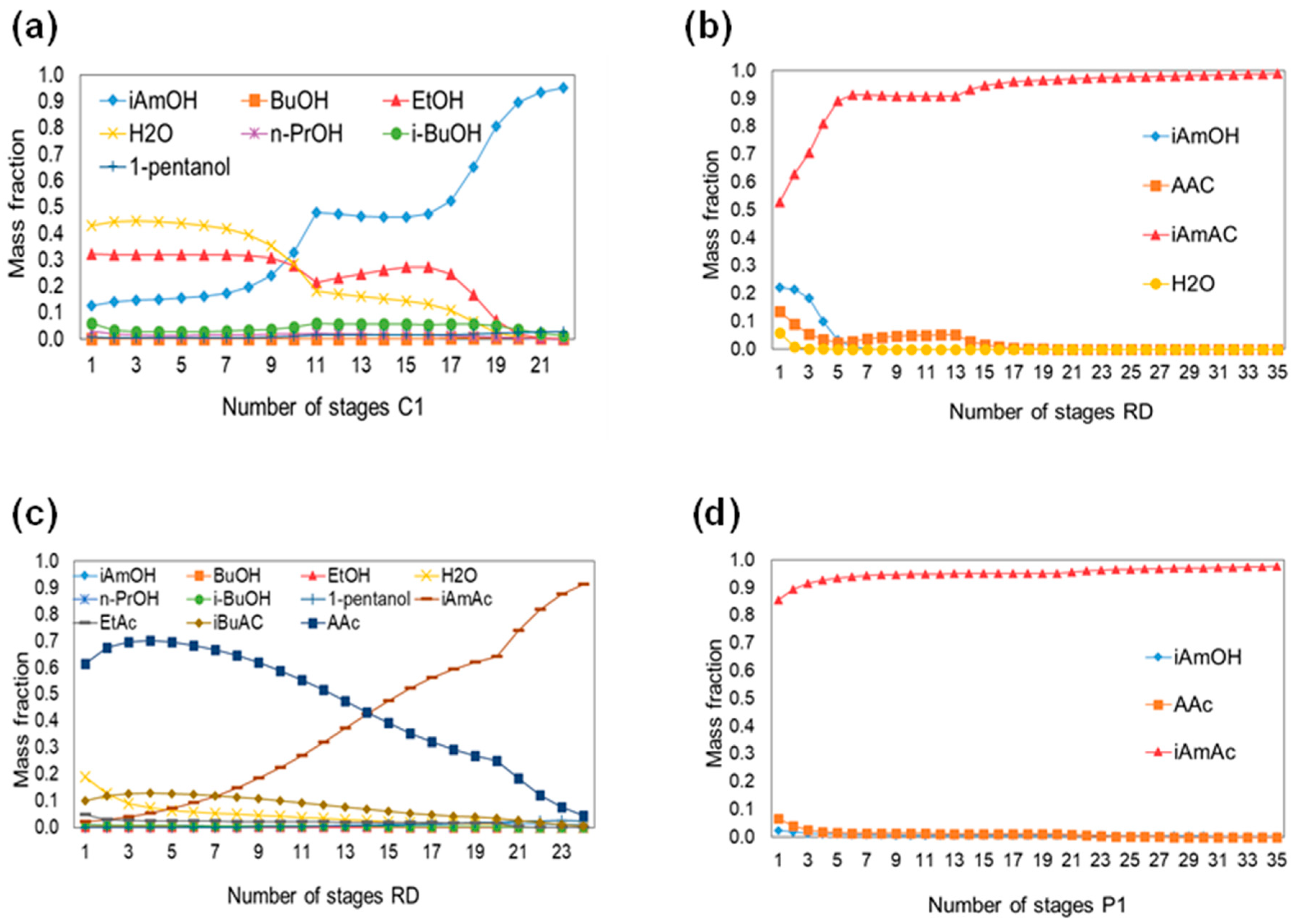
Based on the simulation results, an analysis of the concentration profiles for each technology was performed.
Figure 2 illustrates the concentration profiles in the liquid phase, which allow us to identify the behavior of each component and the separation efficiency based on its relative volatility and to identify the reaction zone for each technology.
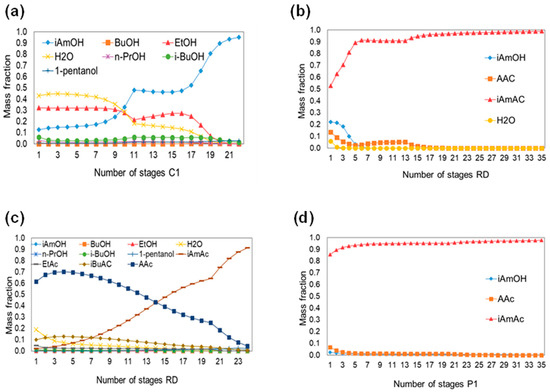
Figure 2.
Mass fraction profiles in the liquid phase for each column of Technology A (a,b) and B (c,d).
Figure 2a,b show the concentration profiles for Technology A. For the distillation column (C1), Figure 2a shows how isoamyl alcohol, one of the least volatile components in the mixture, progressively concentrates at the bottom of the column as its mass fraction increases. In the case of the more volatile components, such as ethanol and water, they are efficiently removed in the distillate, showing higher values in the initial stages with a decreasing trend towards the bottom.
Figure 2b shows the behavior of the RD, which shows an upward trend in the mass fraction of isoamyl acetate. Isoamyl alcohol shows a peak concentration between stages 3 and 5 due to its introduction as a reactant, followed by a decrease in its composition after these stages, due to its conversion by reacting with the acid. From stage 10 onward, a high conversion is evident within the reactive zone (stages 5–20).
Acetic acid exhibits a similar behavior to isoamyl alcohol, with a higher concentration in the higher stages (up to stage 8), progressively decreasing to reach low values starting from stage 15. The combined decrease in both reactants in the intermediate stages coincides with the zone of greatest reaction intensity. In the case of the water component, its efficient elimination is observed in higher stages of the process.
The concentration profiles for Technology B are illustrated in Figure 2c,d. Figure 2c shows the behavior of the reactive column for this technology, where the mass fraction of acetic acid shows a progressive decrease in concentration starting from stage 6, which is consistent with the reaction zone (stages 5 to 20). In parallel, the mass fraction of isoamyl acetate increases continuously until reaching values close to 0.94, confirming a highly efficient conversion of the reactive system. Water shows a decreasing profile towards the bottom, demonstrating that it is efficiently entrained and removed towards the distillate product of the system.
Figure 2d shows the behavior of the profiles for the column P1, in which isoamyl acetate presents increasing concentration, demonstrating the enrichment of the product throughout the column stages. In parallel, acetic acid and isoamyl alcohol show a decreasing trend throughout the column stages, indicating adequate fractionation, ensuring high purity in the final product.
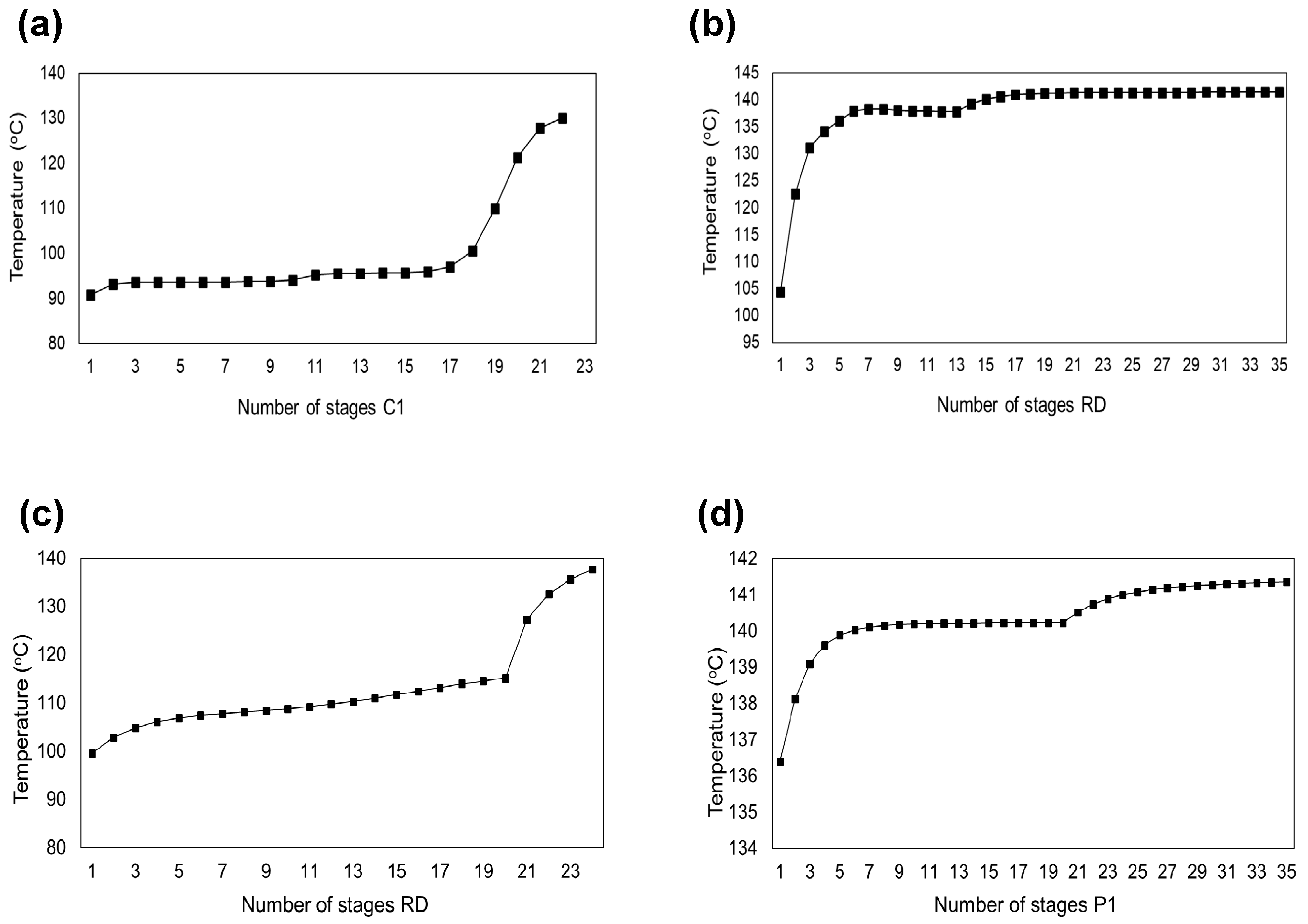
Figure 3 illustrates the temperature profiles of the technologies studied. For technology A, Figure 3a illustrates the temperature profile in column C1, where it can be observed that from stage 1 to stage 17 there is an almost linear increase (90–97 °C), followed by a more noticeable increase between stages 17 and 22, reaching 130 °C. For the RD column, Figure 3b shows variable points between stages 1 and 7 (104–138 °C), and from stage 15 onward, the temperature shows little variation along the column. For the RD column of technology B, Figure 3c shows that the greatest variations along the column occur in stages 20 to 24 (115–138 °C), while for the P1 column, the greatest variations are found between stages 1 and 4 (136–140 °C).
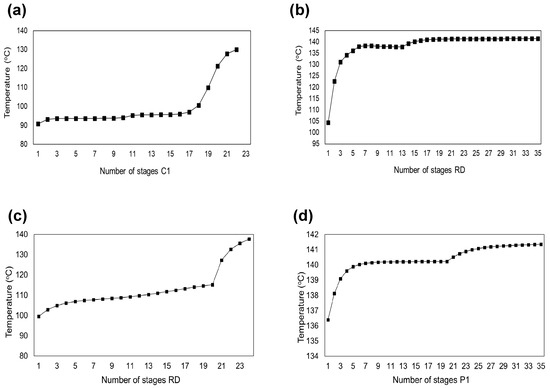
Figure 3.
Temperature profiles for each column of Technology A (a,b) and B (c,d).
3.2. Sensitivity Analysis
Sensitivity analysis allowed us to establish the best operating conditions for each technology.
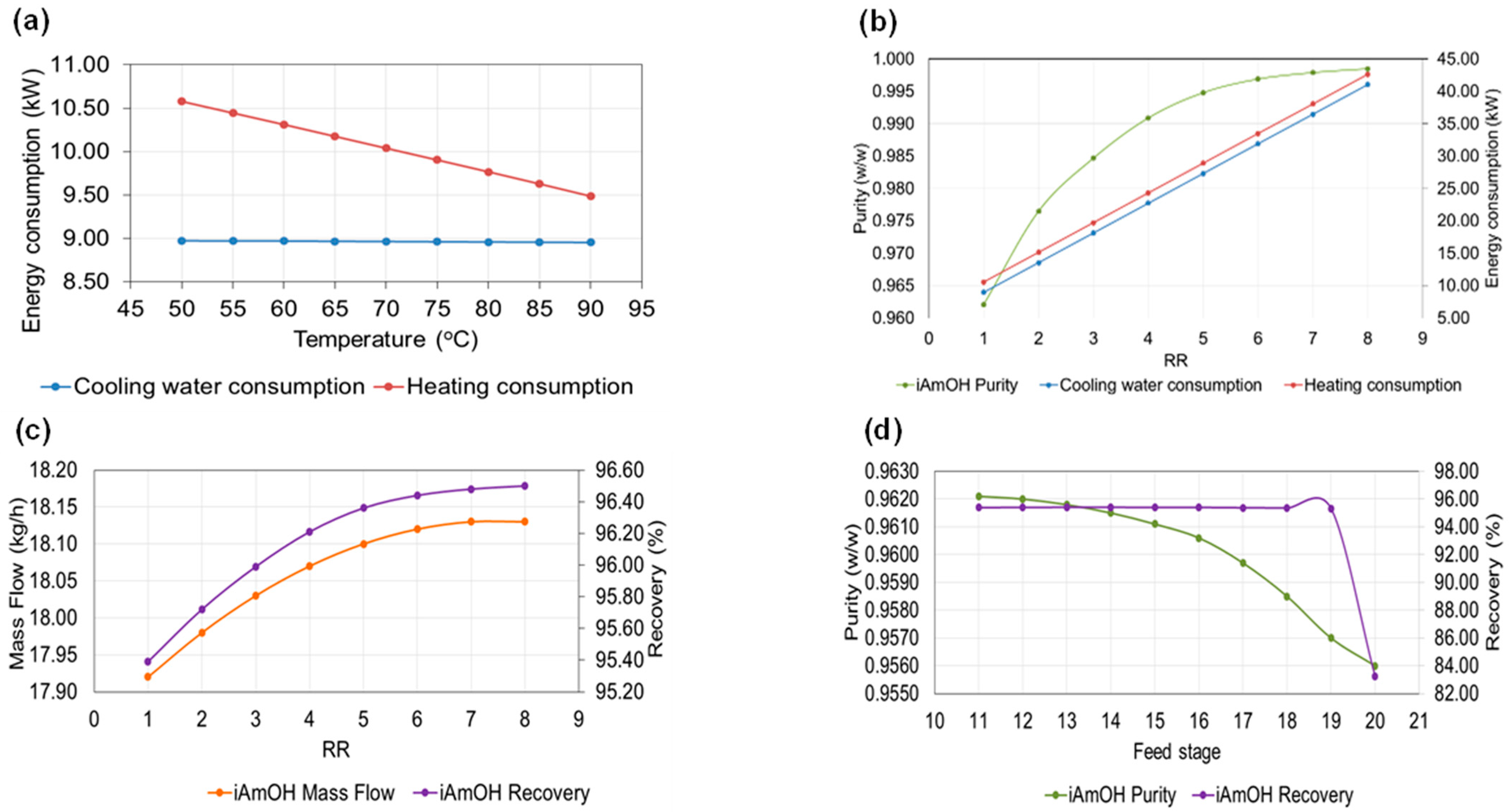
In column C1 of Technology A, when analyzing the effect of feed temperature on heating and cooling consumption (Figure 4a), it is observed that energy consumption in the condenser remains practically constant (8.95–8.97 kW). On the other hand, consumption in the reboiler decreases from 10.58 kW to 9.49 kW, suggesting an improvement in the energy efficiency of the process.
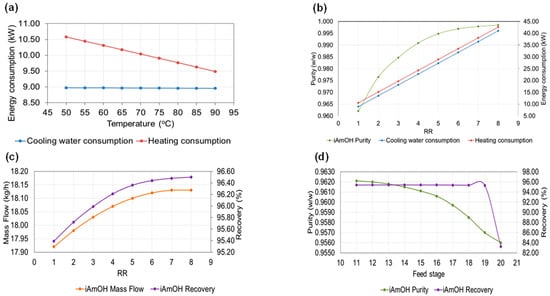
Figure 4.
Influence of temperature variation (a), RR (b,c), and feed stage (d) in column C1 of Technology A.
The variation in RR (Figure 4b,c) favors purity (0.9621 to 0.9985 w/w), mass flow rate (17.92 to 18.13 kg/h), and isoamyl alcohol recovery (95.39 to 96.50%), although it is not very pronounced in these last two parameters. At the same time, the increase in RR implies greater efforts in the column to vaporize and condense the liquid, which translates into a higher consumption of heating (10.58 to 42.64 kW) and cooling water (8.97 to 41.06 kW), so the increase in RR does not represent an advantage, since the benefits in purity and recovery are minimal compared to the increase in the consumption of auxiliary services.
When varying the fusel oil feed stage (Figure 4d), a decrease in purity (0.9621 to 0.9560 w/w) and recovery percentage (95.41 to 83.24%) is observed, although the decrease is not very significant for the latter parameter between stages 11 to 19. Therefore, the feed on stage 11 represents the best condition for the column, offering greater purity and recovery.
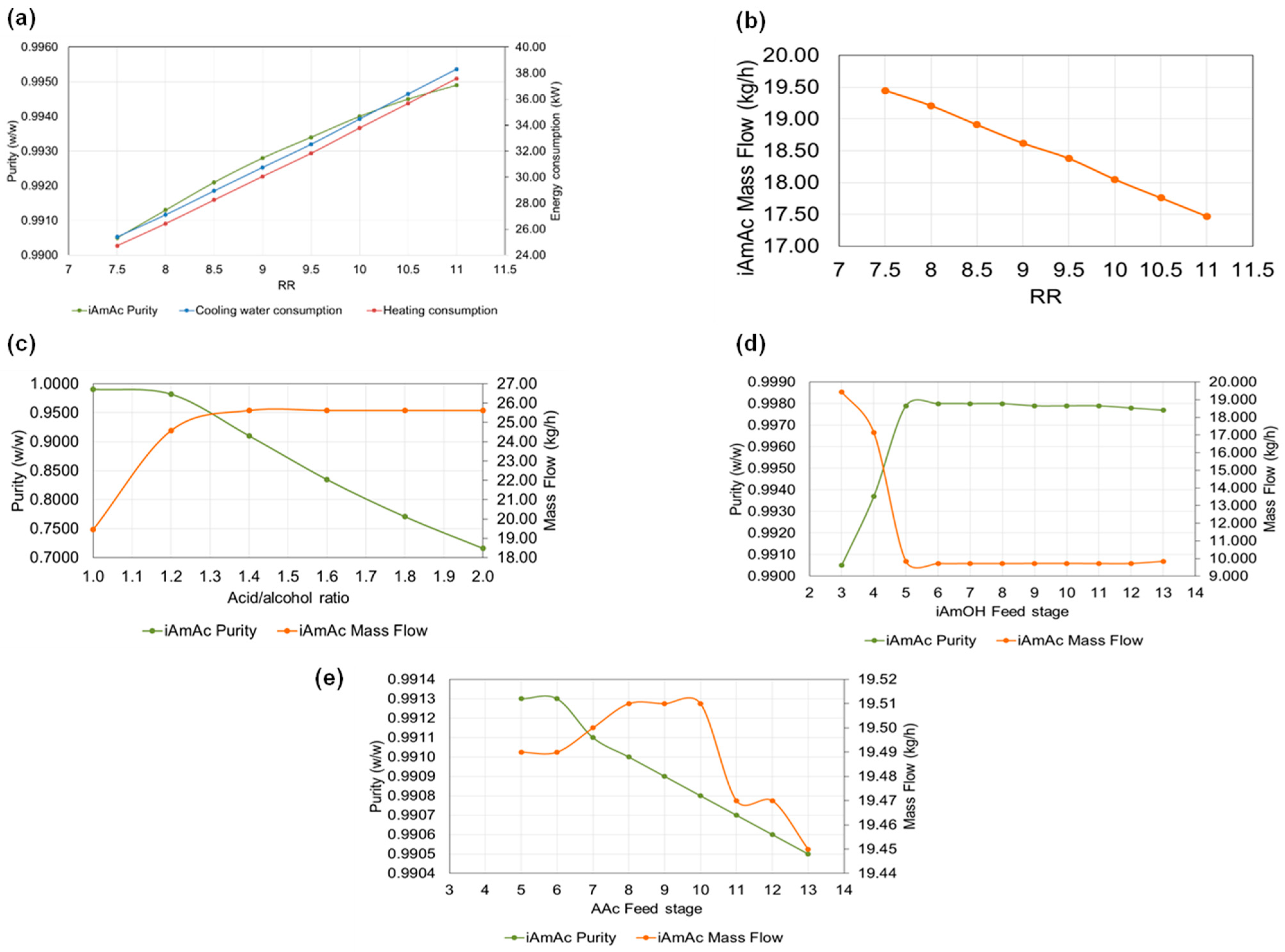
The change in RR in the reactive column (Figure 5a,b) shows that the increase in RR moderately favors the purity value (0.9905 to 0.9949 w/w), decreases the acetate mass flow rate (19.45 to 17.47 kg/h) along with an increase in heating (24.73 to 37.58 kW) and cooling water (25.41 to 38.31 kW) consumption. In this case, the increase in RR does not represent an operational advantage since the improvement in purity is minimal and the amount of the desired product flow rate is reduced, in addition to increasing energy costs, which leads to a decrease in the process efficiency. It is important to note that for an RR value of 11.5, the column does not converge.
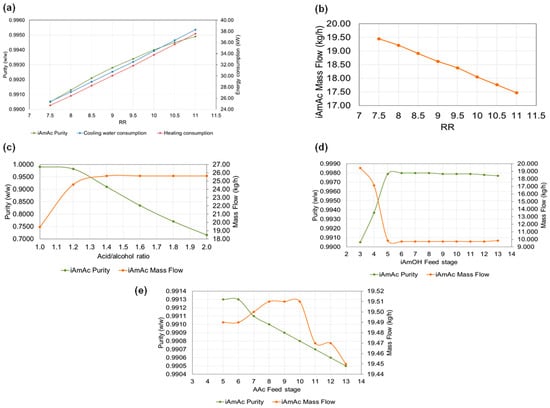
Figure 5.
Influence of the variation in the RR (a,b), the acid/alcohol ratio (c), and the reactant feed stage (d,e) of the RD column of Technology A.
The increase in the acid/alcohol feed molar ratio (Figure 5c) shows a decrease in the purity value (0.9905 to 0.7160 w/w) and an increase in the bottom mass flow rate values (19.45 to 25.62 kg/h), which shows that it is not favorable to increase the acid:alcohol ratio because it considerably affects the purity value of the product despite obtaining higher flows.
By varying the alcohol feed stage (Figure 5d), while keeping the acid feed fixed at stage 13, a significant increase in product purity is observed (0.9905–0.9980 w/w) from trays 3 to 6, while from trays 6 to 13 this parameter shows almost no variation (0.9980–0.9977 w/w); this is accompanied by a considerable reduction in the bottom flow rate (19.45–9.721 kg/h). On the other hand, when varying the acetic acid feed (Figure 5e), keeping the alcohol feed fixed on stage 3, a moderate decrease in purity is observed (0.9913–0.9905 w/w), accompanied by an increase in the isoamyl acetate mass flow rate between stages 5 and 10, while a decrease in flow rate is seen between stages 10 and 13. It is important to highlight that with the acid feed on stage 4, the model does not converge.
These results show that alcohol feed is a key parameter in the operation, since it significantly influences both the purity and the yield of the product. The best condition for alcohol feed would be on stage 3, since greater acetate productivity (19.45 kg/h) is obtained along with a purity greater than 99%. In the case of varying the acid feed, the best feed condition would be between stages 8 and 10, since a greater acetate flow rate (19.51 kg/h) is obtained with a purity greater than 99%.
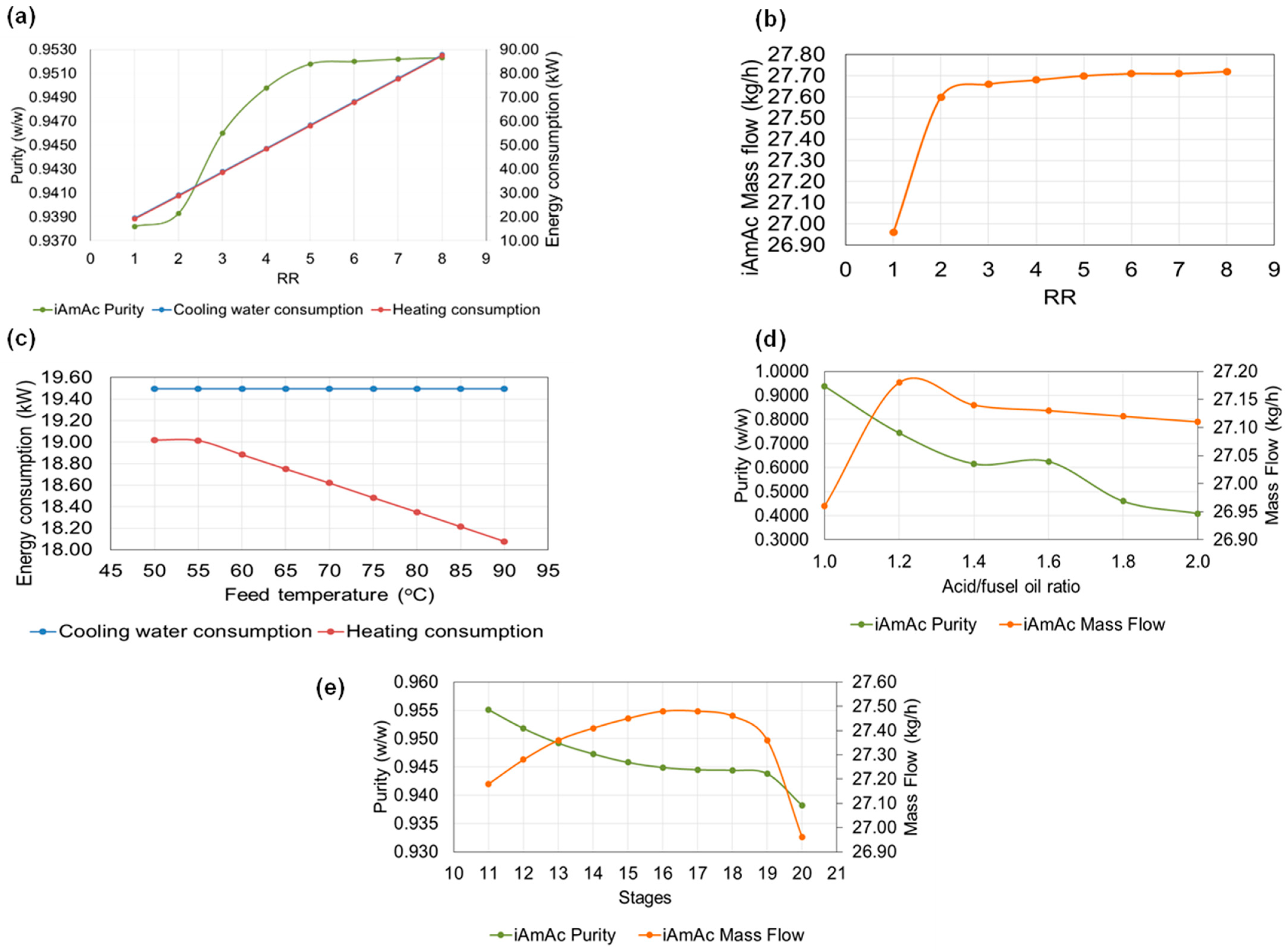
In the case of Technology B for the RD column, the variation in the RR (Figure 6a,b) improves the separation in the column, favoring the purity value in isoamyl acetate (0.9382 to 0.9523 w/w) and mass flow (26.96 to 27.72 kg/h), although moderately for this last parameter. However, this increase in RR is associated with higher consumption of heating (19.14 to 87.42 kW) and cooling water (19.49 to 87.81 kW).
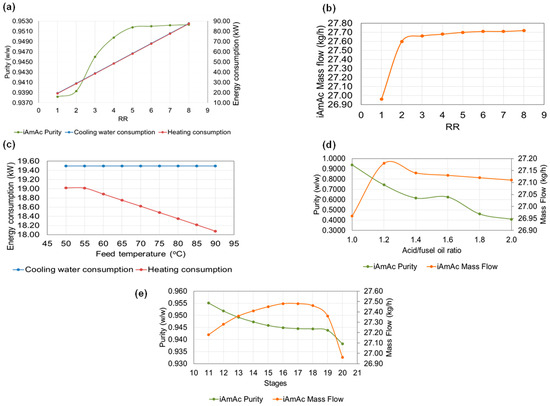
Figure 6.
Influence of the variation in the RR temperature (a,b), feed temperature (c), acid/fusel oil feed ratio (d), and reactant feed stage (e) of the RD column of Technology B.
By varying the inlet temperature of the fusel oil stream and keeping the acid temperature constant (Figure 6c), it is observed that the energy consumption in the condenser remains constant (19.50 kW) without undergoing significant changes due to this variation, while a decrease in the heating consumption in the reboiler (from 19.02 to 18.08 kW) of 4.95% is observed. These results show that raising the feed temperature of the fusel oil stream can represent an energy improvement for the system by reducing the heating demand without negatively affecting other operating variables.
The acid/fusel oil feed molar ratio (Figure 6d) increase shows a significant decrease in the purity value (0.9382 to 0.4090 w/w), which demonstrates that it is more feasible to feed the acid in a stoichiometric ratio of 1:1 to ensure the highest purity of the acetate.
The study of the feed stage variation (Figure 6e) shows that, when feeding the reactants in the upper stages, the product purity increases progressively up to 0.9551 w/w in stage 11. But in the case of the mass flow rate of the products, it tends to increase from 26.96 kg/h to 27.48 kg/h from stage 20 to stage 16, and then decrease from stage 15 to 11 in values of 25.45 to 27.18 kg/h. The results suggest that the optimal feed range is between stages 14 and 18, where adequate purity and mass flow values are achieved. Feeding below stage 13 improves purity, but decreases the system’s productivity.
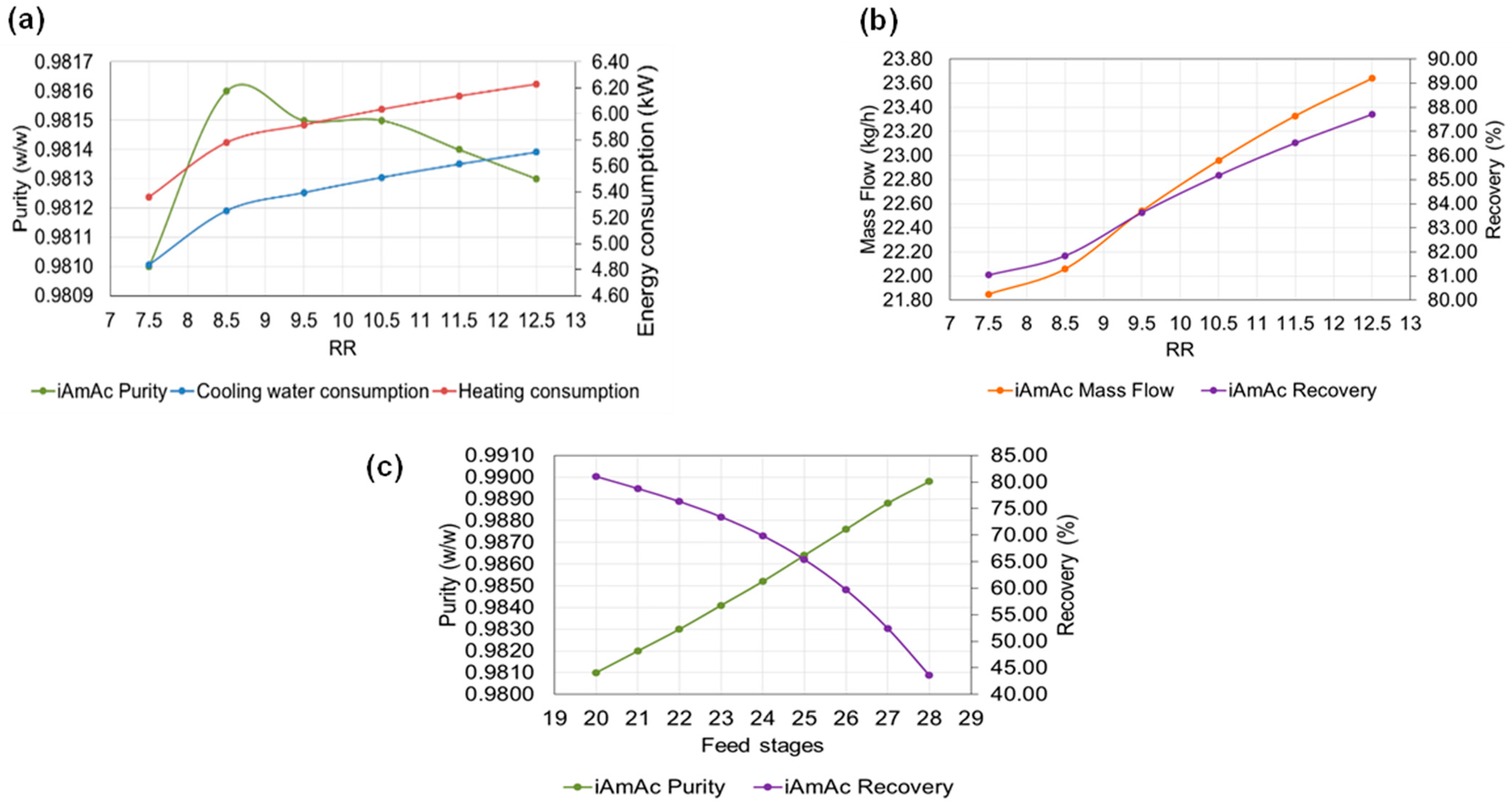
In the case of the P1, the variation in RR (Figure 7a,b) indicates that product recovery (81.04 to 87.71%) and the mass flow rate of isoamyl acetate (21.85 to 23.64 kg/h) are favored, but the quality of the final product is not improved, since the acetate purity remains practically constant (0.9810 to 0.9813 w/w). Together with this, there is a significant increase in the energy requirements of auxiliary services, both for cooling water (4.84 to 5.71 kW) and for heating consumption (5.36 to 6.23 kW); therefore, operating at RR values above those proposed would not be efficient. The variation in the feed stage in the P1 (Figure 7c) moderately favors the purity value (0.9810 to 0.9898 w/w) but decreases the recovery percentage (81.04 to 43.58%), so the change in feed stage would not be viable because it would affect the efficiency of the process.
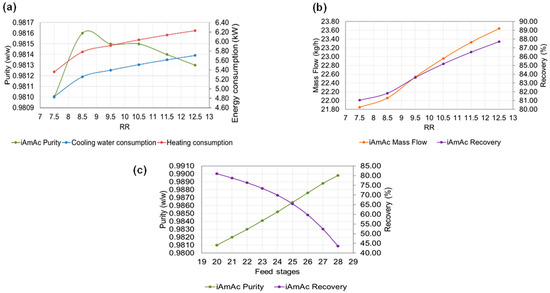
Figure 7.
Influence of the variation in the RR (a,b) and feed stage (c) in column P1 of Technology B.
For Technology A, the results of the sensitivity analysis indicate that in column C1, the feed should be carried out in stage 11, since greater purity and product recovery are obtained, and an RR of 1 should be employed. For column RD, the acid/alcohol molar ratio corresponds to a 1:1 ratio; the alcohol and the acid feed should be located in stage 3 and between stages 8 and 10, respectively, to achieve high purity (>99%) and higher isoamyl acetate productivity (19.51 kg/h).
In the case of Technology B, the RD column must operate with an acid/fusel oil molar ratio of 1:1, the reactant feed must occur between stages 14 and 18, and the fusel oil stream feed temperature must be increased to 90 °C to reduce heating consumption and work at an RR of 1. Finally, for column P1, the proposed RR value must be maintained (RR = 7.5), since increasing it does not improve purity, but does significantly increase energy consumption, and it is not recommended to vary the feed stage (stage 20) because it harms product recovery.
The analysis of the experimental data, based on Taguchi L9 arrays, allowed the identification of the main effects and the evaluation of interactions between the process operating parameters.
Table 7 shows the matrix to evaluate the interactions between the variables for column C1 of Technology A. It shows that the least favorable combinations of values result in case 3, where the lowest flow rate and purity are obtained. It is also evident that achieving a purity greater than 96% in the final product requires greater energy consumption, driven by an increase in the RR.
Table 7.
Taguchi L9 fractional experimental design matrix for the C1 column of Technology A.
Table 8 shows the matrix to evaluate the interactions between the variables for column RD of Technology A. From Table 9, it can be concluded that the least favorable combination of values is found in cases 3, 6, and 9, where the lowest purities are obtained in the final product. In contrast, the most favorable scenario is case 1, with a high purity value and adequate flow rate, and moderate energy consumption compared to the other cases.
Table 8.
Taguchi L9 fractional experimental design matrix for the RD column of Technology A.
Table 9.
Taguchi L9 fractional experimental design matrix for the RD column of Technology B.
Table 9 shows the matrix to evaluate the interactions between the variables for column RD of Technology B. From Table 10, it can be concluded that the most favorable combination is found in case 1, where adequate purity and flow rate values are obtained in the final product with moderate energy consumption compared to the other cases.
Table 10.
Taguchi L9 fractional experimental design matrix for the P1 column of Technology B.
Finally, it is possible to observe in Table 10, which shows the Taguchi L9 matrix for the analysis of column P1 of Technology B, that in all the scenarios analyzed, the purity is greater than 98%. However, the least favorable combinations are cases 3 and 6, with the lowest acetate flow rates. Case 1 is the most favorable, with the highest flow rate and lowest consumption.
This analysis demonstrated that achieving optimal process conditions requires evaluating the combination of several operating factors, as the process does not depend solely on the individual effects of its operating parameters. The analysis identified the most influential factors and their interactions in each configuration studied.
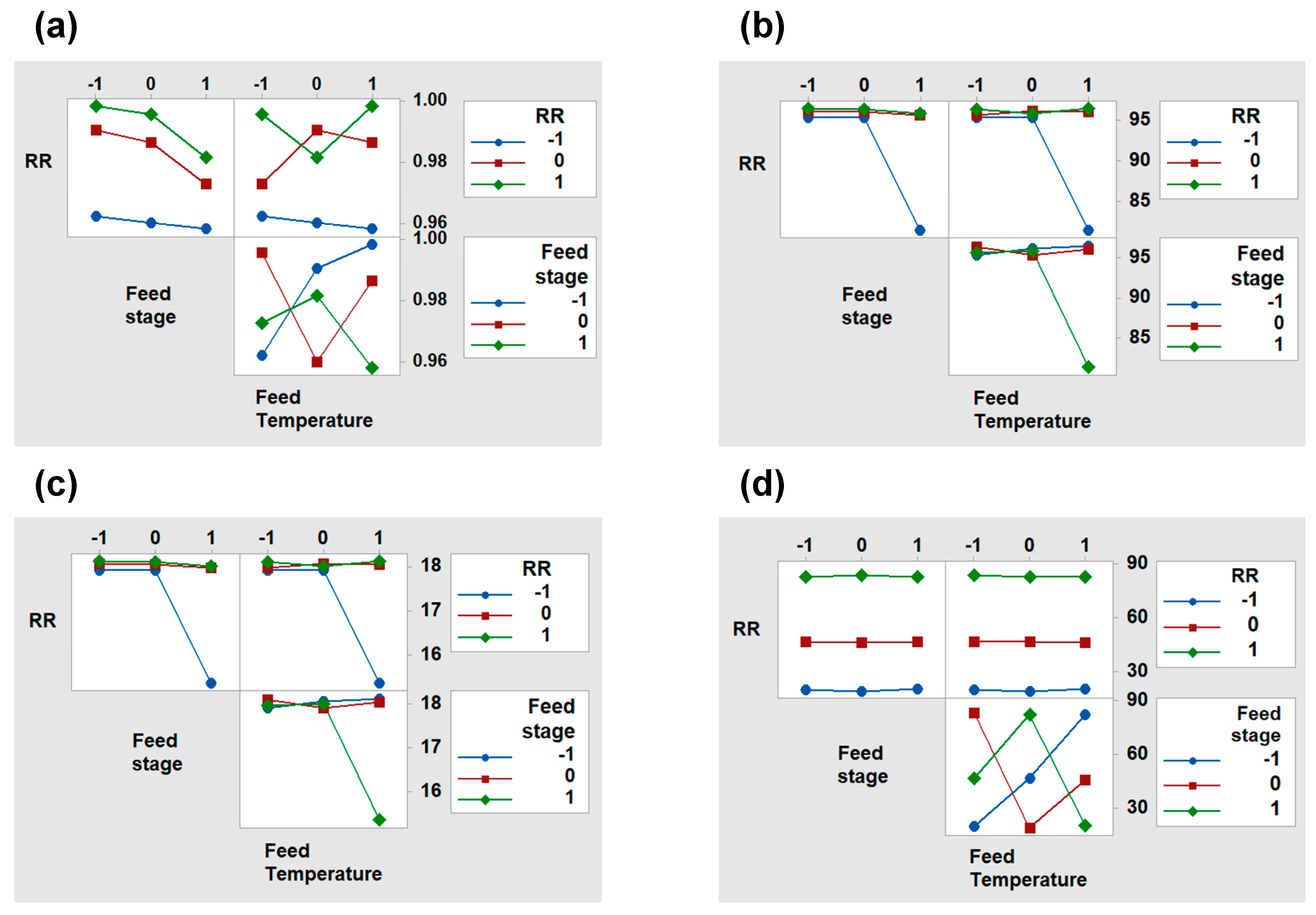
The designs of column C1 of Technology A show that the RR is the factor with the greatest impact on the purity, flow rate, recovery, and energy consumption of the process. Achieving purities above 96% requires a high RR, which leads to higher energy consumption. Figure 8d shows that total energy consumption is primarily influenced by the interactions between the feed stage and the feed temperature, while purity (Figure 8a) is influenced by the interactions between the feed stage and the feed temperature, and between the feed temperature and the RR. The analysis indicates that, in cases where the feed temperature is high with a low RR, lower purities and flow rates are obtained due to the interaction between the RR and the feed temperature. For mass flow rate and isoamyl alcohol recovery (Figure 8b,c), interactions exist among all the analyzed parameters.
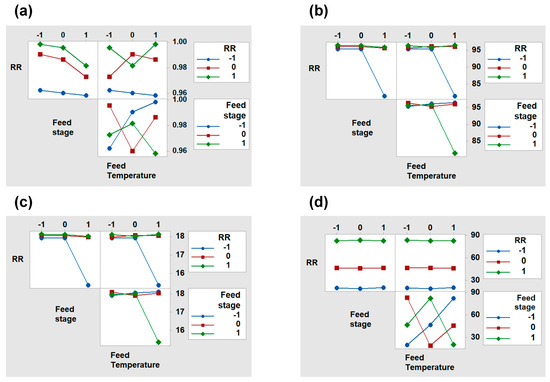
Figure 8.
Interactions between the operating parameters of column C1 of Technology A for purity (a), recovery (b), mass flow (c), and total energy consumption (d).
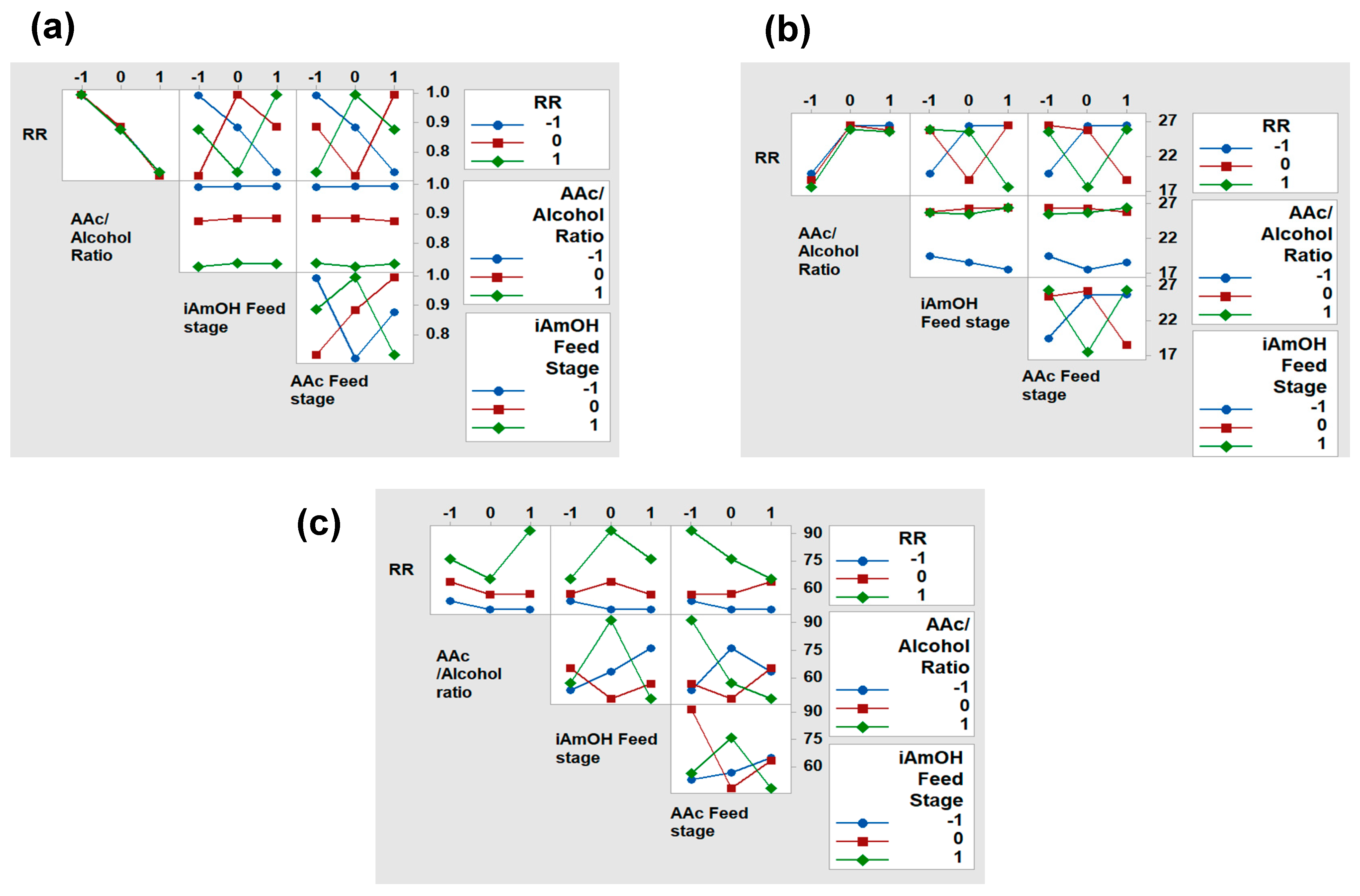
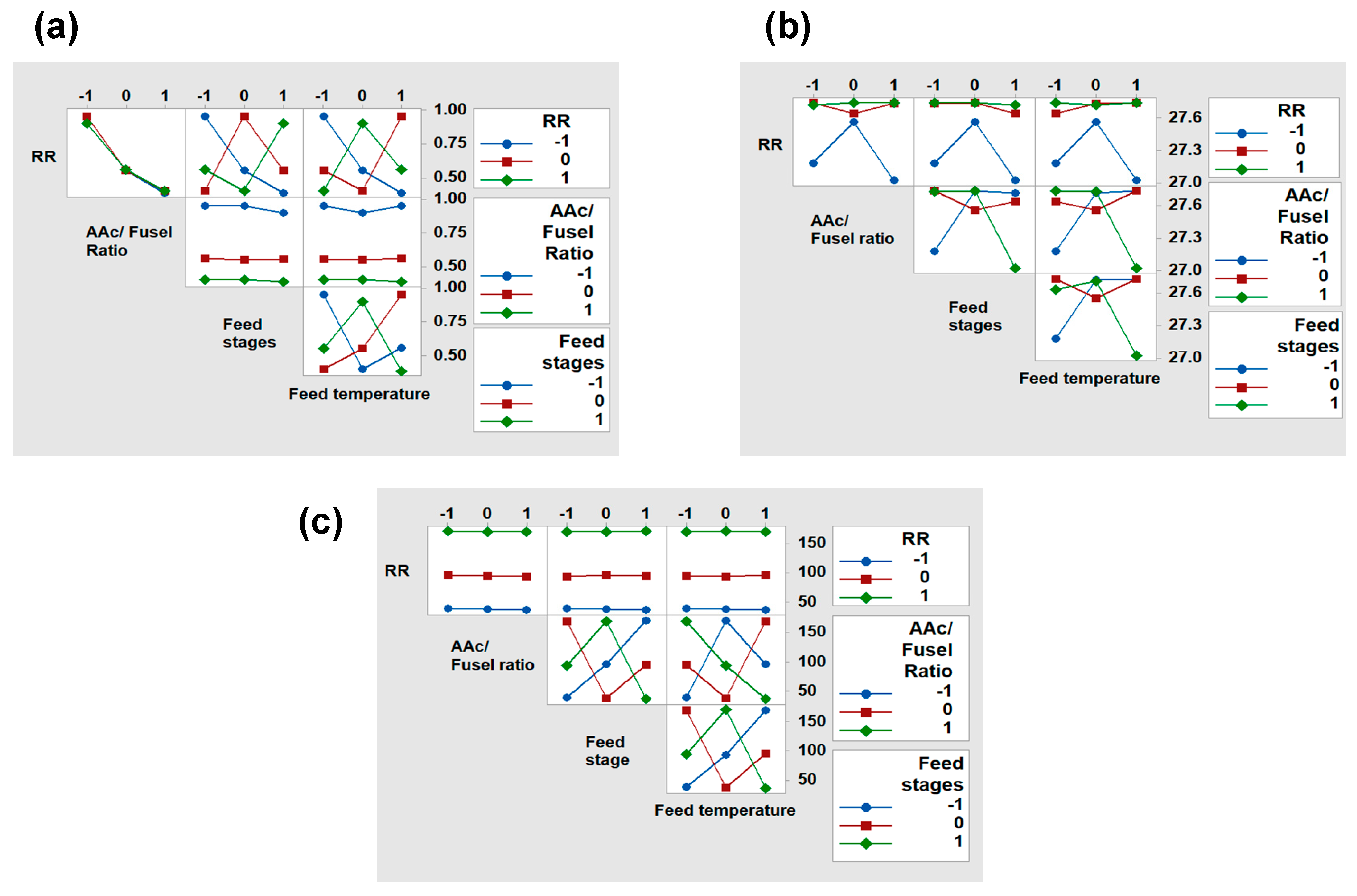
For the RD column, the design shows that the acid/alcohol feed molar ratio is the factor that most influences product purity; feeding the acid above the stoichiometric 1:1 ratio is not favorable for the process. It was identified that the acetate purity and mass flow rate (Figure 9a,b) are influenced by interactions between the RR and the feed stages (acid and alcohol). In the case of mass flow rate, it is also conditioned by interactions between the feed molar ratio and the feed stages (acid and alcohol). For total energy consumption (Figure 9c), the only variable that does not show interactions is the RR. The analysis indicates that the combination of low RR levels, the acid/alcohol ratio, and feed stages provides the best balance between purity and energy consumption.
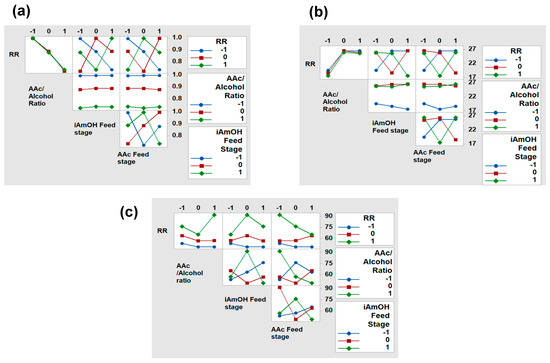
Figure 9.
Interactions between the operating parameters of column RD of Technology A for purity (a), mass flow (b), and total energy consumption (c).
For the RD column of Technology B, the design also confirms that the acid/fusel oil molar ratio is the most influential factor in achieving high purities. It was identified that the mass flow rate (Figure 10b) is conditioned by the interaction between all the analyzed factors. In the case of purity (Figure 10a), the interactions identified were the combination of the RR and the feed stage and temperature and the combination of these last two factors. In the case of energy consumption (Figure 10c), the interaction between the acid/fusel oil feed molar ratio and the feed stage and temperature was observed, while the RR was the only factor that did not interact with any other. The interactions between these parameters demonstrated that cases 1, 4, and 7 are the only ones that achieve a purity above 90%.
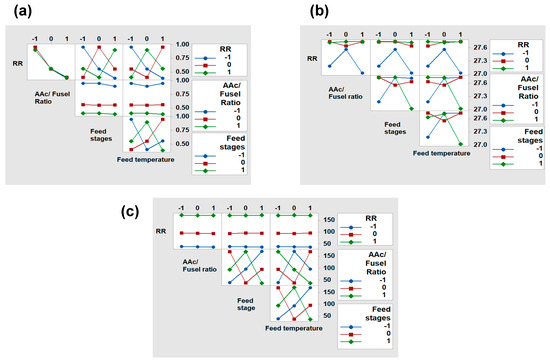
Figure 10.
Interactions between the operating parameters of column RD of Technology B for purity (a), mass flow (b) and total energy consumption (c).
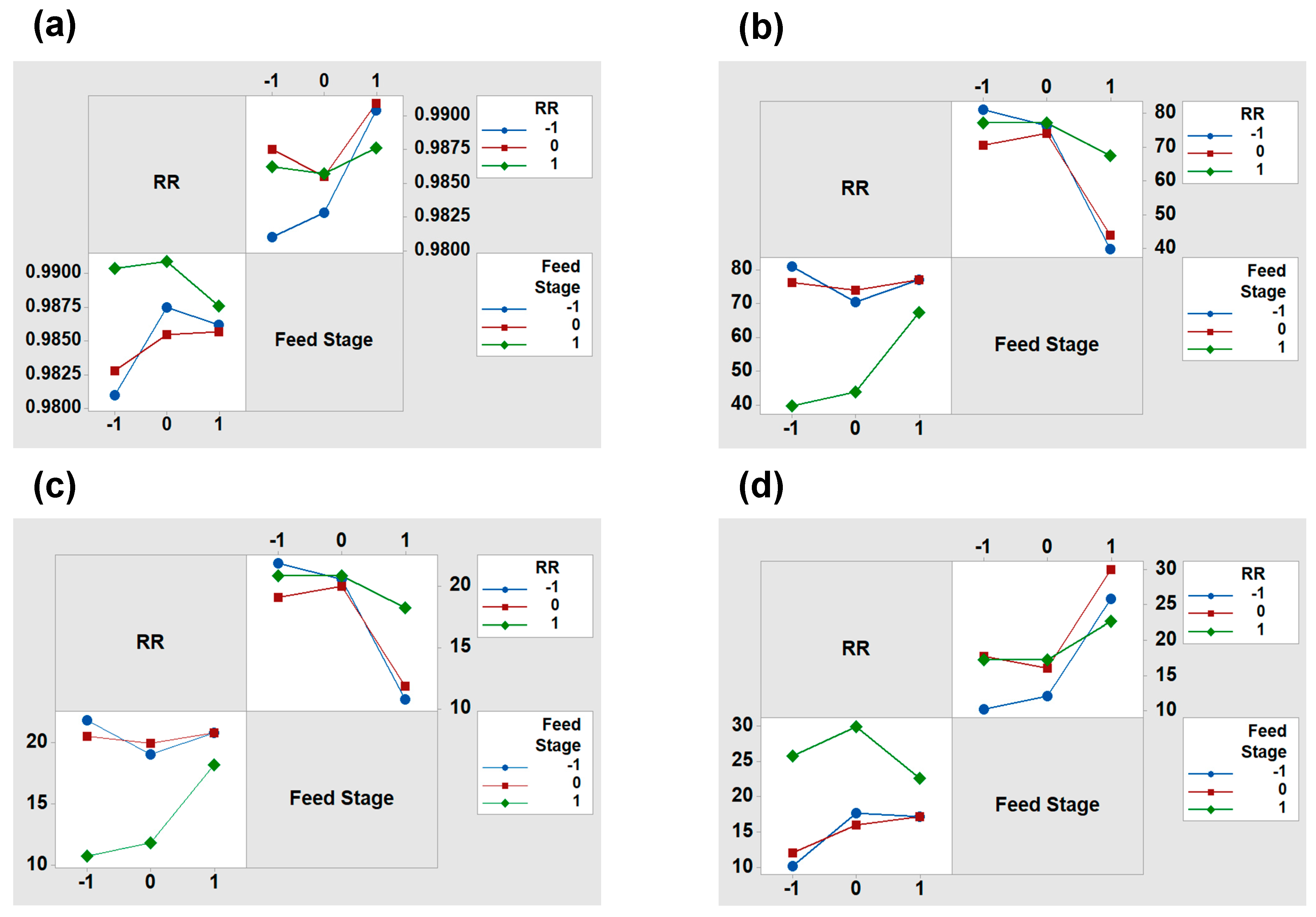
Finally, in column P1, the most influential parameter was RR. Figure 11a–d demonstrate that the combination of RR and the feed stage factors exhibits interactions for all the analyzed response variables. The interaction between RR and the feed stage demonstrated that combining a low RR with the most suitable feed stage can result in a more efficient process than simply increasing RR.
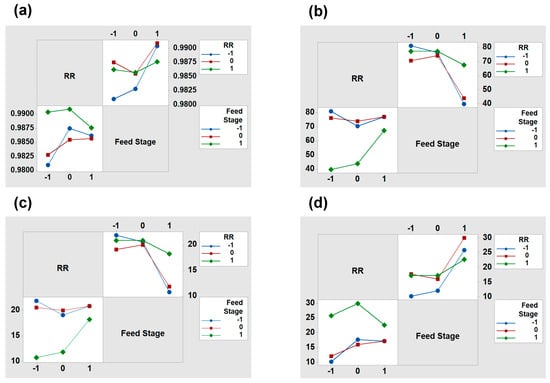
Figure 11.
Interactions between the operating parameters of column P1 of Technology B for purity (a), recovery (b), mass flow (c), and total energy consumption (d).
3.3. Economic Assessment
Based on the results obtained in the simulation, the technical–economic analysis of Technology B was carried out, identified as the most advantageous to evaluate its economic viability. The analysis was carried out considering two alternatives: one in which the acetic acid that constitutes the original process is not recirculated (Alternative 1) and another in which the recirculation of the acid is considered (Alternative 2). The results obtained from the economic analysis are shown in Table 11.
Table 11.
Results of the economic analysis of Technology B.
As can be seen, the technology analyzed is economically advantageous, reaching an NPV of US$3,587,110. The IRR (38.95%) presents values above the rate at which the company can obtain funds (interest rate of 12%), recovering the investment in a period of 5.05 years, which demonstrates its economic feasibility.
Regarding operating costs, the annual OPEX was estimated at US$5,054,440/year for a production capacity of 178,160 kg/year of isoamyl acetate, corresponding to a unit operating cost of US$28.37/kg of isoamyl acetate. Raw material costs represent 75.56% of total OPEX (US$3,819,010/year), while utilities consumption only represents 1.16% (US$58,627/year). This is because the cost of acetic acid (US$3,798,263/year) accounts for more than 99% of raw material costs, indicating that the economic viability of the process is critically influenced by acid costs in the market.
Considering the recirculation of acetic acid in the process, this would allow the recovery of 16 kg/h of this compound, representing a 43.81% reduction in net acid consumption and significantly reducing associated costs. The estimated economic savings in raw material costs would amount to US$1,680,000/year, which would consequently help increase the economic viability of the process. In this case, the annual OPEX is reduced by 29.56% compared to Alternative 1, and the unit operating cost is US$19.99/kg of isoamyl acetate.
4. Conclusions
In this work, a study was carried out to evaluate two processes for the synthesis of isoamyl acetate from fusel oil (A. Indirect process, B. Direct process) using the Aspen Hysys v14.0 simulator. Both processes were favorable for obtaining isoamyl acetate. However, Technology B leads to the best configuration, with reductions of 29% in the case of cooling water consumption and 31% in the case of heating compared to the Technology A, obtaining a mass flow rate of isoamyl acetate of 22.18 kg/h with a purity of 98%.
Sensitivity analysis determined the best operating conditions for each technology. For Technology A, column C1 performed best with a feed in stage 11 and RR = 1, while for the RD column, we used a molar ratio of 1:1, alcohol feed in stage 3, and acid in stages 8–10, achieving >99% purity and 19.51 kg/h of productivity. For Technology B, the RD column showed greater efficiency with a 1:1 ratio, feed between stages 14 and 18, and a fusel feed temperature of 90 °C, while column P1 must maintain RR = 7.5 and acetate feed in stage 20.
The Taguchi L9 fractional experimental design allowed for the identification of the influence of the combination of operating factors on acetate purity and flow rate, recovery, and energy consumption of the process, as well as facilitating the combination of favorable and unfavorable scenarios. In Technology A, column C1 exhibited its worst performance in case 3, while in column RD, cases 3, 6, and 9 were the least favorable, and case 1 was the most favorable. In Technology B, in both column RD and column P1, case 1 showed the best performance, while cases 3 and 6 registered the least favorable results. The factors that most influenced Technology A were the RR and the acid/alcohol feed ratio, while for Technology B, they were the acid/fusel oil feed ratio and the RR.
Based on the optimal configuration, a technical–economic analysis was performed, proving to be economically feasible, achieving an NPV of 3,587,110 US$, an IRR of 38.95%, and a PP of 5.05 years. If acid recirculation is considered in the process, an NPV of 7,232,950 US$, an IRR of 56.34%, and a PP of 3.56 years are obtained.
The results of this work contribute to the development of technological alternatives for the production of isoamyl acetate from fusel oil, contributing to its valorization as a raw material and improving the circularity of sugarcane mills. Furthermore, it demonstrates the potential of reactive distillation as a process intensification strategy for synthesizing esters by integrating reaction and separation in a single unit, which favors the energy and operational efficiency of the system.
It is important to note that the results obtained are based exclusively on simulations, without experimental validation to corroborate their behavior under real-world conditions, which represents a significant limitation of the study. From an industrial perspective, the implementation of these technologies presents significant operational and environmental challenges, notably the generation of acidic waste that requires proper handling and treatment, as it would be harmful to the environment due to its chemical composition. Additionally, the installation of tall, technically complex columns entails substantial capital investments and considerable operating costs.
On the other hand, while reactive distillation shows remarkable potential as a process intensification strategy for obtaining esters, its application in the esterification of fusel oil components is not yet established at an industrial scale. There are few reports in the literature, and those that exist are from laboratory or small-scale studies, highlighting the need for further experimental research and detailed techno-economic analyses to assess viability in a real-world process.
Supplementary Materials
The following supporting information can be downloaded at: https://www.mdpi.com/article/10.3390/pr14010037/s1. values of the coefficients of the Antoine equation to estimate the vapor pressures of the components involved in the processes studied. Table S1. Antoine equation coefficients.
Author Contributions
Conceptualization, C.L.G.A., A.C.L., L.Z.d.C., L.V.P., M.A.d.S.S.R., C.B.B.C. and O.P.O.; methodology, C.L.G.A., A.C.L., L.Z.d.C., L.V.P., M.A.d.S.S.R., C.B.B.C. and O.P.O.; software, C.L.G.A.; validation, C.L.G.A.; formal analysis, C.L.G.A., A.C.L., L.Z.d.C., L.V.P., M.A.d.S.S.R., C.B.B.C. and O.P.O.; investigation, C.L.G.A., A.C.L., L.Z.d.C., L.V.P., M.A.d.S.S.R., C.B.B.C. and O.P.O.; data curation, C.L.G.A.; writing—original draft preparation, C.L.G.A., A.C.L., C.B.B.C. and O.P.O.; writing—review and editing, C.L.G.A., A.C.L., L.V.P., M.A.d.S.S.R., C.B.B.C. and O.P.O.; visualization, C.L.G.A.; supervision, A.C.L., C.B.B.C. and O.P.O.; project administration, C.B.B.C. All authors have read and agreed to the published version of the manuscript.
Funding
This study was funded by Move La America Program—Coordenação de Aperfeiçoamento de Pessoal de Nível Superior—Brasil (CAPES), Processes 88887.009819/2024-00 and 88881.996448/2024-01.
Data Availability Statement
The original contributions presented in this study are included in the article.
Acknowledgments
The authors express their gratitude to Move La America Program—Coordenação de Aperfeiçoamento de Pessoal de Nível Superior—Brasil (CAPES), Processes 88887.009819/2024-00 and 88881.996448/2024-01, for providing financial support to one of them (C.L.G. Aleaga) and Conselho Nacional de Desenvolvimento Científico e Tecnológico (CNPq), Processes 309026/2022-9, 406544/2023-9, and 307705/2025-0. During the preparation of this study, the authors used Grammarly v. 6.8.263 in order to verify possible English typos. The authors have re-viewed and edited the output and take full responsibility for the content of this publication.
Conflicts of Interest
The authors declare no conflicts of interest.
Abbreviations
The following abbreviations are used in this manuscript:
| RD | Reactive distillation |
| C1 | Distillation column |
| P1 | Purification column |
| B1 | Bottom stream of distillation column C1 |
| D1 | Distillate stream of distillation column C1 |
| AAc | Acetic acid |
| iAmOH | Isoamyl alcohol |
| iAmAc | Isoamyl acetate |
| NRTL | Nonrandom Two-Liquid model |
| PR | Peng-Robinson |
| RR | Reflux ratio |
| CAPEX | Capital expenditures |
| OPEX | Operating expenses |
| NPV | Net present value |
| IRR | Internal rate of return |
| PP | Payback period |
| TUC | Utility services |
References
- García-Aleaga, C.L.; Cruz-Llerena, A.; Pérez-Ones, O.; de Cárdenas, L.Z.; Fernández-Casiis, M. Potencialidades del aceite fusel. Tecnologías para su revalorización. Bionatura 2024, 9, 91–112. [Google Scholar] [CrossRef]
- Mendoza-Pedroza, J.J.; Sánchez-Ramírez, E.; Segovia-Hernández, J.G.; Hernández, S.; Orjuela, A. Recovery of alcohol industry wastes: Revaluation of fusel oil through intensified processes. Chem. Eng. Process. 2021, 163, 108329. [Google Scholar] [CrossRef]
- Dias, A.L.B.; da Cunha, G.N.; dos Santos, P.; Meireles, M.A.A.; Martínez, J. Fusel oil: Water adsorption and enzymatic synthesis of acetate esters in supercritical CO2. J. Supercrit. Fluids. 2018, 142, 22–31. [Google Scholar] [CrossRef]
- Neagu, M.; Cursaru, D.L.; Missyurin, A.; Goian, O. Efficient separation of isoamyl alcohol from fusel oil using non-polar solvent and hybrid decanter–distillation process. Appl. Sci. 2025, 15, 9954. [Google Scholar] [CrossRef]
- Studziński, W.; Podczarski, M.; Piechota, J.; Buziak, M.; Yakovenko, M.; Khokha, Y. Recovery of Natural Pyrazines and Alcohols from Fusel Oils Using an Innovative Extraction Installation. Molecules 2025, 30, 3028. [Google Scholar] [CrossRef] [PubMed]
- Marinho, L.H.N.; Aragão, F.V.; de Genaro Chiroli, D.M.; Zola, F.C.; Tebcherani, S.M. A systematic review of fusel oil as a renewable biofuel: Challenges, opportunities, and circular economy integration. Fuel 2025, 402, 135924. [Google Scholar] [CrossRef]
- de Lima, R.; Bento, H.B.S.; Reis, C.E.R.; Bôas, R.N.V.; de Freitas, L.; Carvalho, A.K.F.; de Castro, H.F. Biolubricant Production from Stearic Acid and Residual Secondary Alcohols: System and Reaction Design for Lipase-Catalyzed Batch and Continuous Processes. Catal. Lett. 2022, 152, 547–558. [Google Scholar] [CrossRef]
- Erol, D.; Yaman, H.; Doğan, B.; Yeşilyurt, M.K. The assessment of fusel oil in a compression-ignition engine in the perspective of the waste to energy concept: Investigation of the performance, emissions, and combustion characteristics. Biofuels 2022, 13, 1147–1164. [Google Scholar] [CrossRef]
- Massa, T.B.; Raspe, D.T.; Feiten, M.C.; Cardozo-Filho, L.; da Silva, C.D. Fusel Oil: Chemical Composition and an Overview of Its Potential Application. J. Braz. Chem. Soc. 2023, 34, 153–166. [Google Scholar] [CrossRef]
- SÁ, A.G.A.; de Meneses, A.C.; de Araújo, P.H.H.; de Oliveira, D. A review on enzymatic synthesis of aromatic esters used as flavor ingredients for food, cosmetics and pharmaceuticals industries. Trends Food Sci. Technol. 2017, 69, 95–105. [Google Scholar] [CrossRef]
- Yılmaz, B.; Deniz, İ.; Fazlı, H.; Gürsoy, S.; Yarıcı, T.; Bengü, B. Synthesis of iso-amyl ester rosin and its evaluation as an alternative to paraffin in medium density fiberboard production. Bioresources 2024, 19, 2077–2091. [Google Scholar] [CrossRef]
- Tran, T.T.V.; Kongparakul, S.; Karnjanakom, S.; Reubroycharoen, P.; Guan, G.; Chanlek, N.; Samart, C. Selective production of green solvent (isoamyl acetate) from fusel oil using a sulfonic acid-functionalized KIT-6 catalyst. Mol. Catal. 2020, 484, 110724. [Google Scholar] [CrossRef]
- Sánchez, C.A.; Sánchez, O.A.; Orjuela, A.; Gil, I.D.; Rodríguez, G. Vapor–Liquid Equilibrium for Binary Mixtures of Acetates in the Direct Esterification of Fusel Oil. J. Chem. Eng. Data. 2017, 62, 11–19. [Google Scholar] [CrossRef]
- Ali, S.S.; Hossain, S.K.; Asif, M. Dynamic modeling of the isoamyl acetate reactive distillation process. Pol. J. Chem. Technol. 2017, 19, 59–66. [Google Scholar] [CrossRef]
- Barrientos, D.A.; Fernandez, B.; Morante, R.; Rivera, H.R.; Simeon, K.; Lopez, E.C.R. Recent Advances in Reactive Distillation. Eng. Proc. 2023, 56, 99. [Google Scholar] [CrossRef]
- Kiss, A.A.; Muthia, R.; Pazmiño-Mayorga, I.; Harmsen, J.; Jobson, M.; Gao, X. Conceptual methods for synthesis of reactive distillation processes: Recent developments and perspectives. J. Chem. Technol. Biotechnol. 2024, 99, 1263–1290. [Google Scholar] [CrossRef]
- Kiss, A.A. Novel Catalytic Reactive Distillation Processes for a Sustainable Chemical Industry. Top. Catal. 2019, 62, 1132–1148. [Google Scholar] [CrossRef]
- Missyurin, A.; Cursaru, D.L.; Neagu, M.; Nicolae, M. Hybrid Process Flow Diagram for Separation of Fusel Oil into Valuable Components. Processes 2024, 12, 2888. [Google Scholar] [CrossRef]
- Valverde, J.L.; Ferro, V.R.; Giroir-Fendler, A. Automation in the simulation of processes with Aspen HYSYS: An academic approach. Comput. Appl. Eng. Educ. 2023, 31, 376–388. [Google Scholar] [CrossRef]
- Cruz-Llerena, A.; Pérez-Ones, O.; Zumalacarregui-de Cárdenas, L.; Pérez-de los Ríos, J.L. Simulation and technoeconomic assessment of vinasse-to-energy treatments for pollution mitigation: A biorefinery approach. Biofuels, Bioprod. Bioref. 2025. [Google Scholar] [CrossRef]
- Ferreira, M.C.; Meirelles, A.J.; Batista, E.A. Study of the fusel oil distillation process. Ind. Eng. Chem. Res. 2013, 52, 2336–2351. [Google Scholar] [CrossRef]
- Montoya, N.; Córdoba, F.; Trujillo, C.; Gil, I.; Rodríguez, G. Fusel oil separation process. In Proceedings of the AIChE Annual Meeting, Minneapolis, MN, USA, 16–21 October 2011; American Institute of Chemical Engineers: New York, NY, USA, 2011; pp. 332–337. Available online: https://proceedings.aiche.org/conferences/aiche-annual-meeting/2011/proceeding/paper/428f-fusel-oil-separation-process (accessed on 8 April 2025).
- Patil, K.D.; Kulkarni, B.D. Modeling and simulation for reactive distillation process using aspen plus. In Proceedings of the National Symposium on Reaction Engineering (NSRE), Raipur, India, 22–23 January 2010; pp. 199–209. Available online: https://www.academia.edu/30993401/Modeling_and_simulation_for_reactive_distillation_process_using_Aspen_Plus (accessed on 8 April 2025).
- García-Aleaga, C.L.; Cruz-Llerena, A.; Pérez-Ones, O.; de Cárdenas, L.Z. Destilación reactiva para la revalorización de aceite de fusel: Caracterización de muestras y simulación de procesos. Rev. Cen. Azúcar 2024, 51, e1085-07. Available online: http://centroazucar.uclv.edu.cu/index.php/centro_azucar/article/view/818 (accessed on 8 April 2025).
- Patidar, P.; Mahajani, S.M. Esterification of fusel oil using reactive distillation–Part I: Reaction kinetics. Chem. Eng. J. 2012, 207, 377–387. [Google Scholar] [CrossRef]
- Sánchez, C.A.; Gil, I.D.; Rodríguez, G. Fluid phase equilibria for the isoamyl acetate production by reactive distillation. Fluid Phase Equilib. 2020, 518, 112647. [Google Scholar] [CrossRef]
- Patidar, P.; Mahajani, S.M. Esterification of fusel oil using reactive distillation. Part II: Process alternatives. Ind. Eng. Chem. Res. 2013, 52, 16637–16647. [Google Scholar] [CrossRef]
- González, D.R.; Bastidas, P.; Rodríguez, G.; Gil, I. Design alternatives and control performance in thepilot scale production of isoamyl acetate via reactive distillation. Chem. Eng. Res. Des. 2017, 123, 347–359. [Google Scholar] [CrossRef]
- Silva, G.G.; Botett, J.; Prieto, N. Predicción del equilibrio vapor-líquido de la mezcla acetato de etilo-etanol usando la ecuación de estado de Peng Robinson. Rev. UIS Ing. 2021, 20, 135–142. [Google Scholar] [CrossRef]
- Forero, L.A.; Velásquez, J.A. Representación simultánea del equilibrio líquido-vapor, el volumen molar y la entalpía de exceso de mezclas complejas mediante una ecuación de estado tipo Peng-Robinson. Inf. Tecnol. 2019, 30, 21–34. [Google Scholar] [CrossRef][Green Version]
- Odejobi, O.J.; Oladokun, O.R.; Ajeigbe, F.J. Comparative study of fluid package on extractive distillation of ethanol-water mixture using pure glycerol and ethylene glycol as extracting solvents. J Eng Res Rep. 2018, 2, 1–12. [Google Scholar] [CrossRef]
- Patil, K.; Karan, P.; Pathare, S.; Salvi, S. Reactive Distillation for Esterification Reaction of Isoamyl Alcohol and Acetic Acid: Simulation and Experimental Studies. In Proceedings of the CHEMCON Indian Chemical Engineering Congress, Visakhapatnam, India, 27–30 December 2009; pp. 1–16. Available online: https://www.researchgate.net/publication/263331447_Reactive_Distillation_for_Esterification_Reaction_of_Isoamyl_Alcohol_and_Acetic_Acid_Simulation_and_Experimental_Studies (accessed on 2 May 2025).
- Bi, F.; Ali, A.; Iqbal, S.; Arman, M.; Ul-Hassan, M. Chemical esterification of fusel oil alcohol for the production of flavor and fragrance esters. J. Chem. Soc. Pak. 2008, 30, 919–923. Available online: https://psa.pastic.gov.pk/SearchArticleView.aspx?articledetailId=14898&S_id=83147 (accessed on 2 May 2025).
- Dar, A.; Anuradha, N. Use of orthogonal arrays and design of experiment via Taguchi L9 method in probability of default. Account 2018, 4, 113–122. [Google Scholar] [CrossRef]
- Guevara-Fernandez, D.; Proano-Aviles, J. Techno-economic analysis of the production of acetic acid via thermochemical processing of residual woody biomass in Ecuador. Biofuels Bioprod. Biorefin. 2022, 16, 335–348. [Google Scholar] [CrossRef]
- Eustácio, R.S.; da Silva, L.F.; Souza, C.; Mendes, M.F.; Neto, M.R.F.; Pereira, C.S.S. Simulação do processo de destilação da mistura etanol-óleo fúsel utilizando o simulador de processos ProSimPlus. Rev. Eletrônica Teccen 2018, 11, 61–67. [Google Scholar] [CrossRef][Green Version]
- LaboratoriumDiscounter. Acetato de Isoamilo ≥98%, Extra Puro. Available online: https://www.laboratoriumdiscounter.nl/es/acetato-de-isoamilo-98-extra-puro.html (accessed on 5 May 2025).
Disclaimer/Publisher’s Note: The statements, opinions and data contained in all publications are solely those of the individual author(s) and contributor(s) and not of MDPI and/or the editor(s). MDPI and/or the editor(s) disclaim responsibility for any injury to people or property resulting from any ideas, methods, instructions or products referred to in the content. |
© 2025 by the authors. Licensee MDPI, Basel, Switzerland. This article is an open access article distributed under the terms and conditions of the Creative Commons Attribution (CC BY) license.