Review

Smart Conferences: A Comprehensive Review of Technologies, Analytics and Future Directions

1
Faculty of Innovation Engineering, Macau University of Science and Technology, Macau, China
2
State Key Laboratory of Multimodal Artificial Intelligence Systems, Institute of Automation, Chinese Academy of Sciences, Beijing 100190, China
3
University of Manchester, Manchester M13 9PL, UK
4
Institute of Automation, Chinese Academy of Sciences, Chinese Association of Automation, Beijing 100190, China
5
Hungarian Branch of QAII, 1034 Budapest, Hungary
6
YakiHonne, Palo Alto, CA 94301, USA
7
DeSci Center of Parallel Intelligence, Óbuda University, 1034 Budapest, Hungary
8
Helen and John C. Hartmann Department of Electrical and Computer Engineering, New Jersey Institute of Technology, Newark, NJ 07102, USA
9
State Key Laboratory for Management and Control of Complex Systems, Institute of Automation, Chinese Academy of Sciences, Beijing 100190, China
*
Author to whom correspondence should be addressed.
Processes 2026, 14(1), 144; https://doi.org/10.3390/pr14010144
Submission received: 3 November 2025 / Revised: 12 December 2025 / Accepted: 24 December 2025 / Published: 31 December 2025
(This article belongs to the Section AI-Enabled Process Engineering)

Abstract

Academic conferences have been pivotal in scholarly communications, facilitating the exchange of ideas and fostering collaborations among attendees by using advanced sensing, networking, and control technologies. Traditionally held in physical venues, the landscape of academic conferences has been revolutionised by the advent of virtual and hybrid formats as supported by the Internet of Things, Artificial Intelligence, and virtual reality tools. Despite the burgeoning literature on smart conferences, there exists a gap in comprehensive reviews that consolidate the various advancements and methodologies in this domain. This article aims to fill this gap by providing a thorough review of the latest developments in smart conference technologies and practices. It offers a multidimensional analysis, including predictive analytics, smart content delivery, networking improvements, and data-driven assessments. Fundamentally, we frame conference activities as a complex process involving multi-stage planning, real-time dynamic execution, and post-event analysis and refinement. This review specifically highlights how smart technologies are transforming this end-to-end process. Additionally, the concept of parallel intelligence is introduced, exploring its potential to transform future conferences. The significance of this article lies in its holistic perspective, offering valuable insights for enhancing conference planning, attendee engagement, and overall conference experiences.

1. Introduction

Academic conferences have long been a cornerstone of scholarly communications, offering platforms for researchers to present their findings, exchange ideas, and foster collaborations [1,2,3,4,5,6,7,8]. Traditionally, these gatherings have been held in physical venues, often requiring significant travel and logistical planning. However, the landscape of academic conferences has undergone a significant transformation. The advent of the Internet and the proliferation of digital communication tools and sensing technologies have paved the way for virtual and hybrid conferences [9,10,11]. These formats offer the potential to overcome geographical barriers, reduce costs, and minimise the environmental impact associated with travel [12,13,14]. The COVID-19 pandemic further accelerated this shift, making virtual and hybrid conferences commonplace [15,16].
“Smart conferences” represent an evolution of this transformation, defined as academic gatherings that leverage advanced technologies—such as predictive analytics, artificial intelligence (AI), Internet of Things (IoT), sensing technologies, and data-driven insights—to enhance conference planning, attendee engagement, and overall experiences [17,18,19,20,21,22]. This concept encompasses features like AI-assisted scheduling [23,24], virtual or hybrid participation formats, real-time interactive tools (e.g., live polling or Q&A systems) [25], and open-access digital proceedings to broaden knowledge dissemination, providing a holistic approach to improving accessibility, sustainability, and scholarly impact [26].
To clarify the scope of this review, we distinguish three key dimensions of smart conferences: (1) virtual/hybrid conferencing technologies addressing logistical challenges, (2) smart content delivery systems enabling personalisation and recommendation, and (3) data-driven assessment methodologies for continuous measurement and analytics. This review examines how these dimensions intersect and complement each other in creating comprehensive smart conference ecosystems.
From a systems perspective, conference activities constitute a complex process involving multiple interconnected stages: pre-conference planning and organisation, real-time dynamic execution and service delivery, and post-conference analytics and refinement [27]. The emergence of smart conferences marks a shift from viewing these stages in isolation to managing them as a continuous, data-driven feedback loop [28]. Technologies for sensing, analytics, and control are increasingly used to monitor, optimise, and automate this end-to-end process, leading to more efficient, engaging, and adaptive scholarly events.
Despite the growing body of literature on smart conferences, there has not been a comprehensive review that maps the breadth of advancements and methodologies in this domain. Existing reviews often focus on specific aspects [2,25,29,30,31,32], such as virtual conferencing tools [29] or attendee engagement strategies, but lack a holistic perspective that encompasses the full scope of smart conference technologies and practices. This article aims to fill this gap by conducting a scoping review to map the current landscape of smart conference technologies, identify key themes, trends, and research gaps, and explore future directions, including the emerging concept of parallel intelligence [33]. Unlike systematic reviews that focus on answering specific research questions through rigorous evidence synthesis, this scoping review, guided by the framework proposed by Arksey and O’Malley [34], seeks to provide a broad overview of the field, integrating diverse sources such as peer-reviewed articles, conference proceedings, and industry reports to capture the multidisciplinary nature of smart conferences.
The data for this scoping review were collected through a structured literature search using multiple academic databases, including Google Scholar, IEEE Xplore, PubMed, Scopus, and Web of Science, covering publications from 2000 to 2024. The search strategy employed Boolean operators with the following key terms:
(“smart conference*” OR “hybrid conference*” OR “virtual conference*” OR “digital conference*”) AND (“predictive analytics” OR “attendance forecasting” OR “recommendation system*” OR “networking improvements” OR “engagement metric*” OR “post-conference analytics”).
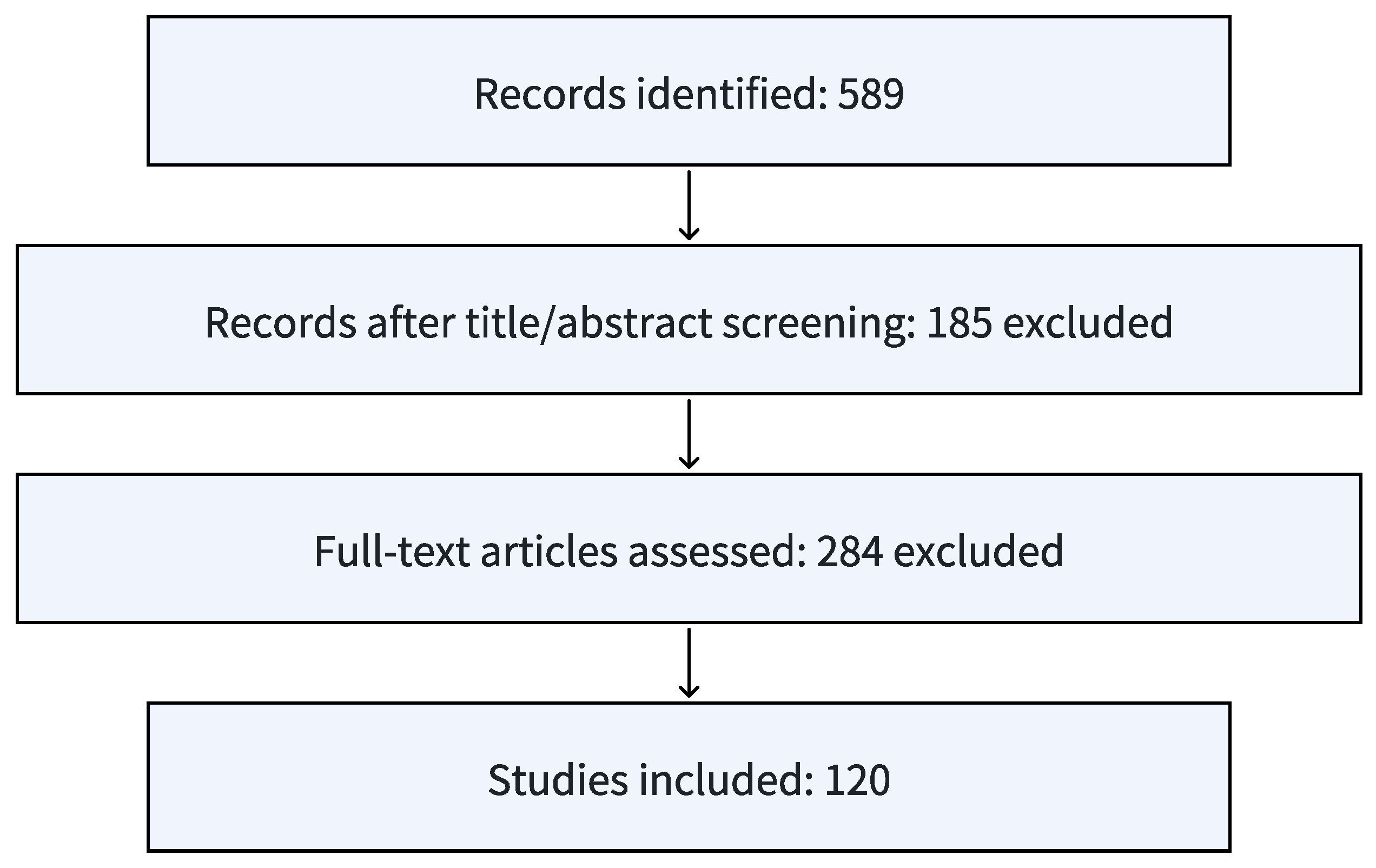
The initial search identified 589 articles. The selection process followed a three-stage approach conducted independently by two reviewers, with disagreements resolved through consensus: (1) screening titles and abstracts for relevance to smart conference technologies (185 articles excluded), (2) full-text review of potentially relevant articles (284 articles excluded based on inclusion/exclusion criteria), and (3) final selection of 120 articles for in-depth analysis.
Inclusion criteria encompassed peer-reviewed journal articles, conference proceedings, and industry reports published in English that addressed technologies, analytics, or practices related to smart conferences. Exclusion criteria included non-English publications, studies unrelated to academic conferences, or those lacking a technological focus. The PRISMA flow diagram in Figure 1 illustrates the complete screening process.
Data were extracted using a standardised charting template that captured: authors, publication year, research objectives, methodology, technologies examined, datasets used, key findings, and limitations. The selected literature was categorised based on key themes, including predictive analytics, smart content delivery, networking improvements, and data-driven assessments, to map the current state of the field.
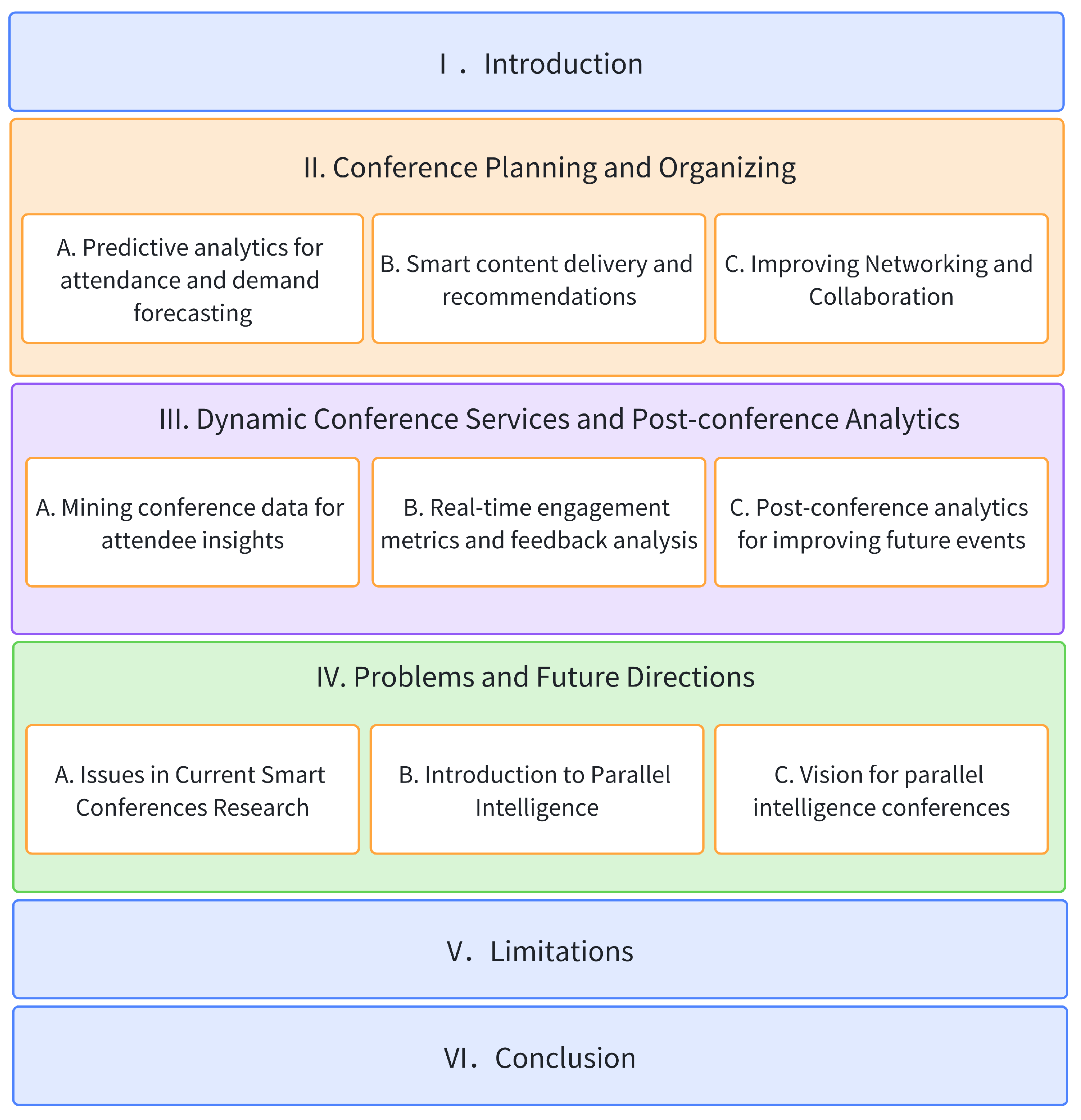
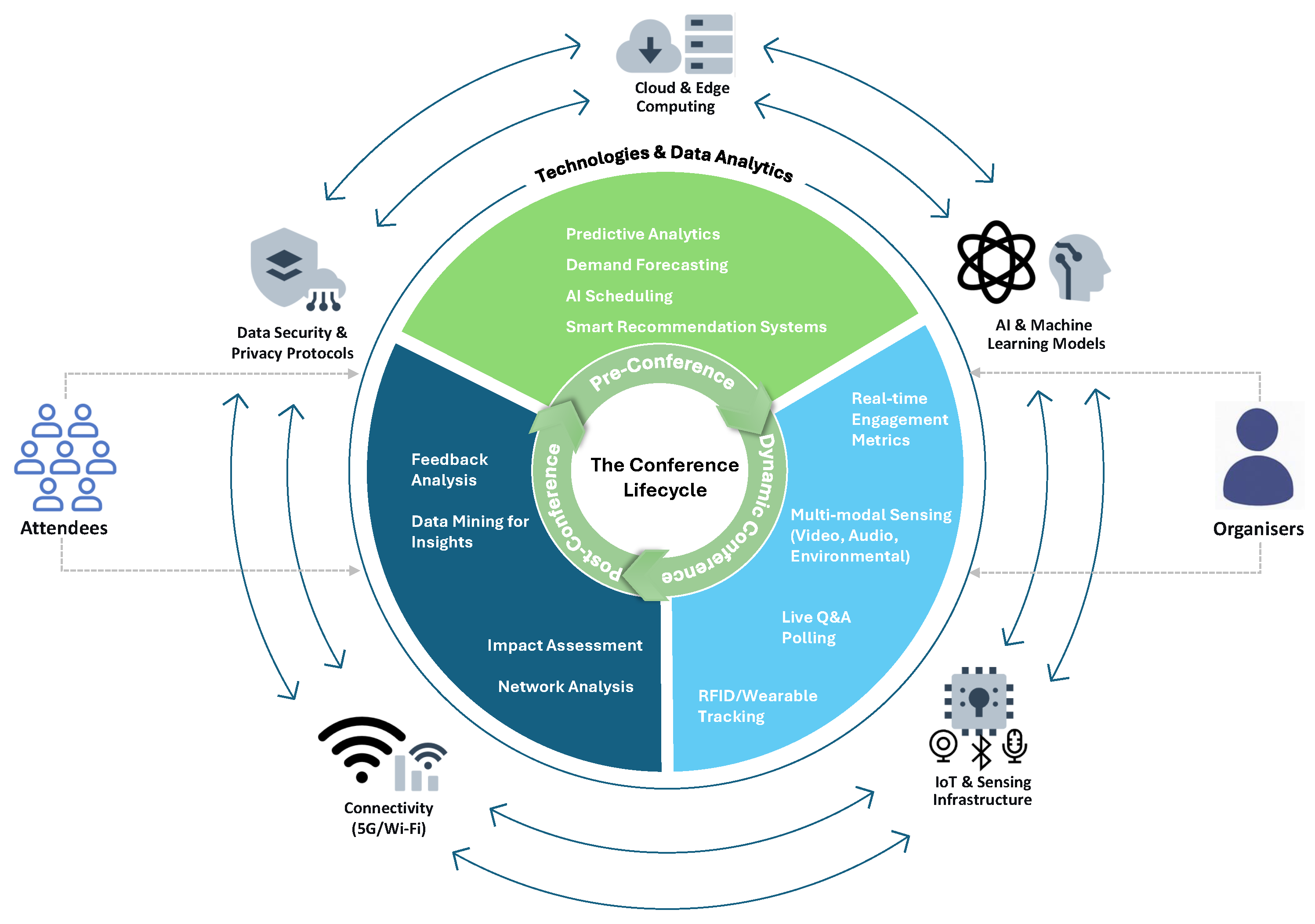
This article is structured to provide a logical progression from the current state of smart conference technologies to future directions, as shown in Figure 2. The conceptual ecosystem of a smart conference, integrating the various technologies discussed, is illustrated in Figure 3. The following sections are included:
  • Conference Planning and Organising: This section explores how predictive analytics, smart content delivery, and improved networking and collaboration tools are enhancing conference planning and participant engagement.
  • Dynamic Conference Services and Post-conference Analytics: It focuses on the utilisation of conference data for gaining attendee insights, real-time engagement metrics, feedback analysis, and post-conference analytics for continuous improvement.
  • Problems and Future Directions: It discusses the limitations of current smart conference approaches and introduces the concept of parallel intelligence. It also outlines the vision for parallel intelligence conferences and their potential to revolutionise attendee experiences and outcomes.
  • Limitations: This section discusses the methodological limitations of the current review.
  • Conclusion: It summarises the key findings of the review and highlights future research directions.

2. Conference Planning and Organising

In the realm of contemporary conference management, advancements in technology are profoundly altering the strategies and dynamics of attendee engagement [22]. From the integration of predictive analytics for precise attendance forecasting and resource allocation [35], to the implementation of smart content delivery systems that tailor information dissemination based on attendee preferences [36], and innovative networking solutions fostering collaborations [37]—the evolution towards “smart conferences” represents a pivotal shift towards more data-driven, personalised, and efficient event experiences. This section explores the critical aspects of conference planning and organising, elucidating their transformative potential within the evolving landscape of professional and academic gatherings.

2.1. Predictive Analytics for Attendance and Demand Forecasting

The field of predictive analytics for attendance and demand forecasting has garnered increasing attention for its potential to revolutionise event planning and resource management strategies. By harnessing data-driven insights and advanced analytical tools, organisations can gain a competitive edge in understanding attendee behaviour, predicting demand, and optimising resource allocation. This proactive approach enables informed decision-making, drives operational efficiency, reduces waste of conference materials (e.g., catering, promotional items), and enhances the overall success of events and conferences.
Modern smart conferences leverage diverse sensing technologies to capture comprehensive data for predictive modelling, including video cameras for visual attendee counting and flow analysis [38,39], environmental sensors for monitoring temperature, humidity, and air quality conditions that may affect attendance patterns [40], and audio/paralinguistic analysis for measuring ambient noise and speech patterns that indicate engagement and affect [41,42]. These sensing modalities provide rich, multi-dimensional datasets that can be used to build accurate attendance forecasting models. As the importance of predictive analytics continues to grow in shaping strategic planning and operational processes, these datasets and their use play an increasingly important role in helping us achieve sustainable growth and maximise outcomes of conferences and events.
Mu’s research [43] explores the application of the Analytic Network Process (ANP) in the non-profit sector, focusing specifically on the Latin American Studies Association. The study effectively demonstrates ANP’s utility as a decision-making tool for selecting conference sites and forecasting attendance, showcasing a comprehensive approach enhanced by considering factors like cost, political/strategic implications, tourism opportunities, and risk within the Benefit-Cost-Risk model. This highlights the potential of ANP in enhancing decision-making processes in non-profit organisations.
Transitioning to event-based social networks, Du et al. [44] delve into predicting activity attendance by emphasising the intricate interplay between online and offline social interactions. Utilising the Singular Value Decomposition with the Multi-Factor Neighborhood algorithm, they successfully integrate content preferences, context, and social influence factors to outperform existing methods in forecasting attendance. In a parallel study, by analysing users’ interests and past activities, Zhang et al. [45] develop supervised learning models leveraging semantic, temporal, and spatial features, with a notable emphasis on the influential role of semantic features in predicting event attendance. Complementing these efforts, Rizi and Granitzer [46] explore the role of social influence in event attendance prediction, demonstrating how network-based models can enhance accuracy by incorporating relational data from social platforms.
Mair and Thompson’s exploration of decision-making processes among conference attendees at association conferences in the UK [47] sheds light on significant factors such as networking opportunities, cost, location, personal and professional development, and health/safety considerations. Through advanced analytical techniques like principal component analysis and multiple regression analysis, the authors identify networking opportunities and costs as primary predictors influencing future conference attendance. Additionally, Scholz et al.’s utilisation of the mixed-root PageRank algorithm to predict talk attendance at academic conferences [48] underscores the relevance of contact networks and similarity networks, highlighting the impact of face-to-face contact duration on attendance probability. Finally, Leach et al.’s analysis of attitudes, word-of-mouth, and value congruence on conference participation [49] emphasises the importance of generating positive word-of-mouth and participant satisfaction for conference organisers’ success in attracting and retaining attendees.
The current landscape of predictive analytics for attendance and demand forecasting in event management is marked by a growing recognition of its transformative potential through data-driven insights and advanced analytical tools. Studies across various domains have demonstrated the value of predictive analytics in understanding attendee behaviour, predicting demand, and optimising resource allocation to enhance event success. Recent reviews, such as that by Leong and Mafas [35], further synthesise these algorithms, particularly in event-based social networks, underscoring the evolution toward more integrated predictive frameworks.

2.2. Smart Content Delivery and Recommendations

Smart content delivery and recommendations play a critical role in enhancing the academic conference experience by providing attendees with tailored and relevant information. Modern systems leverage advanced sensing technologies to understand attendee preferences and behaviours, including computer vision systems for tracking visual attention patterns and gaze direction during presentations [50], audio and paralinguistic processing for analysing vocal responses and discussion participation levels [41], environmental and physiological sensors for monitoring comfort and engagement-related conditions [40,51], and multimodal emotion recognition through facial expression and voice-tone analysis [42]. These sensing modalities enable real-time adaptation of content delivery based on audience engagement levels, attention patterns, and emotional responses.
Researchers have explored various recommendation algorithms that leverage users’ preferences, social networks, and content information to improve conference participation. The integration of social network-based recommendations, content information, and context-aware mobile recommendation services has shown promising results in offering personalised talk suggestions, facilitating networking opportunities, and catering to the needs of both regular attendees and new participants.
Lee and Brusilovsky [52] investigate different recommendation approaches, finding that social network-based recommendations fused with content information and non-personalised community vote-based recommendations yield promising results, particularly benefiting cold-start users. Pham et al. [53] introduce a context-aware mobile recommendation service aimed at enhancing academic event participation through personalised recommendations, with positive feedback indicating the system’s efficacy in issuing relevant talk recommendations and facilitating networking opportunities. Additionally, Lee and Brusilovsky [54] focus on suggesting talks at research conferences, highlighting the success of social network recommendations combined with content information. Building on this, Li et al. [36] propose a unified conference paper recommendation method that integrates content and authorship information using pairwise learning-to-rank techniques, improving personalisation for academic conferences. Asabere et al. [17] propose a socially aware recommendation algorithm for smart conference participation, emphasising the importance of considering social characteristics and context in venue recommendations to improve the conference experience.
In summary, the current research on smart content delivery and recommendations within academic conferences demonstrates a growing interest in leveraging technology to optimise attendees’ conference experiences. By combining social characteristics, context awareness, and personalised recommendations enhanced by multi-modal sensing data—including video analytics for attention measurement, audio processing for sentiment analysis, environmental monitoring for comfort assessment, and behavioural sensing for engagement evaluation—researchers aim to enhance information dissemination, promote networking, and improve overall engagement at academic events. Emerging intelligent systems, such as the one developed by Atalla et al. [55], extend these principles to academic advising, offering scalable models for curriculum-based recommendations that could inform conference scheduling and content curation. Future studies in this field may focus on refining recommendation algorithms through advanced sensing integration, incorporating real-time data analytics from diverse sensing modalities, and exploring interactive technologies that utilise computer vision, audio processing, and environmental sensing to further enhance the conference experience and foster meaningful connections among attendees.

2.3. Improving Networking and Collaboration

Improving networking and collaboration in academic and professional settings has become a focal point of research across various domains. Several innovative approaches have emerged to facilitate connections among conference participants, enrich conference experiences, and promote meaningful collaborations. For instance, ConfFlow and DataConf offer interactive web and mobile applications, respectively, that leverage attendees’ research interests and conference metadata to foster diverse collaborations. Additionally, studies like Wittich et al.’s exploration of mobile conference applications [56] and Klein-Gardner and Chukwurah’s investigation into the impact of Science, Technology, Engineering, and Mathematics (STEM) conferences on educational integration [57] highlight the significance of technology and events in enhancing networking and collaboration. Moreover, Huo et al.’s work on privacy-preserving recommendations in location-based social networks [58] addresses privacy concerns while promoting engagement and collaboration within online communities. Complementing these, Reychav et al. [37] examine how social networks facilitate the adoption of mobile technologies for collaboration, revealing key factors influencing user engagement in professional settings.
ConfFlow [59] offers an interactive web application designed to facilitate new diverse collaborations among conference participants by visualising a similarity space based on attendees’ former publications. By customising the user experience and enabling connections with individuals sharing similar or complementary research interests, ConfFlow aims to foster meaningful collaborations. In a similar vein, Médini et al. [60] introduce DataConf, a mobile web application that enriches conference publications by providing access to authors, organisations, related publications, and keywords. Leveraging the Linked Data paradigm and client-side reasoning, DataConf offers functionalities such as generating publication Quick Response (QR) codes and integrating with external web services, thereby enhancing the exploration of conference metadata and promoting collaboration within the academic community. Wittich et al. [56] delve into the realm of continuing medical education (CME) by investigating participants’ attitudes towards mobile conference applications. Through the development of a CME App equipped with features like presentation slides, note-taking capabilities, and social networking, the study validates a measure (CMEAPP-10) to assess participant perceptions. The results highlight the positive correlation between App usage frequency, participant characteristics, and attitudes towards the CME App, emphasising the importance of portable technology in engaging learners within the medical education domain. Klein-Gardner and Chukwurah [57] shed light on the impact of the STEM Think Tank and Conference on K-12 educators, administrators, and industry professionals in promoting STEM integration in educational settings. Through surveys, interviews, and data comparisons, the study reveals significant improvements in attendees’ professional connections and their inclination towards implementing STEM practices in the classroom, underscoring the conference’s role in fostering collaborations and inspiring pedagogical innovation. Lastly, Huo et al. [58] focus on privacy-preserving point-of-interest recommendations in Location-Based Social Networks (LBSN) [61] by addressing the challenge of safeguarding user privacy while considering geographical and social influences. By proposing privacy-preserving algorithms that ensure user privacy protection under differential entropy metrics, the study demonstrates how a privacy-preserving recommendation system can effectively balance privacy concerns with recommendation accuracy in LBSN environments.
In summary, the current research emphasises the importance of improving networking and collaboration through technological innovations and event-driven initiatives. By harnessing the power of interactive applications, enhancing conference experiences, and addressing privacy concerns, researchers aim to create conducive environments for meaningful collaborations across disciplines. Looking ahead, the integration of advanced technologies such as AI and blockchain [62,63], coupled with a continued emphasis on user experience and privacy, promises to further enhance networking and collaboration platforms. Future research may explore personalised recommendation systems, augmented reality interfaces, and interdisciplinary conferences to catalyse collaboration and drive innovation in diverse fields. Ultimately, the evolution of networking and collaboration methodologies underscores their intrinsic value in fostering creativity, knowledge exchange, and collective problem-solving in academic and professional communities.
Table 1. Summary of key aspects in smart conference planning and organising.
CategoryDetailsReferences
Data SourcesConference data[43,52,53,54]
Survey data from participants[47,49,56,57]
Real-world datasets from platforms like Douban, Meetup, and Conference Navigator[17,44,45,59,60,64]
Analysis MethodsStatistical analyses[47,49,56,57]
Network analysis and cross-validation[48,52,54]
User feedback and performance evaluation[17,53,57,64]
Video analytics and emotion detection through computer vision[17,53,65]
Theoretical analysis for privacy-accuracy trade-off[58]
Interaction TechnologyMobile and web applications for enhanced conference participation and networking, video analytics systems, environmental sensing networks[56,59,60,65]
Data Privacy and SecurityPrivacy-preserving techniques in recommendation systems[58]
Interdisciplinary CooperationEncouragement of collaborations, particularly in STEM education[57]
To provide a consolidated overview of the key studies discussed in this section, Table 2 summarises the authors, year, dataset context, analytical method, key variables, and primary outcomes of each work. This synthesis highlights the diverse methodologies and foci within smart conference research.
Research in the realm of smart conference planning and organising encompasses a multifaceted landscape, integrating insights from diverse disciplines and methodologies. To provide a comprehensive overview, Table 1 categorises key aspects of this research, including data sources, analysis methods, interaction technologies, data privacy and security considerations, and interdisciplinary cooperation. Each category details specific elements and indicates relevant papers that contribute to the understanding and advancement of smart conference systems.
Data sourcing strategies span a wide spectrum, encompassing datasets derived from conference attendance records, user surveys, event-based social networks, and real-world face-to-face interactions. These rich datasets capture intricate details essential for modelling decision networks, predicting attendee behaviour, and optimising conference management processes.
Analysis methods applied in this domain encompass both quantitative and qualitative approaches tailored to research objectives. Pairwise comparisons, regression analysis, structural equation modelling, and supervised learning models are commonly utilised to examine factors influencing conference attendance, predict user behaviour, and evaluate model performance against diverse metrics. Interaction technologies, including Radio-Frequency Identification (RFID) tracking systems, event-based social networks, and specialised software platforms, play a crucial role in facilitating data collection, analysis, and decision optimisation, fostering innovation and holistic understanding.
Ensuring data privacy and security emerges as an important topic of smart conference research, ensuring the integrity of research outcomes and maintaining participant trust. While not explicitly addressed in all studies, maintaining confidentiality, anonymity, and compliance with ethical standards are paramount. Efforts to promote interdisciplinary cooperation are evident, as research draws upon disciplines such as data science, social network analysis, tourism management, and computer science. Through interdisciplinary collaboration, researchers enrich the depth and breadth of their investigations, fostering innovation and adaptive conference management practices.

3. Dynamic Conference Services and Post-Conference Analytics

Dynamic conference services and post-conference analytics involve collecting, analysing, and interpreting data related to an event in order to assess its effectiveness and impact. This can include various types of data, such as mining conference data for attendee insights, real-time engagement metrics, and feedback analysis, and post-conference analytics for improving future events.
The fundamental procedure of dynamic conference services and post-conference analytics is to systematically collect, analyse, and utilise data from various sources related to a conference. This approach leverages advanced technologies and analytical techniques to gather real-time and post-event information about attendees, sessions, and overall event performance. Table 3 summarises the key aspects and relevant research in smart conference planning and organising.

3.1. Mining Conference Data for Attendee Insights

Mining conference data for attendee insights involves gathering, integrating, and interpreting heterogeneous signals produced during events to characterise behaviour, preferences, and interaction patterns. Practical deployments combine several complementary sensing modalities: fixed or mobile video for people-counting and flow analysis [38,39,77]; vision-based facial-expression and webcam or mobile gaze-tracking for attention and affect estimation [42,50,78]; environmental probes for temperature, lighting, and air-quality monitoring [40]; audio and paralinguistic analysis for sentiment and engagement detection [41]; and wearable physiological sensors (e.g., heart-rate variability, and skin conductance) to infer arousal and stress [51]. Compared with traditional surveys, these modalities provide continuous, objective measurements with higher temporal resolution and ecological validity, enabling more responsive operational decisions such as session sizing, room assignment, and targeted interventions.
When these heterogeneous streams are fused through multimodal machine-learning pipelines, they support richer analytics: engagement heatmaps, speaker–audience synchrony measures, automated summaries of interaction dynamics, and real-time crowd estimation for capacity management [38,42,77,78]. Combined signals—such as paired physiological and acoustic cues—can also inform adaptive comfort controls, break scheduling, or pacing adjustments to improve attendee focus and well-being [40,51]. Because many of these modalities involve the collection of audiovisual or biometric data, organisers must explicitly address privacy, ethics, and legal compliance. They can apply data-minimisation and purpose-limitation principles, obtain informed consent, adopt on-device/edge processing when feasible, and implement secure storage, strict access controls, and clear retention policies in accordance with frameworks such as General Data Protection Regulation (GDPR) [58,79]. For practical implementation, conference organisers should establish lawful bases for data processing, conduct data protection impact assessments, define clear data governance roles between organisers and technology vendors, and implement technical safeguards such as encryption and access controls.
Cox et al. [65] provide a detailed introduction to a project aimed at providing location-aware value-added services to academic conference participants. The main characteristic of this project is the integration of RFID technology, database management, data mining, real-time information visualisation, and interactive web application technology into an operational integrated system deployed at large public conferences. The developed system tracks conference attendees, analyses track data in real time, and provides attendees with various services, such as real-time snapshots of conference event attendance, the ability to locate friends at the conference centre, and the ability to search for events of interest. The results of this experiment demonstrate the potential for technological innovation to enhance dynamic conference experiences. Wang et al. [4] propose a new collaborative mechanism, termed conference closure. Conference closure implies that scholars participating in the same conference can collaborate in the future. They utilise 22 conferences from the DBLP digital library in the field of data mining to analyse the extent of scholars in meeting new collaborators at individual and community levels. Andreas et al. [66] present a prototype of an intelligent activity mobile application, with indoor geolocation based on beacons, personalised recommendations, and automatic user interface adaptability. Their focus is on the recommendation function that utilises professional social network mining and semantic concept recognition. They report its usage in real life during the conference and discuss the usefulness of the recommendations, or more accurately, the impact of the recommendation function. Watts et al. [67] explore the potential of analysing conference records using WebQL information retrieval and TechOasis (VantagePoint) text mining software. Their approach demonstrates how tracking research patterns and changes across conference series can clarify R&D trends, identify leading issues, and highlight key research organisations. Hornick et al. [68] address the challenge of recommending conferences to potential participants through a novel extension to traditional model-based recommendation systems. Their approach offers enhanced personalisation of conference experiences based on participant data. Similarly, Barrat et al. [80] analysed social dynamics in conferences using RFID-tracked interaction data from the Live Social Semantics application, providing insights into sparse network formations and attendee interactions. Ertek et al. [81] developed a framework for mining RFID data in schedule-based systems like conferences, enabling the extraction of behavioural patterns such as social clustering and attendance flows. Ryu and Back [82] used cluster analysis on survey data from academic convention attendees to explore self-congruity effects on evaluations of event quality, value, and behavioural intentions, highlighting psychographic segmentation for targeted improvements.
In conclusion, the integration of data mining and smart technologies in academic conferences is significantly enhancing the attendee experience. By leveraging attendee behaviour data captured through computer vision systems for gesture recognition and movement tracking, environmental sensing networks for spatial utilisation analysis, audio processing for real-time emotion detection and engagement measurement, and contextual awareness systems, these technologies facilitate better information dissemination, foster networking, and improve engagement. The incorporation of multi-modal sensing approaches—combining video analytics for facial expression recognition, thermal sensors for comfort assessment, and acoustic analysis for sentiment evaluation—enables a more nuanced understanding of attendee preferences and behaviours. The continuous refinement of recommendation algorithms, coupled with the incorporation of real-time analytics and interactive technologies, is expected to further optimise conference experiences. Future research will likely focus on advancing these approaches, exploring new ways to promote meaningful interactions and collaboration through advanced sensing modalities, and refining the overall management of academic events.

3.2. Real-Time Engagement Metrics and Feedback Analysis

Real-time engagement metrics and feedback analysis in the context of smart conferences refer to the continuous tracking and evaluation of attendee interactions during events, leveraging advanced sensing technologies to assess participation, feedback, and overall engagement. These systems employ computer vision cameras for facial expression analysis and attention tracking, environmental sensors to monitor room temperature, lighting, and air quality that may affect engagement levels, audio processing systems for real-time sentiment analysis of questions, comments, and ambient conversations, and wearable devices for measuring physiological indicators such as heart rate variability and skin conductance that correlate with emotional engagement. Additionally, thermal imaging cameras can be used to detect stress responses and comfort levels [83], while acoustic beamforming arrays can isolate and analyse individual conversations to gauge discussion quality and participation depth [84]. These metrics provide real-time insights into how attendees are interacting with speakers, content, and each other, enabling organisers to adjust and improve the event experience on the fly.
Schwenk et al. [70] design a study to answer whether there is a correlation between conference attendance/registration and four defined Twitter metrics. They have observed that the number of Twitter participants at the conference is positively correlated with Twitter activity metrics. No relationship is observed between conference size and Twitter metrics. Physician influencers may be a significant driver of participants. Laura et al. [71] propose a method for students to use their mobile phones for real-time voting during conferences, thereby improving the quality of educational conferences. Koh et al. [72] propose a novel intelligent user interface method for virtual conference software. It supports impromptu voting interactions by utilising real-time gesture recognition and video filter feedback. They conduct research to design and evaluate this intuitive gesture-based voting system with visual feedback. Kulyk et al. [73] provide a service that gives real-time feedback on social dynamics of a group meeting to its participants. This service allows one to visualise the non-verbal attributes of behaviour related to social dynamics: speaking time and gaze behaviour. Buchsbaum et al. [74] design a real-time voting system to collect and analyse the opinions of large groups. This system drives a process known as “collective evolution”, where the feedback from the entire group is used to design the next iteration of the system. Rather than focusing on individual opinions, the collective input guides system improvements, offering an effective framework for real-time decision-making and adaptation based on group feedback. Complementing these, Frank et al. [85] demonstrated real-time engagement detection in meetings using multimodal biometrics like facial expressions and voice, achieving low-latency processing suitable for conference settings. Shankar [86] proposed a machine learning-based multimodal system for monitoring engagement in e-learning environments, adaptable to virtual conference sessions for continuous feedback. Villaroya et al. [87] introduced an automatic real-time engagement recognition system combining non-verbal facial features for human-agent interactions, extensible to audience monitoring in educational and conference contexts. Levordashka et al. [88] developed a scalable web-based method using webcam head movement tracking to quantify cognitive engagement in remote video audiences, validating its correlation with self-reported immersion.
These insights are invaluable for conference organisers as they enable them to make real-time adjustments during the event to better meet the needs and expectations of attendees. The integration of multi-modal sensing technologies—including video analytics for detecting audience attention patterns, environmental monitoring for optimising room conditions, audio processing for measuring discussion quality and emotional tone, and physiological sensing for assessing engagement levels—provides a comprehensive understanding of attendee experiences that goes beyond traditional feedback mechanisms. They can also help event organisers plan and execute more successful future events.

3.3. Post-Conference Analytics for Improving Future Events

Post-conference analytics refers to the process of collecting, analysing, and interpreting data related to a completed conference or event. This systematic approach allows organisers to gain valuable insights into attendee experiences, session effectiveness, and overall event performance. By identifying key strengths and areas for improvement, organisers can leverage these insights to optimise the planning and execution of future events.
To assess different individuals’ experiences in conference spaces, Wilton et al. [76] interpret the conference atmosphere survey results completed by 198 out of the 482 registrants of the Society for Advancement of Biology Education Research (SABER) West 2021 conference. Six biology education researchers analyse the survey data; they not only amplify the voices of conference participants but also provide insights and follow-up steps, the implementation of which can promote greater participant fairness, representativeness, and participation in future STEM education conferences. Moro et al. [75] analyse the last four editions of the Iberian Conference on Information Systems and Technologies (CISTI) (2013–2016), covering 677 articles. To address the challenge of large-scale literature analysis, they employ text mining and topic modelling to evaluate research trends and their alignment with the conference’s main themes. The study confirms that data-driven empirical research remains a dominant topic, while education and learning also play significant roles. Additionally, although the Internet and social media are not official conference themes, they emerge as highly relevant topics. In contrast, health informatics receives comparatively less attention. Based on these findings, the study provides actionable recommendations for future CISTI themes, alongside a comprehensive overview of current research trends. Wu et al. [89] used data analytics on log files and post-event surveys from a virtual academic conference to examine attendee behaviours and psychological states, offering implications for enhancing virtual event designs. Moreira et al. [90] assessed engagement and social interactions in a virtual reality (VR)-based virtual conference through post-event questionnaires and analytics, identifying key areas for improving immersion and networking in future hybrid formats. Seidenberg et al. [91] conducted a multi-year analysis of participant feedback from Learning Analytics and Knowledge (LAK) conferences, comparing virtual and in-person formats to derive predictors of perceived value, such as social interaction quality, for guiding future event optimisation. Skiles et al. [92] evaluated demographic diversity, equity, and carbon footprint metrics across in-person and virtual engineering conferences using survey and attendance data, demonstrating substantial improvements in accessibility and sustainability to inform hybrid adoption strategies.
Collecting and analysing this data allows organisers to uncover trends, assess performance, make data-driven decisions, and ultimately, plan better events in the future. By using a data-driven approach, conference organisers can obtain more objective, comprehensive, and actionable insights that can be used to continuously improve future events. Moreover, data-driven insights and assessments also enable conference organisers to create more effective, engaging, and successful events by making informed decisions based on concrete data rather than intuition or anecdotal evidence.
The key studies discussed in this section, which focus on dynamic services and post-event analytics, are synthesised in Table 4 to provide a clear comparison of their approaches and contributions.

4. Challenges and Future Directions

4.1. Issues in Current Smart Conferences Research

With the rapid development of technology and data analysis, smart meetings have become an important trend in event management. While these conferences are designed to enhance attendee experience, foster collaboration, and optimise event planning, there are several shortcomings in the current landscape. It mainly focuses on five aspects: data accuracy and source diversity, participant behaviour modelling and artificial social environment construction, privacy and data security, integration of interactive technologies, and interdisciplinary cooperation.

4.1.1. Data Accuracy and Source Diversity

With the growing use of data-driven insights in smart conferences, there is a significant concern regarding the accuracy and diversity of data sources. Current methodologies often rely on limited data sets, which may not fully capture the complexity of attendee behaviour and preferences. Additionally, the lack of real-time data analytics hinders the ability to make timely adjustments during the conference to better meet attendees’ needs. Existing studies, such as those by Cox et al. [65] and Wang et al. [4], have shown promise in leveraging RFID technology and conference metadata. However, these methods often do not incorporate diverse data sources, limiting the comprehensiveness of the insights gained. While some studies like Amicis et al. [69] and Laura et al. [71] have explored real-time engagement metrics, there is a need for more advanced real-time data analytics to continuously assess and adapt to attendee interactions and responses during the conference.

4.1.2. Modeling of Attendee Behavior and the Construction of Artificial Social Environments

The modelling of attendee behaviour and the construction of artificial social environments are essential for enhancing networking and collaboration. However, current approaches often lack sophistication and fail to accurately simulate real-world social dynamics. Research by Zhang et al. [45] and Mair and Thompson [47] contributes to predicting attendee behaviour but often does not fully account for the complexity of human interactions and decision-making processes. While applications like ConfFlow [59] and DataConf [60] facilitate networking, they often fall short in creating authentic and meaningful social interactions among attendees.

4.1.3. Privacy and Data Security

Privacy and data security are paramount concerns in smart conferences. The centralised nature of current systems poses risks to attendees’ personal data, and there is a need for more secure and transparent systems. Additionally, the potential of decentralised autonomous organisations (DAOs) in meeting organisation and execution remains largely unexplored. Current studies, such as Huo et al. [58], address privacy concerns but do not offer comprehensive solutions to safeguard user data in location-based social networks. The integration of DAOs in smart conferences could revolutionise the organisation and execution of meetings by providing a transparent, secure, and decentralised platform, as suggested by Wang et al. [93]. However, this potential remains largely untapped in current research and practices. Beyond technical safeguards, practical deployment must address informed consent challenges—as attendees may not fully comprehend how multimodal data fusion creates insights beyond individual sensors—and usability barriers for participants with limited technological literacy or disabilities. Moreover, algorithmic curation risks reinforcing research silos by over-optimising for past preferences, potentially diminishing the serendipitous cross-disciplinary exchanges that conferences traditionally facilitate. Future implementations should embed independent ethics review, provide meaningful opt-out mechanisms, and balance technological enhancement with preservation of unplanned intellectual interactions.

4.1.4. Integration of Interactive Technologies

While smart conferences aim to enhance attendee experience, the integration of interactive technologies is often superficial and lacks innovation. Lee and Brusilovsky [52] and Asabere et al. [17] have explored the use of mobile recommendation services and socially aware recommendation algorithms. However, there is a need for more advanced and interactive technologies, such as augmented reality interfaces and gesture-based systems, to provide a truly immersive and engaging conference experience, as demonstrated by Koh et al. [72].

4.1.5. Interdisciplinary Collaboration

Interdisciplinary collaboration is crucial for fostering creativity, knowledge exchange, and collective problem-solving in academic and professional communities. However, current smart conferences often lack a holistic approach that integrates diverse disciplines and perspectives. While some studies, such as Klein-Gardner and Chukwurah [57], highlight the role of STEM conferences in promoting interdisciplinary collaboration, there is a need for more comprehensive strategies that facilitate meaningful connections across various fields and disciplines.
In summary, while smart conferences hold significant potential for revolutionising event management and enhancing attendee experience, several shortcomings exist in the current landscape. These include limitations in data accuracy and source diversity, inadequate modelling of attendee behaviour and artificial social environments, ongoing concerns about privacy and data security, lack of innovation in integrating interactive technologies, and insufficient emphasis on interdisciplinary collaboration. Addressing these challenges requires a more comprehensive and innovative approach that leverages advanced analytics, integrates diverse data sources, prioritises privacy and security, explores the potential of DAOs, and fosters interdisciplinary collaboration. Embracing these strategies will be essential in unlocking the full potential of smart conferences and shaping the future of event planning and management.

4.2. Introduction to Parallel Intelligence

Parallel intelligence is regarded as an effective approach for achieving intelligent management and control of complex systems. Originating from Wang’s research on intelligent systems in 1994 [94], parallel systems have progressively evolved into a novel artificial intelligence theoretical framework centred on the ACP methodology, -namely, Artificial societies, Computational experiments, and Parallel execution [95]. Parallel intelligence transforms artificial societies from conventional system analysers into intelligent data generators, overcoming challenges in modelling, experimentation, and data scarcity within complex systems [96]. While the ACP approach has been successfully implemented in domains such as transportation, manufacturing, and energy management [95,97,98], its application to the complete lifecycle of academic conferences–encompassing planning, real-time execution, and post-event analytics–represents an innovative and promising research direction. The following sections will introduce fundamental concepts and representative studies in this field, contextualising them for potential adaptation to smart conferences.
The computational experiment method abstracts the conceptual model of CPSS from a bottom-up perspective [99]. Computational experiments are validated and applied in complex systems in multiple fields. According to Xue et al. [100], the computational experiment approach for complex social systems is a new quantitative analysis method that is applicable to interdisciplinary fields such as economics, finance, and epidemiology. Wang et al. [101] propose a method that explores network interactive behaviours using artificial communities and computational experiments. Wang et al. [102] make predictions of various forms of crime scenes through computational experiments and guide the evolution of the crime process. Zheng et al. [103] propose an image encryption method based on ACP, enhancing the security of encryption systems by combining redundant block strategies with artificial images.
As a crucial component of the ACP method, Artificial Societies are widely applied in fields such as AI, automated control, network security, data mining, and play significant roles in smart city development, including smart transportation. Ye et al. [104] proposes an agent decision modelling approach for Agent-Based Artificial Society, addressing issues related to model reuse and system integration, and demonstrates its effectiveness through implementing two simulations–emergency evacuation and population evolution. Song et al. [105] models complex distributed parameter systems in artificial societies or artificial systems to control and manage distributed parameter systems, thereby enhancing production efficiency. Wang et al. [106] introduces the concept of virtual doctors, which comprises descriptive doctors, predictive doctors, and scalable doctors. Wang et al. [101] investigates user behaviour in a community concerning information posting and how to construct an artificial community to study the generation of collective behavioural patterns. Zhu et al. [107] collects traffic data in social spaces using social sensors and social signals. Social media and social networking platforms provide real-time social signals, based on which artificial traffic scenarios and social traffic perception environments are built to continuously collect, store, process, and analyse traffic conditions in real time.
Researchers have proposed the DAO method to address the privacy and data security issues in CPSS. It is an organisational form based on blockchain that can achieve self-operation, autonomy, and evolution [93]. DAO has been applied in the fields of management and decision-making. Li et al. [108] presents a DeMana management model based on DAO and a MOSs intelligent operating system based on blockchain, which can be effectively used for intelligent organisation and operation. Wang et al. [109] discuss the role and potential applications of intelligent technologies in DAO-based decentralised science (DeSci) in organisation and operation. Wang et al. [110] propose a parallel enterprise management framework based on DAO, which combines blockchain technology with methods such as artificial systems, computational experiments, and parallel execution to achieve distributed management of enterprises. Wang et al. [111] introduces research methods based on MetaControl and DeControl using computational and parallel control for decision-making and managing complex systems. These applications of DAO technology demonstrate significant potential for enhancing privacy, security, and management efficiency in smart conference systems, offering a blockchain-based framework that could revolutionise how conference data is governed and protected.
Artificial network system models are continuously improved to approximate real networks. When the real network is accurately described by the artificial network, various statistical computational experiments can be conducted on the artificial network to determine management and control strategies for the actual network system [112]. Han et al. [113] construct an artificial vehicle network based on CPSS and achieve real-time interaction between the actual system and the artificial system through parallel execution, enabling effective evaluation, verification, and improvement of the artificial system. Zhou et al. [114] propose constructing an artificial city rail transit station system based on agent modelling technology and managing and optimising emergency strategies through parallel execution mechanisms. Tan et al. [115] optimise the nuclear emergency evacuation system through a combination of artificial system simulation, computational experiment optimisation, and intelligent vehicle cooperation systems. Gao et al. [116] propose a parallel mining framework based on the IoT, constructing a parallel unmanned mining system that interacts between virtual mining organisations and real mining systems.
These diverse applications demonstrate how artificial–real system interaction improves decision-making through three core mechanisms. First, bidirectional feedback enables continuous model refinement: real-world data calibrates artificial system parameters while computational experiments generate optimised strategies for real deployment. Second, parallel execution allows risk-free testing of scenarios that would be dangerous or impractical in reality, enhancing system resilience. Third, rapid evaluation of alternative strategies in artificial systems identifies near-optimal solutions unattainable through real-world trial-and-error. These mechanisms assume that: (1) artificial systems achieve sufficient fidelity through agent-based modelling and data-driven parameterisation, (2) adequate sensor coverage enables meaningful calibration, and (3) computational complexity remains tractable for timely decision support. For smart conferences, these principles suggest that artificial systems could optimise attendee experience by modelling participant behaviour, simulating scheduling scenarios, and adapting to real-time engagement data.
In conclusion, based on the exploration conducted by the author on the application of parallel systems in various fields, the current theoretical framework has not been applied in the conference domain. As the parallel intelligence theory has been applied and validated in complex environmental scenarios in multiple domains, such as parallel control [95], parallel manufacturing [97], parallel transportation [117], parallel grid [98], parallel agriculture [118], parallel healthcare [119], parallel UAVs(unmanned aerial vehicles) [120], etc., proving its advantages in addressing complex system management and control issues, it is therefore worth further research on its application in the conference domain.

4.3. Vision for Parallel Intelligence Conferences

Emerging technologies are accelerating the transition of academic conferences toward more diversified modes of participation. The three-year worldwide epidemic has also been accelerating this shift, as it not only becomes an essential approach to avoid the spread through people’s physical contact but also brings much convenience into people’s lives in the post-pandemic era. Parallel conference, with the advantages mentioned before, represents a prospective direction for future academic conferences. Several unique, beneficial features in such a paradigm may elevate the convenience and efficiency of meetings. First, by developing digital organisers and digital attendees as the assistants of real human organisers and attendees, parallel conferences can bring various participants better user and interaction experiences. Particularly, with the support of current Large Language Models (LLMs), AI Agents, and the emerging social media such as VR and augmented reality (AR), it is going to implement the virtual-real hybrid conference via “meeting in playing” and “playing in meeting”. By constantly interacting with its human user counterpart, the digital assistant can further learn the user’s knowledge structure as well as preferences and recommend suitable strategies for meeting attendance, such as the travel modes (train or airline). Once the conference is completed, participants can maintain continuous communications with each other through their respective assistants, thereby facilitating their joint research. The virtual-real hybrid conference can be viewed as a prototype of the metaverse conference, involving diversified, flexible, and personalised interactions among scholars.
Second, treating digital assistants as the avatars of the conference organisers and attendees in cyberspace, a parallel conference can perform various operations on the acquired knowledge, like extraction, association, aggregation, reconstruction, generalisation, etc., and thus conduct computational experiments involving different organisation patterns and different types of participants. By setting the computational experiments on automatic, which is known as the knowledge automation, parallel conference can establish an analytical methodology for the virtual-real hybrid conference at the systemic level, investigating the evolutionary dynamics of the whole workflow, from the initial planning, invitation, conference arrangement, to the post-meeting service. This helps optimise the organisational process and the pattern of participation, and identify more potential attendees as well as beneficiaries.
Third, in the paradigm of virtual-real hybrid conference and knowledge automation evolutionary experiment, generative AI and scenario engineering can be further introduced to enhance the guidance of the conference. Generative AI is different from traditional AI, where the algorithm focuses on analysing and predicting based on input data. It is able to produce original outputs that mimic the characteristics of the data it was trained on, such as text, images, audio, or code. Scenario engineering is a strategic planning and analytical methodology used to create and evaluate multiple plausible, critical scenarios to elevate the intelligence and robustness of AI models. It involves systematically constructing, analysing, and utilising scenarios to investigate the system’s potential long-tail phenomena. By combining generative AI and scenario engineering, parallel conferences can proactively set conference topics, ensuring that the theme tracks the forefront of the research field and discussions are effectively guided to a certain depth. Parallel conference can also fully explore the common research interests among scholars via interactive communications with different research communities, which facilitates collaborative research, sparks new ideas, and promotes the multidisciplinary as well as interdisciplinary integration of scientific research.
At last, by introducing DAO as its implementation form, the parallel conference guarantees the trustworthiness and tampering resistance of the knowledge sharing. As a result, such a paradigm can better protect the originality of research, thereby laying the foundation for the development of DeSci. DeSci aims to create an ecosystem where scientists are incentivised to openly share their research and receive credit for their work while allowing anyone to access and contribute to the research easily. DeSci works off the idea that scientific knowledge should be accessible to everyone and that the process of scientific research should be transparent. DeSci is creating a more decentralised and distributed scientific research model, making it more resistant to censorship and control by central authorities. DeSci hopes to create an environment where new and unconventional ideas can flourish by decentralising access to funding, scientific tools, and communication channels. As for these goals, parallel conferences may represent the most suitable paradigm to promote the development of DeSci. On the one hand, due to the consensus mechanism of DAO, a parallel conference can guarantee the knowledge update is completed on the condition that the majority of participants approve. This improves its credibility and wide acceptance and avoids the private falsification and tampering of the knowledge. On the other hand, a parallel conference based on DAO also keeps entire records of operations, such as the knowledge generation, modification, and abolition. It makes all the knowledge traceable and verifiable, thus ensuring its trustworthiness to all the conference attendees.

5. Limitations

This scoping review has several limitations that should be considered when interpreting its findings. First, the review primarily relied on five academic databases (Google Scholar, IEEE Xplore, PubMed, Scopus, and Web of Science) but may have missed relevant studies in domain-specific databases or grey literature sources. Second, the inclusion of only English-language publications may have introduced a language bias, potentially excluding valuable research published in other languages. Third, as a scoping review, the focus was on mapping the breadth of the field rather than conducting a critical appraisal of the methodological quality of individual studies, which limits the ability to assess the strength of evidence for specific smart conference technologies. Fourth, the rapidly evolving nature of smart conference technologies means that some recent developments may not be captured in this review, particularly those emerging after the literature search was completed in 2024. Finally, the review’s focus on technological aspects of smart conferences may have underemphasised important social, organisational, and ethical considerations that are crucial for successful implementation. Future research should address these limitations through more comprehensive literature searches, inclusion of non-English publications, systematic quality assessment of primary studies, and greater attention to the socio-technical dimensions of smart conference implementation.

6. Conclusions

This article provides a comprehensive review of the advancements in smart conference technologies, focusing on predictive analytics, smart content delivery, networking improvements, and data-driven assessments. By systematically analysing the current literature, this review aggregates the diverse methodologies and innovations in the realm of smart conferences, highlighting the significant strides made in enhancing conference planning, attendee engagement, and overall conference experiences. The review also introduces the concept of parallel intelligence, detailing its potential to revolutionise the future of academic conferences. Comprising artificial societies, computational experiments, and parallel execution, parallel intelligence represents a transformative approach in the context of smart conferences.
Current mainstream research on smart conferences is largely driven by the integration of AI, machine learning, and big data analytics. The common consensus in these studies is the transformative potential of leveraging advanced analytics and interactive technologies to optimise conference participation and outcomes. We believe that parallel intelligence conferences, which combine virtual-real hybrid meetings, AI-driven automation, and DAOs to enhance interaction, optimise organisation, and ensure trustworthy, tamper-resistant knowledge sharing, represent a promising direction for academic conferences. This paradigm promises to enhance the efficiency, engagement, and collaborative potential of conferences, paving the way for more innovative and inclusive scholarly communications.

Author Contributions

Conceptualisation, H.L., P.Y. and F.-Y.W.; methodology, H.L., P.Y., J.L. and N.Z.; investigation, H.L., J.L., X.Y., W.G. and Y.T.; data curation, H.L., W.G. and Y.T.; writing—original draft preparation, H.L., P.Y., J.L. and W.D.; writing—review and editing, P.Y., M.Z. and F.-Y.W.; supervision, P.Y., M.Z. and F.-Y.W.; project administration, P.Y. and F.-Y.W.; funding acquisition, P.Y., M.Z. and F.-Y.W. All authors have read and agreed to the published version of the manuscript.

Funding

This research was funded by the National Natural Science Foundation of China, grant numbers 62476270 and T2192933.

Data Availability Statement

Data sharing is not applicable to this article as no new data were created or analysed in this study.

Conflicts of Interest

Author Wendy Ding was employed by YakiHonne. The remaining authors declare that the research was conducted in the absence of any commercial or financial relationships that could be construed as a potential conflict of interest.

Abbreviations

The following abbreviations are used in this manuscript:
ACPArtificial societies, Computational experiments, and Parallel execution
AIArtificial Intelligence
ANPAnalytic Network Process
ARAugmented Reality
VRVirtual Reality
CISTIIberian Conference on Information Systems and Technologies
CMEContinuing Medical Education
CPSSCyber-Physical-Social Systems
DAODecentralised Autonomous Organisations
DeSciDecentralised Science
EBSNEvent-Based Social Network
GDPRGeneral Data Protection Regulation
IoTInternet of Things
LAKLearning Analytics and Knowledge
LBSNLocation-Based Social Networks
LLMsLarge Language Models
QRQuick Response
RFIDRadio-Frequency Identification
SABERSociety for Advancement of Biology Education Research
STEMScience, Technology, Engineering, and Mathematics
UAVsUnmanned Aerial Vehicles

References

  1. Oester, S.; Cigliano, J.A.; Hind-Ozan, E.J.; Parsons, E.C.M. Why Conferences Matter—An Illustration from the International Marine Conservation Congress. Front. Mar. Sci. 2017, 4, 257. [Google Scholar] [CrossRef]
  2. Hansen, T.T.; Budtz Pedersen, D. The impact of academic events—A literature review. Res. Eval. 2018, 27, 358–366. [Google Scholar] [CrossRef]
  3. Harrison, R. Unique Benefits of Conference Attendance as a Method of Professional Development for LIS Professionals. Ser. Libr. 2010, 59, 263–270. [Google Scholar] [CrossRef]
  4. Wang, W.; Bai, X.; Xia, F.; Bekele, T.M.; Su, X.; Tolba, A. From triadic closure to conference closure: The role of academic conferences in promoting scientific collaborations. Scientometrics 2017, 113, 177–193. [Google Scholar] [CrossRef]
  5. Chai, S.; Freeman, R.B. Temporary colocation and collaborative discovery: Who confers at conferences. Strateg. Manag. J. 2019, 40, 2138–2164. [Google Scholar] [CrossRef]
  6. Black, A.L.; Crimmins, G.; Dwyer, R.; Lister, V. Engendering belonging: Thoughtful gatherings with/in online and virtual spaces. Gend. Educ. 2020, 32, 115–129. [Google Scholar] [CrossRef]
  7. Goel, R.K.; Grimpe, C. Active versus passive academic networking: Evidence from micro-level data. J. Technol. Transf. 2013, 38, 116–134. [Google Scholar] [CrossRef]
  8. Dorsch, M.J.; Fisk, R.P. The Frontiers in Service Conference: A 20-year retrospective. Serv. Ind. J. 2014, 34, 477–494. [Google Scholar] [CrossRef]
  9. Anderson, T. The Virtual Conference: Extending Professional Education in Cyberspace. Int. J. Educ. Telecommun. 1996, 2, 121–135. [Google Scholar]
  10. Thatcher, A. Building and maintaining an online academic conference series. Int. J. Ind. Ergon. 2006, 36, 1081–1088. [Google Scholar] [CrossRef]
  11. Fraser, H.; Soanes, K.; Jones, S.A.; Jones, C.S.; Malishev, M. The value of virtual conferencing for ecology and conservation. Conserv. Biol. 2017, 31, 540–546. [Google Scholar] [CrossRef]
  12. Raby, C.L.; Madden, J.R. Moving academic conferences online: Aids and barriers to delegate participation. Ecol. Evol. 2021, 11, 3646–3655. [Google Scholar] [CrossRef]
  13. Abbott, A. Low-carbon, virtual science conference tries to recreate social buzz. Nature 2019, 577, 13. [Google Scholar] [CrossRef] [PubMed]
  14. Holden, M.H.; Butt, N.; Chauvenet, A.L.M.; Plein, M.; Stringer, M.; Chades, I. Academic conferences urgently need environmental policies. Nat. Ecol. Evol. 2017, 1, 1211–1212. [Google Scholar] [CrossRef] [PubMed]
  15. Valenti, A.; Fortuna, G.; Barillari, C.; Cannone, E.; Boccuni, V.; Iavicoli, S. The future of scientific conferences in the era of the COVID-19 pandemic: Critical analysis and future perspectives. Ind. Health 2021, 59, 334–339. [Google Scholar] [CrossRef]
  16. Fraser, S.; Mancl, D. Virtual and the Future of Conferences. Commun. ACM 2024, 67, 32–34. [Google Scholar] [CrossRef]
  17. Asabere, N.Y.; Xia, F.; Wang, W.; Rodrigues, J.J.P.C.; Basso, F.; Ma, J. Improving Smart Conference Participation Through Socially Aware Recommendation. IEEE Trans. Hum.-Mach. Syst. 2014, 44, 689–700. [Google Scholar] [CrossRef]
  18. Xia, F.; Asabere, N.Y.; Rodrigues, J.J.; Basso, F.; Deonauth, N.; Wang, W. Socially-Aware Venue Recommendation for Conference Participants. In Proceedings of the 2013 IEEE 10th International Conference on Ubiquitous Intelligence and Computing and 2013 IEEE 10th International Conference on Autonomic and Trusted Computing, Washington, DC, USA, 18–21 December 2013; pp. 134–141. [Google Scholar] [CrossRef]
  19. Zhang, N.; Wu, N.; Li, L.; Tian, Y.; Wang, X.; Morris, B. IEEE ITSC 2022 [conference activities]. IEEE Intell. Transp. Syst. Mag. 2023, 15, 237–242. [Google Scholar] [CrossRef]
  20. Sá, M.J.; Ferreira, C.M.; Serpa, S. Virtual and Face-To-Face Academic Conferences: Comparison and Potentials. J. Educ. Soc. Res. 2019, 9, 35–47. [Google Scholar] [CrossRef]
  21. Falk, M.T.; Hagsten, E. The uneven distribution of fees for virtual academic conferences. J. Conv. Event Tour. 2022, 23, 189–208. [Google Scholar] [CrossRef]
  22. Yang, B.; Liu, H.; Xiong, X.; Zhu, S.; Tolba, A.; Zhang, X. A Big Data Platform for International Academic Conferences Based on Microservice Framework. Electronics 2023, 12, 1182. [Google Scholar] [CrossRef]
  23. Hamasaki, M.; Takeda, H.; Ohmukai, I.; Ichise, R. Scheduling Support System for Academic Conferences Based on Interpersonal Networks. In Proceedings of the 15th ACM Conference Hypertext and Hypermedia (Hypertext 2004), Santa Cruz, CA, USA, 9–13 August 2004. [Google Scholar]
  24. Xia, F.; Ahmed, A.M.; Yang, L.T.; Luo, Z. Community-Based Event Dissemination with Optimal Load Balancing. IEEE Trans. Comput. 2015, 64, 1857–1869. [Google Scholar] [CrossRef]
  25. Neumayr, T.; Saatçi, B.; Rintel, S.; Klokmose, C.N.; Augstein, M. What was Hybrid? A Systematic Review of Hybrid Collaboration and Meetings Research. arXiv 2022, arXiv:2111.06172. [Google Scholar] [CrossRef]
  26. Brescia-Zapata, M. Towards sustainable and accessible events: An exploratory research perspective. Univers. Access Inf. Soc. 2025, 24, 1985–1994. [Google Scholar] [CrossRef]
  27. Oruc, A. Tools for Organizing an Effective Virtual Academic Conference. Ser. Rev. 2021, 47, 231–242. [Google Scholar] [CrossRef]
  28. López, L.; Bagnato, A.; Ahbervé, A.; Franch, X. QFL: Data-Driven Feedback Loop to Manage Quality in Agile Development. In Proceedings of the 43rd International Conference on Software Engineering: Software Engineering in Society, Madrid, Spain, 25–28 May 2021; pp. 58–66. [Google Scholar]
  29. Yu, Z.; Nakamura, Y. Smart meeting systems: A survey of state-of-the-art and open issues. ACM Comput. Surv. 2010, 42, 1–20. [Google Scholar] [CrossRef]
  30. Maria Spilker, F.P.; Kalz, M. Valuing technology-enhanced academic conferences for continuing professional development. A systematic literature review. Prof. Dev. Educ. 2020, 46, 482–499. [Google Scholar] [CrossRef]
  31. Xia, F.; Asabere, N.Y.; Ahmed, A.M.; Li, J.; Kong, X. Mobile Multimedia Recommendation in Smart Communities: A Survey. IEEE Access 2013, 1, 606–624. [Google Scholar] [CrossRef]
  32. Rubinger, L.; Gazendam, A.; Ekhtiari, S.; Nucci, N.; Payne, A.; Johal, H.; Khanduja, V.; Bhandari, M. Maximizing virtual meetings and conferences: A review of best practices. Int. Orthop. 2020, 44, 1461–1466. [Google Scholar] [CrossRef]
  33. Wang, F.Y.; Wang, X.; Li, L.; Li, L. Steps toward Parallel Intelligence. IEEE/CAA J. Autom. Sin. 2016, 3, 2329–9266. [Google Scholar] [CrossRef]
  34. Arksey, H.; O’Malley, L. Scoping studies: Towards a methodological framework. Int. J. Soc. Res. Methodol. 2005, 8, 19–32. [Google Scholar] [CrossRef]
  35. Leong, O.J.; Mafas, R. A Review on the Predictive Algorithms for Event Attendance Prediction in Event-Based Social Networks. J. Crit. Rev. 2020, 7, 1654–1659. [Google Scholar]
  36. Li, S.; Brusilovsky, P.; Su, S.; Cheng, X. Conference Paper Recommendation for Academic Conferences. IEEE Access 2018, 6, 17153–17164. [Google Scholar] [CrossRef]
  37. Reychav, I.; Ndicu, M.; Wu, D. Leveraging Social Networks in the Adoption of Mobile Technologies for Collaboration. Comput. Hum. Behav. 2016, 58, 443–453. [Google Scholar] [CrossRef]
  38. Zhang, Y.; Zhou, D.; Chen, S.; Gao, S.; Ma, Y. Single-Image Crowd Counting via Multi-Column Convolutional Neural Network. In Proceedings of the IEEE Conference on Computer Vision and Pattern Recognition (CVPR), Las Vegas, NV, USA, 27–30 June 2016. [Google Scholar]
  39. Idrees, H.; Saleemi, I.; Seibert, C.; Shah, M. Multi-source Multi-scale Counting in Extremely Dense Crowd Images. In Proceedings of the IEEE Conference on Computer Vision and Pattern Recognition (CVPR), Portland, OR, USA, 23–28 June 2013. [Google Scholar]
  40. Seppänen, O.; Fisk, W.J.; Lei, Q.H. Effect of Temperature on Task Performance in Office Environment. 2006. Available online: https://escholarship.org/uc/item/45g4n3rv (accessed on 2 November 2025).
  41. Schuller, B.; Steidl, S.; Batliner, A.; Vinciarelli, A.; Scherer, K.; Ringeval, F.; Chetouani, M.; Weninger, F.; Eyben, F.; Marchi, E.; et al. The INTERSPEECH 2013 Computational Paralinguistics Challenge: Social Signals, Conflict, Emotion, Autism. In Proceedings of the INTERSPEECH 2013: 14th Annual Conference of the International Speech Communication Association, Lyon, France, 25–29 August 2013. [Google Scholar]
  42. Soleymani, M.; Lichtenauer, J.; Pun, T.; Pantic, M. A Multimodal Database for Affect Recognition and Implicit Tagging. IEEE Trans. Affect. Comput. 2012, 3, 42–55. [Google Scholar] [CrossRef]
  43. Mu, E. Using ANP in the Non-Profit Sector: Selecting a Congress Site and Predicting Conference Attendance. In Proceedings of the International Symposium on the Analytic Hierarchy Process, Honolulu, HI, USA, 8–10 July 2005. [Google Scholar] [CrossRef]
  44. Du, R.; Yu, Z.; Mei, T.; Wang, Z.; Wang, Z.; Guo, B. Predicting activity attendance in event-based social networks: Content, context and social influence. In Proceedings of the 2014 ACM International Joint Conference on Pervasive and Ubiquitous Computing, UbiComp ’14, Seattle, WA, USA, 13–17 September 2014; pp. 425–434. [Google Scholar] [CrossRef]
  45. Zhang, X.; Zhao, J.; Cao, G. Who Will Attend?—Predicting Event Attendance in Event-Based Social Network. In Proceedings of the 2015 16th IEEE International Conference on Mobile Data Management, Pittsburgh, PA, USA, 15–18 June 2015; Volume 1, pp. 74–83. [Google Scholar] [CrossRef]
  46. Rizi, F.S.; Granitzer, M. Predicting Event Attendance Exploring Social Influence. In Proceedings of the 34th ACM/SIGAPP Symposium on Applied Computing, Limassol, Cyprus, 8–12 April 2019; pp. 2131–2134. [Google Scholar] [CrossRef]
  47. Mair, J.; Thompson, K. The UK association conference attendance decision-making process. Tour. Manag. 2009, 30, 400–409. [Google Scholar] [CrossRef]
  48. Scholz, C.; Illig, J.; Atzmueller, M.; Stumme, G. On the Predictability of Talk Attendance at Academic Conferences. arXiv 2014, arXiv:1407.0613. [Google Scholar] [CrossRef]
  49. Leach, M.P.; Liu, A.H.; Winsor, R.D. The Impact of Attitudes, Word-of-Mouth, and Value Congruence on Conference Participation: A Comparison of Attending and Non-Attending Organizational Members. J. Hosp. Leis. Mark. 2008, 16, 246–269. [Google Scholar] [CrossRef]
  50. Krafka, K.; Khosla, A.; Kellnhofer, P.; Kannan, H.; Bhandarkar, S.; Matusik, W.; Torralba, A. Eye Tracking for Everyone. In Proceedings of the IEEE Conference on Computer Vision and Pattern Recognition (CVPR), Las Vegas, NV, USA, 27–30 June 2016. [Google Scholar]
  51. Healey, J.A.; Picard, R.W. Detecting stress during real-world driving tasks using physiological sensors. IEEE Trans. Intell. Transp. Syst. 2005, 6, 156–166. [Google Scholar] [CrossRef]
  52. Lee, D.H.; Brusilovsky, P. Exploring social approach to recommend talks at research conferences. In Proceedings of the 8th International Conference on Collaborative Computing: Networking, Applications and Worksharing (CollaborateCom), Pittsburgh, PA, USA, 14–17 October 2012; pp. 157–164. [Google Scholar] [CrossRef][Green Version]
  53. Pham, M.C.; Kovachev, D.; Cao, Y.; Mbogos, G.M.; Klamma, R. Enhancing Academic Event Participation with Context-aware and Social Recommendations. In Proceedings of the 2012 IEEE/ACM International Conference on Advances in Social Networks Analysis and Mining, Istanbul, Turkey, 26–29 August 2012; pp. 464–471. [Google Scholar] [CrossRef]
  54. Lee, D.H.; Brusilovsky, P. Recommending Talks at Research Conferences Using Users’ Social Networks. Int. J. Cooperative Inf. Syst. 2014, 23, 1441003. [Google Scholar] [CrossRef]
  55. Atalla, S.; Daradkeh, M.; Gawanmeh, A.; Khalil, H.; Mansoor, W.; Miniaoui, S.; Himeur, Y. An Intelligent Recommendation System for Automating Academic Advising Based on Curriculum Analysis and Performance Modeling. Mathematics 2023, 11, 1098. [Google Scholar] [CrossRef]
  56. Wittich, C.M.; Wang, A.T.; Fiala, J.A.; Mauck, K.F.; Mandrekar, J.N.; Ratelle, J.T.; Beckman, T.J. Measuring participants’ attitudes toward mobile device conference applications in continuing medical education. J. Contin. Educ. Health Prof. 2016, 36, 69–73. [Google Scholar] [CrossRef]
  57. Klein-Gardner, S.; Chukwurah, C.T. STEM Think Tank and Conference: Encouraging K-12 Teachers to Integrate STEM in the Classroom. In Proceedings of the 2013 ASEE Annual Conference & Exposition, Atlanta, Georgia, 23–26 June 2013. [Google Scholar]
  58. Huo, Y.; Chen, B.; Tang, J.; Zeng, Y. Privacy-preserving point-of-interest recommendation based on geographical and social influence. Inf. Sci. 2021, 543, 202–218. [Google Scholar] [CrossRef]
  59. Gedik, E.; Hung, H. ConfFlow: A Tool to Encourage New Diverse Collaborations. In Proceedings of the 28th ACM International Conference on Multimedia, MM ’20, Seattle, WA, USA, 12–16 October 2020; pp. 4562–4564. [Google Scholar] [CrossRef]
  60. Médini, L.; Bâcle, F.; Nguyen, H.D.T. DataConf: Enriching conference publications with a mobile mashup application. In Proceedings of the 22nd International Conference on World Wide Web, WWW ’13 Companion, Rio de Janeiro, Brazil, 13–17 May 2013; pp. 477–478. [Google Scholar] [CrossRef]
  61. Ding, Z.; Li, X.; Jiang, C.; Zhou, M. Objectives and State-of-the-Art of Location-Based Social Network Recommender Systems. ACM Comput. Surv. 2018, 51, 18. [Google Scholar] [CrossRef]
  62. Zhang, P.; Zhou, M. Security and Trust in Blockchains: Architecture, Key Technologies, and Open Issues. IEEE Trans. Comput. Soc. Syst. 2020, 7, 790–801. [Google Scholar] [CrossRef]
  63. Zhang, P.; Ding, S.; Zhao, Q. Exploiting Blockchain to Make AI Trustworthy: A Software Development Lifecycle View. ACM Comput. Surv. 2024, 56, 163. [Google Scholar] [CrossRef]
  64. Tsai, C.H.; Rahdari, B.; Brusilovsky, P. Exploring User-Controlled Hybrid Recommendation in Conference Contexts. Inf. Syst. Quant. Anal. Fac. Publ. 2019, 19, 130. [Google Scholar]
  65. Cox, D.J.; Kindratenko, V.V.; Pointer, D. IntelliBadge TM: Towards Providing Location-Aware Value-Added Services at Academic Conferences. In Ubiquitous Computing; Springer: Berlin/Heidelberg, Germany, 2003; pp. 264–280. [Google Scholar]
  66. Arens-Volland, A.; Naudet, Y. Personalized recommender system for event attendees. In Proceedings of the 2016 11th International Workshop on Semantic and Social Media Adaptation and Personalization (SMAP), Thessaloniki, Greece, 20–21 October 2016; pp. 65–70. [Google Scholar] [CrossRef]
  67. Watts, R.J.; Porter, A.L. Mining conference proceedings for corporate technology knowledge management. Int. J. Innov. Technol. Manag. 2007, 4, 103–119. [Google Scholar] [CrossRef]
  68. Hornick, M.; Tamayo, P. Extending Recommender Systems for Disjoint User/Item Sets: The Conference Recommendation Problem. IEEE Trans. Knowl. Data Eng. 2012, 24, 1478–1490. [Google Scholar] [CrossRef]
  69. De Amicis, C.; Falconieri, S.; Tastan, M. Sentiment analysis and gender differences in earnings conference calls. J. Corp. Financ. 2021, 71, 101809. [Google Scholar] [CrossRef]
  70. Schwenk, E.S.; Jaremko, K.M.; Park, B.H.; Stiegler, M.A.; Gamble, J.G.; Chu, L.F.; Utengen, A.; Mariano, E.R. I Tweet, Therefore I Learn: An Analysis of Twitter Use Across Anesthesiology Conferences. Anesth. Analg. 2020, 130, 333–340. [Google Scholar] [CrossRef]
  71. Briz, L.; Juanes, J.; García-Peñalvo, F. Handbook of Research on Mobile Devices and Applications in Higher Education Settings; IGI Global: Hershey, PA, USA, 2016. [Google Scholar]
  72. Koh, J.; Ray, S.; Cherian, J.; Taele, P.; Hammond, T. Show of Hands: Leveraging Hand Gestural Cues in Virtual Meetings for Intelligent Impromptu Polling Interactions. In Proceedings of the 27th International Conference on Intelligent User Interfaces, Helsinki, Finland, 22–25 March 2022; pp. 292–309. [Google Scholar] [CrossRef]
  73. Kulyk, O.; Wang, J.; Terken, J. Real-Time Feedback on Nonverbal Behaviour to Enhance Social Dynamics in Small Group Meetings. In Proceedings of the International Workshop on Machine Learning for Multimodal Interaction, Edinburgh, UK, 11–13 July 2005; Volume 3869, pp. 150–161. [Google Scholar] [CrossRef]
  74. Buchsbaum, D.; Funes, P.; Budynek, J.; Koppermann, H.; Bonabeau, E. Designing collective behavior in a group of humans using a real-time polling system and interactive evolution. In Proceedings of the 2005 IEEE Swarm Intelligence Symposium, Pasadena, CA, USA, 8–10 June 2005; pp. 15–21. [Google Scholar] [CrossRef]
  75. Moro, S.; Alturas, B.; Esmerado, J.; Costa, C.J. Research trends in CISTI’s unveiled through text mining. In Proceedings of the 2017 12th Iberian Conference on Information Systems and Technologies (CISTI), Lisbon, Portugal, 21–24 June 2017; pp. 1–5. [Google Scholar] [CrossRef]
  76. Wilton, M.; Vargas, P.; Prevost, L.; Lo, S.M.; Cooke, J.E.; Gin, L.E.; Imad, M.; Tatapudy, S.; Sato, B.; Burke, K.C. Moving towards More Diverse and Welcoming Conference Spaces: Data-Driven Perspectives from Biology Education Research Scholars. J. Microbiol. Biol. Educ. 2022, 23, e00048-22. [Google Scholar] [CrossRef]
  77. Khan, M.A.; Menouar, H.; Hamila, R. Revisiting crowd counting: State-of-the-art, trends, and future perspectives. Image Vis. Comput. 2023, 129, 104597. [Google Scholar] [CrossRef]
  78. Busso, C.; Bulut, M.; Lee, C.C.; Kazemzadeh, A.; Mower, E.; Kim, S.; Chang, J.; Lee, S.; Narayanan, S. IEMOCAP: Interactive Emotional Dyadic Motion Capture Database. Lang. Resour. Eval. 2008, 42, 335–359. [Google Scholar] [CrossRef]
  79. European Parliament and Council of the European Union. Regulation (EU) 2016/679 (General Data Protection Regulation). Available online: https://gdpr-info.eu/ (accessed on 27 April 2016).
  80. Barrat, A.; Cattuto, C.; Szomszor, M. Social Dynamics in Conferences: Analyses of Data from the Live Social Semantics Application. In Proceedings of the The Semantic Web—ISWC 2010, Shanghai, China, 7–11 November 2010; Springer: Berlin/Heidelberg, Germany, 2010; pp. 15–25. [Google Scholar] [CrossRef]
  81. Ertek, G.; Chi, X.; Zhang, A.N. A Framework for Mining RFID Data From Schedule-Based Systems. IEEE Trans. Syst. Man Cybern. Syst. 2017, 47, 2967–2984. [Google Scholar] [CrossRef]
  82. Ryu, K.; Back, K.J. Understanding convention attendee behavior from the perspective of self-congruity: The case of academic association convention. Int. J. Hosp. Manag. 2013, 34, 39–45. [Google Scholar] [CrossRef]
  83. Pavlidis, I.; Levine, J.; Baukol, P. Thermal Imaging for Anxiety Detection. In Proceedings IEEE Workshop on Computer Vision Beyond the Visible Spectrum: Methods and Applications (Cat. No.PR00640); IEEE: New York, NY, USA, 2000; pp. 104–109. [Google Scholar]
  84. Van Veen, B.D.; Buckley, K.M. Beamforming: A versatile approach to spatial filtering. IEEE ASSP Mag. 1988, 5, 4–24. [Google Scholar] [CrossRef]
  85. Frank, M.; Tofighi, G.; Gu, H.; Fruchter, R. Engagement Detection in Meetings. arXiv 2016, arXiv:1608.08711. [Google Scholar] [CrossRef]
  86. Shankar, R. A Multimodal Approach for Real-Time Engagement Monitoring in E-Learning Using Machine Learning. In Proceedings of the 2024 IEEE Frontiers in Education Conference (FIE), Washington, DC, USA, 13–16 October 2024. [Google Scholar] [CrossRef]
  87. Marques Villaroya, S.; Gamboa-Montero, J.J.; Bernardino, A.; Maroto-Gómez, M.; Vicente, M.Á.; Ferrández Vicente, J.M. Real-time Engagement Detection from Facial Features. In Proceedings of the 2022 IEEE International Conference on Development and Learning (ICDL), London, UK, 12–15 September 2022; pp. 231–237. [Google Scholar]
  88. Levordashka, A.; Stanton Fraser, D.; Gilchrist, I.D. Measuring Real-time Cognitive Engagement in Remote Audiences. Sci. Rep. 2023, 13, 10516. [Google Scholar] [CrossRef]
  89. Wu, J.Y.Y.; Liao, C.H.; Cheng, T.; Nian, M.W. Using Data Analytics to Investigate Attendees’ Behaviors and Psychological States in a Virtual Academic Conference. Educ. Technol. Soc. 2021, 24, 75–91. [Google Scholar]
  90. Moreira, C.; Simões, F.P.M.; Lee, M.J.W.; Zorzal, E.R.; Silva, H.P.d. Toward VR in VR: Assessing Engagement and Social Interaction in a Virtual Conference. IEEE Access 2023, 11, 1906–1922. [Google Scholar] [CrossRef]
  91. Seidenberg, N.; Jivet, I.; Scheffel, M.; Kovanović, V.; Lynch, G.; Drachsler, H. Learning At and From a Virtual Conference: A Comparison of Conference Formats and Value Contributing Factors. J. Learn. Anal. 2024, 11, 281–296. [Google Scholar] [CrossRef]
  92. Skiles, M.; Yang, E.; Reshef, O.; Robalino Muñoz, D.; Cintron, D.; Lind, M.L.; Rush, A.; Perez Calleja, P.; Nerenberg, R.; Armani, A.; et al. Conference demographics and footprint changed by virtual platforms. Nat. Sustain. 2022, 5, 149–156. [Google Scholar] [CrossRef]
  93. Wang, S.; Ding, W.; Li, J.; Yuan, Y.; Ouyang, L.; Wang, F.Y. Decentralized Autonomous Organizations: Concept, Model, and Applications. IEEE Trans. Comput. Soc. Syst. 2019, 6, 870–878. [Google Scholar] [CrossRef]
  94. Wang, F.Y. Shadow Systems: A New Concept for Nested and Embedded Co-Simulation for Intelligent Systems; University of Arizona: Tucson, AZ, USA, 1994. [Google Scholar]
  95. Wang, F.Y. Parallel Control and Management for Intelligent Transportation Systems: Concepts, Architectures, and Applications. IEEE Trans. Intell. Transp. Syst. 2010, 11, 630–638. [Google Scholar] [CrossRef]
  96. Zhao, Y.; Zhu, Z.; Chen, B.; Qiu, S.; Huang, J.; Lu, X.; Yang, W.; Ai, C.; Huang, K.; He, C.; et al. Toward parallel intelligence: An interdisciplinary solution for complex systems. Innovation 2023, 4, 100521. [Google Scholar] [CrossRef]
  97. Wang, Y.; Wang, J.; Tian, Y.; Wang, X.; Wang, F.Y. Digital Workers in Cyber–Physical–Social Systems for PCB Manufacturing. IEEE J. Radio Freq. Identif. 2022, 6, 688–692. [Google Scholar] [CrossRef]
  98. Zhang, J.J.; Wang, F.Y.; Wang, Q.; Hao, D.; Yang, X.; Gao, D.W.; Zhao, X.; Zhang, Y. Parallel dispatch: A new paradigm of electrical power system dispatch. IEEE/CAA J. Autom. Sin. 2018, 5, 311–319. [Google Scholar] [CrossRef]
  99. Xue, X.; Shen, Y.; Yu, X.; Zhou, D.Y.; Wang, X.; Wang, G.; Wang, F.Y. Computational Experiments: A New Analysis Method for Cyber-Physical-Social Systems. IEEE Trans. Syst. Man Cybern.-Syst. 2024, 54, 813–826. [Google Scholar] [CrossRef]
  100. Xue, X.; Chen, F.; Zhou, D.; Wang, X.; Lu, M.; Wang, F.Y. Computational Experiments for Complex Social Systems–Part I: The Customization of Computational Model. IEEE Trans. Comput. Soc. Syst. 2022, 9, 1330–1344. [Google Scholar] [CrossRef]
  101. Wang, X.; Zheng, X.; Zhang, X.; Zeng, K.; Wang, F.Y. Analysis of Cyber Interactive Behaviors Using Artificial Community and Computational Experiments. IEEE Trans. Syst. Man Cybern.-Syst. 2017, 47, 995–1006. [Google Scholar] [CrossRef]
  102. Wang, S.; Wang, X.; Ye, P.; Yuan, Y.; Liu, S.; Wang, F.Y. Parallel Crime Scene Analysis Based on ACP Approach. IEEE Trans. Comput. Soc. Syst. 2018, 5, 244–255. [Google Scholar] [CrossRef]
  103. Zheng, W.; Yan, L.; Gou, C.; Wang, F.Y. An ACP-Based Parallel Approach for Color Image Encryption Using Redundant Blocks. IEEE Trans. Cybern. 2022, 52, 13181–13196. [Google Scholar] [CrossRef] [PubMed]
  104. Ye, P.; Wang, S.; Wang, F.Y. A General Cognitive Architecture for Agent-Based Modeling in Artificial Societies. IEEE Trans. Comput. Soc. Syst. 2018, 5, 176–185. [Google Scholar] [CrossRef]
  105. Song, Y.; He, X.; Liu, Z.; He, W.; Sun, C.; Wang, F.Y. Parallel Control of Distributed Parameter Systems. IEEE Trans. Cybern. 2018, 48, 3291–3301. [Google Scholar] [CrossRef]
  106. Wang, S.; Wang, J.; Wang, X.; Qiu, T.; Yuan, Y.; Ouyang, L.; Guo, Y.; Wang, F.Y. Blockchain-Powered Parallel Healthcare Systems Based on the ACP Approach. IEEE Trans. Comput. Soc. Syst. 2018, 5, 942–950. [Google Scholar] [CrossRef]
  107. Zhu, F.; Lv, Y.; Chen, Y.; Wang, X.; Xiong, G.; Wang, F.Y. Parallel Transportation Systems: Toward IoT-Enabled Smart Urban Traffic Control and Management. IEEE Trans. Intell. Transp. Syst. 2020, 21, 4063–4071. [Google Scholar] [CrossRef]
  108. Li, J.; Qin, R.; Wang, F.Y. The Future of Management: DAO to Smart Organizations and Intelligent Operations. IEEE Trans. Syst. Man Cybern.-Syst. 2023, 53, 3389–3399. [Google Scholar] [CrossRef]
  109. Wang, F.Y.; Ding, W.; Wang, X.; Garibaldi, J.; Teng, S.; Imre, R.; Olaverri-Monreal, C. The DAO to DeSci: AI for Free, Fair, and Responsibility Sensitive Sciences. IEEE Intell. Syst. 2022, 37, 16–22. [Google Scholar] [CrossRef]
  110. Wang, G.; Qin, R.; Li, J.; Wang, F.Y.; Gan, Y.; Yan, L. A Novel DAO-Based Parallel Enterprise Management Framework in Web3 Era. IEEE Trans. Comput. Soc. Syst. 2024, 11, 839–848. [Google Scholar] [CrossRef]
  111. Wang, F.Y. The DAO to MetaControl for MetaSystems in Metaverses: The System of Parallel Control Systems for Knowledge Automation and Control Intelligence in CPSS. IEEE-CAA J. Autom. Sin. 2022, 9, 1899–1908. [Google Scholar] [CrossRef]
  112. Zhang, J.J.; Wang, F.Y.; Wang, X.; Xiong, G.; Zhu, F.; Lv, Y.; Hou, J.; Han, S.; Yuan, Y.; Lu, Q.; et al. Cyber-Physical-Social Systems: The State of the Art and Perspectives. IEEE Trans. Comput. Soc. Syst. 2018, 5, 829–840. [Google Scholar] [CrossRef]
  113. Han, S.; Wang, X.; Zhang, J.J.; Cao, D.; Wang, F.Y. Parallel Vehicular Networks: A CPSS-Based Approach via Multimodal Big Data in IoV. IEEE Internet Things J. 2019, 6, 1079–1089. [Google Scholar] [CrossRef]
  114. Zhou, M.; Dong, H.; Ning, B.; Wang, F.Y. Parallel Urban Rail Transit Stations for Passenger Emergency Management. IEEE Intell. Syst. 2020, 35, 16–26. [Google Scholar] [CrossRef]
  115. Tan, K.; Yang, L.; Liu, X.; Xu, Y.; Lin, J.; Wang, X.; Wang, F.Y. An IVC-Based Nuclear Emergency Parallel Evacuation System. IEEE Trans. Comput. Soc. Syst. 2021, 8, 844–855. [Google Scholar] [CrossRef]
  116. Gao, Y.; Ai, Y.; Tian, B.; Chen, L.; Wang, J.; Cao, D.; Wang, F.Y. Parallel End-to-End Autonomous Mining: An IoT-Oriented Approach. IEEE Internet Things J. 2020, 7, 1011–1023. [Google Scholar] [CrossRef]
  117. Sun, Y.; Hu, Y.; Zhang, H.; Chen, H.; Wang, F.Y. A Parallel Emission Regulatory Framework for Intelligent Transportation Systems and Smart Cities. IEEE Trans. Intell. Veh. 2023, 8, 1017–1020. [Google Scholar] [CrossRef]
  118. Kang, M.; Wang, F.Y. From parallel plants to smart plants: Intelligent control and management for plant growth. IEEE/CAA J. Autom. Sin. 2017, 4, 161–166. [Google Scholar] [CrossRef]
  119. Ge, L.; Lv, B.; Li, N.; An, S.; Wang, F.Y. A Hypertension Parallel Healthcare System Based on the ACP Approach. IEEE J. Radio Freq. Identif. 2022, 6, 724–728. [Google Scholar] [CrossRef]
  120. Li, X.; Duan, H.; Tian, Y.; Wang, F.Y. Exploring Image Generation for UAV Change Detection. IEEE/CAA J. Autom. Sin. 2022, 9, 1061–1072. [Google Scholar] [CrossRef]
Figure 1. PRISMA flow diagram illustrating the literature screening and selection process.
Processes 14 00144 g001
Figure 2. Overview of this article’s structure.
Processes 14 00144 g002
Figure 3. The ecosystem of Smart Conferences.
Processes 14 00144 g003
Table 2. Comparative summary of key studies in smart conference planning and organising.
AuthorsAnalytical MethodDataset/ContextYearKey Variables/FocusMain Outcomes/Finding
Mu et al. [43]ANPLatin American Studies Association conference2005Cost, political strategy, tourism, riskANP is effective for conference site selection and attendance forecasting.
Du et al. [44]Singular Value Decomposition with Multi-Factor NeighborhoodEvent-based social network (EBSN)2014Content preference, social influence, contextOutperformed existing methods in predicting event attendance.
Zhang et al. [45]Supervised learning modelsEBSN data2015Semantic, temporal, spatial featuresSemantic features were most influential for attendance prediction.
Rizi et al. [46]Network-based modelsSocial platform data2019Social influence, relational dataIncorporating social influence improved prediction accuracy.
Mair et al. [47]Principal component and multiple regression analysisUK association conferences2009Networking, cost, location, developmentNetworking and cost are primary predictors of future attendance.
Scholz et al. [48]Mixed-root PageRank algorithmAcademic conference contact data2014Contact duration, similarity networksFace-to-face contact duration predicts talk attendance probability.
Lee et al. [52]Recommendation algorithms (social, content, community vote)Academic conference data2012User preferences, social networks, contentHybrid recommendations effective, especially for cold-start users.
Pham et al. [53]Context-aware mobile recommendation systemAcademic conference mobile app2012User context, preferencesPositive feedback on relevance of talk recommendations and networking aid.
Li et al. [36]Pairwise learning-to-rankConference publications2018Content, authorship informationImproved personalisation of paper recommendations.
Asabere et al. [17]Socially-aware recommendation algorithmSmart conference participation data2014Social characteristics, contextImproved conference experience via social venue recommendations.
Gedik et al. (ConfFlow) [59]Similarity space visualisationAttendees’ former publications2020Research interest similarityFacilitated new and diverse collaborations among attendees.
Médini et al. (DataConf) [60]Linked Data, client-side reasoningConference publications metadata2013Authors, organisations, keywordsEnhanced exploration of conference metadata and collaboration.
Wittich et al. [56]Survey validation (CMEAPP-10 measure)Continuing Medical Education (CME) conference2016App usage frequency, participant attitudesPositive correlation between app use and engagement in medical education.
Klein-Gardner et al. [57]Qualitative and quantitative analysisSTEM conference surveys and interviews2013Professional connections, STEM integrationConference improved professional networks and pedagogical innovation.
Huo et al. [58]Privacy-preserving algorithms (differential entropy)LBSN2021Geographical and social influences, privacyBalanced privacy protection with recommendation accuracy in LBSNs.
Table 3. Summary of data-driven insights and assessment.
CategoryDetailsReferences
ThemeMining conference data for attendee insights[4,65,66,67,68]
Real-time engagement metrics and feedback analysis[69,70,71,72,73,74]
Post-conference analytics for improving future events[75,76]
Data SourceAttendee’s behavior and odometer[65,66,68]
Conference proceeding[4,67,75]
Conference transcript[69]
Social network[70,71,73]
Polling[72,74,76]
Data Collection MethodRFID[65]
Data mining[4,67,68,69,70,75]
Software application[66,71,72,73,74,76]
ApplicationAttendee service[65,69,70,72,74,76]
Conference evaluation[4,67,71,73]
Conference recommendation[66,68,75]
Table 4. Comparative summary of key studies in dynamic services and post-conference analytics.
AuthorsAnalytical MethodDataset/ContextYearKey Variables/FocusMain Outcomes/Finding
Cox et al. [65]RFID data mining, real-time visualisationAcademic conference with RFID tracking2003Attendee location, movement, session attendanceDemonstrated potential for location-aware services and real-time conference analytics.
Wang et al. [4]Network analysisDBLP data mining conference data2017Co-authorship patterns after conferencesProposed “conference closure” concept; quantified formation of new collaborations.
Arens et al. [66]Professional social network mining, semantic analysisConference mobile app with beacon geolocation2016User location, professional interests, session contentDeveloped a prototype app with personalised recommendations and evaluated its usefulness.
Watts et al. [67]Text mining (WebQL, VantagePoint)Conference proceedings records2007Research trends, key topics, leading organisationsShowed how mining proceedings can identify R&D trends and key research players.
Hornick et al. [68]Model-based recommendation systemParticipant and conference data2012Participant profiles, conference featuresExtended recommendation systems for personalised conference experience planning.
Barrat et al. [80]Social network analysisRFID-tracked interactions at a conference2010Face-to-face interaction duration, frequencyRevealed sparse, heterogeneous contact networks and social dynamics at conferences.
Ertek et al. [81]Behavioral pattern miningRFID data in schedule-based systems2017Attendee movement, session attendance flowsExtracted patterns like social clustering and popular session pathways.
Ryu et al. [82]Cluster analysisSurvey data from academic convention attendees2013Self-congruity, event quality, value, behavioral intentionsHighlighted psychographic segmentation for improving event quality and value.
Schwenk et al. [70]Correlation analysisConference-related Twitter data2020Twitter metrics (participants, activity) vs. attendancePositive correlation between Twitter participants and activity, but not with conference size.
Briz-Ponce et al. [71]Real-time mobile voting systemEducational conferences2016Student feedback, interaction qualityImproved the quality of educational conferences through real-time audience engagement.
Koh et al. [72]Gesture recognition, video filter feedbackVirtual conference software2022Impromptu voting, user interactionDesigned an intuitive gesture-based voting system with real-time visual feedback for virtual conferences.
Kulyk et al. [73]Visualisation of non-verbal attributesGroup meetings2005Speaking time, gaze behaviorProvided real-time feedback on social dynamics to meeting participants.
Buchsbaum et al. [74]Real-time voting and analysis systemLarge group meetings2005Collective opinion, group feedbackEnabled “collective evolution” where group feedback drives system design improvements.
Wilton et al. [76]Thematic analysis of survey dataSABER West 2021 conference survey2022Participant fairness, representativeness, inclusionProvided insights to promote greater equity and participation in future STEM conferences.
Moro et al. [75]Text mining, topic modelingCISTI conference proceedings (677 articles)2017Research trends, theme alignmentIdentified dominant and emerging topics; provided recommendations for future conference themes.
Disclaimer/Publisher’s Note: The statements, opinions and data contained in all publications are solely those of the individual author(s) and contributor(s) and not of MDPI and/or the editor(s). MDPI and/or the editor(s) disclaim responsibility for any injury to people or property resulting from any ideas, methods, instructions or products referred to in the content.