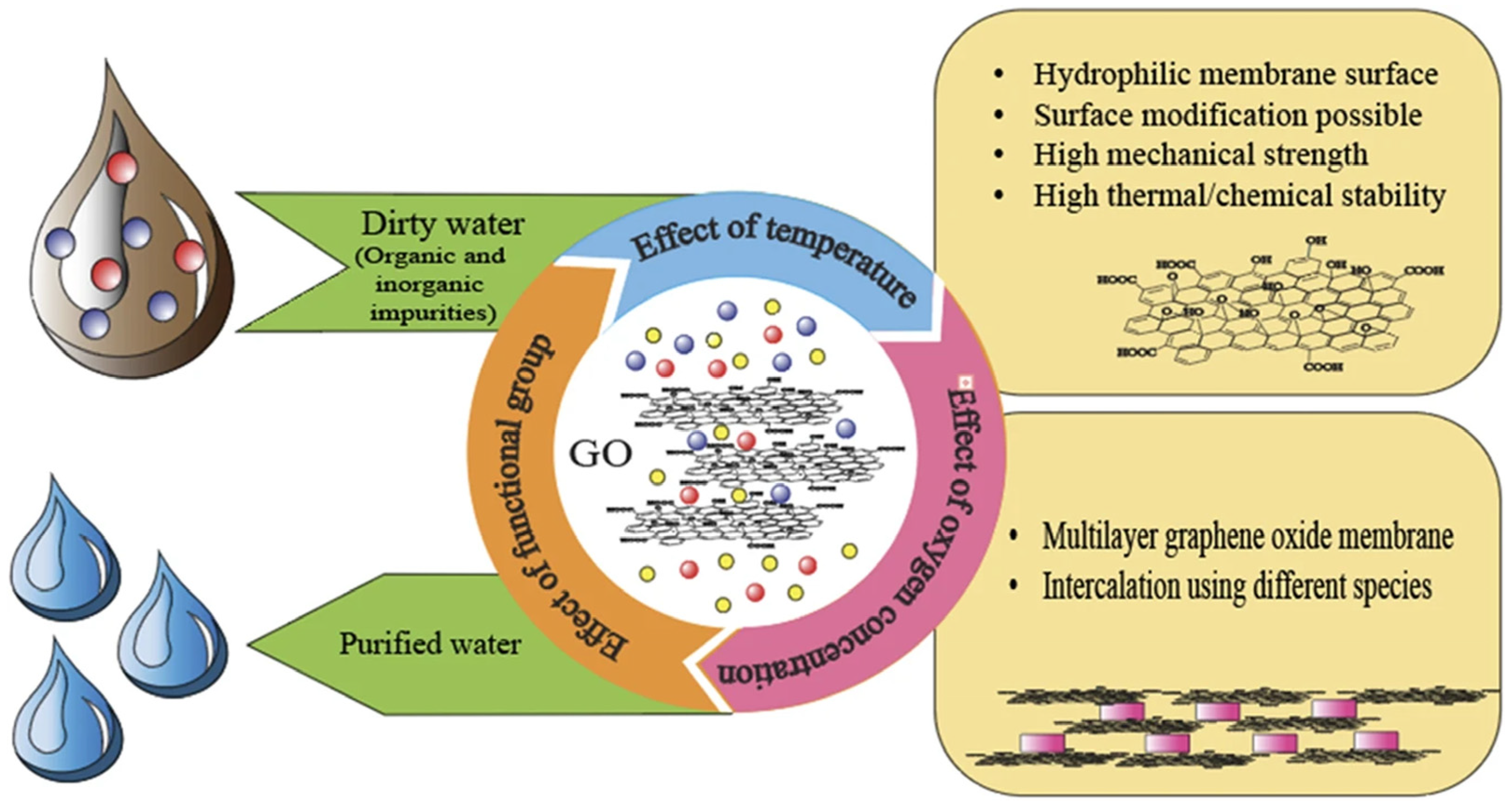
Advances in Graphene Oxide-Based Composites and Membranes: Structural Engineering, Multifunctional Performance, and Emerging Applications


Abstract
1. Introduction
2. Review Methodology
3. Graphene Oxide: Structure, Morphology, Synthesis and Application
3.1. Evolution of GO Structural Models
3.2. Morphology and Chemistry of GO
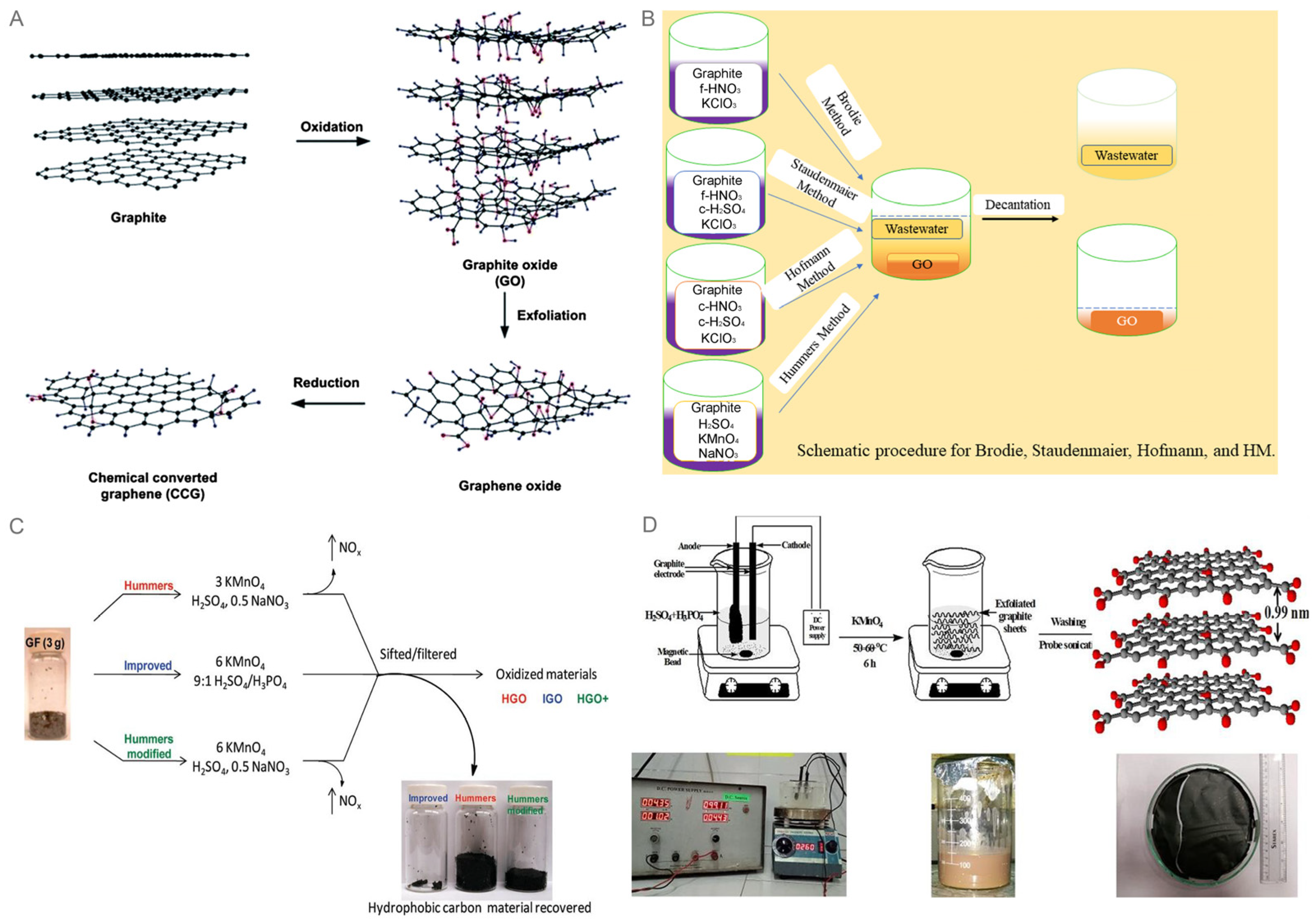
3.3. Synthesis Methods of GO
4. Graphene Oxide Membrane Technology
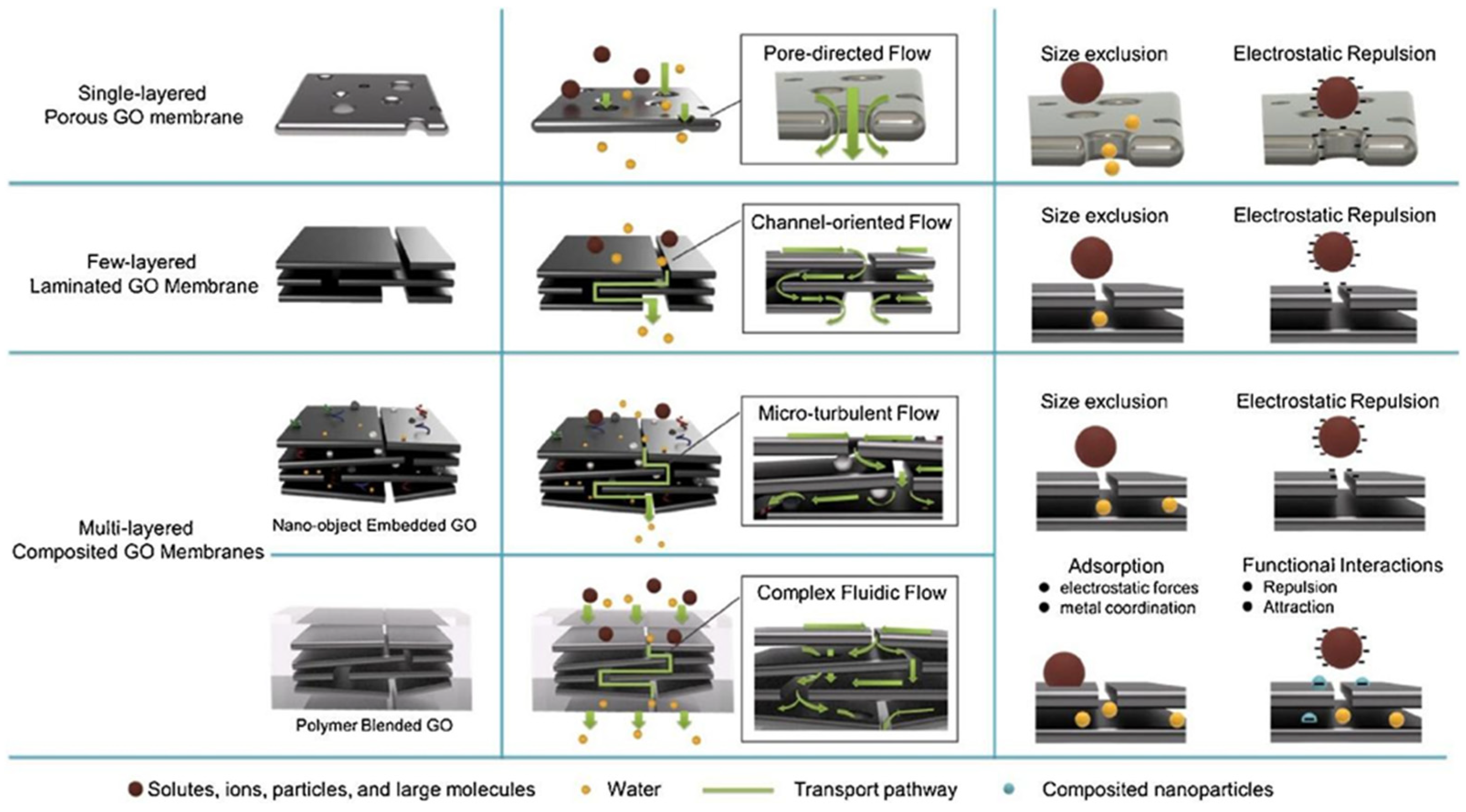
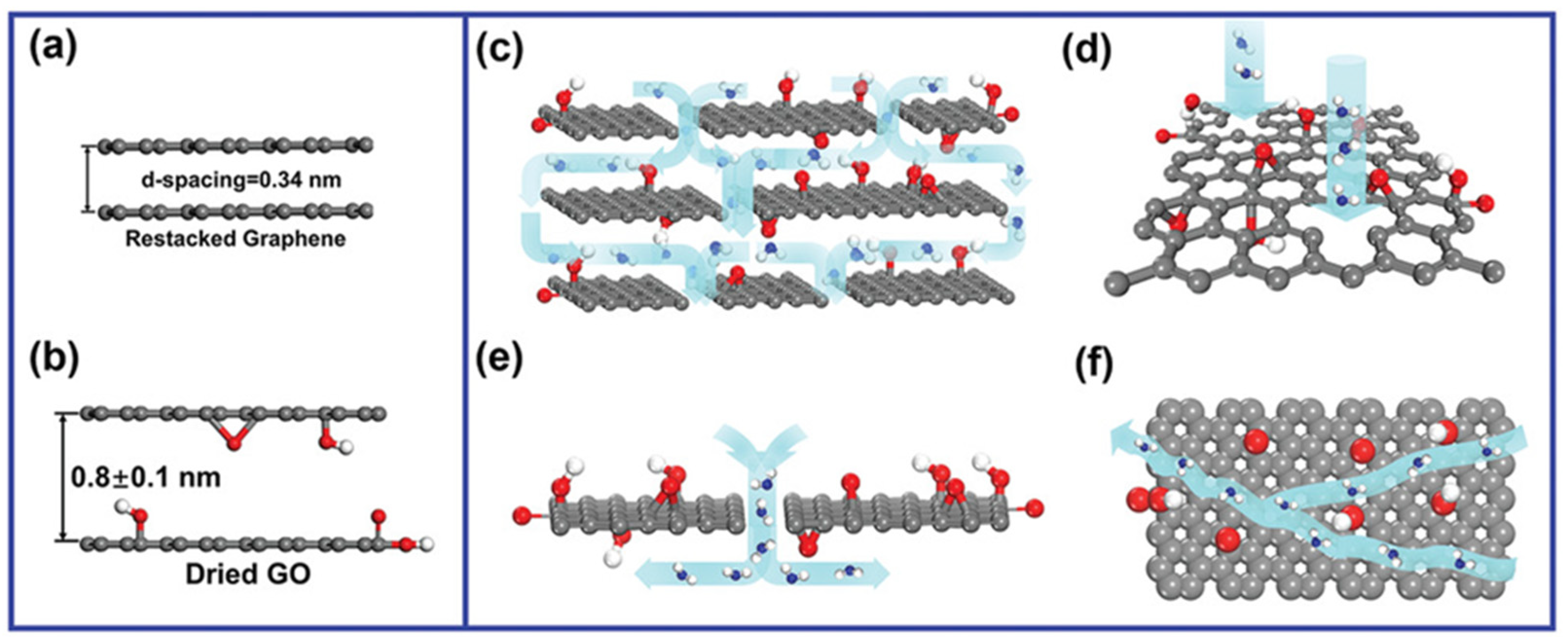
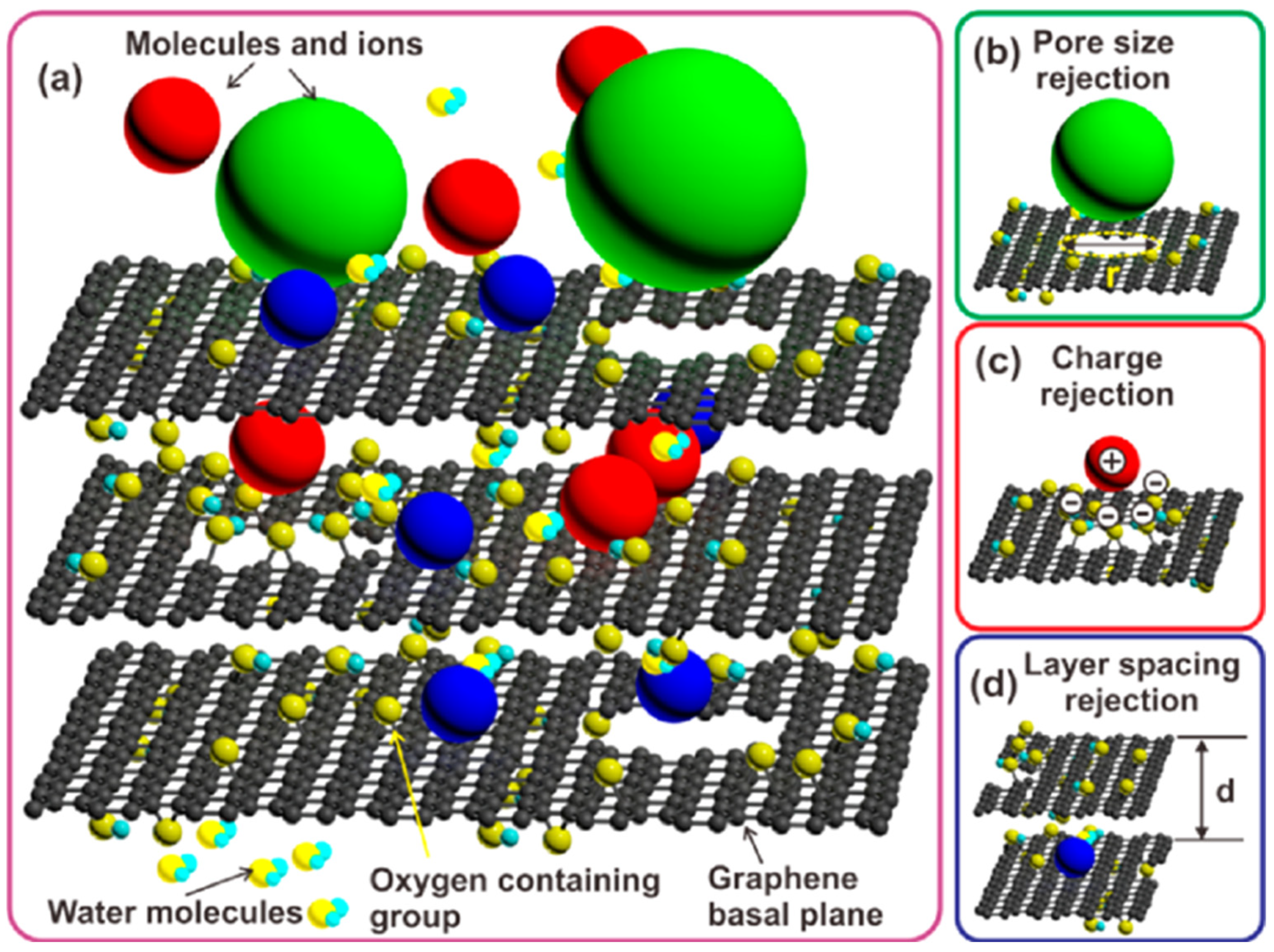
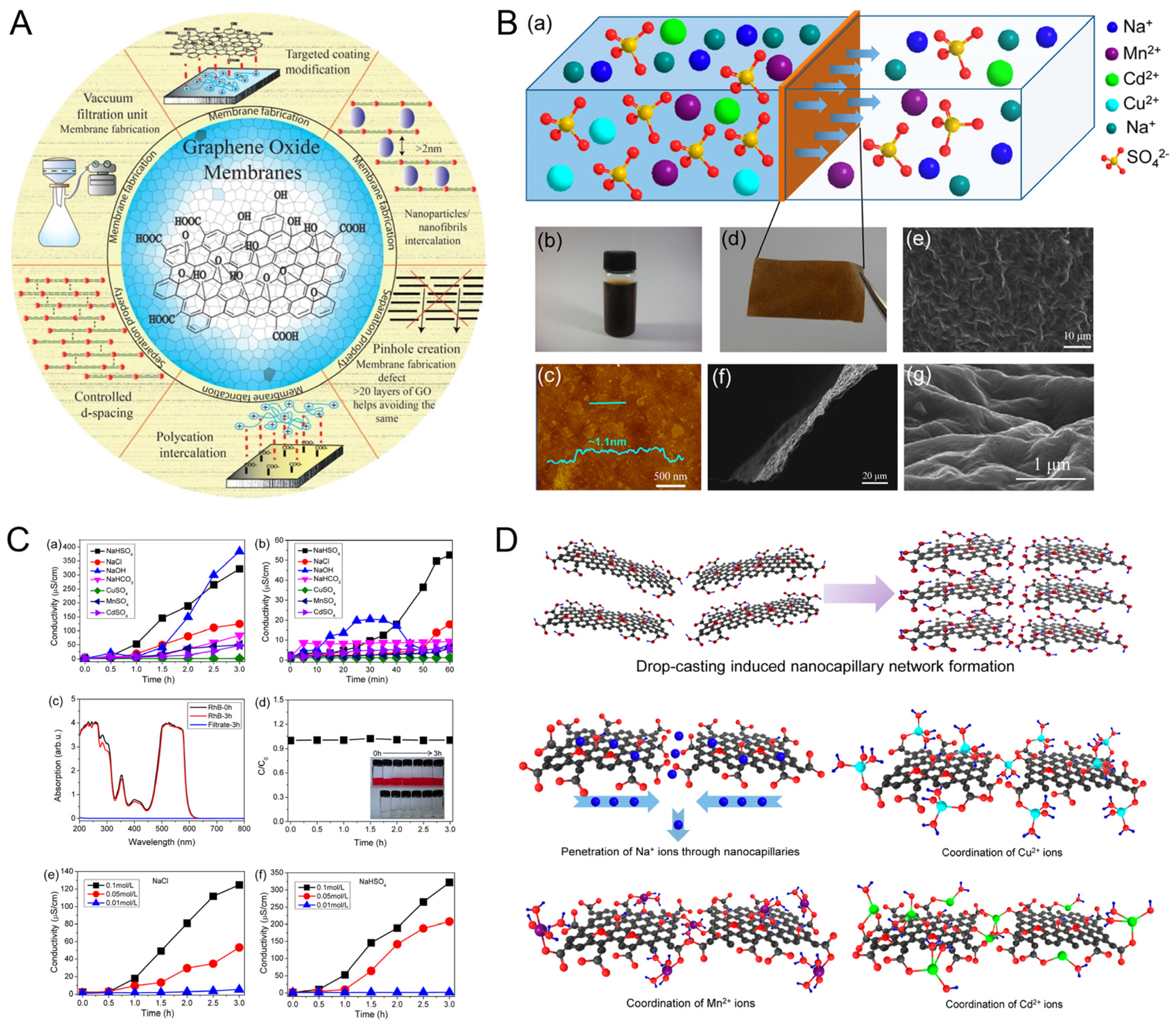
4.1. Principles, Optimization Strategies and Transport Mechanisms of GO Membranes
- (I)
- Porous single-layer membranes, which consist of isolated GO sheets with engineered pores;
- (II)
- Few-layer laminated membranes, offering controlled spacing and high flux;
- (III)
- Multi-layer composite membranes, where GO is integrated with polymers or other nanomaterials to enhance mechanical and chemical stability.
4.2. Fabrication Techniques
4.2.1. Vacuum Filtration/Pressure-Assisted Assembly
4.2.2. Spin-Coating/Dip Coating/Drop-Casting Enables Precise Control of Thickness for Ultrathin and Flexible Membranes
4.2.3. Spray Coating, Bar/Doctor Blade Coating, and Slot-Die Coating as Scalable Methods for GO Membrane Fabrication
4.2.4. Layer-by-Layer Assembly (LbL) Allows Nanometer-Scale Tuning of Multilayered Architectures and Integration with Polymers
4.2.5. Interfacial Self-Assembly: Forms Defect-Free, Large-Area GO Films at Liquid Interfaces
4.2.6. Mixed Matrix Membranes (MMMs) Combine GO Nanosheets with Polymer Matrices for Enhanced Mechanical Strength and Permeability
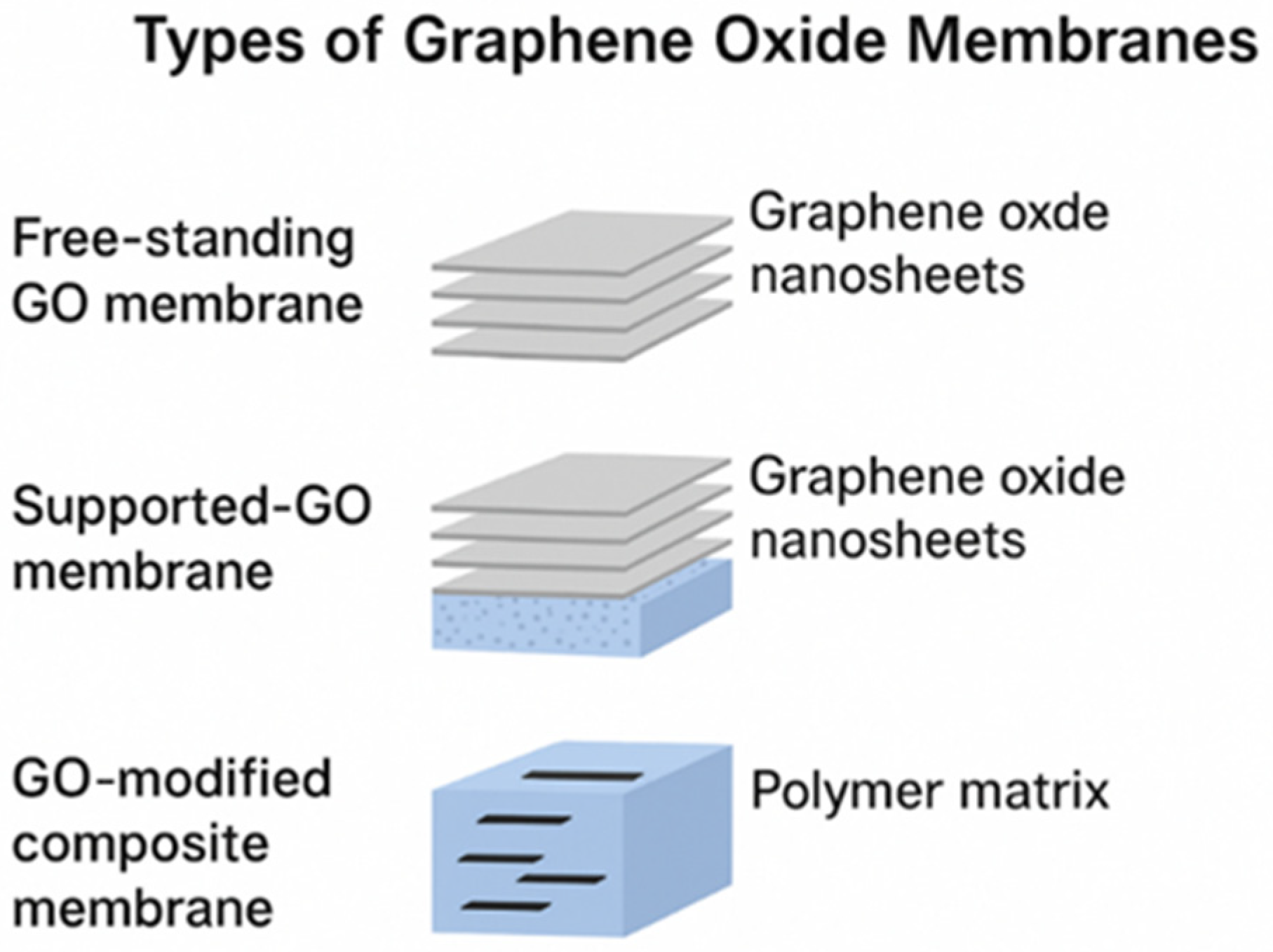
4.3. Types of GO Membranes
4.3.1. Free-Standing GO Membranes
4.3.2. Supported-GO Membranes
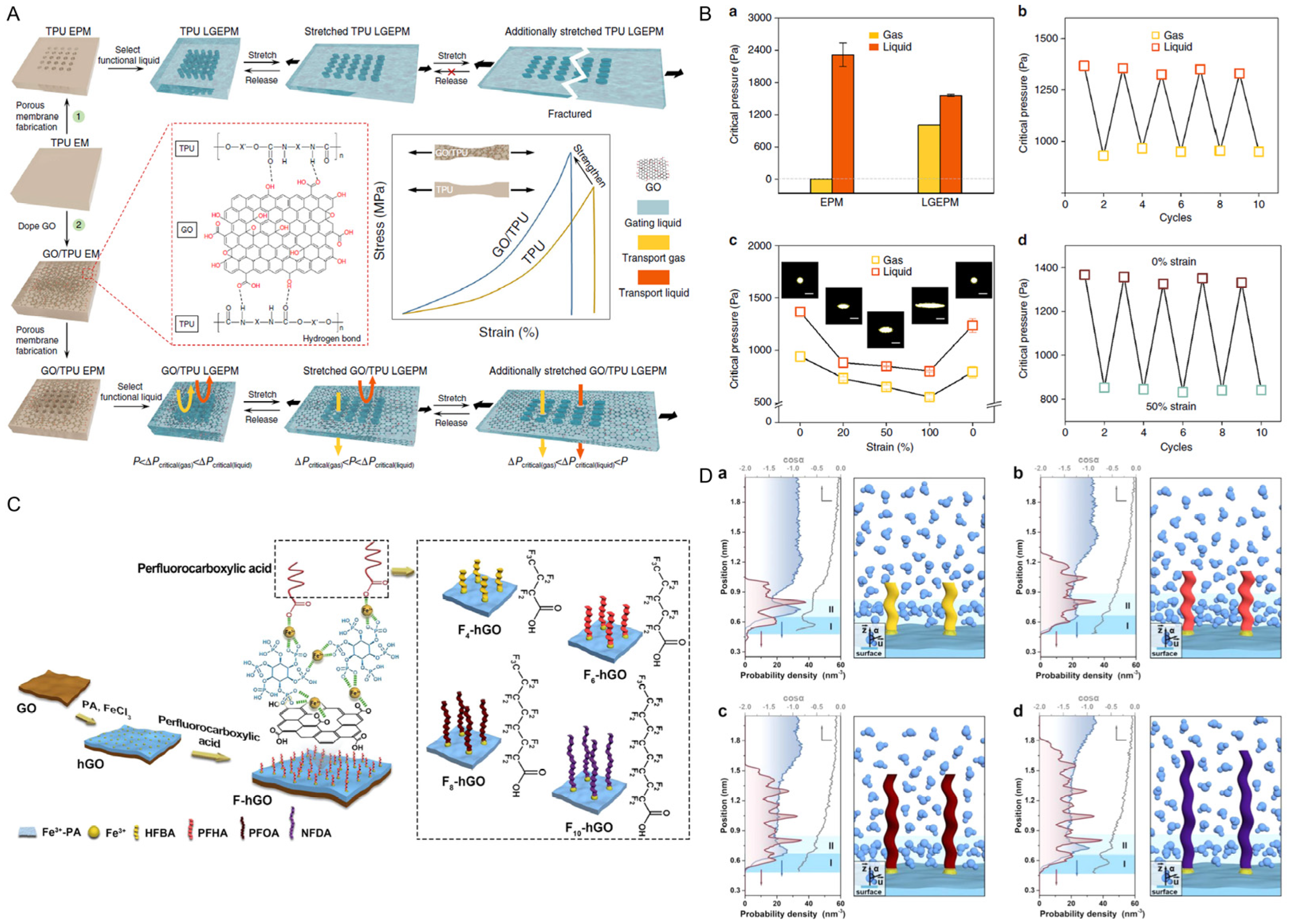
4.3.3. GO-Modified Composite Membranes
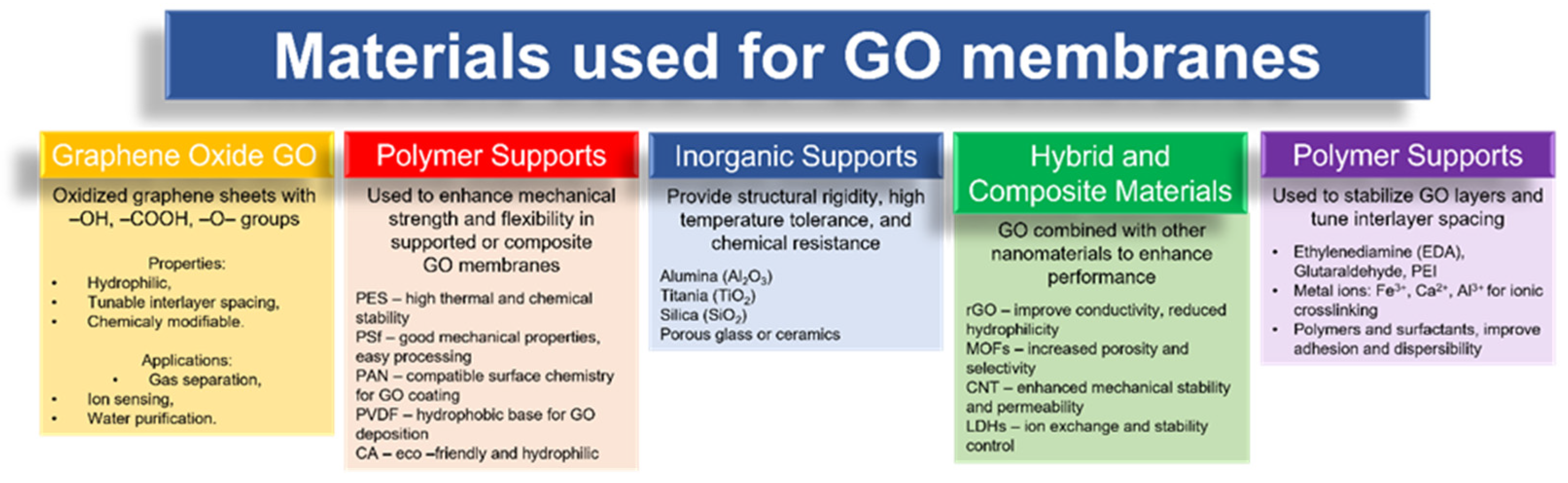
4.4. Materials Suitable for GO Membranes
5. Application of GO in Membrane Technology
6. Critical Assessment
7. Challenges and Limitations
- Structural Stability, Mechanical Integrity, and Operational Lifespan—GO membranes remain susceptible to structural degradation under realistic operating conditions. Prolonged exposure to hydraulic pressure (>3–5 bar), transmembrane shear, or chemically aggressive feed streams can induce layer slippage, interlayer spacing fluctuations, or partial delamination due to the relatively weak van der Waals interactions holding GO lamellae together. Reported operational lifetimes for pristine GO laminates range from several hours to a few weeks, depending on feed chemistry and mechanical support. Stabilization techniques—such as ionic crosslinking, covalent bridging, or polymer intercalation—extend the lifespan to several months, but these strategies often increase fabrication complexity and reduce permeability. A systematic evaluation of long-term performance remains scarce, and only a limited number of studies report durability tests beyond 100–500 h, underscoring the need for standardized lifetime benchmarking [110].
- Transport Performance and the Permeability–Selectivity Trade-off—Achieving simultaneous high permeability and tight molecular/ionic selectivity remains a significant challenge. Minor variations in interlayer spacing (0.1–0.2 nm), defect density, GO oxidation state, or sheet size distribution can shift rejection rates by 10–30%, complicating reproducibility across batches and laboratories. While Section 3.1 addressed the theoretical basis of GO transport mechanisms, Section 4 illustrated these limitations through literature case studies; the combined evidence highlights that transport is strongly modulated by synthesis-induced structural heterogeneities. Emerging strategies—such as 2D heterostructure, controlled nanochannel alignment, and chemical crosslinking—offer promising routes to narrow variability, but require more rigorous quantitative validation and standardized reporting [162,163,164].
- Chemical and thermal stability—GO’s oxygen-containing functional groups, while beneficial for hydrophilicity and tunability, are chemically unstable in extreme pH or high-temperature environments. Reduction or oxidation reactions can modify the membrane chemistry, leading to performance degradation over time. Ensuring long-term chemical resistance without sacrificing tunability remains an active area of research [165].
- Scalability, Production Throughput, and Manufacturing Constraints—Most current GO membrane preparation techniques, including vacuum filtration, drop-casting, spin-coating, and layer-by-layer assembly, remain limited to laboratory-scale throughputs (<0.1–0.5 m2·day−1). Recent advances such as slot-die coating, spray-lamination, roll-to-roll deposition, and continuous shear-alignment methods have demonstrated production rates on the order of tens of m2·day−1, approaching pilot-scale requirements. However, maintaining uniform thickness (<100 nm variation), precise stacking orientation, and defect-free morphology at high throughput remains challenging. Batch-to-batch variations in GO precursor quality—especially sheet size distribution, oxidative degree, and residual metal content—further complicate scale-up. Techno-economic analyses (TEA) are still sparse, but preliminary models estimate that high-quality GO production contributes 40–70% of total membrane cost, with oxidant consumption, washing demands, and waste treatment representing major cost drivers. Current estimates for pilot-scale GO membrane fabrication range from 50 to 200 USD·m−2, substantially higher than commercial polymeric membranes (5–30 USD·m−2), though costs are projected to decline with process intensification and greener synthesis routes [145,166,167].
- Fouling Resistance, Long-Term Operation, and Maintenance—Although the hydrophilic and negatively charged GO surface inherently reduces organic fouling, long-term studies reveal gradual performance deterioration during filtration of complex natural waters, brines, or industrial effluents. Flux decline of 20–60% over 24–72 h has been reported for pristine GO laminates. Biofouling remains particularly problematic, as microorganisms can colonize oxygenated functional groups. Antifouling strategies such as surface grafting, zwitterionic modification, and silver or photocatalytic nanoparticle incorporation show promise but introduce concerns regarding toxicity, leaching, and long-term stability. Few studies quantify cleaning cycles, recovery ratios, or maintenance intervals, critical metrics for evaluating operational costs and membrane lifetime [167,168,169].
- Environmental and Toxicological Considerations—Conventional GO synthesis relies on strong oxidizing agents (KMnO4, concentrated H2SO4, NaNO3), producing metal-containing acidic waste that requires intensive neutralization and treatment. Estimates suggest that 20–40 L of acidic wastewater can be generated per gram of purified GO using unoptimized Hummers-type methods. Life-cycle assessments (LCAs) indicate that energy consumption during oxidation, exfoliation, and multi-stage washing dominates the environmental footprint, while concerns regarding the ecotoxicity of released GO nanosheets—particularly their interactions with microorganisms and aquatic species—remain unresolved. Recent developments, including electrochemical exfoliation, green oxidants (e.g., persulfates, H2O2-assisted oxidation), solvent-free or low-acid methods, and improved waste recovery, offer compelling routes toward more sustainable GO production. However, scalability and consistency remain technological hurdles [170,171].
Author Contributions
Funding
Data Availability Statement
Conflicts of Interest
References
- Baker, R.W. Membrane Technology and Applications, 2nd ed.; John Wiley & Sons: Hoboken, NJ, USA, 2004. [Google Scholar] [CrossRef]
- Yoon, H.W.; Cho, Y.H.; Park, H.B. Graphene-based membrasnes: Status and prospects. Philos. Trans. R. Soc. A Math. Phys. Eng. Sci. 2016, 374, 20150024. [Google Scholar] [CrossRef] [PubMed]
- Robeson, L.M. The upper bound revisited. J. Memb. Sci. 2008, 320, 390–400. [Google Scholar] [CrossRef]
- Geise, G.M.; Park, H.B.; Sagle, A.C.; Freeman, B.D.; McGrath, J.E. Water permeability and water/salt selectivity tradeoff in polymers for desalination. J. Memb. Sci. 2011, 369, 130–138. [Google Scholar] [CrossRef]
- Bhol, P.; Yadav, S.; Altaee, A.; Saxena, M.; Misra, P.K.; Samal, A.K. Graphene-Based Membranes for Water and Wastewater Treatment: A Review. ACS Appl. Nano Mater. 2021, 4, 3274–3293. [Google Scholar] [CrossRef]
- Meyer, J.C.; Geim, A.K.; Katsnelson, M.I.; Novoselov, K.S.; Booth, T.J.; Roth, S. The structure of suspended graphene sheets. Nature 2007, 446, 60–63. [Google Scholar] [CrossRef]
- Li, F.; Jiang, X.; Zhao, J.; Zhang, S. Graphene oxide: A promising nanomaterial for energy and environmental applications. Nano Energy 2015, 16, 488–515. [Google Scholar] [CrossRef]
- Jiříčková, A.; Jankovský, O.; Sofer, Z.; Sedmidubský, D. Synthesis and Applications of Graphene Oxide. Materials 2022, 15, 920. [Google Scholar] [CrossRef]
- Hsu, H.-C.; Shown, I.; Wei, H.-Y.; Chang, Y.-C.; Du, H.-Y.; Lin, Y.-G.; Tseng, C.-A.; Wang, C.-H.; Chen, L.-C.; Lin, Y.-C.; et al. Graphene oxide as a promising photocatalyst for CO2 to methanol conversion. Nanoscale 2013, 5, 262–268. [Google Scholar] [CrossRef]
- Xu, Y.-F.; Yang, M.-Z.; Chen, B.-X.; Wang, X.-D.; Chen, H.-Y.; Kuang, D.-B.; Su, C.-Y. A CsPbBr3 Perovskite Quantum Dot/Graphene Oxide Composite for Photocatalytic CO2 Reduction. J. Am. Chem. Soc. 2017, 139, 5660–5663. [Google Scholar] [CrossRef]
- Xu, D.; Cheng, B.; Wang, W.; Jiang, C.; Yu, J. Ag2CrO4/g-C3N4/graphene oxide ternary nanocomposite Z-scheme photocatalyst with enhanced CO2 reduction activity. Appl. Catal. B 2018, 231, 368–380. [Google Scholar] [CrossRef]
- Zhao, G.; Li, J.; Ren, X.; Chen, C.; Wang, X. Few-Layered Graphene Oxide Nanosheets as Superior Sorbents for Heavy Metal Ion Pollution Management. Environ. Sci. Technol. 2011, 45, 10454–10462. [Google Scholar] [CrossRef] [PubMed]
- Liu, L.; Liu, S.; Zhang, Q.; Li, C.; Bao, C.; Liu, X.; Xiao, P. Adsorption of Au(III), Pd(II), and Pt(IV) from Aqueous Solution onto Graphene Oxide. J. Chem. Eng. Data 2013, 58, 209–216. [Google Scholar] [CrossRef]
- Zhao, G.; Ren, X.; Gao, X.; Tan, X.; Li, J.; Chen, C.; Huang, Y.; Wang, X. Removal of Pb(ii) ions from aqueous solutions on few-layered graphene oxide nanosheets. Dalton Trans. 2011, 40, 10945. [Google Scholar] [CrossRef] [PubMed]
- Chandra, V.; Kim, K.S. Highly selective adsorption of Hg2+ by a polypyrrole–reduced graphene oxide composite. Chem. Commun. 2011, 47, 3942. [Google Scholar] [CrossRef]
- Ramesha, G.K.; Kumara, A.V.; Muralidhara, H.B.; Sampath, S. Graphene and graphene oxide as effective adsorbents toward anionic and cationic dyes. J. Colloid Interface Sci. 2011, 361, 270–277. [Google Scholar] [CrossRef]
- Molla, A.; Li, Y.; Mandal, B.; Kang, S.G.; Hur, S.H.; Chung, J.S. Selective adsorption of organic dyes on graphene oxide: Theoretical and experimental analysis. Appl. Surf. Sci. 2019, 464, 170–177. [Google Scholar] [CrossRef]
- Gopal, G.; Roy, N.; Mukherjee, A. Recent Developments in the Applications of GO/rGO-Based Biosensing Platforms for Pesticide Detection. Biosensors 2023, 13, 488. [Google Scholar] [CrossRef]
- Gaur, M.; Misra, C.; Yadav, A.B.; Swaroop, S.; Maolmhuaidh, F.Ó.; Bechelany, M.; Barhoum, A. Biomedical Applications of Carbon Nanomaterials: Fullerenes, Quantum Dots, Nanotubes, Nanofibers, and Graphene. Materials 2021, 14, 5978. [Google Scholar] [CrossRef]
- Farooq, N.; Rehman, Z.U.; Hareem, A.; Masood, R.; Ashfaq, R.; Fatimah, I.; Hussain, S.; Ansari, S.A.; Parveen, N. Graphene Oxide and Based Materials: Synthesis, Properties, and Applications—A Comprehensive Review. MatSci Express 2024, 1, 185–231. [Google Scholar] [CrossRef]
- Budimir, M.D.; Prekodravac, J.R. Photocatalytic properties of zero-dimensional carbon–based nanomaterials: Application as catalysts/adsorbents in water treatment. In Zero-Dimensional Carbon Nanomaterials; Elsevier: Amsterdam, The Netherlands, 2024; pp. 291–355. [Google Scholar] [CrossRef]
- Prekodravac, J.R.; Kepić, D.P.; Colmenares, J.C.; Giannakoudakis, D.A.; Jovanović, S.P. A comprehensive review on selected graphene synthesis methods: From electrochemical exfoliation through rapid thermal annealing towards biomass pyrolysis. J. Mater. Chem. C Mater. 2021, 9, 6722–6748. [Google Scholar] [CrossRef]
- Geim, A.K.; Novoselov, K.S. The rise of graphene. Nat. Mater. 2007, 6, 183–191. [Google Scholar] [CrossRef]
- Iijima, S. Helical microtubules of graphitic carbon. Nature 1991, 354, 56–58. [Google Scholar] [CrossRef]
- Novoselov, K.S.; Geim, A.K.; Morozov, S.V.; Jiang, D.; Zhang, Y.; Dubonos, S.V.; Grigorieva, I.V.; Firsov, A.A. Electric Field Effect in Atomically Thin Carbon Films. Science 2004, 306, 666–669. [Google Scholar] [CrossRef] [PubMed]
- Filipović, J.P.; Mijin, D.; Tot, N.; Despotović, V.; Kozić, J.; Vasiljević, B.; Kleut, D.; Bonasera, A.; Scopelliti, M.; Ciasca, G.; et al. A comprehensible approach to enhanced photocatalytic efficiency of boron-doped carbon quantum dots: Organic dyes compared to herbicides. Surf. Interfaces 2025, 73, 107592. [Google Scholar] [CrossRef]
- Filipovic, J.P.; Milenkovic, M.; Kleut, D.; Haddadi, K.; Yasir, M.; Saeed, W.; Bogdanovic, D.B.; Jovanovic, S. Sustainable gamma irradiation strategy for GO and rGO modification: Impact on electromagnetic interference shielding efficiency. Chem. Eng. J. Adv. 2025, 24, 100873. [Google Scholar] [CrossRef]
- Raidongia, K.; Tan, A.T.L.; Huang, J. Graphene Oxide: Some New Insights into an Old Material. In Carbon Nanotubes and Graphene, 2nd ed.; Tanaka, S.I.K., Ed.; Elsevier: Amsterdam, The Netherlands, 2014; pp. 341–374. [Google Scholar] [CrossRef]
- Yadav, S.; Raman, A.P.S.; Meena, H.; Goswami, A.G.; Bhawna; Kumar, V.; Jain, P.; Kumar, G.; Sagar, M.; Rana, D.K.; et al. An Update on Graphene Oxide: Applications and Toxicity. ACS Omega 2022, 7, 35387–35445. [Google Scholar] [CrossRef]
- Dave, S.H.; Gong, C.; Robertson, A.W.; Warner, J.H.; Grossman, J.C. Chemistry and Structure of Graphene Oxide via Direct Imaging. ACS Nano 2016, 10, 7515–7522. [Google Scholar] [CrossRef]
- Sun, L. Structure and synthesis of graphene oxide. Chin. J. Chem. Eng. 2019, 27, 2251–2260. [Google Scholar] [CrossRef]
- Viprya, P.; Kumar, D.; Kowshik, S. Study of Different Properties of Graphene Oxide (GO) and Reduced Graphene Oxide (rGO). Eng. Proc. 2023, 59, 84. [Google Scholar] [CrossRef]
- Seromo, L.; Greesh, N.; Mofokeng, J.P. Synthesis, morphology, and structural properties of graphene oxide (GO) and its composites with transition metal phosphates for application in water purification: A review. Carbon Trends 2025, 21, 100566. [Google Scholar] [CrossRef]
- Petukhov, D.I.; Chumakov, A.P.; Johnson, D.J. Effect of competition between swelling and dye adsorption on the performance and selectivity of graphene oxide membranes. Nanoscale 2025, 17, 25572–25588. [Google Scholar] [CrossRef] [PubMed]
- Chernova, E.A.; Petukhov, D.I.; Chumakov, A.P.; Kirianova, A.V.; Sadilov, I.S.; Kapitanova, O.O.; Boytsova, O.V.; Valeev, R.G.; Roth, S.V.; Eliseev, A.A.; et al. The role of oxidation level in mass-transport properties and dehumidification performance of graphene oxide membranes. Carbon 2021, 183, 404–414. [Google Scholar] [CrossRef]
- Magro, M.R.; Vella, D.A.; Cassar, G. Synthesis of graphene oxide: A refined approach. Carbon Trends 2025, 20, 100509. [Google Scholar] [CrossRef]
- Amadei, C.A.; Vecitis, C.D. How to Increase the Signal-to-Noise Ratio of Graphene Oxide Membrane Research. J. Phys. Chem. Lett. 2016, 7, 3791–3797. [Google Scholar] [CrossRef]
- Halbig, C.E.; Zambare, R.; Mukherjee, B.; Garaj, S. The multidiverse graphene oxide: How the fine structure affects structural analysis and performance in reverse osmosis membranes. Carbon Trends 2025, 21, 100565. [Google Scholar] [CrossRef]
- Smith, A.T.; LaChance, A.M.; Zeng, S.; Liu, B.; Sun, L. Synthesis, properties, and applications of graphene oxide/reduced graphene oxide and their nanocomposites. Nano Mater. Sci. 2019, 1, 31–47. [Google Scholar] [CrossRef]
- Trikkaliotis, D.G.; Christoforidis, A.K.; Mitropoulos, A.C.; Kyzas, G.Z. Graphene Oxide Synthesis, Properties and Characterization Techniques: A Comprehensive Review. ChemEngineering 2021, 5, 64. [Google Scholar] [CrossRef]
- Hofmann, U.; Holst, R. Über die Säurenatur und die Methylierung von Graphitoxyd. Berichte Dtsch. Chem. Ges. A B Ser. 1939, 72, 754–771. [Google Scholar] [CrossRef]
- Ruess, G. Über das Graphitoxyhydroxyd (Graphitoxyd). Monatsh. Chem. 1947, 76, 381–417. [Google Scholar] [CrossRef]
- Scholz, W.; Boehm, H.P. Untersuchungen am Graphitoxid. VI. Betrachtungen zur Struktur des Graphitoxids. Z. Anorg. Allg. Chem. 1969, 369, 327–340. [Google Scholar] [CrossRef]
- Nakajima, T.; Matsuo, Y. Formation process and structure of graphite oxide. Carbon 1994, 32, 469–475. [Google Scholar] [CrossRef]
- Lerf, A.; He, H.; Forster, M.; Klinowski, J. Structure of Graphite Oxide Revisited. J. Phys. Chem. B 1998, 102, 4477–4482. [Google Scholar] [CrossRef]
- Savazzi, F.; Risplendi, F.; Mallia, G.; Harrison, N.M.; Cicero, G. Unravelling Some of the Structure–Property Relationships in Graphene Oxide at Low Degree of Oxidation. J. Phys. Chem. Lett. 2018, 9, 1746–1749. [Google Scholar] [CrossRef] [PubMed]
- Szabó, T.; Berkesi, O.; Forgó, P.; Josepovits, K.; Sanakis, Y.; Petridis, D.; Dékány, I. Evolution of Surface Functional Groups in a Series of Progressively Oxidized Graphite Oxides. Chem. Mater. 2006, 18, 2740–2749. [Google Scholar] [CrossRef]
- Rourke, J.P.; Pandey, P.A.; Moore, J.J.; Bates, M.; Kinloch, I.A.; Young, R.J.; Wilson, N.R. The Real Graphene Oxide Revealed: Stripping the Oxidative Debris from the Graphene-like Sheets. Angew. Chem. Int. Ed. 2011, 50, 3173–3177. [Google Scholar] [CrossRef]
- Kim, S.; Zhou, S.; Hu, Y.; Acik, M.; Chabal, Y.J.; Berger, C.; de Heer, W.; Bongiorno, A.; Riedo, E. Room-temperature metastability of multilayer graphene oxide films. Nat. Mater. 2012, 11, 544–549. [Google Scholar] [CrossRef]
- Dimiev, A.M.; Alemany, L.B.; Tour, J.M. Graphene Oxide. Origin of Acidity, Its Instability in Water, and a New Dynamic Structural Model. ACS Nano 2013, 7, 576–588. [Google Scholar] [CrossRef]
- Liu, Z.; Nørgaard, K.; Overgaard, M.H.; Ceccato, M.; Mackenzie, D.M.A.; Stenger, N.; Stipp, S.L.S.; Hassenkam, T. Direct observation of oxygen configuration on individual graphene oxide sheets. Carbon 2018, 127, 141–148. [Google Scholar] [CrossRef]
- Taniguchi, T.; Kurihara, S.; Tateishi, H.; Hatakeyama, K.; Koinuma, M.; Yokoi, H.; Hara, M.; Ishikawa, H.; Matsumoto, Y. pH-driven, reversible epoxy ring opening/closing in graphene oxide. Carbon 2015, 84, 560–566. [Google Scholar] [CrossRef]
- Gerstner, E. Nobel Prize 2010: Andre Geim & Konstantin Novoselov. Nat. Phys. 2010, 6, 836. [Google Scholar] [CrossRef]
- Veeresh, S.; Ganesh, H.; Nagaraju, Y.S.; Vandana, M.; Ashokkumar, S.P.; Yesappa, L.; Vijeth, H.; Devendrappa, H. Structure, morphology and optical properties of graphene oxide. AIP Conf. Proc. 2020, 2244, 080023. [Google Scholar] [CrossRef]
- Wu, T.; Moghadam, F.; Li, K. High-performance porous graphene oxide hollow fiber membranes with tailored pore sizes for water purification. J. Memb. Sci. 2022, 645, 120216. [Google Scholar] [CrossRef]
- Guerrero-Fajardo, C.A.; Giraldo, L.; Moreno-Piraján, J.C. Graphene Oxide: Study of Pore Size Distribution and Surface Chemistry Using Immersion Calorimetry. Nanomaterials 2020, 10, 1492. [Google Scholar] [CrossRef] [PubMed]
- Jahandideh, H.; Macairan, J.-R.; Bahmani, A.; Lapointe, M.; Tufenkji, N. Fabrication of graphene-based porous materials: Traditional and emerging approaches. Chem. Sci. 2022, 13, 8924–8941. [Google Scholar] [CrossRef]
- Ortiz-Anaya, I.; Nishina, Y. Refined surface area determination of graphene oxide using methylene blue as a probe molecule: A comparative approach. Bull. Chem. Soc. Jpn. 2024, 97, uoae118. [Google Scholar] [CrossRef]
- Zhang, S.; Wang, H.; Liu, J.; Bao, C. Measuring the specific surface area of monolayer graphene oxide in water. Mater. Lett. 2020, 261, 127098. [Google Scholar] [CrossRef]
- Dreyer, D.R.; Park, S.; Bielawski, C.W.; Ruoff, R.S. The chemistry of graphene oxide. Chem. Soc. Rev. 2010, 39, 228–240. [Google Scholar] [CrossRef]
- Eda, G.; Chhowalla, M. Chemically Derived Graphene Oxide: Towards Large-Area Thin-Film Electronics and Optoelectronics. Adv. Mater. 2010, 22, 2392–2415. [Google Scholar] [CrossRef]
- Park, S.; Ruoff, R.S. Chemical methods for the production of graphenes. Nat. Nanotechnol. 2009, 4, 217–224. [Google Scholar] [CrossRef]
- Dimiev, A.M.; Tour, J.M. Mechanism of Graphene Oxide Formation. ACS Nano 2014, 8, 3060–3068. [Google Scholar] [CrossRef]
- Pei, S.; Cheng, H.-M. The reduction of graphene oxide. Carbon 2012, 50, 3210–3228. [Google Scholar] [CrossRef]
- Aberoumand, S.; Dubal, D.; Woodfield, P.; Mahale, K.; Pham, H.D.; Padwal, C.; Tung, T.; Shiddiky, M.J.A.; Dao, D.V. Reduced graphene oxide nanofluidic electrolyte with improved electrochemical properties for vanadium flow batteries. J. Energy Storage 2022, 49, 104133. [Google Scholar] [CrossRef]
- Marcano, D.C.; Kosynkin, D.V.; Berlin, J.M.; Sinitskii, A.; Sun, Z.; Slesarev, A.; Alemany, L.B.; Lu, W.; Tour, J.M. Improved Synthesis of Graphene Oxide. ACS Nano 2010, 4, 4806–4814. [Google Scholar] [CrossRef] [PubMed]
- Kobyliukh, A.; Olszowska, K.; Szeluga, U.; Pusz, S. Iron oxides/graphene hybrid structures—Preparation; modification, and application as fillers of polymer composites. Adv. Colloid Interface Sci. 2020, 285, 102285. [Google Scholar] [CrossRef]
- Kong, Q.; Shi, X.; Ma, W.; Zhang, F.; Yu, T.; Zhao, F.; Zhao, D.; Wei, C. Strategies to improve the adsorption properties of graphene-based adsorbent towards heavy metal ions and their compound pollutants: A review. J. Hazard. Mater. 2021, 415, 125690. [Google Scholar] [CrossRef]
- Kumar, P.; Huo, P.; Zhang, R.; Liu, B. Antibacterial Properties of Graphene-Based Nanomaterials. Nanomaterials 2019, 9, 737. [Google Scholar] [CrossRef]
- Kumar, S.; Himanshi; Prakash, J.; Verma, A.; Suman; Jasrotia, R.; Kandwal, A.; Verma, R.; Kumar Godara, S.; Khan, M.A.M.; et al. A Review on Properties and Environmental Applications of Graphene and Its Derivative-Based Composites. Catalysts 2023, 13, 111. [Google Scholar] [CrossRef]
- Kumar, V.; Lee, Y.-S.; Shin, J.-W.; Kim, K.-H.; Kukkar, D.; Tsang, Y.F. Potential applications of graphene-based nanomaterials as adsorbent for removal of volatile organic compounds. Environ. Int. 2020, 135, 105356. [Google Scholar] [CrossRef]
- Kou, Z.; Li, X.; Wang, T.; Ma, Y.; Zang, W.; Nie, G.; Wang, J. Fundamentals, On-Going Advances and Challenges of Electrochemical Carbon Dioxide Reduction. Electrochem. Energy Rev. 2022, 5, 82–111. [Google Scholar] [CrossRef]
- Benzait, Z.; Chen, P.; Trabzon, L. Enhanced synthesis method of graphene oxide. Nanoscale Adv. 2021, 3, 223–230. [Google Scholar] [CrossRef]
- Kumar, S.S.A.; Bashir, S.; Ramesh, K.; Ramesh, S. A review on graphene and its derivatives as the forerunner of the two-dimensional material family for the future. J. Mater. Sci. 2022, 57, 12236–12278. [Google Scholar] [CrossRef]
- Feicht, P.; Biskupek, J.; Gorelik, T.E.; Renner, J.; Halbig, C.E.; Maranska, M.; Puchtler, F.; Kaiser, U.; Eigler, S. Brodie’s or Hummers’ Method: Oxidation Conditions Determine the Structure of Graphene Oxide. Chem.—Eur. J. 2019, 25, 8955–8959. [Google Scholar] [CrossRef]
- Zaaba, N.I.; Foo, K.L.; Hashim, U.; Tan, S.J.; Liu, W.-W.; Voon, C.H. Synthesis of Graphene Oxide using Modified Hummers Method: Solvent Influence. Procedia Eng. 2017, 184, 469–477. [Google Scholar] [CrossRef]
- Krishnamoorthy, K.; Veerapandian, M.; Yun, K.; Kim, S.-J. The chemical and structural analysis of graphene oxide with different degrees of oxidation. Carbon 2013, 53, 38–49. [Google Scholar] [CrossRef]
- Yang, T.; Lin, H.; Loh, K.P.; Jia, B. Fundamental Transport Mechanisms and Advancements of Graphene Oxide Membranes for Molecular Separation. Chem. Mater. 2019, 31, 1829–1846. [Google Scholar] [CrossRef]
- Nair, R.R.; Wu, H.A.; Jayaram, P.N.; Grigorieva, I.V.; Geim, A.K. Unimpeded Permeation of Water Through Helium-Leak–Tight Graphene-Based Membranes. Science 2012, 335, 442–444. [Google Scholar] [CrossRef]
- Joshi, R.K.; Carbone, P.; Wang, F.C.; Kravets, V.G.; Su, Y.; Grigorieva, I.V.; Wu, H.A.; Geim, A.K.; Nair, R.R. Precise and Ultrafast Molecular Sieving Through Graphene Oxide Membranes. Science 2014, 343, 752–754. [Google Scholar] [CrossRef]
- Su, P.; Wang, F.; Li, Z.; Tang, C.Y.; Li, W. Graphene oxide membranes: Controlling their transport pathways. J. Mater. Chem. A Mater. 2020, 8, 15319–15340. [Google Scholar] [CrossRef]
- Sun, M.; Li, J. Graphene oxide membranes: Functional structures, preparation and environmental applications. Nano Today 2018, 20, 121–137. [Google Scholar] [CrossRef]
- Xing, C.; Liu, C.; Lai, C.; Zhang, S. Tuning d-spacing of graphene oxide nanofiltration membrane for effective dye/salt separation. Rare Met. 2023, 42, 418–429. [Google Scholar] [CrossRef]
- Liu, X.; Zhang, L.; Cui, X.; Zhang, Q.; Hu, W.; Du, J.; Zeng, H.; Xu, Q. 2D Material Nanofiltration Membranes: From Fundamental Understandings to Rational Design. Adv. Sci. 2021, 8, 2102493. [Google Scholar] [CrossRef]
- Tan, Q.; Fan, Y.; Song, Z.; Chen, J.; Chen, L. Effects of interlayer spacing and oxidation degree of graphene oxide nanosheets on water permeation: A molecular dynamics study. J. Mol. Model. 2022, 28, 57. [Google Scholar] [CrossRef]
- Abraham, J.; Vasu, K.S.; Williams, C.D.; Gopinadhan, K.; Su, Y.; Cherian, C.T.; Dix, J.; Prestat, E.; Haigh, S.J.; Grigorieva, I.V.; et al. Tunable sieving of ions using graphene oxide membranes. Nat. Nanotechnol. 2017, 12, 546–550. [Google Scholar] [CrossRef]
- Zhang, M.; Guan, K.; Ji, Y.; Liu, G.; Jin, W.; Xu, N. Controllable ion transport by surface-charged graphene oxide membrane. Nat. Commun. 2019, 10, 1253. [Google Scholar] [CrossRef]
- Tiwary, S.K.; Singh, M.; Chavan, S.V.; Karim, A. Graphene oxide-based membranes for water desalination and purification. npj 2D Mater. Appl. 2024, 8, 27. [Google Scholar] [CrossRef]
- Chen, M.; Trubyanov, M.; Zhang, P.; Wang, Q.; Li, Z.; Novoselov, K.S.; Andreeva, D.V. Comprehensive characterization of gas diffusion through graphene oxide membranes. J. Memb. Sci. 2023, 676, 121583. [Google Scholar] [CrossRef]
- Kwon, O.; Choi, Y.; Choi, E.; Kim, M.; Woo, Y.C.; Kim, D.W. Fabrication Techniques for Graphene Oxide-Based Molecular Separation Membranes: Towards Industrial Application. Nanomaterials 2021, 11, 757. [Google Scholar] [CrossRef]
- Aher, A.; Cai, Y.; Majumder, M.; Bhattacharyya, D. Synthesis of graphene oxide membranes and their behavior in water and isopropanol. Carbon 2017, 116, 145–153. [Google Scholar] [CrossRef]
- Huang, L.; Chen, J.; Gao, T.; Zhang, M.; Li, Y.; Dai, L.; Qu, L.; Shi, G. Reduced Graphene Oxide Membranes for Ultrafast Organic Solvent Nanofiltration. Adv. Mater. 2016, 28, 8669–8674. [Google Scholar] [CrossRef]
- Cho, K.M.; Lee, H.-J.; Nam, Y.T.; Kim, Y.-J.; Kim, C.; Kang, K.M.; Torres, C.A.R.; Kim, D.W.; Jung, H.-T. Ultrafast-Selective Nanofiltration of an Hybrid Membrane Comprising Laminated Reduced Graphene Oxide/Graphene Oxide Nanoribbons. ACS Appl. Mater. Interfaces 2019, 11, 27004–27010. [Google Scholar] [CrossRef]
- Ruiz-Torres, C.A.; Kang, J.; Kang, S.; Kim, J.P.; Kim, C.; Kang, K.M.; Cho, K.M.; Nam, Y.T.; Chang, Y.-Y.; Byon, C.; et al. Oxidation-controlled nanoporous graphene laminate membranes via intercalation chemistry for desalination. J. Memb. Sci. 2025, 735, 124515. [Google Scholar] [CrossRef]
- Reiner-Rozman, C.; Hasler, R.; Andersson, J.; Rodrigues, T.; Bozdogan, A.; Bintinger, J.; Aspermair, P. The top performer: Towards optimized parameters for reduced graphene oxide uniformity by spin coating. Micro Nano Lett. 2021, 16, 436–442. [Google Scholar] [CrossRef]
- Karlsson, A.; Grennberg, H.; Johansson, S. Graphene oxide microstructure control of electrosprayed thin films. RSC Adv. 2023, 13, 781–789. [Google Scholar] [CrossRef] [PubMed]
- Ibrahim, A.F.M.; Lin, Y.S. Synthesis of graphene oxide membranes on polyester substrate by spray coating for gas separation. Chem. Eng. Sci. 2018, 190, 312–319. [Google Scholar] [CrossRef]
- Heo, J.; Choi, M.; Hong, J. Facile Surface Modification of Polyethylene Film via Spray-Assisted Layer-by-Layer Self-Assembly of Graphene Oxide for Oxygen Barrier Properties. Sci. Rep. 2019, 9, 2754. [Google Scholar] [CrossRef]
- Kim, J.H.; Choi, Y.; Kang, J.; Choi, E.; Choi, S.E.; Kwon, O.; Kim, D.W. Scalable fabrication of deoxygenated graphene oxide nanofiltration membrane by continuous slot-die coating. J. Memb. Sci. 2020, 612, 118454. [Google Scholar] [CrossRef]
- Hu, M.; Mi, B. Layer-by-layer assembly of graphene oxide membranes via electrostatic interaction. J. Memb. Sci. 2014, 469, 80–87. [Google Scholar] [CrossRef]
- Heo, J.; Choi, M.; Choi, D.; Jeong, H.; Kim, H.Y.; Jeon, H.; Kang, S.W.; Hong, J. Spray-assisted layer-by-layer self-assembly of tertiary-amine-stabilized gold nanoparticles and graphene oxide for efficient CO2 capture. J. Memb. Sci. 2020, 601, 117905. [Google Scholar] [CrossRef]
- Gu, Y.-H.; Yan, X.; Chen, Y.; Guo, X.-J.; Lang, W.-Z. Layer-by-layer assembled GO-based membranes with high long-standing stability and chemical resistance applied in dye separation and desalination. 2D Mater. 2020, 7, 045016. [Google Scholar] [CrossRef]
- Zhao, S.; Zou, L.; Tang, C.Y.; Mulcahy, D. Recent developments in forward osmosis: Opportunities and challenges. J. Memb. Sci. 2012, 396, 1–21. [Google Scholar] [CrossRef]
- Kamkar, M.; Erfanian, E.; Bazazi, P.; Ghaffarkhah, A.; Sharif, F.; Xie, G.; Kannan, A.; Arjmand, M.; Hejazi, S.H.; Russell, T.P.; et al. Interfacial Assembly of Graphene Oxide: From Super Elastic Interfaces to Liquid-in-Liquid Printing. Adv. Mater. Interfaces 2022, 9, 2101659. [Google Scholar] [CrossRef]
- Casado-Coterillo, C. Mixed Matrix Membranes. Membranes 2019, 9, 149. [Google Scholar] [CrossRef]
- Kadhim, R.J.; Al-Ani, F.H.; Al-shaeli, M.; Alsalhy, Q.F.; Figoli, A. Removal of Dyes Using Graphene Oxide (GO) Mixed Matrix Membranes. Membranes 2020, 10, 366. [Google Scholar] [CrossRef]
- Mao, G.; Liu, T.; Chen, Y.; Gao, X.; Qin, J.; Zhou, H.; Jin, W. Polyamide@GO microporous membrane with enhanced permeability for the molecular sieving of nitrogen over VOC. J. Memb. Sci. 2022, 652, 120443. [Google Scholar] [CrossRef]
- Bonatout, N.; Muller, F.; Fontaine, P.; Gascon, I.; Konovalov, O.; Goldmann, M. How exfoliated graphene oxide nanosheets organize at the water interface: Evidence for a spontaneous bilayer self-assembly. Nanoscale 2017, 9, 12543–12548. [Google Scholar] [CrossRef]
- Petukhov, D.I.; Weston, J.; Valeev, R.G.; Johnson, D.J. Graphene Oxide Surface Modification of Reverse Osmosis (RO) Membrane via Langmuir–Blodgett Technique: Balancing Performance and Antifouling Properties. Membranes 2024, 14, 172. [Google Scholar] [CrossRef]
- Ma, J.; Ping, D.; Dong, X. Recent Developments of Graphene Oxide-Based Membranes: A Review. Membranes 2017, 7, 52. [Google Scholar] [CrossRef]
- Tong, X.; Liu, S.; Zhao, Y.; Xiao, C.; Chen, Y.; Crittenden, J. A freestanding graphene oxide framework membrane for forward osmosis: Separation performance and transport mechanistic insights. J. Memb. Sci. 2022, 661, 120919. [Google Scholar] [CrossRef]
- Hung, W.-S.; An, Q.-F.; De Guzman, M.; Lin, H.-Y.; Huang, S.-H.; Liu, W.-R.; Hu, C.-C.; Lee, K.-R.; Lai, J.-Y. Pressure-assisted self-assembly technique for fabricating composite membranes consisting of highly ordered selective laminate layers of amphiphilic graphene oxide. Carbon 2014, 68, 670–677. [Google Scholar] [CrossRef]
- Chu, K.H.; Huang, Y.; Yu, M.; Heo, J.; Flora, J.R.V.; Jang, A.; Jang, M.; Jung, C.; Park, C.M.; Kim, D.-H.; et al. Evaluation of graphene oxide-coated ultrafiltration membranes for humic acid removal at different pH and conductivity conditions. Sep. Purif. Technol. 2017, 181, 139–147. [Google Scholar] [CrossRef]
- Shin, Y.; Taufique, M.F.N.; Devanathan, R.; Cutsforth, E.C.; Lee, J.; Liu, W.; Fifield, L.S.; Gotthold, D.W. Highly Selective Supported Graphene Oxide Membranes for Water-Ethanol Separation. Sci. Rep. 2019, 9, 2251. [Google Scholar] [CrossRef]
- Zeng, L.; Zhu, Z.; Sun, D.-W. Novel graphene oxide/polymer composite membranes for the food industry: Structures, mechanisms and recent applications. Crit. Rev. Food Sci. Nutr. 2022, 62, 3705–3722. [Google Scholar] [CrossRef]
- Zheng, Z.; Ge, M.; Zhang, J.; Wang, Y.; Wang, K.; Gao, Z.; Huang, Z. Graphene oxide-based membranes: Recent advances in ionic and molecular resource recovery. J. Environ. Chem. Eng. 2025, 13, 119997. [Google Scholar] [CrossRef]
- Zhao, Z.; Cao, N.; Lin, Z.; Chen, G.; Chen, L.; Zhao, B.; Liu, J.; Li, W.; Jiang, Z.; Pang, J. Fabrication of Robust GO Composite Membranes through Novel Polyether Ether Ketone Weaving Strategies for Organic Solvent Nanofiltration. Nano Lett. 2025, 25, 6879–6887. [Google Scholar] [CrossRef] [PubMed]
- Pedico, A.; Baudino, L.; Aixalà-Perelló, A.; Lamberti, A. Green Methods for the Fabrication of Graphene Oxide Membranes: From Graphite to Membranes. Membranes 2023, 13, 429. [Google Scholar] [CrossRef]
- Gkika, D.A.; Karmali, V.; Lambropoulou, D.A.; Mitropoulos, A.C.; Kyzas, G.Z. Membranes Coated with Graphene-Based Materials: A Review. Membranes 2023, 13, 127. [Google Scholar] [CrossRef] [PubMed]
- Meng, N.; Sun, X.; Liu, J.; Mi, J.; Rong, R. Effect of Addition Amount of Ethylenediamine on Interlayer Nanochannels and the Separation Performance of Graphene Oxide Membranes. Polymers 2024, 16, 3123. [Google Scholar] [CrossRef] [PubMed]
- Yasmeen, R.; Khan, F.S.; Nisa, W.U.; Saleem, A.R.; Awais, M.; Jameel, M.; Dara, R.N.; Khan, M. Enhanced water purification by using graphene oxide nano-membranes: A novel approach for mitigating industrial pollutant. Carbon Trends 2025, 19, 100486. [Google Scholar] [CrossRef]
- Lingamdinne, L.P.; Koduru, J.R.; Karri, R.R. A comprehensive review of applications of magnetic graphene oxide based nanocomposites for sustainable water purification. J. Environ. Manag. 2019, 231, 622–634. [Google Scholar] [CrossRef]
- Kang, J.; Kwon, O.; Kim, J.P.; Kim, J.Y.; Kim, J.; Cho, Y.; Kim, D.W. Graphene Membrane for Water-Related Environmental Application: A Comprehensive Review and Perspectives. ACS Environ. Au 2025, 5, 35–60. [Google Scholar] [CrossRef]
- Moghadam, F.; Zhai, M.; Zouaoui, T.; Li, K. Hybrid graphene oxide membranes with regulated water and ion permeation channels via functional materials. Curr. Opin. Chem. Eng. 2023, 40, 100907. [Google Scholar] [CrossRef]
- Sun, P.; Zhu, M.; Wang, K.; Zhong, M.; Wei, J.; Wu, D.; Xu, Z.; Zhu, H. Selective Ion Penetration of Graphene Oxide Membranes. ACS Nano 2013, 7, 428–437. [Google Scholar] [CrossRef] [PubMed]
- Kim, D.W.; Jang, J.; Kim, I.; Nam, Y.T.; Jung, Y.; Jung, H.-T. Revealing the Role of Oxygen Debris and Functional Groups on the Water Flux and Molecular Separation of Graphene Oxide Membrane: A Combined Experimental and Theoretical Study. J. Phys. Chem. C 2018, 122, 17507–17517. [Google Scholar] [CrossRef]
- Yu, H.; He, Y.; Xiao, G.; Fan, Y.; Ma, J.; Gao, Y.; Hou, R.; Yin, X.; Wang, Y.; Mei, X. The roles of oxygen-containing functional groups in modulating water purification performance of graphene oxide-based membrane. Chem. Eng. J. 2020, 389, 124375. [Google Scholar] [CrossRef]
- Qiu, R.; Yuan, S.; Xiao, J.; Chen, X.D.; Selomulya, C.; Zhang, X.; Woo, M.W. Effects of Edge Functional Groups on Water Transport in Graphene Oxide Membranes. ACS Appl. Mater. Interfaces 2019, 11, 8483–8491. [Google Scholar] [CrossRef]
- Eliseev, A.A.; Gurianov, K.E.; Poyarkov, A.A.; Komkova, M.A.; Sadilov, I.S.; Chumakov, A.P.; Petukhov, D.I. Tunable Sieving of Ions Using Graphene Oxide: Swelling Peculiarities in Free-Standing and Confined States. Nano Lett. 2023, 23, 9719–9725. [Google Scholar] [CrossRef]
- Oikawa, M.; Takeuchi, H.; Chikyu, D.; Ohba, T.; Wang, Z.-M.; Koura, S. Insight into the role of ionicity in the desalination and separation of a graphene oxide membrane. Desalination 2023, 552, 116433. [Google Scholar] [CrossRef]
- Huang, H.; Song, Z.; Wei, N.; Shi, L.; Mao, Y.; Ying, Y.; Sun, L.; Xu, Z.; Peng, X. Ultrafast viscous water flow through nanostrand-channelled graphene oxide membranes. Nat. Commun. 2013, 4, 2979. [Google Scholar] [CrossRef]
- Mohammed, S. Graphene oxide: A mini-review on the versatility and challenges as a membrane material for solvent-based separation. Chem. Eng. J. Adv. 2022, 12, 100392. [Google Scholar] [CrossRef]
- Pokharel, P.; Lee, D.S. High performance polyurethane nanocomposite films prepared from a masterbatch of graphene oxide in polyether polyol. Chem. Eng. J. 2014, 253, 356–365. [Google Scholar] [CrossRef]
- Pant, H.R.; Pokharel, P.; Joshi, M.K.; Adhikari, S.; Kim, H.J.; Park, C.H.; Kim, C.S. Processing and characterization of electrospun graphene oxide/polyurethane composite nanofibers for stent coating. Chem. Eng. J. 2015, 270, 336–342. [Google Scholar] [CrossRef]
- Cai, D.; Yusoh, K.; Song, M. The mechanical properties and morphology of a graphite oxide nanoplatelet/polyurethane composite. Nanotechnology 2009, 20, 085712. [Google Scholar] [CrossRef] [PubMed]
- Lv, W.; Sheng, Z.; Zhu, Y.; Liu, J.; Lei, Y.; Zhang, R.; Chen, X.; Hou, X. Highly stretchable and reliable graphene oxide-reinforced liquid gating membranes for tunable gas/liquid transport. Microsyst. Nanoeng. 2020, 6, 43. [Google Scholar] [CrossRef] [PubMed]
- Yang, C.; Long, M.; Ding, C.; Zhang, R.; Zhang, S.; Yuan, J.; Zhi, K.; Yin, Z.; Zheng, Y.; Liu, Y.; et al. Antifouling graphene oxide membranes for oil-water separation via hydrophobic chain engineering. Nat. Commun. 2022, 13, 7334. [Google Scholar] [CrossRef]
- Elzubair, A.; Uchôa, L.R.; Prado da Silva, M.H. Production and characterization of graphene oxide/polymer support composite membranes for water desalination and purification. Desalination Water Treat. 2024, 317, 100012. [Google Scholar] [CrossRef]
- Chi, C.; Wang, X.; Peng, Y.; Qian, Y.; Hu, Z.; Dong, J.; Zhao, D. Facile Preparation of Graphene Oxide Membranes for Gas Separation. Chem. Mater. 2016, 28, 2921–2927. [Google Scholar] [CrossRef]
- Shen, H.; Wang, N.; Ma, K.; Wang, L.; Chen, G.; Ji, S. Tuning inter-layer spacing of graphene oxide laminates with solvent green to enhance its nanofiltration performance. J. Memb. Sci. 2017, 527, 43–50. [Google Scholar] [CrossRef]
- Mahalingam, D.K.; Falca, G.; Upadhya, L.; Abou-Hamad, E.; Batra, N.; Wang, S.; Musteata, V.; da Costa, P.M.; Nunes, S.P. Spray-coated graphene oxide hollow fibers for nanofiltration. J. Memb. Sci. 2020, 606, 118006. [Google Scholar] [CrossRef]
- Choi, Y.; Kim, S.-S.; Kim, J.H.; Kang, J.; Choi, E.; Choi, S.E.; Kim, J.P.; Kwon, O.; Kim, D.W. Graphene Oxide Nanoribbon Hydrogel: Viscoelastic Behavior and Use as a Molecular Separation Membrane. ACS Nano 2020, 14, 12195–12202. [Google Scholar] [CrossRef]
- Xia, J.; Xiao, P.; Gu, J.; Chen, T.; Liu, C.; Yan, L.; Chen, T. Interfacial self-assembled GR/GO ultrathin membranes on a large scale for molecular sieving. J. Mater. Chem. A Mater. 2020, 8, 18735–18744. [Google Scholar] [CrossRef]
- Fahmi, M.Z.; Wathoniyyah, M.; Khasanah, M.; Rahardjo, Y.; Wafiroh, S.; Abdulloh, A. Incorporation of graphene oxide in polyethersulfone mixed matrix membranes to enhance hemodialysis membrane performance. RSC Adv. 2018, 8, 931–937. [Google Scholar] [CrossRef] [PubMed]
- Aixalà-Perelló, A.; Pedico, A.; Laurenti, M.; Fontananova, E.; Bocchini, S.; Ferrari, I.V.; Lamberti, A. Scalable and highly selective graphene-based ion-exchange membranes with tunable permselectivity. Npj 2D Mater. Appl. 2023, 7, 46. [Google Scholar] [CrossRef]
- Gahlot, S.; Sharma, P.P.; Gupta, H.; Kulshrestha, V.; Jha, P.K. Preparation of graphene oxide nano-composite ion-exchange membranes for desalination application. RSC Adv. 2014, 4, 24662–24670. [Google Scholar] [CrossRef]
- Yu, Y.; Zeng, Q.; Zhang, H.; Ao, M.; Yao, J.; Yang, C.; Velizarov, S.; Han, L. Graphene Oxide/Polyethyleneimine-Modified Cation Exchange Membrane for Efficient Selective Recovery of Ammonia Nitrogen from Wastewater. Membranes 2023, 13, 726. [Google Scholar] [CrossRef]
- Ceballos-Alvarez, C.; Maziar, J.; Moradizadeh, L.; Siaj, M.; Shahgaldi, S.; Izquierdo, R. Enhanced Graphene Oxide-Nafion® membranes for proton exchange membrane water electrolysis. J. Memb. Sci. 2025, 734, 124267. [Google Scholar] [CrossRef]
- Varshney, S.K.; Koorata, P.K. Enhanced hydronium ion diffusion in proton exchange membranes reinforced with multilayer graphene oxide: New insights into water retention and ion mobility using molecular dynamics simulation. Mater. Adv. 2025, 6, 9465–9475. [Google Scholar] [CrossRef]
- Chen, J.; Yao, B.; Li, C.; Shi, G. An improved Hummers method for eco-friendly synthesis of graphene oxide. Carbon 2013, 64, 225–229. [Google Scholar] [CrossRef]
- Yu, Y.; Lv, Z.; Zhao, S.; Han, L.; Shen, L.; Zhou, Z. How graphene oxide properties guide transport channel construction and impact desalination performance in composite membranes. Desalination 2025, 607, 118810. [Google Scholar] [CrossRef]
- Zheng, S.; Tu, Q.; Urban, J.J.; Li, S.; Mi, B. Swelling of Graphene Oxide Membranes in Aqueous Solution: Characterization of Interlayer Spacing and Insight into Water Transport Mechanisms. ACS Nano 2017, 11, 6440–6450. [Google Scholar] [CrossRef]
- Rodríguez, B.E.; Armendariz-Ontiveros, M.M.; Quezada, R.; Huitrón-Segovia, E.A.; Estay, H.; García, A.G.; García, A. Influence of Multidimensional Graphene Oxide (GO) Sheets on Anti-Biofouling and Desalination Performance of Thin-Film Composite Membranes: Effects of GO Lateral Sizes and Oxidation Degree. Polymers 2020, 12, 2860. [Google Scholar] [CrossRef]
- Paneri, A.; Moghaddam, S. Impact of synthesis conditions on physicochemical and transport characteristics of graphene oxide laminates. Carbon 2015, 86, 245–255. [Google Scholar] [CrossRef]
- Zapata-Hernandez, C.; Durango-Giraldo, G.; Cacua, K.; Buitrago-Sierra, R. Influence of graphene oxide synthesis methods on the electrical conductivity of cotton/graphene oxide composites. J. Text. Inst. 2022, 113, 131–140. [Google Scholar] [CrossRef]
- Feng, T.; Zheng, L.; Huang, J.; Chu, Z.; Xue, D.; Liu, Z. Effect of Different Reduction Methods on the Structure of Graphene Oxid. IOP Conf. Ser. Mater. Sci. Eng. 2020, 729, 012083. [Google Scholar] [CrossRef]
- Andrikopoulos, K.S.; Bounos, G.; Tasis, D.; Sygellou, L.; Drakopoulos, V.; Voyiatzis, G.A. The Effect of Thermal Reduction on the Water Vapor Permeation in Graphene Oxide Membranes. Adv. Mater. Interfaces 2014, 1, 1400250. [Google Scholar] [CrossRef]
- Weiss, M.; Majchrzycki, Ł.; Skonieczny, R.; Florjan, D.; Ptak, A. Influence of the thermal reduction process on the tribological and conductive properties of single-layer graphene oxide. Tribol. Int. 2025, 201, 110203. [Google Scholar] [CrossRef]
- Li, N.; Xue, W.; Han, Y.; Zhu, B.; Wu, J.; Xu, Z. Defect Engineering in GO Membranes—Tailoring Size and Oxidation Degree of Nanosheet for Enhanced Pore Channels. Chem. Asian J. 2024, 19, e202301065. [Google Scholar] [CrossRef]
- Meng, N.; Priestley, R.C.E.; Zhang, Y.; Wang, H.; Zhang, X. The effect of reduction degree of GO nanosheets on microstructure and performance of PVDF/GO hybrid membranes. J. Memb. Sci. 2016, 501, 169–178. [Google Scholar] [CrossRef]
- Qian, X.; Wang, Z.; Sun, J.; Zeng, F.; Wu, D.; Xie, Z.; Li, N. Tuning the oxidation level of GO to construct high performance crosslinked lamellar graphene oxide membrane for pervaporation desalination. Desalination 2023, 568, 117015. [Google Scholar] [CrossRef]
- Park, H.B.; Kamcev, J.; Robeson, L.M.; Elimelech, M.; Freeman, B.D. Maximizing the right stuff: The trade-off between membrane permeability and selectivity. Science 2017, 356, eaab0530. [Google Scholar] [CrossRef]
- Wang, Y.; Zhang, Y.; Zuo, H.; Wang, X.; Hao, Y.; Liu, M.; Gong, G.; Hu, Y. Enhancing the permeability and selectivity of graphene oxide membrane through polyhedral oligomeric silsesquioxane intercalation for textile wastewater treatment. Desalination 2024, 587, 117933. [Google Scholar] [CrossRef]
- Sun, W. Crumpled graphene oxide membranes enable rapid and selective hydrogen separation. Nat. Nanotechnol. 2025, 20, 1182–1183. [Google Scholar] [CrossRef]
- Patil, J.J.; Lu, Z.; Zachman, M.J.; Chen, N.; Reeves, K.S.; Jana, A.; Revia, G.; MacDonald, B.; Keller, B.D.; Lara-Curzio, E.; et al. Chemical and Physical Drivers for Improvement in Permeance and Stability of Linker-Free Graphene Oxide Membranes. Nano Lett. 2023, 23, 6414–6423. [Google Scholar] [CrossRef] [PubMed]
- Liu, Y.; Wang, J.; Zhou, R.; Ding, Z.; Gu, Y.; Bai, B.; Sun, C. Innovations and challenges in large-area graphene oxide membranes for seawater desalination: Preparation techniques, bottlenecks, and module developments. Desalination 2024, 592, 118177. [Google Scholar] [CrossRef]
- Cha-umpong, W.; Mayyas, M.; Razmjou, A.; Chen, V. Modification of GO-based pervaporation membranes to improve stability in oscillating temperature operation. Desalination 2021, 516, 115215. [Google Scholar] [CrossRef]
- Fathizadeh, M.; Xu, W.L.; Zhou, F.; Yoon, Y.; Yu, M. Graphene Oxide: A Novel 2-Dimensional Material in Membrane Separation for Water Purification. Adv. Mater. Interfaces 2017, 4, 1600918. [Google Scholar] [CrossRef]
- Tian, L.; Zhou, P.; Graham, N.; Li, G.; Yu, W. Long-term operation and biofouling of graphene oxide membrane in practical water treatment: Insights from performance and biofilm characteristics. J. Memb. Sci. 2023, 680, 121761. [Google Scholar] [CrossRef]
- Ghulam, A.N.; dos Santos, O.A.L.; Hazeem, L.; Backx, B.P.; Bououdina, M.; Bellucci, S. Graphene Oxide (GO) Materials—Applications and Toxicity on Living Organisms and Environment. J. Funct. Biomater. 2022, 13, 77. [Google Scholar] [CrossRef]
- Lin, H.; Buerki-Thurnherr, T.; Kaur, J.; Wick, P.; Pelin, M.; Tubaro, A.; Carniel, F.C.; Tretiach, M.; Flahaut, E.; Iglesias, D.; et al. Environmental and Health Impacts of Graphene and Other Two-Dimensional Materials: A Graphene Flagship Perspective. ACS Nano 2024, 18, 6038–6094. [Google Scholar] [CrossRef]



| Fabrication Process | Performance | Composition/Application | Ref |
|---|---|---|---|
| Vacuum filtration | 312.8 LMH/bar | GONR mixture on a porous support for dye and ion separation | [93] |
| Spin-Coating | 3.5 × 10⁻⁷ mol/(m2·s·Pa) | GO flakes on porous alumina substrate for gas separation | [139] |
| Dip Coating | 56.8 to 330 LMH/MPa | polyamide-imide hollow fiber/GO membranes for Eriochrome black T | [140] |
| Spray coating | 40 and 24 LMH/bar | GO layer on polyetherimide for Rose Bengal | [141] |
| Bar/Doctor Blade Coating | 8 LMH/bar | GONR gels for dye molecules | [142] |
| Slot-Die Coating | 30 LMH/bar | deoxygenated GO sheets for dye molecules | [99] |
| Layer-by-Layer Assembly | CO2/N2 selectivity of 48.48 N2 permeance at 1204.25 GPU | Tertiary-amine-stabilized gold nanoparticles and GO for CO2 capture | [101] |
| Interfacial Self-Assembly | 191 L m−2 h−1 bar−1 | GR/GO@PEI composite for Congo red | [143] |
| Mixed matrix membranes (MMMs) | 2.94 L m−2 h−1 | GO polyethersulfone (PES) for Hemodialysis | [144] |
| Parameter | GO Membranes (Typical Lab-Scale) | Commercial Polyamide RO/NF | Ceramic/Alumina Membranes |
|---|---|---|---|
| Water permeability | 10–60 L·m−2·h−1·bar−1 | 1–5 L·m−2·h−1·bar−1 | 1–5 L·m−2·h−1·bar−1 |
| NaCl rejection | 20–85% | >95%, 40–90% | >95%, 40–90% |
| Operational pressure | 1–5 bar | 10–70 bar | 10–70 bar |
| Typical lifespan | Weeks–months | 3–7 years | 3–7 years |
| Fouling resistance | Moderate; improves with modifications | Moderate | Moderate |
| Typical cost (USD·m−2) | 50–200 | 5–30 | 5–30 |
Disclaimer/Publisher’s Note: The statements, opinions and data contained in all publications are solely those of the individual author(s) and contributor(s) and not of MDPI and/or the editor(s). MDPI and/or the editor(s) disclaim responsibility for any injury to people or property resulting from any ideas, methods, instructions or products referred to in the content. |
© 2025 by the authors. Licensee MDPI, Basel, Switzerland. This article is an open access article distributed under the terms and conditions of the Creative Commons Attribution (CC BY) license.
Share and Cite
Kleut, D.; Prekodravac Filipovic, J. Advances in Graphene Oxide-Based Composites and Membranes: Structural Engineering, Multifunctional Performance, and Emerging Applications. Processes 2026, 14, 13. https://doi.org/10.3390/pr14010013
Kleut D, Prekodravac Filipovic J. Advances in Graphene Oxide-Based Composites and Membranes: Structural Engineering, Multifunctional Performance, and Emerging Applications. Processes. 2026; 14(1):13. https://doi.org/10.3390/pr14010013
Chicago/Turabian StyleKleut, Duska, and Jovana Prekodravac Filipovic. 2026. "Advances in Graphene Oxide-Based Composites and Membranes: Structural Engineering, Multifunctional Performance, and Emerging Applications" Processes 14, no. 1: 13. https://doi.org/10.3390/pr14010013
APA StyleKleut, D., & Prekodravac Filipovic, J. (2026). Advances in Graphene Oxide-Based Composites and Membranes: Structural Engineering, Multifunctional Performance, and Emerging Applications. Processes, 14(1), 13. https://doi.org/10.3390/pr14010013