Article

Study on the Evolution Law of Overlying Rock Fractures in Multiple Coal Seams with Shallow Burial and Nearby Repeated Mining
School of Mechanical and Aviation Manufacturing Engineering, Anyang Institute of Technology, Anyang 455000, China
*
Author to whom correspondence should be addressed.
Processes 2026, 14(1), 121; https://doi.org/10.3390/pr14010121
Submission received: 22 November 2025 / Revised: 18 December 2025 / Accepted: 26 December 2025 / Published: 29 December 2025
(This article belongs to the Section Petroleum and Low-Carbon Energy Process Engineering)

Abstract

Addressing the issue of shallow-buried, closely spaced multiple coal seam repeat mining, where the development of overlying rock fractures causes interlayer airflow disturbances, leading to spontaneous combustion hazards in leftover coal and affecting the safe and efficient mining of the working face. Taking Zhangjiamao Coal Mine as the research object, a discrete element numerical model of shallow-buried, closely spaced overlying rock structure particle flow is established to study the development patterns of overlying rock fractures and the evolution of porosity in the working faces during the repeated mining processes of the 2−2 and 4−2 coal seams. Based on simulated data, we establish a fitting formula for the relationship between mining height, advance distance, and fracture development height. The research results indicate the following: as the working face continues to advance, the number of fractures in the overlying roof rock increases, and the fracture zones exhibit a horizontal and vertical intersecting distribution pattern, with the range continuously expanding until it extends to the surface, forming a moderately flat subsidence basin in the middle. The porosity range of the roof rock increases progressively with the mining of the working face, and the porosity of the roof rock when mining the lower coal seam is greater than that when mining the upper coal seam. The comparison between the research results and the on-site measured results verified the reliability of the simulation results.

1. Introduction

The Zhangjiamao coal mine has shallowly buried coal seams, numerous coal layers, and relatively thick loose layers. When the mining area adopts a large-extraction, high-speed advancing method to mine the upper and lower coal seams, it will cause structural fracture and damage in the overlying rock layers, disturbance of interlayer airflow, potential spontaneous combustion hazards in residual coal, reduced strength and stability of the roof of the lower coal seam, increased probability of roof collapse accidents, and will affect the safe mining of the coal mine. In addition, the overlying rock fracture field generates a superimposed effect. The fractures have fully developed and penetrated to the surface, forming obvious surface fractures that have damaged the surface ecosystem. Ecological restoration and the management of coal mining subsidence areas have gradually become the focus of research for experts and scholars [1,2]. Therefore, studying the development patterns of overlying rock fractures during shallow-buried, close-distance multi-seam mining has practical engineering significance for surface damage reduction and ecological management.
With regard to the development patterns of overlying rock fractures in mining areas, scholars at home and abroad have conducted extensive research [3,4]. Qian Minggao et al. pointed out that the fractures caused by overlying rock movement exhibit an ‘O’-shaped distribution pattern [5]. Xie Heping et al. studied the fracture fractal characteristics of mined rock masses by using similar simulation experiments and applying fractal geometry theory [6]. Hu Zhenqi et al. used a self-developed monitoring system to observe the fissure patterns in the overlying rock of the Bulianta 12406 fully mechanized mining face, indicating that the width of surface fractures shows an ‘M’-shaped double-peak pattern, with edge fractures exhibiting ‘striped’ and ‘O’-shaped ring distribution characteristics [7]. Huang Qingxiang et al. studied the secondary expansion distribution characteristics of fractures in the shallowly buried overlying rock layers of the Ningtiao Tower coal mine [8]. Yang Binbin et al. studied the development patterns of fractures in the overlying rock caused by repeated mining at the H1150 working face of the Beizao Coal Mine using similar experimental methods [9]. Zhao Yixin et al. conducted a study on the stress distribution patterns, rock layer damage and failure patterns caused by mining at the 8201 fully mechanized mining face of Caoduogou Mine, and investigated the development forms of fissure zones in the overlying rock through borehole methods [10]. Wang et al. used similarity simulation, fractal geometry, and seepage theory to study the distribution patterns of overlying rock fractures caused by coal seam mining in a coal mine in Ordos [11]. Cai Hongcai studied the characteristics of fracture distribution under repeated mining of coal seams in the Panjiang mining area of Liupanshui City using experimental and numerical simulation methods [12]. Feng Guorui et al., based on similar simulation experiments, studied the development patterns of advance coal pillar groups and overlying rock fractures during shallow-burial near-distance coal seam mining in Yuanbao Bay Coal Mine [13]. Xie Xiaoshen et al. analyzed the distribution characteristics of surface fractures in the Yushenfu mining area using the ‘multiple markers-fixed point measurement’ method [14]. Guo Wenbing et al. have summarized the patterns of surface damage in high-intensity mining areas in northwest China [15]. Ajeet et al. studied the deformation behavior and failure mechanisms of coal pillars with different aspect ratios through simulation methods combined with uniaxial and triaxial compression tests [16]. AN Huaming et al. conducted a review and analysis of the research on roof rock fracturing caused by deep coal seam mining [17]. Jin Chunzhe et al. studied the mechanism by which roadway roof cutting, considering seepage effects, influences the collapse characteristics of the strata beneath the mining area [18]. Zhang Hu et al. studied the stability of headgate #15107 and the coal pillar section through a combination of theoretical analysis and experimental testing [19]. DU Feng et al. conducted a study on the structural characteristics of the overlying strata of the Zhaogu No. 2 coal mine working face using theoretical analysis combined with industrial experiments [20].
Despite the abundant research achievements mentioned above, during close-distance multi-seam mining, subsidence of the lower coal seam can cause a ‘secondary activation’ effect on the fracture network of the upper, already stabilized, coal seam roof. How these fracture networks overlap and reorganize has not been fully explained by existing theories. Therefore, this study focuses on the dynamic evolution and connectivity mechanisms of roof fracture networks under conditions of close-distance sequential multi-seam mining. Building on classical concepts such as the ‘key layer theory’ and the ‘O-shaped circle,’ it emphasizes how the disturbance from lower seam mining disrupts the stability of the previously mined overlying strata, advancing the theoretical understanding from single-seam to multi-seam interactions. This paper takes the 2204 working face of the 2−2 coal seam and the 14204 working face of the 4−2 coal seam at Zhangjiamao Coal Mine as the engineering background, using numerical simulation, theoretical analysis, and on-site measurements. When multiple coal seams are mined repeatedly at close distances, the distribution patterns of fractures caused by overlying rock mining, as well as the development height of fracture zones, are studied and verified in combination with field borehole measurements.

2. Project Overview

The overall structural type of the Zhangjiamao Coal Mine fully mechanized mining face is a single N-S strike, with most areas of the coal seam being gently inclined and with little undulation, and the surface showing characteristics of sandy beach landforms. According to the drilling data, the main coal seams mined in the comprehensive mining face are 2−2 and 4−2, among which the 2−2 coal seam has an average mining thickness of 7.7 m and a dip angle ranging from 0.6°to 1°. The rock layer that overlies the roof is mainly composed of medium-grained sandstone and siltstone, with an average saturated compressive strength of 35.90 MPa, while the floor has an average saturated compressive strength of 38.81 MPa, classifying it as medium-hard overlying rock. The mechanical parameters in Table 1 were obtained through experiments on specific rock samples from the site. The average mining thickness of the 4−2 coal seam is 2.3 m, with a dip angle ranging from 0.5°to 1°. Due to the small dip angle, the seam is considered a horizontal coal seam in the analysis. The distance between the two coal seams is approximately 25.4 m. Using the MG1100/3030-GWD type shearer with a bidirectional coal cutting method, the full thickness is mined in a single pass.

3. Numerical Simulation

We used the PFC2D discrete element software to simulate the development patterns of overlying roof fractures and changes in porosity while mining the 2−2 and 4−2 coal seams of Zhangjiamao Coal Mine. The model measures 600 m in length and 250 m in height, with a total of 14 rock layers. The ends and the bottom of the model are set as walls. A linear model is used between the particles and the ‘wall.’ In order to overcome the limitation of the parallel bond model in exhibiting relatively low compressive and tensile strength in particle assemblies, a straight joint model is used between rock particles, as shown in Figure 1. In the numerical model established by PFC2D, mesoscopic parameters of the strata particles, such as unit weight, minimum particle radius, particle size ratio, elastic modulus, stiffness ratio, cohesion, and tensile strength, are calibrated for mechanical properties using empirical formulas from the literature [21]. After the model is established, the initial stress field is set as the gravitational field to simulate the natural accumulation of strata under the influence of gravity (the acceleration due to gravity is 9.81 m/s2). The discrete fracture network (DFN) method was used to record the fractures between particles. A step-by-step mining method is adopted, with each mining stage being 5 m. During the unloading process of each excavation, the particle stress will redistribute, with an equilibrium criterion of reducing the average ratio of unbalanced forces to below 1e−5. To eliminate boundary effects, a 50 m boundary coal pillar is reserved at both ends of the model.

3.1. Analysis of Development Patterns of Mine Seams Fractures

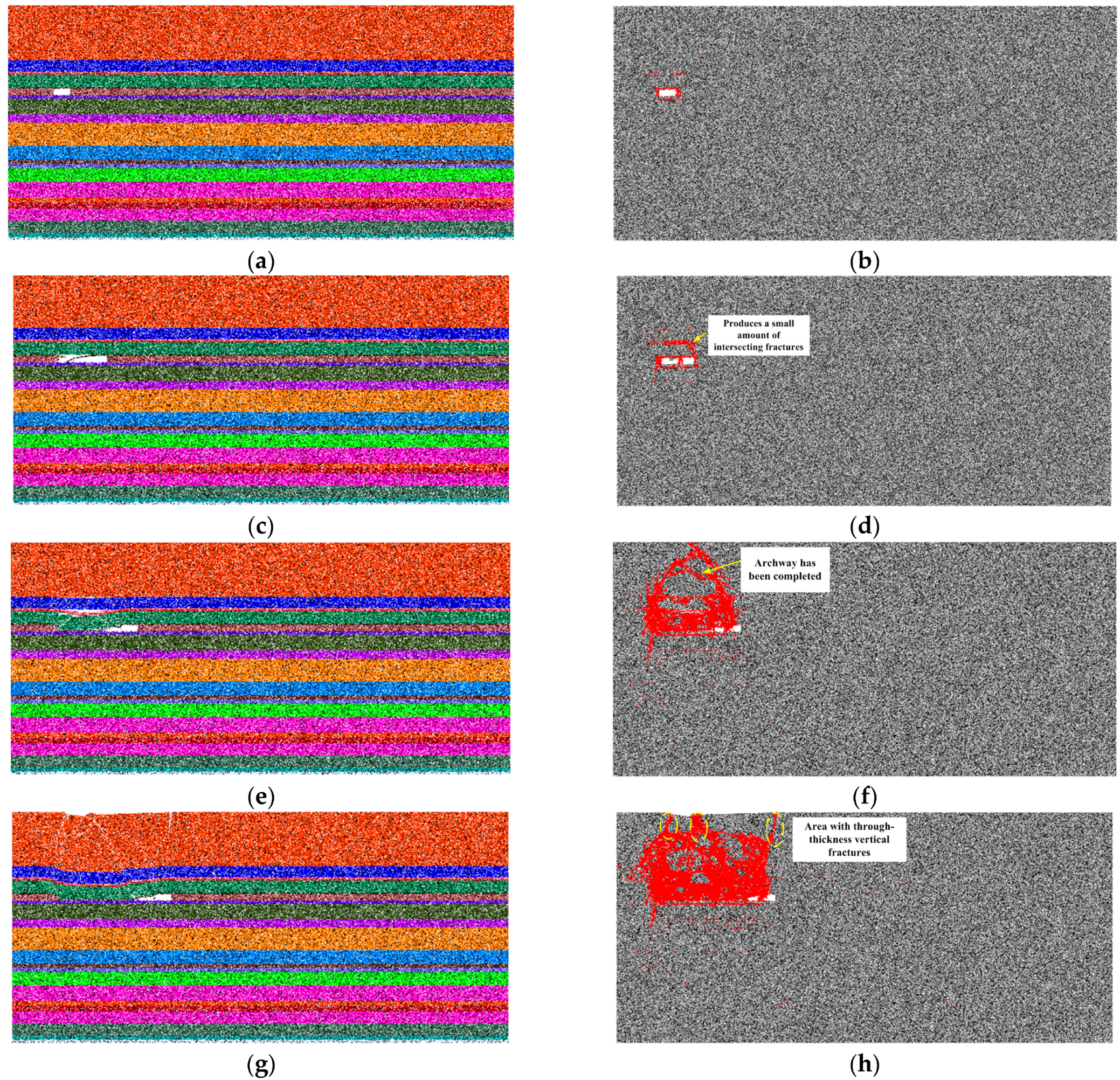
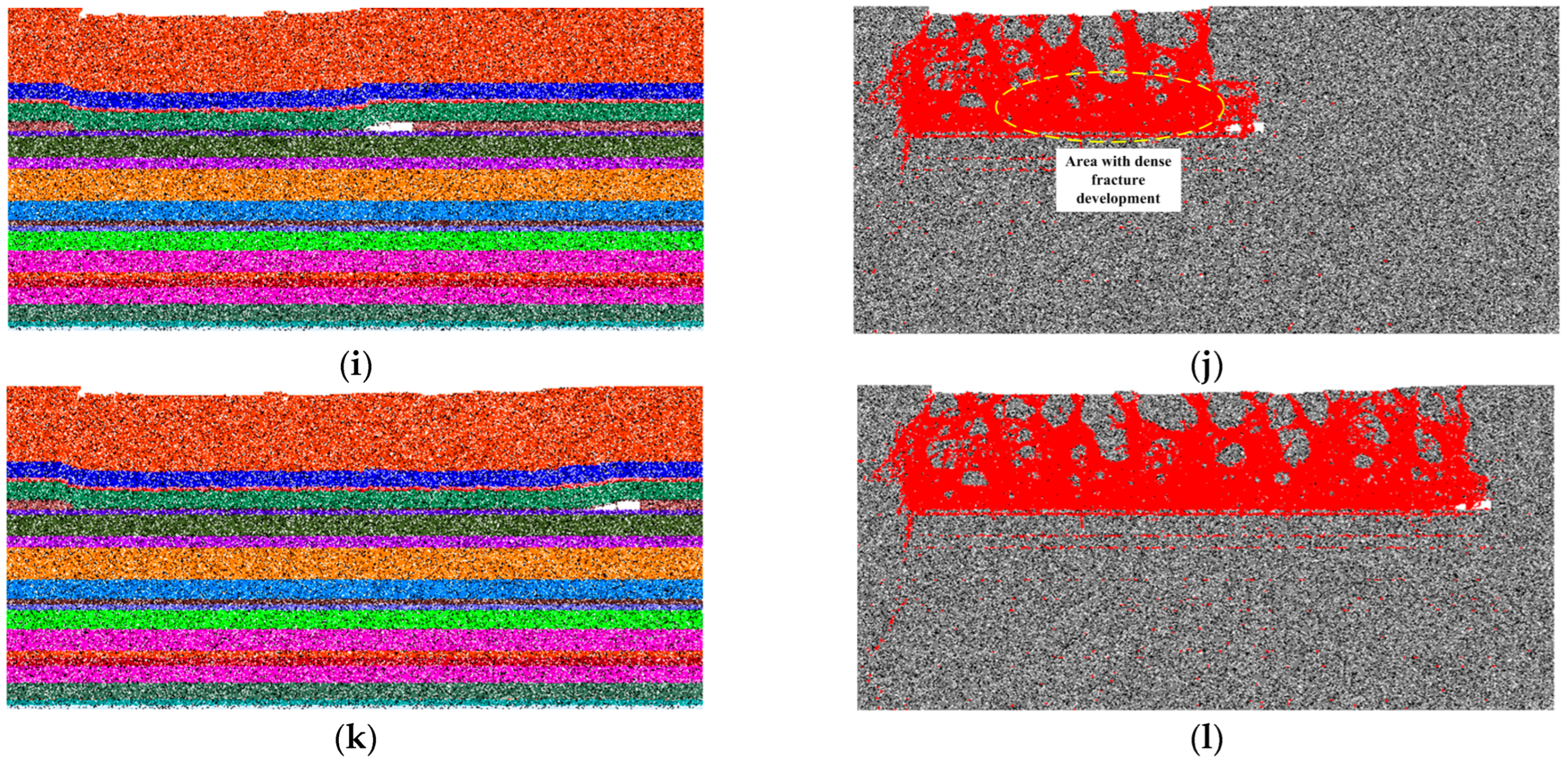
Figure 2 shows the development of fractures in the roof and floor during the mining of the 2-2 coal seam. When the coal seam is mined to 20 m, the overlying rock above has not collapsed (as shown in Figure 2a), and only a few fractures have formed in the immediate roof of silty mudstone and the floor mudstone (as shown in Figure 2b). When the coal seam is mined to 50 m, the direct roof breaks and subsides (as shown in Figure 2c), with both sides displaying a cantilever beam distribution. The number of fractures in the overlying strata of the roof increases, mainly in the siltstone (as shown in Figure 2d). At this time, a small number of intersecting cracks are forming in the roof rock layer. As the working face continues to advance, the basic roof gradually breaks and subsides (as shown in Figure 2e). Gas migration channels formed at the basic top mudstone siltstone, and the underlying mudstone began to accumulate in the mined-out area. The number of fractures at the basic top surged, and some local fractures developed up to the surface (as shown in Figure 2f). Some fissures have formed continuous arches. This is due to the fact that the fractures above the working face have undergone a transition from a compressive zone to a tensile zone, and this change in distribution reflects the spatial variability in the development of fractures in the rock strata. When the coal seam is mined to 150 m (as shown in Figure 2g,h), the overlying caving rock above the goaf gradually compacts. Caving and broken rock provide support to the overlying strata, causing the minimum principal stress of the overlying rock to gradually increase, which suppresses the development and expansion of fractures, and the number of air leakage channels decreases. The subsidence range of the roof-overlying rock has extended to the surface soil layer, and larger gas migration channels have appeared, with mining-induced fractures becoming more developed, gradually developing upward into a new arched form. As the working face gradually advances, as shown in Figure 2i,j, the collapse range of the surface soil layer expands, creating a certain drop. As the overlying rock gradually compacts, the number of fractures in the surface soil layer above the mined-out area decreases, while the development of mining-induced fissures further intensifies, and the fractures are the most developed, largest, and densest. However, a cantilever beam is formed at the advancing area on the right working face, providing a certain degree of support to the overlying rock layers. The supporting stress is transmitted to the overlying layers, slowing down the development of cracks above. When the working face has been mined 400 m (as shown in Figure 2k,l), the mining of the working face is completed, resulting in the formation of an intermediate flat subsidence basin on the surface. There are a certain number of fractures in some areas. The number of fractures in the overlying roof strata continues to increase and expand, reaching the maximum value induced by the 2−2 coal seam mining. A complex network of intersecting horizontal and vertical fractures developed in the roof overburden at a depth of approximately 92 m, and a certain number of fractures have also appeared in the floor.
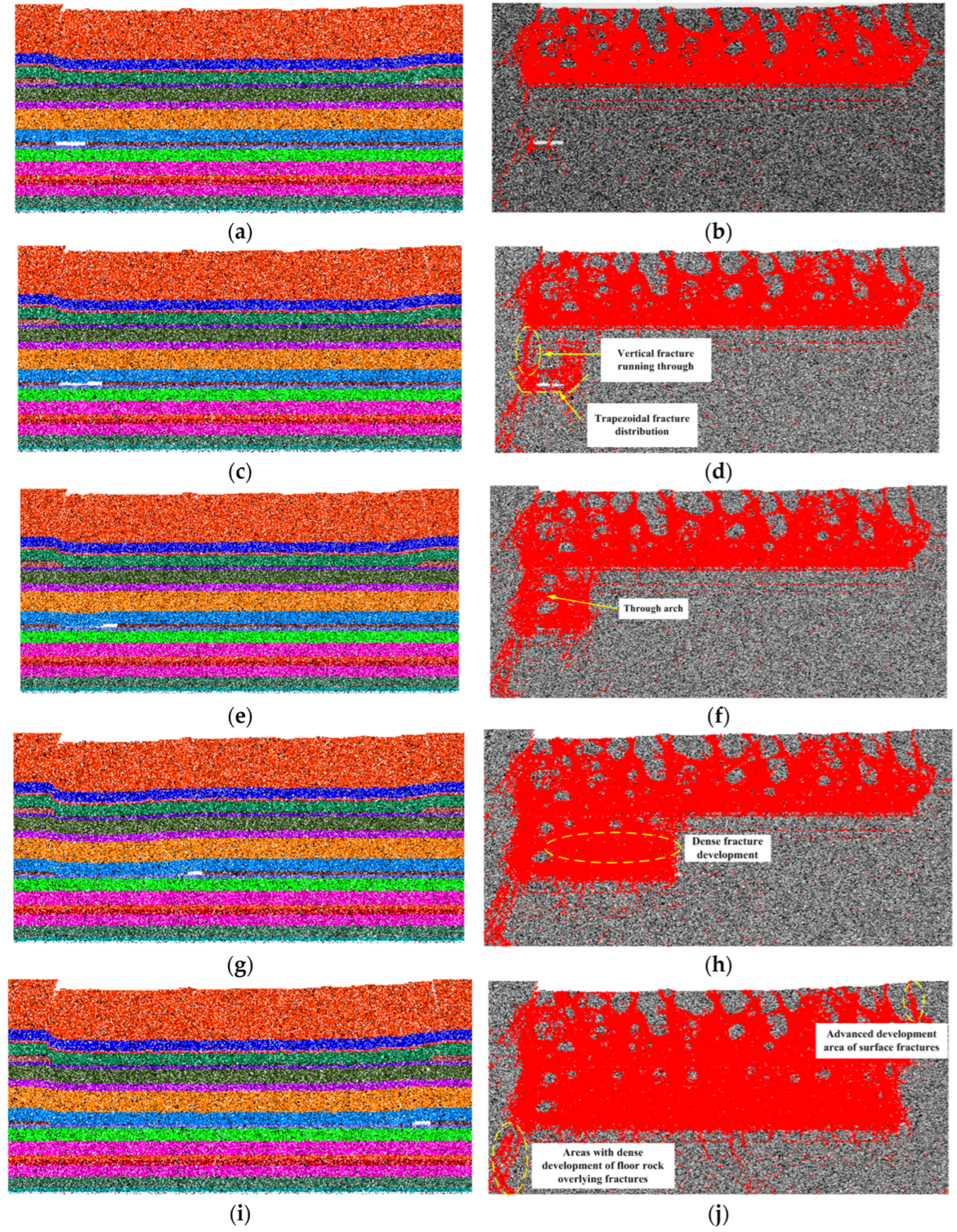
Figure 3 shows the development of fractures in the roof and floor during the mining of the 4−2 coal seam. As can be seen from the figure, when the coal seam is mined 20 m (as shown in Figure 3a,b), the roof has not collapsed and still provides support, and the impact of mining has only caused minor fractures in the floor. When the coal seam is mined to 50 m (as shown in Figure 3c,d), the immediate roof begins to fracture and subside, creating a gas migration channel between the sandstone and sandy mudstone in the main roof. The number of fractures around the roof of the 4−2 coal seam mined-out area has increased, further extending upward in the roof, and some fractures have already reached the upper compacted area, forming through-going fractures. The fractures around the 4−2 coal seam exhibit a ‘trapezoidal’ distribution. When the working face continues to advance by 150 m (as shown in Figure 3e,f), as the basic roof rock continues to subside, the gas migration channels in the basic roof gradually become compacted, and the subsiding mudstone begins to accumulate in mined-out area. The number of fractures in the upper rock layers increases again, with most of them extending into the fracture development area of the upper mining face, and the overlying rock in the middle forms a continuous arch. As the working face layer is gradually mined, as shown in Figure 3g,h, the mined-out area and the compaction range of the overlying rock are gradually expanding, and the subsidence of the surface soil layer is increasing accordingly. The area with fractures in the basic roof rock layer is larger when compared with when coal seam 2−2 was mined. Extensive development of overlying rock fractures in the area above the right working face of the 4-2 coal seam. When the working face has advanced 400 m, the mining of the 4−2 coal seam is completed (as shown in Figure 3i,j). The overall overlying rock layer has formed a network of intersecting horizontal and vertical fractures, with surface subsidence basins and fracture drop reaching their maximum values. Some local rock layers still contain a certain number of fractures, with the number of fractures in the top coal seam roof caused by mining reaching the maximum value for the 4−2 coal seam and the area ahead of the surface’s crack formation. The floor also contains a certain number of fractures. Based on the characteristics of roof collapse and fracture evolution observed in simulations 2−2 and 4−2 of coal seam mining, it is recommended to strengthen roof support or optimize support density in stages or areas where fractures are highly developed. To prevent air leakage in goaf areas, it is advised to implement grouting or filling measures in corresponding locations (such as areas with high fracture connectivity) and to provide early warnings regarding roof stability during periodic caving.
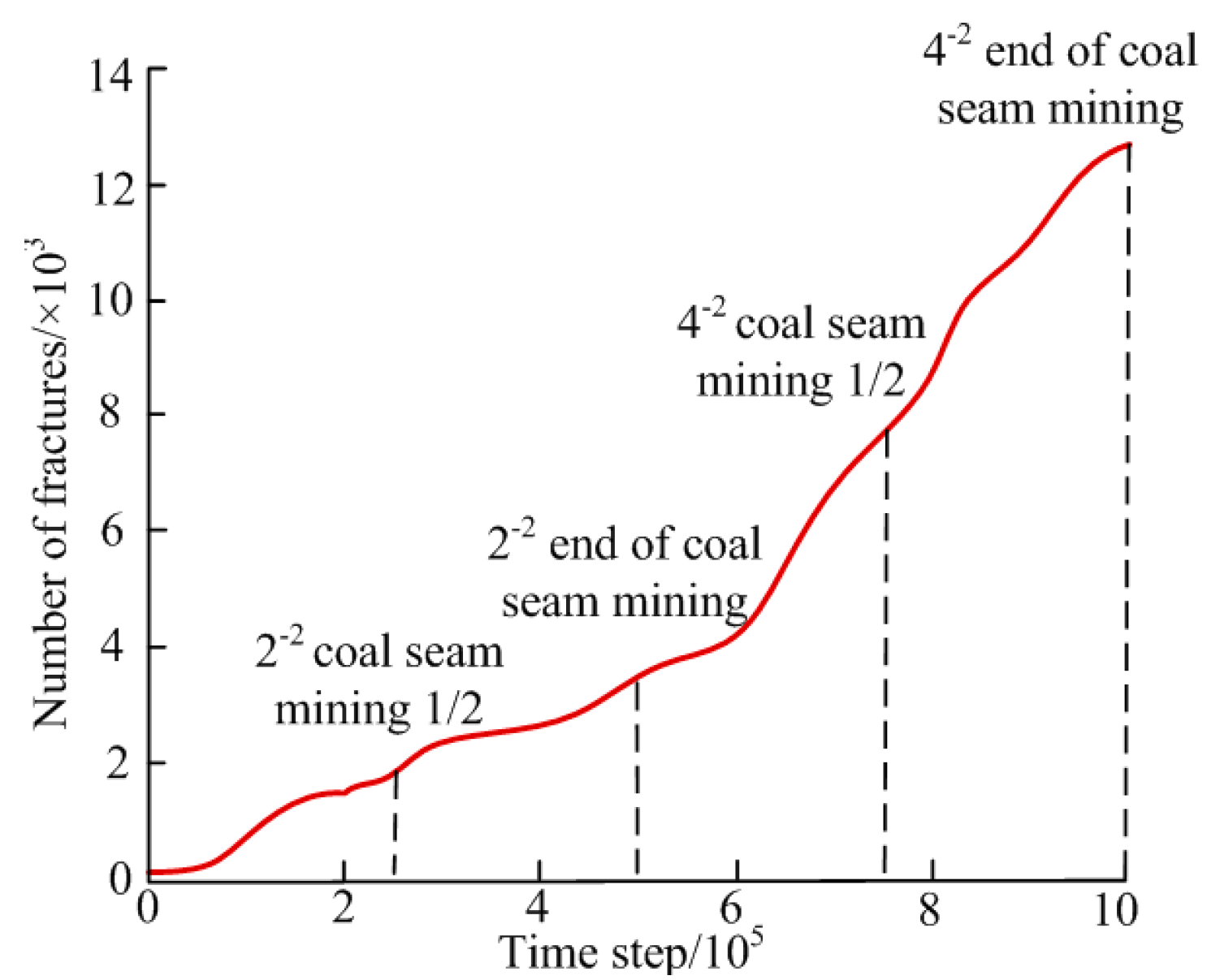
By counting the number of fractures developed throughout the mining processes of the 2−2 and 4−2 coal seams, the relationship curve between mining steps and the number of fractures was obtained, as shown in Figure 4. Analysis shows that the number of fractures developed exhibits a stepwise increase with the mining of the two coal seams, and the number of fractures developed during the mining of the 2−2 coal seam is more than three times that during the mining of the 4−2 coal seam. This is because the mining height of the 2−2 coal seam is 7.7 m, while that of the 4−2 coal seam is 2.3 m, indicating that mining height is an important factor affecting fracture development.

3.2. Analysis of the Impact of Mining Parameters on the Variation of Overlying Rock Fracture Height

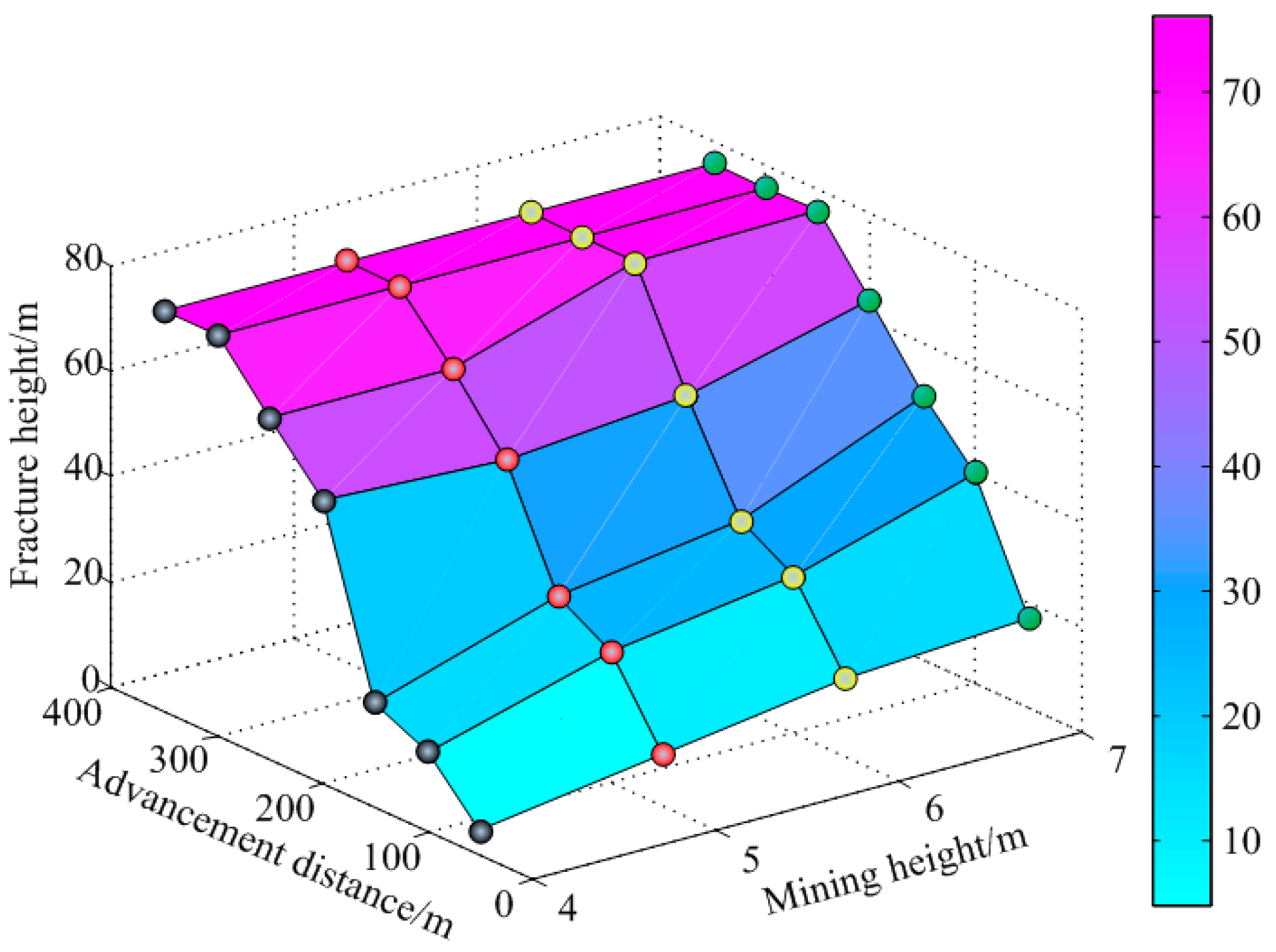
In order to obtain the relationship between mining height, mining distance, and the height of rock layer fractures, we take the mining of the 2−2 coal seam as an example. The mining heights are set at 4 m, 5 m, 6 m, and 7 m, and the working face advance distances are 20 m, 50 m, 100 m, 150 m, 200 m, 250 m, and 400 m. The results obtained through simulation are shown in Figure 5:
Analysis shows that as the mining height increases, the development height of fractures gradually tends to increase. When the mining height is consistent, the height of fracture development gradually increases with the advancement distance. In order to quantitatively analyze the relationship between mining height, advance distance, and fracture development height, the paper fits the above data results. As shown in Equation (1), the goodness of fit is 0.97, the fitting range is x (0, 400), y (4, 7).
h = 0.39 x 2 0.02 y 2 0.03 x y + 4.76 x + 0.87 y + 59.9
where x is the mining height; y is the mining distance; h is the fracture height; the coefficients 0.39 and 0.02 represent the secondary nonlinear contribution of the working face advance distance and mining height to the fracture height, respectively; 0.03 represents the coupled linear contribution of the working face advance distance and mining height to the fracture height; 4.76 and 0.87 represent the linear contribution of the working face advance distance and mining height to the fracture height, respectively; and 59.9 is the constant term.

3.3. Analysis of Fracture Porosity in the Mining Area

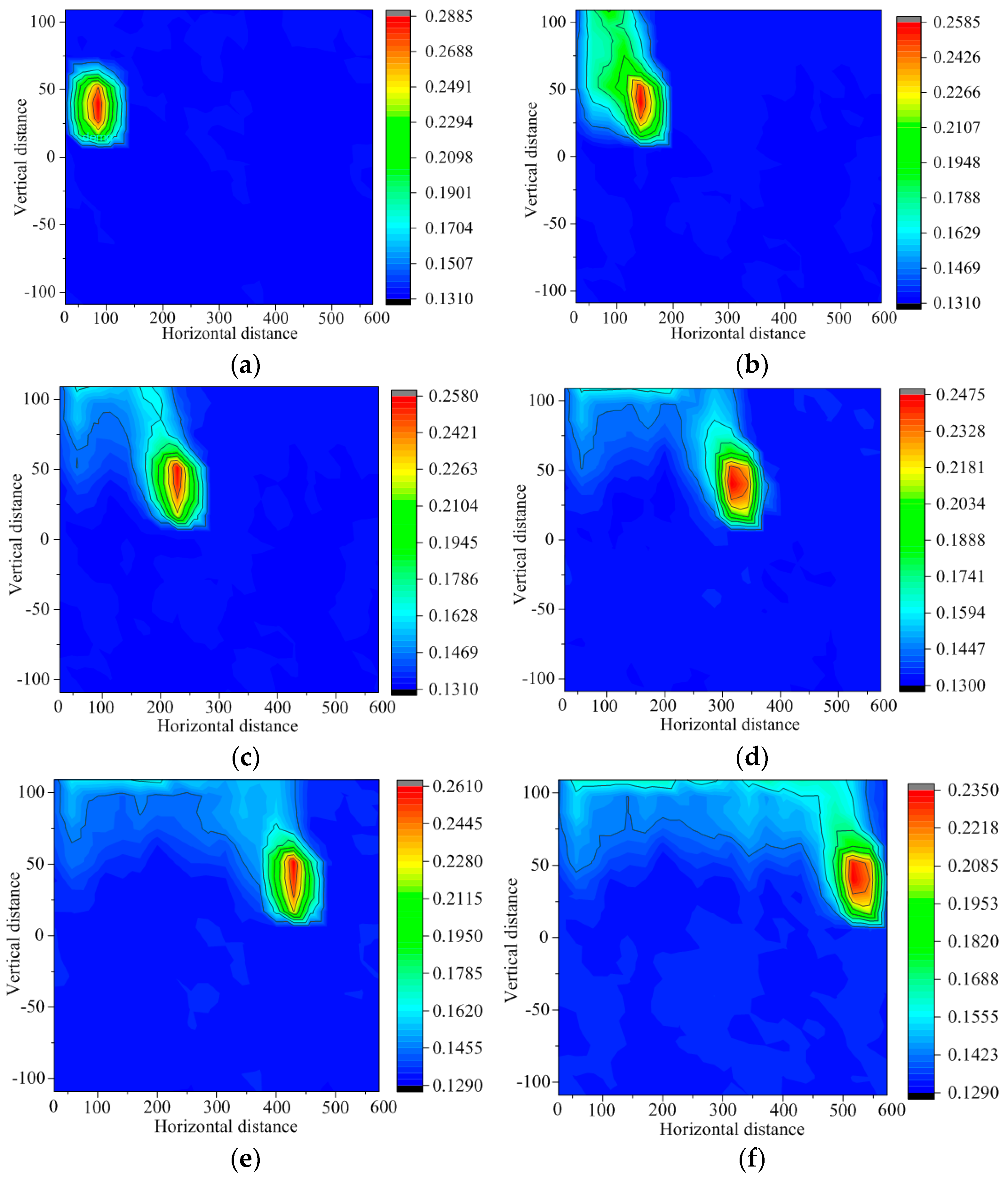
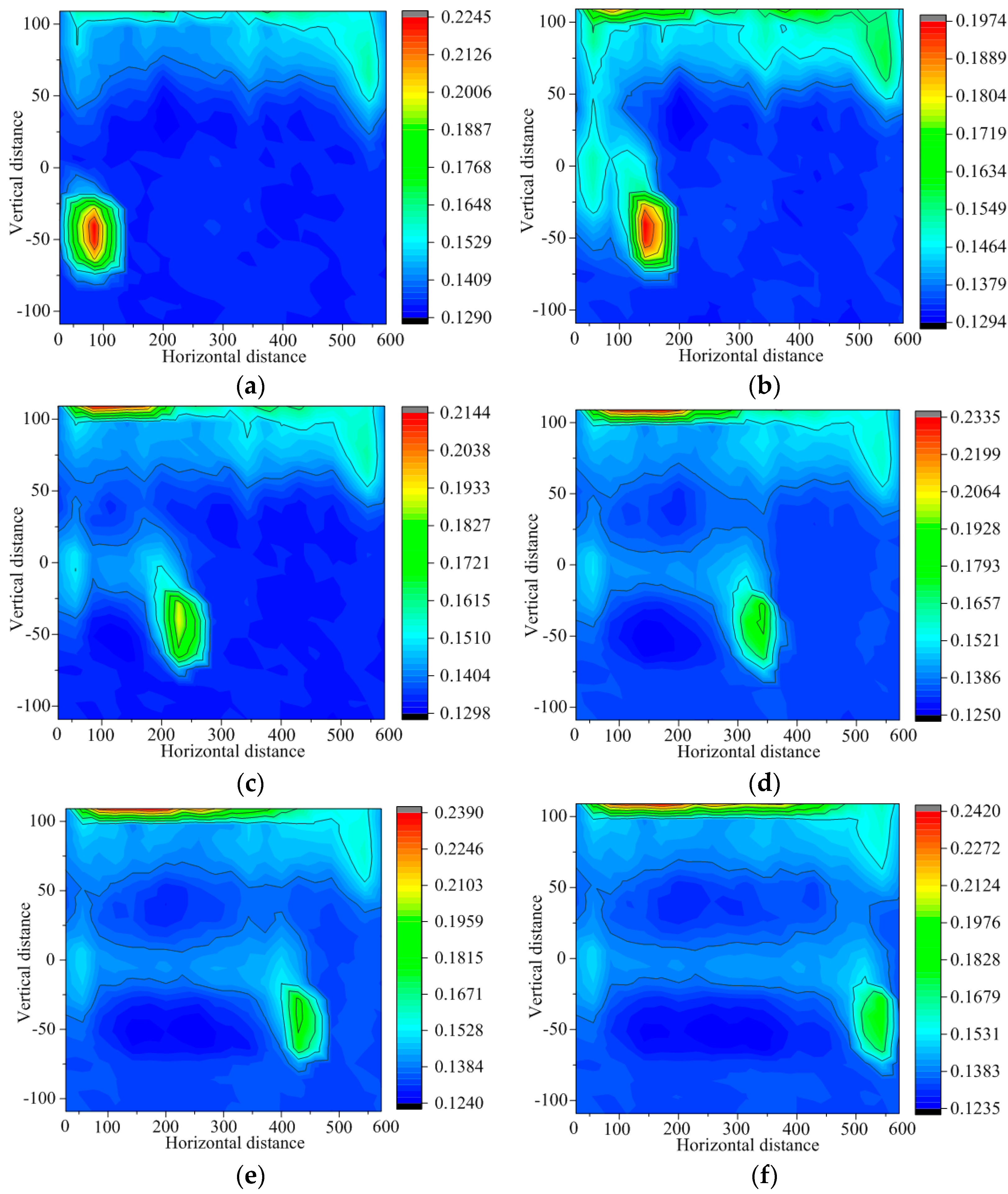
In order to obtain the evolution law of the porosity within the overlying rock during close-distance multi-coal seam mining, the development of fractures in the established model is tracked using measurement circles, with the measurement circle covering an area of 500 m in the advancing direction and 250 m in the vertical direction, with a diameter set at 20 m. These are arranged in 20 rows and 40 columns both horizontally and vertically, with a total of 1000 measurement circles distributed across the measurement area. The porosity development pattern is obtained based on the migration of overlying rock particles, and the results are shown in Figure 6 and Figure 7.
When the upper coal seam is mined, the change pattern of the overlying rock porosity is shown in Figure 6. It can be seen from the analysis of Figure 6a that, when the working face advanced 20 m, the overlying rock did not fracture or subside. The porosity began to gradually expand from the mining area to the surrounding areas, with the central part having the highest porosity value of 0.2885. When the working face advances 50 m (as shown in Figure 6b), the overlying rock at the top fractured and subsided. Affected by the expansion of the subsidence range of the top slab’s overlying rock, the range of porosity changes gradually widened and has extended to the surface soil layer, while the porosity of the overlying rock in the remaining areas remained unchanged. With the continued advancement of the working face (as shown in Figure 6c–e), although the range of porosity continues to expand, the porosity values gradually decrease as the overlying rock in the mining face is compacted, with high porosity values persisting only in the mining area and its vicinity. When the upper coal seam mining is completed (as shown in Figure 6f), the caving of the overlying strata in the mined-out area is stable. Except for higher porosity at the mining site, the porosity of the surface soil gradually increases in range, and porosity decreases progressively downward from the surface.
The variation pattern of the overlying rock porosity during the mining of the lower coal seam is shown in Figure 7. When the coal seam working face advances by 20 m, as shown in Figure 7a, the porosity in the mining area varies significantly and has gradually begun to expand outward. When the coal seam working face advances 50 m (as shown in Figure 7b), affected by the subsidence of the overlying strata at the top, the porosity in the mining area has increased, and it has extended to the rear of the goaf and the fracture development zone of the upper mining face. As the working face advances, the porosity continues to extend toward the ground surface. At this time, the porosity value at the ground surface gradually increases from 0.2144 to 0.2335, and the range also continues to expand, as shown in Figure 6d and Figure 7c. As the working face continues to advance (as shown in Figure 7e,f), when both the upper and lower coal seams have been fully mined and are in a stable state, the surface subsidence causes differential fractures, leading to a continuous increase in the surface porosity values. By comparing the surface porosity values when mining the upper and lower coal seams, it can be seen that the surface porosity at the end of mining the lower coal seam is greater than that of mining the upper coal seam.

4. Development Height of Overburden Fractured Zone

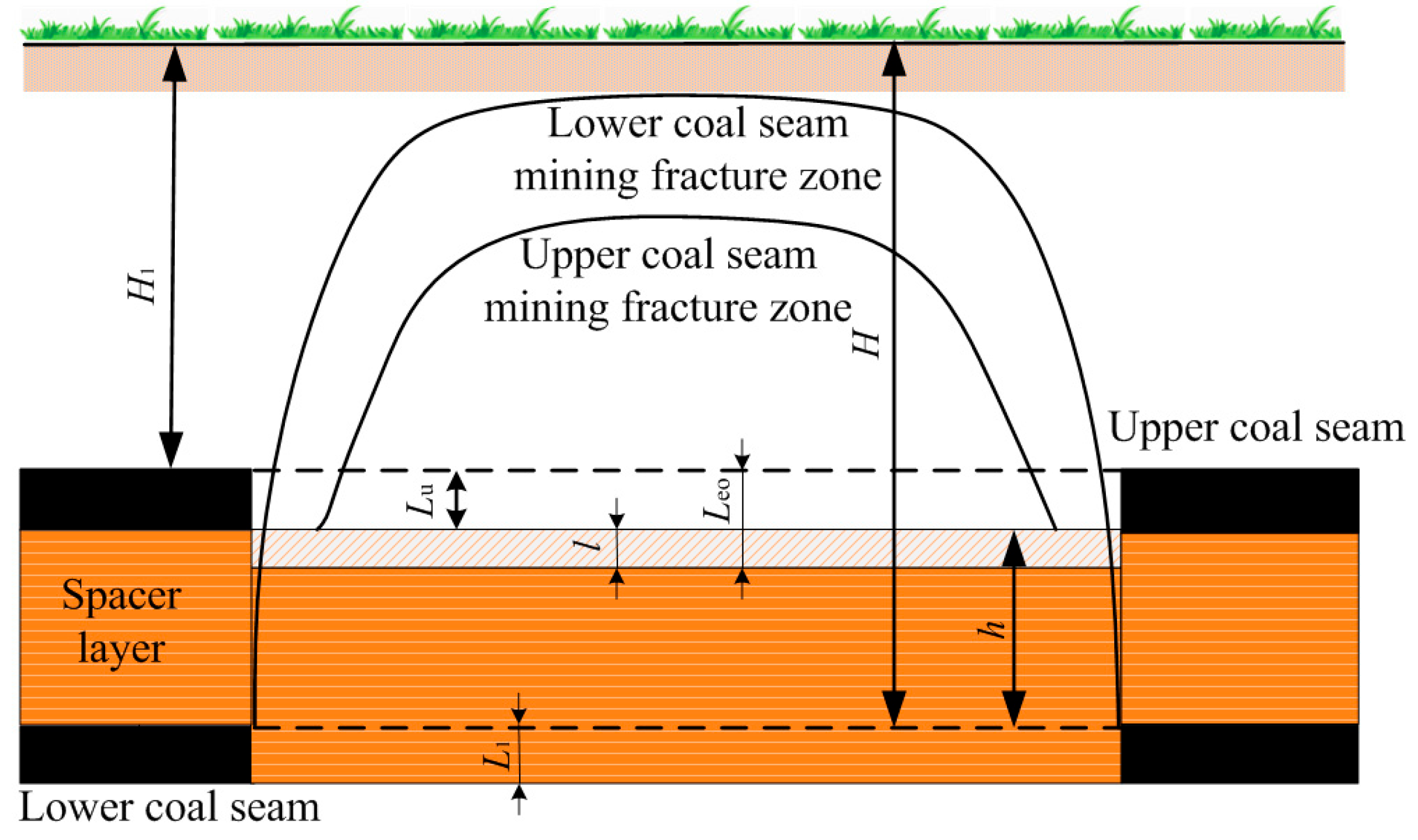
Ref. [22] describes the height of rock layer damage development caused by coal seam mining using overlying rock fractures. Affected by the properties of rock strata, mining thickness, and the interactions between multiple coal seams, the development height of the fracture zone caused by close-distance multi-seam mining exhibits a superimposed effect. In order to comprehensively reflect the height of the fracture zones in closely spaced coal seams during comprehensive mining and to describe their physical significance, this paper uses the two-coal-seam mining calculation model shown in Figure 8, which includes the subsidence of the overlying strata caused by the mining of the upper coal seam as well as the subsidence of the top strata of the interburden caused by the mining of the lower coal seam.
In Figure 8, H is the burial depth of the lower coal seam, L1 is the mining thickness, H1 is the burial depth of the upper coal seam, Lu is the mining thickness, and l is the subsidence value of the top rock layer of the interlayer caused by mining of the lower coal seam, the expression is as follows:
l = q i L 1
where q i is the overburden subsidence coefficient [23], expressed as follows:
q i = 1 h H 1 0.52 1 q
where h is the thickness of the interlayer between the upper and lower coal seams; q is the surface subsidence coefficient. Through Equations (2) and (3), the comprehensive mining thickness after close-distance multi-coal-seam mining is described as follows:
L e o = L u + l
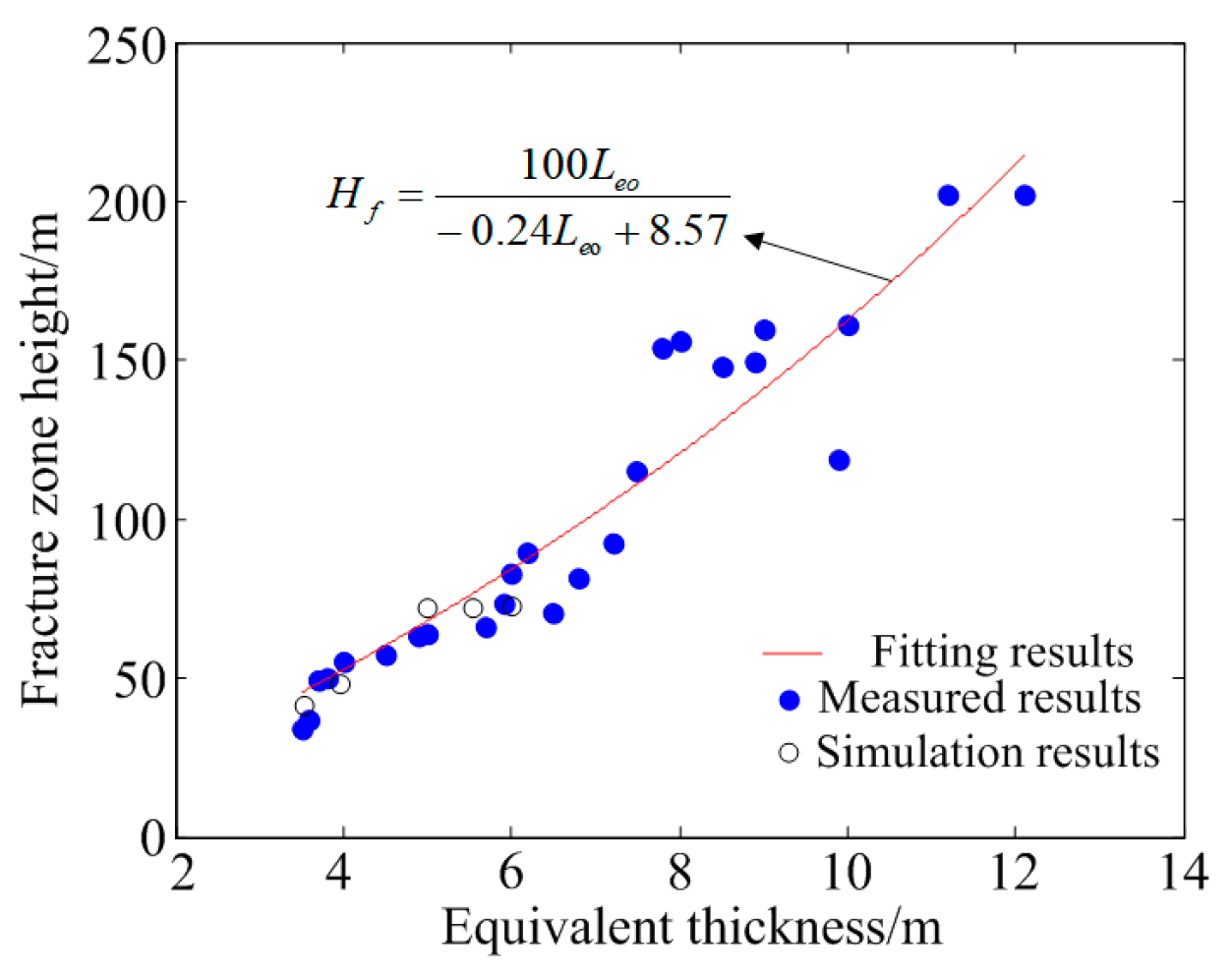
Based on the measured height data of the ‘two belts’ in 152 groups of comprehensive mining listed in reference [24], and taking into account the medium-hard overlying rock properties of the mining site in this study, 25 sets of data were selected to fit the mining thickness and the height of the fracture zone, using a mining thickness interval of 0.1 m. The formula for the height Hf of the comprehensive mining fracture zone was obtained through nonlinear regression fitting (fitting goodness R2 = 0.95).
H f = 100 L e o 0.24 L e o + 8.57
Based on the mining conditions of the Zhangjiamao Coal Mine, PFC2D software was used to numerically simulate the fracture zone height of double coal seam mining under five different mining thicknesses. Comparing the results with measured data and fitted results (as shown in Figure 9), the trends of all three are consistent, which verifies the applicability of Equation (5).

5. Engineering Validation

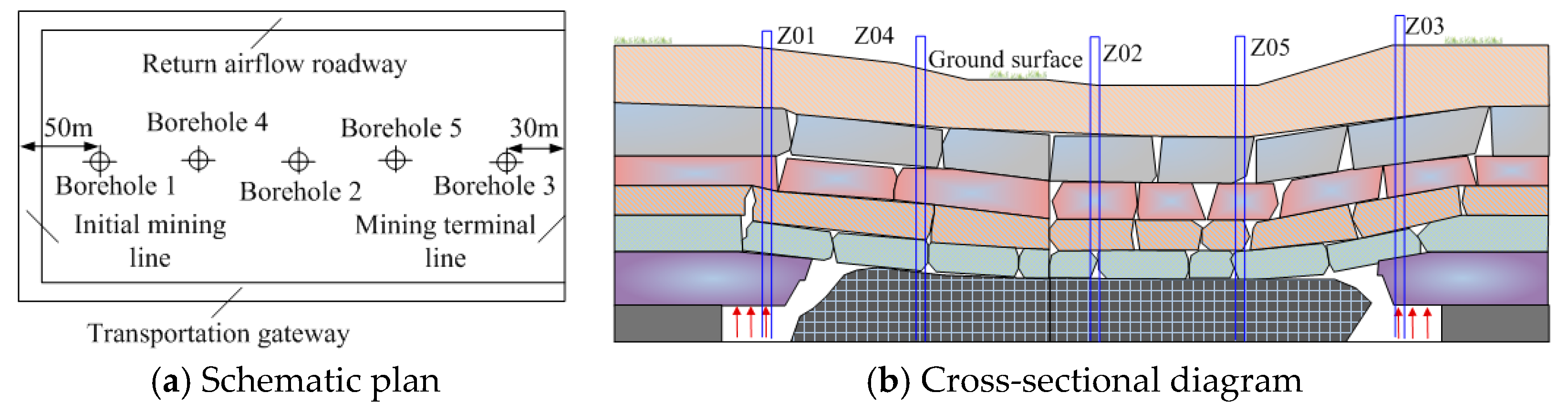
In order to use the data on the evolution characteristics of overlying rock fractures at the site to verify the theoretical research results mentioned above, the 2−2 and 4−2 coal seams of Zhangjiamao Coal Mine are selected as observation targets. According to the requirements of the coal industry standard “Measuring method on height of water flowing fractured zone using loses of drilling fluid,” three post-mining observation boreholes were designed and arranged in two coal seam working faces. The coordinates of the boreholes are as follows: Z01 at (4,070,204.542, 34,204,361.213), Z02 at (407,210.206, 34,314,620.231), Z03 at (4,071,735.614, 34,333,526.425), Z04 at (4,070,206.323, 34,204,427.306), and Z05 at (4,070,235.614, 34,314,622.023). The drilling depths are 100 m, 95 m, 98 m, 97 m, and 95 m, respectively, and the arrangement is shown in Figure 10. The borehole has a diameter of 150 mm, and the observation section has a diameter of 91 mm for diameter reduction operations. Using a three-dimensional digital transparent borehole imaging device, data on the development of fractures in the fractured overlying rock are collected.
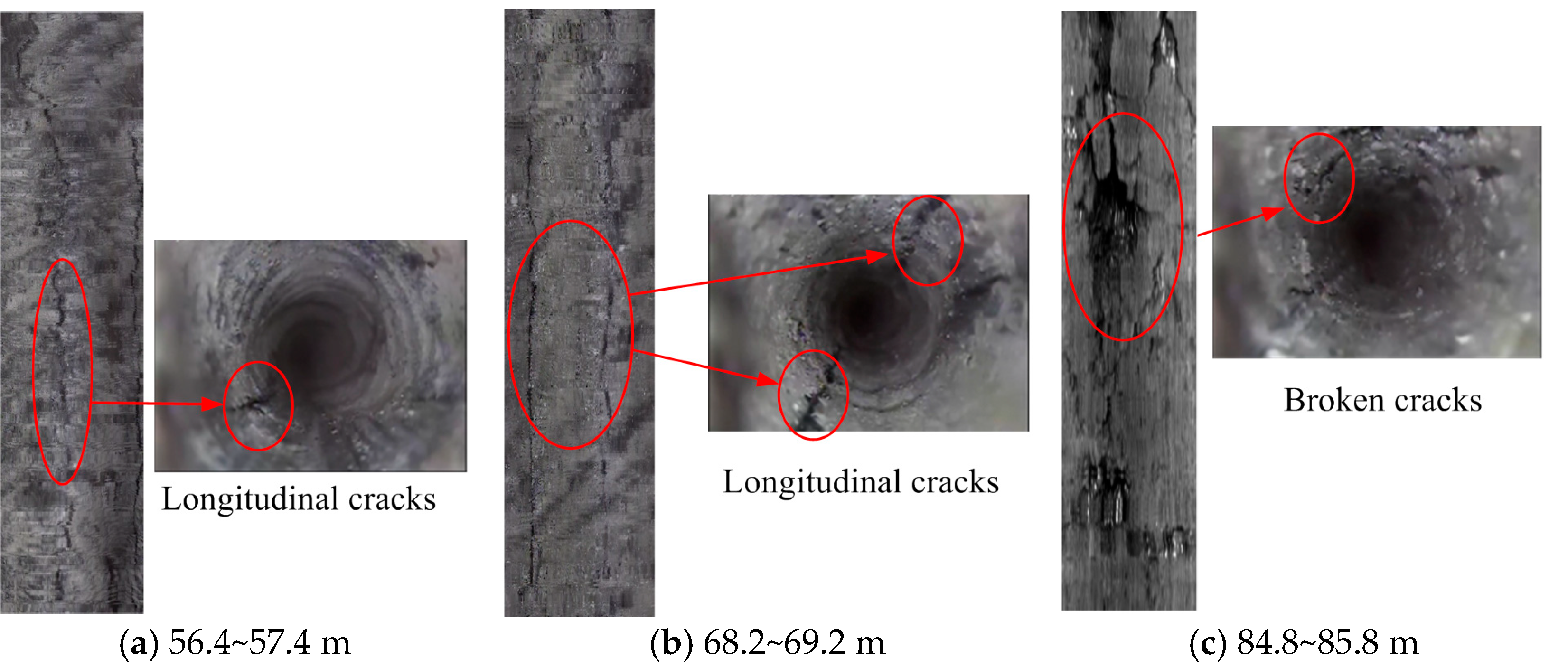
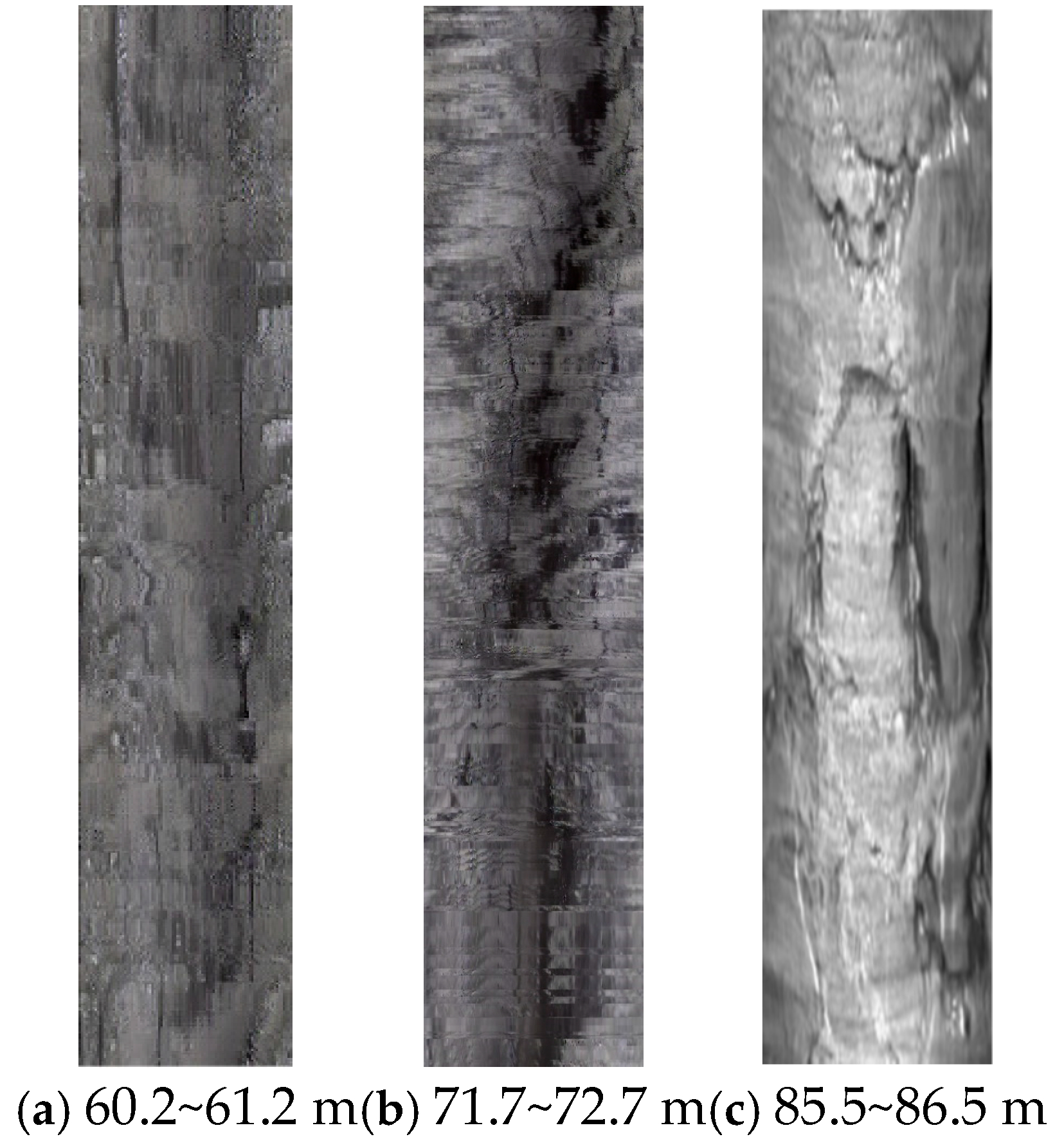
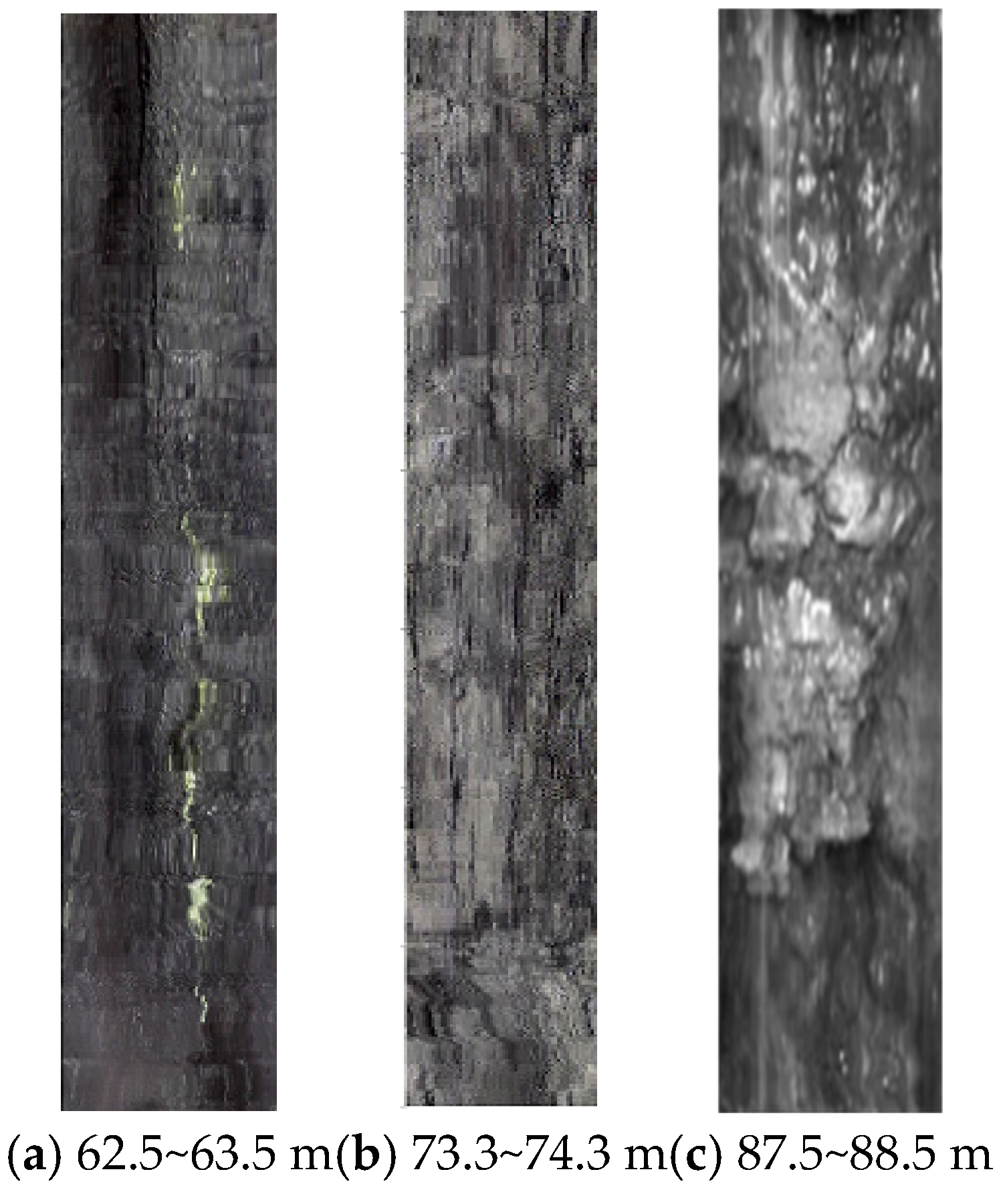
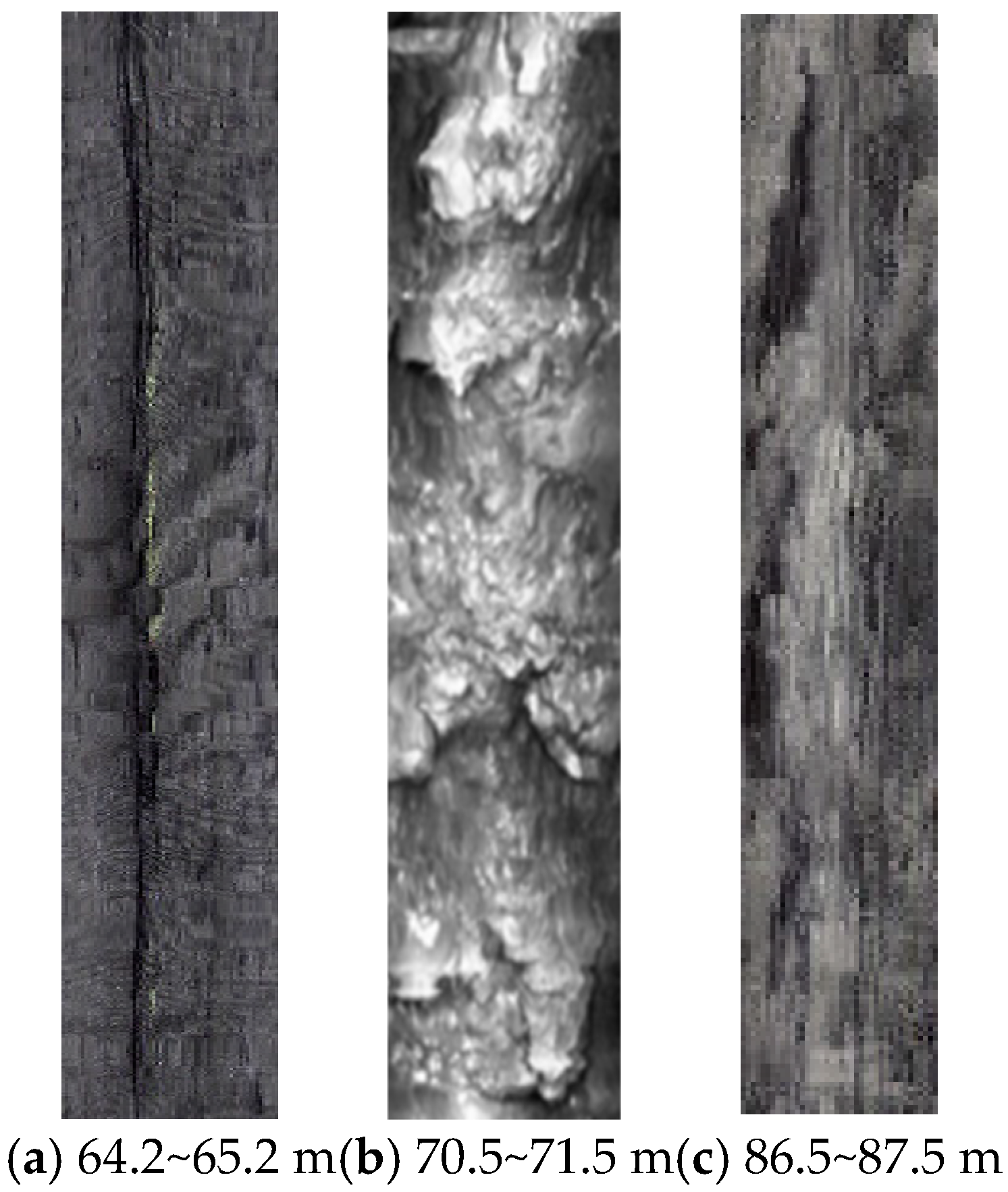
Due to the large amount of overall detection data, this paper only selects part of the borehole depth detection range for result analysis. The analysis range of Z01 drilling data is from 45.1 m to 96.3 m, with an observation length of 51.2 m. The results of the overlying rock fracture development are shown in Figure 11. Figure 11 shows the development of fractures in the borehole wall at different detection depths. As can be seen from Figure 11a–c, each test section showed a different number of through-thickness vertical fractures, with the fractures being very long. There are intersecting fractured cracks on the borehole wall in the 84.8–85.8 m section, with some rock blocks showing detachment, and the fracture width is increasing. The integrity of the borehole wall is very poor, which is roughly consistent with the pattern of the simulation results. Comprehensive analysis of the monitoring data indicates that the fracture zone height at monitoring point Z01 extends to the surface, consistent with the simulation data.
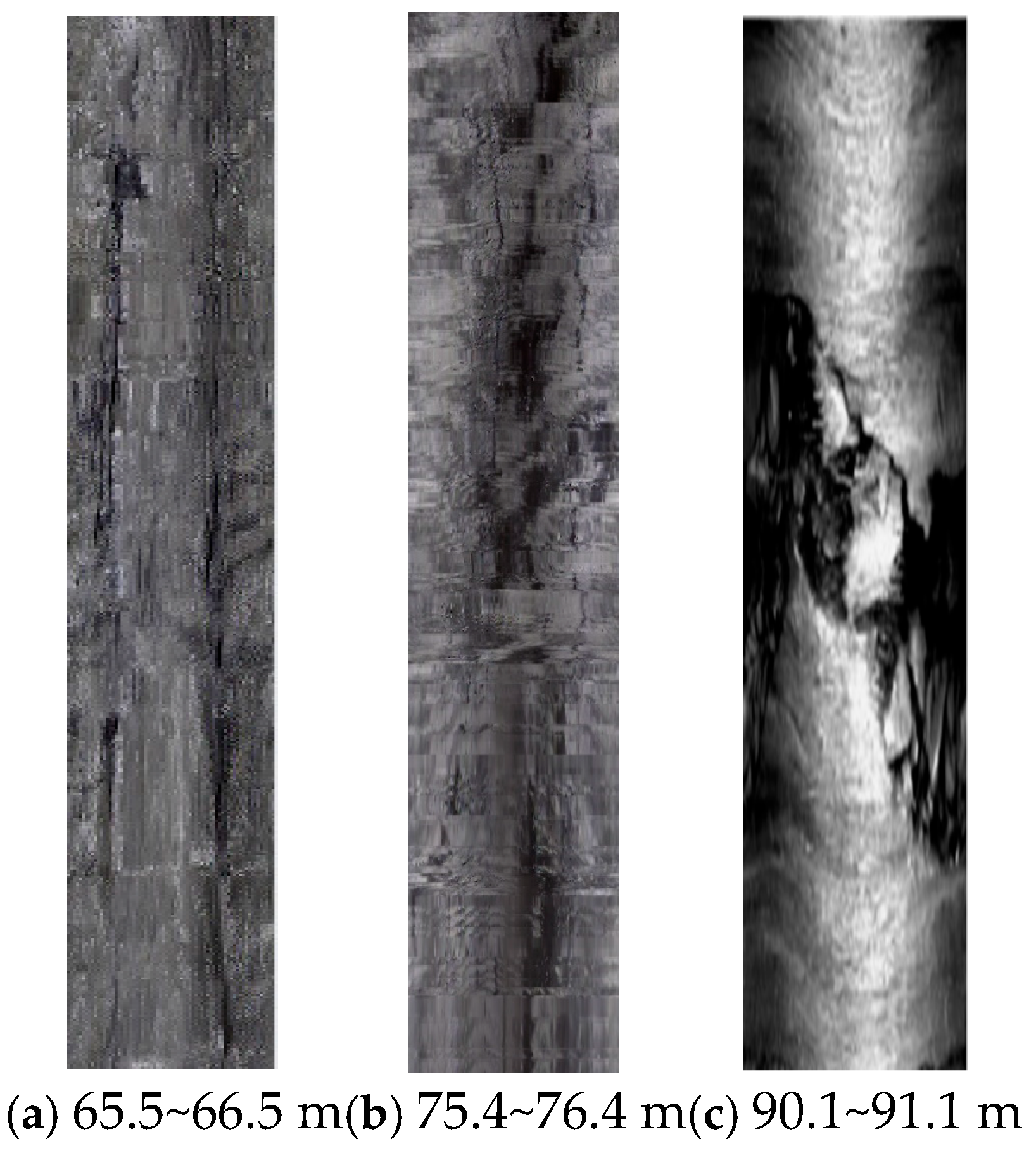
Z02 drilling data analysis range is from 55 m to 95 m, with an observation length of 40 m. Z03 drilling data analysis range is from 45 m to 96 m, with an observation length of 51 m. Z04 drilling data analysis range is from 45 m to 95 m, with an observation length of 50 m. Z05 drilling data analysis range is from 50 m to 90 m, with an observation length of 40 m. The test results of the strata with developed fractures in the wellbore are shown in Figure 12, Figure 13, Figure 14 and Figure 15. Analysis indicates that longitudinal fractures penetrated through the borehole were observed in sections around 60 m deep, the number of borehole fractures increased in sections around 70 m, and fractured overlying rock was present in the 85–90 m section. The fractures around the borehole are intersecting. The simulation estimated that the depth of the cross fissures in the overlying rock was about 92 m, with the error between the experimental and simulation results within 10%. The main reasons for the discrepancies are as follows: (1) vibration from the on-site equipment had a certain impact on the movement of the overlying rock structure; (2) there was some deviation while drilling with the equipment; (3) during the drilling experiments, mining work was still ongoing underground, which also affected the location of the overlying rock fissures. In addition, the height of the fissure zones from the drilling points in all four directions extended to the surface, consistent with the simulation data.

6. Conclusions

(1)
A discrete element numerical model of granular flow in the near-surface rock structure of the Zhangjiamao mining area was established. The following conclusions were drawn from the analysis: as the 2−2 coal seam continues to advance, the number of fractures in the overlying rock increases and expands, developing upward in a new arch-shaped form with gradual penetration. During the mining of the 4−2 coal seam, gas migration channels are formed between the medium-grained sandstone and sandy mudstone in the main roof, and the fractures around the 4−2 coal seam show a “trapezoidal” distribution. A statistical analysis of the number of fractures after the mining of the 2−2 and 4−2 coal seams shows that the number of fractures developed during the mining of the 2−2 coal seam is three times that during the mining of the 4−2 coal seam.
(2)
The evolution of the porosity within the overlying strata under coal seam mining was tracked, and it was found that the porosity evolves through a dynamic process of ‘central initiation—upward expansion (to the surface)—compaction and convergence of the goaf—continued development at the surface.’ Due to the cumulative damage to the overlying strata caused by mining of the upper coal seam, the porosity response during mining of the lower coal seam is more sensitive and expands more rapidly. High porosity zones remain concentrated near the mining area, but the affected range continues to spread toward the surface, showing a pattern of ‘deep concentration, shallow wide distribution.’ Mining of the lower coal seam is a critical stage for controlling surface subsidence and fracture seepage risks, and particular attention should be paid to the expansion of the surface fracture network and the potential enhancement of water conductivity it may trigger.
(3)
A fitting formula for the height of the overlying rock fracture zone under multi-coal seam mining conditions was developed, and its applicability was verified by comparison with numerical simulation and field measurement results.
(4)
Based on the results of numerical simulations, a relational equation among mining height, mining distance, and fracture height was established. The related findings can provide a reference for surface subsidence management in the Shendong mining area.

Author Contributions

The author contributions are as follows: writing—original draft, review, and editing, Y.Z. (Yu Zhang); data acquisition, Y.Z. (Yuezhi Zhang) and Y.Z. (Yadong Zhao); investigation, X.B. All authors have read and agreed to the published version of the manuscript.

Funding

This work was supported by the Natural Science Foundation of Henan (252300421895).

Institutional Review Board Statement

Not applicable.

Informed Consent Statement

Not applicable.

Data Availability Statement

The original contributions presented in this study are included in the article. Further inquiries can be directed to the corresponding author.

Conflicts of Interest

The authors declare no conflicts of interest.

References

  1. Kang, H.; Xu, G.; Wang, B.; Wu, Y.; Jang, P.; Pan, J.; Ren, H.; Zhang, Y.; Pang, Y. Forty years development and prospects of underground coal mining and strata control technologies in China. J. Min. Strat. Control. Eng. 2019, 1, 013501. [Google Scholar] [CrossRef]
  2. Peng, S.; Bi, Y. Academician minggao Qian directed ecological restoration research of arid and semi-arid coal mining areas in western China. J. Min. Saf. Eng. 2023, 40, 857–860. [Google Scholar] [CrossRef]
  3. Zhang, J.; An, J.; Wen, Z.; Zhang, K.; Pan, R.; Al Mamun, N.A. Numerical investigation of coal self-heating in longwall goaf considering airflow leakage from mining induced crack. Process Saf. Environ. Prot. 2020, 134, 353–370. [Google Scholar] [CrossRef]
  4. Yang, D.; Sun, Y.; Xu, J.; Zhao, L. Study on the evolution of fractures in overlying strata during repeated mining of coal seams at extremely close distances. Front. Earth Sci. 2024, 12, 1472939. [Google Scholar] [CrossRef]
  5. Qian, M.; Xu, J. Characterization of “O” ring in the distribution of mining fissures in overburden rocks. J. China Coal. Soc. 1998, 5, 20–23. [Google Scholar]
  6. Gao, M.; Xie, J.; Guo, J.; Lu, Y.; He, Z.; Li, C. Research on the fractal effects of crack network in overburden rock stratum. Chin. J. Rock Mech. Eng. 1999, 18, 147–151. [Google Scholar]
  7. Hu, Z.Q.; Wang, X.J.; He, A.M. Distribution characteristic and development rules of ground fissures due to coal mining in windy and sandy region. J. China Coal Soc. 2014, 39, 11. [Google Scholar]
  8. Huang, Q.X.; Han, J.B. Study on fracture evolution mechanism of shallow-buried close coal seam mining. J. Min. Saf. Eng. 2019, 36, 706–711. [Google Scholar] [CrossRef]
  9. Yang, B.B.; Yuan, S.C.; Zheng, D.Z.; Liu, J.W.; Kang, J.Y.; Ma, L.X.; Zhou, Y. Spatial and temporal characteristics of overburden fractures due to repeated mining in close distance coal seams. J. Min. Saf. Eng. 2022, 39, 255–263. [Google Scholar] [CrossRef]
  10. Zhao, Y.; Liu, W.; Zhang, C.; Liu, H.; Wei, Y.; Wang, P.; Shi, Y.; Zhai, J.; Gao, S. Stress and fracture evolution of surround rock during mining above mined out area in contiguous coal seams. J. China Coal Soc. 2022, 47, 259–273. [Google Scholar] [CrossRef]
  11. Wang, X.; Zhang, S.; Pan, R.; Zhao, Y.; Jia, Z.; Tursinhali, H.; Ren, X.; Kuerban, A. Characterization of mining fracture network development in overlying rock layers of deep mining in ordos basin. Front. Earth Sci. 2025, 13, 1461180. [Google Scholar] [CrossRef]
  12. Cai, H.; Kong, D.; Zhang, Q.; Zuo, Y.; Wu, G.; Zhou, Y. Study on the influence of fracture distribution characteristics on the stability of end face roof under repeated mining of close-distance coal seam group. Min. RD 2024, 44, 56–65. [Google Scholar] [CrossRef]
  13. Feng, G.; Zhu, W.; Bai, J.; Yu, D.; Xie, J.; Li, Z. Shocking failure mechanism of advanced coal pillars under the mining influence of shallow buried closed distance coal seams. J. China Coal Soc. 2023, 48, 114–125. [Google Scholar] [CrossRef]
  14. Xie, X.S.; Hou, E.K.; Feng, D.; Cong, T.; Hou, P.F.; Chen, Q.J.; Wang, J.W.; Li, M.F.; Xie, Y.L. Development law and characteristics of surface cracks caused by coal mining in Yushenfu mining area. Chin. J. Eng. 2023, 45, 44–53. [Google Scholar] [CrossRef]
  15. Guo, W.; Bai, E.; Zhao, G. Current status and progress on overburden and surface damage and prevention technology of high-intensity mining. J. China Coal Soc. 2020, 45, 509–523. [Google Scholar] [CrossRef]
  16. Yadav, A.; Behera, B.; Singh, G.S.P.; Sharma, S.K. Numerical modelling of post-failure behaviors of coal specimens. J. Rock Mech. Geotech. Eng. 2024, 16, 514–531. [Google Scholar] [CrossRef]
  17. An, H.; Mu, X. Contributions to rock fracture induced by high ground stress in deep mining: A review. Rock Mech. Rock Eng. 2025, 58, 463–511. [Google Scholar] [CrossRef]
  18. Jin, C.; Sun, C.; Lan, S.; Zhang, J. Progressive collapse mechanism analysis of tunnel roof with weak surrounding rock considering seepage effect. Int. J. Geomech 2025, 25, 04025170. [Google Scholar] [CrossRef]
  19. Zhang, H.; Wen, Y.; Wu, W.; Wen, H.; Hu, Y.; Wang, B.; Shao, J.; Li, Z.; Niu, J. Study on the width of a narrow coal pillar for gob-side entry driving near an advancing working face in a shallow coal seam. Energies 2025, 18, 4303. [Google Scholar] [CrossRef]
  20. Du, F.; Xan, X.; Li, Z.; Cao, Z.; Wang, W.; Lu, F.; Jiang, Y. Research on overburden structural characteristics and support adaptability in cooperative mining of sectional coal pillar and bottom coal seam. Sci. Rep. 2024, 14, 11458. [Google Scholar] [CrossRef]
  21. Hou, E.; Cong, T.; Xie, X.; Wei, J. Ground surface fracture development characteristics of shallow double coal seam staggered mining based on particle flow. J. Min. Strat. Control. Eng. 2020, 2, 013521. [Google Scholar] [CrossRef]
  22. Zhang, T.; Yuan, L.; Zhao, Y.; Hao, X. Distribution law of working face pressure under the fracture zone distribution characteristic of deep mining. J. China Coal Soc. 2015, 40, 2260–2268. [Google Scholar] [CrossRef]
  23. Li, C. Prediction Theory and Experiment Research of Overburden and Surface Movement Deformation Evolution Regulation. Ph.D. Thesis, China University of Mining and Technology, Beijing, China, 2010. [Google Scholar]
  24. Liu, S. The Law of the Overburden Failure in Thick Coal Seam Mining and Instability Criterion of the Clay Aquiclude Under the Influence of Mining. Ph.D. Thesis, University of Mining and Technology, Beijing, China, 2016. [Google Scholar]
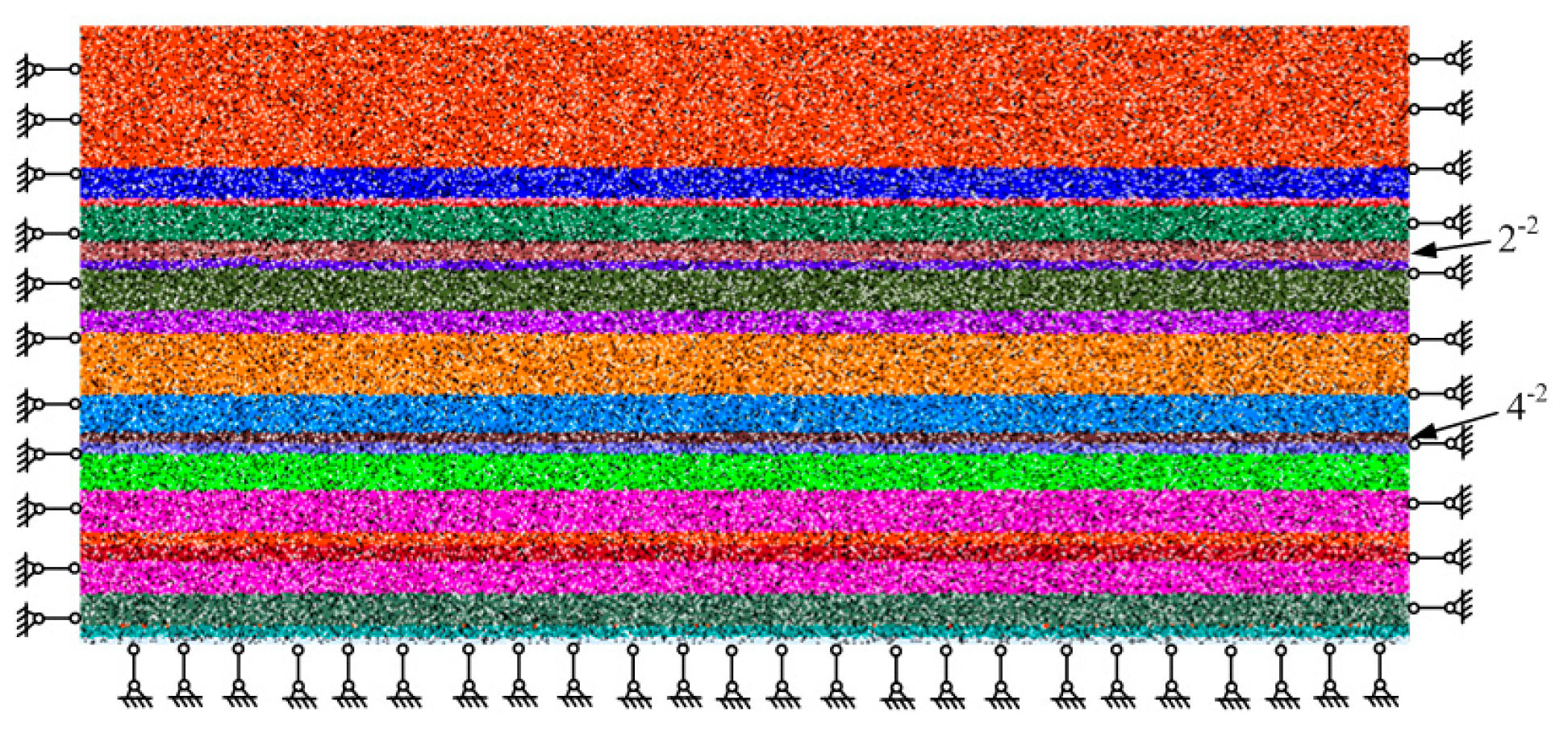
Figure 1. Rock layer numerical model.
Processes 14 00121 g001
Figure 2. Evolution diagram of roof and floor fractures during 2−2 coal seam mining. (a) Subsidence diagram when the working face advances 20 m; (b) fracture diagram when the working face advances 20 m; (c) subsidence diagram when the working face advances 50 m; (d) fracture diagram when the working face advances 50 m; (e) subsidence diagram when the working face advances 100 m; (f) fracture diagram when the working face advances 100 m; (g) subsidence diagram when the working face advances 150 m; (h) fracture diagram when the working face advances 150 m; (i) subsidence diagram when the working face advances 250 m; (j) fracture diagram when the working face advances 250 m; (k) subsidence diagram when the working face advances 400 m; (l) fracture diagram when the working face advances 400 m.
Processes 14 00121 g002aProcesses 14 00121 g002b
Figure 3. Evolution of fractures in the roof and floor during 4−2 coal seam mining. (a) Subsidence diagram when the working face advances 20 m; (b) fracture diagram when the working face advances 20 m; (c) subsidence diagram when the working face advances 50 m; (d) fracture diagram when the working face advances 50 m; (e) subsidence diagram when the working face advances 150 m; (f) fracture diagram when the working face advances 150 m; (g) subsidence diagram when the working face advances 200 m; (h) fracture diagram when the working face advances 200 m; (i) subsidence diagram when the working face advances 400 m; (j) fracture diagram when the working face advances 400 m.
Processes 14 00121 g003
Figure 4. Curve of the relationship between mining steps and the number of fractures.
Processes 14 00121 g004
Figure 5. Distribution of the influence law of mining height on fracture changes.
Processes 14 00121 g005
Figure 6. Porosity contour map of the working face during upper coal seam mining. (a) Working face advanced 20 m; (b) working face advanced 50 m; (c) working face advanced 100 m; (d) working face advanced 150 m; (e) working face advanced 250 m; (f) working face advanced 400 m.
Processes 14 00121 g006
Figure 7. Porosity contour map of the working face during lower coal seam mining. (a) Working face advanced 20 m; (b) working face advanced 50 m; (c) working face advanced 100 m; (d) working face advanced 150 m; (e) working face advanced 250 m; (f) working face advanced 400 m.
Processes 14 00121 g007
Figure 8. Near-field multi-seam mining fracture zone model.
Processes 14 00121 g008
Figure 9. Comparison results.
Processes 14 00121 g009
Figure 10. Drilling location diagram.
Processes 14 00121 g010
Figure 11. Z01 hole drilling detection diagram.
Processes 14 00121 g011
Figure 12. Z02 hole drilling detection diagram.
Processes 14 00121 g012
Figure 13. Z03 hole drilling detection diagram.
Processes 14 00121 g013
Figure 14. Z04 hole drilling detection diagram.
Processes 14 00121 g014
Figure 15. Z05 hole drilling detection diagram.
Processes 14 00121 g015
Table 1. Rock mechanics parameters.
Rock StrataBulk Modulus
K/GPa
Shear Modulus
G/GPa
Density
ρ/(kg·m3)
Internal Friction Angle
f
Internal Cohesion
/MPa
Tensile Strength
Rf/MPa
Lamination Thickness
Loess0.250.112300150.80.746.45
Laterite0.420.192400201.20.910.05
Siltstone10.808.132709382.751.8410.20
Silty mudstone2.572.702510302.190.724.75
Muddy siltstone4.005.152520301.00.84.52
Medium-grained sandstone5.926.032490402.001.1016.50
Siltstone3.501.702050321.70.26.69
silty mudstone2.572.702510302.190.725.21
2−2 coal1.01.701450200.60.157.70
Silty mudstone2.572.702510302.190.7215.07
Medium-grained sandstone5.926.032490402.001.105.40
Siltstone10.88.132709382.751.846.53
4−2 coal4.561.981380321.190.162.30
Siltstone10.88.132709382.751.8413.67
Disclaimer/Publisher’s Note: The statements, opinions and data contained in all publications are solely those of the individual author(s) and contributor(s) and not of MDPI and/or the editor(s). MDPI and/or the editor(s) disclaim responsibility for any injury to people or property resulting from any ideas, methods, instructions or products referred to in the content.