

Article

Optimizing the Agitation Position in a Continuous Stirring Settler: A CFD-PBM Strategy for Enhanced Liquid–Liquid Separation

1
School of Energy and Power Engineering, North University of China, Taiyuan 030051, China
2
Key Laboratory of Ecological Metallurgy of Multi-Metal Intergrown Ores of Education Ministry, Shenyang 110819, China
3
School of Metallurgy of Northeastern University, Special Metallurgy and Process Engineering Institute, Shenyang 110819, China
4
Key Laboratory of Shanxi Province for Solar Thermal Technology, Taiyuan 030051, China
5
Engineering Materials, Department of Engineering Science, Luleå University of Technology, 97187 Luleå, Sweden
*
Authors to whom correspondence should be addressed.
Processes 2025, 13(8), 2536; https://doi.org/10.3390/pr13082536
Submission received: 3 July 2025 / Revised: 25 July 2025 / Accepted: 30 July 2025 / Published: 12 August 2025

Abstract

Mixer-settlers are pivotal in the solvent extraction industry, yet spatial control of agitation to intensity separation remains underexplored. This study proposes a novel strategy by localizing agitation strictly within the dispersion band. Through the developed computational fluid dynamics coupled population balance model (CFD-PBM) resolving droplet breakup/coalescence dynamics and laboratory experiments, it demonstrates that the agitator position critically governs dispersion band thickness and separation efficiency. It should be emphasized there was no significant difference between the experimental and the simulated. Optimal separation is achieved only when the agitation zone overlaps the dispersion band, balancing droplet fragmentation and coalescence while minimizing turbulence in settling regions. Conventional uniform agitation designs are suboptimal due to spatial sensitivity. The CFD-PBM framework establishes a physics-based tool for scalable mixer-settler design, enabling energy-efficient separation by decoupling mixing and settling energetics. This work provides an advanced solution for using the solvent extraction via targeted agitation optimization, emphasizing both scientific rigor and industrial applicability.

1. Introduction

Solvent extraction serves as a cornerstone separation method in the rare earth and rare metal industries, with critical applications ranging from recovery of rare metals from spent-fuel elements and in recovery rubidium from gold waste [1,2,3,4]. Among solvent extraction equipment (e.g., mixer-settlers, spray columns, packed columns, sieve-tray columns, and centrifugal extractors), mixer-settlers dominate industrial practices owing to their structural simplicity, operational flexibility, and tolerance to multiphase flow regimes [5,6]. In mixer-settlers, two immiscible liquid phases undergo intensive mixing via an impeller in the mixer compartment, followed by gravity-driven phase disengagement in the settler compartment. However, sole reliance on gravitational settling often leads to inefficient separation, necessitating oversized settlers to accommodate prolonged residence times and resulting in excessive solvent holdup.
Extensive research has been conducted to elucidate liquid–liquid separation mechanisms, driven by dramatic developments in computational approaches, advances in image analysis, and improvements in high-speed photographic technology. Flow field characterization predominantly relies on ultrasonic velocity profiling (UVP) [7,8] and particle image velocimetry (PIV) [9]. Notably, PIV faces limitations in high concentration dispersed phase systems and under optical constraints [10], while UVP-based studies often neglect droplet aggregation effects [11,12]. Additionally, droplet size distribution (DSD) is one of the most important properties of liquid–liquid dispersions, as it determines their stability, mass transfer capability, and rheological behavior. DSD quantification involves measuring droplets diameters through microscopic imaging or laser diffraction [13,14]. However, challenges persist including sampling artifacts (e.g., coalescence), technical constraints (e.g., laser diffraction errors in dense flows), and limitations in real-time dynamic monitoring. The flow field of the equipment represents crucial parameters in extractor design.
Computational fluid dynamics (CFD) has made significant advances in simulating liquid–liquid dispersion behavior by coupling with population balance model (PBM) to simulate droplet coalescence, breakup, and separation dynamics [15,16]. CFD-PBM simulations employ simplified binary coalescence to predict dispersion band thickness and set interface evolution time [17,18,19]. CFD-PBM simulation predicted the DSD, and investigated local liquid–liquid flow behaviors in a square-sectioned pulsed disk and doughnut column. In addition, the CFD-PBM predicted dispersed phase holdup and Sauter mean drop diameter in a pulsed sieve plate column [20]. Meanwhile, the droplets coalescence and breakage models were calibrated through experiments [21,22,23]. PIV data validation against CFD-PBM simulation demonstrates DSD sensitivity to impeller speed/design, and enables optimized drag models for holdup prediction in pulsed columns [20,24]. The optimization of the model constants of the drag model could reduce the error in dispersed phase holdup prediction. Large eddy simulations (LESs) formulation-based Approximate Deconvolution Models (ADMs) enhance turbulence prediction in the vicinity of the liquid–liquid interfaces in an incompressible interfacial flow [25], though excessive computational costs limit practical applications [26]. The sub grid scale (SGS) terms of stress tensor and surface tension in the Navier–Stokes equations are mathematically reconstructed. The results reveal that the ADM approach is of superior performance in predicting the energy spectra and statistics of turbulence. The above papers show that the CFD-PBM method is an effective means to simulate the liquid–liquid flow. In addition, the reliability of initial DSD measurements is crucial for the model’s solving. The large eddy simulation method is a promising approach to estimate the processes of collision, coalescence and breakage of the dispersed phase. However, it requires huge computing resources and finer grids.
Although many studies have focused on experimental and simulation studies of liquid–liquid separation in mixer-settlers, the interplay between agitation dynamics and separation efficiency remains poorly understood [18,27,28,29,30,31]. This study bridges this gap by integrating a validated CFD-PBM framework with lab-scale experiments to systematically investigate agitating paddle position effects on flow characteristics and settling performance. Simulations are performed using the previously developed coupled fluid dynamics and population balance model (CFD-PBM) [27], while the experiments are performed in order to obtain the initial boundary conditions for simulation and the data for validating the simulation results on a laboratory-scale transparent mixer-settler that is dedicatedly designed and manufactured. Our findings advance the mechanistic understanding of stirred settlers, directly informing energy-efficient separator design and scale-up strategies.

2. Materials and Methods

2.1. Computational Approach

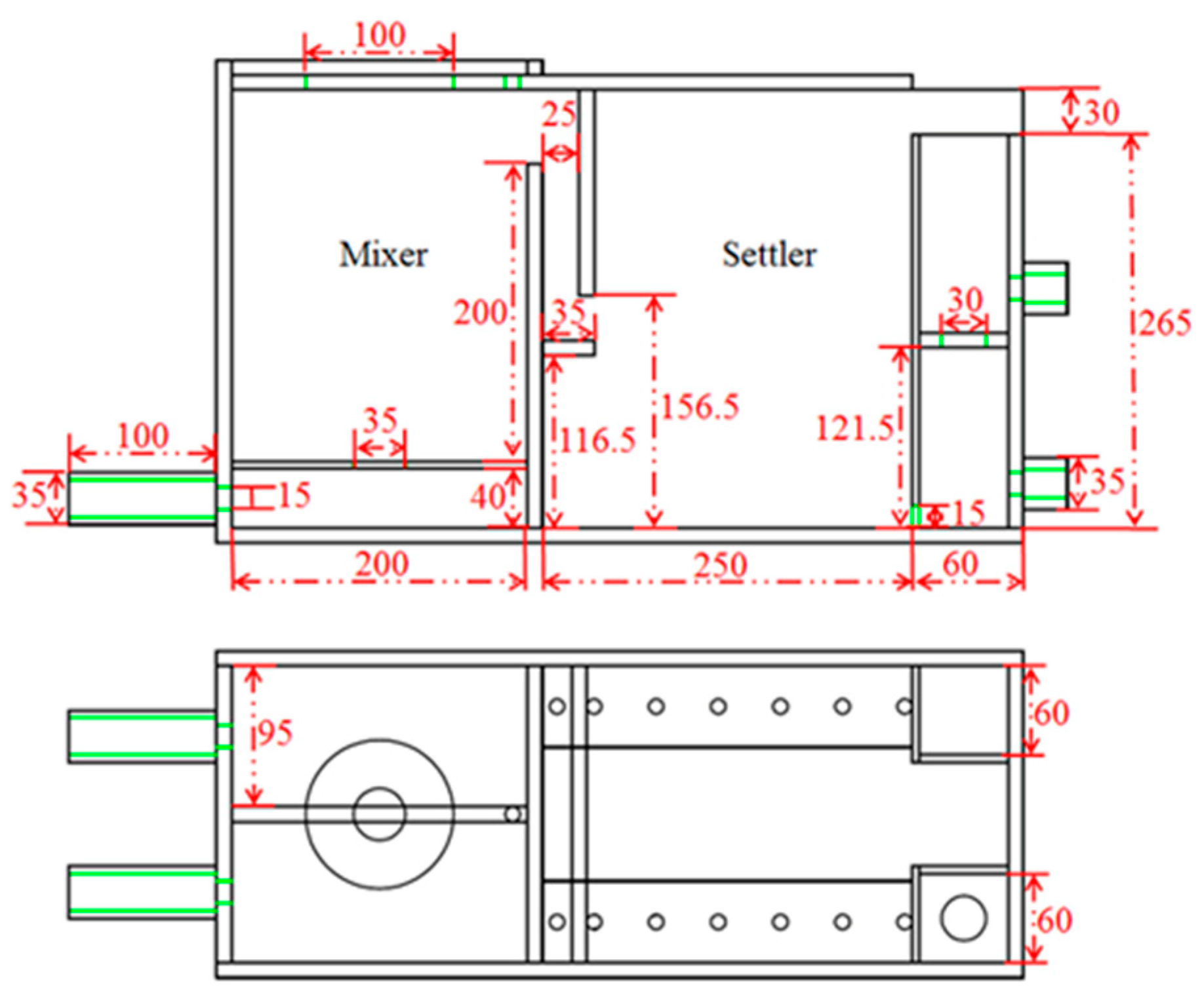
The dimensions of the mixer-settler for numerical simulation and experimental study are shown in Figure 1. The laboratory-scale transparent mixer-settler is made of polymethyl methacrylate (PMMA) with a wall thickness of 10 mm. The flow field in it is mainly divided into the mixer zone and the settler zone. The settler zone is the main object of this study. The settler was a rectangular vessel with dimensions of 250 mm, 200 mm, and 270 mm for the length (L), width, and height (H), respectively.
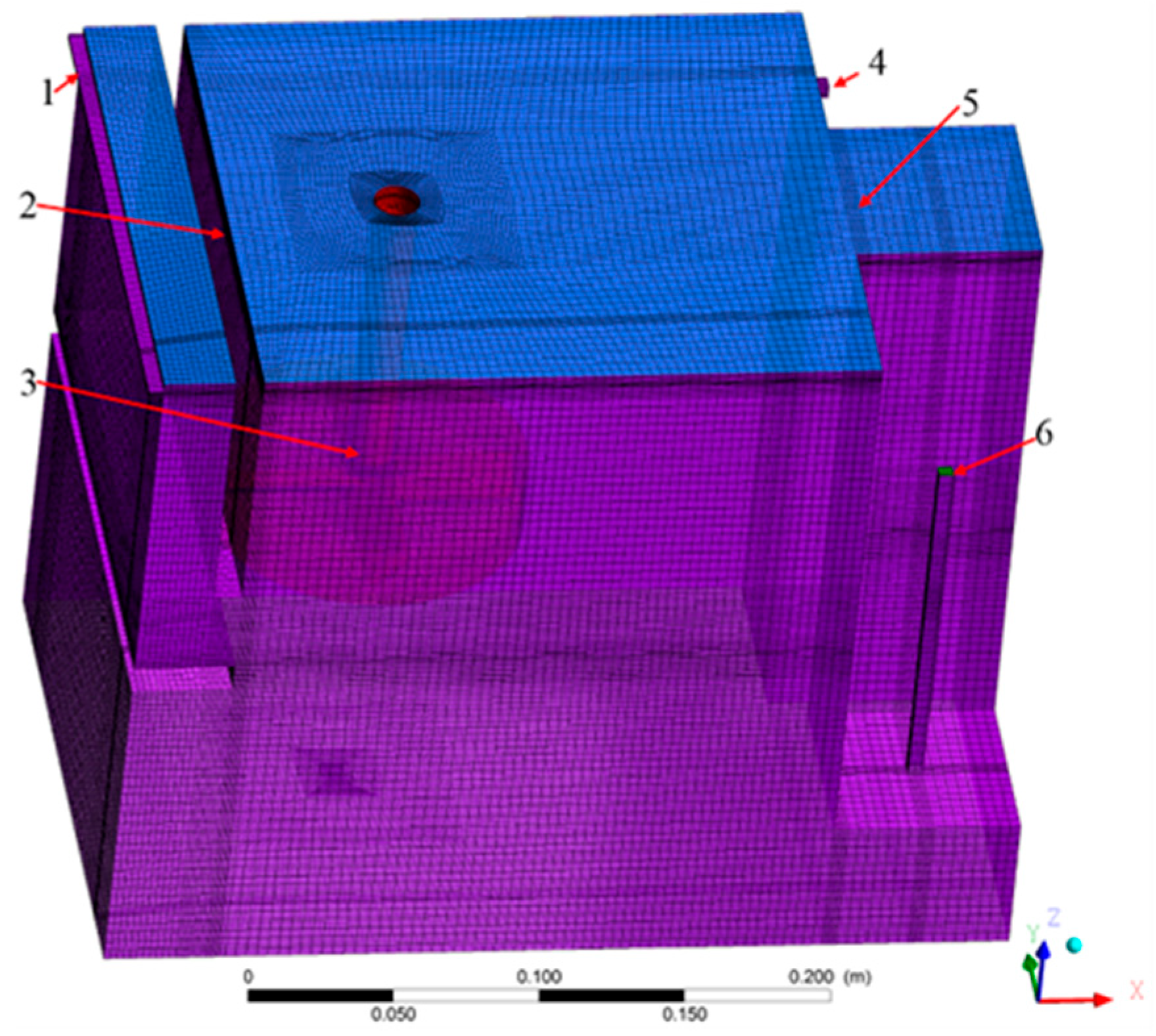
As shown in Figure 2, the settler was divided into structured hexahedron grid cells using ICEM for the numerical simulation. Figure 2 corresponds to the settler of Figure 1, viewed from the front. Because of the velocities in the zones of the inlet, agitating paddle, organic phase outlet, and aqueous phase outlet change intensively; the grid of those zones has been encrypted and the lengths of the inlet and outlets have been extended to improve the accuracy of simulation predictions.

2.1.1. Numerical Method

All numerical simulations are executed using a developed CFD-PBM method under ANSYS FLUENT(19.2, ANSYS Inc., Canonsburg, PA, USA, 2019), which was introduced in a previous paper [27]. The standard k-ε turbulence model, based on the Euler–Euler dual-fluid frame multiphase model, coupled with a Second-Order Upwind scheme, were employed to describe the fluid flow. The aqueous phase is considered a continuous phase while the organic phase is considered a discrete phase. The drag coefficient is modeled by the Morsi–Alexander model [32]. The pressure-velocity coupling was achieved by the Phase Coupled SIMPLE algorithm. A population balance equation (PBE), which is solved by the quadrature method of moments (QMOM) method considering six first moments, is employed to describe the dispersed phase evolution.

2.1.2. Governing Equations

Euler–Euler dual-fluid model is effective for simulating dispersion in liquid–liquid two-phase systems. For the liquid–liquid two-phase flow, both phases were considered to act as continuum interpenetrating phase, incorporating the concept of phase volume fraction. Meanwhile, the mass conservation equation and the momentum conservation equation were solved for each phase. The continuity equations are solved as follows:
t ( α i ρ i ) + ( α i ρ i U i ) = 0
where i denotes the phase sequence number. α, ρ, and U i denote the volume fractions, densities and velocity, respectively.
The momentum conservation equations are given as follows:
t ( α i ρ i U i ) + ( α i ρ i U i U i ) = α i P α i τ i ¯ ¯ + α i ρ i g + ( 1 ) i F e x
where P, g , and τ i ¯ ¯ denote the pressure shared by two phases, gravity acceleration vector and the stress–strain tensor. F e x denotes the interfacial momentum exchange term between the two phases. In the work, the drag force was only considered and modeled using the Morsi–Alexander drag force model [32]:
F e x = C D R e 24
where Re and C D denote the Reynolds number and the drag coefficient, respectively.
C D = a 1 + a 2 R e + a 3 R e 2
where
a 1 , a 2 , a 3 = 0 , 24 , 0 0 < R e < 0.1 3.690 , 22.73 , 0.0903 0.1 < R e < 1 1.222 , 29.1667 , 3.8889 1 < R e < 10 0.6167 , 46.50 , 116.67 10 < R e < 100 0.3644 , 98.33 , 2778 100 < R e < 1000 0.357 , 148.62 , 47500 1000 < R e < 5000
Standard kε model is a semi-empirical model derived from experimental observations and empirical data, based on turbulent kinetic energy k and energy dissipation rate ε. The transport equation for the turbulent kinetic energy k is derived from the exact equation, while the transport equation for the energy dissipation rate ε is obtained by physical reasoning. The transport equations are given as follows:
t ρ k + x i ρ u i k = x j ( μ + μ t σ k ) k x j + G ρ ε
t ρ ε + x i ρ u i ε = x j ( μ + μ t σ ε ) ε x j + c 1 G ε k c 2 ρ ε 2 k
where
μ t = ρ c μ k 2 ε
G = ρ u i u j ¯ u j x i = 2 μ t ( u x ) 2 + ( v y ) 2 + ( w z ) 2 + μ t ( u y + v x ) 2 + ( v z + w y ) 2 + ( w x + u z ) 2
c 1 = 1.44 ,   c 2 = 1.92 ,   c μ = 0.09 ,   σ k = 1.0 ,   σ ε = 1.3
This study analyzed the size distribution and evolution of the dispersed phase droplets in liquid–liquid two-phase flow systems using the PBM. In the ANSYS FLUENT, the population balance equations (PBEs) are solved by finite volume method, and the equations are given as follows:
t [ n ( V , t ) ] + [ u n ( V , t ) ] + V [ G V n ( V , t ) ] = 1 2 0 V a ( V V , V ) n ( V V , t ) n ( V , t ) d V 0 a ( V , V ) n ( V , t ) n ( V , t ) d V   + Ω V ρ g ( V ) β ( V V ) n ( V , t ) d V g ( V ) n ( V , t )
where G V denotes the growth rate based on the droplets volume (m3/s). α ( V , V ) denotes the droplet collision frequency of droplets with the volume between V and V′. g ( V ) denotes the droplet breakage frequency (s−1). β ( V V ) denotes the probability density function of droplets breaking from volume V′ to V (m−3). There are many droplet coalescence and breakage models in the PBM, among which the Luo coalescence model [27] is applied.
The six initial moments are calculated using the following equation [33]:
M k = exp k μ log + 1 2 k 2 σ log 2
The two parameters μ log and σ log are defined as the following equation [34]:
μ log = log d 10 2 v + d 32 2
σ log = log v d 10 2 + 1
where k denotes the order of the moment to calculate. d 10 denotes the mean diameter of droplets. d 32 denotes mean Sauter diameter and v denotes 15% of the mean diameter of droplets. These data can only be obtained by experiments.
The inlet is set to be velocity inlet and the outlets are set to be pressure outlet. No-slip boundary condition is adopted for all walls. A sliding mesh (SM) method is employed to solver the agitating zone. The drag coefficients and the coalescence are implemented into the Fluent solver with User-Defined Functions (UDFs). About 120 h are required for each case running in parallel on a 24 cores workstation.

2.2. Experimental Setup and Method

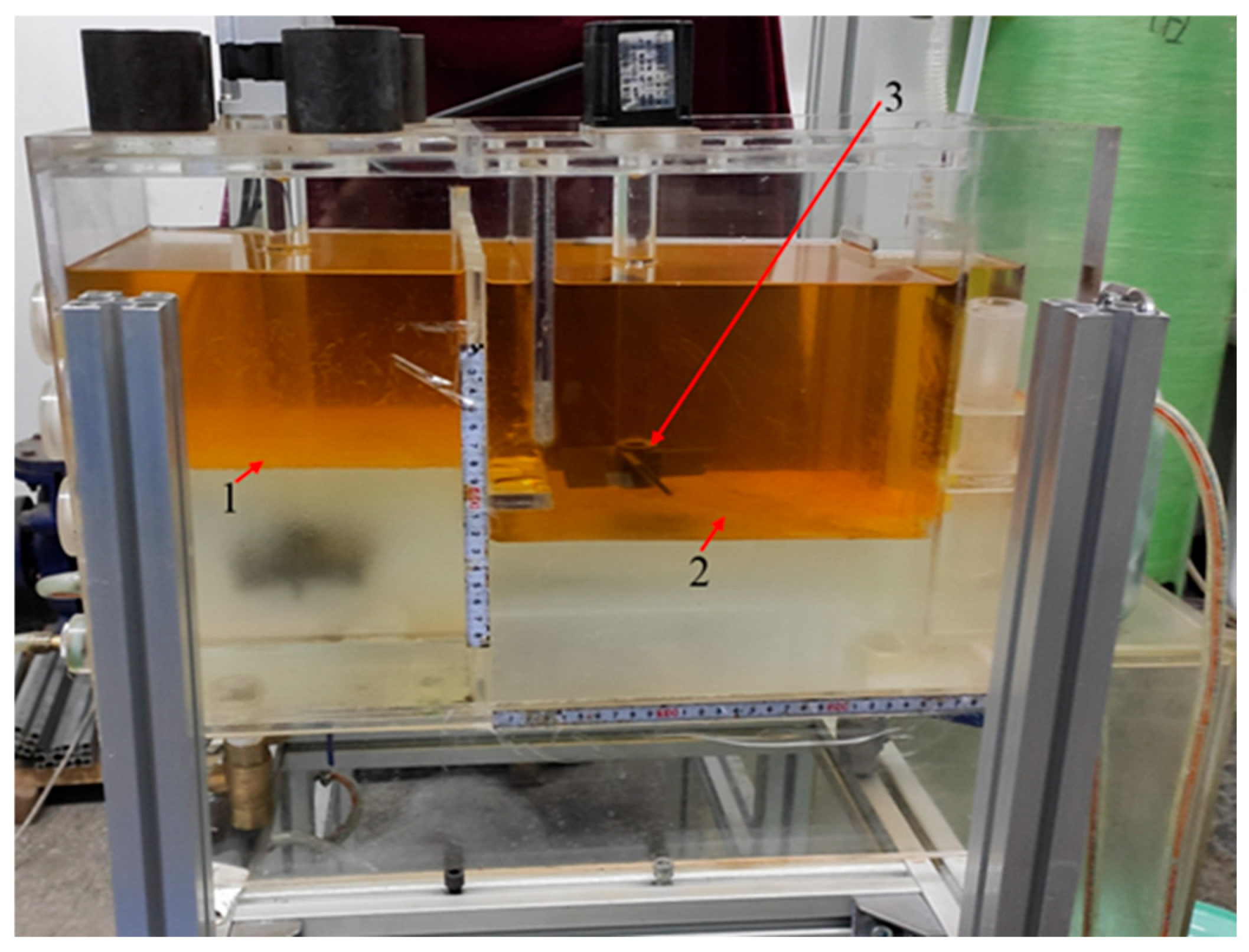
As illustrated in Figure 3, a laboratory-scale transparent mixer-settler is designed and manufactured according to the dimensions of Figure 1 to obtain the initial conditions for the simulation and the data to validate the numerical simulation results. A standard four-inclined blade is used as an agitating paddle, with a diameter that is 0.4 of the width of the settler.
The organic phase is a mixture of sulfonated kerosene and P204 (density: 886 kg/m3, kinematic viscosity: 0.00246 kg/ms) and the aqueous phase is deionized water (density: 1033 kg/m3, kinematic viscosity: 0.00116 kg/ms). The interfacial tension between the aqueous and organic phases is 0.00946 N/m. The microscopic imaging method is selected to measure the organic droplet diameter distribution. The instrument used is a metallographic microscope (MIT500). The dispersion band thickness is measured by a high-speed camera (LIGHTNING RDT). The measurement results are repeated three times and averaged to reduce the measurement error. The detailed information of the experimental instruments is shown in Table 1.
The experiment mainly investigates the influence of different agitating paddle immersion depth (h*) and horizontal position (l*) on the dispersion band thickness.
It is assumed that the ratio of the difference between the height of the settler and the distance (h) from the agitating paddle center to the settler’s bottom to the height of the settler is a dimensionless value of agitating paddle immersion depth (h*).
h * = H h H
where h is the distance from the agitating paddle center to the settler bottom and H is the height of the settler.
It is assumed that the ratio of the distance (l) from the agitating paddle center to the inlet to the length of the settler is a dimensionless value of agitating paddle horizontal position (l*).
l * = l L

3. Results and Discussion

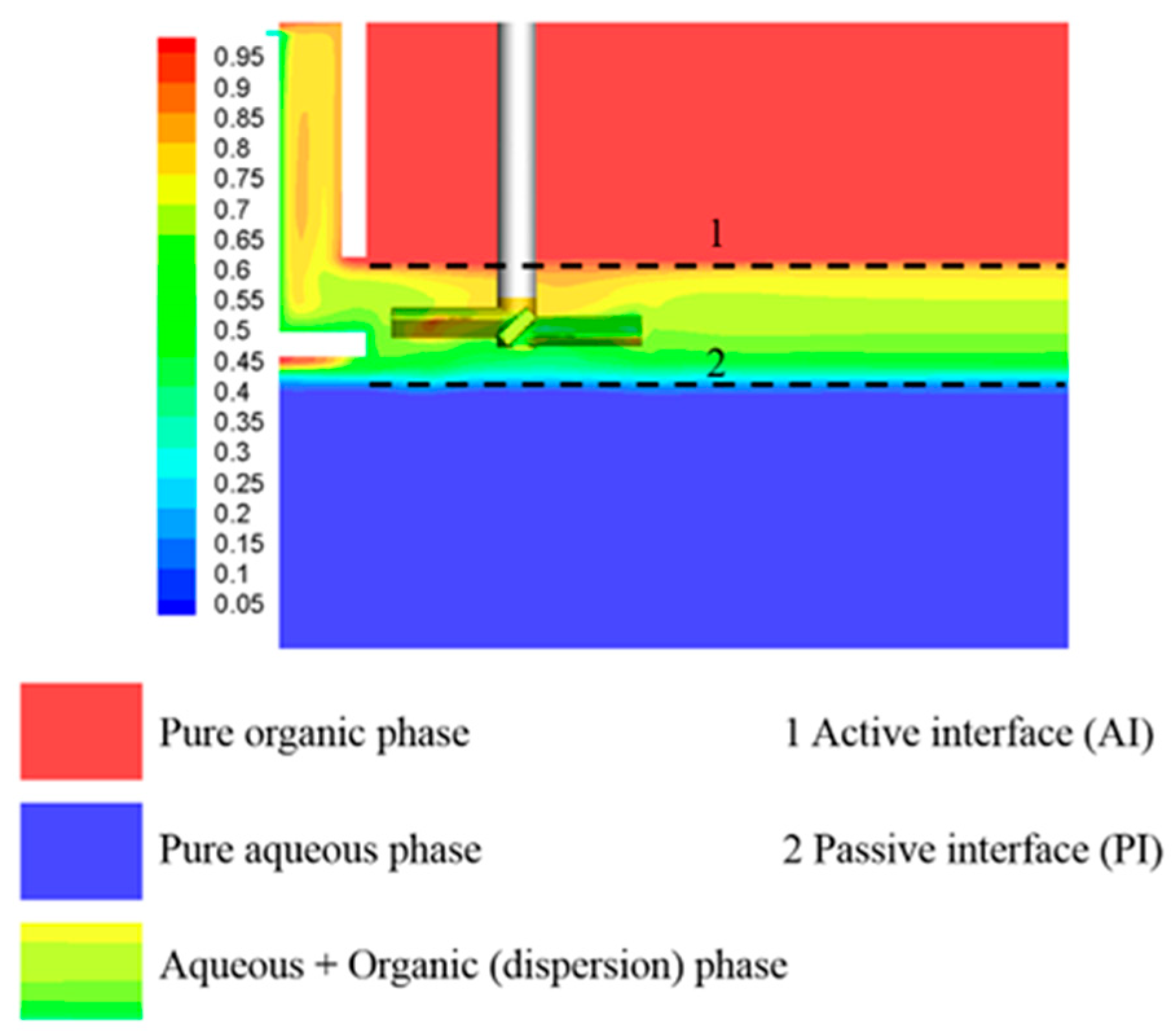
It has been demonstrated in previous studies that this CFD-PBM coupling method can accurately predict the flow characteristics and settling performance of organic and aqueous phases in a stirring settler [18,27]. In order to facilitate the analysis, a typical simulated prediction of the organic phase volume fraction distribution is shown in Figure 4. The upper region corresponding to the red color contains a pure organic phase. The active interface (AI) is marked by line 1, which is the interface with an 85% volume fraction of the organic phase in the dense-packed region filled with packed larger droplets in the lower part of the pure organic phase. The passive interface (PI) is marked by line 2, which is the interface with 15% organic phase volume fraction in the sedimentation region consisting of loosely packed smaller droplets in the lower part of the pure aqueous phase. The bottom region corresponding to the blue color contains a pure aqueous phase. The region between line 1 and line 2 is a dispersion band, a mixed phase of aqueous phase and organic phase.

3.1. Preliminary Research

Exploratory studies showed that there is a better settling performance between the aqueous phase and the organic phase when the agitating speed is 15 rpm [18]. All simulations and experiments in this study are performed under conditions of agitation speed of 15 rpm, a total inlet flow rate of 96 L/h, and an inlet volume ratio of the organic phase to the aqueous phase of 1:2.
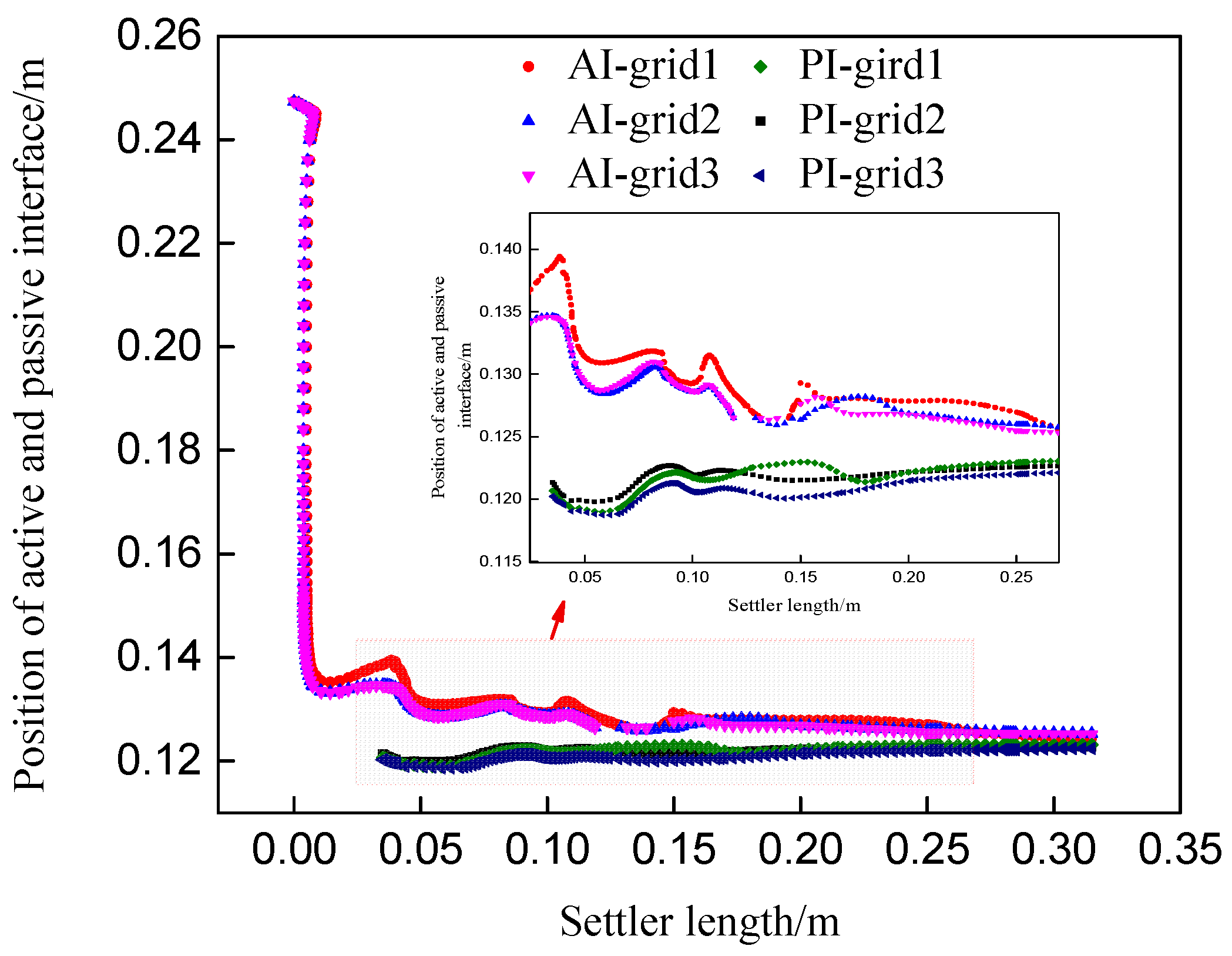
The precision of the simulation prediction results is directly related to the grid resolution. Therefore, the grid independence test is indispensable for determining an adequate grid number for numerical simulations. Three models of the same settler with different grid resolutions are simulated and the total grid numbers are about 950,000 (grid 1), 1,320,000 (grid 2) and 1,650,000 (grid 3), respectively. The comparison of three different grid numbers plotted as the variation in the position of AI and PI along the length of the settler is ultimately made and the result is reported in Figure 5. It can be seen that the grid number has a great effect on the position of AI and PI along the length of the settler, and the larger the grid number, the smaller the influence on the simulation results. The average deviation of grid 2 and grid 3 results is less than 5%. Therefore, to ensure the best cost–benefit regarding the computing accuracy and the computational costs, the model of the stirring settler with a grid number of about 1,320,000 elements is chosen for all following simulations.
In the exploratory study, it was found that when the simulation time reaches 150 s, the positions of AI and PI have stabilized. This is similar to the condition of Guo et al. [27]. Therefore, all the numerical simulation results of this study are carried out until 200 s. The time step is selected as 0.002 s in the first 20 s and 0.005 s in the remaining time.
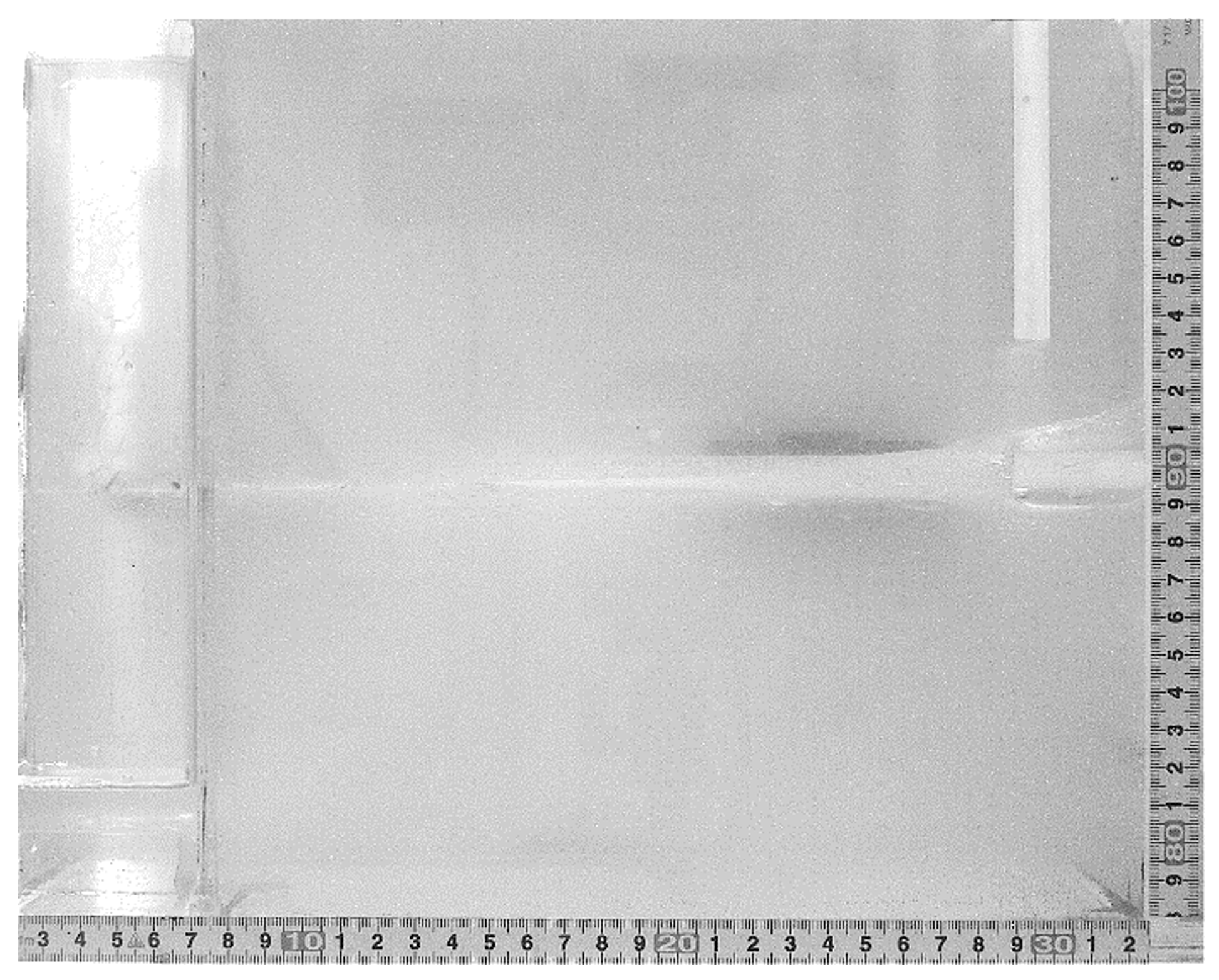
Figure 6 shows the experimental steady-state dispersion band thickness at h* = 0.49 and l* = 0.38. The dispersion band thickness measured by experiments is 0.0196 m, and the corresponding simulated predicted value is 0.0188 m. The error is within 5%. The experimental and simulation error of Guo [27] using the same model in another size settler is less than 4%. Obviously, the CFD-PBM coupled model can accurately simulate the dispersion band behavior in a stirring settler.

3.2. Effect of Agitating Paddle Immersion Depth on Dispersion Band Thickness

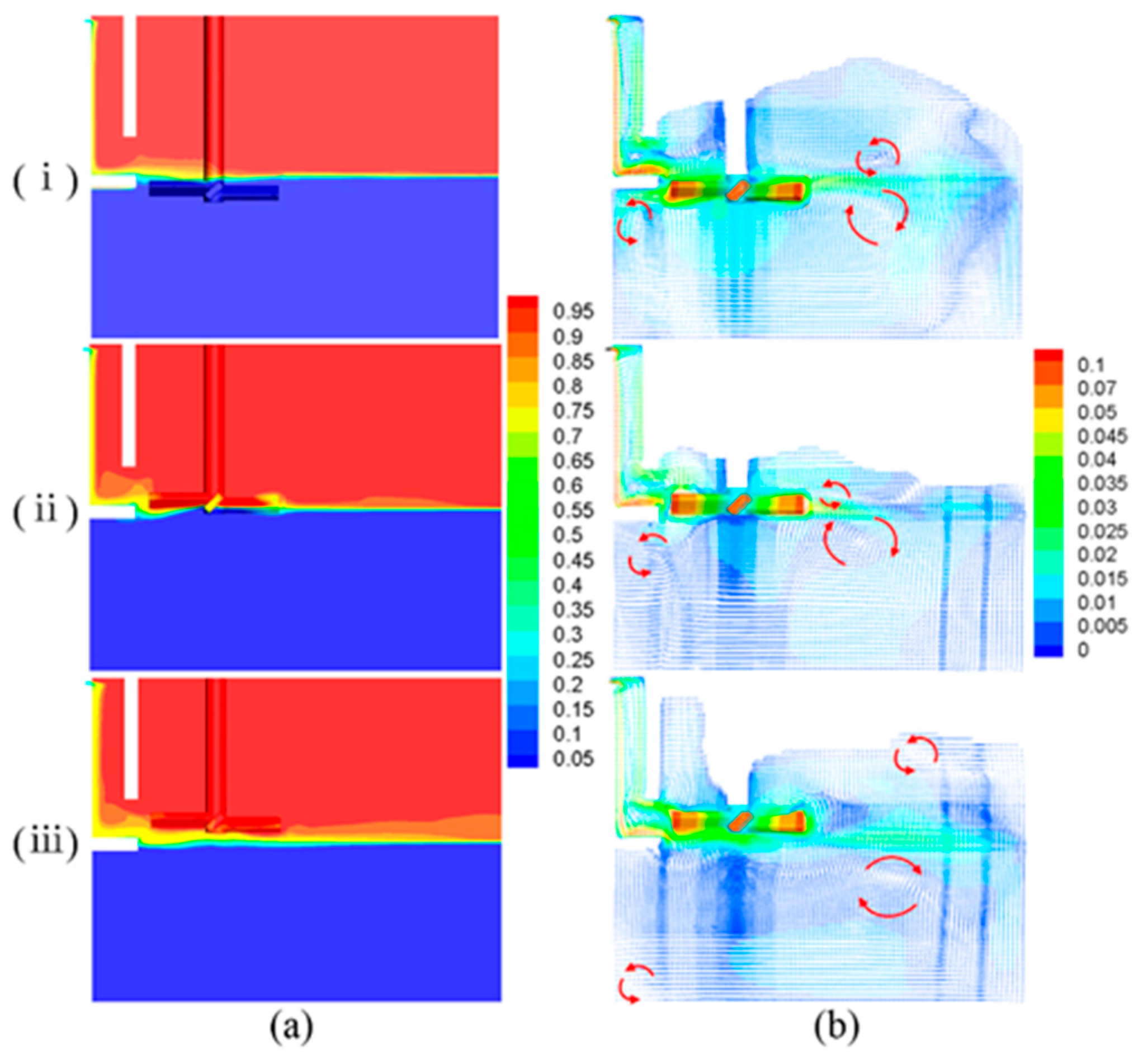
This section investigated the effect of the agitating paddle immersion depth (h*) on the flow characteristics and dispersion band. The dispersion band thickness and aqueous phase velocity distribution with the agitating paddle immersion depth of 0.45–0.54 are shown in Figure 7a and Figure 7b, respectively. It should be noted that when the immersion depth is 0.54, the upper part of the agitating paddle is located at the lower part of the dispersion band. When the immersion depth is 0.49, the center of the agitating paddle is located exactly in the center of the dispersion band. When the immersion depth is 0.45, the lower part of the agitating paddle is located at the upper part of the dispersion band.
It can be seen from Figure 7a that a vortex is formed on each of the left and right sides of the agitating paddle under the action of the agitating paddle. At the same time, as the four-blade impeller can promote axial flow, a small amount of aqueous phase enters the upper organic phase region, and a vortex is also formed above the agitating paddle. Comparing the three velocity vector diagrams of the aqueous phase in Figure 7b, it can be seen that when the immersion depth is 0.45, the vortex center in the upper part of the agitation blade is located in the upper part of the settler. This may lead to increased aqueous phase entrainment at the organic phase outlet. In contrast, the vortex center in the other two cases is near the paddle.
Comparing the organic phase volume fraction distribution in Figure 7a, it can be observed that the range of the dispersion band zone becomes narrower as the immersion depth increases. When the immersion depth is 0.45, the range of the dispersion band is significantly increased. This is because the agitating paddle promotes the organic phase droplets to float while driving the small aqueous phase droplets in the dispersion band zone to rise. The aqueous phase droplets settle after rising a short distance under the action of gravity. When the agitating paddle is on the upper part of the dispersion band zone, the small aqueous phase droplets in the dispersion band zone will be driven to rise a greater distance, thereby causing the range of the dispersion band zone to widen.
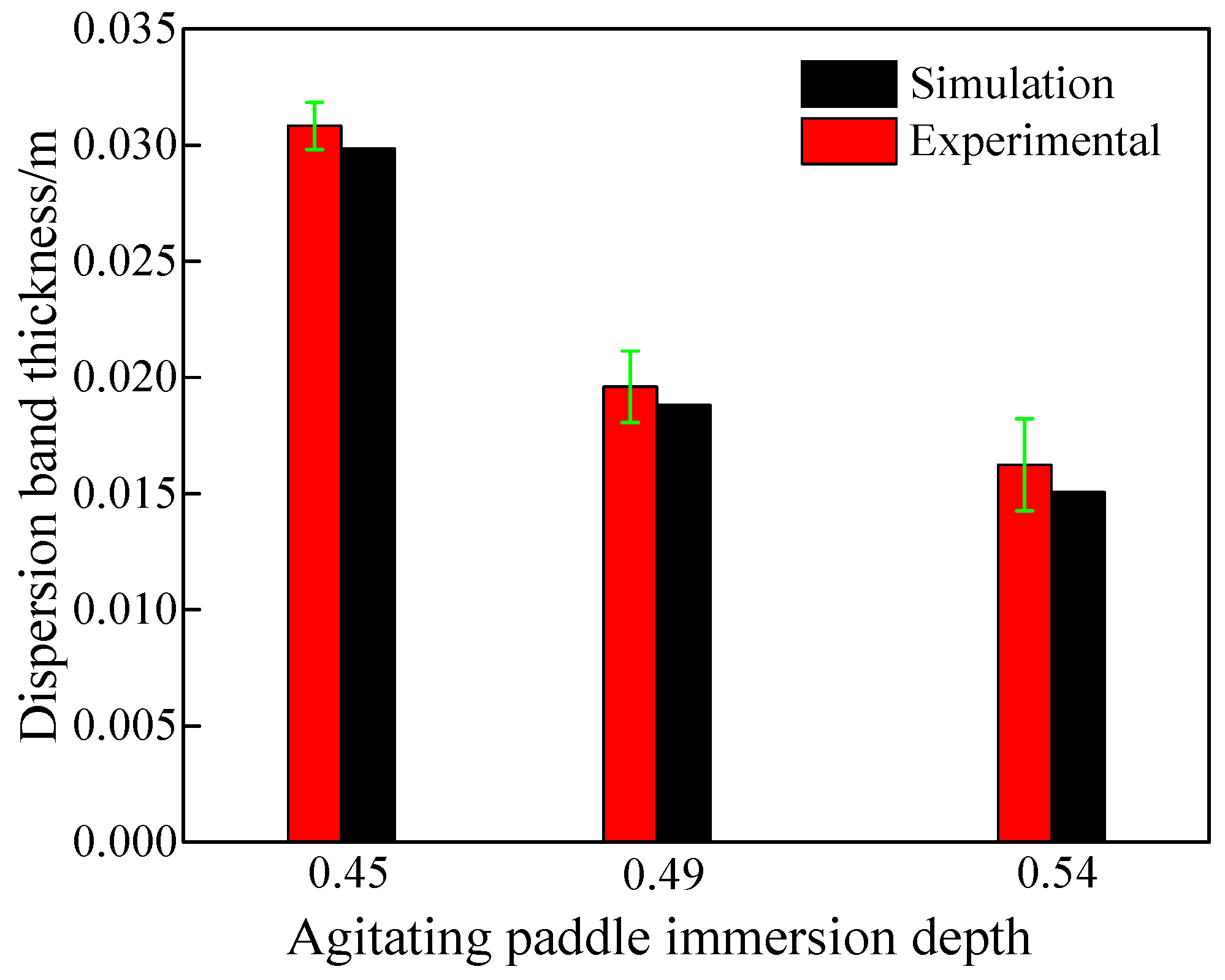
In addition to the fluid flow behavior, the dispersion band thickness must be quantitatively analyzed to understand the role of the agitating paddle immersion depth. To this end, Figure 8 shows the comparison of the simulated predicted and experimentally measured dispersion band thickness results at different immersion depths. As illustrated in Figure 8, both the simulated and experimental dispersion band thicknesses decrease with the increase in the agitating paddle immersion depth. The dispersion band thickness is reduced by about 35% when the immersion depth was 0.49 compared to a depth of immersion of 0.45. The dispersion band thickness is reduced by about 18% at an immersion depth of 0.54, compared to a depth of immersion of 0.49. When a four-blade paddle is used as the perturbation paddle, the increase in the immersion depth is beneficial to the reduction in the dispersion band thickness and the separation of the organic phase and the aqueous phase. Obviously, the simulation results are in good agreement with the experimental results. The agitating paddle immersion depth is an important factor affecting the settling performance of the stirring-settler. Therefore, the research of the agitating paddle immersion depth is an essential step in the design and optimization of the stirring -settler.

3.3. Effect of Agitating Paddle Horizontal Position on Dispersion Band Thickness

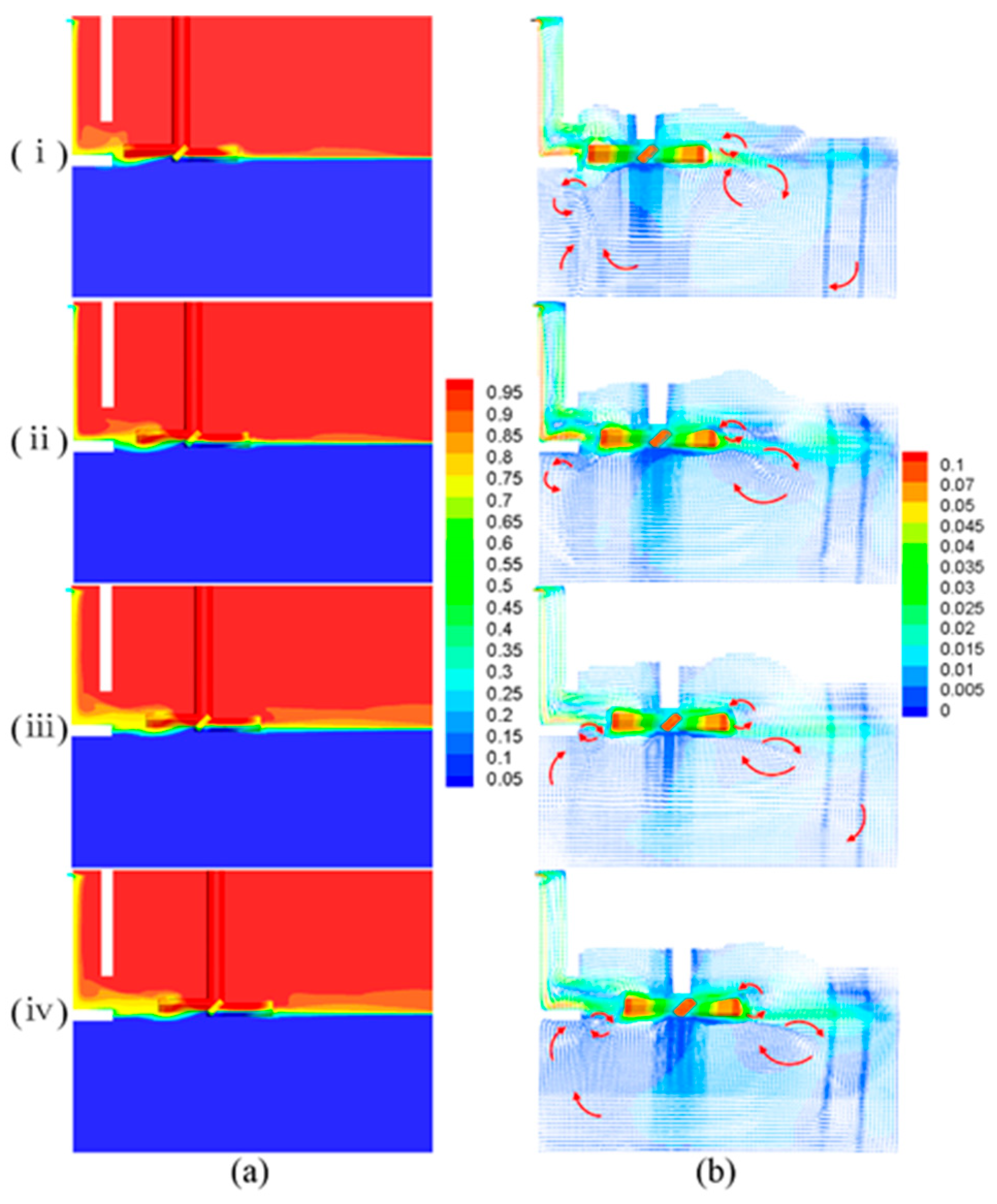
This section investigated the effect of the agitating paddle immersion horizontal position (l*) on the flow characteristics and dispersion band. The dispersion band thickness and aqueous phase velocity distribution with the agitating paddle horizontal position of 0.38–0.50 are shown in Figure 9a and Figure 9b, respectively. The horizontal position of 0.5 indicates that the agitating paddle center is located in the center of the length of the settler.
The simulation results in Figure 9 show that the range of the dispersion band zone becomes wider as the agitating paddle horizontal position increases. This is because the disturbance action of the agitating paddle is mainly concentrated around the blade. Moderate turbulence can increase the collision probability of organic phase droplets in the dispersion band zone, and promote two-phase separation. However, perturbations in the stratified areas of the organic and aqueous phases outside the dispersion band zone can lead to the mixing of the organic and aqueous phases, which is bound to run counter to the design purpose of the settler. The design of the stirring-settler is to enable higher separation efficiency between the organic phase and the aqueous phase. Because the height of the dispersion zone gradually narrows along the length of the settler, the agitating paddle will inevitably be located outside the dispersion band zone when the horizontal position is large, which will cause the dispersion band zone in the direction of the rear of the settler to widen. In other words, the agitating paddle can promote the separation of the organic phase and the aqueous phase in the dispersion band zone, but promote the mixing of the two phases outside the dispersion band zone.
Analyzing the velocity vectors of the aqueous phase in Figure 9b, it can be seen that the center of the vortex on the right side of the agitating paddle moves to the right as the horizontal position increases. It is necessary to minimize the disturbance so that the fluid is in a laminar state in the layered area of the organic phase and the aqueous phase on the right side of the settler. Therefore, the area of action of the agitating paddle should be controlled in the dispersion band zone on the left side of the stirring-settler.
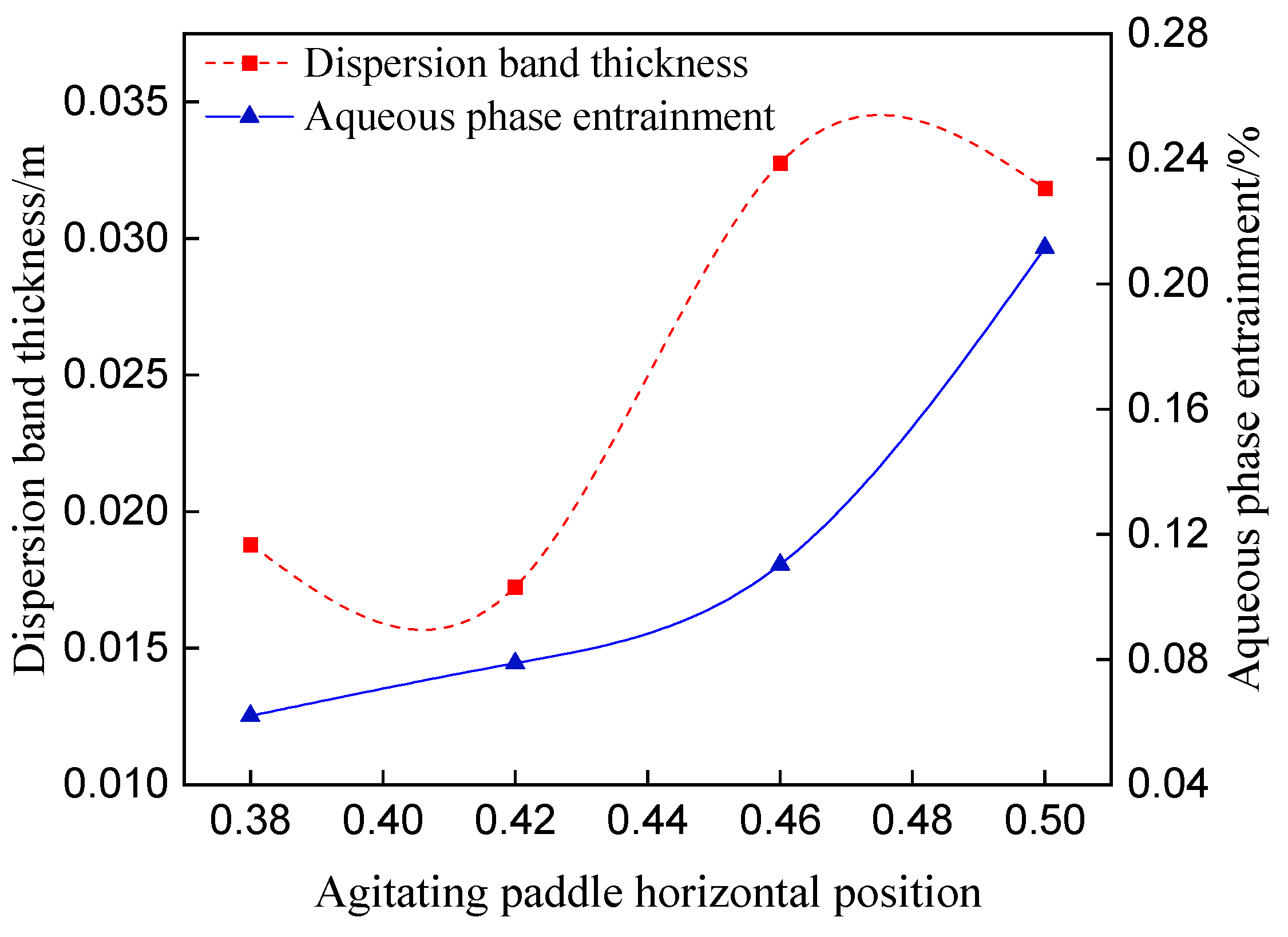
Figure 10 shows the effect of the agitating paddle horizontal position on the dispersion band thickness and aqueous phase entrainment. The simulation results reveal that the dispersion band thickness increases with increasing horizontal position. This trend is in line with the aqueous phase entrainments. Obviously, the increase in the horizontal position is not conducive to the separation of the organic phase and the aqueous phase. A smaller dispersion band thickness and aqueous phase entrainment occur simultaneously when the horizontal position is 0.42.

3.4. Effect of Baffle on Dispersion Band Thickness

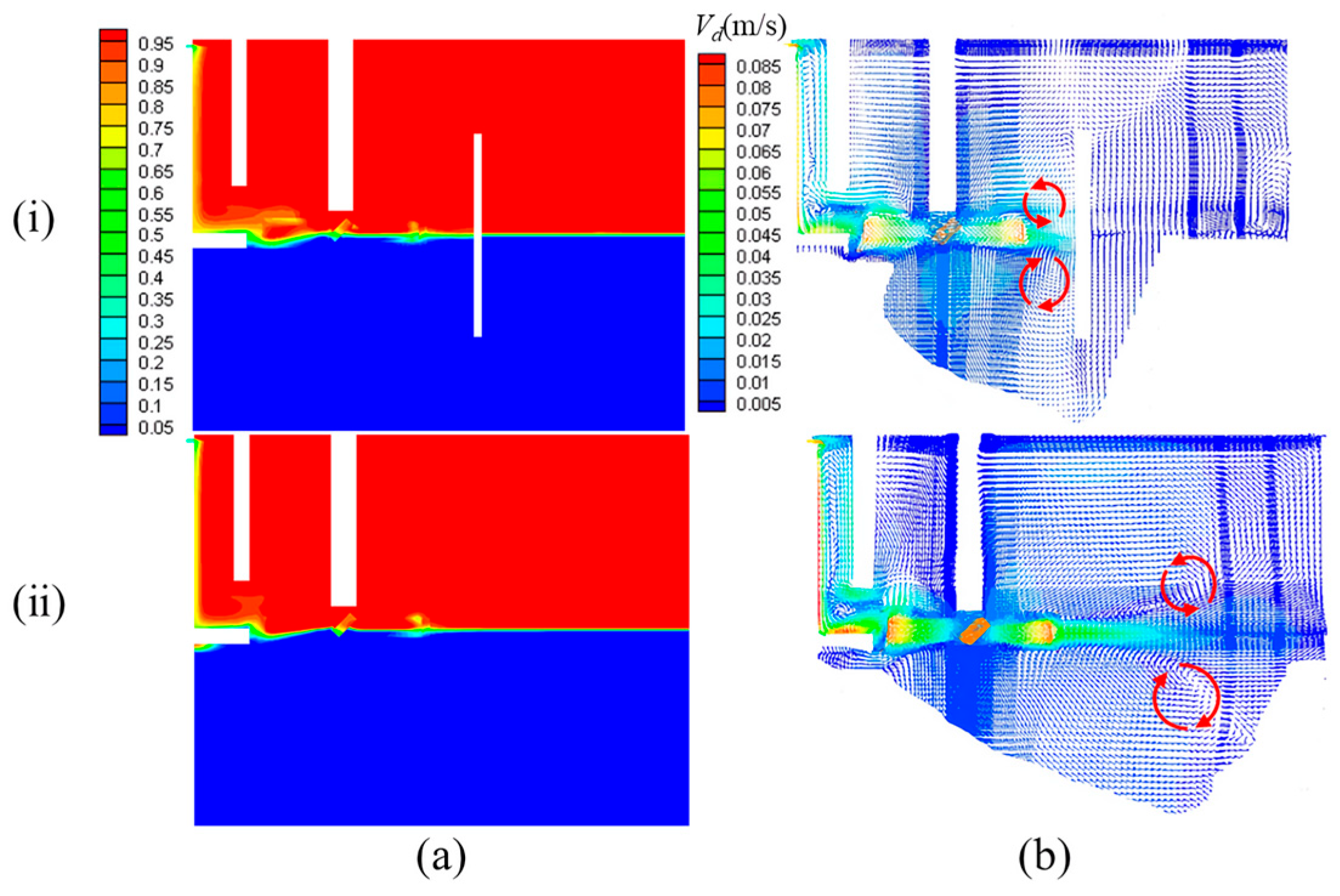
This section investigated the effect of the baffle on the flow characteristics and dispersion band. The dispersion band thickness and organic phase velocity distribution with and without baffle are shown in Figure 11a and Figure 11b, respectively.
A comparison of the distributions of the dispersion bands in Figure 11a shows that the dispersion bands distribution under the two conditions is essentially the same. However, a comparison of the organic phase velocity vector diagrams under the two conditions reveals that in the absence of a baffle, the horizontal radial flow of the organic phase at the interface of the two phases does not return until it encounters the aqueous-phase outlet baffle. Most of the organic phase flows upward into the organic-phase region, with only a small portion entering the aqueous-phase region to form a cycle. In the presence of the baffle, the horizontal radial flow of the organic phase at the interface of the two phases begins to form an upward and downward circulation after encountering the baffle. The re-flowing fluid meets with the incoming flow to form a vortex, which enhances the interaction of the two phases in this region and increases the collision frequency of the organic phase droplets. The addition of the baffle reduces the extension of the horizontal radial flow of the organic phase at the interface of the two phases, which promotes the concentration of the interaction region of the two phases in the mixing paddle region.
Furthermore, we analyzed the distribution of droplet diameters in the organic phase within the settler. Without the baffle, approximately 50% of the organic phase droplets had diameters around 260 μm, while with the baffles, about 80% of the droplets had diameters around 300 μm. This may be due to the fact that the baffle induces the interaction between the two phases, concentrating it in the agitating paddle area, which increases the droplet collision frequency. Therefore, it indicates that adding baffle facilitates the coalescence of the droplets.
Overall, the position of the agitating paddle and the addition of baffle both affect the liquid–liquid flow characteristics and settling performance in a stirring settler. The effect of optimizing the position of the agitating paddle on the dispersion band thickness is shown in Table 2.

4. Conclusions

In this work, the effect of agitating paddle position on the liquid–liquid flow characteristics and settling performance in a stirring settler is investigated numerically and experimentally following the development of CFD–PBE coupled model and the implementing of a laboratory-scale mixer-settler.
Thanks to this model, the main features of the two phases settling process in the stirring-settler have been reproduced numerically, especially the effect of the immersion depth and horizontal position of the agitating paddle. Compared with the experimental results, the predicted dispersion band thickness is very satisfactory both qualitatively and quantitatively. Accordingly, the results reveal that the agitating paddle position is an important factor for two-phase flow and separation. The separation of the two phases can be promoted only when the area of action of the agitating paddle is controlled in the area of the dispersion band zone. For the stirring settler of this study, the better agitating paddle immersion depth and horizontal position are 0.49 and 0.38, respectively. The dispersion band thickness after optimization can be reduced by 19% compared to when it is not optimization. Moreover, the addition of baffles at suitable locations can also be effective in increasing the two-phase separation effect.
By means of experiments and simulations, this study provides the initial step toward establishing a fundamental connection between the agitations and liquid–liquid separation. The coupled CFD-PBM is one of the promising methods for applications in design and scale-up of mixer-settlers. Nevertheless, the coalescence kernel is empirical. Additional work will be required to study the effects of agitation on the mechanism of binary coalescence of droplets. Optimization of baffle position and size is also a worthy topic of the research.

Author Contributions

X.G.: Writing—original draft, investigation, formal analysis, methodology; T.Z.: writing—conceptualization, methodology, review and editing, supervision, funding acquisition; W.M.: investigation, writing—review and editing. All authors have read and agreed to the published version of the manuscript.

Funding

This research was funded by the National 863 Plan (2010AA03A405), the National Natural Science Foundation of China (U1710257), the Water Science and Technology Research and Promotion Project of Shanxi Province (NO. 2023GM32), and the Natural Science Foundation of Shanxi Province of China (20210302124663). STINT (No. IB2022-9228) is acknowledged for supporting the collaboration between KTH and NEU.

Data Availability Statement

The data presented in this study are available. Further inquiries can be directed to the corresponding authors.

Conflicts of Interest

The authors declare no conflicts of interest.

References

  1. Salehi, H.; Maroufi, S.; Nekouei, R.K.; Sahajwalla, V. Solvent extraction systems for selective isolation of light rare earth elements with high selectivity for Sm and La. Rare Met. 2025, 44, 2071–2084. [Google Scholar] [CrossRef]
  2. Ji, L.M.; Shi, D.; Peng, X.W.; Xie, S.L.; Li, J.F.; Zhang, Y.Z.; Zhang, L.C.; Niu, Y.; Chen, G.; Li, L.J. Lithium extraction from carbonate-rich Salt Lake brine using HBTA/TBP system. Rare Met. 2024, 43, 6717–6729. [Google Scholar] [CrossRef]
  3. Atanassova, M. Thenoyltrifluoroacetone: Preferable molecule for solvent extraction of metals—Ancient twists to new approaches. Separations 2022, 9, 154. [Google Scholar] [CrossRef]
  4. Rahmati, S.; Adavodi, R.; Hosseini, M.R.; Veglio’, F. Efficient metal extraction from dilute solutions: A review of novel selective separation methods and their applications. Metals 2024, 14, 605. [Google Scholar] [CrossRef]
  5. Fu, Z.Z. Application of complete counter-current mixer-settler in plants. Chin. J. Rare Met. 1998, 22, 60–62. [Google Scholar]
  6. Kostanyan, A.E.; Voshkin, A.A. Modeling of analytical, preparative and industrial scale counter-current chromatography separations. J. Chromatogr. A 2024, 1713, 464534. [Google Scholar] [CrossRef]
  7. Shoji, N.; Oishi, Y.; Osanai, S.; Kusumoto, K.; Kikura, H.; Kawai, H. Assessment of silica sand behavior around rotating square rod in cylindrical container via ultrasonic velocity profiling. J. Vis. 2025, 28, 279–290. [Google Scholar] [CrossRef]
  8. Rice, H.P.; He, Y.; Muller, F.L.; Bayly, A.E.; Ashe, R.; Karras, A.; Hassanpour, A.; Bourne, R.A.; Fairweather, M.; Hunter, T.N. Physical and numerical characterisation of an agitated tubular reactor (ATR) for intensification of chemical processes. Chem. Eng. Process.-Process Intensif. 2022, 179, 109067. [Google Scholar] [CrossRef]
  9. Ye, S.S.; Tang, Q.; Wang, Y.D.; Fei, W.Y. Structural optimization of a settler via CFD simulation in a mixer-settler. Chin. J. Chem. Eng. 2020, 28, 995–1015. [Google Scholar] [CrossRef]
  10. Liu, N.N.; Wang, W.; Wang, Y.; Wang, Z.; Han, J.C.; Wu, C.C.; Gong, J. Comparison of turbulent flow characteristics of liquid-liquid dispersed flow between CFD simulations and direct measurements with particle image velocimetry. Appl. Therm. Eng. 2017, 125, 1209–1217. [Google Scholar] [CrossRef]
  11. Mohanarangam, K.; Yang, W.; Barnard, K.; Kelly, N.; Robinson, D. Flow mapping of full scale solvent extraction settlers using pulsed Doppler UVP technique. Chem. Eng. Sci. 2013, 104, 925–933. [Google Scholar] [CrossRef]
  12. Lane, G.L.; Mohanarangam, K.; Yang, W.; Robinson, D.J.; Barnard, K.R. Flow pattern assessment and design optimisation for an industrial solvent extraction settler through in situ measurements and CFD modelling. Chem. Eng. Res. Des. 2016, 109, 200–214. [Google Scholar] [CrossRef]
  13. Panda, S.K.; Singh, K.; Shenoy, K.; Buwa, V.V. Numerical simulations of liquid-liquid flow in a continuous gravity settler using OpenFOAM and experimental verification. Chem. Eng. J. 2017, 310, 120–133. [Google Scholar] [CrossRef]
  14. Panda, S.K.; Buwa, V.V. Effects of geometry and internals of a continuous gravity settler on liquid–liquid separation. Ind. Eng. Chem. Res. 2017, 56, 13929–13944. [Google Scholar] [CrossRef]
  15. Mahakal, P.A.; Patwardhan, A.W. CFD modeling of liquid–liquid batch-stirred tank at high organic to aqueous phase ratios. Ind. Eng. Chem. Res. 2023, 62, 19323–19340. [Google Scholar] [CrossRef]
  16. Milot, J.F.; Duhamet, J.; Gourdon, C.; Casamatta, G. Simulation of a pneumatically pulsed liquid-liquid extraction column. Chem. Eng. J. 1990, 45, 111–122. [Google Scholar] [CrossRef]
  17. Cai, X.L.; Chen, J.Q.; Liu, M.L.; Ji, Y.P.; Ding, G.D.; Zhang, L. CFD simulation of oil–water separation characteristics in a compact flotation unit by population balance modeling. J. Dispers. Sci. Technol. 2017, 38, 1435–1447. [Google Scholar] [CrossRef]
  18. Guo, X.H.; Zhang, T.A.; Zhao, Q.Y.; Zhang, Z.M.; Zhu, S. CFD-PBM Simulation and PIV Measurement of Liquid–Liquid Flow in a Continuous Stirring Settler. JOM 2019, 71, 4500–4508. [Google Scholar] [CrossRef]
  19. Thaker, A.H.; Buwa, V.V. Separation of liquid–liquid dispersion in a batch settler: CFD-PBM simulations incorporating interfacial coalescence. AIChE J. 2020, 66, e16983. [Google Scholar] [CrossRef]
  20. Sen, N.; Singh, K.; Patwardhan, A.; Mukhopadhyay, S.; Shenoy, K. CFD-PBM simulations of a pulsed sieve plate column. Prog. Nucl. Energy 2019, 111, 125–137. [Google Scholar] [CrossRef]
  21. Castellano, S.; Sheibat-Othman, N.; Marchisio, D.; Buffo, A.; Charton, S. Description of droplet coalescence and breakup in emulsions through a homogeneous population balance model. Chem. Eng. J. 2018, 354, 1197–1207. [Google Scholar] [CrossRef]
  22. Misra, A.; de Souza, L.; Illner, M.; Hohl, L.; Kraume, M.; Repke, J.-U.; Thévenin, D. Simulating separation of a multiphase liquid-liquid system in a horizontal settler by CFD. Chem. Eng. Sci. 2017, 167, 242–250. [Google Scholar] [CrossRef]
  23. Qi, L.; Meng, X.H.; Zhang, R.; Liu, H.Y.; Xu, C.M.; Liu, Z.C.; Klusener, P.A. Droplet size distribution and droplet size correlation of chloroaluminate ionic liquid–heptane dispersion in a stirred vessel. Chem. Eng. J. 2015, 268, 116–124. [Google Scholar] [CrossRef]
  24. Yu, X.; Zhou, H.; Jing, S.; Lan, W.J.; Li, S.W. CFD–PBM simulation of two-phase flow in a pulsed disc and doughnut column with directly measured breakup kernel functions. Chem. Eng. Sci. 2019, 201, 349–361. [Google Scholar] [CrossRef]
  25. Saeedipour, M.; Puttinger, S.; Doppelhammer, N.; Pirker, S. Investigation on turbulence in the vicinity of liquid-liquid interfaces—Large eddy simulation and piv experiment. Chem. Eng. Sci. 2019, 198, 98–107. [Google Scholar] [CrossRef]
  26. Rave, K.; Hermes, M.; Hundshagen, M.; Skoda, R. Assessment of scale-adaptive turbulence modeling in coupled CFD-PBM 3D flow simulations of disperse liquid-liquid flow in a baffled stirred tank with particular emphasis on the dissipation rate. Chem. Eng. Sci. 2023, 270, 118509. [Google Scholar] [CrossRef]
  27. Guo, X.H.; Zhao, Q.Y.; Zhang, T.A.; Zhang, Z.M.; Zhu, S. Liquid–liquid flow in a continuous stirring settler: CFD-PBM simulation and experimental verification. JOM 2019, 71, 1650–1659. [Google Scholar] [CrossRef]
  28. Chao, L.; Zhang, Z.M.; Zhao, Q.Y.; Wang, S.C.; Zhang, T.A.; Liu, Y. Numerical simulation of enhanced oil-water separation in a three-stage double-stirring extraction tank. China Pet. Process. Petrochem. Technol. 2015, 17, 121–126. [Google Scholar]
  29. Chao, L.; Zhang, Z.; Zhao, Q.; Wang, S.; Yan, L.; Zhang, T. Numerical Simulation on Multiphase Fluid Dynamic in High Efficient Clarification and Extraction Tank with Double Stirring. Chin. J. Rare Met. 2015, 39, 540–545. [Google Scholar]
  30. Wang, S.C.; Zhang, T.A.; Zhang, Z.M.; Chao, L.; Zhao, Q.Y.; Liu, Y. Effect of stirring on oil-water separation in rare earth mixer-settler. China Pet. Process. Petrochem. Technol. 2014, 16, 99–103. [Google Scholar]
  31. Lyu, C.; Zhang, Z.M.; Zhao, Q.Y.; Zhang, T.A. Numerical simulation on fluid flow characteristics of the settler in high efficient clarification and extraction tank with double stirring. J. Northeast. Univ. Nat. Sci. 2014, 35, 1570. [Google Scholar]
  32. Morsi, S.; Alexander, A. An investigation of particle trajectories in two-phase flow systems. J. Fluid Mech. 1972, 55, 193–208. [Google Scholar] [CrossRef]
  33. Li, D.Y.; Gao, Z.M.; Buffo, A.; Podgorska, W.; Marchisio, D.L. Droplet breakage and coalescence in liquid–liquid dispersions: Comparison of different kernels with EQMOM and QMOM. AIChE J. 2017, 63, 2293–2311. [Google Scholar] [CrossRef]
  34. Tsouris, C.; Tavlarides, L.L. Breakage and coalescence models for drops in turbulent dispersions. AIChE J. 1994, 40, 395–406. [Google Scholar] [CrossRef]
Figure 1. Dimensions of the mixer-settler.
Processes 13 02536 g001
Figure 2. Typical computational mesh (1. inlet, 2. baffle, 3. agitating paddle, 4. organic phase outlet, 5. top surface, 6. aqueous phase outlet).
Processes 13 02536 g002
Figure 3. Experimental setup of mixer-settler (1. mixer, 2. settler, 3. agitating paddle).
Processes 13 02536 g003
Figure 4. The schematic diagram of simulated organic phase volume fraction distribution.
Processes 13 02536 g004
Figure 5. Effect of grid resolution on the position of AI and PI along the length of the settler.
Processes 13 02536 g005
Figure 6. The dispersion band thickness measured by experiment (h* = 0.49, l* = 0.38).
Processes 13 02536 g006
Figure 7. Dispersion band thickness in different immersion depth (i) 0.54, (ii) 0.49, and (iii) 0.45 organic phase volume fraction (a) and velocity vectors of aqueous phase (b).
Processes 13 02536 g007
Figure 8. Comparison of predicted and measured dispersion band thickness.
Processes 13 02536 g008
Figure 9. Dispersion band thickness in different horizontal positions, (i) 0.38, (ii) 0.42, (iii) 0.46, and (iv) 0.50 organic phase volume fraction (a) and velocity vectors of aqueous phase (b).
Processes 13 02536 g009
Figure 10. Effect of agitating paddle horizontal position on settlement characteristics.
Processes 13 02536 g010
Figure 11. Dispersion band thickness with and without baffle (i), with baffle (ii), without baffle and organic phase volume fraction (a), and velocity vectors of organic phase (b).
Processes 13 02536 g011
Table 1. The detailed information of the experimental instruments.
Instrument NameManufacturerPrecision
Metallographic microscope (MIT500)Chongqing Optec Instrument Co., Ltd. Chongqing, China0.5 μm
High-speed camera i-speed 3Olympus Corporation, Tokyo, Japan10,000 frames per second
Interfacial Tensiometers DVT50 Kruss Scientific Instrument Co., Ltd. Shanghai, China0.001 mN/m
Digital viscometer LC-NDJ-5SLACHOI Scientific Instrument Co., Ltd. Shaoxing, China±2%
Table 2. Dispersion band thickness under different conditions.
ConditionDispersion Band Thickness/mRate
Comparison group0.0188-
Immersion depth optimization0.0151−19.7%
Horizontal position optimization 0.0173−7.9%
With baffle0.01911.6%
Disclaimer/Publisher’s Note: The statements, opinions and data contained in all publications are solely those of the individual author(s) and contributor(s) and not of MDPI and/or the editor(s). MDPI and/or the editor(s) disclaim responsibility for any injury to people or property resulting from any ideas, methods, instructions or products referred to in the content.