Article

Techno-Economic Assessment of Hydrogen and CO2 Recovery from Broccoli Waste via Dark Fermentation and Biorefinery Modeling


by
Carlos Eduardo Molina-Guerrero
1,*,
Idania Valdez-Vazquez
2,
Arquímedes Cruz López
3,
José de Jesús Ibarra-Sánchez
1,4 and
Luis Carlos Barrientos Álvarez
1
1
Department of Chemical, Electronic, and Biomedical Engineering, Division of Science and Engineering, University of Guanajuato, Lomas del Bosque 103, Col. Lomas del Campestre, León 37150, Guanajuato, Mexico
2
Laboratory for Research on Advanced Water Treatment Processes, Juriquilla Academic Unit, Institute of Engineering, National Autonomous University of Mexico, Blvd. Juriquilla 3001, Col. La Mesa, Juriquilla 76230, Querétaro, Mexico
3
Department of Environmental Engineering, School of Civil Engineering, Autonomous University of Nuevo León, Av. Universidad S/N, Ciudad Universitaria, San Nicolás de los Garza 66455, Nuevo León, Mexico
4
Department of Engineering, Iberoamerican University León, Col. Cañada de Alfaro, Blvd. Jorge Vértiz Campero 1640, León 37238, Guanajuato, Mexico
*
Author to whom correspondence should be addressed.
Processes 2025, 13(12), 4083; https://doi.org/10.3390/pr13124083
Submission received: 1 November 2025 / Revised: 10 December 2025 / Accepted: 15 December 2025 / Published: 18 December 2025
(This article belongs to the Special Issue Advances in Biomass Conversion and Biorefinery Applications)

Abstract

Broccoli waste (Brassica oleracea), comprising non-commercialized stems and leaves, represents a valuable substrate for bioenergy and commodity recovery within agro-industrial systems. This study evaluates the potential of dark fermentation (DF) to produce hydrogen (H2) and carbon dioxide (CO2) from unpretreated broccoli residues. Batch experiments (120 mL) yielded maximum gas production rates of up to 166 mL/L·d, with final compositions of 41.43 mol% and 58.56 mol% of H2 and CO2, respectively. Based on these results, two biorefinery models were simulated using COCO v3.10 and SuperPro Designer® v12.0, incorporating absorption and cryogenic separation technologies in the purification stage. Two scenarios were considered: Option A (169.82 kmol/day; H2: 0.5856 mol fraction, CO2: 0.4143 mol fraction) and Option B (72.84 kmol/day; H2: 0.6808 mol fraction, CO2: 0.3092 mol fraction). In both configurations, the purities of the final streams were the same, being 99.8% and 99.8% for both H2 and CO2, respectively. However, energy consumption was 43.76% higher in the cryogenic H2/CO2 separation system than in the absorption system. Noteworthily, this difference does not depend on the stream’s composition. Furthermore, from a financial standpoint, the cryogenic system is more expensive than the absorption system. These findings confirm the feasibility of designing biorefineries for H2 production with high CO2 recovery from broccoli waste. However, the economic viability of the process depends on the valorization of the secondary effluent from the fermentation reactor, which may require subsequent anaerobic digestion stages to complete the degradation of residual organic matter and enhance overall resource recovery.

1. Introduction

The growing demand for energy and the decline in fossil fuel reserves have led to the search for new energy alternatives that can mitigate dependence on oil and, at the same time, reduce greenhouse gas emissions (CO2) that cause global warming [1]. Some current alternatives have focused on using plant biomass (lignocellulose) to produce fuels such as biohydrogen [2] or bioethanol [3]. On the other hand, several studies have focused on the analysis and revaluation of agro-industrial waste as a source of lignocellulose, for producing biofuels, being mainly wheat straw, corn stover, sugarcane bagasse, and agave bagasse [4], which are considered major waste products in Mexico and are not consumed directly or indirectly by humans, thus not affecting the basic food basket [5,6,7,8]. Furthermore, the great diversity of climates and soils in Mexico favors the cultivation of multiple plant species, which can represent an important source of supply for the generation of bioenergy and other value-added products. According to the Secretariat of Agriculture, Livestock, Fisheries, Poultry, and Agri-Food (SAGARPA), Mexico ranks thirteenth in food production, with 818 agro-industrial products, 71 of which rank first in production [9]. Thus, Mexico has great potential to produce bioenergy from agro-industrial waste [10].
According to statistics, Mexico ranks fifth in global broccoli (Brassica oleracea L. var italica) production, with the state of Guanajuato being its leading producer. In 2017, 567,000 tons were produced in the country, with Guanajuato being the most significant producer, at 320,268 tons [11]. From a biological point of view, broccoli is classified as a vegetable. It consists of four main parts: a taproot, dark green leaves, a greenish stem and a globular mass called a flower bud (flower) that develops at the end of this stem, whis is the only part of broccoli that is marketed. However, the rest of the plant material is left in the field, and small farmers use it as livestock feed or incorporate it into the soil as fertilizer to a lesser extent. Nevertheless, large companies must collect it, which entails an operating cost. In this regard, broccoli plant residues (stems and leaves) account for about 75% of the plant’s total weight, which could mean the production of 1.5 million tons of agricultural waste per year [12]. On the other hand, broccoli leaves contain between 26% and 32% of dietary fiber, mainly cellulose, in their dry weight. In the stems, it ranges from 10.66% to 16% [13]. In this sense, one alternative for its recovery is to convert this waste into bioenergy using DF technology [14], given its high cellulose content. This methodology has been widely used for converting various biomass sources, such as wheat straw [15], agave bagasse [16], and food waste [17,18,19].
Valorizing broccoli agro-waste (BAW) is challenging due to its high moisture content and rapid spoilage, as well as logistical constraints in collection and field clearance. DF offers a promising anaerobic pathway for converting BAW into biohydrogen, a clean energy carrier with high energy density (142 kJ/g) and water as its only combustion by-product [20]. Conversely, there are currently various ways of reusing this waste to produce H2, such as by combining microbial fermentation/electrolysis, which consists of two stages: anaerobic fermentation (DF), followed by a stage of “microbial electrolysis” (MEC, microbial electrolysis cell), using organic residues, food scraps, or solid waste as raw material. According to technical–economic and life cycle analyses, this route can produce “bio-H2” with net harmful greenhouse gas emissions (i.e., removing carbon in the process), and the results showed that, under certain operating conditions, the cost of production can be significantly reduced, bringing the technology closer to being competitive, based on the design of a 50-ton/day hydrogen production plant [21]. Another technology currently being analyzed is the optimized anaerobic fermentation of agro-industrial waste, in which fruit/vegetable peelings and scraps (post-consumer or food industry waste) are used as substrates, with bacteria such as Clostridium butyricum. The results showed a yield of 1617.67 ± 3.84 mL/L of reactor, demonstrating that not only lignocellulosic waste (straw, wood) is suitable, but also “softer” or wetter fruit/vegetable waste; however, the results of the composition of the gas obtained are not reported [22]. Another recent study analyzed various combinations of hydrogen-producing bacteria (such as Clostridium) with lactic acid bacteria (e.g., Lactobacillus plantarum) to improve H2 yields from food waste. This is especially relevant for agricultural or agro-industrial areas, where large amounts of farm or food processing waste (such as peels, pulp, fruit waste, and crop waste) can be converted into hydrogen using suitable bacteria. The highest H2 production of 46.0 ± 0.7 mL H2/gVS was obtained by the combination of C. butyricum (61%), C. beijerinckii (13%), L. plantarum (13%), and L. pentosus (13%), showing a synergistic activity between those strains [23].
Furthermore, DF also produces significant amounts of carbon dioxide (CO2), which must be captured to purify H2. CO2 itself is increasingly valorized as a feedstock for chemicals such as methanol, enhancing the appeal of integrated biorefinery systems [24]. The separation of H2 and CO2 involves technologies such as pressure swing adsorption (PSA) [25], membrane separation [26], cryogenic distillation [27], and chemical absorption using solvents such as diethylene glycol (DEG) [28]. Cryogenic methods are effective for bulk CO2 recovery, while DEG-based absorption is widely used in natural gas and biogas upgrading due to its selectivity for CO2 and water vapor [29,30]. For instance, cryogenic systems combined with distillation theory are considered to offer higher efficiency than adsorption-based methods [31]. In a recent study, cryogenic CO2 separation was assessed in a multicomponent gas mixture containing carbon dioxide, methane, ethane, propane, isobutane, and n-propane, with a feed rate of 80,000 m3/day. The system achieved a CO2 recovery of 92 mol% under operating conditions of 3.5 MPa and −20 °C [29]. Furthermore, absorption technology has been extensively evaluated for gas separation applications. For instance, laboratory-scale studies have demonstrated its effectiveness in capturing carbon dioxide (CO2) and hydrogen sulfide (H2S) using a solvent mixture of N-methyl diethanolamine (MDEA) and ethylene glycol (EG), achieving high removal efficiencies while incurring energy consumption as low as 25. These technologies have been evaluated for technical and economic performance, with cryogenics showing high recovery efficiencies and absorption systems demonstrating energy savings and scalability [32].
Currently, to analyze the technological and economic viability of producing biofuels from various substrates, regardless of the type of biotechnological process used, it is necessary to design a biorefinery and define metrics that allow the proposal to be evaluated from different perspectives, such as economics, environmental impact, use of various technologies, and, in some cases, social impact. In this sense, a biorefinery integrates a series of physical, chemical, and biological operations to convert biomass into high-value products, such as biofuels, biopolymers, and chemical compounds, as well as energy. Its circular approach seeks to maximize the use of each fraction of the resource, reducing waste and emissions. In this context, modeling plays a crucial role in describing, simulating, and optimizing the involved processes, utilizing mathematical and computational tools. Using kinetic, thermodynamic, or process simulation models, it is possible to predict system behavior, evaluate scenarios, identify bottlenecks, and design more efficient and sustainable strategies for decision-making in the operation and scaling of modern biorefineries [33].
In this study, we assess the economic viability of two biorefinery configurations for CO2 capture and H2 purification from untreated BAW. Firstly, the experimental evaluation of broccoli stems and leaves was conducted to quantify gas yields and compositions. Based on these data, a conceptual design of a large-scale processing plant was developed using Coco® v.3.10 and SuperPro Designer® v.12.0. A comparative techno-economic analysis of cryogenic- and absorption-based separation pathways was performed to evaluate process performance, cost-effectiveness, and integration potential within renewable biorefinery systems.

2. Materials and Methods

2.1. Reagents

The reagents used in this study were NH4Cl (Monterrey Chemical Products: PQM, Monterrey, Mexico), MgCl2·6H2O, K2HPO4, FeCl3 (Sigma-Aldrich ®, St. Louis, USA), and KH2PO4, NiSO4, and CoCl2·6H2O (J.T. Baker ®, New Jersey, USA).

2.2. Substrate

Broccoli agricultural waste (BAW), consisting of stalks and leaves, was collected from local producers in Abasolo, Guanajuato, Mexico (20°25′58.20″ N, 101°33′46.52″ W) in October 2021. Samples were stored at −15 °C until biohydrogen production experiments were conducted. Before use, the samples were crushed in a blade mill to homogenize the size to 50-mesh.

2.3. Inoculum Source

Granular anaerobic sludge was sourced from the wastewater treatment facility of a beer production plant in Monterrey, Nuevo León, Mexico.

2.4. Dark Fermentation Experiments for Biohydrogen Production

To study the behavior of biohydrogen production using BAW, three experiments were prepared in duplicate using 120 mL serological bottles with a total working volume of 80 mL. In each experiment, 10 mL of inoculum (granular sludge) 70 mL of nutrient broth at concentrations of 0.5, 0.25, 0.3, 0.016, 0.25, 0.025, and 0.025 g/L of NH4Cl, K2HPO4, MgCl2·6H2O, NiSO4, KH2PO4, FeCl3, and CoCl2·6H2O, respectively, and an amount of substrate described in Table 1, was prepared. The pH used was 5.5, and the inoculum source was not pretreated. The reactor headspace volume was 30% (36 mL), and the temperature was maintained at 35 °C using a thermocycle. Finally, the agitation was carried out using an external agitation system, employing an orbital speed of 100 rpm.

Statistical Analysis

A one-way analysis of variance (ANOVA) was performed to evaluate significant differences in the means for E1 at 72 h, as well as between them (E1, E2, and E3), for gas production.

2.5. Analytical Methods

The following parameters were calculated during substrate characterization: Total Solids (%TS); Volatile Solids (%VS); Total Carbohydrates (%TCH); Moisture content (%MC). These parameters were analyzed according to standard methods [18]. The total volume of biogas was measured at each interval using the plunger displacement method with syringes ranging from 10 to 50 mL [34]. The amount of biohydrogen in the gas was quantified using a gas chromatograph (SRI 8610C) equipped with a Thermal Conductivity Detector (TCD) and two packed columns: a silica gel and a molecular sieve, both 6′ × 1/8′. The injector and detector temperatures were 90 °C and 150 °C, respectively. The gas carrier was nitrogen at a flow rate of 20 mL/min.

2.6. Tecno-Economic Analysis of Broccoli Biorefineries

The process simulator software Coco v.1.3 (Las Rozas (Madrid), Spain) was used for the process simulation. Once the compositions of the flows were obtained, they were assembled in the model generated in SuperPro Designer® v.12.0 (SPD) (New Jersey, USA) for economic evaluation.
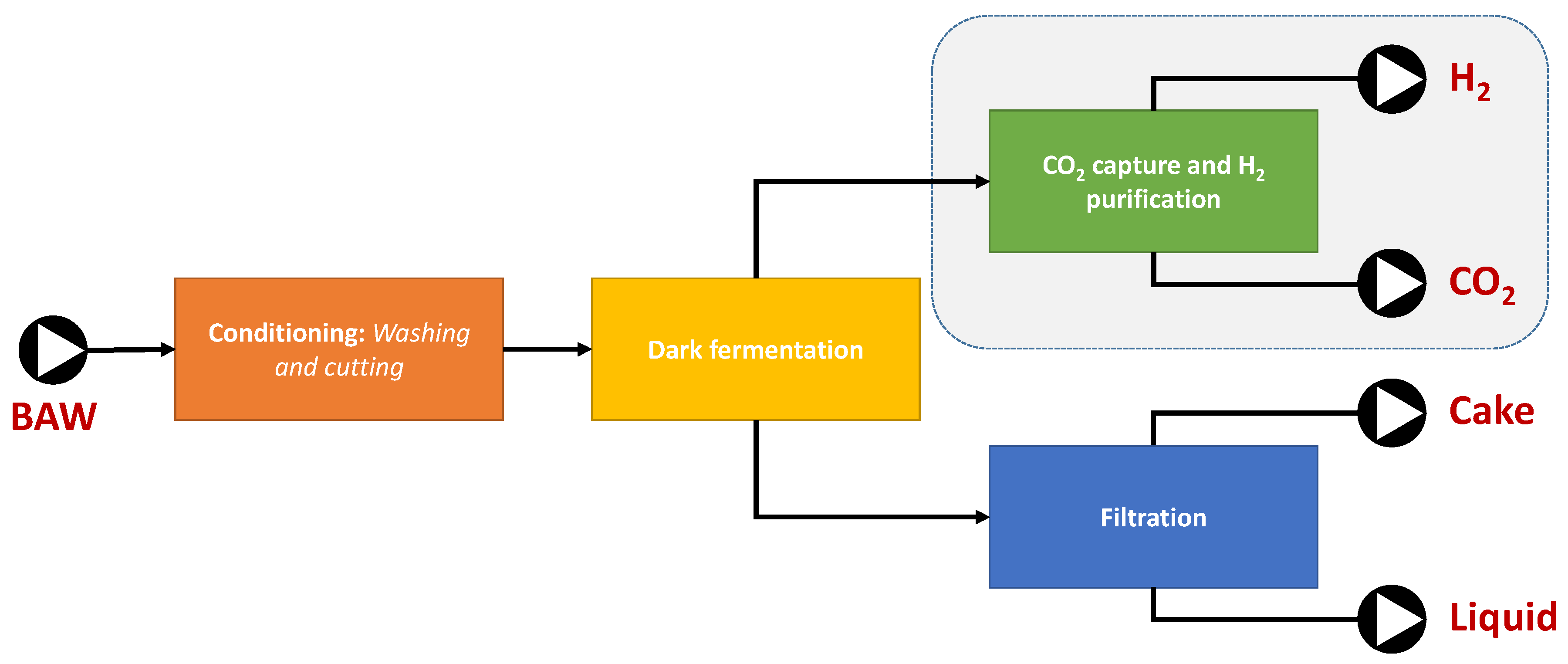
Figure 1 presents the process block diagram. The plant contains (i) conditioning (washing, grinding) and (ii) DF stages. DF generates two flows: (i) gaseous (H2 and CO2) and (ii) semi-solid (sludge). Subsequently, two processes were set up for H2 purification and CO2 capture, i.e., cryogenization and absorption, which are described in the section below.

2.6.1. Cryogenization

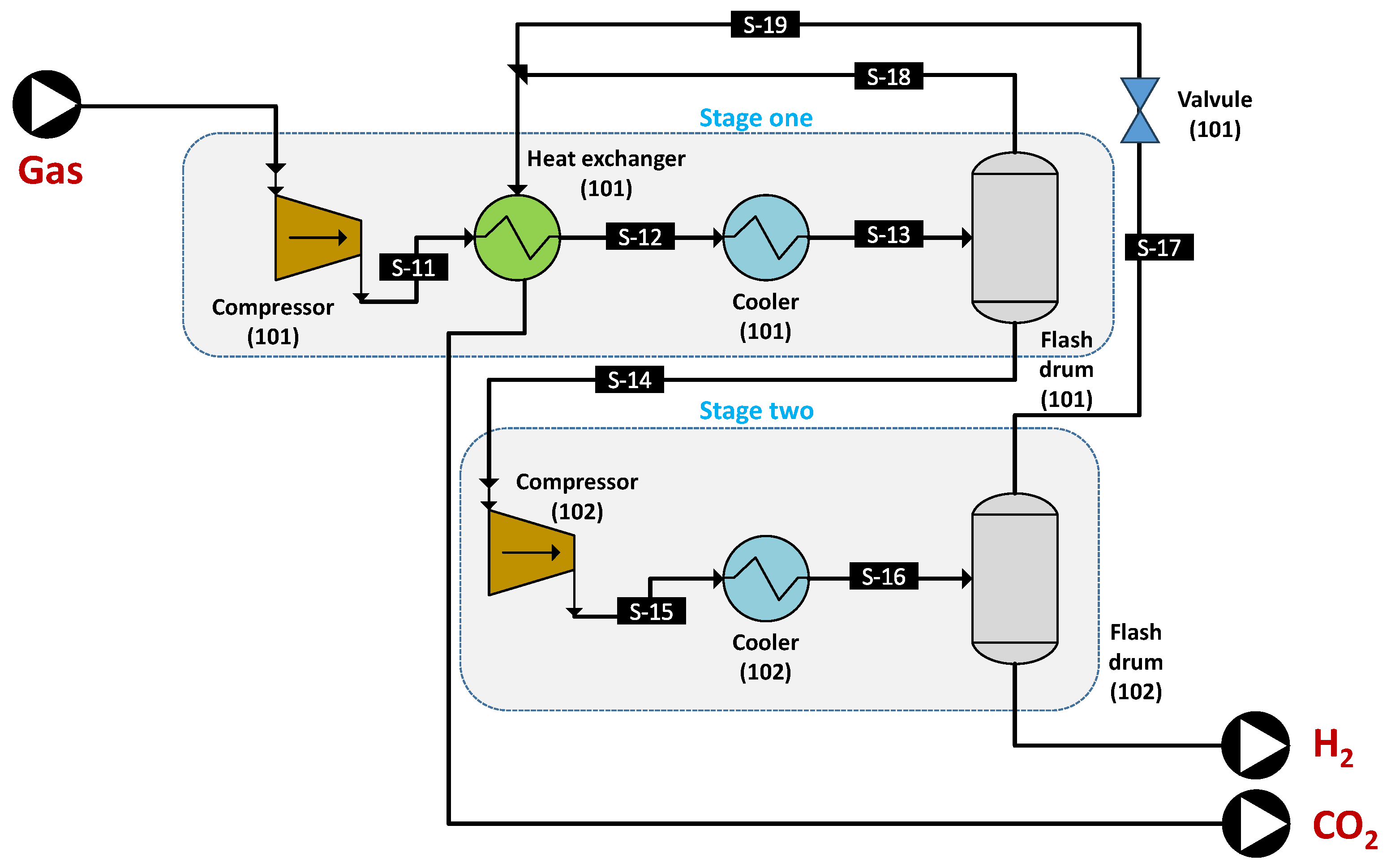
The cryogenic process consists of three consecutive stages comprising: (i) compression, (ii) cooling, and (iii) phase separation, as shown in Figure 2. The Coco v.1.3 process simulator software was used to determine the composition of the flows. The Peng–Robinson thermodynamic model was the most appropriate for this gas mixture [35].
The system consists of two steps in a cascade, with similar operations. The process is carried out by compressing the gas mixture to a suitable pressure and then refrigerating it at a low temperature to condense mainly CO2. Subsequently, the condensed CO2 is separated by flashing as a liquid [29]. The flows of the separated liquid phases are mixed, generating a new current at a specific temperature and pressure to remove heat from the feed at the first cooler, thereby reducing operational costs.

2.6.2. Absorption

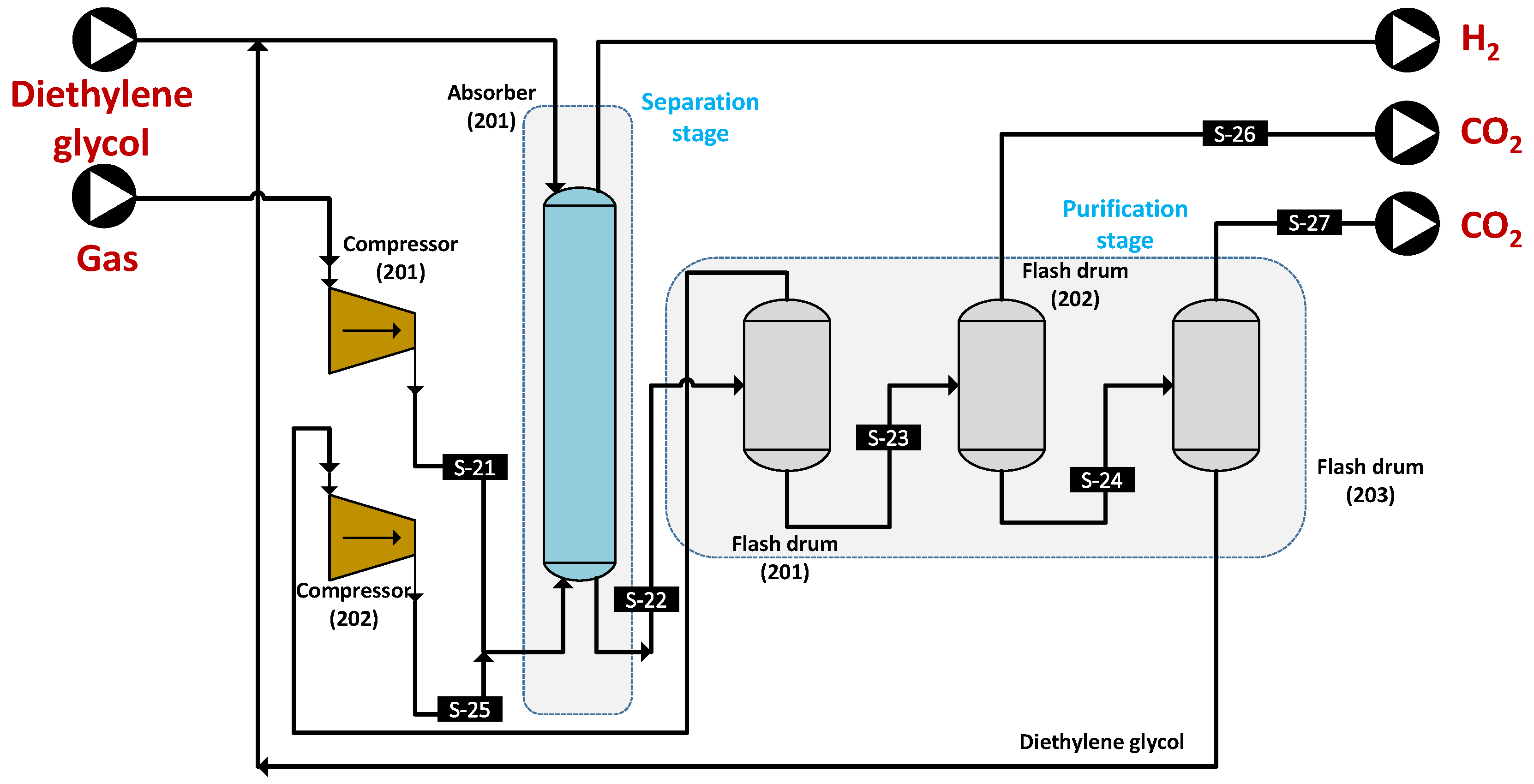
The absorption-based process consists of three stages: compression, absorption (separation stage), and depressurization (purification stage), as illustrated in the block diagram in Figure 3. The solvent used for CO2 absorption was diethylene glycol (DEG), which can absorb acid gases such as CO2. A relatively high pressure is required for this process, generally between 2.07 and 13.8 MPa [24].
The gas mixture (CO2 and H2) is fed through the bottom of the tower at a pressure of 2360 kPa, and a DEG solution (33.4% by weight) is fed through the tower dome, with a ratio of 0.4 mol CO2/mol of DEG, which can recover up to 97% of the CO2 according to [36]. The CO2 feed (DEG-CO2) is sent to three flash expansion tanks in series operating at high, medium, and low pressures (1800, 980, and 98.07 kPa, respectively). The CO2-rich solvent is regenerated by gradual depressurization in expansion flash tanks [37].
The first flash drum plays a crucial role in recovering H2 from the CO2-rich solvent, as the exiting gas has a higher H2 concentration (mol%). Therefore, this flow is recirculated back into the absorber feed. The solvent depleted of H2 is sent to the following expansion drums for CO2 depletion, leaving the solvent with a final CO2 concentration of 0.1%, which is later reused in the same process.

2.7. Economic Evaluation

In this study, the total production cost (TPC) of CO2 was calculated using a dynamic cash flow analysis (DCFA) that employs the present net value (PNV) = 0 (i.e., i equals the internal rate of return (IRR)). SPD utilizes this methodology and is widely interpreted in [38]. Briefly, PNV Equation (1) is a function of the chosen plant capacity and feedstock price intervals for fixed financial and production conditions. The base year was 2025.
P N V = C a s h   f l o w 1 + i n 1 i 1 + i n + w o r k i n g   c a p i t a l 1 + i n i n v e s t m e n t
C a s h   f l o w = C a s h   i n f l o w C a s h   o u t f l o w
C a s h   o u t f l o w = D i r e c t   p r o d u c t i o n   c o s t + t a x e s + l o a n   a n n u i t y
D i r e c t   c o s t s   ( D C ) = f 1 e q u i p m e n t   c o s t
I n d i r e c t   c o s t s   ( I C ) = f 2 e q u i p m e n t   c o s t
F i x e d   C a p i t a l   I n v e s t m e n t   F C I = D C + I C
s t a r t   u p = f 3 F C I
w o r k i n g   c a p i t a l   ( W C ) = f 4 F C I + s t a r t   u p
t o t a l   c a p i t a l   i n v e s t m e n t   T C I = F C I + W C + s t a r t   u p
i n v e s t m e n t = F C I l o a n
The financial investment and assumptions were considered in accordance with Seader et al. [39] and the SuperPro Designer-User’s Guide. The plant operates for 365 days/year; the capacity of 1000 MT of BAW/day was studied to evaluate the impact on CO2 TPC. It is also assumed that 30% of the capital is borrowed for 10 years at an interest rate of 4% and an inflation factor of 4%. The project lifetime and plant construction were fixed at 15 and 3 years, respectively, with straight-line depreciation. Federal taxes were considered at 40% profit. Feedstock cost (AP) was determined and calculated until NPV = 0 was obtained. The operator’s salary was fixed at USD 3.91/h for eight hours, based on the minimum salary for a technical worker reported by the Mexican government [16]. The purchase cost of the DEG was set at USD 110/MT according to [40]. Additionally, a cost of USD 2000/m3 of nitrogen was considered for the cryogenic process.
The selling cost of CO2 was set at USD 100/MT, with a composition of 99.99% purity, according to the selling price of H2; for the absorption and cryogenics processes, respectively, it was set at USD 1.8/kg and USD 1.4/kg, and this was decided upon to achieve the desired product purity percentage, as specified in [41]. In addition, the selling cost of the fermenter effluent (RRE) was calculated to modulate the plant’s profitability and to obtain scenarios with positive profitability, as discussed in the Section 3.

3. Results

This section presents the results obtained from the characterization of biomass, dark fermentation, and the techno-economic and sustainability analysis of two biorefinery models for H2 production and CO2 capture. This study compares and evaluates the cryogenic and absorption processes using the same economic parameters and plant capacity. First, the cryogenic process is evaluated, followed by the absorption process. Then, a comparison is made between these processes regarding process efficiency and economy.

3.1. Characterization of the Source: Volatile and Total Solids of Broccoli Leaves and Stems

The leaves and stems were characterized physiochemically using %TS, %VS, %TCH, and %MC, as described in [18]. The results of the leaves were 89.5 ± 0.9, 67.5 ± 0.5, 22.1 ± 0.4, and 10.4 ± 0.9 for %TS, %VS, %TCH, and %MC, respectively. The results for the stem were 85.9 ± 0.3, 69.1 ± 0.6, 16.8 ± 0.4, and 14.1 ± 0.3 for %TS, %VS, %TCH, and %MC, respectively. The results presented here are similar to those reported by [42,43,44,45], suggesting that both the leaves and the stem contain high levels of carbohydrates, which are the primary source of DF. Therefore, this material is suitable as a raw material for H2 production via dark fermentation.

3.2. Dark Fermentation Experiments

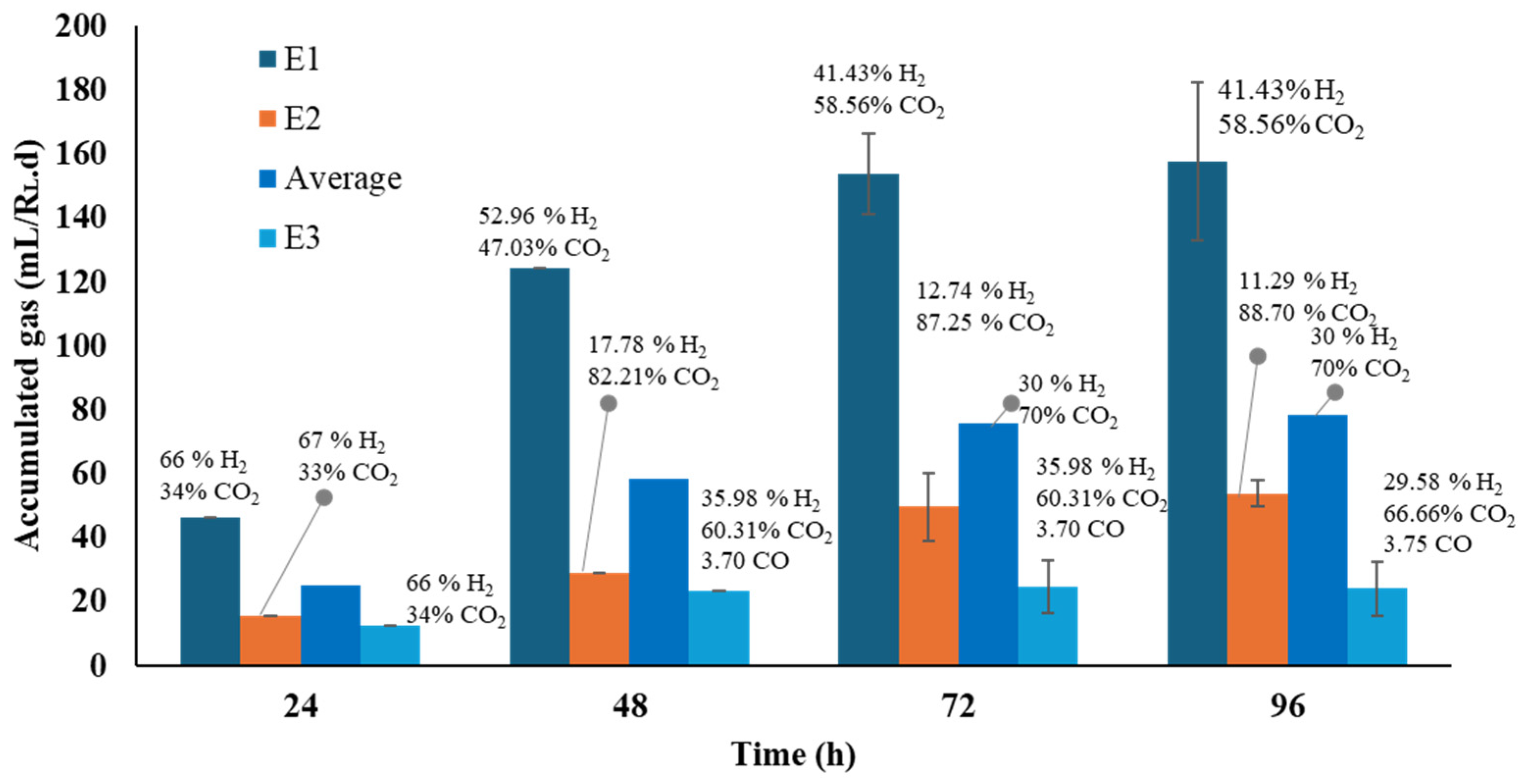
Figure 4 illustrates the performance of experiments conducted using a mixture of broccoli leaves and stems. It is observed that sample E1 (with equal amounts of leaves and stem) exhibits the best performance, with 149 mL of gas/RL·day, surpassing mixtures E2 and E3, whose productions were 25 and 54 mL gas/RL·day, respectively. It is also observed that mixtures E1 and E3 have compositions of 41.43% and 11.29% H2, respectively, with the remainder being CO2. However, the experiment E2 shows the lowest productivity, presenting, in addition to H2, CO2 and 3.75% carbon monoxide (CO). These results obtained here are very similar to those reported for non-composted organic waste, which is typically composed of vegetables [14,19,21,22].
In relation to the yields obtained in the experiments E1, E2, and E3, volumetric flow and average output composition were measured, since the amount of inoculum may vary in real scenarios. In this sense, the yield was 80 mL gas/RL·d, with an approximate composition of 30% H2 and 70% CO2.

Statistical Analysis Results

A one-way ANOVA was conducted to compare the effect of time on variable E1 across three time points: 24 h, 48 h, and 72 h. This analysis revealed a statistically significant difference between group means [F(2.6) = 214.45, p < 0.001]. Post hoc inspection suggests that E1 increases substantially over time, with the most significant variability observed at 72 h. These findings support the time-dependent dynamic in E1 behavior, potentially linked to cumulative biological processes. In addition, a one-way ANOVA was conducted to compare the means of three variables (E1, E2, and E3) measured at 72 h. The analysis revealed a statistically significant difference between the groups [F(2,6) = 226.26, p < 0.001]. Noteworthily, E1 showed a higher mean and variance than E2 and E3, suggesting that E1 exhibits a more pronounced, more variable response. These results indicate that the three variables respond differently under the same conditions and that, in addition, E1 exhibits greater sensitivity in the studied system.

3.3. Biorefinery Simulation

The simulations for H2 purification and CO2 capture were scaled up from the laboratory yield, processing 1000 MT/day of broccoli leaves and stems without pretreatment. In this case, two scenarios were considered: (A) maximum H2 production and (B) the average production observed in the laboratory. Noteworthily, batch yields in such small volumes do not correlate linearly with continuous production systems due to substrate inhibition, hydraulic retention times, and volatile fatty acid accumulation. However, they are taken as starting points. If the technical and economic viability of the proposed system is not profitable, the use of other, more robust control systems is also not profitable. Table 2 presents the composition and molar flow rates used in each simulation scenario. Appendix A presents the equipment proposed for the absorption (Table A1) and cryogenic process (Table A2).

3.3.1. Cryogenic Process Evaluation

This section presents the technical and economic results of the study of a plant that incorporates a cryogenic distillation process in the separation and purification stage of the H2/CO2 mixture. Table 3 and Table 4 show the results of stream composition throughout the purification process, as shown in Figure 1 for both studied scenarios. The final streams of the process (H2 and CO2) indicate that the cryogenic process can produce a high-purity CO2 stream (99.8%) and an H2 output stream with the same composition. However, the H2 production flow indicates that H2 purification consumes a considerable amount of energy due to the temperatures used in the coolers and flash separation. This result directly affects the product’s selling price, which is associated with its calorific value. In this regard, the process generated 667.22 MT/year of CO2 with a purity of 99.8% and produced 160.53 MT/year of H2 with a purity of 99.8%. In contrast, cryogenization has a recovery rate of 90%; this system can generate a high-purity CO2 product (>99%) due to the initial CO2 concentration. Noteworthily, as they are a mixture, the two gases have different boiling points, with CO2 being the highest, so that the higher its concentration, the lower the temperature at which it must be transported in the mixture to achieve separation by phase difference. Finally, to process a 1000 MT/day BAW plant, the process used a volumetric flow of nitrogen of 226.7211 m3/year as a cooling medium.
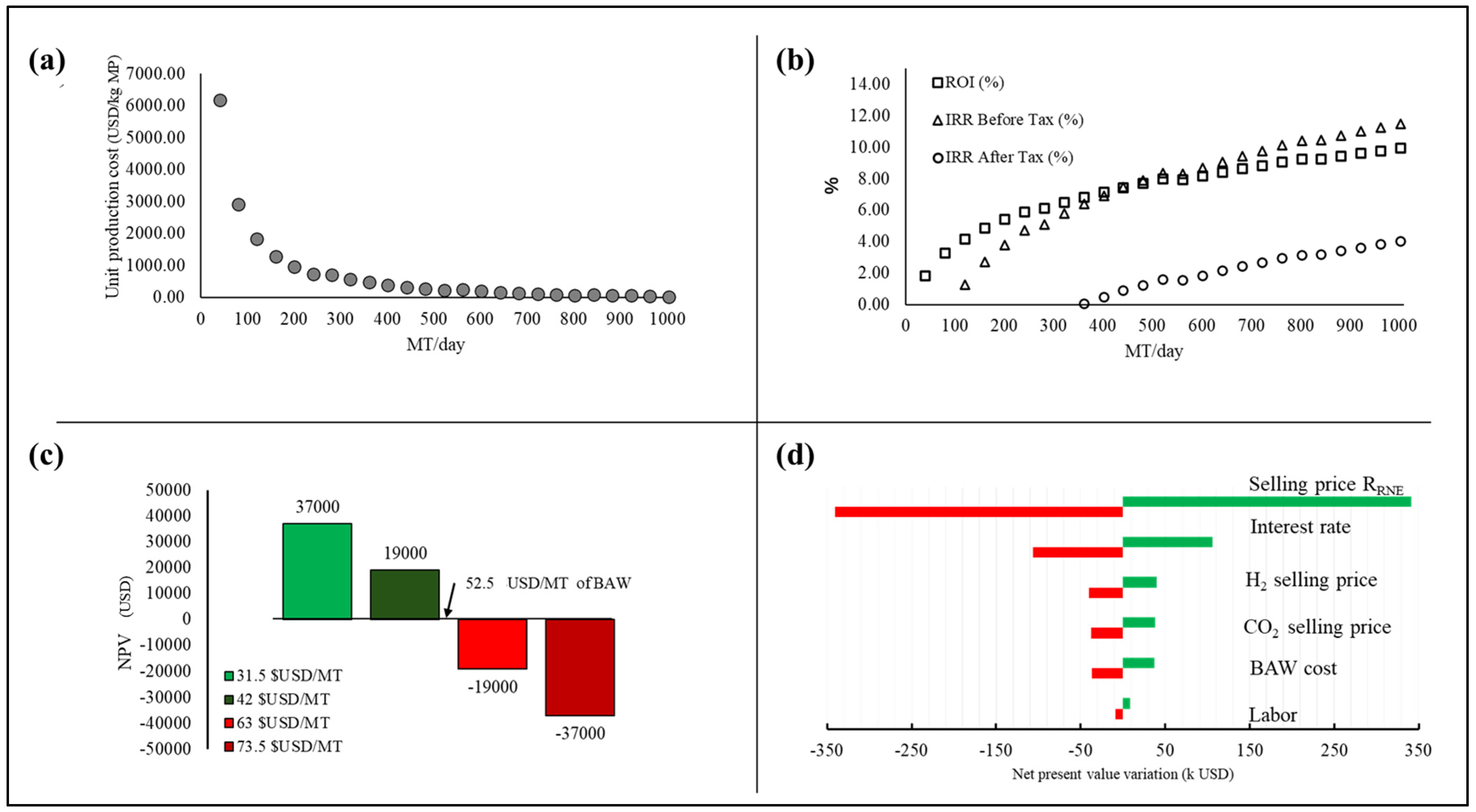
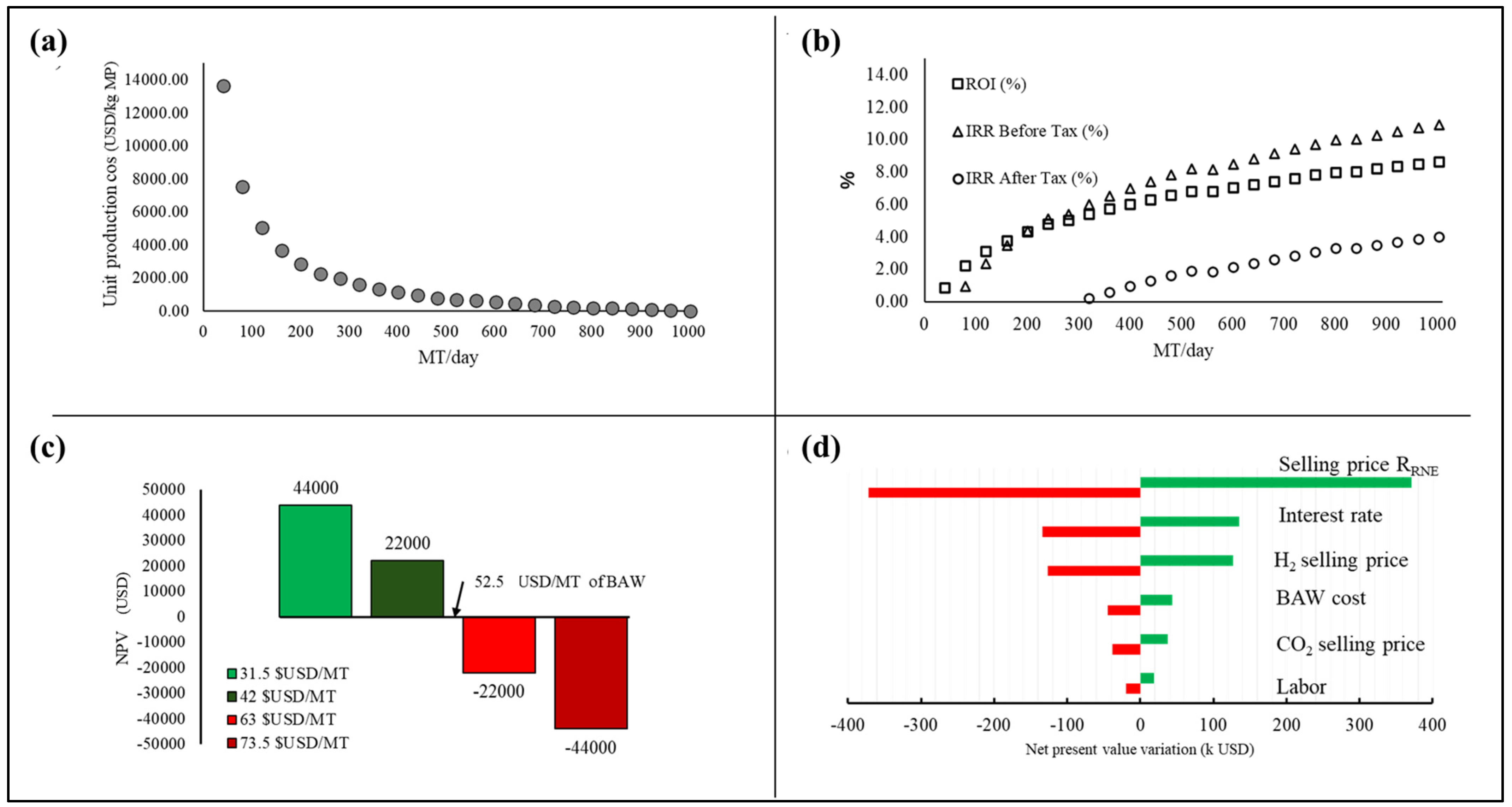
Figure 5 presents the results of the profitability analysis of the biorefinery to produce H2 and CO2 using a cryogenic CO2 capture system. Figure 5a shows the sensitivity analysis of plant capacity versus total production cost, where a typical exponential drop associated with the plant capacity presented above [7] can be observed, and where it can also be seen that a low feed rate (<50 MT/d) generates a high production cost of USD 13,900 per ton of CO2. On the other hand, the calculated production cost is USD 1 per ton, and the sale price of 1 kg of H2 is USD 1.40/kg. It should be noted that the bioreactor has two effluents: gaseous (main subject of study) and solid (RRNE: solid reactor effluent). In this regard, a portion of the sales of RRNE effluents is used to repay the plant’s loan, significantly reducing production costs. Figure 5b shows the ROI and IRR results before and after taxes. The ROI and IRR before taxes are favorable for the plant’s initial capacity, while the IRR after taxes is only positive at capacities above 300 tons per day. This value allows us to identify that the plant achieves positive profitability due to its high capacity, maintained at up to 1000 MT/day. Figure 5c illustrates the impact of the residual cost of broccoli biomass on the NPV. In this scenario, the NPV is 0 when the price of biomass reaches USD 52.5; however, a 20% or 40% increase in the price of biomass generates a negative NPV. The opposite phenomenon is observed when the biomass costs decrease to 20% and 40% of the initial cost. Figure 5d shows the tornado diagram, a powerful and valuable tool for assessing the impact of variables on the process’s economics. This tool is very effective and has been used previously to evaluate the profitability of various projects [7]. The effect of the parameters was analyzed for a plant with a capacity of 1000 MT of BAW per day. The most significant impact is the sale of RRNE > interest rate > H2 sale price > BAW > CO2 sale price > labor. Therefore, the lowest impact is associated with labor, while RRNE and the interest rate have the most significant impact. The high impact of RRNE is due to the large volume of effluent, which significantly affects the process economics. This allows us to observe the low performance in this scenario.

3.3.2. Absorption Process Evaluation

This section presents the technical and economic results of the plant, which utilizes absorption technology for CO2 capture and H2 purification. Table 5 and Table 6 present the composition employed for the analysis. It is observed that for each stream, the composition in molar fraction was 99.8% for CO2 and H2; however, three product streams are obtained, two of which contain a high degree of CO2 purity (S-26 and S-27), with a joint CO2 production of 20.7690 m3/day (STP). Additionally, a third stream exhibits a high degree of H2 purity (H2 stream). The CO2 production streams have a purity of 99.8% and very low H2 content. The H2 production stream shows a high H2 purity, with 99.8% H2 and 0.2% CO2. This result is attributed to the high affinity of CO2 for DEG, which enables more efficient extraction. The calorific value obtained for the absorption process mixture was 2.7 × 10⁶ kJ/day, assuming a calorific value of H2 of 121 kJ/mol and generation rates of 22.46 kg/day and 22.1 kg/day for the absorption and homogenization processes, respectively. The absorption uses DEG, which requires an annual fresh feed of 1937.8495 m3/year. This considers a yearly loss of 10% of the absorbent agent, which is relatively low.
The economics of the CO2 capture process using absorption were also evaluated. Figure 6 illustrates the profitability study of the process and the factors that impact its economics. Figure 6a shows the impact of plant capacity versus total production cost per CO2 entity. It is observed that the process is expensive at a low production capacity. However, a typical exponential decay is observed as the process capacity increases, achieving low production costs at 1000 MT/day. The low production cost is inferred from a typical main product (MP) sales price of USD 100/MT and a hydrogen price of USD 1.80/kg. However, the process is highly dependent on the sale of reactor effluent, which is considered a nutrient-rich byproduct that can be utilized in subsequent processes, such as methane production. Otherwise, it is essential to emphasize that if this were not the case, a large subsidy would be required to achieve competitive production with similar products. Figure 6b shows the before- and after-tax parameters of ROI and IRR. It can be observed that parameters such as ROI and IRR before taxes are favorable for small capacities. Still, the IRR after taxes is achieved at 350 MT/day, indicating that the process is profitable at this processing capacity. These parameters remain positive up to 1000 MT/day. Figure 6c shows the impact of BAW vs. NPV for a plant with a capacity of 1000 MT/day. Using a value of USD 52.5/MT, an NPV equal to zero was found. With this value, a variation of up to ±35% was made to observe the effects on the process economy. As expected, the NPV decreases with increasing purchase price of BAW; it increases with the decreasing purchase price of BAW. Finally, Figure 6d presents the tornado diagram to assess the impact of various factors on the process economy. In this sense, the sale of nutrient-affluent effluent has a significant effect on the process economy, followed by interest rates as the second factor. Subsequently, the sale cost of CO2 and H2 are observed as the most critical factors, and finally, the BAW cost and labor.
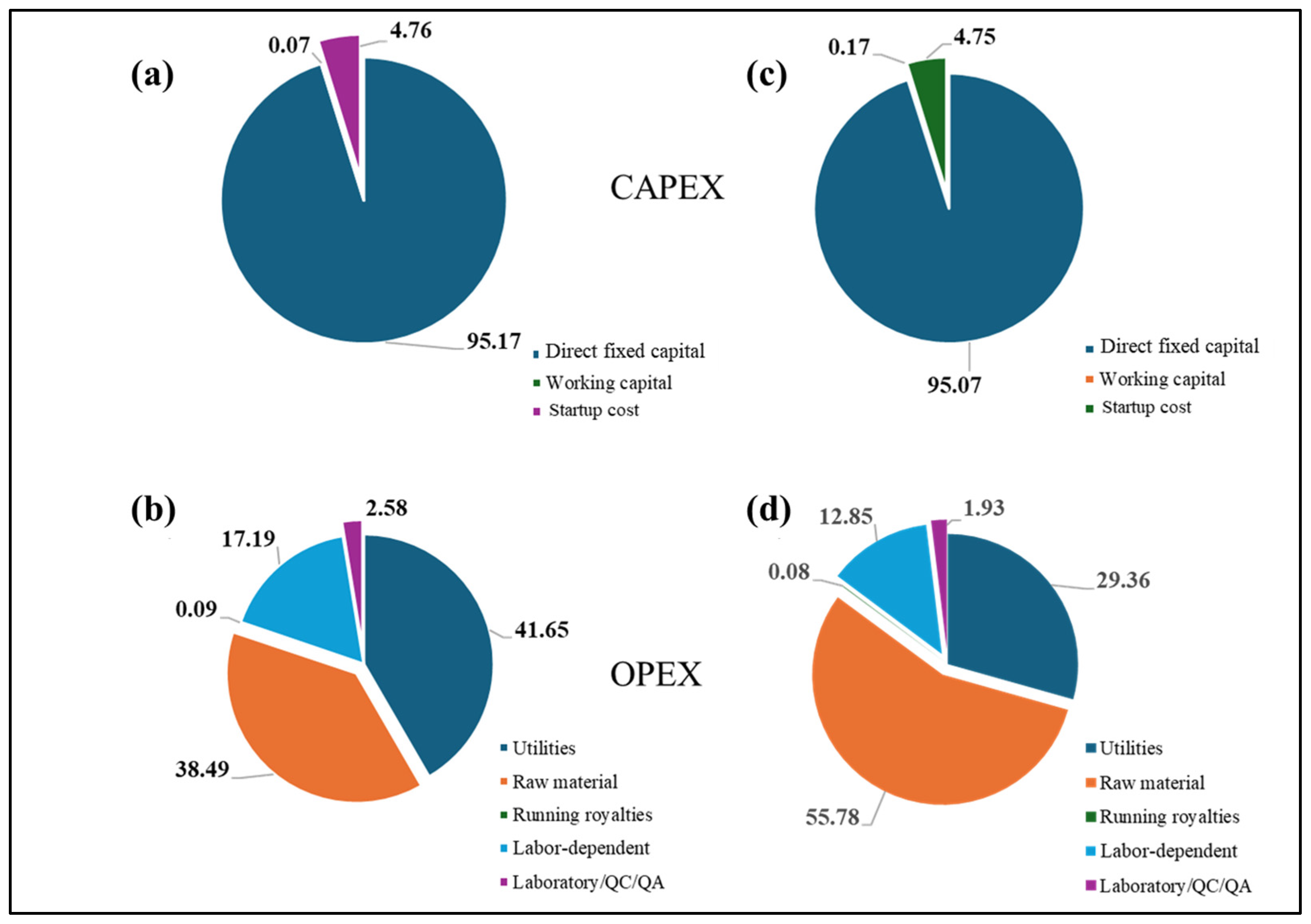
Table 7 shows the economic comparison between the two processes: cryogenic and absorption. A slightly higher capital investment is observed for the cryogenic process compared to the absorption process. Conversely, the operating cost is higher for the absorption process due to the consumption of diethylene glycol (DEG). As expected, the net production cost per unit is considerably high for both methods, well above the values typically cited in the literature, due to the low gas yield. However, the payback period is shorter for the absorption process, suggesting a potential economic advantage for this technology under the evaluated conditions. Figure 7a shows that the fixed direct capital cost of the cryogenic process accounts for 95.7%, slightly higher than the corresponding value for the absorption process shown in Figure 7c. Furthermore, a comparative analysis of Figure 7b,d reveals that the cryogenic process is more dependent on utilities, labor, and laboratory quality-control expenses. Conversely, the absorption process depends more on raw material costs.

4. Conclusions

Using experimental data, two biorefineries were simulated for H2 production and CO2 capture via dark fermentation, and two technologies were compared: cryogenics and absorption. According to the experimental results, the absorption technology is technically more efficient, capturing a higher percentage of CO2 and delivering a purer H2 stream. The economic results also indicate that the absorption process requires the least investment, and therefore, the capital recovery process is more efficient. The financial impacts are greater when varying the percentages of influence across sales products, services, and labor. Both processes generate large volumes of fermenter effluent, which is associated with a low reaction yield from unpretreated biomass. However, this can be considered a central driver of economic profits if the product is sold to a new plant that can use it as an input in the biorefinery. Without this income, the plant cannot cover the costs of selling H2 and CO2, requiring a significant government subsidy.

Author Contributions

C.E.M.-G.: conceptualization, investigation, writing—original draft, visualization. I.V.-V.: investigation, validation, writing—review and editing. A.C.L.: investigation, methodology, writing—review and editing. J.d.J.I.-S.: investigation, methodology, validation, visualization, writing—review and editing. L.C.B.Á.: investigation, methodology. All authors have read and agreed to the published version of the manuscript.

Funding

This research received no external funding.

Data Availability Statement

The original contributions presented in this study are included in the article.

Acknowledgments

CEMG acknowledges Universidad de Guanajuato and Laboratorio para la Sustentabilidad Ambiental y Energética for the support of this research.

Conflicts of Interest

The authors declare no conflicts of interest.

Appendix A

Table A1. Absorption process equipment cost.
NameTypeUnitsSize (Capacity) Unit Price
(USD/Unit)
Total Price
(USD)
C-101Absorber11931.65L49,00049,000
AD-102Anaerobic Digester117,971.08m310,174,00010,174,000
G-101Centrifugal Compressor113.56kW85,00085,000
G-102Centrifugal Compressor115.37kW85,00085,000
V-103Flash Drum1406.20L50005000
V-101Flash Drum1430.28L50005000
V-102Flash Drum1422.88L50005000
RVF-101Rotary Vaccum Filter4162.62m2397,0001,588,000
SC-103Screw Conveyor215.00m92,000184,000
SR-102Shredder141.66MT/h286,000286,000
Table A2. Cryogenic process equipment cost.
NameTypeUnitsSize (Capacity) Unit Price
(USD/Unit)
Total Price
(USD)
AD-101Anaerobic Digester118,033.73m310,196,00010,196,000
G-102Centrifugal Compressor113.22kW85,00085,000
G-101Centrifugal Compressor11.99kW85,00085,000
G-103Centrifugal Compressor11.89kW85,00085,000
V-102Flash Drum157.05L20002000
V-101Flash Drum157.05L20002000
HX-101Heat Exchanger10.04m240004000
RVF-101Rotary Vaccum Filter4163.19m2398,0001,592,000
SC-103Screw Conveyor215.00m93,000186,000
SR-102Shredder141.81MT/h287,000287,000

References

  1. Holechek, J.L.; Geli, H.; Sawalhah, M.; Valdez, R. A Global Assessment: Can Renewable Energy Replace Fossil Fuels by 2050? Sustainability 2025, 14, 4792. [Google Scholar] [CrossRef]
  2. Merajul Islam, M.; Nafees, A. Transforming biomass into sustainable biohydrogen: An in-depth analysis. RSC Sustain. 2025, 3, 4250–4297. [Google Scholar] [CrossRef]
  3. Hong, J.; Chen, B.; Wang, T.; Zhao, X. A promising technical route for converting lignocellulose to bio-jet fuels based on bioconversion of biomass and coupling of aqueous ethanol: A techno-economic assessment. Fuel 2025, 381, 133670. [Google Scholar] [CrossRef]
  4. Valenzuela, M.; Ciudad, G.; Cárdenas, J.P.; Medina, C.; Salas, A.; Oñate, A.; Pincheira, G.; Attia, S.; Tuninetti, V. Towards the development of performance-efficient compressed earth blocks from industrial and agro-industrial by-products. Renew. Sustain. Energy Rev. 2024, 194, 114323. [Google Scholar] [CrossRef]
  5. Valdez-Vazquez, I.; Acevedo-Benítez, J.A.; Hernández-Santiago, C. Distribution and potential of bioenergy resources from agricultural activities in Mexico. Renew. Sustain. Energy Rev. 2010, 14, 2147–2153. [Google Scholar] [CrossRef]
  6. Hernández, C.; Escamilla-Alvarado, C.; Sánchez, A. Wheat straw, corn stover, sugarcane, and Agave biomasses: Chemical properties, availability, and cellulosic-bioethanol production potential in Mexico. Biofuels Bioprod. Biorefining 2019, 13, 1143–1159. [Google Scholar] [CrossRef]
  7. Molina-Guerrero, C.E.; Sanchez, A.; Vázquez-Núñez, E. Energy potential of agricultural residues generated in Mexico and their use for butanol and electricity production under a biorefinery configuration. Environ. Sci. Pollut. Res. 2020, 27, 28607–28622. [Google Scholar] [CrossRef]
  8. González-Chavez, J.J.; Arenas-Grimaldo, C.; Amaya-Delgado, L. Sotol bagasse (Dasylirion sp.) as a novel feedstock to produce bioethanol 2G: Bioprocess design and biomass characterization. Ind. Crops Prod. 2022, 178, 114571. [Google Scholar] [CrossRef]
  9. Carrillo-Nieves, D.; Rostro Alanís, M.; de la Cruz Quiroz, R.; Ruiz, H.A.; Iqbal, H.; Parra-Saldíva, R. Current status and future trends of bioethanol production from agro-industrial wastes in Mexico. Renew. Sustain. Energy Rev. 2019, 102, 69–74. [Google Scholar] [CrossRef]
  10. Veitía-de-Armas, L.; Reynel-Ávila, H.; Villalobos-Delgado, F.J.; Duran-Valle, C.; Adame-Pereira, M.; Bonilla-Petriciolet, A. A circular economy approach to produce low-cost biodiesel using agro-industrial and packing wastes from Mexico: Valorization, homogeneous and heterogeneous reaction routes and product characterization. Renew. Energy 2024, 237, 121684. [Google Scholar] [CrossRef]
  11. SIAP. México produjo 567 mil toneladas de brócoli en 2017. México produjo 567 mil toneladas de brócoli en 2017. 2017. Available online: https://www.gob.mx/agricultura%7Cdgsiap/es/articulos/mexico-produjo-567-mil-toneladas-de-brocoli-en-2017 (accessed on 10 December 2025).
  12. Manríquez-Zúñiga, A.N.; Rosillo De La Torre, A.; Valdés-Santiago, L. Broccoli Leaves (Brassica oleracea var. italica) as a Source of Bioactive Compounds and Chemical Building Blocks: Optimal Extraction Using Dynamic Maceration and Life Cycle Assessment. Sustainability 2023, 15, 16616. [Google Scholar] [CrossRef]
  13. Berndtsson, E.; Andersson, R.; Johansson, E.; Olsson, M. Side Streams of Broccoli Leaves: A Climate Smart and Healthy Food Ingredient. Int. J. Environ. Res. Public Health 2020, 17, 2406. [Google Scholar] [CrossRef]
  14. Chandra, S.; Pandit, S.; Roy, C.; Obaidur, S.; Kumar, A.R.; Saeed, M.; Kumar, A.; Sharma, K.; Ranjan, N. Bioenergy recovery from jackfruit waste via biohydrogen production through dark fermentation and power generation through stacked microbial fuel cells. Int. J. Hydrogen Energy 2025, 102, 845–855. [Google Scholar] [CrossRef]
  15. Lufan, P.; Cardozo, R. Biohydrogen production from residual biomass: The potential of wheat, corn, rice, and barley straw−recent advances. Bioresour. Technol. 2025, 432, 132638. [Google Scholar] [CrossRef]
  16. Valdez-Guzmán, B.E.; Rios-Del Toro, E.; Cardenas-López, R.; Méndez-Acosta, H.; González-Álvarez, V.; Arreola-Vargas, J. Enhancing biohydrogen production from Agave tequilana bagasse: Detoxified vs. Undetoxified acid hydrolysates. Bioresour. Technol. 2019, 276, 74–80. [Google Scholar] [CrossRef]
  17. Dudek, K.; Buitrón, G.; Valdez-Vazquez, I. Nutrient influence on acidogenesis and native microbial community of Agave bagasse. Ind. Crops Prod. 2021, 170, 113751. [Google Scholar] [CrossRef]
  18. Valdez-Vazquez, I.; Pérez-Rangel, M.; Tapia, A. Hydrogen and butanol production from native wheat straw by synthetic microbial consortia integrated by species of Enterococcus and Clostridium. Fuel 2015, 159, 214–222. [Google Scholar] [CrossRef]
  19. Villanueva-Galindo, E.; Vital-Jácome, M.; Moreno-Andrade, I. Dark fermentation for H2 production from food waste and novel strategies for its enhancement. Int. J. Hydrogen Energy 2023, 48, 9957–9970. [Google Scholar] [CrossRef]
  20. Obiora, N.K.; Ujah, C.O.; Asadu, C.O.; Kolawole, F.O.; Ekwueme, B.N. Production of hydrogen energy from biomass: Prospects and challenges. Green Technol. Sustain. 2024, 2, 100100. [Google Scholar] [CrossRef]
  21. Ganguly, A.; Sun, P.; Liu, X.; Delgado, H.E.; Sun, L.; Elgowainy, A. Techno-economic and life cycle analysis of bio-hydrogen production using bio-based waste streams through the integration of dark fermentation and microbial electrolysis. Green Chem. 2025, 27, 6213–6231. [Google Scholar] [CrossRef]
  22. Elerakey, N.; Abdel-Hamied, M.; Hawary, H. Mathematical modeling of biohydrogen production via dark fermentation of fruit peel wastes by Clostridium butyricum NE95. BMC Biotechnol. 2024, 24, 105. [Google Scholar] [CrossRef]
  23. Díez, M.P.; Villanueva-Galindo, E.; Moreno-Andrade, I. Enhanced hydrogen production from food waste via bioaugmentation with Clostridium and Lactobacillus. Biomass Conv. Bioref. 2025, 15, 27501–27513. [Google Scholar] [CrossRef]
  24. Inocencio-García, P.J.; Cardona Alzate, C.A. Techno-Economic Comparison of CO2 Valorization Through Chemical and Biotechnological Conversion. Waste Biomass Valor. 2025, 16, 3969–3985. [Google Scholar] [CrossRef]
  25. Chen, Y.; Ahn, H. Process swing adsorption with selective purge gas recirculation (PSA-SPUR): Adsorption process technology optimised for separation of heavy component from a gas mixture and its design for CO2 capture through Equilibrium Theory analysis. Sep. Purif. Technol. 2025, 358, 130356. [Google Scholar] [CrossRef]
  26. Hartini Suhaimi, N.; Jusoh, N.; Kar Yap, B.; Nur-E-Alam, M.; Soraya Sambudi, N.; Lai, L.S.; Izzuddin Adnan, A. Amine-functionalized MOF-based hybrid membranes for CO2 separation: Molecular interactions and separation performance. Carbon Capture Sci. Technol. 2025, 17, 100542. [Google Scholar]
  27. Tuinier, M.J.; Hamers, H.P.; Annaland, M. Techno-economic evaluation of cryogenic CO2 capture—A comparison with absorption and membrane technology. Int. J. Greenh. Gas Control 2011, 5, 1559–1565. [Google Scholar] [CrossRef]
  28. Byung-Moon, J.; Kim, J.; Young-Nam, K. Enhanced CO2/CH4 separation by solvent-based pressure swing absorption: Effects of solvent composition and concentration in ternary system. Chem. Eng. J. 2025, 1, 166415. [Google Scholar] [CrossRef]
  29. Lin, M.; Zhang, Y.; Yan, G.; Yu, P.; Duan, S.; Chen, H.; Han, J. Design and analysis of cryogenic CO2 separation from a CO2-rich mixture. Energy Sci. Eng. 2023, 11, 2253–2266. [Google Scholar] [CrossRef]
  30. Smith, K.H.; Ashkanani, H.E.; Morsi, B.I.; Siefert, N.S. Physical solvents and techno-economic analysis for pre-combustion CO2 capture: A review. Int. J. Greenh. Gas Control 2022, 118, 103694. [Google Scholar] [CrossRef]
  31. Xu, G.; Liang, F.; Yang, Y.; Hu, Y.; Zhang, K.; Liu, W. An Improved CO2 Separation and Purification System Based on Cryogenic Separation and Distillation Theory. Energies 2014, 7, 3484–3502. [Google Scholar] [CrossRef]
  32. Gonzalez, K.; Boyer, L.; Almoucachar, D.; Poulain, B.; Cloarec, E.; Magnon, C.; de Meyer, F. CO2 and H2S absorption in aqueous MDEA with ethylene glycol: Electrolyte NRTL, rate-based process model and pilot plant experimental validation. Chem. Eng. J. 2023, 451, 138948. [Google Scholar] [CrossRef]
  33. Nielsen, J.; Villadsen, J. Bioreaction Engineering Principles, 3rd ed.; Springer: Berlin/Heidelberg, Germany, 2017. [Google Scholar]
  34. Sanchez, A.; Valdez-Vazquez, I.; Soto, A.; Sánchez, S.; Tavarez, D. Lignocellulosic n-butanol co-production in an advanced biorefinery using mixed cultures. Biomass Bioenergy 2017, 102, 1–12. [Google Scholar] [CrossRef]
  35. Qasim, A.; Mohd Shariff, A.; Sufian, S.; Ayoub, M.; Lal, B. Phase identification of natural gas system with high CO2 content through simulation approach using Peng-Robinson model. Mater. Sci. Eng. 2018, 458, 012068. [Google Scholar] [CrossRef]
  36. Yavini, T.D.; Ali, M.-D.I.; Muhammad, W.S. Economic Evaluation of Selexol-Based CO2 Capture Process for a Cement Plant Using Post—Combustion Technology. Int. J. Sci. Res. Sci. Technol. 2015, 1, 194–203. [Google Scholar]
  37. Asgharian, H.; Pujol Duran, A.; Yahyaee, A.; Pignataro, V.; Pagh Nielsen, M.; Iov, F.; Liso, V. Sustainable urea production via CO2 capture from cement plants: A techno-economic analysis with focus on process heat integration and electrification. Int. J. Hydrogen Energy 2025, 151, 150154. [Google Scholar] [CrossRef]
  38. Sanchez, A.; Sevilla-Güitrón, V.; Magaña, G.; Gutierrez, L. Parametric analysis of total costs and energy efficiency of 2G enzymatic ethanol production. Fuel 2013, 113, 165–179. [Google Scholar] [CrossRef]
  39. Seider, W.D.; Lewin, D.R.; Seader, J.D.; Widagdo, S.; Gani, R.; Ming, K. Product and Process Design Principles: Synthesis, Analysis, and Evaluation, 4th ed.; John Wiley & Sons, Inc.: Hoboken, NJ, USA, 2017; p. 456. [Google Scholar]
  40. Diethylene Glycol Price Trend, Index, Chart, Database. 2024. Available online: https://www.procurementresource.com/resource-center/diethylene-glycol-price-trends (accessed on 10 December 2025).
  41. Investment Research Data, Bloomberg Professional Service. 2025. Available online: https://www.bloomberg.com/professional/products/data/enterprise-catalog/investment-research-data/ (accessed on 10 December 2025).
  42. Ajayi-Banji, A.A.; Rahman, S.; Sunoj, S.; Igathinathane, C. Impact of corn stover particle size and C/N ratio on reactor performance in solid-state anaerobic co-digestion with dairy manure. J. Air Waste Manag. Assoc. 2020, 70, 436–454. [Google Scholar] [CrossRef]
  43. Tahir Khan, M.; Brulé, M.; Maurer, C.; Argyropoulos, D.; Müller, J.; Oechsner, H. Batch anaerobic digestion of banana waste—Energy potential and modelling of methane production kinetics. Agric. Eng. Int. CIGR J. 2016, 18, 1. [Google Scholar]
  44. Nandiyanto, A.; Azizah, N.; Chelvina, G.; Girsang, S. Optimal Design and Techno-Economic Analysis for Corncob Particles Briquettes: A Literature Review of the Utilization of Agricultural Waste and Analysis Calculation. Appl. Sci. Eng. Prog. 2022, 15, 3. [Google Scholar] [CrossRef]
  45. Jose, D.; Kitiborwornkul, N.; Sriariyanun, M.; Keerthi, K. A Review on Chemical Pretreatment Methods of Lignocellulosic Biomass: Recent Advances and Progress. Appl. Sci. Eng. Prog. 2022, 15, 4. [Google Scholar] [CrossRef]
Figure 1. Process block diagram for BAW biorefineries.
Processes 13 04083 g001
Figure 2. Process diagram of the cryogenic process.
Processes 13 04083 g002
Figure 3. Process diagram for absorption system.
Processes 13 04083 g003
Figure 4. Accumulated biogas (mL gas/RL·d) and its composition obtained from batch experiments. The results are presented in mol fraction (%).
Processes 13 04083 g004
Figure 5. Economic parameter evaluation for cryogenic technology. (a) Unit production cost versus plant capacity. (b) Economic indicators: ROI (%), IRR before tax (%), IRR after tax (%) versus plant capacity. (c) Net present value vs. raw material cost for a plant capacity of 1000 MT/day. (d) Tornado plot for a plant capacity of 1000 MT/day of BAW (parameter variation: selling price CO2 ± 10%; labor ± 1%; BAW purchase price ± 40%; interest rate: ±0.5%; selling price RRNE ± 0.5%).
Processes 13 04083 g005
Figure 6. Economic parameter evaluation for absorption technology: (a) Unit production cost vs. plant capacity; (b) economic indicators ROI (%), IRR before tax (%), IRR after tax (%) vs. plant capacity; (c) net present value vs. raw material cost for a plant capacity of 1000 MT/day; (d) tornado plot for a plant capacity of 1000 MT/day of raw material (parameter variation: labor ± 10%; interest rate: ±0.5%; raw material cost (BAW): ±35%; selling price MP ± 1%).
Processes 13 04083 g006
Figure 7. Capex and Opex. Percentage distribution (a,b) for cryogenic process and (c,d) for absorption process.
Processes 13 04083 g007
Table 1. Experiments proposed for biohydrogen production using broccoli leaves and stems.
ExperimentLeaf (g)Stem (g)
E10.50.5
E20.52.0
E32.00.5
Table 2. Feed composition of gas mixture (H2 + CO2).
ParameterScenario AScenario B
Mole flow (kmol/day)169.8272.84
Pressure kPa101.325101.325
Vapor fraction 1.01.0
Composition (mol fraction)
CO20.58560.6808
H20.41430.3092
Table 3. Parameters and composition for cryogenic process: Case A.
FlowTemperature [°C]Pressure [kPa]Mole Fraction [%]
CO2H2
BIOGAS36.00101.3269.0830.92
S-1140.002101.3269.0830.92
S-12−30.002101.3269.0830.92
S-13−35.602101.3269.0830.92
S-14−35.602100.0060.9539.05
S-1542.485000.0060.9539.05
S-16−36.005000.0060.9539.05
S-17−36.005000.0097.202.79
S-18−35.602100.0098.551.45
S-19−38.502100.0097.202.79
H2−36.005000.0031.0169.09
CO2−20.452100.0097.992.01
Table 4. Parameters and composition for cryogenic process: Case B.
FlowTemperature [°C]Pressure [kPa]Mole Fraction [%]
CO2H2
Gas36.00101.3258.5641.44
S-2140.002500.0058.5641.44
S-22−30.002500.0058.5641.44
S-23−35.602500.0058.5641.44
S-24−35.602500.0052.9047.10
S-2542.885000.0052.9047.10
S-26−36.005000.0052.9047.10
S-27−36.005000.0097.212.79
S-28−35.602500.0099.001.00
S-29−38.502500.0097.212.79
H2−36.005000.0031.0868.90
CO2−20.452500.0097.212.08
Table 5. Parameters and composition for the absorption process: Case A.
FlowTemperature [°C]Pressure [kPa]Mole Fraction [%]
CO2H2DEG Solution
Gas36.0101.369.080030.92000.0000
Diethylene glycol38.0101.30.10000.000099.9000
S-2140.02360.069.080030.92000.0000
S-2238.12360.022.50002.400075.1100
S-2337.71800.00.69000.002399.3000
S-2438.0980.70.69000.002399.3000
S-2563.81800.089.900010.10000.0000
S-26 (CO2)37.8980.799.80000.20000.0000
S-27 (CO2)38.098.199.80000.20000.0000
H236.72360.00.300099.70000.0000
Table 6. Parameters and composition for the absorption process: Case B.
FlowTemperature [°C]Pressure [kPa]Mole Fraction [%]
CO2H2DEG Solution
BIOGAS36.0101.358.560041.44000.0000
DEG solution38.0101.30.10000.000099.9000
S-2140.02360.058.560041.44000.0000
S-2238.12360.019.20003.180077.5000
S-2337.71800.00.69000.002399.3000
S-2438.0980.70.69000.002399.3000
S-2563.71800.085.270014.40000.0000
S-26 (CO2)37.8980.798.20001.80000.0000
S-27 (CO2)38.098.198.20001.80000.0000
H236.72360.00.300099.70000.0000
Table 7. Economic comparison for cryogenic and absorption processes.
Economic ParameterCryogenicAbsorptionUnits
Total Capital Investment92,310,00091,911,000USD
Operating Cost1,366,0001,800,000USD/year
Net Unit Production Cost876.27704.83USD/MP Entity
Gross Margin95.7896.48%
Return On Investment8.639.84%
Payback Time11.5810.22years
IRR (After Taxes)44%
NPV (at 4.0% Interest)30,00033,000USD
Disclaimer/Publisher’s Note: The statements, opinions and data contained in all publications are solely those of the individual author(s) and contributor(s) and not of MDPI and/or the editor(s). MDPI and/or the editor(s) disclaim responsibility for any injury to people or property resulting from any ideas, methods, instructions or products referred to in the content.