


Abstract
The Hongche Fault Zone in the Junggar Basin exhibits significant spatiotemporal variations in the relationship between fault systems and hydrocarbon accumulation across different structural belts. Two key factors contribute to this phenomenon: frequent tectonic activities and well-developed Paleozoic fault systems. To date, no detailed studies have been conducted on the fault systems in the Paleozoic strata of the Hongche Fault Zone. In this study, the fault systems in the Paleozoic strata of the Hongche Fault Zone were systematically sorted out for the first time. Furthermore, the controlling effects of active faults in different geological periods on hydrocarbon charging were clarified. Firstly, basing on the 3D seismic and well-log data, the structural framework and fault activity, fault systems, source-contacting faults were characterized. Vertically, the Hongche Fault Zone experienced three major thrusting episodes followed by one weak extensional subsidence Stage, forming four principal tectonic layers: Permian (Thrusting Episode I), Triassic (Thrusting Episode II), Jurassic (Thrusting Episode III), and Cretaceous–Quaternary (Post-Thrusting Subsidence). Laterally, six fault systems are identified: Middle Permian (Stage I), Late Triassic (Stage II), Jurassic (Stage III), post-Cretaceous (Stage IV), as well as composite systems from Middle Permian–Jurassic (Stages I–III) and Late Triassic–Jurassic (Stages II–III). These reveal multi-stage, multi-directional composite structural characteristics in the study area. According to the oil–source correlation, the Carboniferous reservoir is primarily sourced by Permian Fengcheng Formation source rocks in the Shawan Sag. Hydrocarbon migration tracing shows that oil migrates along faults, progressively charging from depression zones to thrust belts and uplifted areas. In this process, fault systems exert hierarchical controls on accumulation: Stage I faults dominate trap formation, Stages II and III faults regulate hydrocarbon migration, accumulation, and adjustment, while Stage IV faults influence hydrocarbon conduction in Mesozoic–Cenozoic reservoirs. By clarifying the fault-controlled hydrocarbon accumulation mechanisms in the Hongche Fault Zone, this study provides theoretical guidance for two key aspects of the Carboniferous reservoirs in the study area: the optimization of favorable exploration zones and the development of reserves.
1. Introduction
A fault system comprises a set of fractures with varying properties, formed under a regional tectonic stress field. It is characterized by genetic linkages in four key aspects: spatial distribution, cross-cutting relationships, mechanical behavior, and displacement characteristics [1]. In petroliferous basins, the distribution and activity of such fault systems are closely associated with four core geological processes. These processes include sedimentation, source rock development, trap formation, and the evolution of hydrocarbon accumulation. Thus, studying fault systems is essential for two critical objectives: the first is addressing fundamental geological questions in the study area, and the second is enhancing hydrocarbon exploration efficiency [2].
The Junggar Basin is located between the Tianshan Mountains and the Altai Mountains in Xinjiang, China. It roughly takes the shape of an irregular triangle and covers an area of over 300,000 square kilometers. Owing to variations in tectonic deformation characteristics, the northwestern margin of the Junggar Basin is divided into three major fault zones. These zones are the nearly SN-trending Hongche Fault Zone, NE-trending Kebai Fault Zone, and NEE-trending Wuxia Fault Zone. Currently, controversies persist regarding the fault nature and activity timing of the fault zones in the northwestern Junggar Basin. For fault nature, multiple perspectives exist: high-angle thrust zones involving the basement [3], foreland thrust-nappe fault zones [4], and composite fault zones formed by the superposition of early thrust-nappe and late strike-slip thrusting [5]. Similarly, debates surround the fault activity timing. Mainstream viewpoints include the Carboniferous–Triassic [4], Late Permian–Middle-Late Triassic [6], and Late Triassic–Jurassic [7].
The Hongche Fault Zone is one of the favorable hydrocarbon enrichment zones on the northwestern margin of the Junggar Basin. Intensive tectonic activity has given rise to a well-developed Paleozoic fault system in the area. It has also formed a structural architecture of alternating uplifts and sags in the Carboniferous strata [8]. The frequent tectonic activity has promoted the development of a fault system in the Paleozoic strata. Faults and multi-stage volcanic activities have influenced the Paleozoic reservoirs in the area. These reservoirs show three key characteristics: complex types, well-developed fault transport systems, and significant differences in hydrocarbon migration-accumulation process and reservoir-forming mechanisms [8,9]. Currently, the mainstream view on the fault nature of the Hongche Fault Zone focuses on the multi-stage characteristics of faulting in the study area. Reverse faults with multi-stage activity are the dominant type in the deep subsurface. In contrast, a small number of nearly EW-trending normal faults are developed in the shallow subsurface [10].
Previous studies have explored fault controls on reservoir formation [10,11,12], reservoir characteristics [13,14,15], and hydrocarbon sources [16,17,18,19] in the Carboniferous volcanic reservoirs of the Hongche Fault Zone. However, systematic analysis of the fault systems and their role in controlling hydrocarbon accumulation remains limited [8,11]. Recent exploration results confirm a critical point that tectonic evolution and fault development are key factors controlling the accumulation processes in Carboniferous volcanic reservoirs [17]. Thus, there is an urgent need to clarify the spatiotemporal relationship between Paleozoic fault systems and hydrocarbon distribution. This clarification will support the effective exploitation of Carboniferous reserves in the Hongche Fault Zone.
Currently, the Paleozoic fault system in the study area lacks detailed characterization. In particular, systematic evaluation remains insufficient regarding two aspects: the delineation of the fault system and its control on Carboniferous hydrocarbon accumulation. In this study, 3D seismic data, logging data, and geochemical data were used to conduct the detailed structural interpretation, fault system classification, and hydrocarbon charging process analysis. Specifically, 3D seismic data was used for structural layer identification and fault interpretation. The geochemical data included analysis results of 61 crude oil samples, covering physical properties, gas chromatography, and gas chromatography-mass spectrometry (GC-MS).
Through this study, three key findings were obtained: the structural characteristics, fault system classification, and fault activity stages of the Hongche Fault Zone. Combined with oil–source correlation and migration tracing, the controlling effect of the fault system on the hydrocarbon migration in Carboniferous reservoirs was identified. This research clarified the fault-controlled hydrocarbon charging mechanisms of the Hongche Fault Zone. In turn, it offers theoretical guidance for two practical goals: optimizing exploration targets and advancing reserve development in the Carboniferous reservoirs within the study area.
Geological Setting
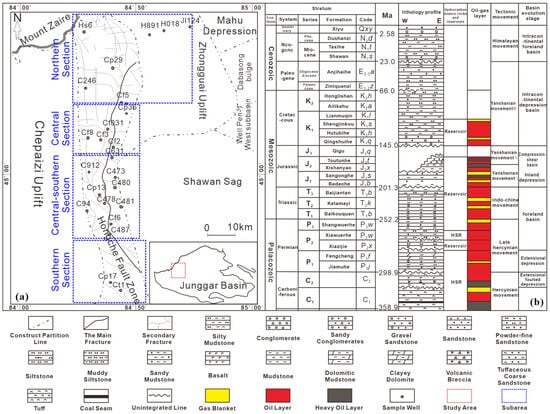
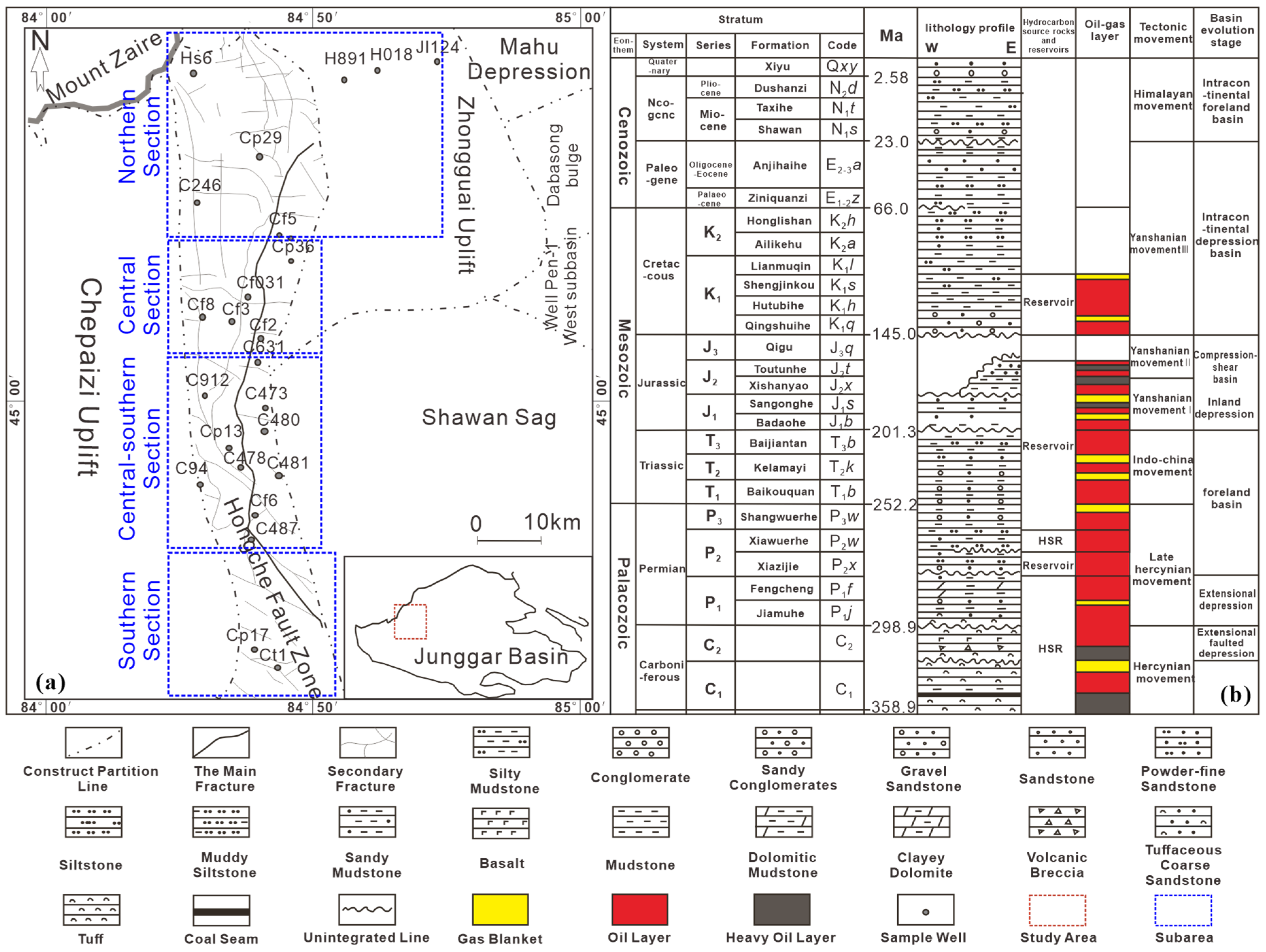
The Hongche Fault Zone is located in the southern segment of the northwestern margin of the Junggar Basin, China, striking approximately north–south. It is bounded by the Kebai Fault Zone to the north, and adjoins the Zhongguai Uplift and Shawan Sag to the east, covering an exploration area of about 1500–2000 km2 (Figure 1a) [8]. Structurally, the zone lies within a transitional domain between the West Junggar Hercynian Fold Belt and the ancient Junggar Block. Together with the Wuxia and Kebai fault zones, it constitutes a foreland thrust belt that marks the frontal part of a large-scale thrust-nappe system along the northwestern margin of the Junggar Basin [12,20].
Figure 1.
Geological Structure and Stratigraphic Column Chart of Hongche Fault Zone in Junggar Basin, (a) Structural division of the Qargalai Basin; (b) Comprehensive stratigraphic columnar diagram. Modified after reference [11,12].
The Hongche Fault Zone has experienced multiple Stages of tectonic deformation, including the Hercynian, Indosinian, Yanshanian, and Himalayan movements (Figure 1b), resulting in a complex structural framework characterized by several large-scale, north–south trending thrust faults and east-dipping step-fault zones [10,21]. Oblique compressive structures are developed regionally in the Hongche Fault Zone. In the deep subsurface, most faults in the Carboniferous–Jurassic strata are reverse faults. In contrast, small-scale normal faults are formed in the shallow subsurface. Three main tectonic styles are developed in the study area. The extensional tectonic style dominates the southern part. The central-northern part is characterized by two tectonic styles: compressive tectonic style and composite tectonic style.
The stratigraphic record in the area spans from the Paleozoic to the Quaternary, comprising, in ascending order, the Carboniferous (C), Permian (P), Triassic (T), Jurassic (J), Cretaceous (K), Paleogene, Neogene, and Quaternary (Figure 1b) [22]. Due to multi-stage tectonic activity, the Permian, Triassic, and Jurassic strata on the hanging wall of the main fault exhibit varying degrees of erosion from south to north [23]. The hydrocarbons in the Hongche Fault Belt are primarily derived from source rocks in the adjacent Shawan Sag, which contains four principal source intervals [8] (Figure 1b). These are coal-bearing mudstone (C), mudstones of the Lower Permian Jiamuhe Formation (P1j), mudstones of the Lower Permian Fengcheng Formation (P1f), and mudstones of the Middle Permian Xiawuerhe Formation (P2w). The Carboniferous strata are among the primary oil-bearing intervals in this area. These strata are mainly composed of volcanic reservoirs. Their lithologies include basalt, andesite, volcanic breccia, and tuff [13]. Faults, unconformities, and lithofacies characteristics are key factors controlling hydrocarbon accumulation within the Carboniferous reservoirs.
2. Tectonic Characteristics
2.1. Construction Layer and Indentation Structure
The Hongche Fault Zone, situated along the northwestern margin of the Junggar Basin at the junction between the West Junggar Fold Belt and the Junggar Basin [24,25], exhibits a well-defined tectonic-stratigraphic framework from the Permian to Quaternary. In this study, the GeoEast Seismic Interpretation Workstation (BGP Inc., China, Software Version 3.2) was utilized for the processing and interpretation of high-precision 3D seismic data. Initially, well logging stratigraphic division data from the study area were employed to calibrate major seismic reflection horizons, such as the top boundary of the Carboniferous System and the bottom boundary of the Permian System. Subsequently, attribute slices (including coherence cubes and variance cubes) were used to assist in fault identification [26]. Finally, manual interactive interpretation was conducted on seismic profiles to achieve fine-grained interpretation of stratigraphic sequences and faults.
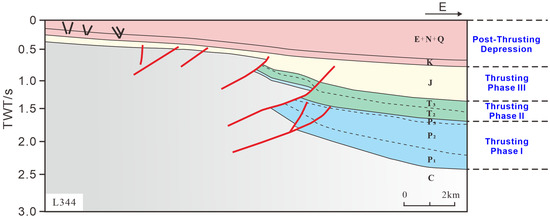
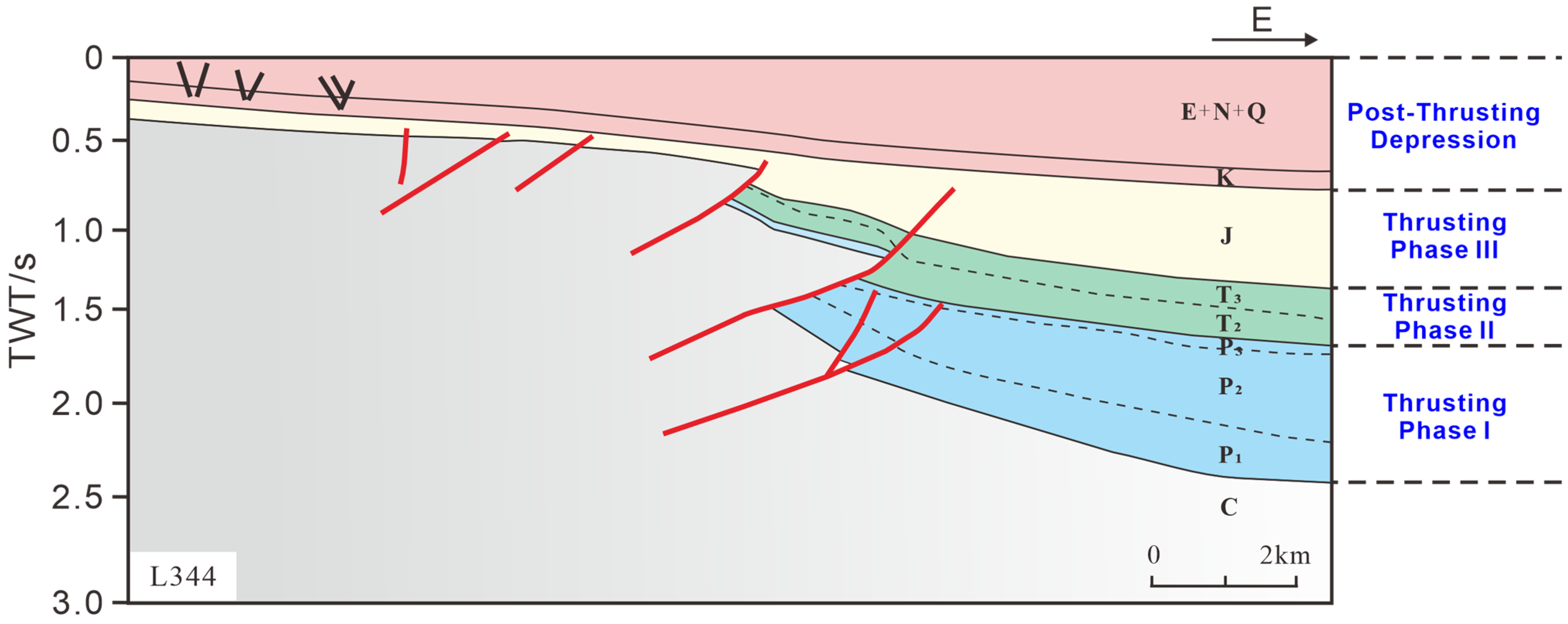
Based on key geological features—including angular unconformities and structural styles observed in seismic profiles—the studied sequence is subdivided into four major structural layers (Figure 2). Each layer corresponds to a distinct basin dynamic setting, specifically: the Permian (Thrusting Episode I), Triassic (Thrusting Episode II), Jurassic (Thrusting Episode III), and Cretaceous–Quaternary (Post-Thrusting Depression).
Figure 2.
Tectonic layer division of the Hongche Fault Zone.
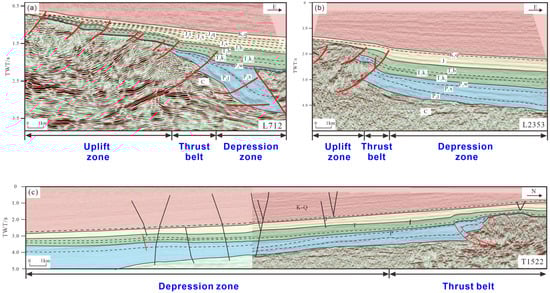
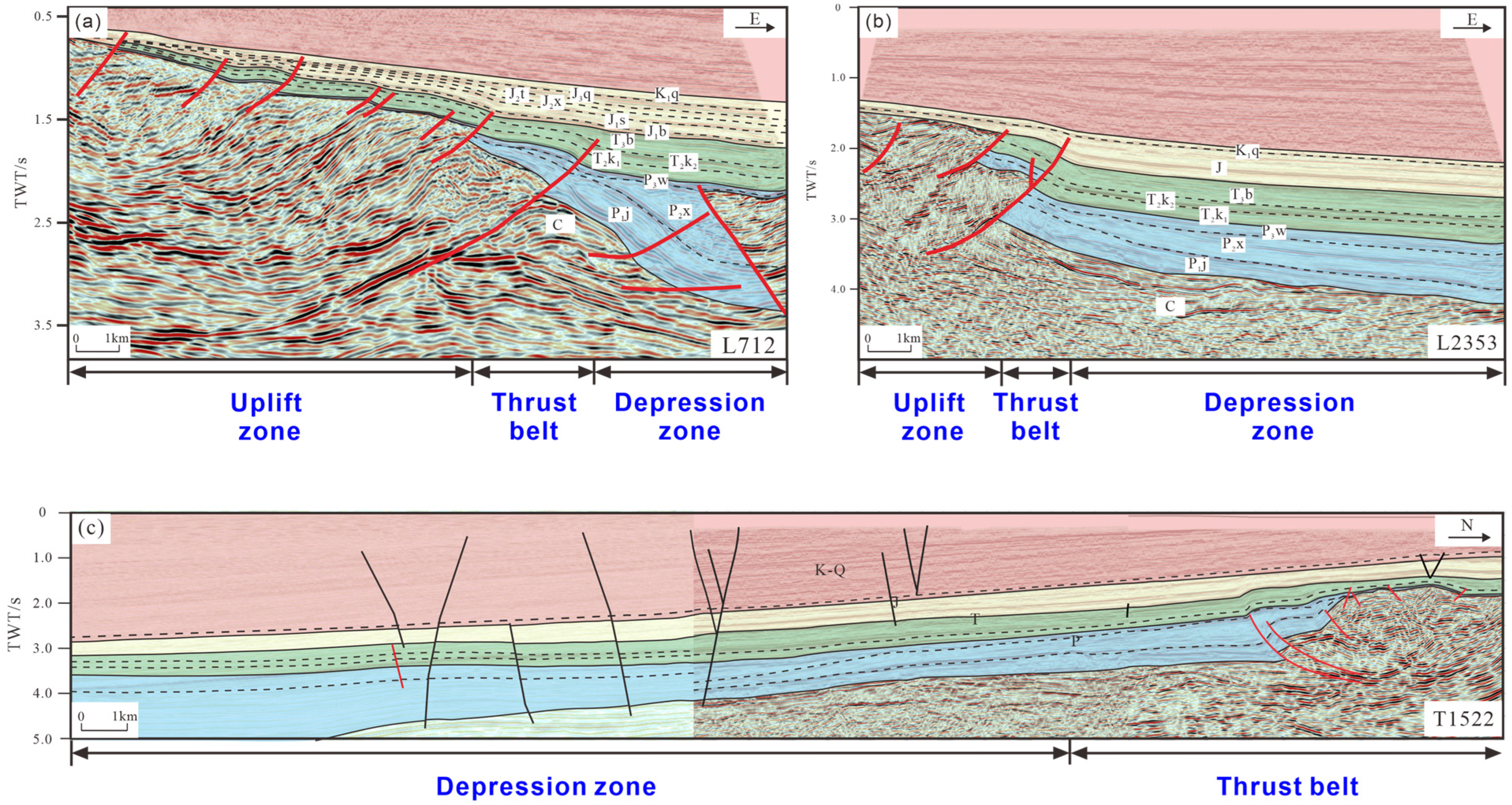
During the Permian, the region underwent intense NW-SE directed thrusting. Compressional thrusting led to significant uplift and erosion, resulting in the absence of Permian strata in the western part of the study area. Initial thrusting and nappe activity occurred along the northwestern margin of the basin, which established the fundamental structural framework of the Hongche Fault Zone and resulted in intense denudation of the western stratigraphic sequences. In the Triassic, the stress field shifted to NE-SW compression, and thrusting continued. Thrusting activity persisted and propagated toward the basin interior, further intensifying the structural differentiation pattern characterized by alternating uplifts and depressions. By the Jurassic, thrust propagation advanced further under N-S compression, accompanied by deposition of a typical foreland basin sedimentary sequence. The thrust system was eventually finalized, accompanied by the sedimentary filling typical of a foreland basin. From the Cretaceous to Quaternary, the area entered a post-thrusting depression stage, with the tectonic stress field transitioning from compression to N-S extension. The basin entered a stage of overall sagging and subsidence, with localized differential adjustment occurring in specific areas. This stage was characterized by regional subsidence with local differential adjustments. The overall structural framework shows inherited development, with strata progressively uplifted and eroded from east to west [27,28]. In terms of compressional architecture, the study area is typified by oblique compression structures [29]. Deep strata from the Carboniferous to Jurassic were subjected to multi-directional compressive stresses, forming thrust faults in varying orientations. In contrast, shallow sections experienced a later shift from compression to extension, leading to the development of small-scale normal faults (Figure 3).
Figure 3.
Compressional depression structure of the Hongche Fault Zone, (a) Seismic Profile along Line L712; (b) Seismic Profile along Line L353; (c) Seismic Profile along Line L1522.
The differentiation between deep and shallow structural styles not only controls the spatial distribution of stratigraphic sequences and the formation of traps but, more importantly, establishes a fluid migration network between deep-source rocks and shallow reservoirs, as well as among different reservoir units. This network provides critical pathways for the vertical migration and cross-reservoir conduction of hydrocarbons.
2.2. Structural Style and Planar Distribution
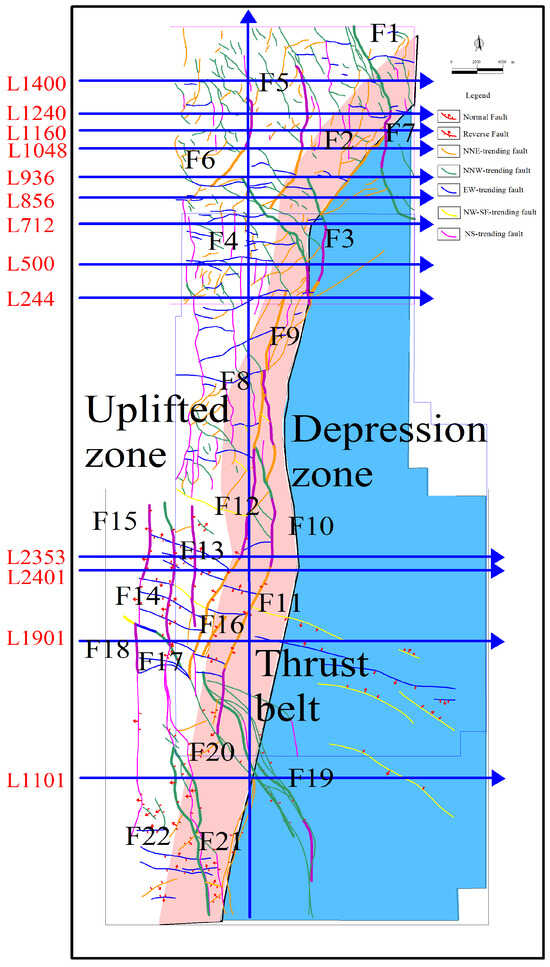
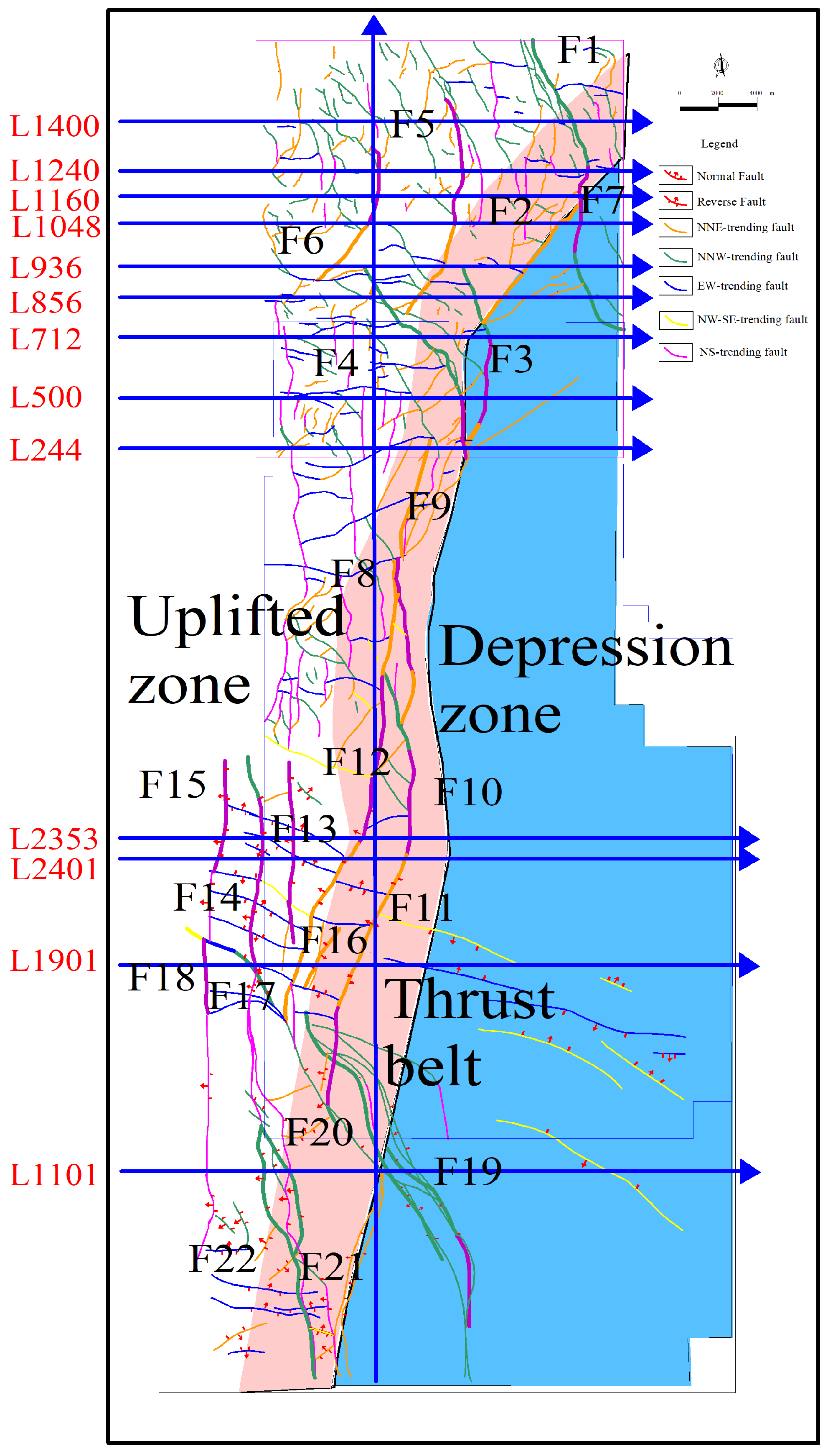
The Hongche Fault Zone exhibits an overall near-north–south (N-S) strike. Its structural styles are controlled by the foreland thrust system along the northwestern margin, while the pre-existing N-S basement structural framework governs the tectonic evolution of the entire region. This control results in the fault zone displaying distinct vertical stratification and north–south zonation characteristics in cross-sections. Second, the structural characteristics of the fault zone exhibit regular, systematic variations from north to south: The northern segment is characterized by a “uplift-thrust” assemblage, with the most intense tectonic uplift, representing the zone of strong uplift and denudation within the fault zone; The middle segment constitutes the core area of compressional deformation, functioning as the zone of intense thrusting in the fault zone; The southern segment acts as a thrust-depression transition zone (Figure 4).
Figure 4.
Tectonic Zoning of the Hongche Fault Zone.
Concurrently, the strike, activity episodes, and intensity of the dominant faults in different segments exhibit systematic variations. For instance, NNE-trending faults are more prominent in the northern segment, whereas more NNW- and NEE-trending faults develop in the middle and south-central segments. This pattern reflects the differential response of the tectonic stress field across different episodes along the north–south direction. In contrast, east–west (E-W)-trending variations are secondary in this region; dividing an N-S trending structural zone along the E-W direction would cut through its primary structural lines, failing to effectively reveal the core geological patterns. Therefore, the basic orientation of this study was designed to follow the strike of the fault zone (i.e., the north–south direction).
From north to south, the zone is divided into three major structural units: the pre-fault uplift zone, the thrust zone, and the post-fault depression zone [30] (Figure 4). North–south-oriented seismic profiles reveal an overall “low in the south, high in the north” structural morphology, with intense tectonic uplift in the northern sector (Figure 4). The depression zone preserves relatively complete stratigraphic sequences, with sedimentary layers from multiple tectonic Stages showing wedge-shaped geometries, indicating syn-sedimentary deformation. The fault system is dominated by NE-striking thrust faults, which control both the structural morphology and the burial depth distribution of the Carboniferous top surface [31].
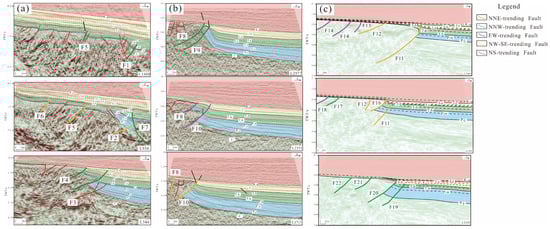
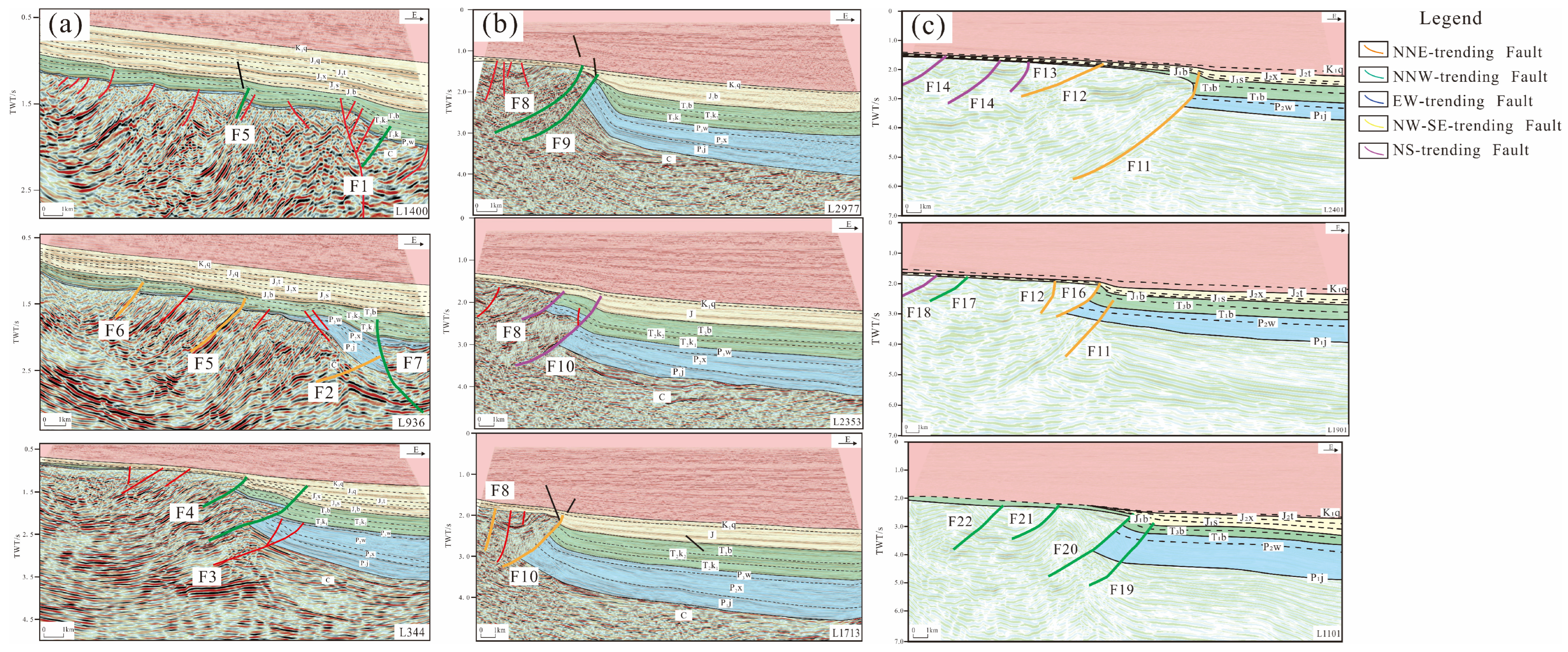
In the northern section, structural segmentation is pronounced. The northern segment exhibits a typical uplift-thrust assemblage (Figure 5a), transitioning southward into a tripartite “uplift-fault-depression” structure. Permian strata in the uplift zone are poorly preserved, with only localized remnants of Late Permian deposits. NNW-trending faults in the northern segment exhibit steep dips and often cut through to the top of the Middle Triassic, whereas NNE-trending faults are mainly confined to the uplift zone and terminate within the Middle Triassic. A series of nearly E-W-striking normal faults, frequently arranged in V-shaped patterns, are developed in shallow sections; these are underlain by EW-trending thrust faults, predominantly formed during the Cretaceous and later.
Figure 5.
Joint Profile of Tectonic Styles in the Northern, Middle and Southern Segments of the Hongche Fault Zone, (a) Interpretation of Seismic Profiles L1400, L936, and L344 in Block Hong-18; (b) Interpretation of Seismic Profiles L2977, L2353, and L1713 in Block Chepai-18; (c) Interpretation of Seismic Profiles L2401, L1901, and L1101 in Block Chepai-45.
In the central section, thrusting was more intense (Figure 5b). Under compressional thrust-nappe effects, thrust faults are well developed and were highly active, resulting in the widespread absence of Permian and Triassic deposits in the uplift and thrust zones. NNW-trending faults extend upward into the Jurassic, displaying listric geometries with steep upper segments and gentler lower segments. NNE-trending faults exhibit relatively gentler dips. Nearly NS-trending faults, interpreted as structural transition units, show weaker activity, allowing localized preservation of Permian-Triassic strata within the thrust belt.
The structural style in the south section is similar to that of central part (Figure 5c). NEE-trending faults cut through to the Jurassic and exhibit typical listric geometries, while NWW-trending fractures mostly terminate within the Triassic with gentle dips, forming a series of book-shelf thrust faults. The overall structure remains characterized by thrust-dominated layered deformation. Deep-level deformation is primarily represented by thrust nappes, whereas smaller-scale normal faults developed at shallow levels, reflecting a shift in the late-stage tectonic stress field.
The north–south (N-S) tectonic zonation of the study area exerts a critical control on hydrocarbon migration. The northern uplift zone experienced intense tectonic uplift, serving as a long-term target for hydrocarbon migration; the developed fault system primarily functions to adjust and redistribute hydrocarbons. The central thrust zone underwent the most intense tectonic deformation, where the multi-episodic fault system constitutes the primary vertical migration pathway for hydrocarbons from deep-source rocks to shallow reservoirs. In contrast, the southern depression zone preserves intact stratigraphic sequences; as the primary distribution area of source rocks, the configuration between internal faults and sand bodies within this zone controls the primary migration and early accumulation of hydrocarbons. This zonational pattern of tectonic control on hydrocarbon accumulation is the primary factor leading to the hydrocarbon distribution framework of “oil in the north, gas in the south, and multi-stratigraphic accumulation” within the Hongche Fault Zone.
2.3. Classification of Fracture Systems
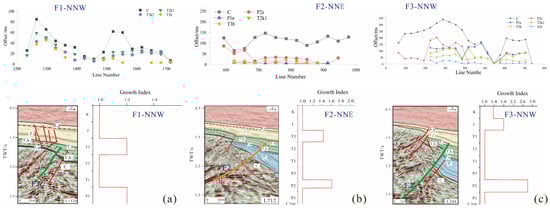
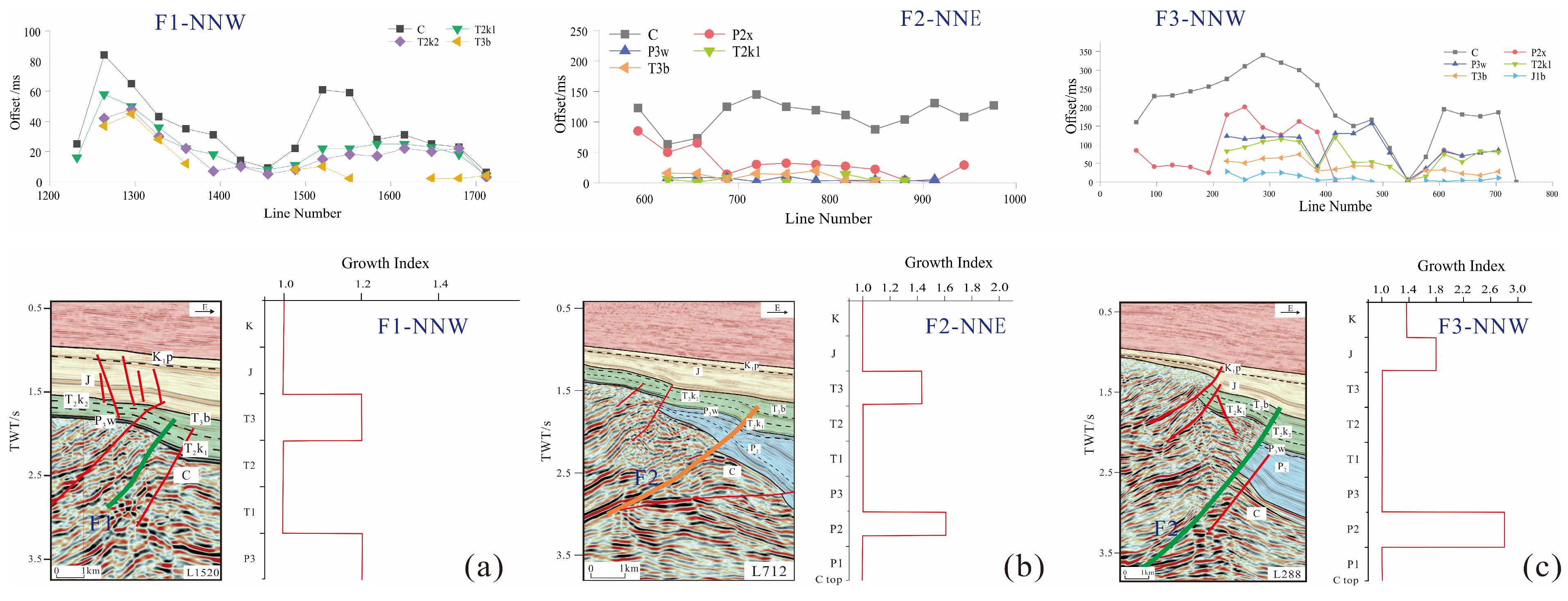
Based on integrated seismic interpretation Displacement–Distance Curve and growth strata analysis, the fault system in the study area demonstrates multi-Stage, multi-directional composite development. To characterize the spatial-temporal evolution of the Hongche Fault Zone, three representative main faults (F1, F2, F3) were selected as key research objects. Leveraging interpretations of high-precision 3D seismic data, systematic measurements of displacement were conducted along the strike of each fault (north–south direction), and corresponding displacement–distance curves were constructed to quantify slip heterogeneity (Figure 6).
Figure 6.
F1, F2, F3 displacement–distance curves and fault growth index diagrams.
Concurrently, to assess the temporal variability of fault activity across different geological periods, the growth index of each fault was calculated for multiple stratigraphic horizons. Defined as the ratio of the thickness of hanging-wall strata to that of footwall strata for the same horizon [32], this index serves as a quantitative proxy for fault activity intensity: a growth index > 1 indicates intense fault activity during the deposition of the target horizon, whereas a growth index ≈ 1 denotes weak or ceased fault activity [33].
For the displacement–distance curves of the three main faults (F1, F2, F3) in the Hongche Fault Zone, distinct morphological features are observed, each corresponding to a specific stage of fault evolution and validated by the growth index of associated stratigraphic horizons.
- Basal “Broad, Low-Amplitude Uplift” (Fault Initiation Stage, Permian)
A broad, low-amplitude “basal” uplift is present at the base of the displacement–distance curves (Figure 6). This morphological feature represents the initial displacement profile of the faults during their formation [34,35]. Consistent with this, the growth index of the faults in Permian strata is significantly greater than 1.0, indicating that the faults initiated and underwent intense activity during the Permian—directly linking the curve’s basal uplift to the onset of faulting.
- 2.
- High-Amplitude “Sharp Main Peak” (Main Fault Activity Stage, Triassic)
Superimposed on the broad Permian uplift, a high-amplitude, sharp “main peak” is observed in the middle segment of the curves. The asymmetry of this main peak indicates the initiation point and propagation direction of fault rupture (e.g., rupturing from north to south, consistent with the N-S strike of the Hongche Fault Zone). Quantitatively, the growth index of the faults reaches its peak in Triassic strata (far greater than 1.0) (Figure 6a,b), confirming that the Triassic represents the main activity stage of the faults—with the main peak’s high amplitude reflecting the maximum slip accumulated during this period.
- 3.
- “Secondary Peak” on F2 and F3 Curves (Sustained Fault Activity Stage, Jurassic)
On the displacement–distance curves of Faults F2 (Figure 6b) and F3 (Figure 6c), a distinct “secondary peak” is present on the right side of the main peak (Triassic stage). This secondary peak is interpreted as the superimposed effect of a third fault activity episode (Stage III). During the Jurassic, although the growth index of the faults decreases compared to the Triassic, it remains generally greater than 1—indicating that the faults continued to be active but with reduced intensity relative to the main activity stage (Triassic).
- 4.
- Curve Flattening (Fault Inactivity Stage, Cretaceous–Cenozoic)
In the upper part of the displacement–distance curves (corresponding to Cretaceous and Cenozoic strata), the curve morphology flattens, with no new amplitude peaks observed. This is consistent with the growth index of the faults, which rapidly decreases to approximately 1 in Cretaceous and Cenozoic strata—signifying that fault activity weakened significantly or ceased entirely during this period.
Thus, according to cross-cutting relationships and timing constraints of fault activity, the fault evolution can be divided into four distinct stages (Figure 6). Marked differences in activity history and intensity are observed among faults of different orientations. NNE-trending faults primarily formed during Stage I under NWW-directed compression, with activity largely confined to Stage I or persisting through Stage III (Stage I–III). In contrast, NNW-trending faults initiated mainly during Stage II or remained active from Stage I to Stage III, indicating a transformation of the regional tectonic stress field during the Late Triassic (Figure 7).
Figure 7.
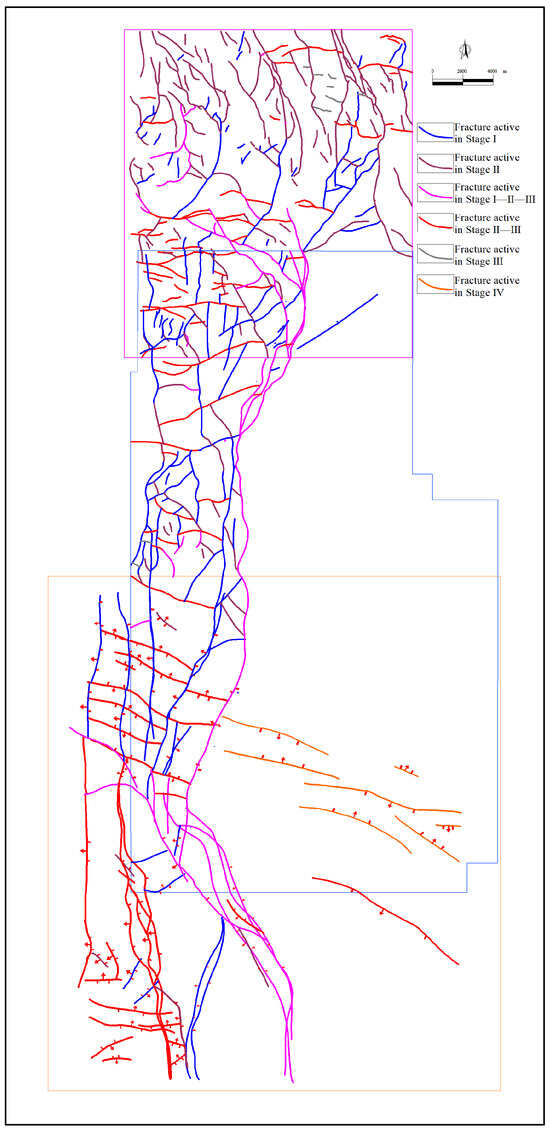
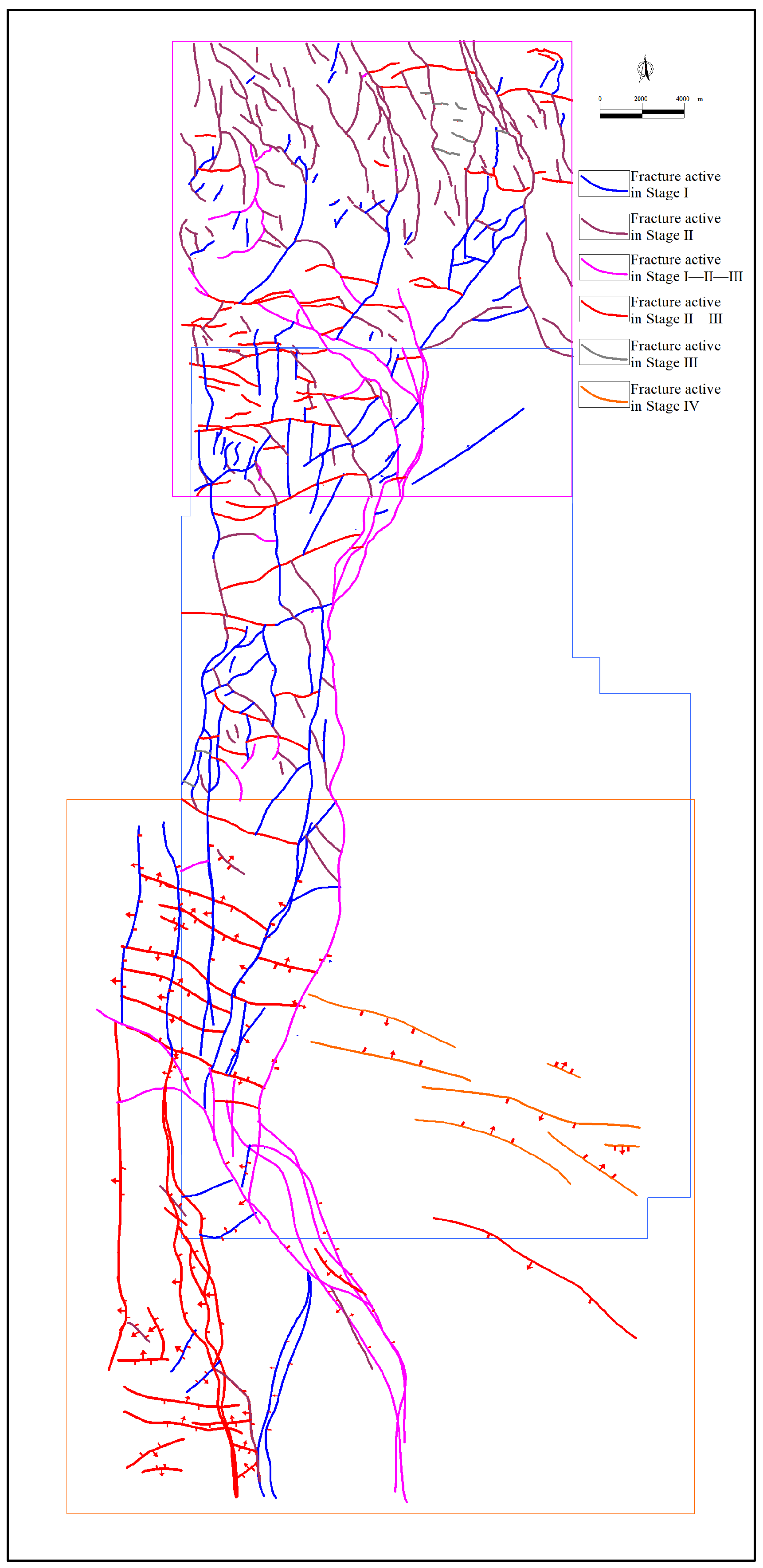
Fault system division of the top Carboniferous.
Analysis of fault activity reveals a clear progression in both style and orientation, initiating with NNE-trending reverse faults in the Middle Permian (Stage I), transitioning to NNW-trending reverse faults in the Late Triassic (Stage II) and nearly EW-trending reverse faults in the Jurassic (Stage III), and culminating with EW-trending normal faults from the Cretaceous onward (Stage IV), which indicates a regional stress field transition from compression to extension.
Six distinct fault systems have been identified in the study area (Figure 7): those active in the Middle Permian (Stage I), Late Triassic (Stage II), Jurassic (Stage III), and since the Cretaceous (Stage IV), as well as composite systems active from the Middle Permian to Jurassic (Stages I–III) and from the Late Triassic to Jurassic (Stages II–III). These fault systems exhibit clear planar distribution patterns from the Carboniferous to the top of the Cretaceous, demonstrating layered, zonal, and multi-Stage characteristics. Substantial variations are observed in strike, activity duration, and fault nature among the systems (Table 1).
Table 1.
Statistical Table of Relevant Elements for Fault Characteristics at the Top of the Carboniferous System.
The Stage I fault system, developed mainly near the top of the Carboniferous, is concentrated in the northwestern tectonic belt and strikes predominantly NNW. These faults are moderate in scale but exhibit considerable extension lengths and high density, playing a key role in controlling the early structural framework. The Stage II system occurs primarily at the Permian top, exposed in the northern and central slope zones. It consists largely of small- to medium-sized NNW-trending faults and long SN-trending faults, with limited distribution and low density. The Stage III fault system—corresponding to the secondary activity episode identified in the displacement–distance curves of Faults F2 and F3—primarily developed within the Jurassic strata and along the Jurassic top boundary. Spatially, these faults are concentrated in the south-central portion of the study area, dominated by moderate-scale reverse faults with a near-east–west (near-E-W) strike.
This fault system exhibits a moderate density, and its faults frequently intersect with pre-existing (early-stage) faults. Geologically, this system exerted a critical influence on two key processes: (1) the finalization of the tectonic framework at the end of the Jurassic, and (2) the subsequent tectonic differentiation of the Hongche Fault Zone during the Cretaceous–Cenozoic period. The Stages II–III composite system is distributed from the southern thrust zone to the uplift transition belt, dominated by small- to medium-sized NNE- and near-EW-trending faults of relatively low density.
The combined fault activity across Stages I (Permian), II (Triassic), and III (Jurassic) constitutes a compound active fault system—defined as an assemblage of faults that exhibit multi-episodic activity characteristics along the same fault zone, resulting from the superposition and reworking of tectonic movements across different geological periods.
Spatially, this compound fault system is primarily distributed in the overlapping regions of the northern and central structural belts of the Hongche Fault Zone, with diverse strikes (including NNW, NNE, and approximately north–south [N-S]) and moderate to high fault density. This combination of strike diversity and density explicitly indicates multi-stage tectonic superposition.
This distribution and structural signature align with the earlier observations of fault activity: the northern structural belt (dominated by Stage I “uplift-thrust” assemblages and moderate Stage III activity) and the central structural belt (the core of Stage II intense thrusting with secondary Stage III superposition) overlap to create a zone where multi-stage fault movements are concentrated. The superposition of these stages—each with distinct dominant strikes (e.g., Stage I N-S basement-controlled trends, Stage II NNW compressional strikes, Stage III NNE secondary adjustments)—gives rise to the diverse strike patterns, while cumulative faulting events contribute to the moderate-to-high density, collectively forming the distinct compound activity signature. The Stage IV fault system is widely developed at the Cretaceous top, concentrated in the central–eastern tectonic transition zone. It is dominated by large EW-trending faults with high distribution density, reflecting intense late-stage tectonic activity.
2.4. Conductivity Characteristics of Fault Systems
The aforementioned multi-episodic (Stages I–III) and multi-strike (NNW, NNE, near-N-S) fault systems exhibit a close correlation with the connectivity of Carboniferous volcanic reservoirs. Two key fault-related factors govern the reservoir’s hydrocarbon-bearing potential:
- Timing Matching Determines the Effectiveness of Oil–Source Faults
The temporal alignment between the activity duration of faults across different episodes and the main hydrocarbon generation period of source rocks (Middle–Late Triassic) dictates whether a fault functions as an effective oil–source fault. Specifically, faults active during or overlapping with the Middle–Late Triassic can establish direct pathways between deep source rocks and shallow volcanic reservoirs, enabling efficient hydrocarbon migration. In contrast, faults inactive during this critical period (e.g., Stage I faults that ceased activity post-Permian) lack the capacity to transport hydrocarbons generated later, limiting their role as effective oil–source conduits.
- 2.
- Fault Geometry Controls Reservoir Fracture Network and Permeability
The strike, density, and assemblage pattern of the fault system directly regulate two key properties of Carboniferous volcanic reservoirs: (1) the development intensity of internal fracture networks, and (2) the spatial configuration of these fractures. These factors, in turn, govern the reservoir’s overall permeability and anisotropy—critical parameters for hydrocarbon storage and flow [36].
In summary, the northern, central, and southern segments of the Hongche Fault Zone form an integrated tectonic system in terms of tectonic style, fault assemblage, and geological significance: The northern segment (uplifted area) is characterized by intense uplift and erosion, serving as a long-term target area for hydrocarbon migration; The central segment (thrust area), as the core of compressional deformation, develops multi-stage active faults, which constitute preferential pathways for vertical hydrocarbon migration; The southern segment (depressed area) preserves complete strata and represents the main distribution area of source rocks, where the internal fault system controls the early-stage hydrocarbon accumulation. This north–south zoned tectonic framework has resulted in the differential distribution of oil and gas reservoirs and the diversification of hydrocarbon accumulation models in the study area.
3. Hydrocarbon Source and Charging Pathways
3.1. Oil Source Allocation Mechanism
The crude oil in the Carboniferous reservoirs of the Hongche Fault Zone is mainly sourced from the Fengcheng and Lower Wuerhe mudstones, whereas natural gas is predominantly generated from the coal-bearing mudstone (C) and the Jiamuhe (P1j) and Fengcheng (P1f) mudstones [8,37].
Hydrocarbon distribution in the study area is strongly controlled by the structural framework of the Hongche Fault Belt. Different fault systems govern distinct hydrocarbon accumulation patterns: the Stage I thrust fault system, developed mainly in the uplifted area, hosts hydrocarbons primarily within Carboniferous strata. In contrast, multi-stage active faults in the thrust zone result in accumulations across both Carboniferous and overlying formations, exhibiting complementary oil-bearing behavior between upper and lower sequences.
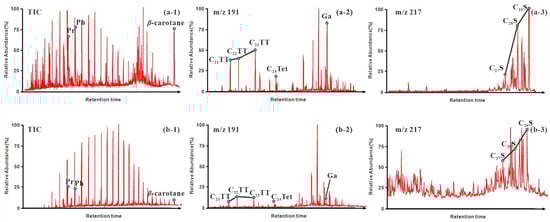
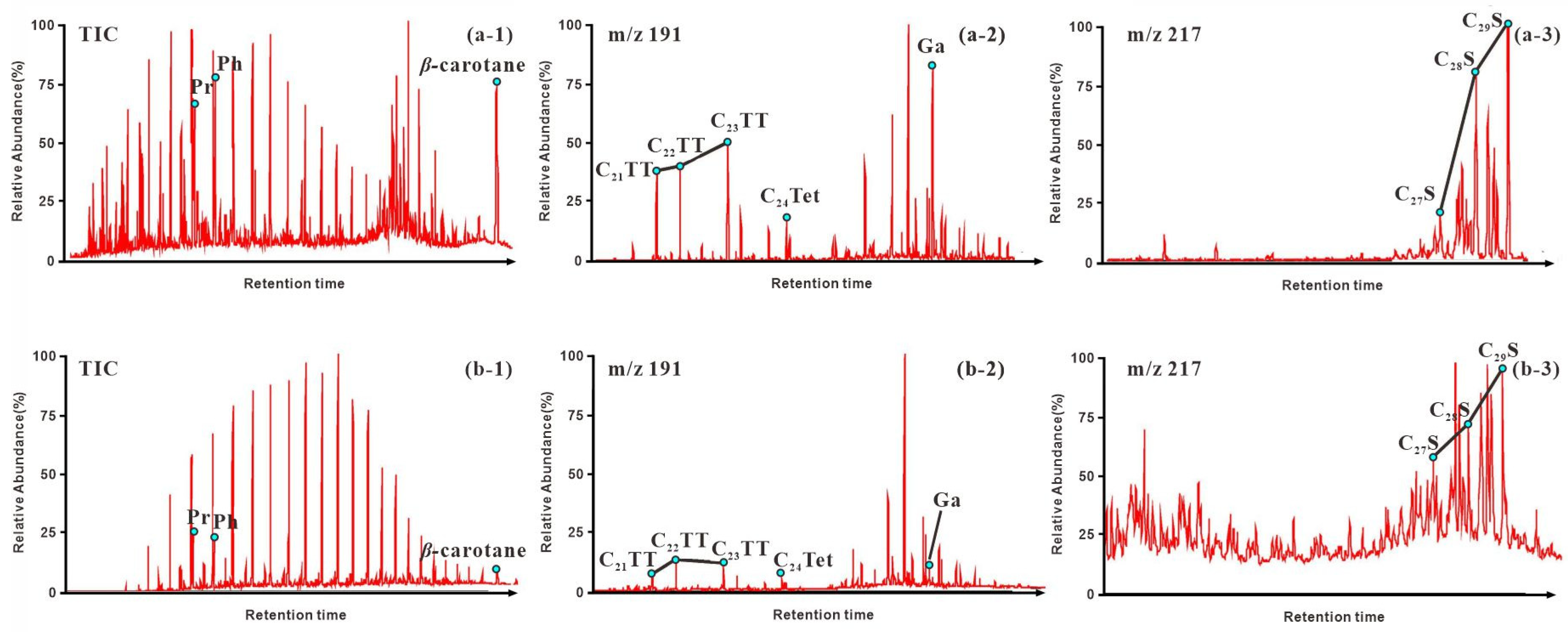
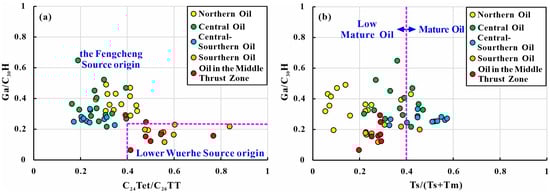
Significant geochemical differences exist between the two principal source rocks-the Fengcheng and Lower Wuerhe formations. Fengcheng source rocks are characterized by low pristane/phytane ratios (0.46–0.97), high C23TT, low C24Tet, and moderate to high gammacerane (Ga) and β-carotane (Figure 8a). In comparison, Lower Wuerhe samples show pristane/phytane ratios of 0.76–1.84, high C21TT, high C24Tet, and low (Ga) and β-carotane (Figure 8b) [8]. Oils in Carboniferous reservoirs generally display high β-carotane, high gammacerane (Ga/C30H > 0.22), and low C24Tet (C24Tet/C26TT < 0.45), indicating a dominant contribution from the Fengcheng Formation (Table 2) [38]. However, in the central thrust zone of the Hongche Fault Belt, oil characteristics correlate more closely with those of the Lower Wuerhe Formation, suggesting a secondary contribution from this interval (Figure 9a) (Table 2). In general, the crude oil accumulated in the Carboniferous reservoirs within the Hongche Fault Zone is primarily derived from the source rocks of the Fengcheng Formation.
Figure 8.
GCMS chromatograms showing the distribution of normal alkanes, tricyclic terpanes, hopanes, and sterane in source rock: (a-1–a-3) Fengcheng source rock; (b-1–b-3) Lower Wuerhe source rock. Modified after reference [11].
Table 2.
Geochemical Parameters of Oils in Carboniferous reservoirs.
Figure 9.
Carboniferous reservoir crude oil biomarker comparison: (a) Ga/C30H-C24Tet/C26TT Cross-Plot; (b) Ga/C30H-Ts/(Ts + Tm) Cross-Plot, modified after Li et al. (2023) [11].
Ts/(Ts + Tm) is thermal parameter based on relative stability of C27 hopanes applicable over the range immature to mature to postmature. When the ratio is less than 0.4, it indicates that the crude oil is immature-low maturity oil. When the ratio is greater than 0.4, it indicates that the crude oil is in the mature stage [39]. In the study area, crude oil maturity trends further indicate that oils in different structural segments were generated at varying stages of source rock maturation: the northern area contains low mature to mature oils, the central area mature oils, and the southern area low mature to mature oils (Figure 9b).
Previous studies indicate that the Fengcheng Formation source rocks in the Shawan Sag entered the oil window during the Triassic (R0 = 0.5–1.0%), and fluid inclusion analyses reveal a phase of hydrocarbon charging in Carboniferous reservoirs during the Middle to Late Triassic [22,40]. Therefore, integration of source rock maturation history, reservoir fluid activity, and oil maturity characteristics suggests that the Middle to Late Triassic was the primary charging period for Carboniferous reservoirs in the Hongche Fault Belt.
3.2. Tracing of Crude Oil Migration Pathways
In hydrocarbon accumulation studies, physical and chemical properties of crude oil, particularly density, viscosity and maturity serve as effective proxies for tracing migration pathways due to their sensitivity to transport processes [41]. The migration and expulsion of crude oil are controlled by the maturity gradient of source rocks. Low-maturity crude oil, generated in the early stage of source rock evolution, is preferentially expelled. This low-maturity crude oil also leads the migration front. As a result, a trend emerges: along the oil charging direction, the maturity of crude oil decreases gradually.
During the long-distance lateral migration of crude oil in sandbody–conduit systems, the geochromatographic effect dominates, leading to a gradual decrease in oil density and viscosity along the charging direction. In contrast, when oil and gas migrate through open fractures, processes such as loss (of light components) and oxidation become predominant; consequently, crude oil viscosity and density exhibit a gradual increase with increasing migration distance.
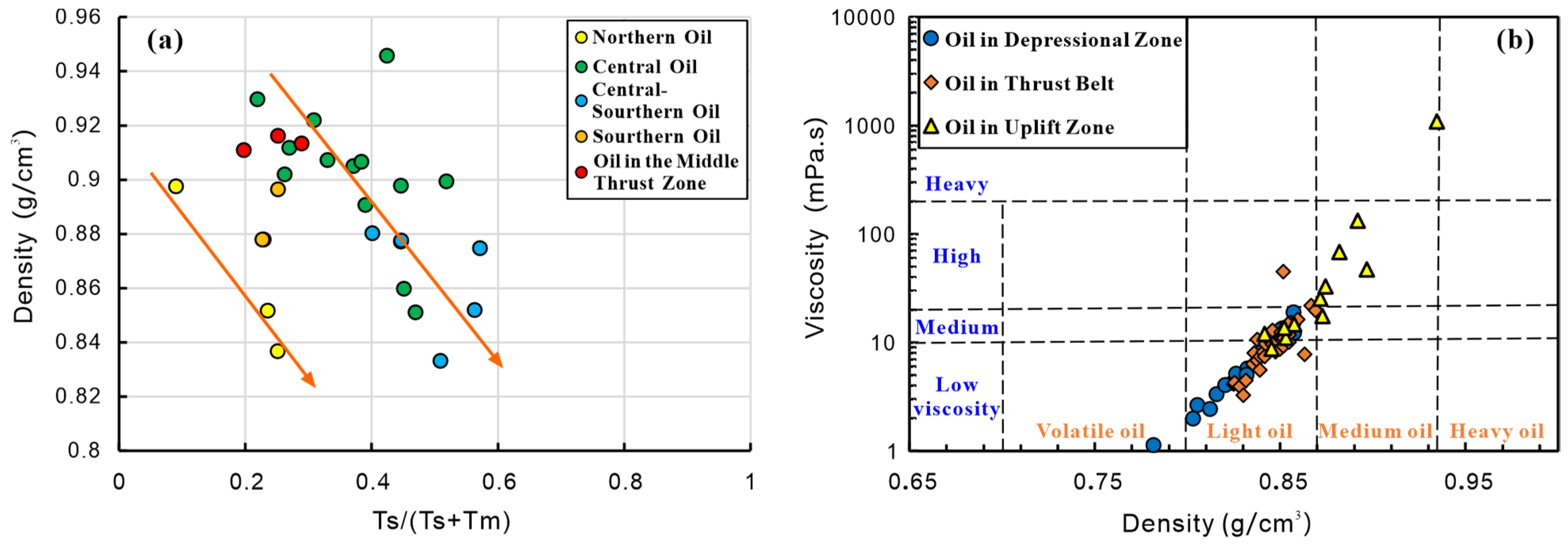
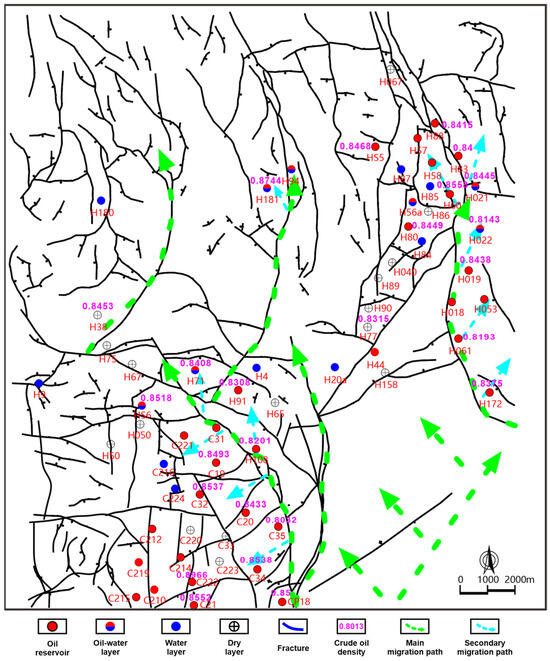
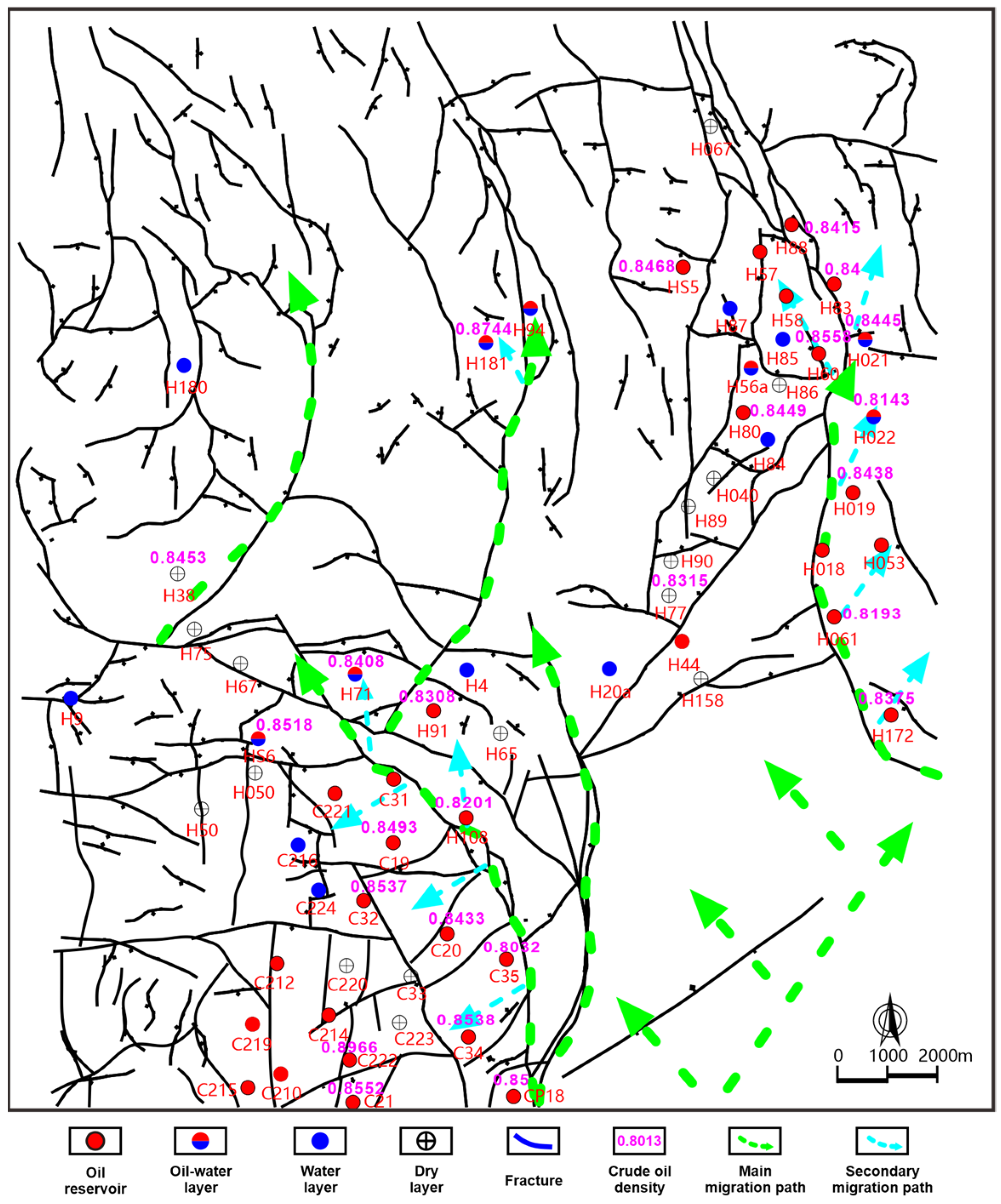
Recent studies have confirmed a clear correlation between the significant increase in crude oil viscosity within the study area and the presence of open fractures. This finding aligns with the perspective proposed in this research that fractures serve as the primary conduits for hydrocarbon migration [17]. In this study, density measurements of crude oil samples from Carboniferous reservoirs in the Hongche Fault Zone were used to reconstruct hydrocarbon charging pathways. To ensure that crude oil density can indicate the direction of crude oil migration, a correlation analysis between oil maturity and density was conducted. The results revealed a negative correlation between these two parameters across different zones. This finding confirms that crude oil density decreases gradually as its maturity increases (Figure 10a). Then, the planar distribution of oil density is largely controlled by the regional structural framework, which exhibits a typical “uplift-thrust-depression” configuration. Oil density and viscosity generally increase from the depression area toward the uplift zone (Figure 4 and Figure 10b), indicating that the filling process was governed by the maturity gradient of source rocks and Fractured transport system. The low-maturity crude oils are primarily accumulated in thrust fault zones and uplifted areas. During the migration of these oils through fractures (the main migration pathway), they undergo secondary modifications such as biodegradation and water washing [17]. As a result, the oil types are dominated by medium-gravity to heavy-gravity crude oils. Whereas light oils generated at higher maturity stages are preserved in the depression to thrust zones.
Figure 10.
Crude oil Physical property plate of the Carboniferous reservoir in the northern segment of the Hongche Fault Zone, (a) Density vs. Ts/(Ts+Tm) crossplot; (b) Viscosity vs. Density crossplot.
These trends enable reconstruction of hydrocarbon charging routes. In the northern Hongche Fault Zone, for example, oil density ranges from 0.80–0.85 g/cm3 near the Shawan Sag and increases northward, reaching a maximum of 0.87 g/cm3 in uplifted areas. This pattern confirms a macro-scale south-to-north charging direction, with two distinct migration pathways: a northwestern charging trend in the western H18 well area, and a south–north trend in the eastern Jinlong well area (Figure 11). These two oil charging directions are consistent with the strike of faults active in stages II and III. This consistency confirms that the direction of hydrocarbon charging is mainly controlled by faults active in the Thrusting Episode II and III.
Figure 11.
Migration path tracing in the northern segment of the Hongche Fault Zone.
4. The Controlling Effect of the Fault System on Hydrocarbon Accumulation
4.1. Hydrocarbon Transport Systems
Transport systems act as critical “bridges” connecting source rocks with traps in petroliferous basins, comprising all migration conduits such as carrier beds, faults, unconformities, and their composites. In practice, these elements rarely act alone; instead, two or more components typically combine to form a composite migration network. The eventual formation of hydrocarbon accumulations results from complex migration, accumulation, and redistribution processes through such composite conduits.
In the Hongche Fault Zone, the Carboniferous reservoir exhibits clear zonation (E-W) and segmentation (N-S) in its passage systems. The northern segment experienced strong tectonic uplift, leading to well-developed paleo-weathering crust at the Carboniferous top and abundant fracture-dissolution porosity (fracture–vug systems) in volcanic reservoirs [36,42]. Here, hydrocarbon migration occurred mainly along faults and the unconformity-controlled weathering crust. Southward, as tectonic activity and fracture intensity decrease, the system transitions to a fault-volcanic rock composite conduit. This variation results in different accumulation models: the northern segment exhibits pervasive oil occurrence with local enrichment controlled by fracture–vug systems, whereas the southern segment shows layered accumulation dominated by volcanic lithology. In both models, faults serve as the primary migration pathways, controlling the timing, direction, and effective trap configuration of hydrocarbon emplacement.
4.2. Fault-Controlled Charging Process
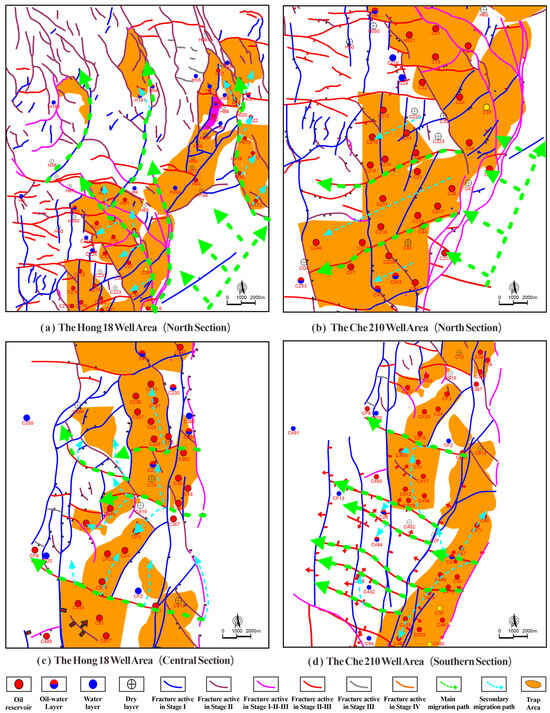
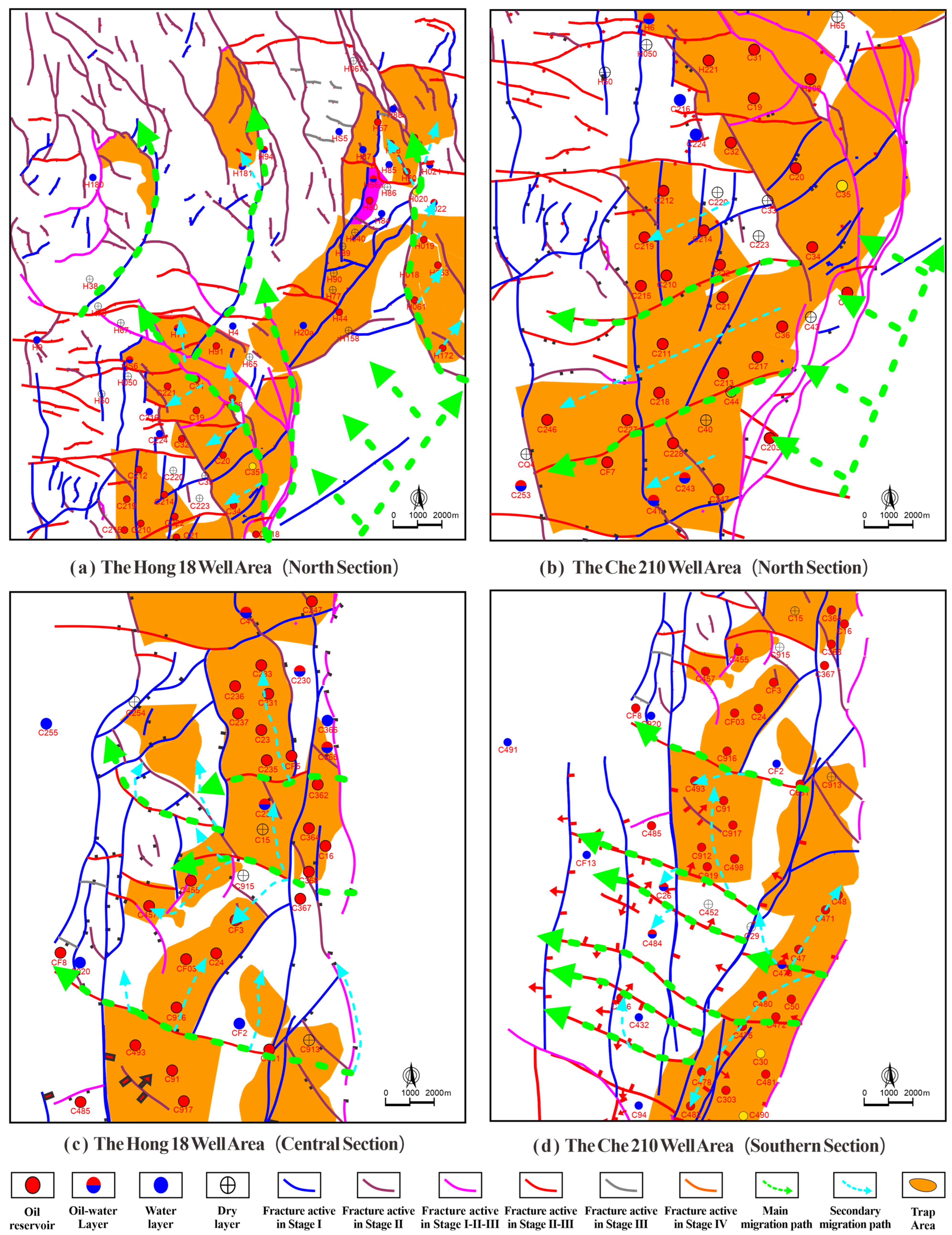
Integrated analysis of fault activity, fault system classification, oil–source correlation, migration pathways, and reservoir distribution reveals that faults of different phases exerted distinct controls on Carboniferous hydrocarbon migration. The study area underwent four main tectonic phases: Thrusting Episode I (Permian), Thrusting Episode II (Triassic), Thrusting Episode III (Jurassic), and Post-Thrusting Subsidence (Cretaceous–Quaternary). The Carboniferous reservoirs are primarily sourced by the Permian Fengcheng Formation source rocks in the Shawan Sag, which entered peak oil generation during the Triassic. This timing is consistent with fluid inclusion evidence indicating that the Triassic was the key accumulation period [38,42]. Faults active during Thrusting Episode I (Permian) had ceased moving by the main charging period, thus contributing little to hydrocarbon migration. Instead, they likely acted as lateral seals, controlling hydrocarbon charging process and forming numerous fault-lithologic traps in the region (Figure 12).
Figure 12.
Relationship between Carboniferous fault system, migration paths and reservoir configuration.
- Stage I faults act as reservoir-controlling faults
The main active period of Stage I faults is the Middle Permian. During this period, the source rocks of the Fengcheng Formation in the Shawan Sag had not yet entered the stage of large-scale hydrocarbon generation, and no large-scale hydrocarbon migration occurred. By the main hydrocarbon accumulation period (Late Triassic), Stage I faults had ceased activity. Their role as fluid migration channels was therefore limited.
As shown in Figure 12c,d, the reservoirs in the study area are generally distributed in a near north–south banded pattern. This distribution is basically consistent with the strike of Stage I faults. This consistency indicates that Phase I faults mainly act as sealing faults to control the distribution of oil reservoirs.
- 2.
- Stage II and III faults control charging pathways and charging directions
During the Triassic (Thrusting Episode II), NE-SW compression gave rise to numerous thrust faults striking NNW and SW. These faults served as the primary charging pathways. After being expelled from source rocks, hydrocarbons migrated vertically into the Carboniferous via the Hongche Fault. Subsequently, they moved laterally into thrust zones and uplift zones through Stage II faults. Affected by the paleotopography (higher in the north and lower in the south), the oil charging direction shifted from NNW to SN. Between the Stage I faults striking NNE, hydrocarbons filled reservoirs in a “stripped” pattern.
In the northern part (e.g., H18 and C210 Well Areas), the developed paleo-weathering crust and fractured volcanic rocks enabled piston-like oil advancement and pervasive oil charging [36,42]. This resulted in the formation of large-scale oil-bearing volcanic bodies, with high-quality reservoirs showing enrichment (Figure 12a,b). In the central-southern segment, where fracture development is limited, hydrocarbons preferentially migrated in a finger-like manner into volcanic layers with higher permeability (Figure 12c,d).
Many faults active during Thrusting Episode III (Jurassic) inherited the orientations and distributions of faults from Stage II. These later faults mainly modified or redistributed oil pool formed earlier. In contrast, some Stage II faults transitioned from migration conduits to sealing faults during this stage. Locally, they played a role in controlling hydrocarbon migration.
- 3.
- Stage IV faults control controls Charge process in the Meso-Cenozoic reservoirs
During the Post-Thrusting Depression (Stage IV), faulting was concentrated near the Cretaceous top, exerting minimal influence on the deep Carboniferous reservoirs but serving as important conduits for Mesozoic–Cenozoic hydrocarbon systems.
5. Conclusions
- (1)
- Vertically, the Hongche Fault Zone has experienced “three Stages of thrusting and one Stage of weak extensional depression”, resulting in “three major deformation zones and six sets of fault systems”. The long term thrusting of active faults has created an alternating pattern of uplifts and depressions.
- (2)
- The fault system in the study area is characterized by multi-stage and multi-trend composite development. The NNE-trending faults were mainly formed in Stage I, controlled by the NWW-directed compressive stress. Most of them only showed activity in Stage I or continued to be active until Stage III. The NNW-trending faults mainly started to be active in Stage II or were active from Stage I to Stage III, reflecting the transformation of the tectonic stress field in the Late Triassic.
- (3)
- The oil sources of the Carboniferous reservoirs in the Hongche Fault Zone are mainly from the source rocks of the Permian Fengcheng Formation and the Lower Wuerhe Formation in the Shawan Sag. Tracer analysis of the migration path indicates that the migration of crude oil is mainly controlled by faults active during Thrusting Episodes II and III.
- (4)
- The faults active at different stages in the Hongche Fault Zone controlled the hydrocarbon accumulation process of the Carboniferous reservoirs. The Stage I faults mainly act as reservoir-controlling faults. The Stage II and III faults serve as the primary migration pathways for hydrocarbons in the Carboniferous reservoirs. They control the hydrocarbon charging pathways, charging directions, and readjustment of hydrocarbon accumulation. The Stage IV faults are of great significance for the hydrocarbon conduction in the Meso-Cenozoic reservoirs of the study area.
- (5)
- This research provides theoretical guidance for optimizing exploration targets and reserve development in Carboniferous reservoirs of the Hongche Fault Zone.
Author Contributions
Conceptualization, C.H. and Y.S. (Yonghe Sun); Methodology, C.H., Y.S. (Yonghe Sun) and J.F.; Software, M.H.; Validation, X.Y.; Investigation, C.H., H.Z., X.Y., J.F. and Y.S. (Yulin Song); Resources, C.H., H.Z., X.Y. and J.H.; Data curation, Y.S. (Yulin Song); Writing—original draft, C.H. and J.F.; Writing—review & editing, C.H. and Y.S. (Yonghe Sun); Visualization, H.Z., M.H. and Y.S. (Yulin Song); Supervision, Y.S. (Yonghe Sun) and J.H.; Project administration, J.H.; Funding acquisition, Y.S. (Yonghe Sun). All authors have read and agreed to the published version of the manuscript.
Funding
This research was funded by [the National Natural Science Foundation of China], grant number [42472190].
Data Availability Statement
The original contributions presented in this study are included in the article. Further inquiries can be directed to the corresponding author.
Conflicts of Interest
Authors Cheng Huang, Huafeng Zhou, Xiaofan Yang and Junwei Han were employed by No.1 Oil Production Plant, PetroChina Xinjiang Oilfield Company. The remaining authors declare that the research was conducted in the absence of any commercial or financial relationships that could be construed as a potential conflict of interest.
References
- Wang, Q. Study on the Difference in the Evolution Mechanism of Strike-Slip Fault System and Its Relationship with Oil and Gas Distribution in the Western Depression of Liaohe Subbasin. Ph.D. Thesis, Northeast Petroleum University, Daqing, China, 2023. [Google Scholar] [CrossRef]
- Xu, Z.; Ma, Q. Zonal Differential Deformation and Reservoir Control Model of Ordovician Strike-Slip Fault Zone in Tahe Oilfield. Mar. Orig. Pet. Geol. 2022, 27, 124–134. [Google Scholar] [CrossRef]
- Cai, Z.; Chen, F.; Jia, Z. Types and Tectonic Evolution of Junger Basin. Earth Sci. Front. 2000, 7, 431–440. [Google Scholar]
- Xu, H.; Xu, C.; Li, Z.; Liu, D.; Liu, W. Characteristics of Strike-Slip Faults in the Northwestern Margin of Junggar Basin and Their Geological Significance for Petroleum. Geol. J. China Univ. 2008, 14, 217–222. [Google Scholar] [CrossRef] [Scilit]
- Guo, W.; Wu, K.; Ren, B. Deformation Mechnisim and Petroleum Accumulation of the High Angle Fault in the Western Circle Zone of Mahu Depression, Junggar Basin. Xinjiang Pet. Geol. 2016, 34, 263–268. [Google Scholar] [CrossRef]
- Chen, S.; Guo, S.; Qi, J.; Xing, X. Three-Stage Strike-Slip Fault Systems at the Northwestern Margin of the Junggar Basin and Their Implications for Hydrocarbon Exploration. Oil Gas Geol. 2016, 37, 322–331. [Google Scholar] [CrossRef]
- Guan, S.; Li, B.; Hou, L.; He, D.; Shi, X.; Zhang, Y. New Hydrocarbon Exploration Areas in Footwall-Covered Structures of the Northwestern Margin of the Junggar Basin. Pet. Explor. Dev. 2008, 35, 17–22. [Google Scholar] [CrossRef] [Scilit]
- Dong, X.; Li, J.; Pan, T.; Xu, Q.; Chen, L.; Ren, J.; Jin, K. Hydrocarbon Accumulation Conditions and Exploration Potential of Hongche Fault Zone in Junggar Basin. Acta Pet. Sin. 2023, 44, 748–764. [Google Scholar] [CrossRef]
- Cao, J.; Zhang, Y.; Hu, W.; Yao, S.; Wang, X.; Zhang, Y.; Tang, Y. The Permian Hybrid Petroleum System in the Northwest Margin of the Junggar Basin, Northwest China. Mar. Pet. Geol. 2005, 22, 331–349. [Google Scholar] [CrossRef] [Scilit]
- Wu, K.; Liu, B.; Liu, Y.; Jia, C.; Guo, J.; Li, S. Characteristics, Formation and Evolution of Fault System in Zhongguai Uplift of Junggar Basin, China. J. Earth Sci. Environ. 2017, 39, 406–418. [Google Scholar]
- Li, Y.; Luo, L.; Wang, J.; Liu, X.; Ma, W.; Chen, S.; He, C. A Geochemical Evaluation Method of Fault Sealing Evolution and Its Controlling Effect on Hydrocarbon Accumulation: A Case Study of the Hongche Fault Zone in the North-West Margin of the Junggar Basin. Nat. Gas Ind. 2023, 43, 12–25. [Google Scholar] [CrossRef]
- Wu, K.; Guo, J.; Yao, W.; Liu, Q.; Liu, Y.; Liu, B. Analysis on the Structure and Accumulation Differences of Hongche Fault Belt in Junggar Basin. Geol. Resour. 2019, 28, 57–65. [Google Scholar] [CrossRef]
- Yin, W.; Feng, C.; Zhou, F.; Feng, Z.; Sun, T.; Gao, Z.; Pu, Y.; Zhou, L. Lithology and Lithofacies Characteristics Analysis and Reservoir Identification of Carboniferous Volcanic Rocks in Hongche Fault Zone. J. China Univ. Pet. (Ed. Nat. Sci.) 2023, 47, 50–61. [Google Scholar] [CrossRef]
- Zhao, X.; Yang, S.; Xiang, K.; Chen, G.; Zhu, C.; Wei, X. Oil-Water Inversion and Its Generation at Top and Bottom of the Shallow Sandstone Reservoir in the Northern Chepaizi Area, Junggar Basin, NW China. Pet. Explor. Dev. 2014, 41, 485–491. [Google Scholar] [CrossRef] [Scilit]
- Yao, W.; Chen, Z.; Hu, T.; Liang, Z.; Jia, C.; Wu, K.; Pan, T.; Yu, H.; Dang, Y. Storage Space, Pore Structure, and Primary Control of Igneous Rock Reservoirs in Chepaizi Bulge, Junggar Basin, Western China: Significance for Oil Accumulation. J. Pet. Sci. Eng. 2020, 195, 107836. [Google Scholar] [CrossRef] [Scilit]
- Li, Y.; Lu, J.; Liu, X.; Wang, J.; Chen, S.; He, Q. Geochemical Characteristics of Source Rocks and Gas Exploration Direction in Shawan Sag, Junggar Basin. Nat. Gas Geosci. 2022, 33, 1319–1331. [Google Scholar] [CrossRef] [Scilit]
- Chang, X.; Liu, T.; Shi, B.; Xu, Y.; Zeng, Z. Genesis of Heavy Oils and Hydrocarbon Accumulation Process in Chepaizi Uplift (NW Junggar Basin). Energy Fuels 2024, 38, 18610–18630. [Google Scholar] [CrossRef] [Scilit]
- Zhi, D.; Song, Y.; Zheng, M.; Qin, Z.; Gong, D. Genetic Types, Origins, and Accumulation Process of Natural Gas from the Southwestern Junggar Basin: New Implications for Natural Gas Exploration Potential. Mar. Pet. Geol. 2021, 123, 104727. [Google Scholar] [CrossRef] [Scilit]
- Tang, Y.; Hu, S.; Gong, D.; You, X.; Li, H.; Liu, H.; Chen, X. Natural Gas Exploration Potential and Favorable Targets of Permian Fengcheng Formation in the Western Central Depression of Junggar Basin, NW China. Pet. Explor. Dev. 2024, 51, 563–575. [Google Scholar] [CrossRef] [Scilit]
- Yu, Y.; He, D.; Lei, Z. Sedimentary Response to the Activity of the Permian Thrusting Fault in the Foreland Thrust Belt of the Northwestern Junggar Basin. Acta Geol. Sin. 2004, 78, 612–625. [Google Scholar]
- Zhang, J.-Q.; Yu, F.-S.; Wang, Y.-F.; Shen, Z.-Y.; Xiu, J.-L.; Xue, Y.; Shao, L.-F. Multi-Phase Deformation and Analogue Modelling of the Junggar Basin, NW China. Pet. Sci. 2024, 21, 3720–3741. [Google Scholar] [CrossRef] [Scilit]
- Cao, J.; Jin, Z.; Hu, W.; Zhang, Y.; Yao, S.; Wang, X.; Zhang, Y.; Tang, Y. Improved Understanding of Petroleum Migration History in the Hongche Fault Zone, Northwestern Junggar Basin (Northwest China): Constrained by Vein-Calcite Fluid Inclusions and Trace Elements. Mar. Pet. Geol. 2010, 27, 61–68. [Google Scholar] [CrossRef] [Scilit]
- Liu, H. Study on Hydrocarbon Accumulation Law for Volcanic Rockreservoirs in Hongche Fault Belt, Junggar Basin. Ph.D. Thesis, China University of Petroleum (East China), Qingdao, China, 2013. [Google Scholar]
- Pan, H.; Yu, Q.; Li, X. Re-Understanding of the Carboniferous and the Characteristics of Hydrocarbon Accumulation in the Hongche Fault Zone of the Junggar Basin. Oil Gas Geol. 2024, 45, 215–230. [Google Scholar]
- Guo, J.; Han, W.; Zhao, H.; Zhang, F.; Liang, S. Tectonic Layer Division and Its Tectonic Significance in the Middle-Cenozoic Red Layer in the Western Qinling Mountains. Geol. Rev. 2014, 60, 1231–1244. [Google Scholar]
- de Oliveira Neto, E.R.; Fatah, T.Y.A.; Dias, R.M.; Freire, A.F.M.; Lupinacci, W.M. Curvature Analysis and Its Correlation with Faults and Fractures in Presalt Carbonates, Santos Basin, Brazil. Mar. Pet. Geol. 2023, 158, 106572. [Google Scholar] [CrossRef] [Scilit]
- Su, N.; Chen, Z.; Zhai, Y.; Pan, Y.; Wang, L.; Ren, Y.; Zhang, Y.; Xie, W.; Wu, S. Normal Fault Genesis Mechanism in Foreland Tectonic Superposition Area in Northern Sichuan Basin. Oil Gas Geol. 2025, 46, 478–490. [Google Scholar] [CrossRef]
- Yang, H.; Hu, S.; Yang, X.; Hu, M.; Xie, H.; Zhang, L.; Li, L.; Zhou, L.; Zhang, G.; Luo, H.; et al. Episodic Thrusting and Sequence-Sedimentary Responses and Their Petroleum Geological Significance in Kuga Foreland Basin, NW China. Pet. Explor. Dev. 2024, 51, 1254–1266. [Google Scholar] [CrossRef] [Scilit]
- Zhang, H.; Tong, H.; He, Y.; Liu, Z.; Zhou, Y.; Zhang, P.; Ren, X.; Ren, X.; Deng, C.; Yin, Y. Structural Analysis of Oblique Extrusion Superposition Deformation: A Case Study of Weiyuan Area in Sichuan. Acta Geol. Sin. 2023, 97, 1630–1640. [Google Scholar] [CrossRef]
- Ouyang, Z.; Chen, C.; Feng, J. Structural Characters and Evolution of the Mid South Section at the West Margin of Ordos Basin. Geoscience 2012, 26, 691. [Google Scholar] [CrossRef]
- Chen, Z.; Dong, J.; Wei, G.; Li, B.; Zeng, Q.; Yang, G. Hidden Rift Basin and Its Hydrocarbon Geological Significance under the Thin-Skin Thrust Structure in the Southern Foreland Basin of Western Sichuan. Oil Gas Geol. 2006, 27, 460–466. [Google Scholar] [CrossRef]
- Yang, Y.; Yang, C.; Sun, J.; Liang, J.; Zhao, Q.; Wang, J. Fault Characteristics and Reservoir Potential of Mesozoic Basins in the Southern East China Sea. J. Mar. Sci. Eng. 2024, 12, 1800. [Google Scholar] [CrossRef] [Scilit]
- Liu, J.; Ding, W.; Dai, J.; Wu, Z.; Yang, H. Quantitative Prediction of Lower Order Faults Based on the Finite Element Method: A Case Study of the M35 Fault Block in the Western Hanliu Fault Zone in the Gaoyou Sag, East China. Tectonics 2018, 37, 3479–3499. [Google Scholar] [CrossRef] [Scilit]
- Weert, A.; Camanni, G.; Mercuri, M.; Ogata, K.; Vinci, F.; Tavani, S. Displacement Analysis of Basin-Scale Reactivated Normal Faults: Insights from the West Netherlands Basin. J. Struct. Geol. 2025, 192, 105356. [Google Scholar] [CrossRef] [Scilit]
- Hughes, A.N.; Shaw, J.H. Fault Displacement-Distance Relationships as Indicators of Contractional Fault-Related Folding Style. AAPG Bull. 2014, 98, 227–251. [Google Scholar] [CrossRef] [Scilit]
- Su, P.; Qin, Q.; Yuan, Y.; Jiang, F. Characteristics of Volcanic Reservoir Fractures in Upper Wall of HongChe Fault Belt. Xinjiang Pet. Geol. 2011, 32, 457–460. [Google Scholar]
- Chen, S.; Zeng, J.; Wang, X.; Li, Y. Geochemical Study of Oil and Gas Reservoir Formation of Hongche Area. J. Southwest Pet. Inst. 2004, 26, 1–4+97. [Google Scholar]
- Jiang, Q.; Li, Y.; Liu, X.; Wang, J.; Ma, W.; He, Q. Controlling Factors of Multi-Source and Multi-Stage Complex Hydrocarbon Accumulation and Favorable Exploration Area in the Hongche Fault Zone, Junggar Basin. Nat. Gas Geosci. 2023, 34, 807–820. [Google Scholar] [CrossRef]
- Peters, K.E.; Moldowan, J.M. The Biomarker Guide: Interpreting Molecular Fossils in Petroleum and Ancient Sediments; Prentice Hall: Englewood Cliffs, NJ, USA, 1993. [Google Scholar]
- Hu, T.; Chen, Z.; Dong, X.; Yao, W.; Liang, Z.; Wu, K.; Guan, J.; Gao, M.; Pang, Z.; Li, S.; et al. Oil Origin, Charging History and Crucial Controls in the Carboniferous of Western Junggar Basin, China: Formation Mechanisms for Igneous Rock Reservoirs. J. Pet. Sci. Eng. 2021, 203, 108600. [Google Scholar] [CrossRef] [Scilit]
- Fu, J.; Zhang, Z.; Chen, C.; Wang, T.; Li, M.; Sajjad, A.; Lu, X.; Dai, J. Geochemistry and Origins of Petroleum in the Neogene Reservoirs of the Baiyun Sag, Pearl River Mouth Basin. Mar. Pet. Geol. 2019, 107, 127–141. [Google Scholar] [CrossRef] [Scilit]
- Ji, J.; Wu, K.; Liu, Y.; Pei, Y.; Li, T. Cementing and Sealing Actions of Hongche Fault Belt in Zhongguai Area of Northwest Margin of Junggar Basin. Pet. Geol. Oilfield Dev. Daqing 2019, 38, 17–25. [Google Scholar] [CrossRef]

Disclaimer/Publisher’s Note: The statements, opinions and data contained in all publications are solely those of the individual author(s) and contributor(s) and not of MDPI and/or the editor(s). MDPI and/or the editor(s) disclaim responsibility for any injury to people or property resulting from any ideas, methods, instructions or products referred to in the content. |
© 2025 by the authors. Licensee MDPI, Basel, Switzerland. This article is an open access article distributed under the terms and conditions of the Creative Commons Attribution (CC BY) license (https://creativecommons.org/licenses/by/4.0/).