


Abstract
Coccomyxa onubensis (C. onubensis) belongs to the extensive genus Coccomyxa, which inhabits ecosystems with high metal concentrations, generally at acidic pH. In this study, the feasibility of cultivating the acidotolerant microalga C. onubensis in raceway open ponds was investigated. Specific attention was paid to the production of lipids and carotenoids. C. onubensis was cultivated outdoors, under non-sterile conditions, in three separate ponds that differed in their nutrient concentrations and aeration rates. The results show that C. onubensis was able to grow steadily and free of photosynthetic contaminants throughout the cultivation period. The low pH of the media prevented non-extremophilic competitors from proliferating, thus allowing for the selective growth of C. onubensis. The highest productivity values for the biomass and targeted compounds were obtained in the culture supplemented with twice the amount of nutrients and aeration rate. These significant maximum productivity values were 0.223 mg of carotenoids·g−1·d−1, 0.139 mg of chlorophylls·g−1·d−1, and 0.031 g of biomass·L−1·d−1. A significant maximum lipid production of 9.87% in the dry biomass was reached, of which 49.92% corresponded to polyunsaturated fatty acids (PUFAs). Overall, this manuscript demonstrates that the production of acidic-habitat microalgae in open systems can be advantageous for microalgae-based production of carotenoids and PUFAs, while avoiding contamination by photosynthetic competitors.
1. Introduction
Within a circular economy framework, there is currently increasing interest in the biotechnological production of valuable metabolites using microorganisms as cell factories. With the growing world population, the eventual future lack of food necessitates the search for alternative, suitable natural sources to produce essential nutrients like protein and lipids [1]. Traditional natural sources of food production (plants and their fruits) will be insufficient to meet humankind’s requirements. In this context, microalgae are poised to become an essential part of our lives, as they are a fast-growing green source of sustainable and highly valued market products [2].
Researchers are looking for economically feasible ways to exploit the immense potential of microalgae. Among the most valuable microalgal molecules are carotenoids. These natural pigments, with strong antioxidant activity, are produced mainly by plants and some types of microorganisms (yeasts, microalgae, cyanobacteria, and archaea), and are used in many applications in the pharmaceutical, food, and feed industries [3]. Carotenoids play a crucial role in human health, and their long-term consumption has been associated with the prevention of current societal diseases, such as cancer and cardiovascular and neurological disorders [4,5]. Additionally, microalgal lipids are currently considered of great value; especially, the high content of polyunsaturated fatty acids (PUFAs) and monounsaturated fatty acids (MUFAs) in microalgal lipids makes microalgal biomass attractive for human health [6].
As reported above, microalgae metabolism offers possibilities for important applications, such as the production of microalgal biomass to be used as functional food containing high levels of vitamins, minerals, PUFAs, and antioxidant compounds. Thus, microalgae culture conditions could be optimized to shift microalgae metabolism for enriching the biomass in carotenoids, polysaccharides, proteins, lipids with a high content of unsaturated fatty acids, and other valuable compounds [7].
Microalgae for industrial applications are mostly grown in closed bioreactors due to their susceptibility to competitors’ growth and their reduced growth under suboptimal conditions [8]. Thus, closed bioreactors usually offer a higher yield of biomass and targeted products, as well as higher photosynthetic efficiency, but they are more expensive in terms of investment and operation costs [9]. Alternatively, open pond cultivation can lead to lower production costs, but the risk of contamination by competitors is considerably higher [10]. Thus, open systems are more suitable for producing microalgae that are more resistant to biological contamination. This is the case for extremophiles, microorganisms that can adapt to polyextreme environments, such as extreme aridity, high salinity, high and low pH, high and low temperatures, and ionizing radiation, among other factors [11].
Based on the above, acidophilic microalgae are gaining attention as a novel source of valuable molecules [12]. These are microorganisms that grow optimally in acidic conditions, typically with a pH range of 1.0 to 5.5 [13]. These microalgae have unique biochemical properties that make them potentially useful for industrial applications, including the production of biofuels, food supplements, and pigments. Indeed, the interest in acidotolerant and acidophilic microalgal species is reflected in the increasing number of species whose biotechnological potential is being studied, including Galdieria sulphuraria, Chlamydomonas acidophila, and Coccomyxa onubensis [14]. The latter (C. onubensis) is an acidotolerant microalga isolated from the acidic waters of the Tinto River in the southwestern region of Spain, in the province of Huelva. Because of its capacity to grow optimally in the acidic pH range of 2–4 [15], C. onubensis is an outstanding example of a photosynthetic microorganism able to outcompete most non-extremophilic microalgae species that are unable to grow in acidic media. This fact becomes advantageous in large-scale cultivation trials and, particularly, it should give C. onubensis a competitive edge in raceway open pond production processes. In addition, the potential value of C. onubensis as a feed and food nutritional supplement has already been described [16].
However, the production of acidophilic microalgae has been reported to be constrained by limited microalgal productivity. This is caused by the extreme medium pH values, which force microalgal metabolism to expend energy in maintaining the proton gradient across the cell wall, thus reducing the energy available for growth [17]. Probably based on this, despite their potential value as sources of marketable compounds and bioactivities valuable to human health [16], the biotechnological potential of acidophilic microalgae has not yet been fully exploited. Indeed, pilot-scale production trials of acidophilic microalgae species are very scarce, with some production attempts for G. sulphuraria [18] and C. onubensis [19] being the only representatives of this specific group of microalgae species that, to the best of our knowledge, have been investigated for production.
In a previous study, we investigated the growth of C. onubensis in an 800 L vertically stacked tubular photobioreactor [18], which demonstrated that the production of C. onubensis at pH 2.5–3.0 is technically feasible, reaching productivity values of 0.14 g·L−1·d−1, which can be considered acceptable for pilot-scale production of common microalgae. To the best of our knowledge, that was the first reported example of biomass production of any acidophilic Coccomyxa species in a photobioreactor, representing a step forward toward further trials at a larger scale or in other production systems. Similarly, C. onubensis was cultivated in a membrane high-cell-density photobioreactor aimed at optimizing the dynamic cultivation factors, including time-varying light intensity profiles, nitrogen feeding strategies, and three constant CO2 levels [20]. The maximum biomass productivity was found at moderate–high CO2 and nitrogen concentrations (6.5% and 499 mg∙L−1 over 5 days, respectively) of about 1.28 ± 0.23 g∙L−1∙d−1. Nevertheless, production in tubular photobioreactors is much more protected from external contamination by other microalgae species, making production in open systems the pending challenge for producing any acidophilic Coccomyxa species.
As mentioned, high acidity can be advantageous for avoiding biological contamination in open cultures. The acidophilic red algae Cyanidialean was described to grow efficiently in a 7 L open pond culture system, with acidified natural seawater supplemented with inorganic nutrients. The authors found that the combination of seawater and highly acidophilic conditions, which do not exist in nature, could be useful for the open pond cultivation of acidophilic algae with little contamination of other organisms [21].
This paper aimed to make a first attempt at the production of C. onubensis using raceway open ponds—operated under different growth conditions—with an expected lower competitors’ growth considering the acidic culture media. This study aimed to assess the microalgal biomass productivity and its potential to produce carotenoids and lipids in open ponds.
2. Materials and Methods
2.1. Algae Strain and Cultivation Conditions
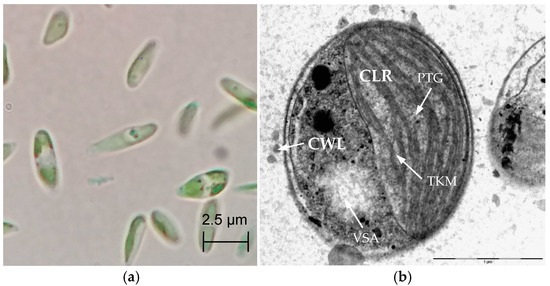
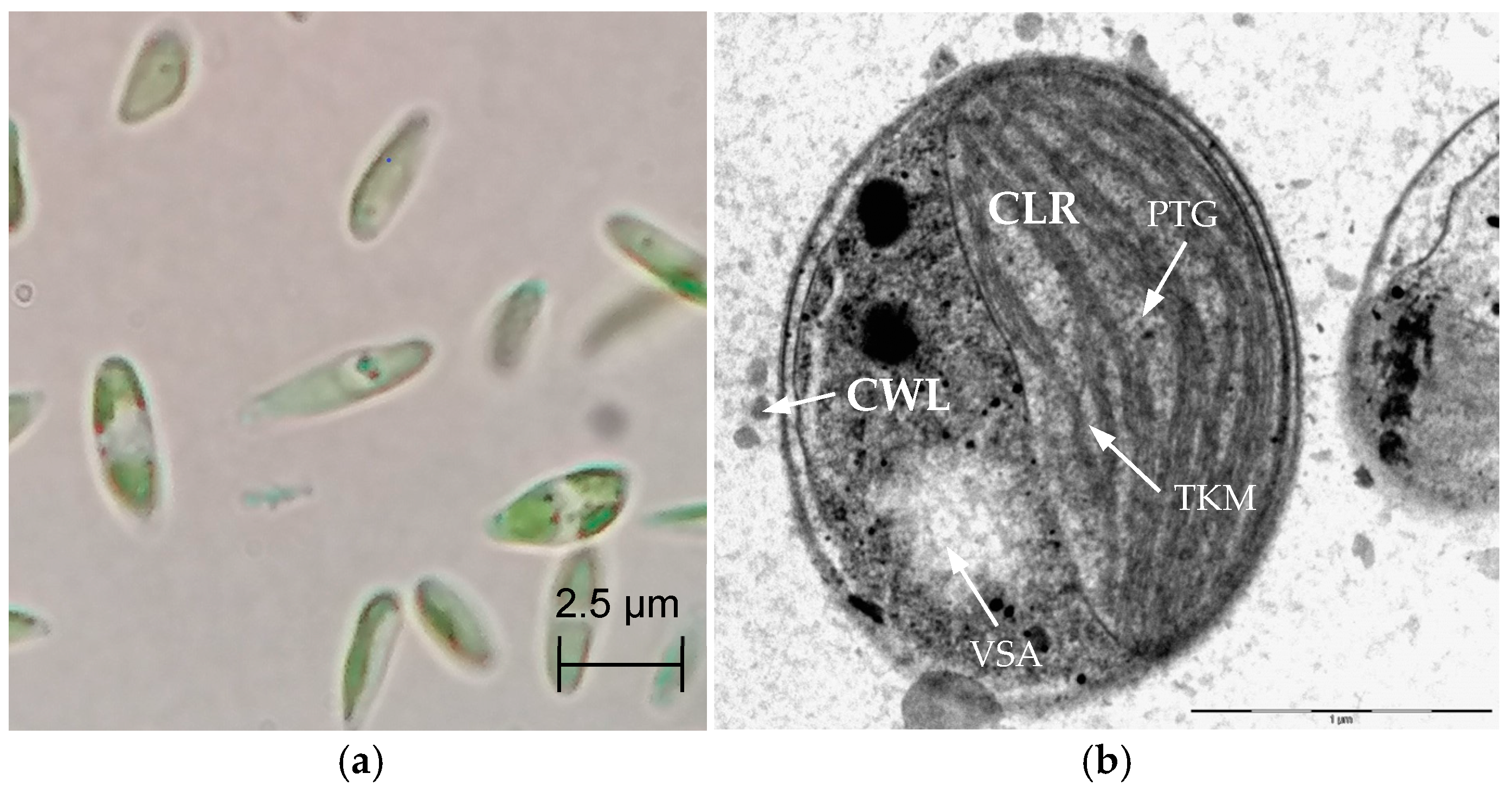
C. onubensis (Figure 1) was isolated from Tinto River water (Huelva, Spain; site coordinates: latitude 37.585115, longitude 6.550754), which runs through a mining area with a low pH (<2.5) and is highly contaminated with heavy metals, such as iron, copper, magnesium, and aluminum [22]. The microalga strain was kept in sterile agar plates prepared with K9 medium at pH 2.5 [23]. The K9 medium was modified according to the following final composition per liter: 2.29 g KNO3, 0.5 g K2HPO4, 3.95 g K2SO4, 0.01 g CaCl2, 0.41 g MgCl2, 0.1 g KCl, and 5 mL Hutner solution [24]. The K9 media was used for small-scale experiments and the first inoculum, in a 3 L Erlenmeyer flask under sterile conditions. The inoculum was then transferred to 40 L plastic bags containing 25 L of NPK-based fertilizer media at pH 2.5 and cultivated under non-sterile conditions. The NPK-based fertilizer media composition was as follows per liter: 0.0155 g NO3−, 0.00812 g NH4+, 0.0568 g P2O5, and 0.0603 g K2O, and 0.4 mL of micronutrient solution (Microfer Complex, Fercampo S. A., Málaga, Spain). All the indoor experiments were carried out at 25 ± 2 °C and were continuously illuminated with white, fluorescent lamps, which provided 150 μmol photon·m−2·s−1 at the flask’s surface. The cultures were bubbled with air enriched in CO2 (2% v/v). The C. onubensis cultures were maintained at a pH of 2.5 by adding a few drops of H2SO4 (v/v) 40% when needed. As observed under an optical microscope model BX-61 (Olympus, Tokyo, Japan) and transmission electron microscope (TEM) model JEM 1011 (JEOL Ltd., Tokyo, Japan) (Figure 1), when cultivated under the above-referred K9-modified culture medium, C. onubensis presented with a typical-like ellipsoid shape from 2 to 5 mm in length, with a large chloroplast occupying most of the internal cell volume and containing dark spots, plastoglobuli, containing carotenoids and acylglycerol-type molecules.
Figure 1.
Pictures of C. onubensis obtained from observations of control culture sample under (a) optical microscope and 100× amplification, and (b) transmission electron microscope (TEM); scale bar 1 μm (×30,000). CLR: chloroplast; CWL: cell wall; PTG plastoglobulus; TKM: thylakoid membranes; VSA: vesicular activity in the cytosol.
2.2. Outdoor Cultivation Experiments
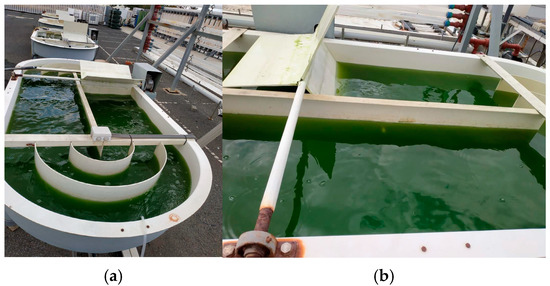
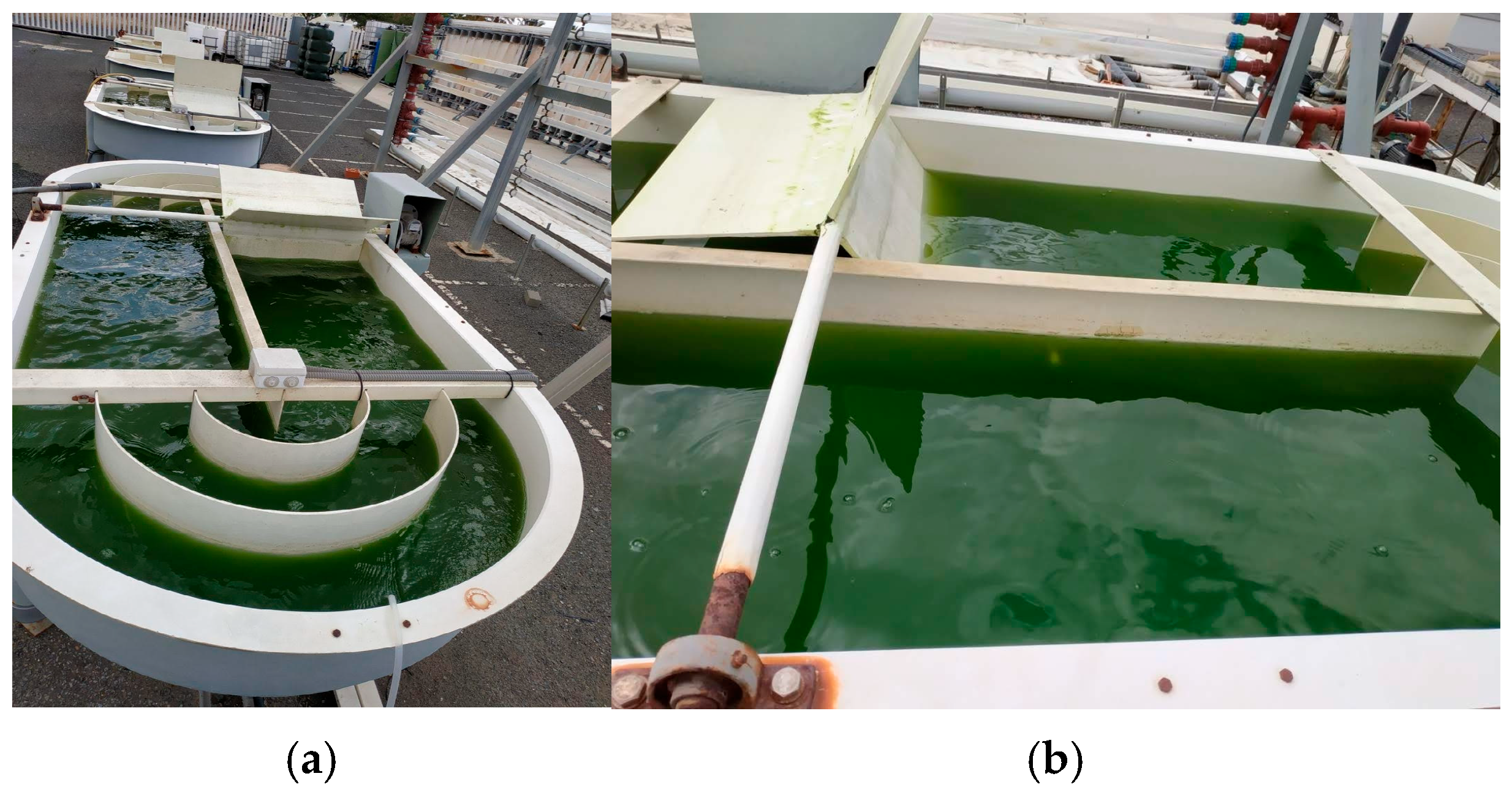
Experimental cultivation in raceway ponds was employed to study C. onubensis resistance to competitors’ growth, outdoor growth properties, and pigment and lipid production. Three identical raceway open ponds (Figure 2) available at the Microalgae Biotechnology Unit (CIQSO, University of Huelva) were used for this study. Each raceway pond’s dimensions were as follows: 2.95 m in length, 1.33 m in width. Each pond was equipped with deflectors around the semicircular extremes to minimize biomass sedimentation. The water column was 15 cm. The flow velocity of the culture was 0.5 m·s−1. The lighting in the outdoor ponds varied throughout the day, reaching up to 1900 μmol photon·m−2·s−1 at noon—approximately 10-fold higher than in the culture room—while the medium temperature ranged from 13 °C to 25 °C, respectively, in April.
Figure 2.
General view of (a) the open raceway ponds used in the experiments of this study with C. onubensis cultures, and (b) details of the paddle wheel built with three metal sheets joined to a swivel metal bar.
Three different cultivation conditions were prepared, which are described in Table 1. The final volume in each pond was set at 320 L (300 L media + 20 L inoculum). To provide the cultures with extra aeration, two raceway ponds were aerated by air bubbling (raceway ponds 1 and 2). NPK was selected as the culture media and prepared using tap water for the raceway ponds because it is a low-cost option suitable for microalgae scale-up; one of them had twice the NPK concentrated nutrient solution added (raceway pond 1). The third raceway pond acted as the control culture, without additional air bubbling and with the standard NPK solution concentration added. Each independent culture was mixed with a paddle wheel set at 20 revolutions per minute, which resulted in a flow speed of 0.5 m·s−1.
Table 1.
Cultivation conditions for outdoor production in open raceway ponds.
Before sampling, the medium level in each raceway pond was checked and, if necessary, supplemented with water. Thus, natural evaporation was compensated for, keeping the pond volume roughly constant. The pH and temperature were measured periodically using a portable pH meter and thermometer model pH1 (ref. LPV2500.98.0002, Hach, Loveland, CO, USA), respectively, before taking culture samples. Samples from each raceway pond were taken every other day (Monday, Wednesday, –Friday). On these sampling days the following parameters were measured: the optical density at 680 nm, photosynthesis efficiency (measured as quantum yield), and biomass dry weight. Additionally, biomass samples were taken to analyze the carotenoids, chlorophylls, and lipid contents, as well as the fatty acid profile. The culture samples were periodically checked for microbial contamination under an optical microscope.
2.3. Light and Transmission Electron Microscopy
Photomicrographs of C. onubensis under an optical microscope and transmission electron microscope (TEM) were taken as described in a previous publication [25]. For the optical microscope, photographs were taken using an Olympus BX-61 microscope (Olympus, Tokyo, Japan) with a CCD Colour-View-II camera (Soft Imaging System, Münster, Germany) and the CellSens analysis imaging system (Olympus, Tokyo, Japan). For the TEM observations, the algal cells were collected by centrifugation (1957× g, 1 min). The algal cells were fixed with 1% glutaraldehyde in 0.1 M sodium cacodylate buffer (pH 7.4) for 2 h at 4 °C. The cells were then washed three times for 5 min using the same buffer. The samples were postfixed with 1% osmium tetroxide in 0.2 M cacodylate buffer at 4 °C for 1 h. The samples were washed with the same buffer, dehydrated in a graded ethanol series, and embedded in Epon 812 (Electron Microscopy Science, Hatfield, PA, USA). Ultrathin sections of 80–90 nm, obtained by an ultramicrotome (Leica, Wetzlar, Germany) and placed on copper grids, were stained with aqueous 1% (w/v) uranyl acetate and lead citrate. The transmission electron micrographs were observed with a JEM 1011 (JEOL Ltd., Tokyo, Japan) electron microscope using an accelerating voltage of 80 kV. All the chemicals used for histological preparation were purchased from Electron Microscopy Sciences, Hatfield, PA, USA.
2.4. Photosystem II Quantum Yield
The Photosystem II (PSII) quantum yield (Qy) measurements were performed according to [26]. The Qy measurements were performed using a portable modulated pulse amplitude (PAM) fluorimeter AquaPen-C AP-C 100 (Photon System Instruments, Drásov, Czech Republic). A volume of 1 mL of fresh culture sample was placed into a plastic cuvette and stored at room temperature in the dark for 15 min. If necessary, the culture sample was diluted with distilled water. After dark-acclimation, the cuvette was immediately placed into the PAM device chamber and the Qy was measured using a 630 nm orange-red LED emitter. The Qy was calculated using the equation below, where FV represents the variable fluorescence and is calculated as FV = FM − F0, where F0 is the minimum level of fluorescence observed after exposing the cells to a non-actinic beam and acclimating them in the dark, while FM represents the maximum fluorescence observed in the cells after exposing them to a brief but saturating pulse of actinic light.
2.5. Specific Growth Rate and Productivity
The maximal specific growth rate was calculated, as described in [27], during the early-growth phase (days 0–6) and the late-growth phase (days 8–23), according to the following logarithmic expression:
where Ct and C0 represent the cell density for times t and zero, respectively, and represent the specific growth rate (μ), expressed in d−1. In this study, the cell density was determined by measuring the dry weight (dw) of the biomass contained in 2 mL of culture medium. Additionally, the productivity of biomass and target compounds (chlorophylls, carotenoids, and fatty acids) were calculated, as described in [25] according to the following expression:
2.6. Gravimetric Analysis
A 40 mL culture sample was taken for gravimetric determination of biomass production and subsequent analysis, as described in [28]. The sample was centrifuged at 8000 rpm and washed with 20 mL of MilliQ water. The centrifuged and washed sample was then frozen at −40 °C and lyophilized for 48 h. The freeze-dried samples containing the microalgal biomass were weighed, and based on the obtained values, the corresponding culture biomass concentrations (g·L−1) were calculated. The samples were stored at −40 °C to further analyze the total lipid production, fatty acid profile, carotenoids, and chlorophyll content.
2.7. Pigment Analysis
The total carotenoid and chlorophyll content was determined using an HPLC equipped with a diode array detector, as described in [28]. Samples of freeze-dried microalgal biomass were properly weighed (approximately 15–25 mg) and rehydrated with 1 mL of MilliQ water for 30 min. Excess water was removed by centrifugation at 12,000 rpm, and 1 mL of methanol and about 0.5 mL of glass beads (0.2–0.5 mm diameter) were added to the sample. The sample was vortexed for 20 min and then transferred to a 15 mL tube and washed with 2 mL of chloroform. The mixture was further vortexed for 10 min. Then, 1 mL of water was added, the tube was shaken for 3 min, and two phases were formed. The total volume of the lower chloroform phase was transferred to a clean tube and dried under an inert nitrogen atmosphere. The dried sample was dissolved in 1 mL of 2:1 ethyl acetate (EtAc):acetonitrile (ACN) (v/v) and filtered through a 0.45 μm filter into a vial. The samples were measured on a Dionex Ultimate series HPLC with Vanquish DAD detector (Thermo Fischer Scientific, Waltham, MA, USA) on a Kinetex C18-EVO column 150 mm × 4.6 mm × 5 µm (Phenomenex, Torrance, CA, USA). The following solvent combinations were used: mobile phase A, ACN:methanol (MeOH):Tris HCl pH = 8 (84:2:14); mobile phase B, MeOH: EtAc (60:40), at a flowrate of 1.2 mL·min−1 and 25 °C. The gradient program is listed in the Table 2.
Table 2.
HPLC gradient analysis.
Carotenoid pigments were detected at 445 nm and chlorophyll at 445 and 455 nm. The chromatographic data were evaluated using Chromeleon 7.2 software. The total carotenoid and chlorophyll were identified and evaluated using commercial standards (Sigma Aldrich) and external calibration.
2.8. Fatty Acid Profile and Total Lipid Analysis
The fatty acid profile was analyzed according to the following method, modified from [16]. Approximately 10–12 mg of freeze-dried microalgal biomass was placed into a 2 mL crimp neck vial together with 1.8 mL 15% (v/v) H2SO4 in methanol, capped with an aluminum cap, and heated at 85 °C for 2 h. After the transesterification process, the mixture was transferred quantitatively into a 5 mL vial and neutralized with 0.5 mL of 0.005 M NaOH. The formed fatty acid methyl esters (FAMEs) were transferred to the non-polar phase by adding 1 mL of n-hexane and shaking vigorously on the vortex for 5 min. The total lipids and fatty acids profile were determined by gas chromatography with a flame ionization detection (GC/FID) analysis. The GC analysis of FAMEs was carried out on a TRACETM 1300 Gas Chromatograph (Thermo Fischer Scientific, Waltham, MA, USA) equipped with a flame ionization detector and an Al 1310 autosampler. A total of 1 µL of the sample was injected into a silica-based column Zebron ZB-FAME (30 m, 0.25 mm id, 0.20 μm film thickness) (Phenomenex, Torrance, CA, USA). Hydrogen was used as the carrier gas at a constant flow rate of 1 mL·min−1, with a 10:1 sample split ratio. The internal temperature was set to 260 °C for the injector and detector. The detector was fed with 30 mL·min−1 of hydrogen, 350 mL·min−1 of air, and 40 mL·min−1 of nitrogen gas. The oven temperature was raised to 140 °C at 5 °C·min−1, subsequently increased up to 170 °C at 4 °C·min−1, then kept at 170 °C for 2 min, followed by an increase to 190 °C at 1 °C·min−1, and maintained at 190 °C for 2 min. Finally, the oven temperature program was increased to 260 °C at 25 °C·min−1. The FAMEs were identified using the commercial standard Supelco 37 Component FAME Mix (Sigma Aldrich, SRN). The internal standard method was used for quantification via the addition of 0.5 mg·mL−1 heptadecanoic acid (Sigma Aldrich, Munich, Germany) into the transesterification mixture. The chromatography data were evaluated using Chromeleon software 7.2.
2.9. Statistics
Unless otherwise indicated, the presented data are the means of three biological replicates. The standard deviations are presented in the figures and tables. An analysis of variances (ANOVA) was used to analyze the data with univariate statistical models, ensuring a 95% confidence. Significant differences were evaluated using Tukey’s range test with a confidence level of 95% (p ≤ 0.05); additional data are presented in Tables S2–S9 of the Supplementary Material. Minitab 17 software was used to perform the statistical analysis.
3. Results
3.1. Coccomyxa Onubensis Biomass Production and Growth Kinetics in Raceway Ponds
This section analyzes the growth and viability of C. onubensis cultivated in open raceway ponds. Additionally, the optimization of certain growth-influencing parameters was carried out by varying the nutrient concentration and the aeration conditions. The NPK medium was chosen to address one of the main objectives of this study: using nutrient sources that could facilitate large-scale production and improve economic feasibility. Raceway ponds 1 and 2 were aerated by air bubbling (2 L·min−1), while raceway pond 1 contained twice the nutrient concentration of the standard NPK culture medium. Further details are provided in the Materials and Methods section.
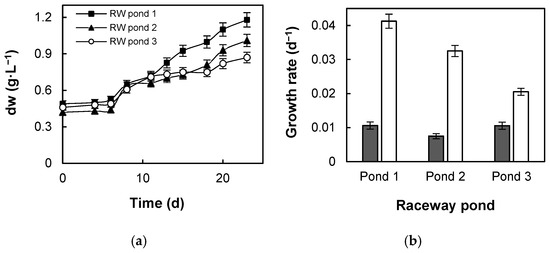
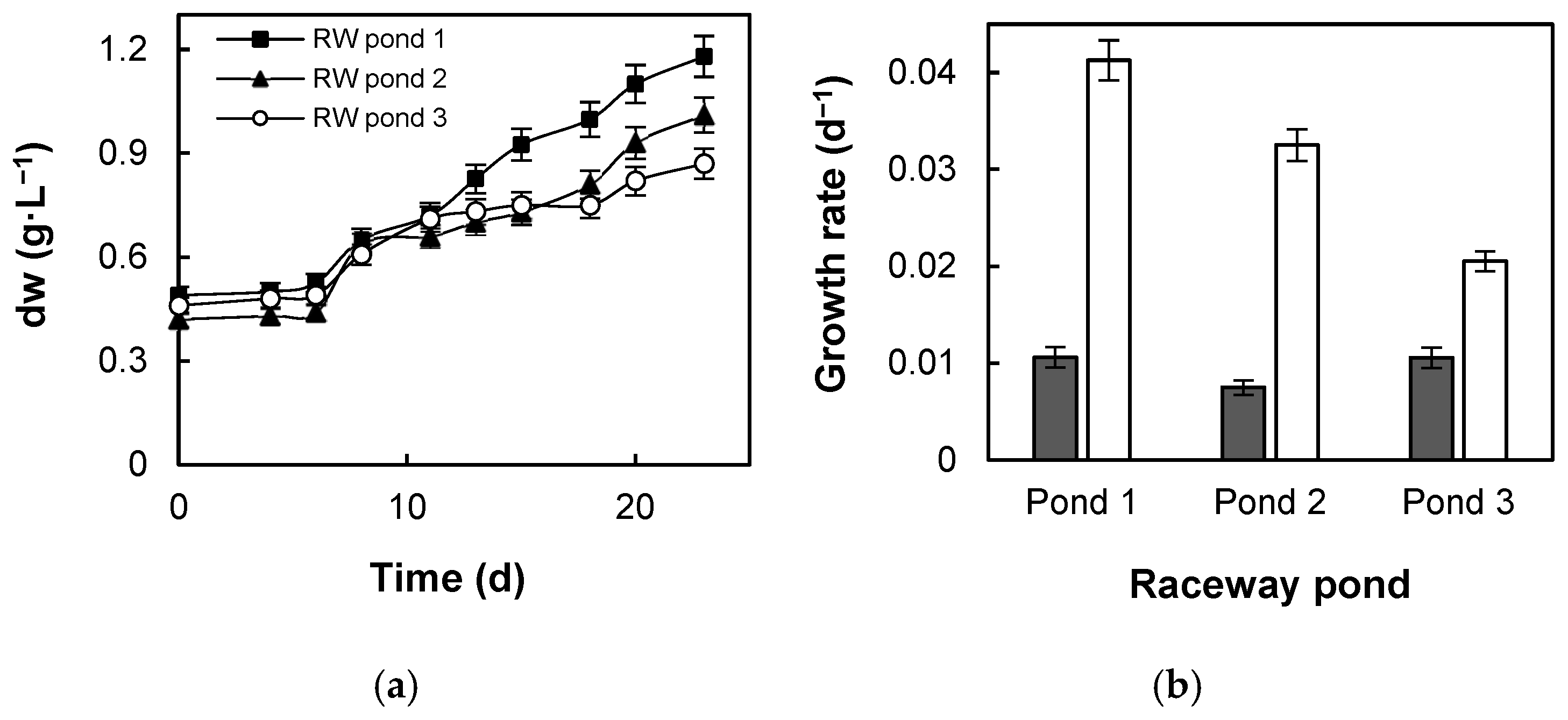
Figure 3 shows the overall biomass productivity of C. onubensis in the three open ponds. Growth was assessed by measuring the biomass concentration as dry weight (dw), which also enabled the estimation of culture growth rates (Figure 3a,b). According to Figure 3a, the initial lag phase progressed similarly in all the monitored ponds. Specifically, after inoculation into the production medium, a clear lag phase occurred, during which the microalgal cells acclimated to the imposed conditions from day 0 to 6. After that point, a significant linear increase, rather than an exponential one, occurred in all the ponds from day 8 to day 23, corresponding to the end of the cultivation period.
Figure 3.
Growth dynamics of C. onubensis cultures in outdoors open raceway (RW) ponds. (a) Time-course evolution of dry weight (dw) throughout the experiment, expressed in grams per liter of biomass; (b) growth rate, calculated as explained in the Materials and Methods section, for early growth (solid bar, days 0–6) and late growth (open bar, days 8–23), expressed in day−1. Legend symbols: RW pond 1 (2 × NPK + air), RW pond 2 (NPK + air), and RW pond 3 (NPK). Significant differences were evaluated using Tukey’s range test with a confidence level of 95% (p ≤ 0.05); additional data are in Tables S2 and S3 of the Supplementary Material.
As explained above, raceway pond 1 contained twice the nutrient concentration of the standard NPK culture medium. Accordingly, the dry weight-based growth pattern of the culture in raceway pond 1 (Figure 3a) showed significantly faster growth (Table S2) than that observed in raceways 2 and 3 (roughly 18% and 30%, respectively) during the linear growth phase (days 13–23). Similarly, in the latter part of the linear phase (days 18–23), raceway 2 showed a significant increase compared with the control culture (raceway pond 3). Thus, the culture conditions imposed on raceways 1 and 2 enabled higher growth rates—2-fold and 1.58-fold higher, respectively—relative to the control culture (Figure 3b). Nevertheless, the growth rate obtained during the early-growth cultivation (days 0–6) showed almost no difference (Table S3).
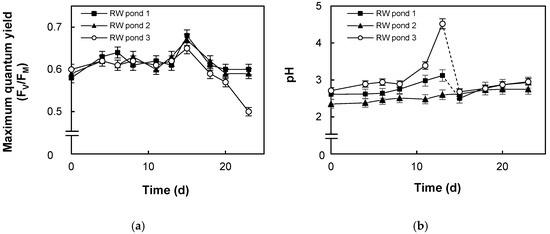
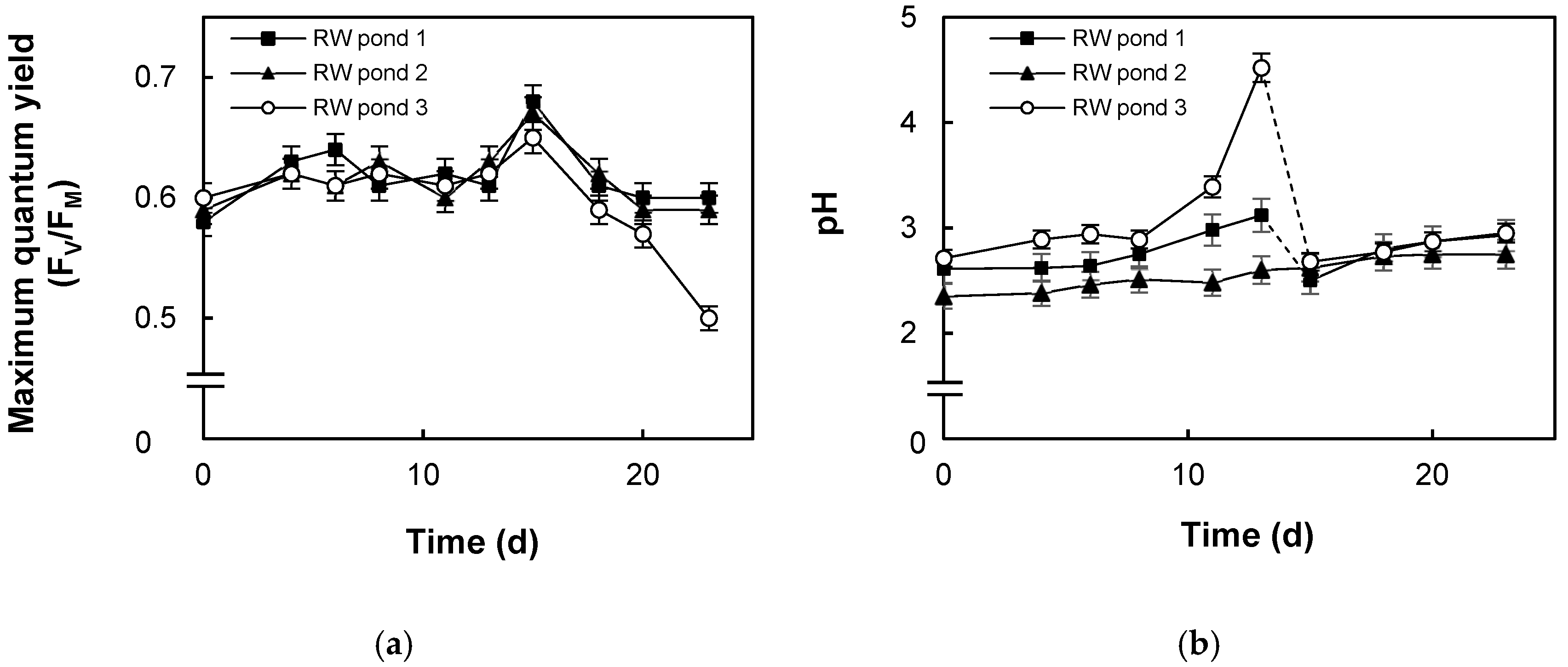
In summary, during the first week of cultivation, C. onubensis growth under the conditions of raceway ponds 2 and 3 followed a pattern similar to that of raceway 1. Subsequently, a transition to linear growth occurred. During this growth phase, a significantly higher growth trend was observed in pond 1 (from days 13–23 onward), whereas in pond 2, the growth increased relative to pond 3 (from days 18–23 onward), suggesting that the selected growth-influencing parameters had a significant effect on C. onubensis growth in the open raceway ponds. To further assess the photosynthetic viability of the cultures, the quantum yield (Qy) is analyzed in Figure 4a. This parameter provides rapid information about the photosynthetic status of microalgae through PSII efficiency measurements.
Figure 4.
(a) Quantum yield (Qy) and (b) pH evolution of C. onubensis cultures in outdoor open raceway (RW) ponds; dashed vertical lines indicate points where external pH correction was applied. Legend symbols: RW pond 1 (2 × NPK + air), RW pond 2 (NPK + air), and RW pond 3 (NPK). Significant differences were evaluated using Tukey’s range test with a confidence level of 95% (p ≤ 0.05); additional data are presented in Tables S4 and S5 of Supplementary Material.
Efficiently grown cultures of photosynthetic microalgae must exhibit Qy values in the range of 0.6–0.7. The Qy remained stable at approximately 0.6 for most of the growth trials until day 15 (Figure 4a). From that day on, a slight decrease in the Qy was observed in all three ponds. The most significant decrease occurred in pond 3 (regular nutrition and no additional aeration supply), suggesting that these growth-influencing parameters are essential for maintaining viable cultures (Table S4).
The photosynthetic growth of microalgae tends to increase the pH. Therefore, one of the challenges of cultivating acidophilic microalgae is maintaining the acidic pH of the growth medium throughout the culture period. This can be achieved through careful pH monitoring and the addition of acid as needed. During the early-growth phase of C. onubensis, the pH increases were negligible; thus, no pH correction was required (maximum increase of approximately 0.3 units within a week), probably due to the slow biomass increase in the cultures. However, during the later growth phase, a significant pH increase was obtained (Table S5); therefore, the pH was corrected by adding sulfuric acid (dashed vertical lines in Figure 4b). The low pH of the C. onubensis culture medium is a considerable advantage for open cultivation, as the pH is considered a key parameter for minimizing or inhibiting biological contamination. Accordingly, the microalgal samples were periodically checked under the optical microscope (Figure 5).
Figure 5.
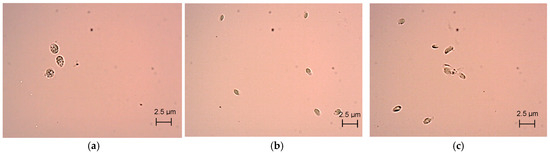
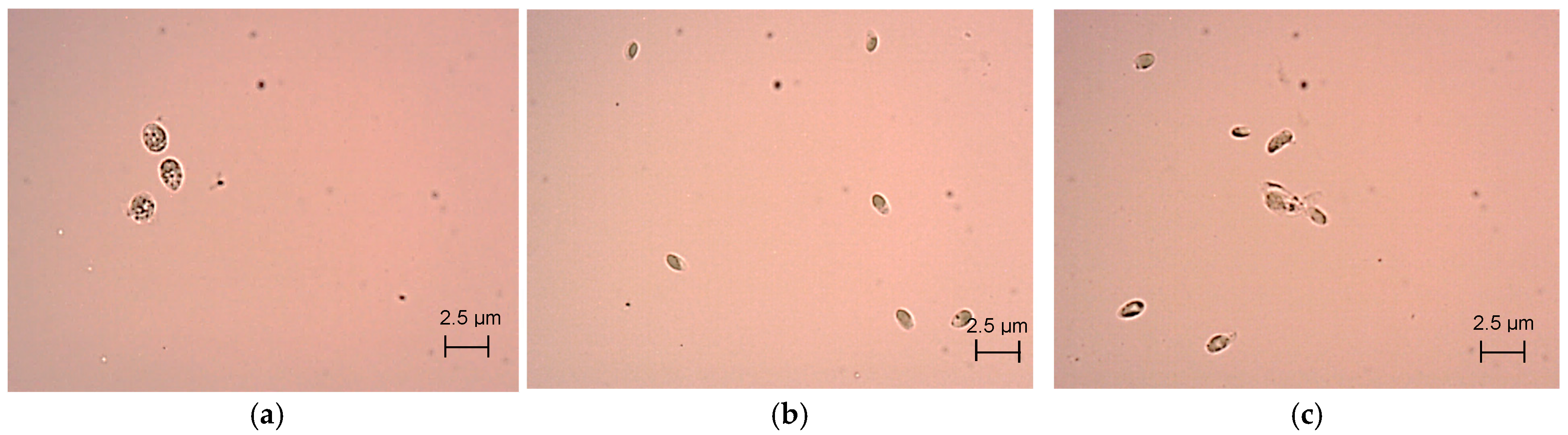
Optical microscope images of C. onubensis cells from samples collected from the three raceway ponds on day 11 of cultivation, 40× amplification: (a) raceway pond 1 (2 × NPK + air), (b) raceway pond 2 (NPK + air), (c) raceway pond 3 (NPK).
Figure 5 shows microscopic images of C. onubensis cells as a function of the growth conditions imposed in the ponds. According to the figure, the microscopic observation reveals a possible larger size of the C. onubensis cells in pond 1. Additionally, no significant contamination by any other microorganisms is observed, nor is photosynthetic contamination. During cultivation, the culture samples were periodically checked for photosynthetic contamination under the microscope. At the beginning of the experiment, no photosynthetic contamination was observed, and this trend persisted throughout the cultivation in all three raceway ponds, as also observed in the figure.
Overall, these results demonstrate that C. onubensis can be efficiently cultivated in outdoor open raceway ponds under the tested conditions, maintaining stable photosynthetic performance and minimal contamination, thereby confirming its potential for scalable and sustainable production. In the following section, the lipid content of the cultures—including fatty acids, chlorophylls, and carotenoids—will be analyzed to further assess their biotechnological potential.
3.2. Lipid Production and Fatty Acid Composition
Once the production of C. onubensis in outdoor raceways operated in batch mode was proven stable and productivity data were obtained, the potential of C. onubensis for lipid accumulation under these conditions was evaluated. During the growth experiment in the raceways, biomass samples were collected, extracted, and analyzed by GC to determine the variations in the fatty acid profile and total fatty acid content, as described in Materials and Methods.
The content and profile of fatty acids (FAs) in the biomass samples from the cultures of raceway ponds 1, 2, and 3 were analyzed. Significant changes were observed in both the intracellular fatty acid content and composition (Tables S6 and S7) throughout the experiment time-course in each raceway, affecting the ratio of polyunsaturated (PUFAs), monounsaturated (MUFAs), and saturated (SFAs) fatty acids (Figure 6). Days 11 and 20 represent the early-growth phase and late-growth phase, respectively.
Figure 6.
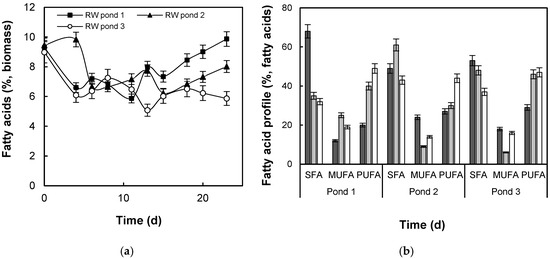
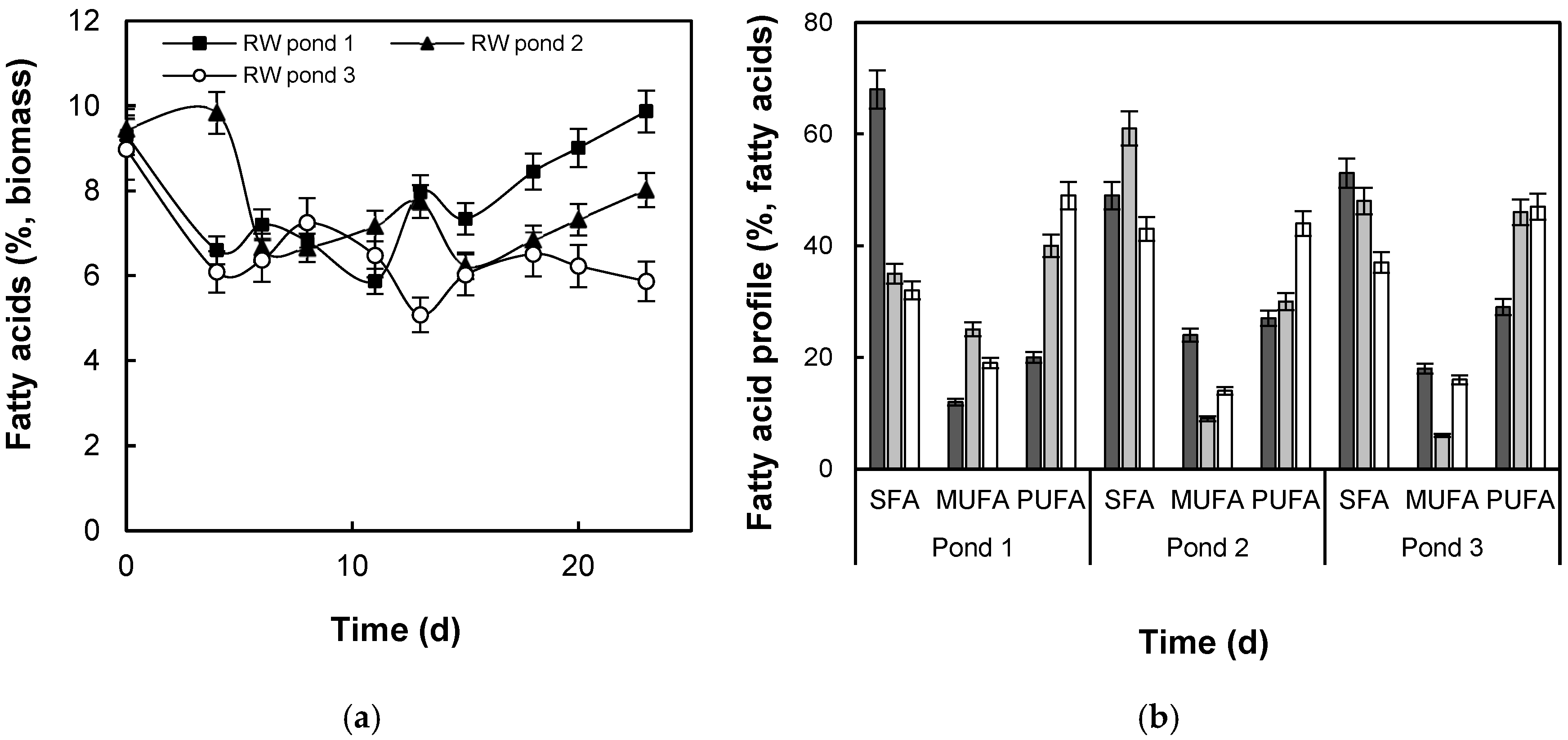
Fatty acids content of C. onubensis biomass samples from outdoor open raceway (RW) pond cultures. (a) Time-course evolution of fatty acids content during C. onubensis cultivation, expressed as a percentage of biomass; (b) variation in the content of saturated (SFAs), monounsaturated (MUFAs), and polyunsaturated (PUFAs) fatty acids in the biomass samples for day 0 (dark grey), day 11 (light grey), and day 20 (open bar), expressed as a percentage of total fatty acids. Days 11 and 20 represent the early-growth phase and late-growth phase, respectively. Legend symbols: RW pond 1 (2 × NPK + air), RW pond 2 (NPK + air), and RW pond 3 (NPK). Significant differences were evaluated using Tukey’s range test with a confidence level of 95% (p ≤ 0.05); additional data are presented in Tables S6 and S7 of Supplementary Material.
According to Figure 6a, the FA content of C. onubensis decreased by roughly 20% in the biomass of all three ponds during the first week of the experiment, corresponding to the lag phase of growth. By the end of the experiment (days 18–23), the FA content in pond 3 gradually declined, while significant increases of roughly 80% and 27% were obtained in ponds 1 and 2, respectively, compared with pond 3 (Table S6).
The analysis of the specific fatty acid (FA) composition of the C. onubensis biomass samples from the three ponds is summarized in Figure 6b. A well-defined pattern was observed for the three FA groups: saturated (SFAs), monounsaturated (MUFAs), and polyunsaturated (PUFAs) fatty acids. The data reveal a significantly decreasing trend for the SFAs throughout the experiment, irrespective of cultivation conditions in ponds 1, 2, and 3 (Table S7). The decline in the SFAs content was most pronounced in pond 1, where it dropped by approximately 50% of its initial concentration, whereas in ponds 2 and 3, the reduction was moderate, around 10%. Overall, a similar but less pronounced decreasing trend was also observed for the MUFAs, except in pond 1, where an increase of about 30% was achieved. Notably, the PUFAs content of the biomass samples from all three ponds increased significantly and to a comparable extent, within a range of approximately 40–60% of the initial content (Table S7). Meanwhile, the SFAs content continued to decline during the linear growth phase.
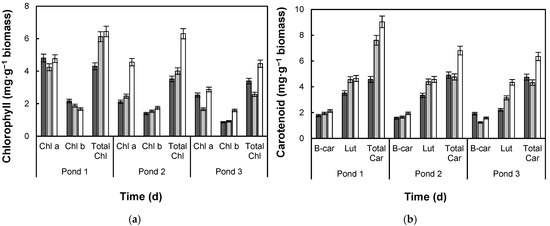
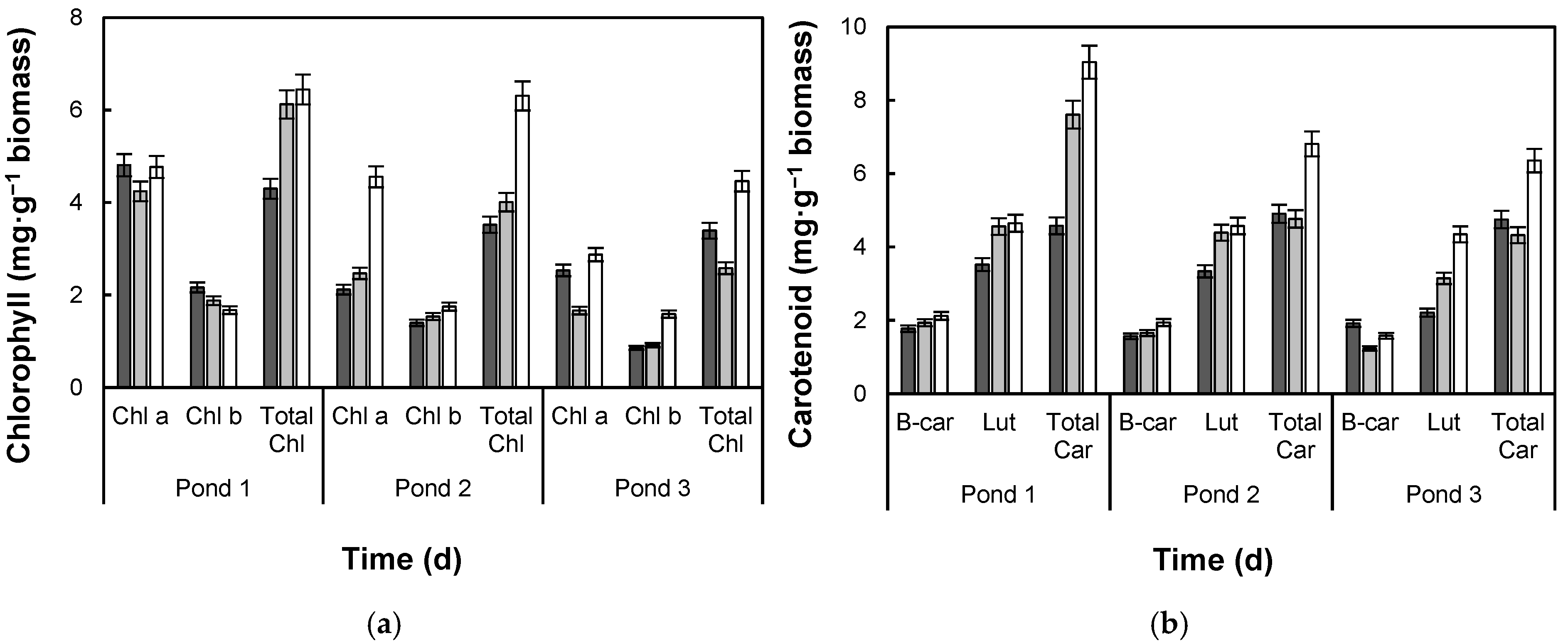
The analysis of the photosynthetic pigment profile of the C. onubensis biomass samples from the three ponds is summarized in Figure 7. Days 11 and 20 represent the early-growth phase and late-growth phase, respectively. Almost no variation was observed in the Chl b content in Figure 7a (Table S8); therefore, the changes in the total chlorophyll content can be attributed primarily to fluctuations in the Chl a levels. According to the figure, two distinct patterns can be identified based on these observations. In raceway ponds 1 and 2, the chlorophyll content increased significantly over time, whereas in pond 3, the chlorophyll content remained relatively stable. The highest chlorophyll content was recorded in ponds 1 and 2 (6.3 mg·g−1 biomass), approximately 40% higher than that in the control culture.
Figure 7.
Pigment content of C. onubensis biomass samples from outdoor open raceway (RW) pond cultures, expressed as mg·g−1 of biomass. (a) Variation in the content of chlorophyll a (Chl a), chlorophyll b (Chl b), and total chlorophyll (Total Chl) in the biomass samples. (b) Variation in the content of β-carotene (β-Car), lutein (Lut), and total carotenoids (Total Car). Bar symbols: day 0 (dark gray), day 11 (light gray), and day 20 (open bar). Days 11 and 20 represent the early-growth phase and late-growth phase, respectively. Legend symbols: RW pond 1 (2 × NPK + air), RW pond 2 (NPK + air), and RW pond 3 (NPK). Significant differences were evaluated using Tukey’s range test with a confidence level of 95% (p ≤ 0.05); additional data are presented in Tables S8 and S9 of Supplementary Material.
Regarding the carotenoids (Figure 7b), almost no variation was observed in the β-carotene content (Table S9). Therefore, the changes in the total carotenoid levels can be attributed primarily to fluctuations in the lutein content. The total carotenoid content increased over time in all three ponds, reaching the highest values during the final stage of the experiment (day 23). Additionally, the carotenoid content in ponds 1 and 2 was approximately 42% and 7% higher, respectively, than that in the control culture (pond 3).
In summary, during the final stage of the experiment (day 23), both the chlorophyll and carotenoid content in pond 1 were significantly higher (by approximately 44% and 42%, respectively) than in pond 3. This is in good agreement with the productivity values presented in Table 3, showing that pond 1 was the most favorable condition for biomass, carotenoid, and fatty acid production (0.031 g·L−1·d−1, 0.223 mg·g−1·d−1, and 0.151 mg·g−1·d−1). These results suggest that additional nutrient supplementation, combined with increased aeration, played a crucial role. Nevertheless, this aspect will be discussed in more detail in the next section and related to the observed growth patterns.
Table 3.
Productivity values obtained for C. onubensis cultivated in raceway open ponds: biomass and target compounds. RW pond 1 (2 × NPK + air), RW pond 2 (NPK + air), and RW pond 3 (NPK).
4. Discussion
4.1. Coccomyxa Onubensis Biomass Production and Growth Kinetics in Raceway Ponds
This study focused on the basic culture characteristics that represent the overall state of C. onubensis growing in a highly acidic pH in outdoor culture ponds. Culture turbidimetry is a widely used technique for determining the growth rate, culture health, and possible contamination of a culture, as well as for assessing how a strain acclimates to new media conditions. The overall biomass productivity obtained shows that C. onubensis can be cultivated in raceway open ponds. The initial latency phase observed in all the monitored ponds suggests the acclimation of the microalgal cells to the imposed conditions—the sunny weather of southern Spain during spring.
C. onubensis growth in low-density batch cultures was previously found to be sensitive to a high PAR. Thus, growth is faster in moderately dense cultures under moderate light irradiance (150 μmol photon·m−2·s−1) in culture room conditions [25]. This growth pattern is consistent with most microalgal species produced in batch mode, which typically exhibit linear growth rather than exponential growth until reaching the stationary phase. That is, increased biomass concentration limits light availability due to shading among cells [29]. From the second week onward, C. onubensis fully acclimated to the cultivation conditions, and the biomass production gradually increased.
As inferred from the results, the double nutrition doses added to the culture medium in raceway pond 1 was what really made the growth different between the three ponds. Moreover, the additional aeration significantly improved C. onubensis’ growth, as inferred from the growth rate obtained from the pond 2 results compared to pond 3, where additional aeration was the only differential operational feature. Aeration promotes gas exchange, culture mixing, oxygen availability for respiration, and release of excess oxygen, although it can account for up to 40% of total production cost of a photobioreactor [30,31]. Thus, the need for additional aeration must be strongly supported by productivity data. Accordingly, the positive effects of additional aeration (pond 2 and pond 1 with double nutrients) may have been be due to faster oxygen degassing, increased nutrient accessibility, and enhanced light exposure resulting from improved culture homogenization. These results highlight the need for further optimization of operational parameters.
The C. onubensis cultures in the raceway ponds are proven to be photosynthetically viable (Figure 4), with Qy values in the range of 0.6—0.7, consistent with efficient photosynthetic growth. The decline in the photosynthetic viability during the final days of the experiment suggests that the cultures were approaching the stationary phase. Photosynthetic growth tends to increase the pH, posing a challenge for acidophilic microalgae. Maintaining an acidic pH throughout the culture period can be achieved through careful monitoring and acid addition as needed. Correction of pH in batch cultures can impact microalgal growth, i.e., the addition of any acid results in an increased ionic strength of the medium due to the added proton counterion (sulfate in this case). Consequently, cultivated species should be able to tolerate certain levels of salt. This is the case for C. onubensis, whose adaptation capacity to salinity has already been proven [15], thus supporting this microalga’s suitability to adapt to the production process conditions.
A low pH provides a substantial advantage for open cultivation, as it limits contamination by other microorganisms. As already mentioned in this manuscript, the C. onubensis inoculum culture medium was initially adjusted to pH 2.5, based on previous experiments [32], allowing for optimal growth while minimizing possible contamination. In all three ponds, C. onubensis maintained a pH between 2.5 and 3.0 for about 2 weeks, preventing contamination, as confirmed by optical microscope observations of pond samples (Figure 5). Microalgae in natural conditions coexist in a symbiotic relationship with other microorganisms. C. onubensis maintains a symbiosis-like relationship with bacterial strains, facilitating pH regulation and limiting overgrowth of other microorganisms. Microalgae have been reported to produce organic compounds that are processed by heterotrophs, thereby forming molecules that might contribute to lowering a medium’s pH [15,33]. Species of the genus Coccomyxa release glycolic acid into the surrounding medium. This release contributes to pH buffering (glycolic pKa 3.6), metal chelation (e.g., iron and copper), nutrient availability, and serving as a carbon source for other microorganisms while inhibiting certain bacteria and fungi [33]. These mechanisms might contribute to microbial control and favorable growth conditions for C. onubensis in open raceways.
Only a few species have been reported to tolerate extreme acidic pH conditions. Some examples of microalgae species that are known to tolerate acidic conditions include Euglena gracilis, which can grow at pH values as low as 1.5, though growth rates are significantly reduced at pH values below 2.5; Dunaliella acidophila, which is capable of growing in highly acidic environments with pH values as low as 0.5; and Chlamydomonas acidophila, which can grow at pH values as low as 1.0. Strains of Chlorella are also known to grow across a wide pH range. Examples of strict acidophiles include Galdieria sulphuraria, Cyanidioschyzon merolae, and Coccomyxa acidophila, which grow optimally at pH below 2; these species have also been described to be thermoacidophiles [12]. This is not the case for C. onubensis, which tolerates a pH of 2.5 but can also grow at a higher pH, around neutral values [15]. Thus, C. onubensis is an outstanding example of a microorganism that grows almost optimally at a highly acidic pH, but offers growth flexibility at a neutral pH if required.
4.2. Lipid Production and Fatty Acid Composition
Microalgae are known for their wide spectrum of polyunsaturated fatty acids (PUFAs) [16]. Various stress factors applied to microalgal cultures can influence their fatty acid (FA) profiles, which may also change at different stages of the cell growth cycle [34]. Prior to the fatty acid analysis of biomass samples from the raceways, the FA profile was analyzed for the indoor control cultures. These results served as a reference for the outdoor raceway cultures. Figure S1 shows a typical GC chromatogram of C. onubensis samples, and Table S1 compiles the most abundant fatty acids by category.
Therefore, the C. onubensis extracts (dry biomass), produced indoors under the conditions detailed in the Materials and Methods, contained 29% (w/w) of lipids. Of this lipid content, 28% were FAs, measured as fatty acid methyl esters (FAMEs), which, regarding the biomass, 8% of C. onubensis biomass consisted of FAs. The six most abundant FAs listed in Table S1 represent roughly 85% of the total FA content of the microalga. Accordingly, the C. onubensis fatty acid profile has been reported to be particularly abundant in oleic, alpha-linoleic, and alpha-linolenic acids [25].
The FA contents and profiles of the biomass samples from the three raceway ponds were subsequently analyzed. Significant changes occurred in both the intracellular FA content and composition throughout the experimental time-course, affecting the ratio of polyunsaturated (PUFAs), monounsaturated (MUFAs), and saturated (SFAs) fatty acids (Figure 6). The altered FA ratios determine the potential applications of the microalgal biomass; thus, unveiling the cultivation strategies that lead to desired FA profiles would ensure the targeted biochemical quality of the produced biomass.
The initial decrease in the FA content could be attributed to the low biomass concentration at the start of the experiment, which led the cells to experience a much higher photon flux density (PFD) than that experienced in dense cultures. Indeed, the prolonged lag phase can be interpreted as a typical response of low-density C. onubensis cultures transferred from low-light indoor conditions to the high-light outdoor conditions of the sunny weather of southern Spain during spring.
The higher FA content obtained in pond 1 likely resulted from the doubled nutrient concentration combined with the extra aeration, compared with pond 3. Although FA accumulation is typically induced by nutrient limitation or starvation [34], the positive effect of additional aeration is logical from a biochemical perspective, as respiration could be effectively stimulated, thus increasing the metabolic energy availability for FA synthesis. Simultaneously, the results suggest that a paddle wheel alone may not be sufficient to achieve full air saturation in the ponds.
Interestingly, the Coccomyxa sp. has been reported to be the main primary producer microorganism in acidic water columns of lakes in the Pyritic Belt of Huelva (Spain), forming blooms at depths of 11 m, where only low-wavelength PAR reaches the cells [35]. This natural behavior aligns with our observations and the results obtained by our group [36], showing that C. onubensis is particularly sensitive to intermediate PAR light intensities. In general, high PAR intensity to cell density ratios tend to reduce the FA content, as excess light diminishes the need for energy storage in lipids [37]. Conversely, and in good agreement with the results shown in Figure 6, the higher the OD (roughly from day 20 onward) under the same radiation conditions, the higher the FA content of the cells will be. This is consistent with the increased FA accumulation reported for microalgae species incubated under limited light irradiance [34].
Abiotic stress factors, such as nitrogen or phosphorus limitation and nutrient starvation, can induce FA biosynthesis and accumulation [38]. However, these conditions may reduce growth rates, thereby lowering the overall fatty acid productivity [39]. In this study, FA productivity was highest in the cultures supplemented with twice the standard nutrient concentration. This conclusion is supported by the increased biomass productivity in pond 1 (Figure 3) and, perhaps unexpectedly, the higher FA content recorded (Figure 6). This effect may reflect a typical physiological response of C. onubensis to light limitation in dense cultures: expansion of the chlorophyll antenna (requiring nitrogen) and enhanced photosynthetic efficiency, likely associated with an increase in the thylakoid membranes, as previously described in this microalga [25]. Membrane expansion may also explain the apparently observed increase in cell size (Figure 5), together with the increase in unsaturated FAs (MUFAs and PUFAs) and chlorophyll content across all the cultures by the end of the linear growth phase, regardless of nutrient availability or aeration conditions. Similar responses have been reported in other extremophilic species adapted to cold temperatures [40].
Regarding the photosynthetic pigments, in summary, during the final stage of the experiment (day 23), both the chlorophyll and carotenoid content in pond 1 were significantly higher (by approximately 44% and 42%, respectively) than in pond 3. This suggests that the additional nutrient supplementation, combined with increased aeration, played a crucial role. As previously discussed, aeration enhances gas exchange, culture mixing, and oxygen availability, supporting the optimal photochemical reactions in photosynthesis. These findings align with the slight differences observed between raceway ponds 1 and 2 during the final experimental stage.
Overall, the lower pigment concentrations recorded in raceway pond 3 during the final stage corresponded with the decline in the Qy values observed in Figure 4. These results highlight the importance of additional aeration in enhancing culture productivity (Figure 3) and maintaining photosynthetic viability (Figure 4 and Figure 7). Comparisons between ponds 1 and 2 indicate that nutrient supplementation is a more effective strategy for achieving higher chlorophyll and carotenoid content in a shorter cultivation period. The results and discussion above reinforce the “microalgal lipid production paradox”: nutrient starvation is not necessarily the most efficient strategy to rapidly produce microalgal FA. For instance, two-phase production (growth followed by nutrient stress), or low biomass productivity in repeated-batch processes under a low nitrogen concentration, can result in lower overall FA productivities than in the control cultures.
5. Conclusions
The acidic-habitat microalga C. onubensis, isolated from the Tinto River, was cultivated in three raceway ponds under varying nutrient and aeration conditions during the sunny spring season in Spain. Stable and robust growth, along with sustained photosynthetic viability, was successfully demonstrated under these conditions. Optimal cultivation was achieved using twice the standard nutrient concentration in a commercial NPK-based culture medium, combined with increased aeration. Under these conditions, the biomass productivity was approximately 50% higher than that obtained in the raceway pond cultivated without additional nutrient supplementation or aeration.
The acidic conditions of the C. onubensis culture medium proved advantageous for preventing the growth of non-extremophilic photosynthetic microorganisms. Furthermore, the raceway pond supplemented with additional nutrients and aeration exhibited higher fatty acid productivity. Based on the data obtained for the photosynthetic pigments, it is hypothesized that the observed increase in the fatty acid content may be linked to a typical physiological response of C. onubensis to light limitation in dense cultures, namely, an expansion of the chlorophyll antenna, likely associated with an increase in the thylakoid membranes. This hypothesis is further supported by the eventual increase in membrane formation under these conditions, as suggested by the rise in unsaturated fatty acids (MUFAs and PUFAs).
Overall, the acidotolerant microalga C. onubensis demonstrated viable growth while simultaneously limiting the proliferation of photosynthetic competitors. However, further research is required to enhance its productivity. In particular, future optimization strategies, such as supplementing cultures with an external carbon source, photoperiod control, and implementing engineering solutions specifically designed for the large-scale production of acidophiles in open systems, should be explored.
Supplementary Materials
The following supporting information can be downloaded at: https://www.mdpi.com/article/10.3390/pr13124041/s1, Figure S1: Typical GC chromatogram of C. onubensis grown under standard conditions in the culture room; Table S1: Most abundant fatty acids of C. onubensis biomass from laboratory control cultures, classified by the saturation level. 100% corresponds to 125 mg FA·g−1 dw of biomass; Table S2: Time-course evolution of growth, measured as dry weight (dw), throughout the experiment in cultures of C. onubensis. Abbreviation: raceway (RW); Table S3: Growth rate of C. onubensis throughout the experiment as a function of the growth stage. Abbreviation: raceway (RW); Table S4: Time-course evolution of photosynthetic efficiency, measured as Quantum yield (Qy), throughout the experiment in cultures of C. onubensis. Abbreviation: raceway (RW); Table S5: Time-course evolution of pH throughout the experiment in cultures of C. onubensis. Abbreviation: raceway (RW); Table S6: Time-course evolution of fatty acids (FAs) expressed as % biomass, throughout the experiment in cultures of C. onubensis. Abbreviation: raceway (RW); Table S7: Time-course evolution of fatty acids profile expressed as % biomass, throughout the experiment in cultures of C. onubensis; Table S8: Time-course evolution of chlorophyll (Chl) expressed as mg·g−1 biomass, throughout the experiment in cultures of C. onubensis; Table S9: Time-course evolution of carotenoids expressed as mg·g−1 biomass, throughout the experiment in cultures of C. onubensis.
Author Contributions
Conceptualization, M.S., I.M., J.D. and C.V.; investigation, M.S., J.H., J.L.F. and M.C.R.-D.; writing—original draft preparation, M.S., M.R., I.G. and C.V.; methodology, M.S., J.H., J.L.F., R.T. and M.C.; supervision, J.L.F., I.G. and C.V. All authors have read and agreed to the published version of the manuscript.
Funding
This work was funded by the Andalusian Research, Development and Innovation Plan (Junta de Andalucía, Spain) and FEDER funds (Project P20_00930), the Spanish Ministry of Science, Innovation and Universities and FEDER funds (Project PID2023-148098OA-I00), and the Internal Grant Agency of the Brno University of Technology (grant number FCH-S-25-8818).
Data Availability Statement
All of the data are contained within the article and Supplementary Material.
Conflicts of Interest
The authors declare no conflicts of interest.
References
- Henchion, M.; Hayes, M.; Mullen, A.M.; Fenelon, M.; Tiwari, B. Future Protein Supply and Demand: Strategies and Factors Influencing a Sustainable Equilibrium. Foods 2017, 6, 53. [Google Scholar] [CrossRef] [Scilit] [PubMed]
- Goiris, K.; Muylaert, K.; Voorspoels, S.; Noten, B.; De Paepe, D.; Baart, G.J.E.; De Cooman, L. Detection of flavonoids in microalgae from different evolutionary lineages. J. Phycol. 2014, 50, 483–492. [Google Scholar] [CrossRef] [Scilit] [PubMed]
- Yang, C.; Zhang, L.; Tsao, R. Chemistry and biochemistry of dietary carotenoids: Bioaccessibility, bioavailability and bioactivities. J. Food Bioact. 2020, 10, 32–46. [Google Scholar] [CrossRef] [Scilit]
- Pérez-Gálvez, A.; Viera, I.; Roca, M. Carotenoids and Chlorophylls as Antioxidants. Antioxidants 2020, 9, 505. [Google Scholar] [CrossRef] [Scilit] [PubMed]
- Schüler, L.M.; Santos, T.; Pereira, H.; Duarte, P.; Katkam, N.G.; Florindo, C.; Schulze, P.S.C.; Barreira, L.; Varela, J.C.S. Improved production of lutein and β-carotene by thermal and light intensity upshifts in the marine microalga Tetraselmis sp. CTP4. Algal Res. 2020, 45, 101732. [Google Scholar] [CrossRef] [Scilit]
- Santin, A.; Russo, M.T.; Ferrante, M.I.; Balzano, S.; Orefice, I.; Sardo, A. Highly Valuable Polyunsaturated Fatty Acids from Microalgae: Strategies to Improve Their Yields and Their Potential Exploitation in Aquaculture. Molecules 2021, 26, 7697. [Google Scholar] [CrossRef] [Scilit]
- Paliwal, C.; Mitra, M.; Bhayani, K.; Bharadwaj, S.V.V.; Ghosh, T.; Dubey, S.; Mishra, S. Abiotic stresses as tools for metabolites in microalgae. Bioresour. Technol. 2017, 244, 1216–1226. [Google Scholar] [CrossRef] [Scilit]
- Wang, B.; Lan, C.Q.; Horsman, M. Closed photobioreactors for production of microalgal biomasses. Biotechnol. Adv. 2012, 30, 904–912. [Google Scholar] [CrossRef] [Scilit]
- Benner, P.; Meier, L.; Pfeffer, A.; Krüger, K.; Oropeza Vargas, J.E.; Weuster-Botz, D. Lab-scale photobioreactor systems: Principles, applications, and scalability. Bioprocess Biosyst. Eng. 2022, 45, 791–813. [Google Scholar] [CrossRef] [Scilit]
- Wasanasathian, A.; Peng, C.-A. Algal Photobioreactor for Production of Lutein and Zeaxanthin. In Bioprocessing for Value-Added Products from Renewable Resources; Elsevier: Amsterdam, The Netherlands, 2007; pp. 491–505. [Google Scholar]
- Merino, N.; Aronson, H.S.; Bojanova, D.P.; Feyhl-Buska, J.; Wong, M.L.; Zhang, S.; Giovannelli, D. Living at the Extremes: Extremophiles and the Limits of Life in a Planetary Context. Front. Microbiol. 2019, 10, 780. [Google Scholar] [CrossRef] [Scilit]
- Malavasi, V.; Soru, S.; Cao, G. Extremophile Microalgae: The potential for biotechnological application. J. Phycol. 2020, 56, 559–573. [Google Scholar] [CrossRef] [Scilit]
- Gimmler, H. Acidophilic and Acidotolerant Algae. In Algal Adaptation to Environmental Stresses: Physiological, Biochemical and Molecular Mechanisms; Rai, L.C., Gaur, J.P., Eds.; Springer: Berlin/Heidelberg, Germany, 2001; pp. 259–290. [Google Scholar]
- Abiusi, F.; Trompetter, E.; Pollio, A.; Wijffels, R.H.; Janssen, M. Acid Tolerant and Acidophilic Microalgae: An Underexplored World of Biotechnological Opportunities. Front. Microbiol. 2022, 13, 820907. [Google Scholar] [CrossRef] [Scilit]
- Fuentes, J.L.; Huss, V.A.R.; Montero, Z.; Torronteras, R.; Cuaresma, M.; Garbayo, I.; Vílchez, C. Phylogenetic characterization and morphological and physiological aspects of a novel acidotolerant and halotolerant microalga Coccomyxa onubensis sp. nov. (Chlorophyta, Trebouxiophyceae). J. Appl. Phycol. 2016, 28, 3269–3279. [Google Scholar] [CrossRef] [Scilit]
- Navarro, F.; Forján, E.; Vázquez, M.; Montero, Z.; Bermejo, E.; Castaño, M.Á.; Toimil, A.; Chagüaceda, E.; García-Sevillano, M.Á.; Sánchez, M.; et al. Microalgae as a safe food source for animals: Nutritional characteristics of the acidophilic microalga Coccomyxa onubensis. Food Nutr. Res. 2016, 60, 30472. [Google Scholar] [CrossRef] [Scilit]
- Gross, W. Ecophysiology of algae living in highly acidic environments. Hydrobiologia 2000, 433, 31–37. [Google Scholar] [CrossRef] [Scilit]
- Canelli, G.; Abiusi, F.; Vidal Garcia, A.; Canziani, S.; Mathys, A. Amino acid profile and protein bioaccessibility of two Galdieria sulphuraria strains cultivated autotrophically and mixotrophically in pilot-scale photobioreactors. Innov. Food Sci. Emerg. Technol. 2023, 84, 103287. [Google Scholar] [CrossRef] [Scilit]
- Fuentes, J.-L.; Montero, Z.; Cuaresma, M.; Ruiz-Domínguez, M.-C.; Mogedas, B.; Nores, I.G.; del Valle, M.; Vílchez, C. Outdoor Large-Scale Cultivation of the Acidophilic Microalga Coccomyxa onubensis in a Vertical Close Photobioreactor for Lutein Production. Processes 2020, 8, 324. [Google Scholar] [CrossRef] [Scilit]
- Tizzani, R.; Barberi, G.; Mohamadnia, S.; Angelidaki, I.; Facco, P.; Sforza, E. Design of Dynamic Experiments (DoDE) to optimize the lutein production by Coccomyxa onubensis in a novel high-cell density reactor. Algal Res. 2025, 89, 104062. [Google Scholar] [CrossRef] [Scilit]
- Hirooka, S.; Tomita, R.; Fujiwara, T.; Ohnuma, M.; Kuroiwa, H.; Kuroiwa, T.; Miyagishima, S. Efficient open cultivation of cyanidialean red algae in acidified seawater. Sci. Rep. 2020, 10, 13794. [Google Scholar] [CrossRef] [Scilit] [PubMed]
- Vaquero, I.; Mogedas, B.; Ruiz-Domínguez, M.C.; Vega, J.M.; Vílchez, C. Light-mediated lutein enrichment of an acid environment microalga. Algal Res. 2014, 6, 70–77. [Google Scholar] [CrossRef] [Scilit]
- Silverman, M.P.; Lundgren, D.G. Studies on the chemoautotrophic iron bacterium Ferrobacillus ferrooxidans. I. An improved medium and a harvesting procedure for securing high cell yields. J. Bacteriol. 1959, 77, 642–647. [Google Scholar] [CrossRef] [Scilit]
- Hutner, S.H.; Provasoli, L.; Schatz, A.; Haskins, C.P. Some Approaches to the Study of the Role of Metals in the Metabolism of Microorganisms. Proc. Am. Philos. Soc. 1950, 94, 152–170. [Google Scholar]
- Robles, M.; Torronteras, R.; Ostojic, C.; Oria, C.; Cuaresma, M.; Garbayo, I.; Navarro, F.; Vílchez, C. Fe (III)-Mediated Antioxidant Response of the Acidotolerant Microalga Coccomyxa onubensis. Antioxidants 2023, 12, 610. [Google Scholar] [CrossRef] [Scilit]
- Shuler, M.L.; Kargi, F. Bioprocess Engineering: Basic Concepts, 2nd ed.; Pearson Education: Singapore, 2005. [Google Scholar]
- Robles, M.; Garbayo, I.; Wierzchos, J.; Vílchez, C.; Cuaresma, M. Effect of low-frequency ultrasound on disaggregation, growth and viability of an extremotolerant cyanobacterium. J. Appl. Phycol. 2022, 34, 2895–2904. [Google Scholar] [CrossRef] [Scilit]
- Kostovová, I.; Byrtusová, D.; Rapta, M.; Babák, V.; Márová, I. The variability of carotenoid pigments and fatty acids produced by some yeasts within Sporidiobolales and Cystofilobasidiales. Chem. Pap. 2021, 75, 3353–3362. [Google Scholar] [CrossRef] [Scilit]
- Richmond, A. Biological Principles of Mass Cultivation. In Handbook of Microalgal Culture; Wiley Online Library: Hoboken, NJ, USA, 2003; pp. 125–177. [Google Scholar]
- Norsker, N.-H.; Barbosa, M.J.; Vermuë, M.H.; Wijffels, R.H. Microalgal production—A close look at the economics. Biotechnol. Adv. 2011, 29, 24–27. [Google Scholar] [CrossRef] [Scilit] [PubMed]
- Kishi, M.; Tanaka, K.; Akizuki, S.; Toda, T. Development of a gas-permeable bag photobioreactor for energy-efficient oxygen removal from algal culture. Algal Res. 2021, 60, 102543. [Google Scholar] [CrossRef] [Scilit]
- Garbayo, I.; Torronteras, R.; Forján, E.; Cuaresma, M.; Bejarano, C.; Mogedas, B.; Ruiz-Dominguez, M.C.; Márquez, M.; Vaquero, I.; Fuentes-Cordero, J.L.; et al. Identification and physiological aspects of a novel carotenoid-enriched, metal-resistant microalga isolated from an acidic river in Huelva (Spain). J. Phycol. 2012, 48, 607–614. [Google Scholar] [CrossRef] [Scilit]
- Nancucheo, I.; Johnson, D. Acidophilic algae isolated from mine-impacted environments and their roles in sustaining heterotrophic acidophiles. Front. Microbiol. 2012, 3, 325. [Google Scholar] [CrossRef] [Scilit] [PubMed]
- Schüler, L.M.; Schulze, P.S.C.; Pereira, H.; Barreira, L.; León, R.; Varela, J. Trends and strategies to enhance triacylglycerols and high-value compounds in microalgae. Algal Res. 2017, 25, 263–273. [Google Scholar] [CrossRef] [Scilit]
- Sánchez-España, J.; Falagán, C.; Ayala, D.; Wendt-Potthoff, K. Adaptation of Coccomyxa sp. to Extremely Low Light Conditions Causes Deep Chlorophyll and Oxygen Maxima in Acidic Pit Lakes. Microorganisms 2020, 8, 1218. [Google Scholar] [CrossRef] [Scilit]
- Vaquero, I.; Ruiz-Domínguez, M.C.; Mogedas, B.; Vílchez, C.; Vega, J.M. Production of Lutein-enriched Biomass by Growing Coccomyxa sp. (strain onubensis; Chlorophyta) under Spring Outdoor Conditions of Southwest Spain. J. Adv. Biotechnol. 2016, 6, 828–834. [Google Scholar] [CrossRef] [Scilit]
- Yu, L.; Fan, J.; Zhou, C.; Xu, C. Chloroplast lipid biosynthesis is fine-tuned to thylakoid membrane remodeling during light acclimation. Plant Physiol. 2020, 185, 94–107. [Google Scholar] [CrossRef] [Scilit]
- Chen, B.; Wan, C.; Mehmood, M.A.; Chang, J.-S.; Bai, F.; Zhao, X. Manipulating environmental stresses and stress tolerance of microalgae for enhanced production of lipids and value-added products–A review. Bioresour. Technol. 2017, 244, 1198–1206. [Google Scholar] [CrossRef] [Scilit]
- Procházková, G.; Brányiková, I.; Zachleder, V.; Brányik, T. Effect of nutrient supply status on biomass composition of eukaryotic green microalgae. J. Appl. Phycol. 2014, 26, 1359–1377. [Google Scholar] [CrossRef] [Scilit]
- Suzuki, H.; Hulatt, C.J.; Wijffels, R.H.; Kiron, V. Growth and LC-PUFA production of the cold-adapted microalga Koliella antarctica in photobioreactors. J. Appl. Phycol. 2019, 31, 981–997. [Google Scholar] [CrossRef] [Scilit]

Disclaimer/Publisher’s Note: The statements, opinions and data contained in all publications are solely those of the individual author(s) and contributor(s) and not of MDPI and/or the editor(s). MDPI and/or the editor(s) disclaim responsibility for any injury to people or property resulting from any ideas, methods, instructions or products referred to in the content. |
© 2025 by the authors. Licensee MDPI, Basel, Switzerland. This article is an open access article distributed under the terms and conditions of the Creative Commons Attribution (CC BY) license (https://creativecommons.org/licenses/by/4.0/).